หน้า 1
คลิกเพื่อขยาย
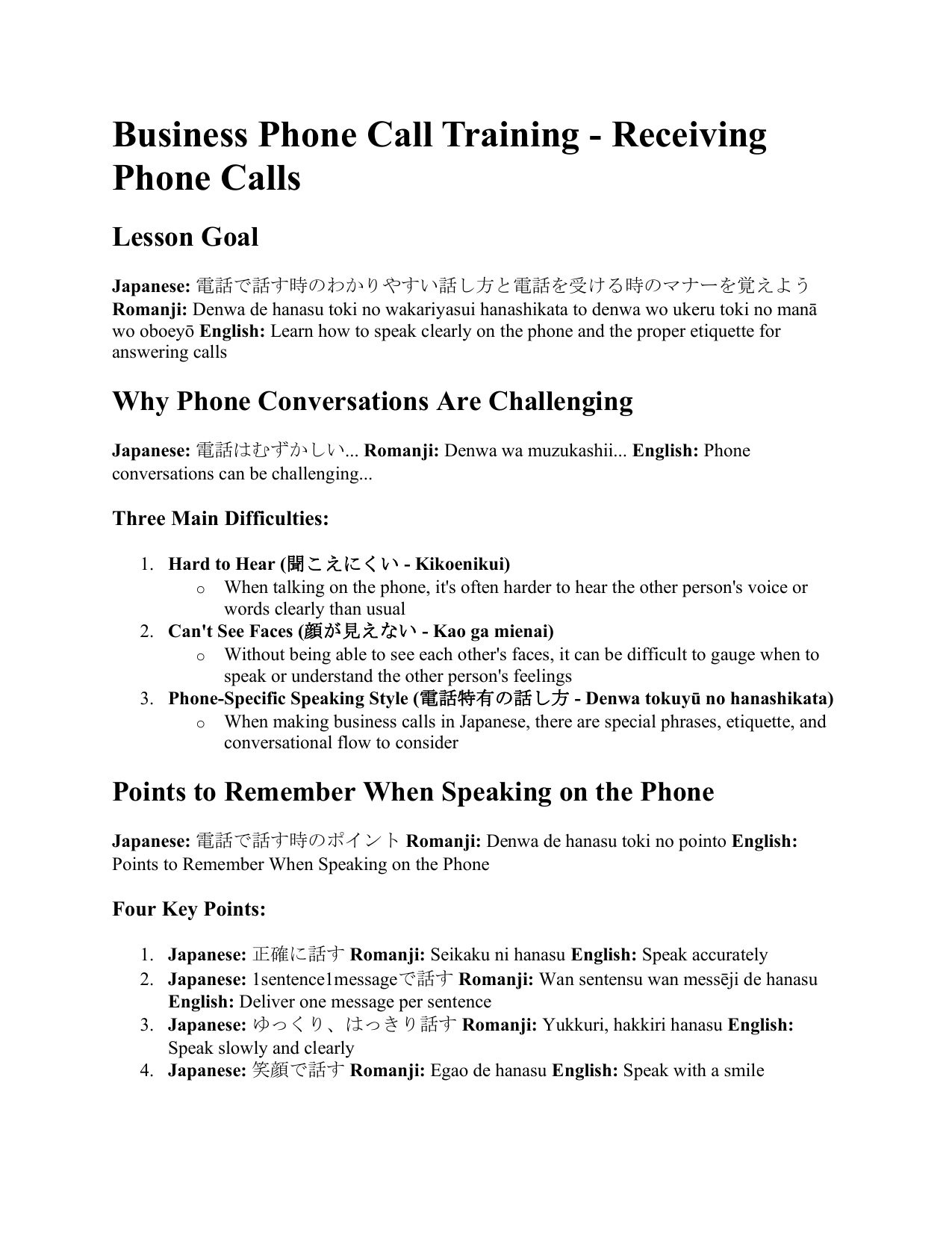
ENBusiness Phone Call Training - Receiving
Phone Calls
Lesson Goal
Phone Calls
Lesson Goal
JPJapanese:電話で話す時のわかりやすい話し方と電話を受ける時のマナーを覚えよう
ENRomanji: Denwa de hanasu toki no wakariyasui hanashikata to denwa wo ukeru toki no manā
wo oboeyō English: Learn how to speak clearly on the phone and the proper etiquette for
answering calls
Why Phone Conversations Are Challenging
Japanese: 電話はむずかしい... Romanji: Denwa wa muzukashii... English: Phone
conversations can be challenging...
Three Main Difficulties:
1. Hard to Hear (聞こえにくい - Kikoenikui)
o When talking on the phone, it's often harder to hear the other person's voice or
words clearly than usual
2. Can't See Faces (顔が見えない - Kao ga mienai)
o Without being able to see each other's faces, it can be difficult to gauge when to
speak or understand the other person's feelings
3. Phone-Specific Speaking Style (電話特有の話し方 - Denwa tokuyū no hanashikata)
o When making business calls in Japanese, there are special phrases, etiquette, and
conversational flow to consider
Points to Remember When Speaking on the Phone
Japanese: 電話で話す時のポイント Romanji: Denwa de hanasu toki no pointo English:
Points to Remember When Speaking on the Phone
Four Key Points:
1. Japanese: 正確に話す Romanji: Seikaku ni hanasu English: Speak accurately
2. Japanese: 1sentence1messageで話す Romanji: Wan sentensu wan messēji de hanasu
English: Deliver one message per sentence
3. Japanese: ゆっくり、はっきり話す Romanji: Yukkuri, hakkiri hanasu English:
Speak slowly and clearly
4. Japanese: 笑顔で話す Romanji: Egao de hanasu English: Speak with a smile
wo oboeyō English: Learn how to speak clearly on the phone and the proper etiquette for
answering calls
Why Phone Conversations Are Challenging
Japanese: 電話はむずかしい... Romanji: Denwa wa muzukashii... English: Phone
conversations can be challenging...
Three Main Difficulties:
1. Hard to Hear (聞こえにくい - Kikoenikui)
o When talking on the phone, it's often harder to hear the other person's voice or
words clearly than usual
2. Can't See Faces (顔が見えない - Kao ga mienai)
o Without being able to see each other's faces, it can be difficult to gauge when to
speak or understand the other person's feelings
3. Phone-Specific Speaking Style (電話特有の話し方 - Denwa tokuyū no hanashikata)
o When making business calls in Japanese, there are special phrases, etiquette, and
conversational flow to consider
Points to Remember When Speaking on the Phone
Japanese: 電話で話す時のポイント Romanji: Denwa de hanasu toki no pointo English:
Points to Remember When Speaking on the Phone
Four Key Points:
1. Japanese: 正確に話す Romanji: Seikaku ni hanasu English: Speak accurately
2. Japanese: 1sentence1messageで話す Romanji: Wan sentensu wan messēji de hanasu
English: Deliver one message per sentence
3. Japanese: ゆっくり、はっきり話す Romanji: Yukkuri, hakkiri hanasu English:
Speak slowly and clearly
4. Japanese: 笑顔で話す Romanji: Egao de hanasu English: Speak with a smile
หน้า 2
คลิกเพื่อขยาย
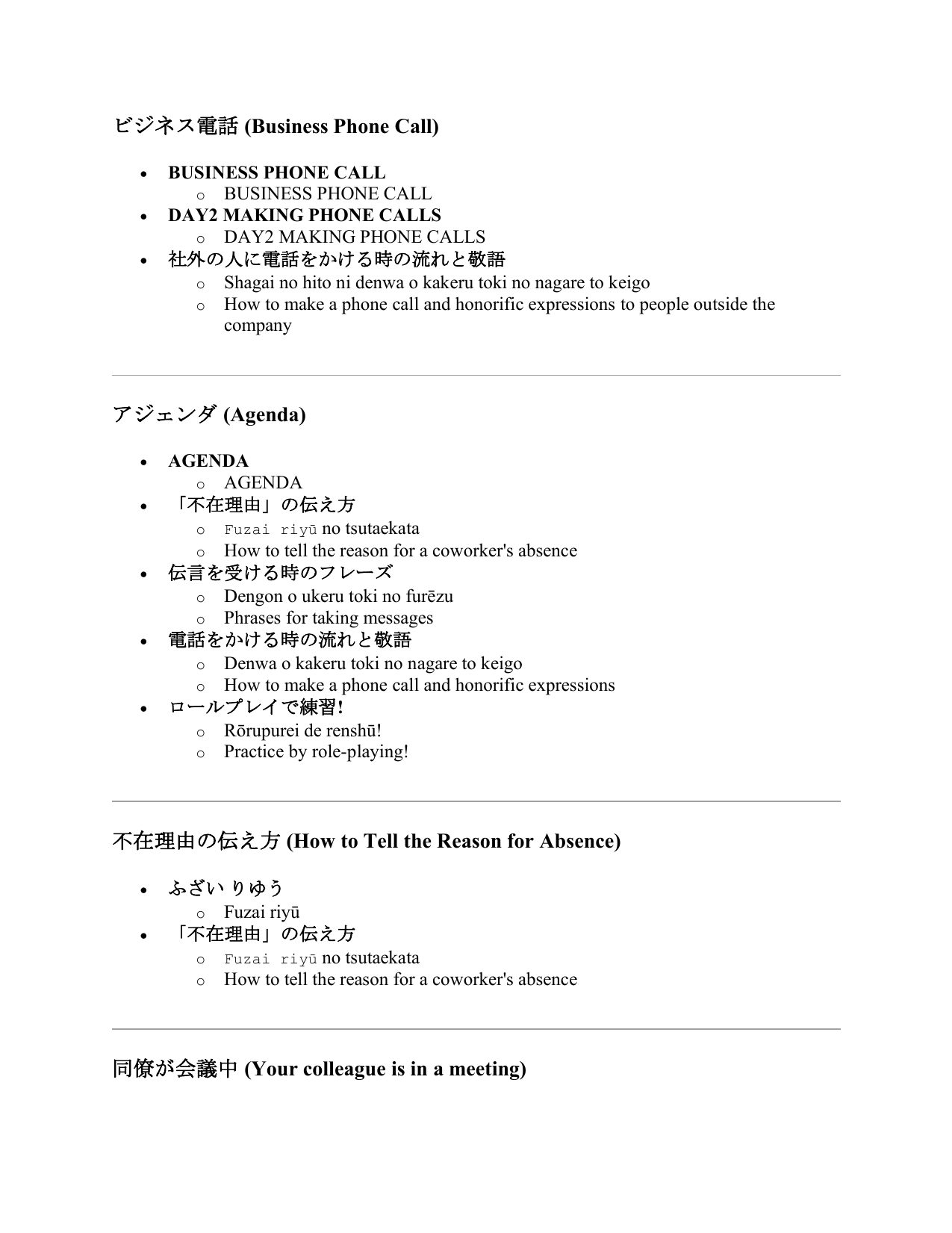
ENビジネス電話 (Business Phone Call)
• BUSINESS PHONE CALL
o BUSINESS PHONE CALL
• DAY2 MAKING PHONE CALLS
o DAY2 MAKING PHONE CALLS
• BUSINESS PHONE CALL
o BUSINESS PHONE CALL
• DAY2 MAKING PHONE CALLS
o DAY2 MAKING PHONE CALLS
JP•社外の人に電話をかける時の流れと敬語
EN o Shagai no hito ni denwa o kakeru toki no nagare to keigo
o How to make a phone call and honorific expressions to people outside the
company
アジェンダ (Agenda)
• AGENDA
o AGENDA
o How to make a phone call and honorific expressions to people outside the
company
アジェンダ (Agenda)
• AGENDA
o AGENDA
JP•「不在理由」の伝え方
EN o Fuzai riyū no tsutaekata
o How to tell the reason for a coworker's absence
o How to tell the reason for a coworker's absence
JP•伝言を受ける時のフレーズ
EN o Dengon o ukeru toki no furēzu
o Phrases for taking messages
o Phrases for taking messages
JP•電話をかける時の流れと敬語
EN o Denwa o kakeru toki no nagare to keigo
o How to make a phone call and honorific expressions
o How to make a phone call and honorific expressions
JP•ロールプレイで練習!
EN o Rōrupurei de renshū!
o Practice by role-playing!
不在理由の伝え方 (How to Tell the Reason for Absence)
o Practice by role-playing!
不在理由の伝え方 (How to Tell the Reason for Absence)
JP•ふざいりゆう
EN o Fuzai riyū
JP•「不在理由」の伝え方
EN o Fuzai riyū no tsutaekata
o How to tell the reason for a coworker's absence
同僚が会議中 (Your colleague is in a meeting)
o How to tell the reason for a coworker's absence
同僚が会議中 (Your colleague is in a meeting)
หน้า 3
คลิกเพื่อขยาย
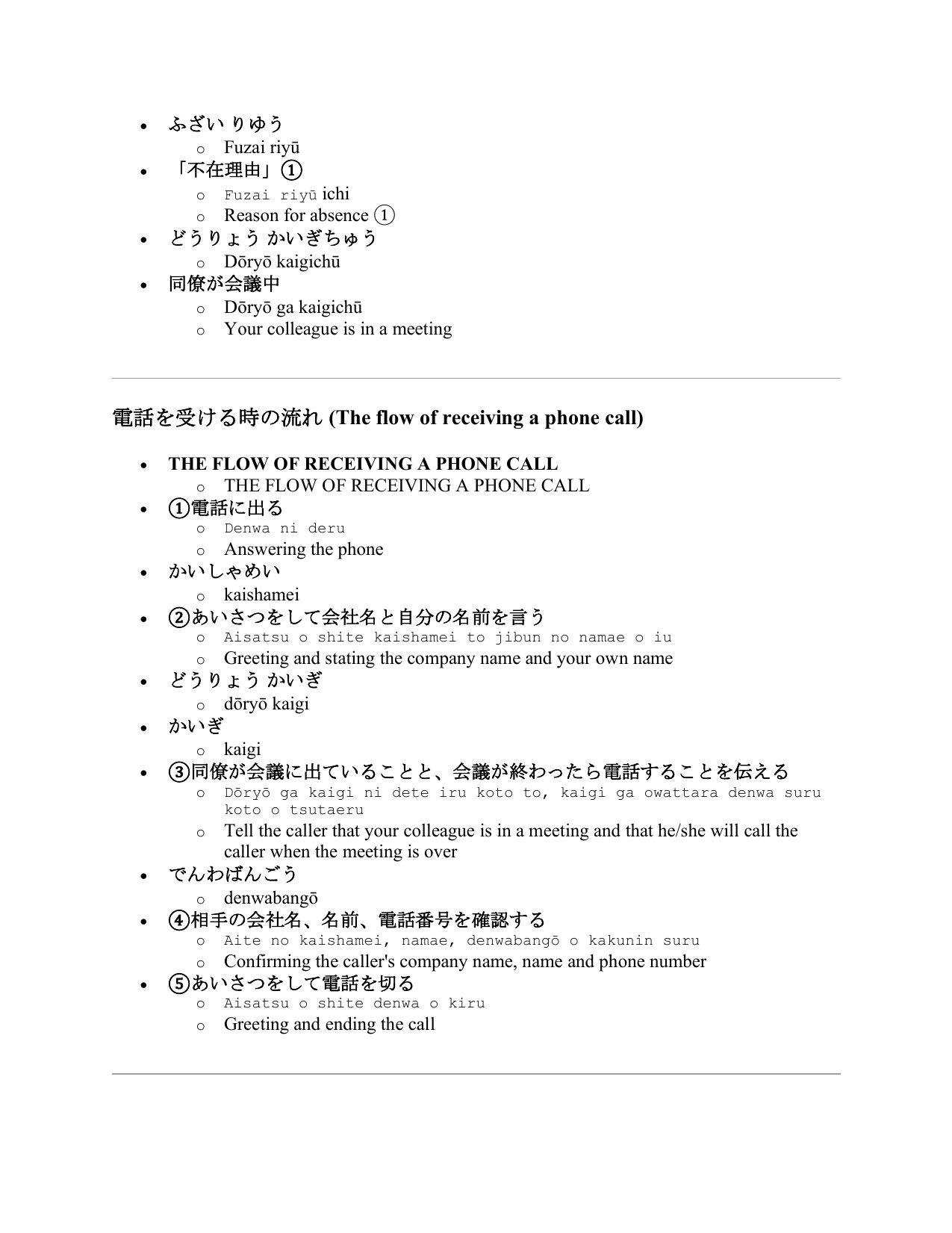
JP•ふざいりゆう
EN o Fuzai riyū
JP•「不在理由」①
EN o Fuzai riyū ichi
Reason for absence ①
o
Reason for absence ①
o
JP•どうりょうかいぎちゅう
EN o Dōryō kaigichū
JP•同僚が会議中
EN o Dōryō ga kaigichū
o Your colleague is in a meeting
電話を受ける時の流れ (The flow of receiving a phone call)
• THE FLOW OF RECEIVING A PHONE CALL
o THE FLOW OF RECEIVING A PHONE CALL
o Your colleague is in a meeting
電話を受ける時の流れ (The flow of receiving a phone call)
• THE FLOW OF RECEIVING A PHONE CALL
o THE FLOW OF RECEIVING A PHONE CALL
JP•①電話に出る
EN o Denwa ni deru
Answering the phone
o
Answering the phone
o
JP•かいしゃめい
EN o kaishamei
JP•②あいさつをして会社名と自分の名前を言う
EN o Aisatsu o shite kaishamei to jibun no namae o iu
Greeting and stating the company name and your own name
o
Greeting and stating the company name and your own name
o
JP•どうりょうかいぎ
EN o dōryō kaigi
JP•かいぎ
EN o kaigi
JP•③同僚が会議に出ていることと、会議が終わったら電話することを伝える
EN o Dōryō ga kaigi ni dete iru koto to, kaigi ga owattara denwa suru
koto o tsutaeru
Tell the caller that your colleague is in a meeting and that he/she will call the
o
caller when the meeting is over
koto o tsutaeru
Tell the caller that your colleague is in a meeting and that he/she will call the
o
caller when the meeting is over
JP•でんわばんごう
EN o denwabangō
JP•④相手の会社名、名前、電話番号を確認する
EN o Aite no kaishamei, namae, denwabangō o kakunin suru
Confirming the caller's company name, name and phone number
o
Confirming the caller's company name, name and phone number
o
JP•⑤あいさつをして電話を切る
EN o Aisatsu o shite denwa o kiru
o Greeting and ending the call
o Greeting and ending the call
หน้า 4
คลิกเพื่อขยาย
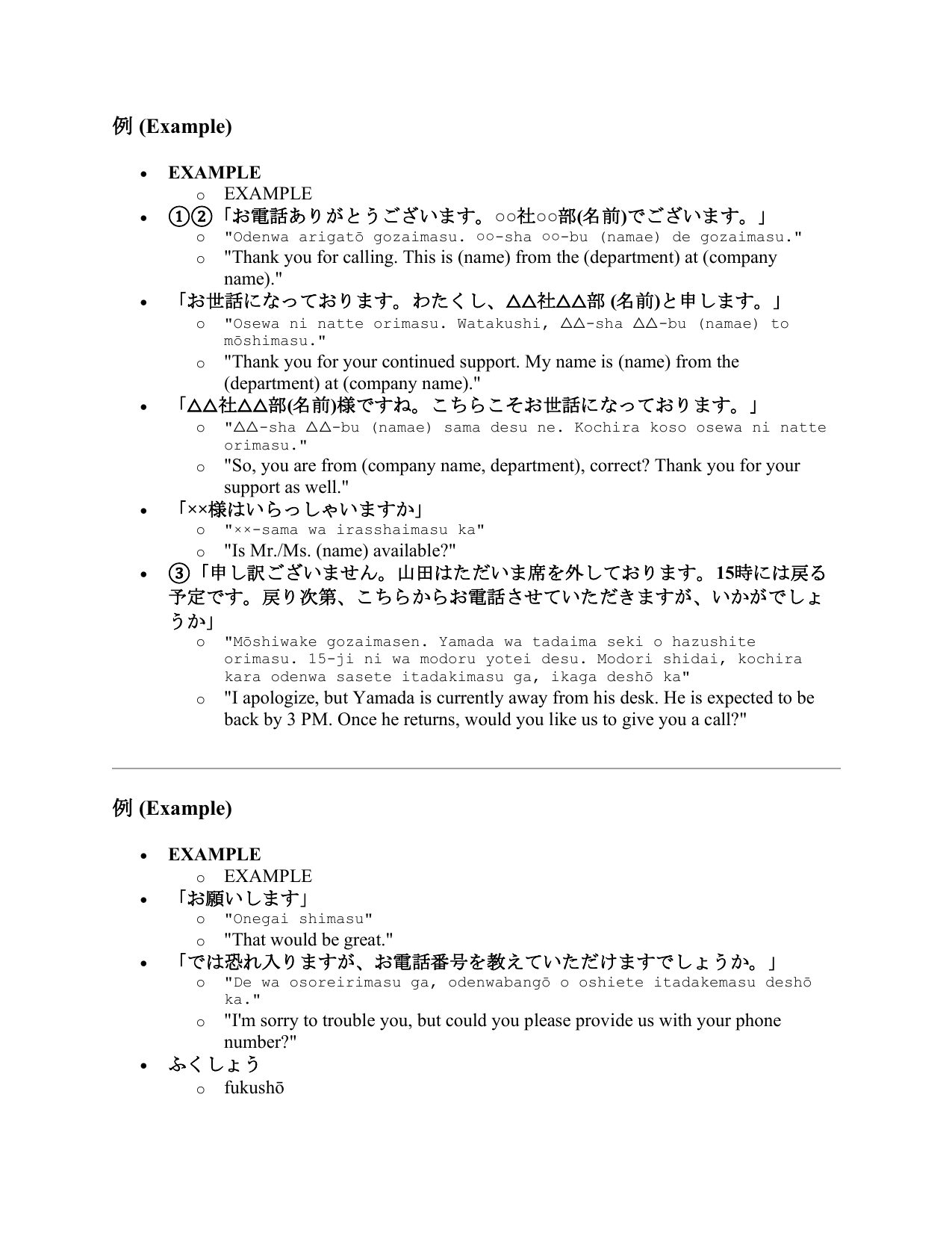
EN例 (Example)
• EXAMPLE
o EXAMPLE
• EXAMPLE
o EXAMPLE
JP•①②「お電話ありがとうございます。○○社○○部(名前)でございます。」
EN o "Odenwa arigatō gozaimasu. ○○-sha ○○-bu (namae) de gozaimasu."
"Thank you for calling. This is (name) from the (department) at (company
o
name)."
"Thank you for calling. This is (name) from the (department) at (company
o
name)."
JP•「お世話になっております。わたくし、△△社△△部(名前)と申します。」
EN o "Osewa ni natte orimasu. Watakushi, △△-sha △△-bu (namae) to
mōshimasu."
"Thank you for your continued support. My name is (name) from the
o
(department) at (company name)."
mōshimasu."
"Thank you for your continued support. My name is (name) from the
o
(department) at (company name)."
JP•「△△社△△部(名前)様ですね。こちらこそお世話になっております。」
EN o "△△-sha △△-bu (namae) sama desu ne. Kochira koso osewa ni natte
orimasu."
o"So, you are from (company name, department), correct? Thank you for your
support as well."
orimasu."
o"So, you are from (company name, department), correct? Thank you for your
support as well."
JP•「××様はいらっしゃいますか」
EN o "××-sama wa irasshaimasu ka"
"Is Mr./Ms. (name) available?"
o
"Is Mr./Ms. (name) available?"
o
JP•③「申し訳ございません。山田はただいま席を外しております。15時には戻る
予定です。戻り次第、こちらからお電話させていただきますが、いかがでしょ
うか」
予定です。戻り次第、こちらからお電話させていただきますが、いかがでしょ
うか」
EN o "Mōshiwake gozaimasen. Yamada wa tadaima seki o hazushite
orimasu. 15-ji ni wa modoru yotei desu. Modori shidai, kochira
kara odenwa sasete itadakimasu ga, ikaga deshō ka"
o "I apologize, but Yamada is currently away from his desk. He is expected to be
back by 3 PM. Once he returns, would you like us to give you a call?"
例 (Example)
• EXAMPLE
o EXAMPLE
orimasu. 15-ji ni wa modoru yotei desu. Modori shidai, kochira
kara odenwa sasete itadakimasu ga, ikaga deshō ka"
o "I apologize, but Yamada is currently away from his desk. He is expected to be
back by 3 PM. Once he returns, would you like us to give you a call?"
例 (Example)
• EXAMPLE
o EXAMPLE
JP•「お願いします」
EN o "Onegai shimasu"
"That would be great."
o
"That would be great."
o
JP•「では恐れ入りますが、お電話番号を教えていただけますでしょうか。」
EN o "De wa osoreirimasu ga, odenwabangō o oshiete itadakemasu deshō
ka."
"I'm sorry to trouble you, but could you please provide us with your phone
o
number?"
ka."
"I'm sorry to trouble you, but could you please provide us with your phone
o
number?"
JP•ふくしょう
EN o fukushō
หน้า 5
คลิกเพื่อขยาย
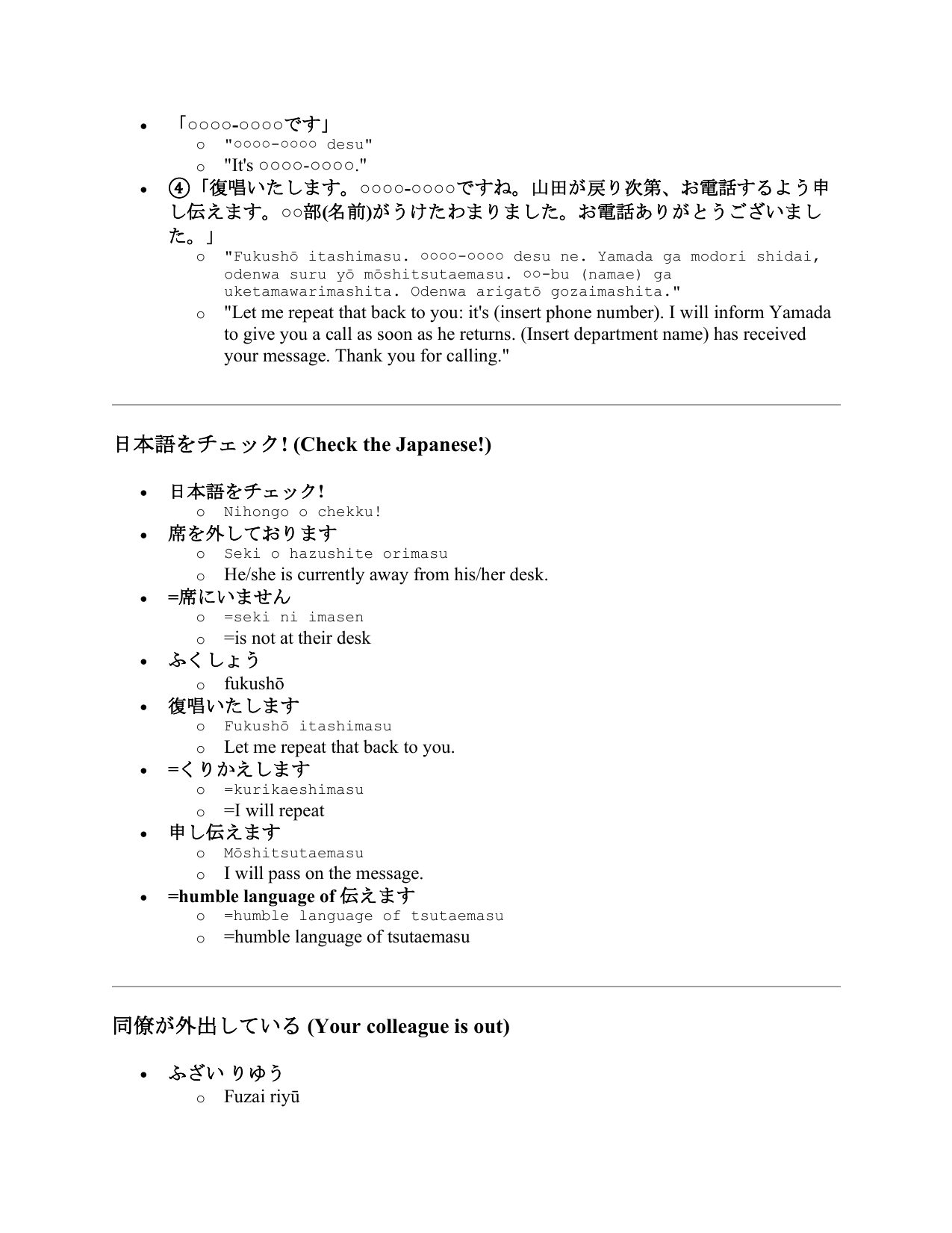
JP•「○○○○-○○○○です」
EN o "○○○○-○○○○ desu"
"It's ○○○○-○○○○."
o
"It's ○○○○-○○○○."
o
JP•④「復唱いたします。○○○○-○○○○ですね。山田が戻り次第、お電話するよう申
し伝えます。○○部(名前)がうけたわまりました。お電話ありがとうございまし
た。」
し伝えます。○○部(名前)がうけたわまりました。お電話ありがとうございまし
た。」
EN o "Fukushō itashimasu. ○○○○-○○○○ desu ne. Yamada ga modori shidai,
odenwa suru yō mōshitsutaemasu. ○○-bu (namae) ga
uketamawarimashita. Odenwa arigatō gozaimashita."
o "Let me repeat that back to you: it's (insert phone number). I will inform Yamada
to give you a call as soon as he returns. (Insert department name) has received
your message. Thank you for calling."
日本語をチェック! (Check the Japanese!)
odenwa suru yō mōshitsutaemasu. ○○-bu (namae) ga
uketamawarimashita. Odenwa arigatō gozaimashita."
o "Let me repeat that back to you: it's (insert phone number). I will inform Yamada
to give you a call as soon as he returns. (Insert department name) has received
your message. Thank you for calling."
日本語をチェック! (Check the Japanese!)
JP•日本語をチェック!
EN o Nihongo o chekku!
JP•席を外しております
EN o Seki o hazushite orimasu
He/she is currently away from his/her desk.
o
He/she is currently away from his/her desk.
o
JP•=席にいません
EN o =seki ni imasen
=is not at their desk
o
=is not at their desk
o
JP•ふくしょう
EN o fukushō
JP•復唱いたします
EN o Fukushō itashimasu
Let me repeat that back to you.
o
Let me repeat that back to you.
o
JP•=くりかえします
EN o =kurikaeshimasu
=I will repeat
o
=I will repeat
o
JP•申し伝えます
EN o Mōshitsutaemasu
o I will pass on the message.
• =humble language of 伝えます
o =humble language of tsutaemasu
o =humble language of tsutaemasu
同僚が外出している (Your colleague is out)
o I will pass on the message.
• =humble language of 伝えます
o =humble language of tsutaemasu
o =humble language of tsutaemasu
同僚が外出している (Your colleague is out)
JP•ふざいりゆう
EN o Fuzai riyū
หน้า 6
คลิกเพื่อขยาย
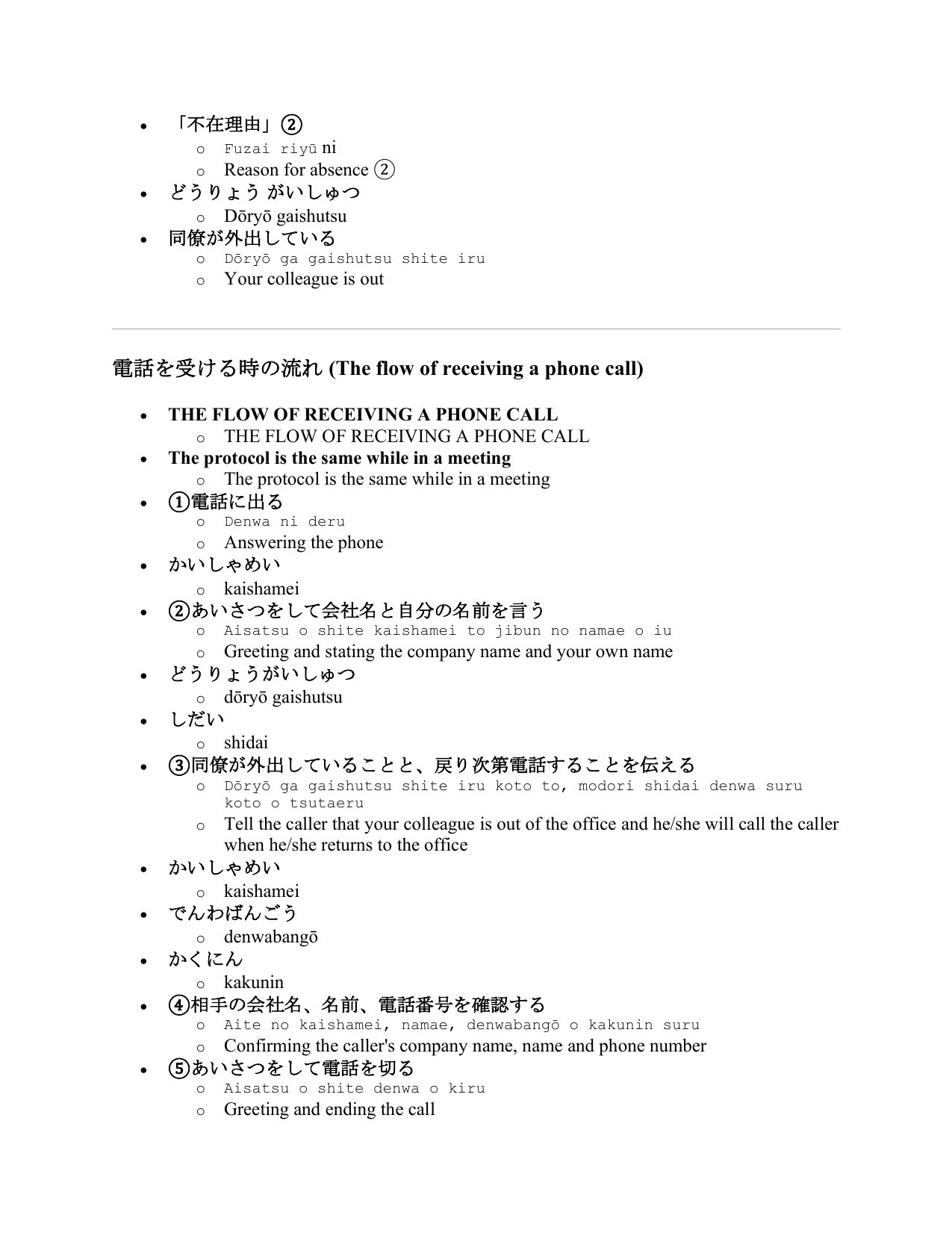
JP•「不在理由」②
EN o Fuzai riyū ni
Reason for absence ②
o
Reason for absence ②
o
JP•どうりょうがいしゅつ
EN o Dōryō gaishutsu
JP•同僚が外出している
EN o Dōryō ga gaishutsu shite iru
o Your colleague is out
電話を受ける時の流れ (The flow of receiving a phone call)
• THE FLOW OF RECEIVING A PHONE CALL
o THE FLOW OF RECEIVING A PHONE CALL
• The protocol is the same while in a meeting
o The protocol is the same while in a meeting
o Your colleague is out
電話を受ける時の流れ (The flow of receiving a phone call)
• THE FLOW OF RECEIVING A PHONE CALL
o THE FLOW OF RECEIVING A PHONE CALL
• The protocol is the same while in a meeting
o The protocol is the same while in a meeting
JP•①電話に出る
EN o Denwa ni deru
Answering the phone
o
Answering the phone
o
JP•かいしゃめい
EN o kaishamei
JP•②あいさつをして会社名と自分の名前を言う
EN o Aisatsu o shite kaishamei to jibun no namae o iu
Greeting and stating the company name and your own name
o
Greeting and stating the company name and your own name
o
JP•どうりょうがいしゅつ
EN o dōryō gaishutsu
JP•しだい
EN o shidai
JP•③同僚が外出していることと、戻り次第電話することを伝える
EN o Dōryō ga gaishutsu shite iru koto to, modori shidai denwa suru
koto o tsutaeru
Tell the caller that your colleague is out of the office and he/she will call the caller
o
when he/she returns to the office
koto o tsutaeru
Tell the caller that your colleague is out of the office and he/she will call the caller
o
when he/she returns to the office
JP•かいしゃめい
EN o kaishamei
JP•でんわばんごう
EN o denwabangō
JP•かくにん
EN o kakunin
JP•④相手の会社名、名前、電話番号を確認する
EN o Aite no kaishamei, namae, denwabangō o kakunin suru
Confirming the caller's company name, name and phone number
o
Confirming the caller's company name, name and phone number
o
JP•⑤あいさつをして電話を切る
EN o Aisatsu o shite denwa o kiru
o Greeting and ending the call
o Greeting and ending the call
หน้า 7
คลิกเพื่อขยาย
EN日本語をチェック! (Check the Japanese!)
JP•日本語をチェック!
EN o Nihongo o chekku!
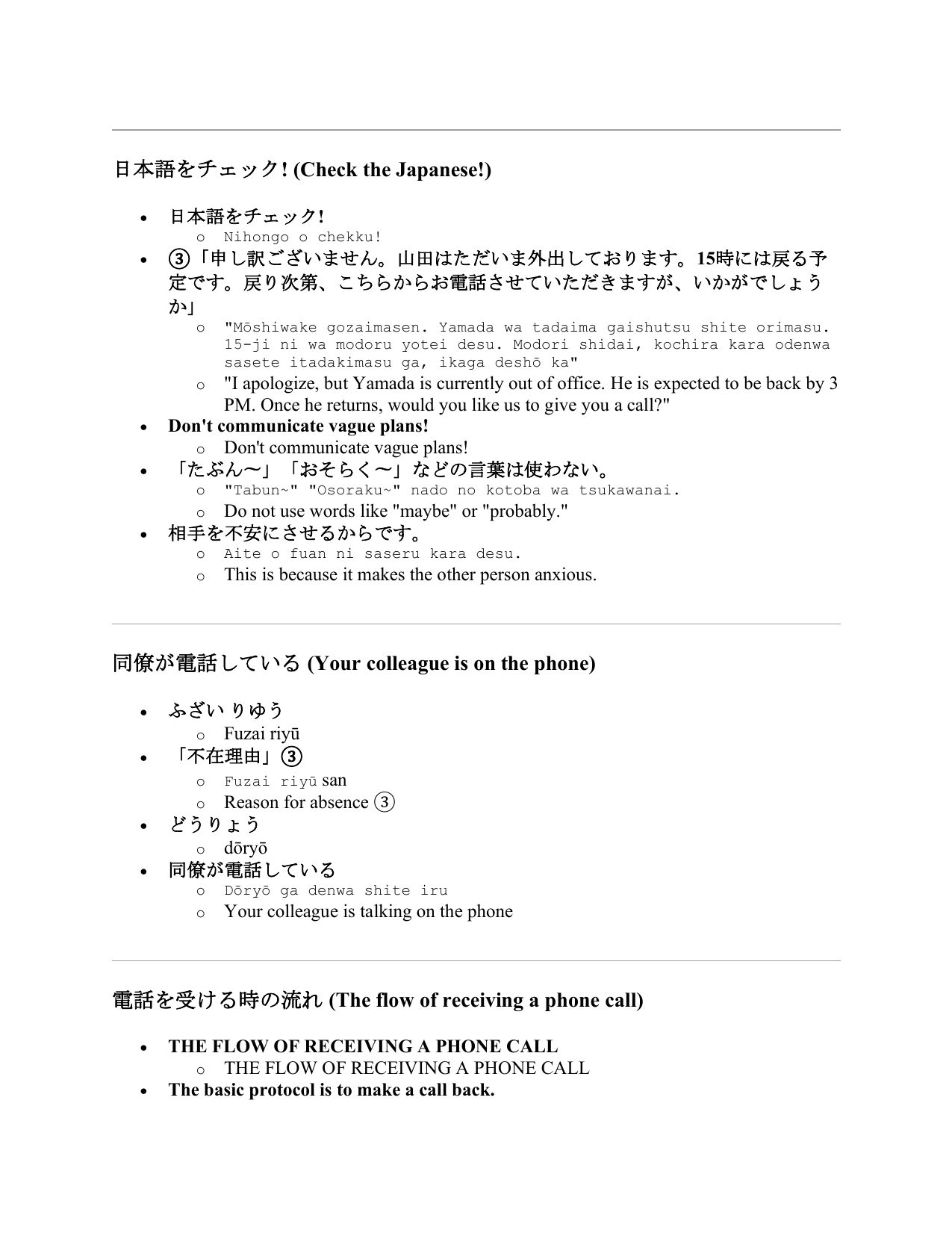
JP•③「申し訳ございません。山田はただいま外出しております。15時には戻る予
定です。戻り次第、こちらからお電話させていただきますが、いかがでしょう
か」
定です。戻り次第、こちらからお電話させていただきますが、いかがでしょう
か」
EN o "Mōshiwake gozaimasen. Yamada wa tadaima gaishutsu shite orimasu.
15-ji ni wa modoru yotei desu. Modori shidai, kochira kara odenwa
sasete itadakimasu ga, ikaga deshō ka"
o "I apologize, but Yamada is currently out of office. He is expected to be back by 3
PM. Once he returns, would you like us to give you a call?"
• Don't communicate vague plans!
o Don't communicate vague plans!
15-ji ni wa modoru yotei desu. Modori shidai, kochira kara odenwa
sasete itadakimasu ga, ikaga deshō ka"
o "I apologize, but Yamada is currently out of office. He is expected to be back by 3
PM. Once he returns, would you like us to give you a call?"
• Don't communicate vague plans!
o Don't communicate vague plans!
JP•「たぶん〜」「おそらく〜」などの言葉は使わない。
EN o "Tabun~" "Osoraku~" nado no kotoba wa tsukawanai.
Do not use words like "maybe" or "probably."
o
Do not use words like "maybe" or "probably."
o
JP•相手を不安にさせるからです。
EN o Aite o fuan ni saseru kara desu.
o This is because it makes the other person anxious.
同僚が電話している (Your colleague is on the phone)
o This is because it makes the other person anxious.
同僚が電話している (Your colleague is on the phone)
JP•ふざいりゆう
EN o Fuzai riyū
JP•「不在理由」③
EN o Fuzai riyū san
Reason for absence ③
o
Reason for absence ③
o
JP•どうりょう
EN o dōryō
JP•同僚が電話している
EN o Dōryō ga denwa shite iru
o Your colleague is talking on the phone
電話を受ける時の流れ (The flow of receiving a phone call)
• THE FLOW OF RECEIVING A PHONE CALL
o THE FLOW OF RECEIVING A PHONE CALL
• The basic protocol is to make a call back.
o Your colleague is talking on the phone
電話を受ける時の流れ (The flow of receiving a phone call)
• THE FLOW OF RECEIVING A PHONE CALL
o THE FLOW OF RECEIVING A PHONE CALL
• The basic protocol is to make a call back.
หน้า 8
คลิกเพื่อขยาย
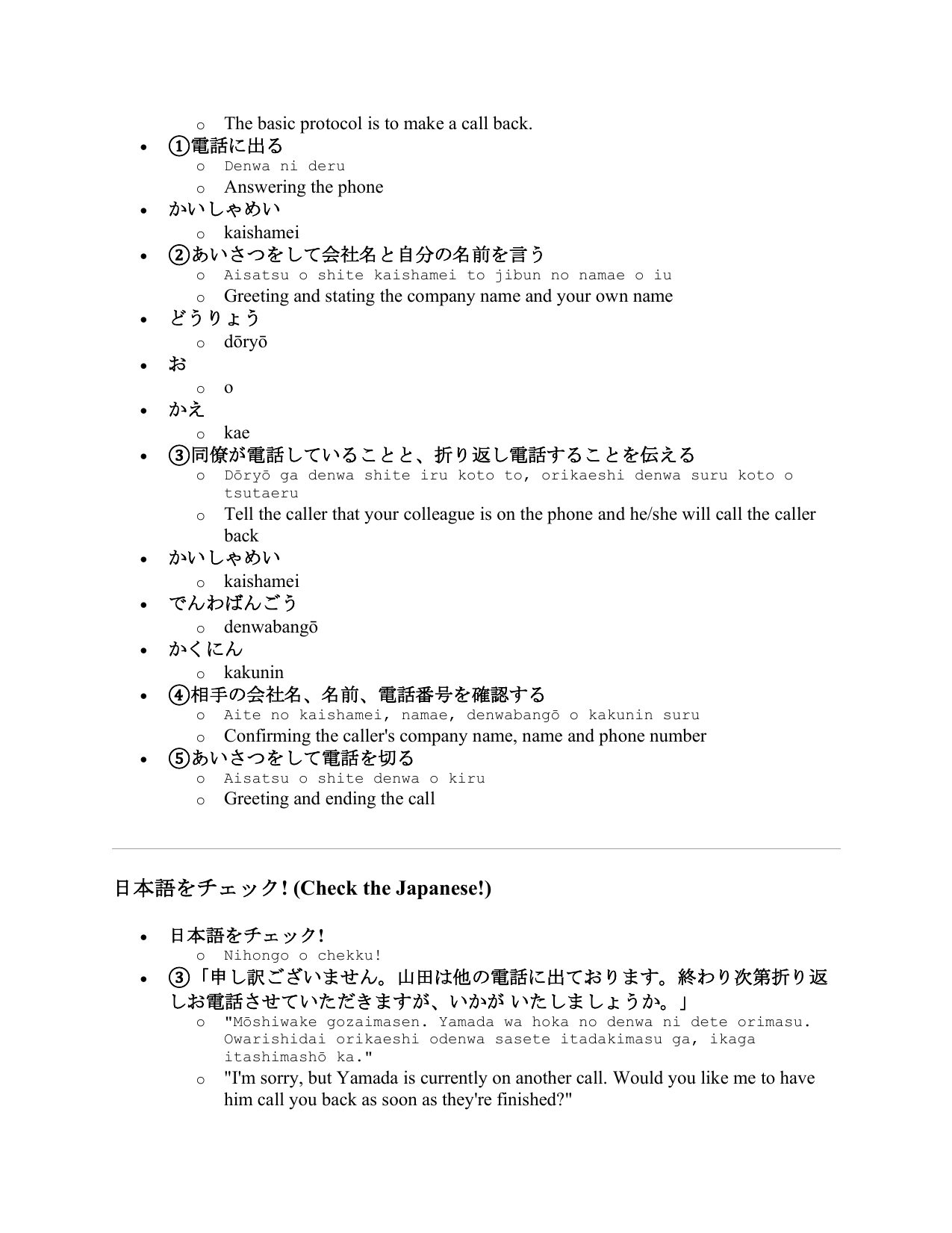
EN The basic protocol is to make a call back.
o
o
JP•①電話に出る
EN o Denwa ni deru
Answering the phone
o
Answering the phone
o
JP•かいしゃめい
EN o kaishamei
JP•②あいさつをして会社名と自分の名前を言う
EN o Aisatsu o shite kaishamei to jibun no namae o iu
oGreeting and stating the company name and your own name
oGreeting and stating the company name and your own name
JP•どうりょう
EN o dōryō
JP•お
EN o o
JP•かえ
EN o kae
JP•③同僚が電話していることと、折り返し電話することを伝える
EN o Dōryō ga denwa shite iru koto to, orikaeshi denwa suru koto o
tsutaeru
Tell the caller that your colleague is on the phone and he/she will call the caller
o
back
tsutaeru
Tell the caller that your colleague is on the phone and he/she will call the caller
o
back
JP•かいしゃめい
EN o kaishamei
JP•でんわばんごう
EN o denwabangō
JP•かくにん
EN o kakunin
JP•④相手の会社名、名前、電話番号を確認する
EN o Aite no kaishamei, namae, denwabangō o kakunin suru
Confirming the caller's company name, name and phone number
o
Confirming the caller's company name, name and phone number
o
JP•⑤あいさつをして電話を切る
EN o Aisatsu o shite denwa o kiru
o Greeting and ending the call
日本語をチェック! (Check the Japanese!)
o Greeting and ending the call
日本語をチェック! (Check the Japanese!)
JP•日本語をチェック!
EN o Nihongo o chekku!
JP•③「申し訳ございません。山田は他の電話に出ております。終わり次第折り返
しお電話させていただきますが、いかがいたしましょうか。」
しお電話させていただきますが、いかがいたしましょうか。」
EN o "Mōshiwake gozaimasen. Yamada wa hoka no denwa ni dete orimasu.
Owarishidai orikaeshi odenwa sasete itadakimasu ga, ikaga
itashimashō ka."
o "I'm sorry, but Yamada is currently on another call. Would you like me to have
him call you back as soon as they're finished?"
Owarishidai orikaeshi odenwa sasete itadakimasu ga, ikaga
itashimashō ka."
o "I'm sorry, but Yamada is currently on another call. Would you like me to have
him call you back as soon as they're finished?"
หน้า 9
คลิกเพื่อขยาย
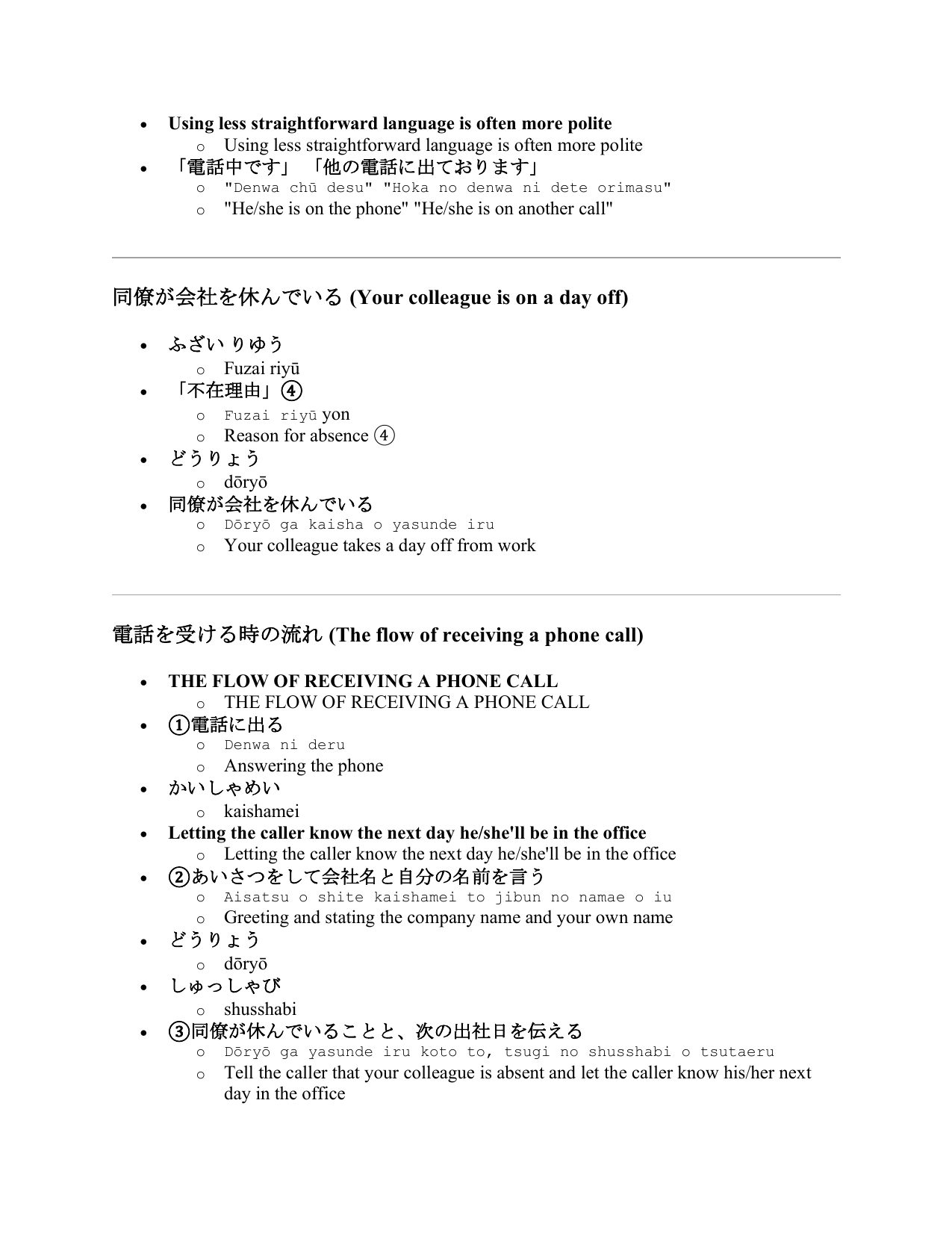
EN • Using less straightforward language is often more polite
o Using less straightforward language is often more polite
o Using less straightforward language is often more polite
JP•「電話中です」「他の電話に出ております」
EN o "Denwa chū desu" "Hoka no denwa ni dete orimasu"
o "He/she is on the phone" "He/she is on another call"
同僚が会社を休んでいる (Your colleague is on a day off)
o "He/she is on the phone" "He/she is on another call"
同僚が会社を休んでいる (Your colleague is on a day off)
JP•ふざいりゆう
EN o Fuzai riyū
JP•「不在理由」④
EN o Fuzai riyū yon
Reason for absence ④
o
Reason for absence ④
o
JP•どうりょう
EN o dōryō
JP•同僚が会社を休んでいる
EN o Dōryō ga kaisha o yasunde iru
o Your colleague takes a day off from work
電話を受ける時の流れ (The flow of receiving a phone call)
• THE FLOW OF RECEIVING A PHONE CALL
o THE FLOW OF RECEIVING A PHONE CALL
o Your colleague takes a day off from work
電話を受ける時の流れ (The flow of receiving a phone call)
• THE FLOW OF RECEIVING A PHONE CALL
o THE FLOW OF RECEIVING A PHONE CALL
JP•①電話に出る
EN o Denwa ni deru
o Answering the phone
o Answering the phone
JP•かいしゃめい
EN o kaishamei
• Letting the caller know the next day he/she'll be in the office
o Letting the caller know the next day he/she'll be in the office
• Letting the caller know the next day he/she'll be in the office
o Letting the caller know the next day he/she'll be in the office
JP•②あいさつをして会社名と自分の名前を言う
EN o Aisatsu o shite kaishamei to jibun no namae o iu
Greeting and stating the company name and your own name
o
Greeting and stating the company name and your own name
o
JP•どうりょう
EN o dōryō
JP•しゅっしゃび
EN o shusshabi
JP•③同僚が休んでいることと、次の出社日を伝える
EN o Dōryō ga yasunde iru koto to, tsugi no shusshabi o tsutaeru
o Tell the caller that your colleague is absent and let the caller know his/her next
day in the office
o Tell the caller that your colleague is absent and let the caller know his/her next
day in the office
หน้า 10
คลิกเพื่อขยาย
JP•でんわばんごう
EN o denwabangō
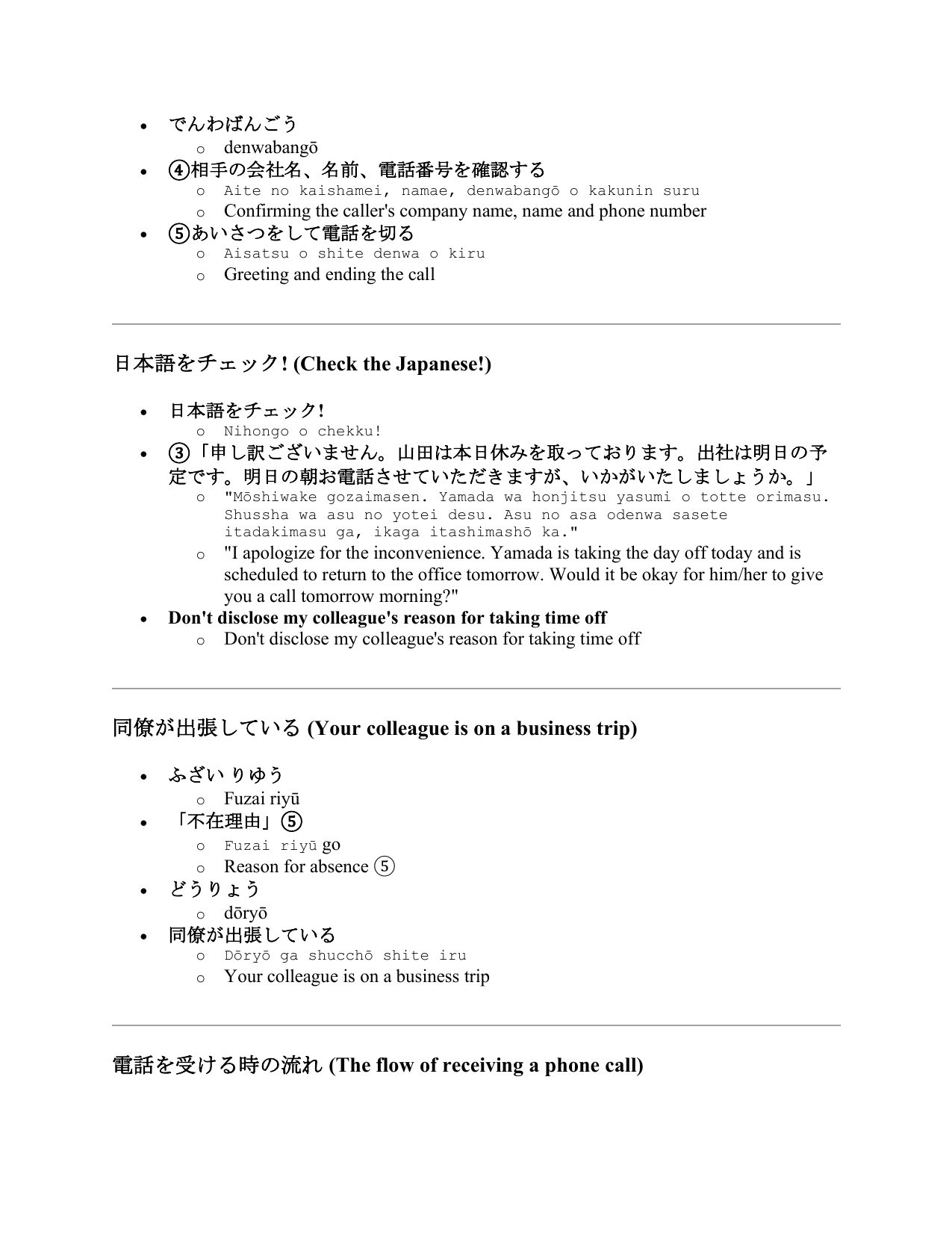
JP•④相手の会社名、名前、電話番号を確認する
EN o Aite no kaishamei, namae, denwabangō o kakunin suru
Confirming the caller's company name, name and phone number
o
Confirming the caller's company name, name and phone number
o
JP•⑤あいさつをして電話を切る
EN o Aisatsu o shite denwa o kiru
o Greeting and ending the call
日本語をチェック! (Check the Japanese!)
o Greeting and ending the call
日本語をチェック! (Check the Japanese!)
JP•日本語をチェック!
EN o Nihongo o chekku!
JP•③「申し訳ございません。山田は本日休みを取っております。出社は明日の予
定です。明日の朝お電話させていただきますが、いかがいたしましょうか。」
定です。明日の朝お電話させていただきますが、いかがいたしましょうか。」
EN o "Mōshiwake gozaimasen. Yamada wa honjitsu yasumi o totte orimasu.
Shussha wa asu no yotei desu. Asu no asa odenwa sasete
itadakimasu ga, ikaga itashimashō ka."
o "I apologize for the inconvenience. Yamada is taking the day off today and is
scheduled to return to the office tomorrow. Would it be okay for him/her to give
you a call tomorrow morning?"
• Don't disclose my colleague's reason for taking time off
o Don't disclose my colleague's reason for taking time off
同僚が出張している (Your colleague is on a business trip)
Shussha wa asu no yotei desu. Asu no asa odenwa sasete
itadakimasu ga, ikaga itashimashō ka."
o "I apologize for the inconvenience. Yamada is taking the day off today and is
scheduled to return to the office tomorrow. Would it be okay for him/her to give
you a call tomorrow morning?"
• Don't disclose my colleague's reason for taking time off
o Don't disclose my colleague's reason for taking time off
同僚が出張している (Your colleague is on a business trip)
JP•ふざいりゆう
EN o Fuzai riyū
JP•「不在理由」⑤
EN o Fuzai riyū go
Reason for absence ⑤
o
Reason for absence ⑤
o
JP•どうりょう
EN o dōryō
JP•同僚が出張している
EN o Dōryō ga shucchō shite iru
o Your colleague is on a business trip
電話を受ける時の流れ (The flow of receiving a phone call)
o Your colleague is on a business trip
電話を受ける時の流れ (The flow of receiving a phone call)
หน้า 11
คลิกเพื่อขยาย
EN • THE FLOW OF RECEIVING A PHONE CALL
o THE FLOW OF RECEIVING A PHONE CALL
o THE FLOW OF RECEIVING A PHONE CALL
JP•①電話に出る
EN o Denwa ni deru
o Answering the phone
o Answering the phone
JP•かいしゃめい
EN o kaishamei
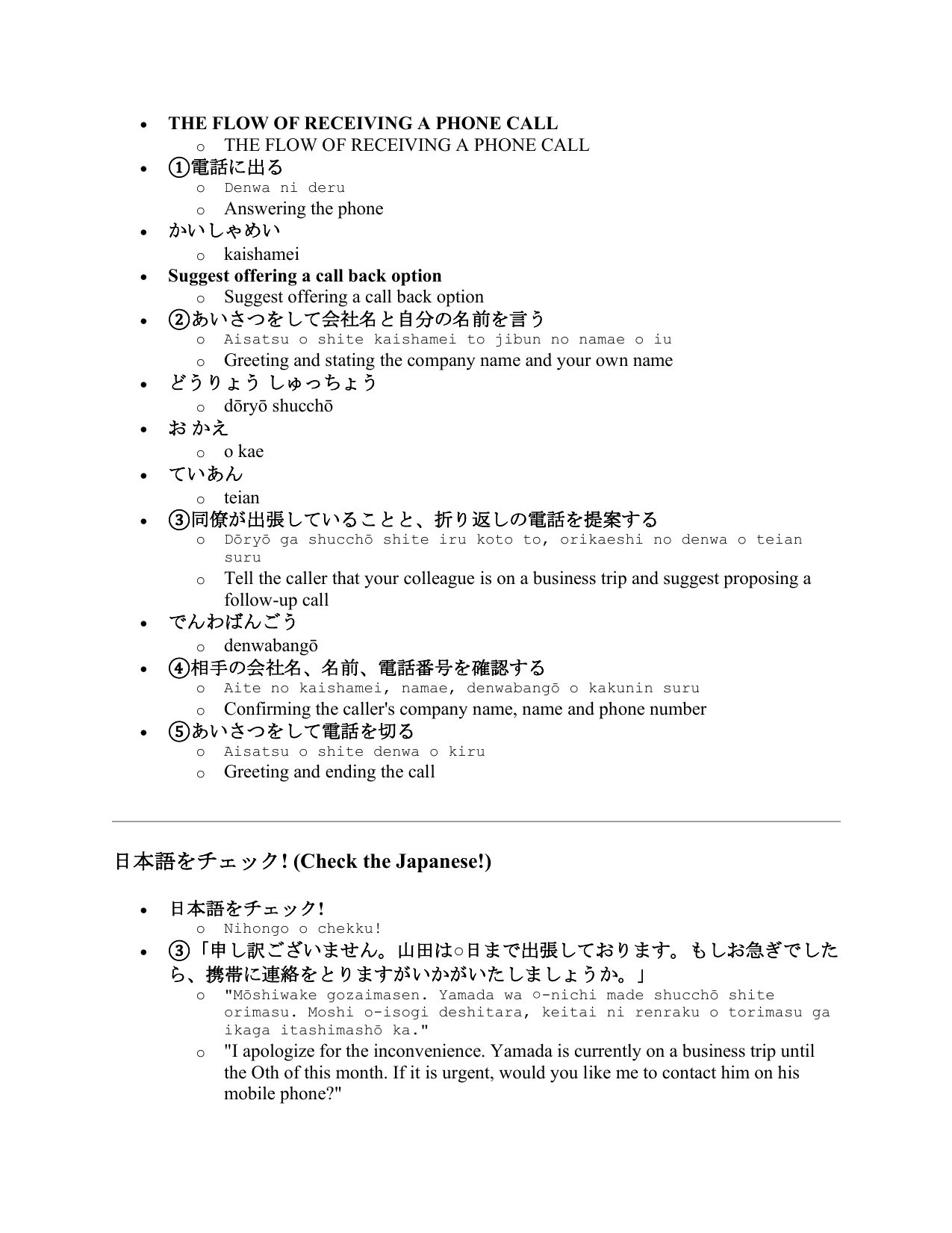
• Suggest offering a call back option
o Suggest offering a call back option
• Suggest offering a call back option
o Suggest offering a call back option
JP•②あいさつをして会社名と自分の名前を言う
EN o Aisatsu o shite kaishamei to jibun no namae o iu
oGreeting and stating the company name and your own name
oGreeting and stating the company name and your own name
JP•どうりょうしゅっちょう
EN o dōryō shucchō
JP•おかえ
EN o o kae
JP•ていあん
EN o teian
JP•③同僚が出張していることと、折り返しの電話を提案する
EN o Dōryō ga shucchō shite iru koto to, orikaeshi no denwa o teian
suru
Tell the caller that your colleague is on a business trip and suggest proposing a
o
follow-up call
suru
Tell the caller that your colleague is on a business trip and suggest proposing a
o
follow-up call
JP•でんわばんごう
EN o denwabangō
JP•④相手の会社名、名前、電話番号を確認する
EN o Aite no kaishamei, namae, denwabangō o kakunin suru
Confirming the caller's company name, name and phone number
o
Confirming the caller's company name, name and phone number
o
JP•⑤あいさつをして電話を切る
EN o Aisatsu o shite denwa o kiru
o Greeting and ending the call
日本語をチェック! (Check the Japanese!)
o Greeting and ending the call
日本語をチェック! (Check the Japanese!)
JP•日本語をチェック!
EN o Nihongo o chekku!
JP•③「申し訳ございません。山田は○日まで出張しております。もしお急ぎでした
ら、携帯に連絡をとりますがいかがいたしましょうか。」
ら、携帯に連絡をとりますがいかがいたしましょうか。」
EN o "Mōshiwake gozaimasen. Yamada wa ○-nichi made shucchō shite
orimasu. Moshi o-isogi deshitara, keitai ni renraku o torimasu ga
ikaga itashimashō ka."
o "I apologize for the inconvenience. Yamada is currently on a business trip until
the Oth of this month. If it is urgent, would you like me to contact him on his
mobile phone?"
orimasu. Moshi o-isogi deshitara, keitai ni renraku o torimasu ga
ikaga itashimashō ka."
o "I apologize for the inconvenience. Yamada is currently on a business trip until
the Oth of this month. If it is urgent, would you like me to contact him on his
mobile phone?"
หน้า 12
คลิกเพื่อขยาย
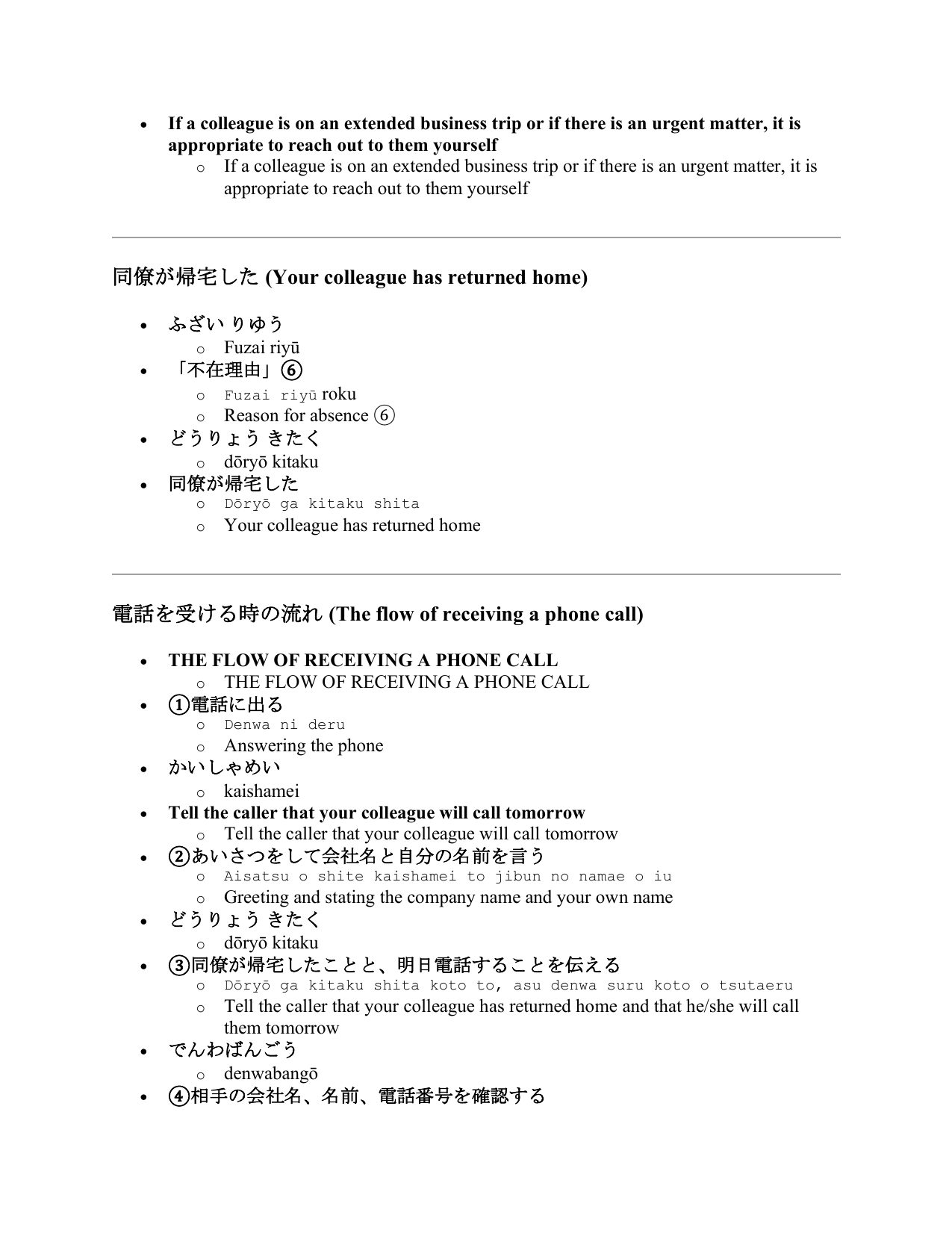
EN • If a colleague is on an extended business trip or if there is an urgent matter, it is
appropriate to reach out to them yourself
o If a colleague is on an extended business trip or if there is an urgent matter, it is
appropriate to reach out to them yourself
同僚が帰宅した (Your colleague has returned home)
appropriate to reach out to them yourself
o If a colleague is on an extended business trip or if there is an urgent matter, it is
appropriate to reach out to them yourself
同僚が帰宅した (Your colleague has returned home)
JP•ふざいりゆう
EN o Fuzai riyū
JP•「不在理由」⑥
EN o Fuzai riyū roku
Reason for absence ⑥
o
Reason for absence ⑥
o
JP•どうりょうきたく
EN o dōryō kitaku
JP•同僚が帰宅した
EN o Dōryō ga kitaku shita
o Your colleague has returned home
電話を受ける時の流れ (The flow of receiving a phone call)
• THE FLOW OF RECEIVING A PHONE CALL
o THE FLOW OF RECEIVING A PHONE CALL
o Your colleague has returned home
電話を受ける時の流れ (The flow of receiving a phone call)
• THE FLOW OF RECEIVING A PHONE CALL
o THE FLOW OF RECEIVING A PHONE CALL
JP•①電話に出る
EN o Denwa ni deru
o Answering the phone
o Answering the phone
JP•かいしゃめい
EN o kaishamei
• Tell the caller that your colleague will call tomorrow
o Tell the caller that your colleague will call tomorrow
• Tell the caller that your colleague will call tomorrow
o Tell the caller that your colleague will call tomorrow
JP•②あいさつをして会社名と自分の名前を言う
EN o Aisatsu o shite kaishamei to jibun no namae o iu
Greeting and stating the company name and your own name
o
Greeting and stating the company name and your own name
o
JP•どうりょうきたく
EN o dōryō kitaku
JP•③同僚が帰宅したことと、明日電話することを伝える
EN o Dōryō ga kitaku shita koto to, asu denwa suru koto o tsutaeru
Tell the caller that your colleague has returned home and that he/she will call
o
them tomorrow
Tell the caller that your colleague has returned home and that he/she will call
o
them tomorrow
JP•でんわばんごう
EN o denwabangō
JP•④相手の会社名、名前、電話番号を確認する
หน้า 13
คลิกเพื่อขยาย
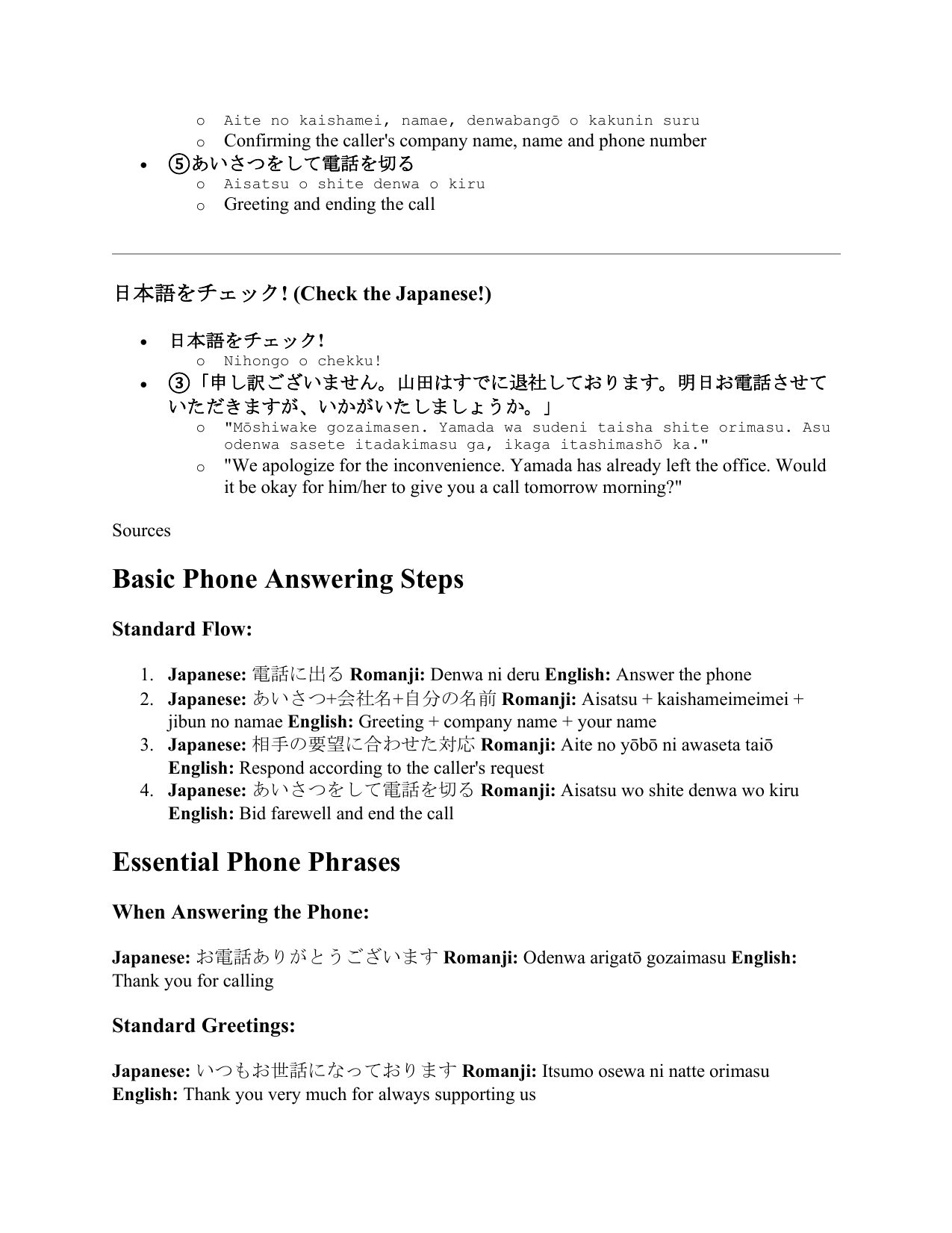
EN o Aite no kaishamei, namae, denwabangō o kakunin suru
Confirming the caller's company name, name and phone number
o
Confirming the caller's company name, name and phone number
o
JP•⑤あいさつをして電話を切る
EN o Aisatsu o shite denwa o kiru
o Greeting and ending the call
日本語をチェック! (Check the Japanese!)
o Greeting and ending the call
日本語をチェック! (Check the Japanese!)
JP•日本語をチェック!
EN o Nihongo o chekku!
JP•③「申し訳ございません。山田はすでに退社しております。明日お電話させて
いただきますが、いかがいたしましょうか。」
いただきますが、いかがいたしましょうか。」
EN o "Mōshiwake gozaimasen. Yamada wa sudeni taisha shite orimasu. Asu
odenwa sasete itadakimasu ga, ikaga itashimashō ka."
o "We apologize for the inconvenience. Yamada has already left the office. Would
it be okay for him/her to give you a call tomorrow morning?"
Sources
Basic Phone Answering Steps
Standard Flow:
1. Japanese: 電話に出る Romanji: Denwa ni deru English: Answer the phone
2. Japanese: あいさつ+会社名+自分の名前 Romanji: Aisatsu + kaishameimeimei +
jibun no namae English: Greeting + company name + your name
3. Japanese: 相手の要望に合わせた対応 Romanji: Aite no yōbō ni awaseta taiō
English: Respond according to the caller's request
4. Japanese: あいさつをして電話を切る Romanji: Aisatsu wo shite denwa wo kiru
English: Bid farewell and end the call
Essential Phone Phrases
When Answering the Phone:
Japanese: お電話ありがとうございます Romanji: Odenwa arigatō gozaimasu English:
Thank you for calling
Standard Greetings:
Japanese: いつもお世話になっております Romanji: Itsumo osewa ni natte orimasu
English: Thank you very much for always supporting us
odenwa sasete itadakimasu ga, ikaga itashimashō ka."
o "We apologize for the inconvenience. Yamada has already left the office. Would
it be okay for him/her to give you a call tomorrow morning?"
Sources
Basic Phone Answering Steps
Standard Flow:
1. Japanese: 電話に出る Romanji: Denwa ni deru English: Answer the phone
2. Japanese: あいさつ+会社名+自分の名前 Romanji: Aisatsu + kaishameimeimei +
jibun no namae English: Greeting + company name + your name
3. Japanese: 相手の要望に合わせた対応 Romanji: Aite no yōbō ni awaseta taiō
English: Respond according to the caller's request
4. Japanese: あいさつをして電話を切る Romanji: Aisatsu wo shite denwa wo kiru
English: Bid farewell and end the call
Essential Phone Phrases
When Answering the Phone:
Japanese: お電話ありがとうございます Romanji: Odenwa arigatō gozaimasu English:
Thank you for calling
Standard Greetings:
Japanese: いつもお世話になっております Romanji: Itsumo osewa ni natte orimasu
English: Thank you very much for always supporting us
หน้า 14
คลิกเพื่อขยาย
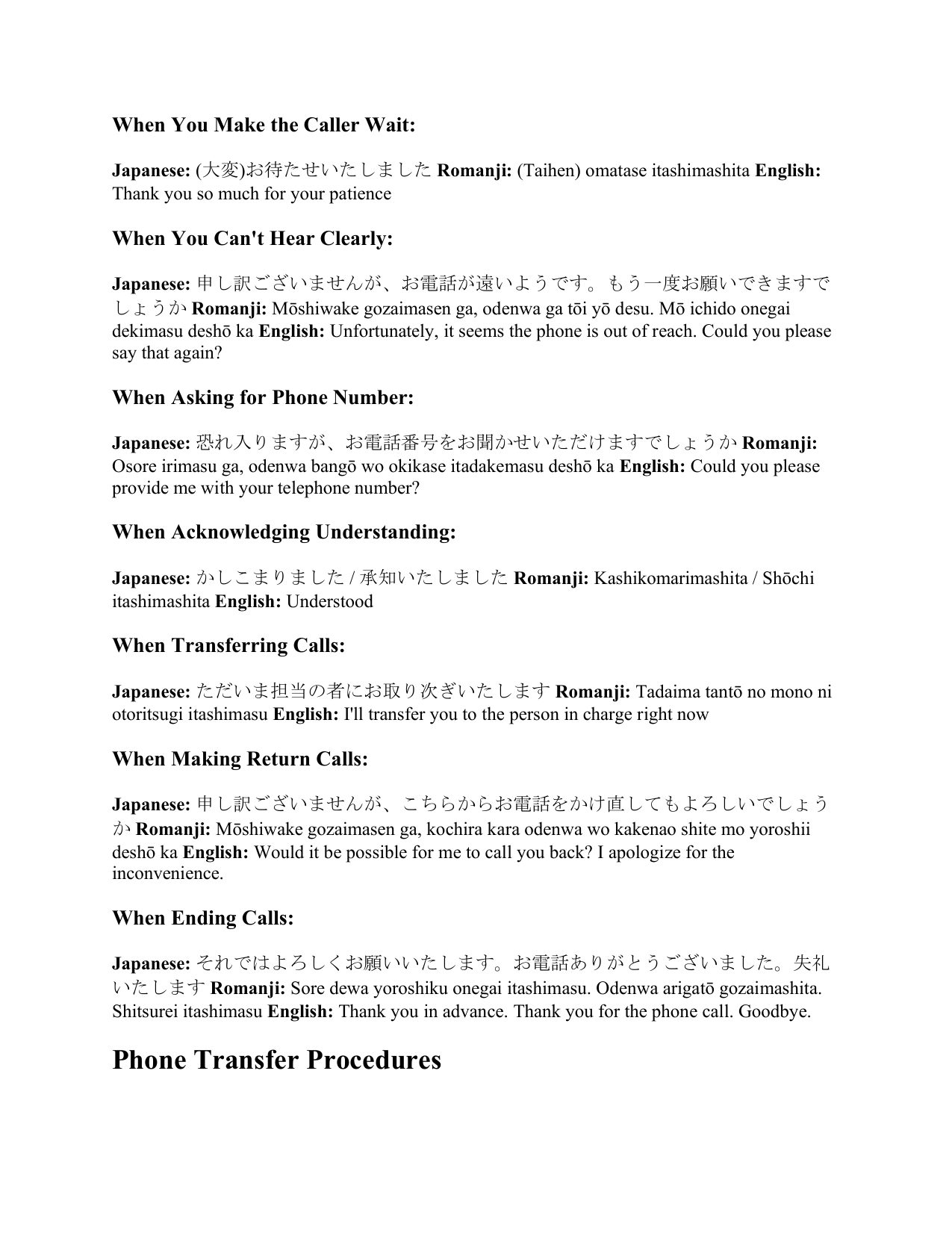
ENWhen You Make the Caller Wait:
Japanese: (大変)お待たせいたしました Romanji: (Taihen) omatase itashimashita English:
Thank you so much for your patience
When You Can't Hear Clearly:
Japanese: (大変)お待たせいたしました Romanji: (Taihen) omatase itashimashita English:
Thank you so much for your patience
When You Can't Hear Clearly:
JPJapanese:申し訳ございませんが、お電話が遠いようです。もう一度お願いできますで
ENしょうか Romanji: Mōshiwake gozaimasen ga, odenwa ga tōi yō desu. Mō ichido onegai
dekimasu deshō ka English: Unfortunately, it seems the phone is out of reach. Could you please
say that again?
When Asking for Phone Number:
dekimasu deshō ka English: Unfortunately, it seems the phone is out of reach. Could you please
say that again?
When Asking for Phone Number:
JPJapanese:恐れ入りますが、お電話番号をお聞かせいただけますでしょうかRomanji:
ENOsore irimasu ga, odenwa bangō wo okikase itadakemasu deshō ka English: Could you please
provide me with your telephone number?
When Acknowledging Understanding:
Japanese: かしこまりました / 承知いたしました Romanji: Kashikomarimashita / Shōchi
itashimashita English: Understood
When Transferring Calls:
Japanese: ただいま担当の者にお取り次ぎいたします Romanji: Tadaima tantō no mono ni
otoritsugi itashimasu English: I'll transfer you to the person in charge right now
When Making Return Calls:
provide me with your telephone number?
When Acknowledging Understanding:
Japanese: かしこまりました / 承知いたしました Romanji: Kashikomarimashita / Shōchi
itashimashita English: Understood
When Transferring Calls:
Japanese: ただいま担当の者にお取り次ぎいたします Romanji: Tadaima tantō no mono ni
otoritsugi itashimasu English: I'll transfer you to the person in charge right now
When Making Return Calls:
JPJapanese:申し訳ございませんが、こちらからお電話をかけ直してもよろしいでしょう
ENか Romanji: Mōshiwake gozaimasen ga, kochira kara odenwa wo kakenao shite mo yoroshii
deshō ka English: Would it be possible for me to call you back? I apologize for the
inconvenience.
When Ending Calls:
deshō ka English: Would it be possible for me to call you back? I apologize for the
inconvenience.
When Ending Calls:
JPJapanese:それではよろしくお願いいたします。お電話ありがとうございました。失礼
ENいたします Romanji: Sore dewa yoroshiku onegai itashimasu. Odenwa arigatō gozaimashita.
Shitsurei itashimasu English: Thank you in advance. Thank you for the phone call. Goodbye.
Phone Transfer Procedures
Shitsurei itashimasu English: Thank you in advance. Thank you for the phone call. Goodbye.
Phone Transfer Procedures
หน้า 15
คลิกเพื่อขยาย
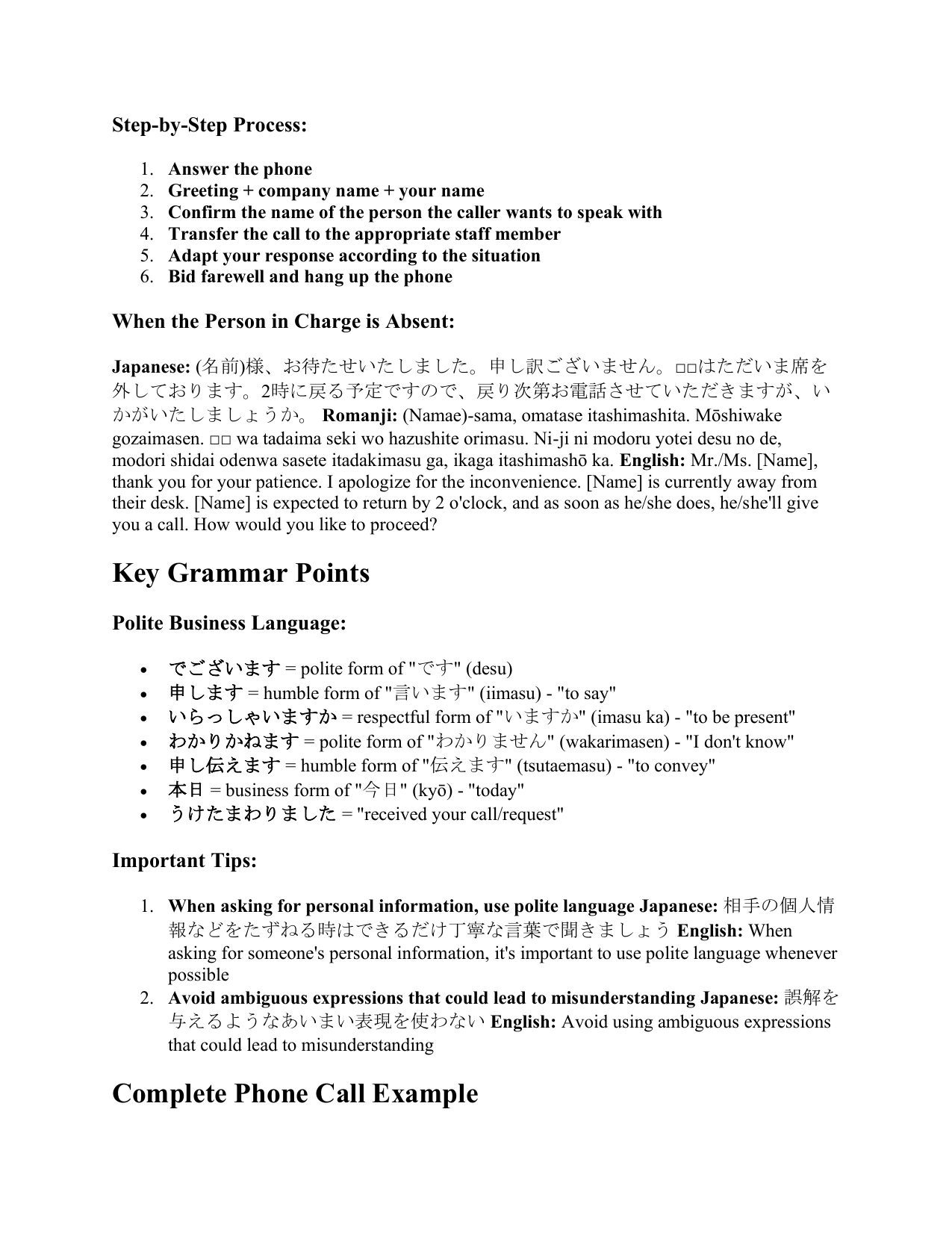
ENStep-by-Step Process:
1. Answer the phone
2. Greeting + company name + your name
3. Confirm the name of the person the caller wants to speak with
4. Transfer the call to the appropriate staff member
5. Adapt your response according to the situation
6. Bid farewell and hang up the phone
When the Person in Charge is Absent:
1. Answer the phone
2. Greeting + company name + your name
3. Confirm the name of the person the caller wants to speak with
4. Transfer the call to the appropriate staff member
5. Adapt your response according to the situation
6. Bid farewell and hang up the phone
When the Person in Charge is Absent:
JPJapanese:(名前)様、お待たせいたしました。申し訳ございません。□□はただいま席を
外しております。2時に戻る予定ですので、戻り次第お電話させていただきますが、い
外しております。2時に戻る予定ですので、戻り次第お電話させていただきますが、い
ENかがいたしましょうか。 Romanji: (Namae)-sama, omatase itashimashita. Mōshiwake
gozaimasen. □□ wa tadaima seki wo hazushite orimasu. Ni-ji ni modoru yotei desu no de,
modori shidai odenwa sasete itadakimasu ga, ikaga itashimashō ka. English: Mr./Ms. [Name],
thank you for your patience. I apologize for the inconvenience. [Name] is currently away from
their desk. [Name] is expected to return by 2 o'clock, and as soon as he/she does, he/she'll give
you a call. How would you like to proceed?
Key Grammar Points
Polite Business Language:
• でございます = polite form of "です" (desu)
• 申します = humble form of "言います" (iimasu) - "to say"
• いらっしゃいますか = respectful form of "いますか" (imasu ka) - "to be present"
• わかりかねます = polite form of "わかりません" (wakarimasen) - "I don't know"
• 申し伝えます = humble form of "伝えます" (tsutaemasu) - "to convey"
• 本日 = business form of "今日" (kyō) - "today"
• うけたまわりました = "received your call/request"
Important Tips:
1. When asking for personal information, use polite language Japanese: 相手の個人情
gozaimasen. □□ wa tadaima seki wo hazushite orimasu. Ni-ji ni modoru yotei desu no de,
modori shidai odenwa sasete itadakimasu ga, ikaga itashimashō ka. English: Mr./Ms. [Name],
thank you for your patience. I apologize for the inconvenience. [Name] is currently away from
their desk. [Name] is expected to return by 2 o'clock, and as soon as he/she does, he/she'll give
you a call. How would you like to proceed?
Key Grammar Points
Polite Business Language:
• でございます = polite form of "です" (desu)
• 申します = humble form of "言います" (iimasu) - "to say"
• いらっしゃいますか = respectful form of "いますか" (imasu ka) - "to be present"
• わかりかねます = polite form of "わかりません" (wakarimasen) - "I don't know"
• 申し伝えます = humble form of "伝えます" (tsutaemasu) - "to convey"
• 本日 = business form of "今日" (kyō) - "today"
• うけたまわりました = "received your call/request"
Important Tips:
1. When asking for personal information, use polite language Japanese: 相手の個人情
JP報などをたずねる時はできるだけ丁寧な言葉で聞きましょうEnglish:When
EN asking for someone's personal information, it's important to use polite language whenever
possible
2. Avoid ambiguous expressions that could lead to misunderstanding Japanese: 誤解を
与えるようなあいまい表現を使わない English: Avoid using ambiguous expressions
that could lead to misunderstanding
Complete Phone Call Example
possible
2. Avoid ambiguous expressions that could lead to misunderstanding Japanese: 誤解を
与えるようなあいまい表現を使わない English: Avoid using ambiguous expressions
that could lead to misunderstanding
Complete Phone Call Example
หน้า 16
คลิกเพื่อขยาย
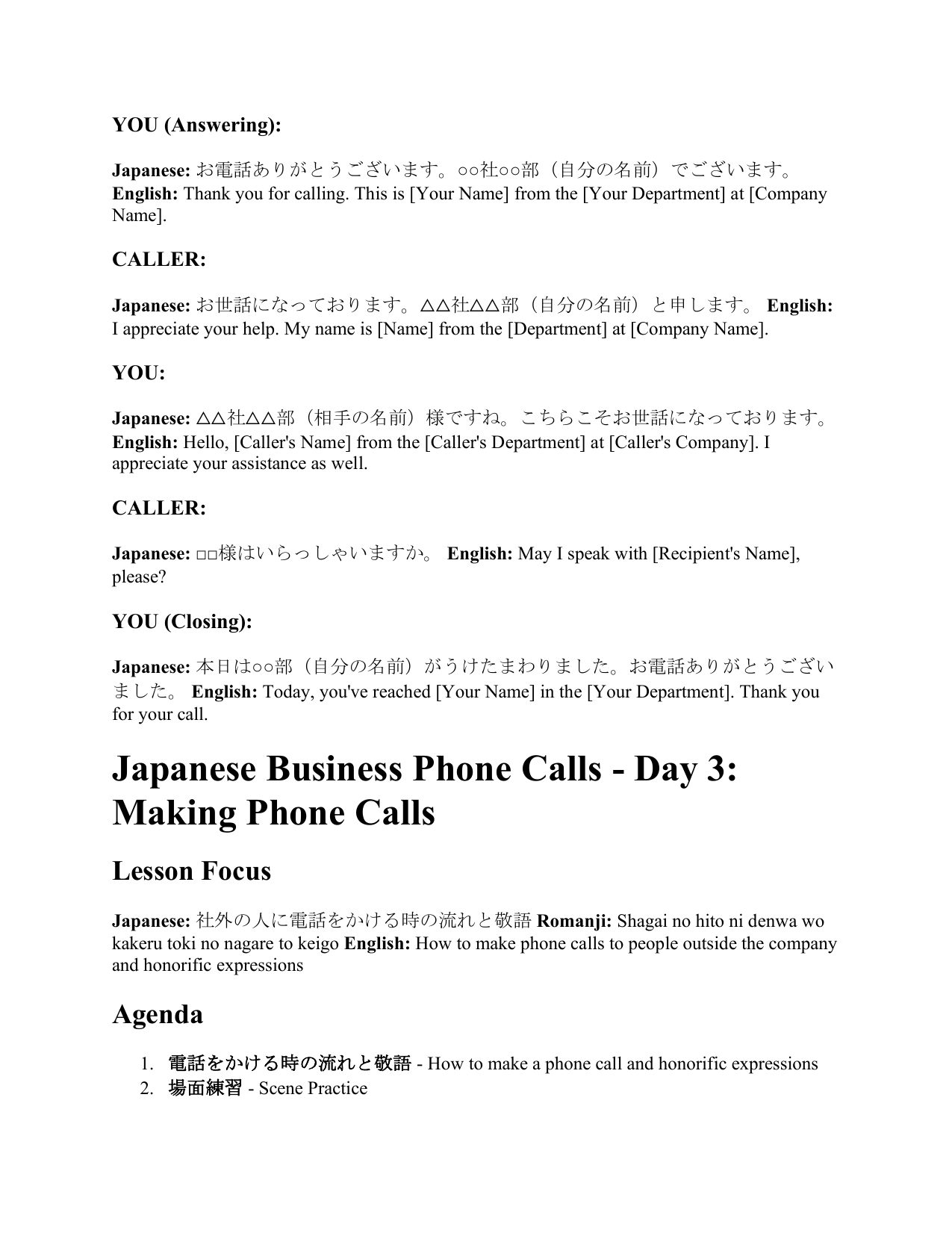
ENYOU (Answering):
JPJapanese:お電話ありがとうございます。○○社○○部(自分の名前)でございます。
ENEnglish: Thank you for calling. This is [Your Name] from the [Your Department] at [Company
Name].
CALLER:
Name].
CALLER:
JPJapanese:お世話になっております。△△社△△部(自分の名前)と申します。English:
ENI appreciate your help. My name is [Name] from the [Department] at [Company Name].
YOU:
YOU:
JPJapanese:△△社△△部(相手の名前)様ですね。こちらこそお世話になっております。
ENEnglish: Hello, [Caller's Name] from the [Caller's Department] at [Caller's Company]. I
appreciate your assistance as well.
CALLER:
Japanese: □□様はいらっしゃいますか。 English: May I speak with [Recipient's Name],
please?
YOU (Closing):
appreciate your assistance as well.
CALLER:
Japanese: □□様はいらっしゃいますか。 English: May I speak with [Recipient's Name],
please?
YOU (Closing):
JPJapanese:本日は○○部(自分の名前)がうけたまわりました。お電話ありがとうござい
ENました。 English: Today, you've reached [Your Name] in the [Your Department]. Thank you
for your call.
Japanese Business Phone Calls - Day 3:
Making Phone Calls
Lesson Focus
Japanese: 社外の人に電話をかける時の流れと敬語 Romanji: Shagai no hito ni denwa wo
kakeru toki no nagare to keigo English: How to make phone calls to people outside the company
and honorific expressions
Agenda
1. 電話をかける時の流れと敬語 - How to make a phone call and honorific expressions
2. 場面練習 - Scene Practice
for your call.
Japanese Business Phone Calls - Day 3:
Making Phone Calls
Lesson Focus
Japanese: 社外の人に電話をかける時の流れと敬語 Romanji: Shagai no hito ni denwa wo
kakeru toki no nagare to keigo English: How to make phone calls to people outside the company
and honorific expressions
Agenda
1. 電話をかける時の流れと敬語 - How to make a phone call and honorific expressions
2. 場面練習 - Scene Practice
หน้า 17
คลิกเพื่อขยาย
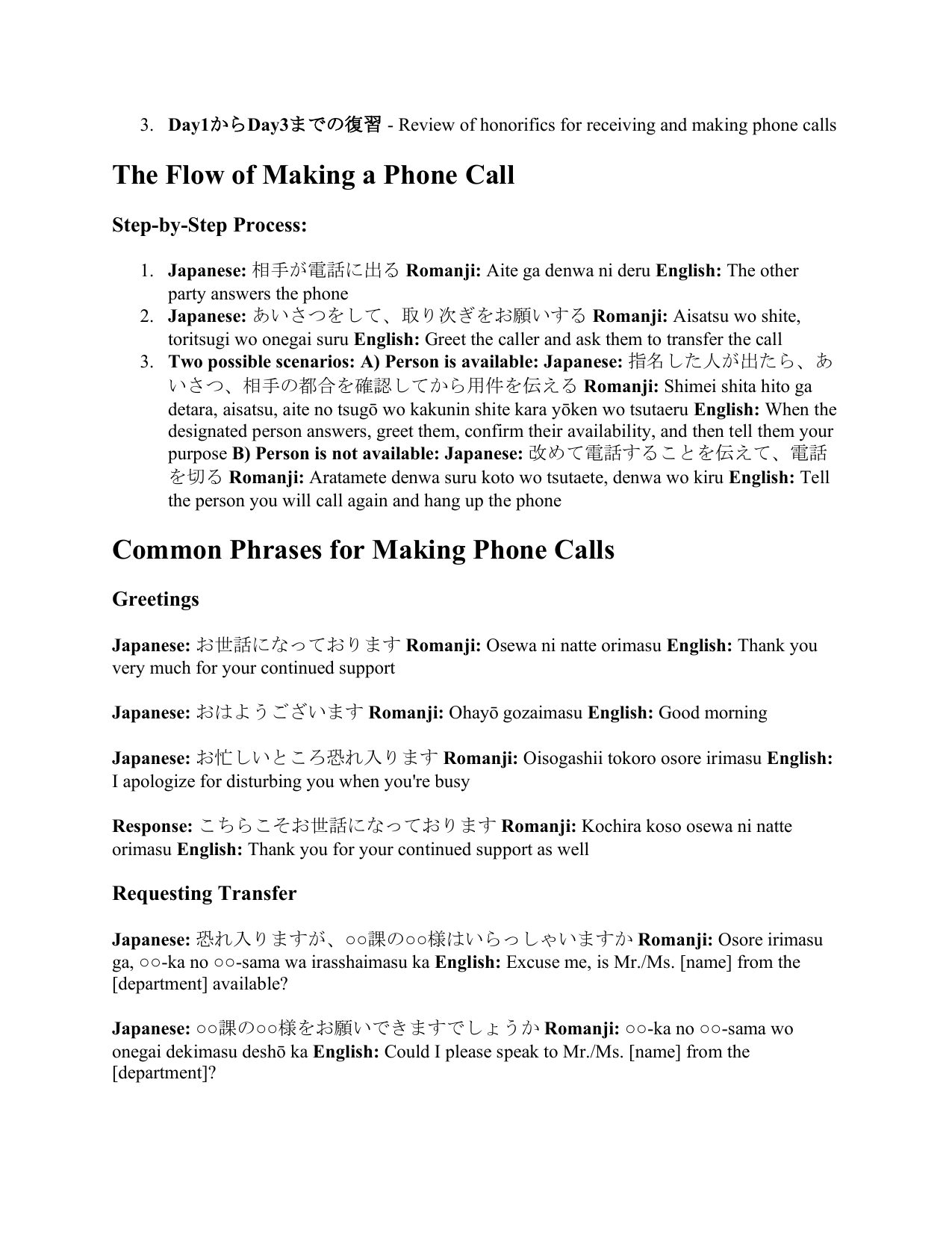
EN 3. Day1からDay3までの復習 - Review of honorifics for receiving and making phone calls
The Flow of Making a Phone Call
Step-by-Step Process:
1. Japanese: 相手が電話に出る Romanji: Aite ga denwa ni deru English: The other
party answers the phone
2. Japanese: あいさつをして、取り次ぎをお願いする Romanji: Aisatsu wo shite,
toritsugi wo onegai suru English: Greet the caller and ask them to transfer the call
3. Two possible scenarios: A) Person is available: Japanese: 指名した人が出たら、あ
いさつ、相手の都合を確認してから用件を伝える Romanji: Shimei shita hito ga
detara, aisatsu, aite no tsugō wo kakunin shite kara yōken wo tsutaeru English: When the
designated person answers, greet them, confirm their availability, and then tell them your
purpose B) Person is not available: Japanese: 改めて電話することを伝えて、電話
を切る Romanji: Aratamete denwa suru koto wo tsutaete, denwa wo kiru English: Tell
the person you will call again and hang up the phone
Common Phrases for Making Phone Calls
Greetings
Japanese: お世話になっております Romanji: Osewa ni natte orimasu English: Thank you
very much for your continued support
Japanese: おはようございます Romanji: Ohayō gozaimasu English: Good morning
Japanese: お忙しいところ恐れ入ります Romanji: Oisogashii tokoro osore irimasu English:
I apologize for disturbing you when you're busy
Response: こちらこそお世話になっております Romanji: Kochira koso osewa ni natte
orimasu English: Thank you for your continued support as well
Requesting Transfer
Japanese: 恐れ入りますが、○○課の○○様はいらっしゃいますか Romanji: Osore irimasu
ga, ○○-ka no ○○-sama wa irasshaimasu ka English: Excuse me, is Mr./Ms. [name] from the
[department] available?
Japanese: ○○課の○○様をお願いできますでしょうか Romanji: ○○-ka no ○○-sama wo
onegai dekimasu deshō ka English: Could I please speak to Mr./Ms. [name] from the
[department]?
The Flow of Making a Phone Call
Step-by-Step Process:
1. Japanese: 相手が電話に出る Romanji: Aite ga denwa ni deru English: The other
party answers the phone
2. Japanese: あいさつをして、取り次ぎをお願いする Romanji: Aisatsu wo shite,
toritsugi wo onegai suru English: Greet the caller and ask them to transfer the call
3. Two possible scenarios: A) Person is available: Japanese: 指名した人が出たら、あ
いさつ、相手の都合を確認してから用件を伝える Romanji: Shimei shita hito ga
detara, aisatsu, aite no tsugō wo kakunin shite kara yōken wo tsutaeru English: When the
designated person answers, greet them, confirm their availability, and then tell them your
purpose B) Person is not available: Japanese: 改めて電話することを伝えて、電話
を切る Romanji: Aratamete denwa suru koto wo tsutaete, denwa wo kiru English: Tell
the person you will call again and hang up the phone
Common Phrases for Making Phone Calls
Greetings
Japanese: お世話になっております Romanji: Osewa ni natte orimasu English: Thank you
very much for your continued support
Japanese: おはようございます Romanji: Ohayō gozaimasu English: Good morning
Japanese: お忙しいところ恐れ入ります Romanji: Oisogashii tokoro osore irimasu English:
I apologize for disturbing you when you're busy
Response: こちらこそお世話になっております Romanji: Kochira koso osewa ni natte
orimasu English: Thank you for your continued support as well
Requesting Transfer
Japanese: 恐れ入りますが、○○課の○○様はいらっしゃいますか Romanji: Osore irimasu
ga, ○○-ka no ○○-sama wa irasshaimasu ka English: Excuse me, is Mr./Ms. [name] from the
[department] available?
Japanese: ○○課の○○様をお願いできますでしょうか Romanji: ○○-ka no ○○-sama wo
onegai dekimasu deshō ka English: Could I please speak to Mr./Ms. [name] from the
[department]?
หน้า 18
คลิกเพื่อขยาย
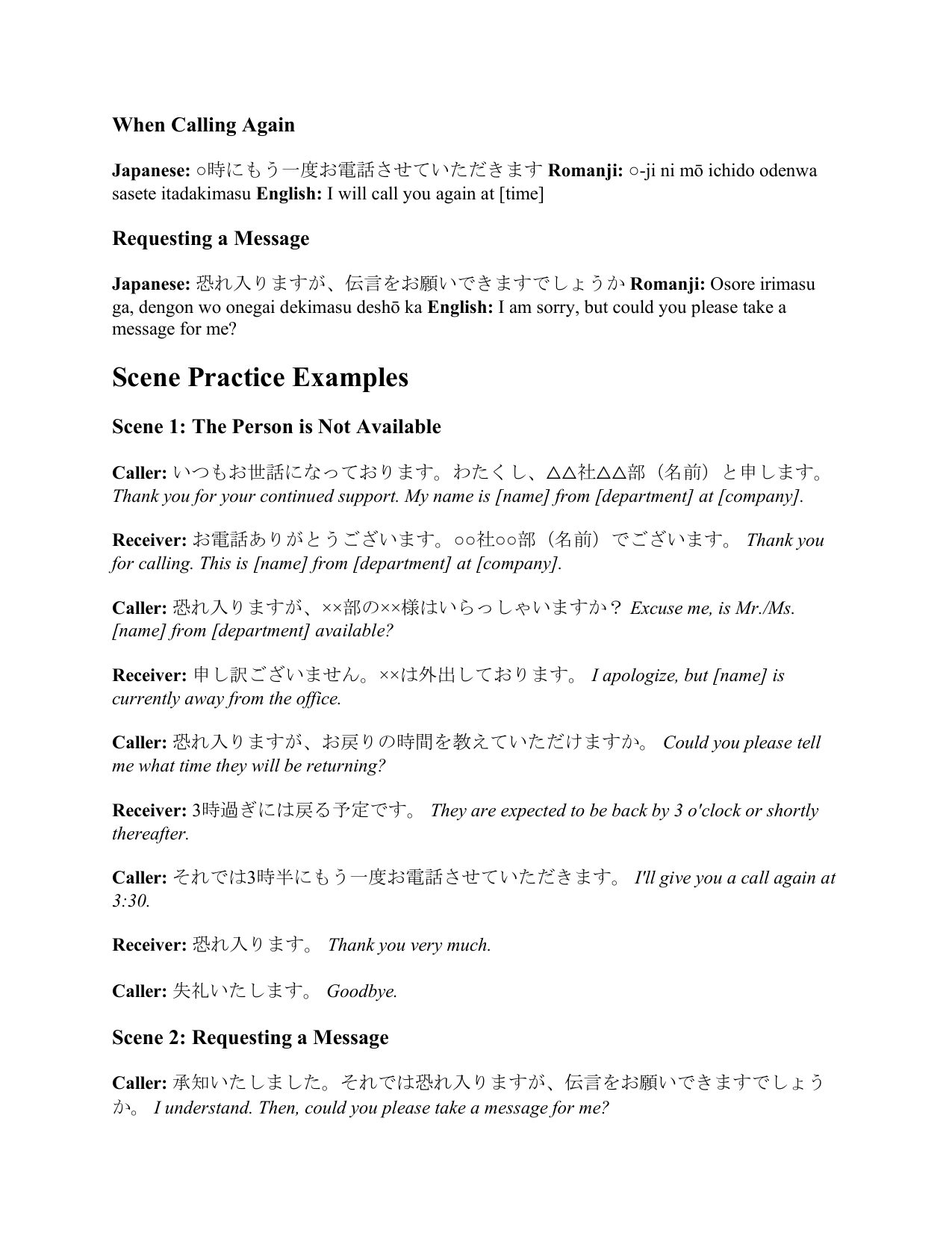
ENWhen Calling Again
Japanese: ○時にもう一度お電話させていただきます Romanji: ○-ji ni mō ichido odenwa
sasete itadakimasu English: I will call you again at [time]
Requesting a Message
Japanese: 恐れ入りますが、伝言をお願いできますでしょうか Romanji: Osore irimasu
ga, dengon wo onegai dekimasu deshō ka English: I am sorry, but could you please take a
message for me?
Scene Practice Examples
Scene 1: The Person is Not Available
Japanese: ○時にもう一度お電話させていただきます Romanji: ○-ji ni mō ichido odenwa
sasete itadakimasu English: I will call you again at [time]
Requesting a Message
Japanese: 恐れ入りますが、伝言をお願いできますでしょうか Romanji: Osore irimasu
ga, dengon wo onegai dekimasu deshō ka English: I am sorry, but could you please take a
message for me?
Scene Practice Examples
Scene 1: The Person is Not Available
JPCaller:いつもお世話になっております。わたくし、△△社△△部(名前)と申します。
ENThank you for your continued support. My name is [name] from [department] at [company].
JPReceiver:お電話ありがとうございます。○○社○○部(名前)でございます。Thankyou
ENfor calling. This is [name] from [department] at [company].
JPCaller:恐れ入りますが、××部の××様はいらっしゃいますか?Excuseme,isMr./Ms.
EN[name] from [department] available?
Receiver: 申し訳ございません。××は外出しております。 I apologize, but [name] is
currently away from the office.
Receiver: 申し訳ございません。××は外出しております。 I apologize, but [name] is
currently away from the office.
JPCaller:恐れ入りますが、お戻りの時間を教えていただけますか。Couldyoupleasetell
ENme what time they will be returning?
Receiver: 3時過ぎには戻る予定です。 They are expected to be back by 3 o'clock or shortly
thereafter.
Caller: それでは3時半にもう一度お電話させていただきます。 I'll give you a call again at
3:30.
Receiver: 恐れ入ります。 Thank you very much.
Caller: 失礼いたします。 Goodbye.
Scene 2: Requesting a Message
Receiver: 3時過ぎには戻る予定です。 They are expected to be back by 3 o'clock or shortly
thereafter.
Caller: それでは3時半にもう一度お電話させていただきます。 I'll give you a call again at
3:30.
Receiver: 恐れ入ります。 Thank you very much.
Caller: 失礼いたします。 Goodbye.
Scene 2: Requesting a Message
JPCaller:承知いたしました。それでは恐れ入りますが、伝言をお願いできますでしょう
ENか。 I understand. Then, could you please take a message for me?
หน้า 19
คลิกเพื่อขยาย
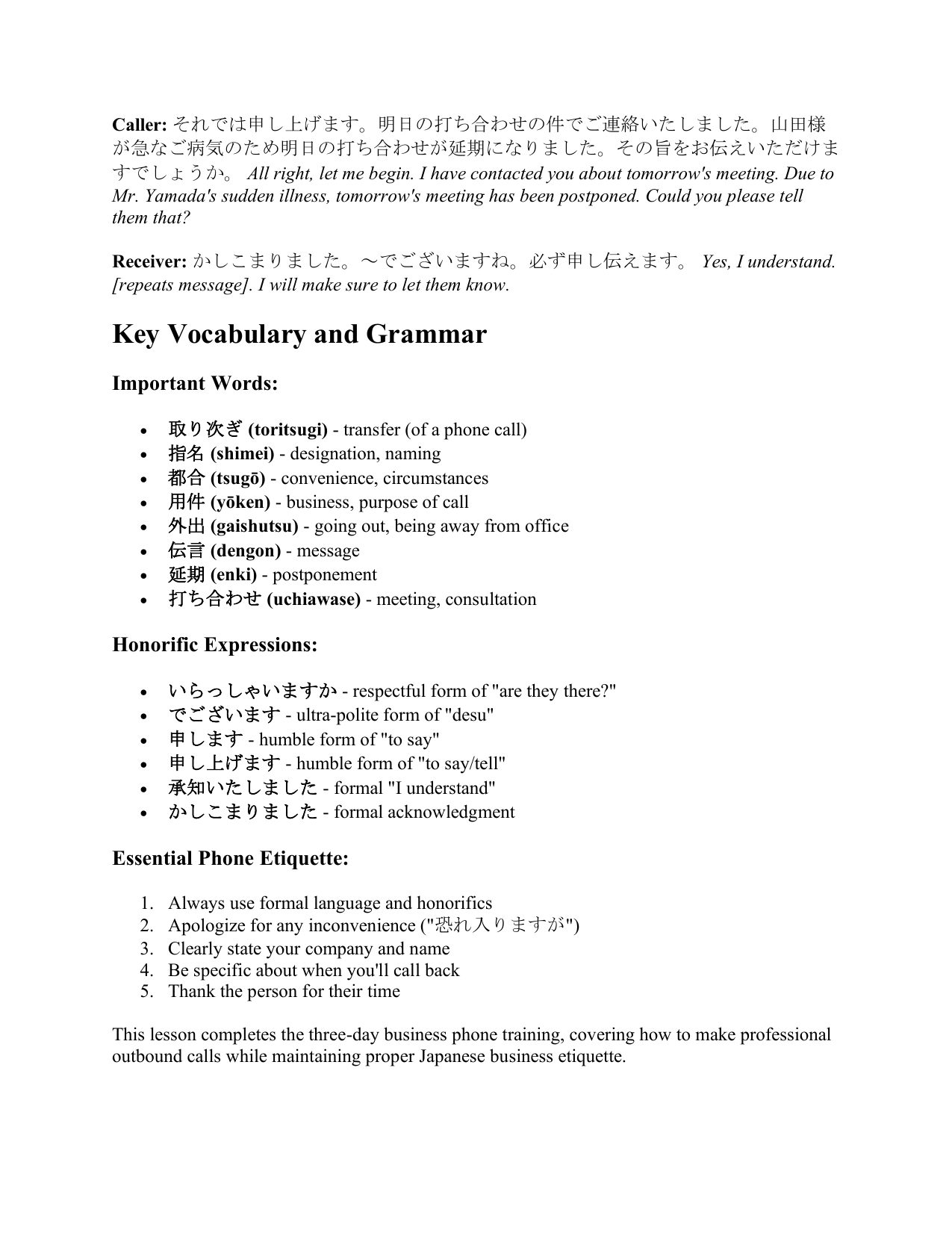
JPCaller:それでは申し上げます。明日の打ち合わせの件でご連絡いたしました。山田様
が急なご病気のため明日の打ち合わせが延期になりました。その旨をお伝えいただけま
が急なご病気のため明日の打ち合わせが延期になりました。その旨をお伝えいただけま
ENすでしょうか。 All right, let me begin. I have contacted you about tomorrow's meeting. Due to
Mr. Yamada's sudden illness, tomorrow's meeting has been postponed. Could you please tell
them that?
Mr. Yamada's sudden illness, tomorrow's meeting has been postponed. Could you please tell
them that?
JPReceiver:かしこまりました。~でございますね。必ず申し伝えます。Yes,Iunderstand.
EN[repeats message]. I will make sure to let them know.
Key Vocabulary and Grammar
Important Words:
• 取り次ぎ (toritsugi) - transfer (of a phone call)
• 指名 (shimei) - designation, naming
• 都合 (tsugō) - convenience, circumstances
• 用件 (yōken) - business, purpose of call
• 外出 (gaishutsu) - going out, being away from office
• 伝言 (dengon) - message
• 延期 (enki) - postponement
• 打ち合わせ (uchiawase) - meeting, consultation
Honorific Expressions:
• いらっしゃいますか - respectful form of "are they there?"
• でございます - ultra-polite form of "desu"
• 申します - humble form of "to say"
• 申し上げます - humble form of "to say/tell"
• 承知いたしました - formal "I understand"
• かしこまりました - formal acknowledgment
Essential Phone Etiquette:
1. Always use formal language and honorifics
2. Apologize for any inconvenience ("恐れ入りますが")
3. Clearly state your company and name
4. Be specific about when you'll call back
5. Thank the person for their time
This lesson completes the three-day business phone training, covering how to make professional
outbound calls while maintaining proper Japanese business etiquette.
Key Vocabulary and Grammar
Important Words:
• 取り次ぎ (toritsugi) - transfer (of a phone call)
• 指名 (shimei) - designation, naming
• 都合 (tsugō) - convenience, circumstances
• 用件 (yōken) - business, purpose of call
• 外出 (gaishutsu) - going out, being away from office
• 伝言 (dengon) - message
• 延期 (enki) - postponement
• 打ち合わせ (uchiawase) - meeting, consultation
Honorific Expressions:
• いらっしゃいますか - respectful form of "are they there?"
• でございます - ultra-polite form of "desu"
• 申します - humble form of "to say"
• 申し上げます - humble form of "to say/tell"
• 承知いたしました - formal "I understand"
• かしこまりました - formal acknowledgment
Essential Phone Etiquette:
1. Always use formal language and honorifics
2. Apologize for any inconvenience ("恐れ入りますが")
3. Clearly state your company and name
4. Be specific about when you'll call back
5. Thank the person for their time
This lesson completes the three-day business phone training, covering how to make professional
outbound calls while maintaining proper Japanese business etiquette.
หน้า 20
คลิกเพื่อขยาย
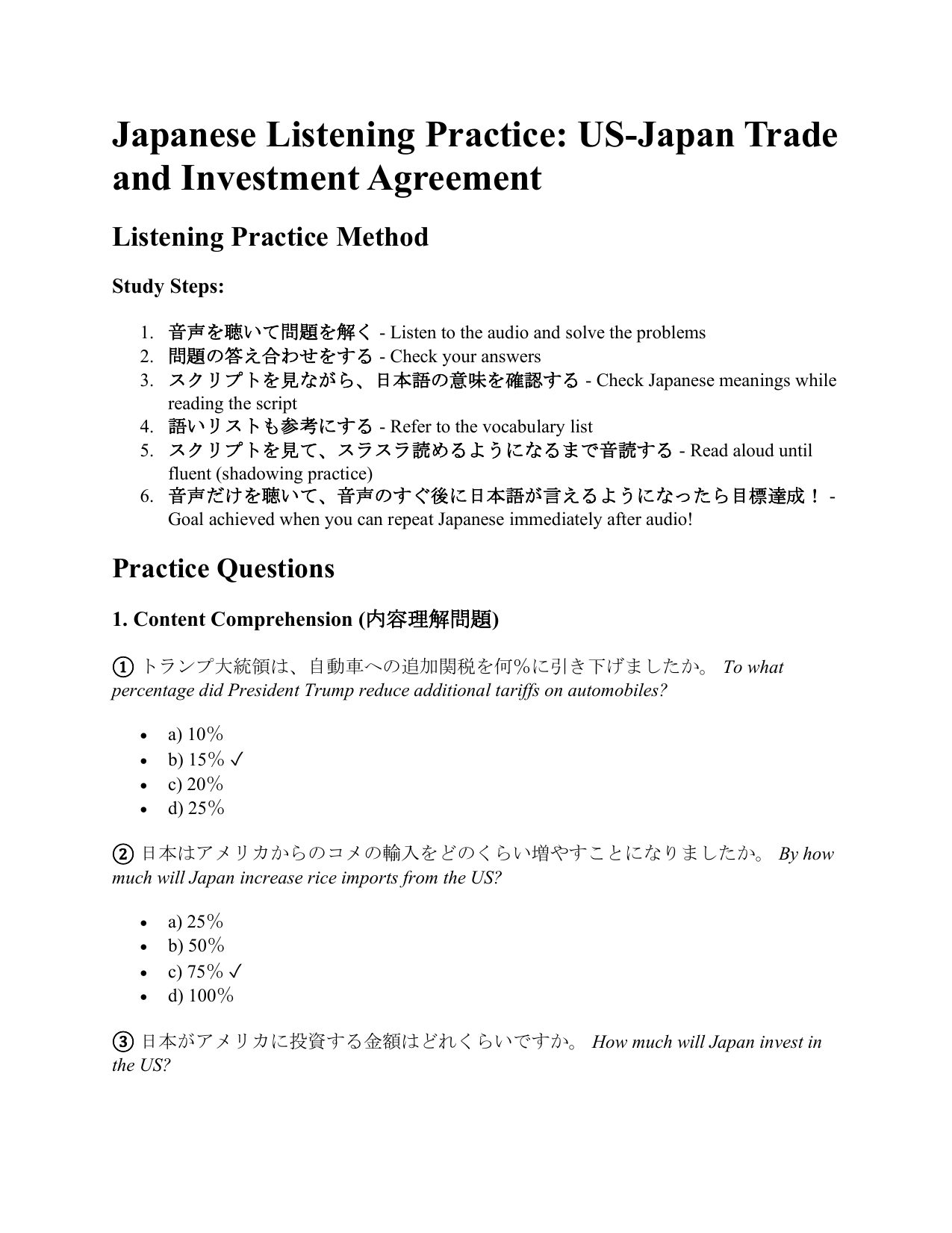
ENJapanese Listening Practice: US-Japan Trade
and Investment Agreement
Listening Practice Method
Study Steps:
1. 音声を聴いて問題を解く - Listen to the audio and solve the problems
2. 問題の答え合わせをする - Check your answers
3. スクリプトを見ながら、日本語の意味を確認する - Check Japanese meanings while
reading the script
4. 語いリストも参考にする - Refer to the vocabulary list
and Investment Agreement
Listening Practice Method
Study Steps:
1. 音声を聴いて問題を解く - Listen to the audio and solve the problems
2. 問題の答え合わせをする - Check your answers
3. スクリプトを見ながら、日本語の意味を確認する - Check Japanese meanings while
reading the script
4. 語いリストも参考にする - Refer to the vocabulary list
JP5.スクリプトを見て、スラスラ読めるようになるまで音読する-Readalouduntil
EN fluent (shadowing practice)
JP6.音声だけを聴いて、音声のすぐ後に日本語が言えるようになったら目標達成!-
EN Goal achieved when you can repeat Japanese immediately after audio!
Practice Questions
1. Content Comprehension (内容理解問題)
Practice Questions
1. Content Comprehension (内容理解問題)
JP①トランプ大統領は、自動車への追加関税を何%に引き下げましたか。Towhat
ENpercentage did President Trump reduce additional tariffs on automobiles?
• a) 10%
• b) 15% ✓
• c) 20%
• d) 25%
• a) 10%
• b) 15% ✓
• c) 20%
• d) 25%
JP②日本はアメリカからのコメの輸入をどのくらい増やすことになりましたか。Byhow
ENmuch will Japan increase rice imports from the US?
• a) 25%
• b) 50%
• c) 75% ✓
• d) 100%
③ 日本がアメリカに投資する金額はどれくらいですか。 How much will Japan invest in
the US?
• a) 25%
• b) 50%
• c) 75% ✓
• d) 100%
③ 日本がアメリカに投資する金額はどれくらいですか。 How much will Japan invest in
the US?
หน้า 21
คลิกเพื่อขยาย
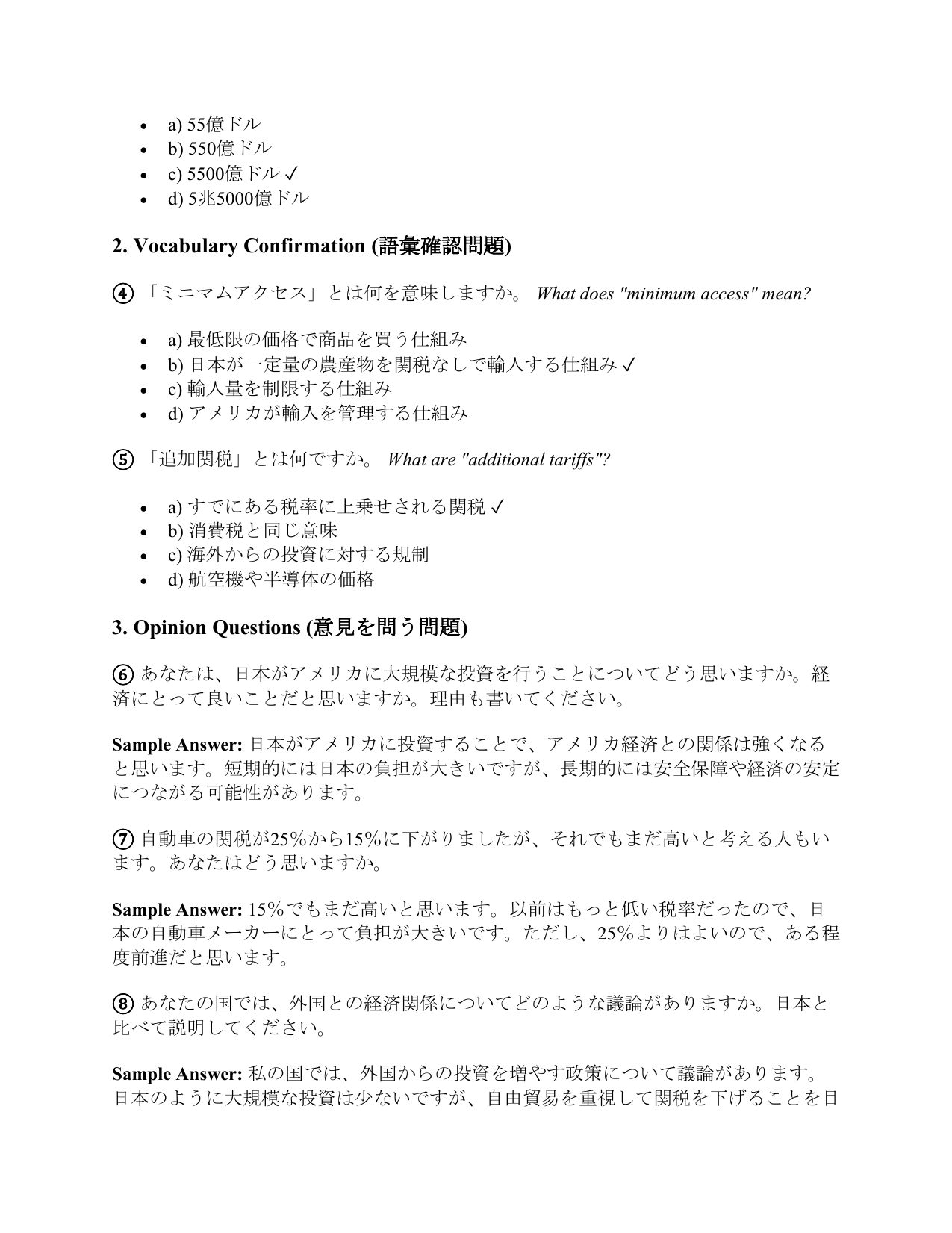
JP•a)55億ドル
•b)550億ドル
•c)5500億ドル✓
•d)5兆5000億ドル
•b)550億ドル
•c)5500億ドル✓
•d)5兆5000億ドル
EN2. Vocabulary Confirmation (語彙確認問題)
④ 「ミニマムアクセス」とは何を意味しますか。 What does "minimum access" mean?
④ 「ミニマムアクセス」とは何を意味しますか。 What does "minimum access" mean?
JP•a)最低限の価格で商品を買う仕組み
•b)日本が一定量の農産物を関税なしで輸入する仕組み✓
•c)輸入量を制限する仕組み
•d)アメリカが輸入を管理する仕組み
•b)日本が一定量の農産物を関税なしで輸入する仕組み✓
•c)輸入量を制限する仕組み
•d)アメリカが輸入を管理する仕組み
EN⑤ 「追加関税」とは何ですか。 What are "additional tariffs"?
JP•a)すでにある税率に上乗せされる関税✓
•b)消費税と同じ意味
•c)海外からの投資に対する規制
•d)航空機や半導体の価格
•b)消費税と同じ意味
•c)海外からの投資に対する規制
•d)航空機や半導体の価格
EN3. Opinion Questions (意見を問う問題)
JP⑥あなたは、日本がアメリカに大規模な投資を行うことについてどう思いますか。経
済にとって良いことだと思いますか。理由も書いてください。
SampleAnswer:日本がアメリカに投資することで、アメリカ経済との関係は強くなる
と思います。短期的には日本の負担が大きいですが、長期的には安全保障や経済の安定
につながる可能性があります。
⑦自動車の関税が25%から15%に下がりましたが、それでもまだ高いと考える人もい
ます。あなたはどう思いますか。
SampleAnswer:15%でもまだ高いと思います。以前はもっと低い税率だったので、日
本の自動車メーカーにとって負担が大きいです。ただし、25%よりはよいので、ある程
度前進だと思います。
⑧あなたの国では、外国との経済関係についてどのような議論がありますか。日本と
比べて説明してください。
SampleAnswer:私の国では、外国からの投資を増やす政策について議論があります。
日本のように大規模な投資は少ないですが、自由貿易を重視して関税を下げることを目
済にとって良いことだと思いますか。理由も書いてください。
SampleAnswer:日本がアメリカに投資することで、アメリカ経済との関係は強くなる
と思います。短期的には日本の負担が大きいですが、長期的には安全保障や経済の安定
につながる可能性があります。
⑦自動車の関税が25%から15%に下がりましたが、それでもまだ高いと考える人もい
ます。あなたはどう思いますか。
SampleAnswer:15%でもまだ高いと思います。以前はもっと低い税率だったので、日
本の自動車メーカーにとって負担が大きいです。ただし、25%よりはよいので、ある程
度前進だと思います。
⑧あなたの国では、外国との経済関係についてどのような議論がありますか。日本と
比べて説明してください。
SampleAnswer:私の国では、外国からの投資を増やす政策について議論があります。
日本のように大規模な投資は少ないですが、自由貿易を重視して関税を下げることを目
หน้า 22
คลิกเพื่อขยาย
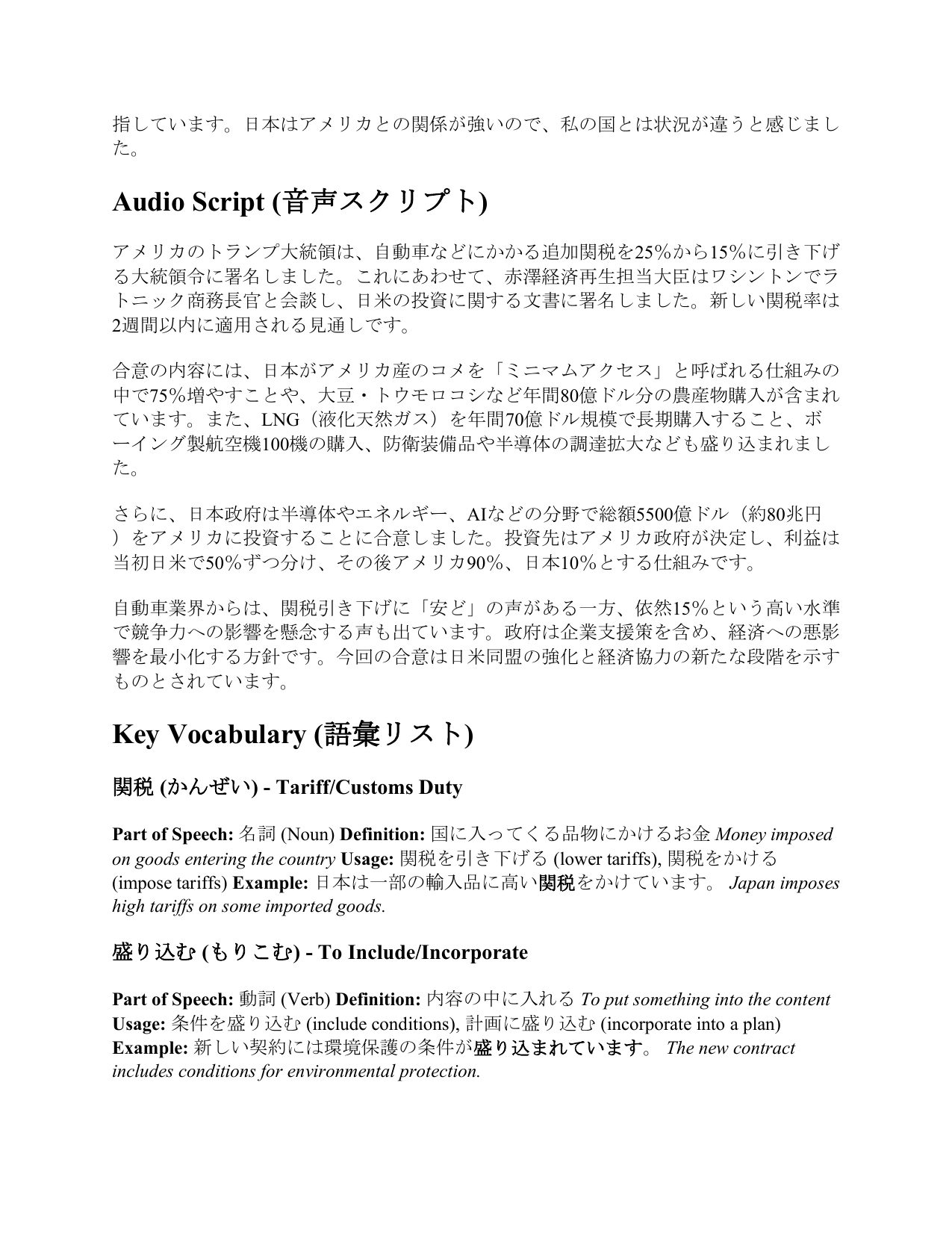
JP指しています。日本はアメリカとの関係が強いので、私の国とは状況が違うと感じまし
た。
た。
ENAudio Script (音声スクリプト)
JPアメリカのトランプ大統領は、自動車などにかかる追加関税を25%から15%に引き下げ
る大統領令に署名しました。これにあわせて、赤澤経済再生担当大臣はワシントンでラ
トニック商務長官と会談し、日米の投資に関する文書に署名しました。新しい関税率は
2週間以内に適用される見通しです。
合意の内容には、日本がアメリカ産のコメを「ミニマムアクセス」と呼ばれる仕組みの
中で75%増やすことや、大豆・トウモロコシなど年間80億ドル分の農産物購入が含まれ
ています。また、LNG(液化天然ガス)を年間70億ドル規模で長期購入すること、ボ
ーイング製航空機100機の購入、防衛装備品や半導体の調達拡大なども盛り込まれまし
た。
さらに、日本政府は半導体やエネルギー、AIなどの分野で総額5500億ドル(約80兆円
)をアメリカに投資することに合意しました。投資先はアメリカ政府が決定し、利益は
当初日米で50%ずつ分け、その後アメリカ90%、日本10%とする仕組みです。
自動車業界からは、関税引き下げに「安ど」の声がある一方、依然15%という高い水準
で競争力への影響を懸念する声も出ています。政府は企業支援策を含め、経済への悪影
響を最小化する方針です。今回の合意は日米同盟の強化と経済協力の新たな段階を示す
ものとされています。
る大統領令に署名しました。これにあわせて、赤澤経済再生担当大臣はワシントンでラ
トニック商務長官と会談し、日米の投資に関する文書に署名しました。新しい関税率は
2週間以内に適用される見通しです。
合意の内容には、日本がアメリカ産のコメを「ミニマムアクセス」と呼ばれる仕組みの
中で75%増やすことや、大豆・トウモロコシなど年間80億ドル分の農産物購入が含まれ
ています。また、LNG(液化天然ガス)を年間70億ドル規模で長期購入すること、ボ
ーイング製航空機100機の購入、防衛装備品や半導体の調達拡大なども盛り込まれまし
た。
さらに、日本政府は半導体やエネルギー、AIなどの分野で総額5500億ドル(約80兆円
)をアメリカに投資することに合意しました。投資先はアメリカ政府が決定し、利益は
当初日米で50%ずつ分け、その後アメリカ90%、日本10%とする仕組みです。
自動車業界からは、関税引き下げに「安ど」の声がある一方、依然15%という高い水準
で競争力への影響を懸念する声も出ています。政府は企業支援策を含め、経済への悪影
響を最小化する方針です。今回の合意は日米同盟の強化と経済協力の新たな段階を示す
ものとされています。
ENKey Vocabulary (語彙リスト)
関税 (かんぜい) - Tariff/Customs Duty
Part of Speech: 名詞 (Noun) Definition: 国に入ってくる品物にかけるお金 Money imposed
on goods entering the country Usage: 関税を引き下げる (lower tariffs), 関税をかける
(impose tariffs) Example: 日本は一部の輸入品に高い関税をかけています。 Japan imposes
high tariffs on some imported goods.
盛り込む (もりこむ) - To Include/Incorporate
Part of Speech: 動詞 (Verb) Definition: 内容の中に入れる To put something into the content
Usage: 条件を盛り込む (include conditions), 計画に盛り込む (incorporate into a plan)
関税 (かんぜい) - Tariff/Customs Duty
Part of Speech: 名詞 (Noun) Definition: 国に入ってくる品物にかけるお金 Money imposed
on goods entering the country Usage: 関税を引き下げる (lower tariffs), 関税をかける
(impose tariffs) Example: 日本は一部の輸入品に高い関税をかけています。 Japan imposes
high tariffs on some imported goods.
盛り込む (もりこむ) - To Include/Incorporate
Part of Speech: 動詞 (Verb) Definition: 内容の中に入れる To put something into the content
Usage: 条件を盛り込む (include conditions), 計画に盛り込む (incorporate into a plan)
JPExample:新しい契約には環境保護の条件が盛り込まれています。Thenewcontract
ENincludes conditions for environmental protection.
หน้า 23
คลิกเพื่อขยาย
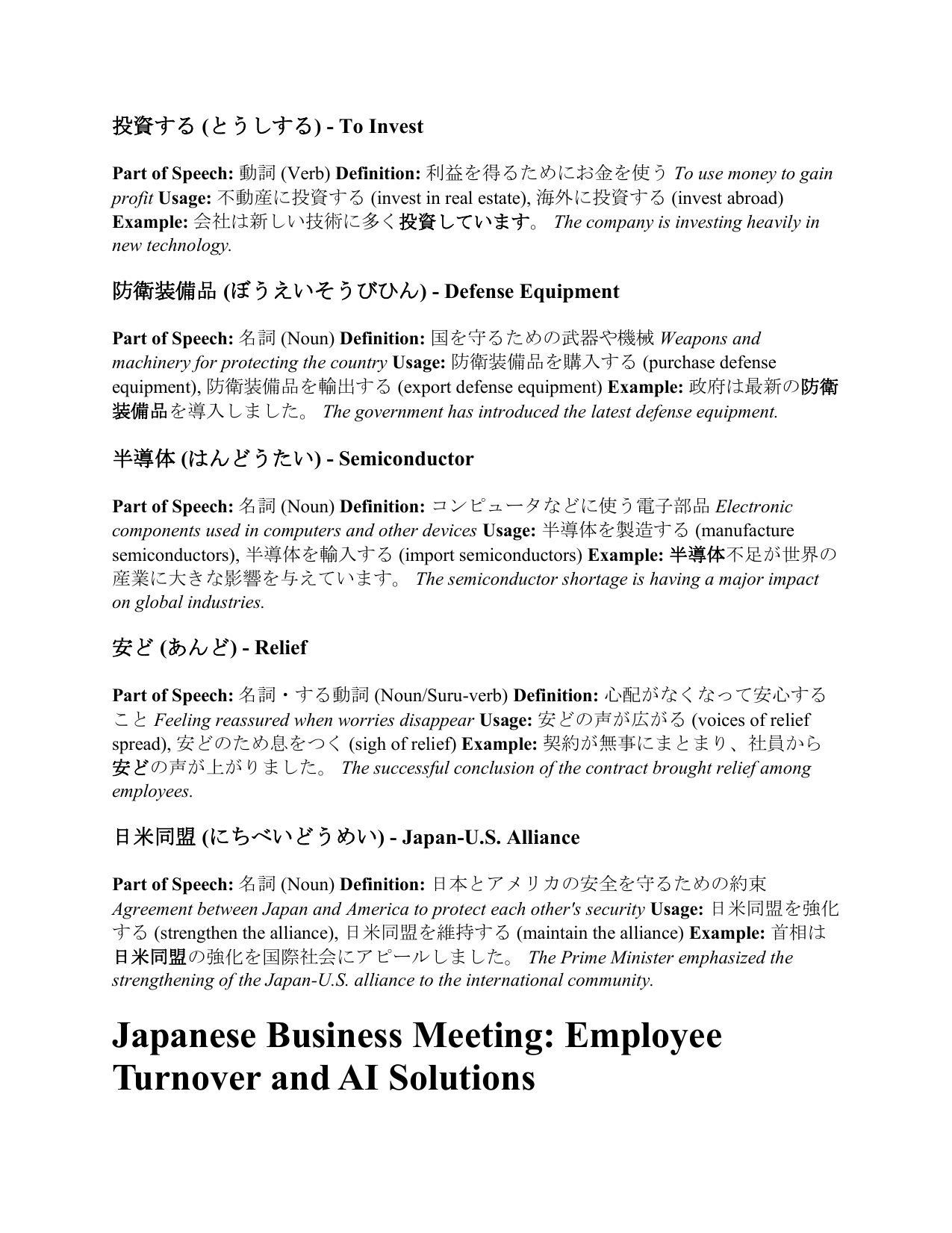
JP投資する(とうしする)-ToInvest
ENPart of Speech: 動詞 (Verb) Definition: 利益を得るためにお金を使う To use money to gain
profit Usage: 不動産に投資する (invest in real estate), 海外に投資する (invest abroad)
Example: 会社は新しい技術に多く投資しています。 The company is investing heavily in
new technology.
防衛装備品 (ぼうえいそうびひん) - Defense Equipment
Part of Speech: 名詞 (Noun) Definition: 国を守るための武器や機械 Weapons and
machinery for protecting the country Usage: 防衛装備品を購入する (purchase defense
equipment), 防衛装備品を輸出する (export defense equipment) Example: 政府は最新の防衛
装備品を導入しました。 The government has introduced the latest defense equipment.
半導体 (はんどうたい) - Semiconductor
Part of Speech: 名詞 (Noun) Definition: コンピュータなどに使う電子部品 Electronic
components used in computers and other devices Usage: 半導体を製造する (manufacture
semiconductors), 半導体を輸入する (import semiconductors) Example: 半導体不足が世界の
産業に大きな影響を与えています。 The semiconductor shortage is having a major impact
on global industries.
安ど (あんど) - Relief
Part of Speech: 名詞・する動詞 (Noun/Suru-verb) Definition: 心配がなくなって安心する
こと Feeling reassured when worries disappear Usage: 安どの声が広がる (voices of relief
spread), 安どのため息をつく (sigh of relief) Example: 契約が無事にまとまり、社員から
安どの声が上がりました。 The successful conclusion of the contract brought relief among
employees.
日米同盟 (にちべいどうめい) - Japan-U.S. Alliance
Part of Speech: 名詞 (Noun) Definition: 日本とアメリカの安全を守るための約束
Agreement between Japan and America to protect each other's security Usage: 日米同盟を強化
する (strengthen the alliance), 日米同盟を維持する (maintain the alliance) Example: 首相は
日米同盟の強化を国際社会にアピールしました。 The Prime Minister emphasized the
strengthening of the Japan-U.S. alliance to the international community.
Japanese Business Meeting: Employee
Turnover and AI Solutions
profit Usage: 不動産に投資する (invest in real estate), 海外に投資する (invest abroad)
Example: 会社は新しい技術に多く投資しています。 The company is investing heavily in
new technology.
防衛装備品 (ぼうえいそうびひん) - Defense Equipment
Part of Speech: 名詞 (Noun) Definition: 国を守るための武器や機械 Weapons and
machinery for protecting the country Usage: 防衛装備品を購入する (purchase defense
equipment), 防衛装備品を輸出する (export defense equipment) Example: 政府は最新の防衛
装備品を導入しました。 The government has introduced the latest defense equipment.
半導体 (はんどうたい) - Semiconductor
Part of Speech: 名詞 (Noun) Definition: コンピュータなどに使う電子部品 Electronic
components used in computers and other devices Usage: 半導体を製造する (manufacture
semiconductors), 半導体を輸入する (import semiconductors) Example: 半導体不足が世界の
産業に大きな影響を与えています。 The semiconductor shortage is having a major impact
on global industries.
安ど (あんど) - Relief
Part of Speech: 名詞・する動詞 (Noun/Suru-verb) Definition: 心配がなくなって安心する
こと Feeling reassured when worries disappear Usage: 安どの声が広がる (voices of relief
spread), 安どのため息をつく (sigh of relief) Example: 契約が無事にまとまり、社員から
安どの声が上がりました。 The successful conclusion of the contract brought relief among
employees.
日米同盟 (にちべいどうめい) - Japan-U.S. Alliance
Part of Speech: 名詞 (Noun) Definition: 日本とアメリカの安全を守るための約束
Agreement between Japan and America to protect each other's security Usage: 日米同盟を強化
する (strengthen the alliance), 日米同盟を維持する (maintain the alliance) Example: 首相は
日米同盟の強化を国際社会にアピールしました。 The Prime Minister emphasized the
strengthening of the Japan-U.S. alliance to the international community.
Japanese Business Meeting: Employee
Turnover and AI Solutions
หน้า 24
คลิกเพื่อขยาย
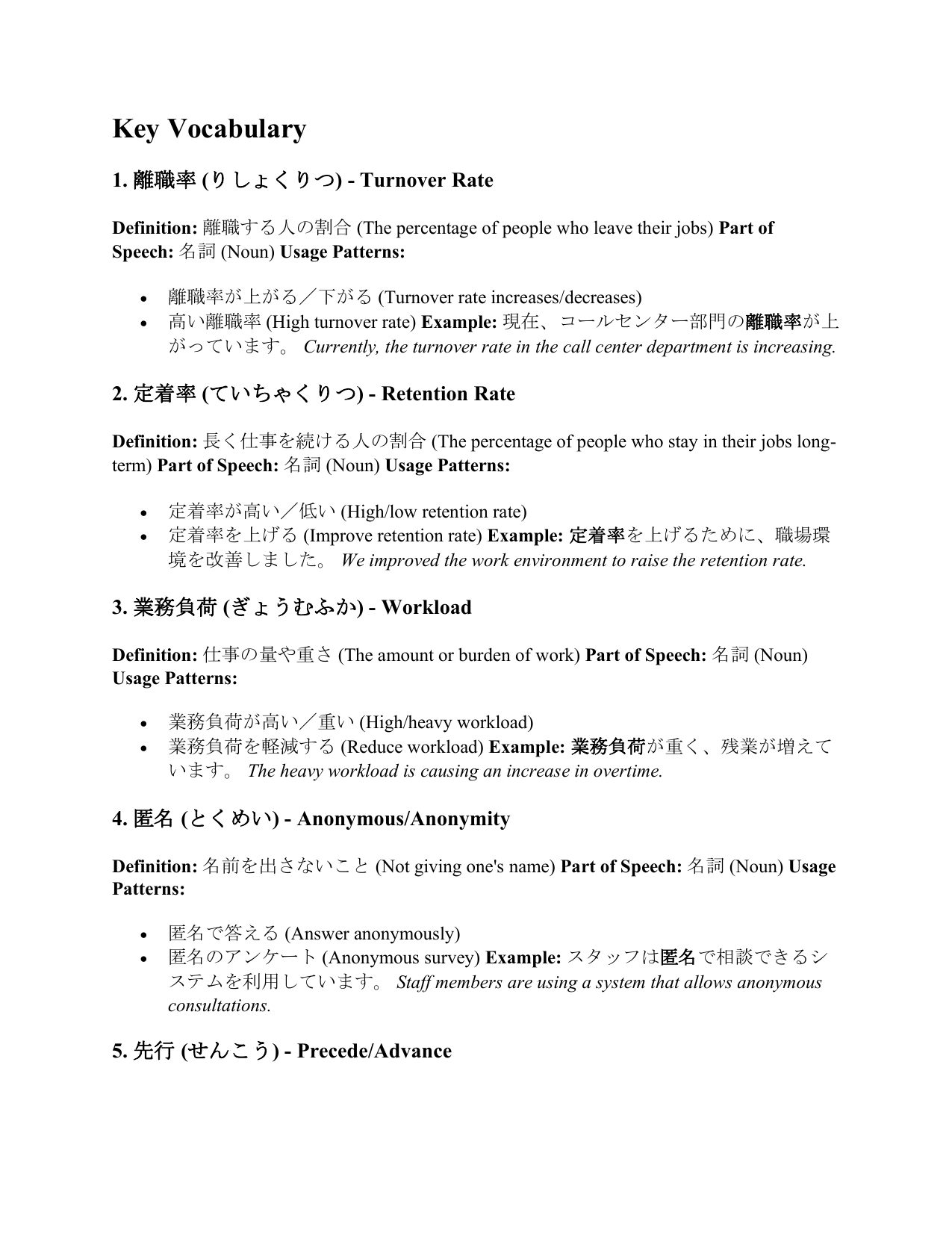
ENKey Vocabulary
1. 離職率 (りしょくりつ) - Turnover Rate
Definition: 離職する人の割合 (The percentage of people who leave their jobs) Part of
Speech: 名詞 (Noun) Usage Patterns:
• 離職率が上がる/下がる (Turnover rate increases/decreases)
• 高い離職率 (High turnover rate) Example: 現在、コールセンター部門の離職率が上
がっています。 Currently, the turnover rate in the call center department is increasing.
2. 定着率 (ていちゃくりつ) - Retention Rate
Definition: 長く仕事を続ける人の割合 (The percentage of people who stay in their jobs long-
term) Part of Speech: 名詞 (Noun) Usage Patterns:
• 定着率が高い/低い (High/low retention rate)
• 定着率を上げる (Improve retention rate) Example: 定着率を上げるために、職場環
境を改善しました。 We improved the work environment to raise the retention rate.
1. 離職率 (りしょくりつ) - Turnover Rate
Definition: 離職する人の割合 (The percentage of people who leave their jobs) Part of
Speech: 名詞 (Noun) Usage Patterns:
• 離職率が上がる/下がる (Turnover rate increases/decreases)
• 高い離職率 (High turnover rate) Example: 現在、コールセンター部門の離職率が上
がっています。 Currently, the turnover rate in the call center department is increasing.
2. 定着率 (ていちゃくりつ) - Retention Rate
Definition: 長く仕事を続ける人の割合 (The percentage of people who stay in their jobs long-
term) Part of Speech: 名詞 (Noun) Usage Patterns:
• 定着率が高い/低い (High/low retention rate)
• 定着率を上げる (Improve retention rate) Example: 定着率を上げるために、職場環
境を改善しました。 We improved the work environment to raise the retention rate.
JP3.業務負荷(ぎょうむふか)-Workload
ENDefinition: 仕事の量や重さ (The amount or burden of work) Part of Speech: 名詞 (Noun)
Usage Patterns:
• 業務負荷が高い/重い (High/heavy workload)
Usage Patterns:
• 業務負荷が高い/重い (High/heavy workload)
JP•業務負荷を軽減する(Reduceworkload)Example:業務負荷が重く、残業が増えて
EN います。 The heavy workload is causing an increase in overtime.
4. 匿名 (とくめい) - Anonymous/Anonymity
Definition: 名前を出さないこと (Not giving one's name) Part of Speech: 名詞 (Noun) Usage
Patterns:
• 匿名で答える (Answer anonymously)
4. 匿名 (とくめい) - Anonymous/Anonymity
Definition: 名前を出さないこと (Not giving one's name) Part of Speech: 名詞 (Noun) Usage
Patterns:
• 匿名で答える (Answer anonymously)
JP•匿名のアンケート(Anonymoussurvey)Example:スタッフは匿名で相談できるシ
EN ステムを利用しています。 Staff members are using a system that allows anonymous
consultations.
5. 先行 (せんこう) - Precede/Advance
consultations.
5. 先行 (せんこう) - Precede/Advance
หน้า 25
คลิกเพื่อขยาย
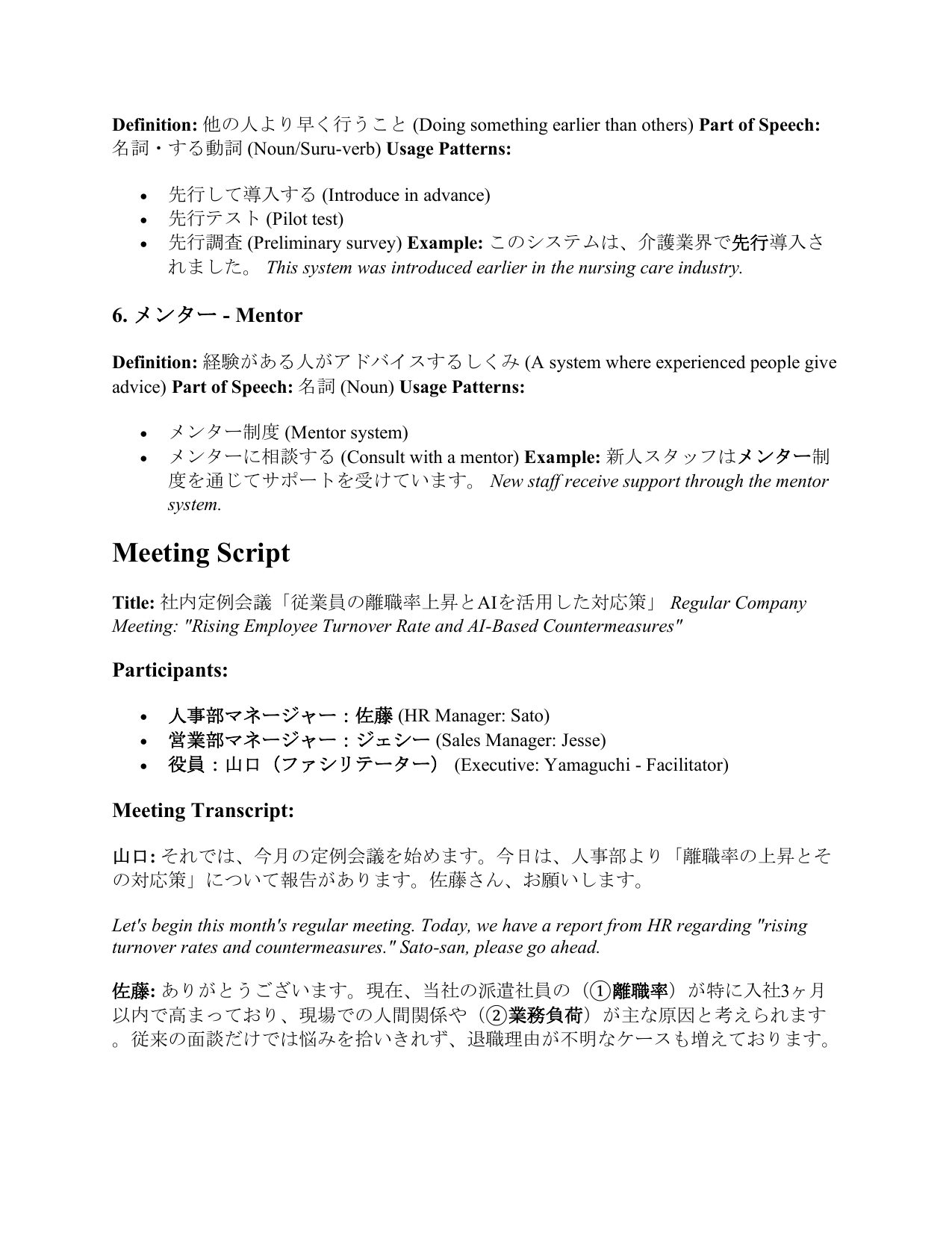
ENDefinition: 他の人より早く行うこと (Doing something earlier than others) Part of Speech:
名詞・する動詞 (Noun/Suru-verb) Usage Patterns:
• 先行して導入する (Introduce in advance)
• 先行テスト (Pilot test)
• 先行調査 (Preliminary survey) Example: このシステムは、介護業界で先行導入さ
れました。 This system was introduced earlier in the nursing care industry.
6. メンター - Mentor
Definition: 経験がある人がアドバイスするしくみ (A system where experienced people give
advice) Part of Speech: 名詞 (Noun) Usage Patterns:
• メンター制度 (Mentor system)
• メンターに相談する (Consult with a mentor) Example: 新人スタッフはメンター制
度を通じてサポートを受けています。 New staff receive support through the mentor
system.
Meeting Script
名詞・する動詞 (Noun/Suru-verb) Usage Patterns:
• 先行して導入する (Introduce in advance)
• 先行テスト (Pilot test)
• 先行調査 (Preliminary survey) Example: このシステムは、介護業界で先行導入さ
れました。 This system was introduced earlier in the nursing care industry.
6. メンター - Mentor
Definition: 経験がある人がアドバイスするしくみ (A system where experienced people give
advice) Part of Speech: 名詞 (Noun) Usage Patterns:
• メンター制度 (Mentor system)
• メンターに相談する (Consult with a mentor) Example: 新人スタッフはメンター制
度を通じてサポートを受けています。 New staff receive support through the mentor
system.
Meeting Script
JPTitle:社内定例会議「従業員の離職率上昇とAIを活用した対応策」RegularCompany
ENMeeting: "Rising Employee Turnover Rate and AI-Based Countermeasures"
Participants:
• 人事部マネージャー:佐藤 (HR Manager: Sato)
• 営業部マネージャー:ジェシー (Sales Manager: Jesse)
• 役員:山口(ファシリテーター) (Executive: Yamaguchi - Facilitator)
Meeting Transcript:
Participants:
• 人事部マネージャー:佐藤 (HR Manager: Sato)
• 営業部マネージャー:ジェシー (Sales Manager: Jesse)
• 役員:山口(ファシリテーター) (Executive: Yamaguchi - Facilitator)
Meeting Transcript:
JP山口:それでは、今月の定例会議を始めます。今日は、人事部より「離職率の上昇とそ
の対応策」について報告があります。佐藤さん、お願いします。
の対応策」について報告があります。佐藤さん、お願いします。
ENLet's begin this month's regular meeting. Today, we have a report from HR regarding "rising
turnover rates and countermeasures." Sato-san, please go ahead.
turnover rates and countermeasures." Sato-san, please go ahead.
JP佐藤:ありがとうございます。現在、当社の派遣社員の(①離職率)が特に入社3ヶ月
以内で高まっており、現場での人間関係や(②業務負荷)が主な原因と考えられます
。従来の面談だけでは悩みを拾いきれず、退職理由が不明なケースも増えております。
以内で高まっており、現場での人間関係や(②業務負荷)が主な原因と考えられます
。従来の面談だけでは悩みを拾いきれず、退職理由が不明なケースも増えております。
หน้า 26
คลิกเพื่อขยาย
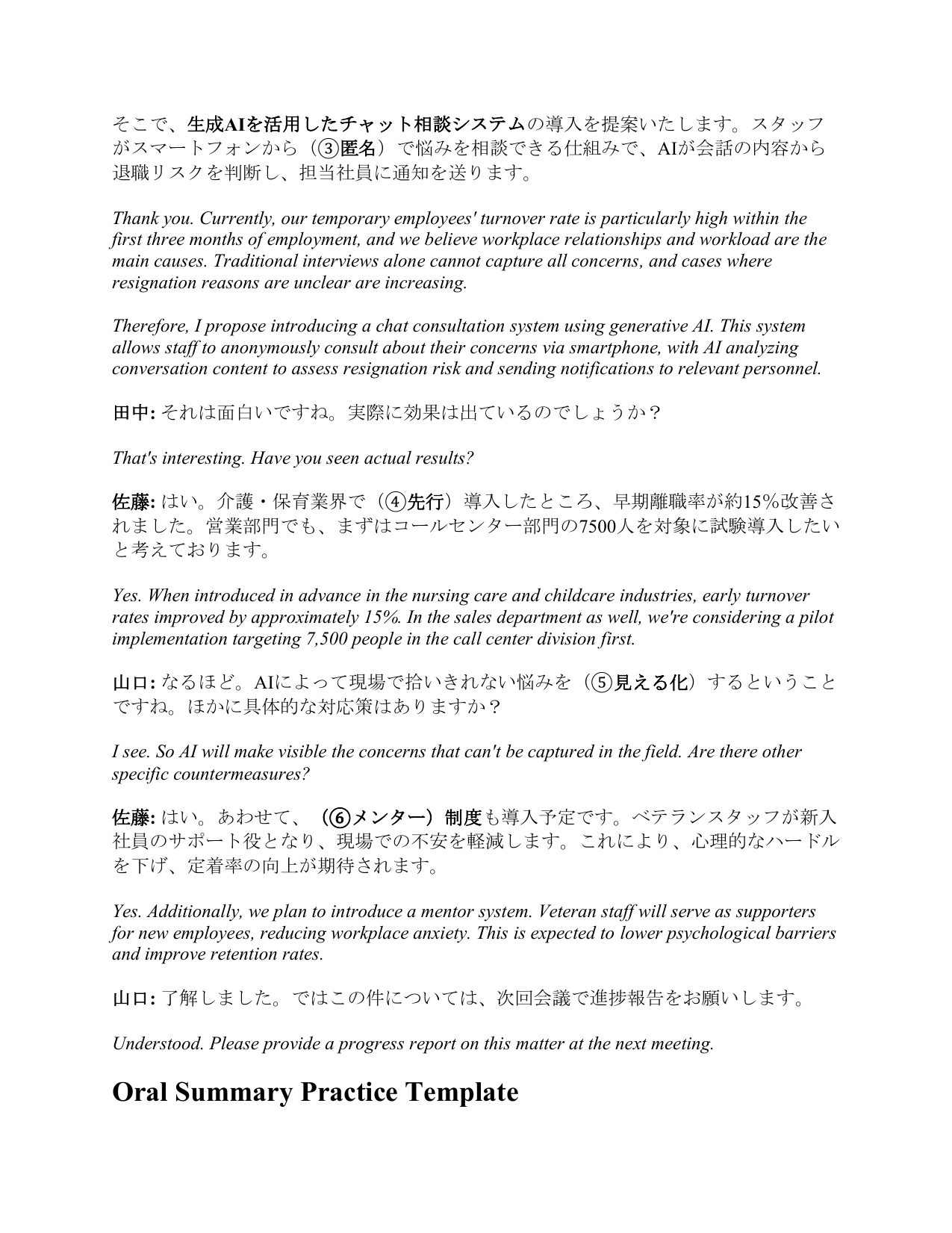
JPそこで、生成AIを活用したチャット相談システムの導入を提案いたします。スタッフ
がスマートフォンから(③匿名)で悩みを相談できる仕組みで、AIが会話の内容から
退職リスクを判断し、担当社員に通知を送ります。
がスマートフォンから(③匿名)で悩みを相談できる仕組みで、AIが会話の内容から
退職リスクを判断し、担当社員に通知を送ります。
ENThank you. Currently, our temporary employees' turnover rate is particularly high within the
first three months of employment, and we believe workplace relationships and workload are the
main causes. Traditional interviews alone cannot capture all concerns, and cases where
resignation reasons are unclear are increasing.
Therefore, I propose introducing a chat consultation system using generative AI. This system
allows staff to anonymously consult about their concerns via smartphone, with AI analyzing
conversation content to assess resignation risk and sending notifications to relevant personnel.
first three months of employment, and we believe workplace relationships and workload are the
main causes. Traditional interviews alone cannot capture all concerns, and cases where
resignation reasons are unclear are increasing.
Therefore, I propose introducing a chat consultation system using generative AI. This system
allows staff to anonymously consult about their concerns via smartphone, with AI analyzing
conversation content to assess resignation risk and sending notifications to relevant personnel.
JP田中:それは面白いですね。実際に効果は出ているのでしょうか?
ENThat's interesting. Have you seen actual results?
JP佐藤:はい。介護・保育業界で(④先行)導入したところ、早期離職率が約15%改善さ
れました。営業部門でも、まずはコールセンター部門の7500人を対象に試験導入したい
と考えております。
れました。営業部門でも、まずはコールセンター部門の7500人を対象に試験導入したい
と考えております。
ENYes. When introduced in advance in the nursing care and childcare industries, early turnover
rates improved by approximately 15%. In the sales department as well, we're considering a pilot
implementation targeting 7,500 people in the call center division first.
rates improved by approximately 15%. In the sales department as well, we're considering a pilot
implementation targeting 7,500 people in the call center division first.
JP山口:なるほど。AIによって現場で拾いきれない悩みを(⑤見える化)するということ
ですね。ほかに具体的な対応策はありますか?
ですね。ほかに具体的な対応策はありますか?
ENI see. So AI will make visible the concerns that can't be captured in the field. Are there other
specific countermeasures?
specific countermeasures?
JP佐藤:はい。あわせて、(⑥メンター)制度も導入予定です。ベテランスタッフが新入
社員のサポート役となり、現場での不安を軽減します。これにより、心理的なハードル
を下げ、定着率の向上が期待されます。
社員のサポート役となり、現場での不安を軽減します。これにより、心理的なハードル
を下げ、定着率の向上が期待されます。
ENYes. Additionally, we plan to introduce a mentor system. Veteran staff will serve as supporters
for new employees, reducing workplace anxiety. This is expected to lower psychological barriers
and improve retention rates.
for new employees, reducing workplace anxiety. This is expected to lower psychological barriers
and improve retention rates.
JP山口:了解しました。ではこの件については、次回会議で進捗報告をお願いします。
ENUnderstood. Please provide a progress report on this matter at the next meeting.
Oral Summary Practice Template
Oral Summary Practice Template
หน้า 27
คลิกเพื่อขยาย
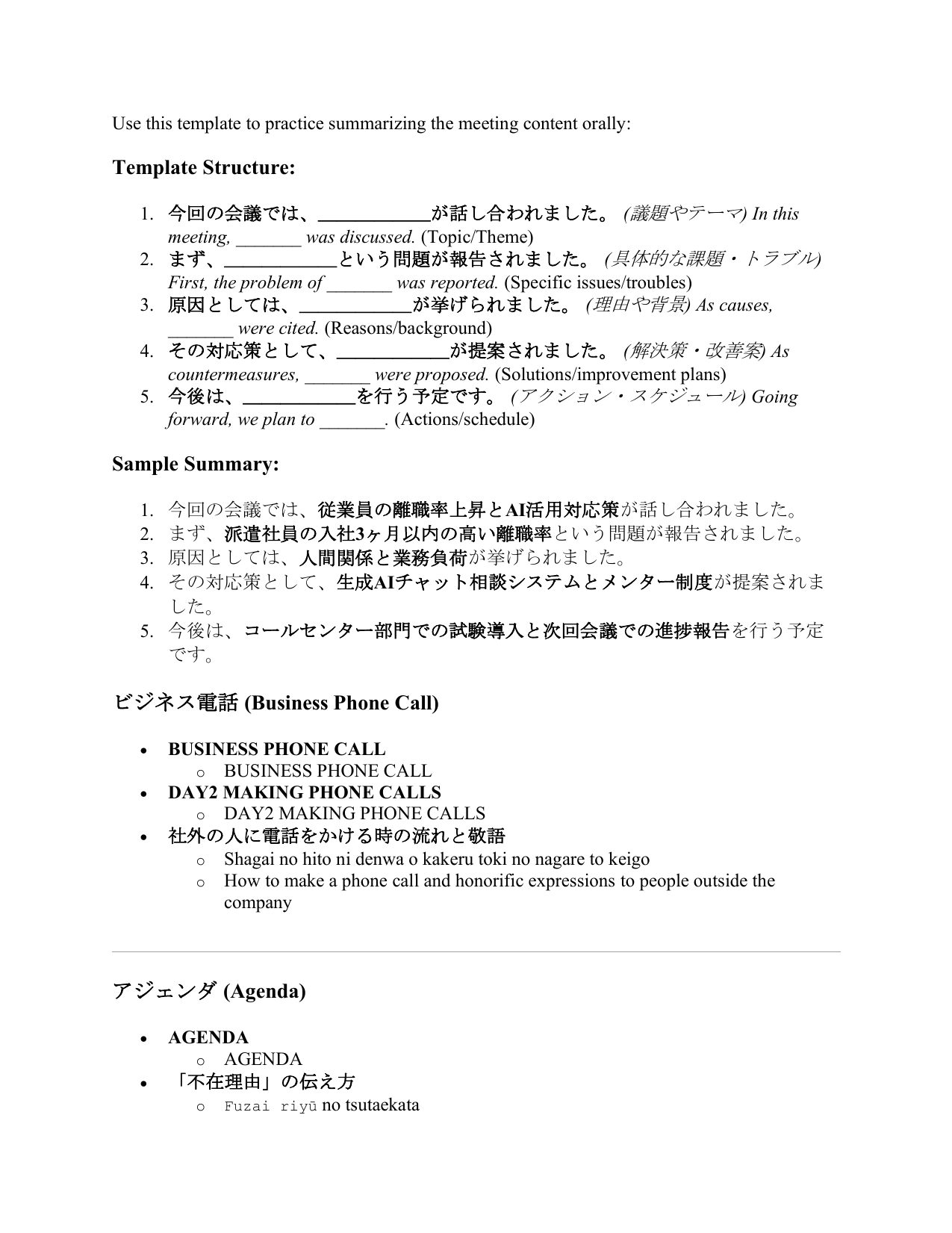
ENUse this template to practice summarizing the meeting content orally:
Template Structure:
Template Structure:
JP1.今回の会議では、______が話し合われました。(議題やテーマ)Inthis
EN meeting, _______ was discussed. (Topic/Theme)
JP2.まず、______という問題が報告されました。(具体的な課題・トラブル)
EN First, the problem of _______ was reported. (Specific issues/troubles)
JP3.原因としては、______が挙げられました。(理由や背景)Ascauses,
EN _______ were cited. (Reasons/background)
JP4.その対応策として、______が提案されました。(解決策・改善案)As
EN countermeasures, _______ were proposed. (Solutions/improvement plans)
JP5.今後は、______を行う予定です。(アクション・スケジュール)Going
EN forward, we plan to _______. (Actions/schedule)
Sample Summary:
Sample Summary:
JP1.今回の会議では、従業員の離職率上昇とAI活用対応策が話し合われました。
2.まず、派遣社員の入社3ヶ月以内の高い離職率という問題が報告されました。
3.原因としては、人間関係と業務負荷が挙げられました。
4.その対応策として、生成AIチャット相談システムとメンター制度が提案されま
した。
5.今後は、コールセンター部門での試験導入と次回会議での進捗報告を行う予定
です。
2.まず、派遣社員の入社3ヶ月以内の高い離職率という問題が報告されました。
3.原因としては、人間関係と業務負荷が挙げられました。
4.その対応策として、生成AIチャット相談システムとメンター制度が提案されま
した。
5.今後は、コールセンター部門での試験導入と次回会議での進捗報告を行う予定
です。
ENビジネス電話 (Business Phone Call)
• BUSINESS PHONE CALL
o BUSINESS PHONE CALL
• DAY2 MAKING PHONE CALLS
o DAY2 MAKING PHONE CALLS
• BUSINESS PHONE CALL
o BUSINESS PHONE CALL
• DAY2 MAKING PHONE CALLS
o DAY2 MAKING PHONE CALLS
JP•社外の人に電話をかける時の流れと敬語
EN o Shagai no hito ni denwa o kakeru toki no nagare to keigo
o How to make a phone call and honorific expressions to people outside the
company
アジェンダ (Agenda)
• AGENDA
o AGENDA
o How to make a phone call and honorific expressions to people outside the
company
アジェンダ (Agenda)
• AGENDA
o AGENDA
JP•「不在理由」の伝え方
EN o Fuzai riyū no tsutaekata
หน้า 28
คลิกเพื่อขยาย
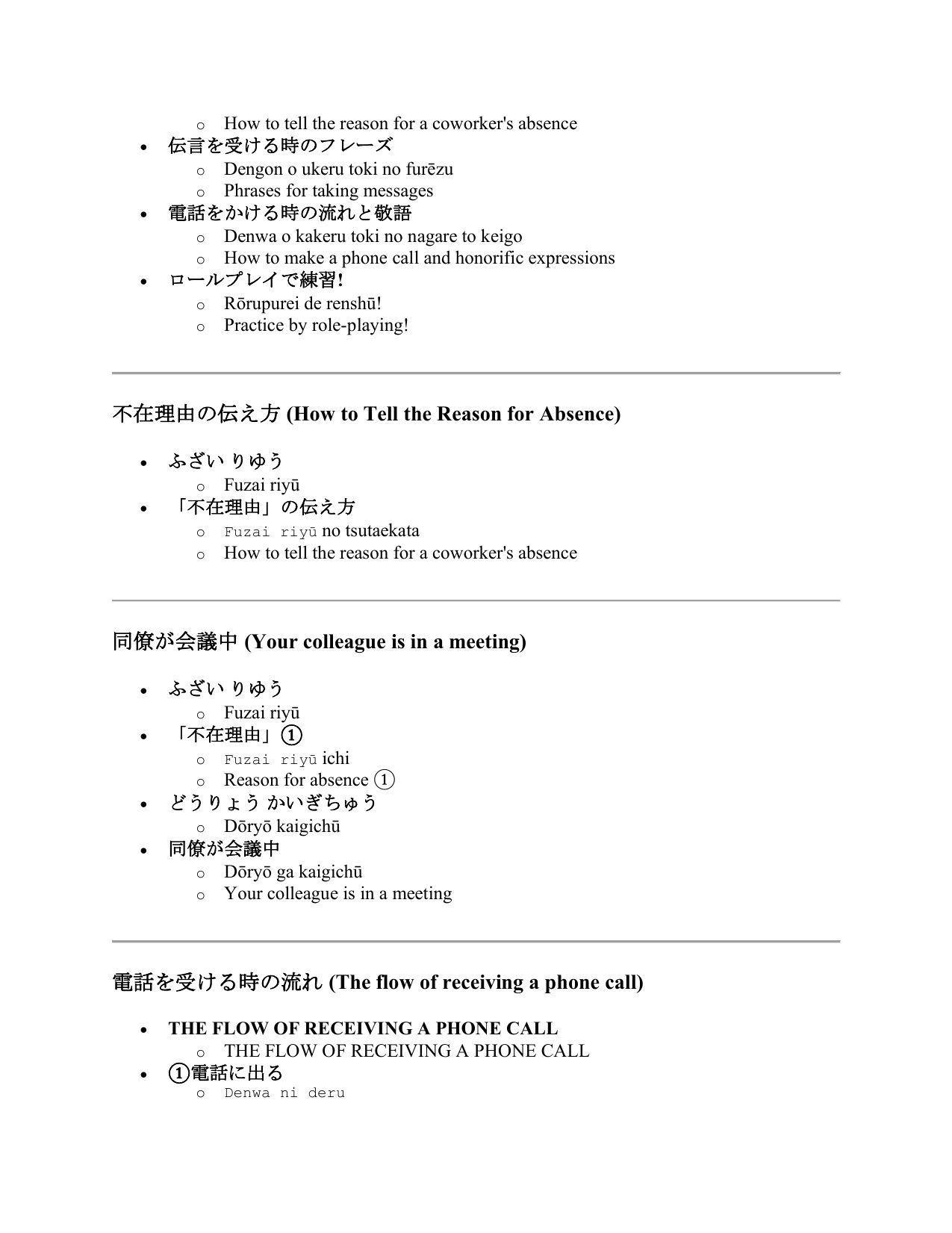
EN How to tell the reason for a coworker's absence
o
o
JP•伝言を受ける時のフレーズ
EN o Dengon o ukeru toki no furēzu
o Phrases for taking messages
o Phrases for taking messages
JP•電話をかける時の流れと敬語
EN o Denwa o kakeru toki no nagare to keigo
o How to make a phone call and honorific expressions
o How to make a phone call and honorific expressions
JP•ロールプレイで練習!
EN o Rōrupurei de renshū!
o Practice by role-playing!
不在理由の伝え方 (How to Tell the Reason for Absence)
o Practice by role-playing!
不在理由の伝え方 (How to Tell the Reason for Absence)
JP•ふざいりゆう
EN o Fuzai riyū
JP•「不在理由」の伝え方
EN o Fuzai riyū no tsutaekata
o How to tell the reason for a coworker's absence
同僚が会議中 (Your colleague is in a meeting)
o How to tell the reason for a coworker's absence
同僚が会議中 (Your colleague is in a meeting)
JP•ふざいりゆう
EN o Fuzai riyū
JP•「不在理由」①
EN o Fuzai riyū ichi
Reason for absence ①
o
Reason for absence ①
o
JP•どうりょうかいぎちゅう
EN o Dōryō kaigichū
JP•同僚が会議中
EN o Dōryō ga kaigichū
o Your colleague is in a meeting
電話を受ける時の流れ (The flow of receiving a phone call)
• THE FLOW OF RECEIVING A PHONE CALL
o THE FLOW OF RECEIVING A PHONE CALL
o Your colleague is in a meeting
電話を受ける時の流れ (The flow of receiving a phone call)
• THE FLOW OF RECEIVING A PHONE CALL
o THE FLOW OF RECEIVING A PHONE CALL
JP•①電話に出る
EN o Denwa ni deru
หน้า 29
คลิกเพื่อขยาย
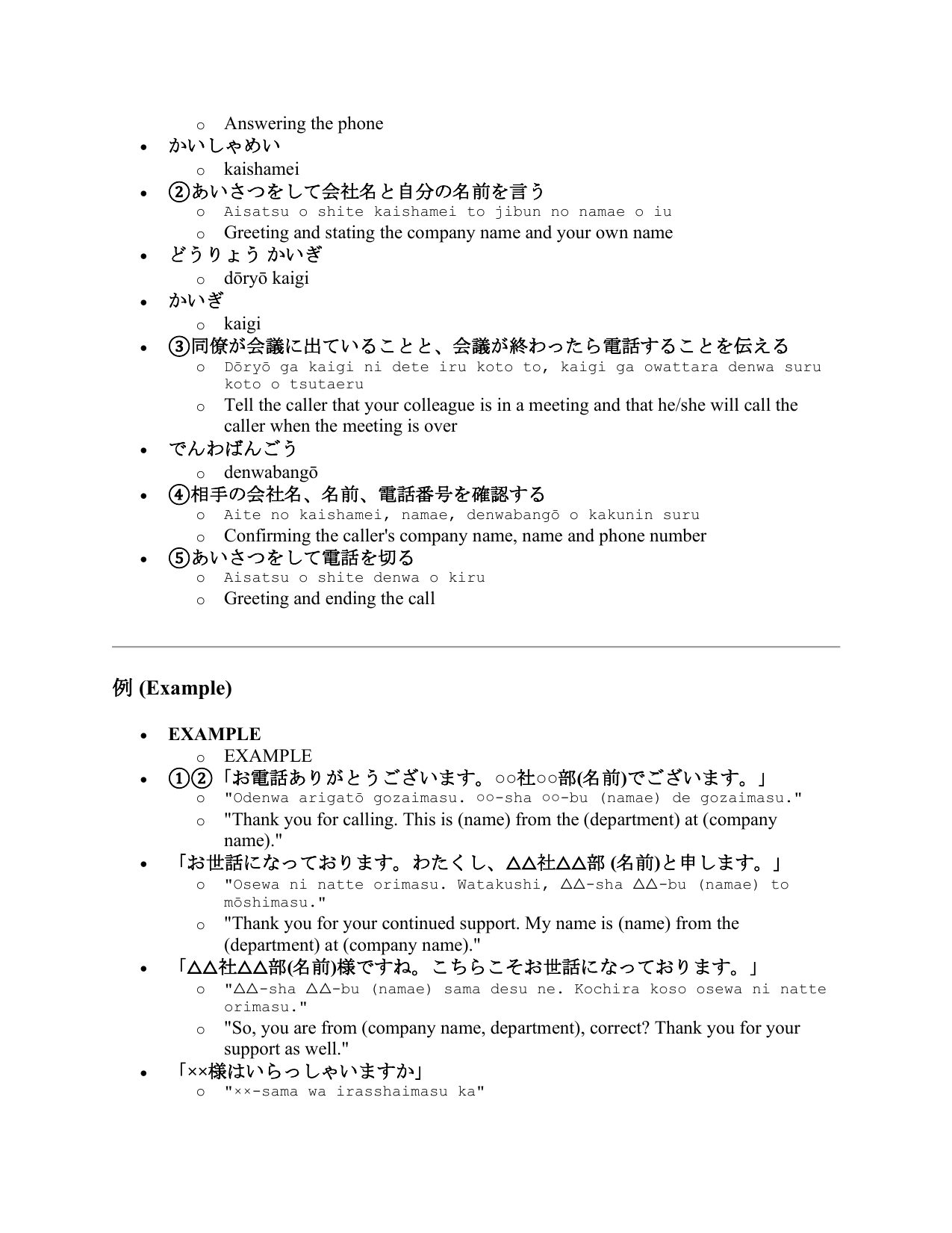
EN Answering the phone
o
o
JP•かいしゃめい
EN o kaishamei
JP•②あいさつをして会社名と自分の名前を言う
EN o Aisatsu o shite kaishamei to jibun no namae o iu
Greeting and stating the company name and your own name
o
Greeting and stating the company name and your own name
o
JP•どうりょうかいぎ
EN o dōryō kaigi
JP•かいぎ
EN o kaigi
JP•③同僚が会議に出ていることと、会議が終わったら電話することを伝える
EN o Dōryō ga kaigi ni dete iru koto to, kaigi ga owattara denwa suru
koto o tsutaeru
Tell the caller that your colleague is in a meeting and that he/she will call the
o
caller when the meeting is over
koto o tsutaeru
Tell the caller that your colleague is in a meeting and that he/she will call the
o
caller when the meeting is over
JP•でんわばんごう
EN o denwabangō
JP•④相手の会社名、名前、電話番号を確認する
EN o Aite no kaishamei, namae, denwabangō o kakunin suru
Confirming the caller's company name, name and phone number
o
Confirming the caller's company name, name and phone number
o
JP•⑤あいさつをして電話を切る
EN o Aisatsu o shite denwa o kiru
o Greeting and ending the call
例 (Example)
• EXAMPLE
o EXAMPLE
o Greeting and ending the call
例 (Example)
• EXAMPLE
o EXAMPLE
JP•①②「お電話ありがとうございます。○○社○○部(名前)でございます。」
EN o "Odenwa arigatō gozaimasu. ○○-sha ○○-bu (namae) de gozaimasu."
"Thank you for calling. This is (name) from the (department) at (company
o
name)."
"Thank you for calling. This is (name) from the (department) at (company
o
name)."
JP•「お世話になっております。わたくし、△△社△△部(名前)と申します。」
EN o "Osewa ni natte orimasu. Watakushi, △△-sha △△-bu (namae) to
mōshimasu."
"Thank you for your continued support. My name is (name) from the
o
(department) at (company name)."
mōshimasu."
"Thank you for your continued support. My name is (name) from the
o
(department) at (company name)."
JP•「△△社△△部(名前)様ですね。こちらこそお世話になっております。」
EN o "△△-sha △△-bu (namae) sama desu ne. Kochira koso osewa ni natte
orimasu."
o"So, you are from (company name, department), correct? Thank you for your
support as well."
orimasu."
o"So, you are from (company name, department), correct? Thank you for your
support as well."
JP•「××様はいらっしゃいますか」
EN o "××-sama wa irasshaimasu ka"
หน้า 30
คลิกเพื่อขยาย
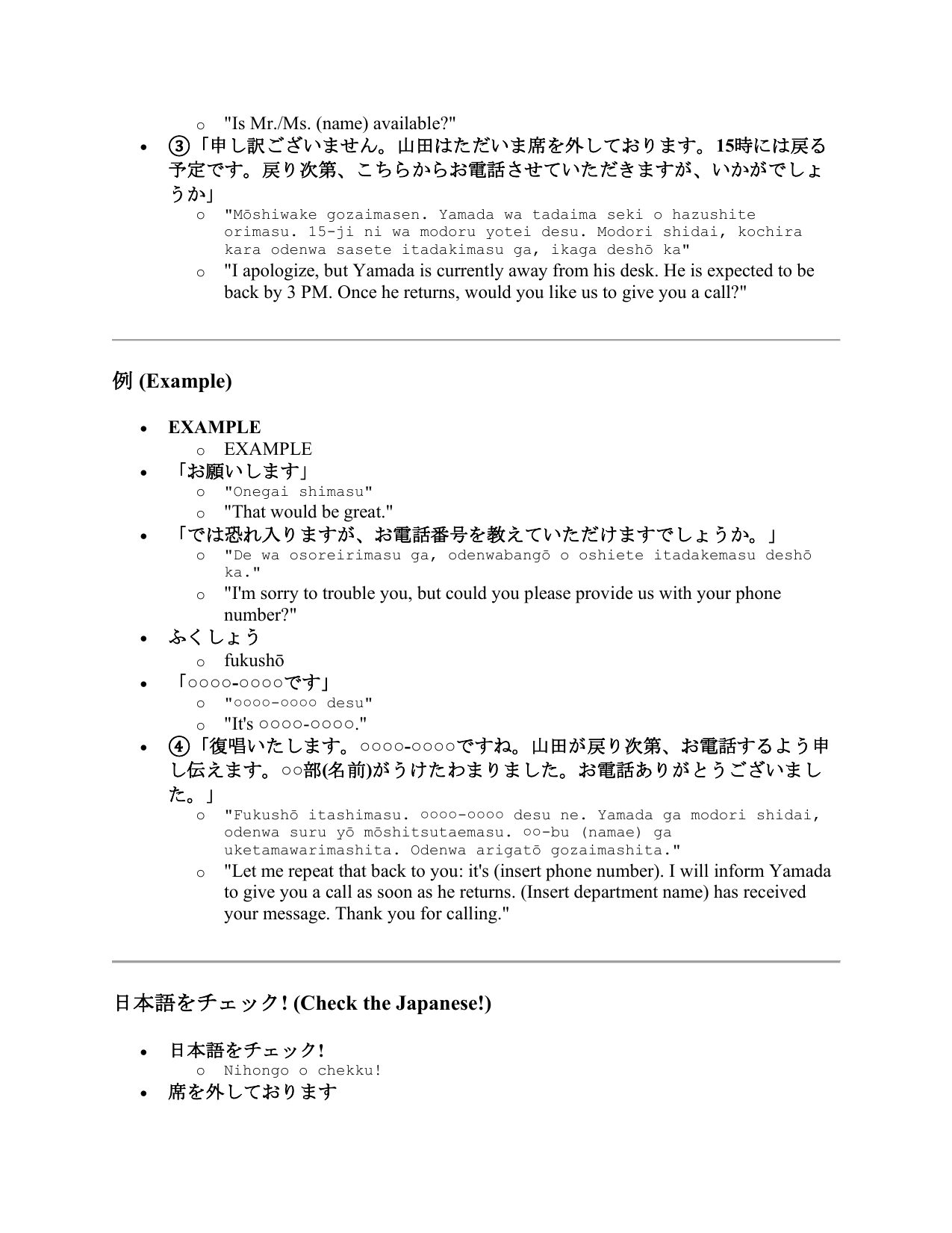
EN "Is Mr./Ms. (name) available?"
o
o
JP•③「申し訳ございません。山田はただいま席を外しております。15時には戻る
予定です。戻り次第、こちらからお電話させていただきますが、いかがでしょ
うか」
予定です。戻り次第、こちらからお電話させていただきますが、いかがでしょ
うか」
EN o "Mōshiwake gozaimasen. Yamada wa tadaima seki o hazushite
orimasu. 15-ji ni wa modoru yotei desu. Modori shidai, kochira
kara odenwa sasete itadakimasu ga, ikaga deshō ka"
o "I apologize, but Yamada is currently away from his desk. He is expected to be
back by 3 PM. Once he returns, would you like us to give you a call?"
例 (Example)
• EXAMPLE
o EXAMPLE
orimasu. 15-ji ni wa modoru yotei desu. Modori shidai, kochira
kara odenwa sasete itadakimasu ga, ikaga deshō ka"
o "I apologize, but Yamada is currently away from his desk. He is expected to be
back by 3 PM. Once he returns, would you like us to give you a call?"
例 (Example)
• EXAMPLE
o EXAMPLE
JP•「お願いします」
EN o "Onegai shimasu"
"That would be great."
o
"That would be great."
o
JP•「では恐れ入りますが、お電話番号を教えていただけますでしょうか。」
EN o "De wa osoreirimasu ga, odenwabangō o oshiete itadakemasu deshō
ka."
o"I'm sorry to trouble you, but could you please provide us with your phone
number?"
ka."
o"I'm sorry to trouble you, but could you please provide us with your phone
number?"
JP•ふくしょう
EN o fukushō
JP•「○○○○-○○○○です」
EN o "○○○○-○○○○ desu"
"It's ○○○○-○○○○."
o
"It's ○○○○-○○○○."
o
JP•④「復唱いたします。○○○○-○○○○ですね。山田が戻り次第、お電話するよう申
し伝えます。○○部(名前)がうけたわまりました。お電話ありがとうございまし
た。」
し伝えます。○○部(名前)がうけたわまりました。お電話ありがとうございまし
た。」
EN o "Fukushō itashimasu. ○○○○-○○○○ desu ne. Yamada ga modori shidai,
odenwa suru yō mōshitsutaemasu. ○○-bu (namae) ga
uketamawarimashita. Odenwa arigatō gozaimashita."
o "Let me repeat that back to you: it's (insert phone number). I will inform Yamada
to give you a call as soon as he returns. (Insert department name) has received
your message. Thank you for calling."
日本語をチェック! (Check the Japanese!)
odenwa suru yō mōshitsutaemasu. ○○-bu (namae) ga
uketamawarimashita. Odenwa arigatō gozaimashita."
o "Let me repeat that back to you: it's (insert phone number). I will inform Yamada
to give you a call as soon as he returns. (Insert department name) has received
your message. Thank you for calling."
日本語をチェック! (Check the Japanese!)
JP•日本語をチェック!
EN o Nihongo o chekku!
JP•席を外しております
หน้า 31
คลิกเพื่อขยาย
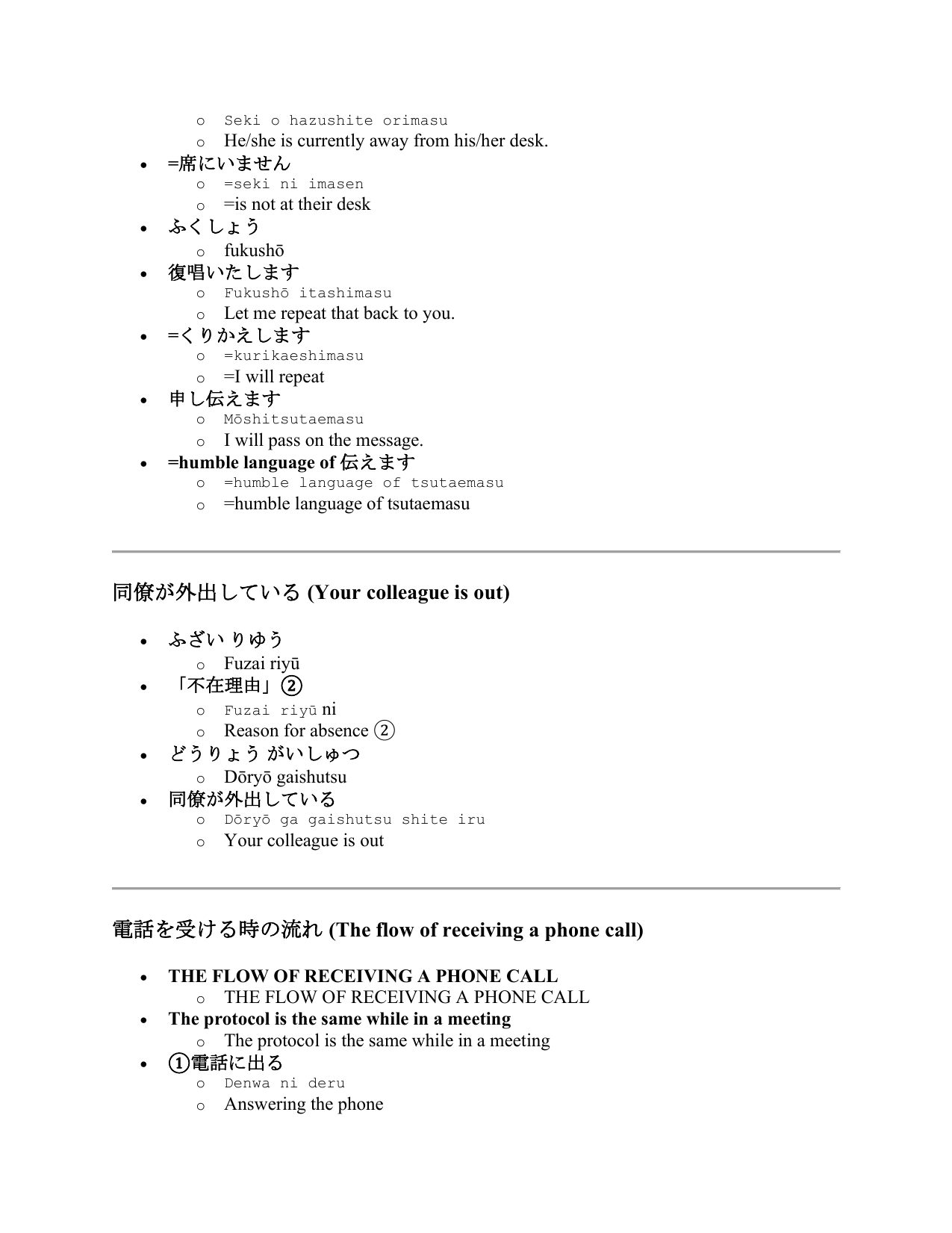
EN o Seki o hazushite orimasu
He/she is currently away from his/her desk.
o
He/she is currently away from his/her desk.
o
JP•=席にいません
EN o =seki ni imasen
=is not at their desk
o
=is not at their desk
o
JP•ふくしょう
EN o fukushō
JP•復唱いたします
EN o Fukushō itashimasu
Let me repeat that back to you.
o
Let me repeat that back to you.
o
JP•=くりかえします
EN o =kurikaeshimasu
=I will repeat
o
=I will repeat
o
JP•申し伝えます
EN o Mōshitsutaemasu
o I will pass on the message.
• =humble language of 伝えます
o =humble language of tsutaemasu
o =humble language of tsutaemasu
同僚が外出している (Your colleague is out)
o I will pass on the message.
• =humble language of 伝えます
o =humble language of tsutaemasu
o =humble language of tsutaemasu
同僚が外出している (Your colleague is out)
JP•ふざいりゆう
EN o Fuzai riyū
JP•「不在理由」②
EN o Fuzai riyū ni
Reason for absence ②
o
Reason for absence ②
o
JP•どうりょうがいしゅつ
EN o Dōryō gaishutsu
JP•同僚が外出している
EN o Dōryō ga gaishutsu shite iru
o Your colleague is out
電話を受ける時の流れ (The flow of receiving a phone call)
• THE FLOW OF RECEIVING A PHONE CALL
o THE FLOW OF RECEIVING A PHONE CALL
• The protocol is the same while in a meeting
o The protocol is the same while in a meeting
o Your colleague is out
電話を受ける時の流れ (The flow of receiving a phone call)
• THE FLOW OF RECEIVING A PHONE CALL
o THE FLOW OF RECEIVING A PHONE CALL
• The protocol is the same while in a meeting
o The protocol is the same while in a meeting
JP•①電話に出る
EN o Denwa ni deru
o Answering the phone
o Answering the phone
หน้า 32
คลิกเพื่อขยาย
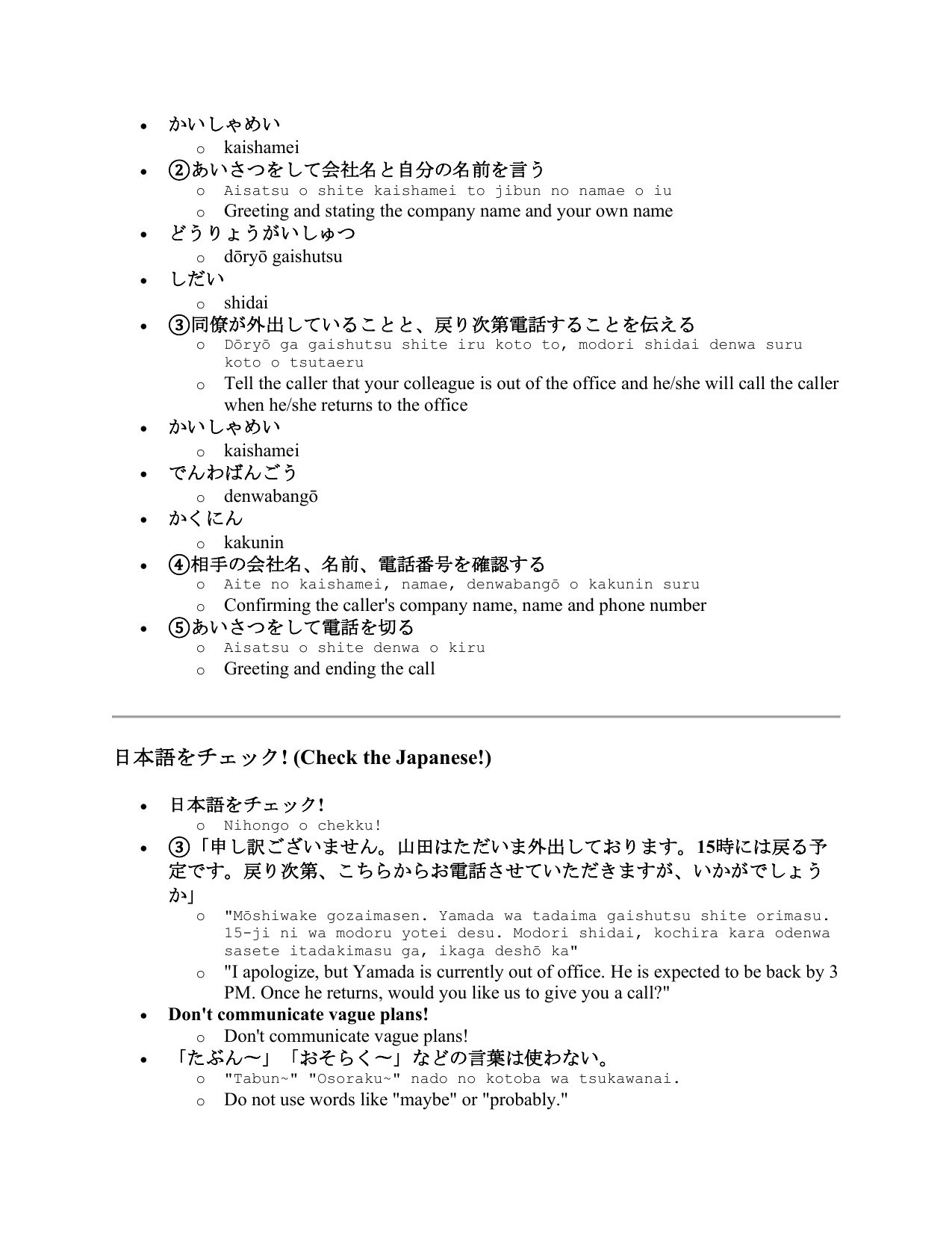
JP•かいしゃめい
EN o kaishamei
JP•②あいさつをして会社名と自分の名前を言う
EN o Aisatsu o shite kaishamei to jibun no namae o iu
Greeting and stating the company name and your own name
o
Greeting and stating the company name and your own name
o
JP•どうりょうがいしゅつ
EN o dōryō gaishutsu
JP•しだい
EN o shidai
JP•③同僚が外出していることと、戻り次第電話することを伝える
EN o Dōryō ga gaishutsu shite iru koto to, modori shidai denwa suru
koto o tsutaeru
Tell the caller that your colleague is out of the office and he/she will call the caller
o
when he/she returns to the office
koto o tsutaeru
Tell the caller that your colleague is out of the office and he/she will call the caller
o
when he/she returns to the office
JP•かいしゃめい
EN o kaishamei
JP•でんわばんごう
EN o denwabangō
JP•かくにん
EN o kakunin
JP•④相手の会社名、名前、電話番号を確認する
EN o Aite no kaishamei, namae, denwabangō o kakunin suru
Confirming the caller's company name, name and phone number
o
Confirming the caller's company name, name and phone number
o
JP•⑤あいさつをして電話を切る
EN o Aisatsu o shite denwa o kiru
o Greeting and ending the call
日本語をチェック! (Check the Japanese!)
o Greeting and ending the call
日本語をチェック! (Check the Japanese!)
JP•日本語をチェック!
EN o Nihongo o chekku!
JP•③「申し訳ございません。山田はただいま外出しております。15時には戻る予
定です。戻り次第、こちらからお電話させていただきますが、いかがでしょう
か」
定です。戻り次第、こちらからお電話させていただきますが、いかがでしょう
か」
EN o "Mōshiwake gozaimasen. Yamada wa tadaima gaishutsu shite orimasu.
15-ji ni wa modoru yotei desu. Modori shidai, kochira kara odenwa
sasete itadakimasu ga, ikaga deshō ka"
o "I apologize, but Yamada is currently out of office. He is expected to be back by 3
PM. Once he returns, would you like us to give you a call?"
• Don't communicate vague plans!
o Don't communicate vague plans!
15-ji ni wa modoru yotei desu. Modori shidai, kochira kara odenwa
sasete itadakimasu ga, ikaga deshō ka"
o "I apologize, but Yamada is currently out of office. He is expected to be back by 3
PM. Once he returns, would you like us to give you a call?"
• Don't communicate vague plans!
o Don't communicate vague plans!
JP•「たぶん〜」「おそらく〜」などの言葉は使わない。
EN o "Tabun~" "Osoraku~" nado no kotoba wa tsukawanai.
o Do not use words like "maybe" or "probably."
o Do not use words like "maybe" or "probably."
หน้า 33
คลิกเพื่อขยาย
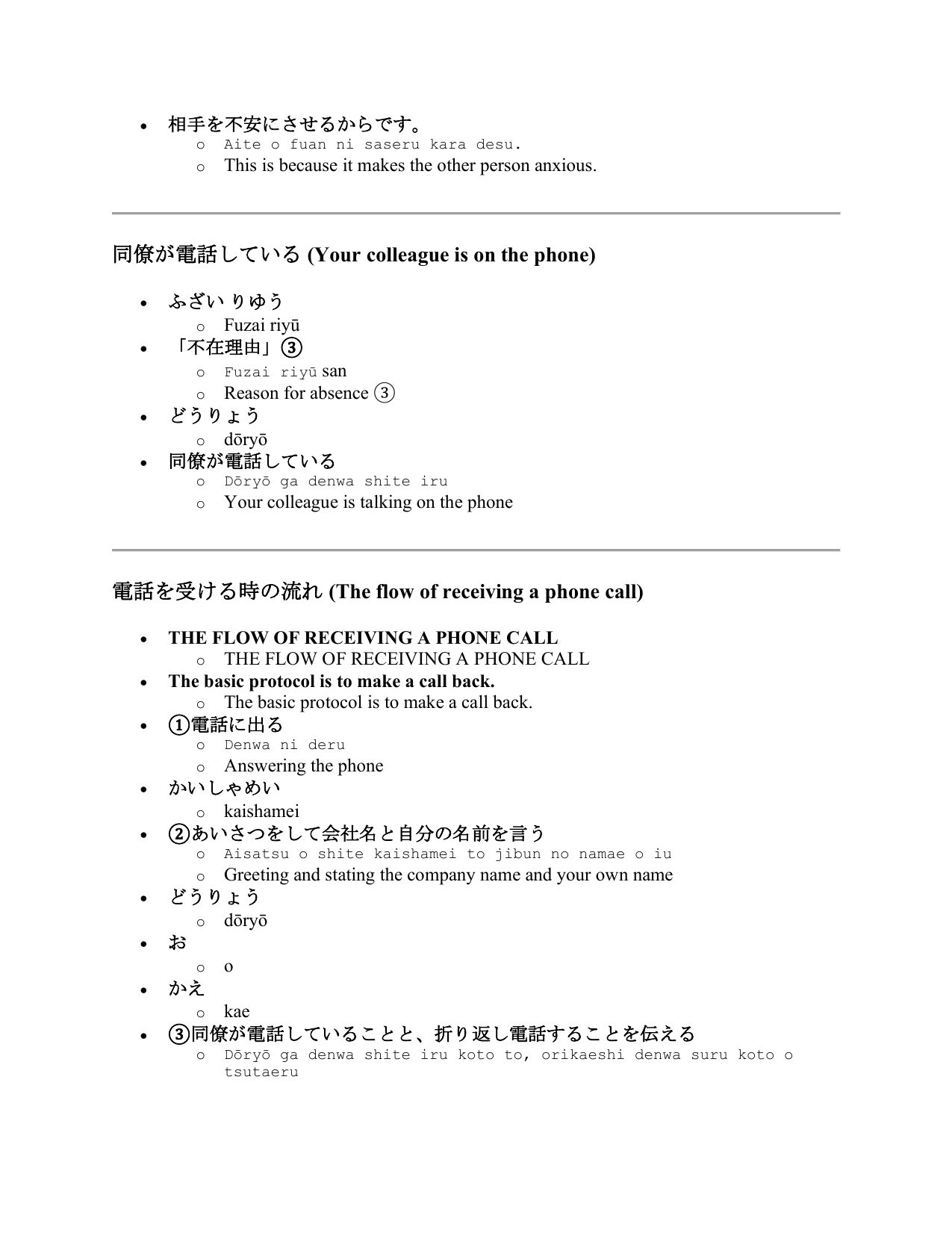
JP•相手を不安にさせるからです。
EN o Aite o fuan ni saseru kara desu.
o This is because it makes the other person anxious.
同僚が電話している (Your colleague is on the phone)
o This is because it makes the other person anxious.
同僚が電話している (Your colleague is on the phone)
JP•ふざいりゆう
EN o Fuzai riyū
JP•「不在理由」③
EN o Fuzai riyū san
Reason for absence ③
o
Reason for absence ③
o
JP•どうりょう
EN o dōryō
JP•同僚が電話している
EN o Dōryō ga denwa shite iru
o Your colleague is talking on the phone
電話を受ける時の流れ (The flow of receiving a phone call)
• THE FLOW OF RECEIVING A PHONE CALL
o THE FLOW OF RECEIVING A PHONE CALL
• The basic protocol is to make a call back.
o The basic protocol is to make a call back.
o Your colleague is talking on the phone
電話を受ける時の流れ (The flow of receiving a phone call)
• THE FLOW OF RECEIVING A PHONE CALL
o THE FLOW OF RECEIVING A PHONE CALL
• The basic protocol is to make a call back.
o The basic protocol is to make a call back.
JP•①電話に出る
EN o Denwa ni deru
Answering the phone
o
Answering the phone
o
JP•かいしゃめい
EN o kaishamei
JP•②あいさつをして会社名と自分の名前を言う
EN o Aisatsu o shite kaishamei to jibun no namae o iu
oGreeting and stating the company name and your own name
oGreeting and stating the company name and your own name
JP•どうりょう
EN o dōryō
JP•お
EN o o
JP•かえ
EN o kae
JP•③同僚が電話していることと、折り返し電話することを伝える
EN o Dōryō ga denwa shite iru koto to, orikaeshi denwa suru koto o
tsutaeru
tsutaeru
หน้า 34
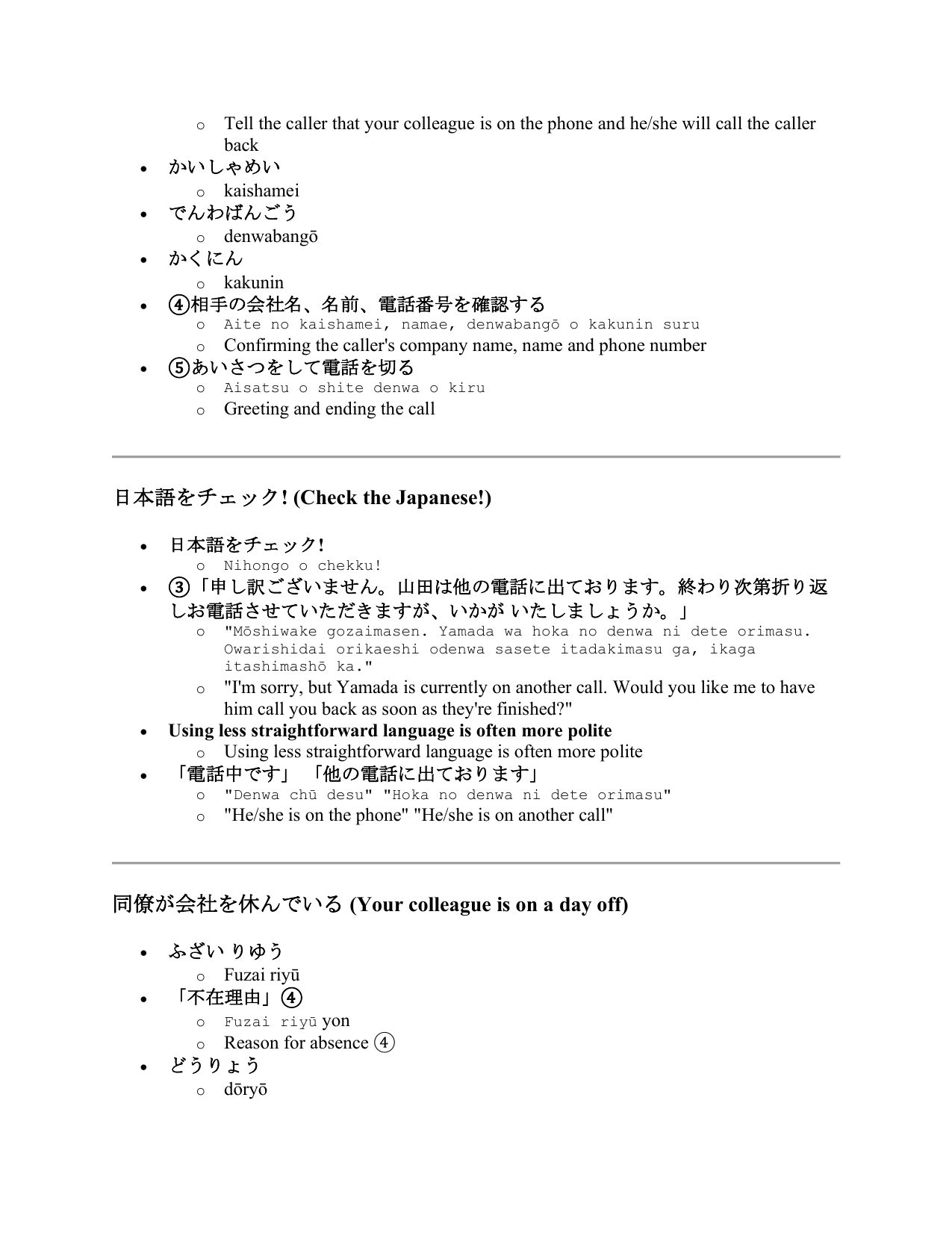
คลิกเพื่อขยาย
EN Tell the caller that your colleague is on the phone and he/she will call the caller
o
back
o
back
JP•かいしゃめい
EN o kaishamei
JP•でんわばんごう
EN o denwabangō
JP•かくにん
EN o kakunin
JP•④相手の会社名、名前、電話番号を確認する
EN o Aite no kaishamei, namae, denwabangō o kakunin suru
Confirming the caller's company name, name and phone number
o
Confirming the caller's company name, name and phone number
o
JP•⑤あいさつをして電話を切る
EN o Aisatsu o shite denwa o kiru
o Greeting and ending the call
日本語をチェック! (Check the Japanese!)
o Greeting and ending the call
日本語をチェック! (Check the Japanese!)
JP•日本語をチェック!
EN o Nihongo o chekku!
JP•③「申し訳ございません。山田は他の電話に出ております。終わり次第折り返
しお電話させていただきますが、いかがいたしましょうか。」
しお電話させていただきますが、いかがいたしましょうか。」
EN o "Mōshiwake gozaimasen. Yamada wa hoka no denwa ni dete orimasu.
Owarishidai orikaeshi odenwa sasete itadakimasu ga, ikaga
itashimashō ka."
o "I'm sorry, but Yamada is currently on another call. Would you like me to have
him call you back as soon as they're finished?"
• Using less straightforward language is often more polite
o Using less straightforward language is often more polite
Owarishidai orikaeshi odenwa sasete itadakimasu ga, ikaga
itashimashō ka."
o "I'm sorry, but Yamada is currently on another call. Would you like me to have
him call you back as soon as they're finished?"
• Using less straightforward language is often more polite
o Using less straightforward language is often more polite
JP•「電話中です」「他の電話に出ております」
EN o "Denwa chū desu" "Hoka no denwa ni dete orimasu"
o "He/she is on the phone" "He/she is on another call"
同僚が会社を休んでいる (Your colleague is on a day off)
o "He/she is on the phone" "He/she is on another call"
同僚が会社を休んでいる (Your colleague is on a day off)
JP•ふざいりゆう
EN o Fuzai riyū
JP•「不在理由」④
EN o Fuzai riyū yon
Reason for absence ④
o
Reason for absence ④
o
JP•どうりょう
EN o dōryō
หน้า 35
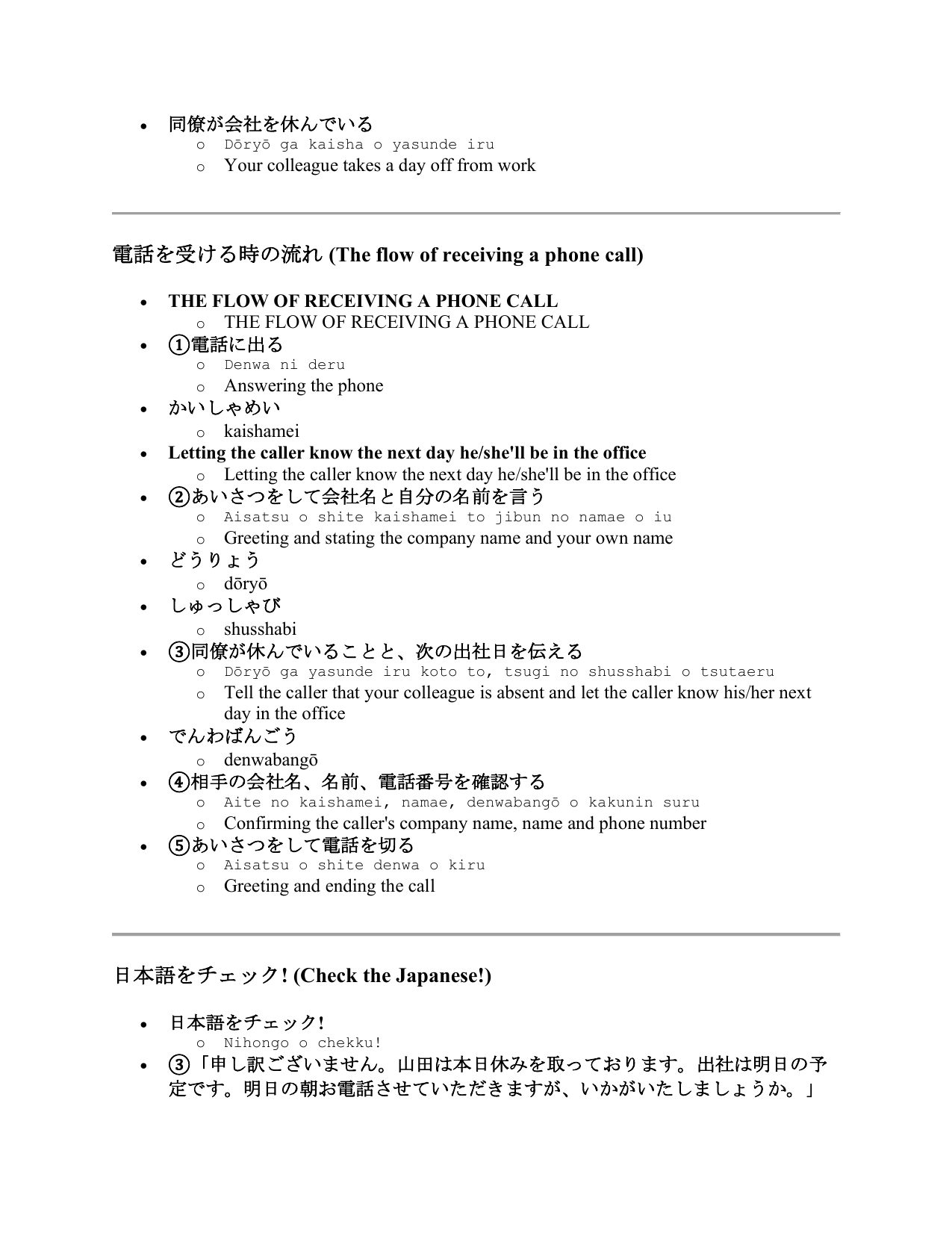
คลิกเพื่อขยาย
JP•同僚が会社を休んでいる
EN o Dōryō ga kaisha o yasunde iru
o Your colleague takes a day off from work
電話を受ける時の流れ (The flow of receiving a phone call)
• THE FLOW OF RECEIVING A PHONE CALL
o THE FLOW OF RECEIVING A PHONE CALL
o Your colleague takes a day off from work
電話を受ける時の流れ (The flow of receiving a phone call)
• THE FLOW OF RECEIVING A PHONE CALL
o THE FLOW OF RECEIVING A PHONE CALL
JP•①電話に出る
EN o Denwa ni deru
o Answering the phone
o Answering the phone
JP•かいしゃめい
EN o kaishamei
• Letting the caller know the next day he/she'll be in the office
o Letting the caller know the next day he/she'll be in the office
• Letting the caller know the next day he/she'll be in the office
o Letting the caller know the next day he/she'll be in the office
JP•②あいさつをして会社名と自分の名前を言う
EN o Aisatsu o shite kaishamei to jibun no namae o iu
Greeting and stating the company name and your own name
o
Greeting and stating the company name and your own name
o
JP•どうりょう
EN o dōryō
JP•しゅっしゃび
EN o shusshabi
JP•③同僚が休んでいることと、次の出社日を伝える
EN o Dōryō ga yasunde iru koto to, tsugi no shusshabi o tsutaeru
Tell the caller that your colleague is absent and let the caller know his/her next
o
day in the office
Tell the caller that your colleague is absent and let the caller know his/her next
o
day in the office
JP•でんわばんごう
EN o denwabangō
JP•④相手の会社名、名前、電話番号を確認する
EN o Aite no kaishamei, namae, denwabangō o kakunin suru
Confirming the caller's company name, name and phone number
o
Confirming the caller's company name, name and phone number
o
JP•⑤あいさつをして電話を切る
EN o Aisatsu o shite denwa o kiru
o Greeting and ending the call
日本語をチェック! (Check the Japanese!)
o Greeting and ending the call
日本語をチェック! (Check the Japanese!)
JP•日本語をチェック!
EN o Nihongo o chekku!
JP•③「申し訳ございません。山田は本日休みを取っております。出社は明日の予
定です。明日の朝お電話させていただきますが、いかがいたしましょうか。」
定です。明日の朝お電話させていただきますが、いかがいたしましょうか。」
หน้า 36
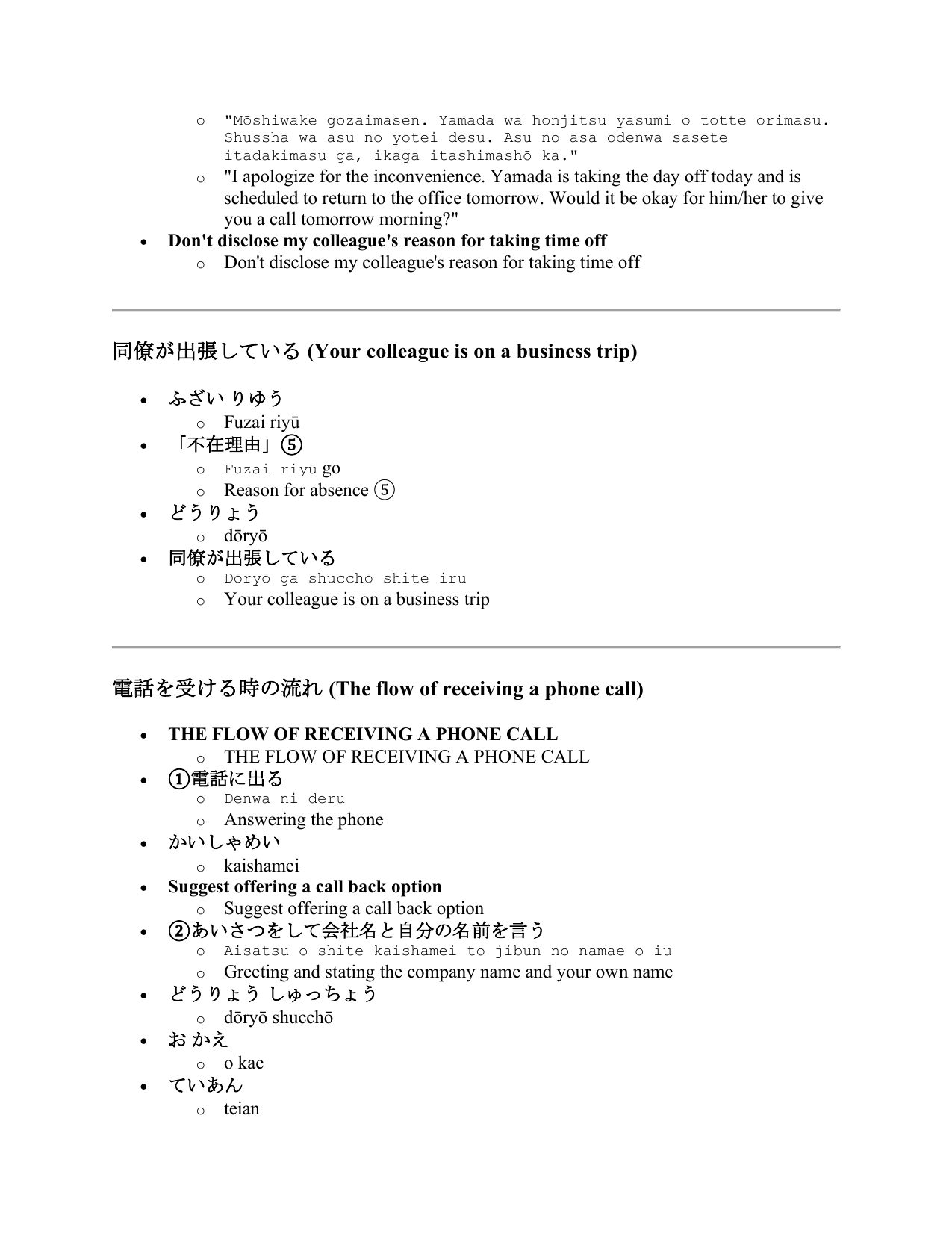
คลิกเพื่อขยาย
EN o "Mōshiwake gozaimasen. Yamada wa honjitsu yasumi o totte orimasu.
Shussha wa asu no yotei desu. Asu no asa odenwa sasete
itadakimasu ga, ikaga itashimashō ka."
o "I apologize for the inconvenience. Yamada is taking the day off today and is
scheduled to return to the office tomorrow. Would it be okay for him/her to give
you a call tomorrow morning?"
• Don't disclose my colleague's reason for taking time off
o Don't disclose my colleague's reason for taking time off
同僚が出張している (Your colleague is on a business trip)
Shussha wa asu no yotei desu. Asu no asa odenwa sasete
itadakimasu ga, ikaga itashimashō ka."
o "I apologize for the inconvenience. Yamada is taking the day off today and is
scheduled to return to the office tomorrow. Would it be okay for him/her to give
you a call tomorrow morning?"
• Don't disclose my colleague's reason for taking time off
o Don't disclose my colleague's reason for taking time off
同僚が出張している (Your colleague is on a business trip)
JP•ふざいりゆう
EN o Fuzai riyū
JP•「不在理由」⑤
EN o Fuzai riyū go
Reason for absence ⑤
o
Reason for absence ⑤
o
JP•どうりょう
EN o dōryō
JP•同僚が出張している
EN o Dōryō ga shucchō shite iru
o Your colleague is on a business trip
電話を受ける時の流れ (The flow of receiving a phone call)
• THE FLOW OF RECEIVING A PHONE CALL
o THE FLOW OF RECEIVING A PHONE CALL
o Your colleague is on a business trip
電話を受ける時の流れ (The flow of receiving a phone call)
• THE FLOW OF RECEIVING A PHONE CALL
o THE FLOW OF RECEIVING A PHONE CALL
JP•①電話に出る
EN o Denwa ni deru
o Answering the phone
o Answering the phone
JP•かいしゃめい
EN o kaishamei
• Suggest offering a call back option
o Suggest offering a call back option
• Suggest offering a call back option
o Suggest offering a call back option
JP•②あいさつをして会社名と自分の名前を言う
EN o Aisatsu o shite kaishamei to jibun no namae o iu
oGreeting and stating the company name and your own name
oGreeting and stating the company name and your own name
JP•どうりょうしゅっちょう
EN o dōryō shucchō
JP•おかえ
EN o o kae
JP•ていあん
EN o teian
หน้า 37
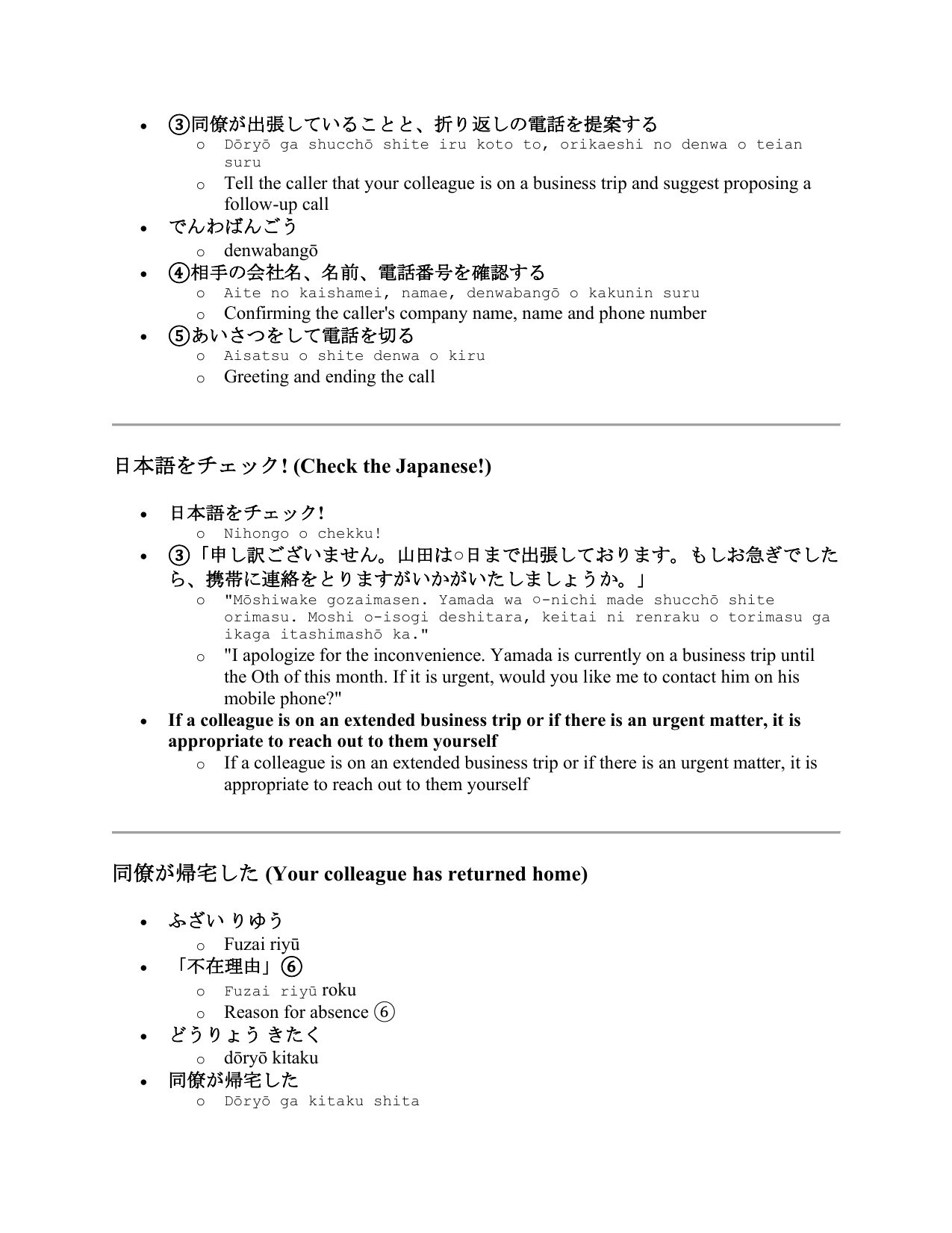
คลิกเพื่อขยาย
JP•③同僚が出張していることと、折り返しの電話を提案する
EN o Dōryō ga shucchō shite iru koto to, orikaeshi no denwa o teian
suru
Tell the caller that your colleague is on a business trip and suggest proposing a
o
follow-up call
suru
Tell the caller that your colleague is on a business trip and suggest proposing a
o
follow-up call
JP•でんわばんごう
EN o denwabangō
JP•④相手の会社名、名前、電話番号を確認する
EN o Aite no kaishamei, namae, denwabangō o kakunin suru
Confirming the caller's company name, name and phone number
o
Confirming the caller's company name, name and phone number
o
JP•⑤あいさつをして電話を切る
EN o Aisatsu o shite denwa o kiru
o Greeting and ending the call
日本語をチェック! (Check the Japanese!)
o Greeting and ending the call
日本語をチェック! (Check the Japanese!)
JP•日本語をチェック!
EN o Nihongo o chekku!
JP•③「申し訳ございません。山田は○日まで出張しております。もしお急ぎでした
ら、携帯に連絡をとりますがいかがいたしましょうか。」
ら、携帯に連絡をとりますがいかがいたしましょうか。」
EN o "Mōshiwake gozaimasen. Yamada wa ○-nichi made shucchō shite
orimasu. Moshi o-isogi deshitara, keitai ni renraku o torimasu ga
ikaga itashimashō ka."
o "I apologize for the inconvenience. Yamada is currently on a business trip until
the Oth of this month. If it is urgent, would you like me to contact him on his
mobile phone?"
• If a colleague is on an extended business trip or if there is an urgent matter, it is
appropriate to reach out to them yourself
o If a colleague is on an extended business trip or if there is an urgent matter, it is
appropriate to reach out to them yourself
同僚が帰宅した (Your colleague has returned home)
orimasu. Moshi o-isogi deshitara, keitai ni renraku o torimasu ga
ikaga itashimashō ka."
o "I apologize for the inconvenience. Yamada is currently on a business trip until
the Oth of this month. If it is urgent, would you like me to contact him on his
mobile phone?"
• If a colleague is on an extended business trip or if there is an urgent matter, it is
appropriate to reach out to them yourself
o If a colleague is on an extended business trip or if there is an urgent matter, it is
appropriate to reach out to them yourself
同僚が帰宅した (Your colleague has returned home)
JP•ふざいりゆう
EN o Fuzai riyū
JP•「不在理由」⑥
EN o Fuzai riyū roku
Reason for absence ⑥
o
Reason for absence ⑥
o
JP•どうりょうきたく
EN o dōryō kitaku
JP•同僚が帰宅した
EN o Dōryō ga kitaku shita
หน้า 38
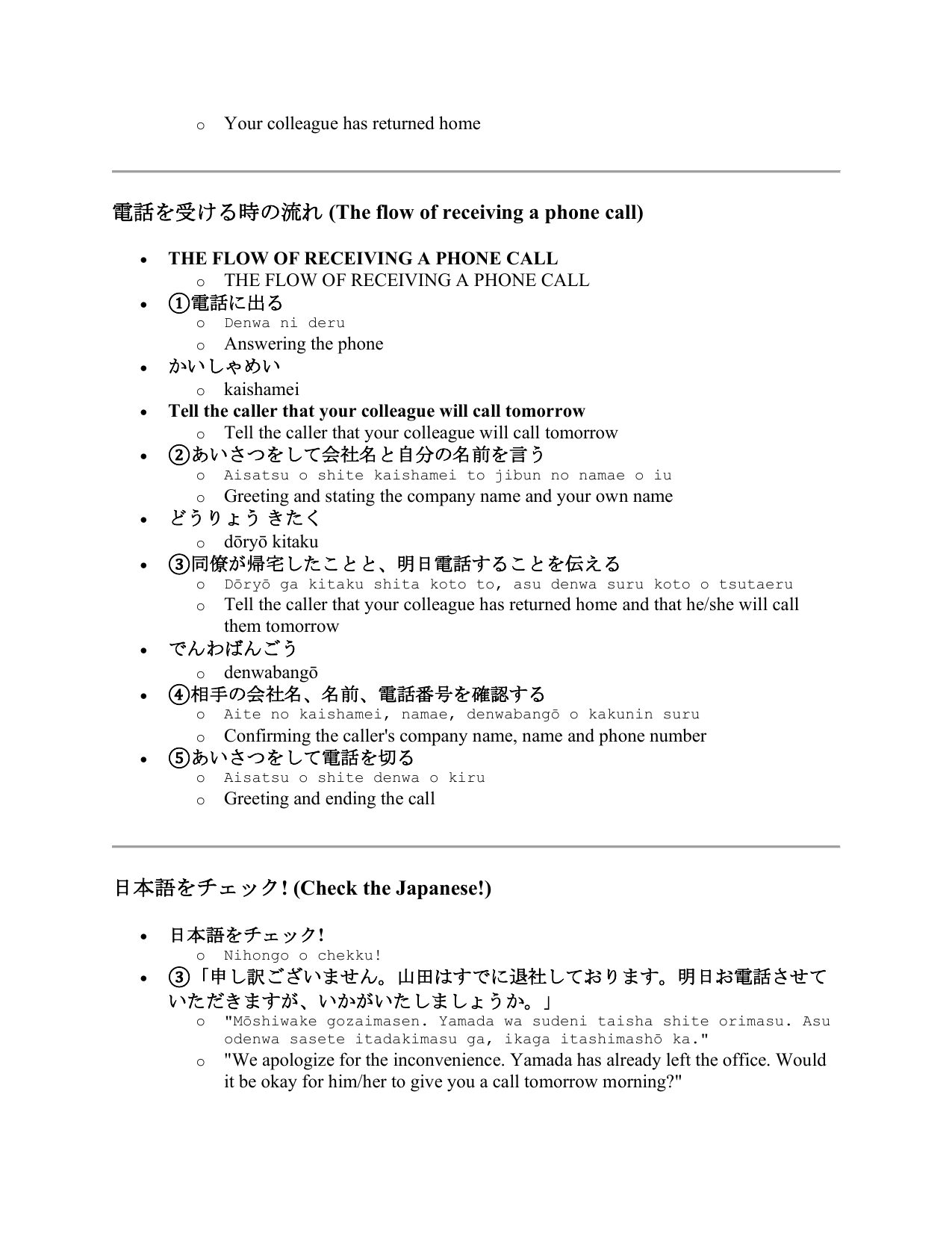
คลิกเพื่อขยาย
EN o Your colleague has returned home
電話を受ける時の流れ (The flow of receiving a phone call)
• THE FLOW OF RECEIVING A PHONE CALL
o THE FLOW OF RECEIVING A PHONE CALL
電話を受ける時の流れ (The flow of receiving a phone call)
• THE FLOW OF RECEIVING A PHONE CALL
o THE FLOW OF RECEIVING A PHONE CALL
JP•①電話に出る
EN o Denwa ni deru
o Answering the phone
o Answering the phone
JP•かいしゃめい
EN o kaishamei
• Tell the caller that your colleague will call tomorrow
o Tell the caller that your colleague will call tomorrow
• Tell the caller that your colleague will call tomorrow
o Tell the caller that your colleague will call tomorrow
JP•②あいさつをして会社名と自分の名前を言う
EN o Aisatsu o shite kaishamei to jibun no namae o iu
Greeting and stating the company name and your own name
o
Greeting and stating the company name and your own name
o
JP•どうりょうきたく
EN o dōryō kitaku
JP•③同僚が帰宅したことと、明日電話することを伝える
EN o Dōryō ga kitaku shita koto to, asu denwa suru koto o tsutaeru
Tell the caller that your colleague has returned home and that he/she will call
o
them tomorrow
Tell the caller that your colleague has returned home and that he/she will call
o
them tomorrow
JP•でんわばんごう
EN o denwabangō
JP•④相手の会社名、名前、電話番号を確認する
EN o Aite no kaishamei, namae, denwabangō o kakunin suru
Confirming the caller's company name, name and phone number
o
Confirming the caller's company name, name and phone number
o
JP•⑤あいさつをして電話を切る
EN o Aisatsu o shite denwa o kiru
o Greeting and ending the call
日本語をチェック! (Check the Japanese!)
o Greeting and ending the call
日本語をチェック! (Check the Japanese!)
JP•日本語をチェック!
EN o Nihongo o chekku!
JP•③「申し訳ございません。山田はすでに退社しております。明日お電話させて
いただきますが、いかがいたしましょうか。」
いただきますが、いかがいたしましょうか。」
EN o "Mōshiwake gozaimasen. Yamada wa sudeni taisha shite orimasu. Asu
odenwa sasete itadakimasu ga, ikaga itashimashō ka."
o "We apologize for the inconvenience. Yamada has already left the office. Would
it be okay for him/her to give you a call tomorrow morning?"
odenwa sasete itadakimasu ga, ikaga itashimashō ka."
o "We apologize for the inconvenience. Yamada has already left the office. Would
it be okay for him/her to give you a call tomorrow morning?"
หน้า 39
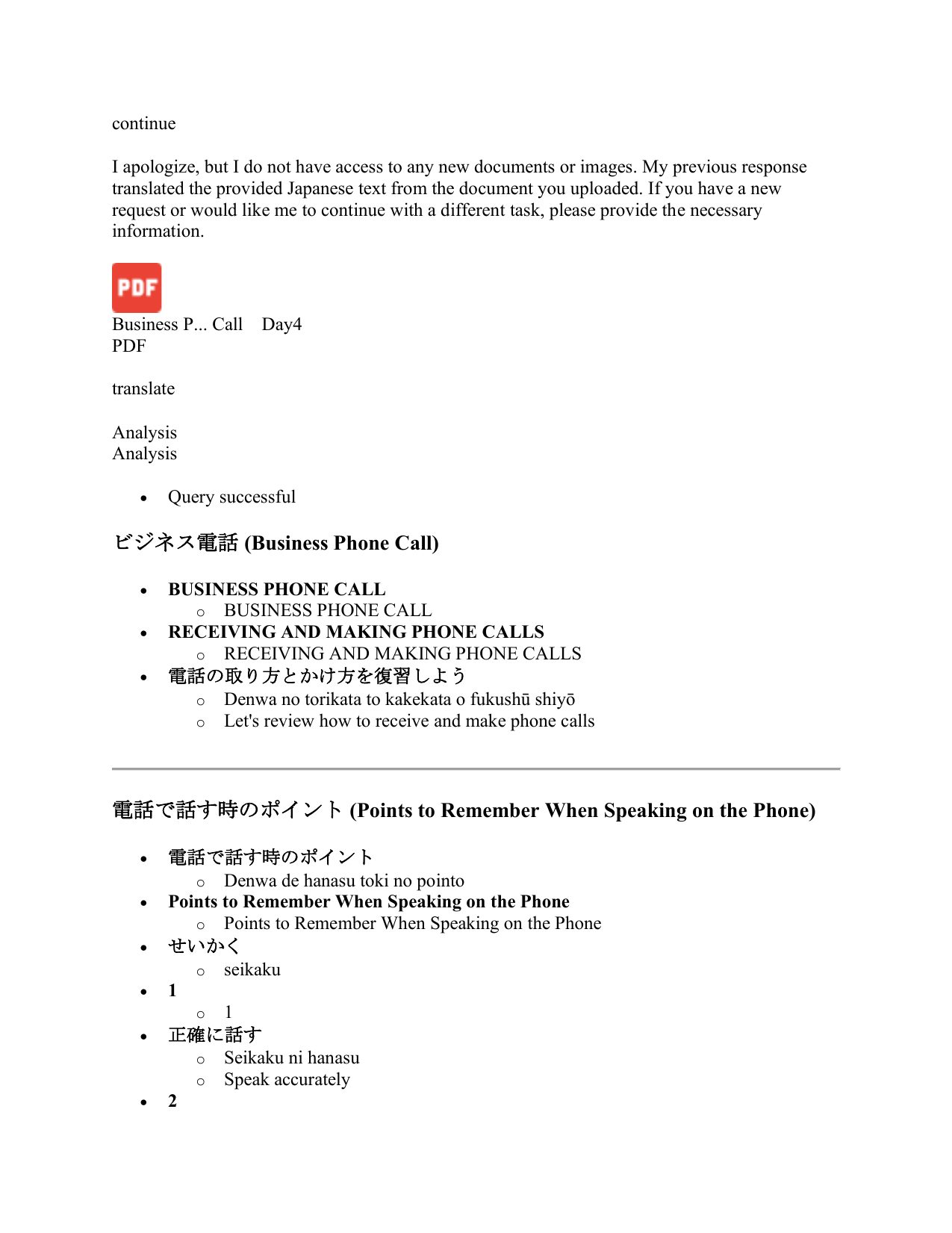
คลิกเพื่อขยาย
ENcontinue
I apologize, but I do not have access to any new documents or images. My previous response
translated the provided Japanese text from the document you uploaded. If you have a new
request or would like me to continue with a different task, please provide the necessary
information.
Business P... Call Day4
PDF
translate
Analysis
Analysis
• Query successful
ビジネス電話 (Business Phone Call)
• BUSINESS PHONE CALL
o BUSINESS PHONE CALL
• RECEIVING AND MAKING PHONE CALLS
o RECEIVING AND MAKING PHONE CALLS
I apologize, but I do not have access to any new documents or images. My previous response
translated the provided Japanese text from the document you uploaded. If you have a new
request or would like me to continue with a different task, please provide the necessary
information.
Business P... Call Day4
translate
Analysis
Analysis
• Query successful
ビジネス電話 (Business Phone Call)
• BUSINESS PHONE CALL
o BUSINESS PHONE CALL
• RECEIVING AND MAKING PHONE CALLS
o RECEIVING AND MAKING PHONE CALLS
JP•電話の取り方とかけ方を復習しよう
EN o Denwa no torikata to kakekata o fukushū shiyō
o Let's review how to receive and make phone calls
電話で話す時のポイント (Points to Remember When Speaking on the Phone)
o Let's review how to receive and make phone calls
電話で話す時のポイント (Points to Remember When Speaking on the Phone)
JP•電話で話す時のポイント
EN o Denwa de hanasu toki no pointo
• Points to Remember When Speaking on the Phone
o Points to Remember When Speaking on the Phone
• Points to Remember When Speaking on the Phone
o Points to Remember When Speaking on the Phone
JP•せいかく
EN o seikaku
• 1
o 1
• 1
o 1
JP•正確に話す
EN o Seikaku ni hanasu
o Speak accurately
• 2
o Speak accurately
• 2
หน้า 40
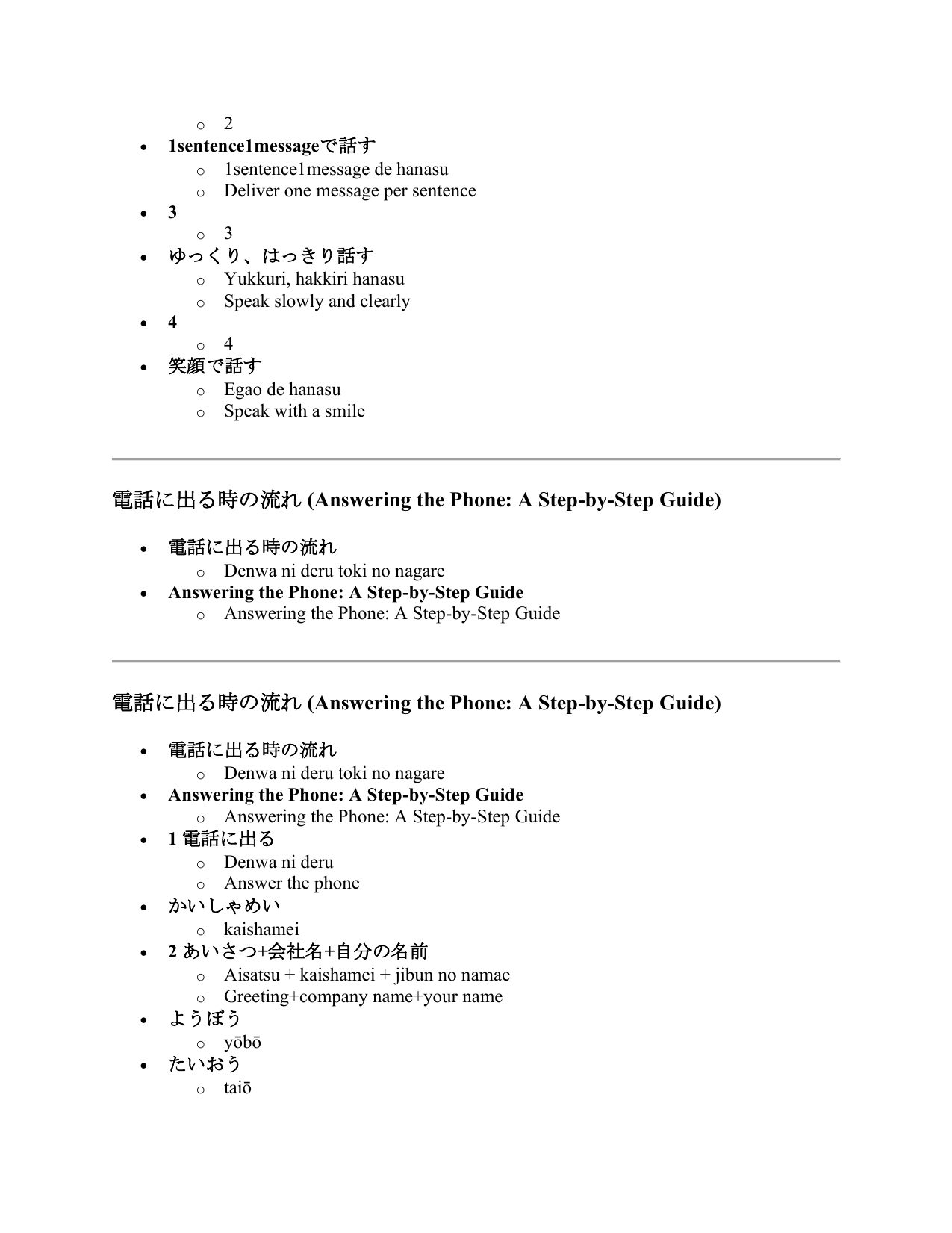
คลิกเพื่อขยาย
EN o 2
• 1sentence1messageで話す
o 1sentence1message de hanasu
o Deliver one message per sentence
• 3
o 3
• 1sentence1messageで話す
o 1sentence1message de hanasu
o Deliver one message per sentence
• 3
o 3
JP•ゆっくり、はっきり話す
EN o Yukkuri, hakkiri hanasu
o Speak slowly and clearly
• 4
o 4
o Speak slowly and clearly
• 4
o 4
JP•笑顔で話す
EN o Egao de hanasu
o Speak with a smile
電話に出る時の流れ (Answering the Phone: A Step-by-Step Guide)
o Speak with a smile
電話に出る時の流れ (Answering the Phone: A Step-by-Step Guide)
JP•電話に出る時の流れ
EN o Denwa ni deru toki no nagare
• Answering the Phone: A Step-by-Step Guide
o Answering the Phone: A Step-by-Step Guide
電話に出る時の流れ (Answering the Phone: A Step-by-Step Guide)
• Answering the Phone: A Step-by-Step Guide
o Answering the Phone: A Step-by-Step Guide
電話に出る時の流れ (Answering the Phone: A Step-by-Step Guide)
JP•電話に出る時の流れ
EN o Denwa ni deru toki no nagare
• Answering the Phone: A Step-by-Step Guide
o Answering the Phone: A Step-by-Step Guide
• Answering the Phone: A Step-by-Step Guide
o Answering the Phone: A Step-by-Step Guide
JP•1電話に出る
EN o Denwa ni deru
o Answer the phone
o Answer the phone
JP•かいしゃめい
EN o kaishamei
JP•2あいさつ+会社名+自分の名前
EN o Aisatsu + kaishamei + jibun no namae
o Greeting+company name+your name
o Greeting+company name+your name
JP•ようぼう
EN o yōbō
JP•たいおう
EN o taiō
หน้า 41
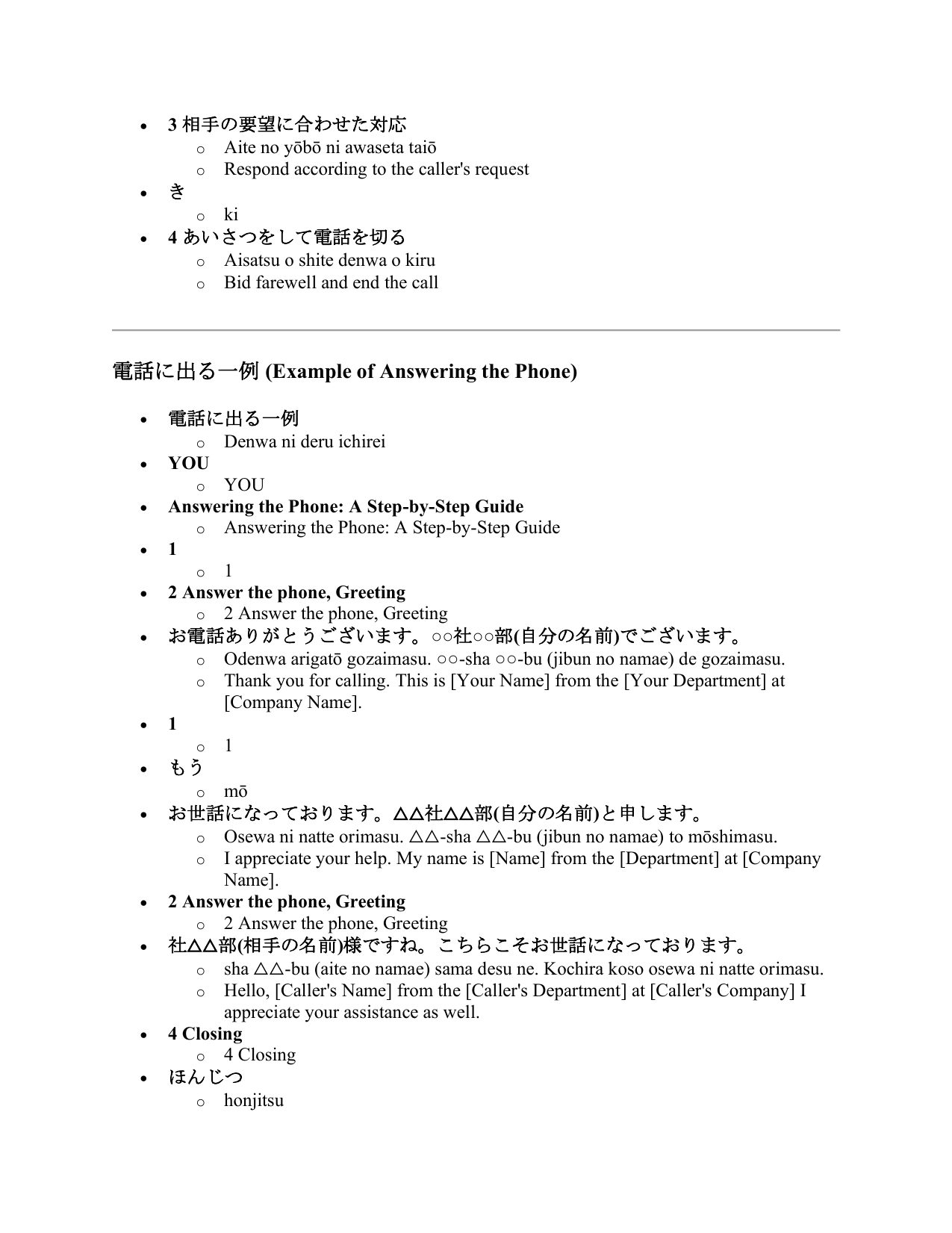
คลิกเพื่อขยาย
JP•3相手の要望に合わせた対応
EN o Aite no yōbō ni awaseta taiō
o Respond according to the caller's request
o Respond according to the caller's request
JP•き
EN o ki
JP•4あいさつをして電話を切る
EN o Aisatsu o shite denwa o kiru
o Bid farewell and end the call
電話に出る一例 (Example of Answering the Phone)
o Bid farewell and end the call
電話に出る一例 (Example of Answering the Phone)
JP•電話に出る一例
EN o Denwa ni deru ichirei
• YOU
o YOU
• Answering the Phone: A Step-by-Step Guide
o Answering the Phone: A Step-by-Step Guide
• 1
o 1
• 2 Answer the phone, Greeting
o 2 Answer the phone, Greeting
• YOU
o YOU
• Answering the Phone: A Step-by-Step Guide
o Answering the Phone: A Step-by-Step Guide
• 1
o 1
• 2 Answer the phone, Greeting
o 2 Answer the phone, Greeting
JP•お電話ありがとうございます。○○社○○部(自分の名前)でございます。
EN o Odenwa arigatō gozaimasu. ○○-sha ○○-bu (jibun no namae) de gozaimasu.
o Thank you for calling. This is [Your Name] from the [Your Department] at
[Company Name].
• 1
o 1
o Thank you for calling. This is [Your Name] from the [Your Department] at
[Company Name].
• 1
o 1
JP•もう
EN o mō
JP•お世話になっております。△△社△△部(自分の名前)と申します。
EN o Osewa ni natte orimasu. △△-sha △△-bu (jibun no namae) to mōshimasu.
o I appreciate your help. My name is [Name] from the [Department] at [Company
Name].
• 2 Answer the phone, Greeting
o 2 Answer the phone, Greeting
o I appreciate your help. My name is [Name] from the [Department] at [Company
Name].
• 2 Answer the phone, Greeting
o 2 Answer the phone, Greeting
JP•社△△部(相手の名前)様ですね。こちらこそお世話になっております。
EN o sha △△-bu (aite no namae) sama desu ne. Kochira koso osewa ni natte orimasu.
o Hello, [Caller's Name] from the [Caller's Department] at [Caller's Company] I
appreciate your assistance as well.
• 4 Closing
o 4 Closing
o Hello, [Caller's Name] from the [Caller's Department] at [Caller's Company] I
appreciate your assistance as well.
• 4 Closing
o 4 Closing
JP•ほんじつ
EN o honjitsu
หน้า 42
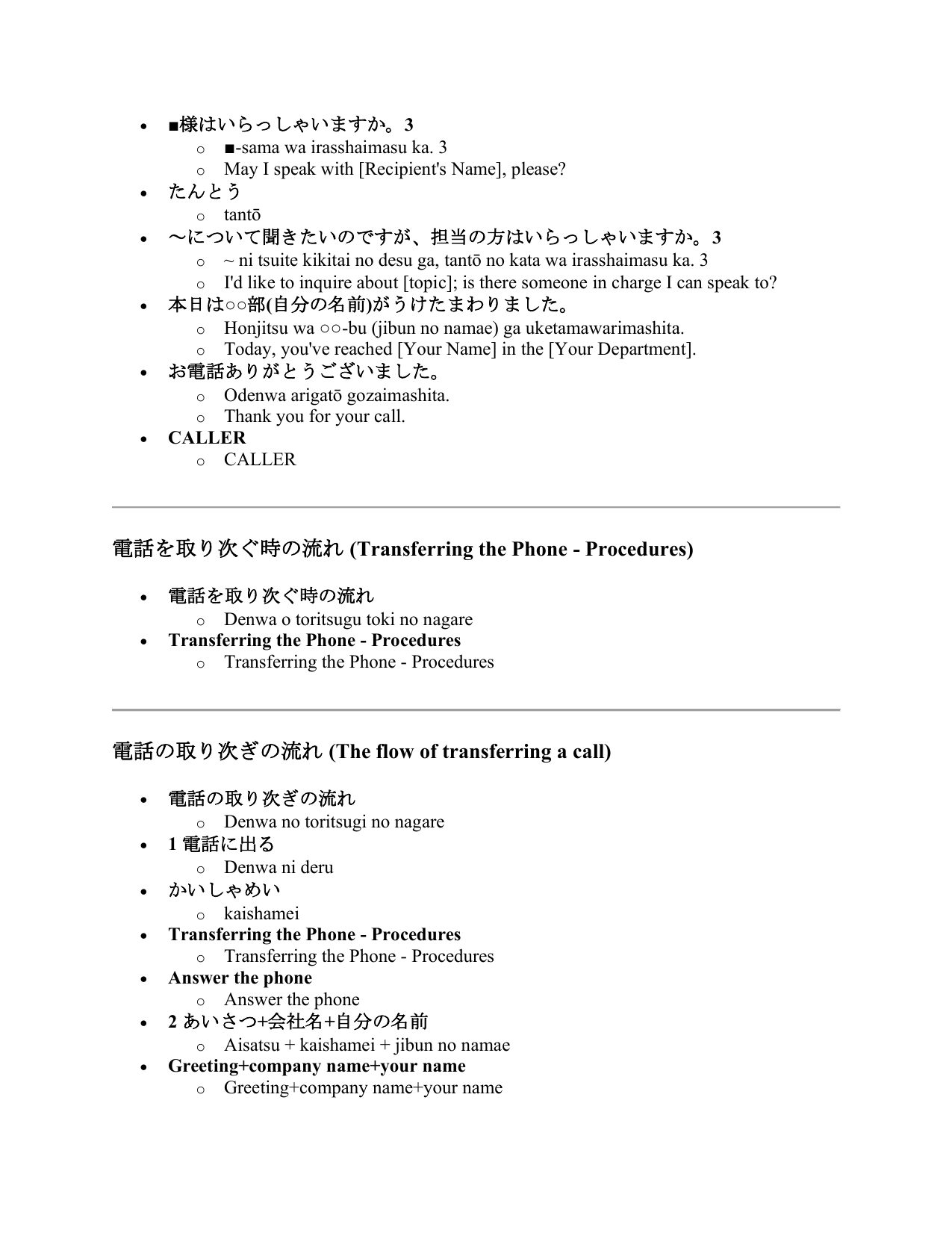
คลิกเพื่อขยาย
JP•■様はいらっしゃいますか。3
EN o ■-sama wa irasshaimasu ka. 3
o May I speak with [Recipient's Name], please?
o May I speak with [Recipient's Name], please?
JP•たんとう
EN o tantō
JP•~について聞きたいのですが、担当の方はいらっしゃいますか。3
EN o ~ ni tsuite kikitai no desu ga, tantō no kata wa irasshaimasu ka. 3
o I'd like to inquire about [topic]; is there someone in charge I can speak to?
o I'd like to inquire about [topic]; is there someone in charge I can speak to?
JP•本日は○○部(自分の名前)がうけたまわりました。
EN o Honjitsu wa ○○-bu (jibun no namae) ga uketamawarimashita.
o Today, you've reached [Your Name] in the [Your Department].
o Today, you've reached [Your Name] in the [Your Department].
JP•お電話ありがとうございました。
EN o Odenwa arigatō gozaimashita.
o Thank you for your call.
• CALLER
o CALLER
電話を取り次ぐ時の流れ (Transferring the Phone - Procedures)
o Thank you for your call.
• CALLER
o CALLER
電話を取り次ぐ時の流れ (Transferring the Phone - Procedures)
JP•電話を取り次ぐ時の流れ
EN o Denwa o toritsugu toki no nagare
• Transferring the Phone - Procedures
o Transferring the Phone - Procedures
電話の取り次ぎの流れ (The flow of transferring a call)
• Transferring the Phone - Procedures
o Transferring the Phone - Procedures
電話の取り次ぎの流れ (The flow of transferring a call)
JP•電話の取り次ぎの流れ
EN o Denwa no toritsugi no nagare
JP•1電話に出る
EN o Denwa ni deru
JP•かいしゃめい
EN o kaishamei
• Transferring the Phone - Procedures
o Transferring the Phone - Procedures
• Answer the phone
o Answer the phone
• Transferring the Phone - Procedures
o Transferring the Phone - Procedures
• Answer the phone
o Answer the phone
JP•2あいさつ+会社名+自分の名前
EN o Aisatsu + kaishamei + jibun no namae
• Greeting+company name+your name
o Greeting+company name+your name
• Greeting+company name+your name
o Greeting+company name+your name
หน้า 43
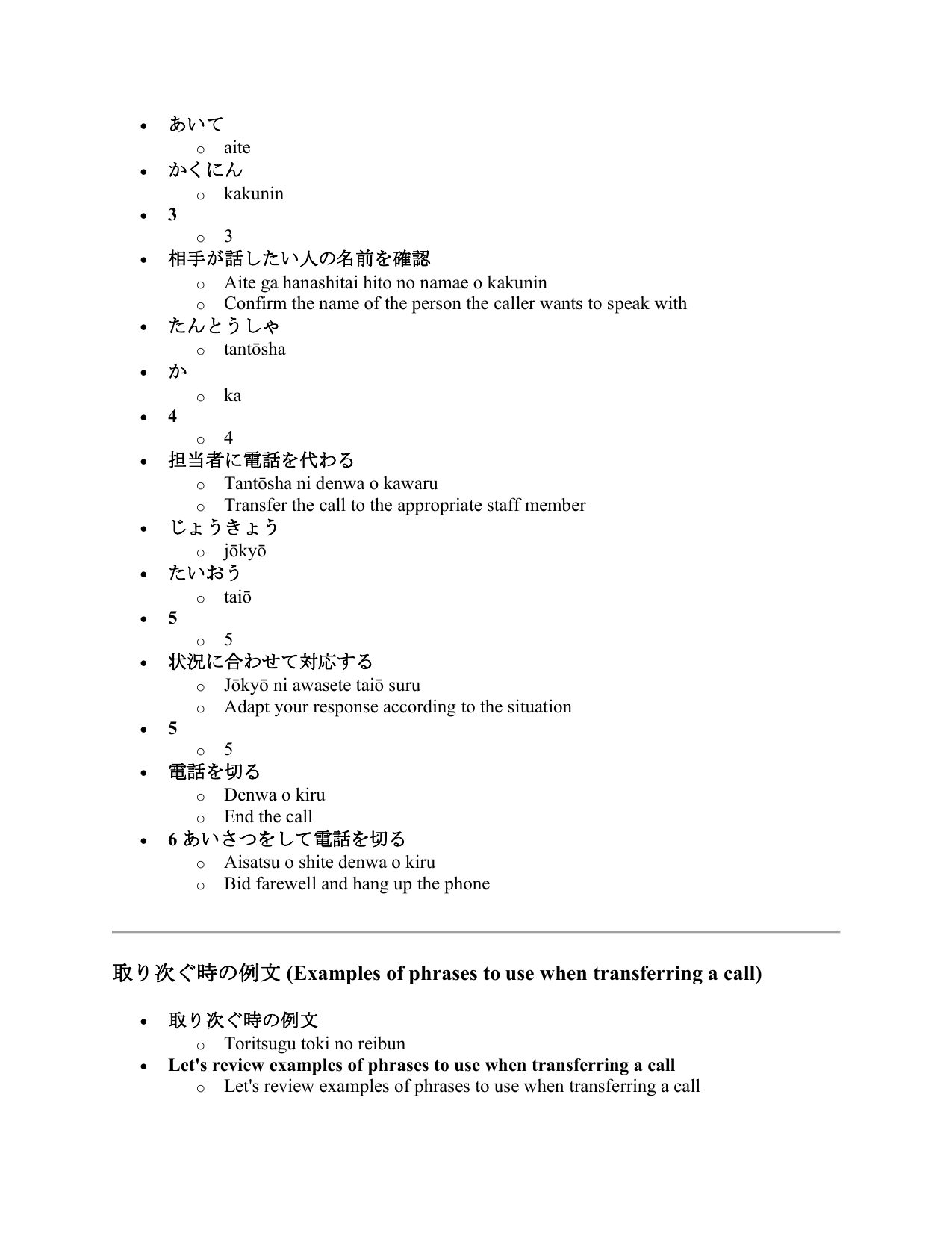
คลิกเพื่อขยาย
JP•あいて
EN o aite
JP•かくにん
EN o kakunin
• 3
o 3
• 3
o 3
JP•相手が話したい人の名前を確認
EN o Aite ga hanashitai hito no namae o kakunin
o Confirm the name of the person the caller wants to speak with
o Confirm the name of the person the caller wants to speak with
JP•たんとうしゃ
EN o tantōsha
JP•か
EN o ka
• 4
o 4
• 4
o 4
JP•担当者に電話を代わる
EN o Tantōsha ni denwa o kawaru
o Transfer the call to the appropriate staff member
o Transfer the call to the appropriate staff member
JP•じょうきょう
EN o jōkyō
JP•たいおう
EN o taiō
• 5
o 5
• 5
o 5
JP•状況に合わせて対応する
EN o Jōkyō ni awasete taiō suru
o Adapt your response according to the situation
• 5
o 5
o Adapt your response according to the situation
• 5
o 5
JP•電話を切る
EN o Denwa o kiru
o End the call
o End the call
JP•6あいさつをして電話を切る
EN o Aisatsu o shite denwa o kiru
o Bid farewell and hang up the phone
取り次ぐ時の例文 (Examples of phrases to use when transferring a call)
o Bid farewell and hang up the phone
取り次ぐ時の例文 (Examples of phrases to use when transferring a call)
JP•取り次ぐ時の例文
EN o Toritsugu toki no reibun
• Let's review examples of phrases to use when transferring a call
o Let's review examples of phrases to use when transferring a call
• Let's review examples of phrases to use when transferring a call
o Let's review examples of phrases to use when transferring a call
หน้า 44
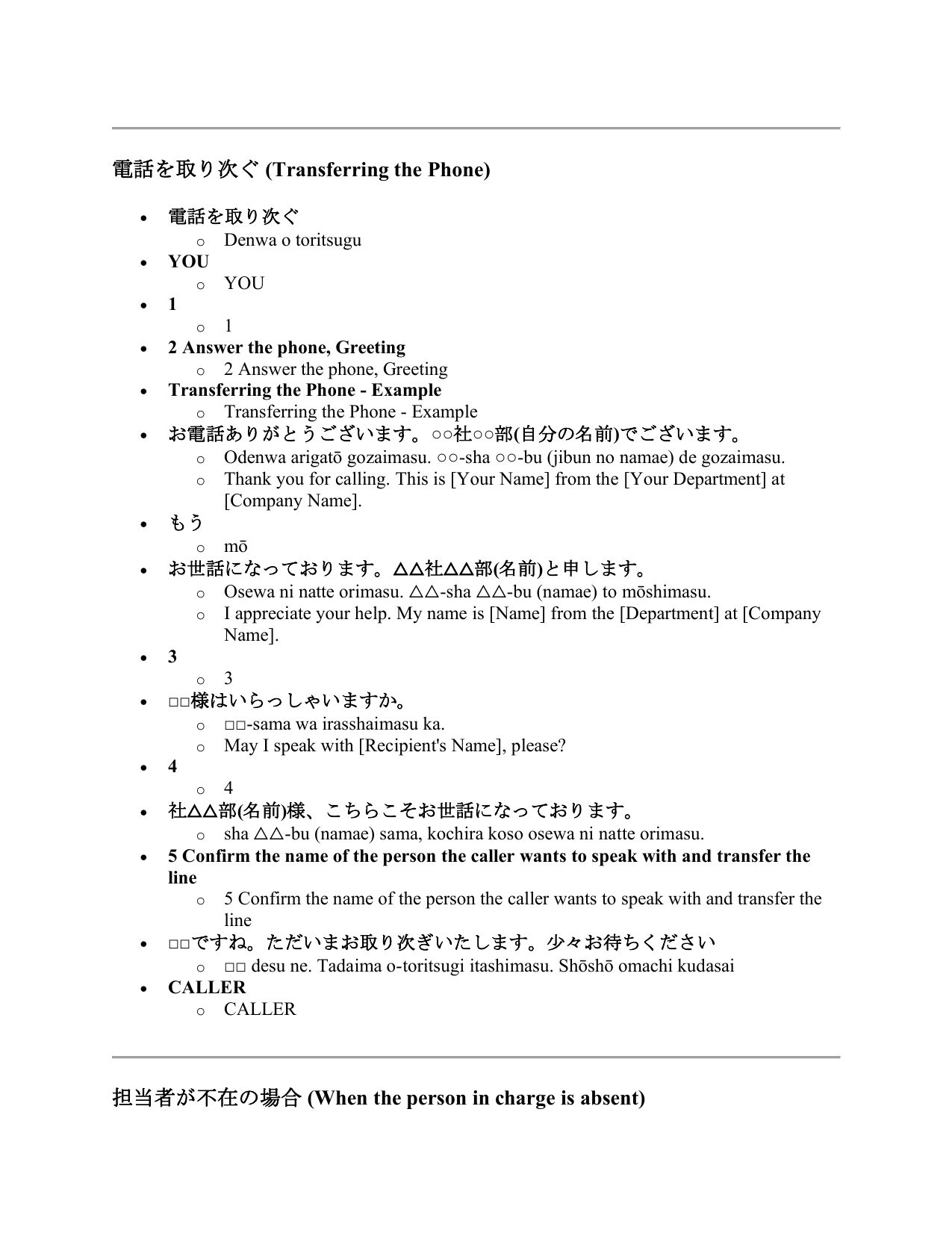
คลิกเพื่อขยาย
EN電話を取り次ぐ (Transferring the Phone)
JP•電話を取り次ぐ
EN o Denwa o toritsugu
• YOU
o YOU
• 1
o 1
• 2 Answer the phone, Greeting
o 2 Answer the phone, Greeting
• Transferring the Phone - Example
o Transferring the Phone - Example
• YOU
o YOU
• 1
o 1
• 2 Answer the phone, Greeting
o 2 Answer the phone, Greeting
• Transferring the Phone - Example
o Transferring the Phone - Example
JP•お電話ありがとうございます。○○社○○部(自分の名前)でございます。
EN o Odenwa arigatō gozaimasu. ○○-sha ○○-bu (jibun no namae) de gozaimasu.
o Thank you for calling. This is [Your Name] from the [Your Department] at
[Company Name].
o Thank you for calling. This is [Your Name] from the [Your Department] at
[Company Name].
JP•もう
EN o mō
JP•お世話になっております。△△社△△部(名前)と申します。
EN o Osewa ni natte orimasu. △△-sha △△-bu (namae) to mōshimasu.
o I appreciate your help. My name is [Name] from the [Department] at [Company
Name].
• 3
o 3
o I appreciate your help. My name is [Name] from the [Department] at [Company
Name].
• 3
o 3
JP•□□様はいらっしゃいますか。
EN o □□-sama wa irasshaimasu ka.
o May I speak with [Recipient's Name], please?
• 4
o 4
o May I speak with [Recipient's Name], please?
• 4
o 4
JP•社△△部(名前)様、こちらこそお世話になっております。
EN o sha △△-bu (namae) sama, kochira koso osewa ni natte orimasu.
• 5 Confirm the name of the person the caller wants to speak with and transfer the
line
o 5 Confirm the name of the person the caller wants to speak with and transfer the
line
• 5 Confirm the name of the person the caller wants to speak with and transfer the
line
o 5 Confirm the name of the person the caller wants to speak with and transfer the
line
JP•□□ですね。ただいまお取り次ぎいたします。少々お待ちください
EN o □□ desu ne. Tadaima o-toritsugi itashimasu. Shōshō omachi kudasai
• CALLER
o CALLER
担当者が不在の場合 (When the person in charge is absent)
• CALLER
o CALLER
担当者が不在の場合 (When the person in charge is absent)
หน้า 45
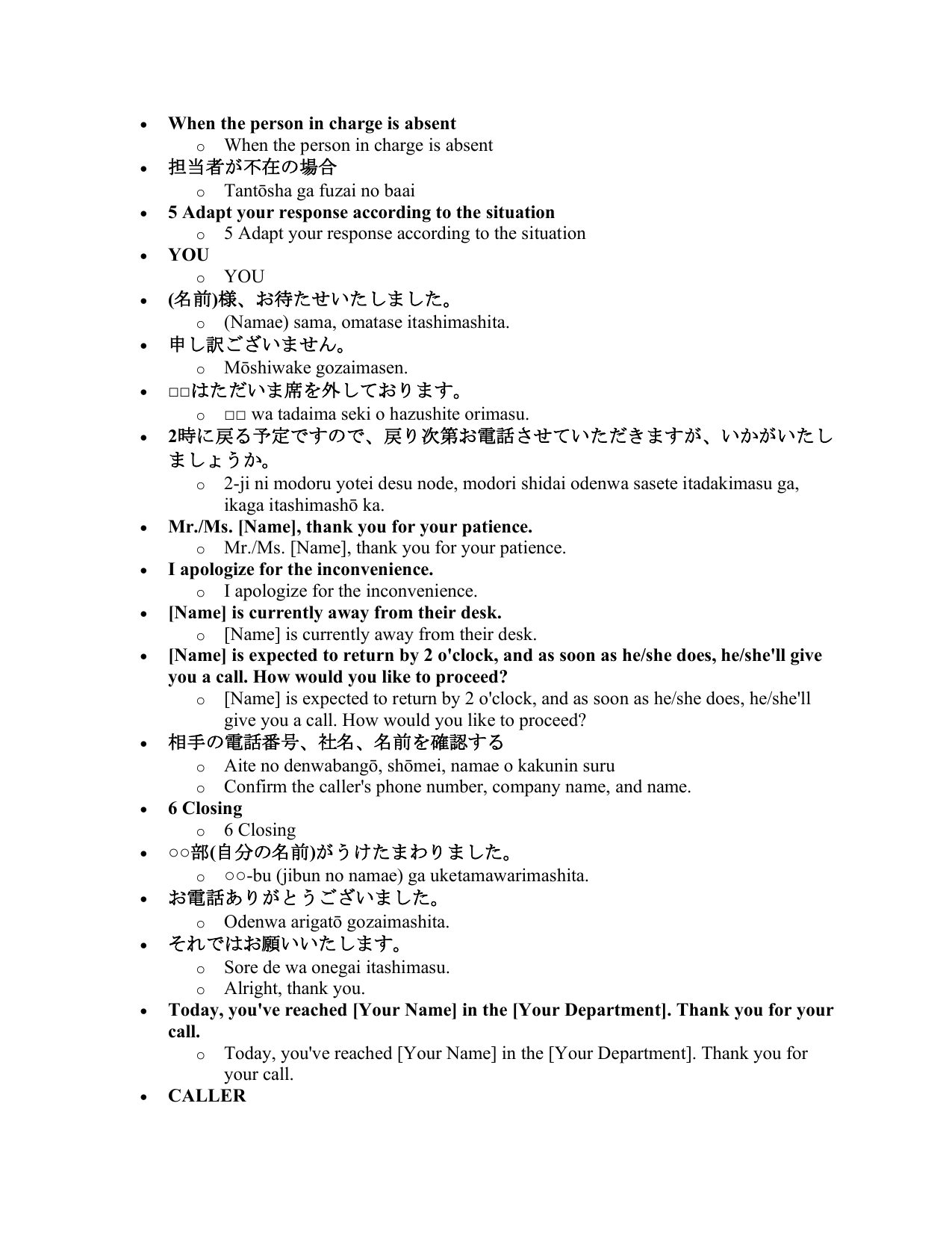
คลิกเพื่อขยาย
EN• When the person in charge is absent
o When the person in charge is absent
o When the person in charge is absent
JP•担当者が不在の場合
EN o Tantōsha ga fuzai no baai
• 5 Adapt your response according to the situation
o 5 Adapt your response according to the situation
• YOU
o YOU
• 5 Adapt your response according to the situation
o 5 Adapt your response according to the situation
• YOU
o YOU
JP•(名前)様、お待たせいたしました。
EN o (Namae) sama, omatase itashimashita.
JP•申し訳ございません。
EN o Mōshiwake gozaimasen.
JP•□□はただいま席を外しております。
EN o □□ wa tadaima seki o hazushite orimasu.
JP•2時に戻る予定ですので、戻り次第お電話させていただきますが、いかがいたし
ましょうか。
ましょうか。
EN o 2-ji ni modoru yotei desu node, modori shidai odenwa sasete itadakimasu ga,
ikaga itashimashō ka.
• Mr./Ms. [Name], thank you for your patience.
o Mr./Ms. [Name], thank you for your patience.
• I apologize for the inconvenience.
o I apologize for the inconvenience.
• [Name] is currently away from their desk.
o [Name] is currently away from their desk.
• [Name] is expected to return by 2 o'clock, and as soon as he/she does, he/she'll give
you a call. How would you like to proceed?
o [Name] is expected to return by 2 o'clock, and as soon as he/she does, he/she'll
give you a call. How would you like to proceed?
ikaga itashimashō ka.
• Mr./Ms. [Name], thank you for your patience.
o Mr./Ms. [Name], thank you for your patience.
• I apologize for the inconvenience.
o I apologize for the inconvenience.
• [Name] is currently away from their desk.
o [Name] is currently away from their desk.
• [Name] is expected to return by 2 o'clock, and as soon as he/she does, he/she'll give
you a call. How would you like to proceed?
o [Name] is expected to return by 2 o'clock, and as soon as he/she does, he/she'll
give you a call. How would you like to proceed?
JP•相手の電話番号、社名、名前を確認する
EN o Aite no denwabangō, shōmei, namae o kakunin suru
o Confirm the caller's phone number, company name, and name.
• 6 Closing
o 6 Closing
o Confirm the caller's phone number, company name, and name.
• 6 Closing
o 6 Closing
JP•○○部(自分の名前)がうけたまわりました。
EN o ○○-bu (jibun no namae) ga uketamawarimashita.
JP•お電話ありがとうございました。
EN o Odenwa arigatō gozaimashita.
JP•それではお願いいたします。
EN o Sore de wa onegai itashimasu.
o Alright, thank you.
• Today, you've reached [Your Name] in the [Your Department]. Thank you for your
call.
o Today, you've reached [Your Name] in the [Your Department]. Thank you for
your call.
• CALLER
o Alright, thank you.
• Today, you've reached [Your Name] in the [Your Department]. Thank you for your
call.
o Today, you've reached [Your Name] in the [Your Department]. Thank you for
your call.
• CALLER
หน้า 46
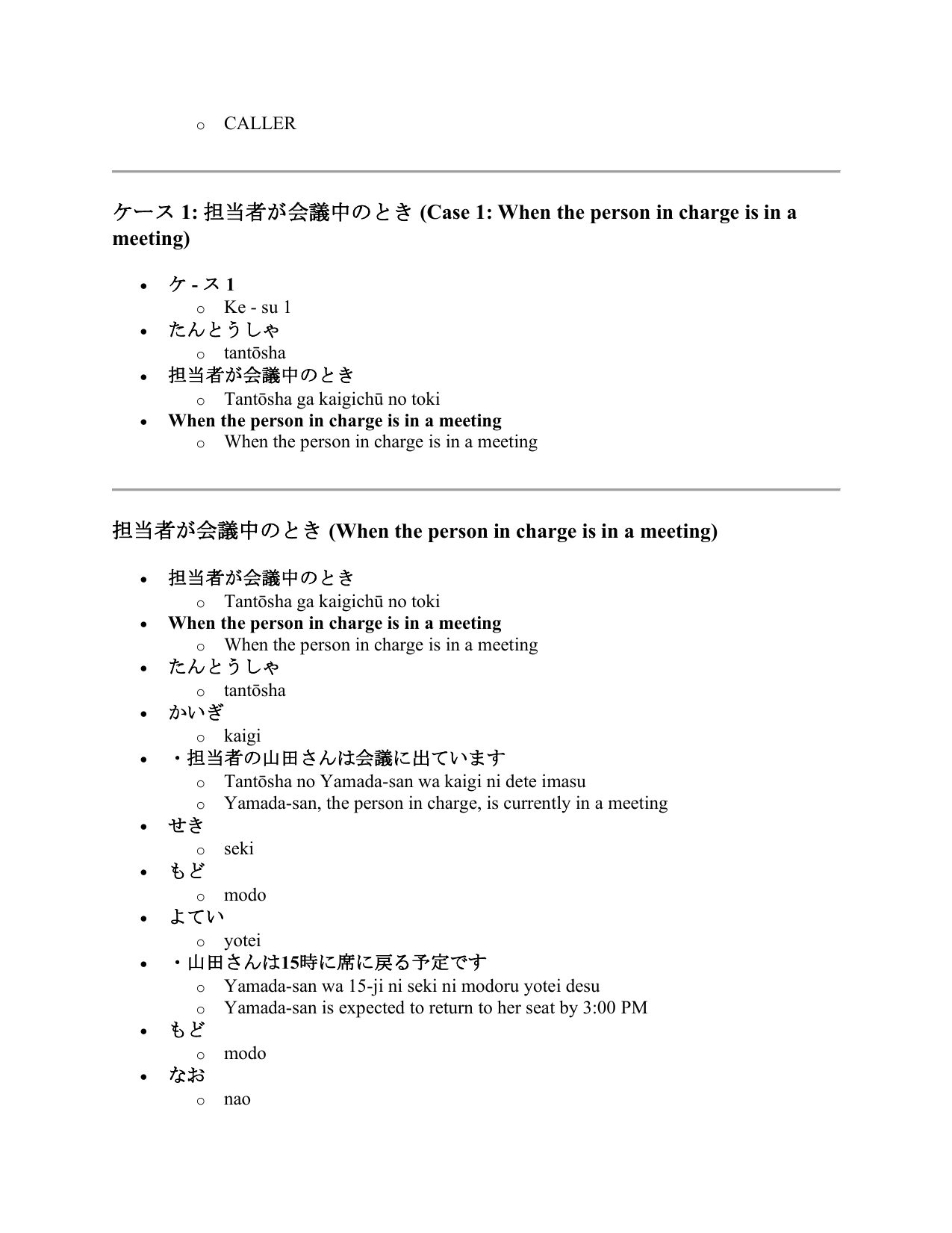
คลิกเพื่อขยาย
EN o CALLER
ケース 1: 担当者が会議中のとき (Case 1: When the person in charge is in a
meeting)
ケース 1: 担当者が会議中のとき (Case 1: When the person in charge is in a
meeting)
JP•ケ-ス1
EN o Ke - su 1
JP•たんとうしゃ
EN o tantōsha
JP•担当者が会議中のとき
EN o Tantōsha ga kaigichū no toki
• When the person in charge is in a meeting
o When the person in charge is in a meeting
担当者が会議中のとき (When the person in charge is in a meeting)
• When the person in charge is in a meeting
o When the person in charge is in a meeting
担当者が会議中のとき (When the person in charge is in a meeting)
JP•担当者が会議中のとき
EN o Tantōsha ga kaigichū no toki
• When the person in charge is in a meeting
o When the person in charge is in a meeting
• When the person in charge is in a meeting
o When the person in charge is in a meeting
JP•たんとうしゃ
EN o tantōsha
JP•かいぎ
EN o kaigi
JP•・担当者の山田さんは会議に出ています
EN o Tantōsha no Yamada-san wa kaigi ni dete imasu
o Yamada-san, the person in charge, is currently in a meeting
o Yamada-san, the person in charge, is currently in a meeting
JP•せき
EN o seki
JP•もど
EN o modo
JP•よてい
EN o yotei
JP•・山田さんは15時に席に戻る予定です
EN o Yamada-san wa 15-ji ni seki ni modoru yotei desu
o Yamada-san is expected to return to her seat by 3:00 PM
o Yamada-san is expected to return to her seat by 3:00 PM
JP•もど
EN o modo
JP•なお
EN o nao
หน้า 47
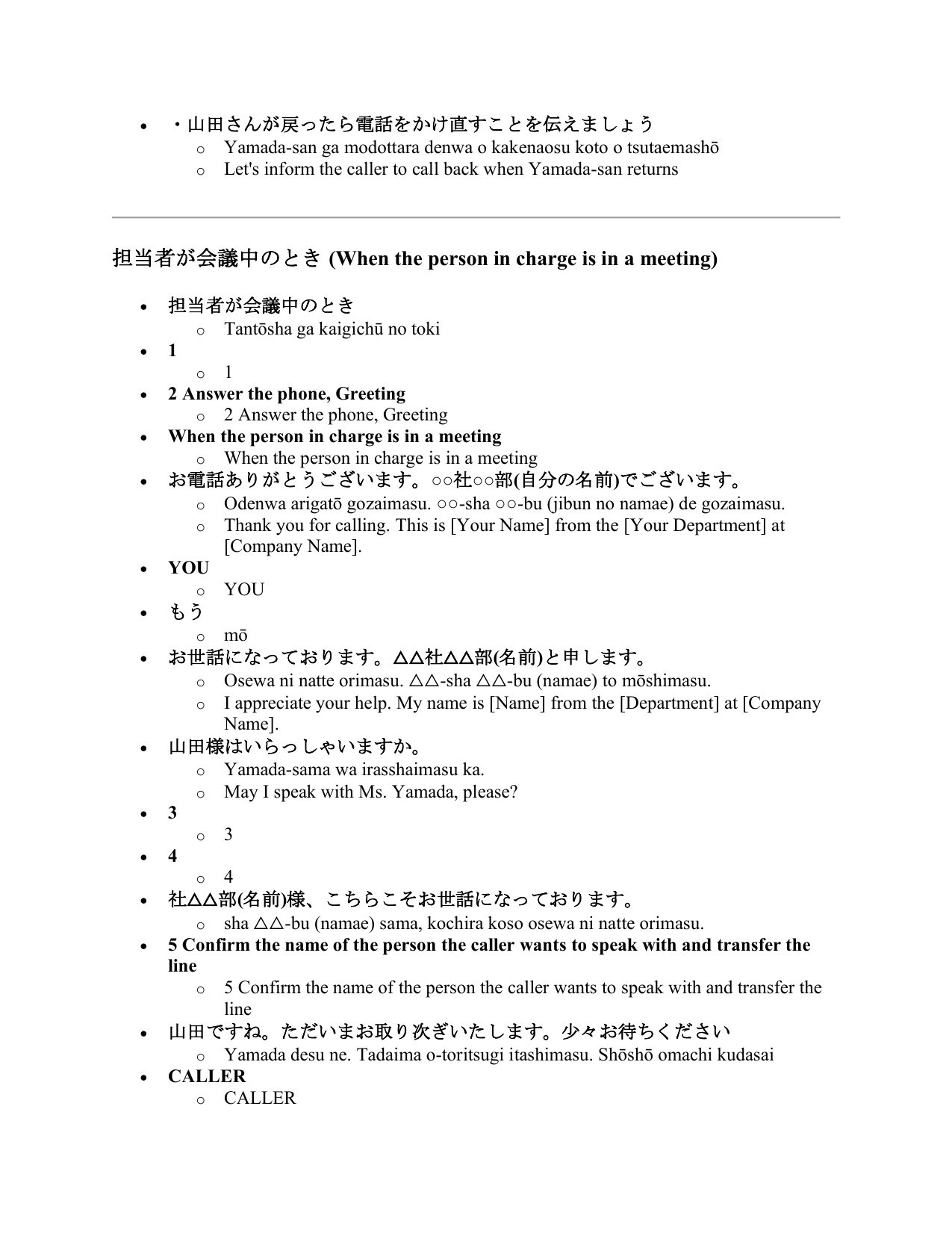
คลิกเพื่อขยาย
JP•・山田さんが戻ったら電話をかけ直すことを伝えましょう
EN o Yamada-san ga modottara denwa o kakenaosu koto o tsutaemashō
o Let's inform the caller to call back when Yamada-san returns
担当者が会議中のとき (When the person in charge is in a meeting)
o Let's inform the caller to call back when Yamada-san returns
担当者が会議中のとき (When the person in charge is in a meeting)
JP•担当者が会議中のとき
EN o Tantōsha ga kaigichū no toki
• 1
o 1
• 2 Answer the phone, Greeting
o 2 Answer the phone, Greeting
• When the person in charge is in a meeting
o When the person in charge is in a meeting
• 1
o 1
• 2 Answer the phone, Greeting
o 2 Answer the phone, Greeting
• When the person in charge is in a meeting
o When the person in charge is in a meeting
JP•お電話ありがとうございます。○○社○○部(自分の名前)でございます。
EN o Odenwa arigatō gozaimasu. ○○-sha ○○-bu (jibun no namae) de gozaimasu.
o Thank you for calling. This is [Your Name] from the [Your Department] at
[Company Name].
• YOU
o YOU
o Thank you for calling. This is [Your Name] from the [Your Department] at
[Company Name].
• YOU
o YOU
JP•もう
EN o mō
JP•お世話になっております。△△社△△部(名前)と申します。
EN o Osewa ni natte orimasu. △△-sha △△-bu (namae) to mōshimasu.
o I appreciate your help. My name is [Name] from the [Department] at [Company
Name].
o I appreciate your help. My name is [Name] from the [Department] at [Company
Name].
JP•山田様はいらっしゃいますか。
EN o Yamada-sama wa irasshaimasu ka.
o May I speak with Ms. Yamada, please?
• 3
o 3
• 4
o 4
o May I speak with Ms. Yamada, please?
• 3
o 3
• 4
o 4
JP•社△△部(名前)様、こちらこそお世話になっております。
EN o sha △△-bu (namae) sama, kochira koso osewa ni natte orimasu.
• 5 Confirm the name of the person the caller wants to speak with and transfer the
line
o 5 Confirm the name of the person the caller wants to speak with and transfer the
line
• 5 Confirm the name of the person the caller wants to speak with and transfer the
line
o 5 Confirm the name of the person the caller wants to speak with and transfer the
line
JP•山田ですね。ただいまお取り次ぎいたします。少々お待ちください
EN o Yamada desu ne. Tadaima o-toritsugi itashimasu. Shōshō omachi kudasai
• CALLER
o CALLER
• CALLER
o CALLER
หน้า 48
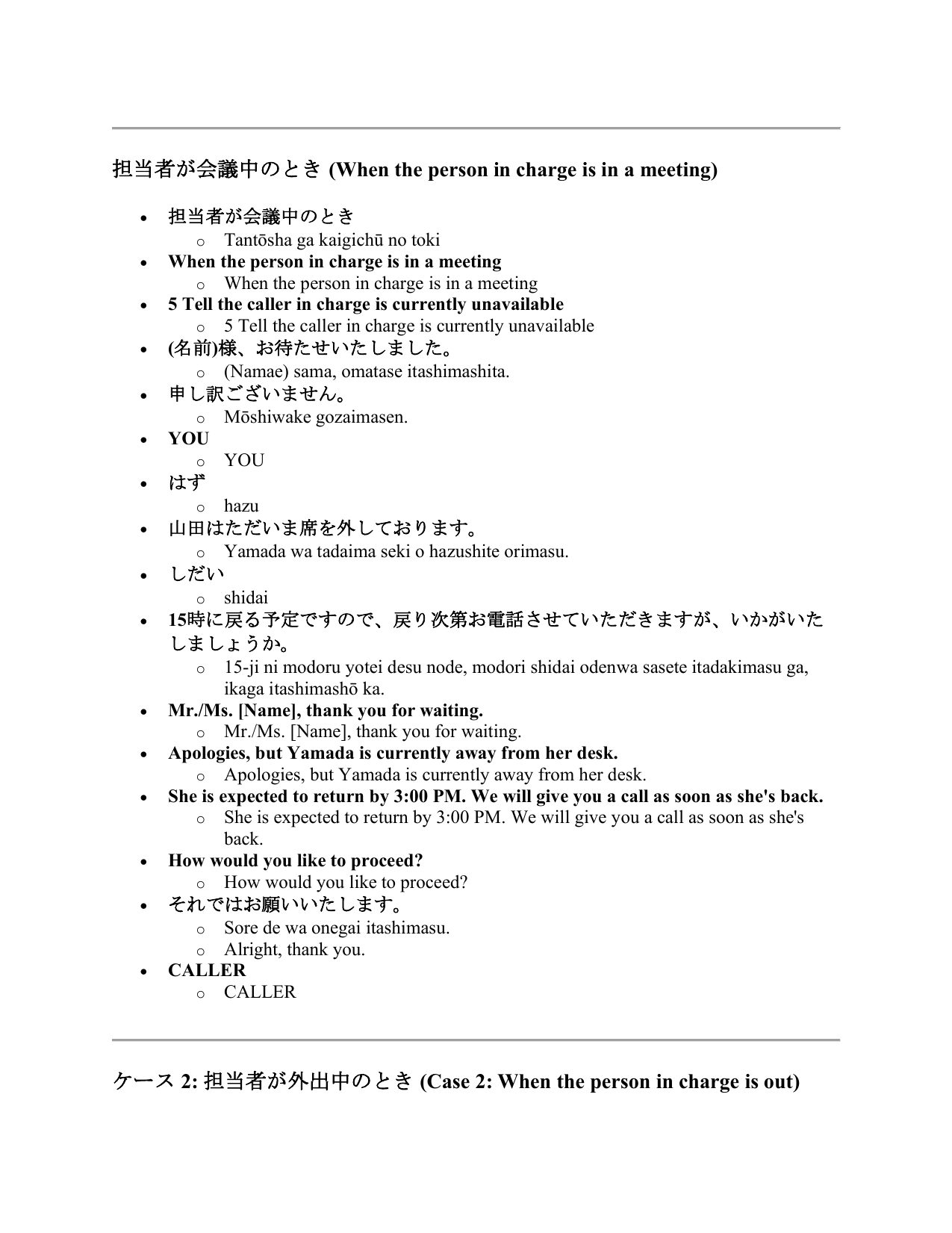
คลิกเพื่อขยาย
EN担当者が会議中のとき (When the person in charge is in a meeting)
JP•担当者が会議中のとき
EN o Tantōsha ga kaigichū no toki
• When the person in charge is in a meeting
o When the person in charge is in a meeting
• 5 Tell the caller in charge is currently unavailable
o 5 Tell the caller in charge is currently unavailable
• When the person in charge is in a meeting
o When the person in charge is in a meeting
• 5 Tell the caller in charge is currently unavailable
o 5 Tell the caller in charge is currently unavailable
JP•(名前)様、お待たせいたしました。
EN o (Namae) sama, omatase itashimashita.
JP•申し訳ございません。
EN o Mōshiwake gozaimasen.
• YOU
o YOU
• YOU
o YOU
JP•はず
EN o hazu
JP•山田はただいま席を外しております。
EN o Yamada wa tadaima seki o hazushite orimasu.
JP•しだい
EN o shidai
JP•15時に戻る予定ですので、戻り次第お電話させていただきますが、いかがいた
しましょうか。
しましょうか。
EN o 15-ji ni modoru yotei desu node, modori shidai odenwa sasete itadakimasu ga,
ikaga itashimashō ka.
• Mr./Ms. [Name], thank you for waiting.
o Mr./Ms. [Name], thank you for waiting.
• Apologies, but Yamada is currently away from her desk.
o Apologies, but Yamada is currently away from her desk.
• She is expected to return by 3:00 PM. We will give you a call as soon as she's back.
o She is expected to return by 3:00 PM. We will give you a call as soon as she's
back.
• How would you like to proceed?
o How would you like to proceed?
ikaga itashimashō ka.
• Mr./Ms. [Name], thank you for waiting.
o Mr./Ms. [Name], thank you for waiting.
• Apologies, but Yamada is currently away from her desk.
o Apologies, but Yamada is currently away from her desk.
• She is expected to return by 3:00 PM. We will give you a call as soon as she's back.
o She is expected to return by 3:00 PM. We will give you a call as soon as she's
back.
• How would you like to proceed?
o How would you like to proceed?
JP•それではお願いいたします。
EN o Sore de wa onegai itashimasu.
o Alright, thank you.
• CALLER
o CALLER
ケース 2: 担当者が外出中のとき (Case 2: When the person in charge is out)
o Alright, thank you.
• CALLER
o CALLER
ケース 2: 担当者が外出中のとき (Case 2: When the person in charge is out)
หน้า 49
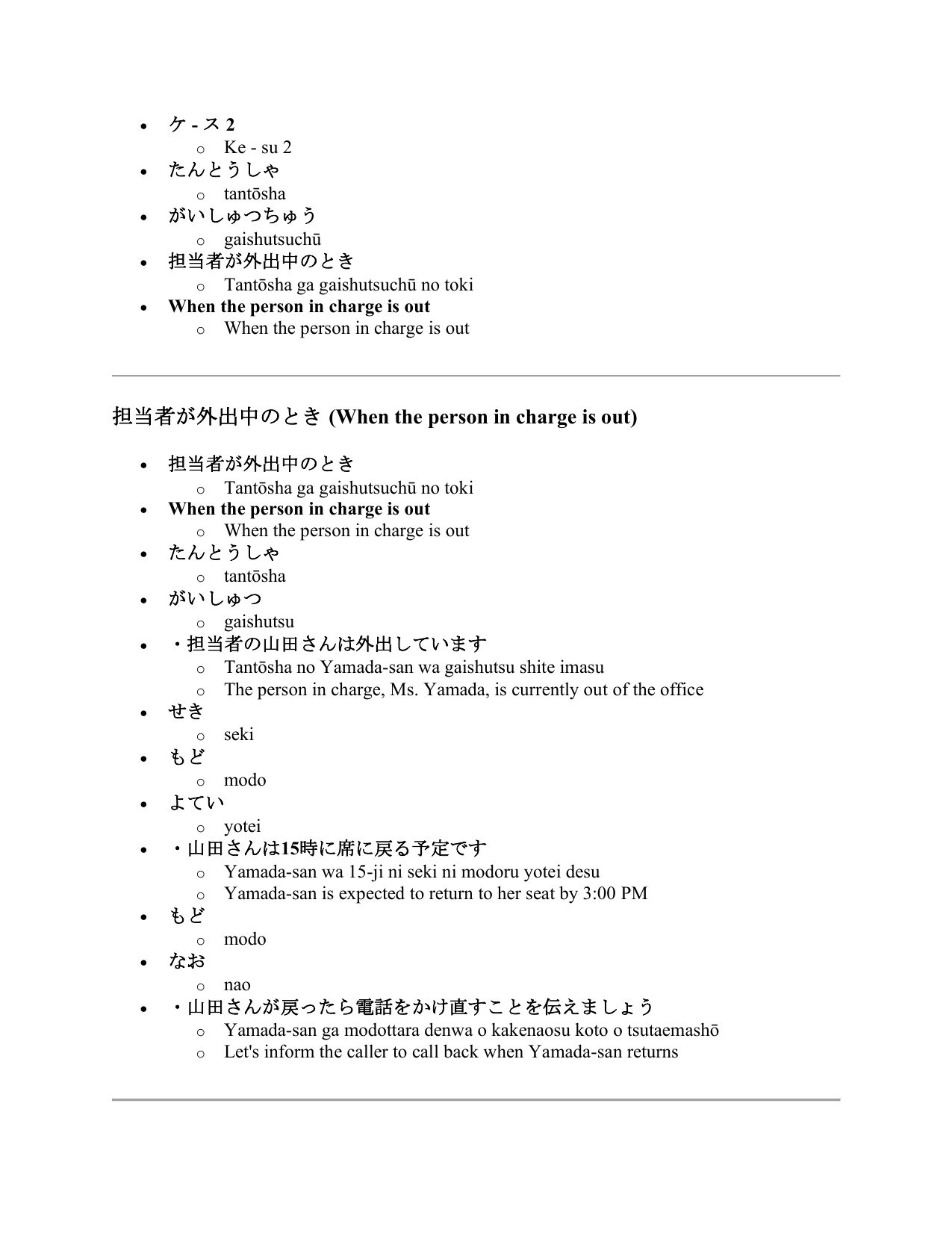
คลิกเพื่อขยาย
JP•ケ-ス2
EN o Ke - su 2
JP•たんとうしゃ
EN o tantōsha
JP•がいしゅつちゅう
EN o gaishutsuchū
JP•担当者が外出中のとき
EN o Tantōsha ga gaishutsuchū no toki
• When the person in charge is out
o When the person in charge is out
担当者が外出中のとき (When the person in charge is out)
• When the person in charge is out
o When the person in charge is out
担当者が外出中のとき (When the person in charge is out)
JP•担当者が外出中のとき
EN o Tantōsha ga gaishutsuchū no toki
• When the person in charge is out
o When the person in charge is out
• When the person in charge is out
o When the person in charge is out
JP•たんとうしゃ
EN o tantōsha
JP•がいしゅつ
EN o gaishutsu
JP•・担当者の山田さんは外出しています
EN o Tantōsha no Yamada-san wa gaishutsu shite imasu
o The person in charge, Ms. Yamada, is currently out of the office
o The person in charge, Ms. Yamada, is currently out of the office
JP•せき
EN o seki
JP•もど
EN o modo
JP•よてい
EN o yotei
JP•・山田さんは15時に席に戻る予定です
EN o Yamada-san wa 15-ji ni seki ni modoru yotei desu
o Yamada-san is expected to return to her seat by 3:00 PM
o Yamada-san is expected to return to her seat by 3:00 PM
JP•もど
EN o modo
JP•なお
EN o nao
JP•・山田さんが戻ったら電話をかけ直すことを伝えましょう
EN o Yamada-san ga modottara denwa o kakenaosu koto o tsutaemashō
o Let's inform the caller to call back when Yamada-san returns
o Let's inform the caller to call back when Yamada-san returns
หน้า 50
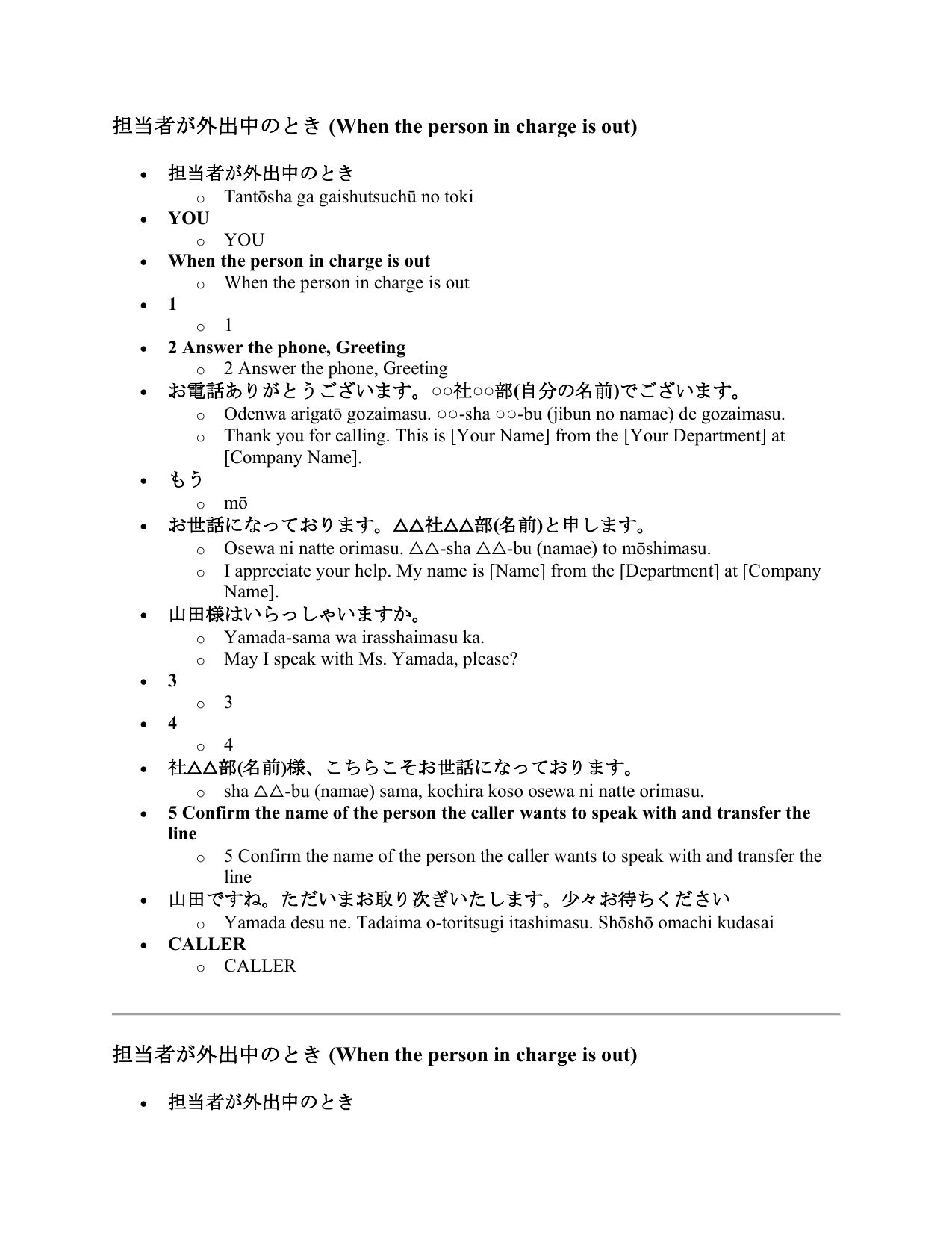
คลิกเพื่อขยาย
EN担当者が外出中のとき (When the person in charge is out)
JP•担当者が外出中のとき
EN o Tantōsha ga gaishutsuchū no toki
• YOU
o YOU
• When the person in charge is out
o When the person in charge is out
• 1
o 1
• 2 Answer the phone, Greeting
o 2 Answer the phone, Greeting
• YOU
o YOU
• When the person in charge is out
o When the person in charge is out
• 1
o 1
• 2 Answer the phone, Greeting
o 2 Answer the phone, Greeting
JP•お電話ありがとうございます。○○社○○部(自分の名前)でございます。
EN o Odenwa arigatō gozaimasu. ○○-sha ○○-bu (jibun no namae) de gozaimasu.
o Thank you for calling. This is [Your Name] from the [Your Department] at
[Company Name].
o Thank you for calling. This is [Your Name] from the [Your Department] at
[Company Name].
JP•もう
EN o mō
JP•お世話になっております。△△社△△部(名前)と申します。
EN o Osewa ni natte orimasu. △△-sha △△-bu (namae) to mōshimasu.
o I appreciate your help. My name is [Name] from the [Department] at [Company
Name].
o I appreciate your help. My name is [Name] from the [Department] at [Company
Name].
JP•山田様はいらっしゃいますか。
EN o Yamada-sama wa irasshaimasu ka.
o May I speak with Ms. Yamada, please?
• 3
o 3
• 4
o 4
o May I speak with Ms. Yamada, please?
• 3
o 3
• 4
o 4
JP•社△△部(名前)様、こちらこそお世話になっております。
EN o sha △△-bu (namae) sama, kochira koso osewa ni natte orimasu.
• 5 Confirm the name of the person the caller wants to speak with and transfer the
line
o 5 Confirm the name of the person the caller wants to speak with and transfer the
line
• 5 Confirm the name of the person the caller wants to speak with and transfer the
line
o 5 Confirm the name of the person the caller wants to speak with and transfer the
line
JP•山田ですね。ただいまお取り次ぎいたします。少々お待ちください
EN o Yamada desu ne. Tadaima o-toritsugi itashimasu. Shōshō omachi kudasai
• CALLER
o CALLER
担当者が外出中のとき (When the person in charge is out)
• CALLER
o CALLER
担当者が外出中のとき (When the person in charge is out)
JP•担当者が外出中のとき
หน้า 51
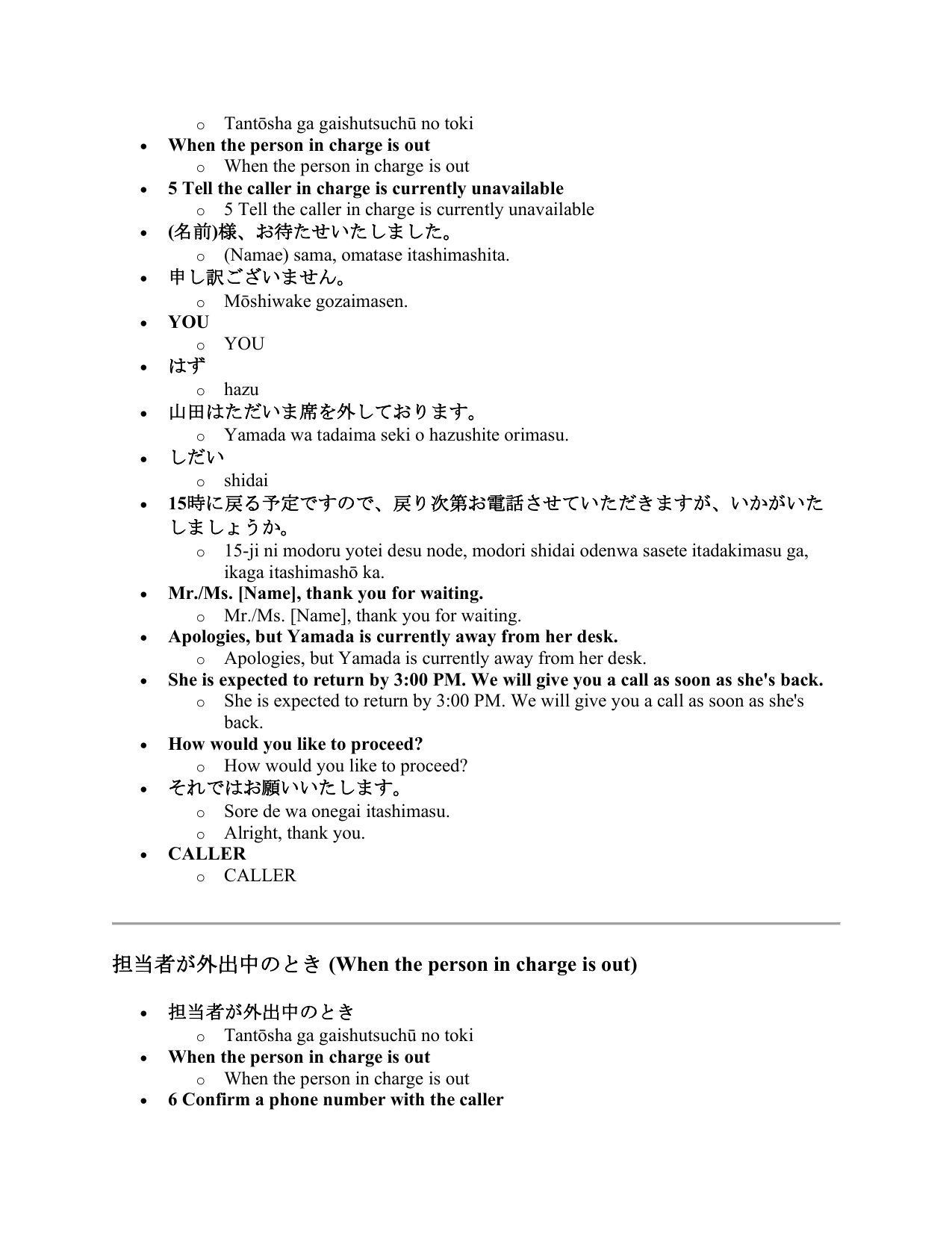
คลิกเพื่อขยาย
EN o Tantōsha ga gaishutsuchū no toki
• When the person in charge is out
o When the person in charge is out
• 5 Tell the caller in charge is currently unavailable
o 5 Tell the caller in charge is currently unavailable
• When the person in charge is out
o When the person in charge is out
• 5 Tell the caller in charge is currently unavailable
o 5 Tell the caller in charge is currently unavailable
JP•(名前)様、お待たせいたしました。
EN o (Namae) sama, omatase itashimashita.
JP•申し訳ございません。
EN o Mōshiwake gozaimasen.
• YOU
o YOU
• YOU
o YOU
JP•はず
EN o hazu
JP•山田はただいま席を外しております。
EN o Yamada wa tadaima seki o hazushite orimasu.
JP•しだい
EN o shidai
JP•15時に戻る予定ですので、戻り次第お電話させていただきますが、いかがいた
しましょうか。
しましょうか。
EN o 15-ji ni modoru yotei desu node, modori shidai odenwa sasete itadakimasu ga,
ikaga itashimashō ka.
• Mr./Ms. [Name], thank you for waiting.
o Mr./Ms. [Name], thank you for waiting.
• Apologies, but Yamada is currently away from her desk.
o Apologies, but Yamada is currently away from her desk.
• She is expected to return by 3:00 PM. We will give you a call as soon as she's back.
o She is expected to return by 3:00 PM. We will give you a call as soon as she's
back.
• How would you like to proceed?
o How would you like to proceed?
ikaga itashimashō ka.
• Mr./Ms. [Name], thank you for waiting.
o Mr./Ms. [Name], thank you for waiting.
• Apologies, but Yamada is currently away from her desk.
o Apologies, but Yamada is currently away from her desk.
• She is expected to return by 3:00 PM. We will give you a call as soon as she's back.
o She is expected to return by 3:00 PM. We will give you a call as soon as she's
back.
• How would you like to proceed?
o How would you like to proceed?
JP•それではお願いいたします。
EN o Sore de wa onegai itashimasu.
o Alright, thank you.
• CALLER
o CALLER
担当者が外出中のとき (When the person in charge is out)
o Alright, thank you.
• CALLER
o CALLER
担当者が外出中のとき (When the person in charge is out)
JP•担当者が外出中のとき
EN o Tantōsha ga gaishutsuchū no toki
• When the person in charge is out
o When the person in charge is out
• 6 Confirm a phone number with the caller
• When the person in charge is out
o When the person in charge is out
• 6 Confirm a phone number with the caller
หน้า 52
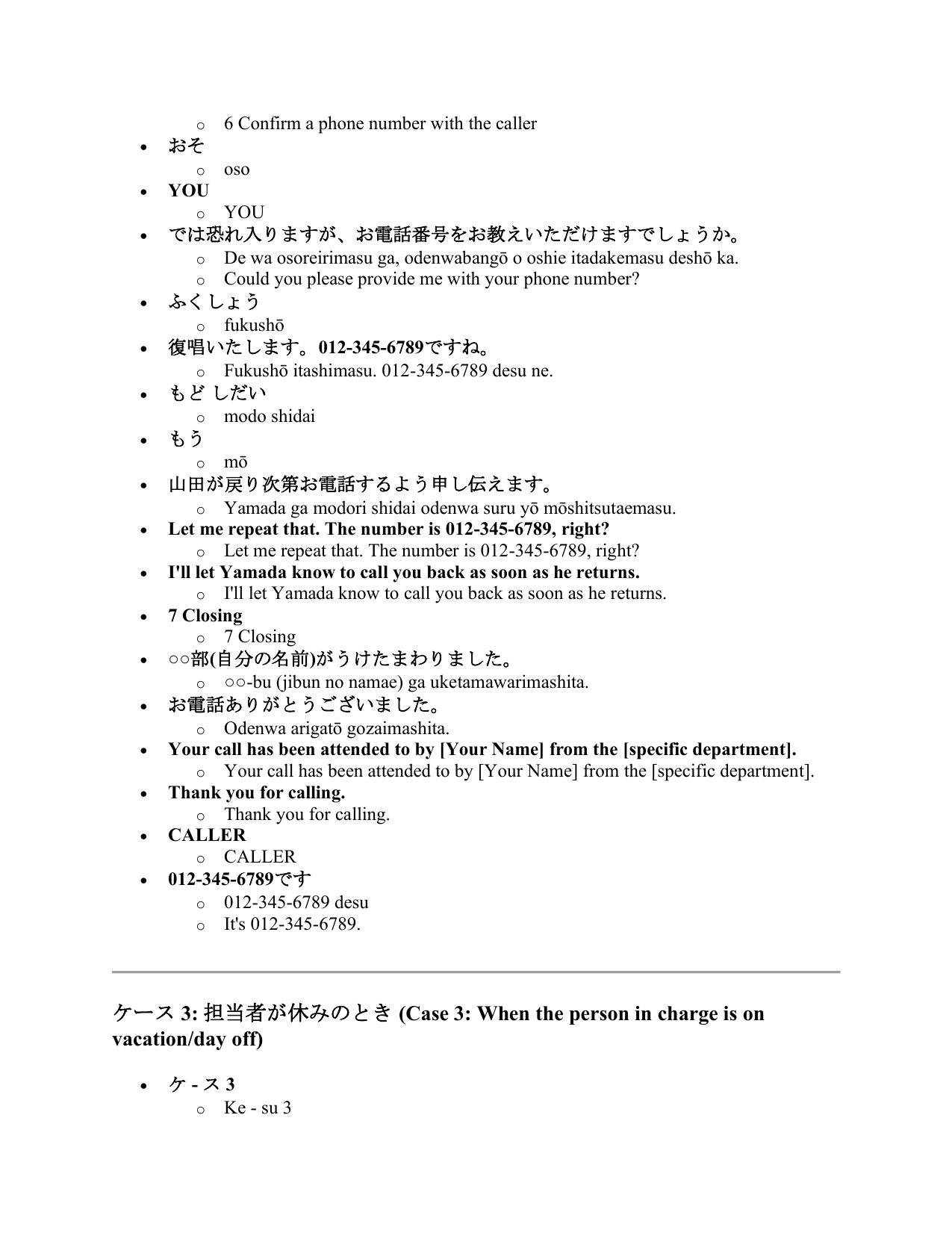
คลิกเพื่อขยาย
EN o 6 Confirm a phone number with the caller
JP•おそ
EN o oso
• YOU
o YOU
• YOU
o YOU
JP•では恐れ入りますが、お電話番号をお教えいただけますでしょうか。
EN o De wa osoreirimasu ga, odenwabangō o oshie itadakemasu deshō ka.
o Could you please provide me with your phone number?
o Could you please provide me with your phone number?
JP•ふくしょう
EN o fukushō
JP•復唱いたします。012-345-6789ですね。
EN o Fukushō itashimasu. 012-345-6789 desu ne.
JP•もどしだい
EN o modo shidai
JP•もう
EN o mō
JP•山田が戻り次第お電話するよう申し伝えます。
EN o Yamada ga modori shidai odenwa suru yō mōshitsutaemasu.
• Let me repeat that. The number is 012-345-6789, right?
o Let me repeat that. The number is 012-345-6789, right?
• I'll let Yamada know to call you back as soon as he returns.
o I'll let Yamada know to call you back as soon as he returns.
• 7 Closing
o 7 Closing
• Let me repeat that. The number is 012-345-6789, right?
o Let me repeat that. The number is 012-345-6789, right?
• I'll let Yamada know to call you back as soon as he returns.
o I'll let Yamada know to call you back as soon as he returns.
• 7 Closing
o 7 Closing
JP•○○部(自分の名前)がうけたまわりました。
EN o ○○-bu (jibun no namae) ga uketamawarimashita.
JP•お電話ありがとうございました。
EN o Odenwa arigatō gozaimashita.
• Your call has been attended to by [Your Name] from the [specific department].
o Your call has been attended to by [Your Name] from the [specific department].
• Thank you for calling.
o Thank you for calling.
• CALLER
o CALLER
• Your call has been attended to by [Your Name] from the [specific department].
o Your call has been attended to by [Your Name] from the [specific department].
• Thank you for calling.
o Thank you for calling.
• CALLER
o CALLER
JP•012-345-6789です
EN o 012-345-6789 desu
o It's 012-345-6789.
ケース 3: 担当者が休みのとき (Case 3: When the person in charge is on
vacation/day off)
o It's 012-345-6789.
ケース 3: 担当者が休みのとき (Case 3: When the person in charge is on
vacation/day off)
JP•ケ-ス3
EN o Ke - su 3
หน้า 53
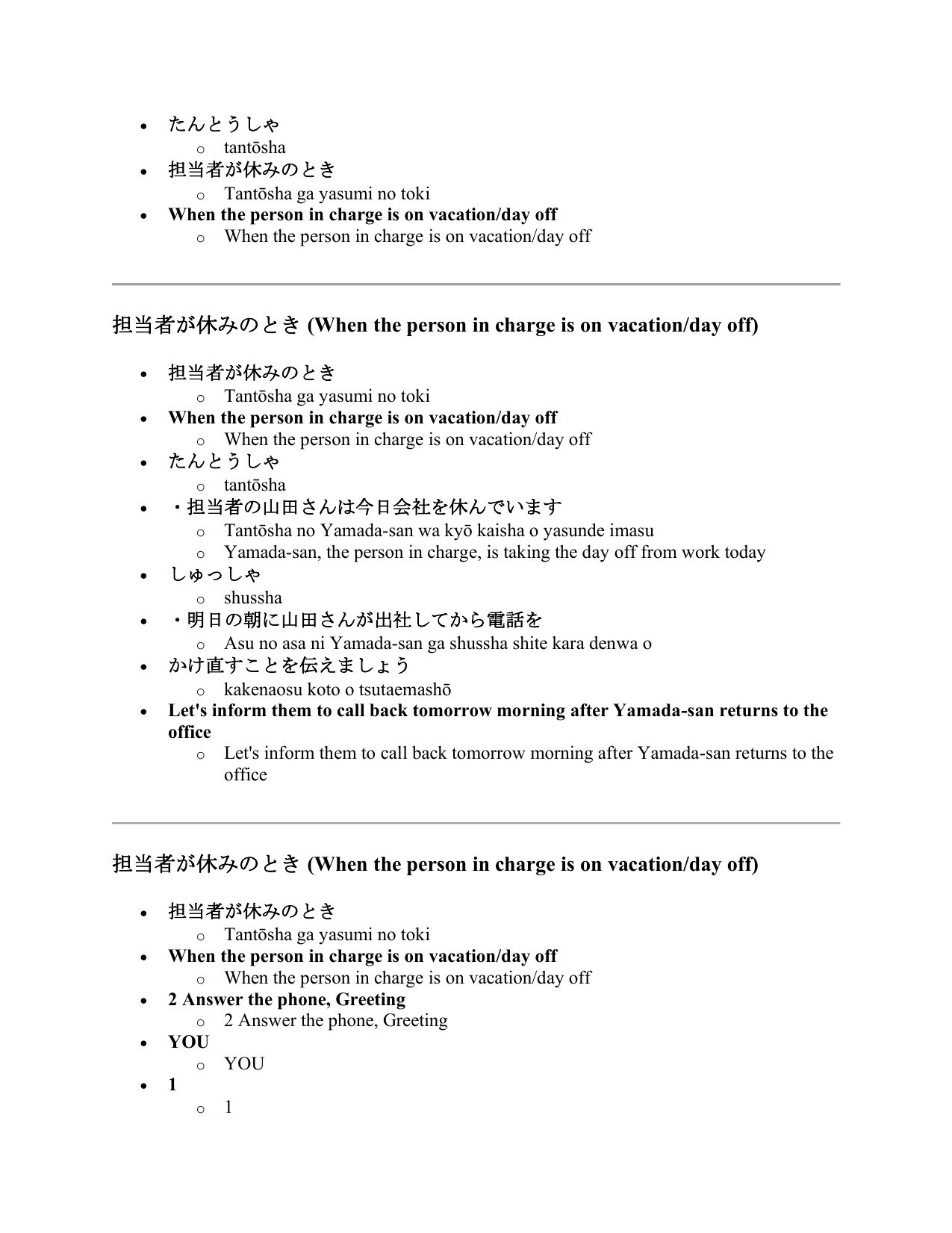
คลิกเพื่อขยาย
JP•たんとうしゃ
EN o tantōsha
JP•担当者が休みのとき
EN o Tantōsha ga yasumi no toki
• When the person in charge is on vacation/day off
o When the person in charge is on vacation/day off
担当者が休みのとき (When the person in charge is on vacation/day off)
• When the person in charge is on vacation/day off
o When the person in charge is on vacation/day off
担当者が休みのとき (When the person in charge is on vacation/day off)
JP•担当者が休みのとき
EN o Tantōsha ga yasumi no toki
• When the person in charge is on vacation/day off
o When the person in charge is on vacation/day off
• When the person in charge is on vacation/day off
o When the person in charge is on vacation/day off
JP•たんとうしゃ
EN o tantōsha
JP•・担当者の山田さんは今日会社を休んでいます
EN o Tantōsha no Yamada-san wa kyō kaisha o yasunde imasu
o Yamada-san, the person in charge, is taking the day off from work today
o Yamada-san, the person in charge, is taking the day off from work today
JP•しゅっしゃ
EN o shussha
JP•・明日の朝に山田さんが出社してから電話を
EN o Asu no asa ni Yamada-san ga shussha shite kara denwa o
JP•かけ直すことを伝えましょう
EN o kakenaosu koto o tsutaemashō
• Let's inform them to call back tomorrow morning after Yamada-san returns to the
office
o Let's inform them to call back tomorrow morning after Yamada-san returns to the
office
担当者が休みのとき (When the person in charge is on vacation/day off)
• Let's inform them to call back tomorrow morning after Yamada-san returns to the
office
o Let's inform them to call back tomorrow morning after Yamada-san returns to the
office
担当者が休みのとき (When the person in charge is on vacation/day off)
JP•担当者が休みのとき
EN o Tantōsha ga yasumi no toki
• When the person in charge is on vacation/day off
o When the person in charge is on vacation/day off
• 2 Answer the phone, Greeting
o 2 Answer the phone, Greeting
• YOU
o YOU
• 1
o 1
• When the person in charge is on vacation/day off
o When the person in charge is on vacation/day off
• 2 Answer the phone, Greeting
o 2 Answer the phone, Greeting
• YOU
o YOU
• 1
o 1
หน้า 54
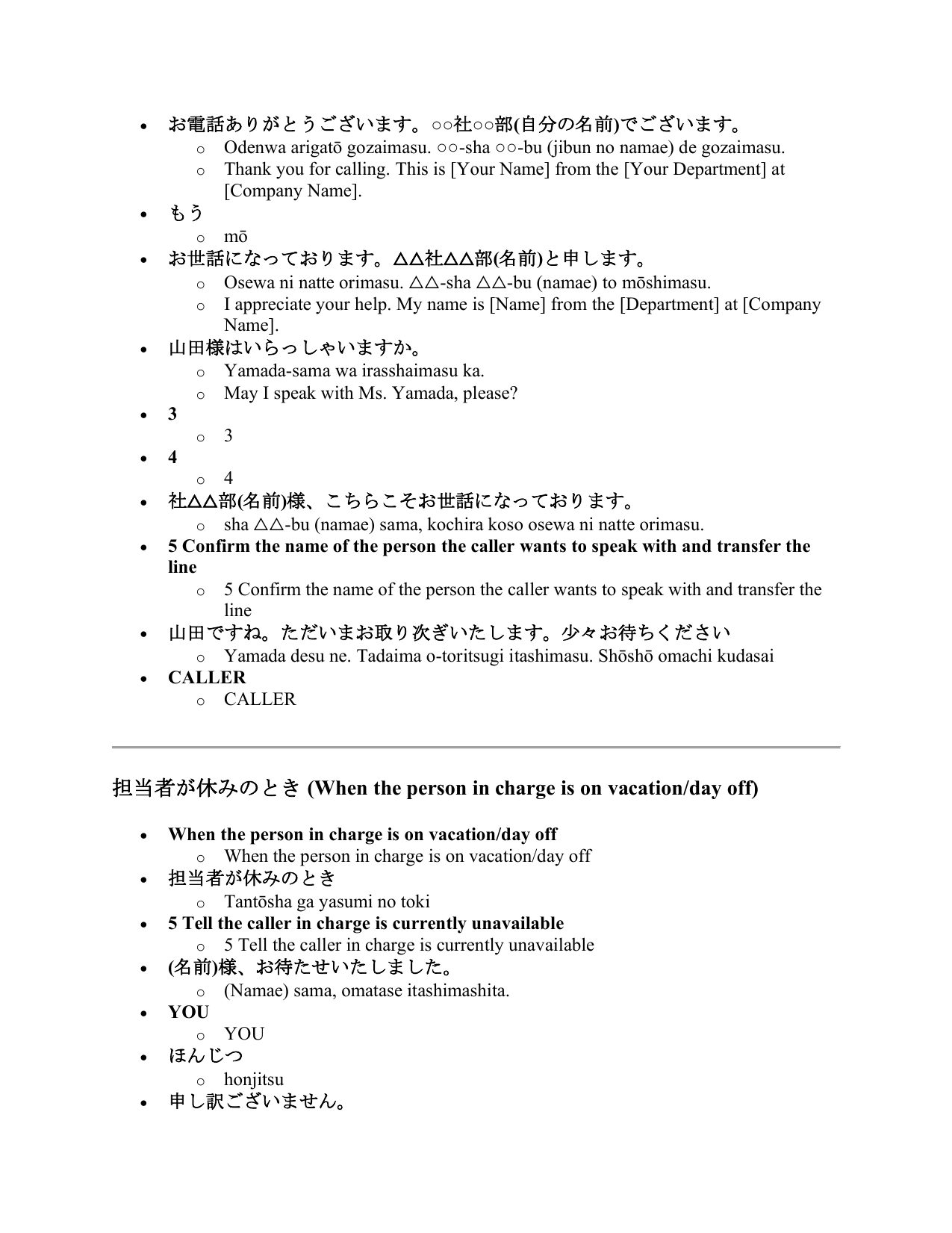
คลิกเพื่อขยาย
JP•お電話ありがとうございます。○○社○○部(自分の名前)でございます。
EN o Odenwa arigatō gozaimasu. ○○-sha ○○-bu (jibun no namae) de gozaimasu.
o Thank you for calling. This is [Your Name] from the [Your Department] at
[Company Name].
o Thank you for calling. This is [Your Name] from the [Your Department] at
[Company Name].
JP•もう
EN o mō
JP•お世話になっております。△△社△△部(名前)と申します。
EN o Osewa ni natte orimasu. △△-sha △△-bu (namae) to mōshimasu.
o I appreciate your help. My name is [Name] from the [Department] at [Company
Name].
o I appreciate your help. My name is [Name] from the [Department] at [Company
Name].
JP•山田様はいらっしゃいますか。
EN o Yamada-sama wa irasshaimasu ka.
o May I speak with Ms. Yamada, please?
• 3
o 3
• 4
o 4
o May I speak with Ms. Yamada, please?
• 3
o 3
• 4
o 4
JP•社△△部(名前)様、こちらこそお世話になっております。
EN o sha △△-bu (namae) sama, kochira koso osewa ni natte orimasu.
• 5 Confirm the name of the person the caller wants to speak with and transfer the
line
o 5 Confirm the name of the person the caller wants to speak with and transfer the
line
• 5 Confirm the name of the person the caller wants to speak with and transfer the
line
o 5 Confirm the name of the person the caller wants to speak with and transfer the
line
JP•山田ですね。ただいまお取り次ぎいたします。少々お待ちください
EN o Yamada desu ne. Tadaima o-toritsugi itashimasu. Shōshō omachi kudasai
• CALLER
o CALLER
担当者が休みのとき (When the person in charge is on vacation/day off)
• When the person in charge is on vacation/day off
o When the person in charge is on vacation/day off
• CALLER
o CALLER
担当者が休みのとき (When the person in charge is on vacation/day off)
• When the person in charge is on vacation/day off
o When the person in charge is on vacation/day off
JP•担当者が休みのとき
EN o Tantōsha ga yasumi no toki
• 5 Tell the caller in charge is currently unavailable
o 5 Tell the caller in charge is currently unavailable
• 5 Tell the caller in charge is currently unavailable
o 5 Tell the caller in charge is currently unavailable
JP•(名前)様、お待たせいたしました。
EN o (Namae) sama, omatase itashimashita.
• YOU
o YOU
• YOU
o YOU
JP•ほんじつ
EN o honjitsu
JP•申し訳ございません。
หน้า 55
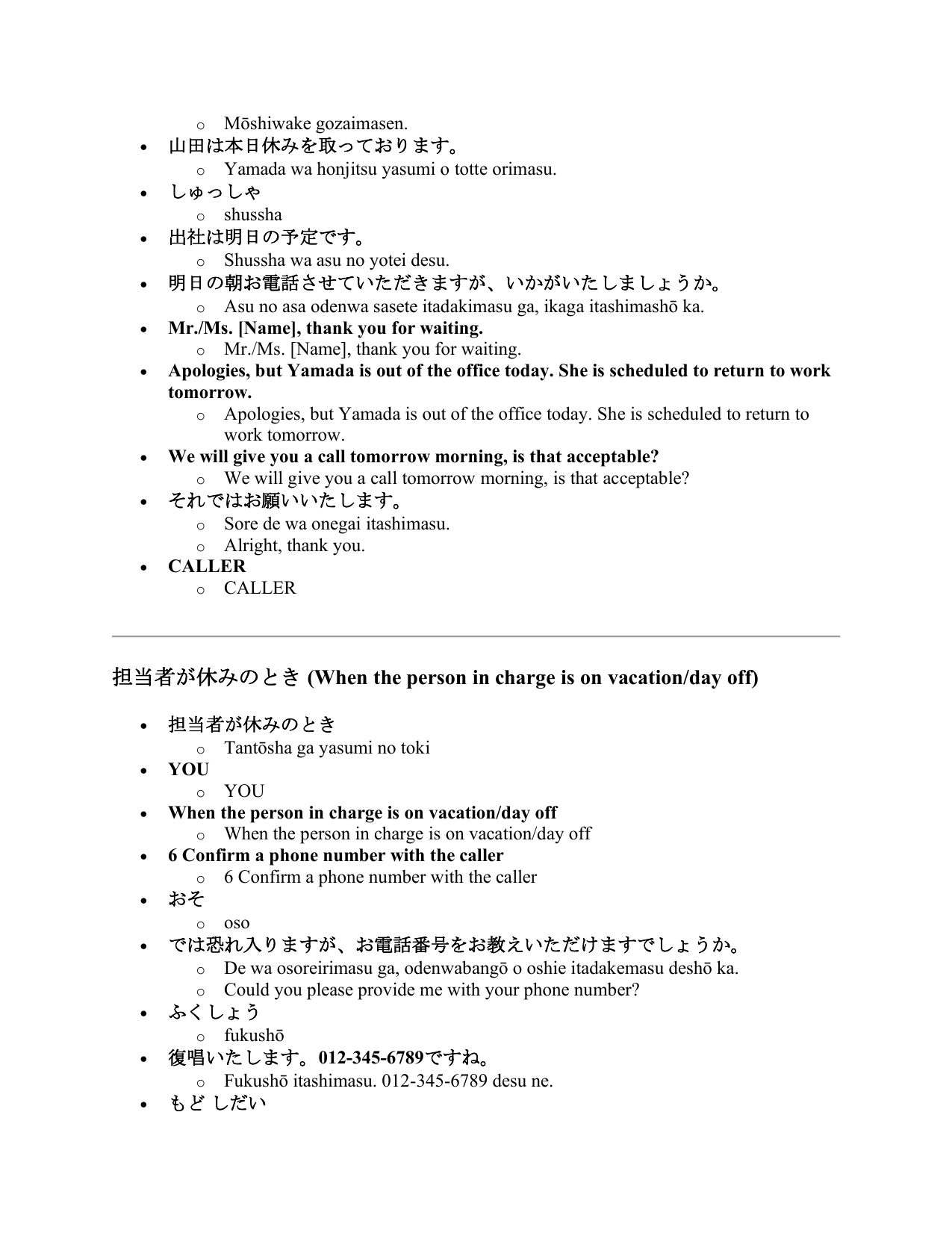
คลิกเพื่อขยาย
EN o Mōshiwake gozaimasen.
JP•山田は本日休みを取っております。
EN o Yamada wa honjitsu yasumi o totte orimasu.
JP•しゅっしゃ
EN o shussha
JP•出社は明日の予定です。
EN o Shussha wa asu no yotei desu.
JP•明日の朝お電話させていただきますが、いかがいたしましょうか。
EN o Asu no asa odenwa sasete itadakimasu ga, ikaga itashimashō ka.
• Mr./Ms. [Name], thank you for waiting.
o Mr./Ms. [Name], thank you for waiting.
• Apologies, but Yamada is out of the office today. She is scheduled to return to work
tomorrow.
o Apologies, but Yamada is out of the office today. She is scheduled to return to
work tomorrow.
• We will give you a call tomorrow morning, is that acceptable?
o We will give you a call tomorrow morning, is that acceptable?
• Mr./Ms. [Name], thank you for waiting.
o Mr./Ms. [Name], thank you for waiting.
• Apologies, but Yamada is out of the office today. She is scheduled to return to work
tomorrow.
o Apologies, but Yamada is out of the office today. She is scheduled to return to
work tomorrow.
• We will give you a call tomorrow morning, is that acceptable?
o We will give you a call tomorrow morning, is that acceptable?
JP•それではお願いいたします。
EN o Sore de wa onegai itashimasu.
o Alright, thank you.
• CALLER
o CALLER
担当者が休みのとき (When the person in charge is on vacation/day off)
o Alright, thank you.
• CALLER
o CALLER
担当者が休みのとき (When the person in charge is on vacation/day off)
JP•担当者が休みのとき
EN o Tantōsha ga yasumi no toki
• YOU
o YOU
• When the person in charge is on vacation/day off
o When the person in charge is on vacation/day off
• 6 Confirm a phone number with the caller
o 6 Confirm a phone number with the caller
• YOU
o YOU
• When the person in charge is on vacation/day off
o When the person in charge is on vacation/day off
• 6 Confirm a phone number with the caller
o 6 Confirm a phone number with the caller
JP•おそ
EN o oso
JP•では恐れ入りますが、お電話番号をお教えいただけますでしょうか。
EN o De wa osoreirimasu ga, odenwabangō o oshie itadakemasu deshō ka.
o Could you please provide me with your phone number?
o Could you please provide me with your phone number?
JP•ふくしょう
EN o fukushō
JP•復唱いたします。012-345-6789ですね。
EN o Fukushō itashimasu. 012-345-6789 desu ne.
JP•もどしだい
หน้า 56
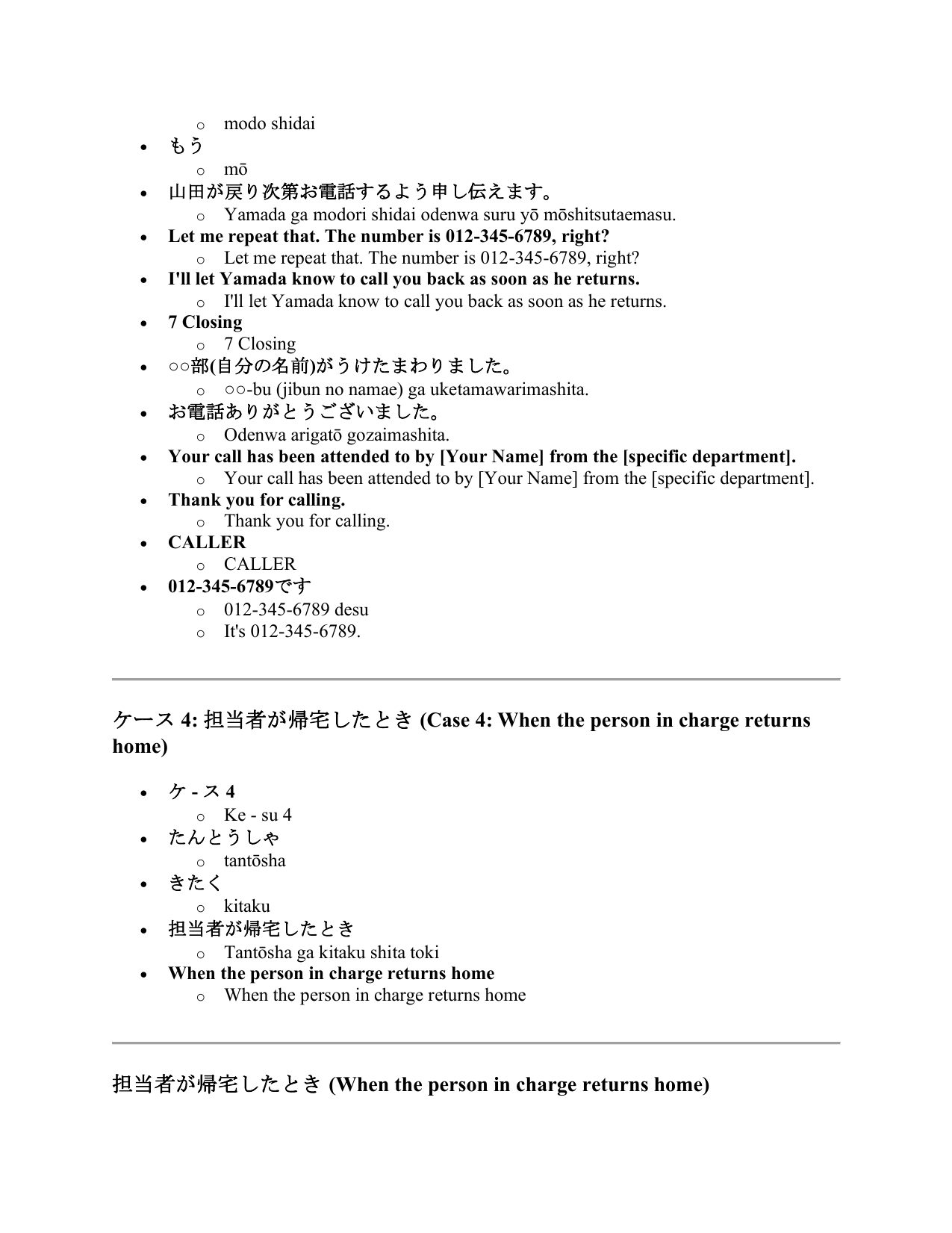
คลิกเพื่อขยาย
EN o modo shidai
JP•もう
EN o mō
JP•山田が戻り次第お電話するよう申し伝えます。
EN o Yamada ga modori shidai odenwa suru yō mōshitsutaemasu.
• Let me repeat that. The number is 012-345-6789, right?
o Let me repeat that. The number is 012-345-6789, right?
• I'll let Yamada know to call you back as soon as he returns.
o I'll let Yamada know to call you back as soon as he returns.
• 7 Closing
o 7 Closing
• Let me repeat that. The number is 012-345-6789, right?
o Let me repeat that. The number is 012-345-6789, right?
• I'll let Yamada know to call you back as soon as he returns.
o I'll let Yamada know to call you back as soon as he returns.
• 7 Closing
o 7 Closing
JP•○○部(自分の名前)がうけたまわりました。
EN o ○○-bu (jibun no namae) ga uketamawarimashita.
JP•お電話ありがとうございました。
EN o Odenwa arigatō gozaimashita.
• Your call has been attended to by [Your Name] from the [specific department].
o Your call has been attended to by [Your Name] from the [specific department].
• Thank you for calling.
o Thank you for calling.
• CALLER
o CALLER
• Your call has been attended to by [Your Name] from the [specific department].
o Your call has been attended to by [Your Name] from the [specific department].
• Thank you for calling.
o Thank you for calling.
• CALLER
o CALLER
JP•012-345-6789です
EN o 012-345-6789 desu
o It's 012-345-6789.
ケース 4: 担当者が帰宅したとき (Case 4: When the person in charge returns
home)
o It's 012-345-6789.
ケース 4: 担当者が帰宅したとき (Case 4: When the person in charge returns
home)
JP•ケ-ス4
EN o Ke - su 4
JP•たんとうしゃ
EN o tantōsha
JP•きたく
EN o kitaku
JP•担当者が帰宅したとき
EN o Tantōsha ga kitaku shita toki
• When the person in charge returns home
o When the person in charge returns home
担当者が帰宅したとき (When the person in charge returns home)
• When the person in charge returns home
o When the person in charge returns home
担当者が帰宅したとき (When the person in charge returns home)
หน้า 57
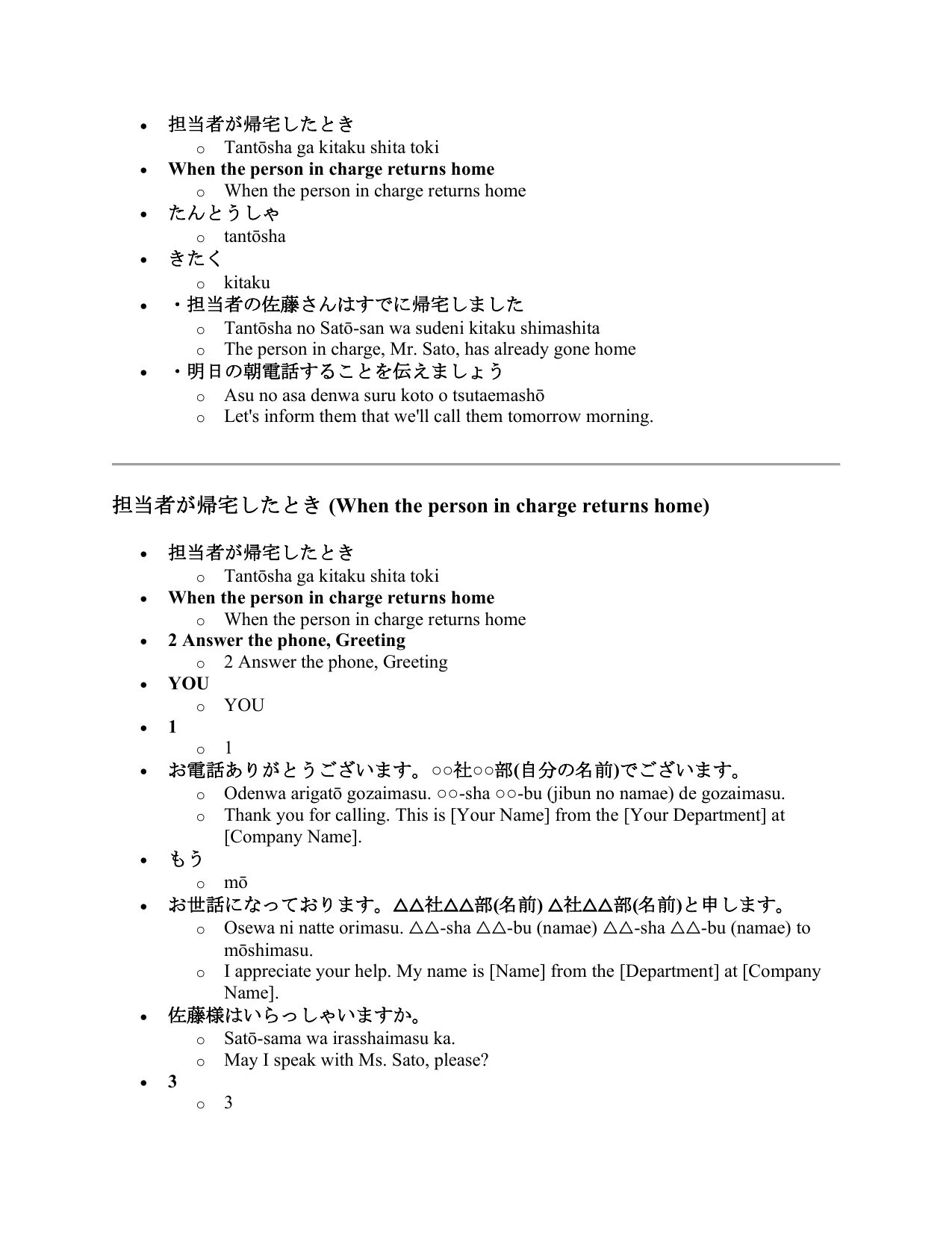
คลิกเพื่อขยาย
JP•担当者が帰宅したとき
EN o Tantōsha ga kitaku shita toki
• When the person in charge returns home
o When the person in charge returns home
• When the person in charge returns home
o When the person in charge returns home
JP•たんとうしゃ
EN o tantōsha
JP•きたく
EN o kitaku
JP•・担当者の佐藤さんはすでに帰宅しました
EN o Tantōsha no Satō-san wa sudeni kitaku shimashita
o The person in charge, Mr. Sato, has already gone home
o The person in charge, Mr. Sato, has already gone home
JP•・明日の朝電話することを伝えましょう
EN o Asu no asa denwa suru koto o tsutaemashō
o Let's inform them that we'll call them tomorrow morning.
担当者が帰宅したとき (When the person in charge returns home)
o Let's inform them that we'll call them tomorrow morning.
担当者が帰宅したとき (When the person in charge returns home)
JP•担当者が帰宅したとき
EN o Tantōsha ga kitaku shita toki
• When the person in charge returns home
o When the person in charge returns home
• 2 Answer the phone, Greeting
o 2 Answer the phone, Greeting
• YOU
o YOU
• 1
o 1
• When the person in charge returns home
o When the person in charge returns home
• 2 Answer the phone, Greeting
o 2 Answer the phone, Greeting
• YOU
o YOU
• 1
o 1
JP•お電話ありがとうございます。○○社○○部(自分の名前)でございます。
EN o Odenwa arigatō gozaimasu. ○○-sha ○○-bu (jibun no namae) de gozaimasu.
o Thank you for calling. This is [Your Name] from the [Your Department] at
[Company Name].
o Thank you for calling. This is [Your Name] from the [Your Department] at
[Company Name].
JP•もう
EN o mō
JP•お世話になっております。△△社△△部(名前)△社△△部(名前)と申します。
EN o Osewa ni natte orimasu. △△-sha △△-bu (namae) △△-sha △△-bu (namae) to
mōshimasu.
o I appreciate your help. My name is [Name] from the [Department] at [Company
Name].
mōshimasu.
o I appreciate your help. My name is [Name] from the [Department] at [Company
Name].
JP•佐藤様はいらっしゃいますか。
EN o Satō-sama wa irasshaimasu ka.
o May I speak with Ms. Sato, please?
• 3
o 3
o May I speak with Ms. Sato, please?
• 3
o 3
หน้า 58
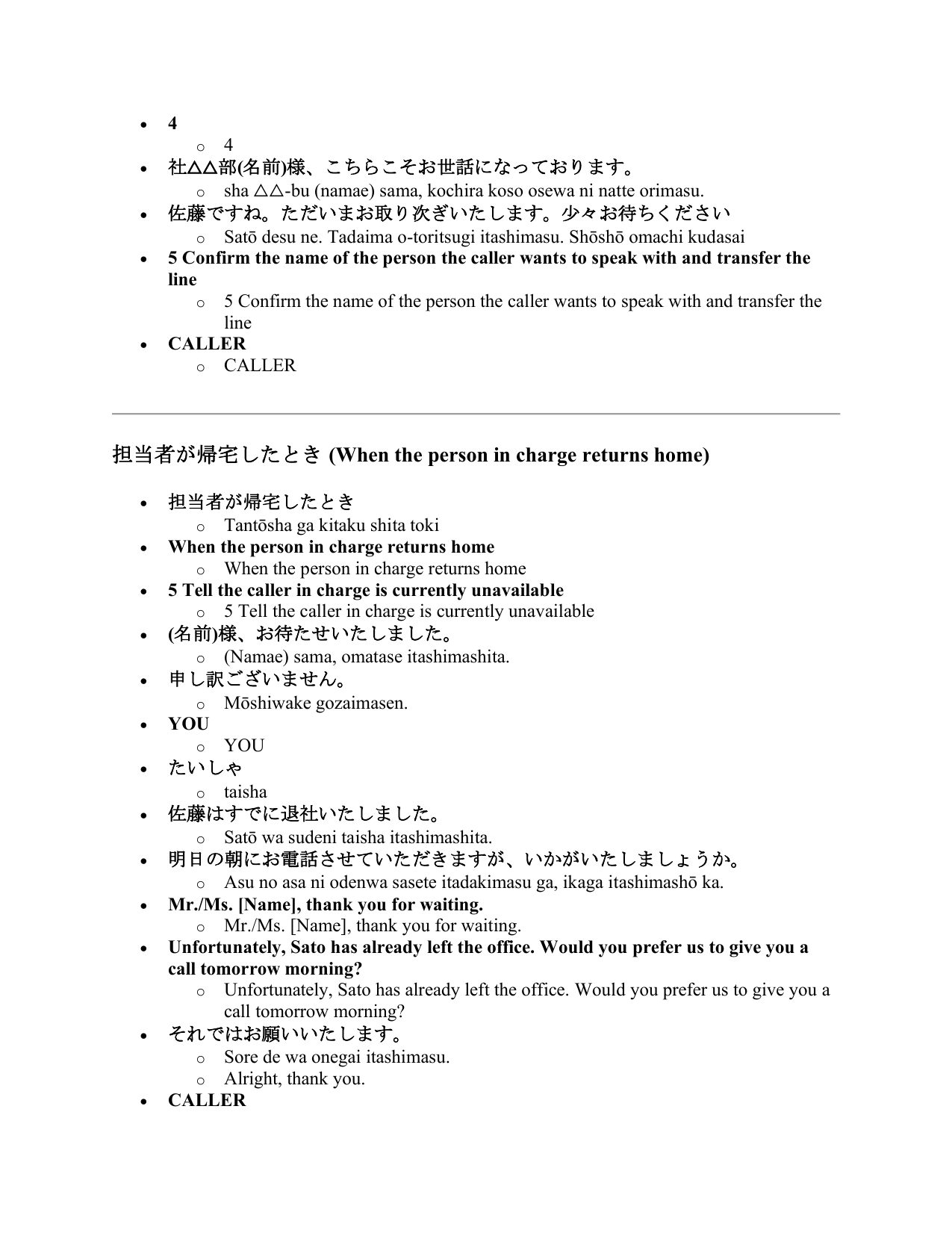
คลิกเพื่อขยาย
• 4
EN o 4
JP•社△△部(名前)様、こちらこそお世話になっております。
EN o sha △△-bu (namae) sama, kochira koso osewa ni natte orimasu.
JP•佐藤ですね。ただいまお取り次ぎいたします。少々お待ちください
EN o Satō desu ne. Tadaima o-toritsugi itashimasu. Shōshō omachi kudasai
• 5 Confirm the name of the person the caller wants to speak with and transfer the
line
o 5 Confirm the name of the person the caller wants to speak with and transfer the
line
• CALLER
o CALLER
担当者が帰宅したとき (When the person in charge returns home)
• 5 Confirm the name of the person the caller wants to speak with and transfer the
line
o 5 Confirm the name of the person the caller wants to speak with and transfer the
line
• CALLER
o CALLER
担当者が帰宅したとき (When the person in charge returns home)
JP•担当者が帰宅したとき
EN o Tantōsha ga kitaku shita toki
• When the person in charge returns home
o When the person in charge returns home
• 5 Tell the caller in charge is currently unavailable
o 5 Tell the caller in charge is currently unavailable
• When the person in charge returns home
o When the person in charge returns home
• 5 Tell the caller in charge is currently unavailable
o 5 Tell the caller in charge is currently unavailable
JP•(名前)様、お待たせいたしました。
EN o (Namae) sama, omatase itashimashita.
JP•申し訳ございません。
EN o Mōshiwake gozaimasen.
• YOU
o YOU
• YOU
o YOU
JP•たいしゃ
EN o taisha
JP•佐藤はすでに退社いたしました。
EN o Satō wa sudeni taisha itashimashita.
JP•明日の朝にお電話させていただきますが、いかがいたしましょうか。
EN o Asu no asa ni odenwa sasete itadakimasu ga, ikaga itashimashō ka.
• Mr./Ms. [Name], thank you for waiting.
o Mr./Ms. [Name], thank you for waiting.
• Unfortunately, Sato has already left the office. Would you prefer us to give you a
call tomorrow morning?
o Unfortunately, Sato has already left the office. Would you prefer us to give you a
call tomorrow morning?
• Mr./Ms. [Name], thank you for waiting.
o Mr./Ms. [Name], thank you for waiting.
• Unfortunately, Sato has already left the office. Would you prefer us to give you a
call tomorrow morning?
o Unfortunately, Sato has already left the office. Would you prefer us to give you a
call tomorrow morning?
JP•それではお願いいたします。
EN o Sore de wa onegai itashimasu.
o Alright, thank you.
• CALLER
o Alright, thank you.
• CALLER
หน้า 59
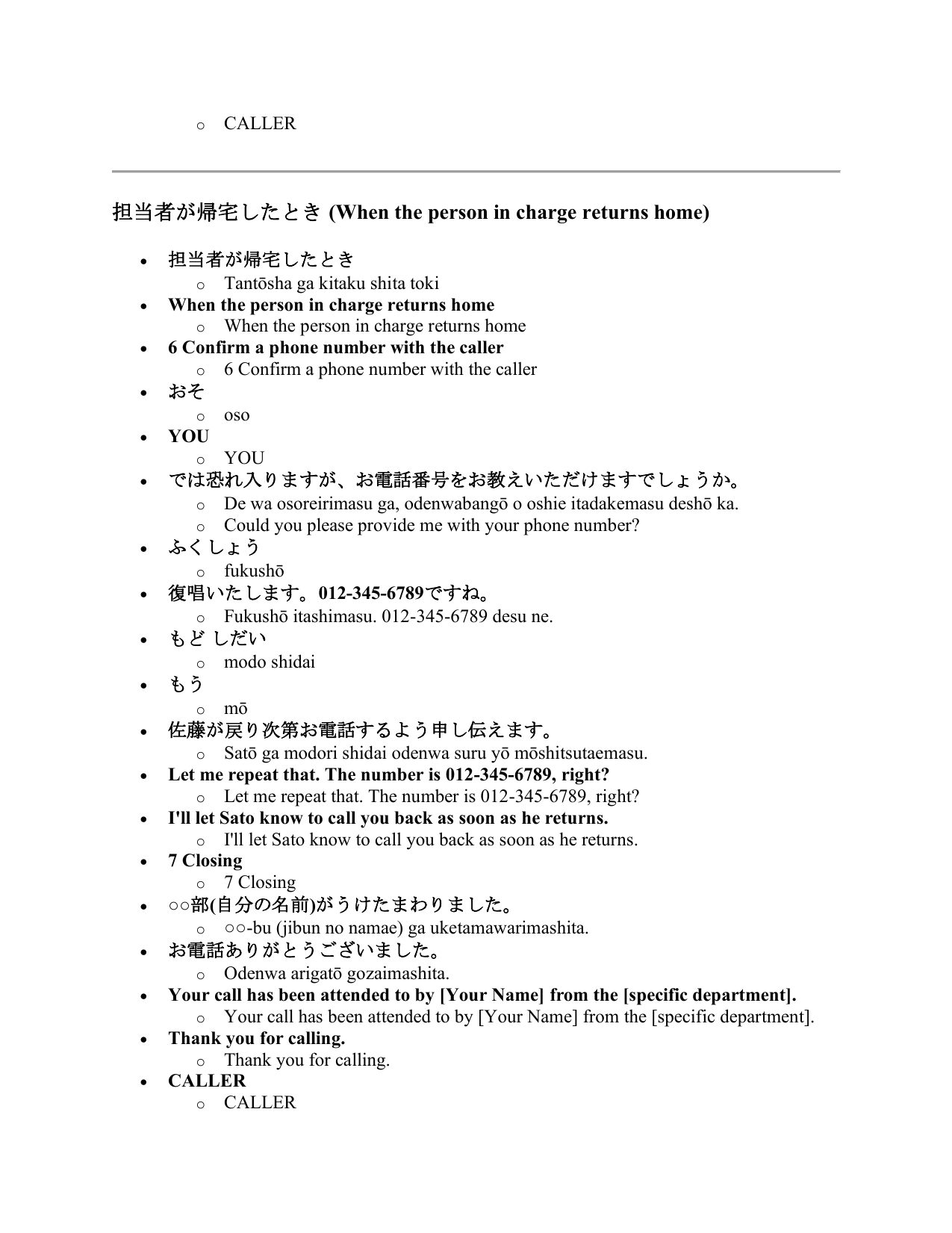
คลิกเพื่อขยาย
EN o CALLER
担当者が帰宅したとき (When the person in charge returns home)
担当者が帰宅したとき (When the person in charge returns home)
JP•担当者が帰宅したとき
EN o Tantōsha ga kitaku shita toki
• When the person in charge returns home
o When the person in charge returns home
• 6 Confirm a phone number with the caller
o 6 Confirm a phone number with the caller
• When the person in charge returns home
o When the person in charge returns home
• 6 Confirm a phone number with the caller
o 6 Confirm a phone number with the caller
JP•おそ
EN o oso
• YOU
o YOU
• YOU
o YOU
JP•では恐れ入りますが、お電話番号をお教えいただけますでしょうか。
EN o De wa osoreirimasu ga, odenwabangō o oshie itadakemasu deshō ka.
o Could you please provide me with your phone number?
o Could you please provide me with your phone number?
JP•ふくしょう
EN o fukushō
JP•復唱いたします。012-345-6789ですね。
EN o Fukushō itashimasu. 012-345-6789 desu ne.
JP•もどしだい
EN o modo shidai
JP•もう
EN o mō
JP•佐藤が戻り次第お電話するよう申し伝えます。
EN o Satō ga modori shidai odenwa suru yō mōshitsutaemasu.
• Let me repeat that. The number is 012-345-6789, right?
o Let me repeat that. The number is 012-345-6789, right?
• I'll let Sato know to call you back as soon as he returns.
o I'll let Sato know to call you back as soon as he returns.
• 7 Closing
o 7 Closing
• Let me repeat that. The number is 012-345-6789, right?
o Let me repeat that. The number is 012-345-6789, right?
• I'll let Sato know to call you back as soon as he returns.
o I'll let Sato know to call you back as soon as he returns.
• 7 Closing
o 7 Closing
JP•○○部(自分の名前)がうけたまわりました。
EN o ○○-bu (jibun no namae) ga uketamawarimashita.
JP•お電話ありがとうございました。
EN o Odenwa arigatō gozaimashita.
• Your call has been attended to by [Your Name] from the [specific department].
o Your call has been attended to by [Your Name] from the [specific department].
• Thank you for calling.
o Thank you for calling.
• CALLER
o CALLER
• Your call has been attended to by [Your Name] from the [specific department].
o Your call has been attended to by [Your Name] from the [specific department].
• Thank you for calling.
o Thank you for calling.
• CALLER
o CALLER
หน้า 60
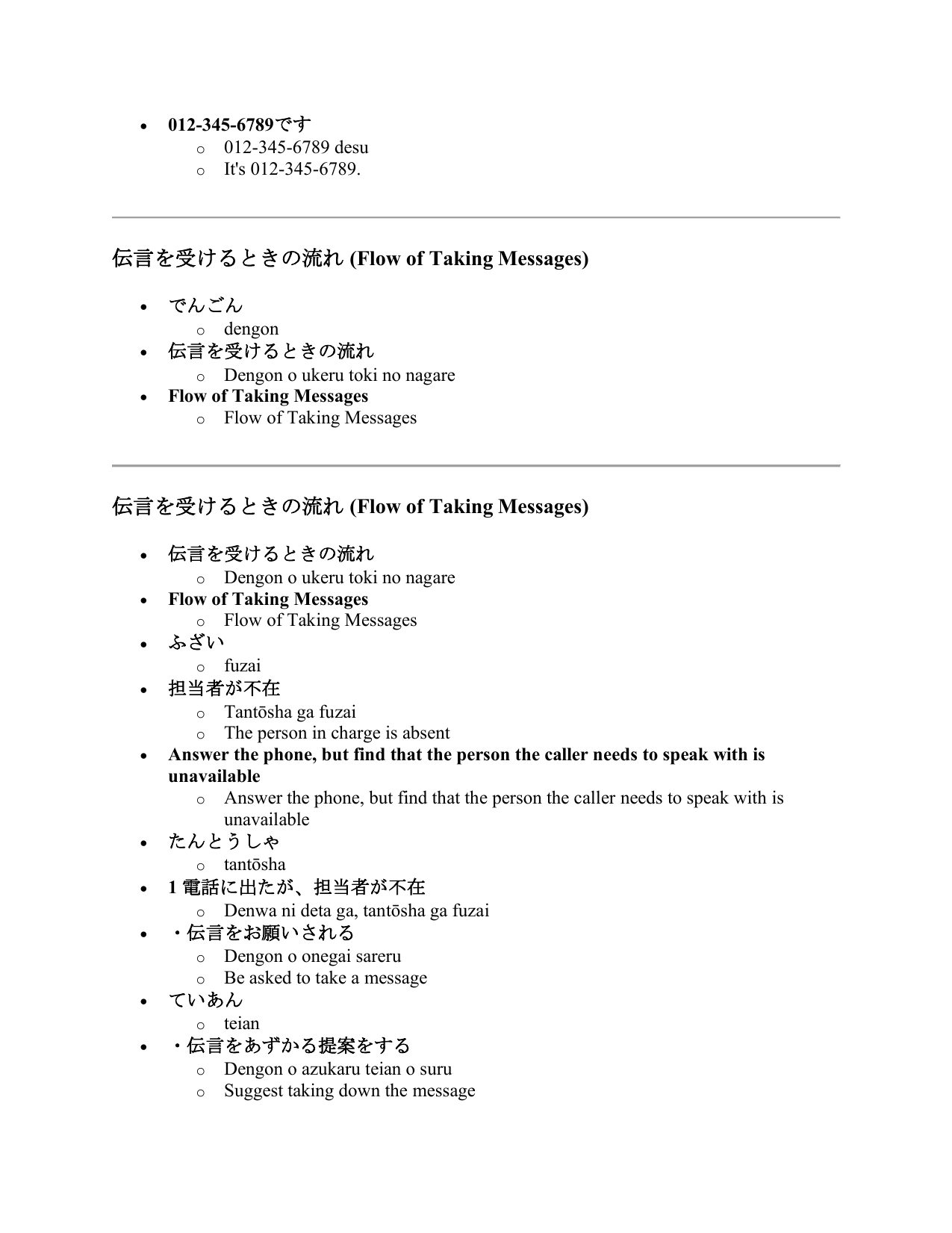
คลิกเพื่อขยาย
JP•012-345-6789です
EN o 012-345-6789 desu
o It's 012-345-6789.
伝言を受けるときの流れ (Flow of Taking Messages)
o It's 012-345-6789.
伝言を受けるときの流れ (Flow of Taking Messages)
JP•でんごん
EN o dengon
JP•伝言を受けるときの流れ
EN o Dengon o ukeru toki no nagare
• Flow of Taking Messages
o Flow of Taking Messages
伝言を受けるときの流れ (Flow of Taking Messages)
• Flow of Taking Messages
o Flow of Taking Messages
伝言を受けるときの流れ (Flow of Taking Messages)
JP•伝言を受けるときの流れ
EN o Dengon o ukeru toki no nagare
• Flow of Taking Messages
o Flow of Taking Messages
• Flow of Taking Messages
o Flow of Taking Messages
JP•ふざい
EN o fuzai
JP•担当者が不在
EN o Tantōsha ga fuzai
o The person in charge is absent
• Answer the phone, but find that the person the caller needs to speak with is
unavailable
o Answer the phone, but find that the person the caller needs to speak with is
unavailable
o The person in charge is absent
• Answer the phone, but find that the person the caller needs to speak with is
unavailable
o Answer the phone, but find that the person the caller needs to speak with is
unavailable
JP•たんとうしゃ
EN o tantōsha
JP•1電話に出たが、担当者が不在
EN o Denwa ni deta ga, tantōsha ga fuzai
JP•・伝言をお願いされる
EN o Dengon o onegai sareru
o Be asked to take a message
o Be asked to take a message
JP•ていあん
EN o teian
JP•・伝言をあずかる提案をする
EN o Dengon o azukaru teian o suru
o Suggest taking down the message
o Suggest taking down the message
หน้า 61
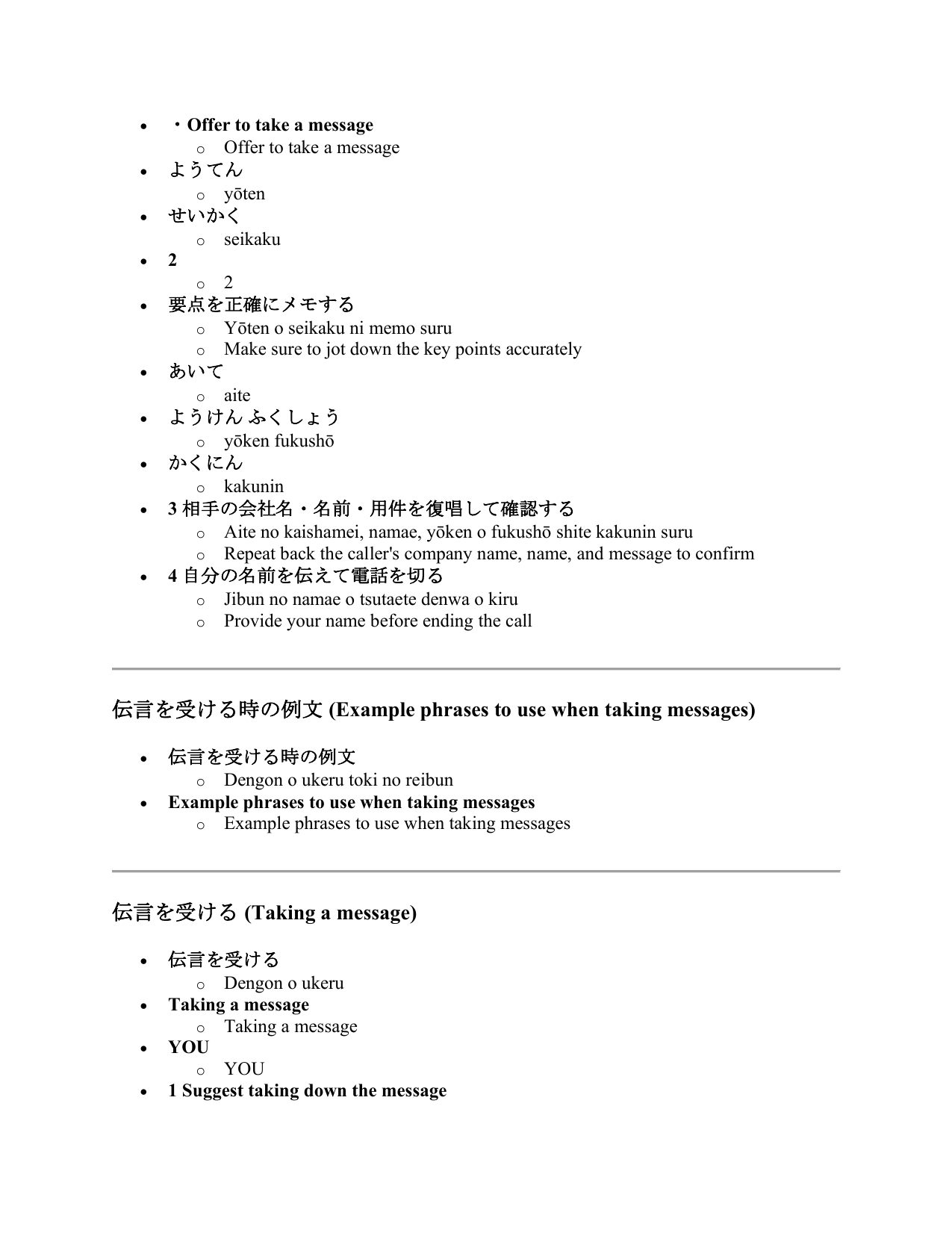
คลิกเพื่อขยาย
EN • ・Offer to take a message
o Offer to take a message
o Offer to take a message
JP•ようてん
EN o yōten
JP•せいかく
EN o seikaku
• 2
o 2
• 2
o 2
JP•要点を正確にメモする
EN o Yōten o seikaku ni memo suru
o Make sure to jot down the key points accurately
o Make sure to jot down the key points accurately
JP•あいて
EN o aite
JP•ようけんふくしょう
EN o yōken fukushō
JP•かくにん
EN o kakunin
JP•3相手の会社名・名前・用件を復唱して確認する
EN o Aite no kaishamei, namae, yōken o fukushō shite kakunin suru
o Repeat back the caller's company name, name, and message to confirm
o Repeat back the caller's company name, name, and message to confirm
JP•4自分の名前を伝えて電話を切る
EN o Jibun no namae o tsutaete denwa o kiru
o Provide your name before ending the call
伝言を受ける時の例文 (Example phrases to use when taking messages)
o Provide your name before ending the call
伝言を受ける時の例文 (Example phrases to use when taking messages)
JP•伝言を受ける時の例文
EN o Dengon o ukeru toki no reibun
• Example phrases to use when taking messages
o Example phrases to use when taking messages
伝言を受ける (Taking a message)
• Example phrases to use when taking messages
o Example phrases to use when taking messages
伝言を受ける (Taking a message)
JP•伝言を受ける
EN o Dengon o ukeru
• Taking a message
o Taking a message
• YOU
o YOU
• 1 Suggest taking down the message
• Taking a message
o Taking a message
• YOU
o YOU
• 1 Suggest taking down the message
หน้า 62
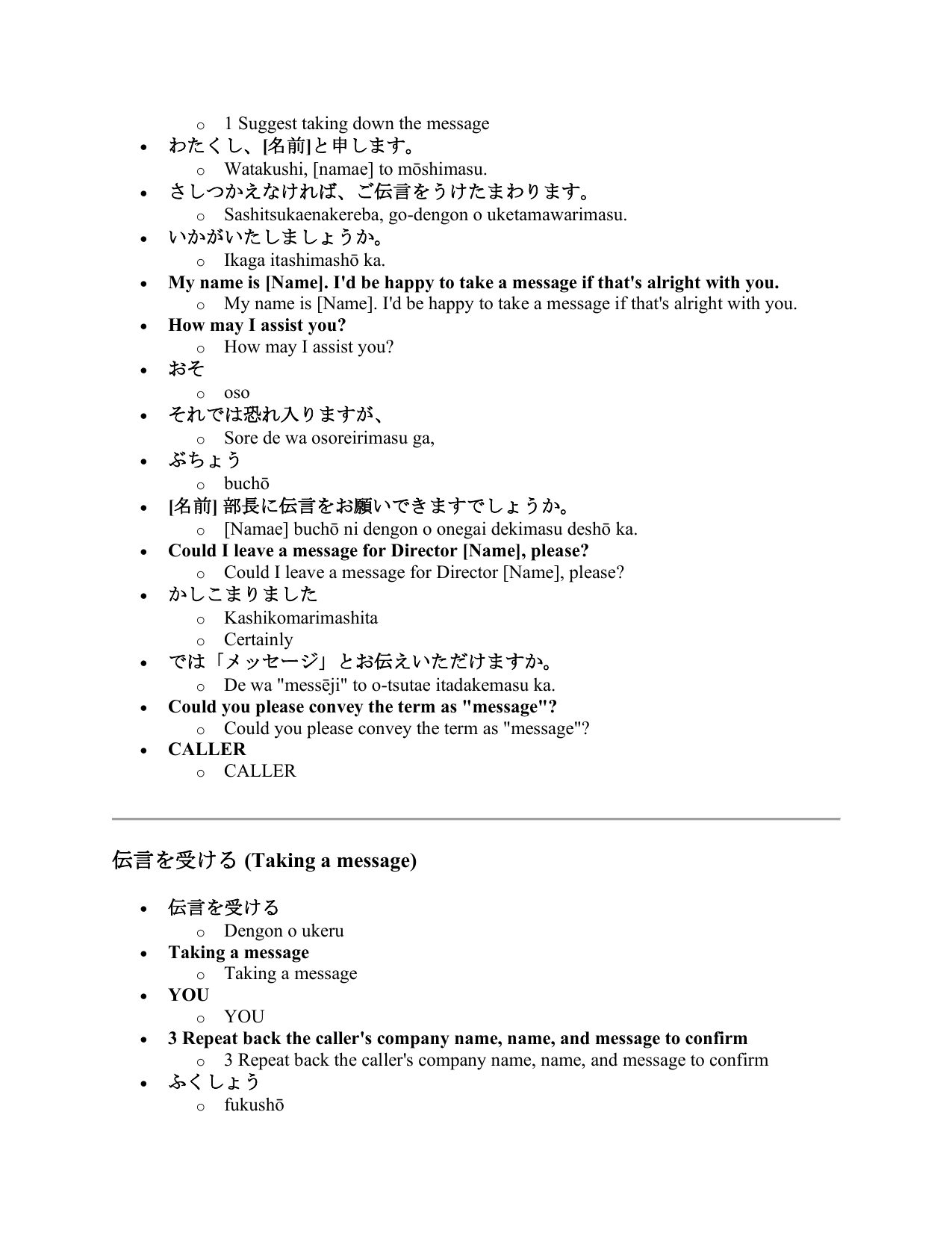
คลิกเพื่อขยาย
EN o 1 Suggest taking down the message
JP•わたくし、[名前]と申します。
EN o Watakushi, [namae] to mōshimasu.
JP•さしつかえなければ、ご伝言をうけたまわります。
EN o Sashitsukaenakereba, go-dengon o uketamawarimasu.
JP•いかがいたしましょうか。
EN o Ikaga itashimashō ka.
• My name is [Name]. I'd be happy to take a message if that's alright with you.
o My name is [Name]. I'd be happy to take a message if that's alright with you.
• How may I assist you?
o How may I assist you?
• My name is [Name]. I'd be happy to take a message if that's alright with you.
o My name is [Name]. I'd be happy to take a message if that's alright with you.
• How may I assist you?
o How may I assist you?
JP•おそ
EN o oso
JP•それでは恐れ入りますが、
EN o Sore de wa osoreirimasu ga,
JP•ぶちょう
EN o buchō
JP•[名前]部長に伝言をお願いできますでしょうか。
EN o [Namae] buchō ni dengon o onegai dekimasu deshō ka.
• Could I leave a message for Director [Name], please?
o Could I leave a message for Director [Name], please?
• Could I leave a message for Director [Name], please?
o Could I leave a message for Director [Name], please?
JP•かしこまりました
EN o Kashikomarimashita
o Certainly
o Certainly
JP•では「メッセージ」とお伝えいただけますか。
EN o De wa "messēji" to o-tsutae itadakemasu ka.
• Could you please convey the term as "message"?
o Could you please convey the term as "message"?
• CALLER
o CALLER
伝言を受ける (Taking a message)
• Could you please convey the term as "message"?
o Could you please convey the term as "message"?
• CALLER
o CALLER
伝言を受ける (Taking a message)
JP•伝言を受ける
EN o Dengon o ukeru
• Taking a message
o Taking a message
• YOU
o YOU
• 3 Repeat back the caller's company name, name, and message to confirm
o 3 Repeat back the caller's company name, name, and message to confirm
• Taking a message
o Taking a message
• YOU
o YOU
• 3 Repeat back the caller's company name, name, and message to confirm
o 3 Repeat back the caller's company name, name, and message to confirm
JP•ふくしょう
EN o fukushō
หน้า 63
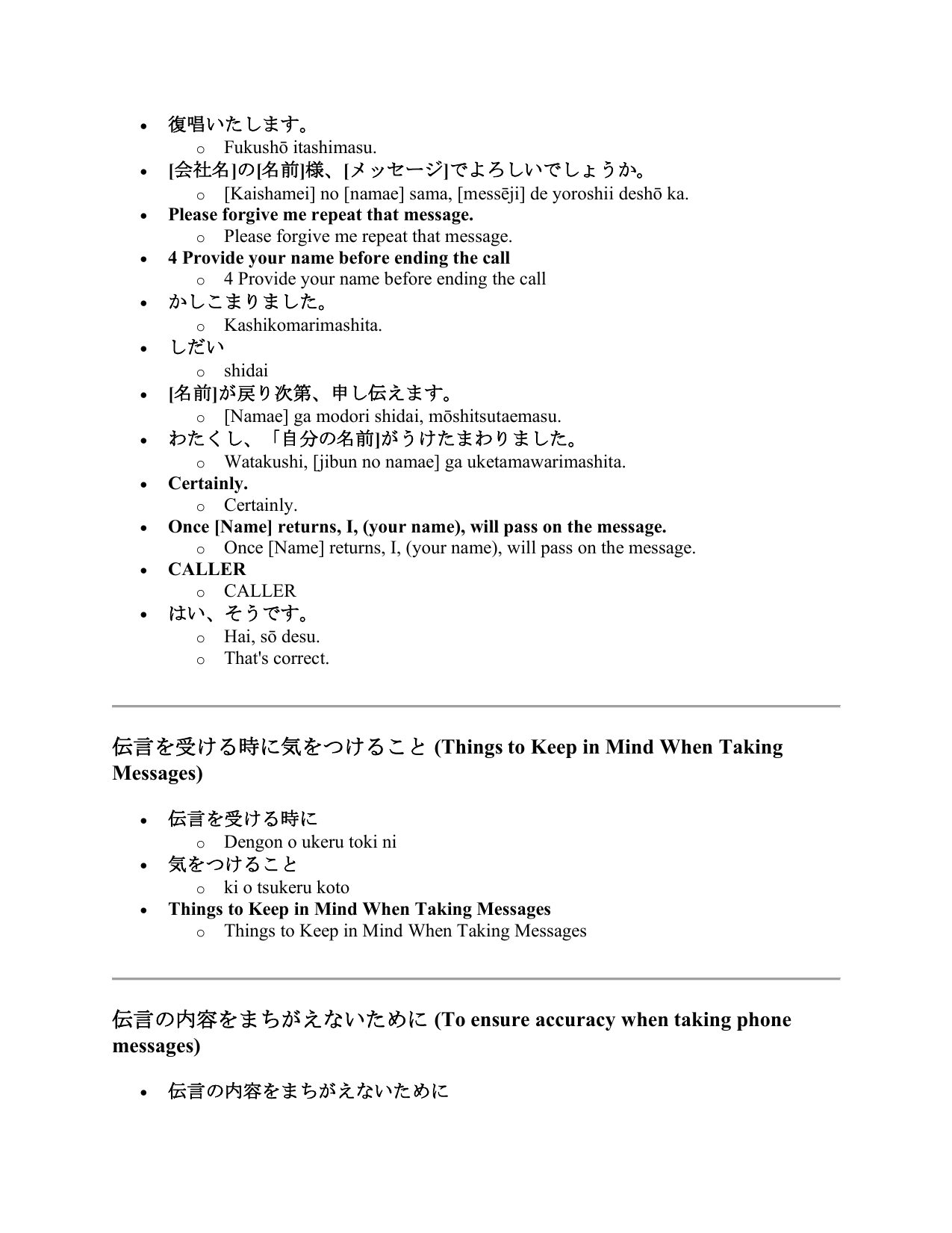
คลิกเพื่อขยาย
JP•復唱いたします。
EN o Fukushō itashimasu.
JP•[会社名]の[名前]様、[メッセージ]でよろしいでしょうか。
EN o [Kaishamei] no [namae] sama, [messēji] de yoroshii deshō ka.
• Please forgive me repeat that message.
o Please forgive me repeat that message.
• 4 Provide your name before ending the call
o 4 Provide your name before ending the call
• Please forgive me repeat that message.
o Please forgive me repeat that message.
• 4 Provide your name before ending the call
o 4 Provide your name before ending the call
JP•かしこまりました。
EN o Kashikomarimashita.
JP•しだい
EN o shidai
JP•[名前]が戻り次第、申し伝えます。
EN o [Namae] ga modori shidai, mōshitsutaemasu.
JP•わたくし、「自分の名前]がうけたまわりました。
EN o Watakushi, [jibun no namae] ga uketamawarimashita.
• Certainly.
o Certainly.
• Once [Name] returns, I, (your name), will pass on the message.
o Once [Name] returns, I, (your name), will pass on the message.
• CALLER
o CALLER
• Certainly.
o Certainly.
• Once [Name] returns, I, (your name), will pass on the message.
o Once [Name] returns, I, (your name), will pass on the message.
• CALLER
o CALLER
JP•はい、そうです。
EN o Hai, sō desu.
o That's correct.
伝言を受ける時に気をつけること (Things to Keep in Mind When Taking
Messages)
o That's correct.
伝言を受ける時に気をつけること (Things to Keep in Mind When Taking
Messages)
JP•伝言を受ける時に
EN o Dengon o ukeru toki ni
JP•気をつけること
EN o ki o tsukeru koto
• Things to Keep in Mind When Taking Messages
o Things to Keep in Mind When Taking Messages
伝言の内容をまちがえないために (To ensure accuracy when taking phone
messages)
• Things to Keep in Mind When Taking Messages
o Things to Keep in Mind When Taking Messages
伝言の内容をまちがえないために (To ensure accuracy when taking phone
messages)
JP•伝言の内容をまちがえないために
หน้า 64
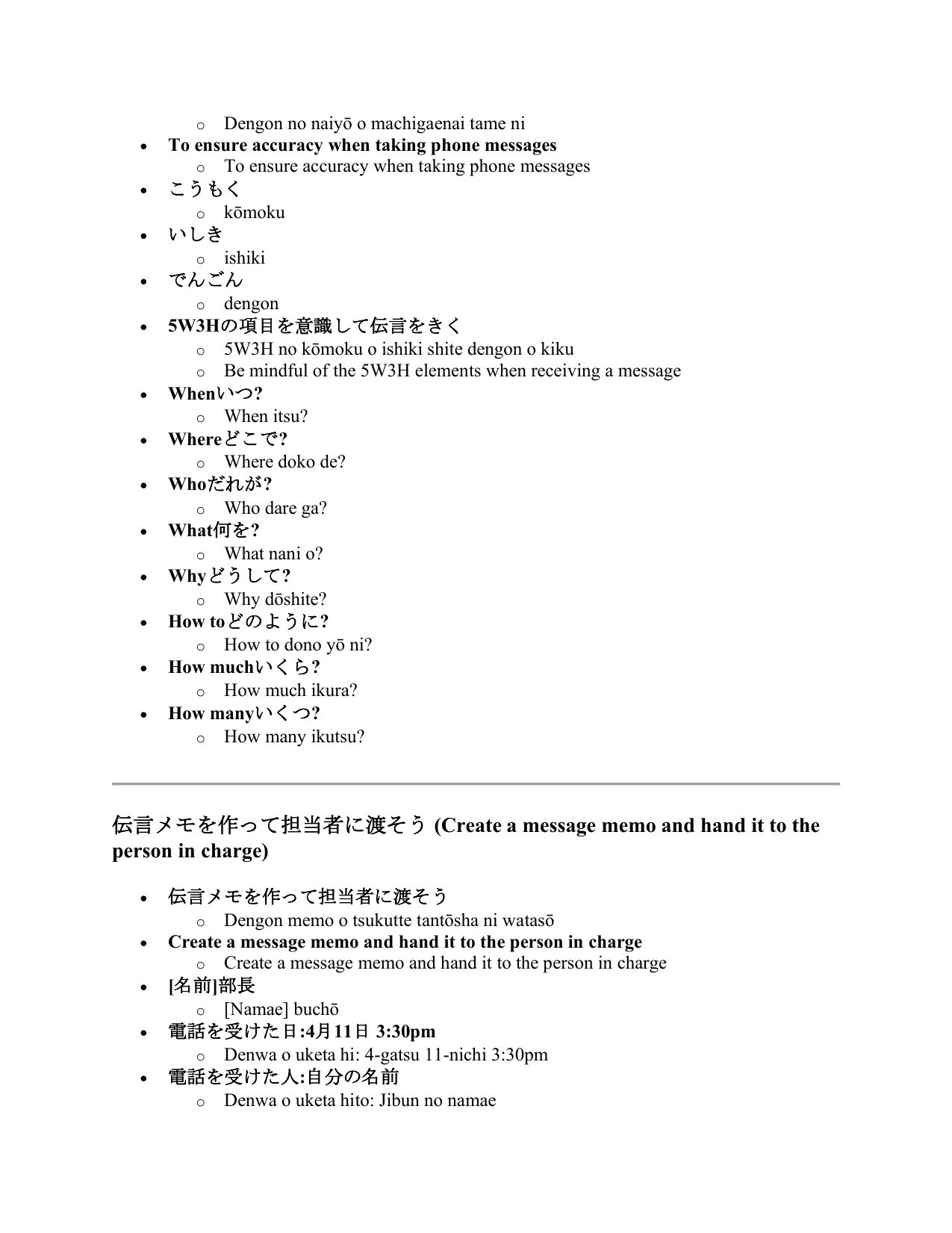
คลิกเพื่อขยาย
EN o Dengon no naiyō o machigaenai tame ni
• To ensure accuracy when taking phone messages
o To ensure accuracy when taking phone messages
• To ensure accuracy when taking phone messages
o To ensure accuracy when taking phone messages
JP•こうもく
EN o kōmoku
JP•いしき
EN o ishiki
JP•でんごん
EN o dengon
JP•5W3Hの項目を意識して伝言をきく
EN o 5W3H no kōmoku o ishiki shite dengon o kiku
o Be mindful of the 5W3H elements when receiving a message
• Whenいつ?
o When itsu?
• Whereどこで?
o Where doko de?
o Be mindful of the 5W3H elements when receiving a message
• Whenいつ?
o When itsu?
• Whereどこで?
o Where doko de?
JP•Whoだれが?
EN o Who dare ga?
• What何を?
o What nani o?
• What何を?
o What nani o?
JP•Whyどうして?
EN o Why dōshite?
JP•Howtoどのように?
EN o How to dono yō ni?
• How muchいくら?
o How much ikura?
• How manyいくつ?
o How many ikutsu?
伝言メモを作って担当者に渡そう (Create a message memo and hand it to the
person in charge)
• How muchいくら?
o How much ikura?
• How manyいくつ?
o How many ikutsu?
伝言メモを作って担当者に渡そう (Create a message memo and hand it to the
person in charge)
JP•伝言メモを作って担当者に渡そう
EN o Dengon memo o tsukutte tantōsha ni watasō
• Create a message memo and hand it to the person in charge
o Create a message memo and hand it to the person in charge
• Create a message memo and hand it to the person in charge
o Create a message memo and hand it to the person in charge
JP•[名前]部長
EN o [Namae] buchō
JP•電話を受けた日:4月11日3:30pm
EN o Denwa o uketa hi: 4-gatsu 11-nichi 3:30pm
JP•電話を受けた人:自分の名前
EN o Denwa o uketa hito: Jibun no namae
หน้า 65
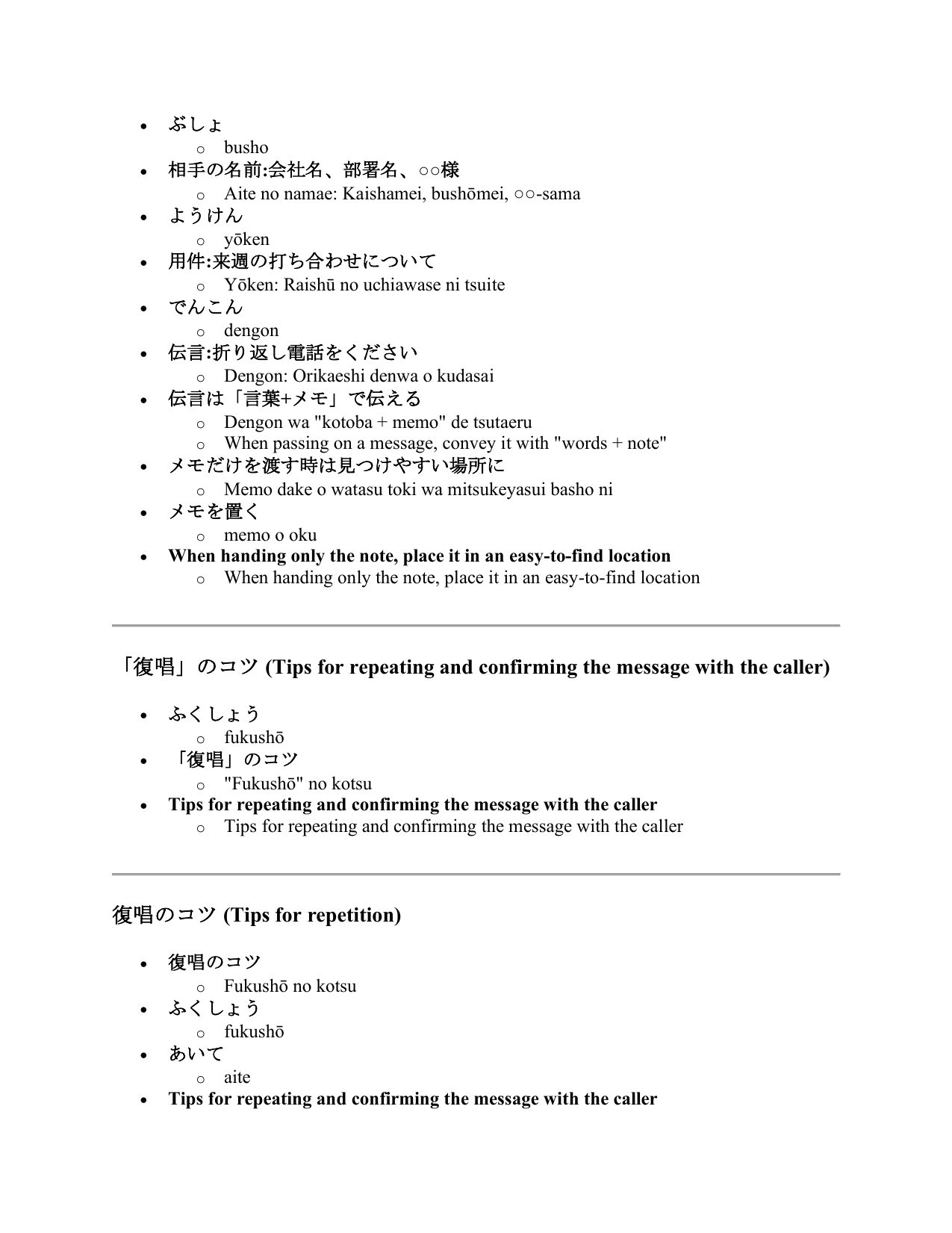
คลิกเพื่อขยาย
JP•ぶしょ
EN o busho
JP•相手の名前:会社名、部署名、○○様
EN o Aite no namae: Kaishamei, bushōmei, ○○-sama
JP•ようけん
EN o yōken
JP•用件:来週の打ち合わせについて
EN o Yōken: Raishū no uchiawase ni tsuite
JP•でんこん
EN o dengon
JP•伝言:折り返し電話をください
EN o Dengon: Orikaeshi denwa o kudasai
JP•伝言は「言葉+メモ」で伝える
EN o Dengon wa "kotoba + memo" de tsutaeru
o When passing on a message, convey it with "words + note"
o When passing on a message, convey it with "words + note"
JP•メモだけを渡す時は見つけやすい場所に
EN o Memo dake o watasu toki wa mitsukeyasui basho ni
JP•メモを置く
EN o memo o oku
• When handing only the note, place it in an easy-to-find location
o When handing only the note, place it in an easy-to-find location
「復唱」のコツ (Tips for repeating and confirming the message with the caller)
• When handing only the note, place it in an easy-to-find location
o When handing only the note, place it in an easy-to-find location
「復唱」のコツ (Tips for repeating and confirming the message with the caller)
JP•ふくしょう
EN o fukushō
JP•「復唱」のコツ
EN o "Fukushō" no kotsu
• Tips for repeating and confirming the message with the caller
o Tips for repeating and confirming the message with the caller
復唱のコツ (Tips for repetition)
• Tips for repeating and confirming the message with the caller
o Tips for repeating and confirming the message with the caller
復唱のコツ (Tips for repetition)
JP•復唱のコツ
EN o Fukushō no kotsu
JP•ふくしょう
EN o fukushō
JP•あいて
EN o aite
• Tips for repeating and confirming the message with the caller
• Tips for repeating and confirming the message with the caller
หน้า 66
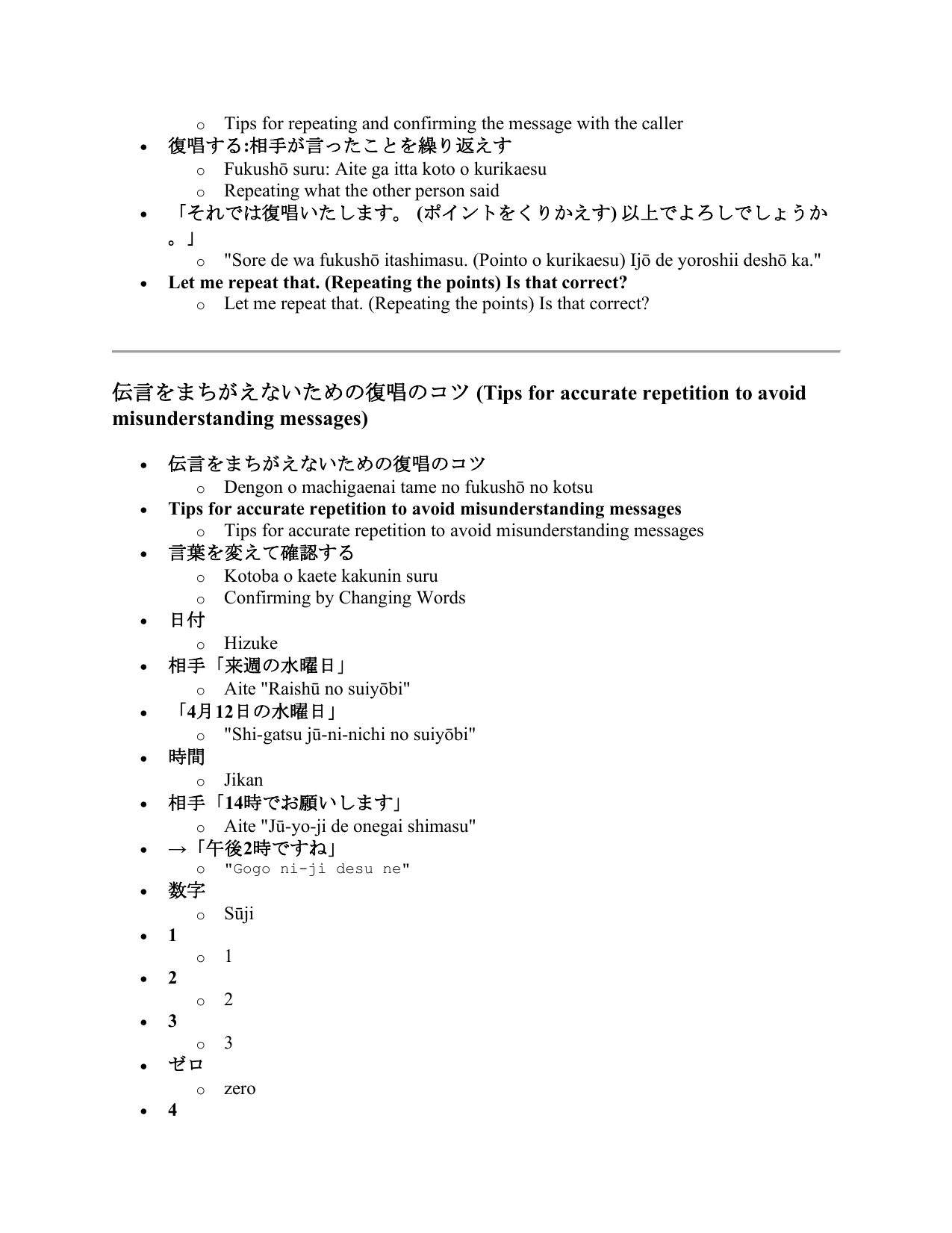
คลิกเพื่อขยาย
EN o Tips for repeating and confirming the message with the caller
JP•復唱する:相手が言ったことを繰り返えす
EN o Fukushō suru: Aite ga itta koto o kurikaesu
o Repeating what the other person said
o Repeating what the other person said
JP•「それでは復唱いたします。(ポイントをくりかえす)以上でよろしでしょうか
。」
。」
EN o "Sore de wa fukushō itashimasu. (Pointo o kurikaesu) Ijō de yoroshii deshō ka."
• Let me repeat that. (Repeating the points) Is that correct?
o Let me repeat that. (Repeating the points) Is that correct?
伝言をまちがえないための復唱のコツ (Tips for accurate repetition to avoid
misunderstanding messages)
• Let me repeat that. (Repeating the points) Is that correct?
o Let me repeat that. (Repeating the points) Is that correct?
伝言をまちがえないための復唱のコツ (Tips for accurate repetition to avoid
misunderstanding messages)
JP•伝言をまちがえないための復唱のコツ
EN o Dengon o machigaenai tame no fukushō no kotsu
• Tips for accurate repetition to avoid misunderstanding messages
o Tips for accurate repetition to avoid misunderstanding messages
• Tips for accurate repetition to avoid misunderstanding messages
o Tips for accurate repetition to avoid misunderstanding messages
JP•言葉を変えて確認する
EN o Kotoba o kaete kakunin suru
o Confirming by Changing Words
o Confirming by Changing Words
JP•日付
EN o Hizuke
JP•相手「来週の水曜日」
EN o Aite "Raishū no suiyōbi"
JP•「4月12日の水曜日」
EN o "Shi-gatsu jū-ni-nichi no suiyōbi"
JP•時間
EN o Jikan
JP•相手「14時でお願いします」
EN o Aite "Jū-yo-ji de onegai shimasu"
JP•→「午後2時ですね」
EN o "Gogo ni-ji desu ne"
JP•数字
EN o Sūji
• 1
o 1
• 2
o 2
• 3
o 3
• 1
o 1
• 2
o 2
• 3
o 3
JP•ゼロ
EN o zero
• 4
• 4
หน้า 67
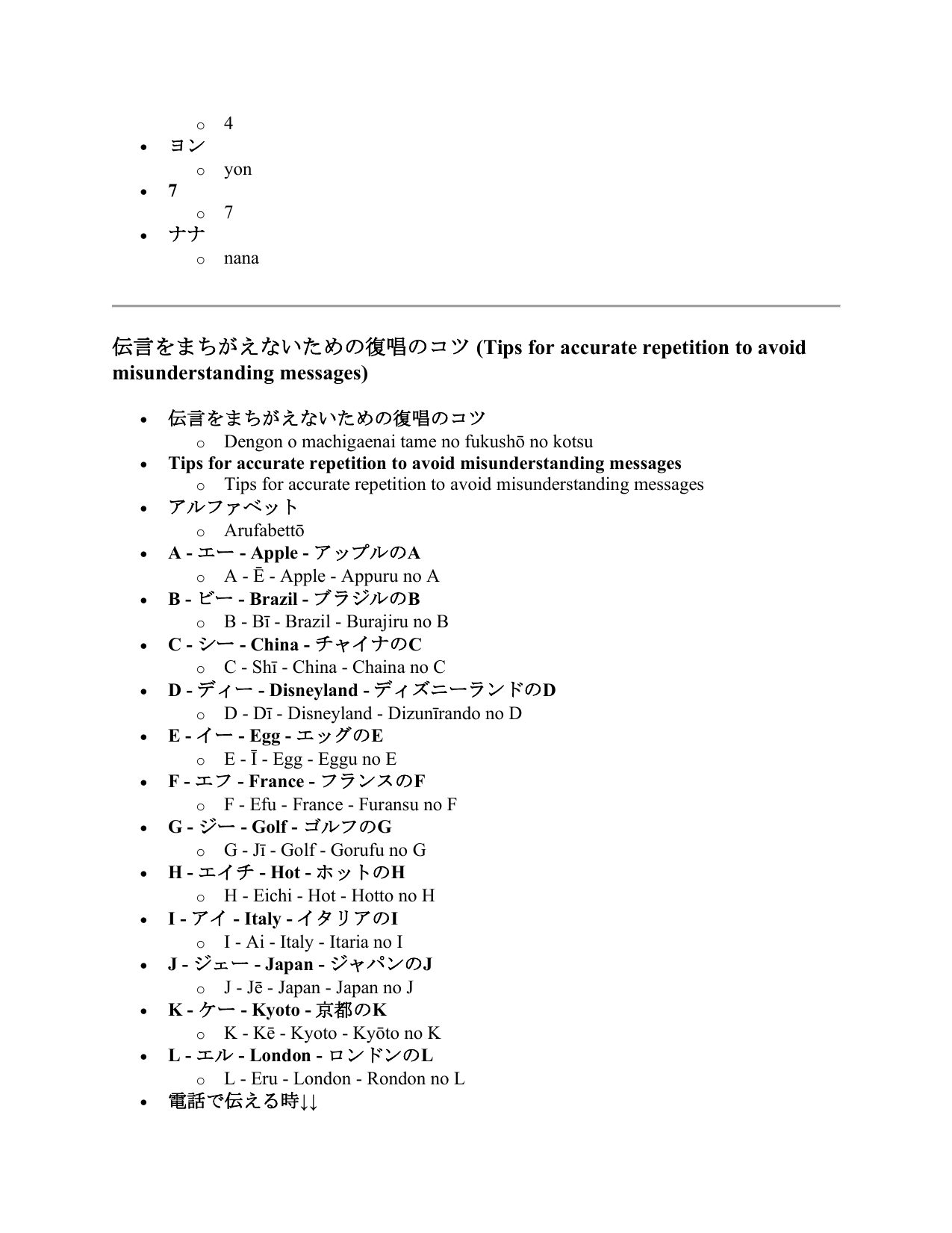
คลิกเพื่อขยาย
EN o 4
JP•ヨン
EN o yon
• 7
o 7
• 7
o 7
JP•ナナ
EN o nana
伝言をまちがえないための復唱のコツ (Tips for accurate repetition to avoid
misunderstanding messages)
伝言をまちがえないための復唱のコツ (Tips for accurate repetition to avoid
misunderstanding messages)
JP•伝言をまちがえないための復唱のコツ
EN o Dengon o machigaenai tame no fukushō no kotsu
• Tips for accurate repetition to avoid misunderstanding messages
o Tips for accurate repetition to avoid misunderstanding messages
• Tips for accurate repetition to avoid misunderstanding messages
o Tips for accurate repetition to avoid misunderstanding messages
JP•アルファベット
EN o Arufabettō
JP•A-エー-Apple-アップルのA
EN o A - Ē - Apple - Appuru no A
• B - ビー - Brazil - ブラジルのB
o B - Bī - Brazil - Burajiru no B
• B - ビー - Brazil - ブラジルのB
o B - Bī - Brazil - Burajiru no B
JP•C-シー-China-チャイナのC
EN o C - Shī - China - Chaina no C
JP•D-ディー-Disneyland-ディズニーランドのD
EN o D - Dī - Disneyland - Dizunīrando no D
JP•E-イー-Egg-エッグのE
EN o E - Ī - Egg - Eggu no E
• F - エフ - France - フランスのF
o F - Efu - France - Furansu no F
• F - エフ - France - フランスのF
o F - Efu - France - Furansu no F
JP•G-ジー-Golf-ゴルフのG
EN o G - Jī - Golf - Gorufu no G
JP•H-エイチ-Hot-ホットのH
EN o H - Eichi - Hot - Hotto no H
JP•I-アイ-Italy-イタリアのI
EN o I - Ai - Italy - Itaria no I
JP•J-ジェー-Japan-ジャパンのJ
EN o J - Jē - Japan - Japan no J
• K - ケー - Kyoto - 京都のK
o K - Kē - Kyoto - Kyōto no K
• L - エル - London - ロンドンのL
o L - Eru - London - Rondon no L
• K - ケー - Kyoto - 京都のK
o K - Kē - Kyoto - Kyōto no K
• L - エル - London - ロンドンのL
o L - Eru - London - Rondon no L
JP•電話で伝える時↓↓
หน้า 68
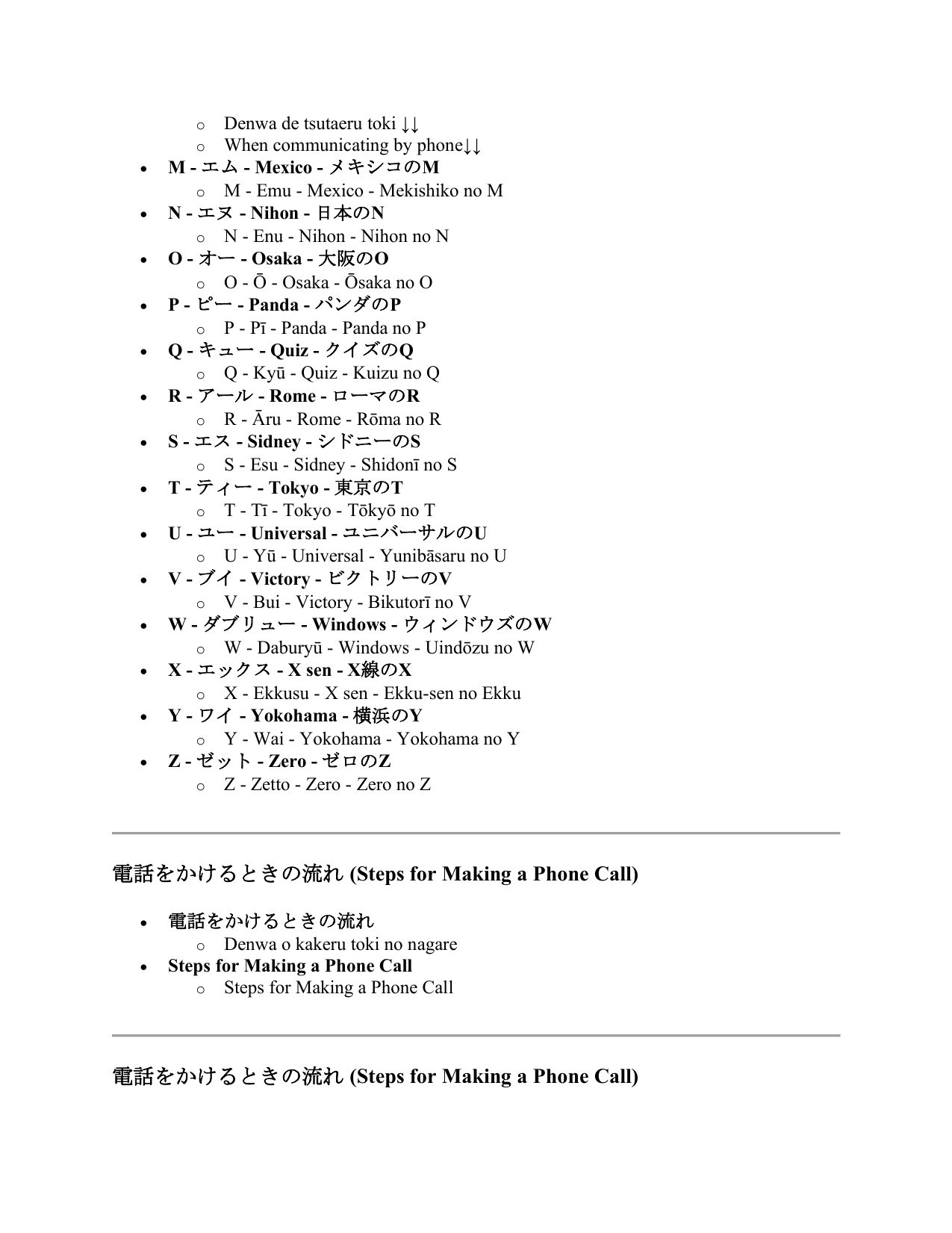
คลิกเพื่อขยาย
EN o Denwa de tsutaeru toki ↓↓
o When communicating by phone↓↓
• M - エム - Mexico - メキシコのM
o M - Emu - Mexico - Mekishiko no M
• N - エヌ - Nihon - 日本のN
o N - Enu - Nihon - Nihon no N
• O - オー - Osaka - 大阪のO
o O - Ō - Osaka - Ōsaka no O
• P - ピー - Panda - パンダのP
o P - Pī - Panda - Panda no P
o When communicating by phone↓↓
• M - エム - Mexico - メキシコのM
o M - Emu - Mexico - Mekishiko no M
• N - エヌ - Nihon - 日本のN
o N - Enu - Nihon - Nihon no N
• O - オー - Osaka - 大阪のO
o O - Ō - Osaka - Ōsaka no O
• P - ピー - Panda - パンダのP
o P - Pī - Panda - Panda no P
JP•Q-キュー-Quiz-クイズのQ
EN o Q - Kyū - Quiz - Kuizu no Q
JP•R-アール-Rome-ローマのR
EN o R - Āru - Rome - Rōma no R
• S - エス - Sidney - シドニーのS
o S - Esu - Sidney - Shidonī no S
• T - ティー - Tokyo - 東京のT
o T - Tī - Tokyo - Tōkyō no T
• U - ユー - Universal - ユニバーサルのU
o U - Yū - Universal - Yunibāsaru no U
• V - ブイ - Victory - ビクトリーのV
o V - Bui - Victory - Bikutorī no V
• S - エス - Sidney - シドニーのS
o S - Esu - Sidney - Shidonī no S
• T - ティー - Tokyo - 東京のT
o T - Tī - Tokyo - Tōkyō no T
• U - ユー - Universal - ユニバーサルのU
o U - Yū - Universal - Yunibāsaru no U
• V - ブイ - Victory - ビクトリーのV
o V - Bui - Victory - Bikutorī no V
JP•W-ダブリュー-Windows-ウィンドウズのW
EN o W - Daburyū - Windows - Uindōzu no W
• X - エックス - X sen - X線のX
o X - Ekkusu - X sen - Ekku-sen no Ekku
• Y - ワイ - Yokohama - 横浜のY
o Y - Wai - Yokohama - Yokohama no Y
• X - エックス - X sen - X線のX
o X - Ekkusu - X sen - Ekku-sen no Ekku
• Y - ワイ - Yokohama - 横浜のY
o Y - Wai - Yokohama - Yokohama no Y
JP•Z-ゼット-Zero-ゼロのZ
EN o Z - Zetto - Zero - Zero no Z
電話をかけるときの流れ (Steps for Making a Phone Call)
電話をかけるときの流れ (Steps for Making a Phone Call)
JP•電話をかけるときの流れ
EN o Denwa o kakeru toki no nagare
• Steps for Making a Phone Call
o Steps for Making a Phone Call
電話をかけるときの流れ (Steps for Making a Phone Call)
• Steps for Making a Phone Call
o Steps for Making a Phone Call
電話をかけるときの流れ (Steps for Making a Phone Call)
หน้า 69
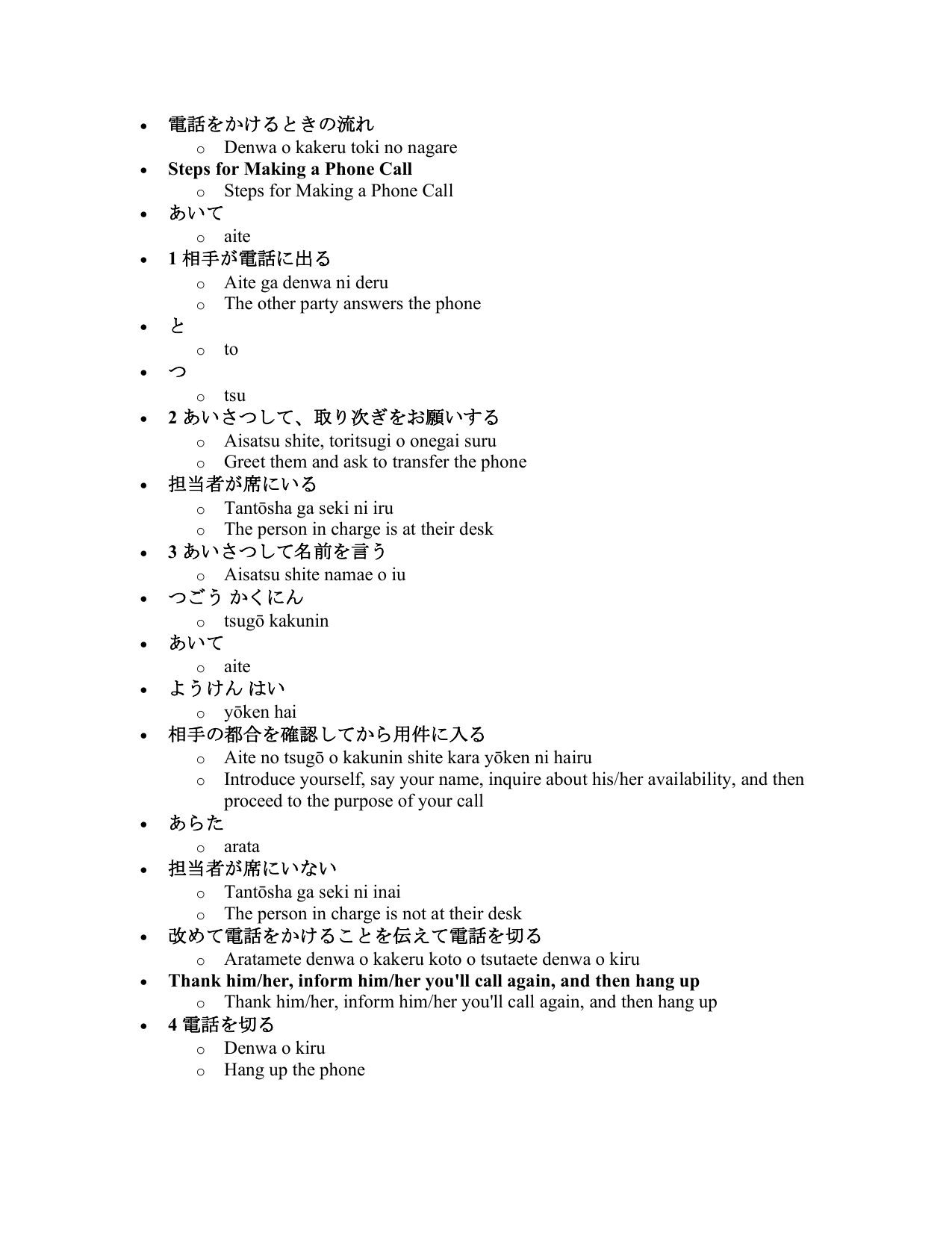
คลิกเพื่อขยาย
JP•電話をかけるときの流れ
EN o Denwa o kakeru toki no nagare
• Steps for Making a Phone Call
o Steps for Making a Phone Call
• Steps for Making a Phone Call
o Steps for Making a Phone Call
JP•あいて
EN o aite
JP•1相手が電話に出る
EN o Aite ga denwa ni deru
o The other party answers the phone
o The other party answers the phone
JP•と
EN o to
JP•つ
EN o tsu
JP•2あいさつして、取り次ぎをお願いする
EN o Aisatsu shite, toritsugi o onegai suru
o Greet them and ask to transfer the phone
o Greet them and ask to transfer the phone
JP•担当者が席にいる
EN o Tantōsha ga seki ni iru
o The person in charge is at their desk
o The person in charge is at their desk
JP•3あいさつして名前を言う
EN o Aisatsu shite namae o iu
JP•つごうかくにん
EN o tsugō kakunin
JP•あいて
EN o aite
JP•ようけんはい
EN o yōken hai
JP•相手の都合を確認してから用件に入る
EN o Aite no tsugō o kakunin shite kara yōken ni hairu
o Introduce yourself, say your name, inquire about his/her availability, and then
proceed to the purpose of your call
o Introduce yourself, say your name, inquire about his/her availability, and then
proceed to the purpose of your call
JP•あらた
EN o arata
JP•担当者が席にいない
EN o Tantōsha ga seki ni inai
o The person in charge is not at their desk
o The person in charge is not at their desk
JP•改めて電話をかけることを伝えて電話を切る
EN o Aratamete denwa o kakeru koto o tsutaete denwa o kiru
• Thank him/her, inform him/her you'll call again, and then hang up
o Thank him/her, inform him/her you'll call again, and then hang up
• Thank him/her, inform him/her you'll call again, and then hang up
o Thank him/her, inform him/her you'll call again, and then hang up
JP•4電話を切る
EN o Denwa o kiru
o Hang up the phone
o Hang up the phone
หน้า 70
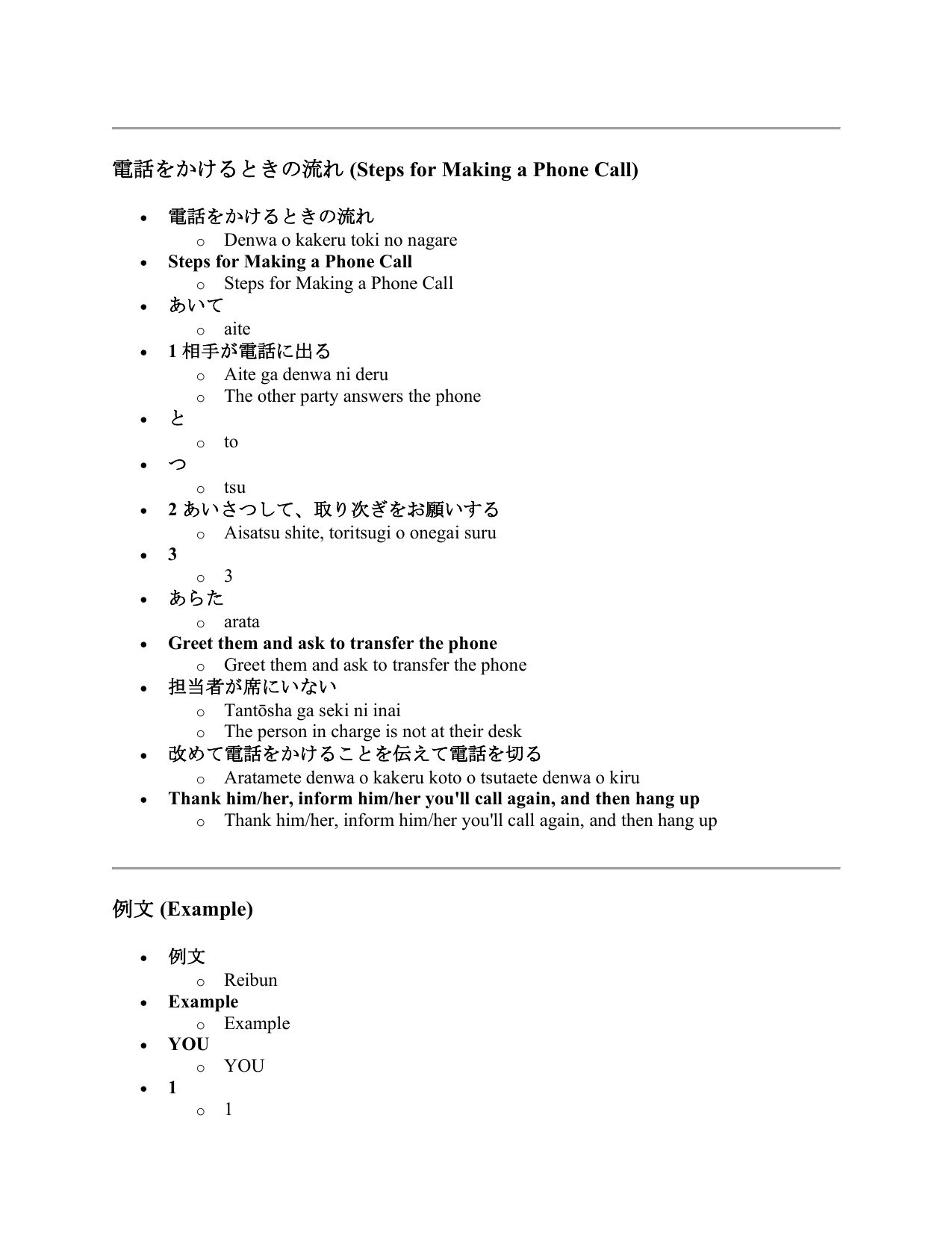
คลิกเพื่อขยาย
EN電話をかけるときの流れ (Steps for Making a Phone Call)
JP•電話をかけるときの流れ
EN o Denwa o kakeru toki no nagare
• Steps for Making a Phone Call
o Steps for Making a Phone Call
• Steps for Making a Phone Call
o Steps for Making a Phone Call
JP•あいて
EN o aite
JP•1相手が電話に出る
EN o Aite ga denwa ni deru
o The other party answers the phone
o The other party answers the phone
JP•と
EN o to
JP•つ
EN o tsu
JP•2あいさつして、取り次ぎをお願いする
EN o Aisatsu shite, toritsugi o onegai suru
• 3
o 3
• 3
o 3
JP•あらた
EN o arata
• Greet them and ask to transfer the phone
o Greet them and ask to transfer the phone
• Greet them and ask to transfer the phone
o Greet them and ask to transfer the phone
JP•担当者が席にいない
EN o Tantōsha ga seki ni inai
o The person in charge is not at their desk
o The person in charge is not at their desk
JP•改めて電話をかけることを伝えて電話を切る
EN o Aratamete denwa o kakeru koto o tsutaete denwa o kiru
• Thank him/her, inform him/her you'll call again, and then hang up
o Thank him/her, inform him/her you'll call again, and then hang up
例文 (Example)
• Thank him/her, inform him/her you'll call again, and then hang up
o Thank him/her, inform him/her you'll call again, and then hang up
例文 (Example)
JP•例文
EN o Reibun
• Example
o Example
• YOU
o YOU
• 1
o 1
• Example
o Example
• YOU
o YOU
• 1
o 1
หน้า 71
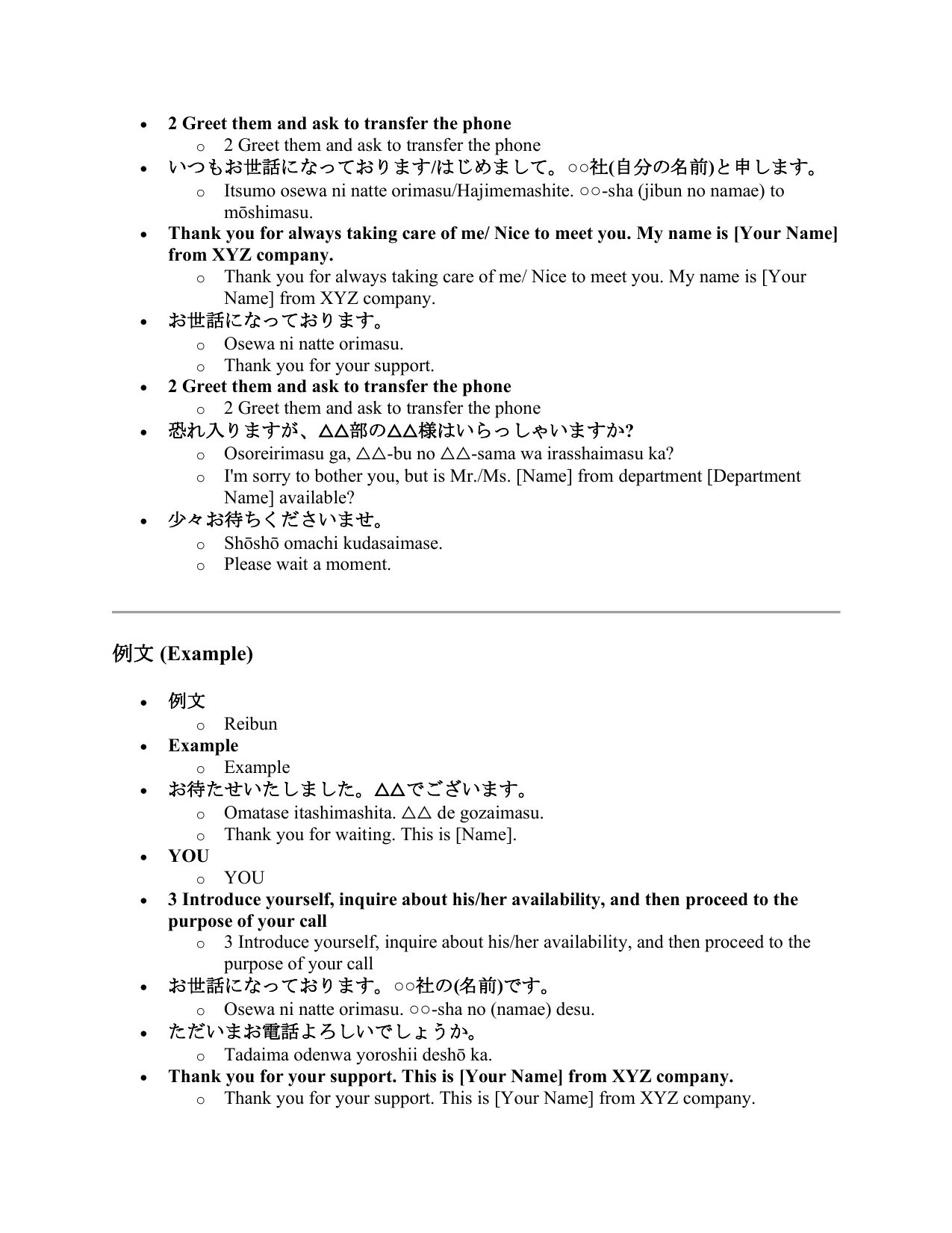
คลิกเพื่อขยาย
EN • 2 Greet them and ask to transfer the phone
o 2 Greet them and ask to transfer the phone
o 2 Greet them and ask to transfer the phone
JP•いつもお世話になっております/はじめまして。○○社(自分の名前)と申します。
EN o Itsumo osewa ni natte orimasu/Hajimemashite. ○○-sha (jibun no namae) to
mōshimasu.
• Thank you for always taking care of me/ Nice to meet you. My name is [Your Name]
from XYZ company.
o Thank you for always taking care of me/ Nice to meet you. My name is [Your
Name] from XYZ company.
mōshimasu.
• Thank you for always taking care of me/ Nice to meet you. My name is [Your Name]
from XYZ company.
o Thank you for always taking care of me/ Nice to meet you. My name is [Your
Name] from XYZ company.
JP•お世話になっております。
EN o Osewa ni natte orimasu.
o Thank you for your support.
• 2 Greet them and ask to transfer the phone
o 2 Greet them and ask to transfer the phone
o Thank you for your support.
• 2 Greet them and ask to transfer the phone
o 2 Greet them and ask to transfer the phone
JP•恐れ入りますが、△△部の△△様はいらっしゃいますか?
EN o Osoreirimasu ga, △△-bu no △△-sama wa irasshaimasu ka?
o I'm sorry to bother you, but is Mr./Ms. [Name] from department [Department
Name] available?
o I'm sorry to bother you, but is Mr./Ms. [Name] from department [Department
Name] available?
JP•少々お待ちくださいませ。
EN o Shōshō omachi kudasaimase.
o Please wait a moment.
例文 (Example)
o Please wait a moment.
例文 (Example)
JP•例文
EN o Reibun
• Example
o Example
• Example
o Example
JP•お待たせいたしました。△△でございます。
EN o Omatase itashimashita. △△ de gozaimasu.
o Thank you for waiting. This is [Name].
• YOU
o YOU
• 3 Introduce yourself, inquire about his/her availability, and then proceed to the
purpose of your call
o 3 Introduce yourself, inquire about his/her availability, and then proceed to the
purpose of your call
o Thank you for waiting. This is [Name].
• YOU
o YOU
• 3 Introduce yourself, inquire about his/her availability, and then proceed to the
purpose of your call
o 3 Introduce yourself, inquire about his/her availability, and then proceed to the
purpose of your call
JP•お世話になっております。○○社の(名前)です。
EN o Osewa ni natte orimasu. ○○-sha no (namae) desu.
JP•ただいまお電話よろしいでしょうか。
EN o Tadaima odenwa yoroshii deshō ka.
• Thank you for your support. This is [Your Name] from XYZ company.
o Thank you for your support. This is [Your Name] from XYZ company.
• Thank you for your support. This is [Your Name] from XYZ company.
o Thank you for your support. This is [Your Name] from XYZ company.
หน้า 72
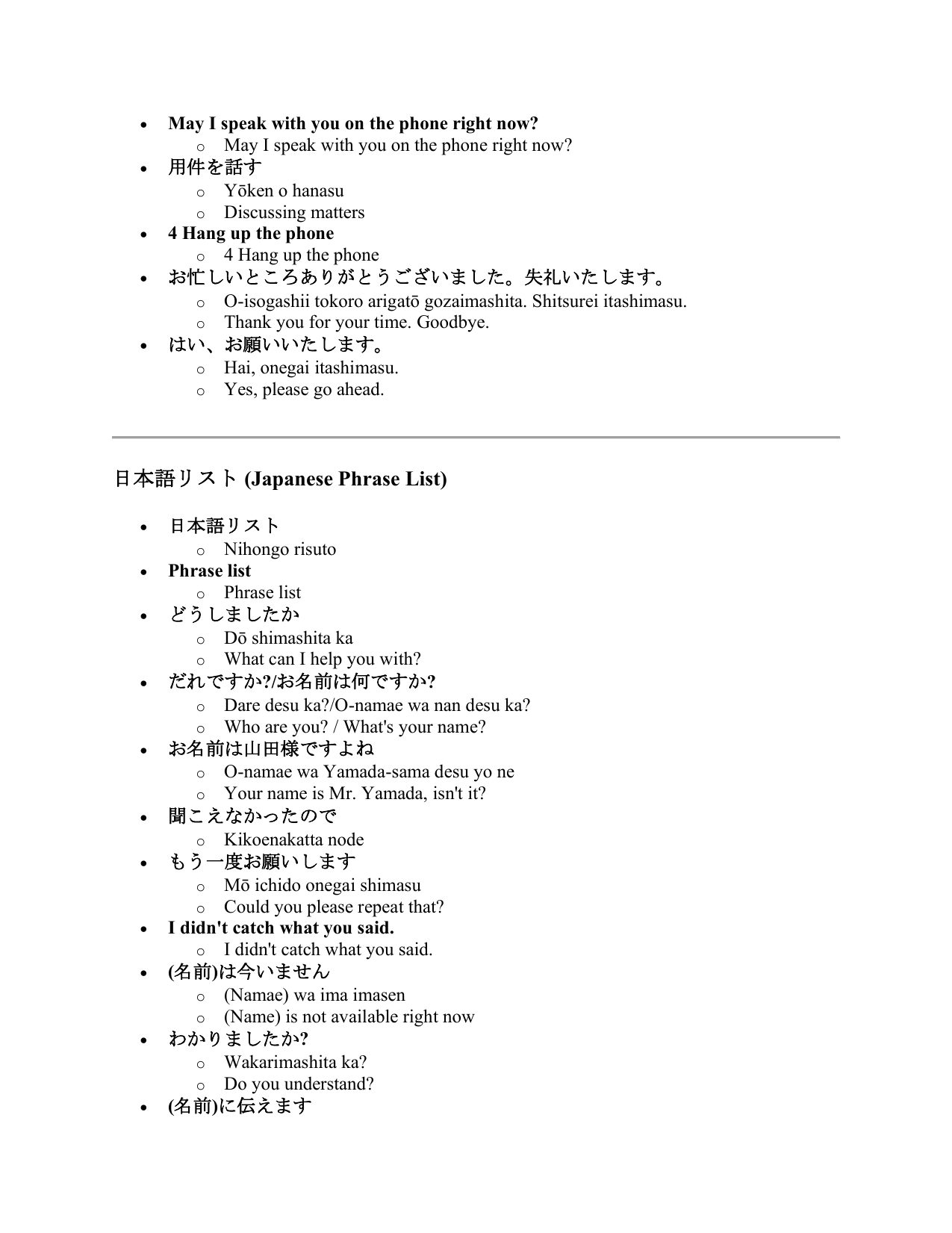
คลิกเพื่อขยาย
EN • May I speak with you on the phone right now?
o May I speak with you on the phone right now?
o May I speak with you on the phone right now?
JP•用件を話す
EN o Yōken o hanasu
o Discussing matters
• 4 Hang up the phone
o 4 Hang up the phone
o Discussing matters
• 4 Hang up the phone
o 4 Hang up the phone
JP•お忙しいところありがとうございました。失礼いたします。
EN o O-isogashii tokoro arigatō gozaimashita. Shitsurei itashimasu.
o Thank you for your time. Goodbye.
o Thank you for your time. Goodbye.
JP•はい、お願いいたします。
EN o Hai, onegai itashimasu.
o Yes, please go ahead.
日本語リスト (Japanese Phrase List)
o Yes, please go ahead.
日本語リスト (Japanese Phrase List)
JP•日本語リスト
EN o Nihongo risuto
• Phrase list
o Phrase list
• Phrase list
o Phrase list
JP•どうしましたか
EN o Dō shimashita ka
o What can I help you with?
o What can I help you with?
JP•だれですか?/お名前は何ですか?
EN o Dare desu ka?/O-namae wa nan desu ka?
o Who are you? / What's your name?
o Who are you? / What's your name?
JP•お名前は山田様ですよね
EN o O-namae wa Yamada-sama desu yo ne
o Your name is Mr. Yamada, isn't it?
o Your name is Mr. Yamada, isn't it?
JP•聞こえなかったので
EN o Kikoenakatta node
JP•もう一度お願いします
EN o Mō ichido onegai shimasu
o Could you please repeat that?
• I didn't catch what you said.
o I didn't catch what you said.
o Could you please repeat that?
• I didn't catch what you said.
o I didn't catch what you said.
JP•(名前)は今いません
EN o (Namae) wa ima imasen
o (Name) is not available right now
o (Name) is not available right now
JP•わかりましたか?
EN o Wakarimashita ka?
o Do you understand?
o Do you understand?
JP•(名前)に伝えます
หน้า 73
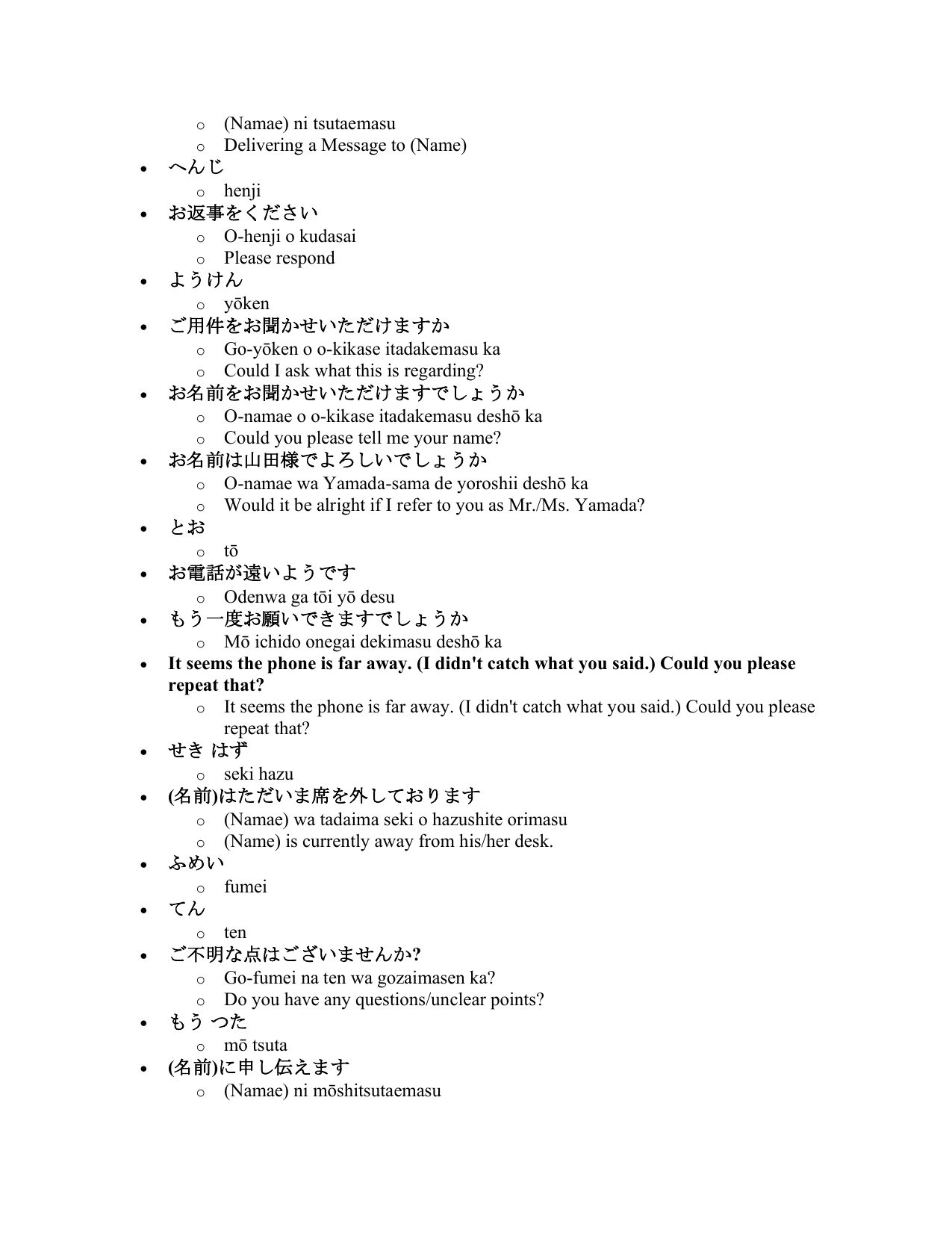
คลิกเพื่อขยาย
EN o (Namae) ni tsutaemasu
o Delivering a Message to (Name)
o Delivering a Message to (Name)
JP•へんじ
EN o henji
JP•お返事をください
EN o O-henji o kudasai
o Please respond
o Please respond
JP•ようけん
EN o yōken
JP•ご用件をお聞かせいただけますか
EN o Go-yōken o o-kikase itadakemasu ka
o Could I ask what this is regarding?
o Could I ask what this is regarding?
JP•お名前をお聞かせいただけますでしょうか
EN o O-namae o o-kikase itadakemasu deshō ka
o Could you please tell me your name?
o Could you please tell me your name?
JP•お名前は山田様でよろしいでしょうか
EN o O-namae wa Yamada-sama de yoroshii deshō ka
o Would it be alright if I refer to you as Mr./Ms. Yamada?
o Would it be alright if I refer to you as Mr./Ms. Yamada?
JP•とお
EN o tō
JP•お電話が遠いようです
EN o Odenwa ga tōi yō desu
JP•もう一度お願いできますでしょうか
EN o Mō ichido onegai dekimasu deshō ka
• It seems the phone is far away. (I didn't catch what you said.) Could you please
repeat that?
o It seems the phone is far away. (I didn't catch what you said.) Could you please
repeat that?
• It seems the phone is far away. (I didn't catch what you said.) Could you please
repeat that?
o It seems the phone is far away. (I didn't catch what you said.) Could you please
repeat that?
JP•せきはず
EN o seki hazu
JP•(名前)はただいま席を外しております
EN o (Namae) wa tadaima seki o hazushite orimasu
o (Name) is currently away from his/her desk.
o (Name) is currently away from his/her desk.
JP•ふめい
EN o fumei
JP•てん
EN o ten
JP•ご不明な点はございませんか?
EN o Go-fumei na ten wa gozaimasen ka?
o Do you have any questions/unclear points?
o Do you have any questions/unclear points?
JP•もうつた
EN o mō tsuta
JP•(名前)に申し伝えます
EN o (Namae) ni mōshitsutaemasu
หน้า 74
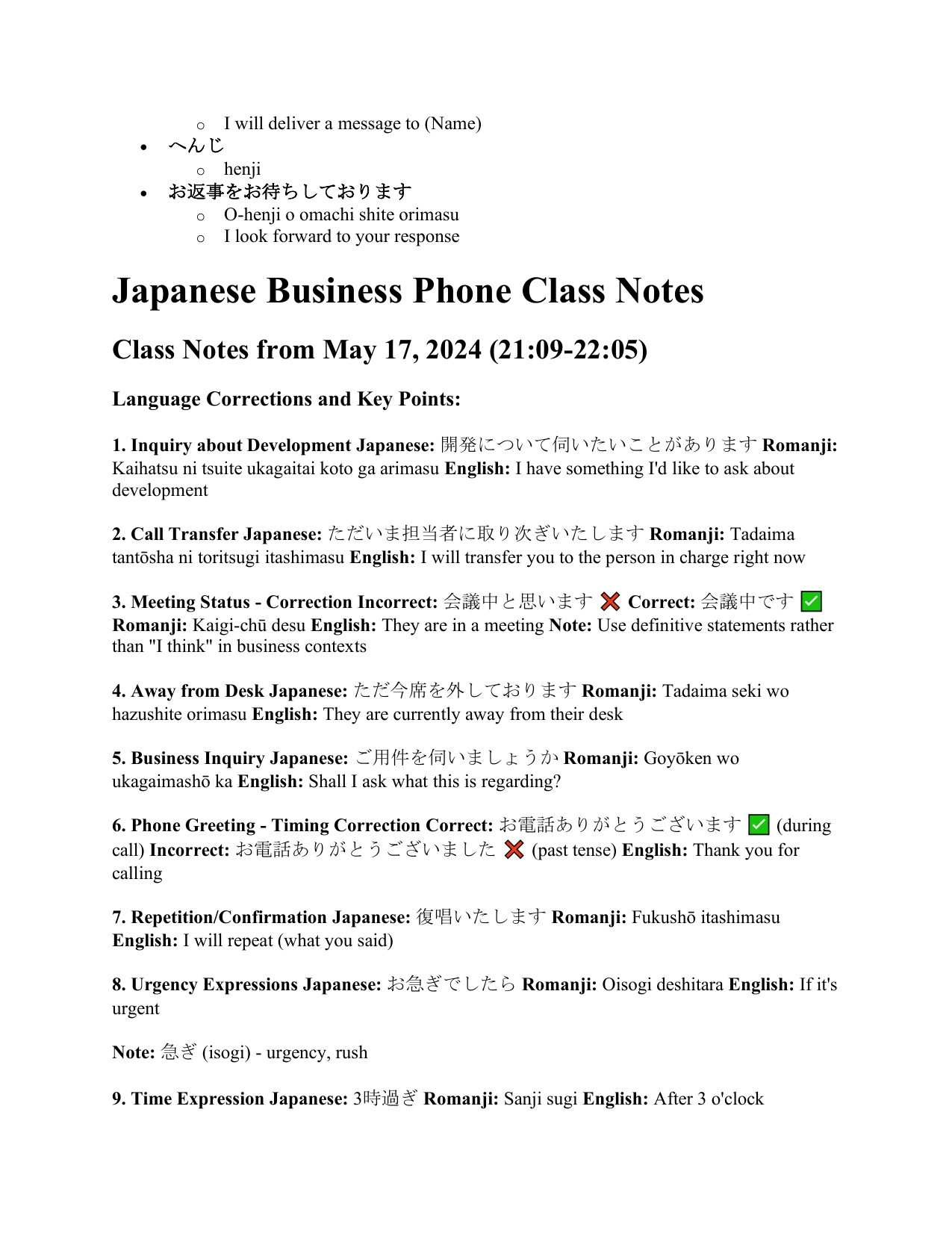
คลิกเพื่อขยาย
EN I will deliver a message to (Name)
o
o
JP•へんじ
EN o henji
JP•お返事をお待ちしております
EN o O-henji o omachi shite orimasu
o I look forward to your response
Japanese Business Phone Class Notes
Class Notes from May 17, 2024 (21:09-22:05)
Language Corrections and Key Points:
1. Inquiry about Development Japanese: 開発について伺いたいことがあります Romanji:
Kaihatsu ni tsuite ukagaitai koto ga arimasu English: I have something I'd like to ask about
development
2. Call Transfer Japanese: ただいま担当者に取り次ぎいたします Romanji: Tadaima
tantōsha ni toritsugi itashimasu English: I will transfer you to the person in charge right now
3. Meeting Status - Correction Incorrect: 会議中と思います Correct: 会議中です
Romanji: Kaigi-chū desu English: They are in a meeting Note: Use definitive statements rather
than "I think" in business contexts
4. Away from Desk Japanese: ただ今席を外しております Romanji: Tadaima seki wo
hazushite orimasu English: They are currently away from their desk
5. Business Inquiry Japanese: ご用件を伺いましょうか Romanji: Goyōken wo
ukagaimashō ka English: Shall I ask what this is regarding?
6. Phone Greeting - Timing Correction Correct: お電話ありがとうございます (during
call) Incorrect: お電話ありがとうございました (past tense) English: Thank you for
calling
7. Repetition/Confirmation Japanese: 復唱いたします Romanji: Fukushō itashimasu
English: I will repeat (what you said)
8. Urgency Expressions Japanese: お急ぎでしたら Romanji: Oisogi deshitara English: If it's
urgent
Note: 急ぎ (isogi) - urgency, rush
9. Time Expression Japanese: 3時過ぎ Romanji: Sanji sugi English: After 3 o'clock
o I look forward to your response
Japanese Business Phone Class Notes
Class Notes from May 17, 2024 (21:09-22:05)
Language Corrections and Key Points:
1. Inquiry about Development Japanese: 開発について伺いたいことがあります Romanji:
Kaihatsu ni tsuite ukagaitai koto ga arimasu English: I have something I'd like to ask about
development
2. Call Transfer Japanese: ただいま担当者に取り次ぎいたします Romanji: Tadaima
tantōsha ni toritsugi itashimasu English: I will transfer you to the person in charge right now
3. Meeting Status - Correction Incorrect: 会議中と思います Correct: 会議中です
Romanji: Kaigi-chū desu English: They are in a meeting Note: Use definitive statements rather
than "I think" in business contexts
4. Away from Desk Japanese: ただ今席を外しております Romanji: Tadaima seki wo
hazushite orimasu English: They are currently away from their desk
5. Business Inquiry Japanese: ご用件を伺いましょうか Romanji: Goyōken wo
ukagaimashō ka English: Shall I ask what this is regarding?
6. Phone Greeting - Timing Correction Correct: お電話ありがとうございます (during
call) Incorrect: お電話ありがとうございました (past tense) English: Thank you for
calling
7. Repetition/Confirmation Japanese: 復唱いたします Romanji: Fukushō itashimasu
English: I will repeat (what you said)
8. Urgency Expressions Japanese: お急ぎでしたら Romanji: Oisogi deshitara English: If it's
urgent
Note: 急ぎ (isogi) - urgency, rush
9. Time Expression Japanese: 3時過ぎ Romanji: Sanji sugi English: After 3 o'clock
หน้า 75
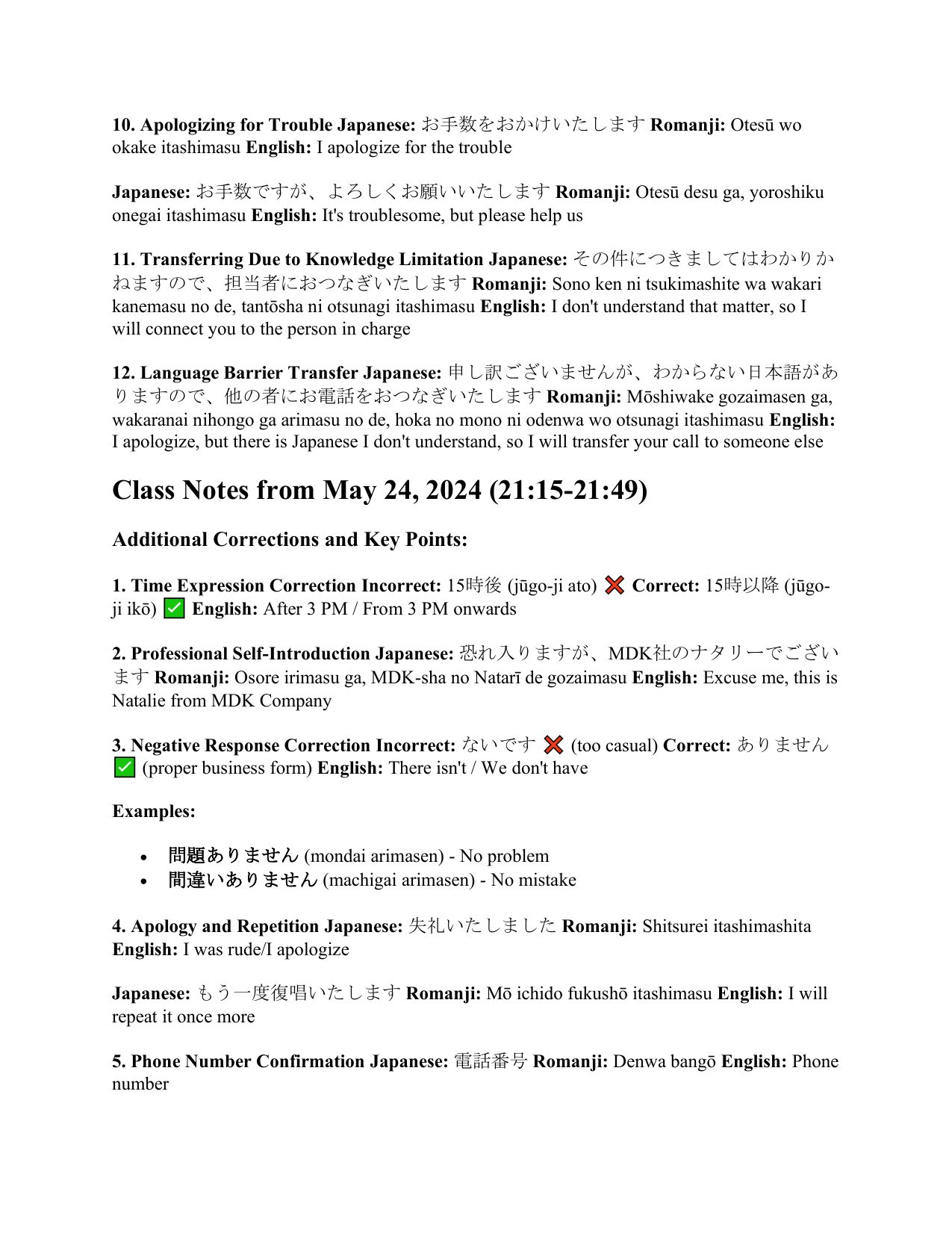
คลิกเพื่อขยาย
EN10. Apologizing for Trouble Japanese: お手数をおかけいたします Romanji: Otesū wo
okake itashimasu English: I apologize for the trouble
Japanese: お手数ですが、よろしくお願いいたします Romanji: Otesū desu ga, yoroshiku
onegai itashimasu English: It's troublesome, but please help us
11. Transferring Due to Knowledge Limitation Japanese: その件につきましてはわかりか
ねますので、担当者におつなぎいたします Romanji: Sono ken ni tsukimashite wa wakari
kanemasu no de, tantōsha ni otsunagi itashimasu English: I don't understand that matter, so I
will connect you to the person in charge
12. Language Barrier Transfer Japanese: 申し訳ございませんが、わからない日本語があ
りますので、他の者にお電話をおつなぎいたします Romanji: Mōshiwake gozaimasen ga,
wakaranai nihongo ga arimasu no de, hoka no mono ni odenwa wo otsunagi itashimasu English:
I apologize, but there is Japanese I don't understand, so I will transfer your call to someone else
Class Notes from May 24, 2024 (21:15-21:49)
Additional Corrections and Key Points:
1. Time Expression Correction Incorrect: 15時後 (jūgo-ji ato) Correct: 15時以降 (jūgo-
ji ikō) English: After 3 PM / From 3 PM onwards
2. Professional Self-Introduction Japanese: 恐れ入りますが、MDK社のナタリーでござい
ます Romanji: Osore irimasu ga, MDK-sha no Natarī de gozaimasu English: Excuse me, this is
Natalie from MDK Company
3. Negative Response Correction Incorrect: ないです (too casual) Correct: ありません
(proper business form) English: There isn't / We don't have
Examples:
• 問題ありません (mondai arimasen) - No problem
• 間違いありません (machigai arimasen) - No mistake
4. Apology and Repetition Japanese: 失礼いたしました Romanji: Shitsurei itashimashita
English: I was rude/I apologize
Japanese: もう一度復唱いたします Romanji: Mō ichido fukushō itashimasu English: I will
repeat it once more
5. Phone Number Confirmation Japanese: 電話番号 Romanji: Denwa bangō English: Phone
number
okake itashimasu English: I apologize for the trouble
Japanese: お手数ですが、よろしくお願いいたします Romanji: Otesū desu ga, yoroshiku
onegai itashimasu English: It's troublesome, but please help us
11. Transferring Due to Knowledge Limitation Japanese: その件につきましてはわかりか
ねますので、担当者におつなぎいたします Romanji: Sono ken ni tsukimashite wa wakari
kanemasu no de, tantōsha ni otsunagi itashimasu English: I don't understand that matter, so I
will connect you to the person in charge
12. Language Barrier Transfer Japanese: 申し訳ございませんが、わからない日本語があ
りますので、他の者にお電話をおつなぎいたします Romanji: Mōshiwake gozaimasen ga,
wakaranai nihongo ga arimasu no de, hoka no mono ni odenwa wo otsunagi itashimasu English:
I apologize, but there is Japanese I don't understand, so I will transfer your call to someone else
Class Notes from May 24, 2024 (21:15-21:49)
Additional Corrections and Key Points:
1. Time Expression Correction Incorrect: 15時後 (jūgo-ji ato) Correct: 15時以降 (jūgo-
ji ikō) English: After 3 PM / From 3 PM onwards
2. Professional Self-Introduction Japanese: 恐れ入りますが、MDK社のナタリーでござい
ます Romanji: Osore irimasu ga, MDK-sha no Natarī de gozaimasu English: Excuse me, this is
Natalie from MDK Company
3. Negative Response Correction Incorrect: ないです (too casual) Correct: ありません
(proper business form) English: There isn't / We don't have
Examples:
• 問題ありません (mondai arimasen) - No problem
• 間違いありません (machigai arimasen) - No mistake
4. Apology and Repetition Japanese: 失礼いたしました Romanji: Shitsurei itashimashita
English: I was rude/I apologize
Japanese: もう一度復唱いたします Romanji: Mō ichido fukushō itashimasu English: I will
repeat it once more
5. Phone Number Confirmation Japanese: 電話番号 Romanji: Denwa bangō English: Phone
number
หน้า 76
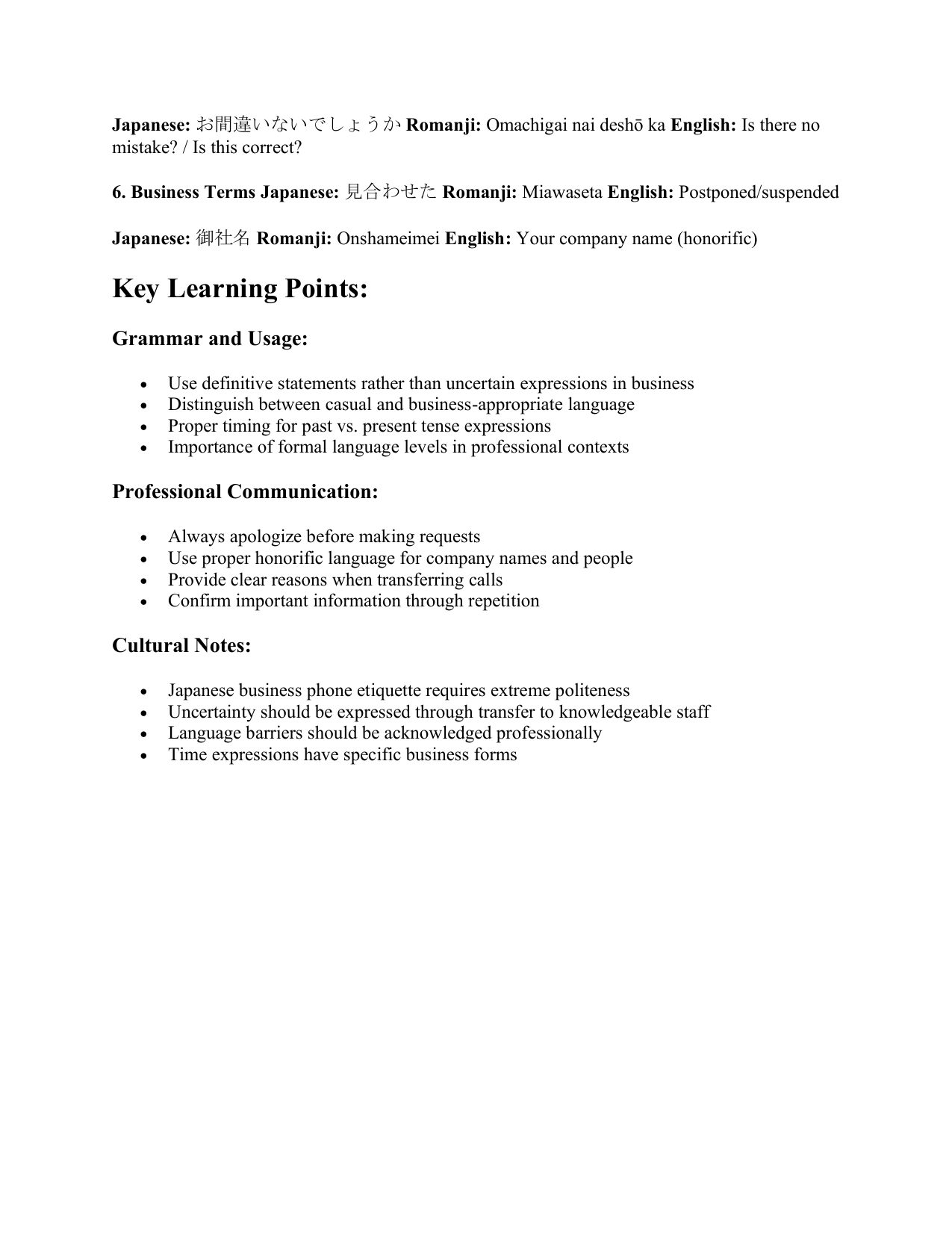
คลิกเพื่อขยาย
ENJapanese: お間違いないでしょうか Romanji: Omachigai nai deshō ka English: Is there no
mistake? / Is this correct?
6. Business Terms Japanese: 見合わせた Romanji: Miawaseta English: Postponed/suspended
Japanese: 御社名 Romanji: Onshameimei English: Your company name (honorific)
Key Learning Points:
Grammar and Usage:
• Use definitive statements rather than uncertain expressions in business
• Distinguish between casual and business-appropriate language
• Proper timing for past vs. present tense expressions
• Importance of formal language levels in professional contexts
Professional Communication:
• Always apologize before making requests
• Use proper honorific language for company names and people
• Provide clear reasons when transferring calls
• Confirm important information through repetition
Cultural Notes:
• Japanese business phone etiquette requires extreme politeness
• Uncertainty should be expressed through transfer to knowledgeable staff
• Language barriers should be acknowledged professionally
• Time expressions have specific business forms
mistake? / Is this correct?
6. Business Terms Japanese: 見合わせた Romanji: Miawaseta English: Postponed/suspended
Japanese: 御社名 Romanji: Onshameimei English: Your company name (honorific)
Key Learning Points:
Grammar and Usage:
• Use definitive statements rather than uncertain expressions in business
• Distinguish between casual and business-appropriate language
• Proper timing for past vs. present tense expressions
• Importance of formal language levels in professional contexts
Professional Communication:
• Always apologize before making requests
• Use proper honorific language for company names and people
• Provide clear reasons when transferring calls
• Confirm important information through repetition
Cultural Notes:
• Japanese business phone etiquette requires extreme politeness
• Uncertainty should be expressed through transfer to knowledgeable staff
• Language barriers should be acknowledged professionally
• Time expressions have specific business forms