หน้า 1
คลิกเพื่อขยาย
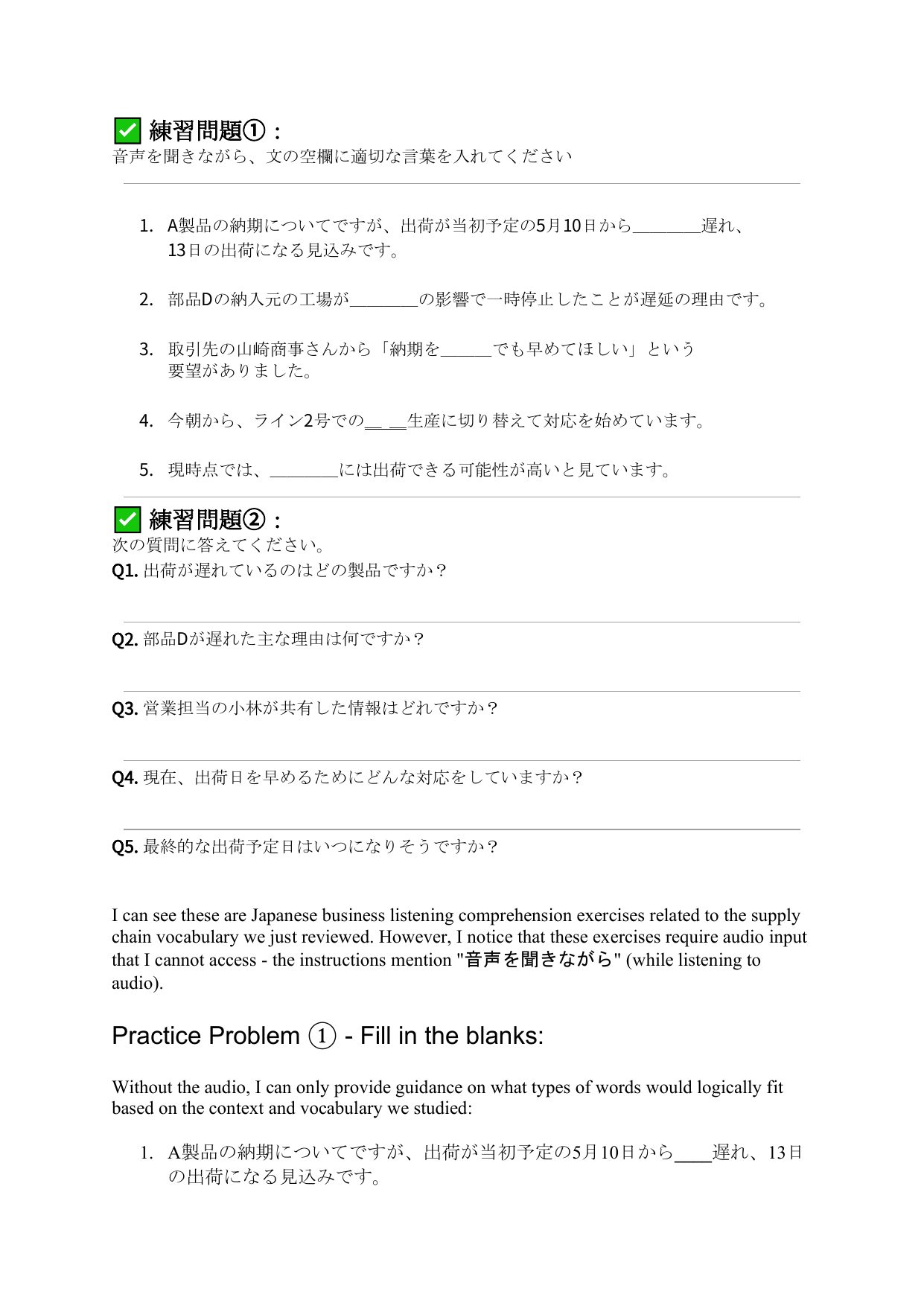
JP練習問題①:
音声を聞きながら、文の空欄に適切な言葉を入れてください
1.A製品の納期についてですが、出荷が当初予定の5月10日から____遅れ、
13日の出荷になる見込みです。
2.部品Dの納入元の工場が____の影響で一時停止したことが遅延の理由です。
3.取引先の山崎商事さんから「納期を___でも早めてほしい」という
要望がありました。
4.今朝から、ライン2号での__生産に切り替えて対応を始めています。
5.現時点では、____には出荷できる可能性が高いと見ています。
練習問題②:
次の質問に答えてください。
Q1.出荷が遅れているのはどの製品ですか?
Q2.部品Dが遅れた主な理由は何ですか?
Q3.営業担当の小林が共有した情報はどれですか?
Q4.現在、出荷日を早めるためにどんな対応をしていますか?
Q5.最終的な出荷予定日はいつになりそうですか?
音声を聞きながら、文の空欄に適切な言葉を入れてください
1.A製品の納期についてですが、出荷が当初予定の5月10日から____遅れ、
13日の出荷になる見込みです。
2.部品Dの納入元の工場が____の影響で一時停止したことが遅延の理由です。
3.取引先の山崎商事さんから「納期を___でも早めてほしい」という
要望がありました。
4.今朝から、ライン2号での__生産に切り替えて対応を始めています。
5.現時点では、____には出荷できる可能性が高いと見ています。
練習問題②:
次の質問に答えてください。
Q1.出荷が遅れているのはどの製品ですか?
Q2.部品Dが遅れた主な理由は何ですか?
Q3.営業担当の小林が共有した情報はどれですか?
Q4.現在、出荷日を早めるためにどんな対応をしていますか?
Q5.最終的な出荷予定日はいつになりそうですか?
ENI can see these are Japanese business listening comprehension exercises related to the supply
chain vocabulary we just reviewed. However, I notice that these exercises require audio input
that I cannot access - the instructions mention "音声を聞きながら" (while listening to
audio).
Practice Problem ① - Fill in the blanks:
Without the audio, I can only provide guidance on what types of words would logically fit
based on the context and vocabulary we studied:
chain vocabulary we just reviewed. However, I notice that these exercises require audio input
that I cannot access - the instructions mention "音声を聞きながら" (while listening to
audio).
Practice Problem ① - Fill in the blanks:
Without the audio, I can only provide guidance on what types of words would logically fit
based on the context and vocabulary we studied:
JP1.A製品の納期についてですが、出荷が当初予定の5月10日から____遅れ、13日
の出荷になる見込みです。
の出荷になる見込みです。
หน้า 2
คลิกเพื่อขยาย
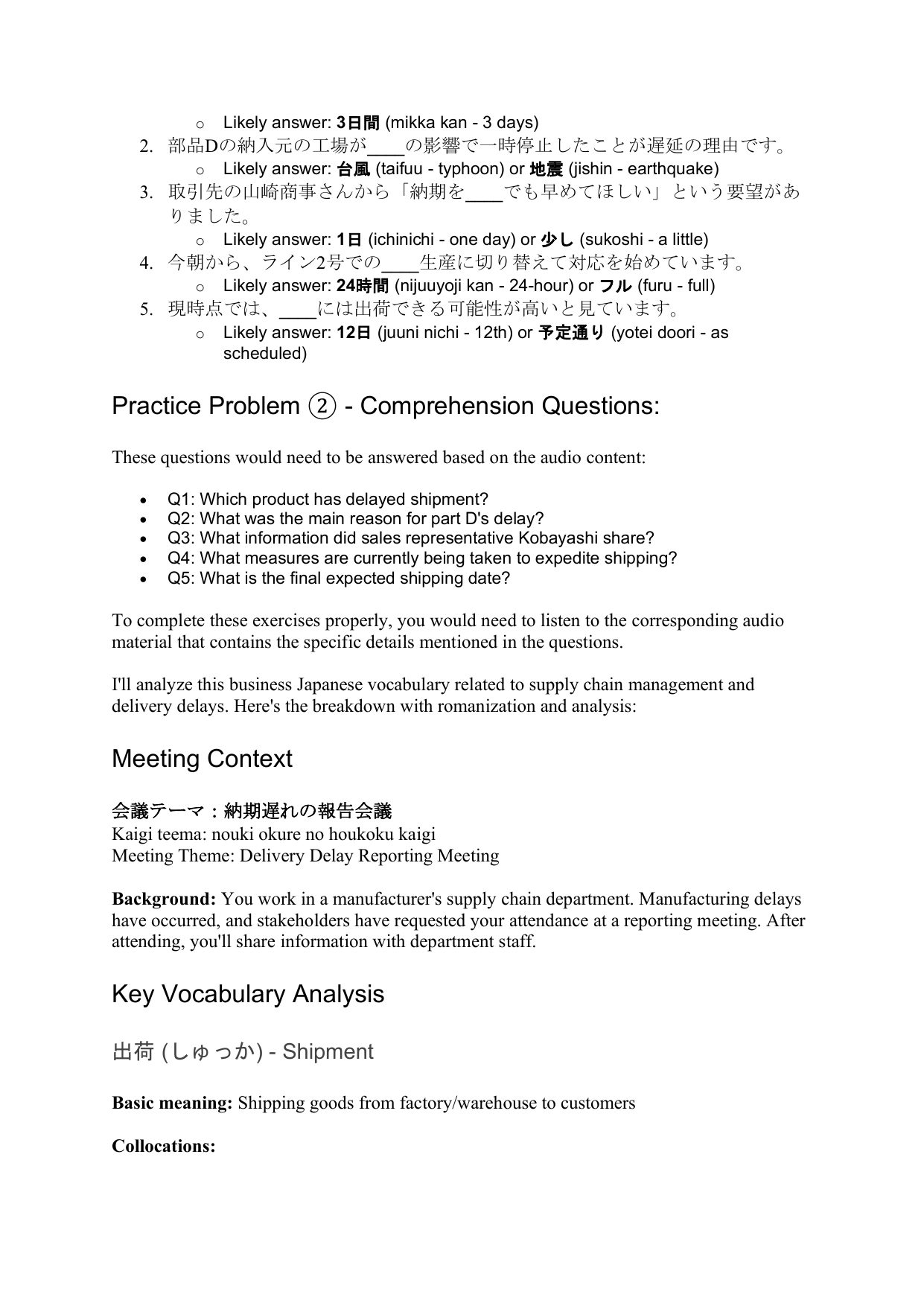
EN o Likely answer: 3日間 (mikka kan - 3 days)
JP2.部品Dの納入元の工場が____の影響で一時停止したことが遅延の理由です。
EN o Likely answer: 台風 (taifuu - typhoon) or 地震 (jishin - earthquake)
JP3.取引先の山崎商事さんから「納期を____でも早めてほしい」という要望があ
りました。
りました。
EN o Likely answer: 1日 (ichinichi - one day) or 少し (sukoshi - a little)
JP4.今朝から、ライン2号での____生産に切り替えて対応を始めています。
EN o Likely answer: 24時間 (nijuuyoji kan - 24-hour) or フル (furu - full)
JP5.現時点では、____には出荷できる可能性が高いと見ています。
EN o Likely answer: 12日 (juuni nichi - 12th) or 予定通り (yotei doori - as
scheduled)
Practice Problem ② - Comprehension Questions:
These questions would need to be answered based on the audio content:
• Q1: Which product has delayed shipment?
• Q2: What was the main reason for part D's delay?
• Q3: What information did sales representative Kobayashi share?
• Q4: What measures are currently being taken to expedite shipping?
• Q5: What is the final expected shipping date?
To complete these exercises properly, you would need to listen to the corresponding audio
material that contains the specific details mentioned in the questions.
I'll analyze this business Japanese vocabulary related to supply chain management and
delivery delays. Here's the breakdown with romanization and analysis:
Meeting Context
scheduled)
Practice Problem ② - Comprehension Questions:
These questions would need to be answered based on the audio content:
• Q1: Which product has delayed shipment?
• Q2: What was the main reason for part D's delay?
• Q3: What information did sales representative Kobayashi share?
• Q4: What measures are currently being taken to expedite shipping?
• Q5: What is the final expected shipping date?
To complete these exercises properly, you would need to listen to the corresponding audio
material that contains the specific details mentioned in the questions.
I'll analyze this business Japanese vocabulary related to supply chain management and
delivery delays. Here's the breakdown with romanization and analysis:
Meeting Context
JP会議テーマ:納期遅れの報告会議
ENKaigi teema: nouki okure no houkoku kaigi
Meeting Theme: Delivery Delay Reporting Meeting
Background: You work in a manufacturer's supply chain department. Manufacturing delays
have occurred, and stakeholders have requested your attendance at a reporting meeting. After
attending, you'll share information with department staff.
Key Vocabulary Analysis
出荷 (しゅっか) - Shipment
Basic meaning: Shipping goods from factory/warehouse to customers
Collocations:
Meeting Theme: Delivery Delay Reporting Meeting
Background: You work in a manufacturer's supply chain department. Manufacturing delays
have occurred, and stakeholders have requested your attendance at a reporting meeting. After
attending, you'll share information with department staff.
Key Vocabulary Analysis
出荷 (しゅっか) - Shipment
Basic meaning: Shipping goods from factory/warehouse to customers
Collocations:
หน้า 3
คลิกเพื่อขยาย
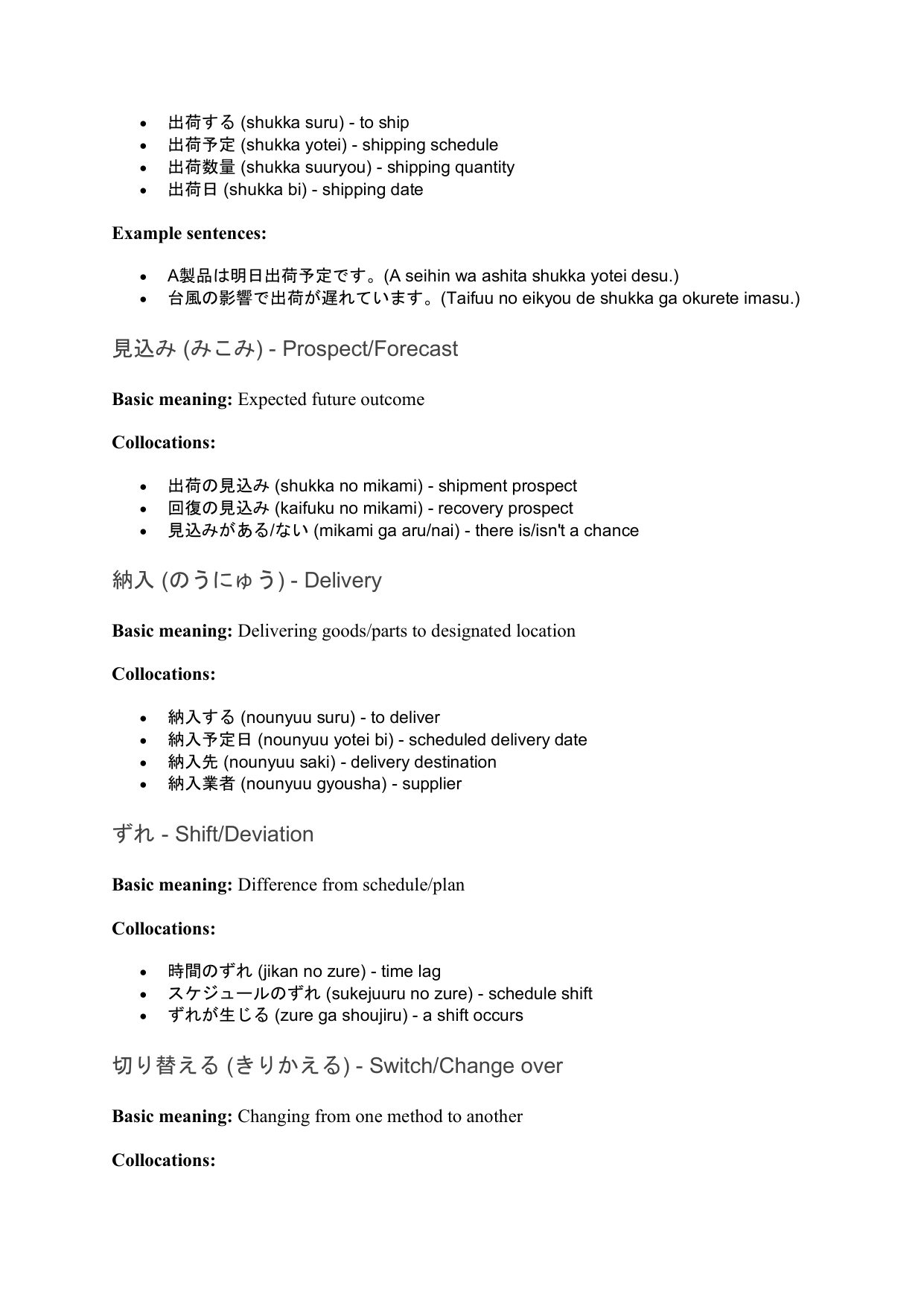
EN • 出荷する (shukka suru) - to ship
• 出荷予定 (shukka yotei) - shipping schedule
• 出荷数量 (shukka suuryou) - shipping quantity
• 出荷日 (shukka bi) - shipping date
Example sentences:
• A製品は明日出荷予定です。(A seihin wa ashita shukka yotei desu.)
• 台風の影響で出荷が遅れています。(Taifuu no eikyou de shukka ga okurete imasu.)
見込み (みこみ) - Prospect/Forecast
Basic meaning: Expected future outcome
Collocations:
• 出荷の見込み (shukka no mikami) - shipment prospect
• 回復の見込み (kaifuku no mikami) - recovery prospect
• 見込みがある/ない (mikami ga aru/nai) - there is/isn't a chance
納入 (のうにゅう) - Delivery
Basic meaning: Delivering goods/parts to designated location
Collocations:
• 納入する (nounyuu suru) - to deliver
• 納入予定日 (nounyuu yotei bi) - scheduled delivery date
• 納入先 (nounyuu saki) - delivery destination
• 納入業者 (nounyuu gyousha) - supplier
ずれ - Shift/Deviation
Basic meaning: Difference from schedule/plan
Collocations:
• 時間のずれ (jikan no zure) - time lag
• スケジュールのずれ (sukejuuru no zure) - schedule shift
• ずれが生じる (zure ga shoujiru) - a shift occurs
切り替える (きりかえる) - Switch/Change over
Basic meaning: Changing from one method to another
Collocations:
• 出荷予定 (shukka yotei) - shipping schedule
• 出荷数量 (shukka suuryou) - shipping quantity
• 出荷日 (shukka bi) - shipping date
Example sentences:
• A製品は明日出荷予定です。(A seihin wa ashita shukka yotei desu.)
• 台風の影響で出荷が遅れています。(Taifuu no eikyou de shukka ga okurete imasu.)
見込み (みこみ) - Prospect/Forecast
Basic meaning: Expected future outcome
Collocations:
• 出荷の見込み (shukka no mikami) - shipment prospect
• 回復の見込み (kaifuku no mikami) - recovery prospect
• 見込みがある/ない (mikami ga aru/nai) - there is/isn't a chance
納入 (のうにゅう) - Delivery
Basic meaning: Delivering goods/parts to designated location
Collocations:
• 納入する (nounyuu suru) - to deliver
• 納入予定日 (nounyuu yotei bi) - scheduled delivery date
• 納入先 (nounyuu saki) - delivery destination
• 納入業者 (nounyuu gyousha) - supplier
ずれ - Shift/Deviation
Basic meaning: Difference from schedule/plan
Collocations:
• 時間のずれ (jikan no zure) - time lag
• スケジュールのずれ (sukejuuru no zure) - schedule shift
• ずれが生じる (zure ga shoujiru) - a shift occurs
切り替える (きりかえる) - Switch/Change over
Basic meaning: Changing from one method to another
Collocations:
หน้า 4
คลิกเพื่อขยาย
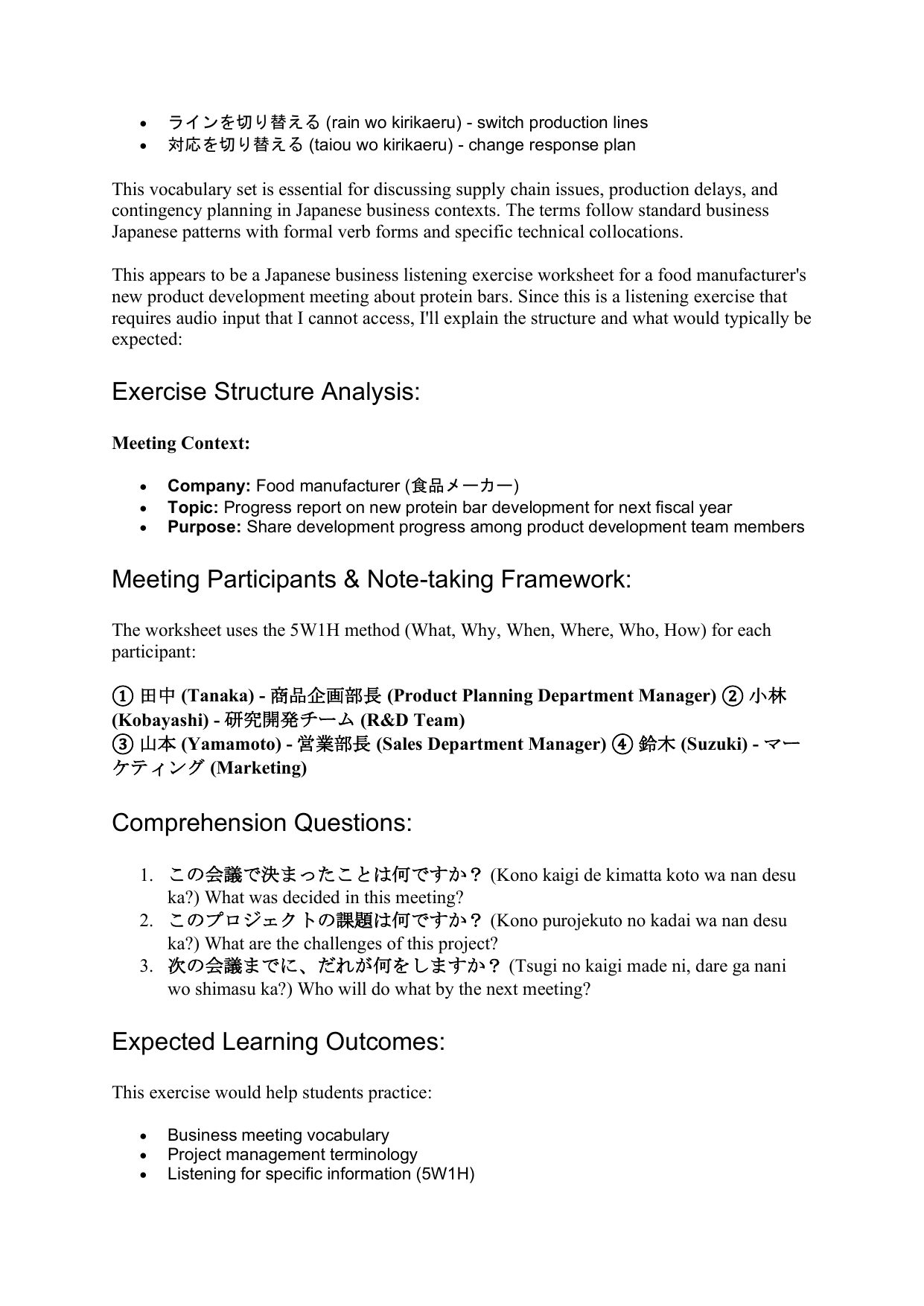
EN • ラインを切り替える (rain wo kirikaeru) - switch production lines
• 対応を切り替える (taiou wo kirikaeru) - change response plan
This vocabulary set is essential for discussing supply chain issues, production delays, and
contingency planning in Japanese business contexts. The terms follow standard business
Japanese patterns with formal verb forms and specific technical collocations.
This appears to be a Japanese business listening exercise worksheet for a food manufacturer's
new product development meeting about protein bars. Since this is a listening exercise that
requires audio input that I cannot access, I'll explain the structure and what would typically be
expected:
Exercise Structure Analysis:
Meeting Context:
• Company: Food manufacturer (食品メーカー)
• Topic: Progress report on new protein bar development for next fiscal year
• Purpose: Share development progress among product development team members
Meeting Participants & Note-taking Framework:
The worksheet uses the 5W1H method (What, Why, When, Where, Who, How) for each
participant:
① 田中 (Tanaka) - 商品企画部長 (Product Planning Department Manager) ② 小林
(Kobayashi) - 研究開発チーム (R&D Team)
③ 山本 (Yamamoto) - 営業部長 (Sales Department Manager) ④ 鈴木 (Suzuki) - マー
ケティング (Marketing)
Comprehension Questions:
1. この会議で決まったことは何ですか? (Kono kaigi de kimatta koto wa nan desu
ka?) What was decided in this meeting?
2. このプロジェクトの課題は何ですか? (Kono purojekuto no kadai wa nan desu
ka?) What are the challenges of this project?
3. 次の会議までに、だれが何をしますか? (Tsugi no kaigi made ni, dare ga nani
wo shimasu ka?) Who will do what by the next meeting?
Expected Learning Outcomes:
This exercise would help students practice:
• Business meeting vocabulary
• Project management terminology
• Listening for specific information (5W1H)
• 対応を切り替える (taiou wo kirikaeru) - change response plan
This vocabulary set is essential for discussing supply chain issues, production delays, and
contingency planning in Japanese business contexts. The terms follow standard business
Japanese patterns with formal verb forms and specific technical collocations.
This appears to be a Japanese business listening exercise worksheet for a food manufacturer's
new product development meeting about protein bars. Since this is a listening exercise that
requires audio input that I cannot access, I'll explain the structure and what would typically be
expected:
Exercise Structure Analysis:
Meeting Context:
• Company: Food manufacturer (食品メーカー)
• Topic: Progress report on new protein bar development for next fiscal year
• Purpose: Share development progress among product development team members
Meeting Participants & Note-taking Framework:
The worksheet uses the 5W1H method (What, Why, When, Where, Who, How) for each
participant:
① 田中 (Tanaka) - 商品企画部長 (Product Planning Department Manager) ② 小林
(Kobayashi) - 研究開発チーム (R&D Team)
③ 山本 (Yamamoto) - 営業部長 (Sales Department Manager) ④ 鈴木 (Suzuki) - マー
ケティング (Marketing)
Comprehension Questions:
1. この会議で決まったことは何ですか? (Kono kaigi de kimatta koto wa nan desu
ka?) What was decided in this meeting?
2. このプロジェクトの課題は何ですか? (Kono purojekuto no kadai wa nan desu
ka?) What are the challenges of this project?
3. 次の会議までに、だれが何をしますか? (Tsugi no kaigi made ni, dare ga nani
wo shimasu ka?) Who will do what by the next meeting?
Expected Learning Outcomes:
This exercise would help students practice:
• Business meeting vocabulary
• Project management terminology
• Listening for specific information (5W1H)
หน้า 5
คลิกเพื่อขยาย
EN • Understanding roles and responsibilities in Japanese companies
• Note-taking in Japanese business contexts
To complete this worksheet, you would need to listen to the accompanying audio recording
and fill in the details for each participant based on what they contribute to the meeting
discussion.
Now I can analyze the complete listening script and help with the exercises. Here are the
answers and analysis:
Listening Script Analysis
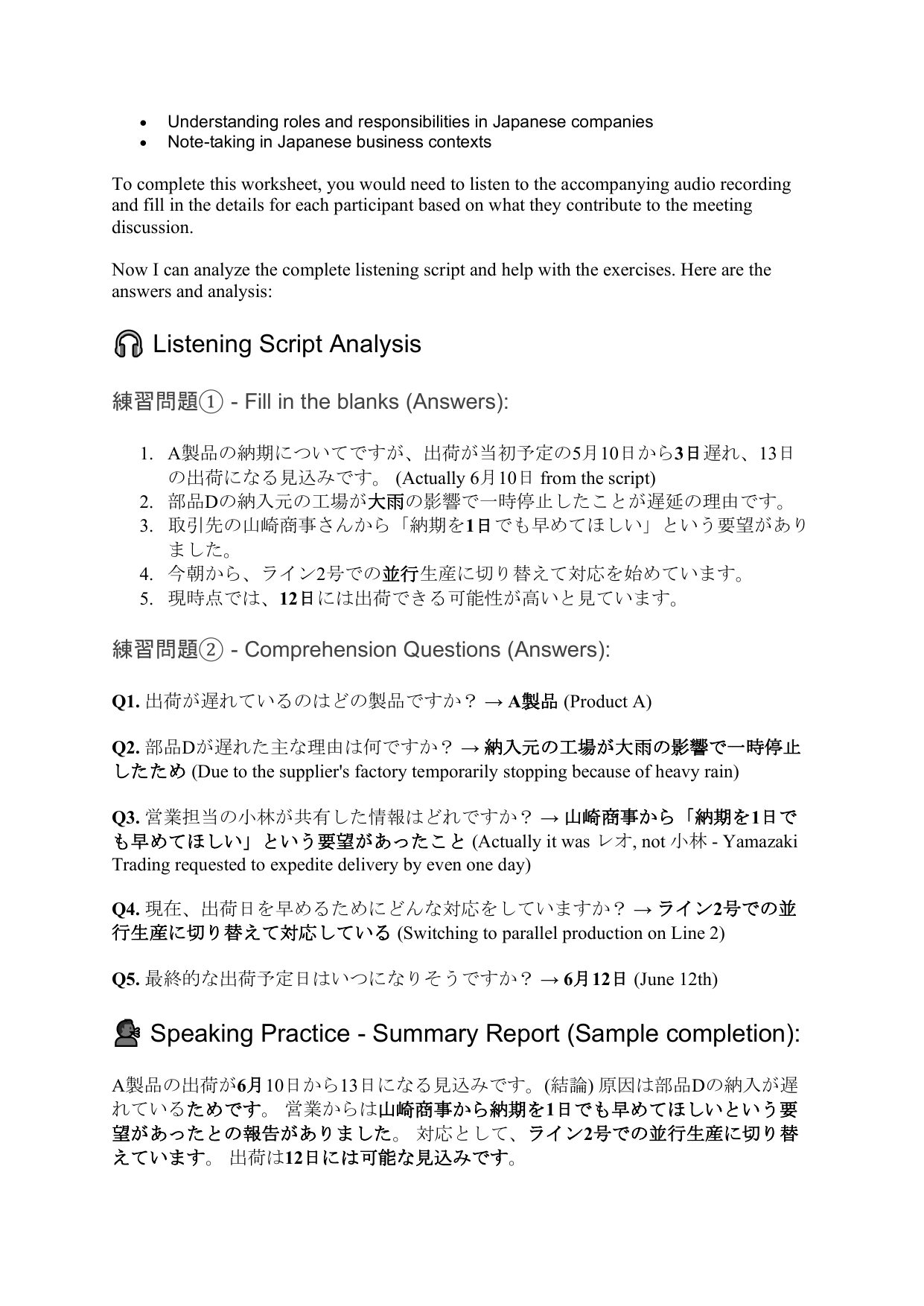
練習問題① - Fill in the blanks (Answers):
• Note-taking in Japanese business contexts
To complete this worksheet, you would need to listen to the accompanying audio recording
and fill in the details for each participant based on what they contribute to the meeting
discussion.
Now I can analyze the complete listening script and help with the exercises. Here are the
answers and analysis:
Listening Script Analysis
練習問題① - Fill in the blanks (Answers):
JP1.A製品の納期についてですが、出荷が当初予定の5月10日から3日遅れ、13日
EN の出荷になる見込みです。 (Actually 6月10日 from the script)
JP2.部品Dの納入元の工場が大雨の影響で一時停止したことが遅延の理由です。
3.取引先の山崎商事さんから「納期を1日でも早めてほしい」という要望があり
ました。
4.今朝から、ライン2号での並行生産に切り替えて対応を始めています。
5.現時点では、12日には出荷できる可能性が高いと見ています。
3.取引先の山崎商事さんから「納期を1日でも早めてほしい」という要望があり
ました。
4.今朝から、ライン2号での並行生産に切り替えて対応を始めています。
5.現時点では、12日には出荷できる可能性が高いと見ています。
EN練習問題② - Comprehension Questions (Answers):
JPQ1.出荷が遅れているのはどの製品ですか?→A製品(ProductA)
Q2.部品Dが遅れた主な理由は何ですか?→納入元の工場が大雨の影響で一時停止
Q2.部品Dが遅れた主な理由は何ですか?→納入元の工場が大雨の影響で一時停止
ENしたため (Due to the supplier's factory temporarily stopping because of heavy rain)
JPQ3.営業担当の小林が共有した情報はどれですか?→山崎商事から「納期を1日で
ENも早めてほしい」という要望があったこと (Actually it was レオ, not 小林 - Yamazaki
Trading requested to expedite delivery by even one day)
Trading requested to expedite delivery by even one day)
JPQ4.現在、出荷日を早めるためにどんな対応をしていますか?→ライン2号での並
EN行生産に切り替えて対応している (Switching to parallel production on Line 2)
JPQ5.最終的な出荷予定日はいつになりそうですか?→6月12日(June12th)
EN Speaking Practice - Summary Report (Sample completion):
JPA製品の出荷が6月10日から13日になる見込みです。(結論)原因は部品Dの納入が遅
れているためです。営業からは山崎商事から納期を1日でも早めてほしいという要
望があったとの報告がありました。対応として、ライン2号での並行生産に切り替
えています。出荷は12日には可能な見込みです。
れているためです。営業からは山崎商事から納期を1日でも早めてほしいという要
望があったとの報告がありました。対応として、ライン2号での並行生産に切り替
えています。出荷は12日には可能な見込みです。
หน้า 6
คลิกเพื่อขยาย
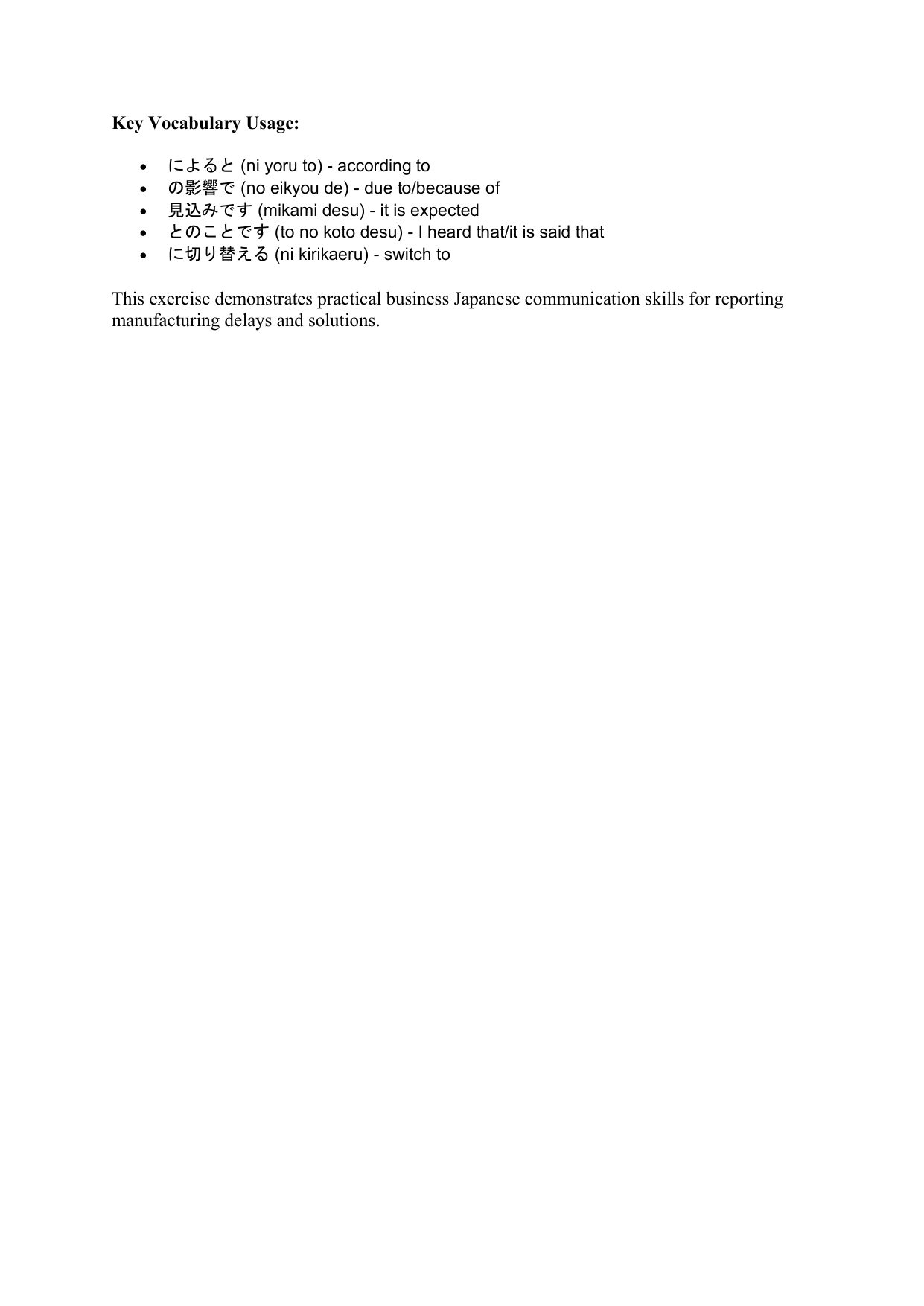
ENKey Vocabulary Usage:
• によると (ni yoru to) - according to
• の影響で (no eikyou de) - due to/because of
• 見込みです (mikami desu) - it is expected
• とのことです (to no koto desu) - I heard that/it is said that
• に切り替える (ni kirikaeru) - switch to
This exercise demonstrates practical business Japanese communication skills for reporting
manufacturing delays and solutions.
• によると (ni yoru to) - according to
• の影響で (no eikyou de) - due to/because of
• 見込みです (mikami desu) - it is expected
• とのことです (to no koto desu) - I heard that/it is said that
• に切り替える (ni kirikaeru) - switch to
This exercise demonstrates practical business Japanese communication skills for reporting
manufacturing delays and solutions.