หน้า 1
คลิกเพื่อขยาย
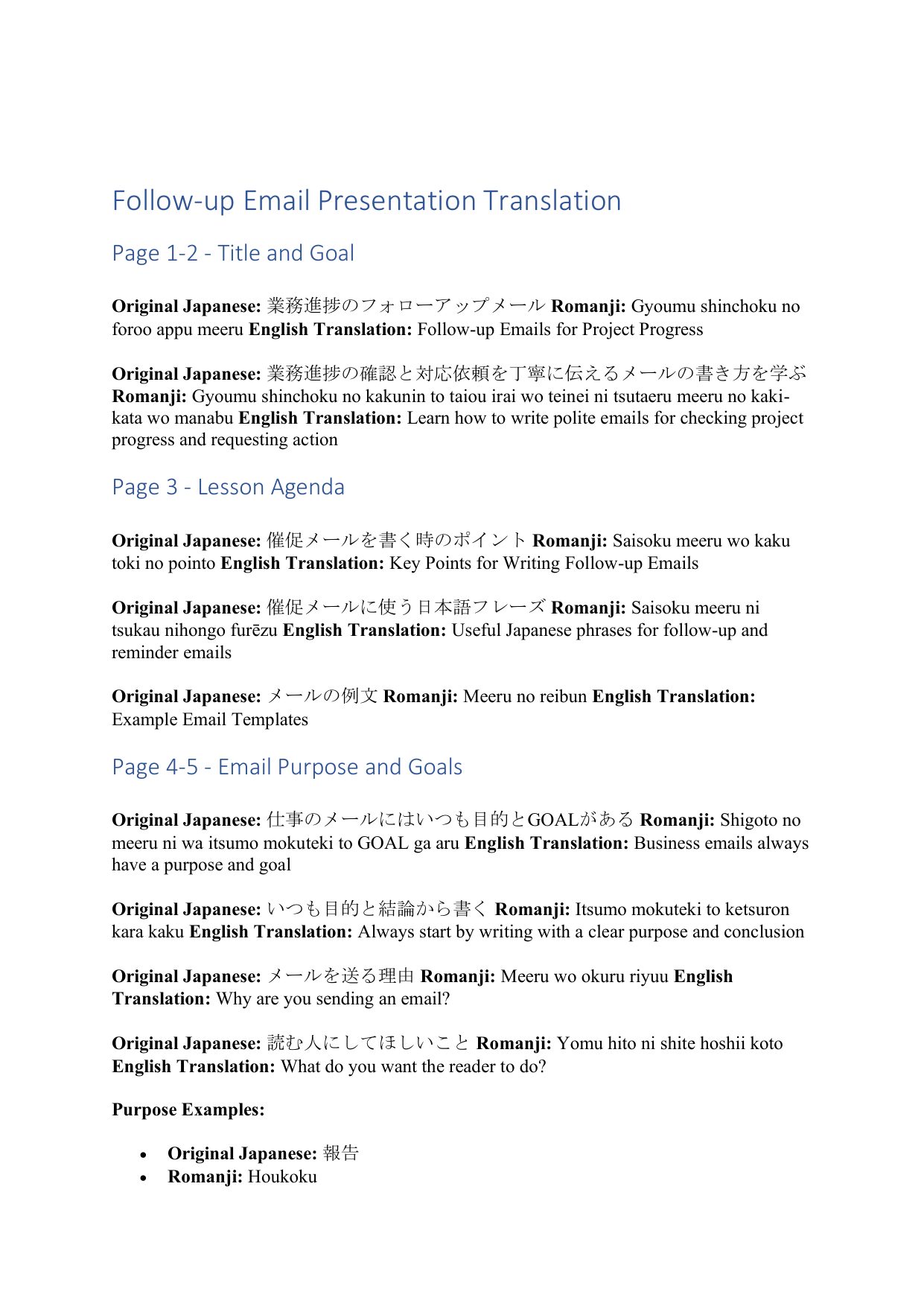
ENFollow-up Email Presentation Translation
Page 1-2 - Title and Goal
Original Japanese: 業務進捗のフォローアップメール Romanji: Gyoumu shinchoku no
foroo appu meeru English Translation: Follow-up Emails for Project Progress
Page 1-2 - Title and Goal
Original Japanese: 業務進捗のフォローアップメール Romanji: Gyoumu shinchoku no
foroo appu meeru English Translation: Follow-up Emails for Project Progress
JPOriginalJapanese:業務進捗の確認と対応依頼を丁寧に伝えるメールの書き方を学ぶ
ENRomanji: Gyoumu shinchoku no kakunin to taiou irai wo teinei ni tsutaeru meeru no kaki-
kata wo manabu English Translation: Learn how to write polite emails for checking project
progress and requesting action
Page 3 - Lesson Agenda
Original Japanese: 催促メールを書く時のポイント Romanji: Saisoku meeru wo kaku
toki no pointo English Translation: Key Points for Writing Follow-up Emails
Original Japanese: 催促メールに使う日本語フレーズ Romanji: Saisoku meeru ni
tsukau nihongo furēzu English Translation: Useful Japanese phrases for follow-up and
reminder emails
Original Japanese: メールの例文 Romanji: Meeru no reibun English Translation:
Example Email Templates
Page 4-5 - Email Purpose and Goals
Original Japanese: 仕事のメールにはいつも目的とGOALがある Romanji: Shigoto no
meeru ni wa itsumo mokuteki to GOAL ga aru English Translation: Business emails always
have a purpose and goal
Original Japanese: いつも目的と結論から書く Romanji: Itsumo mokuteki to ketsuron
kara kaku English Translation: Always start by writing with a clear purpose and conclusion
Original Japanese: メールを送る理由 Romanji: Meeru wo okuru riyuu English
Translation: Why are you sending an email?
Original Japanese: 読む人にしてほしいこと Romanji: Yomu hito ni shite hoshii koto
English Translation: What do you want the reader to do?
Purpose Examples:
• Original Japanese: 報告
• Romanji: Houkoku
kata wo manabu English Translation: Learn how to write polite emails for checking project
progress and requesting action
Page 3 - Lesson Agenda
Original Japanese: 催促メールを書く時のポイント Romanji: Saisoku meeru wo kaku
toki no pointo English Translation: Key Points for Writing Follow-up Emails
Original Japanese: 催促メールに使う日本語フレーズ Romanji: Saisoku meeru ni
tsukau nihongo furēzu English Translation: Useful Japanese phrases for follow-up and
reminder emails
Original Japanese: メールの例文 Romanji: Meeru no reibun English Translation:
Example Email Templates
Page 4-5 - Email Purpose and Goals
Original Japanese: 仕事のメールにはいつも目的とGOALがある Romanji: Shigoto no
meeru ni wa itsumo mokuteki to GOAL ga aru English Translation: Business emails always
have a purpose and goal
Original Japanese: いつも目的と結論から書く Romanji: Itsumo mokuteki to ketsuron
kara kaku English Translation: Always start by writing with a clear purpose and conclusion
Original Japanese: メールを送る理由 Romanji: Meeru wo okuru riyuu English
Translation: Why are you sending an email?
Original Japanese: 読む人にしてほしいこと Romanji: Yomu hito ni shite hoshii koto
English Translation: What do you want the reader to do?
Purpose Examples:
• Original Japanese: 報告
• Romanji: Houkoku
หน้า 2
คลิกเพื่อขยาย
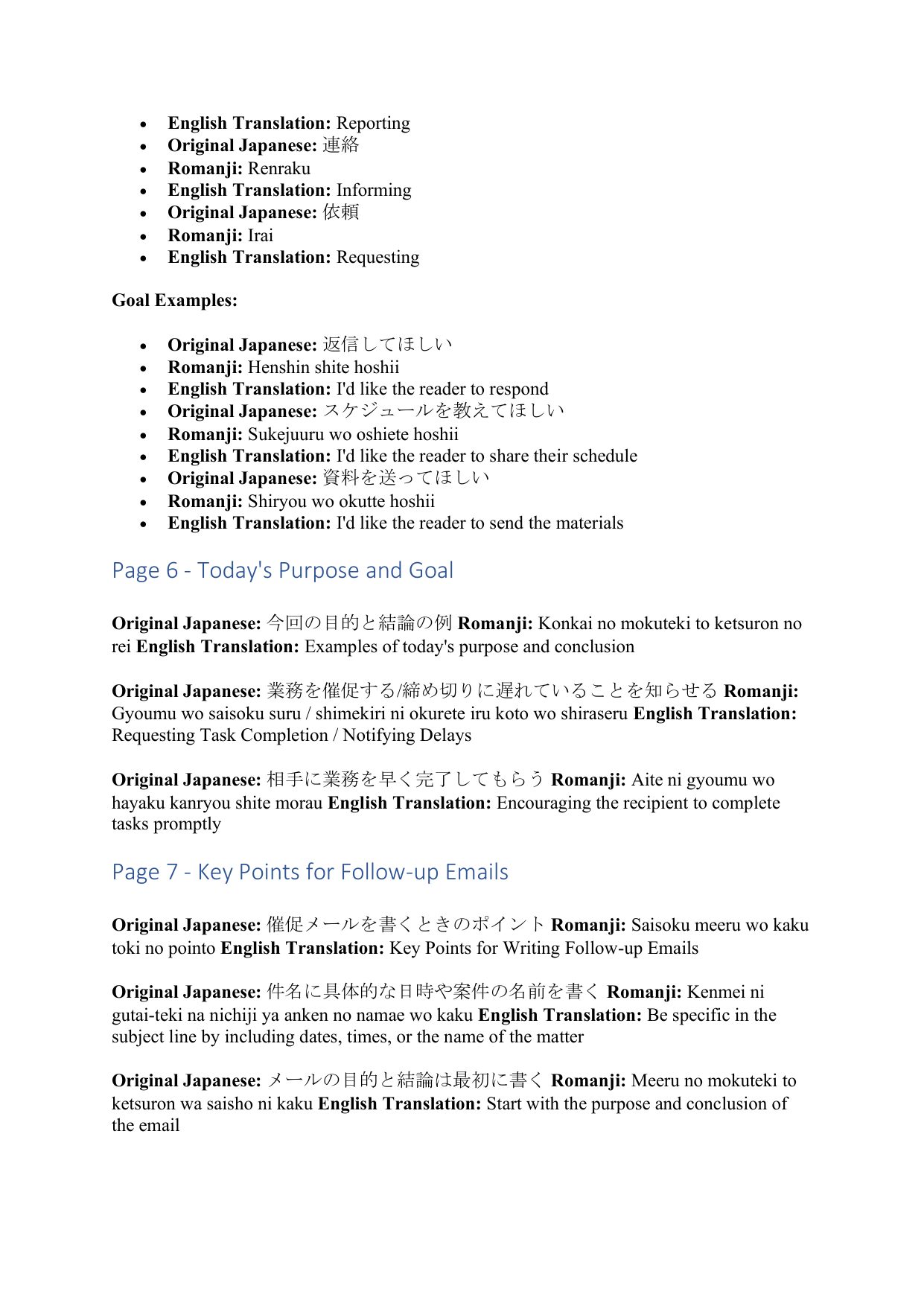
EN • English Translation: Reporting
• Original Japanese: 連絡
• Romanji: Renraku
• English Translation: Informing
• Original Japanese: 依頼
• Romanji: Irai
• English Translation: Requesting
Goal Examples:
• Original Japanese: 返信してほしい
• Romanji: Henshin shite hoshii
• English Translation: I'd like the reader to respond
• Original Japanese: スケジュールを教えてほしい
• Romanji: Sukejuuru wo oshiete hoshii
• English Translation: I'd like the reader to share their schedule
• Original Japanese: 資料を送ってほしい
• Romanji: Shiryou wo okutte hoshii
• English Translation: I'd like the reader to send the materials
Page 6 - Today's Purpose and Goal
Original Japanese: 今回の目的と結論の例 Romanji: Konkai no mokuteki to ketsuron no
rei English Translation: Examples of today's purpose and conclusion
• Original Japanese: 連絡
• Romanji: Renraku
• English Translation: Informing
• Original Japanese: 依頼
• Romanji: Irai
• English Translation: Requesting
Goal Examples:
• Original Japanese: 返信してほしい
• Romanji: Henshin shite hoshii
• English Translation: I'd like the reader to respond
• Original Japanese: スケジュールを教えてほしい
• Romanji: Sukejuuru wo oshiete hoshii
• English Translation: I'd like the reader to share their schedule
• Original Japanese: 資料を送ってほしい
• Romanji: Shiryou wo okutte hoshii
• English Translation: I'd like the reader to send the materials
Page 6 - Today's Purpose and Goal
Original Japanese: 今回の目的と結論の例 Romanji: Konkai no mokuteki to ketsuron no
rei English Translation: Examples of today's purpose and conclusion
JPOriginalJapanese:業務を催促する/締め切りに遅れていることを知らせるRomanji:
ENGyoumu wo saisoku suru / shimekiri ni okurete iru koto wo shiraseru English Translation:
Requesting Task Completion / Notifying Delays
Original Japanese: 相手に業務を早く完了してもらう Romanji: Aite ni gyoumu wo
hayaku kanryou shite morau English Translation: Encouraging the recipient to complete
tasks promptly
Page 7 - Key Points for Follow-up Emails
Original Japanese: 催促メールを書くときのポイント Romanji: Saisoku meeru wo kaku
toki no pointo English Translation: Key Points for Writing Follow-up Emails
Original Japanese: 件名に具体的な日時や案件の名前を書く Romanji: Kenmei ni
gutai-teki na nichiji ya anken no namae wo kaku English Translation: Be specific in the
subject line by including dates, times, or the name of the matter
Original Japanese: メールの目的と結論は最初に書く Romanji: Meeru no mokuteki to
ketsuron wa saisho ni kaku English Translation: Start with the purpose and conclusion of
the email
Requesting Task Completion / Notifying Delays
Original Japanese: 相手に業務を早く完了してもらう Romanji: Aite ni gyoumu wo
hayaku kanryou shite morau English Translation: Encouraging the recipient to complete
tasks promptly
Page 7 - Key Points for Follow-up Emails
Original Japanese: 催促メールを書くときのポイント Romanji: Saisoku meeru wo kaku
toki no pointo English Translation: Key Points for Writing Follow-up Emails
Original Japanese: 件名に具体的な日時や案件の名前を書く Romanji: Kenmei ni
gutai-teki na nichiji ya anken no namae wo kaku English Translation: Be specific in the
subject line by including dates, times, or the name of the matter
Original Japanese: メールの目的と結論は最初に書く Romanji: Meeru no mokuteki to
ketsuron wa saisho ni kaku English Translation: Start with the purpose and conclusion of
the email
หน้า 3
คลิกเพื่อขยาย
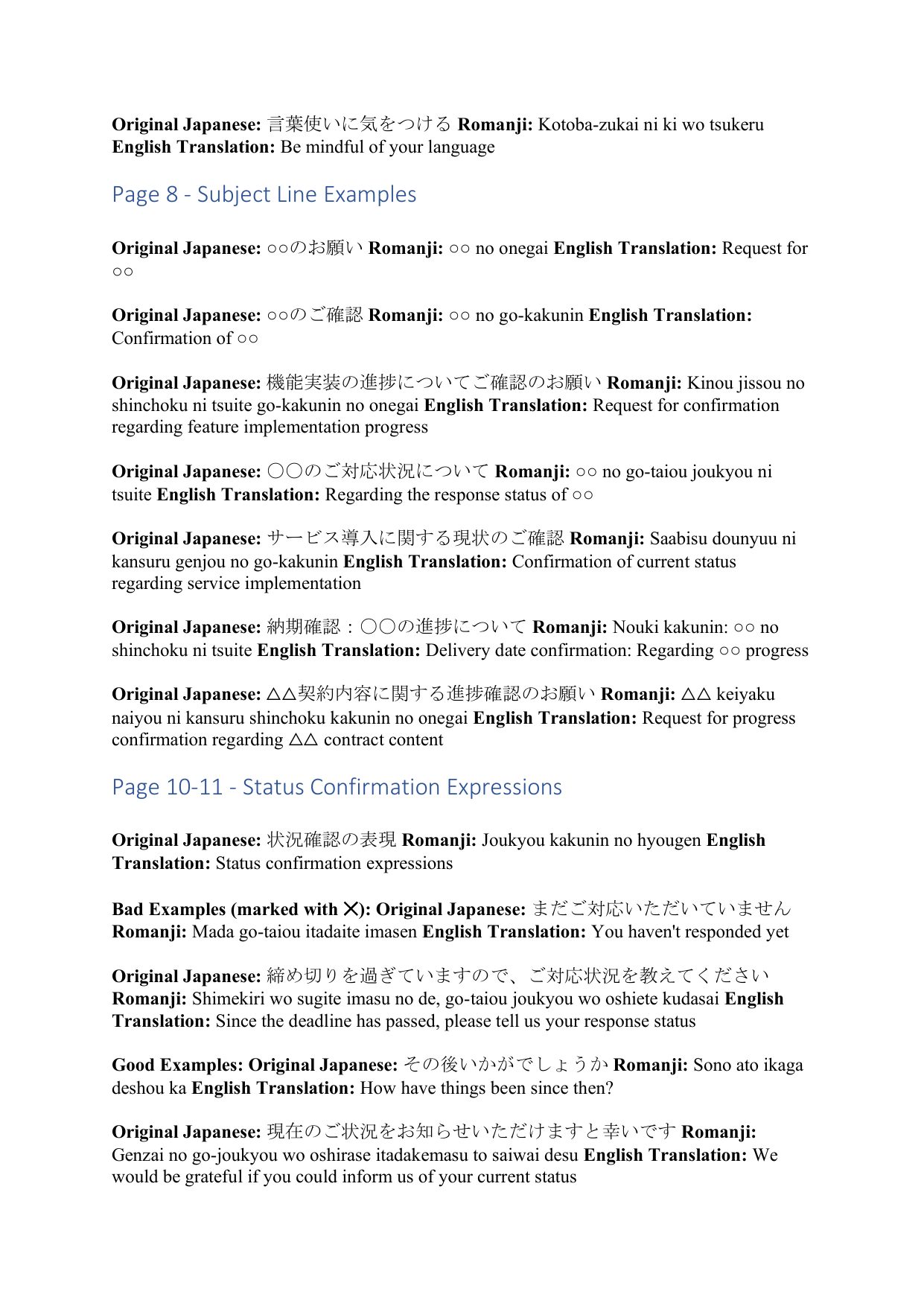
ENOriginal Japanese: 言葉使いに気をつける Romanji: Kotoba-zukai ni ki wo tsukeru
English Translation: Be mindful of your language
Page 8 - Subject Line Examples
Original Japanese: ○○のお願い Romanji: ○○ no onegai English Translation: Request for
○○
Original Japanese: ○○のご確認 Romanji: ○○ no go-kakunin English Translation:
Confirmation of ○○
Original Japanese: 機能実装の進捗についてご確認のお願い Romanji: Kinou jissou no
shinchoku ni tsuite go-kakunin no onegai English Translation: Request for confirmation
regarding feature implementation progress
Original Japanese: 〇〇のご対応状況について Romanji: ○○ no go-taiou joukyou ni
tsuite English Translation: Regarding the response status of ○○
Original Japanese: サービス導入に関する現状のご確認 Romanji: Saabisu dounyuu ni
kansuru genjou no go-kakunin English Translation: Confirmation of current status
regarding service implementation
Original Japanese: 納期確認:〇〇の進捗について Romanji: Nouki kakunin: ○○ no
shinchoku ni tsuite English Translation: Delivery date confirmation: Regarding ○○ progress
Original Japanese: △△契約内容に関する進捗確認のお願い Romanji: △△ keiyaku
naiyou ni kansuru shinchoku kakunin no onegai English Translation: Request for progress
confirmation regarding △△ contract content
Page 10-11 - Status Confirmation Expressions
Original Japanese: 状況確認の表現 Romanji: Joukyou kakunin no hyougen English
Translation: Status confirmation expressions
Bad Examples (marked with ✕): Original Japanese: まだご対応いただいていません
Romanji: Mada go-taiou itadaite imasen English Translation: You haven't responded yet
English Translation: Be mindful of your language
Page 8 - Subject Line Examples
Original Japanese: ○○のお願い Romanji: ○○ no onegai English Translation: Request for
○○
Original Japanese: ○○のご確認 Romanji: ○○ no go-kakunin English Translation:
Confirmation of ○○
Original Japanese: 機能実装の進捗についてご確認のお願い Romanji: Kinou jissou no
shinchoku ni tsuite go-kakunin no onegai English Translation: Request for confirmation
regarding feature implementation progress
Original Japanese: 〇〇のご対応状況について Romanji: ○○ no go-taiou joukyou ni
tsuite English Translation: Regarding the response status of ○○
Original Japanese: サービス導入に関する現状のご確認 Romanji: Saabisu dounyuu ni
kansuru genjou no go-kakunin English Translation: Confirmation of current status
regarding service implementation
Original Japanese: 納期確認:〇〇の進捗について Romanji: Nouki kakunin: ○○ no
shinchoku ni tsuite English Translation: Delivery date confirmation: Regarding ○○ progress
Original Japanese: △△契約内容に関する進捗確認のお願い Romanji: △△ keiyaku
naiyou ni kansuru shinchoku kakunin no onegai English Translation: Request for progress
confirmation regarding △△ contract content
Page 10-11 - Status Confirmation Expressions
Original Japanese: 状況確認の表現 Romanji: Joukyou kakunin no hyougen English
Translation: Status confirmation expressions
Bad Examples (marked with ✕): Original Japanese: まだご対応いただいていません
Romanji: Mada go-taiou itadaite imasen English Translation: You haven't responded yet
JPOriginalJapanese:締め切りを過ぎていますので、ご対応状況を教えてください
ENRomanji: Shimekiri wo sugite imasu no de, go-taiou joukyou wo oshiete kudasai English
Translation: Since the deadline has passed, please tell us your response status
Good Examples: Original Japanese: その後いかがでしょうか Romanji: Sono ato ikaga
deshou ka English Translation: How have things been since then?
Original Japanese: 現在のご状況をお知らせいただけますと幸いです Romanji:
Genzai no go-joukyou wo oshirase itadakemasu to saiwai desu English Translation: We
would be grateful if you could inform us of your current status
Translation: Since the deadline has passed, please tell us your response status
Good Examples: Original Japanese: その後いかがでしょうか Romanji: Sono ato ikaga
deshou ka English Translation: How have things been since then?
Original Japanese: 現在のご状況をお知らせいただけますと幸いです Romanji:
Genzai no go-joukyou wo oshirase itadakemasu to saiwai desu English Translation: We
would be grateful if you could inform us of your current status
หน้า 4
คลิกเพื่อขยาย
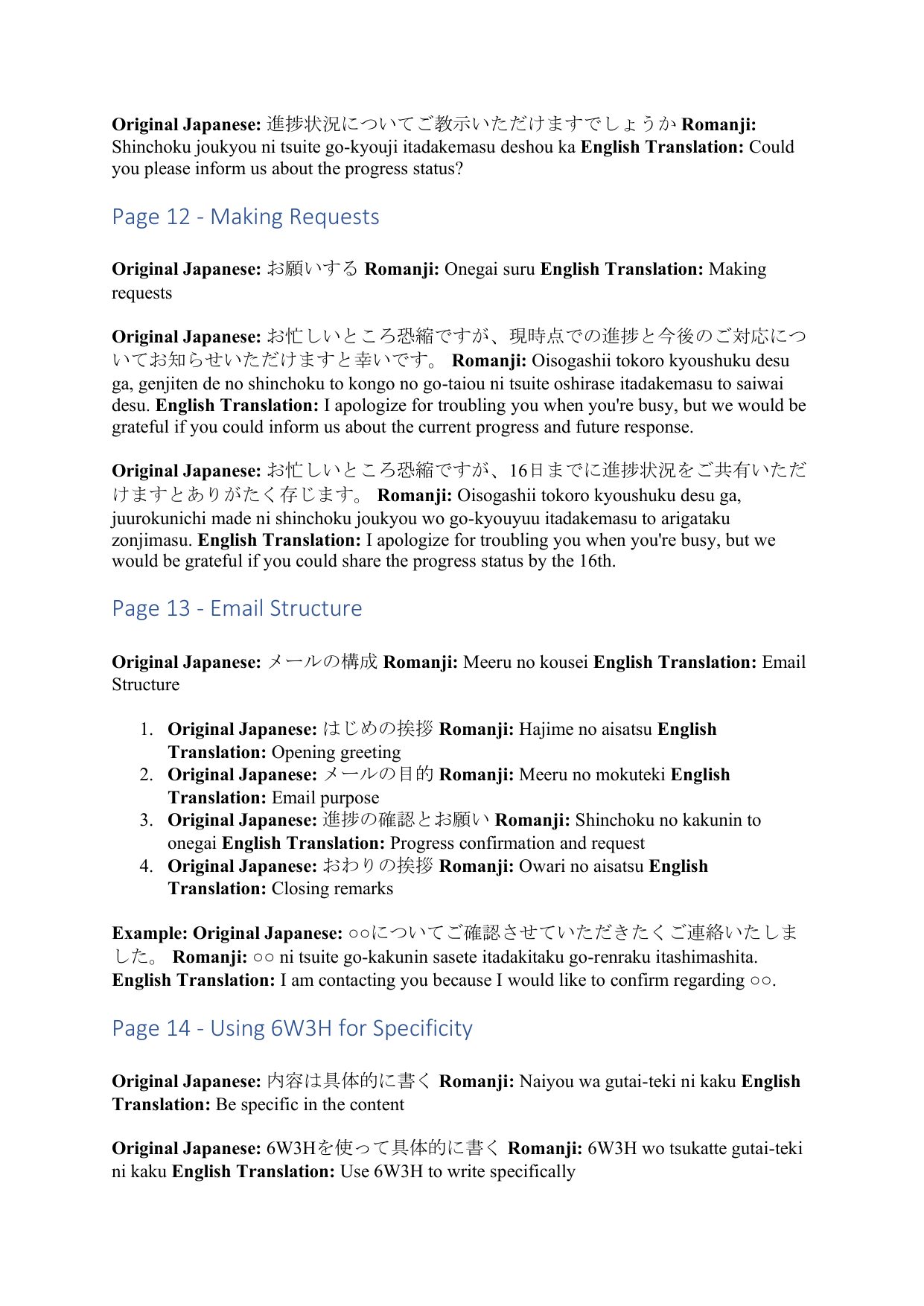
ENOriginal Japanese: 進捗状況についてご教示いただけますでしょうか Romanji:
Shinchoku joukyou ni tsuite go-kyouji itadakemasu deshou ka English Translation: Could
you please inform us about the progress status?
Page 12 - Making Requests
Original Japanese: お願いする Romanji: Onegai suru English Translation: Making
requests
Shinchoku joukyou ni tsuite go-kyouji itadakemasu deshou ka English Translation: Could
you please inform us about the progress status?
Page 12 - Making Requests
Original Japanese: お願いする Romanji: Onegai suru English Translation: Making
requests
JPOriginalJapanese:お忙しいところ恐縮ですが、現時点での進捗と今後のご対応につ
ENいてお知らせいただけますと幸いです。 Romanji: Oisogashii tokoro kyoushuku desu
ga, genjiten de no shinchoku to kongo no go-taiou ni tsuite oshirase itadakemasu to saiwai
desu. English Translation: I apologize for troubling you when you're busy, but we would be
grateful if you could inform us about the current progress and future response.
ga, genjiten de no shinchoku to kongo no go-taiou ni tsuite oshirase itadakemasu to saiwai
desu. English Translation: I apologize for troubling you when you're busy, but we would be
grateful if you could inform us about the current progress and future response.
JPOriginalJapanese:お忙しいところ恐縮ですが、16日までに進捗状況をご共有いただ
ENけますとありがたく存じます。 Romanji: Oisogashii tokoro kyoushuku desu ga,
juurokunichi made ni shinchoku joukyou wo go-kyouyuu itadakemasu to arigataku
zonjimasu. English Translation: I apologize for troubling you when you're busy, but we
would be grateful if you could share the progress status by the 16th.
Page 13 - Email Structure
Original Japanese: メールの構成 Romanji: Meeru no kousei English Translation: Email
Structure
1. Original Japanese: はじめの挨拶 Romanji: Hajime no aisatsu English
Translation: Opening greeting
2. Original Japanese: メールの目的 Romanji: Meeru no mokuteki English
Translation: Email purpose
3. Original Japanese: 進捗の確認とお願い Romanji: Shinchoku no kakunin to
onegai English Translation: Progress confirmation and request
4. Original Japanese: おわりの挨拶 Romanji: Owari no aisatsu English
Translation: Closing remarks
juurokunichi made ni shinchoku joukyou wo go-kyouyuu itadakemasu to arigataku
zonjimasu. English Translation: I apologize for troubling you when you're busy, but we
would be grateful if you could share the progress status by the 16th.
Page 13 - Email Structure
Original Japanese: メールの構成 Romanji: Meeru no kousei English Translation: Email
Structure
1. Original Japanese: はじめの挨拶 Romanji: Hajime no aisatsu English
Translation: Opening greeting
2. Original Japanese: メールの目的 Romanji: Meeru no mokuteki English
Translation: Email purpose
3. Original Japanese: 進捗の確認とお願い Romanji: Shinchoku no kakunin to
onegai English Translation: Progress confirmation and request
4. Original Japanese: おわりの挨拶 Romanji: Owari no aisatsu English
Translation: Closing remarks
JPExample:OriginalJapanese:○○についてご確認させていただきたくご連絡いたしま
ENした。 Romanji: ○○ ni tsuite go-kakunin sasete itadakitaku go-renraku itashimashita.
English Translation: I am contacting you because I would like to confirm regarding ○○.
Page 14 - Using 6W3H for Specificity
Original Japanese: 内容は具体的に書く Romanji: Naiyou wa gutai-teki ni kaku English
Translation: Be specific in the content
Original Japanese: 6W3Hを使って具体的に書く Romanji: 6W3H wo tsukatte gutai-teki
ni kaku English Translation: Use 6W3H to write specifically
English Translation: I am contacting you because I would like to confirm regarding ○○.
Page 14 - Using 6W3H for Specificity
Original Japanese: 内容は具体的に書く Romanji: Naiyou wa gutai-teki ni kaku English
Translation: Be specific in the content
Original Japanese: 6W3Hを使って具体的に書く Romanji: 6W3H wo tsukatte gutai-teki
ni kaku English Translation: Use 6W3H to write specifically
หน้า 5
คลิกเพื่อขยาย
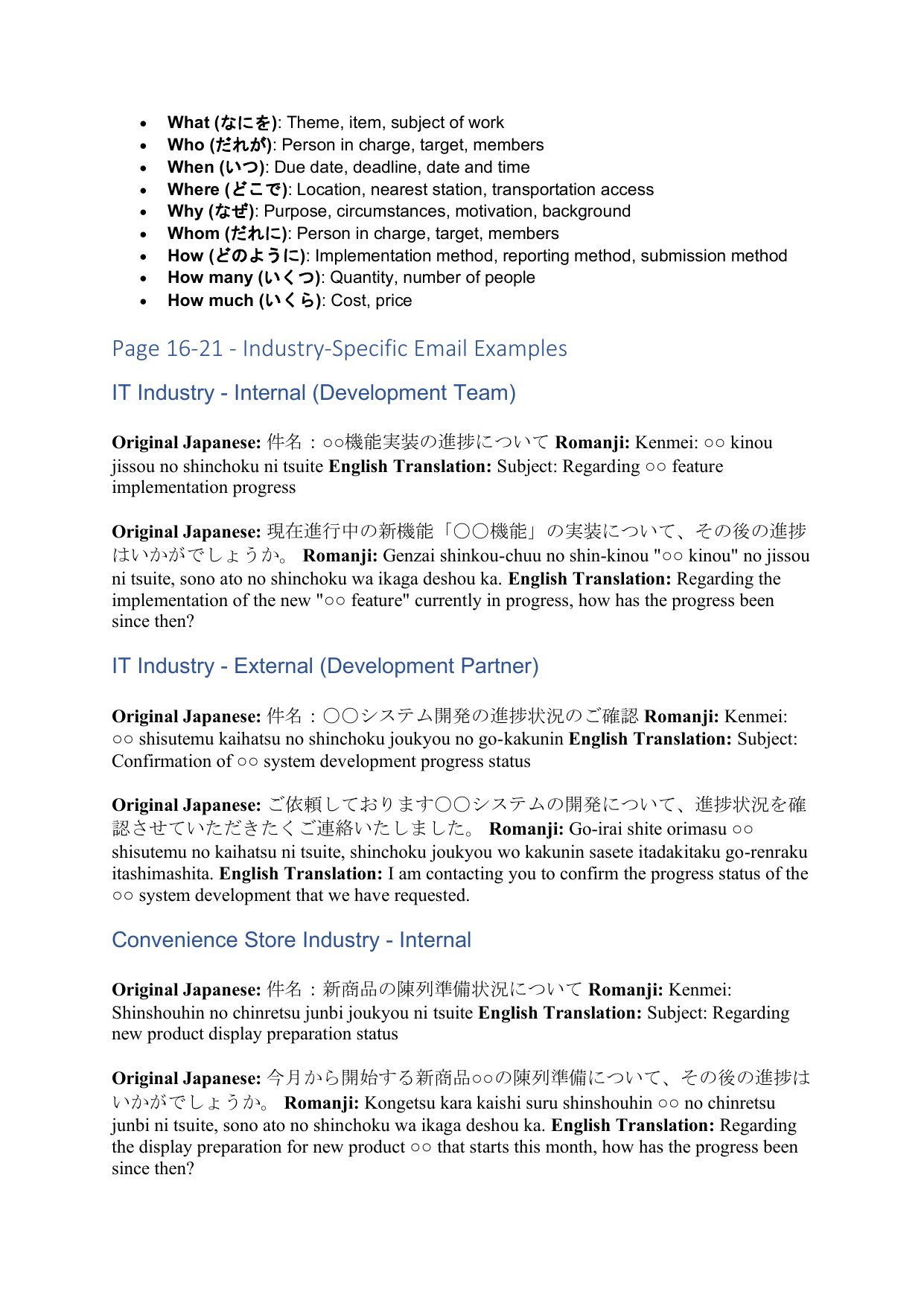
EN • What (なにを): Theme, item, subject of work
• Who (だれが): Person in charge, target, members
• When (いつ): Due date, deadline, date and time
• Where (どこで): Location, nearest station, transportation access
• Why (なぜ): Purpose, circumstances, motivation, background
• Whom (だれに): Person in charge, target, members
• How (どのように): Implementation method, reporting method, submission method
• How many (いくつ): Quantity, number of people
• How much (いくら): Cost, price
Page 16-21 - Industry-Specific Email Examples
IT Industry - Internal (Development Team)
Original Japanese: 件名:○○機能実装の進捗について Romanji: Kenmei: ○○ kinou
jissou no shinchoku ni tsuite English Translation: Subject: Regarding ○○ feature
implementation progress
• Who (だれが): Person in charge, target, members
• When (いつ): Due date, deadline, date and time
• Where (どこで): Location, nearest station, transportation access
• Why (なぜ): Purpose, circumstances, motivation, background
• Whom (だれに): Person in charge, target, members
• How (どのように): Implementation method, reporting method, submission method
• How many (いくつ): Quantity, number of people
• How much (いくら): Cost, price
Page 16-21 - Industry-Specific Email Examples
IT Industry - Internal (Development Team)
Original Japanese: 件名:○○機能実装の進捗について Romanji: Kenmei: ○○ kinou
jissou no shinchoku ni tsuite English Translation: Subject: Regarding ○○ feature
implementation progress
JPOriginalJapanese:現在進行中の新機能「〇〇機能」の実装について、その後の進捗
ENはいかがでしょうか。 Romanji: Genzai shinkou-chuu no shin-kinou "○○ kinou" no jissou
ni tsuite, sono ato no shinchoku wa ikaga deshou ka. English Translation: Regarding the
implementation of the new "○○ feature" currently in progress, how has the progress been
since then?
IT Industry - External (Development Partner)
Original Japanese: 件名:〇〇システム開発の進捗状況のご確認 Romanji: Kenmei:
○○ shisutemu kaihatsu no shinchoku joukyou no go-kakunin English Translation: Subject:
Confirmation of ○○ system development progress status
ni tsuite, sono ato no shinchoku wa ikaga deshou ka. English Translation: Regarding the
implementation of the new "○○ feature" currently in progress, how has the progress been
since then?
IT Industry - External (Development Partner)
Original Japanese: 件名:〇〇システム開発の進捗状況のご確認 Romanji: Kenmei:
○○ shisutemu kaihatsu no shinchoku joukyou no go-kakunin English Translation: Subject:
Confirmation of ○○ system development progress status
JPOriginalJapanese:ご依頼しております〇〇システムの開発について、進捗状況を確
EN認させていただきたくご連絡いたしました。 Romanji: Go-irai shite orimasu ○○
shisutemu no kaihatsu ni tsuite, shinchoku joukyou wo kakunin sasete itadakitaku go-renraku
itashimashita. English Translation: I am contacting you to confirm the progress status of the
○○ system development that we have requested.
Convenience Store Industry - Internal
Original Japanese: 件名:新商品の陳列準備状況について Romanji: Kenmei:
Shinshouhin no chinretsu junbi joukyou ni tsuite English Translation: Subject: Regarding
new product display preparation status
shisutemu no kaihatsu ni tsuite, shinchoku joukyou wo kakunin sasete itadakitaku go-renraku
itashimashita. English Translation: I am contacting you to confirm the progress status of the
○○ system development that we have requested.
Convenience Store Industry - Internal
Original Japanese: 件名:新商品の陳列準備状況について Romanji: Kenmei:
Shinshouhin no chinretsu junbi joukyou ni tsuite English Translation: Subject: Regarding
new product display preparation status
JPOriginalJapanese:今月から開始する新商品○○の陳列準備について、その後の進捗は
ENいかがでしょうか。 Romanji: Kongetsu kara kaishi suru shinshouhin ○○ no chinretsu
junbi ni tsuite, sono ato no shinchoku wa ikaga deshou ka. English Translation: Regarding
the display preparation for new product ○○ that starts this month, how has the progress been
since then?
junbi ni tsuite, sono ato no shinchoku wa ikaga deshou ka. English Translation: Regarding
the display preparation for new product ○○ that starts this month, how has the progress been
since then?
หน้า 6
คลิกเพื่อขยาย
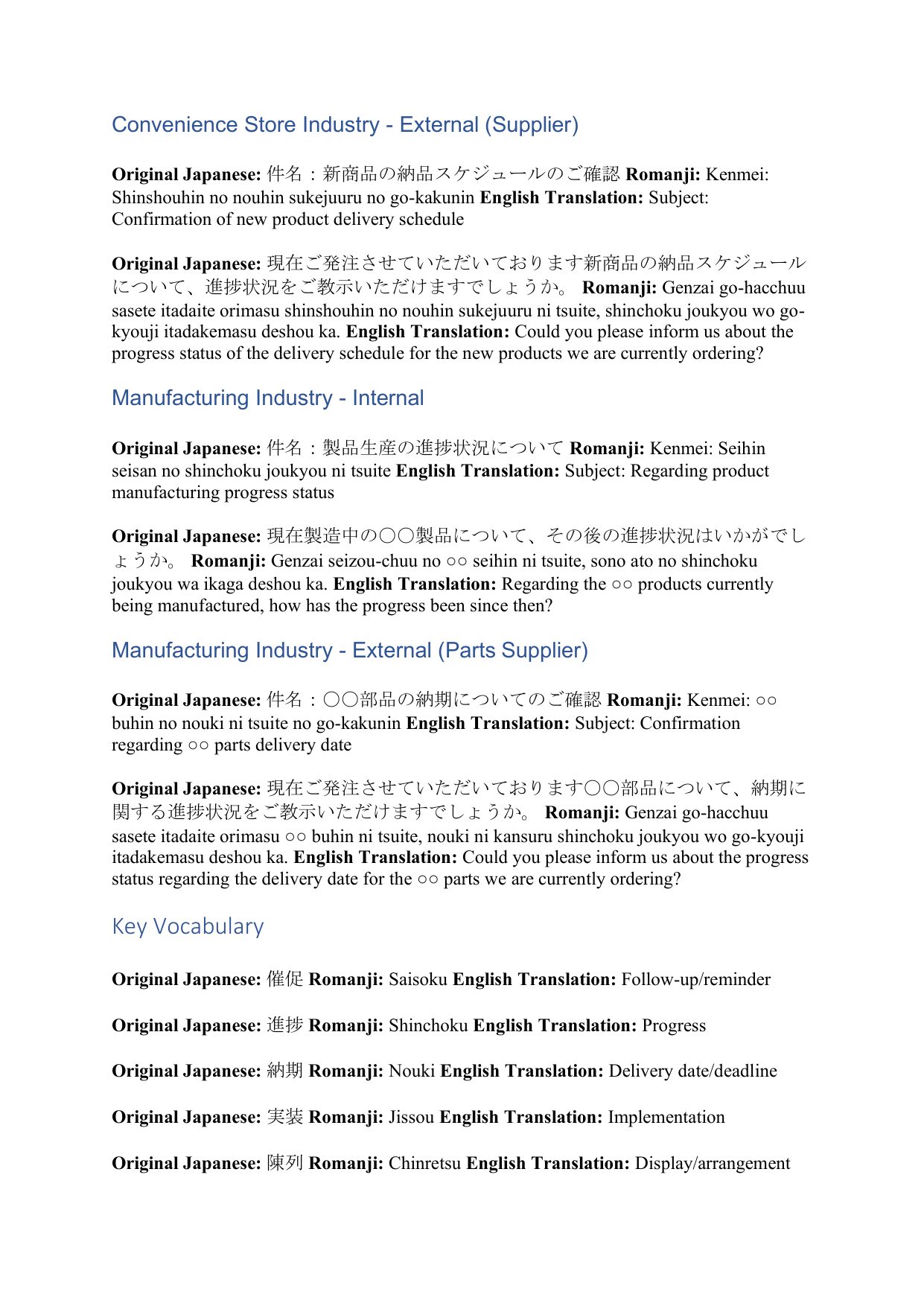
ENConvenience Store Industry - External (Supplier)
Original Japanese: 件名:新商品の納品スケジュールのご確認 Romanji: Kenmei:
Shinshouhin no nouhin sukejuuru no go-kakunin English Translation: Subject:
Confirmation of new product delivery schedule
Original Japanese: 件名:新商品の納品スケジュールのご確認 Romanji: Kenmei:
Shinshouhin no nouhin sukejuuru no go-kakunin English Translation: Subject:
Confirmation of new product delivery schedule
JPOriginalJapanese:現在ご発注させていただいております新商品の納品スケジュール
について、進捗状況をご教示いただけますでしょうか。Romanji:Genzaigo-hacchuu
について、進捗状況をご教示いただけますでしょうか。Romanji:Genzaigo-hacchuu
ENsasete itadaite orimasu shinshouhin no nouhin sukejuuru ni tsuite, shinchoku joukyou wo go-
kyouji itadakemasu deshou ka. English Translation: Could you please inform us about the
progress status of the delivery schedule for the new products we are currently ordering?
Manufacturing Industry - Internal
Original Japanese: 件名:製品生産の進捗状況について Romanji: Kenmei: Seihin
seisan no shinchoku joukyou ni tsuite English Translation: Subject: Regarding product
manufacturing progress status
kyouji itadakemasu deshou ka. English Translation: Could you please inform us about the
progress status of the delivery schedule for the new products we are currently ordering?
Manufacturing Industry - Internal
Original Japanese: 件名:製品生産の進捗状況について Romanji: Kenmei: Seihin
seisan no shinchoku joukyou ni tsuite English Translation: Subject: Regarding product
manufacturing progress status
JPOriginalJapanese:現在製造中の〇〇製品について、その後の進捗状況はいかがでし
ENょうか。 Romanji: Genzai seizou-chuu no ○○ seihin ni tsuite, sono ato no shinchoku
joukyou wa ikaga deshou ka. English Translation: Regarding the ○○ products currently
being manufactured, how has the progress been since then?
Manufacturing Industry - External (Parts Supplier)
Original Japanese: 件名:〇〇部品の納期についてのご確認 Romanji: Kenmei: ○○
buhin no nouki ni tsuite no go-kakunin English Translation: Subject: Confirmation
regarding ○○ parts delivery date
joukyou wa ikaga deshou ka. English Translation: Regarding the ○○ products currently
being manufactured, how has the progress been since then?
Manufacturing Industry - External (Parts Supplier)
Original Japanese: 件名:〇〇部品の納期についてのご確認 Romanji: Kenmei: ○○
buhin no nouki ni tsuite no go-kakunin English Translation: Subject: Confirmation
regarding ○○ parts delivery date
JPOriginalJapanese:現在ご発注させていただいております〇〇部品について、納期に
関する進捗状況をご教示いただけますでしょうか。Romanji:Genzaigo-hacchuu
関する進捗状況をご教示いただけますでしょうか。Romanji:Genzaigo-hacchuu
ENsasete itadaite orimasu ○○ buhin ni tsuite, nouki ni kansuru shinchoku joukyou wo go-kyouji
itadakemasu deshou ka. English Translation: Could you please inform us about the progress
status regarding the delivery date for the ○○ parts we are currently ordering?
Key Vocabulary
Original Japanese: 催促 Romanji: Saisoku English Translation: Follow-up/reminder
Original Japanese: 進捗 Romanji: Shinchoku English Translation: Progress
Original Japanese: 納期 Romanji: Nouki English Translation: Delivery date/deadline
Original Japanese: 実装 Romanji: Jissou English Translation: Implementation
Original Japanese: 陳列 Romanji: Chinretsu English Translation: Display/arrangement
itadakemasu deshou ka. English Translation: Could you please inform us about the progress
status regarding the delivery date for the ○○ parts we are currently ordering?
Key Vocabulary
Original Japanese: 催促 Romanji: Saisoku English Translation: Follow-up/reminder
Original Japanese: 進捗 Romanji: Shinchoku English Translation: Progress
Original Japanese: 納期 Romanji: Nouki English Translation: Delivery date/deadline
Original Japanese: 実装 Romanji: Jissou English Translation: Implementation
Original Japanese: 陳列 Romanji: Chinretsu English Translation: Display/arrangement
หน้า 7
คลิกเพื่อขยาย
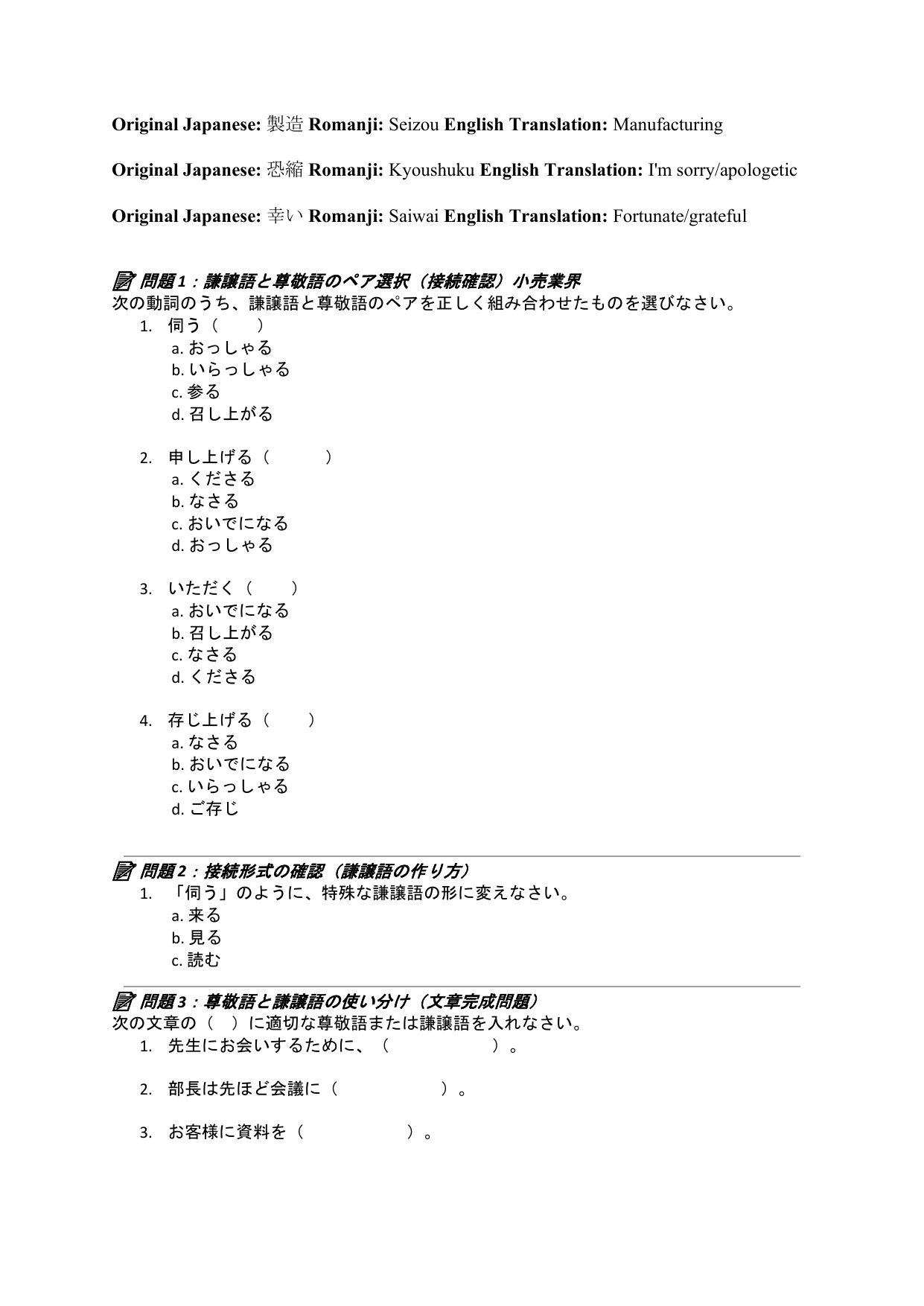
ENOriginal Japanese: 製造 Romanji: Seizou English Translation: Manufacturing
Original Japanese: 恐縮 Romanji: Kyoushuku English Translation: I'm sorry/apologetic
Original Japanese: 幸い Romanji: Saiwai English Translation: Fortunate/grateful
Original Japanese: 恐縮 Romanji: Kyoushuku English Translation: I'm sorry/apologetic
Original Japanese: 幸い Romanji: Saiwai English Translation: Fortunate/grateful
JP📝問題1:謙譲語と尊敬語のペア選択(接続確認)小売業界
次の動詞のうち、謙譲語と尊敬語のペアを正しく組み合わせたものを選びなさい。
1.伺う()
a.おっしゃる
b.いらっしゃる
c.参る
d.召し上がる
2.申し上げる()
a.くださる
b.なさる
c.おいでになる
d.おっしゃる
3.いただく()
a.おいでになる
b.召し上がる
c.なさる
d.くださる
4.存じ上げる()
a.なさる
b.おいでになる
c.いらっしゃる
d.ご存じ
📝問題2:接続形式の確認(謙譲語の作り方)
1.「伺う」のように、特殊な謙譲語の形に変えなさい。
a.来る
b.見る
c.読む
📝問題3:尊敬語と謙譲語の使い分け(文章完成問題)
次の文章の()に適切な尊敬語または謙譲語を入れなさい。
1.先生にお会いするために、()。
2.部長は先ほど会議に()。
3.お客様に資料を()。
次の動詞のうち、謙譲語と尊敬語のペアを正しく組み合わせたものを選びなさい。
1.伺う()
a.おっしゃる
b.いらっしゃる
c.参る
d.召し上がる
2.申し上げる()
a.くださる
b.なさる
c.おいでになる
d.おっしゃる
3.いただく()
a.おいでになる
b.召し上がる
c.なさる
d.くださる
4.存じ上げる()
a.なさる
b.おいでになる
c.いらっしゃる
d.ご存じ
📝問題2:接続形式の確認(謙譲語の作り方)
1.「伺う」のように、特殊な謙譲語の形に変えなさい。
a.来る
b.見る
c.読む
📝問題3:尊敬語と謙譲語の使い分け(文章完成問題)
次の文章の()に適切な尊敬語または謙譲語を入れなさい。
1.先生にお会いするために、()。
2.部長は先ほど会議に()。
3.お客様に資料を()。
หน้า 8
คลิกเพื่อขยาย
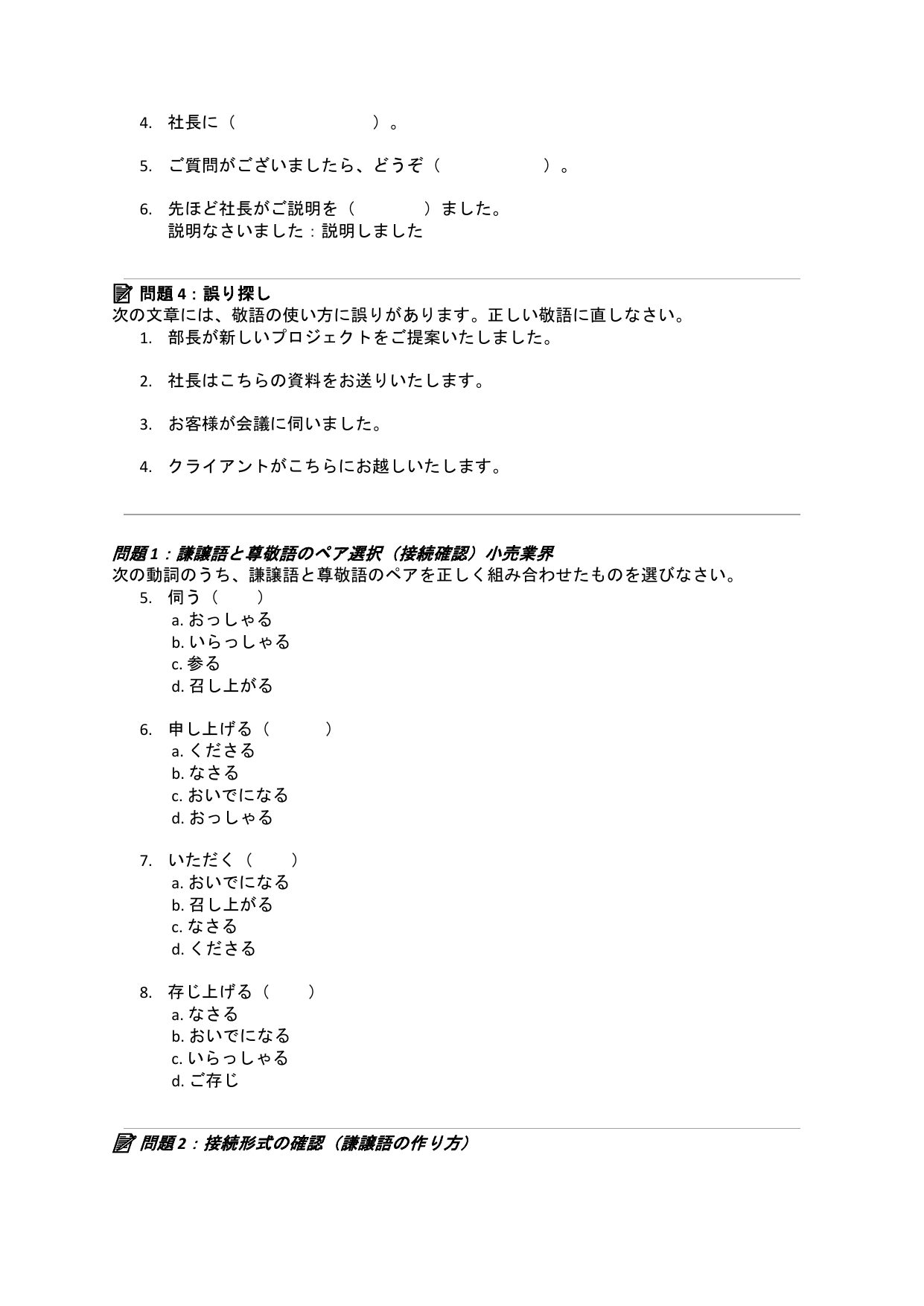
JP4.社長に()。
5.ご質問がございましたら、どうぞ()。
6.先ほど社長がご説明を()ました。
説明なさいました:説明しました
📝問題4:誤り探し
次の文章には、敬語の使い方に誤りがあります。正しい敬語に直しなさい。
1.部長が新しいプロジェクトをご提案いたしました。
2.社長はこちらの資料をお送りいたします。
3.お客様が会議に伺いました。
4.クライアントがこちらにお越しいたします。
問題1:謙譲語と尊敬語のペア選択(接続確認)小売業界
次の動詞のうち、謙譲語と尊敬語のペアを正しく組み合わせたものを選びなさい。
5.伺う()
a.おっしゃる
b.いらっしゃる
c.参る
d.召し上がる
6.申し上げる()
a.くださる
b.なさる
c.おいでになる
d.おっしゃる
7.いただく()
a.おいでになる
b.召し上がる
c.なさる
d.くださる
8.存じ上げる()
a.なさる
b.おいでになる
c.いらっしゃる
d.ご存じ
📝問題2:接続形式の確認(謙譲語の作り方)
5.ご質問がございましたら、どうぞ()。
6.先ほど社長がご説明を()ました。
説明なさいました:説明しました
📝問題4:誤り探し
次の文章には、敬語の使い方に誤りがあります。正しい敬語に直しなさい。
1.部長が新しいプロジェクトをご提案いたしました。
2.社長はこちらの資料をお送りいたします。
3.お客様が会議に伺いました。
4.クライアントがこちらにお越しいたします。
問題1:謙譲語と尊敬語のペア選択(接続確認)小売業界
次の動詞のうち、謙譲語と尊敬語のペアを正しく組み合わせたものを選びなさい。
5.伺う()
a.おっしゃる
b.いらっしゃる
c.参る
d.召し上がる
6.申し上げる()
a.くださる
b.なさる
c.おいでになる
d.おっしゃる
7.いただく()
a.おいでになる
b.召し上がる
c.なさる
d.くださる
8.存じ上げる()
a.なさる
b.おいでになる
c.いらっしゃる
d.ご存じ
📝問題2:接続形式の確認(謙譲語の作り方)
หน้า 9
คลิกเพื่อขยาย
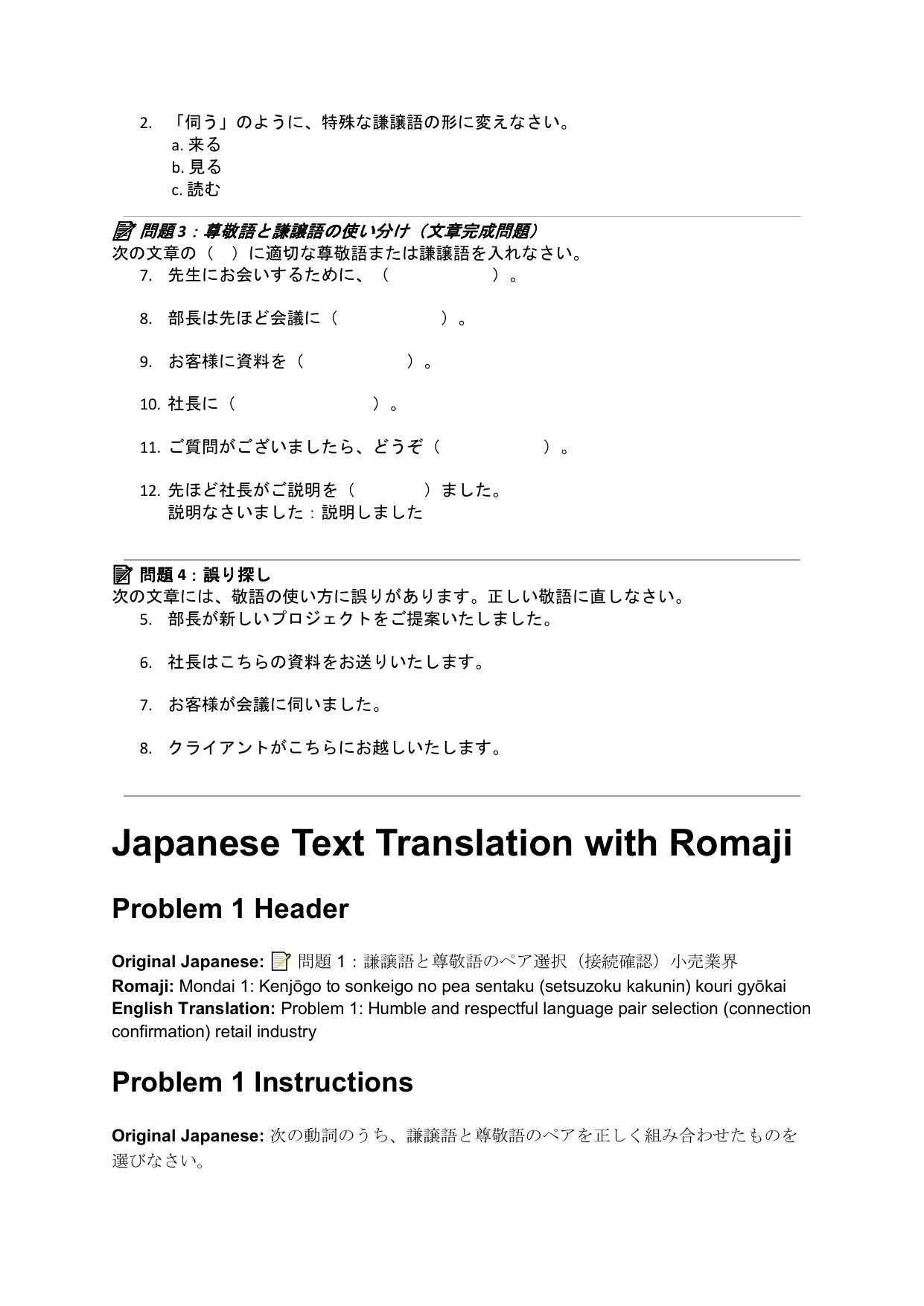
JP2.「伺う」のように、特殊な謙譲語の形に変えなさい。
a.来る
b.見る
c.読む
📝問題3:尊敬語と謙譲語の使い分け(文章完成問題)
次の文章の()に適切な尊敬語または謙譲語を入れなさい。
7.先生にお会いするために、()。
8.部長は先ほど会議に()。
9.お客様に資料を()。
10.社長に()。
11.ご質問がございましたら、どうぞ()。
12.先ほど社長がご説明を()ました。
説明なさいました:説明しました
📝問題4:誤り探し
次の文章には、敬語の使い方に誤りがあります。正しい敬語に直しなさい。
5.部長が新しいプロジェクトをご提案いたしました。
6.社長はこちらの資料をお送りいたします。
7.お客様が会議に伺いました。
8.クライアントがこちらにお越しいたします。
a.来る
b.見る
c.読む
📝問題3:尊敬語と謙譲語の使い分け(文章完成問題)
次の文章の()に適切な尊敬語または謙譲語を入れなさい。
7.先生にお会いするために、()。
8.部長は先ほど会議に()。
9.お客様に資料を()。
10.社長に()。
11.ご質問がございましたら、どうぞ()。
12.先ほど社長がご説明を()ました。
説明なさいました:説明しました
📝問題4:誤り探し
次の文章には、敬語の使い方に誤りがあります。正しい敬語に直しなさい。
5.部長が新しいプロジェクトをご提案いたしました。
6.社長はこちらの資料をお送りいたします。
7.お客様が会議に伺いました。
8.クライアントがこちらにお越しいたします。
ENJapanese Text Translation with Romaji
Problem 1 Header
Problem 1 Header
JPOriginalJapanese:問題1:謙譲語と尊敬語のペア選択(接続確認)小売業界
ENRomaji: Mondai 1: Kenjōgo to sonkeigo no pea sentaku (setsuzoku kakunin) kouri gyōkai
English Translation: Problem 1: Humble and respectful language pair selection (connection
confirmation) retail industry
Problem 1 Instructions
English Translation: Problem 1: Humble and respectful language pair selection (connection
confirmation) retail industry
Problem 1 Instructions
JPOriginalJapanese:次の動詞のうち、謙譲語と尊敬語のペアを正しく組み合わせたものを
選びなさい。
選びなさい。
หน้า 10
คลิกเพื่อขยาย
ENRomaji: Tsugi no dōshi no uchi, kenjōgo to sonkeigo no pea wo tadashiku kumiawaseta
mono wo erabinasai.
English Translation: Among the following verbs, select the one that correctly combines
humble and respectful language pairs.
Problem 1 Questions and Answers
Question 1a
Original Japanese: 伺う( )
Romaji: Ukagau ( )
English Translation: To visit/ask humbly ( )
Answer choices:
• Original Japanese: a. おっしゃる b. いらっしゃる c. 参る d. 召し上がる
• Romaji: a. ossharu b. irassharu c. mairu d. meshiagaru
• English Translation: a. to say (respectful) b. to be/come (respectful) c. to go/come
(humble) d. to eat/drink (respectful)
Question 1b
Original Japanese: 申し上げる( )
Romaji: Mōshiageru ( )
English Translation: To say/tell humbly ( )
Answer choices:
• Original Japanese: a. くださる b. なさる c. おいでになる d. おっしゃる
• Romaji: a. kudasaru b. nasaru c. oide ni naru d. ossharu
• English Translation: a. to give (respectful) b. to do (respectful) c. to come
(respectful) d. to say (respectful)
Question 1c
Original Japanese: いただく( )
Romaji: Itadaku ( )
English Translation: To receive humbly ( )
Answer choices:
• Original Japanese: a. おいでになる b. 召し上がる c. なさる d. くださる
• Romaji: a. oide ni naru b. meshiagaru c. nasaru d. kudasaru
• English Translation: a. to come (respectful) b. to eat/drink (respectful) c. to do
(respectful) d. to give (respectful)
Question 1d
mono wo erabinasai.
English Translation: Among the following verbs, select the one that correctly combines
humble and respectful language pairs.
Problem 1 Questions and Answers
Question 1a
Original Japanese: 伺う( )
Romaji: Ukagau ( )
English Translation: To visit/ask humbly ( )
Answer choices:
• Original Japanese: a. おっしゃる b. いらっしゃる c. 参る d. 召し上がる
• Romaji: a. ossharu b. irassharu c. mairu d. meshiagaru
• English Translation: a. to say (respectful) b. to be/come (respectful) c. to go/come
(humble) d. to eat/drink (respectful)
Question 1b
Original Japanese: 申し上げる( )
Romaji: Mōshiageru ( )
English Translation: To say/tell humbly ( )
Answer choices:
• Original Japanese: a. くださる b. なさる c. おいでになる d. おっしゃる
• Romaji: a. kudasaru b. nasaru c. oide ni naru d. ossharu
• English Translation: a. to give (respectful) b. to do (respectful) c. to come
(respectful) d. to say (respectful)
Question 1c
Original Japanese: いただく( )
Romaji: Itadaku ( )
English Translation: To receive humbly ( )
Answer choices:
• Original Japanese: a. おいでになる b. 召し上がる c. なさる d. くださる
• Romaji: a. oide ni naru b. meshiagaru c. nasaru d. kudasaru
• English Translation: a. to come (respectful) b. to eat/drink (respectful) c. to do
(respectful) d. to give (respectful)
Question 1d
หน้า 11
คลิกเพื่อขยาย
ENOriginal Japanese: 存じ上げる( )
Romaji: Zonjiageru ( )
English Translation: To know (about a person) humbly ( )
Answer choices:
• Original Japanese: a. なさる b. おいでになる c. いらっしゃる d. ご存じ
• Romaji: a. nasaru b. oide ni naru c. irassharu d. go-zonji
• English Translation: a. to do (respectful) b. to come (respectful) c. to be (respectful)
d. to know (respectful)
Problem 2 Header
Romaji: Zonjiageru ( )
English Translation: To know (about a person) humbly ( )
Answer choices:
• Original Japanese: a. なさる b. おいでになる c. いらっしゃる d. ご存じ
• Romaji: a. nasaru b. oide ni naru c. irassharu d. go-zonji
• English Translation: a. to do (respectful) b. to come (respectful) c. to be (respectful)
d. to know (respectful)
Problem 2 Header
JPOriginalJapanese:問題2:接続形式の確認(謙譲語の作り方)
ENRomaji: Mondai 2: Setsuzoku keishiki no kakunin (kenjōgo no tsukurikata)
English Translation: Problem 2: Confirmation of connection format (how to make humble
language)
Problem 2 Instructions
English Translation: Problem 2: Confirmation of connection format (how to make humble
language)
Problem 2 Instructions
JPOriginalJapanese:「伺う」のように、特殊な謙譲語の形に変えなさい。
ENRomaji: "Ukagau" no yō ni, tokushu na kenjōgo no katachi ni kaenasai.
English Translation: Change to special humble language forms like "ukagau" (to visit/ask
humbly).
Answer choices:
• Original Japanese: a. 来る b. 見る c. 読む
• Romaji: a. kuru b. miru c. yomu
• English Translation: a. to come b. to see c. to read
Problem 3 Header
English Translation: Change to special humble language forms like "ukagau" (to visit/ask
humbly).
Answer choices:
• Original Japanese: a. 来る b. 見る c. 読む
• Romaji: a. kuru b. miru c. yomu
• English Translation: a. to come b. to see c. to read
Problem 3 Header
JPOriginalJapanese:問題3:尊敬語と謙譲語の使い分け(文章完成問題)
ENRomaji: Mondai 3: Sonkeigo to kenjōgo no tsukaiwake (bunshō kansei mondai)
English Translation: Problem 3: Proper use of respectful and humble language (sentence
completion problem)
Problem 3 Instructions
English Translation: Problem 3: Proper use of respectful and humble language (sentence
completion problem)
Problem 3 Instructions
JPOriginalJapanese:次の文章の()に適切な尊敬語または謙譲語を入れなさい。
ENRomaji: Tsugi no bunshō no ( ) ni tekisetsu na sonkeigo mata wa kenjōgo wo irenasai.
English Translation: Fill in the blanks ( ) in the following sentences with appropriate
respectful or humble language.
English Translation: Fill in the blanks ( ) in the following sentences with appropriate
respectful or humble language.
หน้า 12
คลิกเพื่อขยาย
ENProblem 3 Questions
Question 3-1
Original Japanese: 先生にお会いするために、( )。
Romaji: Sensei ni oai suru tame ni, ( ).
English Translation: In order to meet the teacher, ( ).
Question 3-2
Original Japanese: 部長は先ほど会議に( )。
Romaji: Buchō wa saki hodo kaigi ni ( ).
English Translation: The department manager ( ) to the meeting a while ago.
Question 3-3
Original Japanese: お客様に資料を( )。
Romaji: Okyaku-sama ni shiryō wo ( ).
English Translation: ( ) materials to the customer.
Question 3-4
Original Japanese: 社長に( )。
Romaji: Shachō ni ( ).
English Translation: To the company president ( ).
Question 3-5
Original Japanese: ご質問がございましたら、どうぞ( )。
Romaji: Go-shitsumon ga gozaimashitara, dōzo ( ).
English Translation: If you have any questions, please ( ).
Question 3-6
Original Japanese: 先ほど社長がご説明を( )ました。
Romaji: Saki hodo shachō ga go-setsumei wo ( ) mashita.
English Translation: The president ( ) an explanation a while ago.
Correct Answers and Explanations
Problem 1 Correct Answers:
Question 3-1
Original Japanese: 先生にお会いするために、( )。
Romaji: Sensei ni oai suru tame ni, ( ).
English Translation: In order to meet the teacher, ( ).
Question 3-2
Original Japanese: 部長は先ほど会議に( )。
Romaji: Buchō wa saki hodo kaigi ni ( ).
English Translation: The department manager ( ) to the meeting a while ago.
Question 3-3
Original Japanese: お客様に資料を( )。
Romaji: Okyaku-sama ni shiryō wo ( ).
English Translation: ( ) materials to the customer.
Question 3-4
Original Japanese: 社長に( )。
Romaji: Shachō ni ( ).
English Translation: To the company president ( ).
Question 3-5
Original Japanese: ご質問がございましたら、どうぞ( )。
Romaji: Go-shitsumon ga gozaimashitara, dōzo ( ).
English Translation: If you have any questions, please ( ).
Question 3-6
Original Japanese: 先ほど社長がご説明を( )ました。
Romaji: Saki hodo shachō ga go-setsumei wo ( ) mashita.
English Translation: The president ( ) an explanation a while ago.
Correct Answers and Explanations
Problem 1 Correct Answers:
หน้า 13
คลิกเพื่อขยาย
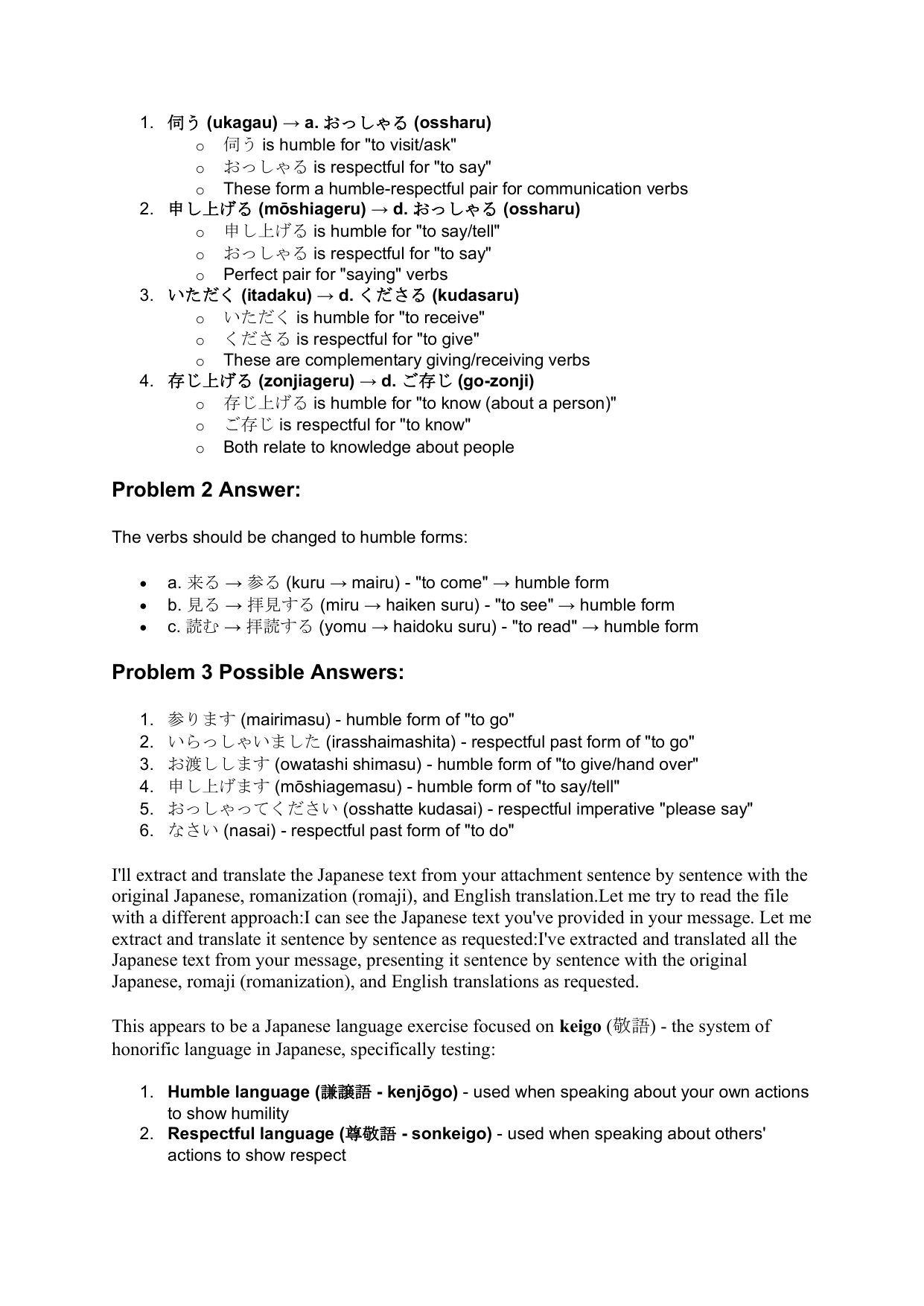
EN 1. 伺う (ukagau) → a. おっしゃる (ossharu)
o 伺う is humble for "to visit/ask"
o おっしゃる is respectful for "to say"
o These form a humble-respectful pair for communication verbs
2. 申し上げる (mōshiageru) → d. おっしゃる (ossharu)
o 申し上げる is humble for "to say/tell"
o おっしゃる is respectful for "to say"
o Perfect pair for "saying" verbs
3. いただく (itadaku) → d. くださる (kudasaru)
o いただく is humble for "to receive"
o くださる is respectful for "to give"
o These are complementary giving/receiving verbs
4. 存じ上げる (zonjiageru) → d. ご存じ (go-zonji)
o 存じ上げる is humble for "to know (about a person)"
o ご存じ is respectful for "to know"
o Both relate to knowledge about people
Problem 2 Answer:
The verbs should be changed to humble forms:
• a. 来る → 参る (kuru → mairu) - "to come" → humble form
• b. 見る → 拝見する (miru → haiken suru) - "to see" → humble form
• c. 読む → 拝読する (yomu → haidoku suru) - "to read" → humble form
Problem 3 Possible Answers:
1. 参ります (mairimasu) - humble form of "to go"
2. いらっしゃいました (irasshaimashita) - respectful past form of "to go"
3. お渡しします (owatashi shimasu) - humble form of "to give/hand over"
4. 申し上げます (mōshiagemasu) - humble form of "to say/tell"
5. おっしゃってください (osshatte kudasai) - respectful imperative "please say"
6. なさい (nasai) - respectful past form of "to do"
I'll extract and translate the Japanese text from your attachment sentence by sentence with the
original Japanese, romanization (romaji), and English translation.Let me try to read the file
with a different approach:I can see the Japanese text you've provided in your message. Let me
extract and translate it sentence by sentence as requested:I've extracted and translated all the
Japanese text from your message, presenting it sentence by sentence with the original
Japanese, romaji (romanization), and English translations as requested.
This appears to be a Japanese language exercise focused on keigo (敬語) - the system of
honorific language in Japanese, specifically testing:
1. Humble language (謙譲語 - kenjōgo) - used when speaking about your own actions
to show humility
2. Respectful language (尊敬語 - sonkeigo) - used when speaking about others'
actions to show respect
o 伺う is humble for "to visit/ask"
o おっしゃる is respectful for "to say"
o These form a humble-respectful pair for communication verbs
2. 申し上げる (mōshiageru) → d. おっしゃる (ossharu)
o 申し上げる is humble for "to say/tell"
o おっしゃる is respectful for "to say"
o Perfect pair for "saying" verbs
3. いただく (itadaku) → d. くださる (kudasaru)
o いただく is humble for "to receive"
o くださる is respectful for "to give"
o These are complementary giving/receiving verbs
4. 存じ上げる (zonjiageru) → d. ご存じ (go-zonji)
o 存じ上げる is humble for "to know (about a person)"
o ご存じ is respectful for "to know"
o Both relate to knowledge about people
Problem 2 Answer:
The verbs should be changed to humble forms:
• a. 来る → 参る (kuru → mairu) - "to come" → humble form
• b. 見る → 拝見する (miru → haiken suru) - "to see" → humble form
• c. 読む → 拝読する (yomu → haidoku suru) - "to read" → humble form
Problem 3 Possible Answers:
1. 参ります (mairimasu) - humble form of "to go"
2. いらっしゃいました (irasshaimashita) - respectful past form of "to go"
3. お渡しします (owatashi shimasu) - humble form of "to give/hand over"
4. 申し上げます (mōshiagemasu) - humble form of "to say/tell"
5. おっしゃってください (osshatte kudasai) - respectful imperative "please say"
6. なさい (nasai) - respectful past form of "to do"
I'll extract and translate the Japanese text from your attachment sentence by sentence with the
original Japanese, romanization (romaji), and English translation.Let me try to read the file
with a different approach:I can see the Japanese text you've provided in your message. Let me
extract and translate it sentence by sentence as requested:I've extracted and translated all the
Japanese text from your message, presenting it sentence by sentence with the original
Japanese, romaji (romanization), and English translations as requested.
This appears to be a Japanese language exercise focused on keigo (敬語) - the system of
honorific language in Japanese, specifically testing:
1. Humble language (謙譲語 - kenjōgo) - used when speaking about your own actions
to show humility
2. Respectful language (尊敬語 - sonkeigo) - used when speaking about others'
actions to show respect
หน้า 14
คลิกเพื่อขยาย
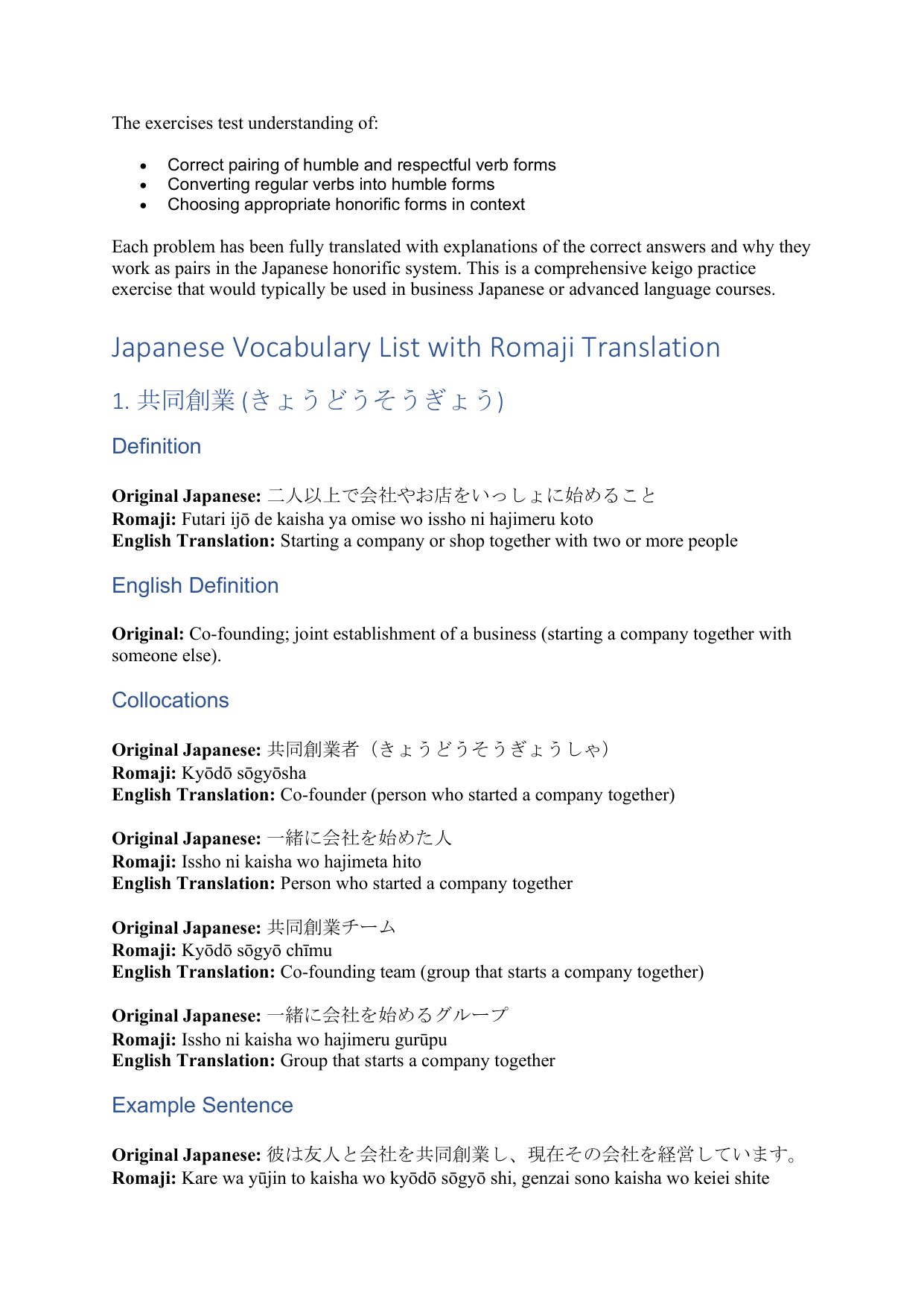
ENThe exercises test understanding of:
• Correct pairing of humble and respectful verb forms
• Converting regular verbs into humble forms
• Choosing appropriate honorific forms in context
Each problem has been fully translated with explanations of the correct answers and why they
work as pairs in the Japanese honorific system. This is a comprehensive keigo practice
exercise that would typically be used in business Japanese or advanced language courses.
Japanese Vocabulary List with Romaji Translation
• Correct pairing of humble and respectful verb forms
• Converting regular verbs into humble forms
• Choosing appropriate honorific forms in context
Each problem has been fully translated with explanations of the correct answers and why they
work as pairs in the Japanese honorific system. This is a comprehensive keigo practice
exercise that would typically be used in business Japanese or advanced language courses.
Japanese Vocabulary List with Romaji Translation
JP1.共同創業(きょうどうそうぎょう)
ENDefinition
JPOriginalJapanese:二人以上で会社やお店をいっしょに始めること
ENRomaji: Futari ijō de kaisha ya omise wo issho ni hajimeru koto
English Translation: Starting a company or shop together with two or more people
English Definition
Original: Co-founding; joint establishment of a business (starting a company together with
someone else).
Collocations
English Translation: Starting a company or shop together with two or more people
English Definition
Original: Co-founding; joint establishment of a business (starting a company together with
someone else).
Collocations
JPOriginalJapanese:共同創業者(きょうどうそうぎょうしゃ)
ENRomaji: Kyōdō sōgyōsha
English Translation: Co-founder (person who started a company together)
Original Japanese: 一緒に会社を始めた人
Romaji: Issho ni kaisha wo hajimeta hito
English Translation: Person who started a company together
Original Japanese: 共同創業チーム
Romaji: Kyōdō sōgyō chīmu
English Translation: Co-founding team (group that starts a company together)
Original Japanese: 一緒に会社を始めるグループ
Romaji: Issho ni kaisha wo hajimeru gurūpu
English Translation: Group that starts a company together
Example Sentence
English Translation: Co-founder (person who started a company together)
Original Japanese: 一緒に会社を始めた人
Romaji: Issho ni kaisha wo hajimeta hito
English Translation: Person who started a company together
Original Japanese: 共同創業チーム
Romaji: Kyōdō sōgyō chīmu
English Translation: Co-founding team (group that starts a company together)
Original Japanese: 一緒に会社を始めるグループ
Romaji: Issho ni kaisha wo hajimeru gurūpu
English Translation: Group that starts a company together
Example Sentence
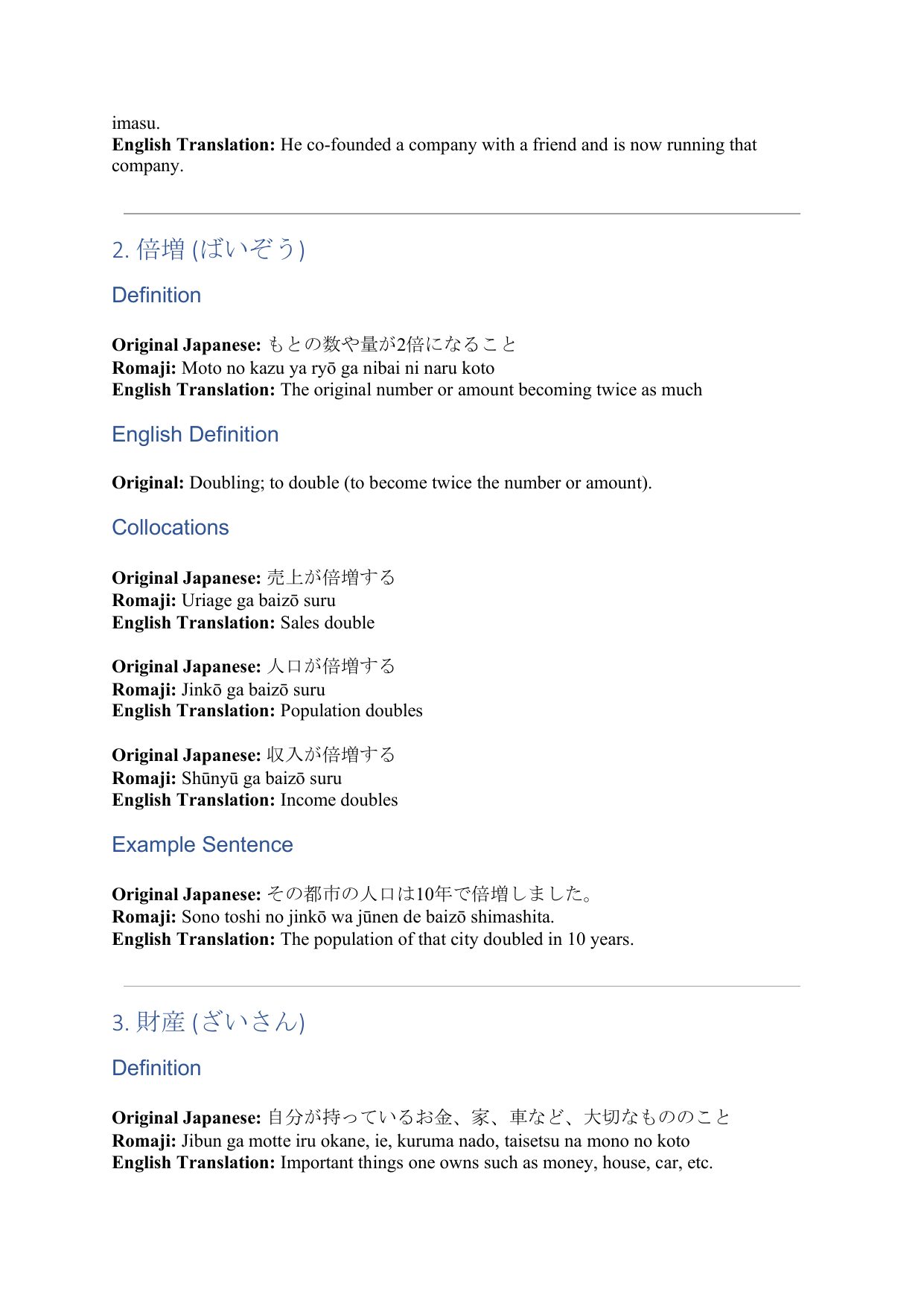
JPOriginalJapanese:彼は友人と会社を共同創業し、現在その会社を経営しています。
ENRomaji: Kare wa yūjin to kaisha wo kyōdō sōgyō shi, genzai sono kaisha wo keiei shite
หน้า 15
คลิกเพื่อขยาย
ENimasu.
English Translation: He co-founded a company with a friend and is now running that
company.
English Translation: He co-founded a company with a friend and is now running that
company.
JP2.倍増(ばいぞう)
ENDefinition
Original Japanese: もとの数や量が2倍になること
Romaji: Moto no kazu ya ryō ga nibai ni naru koto
English Translation: The original number or amount becoming twice as much
English Definition
Original: Doubling; to double (to become twice the number or amount).
Collocations
Original Japanese: 売上が倍増する
Romaji: Uriage ga baizō suru
English Translation: Sales double
Original Japanese: 人口が倍増する
Romaji: Jinkō ga baizō suru
English Translation: Population doubles
Original Japanese: 収入が倍増する
Romaji: Shūnyū ga baizō suru
English Translation: Income doubles
Example Sentence
Original Japanese: もとの数や量が2倍になること
Romaji: Moto no kazu ya ryō ga nibai ni naru koto
English Translation: The original number or amount becoming twice as much
English Definition
Original: Doubling; to double (to become twice the number or amount).
Collocations
Original Japanese: 売上が倍増する
Romaji: Uriage ga baizō suru
English Translation: Sales double
Original Japanese: 人口が倍増する
Romaji: Jinkō ga baizō suru
English Translation: Population doubles
Original Japanese: 収入が倍増する
Romaji: Shūnyū ga baizō suru
English Translation: Income doubles
Example Sentence
JPOriginalJapanese:その都市の人口は10年で倍増しました。
ENRomaji: Sono toshi no jinkō wa jūnen de baizō shimashita.
English Translation: The population of that city doubled in 10 years.
English Translation: The population of that city doubled in 10 years.
JP3.財産(ざいさん)
ENDefinition
JPOriginalJapanese:自分が持っているお金、家、車など、大切なもののこと
ENRomaji: Jibun ga motte iru okane, ie, kuruma nado, taisetsu na mono no koto
English Translation: Important things one owns such as money, house, car, etc.
English Translation: Important things one owns such as money, house, car, etc.
หน้า 16
คลิกเพื่อขยาย
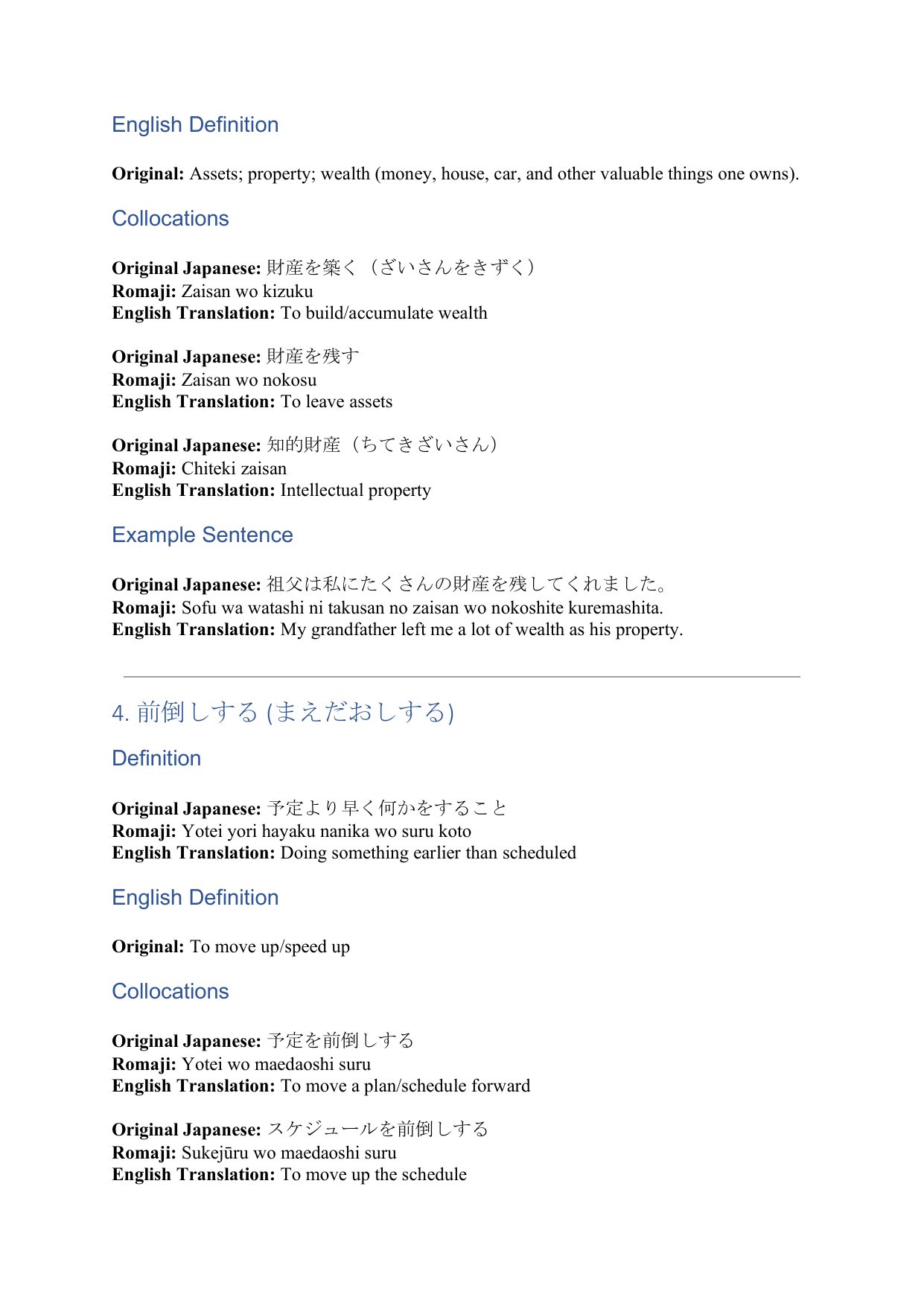
ENEnglish Definition
Original: Assets; property; wealth (money, house, car, and other valuable things one owns).
Collocations
Original Japanese: 財産を築く(ざいさんをきずく)
Romaji: Zaisan wo kizuku
English Translation: To build/accumulate wealth
Original Japanese: 財産を残す
Romaji: Zaisan wo nokosu
English Translation: To leave assets
Original Japanese: 知的財産(ちてきざいさん)
Romaji: Chiteki zaisan
English Translation: Intellectual property
Example Sentence
Original: Assets; property; wealth (money, house, car, and other valuable things one owns).
Collocations
Original Japanese: 財産を築く(ざいさんをきずく)
Romaji: Zaisan wo kizuku
English Translation: To build/accumulate wealth
Original Japanese: 財産を残す
Romaji: Zaisan wo nokosu
English Translation: To leave assets
Original Japanese: 知的財産(ちてきざいさん)
Romaji: Chiteki zaisan
English Translation: Intellectual property
Example Sentence
JPOriginalJapanese:祖父は私にたくさんの財産を残してくれました。
ENRomaji: Sofu wa watashi ni takusan no zaisan wo nokoshite kuremashita.
English Translation: My grandfather left me a lot of wealth as his property.
English Translation: My grandfather left me a lot of wealth as his property.
JP4.前倒しする(まえだおしする)
ENDefinition
Original Japanese: 予定より早く何かをすること
Romaji: Yotei yori hayaku nanika wo suru koto
English Translation: Doing something earlier than scheduled
English Definition
Original: To move up/speed up
Collocations
Original Japanese: 予定を前倒しする
Romaji: Yotei wo maedaoshi suru
English Translation: To move a plan/schedule forward
Original Japanese: スケジュールを前倒しする
Romaji: Sukejūru wo maedaoshi suru
English Translation: To move up the schedule
Original Japanese: 予定より早く何かをすること
Romaji: Yotei yori hayaku nanika wo suru koto
English Translation: Doing something earlier than scheduled
English Definition
Original: To move up/speed up
Collocations
Original Japanese: 予定を前倒しする
Romaji: Yotei wo maedaoshi suru
English Translation: To move a plan/schedule forward
Original Japanese: スケジュールを前倒しする
Romaji: Sukejūru wo maedaoshi suru
English Translation: To move up the schedule
หน้า 17
คลิกเพื่อขยาย
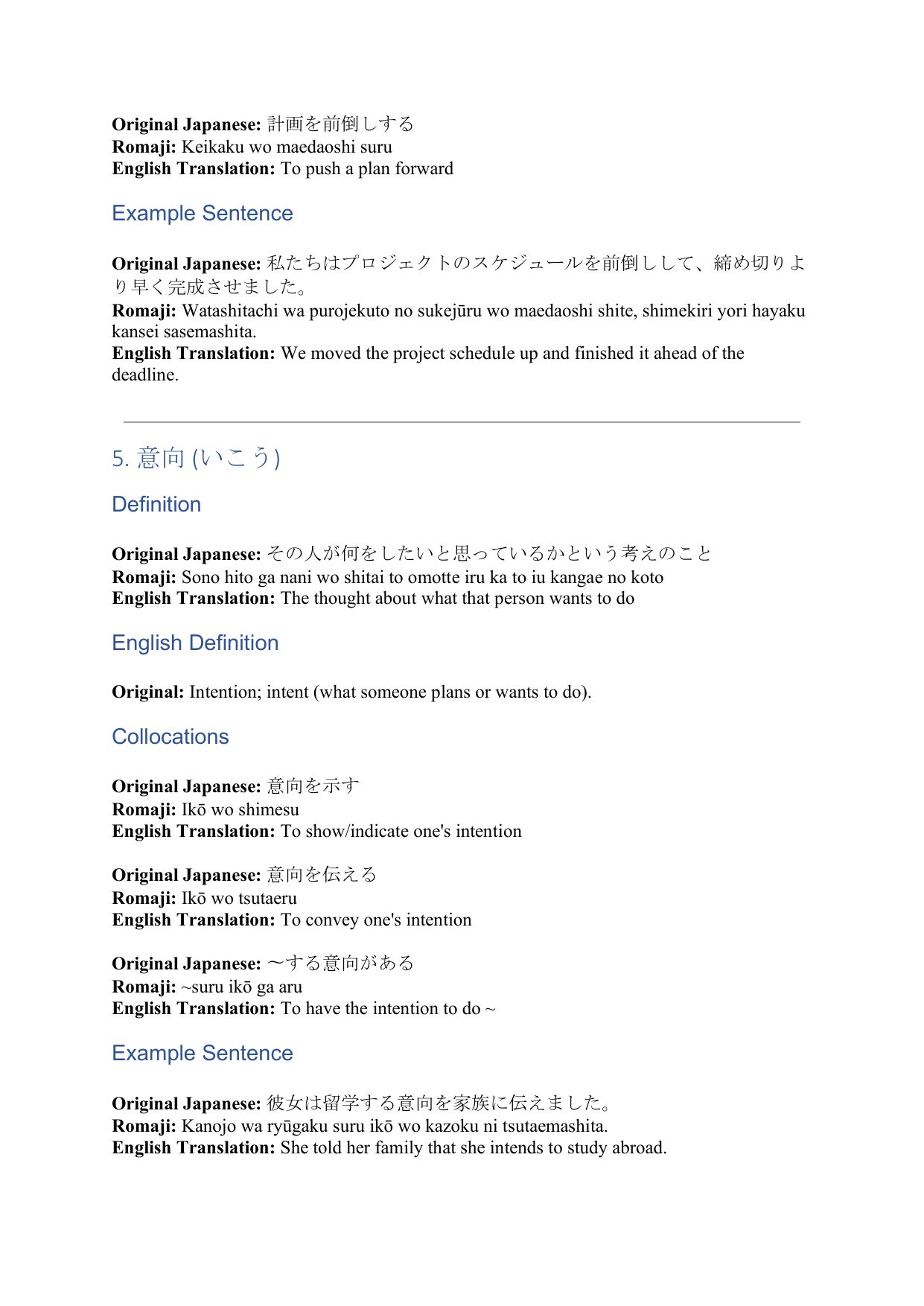
ENOriginal Japanese: 計画を前倒しする
Romaji: Keikaku wo maedaoshi suru
English Translation: To push a plan forward
Example Sentence
Romaji: Keikaku wo maedaoshi suru
English Translation: To push a plan forward
Example Sentence
JPOriginalJapanese:私たちはプロジェクトのスケジュールを前倒しして、締め切りよ
り早く完成させました。
り早く完成させました。
ENRomaji: Watashitachi wa purojekuto no sukejūru wo maedaoshi shite, shimekiri yori hayaku
kansei sasemashita.
English Translation: We moved the project schedule up and finished it ahead of the
deadline.
kansei sasemashita.
English Translation: We moved the project schedule up and finished it ahead of the
deadline.
JP5.意向(いこう)
ENDefinition
JPOriginalJapanese:その人が何をしたいと思っているかという考えのこと
ENRomaji: Sono hito ga nani wo shitai to omotte iru ka to iu kangae no koto
English Translation: The thought about what that person wants to do
English Definition
Original: Intention; intent (what someone plans or wants to do).
Collocations
Original Japanese: 意向を示す
Romaji: Ikō wo shimesu
English Translation: To show/indicate one's intention
Original Japanese: 意向を伝える
Romaji: Ikō wo tsutaeru
English Translation: To convey one's intention
Original Japanese: 〜する意向がある
Romaji: ~suru ikō ga aru
English Translation: To have the intention to do ~
Example Sentence
English Translation: The thought about what that person wants to do
English Definition
Original: Intention; intent (what someone plans or wants to do).
Collocations
Original Japanese: 意向を示す
Romaji: Ikō wo shimesu
English Translation: To show/indicate one's intention
Original Japanese: 意向を伝える
Romaji: Ikō wo tsutaeru
English Translation: To convey one's intention
Original Japanese: 〜する意向がある
Romaji: ~suru ikō ga aru
English Translation: To have the intention to do ~
Example Sentence
JPOriginalJapanese:彼女は留学する意向を家族に伝えました。
ENRomaji: Kanojo wa ryūgaku suru ikō wo kazoku ni tsutaemashita.
English Translation: She told her family that she intends to study abroad.
English Translation: She told her family that she intends to study abroad.
หน้า 18
คลิกเพื่อขยาย
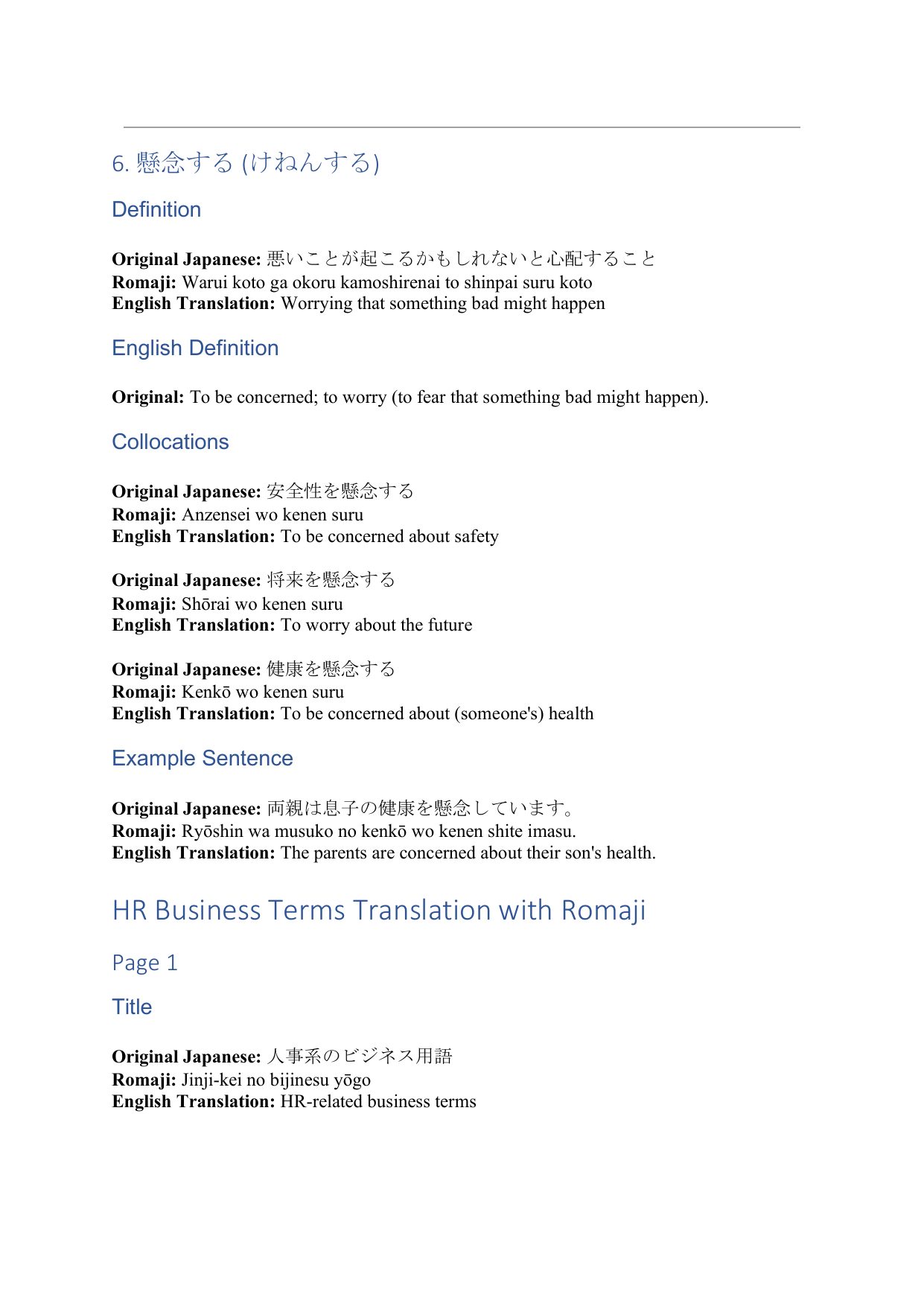
JP6.懸念する(けねんする)
ENDefinition
JPOriginalJapanese:悪いことが起こるかもしれないと心配すること
ENRomaji: Warui koto ga okoru kamoshirenai to shinpai suru koto
English Translation: Worrying that something bad might happen
English Definition
Original: To be concerned; to worry (to fear that something bad might happen).
Collocations
Original Japanese: 安全性を懸念する
Romaji: Anzensei wo kenen suru
English Translation: To be concerned about safety
Original Japanese: 将来を懸念する
Romaji: Shōrai wo kenen suru
English Translation: To worry about the future
Original Japanese: 健康を懸念する
Romaji: Kenkō wo kenen suru
English Translation: To be concerned about (someone's) health
Example Sentence
English Translation: Worrying that something bad might happen
English Definition
Original: To be concerned; to worry (to fear that something bad might happen).
Collocations
Original Japanese: 安全性を懸念する
Romaji: Anzensei wo kenen suru
English Translation: To be concerned about safety
Original Japanese: 将来を懸念する
Romaji: Shōrai wo kenen suru
English Translation: To worry about the future
Original Japanese: 健康を懸念する
Romaji: Kenkō wo kenen suru
English Translation: To be concerned about (someone's) health
Example Sentence
JPOriginalJapanese:両親は息子の健康を懸念しています。
ENRomaji: Ryōshin wa musuko no kenkō wo kenen shite imasu.
English Translation: The parents are concerned about their son's health.
HR Business Terms Translation with Romaji
Page 1
Title
Original Japanese: 人事系のビジネス用語
Romaji: Jinji-kei no bijinesu yōgo
English Translation: HR-related business terms
English Translation: The parents are concerned about their son's health.
HR Business Terms Translation with Romaji
Page 1
Title
Original Japanese: 人事系のビジネス用語
Romaji: Jinji-kei no bijinesu yōgo
English Translation: HR-related business terms
หน้า 19
คลิกเพื่อขยาย
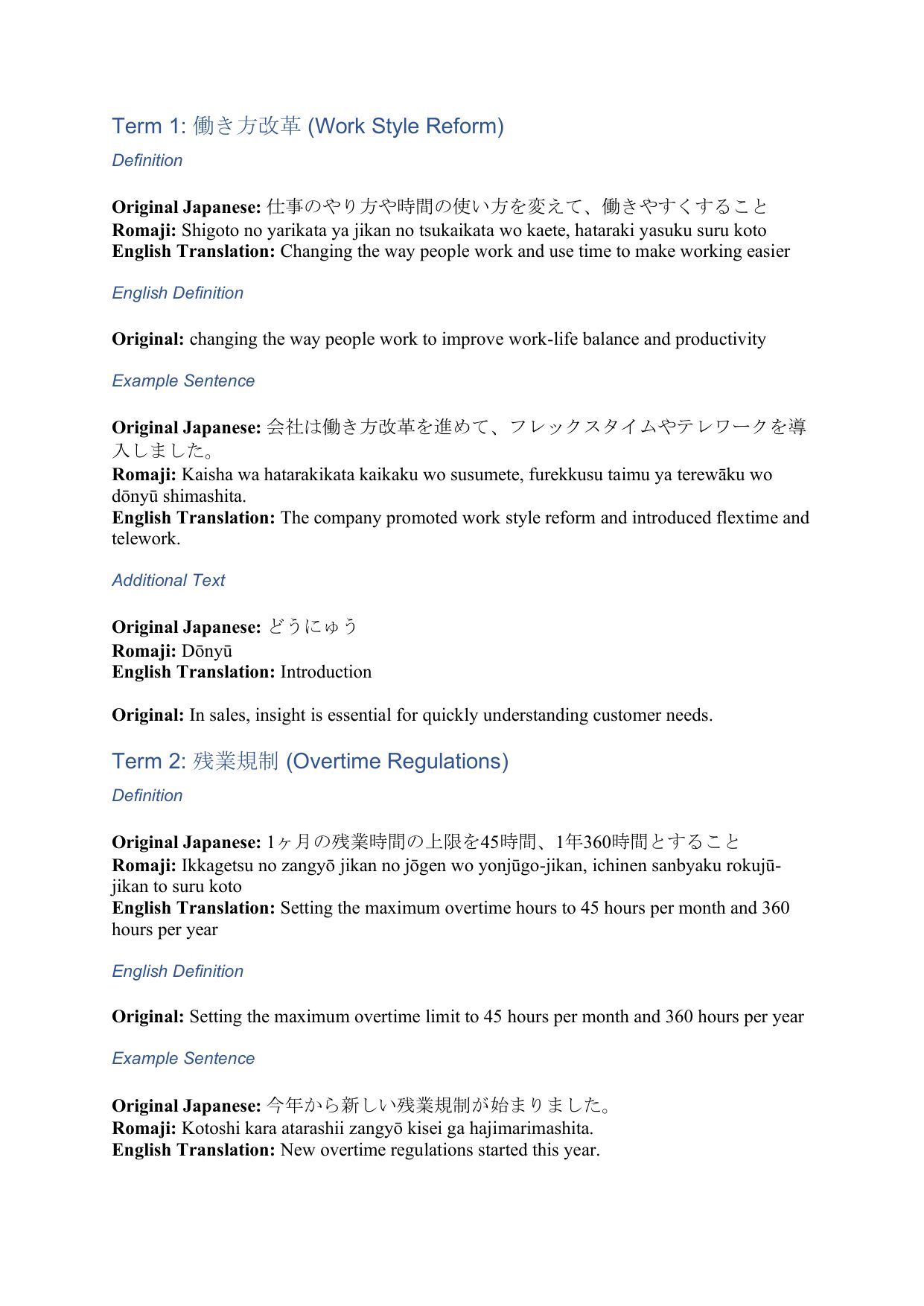
ENTerm 1: 働き方改革 (Work Style Reform)
Definition
Definition
JPOriginalJapanese:仕事のやり方や時間の使い方を変えて、働きやすくすること
ENRomaji: Shigoto no yarikata ya jikan no tsukaikata wo kaete, hataraki yasuku suru koto
English Translation: Changing the way people work and use time to make working easier
English Definition
Original: changing the way people work to improve work-life balance and productivity
Example Sentence
English Translation: Changing the way people work and use time to make working easier
English Definition
Original: changing the way people work to improve work-life balance and productivity
Example Sentence
JPOriginalJapanese:会社は働き方改革を進めて、フレックスタイムやテレワークを導
入しました。
入しました。
ENRomaji: Kaisha wa hatarakikata kaikaku wo susumete, furekkusu taimu ya terewāku wo
dōnyū shimashita.
English Translation: The company promoted work style reform and introduced flextime and
telework.
Additional Text
Original Japanese: どうにゅう
Romaji: Dōnyū
English Translation: Introduction
Original: In sales, insight is essential for quickly understanding customer needs.
Term 2: 残業規制 (Overtime Regulations)
Definition
dōnyū shimashita.
English Translation: The company promoted work style reform and introduced flextime and
telework.
Additional Text
Original Japanese: どうにゅう
Romaji: Dōnyū
English Translation: Introduction
Original: In sales, insight is essential for quickly understanding customer needs.
Term 2: 残業規制 (Overtime Regulations)
Definition
JPOriginalJapanese:1ヶ月の残業時間の上限を45時間、1年360時間とすること
ENRomaji: Ikkagetsu no zangyō jikan no jōgen wo yonjūgo-jikan, ichinen sanbyaku rokujū-
jikan to suru koto
English Translation: Setting the maximum overtime hours to 45 hours per month and 360
hours per year
English Definition
Original: Setting the maximum overtime limit to 45 hours per month and 360 hours per year
Example Sentence
jikan to suru koto
English Translation: Setting the maximum overtime hours to 45 hours per month and 360
hours per year
English Definition
Original: Setting the maximum overtime limit to 45 hours per month and 360 hours per year
Example Sentence
JPOriginalJapanese:今年から新しい残業規制が始まりました。
ENRomaji: Kotoshi kara atarashii zangyō kisei ga hajimarimashita.
English Translation: New overtime regulations started this year.
English Translation: New overtime regulations started this year.
หน้า 20
คลิกเพื่อขยาย
ENAdditional Text
Original: New overtime regulations have been introduced this year.
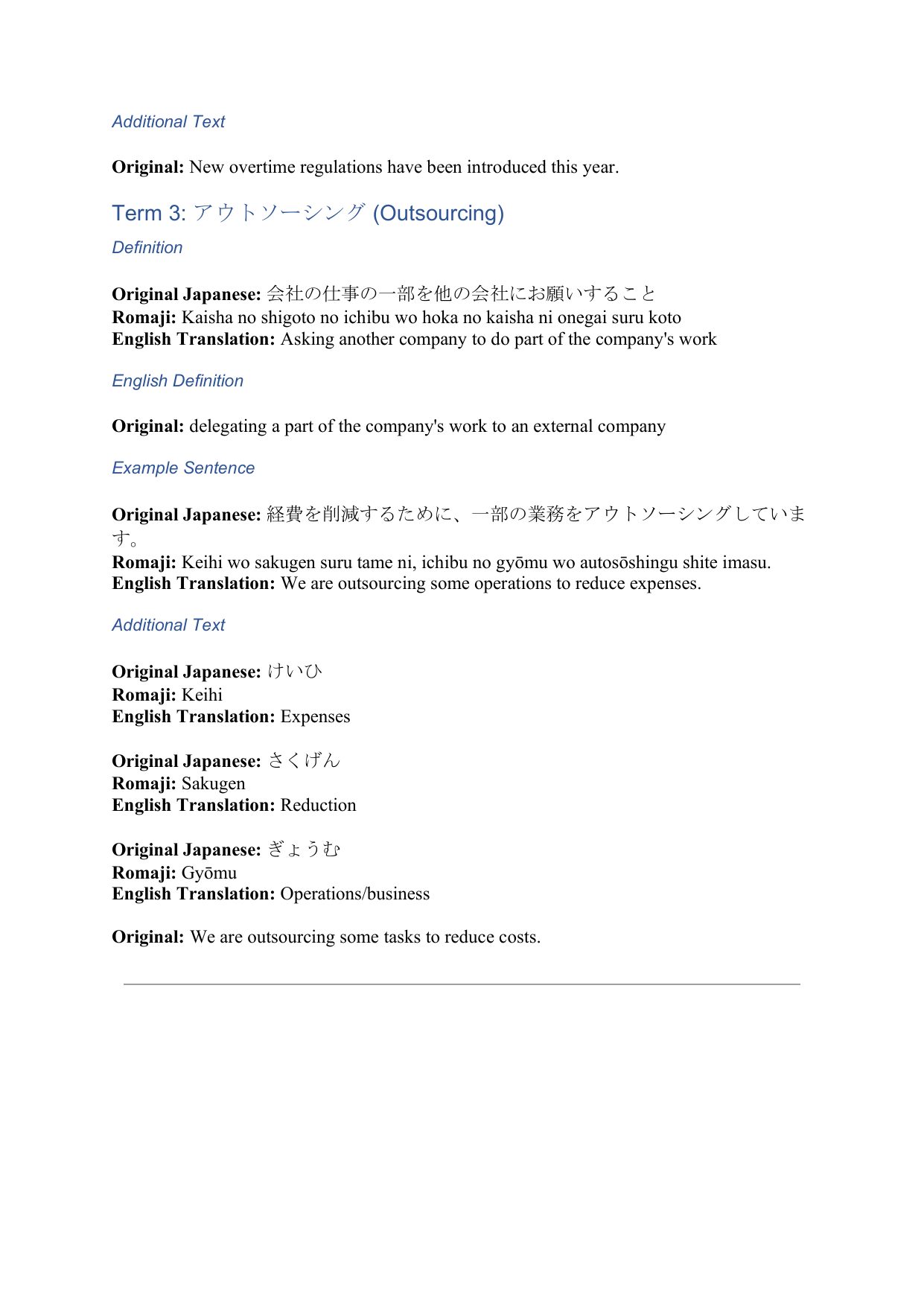
Term 3: アウトソーシング (Outsourcing)
Definition
Original: New overtime regulations have been introduced this year.
Term 3: アウトソーシング (Outsourcing)
Definition
JPOriginalJapanese:会社の仕事の一部を他の会社にお願いすること
ENRomaji: Kaisha no shigoto no ichibu wo hoka no kaisha ni onegai suru koto
English Translation: Asking another company to do part of the company's work
English Definition
Original: delegating a part of the company's work to an external company
Example Sentence
English Translation: Asking another company to do part of the company's work
English Definition
Original: delegating a part of the company's work to an external company
Example Sentence
JPOriginalJapanese:経費を削減するために、一部の業務をアウトソーシングしていま
す。
す。
ENRomaji: Keihi wo sakugen suru tame ni, ichibu no gyōmu wo autosōshingu shite imasu.
English Translation: We are outsourcing some operations to reduce expenses.
Additional Text
Original Japanese: けいひ
Romaji: Keihi
English Translation: Expenses
Original Japanese: さくげん
Romaji: Sakugen
English Translation: Reduction
Original Japanese: ぎょうむ
Romaji: Gyōmu
English Translation: Operations/business
Original: We are outsourcing some tasks to reduce costs.
English Translation: We are outsourcing some operations to reduce expenses.
Additional Text
Original Japanese: けいひ
Romaji: Keihi
English Translation: Expenses
Original Japanese: さくげん
Romaji: Sakugen
English Translation: Reduction
Original Japanese: ぎょうむ
Romaji: Gyōmu
English Translation: Operations/business
Original: We are outsourcing some tasks to reduce costs.
หน้า 21
คลิกเพื่อขยาย
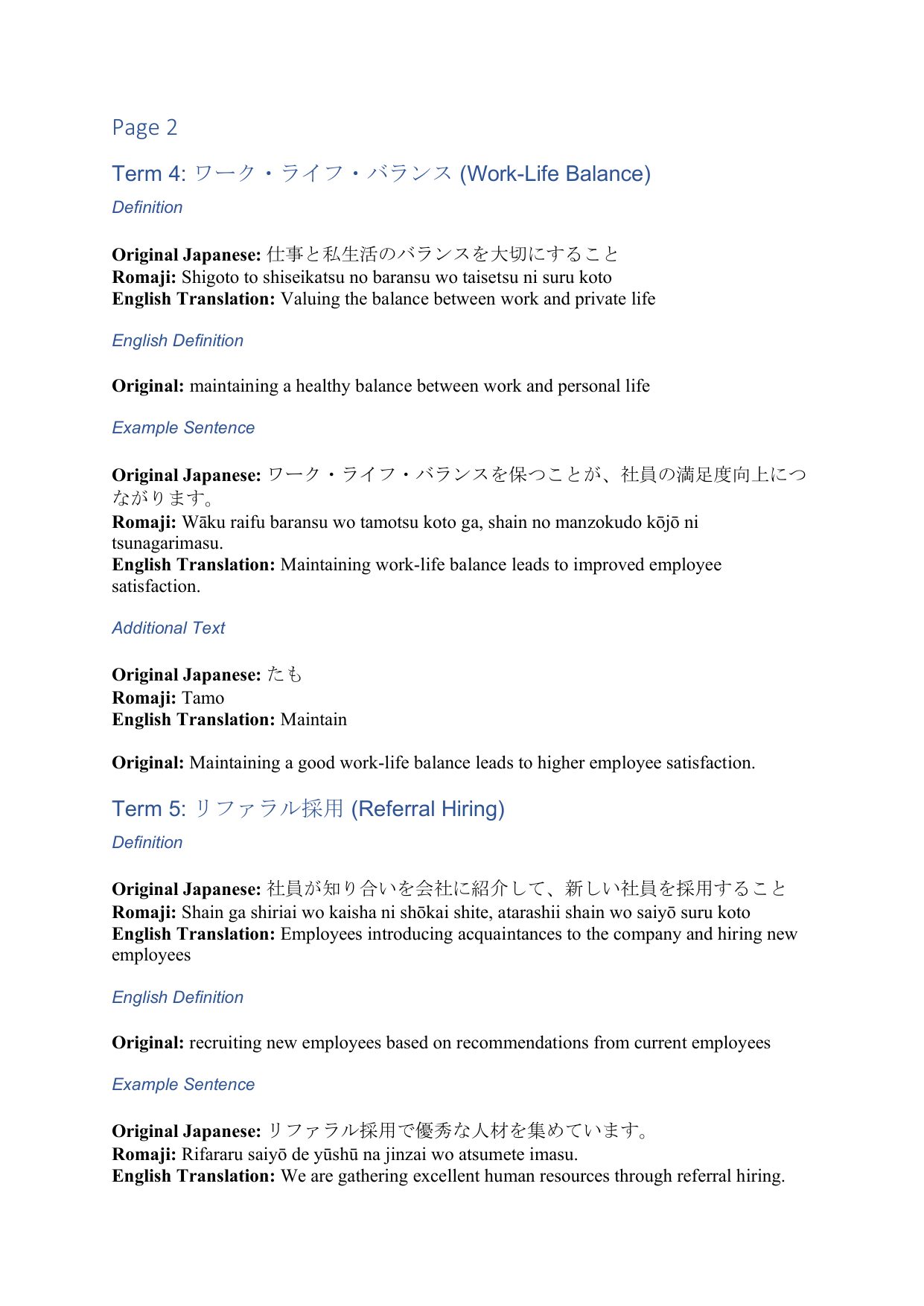
ENPage 2
Term 4: ワーク・ライフ・バランス (Work-Life Balance)
Definition
Term 4: ワーク・ライフ・バランス (Work-Life Balance)
Definition
JPOriginalJapanese:仕事と私生活のバランスを大切にすること
ENRomaji: Shigoto to shiseikatsu no baransu wo taisetsu ni suru koto
English Translation: Valuing the balance between work and private life
English Definition
Original: maintaining a healthy balance between work and personal life
Example Sentence
English Translation: Valuing the balance between work and private life
English Definition
Original: maintaining a healthy balance between work and personal life
Example Sentence
JPOriginalJapanese:ワーク・ライフ・バランスを保つことが、社員の満足度向上につ
ながります。
ながります。
ENRomaji: Wāku raifu baransu wo tamotsu koto ga, shain no manzokudo kōjō ni
tsunagarimasu.
English Translation: Maintaining work-life balance leads to improved employee
satisfaction.
Additional Text
Original Japanese: たも
Romaji: Tamo
English Translation: Maintain
Original: Maintaining a good work-life balance leads to higher employee satisfaction.
Term 5: リファラル採用 (Referral Hiring)
Definition
tsunagarimasu.
English Translation: Maintaining work-life balance leads to improved employee
satisfaction.
Additional Text
Original Japanese: たも
Romaji: Tamo
English Translation: Maintain
Original: Maintaining a good work-life balance leads to higher employee satisfaction.
Term 5: リファラル採用 (Referral Hiring)
Definition
JPOriginalJapanese:社員が知り合いを会社に紹介して、新しい社員を採用すること
ENRomaji: Shain ga shiriai wo kaisha ni shōkai shite, atarashii shain wo saiyō suru koto
English Translation: Employees introducing acquaintances to the company and hiring new
employees
English Definition
Original: recruiting new employees based on recommendations from current employees
Example Sentence
English Translation: Employees introducing acquaintances to the company and hiring new
employees
English Definition
Original: recruiting new employees based on recommendations from current employees
Example Sentence
JPOriginalJapanese:リファラル採用で優秀な人材を集めています。
ENRomaji: Rifararu saiyō de yūshū na jinzai wo atsumete imasu.
English Translation: We are gathering excellent human resources through referral hiring.
English Translation: We are gathering excellent human resources through referral hiring.
หน้า 22
คลิกเพื่อขยาย
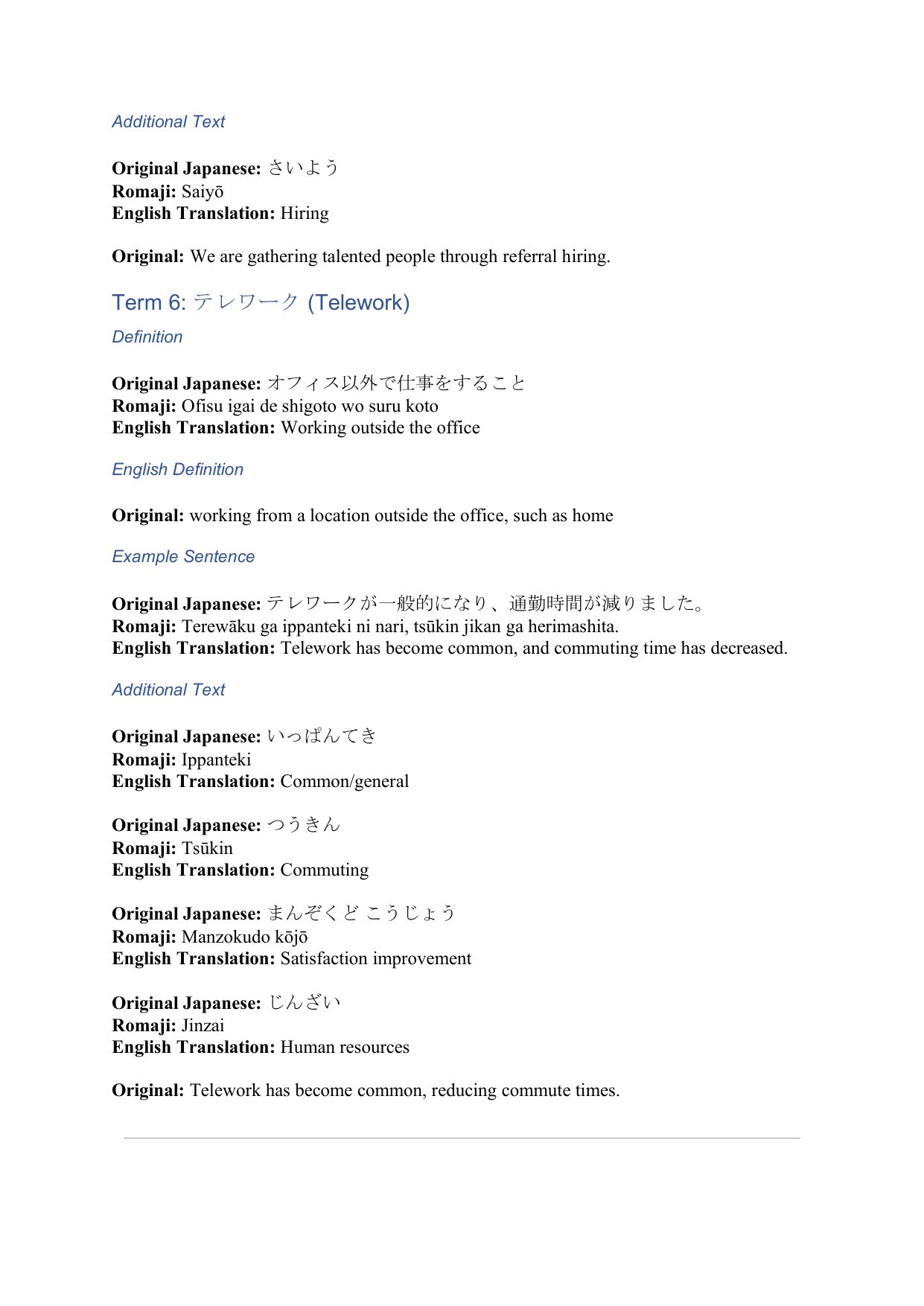
ENAdditional Text
Original Japanese: さいよう
Romaji: Saiyō
English Translation: Hiring
Original: We are gathering talented people through referral hiring.
Term 6: テレワーク (Telework)
Definition
Original Japanese: オフィス以外で仕事をすること
Romaji: Ofisu igai de shigoto wo suru koto
English Translation: Working outside the office
English Definition
Original: working from a location outside the office, such as home
Example Sentence
Original Japanese: さいよう
Romaji: Saiyō
English Translation: Hiring
Original: We are gathering talented people through referral hiring.
Term 6: テレワーク (Telework)
Definition
Original Japanese: オフィス以外で仕事をすること
Romaji: Ofisu igai de shigoto wo suru koto
English Translation: Working outside the office
English Definition
Original: working from a location outside the office, such as home
Example Sentence
JPOriginalJapanese:テレワークが一般的になり、通勤時間が減りました。
ENRomaji: Terewāku ga ippanteki ni nari, tsūkin jikan ga herimashita.
English Translation: Telework has become common, and commuting time has decreased.
Additional Text
Original Japanese: いっぱんてき
Romaji: Ippanteki
English Translation: Common/general
Original Japanese: つうきん
Romaji: Tsūkin
English Translation: Commuting
Original Japanese: まんぞくど こうじょう
Romaji: Manzokudo kōjō
English Translation: Satisfaction improvement
Original Japanese: じんざい
Romaji: Jinzai
English Translation: Human resources
Original: Telework has become common, reducing commute times.
English Translation: Telework has become common, and commuting time has decreased.
Additional Text
Original Japanese: いっぱんてき
Romaji: Ippanteki
English Translation: Common/general
Original Japanese: つうきん
Romaji: Tsūkin
English Translation: Commuting
Original Japanese: まんぞくど こうじょう
Romaji: Manzokudo kōjō
English Translation: Satisfaction improvement
Original Japanese: じんざい
Romaji: Jinzai
English Translation: Human resources
Original: Telework has become common, reducing commute times.
หน้า 23
คลิกเพื่อขยาย
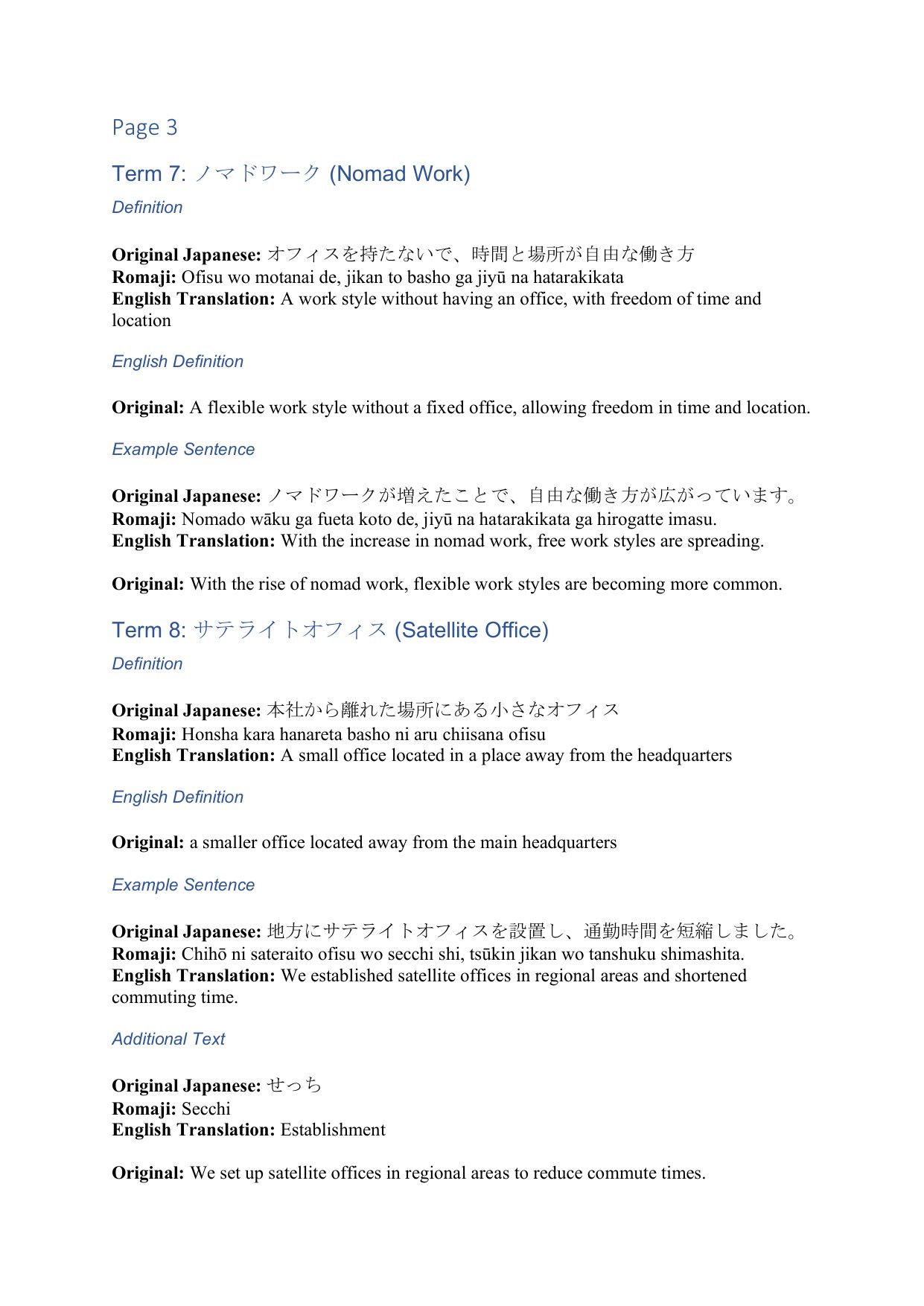
ENPage 3
Term 7: ノマドワーク (Nomad Work)
Definition
Term 7: ノマドワーク (Nomad Work)
Definition
JPOriginalJapanese:オフィスを持たないで、時間と場所が自由な働き方
ENRomaji: Ofisu wo motanai de, jikan to basho ga jiyū na hatarakikata
English Translation: A work style without having an office, with freedom of time and
location
English Definition
Original: A flexible work style without a fixed office, allowing freedom in time and location.
Example Sentence
English Translation: A work style without having an office, with freedom of time and
location
English Definition
Original: A flexible work style without a fixed office, allowing freedom in time and location.
Example Sentence
JPOriginalJapanese:ノマドワークが増えたことで、自由な働き方が広がっています。
ENRomaji: Nomado wāku ga fueta koto de, jiyū na hatarakikata ga hirogatte imasu.
English Translation: With the increase in nomad work, free work styles are spreading.
Original: With the rise of nomad work, flexible work styles are becoming more common.
Term 8: サテライトオフィス (Satellite Office)
Definition
English Translation: With the increase in nomad work, free work styles are spreading.
Original: With the rise of nomad work, flexible work styles are becoming more common.
Term 8: サテライトオフィス (Satellite Office)
Definition
JPOriginalJapanese:本社から離れた場所にある小さなオフィス
ENRomaji: Honsha kara hanareta basho ni aru chiisana ofisu
English Translation: A small office located in a place away from the headquarters
English Definition
Original: a smaller office located away from the main headquarters
Example Sentence
English Translation: A small office located in a place away from the headquarters
English Definition
Original: a smaller office located away from the main headquarters
Example Sentence
JPOriginalJapanese:地方にサテライトオフィスを設置し、通勤時間を短縮しました。
ENRomaji: Chihō ni sateraito ofisu wo secchi shi, tsūkin jikan wo tanshuku shimashita.
English Translation: We established satellite offices in regional areas and shortened
commuting time.
Additional Text
Original Japanese: せっち
Romaji: Secchi
English Translation: Establishment
Original: We set up satellite offices in regional areas to reduce commute times.
English Translation: We established satellite offices in regional areas and shortened
commuting time.
Additional Text
Original Japanese: せっち
Romaji: Secchi
English Translation: Establishment
Original: We set up satellite offices in regional areas to reduce commute times.
หน้า 24
คลิกเพื่อขยาย
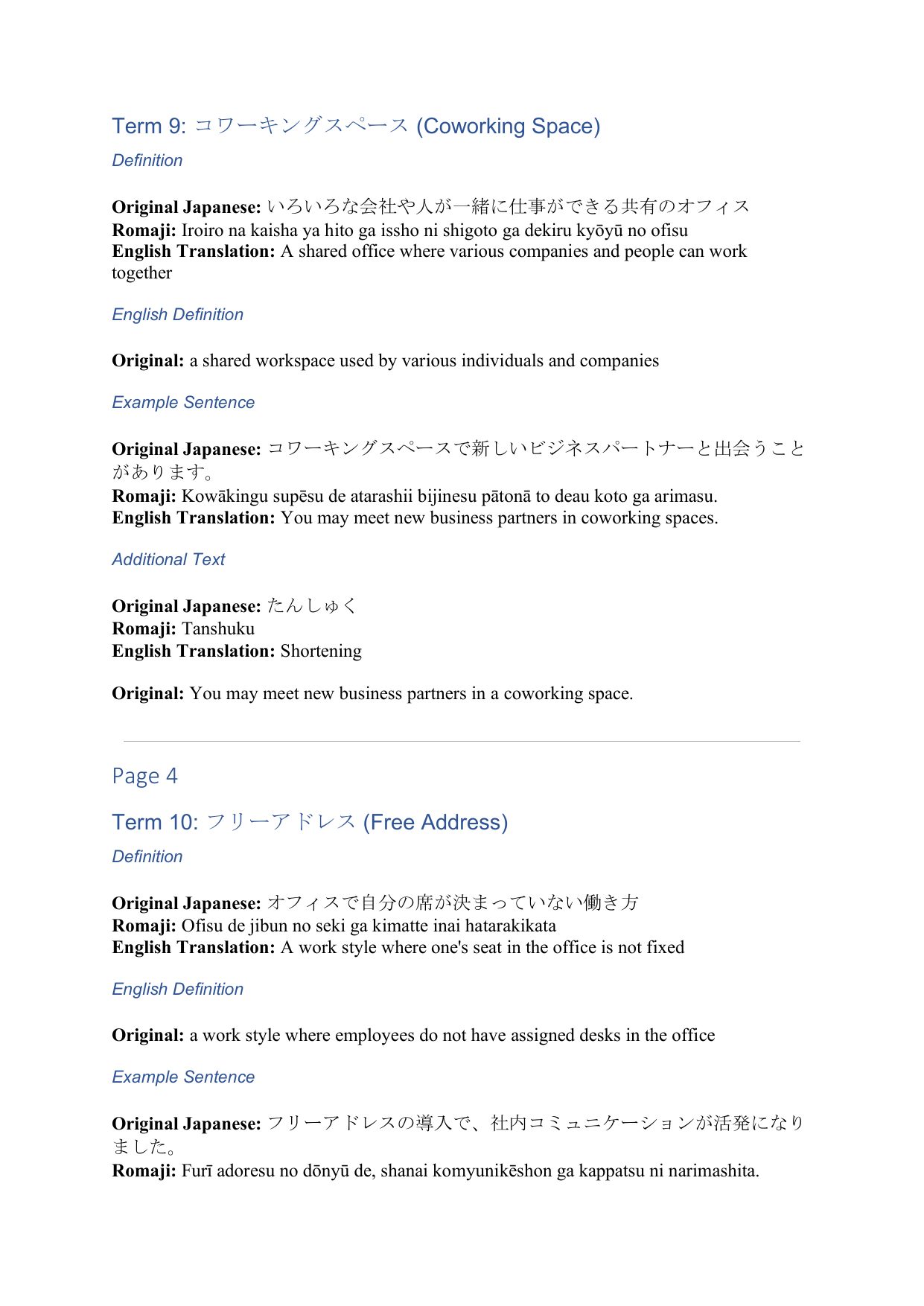
ENTerm 9: コワーキングスペース (Coworking Space)
Definition
Definition
JPOriginalJapanese:いろいろな会社や人が一緒に仕事ができる共有のオフィス
ENRomaji: Iroiro na kaisha ya hito ga issho ni shigoto ga dekiru kyōyū no ofisu
English Translation: A shared office where various companies and people can work
together
English Definition
Original: a shared workspace used by various individuals and companies
Example Sentence
English Translation: A shared office where various companies and people can work
together
English Definition
Original: a shared workspace used by various individuals and companies
Example Sentence
JPOriginalJapanese:コワーキングスペースで新しいビジネスパートナーと出会うこと
があります。
があります。
ENRomaji: Kowākingu supēsu de atarashii bijinesu pātonā to deau koto ga arimasu.
English Translation: You may meet new business partners in coworking spaces.
Additional Text
Original Japanese: たんしゅく
Romaji: Tanshuku
English Translation: Shortening
Original: You may meet new business partners in a coworking space.
Page 4
Term 10: フリーアドレス (Free Address)
Definition
English Translation: You may meet new business partners in coworking spaces.
Additional Text
Original Japanese: たんしゅく
Romaji: Tanshuku
English Translation: Shortening
Original: You may meet new business partners in a coworking space.
Page 4
Term 10: フリーアドレス (Free Address)
Definition
JPOriginalJapanese:オフィスで自分の席が決まっていない働き方
ENRomaji: Ofisu de jibun no seki ga kimatte inai hatarakikata
English Translation: A work style where one's seat in the office is not fixed
English Definition
Original: a work style where employees do not have assigned desks in the office
Example Sentence
English Translation: A work style where one's seat in the office is not fixed
English Definition
Original: a work style where employees do not have assigned desks in the office
Example Sentence
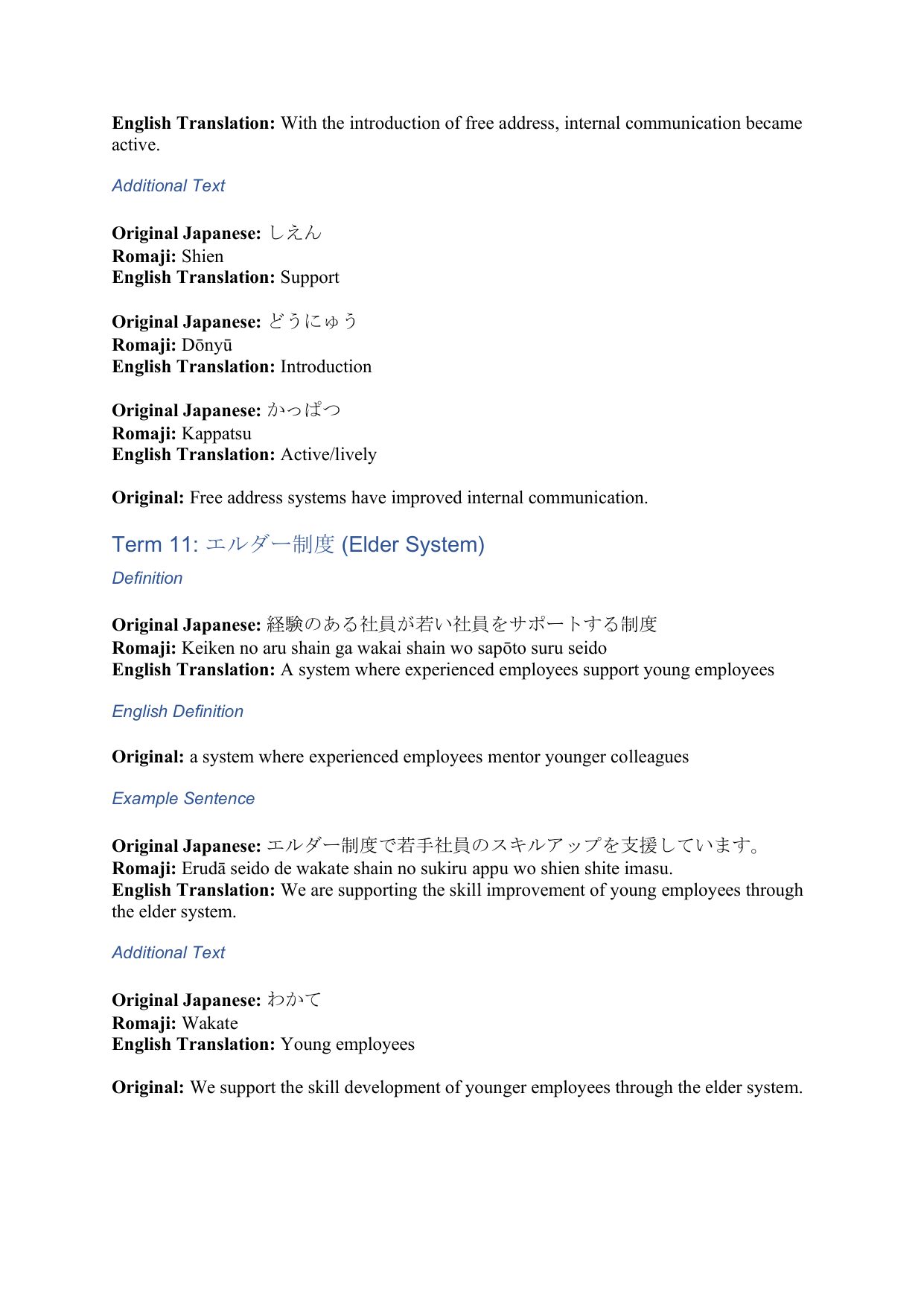
JPOriginalJapanese:フリーアドレスの導入で、社内コミュニケーションが活発になり
ました。
ました。
ENRomaji: Furī adoresu no dōnyū de, shanai komyunikēshon ga kappatsu ni narimashita.
หน้า 25
คลิกเพื่อขยาย
ENEnglish Translation: With the introduction of free address, internal communication became
active.
Additional Text
Original Japanese: しえん
Romaji: Shien
English Translation: Support
Original Japanese: どうにゅう
Romaji: Dōnyū
English Translation: Introduction
Original Japanese: かっぱつ
Romaji: Kappatsu
English Translation: Active/lively
Original: Free address systems have improved internal communication.
Term 11: エルダー制度 (Elder System)
Definition
active.
Additional Text
Original Japanese: しえん
Romaji: Shien
English Translation: Support
Original Japanese: どうにゅう
Romaji: Dōnyū
English Translation: Introduction
Original Japanese: かっぱつ
Romaji: Kappatsu
English Translation: Active/lively
Original: Free address systems have improved internal communication.
Term 11: エルダー制度 (Elder System)
Definition
JPOriginalJapanese:経験のある社員が若い社員をサポートする制度
ENRomaji: Keiken no aru shain ga wakai shain wo sapōto suru seido
English Translation: A system where experienced employees support young employees
English Definition
Original: a system where experienced employees mentor younger colleagues
Example Sentence
English Translation: A system where experienced employees support young employees
English Definition
Original: a system where experienced employees mentor younger colleagues
Example Sentence
JPOriginalJapanese:エルダー制度で若手社員のスキルアップを支援しています。
ENRomaji: Erudā seido de wakate shain no sukiru appu wo shien shite imasu.
English Translation: We are supporting the skill improvement of young employees through
the elder system.
Additional Text
Original Japanese: わかて
Romaji: Wakate
English Translation: Young employees
Original: We support the skill development of younger employees through the elder system.
English Translation: We are supporting the skill improvement of young employees through
the elder system.
Additional Text
Original Japanese: わかて
Romaji: Wakate
English Translation: Young employees
Original: We support the skill development of younger employees through the elder system.
หน้า 26
คลิกเพื่อขยาย
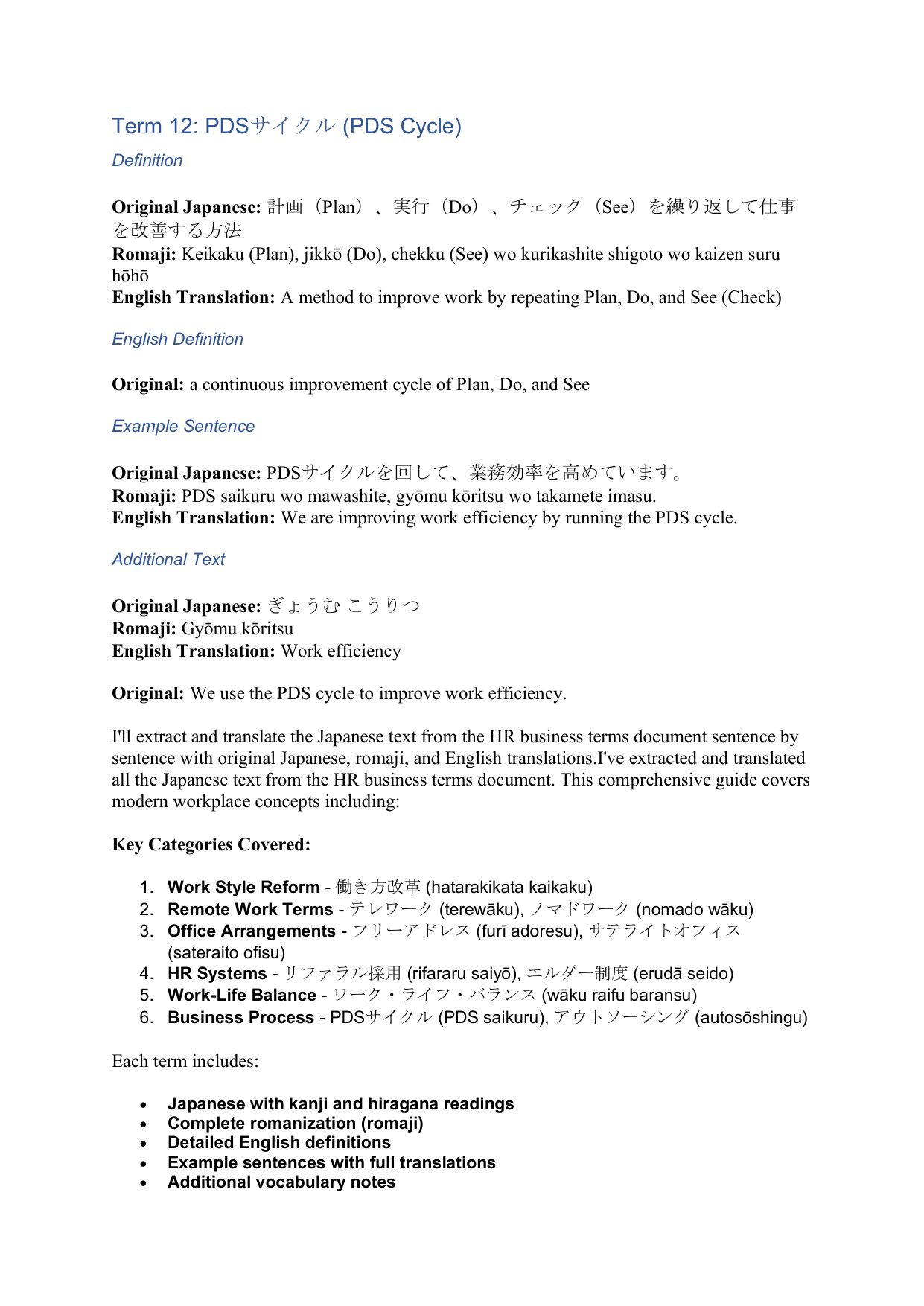
ENTerm 12: PDSサイクル (PDS Cycle)
Definition
Original Japanese: 計画(Plan)、実行(Do)、チェック(See)を繰り返して仕事
Definition
Original Japanese: 計画(Plan)、実行(Do)、チェック(See)を繰り返して仕事
JPを改善する方法
ENRomaji: Keikaku (Plan), jikkō (Do), chekku (See) wo kurikashite shigoto wo kaizen suru
hōhō
English Translation: A method to improve work by repeating Plan, Do, and See (Check)
English Definition
Original: a continuous improvement cycle of Plan, Do, and See
Example Sentence
hōhō
English Translation: A method to improve work by repeating Plan, Do, and See (Check)
English Definition
Original: a continuous improvement cycle of Plan, Do, and See
Example Sentence
JPOriginalJapanese:PDSサイクルを回して、業務効率を高めています。
ENRomaji: PDS saikuru wo mawashite, gyōmu kōritsu wo takamete imasu.
English Translation: We are improving work efficiency by running the PDS cycle.
Additional Text
Original Japanese: ぎょうむ こうりつ
Romaji: Gyōmu kōritsu
English Translation: Work efficiency
Original: We use the PDS cycle to improve work efficiency.
I'll extract and translate the Japanese text from the HR business terms document sentence by
sentence with original Japanese, romaji, and English translations.I've extracted and translated
all the Japanese text from the HR business terms document. This comprehensive guide covers
modern workplace concepts including:
Key Categories Covered:
1. Work Style Reform - 働き方改革 (hatarakikata kaikaku)
2. Remote Work Terms - テレワーク (terewāku), ノマドワーク (nomado wāku)
3. Office Arrangements - フリーアドレス (furī adoresu), サテライトオフィス
(sateraito ofisu)
4. HR Systems - リファラル採用 (rifararu saiyō), エルダー制度 (erudā seido)
5. Work-Life Balance - ワーク・ライフ・バランス (wāku raifu baransu)
6. Business Process - PDSサイクル (PDS saikuru), アウトソーシング (autosōshingu)
Each term includes:
• Japanese with kanji and hiragana readings
• Complete romanization (romaji)
• Detailed English definitions
• Example sentences with full translations
• Additional vocabulary notes
English Translation: We are improving work efficiency by running the PDS cycle.
Additional Text
Original Japanese: ぎょうむ こうりつ
Romaji: Gyōmu kōritsu
English Translation: Work efficiency
Original: We use the PDS cycle to improve work efficiency.
I'll extract and translate the Japanese text from the HR business terms document sentence by
sentence with original Japanese, romaji, and English translations.I've extracted and translated
all the Japanese text from the HR business terms document. This comprehensive guide covers
modern workplace concepts including:
Key Categories Covered:
1. Work Style Reform - 働き方改革 (hatarakikata kaikaku)
2. Remote Work Terms - テレワーク (terewāku), ノマドワーク (nomado wāku)
3. Office Arrangements - フリーアドレス (furī adoresu), サテライトオフィス
(sateraito ofisu)
4. HR Systems - リファラル採用 (rifararu saiyō), エルダー制度 (erudā seido)
5. Work-Life Balance - ワーク・ライフ・バランス (wāku raifu baransu)
6. Business Process - PDSサイクル (PDS saikuru), アウトソーシング (autosōshingu)
Each term includes:
• Japanese with kanji and hiragana readings
• Complete romanization (romaji)
• Detailed English definitions
• Example sentences with full translations
• Additional vocabulary notes
หน้า 27

คลิกเพื่อขยาย
ENThis appears to be a modern Japanese business vocabulary guide focusing on contemporary
workplace trends and HR practices that have become increasingly important in Japanese
business culture.
workplace trends and HR practices that have become increasingly important in Japanese
business culture.