หน้า 1
คลิกเพื่อขยาย
ENJAPANESE STUDY LIBRARY · VOLUME 2
Keigo System
敬語システム — Keigo Shisutemu
Sonkeigo, kenjougo, and the full toolkit of respectful business & service Japanese
Volume 2 of 9
Keigo System
敬語システム — Keigo Shisutemu
Sonkeigo, kenjougo, and the full toolkit of respectful business & service Japanese
Volume 2 of 9
หน้า 2
คลิกเพื่อขยาย
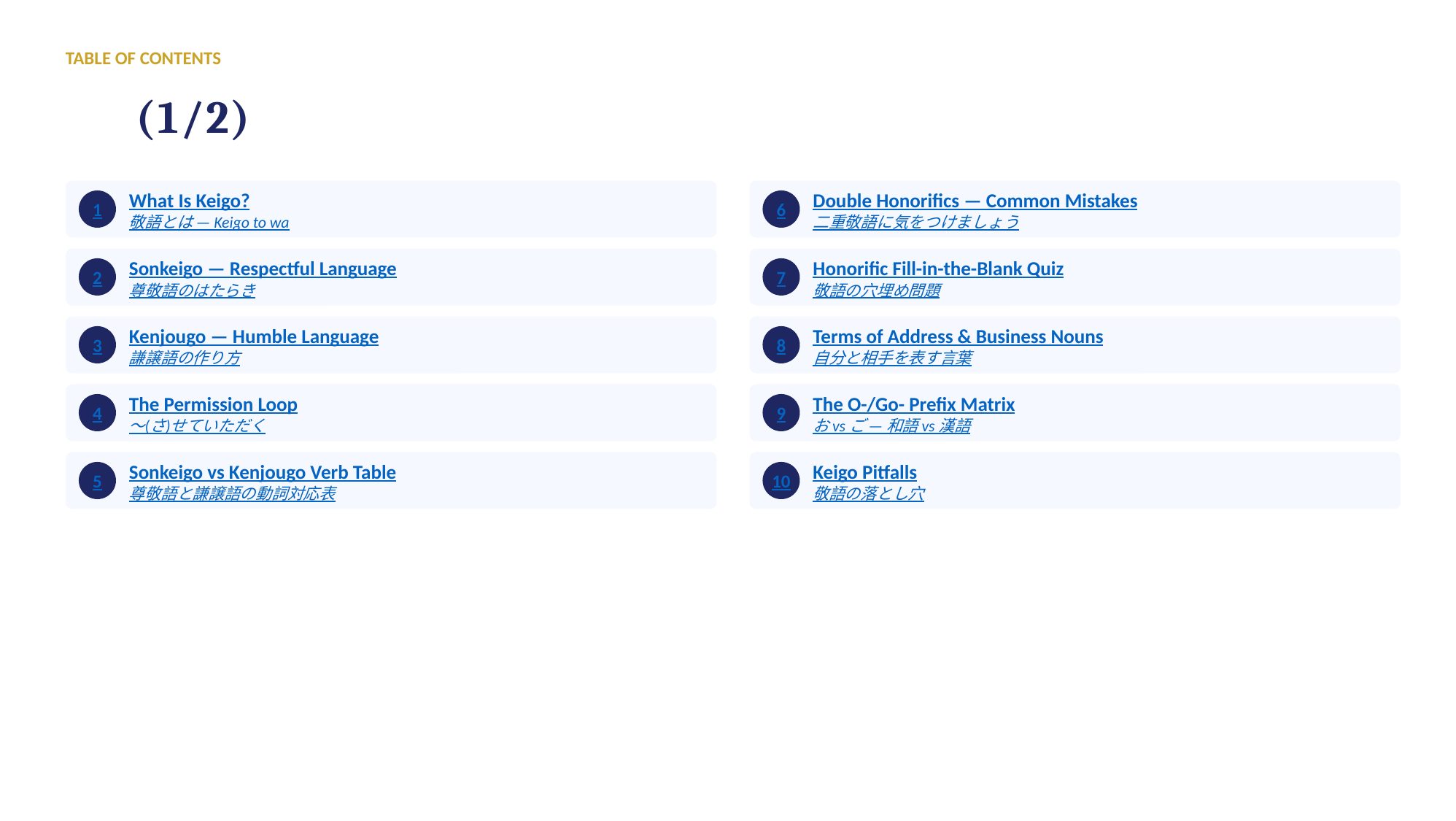
ENTABLE OF CONTENTS
THสารบัญ (1/2)
EN 1 What Is Keigo? 6 Double Honorifics — Common Mistakes
JP敬語とは—Keigotowa二重敬語に気をつけましょう
EN 2 Sonkeigo — Respectful Language 7 Honorific Fill-in-the-Blank Quiz
JP尊敬語のはたらき敬語の穴埋め問題
EN 3 Kenjougo — Humble Language 8 Terms of Address & Business Nouns
JP謙譲語の作り方自分と相手を表す言葉
EN 4 The Permission Loop 9 The O-/Go- Prefix Matrix
JP〜(さ)せていただくおvsご—和語vs漢語
EN 5 Sonkeigo vs Kenjougo Verb Table 10 Keigo Pitfalls
JP尊敬語と謙譲語の動詞対応表敬語の落とし穴
หน้า 3
คลิกเพื่อขยาย
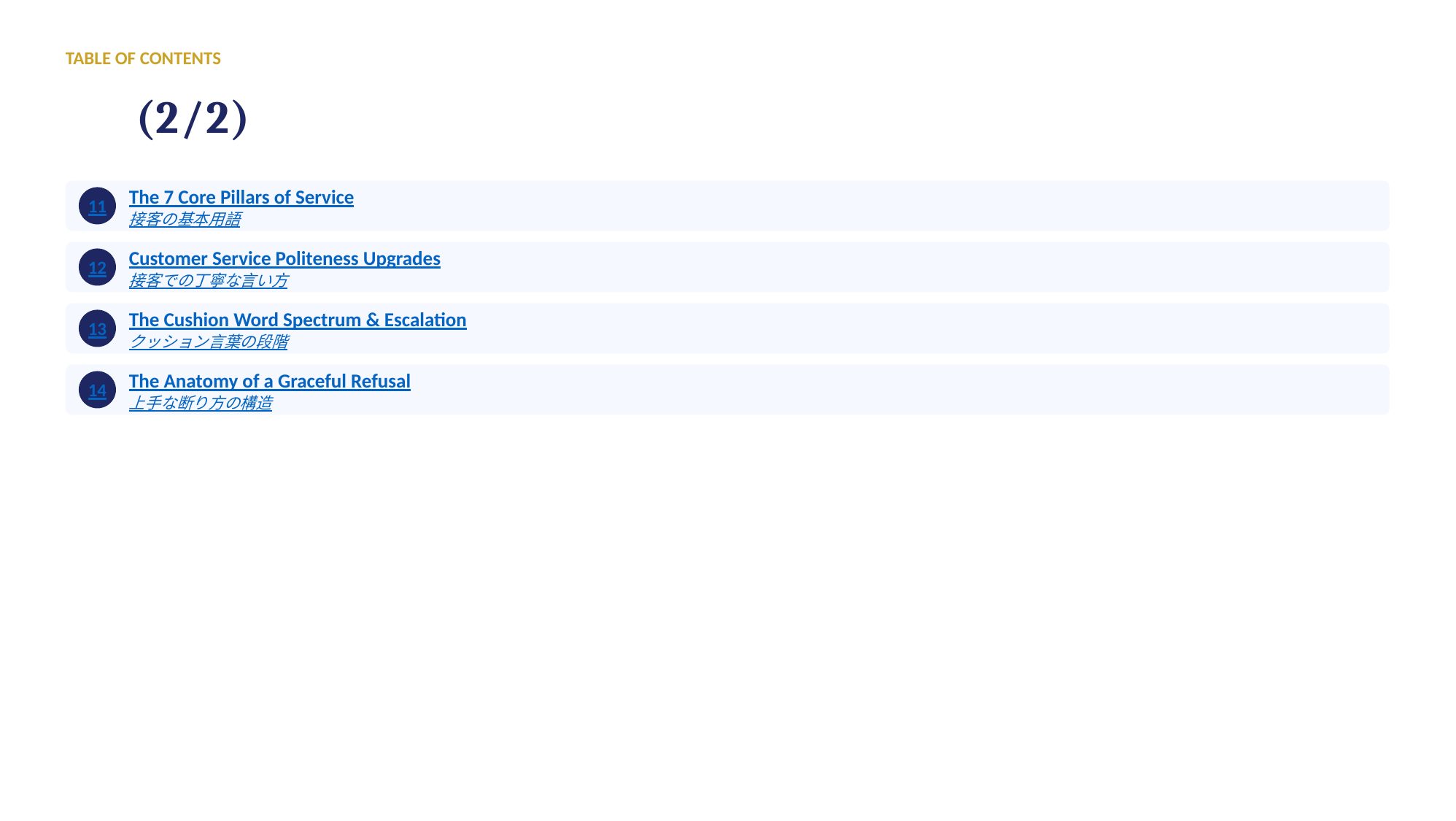
ENTABLE OF CONTENTS
THสารบัญ (2/2)
EN 11 The 7 Core Pillars of Service
JP接客の基本用語
EN 12 Customer Service Politeness Upgrades
JP接客での丁寧な言い方
EN 13 The Cushion Word Spectrum & Escalation
JPクッション言葉の段階
EN 14 The Anatomy of a Graceful Refusal
JP上手な断り方の構造
หน้า 4
คลิกเพื่อขยาย
01
ENWhat Is Keigo?
敬語とは — Keigo to wa
Three types of polite language, and why they matter in service
敬語とは — Keigo to wa
Three types of polite language, and why they matter in service
หน้า 5
คลิกเพื่อขยาย
ENTHE 3 TYPES
JP尊敬語・謙譲語・丁寧語
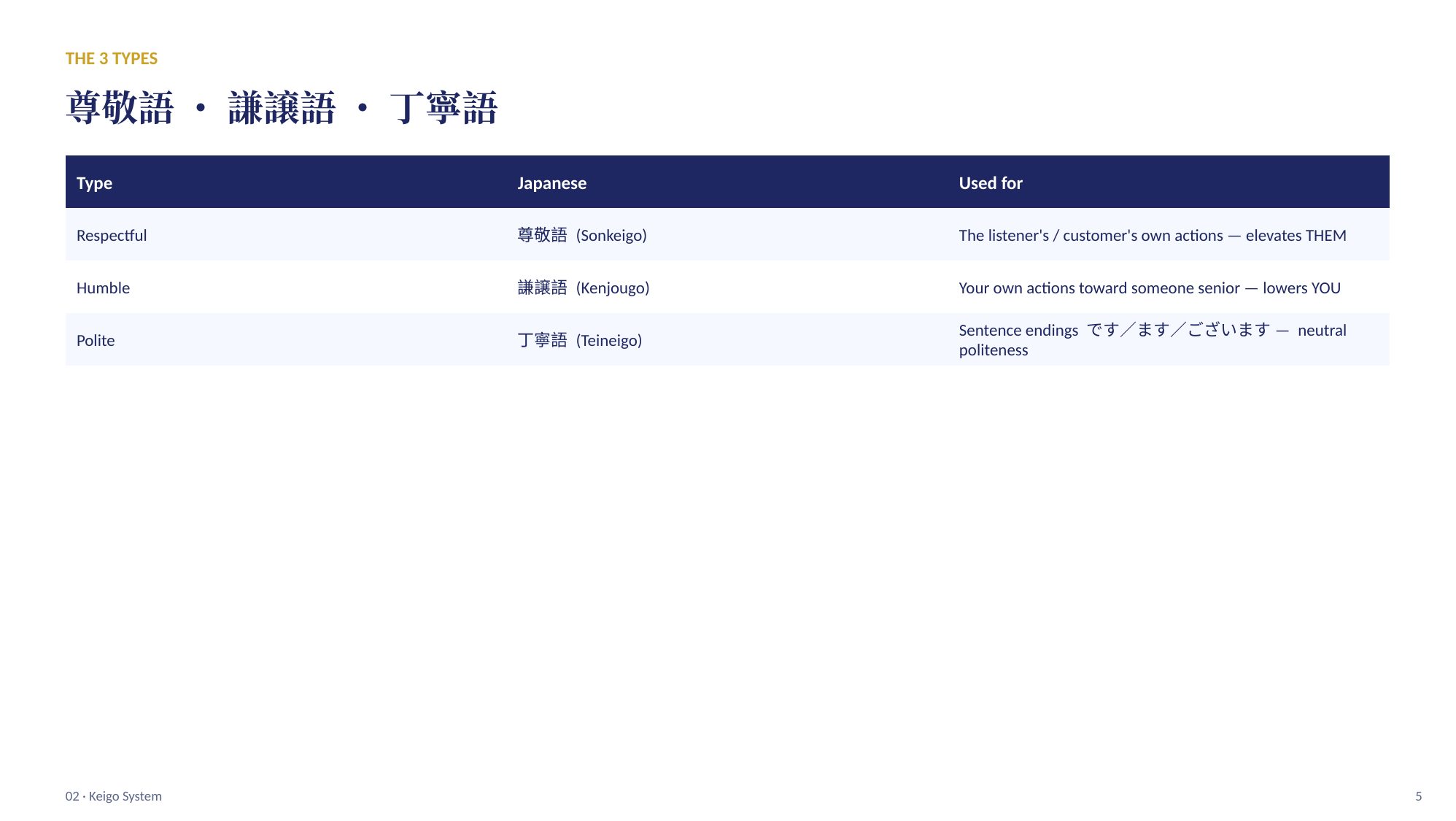
EN Type Japanese Used for
Respectful 尊敬語 (Sonkeigo) The listener's / customer's own actions — elevates THEM
Humble 謙譲語 (Kenjougo) Your own actions toward someone senior — lowers YOU
Sentence endings です/ます/ございます — neutral
Polite 丁寧語 (Teineigo)
politeness
02 · Keigo System 5
Respectful 尊敬語 (Sonkeigo) The listener's / customer's own actions — elevates THEM
Humble 謙譲語 (Kenjougo) Your own actions toward someone senior — lowers YOU
Sentence endings です/ます/ございます — neutral
Polite 丁寧語 (Teineigo)
politeness
02 · Keigo System 5
หน้า 6
คลิกเพื่อขยาย
ENWHY IT MATTERS
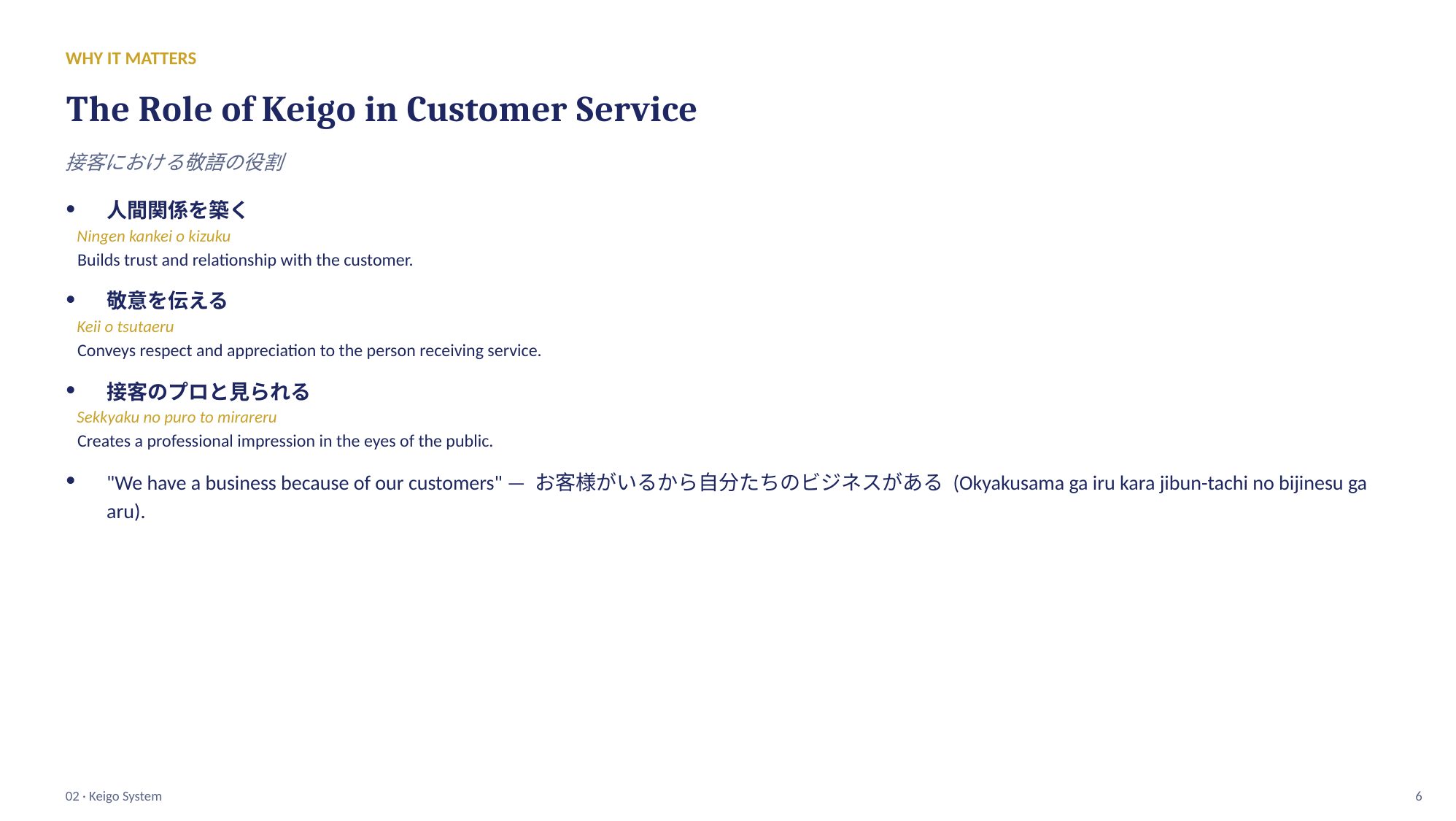
The Role of Keigo in Customer Service
The Role of Keigo in Customer Service
JP接客における敬語の役割
•人間関係を築く
•人間関係を築く
EN Ningen kankei o kizuku
Builds trust and relationship with the customer.
Builds trust and relationship with the customer.
JP•敬意を伝える
EN Keii o tsutaeru
Conveys respect and appreciation to the person receiving service.
Conveys respect and appreciation to the person receiving service.
JP•接客のプロと見られる
EN Sekkyaku no puro to mirareru
Creates a professional impression in the eyes of the public.
• "We have a business because of our customers" — お客様がいるから自分たちのビジネスがある (Okyakusama ga iru kara jibun-tachi no bijinesu ga
aru).
02 · Keigo System 6
Creates a professional impression in the eyes of the public.
• "We have a business because of our customers" — お客様がいるから自分たちのビジネスがある (Okyakusama ga iru kara jibun-tachi no bijinesu ga
aru).
02 · Keigo System 6
หน้า 7
คลิกเพื่อขยาย
02
ENSonkeigo — Respectful Language
JP尊敬語のはたらき
ENElevating the other person's actions
หน้า 8
คลิกเพื่อขยาย
ENTHE RESPECT SEESAW
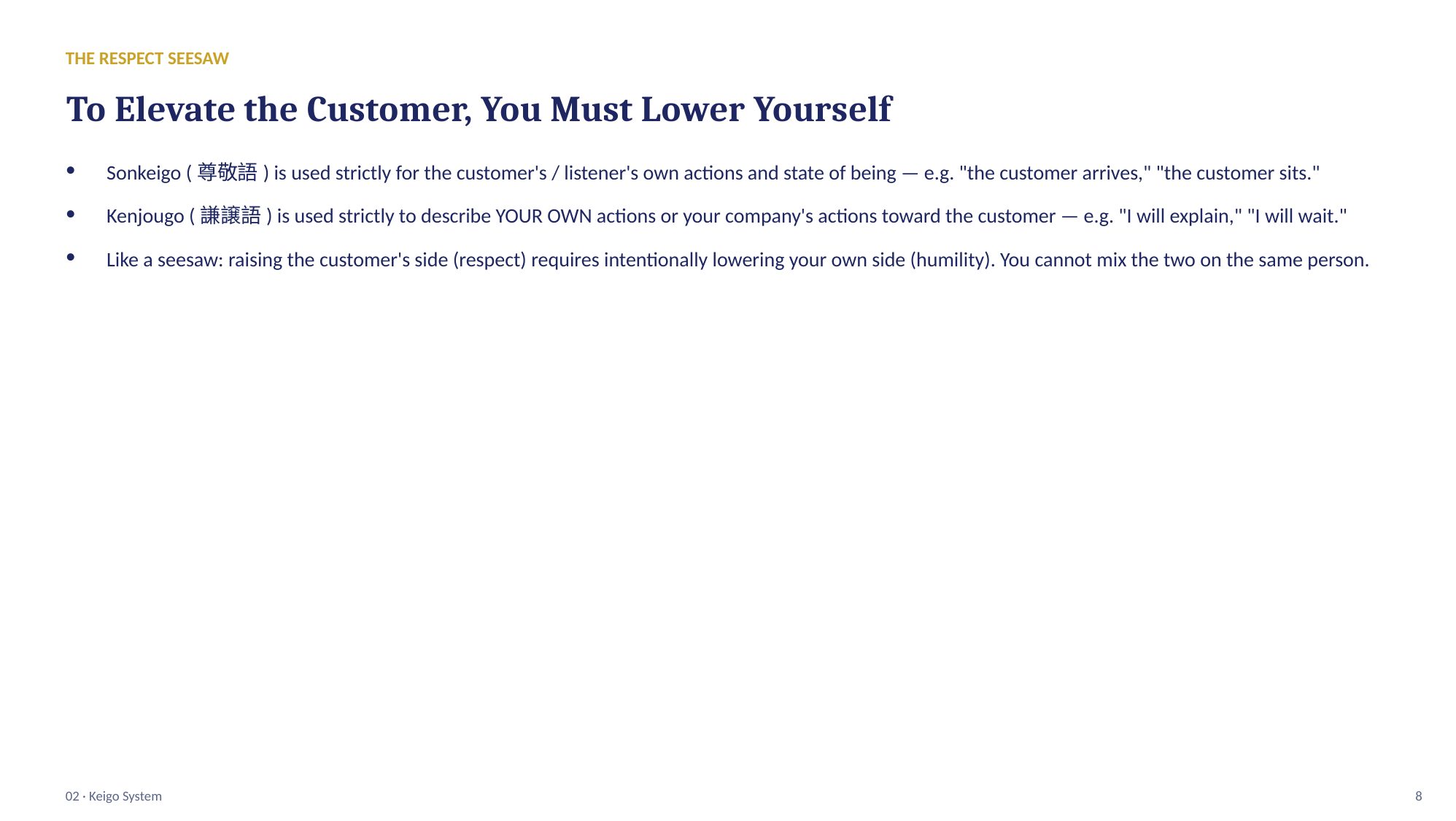
To Elevate the Customer, You Must Lower Yourself
• Sonkeigo ( 尊敬語 ) is used strictly for the customer's / listener's own actions and state of being — e.g. "the customer arrives," "the customer sits."
• Kenjougo ( 謙譲語 ) is used strictly to describe YOUR OWN actions or your company's actions toward the customer — e.g. "I will explain," "I will wait."
• Like a seesaw: raising the customer's side (respect) requires intentionally lowering your own side (humility). You cannot mix the two on the same person.
02 · Keigo System 8
To Elevate the Customer, You Must Lower Yourself
• Sonkeigo ( 尊敬語 ) is used strictly for the customer's / listener's own actions and state of being — e.g. "the customer arrives," "the customer sits."
• Kenjougo ( 謙譲語 ) is used strictly to describe YOUR OWN actions or your company's actions toward the customer — e.g. "I will explain," "I will wait."
• Like a seesaw: raising the customer's side (respect) requires intentionally lowering your own side (humility). You cannot mix the two on the same person.
02 · Keigo System 8
หน้า 9
คลิกเพื่อขยาย
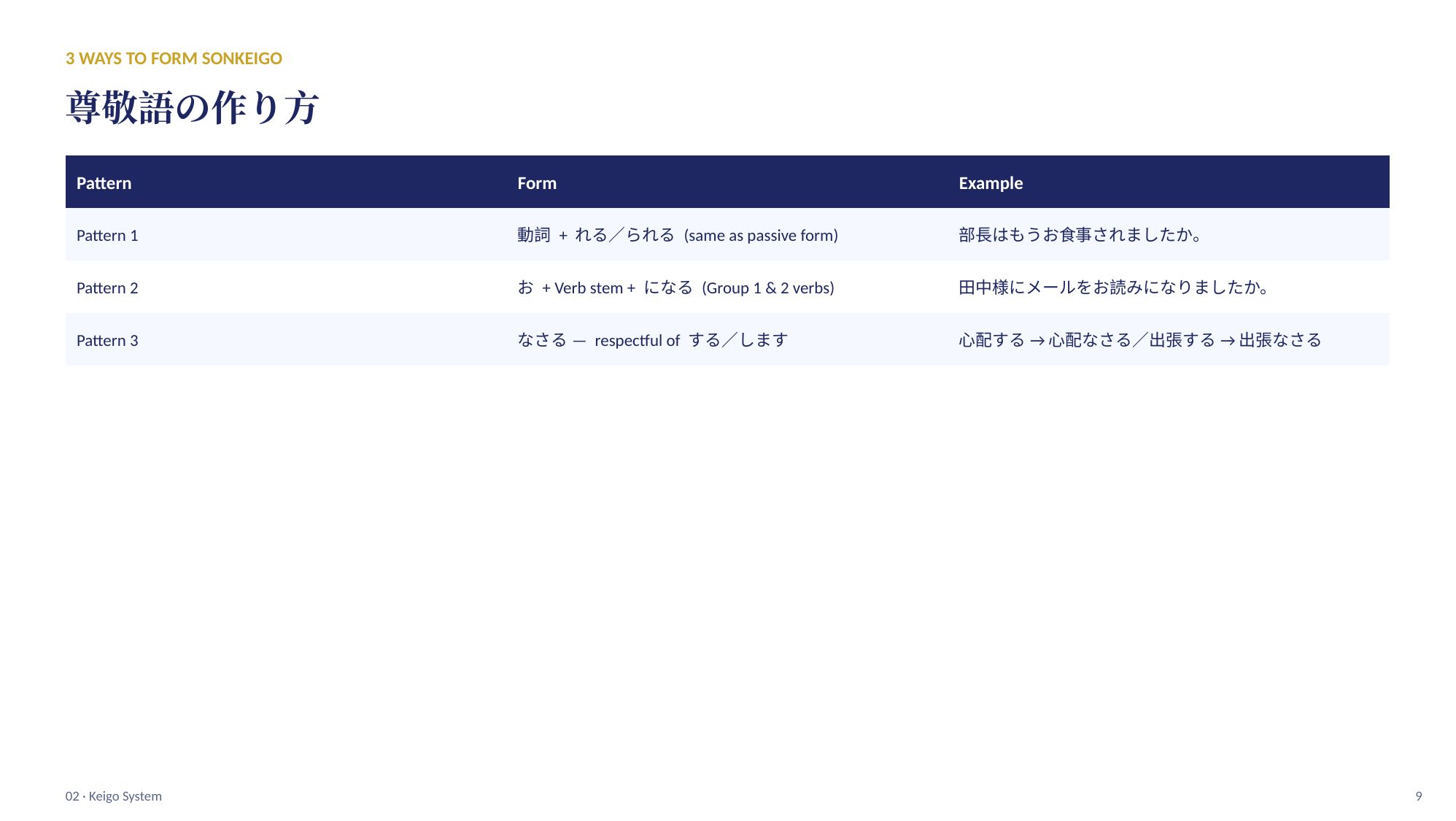
EN3 WAYS TO FORM SONKEIGO
JP尊敬語の作り方
EN Pattern Form Example
Pattern 1 動詞 + れる/られる (same as passive form) 部長はもうお食事されましたか。
Pattern 2 お + Verb stem + になる (Group 1 & 2 verbs) 田中様にメールをお読みになりましたか。
Pattern 1 動詞 + れる/られる (same as passive form) 部長はもうお食事されましたか。
Pattern 2 お + Verb stem + になる (Group 1 & 2 verbs) 田中様にメールをお読みになりましたか。
JPPattern3なさる—respectfulofする/します心配する→心配なさる/出張する→出張なさる
EN02 · Keigo System 9
หน้า 10
คลิกเพื่อขยาย
03
ENKenjougo — Humble Language
JP謙譲語の作り方
ENLowering yourself to elevate the other person
หน้า 11
คลิกเพื่อขยาย
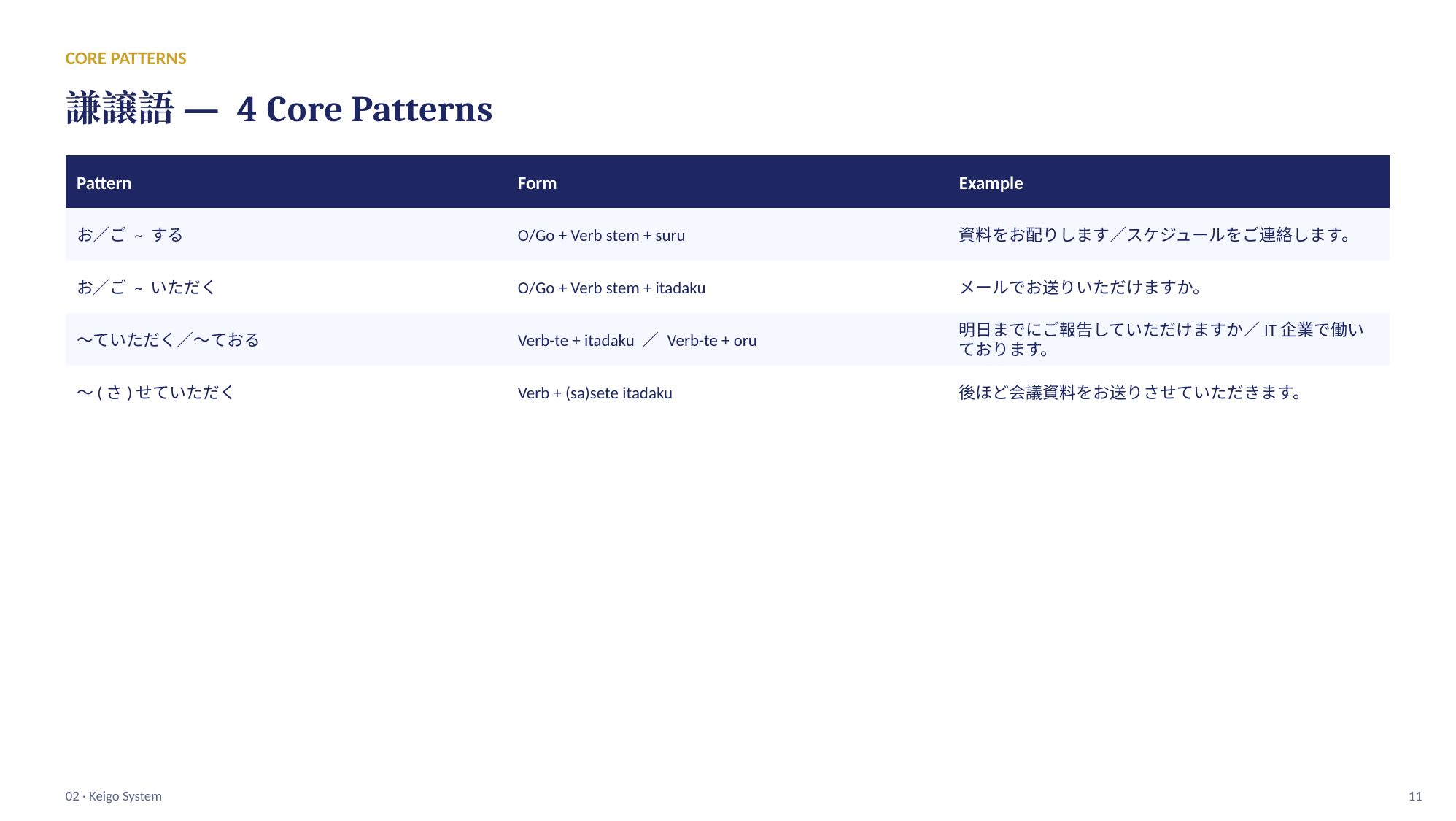
ENCORE PATTERNS
謙譲語 — 4 Core Patterns
Pattern Form Example
謙譲語 — 4 Core Patterns
Pattern Form Example
JPお/ご~するO/Go+Verbstem+suru資料をお配りします/スケジュールをご連絡します。
お/ご~いただくO/Go+Verbstem+itadakuメールでお送りいただけますか。
明日までにご報告していただけますか/IT企業で働い
お/ご~いただくO/Go+Verbstem+itadakuメールでお送りいただけますか。
明日までにご報告していただけますか/IT企業で働い
EN ~ていただく/~ておる Verb-te + itadaku / Verb-te + oru
JPております。
~(さ)せていただくVerb+(sa)seteitadaku後ほど会議資料をお送りさせていただきます。
~(さ)せていただくVerb+(sa)seteitadaku後ほど会議資料をお送りさせていただきます。
EN02 · Keigo System 11
หน้า 12
คลิกเพื่อขยาย
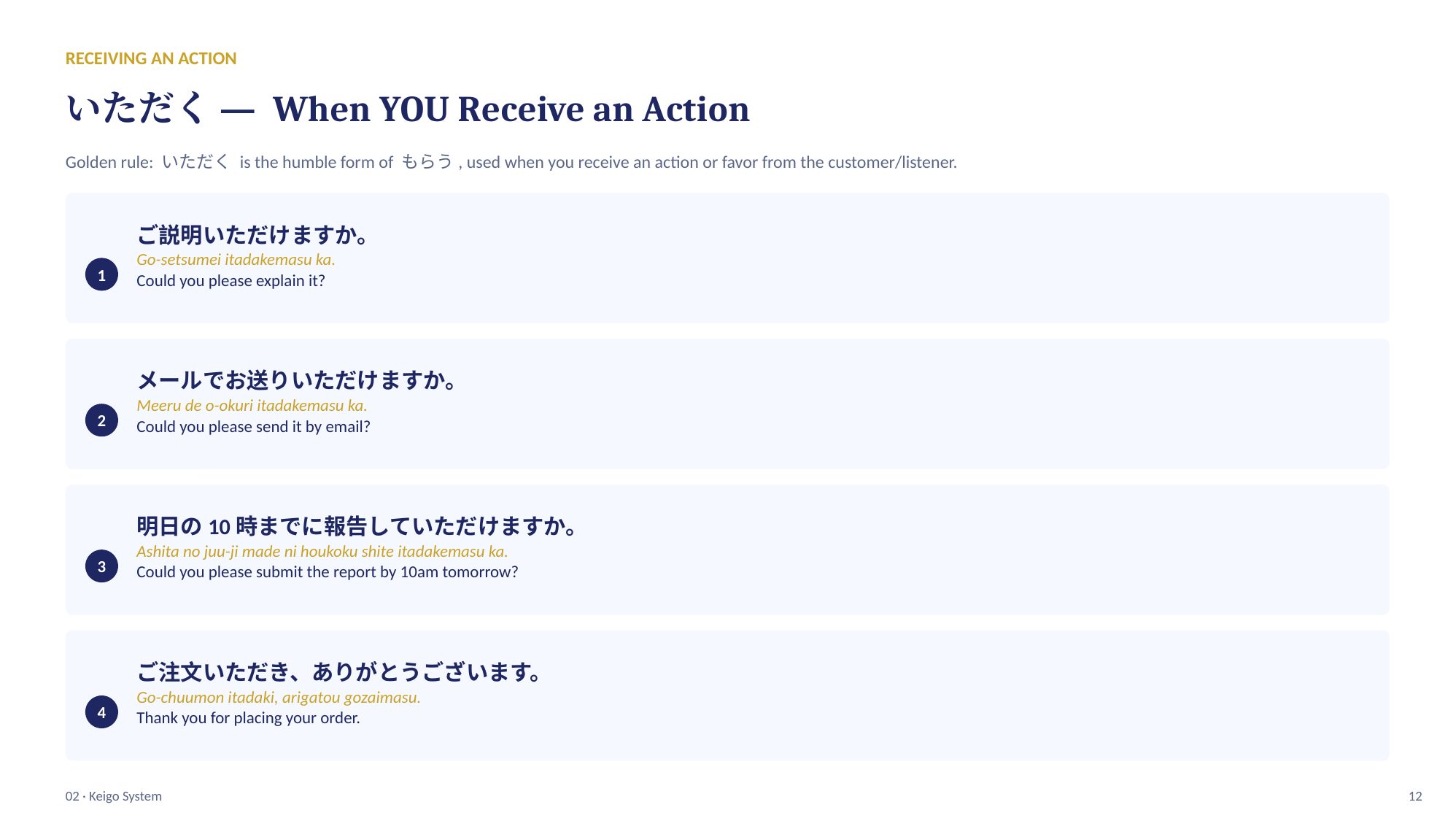
ENRECEIVING AN ACTION
いただく — When YOU Receive an Action
Golden rule: いただく is the humble form of もらう , used when you receive an action or favor from the customer/listener.
いただく — When YOU Receive an Action
Golden rule: いただく is the humble form of もらう , used when you receive an action or favor from the customer/listener.
JPご説明いただけますか。
EN Go-setsumei itadakemasu ka.
1 Could you please explain it?
1 Could you please explain it?
JPメールでお送りいただけますか。
EN Meeru de o-okuri itadakemasu ka.
2 Could you please send it by email?
2 Could you please send it by email?
JP明日の10時までに報告していただけますか。
EN Ashita no juu-ji made ni houkoku shite itadakemasu ka.
3 Could you please submit the report by 10am tomorrow?
3 Could you please submit the report by 10am tomorrow?
JPご注文いただき、ありがとうございます。
EN Go-chuumon itadaki, arigatou gozaimasu.
4 Thank you for placing your order.
02 · Keigo System 12
4 Thank you for placing your order.
02 · Keigo System 12
หน้า 13
คลิกเพื่อขยาย
ENSELF-ACTIONS
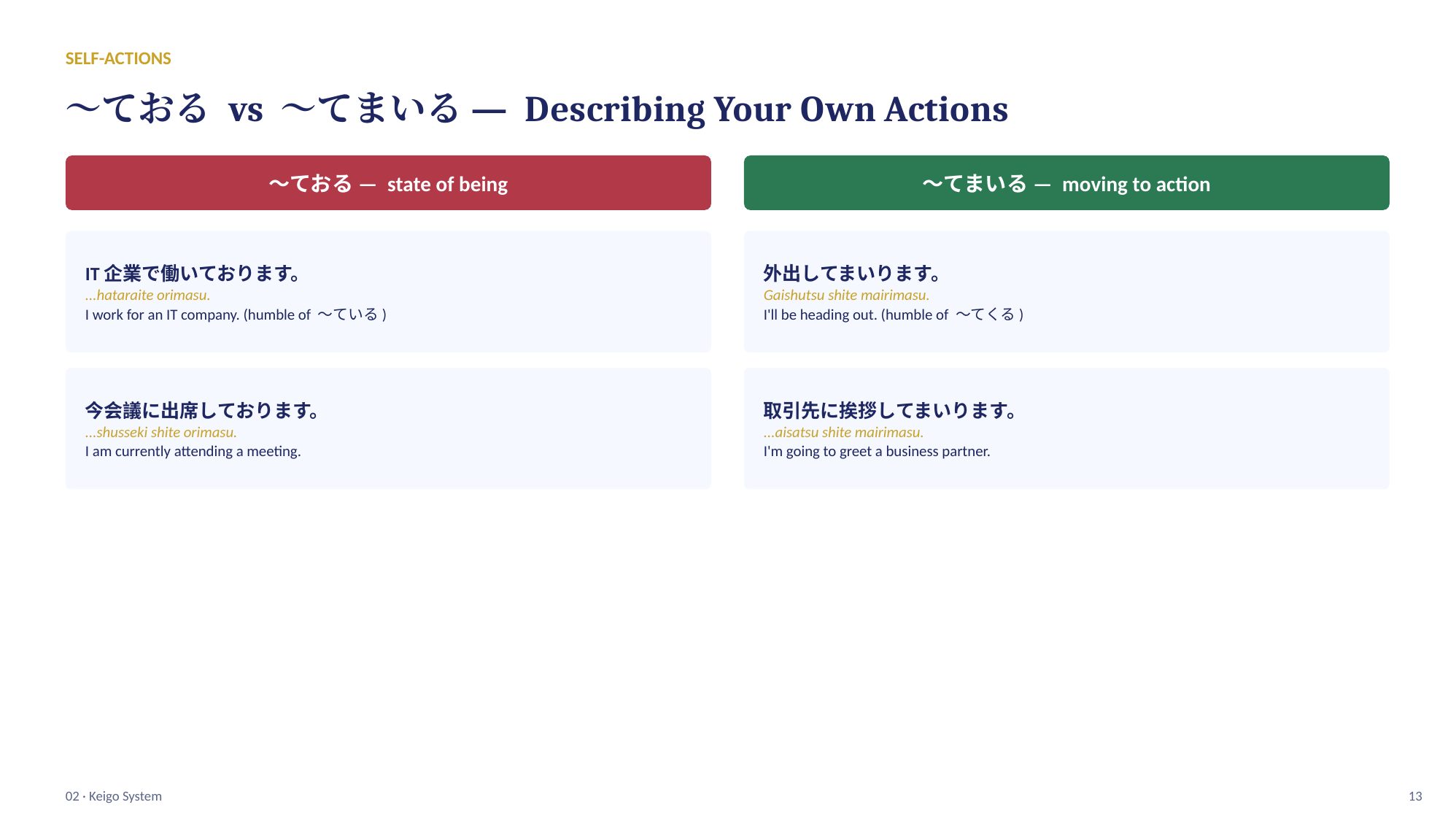
〜ておる vs 〜てまいる — Describing Your Own Actions
〜ておる — state of being 〜てまいる — moving to action
〜ておる vs 〜てまいる — Describing Your Own Actions
〜ておる — state of being 〜てまいる — moving to action
JPIT企業で働いております。外出してまいります。
EN ...hataraite orimasu. Gaishutsu shite mairimasu.
I work for an IT company. (humble of 〜ている ) I'll be heading out. (humble of 〜てくる )
I work for an IT company. (humble of 〜ている ) I'll be heading out. (humble of 〜てくる )
JP今会議に出席しております。取引先に挨拶してまいります。
EN ...shusseki shite orimasu. ...aisatsu shite mairimasu.
I am currently attending a meeting. I'm going to greet a business partner.
02 · Keigo System 13
I am currently attending a meeting. I'm going to greet a business partner.
02 · Keigo System 13
หน้า 14

คลิกเพื่อขยาย
04
ENThe Permission Loop
JP〜(さ)せていただく
EN"Allow me to..." — asking permission before you act
หน้า 15
คลิกเพื่อขยาย
ENDIAGRAM
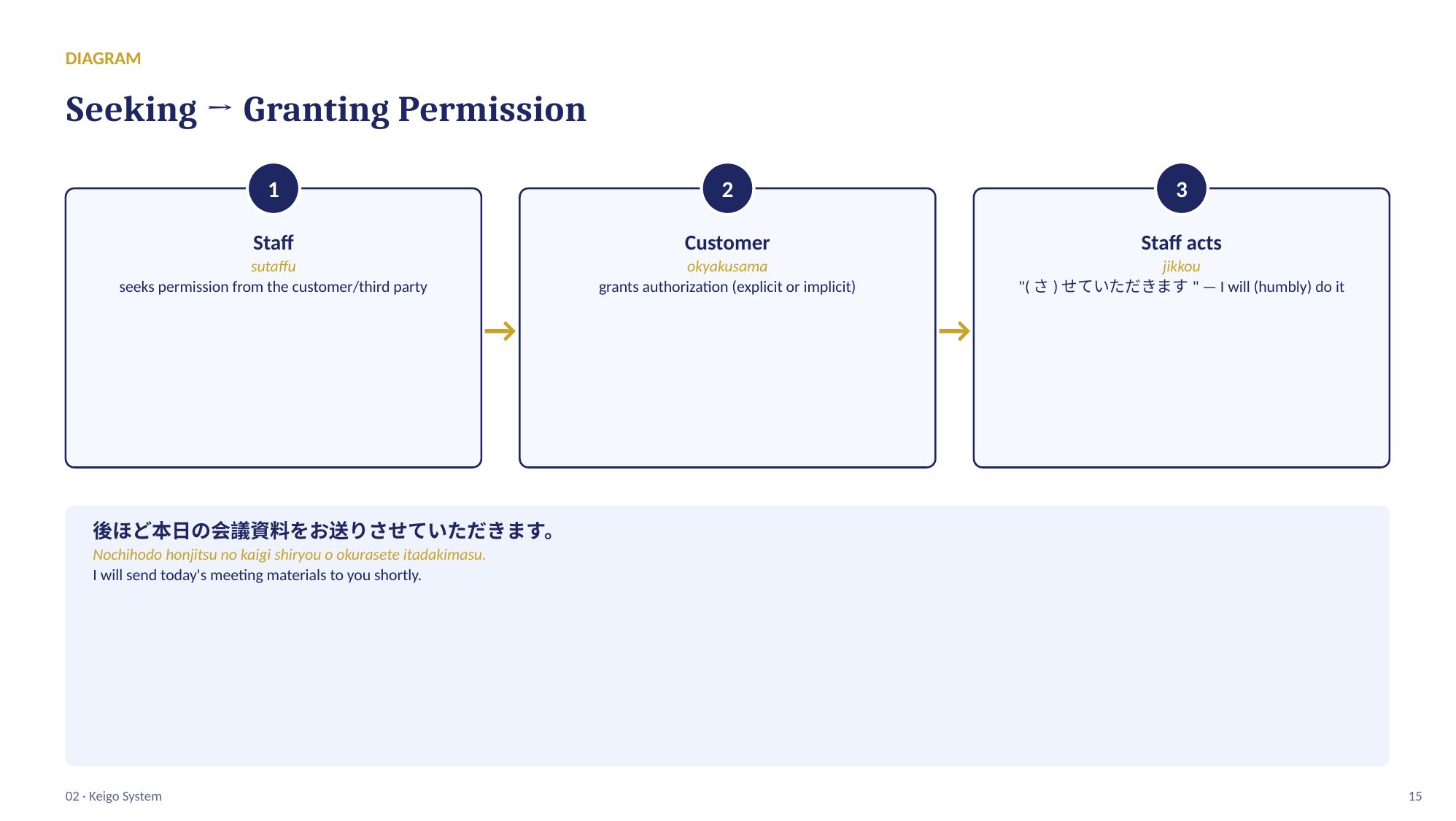
Seeking → Granting Permission
1 2 3
Staff Customer Staff acts
sutaffu okyakusama jikkou
seeks permission from the customer/third party grants authorization (explicit or implicit) "( さ ) せていただきます " — I will (humbly) do it
→ →
Seeking → Granting Permission
1 2 3
Staff Customer Staff acts
sutaffu okyakusama jikkou
seeks permission from the customer/third party grants authorization (explicit or implicit) "( さ ) せていただきます " — I will (humbly) do it
→ →
JP後ほど本日の会議資料をお送りさせていただきます。
EN Nochihodo honjitsu no kaigi shiryou o okurasete itadakimasu.
I will send today's meeting materials to you shortly.
02 · Keigo System 15
I will send today's meeting materials to you shortly.
02 · Keigo System 15
หน้า 16
คลิกเพื่อขยาย
ENWHEN TO USE IT
Key Takeaway
Key Takeaway
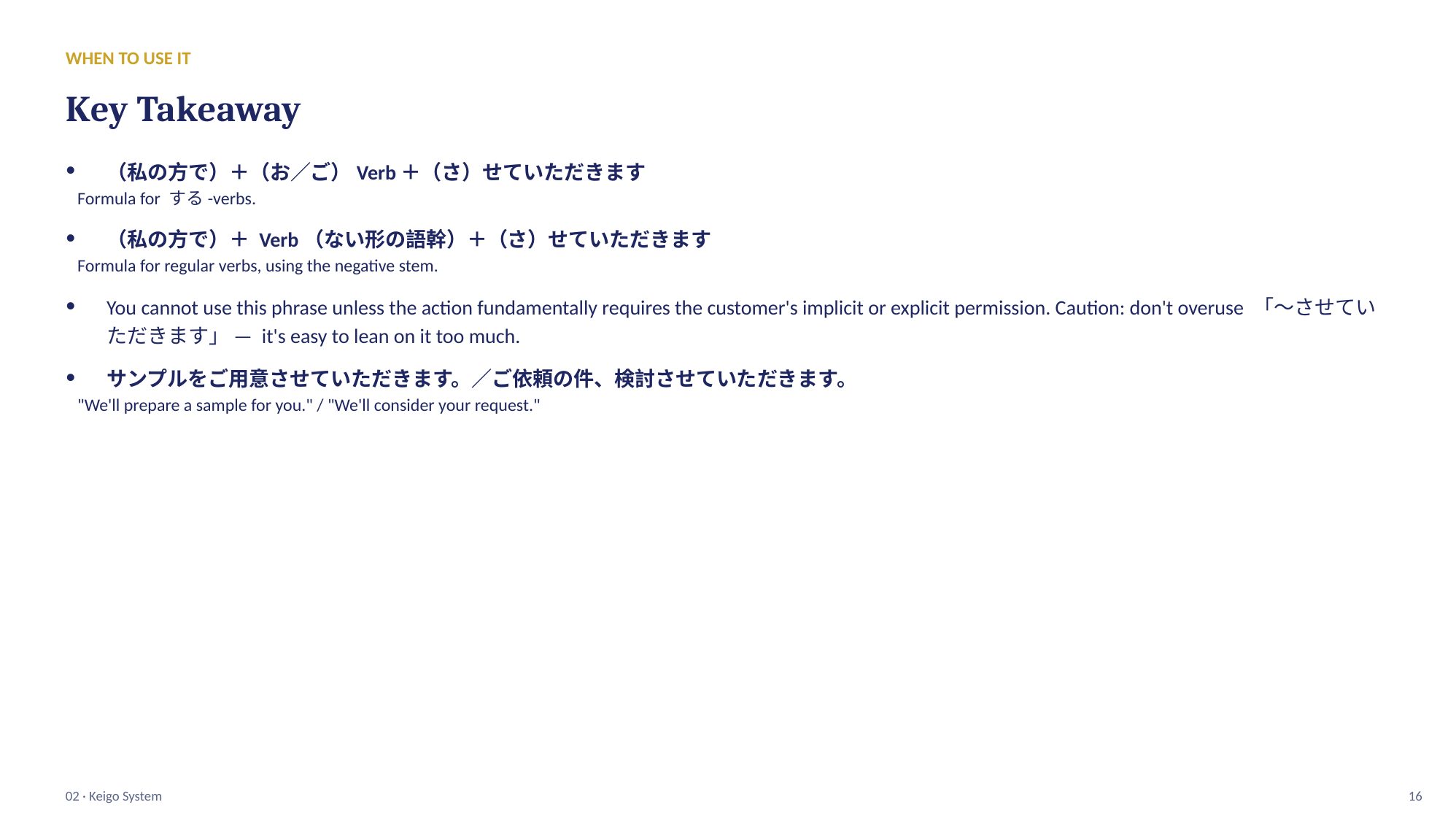
JP•(私の方で)+(お/ご)Verb+(さ)せていただきます
EN Formula for する -verbs.
JP•(私の方で)+Verb(ない形の語幹)+(さ)せていただきます
EN Formula for regular verbs, using the negative stem.
• You cannot use this phrase unless the action fundamentally requires the customer's implicit or explicit permission. Caution: don't overuse 「〜させてい
ただきます」 — it's easy to lean on it too much.
• You cannot use this phrase unless the action fundamentally requires the customer's implicit or explicit permission. Caution: don't overuse 「〜させてい
ただきます」 — it's easy to lean on it too much.
JP•サンプルをご用意させていただきます。/ご依頼の件、検討させていただきます。
EN "We'll prepare a sample for you." / "We'll consider your request."
02 · Keigo System 16
02 · Keigo System 16
หน้า 17
คลิกเพื่อขยาย
05
ENSonkeigo vs Kenjougo Verb Table
JP尊敬語と謙譲語の動詞対応表
ENThe core respectful/humble verb pairs used constantly in business speech
หน้า 18
คลิกเพื่อขยาย
ENREFERENCE
Plain → Respectful (others) → Humble (yourself)
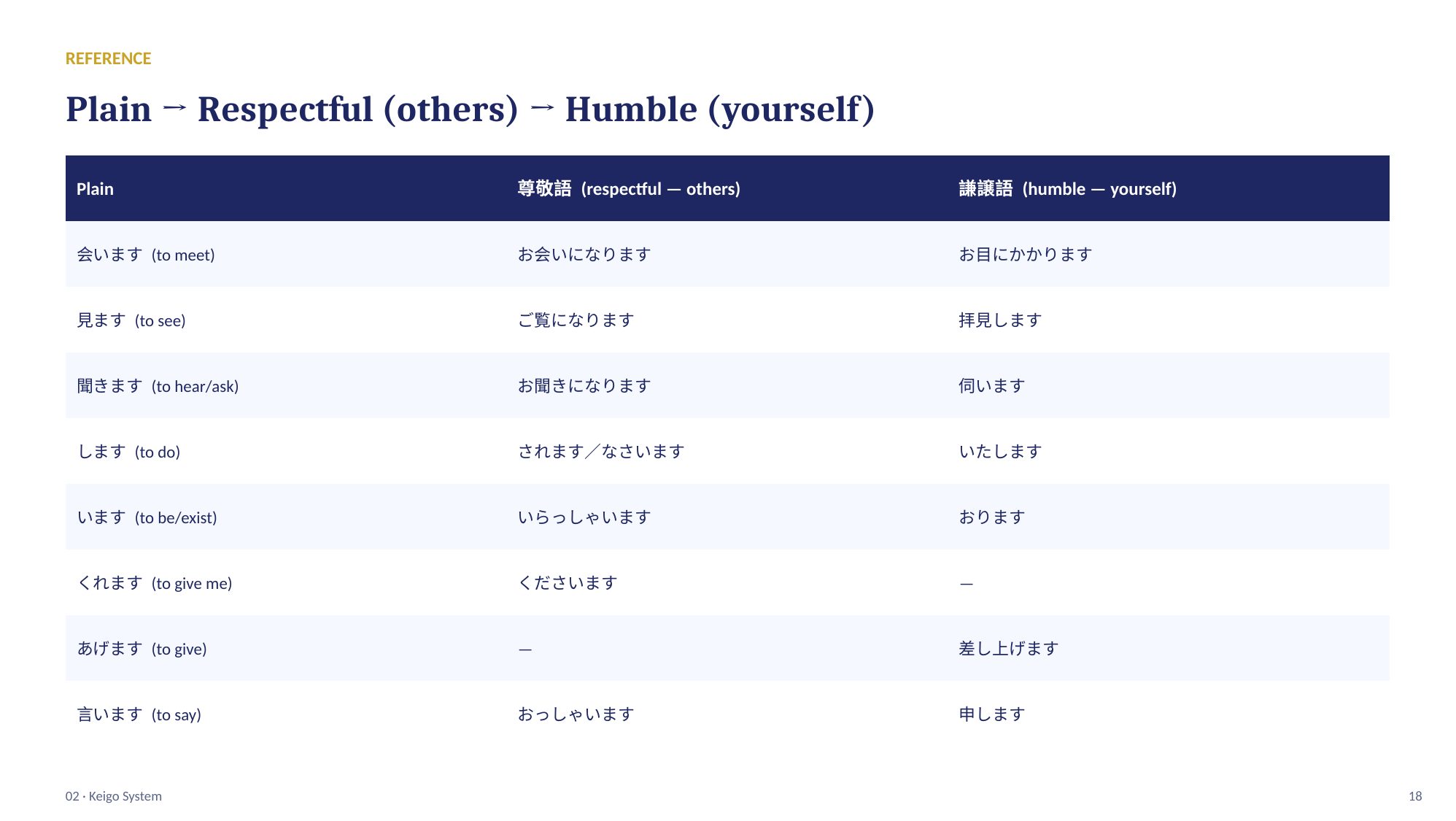
Plain 尊敬語 (respectful — others) 謙譲語 (humble — yourself)
Plain → Respectful (others) → Humble (yourself)
Plain 尊敬語 (respectful — others) 謙譲語 (humble — yourself)
JP会います(tomeet)お会いになりますお目にかかります
見ます(tosee)ご覧になります拝見します
聞きます(tohear/ask)お聞きになります伺います
します(todo)されます/なさいますいたします
います(tobe/exist)いらっしゃいますおります
くれます(togiveme)くださいます—
あげます(togive)—差し上げます
言います(tosay)おっしゃいます申します
見ます(tosee)ご覧になります拝見します
聞きます(tohear/ask)お聞きになります伺います
します(todo)されます/なさいますいたします
います(tobe/exist)いらっしゃいますおります
くれます(togiveme)くださいます—
あげます(togive)—差し上げます
言います(tosay)おっしゃいます申します
EN02 · Keigo System 18
หน้า 19
คลิกเพื่อขยาย
ENIN USE
JPお目にかかります/申します
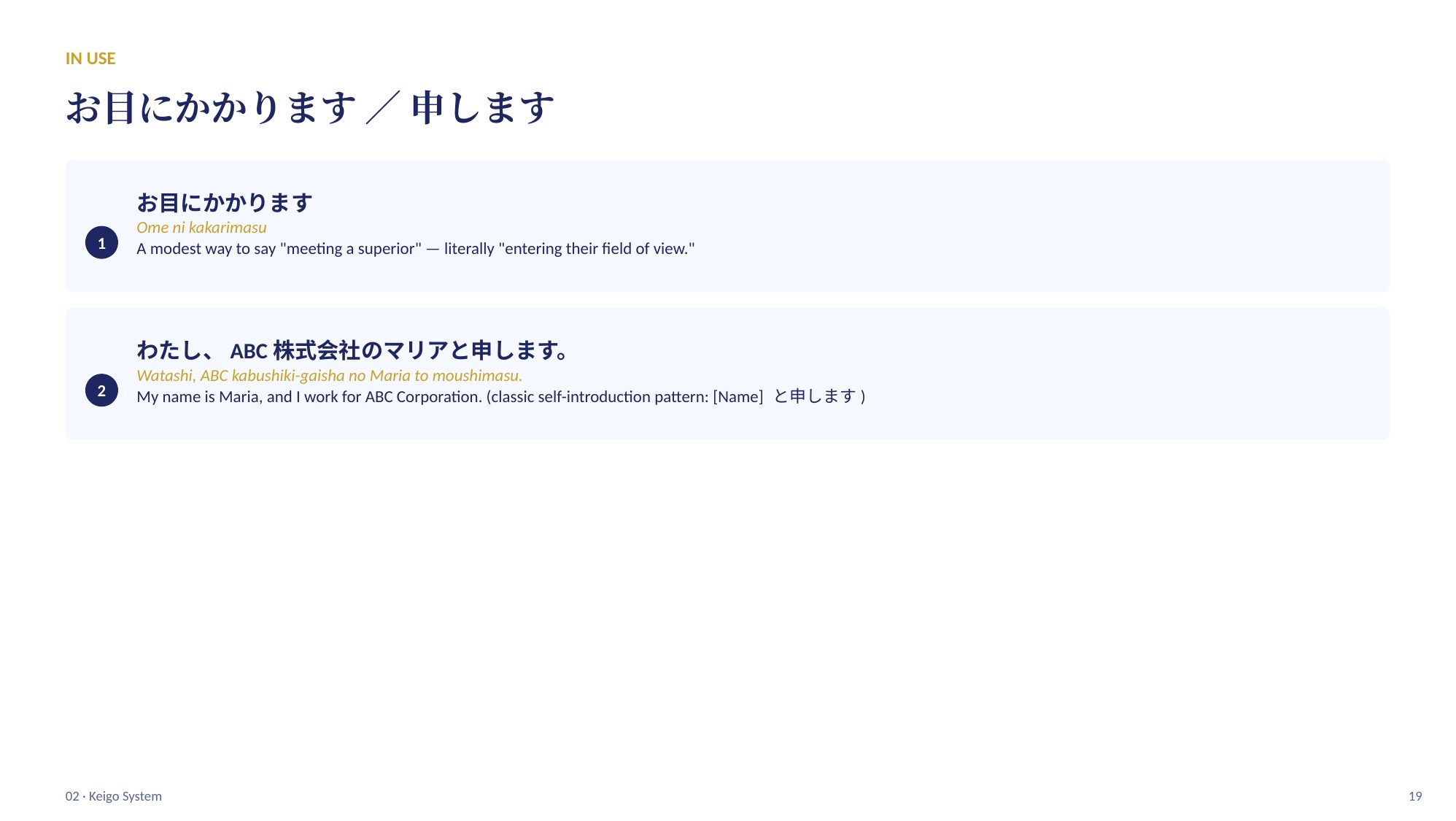
お目にかかります
お目にかかります
EN Ome ni kakarimasu
1 A modest way to say "meeting a superior" — literally "entering their field of view."
1 A modest way to say "meeting a superior" — literally "entering their field of view."
JPわたし、ABC株式会社のマリアと申します。
EN Watashi, ABC kabushiki-gaisha no Maria to moushimasu.
2 My name is Maria, and I work for ABC Corporation. (classic self-introduction pattern: [Name] と申します )
02 · Keigo System 19
2 My name is Maria, and I work for ABC Corporation. (classic self-introduction pattern: [Name] と申します )
02 · Keigo System 19
หน้า 20
คลิกเพื่อขยาย
06
ENDouble Honorifics — Common Mistakes
JP二重敬語に気をつけましょう
ENUsing the same type of honorific twice — a frequent business mistake
หน้า 21
คลิกเพื่อขยาย
ENWHAT IS IT?
JP二重敬語とは
ENNijuu Keigo to wa
• Using the same type of honorific twice is a common mistake in Japanese business settings. Different TYPES of keigo can be combined (e.g. 拝見/謙譲語
+ します/丁寧語 ) — that is NOT double honorific. The error is stacking two respectful (or two humble) markers on one single verb.
02 · Keigo System 21
• Using the same type of honorific twice is a common mistake in Japanese business settings. Different TYPES of keigo can be combined (e.g. 拝見/謙譲語
+ します/丁寧語 ) — that is NOT double honorific. The error is stacking two respectful (or two humble) markers on one single verb.
02 · Keigo System 21
หน้า 22
คลิกเพื่อขยาย
ENFIX IT
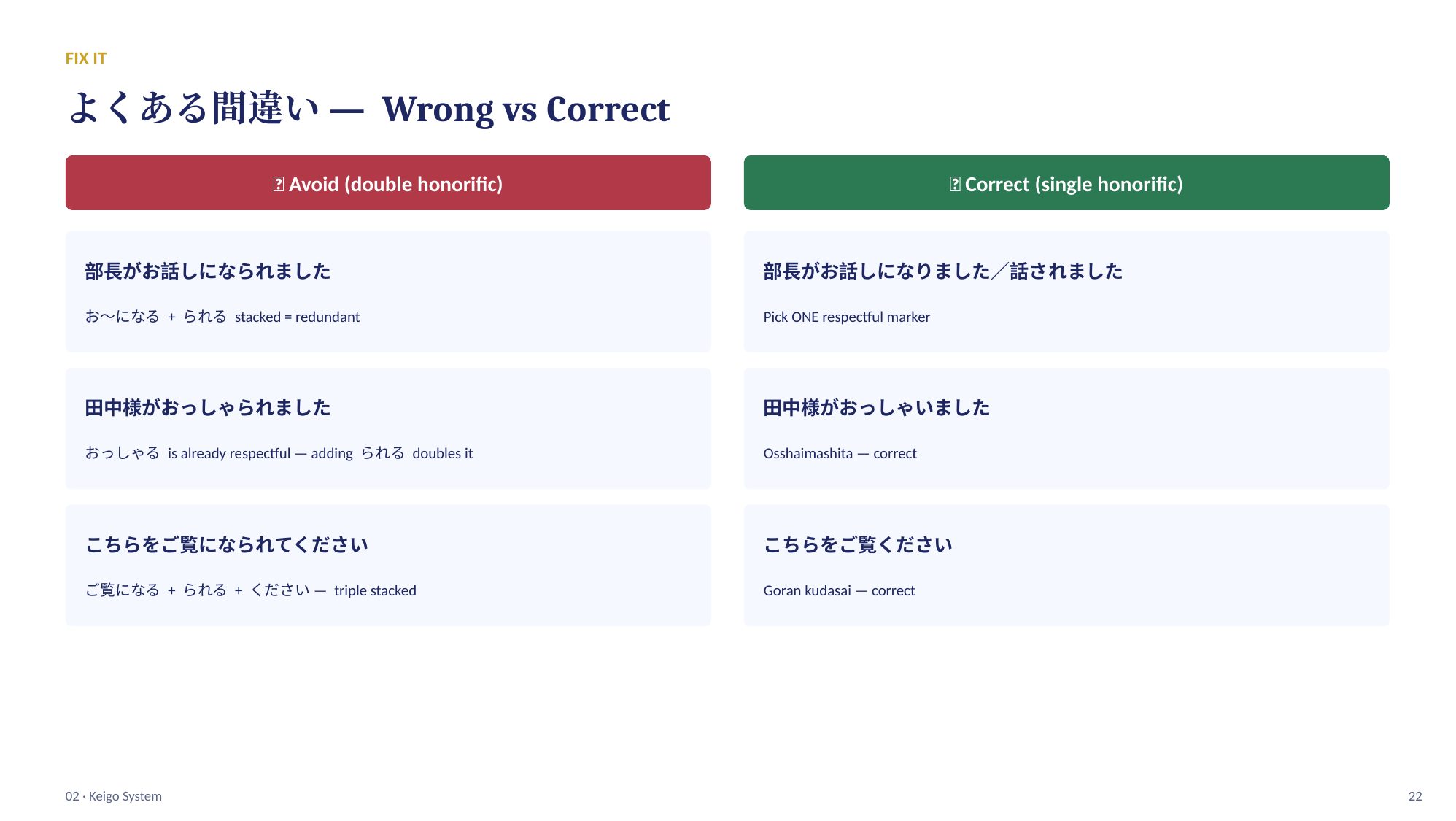
よくある間違い — Wrong vs Correct
❌ Avoid (double honorific) ✅ Correct (single honorific)
よくある間違い — Wrong vs Correct
❌ Avoid (double honorific) ✅ Correct (single honorific)
JP部長がお話しになられました部長がお話しになりました/話されました
EN お〜になる + られる stacked = redundant Pick ONE respectful marker
JP田中様がおっしゃられました田中様がおっしゃいました
EN おっしゃる is already respectful — adding られる doubles it Osshaimashita — correct
JPこちらをご覧になられてくださいこちらをご覧ください
EN ご覧になる + られる + ください — triple stacked Goran kudasai — correct
02 · Keigo System 22
02 · Keigo System 22
หน้า 23
คลิกเพื่อขยาย
07
ENHonorific Fill-in-the-Blank Quiz
JP敬語の穴埋め問題
EN10 real scenarios to test yourself before moving on
หน้า 24
คลิกเพื่อขยาย
ENQ1-Q3
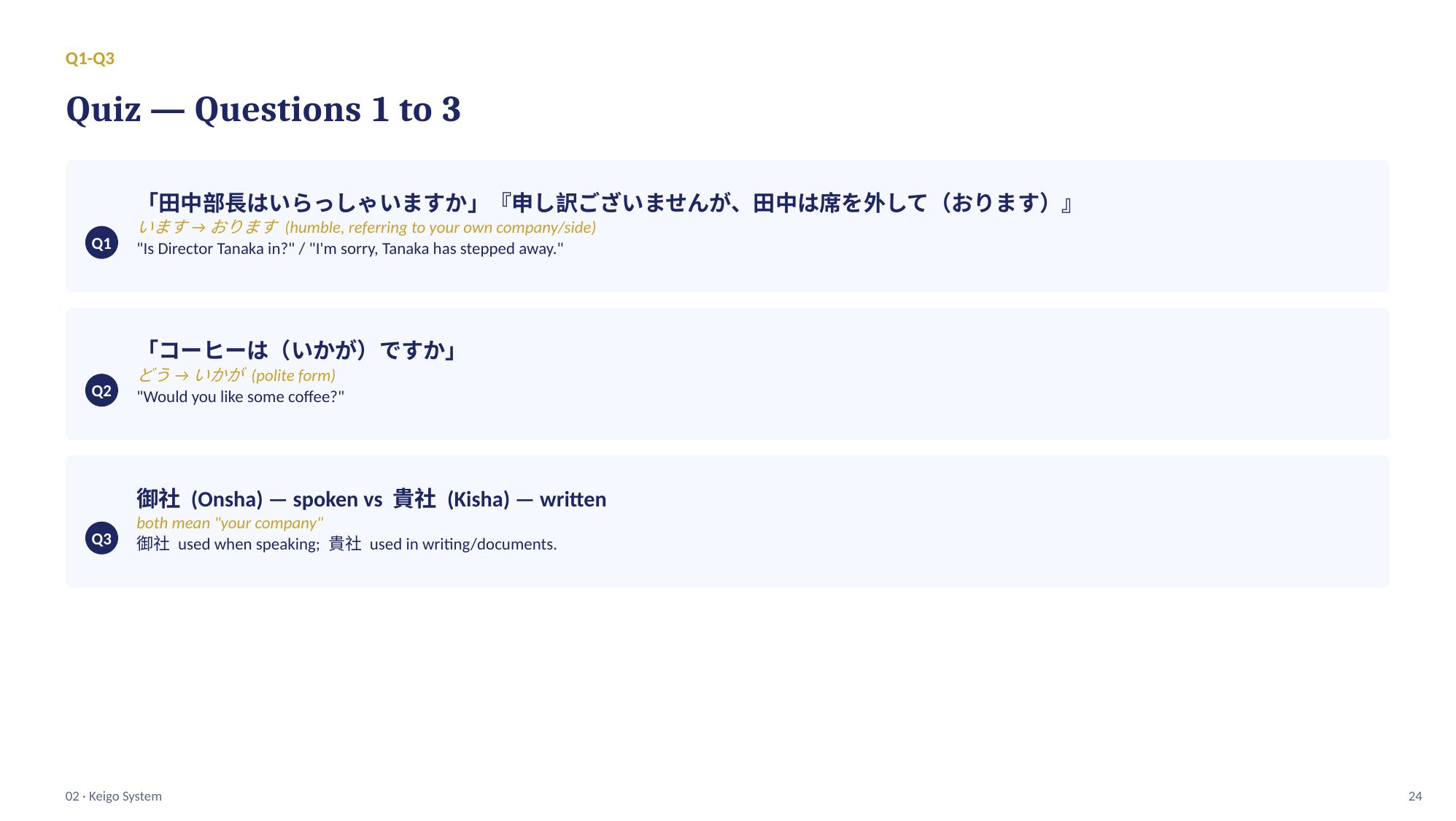
Quiz — Questions 1 to 3
Quiz — Questions 1 to 3
JP「田中部長はいらっしゃいますか」『申し訳ございませんが、田中は席を外して(おります)』
EN います → おります (humble, referring to your own company/side)
Q1 "Is Director Tanaka in?" / "I'm sorry, Tanaka has stepped away."
Q1 "Is Director Tanaka in?" / "I'm sorry, Tanaka has stepped away."
JP「コーヒーは(いかが)ですか」
EN どう → いかが (polite form)
Q2 "Would you like some coffee?"
御社 (Onsha) — spoken vs 貴社 (Kisha) — written
both mean "your company"
Q3 御社 used when speaking; 貴社 used in writing/documents.
02 · Keigo System 24
Q2 "Would you like some coffee?"
御社 (Onsha) — spoken vs 貴社 (Kisha) — written
both mean "your company"
Q3 御社 used when speaking; 貴社 used in writing/documents.
02 · Keigo System 24
หน้า 25
คลิกเพื่อขยาย
ENQ4-Q7
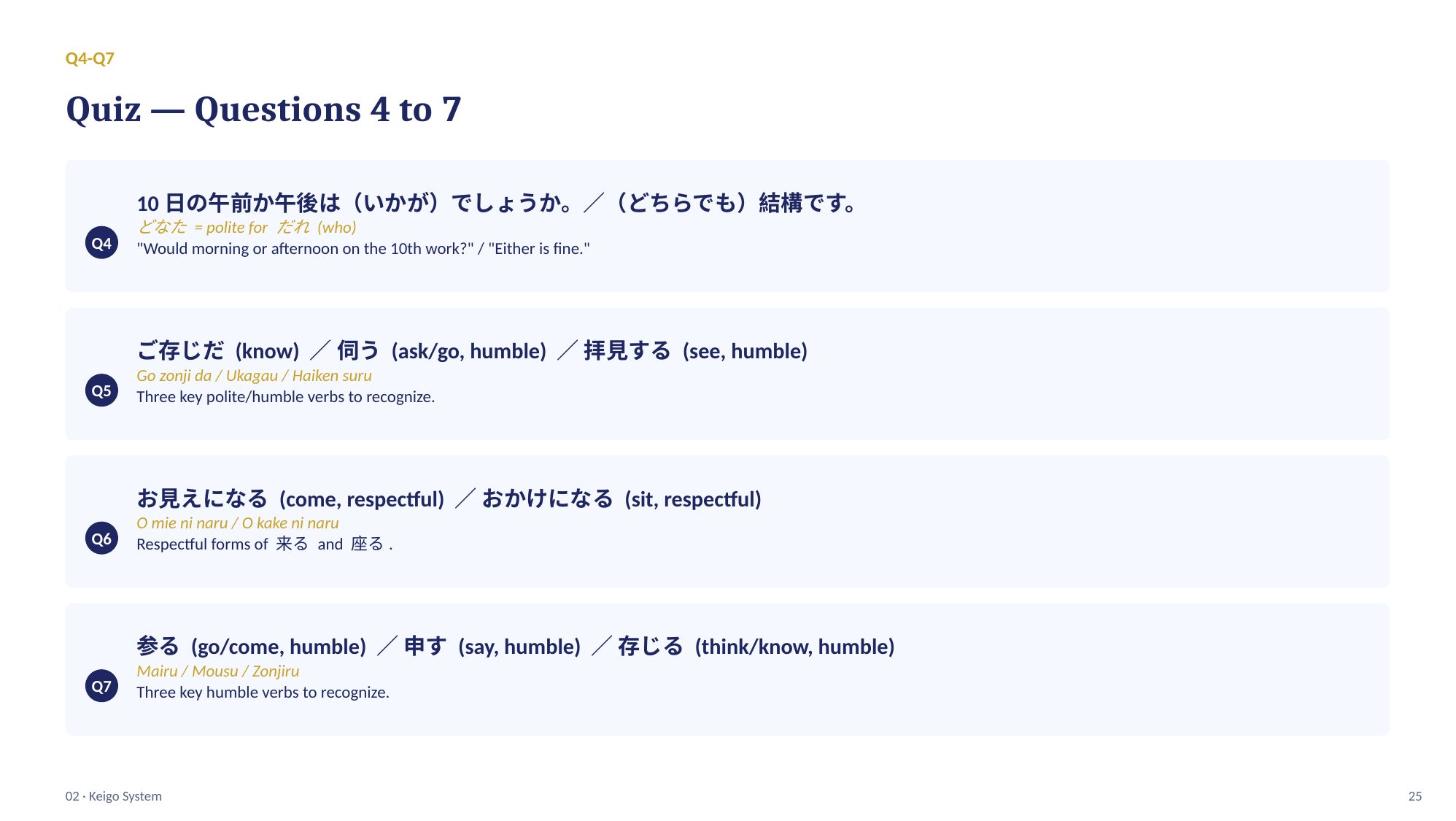
Quiz — Questions 4 to 7
Quiz — Questions 4 to 7
JP10日の午前か午後は(いかが)でしょうか。/(どちらでも)結構です。
EN どなた = polite for だれ (who)
Q4 "Would morning or afternoon on the 10th work?" / "Either is fine."
ご存じだ (know) / 伺う (ask/go, humble) / 拝見する (see, humble)
Go zonji da / Ukagau / Haiken suru
Q5 Three key polite/humble verbs to recognize.
お見えになる (come, respectful) / おかけになる (sit, respectful)
O mie ni naru / O kake ni naru
Q6 Respectful forms of 来る and 座る .
参る (go/come, humble) / 申す (say, humble) / 存じる (think/know, humble)
Mairu / Mousu / Zonjiru
Q7 Three key humble verbs to recognize.
02 · Keigo System 25
Q4 "Would morning or afternoon on the 10th work?" / "Either is fine."
ご存じだ (know) / 伺う (ask/go, humble) / 拝見する (see, humble)
Go zonji da / Ukagau / Haiken suru
Q5 Three key polite/humble verbs to recognize.
お見えになる (come, respectful) / おかけになる (sit, respectful)
O mie ni naru / O kake ni naru
Q6 Respectful forms of 来る and 座る .
参る (go/come, humble) / 申す (say, humble) / 存じる (think/know, humble)
Mairu / Mousu / Zonjiru
Q7 Three key humble verbs to recognize.
02 · Keigo System 25
หน้า 26
คลิกเพื่อขยาย
ENQ8-Q10
Quiz — Questions 8 to 10
Quiz — Questions 8 to 10
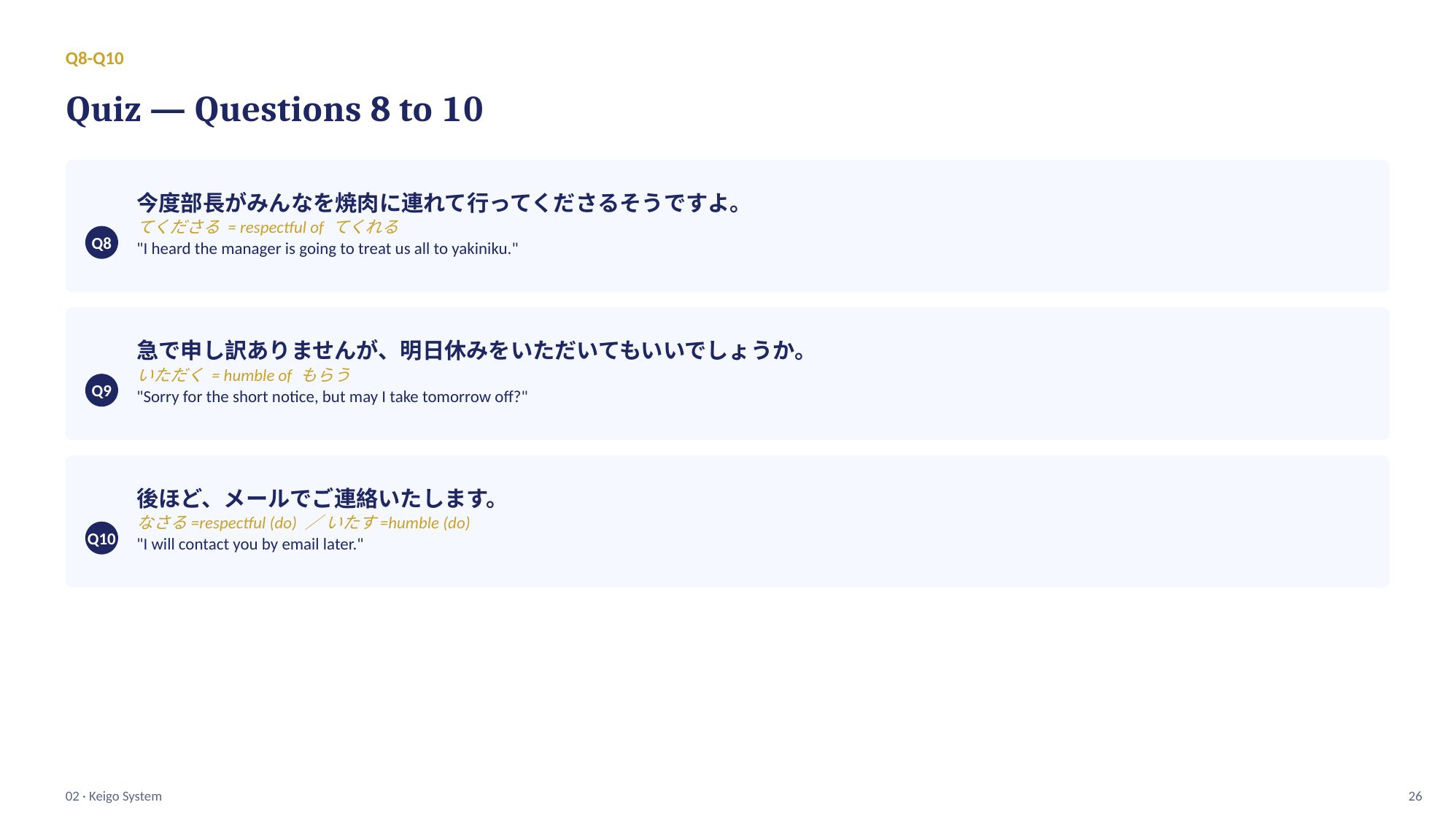
JP今度部長がみんなを焼肉に連れて行ってくださるそうですよ。
EN てくださる = respectful of てくれる
Q8 "I heard the manager is going to treat us all to yakiniku."
Q8 "I heard the manager is going to treat us all to yakiniku."
JP急で申し訳ありませんが、明日休みをいただいてもいいでしょうか。
EN いただく = humble of もらう
Q9 "Sorry for the short notice, but may I take tomorrow off?"
Q9 "Sorry for the short notice, but may I take tomorrow off?"
JP後ほど、メールでご連絡いたします。
EN なさる =respectful (do) / いたす =humble (do)
Q10 "I will contact you by email later."
02 · Keigo System 26
Q10 "I will contact you by email later."
02 · Keigo System 26
หน้า 27
คลิกเพื่อขยาย
08
ENTerms of Address & Business Nouns
JP自分と相手を表す言葉
ENReferring to yourself, your company, and the other party correctly
หน้า 28
คลิกเพื่อขยาย
ENCOMPANY NAMES
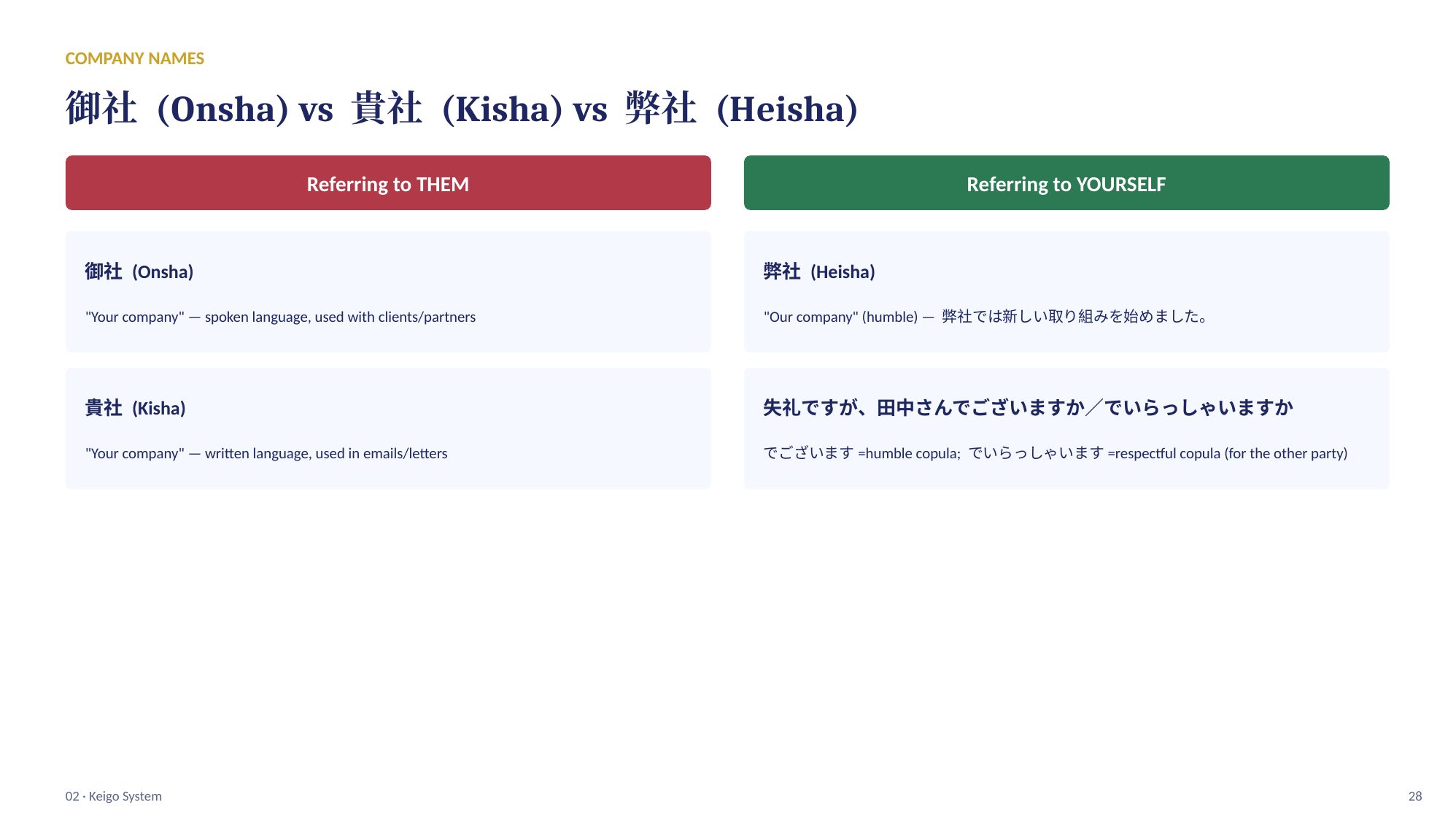
御社 (Onsha) vs 貴社 (Kisha) vs 弊社 (Heisha)
Referring to THEM Referring to YOURSELF
御社 (Onsha) 弊社 (Heisha)
"Your company" — spoken language, used with clients/partners "Our company" (humble) — 弊社では新しい取り組みを始めました。
御社 (Onsha) vs 貴社 (Kisha) vs 弊社 (Heisha)
Referring to THEM Referring to YOURSELF
御社 (Onsha) 弊社 (Heisha)
"Your company" — spoken language, used with clients/partners "Our company" (humble) — 弊社では新しい取り組みを始めました。
JP貴社(Kisha)失礼ですが、田中さんでございますか/でいらっしゃいますか
EN "Your company" — written language, used in emails/letters でございます =humble copula; でいらっしゃいます =respectful copula (for the other party)
02 · Keigo System 28
02 · Keigo System 28
หน้า 29
คลิกเพื่อขยาย
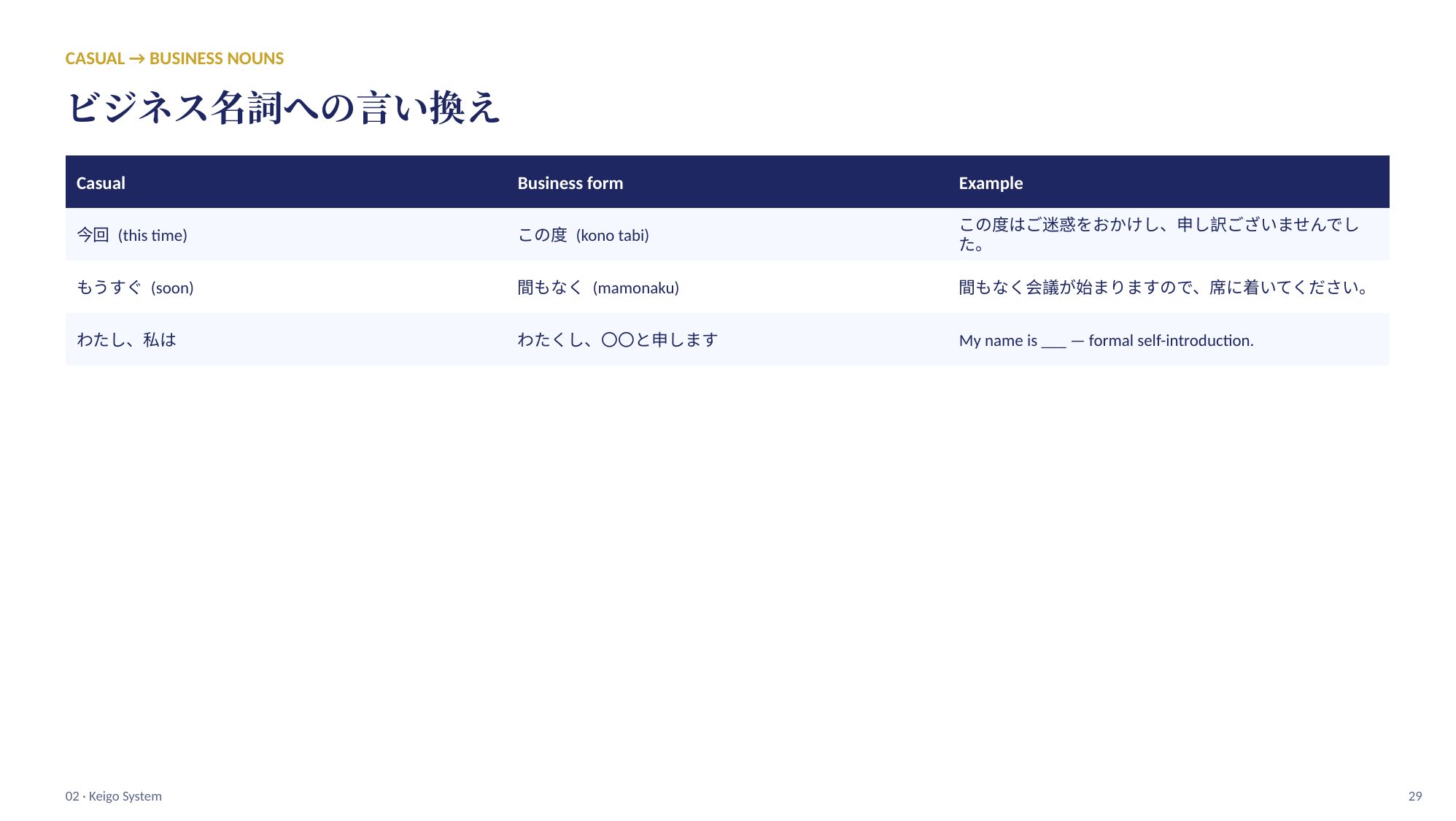
ENCASUAL → BUSINESS NOUNS
JPビジネス名詞への言い換え
EN Casual Business form Example
JPこの度はご迷惑をおかけし、申し訳ございませんでし
EN 今回 (this time) この度 (kono tabi)
JPた。
もうすぐ(soon)間もなく(mamonaku)間もなく会議が始まりますので、席に着いてください。
もうすぐ(soon)間もなく(mamonaku)間もなく会議が始まりますので、席に着いてください。
EN わたし、私は わたくし、〇〇と申します My name is ___ — formal self-introduction.
02 · Keigo System 29
02 · Keigo System 29
หน้า 30
คลิกเพื่อขยาย
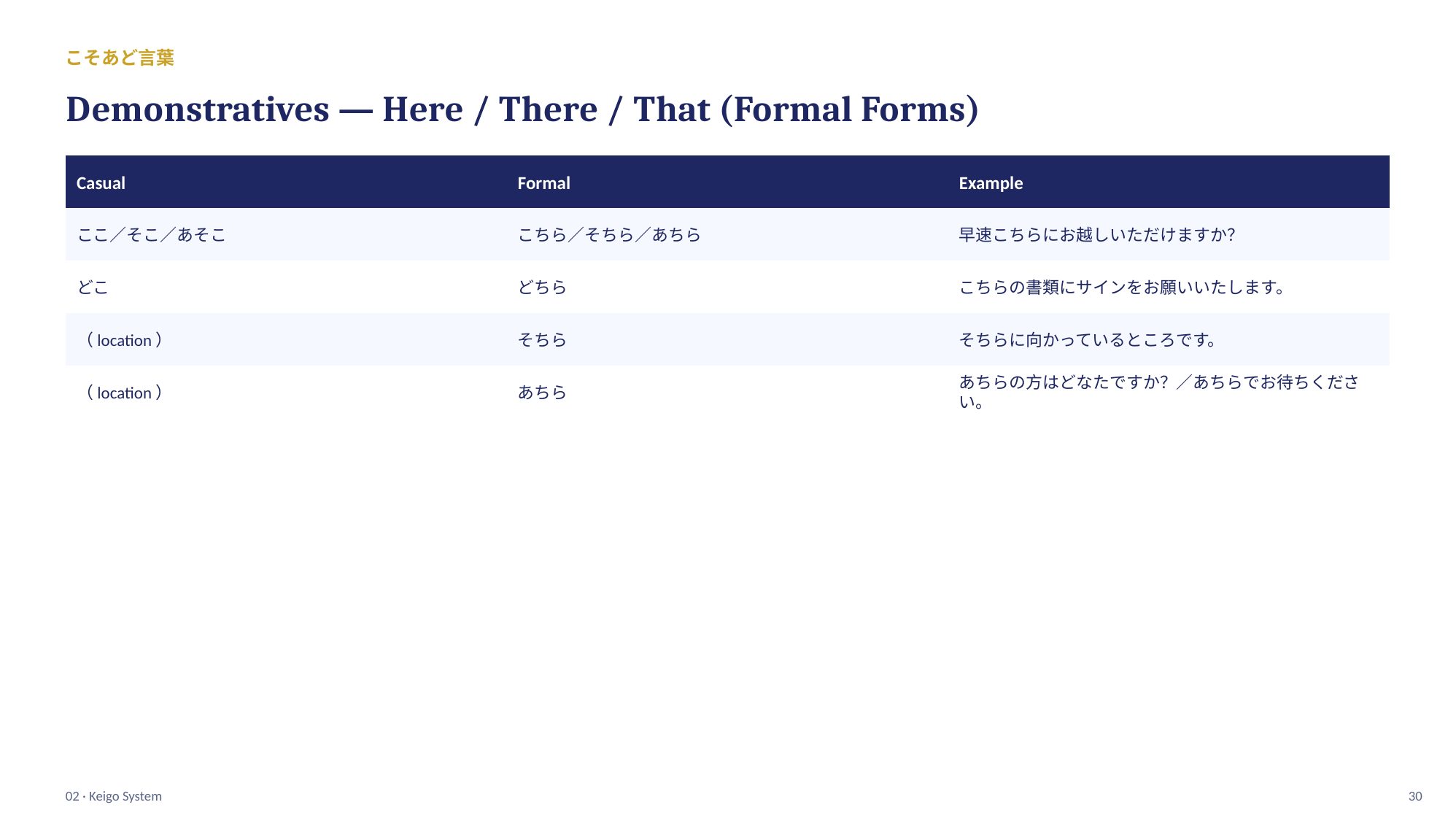
JPこそあど言葉
ENDemonstratives — Here / There / That (Formal Forms)
Casual Formal Example
Casual Formal Example
JPここ/そこ/あそここちら/そちら/あちら早速こちらにお越しいただけますか?
どこどちらこちらの書類にサインをお願いいたします。
(location)そちらそちらに向かっているところです。
あちらの方はどなたですか?/あちらでお待ちくださ
どこどちらこちらの書類にサインをお願いいたします。
(location)そちらそちらに向かっているところです。
あちらの方はどなたですか?/あちらでお待ちくださ
EN ( location ) あちら
JPい。
EN02 · Keigo System 30
หน้า 31

คลิกเพื่อขยาย
09
ENThe O-/Go- Prefix Matrix
JPおvsご—和語vs漢語
ENWhich prefix goes with which kind of word — and the exceptions
หน้า 32
คลิกเพื่อขยาย
ENTHE RULE
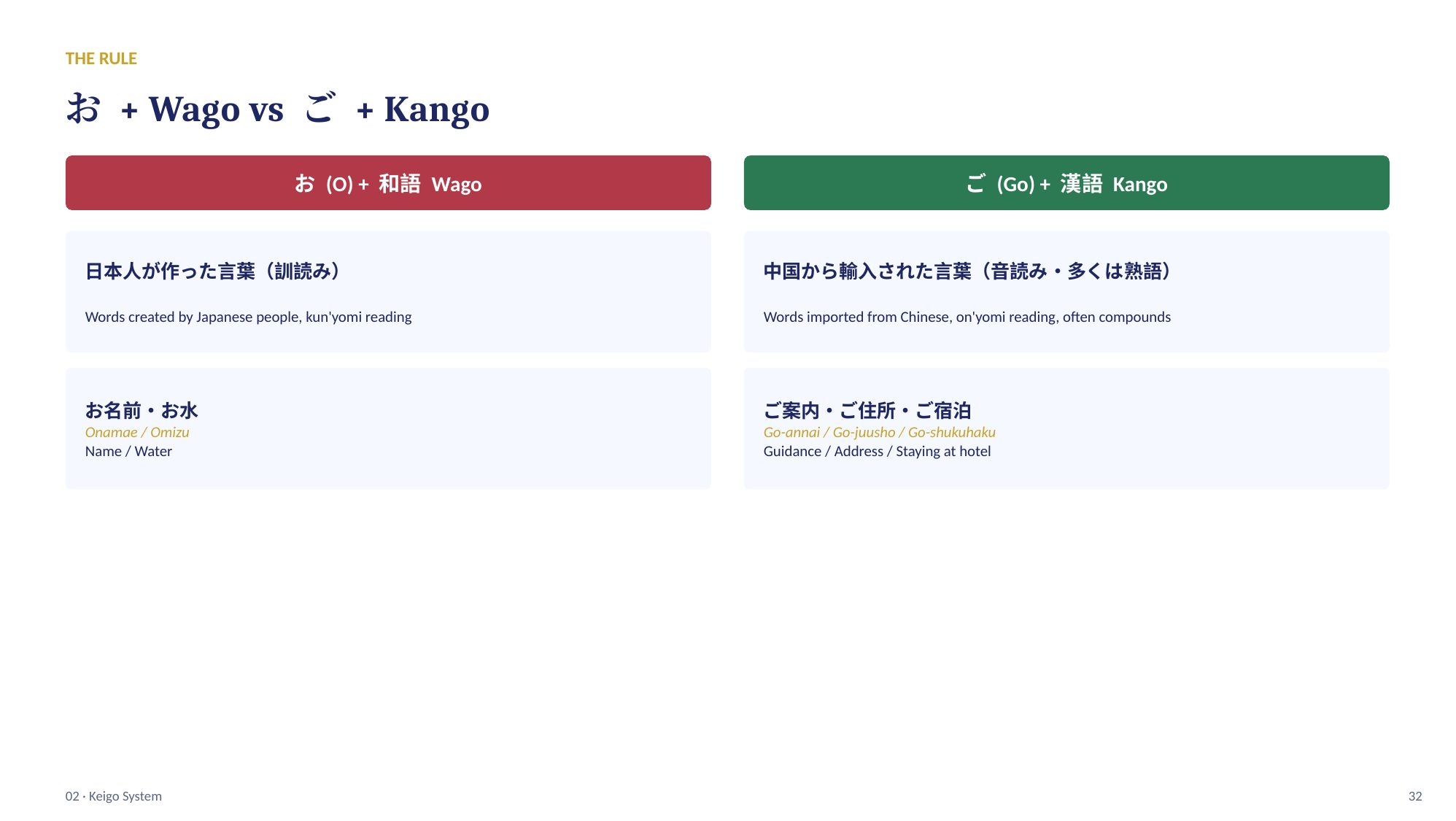
お + Wago vs ご + Kango
お (O) + 和語 Wago ご (Go) + 漢語 Kango
お + Wago vs ご + Kango
お (O) + 和語 Wago ご (Go) + 漢語 Kango
JP日本人が作った言葉(訓読み)中国から輸入された言葉(音読み・多くは熟語)
EN Words created by Japanese people, kun'yomi reading Words imported from Chinese, on'yomi reading, often compounds
JPお名前・お水ご案内・ご住所・ご宿泊
EN Onamae / Omizu Go-annai / Go-juusho / Go-shukuhaku
Name / Water Guidance / Address / Staying at hotel
02 · Keigo System 32
Name / Water Guidance / Address / Staying at hotel
02 · Keigo System 32
หน้า 33
คลิกเพื่อขยาย
ENEXCEPTIONS
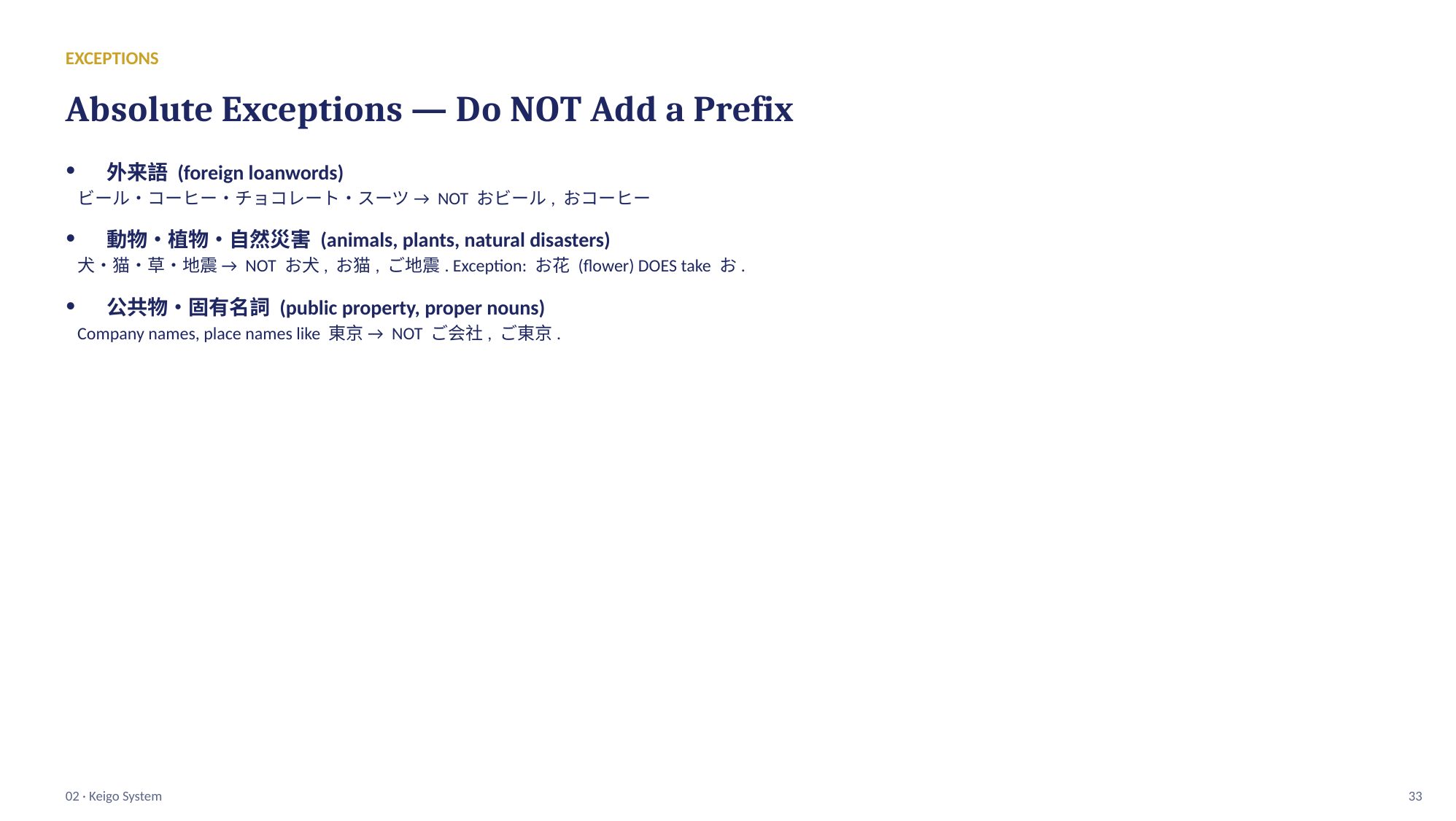
Absolute Exceptions — Do NOT Add a Prefix
• 外来語 (foreign loanwords)
Absolute Exceptions — Do NOT Add a Prefix
• 外来語 (foreign loanwords)
JPビール・コーヒー・チョコレート・スーツ→NOTおビール,おコーヒー
EN• 動物・植物・自然災害 (animals, plants, natural disasters)
犬・猫・草・地震 → NOT お犬 , お猫 , ご地震 . Exception: お花 (flower) DOES take お .
• 公共物・固有名詞 (public property, proper nouns)
Company names, place names like 東京 → NOT ご会社 , ご東京 .
02 · Keigo System 33
犬・猫・草・地震 → NOT お犬 , お猫 , ご地震 . Exception: お花 (flower) DOES take お .
• 公共物・固有名詞 (public property, proper nouns)
Company names, place names like 東京 → NOT ご会社 , ご東京 .
02 · Keigo System 33
หน้า 34

คลิกเพื่อขยาย
10
ENKeigo Pitfalls
JP敬語の落とし穴
ENOveruse, ambiguity, and the in-group/out-group rule
หน้า 35
คลิกเพื่อขยาย
EN3 THINGS TO WATCH FOR
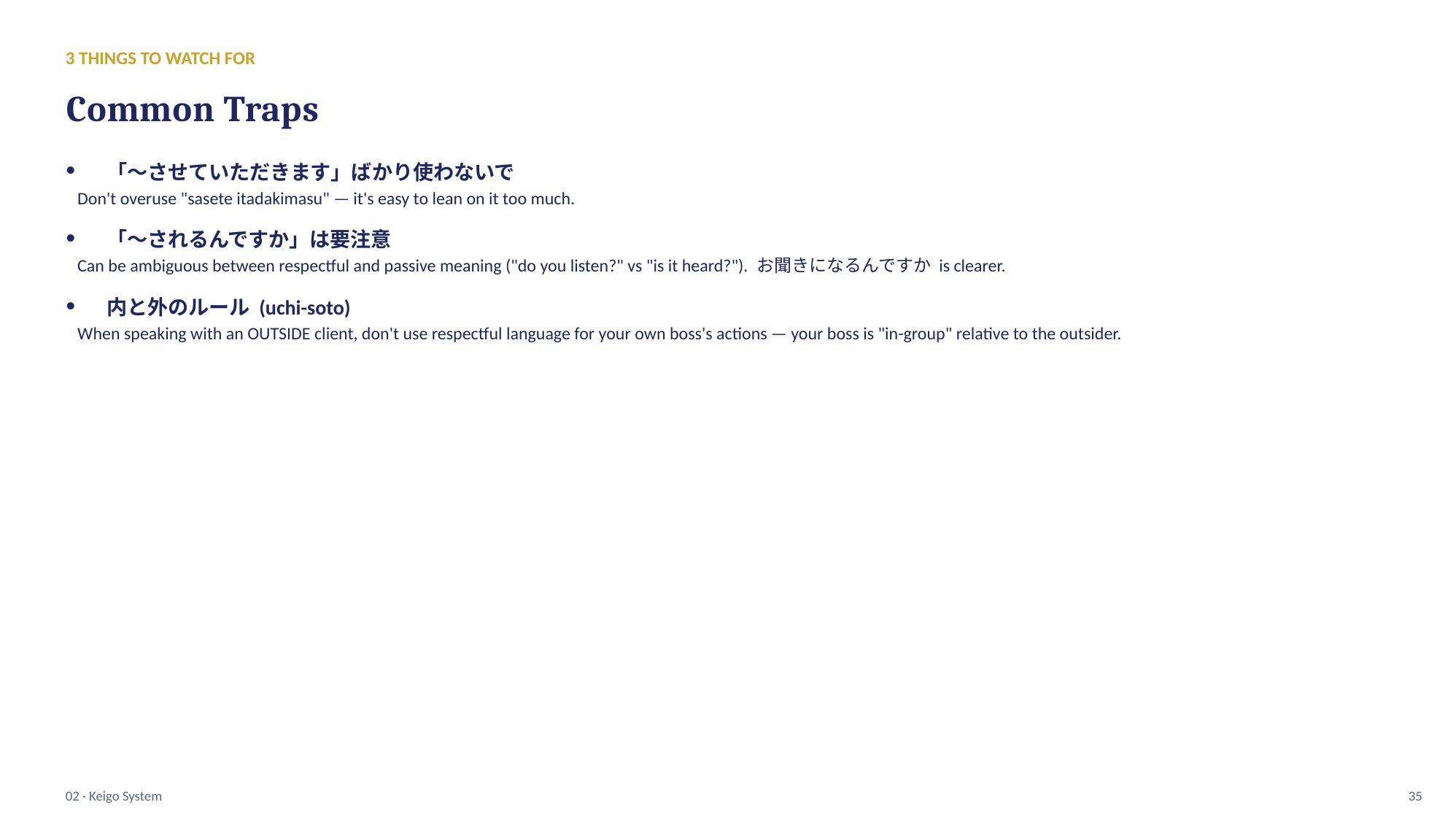
Common Traps
Common Traps
JP•「〜させていただきます」ばかり使わないで
EN Don't overuse "sasete itadakimasu" — it's easy to lean on it too much.
JP•「〜されるんですか」は要注意
EN Can be ambiguous between respectful and passive meaning ("do you listen?" vs "is it heard?"). お聞きになるんですか is clearer.
• 内と外のルール (uchi-soto)
When speaking with an OUTSIDE client, don't use respectful language for your own boss's actions — your boss is "in-group" relative to the outsider.
02 · Keigo System 35
• 内と外のルール (uchi-soto)
When speaking with an OUTSIDE client, don't use respectful language for your own boss's actions — your boss is "in-group" relative to the outsider.
02 · Keigo System 35
หน้า 36
คลิกเพื่อขยาย
11
ENThe 7 Core Pillars of Service
JP接客の基本用語
ENThe essential phrases every service professional needs — and the mistake to avoid with each
หน้า 37
คลิกเพื่อขยาย
ENREFERENCE
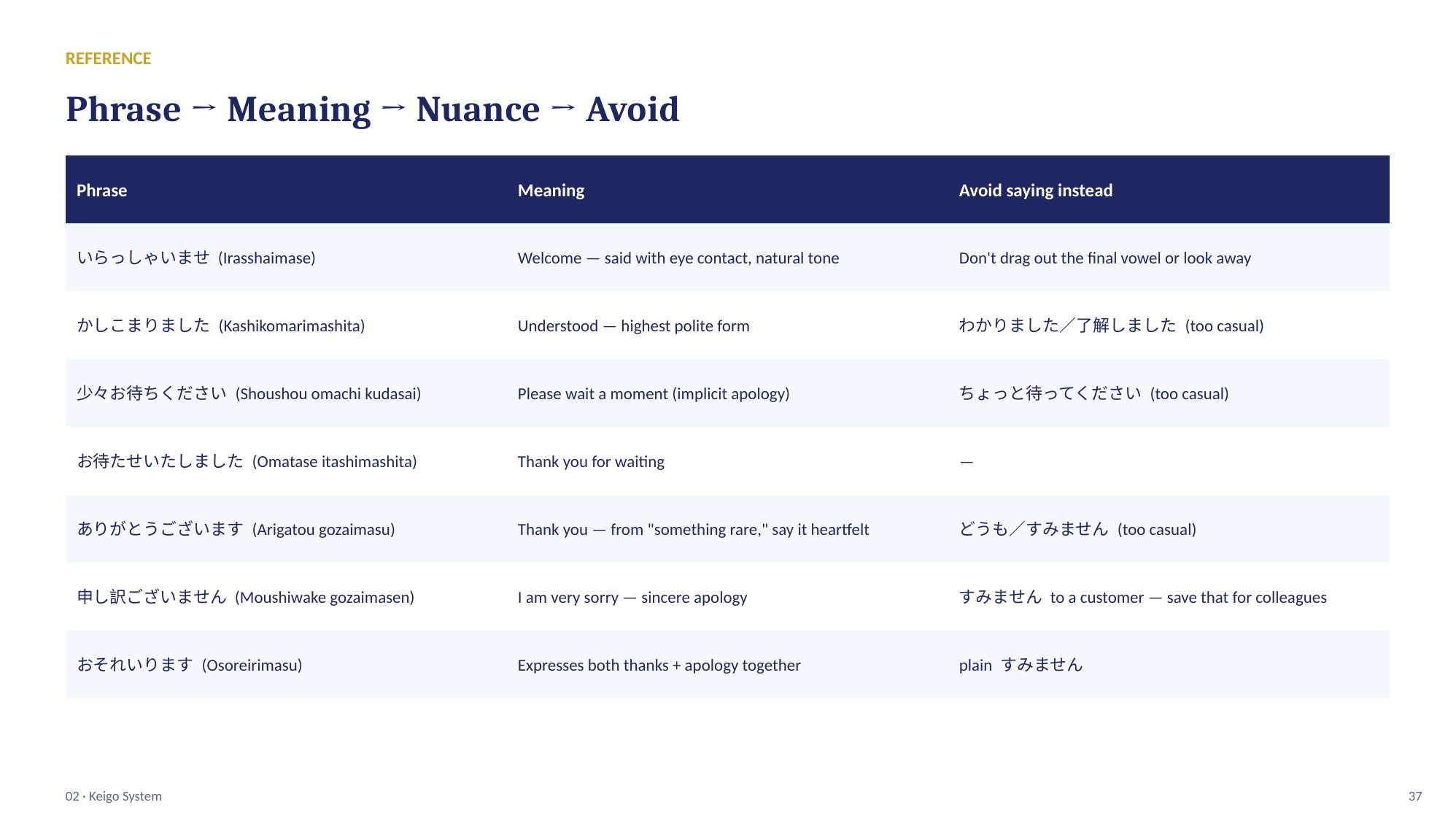
Phrase → Meaning → Nuance → Avoid
Phrase Meaning Avoid saying instead
いらっしゃいませ (Irasshaimase) Welcome — said with eye contact, natural tone Don't drag out the final vowel or look away
かしこまりました (Kashikomarimashita) Understood — highest polite form わかりました/了解しました (too casual)
少々お待ちください (Shoushou omachi kudasai) Please wait a moment (implicit apology) ちょっと待ってください (too casual)
お待たせいたしました (Omatase itashimashita) Thank you for waiting —
ありがとうございます (Arigatou gozaimasu) Thank you — from "something rare," say it heartfelt どうも/すみません (too casual)
申し訳ございません (Moushiwake gozaimasen) I am very sorry — sincere apology すみません to a customer — save that for colleagues
おそれいります (Osoreirimasu) Expresses both thanks + apology together plain すみません
02 · Keigo System 37
Phrase → Meaning → Nuance → Avoid
Phrase Meaning Avoid saying instead
いらっしゃいませ (Irasshaimase) Welcome — said with eye contact, natural tone Don't drag out the final vowel or look away
かしこまりました (Kashikomarimashita) Understood — highest polite form わかりました/了解しました (too casual)
少々お待ちください (Shoushou omachi kudasai) Please wait a moment (implicit apology) ちょっと待ってください (too casual)
お待たせいたしました (Omatase itashimashita) Thank you for waiting —
ありがとうございます (Arigatou gozaimasu) Thank you — from "something rare," say it heartfelt どうも/すみません (too casual)
申し訳ございません (Moushiwake gozaimasen) I am very sorry — sincere apology すみません to a customer — save that for colleagues
おそれいります (Osoreirimasu) Expresses both thanks + apology together plain すみません
02 · Keigo System 37
หน้า 38
คลิกเพื่อขยาย
12
ENCustomer Service Politeness Upgrades
JP接客での丁寧な言い方
ENTurning everyday phrases into premium service language
หน้า 39
คลิกเพื่อขยาย
ENBEFORE → AFTER
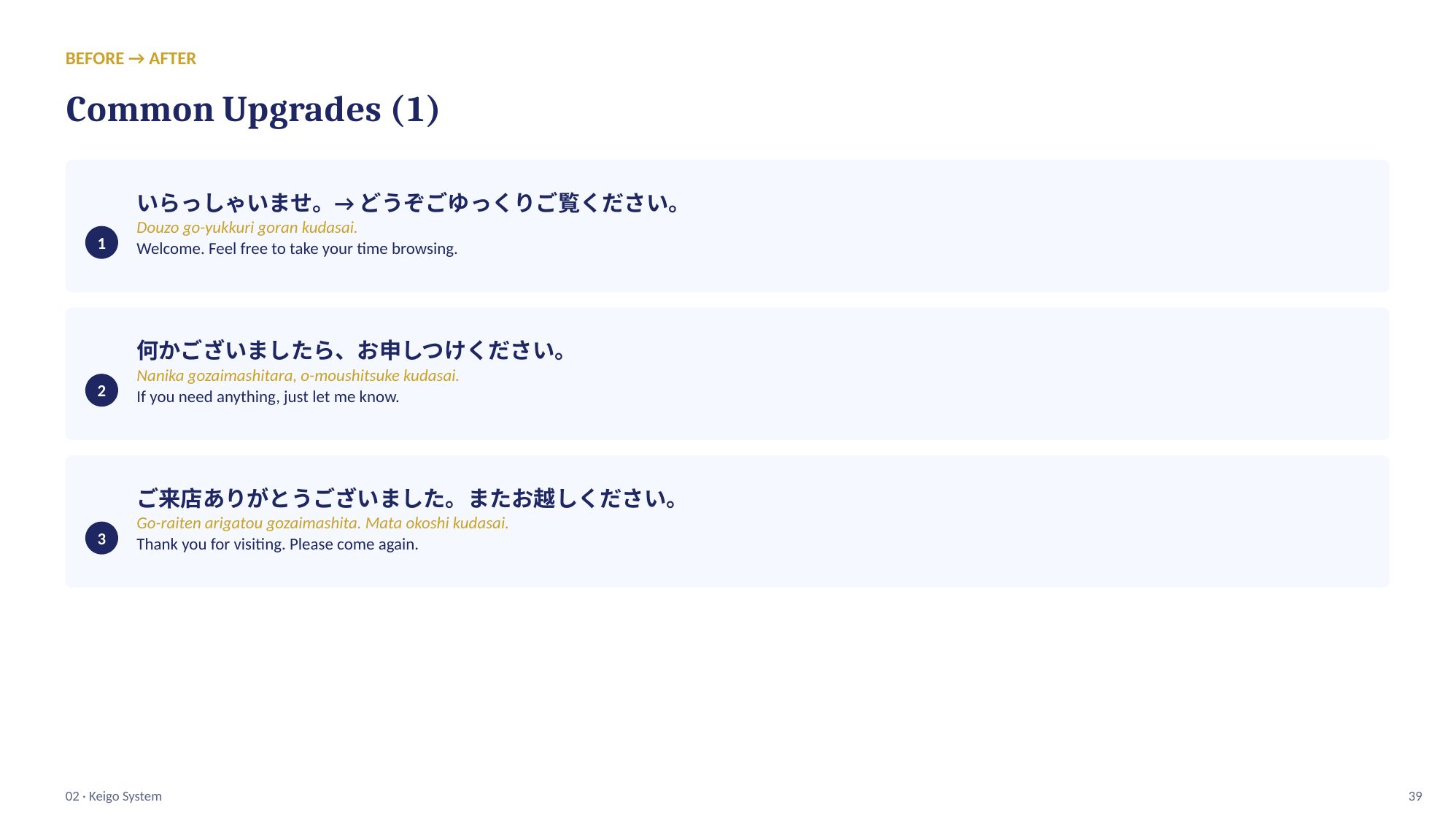
Common Upgrades (1)
Common Upgrades (1)
JPいらっしゃいませ。→どうぞごゆっくりご覧ください。
EN Douzo go-yukkuri goran kudasai.
1 Welcome. Feel free to take your time browsing.
1 Welcome. Feel free to take your time browsing.
JP何かございましたら、お申しつけください。
EN Nanika gozaimashitara, o-moushitsuke kudasai.
2 If you need anything, just let me know.
2 If you need anything, just let me know.
JPご来店ありがとうございました。またお越しください。
EN Go-raiten arigatou gozaimashita. Mata okoshi kudasai.
3 Thank you for visiting. Please come again.
02 · Keigo System 39
3 Thank you for visiting. Please come again.
02 · Keigo System 39
หน้า 40
คลิกเพื่อขยาย
ENBEFORE → AFTER
Common Upgrades (2)
Common Upgrades (2)
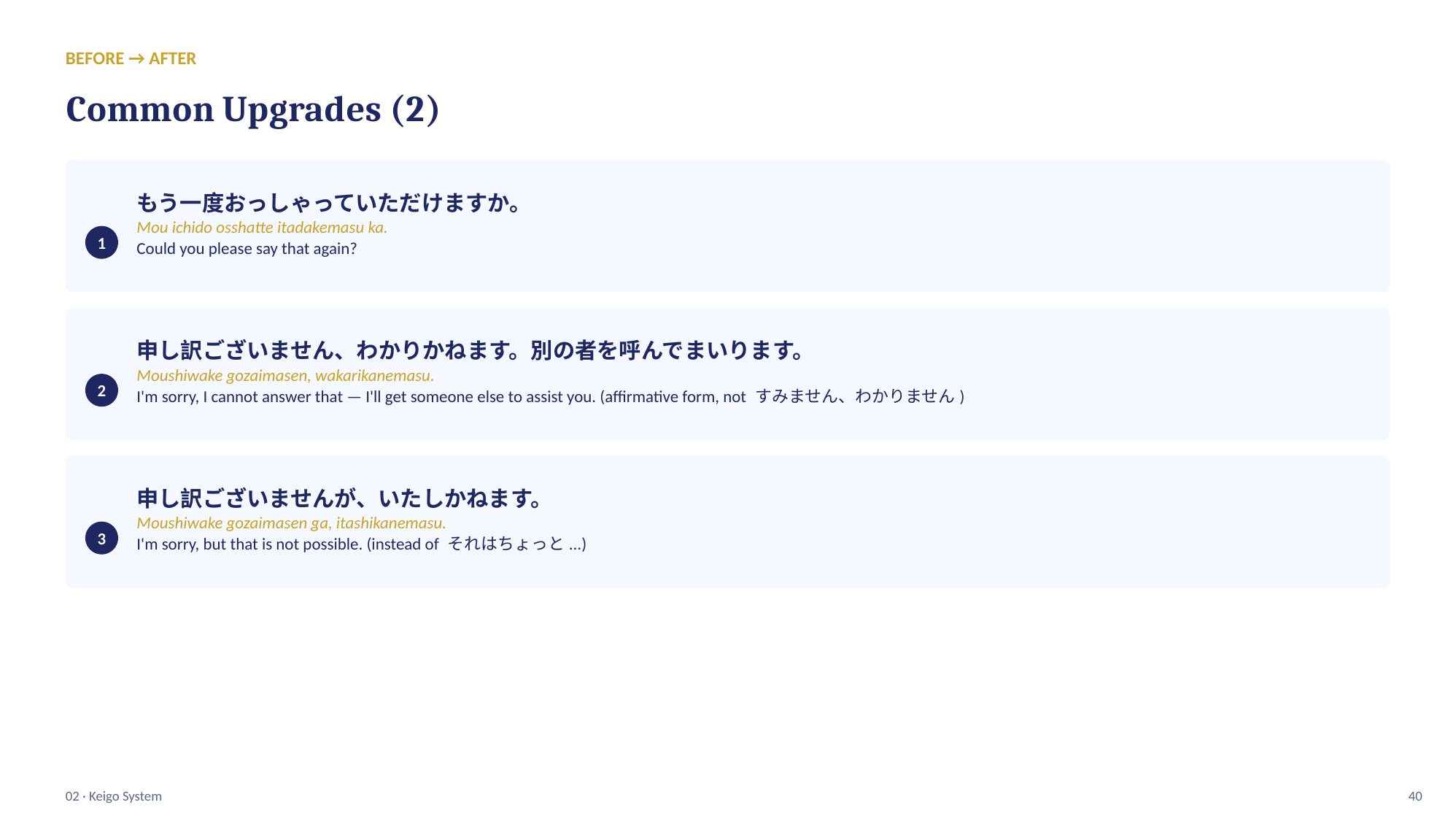
JPもう一度おっしゃっていただけますか。
EN Mou ichido osshatte itadakemasu ka.
1 Could you please say that again?
1 Could you please say that again?
JP申し訳ございません、わかりかねます。別の者を呼んでまいります。
EN Moushiwake gozaimasen, wakarikanemasu.
2 I'm sorry, I cannot answer that — I'll get someone else to assist you. (affirmative form, not すみません、わかりません )
2 I'm sorry, I cannot answer that — I'll get someone else to assist you. (affirmative form, not すみません、わかりません )
JP申し訳ございませんが、いたしかねます。
EN Moushiwake gozaimasen ga, itashikanemasu.
3 I'm sorry, but that is not possible. (instead of それはちょっと ...)
02 · Keigo System 40
3 I'm sorry, but that is not possible. (instead of それはちょっと ...)
02 · Keigo System 40
หน้า 41
คลิกเพื่อขยาย
JP和語VS漢語
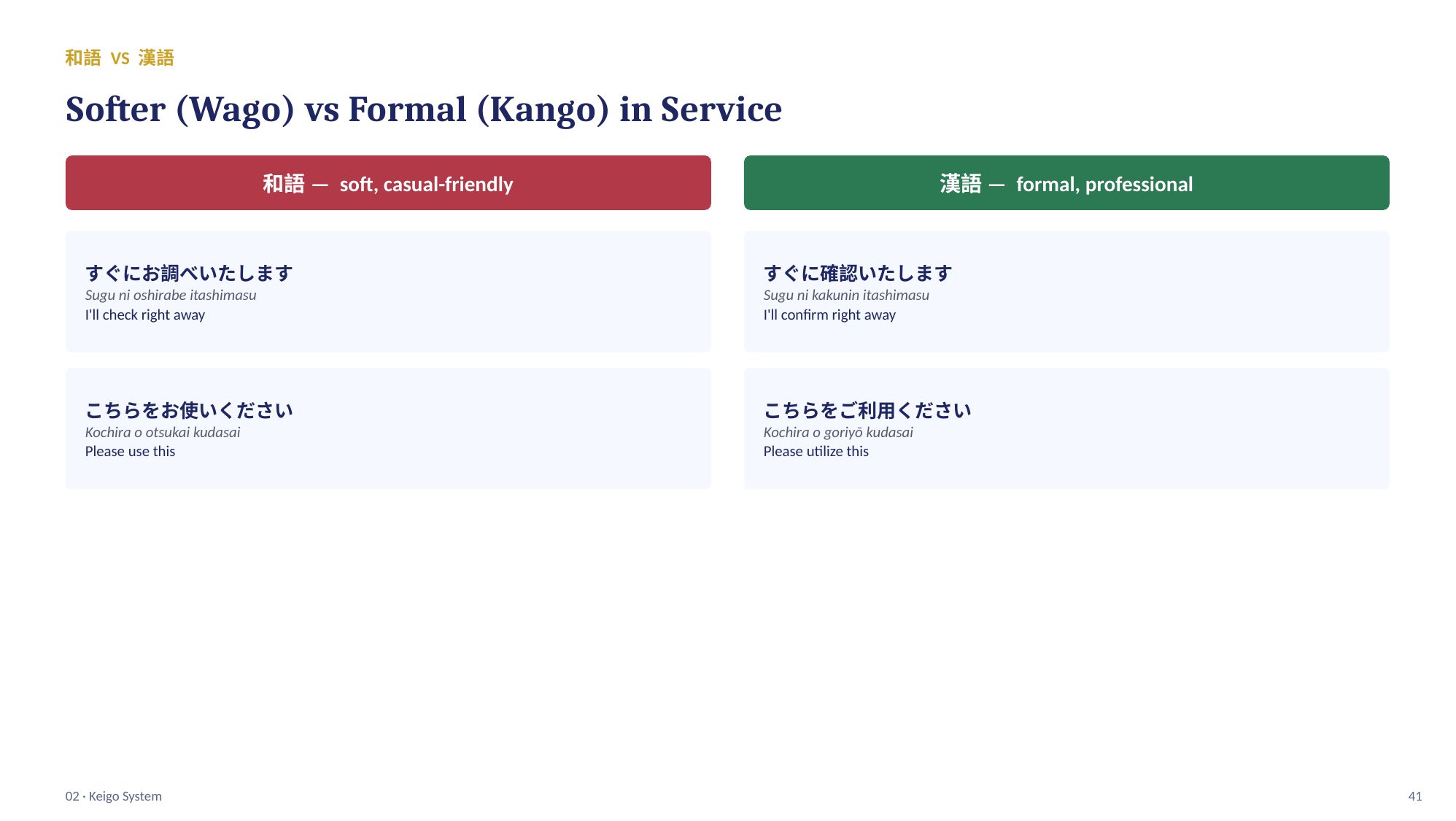
ENSofter (Wago) vs Formal (Kango) in Service
和語 — soft, casual-friendly 漢語 — formal, professional
和語 — soft, casual-friendly 漢語 — formal, professional
JPすぐにお調べいたしますすぐに確認いたします
EN Sugu ni oshirabe itashimasu Sugu ni kakunin itashimasu
I'll check right away I'll confirm right away
I'll check right away I'll confirm right away
JPこちらをお使いくださいこちらをご利用ください
EN Kochira o otsukai kudasai Kochira o goriyō kudasai
Please use this Please utilize this
02 · Keigo System 41
Please use this Please utilize this
02 · Keigo System 41
หน้า 42
คลิกเพื่อขยาย
13
ENThe Cushion Word Spectrum & Escalation
JPクッション言葉の段階
EN6 levels of cushion words, and 3 levels of request intensity
หน้า 43
คลิกเพื่อขยาย
EN6-LEVEL SPECTRUM
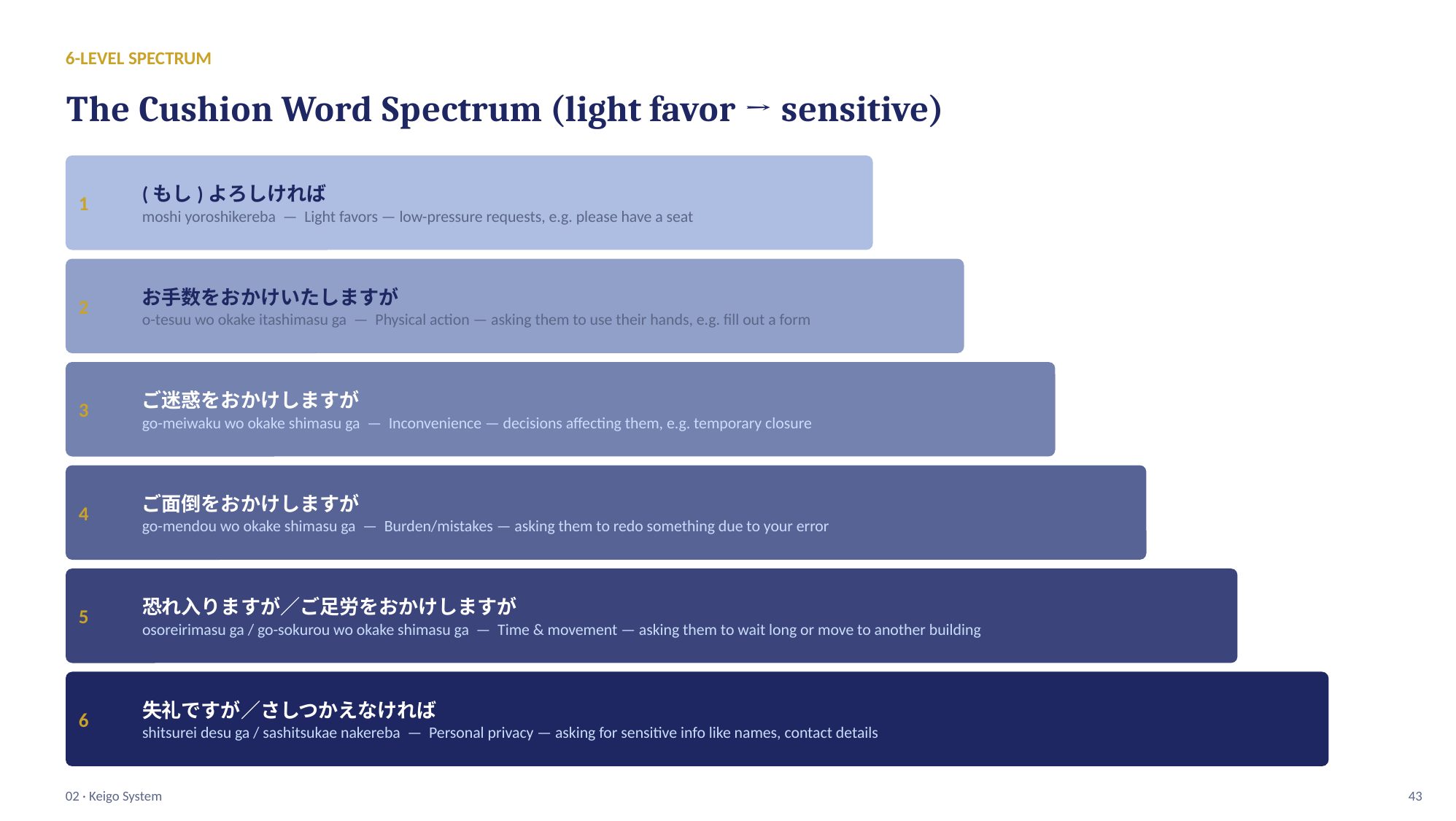
The Cushion Word Spectrum (light favor → sensitive)
The Cushion Word Spectrum (light favor → sensitive)
JP1(もし)よろしければ
EN moshi yoroshikereba — Light favors — low-pressure requests, e.g. please have a seat
JP2お手数をおかけいたしますが
EN o-tesuu wo okake itashimasu ga — Physical action — asking them to use their hands, e.g. fill out a form
JP3ご迷惑をおかけしますが
EN go-meiwaku wo okake shimasu ga — Inconvenience — decisions affecting them, e.g. temporary closure
JP4ご面倒をおかけしますが
EN go-mendou wo okake shimasu ga — Burden/mistakes — asking them to redo something due to your error
JP5恐れ入りますが/ご足労をおかけしますが
EN osoreirimasu ga / go-sokurou wo okake shimasu ga — Time & movement — asking them to wait long or move to another building
JP6失礼ですが/さしつかえなければ
EN shitsurei desu ga / sashitsukae nakereba — Personal privacy — asking for sensitive info like names, contact details
02 · Keigo System 43
02 · Keigo System 43
หน้า 44
คลิกเพื่อขยาย
EN3-STEP STAIRCASE
The Escalation of Requests
The Escalation of Requests
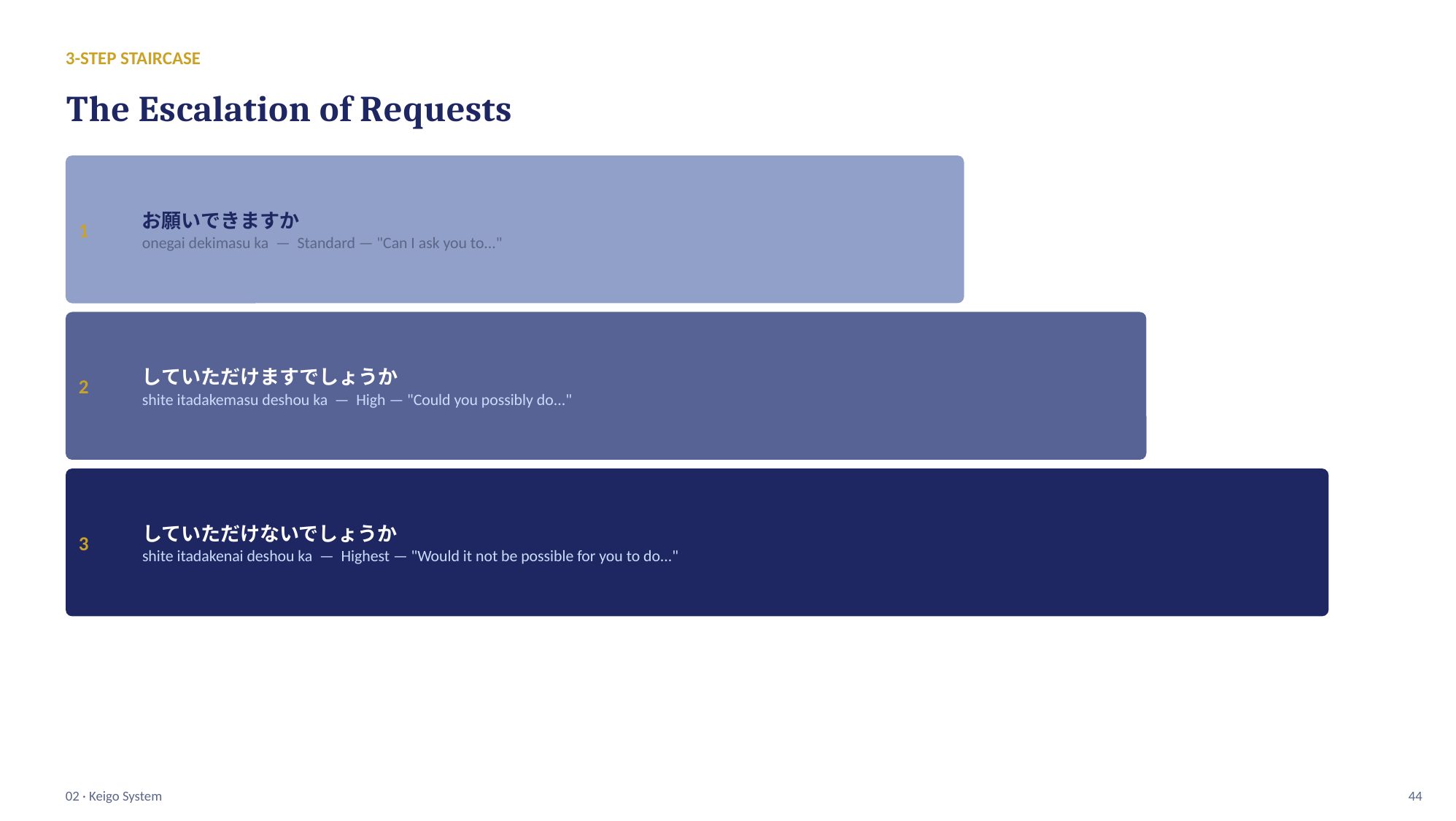
JP1お願いできますか
EN onegai dekimasu ka — Standard — "Can I ask you to..."
JP2していただけますでしょうか
EN shite itadakemasu deshou ka — High — "Could you possibly do..."
JP3していただけないでしょうか
EN shite itadakenai deshou ka — Highest — "Would it not be possible for you to do..."
02 · Keigo System 44
02 · Keigo System 44
หน้า 45
คลิกเพื่อขยาย
ENWARNING
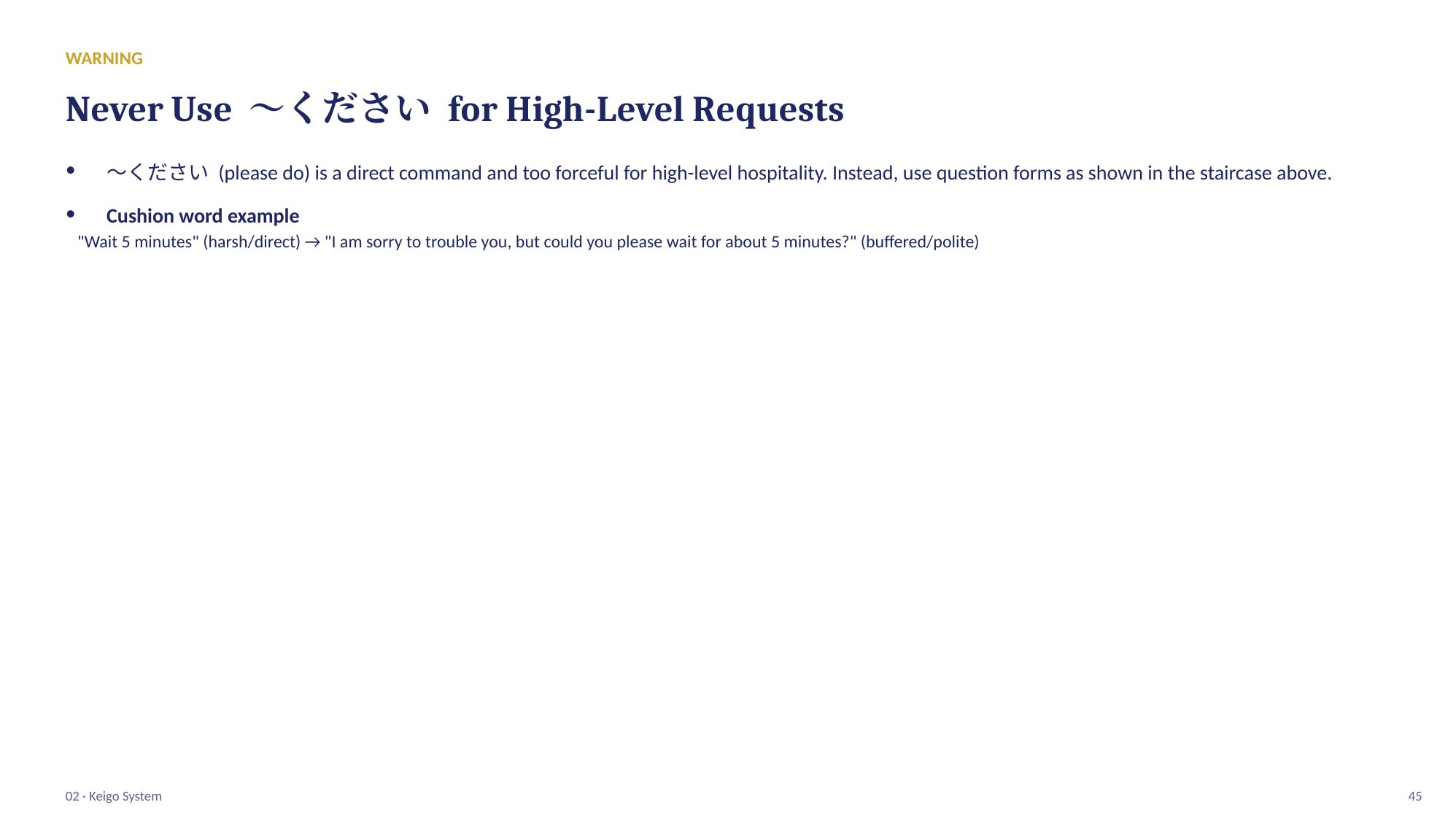
Never Use 〜ください for High-Level Requests
• 〜ください (please do) is a direct command and too forceful for high-level hospitality. Instead, use question forms as shown in the staircase above.
• Cushion word example
"Wait 5 minutes" (harsh/direct) → "I am sorry to trouble you, but could you please wait for about 5 minutes?" (buffered/polite)
02 · Keigo System 45
Never Use 〜ください for High-Level Requests
• 〜ください (please do) is a direct command and too forceful for high-level hospitality. Instead, use question forms as shown in the staircase above.
• Cushion word example
"Wait 5 minutes" (harsh/direct) → "I am sorry to trouble you, but could you please wait for about 5 minutes?" (buffered/polite)
02 · Keigo System 45
หน้า 46
คลิกเพื่อขยาย
14
ENThe Anatomy of a Graceful Refusal
JP上手な断り方の構造
ENThe 4-step method every service professional relies on
หน้า 47
คลิกเพื่อขยาย
EN4-STEP PROCESS
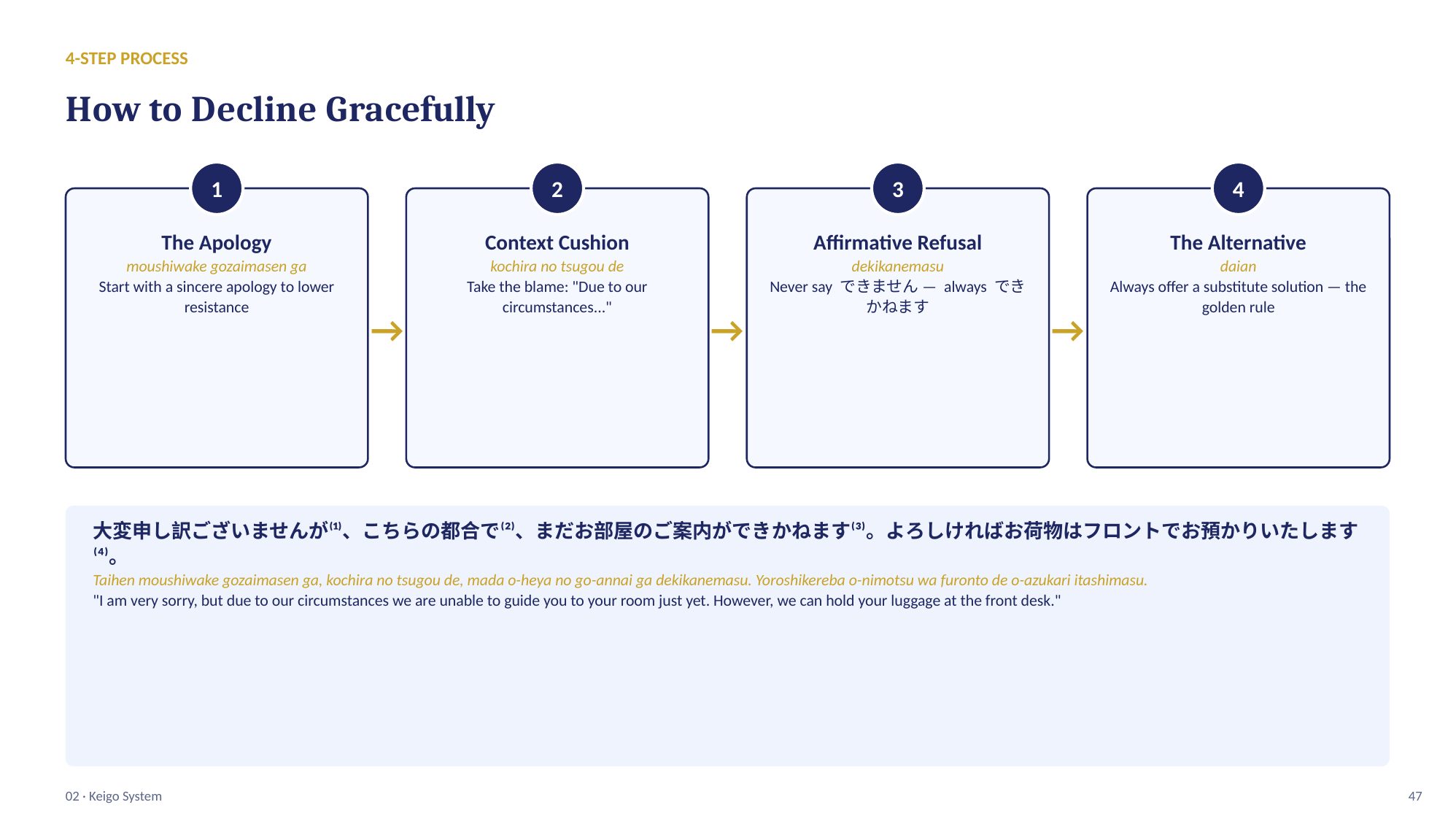
How to Decline Gracefully
1 2 3 4
The Apology Context Cushion Affirmative Refusal The Alternative
moushiwake gozaimasen ga kochira no tsugou de dekikanemasu daian
Start with a sincere apology to lower Take the blame: "Due to our Never say できません — always でき Always offer a substitute solution — the
resistance circumstances..." かねます golden rule
→ → →
How to Decline Gracefully
1 2 3 4
The Apology Context Cushion Affirmative Refusal The Alternative
moushiwake gozaimasen ga kochira no tsugou de dekikanemasu daian
Start with a sincere apology to lower Take the blame: "Due to our Never say できません — always でき Always offer a substitute solution — the
resistance circumstances..." かねます golden rule
→ → →
JP大変申し訳ございませんが⁽¹⁾、こちらの都合で⁽²⁾、まだお部屋のご案内ができかねます⁽³⁾。よろしければお荷物はフロントでお預かりいたします
⁽⁴⁾。
⁽⁴⁾。
EN Taihen moushiwake gozaimasen ga, kochira no tsugou de, mada o-heya no go-annai ga dekikanemasu. Yoroshikereba o-nimotsu wa furonto de o-azukari itashimasu.
"I am very sorry, but due to our circumstances we are unable to guide you to your room just yet. However, we can hold your luggage at the front desk."
02 · Keigo System 47
"I am very sorry, but due to our circumstances we are unable to guide you to your room just yet. However, we can hold your luggage at the front desk."
02 · Keigo System 47
หน้า 48
คลิกเพื่อขยาย
ENREFERENCE
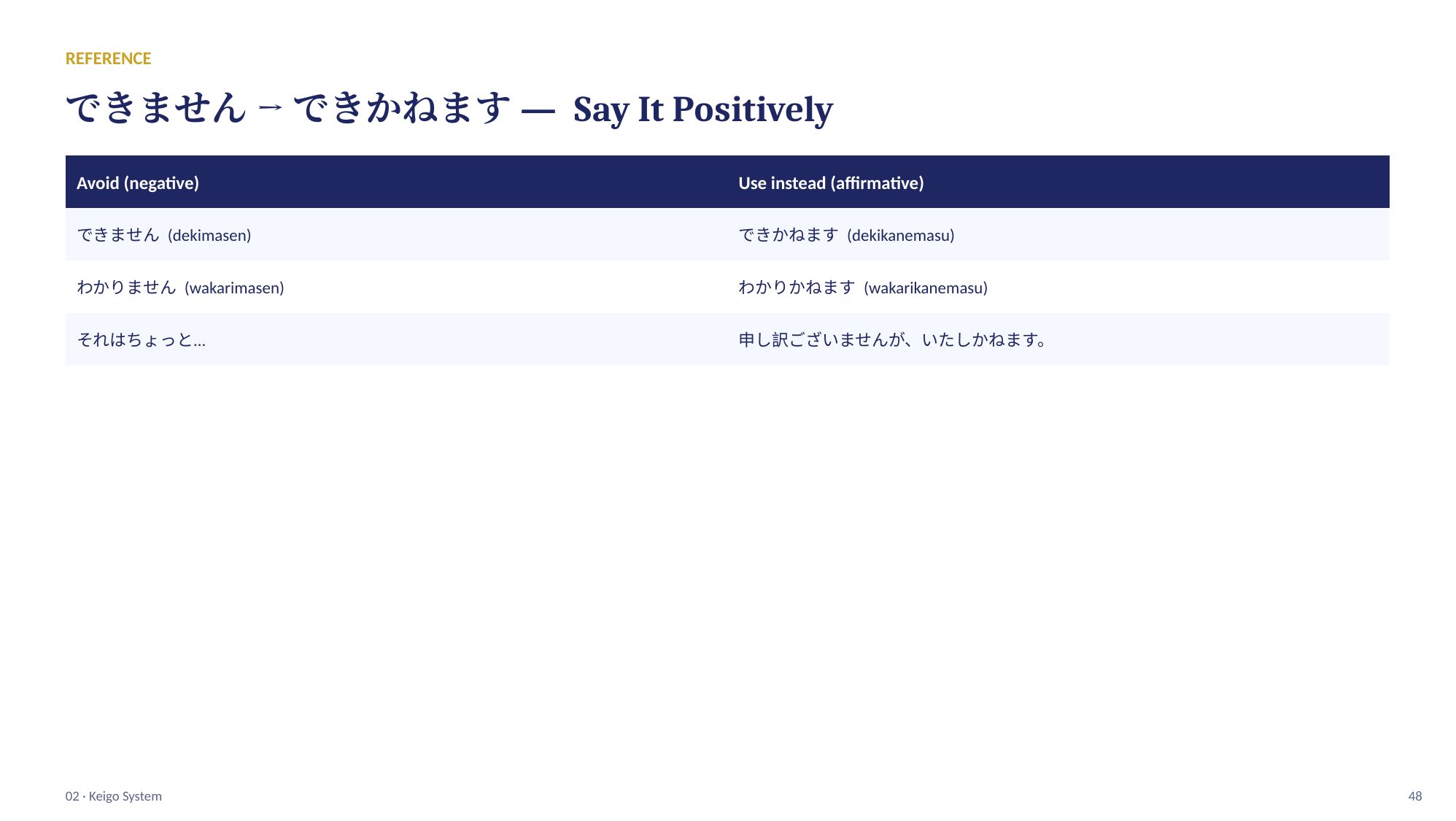
できません → できかねます — Say It Positively
Avoid (negative) Use instead (affirmative)
できません (dekimasen) できかねます (dekikanemasu)
わかりません (wakarimasen) わかりかねます (wakarikanemasu)
できません → できかねます — Say It Positively
Avoid (negative) Use instead (affirmative)
できません (dekimasen) できかねます (dekikanemasu)
わかりません (wakarimasen) わかりかねます (wakarikanemasu)
JPそれはちょっと…申し訳ございませんが、いたしかねます。
EN02 · Keigo System 48