หน้า 1

คลิกเพื่อขยาย
JPめんかいこうしょう
面会して交渉するときの話し方
面会して交渉するときの話し方
หน้า 2
คลิกเพื่อขยาย
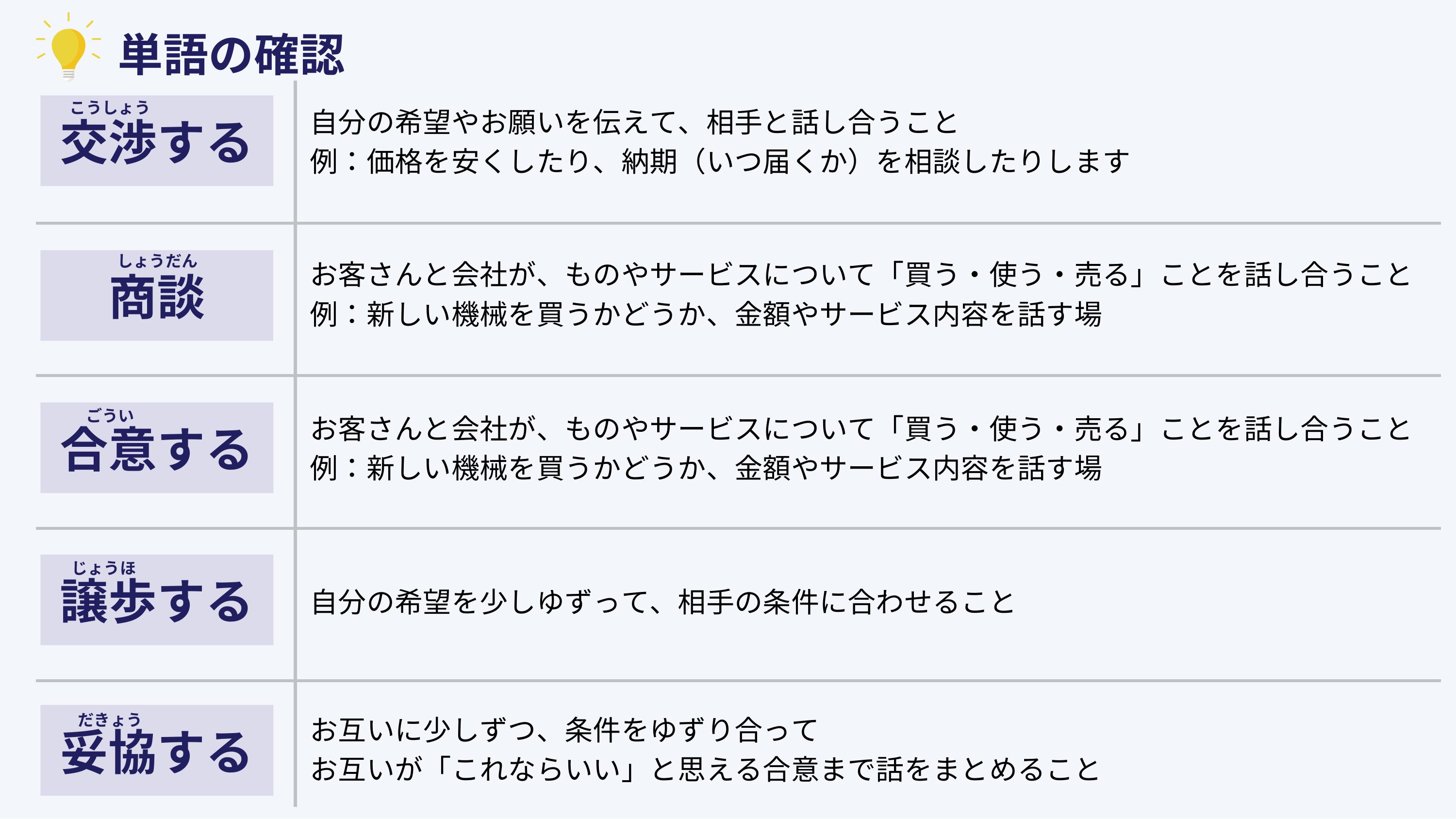
JP単語の確認
こうしょう
自分の希望やお願いを伝えて、相手と話し合うこと
交渉する例:価格を安くしたり、納期(いつ届くか)を相談したりします
しょうだん
お客さんと会社が、ものやサービスについて「買う・使う・売る」ことを話し合うこと
商談例:新しい機械を買うかどうか、金額やサービス内容を話す場
ごうい
お客さんと会社が、ものやサービスについて「買う・使う・売る」ことを話し合うこと
合意する例:新しい機械を買うかどうか、金額やサービス内容を話す場
じょうほ
譲歩する自分の希望を少しゆずって、相手の条件に合わせること
だきょう
お互いに少しずつ、条件をゆずり合って
妥協するお互いが「これならいい」と思える合意まで話をまとめること
こうしょう
自分の希望やお願いを伝えて、相手と話し合うこと
交渉する例:価格を安くしたり、納期(いつ届くか)を相談したりします
しょうだん
お客さんと会社が、ものやサービスについて「買う・使う・売る」ことを話し合うこと
商談例:新しい機械を買うかどうか、金額やサービス内容を話す場
ごうい
お客さんと会社が、ものやサービスについて「買う・使う・売る」ことを話し合うこと
合意する例:新しい機械を買うかどうか、金額やサービス内容を話す場
じょうほ
譲歩する自分の希望を少しゆずって、相手の条件に合わせること
だきょう
お互いに少しずつ、条件をゆずり合って
妥協するお互いが「これならいい」と思える合意まで話をまとめること
หน้า 3
คลิกเพื่อขยาย
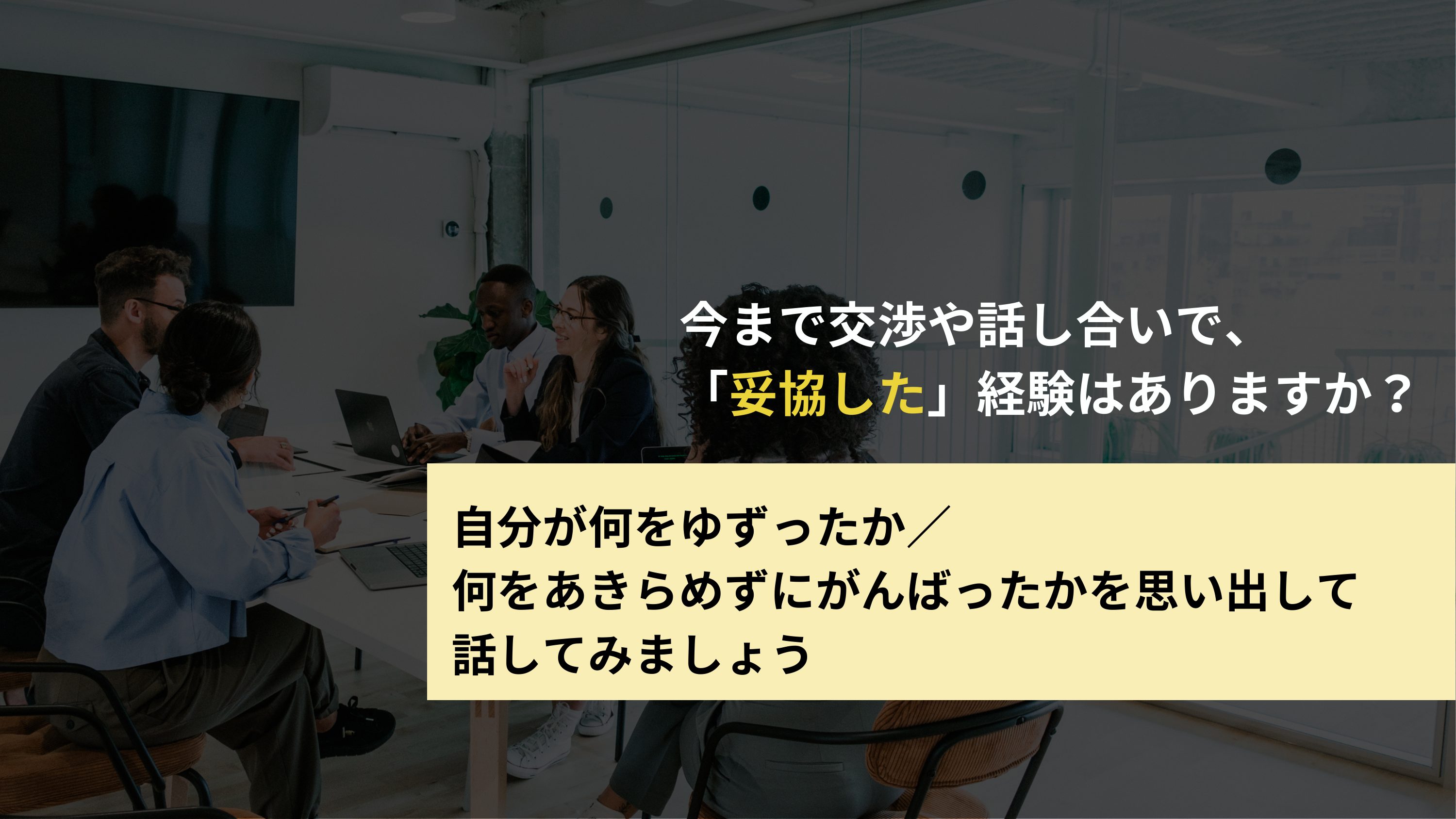
JP今まで交渉や話し合いで、
「妥協した」経験はありますか?
自分が何をゆずったか/
何をあきらめずにがんばったかを思い出して
話してみましょう
「妥協した」経験はありますか?
自分が何をゆずったか/
何をあきらめずにがんばったかを思い出して
話してみましょう
หน้า 4
คลิกเพื่อขยาย
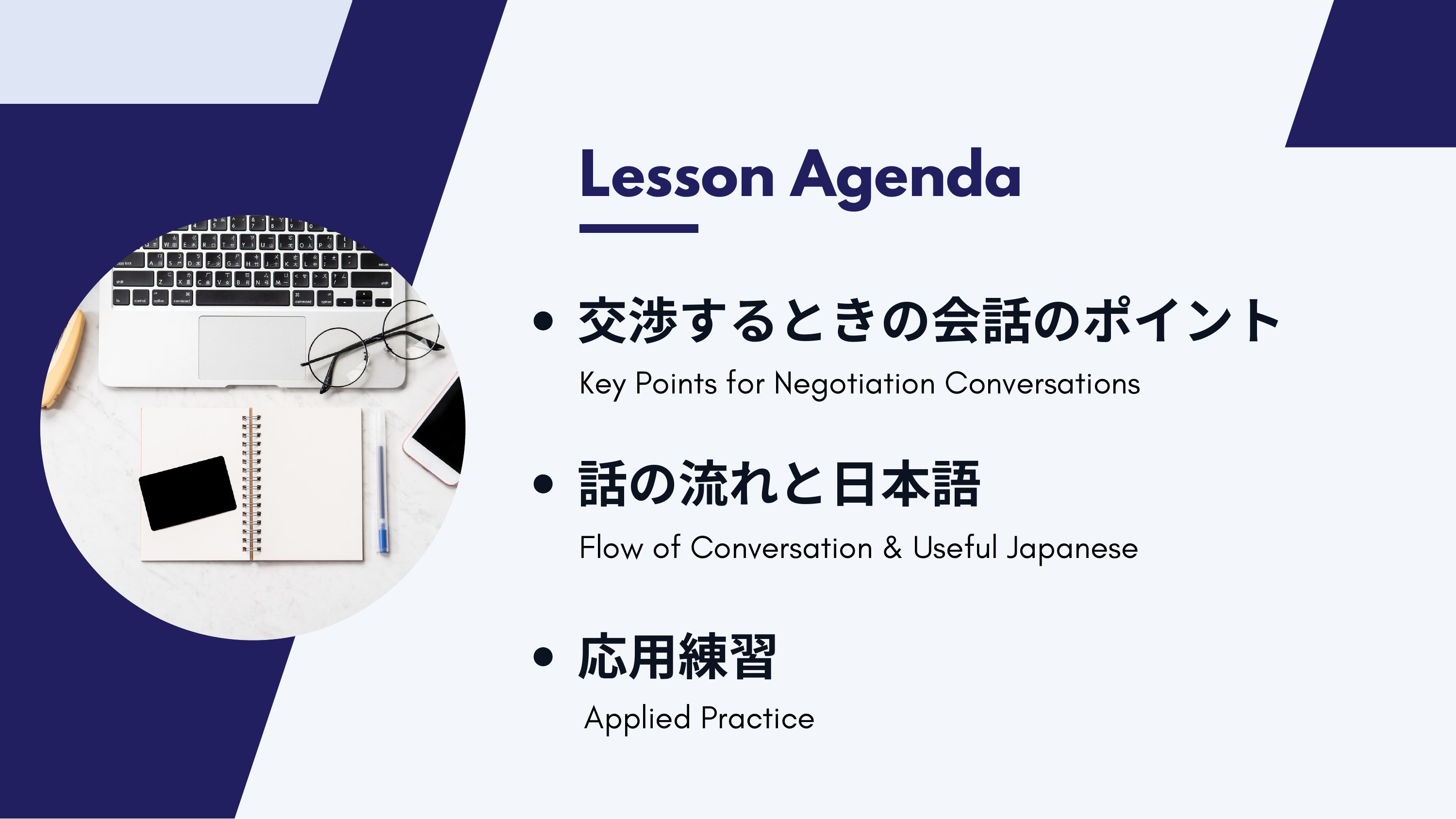
ENLesson Agenda
JP交渉するときの会話のポイント
ENKey Points for Negotiation Conversations
JP話の流れと日本語
ENFlow of Conversation & Useful Japanese
JP応用練習
ENApplied Practice
หน้า 5
คลิกเพื่อขยาย
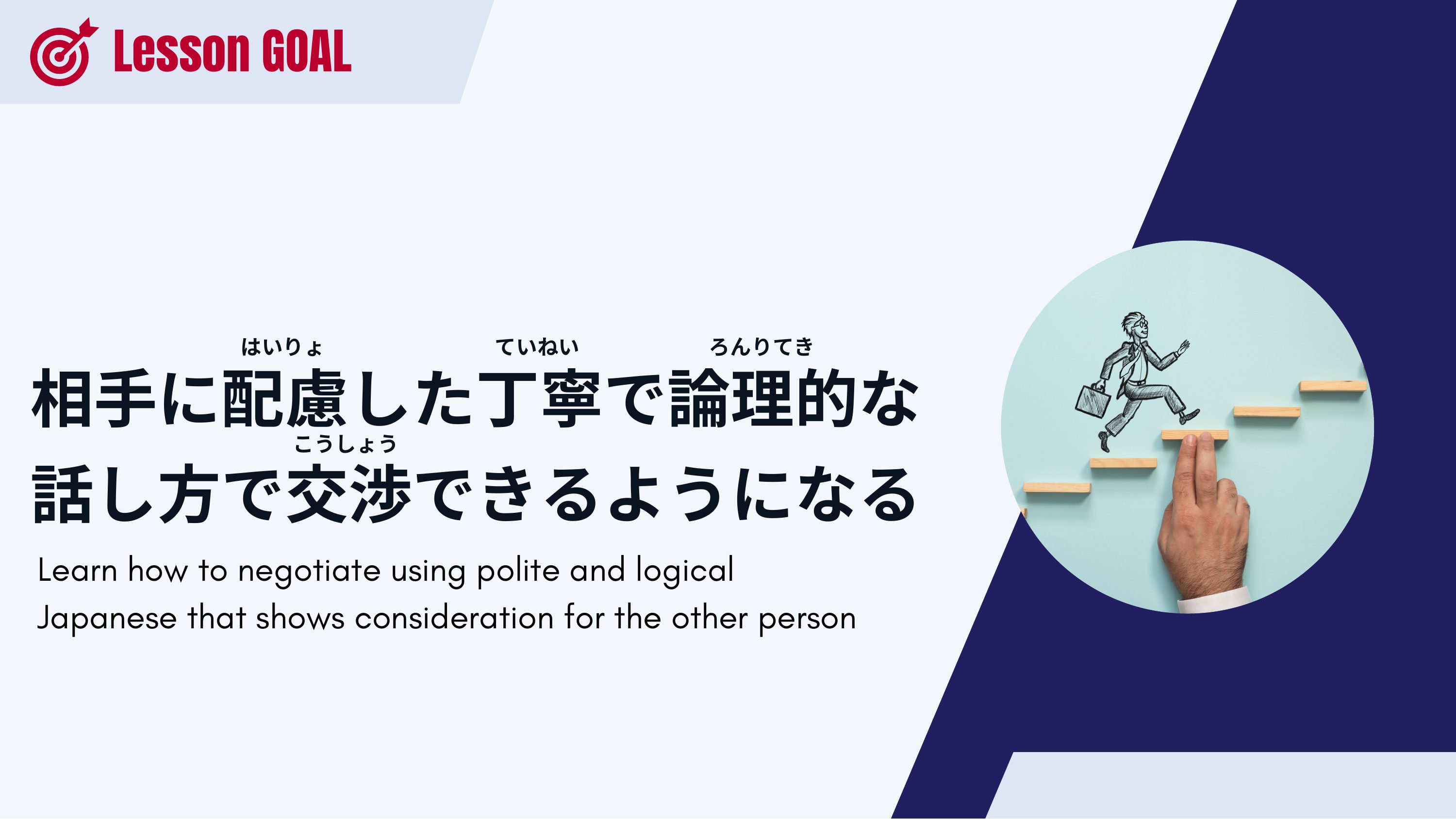
EN Lesson GOAL
JPはいりょていねいろんりてき
相手に配慮した丁寧で論理的なこうしょう
話し方で交渉できるようになる
相手に配慮した丁寧で論理的なこうしょう
話し方で交渉できるようになる
ENLearn how to negotiate using polite and logical
Japanese that shows consideration for the other person
Japanese that shows consideration for the other person
หน้า 6

คลิกเพื่อขยาย
ENAGENDA 1
JP交渉する時のポイント
ENKey Strategies for Negotiation
หน้า 7
คลิกเพื่อขยาย
JPこうしょう
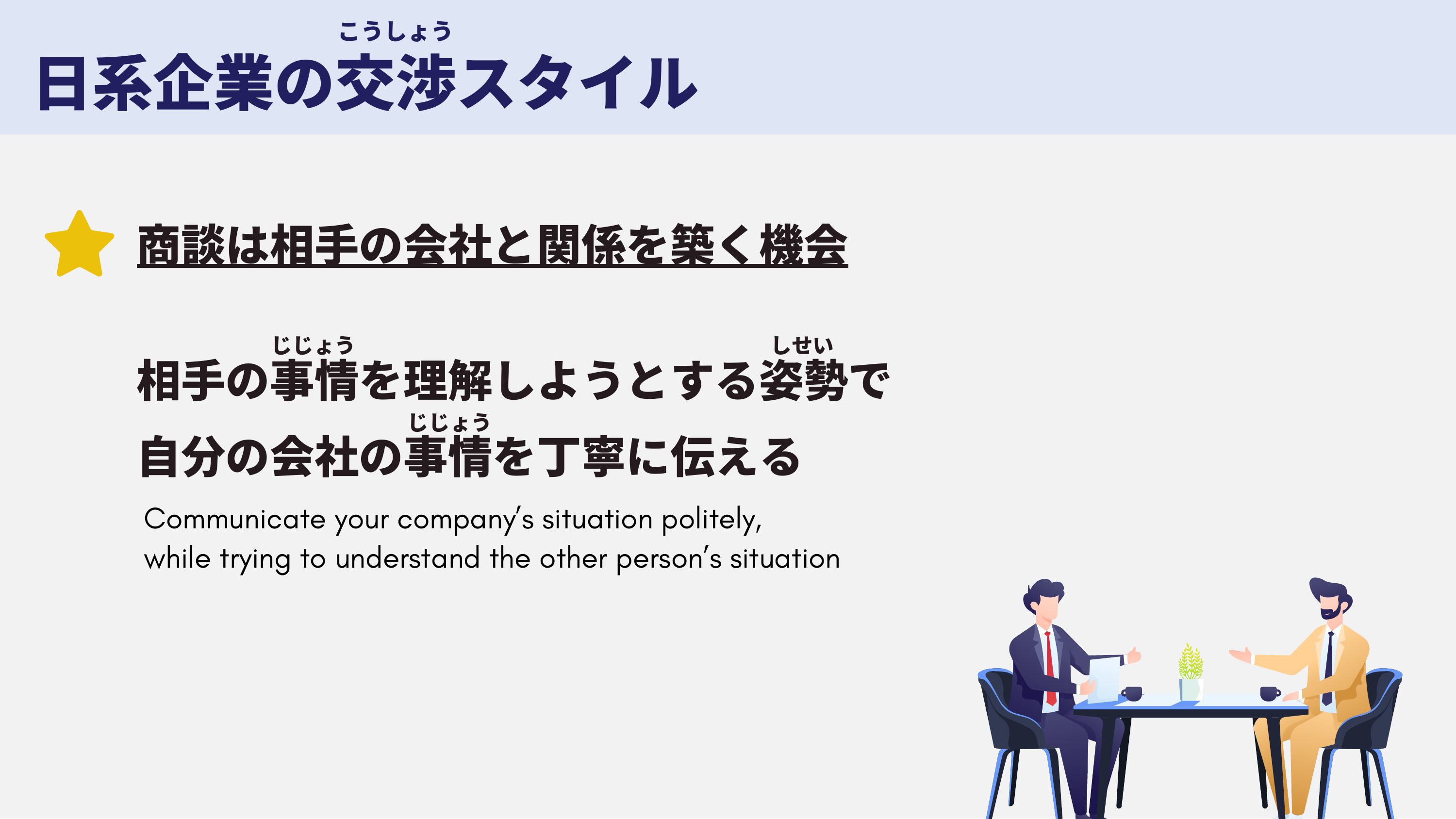
日系企業の交渉スタイル
商談は相手の会社と関係を築く機会
じじょうしせい
相手の事情を理解しようとする姿勢で
じじょう
自分の会社の事情を丁寧に伝える
日系企業の交渉スタイル
商談は相手の会社と関係を築く機会
じじょうしせい
相手の事情を理解しようとする姿勢で
じじょう
自分の会社の事情を丁寧に伝える
EN Communicate your company’s situation politely,
while trying to understand the other person’s situation
while trying to understand the other person’s situation
หน้า 8
คลิกเพื่อขยาย
JPこうしょう
交渉する時のポイント
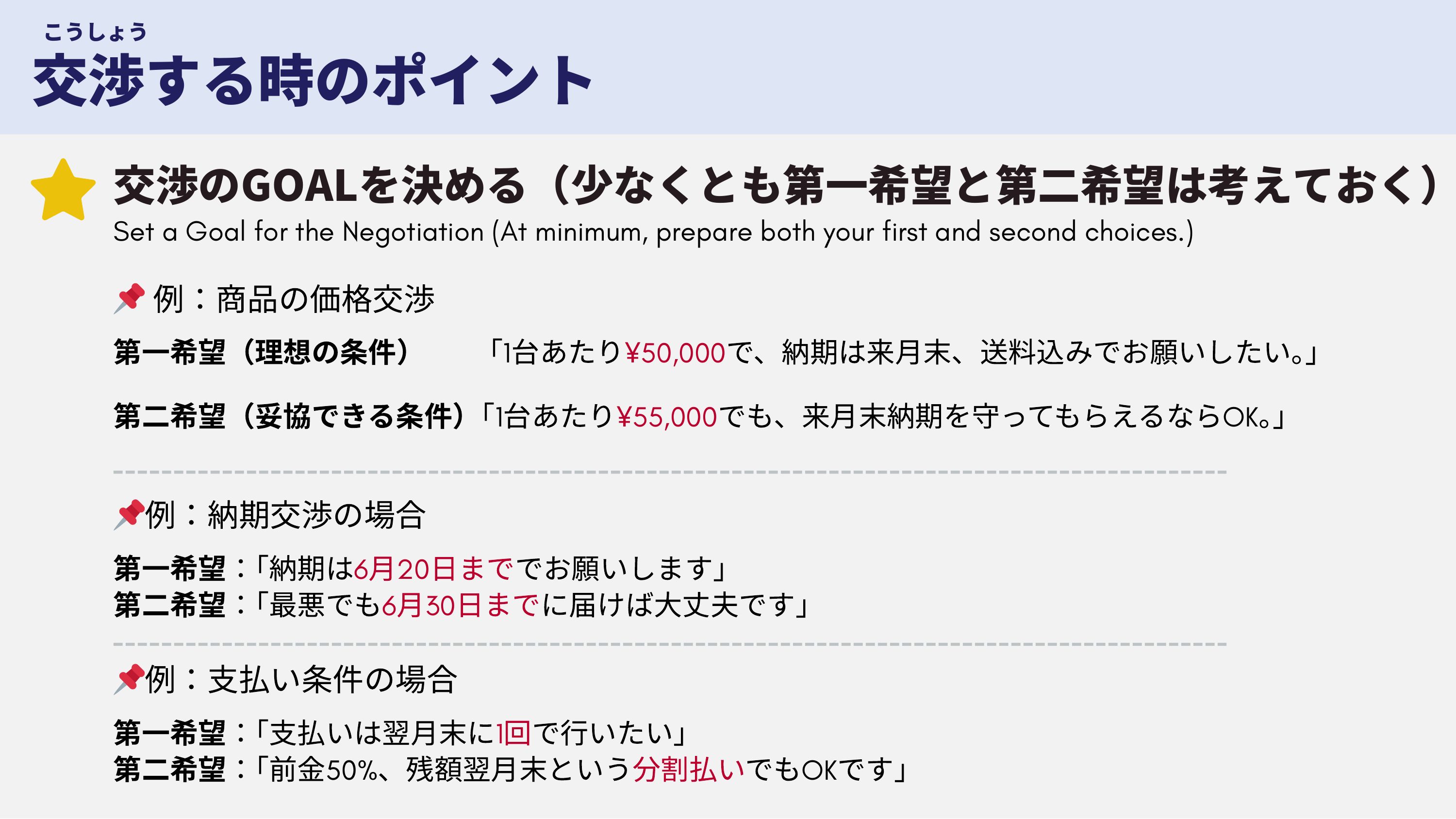
交渉のGOALを決める(少なくとも第一希望と第二希望は考えておく)
交渉する時のポイント
交渉のGOALを決める(少なくとも第一希望と第二希望は考えておく)
EN Set a Goal for the Negotiation (At minimum, prepare both your first and second choices.)
JP📌例:商品の価格交渉
第一希望(理想の条件)「1台あたり¥50,000で、納期は来月末、送料込みでお願いしたい。」
第二希望(妥協できる条件)「1台あたり¥55,000でも、来月末納期を守ってもらえるならOK。」
📌例:納期交渉の場合
第一希望:「納期は6月20日まででお願いします」
第二希望:「最悪でも6月30日までに届けば大丈夫です」
📌例:支払い条件の場合
第一希望:「支払いは翌月末に1回で行いたい」
第二希望:「前金50%、残額翌月末という分割払いでもOKです」
第一希望(理想の条件)「1台あたり¥50,000で、納期は来月末、送料込みでお願いしたい。」
第二希望(妥協できる条件)「1台あたり¥55,000でも、来月末納期を守ってもらえるならOK。」
📌例:納期交渉の場合
第一希望:「納期は6月20日まででお願いします」
第二希望:「最悪でも6月30日までに届けば大丈夫です」
📌例:支払い条件の場合
第一希望:「支払いは翌月末に1回で行いたい」
第二希望:「前金50%、残額翌月末という分割払いでもOKです」
หน้า 9

คลิกเพื่อขยาย
ENAGENDA 2
JP交渉する時の話の流れ
ENKey Points for Negotiation Conversations
หน้า 10
คลิกเพื่อขยาย
JPもくてきめいかく
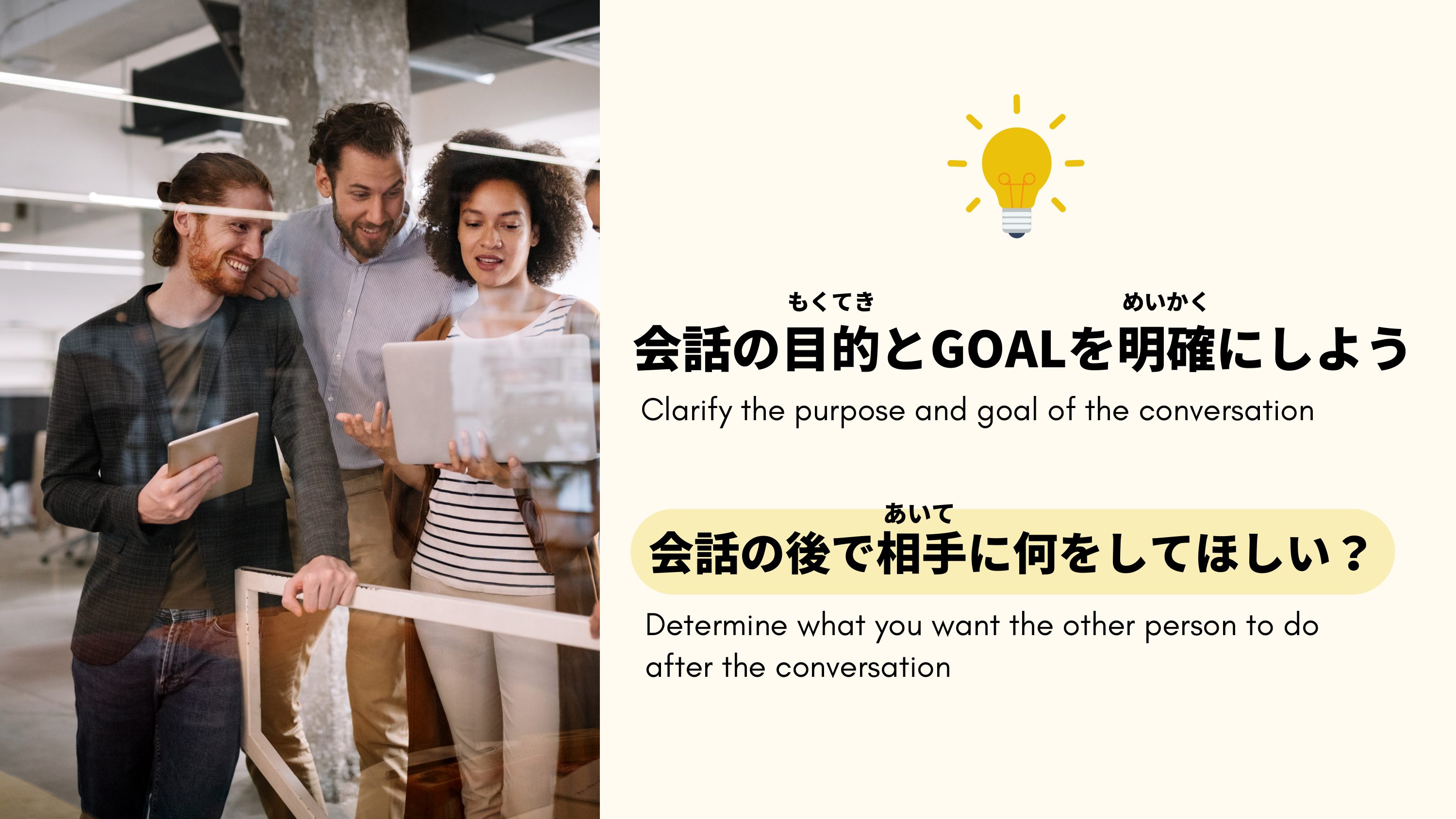
会話の目的とGOALを明確にしよう
会話の目的とGOALを明確にしよう
ENClarify the purpose and goal of the conversation
JPあいて
会話の後で相手に何をしてほしい?
会話の後で相手に何をしてほしい?
ENDetermine what you want the other person to do
after the conversation
after the conversation
หน้า 11
คลิกเพื่อขยาย
JPとりひきさきこうしょう
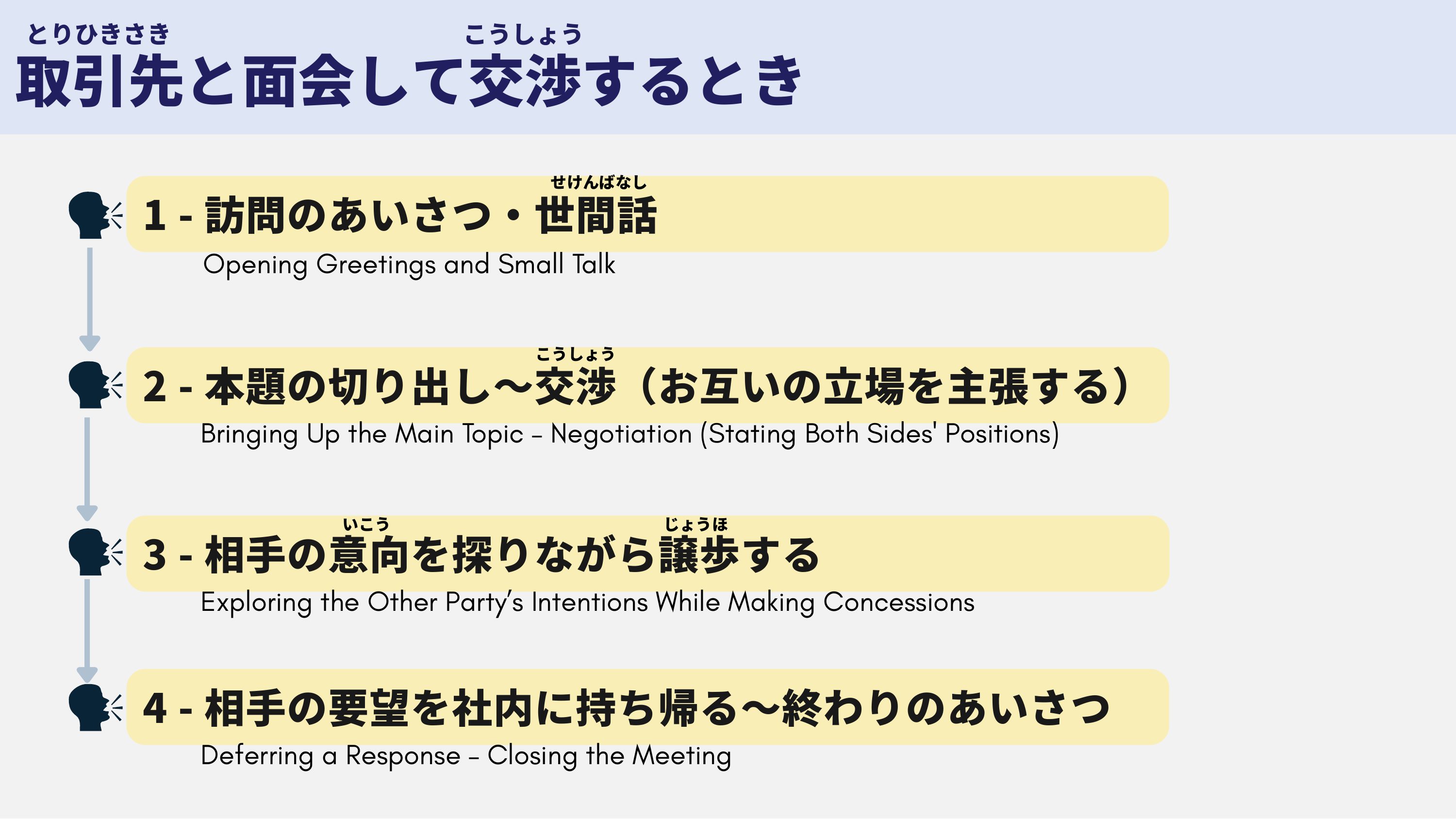
取引先と面会して交渉するとき
せけんばなし
1-訪問のあいさつ・世間話
取引先と面会して交渉するとき
せけんばなし
1-訪問のあいさつ・世間話
EN Opening Greetings and Small Talk
JPこうしょう
2-本題の切り出し〜交渉(お互いの立場を主張する)
2-本題の切り出し〜交渉(お互いの立場を主張する)
EN Bringing Up the Main Topic – Negotiation (Stating Both Sides' Positions)
JPいこうじょうほ
3-相手の意向を探りながら譲歩する
3-相手の意向を探りながら譲歩する
EN Exploring the Other Party’s Intentions While Making Concessions
JP4-相手の要望を社内に持ち帰る〜終わりのあいさつ
EN Deferring a Response – Closing the Meeting
หน้า 12
คลิกเพื่อขยาย
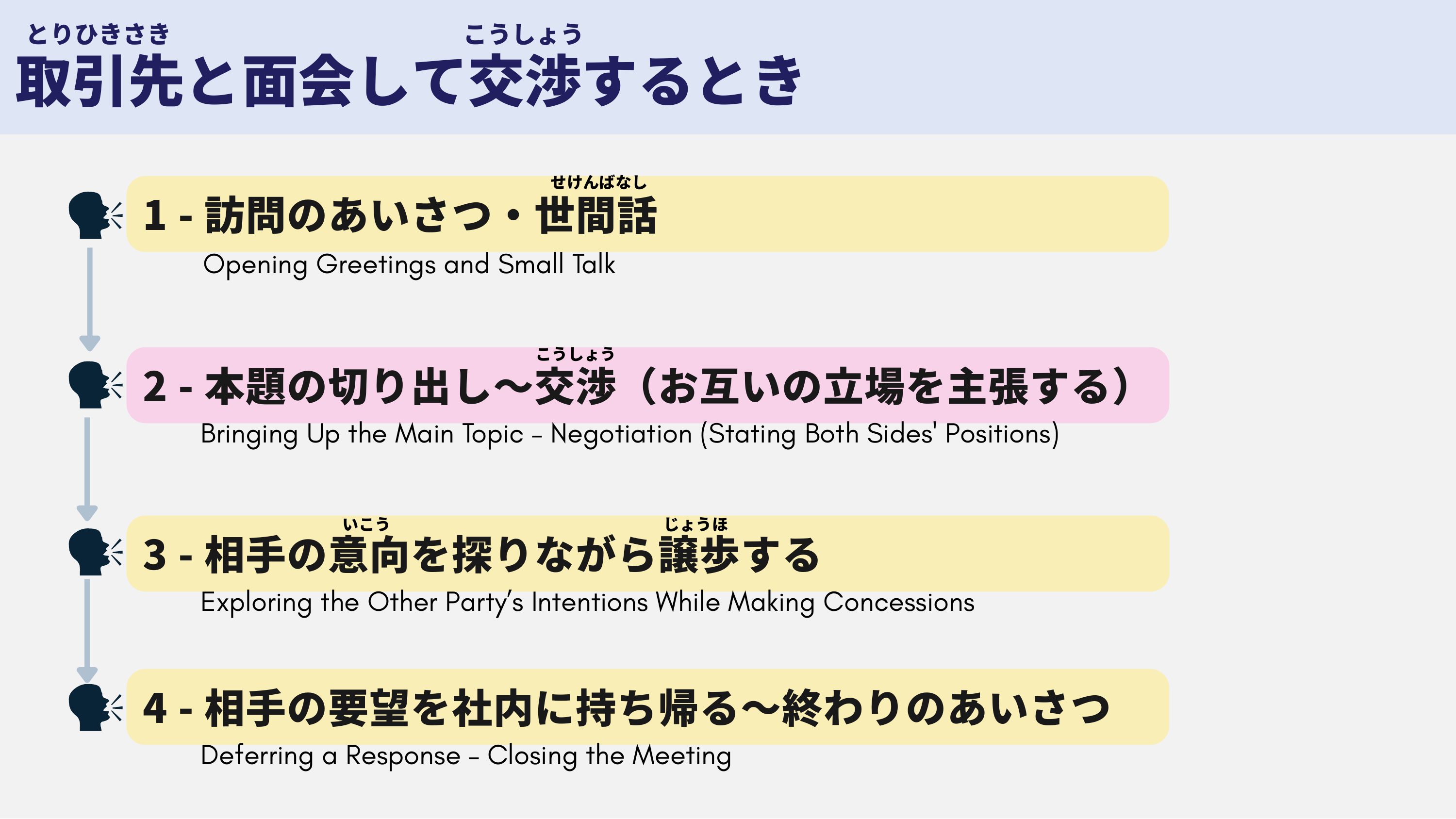
JPとりひきさきこうしょう
取引先と面会して交渉するとき
せけんばなし
1-訪問のあいさつ・世間話
取引先と面会して交渉するとき
せけんばなし
1-訪問のあいさつ・世間話
EN Opening Greetings and Small Talk
JPこうしょう
2-本題の切り出し〜交渉(お互いの立場を主張する)
2-本題の切り出し〜交渉(お互いの立場を主張する)
EN Bringing Up the Main Topic – Negotiation (Stating Both Sides' Positions)
JPいこうじょうほ
3-相手の意向を探りながら譲歩する
3-相手の意向を探りながら譲歩する
EN Exploring the Other Party’s Intentions While Making Concessions
JP4-相手の要望を社内に持ち帰る〜終わりのあいさつ
EN Deferring a Response – Closing the Meeting
หน้า 13
คลิกเพื่อขยาย
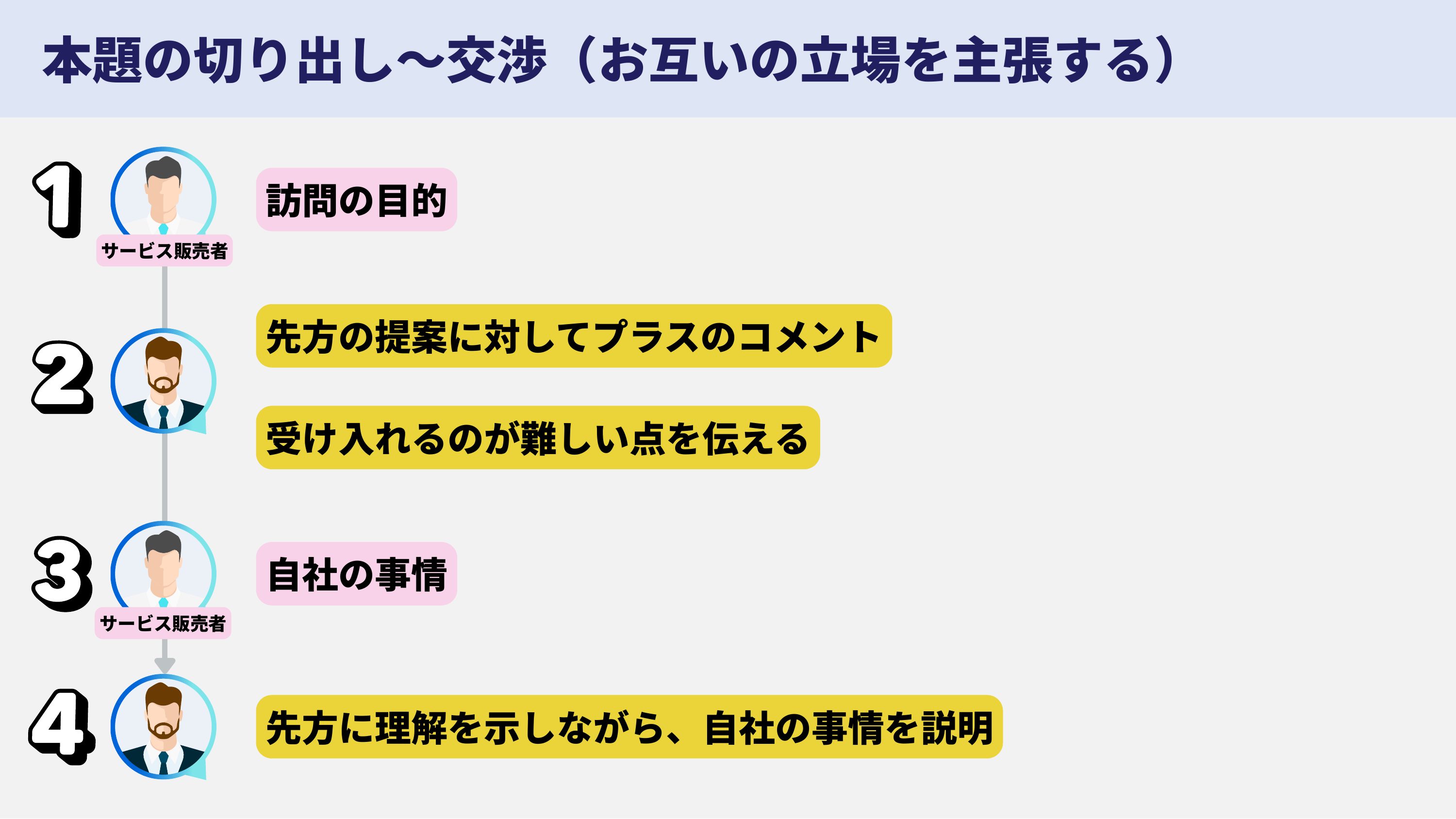
JP本題の切り出し〜交渉(お互いの立場を主張する)
訪問の目的
サービス販売者
先方の提案に対してプラスのコメント
受け入れるのが難しい点を伝える
自社の事情
サービス販売者
先方に理解を示しながら、自社の事情を説明
訪問の目的
サービス販売者
先方の提案に対してプラスのコメント
受け入れるのが難しい点を伝える
自社の事情
サービス販売者
先方に理解を示しながら、自社の事情を説明
หน้า 14
คลิกเพื่อขยาย
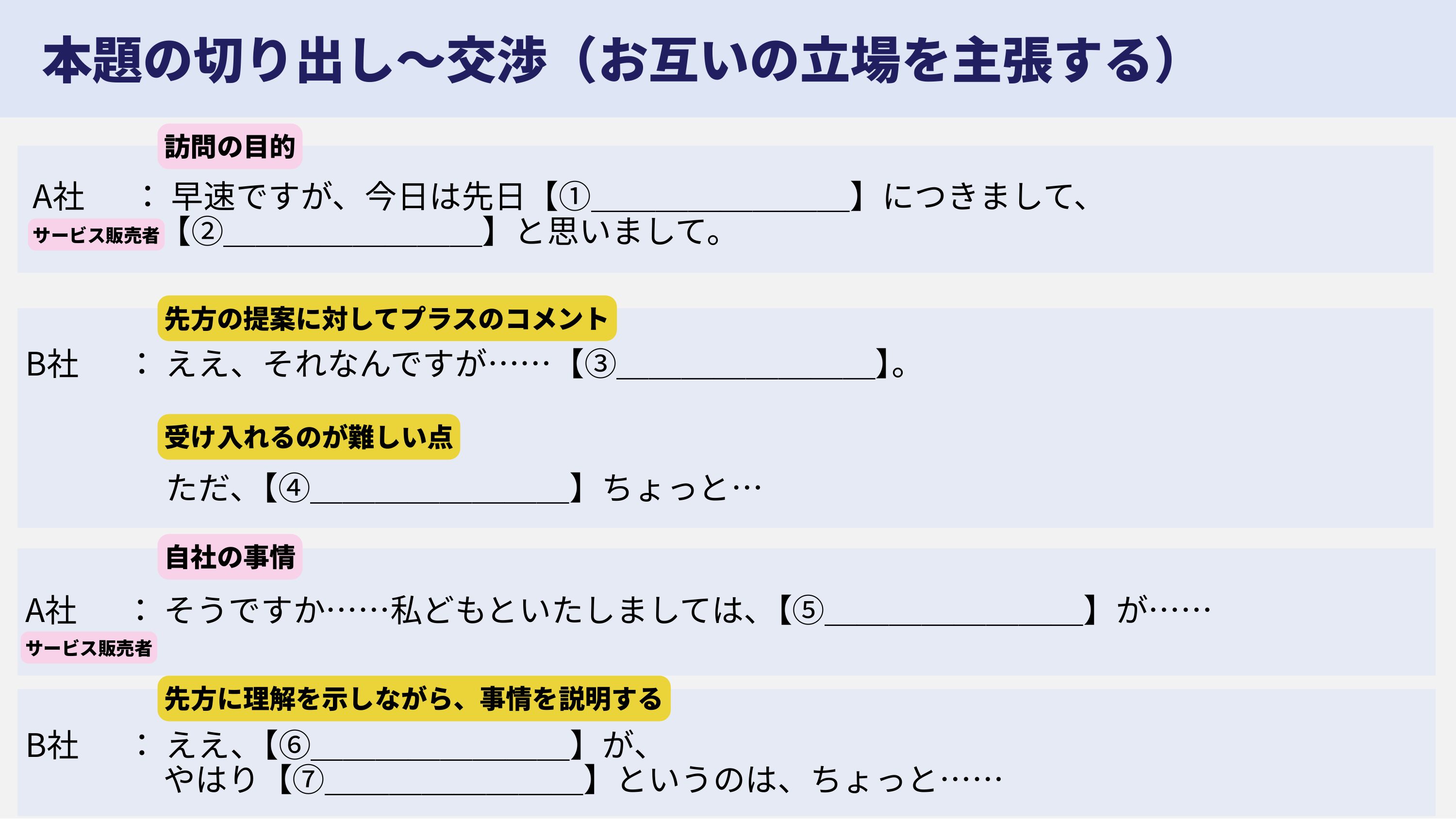
JP本題の切り出し〜交渉(お互いの立場を主張する)
訪問の目的
A社:早速ですが、今日は先日【①________】につきまして、
サービス販売者【②________】と思いまして。
先方の提案に対してプラスのコメント
B社:ええ、それなんですが……【③________】
。
受け入れるのが難しい点
ただ、
【④________】ちょっと…
自社の事情
A社:そうですか……私どもといたしましては、
【⑤________】が……
サービス販売者
先方に理解を示しながら、事情を説明する
B社:ええ、【⑥________】が、
やはり【⑦________】というのは、ちょっと……
訪問の目的
A社:早速ですが、今日は先日【①________】につきまして、
サービス販売者【②________】と思いまして。
先方の提案に対してプラスのコメント
B社:ええ、それなんですが……【③________】
。
受け入れるのが難しい点
ただ、
【④________】ちょっと…
自社の事情
A社:そうですか……私どもといたしましては、
【⑤________】が……
サービス販売者
先方に理解を示しながら、事情を説明する
B社:ええ、【⑥________】が、
やはり【⑦________】というのは、ちょっと……
หน้า 15
คลิกเพื่อขยาย
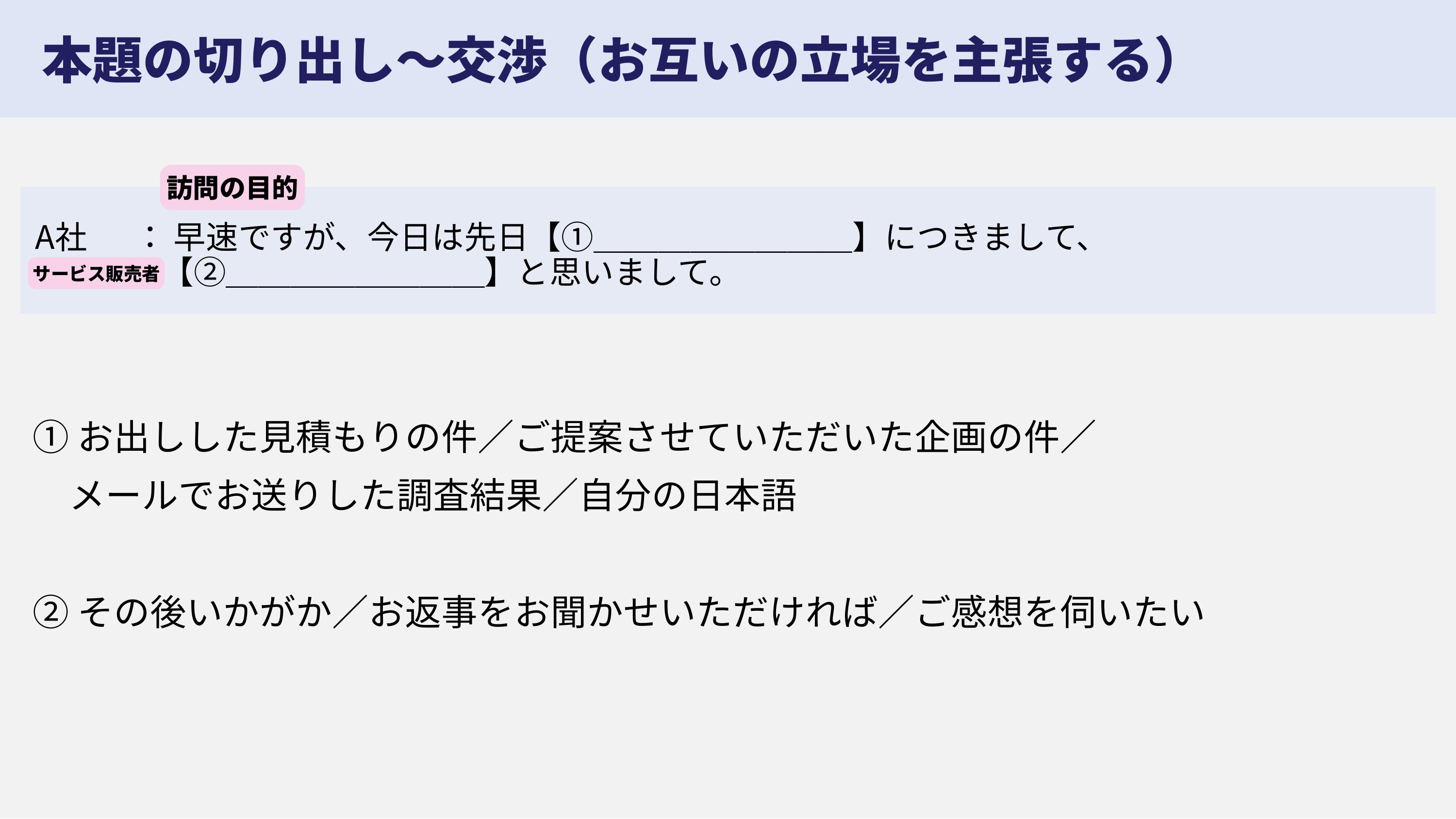
JP本題の切り出し〜交渉(お互いの立場を主張する)
訪問の目的
A社:早速ですが、今日は先日【①________】につきまして、
サービス販売者【②________】と思いまして。
①お出しした見積もりの件/ご提案させていただいた企画の件/
メールでお送りした調査結果/自分の日本語
②その後いかがか/お返事をお聞かせいただければ/ご感想を伺いたい
訪問の目的
A社:早速ですが、今日は先日【①________】につきまして、
サービス販売者【②________】と思いまして。
①お出しした見積もりの件/ご提案させていただいた企画の件/
メールでお送りした調査結果/自分の日本語
②その後いかがか/お返事をお聞かせいただければ/ご感想を伺いたい
หน้า 16
คลิกเพื่อขยาย
JP本題の切り出し〜交渉(お互いの立場を主張する)
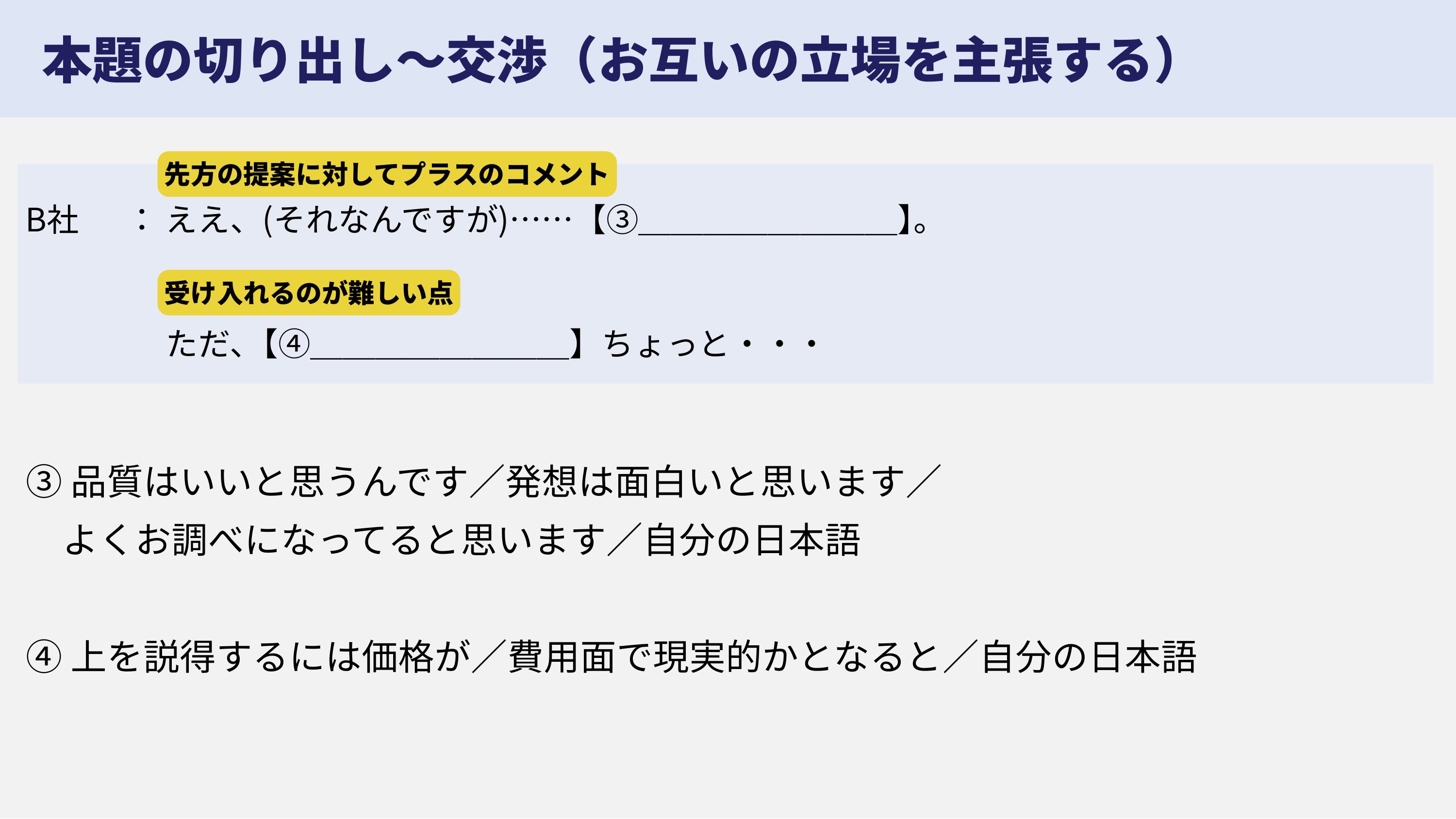
先方の提案に対してプラスのコメント
B社:ええ、(それなんですが)……【③________】
。
受け入れるのが難しい点
ただ、
【④________】ちょっと・・・
③品質はいいと思うんです/発想は面白いと思います/
よくお調べになってると思います/自分の日本語
④上を説得するには価格が/費用面で現実的かとなると/自分の日本語
先方の提案に対してプラスのコメント
B社:ええ、(それなんですが)……【③________】
。
受け入れるのが難しい点
ただ、
【④________】ちょっと・・・
③品質はいいと思うんです/発想は面白いと思います/
よくお調べになってると思います/自分の日本語
④上を説得するには価格が/費用面で現実的かとなると/自分の日本語
หน้า 17
คลิกเพื่อขยาย
JP本題の切り出し〜交渉(お互いの立場を主張する)
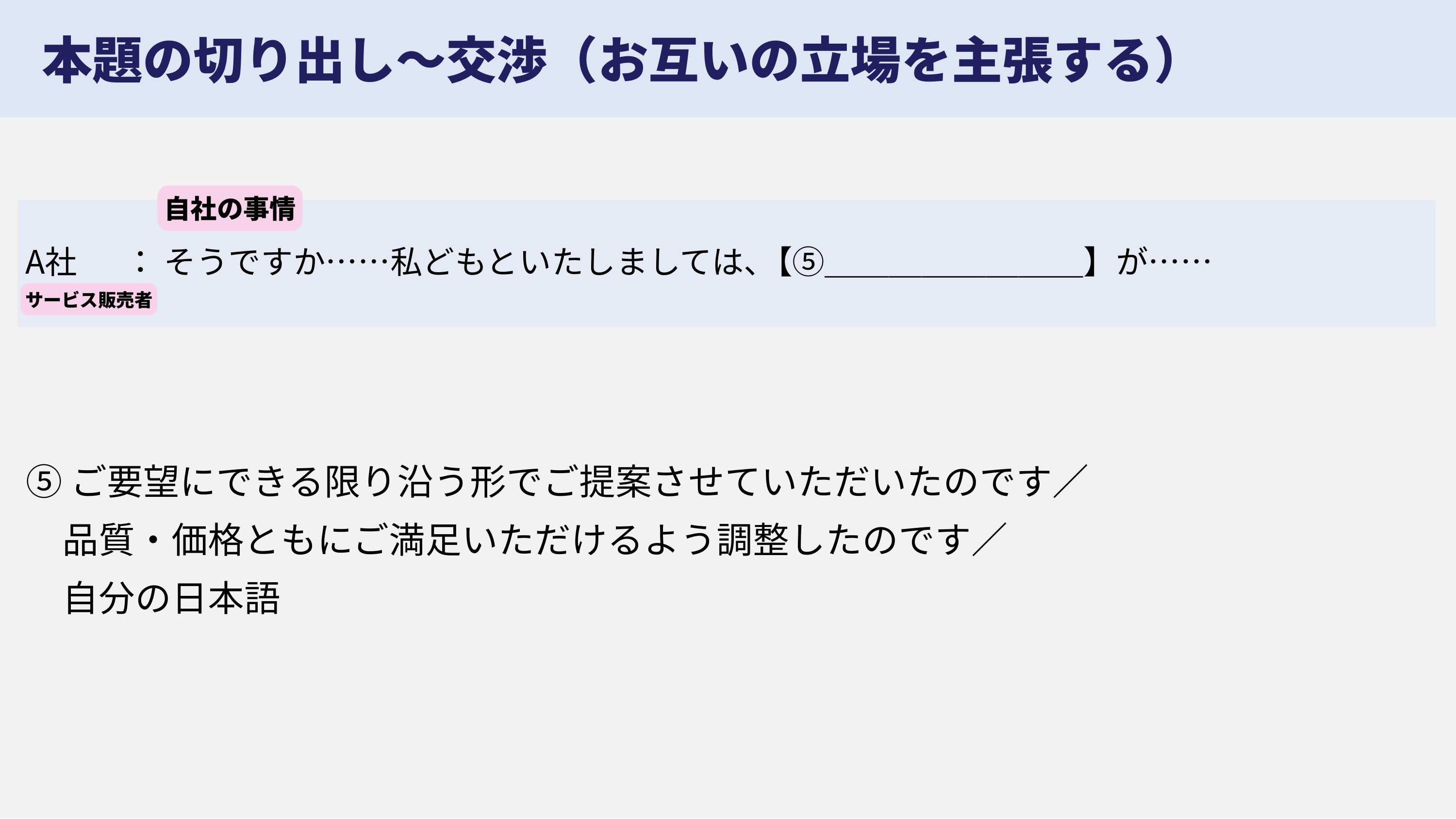
自社の事情
A社:そうですか……私どもといたしましては、
【⑤________】が……
サービス販売者
⑤ご要望にできる限り沿う形でご提案させていただいたのです/
品質・価格ともにご満足いただけるよう調整したのです/
自分の日本語
自社の事情
A社:そうですか……私どもといたしましては、
【⑤________】が……
サービス販売者
⑤ご要望にできる限り沿う形でご提案させていただいたのです/
品質・価格ともにご満足いただけるよう調整したのです/
自分の日本語
หน้า 18
คลิกเพื่อขยาย
JP本題の切り出し〜交渉(お互いの立場を主張する)
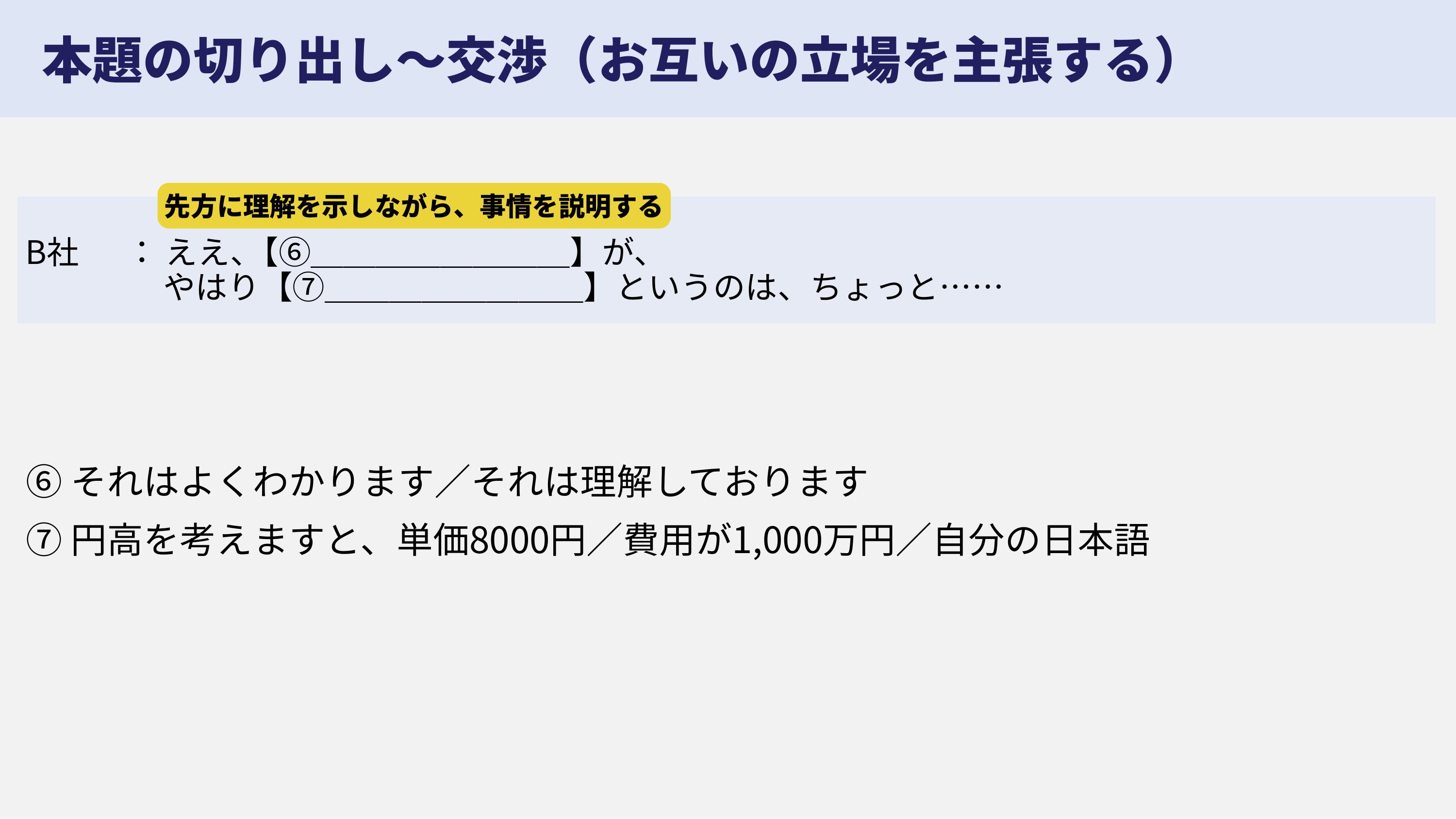
先方に理解を示しながら、事情を説明する
B社:ええ、【⑥________】が、
やはり【⑦________】というのは、ちょっと……
⑥それはよくわかります/それは理解しております
⑦円高を考えますと、単価8000円/費用が1,000万円/自分の日本語
先方に理解を示しながら、事情を説明する
B社:ええ、【⑥________】が、
やはり【⑦________】というのは、ちょっと……
⑥それはよくわかります/それは理解しております
⑦円高を考えますと、単価8000円/費用が1,000万円/自分の日本語
หน้า 19
คลิกเพื่อขยาย
JPとりひきさきこうしょう
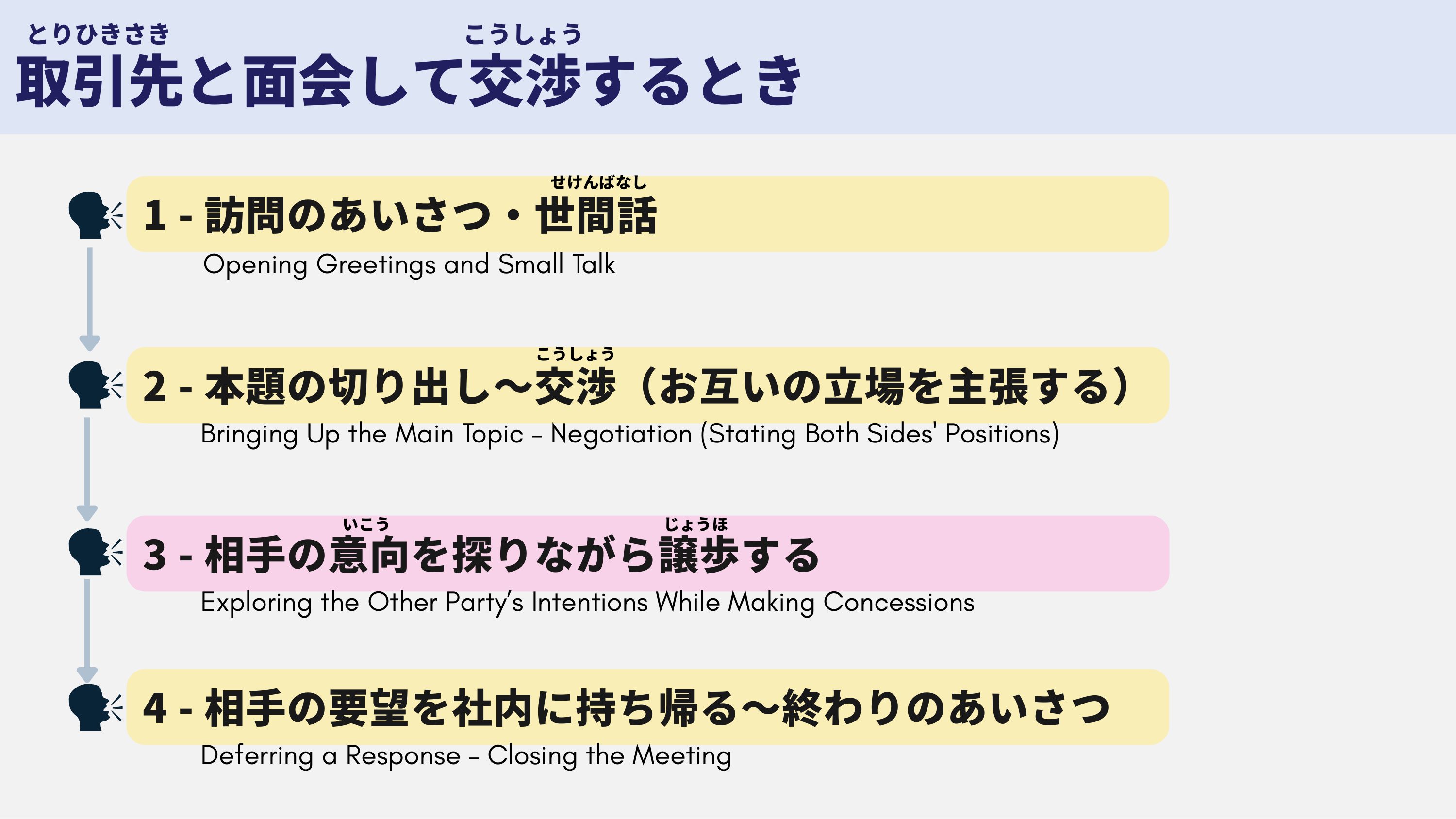
取引先と面会して交渉するとき
せけんばなし
1-訪問のあいさつ・世間話
取引先と面会して交渉するとき
せけんばなし
1-訪問のあいさつ・世間話
EN Opening Greetings and Small Talk
JPこうしょう
2-本題の切り出し〜交渉(お互いの立場を主張する)
2-本題の切り出し〜交渉(お互いの立場を主張する)
EN Bringing Up the Main Topic – Negotiation (Stating Both Sides' Positions)
JPいこうじょうほ
3-相手の意向を探りながら譲歩する
3-相手の意向を探りながら譲歩する
EN Exploring the Other Party’s Intentions While Making Concessions
JP4-相手の要望を社内に持ち帰る〜終わりのあいさつ
EN Deferring a Response – Closing the Meeting
หน้า 20
คลิกเพื่อขยาย
JP相手の意向を探りながら譲歩する
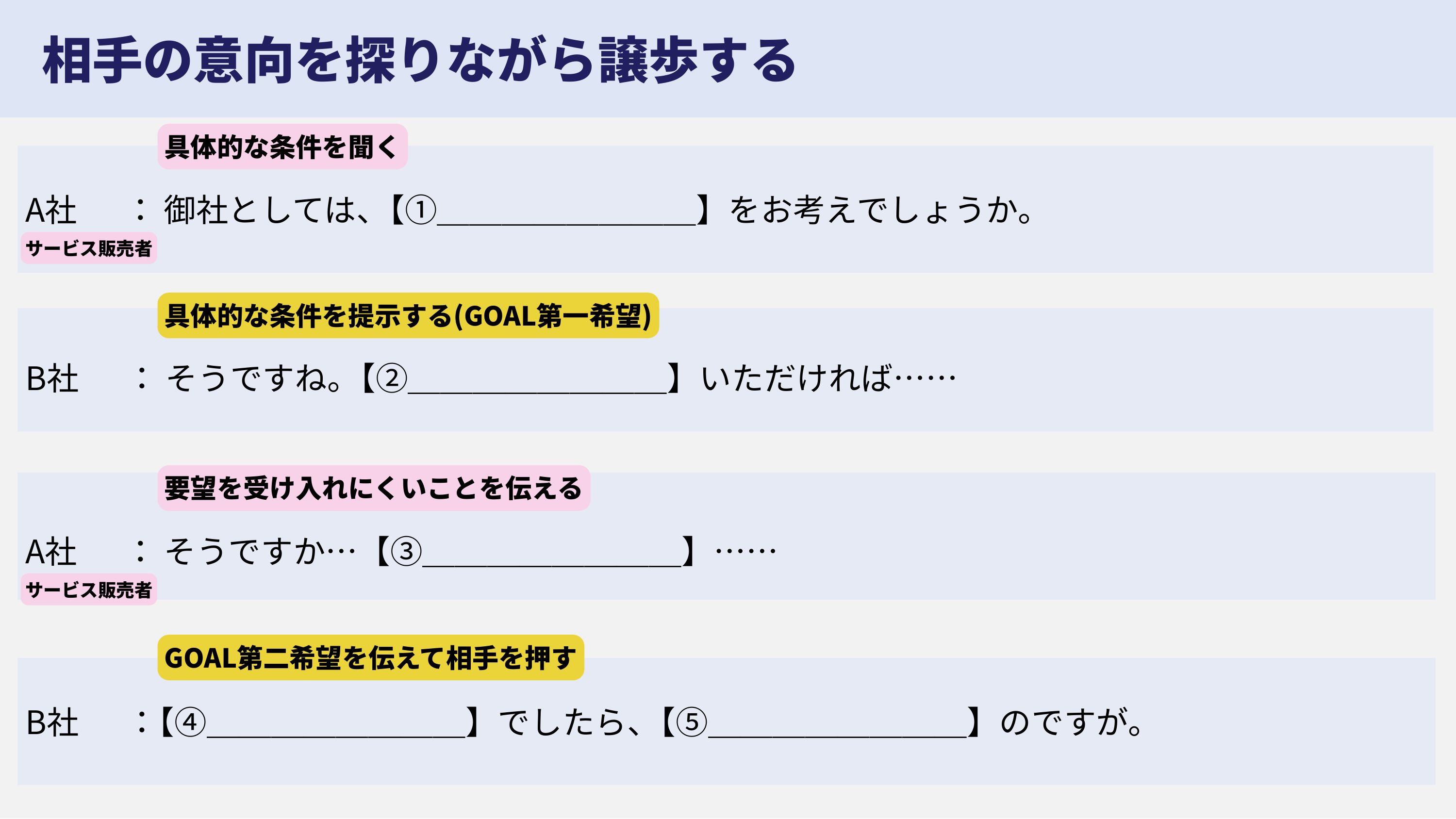
具体的な条件を聞く
A社:御社としては、
【①________】をお考えでしょうか。
サービス販売者
具体的な条件を提示する(GOAL第一希望)
B社:そうですね。
【②________】いただければ……
要望を受け入れにくいことを伝える
A社:そうですか…【③________】……
サービス販売者
GOAL第二希望を伝えて相手を押す
B社:
【④________】でしたら、
【⑤________】のですが。
具体的な条件を聞く
A社:御社としては、
【①________】をお考えでしょうか。
サービス販売者
具体的な条件を提示する(GOAL第一希望)
B社:そうですね。
【②________】いただければ……
要望を受け入れにくいことを伝える
A社:そうですか…【③________】……
サービス販売者
GOAL第二希望を伝えて相手を押す
B社:
【④________】でしたら、
【⑤________】のですが。
หน้า 21
คลิกเพื่อขยาย
JP相手の意向を探りながら譲歩する
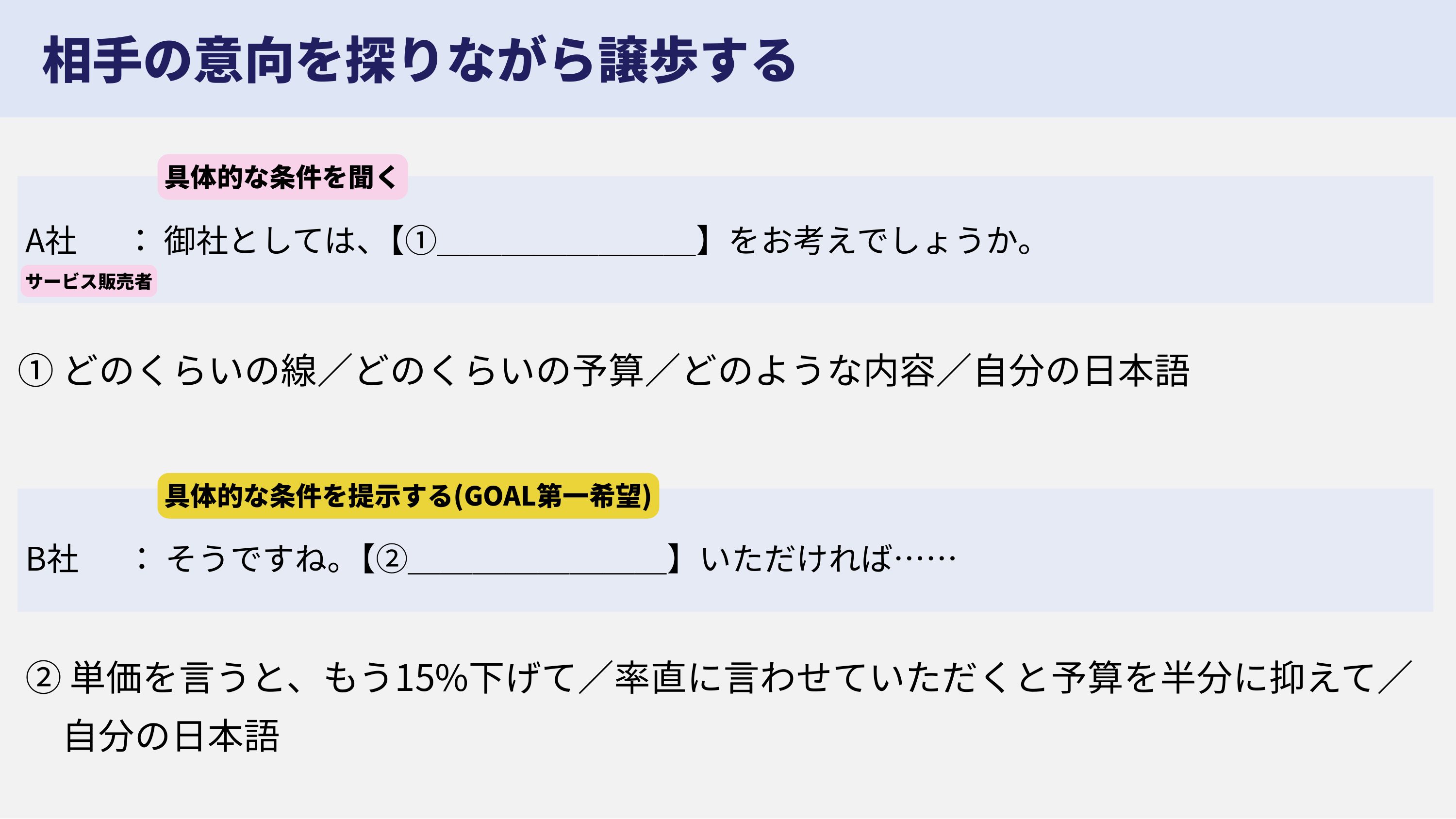
具体的な条件を聞く
A社:御社としては、
【①________】をお考えでしょうか。
サービス販売者
①どのくらいの線/どのくらいの予算/どのような内容/自分の日本語
具体的な条件を提示する(GOAL第一希望)
B社:そうですね。
【②________】いただければ……
②単価を言うと、もう15%下げて/率直に言わせていただくと予算を半分に抑えて/
自分の日本語
具体的な条件を聞く
A社:御社としては、
【①________】をお考えでしょうか。
サービス販売者
①どのくらいの線/どのくらいの予算/どのような内容/自分の日本語
具体的な条件を提示する(GOAL第一希望)
B社:そうですね。
【②________】いただければ……
②単価を言うと、もう15%下げて/率直に言わせていただくと予算を半分に抑えて/
自分の日本語
หน้า 22
คลิกเพื่อขยาย
JP相手の意向を探りながら譲歩する
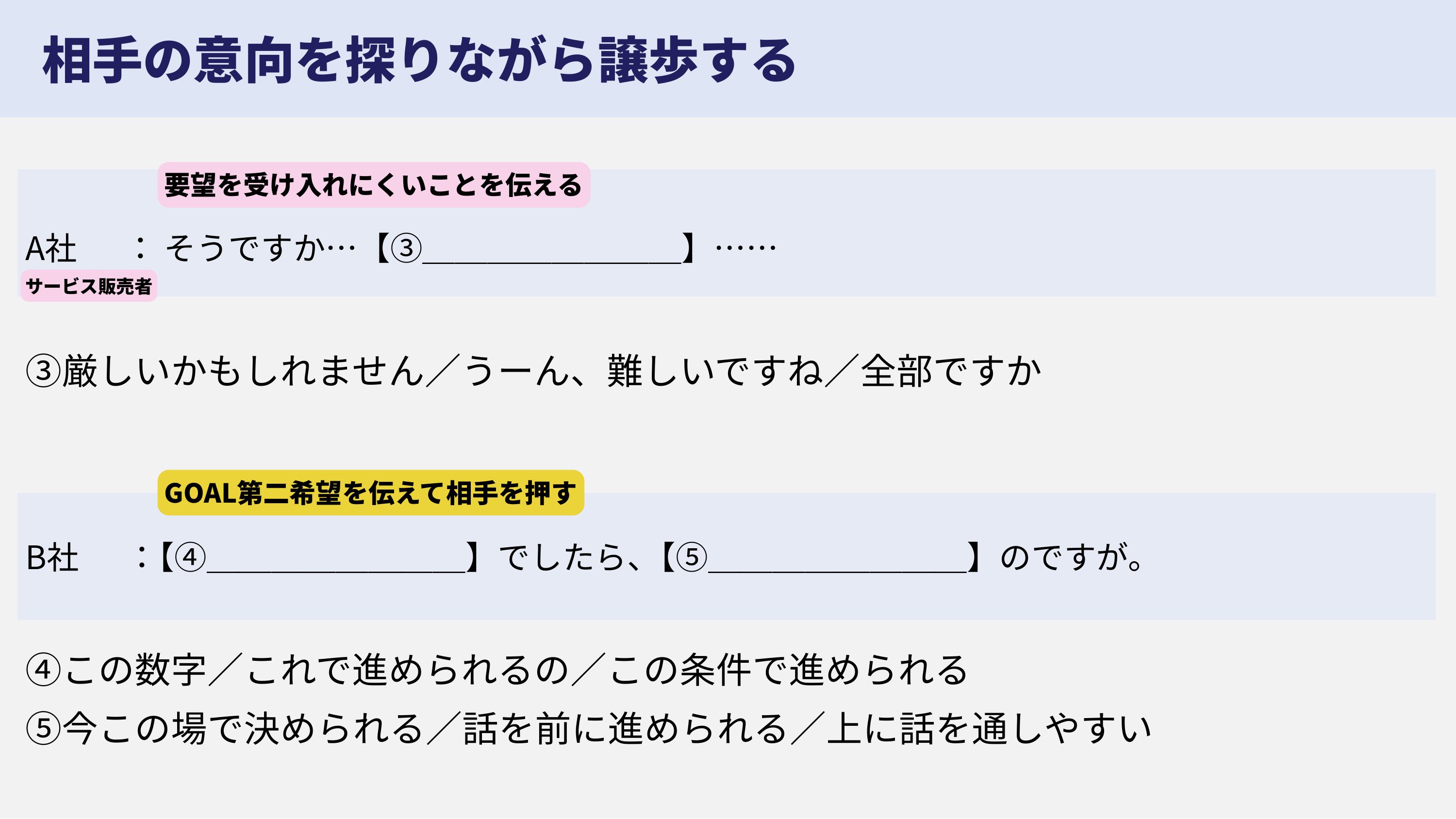
要望を受け入れにくいことを伝える
A社:そうですか…【③________】……
サービス販売者
③厳しいかもしれません/うーん、難しいですね/全部ですか
GOAL第二希望を伝えて相手を押す
B社:
【④________】でしたら、
【⑤________】のですが。
④この数字/これで進められるの/この条件で進められる
⑤今この場で決められる/話を前に進められる/上に話を通しやすい
要望を受け入れにくいことを伝える
A社:そうですか…【③________】……
サービス販売者
③厳しいかもしれません/うーん、難しいですね/全部ですか
GOAL第二希望を伝えて相手を押す
B社:
【④________】でしたら、
【⑤________】のですが。
④この数字/これで進められるの/この条件で進められる
⑤今この場で決められる/話を前に進められる/上に話を通しやすい
หน้า 23
คลิกเพื่อขยาย
JPとりひきさきこうしょう
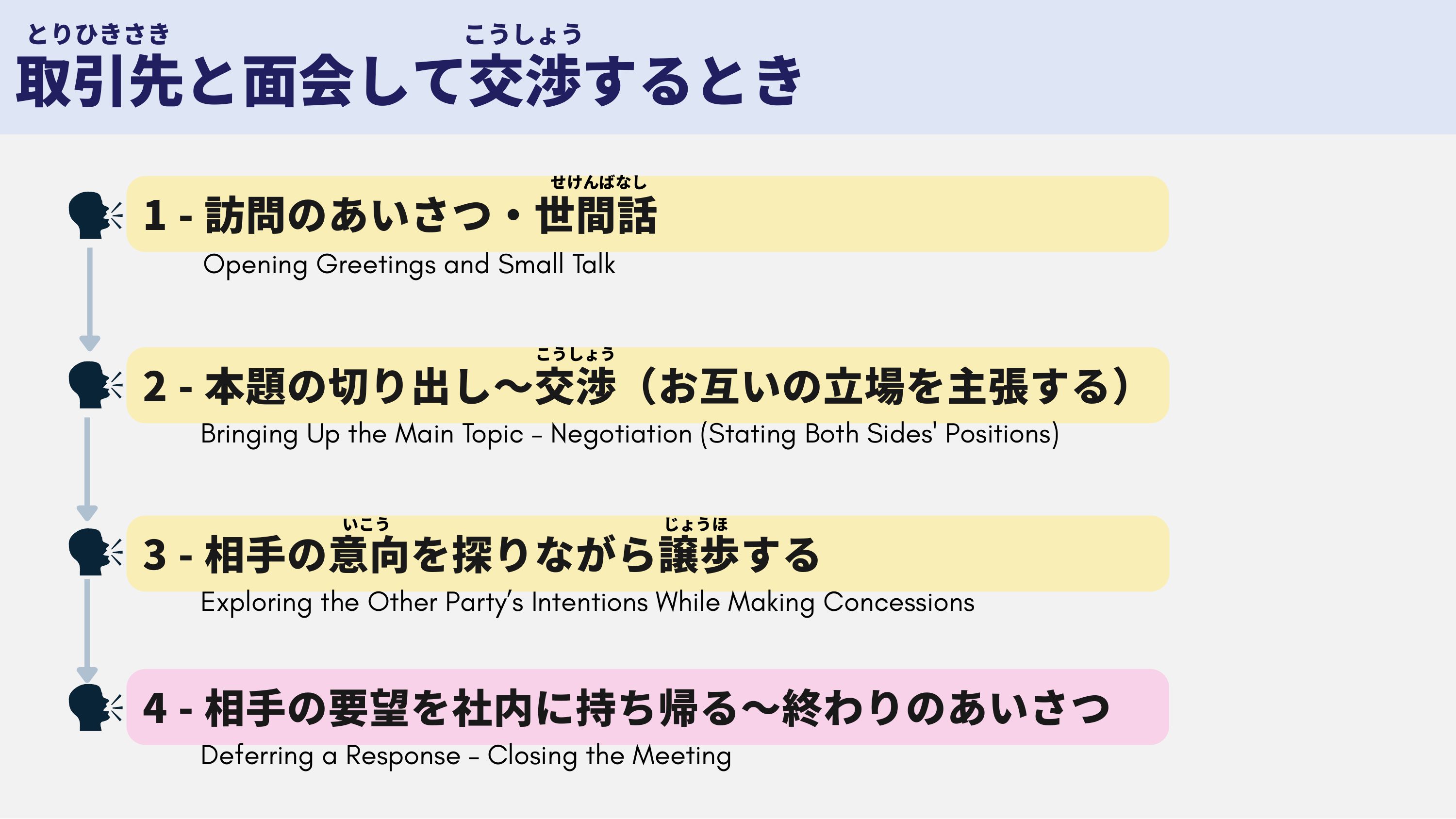
取引先と面会して交渉するとき
せけんばなし
1-訪問のあいさつ・世間話
取引先と面会して交渉するとき
せけんばなし
1-訪問のあいさつ・世間話
EN Opening Greetings and Small Talk
JPこうしょう
2-本題の切り出し〜交渉(お互いの立場を主張する)
2-本題の切り出し〜交渉(お互いの立場を主張する)
EN Bringing Up the Main Topic – Negotiation (Stating Both Sides' Positions)
JPいこうじょうほ
3-相手の意向を探りながら譲歩する
3-相手の意向を探りながら譲歩する
EN Exploring the Other Party’s Intentions While Making Concessions
JP4-相手の要望を社内に持ち帰る〜終わりのあいさつ
EN Deferring a Response – Closing the Meeting
หน้า 24
คลิกเพื่อขยาย
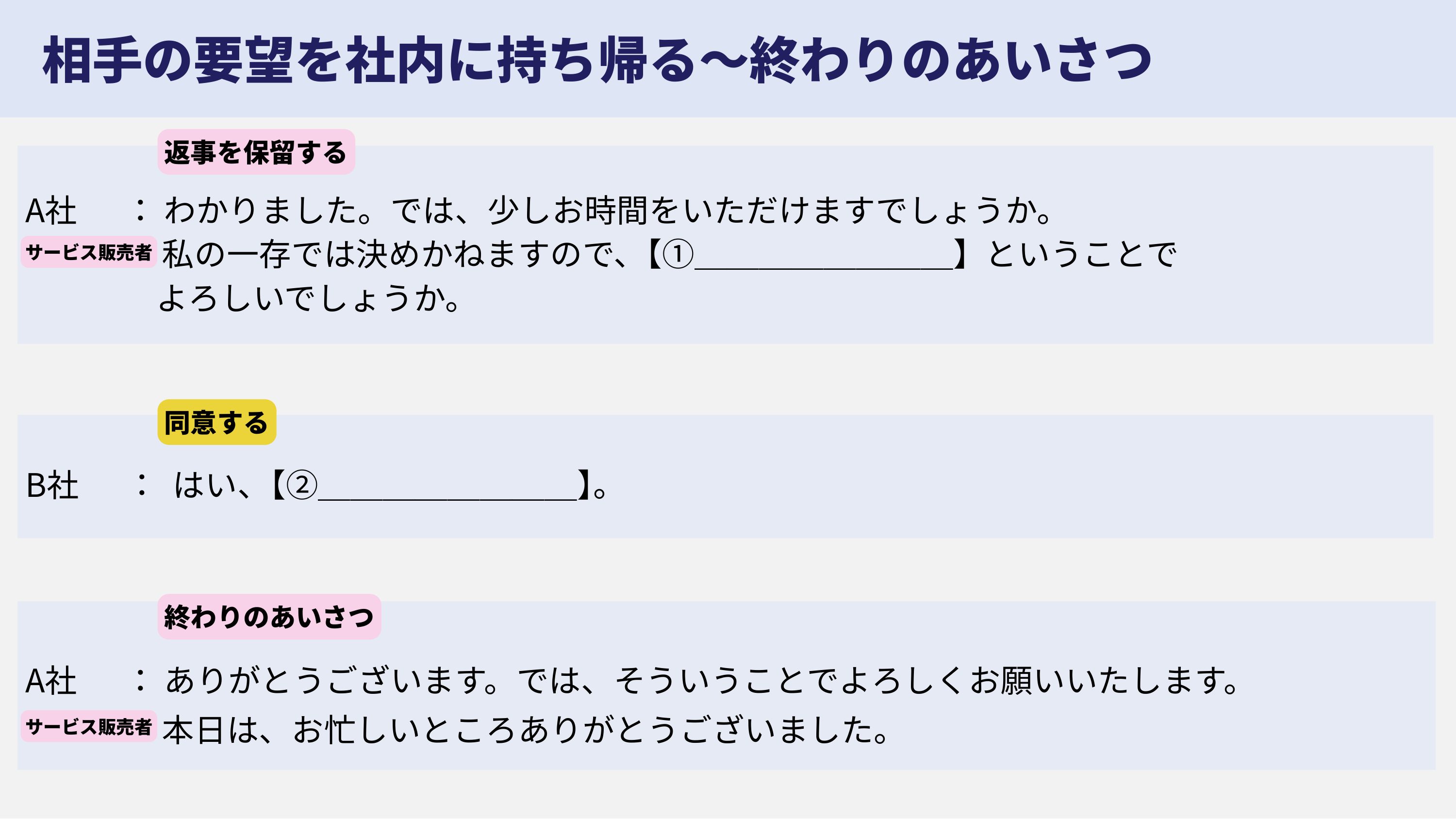
JP相手の要望を社内に持ち帰る〜終わりのあいさつ
返事を保留する
A社:わかりました。では、少しお時間をいただけますでしょうか。
サービス販売者私の一存では決めかねますので、
【①________】ということで
よろしいでしょうか。
同意する
B社:はい、
【②________】
。
終わりのあいさつ
A社:ありがとうございます。では、そういうことでよろしくお願いいたします。
サービス販売者本日は、お忙しいところありがとうございました。
返事を保留する
A社:わかりました。では、少しお時間をいただけますでしょうか。
サービス販売者私の一存では決めかねますので、
【①________】ということで
よろしいでしょうか。
同意する
B社:はい、
【②________】
。
終わりのあいさつ
A社:ありがとうございます。では、そういうことでよろしくお願いいたします。
サービス販売者本日は、お忙しいところありがとうございました。
หน้า 25
คลิกเพื่อขยาย
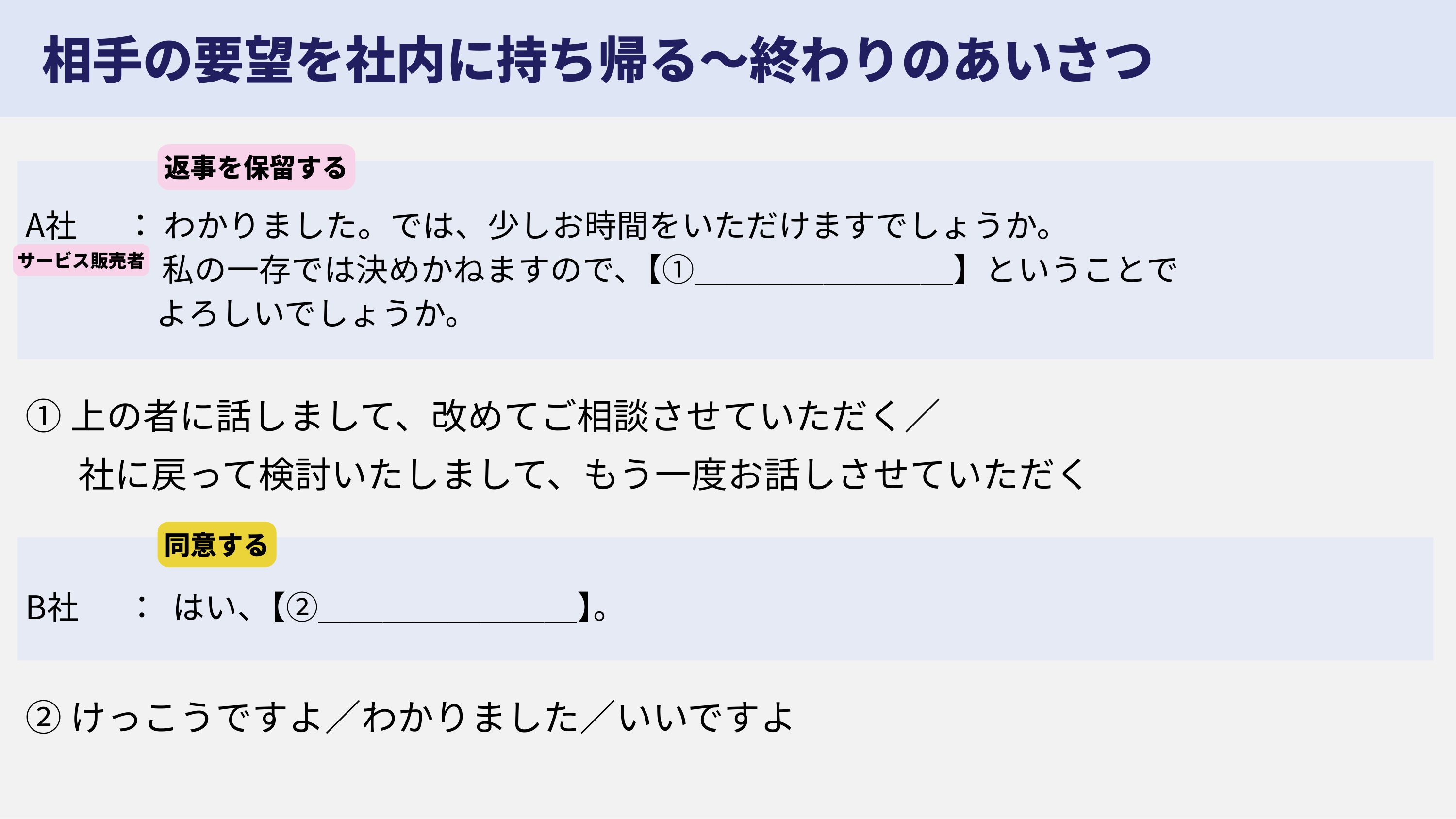
JP相手の要望を社内に持ち帰る〜終わりのあいさつ
返事を保留する
A社:わかりました。では、少しお時間をいただけますでしょうか。
サービス販売者
私の一存では決めかねますので、
【①________】ということで
よろしいでしょうか。
①上の者に話しまして、改めてご相談させていただく/
社に戻って検討いたしまして、もう一度お話しさせていただく
同意する
B社:はい、
【②________】
。
②けっこうですよ/わかりました/いいですよ
返事を保留する
A社:わかりました。では、少しお時間をいただけますでしょうか。
サービス販売者
私の一存では決めかねますので、
【①________】ということで
よろしいでしょうか。
①上の者に話しまして、改めてご相談させていただく/
社に戻って検討いたしまして、もう一度お話しさせていただく
同意する
B社:はい、
【②________】
。
②けっこうですよ/わかりました/いいですよ
หน้า 26
คลิกเพื่อขยาย
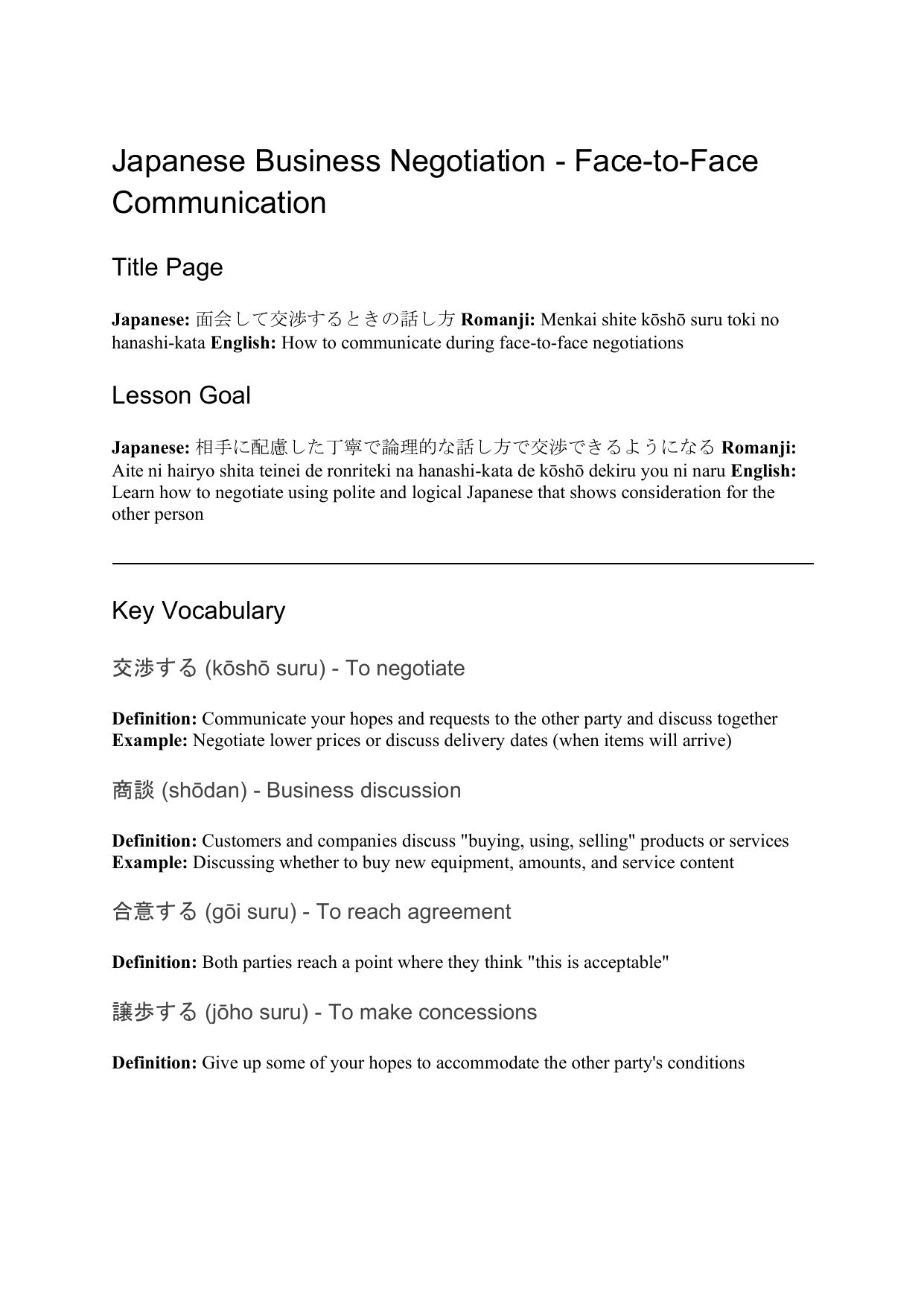
ENJapanese Business Negotiation - Face-to-Face
Communication
Title Page
Japanese: 面会して交渉するときの話し方 Romanji: Menkai shite kōshō suru toki no
hanashi-kata English: How to communicate during face-to-face negotiations
Lesson Goal
Communication
Title Page
Japanese: 面会して交渉するときの話し方 Romanji: Menkai shite kōshō suru toki no
hanashi-kata English: How to communicate during face-to-face negotiations
Lesson Goal
JPJapanese:相手に配慮した丁寧で論理的な話し方で交渉できるようになるRomanji:
ENAite ni hairyo shita teinei de ronriteki na hanashi-kata de kōshō dekiru you ni naru English:
Learn how to negotiate using polite and logical Japanese that shows consideration for the
other person
Key Vocabulary
交渉する (kōshō suru) - To negotiate
Definition: Communicate your hopes and requests to the other party and discuss together
Example: Negotiate lower prices or discuss delivery dates (when items will arrive)
商談 (shōdan) - Business discussion
Definition: Customers and companies discuss "buying, using, selling" products or services
Example: Discussing whether to buy new equipment, amounts, and service content
合意する (gōi suru) - To reach agreement
Definition: Both parties reach a point where they think "this is acceptable"
譲歩する (jōho suru) - To make concessions
Definition: Give up some of your hopes to accommodate the other party's conditions
Learn how to negotiate using polite and logical Japanese that shows consideration for the
other person
Key Vocabulary
交渉する (kōshō suru) - To negotiate
Definition: Communicate your hopes and requests to the other party and discuss together
Example: Negotiate lower prices or discuss delivery dates (when items will arrive)
商談 (shōdan) - Business discussion
Definition: Customers and companies discuss "buying, using, selling" products or services
Example: Discussing whether to buy new equipment, amounts, and service content
合意する (gōi suru) - To reach agreement
Definition: Both parties reach a point where they think "this is acceptable"
譲歩する (jōho suru) - To make concessions
Definition: Give up some of your hopes to accommodate the other party's conditions
หน้า 27
คลิกเพื่อขยาย
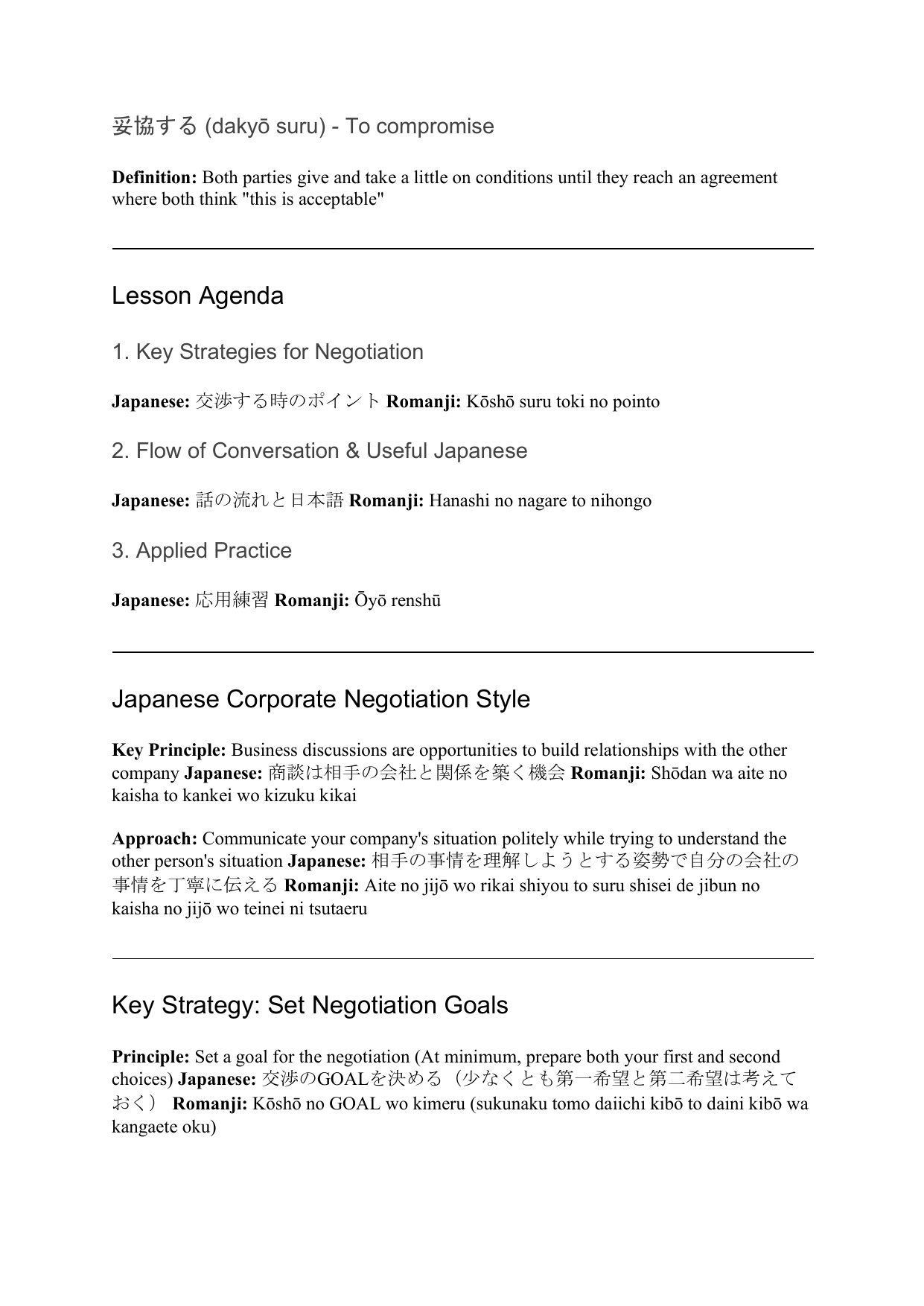
EN妥協する (dakyō suru) - To compromise
Definition: Both parties give and take a little on conditions until they reach an agreement
where both think "this is acceptable"
Lesson Agenda
1. Key Strategies for Negotiation
Japanese: 交渉する時のポイント Romanji: Kōshō suru toki no pointo
2. Flow of Conversation & Useful Japanese
Japanese: 話の流れと日本語 Romanji: Hanashi no nagare to nihongo
3. Applied Practice
Japanese: 応用練習 Romanji: Ōyō renshū
Japanese Corporate Negotiation Style
Key Principle: Business discussions are opportunities to build relationships with the other
company Japanese: 商談は相手の会社と関係を築く機会 Romanji: Shōdan wa aite no
kaisha to kankei wo kizuku kikai
Approach: Communicate your company's situation politely while trying to understand the
other person's situation Japanese: 相手の事情を理解しようとする姿勢で自分の会社の
事情を丁寧に伝える Romanji: Aite no jijō wo rikai shiyou to suru shisei de jibun no
kaisha no jijō wo teinei ni tsutaeru
Key Strategy: Set Negotiation Goals
Principle: Set a goal for the negotiation (At minimum, prepare both your first and second
Definition: Both parties give and take a little on conditions until they reach an agreement
where both think "this is acceptable"
Lesson Agenda
1. Key Strategies for Negotiation
Japanese: 交渉する時のポイント Romanji: Kōshō suru toki no pointo
2. Flow of Conversation & Useful Japanese
Japanese: 話の流れと日本語 Romanji: Hanashi no nagare to nihongo
3. Applied Practice
Japanese: 応用練習 Romanji: Ōyō renshū
Japanese Corporate Negotiation Style
Key Principle: Business discussions are opportunities to build relationships with the other
company Japanese: 商談は相手の会社と関係を築く機会 Romanji: Shōdan wa aite no
kaisha to kankei wo kizuku kikai
Approach: Communicate your company's situation politely while trying to understand the
other person's situation Japanese: 相手の事情を理解しようとする姿勢で自分の会社の
事情を丁寧に伝える Romanji: Aite no jijō wo rikai shiyou to suru shisei de jibun no
kaisha no jijō wo teinei ni tsutaeru
Key Strategy: Set Negotiation Goals
Principle: Set a goal for the negotiation (At minimum, prepare both your first and second
JPchoices)Japanese:交渉のGOALを決める(少なくとも第一希望と第二希望は考えて
ENおく) Romanji: Kōshō no GOAL wo kimeru (sukunaku tomo daiichi kibō to daini kibō wa
kangaete oku)
kangaete oku)
หน้า 28
คลิกเพื่อขยาย
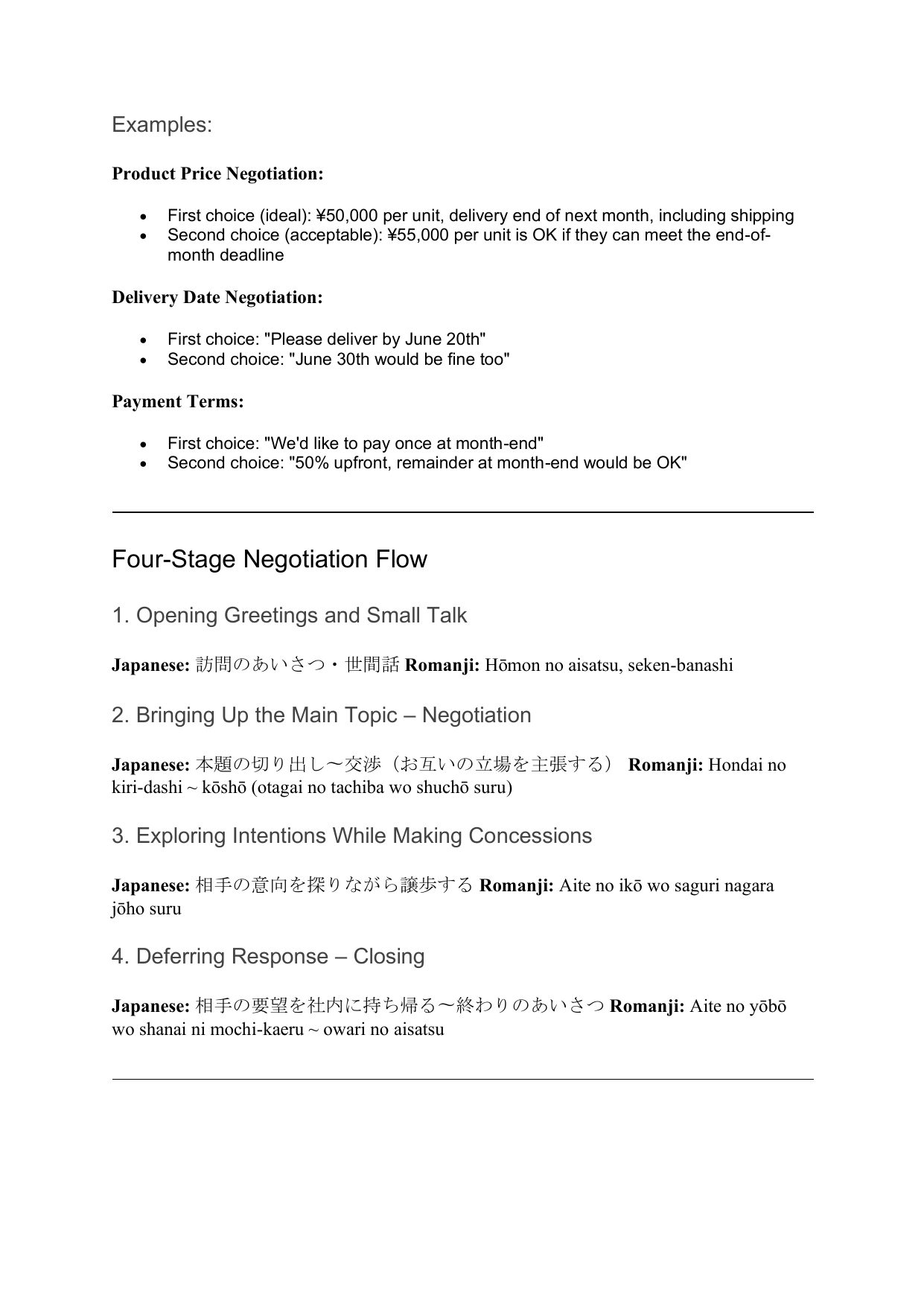
ENExamples:
Product Price Negotiation:
• First choice (ideal): ¥50,000 per unit, delivery end of next month, including shipping
• Second choice (acceptable): ¥55,000 per unit is OK if they can meet the end-of-
month deadline
Delivery Date Negotiation:
• First choice: "Please deliver by June 20th"
• Second choice: "June 30th would be fine too"
Payment Terms:
• First choice: "We'd like to pay once at month-end"
• Second choice: "50% upfront, remainder at month-end would be OK"
Four-Stage Negotiation Flow
1. Opening Greetings and Small Talk
Japanese: 訪問のあいさつ・世間話 Romanji: Hōmon no aisatsu, seken-banashi
2. Bringing Up the Main Topic – Negotiation
Japanese: 本題の切り出し〜交渉(お互いの立場を主張する) Romanji: Hondai no
kiri-dashi ~ kōshō (otagai no tachiba wo shuchō suru)
3. Exploring Intentions While Making Concessions
Japanese: 相手の意向を探りながら譲歩する Romanji: Aite no ikō wo saguri nagara
jōho suru
4. Deferring Response – Closing
Japanese: 相手の要望を社内に持ち帰る〜終わりのあいさつ Romanji: Aite no yōbō
wo shanai ni mochi-kaeru ~ owari no aisatsu
Product Price Negotiation:
• First choice (ideal): ¥50,000 per unit, delivery end of next month, including shipping
• Second choice (acceptable): ¥55,000 per unit is OK if they can meet the end-of-
month deadline
Delivery Date Negotiation:
• First choice: "Please deliver by June 20th"
• Second choice: "June 30th would be fine too"
Payment Terms:
• First choice: "We'd like to pay once at month-end"
• Second choice: "50% upfront, remainder at month-end would be OK"
Four-Stage Negotiation Flow
1. Opening Greetings and Small Talk
Japanese: 訪問のあいさつ・世間話 Romanji: Hōmon no aisatsu, seken-banashi
2. Bringing Up the Main Topic – Negotiation
Japanese: 本題の切り出し〜交渉(お互いの立場を主張する) Romanji: Hondai no
kiri-dashi ~ kōshō (otagai no tachiba wo shuchō suru)
3. Exploring Intentions While Making Concessions
Japanese: 相手の意向を探りながら譲歩する Romanji: Aite no ikō wo saguri nagara
jōho suru
4. Deferring Response – Closing
Japanese: 相手の要望を社内に持ち帰る〜終わりのあいさつ Romanji: Aite no yōbō
wo shanai ni mochi-kaeru ~ owari no aisatsu
หน้า 29
คลิกเพื่อขยาย
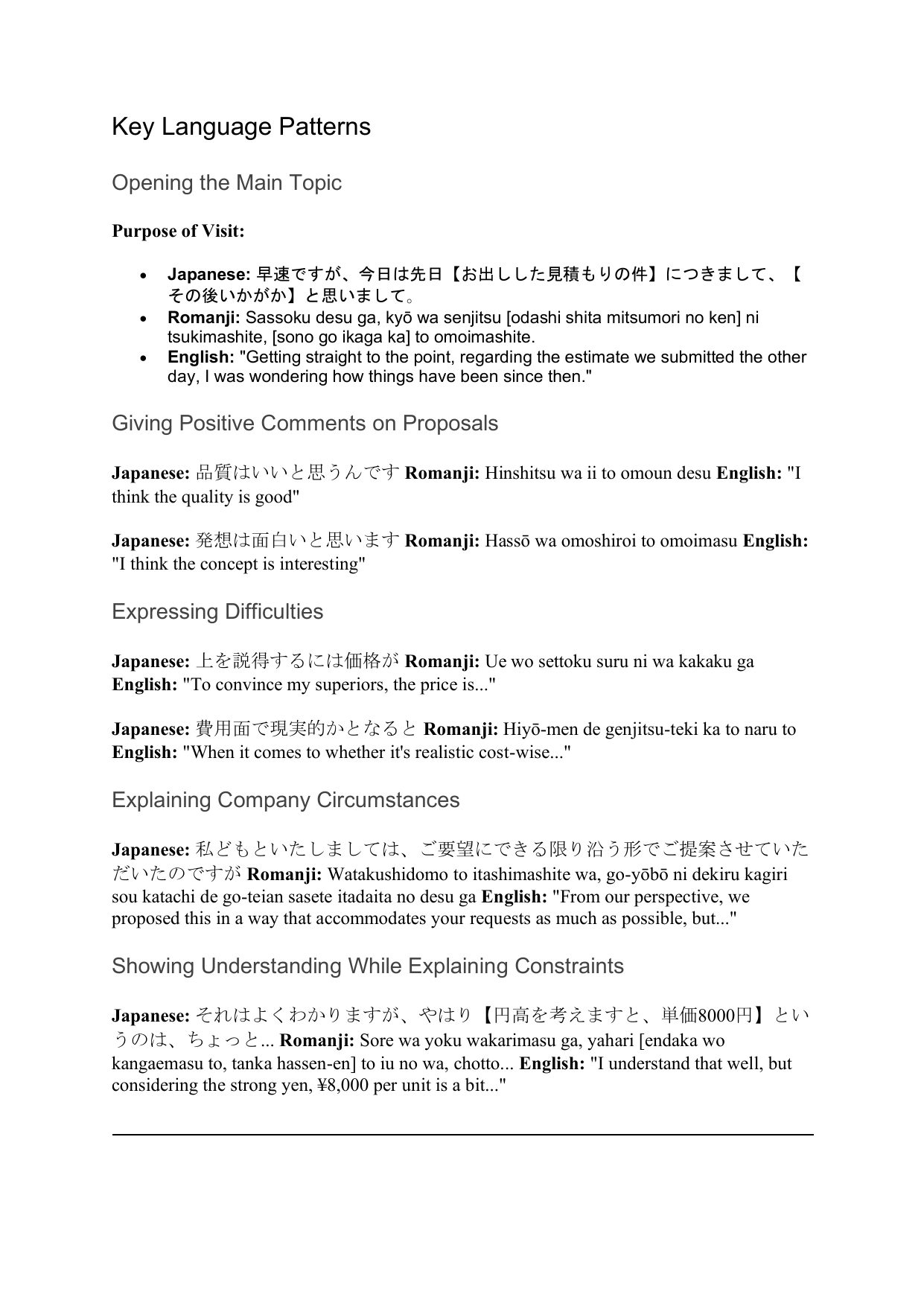
ENKey Language Patterns
Opening the Main Topic
Purpose of Visit:
Opening the Main Topic
Purpose of Visit:
JP•Japanese:早速ですが、今日は先日【お出しした見積もりの件】につきまして、【
その後いかがか】と思いまして。
その後いかがか】と思いまして。
EN • Romanji: Sassoku desu ga, kyō wa senjitsu [odashi shita mitsumori no ken] ni
tsukimashite, [sono go ikaga ka] to omoimashite.
• English: "Getting straight to the point, regarding the estimate we submitted the other
day, I was wondering how things have been since then."
Giving Positive Comments on Proposals
Japanese: 品質はいいと思うんです Romanji: Hinshitsu wa ii to omoun desu English: "I
think the quality is good"
Japanese: 発想は面白いと思います Romanji: Hassō wa omoshiroi to omoimasu English:
"I think the concept is interesting"
Expressing Difficulties
Japanese: 上を説得するには価格が Romanji: Ue wo settoku suru ni wa kakaku ga
English: "To convince my superiors, the price is..."
Japanese: 費用面で現実的かとなると Romanji: Hiyō-men de genjitsu-teki ka to naru to
English: "When it comes to whether it's realistic cost-wise..."
Explaining Company Circumstances
tsukimashite, [sono go ikaga ka] to omoimashite.
• English: "Getting straight to the point, regarding the estimate we submitted the other
day, I was wondering how things have been since then."
Giving Positive Comments on Proposals
Japanese: 品質はいいと思うんです Romanji: Hinshitsu wa ii to omoun desu English: "I
think the quality is good"
Japanese: 発想は面白いと思います Romanji: Hassō wa omoshiroi to omoimasu English:
"I think the concept is interesting"
Expressing Difficulties
Japanese: 上を説得するには価格が Romanji: Ue wo settoku suru ni wa kakaku ga
English: "To convince my superiors, the price is..."
Japanese: 費用面で現実的かとなると Romanji: Hiyō-men de genjitsu-teki ka to naru to
English: "When it comes to whether it's realistic cost-wise..."
Explaining Company Circumstances
JPJapanese:私どもといたしましては、ご要望にできる限り沿う形でご提案させていた
ENだいたのですが Romanji: Watakushidomo to itashimashite wa, go-yōbō ni dekiru kagiri
sou katachi de go-teian sasete itadaita no desu ga English: "From our perspective, we
proposed this in a way that accommodates your requests as much as possible, but..."
Showing Understanding While Explaining Constraints
sou katachi de go-teian sasete itadaita no desu ga English: "From our perspective, we
proposed this in a way that accommodates your requests as much as possible, but..."
Showing Understanding While Explaining Constraints
JPJapanese:それはよくわかりますが、やはり【円高を考えますと、単価8000円】とい
ENうのは、ちょっと... Romanji: Sore wa yoku wakarimasu ga, yahari [endaka wo
kangaemasu to, tanka hassen-en] to iu no wa, chotto... English: "I understand that well, but
considering the strong yen, ¥8,000 per unit is a bit..."
kangaemasu to, tanka hassen-en] to iu no wa, chotto... English: "I understand that well, but
considering the strong yen, ¥8,000 per unit is a bit..."
หน้า 30
คลิกเพื่อขยาย
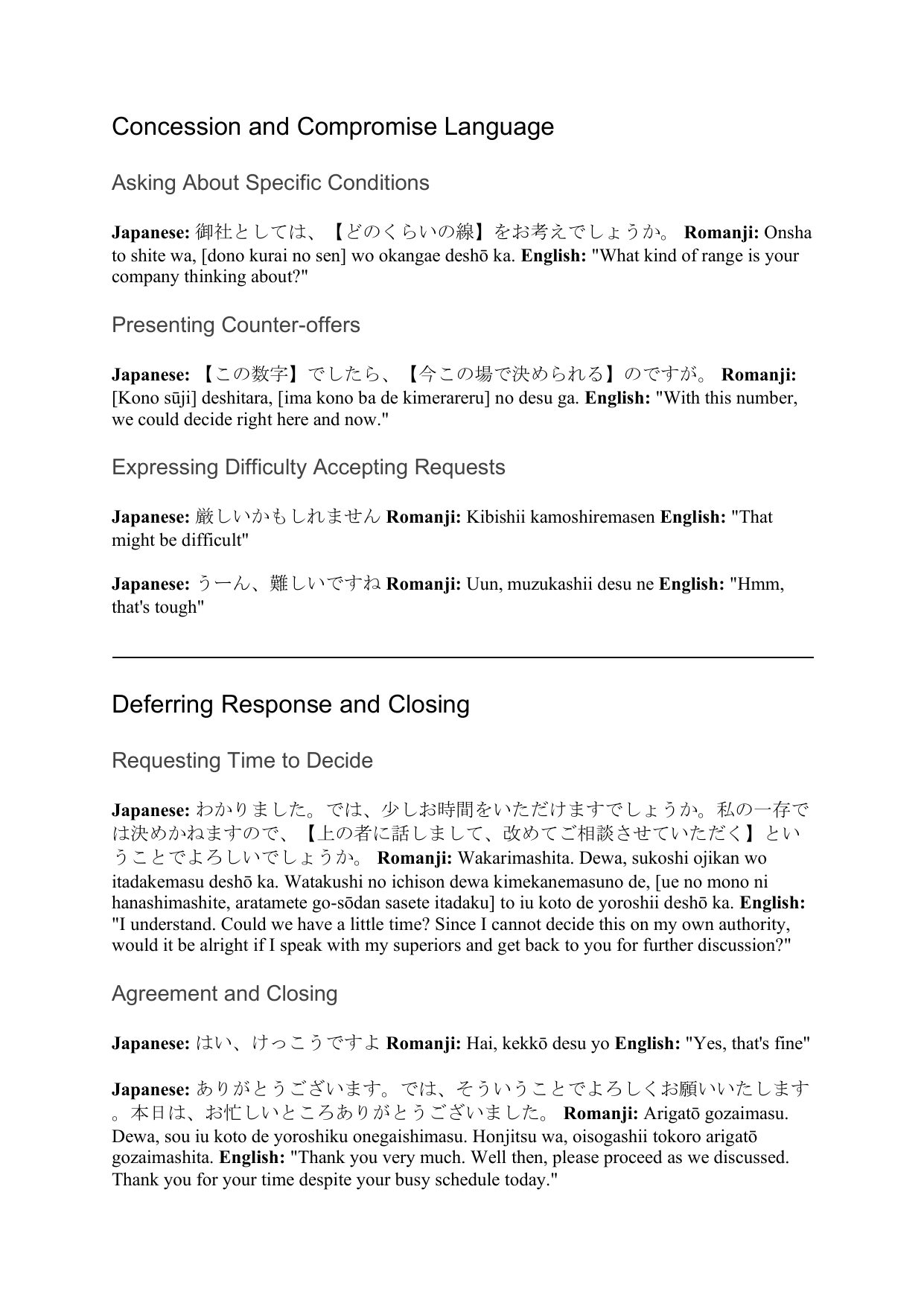
ENConcession and Compromise Language
Asking About Specific Conditions
Asking About Specific Conditions
JPJapanese:御社としては、【どのくらいの線】をお考えでしょうか。Romanji:Onsha
ENto shite wa, [dono kurai no sen] wo okangae deshō ka. English: "What kind of range is your
company thinking about?"
Presenting Counter-offers
company thinking about?"
Presenting Counter-offers
JPJapanese:【この数字】でしたら、【今この場で決められる】のですが。Romanji:
EN[Kono sūji] deshitara, [ima kono ba de kimerareru] no desu ga. English: "With this number,
we could decide right here and now."
Expressing Difficulty Accepting Requests
Japanese: 厳しいかもしれません Romanji: Kibishii kamoshiremasen English: "That
might be difficult"
Japanese: うーん、難しいですね Romanji: Uun, muzukashii desu ne English: "Hmm,
that's tough"
Deferring Response and Closing
Requesting Time to Decide
we could decide right here and now."
Expressing Difficulty Accepting Requests
Japanese: 厳しいかもしれません Romanji: Kibishii kamoshiremasen English: "That
might be difficult"
Japanese: うーん、難しいですね Romanji: Uun, muzukashii desu ne English: "Hmm,
that's tough"
Deferring Response and Closing
Requesting Time to Decide
JPJapanese:わかりました。では、少しお時間をいただけますでしょうか。私の一存で
は決めかねますので、【上の者に話しまして、改めてご相談させていただく】とい
は決めかねますので、【上の者に話しまして、改めてご相談させていただく】とい
ENうことでよろしいでしょうか。 Romanji: Wakarimashita. Dewa, sukoshi ojikan wo
itadakemasu deshō ka. Watakushi no ichison dewa kimekanemasuno de, [ue no mono ni
hanashimashite, aratamete go-sōdan sasete itadaku] to iu koto de yoroshii deshō ka. English:
"I understand. Could we have a little time? Since I cannot decide this on my own authority,
would it be alright if I speak with my superiors and get back to you for further discussion?"
Agreement and Closing
Japanese: はい、けっこうですよ Romanji: Hai, kekkō desu yo English: "Yes, that's fine"
itadakemasu deshō ka. Watakushi no ichison dewa kimekanemasuno de, [ue no mono ni
hanashimashite, aratamete go-sōdan sasete itadaku] to iu koto de yoroshii deshō ka. English:
"I understand. Could we have a little time? Since I cannot decide this on my own authority,
would it be alright if I speak with my superiors and get back to you for further discussion?"
Agreement and Closing
Japanese: はい、けっこうですよ Romanji: Hai, kekkō desu yo English: "Yes, that's fine"
JPJapanese:ありがとうございます。では、そういうことでよろしくお願いいたします
EN。本日は、お忙しいところありがとうございました。 Romanji: Arigatō gozaimasu.
Dewa, sou iu koto de yoroshiku onegaishimasu. Honjitsu wa, oisogashii tokoro arigatō
gozaimashita. English: "Thank you very much. Well then, please proceed as we discussed.
Thank you for your time despite your busy schedule today."
Dewa, sou iu koto de yoroshiku onegaishimasu. Honjitsu wa, oisogashii tokoro arigatō
gozaimashita. English: "Thank you very much. Well then, please proceed as we discussed.
Thank you for your time despite your busy schedule today."
หน้า 31
คลิกเพื่อขยาย
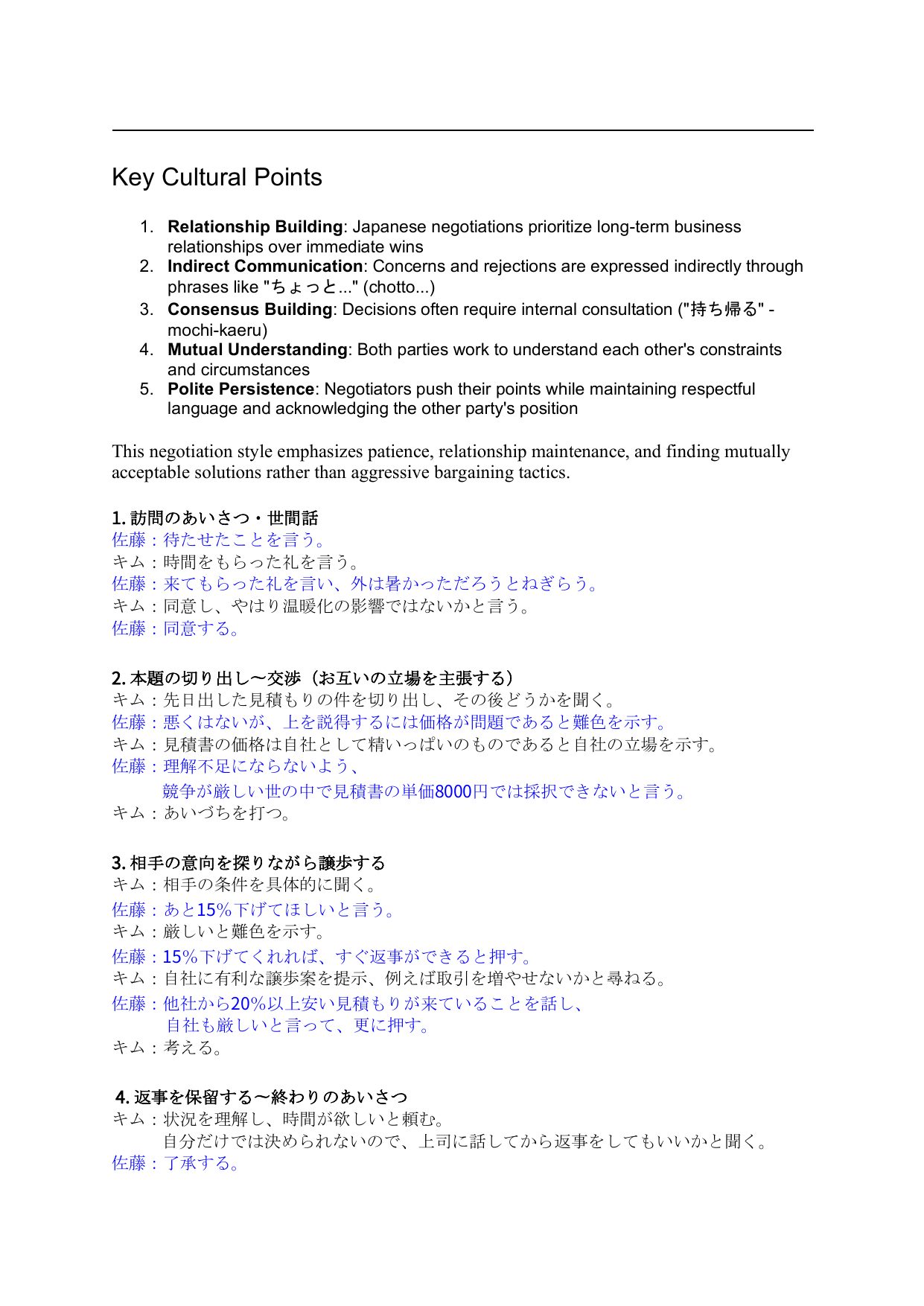
ENKey Cultural Points
1. Relationship Building: Japanese negotiations prioritize long-term business
relationships over immediate wins
2. Indirect Communication: Concerns and rejections are expressed indirectly through
phrases like "ちょっと..." (chotto...)
3. Consensus Building: Decisions often require internal consultation ("持ち帰る" -
mochi-kaeru)
4. Mutual Understanding: Both parties work to understand each other's constraints
and circumstances
5. Polite Persistence: Negotiators push their points while maintaining respectful
language and acknowledging the other party's position
This negotiation style emphasizes patience, relationship maintenance, and finding mutually
acceptable solutions rather than aggressive bargaining tactics.
1. Relationship Building: Japanese negotiations prioritize long-term business
relationships over immediate wins
2. Indirect Communication: Concerns and rejections are expressed indirectly through
phrases like "ちょっと..." (chotto...)
3. Consensus Building: Decisions often require internal consultation ("持ち帰る" -
mochi-kaeru)
4. Mutual Understanding: Both parties work to understand each other's constraints
and circumstances
5. Polite Persistence: Negotiators push their points while maintaining respectful
language and acknowledging the other party's position
This negotiation style emphasizes patience, relationship maintenance, and finding mutually
acceptable solutions rather than aggressive bargaining tactics.
JP1.訪問のあいさつ・世間話
佐藤:待たせたことを言う。
キム:時間をもらった礼を言う。
佐藤:来てもらった礼を言い、外は暑かっただろうとねぎらう。
キム:同意し、やはり温暖化の影響ではないかと言う。
佐藤:同意する。
2.本題の切り出し〜交渉(お互いの立場を主張する)
キム:先日出した見積もりの件を切り出し、その後どうかを聞く。
佐藤:悪くはないが、上を説得するには価格が問題であると難色を示す。
キム:見積書の価格は自社として精いっぱいのものであると自社の立場を示す。
佐藤:理解不足にならないよう、
競争が厳しい世の中で見積書の単価8000円では採択できないと言う。
キム:あいづちを打つ。
3.相手の意向を探りながら譲歩する
キム:相手の条件を具体的に聞く。
佐藤:あと15%下げてほしいと言う。
キム:厳しいと難色を示す。
佐藤:15%下げてくれれば、すぐ返事ができると押す。
キム:自社に有利な譲歩案を提示、例えば取引を増やせないかと尋ねる。
佐藤:他社から20%以上安い見積もりが来ていることを話し、
自社も厳しいと言って、更に押す。
キム:考える。
4.返事を保留する〜終わりのあいさつ
キム:状況を理解し、時間が欲しいと頼む。
自分だけでは決められないので、上司に話してから返事をしてもいいかと聞く。
佐藤:了承する。
佐藤:待たせたことを言う。
キム:時間をもらった礼を言う。
佐藤:来てもらった礼を言い、外は暑かっただろうとねぎらう。
キム:同意し、やはり温暖化の影響ではないかと言う。
佐藤:同意する。
2.本題の切り出し〜交渉(お互いの立場を主張する)
キム:先日出した見積もりの件を切り出し、その後どうかを聞く。
佐藤:悪くはないが、上を説得するには価格が問題であると難色を示す。
キム:見積書の価格は自社として精いっぱいのものであると自社の立場を示す。
佐藤:理解不足にならないよう、
競争が厳しい世の中で見積書の単価8000円では採択できないと言う。
キム:あいづちを打つ。
3.相手の意向を探りながら譲歩する
キム:相手の条件を具体的に聞く。
佐藤:あと15%下げてほしいと言う。
キム:厳しいと難色を示す。
佐藤:15%下げてくれれば、すぐ返事ができると押す。
キム:自社に有利な譲歩案を提示、例えば取引を増やせないかと尋ねる。
佐藤:他社から20%以上安い見積もりが来ていることを話し、
自社も厳しいと言って、更に押す。
キム:考える。
4.返事を保留する〜終わりのあいさつ
キム:状況を理解し、時間が欲しいと頼む。
自分だけでは決められないので、上司に話してから返事をしてもいいかと聞く。
佐藤:了承する。
หน้า 32
คลิกเพื่อขยาย
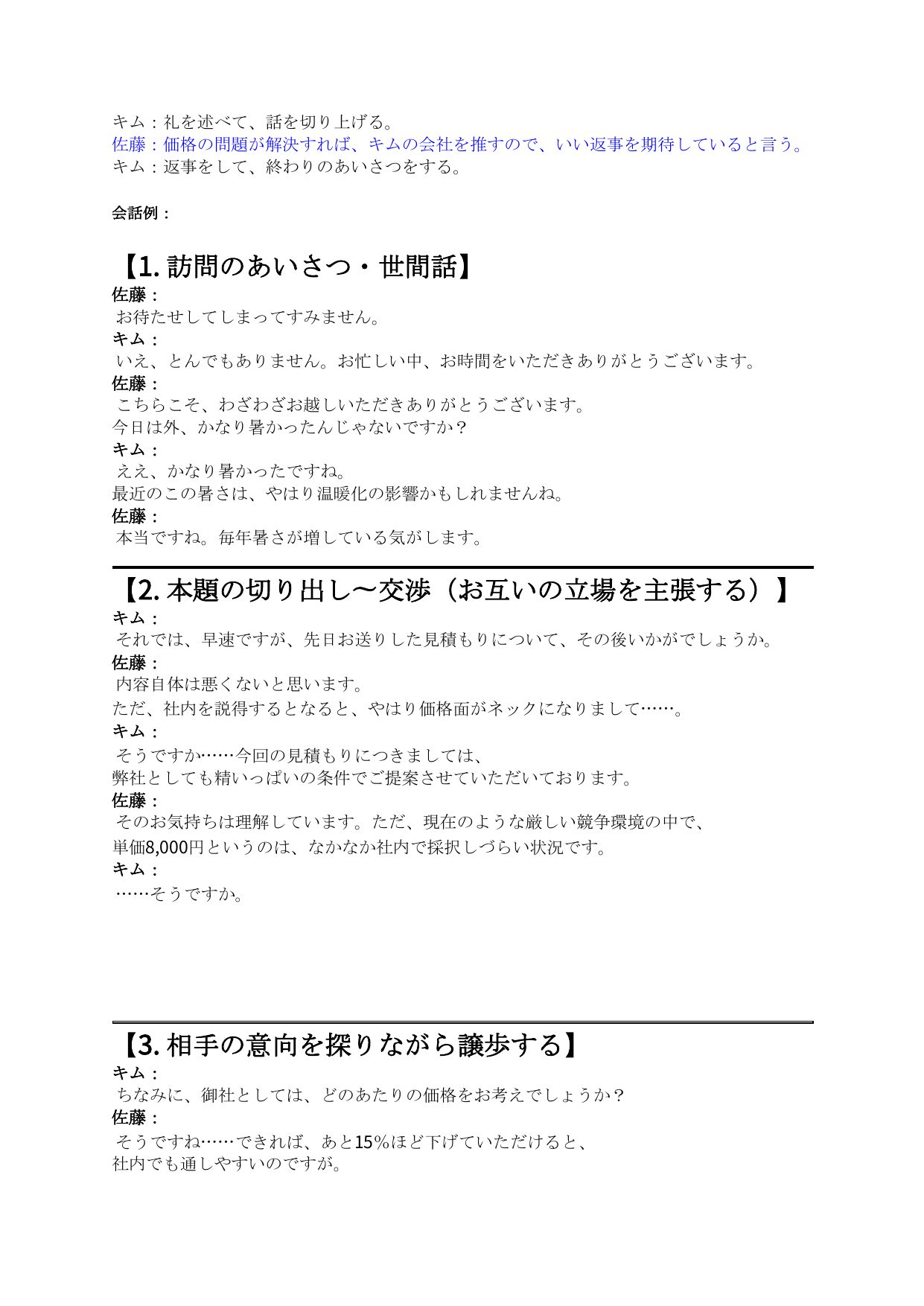
JPキム:礼を述べて、話を切り上げる。
佐藤:価格の問題が解決すれば、キムの会社を推すので、いい返事を期待していると言う。
キム:返事をして、終わりのあいさつをする。
会話例:
【1.訪問のあいさつ・世間話】
佐藤:
お待たせしてしまってすみません。
キム:
いえ、とんでもありません。お忙しい中、お時間をいただきありがとうございます。
佐藤:
こちらこそ、わざわざお越しいただきありがとうございます。
今日は外、かなり暑かったんじゃないですか?
キム:
ええ、かなり暑かったですね。
最近のこの暑さは、やはり温暖化の影響かもしれませんね。
佐藤:
本当ですね。毎年暑さが増している気がします。
【2.本題の切り出し〜交渉(お互いの立場を主張する)】
キム:
それでは、早速ですが、先日お送りした見積もりについて、その後いかがでしょうか。
佐藤:
内容自体は悪くないと思います。
ただ、社内を説得するとなると、やはり価格面がネックになりまして……。
キム:
そうですか……今回の見積もりにつきましては、
弊社としても精いっぱいの条件でご提案させていただいております。
佐藤:
そのお気持ちは理解しています。ただ、現在のような厳しい競争環境の中で、
単価8,000円というのは、なかなか社内で採択しづらい状況です。
キム:
……そうですか。
【3.相手の意向を探りながら譲歩する】
キム:
ちなみに、御社としては、どのあたりの価格をお考えでしょうか?
佐藤:
そうですね……できれば、あと15%ほど下げていただけると、
社内でも通しやすいのですが。
佐藤:価格の問題が解決すれば、キムの会社を推すので、いい返事を期待していると言う。
キム:返事をして、終わりのあいさつをする。
会話例:
【1.訪問のあいさつ・世間話】
佐藤:
お待たせしてしまってすみません。
キム:
いえ、とんでもありません。お忙しい中、お時間をいただきありがとうございます。
佐藤:
こちらこそ、わざわざお越しいただきありがとうございます。
今日は外、かなり暑かったんじゃないですか?
キム:
ええ、かなり暑かったですね。
最近のこの暑さは、やはり温暖化の影響かもしれませんね。
佐藤:
本当ですね。毎年暑さが増している気がします。
【2.本題の切り出し〜交渉(お互いの立場を主張する)】
キム:
それでは、早速ですが、先日お送りした見積もりについて、その後いかがでしょうか。
佐藤:
内容自体は悪くないと思います。
ただ、社内を説得するとなると、やはり価格面がネックになりまして……。
キム:
そうですか……今回の見積もりにつきましては、
弊社としても精いっぱいの条件でご提案させていただいております。
佐藤:
そのお気持ちは理解しています。ただ、現在のような厳しい競争環境の中で、
単価8,000円というのは、なかなか社内で採択しづらい状況です。
キム:
……そうですか。
【3.相手の意向を探りながら譲歩する】
キム:
ちなみに、御社としては、どのあたりの価格をお考えでしょうか?
佐藤:
そうですね……できれば、あと15%ほど下げていただけると、
社内でも通しやすいのですが。
หน้า 33
คลิกเพื่อขยาย
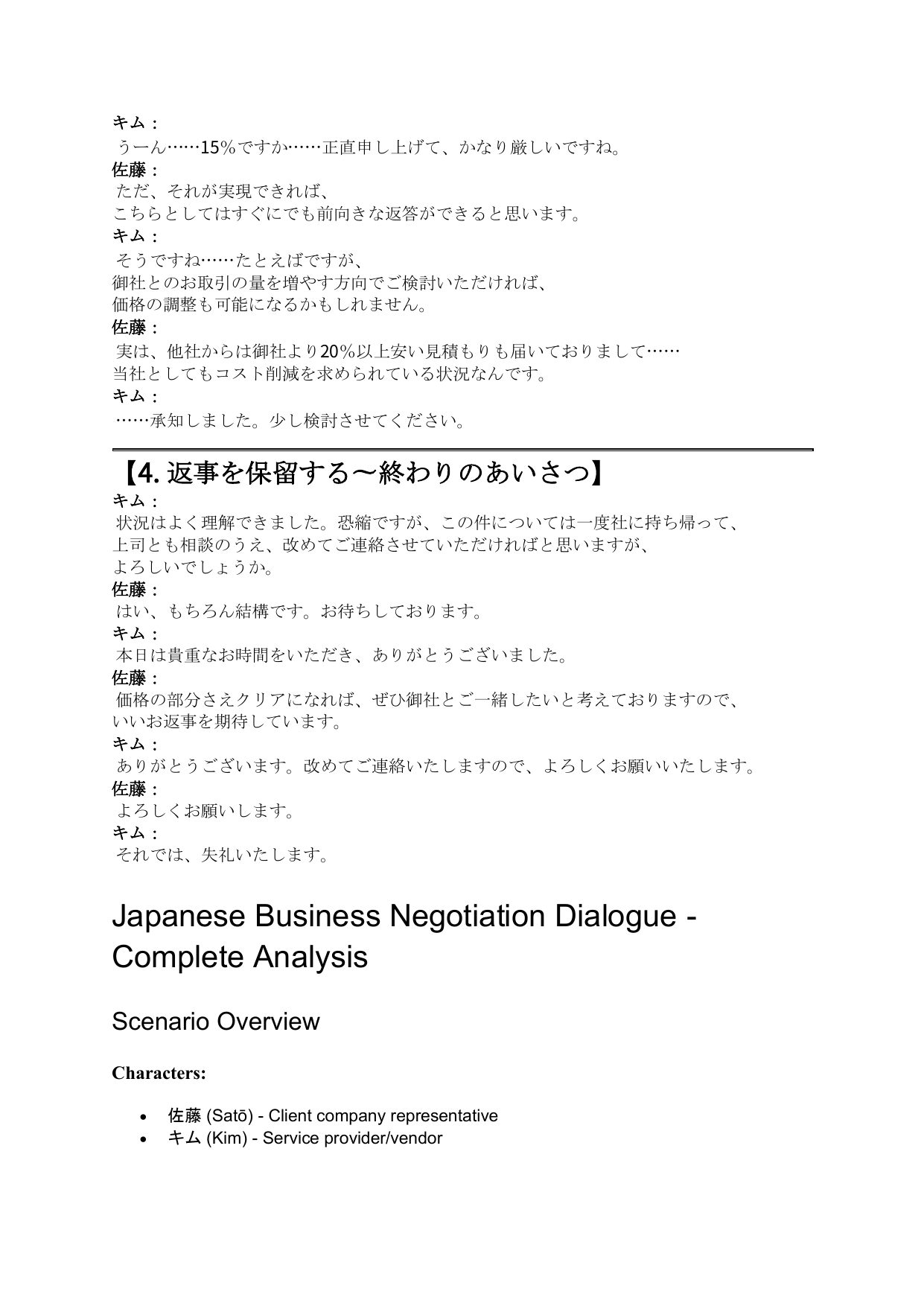
JPキム:
うーん……15%ですか……正直申し上げて、かなり厳しいですね。
佐藤:
ただ、それが実現できれば、
こちらとしてはすぐにでも前向きな返答ができると思います。
キム:
そうですね……たとえばですが、
御社とのお取引の量を増やす方向でご検討いただければ、
価格の調整も可能になるかもしれません。
佐藤:
実は、他社からは御社より20%以上安い見積もりも届いておりまして……
当社としてもコスト削減を求められている状況なんです。
キム:
……承知しました。少し検討させてください。
【4.返事を保留する〜終わりのあいさつ】
キム:
状況はよく理解できました。恐縮ですが、この件については一度社に持ち帰って、
上司とも相談のうえ、改めてご連絡させていただければと思いますが、
よろしいでしょうか。
佐藤:
はい、もちろん結構です。お待ちしております。
キム:
本日は貴重なお時間をいただき、ありがとうございました。
佐藤:
価格の部分さえクリアになれば、ぜひ御社とご一緒したいと考えておりますので、
いいお返事を期待しています。
キム:
ありがとうございます。改めてご連絡いたしますので、よろしくお願いいたします。
佐藤:
よろしくお願いします。
キム:
それでは、失礼いたします。
うーん……15%ですか……正直申し上げて、かなり厳しいですね。
佐藤:
ただ、それが実現できれば、
こちらとしてはすぐにでも前向きな返答ができると思います。
キム:
そうですね……たとえばですが、
御社とのお取引の量を増やす方向でご検討いただければ、
価格の調整も可能になるかもしれません。
佐藤:
実は、他社からは御社より20%以上安い見積もりも届いておりまして……
当社としてもコスト削減を求められている状況なんです。
キム:
……承知しました。少し検討させてください。
【4.返事を保留する〜終わりのあいさつ】
キム:
状況はよく理解できました。恐縮ですが、この件については一度社に持ち帰って、
上司とも相談のうえ、改めてご連絡させていただければと思いますが、
よろしいでしょうか。
佐藤:
はい、もちろん結構です。お待ちしております。
キム:
本日は貴重なお時間をいただき、ありがとうございました。
佐藤:
価格の部分さえクリアになれば、ぜひ御社とご一緒したいと考えておりますので、
いいお返事を期待しています。
キム:
ありがとうございます。改めてご連絡いたしますので、よろしくお願いいたします。
佐藤:
よろしくお願いします。
キム:
それでは、失礼いたします。
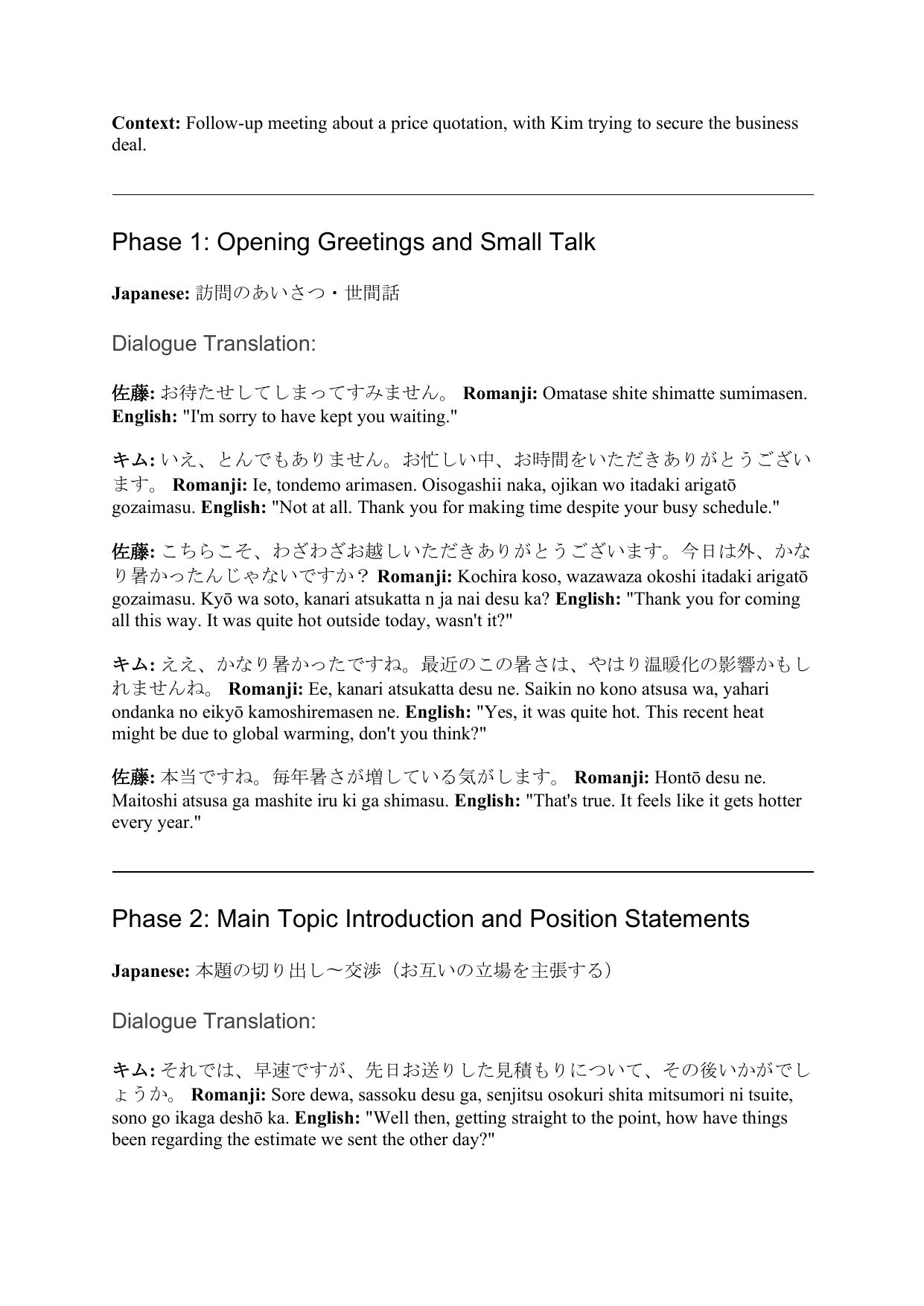
ENJapanese Business Negotiation Dialogue -
Complete Analysis
Scenario Overview
Characters:
• 佐藤 (Satō) - Client company representative
• キム (Kim) - Service provider/vendor
Complete Analysis
Scenario Overview
Characters:
• 佐藤 (Satō) - Client company representative
• キム (Kim) - Service provider/vendor
หน้า 34
คลิกเพื่อขยาย
ENContext: Follow-up meeting about a price quotation, with Kim trying to secure the business
deal.
Phase 1: Opening Greetings and Small Talk
deal.
Phase 1: Opening Greetings and Small Talk
JPJapanese:訪問のあいさつ・世間話
ENDialogue Translation:
佐藤: お待たせしてしまってすみません。 Romanji: Omatase shite shimatte sumimasen.
English: "I'm sorry to have kept you waiting."
佐藤: お待たせしてしまってすみません。 Romanji: Omatase shite shimatte sumimasen.
English: "I'm sorry to have kept you waiting."
JPキム:いえ、とんでもありません。お忙しい中、お時間をいただきありがとうござい
ENます。 Romanji: Ie, tondemo arimasen. Oisogashii naka, ojikan wo itadaki arigatō
gozaimasu. English: "Not at all. Thank you for making time despite your busy schedule."
gozaimasu. English: "Not at all. Thank you for making time despite your busy schedule."
JP佐藤:こちらこそ、わざわざお越しいただきありがとうございます。今日は外、かな
ENり暑かったんじゃないですか? Romanji: Kochira koso, wazawaza okoshi itadaki arigatō
gozaimasu. Kyō wa soto, kanari atsukatta n ja nai desu ka? English: "Thank you for coming
all this way. It was quite hot outside today, wasn't it?"
gozaimasu. Kyō wa soto, kanari atsukatta n ja nai desu ka? English: "Thank you for coming
all this way. It was quite hot outside today, wasn't it?"
JPキム:ええ、かなり暑かったですね。最近のこの暑さは、やはり温暖化の影響かもし
ENれませんね。 Romanji: Ee, kanari atsukatta desu ne. Saikin no kono atsusa wa, yahari
ondanka no eikyō kamoshiremasen ne. English: "Yes, it was quite hot. This recent heat
might be due to global warming, don't you think?"
ondanka no eikyō kamoshiremasen ne. English: "Yes, it was quite hot. This recent heat
might be due to global warming, don't you think?"
JP佐藤:本当ですね。毎年暑さが増している気がします。Romanji:Hontōdesune.
ENMaitoshi atsusa ga mashite iru ki ga shimasu. English: "That's true. It feels like it gets hotter
every year."
Phase 2: Main Topic Introduction and Position Statements
every year."
Phase 2: Main Topic Introduction and Position Statements
JPJapanese:本題の切り出し〜交渉(お互いの立場を主張する)
ENDialogue Translation:
JPキム:それでは、早速ですが、先日お送りした見積もりについて、その後いかがでし
ENょうか。 Romanji: Sore dewa, sassoku desu ga, senjitsu osokuri shita mitsumori ni tsuite,
sono go ikaga deshō ka. English: "Well then, getting straight to the point, how have things
been regarding the estimate we sent the other day?"
sono go ikaga deshō ka. English: "Well then, getting straight to the point, how have things
been regarding the estimate we sent the other day?"
หน้า 35
คลิกเพื่อขยาย
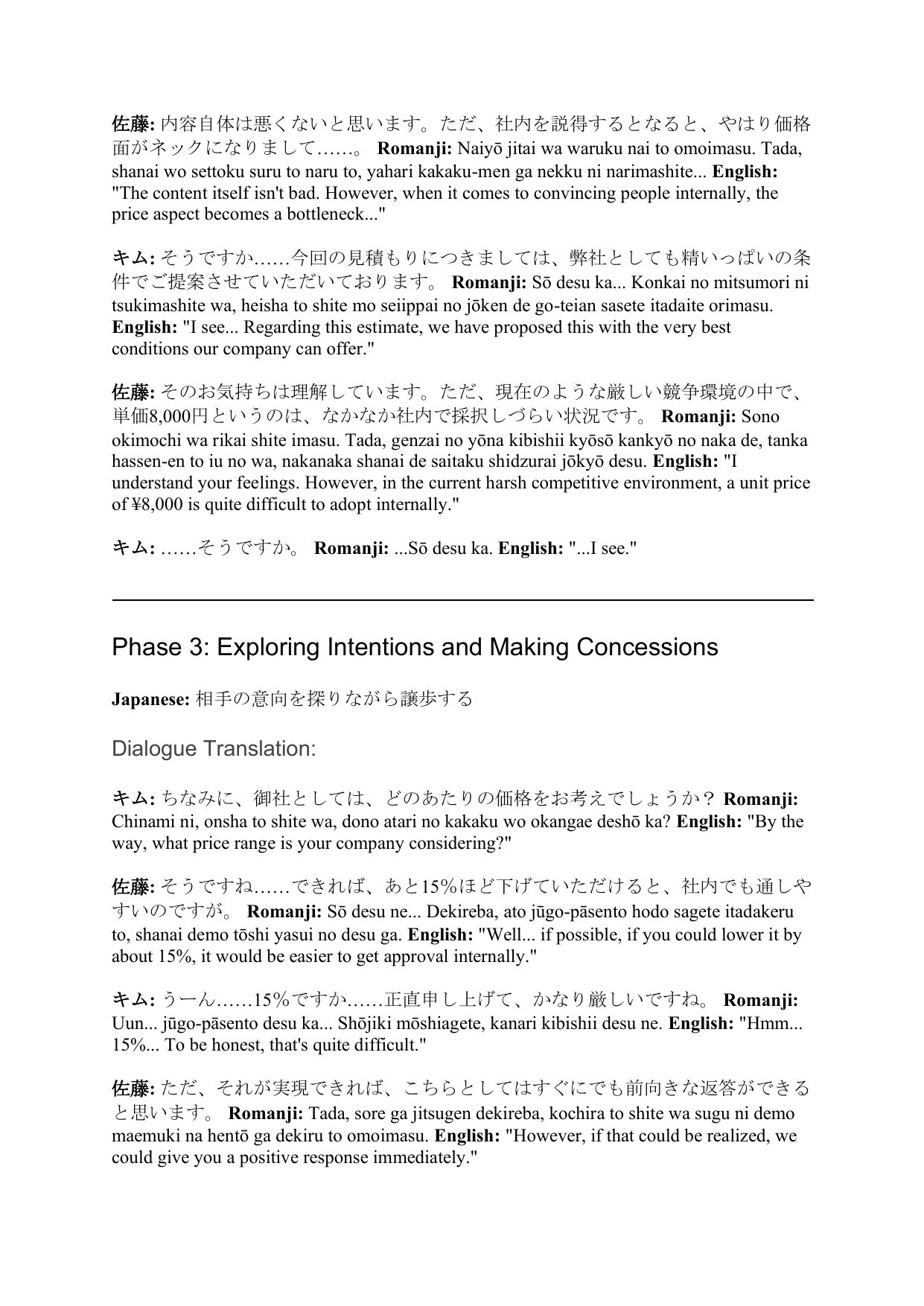
JP佐藤:内容自体は悪くないと思います。ただ、社内を説得するとなると、やはり価格
EN面がネックになりまして……。 Romanji: Naiyō jitai wa waruku nai to omoimasu. Tada,
shanai wo settoku suru to naru to, yahari kakaku-men ga nekku ni narimashite... English:
"The content itself isn't bad. However, when it comes to convincing people internally, the
price aspect becomes a bottleneck..."
shanai wo settoku suru to naru to, yahari kakaku-men ga nekku ni narimashite... English:
"The content itself isn't bad. However, when it comes to convincing people internally, the
price aspect becomes a bottleneck..."
JPキム:そうですか……今回の見積もりにつきましては、弊社としても精いっぱいの条
EN件でご提案させていただいております。 Romanji: Sō desu ka... Konkai no mitsumori ni
tsukimashite wa, heisha to shite mo seiippai no jōken de go-teian sasete itadaite orimasu.
English: "I see... Regarding this estimate, we have proposed this with the very best
conditions our company can offer."
tsukimashite wa, heisha to shite mo seiippai no jōken de go-teian sasete itadaite orimasu.
English: "I see... Regarding this estimate, we have proposed this with the very best
conditions our company can offer."
JP佐藤:そのお気持ちは理解しています。ただ、現在のような厳しい競争環境の中で、
単価8,000円というのは、なかなか社内で採択しづらい状況です。Romanji:Sono
単価8,000円というのは、なかなか社内で採択しづらい状況です。Romanji:Sono
ENokimochi wa rikai shite imasu. Tada, genzai no yōna kibishii kyōsō kankyō no naka de, tanka
hassen-en to iu no wa, nakanaka shanai de saitaku shidzurai jōkyō desu. English: "I
understand your feelings. However, in the current harsh competitive environment, a unit price
of ¥8,000 is quite difficult to adopt internally."
キム: ……そうですか。 Romanji: ...Sō desu ka. English: "...I see."
Phase 3: Exploring Intentions and Making Concessions
hassen-en to iu no wa, nakanaka shanai de saitaku shidzurai jōkyō desu. English: "I
understand your feelings. However, in the current harsh competitive environment, a unit price
of ¥8,000 is quite difficult to adopt internally."
キム: ……そうですか。 Romanji: ...Sō desu ka. English: "...I see."
Phase 3: Exploring Intentions and Making Concessions
JPJapanese:相手の意向を探りながら譲歩する
ENDialogue Translation:
JPキム:ちなみに、御社としては、どのあたりの価格をお考えでしょうか?Romanji:
ENChinami ni, onsha to shite wa, dono atari no kakaku wo okangae deshō ka? English: "By the
way, what price range is your company considering?"
way, what price range is your company considering?"
JP佐藤:そうですね……できれば、あと15%ほど下げていただけると、社内でも通しや
ENすいのですが。 Romanji: Sō desu ne... Dekireba, ato jūgo-pāsento hodo sagete itadakeru
to, shanai demo tōshi yasui no desu ga. English: "Well... if possible, if you could lower it by
about 15%, it would be easier to get approval internally."
to, shanai demo tōshi yasui no desu ga. English: "Well... if possible, if you could lower it by
about 15%, it would be easier to get approval internally."
JPキム:うーん……15%ですか……正直申し上げて、かなり厳しいですね。Romanji:
ENUun... jūgo-pāsento desu ka... Shōjiki mōshiagete, kanari kibishii desu ne. English: "Hmm...
15%... To be honest, that's quite difficult."
15%... To be honest, that's quite difficult."
JP佐藤:ただ、それが実現できれば、こちらとしてはすぐにでも前向きな返答ができる
ENと思います。 Romanji: Tada, sore ga jitsugen dekireba, kochira to shite wa sugu ni demo
maemuki na hentō ga dekiru to omoimasu. English: "However, if that could be realized, we
could give you a positive response immediately."
maemuki na hentō ga dekiru to omoimasu. English: "However, if that could be realized, we
could give you a positive response immediately."
หน้า 36
คลิกเพื่อขยาย
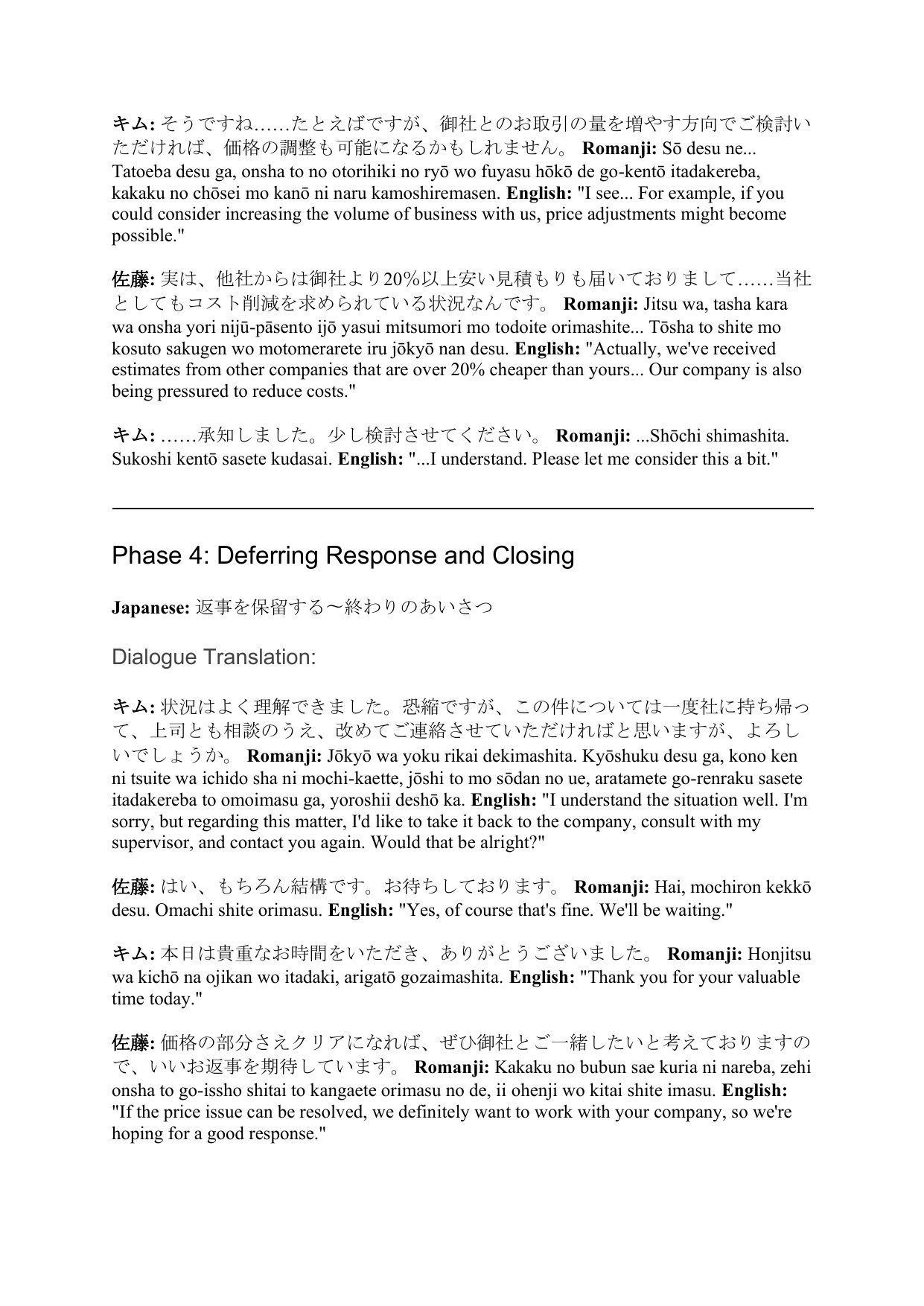
JPキム:そうですね……たとえばですが、御社とのお取引の量を増やす方向でご検討い
ただければ、価格の調整も可能になるかもしれません。Romanji:Sōdesune...
ただければ、価格の調整も可能になるかもしれません。Romanji:Sōdesune...
ENTatoeba desu ga, onsha to no otorihiki no ryō wo fuyasu hōkō de go-kentō itadakereba,
kakaku no chōsei mo kanō ni naru kamoshiremasen. English: "I see... For example, if you
could consider increasing the volume of business with us, price adjustments might become
possible."
kakaku no chōsei mo kanō ni naru kamoshiremasen. English: "I see... For example, if you
could consider increasing the volume of business with us, price adjustments might become
possible."
JP佐藤:実は、他社からは御社より20%以上安い見積もりも届いておりまして……当社
としてもコスト削減を求められている状況なんです。Romanji:Jitsuwa,tashakara
としてもコスト削減を求められている状況なんです。Romanji:Jitsuwa,tashakara
ENwa onsha yori nijū-pāsento ijō yasui mitsumori mo todoite orimashite... Tōsha to shite mo
kosuto sakugen wo motomerarete iru jōkyō nan desu. English: "Actually, we've received
estimates from other companies that are over 20% cheaper than yours... Our company is also
being pressured to reduce costs."
キム: ……承知しました。少し検討させてください。 Romanji: ...Shōchi shimashita.
Sukoshi kentō sasete kudasai. English: "...I understand. Please let me consider this a bit."
Phase 4: Deferring Response and Closing
kosuto sakugen wo motomerarete iru jōkyō nan desu. English: "Actually, we've received
estimates from other companies that are over 20% cheaper than yours... Our company is also
being pressured to reduce costs."
キム: ……承知しました。少し検討させてください。 Romanji: ...Shōchi shimashita.
Sukoshi kentō sasete kudasai. English: "...I understand. Please let me consider this a bit."
Phase 4: Deferring Response and Closing
JPJapanese:返事を保留する〜終わりのあいさつ
ENDialogue Translation:
JPキム:状況はよく理解できました。恐縮ですが、この件については一度社に持ち帰っ
て、上司とも相談のうえ、改めてご連絡させていただければと思いますが、よろし
て、上司とも相談のうえ、改めてご連絡させていただければと思いますが、よろし
ENいでしょうか。 Romanji: Jōkyō wa yoku rikai dekimashita. Kyōshuku desu ga, kono ken
ni tsuite wa ichido sha ni mochi-kaette, jōshi to mo sōdan no ue, aratamete go-renraku sasete
itadakereba to omoimasu ga, yoroshii deshō ka. English: "I understand the situation well. I'm
sorry, but regarding this matter, I'd like to take it back to the company, consult with my
supervisor, and contact you again. Would that be alright?"
佐藤: はい、もちろん結構です。お待ちしております。 Romanji: Hai, mochiron kekkō
desu. Omachi shite orimasu. English: "Yes, of course that's fine. We'll be waiting."
ni tsuite wa ichido sha ni mochi-kaette, jōshi to mo sōdan no ue, aratamete go-renraku sasete
itadakereba to omoimasu ga, yoroshii deshō ka. English: "I understand the situation well. I'm
sorry, but regarding this matter, I'd like to take it back to the company, consult with my
supervisor, and contact you again. Would that be alright?"
佐藤: はい、もちろん結構です。お待ちしております。 Romanji: Hai, mochiron kekkō
desu. Omachi shite orimasu. English: "Yes, of course that's fine. We'll be waiting."
JPキム:本日は貴重なお時間をいただき、ありがとうございました。Romanji:Honjitsu
ENwa kichō na ojikan wo itadaki, arigatō gozaimashita. English: "Thank you for your valuable
time today."
time today."
JP佐藤:価格の部分さえクリアになれば、ぜひ御社とご一緒したいと考えておりますの
ENで、いいお返事を期待しています。 Romanji: Kakaku no bubun sae kuria ni nareba, zehi
onsha to go-issho shitai to kangaete orimasu no de, ii ohenji wo kitai shite imasu. English:
"If the price issue can be resolved, we definitely want to work with your company, so we're
hoping for a good response."
onsha to go-issho shitai to kangaete orimasu no de, ii ohenji wo kitai shite imasu. English:
"If the price issue can be resolved, we definitely want to work with your company, so we're
hoping for a good response."
หน้า 37
คลิกเพื่อขยาย
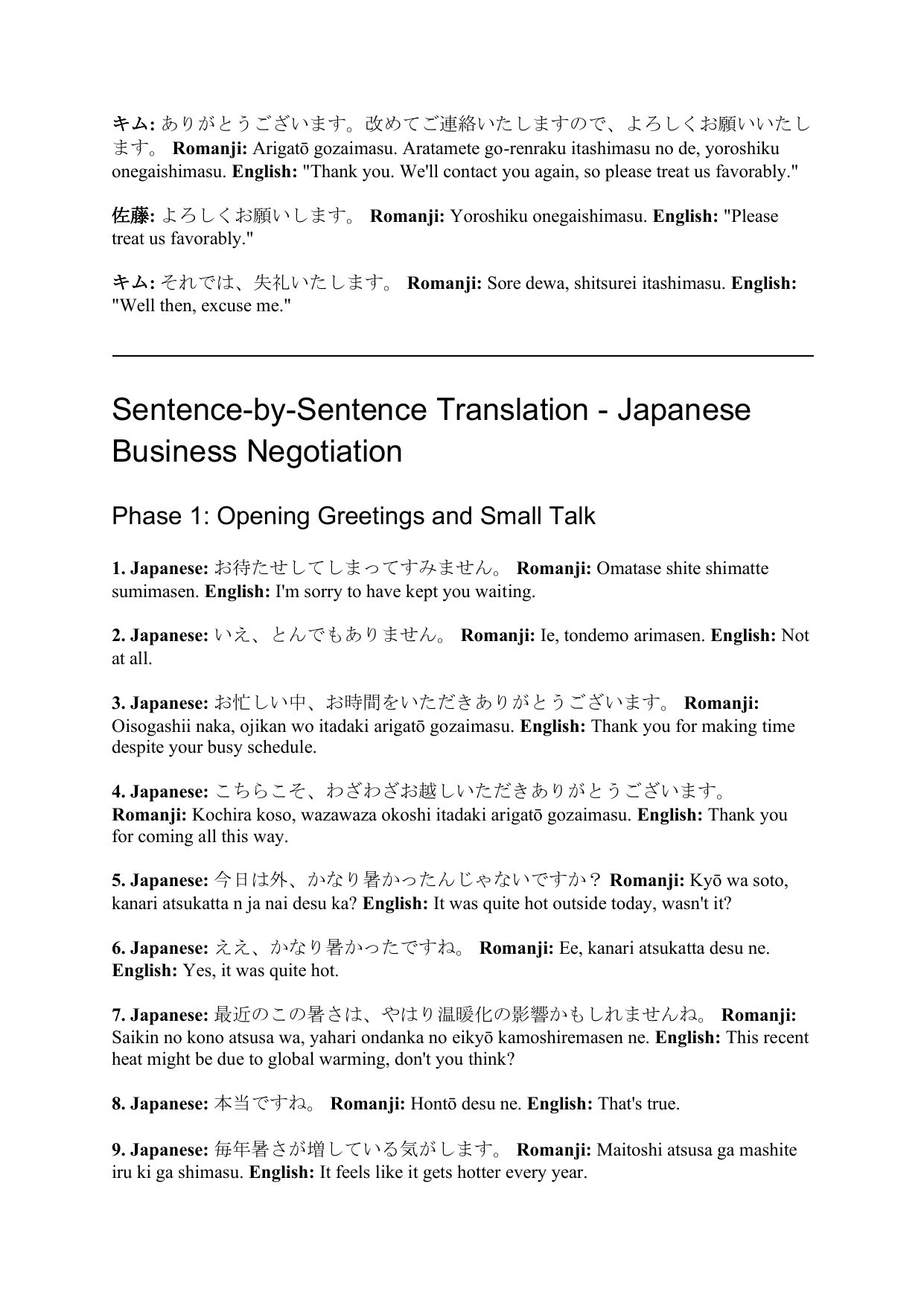
JPキム:ありがとうございます。改めてご連絡いたしますので、よろしくお願いいたし
ENます。 Romanji: Arigatō gozaimasu. Aratamete go-renraku itashimasu no de, yoroshiku
onegaishimasu. English: "Thank you. We'll contact you again, so please treat us favorably."
佐藤: よろしくお願いします。 Romanji: Yoroshiku onegaishimasu. English: "Please
treat us favorably."
キム: それでは、失礼いたします。 Romanji: Sore dewa, shitsurei itashimasu. English:
"Well then, excuse me."
Sentence-by-Sentence Translation - Japanese
Business Negotiation
Phase 1: Opening Greetings and Small Talk
1. Japanese: お待たせしてしまってすみません。 Romanji: Omatase shite shimatte
sumimasen. English: I'm sorry to have kept you waiting.
2. Japanese: いえ、とんでもありません。 Romanji: Ie, tondemo arimasen. English: Not
at all.
onegaishimasu. English: "Thank you. We'll contact you again, so please treat us favorably."
佐藤: よろしくお願いします。 Romanji: Yoroshiku onegaishimasu. English: "Please
treat us favorably."
キム: それでは、失礼いたします。 Romanji: Sore dewa, shitsurei itashimasu. English:
"Well then, excuse me."
Sentence-by-Sentence Translation - Japanese
Business Negotiation
Phase 1: Opening Greetings and Small Talk
1. Japanese: お待たせしてしまってすみません。 Romanji: Omatase shite shimatte
sumimasen. English: I'm sorry to have kept you waiting.
2. Japanese: いえ、とんでもありません。 Romanji: Ie, tondemo arimasen. English: Not
at all.
JP3.Japanese:お忙しい中、お時間をいただきありがとうございます。Romanji:
ENOisogashii naka, ojikan wo itadaki arigatō gozaimasu. English: Thank you for making time
despite your busy schedule.
despite your busy schedule.
JP4.Japanese:こちらこそ、わざわざお越しいただきありがとうございます。
ENRomanji: Kochira koso, wazawaza okoshi itadaki arigatō gozaimasu. English: Thank you
for coming all this way.
5. Japanese: 今日は外、かなり暑かったんじゃないですか? Romanji: Kyō wa soto,
kanari atsukatta n ja nai desu ka? English: It was quite hot outside today, wasn't it?
6. Japanese: ええ、かなり暑かったですね。 Romanji: Ee, kanari atsukatta desu ne.
English: Yes, it was quite hot.
for coming all this way.
5. Japanese: 今日は外、かなり暑かったんじゃないですか? Romanji: Kyō wa soto,
kanari atsukatta n ja nai desu ka? English: It was quite hot outside today, wasn't it?
6. Japanese: ええ、かなり暑かったですね。 Romanji: Ee, kanari atsukatta desu ne.
English: Yes, it was quite hot.
JP7.Japanese:最近のこの暑さは、やはり温暖化の影響かもしれませんね。Romanji:
ENSaikin no kono atsusa wa, yahari ondanka no eikyō kamoshiremasen ne. English: This recent
heat might be due to global warming, don't you think?
8. Japanese: 本当ですね。 Romanji: Hontō desu ne. English: That's true.
9. Japanese: 毎年暑さが増している気がします。 Romanji: Maitoshi atsusa ga mashite
iru ki ga shimasu. English: It feels like it gets hotter every year.
heat might be due to global warming, don't you think?
8. Japanese: 本当ですね。 Romanji: Hontō desu ne. English: That's true.
9. Japanese: 毎年暑さが増している気がします。 Romanji: Maitoshi atsusa ga mashite
iru ki ga shimasu. English: It feels like it gets hotter every year.
หน้า 38
คลิกเพื่อขยาย
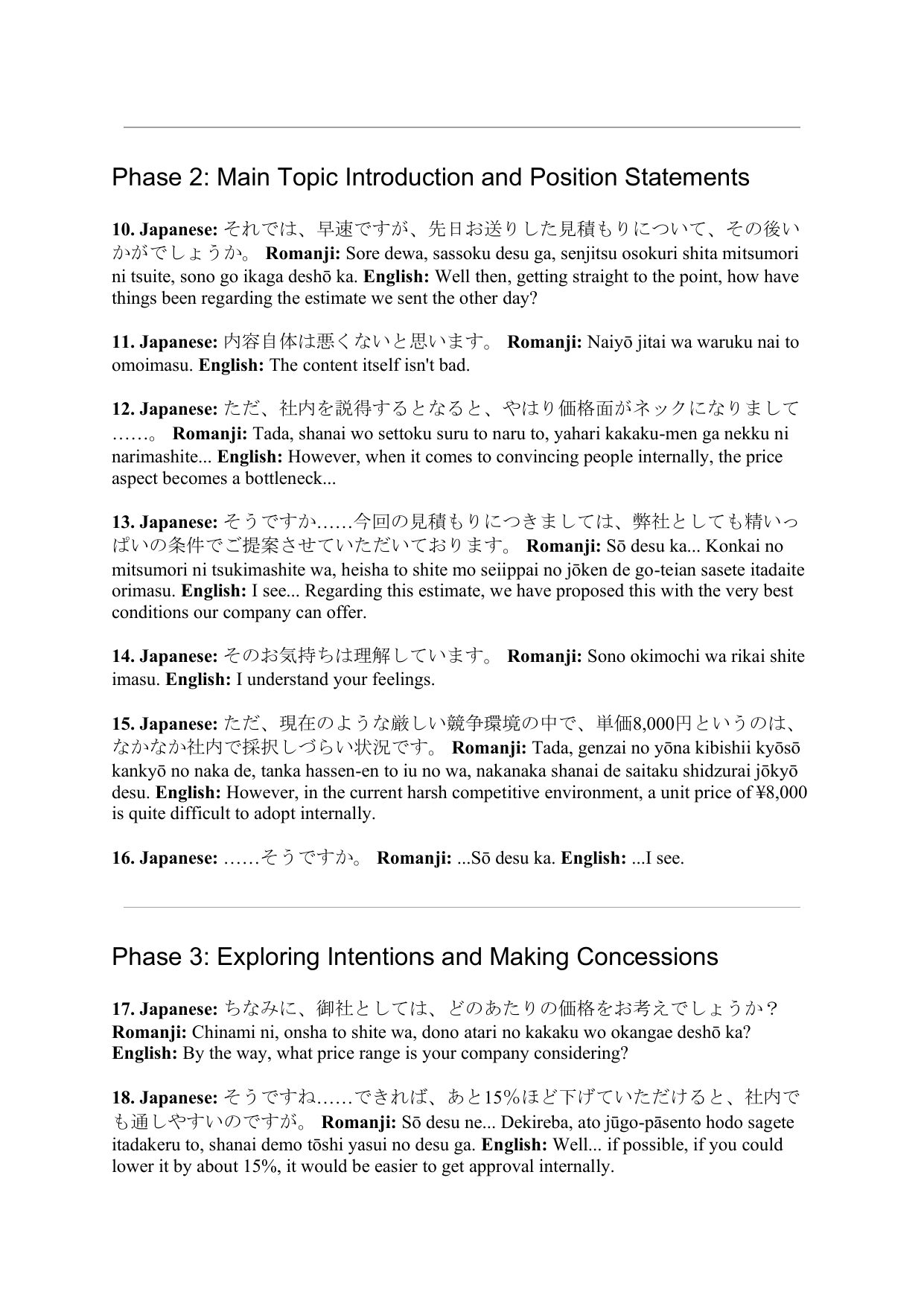
ENPhase 2: Main Topic Introduction and Position Statements
JP10.Japanese:それでは、早速ですが、先日お送りした見積もりについて、その後い
ENかがでしょうか。 Romanji: Sore dewa, sassoku desu ga, senjitsu osokuri shita mitsumori
ni tsuite, sono go ikaga deshō ka. English: Well then, getting straight to the point, how have
things been regarding the estimate we sent the other day?
11. Japanese: 内容自体は悪くないと思います。 Romanji: Naiyō jitai wa waruku nai to
omoimasu. English: The content itself isn't bad.
ni tsuite, sono go ikaga deshō ka. English: Well then, getting straight to the point, how have
things been regarding the estimate we sent the other day?
11. Japanese: 内容自体は悪くないと思います。 Romanji: Naiyō jitai wa waruku nai to
omoimasu. English: The content itself isn't bad.
JP12.Japanese:ただ、社内を説得するとなると、やはり価格面がネックになりまして
EN……。 Romanji: Tada, shanai wo settoku suru to naru to, yahari kakaku-men ga nekku ni
narimashite... English: However, when it comes to convincing people internally, the price
aspect becomes a bottleneck...
narimashite... English: However, when it comes to convincing people internally, the price
aspect becomes a bottleneck...
JP13.Japanese:そうですか……今回の見積もりにつきましては、弊社としても精いっ
ENぱいの条件でご提案させていただいております。 Romanji: Sō desu ka... Konkai no
mitsumori ni tsukimashite wa, heisha to shite mo seiippai no jōken de go-teian sasete itadaite
orimasu. English: I see... Regarding this estimate, we have proposed this with the very best
conditions our company can offer.
14. Japanese: そのお気持ちは理解しています。 Romanji: Sono okimochi wa rikai shite
imasu. English: I understand your feelings.
mitsumori ni tsukimashite wa, heisha to shite mo seiippai no jōken de go-teian sasete itadaite
orimasu. English: I see... Regarding this estimate, we have proposed this with the very best
conditions our company can offer.
14. Japanese: そのお気持ちは理解しています。 Romanji: Sono okimochi wa rikai shite
imasu. English: I understand your feelings.
JP15.Japanese:ただ、現在のような厳しい競争環境の中で、単価8,000円というのは、
ENなかなか社内で採択しづらい状況です。 Romanji: Tada, genzai no yōna kibishii kyōsō
kankyō no naka de, tanka hassen-en to iu no wa, nakanaka shanai de saitaku shidzurai jōkyō
desu. English: However, in the current harsh competitive environment, a unit price of ¥8,000
is quite difficult to adopt internally.
16. Japanese: ……そうですか。 Romanji: ...Sō desu ka. English: ...I see.
Phase 3: Exploring Intentions and Making Concessions
kankyō no naka de, tanka hassen-en to iu no wa, nakanaka shanai de saitaku shidzurai jōkyō
desu. English: However, in the current harsh competitive environment, a unit price of ¥8,000
is quite difficult to adopt internally.
16. Japanese: ……そうですか。 Romanji: ...Sō desu ka. English: ...I see.
Phase 3: Exploring Intentions and Making Concessions
JP17.Japanese:ちなみに、御社としては、どのあたりの価格をお考えでしょうか?
ENRomanji: Chinami ni, onsha to shite wa, dono atari no kakaku wo okangae deshō ka?
English: By the way, what price range is your company considering?
English: By the way, what price range is your company considering?
JP18.Japanese:そうですね……できれば、あと15%ほど下げていただけると、社内で
ENも通しやすいのですが。 Romanji: Sō desu ne... Dekireba, ato jūgo-pāsento hodo sagete
itadakeru to, shanai demo tōshi yasui no desu ga. English: Well... if possible, if you could
lower it by about 15%, it would be easier to get approval internally.
itadakeru to, shanai demo tōshi yasui no desu ga. English: Well... if possible, if you could
lower it by about 15%, it would be easier to get approval internally.
หน้า 39
คลิกเพื่อขยาย
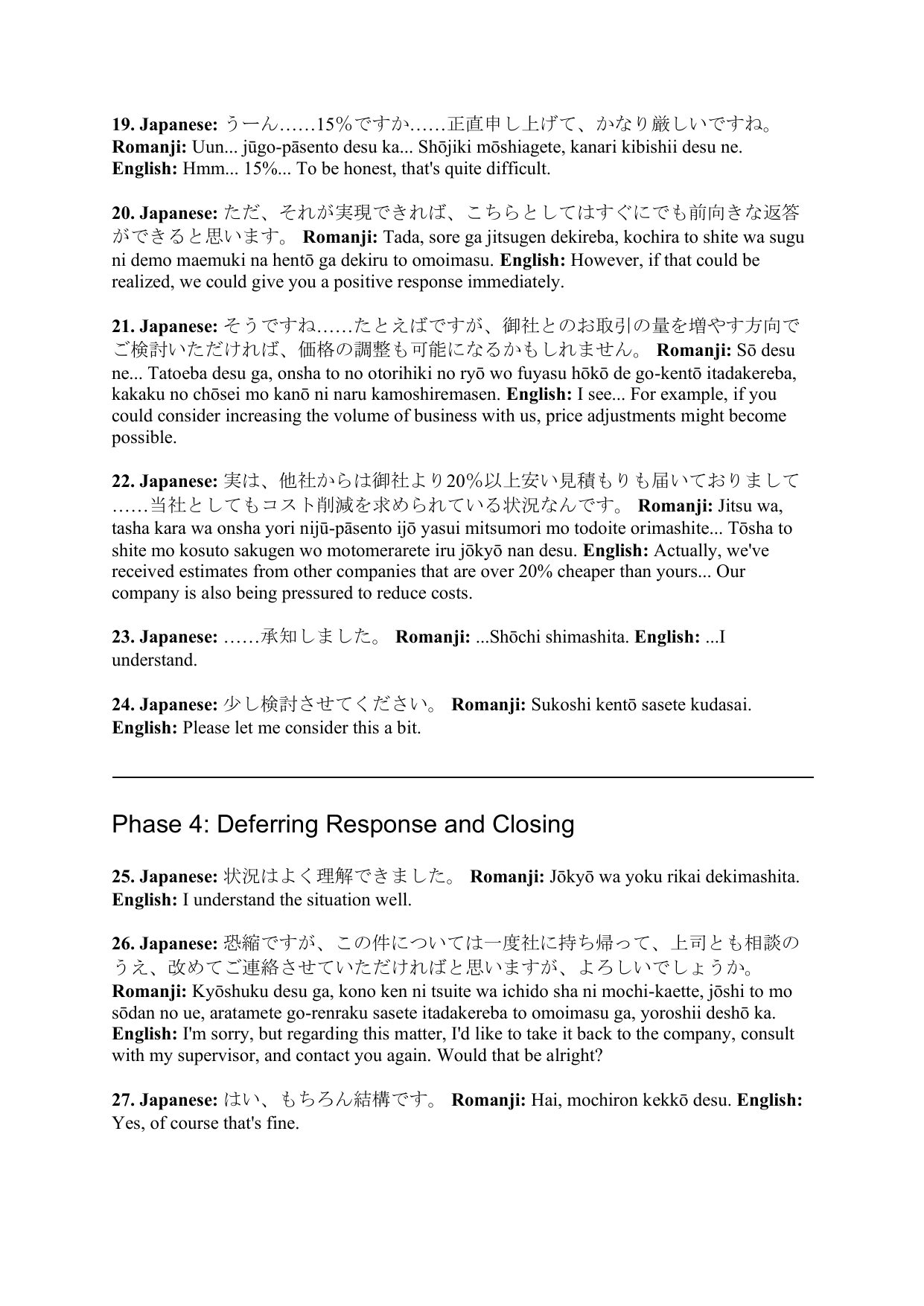
JP19.Japanese:うーん……15%ですか……正直申し上げて、かなり厳しいですね。
ENRomanji: Uun... jūgo-pāsento desu ka... Shōjiki mōshiagete, kanari kibishii desu ne.
English: Hmm... 15%... To be honest, that's quite difficult.
English: Hmm... 15%... To be honest, that's quite difficult.
JP20.Japanese:ただ、それが実現できれば、こちらとしてはすぐにでも前向きな返答
ENができると思います。 Romanji: Tada, sore ga jitsugen dekireba, kochira to shite wa sugu
ni demo maemuki na hentō ga dekiru to omoimasu. English: However, if that could be
realized, we could give you a positive response immediately.
ni demo maemuki na hentō ga dekiru to omoimasu. English: However, if that could be
realized, we could give you a positive response immediately.
JP21.Japanese:そうですね……たとえばですが、御社とのお取引の量を増やす方向で
ご検討いただければ、価格の調整も可能になるかもしれません。Romanji:Sōdesu
ご検討いただければ、価格の調整も可能になるかもしれません。Romanji:Sōdesu
ENne... Tatoeba desu ga, onsha to no otorihiki no ryō wo fuyasu hōkō de go-kentō itadakereba,
kakaku no chōsei mo kanō ni naru kamoshiremasen. English: I see... For example, if you
could consider increasing the volume of business with us, price adjustments might become
possible.
kakaku no chōsei mo kanō ni naru kamoshiremasen. English: I see... For example, if you
could consider increasing the volume of business with us, price adjustments might become
possible.
JP22.Japanese:実は、他社からは御社より20%以上安い見積もりも届いておりまして
……当社としてもコスト削減を求められている状況なんです。Romanji:Jitsuwa,
……当社としてもコスト削減を求められている状況なんです。Romanji:Jitsuwa,
ENtasha kara wa onsha yori nijū-pāsento ijō yasui mitsumori mo todoite orimashite... Tōsha to
shite mo kosuto sakugen wo motomerarete iru jōkyō nan desu. English: Actually, we've
received estimates from other companies that are over 20% cheaper than yours... Our
company is also being pressured to reduce costs.
23. Japanese: ……承知しました。 Romanji: ...Shōchi shimashita. English: ...I
understand.
24. Japanese: 少し検討させてください。 Romanji: Sukoshi kentō sasete kudasai.
English: Please let me consider this a bit.
Phase 4: Deferring Response and Closing
25. Japanese: 状況はよく理解できました。 Romanji: Jōkyō wa yoku rikai dekimashita.
English: I understand the situation well.
shite mo kosuto sakugen wo motomerarete iru jōkyō nan desu. English: Actually, we've
received estimates from other companies that are over 20% cheaper than yours... Our
company is also being pressured to reduce costs.
23. Japanese: ……承知しました。 Romanji: ...Shōchi shimashita. English: ...I
understand.
24. Japanese: 少し検討させてください。 Romanji: Sukoshi kentō sasete kudasai.
English: Please let me consider this a bit.
Phase 4: Deferring Response and Closing
25. Japanese: 状況はよく理解できました。 Romanji: Jōkyō wa yoku rikai dekimashita.
English: I understand the situation well.
JP26.Japanese:恐縮ですが、この件については一度社に持ち帰って、上司とも相談の
うえ、改めてご連絡させていただければと思いますが、よろしいでしょうか。
うえ、改めてご連絡させていただければと思いますが、よろしいでしょうか。
ENRomanji: Kyōshuku desu ga, kono ken ni tsuite wa ichido sha ni mochi-kaette, jōshi to mo
sōdan no ue, aratamete go-renraku sasete itadakereba to omoimasu ga, yoroshii deshō ka.
English: I'm sorry, but regarding this matter, I'd like to take it back to the company, consult
with my supervisor, and contact you again. Would that be alright?
27. Japanese: はい、もちろん結構です。 Romanji: Hai, mochiron kekkō desu. English:
Yes, of course that's fine.
sōdan no ue, aratamete go-renraku sasete itadakereba to omoimasu ga, yoroshii deshō ka.
English: I'm sorry, but regarding this matter, I'd like to take it back to the company, consult
with my supervisor, and contact you again. Would that be alright?
27. Japanese: はい、もちろん結構です。 Romanji: Hai, mochiron kekkō desu. English:
Yes, of course that's fine.
หน้า 40
คลิกเพื่อขยาย
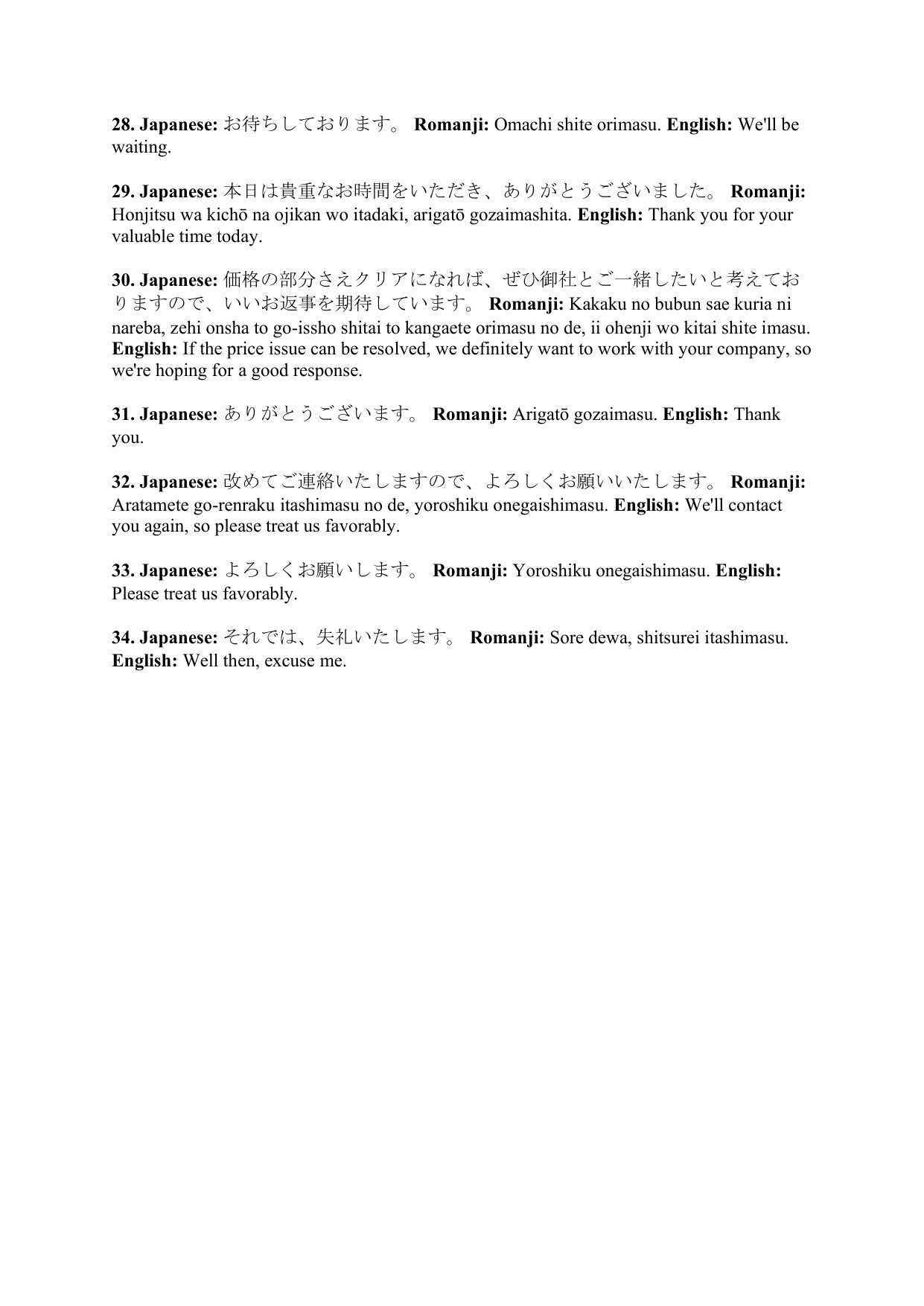
EN28. Japanese: お待ちしております。 Romanji: Omachi shite orimasu. English: We'll be
waiting.
waiting.
JP29.Japanese:本日は貴重なお時間をいただき、ありがとうございました。Romanji:
ENHonjitsu wa kichō na ojikan wo itadaki, arigatō gozaimashita. English: Thank you for your
valuable time today.
valuable time today.
JP30.Japanese:価格の部分さえクリアになれば、ぜひ御社とご一緒したいと考えてお
ENりますので、いいお返事を期待しています。 Romanji: Kakaku no bubun sae kuria ni
nareba, zehi onsha to go-issho shitai to kangaete orimasu no de, ii ohenji wo kitai shite imasu.
English: If the price issue can be resolved, we definitely want to work with your company, so
we're hoping for a good response.
31. Japanese: ありがとうございます。 Romanji: Arigatō gozaimasu. English: Thank
you.
nareba, zehi onsha to go-issho shitai to kangaete orimasu no de, ii ohenji wo kitai shite imasu.
English: If the price issue can be resolved, we definitely want to work with your company, so
we're hoping for a good response.
31. Japanese: ありがとうございます。 Romanji: Arigatō gozaimasu. English: Thank
you.
JP32.Japanese:改めてご連絡いたしますので、よろしくお願いいたします。Romanji:
ENAratamete go-renraku itashimasu no de, yoroshiku onegaishimasu. English: We'll contact
you again, so please treat us favorably.
33. Japanese: よろしくお願いします。 Romanji: Yoroshiku onegaishimasu. English:
Please treat us favorably.
34. Japanese: それでは、失礼いたします。 Romanji: Sore dewa, shitsurei itashimasu.
English: Well then, excuse me.
you again, so please treat us favorably.
33. Japanese: よろしくお願いします。 Romanji: Yoroshiku onegaishimasu. English:
Please treat us favorably.
34. Japanese: それでは、失礼いたします。 Romanji: Sore dewa, shitsurei itashimasu.
English: Well then, excuse me.