หน้า 1
คลิกเพื่อขยาย
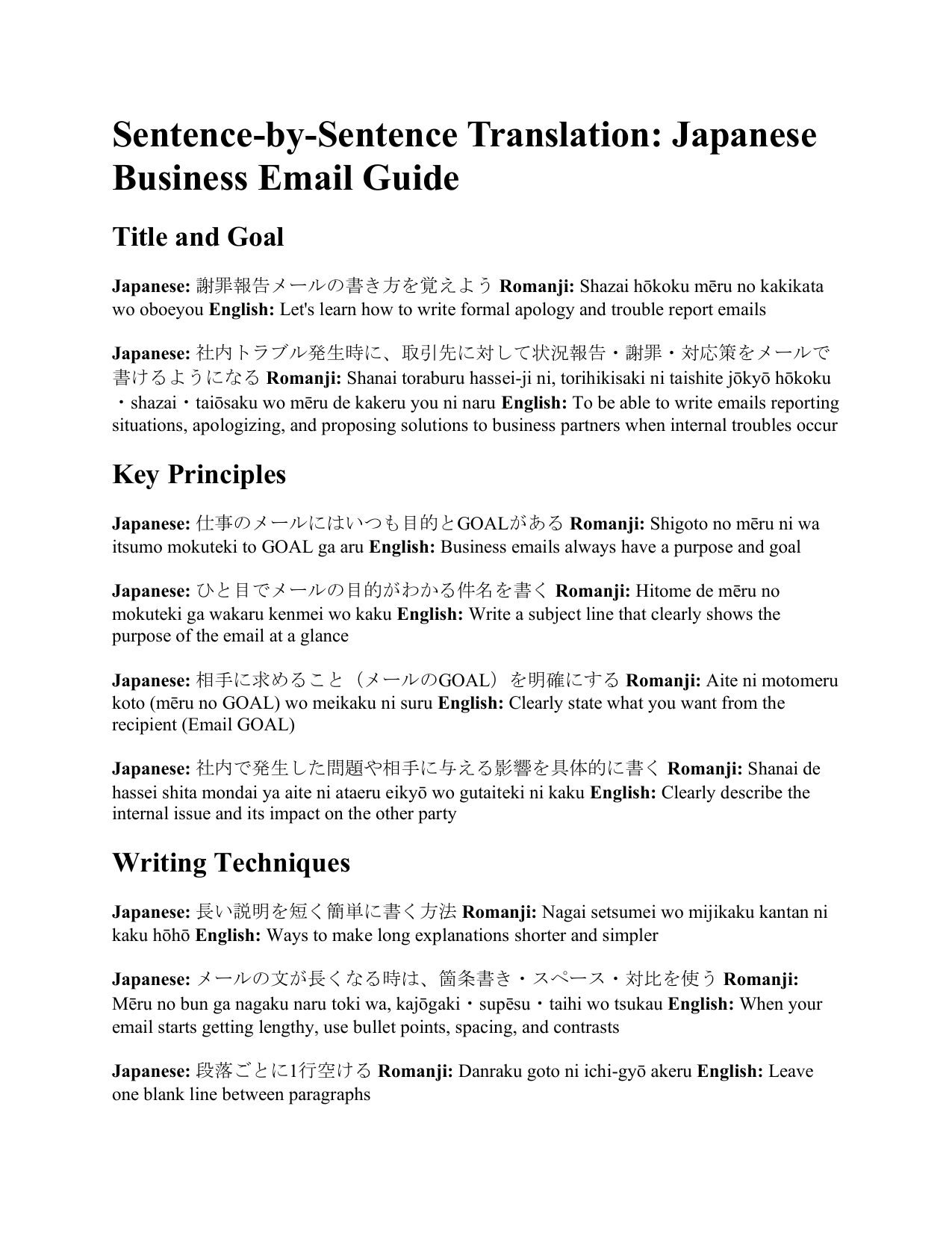
ENSentence-by-Sentence Translation: Japanese
Business Email Guide
Title and Goal
Japanese: 謝罪報告メールの書き方を覚えよう Romanji: Shazai hōkoku mēru no kakikata
wo oboeyou English: Let's learn how to write formal apology and trouble report emails
Business Email Guide
Title and Goal
Japanese: 謝罪報告メールの書き方を覚えよう Romanji: Shazai hōkoku mēru no kakikata
wo oboeyou English: Let's learn how to write formal apology and trouble report emails
JPJapanese:社内トラブル発生時に、取引先に対して状況報告・謝罪・対応策をメールで
EN書けるようになる Romanji: Shanai toraburu hassei-ji ni, torihikisaki ni taishite jōkyō hōkoku
・shazai・taiōsaku wo mēru de kakeru you ni naru English: To be able to write emails reporting
situations, apologizing, and proposing solutions to business partners when internal troubles occur
Key Principles
Japanese: 仕事のメールにはいつも目的とGOALがある Romanji: Shigoto no mēru ni wa
itsumo mokuteki to GOAL ga aru English: Business emails always have a purpose and goal
Japanese: ひと目でメールの目的がわかる件名を書く Romanji: Hitome de mēru no
mokuteki ga wakaru kenmei wo kaku English: Write a subject line that clearly shows the
purpose of the email at a glance
Japanese: 相手に求めること(メールのGOAL)を明確にする Romanji: Aite ni motomeru
koto (mēru no GOAL) wo meikaku ni suru English: Clearly state what you want from the
recipient (Email GOAL)
・shazai・taiōsaku wo mēru de kakeru you ni naru English: To be able to write emails reporting
situations, apologizing, and proposing solutions to business partners when internal troubles occur
Key Principles
Japanese: 仕事のメールにはいつも目的とGOALがある Romanji: Shigoto no mēru ni wa
itsumo mokuteki to GOAL ga aru English: Business emails always have a purpose and goal
Japanese: ひと目でメールの目的がわかる件名を書く Romanji: Hitome de mēru no
mokuteki ga wakaru kenmei wo kaku English: Write a subject line that clearly shows the
purpose of the email at a glance
Japanese: 相手に求めること(メールのGOAL)を明確にする Romanji: Aite ni motomeru
koto (mēru no GOAL) wo meikaku ni suru English: Clearly state what you want from the
recipient (Email GOAL)
JPJapanese:社内で発生した問題や相手に与える影響を具体的に書くRomanji:Shanaide
ENhassei shita mondai ya aite ni ataeru eikyō wo gutaiteki ni kaku English: Clearly describe the
internal issue and its impact on the other party
Writing Techniques
Japanese: 長い説明を短く簡単に書く方法 Romanji: Nagai setsumei wo mijikaku kantan ni
kaku hōhō English: Ways to make long explanations shorter and simpler
internal issue and its impact on the other party
Writing Techniques
Japanese: 長い説明を短く簡単に書く方法 Romanji: Nagai setsumei wo mijikaku kantan ni
kaku hōhō English: Ways to make long explanations shorter and simpler
JPJapanese:メールの文が長くなる時は、箇条書き・スペース・対比を使うRomanji:
ENMēru no bun ga nagaku naru toki wa, kajōgaki・supēsu・taihi wo tsukau English: When your
email starts getting lengthy, use bullet points, spacing, and contrasts
Japanese: 段落ごとに1行空ける Romanji: Danraku goto ni ichi-gyō akeru English: Leave
one blank line between paragraphs
email starts getting lengthy, use bullet points, spacing, and contrasts
Japanese: 段落ごとに1行空ける Romanji: Danraku goto ni ichi-gyō akeru English: Leave
one blank line between paragraphs
หน้า 2
คลิกเพื่อขยาย
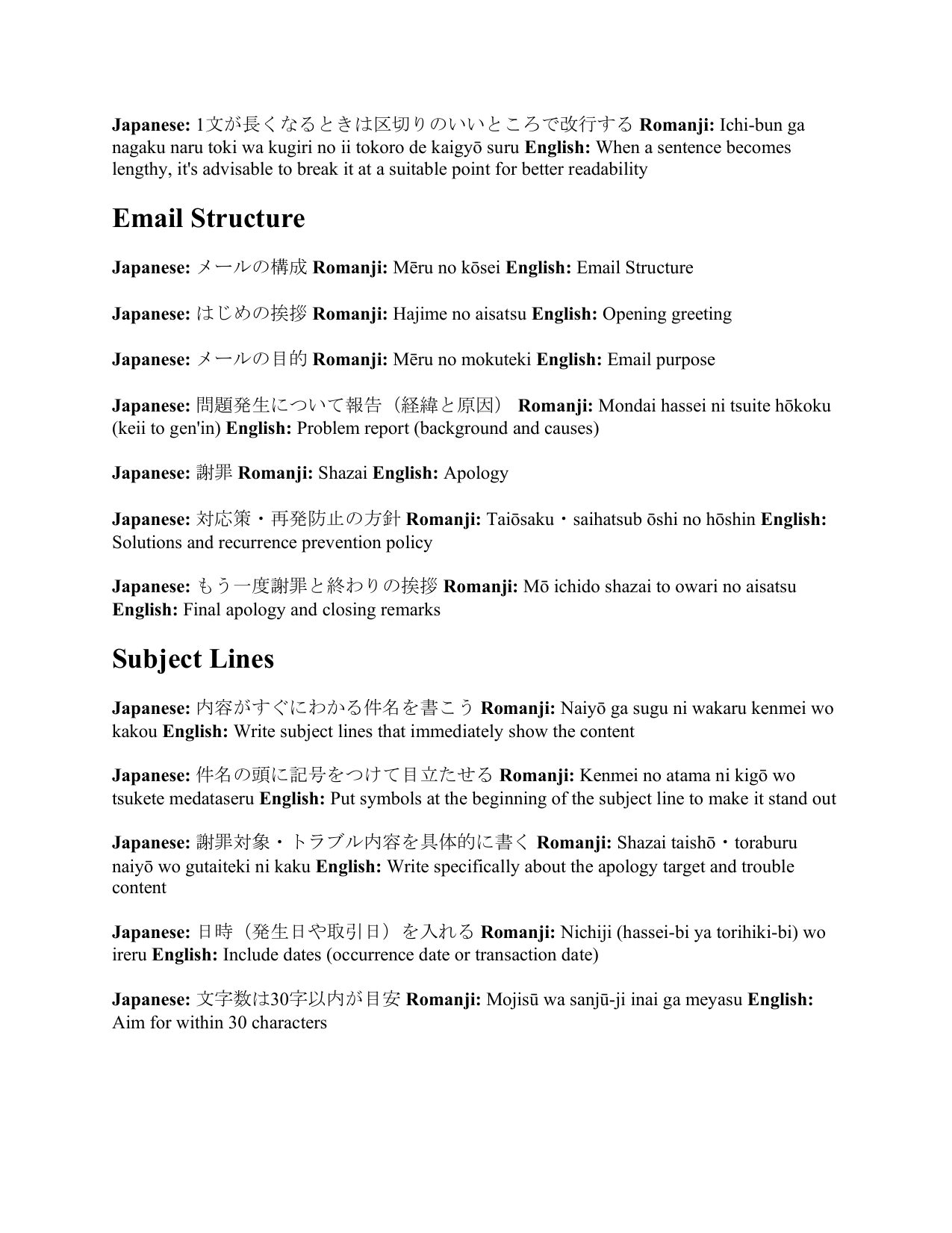
ENJapanese: 1文が長くなるときは区切りのいいところで改行する Romanji: Ichi-bun ga
nagaku naru toki wa kugiri no ii tokoro de kaigyō suru English: When a sentence becomes
lengthy, it's advisable to break it at a suitable point for better readability
Email Structure
Japanese: メールの構成 Romanji: Mēru no kōsei English: Email Structure
Japanese: はじめの挨拶 Romanji: Hajime no aisatsu English: Opening greeting
Japanese: メールの目的 Romanji: Mēru no mokuteki English: Email purpose
Japanese: 問題発生について報告(経緯と原因) Romanji: Mondai hassei ni tsuite hōkoku
(keii to gen'in) English: Problem report (background and causes)
Japanese: 謝罪 Romanji: Shazai English: Apology
Japanese: 対応策・再発防止の方針 Romanji: Taiōsaku・saihatsub ōshi no hōshin English:
Solutions and recurrence prevention policy
Japanese: もう一度謝罪と終わりの挨拶 Romanji: Mō ichido shazai to owari no aisatsu
English: Final apology and closing remarks
Subject Lines
Japanese: 内容がすぐにわかる件名を書こう Romanji: Naiyō ga sugu ni wakaru kenmei wo
kakou English: Write subject lines that immediately show the content
Japanese: 件名の頭に記号をつけて目立たせる Romanji: Kenmei no atama ni kigō wo
tsukete medataseru English: Put symbols at the beginning of the subject line to make it stand out
Japanese: 謝罪対象・トラブル内容を具体的に書く Romanji: Shazai taishō・toraburu
naiyō wo gutaiteki ni kaku English: Write specifically about the apology target and trouble
content
Japanese: 日時(発生日や取引日)を入れる Romanji: Nichiji (hassei-bi ya torihiki-bi) wo
ireru English: Include dates (occurrence date or transaction date)
Japanese: 文字数は30字以内が目安 Romanji: Mojisū wa sanjū-ji inai ga meyasu English:
Aim for within 30 characters
nagaku naru toki wa kugiri no ii tokoro de kaigyō suru English: When a sentence becomes
lengthy, it's advisable to break it at a suitable point for better readability
Email Structure
Japanese: メールの構成 Romanji: Mēru no kōsei English: Email Structure
Japanese: はじめの挨拶 Romanji: Hajime no aisatsu English: Opening greeting
Japanese: メールの目的 Romanji: Mēru no mokuteki English: Email purpose
Japanese: 問題発生について報告(経緯と原因) Romanji: Mondai hassei ni tsuite hōkoku
(keii to gen'in) English: Problem report (background and causes)
Japanese: 謝罪 Romanji: Shazai English: Apology
Japanese: 対応策・再発防止の方針 Romanji: Taiōsaku・saihatsub ōshi no hōshin English:
Solutions and recurrence prevention policy
Japanese: もう一度謝罪と終わりの挨拶 Romanji: Mō ichido shazai to owari no aisatsu
English: Final apology and closing remarks
Subject Lines
Japanese: 内容がすぐにわかる件名を書こう Romanji: Naiyō ga sugu ni wakaru kenmei wo
kakou English: Write subject lines that immediately show the content
Japanese: 件名の頭に記号をつけて目立たせる Romanji: Kenmei no atama ni kigō wo
tsukete medataseru English: Put symbols at the beginning of the subject line to make it stand out
Japanese: 謝罪対象・トラブル内容を具体的に書く Romanji: Shazai taishō・toraburu
naiyō wo gutaiteki ni kaku English: Write specifically about the apology target and trouble
content
Japanese: 日時(発生日や取引日)を入れる Romanji: Nichiji (hassei-bi ya torihiki-bi) wo
ireru English: Include dates (occurrence date or transaction date)
Japanese: 文字数は30字以内が目安 Romanji: Mojisū wa sanjū-ji inai ga meyasu English:
Aim for within 30 characters
หน้า 3
คลิกเพื่อขยาย
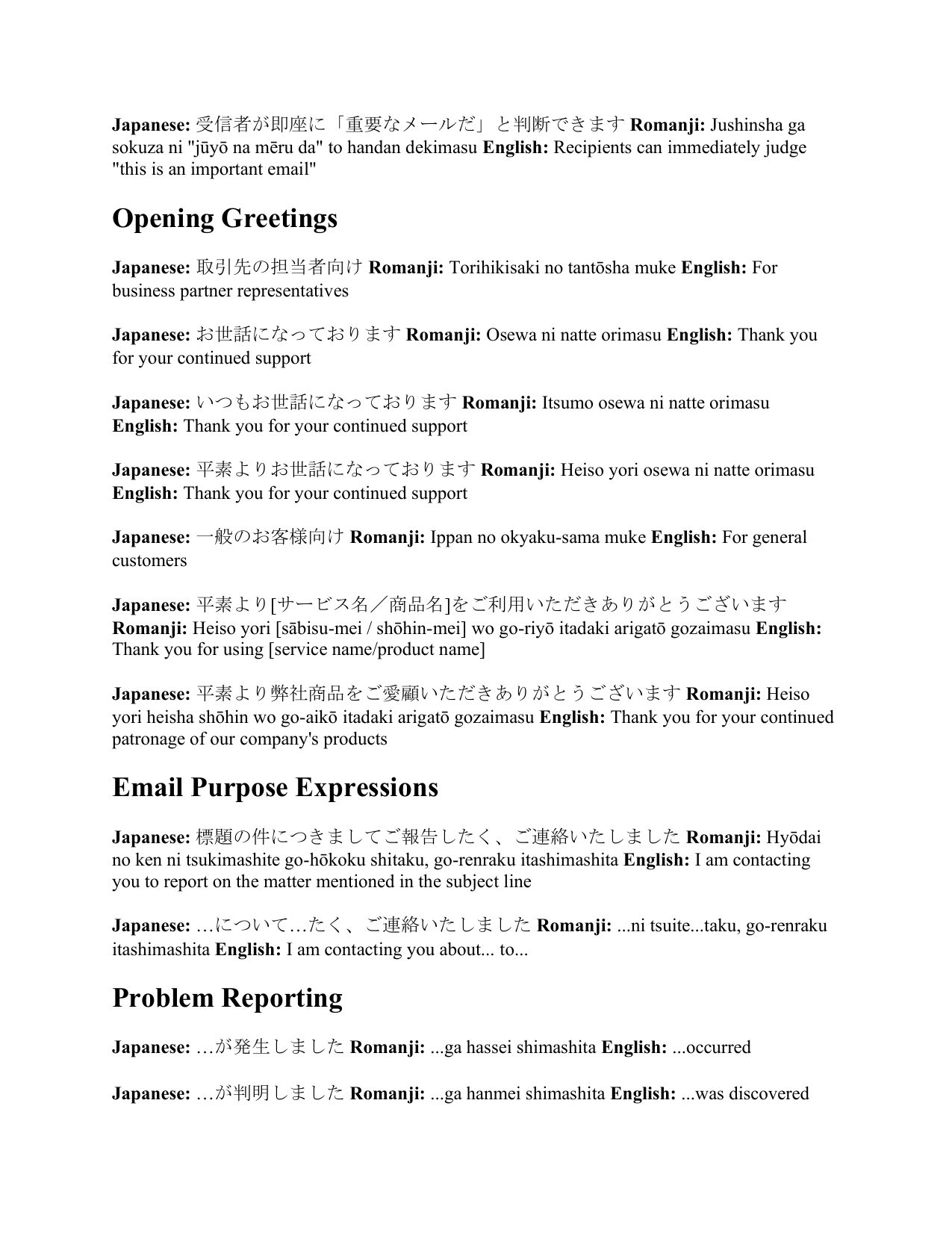
ENJapanese: 受信者が即座に「重要なメールだ」と判断できます Romanji: Jushinsha ga
sokuza ni "jūyō na mēru da" to handan dekimasu English: Recipients can immediately judge
"this is an important email"
Opening Greetings
Japanese: 取引先の担当者向け Romanji: Torihikisaki no tantōsha muke English: For
business partner representatives
Japanese: お世話になっております Romanji: Osewa ni natte orimasu English: Thank you
for your continued support
Japanese: いつもお世話になっております Romanji: Itsumo osewa ni natte orimasu
English: Thank you for your continued support
Japanese: 平素よりお世話になっております Romanji: Heiso yori osewa ni natte orimasu
English: Thank you for your continued support
Japanese: 一般のお客様向け Romanji: Ippan no okyaku-sama muke English: For general
customers
sokuza ni "jūyō na mēru da" to handan dekimasu English: Recipients can immediately judge
"this is an important email"
Opening Greetings
Japanese: 取引先の担当者向け Romanji: Torihikisaki no tantōsha muke English: For
business partner representatives
Japanese: お世話になっております Romanji: Osewa ni natte orimasu English: Thank you
for your continued support
Japanese: いつもお世話になっております Romanji: Itsumo osewa ni natte orimasu
English: Thank you for your continued support
Japanese: 平素よりお世話になっております Romanji: Heiso yori osewa ni natte orimasu
English: Thank you for your continued support
Japanese: 一般のお客様向け Romanji: Ippan no okyaku-sama muke English: For general
customers
JPJapanese:平素より[サービス名/商品名]をご利用いただきありがとうございます
ENRomanji: Heiso yori [sābisu-mei / shōhin-mei] wo go-riyō itadaki arigatō gozaimasu English:
Thank you for using [service name/product name]
Thank you for using [service name/product name]
JPJapanese:平素より弊社商品をご愛顧いただきありがとうございますRomanji:Heiso
ENyori heisha shōhin wo go-aikō itadaki arigatō gozaimasu English: Thank you for your continued
patronage of our company's products
Email Purpose Expressions
patronage of our company's products
Email Purpose Expressions
JPJapanese:標題の件につきましてご報告したく、ご連絡いたしましたRomanji:Hyōdai
ENno ken ni tsukimashite go-hōkoku shitaku, go-renraku itashimashita English: I am contacting
you to report on the matter mentioned in the subject line
Japanese: …について…たく、ご連絡いたしました Romanji: ...ni tsuite...taku, go-renraku
itashimashita English: I am contacting you about... to...
Problem Reporting
Japanese: …が発生しました Romanji: ...ga hassei shimashita English: ...occurred
Japanese: …が判明しました Romanji: ...ga hanmei shimashita English: ...was discovered
you to report on the matter mentioned in the subject line
Japanese: …について…たく、ご連絡いたしました Romanji: ...ni tsuite...taku, go-renraku
itashimashita English: I am contacting you about... to...
Problem Reporting
Japanese: …が発生しました Romanji: ...ga hassei shimashita English: ...occurred
Japanese: …が判明しました Romanji: ...ga hanmei shimashita English: ...was discovered
หน้า 4
คลิกเพื่อขยาย
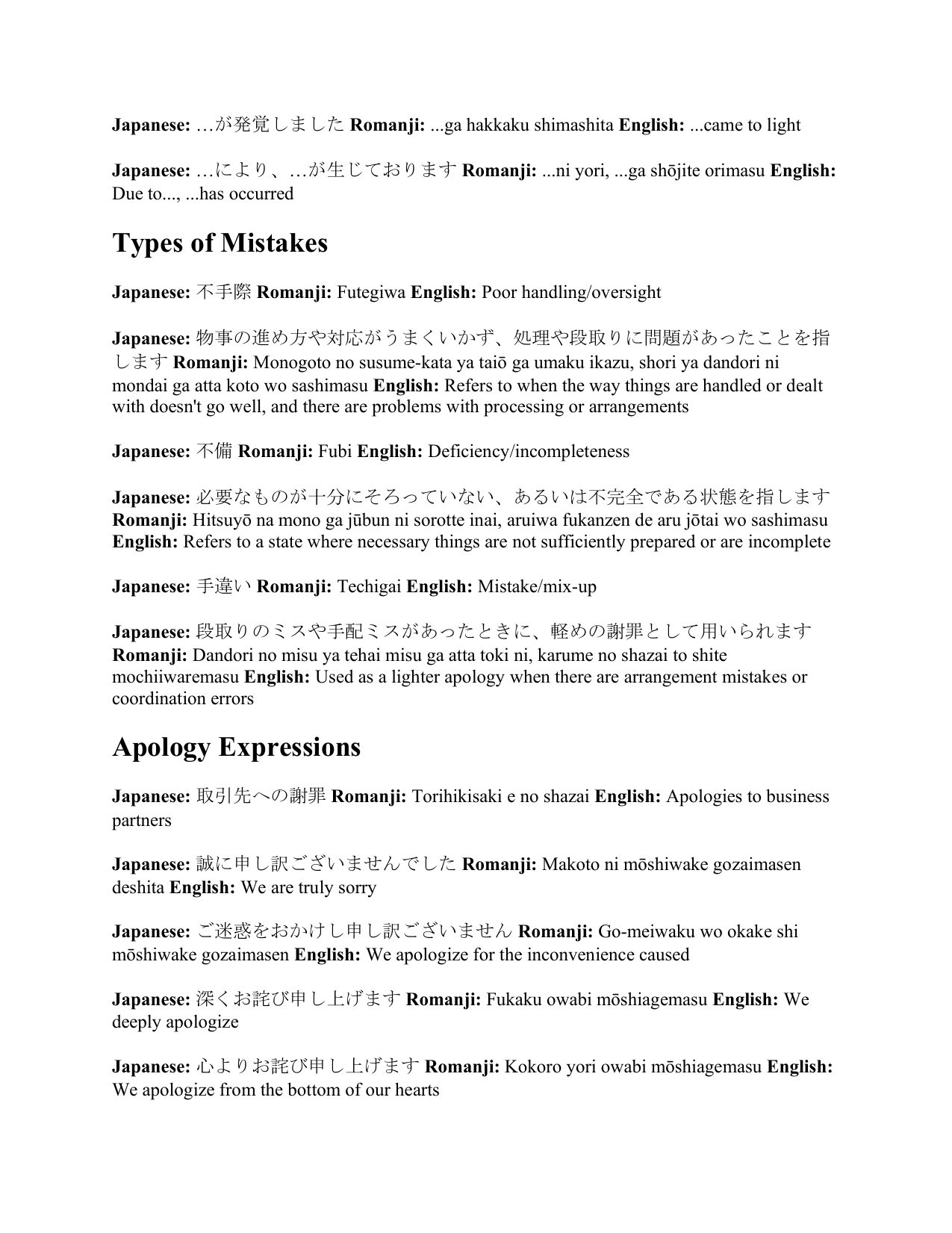
ENJapanese: …が発覚しました Romanji: ...ga hakkaku shimashita English: ...came to light
Japanese: …により、…が生じております Romanji: ...ni yori, ...ga shōjite orimasu English:
Due to..., ...has occurred
Types of Mistakes
Japanese: 不手際 Romanji: Futegiwa English: Poor handling/oversight
Japanese: …により、…が生じております Romanji: ...ni yori, ...ga shōjite orimasu English:
Due to..., ...has occurred
Types of Mistakes
Japanese: 不手際 Romanji: Futegiwa English: Poor handling/oversight
JPJapanese:物事の進め方や対応がうまくいかず、処理や段取りに問題があったことを指
ENします Romanji: Monogoto no susume-kata ya taiō ga umaku ikazu, shori ya dandori ni
mondai ga atta koto wo sashimasu English: Refers to when the way things are handled or dealt
with doesn't go well, and there are problems with processing or arrangements
Japanese: 不備 Romanji: Fubi English: Deficiency/incompleteness
mondai ga atta koto wo sashimasu English: Refers to when the way things are handled or dealt
with doesn't go well, and there are problems with processing or arrangements
Japanese: 不備 Romanji: Fubi English: Deficiency/incompleteness
JPJapanese:必要なものが十分にそろっていない、あるいは不完全である状態を指します
ENRomanji: Hitsuyō na mono ga jūbun ni sorotte inai, aruiwa fukanzen de aru jōtai wo sashimasu
English: Refers to a state where necessary things are not sufficiently prepared or are incomplete
Japanese: 手違い Romanji: Techigai English: Mistake/mix-up
English: Refers to a state where necessary things are not sufficiently prepared or are incomplete
Japanese: 手違い Romanji: Techigai English: Mistake/mix-up
JPJapanese:段取りのミスや手配ミスがあったときに、軽めの謝罪として用いられます
ENRomanji: Dandori no misu ya tehai misu ga atta toki ni, karume no shazai to shite
mochiiwaremasu English: Used as a lighter apology when there are arrangement mistakes or
coordination errors
Apology Expressions
Japanese: 取引先への謝罪 Romanji: Torihikisaki e no shazai English: Apologies to business
partners
Japanese: 誠に申し訳ございませんでした Romanji: Makoto ni mōshiwake gozaimasen
deshita English: We are truly sorry
Japanese: ご迷惑をおかけし申し訳ございません Romanji: Go-meiwaku wo okake shi
mōshiwake gozaimasen English: We apologize for the inconvenience caused
Japanese: 深くお詫び申し上げます Romanji: Fukaku owabi mōshiagemasu English: We
deeply apologize
Japanese: 心よりお詫び申し上げます Romanji: Kokoro yori owabi mōshiagemasu English:
We apologize from the bottom of our hearts
mochiiwaremasu English: Used as a lighter apology when there are arrangement mistakes or
coordination errors
Apology Expressions
Japanese: 取引先への謝罪 Romanji: Torihikisaki e no shazai English: Apologies to business
partners
Japanese: 誠に申し訳ございませんでした Romanji: Makoto ni mōshiwake gozaimasen
deshita English: We are truly sorry
Japanese: ご迷惑をおかけし申し訳ございません Romanji: Go-meiwaku wo okake shi
mōshiwake gozaimasen English: We apologize for the inconvenience caused
Japanese: 深くお詫び申し上げます Romanji: Fukaku owabi mōshiagemasu English: We
deeply apologize
Japanese: 心よりお詫び申し上げます Romanji: Kokoro yori owabi mōshiagemasu English:
We apologize from the bottom of our hearts
หน้า 5
คลิกเพื่อขยาย
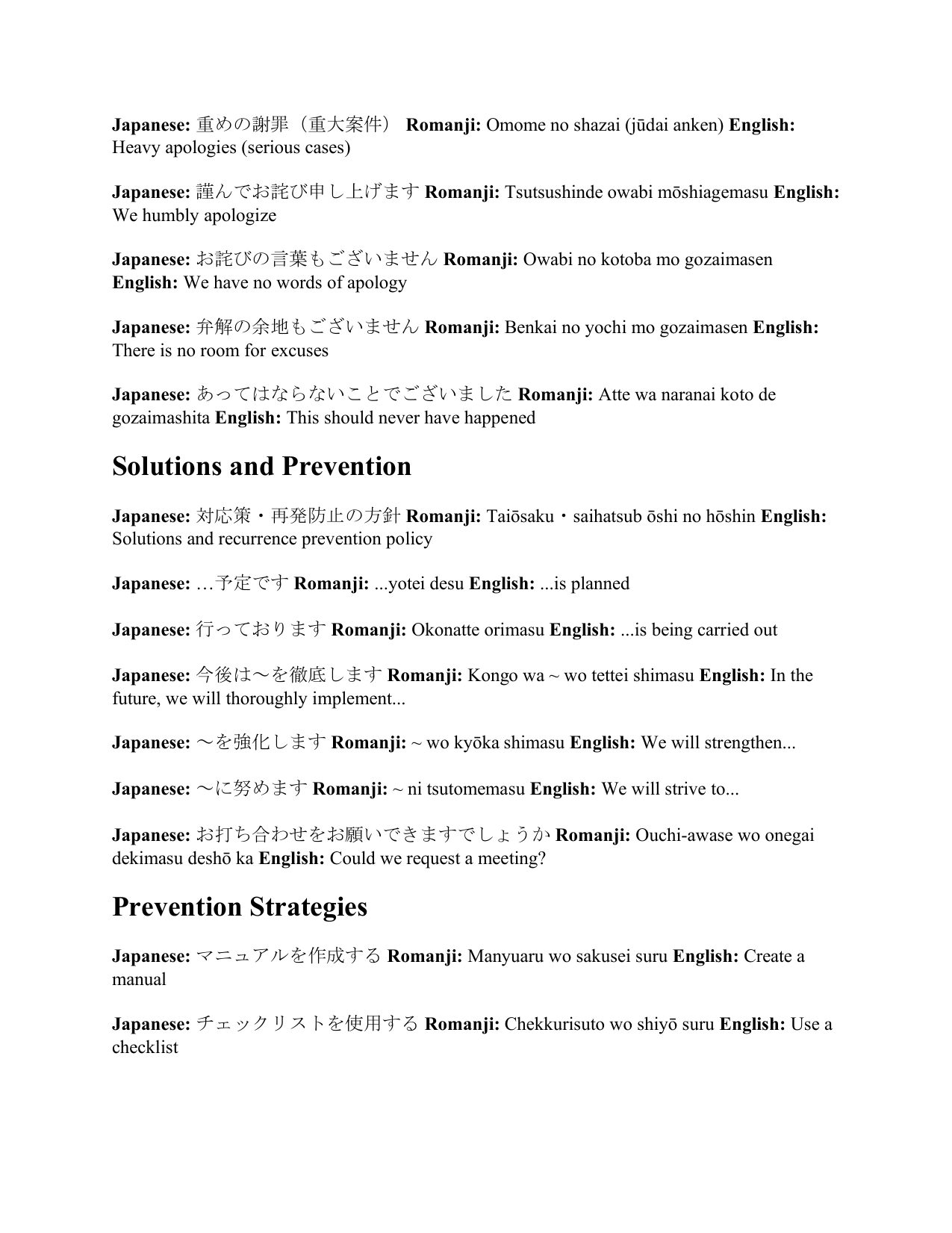
ENJapanese: 重めの謝罪(重大案件) Romanji: Omome no shazai (jūdai anken) English:
Heavy apologies (serious cases)
Japanese: 謹んでお詫び申し上げます Romanji: Tsutsushinde owabi mōshiagemasu English:
We humbly apologize
Japanese: お詫びの言葉もございません Romanji: Owabi no kotoba mo gozaimasen
English: We have no words of apology
Japanese: 弁解の余地もございません Romanji: Benkai no yochi mo gozaimasen English:
There is no room for excuses
Japanese: あってはならないことでございました Romanji: Atte wa naranai koto de
gozaimashita English: This should never have happened
Solutions and Prevention
Japanese: 対応策・再発防止の方針 Romanji: Taiōsaku・saihatsub ōshi no hōshin English:
Solutions and recurrence prevention policy
Japanese: …予定です Romanji: ...yotei desu English: ...is planned
Japanese: 行っております Romanji: Okonatte orimasu English: ...is being carried out
Japanese: 今後は~を徹底します Romanji: Kongo wa ~ wo tettei shimasu English: In the
future, we will thoroughly implement...
Japanese: ~を強化します Romanji: ~ wo kyōka shimasu English: We will strengthen...
Japanese: ~に努めます Romanji: ~ ni tsutomemasu English: We will strive to...
Japanese: お打ち合わせをお願いできますでしょうか Romanji: Ouchi-awase wo onegai
dekimasu deshō ka English: Could we request a meeting?
Prevention Strategies
Japanese: マニュアルを作成する Romanji: Manyuaru wo sakusei suru English: Create a
manual
Japanese: チェックリストを使用する Romanji: Chekkurisuto wo shiyō suru English: Use a
checklist
Heavy apologies (serious cases)
Japanese: 謹んでお詫び申し上げます Romanji: Tsutsushinde owabi mōshiagemasu English:
We humbly apologize
Japanese: お詫びの言葉もございません Romanji: Owabi no kotoba mo gozaimasen
English: We have no words of apology
Japanese: 弁解の余地もございません Romanji: Benkai no yochi mo gozaimasen English:
There is no room for excuses
Japanese: あってはならないことでございました Romanji: Atte wa naranai koto de
gozaimashita English: This should never have happened
Solutions and Prevention
Japanese: 対応策・再発防止の方針 Romanji: Taiōsaku・saihatsub ōshi no hōshin English:
Solutions and recurrence prevention policy
Japanese: …予定です Romanji: ...yotei desu English: ...is planned
Japanese: 行っております Romanji: Okonatte orimasu English: ...is being carried out
Japanese: 今後は~を徹底します Romanji: Kongo wa ~ wo tettei shimasu English: In the
future, we will thoroughly implement...
Japanese: ~を強化します Romanji: ~ wo kyōka shimasu English: We will strengthen...
Japanese: ~に努めます Romanji: ~ ni tsutomemasu English: We will strive to...
Japanese: お打ち合わせをお願いできますでしょうか Romanji: Ouchi-awase wo onegai
dekimasu deshō ka English: Could we request a meeting?
Prevention Strategies
Japanese: マニュアルを作成する Romanji: Manyuaru wo sakusei suru English: Create a
manual
Japanese: チェックリストを使用する Romanji: Chekkurisuto wo shiyō suru English: Use a
checklist
หน้า 6
คลิกเพื่อขยาย
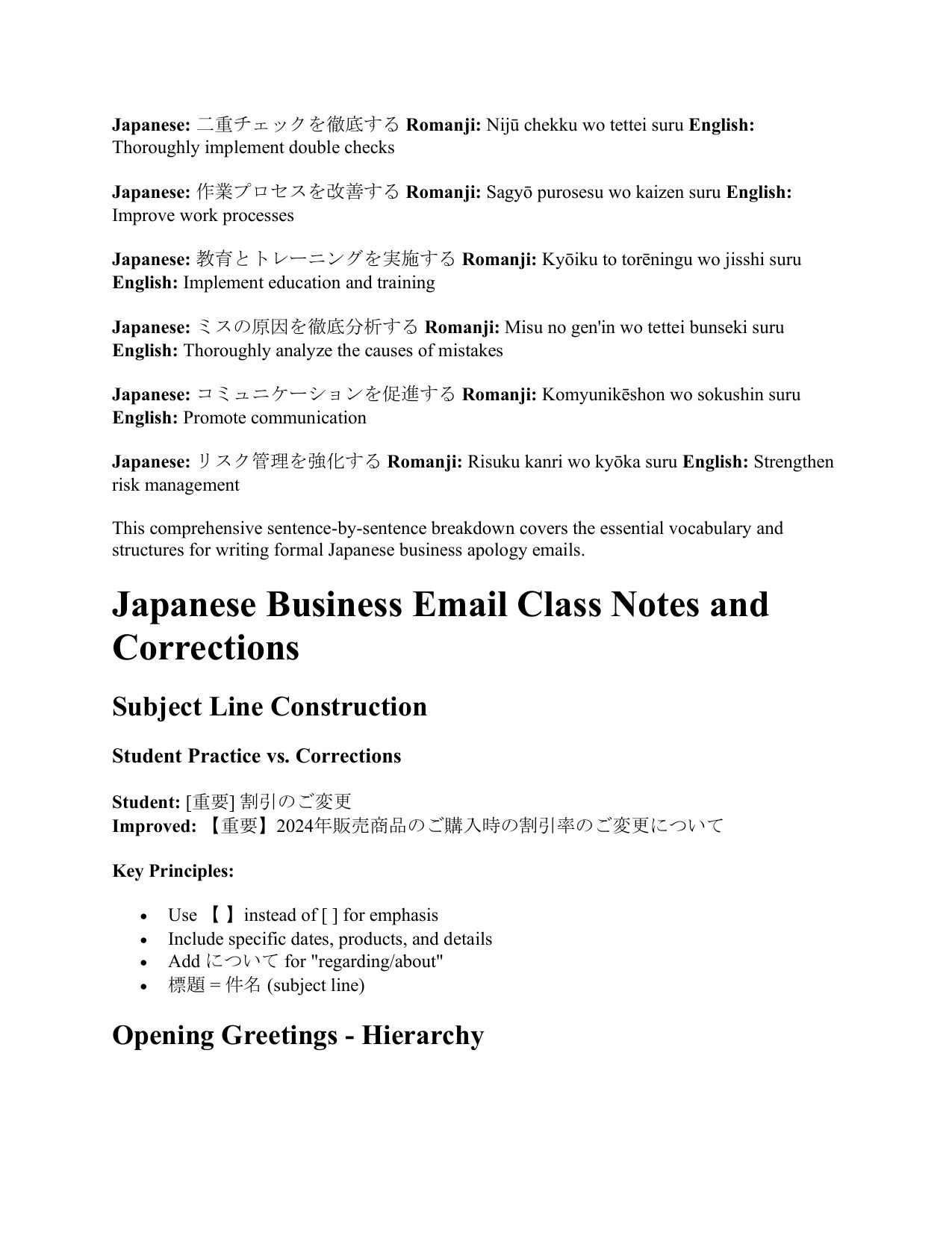
ENJapanese: 二重チェックを徹底する Romanji: Nijū chekku wo tettei suru English:
Thoroughly implement double checks
Japanese: 作業プロセスを改善する Romanji: Sagyō purosesu wo kaizen suru English:
Improve work processes
Japanese: 教育とトレーニングを実施する Romanji: Kyōiku to torēningu wo jisshi suru
English: Implement education and training
Japanese: ミスの原因を徹底分析する Romanji: Misu no gen'in wo tettei bunseki suru
English: Thoroughly analyze the causes of mistakes
Japanese: コミュニケーションを促進する Romanji: Komyunikēshon wo sokushin suru
English: Promote communication
Japanese: リスク管理を強化する Romanji: Risuku kanri wo kyōka suru English: Strengthen
risk management
This comprehensive sentence-by-sentence breakdown covers the essential vocabulary and
structures for writing formal Japanese business apology emails.
Japanese Business Email Class Notes and
Corrections
Subject Line Construction
Student Practice vs. Corrections
Thoroughly implement double checks
Japanese: 作業プロセスを改善する Romanji: Sagyō purosesu wo kaizen suru English:
Improve work processes
Japanese: 教育とトレーニングを実施する Romanji: Kyōiku to torēningu wo jisshi suru
English: Implement education and training
Japanese: ミスの原因を徹底分析する Romanji: Misu no gen'in wo tettei bunseki suru
English: Thoroughly analyze the causes of mistakes
Japanese: コミュニケーションを促進する Romanji: Komyunikēshon wo sokushin suru
English: Promote communication
Japanese: リスク管理を強化する Romanji: Risuku kanri wo kyōka suru English: Strengthen
risk management
This comprehensive sentence-by-sentence breakdown covers the essential vocabulary and
structures for writing formal Japanese business apology emails.
Japanese Business Email Class Notes and
Corrections
Subject Line Construction
Student Practice vs. Corrections
JPStudent:[重要]割引のご変更
Improved:【重要】2024年販売商品のご購入時の割引率のご変更について
Improved:【重要】2024年販売商品のご購入時の割引率のご変更について
ENKey Principles:
• Use 【 】instead of [ ] for emphasis
• Include specific dates, products, and details
• Add について for "regarding/about"
• 標題 = 件名 (subject line)
Opening Greetings - Hierarchy
• Use 【 】instead of [ ] for emphasis
• Include specific dates, products, and details
• Add について for "regarding/about"
• 標題 = 件名 (subject line)
Opening Greetings - Hierarchy
หน้า 7
คลิกเพื่อขยาย
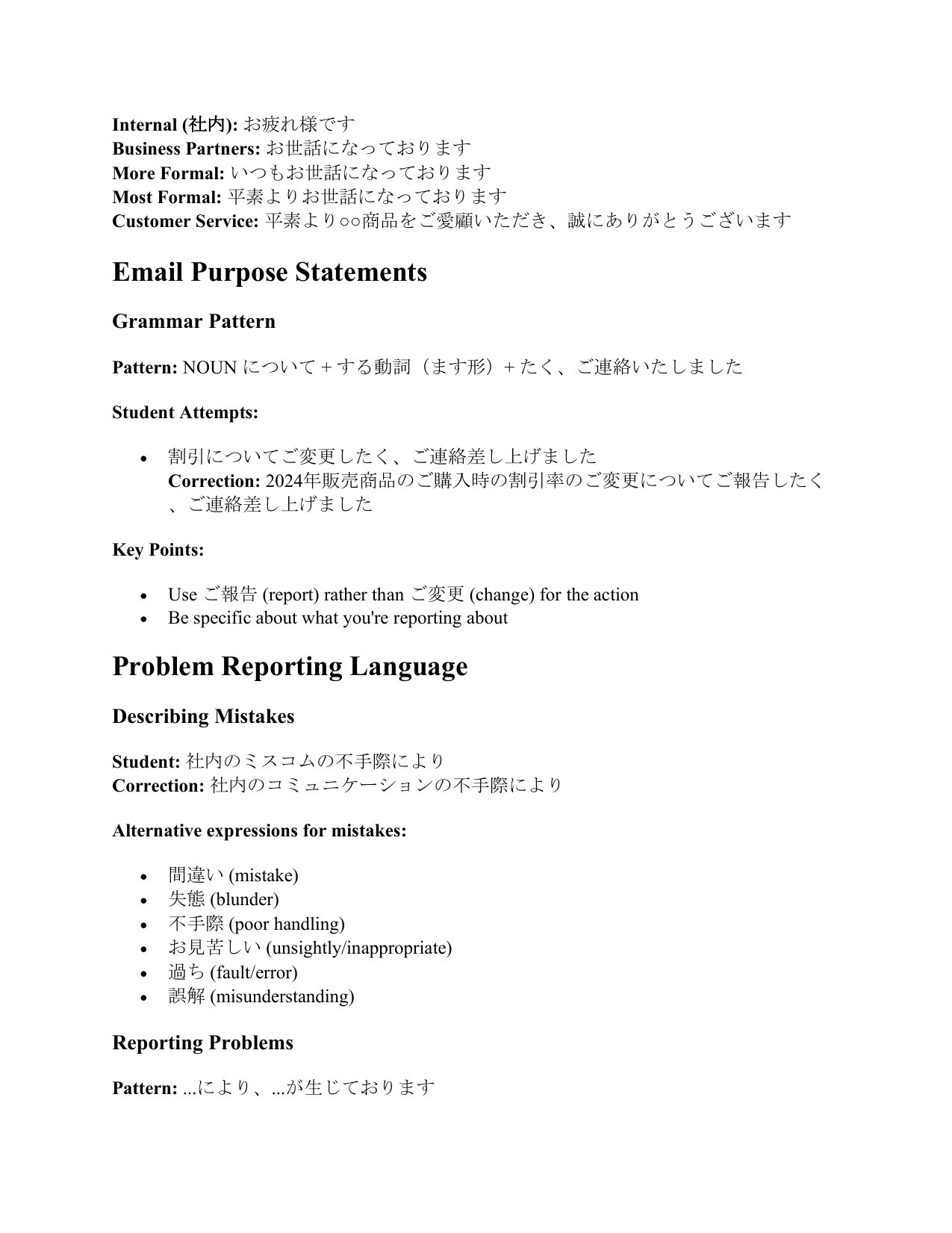
JPInternal(社内):お疲れ様です
ENBusiness Partners: お世話になっております
JPMoreFormal:いつもお世話になっております
MostFormal:平素よりお世話になっております
CustomerService:平素より○○商品をご愛顧いただき、誠にありがとうございます
MostFormal:平素よりお世話になっております
CustomerService:平素より○○商品をご愛顧いただき、誠にありがとうございます
ENEmail Purpose Statements
Grammar Pattern
Grammar Pattern
JPPattern:NOUNについて+する動詞(ます形)+たく、ご連絡いたしました
ENStudent Attempts:
JP•割引についてご変更したく、ご連絡差し上げました
Correction:2024年販売商品のご購入時の割引率のご変更についてご報告したく
、ご連絡差し上げました
Correction:2024年販売商品のご購入時の割引率のご変更についてご報告したく
、ご連絡差し上げました
ENKey Points:
• Use ご報告 (report) rather than ご変更 (change) for the action
• Be specific about what you're reporting about
Problem Reporting Language
Describing Mistakes
• Use ご報告 (report) rather than ご変更 (change) for the action
• Be specific about what you're reporting about
Problem Reporting Language
Describing Mistakes
JPStudent:社内のミスコムの不手際により
Correction:社内のコミュニケーションの不手際により
Correction:社内のコミュニケーションの不手際により
ENAlternative expressions for mistakes:
• 間違い (mistake)
• 失態 (blunder)
• 不手際 (poor handling)
• お見苦しい (unsightly/inappropriate)
• 過ち (fault/error)
• 誤解 (misunderstanding)
Reporting Problems
• 間違い (mistake)
• 失態 (blunder)
• 不手際 (poor handling)
• お見苦しい (unsightly/inappropriate)
• 過ち (fault/error)
• 誤解 (misunderstanding)
Reporting Problems
JPPattern:...により、...が生じております
หน้า 8
คลิกเพื่อขยาย
ENExamples:
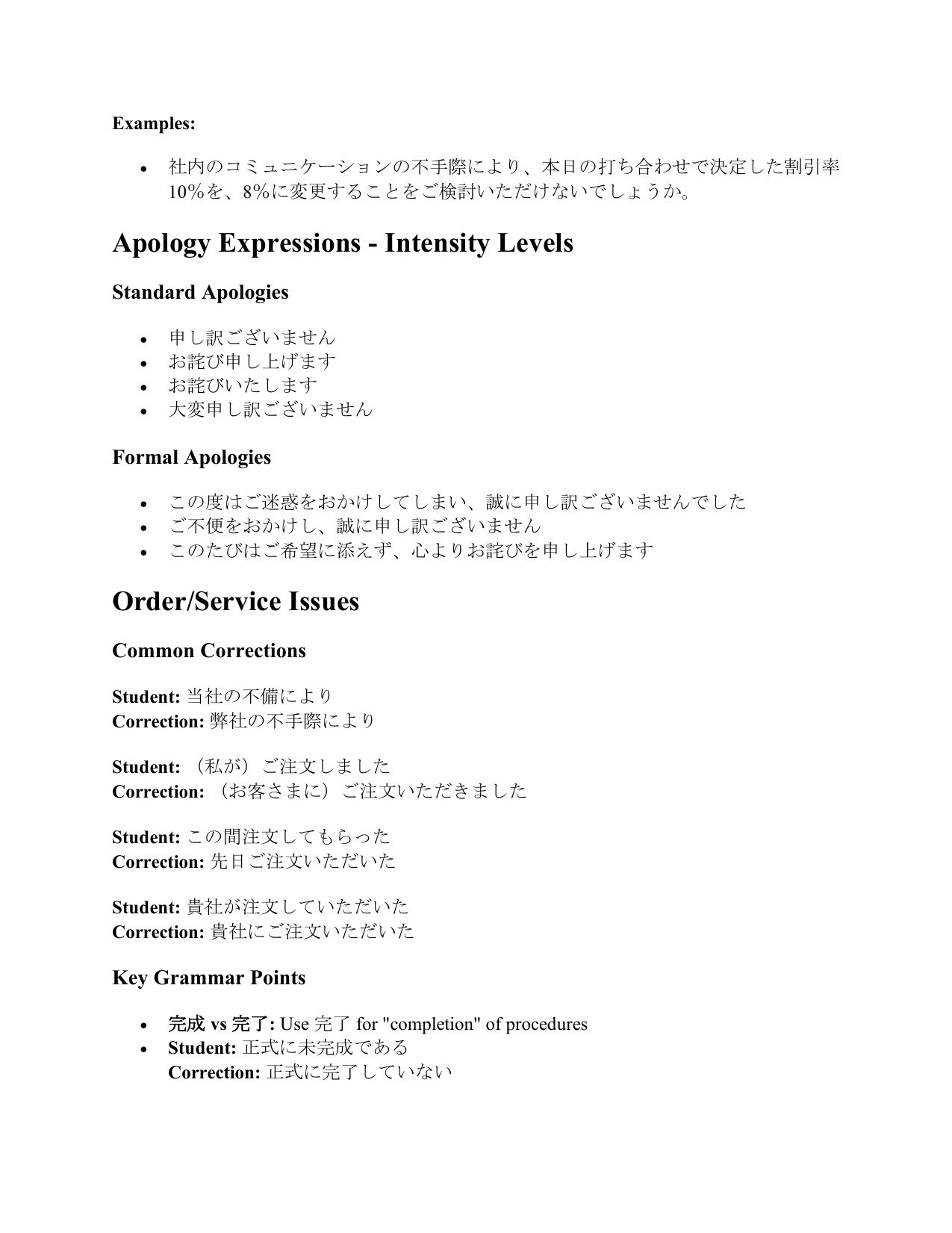
JP•社内のコミュニケーションの不手際により、本日の打ち合わせで決定した割引率
10%を、8%に変更することをご検討いただけないでしょうか。
10%を、8%に変更することをご検討いただけないでしょうか。
ENApology Expressions - Intensity Levels
Standard Apologies
Standard Apologies
JP•申し訳ございません
•お詫び申し上げます
•お詫びいたします
•大変申し訳ございません
•お詫び申し上げます
•お詫びいたします
•大変申し訳ございません
ENFormal Apologies
JP•この度はご迷惑をおかけしてしまい、誠に申し訳ございませんでした
•ご不便をおかけし、誠に申し訳ございません
•このたびはご希望に添えず、心よりお詫びを申し上げます
•ご不便をおかけし、誠に申し訳ございません
•このたびはご希望に添えず、心よりお詫びを申し上げます
ENOrder/Service Issues
Common Corrections
Common Corrections
JPStudent:当社の不備により
ENCorrection: 弊社の不手際により
JPStudent:(私が)ご注文しました
Correction:(お客さまに)ご注文いただきました
Student:この間注文してもらった
Correction:先日ご注文いただいた
Student:貴社が注文していただいた
Correction:貴社にご注文いただいた
Correction:(お客さまに)ご注文いただきました
Student:この間注文してもらった
Correction:先日ご注文いただいた
Student:貴社が注文していただいた
Correction:貴社にご注文いただいた
ENKey Grammar Points
• 完成 vs 完了: Use 完了 for "completion" of procedures
• 完成 vs 完了: Use 完了 for "completion" of procedures
JP•Student:正式に未完成である
Correction:正式に完了していない
Correction:正式に完了していない
หน้า 9
คลิกเพื่อขยาย
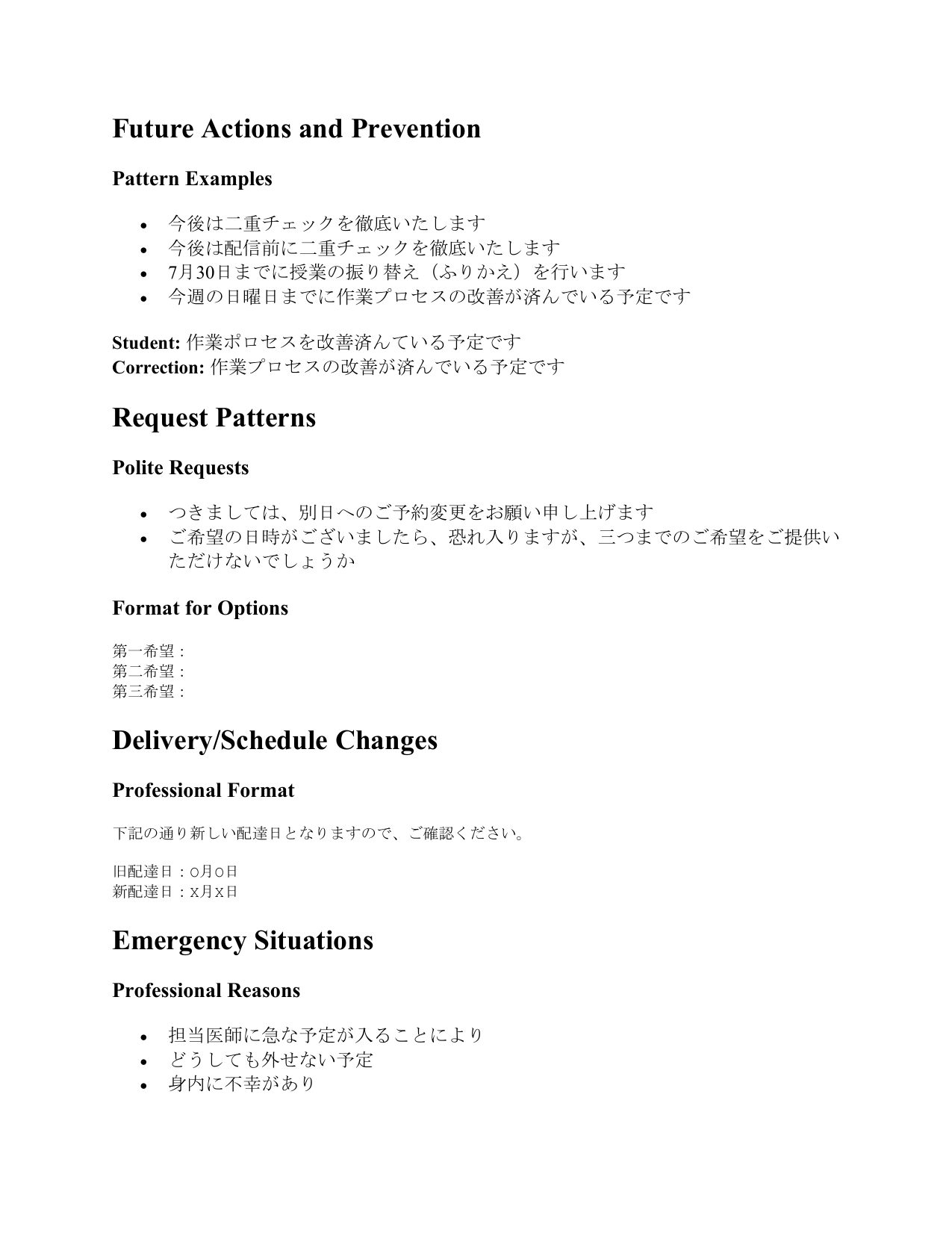
ENFuture Actions and Prevention
Pattern Examples
Pattern Examples
JP•今後は二重チェックを徹底いたします
•今後は配信前に二重チェックを徹底いたします
•7月30日までに授業の振り替え(ふりかえ)を行います
•今週の日曜日までに作業プロセスの改善が済んでいる予定です
Student:作業ポロセスを改善済んている予定です
Correction:作業プロセスの改善が済んでいる予定です
•今後は配信前に二重チェックを徹底いたします
•7月30日までに授業の振り替え(ふりかえ)を行います
•今週の日曜日までに作業プロセスの改善が済んでいる予定です
Student:作業ポロセスを改善済んている予定です
Correction:作業プロセスの改善が済んでいる予定です
ENRequest Patterns
Polite Requests
Polite Requests
JP•つきましては、別日へのご予約変更をお願い申し上げます
•ご希望の日時がございましたら、恐れ入りますが、三つまでのご希望をご提供い
ただけないでしょうか
•ご希望の日時がございましたら、恐れ入りますが、三つまでのご希望をご提供い
ただけないでしょうか
ENFormat for Options
JP第一希望:
第二希望:
第三希望:
第二希望:
第三希望:
ENDelivery/Schedule Changes
Professional Format
Professional Format
JP下記の通り新しい配達日となりますので、ご確認ください。
旧配達日:O月O日
新配達日:X月X日
旧配達日:O月O日
新配達日:X月X日
ENEmergency Situations
Professional Reasons
Professional Reasons
JP•担当医師に急な予定が入ることにより
•どうしても外せない予定
•身内に不幸があり
•どうしても外せない予定
•身内に不幸があり
หน้า 10
คลิกเพื่อขยาย
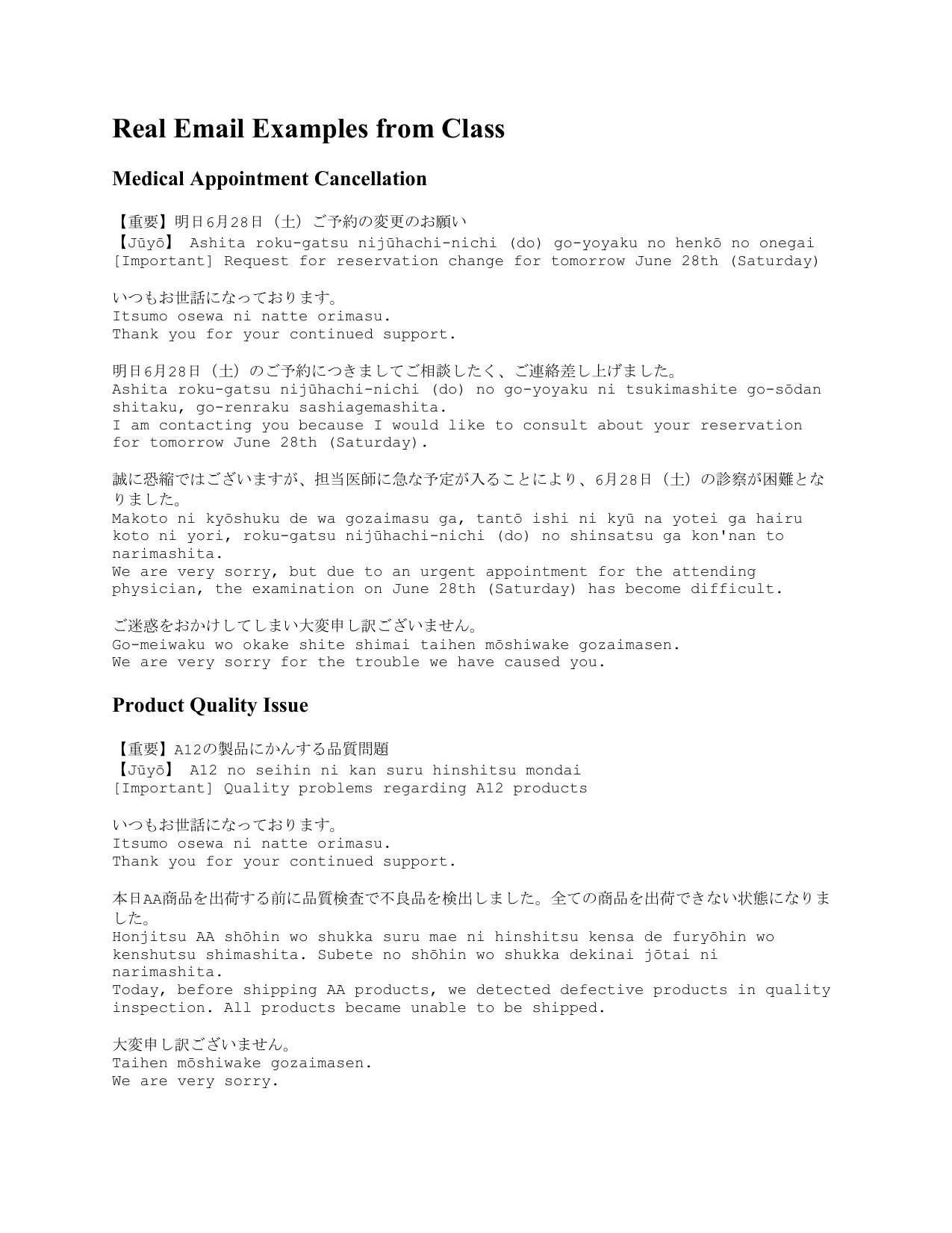
ENReal Email Examples from Class
Medical Appointment Cancellation
Medical Appointment Cancellation
JP【重要】明日6月28日(土)ご予約の変更のお願い
EN【Jūyō】 Ashita roku-gatsu nijūhachi-nichi (do) go-yoyaku no henkō no onegai
[Important] Request for reservation change for tomorrow June 28th (Saturday)
[Important] Request for reservation change for tomorrow June 28th (Saturday)
JPいつもお世話になっております。
ENItsumo osewa ni natte orimasu.
Thank you for your continued support.
Thank you for your continued support.
JP明日6月28日(土)のご予約につきましてご相談したく、ご連絡差し上げました。
ENAshita roku-gatsu nijūhachi-nichi (do) no go-yoyaku ni tsukimashite go-sōdan
shitaku, go-renraku sashiagemashita.
I am contacting you because I would like to consult about your reservation
for tomorrow June 28th (Saturday).
shitaku, go-renraku sashiagemashita.
I am contacting you because I would like to consult about your reservation
for tomorrow June 28th (Saturday).
JP誠に恐縮ではございますが、担当医師に急な予定が入ることにより、6月28日(土)の診察が困難とな
りました。
りました。
ENMakoto ni kyōshuku de wa gozaimasu ga, tantō ishi ni kyū na yotei ga hairu
koto ni yori, roku-gatsu nijūhachi-nichi (do) no shinsatsu ga kon'nan to
narimashita.
We are very sorry, but due to an urgent appointment for the attending
physician, the examination on June 28th (Saturday) has become difficult.
koto ni yori, roku-gatsu nijūhachi-nichi (do) no shinsatsu ga kon'nan to
narimashita.
We are very sorry, but due to an urgent appointment for the attending
physician, the examination on June 28th (Saturday) has become difficult.
JPご迷惑をおかけしてしまい大変申し訳ございません。
ENGo-meiwaku wo okake shite shimai taihen mōshiwake gozaimasen.
We are very sorry for the trouble we have caused you.
Product Quality Issue
We are very sorry for the trouble we have caused you.
Product Quality Issue
JP【重要】A12の製品にかんする品質問題
EN【Jūyō】 A12 no seihin ni kan suru hinshitsu mondai
[Important] Quality problems regarding A12 products
[Important] Quality problems regarding A12 products
JPいつもお世話になっております。
ENItsumo osewa ni natte orimasu.
Thank you for your continued support.
Thank you for your continued support.
JP本日AA商品を出荷する前に品質検査で不良品を検出しました。全ての商品を出荷できない状態になりま
した。
した。
ENHonjitsu AA shōhin wo shukka suru mae ni hinshitsu kensa de furyōhin wo
kenshutsu shimashita. Subete no shōhin wo shukka dekinai jōtai ni
narimashita.
Today, before shipping AA products, we detected defective products in quality
inspection. All products became unable to be shipped.
kenshutsu shimashita. Subete no shōhin wo shukka dekinai jōtai ni
narimashita.
Today, before shipping AA products, we detected defective products in quality
inspection. All products became unable to be shipped.
JP大変申し訳ございません。
ENTaihen mōshiwake gozaimasen.
We are very sorry.
We are very sorry.
หน้า 11
คลิกเพื่อขยาย
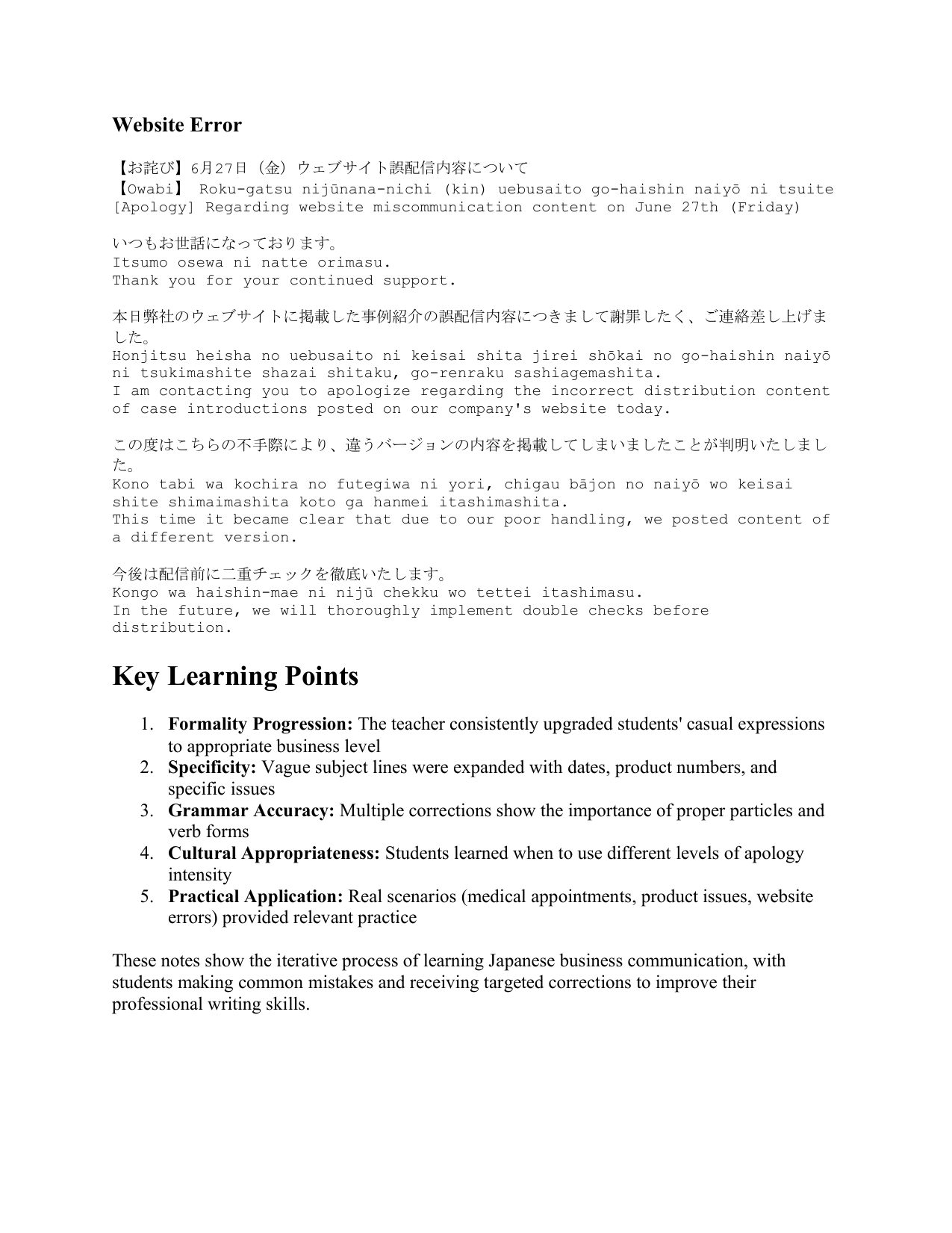
ENWebsite Error
JP【お詫び】6月27日(金)ウェブサイト誤配信内容について
EN【Owabi】 Roku-gatsu nijūnana-nichi (kin) uebusaito go-haishin naiyō ni tsuite
[Apology] Regarding website miscommunication content on June 27th (Friday)
[Apology] Regarding website miscommunication content on June 27th (Friday)
JPいつもお世話になっております。
ENItsumo osewa ni natte orimasu.
Thank you for your continued support.
Thank you for your continued support.
JP本日弊社のウェブサイトに掲載した事例紹介の誤配信内容につきまして謝罪したく、ご連絡差し上げま
した。
した。
ENHonjitsu heisha no uebusaito ni keisai shita jirei shōkai no go-haishin naiyō
ni tsukimashite shazai shitaku, go-renraku sashiagemashita.
I am contacting you to apologize regarding the incorrect distribution content
of case introductions posted on our company's website today.
ni tsukimashite shazai shitaku, go-renraku sashiagemashita.
I am contacting you to apologize regarding the incorrect distribution content
of case introductions posted on our company's website today.
JPこの度はこちらの不手際により、違うバージョンの内容を掲載してしまいましたことが判明いたしまし
た。
た。
ENKono tabi wa kochira no futegiwa ni yori, chigau bājon no naiyō wo keisai
shite shimaimashita koto ga hanmei itashimashita.
This time it became clear that due to our poor handling, we posted content of
a different version.
shite shimaimashita koto ga hanmei itashimashita.
This time it became clear that due to our poor handling, we posted content of
a different version.
JP今後は配信前に二重チェックを徹底いたします。
ENKongo wa haishin-mae ni nijū chekku wo tettei itashimasu.
In the future, we will thoroughly implement double checks before
distribution.
Key Learning Points
1. Formality Progression: The teacher consistently upgraded students' casual expressions
to appropriate business level
2. Specificity: Vague subject lines were expanded with dates, product numbers, and
specific issues
3. Grammar Accuracy: Multiple corrections show the importance of proper particles and
verb forms
4. Cultural Appropriateness: Students learned when to use different levels of apology
intensity
5. Practical Application: Real scenarios (medical appointments, product issues, website
errors) provided relevant practice
These notes show the iterative process of learning Japanese business communication, with
students making common mistakes and receiving targeted corrections to improve their
professional writing skills.
In the future, we will thoroughly implement double checks before
distribution.
Key Learning Points
1. Formality Progression: The teacher consistently upgraded students' casual expressions
to appropriate business level
2. Specificity: Vague subject lines were expanded with dates, product numbers, and
specific issues
3. Grammar Accuracy: Multiple corrections show the importance of proper particles and
verb forms
4. Cultural Appropriateness: Students learned when to use different levels of apology
intensity
5. Practical Application: Real scenarios (medical appointments, product issues, website
errors) provided relevant practice
These notes show the iterative process of learning Japanese business communication, with
students making common mistakes and receiving targeted corrections to improve their
professional writing skills.