หน้า 1
คลิกเพื่อขยาย
ENJAPANESE STUDY LIBRARY · VOLUME 3
Workplace Communication Toolkit
職場コミュニケーション — Shokuba Komyunikeeshon
Cushion words, requests, reports, apologies, gratitude, connectors, and everyday set phrases
Volume 3 of 9
Workplace Communication Toolkit
職場コミュニケーション — Shokuba Komyunikeeshon
Cushion words, requests, reports, apologies, gratitude, connectors, and everyday set phrases
Volume 3 of 9
หน้า 2
คลิกเพื่อขยาย
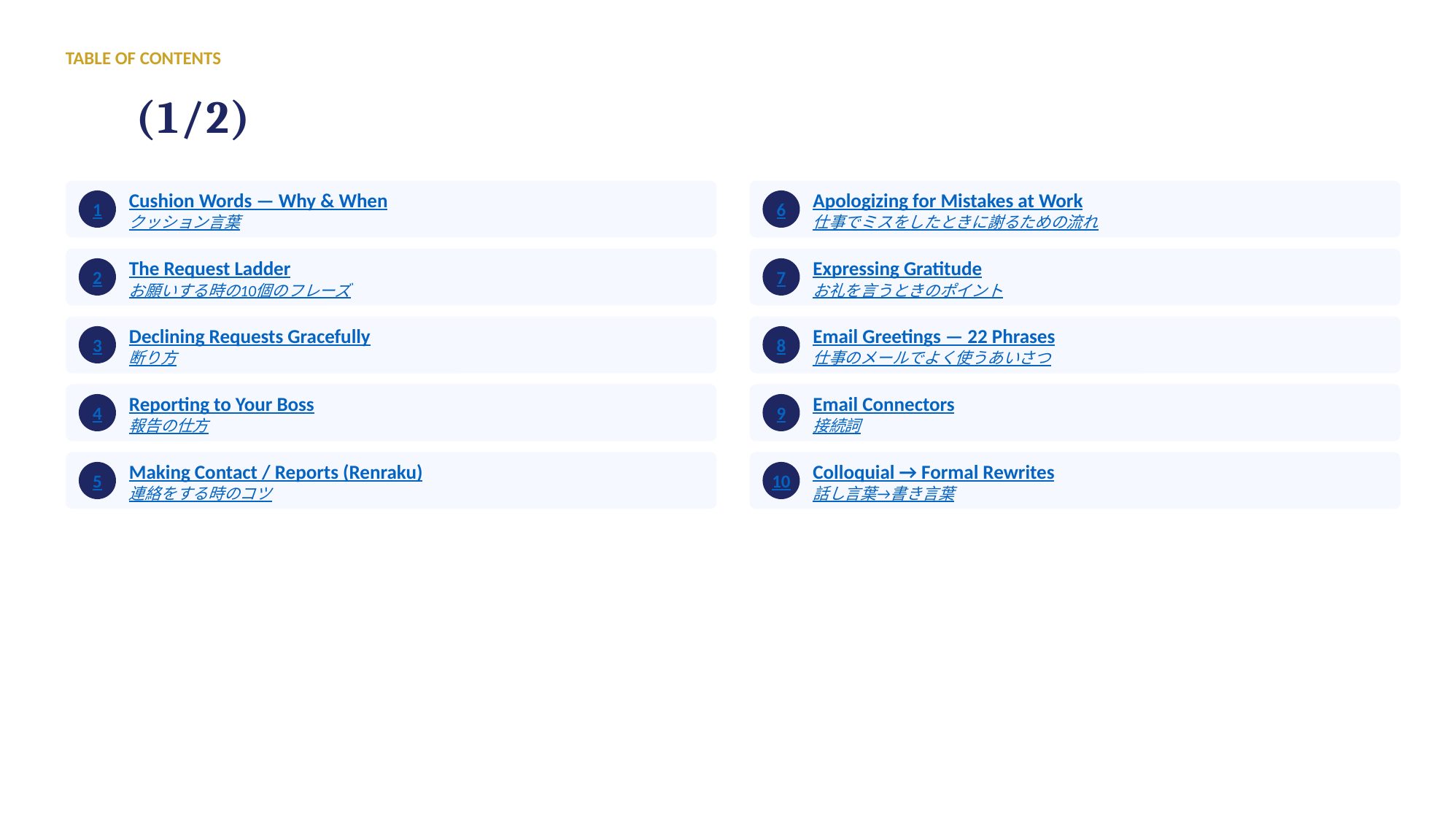
ENTABLE OF CONTENTS
THสารบัญ (1/2)
EN 1 Cushion Words — Why & When 6 Apologizing for Mistakes at Work
JPクッション言葉仕事でミスをしたときに謝るための流れ
EN 2 The Request Ladder 7 Expressing Gratitude
JPお願いする時の10個のフレーズお礼を言うときのポイント
EN 3 Declining Requests Gracefully 8 Email Greetings — 22 Phrases
JP断り方仕事のメールでよく使うあいさつ
EN 4 Reporting to Your Boss 9 Email Connectors
JP報告の仕方接続詞
EN 5 Making Contact / Reports (Renraku) 10 Colloquial → Formal Rewrites
JP連絡をする時のコツ話し言葉→書き言葉
หน้า 3
คลิกเพื่อขยาย
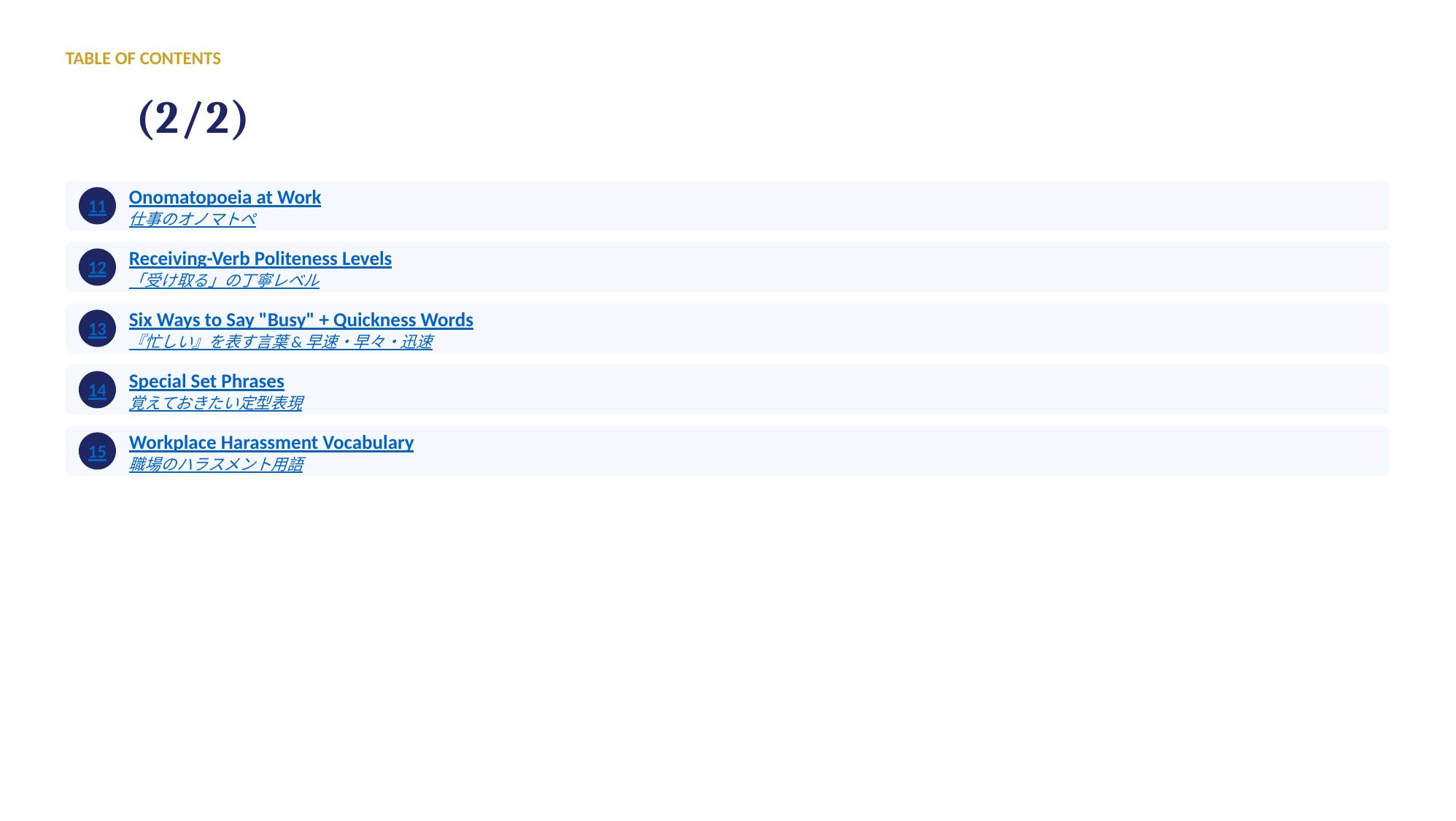
ENTABLE OF CONTENTS
THสารบัญ (2/2)
EN 11 Onomatopoeia at Work
JP仕事のオノマトペ
EN 12 Receiving-Verb Politeness Levels
JP「受け取る」の丁寧レベル
EN 13 Six Ways to Say "Busy" + Quickness Words
JP『忙しい』を表す言葉&早速・早々・迅速
EN 14 Special Set Phrases
JP覚えておきたい定型表現
EN 15 Workplace Harassment Vocabulary
JP職場のハラスメント用語
หน้า 4
คลิกเพื่อขยาย
01
ENCushion Words — Why & When
JPクッション言葉
EN13 softening phrases for requests, questions & refusals, across 4 situations
หน้า 5
คลิกเพื่อขยาย
ENWHY
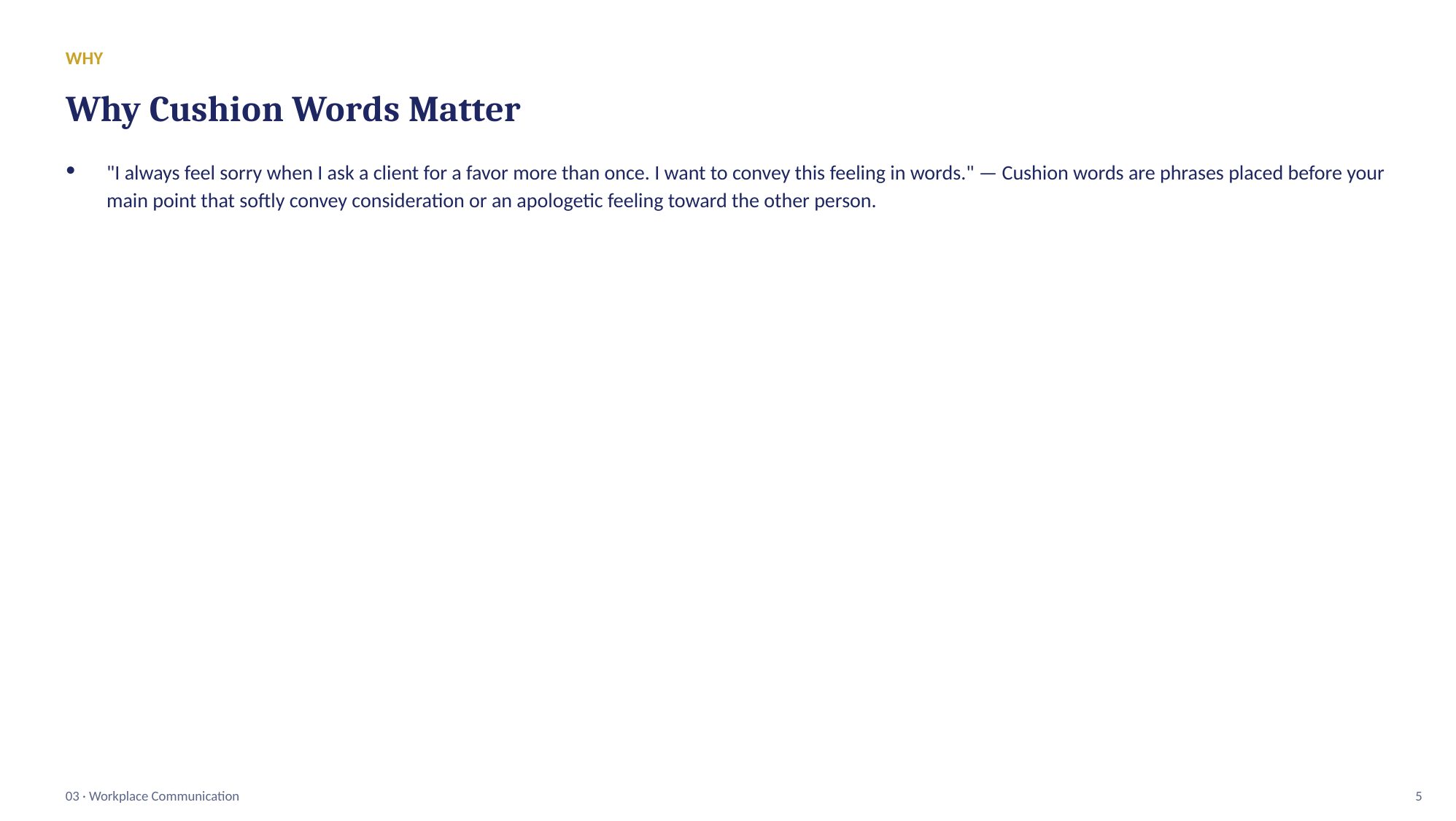
Why Cushion Words Matter
• "I always feel sorry when I ask a client for a favor more than once. I want to convey this feeling in words." — Cushion words are phrases placed before your
main point that softly convey consideration or an apologetic feeling toward the other person.
03 · Workplace Communication 5
Why Cushion Words Matter
• "I always feel sorry when I ask a client for a favor more than once. I want to convey this feeling in words." — Cushion words are phrases placed before your
main point that softly convey consideration or an apologetic feeling toward the other person.
03 · Workplace Communication 5
หน้า 6
คลิกเพื่อขยาย
EN4 SITUATIONS
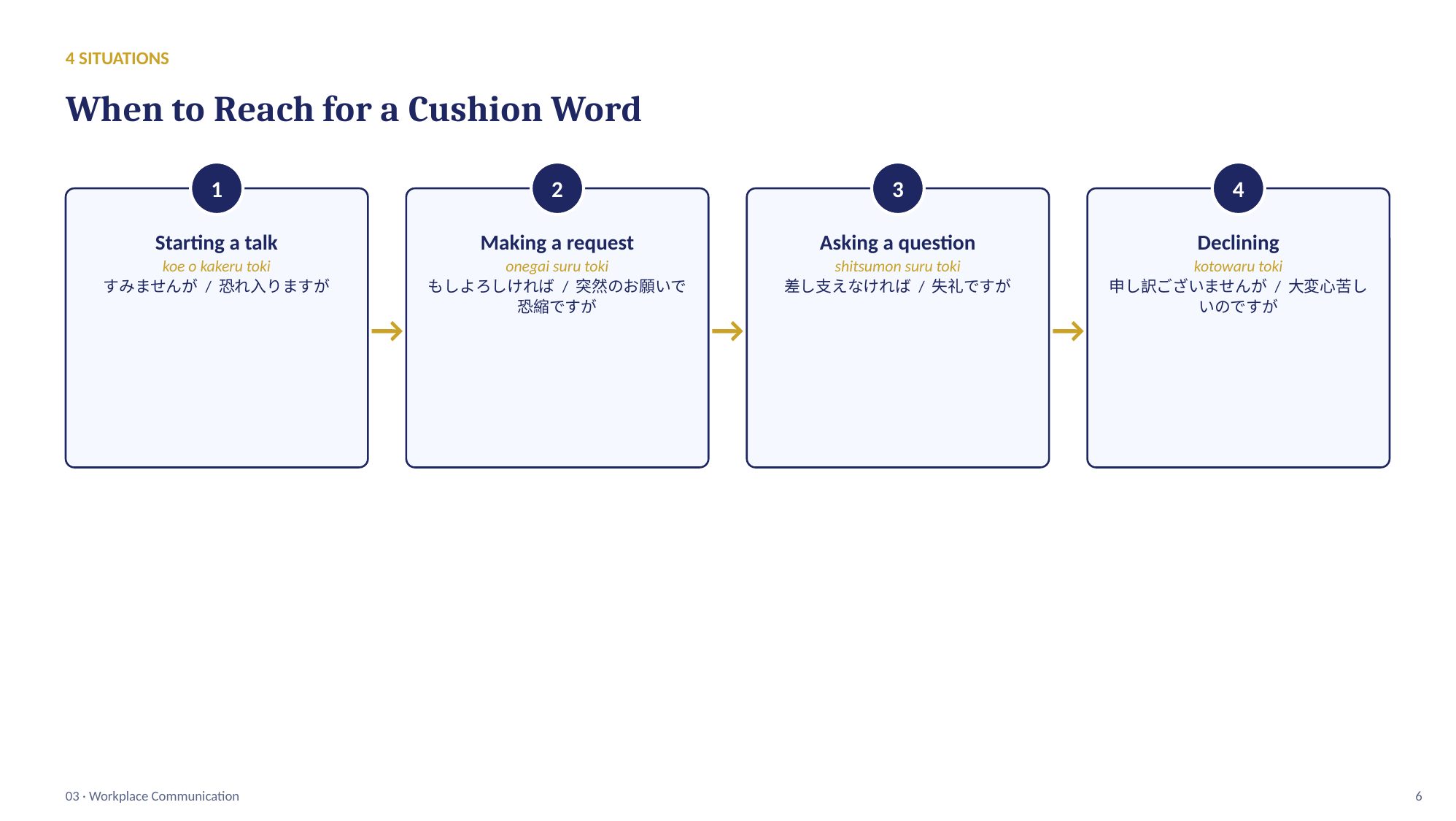
When to Reach for a Cushion Word
1 2 3 4
Starting a talk Making a request Asking a question Declining
koe o kakeru toki onegai suru toki shitsumon suru toki kotowaru toki
When to Reach for a Cushion Word
1 2 3 4
Starting a talk Making a request Asking a question Declining
koe o kakeru toki onegai suru toki shitsumon suru toki kotowaru toki
JPすみませんが/恐れ入りますがもしよろしければ/突然のお願いで差し支えなければ/失礼ですが申し訳ございませんが/大変心苦し
恐縮ですがいのですが
→→→
恐縮ですがいのですが
→→→
EN03 · Workplace Communication 6
หน้า 7
คลิกเพื่อขยาย
ENTHE 13 CUSHION WORDS
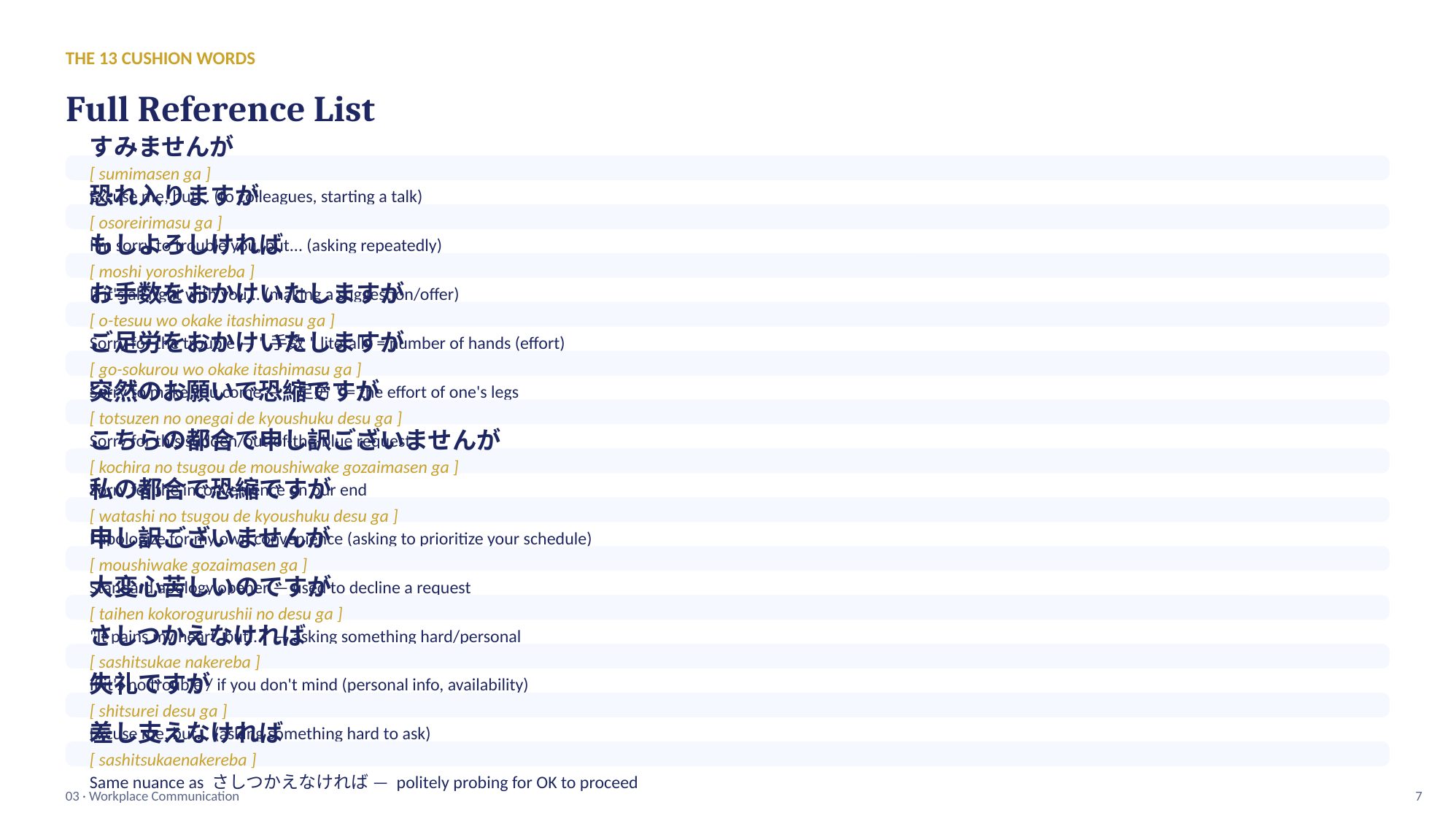
Full Reference List
Full Reference List
JPすみませんが
EN [ sumimasen ga ]
JP恐れ入りますが
EN Excuse me, but... (to colleagues, starting a talk)
[ osoreirimasu ga ]
[ osoreirimasu ga ]
JPもしよろしければ
EN I'm sorry to trouble you, but... (asking repeatedly)
[ moshi yoroshikereba ]
[ moshi yoroshikereba ]
JPお手数をおかけいたしますが
EN If it's all right with you... (making a suggestion/offer)
[ o-tesuu wo okake itashimasu ga ]
[ o-tesuu wo okake itashimasu ga ]
JPご足労をおかけいたしますが
EN Sorry for the trouble — " 手数 " literally = number of hands (effort)
[ go-sokurou wo okake itashimasu ga ]
[ go-sokurou wo okake itashimasu ga ]
JP突然のお願いで恐縮ですが
EN Sorry to make you come — " 足労 " = the effort of one's legs
[ totsuzen no onegai de kyoushuku desu ga ]
[ totsuzen no onegai de kyoushuku desu ga ]
JPこちらの都合で申し訳ございませんが
EN Sorry for this sudden/out-of-the-blue request
[ kochira no tsugou de moushiwake gozaimasen ga ]
[ kochira no tsugou de moushiwake gozaimasen ga ]
JP私の都合で恐縮ですが
EN Sorry for the inconvenience on our end
[ watashi no tsugou de kyoushuku desu ga ]
[ watashi no tsugou de kyoushuku desu ga ]
JP申し訳ございませんが
EN I apologize for my own convenience (asking to prioritize your schedule)
[ moushiwake gozaimasen ga ]
[ moushiwake gozaimasen ga ]
JP大変心苦しいのですが
EN Standard apology opener — used to decline a request
[ taihen kokorogurushii no desu ga ]
[ taihen kokorogurushii no desu ga ]
JPさしつかえなければ
EN "It pains my heart, but..." — asking something hard/personal
[ sashitsukae nakereba ]
[ sashitsukae nakereba ]
JP失礼ですが
EN If it's no trouble / if you don't mind (personal info, availability)
[ shitsurei desu ga ]
[ shitsurei desu ga ]
JP差し支えなければ
EN Excuse me, but... (asking something hard to ask)
[ sashitsukaenakereba ]
Same nuance as さしつかえなければ — politely probing for OK to proceed
03 · Workplace Communication 7
[ sashitsukaenakereba ]
Same nuance as さしつかえなければ — politely probing for OK to proceed
03 · Workplace Communication 7
หน้า 8
คลิกเพื่อขยาย
ENIN USE
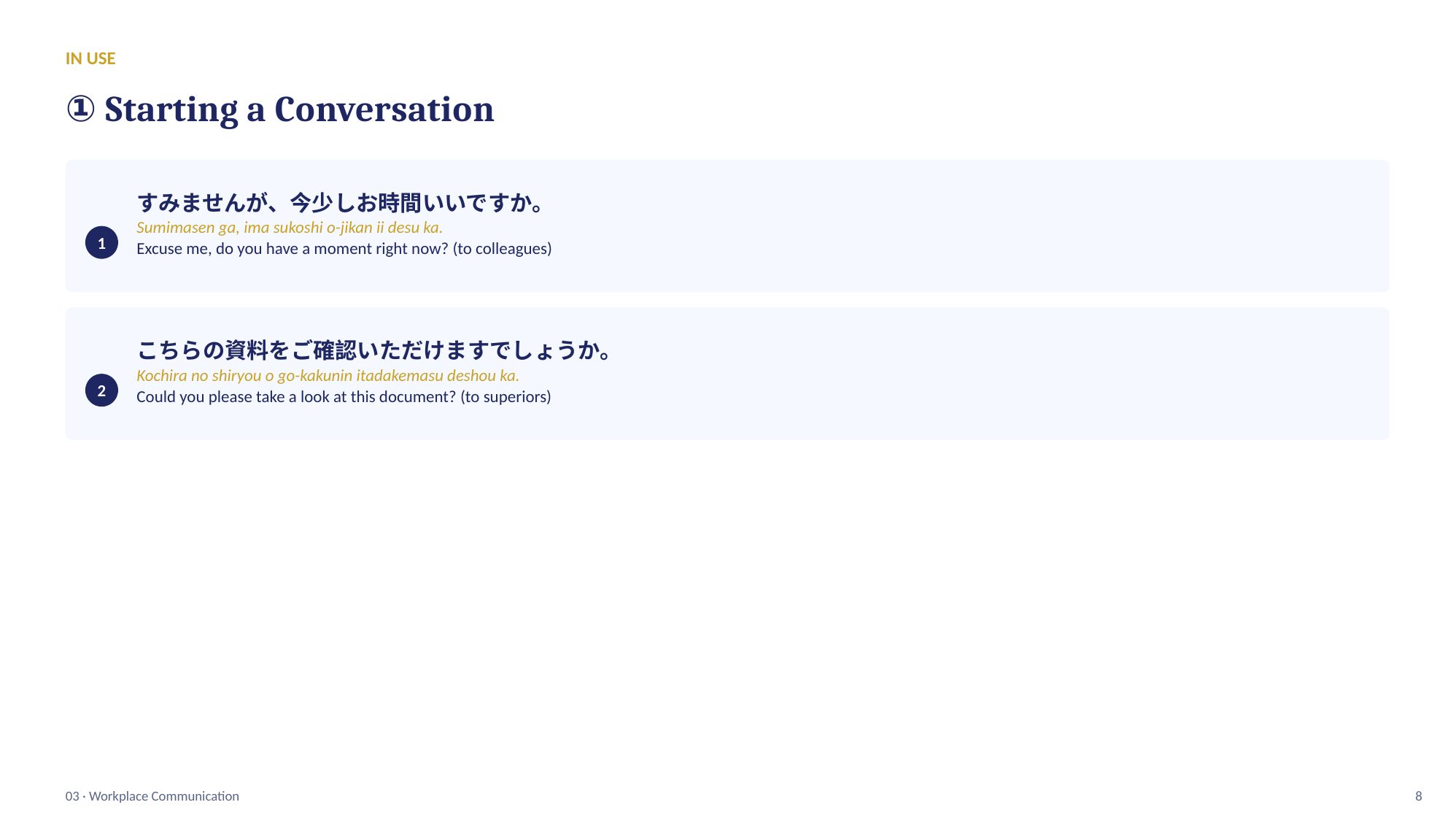
① Starting a Conversation
① Starting a Conversation
JPすみませんが、今少しお時間いいですか。
EN Sumimasen ga, ima sukoshi o-jikan ii desu ka.
1 Excuse me, do you have a moment right now? (to colleagues)
1 Excuse me, do you have a moment right now? (to colleagues)
JPこちらの資料をご確認いただけますでしょうか。
EN Kochira no shiryou o go-kakunin itadakemasu deshou ka.
2 Could you please take a look at this document? (to superiors)
03 · Workplace Communication 8
2 Could you please take a look at this document? (to superiors)
03 · Workplace Communication 8
หน้า 9
คลิกเพื่อขยาย
ENIN USE
② Making a Request
② Making a Request
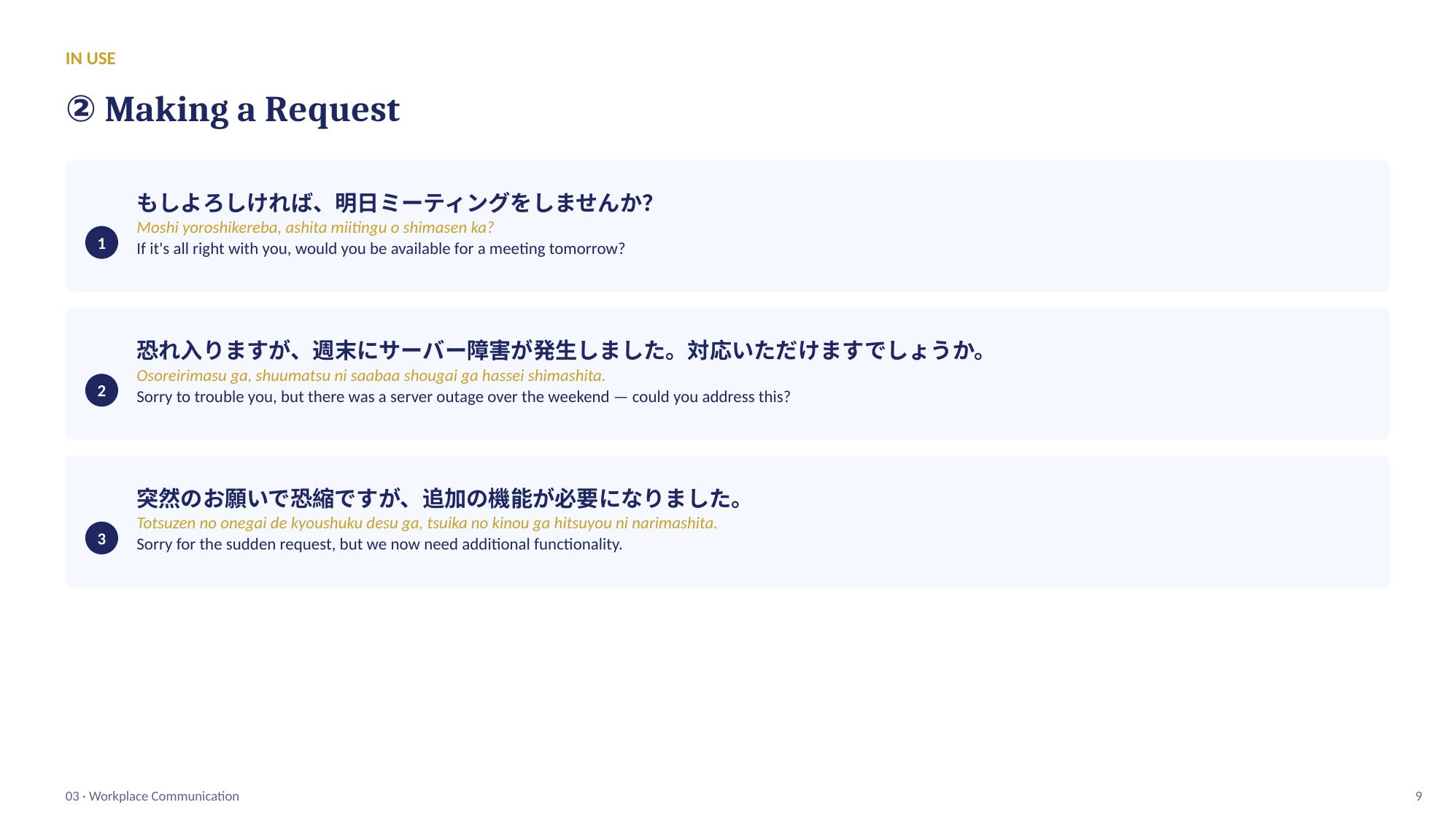
JPもしよろしければ、明日ミーティングをしませんか?
EN Moshi yoroshikereba, ashita miitingu o shimasen ka?
1 If it's all right with you, would you be available for a meeting tomorrow?
1 If it's all right with you, would you be available for a meeting tomorrow?
JP恐れ入りますが、週末にサーバー障害が発生しました。対応いただけますでしょうか。
EN Osoreirimasu ga, shuumatsu ni saabaa shougai ga hassei shimashita.
2 Sorry to trouble you, but there was a server outage over the weekend — could you address this?
2 Sorry to trouble you, but there was a server outage over the weekend — could you address this?
JP突然のお願いで恐縮ですが、追加の機能が必要になりました。
EN Totsuzen no onegai de kyoushuku desu ga, tsuika no kinou ga hitsuyou ni narimashita.
3 Sorry for the sudden request, but we now need additional functionality.
03 · Workplace Communication 9
3 Sorry for the sudden request, but we now need additional functionality.
03 · Workplace Communication 9
หน้า 10

คลิกเพื่อขยาย
02
ENThe Request Ladder
JPお願いする時の10個のフレーズ
ENTen request patterns, ranked from considerate to most deferential
หน้า 11
คลิกเพื่อขยาย
EN10 PATTERNS
Ten Ways to Make a Request
Ten Ways to Make a Request
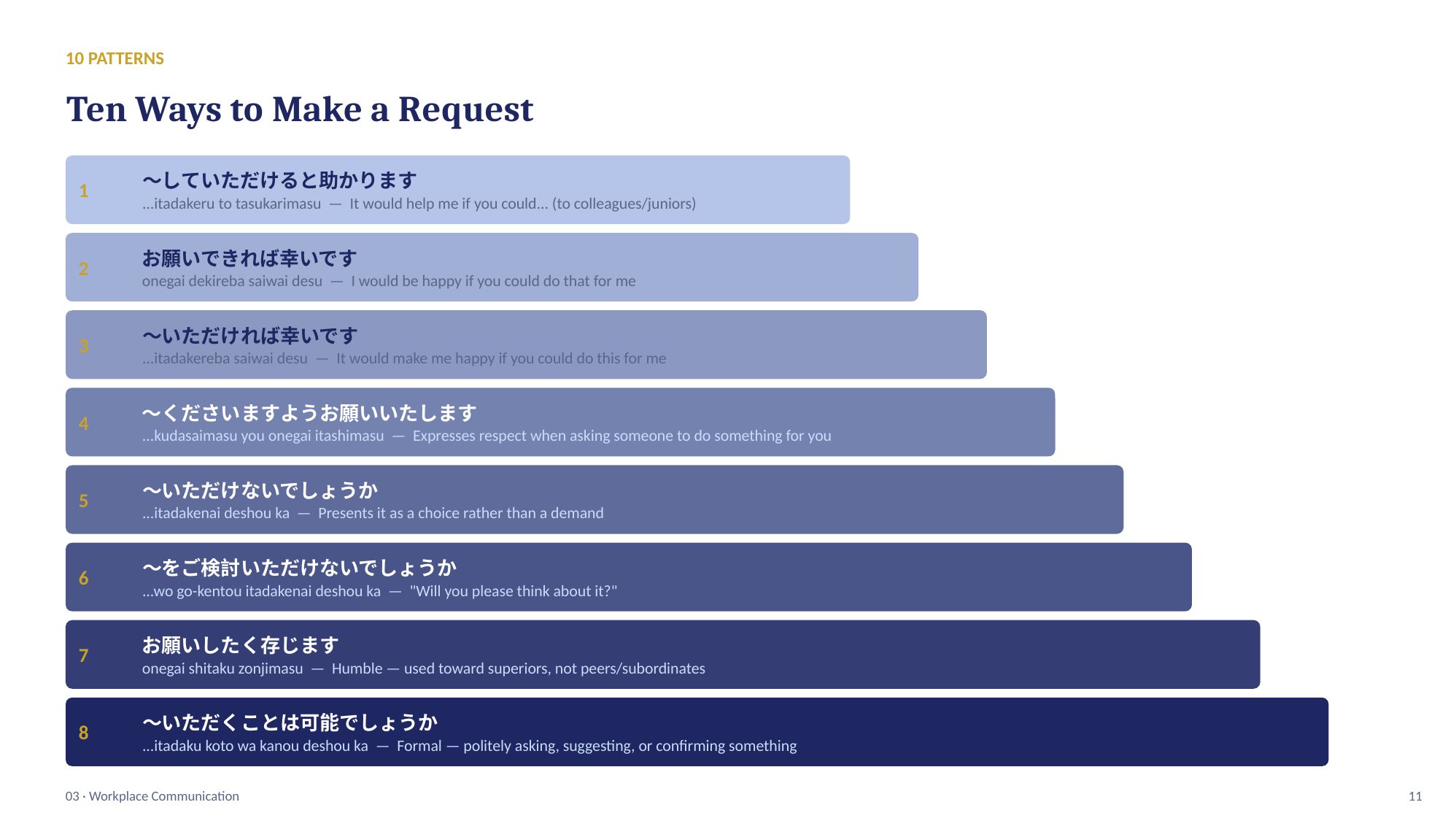
JP1〜していただけると助かります
EN ...itadakeru to tasukarimasu — It would help me if you could... (to colleagues/juniors)
JP2お願いできれば幸いです
EN onegai dekireba saiwai desu — I would be happy if you could do that for me
JP3〜いただければ幸いです
EN ...itadakereba saiwai desu — It would make me happy if you could do this for me
JP4〜くださいますようお願いいたします
EN ...kudasaimasu you onegai itashimasu — Expresses respect when asking someone to do something for you
JP5〜いただけないでしょうか
EN ...itadakenai deshou ka — Presents it as a choice rather than a demand
JP6〜をご検討いただけないでしょうか
EN ...wo go-kentou itadakenai deshou ka — "Will you please think about it?"
JP7お願いしたく存じます
EN onegai shitaku zonjimasu — Humble — used toward superiors, not peers/subordinates
JP8〜いただくことは可能でしょうか
EN ...itadaku koto wa kanou deshou ka — Formal — politely asking, suggesting, or confirming something
03 · Workplace Communication 11
03 · Workplace Communication 11
หน้า 12
คลิกเพื่อขยาย
ENIN USE
Request Patterns — Examples
Request Patterns — Examples
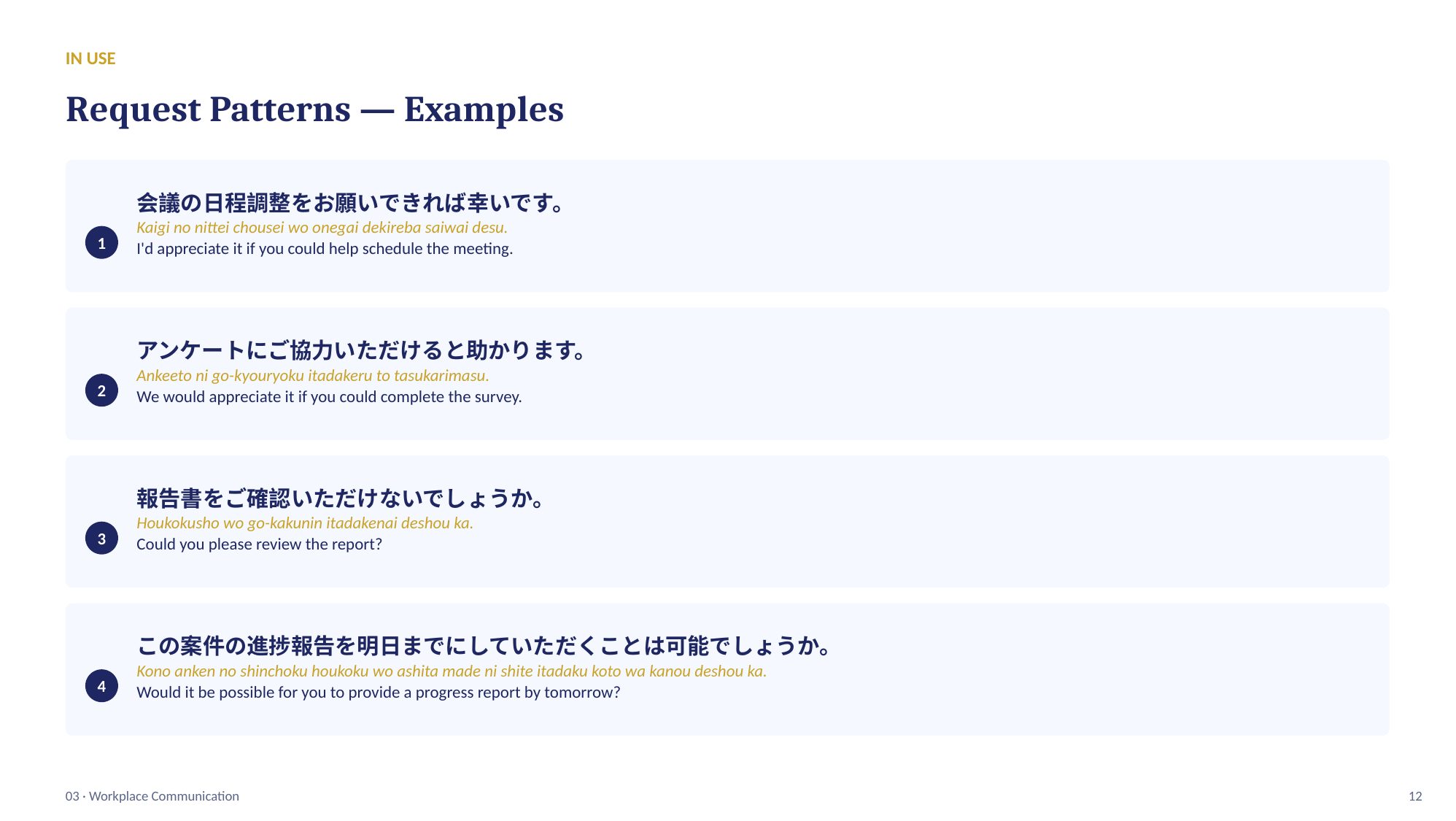
JP会議の日程調整をお願いできれば幸いです。
EN Kaigi no nittei chousei wo onegai dekireba saiwai desu.
1 I'd appreciate it if you could help schedule the meeting.
1 I'd appreciate it if you could help schedule the meeting.
JPアンケートにご協力いただけると助かります。
EN Ankeeto ni go-kyouryoku itadakeru to tasukarimasu.
2 We would appreciate it if you could complete the survey.
2 We would appreciate it if you could complete the survey.
JP報告書をご確認いただけないでしょうか。
EN Houkokusho wo go-kakunin itadakenai deshou ka.
3 Could you please review the report?
3 Could you please review the report?
JPこの案件の進捗報告を明日までにしていただくことは可能でしょうか。
EN Kono anken no shinchoku houkoku wo ashita made ni shite itadaku koto wa kanou deshou ka.
4 Would it be possible for you to provide a progress report by tomorrow?
03 · Workplace Communication 12
4 Would it be possible for you to provide a progress report by tomorrow?
03 · Workplace Communication 12
หน้า 13
คลิกเพื่อขยาย
ENAPOLOGETIC ADD-ONS
Cushion Phrases That Precede a Big Ask
Cushion Phrases That Precede a Big Ask
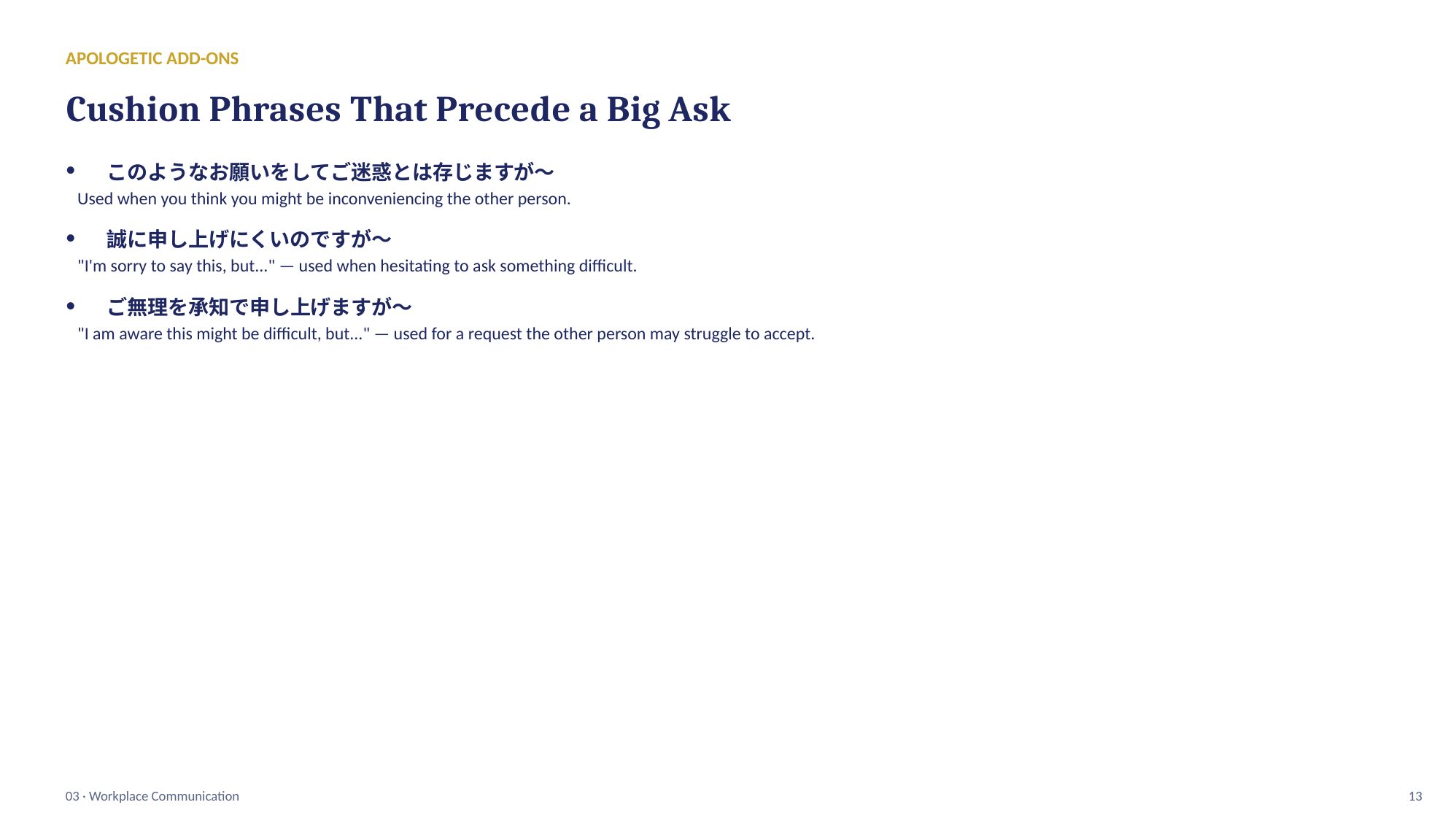
JP•このようなお願いをしてご迷惑とは存じますが〜
EN Used when you think you might be inconveniencing the other person.
JP•誠に申し上げにくいのですが〜
EN "I'm sorry to say this, but..." — used when hesitating to ask something difficult.
JP•ご無理を承知で申し上げますが〜
EN "I am aware this might be difficult, but..." — used for a request the other person may struggle to accept.
03 · Workplace Communication 13
03 · Workplace Communication 13
หน้า 14

คลิกเพื่อขยาย
03
ENDeclining Requests Gracefully
JP断り方
ENThe affirmative-refusal method, and how to say "I can't" politely
หน้า 15
คลิกเพื่อขยาย
ENWORD SWAP
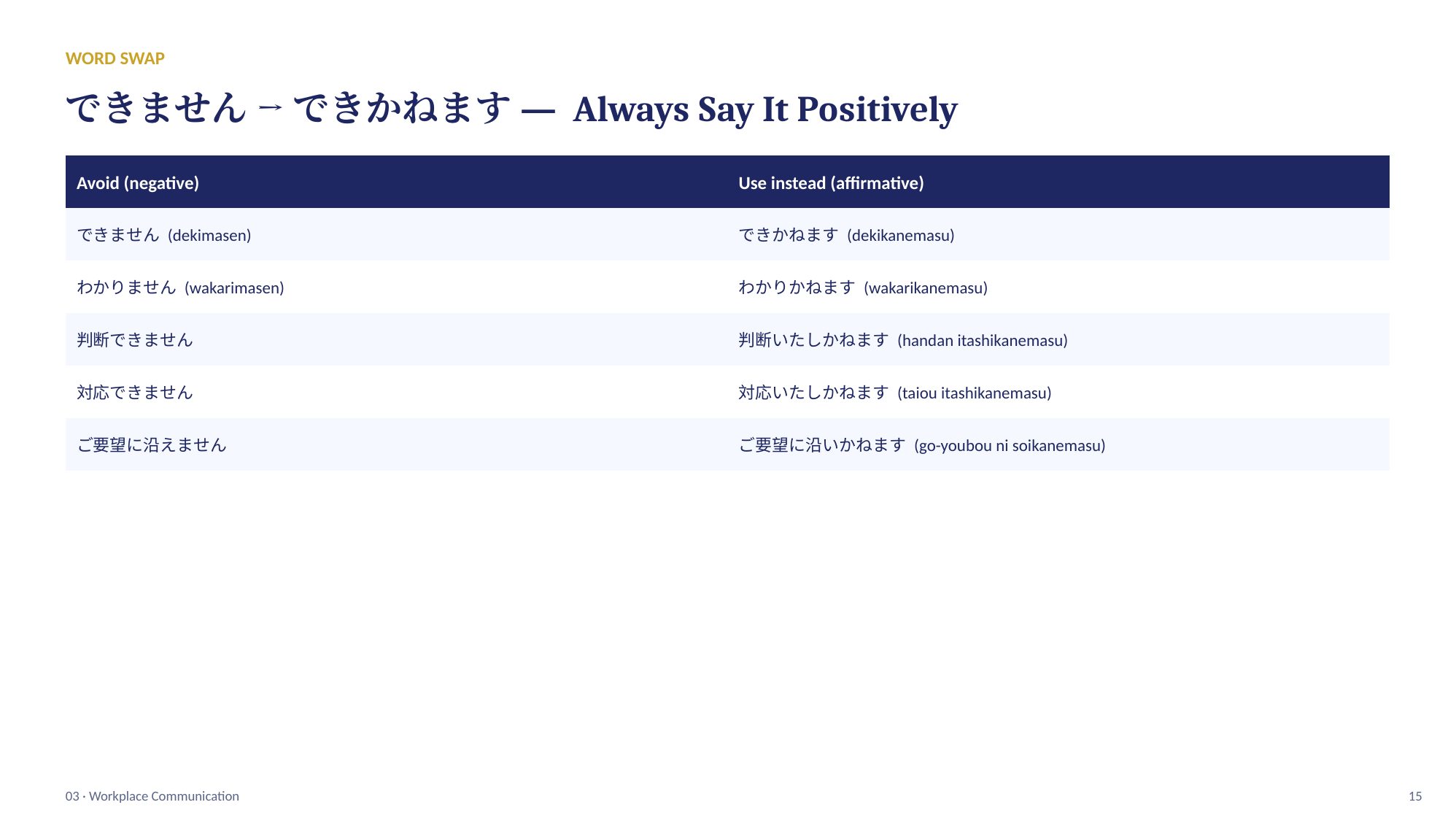
できません → できかねます — Always Say It Positively
Avoid (negative) Use instead (affirmative)
できません (dekimasen) できかねます (dekikanemasu)
わかりません (wakarimasen) わかりかねます (wakarikanemasu)
判断できません 判断いたしかねます (handan itashikanemasu)
対応できません 対応いたしかねます (taiou itashikanemasu)
ご要望に沿えません ご要望に沿いかねます (go-youbou ni soikanemasu)
03 · Workplace Communication 15
できません → できかねます — Always Say It Positively
Avoid (negative) Use instead (affirmative)
できません (dekimasen) できかねます (dekikanemasu)
わかりません (wakarimasen) わかりかねます (wakarikanemasu)
判断できません 判断いたしかねます (handan itashikanemasu)
対応できません 対応いたしかねます (taiou itashikanemasu)
ご要望に沿えません ご要望に沿いかねます (go-youbou ni soikanemasu)
03 · Workplace Communication 15
หน้า 16
คลิกเพื่อขยาย
ENCUSHION + REASON + ALTERNATIVE
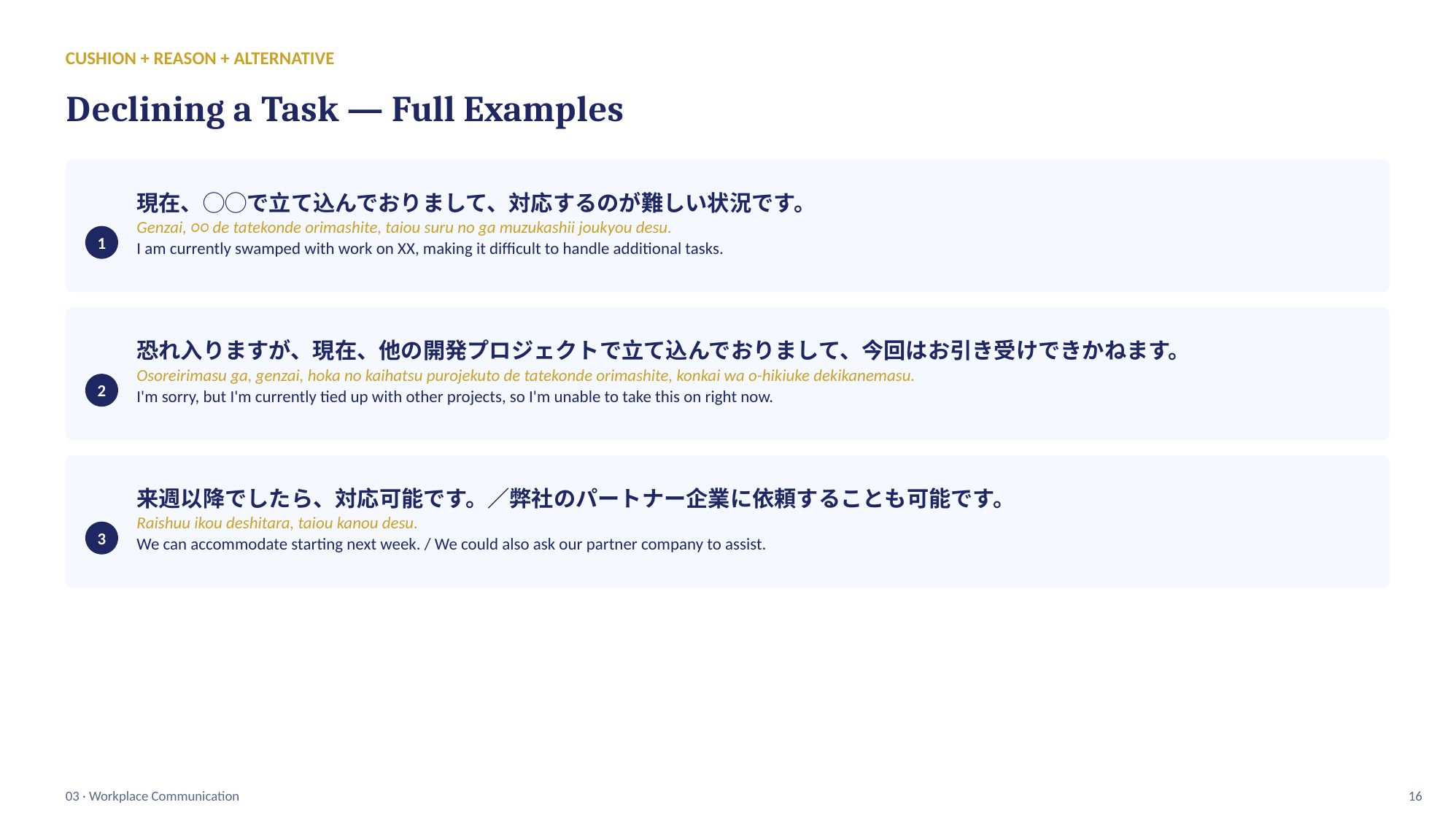
Declining a Task — Full Examples
Declining a Task — Full Examples
JP現在、◯◯で立て込んでおりまして、対応するのが難しい状況です。
EN Genzai, ○○ de tatekonde orimashite, taiou suru no ga muzukashii joukyou desu.
1 I am currently swamped with work on XX, making it difficult to handle additional tasks.
1 I am currently swamped with work on XX, making it difficult to handle additional tasks.
JP恐れ入りますが、現在、他の開発プロジェクトで立て込んでおりまして、今回はお引き受けできかねます。
EN Osoreirimasu ga, genzai, hoka no kaihatsu purojekuto de tatekonde orimashite, konkai wa o-hikiuke dekikanemasu.
2 I'm sorry, but I'm currently tied up with other projects, so I'm unable to take this on right now.
2 I'm sorry, but I'm currently tied up with other projects, so I'm unable to take this on right now.
JP来週以降でしたら、対応可能です。/弊社のパートナー企業に依頼することも可能です。
EN Raishuu ikou deshitara, taiou kanou desu.
3 We can accommodate starting next week. / We could also ask our partner company to assist.
03 · Workplace Communication 16
3 We can accommodate starting next week. / We could also ask our partner company to assist.
03 · Workplace Communication 16
หน้า 17
คลิกเพื่อขยาย
ENJOB/TASK DECLINES
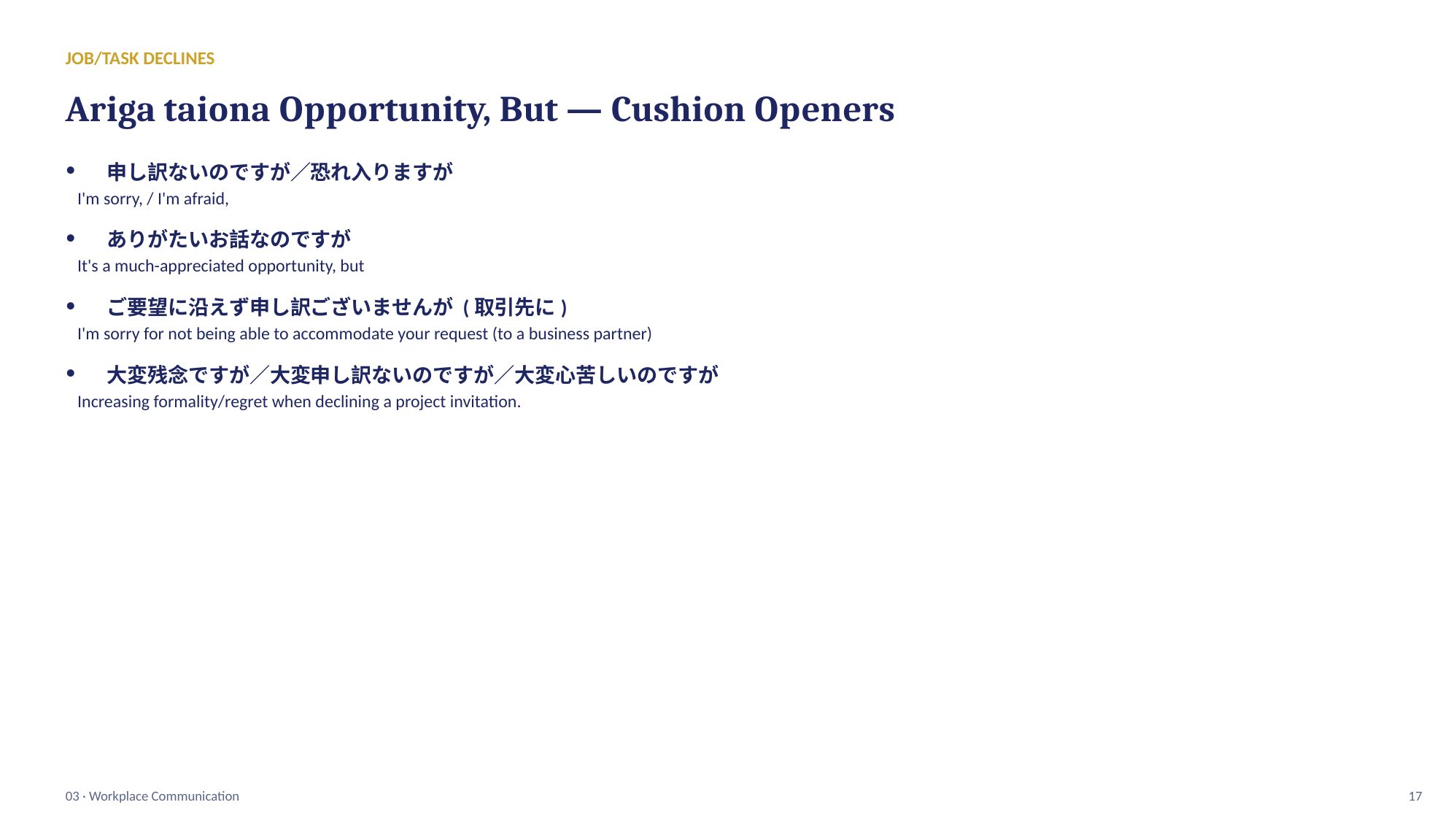
Ariga taiona Opportunity, But — Cushion Openers
Ariga taiona Opportunity, But — Cushion Openers
JP•申し訳ないのですが/恐れ入りますが
EN I'm sorry, / I'm afraid,
JP•ありがたいお話なのですが
EN It's a much-appreciated opportunity, but
JP•ご要望に沿えず申し訳ございませんが(取引先に)
EN I'm sorry for not being able to accommodate your request (to a business partner)
JP•大変残念ですが/大変申し訳ないのですが/大変心苦しいのですが
EN Increasing formality/regret when declining a project invitation.
03 · Workplace Communication 17
03 · Workplace Communication 17
หน้า 18

คลิกเพื่อขยาย
04
ENReporting to Your Boss
JP報告の仕方
ENHow to approach, structure, and deliver a report — in person or in a meeting
หน้า 19
คลิกเพื่อขยาย
ENAPPROACHING
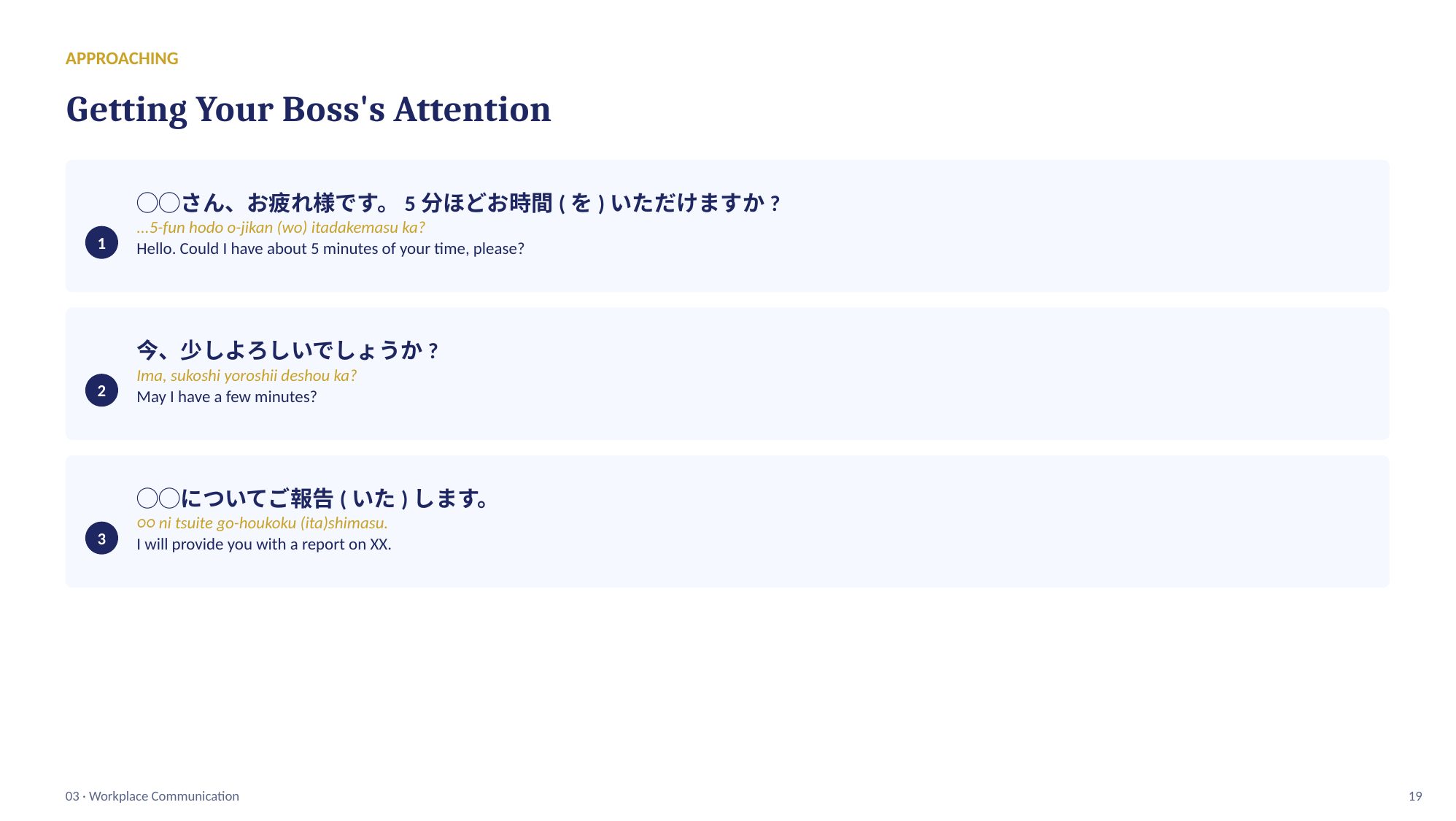
Getting Your Boss's Attention
Getting Your Boss's Attention
JP◯◯さん、お疲れ様です。5分ほどお時間(を)いただけますか?
EN ...5-fun hodo o-jikan (wo) itadakemasu ka?
1 Hello. Could I have about 5 minutes of your time, please?
1 Hello. Could I have about 5 minutes of your time, please?
JP今、少しよろしいでしょうか?
EN Ima, sukoshi yoroshii deshou ka?
2 May I have a few minutes?
2 May I have a few minutes?
JP◯◯についてご報告(いた)します。
EN ○○ ni tsuite go-houkoku (ita)shimasu.
3 I will provide you with a report on XX.
03 · Workplace Communication 19
3 I will provide you with a report on XX.
03 · Workplace Communication 19
หน้า 20
คลิกเพื่อขยาย
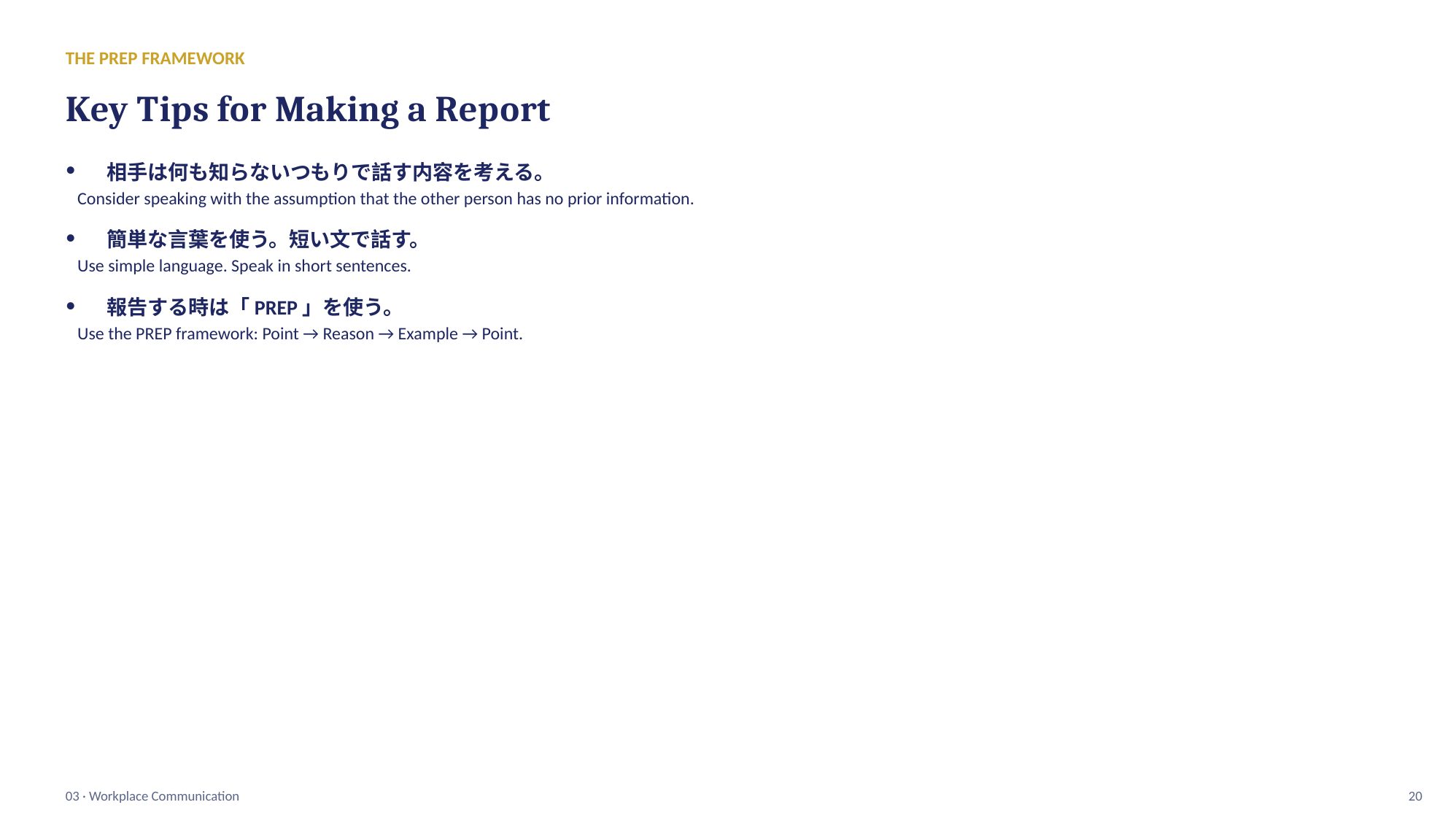
ENTHE PREP FRAMEWORK
Key Tips for Making a Report
Key Tips for Making a Report
JP•相手は何も知らないつもりで話す内容を考える。
EN Consider speaking with the assumption that the other person has no prior information.
JP•簡単な言葉を使う。短い文で話す。
EN Use simple language. Speak in short sentences.
JP•報告する時は「PREP」を使う。
EN Use the PREP framework: Point → Reason → Example → Point.
03 · Workplace Communication 20
03 · Workplace Communication 20
หน้า 21
คลิกเพื่อขยาย
ENSTRUCTURING & CLOSING
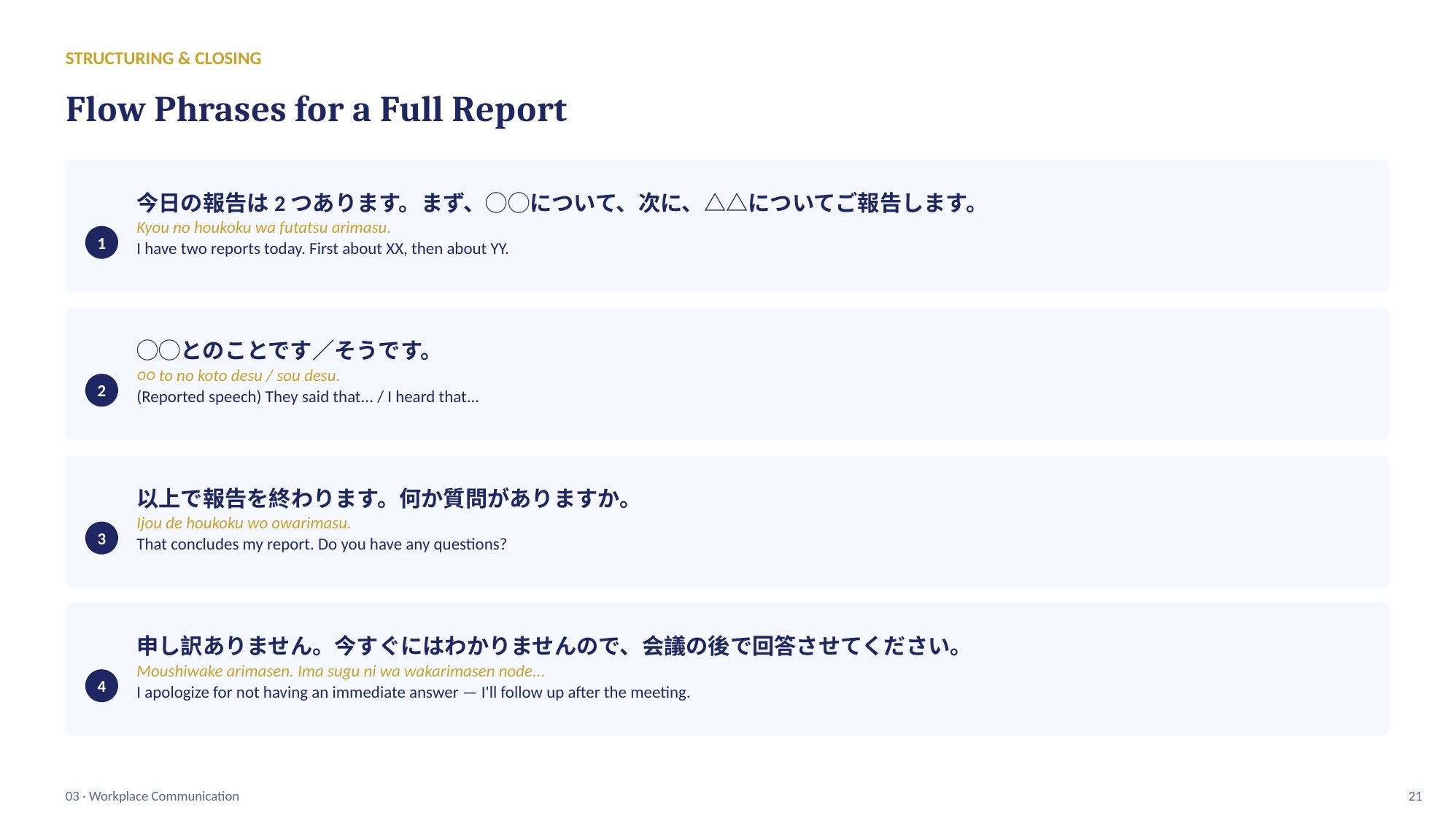
Flow Phrases for a Full Report
Flow Phrases for a Full Report
JP今日の報告は2つあります。まず、◯◯について、次に、△△についてご報告します。
EN Kyou no houkoku wa futatsu arimasu.
1 I have two reports today. First about XX, then about YY.
1 I have two reports today. First about XX, then about YY.
JP◯◯とのことです/そうです。
EN ○○ to no koto desu / sou desu.
2 (Reported speech) They said that... / I heard that...
2 (Reported speech) They said that... / I heard that...
JP以上で報告を終わります。何か質問がありますか。
EN Ijou de houkoku wo owarimasu.
3 That concludes my report. Do you have any questions?
3 That concludes my report. Do you have any questions?
JP申し訳ありません。今すぐにはわかりませんので、会議の後で回答させてください。
EN Moushiwake arimasen. Ima sugu ni wa wakarimasen node...
4 I apologize for not having an immediate answer — I'll follow up after the meeting.
03 · Workplace Communication 21
4 I apologize for not having an immediate answer — I'll follow up after the meeting.
03 · Workplace Communication 21
หน้า 22
คลิกเพื่อขยาย
05
ENMaking Contact / Reports (Renraku)
JP連絡をする時のコツ
ENPrecision over vagueness — the TIA framework
หน้า 23
คลิกเพื่อขยาย
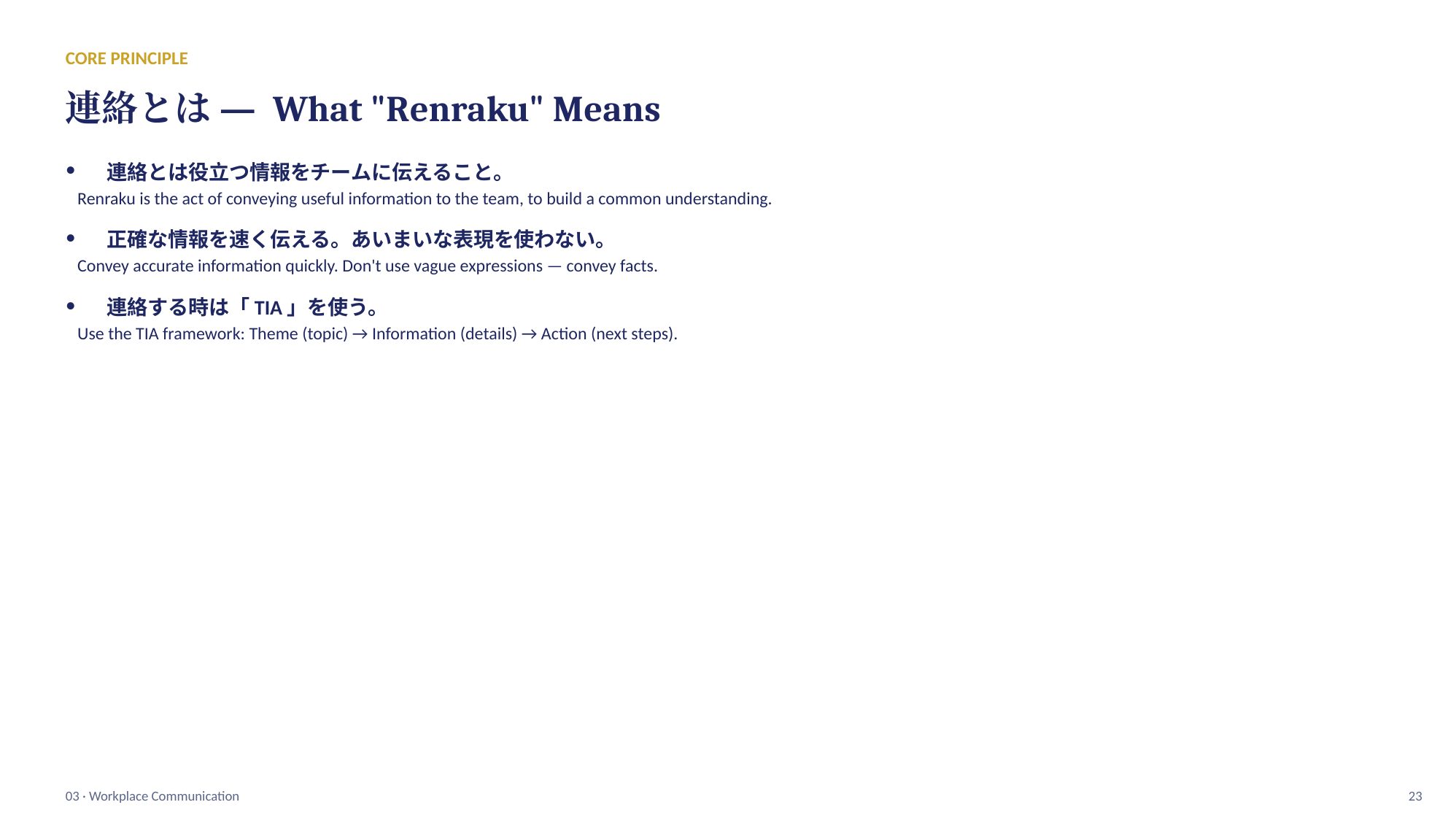
ENCORE PRINCIPLE
連絡とは — What "Renraku" Means
連絡とは — What "Renraku" Means
JP•連絡とは役立つ情報をチームに伝えること。
EN Renraku is the act of conveying useful information to the team, to build a common understanding.
JP•正確な情報を速く伝える。あいまいな表現を使わない。
EN Convey accurate information quickly. Don't use vague expressions — convey facts.
JP•連絡する時は「TIA」を使う。
EN Use the TIA framework: Theme (topic) → Information (details) → Action (next steps).
03 · Workplace Communication 23
03 · Workplace Communication 23
หน้า 24
คลิกเพื่อขยาย
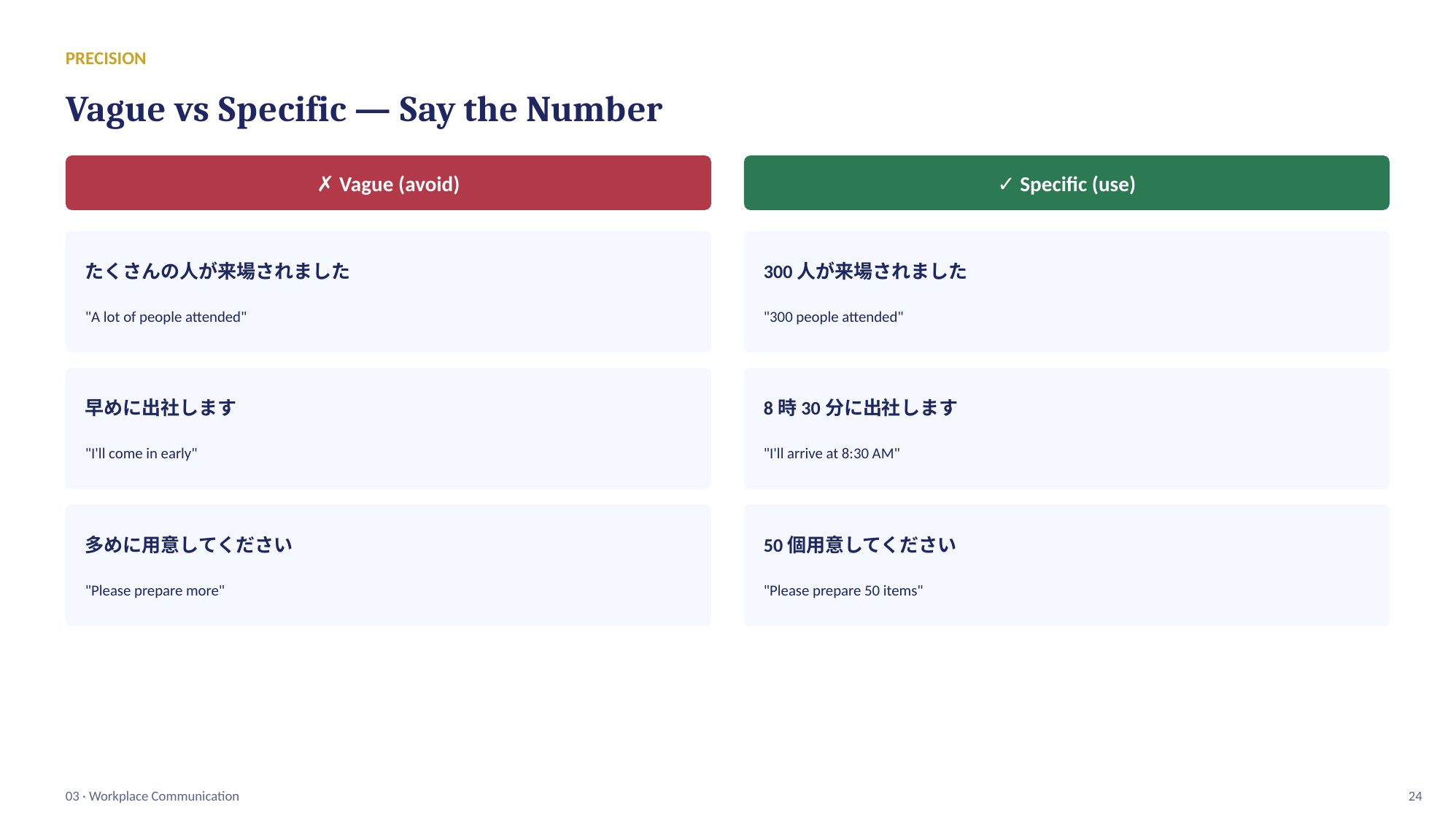
ENPRECISION
Vague vs Specific — Say the Number
✗ Vague (avoid) ✓ Specific (use)
Vague vs Specific — Say the Number
✗ Vague (avoid) ✓ Specific (use)
JPたくさんの人が来場されました300人が来場されました
EN "A lot of people attended" "300 people attended"
JP早めに出社します8時30分に出社します
EN "I'll come in early" "I'll arrive at 8:30 AM"
JP多めに用意してください50個用意してください
EN "Please prepare more" "Please prepare 50 items"
03 · Workplace Communication 24
03 · Workplace Communication 24
หน้า 25
คลิกเพื่อขยาย
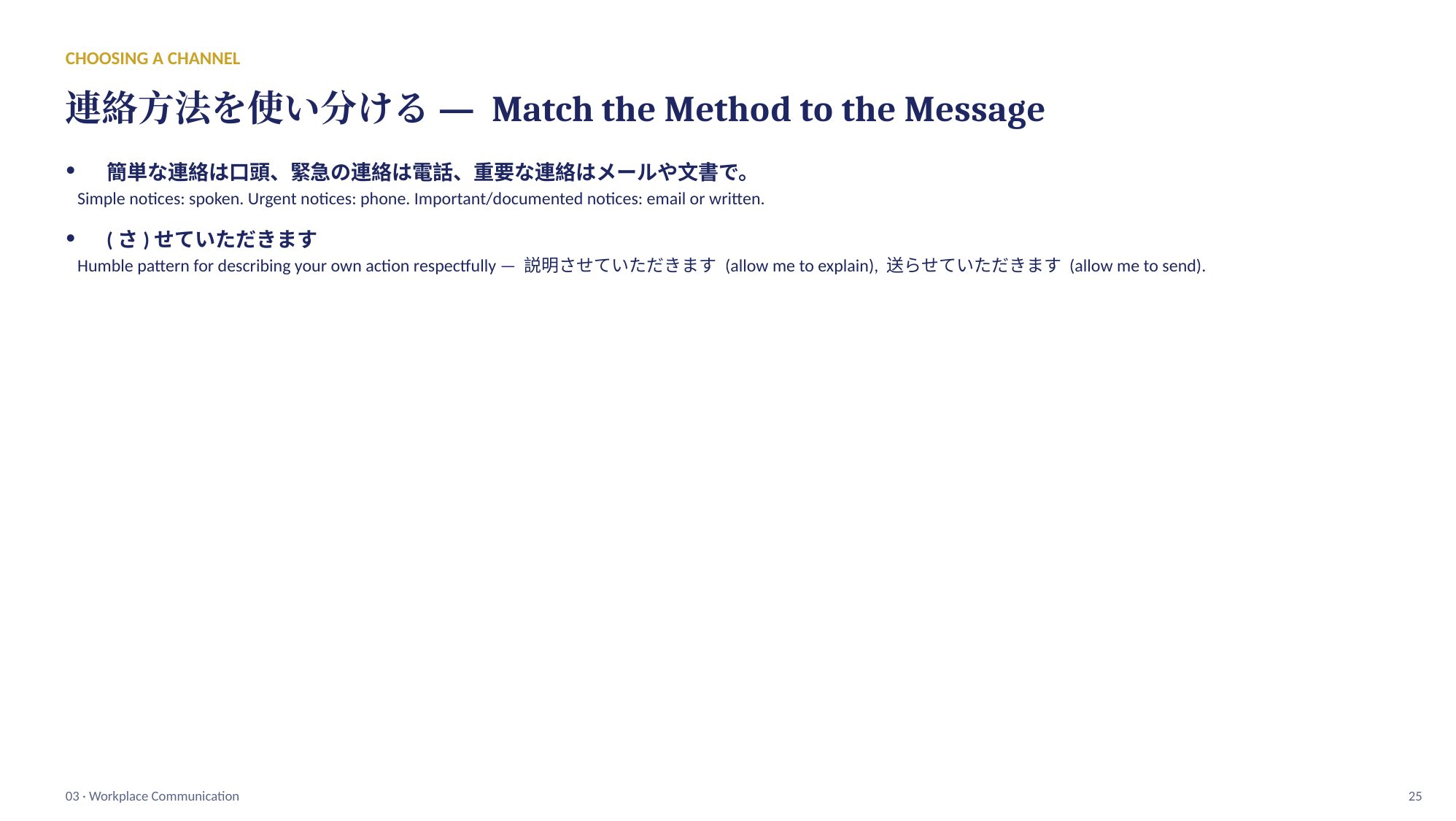
ENCHOOSING A CHANNEL
連絡方法を使い分ける — Match the Method to the Message
連絡方法を使い分ける — Match the Method to the Message
JP•簡単な連絡は口頭、緊急の連絡は電話、重要な連絡はメールや文書で。
EN Simple notices: spoken. Urgent notices: phone. Important/documented notices: email or written.
JP•(さ)せていただきます
EN Humble pattern for describing your own action respectfully — 説明させていただきます (allow me to explain), 送らせていただきます (allow me to send).
03 · Workplace Communication 25
03 · Workplace Communication 25
หน้า 26
คลิกเพื่อขยาย
06
ENApologizing for Mistakes at Work
JP仕事でミスをしたときに謝るための流れ
ENThe 4-step method for owning a mistake professionally
หน้า 27
คลิกเพื่อขยาย
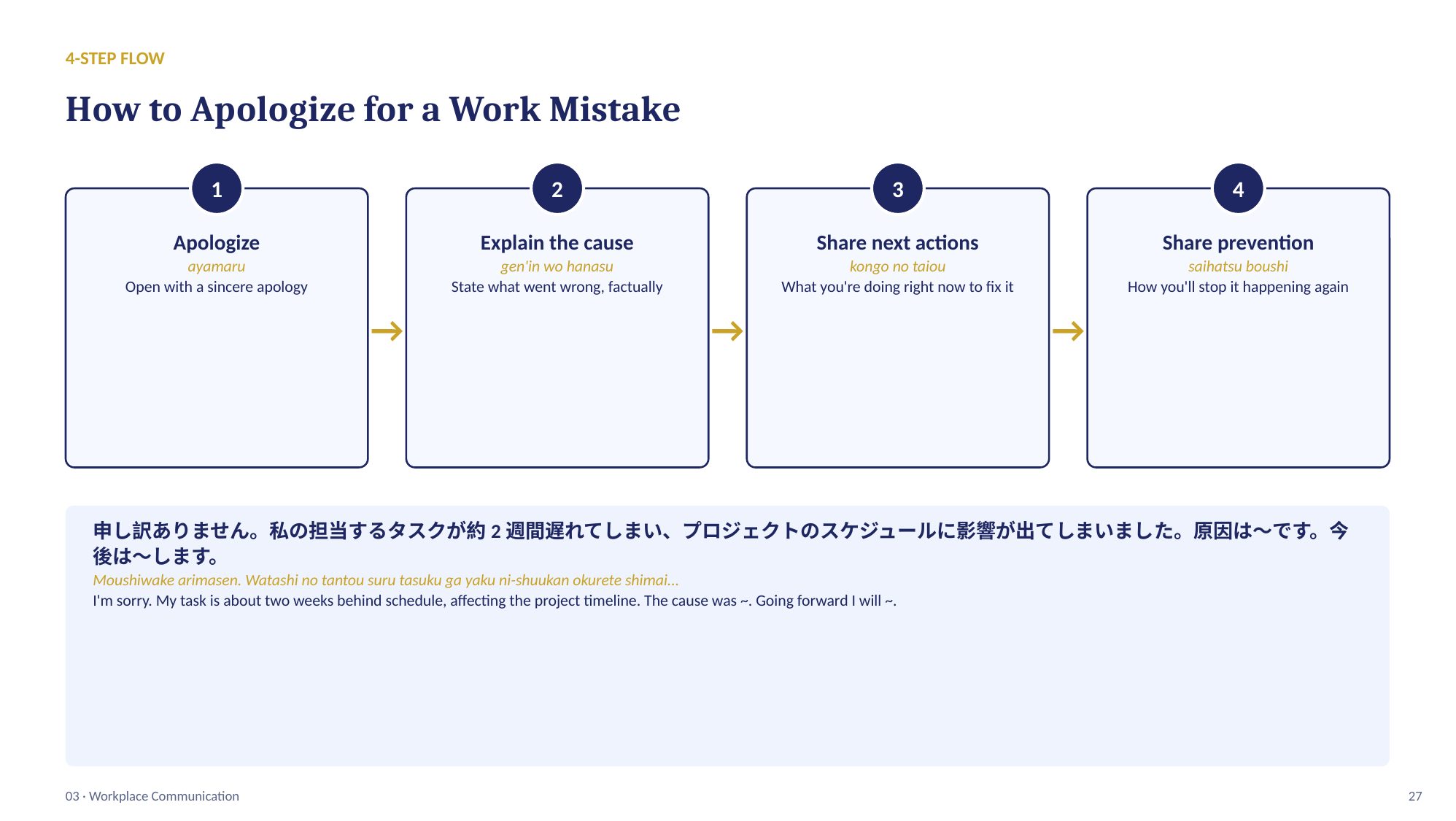
EN4-STEP FLOW
How to Apologize for a Work Mistake
1 2 3 4
Apologize Explain the cause Share next actions Share prevention
ayamaru gen'in wo hanasu kongo no taiou saihatsu boushi
Open with a sincere apology State what went wrong, factually What you're doing right now to fix it How you'll stop it happening again
→ → →
How to Apologize for a Work Mistake
1 2 3 4
Apologize Explain the cause Share next actions Share prevention
ayamaru gen'in wo hanasu kongo no taiou saihatsu boushi
Open with a sincere apology State what went wrong, factually What you're doing right now to fix it How you'll stop it happening again
→ → →
JP申し訳ありません。私の担当するタスクが約2週間遅れてしまい、プロジェクトのスケジュールに影響が出てしまいました。原因は〜です。今
後は〜します。
後は〜します。
EN Moushiwake arimasen. Watashi no tantou suru tasuku ga yaku ni-shuukan okurete shimai...
I'm sorry. My task is about two weeks behind schedule, affecting the project timeline. The cause was ~. Going forward I will ~.
03 · Workplace Communication 27
I'm sorry. My task is about two weeks behind schedule, affecting the project timeline. The cause was ~. Going forward I will ~.
03 · Workplace Communication 27
หน้า 28
คลิกเพื่อขยาย
ENIN USE
More Apology Examples
More Apology Examples
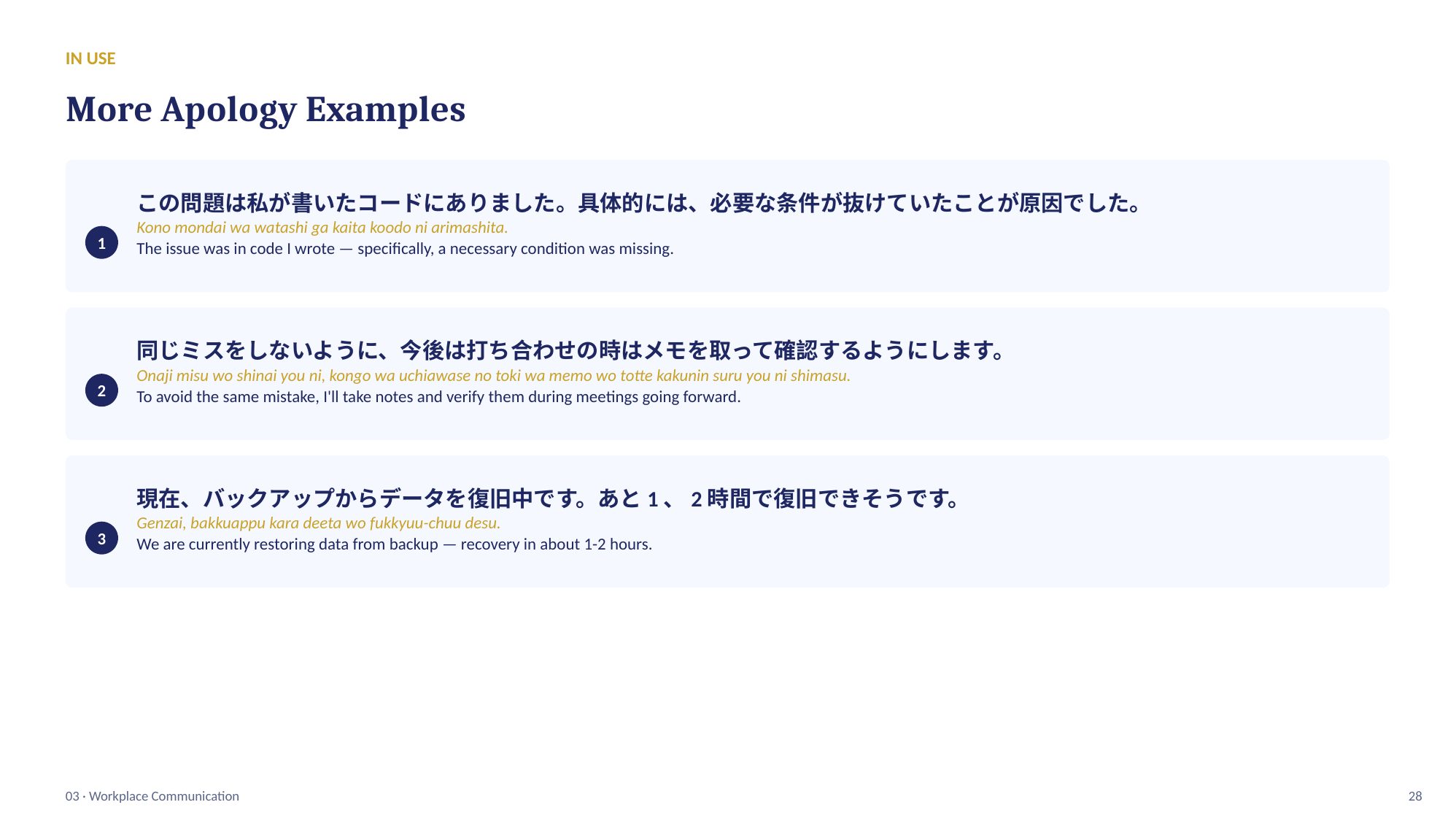
JPこの問題は私が書いたコードにありました。具体的には、必要な条件が抜けていたことが原因でした。
EN Kono mondai wa watashi ga kaita koodo ni arimashita.
1 The issue was in code I wrote — specifically, a necessary condition was missing.
1 The issue was in code I wrote — specifically, a necessary condition was missing.
JP同じミスをしないように、今後は打ち合わせの時はメモを取って確認するようにします。
EN Onaji misu wo shinai you ni, kongo wa uchiawase no toki wa memo wo totte kakunin suru you ni shimasu.
2 To avoid the same mistake, I'll take notes and verify them during meetings going forward.
2 To avoid the same mistake, I'll take notes and verify them during meetings going forward.
JP現在、バックアップからデータを復旧中です。あと1、2時間で復旧できそうです。
EN Genzai, bakkuappu kara deeta wo fukkyuu-chuu desu.
3 We are currently restoring data from backup — recovery in about 1-2 hours.
03 · Workplace Communication 28
3 We are currently restoring data from backup — recovery in about 1-2 hours.
03 · Workplace Communication 28
หน้า 29

คลิกเพื่อขยาย
07
ENExpressing Gratitude
JPお礼を言うときのポイント
ENMaking thanks specific and heartfelt — plus richer alternatives to "yokatta desu ne"
หน้า 30
คลิกเพื่อขยาย
ENKEY POINTS
How to Say Thank You Well
How to Say Thank You Well
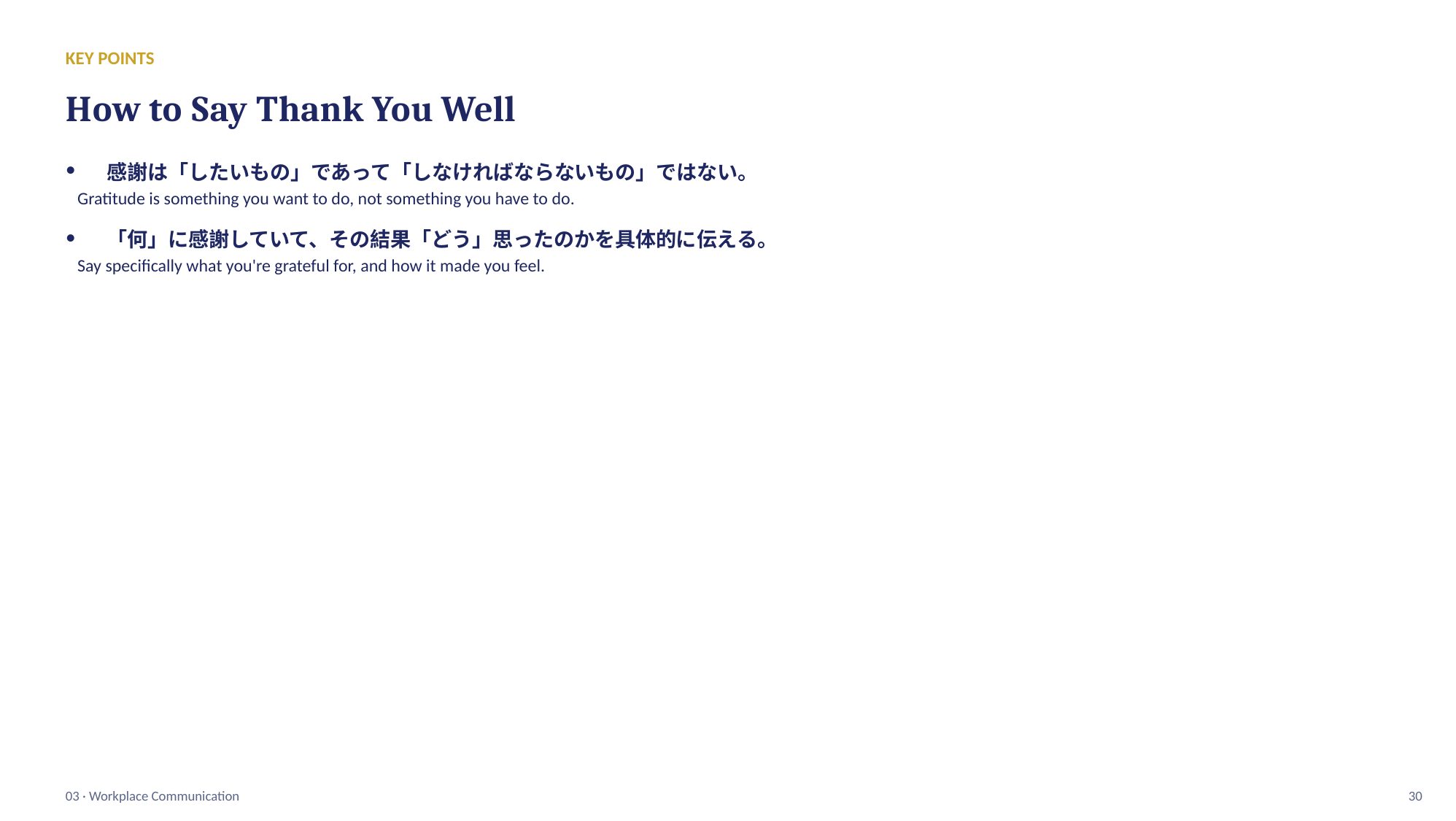
JP•感謝は「したいもの」であって「しなければならないもの」ではない。
EN Gratitude is something you want to do, not something you have to do.
JP•「何」に感謝していて、その結果「どう」思ったのかを具体的に伝える。
EN Say specifically what you're grateful for, and how it made you feel.
03 · Workplace Communication 30
03 · Workplace Communication 30
หน้า 31
คลิกเพื่อขยาย
ENBY SITUATION
Gratitude Phrases by Situation
Gratitude Phrases by Situation
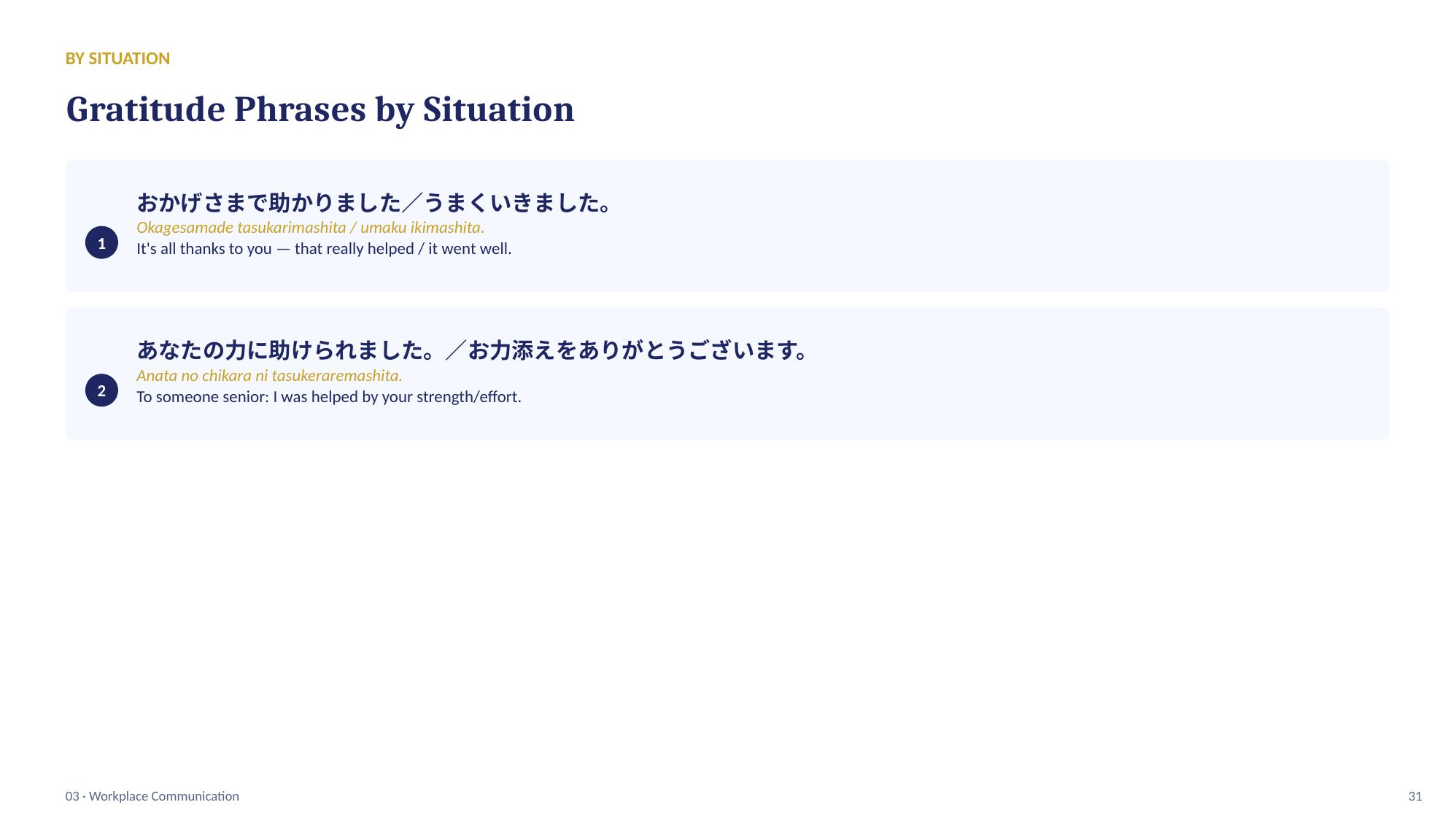
JPおかげさまで助かりました/うまくいきました。
EN Okagesamade tasukarimashita / umaku ikimashita.
1 It's all thanks to you — that really helped / it went well.
1 It's all thanks to you — that really helped / it went well.
JPあなたの力に助けられました。/お力添えをありがとうございます。
EN Anata no chikara ni tasukeraremashita.
2 To someone senior: I was helped by your strength/effort.
03 · Workplace Communication 31
2 To someone senior: I was helped by your strength/effort.
03 · Workplace Communication 31
หน้า 32
คลิกเพื่อขยาย
JPBEYOND"良かったですね"
ENRicher Alternatives — Which Situation, Which Phrase
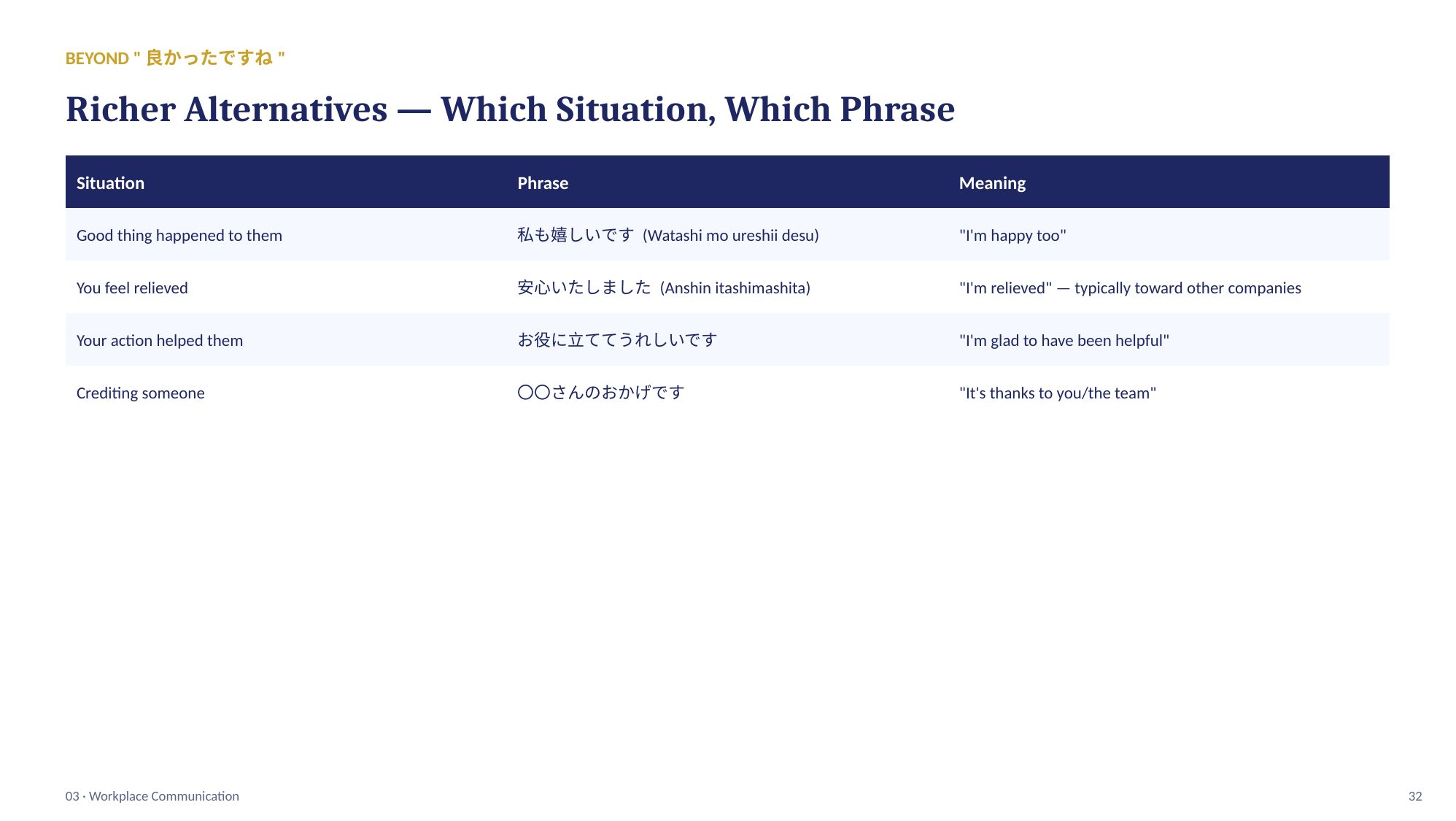
Situation Phrase Meaning
Good thing happened to them 私も嬉しいです (Watashi mo ureshii desu) "I'm happy too"
You feel relieved 安心いたしました (Anshin itashimashita) "I'm relieved" — typically toward other companies
Your action helped them お役に立ててうれしいです "I'm glad to have been helpful"
Crediting someone 〇〇さんのおかげです "It's thanks to you/the team"
03 · Workplace Communication 32
Situation Phrase Meaning
Good thing happened to them 私も嬉しいです (Watashi mo ureshii desu) "I'm happy too"
You feel relieved 安心いたしました (Anshin itashimashita) "I'm relieved" — typically toward other companies
Your action helped them お役に立ててうれしいです "I'm glad to have been helpful"
Crediting someone 〇〇さんのおかげです "It's thanks to you/the team"
03 · Workplace Communication 32
หน้า 33
คลิกเพื่อขยาย
ENIN USE
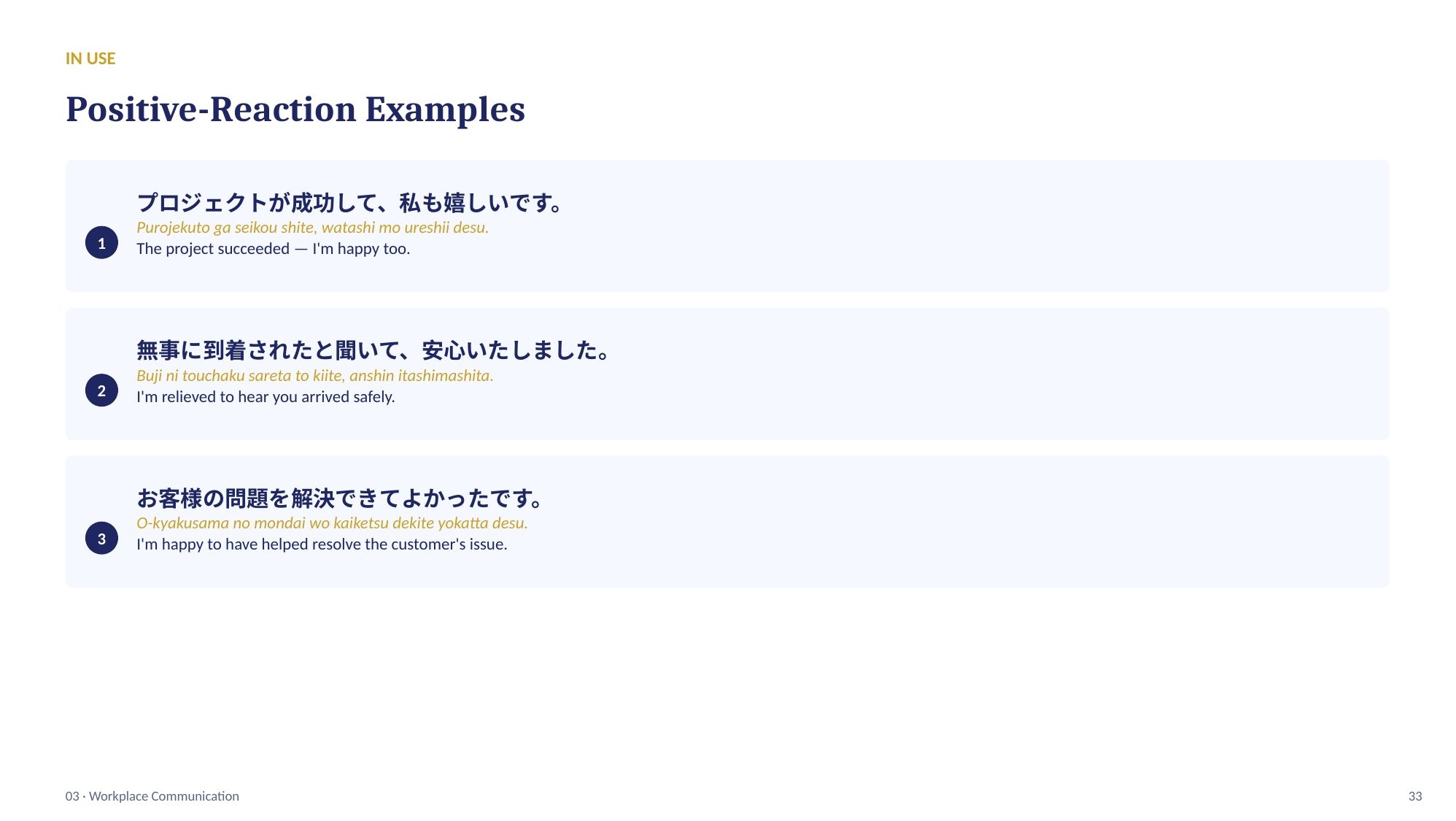
Positive-Reaction Examples
Positive-Reaction Examples
JPプロジェクトが成功して、私も嬉しいです。
EN Purojekuto ga seikou shite, watashi mo ureshii desu.
1 The project succeeded — I'm happy too.
1 The project succeeded — I'm happy too.
JP無事に到着されたと聞いて、安心いたしました。
EN Buji ni touchaku sareta to kiite, anshin itashimashita.
2 I'm relieved to hear you arrived safely.
2 I'm relieved to hear you arrived safely.
JPお客様の問題を解決できてよかったです。
EN O-kyakusama no mondai wo kaiketsu dekite yokatta desu.
3 I'm happy to have helped resolve the customer's issue.
03 · Workplace Communication 33
3 I'm happy to have helped resolve the customer's issue.
03 · Workplace Communication 33
หน้า 34
คลิกเพื่อขยาย
08
ENEmail Greetings — 22 Phrases
JP仕事のメールでよく使うあいさつ
ENOpeners for every stage of an email relationship
หน้า 35
คลิกเพื่อขยาย
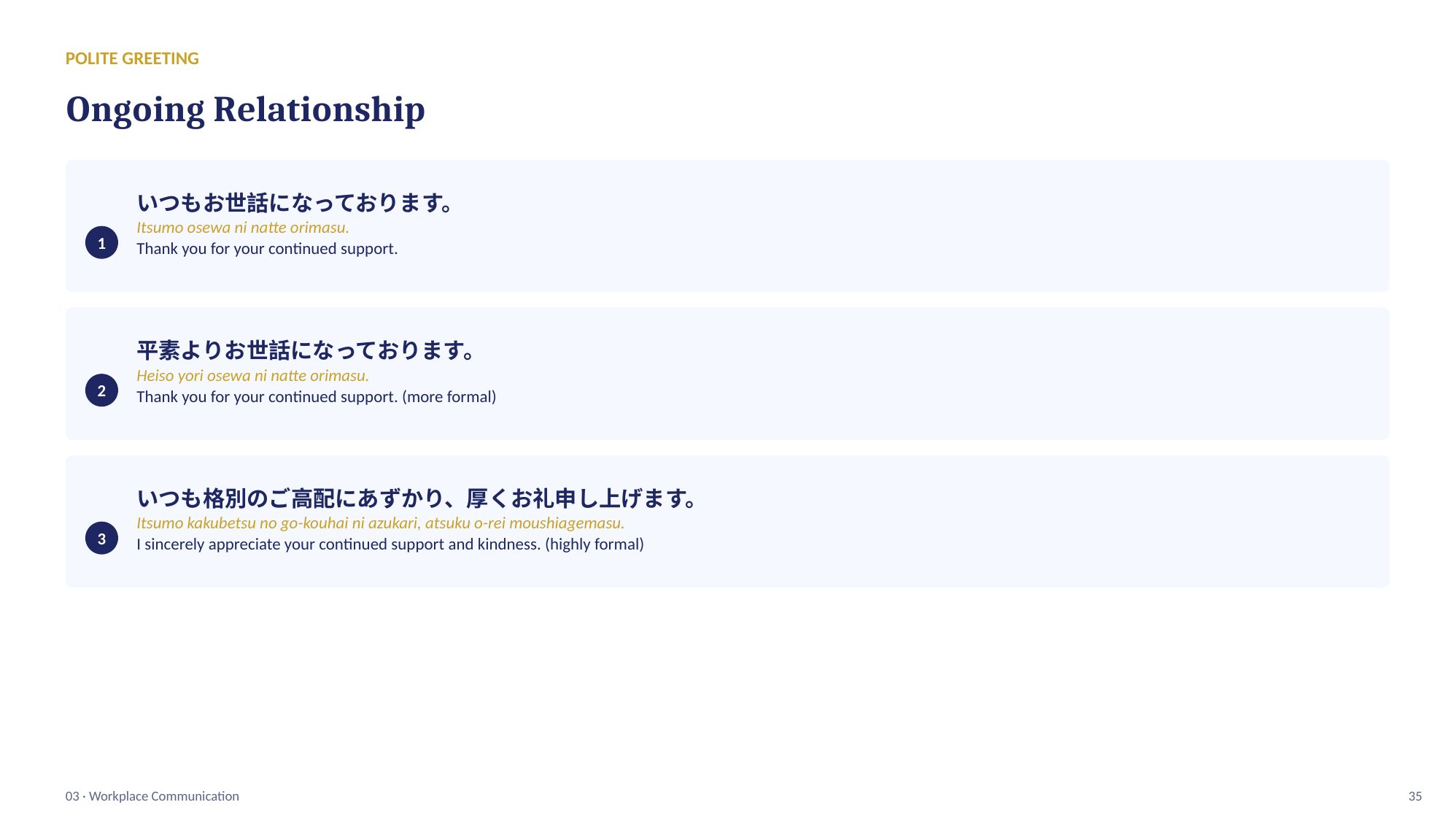
ENPOLITE GREETING
Ongoing Relationship
Ongoing Relationship
JPいつもお世話になっております。
EN Itsumo osewa ni natte orimasu.
1 Thank you for your continued support.
1 Thank you for your continued support.
JP平素よりお世話になっております。
EN Heiso yori osewa ni natte orimasu.
2 Thank you for your continued support. (more formal)
2 Thank you for your continued support. (more formal)
JPいつも格別のご高配にあずかり、厚くお礼申し上げます。
EN Itsumo kakubetsu no go-kouhai ni azukari, atsuku o-rei moushiagemasu.
3 I sincerely appreciate your continued support and kindness. (highly formal)
03 · Workplace Communication 35
3 I sincerely appreciate your continued support and kindness. (highly formal)
03 · Workplace Communication 35
หน้า 36
คลิกเพื่อขยาย
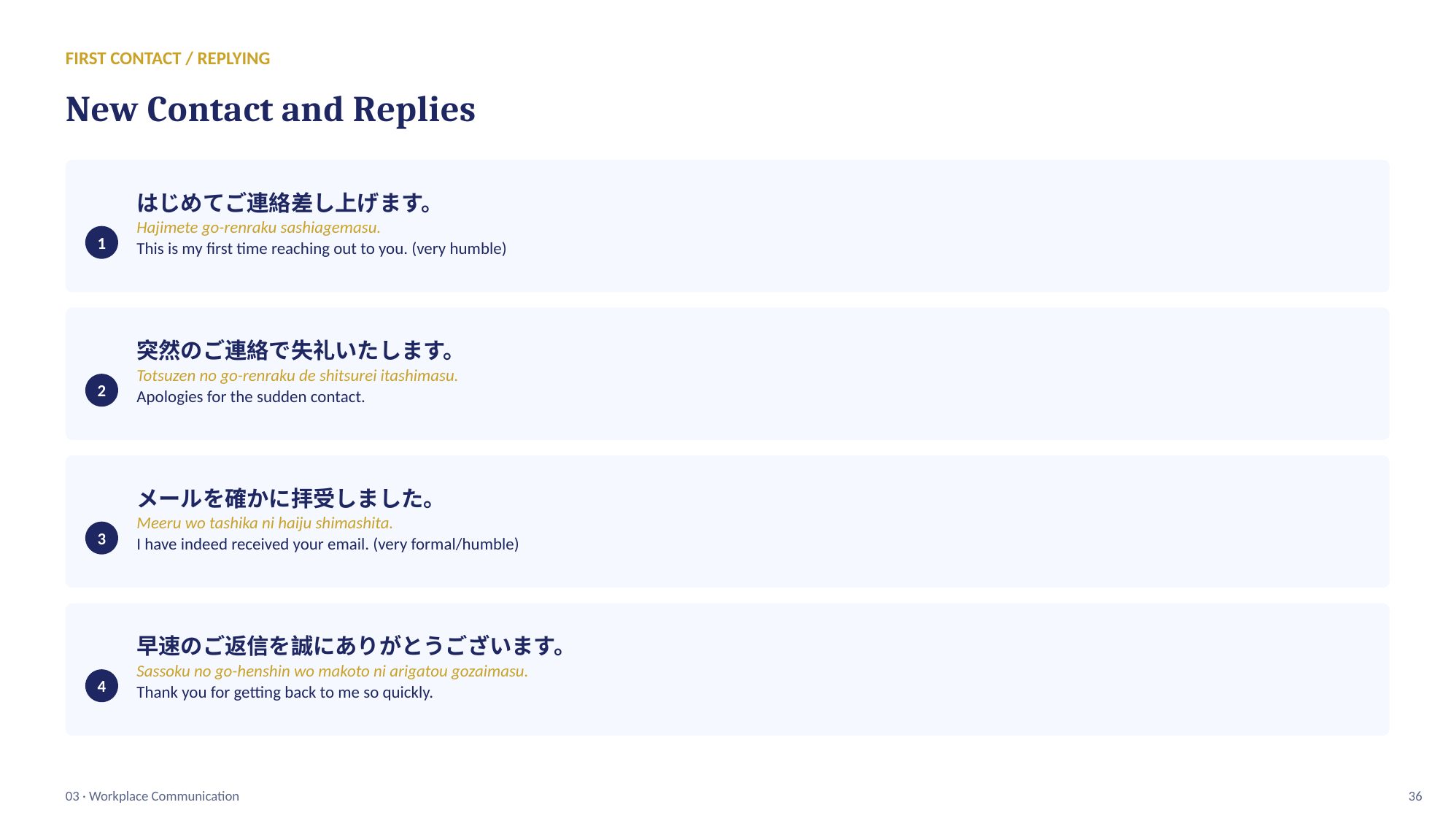
ENFIRST CONTACT / REPLYING
New Contact and Replies
New Contact and Replies
JPはじめてご連絡差し上げます。
EN Hajimete go-renraku sashiagemasu.
1 This is my first time reaching out to you. (very humble)
1 This is my first time reaching out to you. (very humble)
JP突然のご連絡で失礼いたします。
EN Totsuzen no go-renraku de shitsurei itashimasu.
2 Apologies for the sudden contact.
2 Apologies for the sudden contact.
JPメールを確かに拝受しました。
EN Meeru wo tashika ni haiju shimashita.
3 I have indeed received your email. (very formal/humble)
3 I have indeed received your email. (very formal/humble)
JP早速のご返信を誠にありがとうございます。
EN Sassoku no go-henshin wo makoto ni arigatou gozaimasu.
4 Thank you for getting back to me so quickly.
03 · Workplace Communication 36
4 Thank you for getting back to me so quickly.
03 · Workplace Communication 36
หน้า 37
คลิกเพื่อขยาย
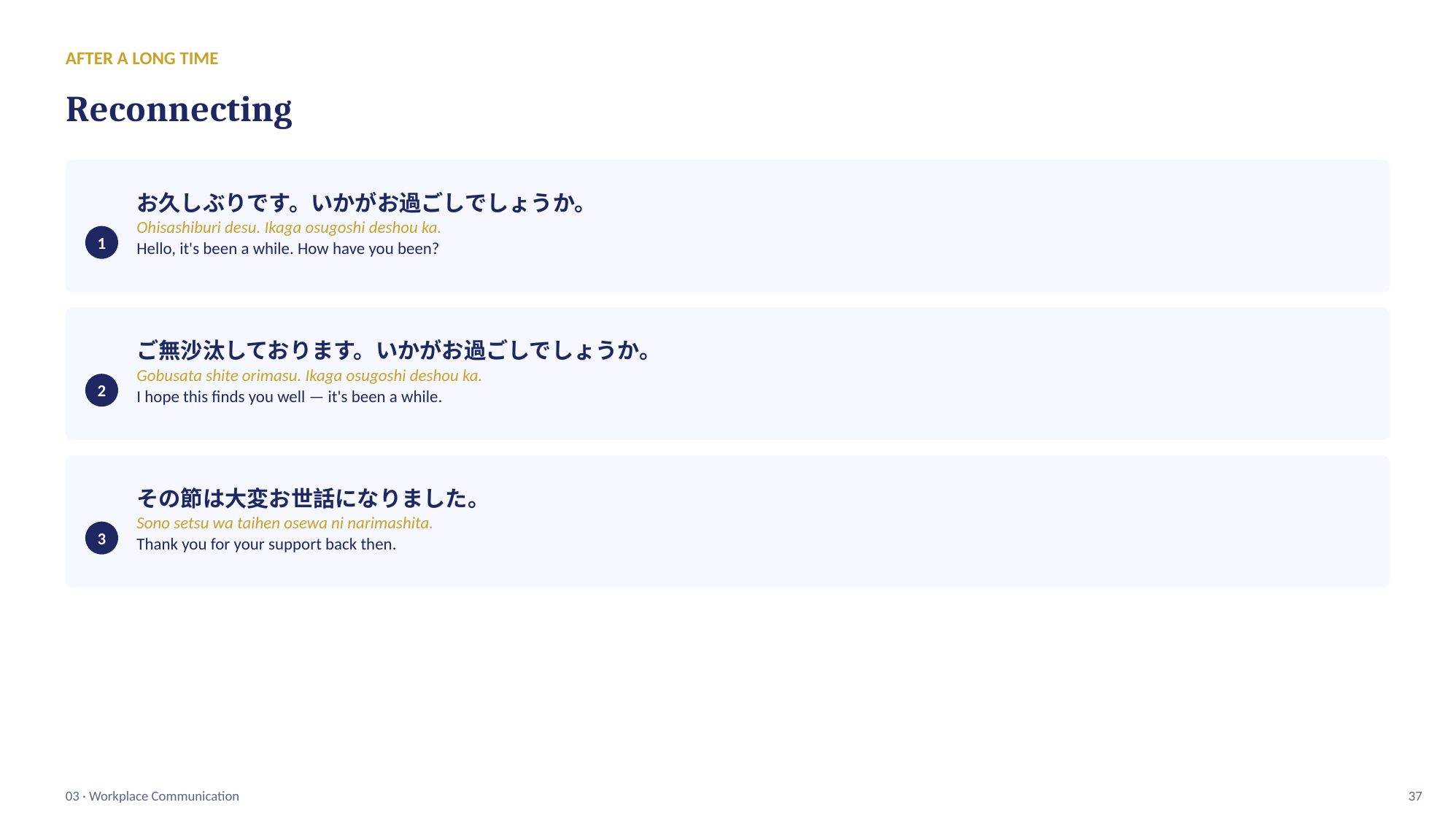
ENAFTER A LONG TIME
Reconnecting
Reconnecting
JPお久しぶりです。いかがお過ごしでしょうか。
EN Ohisashiburi desu. Ikaga osugoshi deshou ka.
1 Hello, it's been a while. How have you been?
1 Hello, it's been a while. How have you been?
JPご無沙汰しております。いかがお過ごしでしょうか。
EN Gobusata shite orimasu. Ikaga osugoshi deshou ka.
2 I hope this finds you well — it's been a while.
2 I hope this finds you well — it's been a while.
JPその節は大変お世話になりました。
EN Sono setsu wa taihen osewa ni narimashita.
3 Thank you for your support back then.
03 · Workplace Communication 37
3 Thank you for your support back then.
03 · Workplace Communication 37
หน้า 38
คลิกเพื่อขยาย
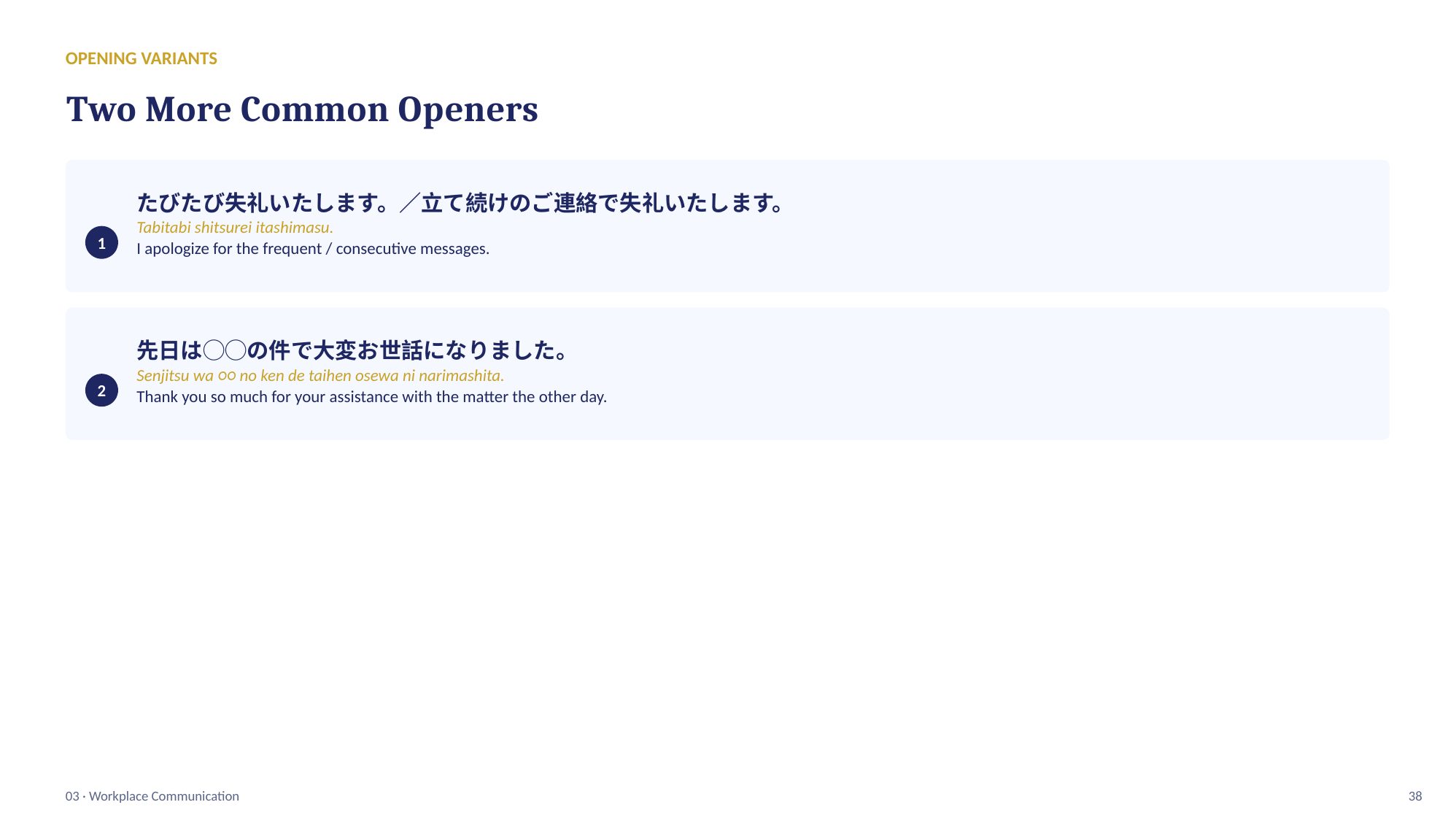
ENOPENING VARIANTS
Two More Common Openers
Two More Common Openers
JPたびたび失礼いたします。/立て続けのご連絡で失礼いたします。
EN Tabitabi shitsurei itashimasu.
1 I apologize for the frequent / consecutive messages.
1 I apologize for the frequent / consecutive messages.
JP先日は◯◯の件で大変お世話になりました。
EN Senjitsu wa ○○ no ken de taihen osewa ni narimashita.
2 Thank you so much for your assistance with the matter the other day.
03 · Workplace Communication 38
2 Thank you so much for your assistance with the matter the other day.
03 · Workplace Communication 38
หน้า 39
คลิกเพื่อขยาย
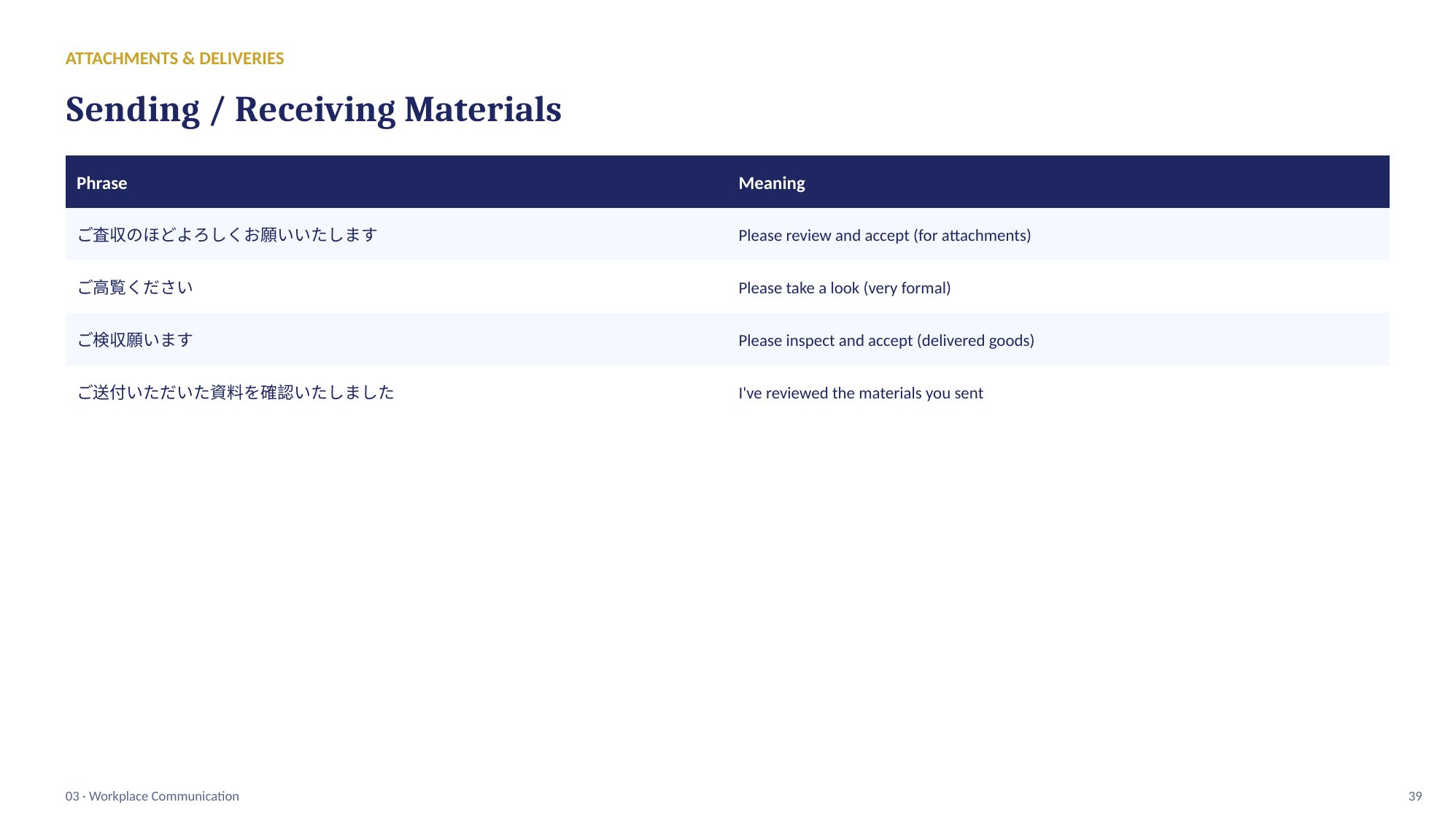
ENATTACHMENTS & DELIVERIES
Sending / Receiving Materials
Phrase Meaning
ご査収のほどよろしくお願いいたします Please review and accept (for attachments)
ご高覧ください Please take a look (very formal)
ご検収願います Please inspect and accept (delivered goods)
ご送付いただいた資料を確認いたしました I've reviewed the materials you sent
03 · Workplace Communication 39
Sending / Receiving Materials
Phrase Meaning
ご査収のほどよろしくお願いいたします Please review and accept (for attachments)
ご高覧ください Please take a look (very formal)
ご検収願います Please inspect and accept (delivered goods)
ご送付いただいた資料を確認いたしました I've reviewed the materials you sent
03 · Workplace Communication 39
หน้า 40

คลิกเพื่อขยาย
09
ENEmail Connectors
JP接続詞
ENSix conjunctions that make written Japanese logical and easy to follow
หน้า 41
คลิกเพื่อขยาย
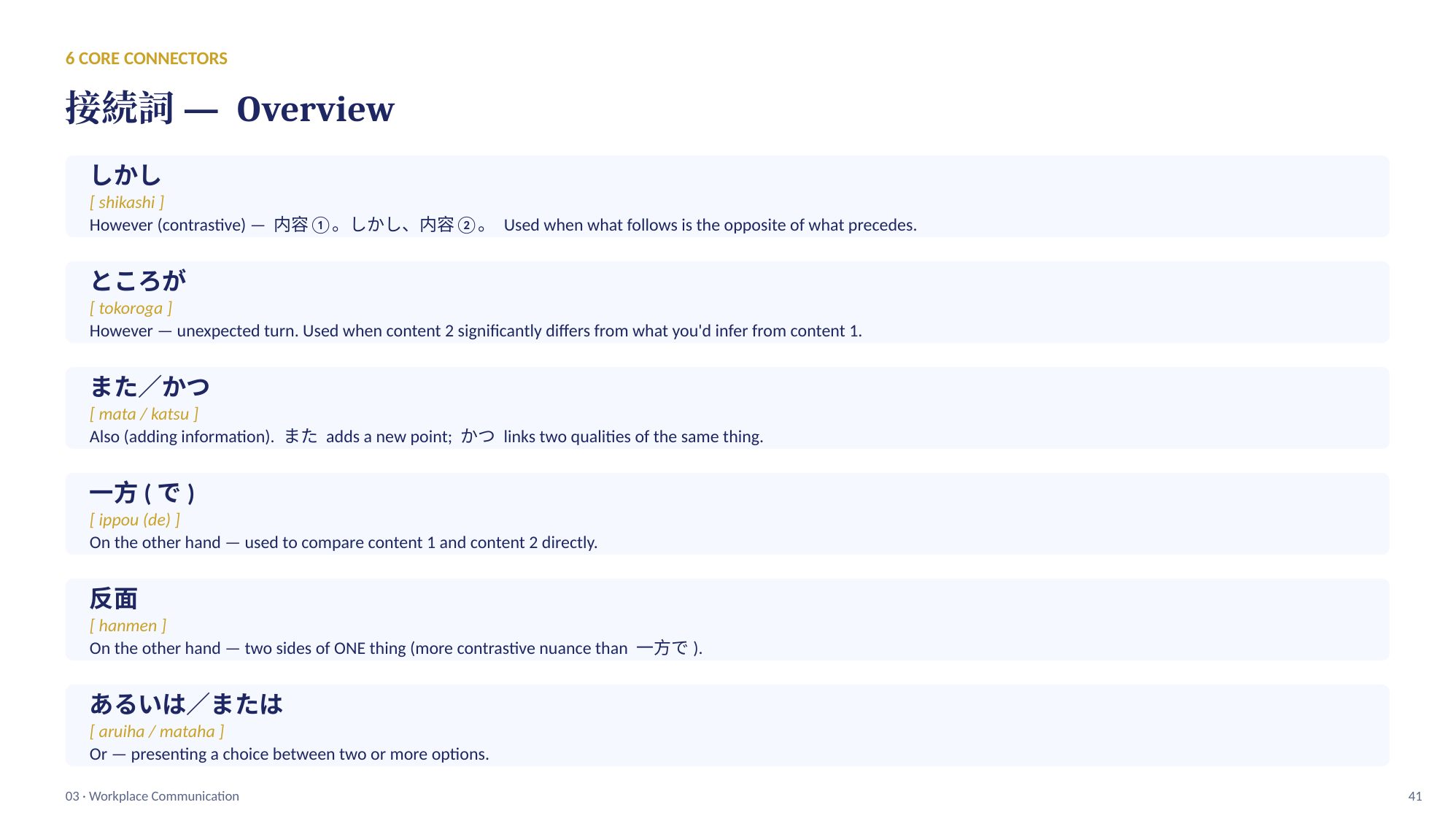
EN6 CORE CONNECTORS
接続詞 — Overview
接続詞 — Overview
JPしかし
EN [ shikashi ]
However (contrastive) — 内容①。しかし、内容②。 Used when what follows is the opposite of what precedes.
However (contrastive) — 内容①。しかし、内容②。 Used when what follows is the opposite of what precedes.
JPところが
EN [ tokoroga ]
However — unexpected turn. Used when content 2 significantly differs from what you'd infer from content 1.
However — unexpected turn. Used when content 2 significantly differs from what you'd infer from content 1.
JPまた/かつ
EN [ mata / katsu ]
Also (adding information). また adds a new point; かつ links two qualities of the same thing.
Also (adding information). また adds a new point; かつ links two qualities of the same thing.
JP一方(で)
EN [ ippou (de) ]
On the other hand — used to compare content 1 and content 2 directly.
On the other hand — used to compare content 1 and content 2 directly.
JP反面
EN [ hanmen ]
On the other hand — two sides of ONE thing (more contrastive nuance than 一方で ).
On the other hand — two sides of ONE thing (more contrastive nuance than 一方で ).
JPあるいは/または
EN [ aruiha / mataha ]
Or — presenting a choice between two or more options.
03 · Workplace Communication 41
Or — presenting a choice between two or more options.
03 · Workplace Communication 41
หน้า 42
คลิกเพื่อขยาย
ENIN USE
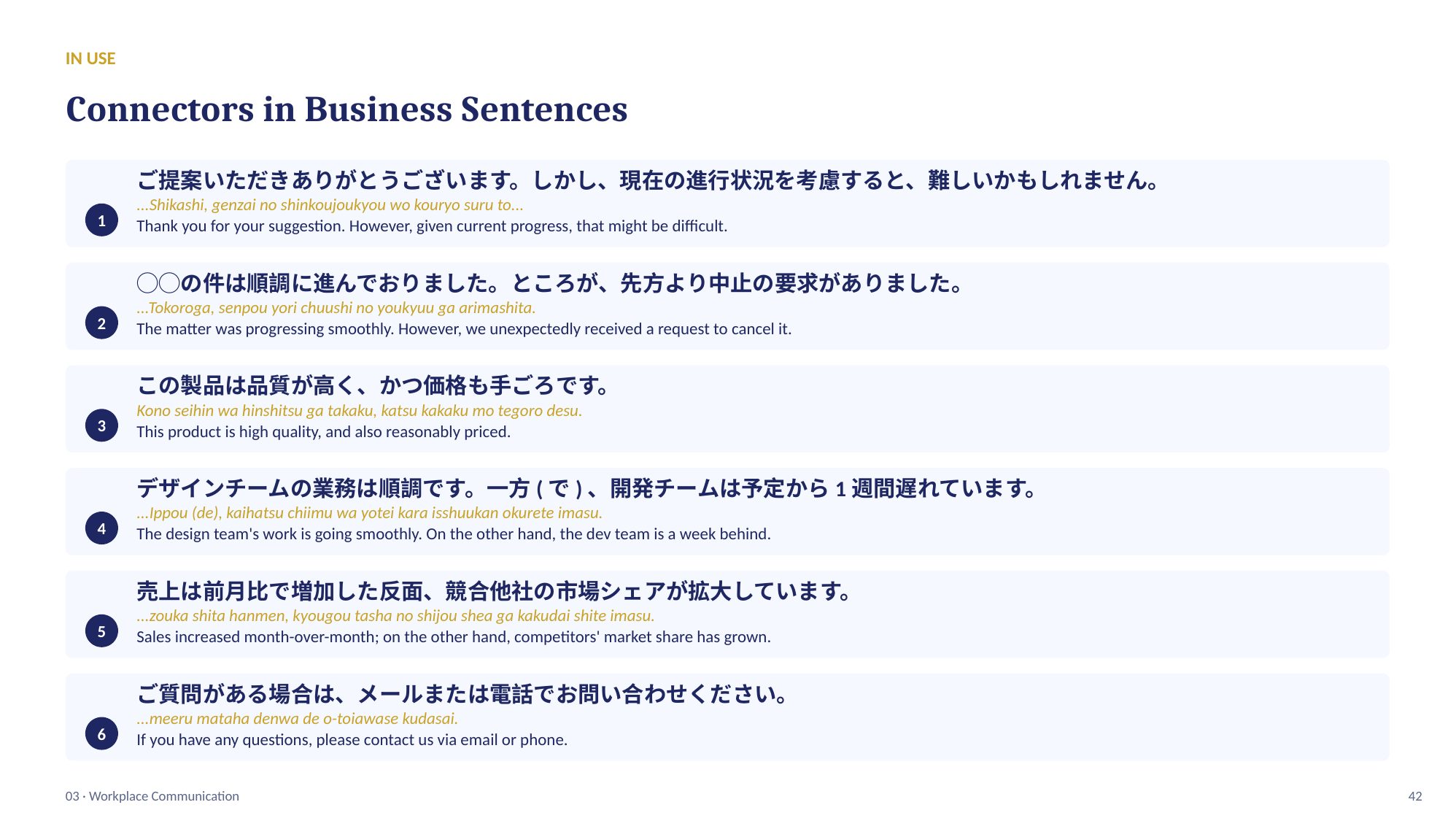
Connectors in Business Sentences
Connectors in Business Sentences
JPご提案いただきありがとうございます。しかし、現在の進行状況を考慮すると、難しいかもしれません。
EN ...Shikashi, genzai no shinkoujoukyou wo kouryo suru to...
1 Thank you for your suggestion. However, given current progress, that might be difficult.
1 Thank you for your suggestion. However, given current progress, that might be difficult.
JP◯◯の件は順調に進んでおりました。ところが、先方より中止の要求がありました。
EN ...Tokoroga, senpou yori chuushi no youkyuu ga arimashita.
2 The matter was progressing smoothly. However, we unexpectedly received a request to cancel it.
2 The matter was progressing smoothly. However, we unexpectedly received a request to cancel it.
JPこの製品は品質が高く、かつ価格も手ごろです。
EN Kono seihin wa hinshitsu ga takaku, katsu kakaku mo tegoro desu.
3 This product is high quality, and also reasonably priced.
3 This product is high quality, and also reasonably priced.
JPデザインチームの業務は順調です。一方(で)、開発チームは予定から1週間遅れています。
EN ...Ippou (de), kaihatsu chiimu wa yotei kara isshuukan okurete imasu.
4 The design team's work is going smoothly. On the other hand, the dev team is a week behind.
4 The design team's work is going smoothly. On the other hand, the dev team is a week behind.
JP売上は前月比で増加した反面、競合他社の市場シェアが拡大しています。
EN ...zouka shita hanmen, kyougou tasha no shijou shea ga kakudai shite imasu.
5 Sales increased month-over-month; on the other hand, competitors' market share has grown.
5 Sales increased month-over-month; on the other hand, competitors' market share has grown.
JPご質問がある場合は、メールまたは電話でお問い合わせください。
EN ...meeru mataha denwa de o-toiawase kudasai.
6 If you have any questions, please contact us via email or phone.
03 · Workplace Communication 42
6 If you have any questions, please contact us via email or phone.
03 · Workplace Communication 42
หน้า 43
คลิกเพื่อขยาย
10
ENColloquial → Formal Rewrites
JP話し言葉→書き言葉
EN15 grammar swaps + 10 word pairs for upgrading spoken Japanese to written business Japanese
หน้า 44
คลิกเพื่อขยาย
ENGRAMMAR SWAPS 1-8
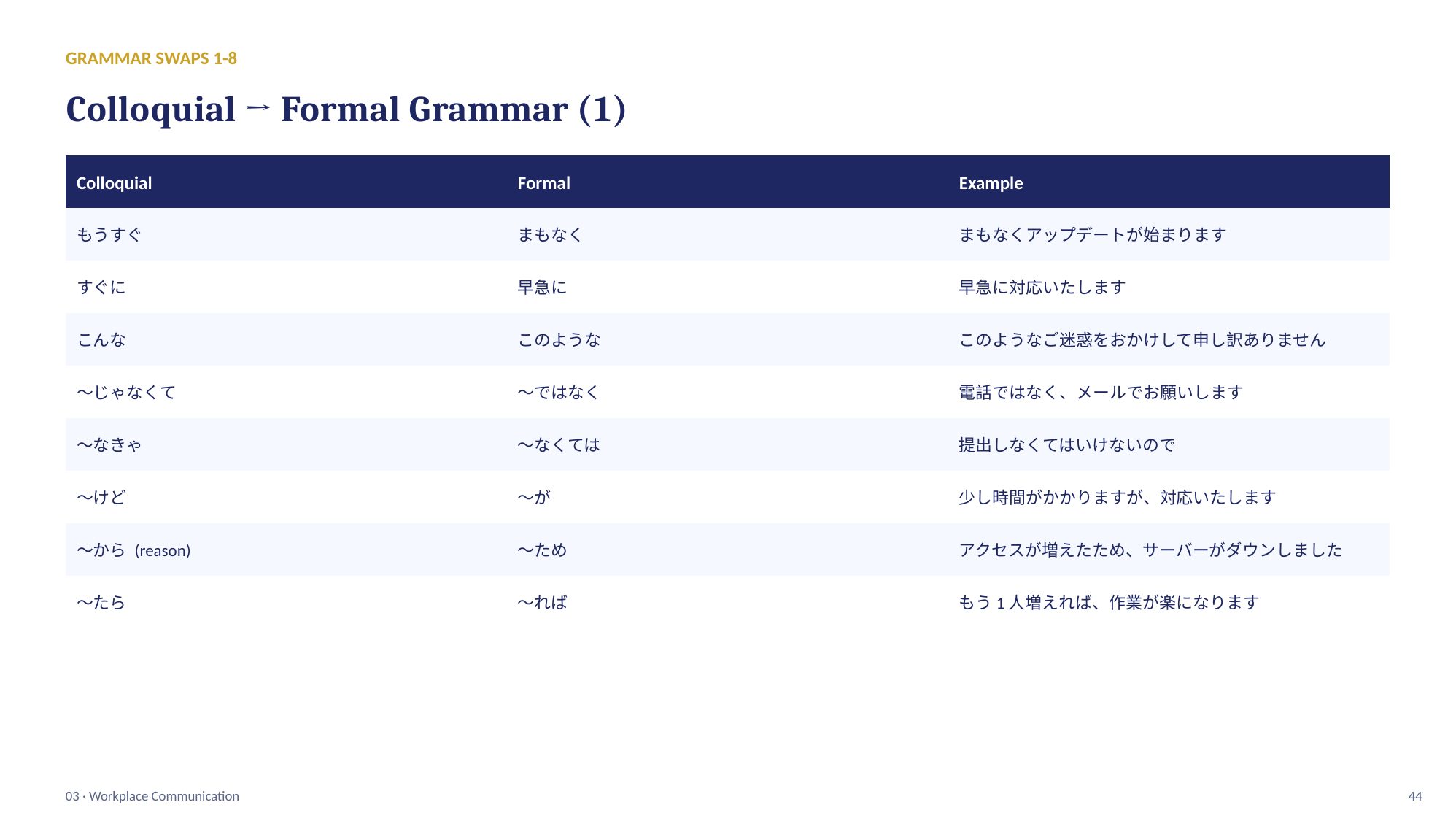
Colloquial → Formal Grammar (1)
Colloquial Formal Example
Colloquial → Formal Grammar (1)
Colloquial Formal Example
JPもうすぐまもなくまもなくアップデートが始まります
すぐに早急に早急に対応いたします
こんなこのようなこのようなご迷惑をおかけして申し訳ありません
〜じゃなくて〜ではなく電話ではなく、メールでお願いします
〜なきゃ〜なくては提出しなくてはいけないので
〜けど〜が少し時間がかかりますが、対応いたします
〜から(reason)〜ためアクセスが増えたため、サーバーがダウンしました
〜たら〜ればもう1人増えれば、作業が楽になります
すぐに早急に早急に対応いたします
こんなこのようなこのようなご迷惑をおかけして申し訳ありません
〜じゃなくて〜ではなく電話ではなく、メールでお願いします
〜なきゃ〜なくては提出しなくてはいけないので
〜けど〜が少し時間がかかりますが、対応いたします
〜から(reason)〜ためアクセスが増えたため、サーバーがダウンしました
〜たら〜ればもう1人増えれば、作業が楽になります
EN03 · Workplace Communication 44
หน้า 45
คลิกเพื่อขยาย
ENGRAMMAR SWAPS 9-15
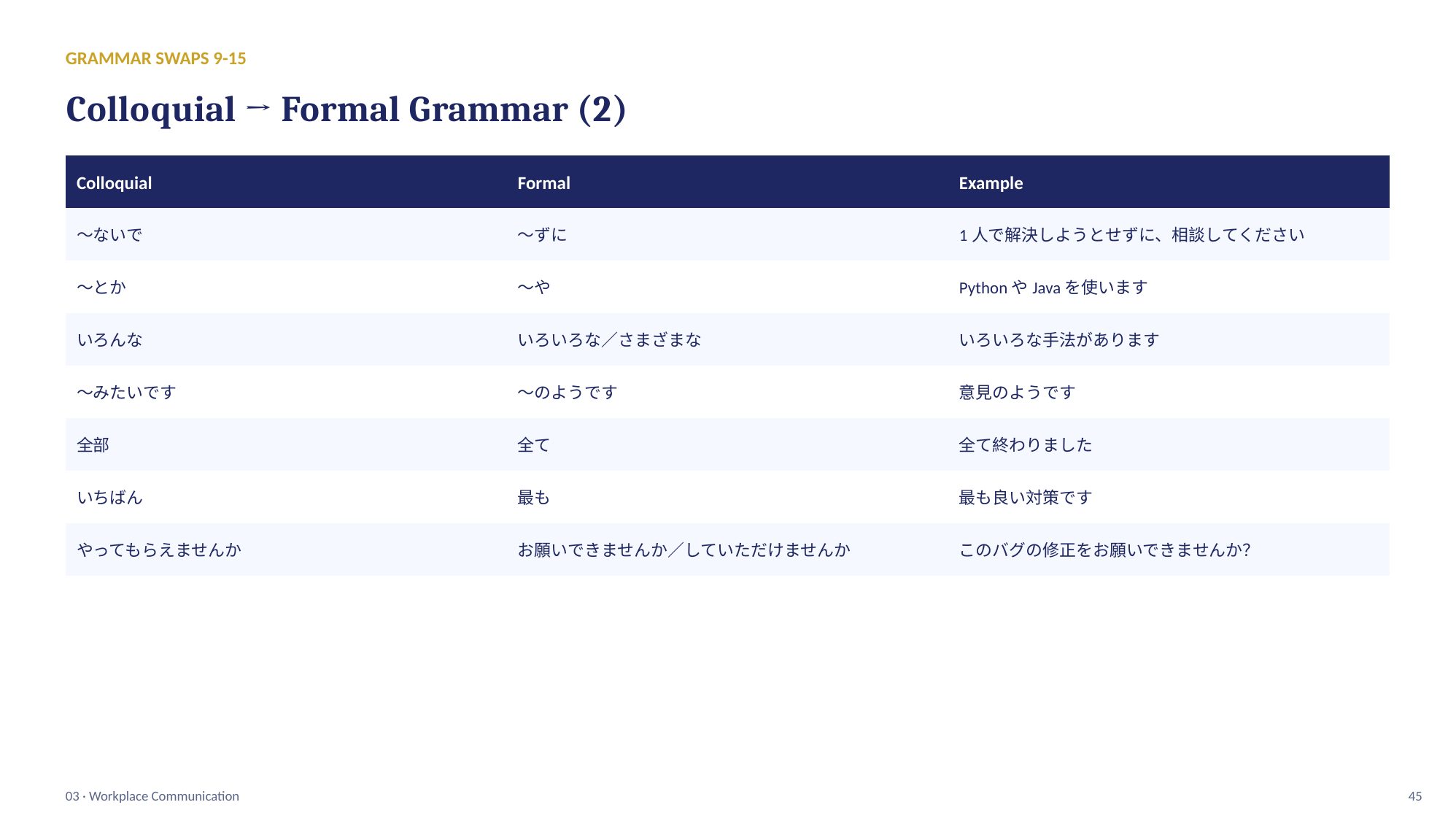
Colloquial → Formal Grammar (2)
Colloquial Formal Example
Colloquial → Formal Grammar (2)
Colloquial Formal Example
JP〜ないで〜ずに1人で解決しようとせずに、相談してください
EN 〜とか 〜や Python や Java を使います
JPいろんないろいろな/さまざまないろいろな手法があります
〜みたいです〜のようです意見のようです
全部全て全て終わりました
いちばん最も最も良い対策です
やってもらえませんかお願いできませんか/していただけませんかこのバグの修正をお願いできませんか?
〜みたいです〜のようです意見のようです
全部全て全て終わりました
いちばん最も最も良い対策です
やってもらえませんかお願いできませんか/していただけませんかこのバグの修正をお願いできませんか?
EN03 · Workplace Communication 45
หน้า 46
คลิกเพื่อขยาย
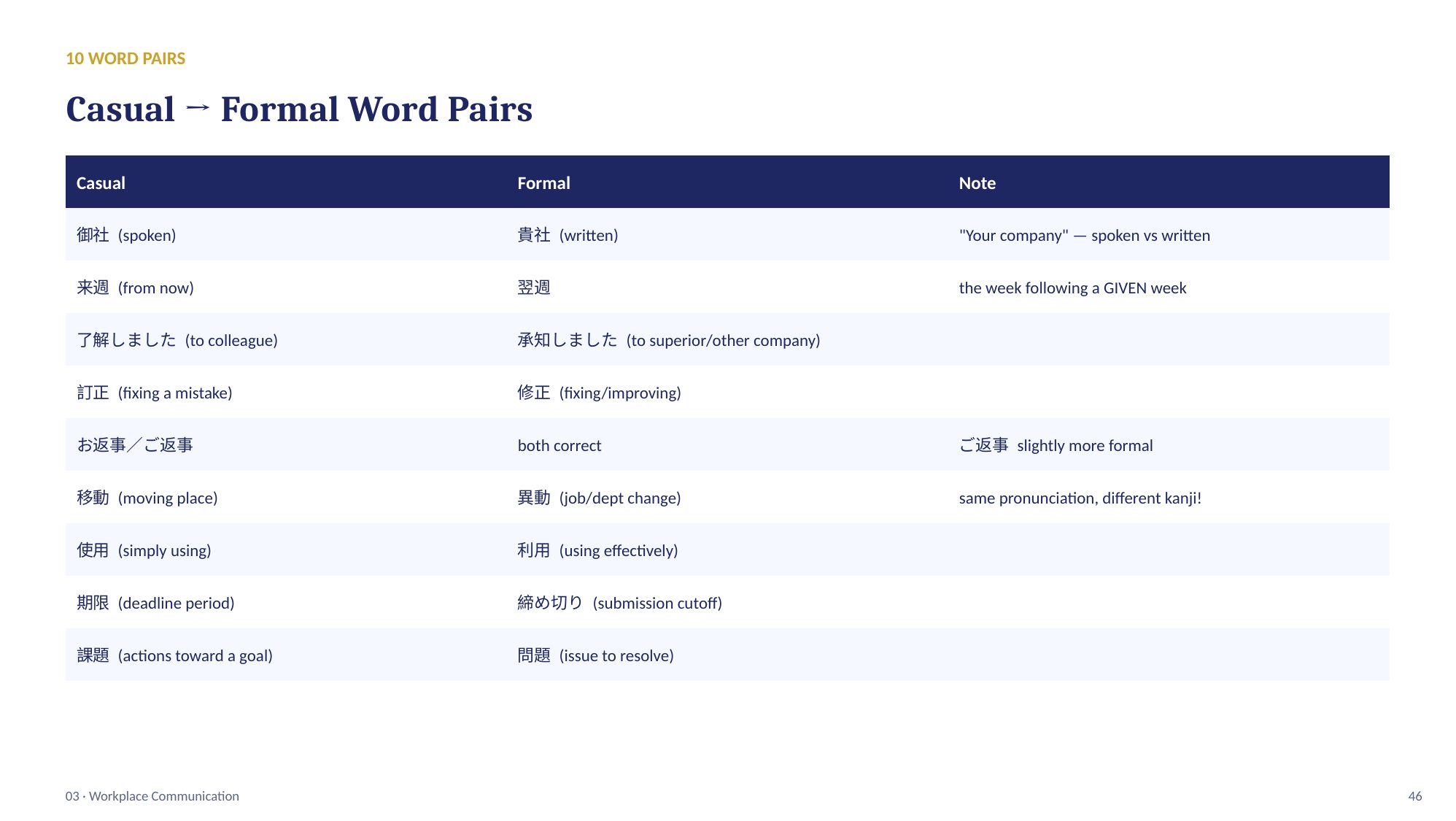
EN10 WORD PAIRS
Casual → Formal Word Pairs
Casual Formal Note
御社 (spoken) 貴社 (written) "Your company" — spoken vs written
来週 (from now) 翌週 the week following a GIVEN week
了解しました (to colleague) 承知しました (to superior/other company)
訂正 (fixing a mistake) 修正 (fixing/improving)
お返事/ご返事 both correct ご返事 slightly more formal
移動 (moving place) 異動 (job/dept change) same pronunciation, different kanji!
使用 (simply using) 利用 (using effectively)
期限 (deadline period) 締め切り (submission cutoff)
課題 (actions toward a goal) 問題 (issue to resolve)
03 · Workplace Communication 46
Casual → Formal Word Pairs
Casual Formal Note
御社 (spoken) 貴社 (written) "Your company" — spoken vs written
来週 (from now) 翌週 the week following a GIVEN week
了解しました (to colleague) 承知しました (to superior/other company)
訂正 (fixing a mistake) 修正 (fixing/improving)
お返事/ご返事 both correct ご返事 slightly more formal
移動 (moving place) 異動 (job/dept change) same pronunciation, different kanji!
使用 (simply using) 利用 (using effectively)
期限 (deadline period) 締め切り (submission cutoff)
課題 (actions toward a goal) 問題 (issue to resolve)
03 · Workplace Communication 46
หน้า 47
คลิกเพื่อขยาย
11
ENOnomatopoeia at Work
JP仕事のオノマトペ
EN20 sound/state words that capture nuance in few syllables, plus わざわざ vs せっかく
หน้า 48
คลิกเพื่อขยาย
ENWHY JAPANESE USES THESE
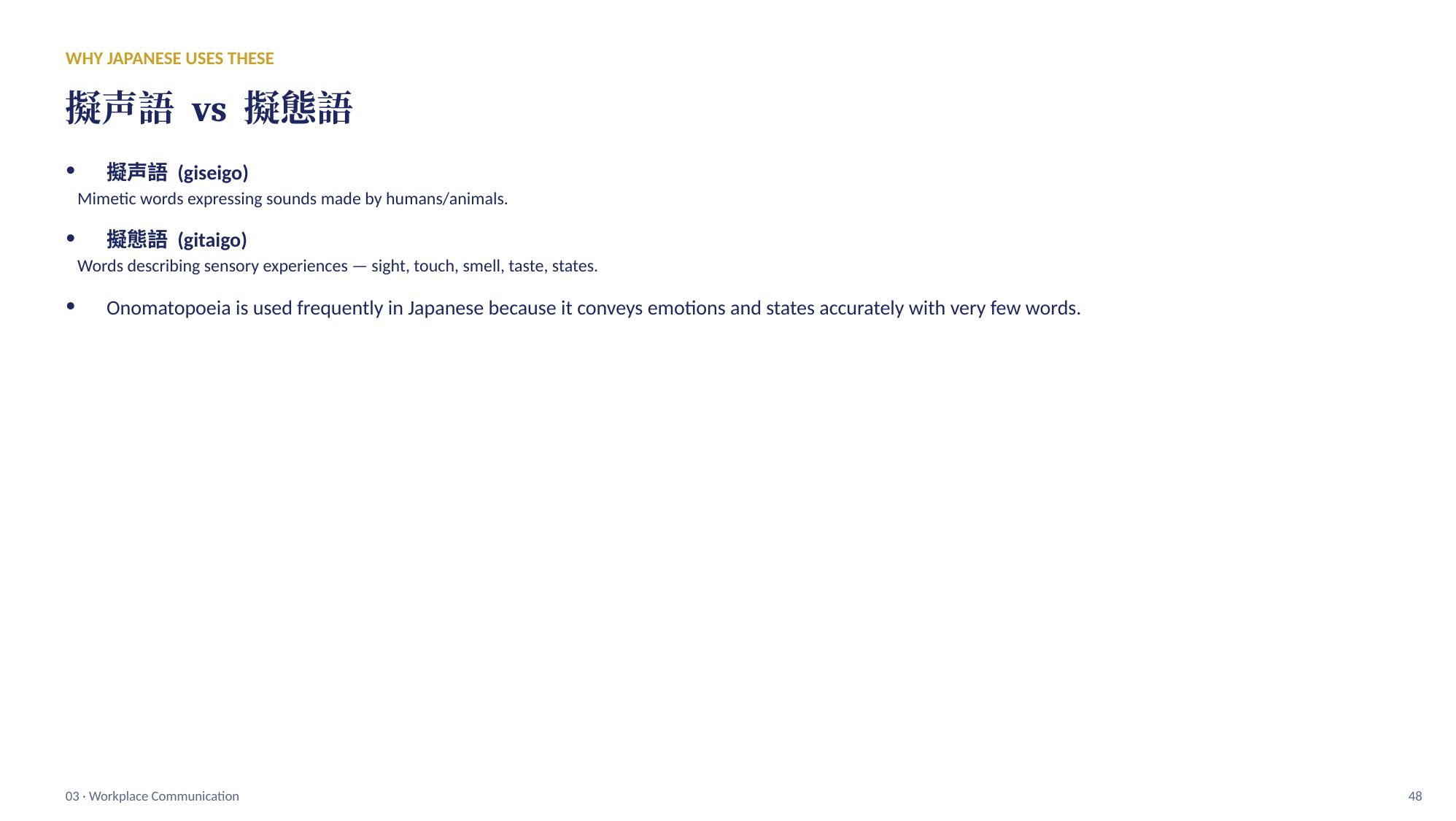
JP擬声語vs擬態語
EN• 擬声語 (giseigo)
Mimetic words expressing sounds made by humans/animals.
• 擬態語 (gitaigo)
Words describing sensory experiences — sight, touch, smell, taste, states.
• Onomatopoeia is used frequently in Japanese because it conveys emotions and states accurately with very few words.
03 · Workplace Communication 48
Mimetic words expressing sounds made by humans/animals.
• 擬態語 (gitaigo)
Words describing sensory experiences — sight, touch, smell, taste, states.
• Onomatopoeia is used frequently in Japanese because it conveys emotions and states accurately with very few words.
03 · Workplace Communication 48
หน้า 49
คลิกเพื่อขยาย
ENSPEED & PACE
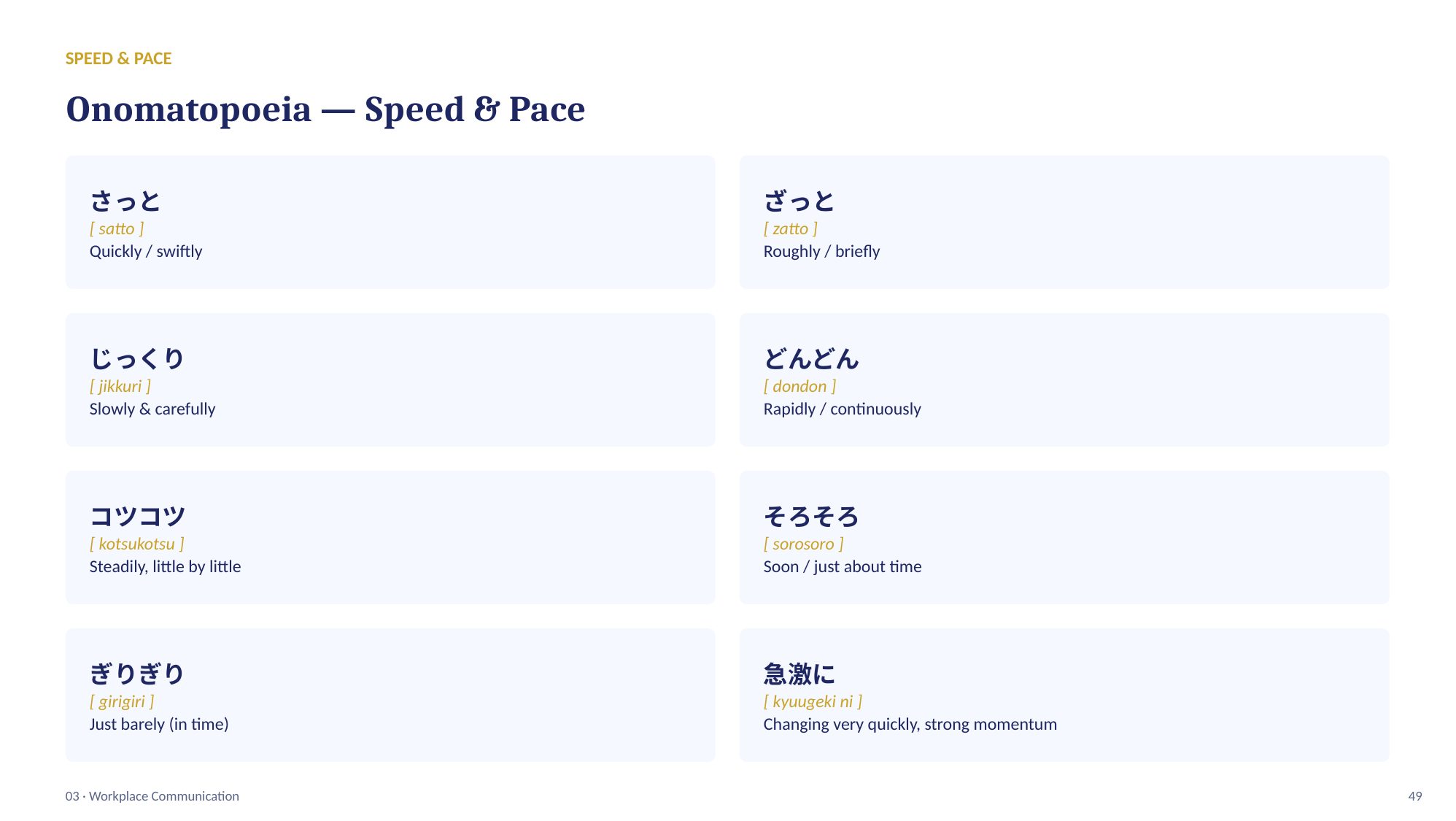
Onomatopoeia — Speed & Pace
Onomatopoeia — Speed & Pace
JPさっとざっと
EN [ satto ] [ zatto ]
Quickly / swiftly Roughly / briefly
Quickly / swiftly Roughly / briefly
JPじっくりどんどん
EN [ jikkuri ] [ dondon ]
Slowly & carefully Rapidly / continuously
Slowly & carefully Rapidly / continuously
JPコツコツそろそろ
EN [ kotsukotsu ] [ sorosoro ]
Steadily, little by little Soon / just about time
Steadily, little by little Soon / just about time
JPぎりぎり急激に
EN [ girigiri ] [ kyuugeki ni ]
Just barely (in time) Changing very quickly, strong momentum
03 · Workplace Communication 49
Just barely (in time) Changing very quickly, strong momentum
03 · Workplace Communication 49
หน้า 50
คลิกเพื่อขยาย
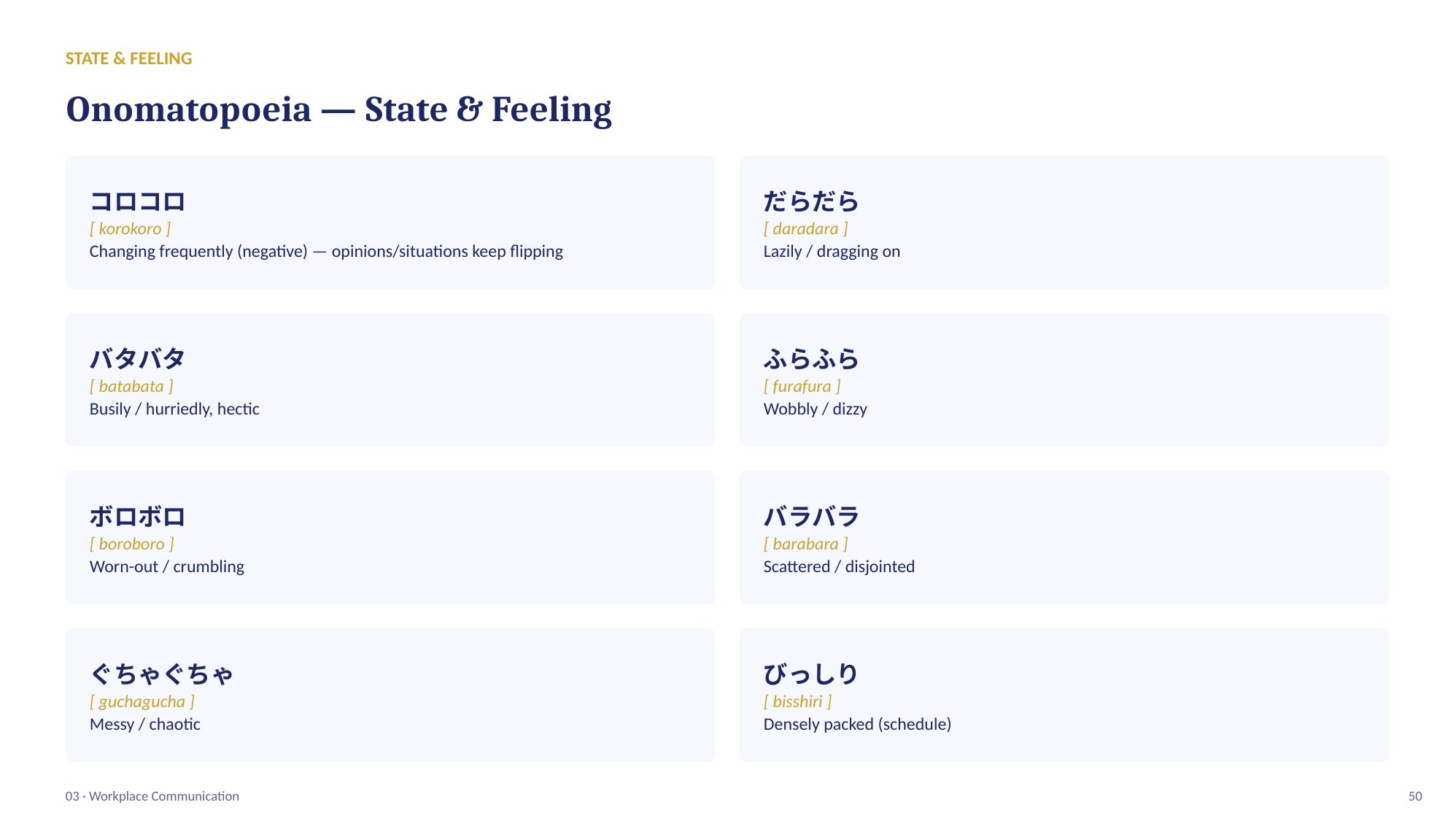
ENSTATE & FEELING
Onomatopoeia — State & Feeling
Onomatopoeia — State & Feeling
JPコロコロだらだら
EN [ korokoro ] [ daradara ]
Changing frequently (negative) — opinions/situations keep flipping Lazily / dragging on
Changing frequently (negative) — opinions/situations keep flipping Lazily / dragging on
JPバタバタふらふら
EN [ batabata ] [ furafura ]
Busily / hurriedly, hectic Wobbly / dizzy
Busily / hurriedly, hectic Wobbly / dizzy
JPボロボロバラバラ
EN [ boroboro ] [ barabara ]
Worn-out / crumbling Scattered / disjointed
Worn-out / crumbling Scattered / disjointed
JPぐちゃぐちゃびっしり
EN [ guchagucha ] [ bisshiri ]
Messy / chaotic Densely packed (schedule)
03 · Workplace Communication 50
Messy / chaotic Densely packed (schedule)
03 · Workplace Communication 50
หน้า 51
คลิกเพื่อขยาย
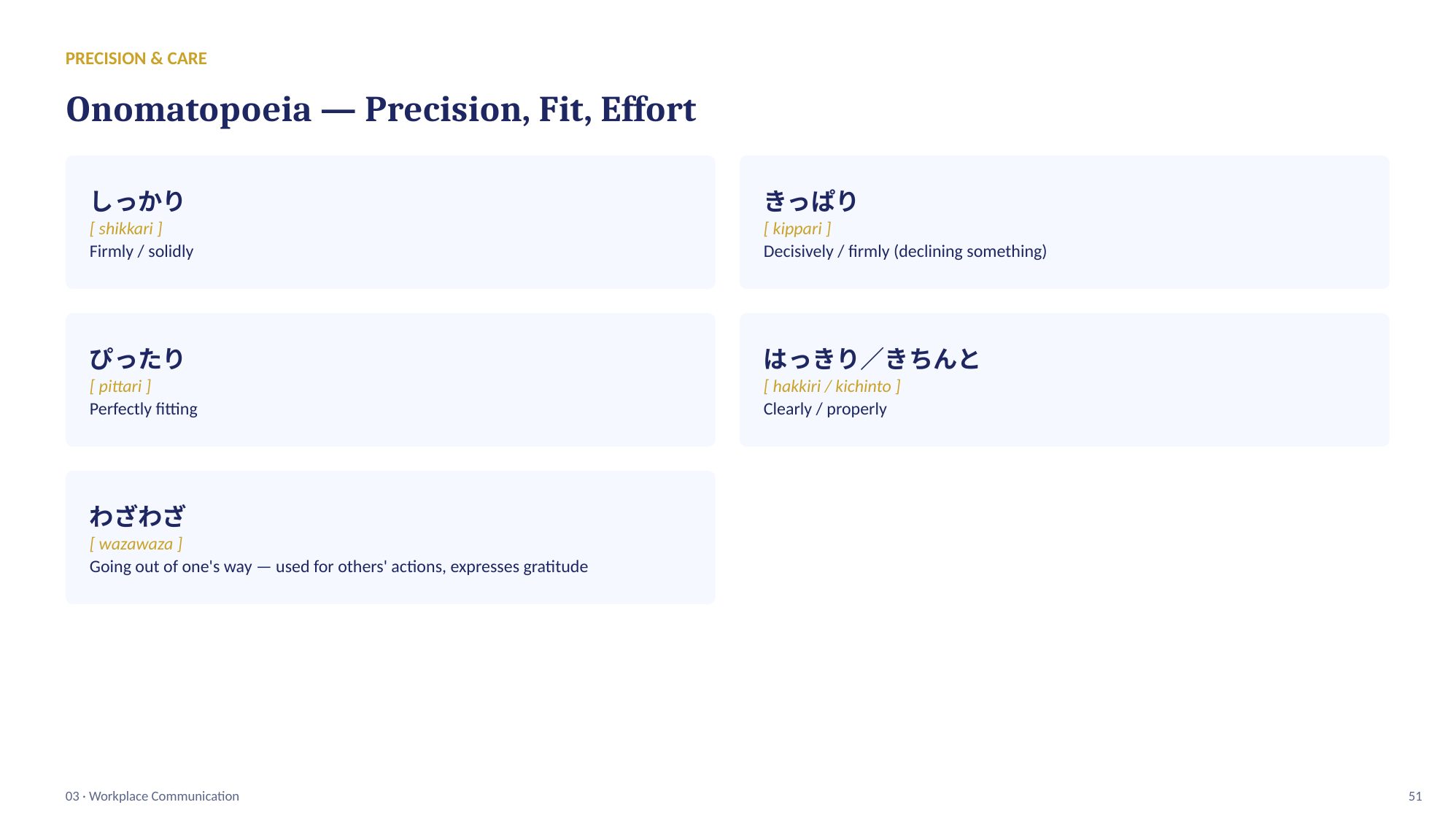
ENPRECISION & CARE
Onomatopoeia — Precision, Fit, Effort
Onomatopoeia — Precision, Fit, Effort
JPしっかりきっぱり
EN [ shikkari ] [ kippari ]
Firmly / solidly Decisively / firmly (declining something)
Firmly / solidly Decisively / firmly (declining something)
JPぴったりはっきり/きちんと
EN [ pittari ] [ hakkiri / kichinto ]
Perfectly fitting Clearly / properly
Perfectly fitting Clearly / properly
JPわざわざ
EN [ wazawaza ]
Going out of one's way — used for others' actions, expresses gratitude
03 · Workplace Communication 51
Going out of one's way — used for others' actions, expresses gratitude
03 · Workplace Communication 51
หน้า 52
คลิกเพื่อขยาย
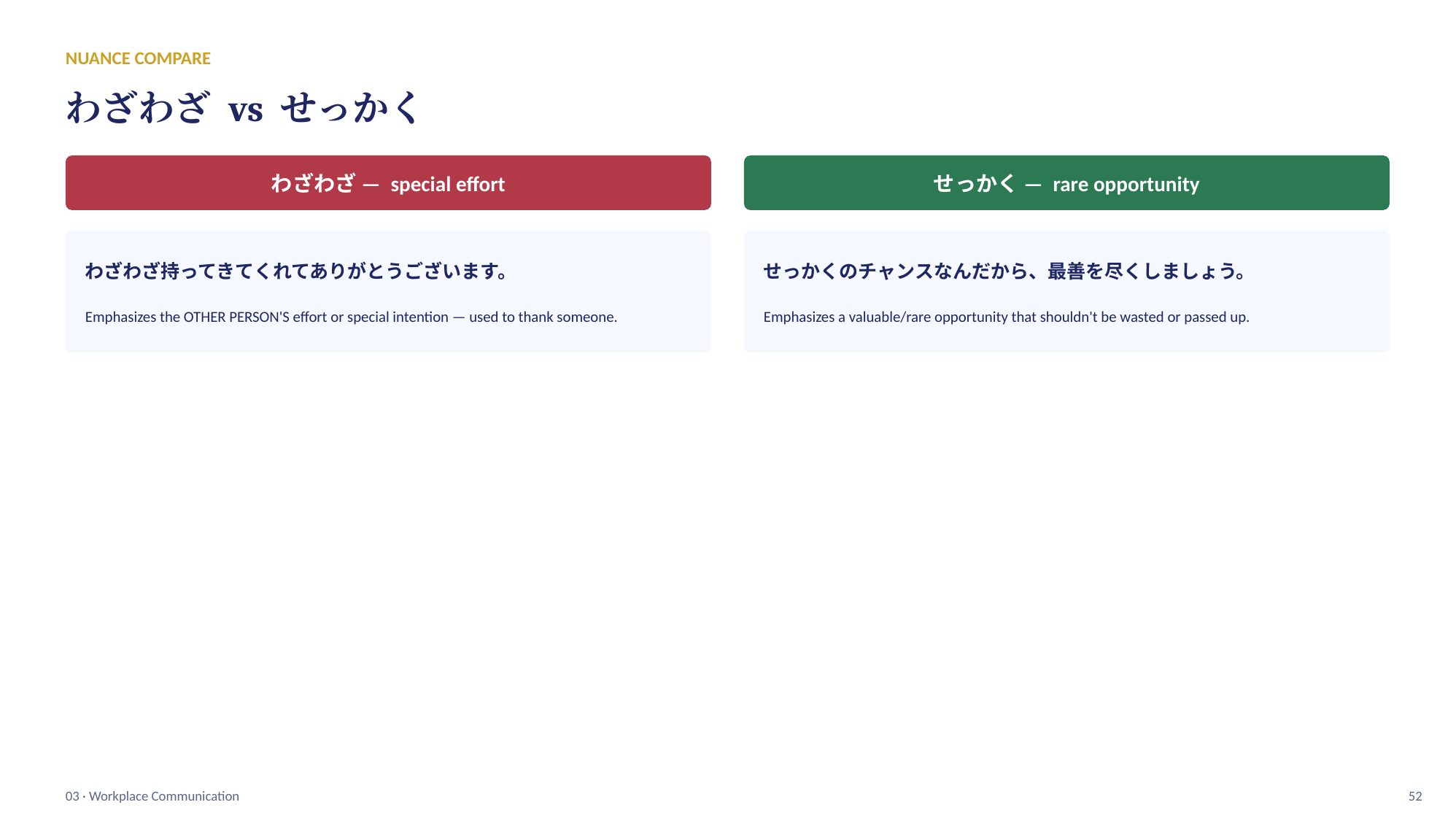
ENNUANCE COMPARE
JPわざわざvsせっかく
EN わざわざ — special effort せっかく — rare opportunity
JPわざわざ持ってきてくれてありがとうございます。せっかくのチャンスなんだから、最善を尽くしましょう。
EN Emphasizes the OTHER PERSON'S effort or special intention — used to thank someone. Emphasizes a valuable/rare opportunity that shouldn't be wasted or passed up.
03 · Workplace Communication 52
03 · Workplace Communication 52
หน้า 53
คลิกเพื่อขยาย
12
ENReceiving-Verb Politeness Levels
JP「受け取る」の丁寧レベル
ENFour levels of "to receive," from neutral to most humble
หน้า 54
คลิกเพื่อขยาย
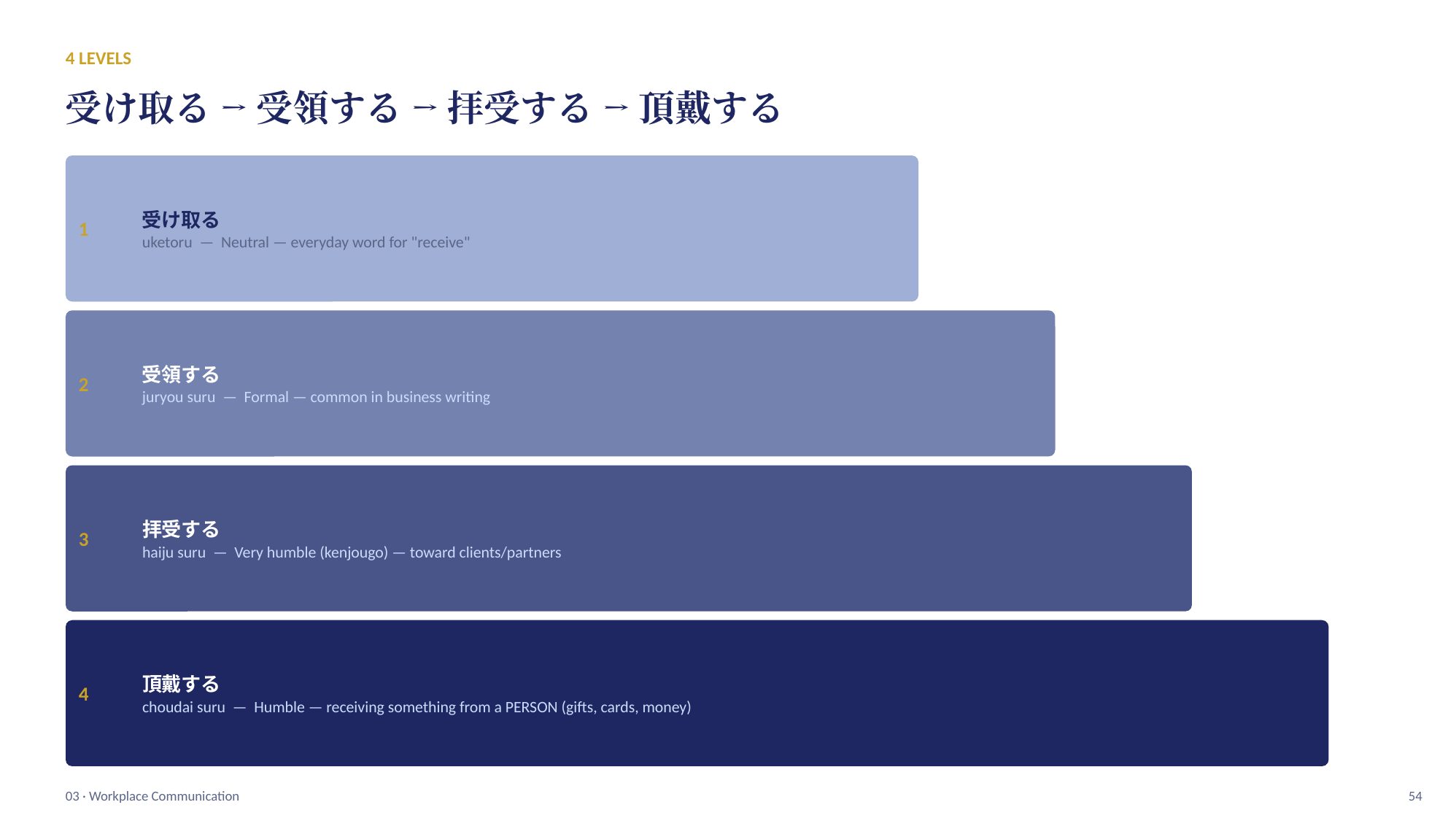
EN4 LEVELS
JP受け取る→受領する→拝受する→頂戴する
1受け取る
1受け取る
EN uketoru — Neutral — everyday word for "receive"
JP2受領する
EN juryou suru — Formal — common in business writing
JP3拝受する
EN haiju suru — Very humble (kenjougo) — toward clients/partners
JP4頂戴する
EN choudai suru — Humble — receiving something from a PERSON (gifts, cards, money)
03 · Workplace Communication 54
03 · Workplace Communication 54
หน้า 55
คลิกเพื่อขยาย
ENIN USE
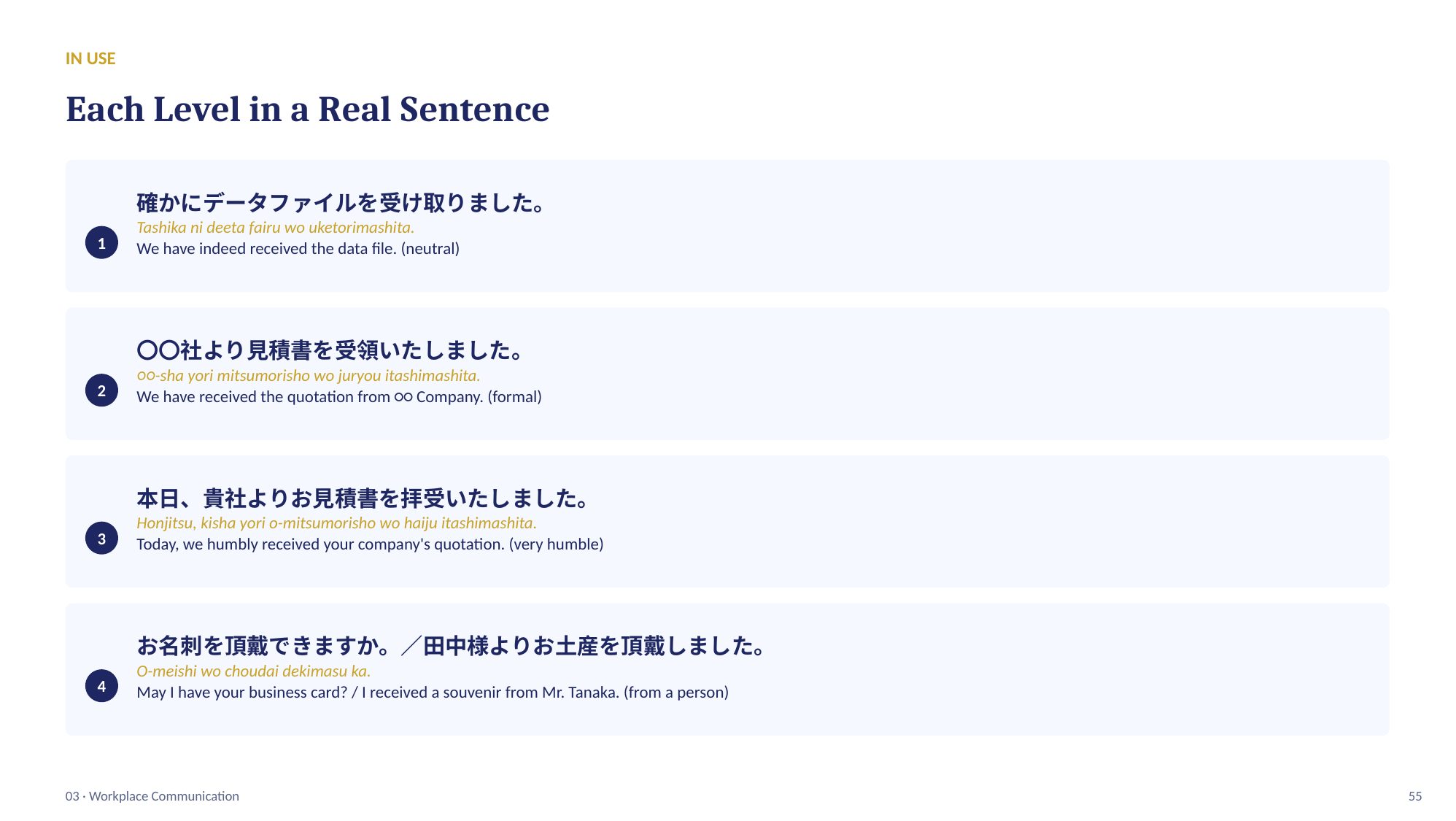
Each Level in a Real Sentence
Each Level in a Real Sentence
JP確かにデータファイルを受け取りました。
EN Tashika ni deeta fairu wo uketorimashita.
1 We have indeed received the data file. (neutral)
1 We have indeed received the data file. (neutral)
JP〇〇社より見積書を受領いたしました。
EN ○○-sha yori mitsumorisho wo juryou itashimashita.
2 We have received the quotation from ○○ Company. (formal)
2 We have received the quotation from ○○ Company. (formal)
JP本日、貴社よりお見積書を拝受いたしました。
EN Honjitsu, kisha yori o-mitsumorisho wo haiju itashimashita.
3 Today, we humbly received your company's quotation. (very humble)
3 Today, we humbly received your company's quotation. (very humble)
JPお名刺を頂戴できますか。/田中様よりお土産を頂戴しました。
EN O-meishi wo choudai dekimasu ka.
4 May I have your business card? / I received a souvenir from Mr. Tanaka. (from a person)
03 · Workplace Communication 55
4 May I have your business card? / I received a souvenir from Mr. Tanaka. (from a person)
03 · Workplace Communication 55
หน้า 56

คลิกเพื่อขยาย
13
ENSix Ways to Say "Busy" + Quickness Words
JP『忙しい』を表す言葉&早速・早々・迅速
ENVivid alternatives to plain 忙しい , plus three ways to say "promptly"
หน้า 57
คลิกเพื่อขยาย
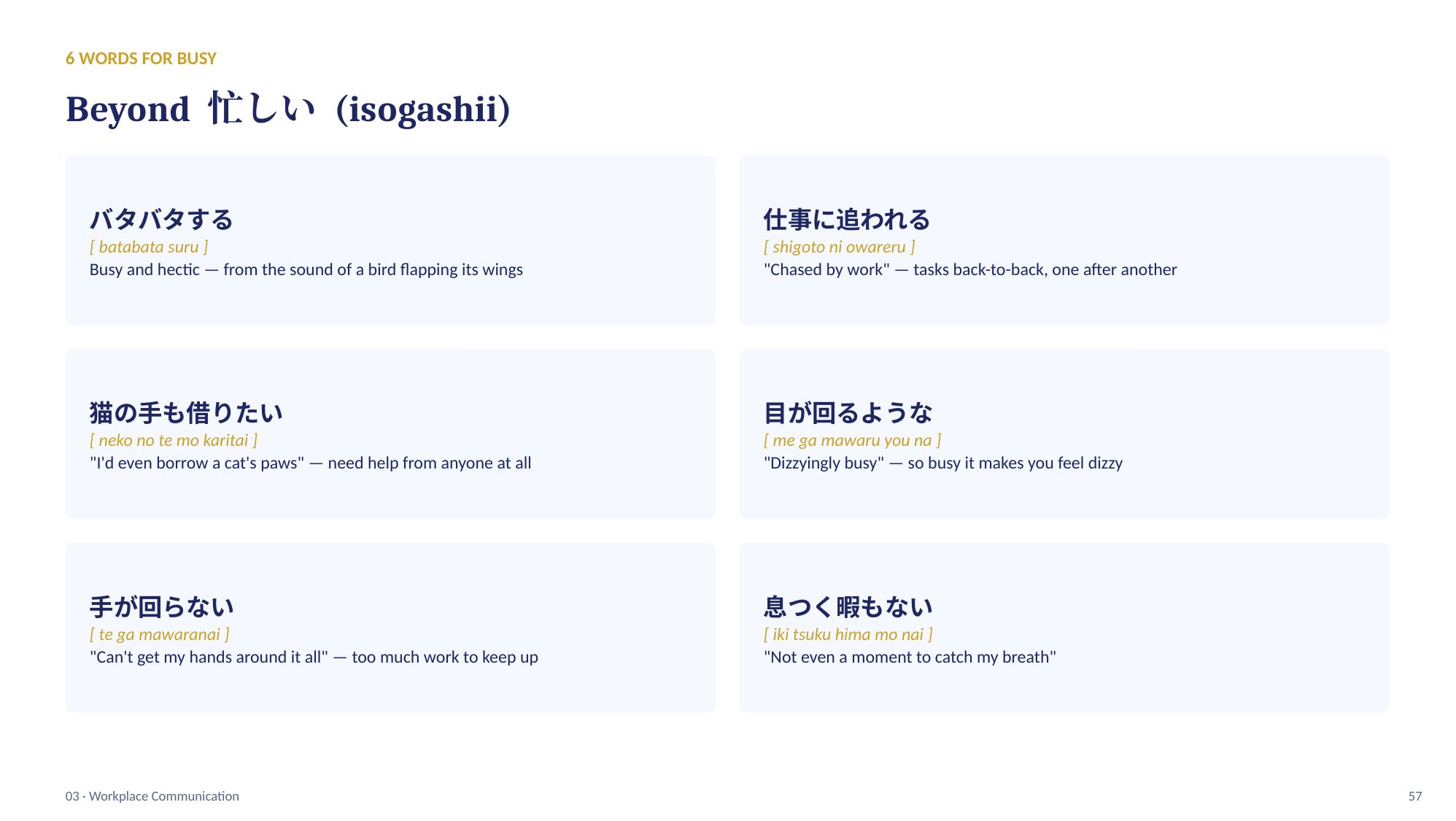
EN6 WORDS FOR BUSY
Beyond 忙しい (isogashii)
Beyond 忙しい (isogashii)
JPバタバタする仕事に追われる
EN [ batabata suru ] [ shigoto ni owareru ]
Busy and hectic — from the sound of a bird flapping its wings "Chased by work" — tasks back-to-back, one after another
Busy and hectic — from the sound of a bird flapping its wings "Chased by work" — tasks back-to-back, one after another
JP猫の手も借りたい目が回るような
EN [ neko no te mo karitai ] [ me ga mawaru you na ]
"I'd even borrow a cat's paws" — need help from anyone at all "Dizzyingly busy" — so busy it makes you feel dizzy
"I'd even borrow a cat's paws" — need help from anyone at all "Dizzyingly busy" — so busy it makes you feel dizzy
JP手が回らない息つく暇もない
EN [ te ga mawaranai ] [ iki tsuku hima mo nai ]
"Can't get my hands around it all" — too much work to keep up "Not even a moment to catch my breath"
03 · Workplace Communication 57
"Can't get my hands around it all" — too much work to keep up "Not even a moment to catch my breath"
03 · Workplace Communication 57
หน้า 58
คลิกเพื่อขยาย
ENIN USE
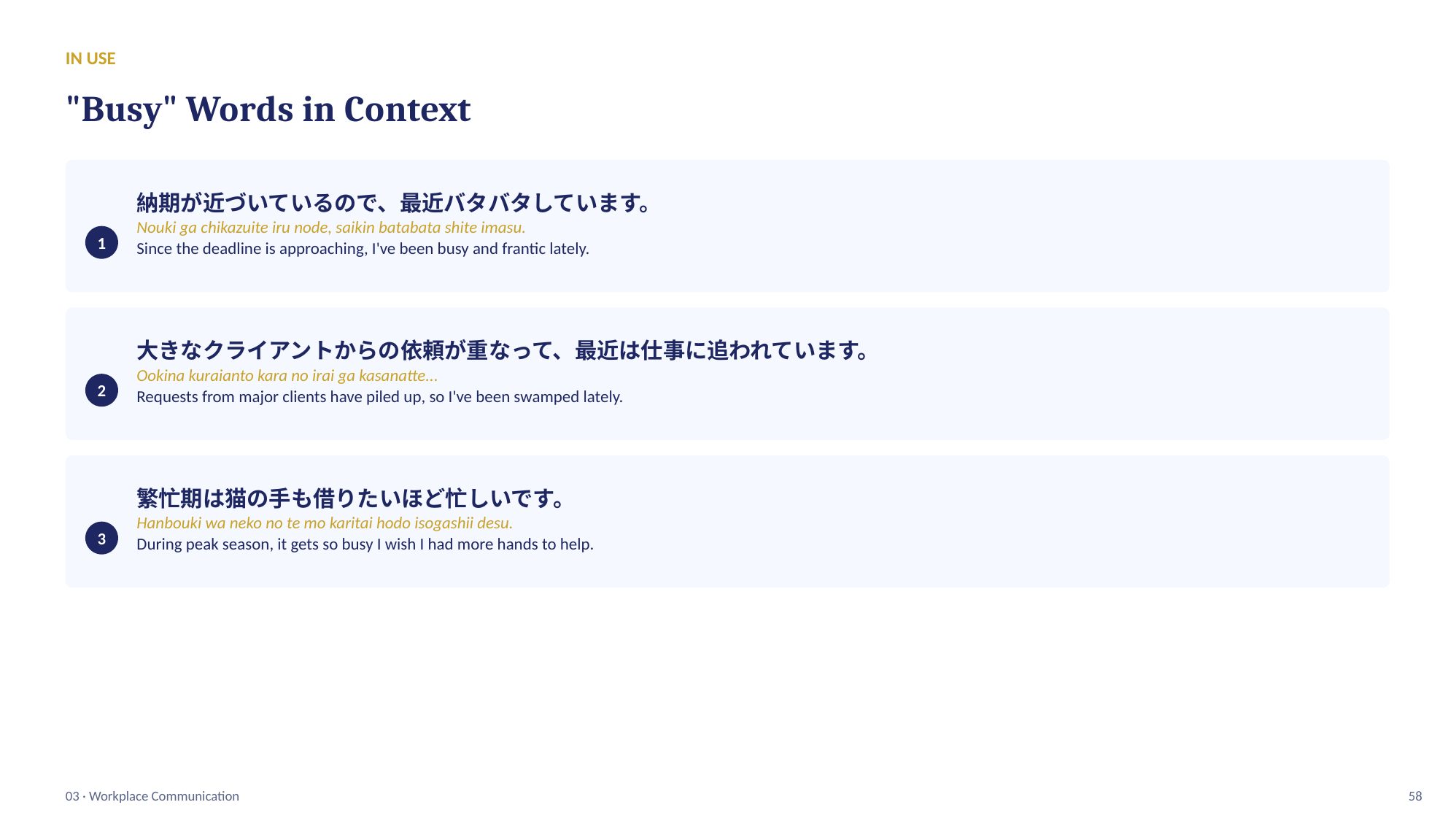
"Busy" Words in Context
"Busy" Words in Context
JP納期が近づいているので、最近バタバタしています。
EN Nouki ga chikazuite iru node, saikin batabata shite imasu.
1 Since the deadline is approaching, I've been busy and frantic lately.
1 Since the deadline is approaching, I've been busy and frantic lately.
JP大きなクライアントからの依頼が重なって、最近は仕事に追われています。
EN Ookina kuraianto kara no irai ga kasanatte...
2 Requests from major clients have piled up, so I've been swamped lately.
2 Requests from major clients have piled up, so I've been swamped lately.
JP繁忙期は猫の手も借りたいほど忙しいです。
EN Hanbouki wa neko no te mo karitai hodo isogashii desu.
3 During peak season, it gets so busy I wish I had more hands to help.
03 · Workplace Communication 58
3 During peak season, it gets so busy I wish I had more hands to help.
03 · Workplace Communication 58
หน้า 59
คลิกเพื่อขยาย
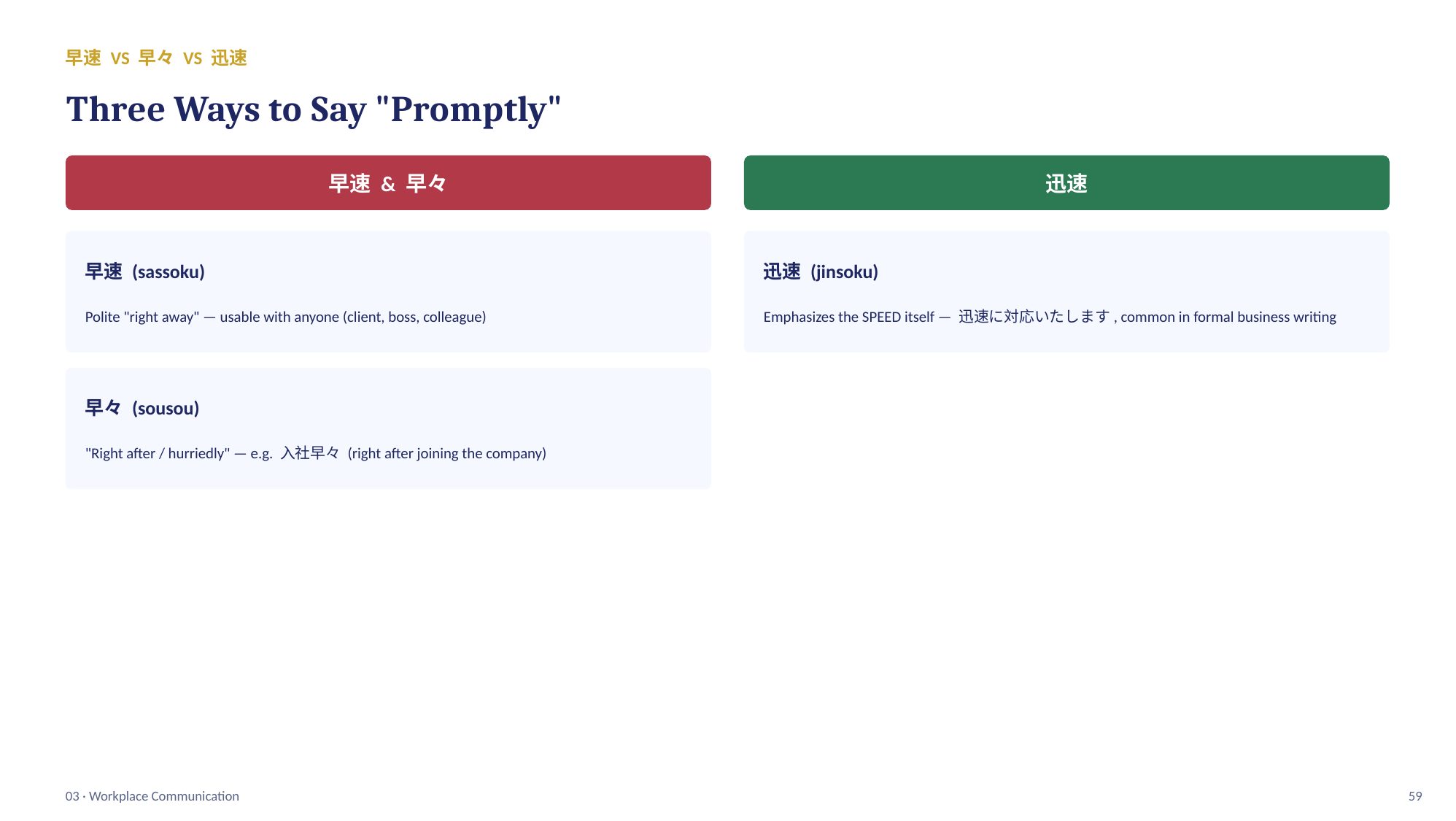
JP早速VS早々VS迅速
ENThree Ways to Say "Promptly"
JP早速&早々迅速
EN 早速 (sassoku) 迅速 (jinsoku)
Polite "right away" — usable with anyone (client, boss, colleague) Emphasizes the SPEED itself — 迅速に対応いたします , common in formal business writing
早々 (sousou)
"Right after / hurriedly" — e.g. 入社早々 (right after joining the company)
03 · Workplace Communication 59
Polite "right away" — usable with anyone (client, boss, colleague) Emphasizes the SPEED itself — 迅速に対応いたします , common in formal business writing
早々 (sousou)
"Right after / hurriedly" — e.g. 入社早々 (right after joining the company)
03 · Workplace Communication 59
หน้า 60

คลิกเพื่อขยาย
14
ENSpecial Set Phrases
JP覚えておきたい定型表現
ENわかりかねます/ご自愛ください/ご承知おきください — three phrases every business email needs
หน้า 61
คลิกเพื่อขยาย
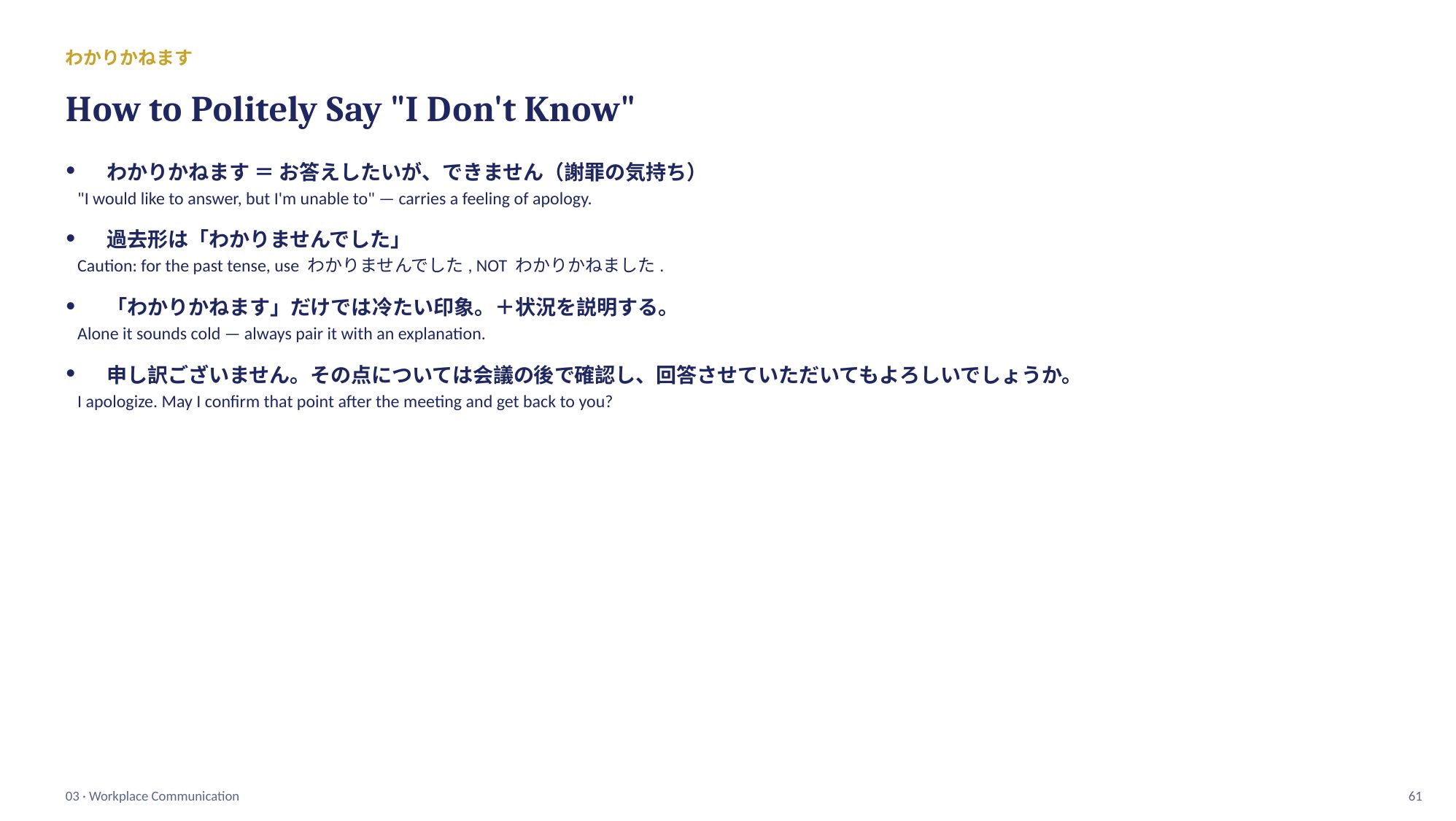
JPわかりかねます
ENHow to Politely Say "I Don't Know"
JP•わかりかねます=お答えしたいが、できません(謝罪の気持ち)
EN "I would like to answer, but I'm unable to" — carries a feeling of apology.
JP•過去形は「わかりませんでした」
EN Caution: for the past tense, use わかりませんでした , NOT わかりかねました .
JP•「わかりかねます」だけでは冷たい印象。+状況を説明する。
EN Alone it sounds cold — always pair it with an explanation.
JP•申し訳ございません。その点については会議の後で確認し、回答させていただいてもよろしいでしょうか。
EN I apologize. May I confirm that point after the meeting and get back to you?
03 · Workplace Communication 61
03 · Workplace Communication 61
หน้า 62
คลิกเพื่อขยาย
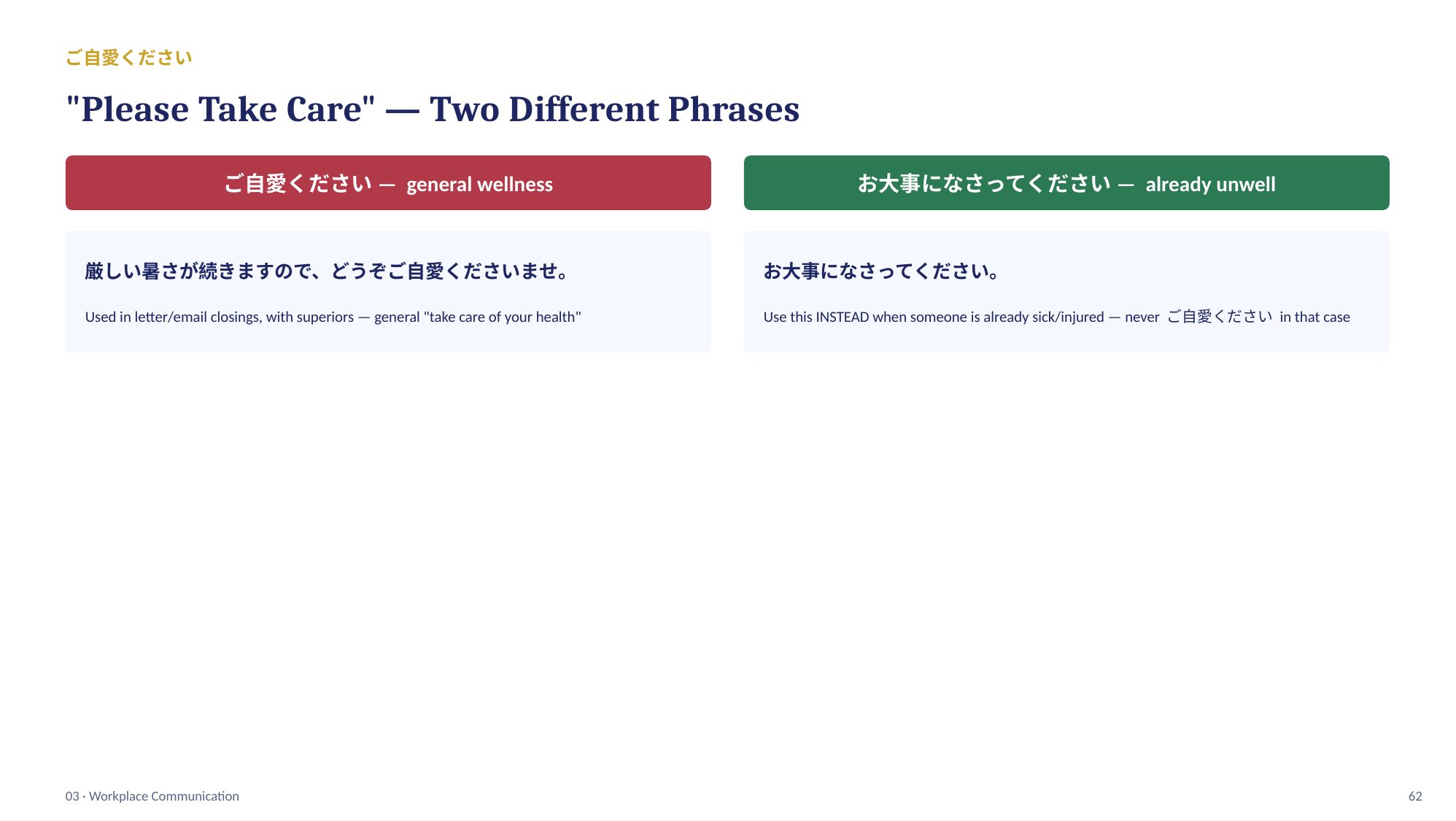
JPご自愛ください
EN"Please Take Care" — Two Different Phrases
ご自愛ください — general wellness お大事になさってください — already unwell
ご自愛ください — general wellness お大事になさってください — already unwell
JP厳しい暑さが続きますので、どうぞご自愛くださいませ。お大事になさってください。
EN Used in letter/email closings, with superiors — general "take care of your health" Use this INSTEAD when someone is already sick/injured — never ご自愛ください in that case
03 · Workplace Communication 62
03 · Workplace Communication 62
หน้า 63
คลิกเพื่อขยาย
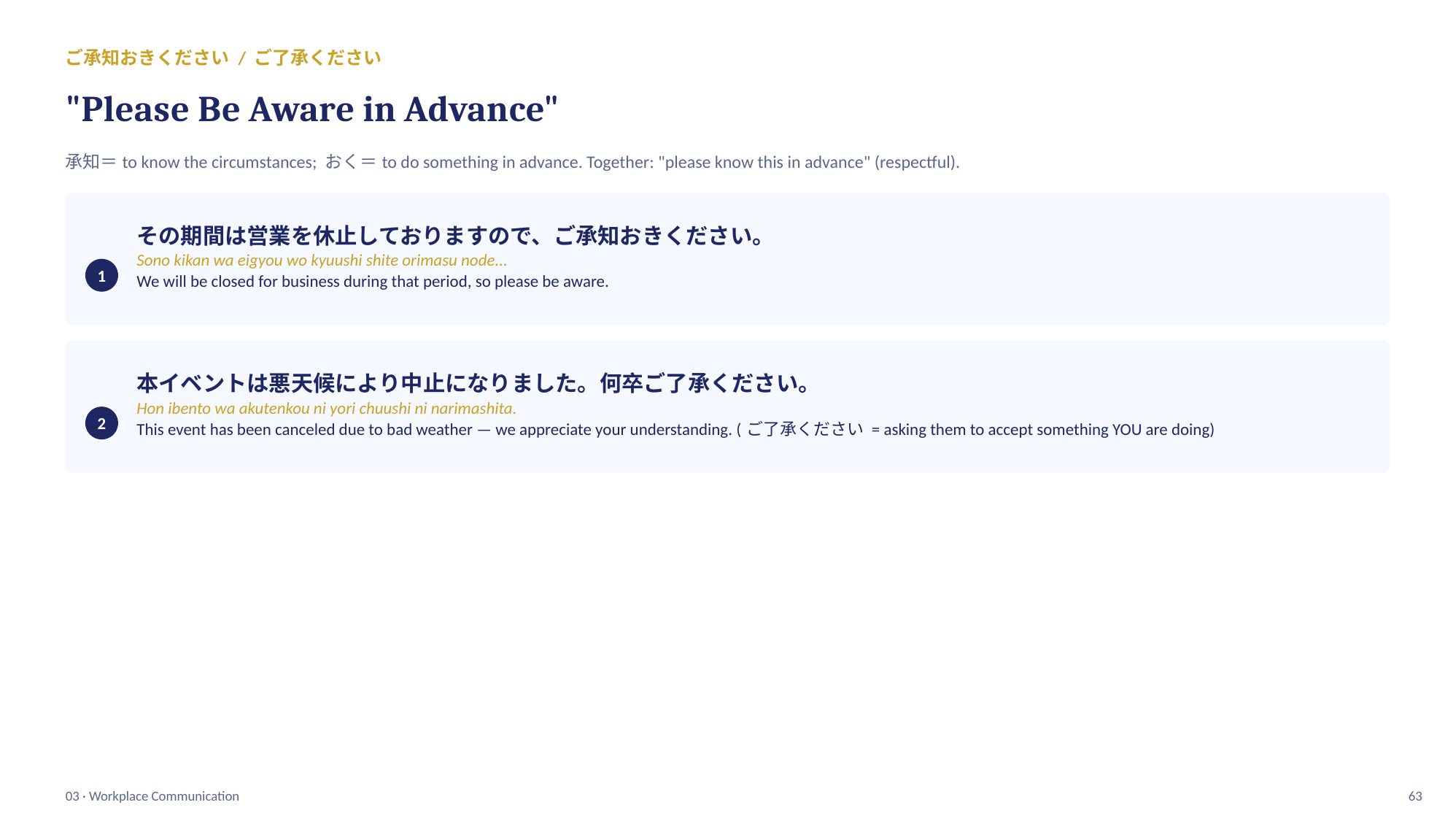
JPご承知おきください/ご了承ください
EN"Please Be Aware in Advance"
承知= to know the circumstances; おく= to do something in advance. Together: "please know this in advance" (respectful).
承知= to know the circumstances; おく= to do something in advance. Together: "please know this in advance" (respectful).
JPその期間は営業を休止しておりますので、ご承知おきください。
EN Sono kikan wa eigyou wo kyuushi shite orimasu node...
1 We will be closed for business during that period, so please be aware.
1 We will be closed for business during that period, so please be aware.
JP本イベントは悪天候により中止になりました。何卒ご了承ください。
EN Hon ibento wa akutenkou ni yori chuushi ni narimashita.
2 This event has been canceled due to bad weather — we appreciate your understanding. ( ご了承ください = asking them to accept something YOU are doing)
03 · Workplace Communication 63
2 This event has been canceled due to bad weather — we appreciate your understanding. ( ご了承ください = asking them to accept something YOU are doing)
03 · Workplace Communication 63
หน้า 64
คลิกเพื่อขยาย
15
ENWorkplace Harassment Vocabulary
JP職場のハラスメント用語
ENSix terms every professional should recognize
หน้า 65
คลิกเพื่อขยาย
ENREFERENCE
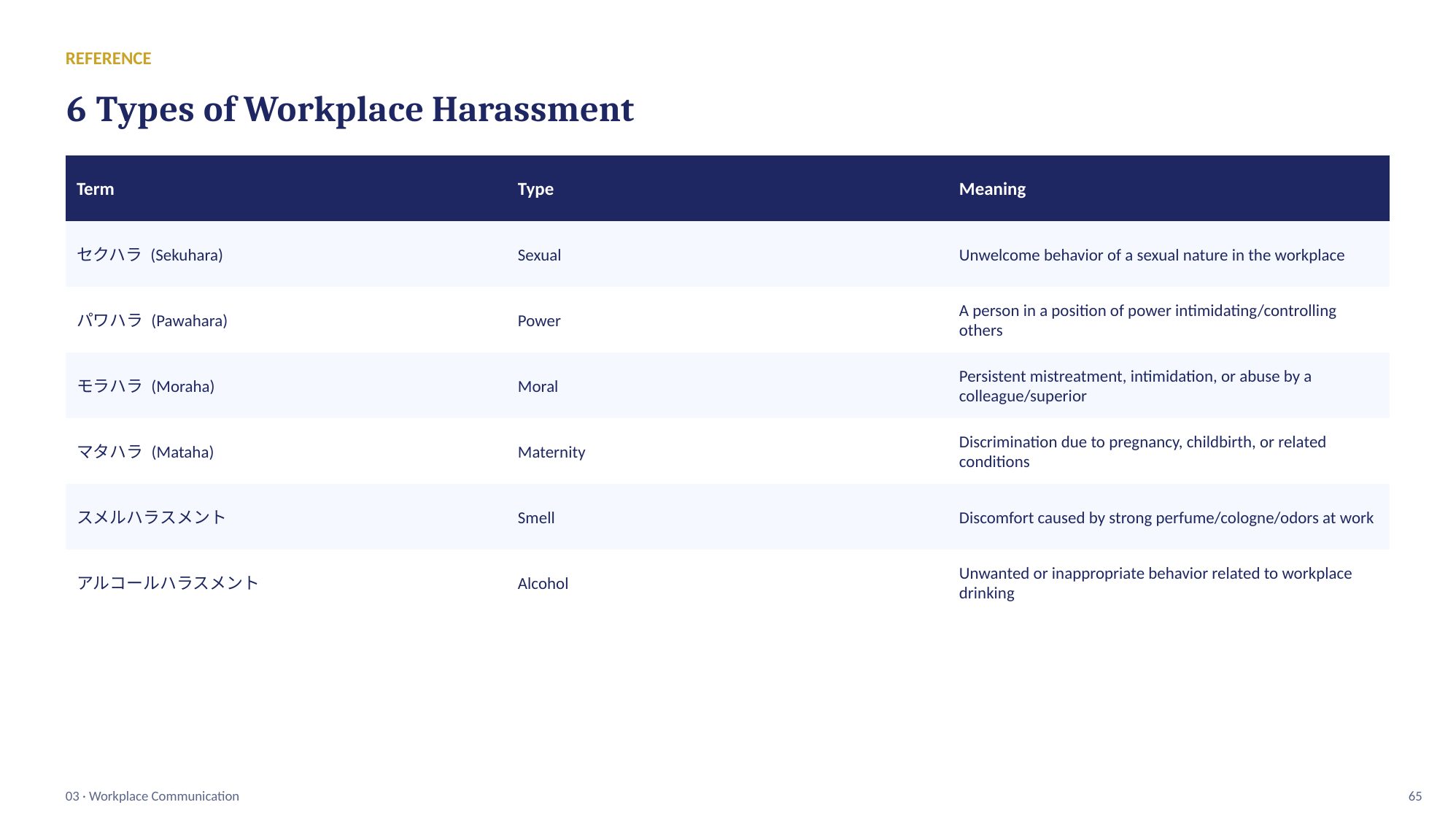
6 Types of Workplace Harassment
Term Type Meaning
セクハラ (Sekuhara) Sexual Unwelcome behavior of a sexual nature in the workplace
A person in a position of power intimidating/controlling
パワハラ (Pawahara) Power
others
Persistent mistreatment, intimidation, or abuse by a
モラハラ (Moraha) Moral
colleague/superior
Discrimination due to pregnancy, childbirth, or related
マタハラ (Mataha) Maternity
conditions
スメルハラスメント Smell Discomfort caused by strong perfume/cologne/odors at work
Unwanted or inappropriate behavior related to workplace
6 Types of Workplace Harassment
Term Type Meaning
セクハラ (Sekuhara) Sexual Unwelcome behavior of a sexual nature in the workplace
A person in a position of power intimidating/controlling
パワハラ (Pawahara) Power
others
Persistent mistreatment, intimidation, or abuse by a
モラハラ (Moraha) Moral
colleague/superior
Discrimination due to pregnancy, childbirth, or related
マタハラ (Mataha) Maternity
conditions
スメルハラスメント Smell Discomfort caused by strong perfume/cologne/odors at work
Unwanted or inappropriate behavior related to workplace
JPアルコールハラスメントAlcohol
EN drinking
03 · Workplace Communication 65
03 · Workplace Communication 65