หน้า 1

คลิกเพื่อขยาย
JPわかりやすい
業務報告メールの書き方
業務報告メールの書き方
ENHow to write clear and concise work report emails
หน้า 2
คลิกเพื่อขยาย
EN Lesson GOAL
JP業務の進捗状況を報告する時の
メールが書けるようになろう
メールが書けるようになろう
ENLearn how to write emails to report the progress of our work
หน้า 3
คลิกเพื่อขยาย
EN Lesson Agenda
JPほうこく
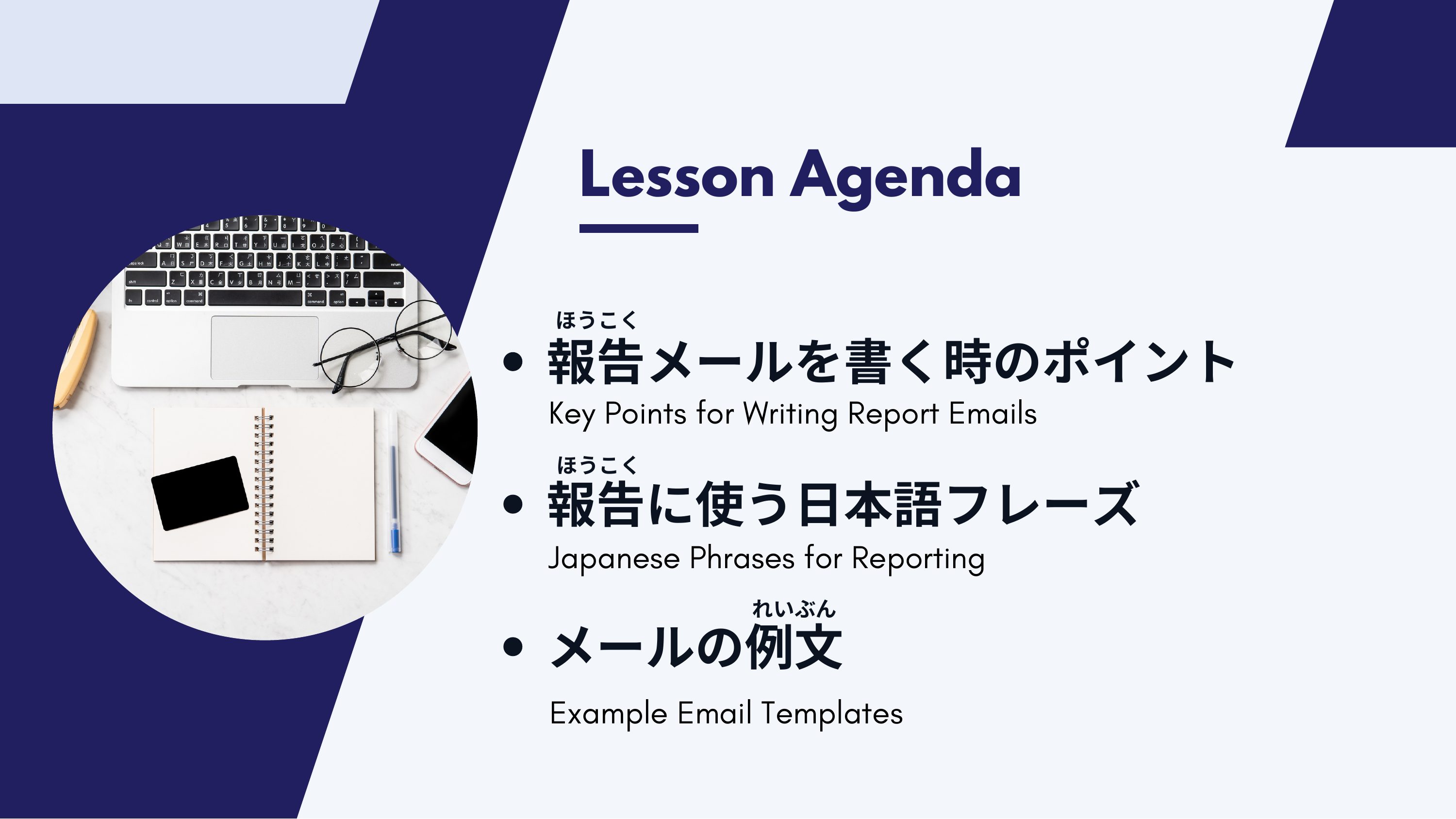
報告メールを書く時のポイント
報告メールを書く時のポイント
ENKey Points for Writing Report Emails
JPほうこく
報告に使う日本語フレーズ
報告に使う日本語フレーズ
ENJapanese Phrases for Reporting
JPれいぶん
メールの例文
メールの例文
ENExample Email Templates
หน้า 4

คลิกเพื่อขยาย
EN point
JP仕事のメールには
いつも目的とGOALがある
いつも目的とGOALがある
หน้า 5
คลิกเพื่อขยาย
JPもくてきけつろん
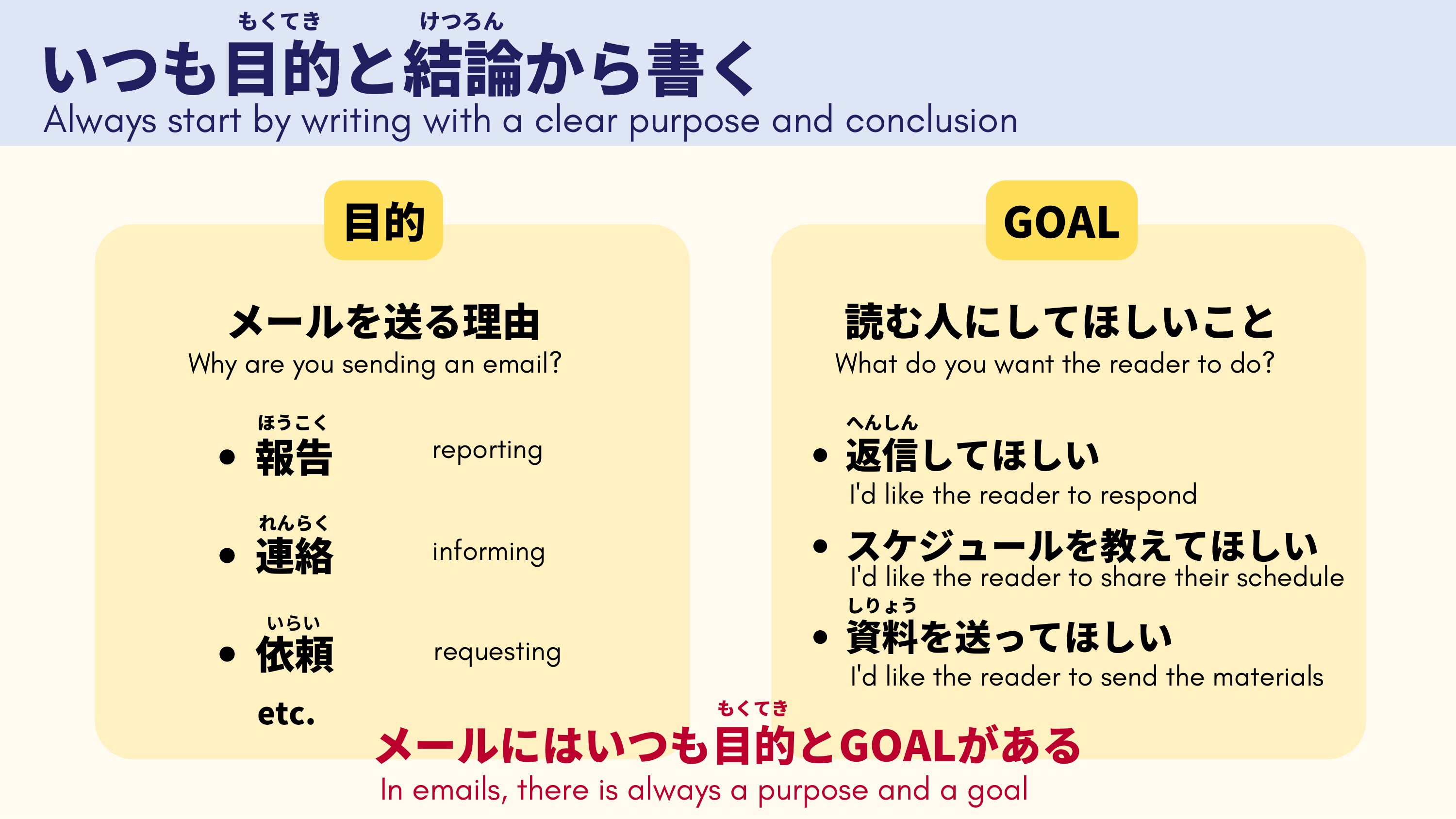
いつも目的と結論から書く
いつも目的と結論から書く
ENAlways start by writing with a clear purpose and conclusion
目的 GOAL
目的 GOAL
JPメールを送る理由読む人にしてほしいこと
EN Why are you sending an email? What do you want the reader to do?
JPほうこくへんしん
報告reporting返信してほしい
報告reporting返信してほしい
EN I'd like the reader to respond
JPれんらく
連絡informingスケジュールを教えてほしい
連絡informingスケジュールを教えてほしい
EN I'd like the reader to share their schedule
JPしりょう
資料を送ってほしい
いらい
資料を送ってほしい
いらい
EN 依頼 requesting
I'd like the reader to send the materials
I'd like the reader to send the materials
JPetc.もくてき
メールにはいつも目的とGOALがある
メールにはいつも目的とGOALがある
EN In emails, there is always a purpose and a goal
หน้า 6
คลิกเพื่อขยาย
JP業務報告をするのはどんな時?
หน้า 7
คลิกเพื่อขยาย
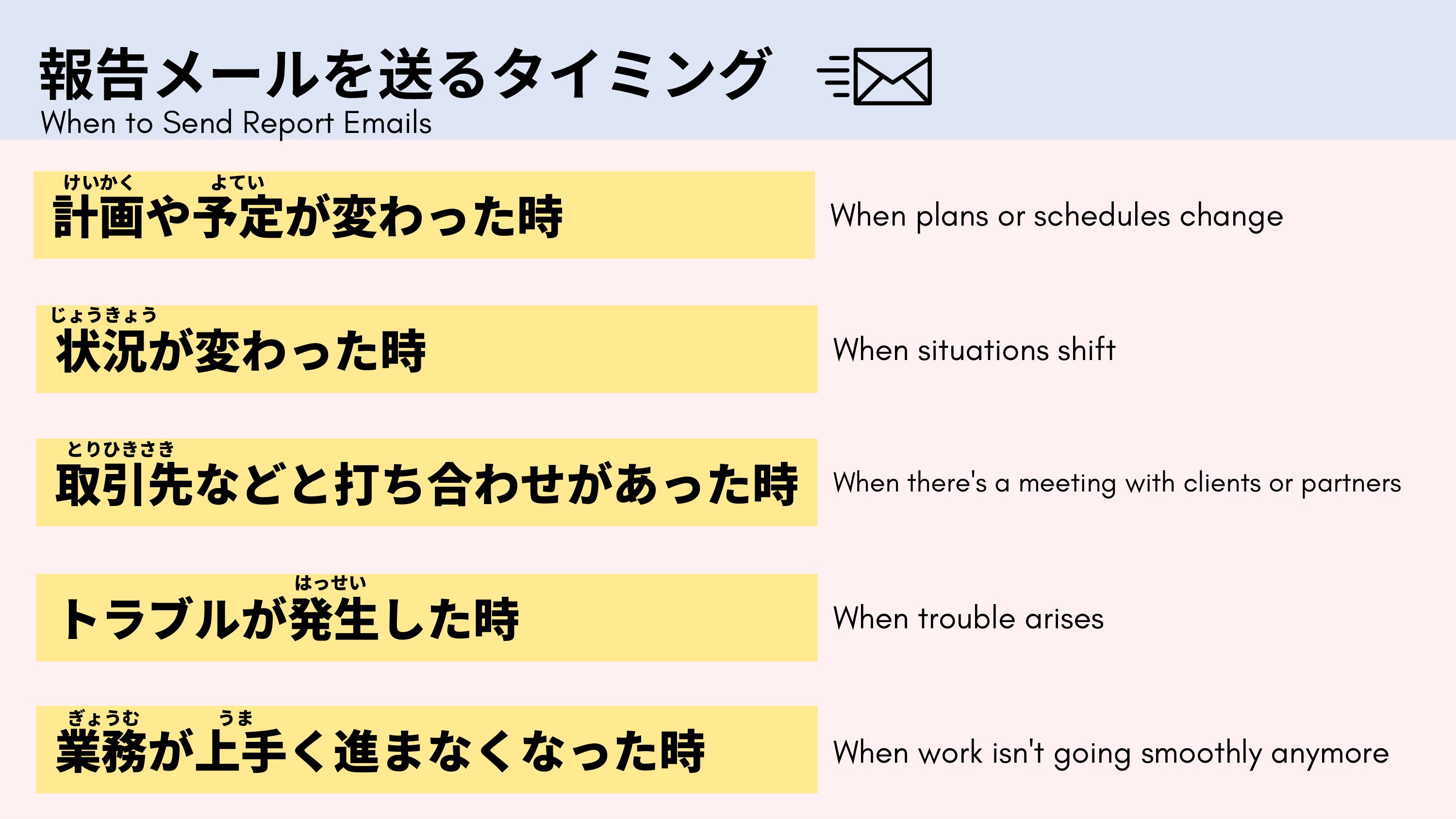
JP報告メールを送るタイミング
ENWhen to Send Report Emails
JPけいかくよてい
EN計画や予定が変わった時 When plans or schedules change
JPじょうきょう
EN状況が変わった時 When situations shift
JPとりひきさき
EN取引先などと打ち合わせがあった時 When there's a meeting with clients or partners
JPはっせい
ENトラブルが発生した時 When trouble arises
JPぎょうむうま
EN業務が上手く進まなくなった時 When work isn't going smoothly anymore
หน้า 8
คลิกเพื่อขยาย
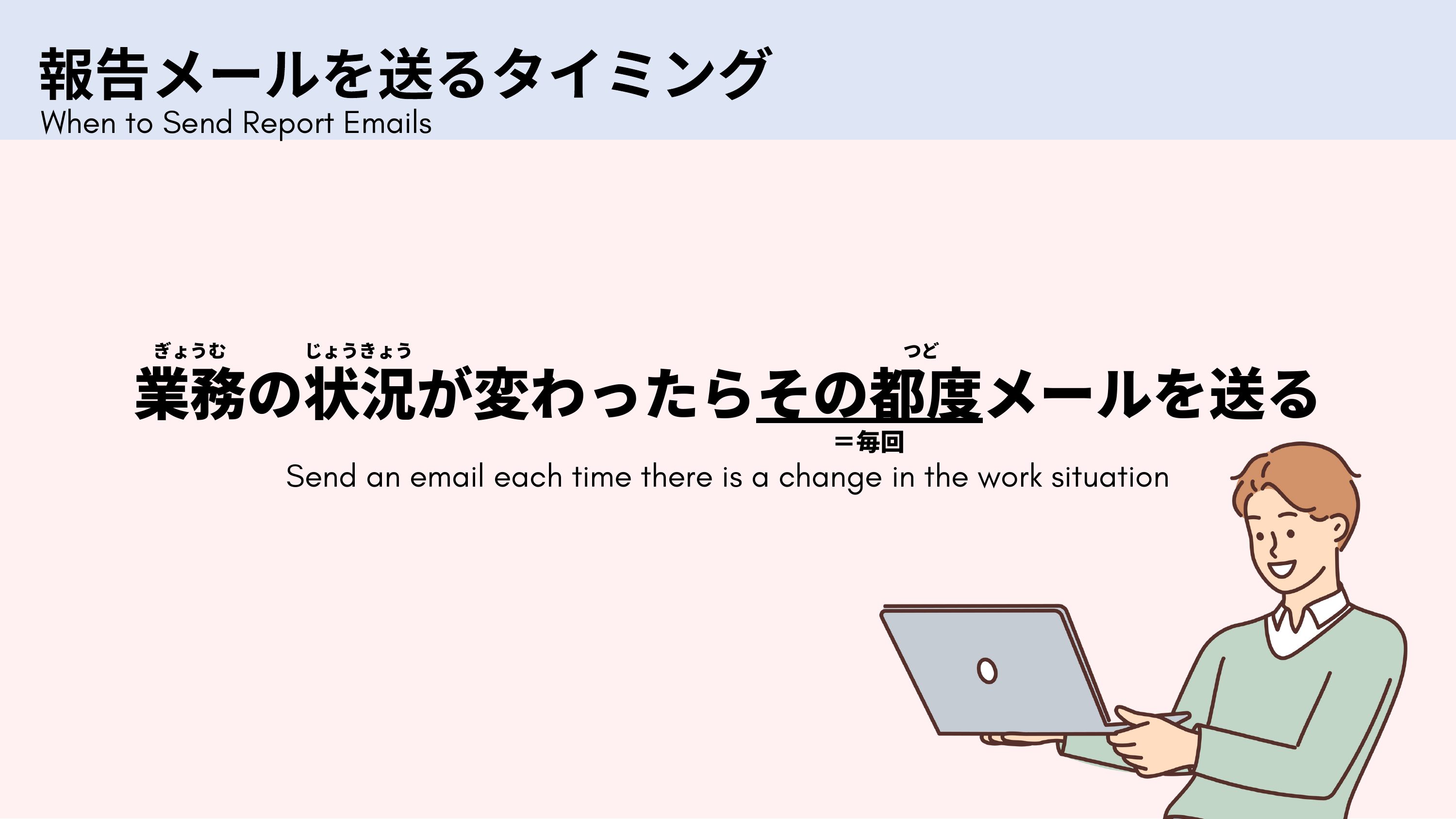
JP報告メールを送るタイミング
ENWhen to Send Report Emails
JPぎょうむじょうきょうつど
業務の状況が変わったらその都度メールを送る
=毎回
業務の状況が変わったらその都度メールを送る
=毎回
EN Send an email each time there is a change in the work situation
หน้า 9
คลิกเพื่อขยาย
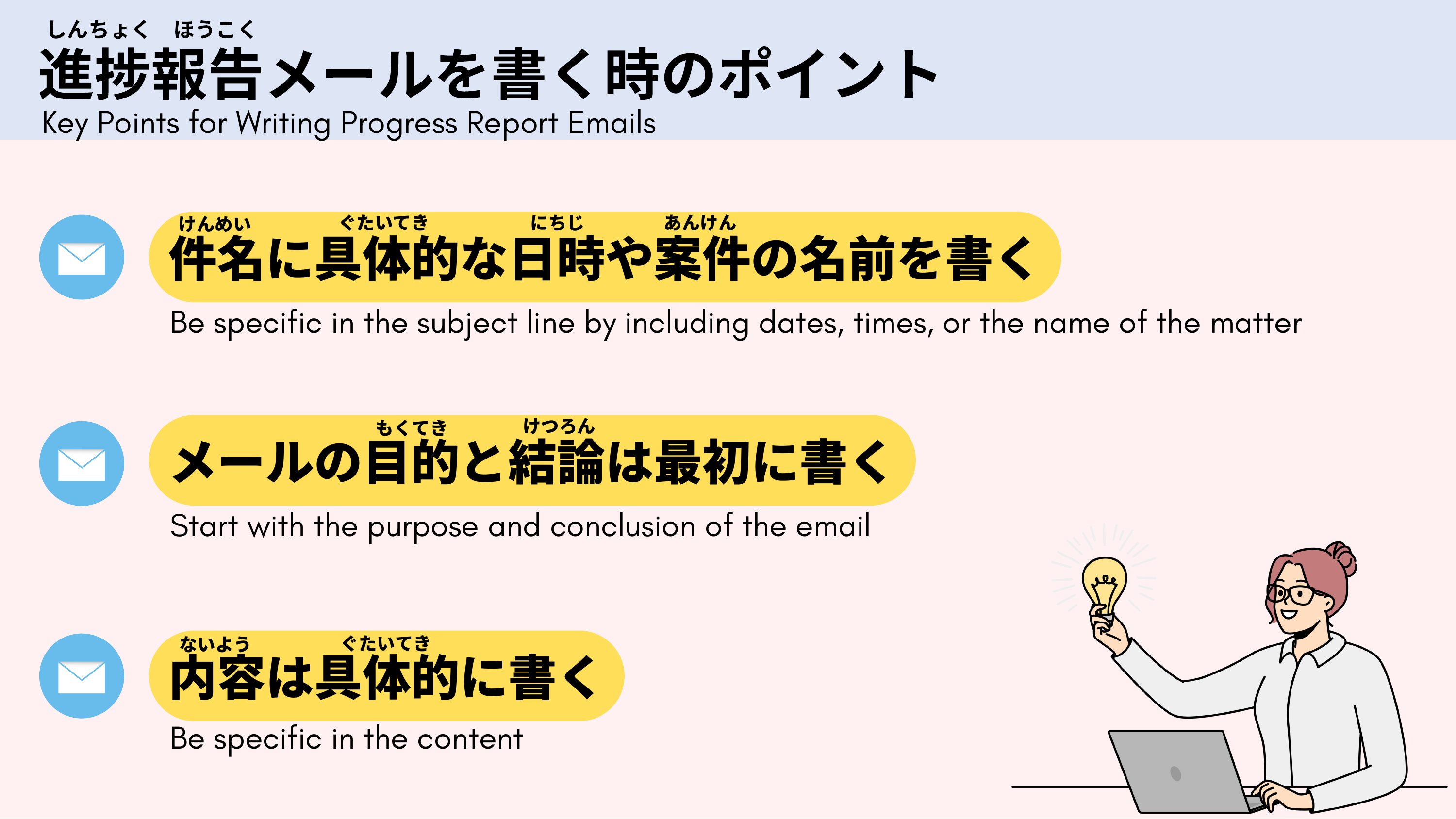
JP進捗報告メールを書く時のポイント
しんちょくほうこく
しんちょくほうこく
ENKey Points for Writing Progress Report Emails
JPけんめいぐたいてきにちじあんけん
件名に具体的な日時や案件の名前を書く
件名に具体的な日時や案件の名前を書く
EN Be specific in the subject line by including dates, times, or the name of the matter
JPもくてきけつろん
メールの目的と結論は最初に書く
メールの目的と結論は最初に書く
EN Start with the purpose and conclusion of the email
JPないようぐたいてき
内容は具体的に書く
内容は具体的に書く
EN Be specific in the content
หน้า 10
คลิกเพื่อขยาย
JP「読まれない件名」があります・・・
けんめい
けんめい
หน้า 11
คลิกเพื่อขยาย
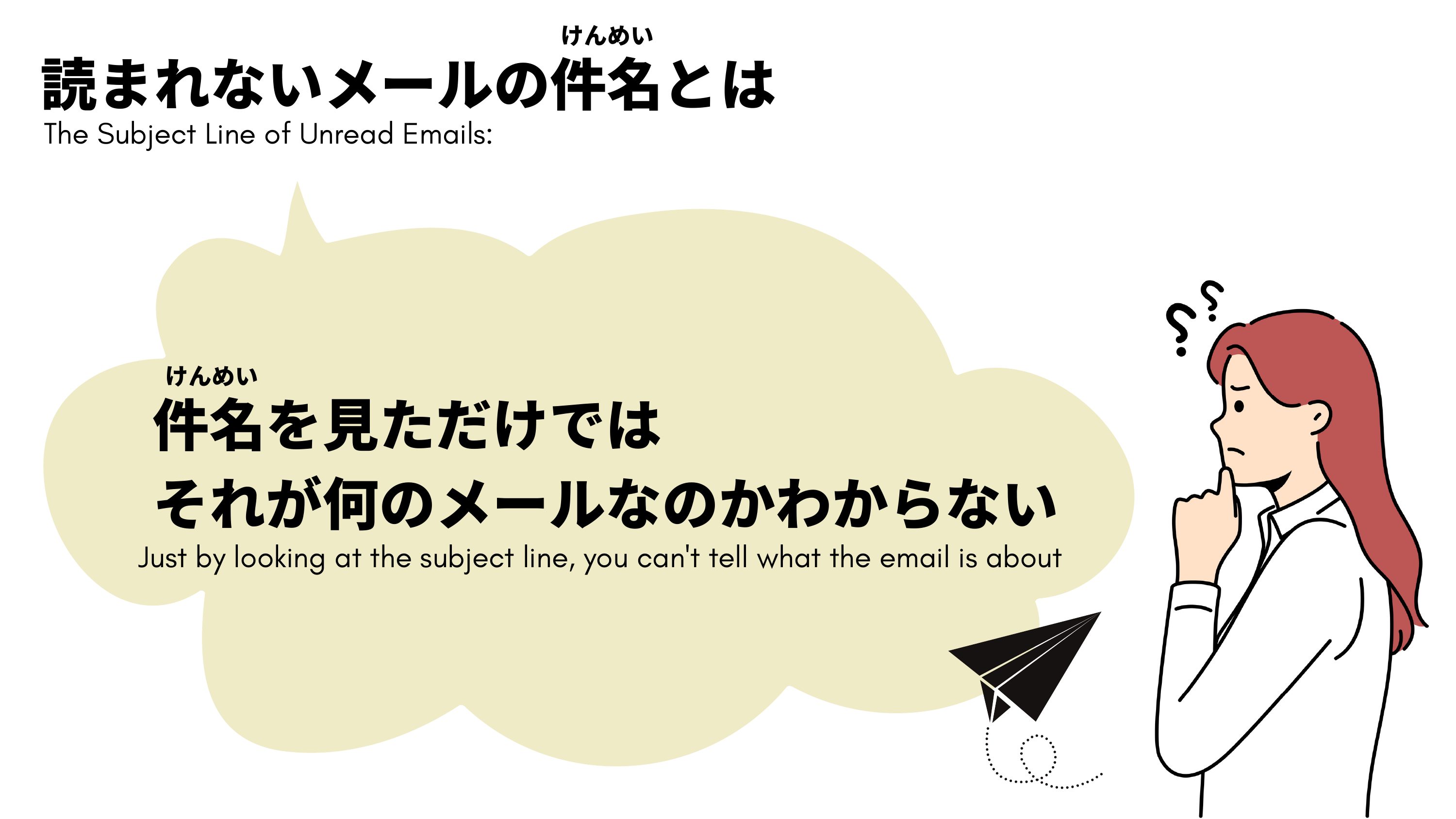
JPけんめい
読まれないメールの件名とは
読まれないメールの件名とは
ENThe Subject Line of Unread Emails:
JPけんめい
件名を見ただけでは
それが何のメールなのかわからない
件名を見ただけでは
それが何のメールなのかわからない
EN Just by looking at the subject line, you can't tell what the email is about
หน้า 12
คลิกเพื่อขยาย
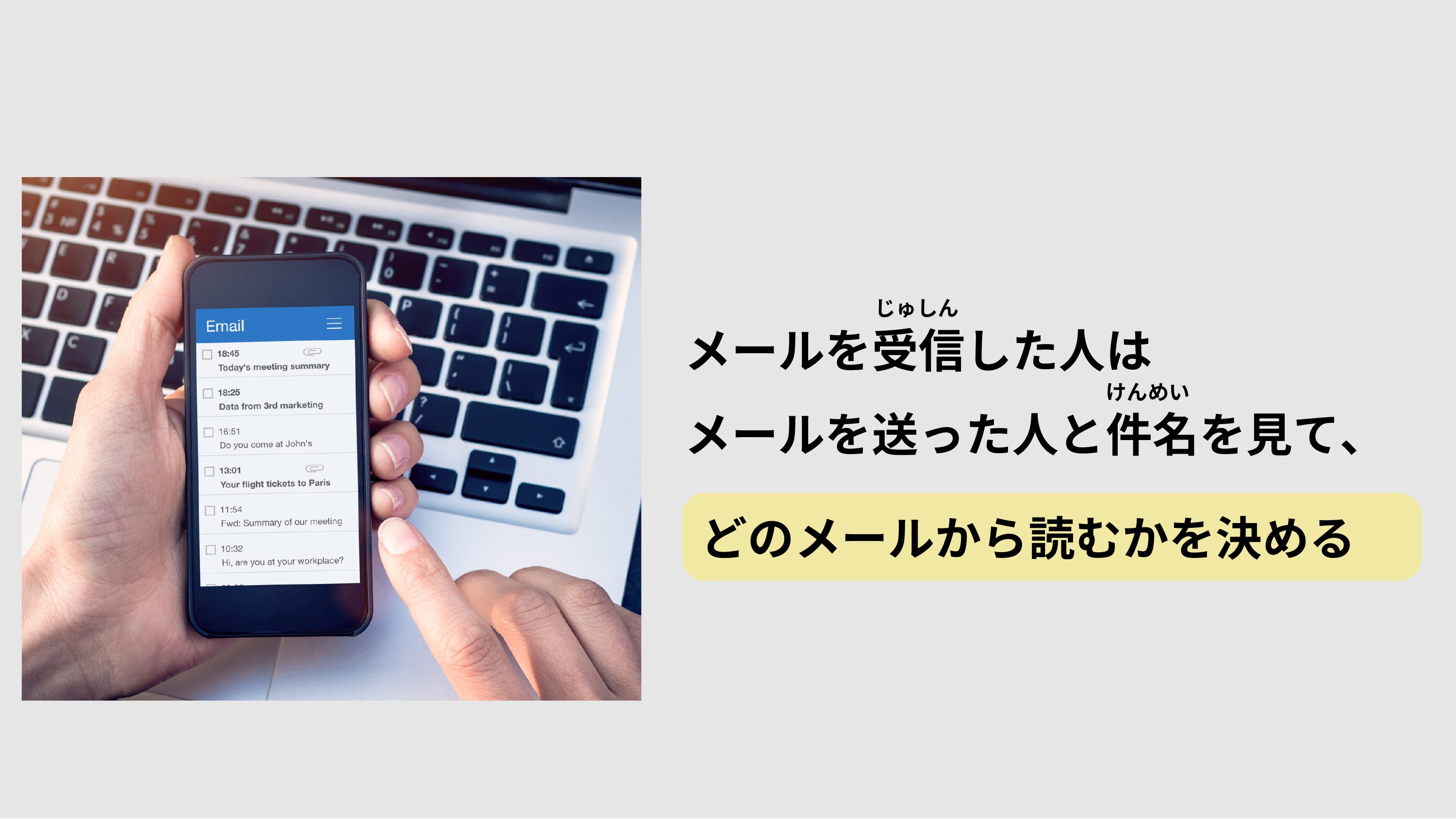
JPじゅしん
メールを受信した人は
けんめい
メールを送った人と件名を見て、
どのメールから読むかを決める
メールを受信した人は
けんめい
メールを送った人と件名を見て、
どのメールから読むかを決める
หน้า 13
คลิกเพื่อขยาย
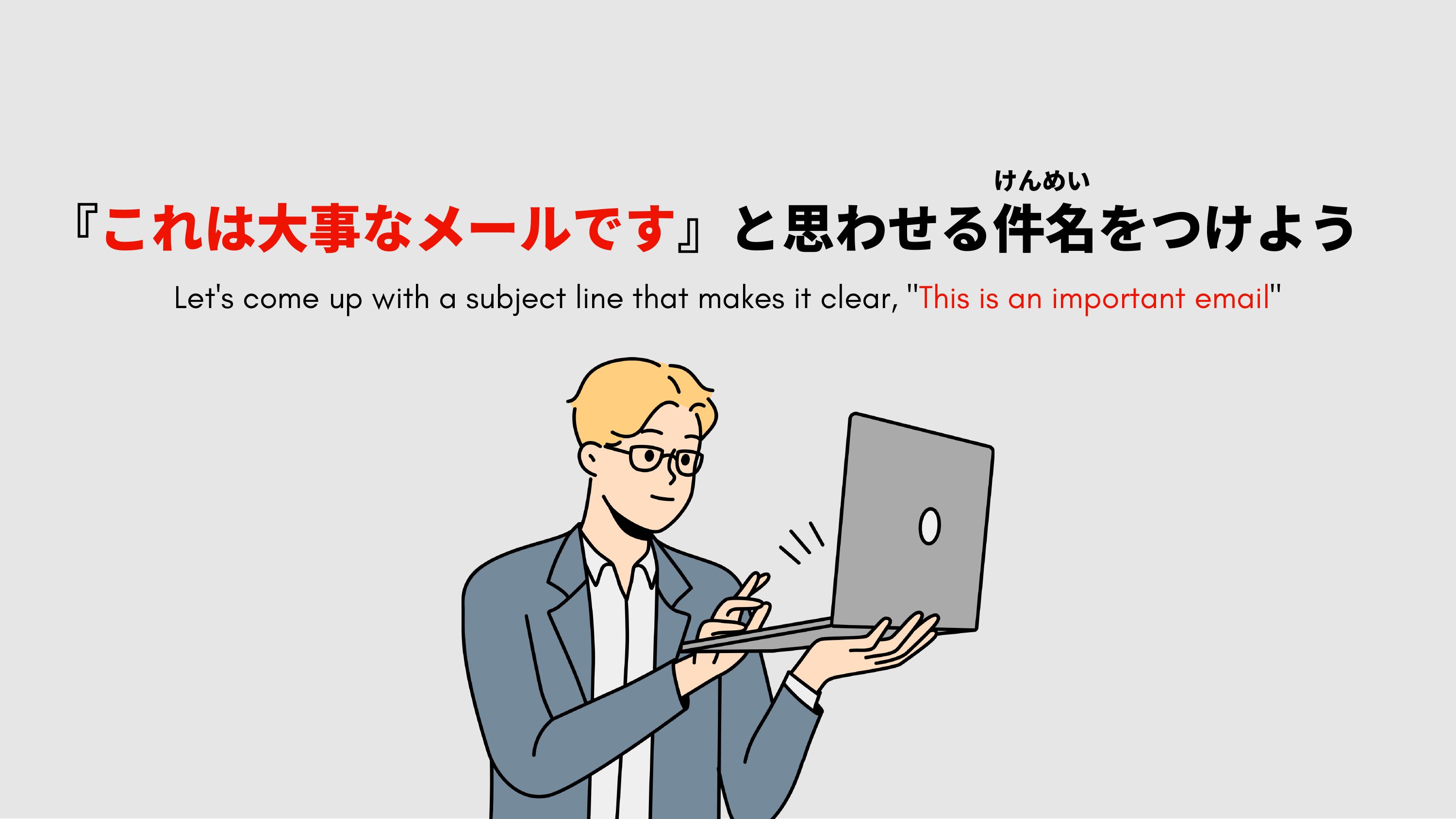
JPけんめい
『これは大事なメールです』と思わせる件名をつけよう
『これは大事なメールです』と思わせる件名をつけよう
EN Let's come up with a subject line that makes it clear, "This is an important email"
หน้า 14
คลิกเพื่อขยาย
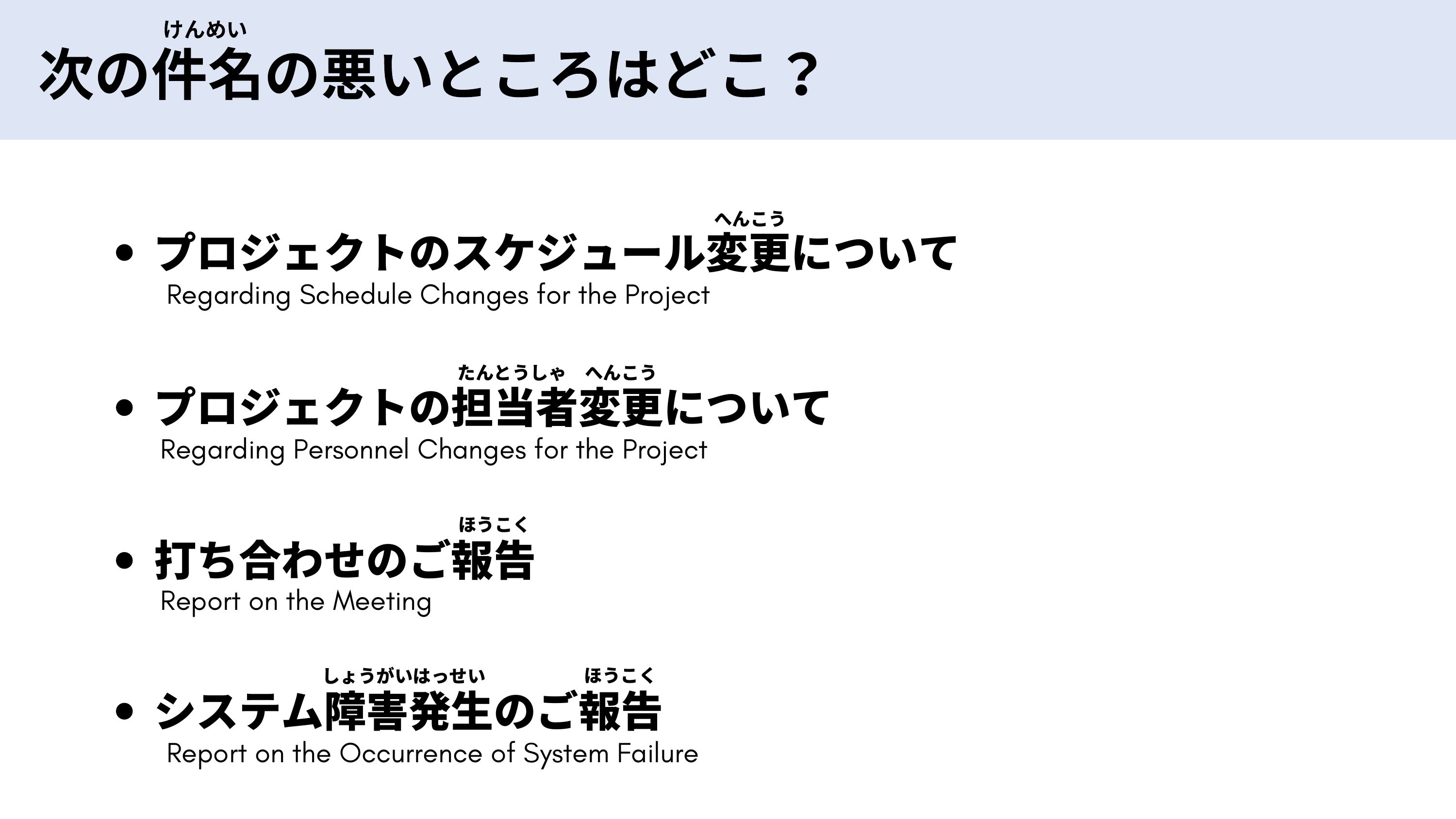
JP次の件名の悪いところはどこ?
けんめい
へんこう
プロジェクトのスケジュール変更について
けんめい
へんこう
プロジェクトのスケジュール変更について
EN Regarding Schedule Changes for the Project
JPたんとうしゃへんこう
プロジェクトの担当者変更について
プロジェクトの担当者変更について
EN Regarding Personnel Changes for the Project
JPほうこく
打ち合わせのご報告
打ち合わせのご報告
EN Report on the Meeting
JPしょうがいはっせいほうこく
システム障害発生のご報告
システム障害発生のご報告
EN Report on the Occurrence of System Failure
หน้า 15
คลิกเพื่อขยาย
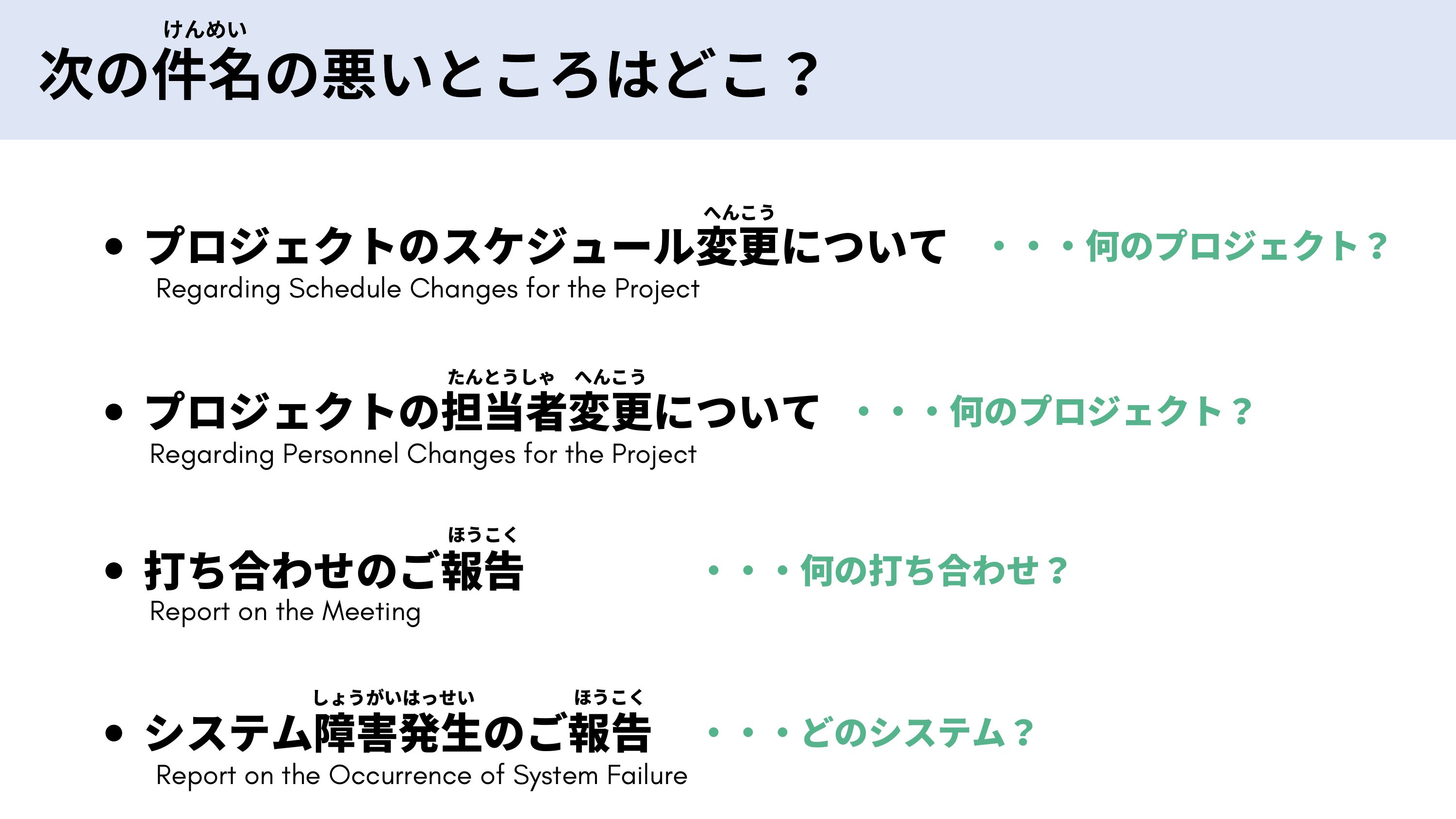
JP次の件名の悪いところはどこ?
けんめい
へんこう
プロジェクトのスケジュール変更について・・・何のプロジェクト?
けんめい
へんこう
プロジェクトのスケジュール変更について・・・何のプロジェクト?
EN Regarding Schedule Changes for the Project
JPたんとうしゃへんこう
プロジェクトの担当者変更について・・・何のプロジェクト?
プロジェクトの担当者変更について・・・何のプロジェクト?
EN Regarding Personnel Changes for the Project
JPほうこく
打ち合わせのご報告・・・何の打ち合わせ?
打ち合わせのご報告・・・何の打ち合わせ?
EN Report on the Meeting
JPしょうがいはっせいほうこく
システム障害発生のご報告・・・どのシステム?
システム障害発生のご報告・・・どのシステム?
EN Report on the Occurrence of System Failure
หน้า 16
คลิกเพื่อขยาย
JPけんめいぐたいてきにちじあんけん
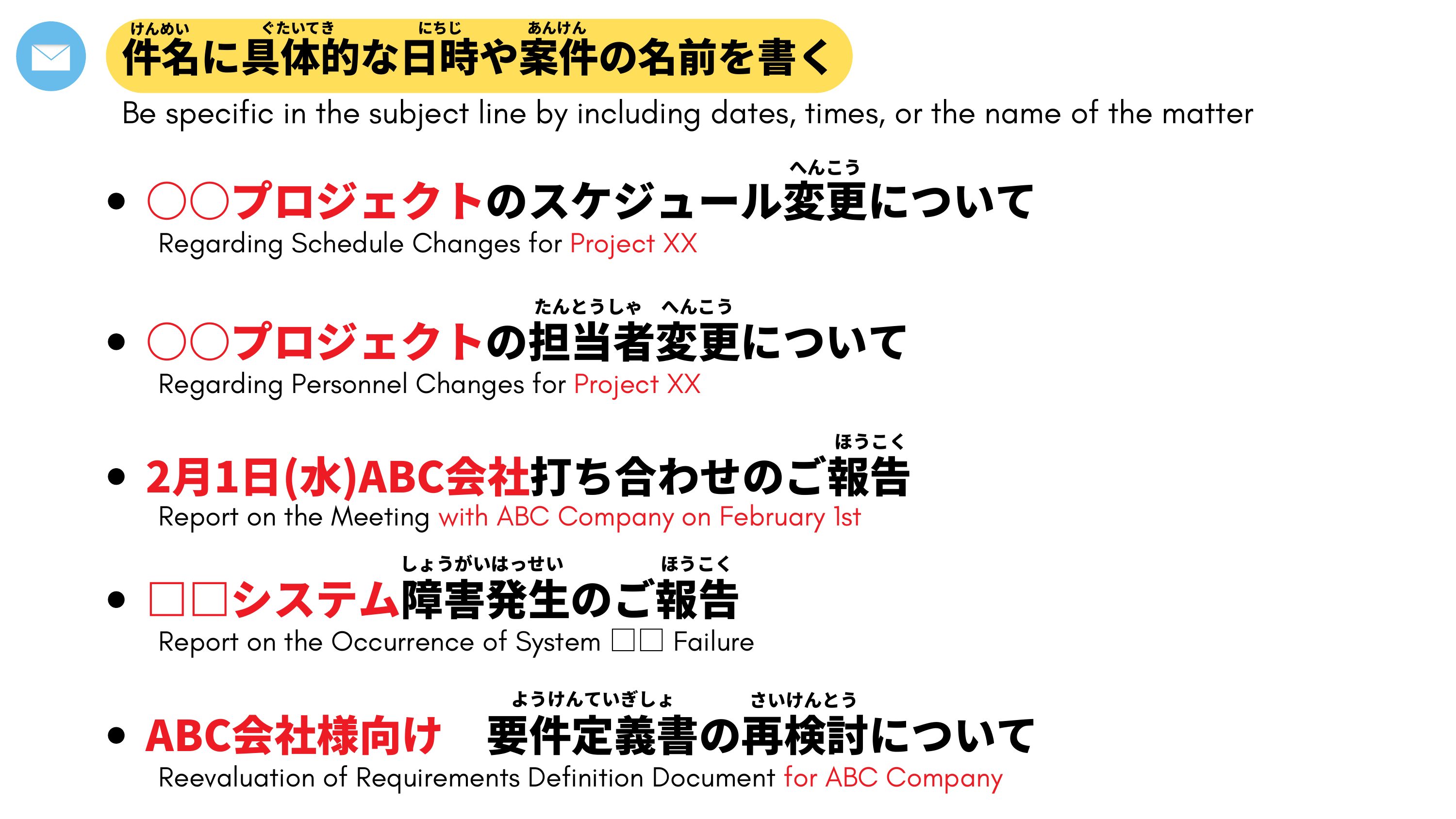
件名に具体的な日時や案件の名前を書く
件名に具体的な日時や案件の名前を書く
ENBe specific in the subject line by including dates, times, or the name of the matter
JPへんこう
○○プロジェクトのスケジュール変更について
○○プロジェクトのスケジュール変更について
EN Regarding Schedule Changes for Project XX
JPたんとうしゃへんこう
○○プロジェクトの担当者変更について
○○プロジェクトの担当者変更について
EN Regarding Personnel Changes for Project XX
JPほうこく
2月1日(水)ABC会社打ち合わせのご報告
2月1日(水)ABC会社打ち合わせのご報告
EN Report on the Meeting with ABC Company on February 1st
JPしょうがいはっせいほうこく
□□システム障害発生のご報告
□□システム障害発生のご報告
EN Report on the Occurrence of System □□ Failure
JPようけんていぎしょさいけんとう
ABC会社様向け要件定義書の再検討について
ABC会社様向け要件定義書の再検討について
EN Reevaluation of Requirements Definition Document for ABC Company
หน้า 17
คลิกเพื่อขยาย
JPきょうちょうけんめいきじつれんらくけんめい
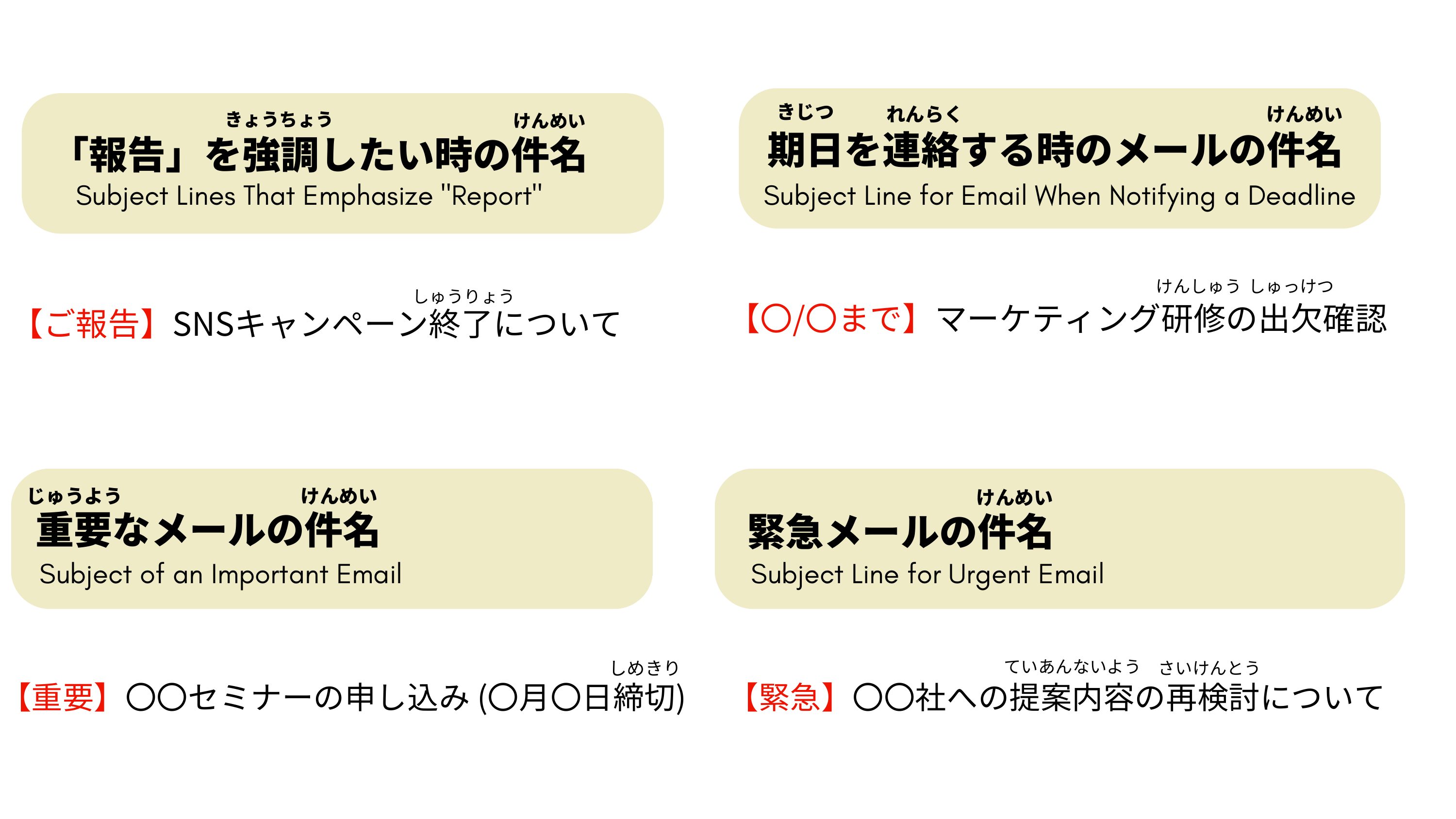
「報告」を強調したい時の件名期日を連絡する時のメールの件名
「報告」を強調したい時の件名期日を連絡する時のメールの件名
EN Subject Lines That Emphasize "Report" Subject Line for Email When Notifying a Deadline
JPけんしゅうしゅっけつ
しゅうりょう
【ご報告】SNSキャンペーン終了について【〇/〇まで】マーケティング研修の出欠確認
じゅうようけんめいけんめい
重要なメールの件名緊急メールの件名
しゅうりょう
【ご報告】SNSキャンペーン終了について【〇/〇まで】マーケティング研修の出欠確認
じゅうようけんめいけんめい
重要なメールの件名緊急メールの件名
EN Subject of an Important Email Subject Line for Urgent Email
JPしめきりていあんないようさいけんとう
【重要】〇〇セミナーの申し込み(〇月〇日締切)【緊急】〇〇社への提案内容の再検討について
【重要】〇〇セミナーの申し込み(〇月〇日締切)【緊急】〇〇社への提案内容の再検討について
หน้า 18
คลิกเพื่อขยาย
JP「読みやすい本文」の順番
じゅんばん
じゅんばん
หน้า 19
คลิกเพื่อขยาย
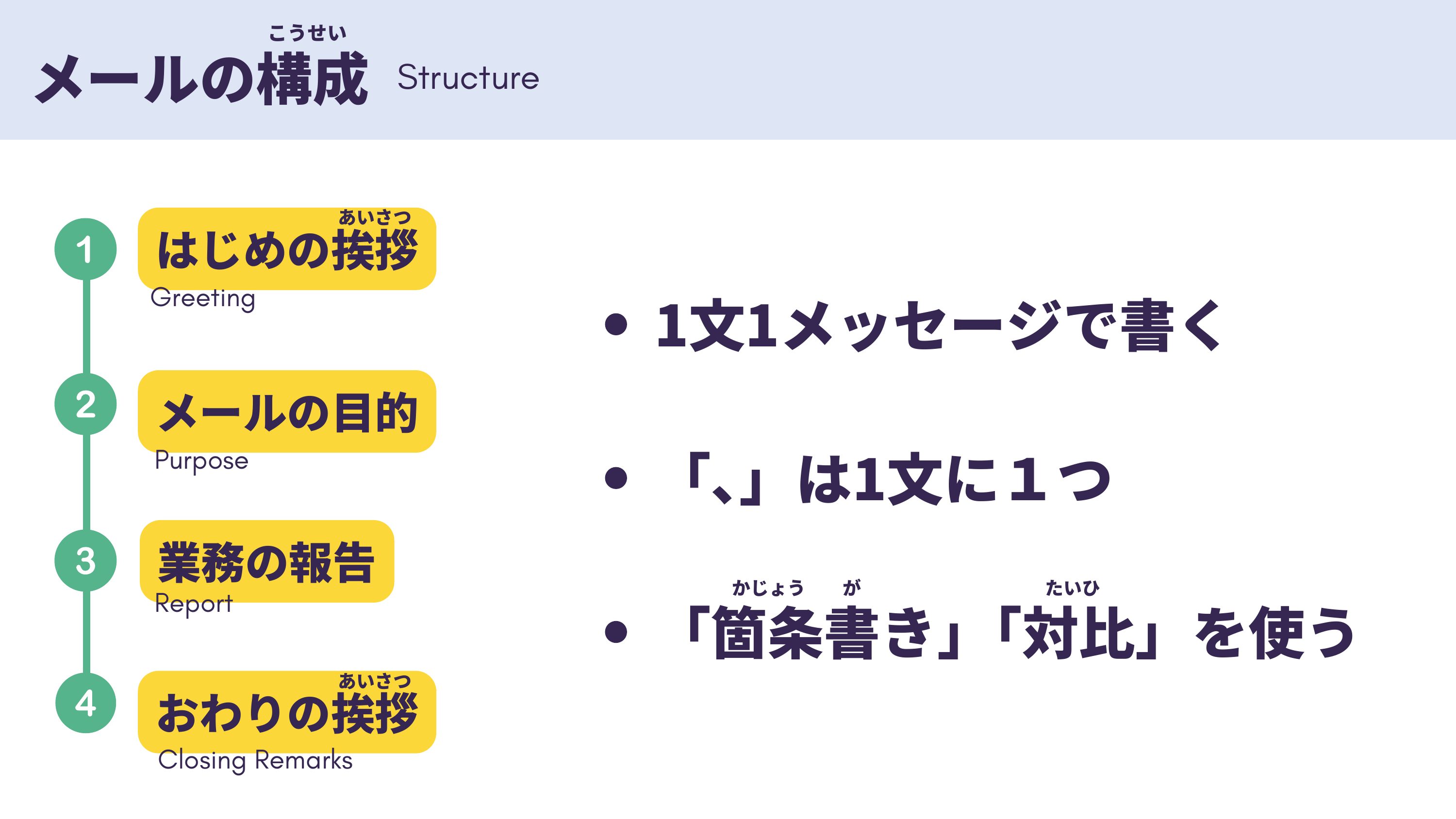
JPこうせい
ENメールの構成 Structure
JPあいさつ
はじめの挨拶
はじめの挨拶
EN Greeting
JP1文1メッセージで書く
メールの目的
「、
」は1文に1つ
メールの目的
「、
」は1文に1つ
EN Purpose
JP業務の報告かじょうがたいひ
EN Report
JP「箇条書き」
「対比」を使う
あいさつ
おわりの挨拶
「対比」を使う
あいさつ
おわりの挨拶
EN Closing Remarks
หน้า 20
คลิกเพื่อขยาย
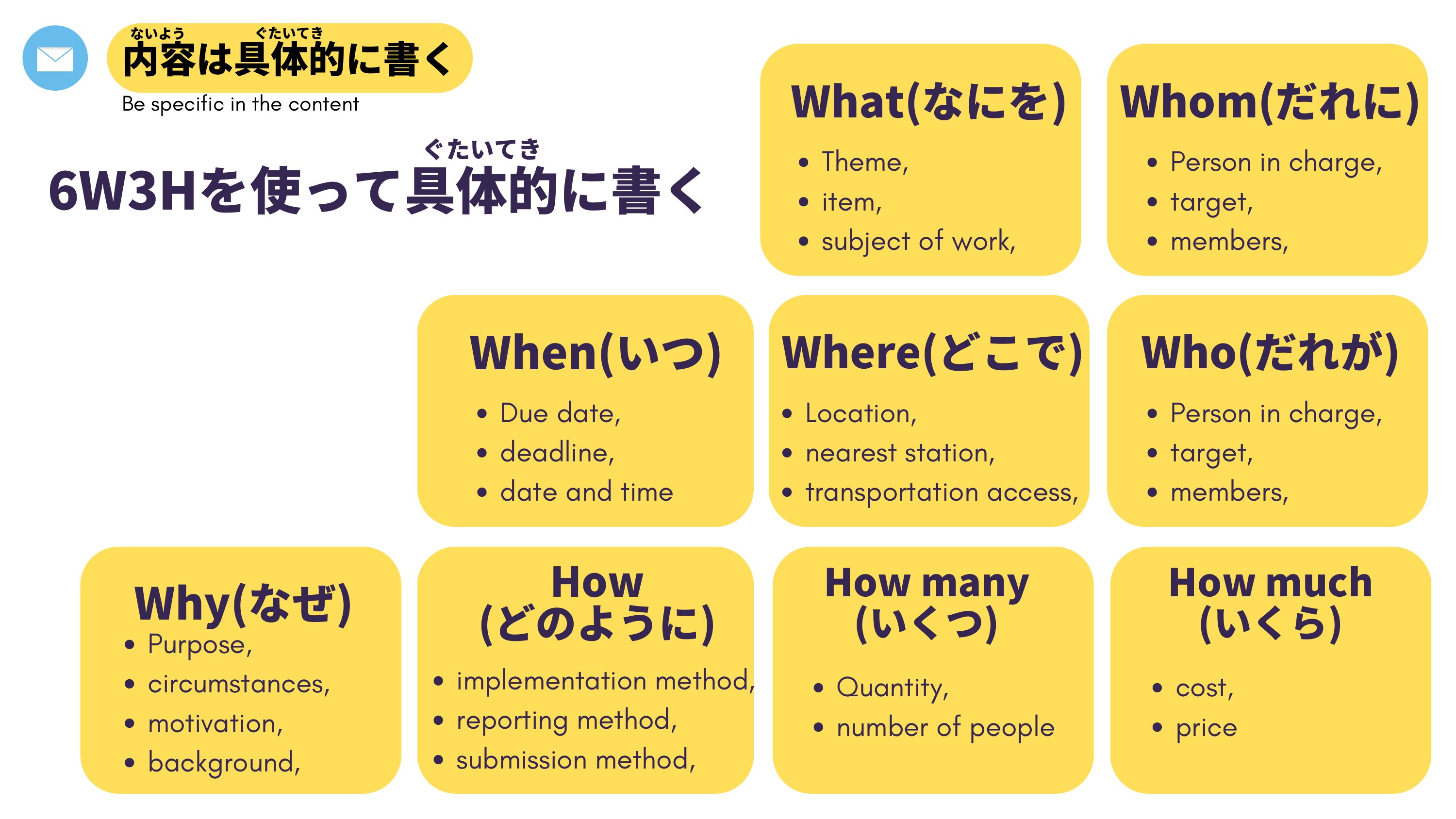
JPないようぐたいてき
内容は具体的に書く
内容は具体的に書く
EN Be specific in the content What(なにを) Whom(だれに)
JPぐたいてき
EN Theme, Person in charge,
6W3Hを使って具体的に書く item, target,
subject of work, members,
When(いつ) Where(どこで) Who(だれが)
Due date, Location, Person in charge,
deadline, nearest station, target,
date and time transportation access, members,
How How many How much
6W3Hを使って具体的に書く item, target,
subject of work, members,
When(いつ) Where(どこで) Who(だれが)
Due date, Location, Person in charge,
deadline, nearest station, target,
date and time transportation access, members,
How How many How much
JPWhy(なぜ)(どのように)(いくつ)(いくら)
EN Purpose,
circumstances, implementation method, Quantity, cost,
motivation, reporting method, number of people price
background, submission method,
circumstances, implementation method, Quantity, cost,
motivation, reporting method, number of people price
background, submission method,
หน้า 21

คลิกเพื่อขยาย
JP読みやすい本文の例
หน้า 22
คลิกเพื่อขยาย
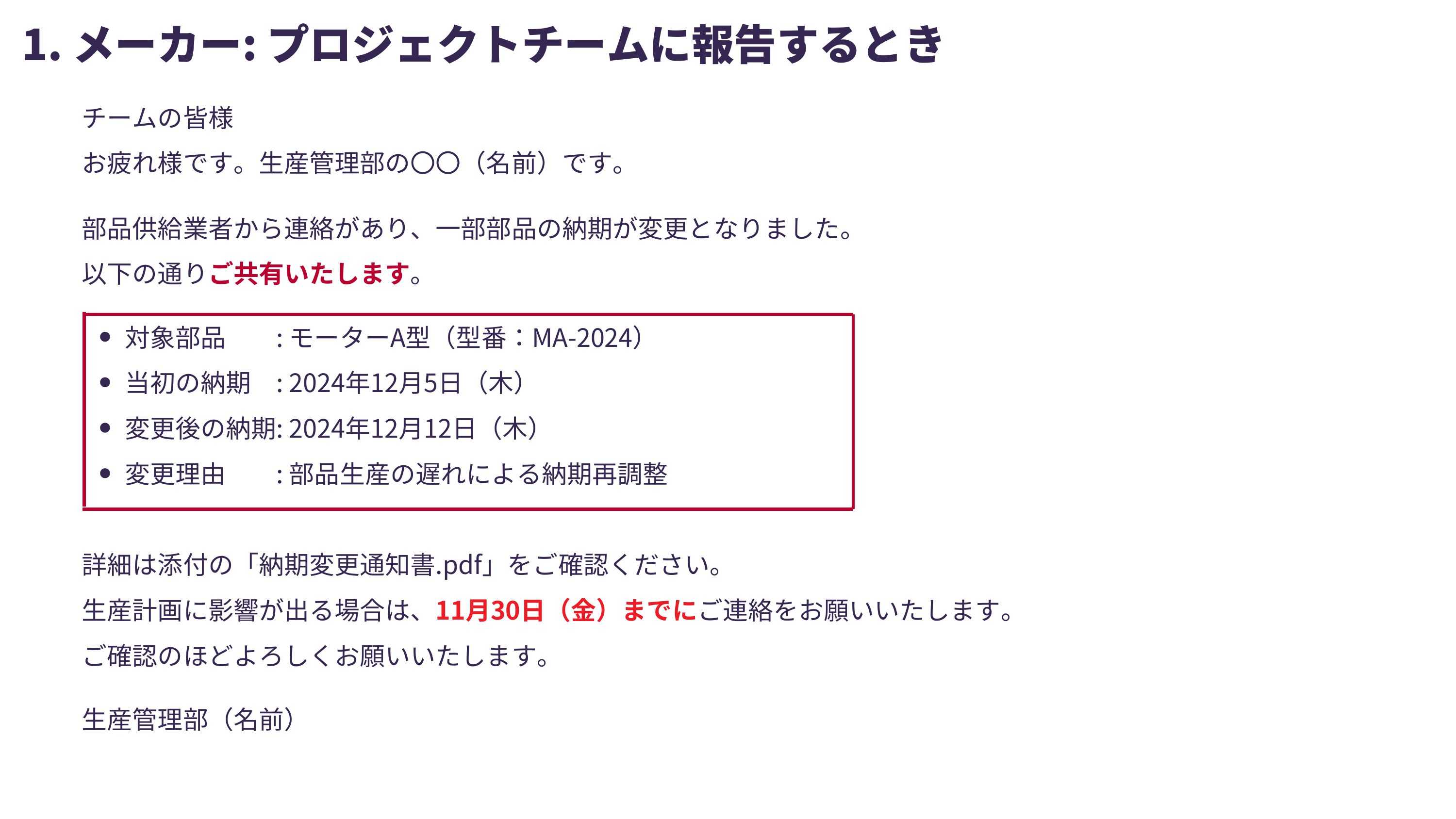
JP1.メーカー:プロジェクトチームに報告するとき
チームの皆様
お疲れ様です。生産管理部の〇〇(名前)です。
部品供給業者から連絡があり、一部部品の納期が変更となりました。
以下の通りご共有いたします。
対象部品:モーターA型(型番:MA-2024)
当初の納期:2024年12月5日(木)
変更後の納期:2024年12月12日(木)
変更理由:部品生産の遅れによる納期再調整
詳細は添付の「納期変更通知書.pdf」をご確認ください。
生産計画に影響が出る場合は、11月30日(金)までにご連絡をお願いいたします。
ご確認のほどよろしくお願いいたします。
生産管理部(名前)
チームの皆様
お疲れ様です。生産管理部の〇〇(名前)です。
部品供給業者から連絡があり、一部部品の納期が変更となりました。
以下の通りご共有いたします。
対象部品:モーターA型(型番:MA-2024)
当初の納期:2024年12月5日(木)
変更後の納期:2024年12月12日(木)
変更理由:部品生産の遅れによる納期再調整
詳細は添付の「納期変更通知書.pdf」をご確認ください。
生産計画に影響が出る場合は、11月30日(金)までにご連絡をお願いいたします。
ご確認のほどよろしくお願いいたします。
生産管理部(名前)
หน้า 23
คลิกเพื่อขยาย
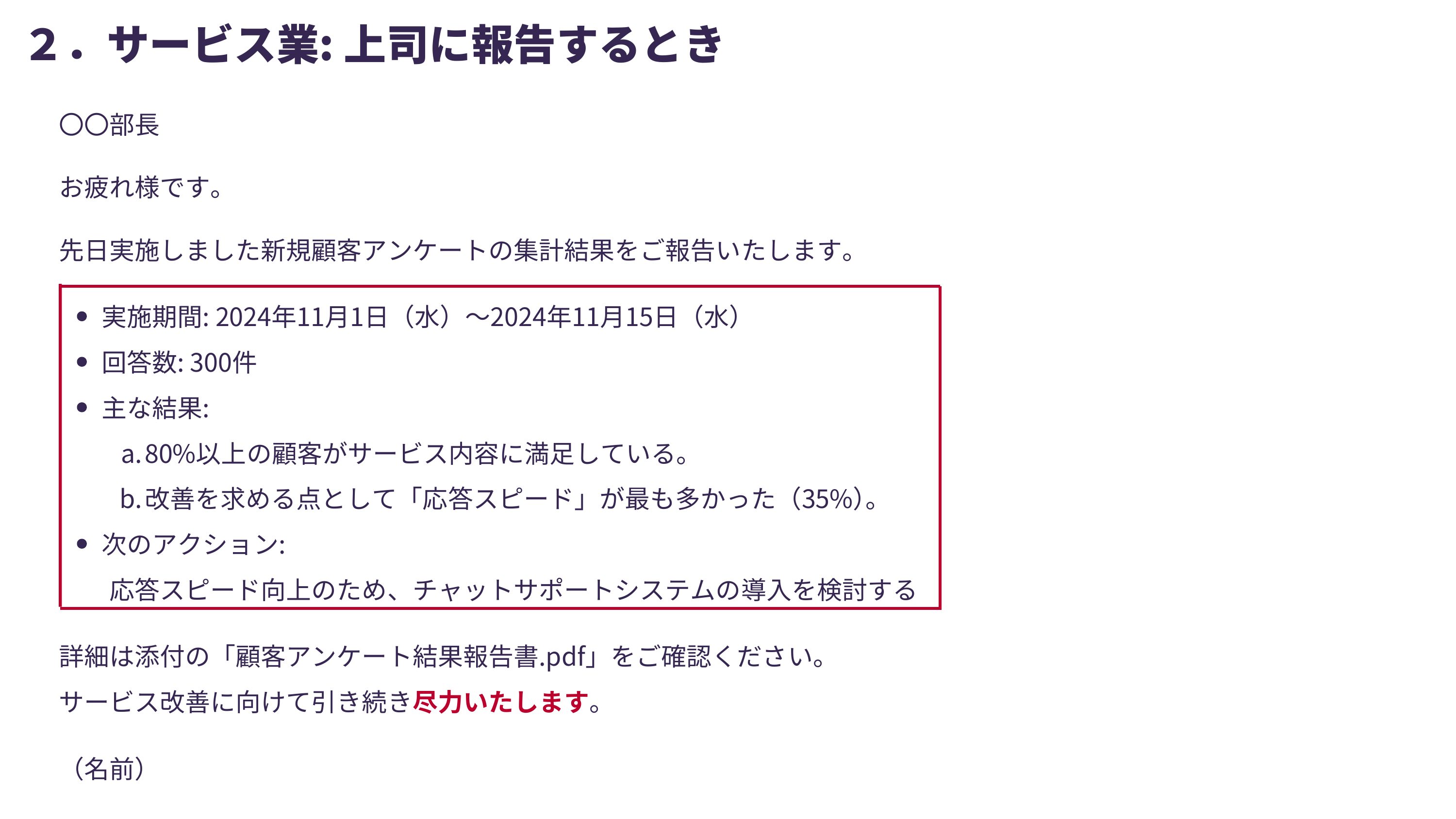
JP2.サービス業:上司に報告するとき
〇〇部長
お疲れ様です。
先日実施しました新規顧客アンケートの集計結果をご報告いたします。
実施期間:2024年11月1日(水)~2024年11月15日(水)
回答数:300件
主な結果:
a.80%以上の顧客がサービス内容に満足している。
b.改善を求める点として「応答スピード」が最も多かった(35%)
。
次のアクション:
応答スピード向上のため、チャットサポートシステムの導入を検討する
詳細は添付の「顧客アンケート結果報告書.pdf」をご確認ください。
サービス改善に向けて引き続き尽力いたします。
(名前)
〇〇部長
お疲れ様です。
先日実施しました新規顧客アンケートの集計結果をご報告いたします。
実施期間:2024年11月1日(水)~2024年11月15日(水)
回答数:300件
主な結果:
a.80%以上の顧客がサービス内容に満足している。
b.改善を求める点として「応答スピード」が最も多かった(35%)
。
次のアクション:
応答スピード向上のため、チャットサポートシステムの導入を検討する
詳細は添付の「顧客アンケート結果報告書.pdf」をご確認ください。
サービス改善に向けて引き続き尽力いたします。
(名前)
หน้า 24
คลิกเพื่อขยาย
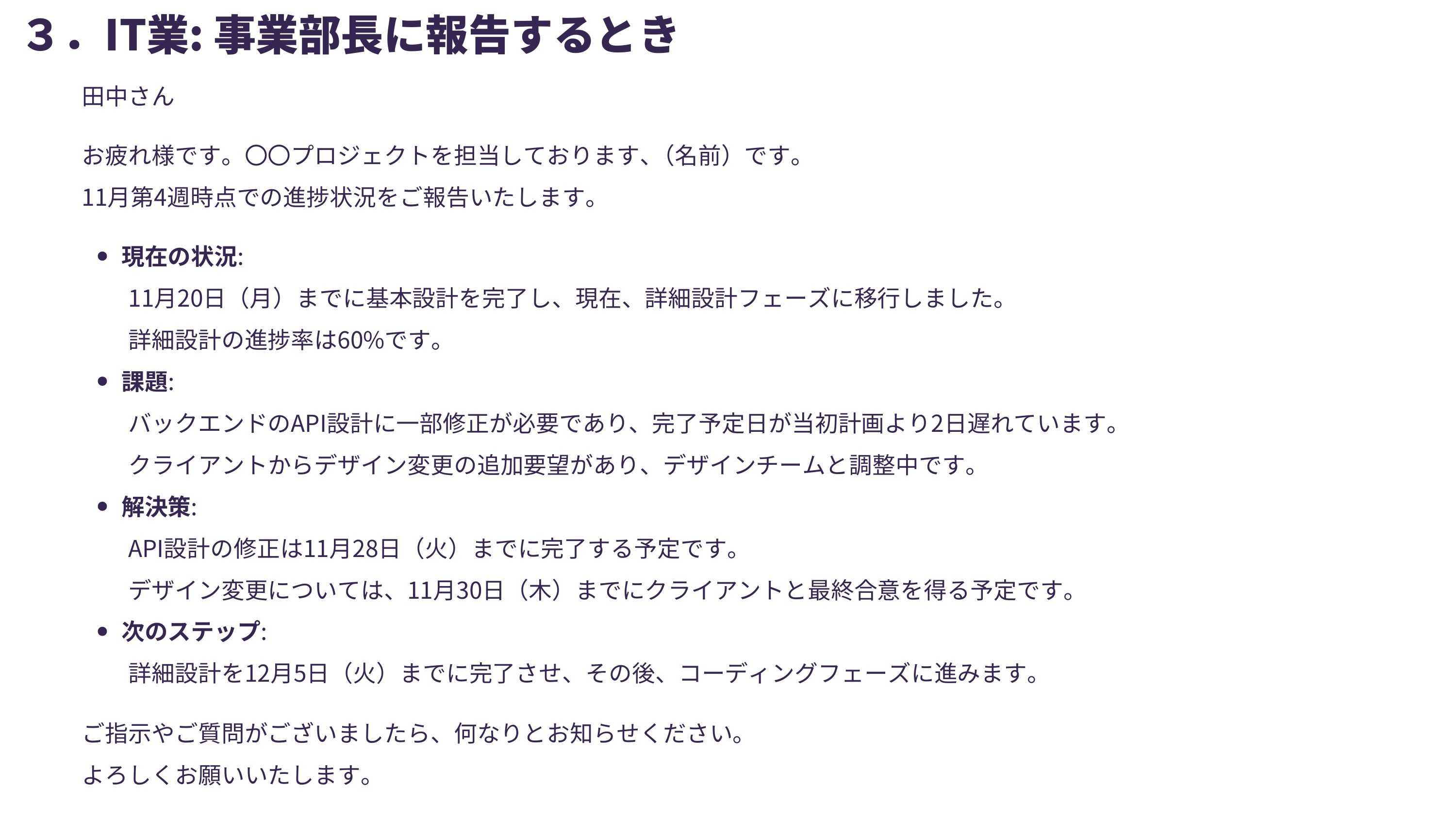
JP3.IT業:事業部長に報告するとき
田中さん
お疲れ様です。〇〇プロジェクトを担当しております、
(名前)です。
11月第4週時点での進捗状況をご報告いたします。
現在の状況:
11月20日(月)までに基本設計を完了し、現在、詳細設計フェーズに移行しました。
詳細設計の進捗率は60%です。
課題:
バックエンドのAPI設計に一部修正が必要であり、完了予定日が当初計画より2日遅れています。
クライアントからデザイン変更の追加要望があり、デザインチームと調整中です。
解決策:
API設計の修正は11月28日(火)までに完了する予定です。
デザイン変更については、11月30日(木)までにクライアントと最終合意を得る予定です。
次のステップ:
詳細設計を12月5日(火)までに完了させ、その後、コーディングフェーズに進みます。
ご指示やご質問がございましたら、何なりとお知らせください。
よろしくお願いいたします。
田中さん
お疲れ様です。〇〇プロジェクトを担当しております、
(名前)です。
11月第4週時点での進捗状況をご報告いたします。
現在の状況:
11月20日(月)までに基本設計を完了し、現在、詳細設計フェーズに移行しました。
詳細設計の進捗率は60%です。
課題:
バックエンドのAPI設計に一部修正が必要であり、完了予定日が当初計画より2日遅れています。
クライアントからデザイン変更の追加要望があり、デザインチームと調整中です。
解決策:
API設計の修正は11月28日(火)までに完了する予定です。
デザイン変更については、11月30日(木)までにクライアントと最終合意を得る予定です。
次のステップ:
詳細設計を12月5日(火)までに完了させ、その後、コーディングフェーズに進みます。
ご指示やご質問がございましたら、何なりとお知らせください。
よろしくお願いいたします。
หน้า 25
คลิกเพื่อขยาย
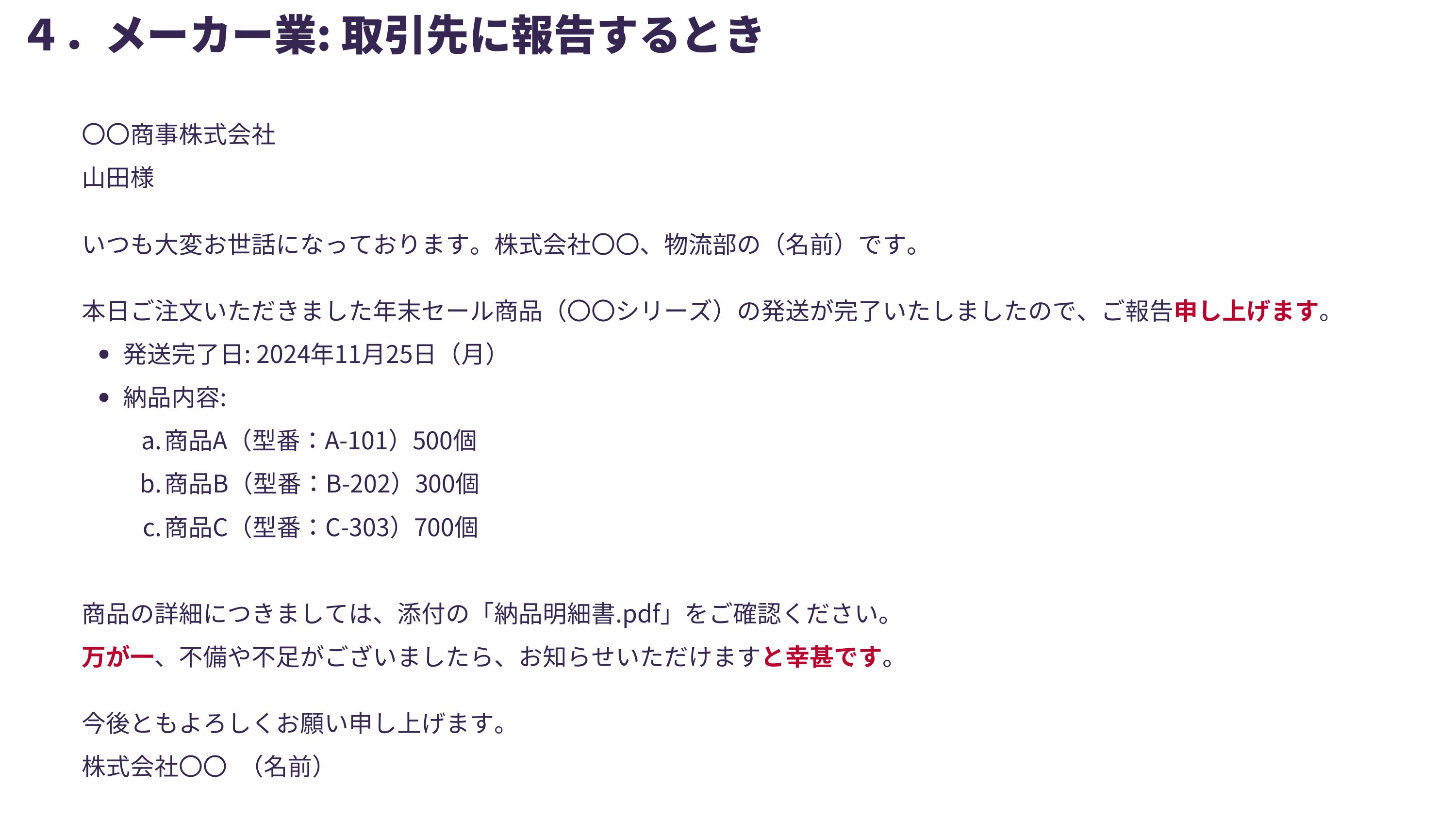
JP4.メーカー業:取引先に報告するとき
〇〇商事株式会社
山田様
いつも大変お世話になっております。株式会社〇〇、物流部の(名前)です。
本日ご注文いただきました年末セール商品(〇〇シリーズ)の発送が完了いたしましたので、ご報告申し上げます。
発送完了日:2024年11月25日(月)
納品内容:
a.商品A(型番:A-101)500個
b.商品B(型番:B-202)300個
c.商品C(型番:C-303)700個
商品の詳細につきましては、添付の「納品明細書.pdf」をご確認ください。
万が一、不備や不足がございましたら、お知らせいただけますと幸甚です。
今後ともよろしくお願い申し上げます。
株式会社〇〇(名前)
〇〇商事株式会社
山田様
いつも大変お世話になっております。株式会社〇〇、物流部の(名前)です。
本日ご注文いただきました年末セール商品(〇〇シリーズ)の発送が完了いたしましたので、ご報告申し上げます。
発送完了日:2024年11月25日(月)
納品内容:
a.商品A(型番:A-101)500個
b.商品B(型番:B-202)300個
c.商品C(型番:C-303)700個
商品の詳細につきましては、添付の「納品明細書.pdf」をご確認ください。
万が一、不備や不足がございましたら、お知らせいただけますと幸甚です。
今後ともよろしくお願い申し上げます。
株式会社〇〇(名前)
หน้า 26
คลิกเพื่อขยาย
ENAGENDA 2
JPほうこく
報告に使う日本語フレーズ
報告に使う日本語フレーズ
EN Japanese Phrases for Reporting
หน้า 27
คลิกเพื่อขยาย
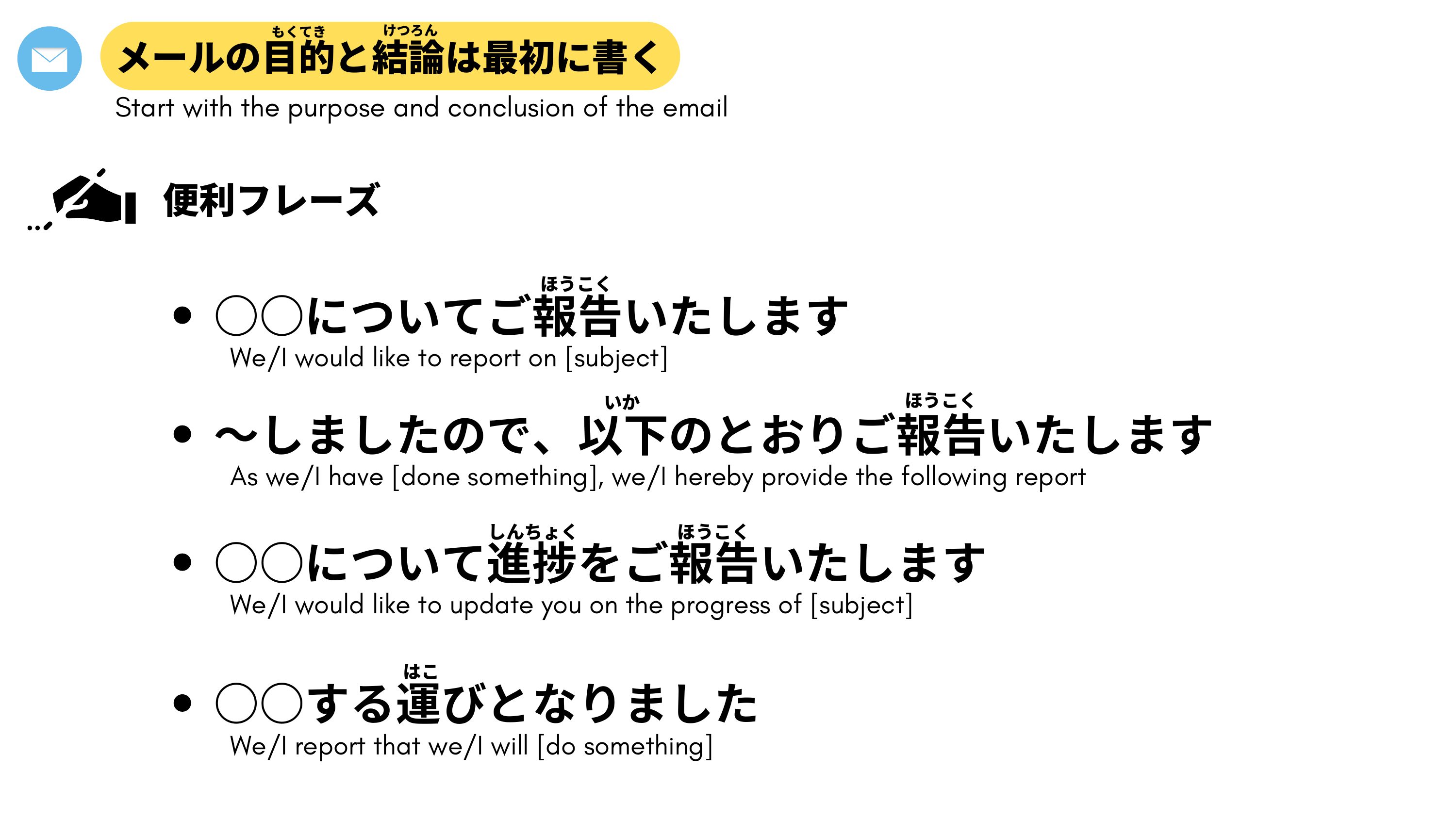
JPもくてきけつろん
メールの目的と結論は最初に書く
メールの目的と結論は最初に書く
ENStart with the purpose and conclusion of the email
JP便利フレーズ
ほうこく
○○についてご報告いたします
ほうこく
○○についてご報告いたします
EN We/I would like to report on [subject]
JPいかほうこく
~しましたので、以下のとおりご報告いたします
~しましたので、以下のとおりご報告いたします
EN As we/I have [done something], we/I hereby provide the following report
JPしんちょくほうこく
○○について進捗をご報告いたします
○○について進捗をご報告いたします
EN We/I would like to update you on the progress of [subject]
JPはこ
○○する運びとなりました
○○する運びとなりました
EN We/I report that we/I will [do something]
หน้า 28
คลิกเพื่อขยาย
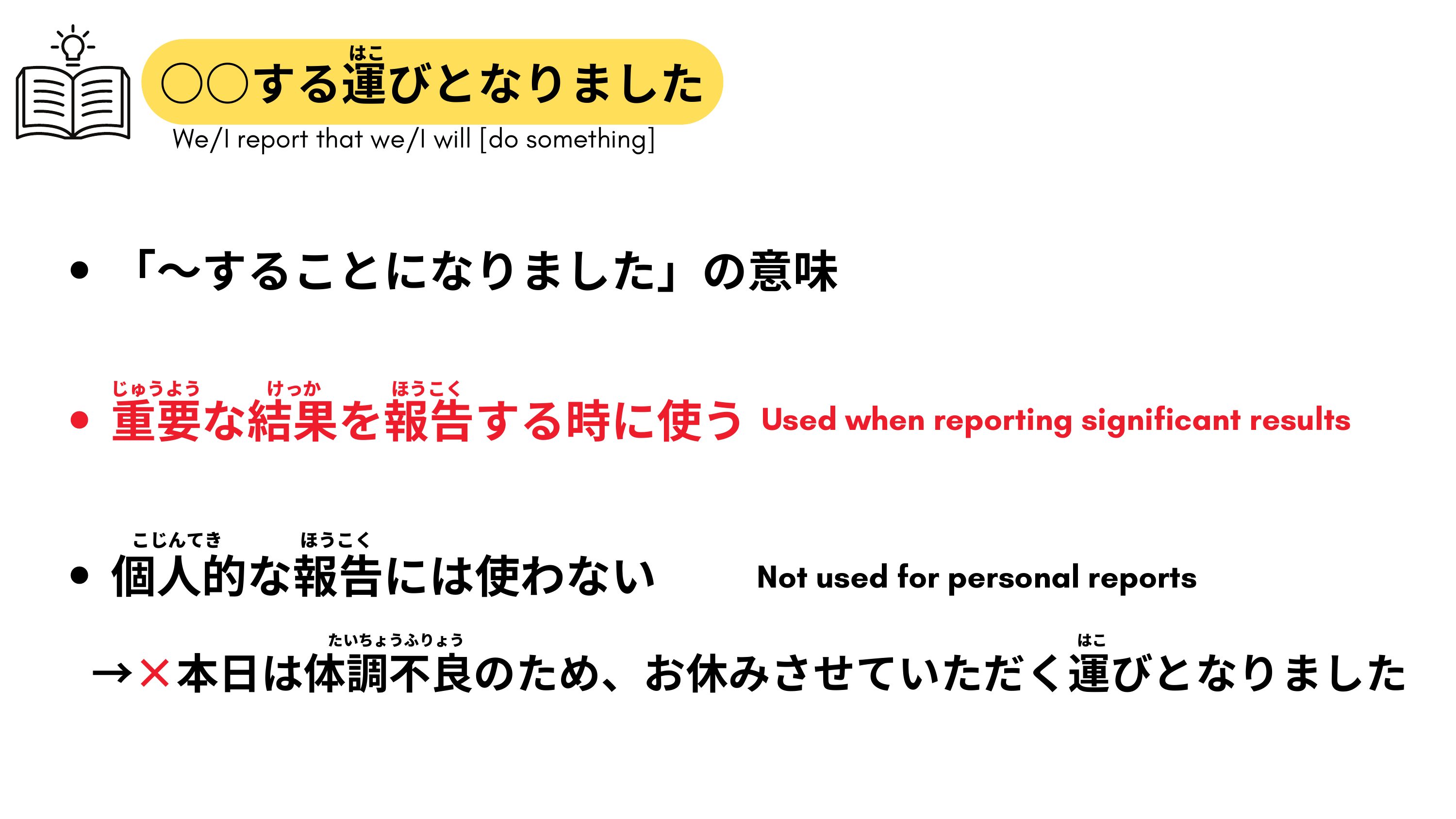
JPはこ
○○する運びとなりました
○○する運びとなりました
EN We/I report that we/I will [do something]
JP「~することになりました」の意味
じゅうようけっかほうこく
じゅうようけっかほうこく
EN重要な結果を報告する時に使う Used when reporting significant results
JPこじんてきほうこく
EN個人的な報告には使わない Not used for personal reports
JPたいちょうふりょうはこ
→×本日は体調不良のため、お休みさせていただく運びとなりました
→×本日は体調不良のため、お休みさせていただく運びとなりました
หน้า 29
คลิกเพื่อขยาย
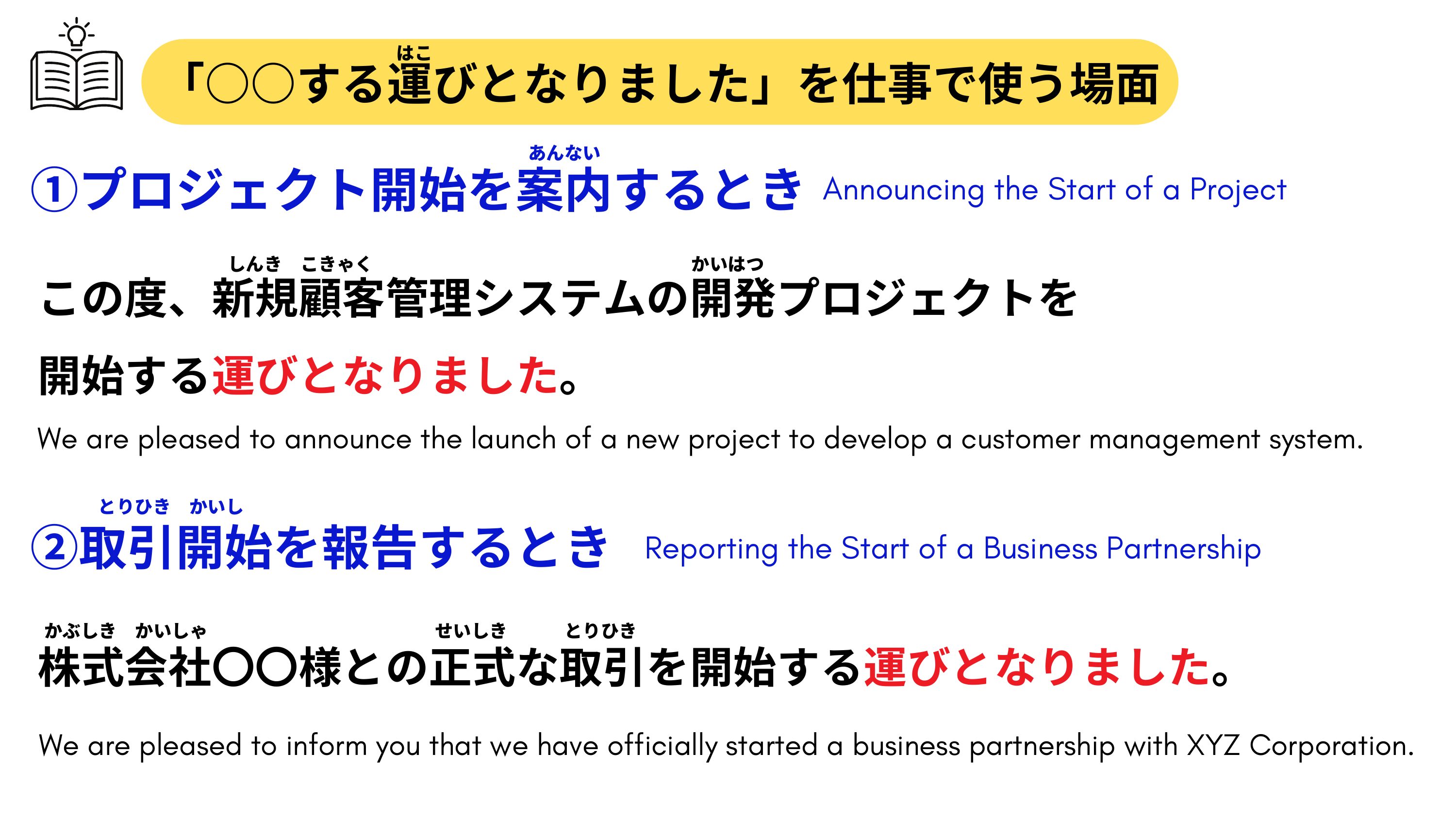
JPはこ
「○○する運びとなりました」を仕事で使う場面
あんない
「○○する運びとなりました」を仕事で使う場面
あんない
EN①プロジェクト開始を案内するとき Announcing the Start of a Project
JPしんきこきゃくかいはつ
この度、新規顧客管理システムの開発プロジェクトを
開始する運びとなりました。
この度、新規顧客管理システムの開発プロジェクトを
開始する運びとなりました。
ENWe are pleased to announce the launch of a new project to develop a customer management system.
JPとりひきかいし
EN②取引開始を報告するとき Reporting the Start of a Business Partnership
JPかぶしきかいしゃせいしきとりひき
株式会社〇〇様との正式な取引を開始する運びとなりました。
株式会社〇〇様との正式な取引を開始する運びとなりました。
ENWe are pleased to inform you that we have officially started a business partnership with XYZ Corporation.
หน้า 30
คลิกเพื่อขยาย
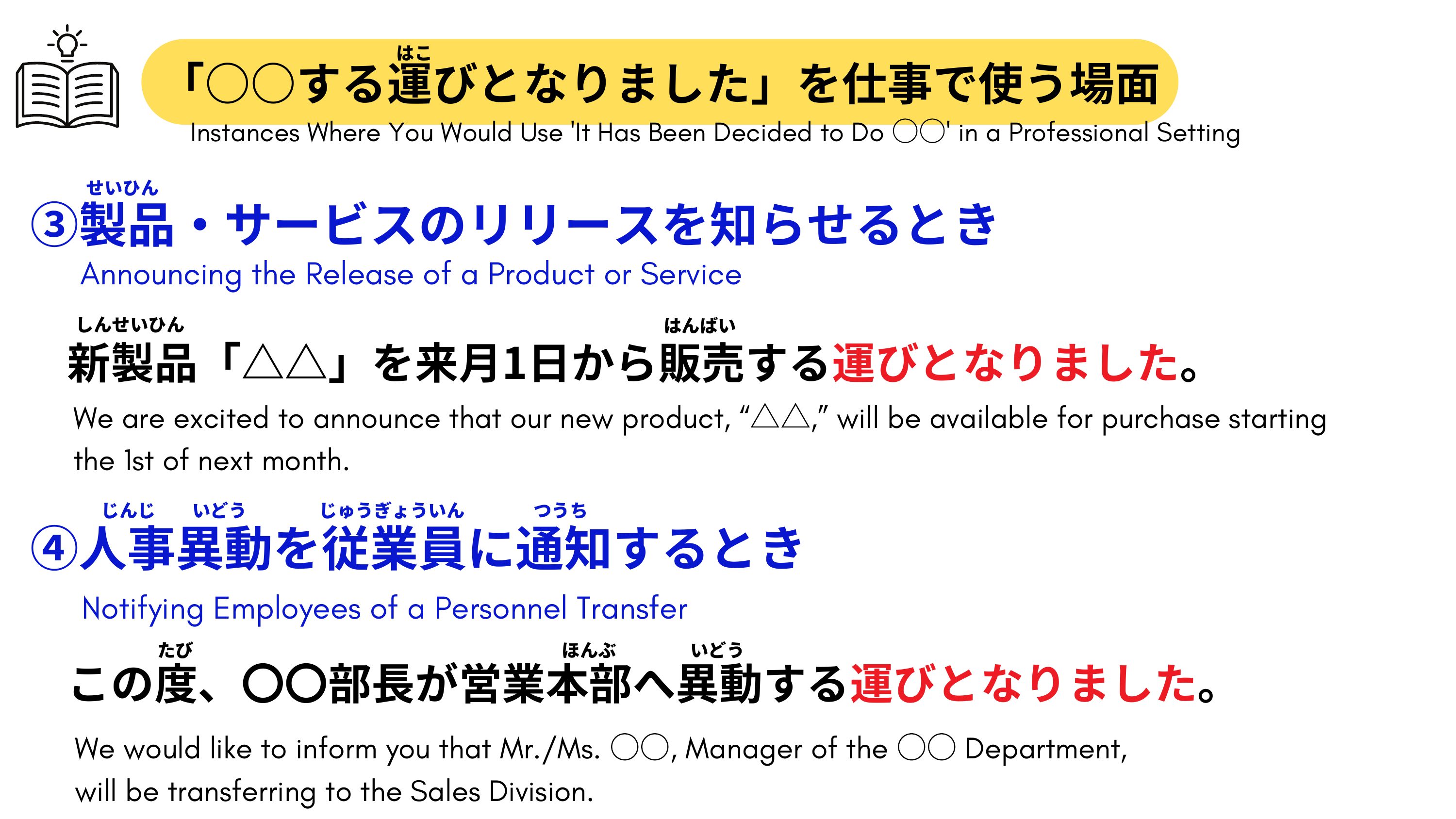
JPはこ
「○○する運びとなりました」を仕事で使う場面
「○○する運びとなりました」を仕事で使う場面
EN Instances Where You Would Use 'It Has Been Decided to Do ○○' in a Professional Setting
JPせいひん
③製品・サービスのリリースを知らせるとき
③製品・サービスのリリースを知らせるとき
EN Announcing the Release of a Product or Service
JPしんせいひんはんばい
新製品「△△」を来月1日から販売する運びとなりました。
新製品「△△」を来月1日から販売する運びとなりました。
ENWe are excited to announce that our new product, “ △△,” will be available for purchase starting
the 1st of next month.
the 1st of next month.
JPじんじいどうじゅうぎょういんつうち
④人事異動を従業員に通知するとき
④人事異動を従業員に通知するとき
EN Notifying Employees of a Personnel Transfer
JPたびほんぶいどう
この度、〇〇部長が営業本部へ異動する運びとなりました。
この度、〇〇部長が営業本部へ異動する運びとなりました。
ENWe would like to inform you that Mr./Ms. ○○, Manager of the ○○ Department,
will be transferring to the Sales Division.
will be transferring to the Sales Division.
หน้า 31
คลิกเพื่อขยาย
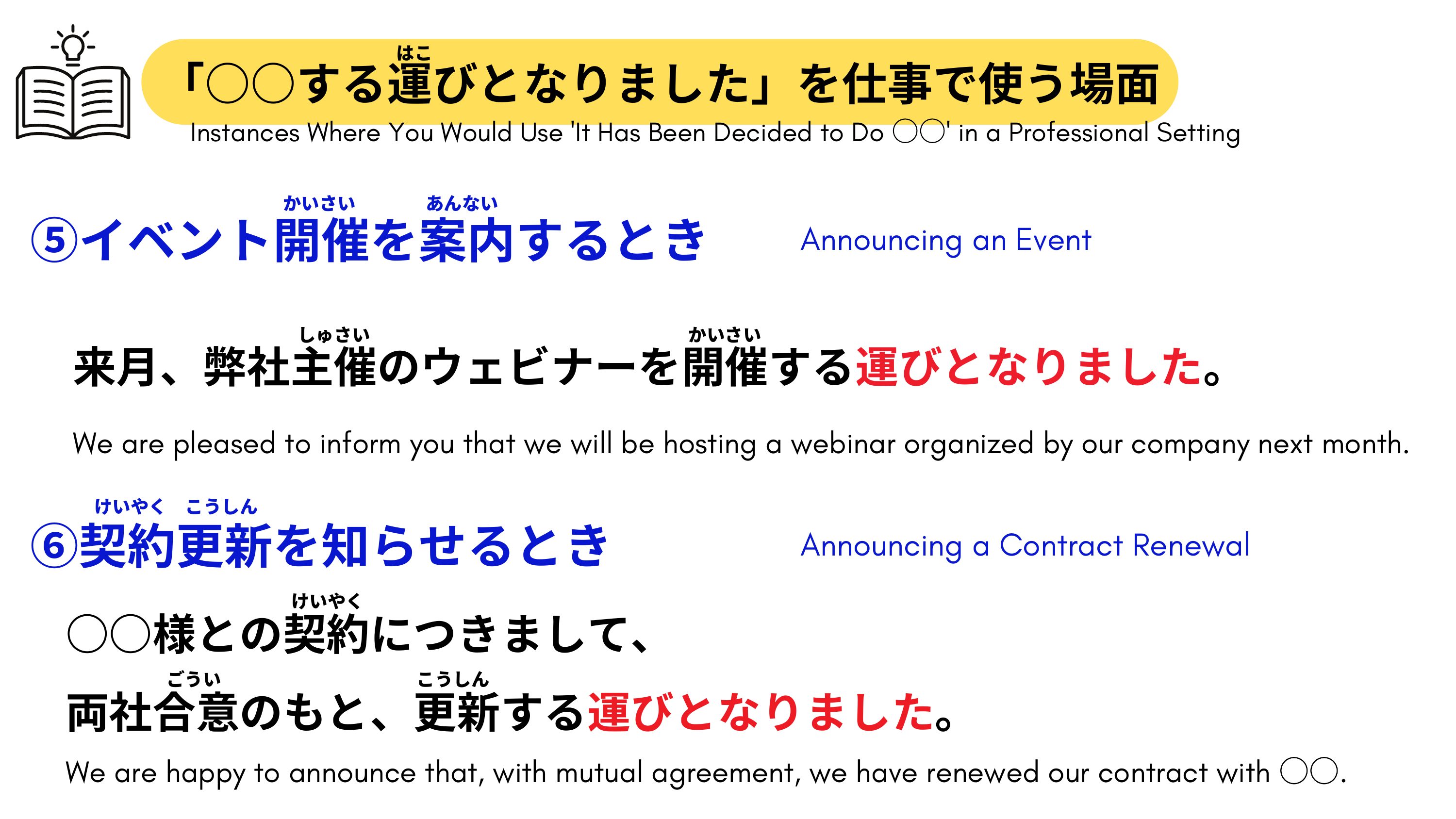
JPはこ
「○○する運びとなりました」を仕事で使う場面
「○○する運びとなりました」を仕事で使う場面
EN Instances Where You Would Use 'It Has Been Decided to Do ○○' in a Professional Setting
JPかいさいあんない
EN⑤イベント開催を案内するとき Announcing an Event
JPしゅさいかいさい
来月、弊社主催のウェビナーを開催する運びとなりました。
来月、弊社主催のウェビナーを開催する運びとなりました。
ENWe are pleased to inform you that we will be hosting a webinar organized by our company next month.
JPけいやくこうしん
EN⑥契約更新を知らせるとき Announcing a Contract Renewal
JPけいやく
○○様との契約につきまして、
ごういこうしん
両社合意のもと、更新する運びとなりました。
○○様との契約につきまして、
ごういこうしん
両社合意のもと、更新する運びとなりました。
ENWe are happy to announce that, with mutual agreement, we have renewed our contract with ○○.
หน้า 32
คลิกเพื่อขยาย
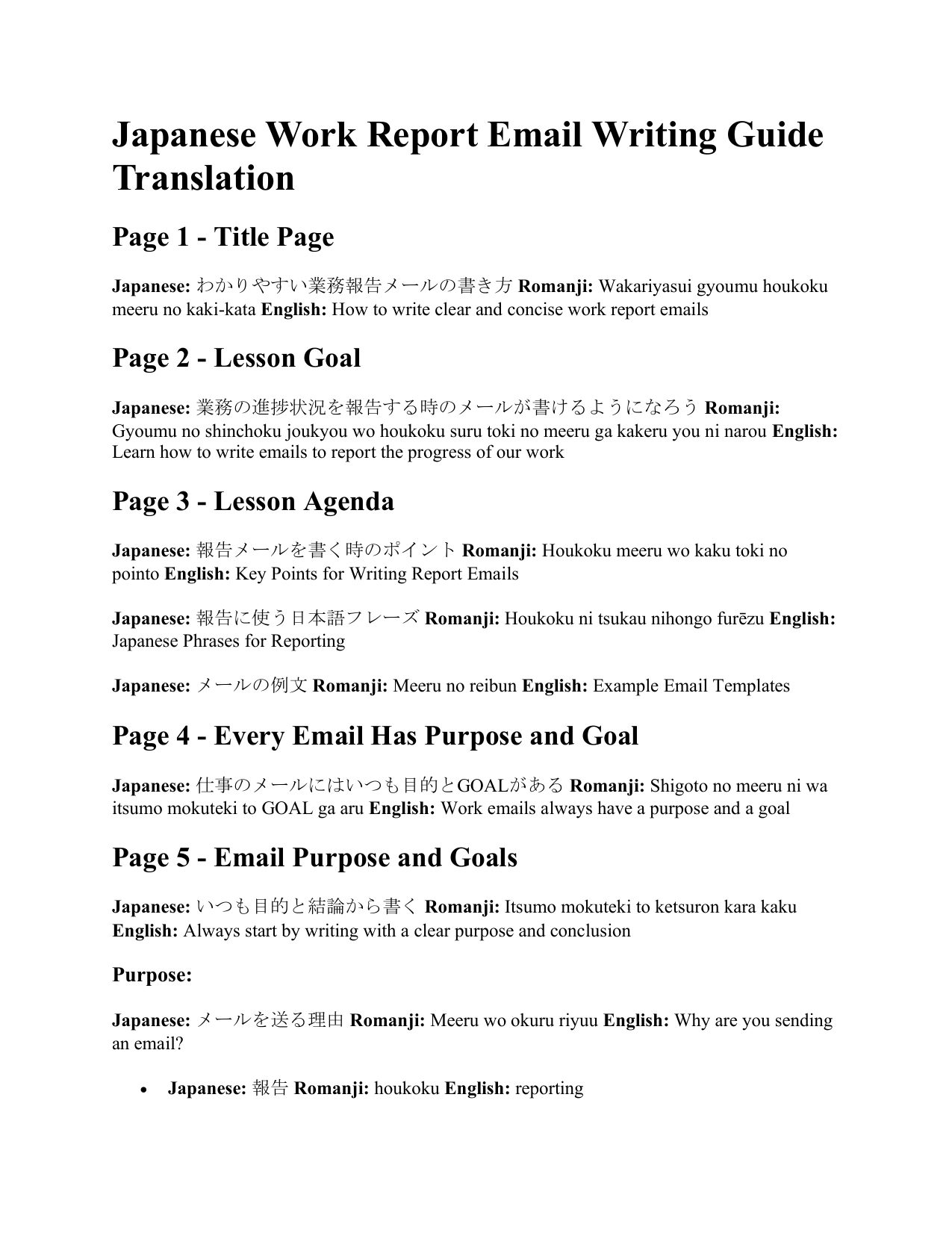
ENJapanese Work Report Email Writing Guide
Translation
Page 1 - Title Page
Japanese: わかりやすい業務報告メールの書き方 Romanji: Wakariyasui gyoumu houkoku
meeru no kaki-kata English: How to write clear and concise work report emails
Page 2 - Lesson Goal
Translation
Page 1 - Title Page
Japanese: わかりやすい業務報告メールの書き方 Romanji: Wakariyasui gyoumu houkoku
meeru no kaki-kata English: How to write clear and concise work report emails
Page 2 - Lesson Goal
JPJapanese:業務の進捗状況を報告する時のメールが書けるようになろうRomanji:
ENGyoumu no shinchoku joukyou wo houkoku suru toki no meeru ga kakeru you ni narou English:
Learn how to write emails to report the progress of our work
Page 3 - Lesson Agenda
Japanese: 報告メールを書く時のポイント Romanji: Houkoku meeru wo kaku toki no
pointo English: Key Points for Writing Report Emails
Japanese: 報告に使う日本語フレーズ Romanji: Houkoku ni tsukau nihongo furēzu English:
Japanese Phrases for Reporting
Japanese: メールの例文 Romanji: Meeru no reibun English: Example Email Templates
Page 4 - Every Email Has Purpose and Goal
Japanese: 仕事のメールにはいつも目的とGOALがある Romanji: Shigoto no meeru ni wa
itsumo mokuteki to GOAL ga aru English: Work emails always have a purpose and a goal
Page 5 - Email Purpose and Goals
Japanese: いつも目的と結論から書く Romanji: Itsumo mokuteki to ketsuron kara kaku
English: Always start by writing with a clear purpose and conclusion
Purpose:
Japanese: メールを送る理由 Romanji: Meeru wo okuru riyuu English: Why are you sending
an email?
• Japanese: 報告 Romanji: houkoku English: reporting
Learn how to write emails to report the progress of our work
Page 3 - Lesson Agenda
Japanese: 報告メールを書く時のポイント Romanji: Houkoku meeru wo kaku toki no
pointo English: Key Points for Writing Report Emails
Japanese: 報告に使う日本語フレーズ Romanji: Houkoku ni tsukau nihongo furēzu English:
Japanese Phrases for Reporting
Japanese: メールの例文 Romanji: Meeru no reibun English: Example Email Templates
Page 4 - Every Email Has Purpose and Goal
Japanese: 仕事のメールにはいつも目的とGOALがある Romanji: Shigoto no meeru ni wa
itsumo mokuteki to GOAL ga aru English: Work emails always have a purpose and a goal
Page 5 - Email Purpose and Goals
Japanese: いつも目的と結論から書く Romanji: Itsumo mokuteki to ketsuron kara kaku
English: Always start by writing with a clear purpose and conclusion
Purpose:
Japanese: メールを送る理由 Romanji: Meeru wo okuru riyuu English: Why are you sending
an email?
• Japanese: 報告 Romanji: houkoku English: reporting
หน้า 33
คลิกเพื่อขยาย
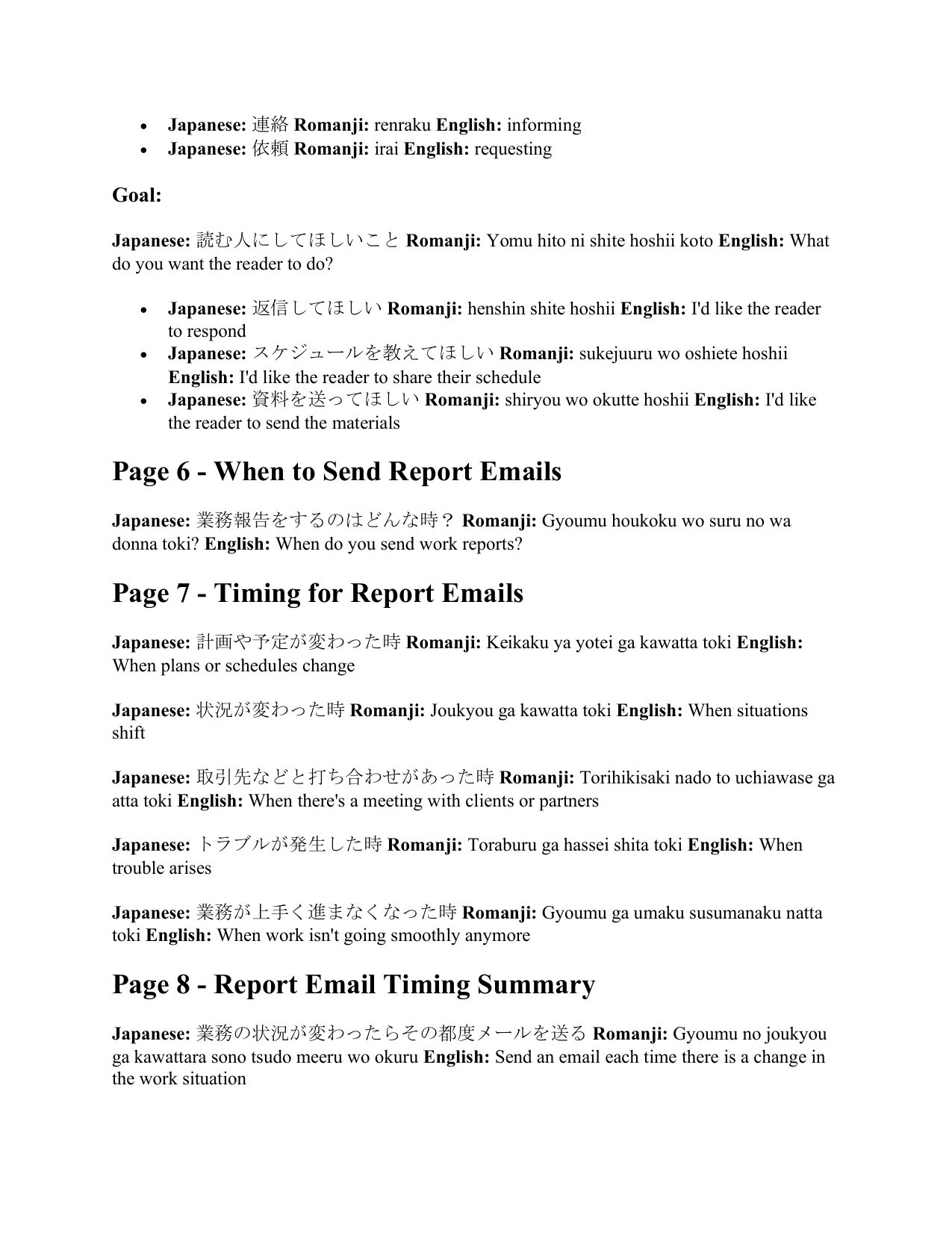
EN • Japanese: 連絡 Romanji: renraku English: informing
• Japanese: 依頼 Romanji: irai English: requesting
Goal:
Japanese: 読む人にしてほしいこと Romanji: Yomu hito ni shite hoshii koto English: What
do you want the reader to do?
• Japanese: 返信してほしい Romanji: henshin shite hoshii English: I'd like the reader
to respond
• Japanese: スケジュールを教えてほしい Romanji: sukejuuru wo oshiete hoshii
English: I'd like the reader to share their schedule
• Japanese: 資料を送ってほしい Romanji: shiryou wo okutte hoshii English: I'd like
the reader to send the materials
Page 6 - When to Send Report Emails
Japanese: 業務報告をするのはどんな時? Romanji: Gyoumu houkoku wo suru no wa
donna toki? English: When do you send work reports?
Page 7 - Timing for Report Emails
Japanese: 計画や予定が変わった時 Romanji: Keikaku ya yotei ga kawatta toki English:
When plans or schedules change
Japanese: 状況が変わった時 Romanji: Joukyou ga kawatta toki English: When situations
shift
Japanese: 取引先などと打ち合わせがあった時 Romanji: Torihikisaki nado to uchiawase ga
atta toki English: When there's a meeting with clients or partners
Japanese: トラブルが発生した時 Romanji: Toraburu ga hassei shita toki English: When
trouble arises
Japanese: 業務が上手く進まなくなった時 Romanji: Gyoumu ga umaku susumanaku natta
toki English: When work isn't going smoothly anymore
Page 8 - Report Email Timing Summary
Japanese: 業務の状況が変わったらその都度メールを送る Romanji: Gyoumu no joukyou
ga kawattara sono tsudo meeru wo okuru English: Send an email each time there is a change in
the work situation
• Japanese: 依頼 Romanji: irai English: requesting
Goal:
Japanese: 読む人にしてほしいこと Romanji: Yomu hito ni shite hoshii koto English: What
do you want the reader to do?
• Japanese: 返信してほしい Romanji: henshin shite hoshii English: I'd like the reader
to respond
• Japanese: スケジュールを教えてほしい Romanji: sukejuuru wo oshiete hoshii
English: I'd like the reader to share their schedule
• Japanese: 資料を送ってほしい Romanji: shiryou wo okutte hoshii English: I'd like
the reader to send the materials
Page 6 - When to Send Report Emails
Japanese: 業務報告をするのはどんな時? Romanji: Gyoumu houkoku wo suru no wa
donna toki? English: When do you send work reports?
Page 7 - Timing for Report Emails
Japanese: 計画や予定が変わった時 Romanji: Keikaku ya yotei ga kawatta toki English:
When plans or schedules change
Japanese: 状況が変わった時 Romanji: Joukyou ga kawatta toki English: When situations
shift
Japanese: 取引先などと打ち合わせがあった時 Romanji: Torihikisaki nado to uchiawase ga
atta toki English: When there's a meeting with clients or partners
Japanese: トラブルが発生した時 Romanji: Toraburu ga hassei shita toki English: When
trouble arises
Japanese: 業務が上手く進まなくなった時 Romanji: Gyoumu ga umaku susumanaku natta
toki English: When work isn't going smoothly anymore
Page 8 - Report Email Timing Summary
Japanese: 業務の状況が変わったらその都度メールを送る Romanji: Gyoumu no joukyou
ga kawattara sono tsudo meeru wo okuru English: Send an email each time there is a change in
the work situation
หน้า 34
คลิกเพื่อขยาย
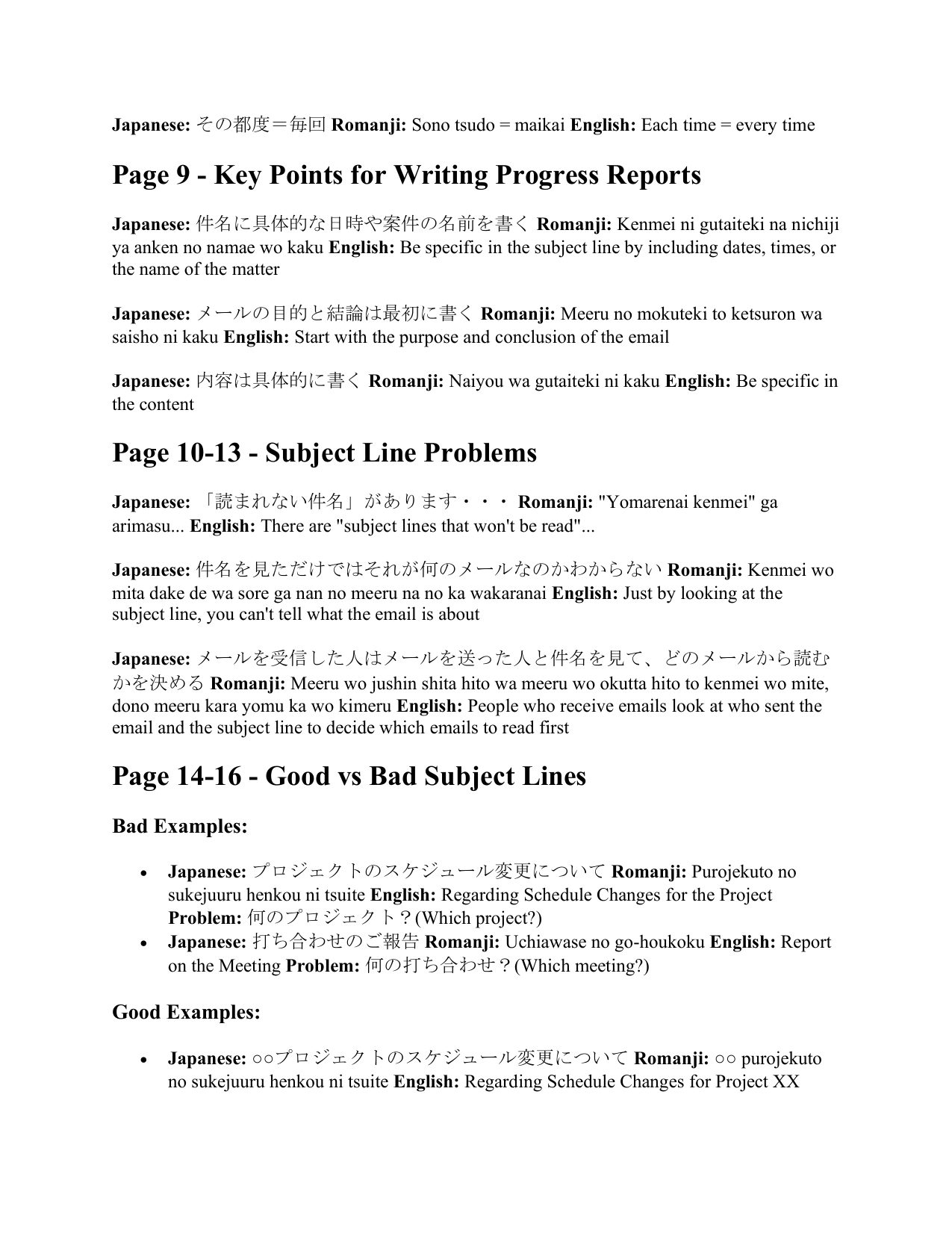
ENJapanese: その都度=毎回 Romanji: Sono tsudo = maikai English: Each time = every time
Page 9 - Key Points for Writing Progress Reports
Japanese: 件名に具体的な日時や案件の名前を書く Romanji: Kenmei ni gutaiteki na nichiji
ya anken no namae wo kaku English: Be specific in the subject line by including dates, times, or
the name of the matter
Japanese: メールの目的と結論は最初に書く Romanji: Meeru no mokuteki to ketsuron wa
saisho ni kaku English: Start with the purpose and conclusion of the email
Japanese: 内容は具体的に書く Romanji: Naiyou wa gutaiteki ni kaku English: Be specific in
the content
Page 10-13 - Subject Line Problems
Japanese: 「読まれない件名」があります・・・ Romanji: "Yomarenai kenmei" ga
arimasu... English: There are "subject lines that won't be read"...
Page 9 - Key Points for Writing Progress Reports
Japanese: 件名に具体的な日時や案件の名前を書く Romanji: Kenmei ni gutaiteki na nichiji
ya anken no namae wo kaku English: Be specific in the subject line by including dates, times, or
the name of the matter
Japanese: メールの目的と結論は最初に書く Romanji: Meeru no mokuteki to ketsuron wa
saisho ni kaku English: Start with the purpose and conclusion of the email
Japanese: 内容は具体的に書く Romanji: Naiyou wa gutaiteki ni kaku English: Be specific in
the content
Page 10-13 - Subject Line Problems
Japanese: 「読まれない件名」があります・・・ Romanji: "Yomarenai kenmei" ga
arimasu... English: There are "subject lines that won't be read"...
JPJapanese:件名を見ただけではそれが何のメールなのかわからないRomanji:Kenmeiwo
ENmita dake de wa sore ga nan no meeru na no ka wakaranai English: Just by looking at the
subject line, you can't tell what the email is about
subject line, you can't tell what the email is about
JPJapanese:メールを受信した人はメールを送った人と件名を見て、どのメールから読む
ENかを決める Romanji: Meeru wo jushin shita hito wa meeru wo okutta hito to kenmei wo mite,
dono meeru kara yomu ka wo kimeru English: People who receive emails look at who sent the
email and the subject line to decide which emails to read first
Page 14-16 - Good vs Bad Subject Lines
Bad Examples:
• Japanese: プロジェクトのスケジュール変更について Romanji: Purojekuto no
sukejuuru henkou ni tsuite English: Regarding Schedule Changes for the Project
Problem: 何のプロジェクト?(Which project?)
• Japanese: 打ち合わせのご報告 Romanji: Uchiawase no go-houkoku English: Report
on the Meeting Problem: 何の打ち合わせ?(Which meeting?)
Good Examples:
• Japanese: ○○プロジェクトのスケジュール変更について Romanji: ○○ purojekuto
no sukejuuru henkou ni tsuite English: Regarding Schedule Changes for Project XX
dono meeru kara yomu ka wo kimeru English: People who receive emails look at who sent the
email and the subject line to decide which emails to read first
Page 14-16 - Good vs Bad Subject Lines
Bad Examples:
• Japanese: プロジェクトのスケジュール変更について Romanji: Purojekuto no
sukejuuru henkou ni tsuite English: Regarding Schedule Changes for the Project
Problem: 何のプロジェクト?(Which project?)
• Japanese: 打ち合わせのご報告 Romanji: Uchiawase no go-houkoku English: Report
on the Meeting Problem: 何の打ち合わせ?(Which meeting?)
Good Examples:
• Japanese: ○○プロジェクトのスケジュール変更について Romanji: ○○ purojekuto
no sukejuuru henkou ni tsuite English: Regarding Schedule Changes for Project XX
หน้า 35
คลิกเพื่อขยาย
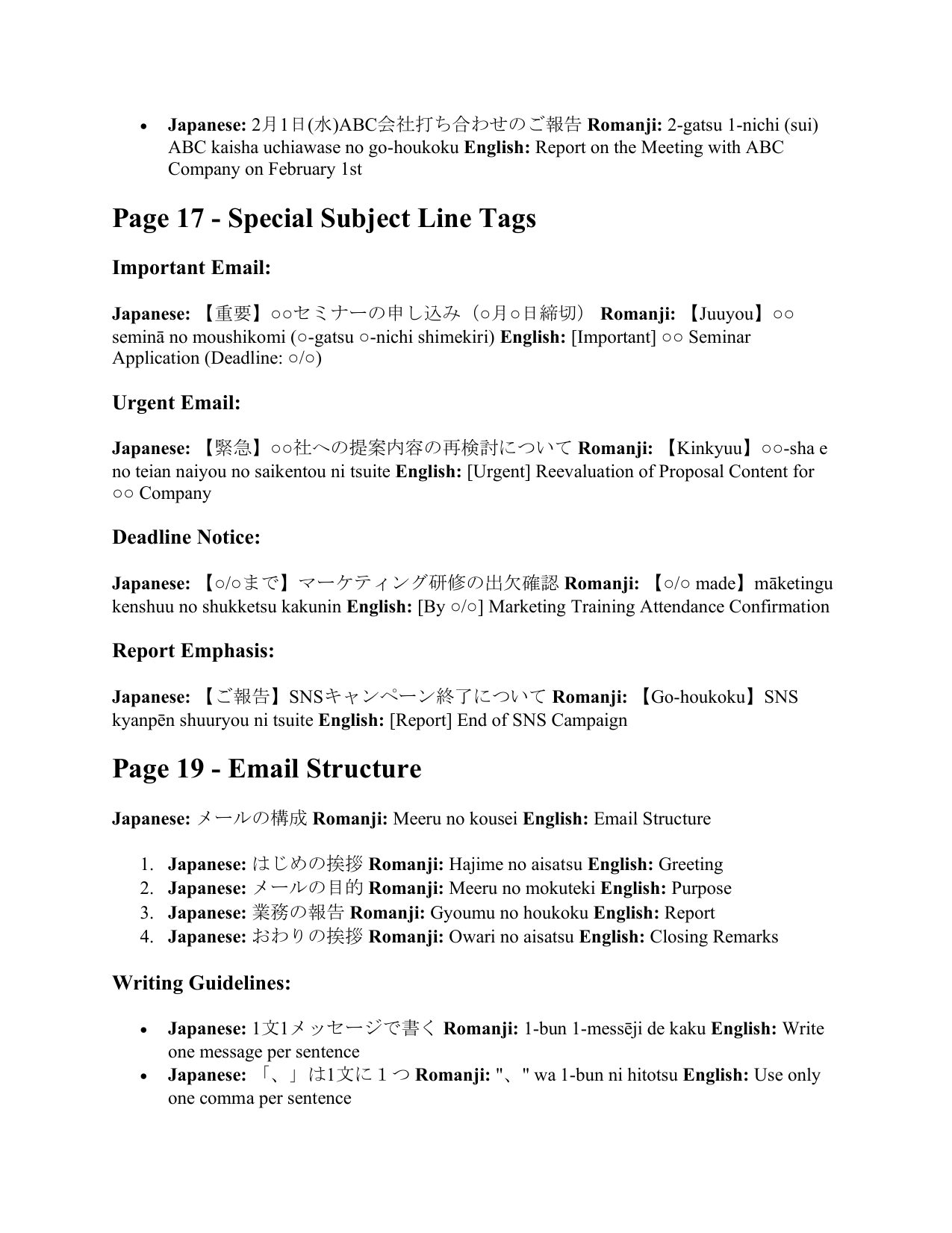
EN • Japanese: 2月1日(水)ABC会社打ち合わせのご報告 Romanji: 2-gatsu 1-nichi (sui)
ABC kaisha uchiawase no go-houkoku English: Report on the Meeting with ABC
Company on February 1st
Page 17 - Special Subject Line Tags
Important Email:
Japanese: 【重要】○○セミナーの申し込み(○月○日締切) Romanji: 【Juuyou】○○
seminā no moushikomi (○-gatsu ○-nichi shimekiri) English: [Important] ○○ Seminar
Application (Deadline: ○/○)
Urgent Email:
Japanese: 【緊急】○○社への提案内容の再検討について Romanji: 【Kinkyuu】○○-sha e
no teian naiyou no saikentou ni tsuite English: [Urgent] Reevaluation of Proposal Content for
○○ Company
Deadline Notice:
Japanese: 【○/○まで】マーケティング研修の出欠確認 Romanji: 【○/○ made】māketingu
kenshuu no shukketsu kakunin English: [By ○/○] Marketing Training Attendance Confirmation
Report Emphasis:
Japanese: 【ご報告】SNSキャンペーン終了について Romanji: 【Go-houkoku】SNS
kyanpēn shuuryou ni tsuite English: [Report] End of SNS Campaign
Page 19 - Email Structure
Japanese: メールの構成 Romanji: Meeru no kousei English: Email Structure
1. Japanese: はじめの挨拶 Romanji: Hajime no aisatsu English: Greeting
2. Japanese: メールの目的 Romanji: Meeru no mokuteki English: Purpose
3. Japanese: 業務の報告 Romanji: Gyoumu no houkoku English: Report
4. Japanese: おわりの挨拶 Romanji: Owari no aisatsu English: Closing Remarks
Writing Guidelines:
• Japanese: 1文1メッセージで書く Romanji: 1-bun 1-messēji de kaku English: Write
one message per sentence
• Japanese: 「、」は1文に1つ Romanji: "、" wa 1-bun ni hitotsu English: Use only
one comma per sentence
ABC kaisha uchiawase no go-houkoku English: Report on the Meeting with ABC
Company on February 1st
Page 17 - Special Subject Line Tags
Important Email:
Japanese: 【重要】○○セミナーの申し込み(○月○日締切) Romanji: 【Juuyou】○○
seminā no moushikomi (○-gatsu ○-nichi shimekiri) English: [Important] ○○ Seminar
Application (Deadline: ○/○)
Urgent Email:
Japanese: 【緊急】○○社への提案内容の再検討について Romanji: 【Kinkyuu】○○-sha e
no teian naiyou no saikentou ni tsuite English: [Urgent] Reevaluation of Proposal Content for
○○ Company
Deadline Notice:
Japanese: 【○/○まで】マーケティング研修の出欠確認 Romanji: 【○/○ made】māketingu
kenshuu no shukketsu kakunin English: [By ○/○] Marketing Training Attendance Confirmation
Report Emphasis:
Japanese: 【ご報告】SNSキャンペーン終了について Romanji: 【Go-houkoku】SNS
kyanpēn shuuryou ni tsuite English: [Report] End of SNS Campaign
Page 19 - Email Structure
Japanese: メールの構成 Romanji: Meeru no kousei English: Email Structure
1. Japanese: はじめの挨拶 Romanji: Hajime no aisatsu English: Greeting
2. Japanese: メールの目的 Romanji: Meeru no mokuteki English: Purpose
3. Japanese: 業務の報告 Romanji: Gyoumu no houkoku English: Report
4. Japanese: おわりの挨拶 Romanji: Owari no aisatsu English: Closing Remarks
Writing Guidelines:
• Japanese: 1文1メッセージで書く Romanji: 1-bun 1-messēji de kaku English: Write
one message per sentence
• Japanese: 「、」は1文に1つ Romanji: "、" wa 1-bun ni hitotsu English: Use only
one comma per sentence
หน้า 36
คลิกเพื่อขยาย
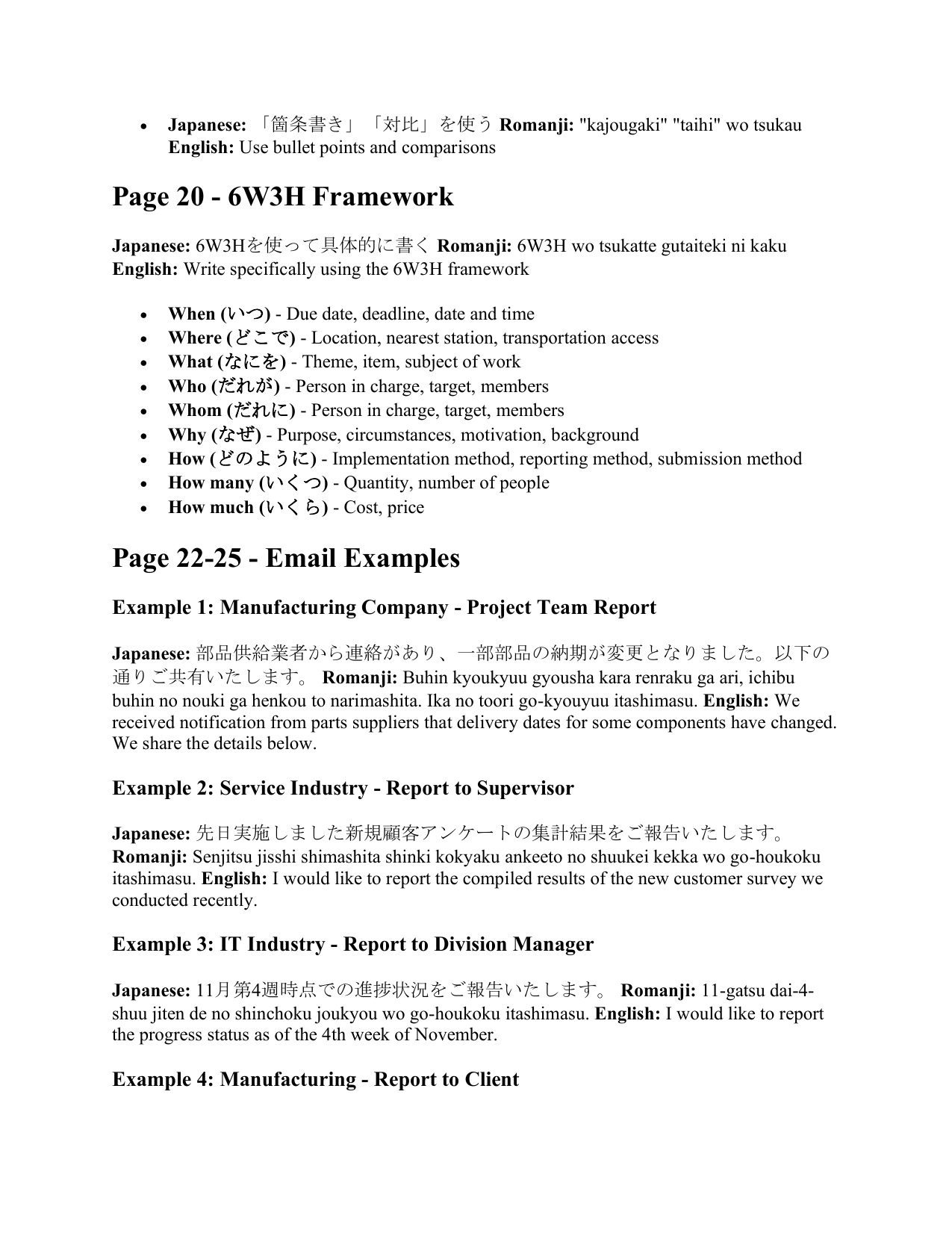
EN • Japanese: 「箇条書き」「対比」を使う Romanji: "kajougaki" "taihi" wo tsukau
English: Use bullet points and comparisons
Page 20 - 6W3H Framework
Japanese: 6W3Hを使って具体的に書く Romanji: 6W3H wo tsukatte gutaiteki ni kaku
English: Write specifically using the 6W3H framework
• When (いつ) - Due date, deadline, date and time
• Where (どこで) - Location, nearest station, transportation access
• What (なにを) - Theme, item, subject of work
• Who (だれが) - Person in charge, target, members
• Whom (だれに) - Person in charge, target, members
• Why (なぜ) - Purpose, circumstances, motivation, background
• How (どのように) - Implementation method, reporting method, submission method
• How many (いくつ) - Quantity, number of people
• How much (いくら) - Cost, price
Page 22-25 - Email Examples
Example 1: Manufacturing Company - Project Team Report
English: Use bullet points and comparisons
Page 20 - 6W3H Framework
Japanese: 6W3Hを使って具体的に書く Romanji: 6W3H wo tsukatte gutaiteki ni kaku
English: Write specifically using the 6W3H framework
• When (いつ) - Due date, deadline, date and time
• Where (どこで) - Location, nearest station, transportation access
• What (なにを) - Theme, item, subject of work
• Who (だれが) - Person in charge, target, members
• Whom (だれに) - Person in charge, target, members
• Why (なぜ) - Purpose, circumstances, motivation, background
• How (どのように) - Implementation method, reporting method, submission method
• How many (いくつ) - Quantity, number of people
• How much (いくら) - Cost, price
Page 22-25 - Email Examples
Example 1: Manufacturing Company - Project Team Report
JPJapanese:部品供給業者から連絡があり、一部部品の納期が変更となりました。以下の
EN通りご共有いたします。 Romanji: Buhin kyoukyuu gyousha kara renraku ga ari, ichibu
buhin no nouki ga henkou to narimashita. Ika no toori go-kyouyuu itashimasu. English: We
received notification from parts suppliers that delivery dates for some components have changed.
We share the details below.
Example 2: Service Industry - Report to Supervisor
buhin no nouki ga henkou to narimashita. Ika no toori go-kyouyuu itashimasu. English: We
received notification from parts suppliers that delivery dates for some components have changed.
We share the details below.
Example 2: Service Industry - Report to Supervisor
JPJapanese:先日実施しました新規顧客アンケートの集計結果をご報告いたします。
ENRomanji: Senjitsu jisshi shimashita shinki kokyaku ankeeto no shuukei kekka wo go-houkoku
itashimasu. English: I would like to report the compiled results of the new customer survey we
conducted recently.
Example 3: IT Industry - Report to Division Manager
Japanese: 11月第4週時点での進捗状況をご報告いたします。 Romanji: 11-gatsu dai-4-
shuu jiten de no shinchoku joukyou wo go-houkoku itashimasu. English: I would like to report
the progress status as of the 4th week of November.
Example 4: Manufacturing - Report to Client
itashimasu. English: I would like to report the compiled results of the new customer survey we
conducted recently.
Example 3: IT Industry - Report to Division Manager
Japanese: 11月第4週時点での進捗状況をご報告いたします。 Romanji: 11-gatsu dai-4-
shuu jiten de no shinchoku joukyou wo go-houkoku itashimasu. English: I would like to report
the progress status as of the 4th week of November.
Example 4: Manufacturing - Report to Client
หน้า 37
คลิกเพื่อขยาย
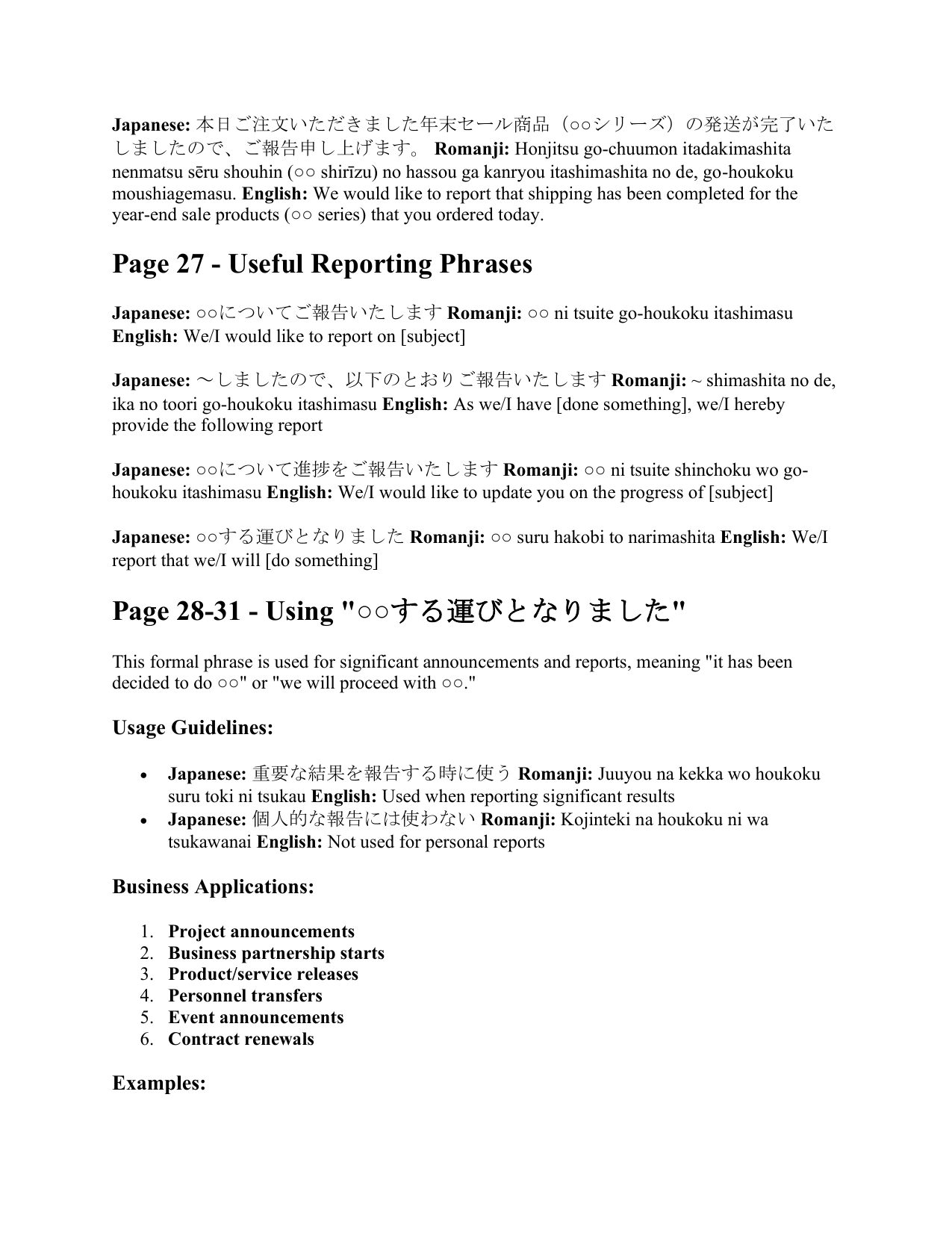
JPJapanese:本日ご注文いただきました年末セール商品(○○シリーズ)の発送が完了いた
ENしましたので、ご報告申し上げます。 Romanji: Honjitsu go-chuumon itadakimashita
nenmatsu sēru shouhin (○○ shirīzu) no hassou ga kanryou itashimashita no de, go-houkoku
moushiagemasu. English: We would like to report that shipping has been completed for the
year-end sale products (○○ series) that you ordered today.
Page 27 - Useful Reporting Phrases
Japanese: ○○についてご報告いたします Romanji: ○○ ni tsuite go-houkoku itashimasu
English: We/I would like to report on [subject]
Japanese: ~しましたので、以下のとおりご報告いたします Romanji: ~ shimashita no de,
ika no toori go-houkoku itashimasu English: As we/I have [done something], we/I hereby
provide the following report
Japanese: ○○について進捗をご報告いたします Romanji: ○○ ni tsuite shinchoku wo go-
houkoku itashimasu English: We/I would like to update you on the progress of [subject]
Japanese: ○○する運びとなりました Romanji: ○○ suru hakobi to narimashita English: We/I
report that we/I will [do something]
nenmatsu sēru shouhin (○○ shirīzu) no hassou ga kanryou itashimashita no de, go-houkoku
moushiagemasu. English: We would like to report that shipping has been completed for the
year-end sale products (○○ series) that you ordered today.
Page 27 - Useful Reporting Phrases
Japanese: ○○についてご報告いたします Romanji: ○○ ni tsuite go-houkoku itashimasu
English: We/I would like to report on [subject]
Japanese: ~しましたので、以下のとおりご報告いたします Romanji: ~ shimashita no de,
ika no toori go-houkoku itashimasu English: As we/I have [done something], we/I hereby
provide the following report
Japanese: ○○について進捗をご報告いたします Romanji: ○○ ni tsuite shinchoku wo go-
houkoku itashimasu English: We/I would like to update you on the progress of [subject]
Japanese: ○○する運びとなりました Romanji: ○○ suru hakobi to narimashita English: We/I
report that we/I will [do something]
JPPage28-31-Using"○○する運びとなりました"
ENThis formal phrase is used for significant announcements and reports, meaning "it has been
decided to do ○○" or "we will proceed with ○○."
Usage Guidelines:
• Japanese: 重要な結果を報告する時に使う Romanji: Juuyou na kekka wo houkoku
suru toki ni tsukau English: Used when reporting significant results
• Japanese: 個人的な報告には使わない Romanji: Kojinteki na houkoku ni wa
tsukawanai English: Not used for personal reports
Business Applications:
1. Project announcements
2. Business partnership starts
3. Product/service releases
4. Personnel transfers
5. Event announcements
6. Contract renewals
Examples:
decided to do ○○" or "we will proceed with ○○."
Usage Guidelines:
• Japanese: 重要な結果を報告する時に使う Romanji: Juuyou na kekka wo houkoku
suru toki ni tsukau English: Used when reporting significant results
• Japanese: 個人的な報告には使わない Romanji: Kojinteki na houkoku ni wa
tsukawanai English: Not used for personal reports
Business Applications:
1. Project announcements
2. Business partnership starts
3. Product/service releases
4. Personnel transfers
5. Event announcements
6. Contract renewals
Examples:
หน้า 38
คลิกเพื่อขยาย
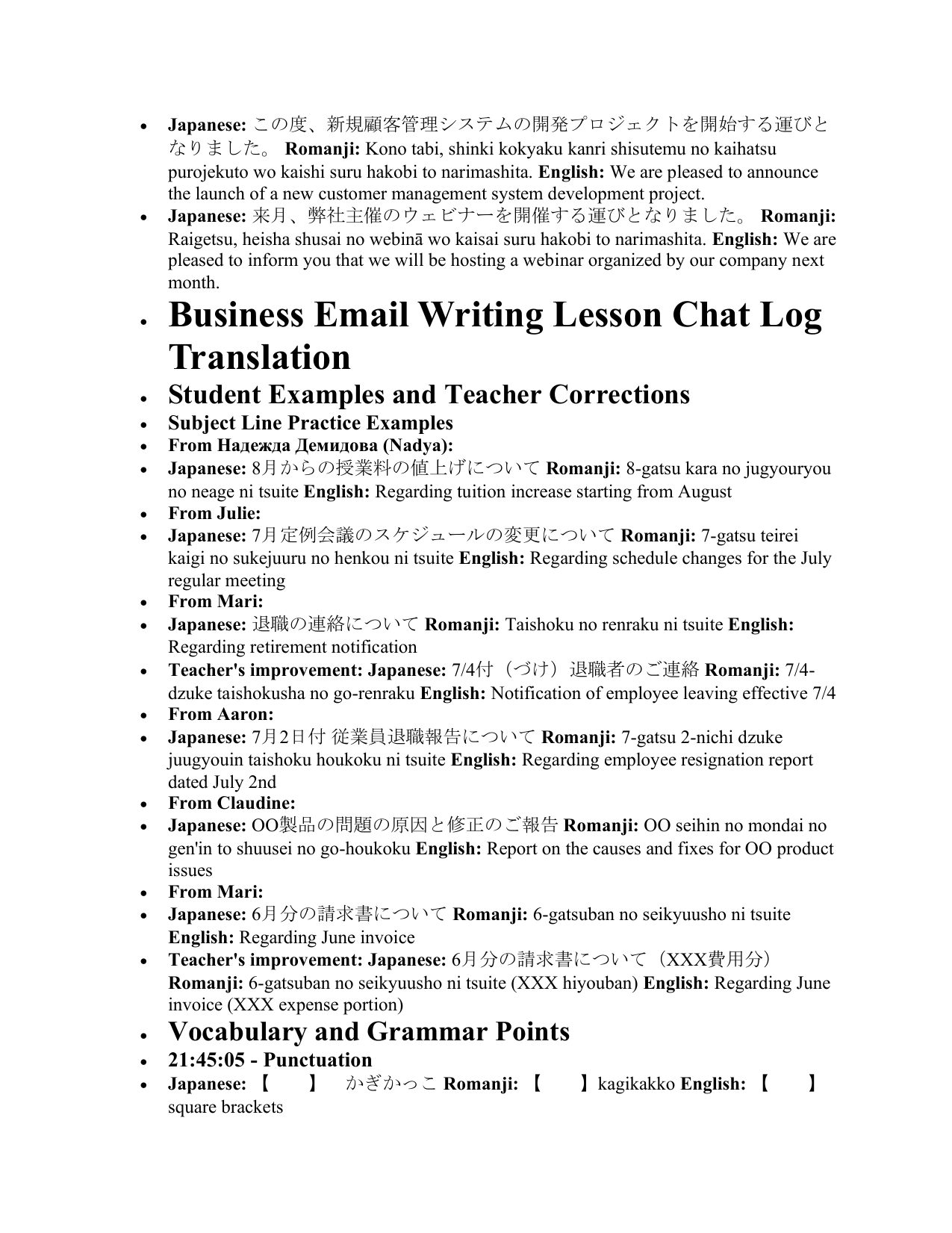
JP•Japanese:この度、新規顧客管理システムの開発プロジェクトを開始する運びと
EN なりました。 Romanji: Kono tabi, shinki kokyaku kanri shisutemu no kaihatsu
purojekuto wo kaishi suru hakobi to narimashita. English: We are pleased to announce
the launch of a new customer management system development project.
purojekuto wo kaishi suru hakobi to narimashita. English: We are pleased to announce
the launch of a new customer management system development project.
JP•Japanese:来月、弊社主催のウェビナーを開催する運びとなりました。Romanji:
EN Raigetsu, heisha shusai no webinā wo kaisai suru hakobi to narimashita. English: We are
pleased to inform you that we will be hosting a webinar organized by our company next
month.
• Business Email Writing Lesson Chat Log
Translation
• Student Examples and Teacher Corrections
• Subject Line Practice Examples
• From Надежда Демидова (Nadya):
• Japanese: 8月からの授業料の値上げについて Romanji: 8-gatsu kara no jugyouryou
no neage ni tsuite English: Regarding tuition increase starting from August
• From Julie:
• Japanese: 7月定例会議のスケジュールの変更について Romanji: 7-gatsu teirei
kaigi no sukejuuru no henkou ni tsuite English: Regarding schedule changes for the July
regular meeting
• From Mari:
• Japanese: 退職の連絡について Romanji: Taishoku no renraku ni tsuite English:
Regarding retirement notification
• Teacher's improvement: Japanese: 7/4付(づけ)退職者のご連絡 Romanji: 7/4-
dzuke taishokusha no go-renraku English: Notification of employee leaving effective 7/4
• From Aaron:
• Japanese: 7月2日付 従業員退職報告について Romanji: 7-gatsu 2-nichi dzuke
juugyouin taishoku houkoku ni tsuite English: Regarding employee resignation report
dated July 2nd
• From Claudine:
• Japanese: OO製品の問題の原因と修正のご報告 Romanji: OO seihin no mondai no
gen'in to shuusei no go-houkoku English: Report on the causes and fixes for OO product
issues
• From Mari:
• Japanese: 6月分の請求書について Romanji: 6-gatsuban no seikyuusho ni tsuite
English: Regarding June invoice
• Teacher's improvement: Japanese: 6月分の請求書について(XXX費用分)
Romanji: 6-gatsuban no seikyuusho ni tsuite (XXX hiyouban) English: Regarding June
invoice (XXX expense portion)
• Vocabulary and Grammar Points
• 21:45:05 - Punctuation
• Japanese: 【 】 かぎかっこ Romanji: 【 】kagikakko English: 【 】
square brackets
pleased to inform you that we will be hosting a webinar organized by our company next
month.
• Business Email Writing Lesson Chat Log
Translation
• Student Examples and Teacher Corrections
• Subject Line Practice Examples
• From Надежда Демидова (Nadya):
• Japanese: 8月からの授業料の値上げについて Romanji: 8-gatsu kara no jugyouryou
no neage ni tsuite English: Regarding tuition increase starting from August
• From Julie:
• Japanese: 7月定例会議のスケジュールの変更について Romanji: 7-gatsu teirei
kaigi no sukejuuru no henkou ni tsuite English: Regarding schedule changes for the July
regular meeting
• From Mari:
• Japanese: 退職の連絡について Romanji: Taishoku no renraku ni tsuite English:
Regarding retirement notification
• Teacher's improvement: Japanese: 7/4付(づけ)退職者のご連絡 Romanji: 7/4-
dzuke taishokusha no go-renraku English: Notification of employee leaving effective 7/4
• From Aaron:
• Japanese: 7月2日付 従業員退職報告について Romanji: 7-gatsu 2-nichi dzuke
juugyouin taishoku houkoku ni tsuite English: Regarding employee resignation report
dated July 2nd
• From Claudine:
• Japanese: OO製品の問題の原因と修正のご報告 Romanji: OO seihin no mondai no
gen'in to shuusei no go-houkoku English: Report on the causes and fixes for OO product
issues
• From Mari:
• Japanese: 6月分の請求書について Romanji: 6-gatsuban no seikyuusho ni tsuite
English: Regarding June invoice
• Teacher's improvement: Japanese: 6月分の請求書について(XXX費用分)
Romanji: 6-gatsuban no seikyuusho ni tsuite (XXX hiyouban) English: Regarding June
invoice (XXX expense portion)
• Vocabulary and Grammar Points
• 21:45:05 - Punctuation
• Japanese: 【 】 かぎかっこ Romanji: 【 】kagikakko English: 【 】
square brackets
หน้า 39
คลิกเพื่อขยาย
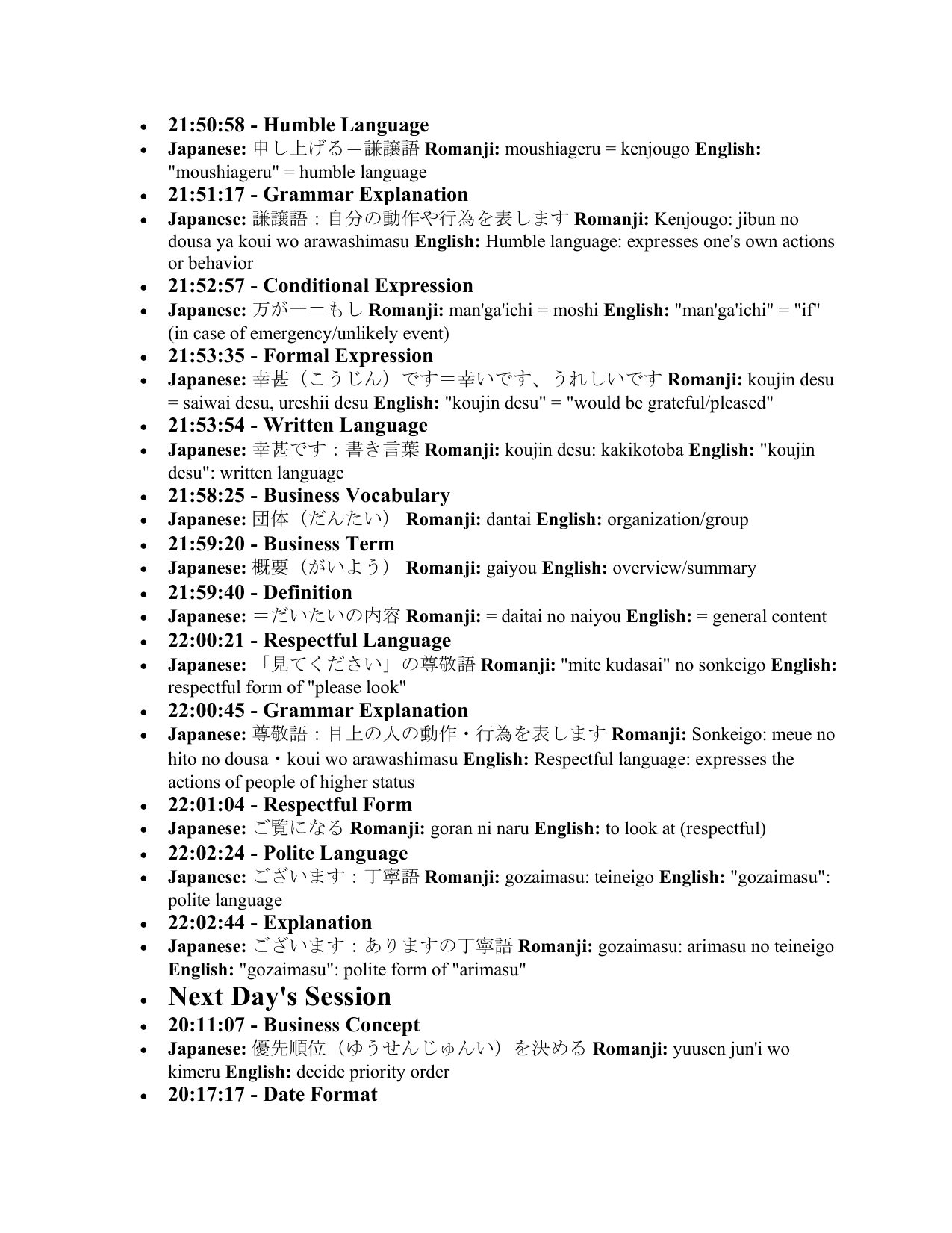
EN• 21:50:58 - Humble Language
• Japanese: 申し上げる=謙譲語 Romanji: moushiageru = kenjougo English:
"moushiageru" = humble language
• 21:51:17 - Grammar Explanation
• Japanese: 謙譲語:自分の動作や行為を表します Romanji: Kenjougo: jibun no
dousa ya koui wo arawashimasu English: Humble language: expresses one's own actions
or behavior
• 21:52:57 - Conditional Expression
• Japanese: 万が一=もし Romanji: man'ga'ichi = moshi English: "man'ga'ichi" = "if"
(in case of emergency/unlikely event)
• 21:53:35 - Formal Expression
• Japanese: 幸甚(こうじん)です=幸いです、うれしいです Romanji: koujin desu
= saiwai desu, ureshii desu English: "koujin desu" = "would be grateful/pleased"
• 21:53:54 - Written Language
• Japanese: 幸甚です:書き言葉 Romanji: koujin desu: kakikotoba English: "koujin
desu": written language
• 21:58:25 - Business Vocabulary
• Japanese: 団体(だんたい) Romanji: dantai English: organization/group
• 21:59:20 - Business Term
• Japanese: 概要(がいよう) Romanji: gaiyou English: overview/summary
• 21:59:40 - Definition
• Japanese: =だいたいの内容 Romanji: = daitai no naiyou English: = general content
• 22:00:21 - Respectful Language
• Japanese: 「見てください」の尊敬語 Romanji: "mite kudasai" no sonkeigo English:
respectful form of "please look"
• 22:00:45 - Grammar Explanation
• Japanese: 尊敬語:目上の人の動作・行為を表します Romanji: Sonkeigo: meue no
hito no dousa・koui wo arawashimasu English: Respectful language: expresses the
actions of people of higher status
• 22:01:04 - Respectful Form
• Japanese: ご覧になる Romanji: goran ni naru English: to look at (respectful)
• 22:02:24 - Polite Language
• Japanese: ございます:丁寧語 Romanji: gozaimasu: teineigo English: "gozaimasu":
polite language
• 22:02:44 - Explanation
• Japanese: ございます:ありますの丁寧語 Romanji: gozaimasu: arimasu no teineigo
English: "gozaimasu": polite form of "arimasu"
• Next Day's Session
• 20:11:07 - Business Concept
• Japanese: 優先順位(ゆうせんじゅんい)を決める Romanji: yuusen jun'i wo
kimeru English: decide priority order
• 20:17:17 - Date Format
• Japanese: 申し上げる=謙譲語 Romanji: moushiageru = kenjougo English:
"moushiageru" = humble language
• 21:51:17 - Grammar Explanation
• Japanese: 謙譲語:自分の動作や行為を表します Romanji: Kenjougo: jibun no
dousa ya koui wo arawashimasu English: Humble language: expresses one's own actions
or behavior
• 21:52:57 - Conditional Expression
• Japanese: 万が一=もし Romanji: man'ga'ichi = moshi English: "man'ga'ichi" = "if"
(in case of emergency/unlikely event)
• 21:53:35 - Formal Expression
• Japanese: 幸甚(こうじん)です=幸いです、うれしいです Romanji: koujin desu
= saiwai desu, ureshii desu English: "koujin desu" = "would be grateful/pleased"
• 21:53:54 - Written Language
• Japanese: 幸甚です:書き言葉 Romanji: koujin desu: kakikotoba English: "koujin
desu": written language
• 21:58:25 - Business Vocabulary
• Japanese: 団体(だんたい) Romanji: dantai English: organization/group
• 21:59:20 - Business Term
• Japanese: 概要(がいよう) Romanji: gaiyou English: overview/summary
• 21:59:40 - Definition
• Japanese: =だいたいの内容 Romanji: = daitai no naiyou English: = general content
• 22:00:21 - Respectful Language
• Japanese: 「見てください」の尊敬語 Romanji: "mite kudasai" no sonkeigo English:
respectful form of "please look"
• 22:00:45 - Grammar Explanation
• Japanese: 尊敬語:目上の人の動作・行為を表します Romanji: Sonkeigo: meue no
hito no dousa・koui wo arawashimasu English: Respectful language: expresses the
actions of people of higher status
• 22:01:04 - Respectful Form
• Japanese: ご覧になる Romanji: goran ni naru English: to look at (respectful)
• 22:02:24 - Polite Language
• Japanese: ございます:丁寧語 Romanji: gozaimasu: teineigo English: "gozaimasu":
polite language
• 22:02:44 - Explanation
• Japanese: ございます:ありますの丁寧語 Romanji: gozaimasu: arimasu no teineigo
English: "gozaimasu": polite form of "arimasu"
• Next Day's Session
• 20:11:07 - Business Concept
• Japanese: 優先順位(ゆうせんじゅんい)を決める Romanji: yuusen jun'i wo
kimeru English: decide priority order
• 20:17:17 - Date Format
หน้า 40
คลิกเพื่อขยาย
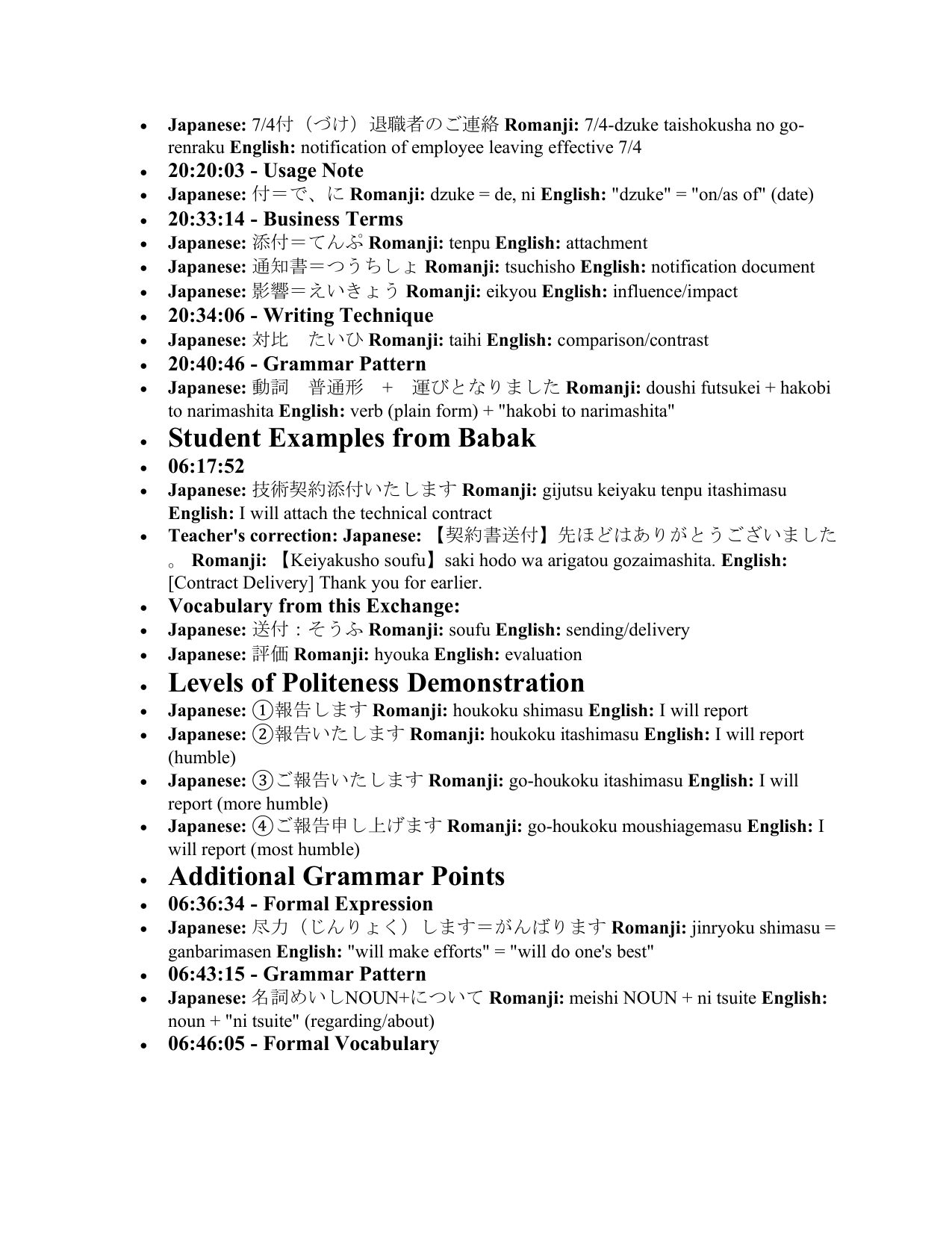
EN• Japanese: 7/4付(づけ)退職者のご連絡 Romanji: 7/4-dzuke taishokusha no go-
renraku English: notification of employee leaving effective 7/4
• 20:20:03 - Usage Note
• Japanese: 付=で、に Romanji: dzuke = de, ni English: "dzuke" = "on/as of" (date)
• 20:33:14 - Business Terms
• Japanese: 添付=てんぷ Romanji: tenpu English: attachment
• Japanese: 通知書=つうちしょ Romanji: tsuchisho English: notification document
• Japanese: 影響=えいきょう Romanji: eikyou English: influence/impact
• 20:34:06 - Writing Technique
• Japanese: 対比 たいひ Romanji: taihi English: comparison/contrast
• 20:40:46 - Grammar Pattern
• Japanese: 動詞 普通形 + 運びとなりました Romanji: doushi futsukei + hakobi
to narimashita English: verb (plain form) + "hakobi to narimashita"
• Student Examples from Babak
• 06:17:52
• Japanese: 技術契約添付いたします Romanji: gijutsu keiyaku tenpu itashimasu
English: I will attach the technical contract
• Teacher's correction: Japanese: 【契約書送付】先ほどはありがとうございました
。 Romanji: 【Keiyakusho soufu】saki hodo wa arigatou gozaimashita. English:
[Contract Delivery] Thank you for earlier.
• Vocabulary from this Exchange:
• Japanese: 送付:そうふ Romanji: soufu English: sending/delivery
• Japanese: 評価 Romanji: hyouka English: evaluation
• Levels of Politeness Demonstration
• Japanese: ①報告します Romanji: houkoku shimasu English: I will report
• Japanese: ②報告いたします Romanji: houkoku itashimasu English: I will report
(humble)
• Japanese: ③ご報告いたします Romanji: go-houkoku itashimasu English: I will
report (more humble)
• Japanese: ④ご報告申し上げます Romanji: go-houkoku moushiagemasu English: I
will report (most humble)
• Additional Grammar Points
• 06:36:34 - Formal Expression
• Japanese: 尽力(じんりょく)します=がんばります Romanji: jinryoku shimasu =
ganbarimasen English: "will make efforts" = "will do one's best"
• 06:43:15 - Grammar Pattern
• Japanese: 名詞めいしNOUN+について Romanji: meishi NOUN + ni tsuite English:
noun + "ni tsuite" (regarding/about)
• 06:46:05 - Formal Vocabulary
renraku English: notification of employee leaving effective 7/4
• 20:20:03 - Usage Note
• Japanese: 付=で、に Romanji: dzuke = de, ni English: "dzuke" = "on/as of" (date)
• 20:33:14 - Business Terms
• Japanese: 添付=てんぷ Romanji: tenpu English: attachment
• Japanese: 通知書=つうちしょ Romanji: tsuchisho English: notification document
• Japanese: 影響=えいきょう Romanji: eikyou English: influence/impact
• 20:34:06 - Writing Technique
• Japanese: 対比 たいひ Romanji: taihi English: comparison/contrast
• 20:40:46 - Grammar Pattern
• Japanese: 動詞 普通形 + 運びとなりました Romanji: doushi futsukei + hakobi
to narimashita English: verb (plain form) + "hakobi to narimashita"
• Student Examples from Babak
• 06:17:52
• Japanese: 技術契約添付いたします Romanji: gijutsu keiyaku tenpu itashimasu
English: I will attach the technical contract
• Teacher's correction: Japanese: 【契約書送付】先ほどはありがとうございました
。 Romanji: 【Keiyakusho soufu】saki hodo wa arigatou gozaimashita. English:
[Contract Delivery] Thank you for earlier.
• Vocabulary from this Exchange:
• Japanese: 送付:そうふ Romanji: soufu English: sending/delivery
• Japanese: 評価 Romanji: hyouka English: evaluation
• Levels of Politeness Demonstration
• Japanese: ①報告します Romanji: houkoku shimasu English: I will report
• Japanese: ②報告いたします Romanji: houkoku itashimasu English: I will report
(humble)
• Japanese: ③ご報告いたします Romanji: go-houkoku itashimasu English: I will
report (more humble)
• Japanese: ④ご報告申し上げます Romanji: go-houkoku moushiagemasu English: I
will report (most humble)
• Additional Grammar Points
• 06:36:34 - Formal Expression
• Japanese: 尽力(じんりょく)します=がんばります Romanji: jinryoku shimasu =
ganbarimasen English: "will make efforts" = "will do one's best"
• 06:43:15 - Grammar Pattern
• Japanese: 名詞めいしNOUN+について Romanji: meishi NOUN + ni tsuite English:
noun + "ni tsuite" (regarding/about)
• 06:46:05 - Formal Vocabulary
หน้า 41
คลิกเพื่อขยาย
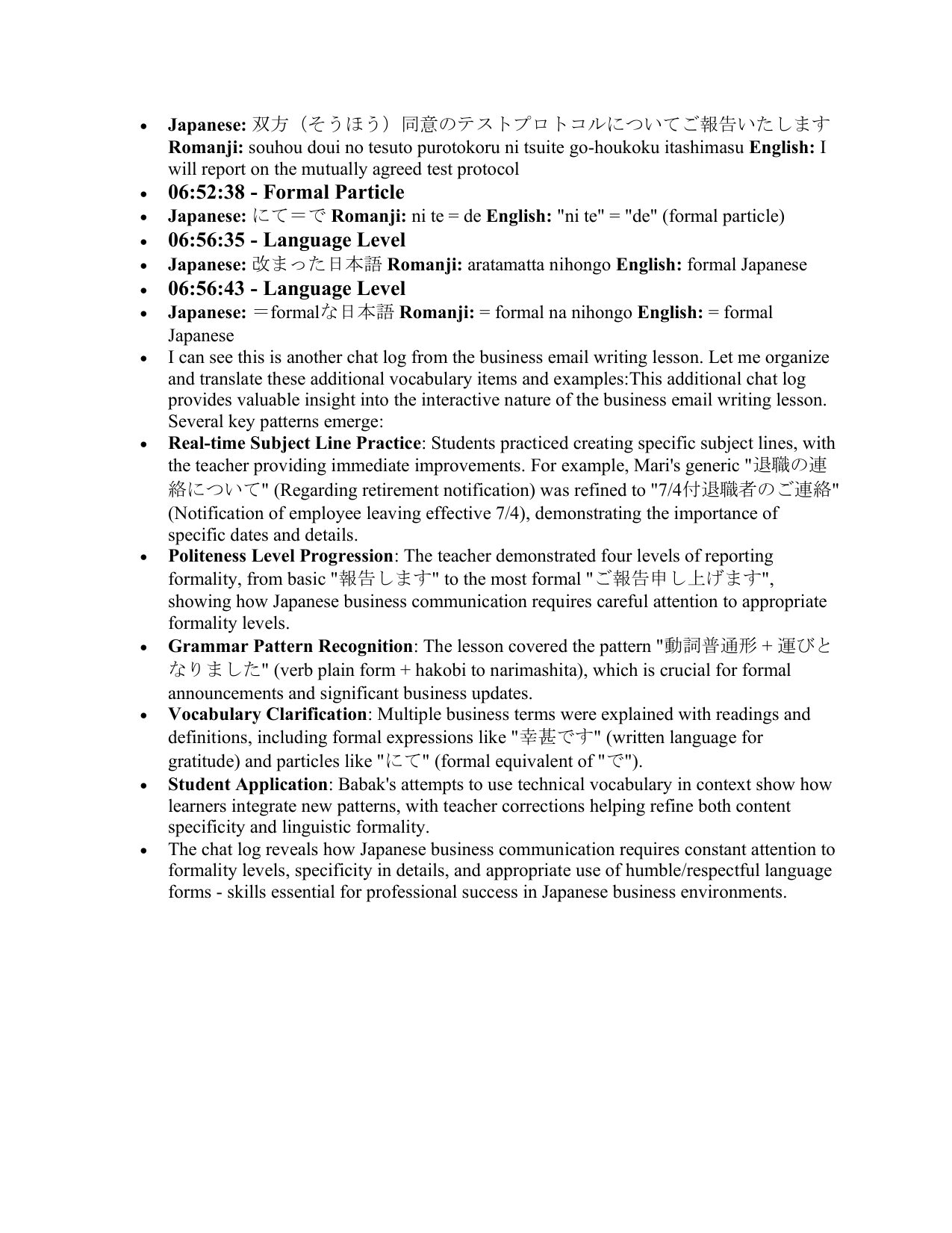
JP•Japanese:双方(そうほう)同意のテストプロトコルについてご報告いたします
EN Romanji: souhou doui no tesuto purotokoru ni tsuite go-houkoku itashimasu English: I
will report on the mutually agreed test protocol
• 06:52:38 - Formal Particle
• Japanese: にて=で Romanji: ni te = de English: "ni te" = "de" (formal particle)
• 06:56:35 - Language Level
• Japanese: 改まった日本語 Romanji: aratamatta nihongo English: formal Japanese
• 06:56:43 - Language Level
• Japanese: =formalな日本語 Romanji: = formal na nihongo English: = formal
Japanese
• I can see this is another chat log from the business email writing lesson. Let me organize
and translate these additional vocabulary items and examples:This additional chat log
provides valuable insight into the interactive nature of the business email writing lesson.
Several key patterns emerge:
• Real-time Subject Line Practice: Students practiced creating specific subject lines, with
the teacher providing immediate improvements. For example, Mari's generic "退職の連
絡について" (Regarding retirement notification) was refined to "7/4付退職者のご連絡"
(Notification of employee leaving effective 7/4), demonstrating the importance of
specific dates and details.
• Politeness Level Progression: The teacher demonstrated four levels of reporting
formality, from basic "報告します" to the most formal "ご報告申し上げます",
showing how Japanese business communication requires careful attention to appropriate
formality levels.
• Grammar Pattern Recognition: The lesson covered the pattern "動詞普通形 + 運びと
なりました" (verb plain form + hakobi to narimashita), which is crucial for formal
announcements and significant business updates.
• Vocabulary Clarification: Multiple business terms were explained with readings and
definitions, including formal expressions like "幸甚です" (written language for
gratitude) and particles like "にて" (formal equivalent of "で").
• Student Application: Babak's attempts to use technical vocabulary in context show how
learners integrate new patterns, with teacher corrections helping refine both content
specificity and linguistic formality.
• The chat log reveals how Japanese business communication requires constant attention to
formality levels, specificity in details, and appropriate use of humble/respectful language
forms - skills essential for professional success in Japanese business environments.
will report on the mutually agreed test protocol
• 06:52:38 - Formal Particle
• Japanese: にて=で Romanji: ni te = de English: "ni te" = "de" (formal particle)
• 06:56:35 - Language Level
• Japanese: 改まった日本語 Romanji: aratamatta nihongo English: formal Japanese
• 06:56:43 - Language Level
• Japanese: =formalな日本語 Romanji: = formal na nihongo English: = formal
Japanese
• I can see this is another chat log from the business email writing lesson. Let me organize
and translate these additional vocabulary items and examples:This additional chat log
provides valuable insight into the interactive nature of the business email writing lesson.
Several key patterns emerge:
• Real-time Subject Line Practice: Students practiced creating specific subject lines, with
the teacher providing immediate improvements. For example, Mari's generic "退職の連
絡について" (Regarding retirement notification) was refined to "7/4付退職者のご連絡"
(Notification of employee leaving effective 7/4), demonstrating the importance of
specific dates and details.
• Politeness Level Progression: The teacher demonstrated four levels of reporting
formality, from basic "報告します" to the most formal "ご報告申し上げます",
showing how Japanese business communication requires careful attention to appropriate
formality levels.
• Grammar Pattern Recognition: The lesson covered the pattern "動詞普通形 + 運びと
なりました" (verb plain form + hakobi to narimashita), which is crucial for formal
announcements and significant business updates.
• Vocabulary Clarification: Multiple business terms were explained with readings and
definitions, including formal expressions like "幸甚です" (written language for
gratitude) and particles like "にて" (formal equivalent of "で").
• Student Application: Babak's attempts to use technical vocabulary in context show how
learners integrate new patterns, with teacher corrections helping refine both content
specificity and linguistic formality.
• The chat log reveals how Japanese business communication requires constant attention to
formality levels, specificity in details, and appropriate use of humble/respectful language
forms - skills essential for professional success in Japanese business environments.