หน้า 1
คลิกเพื่อขยาย
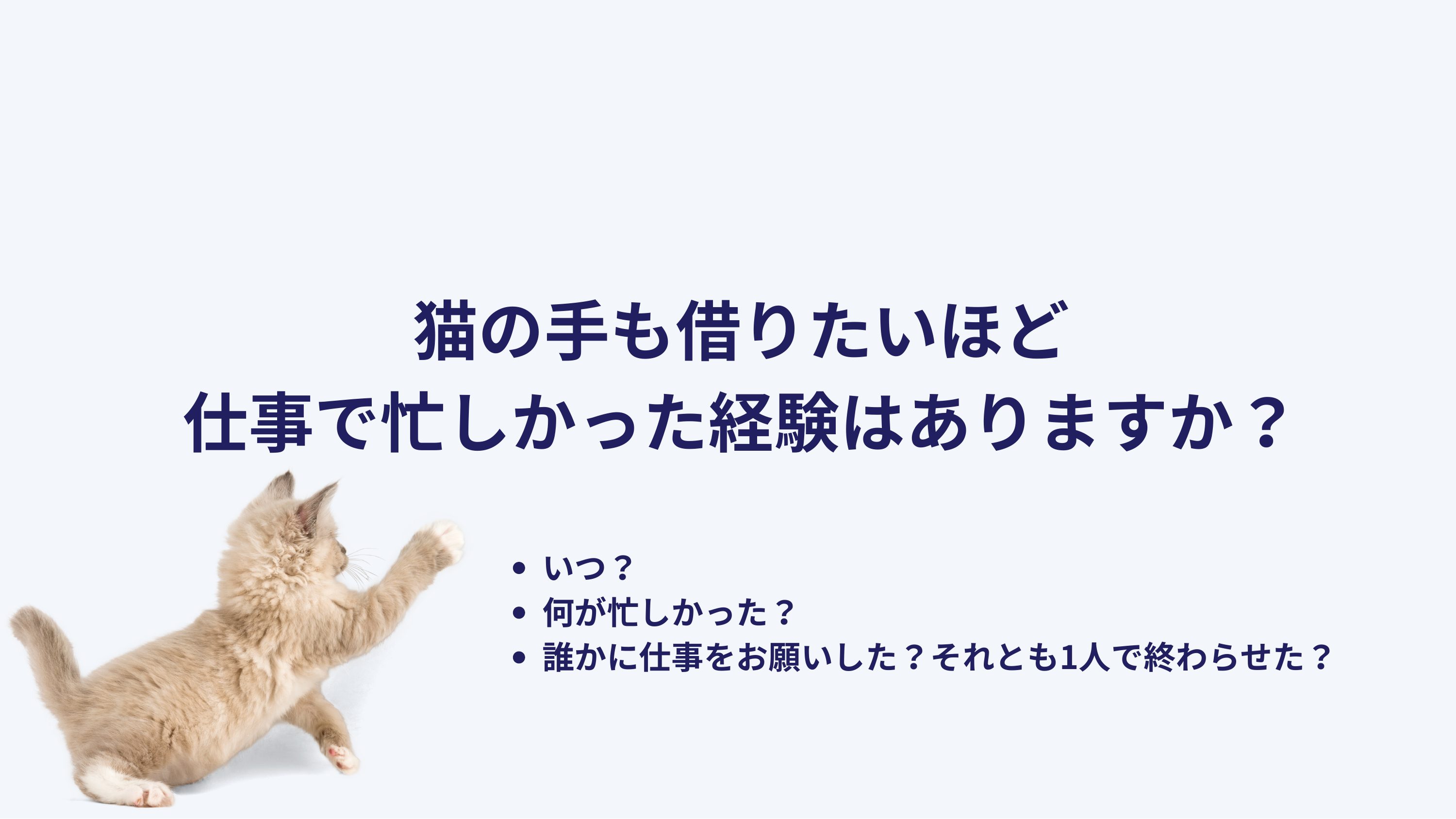
JP猫の手も借りたいほど
仕事で忙しかった経験はありますか?
いつ?
何が忙しかった?
誰かに仕事をお願いした?それとも1人で終わらせた?
仕事で忙しかった経験はありますか?
いつ?
何が忙しかった?
誰かに仕事をお願いした?それとも1人で終わらせた?
หน้า 2

คลิกเพื่อขยาย
JP仕事で依頼する時の
コツを覚えよう
コツを覚えよう
ENLet's learn some tips for making requests at work
หน้า 3
คลิกเพื่อขยาย
ENLesson Agenda
JP仕事をお願いする時のポイント
ENKey Points for Requesting Work
JPお願いする時の話の流れ
ENHow to Structure Your Request
หน้า 4
คลิกเพื่อขยาย
EN Lesson GOAL
JPはいりょ
忙しい同僚に配慮しながら
サポートを依頼する表現を学ぶ
忙しい同僚に配慮しながら
サポートを依頼する表現を学ぶ
ENLearning How to Ask for Help While Being Considerate
of Busy Coworkers
of Busy Coworkers
หน้า 5
คลิกเพื่อขยาย
JPいらいさぎょう
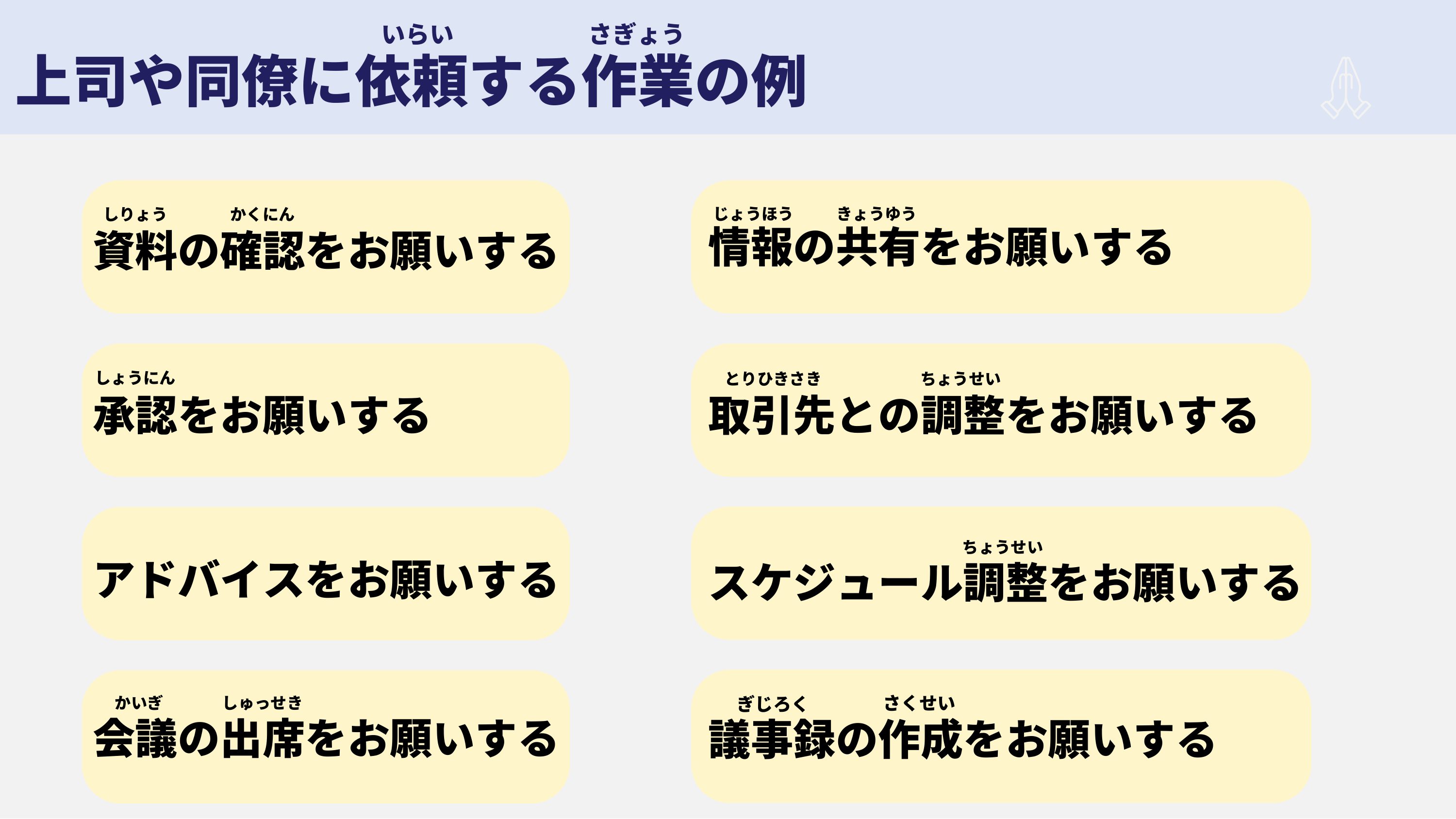
上司や同僚に依頼する作業の例
しりょうかくにんじょうほうきょうゆう
資料の確認をお願いする情報の共有をお願いする
しょうにんとりひきさきちょうせい
承認をお願いする取引先との調整をお願いする
ちょうせい
アドバイスをお願いするスケジュール調整をお願いする
かいぎしゅっせきぎじろくさくせい
会議の出席をお願いする議事録の作成をお願いする
上司や同僚に依頼する作業の例
しりょうかくにんじょうほうきょうゆう
資料の確認をお願いする情報の共有をお願いする
しょうにんとりひきさきちょうせい
承認をお願いする取引先との調整をお願いする
ちょうせい
アドバイスをお願いするスケジュール調整をお願いする
かいぎしゅっせきぎじろくさくせい
会議の出席をお願いする議事録の作成をお願いする
หน้า 6
คลิกเพื่อขยาย
ENAGENDA 1
JP仕事をお願いする時のポイント
ENKey Points for Requesting Work
หน้า 7
คลิกเพื่อขยาย
JPいらい
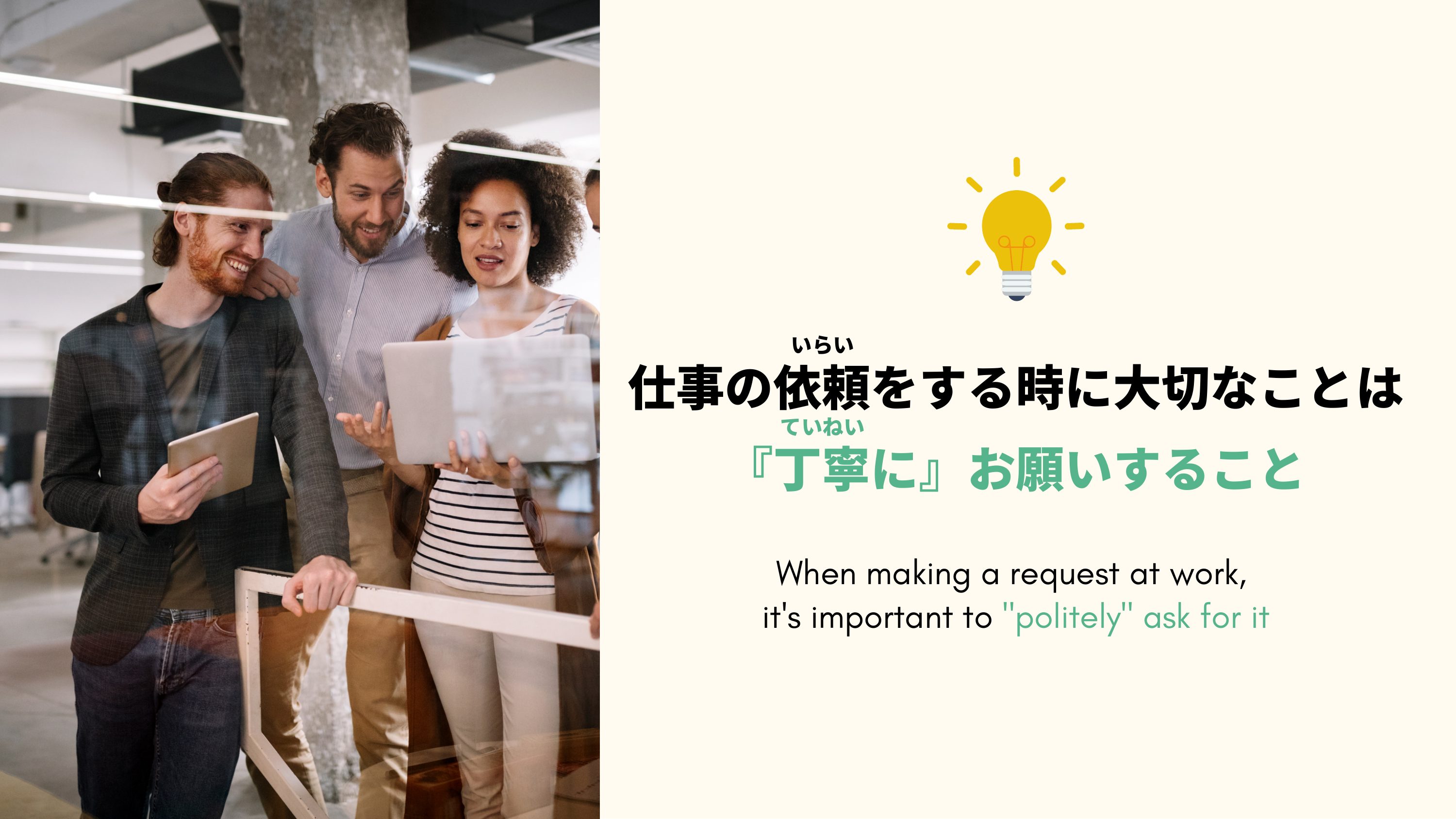
仕事の依頼をする時に大切なことは
ていねい
『丁寧に』お願いすること
仕事の依頼をする時に大切なことは
ていねい
『丁寧に』お願いすること
EN When making a request at work,
it's important to "politely" ask for it
it's important to "politely" ask for it
หน้า 8
คลิกเพื่อขยาย
JPいらい
EN依頼する時のコツ Tips for making requests
JPあいていらいぐたいてき
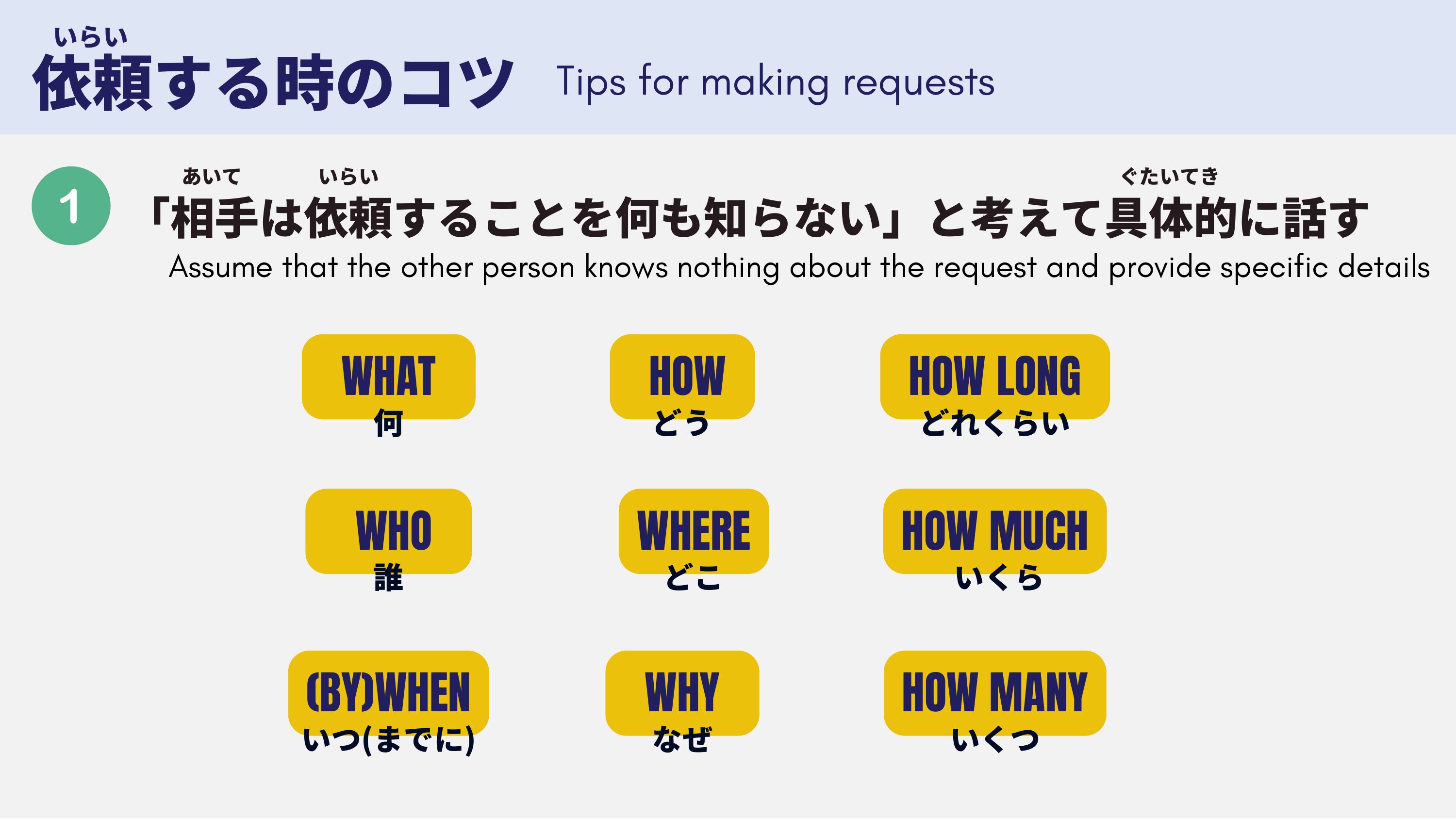
「相手は依頼することを何も知らない」と考えて具体的に話す
「相手は依頼することを何も知らない」と考えて具体的に話す
EN Assume that the other person knows nothing about the request and provide specific details
WHAT HOW HOW LONG
WHAT HOW HOW LONG
JP何どうどれくらい
EN WHO WHERE HOW MUCH
JP誰どこいくら
EN (BY)WHEN WHY HOW MANY
JPいつ(までに)なぜいくつ
หน้า 9
คลิกเพื่อขยาย
JPいらい
EN依頼する時のコツ Tips for making requests
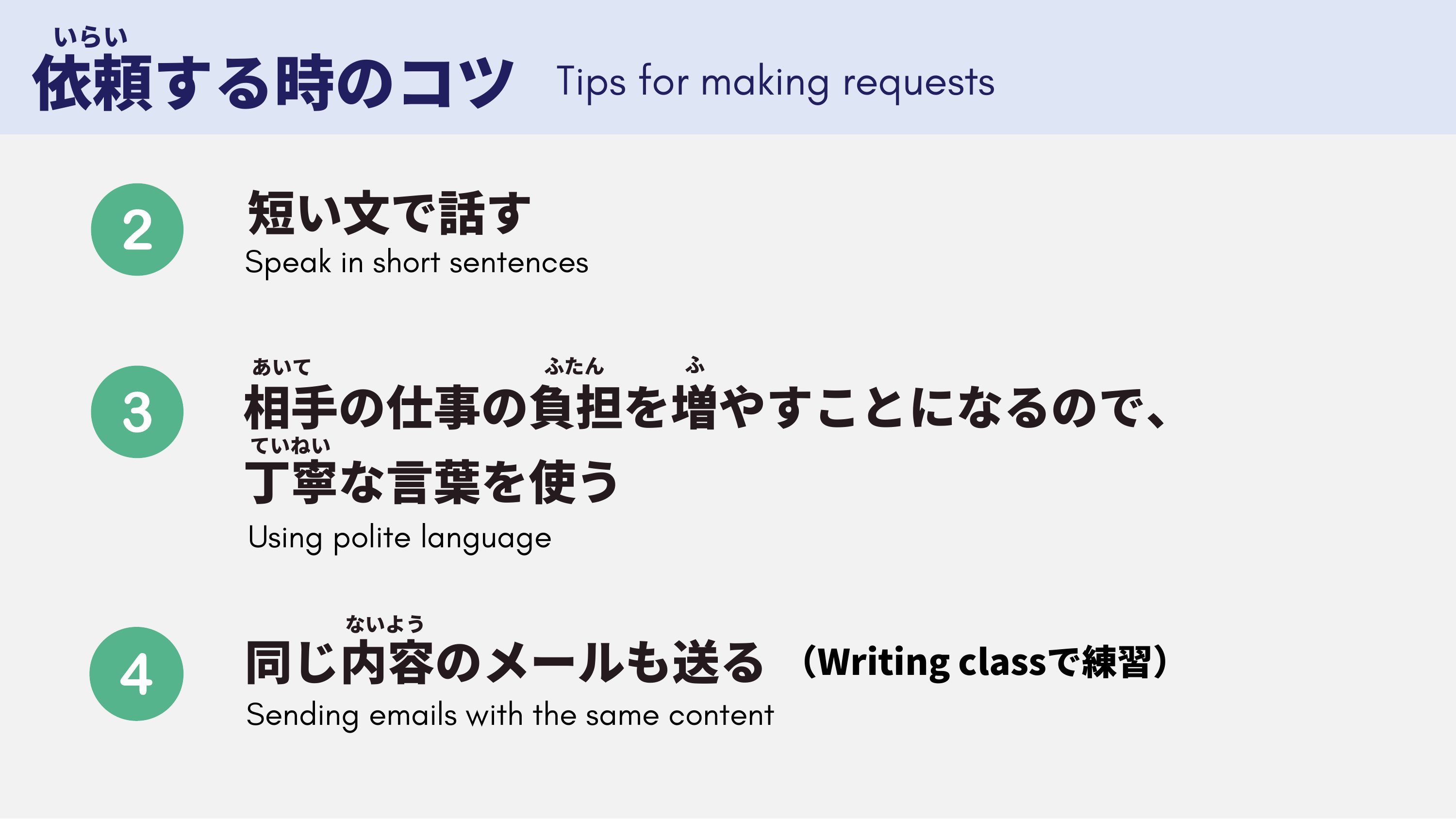
JP短い文で話す
EN Speak in short sentences
JPあいてふたんふ
相手の仕事の負担を増やすことになるので、
ていねい
丁寧な言葉を使う
相手の仕事の負担を増やすことになるので、
ていねい
丁寧な言葉を使う
EN Using polite language
JPないよう
同じ内容のメールも送る(Writingclassで練習)
同じ内容のメールも送る(Writingclassで練習)
EN Sending emails with the same content
หน้า 10
คลิกเพื่อขยาย
ENAGENDA 2
JPお願いする時の話の流れ
ENHow to Structure Your Request
หน้า 11
คลิกเพื่อขยาย
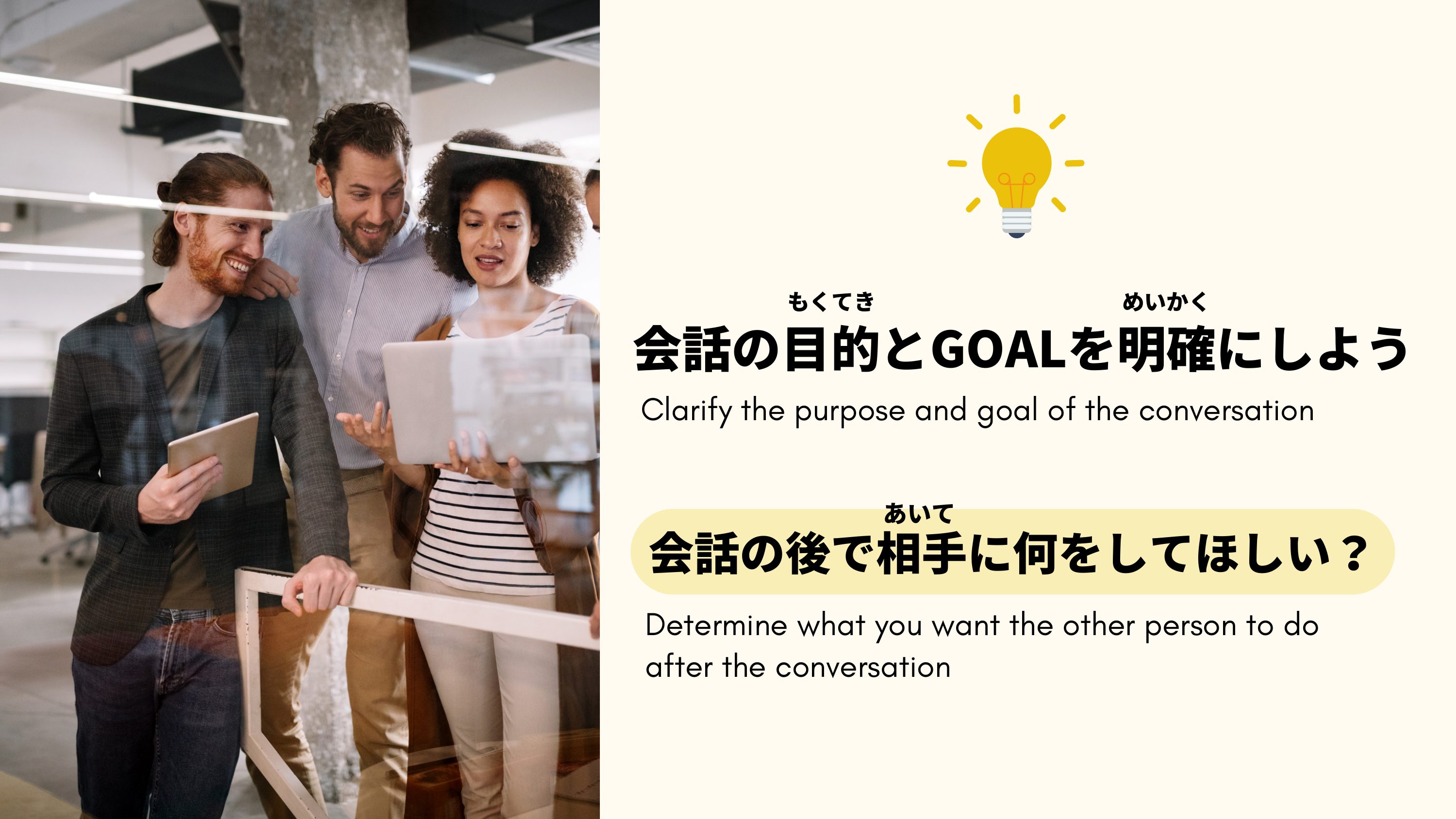
JPもくてきめいかく
会話の目的とGOALを明確にしよう
会話の目的とGOALを明確にしよう
ENClarify the purpose and goal of the conversation
JPあいて
会話の後で相手に何をしてほしい?
会話の後で相手に何をしてほしい?
ENDetermine what you want the other person to do
after the conversation
after the conversation
หน้า 12
คลิกเพื่อขยาย
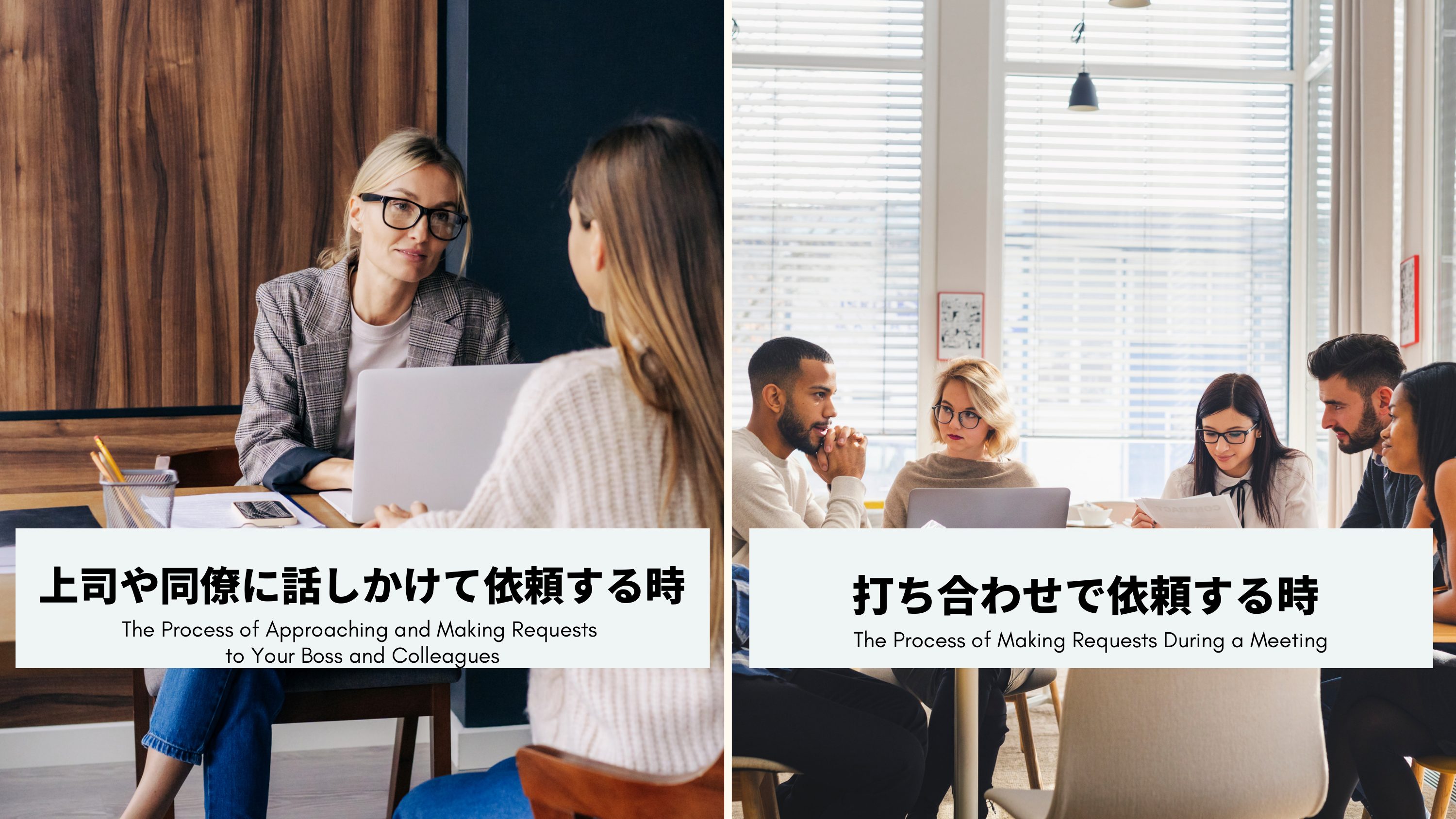
JP上司や同僚に話しかけて依頼する時打ち合わせで依頼する時
EN The Process of Approaching and Making Requests The Process of Making Requests During a Meeting
to Your Boss and Colleagues
to Your Boss and Colleagues
หน้า 13
คลิกเพื่อขยาย
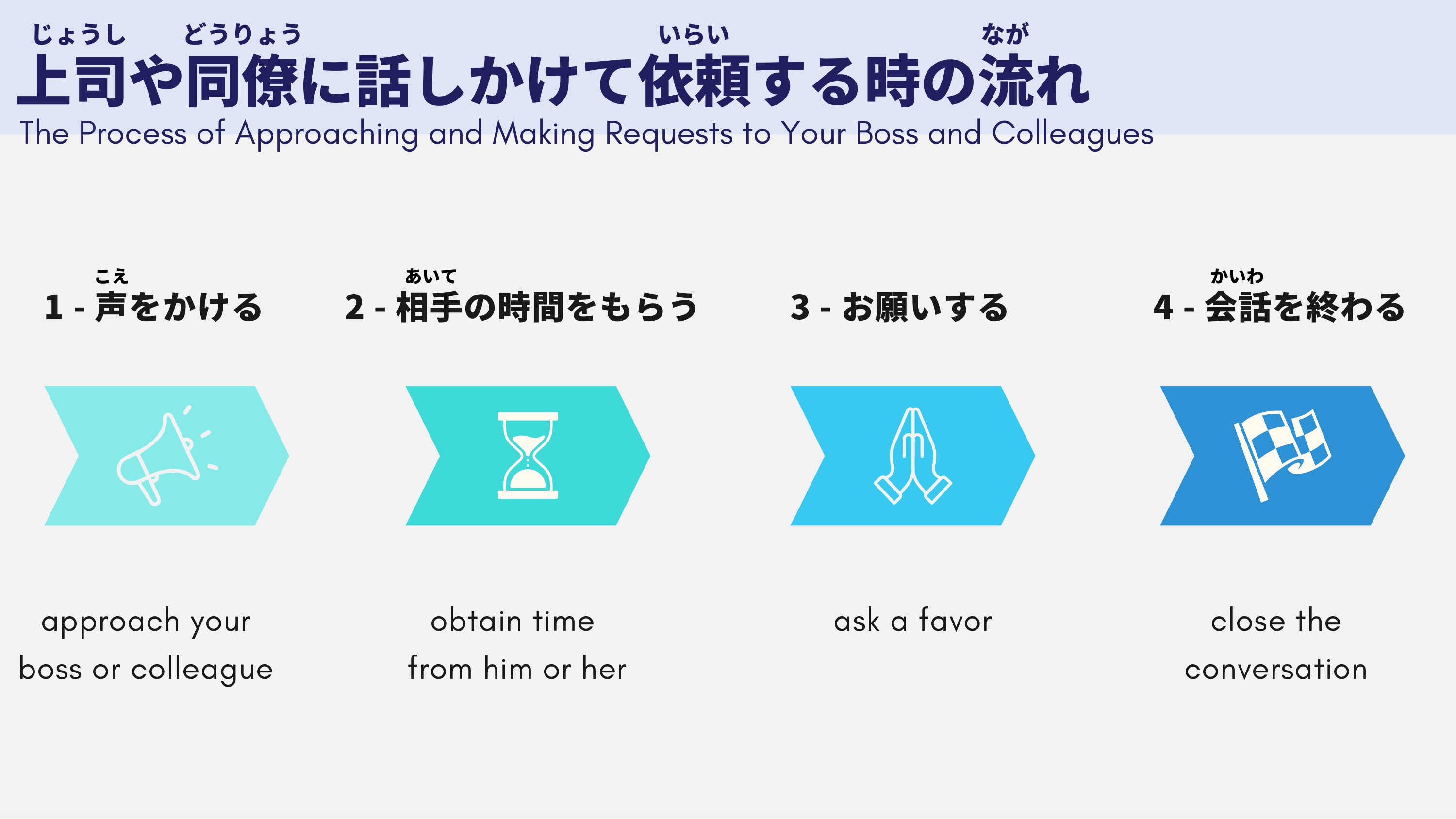
JPじょうしどうりょういらいなが
上司や同僚に話しかけて依頼する時の流れ
上司や同僚に話しかけて依頼する時の流れ
ENThe Process of Approaching and Making Requests to Your Boss and Colleagues
JPこえあいてかいわ
1-声をかける2-相手の時間をもらう3-お願いする4-会話を終わる
1-声をかける2-相手の時間をもらう3-お願いする4-会話を終わる
EN approach your obtain time ask a favor close the
boss or colleague from him or her conversation
boss or colleague from him or her conversation
หน้า 14
คลิกเพื่อขยาย
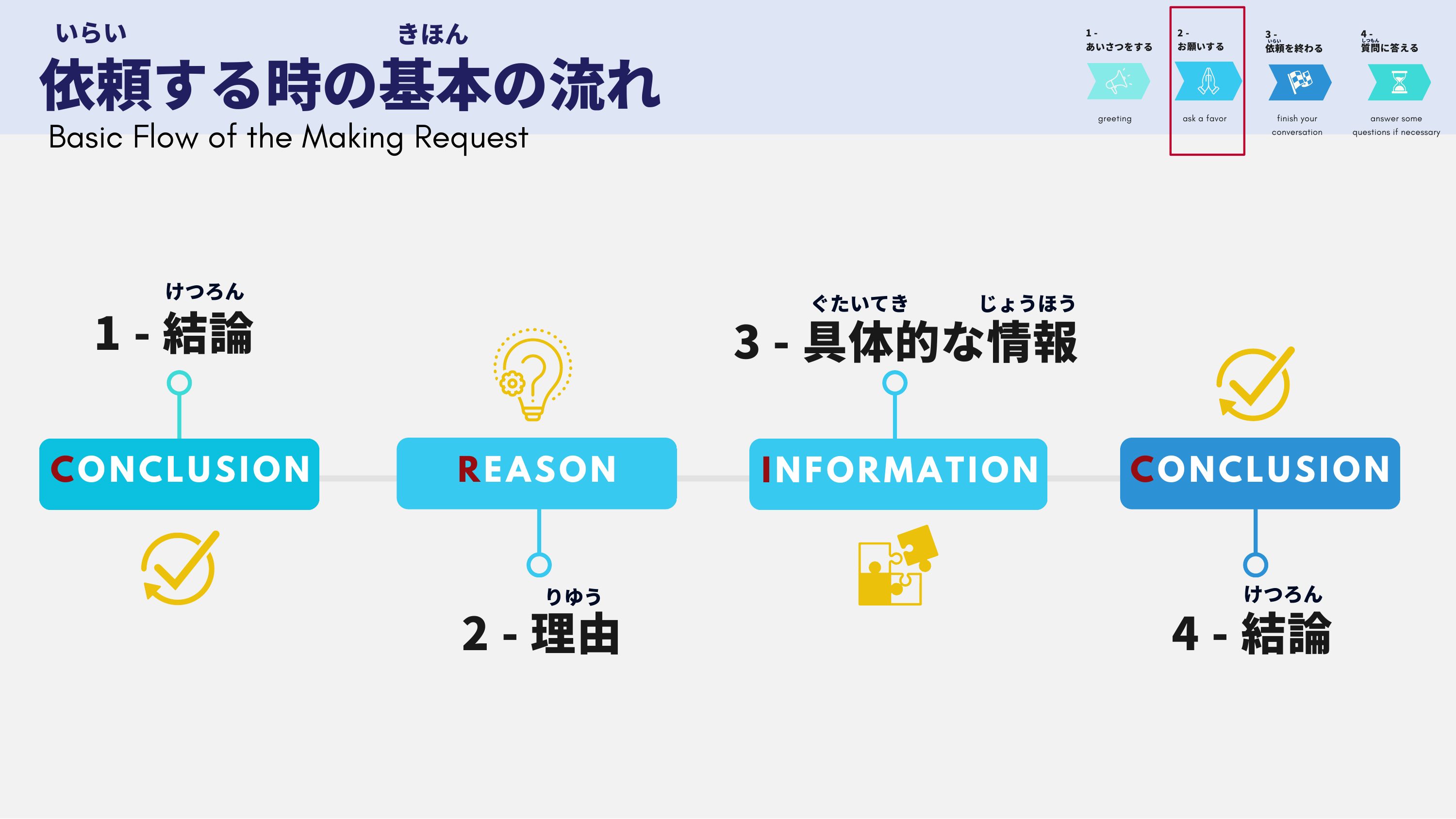
JPいらいきほん1-
あいさつをする
2-
お願いする
3-
いらい
4-
しつもん
依頼する時の基本の流れ
依頼を終わる質問に答える
あいさつをする
2-
お願いする
3-
いらい
4-
しつもん
依頼する時の基本の流れ
依頼を終わる質問に答える
EN greeting ask a favor finish your answer some
Basic Flow of the Making Request conversation questions if necessary
Basic Flow of the Making Request conversation questions if necessary
JPけつろん
ぐたいてきじょうほう
1-結論3-具体的な情報
ぐたいてきじょうほう
1-結論3-具体的な情報
ENCONCLUSION REASON INFORMATION CONCLUSION
JPりゆうけつろん
2-理由4-結論
2-理由4-結論
หน้า 15
คลิกเพื่อขยาย
ENAGENDA 3
JP日本語フレーズの確認
ENJapanese Quiz!
หน้า 16
คลิกเพื่อขยาย
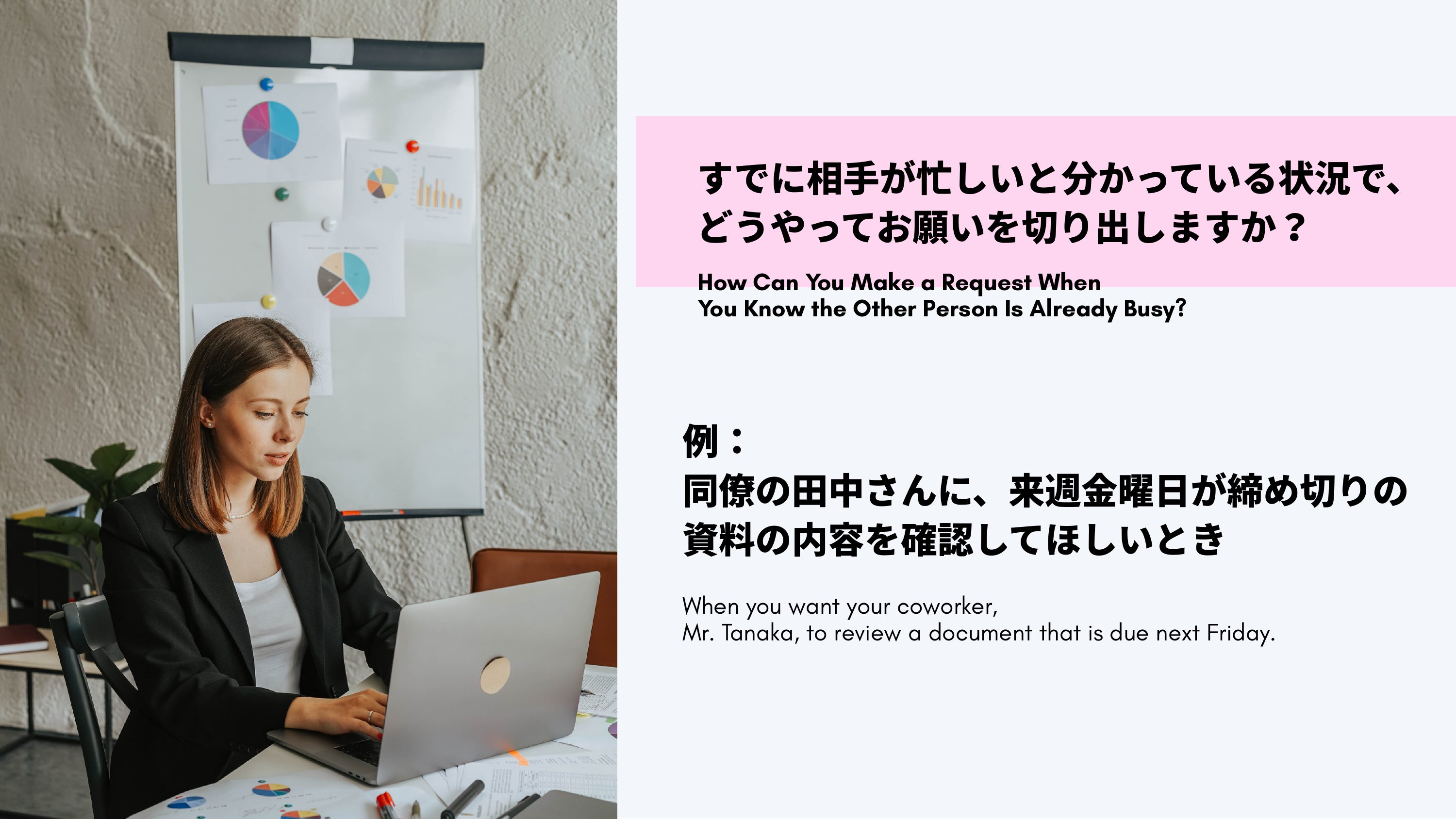
JPすでに相手が忙しいと分かっている状況で、
どうやってお願いを切り出しますか?
どうやってお願いを切り出しますか?
EN How Can You Make a Request When
You Know the Other Person Is Already Busy?
You Know the Other Person Is Already Busy?
JP例:
同僚の田中さんに、来週金曜日が締め切りの
資料の内容を確認してほしいとき
同僚の田中さんに、来週金曜日が締め切りの
資料の内容を確認してほしいとき
ENWhen you want your coworker,
Mr. Tanaka, to review a document that is due next Friday.
Mr. Tanaka, to review a document that is due next Friday.
หน้า 17
คลิกเพื่อขยาย
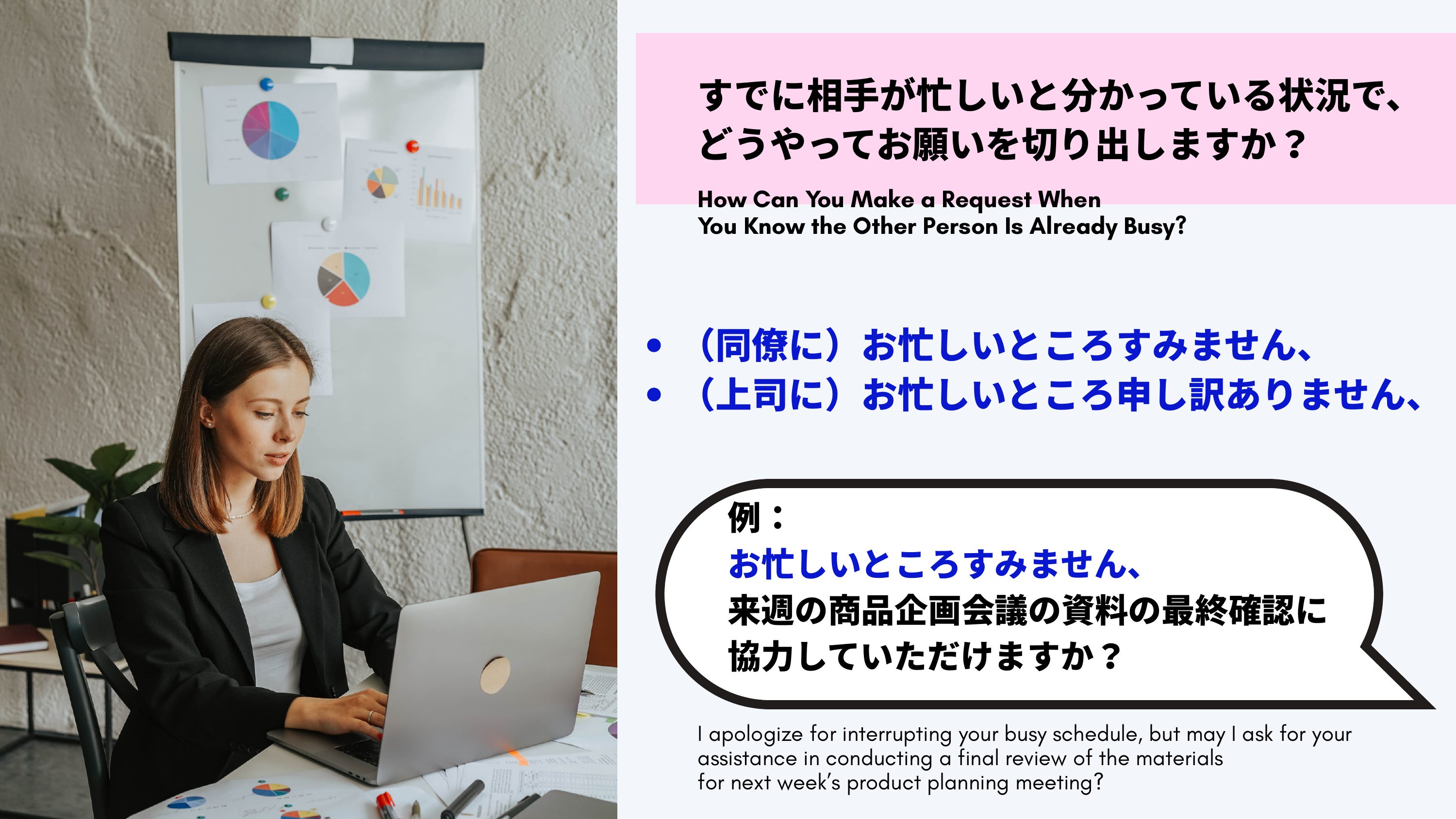
JPすでに相手が忙しいと分かっている状況で、
どうやってお願いを切り出しますか?
どうやってお願いを切り出しますか?
ENHow Can You Make a Request When
You Know the Other Person Is Already Busy?
You Know the Other Person Is Already Busy?
JP(同僚に)お忙しいところすみません、
(上司に)お忙しいところ申し訳ありません、
例:
お忙しいところすみません、
来週の商品企画会議の資料の最終確認に
協力していただけますか?
(上司に)お忙しいところ申し訳ありません、
例:
お忙しいところすみません、
来週の商品企画会議の資料の最終確認に
協力していただけますか?
ENI apologize for interrupting your busy schedule, but may I ask for your
assistance in conducting a final review of the materials
for next week’s product planning meeting?
assistance in conducting a final review of the materials
for next week’s product planning meeting?
หน้า 18
คลิกเพื่อขยาย
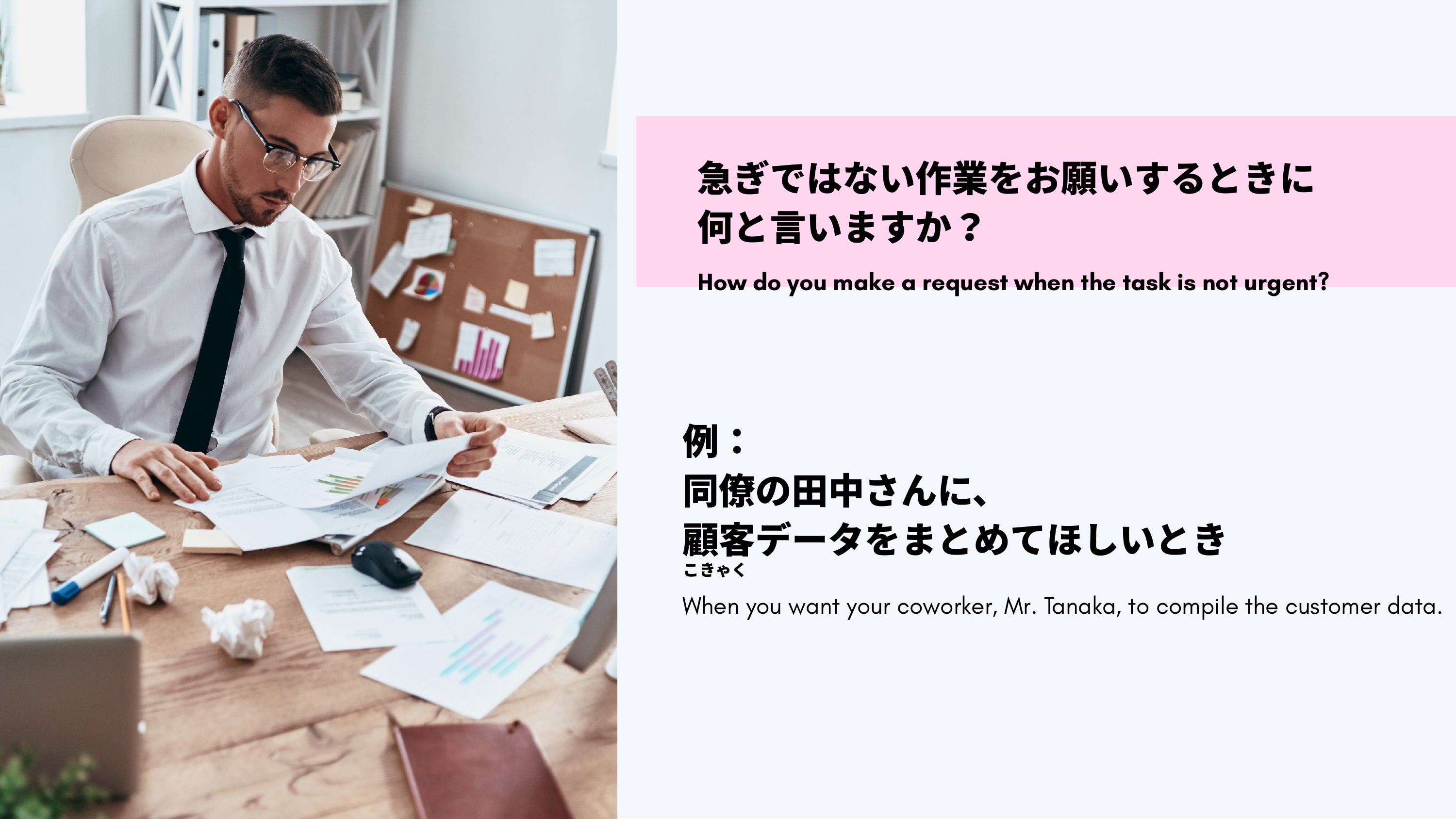
JP急ぎではない作業をお願いするときに
何と言いますか?
何と言いますか?
EN How do you make a request when the task is not urgent?
JP例:
同僚の田中さんに、
顧客データをまとめてほしいとき
こきゃく
同僚の田中さんに、
顧客データをまとめてほしいとき
こきゃく
ENWhen you want your coworker, Mr. Tanaka, to compile the customer data.
หน้า 19
คลิกเพื่อขยาย
JP急ぎではない作業をお願いするときに
何と言いますか?
何と言いますか?
EN How do you make a request when the task is not urgent?
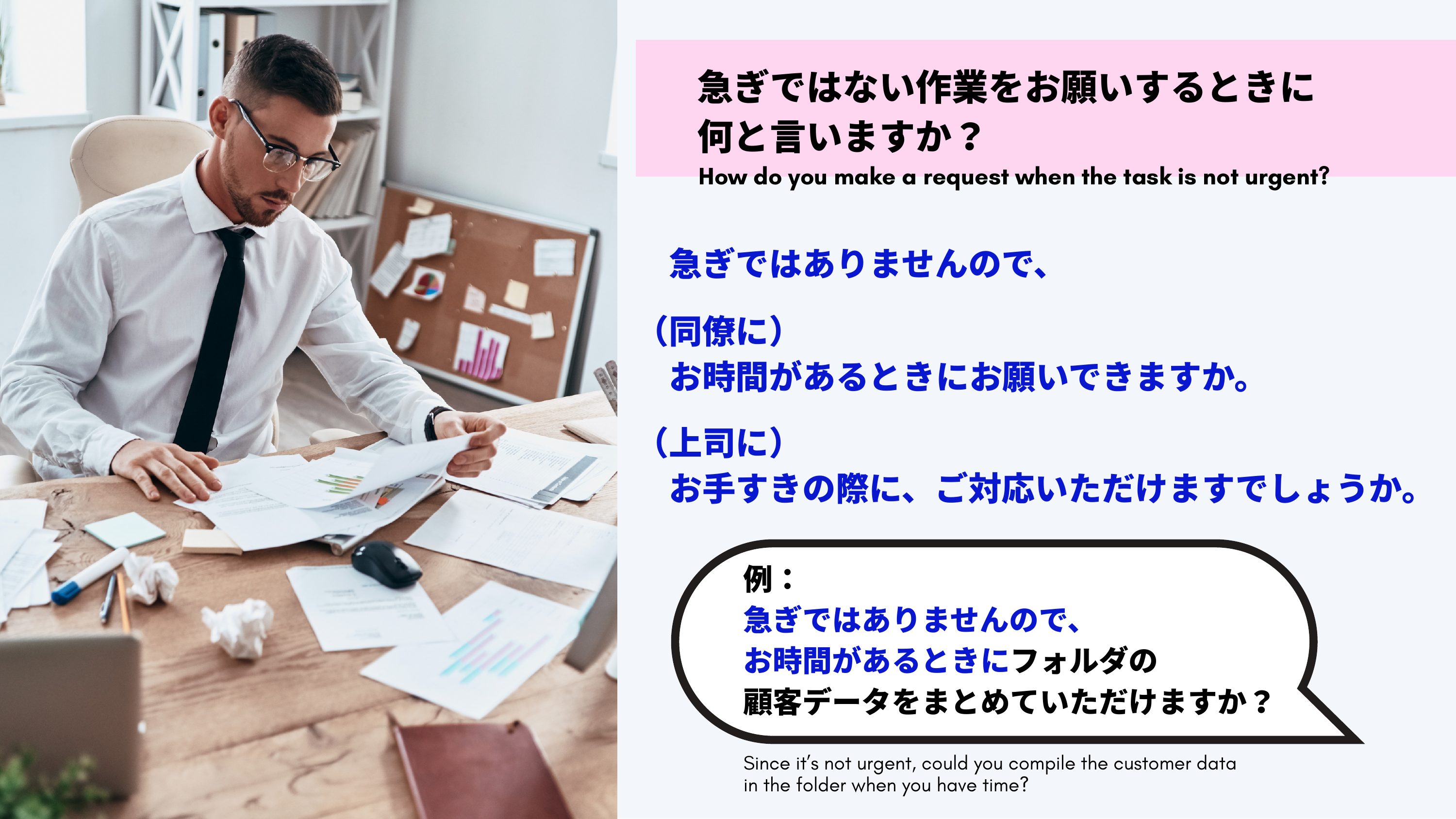
JP急ぎではありませんので、
(同僚に)
お時間があるときにお願いできますか。
(上司に)
お手すきの際に、ご対応いただけますでしょうか。
例:
急ぎではありませんので、
お時間があるときにフォルダの
顧客データをまとめていただけますか?
(同僚に)
お時間があるときにお願いできますか。
(上司に)
お手すきの際に、ご対応いただけますでしょうか。
例:
急ぎではありませんので、
お時間があるときにフォルダの
顧客データをまとめていただけますか?
EN Since it’s not urgent, could you compile the customer data
in the folder when you have time?
in the folder when you have time?
หน้า 20

คลิกเพื่อขยาย
ENAGENDA 4
JP敬語言い換え練習
ENKeigo Rephrasing Practice
หน้า 21
คลิกเพื่อขยาย
JPじょうしどうりょう2-時間をもらう
上司や同僚に時間をもらう時の日本語
上司や同僚に時間をもらう時の日本語
ENJapanese Phrases for Asking Your Boss or Colleagues for Their Time
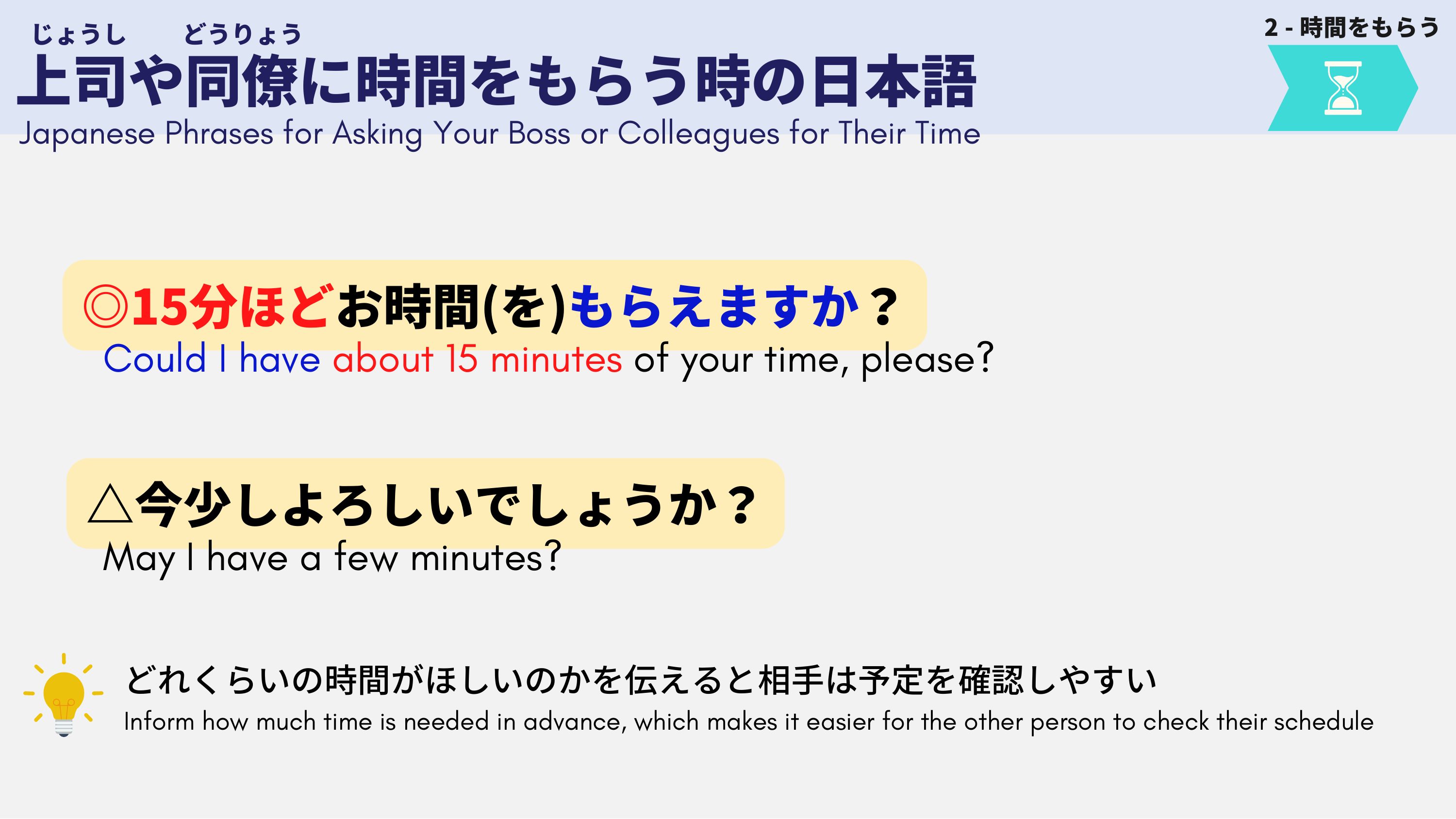
JP◎15分ほどお時間(を)もらえますか?
EN Could I have about 15 minutes of your time, please?
JP△今少しよろしいでしょうか?
EN May I have a few minutes?
JPどれくらいの時間がほしいのかを伝えると相手は予定を確認しやすい
EN Inform how much time is needed in advance, which makes it easier for the other person to check their schedule
หน้า 22
คลิกเพื่อขยาย
JPじょうしどうりょう2-時間をもらう
上司や同僚に時間をもらう時の日本語
上司や同僚に時間をもらう時の日本語
ENJapanese Phrases for Asking Your Boss or Colleagues for Their Time
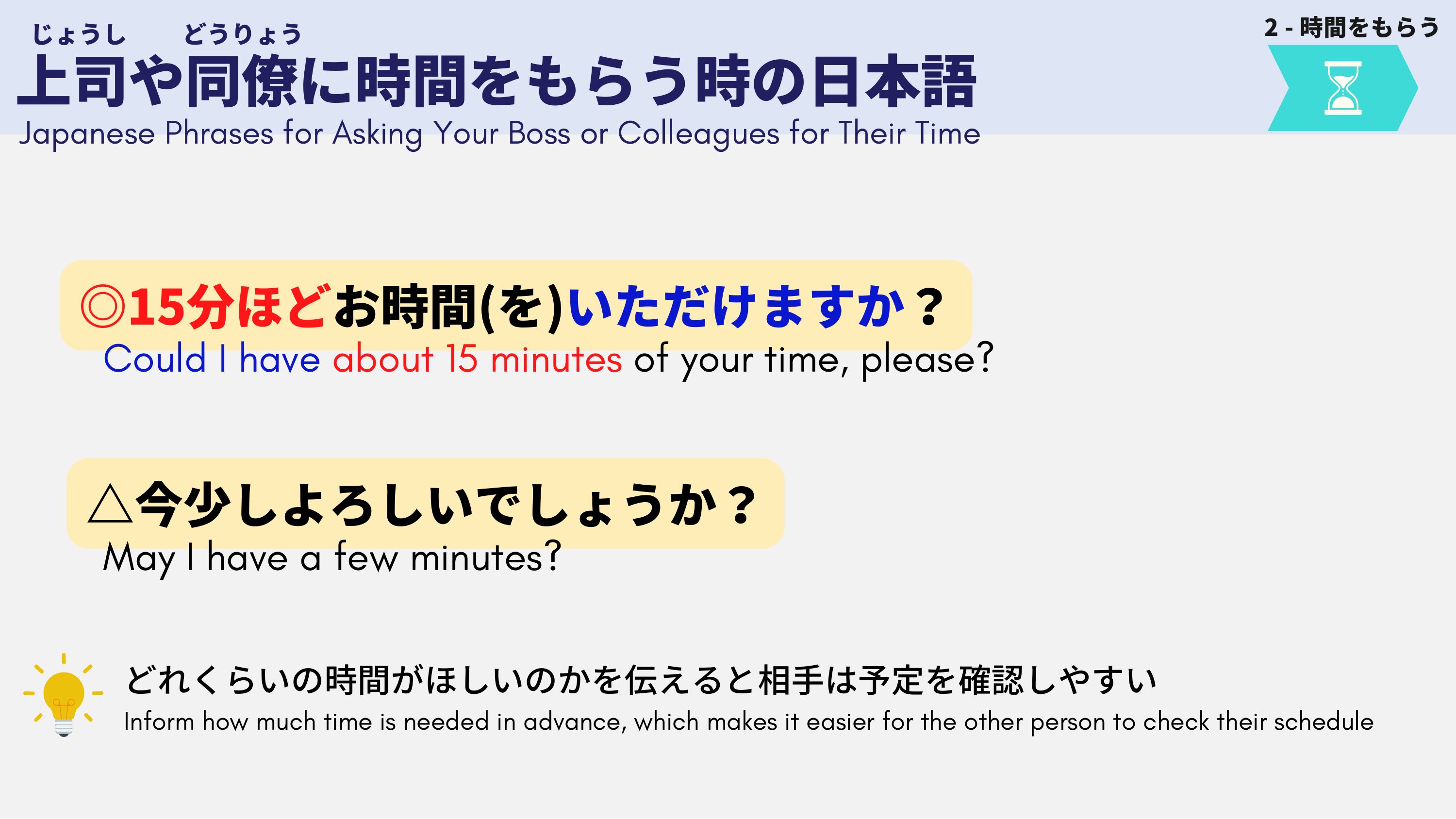
JP◎15分ほどお時間(を)いただけますか?
EN Could I have about 15 minutes of your time, please?
JP△今少しよろしいでしょうか?
EN May I have a few minutes?
JPどれくらいの時間がほしいのかを伝えると相手は予定を確認しやすい
EN Inform how much time is needed in advance, which makes it easier for the other person to check their schedule
หน้า 23
คลิกเพื่อขยาย
JPじょうしどうりょう3-お願いする
上司や同僚にお願いする時の日本語
上司や同僚にお願いする時の日本語
ENJapanese Phrases for Asking Your Boss or Colleagues for Their Time
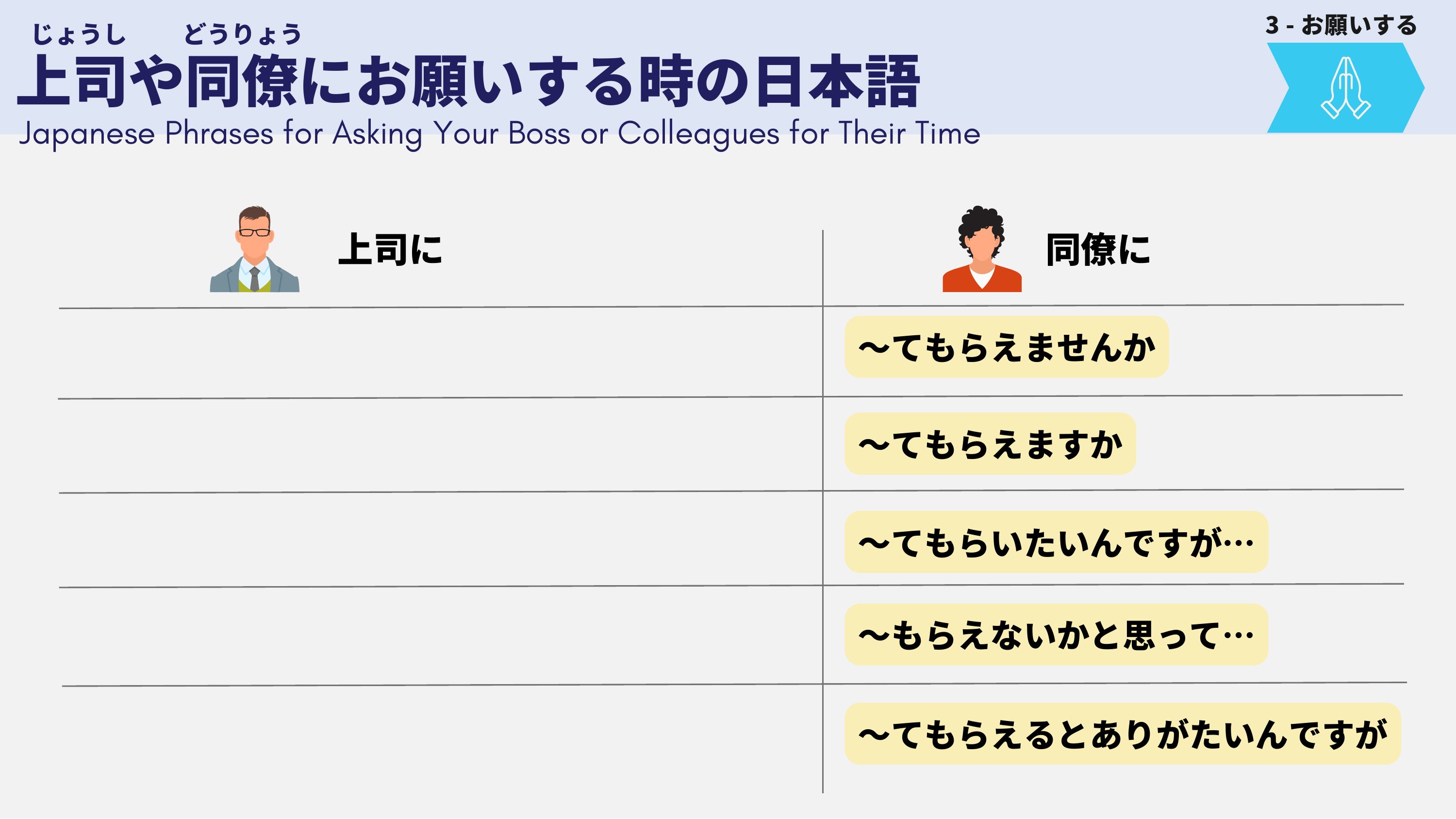
JP上司に同僚に
~てもらえませんか
~てもらえますか
~てもらいたいんですが…
~もらえないかと思って…
~てもらえるとありがたいんですが
~てもらえませんか
~てもらえますか
~てもらいたいんですが…
~もらえないかと思って…
~てもらえるとありがたいんですが
หน้า 24
คลิกเพื่อขยาย
JPじょうしどうりょう3-お願いする
上司や同僚にお願いする時の日本語
上司や同僚にお願いする時の日本語
ENJapanese Phrases for Asking Your Boss or Colleagues for Their Time
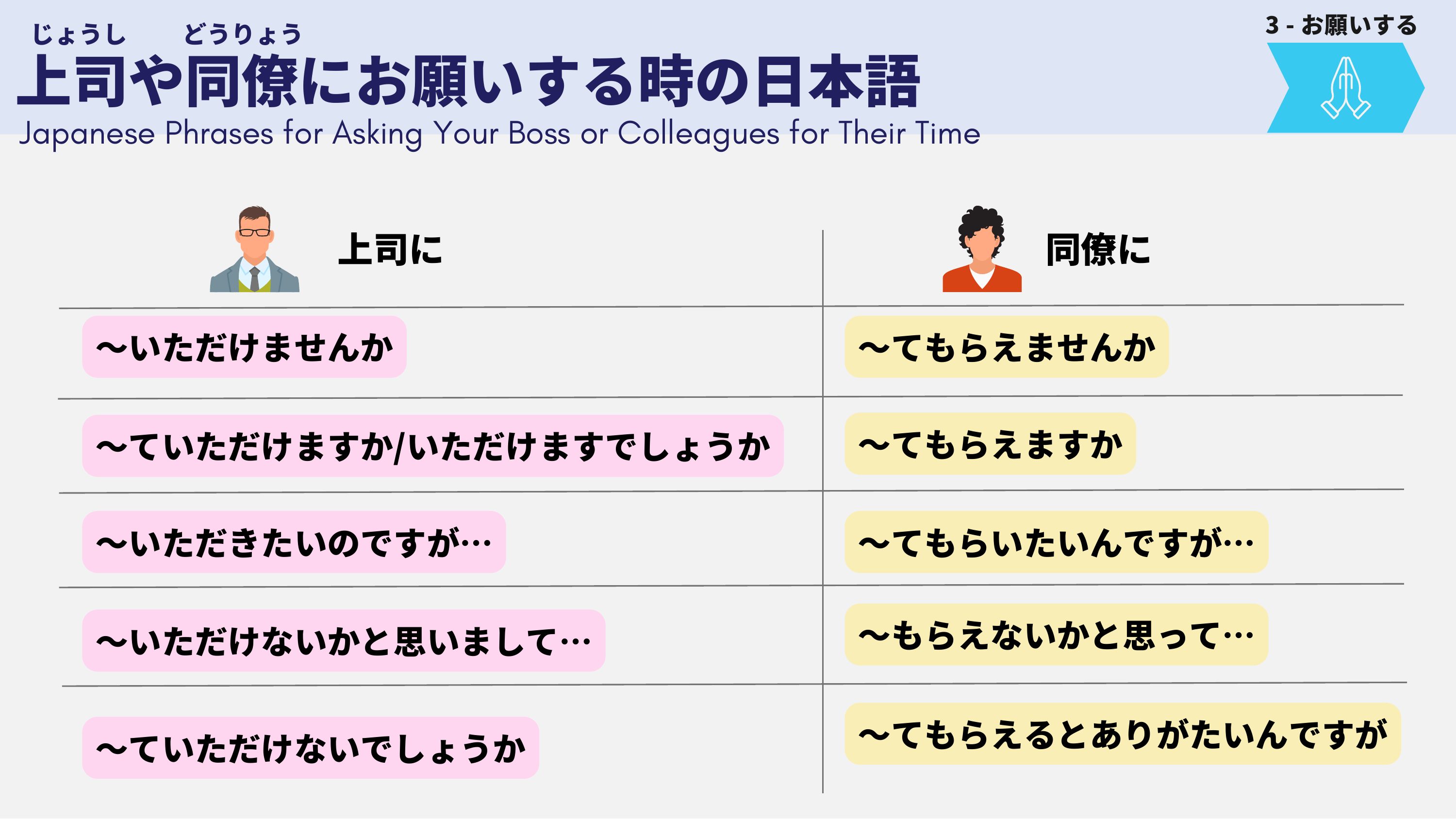
JP上司に同僚に
~いただけませんか~てもらえませんか
~ていただけますか/いただけますでしょうか~てもらえますか
~いただきたいのですが…~てもらいたいんですが…
~いただけないかと思いまして…~もらえないかと思って…
~ていただけないでしょうか~てもらえるとありがたいんですが
~いただけませんか~てもらえませんか
~ていただけますか/いただけますでしょうか~てもらえますか
~いただきたいのですが…~てもらいたいんですが…
~いただけないかと思いまして…~もらえないかと思って…
~ていただけないでしょうか~てもらえるとありがたいんですが
หน้า 25
คลิกเพื่อขยาย
JPじょうしどうりょう3-お願いする
上司や同僚にお願いする時の日本語
上司や同僚にお願いする時の日本語
ENJapanese Phrases for Asking Your Boss or Colleagues for Their Time
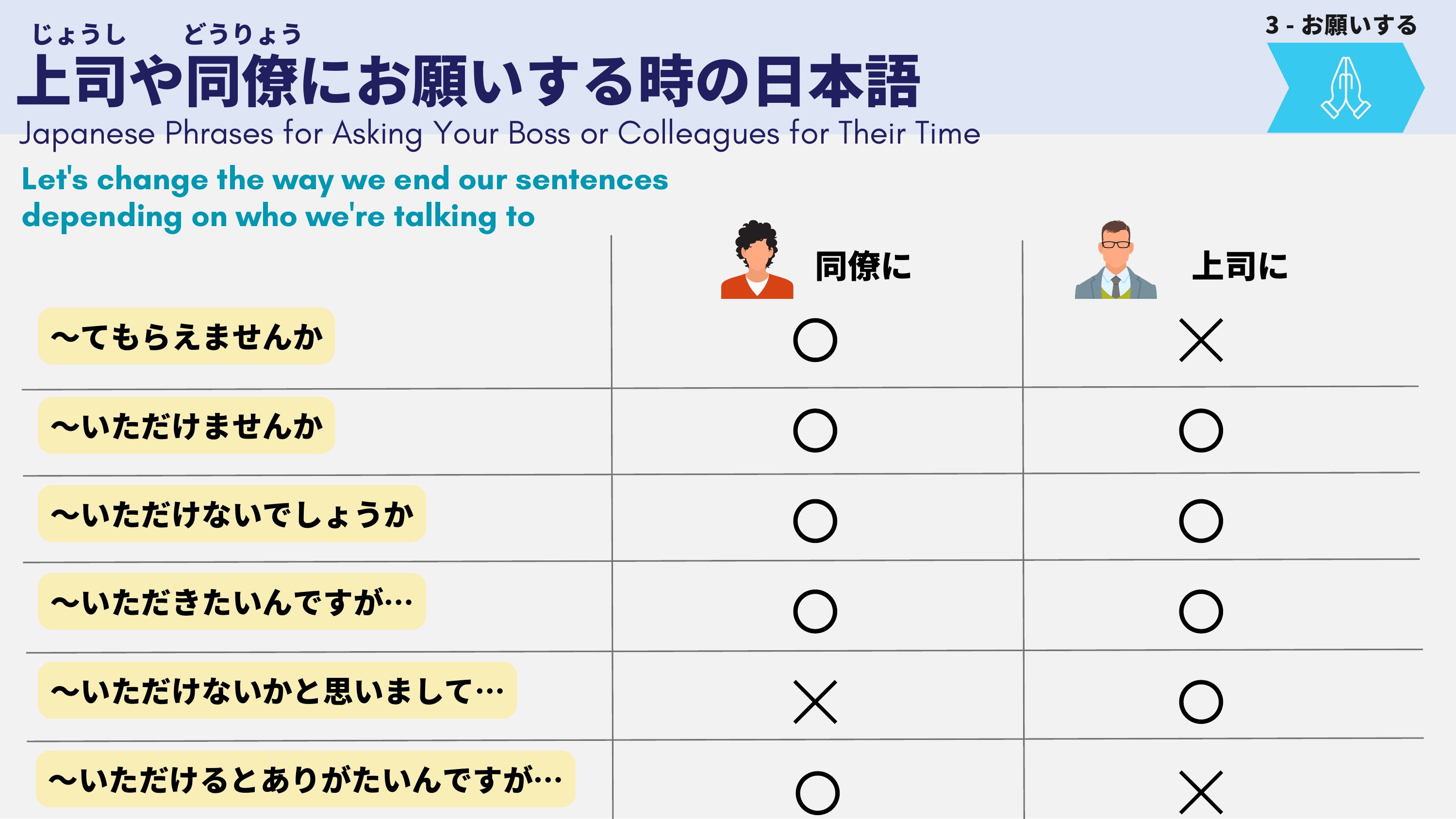
Let's change the way we end our sentences
depending on who we're talking to
Let's change the way we end our sentences
depending on who we're talking to
JP同僚に上司に
~てもらえませんか
~いただけませんか
~いただけないでしょうか
~いただきたいんですが…
~いただけないかと思いまして…
~いただけるとありがたいんですが…
~てもらえませんか
~いただけませんか
~いただけないでしょうか
~いただきたいんですが…
~いただけないかと思いまして…
~いただけるとありがたいんですが…
หน้า 26
คลิกเพื่อขยาย
JPじょうしどうりょうかくにん3-お願いする
上司や同僚に確認をお願いする時の日本語
上司や同僚に確認をお願いする時の日本語
ENJapanese Phrases for Asking Your Boss or Colleagues for Confirmation
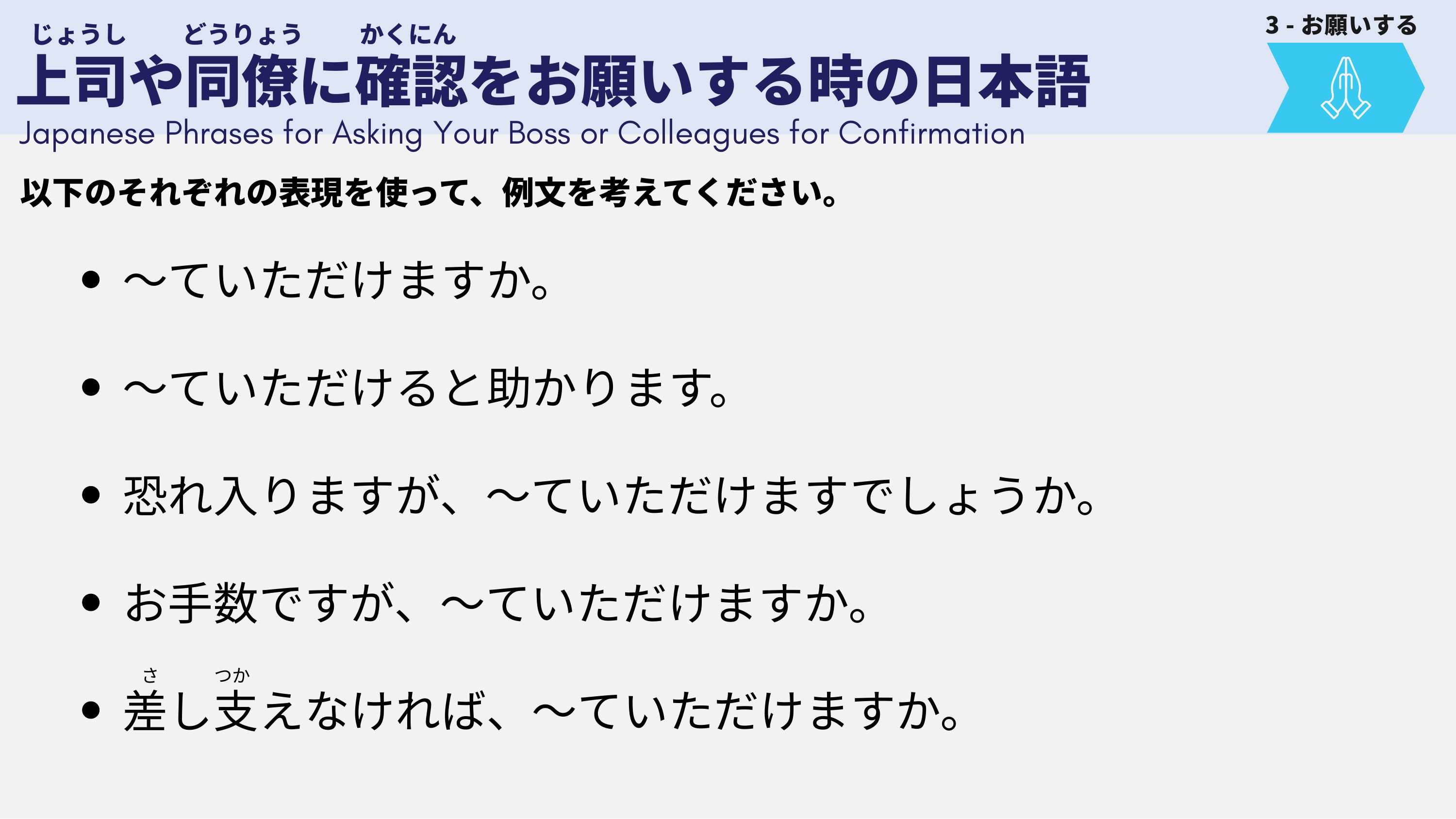
JP以下のそれぞれの表現を使って、例文を考えてください。
〜ていただけますか。
〜ていただけると助かります。
恐れ入りますが、〜ていただけますでしょうか。
お手数ですが、〜ていただけますか。
さつか
差し支えなければ、〜ていただけますか。
〜ていただけますか。
〜ていただけると助かります。
恐れ入りますが、〜ていただけますでしょうか。
お手数ですが、〜ていただけますか。
さつか
差し支えなければ、〜ていただけますか。
หน้า 27
คลิกเพื่อขยาย
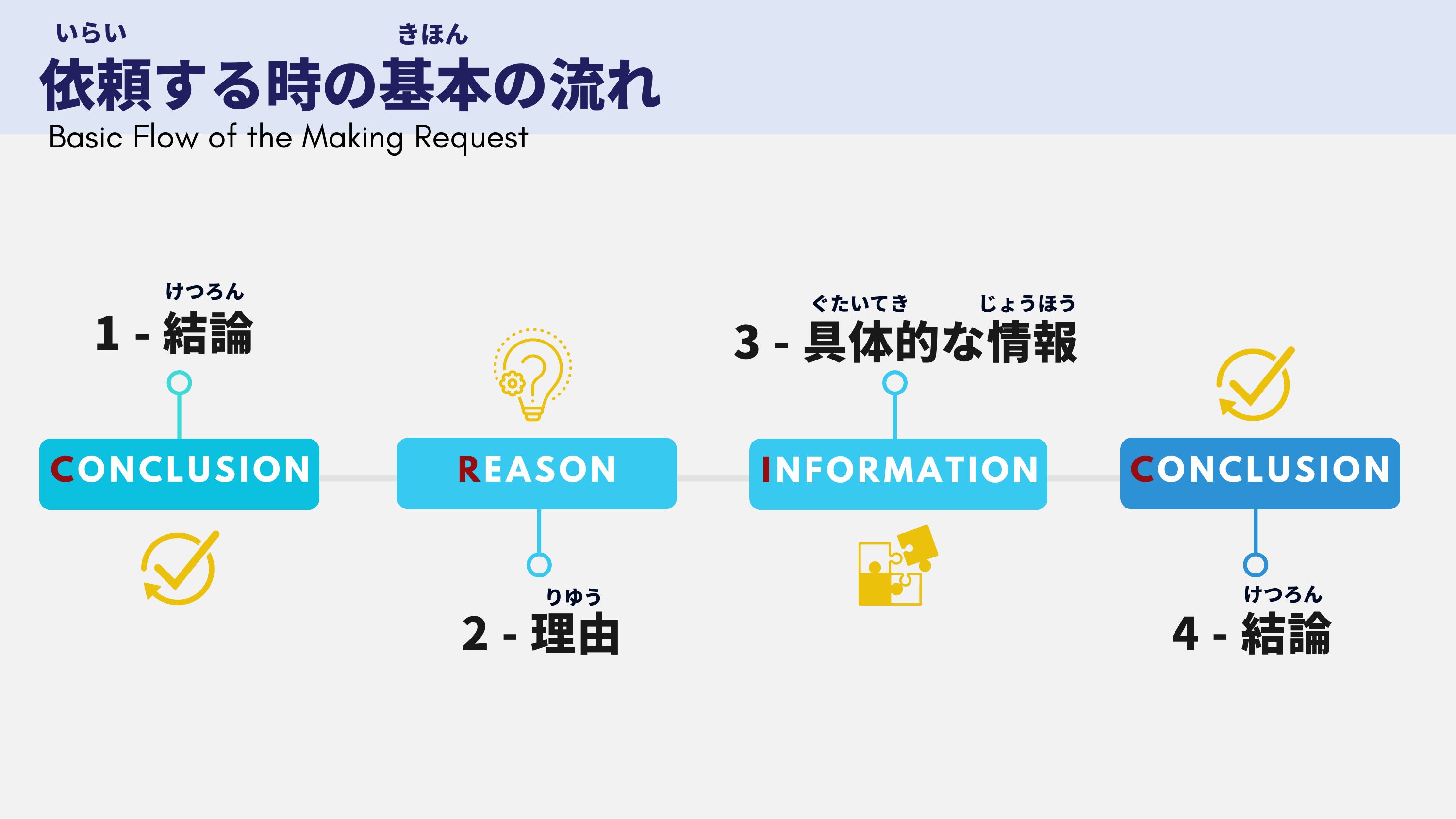
JPいらいきほん
依頼する時の基本の流れ
依頼する時の基本の流れ
ENBasic Flow of the Making Request
JPけつろん
ぐたいてきじょうほう
1-結論3-具体的な情報
ぐたいてきじょうほう
1-結論3-具体的な情報
ENCONCLUSION REASON INFORMATION CONCLUSION
JPりゆうけつろん
2-理由4-結論
2-理由4-結論
หน้า 28
คลิกเพื่อขยาย
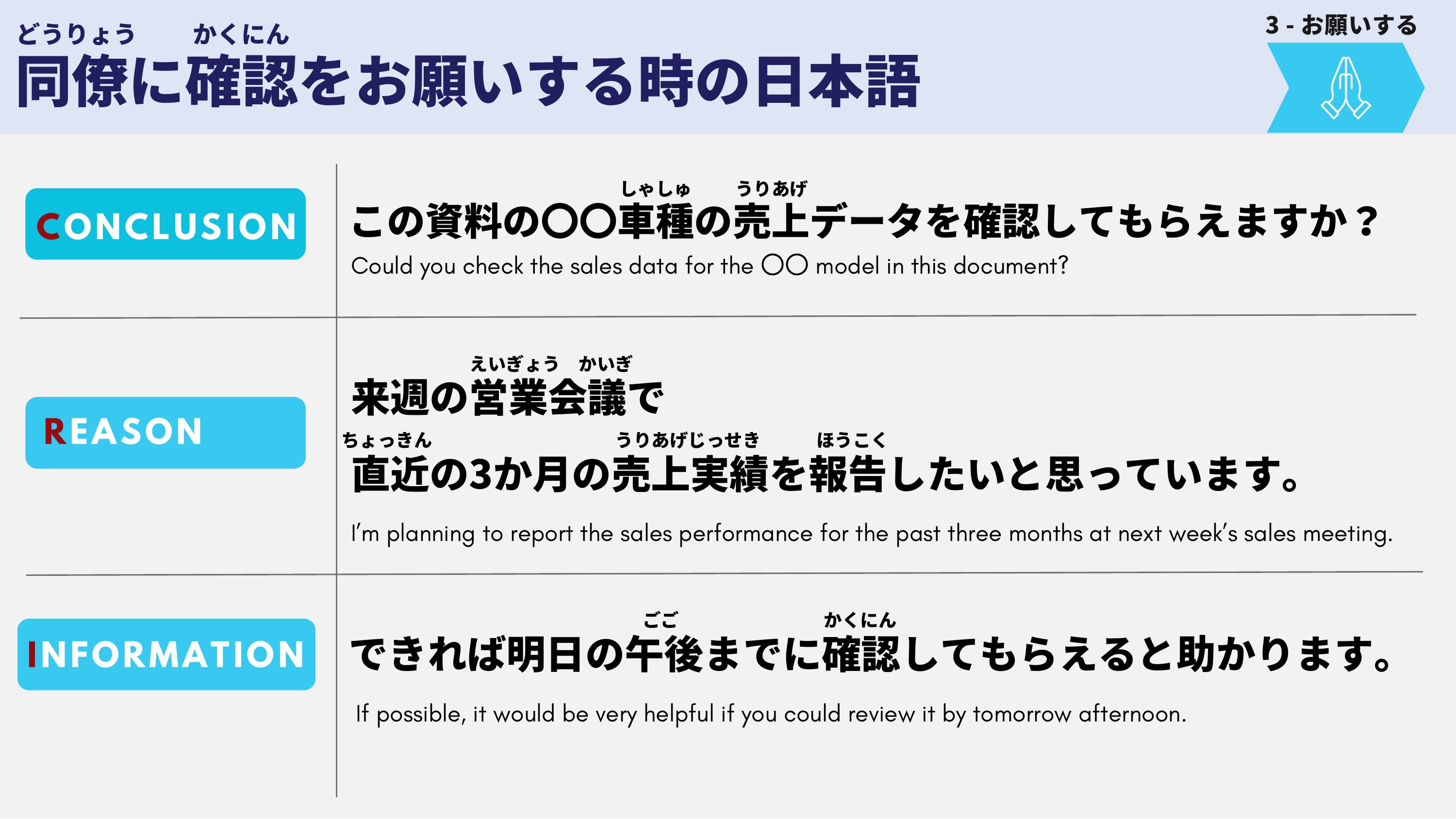
JPどうりょうかくにん3-お願いする
同僚に確認をお願いする時の日本語
しゃしゅうりあげ
CONCLUSIONこの資料の〇〇車種の売上データを確認してもらえますか?
同僚に確認をお願いする時の日本語
しゃしゅうりあげ
CONCLUSIONこの資料の〇〇車種の売上データを確認してもらえますか?
EN Could you check the sales data for the 〇〇 model in this document?
JPえいぎょうかいぎ
来週の営業会議で
REASONちょっきんうりあげじっせきほうこく
直近の3か月の売上実績を報告したいと思っています。
来週の営業会議で
REASONちょっきんうりあげじっせきほうこく
直近の3か月の売上実績を報告したいと思っています。
EN I’m planning to report the sales performance for the past three months at next week’s sales meeting.
JPごごかくにん
INFORMATIONできれば明日の午後までに確認してもらえると助かります。
INFORMATIONできれば明日の午後までに確認してもらえると助かります。
EN If possible, it would be very helpful if you could review it by tomorrow afternoon.
หน้า 29
คลิกเพื่อขยาย
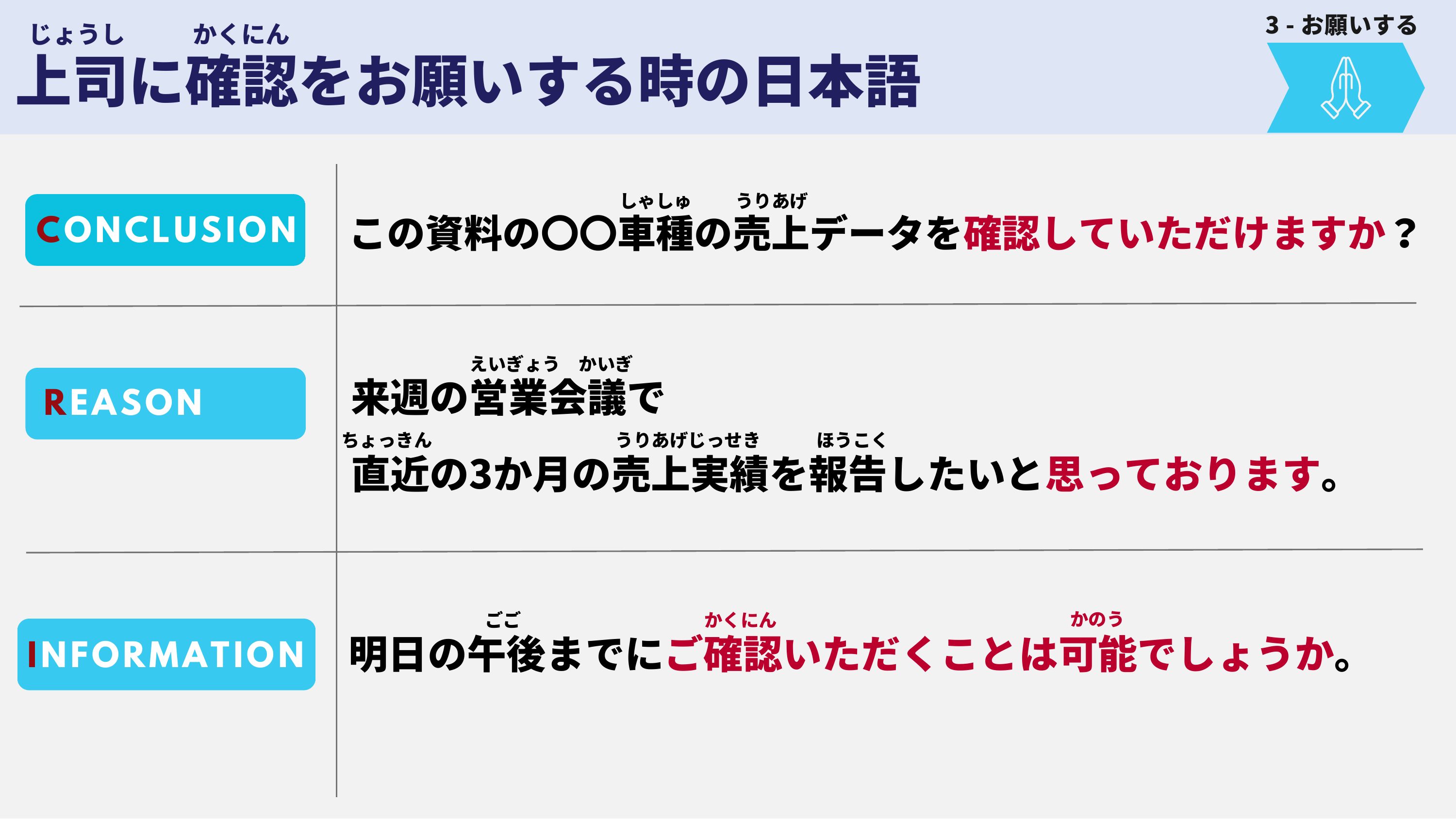
JPじょうしかくにん3-お願いする
上司に確認をお願いする時の日本語
しゃしゅうりあげ
CONCLUSIONこの資料の〇〇車種の売上データを確認していただけますか?
えいぎょうかいぎ
REASON来週の営業会議で
ちょっきんうりあげじっせきほうこく
直近の3か月の売上実績を報告したいと思っております。
ごごかくにんかのう
INFORMATION明日の午後までにご確認いただくことは可能でしょうか。
上司に確認をお願いする時の日本語
しゃしゅうりあげ
CONCLUSIONこの資料の〇〇車種の売上データを確認していただけますか?
えいぎょうかいぎ
REASON来週の営業会議で
ちょっきんうりあげじっせきほうこく
直近の3か月の売上実績を報告したいと思っております。
ごごかくにんかのう
INFORMATION明日の午後までにご確認いただくことは可能でしょうか。
หน้า 30
คลิกเพื่อขยาย
ENAGENDA 5
JP練習問題にチャレンジしよう
ENJapanese for responding to a task request
หน้า 31
คลิกเพื่อขยาย
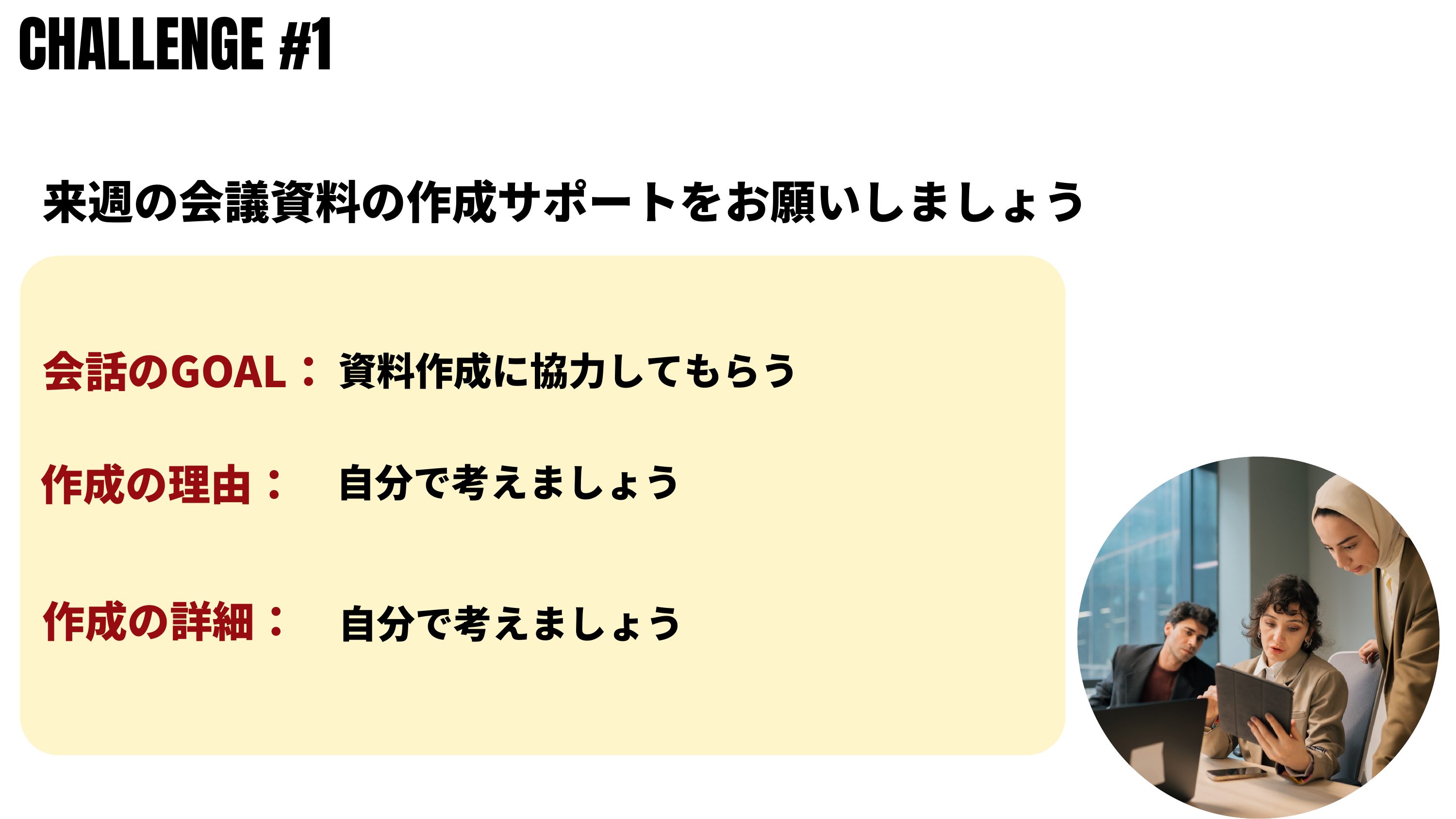
ENCHALLENGE #1
JP来週の会議資料の作成サポートをお願いしましょう
会話のGOAL:資料作成に協力してもらう
作成の理由:自分で考えましょう
作成の詳細:自分で考えましょう
会話のGOAL:資料作成に協力してもらう
作成の理由:自分で考えましょう
作成の詳細:自分で考えましょう
หน้า 32
คลิกเพื่อขยาย
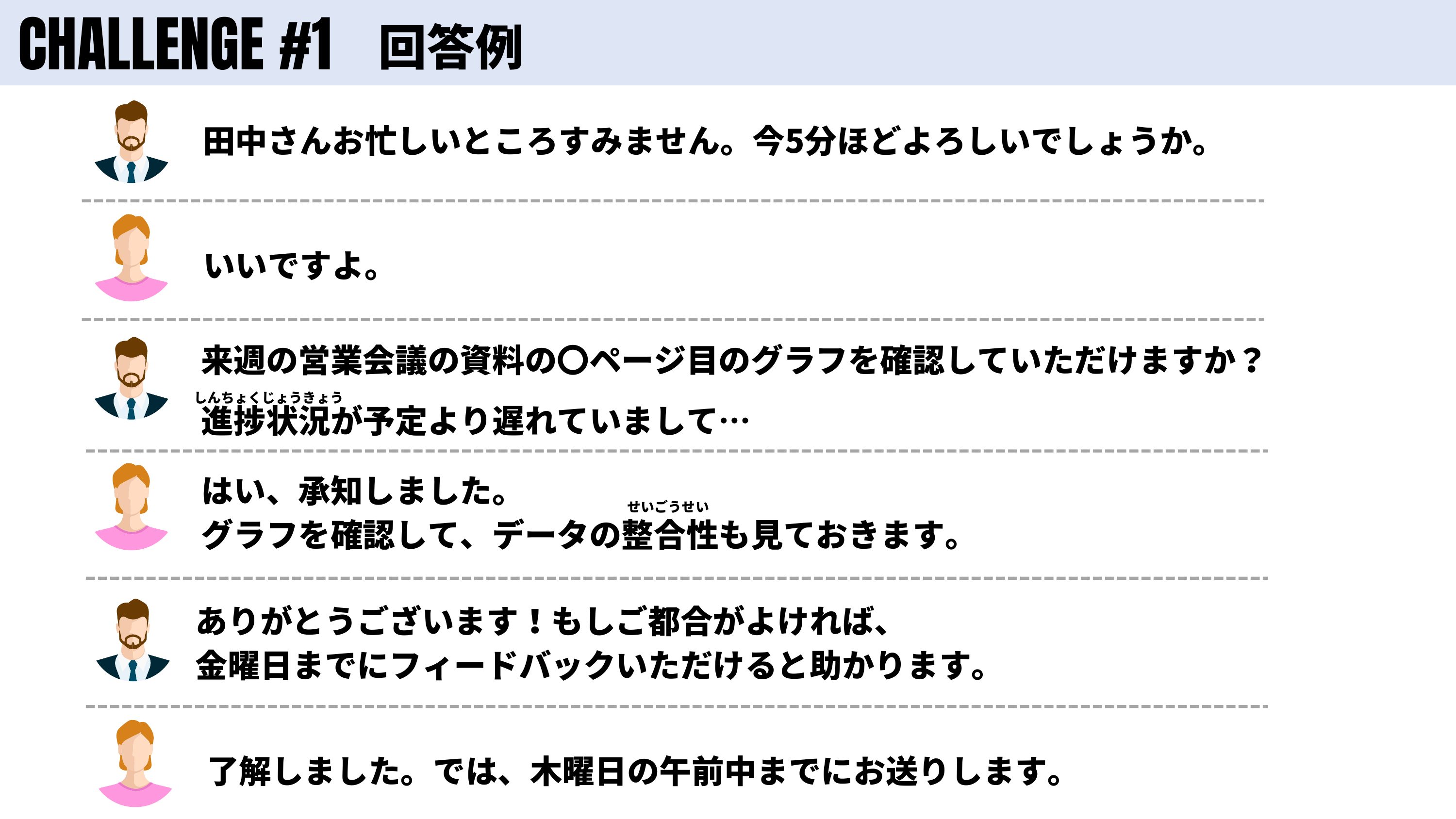
ENCHALLENGE #1 回答例
JP田中さんお忙しいところすみません。今5分ほどよろしいでしょうか。
いいですよ。
来週の営業会議の資料の〇ページ目のグラフを確認していただけますか?
しんちょくじょうきょう
進捗状況が予定より遅れていまして…
はい、承知しました。せいごうせい
グラフを確認して、データの整合性も見ておきます。
ありがとうございます!もしご都合がよければ、
金曜日までにフィードバックいただけると助かります。
了解しました。では、木曜日の午前中までにお送りします。
いいですよ。
来週の営業会議の資料の〇ページ目のグラフを確認していただけますか?
しんちょくじょうきょう
進捗状況が予定より遅れていまして…
はい、承知しました。せいごうせい
グラフを確認して、データの整合性も見ておきます。
ありがとうございます!もしご都合がよければ、
金曜日までにフィードバックいただけると助かります。
了解しました。では、木曜日の午前中までにお送りします。
หน้า 33
คลิกเพื่อขยาย
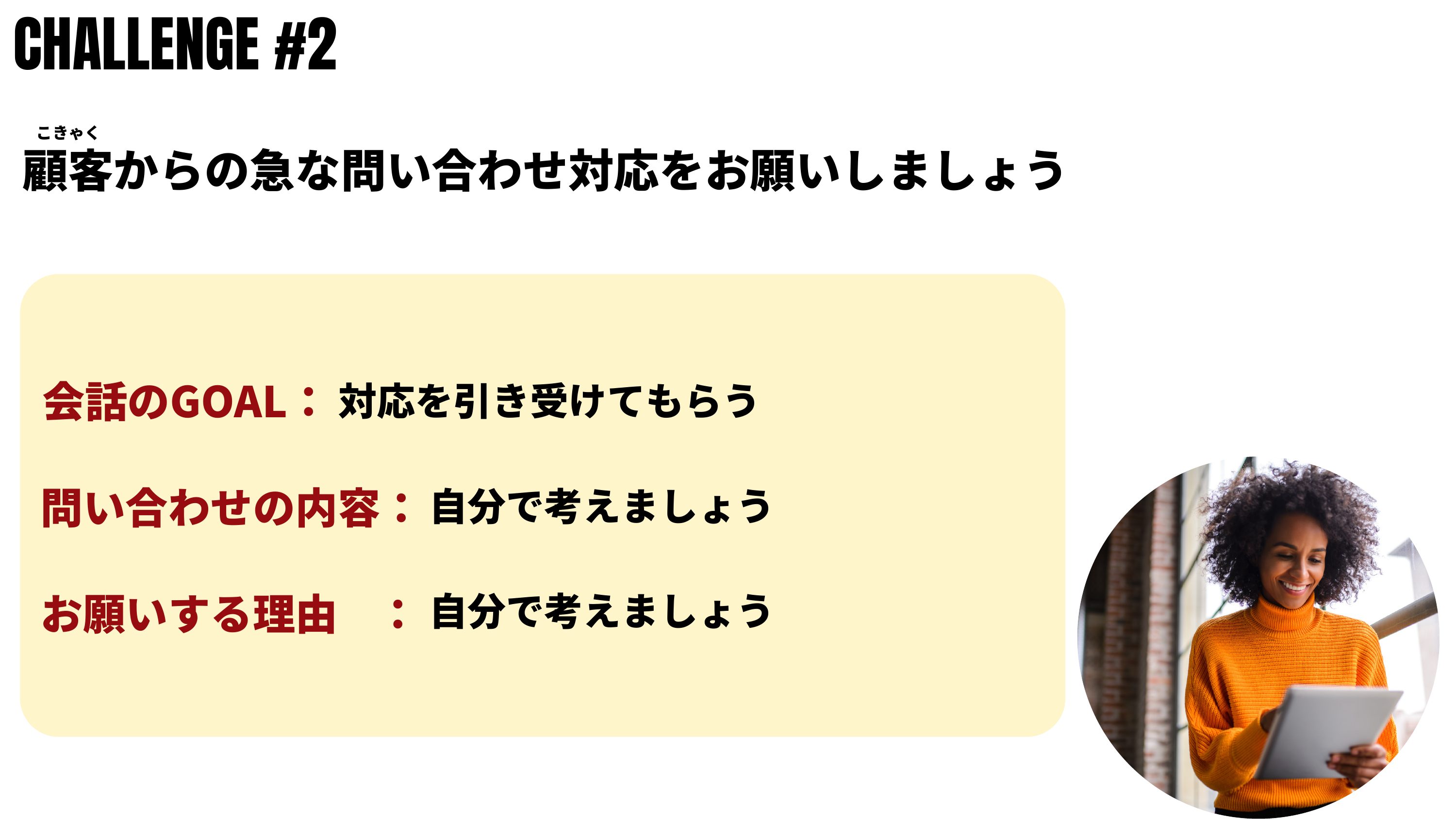
ENCHALLENGE #2
JPこきゃく
顧客からの急な問い合わせ対応をお願いしましょう
会話のGOAL:対応を引き受けてもらう
問い合わせの内容:自分で考えましょう
お願いする理由:自分で考えましょう
顧客からの急な問い合わせ対応をお願いしましょう
会話のGOAL:対応を引き受けてもらう
問い合わせの内容:自分で考えましょう
お願いする理由:自分で考えましょう
หน้า 34
คลิกเพื่อขยาย
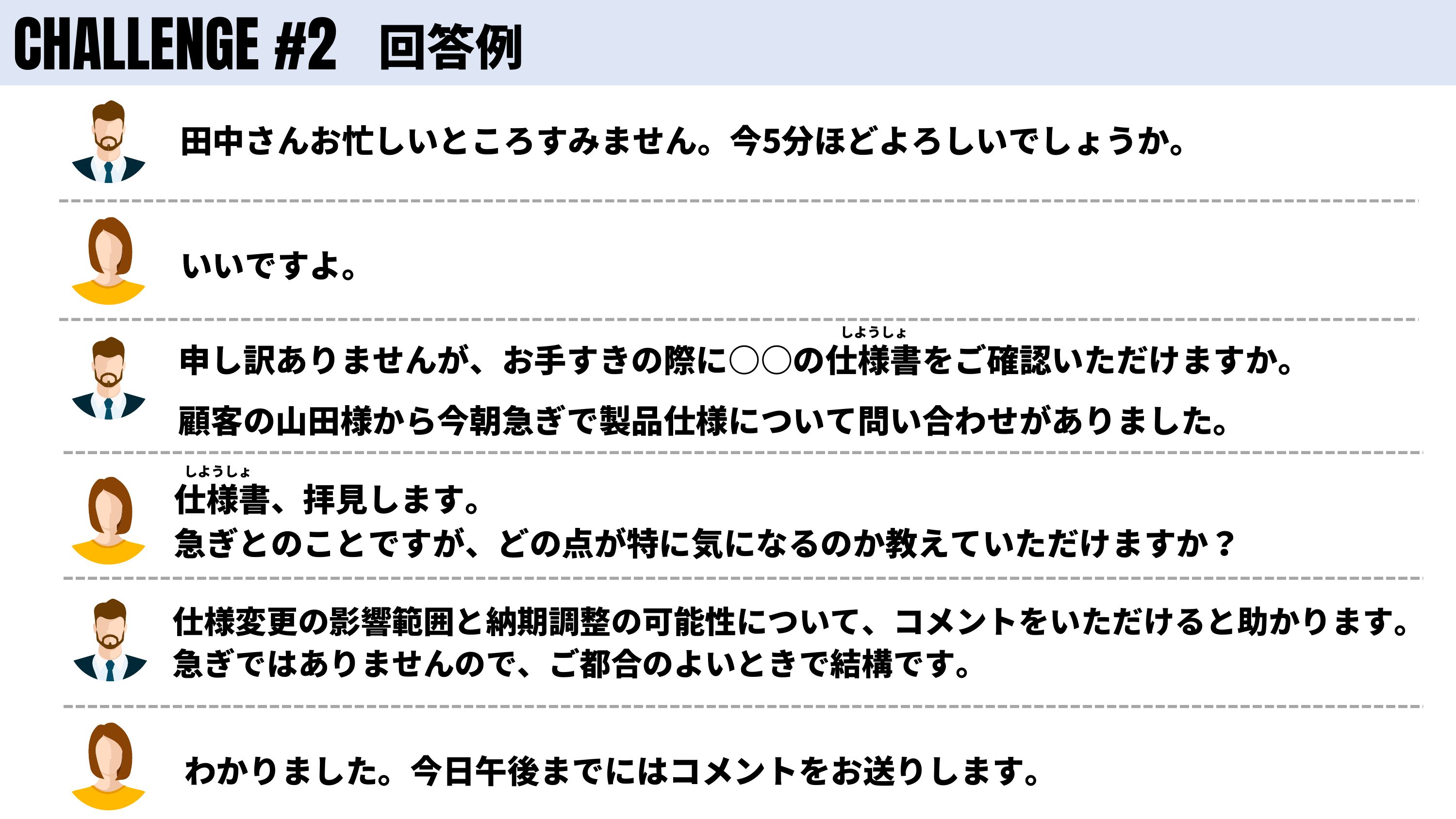
ENCHALLENGE #2 回答例
JP田中さんお忙しいところすみません。今5分ほどよろしいでしょうか。
いいですよ。
しようしょ
申し訳ありませんが、お手すきの際に○○の仕様書をご確認いただけますか。
顧客の山田様から今朝急ぎで製品仕様について問い合わせがありました。
しようしょ
仕様書、拝見します。
急ぎとのことですが、どの点が特に気になるのか教えていただけますか?
仕様変更の影響範囲と納期調整の可能性について、コメントをいただけると助かります。
急ぎではありませんので、ご都合のよいときで結構です。
わかりました。今日午後までにはコメントをお送りします。
いいですよ。
しようしょ
申し訳ありませんが、お手すきの際に○○の仕様書をご確認いただけますか。
顧客の山田様から今朝急ぎで製品仕様について問い合わせがありました。
しようしょ
仕様書、拝見します。
急ぎとのことですが、どの点が特に気になるのか教えていただけますか?
仕様変更の影響範囲と納期調整の可能性について、コメントをいただけると助かります。
急ぎではありませんので、ご都合のよいときで結構です。
わかりました。今日午後までにはコメントをお送りします。
หน้า 35
คลิกเพื่อขยาย
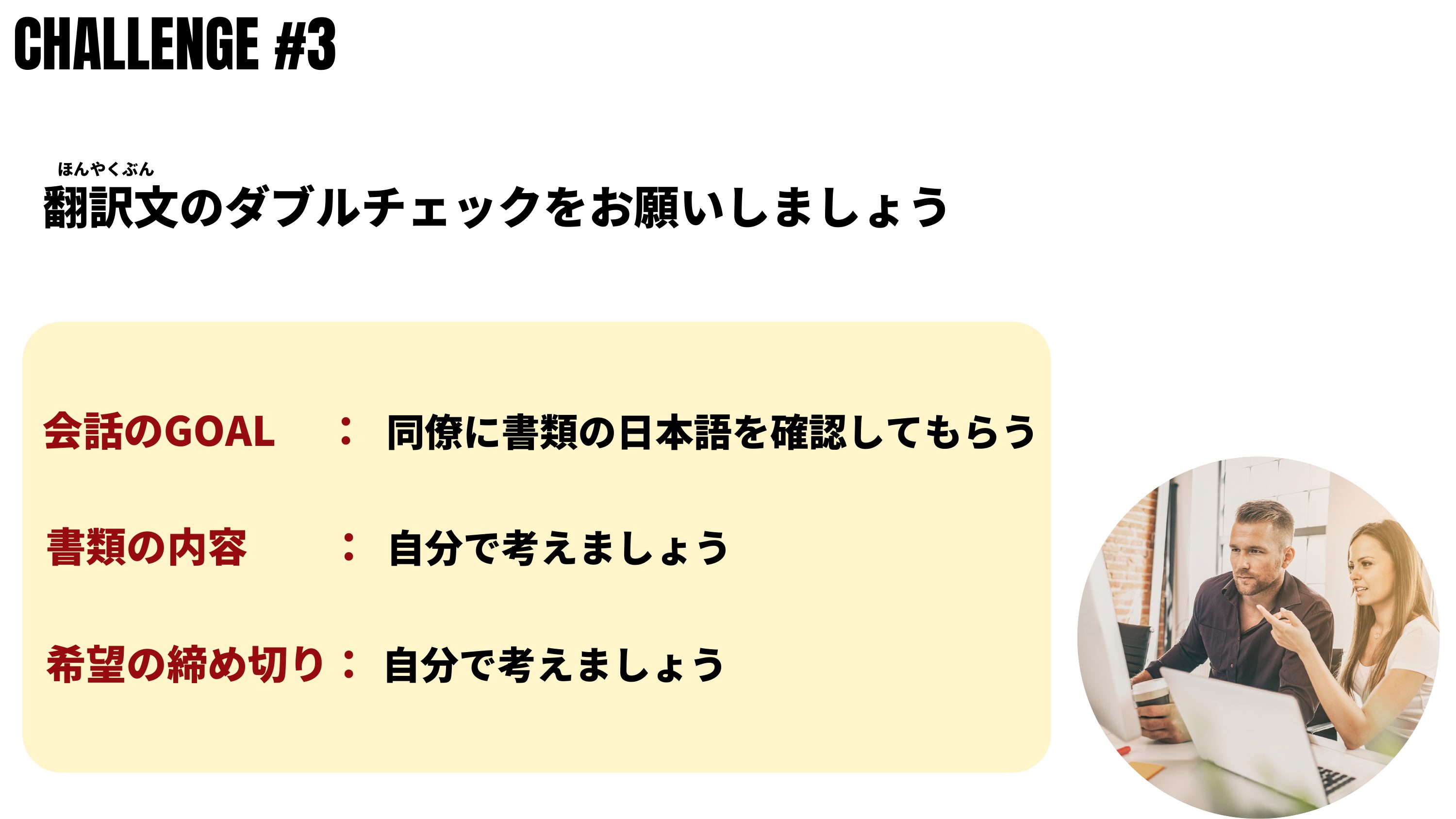
ENCHALLENGE #3
JPほんやくぶん
翻訳文のダブルチェックをお願いしましょう
会話のGOAL:同僚に書類の日本語を確認してもらう
書類の内容:自分で考えましょう
希望の締め切り:自分で考えましょう
翻訳文のダブルチェックをお願いしましょう
会話のGOAL:同僚に書類の日本語を確認してもらう
書類の内容:自分で考えましょう
希望の締め切り:自分で考えましょう
หน้า 36
คลิกเพื่อขยาย
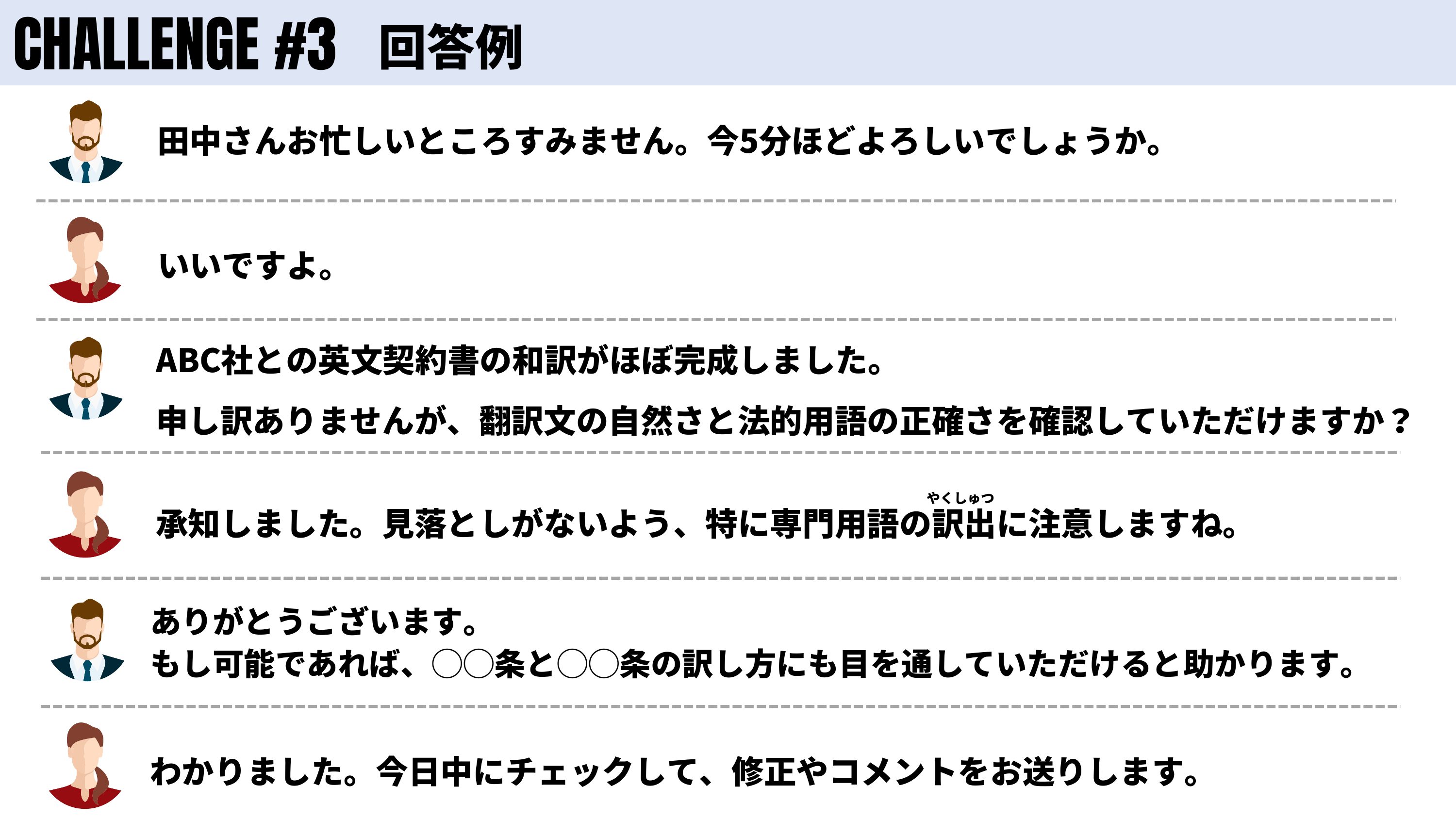
ENCHALLENGE #3 回答例
JP田中さんお忙しいところすみません。今5分ほどよろしいでしょうか。
いいですよ。
ABC社との英文契約書の和訳がほぼ完成しました。
申し訳ありませんが、翻訳文の自然さと法的用語の正確さを確認していただけますか?
やくしゅつ
承知しました。見落としがないよう、特に専門用語の訳出に注意しますね。
ありがとうございます。
もし可能であれば、◯◯条と◯◯条の訳し方にも目を通していただけると助かります。
わかりました。今日中にチェックして、修正やコメントをお送りします。
いいですよ。
ABC社との英文契約書の和訳がほぼ完成しました。
申し訳ありませんが、翻訳文の自然さと法的用語の正確さを確認していただけますか?
やくしゅつ
承知しました。見落としがないよう、特に専門用語の訳出に注意しますね。
ありがとうございます。
もし可能であれば、◯◯条と◯◯条の訳し方にも目を通していただけると助かります。
わかりました。今日中にチェックして、修正やコメントをお送りします。
หน้า 37
คลิกเพื่อขยาย
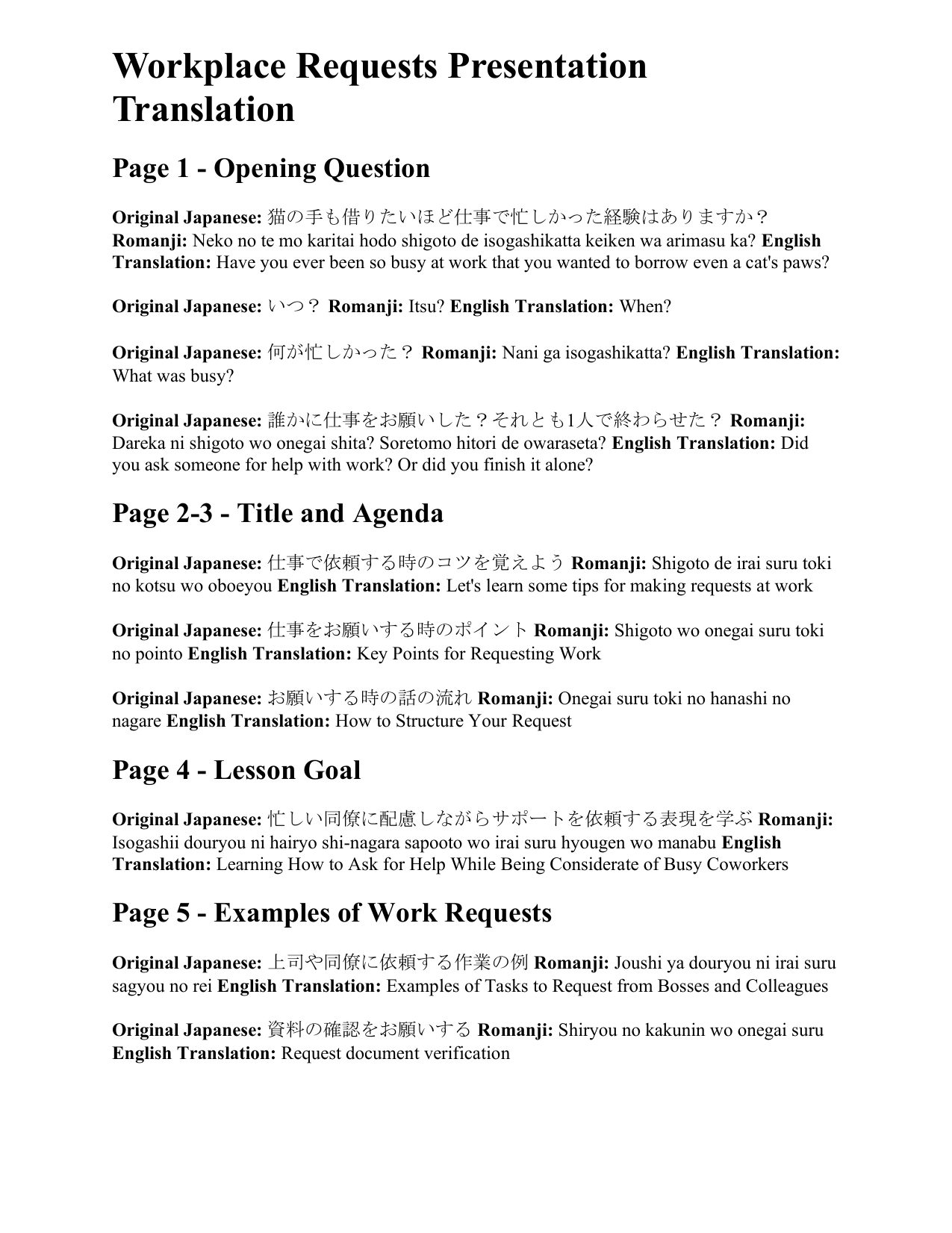
ENWorkplace Requests Presentation
Translation
Page 1 - Opening Question
Translation
Page 1 - Opening Question
JPOriginalJapanese:猫の手も借りたいほど仕事で忙しかった経験はありますか?
ENRomanji: Neko no te mo karitai hodo shigoto de isogashikatta keiken wa arimasu ka? English
Translation: Have you ever been so busy at work that you wanted to borrow even a cat's paws?
Original Japanese: いつ? Romanji: Itsu? English Translation: When?
Original Japanese: 何が忙しかった? Romanji: Nani ga isogashikatta? English Translation:
What was busy?
Original Japanese: 誰かに仕事をお願いした?それとも1人で終わらせた? Romanji:
Dareka ni shigoto wo onegai shita? Soretomo hitori de owaraseta? English Translation: Did
you ask someone for help with work? Or did you finish it alone?
Page 2-3 - Title and Agenda
Original Japanese: 仕事で依頼する時のコツを覚えよう Romanji: Shigoto de irai suru toki
no kotsu wo oboeyou English Translation: Let's learn some tips for making requests at work
Original Japanese: 仕事をお願いする時のポイント Romanji: Shigoto wo onegai suru toki
no pointo English Translation: Key Points for Requesting Work
Original Japanese: お願いする時の話の流れ Romanji: Onegai suru toki no hanashi no
nagare English Translation: How to Structure Your Request
Page 4 - Lesson Goal
Translation: Have you ever been so busy at work that you wanted to borrow even a cat's paws?
Original Japanese: いつ? Romanji: Itsu? English Translation: When?
Original Japanese: 何が忙しかった? Romanji: Nani ga isogashikatta? English Translation:
What was busy?
Original Japanese: 誰かに仕事をお願いした?それとも1人で終わらせた? Romanji:
Dareka ni shigoto wo onegai shita? Soretomo hitori de owaraseta? English Translation: Did
you ask someone for help with work? Or did you finish it alone?
Page 2-3 - Title and Agenda
Original Japanese: 仕事で依頼する時のコツを覚えよう Romanji: Shigoto de irai suru toki
no kotsu wo oboeyou English Translation: Let's learn some tips for making requests at work
Original Japanese: 仕事をお願いする時のポイント Romanji: Shigoto wo onegai suru toki
no pointo English Translation: Key Points for Requesting Work
Original Japanese: お願いする時の話の流れ Romanji: Onegai suru toki no hanashi no
nagare English Translation: How to Structure Your Request
Page 4 - Lesson Goal
JPOriginalJapanese:忙しい同僚に配慮しながらサポートを依頼する表現を学ぶRomanji:
ENIsogashii douryou ni hairyo shi-nagara sapooto wo irai suru hyougen wo manabu English
Translation: Learning How to Ask for Help While Being Considerate of Busy Coworkers
Page 5 - Examples of Work Requests
Original Japanese: 上司や同僚に依頼する作業の例 Romanji: Joushi ya douryou ni irai suru
sagyou no rei English Translation: Examples of Tasks to Request from Bosses and Colleagues
Original Japanese: 資料の確認をお願いする Romanji: Shiryou no kakunin wo onegai suru
English Translation: Request document verification
Translation: Learning How to Ask for Help While Being Considerate of Busy Coworkers
Page 5 - Examples of Work Requests
Original Japanese: 上司や同僚に依頼する作業の例 Romanji: Joushi ya douryou ni irai suru
sagyou no rei English Translation: Examples of Tasks to Request from Bosses and Colleagues
Original Japanese: 資料の確認をお願いする Romanji: Shiryou no kakunin wo onegai suru
English Translation: Request document verification
หน้า 38
คลิกเพื่อขยาย
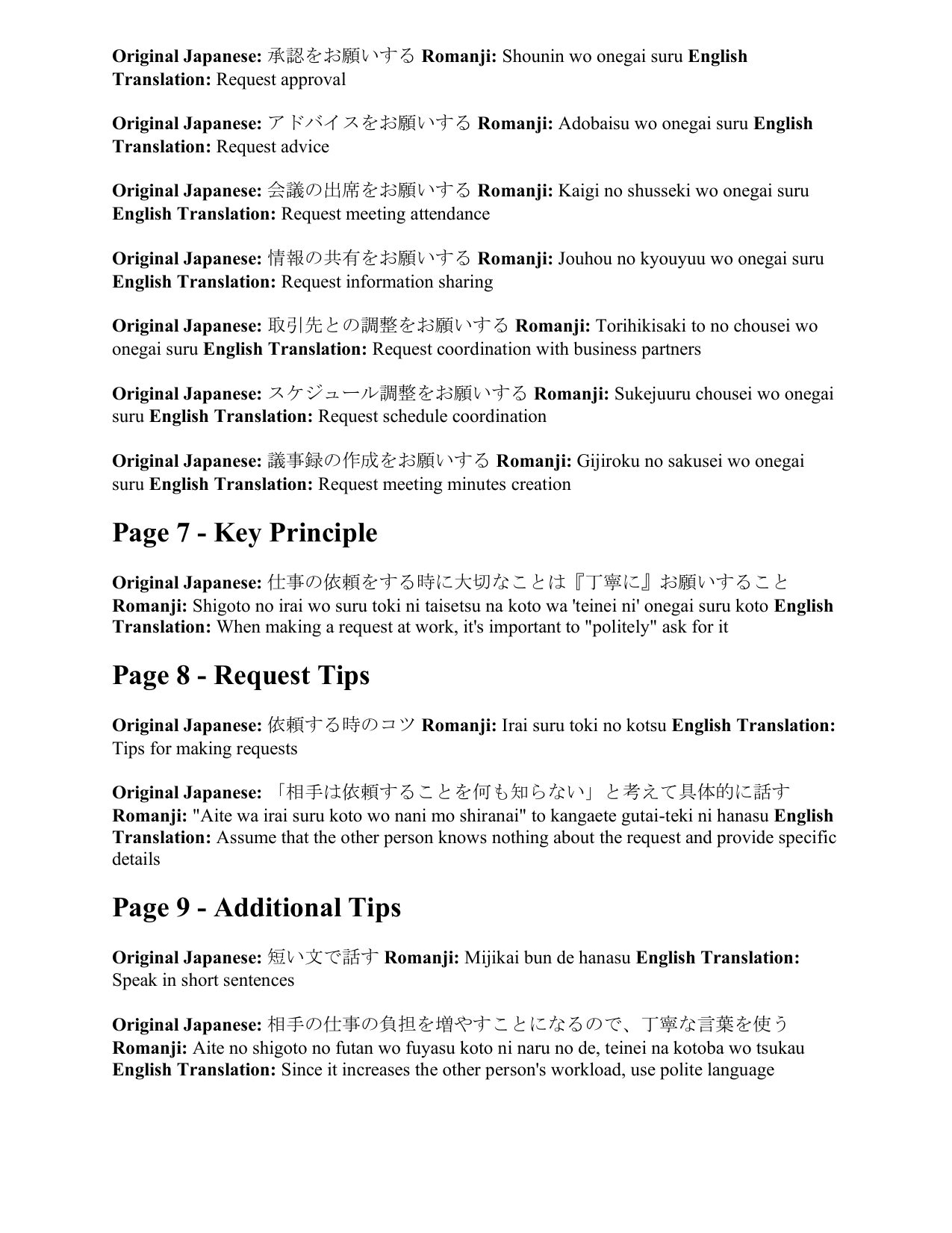
ENOriginal Japanese: 承認をお願いする Romanji: Shounin wo onegai suru English
Translation: Request approval
Original Japanese: アドバイスをお願いする Romanji: Adobaisu wo onegai suru English
Translation: Request advice
Original Japanese: 会議の出席をお願いする Romanji: Kaigi no shusseki wo onegai suru
English Translation: Request meeting attendance
Original Japanese: 情報の共有をお願いする Romanji: Jouhou no kyouyuu wo onegai suru
English Translation: Request information sharing
Original Japanese: 取引先との調整をお願いする Romanji: Torihikisaki to no chousei wo
onegai suru English Translation: Request coordination with business partners
Original Japanese: スケジュール調整をお願いする Romanji: Sukejuuru chousei wo onegai
suru English Translation: Request schedule coordination
Original Japanese: 議事録の作成をお願いする Romanji: Gijiroku no sakusei wo onegai
suru English Translation: Request meeting minutes creation
Page 7 - Key Principle
Translation: Request approval
Original Japanese: アドバイスをお願いする Romanji: Adobaisu wo onegai suru English
Translation: Request advice
Original Japanese: 会議の出席をお願いする Romanji: Kaigi no shusseki wo onegai suru
English Translation: Request meeting attendance
Original Japanese: 情報の共有をお願いする Romanji: Jouhou no kyouyuu wo onegai suru
English Translation: Request information sharing
Original Japanese: 取引先との調整をお願いする Romanji: Torihikisaki to no chousei wo
onegai suru English Translation: Request coordination with business partners
Original Japanese: スケジュール調整をお願いする Romanji: Sukejuuru chousei wo onegai
suru English Translation: Request schedule coordination
Original Japanese: 議事録の作成をお願いする Romanji: Gijiroku no sakusei wo onegai
suru English Translation: Request meeting minutes creation
Page 7 - Key Principle
JPOriginalJapanese:仕事の依頼をする時に大切なことは『丁寧に』お願いすること
ENRomanji: Shigoto no irai wo suru toki ni taisetsu na koto wa 'teinei ni' onegai suru koto English
Translation: When making a request at work, it's important to "politely" ask for it
Page 8 - Request Tips
Original Japanese: 依頼する時のコツ Romanji: Irai suru toki no kotsu English Translation:
Tips for making requests
Translation: When making a request at work, it's important to "politely" ask for it
Page 8 - Request Tips
Original Japanese: 依頼する時のコツ Romanji: Irai suru toki no kotsu English Translation:
Tips for making requests
JPOriginalJapanese:「相手は依頼することを何も知らない」と考えて具体的に話す
ENRomanji: "Aite wa irai suru koto wo nani mo shiranai" to kangaete gutai-teki ni hanasu English
Translation: Assume that the other person knows nothing about the request and provide specific
details
Page 9 - Additional Tips
Original Japanese: 短い文で話す Romanji: Mijikai bun de hanasu English Translation:
Speak in short sentences
Translation: Assume that the other person knows nothing about the request and provide specific
details
Page 9 - Additional Tips
Original Japanese: 短い文で話す Romanji: Mijikai bun de hanasu English Translation:
Speak in short sentences
JPOriginalJapanese:相手の仕事の負担を増やすことになるので、丁寧な言葉を使う
ENRomanji: Aite no shigoto no futan wo fuyasu koto ni naru no de, teinei na kotoba wo tsukau
English Translation: Since it increases the other person's workload, use polite language
English Translation: Since it increases the other person's workload, use polite language
หน้า 39
คลิกเพื่อขยาย
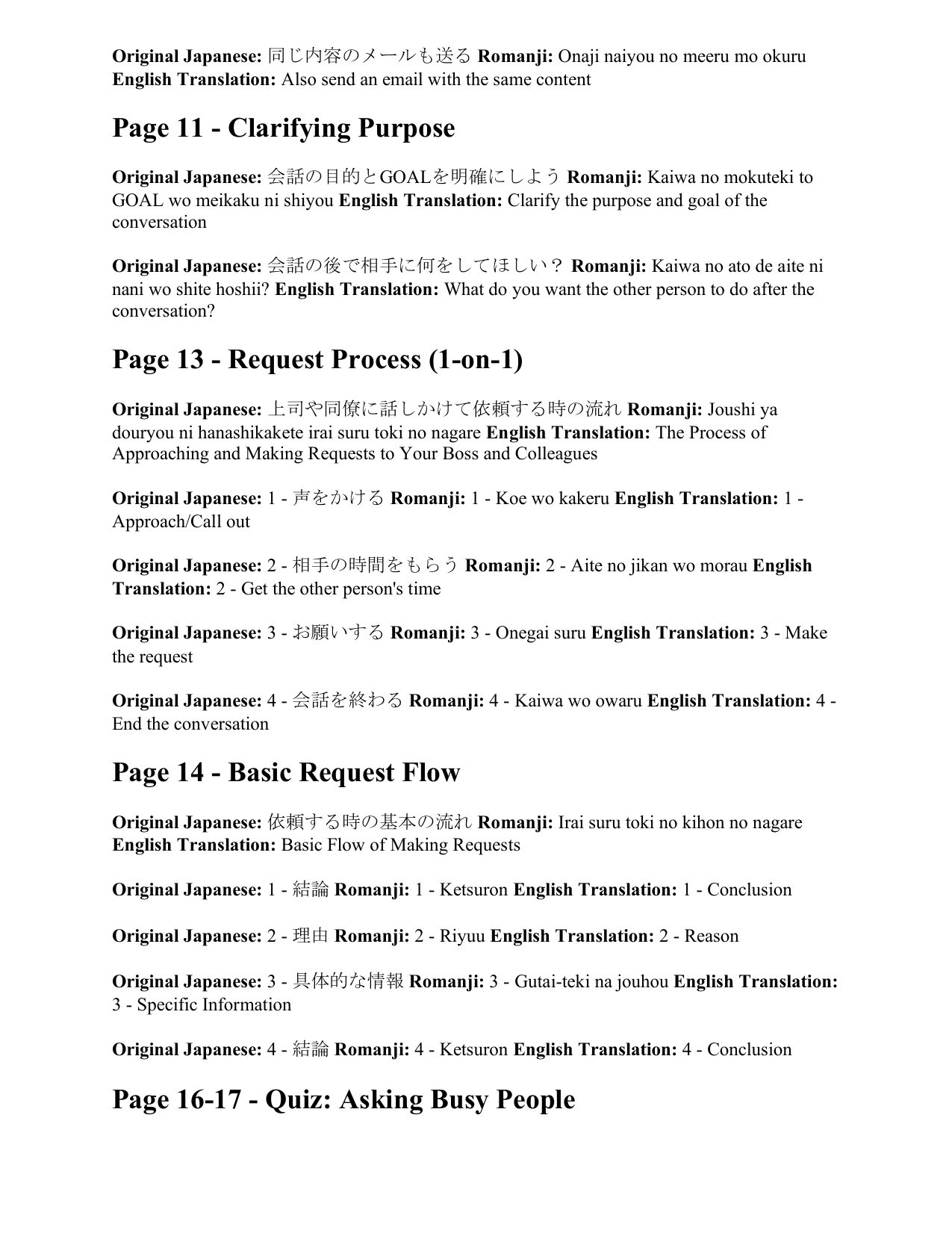
ENOriginal Japanese: 同じ内容のメールも送る Romanji: Onaji naiyou no meeru mo okuru
English Translation: Also send an email with the same content
Page 11 - Clarifying Purpose
Original Japanese: 会話の目的とGOALを明確にしよう Romanji: Kaiwa no mokuteki to
GOAL wo meikaku ni shiyou English Translation: Clarify the purpose and goal of the
conversation
Original Japanese: 会話の後で相手に何をしてほしい? Romanji: Kaiwa no ato de aite ni
nani wo shite hoshii? English Translation: What do you want the other person to do after the
conversation?
Page 13 - Request Process (1-on-1)
Original Japanese: 上司や同僚に話しかけて依頼する時の流れ Romanji: Joushi ya
douryou ni hanashikakete irai suru toki no nagare English Translation: The Process of
Approaching and Making Requests to Your Boss and Colleagues
Original Japanese: 1 - 声をかける Romanji: 1 - Koe wo kakeru English Translation: 1 -
Approach/Call out
Original Japanese: 2 - 相手の時間をもらう Romanji: 2 - Aite no jikan wo morau English
Translation: 2 - Get the other person's time
Original Japanese: 3 - お願いする Romanji: 3 - Onegai suru English Translation: 3 - Make
the request
Original Japanese: 4 - 会話を終わる Romanji: 4 - Kaiwa wo owaru English Translation: 4 -
End the conversation
Page 14 - Basic Request Flow
Original Japanese: 依頼する時の基本の流れ Romanji: Irai suru toki no kihon no nagare
English Translation: Basic Flow of Making Requests
Original Japanese: 1 - 結論 Romanji: 1 - Ketsuron English Translation: 1 - Conclusion
Original Japanese: 2 - 理由 Romanji: 2 - Riyuu English Translation: 2 - Reason
Original Japanese: 3 - 具体的な情報 Romanji: 3 - Gutai-teki na jouhou English Translation:
3 - Specific Information
Original Japanese: 4 - 結論 Romanji: 4 - Ketsuron English Translation: 4 - Conclusion
Page 16-17 - Quiz: Asking Busy People
English Translation: Also send an email with the same content
Page 11 - Clarifying Purpose
Original Japanese: 会話の目的とGOALを明確にしよう Romanji: Kaiwa no mokuteki to
GOAL wo meikaku ni shiyou English Translation: Clarify the purpose and goal of the
conversation
Original Japanese: 会話の後で相手に何をしてほしい? Romanji: Kaiwa no ato de aite ni
nani wo shite hoshii? English Translation: What do you want the other person to do after the
conversation?
Page 13 - Request Process (1-on-1)
Original Japanese: 上司や同僚に話しかけて依頼する時の流れ Romanji: Joushi ya
douryou ni hanashikakete irai suru toki no nagare English Translation: The Process of
Approaching and Making Requests to Your Boss and Colleagues
Original Japanese: 1 - 声をかける Romanji: 1 - Koe wo kakeru English Translation: 1 -
Approach/Call out
Original Japanese: 2 - 相手の時間をもらう Romanji: 2 - Aite no jikan wo morau English
Translation: 2 - Get the other person's time
Original Japanese: 3 - お願いする Romanji: 3 - Onegai suru English Translation: 3 - Make
the request
Original Japanese: 4 - 会話を終わる Romanji: 4 - Kaiwa wo owaru English Translation: 4 -
End the conversation
Page 14 - Basic Request Flow
Original Japanese: 依頼する時の基本の流れ Romanji: Irai suru toki no kihon no nagare
English Translation: Basic Flow of Making Requests
Original Japanese: 1 - 結論 Romanji: 1 - Ketsuron English Translation: 1 - Conclusion
Original Japanese: 2 - 理由 Romanji: 2 - Riyuu English Translation: 2 - Reason
Original Japanese: 3 - 具体的な情報 Romanji: 3 - Gutai-teki na jouhou English Translation:
3 - Specific Information
Original Japanese: 4 - 結論 Romanji: 4 - Ketsuron English Translation: 4 - Conclusion
Page 16-17 - Quiz: Asking Busy People
หน้า 40
คลิกเพื่อขยาย
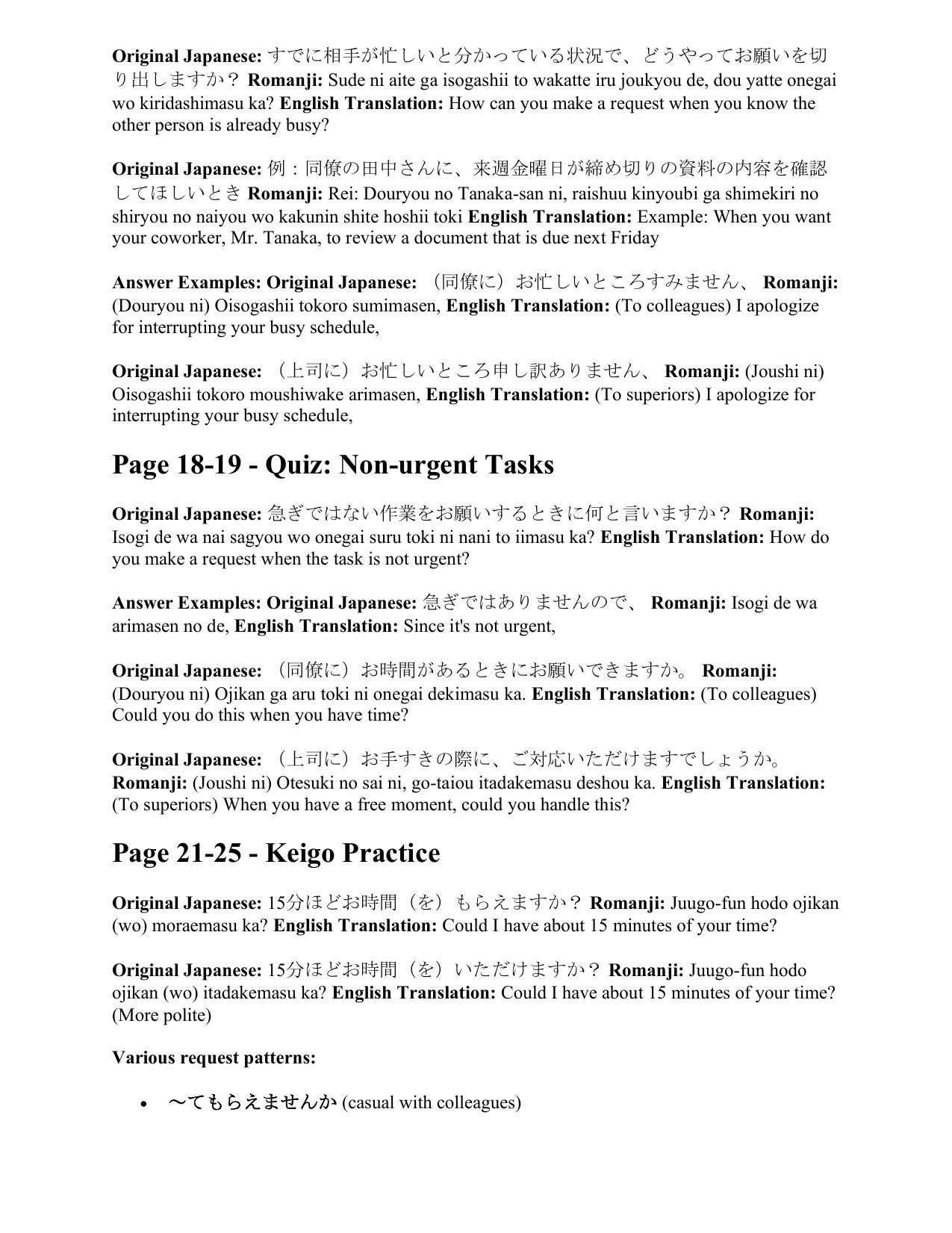
JPOriginalJapanese:すでに相手が忙しいと分かっている状況で、どうやってお願いを切
ENり出しますか? Romanji: Sude ni aite ga isogashii to wakatte iru joukyou de, dou yatte onegai
wo kiridashimasu ka? English Translation: How can you make a request when you know the
other person is already busy?
wo kiridashimasu ka? English Translation: How can you make a request when you know the
other person is already busy?
JPOriginalJapanese:例:同僚の田中さんに、来週金曜日が締め切りの資料の内容を確認
ENしてほしいとき Romanji: Rei: Douryou no Tanaka-san ni, raishuu kinyoubi ga shimekiri no
shiryou no naiyou wo kakunin shite hoshii toki English Translation: Example: When you want
your coworker, Mr. Tanaka, to review a document that is due next Friday
Answer Examples: Original Japanese: (同僚に)お忙しいところすみません、 Romanji:
(Douryou ni) Oisogashii tokoro sumimasen, English Translation: (To colleagues) I apologize
for interrupting your busy schedule,
Original Japanese: (上司に)お忙しいところ申し訳ありません、 Romanji: (Joushi ni)
Oisogashii tokoro moushiwake arimasen, English Translation: (To superiors) I apologize for
interrupting your busy schedule,
Page 18-19 - Quiz: Non-urgent Tasks
shiryou no naiyou wo kakunin shite hoshii toki English Translation: Example: When you want
your coworker, Mr. Tanaka, to review a document that is due next Friday
Answer Examples: Original Japanese: (同僚に)お忙しいところすみません、 Romanji:
(Douryou ni) Oisogashii tokoro sumimasen, English Translation: (To colleagues) I apologize
for interrupting your busy schedule,
Original Japanese: (上司に)お忙しいところ申し訳ありません、 Romanji: (Joushi ni)
Oisogashii tokoro moushiwake arimasen, English Translation: (To superiors) I apologize for
interrupting your busy schedule,
Page 18-19 - Quiz: Non-urgent Tasks
JPOriginalJapanese:急ぎではない作業をお願いするときに何と言いますか?Romanji:
ENIsogi de wa nai sagyou wo onegai suru toki ni nani to iimasu ka? English Translation: How do
you make a request when the task is not urgent?
Answer Examples: Original Japanese: 急ぎではありませんので、 Romanji: Isogi de wa
arimasen no de, English Translation: Since it's not urgent,
Original Japanese: (同僚に)お時間があるときにお願いできますか。 Romanji:
(Douryou ni) Ojikan ga aru toki ni onegai dekimasu ka. English Translation: (To colleagues)
Could you do this when you have time?
you make a request when the task is not urgent?
Answer Examples: Original Japanese: 急ぎではありませんので、 Romanji: Isogi de wa
arimasen no de, English Translation: Since it's not urgent,
Original Japanese: (同僚に)お時間があるときにお願いできますか。 Romanji:
(Douryou ni) Ojikan ga aru toki ni onegai dekimasu ka. English Translation: (To colleagues)
Could you do this when you have time?
JPOriginalJapanese:(上司に)お手すきの際に、ご対応いただけますでしょうか。
ENRomanji: (Joushi ni) Otesuki no sai ni, go-taiou itadakemasu deshou ka. English Translation:
(To superiors) When you have a free moment, could you handle this?
Page 21-25 - Keigo Practice
Original Japanese: 15分ほどお時間(を)もらえますか? Romanji: Juugo-fun hodo ojikan
(wo) moraemasu ka? English Translation: Could I have about 15 minutes of your time?
Original Japanese: 15分ほどお時間(を)いただけますか? Romanji: Juugo-fun hodo
ojikan (wo) itadakemasu ka? English Translation: Could I have about 15 minutes of your time?
(More polite)
Various request patterns:
• ~てもらえませんか (casual with colleagues)
(To superiors) When you have a free moment, could you handle this?
Page 21-25 - Keigo Practice
Original Japanese: 15分ほどお時間(を)もらえますか? Romanji: Juugo-fun hodo ojikan
(wo) moraemasu ka? English Translation: Could I have about 15 minutes of your time?
Original Japanese: 15分ほどお時間(を)いただけますか? Romanji: Juugo-fun hodo
ojikan (wo) itadakemasu ka? English Translation: Could I have about 15 minutes of your time?
(More polite)
Various request patterns:
• ~てもらえませんか (casual with colleagues)
หน้า 41
คลิกเพื่อขยาย
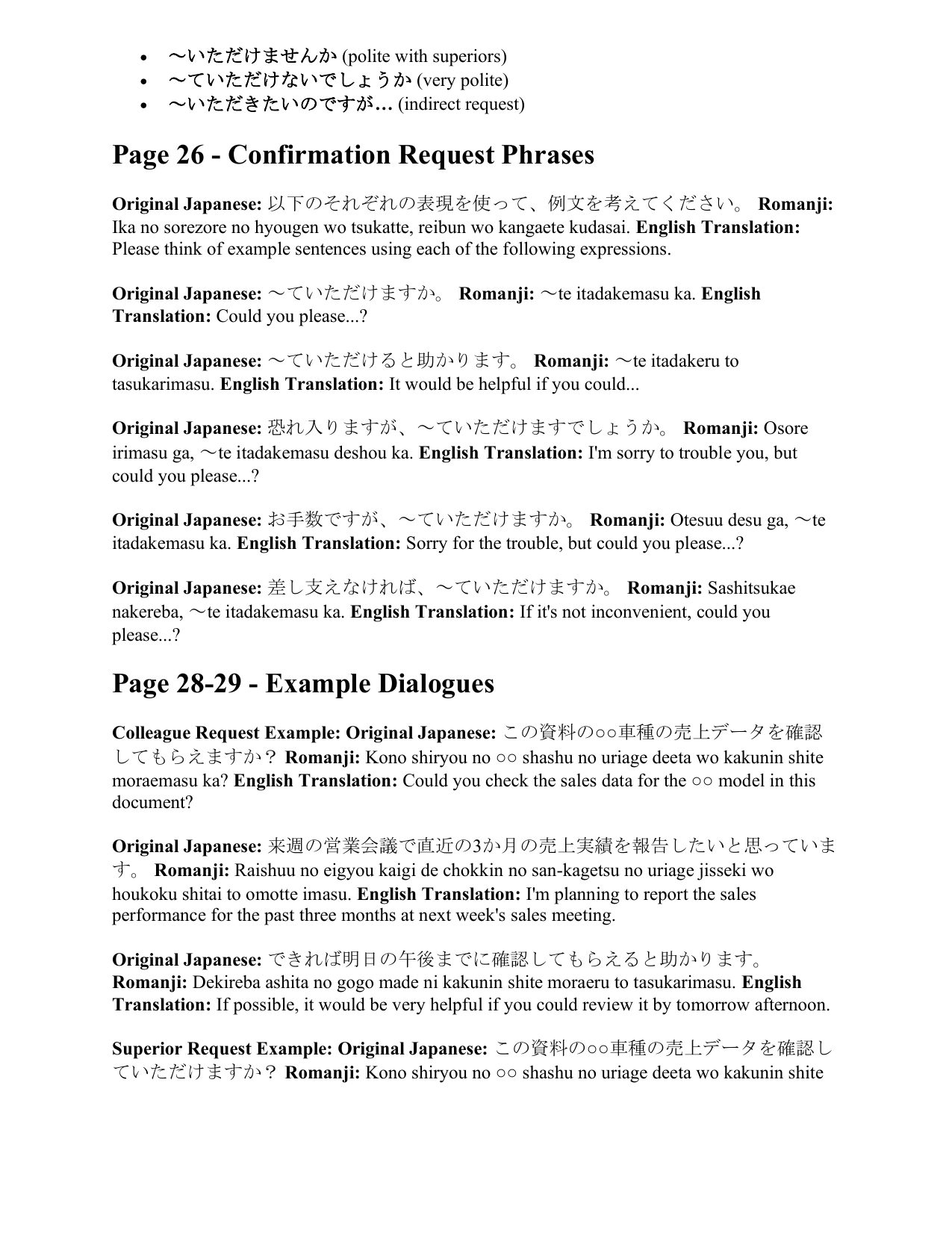
EN • ~いただけませんか (polite with superiors)
JP•~ていただけないでしょうか(verypolite)
EN • ~いただきたいのですが… (indirect request)
Page 26 - Confirmation Request Phrases
Page 26 - Confirmation Request Phrases
JPOriginalJapanese:以下のそれぞれの表現を使って、例文を考えてください。Romanji:
ENIka no sorezore no hyougen wo tsukatte, reibun wo kangaete kudasai. English Translation:
Please think of example sentences using each of the following expressions.
Original Japanese: ~ていただけますか。 Romanji: ~te itadakemasu ka. English
Translation: Could you please...?
Original Japanese: ~ていただけると助かります。 Romanji: ~te itadakeru to
tasukarimasu. English Translation: It would be helpful if you could...
Original Japanese: 恐れ入りますが、~ていただけますでしょうか。 Romanji: Osore
irimasu ga, ~te itadakemasu deshou ka. English Translation: I'm sorry to trouble you, but
could you please...?
Original Japanese: お手数ですが、~ていただけますか。 Romanji: Otesuu desu ga, ~te
itadakemasu ka. English Translation: Sorry for the trouble, but could you please...?
Original Japanese: 差し支えなければ、~ていただけますか。 Romanji: Sashitsukae
nakereba, ~te itadakemasu ka. English Translation: If it's not inconvenient, could you
please...?
Page 28-29 - Example Dialogues
Colleague Request Example: Original Japanese: この資料の○○車種の売上データを確認
してもらえますか? Romanji: Kono shiryou no ○○ shashu no uriage deeta wo kakunin shite
moraemasu ka? English Translation: Could you check the sales data for the ○○ model in this
document?
Please think of example sentences using each of the following expressions.
Original Japanese: ~ていただけますか。 Romanji: ~te itadakemasu ka. English
Translation: Could you please...?
Original Japanese: ~ていただけると助かります。 Romanji: ~te itadakeru to
tasukarimasu. English Translation: It would be helpful if you could...
Original Japanese: 恐れ入りますが、~ていただけますでしょうか。 Romanji: Osore
irimasu ga, ~te itadakemasu deshou ka. English Translation: I'm sorry to trouble you, but
could you please...?
Original Japanese: お手数ですが、~ていただけますか。 Romanji: Otesuu desu ga, ~te
itadakemasu ka. English Translation: Sorry for the trouble, but could you please...?
Original Japanese: 差し支えなければ、~ていただけますか。 Romanji: Sashitsukae
nakereba, ~te itadakemasu ka. English Translation: If it's not inconvenient, could you
please...?
Page 28-29 - Example Dialogues
Colleague Request Example: Original Japanese: この資料の○○車種の売上データを確認
してもらえますか? Romanji: Kono shiryou no ○○ shashu no uriage deeta wo kakunin shite
moraemasu ka? English Translation: Could you check the sales data for the ○○ model in this
document?
JPOriginalJapanese:来週の営業会議で直近の3か月の売上実績を報告したいと思っていま
ENす。 Romanji: Raishuu no eigyou kaigi de chokkin no san-kagetsu no uriage jisseki wo
houkoku shitai to omotte imasu. English Translation: I'm planning to report the sales
performance for the past three months at next week's sales meeting.
houkoku shitai to omotte imasu. English Translation: I'm planning to report the sales
performance for the past three months at next week's sales meeting.
JPOriginalJapanese:できれば明日の午後までに確認してもらえると助かります。
ENRomanji: Dekireba ashita no gogo made ni kakunin shite moraeru to tasukarimasu. English
Translation: If possible, it would be very helpful if you could review it by tomorrow afternoon.
Superior Request Example: Original Japanese: この資料の○○車種の売上データを確認し
ていただけますか? Romanji: Kono shiryou no ○○ shashu no uriage deeta wo kakunin shite
Translation: If possible, it would be very helpful if you could review it by tomorrow afternoon.
Superior Request Example: Original Japanese: この資料の○○車種の売上データを確認し
ていただけますか? Romanji: Kono shiryou no ○○ shashu no uriage deeta wo kakunin shite
หน้า 42
คลิกเพื่อขยาย
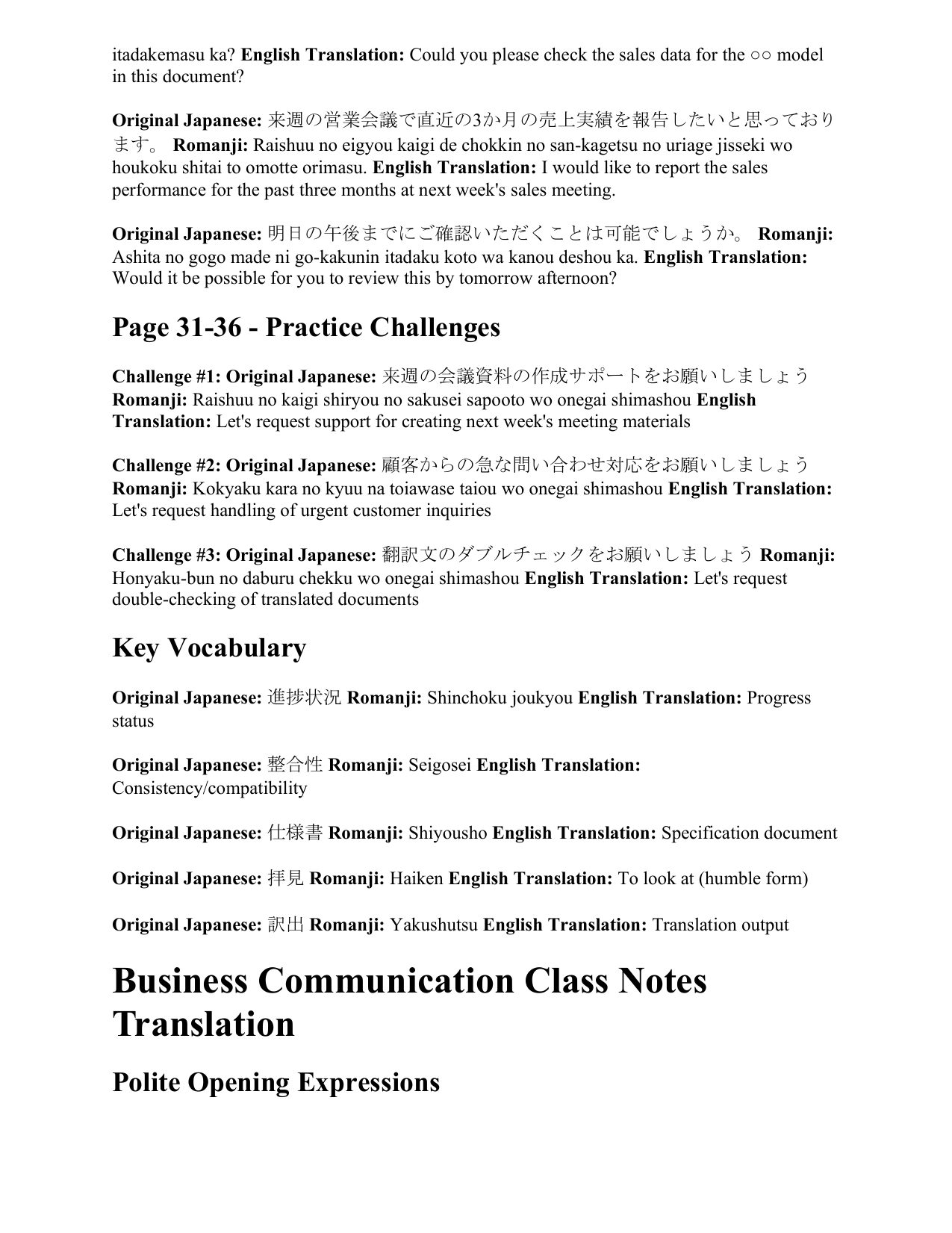
ENitadakemasu ka? English Translation: Could you please check the sales data for the ○○ model
in this document?
in this document?
JPOriginalJapanese:来週の営業会議で直近の3か月の売上実績を報告したいと思っており
ENます。 Romanji: Raishuu no eigyou kaigi de chokkin no san-kagetsu no uriage jisseki wo
houkoku shitai to omotte orimasu. English Translation: I would like to report the sales
performance for the past three months at next week's sales meeting.
houkoku shitai to omotte orimasu. English Translation: I would like to report the sales
performance for the past three months at next week's sales meeting.
JPOriginalJapanese:明日の午後までにご確認いただくことは可能でしょうか。Romanji:
ENAshita no gogo made ni go-kakunin itadaku koto wa kanou deshou ka. English Translation:
Would it be possible for you to review this by tomorrow afternoon?
Page 31-36 - Practice Challenges
Challenge #1: Original Japanese: 来週の会議資料の作成サポートをお願いしましょう
Romanji: Raishuu no kaigi shiryou no sakusei sapooto wo onegai shimashou English
Translation: Let's request support for creating next week's meeting materials
Challenge #2: Original Japanese: 顧客からの急な問い合わせ対応をお願いしましょう
Romanji: Kokyaku kara no kyuu na toiawase taiou wo onegai shimashou English Translation:
Let's request handling of urgent customer inquiries
Challenge #3: Original Japanese: 翻訳文のダブルチェックをお願いしましょう Romanji:
Honyaku-bun no daburu chekku wo onegai shimashou English Translation: Let's request
double-checking of translated documents
Key Vocabulary
Original Japanese: 進捗状況 Romanji: Shinchoku joukyou English Translation: Progress
status
Original Japanese: 整合性 Romanji: Seigosei English Translation:
Consistency/compatibility
Original Japanese: 仕様書 Romanji: Shiyousho English Translation: Specification document
Original Japanese: 拝見 Romanji: Haiken English Translation: To look at (humble form)
Original Japanese: 訳出 Romanji: Yakushutsu English Translation: Translation output
Business Communication Class Notes
Translation
Polite Opening Expressions
Would it be possible for you to review this by tomorrow afternoon?
Page 31-36 - Practice Challenges
Challenge #1: Original Japanese: 来週の会議資料の作成サポートをお願いしましょう
Romanji: Raishuu no kaigi shiryou no sakusei sapooto wo onegai shimashou English
Translation: Let's request support for creating next week's meeting materials
Challenge #2: Original Japanese: 顧客からの急な問い合わせ対応をお願いしましょう
Romanji: Kokyaku kara no kyuu na toiawase taiou wo onegai shimashou English Translation:
Let's request handling of urgent customer inquiries
Challenge #3: Original Japanese: 翻訳文のダブルチェックをお願いしましょう Romanji:
Honyaku-bun no daburu chekku wo onegai shimashou English Translation: Let's request
double-checking of translated documents
Key Vocabulary
Original Japanese: 進捗状況 Romanji: Shinchoku joukyou English Translation: Progress
status
Original Japanese: 整合性 Romanji: Seigosei English Translation:
Consistency/compatibility
Original Japanese: 仕様書 Romanji: Shiyousho English Translation: Specification document
Original Japanese: 拝見 Romanji: Haiken English Translation: To look at (humble form)
Original Japanese: 訳出 Romanji: Yakushutsu English Translation: Translation output
Business Communication Class Notes
Translation
Polite Opening Expressions
หน้า 43
คลิกเพื่อขยาย
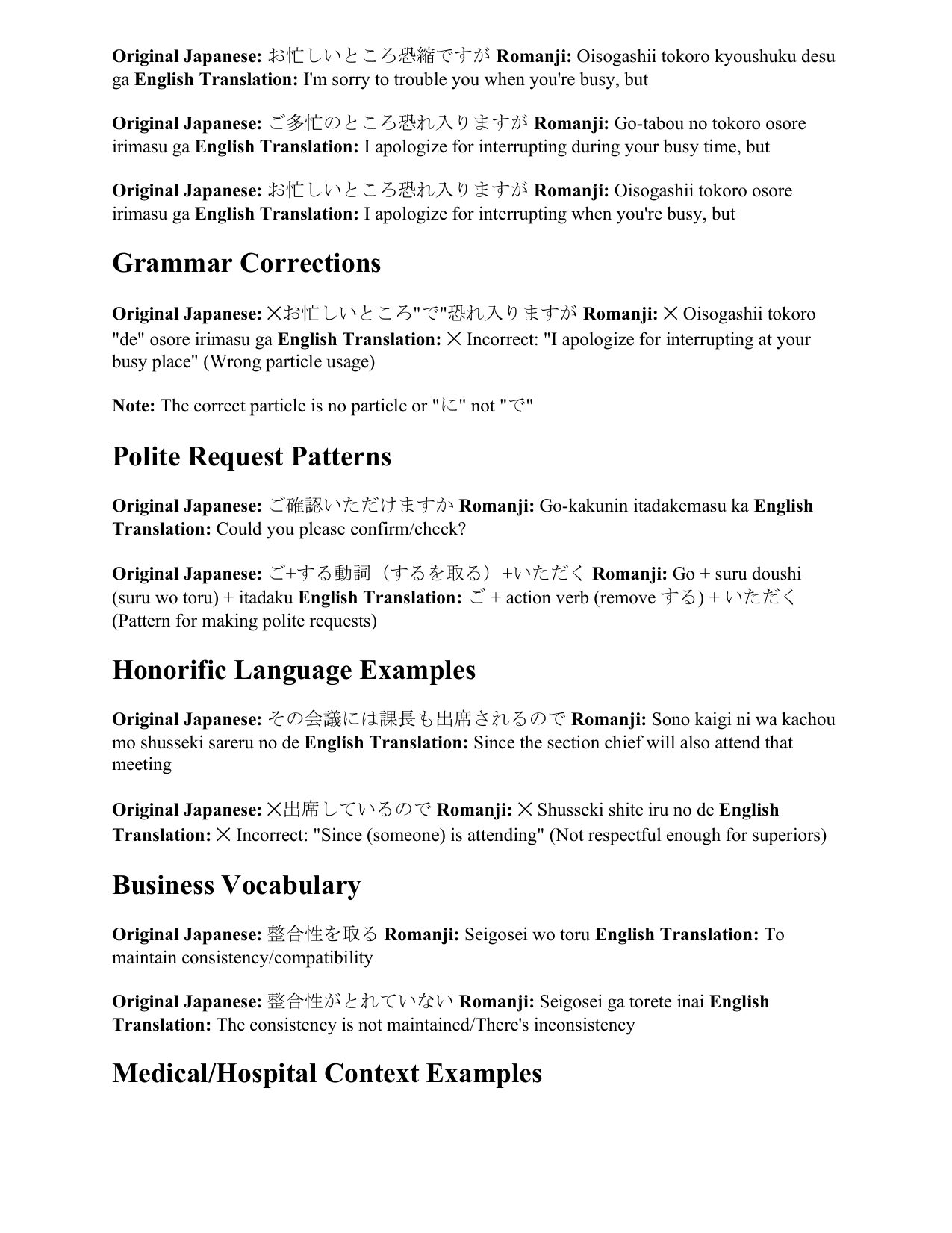
ENOriginal Japanese: お忙しいところ恐縮ですが Romanji: Oisogashii tokoro kyoushuku desu
ga English Translation: I'm sorry to trouble you when you're busy, but
Original Japanese: ご多忙のところ恐れ入りますが Romanji: Go-tabou no tokoro osore
irimasu ga English Translation: I apologize for interrupting during your busy time, but
Original Japanese: お忙しいところ恐れ入りますが Romanji: Oisogashii tokoro osore
irimasu ga English Translation: I apologize for interrupting when you're busy, but
Grammar Corrections
Original Japanese: ✕お忙しいところ"で"恐れ入りますが Romanji: ✕ Oisogashii tokoro
"de" osore irimasu ga English Translation: ✕ Incorrect: "I apologize for interrupting at your
busy place" (Wrong particle usage)
Note: The correct particle is no particle or "に" not "で"
Polite Request Patterns
Original Japanese: ご確認いただけますか Romanji: Go-kakunin itadakemasu ka English
Translation: Could you please confirm/check?
Original Japanese: ご+する動詞(するを取る)+いただく Romanji: Go + suru doushi
(suru wo toru) + itadaku English Translation: ご + action verb (remove する) + いただく
(Pattern for making polite requests)
Honorific Language Examples
Original Japanese: その会議には課長も出席されるので Romanji: Sono kaigi ni wa kachou
mo shusseki sareru no de English Translation: Since the section chief will also attend that
meeting
Original Japanese: ✕出席しているので Romanji: ✕ Shusseki shite iru no de English
Translation: ✕ Incorrect: "Since (someone) is attending" (Not respectful enough for superiors)
Business Vocabulary
Original Japanese: 整合性を取る Romanji: Seigosei wo toru English Translation: To
maintain consistency/compatibility
Original Japanese: 整合性がとれていない Romanji: Seigosei ga torete inai English
Translation: The consistency is not maintained/There's inconsistency
Medical/Hospital Context Examples
ga English Translation: I'm sorry to trouble you when you're busy, but
Original Japanese: ご多忙のところ恐れ入りますが Romanji: Go-tabou no tokoro osore
irimasu ga English Translation: I apologize for interrupting during your busy time, but
Original Japanese: お忙しいところ恐れ入りますが Romanji: Oisogashii tokoro osore
irimasu ga English Translation: I apologize for interrupting when you're busy, but
Grammar Corrections
Original Japanese: ✕お忙しいところ"で"恐れ入りますが Romanji: ✕ Oisogashii tokoro
"de" osore irimasu ga English Translation: ✕ Incorrect: "I apologize for interrupting at your
busy place" (Wrong particle usage)
Note: The correct particle is no particle or "に" not "で"
Polite Request Patterns
Original Japanese: ご確認いただけますか Romanji: Go-kakunin itadakemasu ka English
Translation: Could you please confirm/check?
Original Japanese: ご+する動詞(するを取る)+いただく Romanji: Go + suru doushi
(suru wo toru) + itadaku English Translation: ご + action verb (remove する) + いただく
(Pattern for making polite requests)
Honorific Language Examples
Original Japanese: その会議には課長も出席されるので Romanji: Sono kaigi ni wa kachou
mo shusseki sareru no de English Translation: Since the section chief will also attend that
meeting
Original Japanese: ✕出席しているので Romanji: ✕ Shusseki shite iru no de English
Translation: ✕ Incorrect: "Since (someone) is attending" (Not respectful enough for superiors)
Business Vocabulary
Original Japanese: 整合性を取る Romanji: Seigosei wo toru English Translation: To
maintain consistency/compatibility
Original Japanese: 整合性がとれていない Romanji: Seigosei ga torete inai English
Translation: The consistency is not maintained/There's inconsistency
Medical/Hospital Context Examples
หน้า 44
คลิกเพื่อขยาย
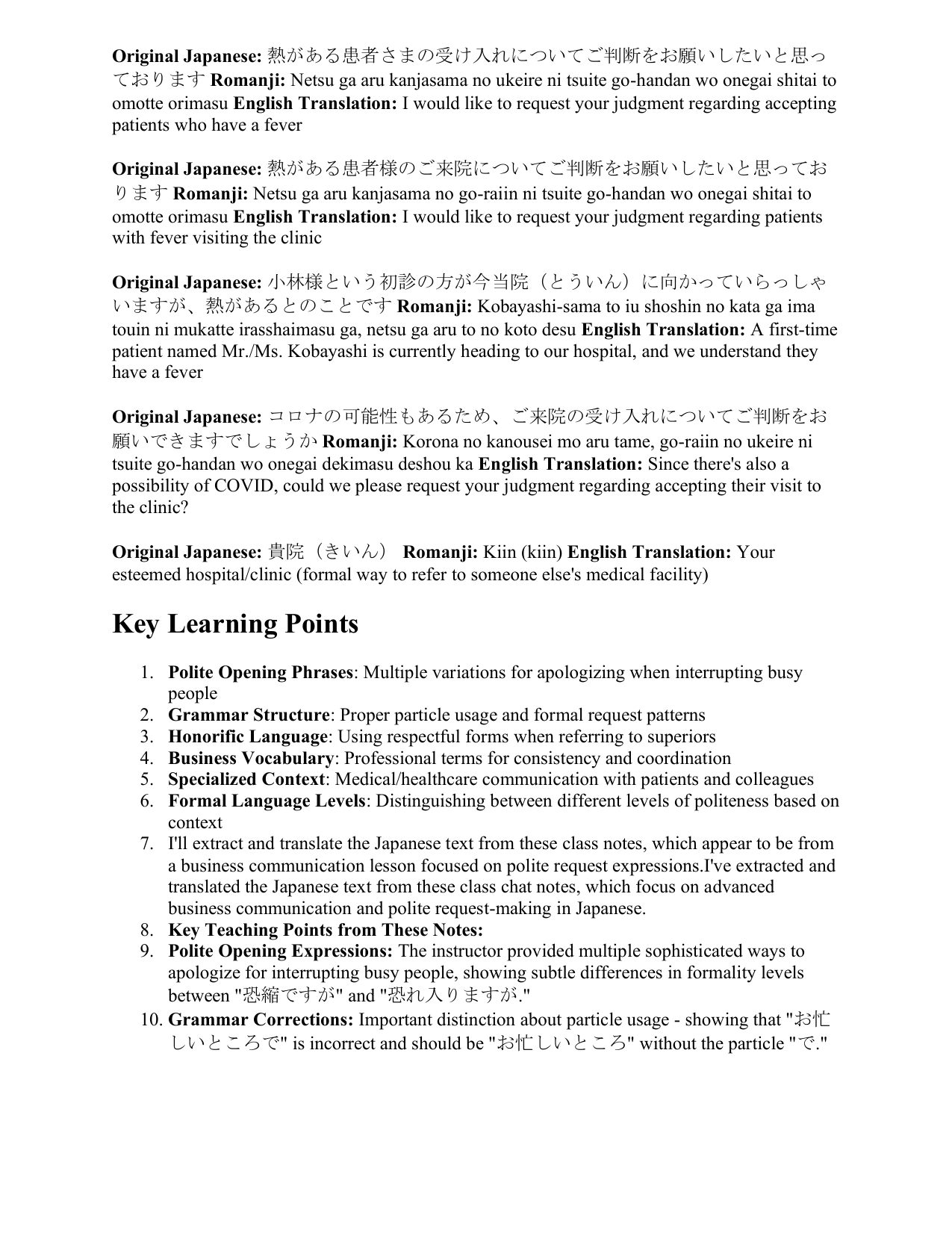
JPOriginalJapanese:熱がある患者さまの受け入れについてご判断をお願いしたいと思っ
ENております Romanji: Netsu ga aru kanjasama no ukeire ni tsuite go-handan wo onegai shitai to
omotte orimasu English Translation: I would like to request your judgment regarding accepting
patients who have a fever
omotte orimasu English Translation: I would like to request your judgment regarding accepting
patients who have a fever
JPOriginalJapanese:熱がある患者様のご来院についてご判断をお願いしたいと思ってお
ENります Romanji: Netsu ga aru kanjasama no go-raiin ni tsuite go-handan wo onegai shitai to
omotte orimasu English Translation: I would like to request your judgment regarding patients
with fever visiting the clinic
omotte orimasu English Translation: I would like to request your judgment regarding patients
with fever visiting the clinic
JPOriginalJapanese:小林様という初診の方が今当院(とういん)に向かっていらっしゃ
ENいますが、熱があるとのことです Romanji: Kobayashi-sama to iu shoshin no kata ga ima
touin ni mukatte irasshaimasu ga, netsu ga aru to no koto desu English Translation: A first-time
patient named Mr./Ms. Kobayashi is currently heading to our hospital, and we understand they
have a fever
touin ni mukatte irasshaimasu ga, netsu ga aru to no koto desu English Translation: A first-time
patient named Mr./Ms. Kobayashi is currently heading to our hospital, and we understand they
have a fever
JPOriginalJapanese:コロナの可能性もあるため、ご来院の受け入れについてご判断をお
EN願いできますでしょうか Romanji: Korona no kanousei mo aru tame, go-raiin no ukeire ni
tsuite go-handan wo onegai dekimasu deshou ka English Translation: Since there's also a
possibility of COVID, could we please request your judgment regarding accepting their visit to
the clinic?
Original Japanese: 貴院(きいん) Romanji: Kiin (kiin) English Translation: Your
esteemed hospital/clinic (formal way to refer to someone else's medical facility)
Key Learning Points
1. Polite Opening Phrases: Multiple variations for apologizing when interrupting busy
people
2. Grammar Structure: Proper particle usage and formal request patterns
3. Honorific Language: Using respectful forms when referring to superiors
4. Business Vocabulary: Professional terms for consistency and coordination
5. Specialized Context: Medical/healthcare communication with patients and colleagues
6. Formal Language Levels: Distinguishing between different levels of politeness based on
context
7. I'll extract and translate the Japanese text from these class notes, which appear to be from
a business communication lesson focused on polite request expressions.I've extracted and
translated the Japanese text from these class chat notes, which focus on advanced
business communication and polite request-making in Japanese.
8. Key Teaching Points from These Notes:
9. Polite Opening Expressions: The instructor provided multiple sophisticated ways to
apologize for interrupting busy people, showing subtle differences in formality levels
tsuite go-handan wo onegai dekimasu deshou ka English Translation: Since there's also a
possibility of COVID, could we please request your judgment regarding accepting their visit to
the clinic?
Original Japanese: 貴院(きいん) Romanji: Kiin (kiin) English Translation: Your
esteemed hospital/clinic (formal way to refer to someone else's medical facility)
Key Learning Points
1. Polite Opening Phrases: Multiple variations for apologizing when interrupting busy
people
2. Grammar Structure: Proper particle usage and formal request patterns
3. Honorific Language: Using respectful forms when referring to superiors
4. Business Vocabulary: Professional terms for consistency and coordination
5. Specialized Context: Medical/healthcare communication with patients and colleagues
6. Formal Language Levels: Distinguishing between different levels of politeness based on
context
7. I'll extract and translate the Japanese text from these class notes, which appear to be from
a business communication lesson focused on polite request expressions.I've extracted and
translated the Japanese text from these class chat notes, which focus on advanced
business communication and polite request-making in Japanese.
8. Key Teaching Points from These Notes:
9. Polite Opening Expressions: The instructor provided multiple sophisticated ways to
apologize for interrupting busy people, showing subtle differences in formality levels
JPbetween"恐縮ですが"and"恐れ入りますが."
EN 10. Grammar Corrections: Important distinction about particle usage - showing that "お忙
しいところで" is incorrect and should be "お忙しいところ" without the particle "で."
しいところで" is incorrect and should be "お忙しいところ" without the particle "で."
หน้า 45
คลิกเพื่อขยาย
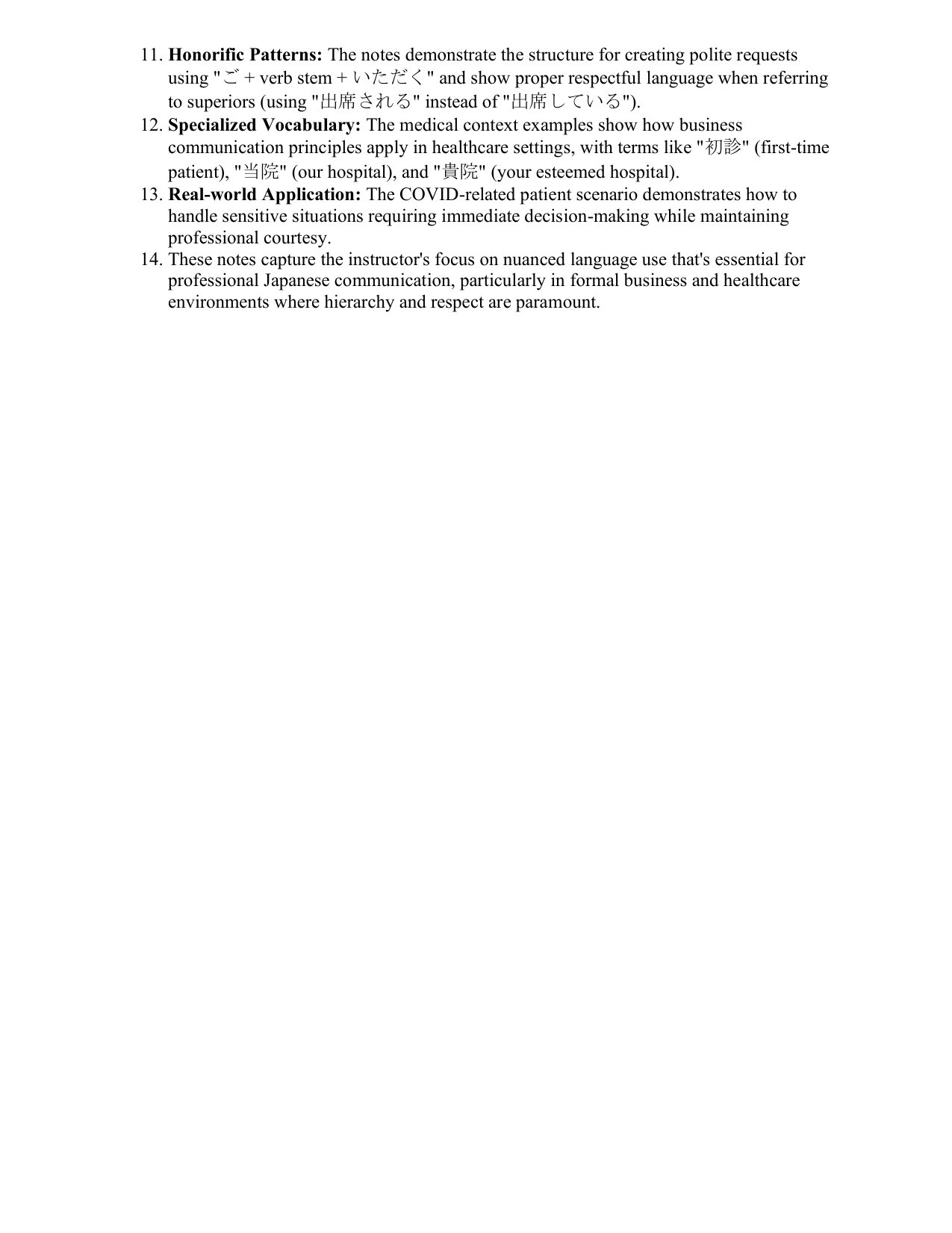
EN11. Honorific Patterns: The notes demonstrate the structure for creating polite requests
using "ご + verb stem + いただく" and show proper respectful language when referring
to superiors (using "出席される" instead of "出席している").
12. Specialized Vocabulary: The medical context examples show how business
communication principles apply in healthcare settings, with terms like "初診" (first-time
patient), "当院" (our hospital), and "貴院" (your esteemed hospital).
13. Real-world Application: The COVID-related patient scenario demonstrates how to
handle sensitive situations requiring immediate decision-making while maintaining
professional courtesy.
14. These notes capture the instructor's focus on nuanced language use that's essential for
professional Japanese communication, particularly in formal business and healthcare
environments where hierarchy and respect are paramount.
using "ご + verb stem + いただく" and show proper respectful language when referring
to superiors (using "出席される" instead of "出席している").
12. Specialized Vocabulary: The medical context examples show how business
communication principles apply in healthcare settings, with terms like "初診" (first-time
patient), "当院" (our hospital), and "貴院" (your esteemed hospital).
13. Real-world Application: The COVID-related patient scenario demonstrates how to
handle sensitive situations requiring immediate decision-making while maintaining
professional courtesy.
14. These notes capture the instructor's focus on nuanced language use that's essential for
professional Japanese communication, particularly in formal business and healthcare
environments where hierarchy and respect are paramount.