หน้า 1
คลิกเพื่อขยาย
ENJAPANESE FOR MEETINGS
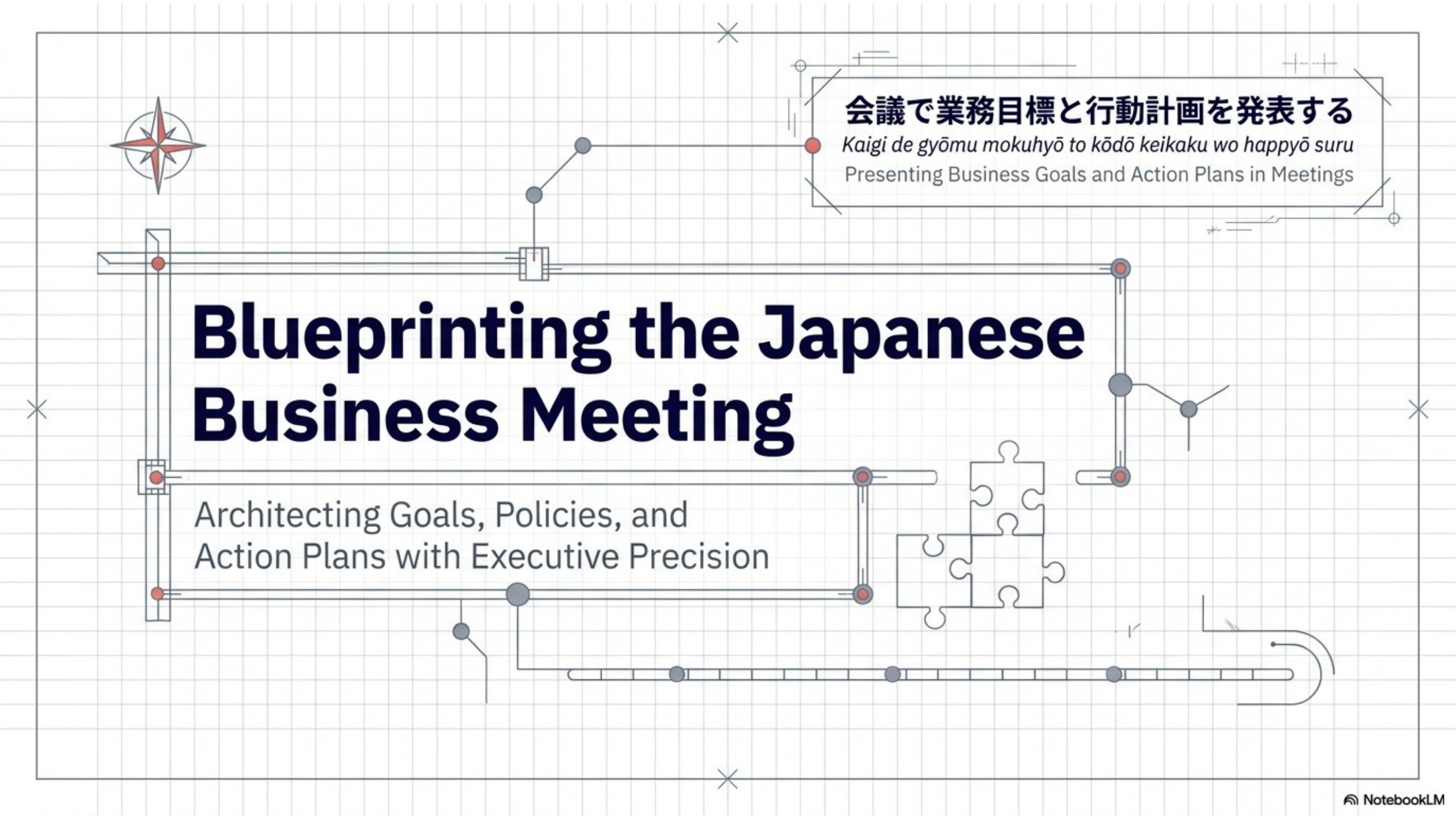
JP会議の日本語
ENWEEK 1
JPかいぎぎょうむもくひょう
会議で業務目標と
こうどうけいかくはっぴょう
行動計画を発表する
会議で業務目標と
こうどうけいかくはっぴょう
行動計画を発表する
หน้า 2
คลิกเพื่อขยาย
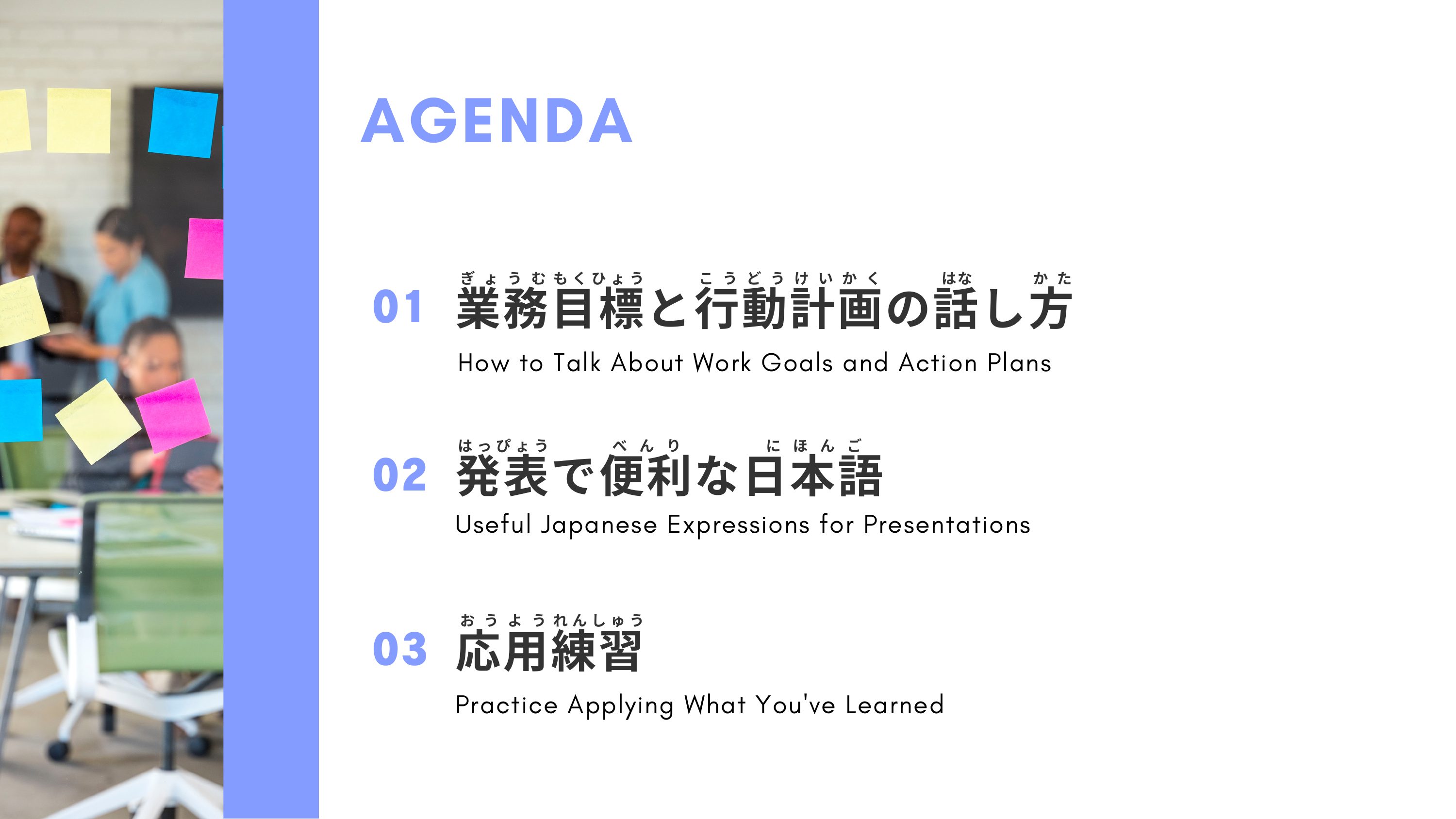
ENAGENDA
JPぎょうむもくひょうこうどうけいかくはなかた
01業務目標と行動計画の話し方
01業務目標と行動計画の話し方
EN How to Talk About Work Goals and Action Plans
JPはっぴょうべんりにほんご
02発表で便利な日本語
02発表で便利な日本語
EN Useful Japanese Expressions for Presentations
JPおうようれんしゅう
03応用練習
03応用練習
EN Practice Applying What You've Learned
หน้า 3
คลิกเพื่อขยาย
EN LESSON GOAL
JPかいぎもくひょうほうしん
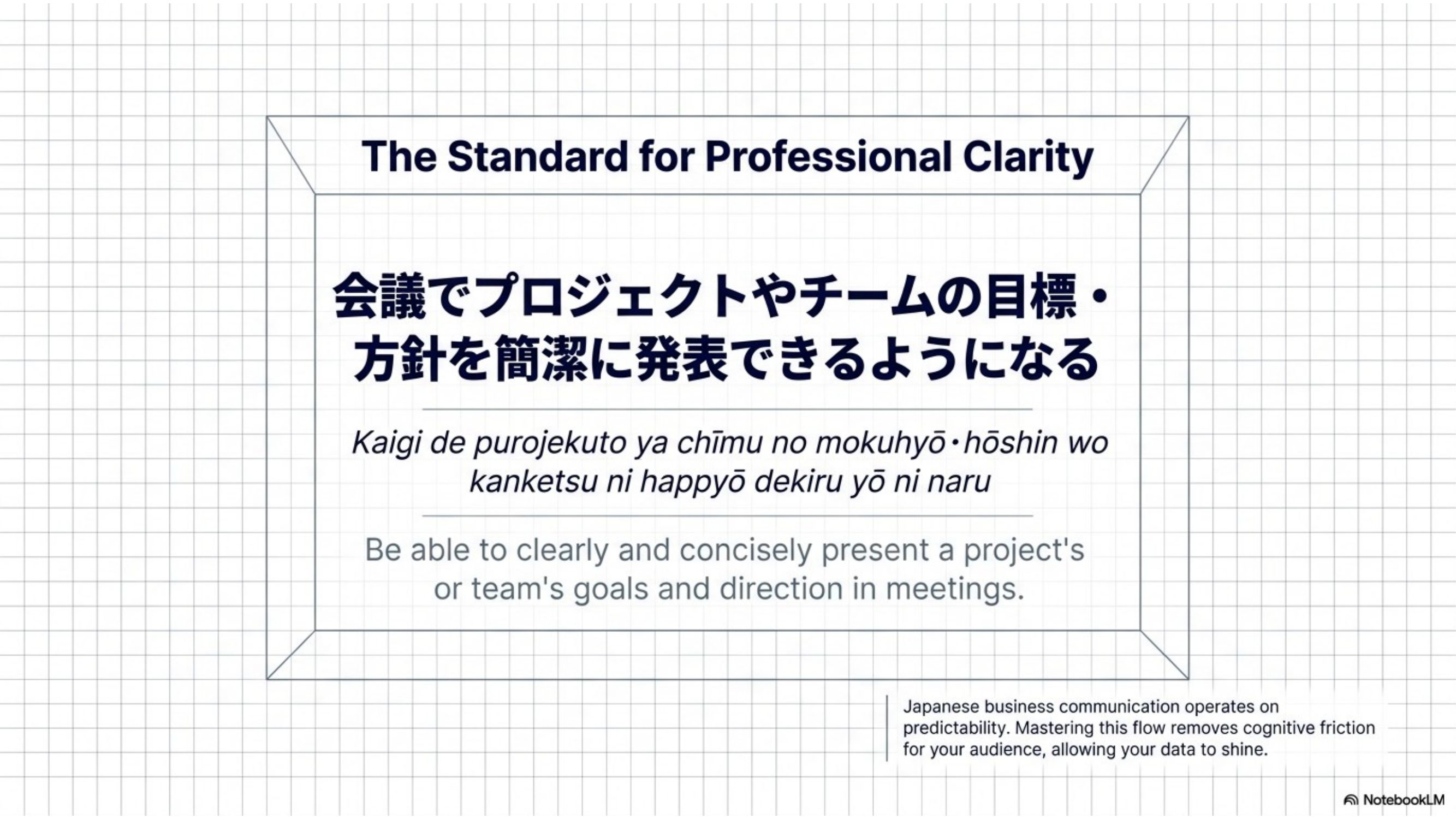
会議でプロジェクトやチームの目標・方針を
かんけつはっぴょう
簡潔に発表できるようになる
会議でプロジェクトやチームの目標・方針を
かんけつはっぴょう
簡潔に発表できるようになる
EN BE ABLE TO CLEARLY AND CONCISELY PRESENT A PROJECT’S
OR TEAM’S GOALS AND DIRECTION IN MEETINGS
OR TEAM’S GOALS AND DIRECTION IN MEETINGS
หน้า 4
คลิกเพื่อขยาย
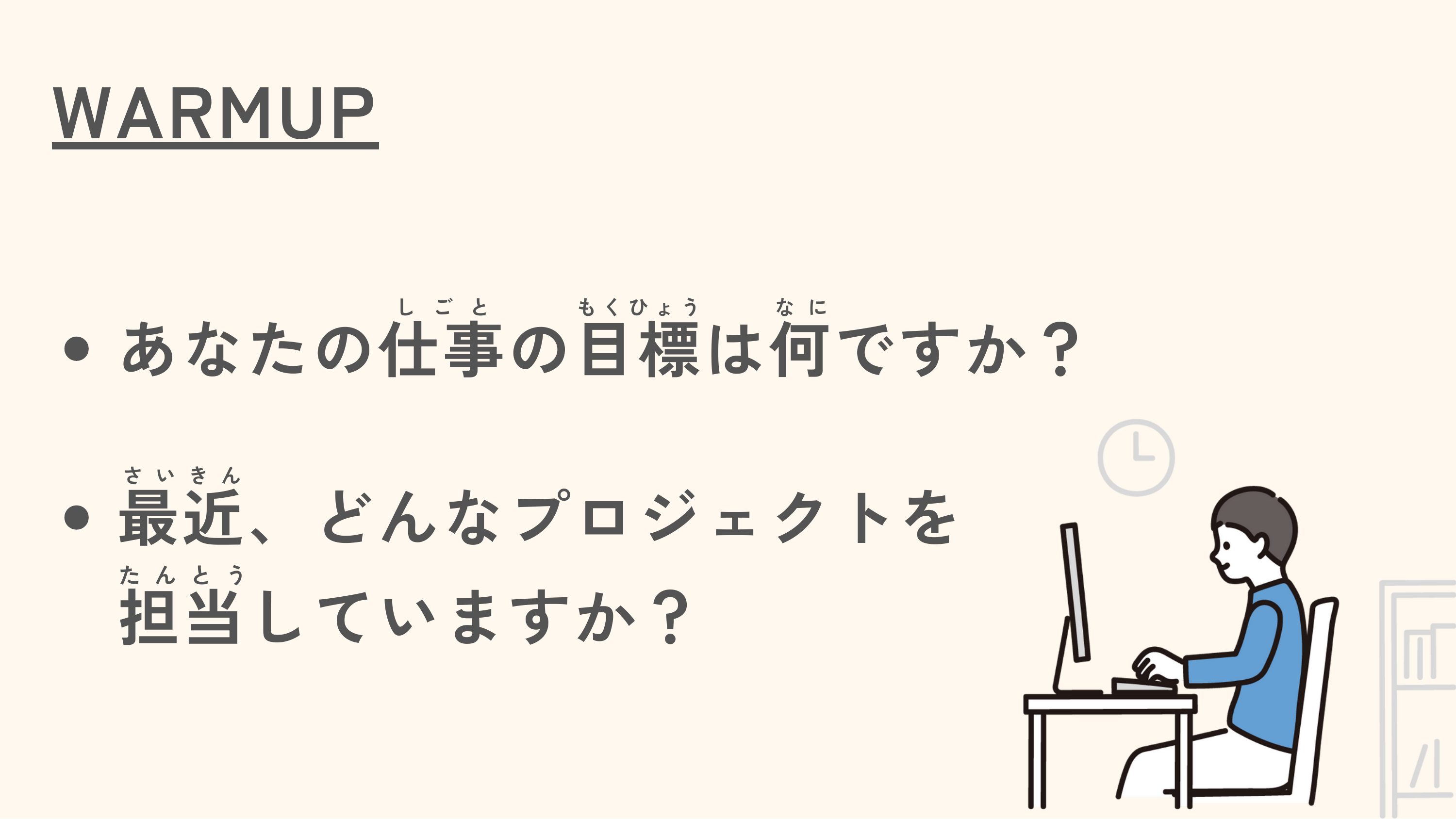
ENWARMUP
JPしごともくひょうなに
あなたの仕事の目標は何ですか?
さいきん
最近、どんなプロジェクトを
たんとう
担当していますか?
あなたの仕事の目標は何ですか?
さいきん
最近、どんなプロジェクトを
たんとう
担当していますか?
หน้า 5
คลิกเพื่อขยาย
EN AGENDA 1
JPぎょうむもくひょうこうどうけいかくはなかた
業務目標と行動計画の話し方
業務目標と行動計画の話し方
ENHow to Talk About Work Goals and Action Plans
หน้า 6
คลิกเพื่อขยาย
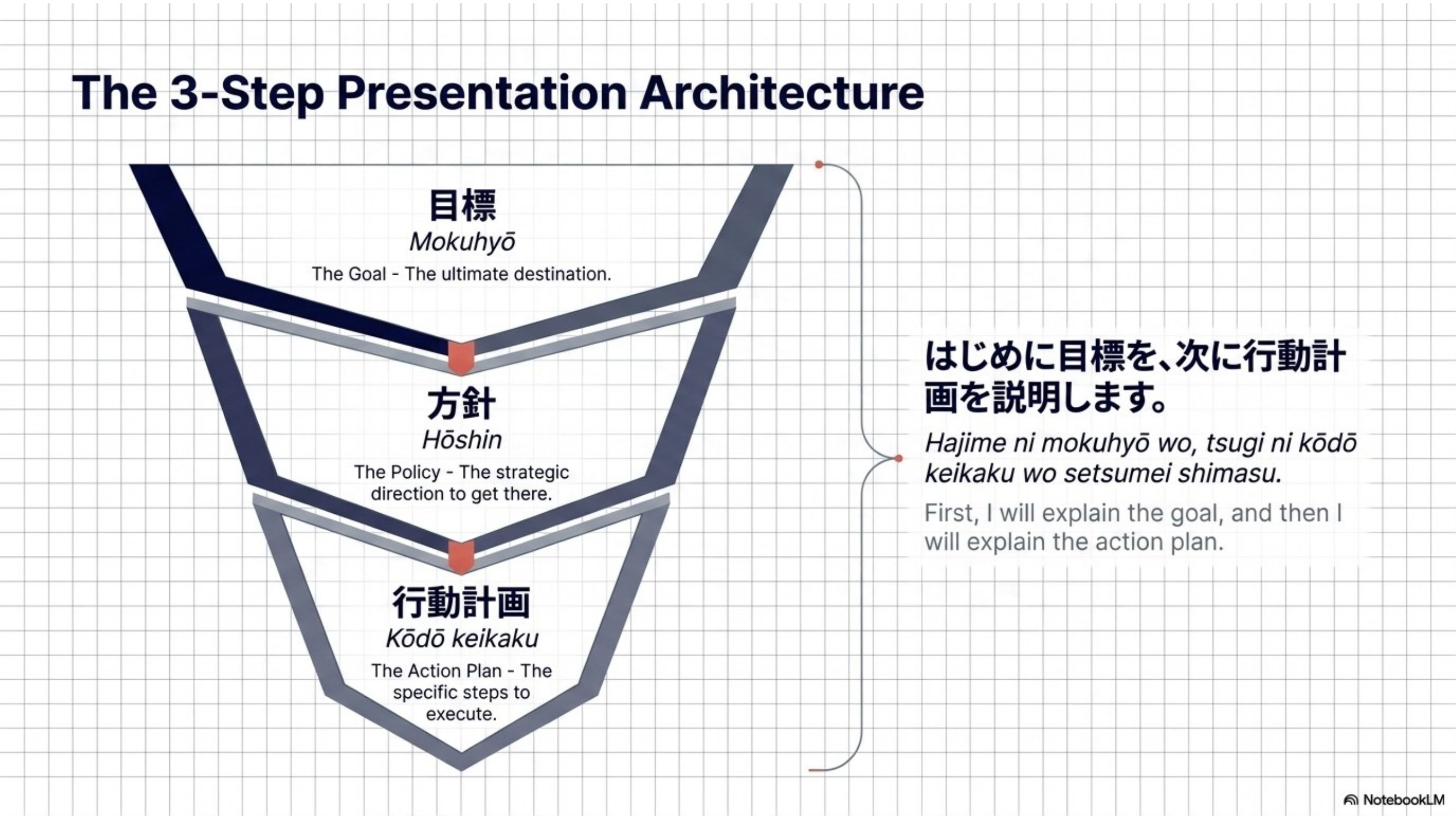
JPぎょうむもくひょうこうどうけいかくはっぴょうなが
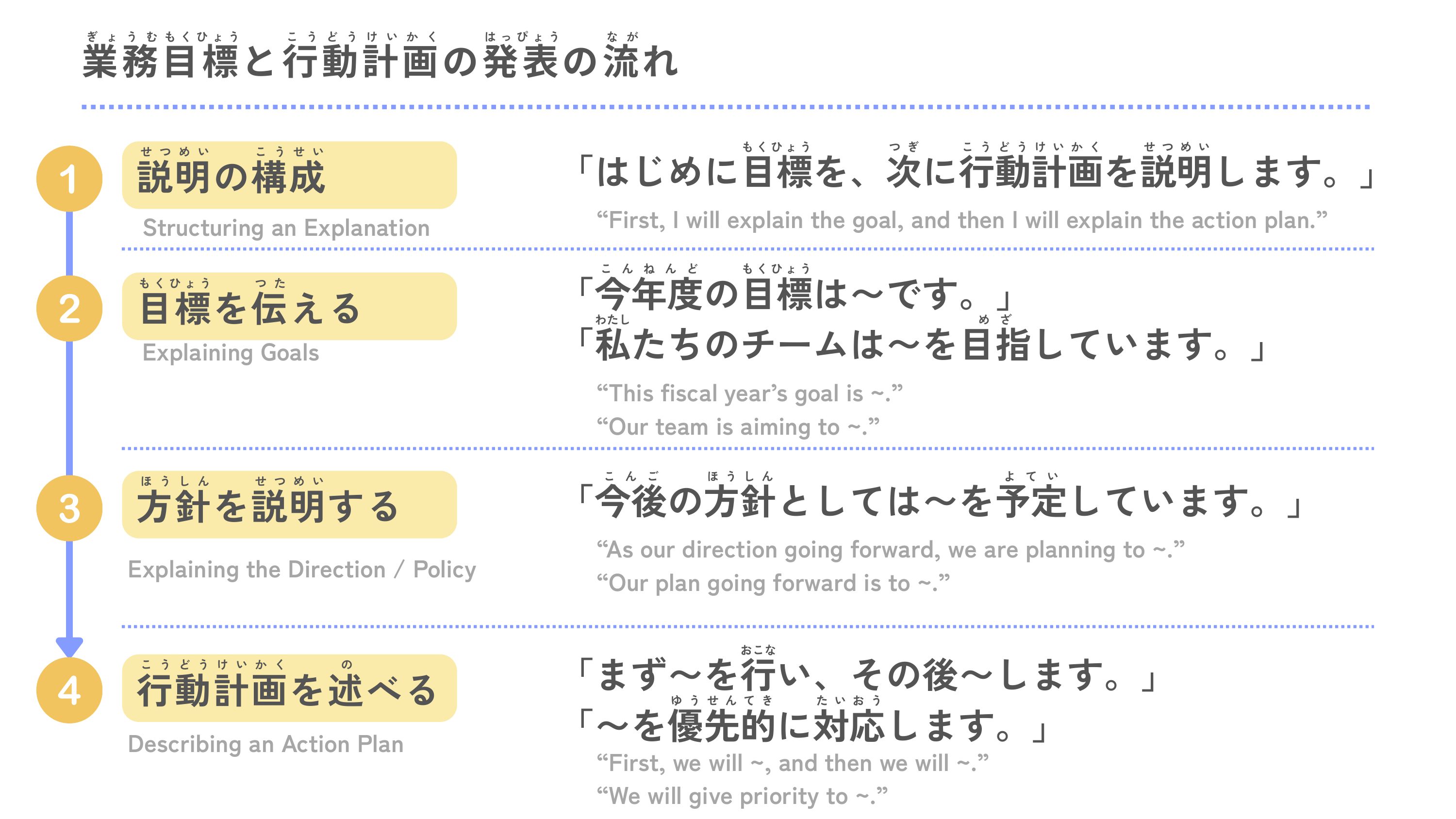
業務目標と行動計画の発表の流れ
せつめいこうせいもくひょうつぎこうどうけいかくせつめい
説明の構成「はじめに目標を、次に行動計画を説明します。」
業務目標と行動計画の発表の流れ
せつめいこうせいもくひょうつぎこうどうけいかくせつめい
説明の構成「はじめに目標を、次に行動計画を説明します。」
EN Structuring an Explanation “First, I will explain the goal, and then I will explain the action plan.”
JPこんねんどもくひょう
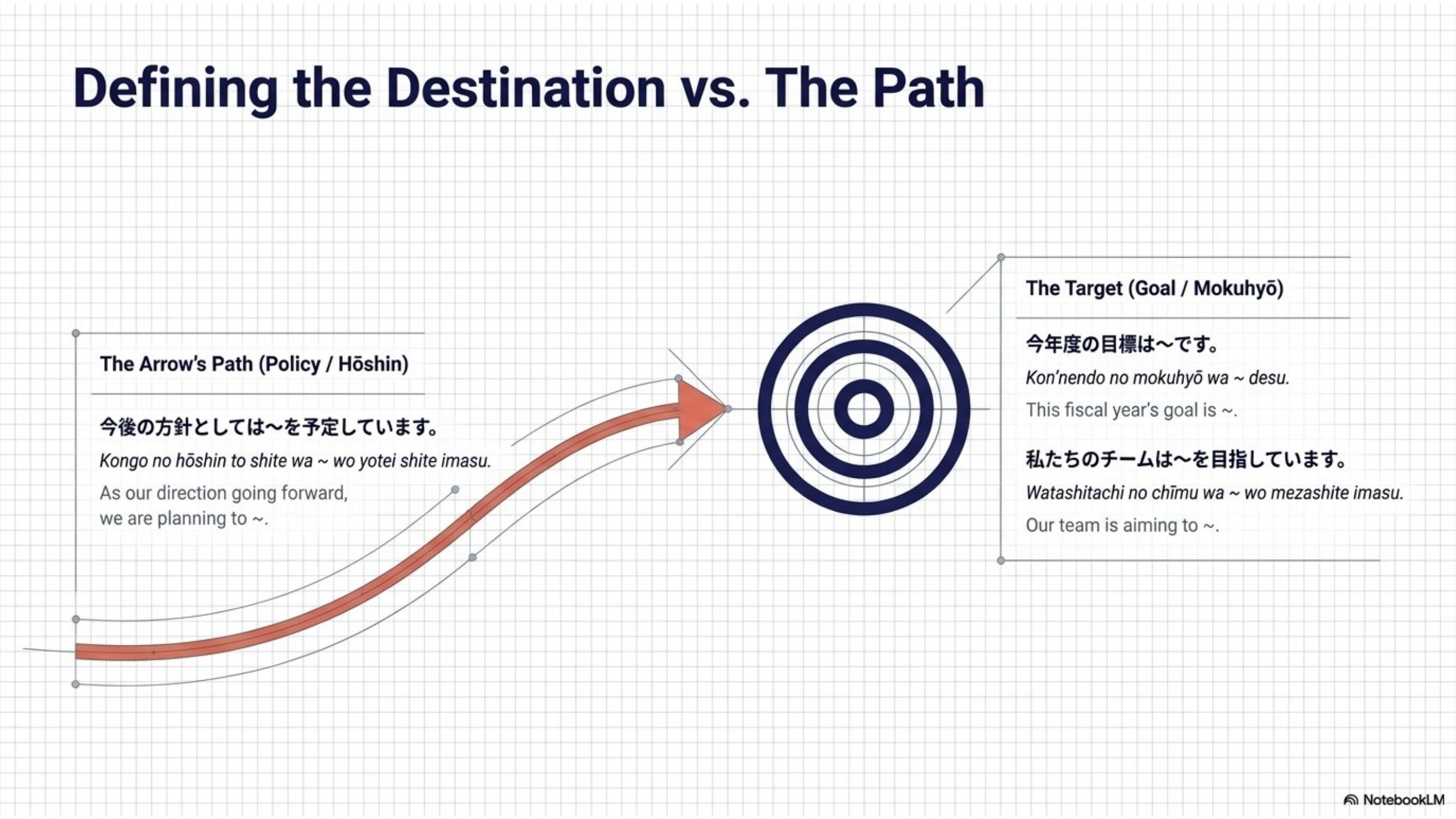
「今年度の目標は〜です。」
もくひょうつた
目標を伝えるわたしめざ
ExplainingGoals「私たちのチームは〜を目指しています。」
「今年度の目標は〜です。」
もくひょうつた
目標を伝えるわたしめざ
ExplainingGoals「私たちのチームは〜を目指しています。」
EN “This fiscal year’s goal is ~.”
“Our team is aiming to ~.”
“Our team is aiming to ~.”
JPほうしんせつめいこんごほうしんよてい
方針を説明する「今後の方針としては〜を予定しています。」
方針を説明する「今後の方針としては〜を予定しています。」
EN “As our direction going forward, we are planning to ~.”
Explaining the Direction / Policy
“Our plan going forward is to ~.”
Explaining the Direction / Policy
“Our plan going forward is to ~.”
JPおこな
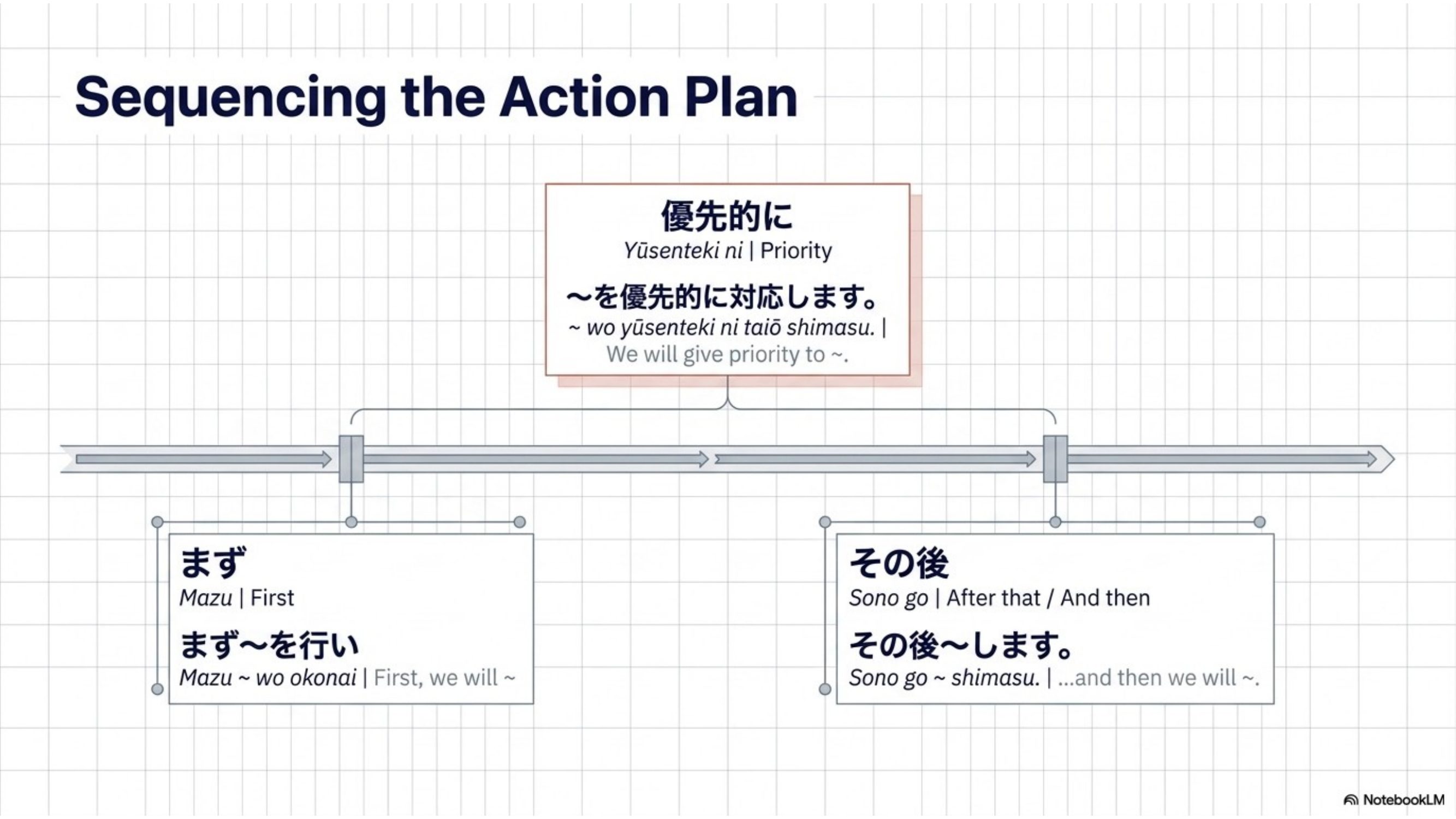
「まず〜を行い、その後〜します。」
こうどうけいかくの
行動計画を述べるゆうせんてきたいおう
「まず〜を行い、その後〜します。」
こうどうけいかくの
行動計画を述べるゆうせんてきたいおう
EN Describing an Action Plan
JP「〜を優先的に対応します。」
EN “First, we will ~, and then we will ~.”
“We will give priority to ~.”
“We will give priority to ~.”
หน้า 7
คลิกเพื่อขยาย
JPミニ練習
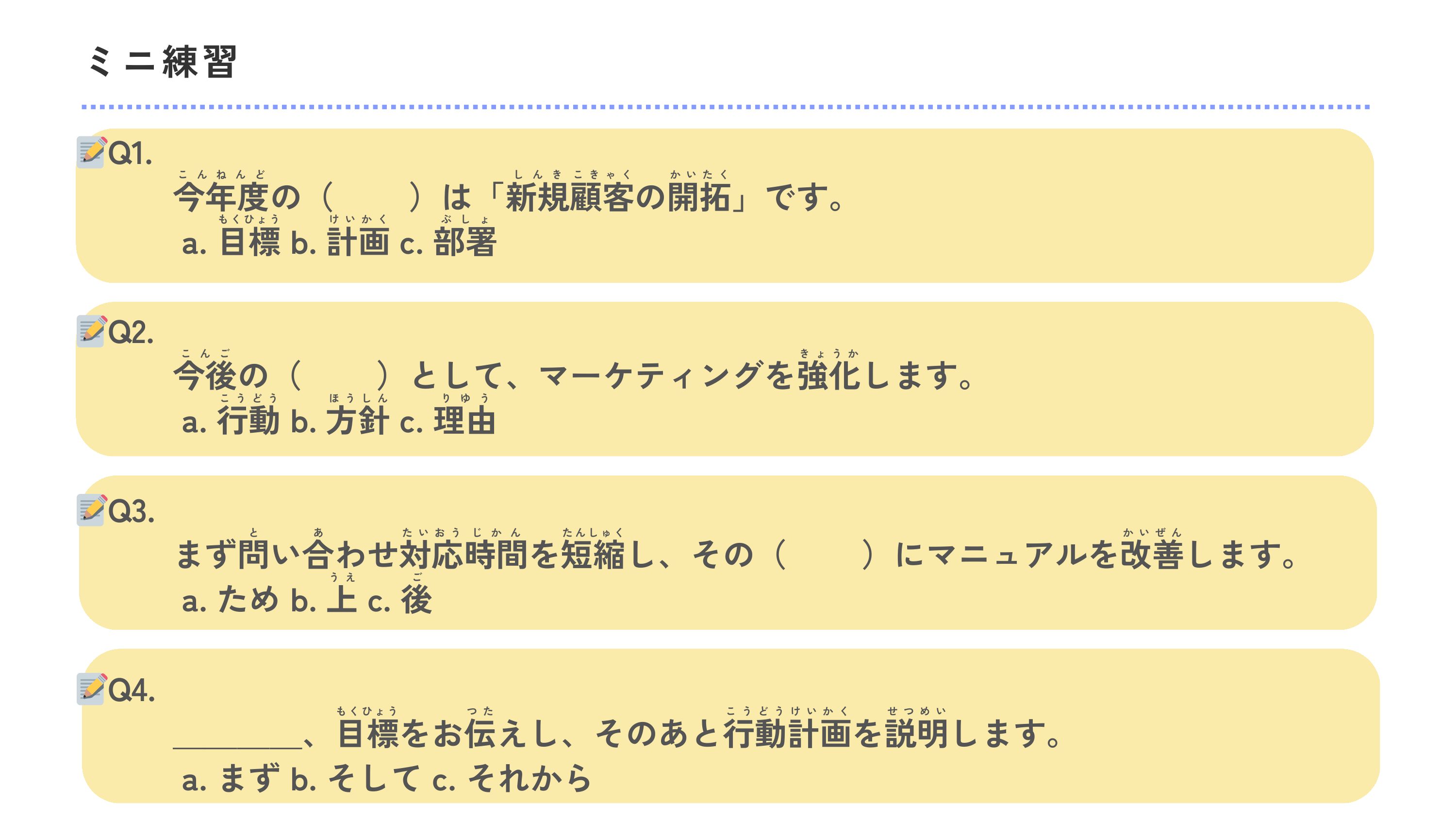
📝Q1.こんねんどしんきこきゃくかいたく
今年度の(
もくひょう
)は「新規顧客の開拓」です。
けいかくぶしょ
a.目標b.計画c.部署
📝Q2.こんごきょうか
今後の(こうどう
)として、マーケティングを強化します。
ほうしんりゆう
a.行動b.方針c.理由
📝Q3.とあたいおうじかんたんしゅくかいぜん
まず問い合わせ対応時間を短縮し、その(
うえご
)にマニュアルを改善します。
a.ためb.上c.後
📝Q4.もくひょうつたこうどうけいかくせつめい
____、目標をお伝えし、そのあと行動計画を説明します。
a.まずb.そしてc.それから
📝Q1.こんねんどしんきこきゃくかいたく
今年度の(
もくひょう
)は「新規顧客の開拓」です。
けいかくぶしょ
a.目標b.計画c.部署
📝Q2.こんごきょうか
今後の(こうどう
)として、マーケティングを強化します。
ほうしんりゆう
a.行動b.方針c.理由
📝Q3.とあたいおうじかんたんしゅくかいぜん
まず問い合わせ対応時間を短縮し、その(
うえご
)にマニュアルを改善します。
a.ためb.上c.後
📝Q4.もくひょうつたこうどうけいかくせつめい
____、目標をお伝えし、そのあと行動計画を説明します。
a.まずb.そしてc.それから
หน้า 8
คลิกเพื่อขยาย
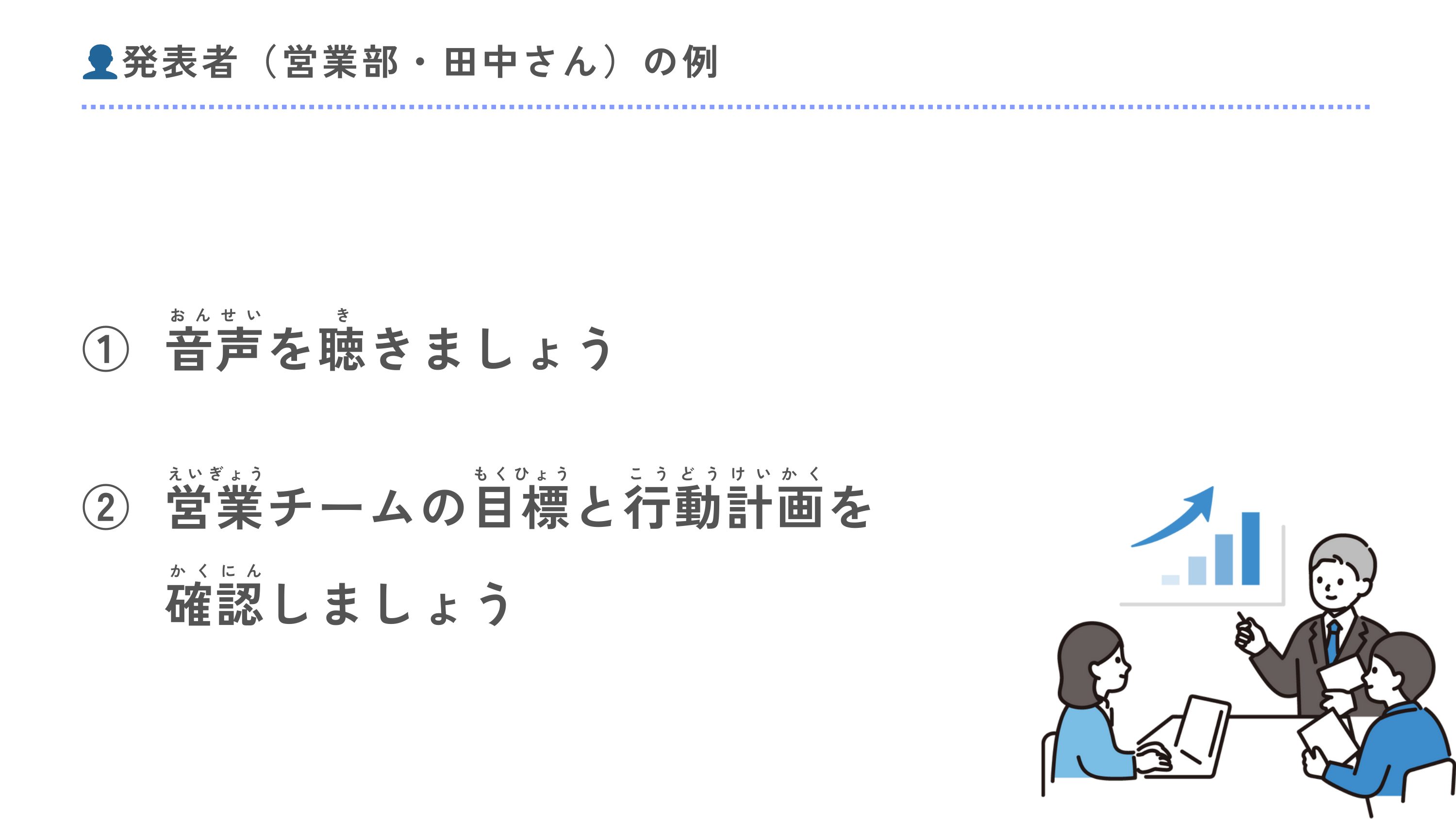
JP👤発表者(営業部・田中さん)の例
おんせいき
①音声を聴きましょう
えいぎょうもくひょうこうどうけいかく
②営業チームの目標と行動計画を
かくにん
確認しましょう
おんせいき
①音声を聴きましょう
えいぎょうもくひょうこうどうけいかく
②営業チームの目標と行動計画を
かくにん
確認しましょう
หน้า 9
คลิกเพื่อขยาย
JP👤発表者(営業部・田中さん)の例
えいぎょうぶたなか
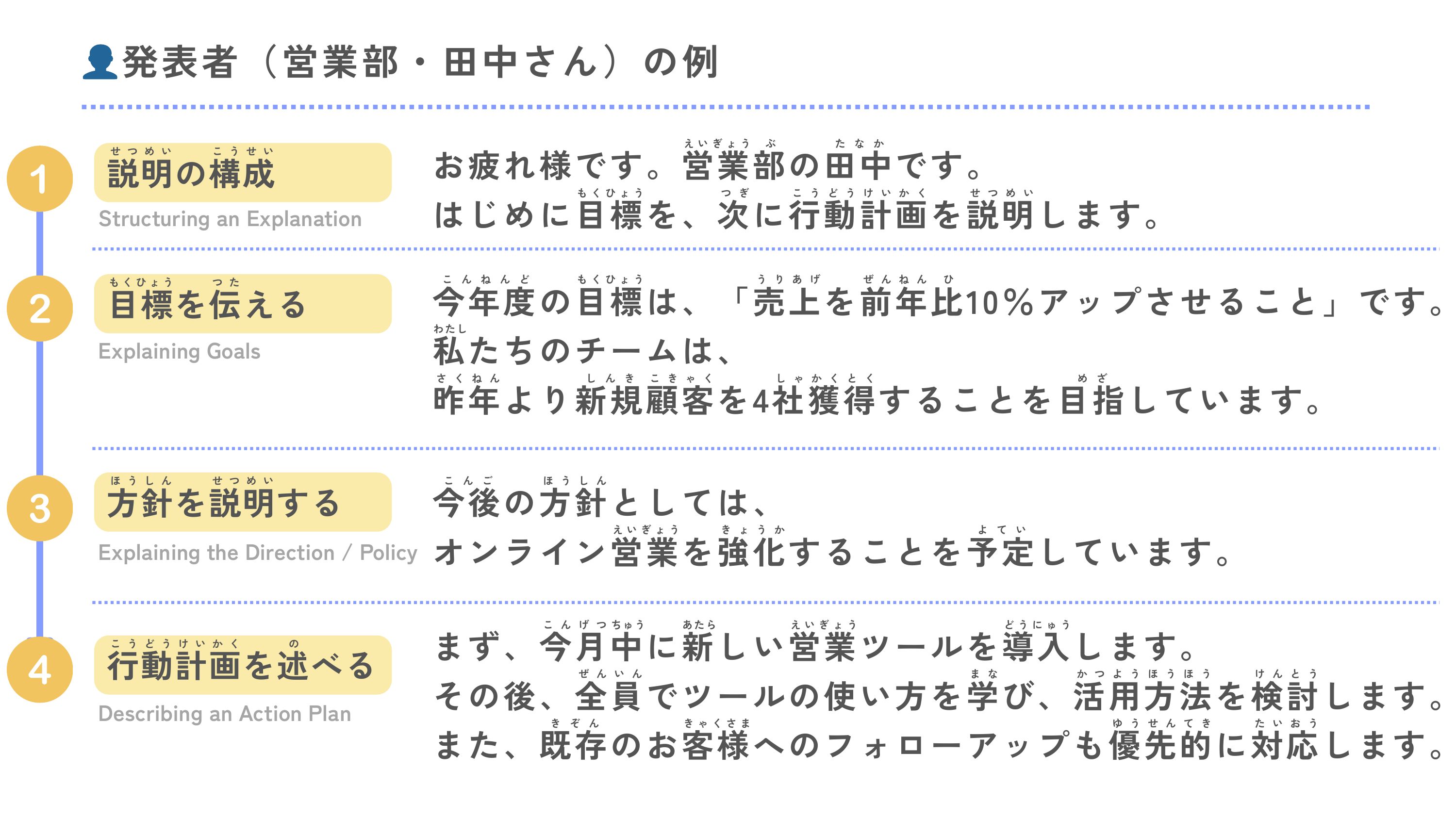
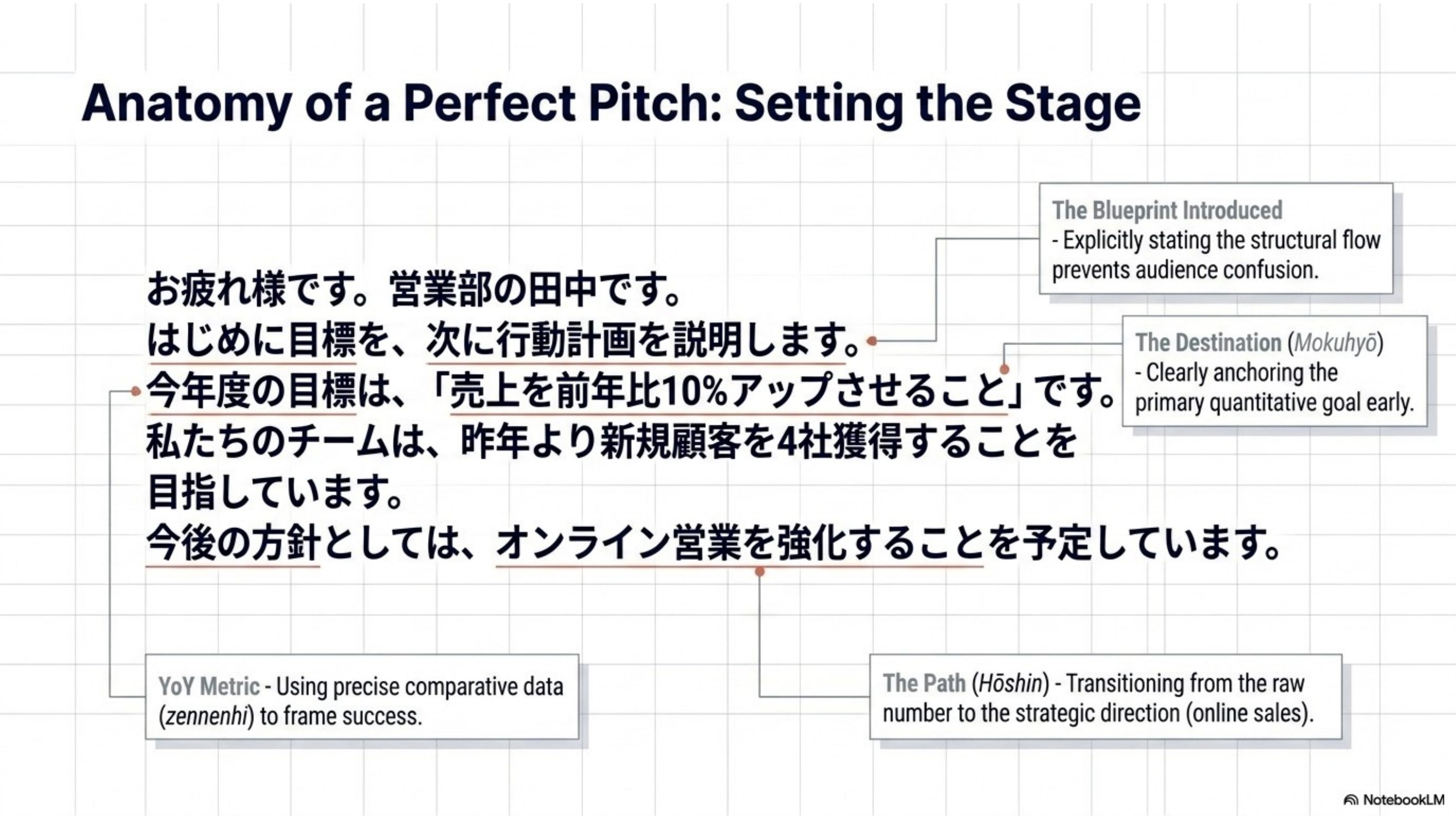
お疲れ様です。営業部の田中です。
せつめいこうせい
説明の構成もくひょうつぎこうどうけいかくせつめい
えいぎょうぶたなか
お疲れ様です。営業部の田中です。
せつめいこうせい
説明の構成もくひょうつぎこうどうけいかくせつめい
ENStructuring an Explanation はじめに目標を、次に行動計画を説明します。
JPもくひょうつたこんねんどもくひょううりあげぜんねんひ
目標を伝える今年度の目標は、「売上を前年比10%アップさせること」です。
わたし
目標を伝える今年度の目標は、「売上を前年比10%アップさせること」です。
わたし
ENExplaining Goals 私たちのチームは、
JPさくねんしんきこきゃくしゃかくとくめざ
昨年より新規顧客を4社獲得することを目指しています。
ほうしんせつめいこんごほうしん
方針を説明する今後の方針としては、
えいぎょうきょうかよてい
昨年より新規顧客を4社獲得することを目指しています。
ほうしんせつめいこんごほうしん
方針を説明する今後の方針としては、
えいぎょうきょうかよてい
ENExplaining the Direction / Policy オンライン営業を強化することを予定しています。
JPこんげつちゅうあたらえいぎょうどうにゅう
こうどうけいかくの
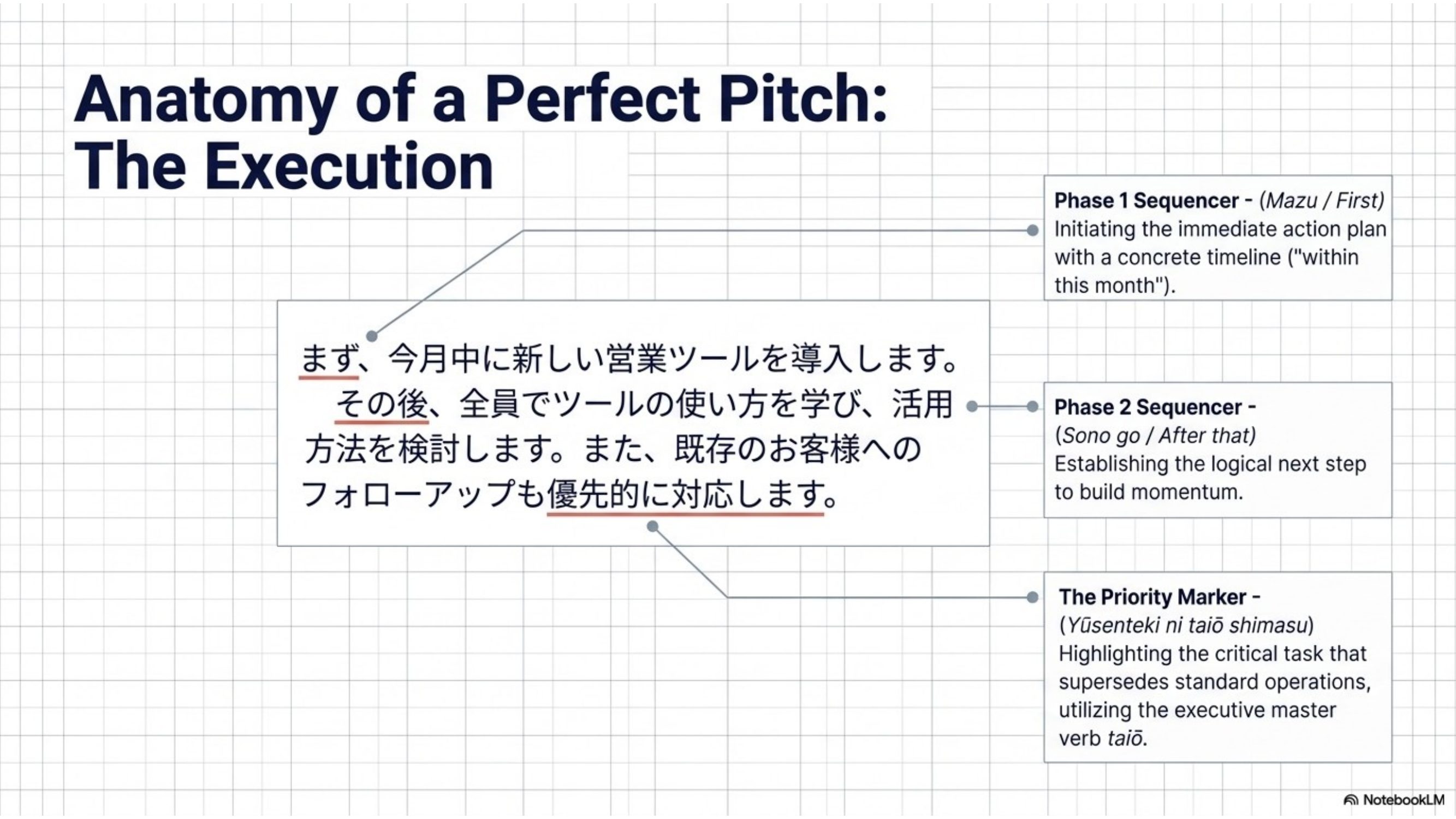
まず、今月中に新しい営業ツールを導入します。
行動計画を述べるぜんいんまなかつようほうほうけんとう
こうどうけいかくの
まず、今月中に新しい営業ツールを導入します。
行動計画を述べるぜんいんまなかつようほうほうけんとう
ENDescribing an Action Plan
JPその後、全員でツールの使い方を学び、活用方法を検討します。
きぞんきゃくさまゆうせんてきたいおう
また、既存のお客様へのフォローアップも優先的に対応します。
きぞんきゃくさまゆうせんてきたいおう
また、既存のお客様へのフォローアップも優先的に対応します。
หน้า 10
คลิกเพื่อขยาย
JPもくひょうつたこんねんどもくひょううりあげぜんねんひ
目標を伝える今年度の目標は、「売上を前年比10%アップさせること」です。
わたし
目標を伝える今年度の目標は、「売上を前年比10%アップさせること」です。
わたし
EN Explaining Goals 私たちのチームは、
JPさくねんしんきこきゃくしゃかくとくめざ
昨年より新規顧客を4社獲得することを目指しています。
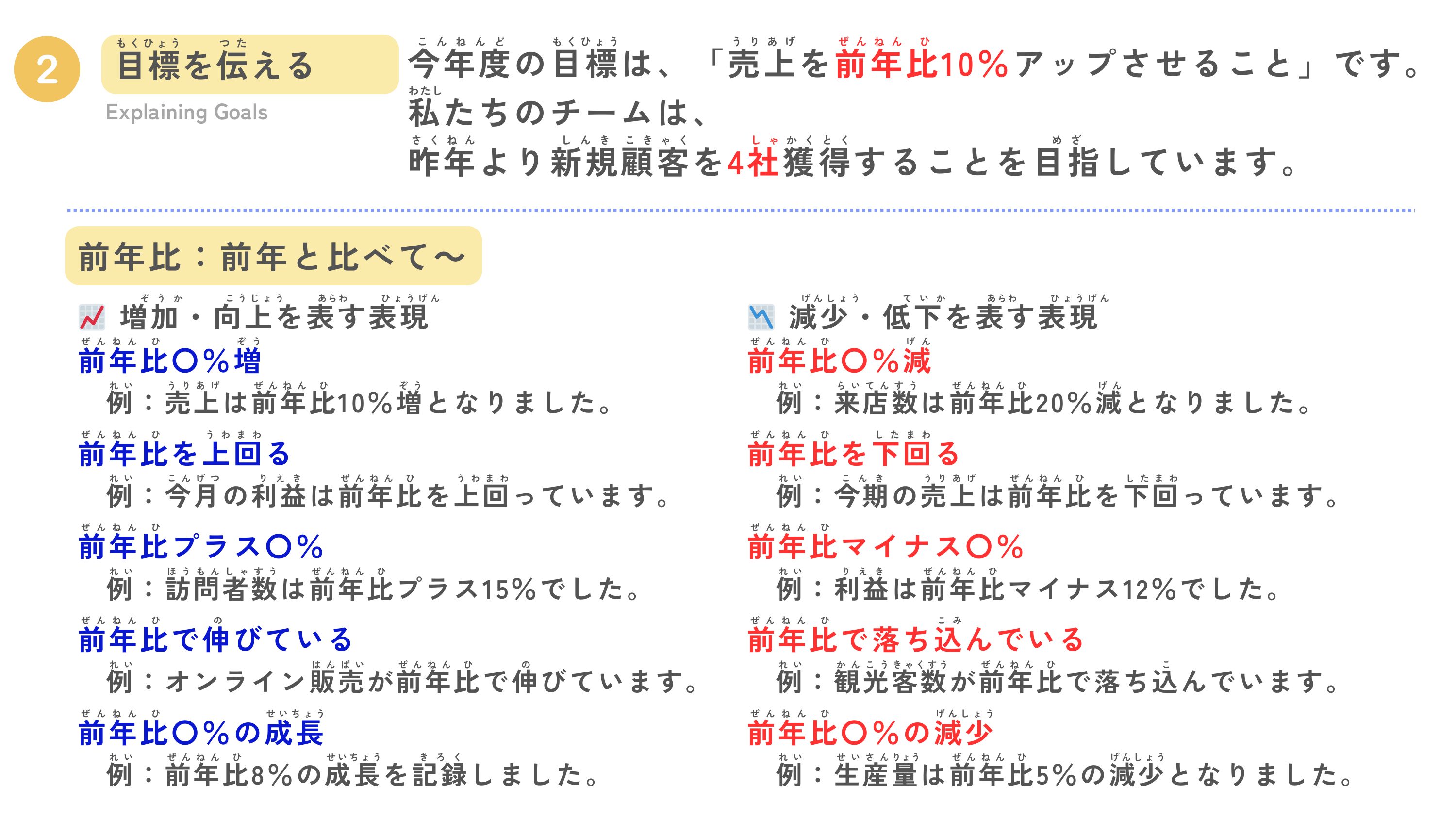
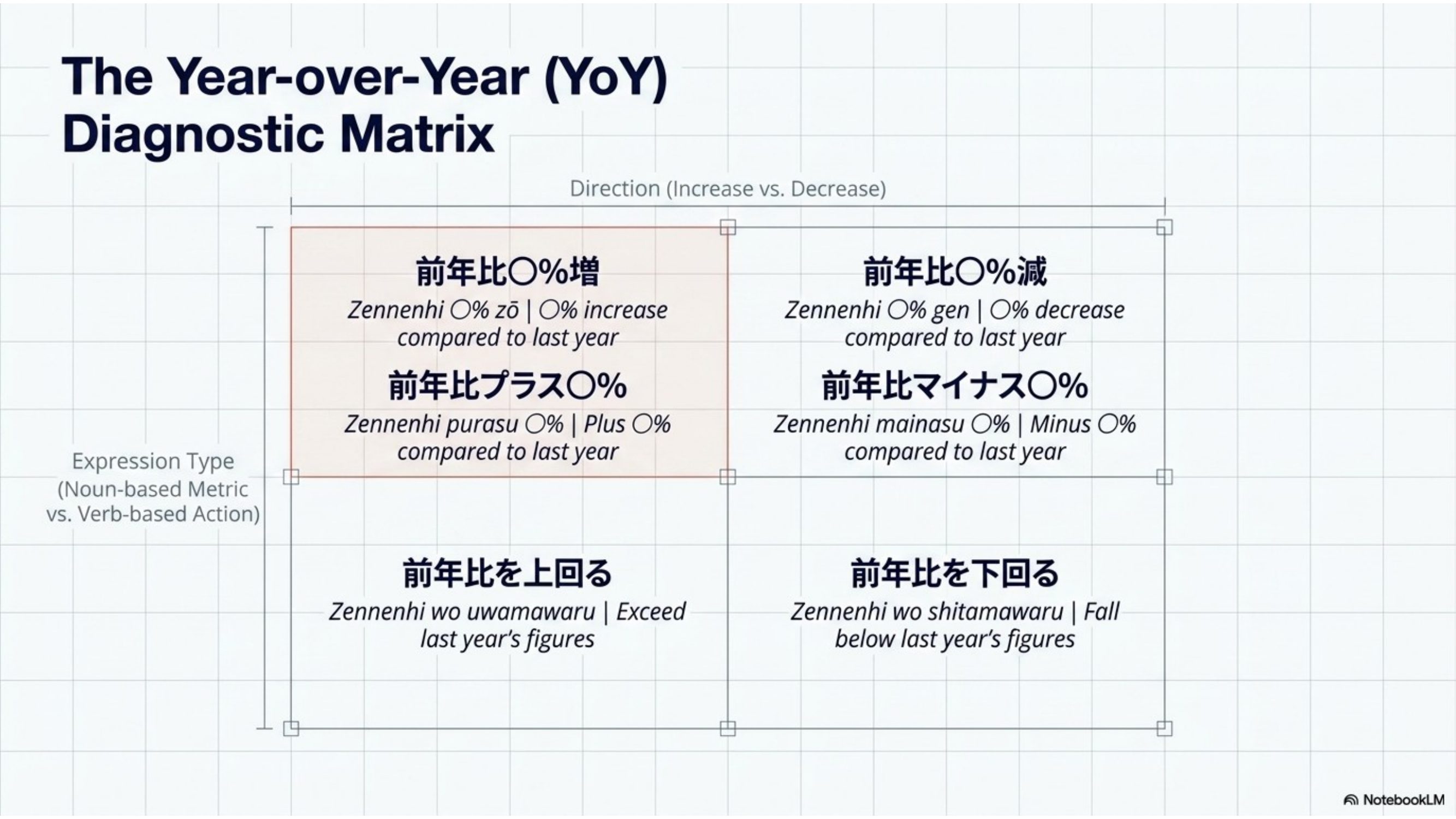
前年比:前年と比べて~
📈増加・向上を表す表現
ぜんねん
ぞうか
ひ
こうじょう
ぞう
あらわひょうげん
📉減少・低下を表す表現
ぜんねん
げんしょう
ひ
ていか
げん
あらわひょうげん
前年比〇%増前年比〇%減
れいうりあげぜんねんひぞうれいらいてんすうぜんねんひげん
例:売上は前年比10%増となりました。例:来店数は前年比20%減となりました。
ぜんねんひうわまわぜんねんひしたまわ
前年比を上回る前年比を下回る
れいこんげつりえきぜんねんひうわまわれいこんきうりあげぜんねんひしたまわ
例:今月の利益は前年比を上回っています。例:今期の売上は前年比を下回っています。
ぜんねんひぜんねんひ
前年比プラス〇%前年比マイナス〇%
れいほうもんしゃすうぜんねんひれいりえきぜんねんひ
例:訪問者数は前年比プラス15%でした。例:利益は前年比マイナス12%でした。
ぜんねんひのぜんねんひこみ
前年比で伸びている前年比で落ち込んでいる
れいはんばいぜんねんひのれいかんこうきゃくすうぜんねんひこ
例:オンライン販売が前年比で伸びています。例:観光客数が前年比で落ち込んでいます。
ぜんねんひせいちょうぜんねんひげんしょう
前年比〇%の成長前年比〇%の減少
れいぜんねんひせいちょうきろくれいせいさんりょうぜんねんひげんしょう
例:前年比8%の成長を記録しました。例:生産量は前年比5%の減少となりました。
昨年より新規顧客を4社獲得することを目指しています。
前年比:前年と比べて~
📈増加・向上を表す表現
ぜんねん
ぞうか
ひ
こうじょう
ぞう
あらわひょうげん
📉減少・低下を表す表現
ぜんねん
げんしょう
ひ
ていか
げん
あらわひょうげん
前年比〇%増前年比〇%減
れいうりあげぜんねんひぞうれいらいてんすうぜんねんひげん
例:売上は前年比10%増となりました。例:来店数は前年比20%減となりました。
ぜんねんひうわまわぜんねんひしたまわ
前年比を上回る前年比を下回る
れいこんげつりえきぜんねんひうわまわれいこんきうりあげぜんねんひしたまわ
例:今月の利益は前年比を上回っています。例:今期の売上は前年比を下回っています。
ぜんねんひぜんねんひ
前年比プラス〇%前年比マイナス〇%
れいほうもんしゃすうぜんねんひれいりえきぜんねんひ
例:訪問者数は前年比プラス15%でした。例:利益は前年比マイナス12%でした。
ぜんねんひのぜんねんひこみ
前年比で伸びている前年比で落ち込んでいる
れいはんばいぜんねんひのれいかんこうきゃくすうぜんねんひこ
例:オンライン販売が前年比で伸びています。例:観光客数が前年比で落ち込んでいます。
ぜんねんひせいちょうぜんねんひげんしょう
前年比〇%の成長前年比〇%の減少
れいぜんねんひせいちょうきろくれいせいさんりょうぜんねんひげんしょう
例:前年比8%の成長を記録しました。例:生産量は前年比5%の減少となりました。
หน้า 11
คลิกเพื่อขยาย
JP会議の日本語
ENKaigi no nihongo
Presenting Business Goals and Action
Presenting Business Goals and Action
JPWARMUP/ウォームアップ
ENPlans
Question 1 / 質問 1:
Question 1 / 質問 1:
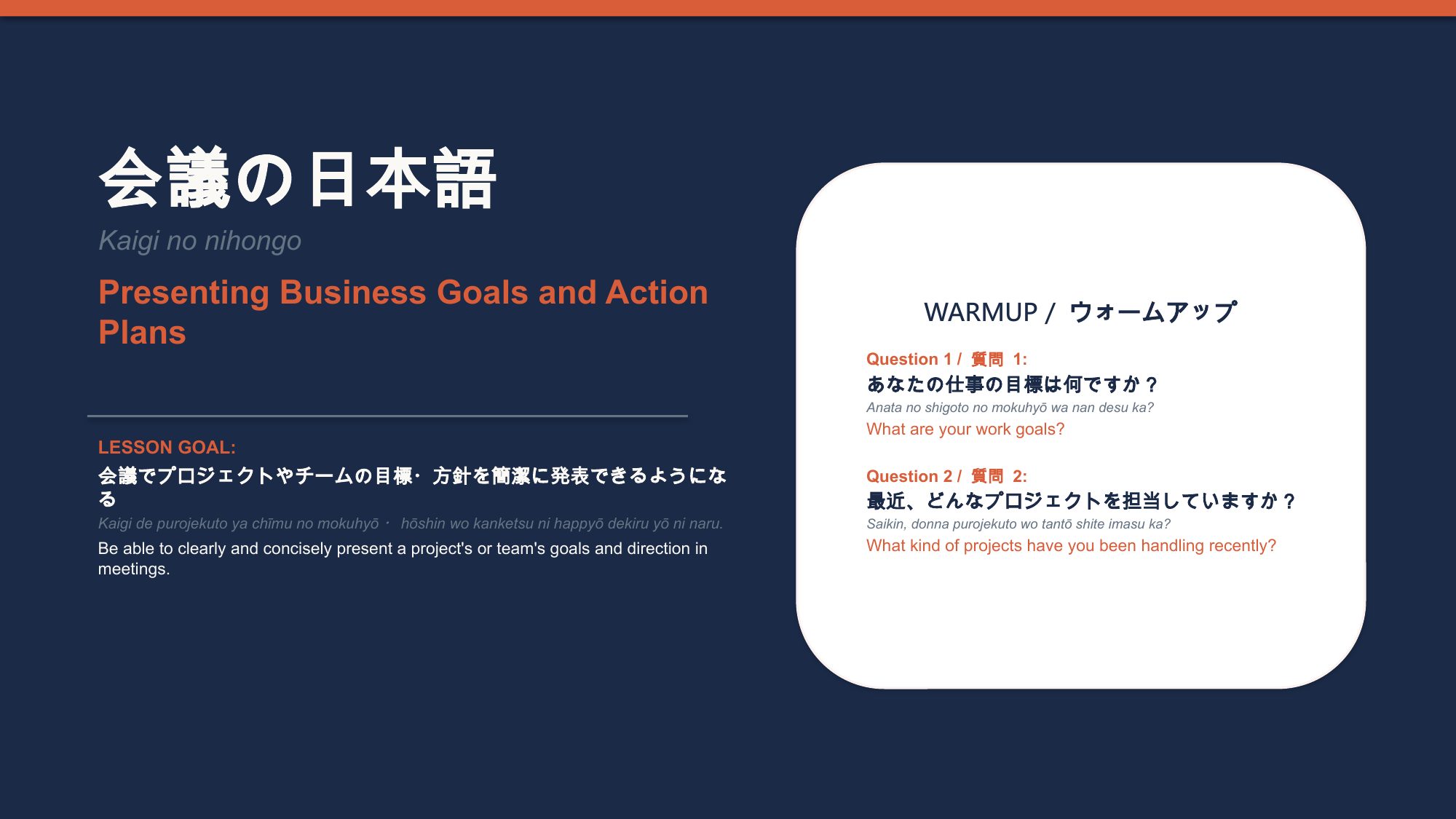
JPあなたの仕事の目標は何ですか?
EN Anata no shigoto no mokuhyō wa nan desu ka?
What are your work goals?
LESSON GOAL:
What are your work goals?
LESSON GOAL:
JP会議でプロジェクトやチームの目標・方針を簡潔に発表できるようになQuestion2/質問2:
る最近、どんなプロジェクトを担当していますか?
る最近、どんなプロジェクトを担当していますか?
ENKaigi de purojekuto ya chīmu no mokuhyō ・ hōshin wo kanketsu ni happyō dekiru yō ni naru. Saikin, donna purojekuto wo tantō shite imasu ka?
Be able to clearly and concisely present a project's or team's goals and direction in What kind of projects have you been handling recently?
meetings.
Be able to clearly and concisely present a project's or team's goals and direction in What kind of projects have you been handling recently?
meetings.
หน้า 12
คลิกเพื่อขยาย
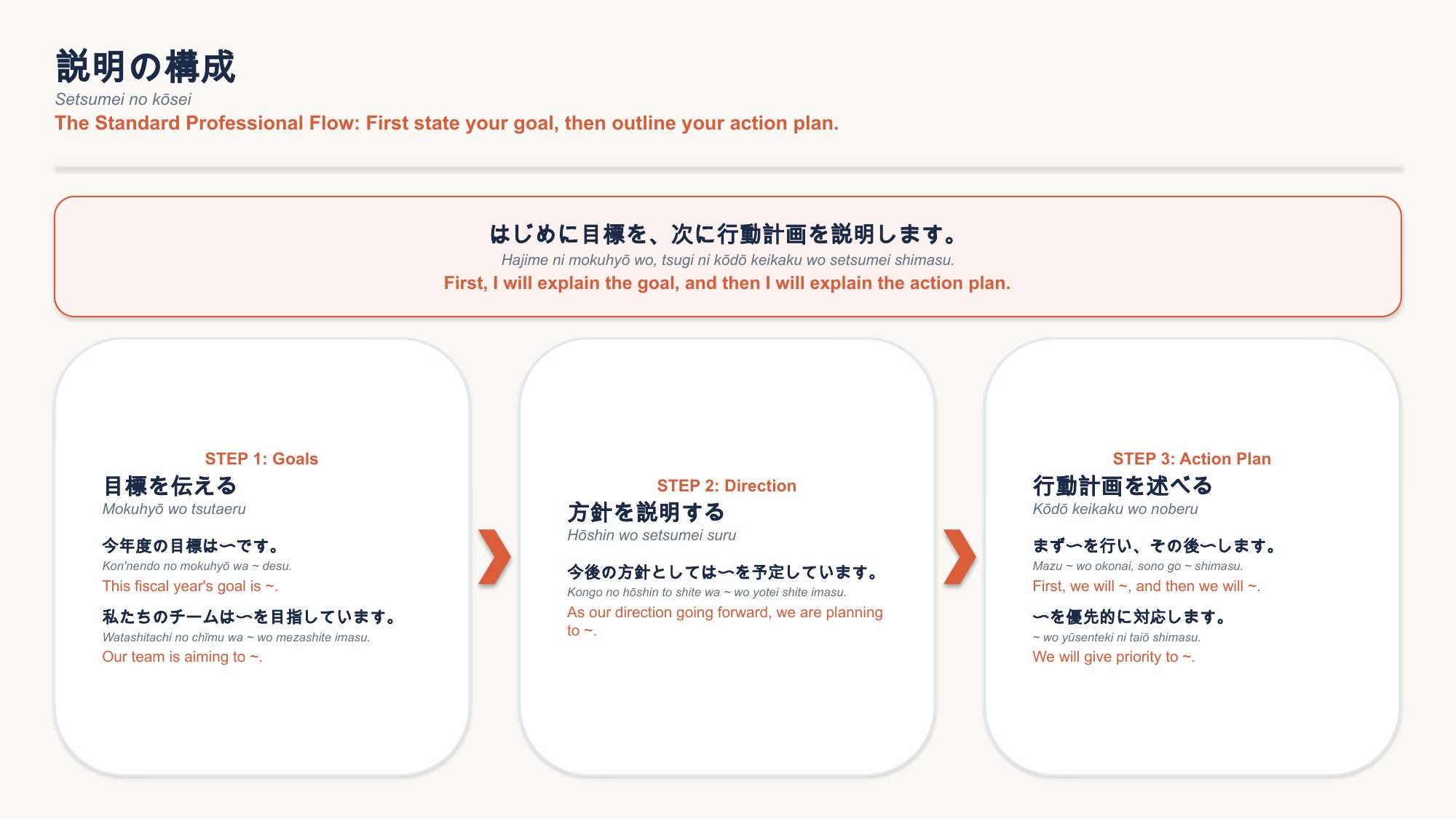
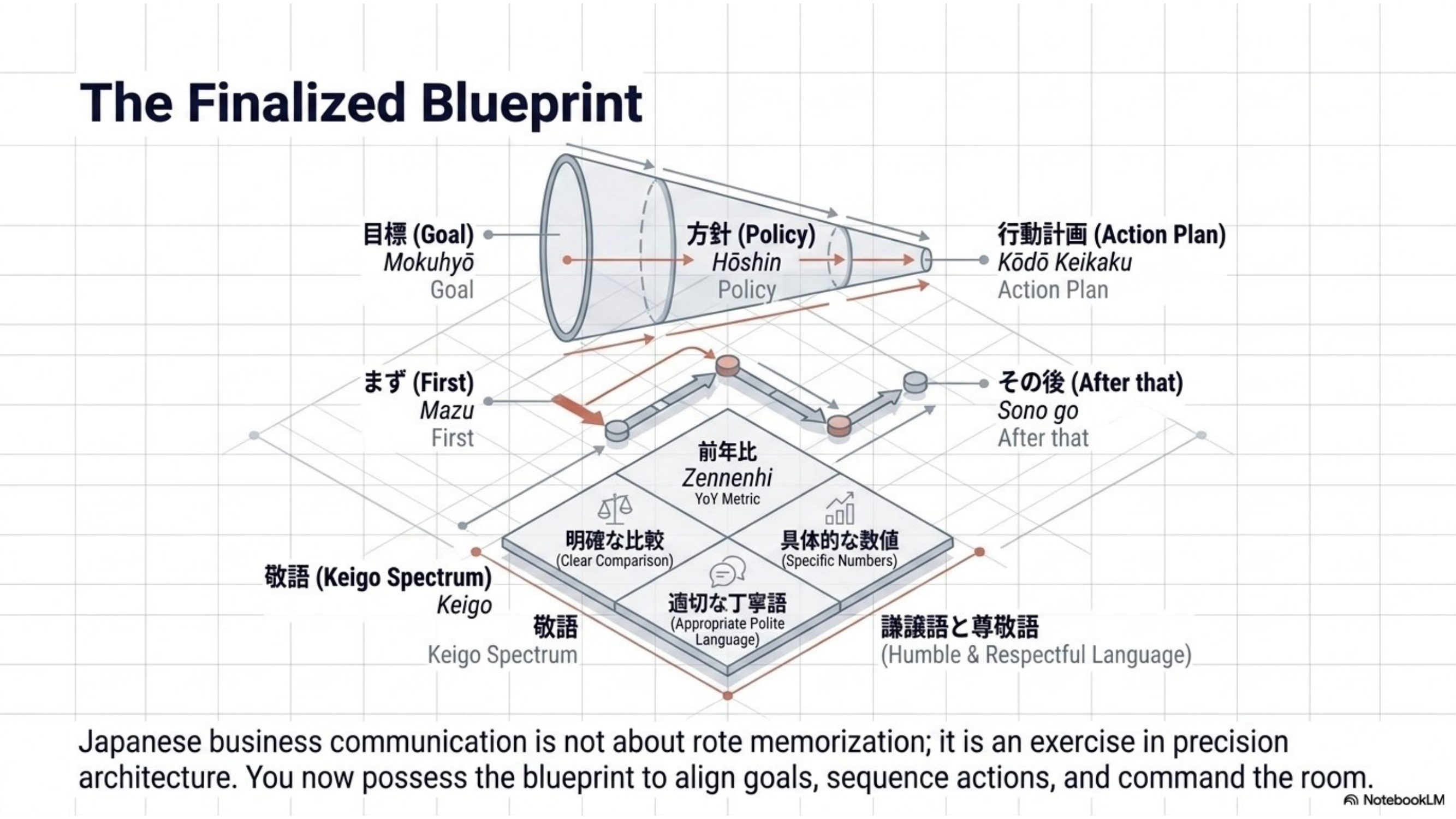
JP説明の構成
ENSetsumei no kōsei
The Standard Professional Flow: First state your goal, then outline your action plan.
The Standard Professional Flow: First state your goal, then outline your action plan.
JPはじめに目標を、次に行動計画を説明します。
EN Hajime ni mokuhyō wo, tsugi ni kōdō keikaku wo setsumei shimasu.
First, I will explain the goal, and then I will explain the action plan.
STEP 1: Goals STEP 3: Action Plan
First, I will explain the goal, and then I will explain the action plan.
STEP 1: Goals STEP 3: Action Plan
JP目標を伝えるSTEP2:Direction行動計画を述べる
EN Mokuhyō wo tsutaeru 方針を説明する Kōdō keikaku wo noberu
Hōshin wo setsumei suru
Hōshin wo setsumei suru
JP今年度の目標は〜です。まず〜を行い、その後〜します。
EN Kon'nendo no mokuhyō wa ~ desu. Mazu ~ wo okonai, sono go ~ shimasu.
JP今後の方針としては〜を予定しています。
EN This fiscal year's goal is ~. Kongo no hōshin to shite wa ~ wo yotei shite imasu. First, we will ~, and then we will ~.
私たちのチームは〜を目指しています。 As our direction going forward, we are planning 〜を優先的に対応します。
Watashitachi no chīmu wa ~ wo mezashite imasu. to ~. ~ wo yūsenteki ni taiō shimasu.
Our team is aiming to ~. We will give priority to ~.
私たちのチームは〜を目指しています。 As our direction going forward, we are planning 〜を優先的に対応します。
Watashitachi no chīmu wa ~ wo mezashite imasu. to ~. ~ wo yūsenteki ni taiō shimasu.
Our team is aiming to ~. We will give priority to ~.
หน้า 13
คลิกเพื่อขยาย
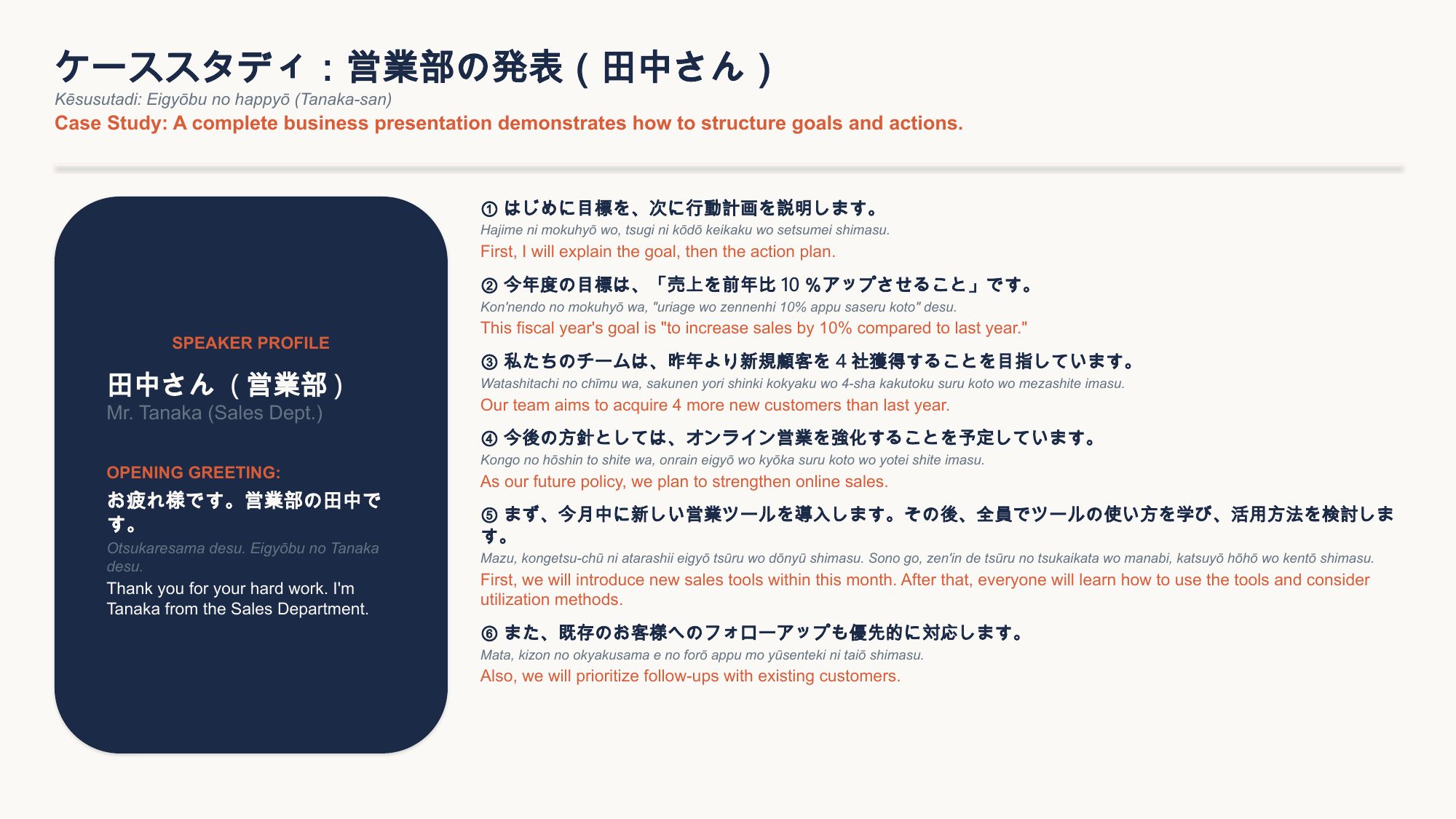
JPケーススタディ:営業部の発表(田中さん)
ENKēsusutadi: Eigyōbu no happyō (Tanaka-san)
Case Study: A complete business presentation demonstrates how to structure goals and actions.
Case Study: A complete business presentation demonstrates how to structure goals and actions.
JP①はじめに目標を、次に行動計画を説明します。
EN Hajime ni mokuhyō wo, tsugi ni kōdō keikaku wo setsumei shimasu.
First, I will explain the goal, then the action plan.
First, I will explain the goal, then the action plan.
JP②今年度の目標は、「売上を前年比10%アップさせること」です。
EN Kon'nendo no mokuhyō wa, "uriage wo zennenhi 10% appu saseru koto" desu.
This fiscal year's goal is "to increase sales by 10% compared to last year."
SPEAKER PROFILE
This fiscal year's goal is "to increase sales by 10% compared to last year."
SPEAKER PROFILE
JP③私たちのチームは、昨年より新規顧客を4社獲得することを目指しています。
EN 田中さん ( 営業部 ) Watashitachi no chīmu wa, sakunen yori shinki kokyaku wo 4-sha kakutoku suru koto wo mezashite imasu.
Our team aims to acquire 4 more new customers than last year.
Mr. Tanaka (Sales Dept.)
Our team aims to acquire 4 more new customers than last year.
Mr. Tanaka (Sales Dept.)
JP④今後の方針としては、オンライン営業を強化することを予定しています。
EN Kongo no hōshin to shite wa, onrain eigyō wo kyōka suru koto wo yotei shite imasu.
OPENING GREETING:
As our future policy, we plan to strengthen online sales.
OPENING GREETING:
As our future policy, we plan to strengthen online sales.
JPお疲れ様です。営業部の田中で
⑤まず、今月中に新しい営業ツールを導入します。その後、全員でツールの使い方を学び、活用方法を検討しま
す。
す。
⑤まず、今月中に新しい営業ツールを導入します。その後、全員でツールの使い方を学び、活用方法を検討しま
す。
す。
EN Otsukaresama desu. Eigyōbu no Tanaka
Mazu, kongetsu-chū ni atarashii eigyō tsūru wo dōnyū shimasu. Sono go, zen'in de tsūru no tsukaikata wo manabi, katsuyō hōhō wo kentō shimasu.
desu.
First, we will introduce new sales tools within this month. After that, everyone will learn how to use the tools and consider
Thank you for your hard work. I'm
utilization methods.
Tanaka from the Sales Department.
Mazu, kongetsu-chū ni atarashii eigyō tsūru wo dōnyū shimasu. Sono go, zen'in de tsūru no tsukaikata wo manabi, katsuyō hōhō wo kentō shimasu.
desu.
First, we will introduce new sales tools within this month. After that, everyone will learn how to use the tools and consider
Thank you for your hard work. I'm
utilization methods.
Tanaka from the Sales Department.
JP⑥また、既存のお客様へのフォローアップも優先的に対応します。
EN Mata, kizon no okyakusama e no forō appu mo yūsenteki ni taiō shimasu.
Also, we will prioritize follow-ups with existing customers.
Also, we will prioritize follow-ups with existing customers.
หน้า 14
คลิกเพื่อขยาย
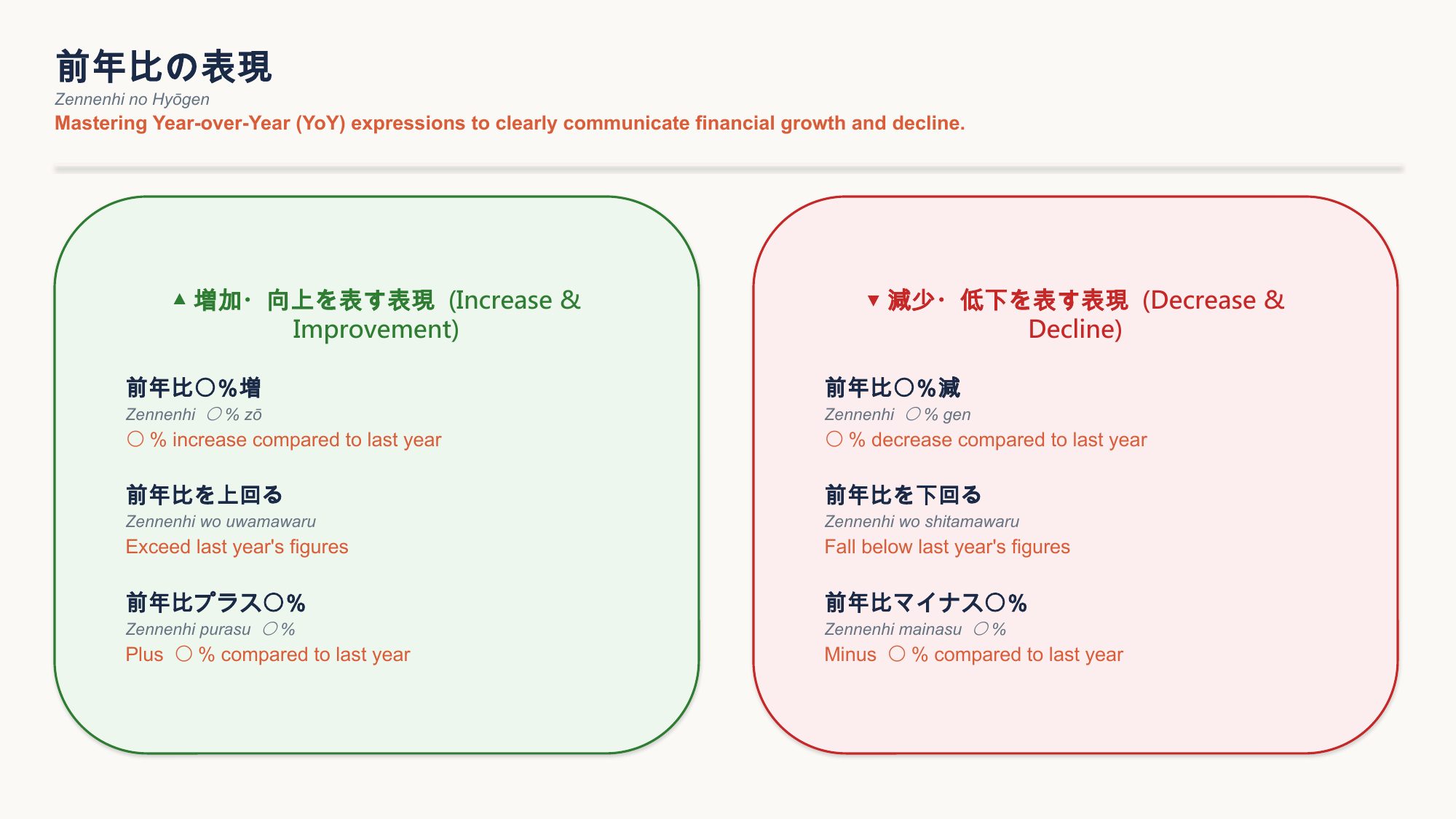
JP前年比の表現
ENZennenhi no Hyōgen
Mastering Year-over-Year (YoY) expressions to clearly communicate financial growth and decline.
Mastering Year-over-Year (YoY) expressions to clearly communicate financial growth and decline.
JP▲増加・向上を表す表現(Increase&▼減少・低下を表す表現(Decrease&
EN Improvement) Decline)
JP前年比〇%増前年比〇%減
EN Zennenhi 〇 % zō Zennenhi 〇 % gen
〇 % increase compared to last year 〇 % decrease compared to last year
〇 % increase compared to last year 〇 % decrease compared to last year
JP前年比を上回る前年比を下回る
EN Zennenhi wo uwamawaru Zennenhi wo shitamawaru
Exceed last year's figures Fall below last year's figures
Exceed last year's figures Fall below last year's figures
JP前年比プラス〇%前年比マイナス〇%
EN Zennenhi purasu 〇 % Zennenhi mainasu 〇 %
Plus 〇 % compared to last year Minus 〇 % compared to last year
Plus 〇 % compared to last year Minus 〇 % compared to last year
หน้า 15
คลิกเพื่อขยาย
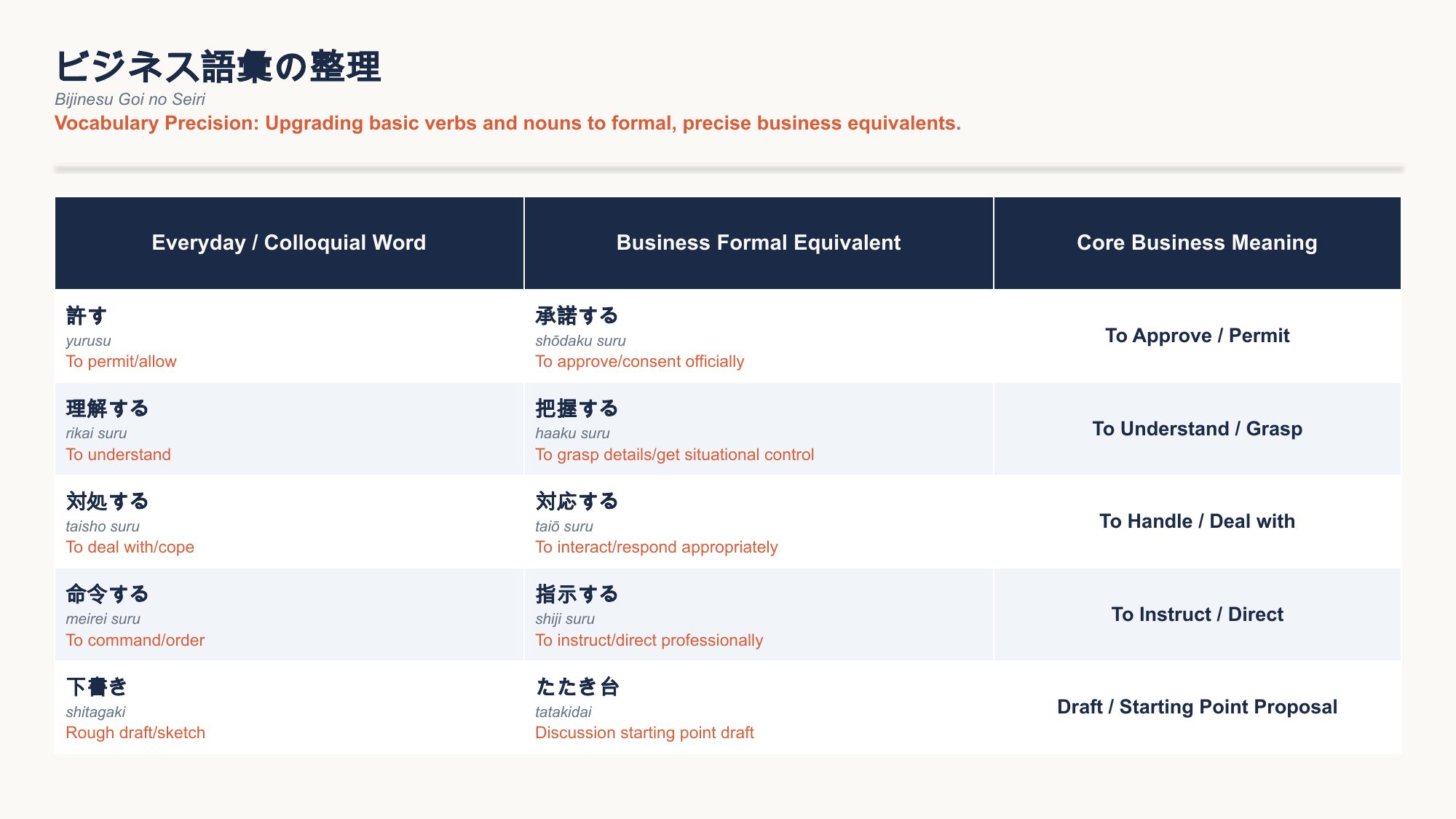
JPビジネス語彙の整理
ENBijinesu Goi no Seiri
Vocabulary Precision: Upgrading basic verbs and nouns to formal, precise business equivalents.
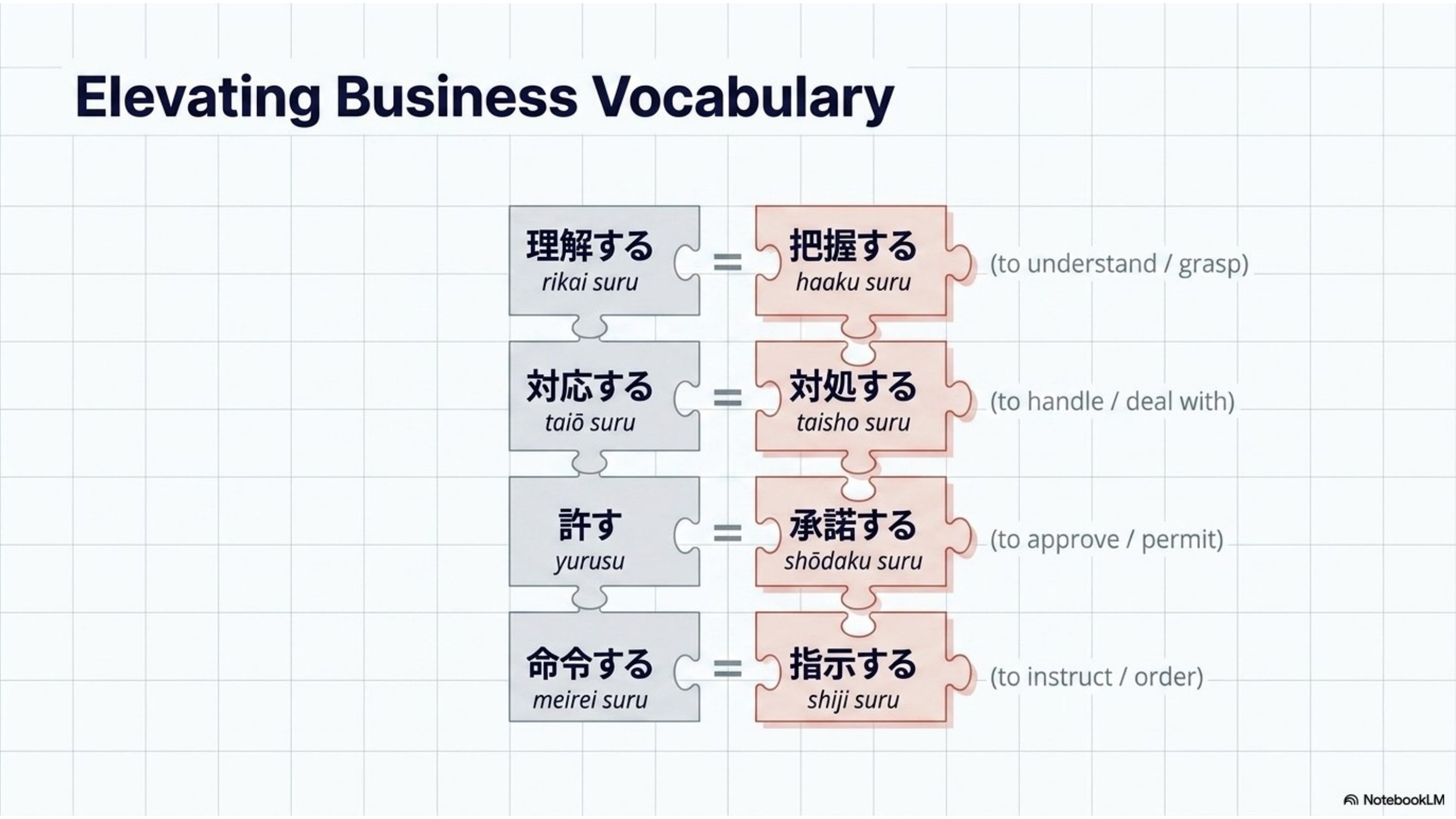
Everyday / Colloquial Word Business Formal Equivalent Core Business Meaning
Vocabulary Precision: Upgrading basic verbs and nouns to formal, precise business equivalents.
Everyday / Colloquial Word Business Formal Equivalent Core Business Meaning
JP許す承諾する
EN yurusu shōdaku suru To Approve / Permit
To permit/allow To approve/consent officially
To permit/allow To approve/consent officially
JP理解する把握する
EN rikai suru haaku suru To Understand / Grasp
To understand To grasp details/get situational control
To understand To grasp details/get situational control
JP対処する対応する
EN taisho suru taiō suru To Handle / Deal with
To deal with/cope To interact/respond appropriately
To deal with/cope To interact/respond appropriately
JP命令する指示する
EN meirei suru shiji suru To Instruct / Direct
To command/order To instruct/direct professionally
To command/order To instruct/direct professionally
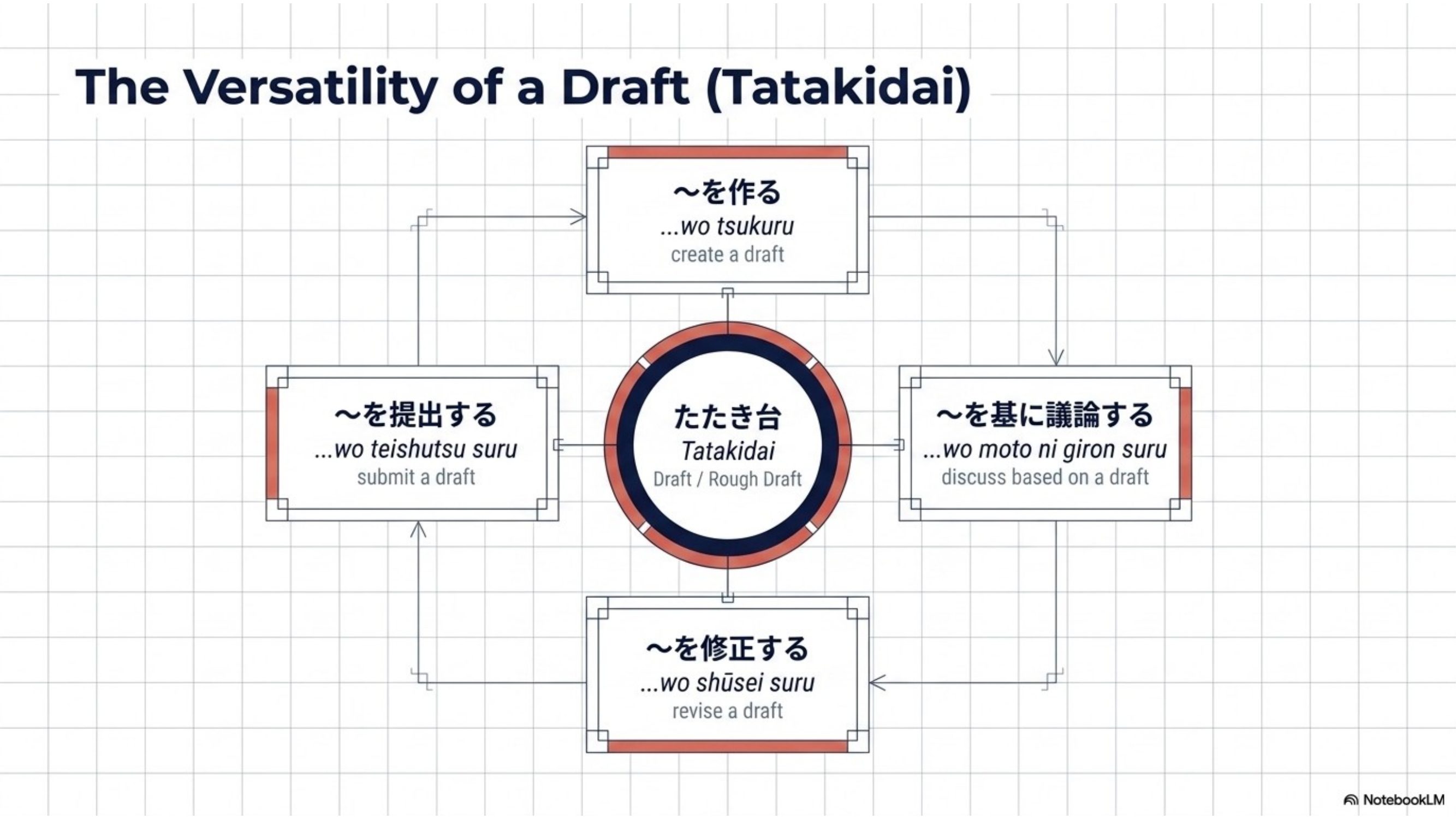
JP下書きたたき台
EN shitagaki tatakidai Draft / Starting Point Proposal
Rough draft/sketch Discussion starting point draft
Rough draft/sketch Discussion starting point draft
หน้า 16
คลิกเพื่อขยาย
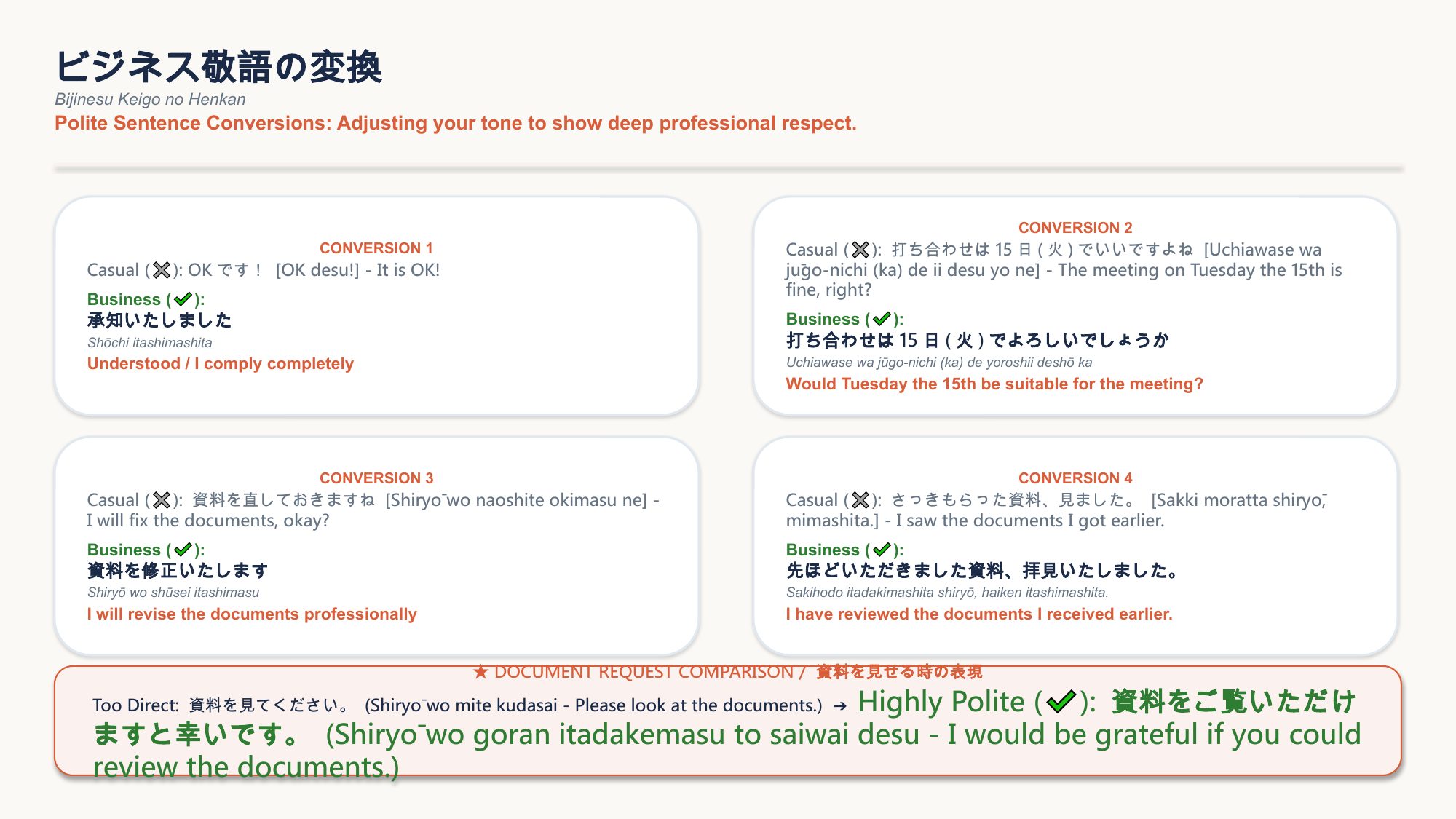
JPビジネス敬語の変換
ENBijinesu Keigo no Henkan
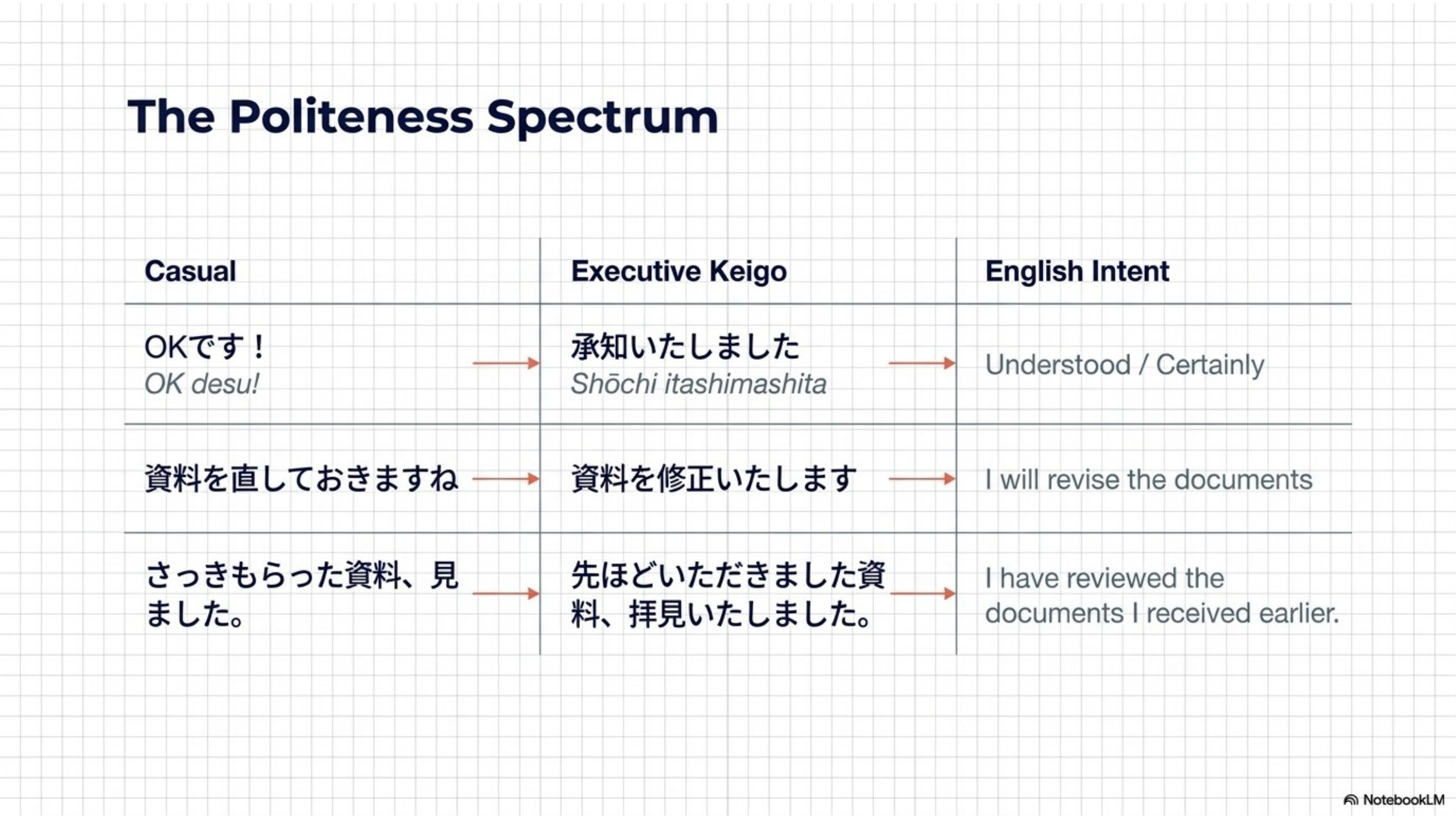
Polite Sentence Conversions: Adjusting your tone to show deep professional respect.
✖ CONVERSION 1 ✖ CONVERSION 2
Casual ( ): 打ち合わせは 15 日 ( 火 ) でいいですよね [Uchiawase wa
✔
Casual ( ): OK です! [OK desu!] - It is OK! jūgo-nichi (ka) de ii desu yo ne] - The meeting on Tuesday the 15th is
✔
fine, right?
Business ( ):
Polite Sentence Conversions: Adjusting your tone to show deep professional respect.
✖ CONVERSION 1 ✖ CONVERSION 2
Casual ( ): 打ち合わせは 15 日 ( 火 ) でいいですよね [Uchiawase wa
✔
Casual ( ): OK です! [OK desu!] - It is OK! jūgo-nichi (ka) de ii desu yo ne] - The meeting on Tuesday the 15th is
✔
fine, right?
Business ( ):
JP承知いたしましたBusiness():
EN Shōchi itashimashita 打ち合わせは 15 日 ( 火 ) でよろしいでしょうか
Understood / I comply completely Uchiawase wa jūgo-nichi (ka) de yoroshii deshō ka
Would Tuesday the 15th be suitable for the meeting?
✖ CONVERSION 3
Casual ( ): 資料を直しておきますね [Shiryōwo naoshite okimasu ne] - ✖ CONVERSION 4
Casual ( ): さっきもらった資料、見ました。 [Sakki moratta shiryō,
✔ ✔
I will fix the documents, okay? mimashita.] - I saw the documents I got earlier.
Business ( ): Business ( ):
Understood / I comply completely Uchiawase wa jūgo-nichi (ka) de yoroshii deshō ka
Would Tuesday the 15th be suitable for the meeting?
✖ CONVERSION 3
Casual ( ): 資料を直しておきますね [Shiryōwo naoshite okimasu ne] - ✖ CONVERSION 4
Casual ( ): さっきもらった資料、見ました。 [Sakki moratta shiryō,
✔ ✔
I will fix the documents, okay? mimashita.] - I saw the documents I got earlier.
Business ( ): Business ( ):
JP資料を修正いたします先ほどいただきました資料、拝見いたしました。
EN Shiryō wo shūsei itashimasu Sakihodo itadakimashita shiryō, haiken itashimashita.
I will revise the documents professionally I have reviewed the documents I received earlier.
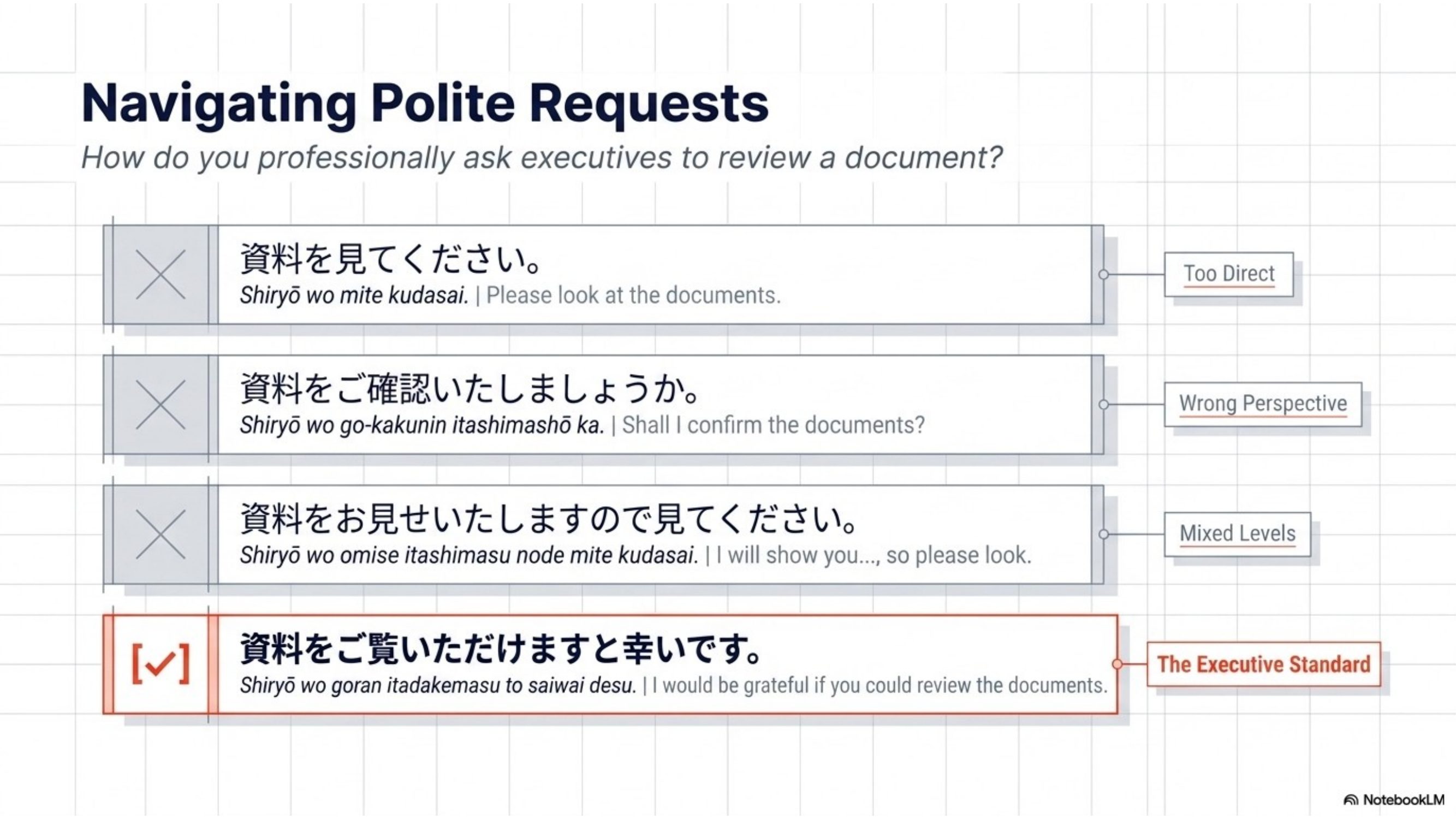
★ DOCUMENT REQUEST COMPARISON / 資料を見せる時の表現
Highly Polite ( ): 資料をご覧いただけ
Too Direct: 資料を見てください。 (Shiryōwo mite kudasai - Please look at the documents.) ➔
ますと幸いです。 (Shiryōwo goran itadakemasu to saiwai desu - I would be grateful if you could
✔
review the documents.)
I will revise the documents professionally I have reviewed the documents I received earlier.
★ DOCUMENT REQUEST COMPARISON / 資料を見せる時の表現
Highly Polite ( ): 資料をご覧いただけ
Too Direct: 資料を見てください。 (Shiryōwo mite kudasai - Please look at the documents.) ➔
ますと幸いです。 (Shiryōwo goran itadakemasu to saiwai desu - I would be grateful if you could
✔
review the documents.)
หน้า 17
คลิกเพื่อขยาย
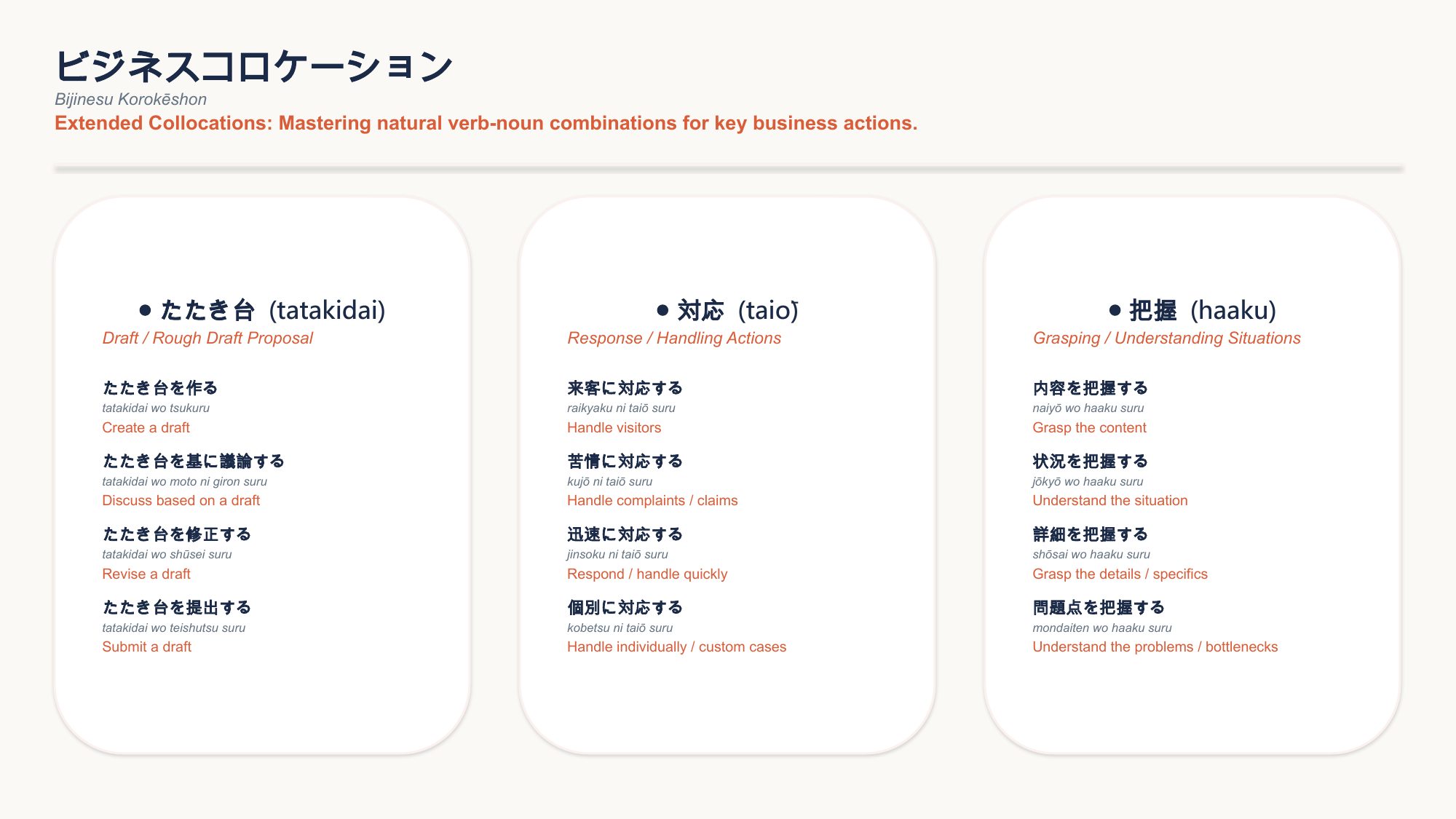
JPビジネスコロケーション
ENBijinesu Korokēshon
Extended Collocations: Mastering natural verb-noun combinations for key business actions.
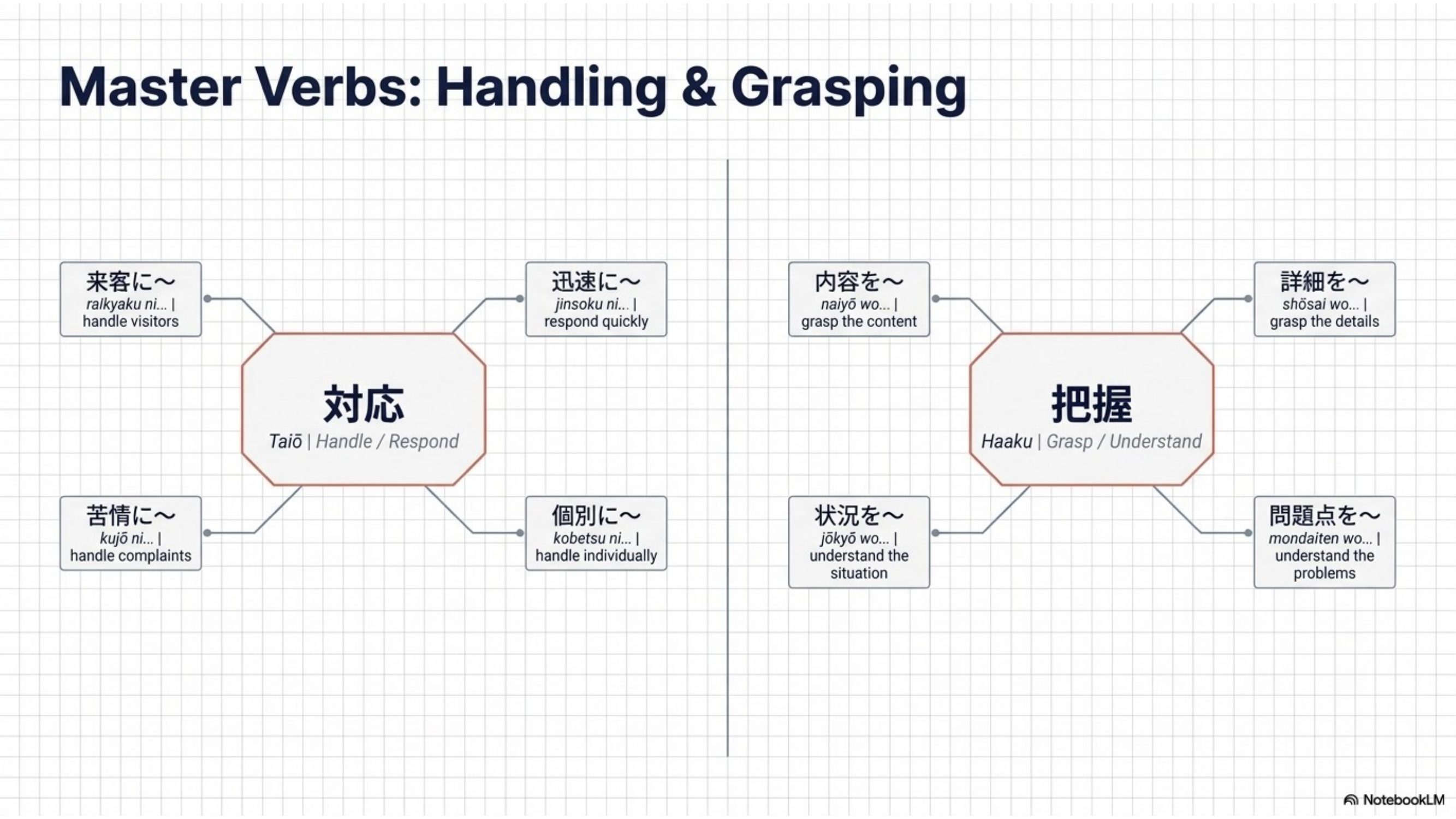
● たたき台 (tatakidai) ● 対応 (taiō) ● 把握 (haaku)
Draft / Rough Draft Proposal Response / Handling Actions Grasping / Understanding Situations
Extended Collocations: Mastering natural verb-noun combinations for key business actions.
● たたき台 (tatakidai) ● 対応 (taiō) ● 把握 (haaku)
Draft / Rough Draft Proposal Response / Handling Actions Grasping / Understanding Situations
JPたたき台を作る来客に対応する内容を把握する
EN tatakidai wo tsukuru raikyaku ni taiō suru naiyō wo haaku suru
Create a draft Handle visitors Grasp the content
Create a draft Handle visitors Grasp the content
JPたたき台を基に議論する苦情に対応する状況を把握する
EN tatakidai wo moto ni giron suru kujō ni taiō suru jōkyō wo haaku suru
Discuss based on a draft Handle complaints / claims Understand the situation
Discuss based on a draft Handle complaints / claims Understand the situation
JPたたき台を修正する迅速に対応する詳細を把握する
EN tatakidai wo shūsei suru jinsoku ni taiō suru shōsai wo haaku suru
Revise a draft Respond / handle quickly Grasp the details / specifics
Revise a draft Respond / handle quickly Grasp the details / specifics
JPたたき台を提出する個別に対応する問題点を把握する
EN tatakidai wo teishutsu suru kobetsu ni taiō suru mondaiten wo haaku suru
Submit a draft Handle individually / custom cases Understand the problems / bottlenecks
Submit a draft Handle individually / custom cases Understand the problems / bottlenecks
หน้า 18
คลิกเพื่อขยาย
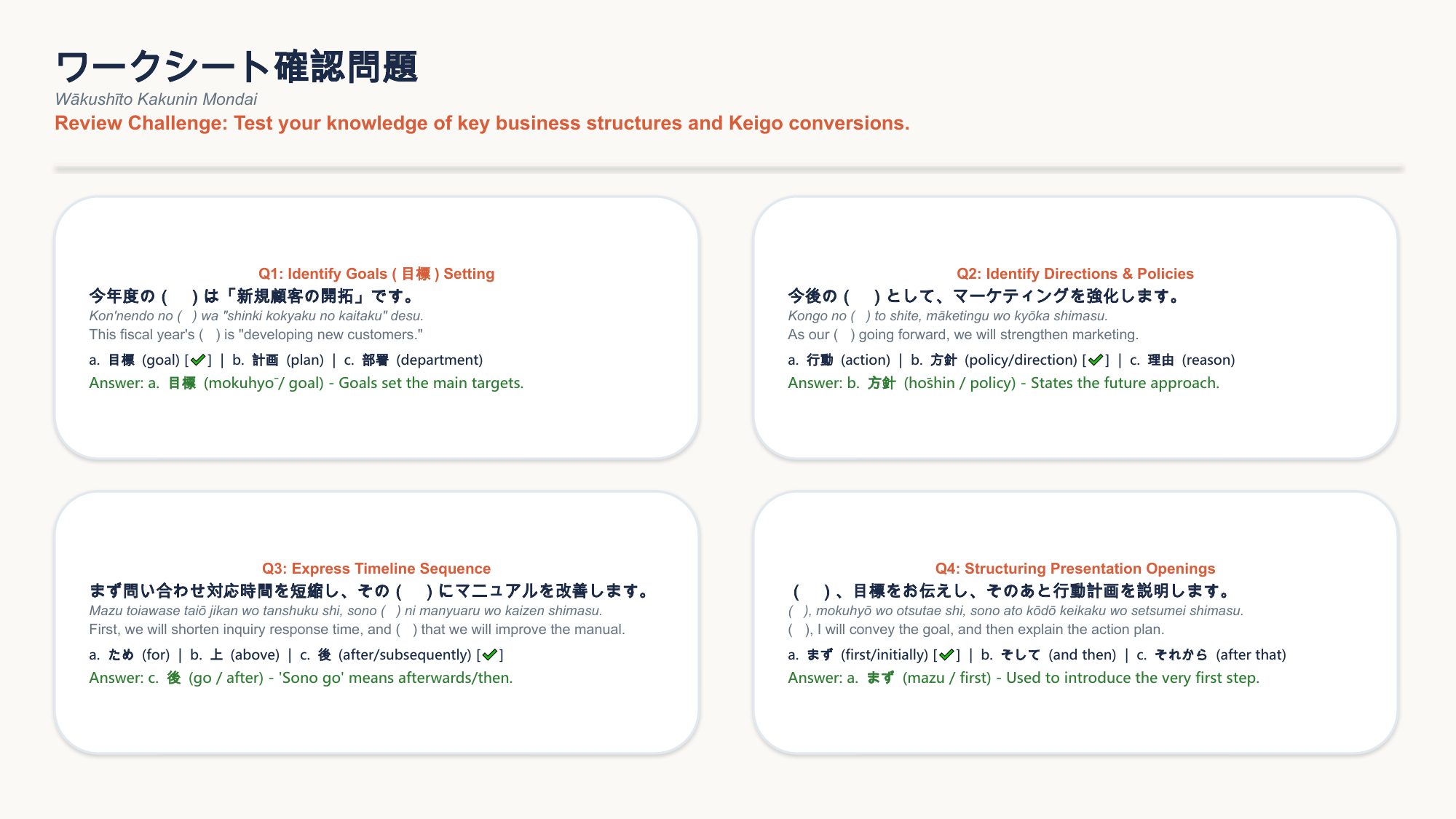
JPワークシート確認問題
ENWākushīto Kakunin Mondai
Review Challenge: Test your knowledge of key business structures and Keigo conversions.
Q1: Identify Goals ( 目標 ) Setting Q2: Identify Directions & Policies
Review Challenge: Test your knowledge of key business structures and Keigo conversions.
Q1: Identify Goals ( 目標 ) Setting Q2: Identify Directions & Policies
JP今年度の()は「新規顧客の開拓」です。今後の()として、マーケティングを強化します。
EN Kon'nendo no ( ) wa "shinki kokyaku no kaitaku" desu. Kongo no ( ) to shite, māketingu wo kyōka shimasu.
✔ ✔
This fiscal year's ( ) is "developing new customers." As our ( ) going forward, we will strengthen marketing.
a. 目標 (goal) [ ] | b. 計画 (plan) | c. 部署 (department) a. 行動 (action) | b. 方針 (policy/direction) [ ] | c. 理由 (reason)
Answer: a. 目標 (mokuhyō/ goal) - Goals set the main targets. Answer: b. 方針 (hōshin / policy) - States the future approach.
Q3: Express Timeline Sequence Q4: Structuring Presentation Openings
✔ ✔
This fiscal year's ( ) is "developing new customers." As our ( ) going forward, we will strengthen marketing.
a. 目標 (goal) [ ] | b. 計画 (plan) | c. 部署 (department) a. 行動 (action) | b. 方針 (policy/direction) [ ] | c. 理由 (reason)
Answer: a. 目標 (mokuhyō/ goal) - Goals set the main targets. Answer: b. 方針 (hōshin / policy) - States the future approach.
Q3: Express Timeline Sequence Q4: Structuring Presentation Openings
JPまず問い合わせ対応時間を短縮し、その()にマニュアルを改善します。()、目標をお伝えし、そのあと行動計画を説明します。
EN Mazu toiawase taiō jikan wo tanshuku shi, sono ( ) ni manyuaru wo kaizen shimasu. ( ), mokuhyō wo otsutae shi, sono ato kōdō keikaku wo setsumei shimasu.
✔ ✔
First, we will shorten inquiry response time, and ( ) that we will improve the manual. ( ), I will convey the goal, and then explain the action plan.
a. ため (for) | b. 上 (above) | c. 後 (after/subsequently) [ ] a. まず (first/initially) [ ] | b. そして (and then) | c. それから (after that)
Answer: c. 後 (go / after) - 'Sono go' means afterwards/then. Answer: a. まず (mazu / first) - Used to introduce the very first step.
✔ ✔
First, we will shorten inquiry response time, and ( ) that we will improve the manual. ( ), I will convey the goal, and then explain the action plan.
a. ため (for) | b. 上 (above) | c. 後 (after/subsequently) [ ] a. まず (first/initially) [ ] | b. そして (and then) | c. それから (after that)
Answer: c. 後 (go / after) - 'Sono go' means afterwards/then. Answer: a. まず (mazu / first) - Used to introduce the very first step.
หน้า 19
คลิกเพื่อขยาย
หน้า 20
คลิกเพื่อขยาย
หน้า 21
คลิกเพื่อขยาย
หน้า 22
คลิกเพื่อขยาย
หน้า 23
คลิกเพื่อขยาย
หน้า 24
คลิกเพื่อขยาย
หน้า 25
คลิกเพื่อขยาย
หน้า 26
คลิกเพื่อขยาย
หน้า 27
คลิกเพื่อขยาย
หน้า 28
คลิกเพื่อขยาย
หน้า 29
คลิกเพื่อขยาย
หน้า 30
คลิกเพื่อขยาย
หน้า 31
คลิกเพื่อขยาย
หน้า 32
คลิกเพื่อขยาย
หน้า 33
คลิกเพื่อขยาย
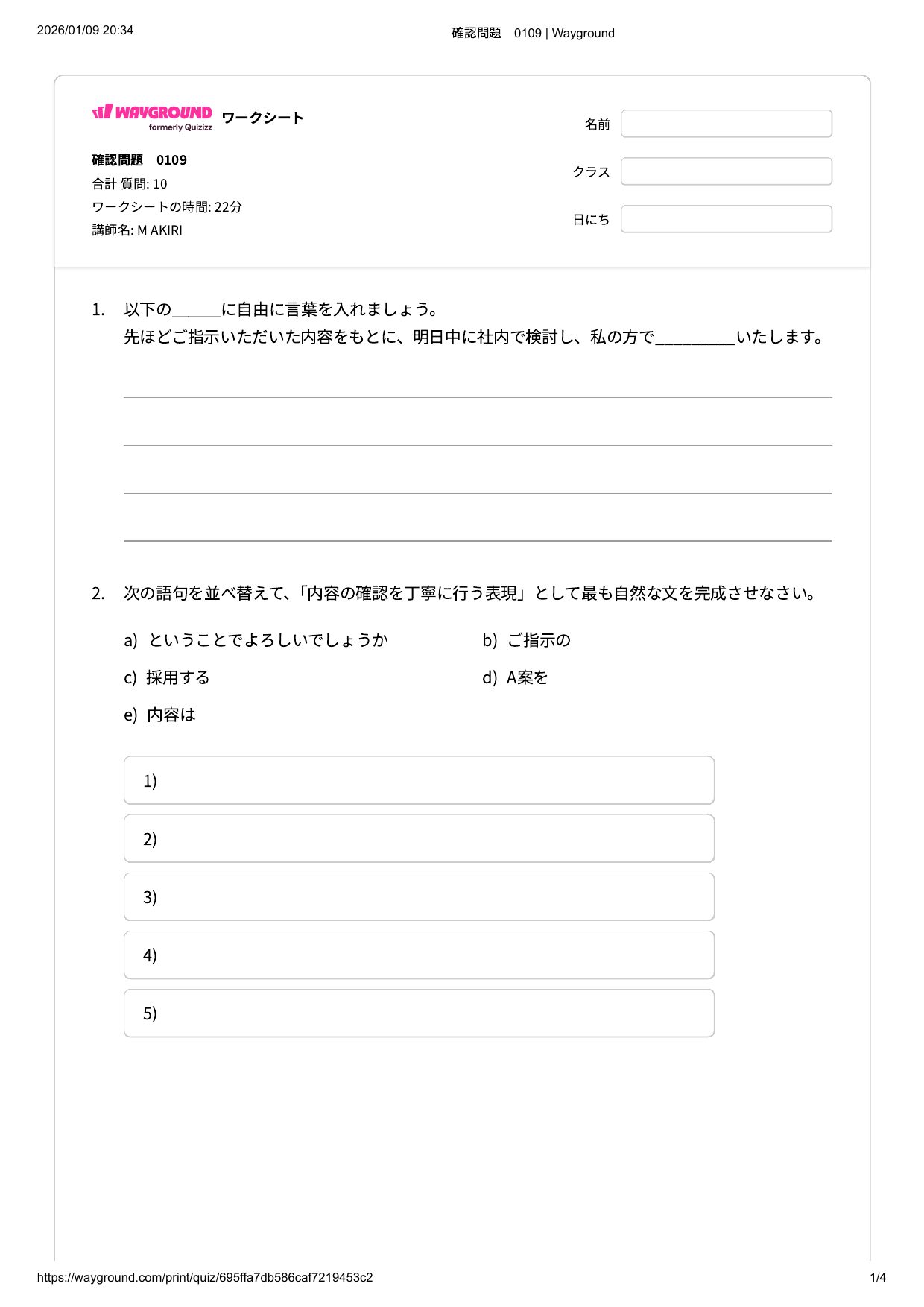
EN2026/01/09 20:34 確認問題 0109 | Wayground
JPワークシート名前
確認問題0109クラス
合計質問:10
ワークシートの時間:22分日にち
確認問題0109クラス
合計質問:10
ワークシートの時間:22分日にち
EN 講師名: M AKIRI
JP1.以下の___に自由に言葉を入れましょう。
先ほどご指示いただいた内容をもとに、明日中に社内で検討し、私の方で_________いたします。
2.次の語句を並べ替えて、「内容の確認を丁寧に行う表現」として最も自然な文を完成させなさい。
a)ということでよろしいでしょうかb)ご指示の
c)採用するd)A案を
e)内容は
1)
2)
3)
4)
5)
先ほどご指示いただいた内容をもとに、明日中に社内で検討し、私の方で_________いたします。
2.次の語句を並べ替えて、「内容の確認を丁寧に行う表現」として最も自然な文を完成させなさい。
a)ということでよろしいでしょうかb)ご指示の
c)採用するd)A案を
e)内容は
1)
2)
3)
4)
5)
ENhttps://wayground.com/print/quiz/695ffa7db586caf7219453c2 1/4
หน้า 34
คลิกเพื่อขยาย
EN2026/01/09 20:34 確認問題 0109 | Wayground
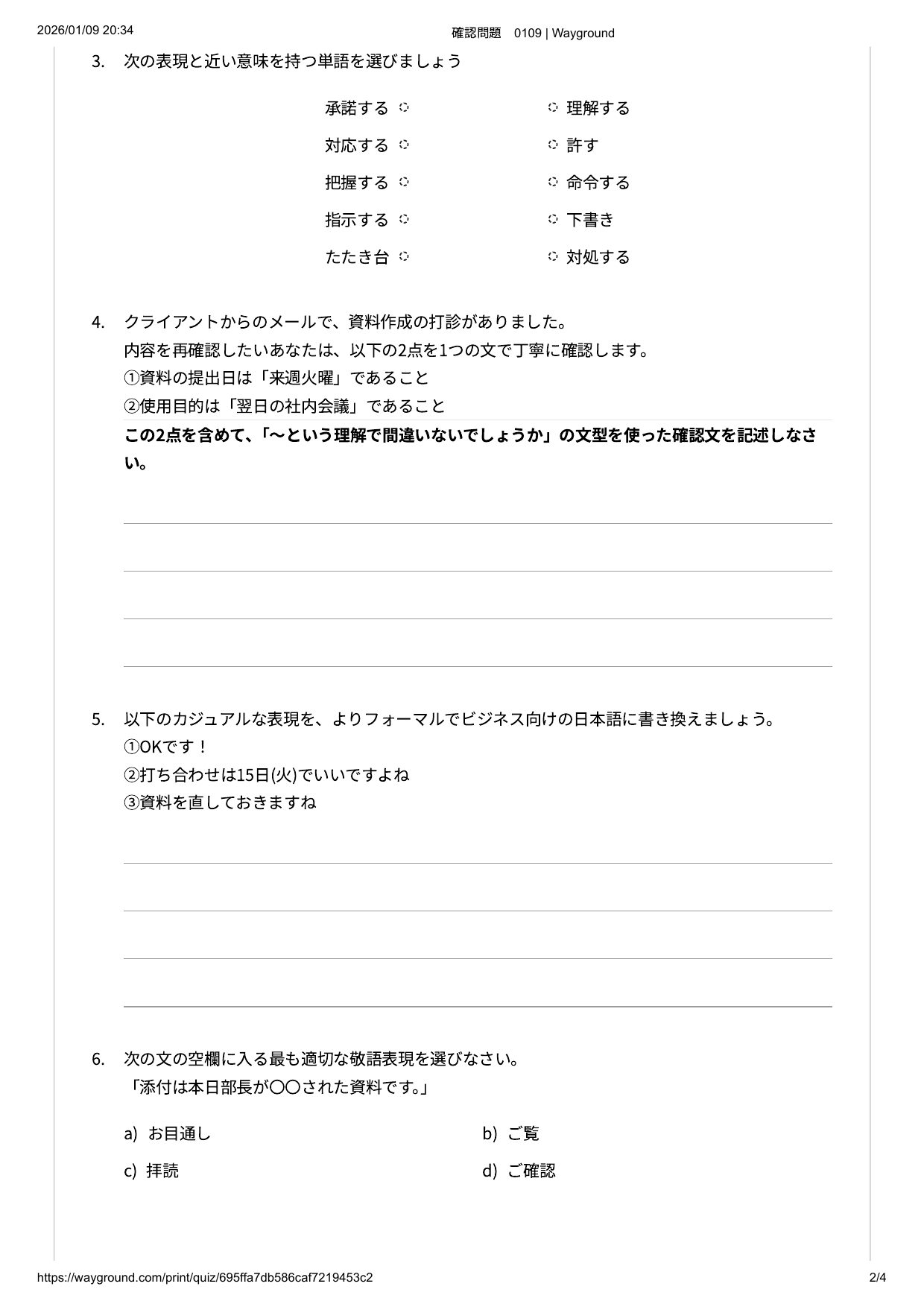
JP3.次の表現と近い意味を持つ単語を選びましょう
承諾する理解する
対応する許す
把握する命令する
指示する下書き
たたき台対処する
4.クライアントからのメールで、資料作成の打診がありました。
内容を再確認したいあなたは、以下の2点を1つの文で丁寧に確認します。
①資料の提出日は「来週火曜」であること
②使用目的は「翌日の社内会議」であること
この2点を含めて、「〜という理解で間違いないでしょうか」の文型を使った確認文を記述しなさ
い。
5.以下のカジュアルな表現を、よりフォーマルでビジネス向けの日本語に書き換えましょう。
①OKです!
②打ち合わせは15日(火)でいいですよね
③資料を直しておきますね
6.次の文の空欄に入る最も適切な敬語表現を選びなさい。
「添付は本日部長が〇〇された資料です。」
a)お目通しb)ご覧
c)拝読d)ご確認
承諾する理解する
対応する許す
把握する命令する
指示する下書き
たたき台対処する
4.クライアントからのメールで、資料作成の打診がありました。
内容を再確認したいあなたは、以下の2点を1つの文で丁寧に確認します。
①資料の提出日は「来週火曜」であること
②使用目的は「翌日の社内会議」であること
この2点を含めて、「〜という理解で間違いないでしょうか」の文型を使った確認文を記述しなさ
い。
5.以下のカジュアルな表現を、よりフォーマルでビジネス向けの日本語に書き換えましょう。
①OKです!
②打ち合わせは15日(火)でいいですよね
③資料を直しておきますね
6.次の文の空欄に入る最も適切な敬語表現を選びなさい。
「添付は本日部長が〇〇された資料です。」
a)お目通しb)ご覧
c)拝読d)ご確認
ENhttps://wayground.com/print/quiz/695ffa7db586caf7219453c2 2/4
หน้า 35
คลิกเพื่อขยาย
EN2026/01/09 20:34 確認問題 0109 | Wayground
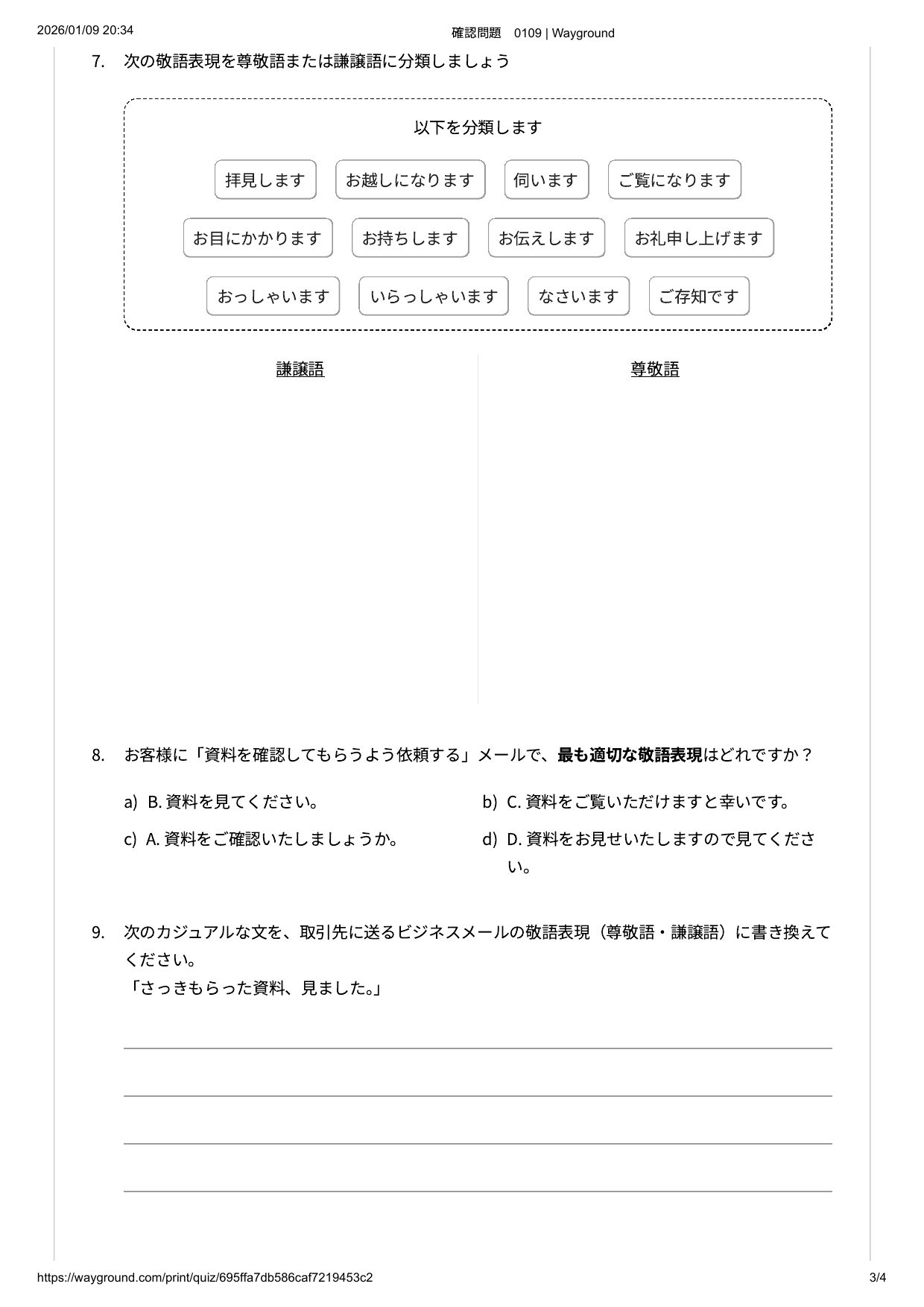
JP7.次の敬語表現を尊敬語または謙譲語に分類しましょう
以下を分類します
拝見しますお越しになります伺いますご覧になります
お目にかかりますお持ちしますお伝えしますお礼申し上げます
おっしゃいますいらっしゃいますなさいますご存知です
謙譲語尊敬語
8.お客様に「資料を確認してもらうよう依頼する」メールで、最も適切な敬語表現はどれですか?
a)B.資料を見てください。b)C.資料をご覧いただけますと幸いです。
c)A.資料をご確認いたしましょうか。d)D.資料をお見せいたしますので見てくださ
い。
9.次のカジュアルな文を、取引先に送るビジネスメールの敬語表現(尊敬語・謙譲語)に書き換えて
ください。
「さっきもらった資料、見ました。」
以下を分類します
拝見しますお越しになります伺いますご覧になります
お目にかかりますお持ちしますお伝えしますお礼申し上げます
おっしゃいますいらっしゃいますなさいますご存知です
謙譲語尊敬語
8.お客様に「資料を確認してもらうよう依頼する」メールで、最も適切な敬語表現はどれですか?
a)B.資料を見てください。b)C.資料をご覧いただけますと幸いです。
c)A.資料をご確認いたしましょうか。d)D.資料をお見せいたしますので見てくださ
い。
9.次のカジュアルな文を、取引先に送るビジネスメールの敬語表現(尊敬語・謙譲語)に書き換えて
ください。
「さっきもらった資料、見ました。」
ENhttps://wayground.com/print/quiz/695ffa7db586caf7219453c2 3/4
หน้า 36

คลิกเพื่อขยาย
EN2026/01/09 20:34 確認問題 0109 | Wayground
JP10.次の単語を使って、コロケーション(単語と単語の組合せ)を作れるだけ作りましょう
たたき台(例:たたき台を作る)
対応(例:来客に対応する)
把握(例:内容を把握する)
たたき台(例:たたき台を作る)
対応(例:来客に対応する)
把握(例:内容を把握する)
ENhttps://wayground.com/print/quiz/695ffa7db586caf7219453c2 4/4
หน้า 37
คลิกเพื่อขยาย
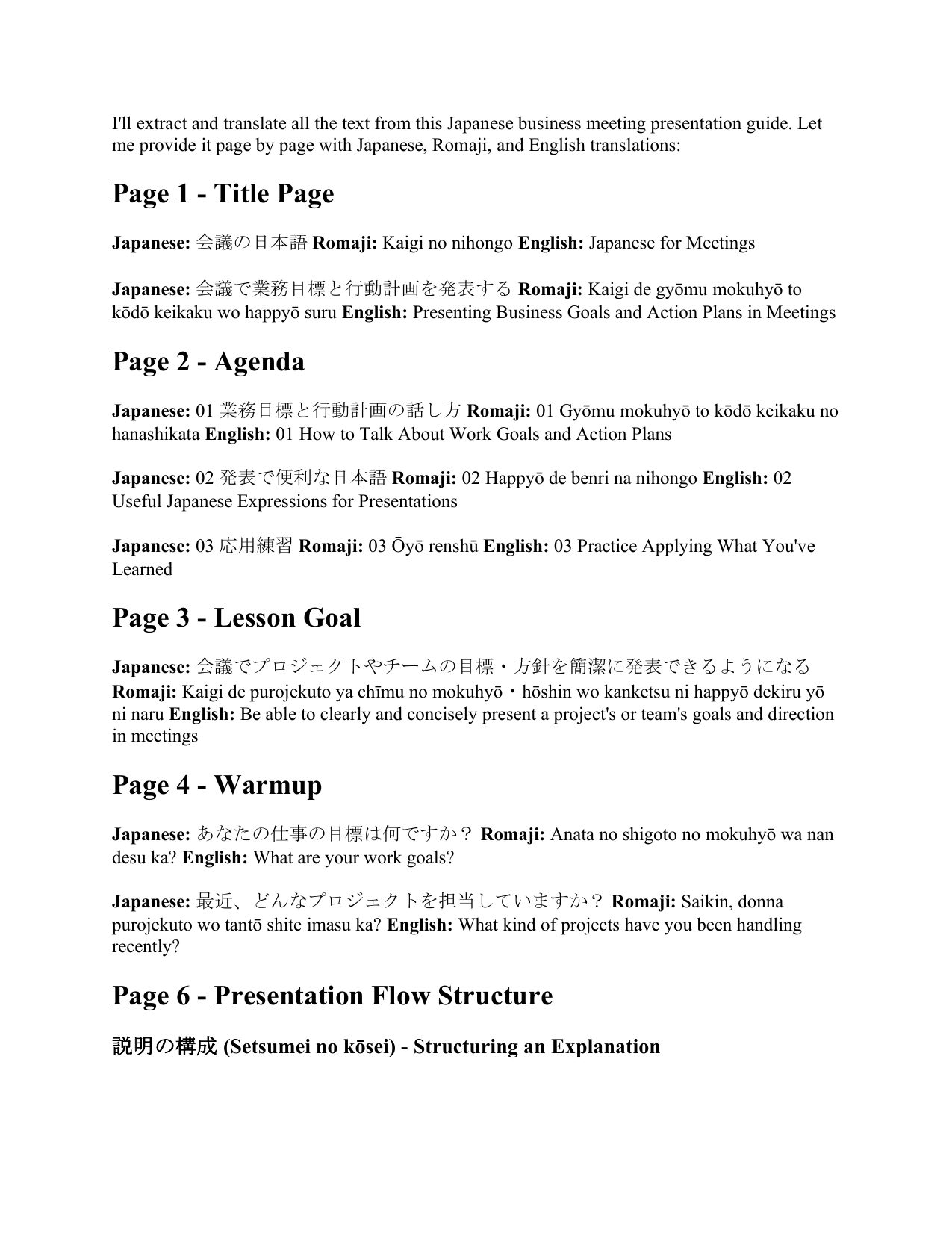
ENI'll extract and translate all the text from this Japanese business meeting presentation guide. Let
me provide it page by page with Japanese, Romaji, and English translations:
Page 1 - Title Page
Japanese: 会議の日本語 Romaji: Kaigi no nihongo English: Japanese for Meetings
Japanese: 会議で業務目標と行動計画を発表する Romaji: Kaigi de gyōmu mokuhyō to
kōdō keikaku wo happyō suru English: Presenting Business Goals and Action Plans in Meetings
Page 2 - Agenda
Japanese: 01 業務目標と行動計画の話し方 Romaji: 01 Gyōmu mokuhyō to kōdō keikaku no
hanashikata English: 01 How to Talk About Work Goals and Action Plans
Japanese: 02 発表で便利な日本語 Romaji: 02 Happyō de benri na nihongo English: 02
Useful Japanese Expressions for Presentations
Japanese: 03 応用練習 Romaji: 03 Ōyō renshū English: 03 Practice Applying What You've
Learned
Page 3 - Lesson Goal
me provide it page by page with Japanese, Romaji, and English translations:
Page 1 - Title Page
Japanese: 会議の日本語 Romaji: Kaigi no nihongo English: Japanese for Meetings
Japanese: 会議で業務目標と行動計画を発表する Romaji: Kaigi de gyōmu mokuhyō to
kōdō keikaku wo happyō suru English: Presenting Business Goals and Action Plans in Meetings
Page 2 - Agenda
Japanese: 01 業務目標と行動計画の話し方 Romaji: 01 Gyōmu mokuhyō to kōdō keikaku no
hanashikata English: 01 How to Talk About Work Goals and Action Plans
Japanese: 02 発表で便利な日本語 Romaji: 02 Happyō de benri na nihongo English: 02
Useful Japanese Expressions for Presentations
Japanese: 03 応用練習 Romaji: 03 Ōyō renshū English: 03 Practice Applying What You've
Learned
Page 3 - Lesson Goal
JPJapanese:会議でプロジェクトやチームの目標・方針を簡潔に発表できるようになる
ENRomaji: Kaigi de purojekuto ya chīmu no mokuhyō・hōshin wo kanketsu ni happyō dekiru yō
ni naru English: Be able to clearly and concisely present a project's or team's goals and direction
in meetings
Page 4 - Warmup
Japanese: あなたの仕事の目標は何ですか? Romaji: Anata no shigoto no mokuhyō wa nan
desu ka? English: What are your work goals?
Japanese: 最近、どんなプロジェクトを担当していますか? Romaji: Saikin, donna
purojekuto wo tantō shite imasu ka? English: What kind of projects have you been handling
recently?
Page 6 - Presentation Flow Structure
説明の構成 (Setsumei no kōsei) - Structuring an Explanation
ni naru English: Be able to clearly and concisely present a project's or team's goals and direction
in meetings
Page 4 - Warmup
Japanese: あなたの仕事の目標は何ですか? Romaji: Anata no shigoto no mokuhyō wa nan
desu ka? English: What are your work goals?
Japanese: 最近、どんなプロジェクトを担当していますか? Romaji: Saikin, donna
purojekuto wo tantō shite imasu ka? English: What kind of projects have you been handling
recently?
Page 6 - Presentation Flow Structure
説明の構成 (Setsumei no kōsei) - Structuring an Explanation
หน้า 38
คลิกเพื่อขยาย
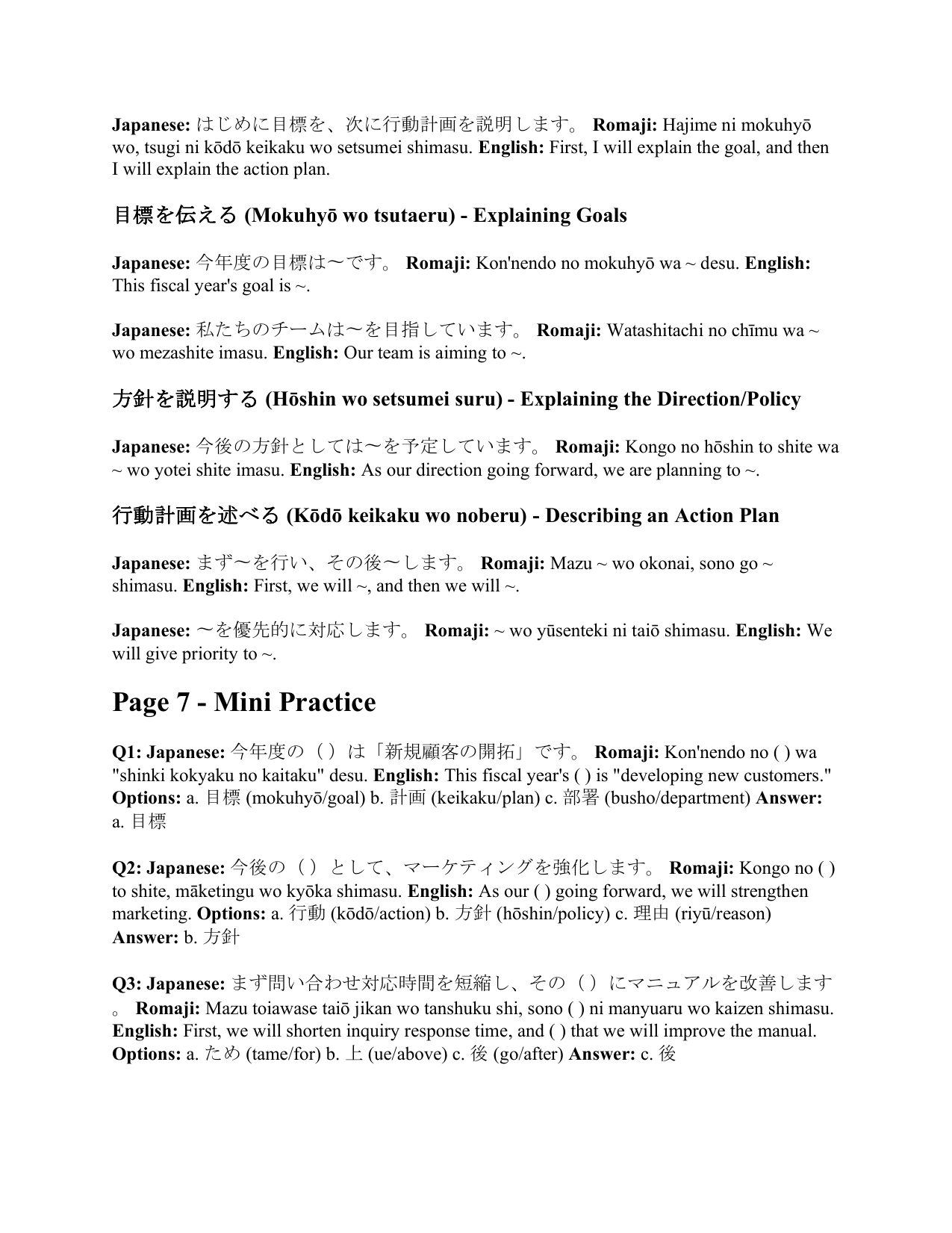
ENJapanese: はじめに目標を、次に行動計画を説明します。 Romaji: Hajime ni mokuhyō
wo, tsugi ni kōdō keikaku wo setsumei shimasu. English: First, I will explain the goal, and then
I will explain the action plan.
目標を伝える (Mokuhyō wo tsutaeru) - Explaining Goals
Japanese: 今年度の目標は〜です。 Romaji: Kon'nendo no mokuhyō wa ~ desu. English:
This fiscal year's goal is ~.
Japanese: 私たちのチームは〜を目指しています。 Romaji: Watashitachi no chīmu wa ~
wo mezashite imasu. English: Our team is aiming to ~.
方針を説明する (Hōshin wo setsumei suru) - Explaining the Direction/Policy
Japanese: 今後の方針としては〜を予定しています。 Romaji: Kongo no hōshin to shite wa
~ wo yotei shite imasu. English: As our direction going forward, we are planning to ~.
行動計画を述べる (Kōdō keikaku wo noberu) - Describing an Action Plan
Japanese: まず〜を行い、その後〜します。 Romaji: Mazu ~ wo okonai, sono go ~
shimasu. English: First, we will ~, and then we will ~.
Japanese: 〜を優先的に対応します。 Romaji: ~ wo yūsenteki ni taiō shimasu. English: We
will give priority to ~.
Page 7 - Mini Practice
Q1: Japanese: 今年度の( )は「新規顧客の開拓」です。 Romaji: Kon'nendo no ( ) wa
"shinki kokyaku no kaitaku" desu. English: This fiscal year's ( ) is "developing new customers."
Options: a. 目標 (mokuhyō/goal) b. 計画 (keikaku/plan) c. 部署 (busho/department) Answer:
wo, tsugi ni kōdō keikaku wo setsumei shimasu. English: First, I will explain the goal, and then
I will explain the action plan.
目標を伝える (Mokuhyō wo tsutaeru) - Explaining Goals
Japanese: 今年度の目標は〜です。 Romaji: Kon'nendo no mokuhyō wa ~ desu. English:
This fiscal year's goal is ~.
Japanese: 私たちのチームは〜を目指しています。 Romaji: Watashitachi no chīmu wa ~
wo mezashite imasu. English: Our team is aiming to ~.
方針を説明する (Hōshin wo setsumei suru) - Explaining the Direction/Policy
Japanese: 今後の方針としては〜を予定しています。 Romaji: Kongo no hōshin to shite wa
~ wo yotei shite imasu. English: As our direction going forward, we are planning to ~.
行動計画を述べる (Kōdō keikaku wo noberu) - Describing an Action Plan
Japanese: まず〜を行い、その後〜します。 Romaji: Mazu ~ wo okonai, sono go ~
shimasu. English: First, we will ~, and then we will ~.
Japanese: 〜を優先的に対応します。 Romaji: ~ wo yūsenteki ni taiō shimasu. English: We
will give priority to ~.
Page 7 - Mini Practice
Q1: Japanese: 今年度の( )は「新規顧客の開拓」です。 Romaji: Kon'nendo no ( ) wa
"shinki kokyaku no kaitaku" desu. English: This fiscal year's ( ) is "developing new customers."
Options: a. 目標 (mokuhyō/goal) b. 計画 (keikaku/plan) c. 部署 (busho/department) Answer:
JPa.目標
ENQ2: Japanese: 今後の( )として、マーケティングを強化します。 Romaji: Kongo no ( )
to shite, māketingu wo kyōka shimasu. English: As our ( ) going forward, we will strengthen
marketing. Options: a. 行動 (kōdō/action) b. 方針 (hōshin/policy) c. 理由 (riyū/reason)
Answer: b. 方針
to shite, māketingu wo kyōka shimasu. English: As our ( ) going forward, we will strengthen
marketing. Options: a. 行動 (kōdō/action) b. 方針 (hōshin/policy) c. 理由 (riyū/reason)
Answer: b. 方針
JPQ3:Japanese:まず問い合わせ対応時間を短縮し、その()にマニュアルを改善します
EN。 Romaji: Mazu toiawase taiō jikan wo tanshuku shi, sono ( ) ni manyuaru wo kaizen shimasu.
English: First, we will shorten inquiry response time, and ( ) that we will improve the manual.
Options: a. ため (tame/for) b. 上 (ue/above) c. 後 (go/after) Answer: c. 後
English: First, we will shorten inquiry response time, and ( ) that we will improve the manual.
Options: a. ため (tame/for) b. 上 (ue/above) c. 後 (go/after) Answer: c. 後
หน้า 39
คลิกเพื่อขยาย
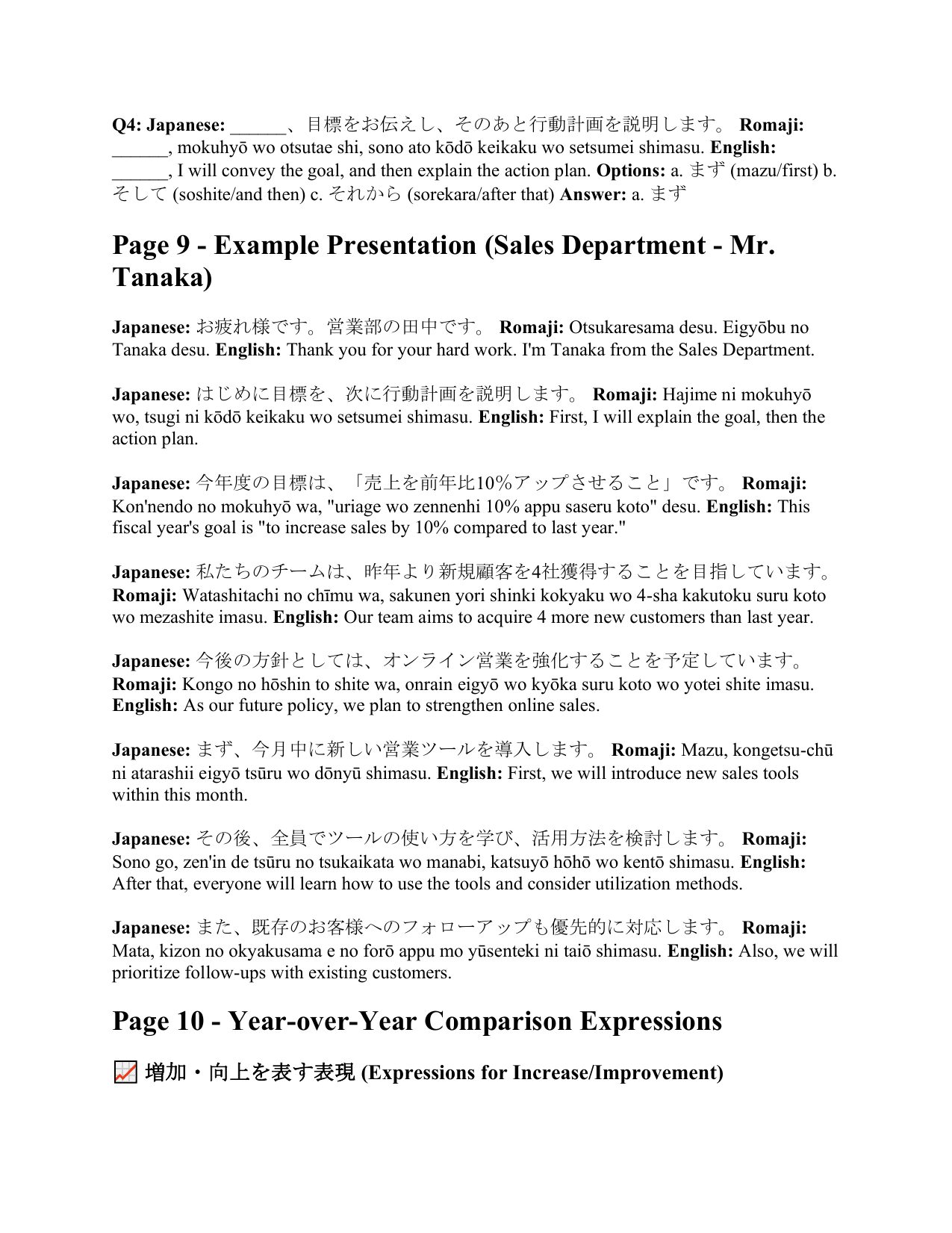
JPQ4:Japanese:______、目標をお伝えし、そのあと行動計画を説明します。Romaji:
EN______, mokuhyō wo otsutae shi, sono ato kōdō keikaku wo setsumei shimasu. English:
______, I will convey the goal, and then explain the action plan. Options: a. まず (mazu/first) b.
そして (soshite/and then) c. それから (sorekara/after that) Answer: a. まず
Page 9 - Example Presentation (Sales Department - Mr.
Tanaka)
Japanese: お疲れ様です。営業部の田中です。 Romaji: Otsukaresama desu. Eigyōbu no
Tanaka desu. English: Thank you for your hard work. I'm Tanaka from the Sales Department.
Japanese: はじめに目標を、次に行動計画を説明します。 Romaji: Hajime ni mokuhyō
wo, tsugi ni kōdō keikaku wo setsumei shimasu. English: First, I will explain the goal, then the
action plan.
______, I will convey the goal, and then explain the action plan. Options: a. まず (mazu/first) b.
そして (soshite/and then) c. それから (sorekara/after that) Answer: a. まず
Page 9 - Example Presentation (Sales Department - Mr.
Tanaka)
Japanese: お疲れ様です。営業部の田中です。 Romaji: Otsukaresama desu. Eigyōbu no
Tanaka desu. English: Thank you for your hard work. I'm Tanaka from the Sales Department.
Japanese: はじめに目標を、次に行動計画を説明します。 Romaji: Hajime ni mokuhyō
wo, tsugi ni kōdō keikaku wo setsumei shimasu. English: First, I will explain the goal, then the
action plan.
JPJapanese:今年度の目標は、「売上を前年比10%アップさせること」です。Romaji:
ENKon'nendo no mokuhyō wa, "uriage wo zennenhi 10% appu saseru koto" desu. English: This
fiscal year's goal is "to increase sales by 10% compared to last year."
fiscal year's goal is "to increase sales by 10% compared to last year."
JPJapanese:私たちのチームは、昨年より新規顧客を4社獲得することを目指しています。
ENRomaji: Watashitachi no chīmu wa, sakunen yori shinki kokyaku wo 4-sha kakutoku suru koto
wo mezashite imasu. English: Our team aims to acquire 4 more new customers than last year.
wo mezashite imasu. English: Our team aims to acquire 4 more new customers than last year.
JPJapanese:今後の方針としては、オンライン営業を強化することを予定しています。
ENRomaji: Kongo no hōshin to shite wa, onrain eigyō wo kyōka suru koto wo yotei shite imasu.
English: As our future policy, we plan to strengthen online sales.
Japanese: まず、今月中に新しい営業ツールを導入します。 Romaji: Mazu, kongetsu-chū
ni atarashii eigyō tsūru wo dōnyū shimasu. English: First, we will introduce new sales tools
within this month.
English: As our future policy, we plan to strengthen online sales.
Japanese: まず、今月中に新しい営業ツールを導入します。 Romaji: Mazu, kongetsu-chū
ni atarashii eigyō tsūru wo dōnyū shimasu. English: First, we will introduce new sales tools
within this month.
JPJapanese:その後、全員でツールの使い方を学び、活用方法を検討します。Romaji:
ENSono go, zen'in de tsūru no tsukaikata wo manabi, katsuyō hōhō wo kentō shimasu. English:
After that, everyone will learn how to use the tools and consider utilization methods.
After that, everyone will learn how to use the tools and consider utilization methods.
JPJapanese:また、既存のお客様へのフォローアップも優先的に対応します。Romaji:
ENMata, kizon no okyakusama e no forō appu mo yūsenteki ni taiō shimasu. English: Also, we will
prioritize follow-ups with existing customers.
Page 10 - Year-over-Year Comparison Expressions
増加・向上を表す表現 (Expressions for Increase/Improvement)
prioritize follow-ups with existing customers.
Page 10 - Year-over-Year Comparison Expressions
増加・向上を表す表現 (Expressions for Increase/Improvement)
หน้า 40
คลิกเพื่อขยาย
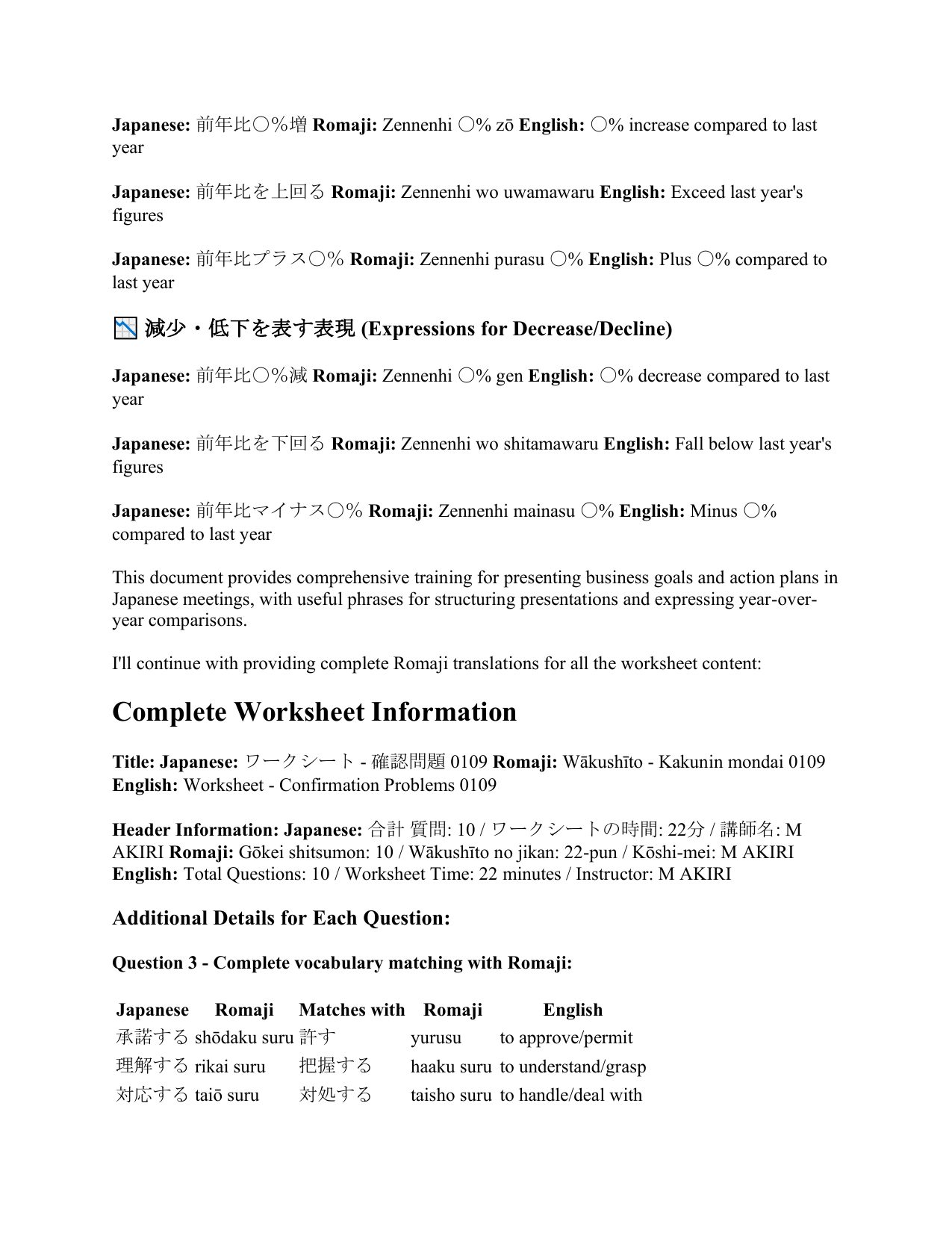
ENJapanese: 前年比〇%増 Romaji: Zennenhi 〇% zō English: 〇% increase compared to last
year
Japanese: 前年比を上回る Romaji: Zennenhi wo uwamawaru English: Exceed last year's
figures
Japanese: 前年比プラス〇% Romaji: Zennenhi purasu 〇% English: Plus 〇% compared to
last year
減少・低下を表す表現 (Expressions for Decrease/Decline)
Japanese: 前年比〇%減 Romaji: Zennenhi 〇% gen English: 〇% decrease compared to last
year
Japanese: 前年比を下回る Romaji: Zennenhi wo shitamawaru English: Fall below last year's
figures
Japanese: 前年比マイナス〇% Romaji: Zennenhi mainasu 〇% English: Minus 〇%
compared to last year
This document provides comprehensive training for presenting business goals and action plans in
Japanese meetings, with useful phrases for structuring presentations and expressing year-over-
year comparisons.
I'll continue with providing complete Romaji translations for all the worksheet content:
Complete Worksheet Information
Title: Japanese: ワークシート - 確認問題 0109 Romaji: Wākushīto - Kakunin mondai 0109
English: Worksheet - Confirmation Problems 0109
Header Information: Japanese: 合計 質問: 10 / ワークシートの時間: 22分 / 講師名: M
AKIRI Romaji: Gōkei shitsumon: 10 / Wākushīto no jikan: 22-pun / Kōshi-mei: M AKIRI
English: Total Questions: 10 / Worksheet Time: 22 minutes / Instructor: M AKIRI
Additional Details for Each Question:
Question 3 - Complete vocabulary matching with Romaji:
Japanese Romaji Matches with Romaji English
承諾する shōdaku suru 許す yurusu to approve/permit
理解する rikai suru 把握する haaku suru to understand/grasp
対応する taiō suru 対処する taisho suru to handle/deal with
year
Japanese: 前年比を上回る Romaji: Zennenhi wo uwamawaru English: Exceed last year's
figures
Japanese: 前年比プラス〇% Romaji: Zennenhi purasu 〇% English: Plus 〇% compared to
last year
減少・低下を表す表現 (Expressions for Decrease/Decline)
Japanese: 前年比〇%減 Romaji: Zennenhi 〇% gen English: 〇% decrease compared to last
year
Japanese: 前年比を下回る Romaji: Zennenhi wo shitamawaru English: Fall below last year's
figures
Japanese: 前年比マイナス〇% Romaji: Zennenhi mainasu 〇% English: Minus 〇%
compared to last year
This document provides comprehensive training for presenting business goals and action plans in
Japanese meetings, with useful phrases for structuring presentations and expressing year-over-
year comparisons.
I'll continue with providing complete Romaji translations for all the worksheet content:
Complete Worksheet Information
Title: Japanese: ワークシート - 確認問題 0109 Romaji: Wākushīto - Kakunin mondai 0109
English: Worksheet - Confirmation Problems 0109
Header Information: Japanese: 合計 質問: 10 / ワークシートの時間: 22分 / 講師名: M
AKIRI Romaji: Gōkei shitsumon: 10 / Wākushīto no jikan: 22-pun / Kōshi-mei: M AKIRI
English: Total Questions: 10 / Worksheet Time: 22 minutes / Instructor: M AKIRI
Additional Details for Each Question:
Question 3 - Complete vocabulary matching with Romaji:
Japanese Romaji Matches with Romaji English
承諾する shōdaku suru 許す yurusu to approve/permit
理解する rikai suru 把握する haaku suru to understand/grasp
対応する taiō suru 対処する taisho suru to handle/deal with
หน้า 41
คลิกเพื่อขยาย
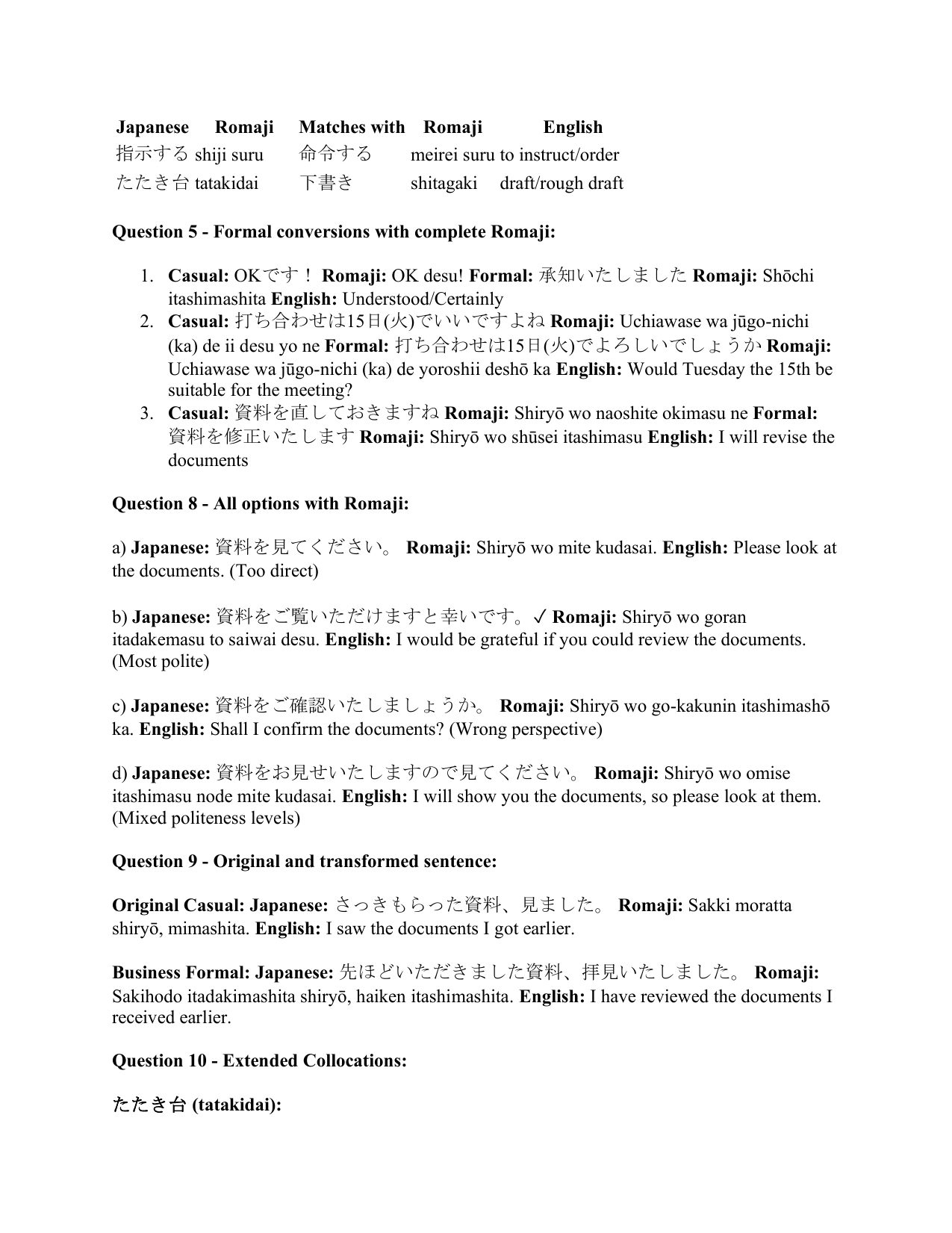
ENJapanese Romaji Matches with Romaji English
指示する shiji suru 命令する meirei suru to instruct/order
たたき台 tatakidai 下書き shitagaki draft/rough draft
Question 5 - Formal conversions with complete Romaji:
1. Casual: OKです! Romaji: OK desu! Formal: 承知いたしました Romaji: Shōchi
itashimashita English: Understood/Certainly
2. Casual: 打ち合わせは15日(火)でいいですよね Romaji: Uchiawase wa jūgo-nichi
(ka) de ii desu yo ne Formal: 打ち合わせは15日(火)でよろしいでしょうか Romaji:
Uchiawase wa jūgo-nichi (ka) de yoroshii deshō ka English: Would Tuesday the 15th be
suitable for the meeting?
3. Casual: 資料を直しておきますね Romaji: Shiryō wo naoshite okimasu ne Formal:
資料を修正いたします Romaji: Shiryō wo shūsei itashimasu English: I will revise the
documents
Question 8 - All options with Romaji:
a) Japanese: 資料を見てください。 Romaji: Shiryō wo mite kudasai. English: Please look at
the documents. (Too direct)
b) Japanese: 資料をご覧いただけますと幸いです。✓ Romaji: Shiryō wo goran
itadakemasu to saiwai desu. English: I would be grateful if you could review the documents.
(Most polite)
c) Japanese: 資料をご確認いたしましょうか。 Romaji: Shiryō wo go-kakunin itashimashō
ka. English: Shall I confirm the documents? (Wrong perspective)
d) Japanese: 資料をお見せいたしますので見てください。 Romaji: Shiryō wo omise
itashimasu node mite kudasai. English: I will show you the documents, so please look at them.
(Mixed politeness levels)
Question 9 - Original and transformed sentence:
Original Casual: Japanese: さっきもらった資料、見ました。 Romaji: Sakki moratta
shiryō, mimashita. English: I saw the documents I got earlier.
Business Formal: Japanese: 先ほどいただきました資料、拝見いたしました。 Romaji:
Sakihodo itadakimashita shiryō, haiken itashimashita. English: I have reviewed the documents I
received earlier.
Question 10 - Extended Collocations:
たたき台 (tatakidai):
指示する shiji suru 命令する meirei suru to instruct/order
たたき台 tatakidai 下書き shitagaki draft/rough draft
Question 5 - Formal conversions with complete Romaji:
1. Casual: OKです! Romaji: OK desu! Formal: 承知いたしました Romaji: Shōchi
itashimashita English: Understood/Certainly
2. Casual: 打ち合わせは15日(火)でいいですよね Romaji: Uchiawase wa jūgo-nichi
(ka) de ii desu yo ne Formal: 打ち合わせは15日(火)でよろしいでしょうか Romaji:
Uchiawase wa jūgo-nichi (ka) de yoroshii deshō ka English: Would Tuesday the 15th be
suitable for the meeting?
3. Casual: 資料を直しておきますね Romaji: Shiryō wo naoshite okimasu ne Formal:
資料を修正いたします Romaji: Shiryō wo shūsei itashimasu English: I will revise the
documents
Question 8 - All options with Romaji:
a) Japanese: 資料を見てください。 Romaji: Shiryō wo mite kudasai. English: Please look at
the documents. (Too direct)
b) Japanese: 資料をご覧いただけますと幸いです。✓ Romaji: Shiryō wo goran
itadakemasu to saiwai desu. English: I would be grateful if you could review the documents.
(Most polite)
c) Japanese: 資料をご確認いたしましょうか。 Romaji: Shiryō wo go-kakunin itashimashō
ka. English: Shall I confirm the documents? (Wrong perspective)
d) Japanese: 資料をお見せいたしますので見てください。 Romaji: Shiryō wo omise
itashimasu node mite kudasai. English: I will show you the documents, so please look at them.
(Mixed politeness levels)
Question 9 - Original and transformed sentence:
Original Casual: Japanese: さっきもらった資料、見ました。 Romaji: Sakki moratta
shiryō, mimashita. English: I saw the documents I got earlier.
Business Formal: Japanese: 先ほどいただきました資料、拝見いたしました。 Romaji:
Sakihodo itadakimashita shiryō, haiken itashimashita. English: I have reviewed the documents I
received earlier.
Question 10 - Extended Collocations:
たたき台 (tatakidai):
หน้า 42
คลิกเพื่อขยาย
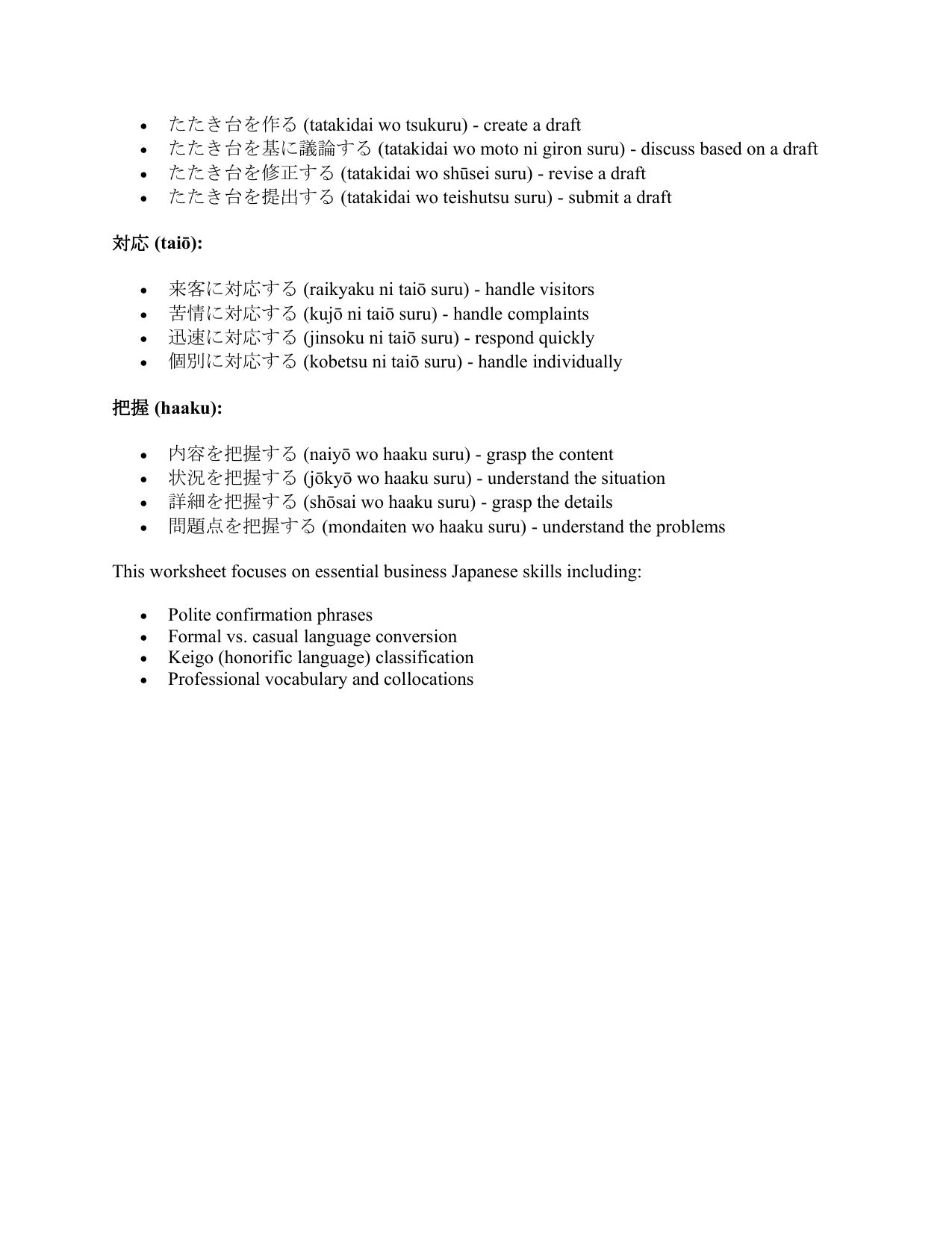
EN • たたき台を作る (tatakidai wo tsukuru) - create a draft
• たたき台を基に議論する (tatakidai wo moto ni giron suru) - discuss based on a draft
• たたき台を修正する (tatakidai wo shūsei suru) - revise a draft
• たたき台を提出する (tatakidai wo teishutsu suru) - submit a draft
対応 (taiō):
• 来客に対応する (raikyaku ni taiō suru) - handle visitors
• 苦情に対応する (kujō ni taiō suru) - handle complaints
• 迅速に対応する (jinsoku ni taiō suru) - respond quickly
• 個別に対応する (kobetsu ni taiō suru) - handle individually
把握 (haaku):
• 内容を把握する (naiyō wo haaku suru) - grasp the content
• 状況を把握する (jōkyō wo haaku suru) - understand the situation
• 詳細を把握する (shōsai wo haaku suru) - grasp the details
• 問題点を把握する (mondaiten wo haaku suru) - understand the problems
This worksheet focuses on essential business Japanese skills including:
• Polite confirmation phrases
• Formal vs. casual language conversion
• Keigo (honorific language) classification
• Professional vocabulary and collocations
• たたき台を基に議論する (tatakidai wo moto ni giron suru) - discuss based on a draft
• たたき台を修正する (tatakidai wo shūsei suru) - revise a draft
• たたき台を提出する (tatakidai wo teishutsu suru) - submit a draft
対応 (taiō):
• 来客に対応する (raikyaku ni taiō suru) - handle visitors
• 苦情に対応する (kujō ni taiō suru) - handle complaints
• 迅速に対応する (jinsoku ni taiō suru) - respond quickly
• 個別に対応する (kobetsu ni taiō suru) - handle individually
把握 (haaku):
• 内容を把握する (naiyō wo haaku suru) - grasp the content
• 状況を把握する (jōkyō wo haaku suru) - understand the situation
• 詳細を把握する (shōsai wo haaku suru) - grasp the details
• 問題点を把握する (mondaiten wo haaku suru) - understand the problems
This worksheet focuses on essential business Japanese skills including:
• Polite confirmation phrases
• Formal vs. casual language conversion
• Keigo (honorific language) classification
• Professional vocabulary and collocations
หน้า 43
คลิกเพื่อขยาย
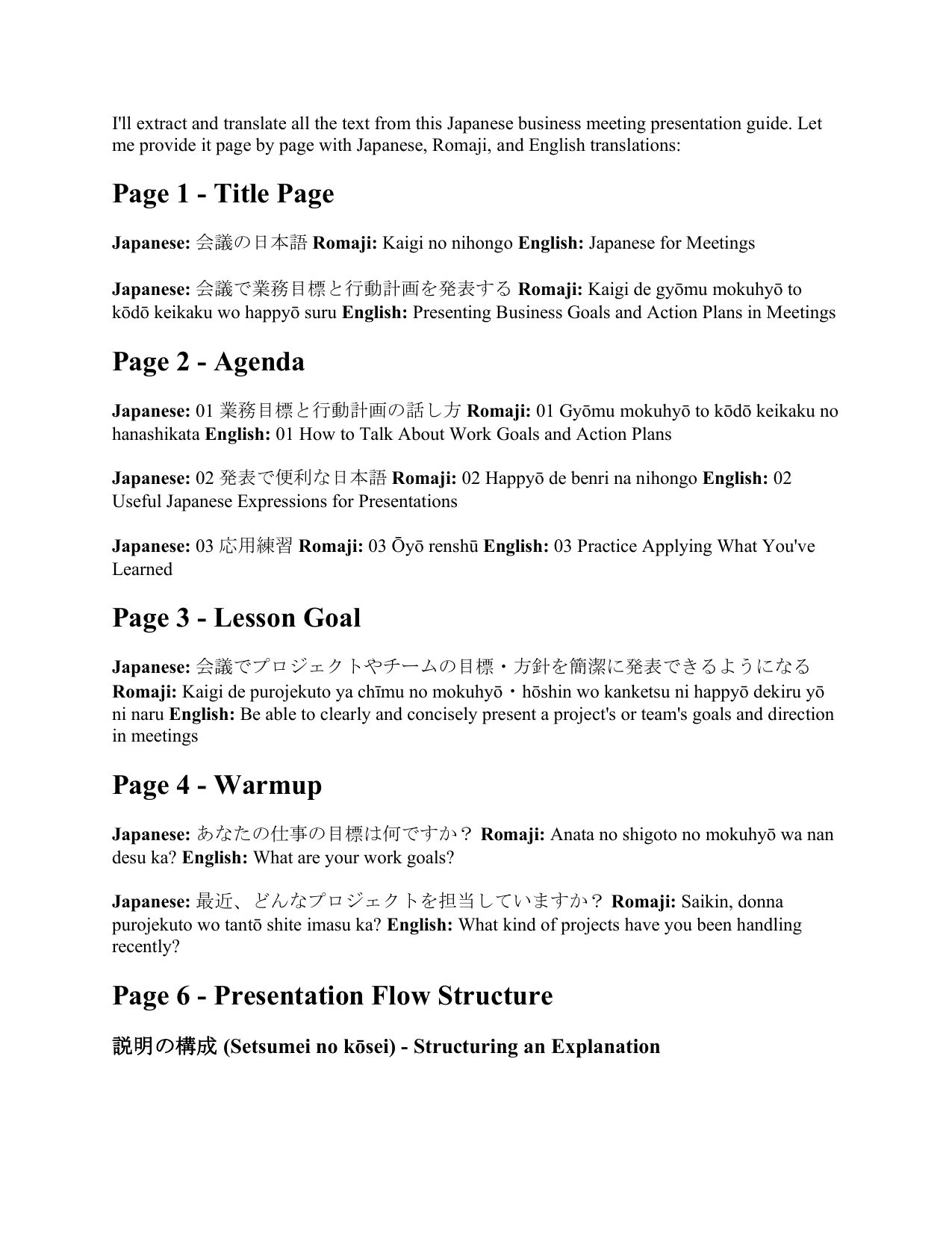
ENI'll extract and translate all the text from this Japanese business meeting presentation guide. Let
me provide it page by page with Japanese, Romaji, and English translations:
Page 1 - Title Page
Japanese: 会議の日本語 Romaji: Kaigi no nihongo English: Japanese for Meetings
Japanese: 会議で業務目標と行動計画を発表する Romaji: Kaigi de gyōmu mokuhyō to
kōdō keikaku wo happyō suru English: Presenting Business Goals and Action Plans in Meetings
Page 2 - Agenda
Japanese: 01 業務目標と行動計画の話し方 Romaji: 01 Gyōmu mokuhyō to kōdō keikaku no
hanashikata English: 01 How to Talk About Work Goals and Action Plans
Japanese: 02 発表で便利な日本語 Romaji: 02 Happyō de benri na nihongo English: 02
Useful Japanese Expressions for Presentations
Japanese: 03 応用練習 Romaji: 03 Ōyō renshū English: 03 Practice Applying What You've
Learned
Page 3 - Lesson Goal
me provide it page by page with Japanese, Romaji, and English translations:
Page 1 - Title Page
Japanese: 会議の日本語 Romaji: Kaigi no nihongo English: Japanese for Meetings
Japanese: 会議で業務目標と行動計画を発表する Romaji: Kaigi de gyōmu mokuhyō to
kōdō keikaku wo happyō suru English: Presenting Business Goals and Action Plans in Meetings
Page 2 - Agenda
Japanese: 01 業務目標と行動計画の話し方 Romaji: 01 Gyōmu mokuhyō to kōdō keikaku no
hanashikata English: 01 How to Talk About Work Goals and Action Plans
Japanese: 02 発表で便利な日本語 Romaji: 02 Happyō de benri na nihongo English: 02
Useful Japanese Expressions for Presentations
Japanese: 03 応用練習 Romaji: 03 Ōyō renshū English: 03 Practice Applying What You've
Learned
Page 3 - Lesson Goal
JPJapanese:会議でプロジェクトやチームの目標・方針を簡潔に発表できるようになる
ENRomaji: Kaigi de purojekuto ya chīmu no mokuhyō・hōshin wo kanketsu ni happyō dekiru yō
ni naru English: Be able to clearly and concisely present a project's or team's goals and direction
in meetings
Page 4 - Warmup
Japanese: あなたの仕事の目標は何ですか? Romaji: Anata no shigoto no mokuhyō wa nan
desu ka? English: What are your work goals?
Japanese: 最近、どんなプロジェクトを担当していますか? Romaji: Saikin, donna
purojekuto wo tantō shite imasu ka? English: What kind of projects have you been handling
recently?
Page 6 - Presentation Flow Structure
説明の構成 (Setsumei no kōsei) - Structuring an Explanation
ni naru English: Be able to clearly and concisely present a project's or team's goals and direction
in meetings
Page 4 - Warmup
Japanese: あなたの仕事の目標は何ですか? Romaji: Anata no shigoto no mokuhyō wa nan
desu ka? English: What are your work goals?
Japanese: 最近、どんなプロジェクトを担当していますか? Romaji: Saikin, donna
purojekuto wo tantō shite imasu ka? English: What kind of projects have you been handling
recently?
Page 6 - Presentation Flow Structure
説明の構成 (Setsumei no kōsei) - Structuring an Explanation
หน้า 44
คลิกเพื่อขยาย
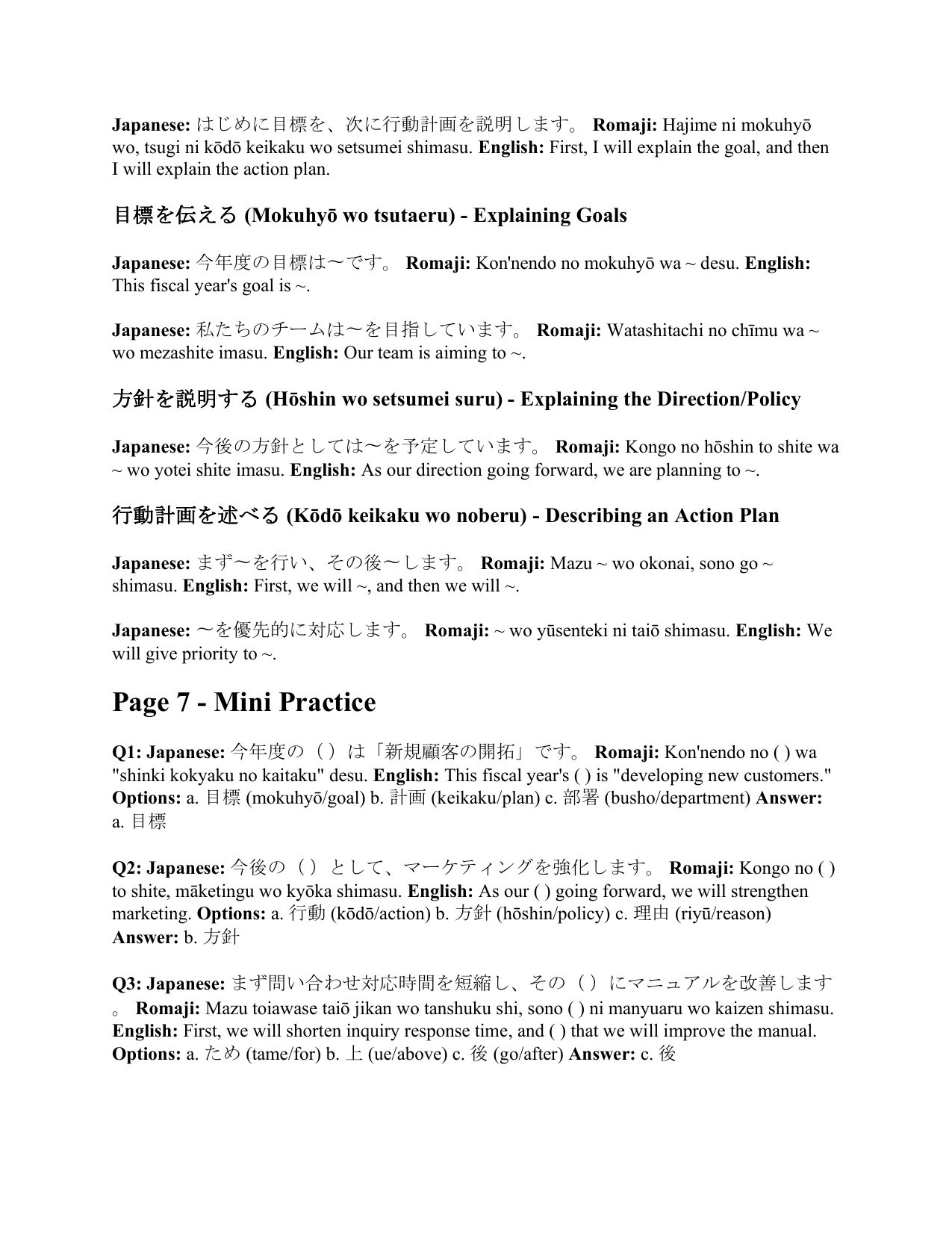
ENJapanese: はじめに目標を、次に行動計画を説明します。 Romaji: Hajime ni mokuhyō
wo, tsugi ni kōdō keikaku wo setsumei shimasu. English: First, I will explain the goal, and then
I will explain the action plan.
目標を伝える (Mokuhyō wo tsutaeru) - Explaining Goals
Japanese: 今年度の目標は〜です。 Romaji: Kon'nendo no mokuhyō wa ~ desu. English:
This fiscal year's goal is ~.
Japanese: 私たちのチームは〜を目指しています。 Romaji: Watashitachi no chīmu wa ~
wo mezashite imasu. English: Our team is aiming to ~.
方針を説明する (Hōshin wo setsumei suru) - Explaining the Direction/Policy
Japanese: 今後の方針としては〜を予定しています。 Romaji: Kongo no hōshin to shite wa
~ wo yotei shite imasu. English: As our direction going forward, we are planning to ~.
行動計画を述べる (Kōdō keikaku wo noberu) - Describing an Action Plan
Japanese: まず〜を行い、その後〜します。 Romaji: Mazu ~ wo okonai, sono go ~
shimasu. English: First, we will ~, and then we will ~.
Japanese: 〜を優先的に対応します。 Romaji: ~ wo yūsenteki ni taiō shimasu. English: We
will give priority to ~.
Page 7 - Mini Practice
Q1: Japanese: 今年度の( )は「新規顧客の開拓」です。 Romaji: Kon'nendo no ( ) wa
"shinki kokyaku no kaitaku" desu. English: This fiscal year's ( ) is "developing new customers."
Options: a. 目標 (mokuhyō/goal) b. 計画 (keikaku/plan) c. 部署 (busho/department) Answer:
wo, tsugi ni kōdō keikaku wo setsumei shimasu. English: First, I will explain the goal, and then
I will explain the action plan.
目標を伝える (Mokuhyō wo tsutaeru) - Explaining Goals
Japanese: 今年度の目標は〜です。 Romaji: Kon'nendo no mokuhyō wa ~ desu. English:
This fiscal year's goal is ~.
Japanese: 私たちのチームは〜を目指しています。 Romaji: Watashitachi no chīmu wa ~
wo mezashite imasu. English: Our team is aiming to ~.
方針を説明する (Hōshin wo setsumei suru) - Explaining the Direction/Policy
Japanese: 今後の方針としては〜を予定しています。 Romaji: Kongo no hōshin to shite wa
~ wo yotei shite imasu. English: As our direction going forward, we are planning to ~.
行動計画を述べる (Kōdō keikaku wo noberu) - Describing an Action Plan
Japanese: まず〜を行い、その後〜します。 Romaji: Mazu ~ wo okonai, sono go ~
shimasu. English: First, we will ~, and then we will ~.
Japanese: 〜を優先的に対応します。 Romaji: ~ wo yūsenteki ni taiō shimasu. English: We
will give priority to ~.
Page 7 - Mini Practice
Q1: Japanese: 今年度の( )は「新規顧客の開拓」です。 Romaji: Kon'nendo no ( ) wa
"shinki kokyaku no kaitaku" desu. English: This fiscal year's ( ) is "developing new customers."
Options: a. 目標 (mokuhyō/goal) b. 計画 (keikaku/plan) c. 部署 (busho/department) Answer:
JPa.目標
ENQ2: Japanese: 今後の( )として、マーケティングを強化します。 Romaji: Kongo no ( )
to shite, māketingu wo kyōka shimasu. English: As our ( ) going forward, we will strengthen
marketing. Options: a. 行動 (kōdō/action) b. 方針 (hōshin/policy) c. 理由 (riyū/reason)
Answer: b. 方針
to shite, māketingu wo kyōka shimasu. English: As our ( ) going forward, we will strengthen
marketing. Options: a. 行動 (kōdō/action) b. 方針 (hōshin/policy) c. 理由 (riyū/reason)
Answer: b. 方針
JPQ3:Japanese:まず問い合わせ対応時間を短縮し、その()にマニュアルを改善します
EN。 Romaji: Mazu toiawase taiō jikan wo tanshuku shi, sono ( ) ni manyuaru wo kaizen shimasu.
English: First, we will shorten inquiry response time, and ( ) that we will improve the manual.
Options: a. ため (tame/for) b. 上 (ue/above) c. 後 (go/after) Answer: c. 後
English: First, we will shorten inquiry response time, and ( ) that we will improve the manual.
Options: a. ため (tame/for) b. 上 (ue/above) c. 後 (go/after) Answer: c. 後
หน้า 45
คลิกเพื่อขยาย
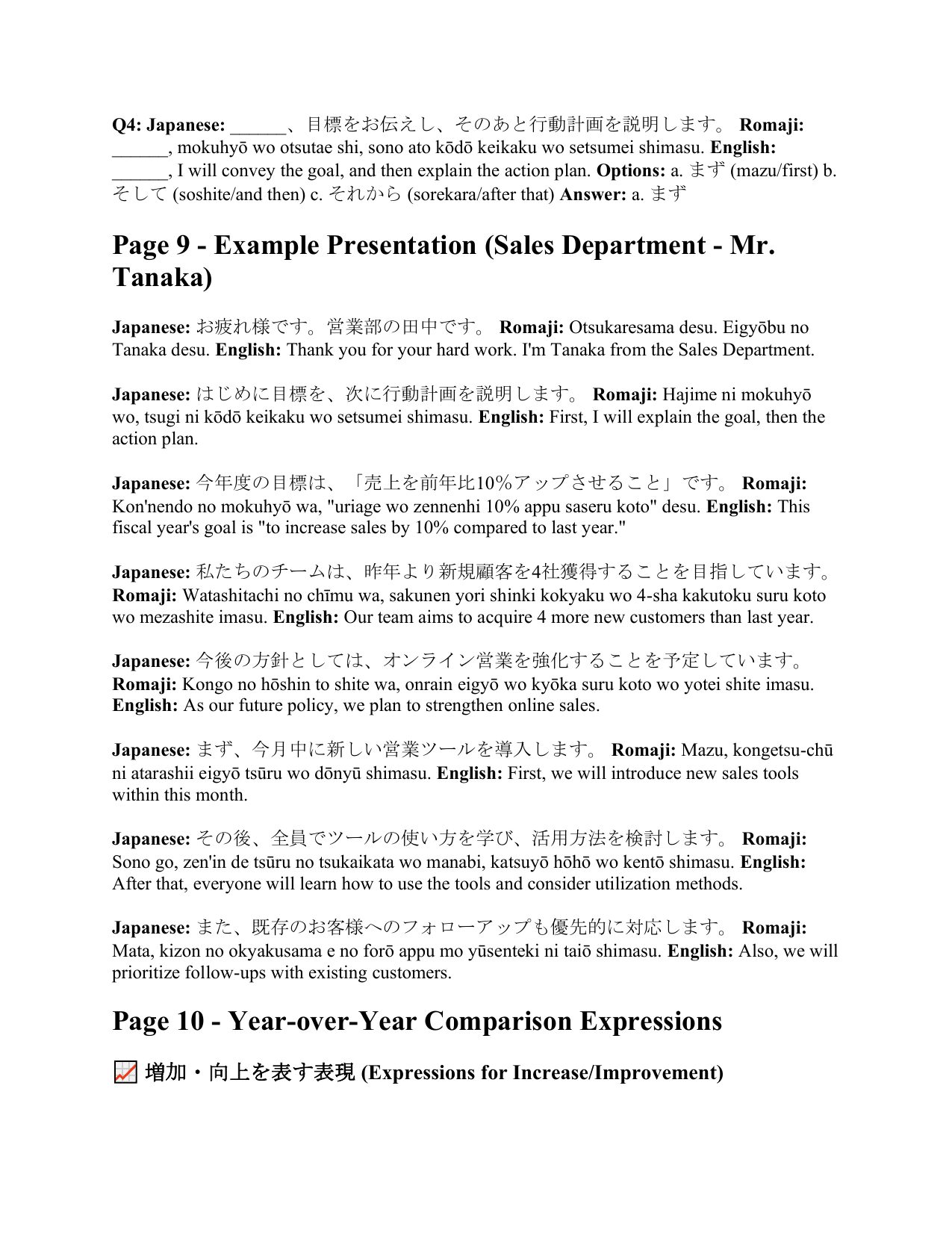
JPQ4:Japanese:______、目標をお伝えし、そのあと行動計画を説明します。Romaji:
EN______, mokuhyō wo otsutae shi, sono ato kōdō keikaku wo setsumei shimasu. English:
______, I will convey the goal, and then explain the action plan. Options: a. まず (mazu/first) b.
そして (soshite/and then) c. それから (sorekara/after that) Answer: a. まず
Page 9 - Example Presentation (Sales Department - Mr.
Tanaka)
Japanese: お疲れ様です。営業部の田中です。 Romaji: Otsukaresama desu. Eigyōbu no
Tanaka desu. English: Thank you for your hard work. I'm Tanaka from the Sales Department.
Japanese: はじめに目標を、次に行動計画を説明します。 Romaji: Hajime ni mokuhyō
wo, tsugi ni kōdō keikaku wo setsumei shimasu. English: First, I will explain the goal, then the
action plan.
______, I will convey the goal, and then explain the action plan. Options: a. まず (mazu/first) b.
そして (soshite/and then) c. それから (sorekara/after that) Answer: a. まず
Page 9 - Example Presentation (Sales Department - Mr.
Tanaka)
Japanese: お疲れ様です。営業部の田中です。 Romaji: Otsukaresama desu. Eigyōbu no
Tanaka desu. English: Thank you for your hard work. I'm Tanaka from the Sales Department.
Japanese: はじめに目標を、次に行動計画を説明します。 Romaji: Hajime ni mokuhyō
wo, tsugi ni kōdō keikaku wo setsumei shimasu. English: First, I will explain the goal, then the
action plan.
JPJapanese:今年度の目標は、「売上を前年比10%アップさせること」です。Romaji:
ENKon'nendo no mokuhyō wa, "uriage wo zennenhi 10% appu saseru koto" desu. English: This
fiscal year's goal is "to increase sales by 10% compared to last year."
fiscal year's goal is "to increase sales by 10% compared to last year."
JPJapanese:私たちのチームは、昨年より新規顧客を4社獲得することを目指しています。
ENRomaji: Watashitachi no chīmu wa, sakunen yori shinki kokyaku wo 4-sha kakutoku suru koto
wo mezashite imasu. English: Our team aims to acquire 4 more new customers than last year.
wo mezashite imasu. English: Our team aims to acquire 4 more new customers than last year.
JPJapanese:今後の方針としては、オンライン営業を強化することを予定しています。
ENRomaji: Kongo no hōshin to shite wa, onrain eigyō wo kyōka suru koto wo yotei shite imasu.
English: As our future policy, we plan to strengthen online sales.
Japanese: まず、今月中に新しい営業ツールを導入します。 Romaji: Mazu, kongetsu-chū
ni atarashii eigyō tsūru wo dōnyū shimasu. English: First, we will introduce new sales tools
within this month.
English: As our future policy, we plan to strengthen online sales.
Japanese: まず、今月中に新しい営業ツールを導入します。 Romaji: Mazu, kongetsu-chū
ni atarashii eigyō tsūru wo dōnyū shimasu. English: First, we will introduce new sales tools
within this month.
JPJapanese:その後、全員でツールの使い方を学び、活用方法を検討します。Romaji:
ENSono go, zen'in de tsūru no tsukaikata wo manabi, katsuyō hōhō wo kentō shimasu. English:
After that, everyone will learn how to use the tools and consider utilization methods.
After that, everyone will learn how to use the tools and consider utilization methods.
JPJapanese:また、既存のお客様へのフォローアップも優先的に対応します。Romaji:
ENMata, kizon no okyakusama e no forō appu mo yūsenteki ni taiō shimasu. English: Also, we will
prioritize follow-ups with existing customers.
Page 10 - Year-over-Year Comparison Expressions
増加・向上を表す表現 (Expressions for Increase/Improvement)
prioritize follow-ups with existing customers.
Page 10 - Year-over-Year Comparison Expressions
増加・向上を表す表現 (Expressions for Increase/Improvement)
หน้า 46
คลิกเพื่อขยาย
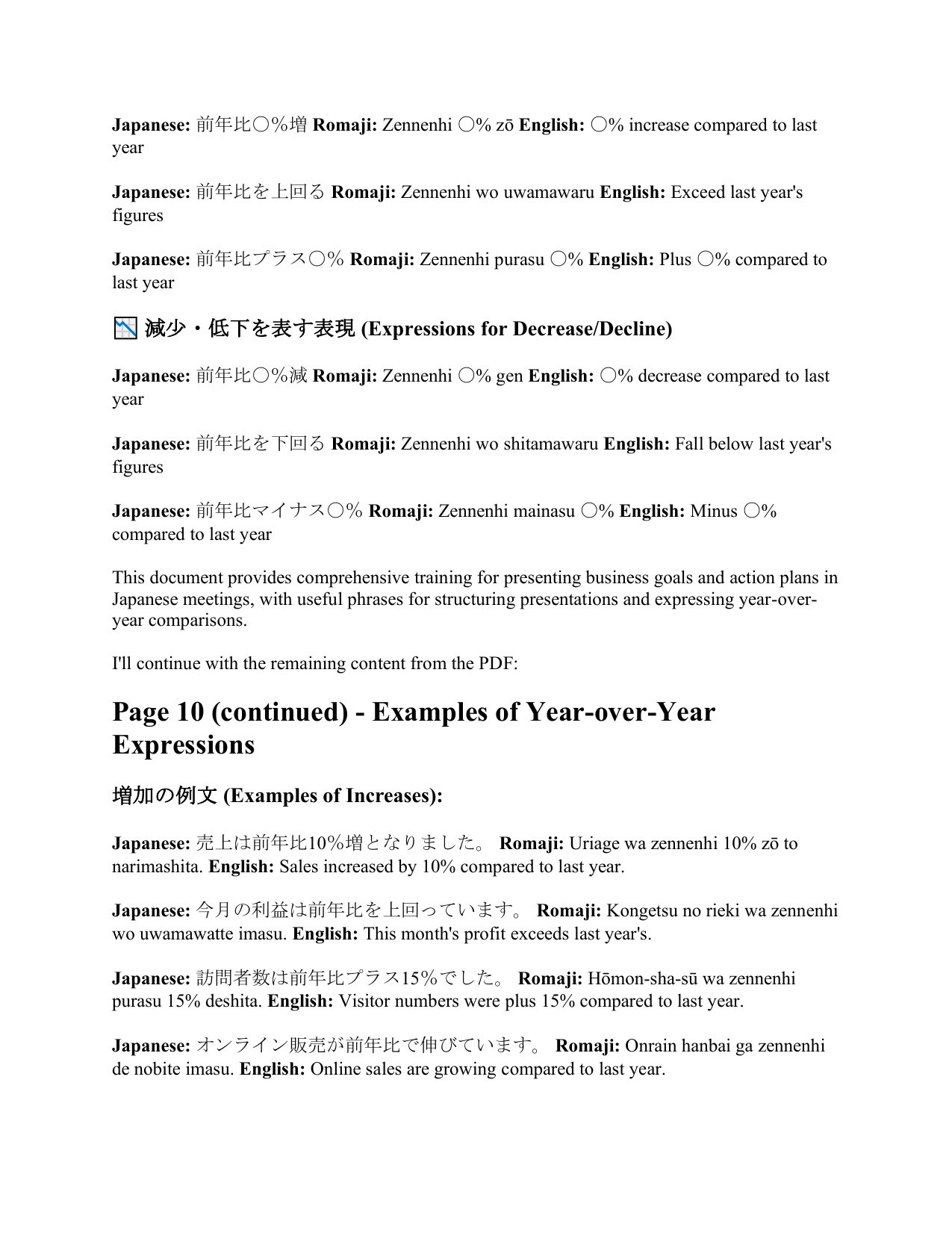
ENJapanese: 前年比〇%増 Romaji: Zennenhi 〇% zō English: 〇% increase compared to last
year
Japanese: 前年比を上回る Romaji: Zennenhi wo uwamawaru English: Exceed last year's
figures
Japanese: 前年比プラス〇% Romaji: Zennenhi purasu 〇% English: Plus 〇% compared to
last year
減少・低下を表す表現 (Expressions for Decrease/Decline)
Japanese: 前年比〇%減 Romaji: Zennenhi 〇% gen English: 〇% decrease compared to last
year
Japanese: 前年比を下回る Romaji: Zennenhi wo shitamawaru English: Fall below last year's
figures
Japanese: 前年比マイナス〇% Romaji: Zennenhi mainasu 〇% English: Minus 〇%
compared to last year
This document provides comprehensive training for presenting business goals and action plans in
Japanese meetings, with useful phrases for structuring presentations and expressing year-over-
year comparisons.
I'll continue with the remaining content from the PDF:
Page 10 (continued) - Examples of Year-over-Year
Expressions
増加の例文 (Examples of Increases):
Japanese: 売上は前年比10%増となりました。 Romaji: Uriage wa zennenhi 10% zō to
narimashita. English: Sales increased by 10% compared to last year.
Japanese: 今月の利益は前年比を上回っています。 Romaji: Kongetsu no rieki wa zennenhi
wo uwamawatte imasu. English: This month's profit exceeds last year's.
Japanese: 訪問者数は前年比プラス15%でした。 Romaji: Hōmon-sha-sū wa zennenhi
purasu 15% deshita. English: Visitor numbers were plus 15% compared to last year.
Japanese: オンライン販売が前年比で伸びています。 Romaji: Onrain hanbai ga zennenhi
de nobite imasu. English: Online sales are growing compared to last year.
year
Japanese: 前年比を上回る Romaji: Zennenhi wo uwamawaru English: Exceed last year's
figures
Japanese: 前年比プラス〇% Romaji: Zennenhi purasu 〇% English: Plus 〇% compared to
last year
減少・低下を表す表現 (Expressions for Decrease/Decline)
Japanese: 前年比〇%減 Romaji: Zennenhi 〇% gen English: 〇% decrease compared to last
year
Japanese: 前年比を下回る Romaji: Zennenhi wo shitamawaru English: Fall below last year's
figures
Japanese: 前年比マイナス〇% Romaji: Zennenhi mainasu 〇% English: Minus 〇%
compared to last year
This document provides comprehensive training for presenting business goals and action plans in
Japanese meetings, with useful phrases for structuring presentations and expressing year-over-
year comparisons.
I'll continue with the remaining content from the PDF:
Page 10 (continued) - Examples of Year-over-Year
Expressions
増加の例文 (Examples of Increases):
Japanese: 売上は前年比10%増となりました。 Romaji: Uriage wa zennenhi 10% zō to
narimashita. English: Sales increased by 10% compared to last year.
Japanese: 今月の利益は前年比を上回っています。 Romaji: Kongetsu no rieki wa zennenhi
wo uwamawatte imasu. English: This month's profit exceeds last year's.
Japanese: 訪問者数は前年比プラス15%でした。 Romaji: Hōmon-sha-sū wa zennenhi
purasu 15% deshita. English: Visitor numbers were plus 15% compared to last year.
Japanese: オンライン販売が前年比で伸びています。 Romaji: Onrain hanbai ga zennenhi
de nobite imasu. English: Online sales are growing compared to last year.
หน้า 47
คลิกเพื่อขยาย
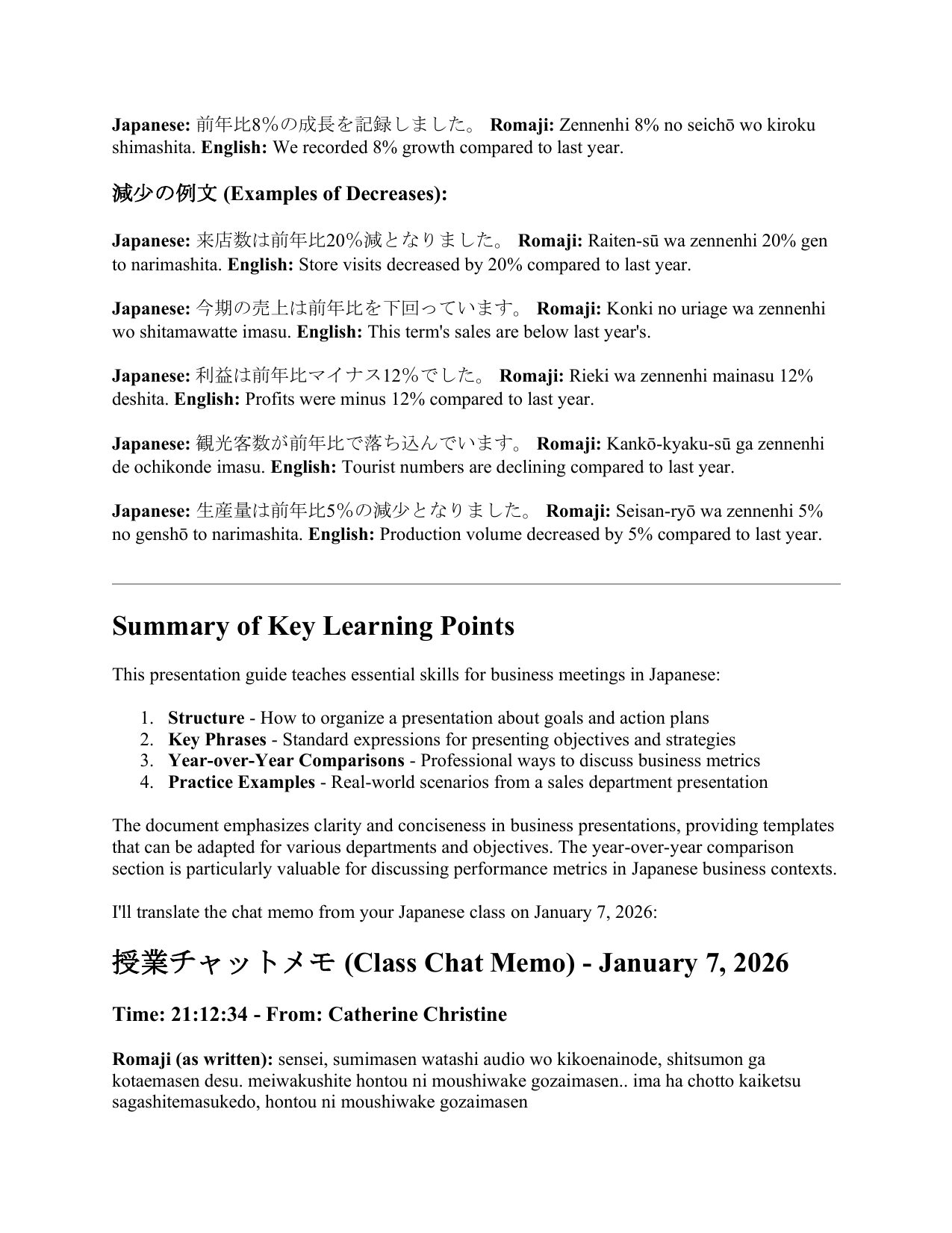
ENJapanese: 前年比8%の成長を記録しました。 Romaji: Zennenhi 8% no seichō wo kiroku
shimashita. English: We recorded 8% growth compared to last year.
減少の例文 (Examples of Decreases):
Japanese: 来店数は前年比20%減となりました。 Romaji: Raiten-sū wa zennenhi 20% gen
to narimashita. English: Store visits decreased by 20% compared to last year.
Japanese: 今期の売上は前年比を下回っています。 Romaji: Konki no uriage wa zennenhi
wo shitamawatte imasu. English: This term's sales are below last year's.
Japanese: 利益は前年比マイナス12%でした。 Romaji: Rieki wa zennenhi mainasu 12%
deshita. English: Profits were minus 12% compared to last year.
Japanese: 観光客数が前年比で落ち込んでいます。 Romaji: Kankō-kyaku-sū ga zennenhi
de ochikonde imasu. English: Tourist numbers are declining compared to last year.
Japanese: 生産量は前年比5%の減少となりました。 Romaji: Seisan-ryō wa zennenhi 5%
no genshō to narimashita. English: Production volume decreased by 5% compared to last year.
Summary of Key Learning Points
This presentation guide teaches essential skills for business meetings in Japanese:
1. Structure - How to organize a presentation about goals and action plans
2. Key Phrases - Standard expressions for presenting objectives and strategies
3. Year-over-Year Comparisons - Professional ways to discuss business metrics
4. Practice Examples - Real-world scenarios from a sales department presentation
The document emphasizes clarity and conciseness in business presentations, providing templates
that can be adapted for various departments and objectives. The year-over-year comparison
section is particularly valuable for discussing performance metrics in Japanese business contexts.
I'll translate the chat memo from your Japanese class on January 7, 2026:
授業チャットメモ (Class Chat Memo) - January 7, 2026
Time: 21:12:34 - From: Catherine Christine
Romaji (as written): sensei, sumimasen watashi audio wo kikoenainode, shitsumon ga
kotaemasen desu. meiwakushite hontou ni moushiwake gozaimasen.. ima ha chotto kaiketsu
sagashitemasukedo, hontou ni moushiwake gozaimasen
shimashita. English: We recorded 8% growth compared to last year.
減少の例文 (Examples of Decreases):
Japanese: 来店数は前年比20%減となりました。 Romaji: Raiten-sū wa zennenhi 20% gen
to narimashita. English: Store visits decreased by 20% compared to last year.
Japanese: 今期の売上は前年比を下回っています。 Romaji: Konki no uriage wa zennenhi
wo shitamawatte imasu. English: This term's sales are below last year's.
Japanese: 利益は前年比マイナス12%でした。 Romaji: Rieki wa zennenhi mainasu 12%
deshita. English: Profits were minus 12% compared to last year.
Japanese: 観光客数が前年比で落ち込んでいます。 Romaji: Kankō-kyaku-sū ga zennenhi
de ochikonde imasu. English: Tourist numbers are declining compared to last year.
Japanese: 生産量は前年比5%の減少となりました。 Romaji: Seisan-ryō wa zennenhi 5%
no genshō to narimashita. English: Production volume decreased by 5% compared to last year.
Summary of Key Learning Points
This presentation guide teaches essential skills for business meetings in Japanese:
1. Structure - How to organize a presentation about goals and action plans
2. Key Phrases - Standard expressions for presenting objectives and strategies
3. Year-over-Year Comparisons - Professional ways to discuss business metrics
4. Practice Examples - Real-world scenarios from a sales department presentation
The document emphasizes clarity and conciseness in business presentations, providing templates
that can be adapted for various departments and objectives. The year-over-year comparison
section is particularly valuable for discussing performance metrics in Japanese business contexts.
I'll translate the chat memo from your Japanese class on January 7, 2026:
授業チャットメモ (Class Chat Memo) - January 7, 2026
Time: 21:12:34 - From: Catherine Christine
Romaji (as written): sensei, sumimasen watashi audio wo kikoenainode, shitsumon ga
kotaemasen desu. meiwakushite hontou ni moushiwake gozaimasen.. ima ha chotto kaiketsu
sagashitemasukedo, hontou ni moushiwake gozaimasen
หน้า 48
คลิกเพื่อขยาย
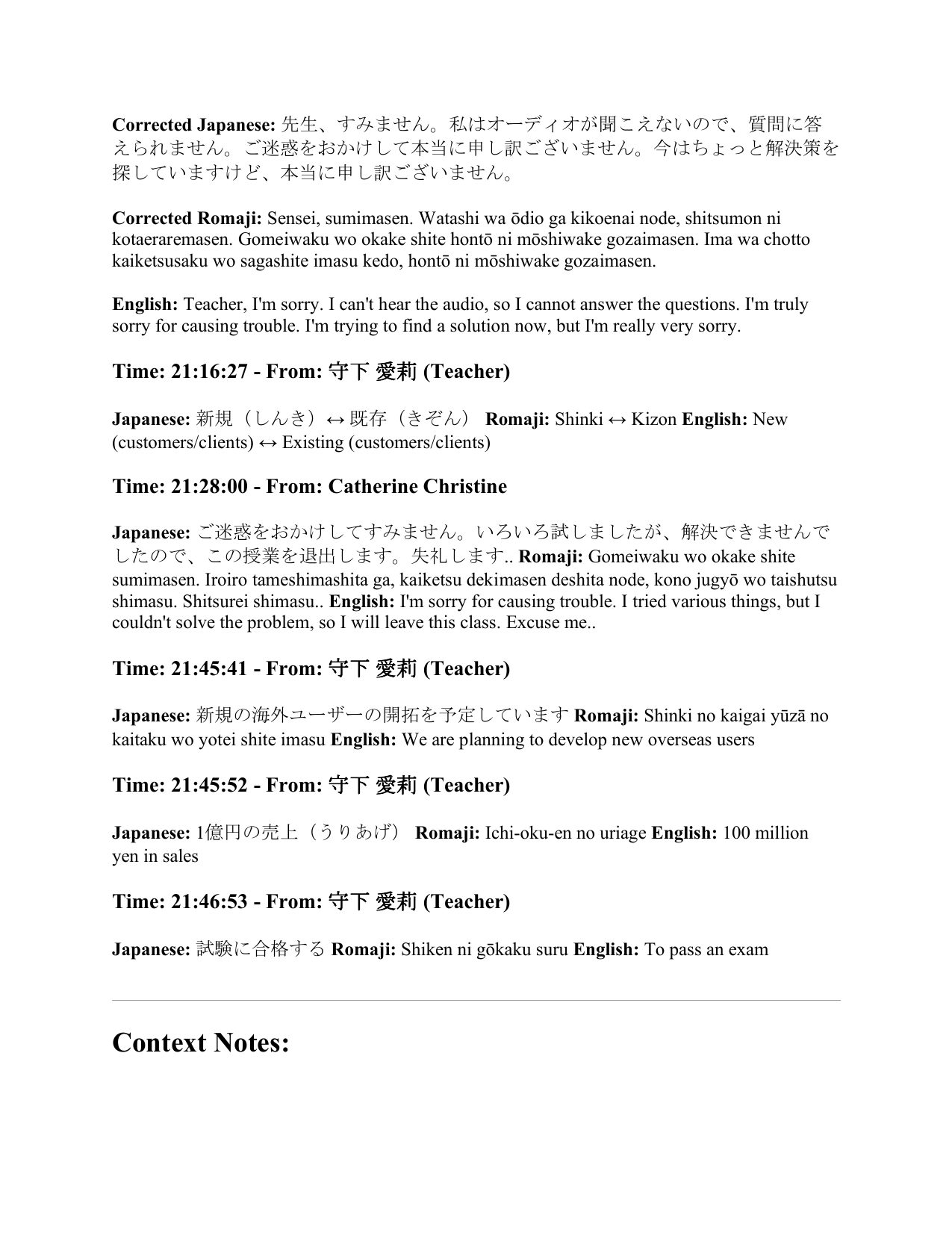
JPCorrectedJapanese:先生、すみません。私はオーディオが聞こえないので、質問に答
えられません。ご迷惑をおかけして本当に申し訳ございません。今はちょっと解決策を
探していますけど、本当に申し訳ございません。
えられません。ご迷惑をおかけして本当に申し訳ございません。今はちょっと解決策を
探していますけど、本当に申し訳ございません。
ENCorrected Romaji: Sensei, sumimasen. Watashi wa ōdio ga kikoenai node, shitsumon ni
kotaeraremasen. Gomeiwaku wo okake shite hontō ni mōshiwake gozaimasen. Ima wa chotto
kaiketsusaku wo sagashite imasu kedo, hontō ni mōshiwake gozaimasen.
English: Teacher, I'm sorry. I can't hear the audio, so I cannot answer the questions. I'm truly
sorry for causing trouble. I'm trying to find a solution now, but I'm really very sorry.
Time: 21:16:27 - From: 守下 愛莉 (Teacher)
Japanese: 新規(しんき)↔️ 既存(きぞん) Romaji: Shinki ↔️ Kizon English: New
(customers/clients) ↔️ Existing (customers/clients)
Time: 21:28:00 - From: Catherine Christine
kotaeraremasen. Gomeiwaku wo okake shite hontō ni mōshiwake gozaimasen. Ima wa chotto
kaiketsusaku wo sagashite imasu kedo, hontō ni mōshiwake gozaimasen.
English: Teacher, I'm sorry. I can't hear the audio, so I cannot answer the questions. I'm truly
sorry for causing trouble. I'm trying to find a solution now, but I'm really very sorry.
Time: 21:16:27 - From: 守下 愛莉 (Teacher)
Japanese: 新規(しんき)↔️ 既存(きぞん) Romaji: Shinki ↔️ Kizon English: New
(customers/clients) ↔️ Existing (customers/clients)
Time: 21:28:00 - From: Catherine Christine
JPJapanese:ご迷惑をおかけしてすみません。いろいろ試しましたが、解決できませんで
ENしたので、この授業を退出します。失礼します.. Romaji: Gomeiwaku wo okake shite
sumimasen. Iroiro tameshimashita ga, kaiketsu dekimasen deshita node, kono jugyō wo taishutsu
shimasu. Shitsurei shimasu.. English: I'm sorry for causing trouble. I tried various things, but I
couldn't solve the problem, so I will leave this class. Excuse me..
Time: 21:45:41 - From: 守下 愛莉 (Teacher)
Japanese: 新規の海外ユーザーの開拓を予定しています Romaji: Shinki no kaigai yūzā no
kaitaku wo yotei shite imasu English: We are planning to develop new overseas users
Time: 21:45:52 - From: 守下 愛莉 (Teacher)
Japanese: 1億円の売上(うりあげ) Romaji: Ichi-oku-en no uriage English: 100 million
yen in sales
Time: 21:46:53 - From: 守下 愛莉 (Teacher)
Japanese: 試験に合格する Romaji: Shiken ni gōkaku suru English: To pass an exam
Context Notes:
sumimasen. Iroiro tameshimashita ga, kaiketsu dekimasen deshita node, kono jugyō wo taishutsu
shimasu. Shitsurei shimasu.. English: I'm sorry for causing trouble. I tried various things, but I
couldn't solve the problem, so I will leave this class. Excuse me..
Time: 21:45:41 - From: 守下 愛莉 (Teacher)
Japanese: 新規の海外ユーザーの開拓を予定しています Romaji: Shinki no kaigai yūzā no
kaitaku wo yotei shite imasu English: We are planning to develop new overseas users
Time: 21:45:52 - From: 守下 愛莉 (Teacher)
Japanese: 1億円の売上(うりあげ) Romaji: Ichi-oku-en no uriage English: 100 million
yen in sales
Time: 21:46:53 - From: 守下 愛莉 (Teacher)
Japanese: 試験に合格する Romaji: Shiken ni gōkaku suru English: To pass an exam
Context Notes:
หน้า 49
คลิกเพื่อขยาย
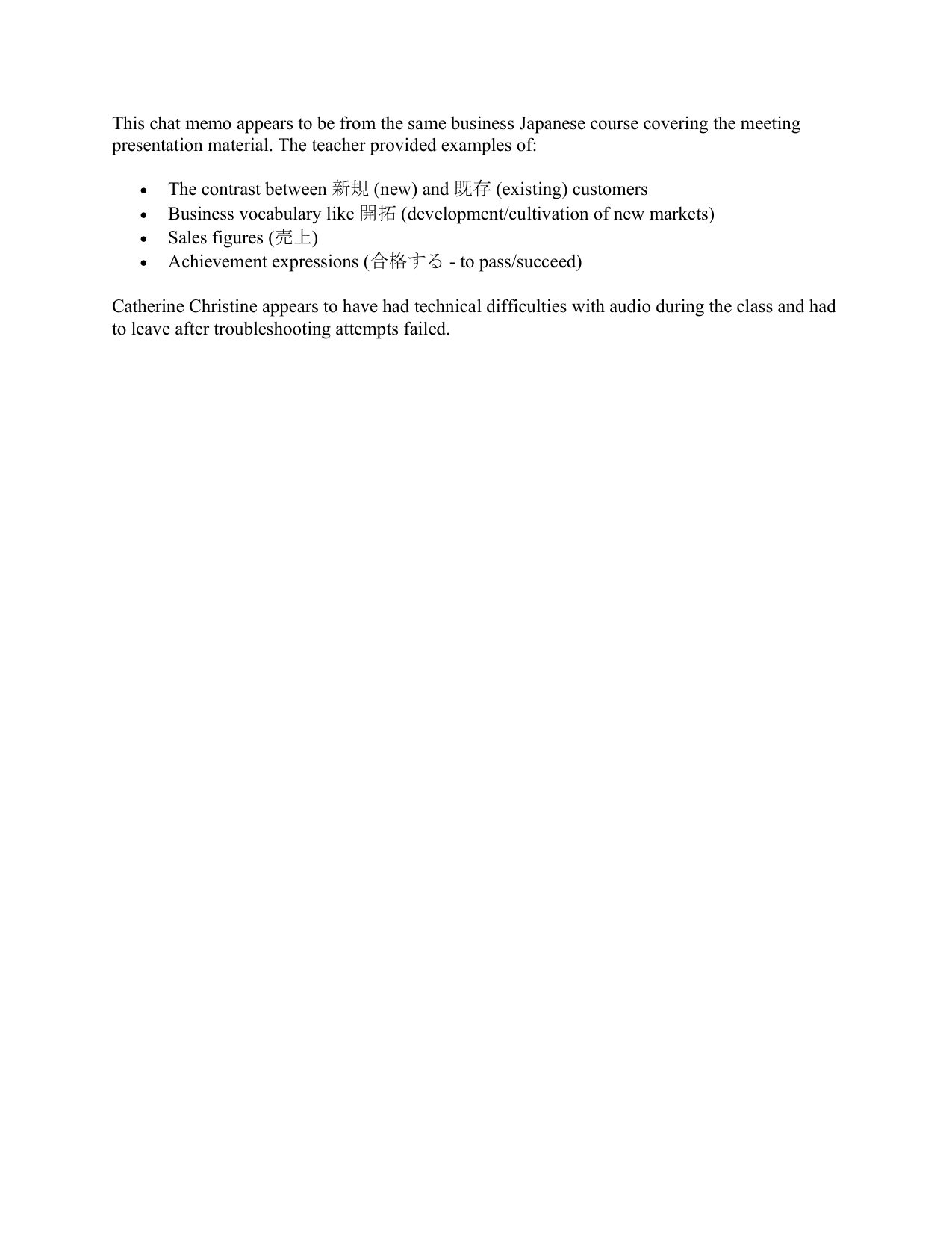
ENThis chat memo appears to be from the same business Japanese course covering the meeting
presentation material. The teacher provided examples of:
• The contrast between 新規 (new) and 既存 (existing) customers
• Business vocabulary like 開拓 (development/cultivation of new markets)
• Sales figures (売上)
• Achievement expressions (合格する - to pass/succeed)
Catherine Christine appears to have had technical difficulties with audio during the class and had
to leave after troubleshooting attempts failed.
presentation material. The teacher provided examples of:
• The contrast between 新規 (new) and 既存 (existing) customers
• Business vocabulary like 開拓 (development/cultivation of new markets)
• Sales figures (売上)
• Achievement expressions (合格する - to pass/succeed)
Catherine Christine appears to have had technical difficulties with audio during the class and had
to leave after troubleshooting attempts failed.