หน้า 1
คลิกเพื่อขยาย
ENJAPANESE STUDY LIBRARY · VOLUME 8
Textbook Vol. 2 — Coworker Rapport &
Phone Etiquette
Textbook Vol. 2 — Coworker Rapport &
Phone Etiquette
JP同僚との距離を縮める会話と電話対応
ENFull page-by-page phrase reference: greetings, comforting colleagues, weekend small talk, future plans, recommending spots,
and phone etiquette (textbook pages 325–471)
Volume 8 of 9
and phone etiquette (textbook pages 325–471)
Volume 8 of 9
หน้า 2
คลิกเพื่อขยาย
ENTABLE OF CONTENTS
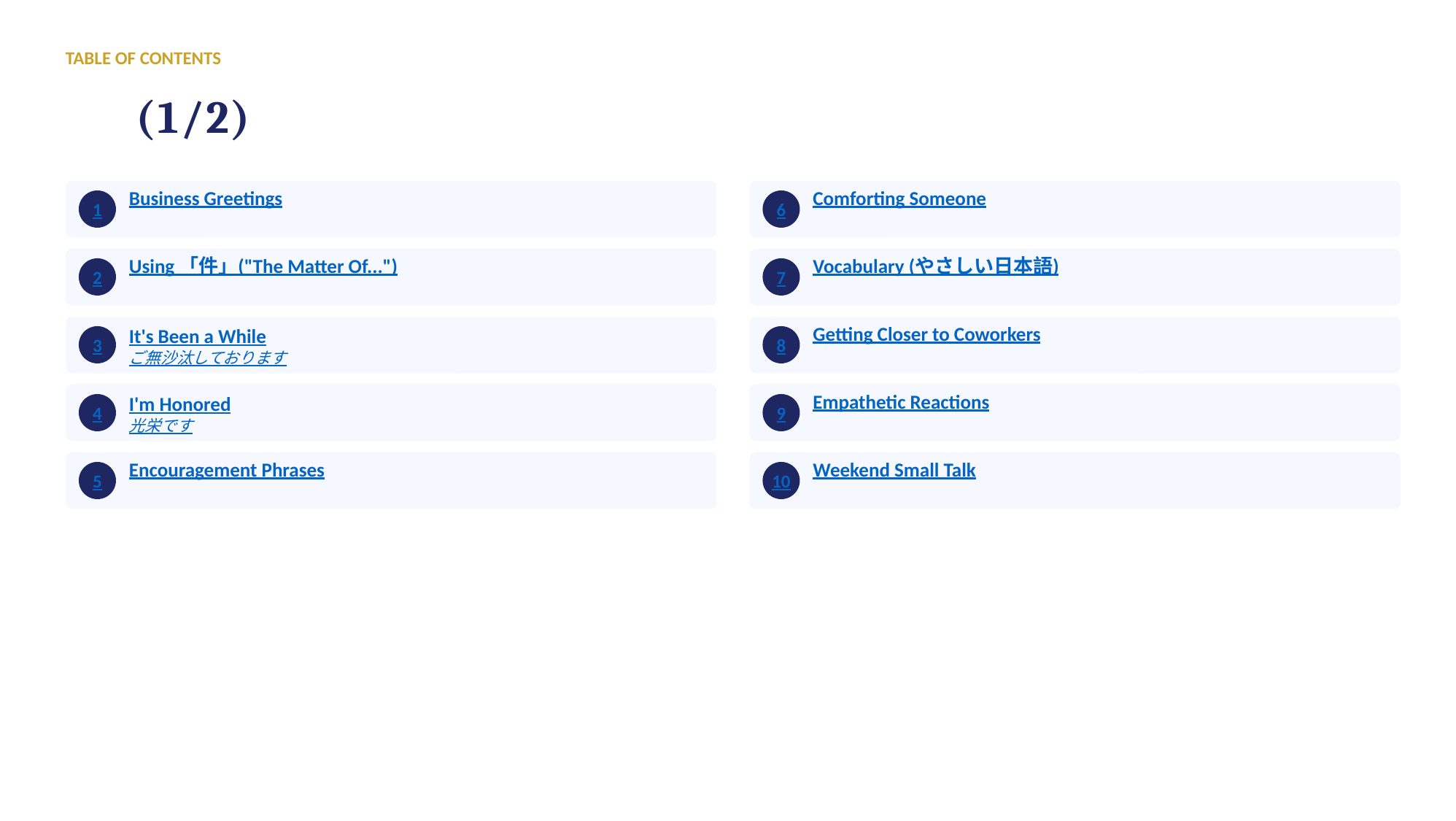
THสารบัญ (1/2)
EN Business Greetings Comforting Someone
1 6
Using 「件」("The Matter Of...") Vocabulary (やさしい日本語)
2 7
It's Been a While Getting Closer to Coworkers
3 8
1 6
Using 「件」("The Matter Of...") Vocabulary (やさしい日本語)
2 7
It's Been a While Getting Closer to Coworkers
3 8
JPご無沙汰しております
EN I'm Honored Empathetic Reactions
4 9
4 9
JP光栄です
EN Encouragement Phrases Weekend Small Talk
5 10
5 10
หน้า 3
คลิกเพื่อขยาย
ENTABLE OF CONTENTS
THสารบัญ (2/2)
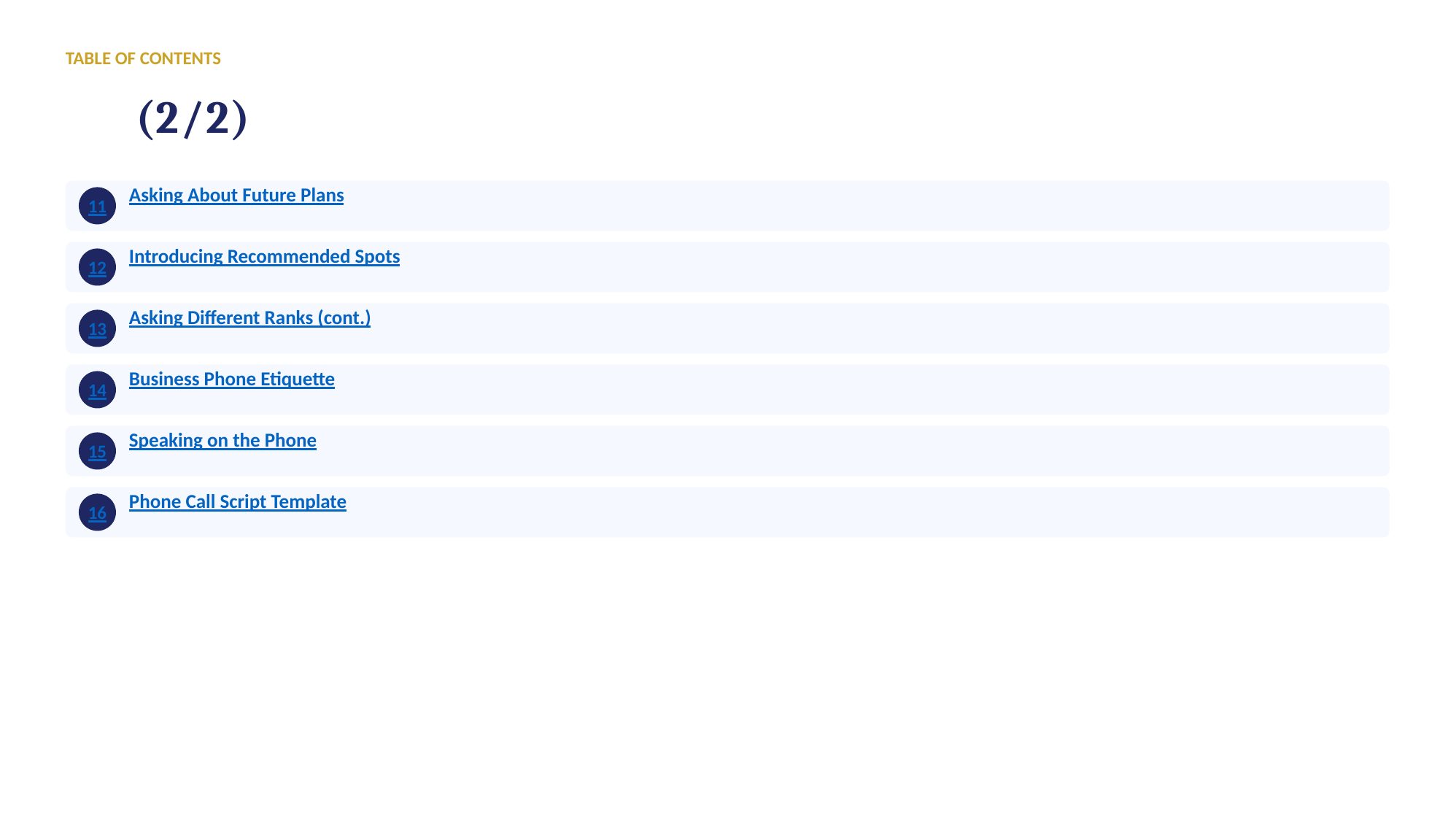
EN Asking About Future Plans
11
Introducing Recommended Spots
12
Asking Different Ranks (cont.)
13
Business Phone Etiquette
14
Speaking on the Phone
15
Phone Call Script Template
16
11
Introducing Recommended Spots
12
Asking Different Ranks (cont.)
13
Business Phone Etiquette
14
Speaking on the Phone
15
Phone Call Script Template
16
หน้า 4

คลิกเพื่อขยาย
01
ENBusiness Greetings
12 phrases · pages 325–336
12 phrases · pages 325–336
หน้า 5
คลิกเพื่อขยาย
ENP.325–P.327
Business Greetings (1/4)
Business Greetings (1/4)
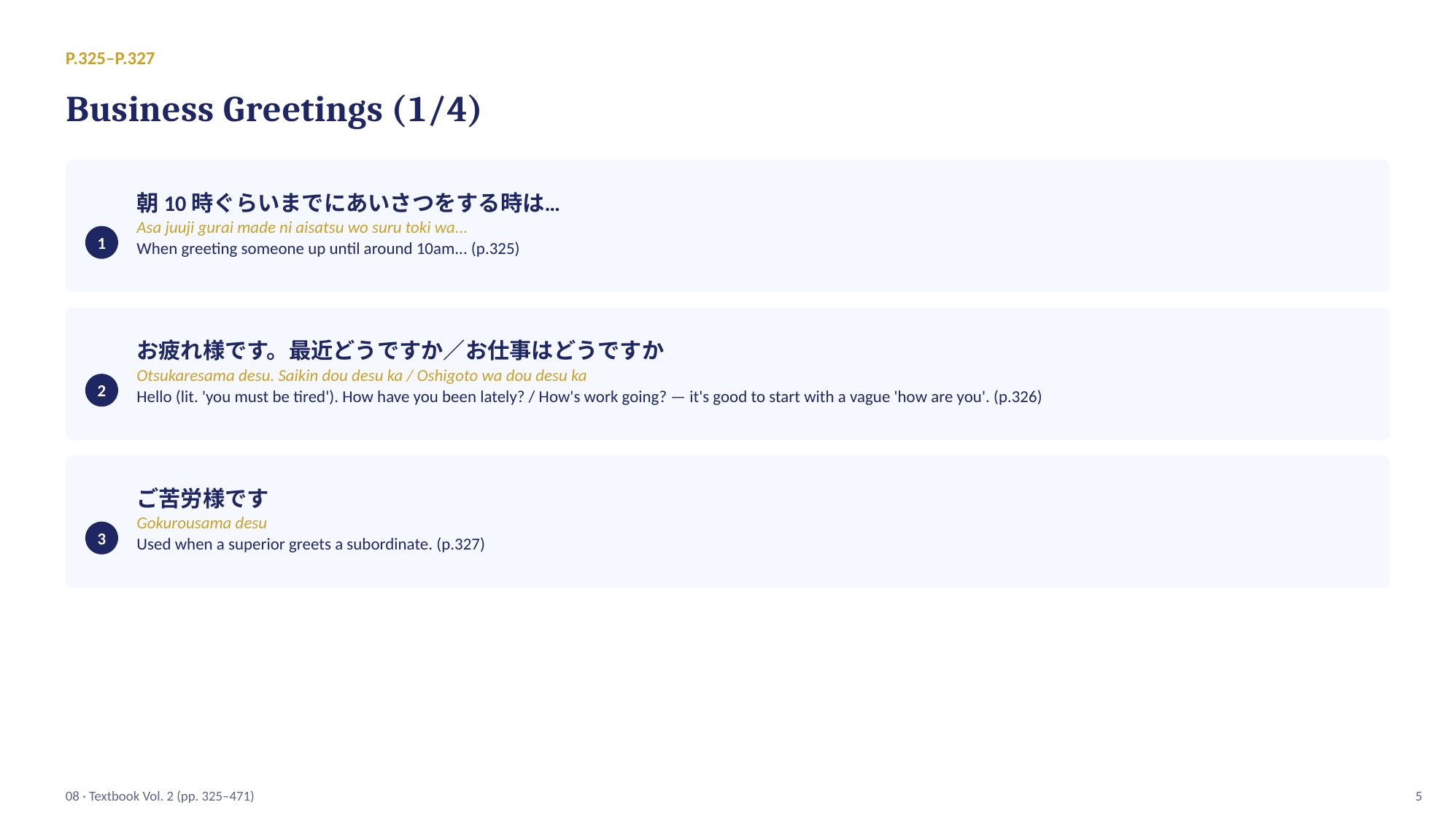
JP朝10時ぐらいまでにあいさつをする時は…
EN Asa juuji gurai made ni aisatsu wo suru toki wa...
1 When greeting someone up until around 10am... (p.325)
1 When greeting someone up until around 10am... (p.325)
JPお疲れ様です。最近どうですか/お仕事はどうですか
EN Otsukaresama desu. Saikin dou desu ka / Oshigoto wa dou desu ka
2 Hello (lit. 'you must be tired'). How have you been lately? / How's work going? — it's good to start with a vague 'how are you'. (p.326)
2 Hello (lit. 'you must be tired'). How have you been lately? / How's work going? — it's good to start with a vague 'how are you'. (p.326)
JPご苦労様です
EN Gokurousama desu
3 Used when a superior greets a subordinate. (p.327)
08 · Textbook Vol. 2 (pp. 325–471) 5
3 Used when a superior greets a subordinate. (p.327)
08 · Textbook Vol. 2 (pp. 325–471) 5
หน้า 6
คลิกเพื่อขยาย
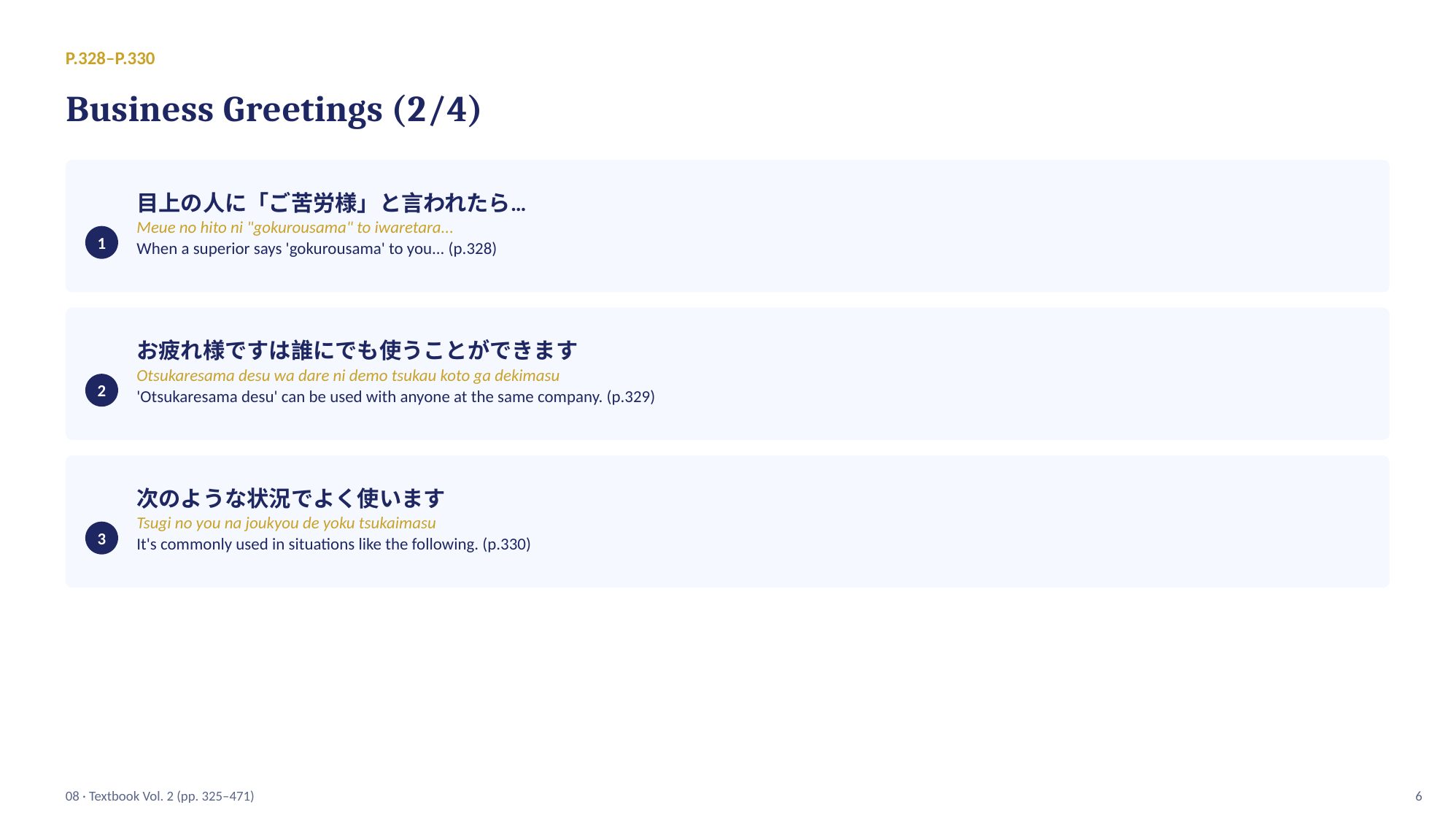
ENP.328–P.330
Business Greetings (2/4)
Business Greetings (2/4)
JP目上の人に「ご苦労様」と言われたら…
EN Meue no hito ni "gokurousama" to iwaretara...
1 When a superior says 'gokurousama' to you... (p.328)
1 When a superior says 'gokurousama' to you... (p.328)
JPお疲れ様ですは誰にでも使うことができます
EN Otsukaresama desu wa dare ni demo tsukau koto ga dekimasu
2 'Otsukaresama desu' can be used with anyone at the same company. (p.329)
2 'Otsukaresama desu' can be used with anyone at the same company. (p.329)
JP次のような状況でよく使います
EN Tsugi no you na joukyou de yoku tsukaimasu
3 It's commonly used in situations like the following. (p.330)
08 · Textbook Vol. 2 (pp. 325–471) 6
3 It's commonly used in situations like the following. (p.330)
08 · Textbook Vol. 2 (pp. 325–471) 6
หน้า 7
คลิกเพื่อขยาย
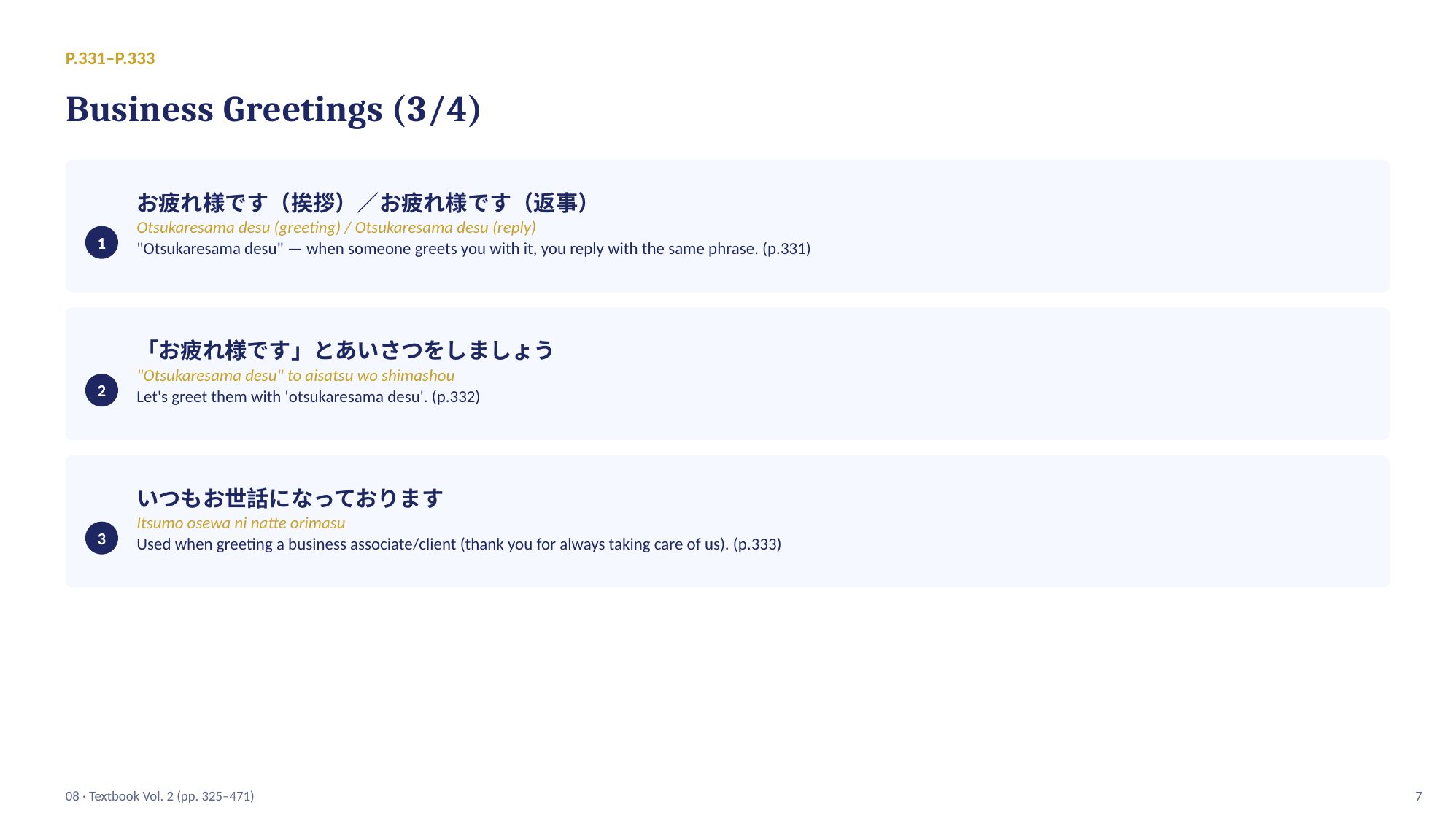
ENP.331–P.333
Business Greetings (3/4)
Business Greetings (3/4)
JPお疲れ様です(挨拶)/お疲れ様です(返事)
EN Otsukaresama desu (greeting) / Otsukaresama desu (reply)
1 "Otsukaresama desu" — when someone greets you with it, you reply with the same phrase. (p.331)
1 "Otsukaresama desu" — when someone greets you with it, you reply with the same phrase. (p.331)
JP「お疲れ様です」とあいさつをしましょう
EN "Otsukaresama desu" to aisatsu wo shimashou
2 Let's greet them with 'otsukaresama desu'. (p.332)
2 Let's greet them with 'otsukaresama desu'. (p.332)
JPいつもお世話になっております
EN Itsumo osewa ni natte orimasu
3 Used when greeting a business associate/client (thank you for always taking care of us). (p.333)
08 · Textbook Vol. 2 (pp. 325–471) 7
3 Used when greeting a business associate/client (thank you for always taking care of us). (p.333)
08 · Textbook Vol. 2 (pp. 325–471) 7
หน้า 8
คลิกเพื่อขยาย
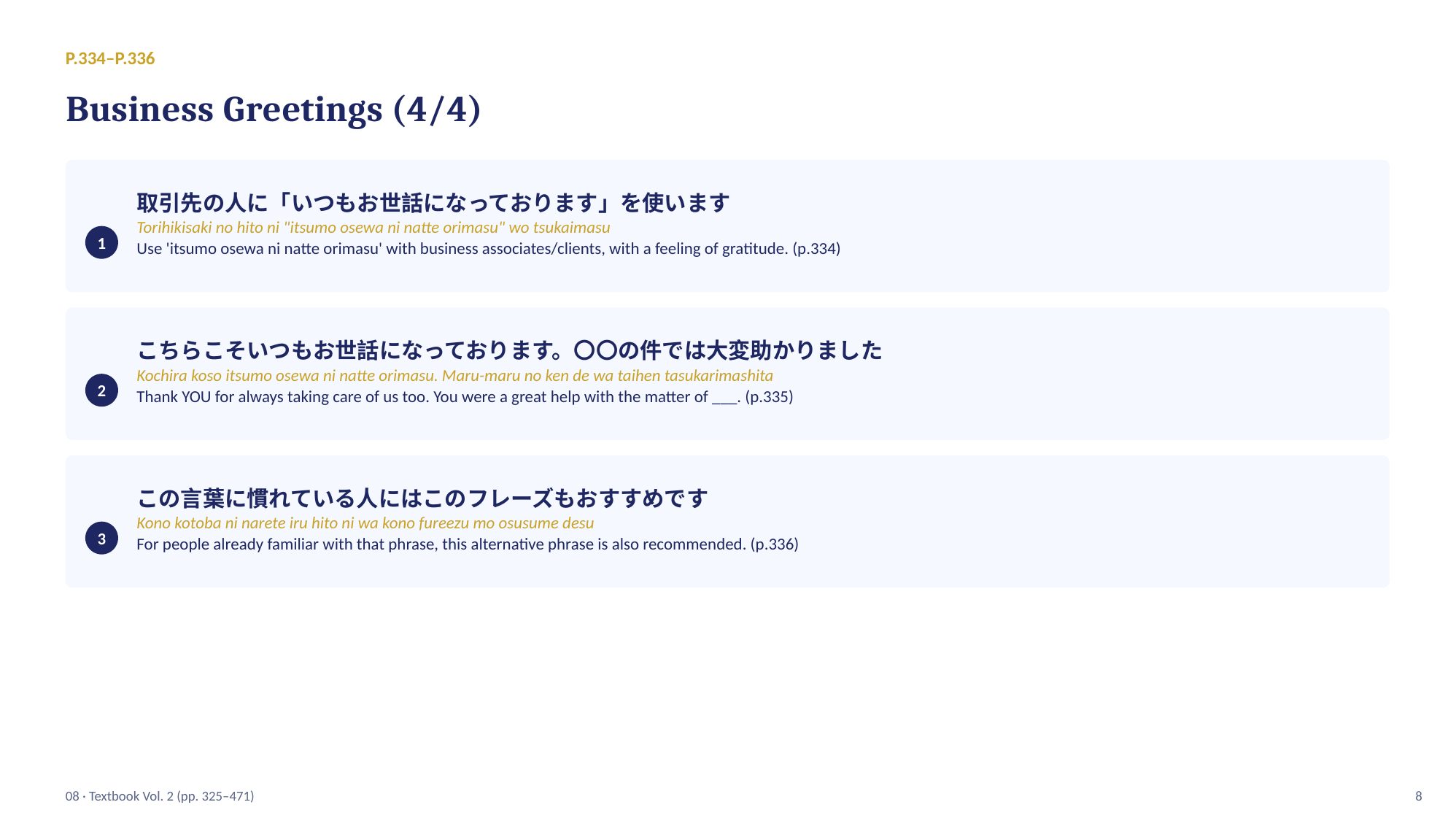
ENP.334–P.336
Business Greetings (4/4)
Business Greetings (4/4)
JP取引先の人に「いつもお世話になっております」を使います
EN Torihikisaki no hito ni "itsumo osewa ni natte orimasu" wo tsukaimasu
1 Use 'itsumo osewa ni natte orimasu' with business associates/clients, with a feeling of gratitude. (p.334)
1 Use 'itsumo osewa ni natte orimasu' with business associates/clients, with a feeling of gratitude. (p.334)
JPこちらこそいつもお世話になっております。〇〇の件では大変助かりました
EN Kochira koso itsumo osewa ni natte orimasu. Maru-maru no ken de wa taihen tasukarimashita
2 Thank YOU for always taking care of us too. You were a great help with the matter of ___. (p.335)
2 Thank YOU for always taking care of us too. You were a great help with the matter of ___. (p.335)
JPこの言葉に慣れている人にはこのフレーズもおすすめです
EN Kono kotoba ni narete iru hito ni wa kono fureezu mo osusume desu
3 For people already familiar with that phrase, this alternative phrase is also recommended. (p.336)
08 · Textbook Vol. 2 (pp. 325–471) 8
3 For people already familiar with that phrase, this alternative phrase is also recommended. (p.336)
08 · Textbook Vol. 2 (pp. 325–471) 8
หน้า 9
คลิกเพื่อขยาย
02
ENUsing 「件」 ("The Matter Of...")
4 phrases · pages 337–341
4 phrases · pages 337–341
หน้า 10
คลิกเพื่อขยาย
ENP.337–P.339
Using 「件」 ("The Matter Of...") (1/2)
Using 「件」 ("The Matter Of...") (1/2)
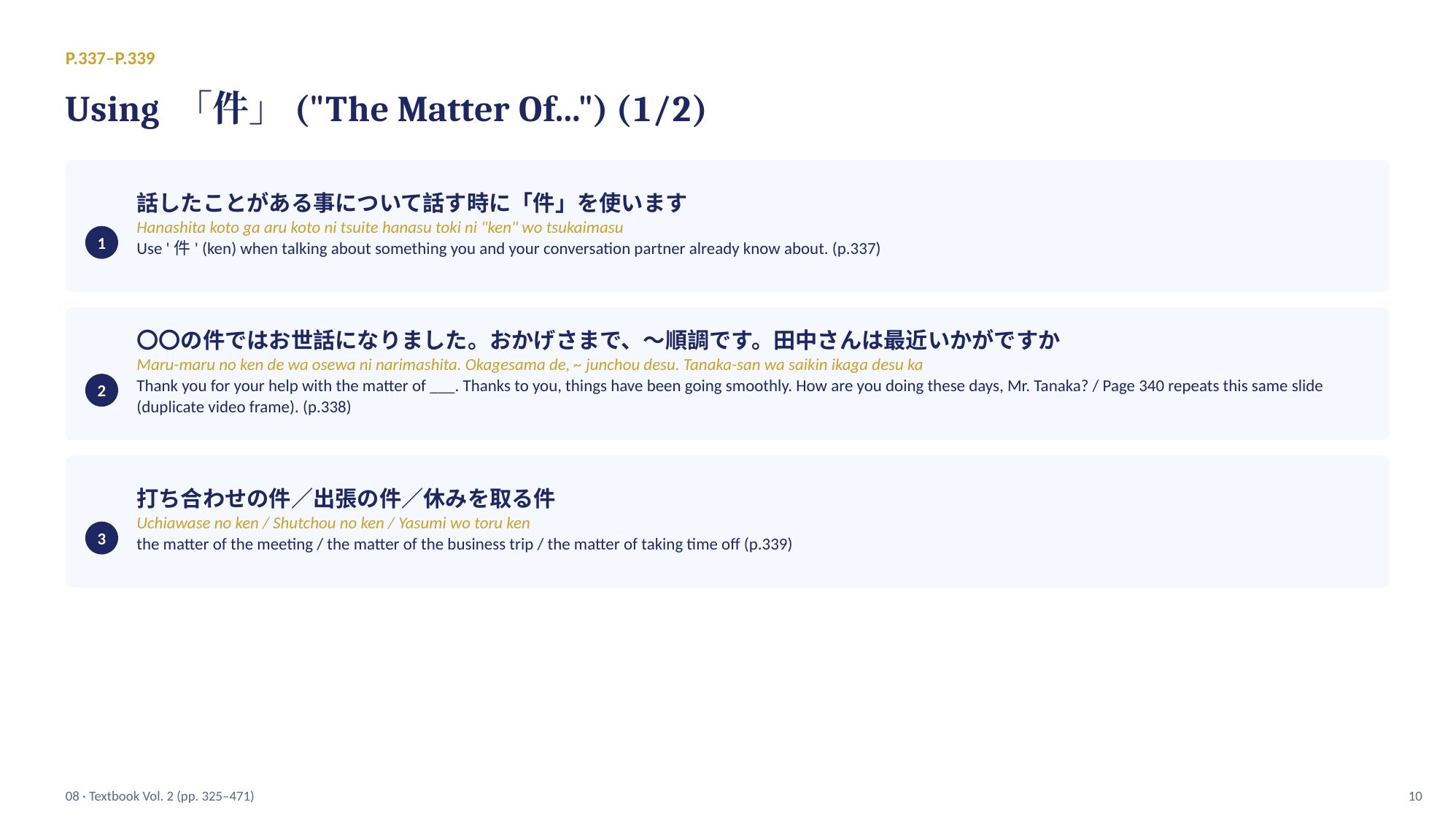
JP話したことがある事について話す時に「件」を使います
EN Hanashita koto ga aru koto ni tsuite hanasu toki ni "ken" wo tsukaimasu
1 Use ' 件 ' (ken) when talking about something you and your conversation partner already know about. (p.337)
1 Use ' 件 ' (ken) when talking about something you and your conversation partner already know about. (p.337)
JP〇〇の件ではお世話になりました。おかげさまで、〜順調です。田中さんは最近いかがですか
EN Maru-maru no ken de wa osewa ni narimashita. Okagesama de, ~ junchou desu. Tanaka-san wa saikin ikaga desu ka
2 Thank you for your help with the matter of ___. Thanks to you, things have been going smoothly. How are you doing these days, Mr. Tanaka? / Page 340 repeats this same slide
(duplicate video frame). (p.338)
2 Thank you for your help with the matter of ___. Thanks to you, things have been going smoothly. How are you doing these days, Mr. Tanaka? / Page 340 repeats this same slide
(duplicate video frame). (p.338)
JP打ち合わせの件/出張の件/休みを取る件
EN Uchiawase no ken / Shutchou no ken / Yasumi wo toru ken
3 the matter of the meeting / the matter of the business trip / the matter of taking time off (p.339)
08 · Textbook Vol. 2 (pp. 325–471) 10
3 the matter of the meeting / the matter of the business trip / the matter of taking time off (p.339)
08 · Textbook Vol. 2 (pp. 325–471) 10
หน้า 11
คลิกเพื่อขยาย
ENP.341
Using 「件」 ("The Matter Of...") (2/2)
Using 「件」 ("The Matter Of...") (2/2)
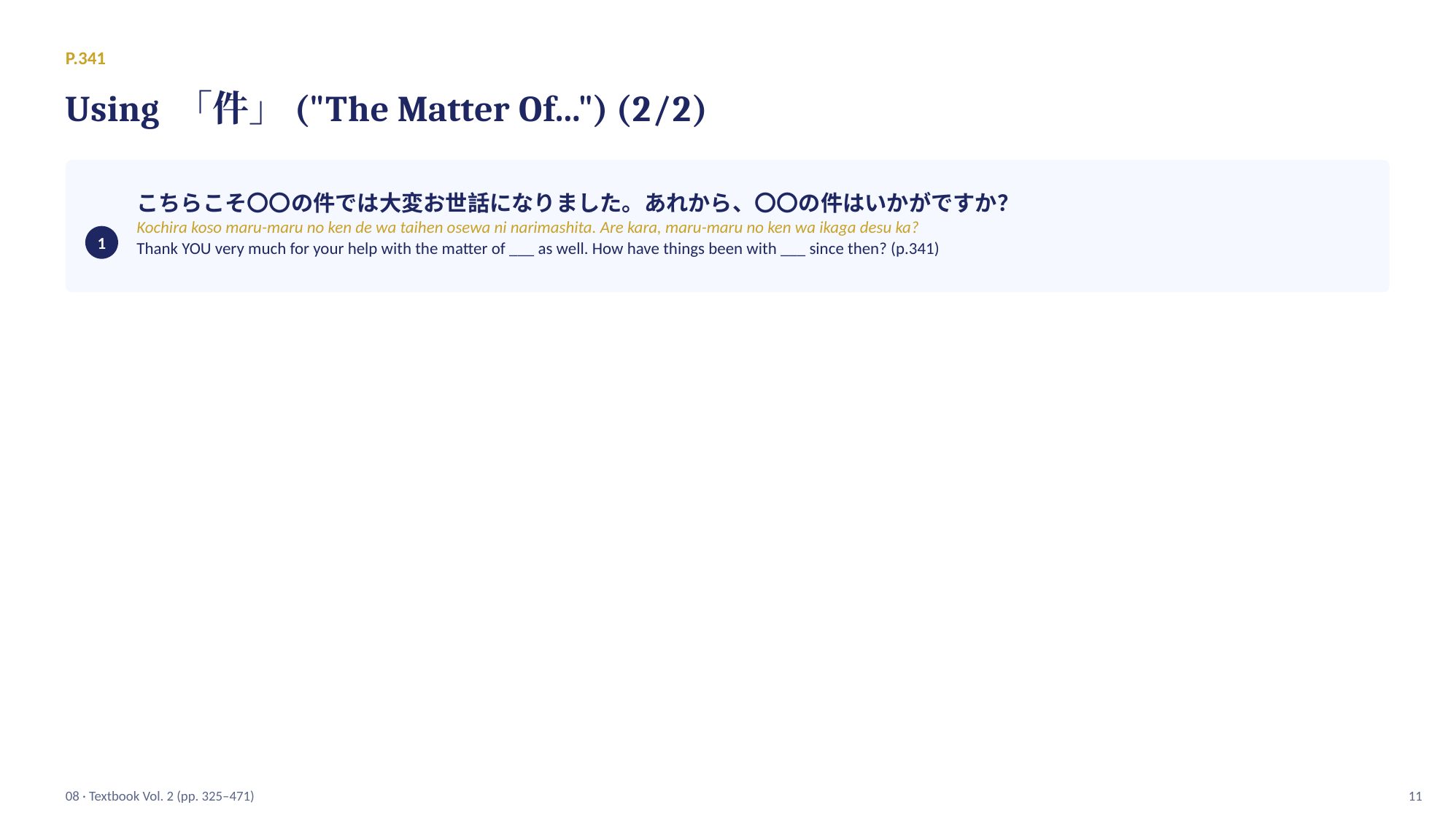
JPこちらこそ〇〇の件では大変お世話になりました。あれから、〇〇の件はいかがですか?
EN Kochira koso maru-maru no ken de wa taihen osewa ni narimashita. Are kara, maru-maru no ken wa ikaga desu ka?
1 Thank YOU very much for your help with the matter of ___ as well. How have things been with ___ since then? (p.341)
08 · Textbook Vol. 2 (pp. 325–471) 11
1 Thank YOU very much for your help with the matter of ___ as well. How have things been with ___ since then? (p.341)
08 · Textbook Vol. 2 (pp. 325–471) 11
หน้า 12

คลิกเพื่อขยาย
03
ENIt's Been a While
JPご無沙汰しております
EN8 phrases · pages 342–350
หน้า 13
คลิกเพื่อขยาย
ENP.342–P.344
It's Been a While (1/3)
It's Been a While (1/3)
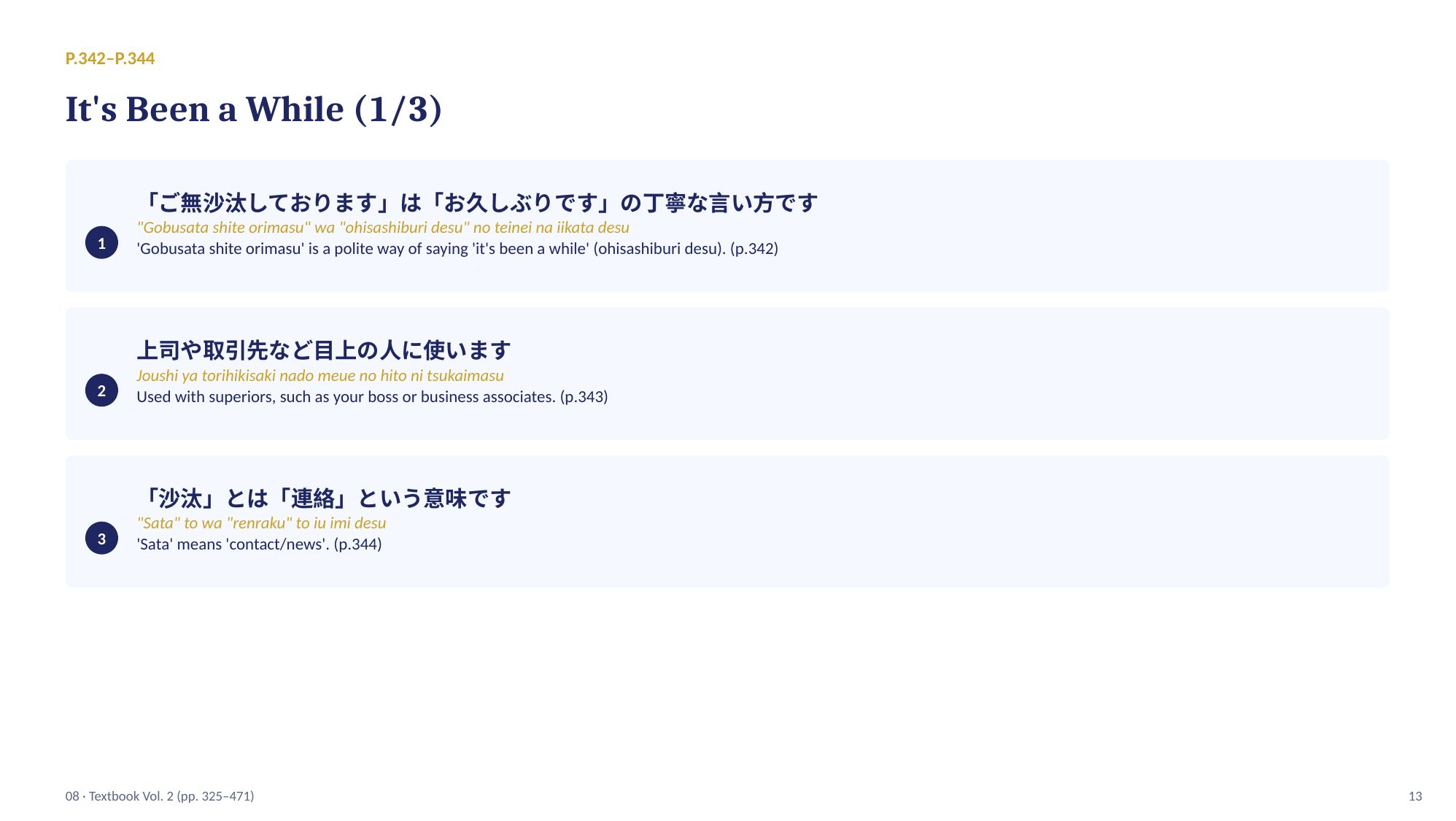
JP「ご無沙汰しております」は「お久しぶりです」の丁寧な言い方です
EN "Gobusata shite orimasu" wa "ohisashiburi desu" no teinei na iikata desu
1 'Gobusata shite orimasu' is a polite way of saying 'it's been a while' (ohisashiburi desu). (p.342)
1 'Gobusata shite orimasu' is a polite way of saying 'it's been a while' (ohisashiburi desu). (p.342)
JP上司や取引先など目上の人に使います
EN Joushi ya torihikisaki nado meue no hito ni tsukaimasu
2 Used with superiors, such as your boss or business associates. (p.343)
2 Used with superiors, such as your boss or business associates. (p.343)
JP「沙汰」とは「連絡」という意味です
EN "Sata" to wa "renraku" to iu imi desu
3 'Sata' means 'contact/news'. (p.344)
08 · Textbook Vol. 2 (pp. 325–471) 13
3 'Sata' means 'contact/news'. (p.344)
08 · Textbook Vol. 2 (pp. 325–471) 13
หน้า 14
คลิกเพื่อขยาย
ENP.345–P.348
It's Been a While (2/3)
It's Been a While (2/3)
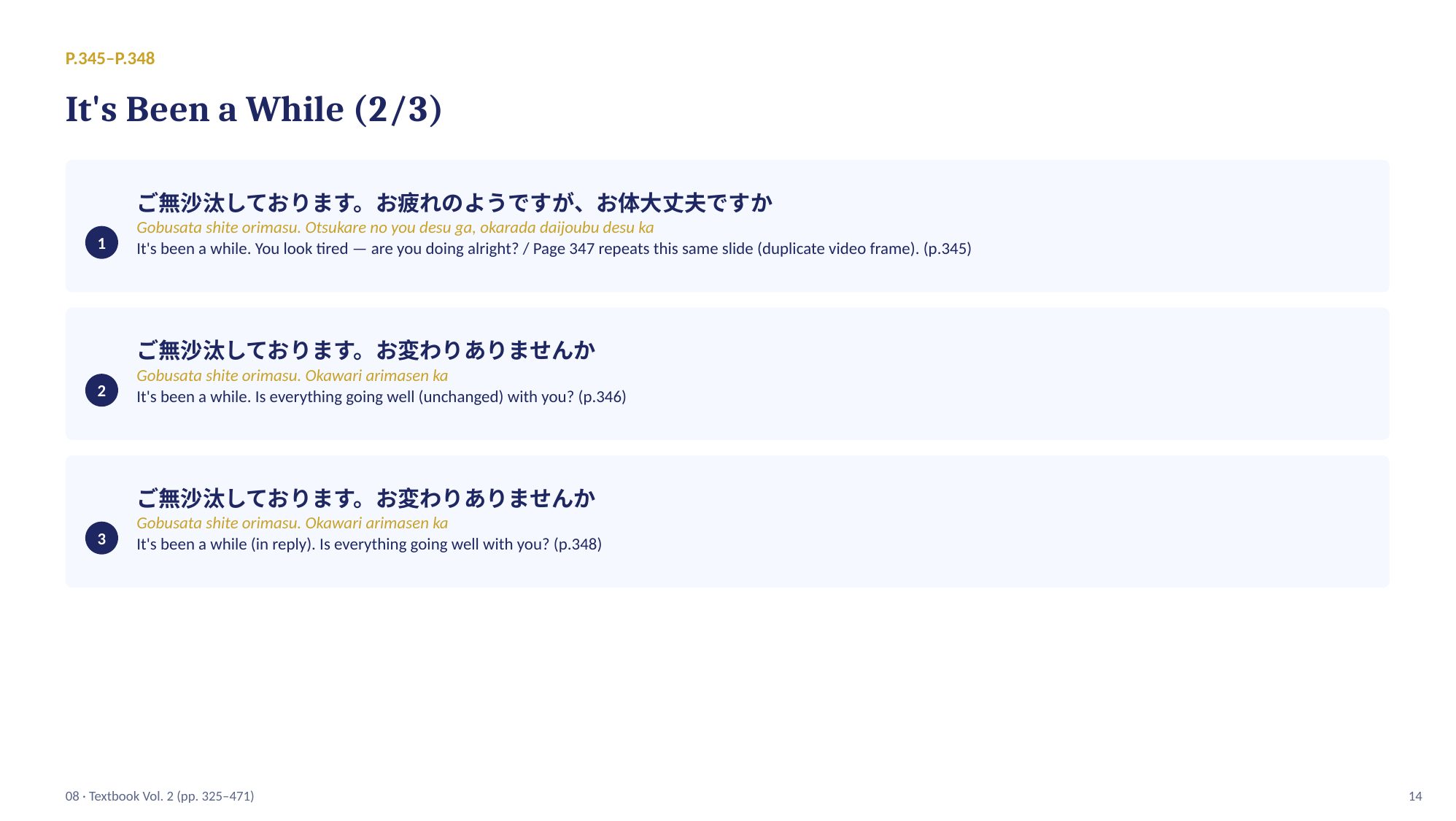
JPご無沙汰しております。お疲れのようですが、お体大丈夫ですか
EN Gobusata shite orimasu. Otsukare no you desu ga, okarada daijoubu desu ka
1 It's been a while. You look tired — are you doing alright? / Page 347 repeats this same slide (duplicate video frame). (p.345)
1 It's been a while. You look tired — are you doing alright? / Page 347 repeats this same slide (duplicate video frame). (p.345)
JPご無沙汰しております。お変わりありませんか
EN Gobusata shite orimasu. Okawari arimasen ka
2 It's been a while. Is everything going well (unchanged) with you? (p.346)
2 It's been a while. Is everything going well (unchanged) with you? (p.346)
JPご無沙汰しております。お変わりありませんか
EN Gobusata shite orimasu. Okawari arimasen ka
3 It's been a while (in reply). Is everything going well with you? (p.348)
08 · Textbook Vol. 2 (pp. 325–471) 14
3 It's been a while (in reply). Is everything going well with you? (p.348)
08 · Textbook Vol. 2 (pp. 325–471) 14
หน้า 15
คลิกเพื่อขยาย
ENP.349–P.350
It's Been a While (3/3)
It's Been a While (3/3)
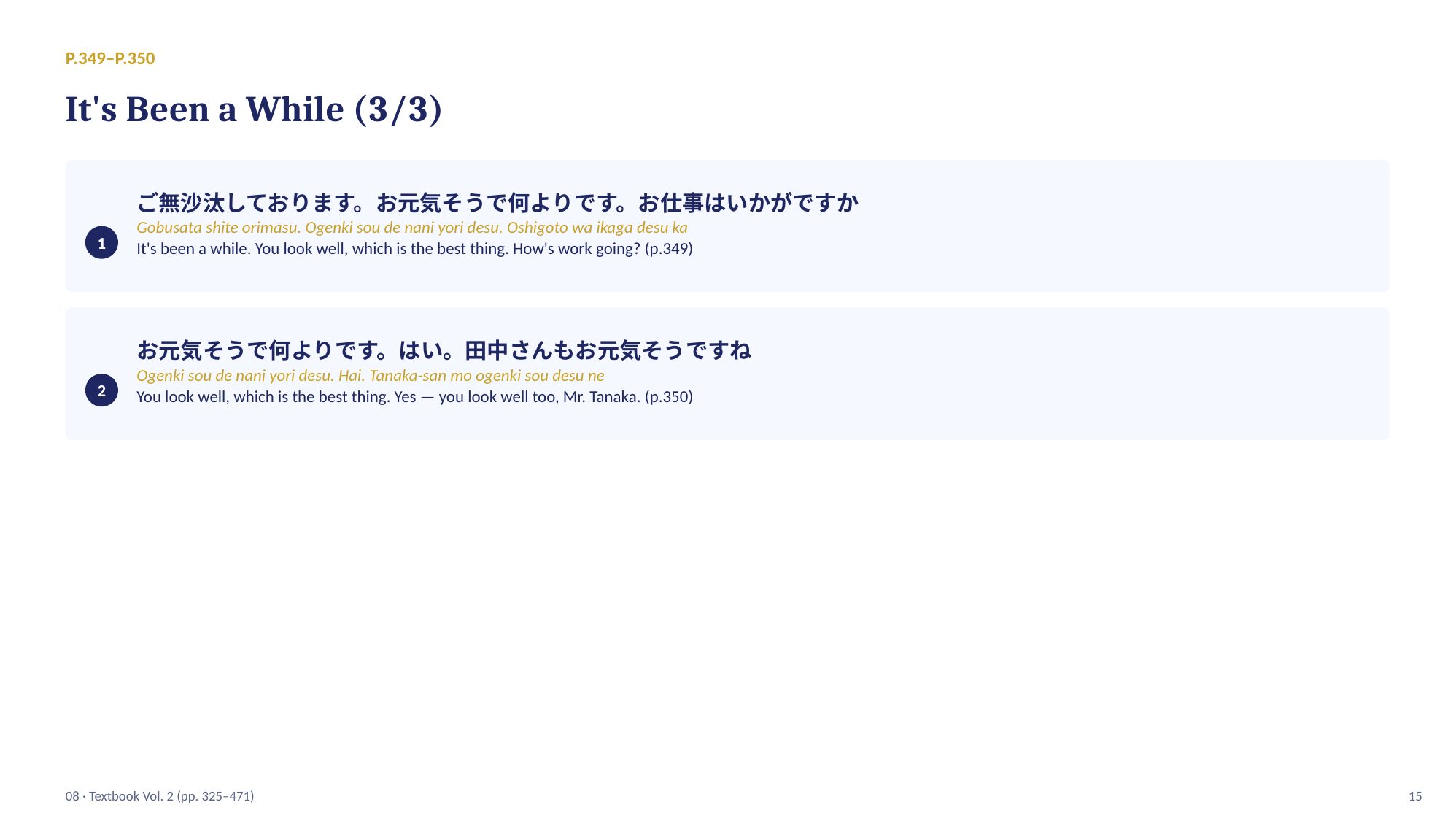
JPご無沙汰しております。お元気そうで何よりです。お仕事はいかがですか
EN Gobusata shite orimasu. Ogenki sou de nani yori desu. Oshigoto wa ikaga desu ka
1 It's been a while. You look well, which is the best thing. How's work going? (p.349)
1 It's been a while. You look well, which is the best thing. How's work going? (p.349)
JPお元気そうで何よりです。はい。田中さんもお元気そうですね
EN Ogenki sou de nani yori desu. Hai. Tanaka-san mo ogenki sou desu ne
2 You look well, which is the best thing. Yes — you look well too, Mr. Tanaka. (p.350)
08 · Textbook Vol. 2 (pp. 325–471) 15
2 You look well, which is the best thing. Yes — you look well too, Mr. Tanaka. (p.350)
08 · Textbook Vol. 2 (pp. 325–471) 15
หน้า 16

คลิกเพื่อขยาย
04
ENI'm Honored
JP光栄です
EN6 phrases · pages 351–356
หน้า 17
คลิกเพื่อขยาย
ENP.351–P.353
I'm Honored (1/2)
I'm Honored (1/2)
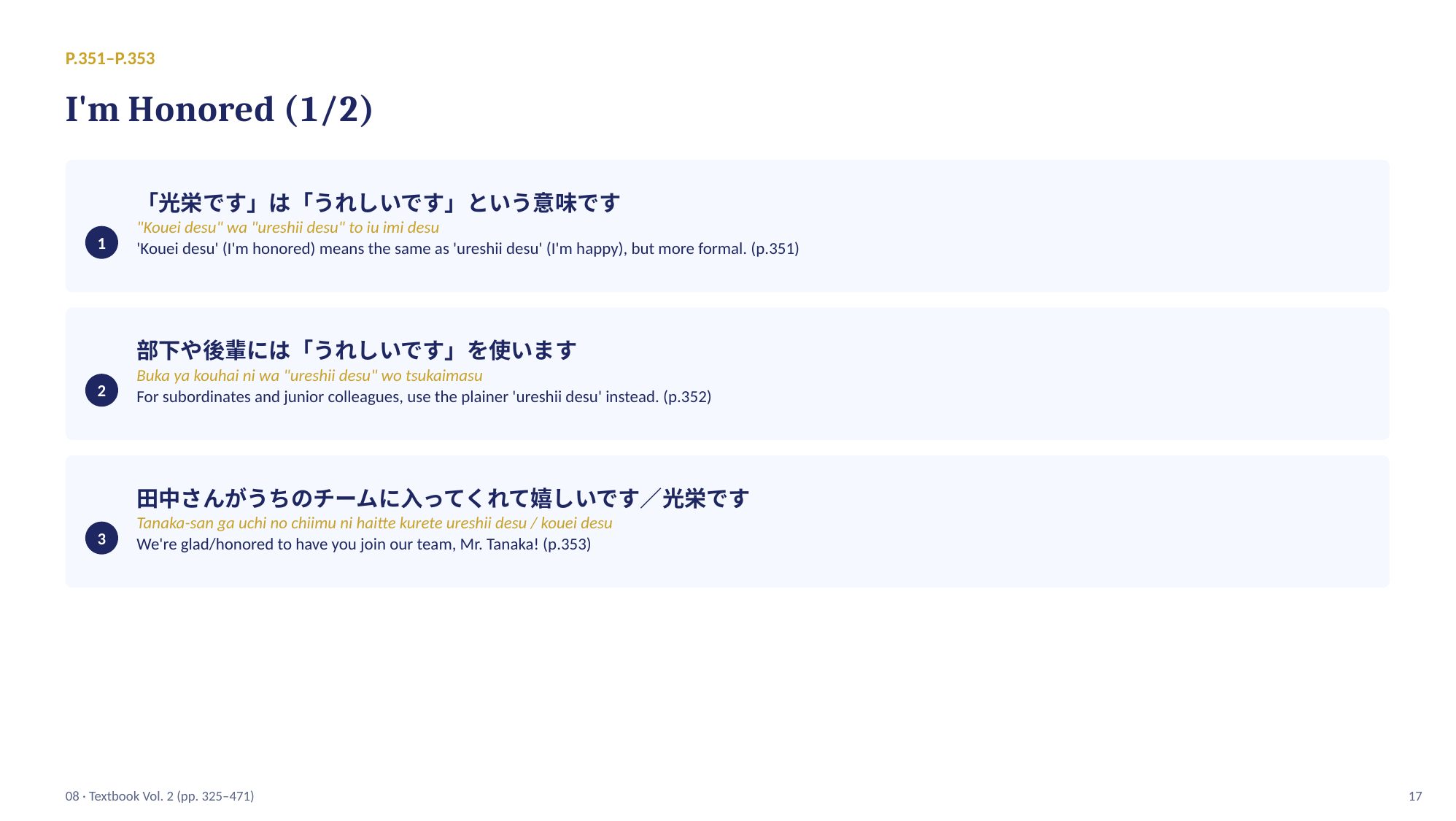
JP「光栄です」は「うれしいです」という意味です
EN "Kouei desu" wa "ureshii desu" to iu imi desu
1 'Kouei desu' (I'm honored) means the same as 'ureshii desu' (I'm happy), but more formal. (p.351)
1 'Kouei desu' (I'm honored) means the same as 'ureshii desu' (I'm happy), but more formal. (p.351)
JP部下や後輩には「うれしいです」を使います
EN Buka ya kouhai ni wa "ureshii desu" wo tsukaimasu
2 For subordinates and junior colleagues, use the plainer 'ureshii desu' instead. (p.352)
2 For subordinates and junior colleagues, use the plainer 'ureshii desu' instead. (p.352)
JP田中さんがうちのチームに入ってくれて嬉しいです/光栄です
EN Tanaka-san ga uchi no chiimu ni haitte kurete ureshii desu / kouei desu
3 We're glad/honored to have you join our team, Mr. Tanaka! (p.353)
08 · Textbook Vol. 2 (pp. 325–471) 17
3 We're glad/honored to have you join our team, Mr. Tanaka! (p.353)
08 · Textbook Vol. 2 (pp. 325–471) 17
หน้า 18
คลิกเพื่อขยาย
ENP.354–P.356
I'm Honored (2/2)
I'm Honored (2/2)
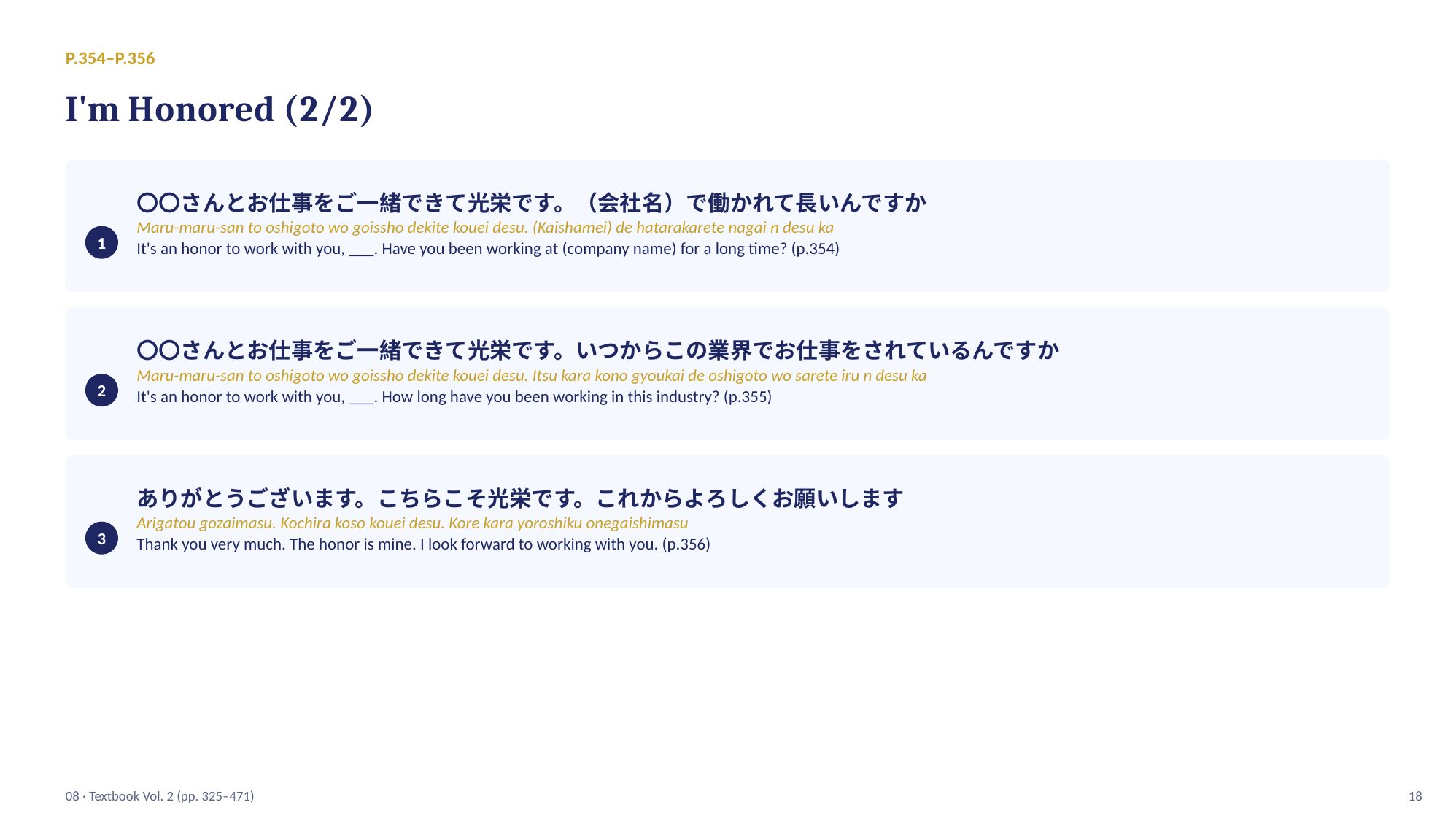
JP〇〇さんとお仕事をご一緒できて光栄です。(会社名)で働かれて長いんですか
EN Maru-maru-san to oshigoto wo goissho dekite kouei desu. (Kaishamei) de hatarakarete nagai n desu ka
1 It's an honor to work with you, ___. Have you been working at (company name) for a long time? (p.354)
1 It's an honor to work with you, ___. Have you been working at (company name) for a long time? (p.354)
JP〇〇さんとお仕事をご一緒できて光栄です。いつからこの業界でお仕事をされているんですか
EN Maru-maru-san to oshigoto wo goissho dekite kouei desu. Itsu kara kono gyoukai de oshigoto wo sarete iru n desu ka
2 It's an honor to work with you, ___. How long have you been working in this industry? (p.355)
2 It's an honor to work with you, ___. How long have you been working in this industry? (p.355)
JPありがとうございます。こちらこそ光栄です。これからよろしくお願いします
EN Arigatou gozaimasu. Kochira koso kouei desu. Kore kara yoroshiku onegaishimasu
3 Thank you very much. The honor is mine. I look forward to working with you. (p.356)
08 · Textbook Vol. 2 (pp. 325–471) 18
3 Thank you very much. The honor is mine. I look forward to working with you. (p.356)
08 · Textbook Vol. 2 (pp. 325–471) 18
หน้า 19

คลิกเพื่อขยาย
05
ENEncouragement Phrases
5 phrases · pages 357–361
5 phrases · pages 357–361
หน้า 20
คลิกเพื่อขยาย
ENP.357–P.359
Encouragement Phrases (1/2)
Encouragement Phrases (1/2)
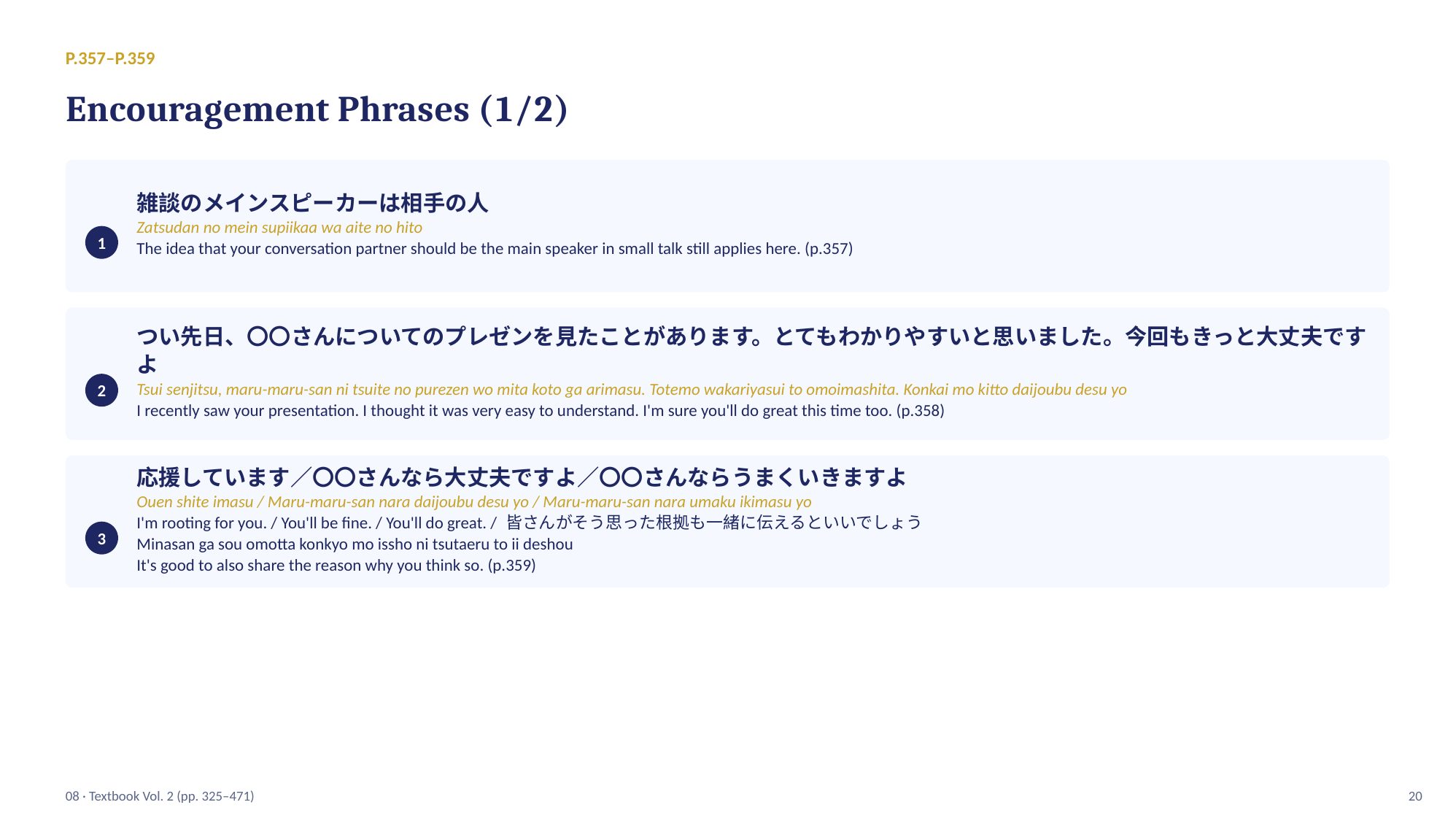
JP雑談のメインスピーカーは相手の人
EN Zatsudan no mein supiikaa wa aite no hito
1 The idea that your conversation partner should be the main speaker in small talk still applies here. (p.357)
1 The idea that your conversation partner should be the main speaker in small talk still applies here. (p.357)
JPつい先日、〇〇さんについてのプレゼンを見たことがあります。とてもわかりやすいと思いました。今回もきっと大丈夫です
よ
よ
EN 2 Tsui senjitsu, maru-maru-san ni tsuite no purezen wo mita koto ga arimasu. Totemo wakariyasui to omoimashita. Konkai mo kitto daijoubu desu yo
I recently saw your presentation. I thought it was very easy to understand. I'm sure you'll do great this time too. (p.358)
I recently saw your presentation. I thought it was very easy to understand. I'm sure you'll do great this time too. (p.358)
JP応援しています/〇〇さんなら大丈夫ですよ/〇〇さんならうまくいきますよ
EN Ouen shite imasu / Maru-maru-san nara daijoubu desu yo / Maru-maru-san nara umaku ikimasu yo
I'm rooting for you. / You'll be fine. / You'll do great. / 皆さんがそう思った根拠も一緒に伝えるといいでしょう
3 Minasan ga sou omotta konkyo mo issho ni tsutaeru to ii deshou
It's good to also share the reason why you think so. (p.359)
08 · Textbook Vol. 2 (pp. 325–471) 20
I'm rooting for you. / You'll be fine. / You'll do great. / 皆さんがそう思った根拠も一緒に伝えるといいでしょう
3 Minasan ga sou omotta konkyo mo issho ni tsutaeru to ii deshou
It's good to also share the reason why you think so. (p.359)
08 · Textbook Vol. 2 (pp. 325–471) 20
หน้า 21
คลิกเพื่อขยาย
ENP.360–P.361
Encouragement Phrases (2/2)
Encouragement Phrases (2/2)
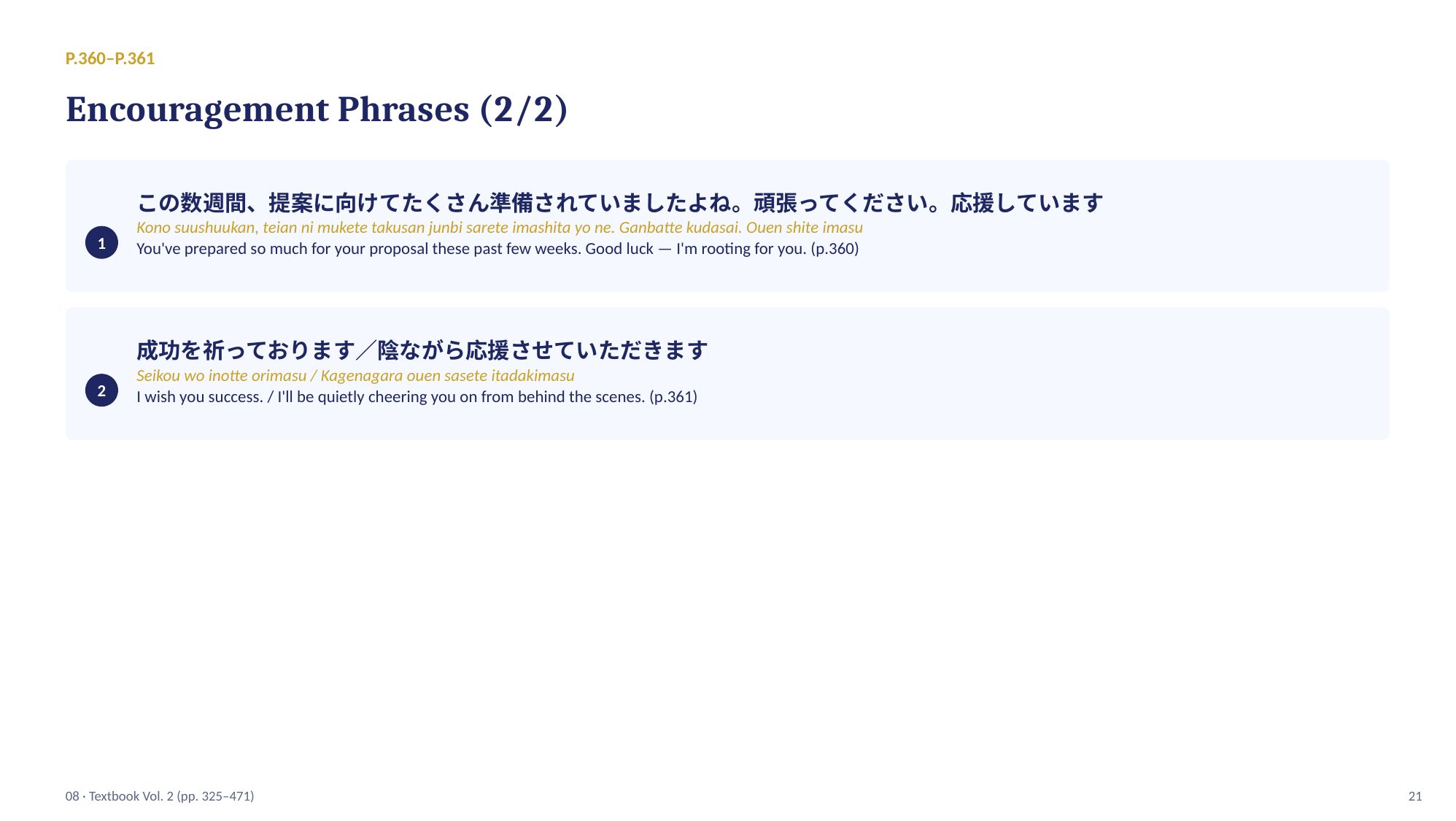
JPこの数週間、提案に向けてたくさん準備されていましたよね。頑張ってください。応援しています
EN Kono suushuukan, teian ni mukete takusan junbi sarete imashita yo ne. Ganbatte kudasai. Ouen shite imasu
1 You've prepared so much for your proposal these past few weeks. Good luck — I'm rooting for you. (p.360)
1 You've prepared so much for your proposal these past few weeks. Good luck — I'm rooting for you. (p.360)
JP成功を祈っております/陰ながら応援させていただきます
EN Seikou wo inotte orimasu / Kagenagara ouen sasete itadakimasu
2 I wish you success. / I'll be quietly cheering you on from behind the scenes. (p.361)
08 · Textbook Vol. 2 (pp. 325–471) 21
2 I wish you success. / I'll be quietly cheering you on from behind the scenes. (p.361)
08 · Textbook Vol. 2 (pp. 325–471) 21
หน้า 22

คลิกเพื่อขยาย
06
ENComforting Someone
10 phrases · pages 362–372
10 phrases · pages 362–372
หน้า 23
คลิกเพื่อขยาย
ENP.362–P.365
Comforting Someone (1/4)
Comforting Someone (1/4)
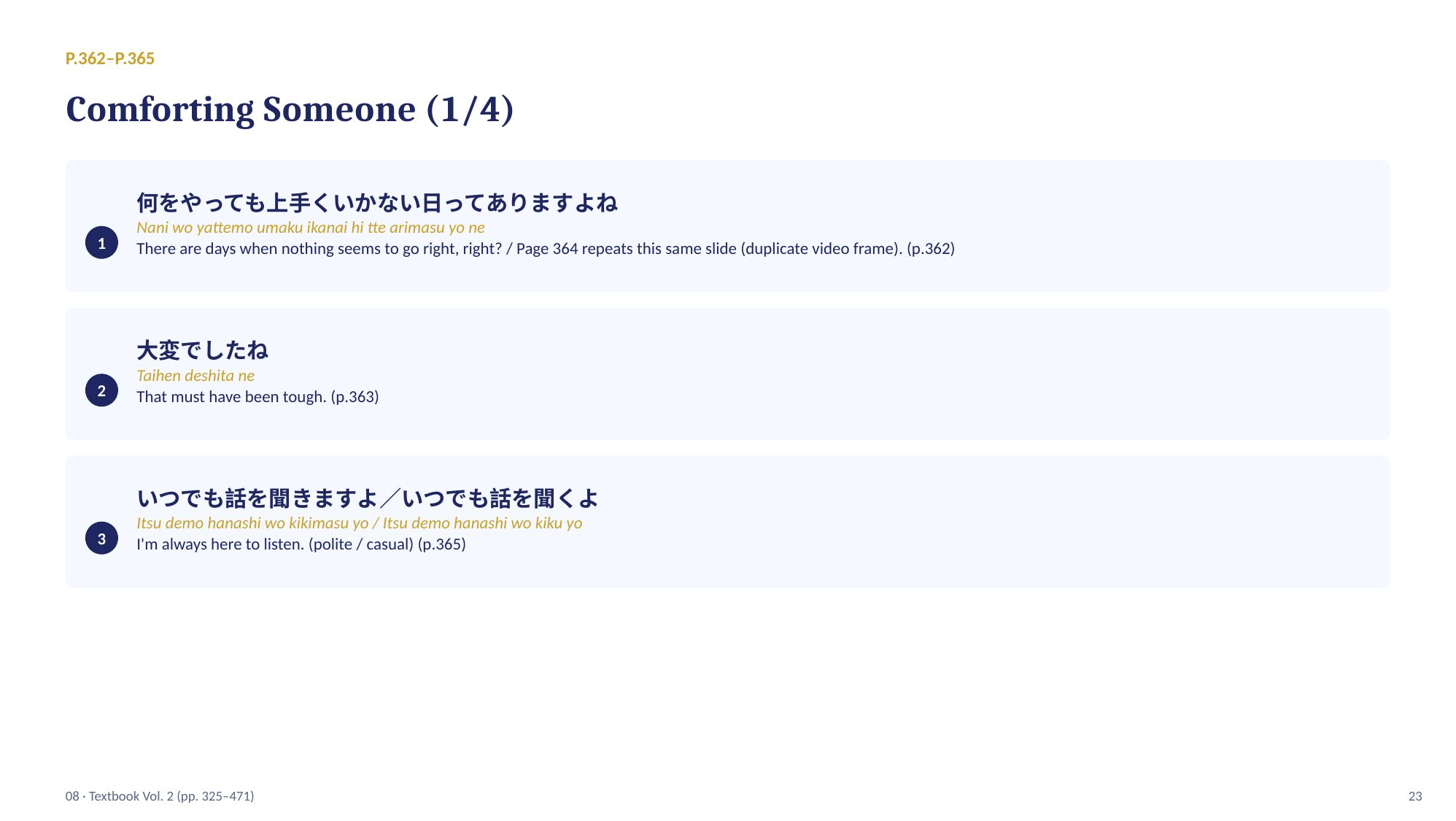
JP何をやっても上手くいかない日ってありますよね
EN Nani wo yattemo umaku ikanai hi tte arimasu yo ne
1 There are days when nothing seems to go right, right? / Page 364 repeats this same slide (duplicate video frame). (p.362)
1 There are days when nothing seems to go right, right? / Page 364 repeats this same slide (duplicate video frame). (p.362)
JP大変でしたね
EN Taihen deshita ne
2 That must have been tough. (p.363)
2 That must have been tough. (p.363)
JPいつでも話を聞きますよ/いつでも話を聞くよ
EN Itsu demo hanashi wo kikimasu yo / Itsu demo hanashi wo kiku yo
3 I'm always here to listen. (polite / casual) (p.365)
08 · Textbook Vol. 2 (pp. 325–471) 23
3 I'm always here to listen. (polite / casual) (p.365)
08 · Textbook Vol. 2 (pp. 325–471) 23
หน้า 24
คลิกเพื่อขยาย
ENP.366–P.368
Comforting Someone (2/4)
Comforting Someone (2/4)
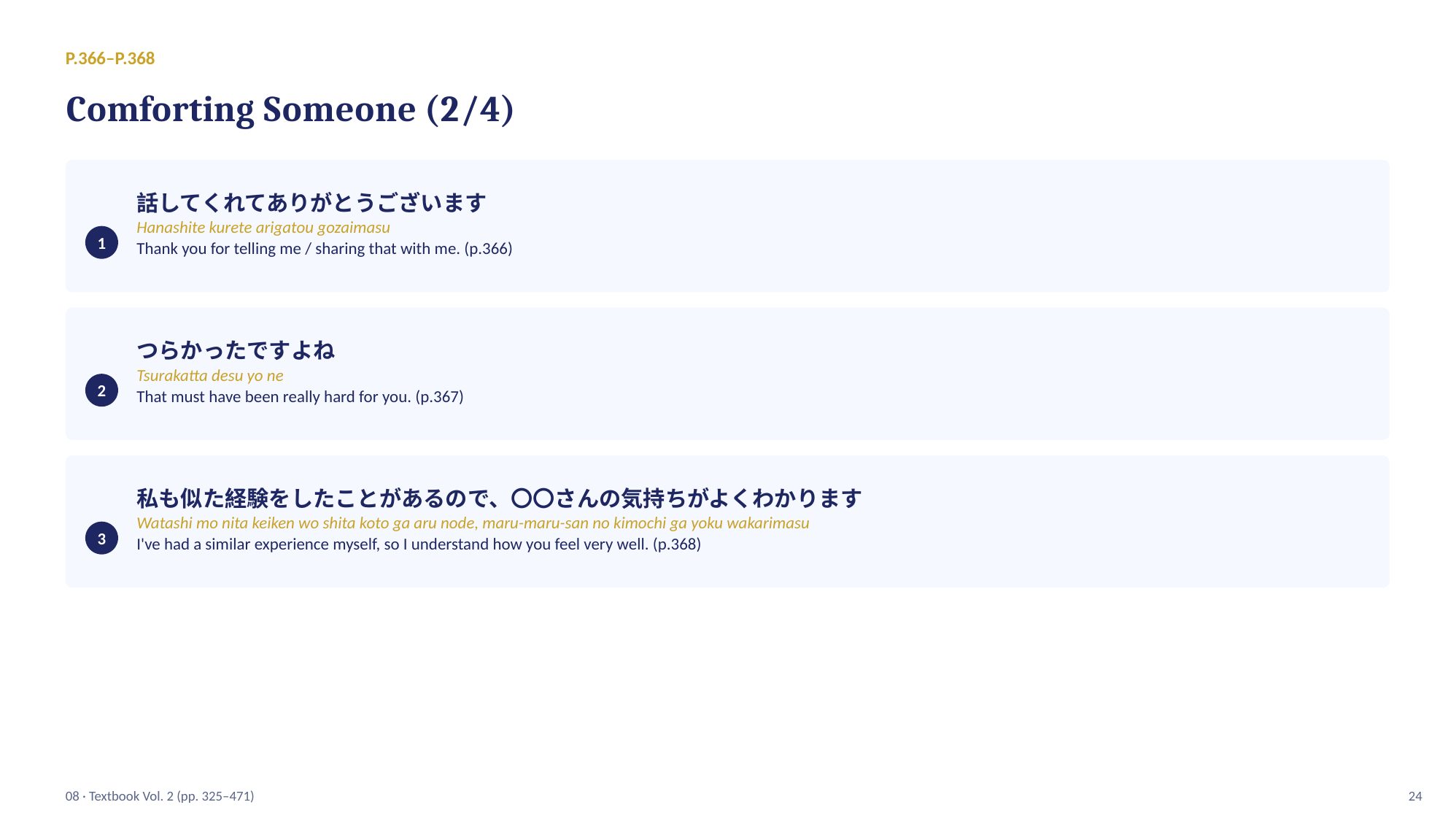
JP話してくれてありがとうございます
EN Hanashite kurete arigatou gozaimasu
1 Thank you for telling me / sharing that with me. (p.366)
1 Thank you for telling me / sharing that with me. (p.366)
JPつらかったですよね
EN Tsurakatta desu yo ne
2 That must have been really hard for you. (p.367)
2 That must have been really hard for you. (p.367)
JP私も似た経験をしたことがあるので、〇〇さんの気持ちがよくわかります
EN Watashi mo nita keiken wo shita koto ga aru node, maru-maru-san no kimochi ga yoku wakarimasu
3 I've had a similar experience myself, so I understand how you feel very well. (p.368)
08 · Textbook Vol. 2 (pp. 325–471) 24
3 I've had a similar experience myself, so I understand how you feel very well. (p.368)
08 · Textbook Vol. 2 (pp. 325–471) 24
หน้า 25
คลิกเพื่อขยาย
ENP.369–P.371
Comforting Someone (3/4)
Comforting Someone (3/4)
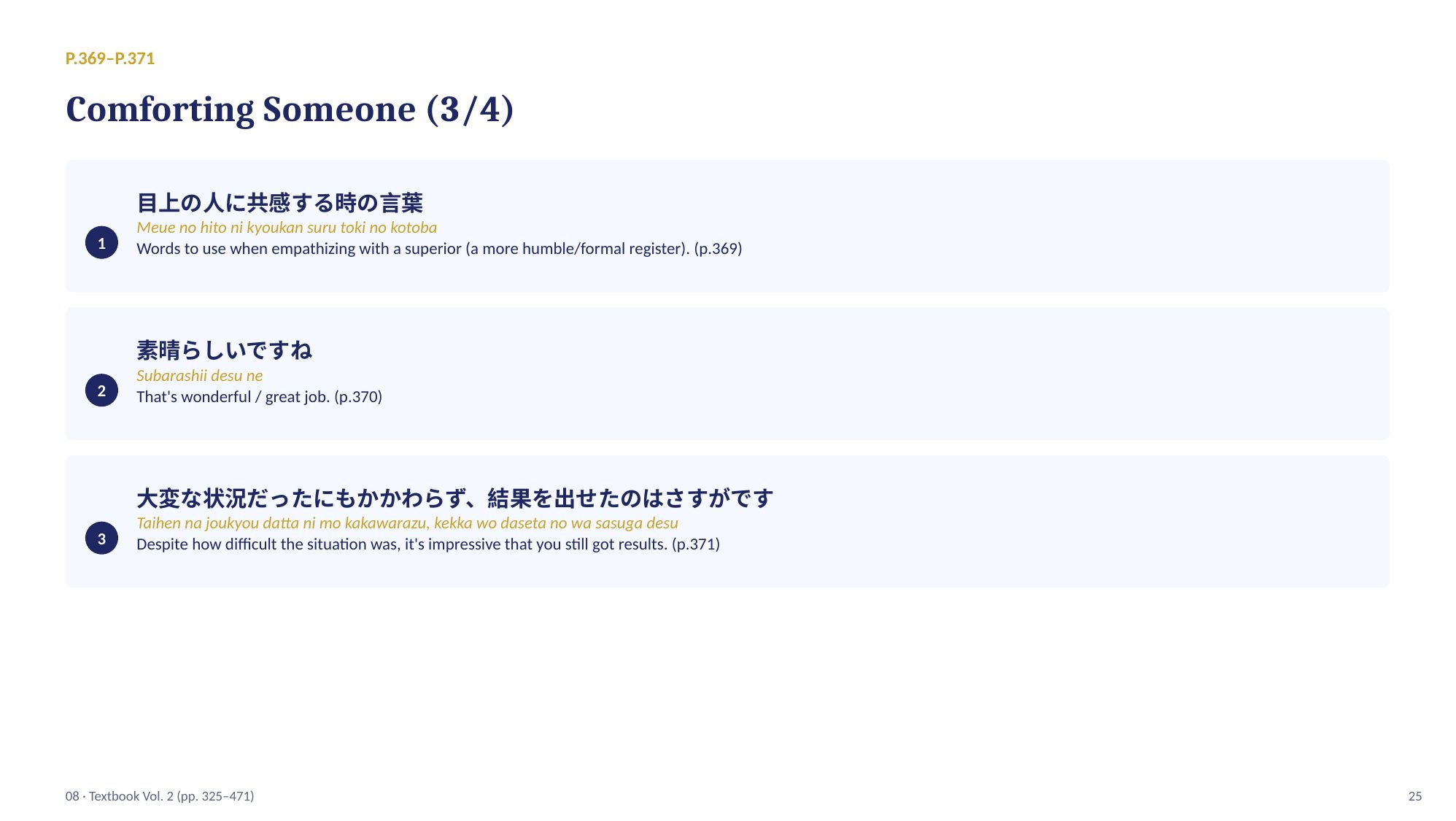
JP目上の人に共感する時の言葉
EN Meue no hito ni kyoukan suru toki no kotoba
1 Words to use when empathizing with a superior (a more humble/formal register). (p.369)
1 Words to use when empathizing with a superior (a more humble/formal register). (p.369)
JP素晴らしいですね
EN Subarashii desu ne
2 That's wonderful / great job. (p.370)
2 That's wonderful / great job. (p.370)
JP大変な状況だったにもかかわらず、結果を出せたのはさすがです
EN Taihen na joukyou datta ni mo kakawarazu, kekka wo daseta no wa sasuga desu
3 Despite how difficult the situation was, it's impressive that you still got results. (p.371)
08 · Textbook Vol. 2 (pp. 325–471) 25
3 Despite how difficult the situation was, it's impressive that you still got results. (p.371)
08 · Textbook Vol. 2 (pp. 325–471) 25
หน้า 26
คลิกเพื่อขยาย
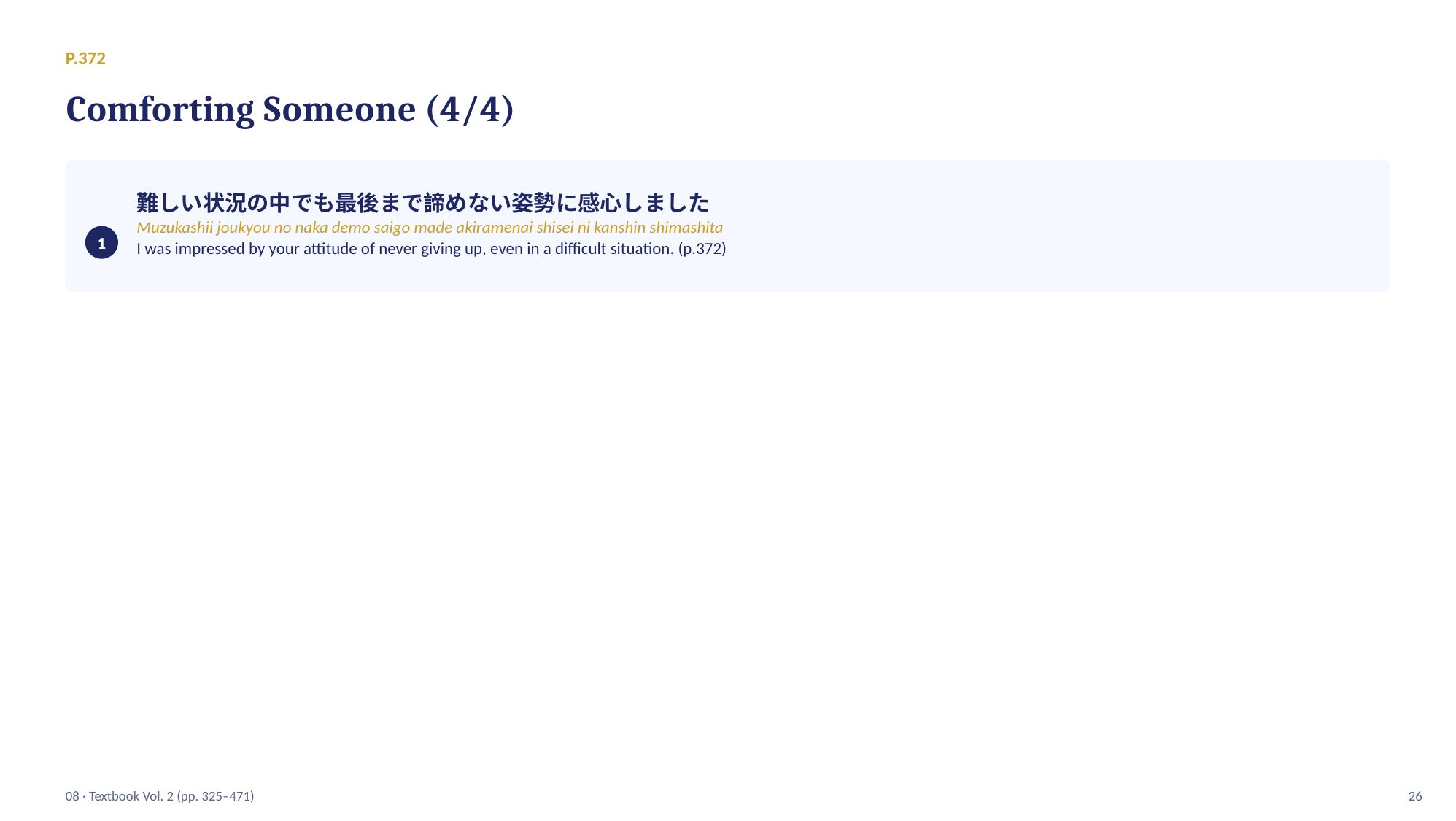
ENP.372
Comforting Someone (4/4)
Comforting Someone (4/4)
JP難しい状況の中でも最後まで諦めない姿勢に感心しました
EN Muzukashii joukyou no naka demo saigo made akiramenai shisei ni kanshin shimashita
1 I was impressed by your attitude of never giving up, even in a difficult situation. (p.372)
08 · Textbook Vol. 2 (pp. 325–471) 26
1 I was impressed by your attitude of never giving up, even in a difficult situation. (p.372)
08 · Textbook Vol. 2 (pp. 325–471) 26
หน้า 27
คลิกเพื่อขยาย
07
ENVocabulary ( やさしい日本語 )
6 phrases · pages 373–378
6 phrases · pages 373–378
หน้า 28
คลิกเพื่อขยาย
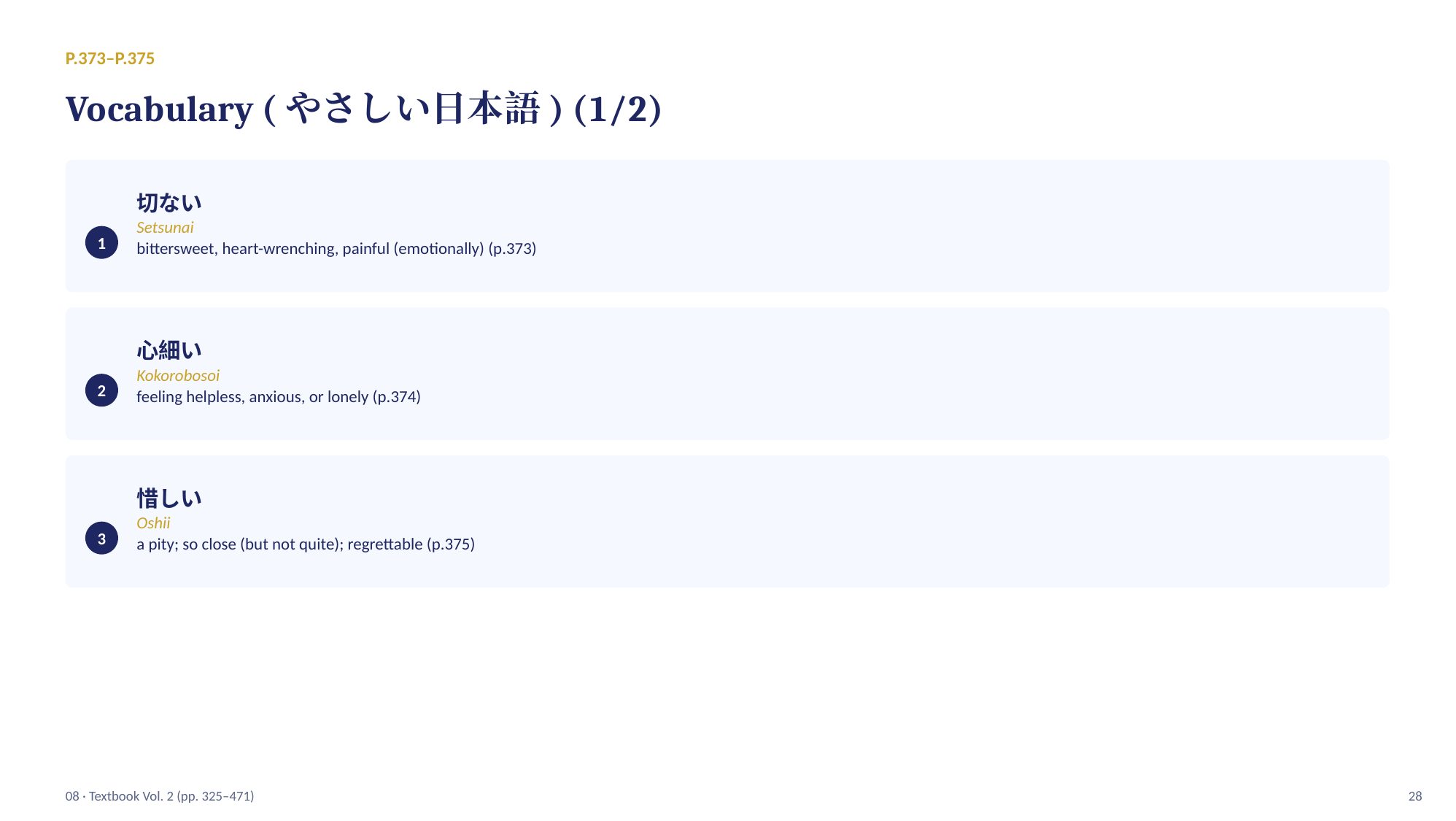
ENP.373–P.375
Vocabulary ( やさしい日本語 ) (1/2)
Vocabulary ( やさしい日本語 ) (1/2)
JP切ない
EN Setsunai
1 bittersweet, heart-wrenching, painful (emotionally) (p.373)
1 bittersweet, heart-wrenching, painful (emotionally) (p.373)
JP心細い
EN Kokorobosoi
2 feeling helpless, anxious, or lonely (p.374)
2 feeling helpless, anxious, or lonely (p.374)
JP惜しい
EN Oshii
3 a pity; so close (but not quite); regrettable (p.375)
08 · Textbook Vol. 2 (pp. 325–471) 28
3 a pity; so close (but not quite); regrettable (p.375)
08 · Textbook Vol. 2 (pp. 325–471) 28
หน้า 29
คลิกเพื่อขยาย
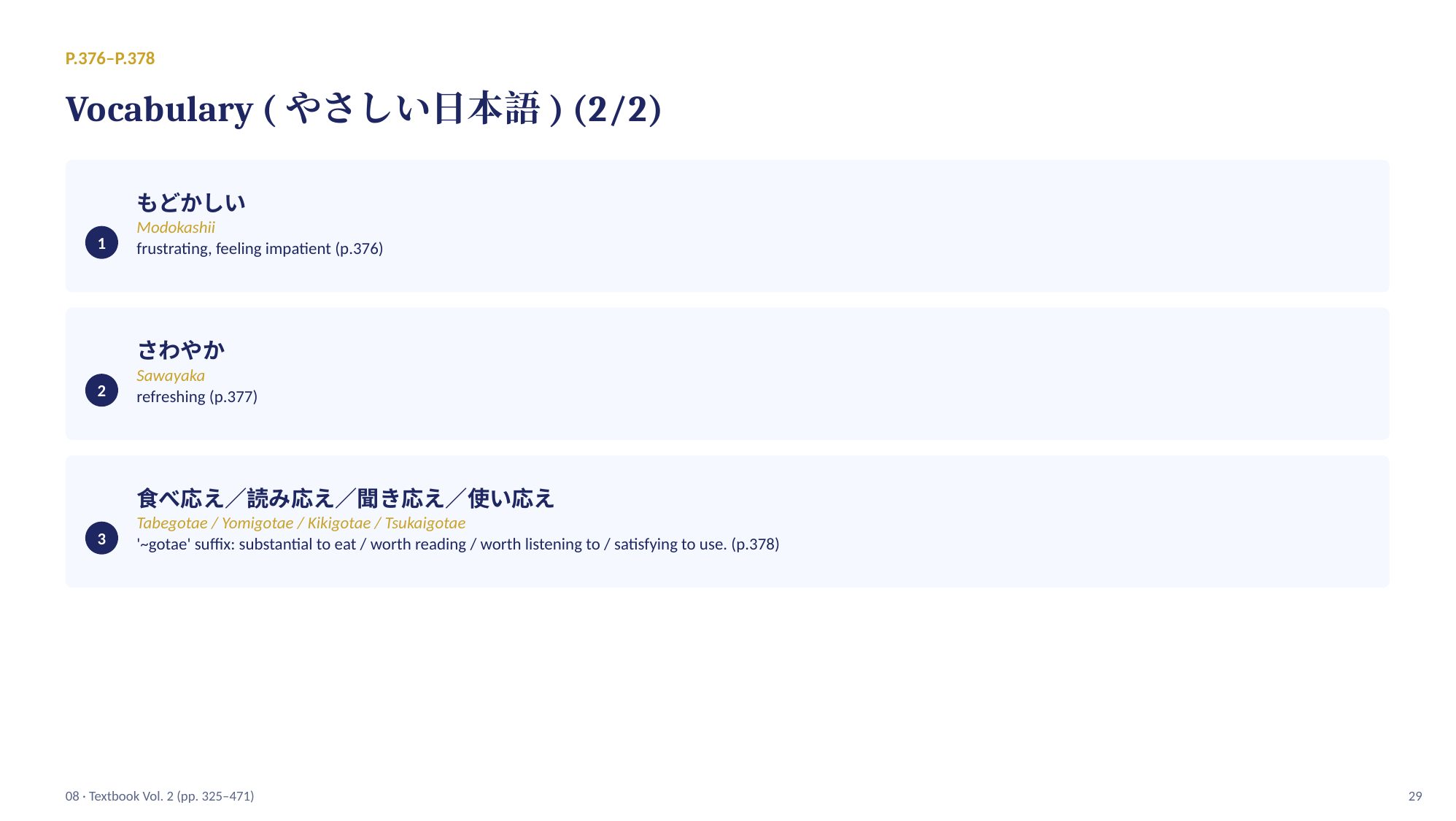
ENP.376–P.378
Vocabulary ( やさしい日本語 ) (2/2)
Vocabulary ( やさしい日本語 ) (2/2)
JPもどかしい
EN Modokashii
1 frustrating, feeling impatient (p.376)
1 frustrating, feeling impatient (p.376)
JPさわやか
EN Sawayaka
2 refreshing (p.377)
2 refreshing (p.377)
JP食べ応え/読み応え/聞き応え/使い応え
EN Tabegotae / Yomigotae / Kikigotae / Tsukaigotae
3 '~gotae' suffix: substantial to eat / worth reading / worth listening to / satisfying to use. (p.378)
08 · Textbook Vol. 2 (pp. 325–471) 29
3 '~gotae' suffix: substantial to eat / worth reading / worth listening to / satisfying to use. (p.378)
08 · Textbook Vol. 2 (pp. 325–471) 29
หน้า 30

คลิกเพื่อขยาย
08
ENGetting Closer to Coworkers
4 phrases · pages 379–382
4 phrases · pages 379–382
หน้า 31
คลิกเพื่อขยาย
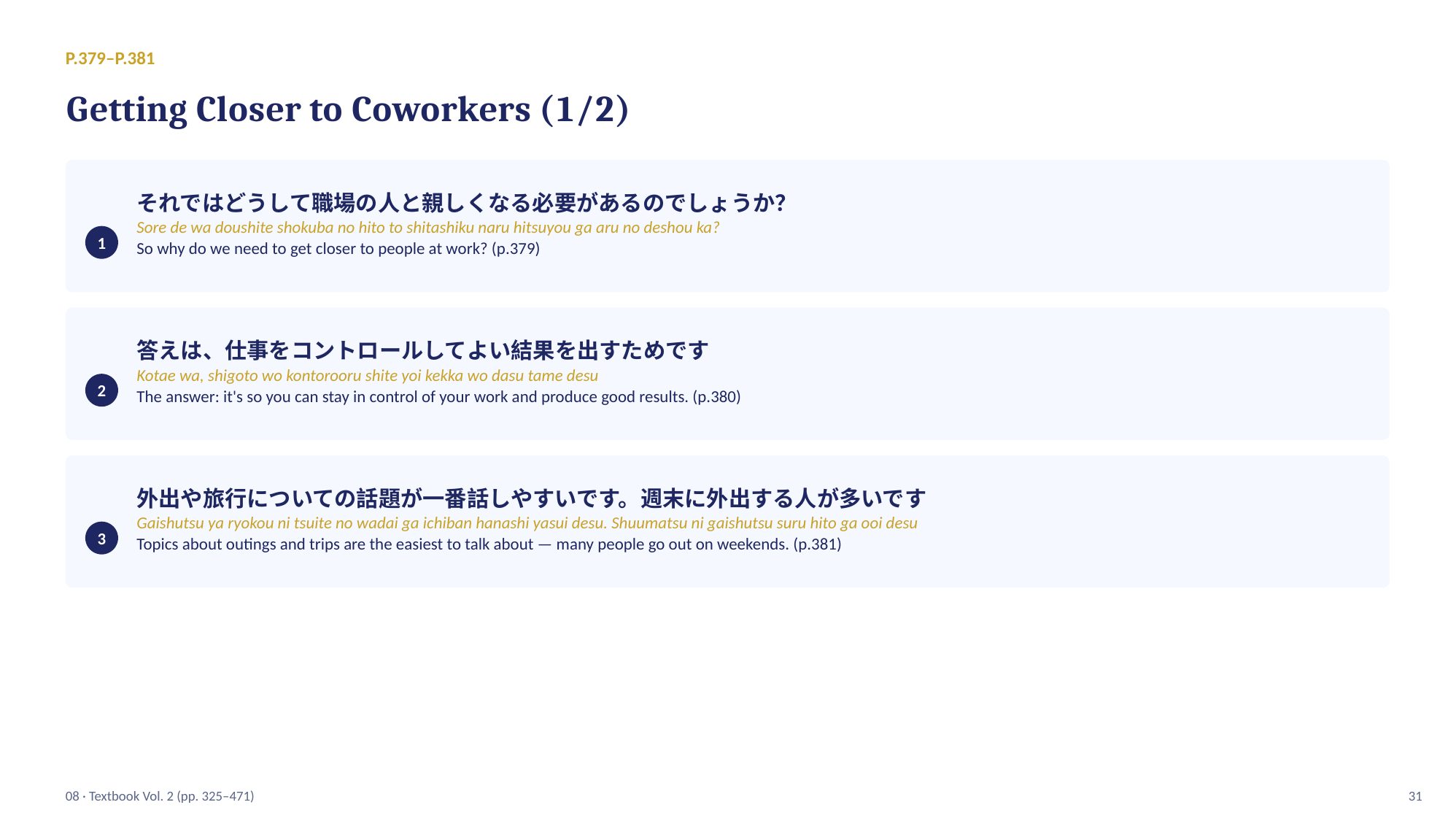
ENP.379–P.381
Getting Closer to Coworkers (1/2)
Getting Closer to Coworkers (1/2)
JPそれではどうして職場の人と親しくなる必要があるのでしょうか?
EN Sore de wa doushite shokuba no hito to shitashiku naru hitsuyou ga aru no deshou ka?
1 So why do we need to get closer to people at work? (p.379)
1 So why do we need to get closer to people at work? (p.379)
JP答えは、仕事をコントロールしてよい結果を出すためです
EN Kotae wa, shigoto wo kontorooru shite yoi kekka wo dasu tame desu
2 The answer: it's so you can stay in control of your work and produce good results. (p.380)
2 The answer: it's so you can stay in control of your work and produce good results. (p.380)
JP外出や旅行についての話題が一番話しやすいです。週末に外出する人が多いです
EN Gaishutsu ya ryokou ni tsuite no wadai ga ichiban hanashi yasui desu. Shuumatsu ni gaishutsu suru hito ga ooi desu
3 Topics about outings and trips are the easiest to talk about — many people go out on weekends. (p.381)
08 · Textbook Vol. 2 (pp. 325–471) 31
3 Topics about outings and trips are the easiest to talk about — many people go out on weekends. (p.381)
08 · Textbook Vol. 2 (pp. 325–471) 31
หน้า 32
คลิกเพื่อขยาย
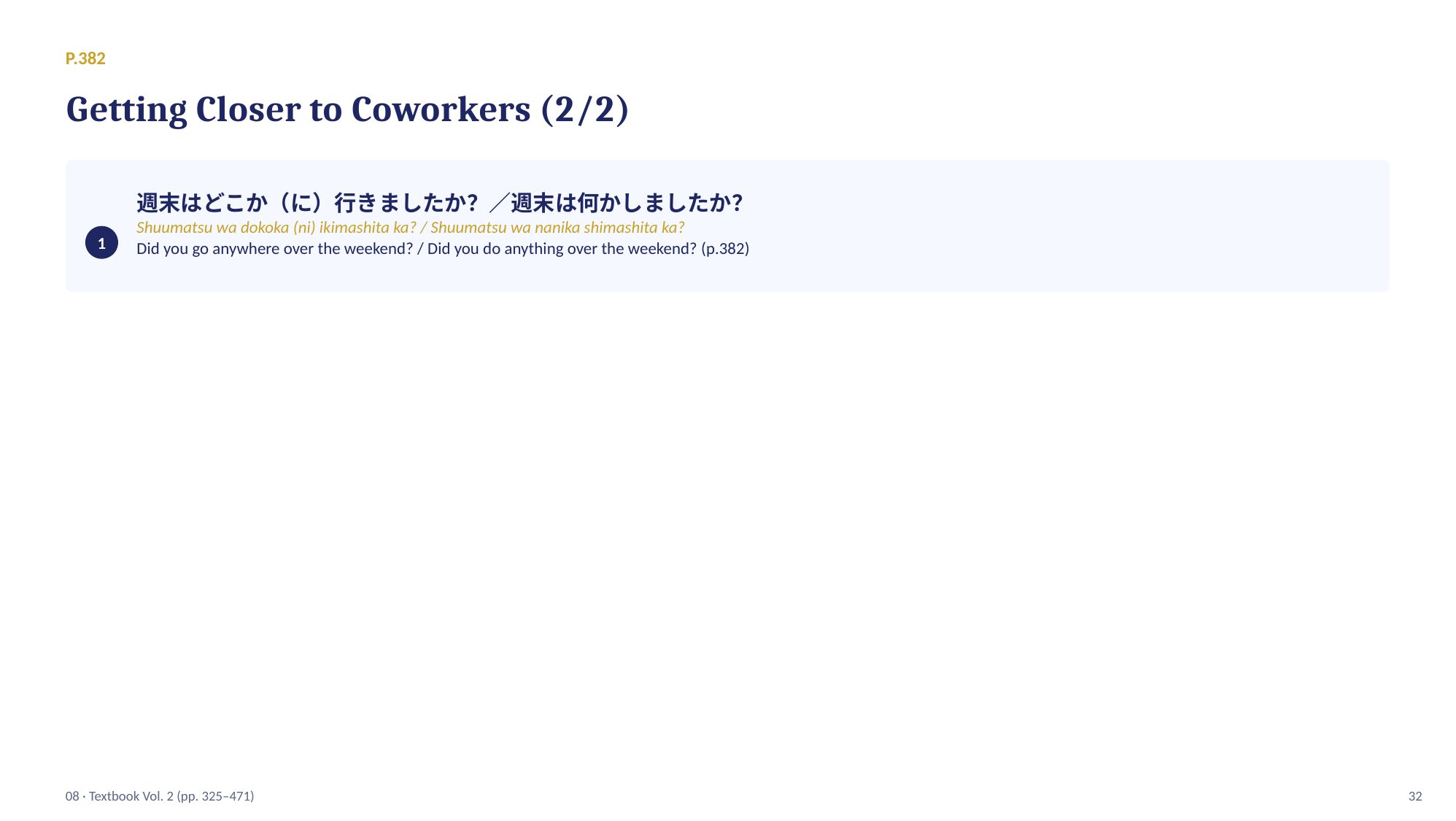
ENP.382
Getting Closer to Coworkers (2/2)
Getting Closer to Coworkers (2/2)
JP週末はどこか(に)行きましたか?/週末は何かしましたか?
EN Shuumatsu wa dokoka (ni) ikimashita ka? / Shuumatsu wa nanika shimashita ka?
1 Did you go anywhere over the weekend? / Did you do anything over the weekend? (p.382)
08 · Textbook Vol. 2 (pp. 325–471) 32
1 Did you go anywhere over the weekend? / Did you do anything over the weekend? (p.382)
08 · Textbook Vol. 2 (pp. 325–471) 32
หน้า 33

คลิกเพื่อขยาย
09
ENEmpathetic Reactions
2 phrases · pages 383–384
2 phrases · pages 383–384
หน้า 34
คลิกเพื่อขยาย
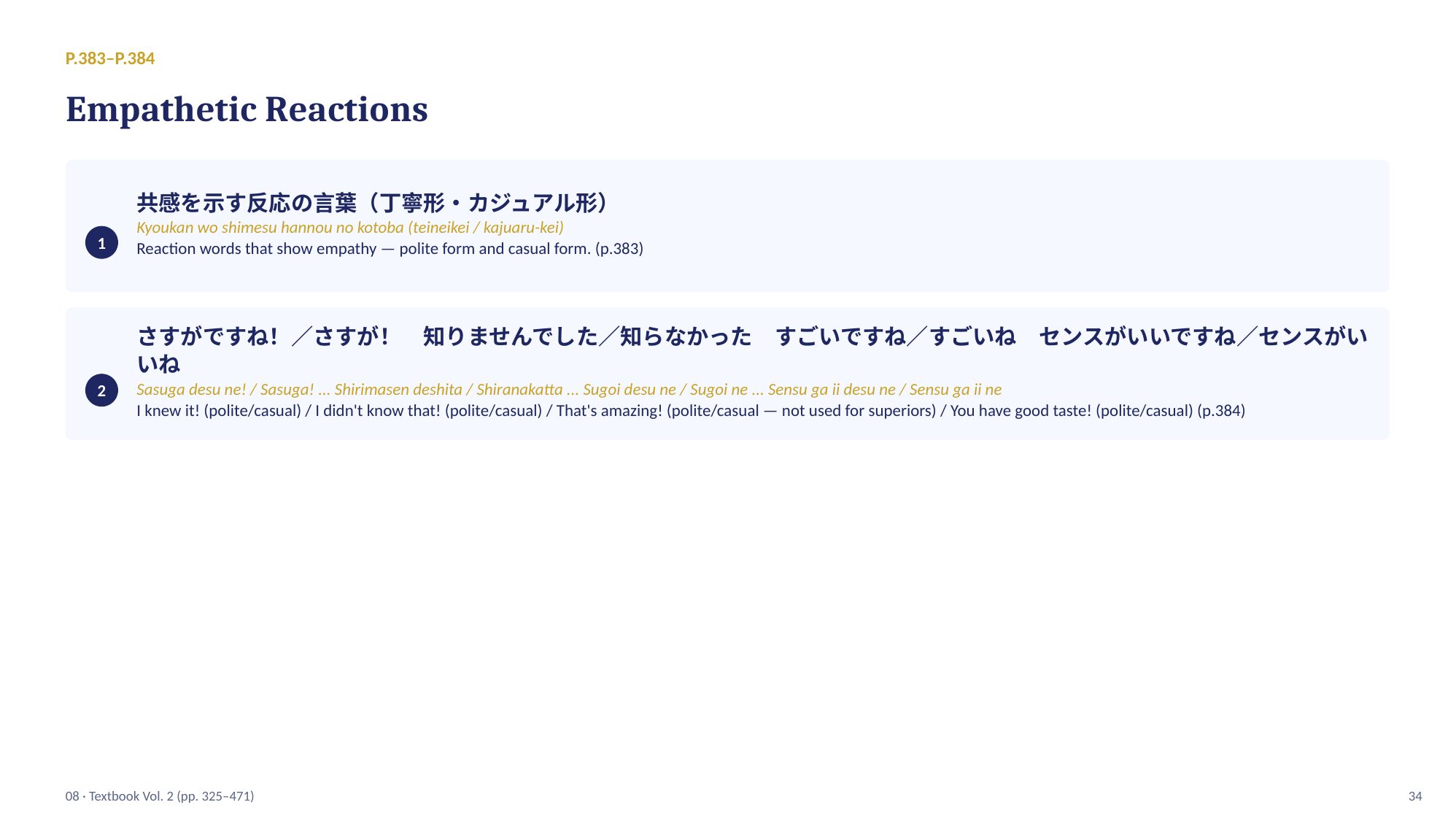
ENP.383–P.384
Empathetic Reactions
Empathetic Reactions
JP共感を示す反応の言葉(丁寧形・カジュアル形)
EN Kyoukan wo shimesu hannou no kotoba (teineikei / kajuaru-kei)
1 Reaction words that show empathy — polite form and casual form. (p.383)
1 Reaction words that show empathy — polite form and casual form. (p.383)
JPさすがですね!/さすが!知りませんでした/知らなかったすごいですね/すごいねセンスがいいですね/センスがい
いね
いね
EN 2 Sasuga desu ne! / Sasuga! ... Shirimasen deshita / Shiranakatta ... Sugoi desu ne / Sugoi ne ... Sensu ga ii desu ne / Sensu ga ii ne
I knew it! (polite/casual) / I didn't know that! (polite/casual) / That's amazing! (polite/casual — not used for superiors) / You have good taste! (polite/casual) (p.384)
08 · Textbook Vol. 2 (pp. 325–471) 34
I knew it! (polite/casual) / I didn't know that! (polite/casual) / That's amazing! (polite/casual — not used for superiors) / You have good taste! (polite/casual) (p.384)
08 · Textbook Vol. 2 (pp. 325–471) 34
หน้า 35

คลิกเพื่อขยาย
10
ENWeekend Small Talk
19 phrases · pages 385–403
19 phrases · pages 385–403
หน้า 36
คลิกเพื่อขยาย
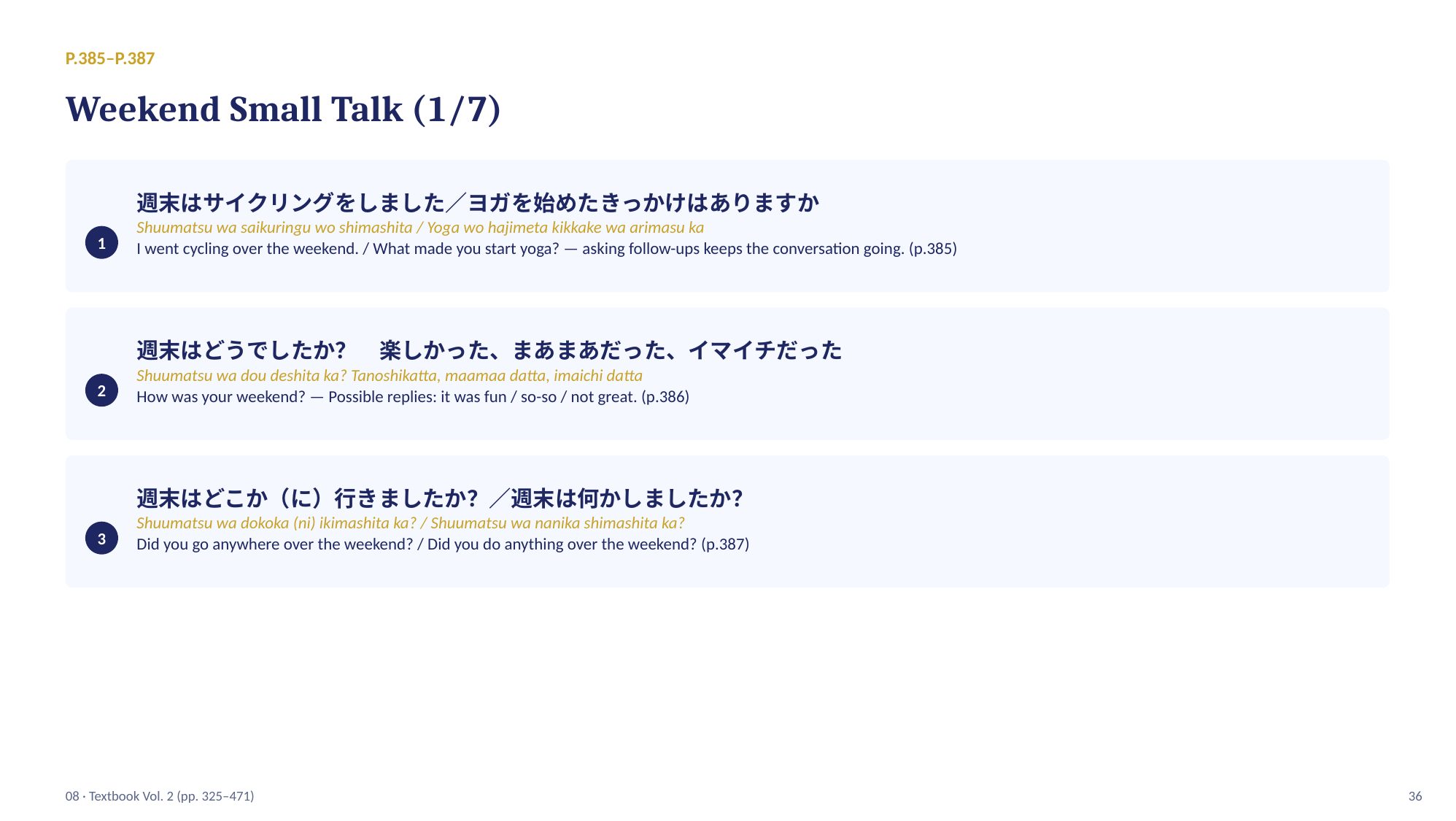
ENP.385–P.387
Weekend Small Talk (1/7)
Weekend Small Talk (1/7)
JP週末はサイクリングをしました/ヨガを始めたきっかけはありますか
EN Shuumatsu wa saikuringu wo shimashita / Yoga wo hajimeta kikkake wa arimasu ka
1 I went cycling over the weekend. / What made you start yoga? — asking follow-ups keeps the conversation going. (p.385)
1 I went cycling over the weekend. / What made you start yoga? — asking follow-ups keeps the conversation going. (p.385)
JP週末はどうでしたか?楽しかった、まあまあだった、イマイチだった
EN Shuumatsu wa dou deshita ka? Tanoshikatta, maamaa datta, imaichi datta
2 How was your weekend? — Possible replies: it was fun / so-so / not great. (p.386)
2 How was your weekend? — Possible replies: it was fun / so-so / not great. (p.386)
JP週末はどこか(に)行きましたか?/週末は何かしましたか?
EN Shuumatsu wa dokoka (ni) ikimashita ka? / Shuumatsu wa nanika shimashita ka?
3 Did you go anywhere over the weekend? / Did you do anything over the weekend? (p.387)
08 · Textbook Vol. 2 (pp. 325–471) 36
3 Did you go anywhere over the weekend? / Did you do anything over the weekend? (p.387)
08 · Textbook Vol. 2 (pp. 325–471) 36
หน้า 37
คลิกเพื่อขยาย
ENP.388–P.390
Weekend Small Talk (2/7)
Weekend Small Talk (2/7)
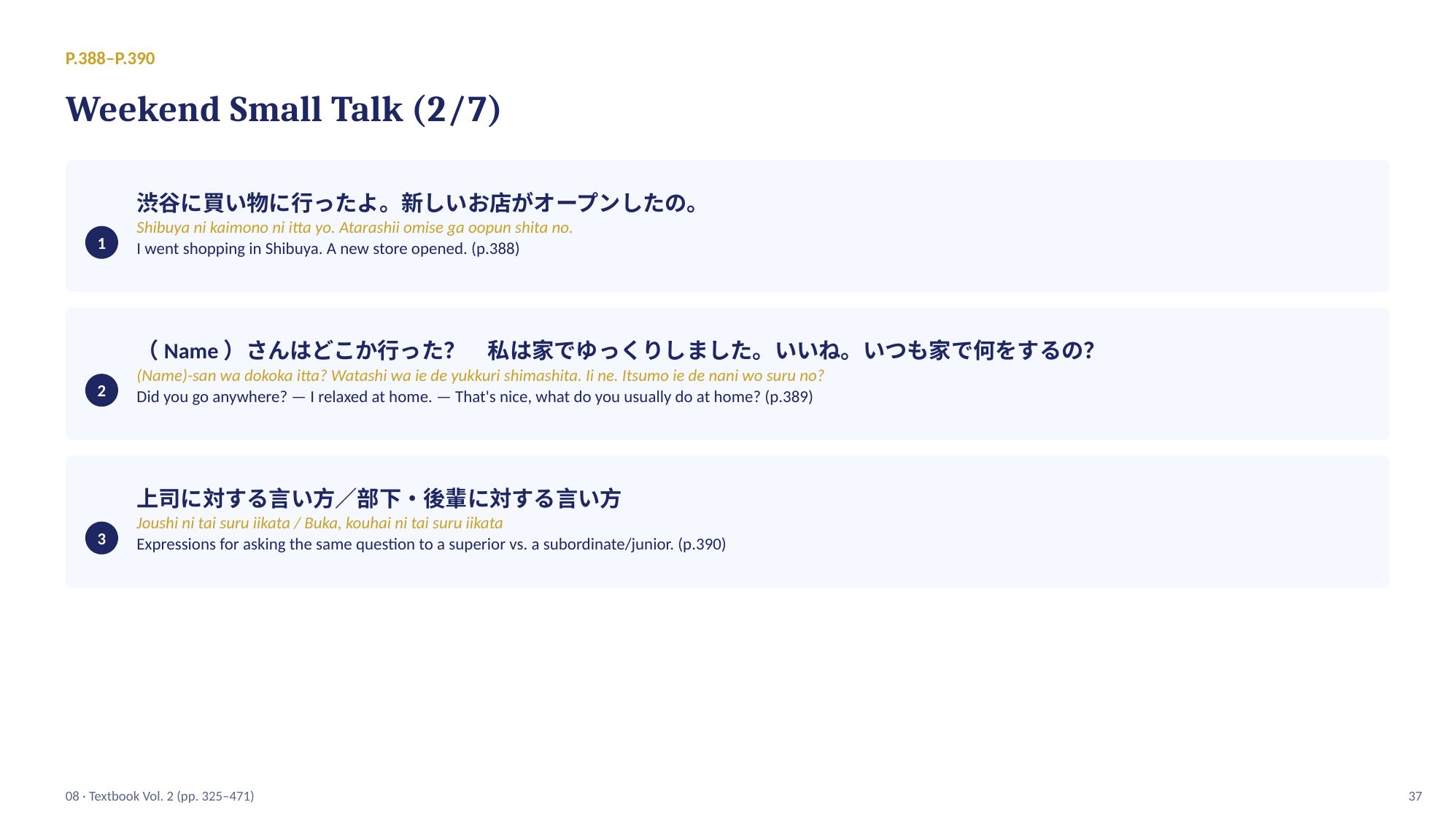
JP渋谷に買い物に行ったよ。新しいお店がオープンしたの。
EN Shibuya ni kaimono ni itta yo. Atarashii omise ga oopun shita no.
1 I went shopping in Shibuya. A new store opened. (p.388)
1 I went shopping in Shibuya. A new store opened. (p.388)
JP(Name)さんはどこか行った?私は家でゆっくりしました。いいね。いつも家で何をするの?
EN (Name)-san wa dokoka itta? Watashi wa ie de yukkuri shimashita. Ii ne. Itsumo ie de nani wo suru no?
2 Did you go anywhere? — I relaxed at home. — That's nice, what do you usually do at home? (p.389)
2 Did you go anywhere? — I relaxed at home. — That's nice, what do you usually do at home? (p.389)
JP上司に対する言い方/部下・後輩に対する言い方
EN Joushi ni tai suru iikata / Buka, kouhai ni tai suru iikata
3 Expressions for asking the same question to a superior vs. a subordinate/junior. (p.390)
08 · Textbook Vol. 2 (pp. 325–471) 37
3 Expressions for asking the same question to a superior vs. a subordinate/junior. (p.390)
08 · Textbook Vol. 2 (pp. 325–471) 37
หน้า 38
คลิกเพื่อขยาย
ENP.391–P.393
Weekend Small Talk (3/7)
Weekend Small Talk (3/7)
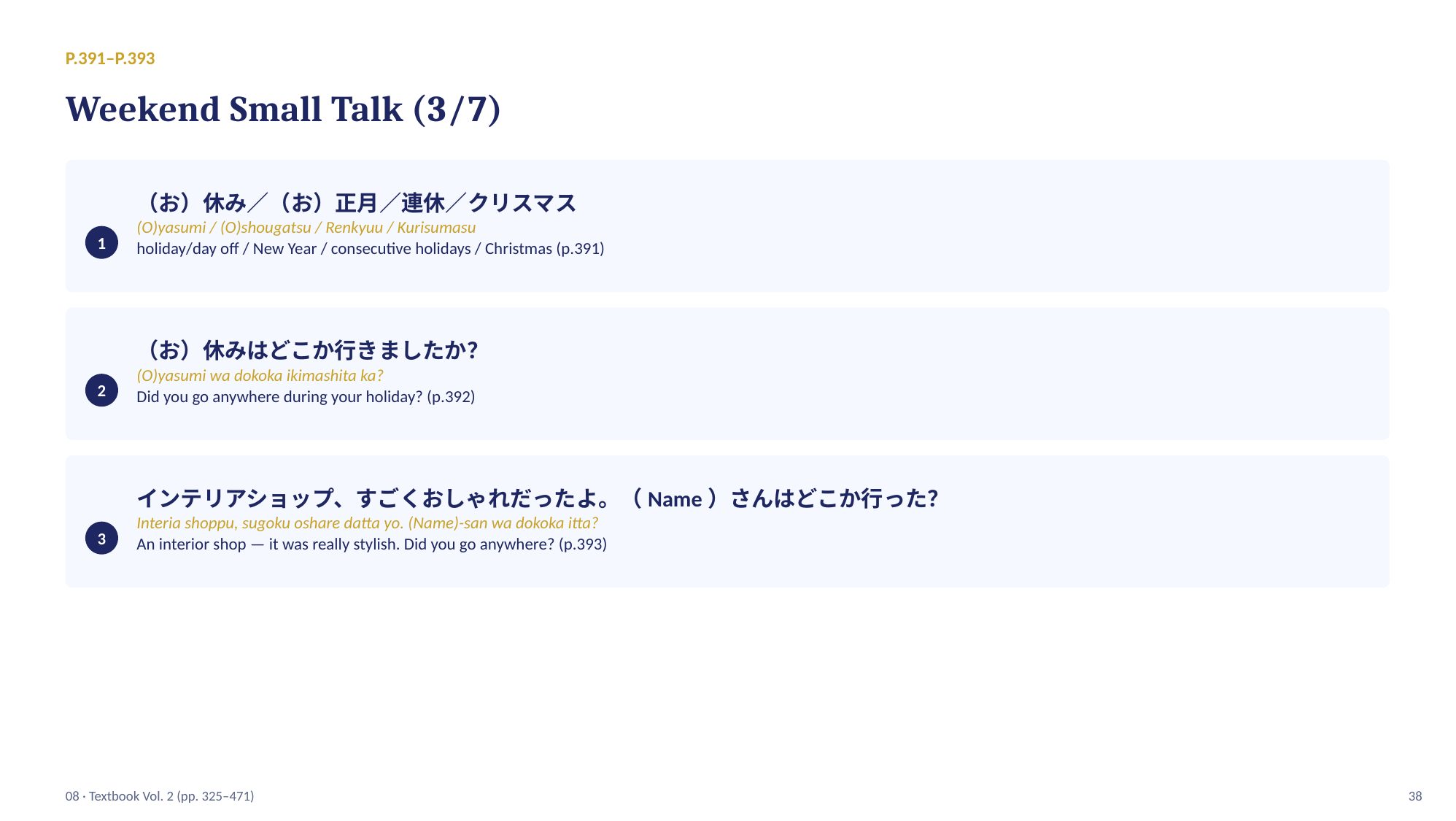
JP(お)休み/(お)正月/連休/クリスマス
EN (O)yasumi / (O)shougatsu / Renkyuu / Kurisumasu
1 holiday/day off / New Year / consecutive holidays / Christmas (p.391)
1 holiday/day off / New Year / consecutive holidays / Christmas (p.391)
JP(お)休みはどこか行きましたか?
EN (O)yasumi wa dokoka ikimashita ka?
2 Did you go anywhere during your holiday? (p.392)
2 Did you go anywhere during your holiday? (p.392)
JPインテリアショップ、すごくおしゃれだったよ。(Name)さんはどこか行った?
EN Interia shoppu, sugoku oshare datta yo. (Name)-san wa dokoka itta?
3 An interior shop — it was really stylish. Did you go anywhere? (p.393)
08 · Textbook Vol. 2 (pp. 325–471) 38
3 An interior shop — it was really stylish. Did you go anywhere? (p.393)
08 · Textbook Vol. 2 (pp. 325–471) 38
หน้า 39
คลิกเพื่อขยาย
ENP.394–P.396
Weekend Small Talk (4/7)
Weekend Small Talk (4/7)
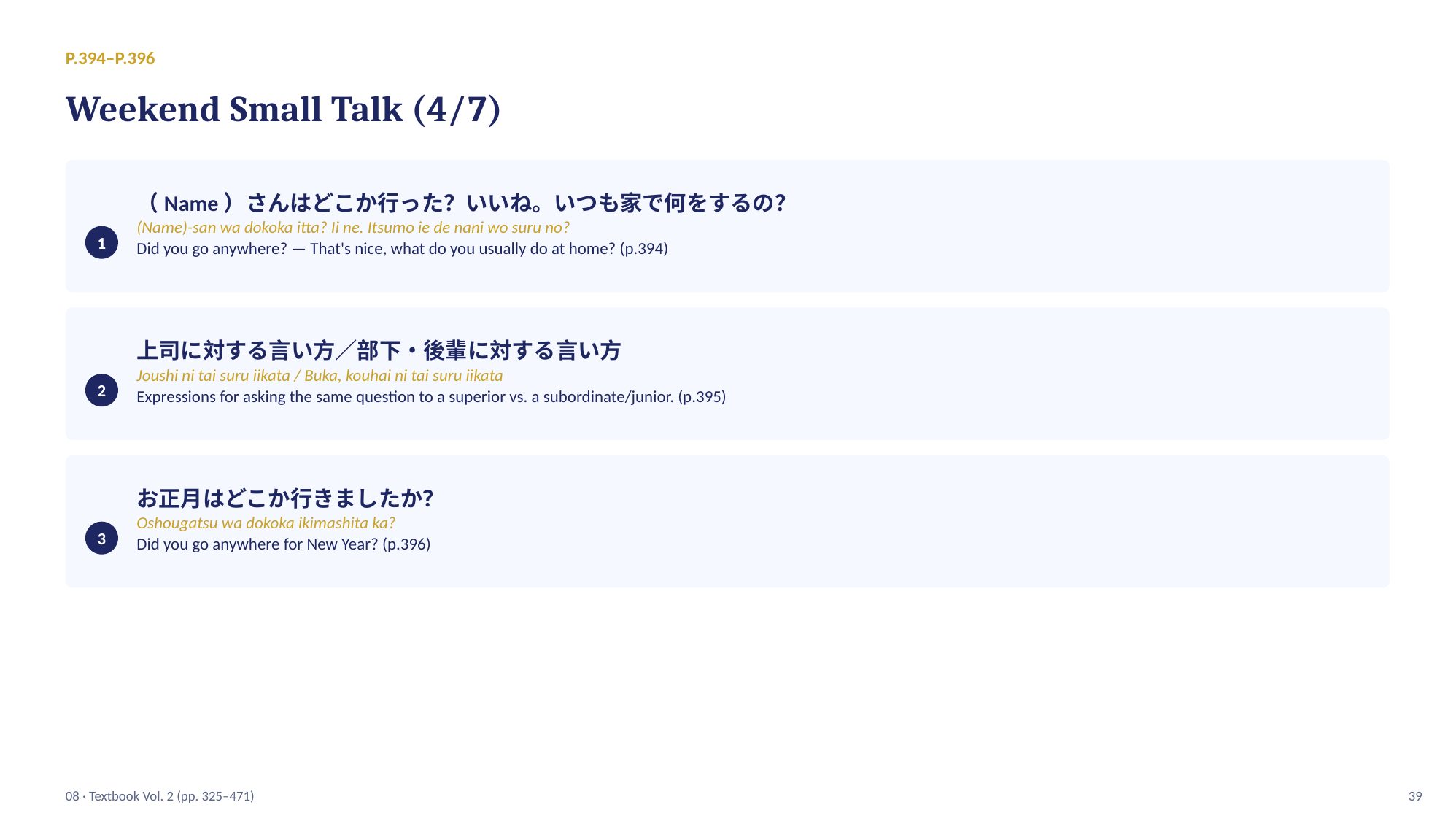
JP(Name)さんはどこか行った?いいね。いつも家で何をするの?
EN (Name)-san wa dokoka itta? Ii ne. Itsumo ie de nani wo suru no?
1 Did you go anywhere? — That's nice, what do you usually do at home? (p.394)
1 Did you go anywhere? — That's nice, what do you usually do at home? (p.394)
JP上司に対する言い方/部下・後輩に対する言い方
EN Joushi ni tai suru iikata / Buka, kouhai ni tai suru iikata
2 Expressions for asking the same question to a superior vs. a subordinate/junior. (p.395)
2 Expressions for asking the same question to a superior vs. a subordinate/junior. (p.395)
JPお正月はどこか行きましたか?
EN Oshougatsu wa dokoka ikimashita ka?
3 Did you go anywhere for New Year? (p.396)
08 · Textbook Vol. 2 (pp. 325–471) 39
3 Did you go anywhere for New Year? (p.396)
08 · Textbook Vol. 2 (pp. 325–471) 39
หน้า 40
คลิกเพื่อขยาย
ENP.397–P.399
Weekend Small Talk (5/7)
Weekend Small Talk (5/7)
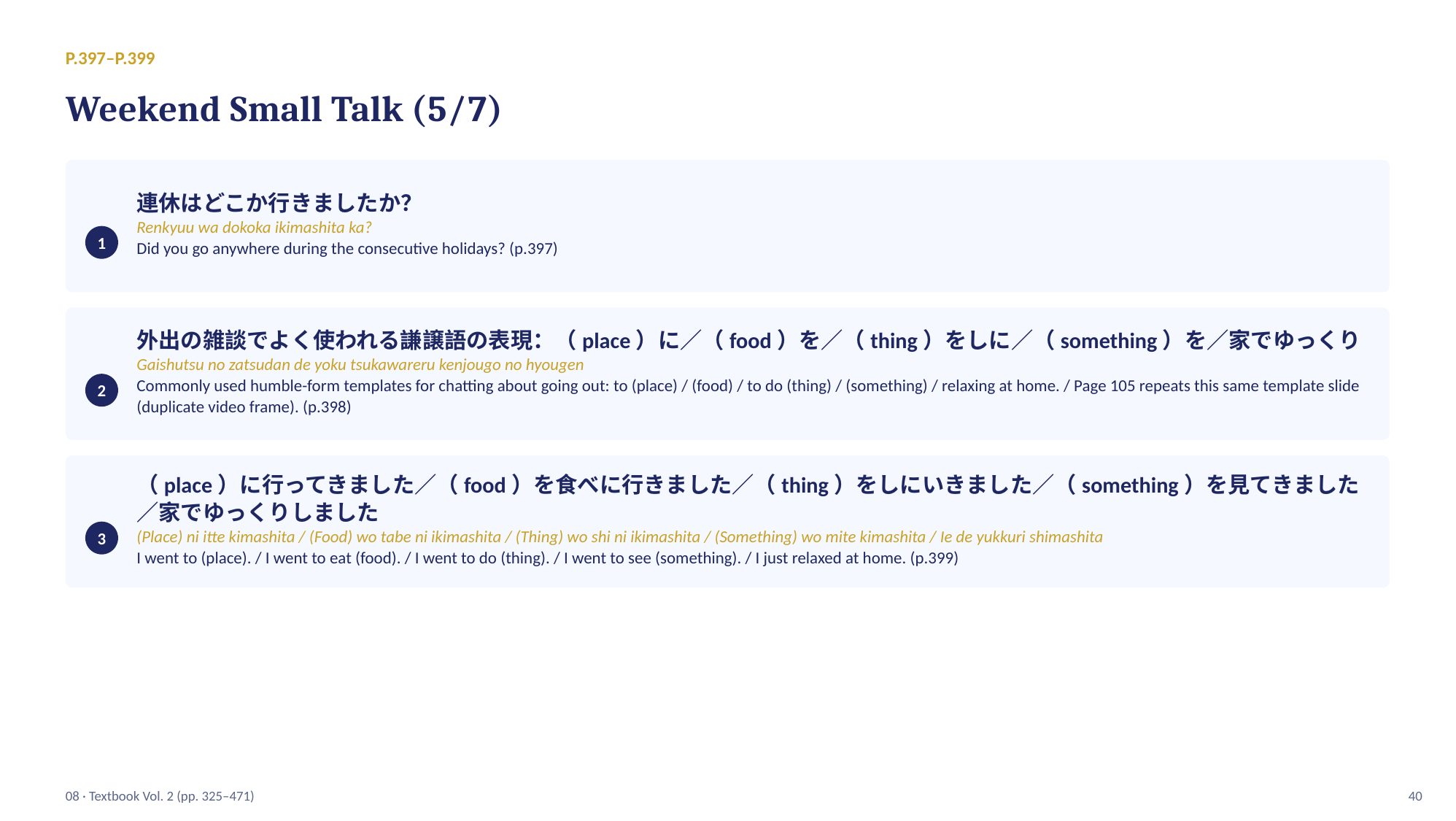
JP連休はどこか行きましたか?
EN Renkyuu wa dokoka ikimashita ka?
1 Did you go anywhere during the consecutive holidays? (p.397)
1 Did you go anywhere during the consecutive holidays? (p.397)
JP外出の雑談でよく使われる謙譲語の表現:(place)に/(food)を/(thing)をしに/(something)を/家でゆっくり
EN Gaishutsu no zatsudan de yoku tsukawareru kenjougo no hyougen
2 Commonly used humble-form templates for chatting about going out: to (place) / (food) / to do (thing) / (something) / relaxing at home. / Page 105 repeats this same template slide
(duplicate video frame). (p.398)
2 Commonly used humble-form templates for chatting about going out: to (place) / (food) / to do (thing) / (something) / relaxing at home. / Page 105 repeats this same template slide
(duplicate video frame). (p.398)
JP(place)に行ってきました/(food)を食べに行きました/(thing)をしにいきました/(something)を見てきました
/家でゆっくりしました
/家でゆっくりしました
EN 3 (Place) ni itte kimashita / (Food) wo tabe ni ikimashita / (Thing) wo shi ni ikimashita / (Something) wo mite kimashita / Ie de yukkuri shimashita
I went to (place). / I went to eat (food). / I went to do (thing). / I went to see (something). / I just relaxed at home. (p.399)
08 · Textbook Vol. 2 (pp. 325–471) 40
I went to (place). / I went to eat (food). / I went to do (thing). / I went to see (something). / I just relaxed at home. (p.399)
08 · Textbook Vol. 2 (pp. 325–471) 40
หน้า 41
คลิกเพื่อขยาย
ENP.400–P.402
Weekend Small Talk (6/7)
Weekend Small Talk (6/7)
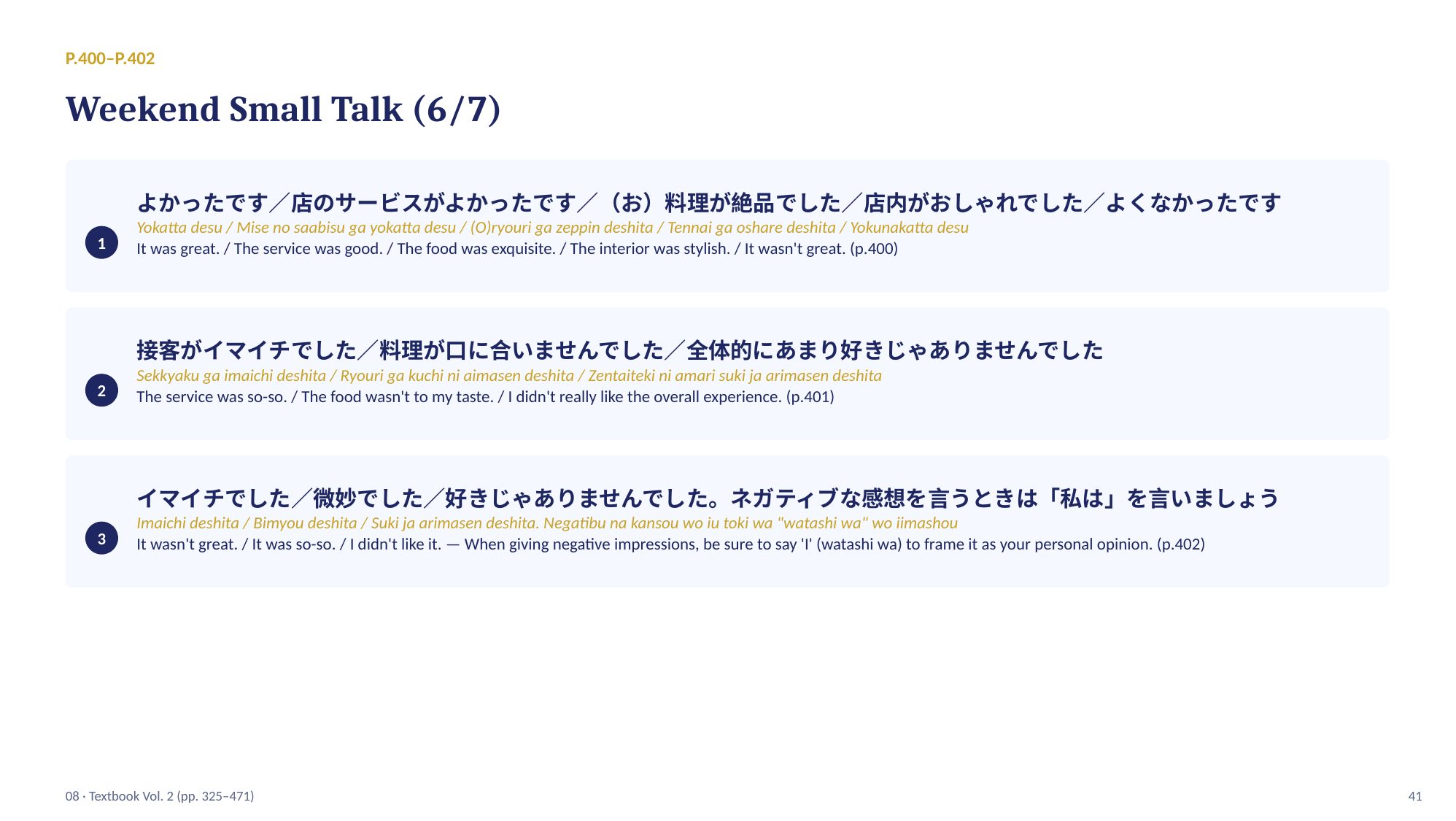
JPよかったです/店のサービスがよかったです/(お)料理が絶品でした/店内がおしゃれでした/よくなかったです
EN Yokatta desu / Mise no saabisu ga yokatta desu / (O)ryouri ga zeppin deshita / Tennai ga oshare deshita / Yokunakatta desu
1 It was great. / The service was good. / The food was exquisite. / The interior was stylish. / It wasn't great. (p.400)
1 It was great. / The service was good. / The food was exquisite. / The interior was stylish. / It wasn't great. (p.400)
JP接客がイマイチでした/料理が口に合いませんでした/全体的にあまり好きじゃありませんでした
EN Sekkyaku ga imaichi deshita / Ryouri ga kuchi ni aimasen deshita / Zentaiteki ni amari suki ja arimasen deshita
2 The service was so-so. / The food wasn't to my taste. / I didn't really like the overall experience. (p.401)
2 The service was so-so. / The food wasn't to my taste. / I didn't really like the overall experience. (p.401)
JPイマイチでした/微妙でした/好きじゃありませんでした。ネガティブな感想を言うときは「私は」を言いましょう
EN Imaichi deshita / Bimyou deshita / Suki ja arimasen deshita. Negatibu na kansou wo iu toki wa "watashi wa" wo iimashou
3 It wasn't great. / It was so-so. / I didn't like it. — When giving negative impressions, be sure to say 'I' (watashi wa) to frame it as your personal opinion. (p.402)
08 · Textbook Vol. 2 (pp. 325–471) 41
3 It wasn't great. / It was so-so. / I didn't like it. — When giving negative impressions, be sure to say 'I' (watashi wa) to frame it as your personal opinion. (p.402)
08 · Textbook Vol. 2 (pp. 325–471) 41
หน้า 42
คลิกเพื่อขยาย
ENP.403
Weekend Small Talk (7/7)
Weekend Small Talk (7/7)
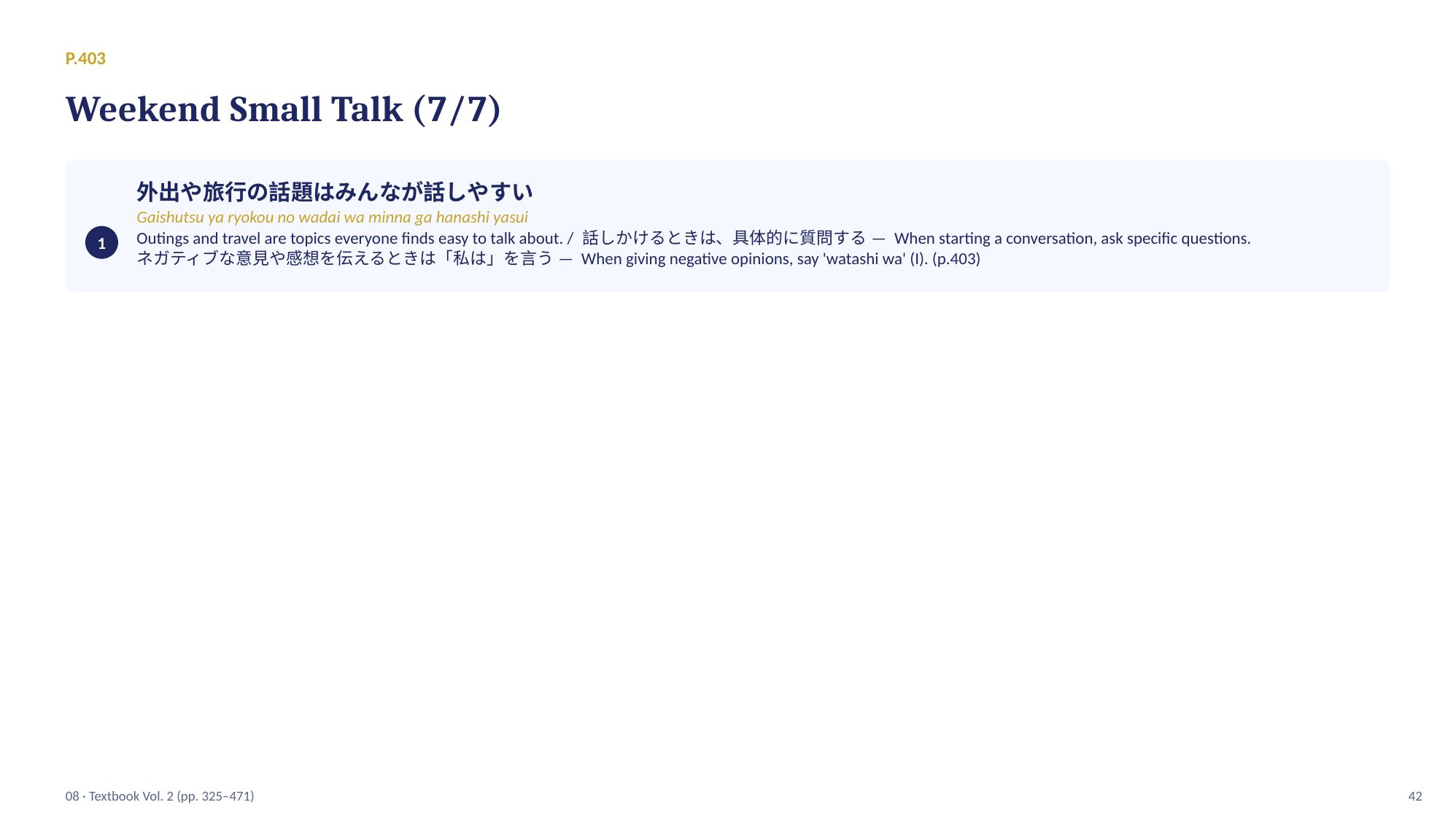
JP外出や旅行の話題はみんなが話しやすい
EN Gaishutsu ya ryokou no wadai wa minna ga hanashi yasui
1 Outings and travel are topics everyone finds easy to talk about. / 話しかけるときは、具体的に質問する — When starting a conversation, ask specific questions.
ネガティブな意見や感想を伝えるときは「私は」を言う — When giving negative opinions, say 'watashi wa' (I). (p.403)
08 · Textbook Vol. 2 (pp. 325–471) 42
1 Outings and travel are topics everyone finds easy to talk about. / 話しかけるときは、具体的に質問する — When starting a conversation, ask specific questions.
ネガティブな意見や感想を伝えるときは「私は」を言う — When giving negative opinions, say 'watashi wa' (I). (p.403)
08 · Textbook Vol. 2 (pp. 325–471) 42
หน้า 43

คลิกเพื่อขยาย
11
ENAsking About Future Plans
17 phrases · pages 404–421
17 phrases · pages 404–421
หน้า 44
คลิกเพื่อขยาย
ENP.404–P.406
Asking About Future Plans (1/6)
Asking About Future Plans (1/6)
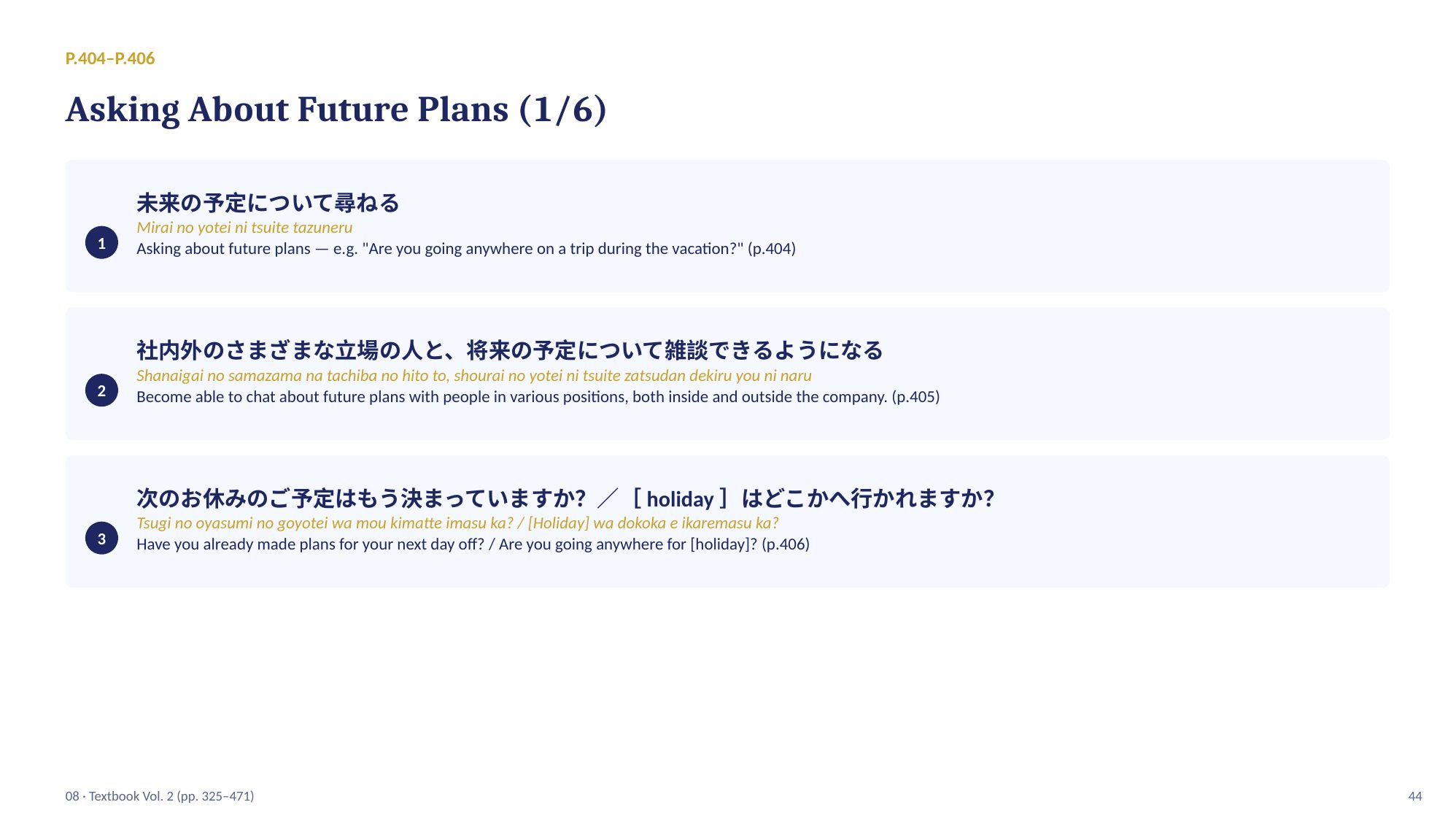
JP未来の予定について尋ねる
EN Mirai no yotei ni tsuite tazuneru
1 Asking about future plans — e.g. "Are you going anywhere on a trip during the vacation?" (p.404)
1 Asking about future plans — e.g. "Are you going anywhere on a trip during the vacation?" (p.404)
JP社内外のさまざまな立場の人と、将来の予定について雑談できるようになる
EN Shanaigai no samazama na tachiba no hito to, shourai no yotei ni tsuite zatsudan dekiru you ni naru
2 Become able to chat about future plans with people in various positions, both inside and outside the company. (p.405)
2 Become able to chat about future plans with people in various positions, both inside and outside the company. (p.405)
JP次のお休みのご予定はもう決まっていますか?/[holiday]はどこかへ行かれますか?
EN Tsugi no oyasumi no goyotei wa mou kimatte imasu ka? / [Holiday] wa dokoka e ikaremasu ka?
3 Have you already made plans for your next day off? / Are you going anywhere for [holiday]? (p.406)
08 · Textbook Vol. 2 (pp. 325–471) 44
3 Have you already made plans for your next day off? / Are you going anywhere for [holiday]? (p.406)
08 · Textbook Vol. 2 (pp. 325–471) 44
หน้า 45
คลิกเพื่อขยาย
ENP.407–P.409
Asking About Future Plans (2/6)
Asking About Future Plans (2/6)
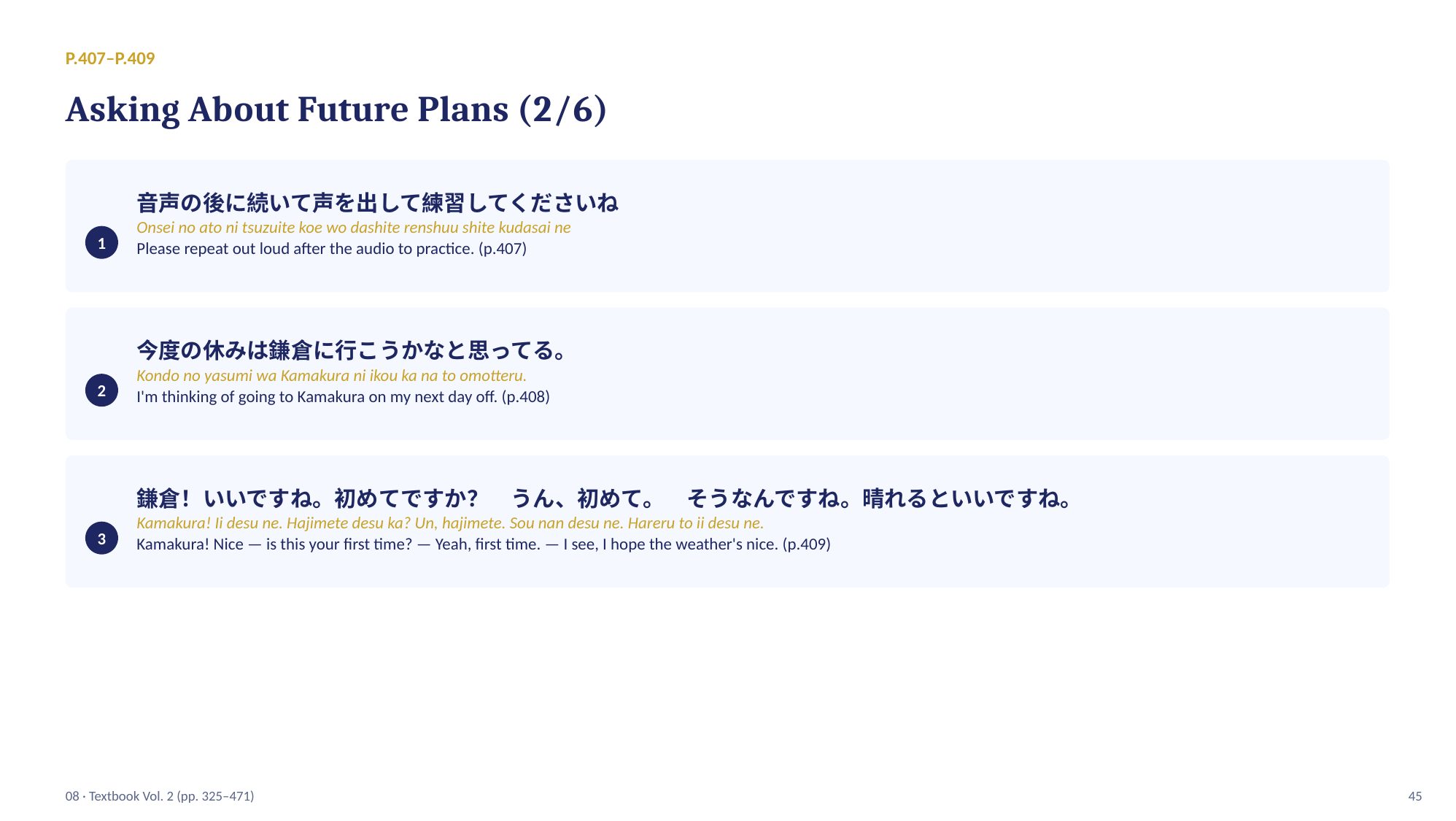
JP音声の後に続いて声を出して練習してくださいね
EN Onsei no ato ni tsuzuite koe wo dashite renshuu shite kudasai ne
1 Please repeat out loud after the audio to practice. (p.407)
1 Please repeat out loud after the audio to practice. (p.407)
JP今度の休みは鎌倉に行こうかなと思ってる。
EN Kondo no yasumi wa Kamakura ni ikou ka na to omotteru.
2 I'm thinking of going to Kamakura on my next day off. (p.408)
2 I'm thinking of going to Kamakura on my next day off. (p.408)
JP鎌倉!いいですね。初めてですか?うん、初めて。そうなんですね。晴れるといいですね。
EN Kamakura! Ii desu ne. Hajimete desu ka? Un, hajimete. Sou nan desu ne. Hareru to ii desu ne.
3 Kamakura! Nice — is this your first time? — Yeah, first time. — I see, I hope the weather's nice. (p.409)
08 · Textbook Vol. 2 (pp. 325–471) 45
3 Kamakura! Nice — is this your first time? — Yeah, first time. — I see, I hope the weather's nice. (p.409)
08 · Textbook Vol. 2 (pp. 325–471) 45
หน้า 46
คลิกเพื่อขยาย
ENP.410–P.412
Asking About Future Plans (3/6)
Asking About Future Plans (3/6)
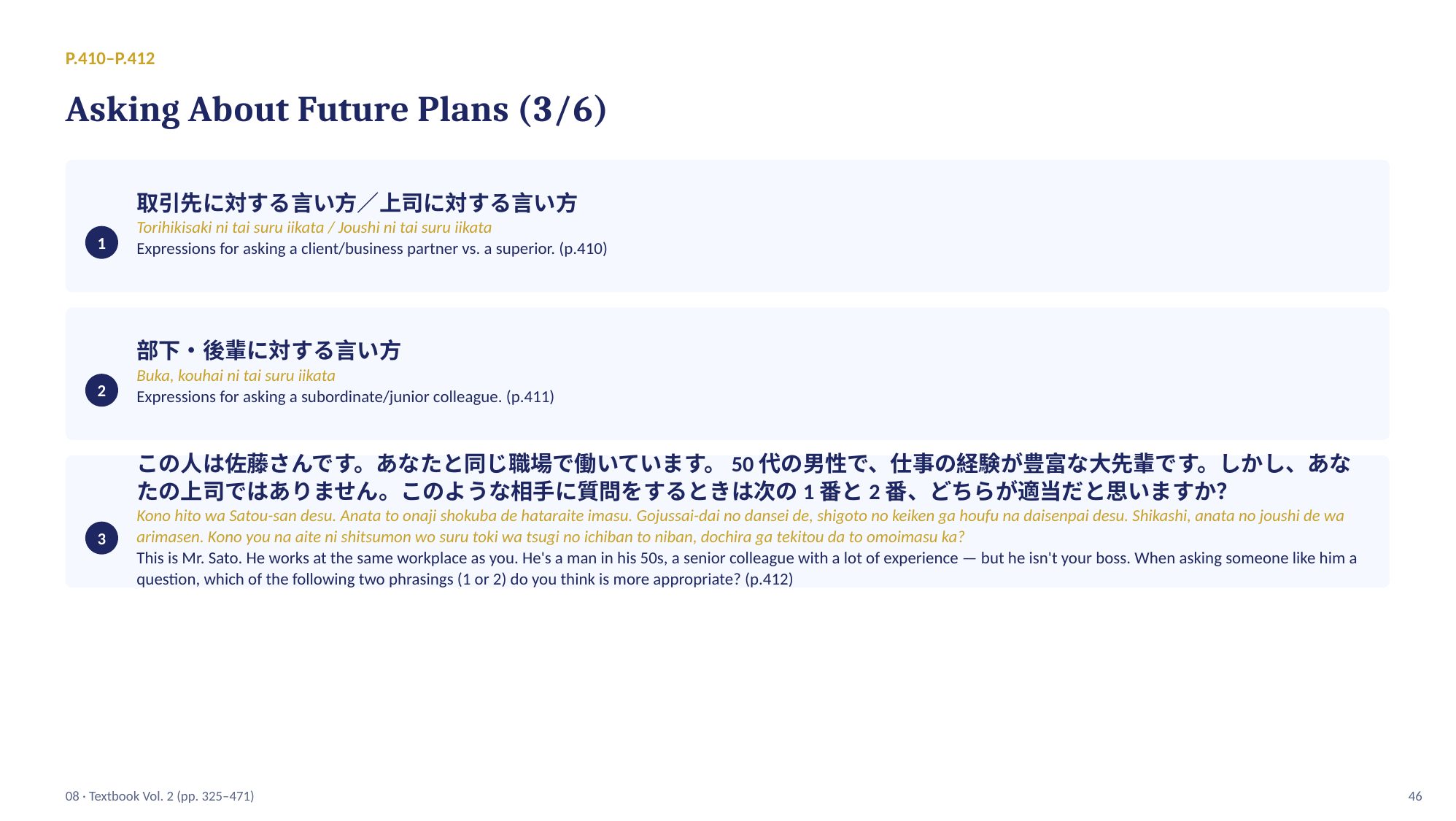
JP取引先に対する言い方/上司に対する言い方
EN Torihikisaki ni tai suru iikata / Joushi ni tai suru iikata
1 Expressions for asking a client/business partner vs. a superior. (p.410)
1 Expressions for asking a client/business partner vs. a superior. (p.410)
JP部下・後輩に対する言い方
EN Buka, kouhai ni tai suru iikata
2 Expressions for asking a subordinate/junior colleague. (p.411)
2 Expressions for asking a subordinate/junior colleague. (p.411)
JPこの人は佐藤さんです。あなたと同じ職場で働いています。50代の男性で、仕事の経験が豊富な大先輩です。しかし、あな
たの上司ではありません。このような相手に質問をするときは次の1番と2番、どちらが適当だと思いますか?
たの上司ではありません。このような相手に質問をするときは次の1番と2番、どちらが適当だと思いますか?
EN Kono hito wa Satou-san desu. Anata to onaji shokuba de hataraite imasu. Gojussai-dai no dansei de, shigoto no keiken ga houfu na daisenpai desu. Shikashi, anata no joushi de wa
3 arimasen. Kono you na aite ni shitsumon wo suru toki wa tsugi no ichiban to niban, dochira ga tekitou da to omoimasu ka?
This is Mr. Sato. He works at the same workplace as you. He's a man in his 50s, a senior colleague with a lot of experience — but he isn't your boss. When asking someone like him a
question, which of the following two phrasings (1 or 2) do you think is more appropriate? (p.412)
08 · Textbook Vol. 2 (pp. 325–471) 46
3 arimasen. Kono you na aite ni shitsumon wo suru toki wa tsugi no ichiban to niban, dochira ga tekitou da to omoimasu ka?
This is Mr. Sato. He works at the same workplace as you. He's a man in his 50s, a senior colleague with a lot of experience — but he isn't your boss. When asking someone like him a
question, which of the following two phrasings (1 or 2) do you think is more appropriate? (p.412)
08 · Textbook Vol. 2 (pp. 325–471) 46
หน้า 47
คลิกเพื่อขยาย
ENP.413–P.416
Asking About Future Plans (4/6)
Asking About Future Plans (4/6)
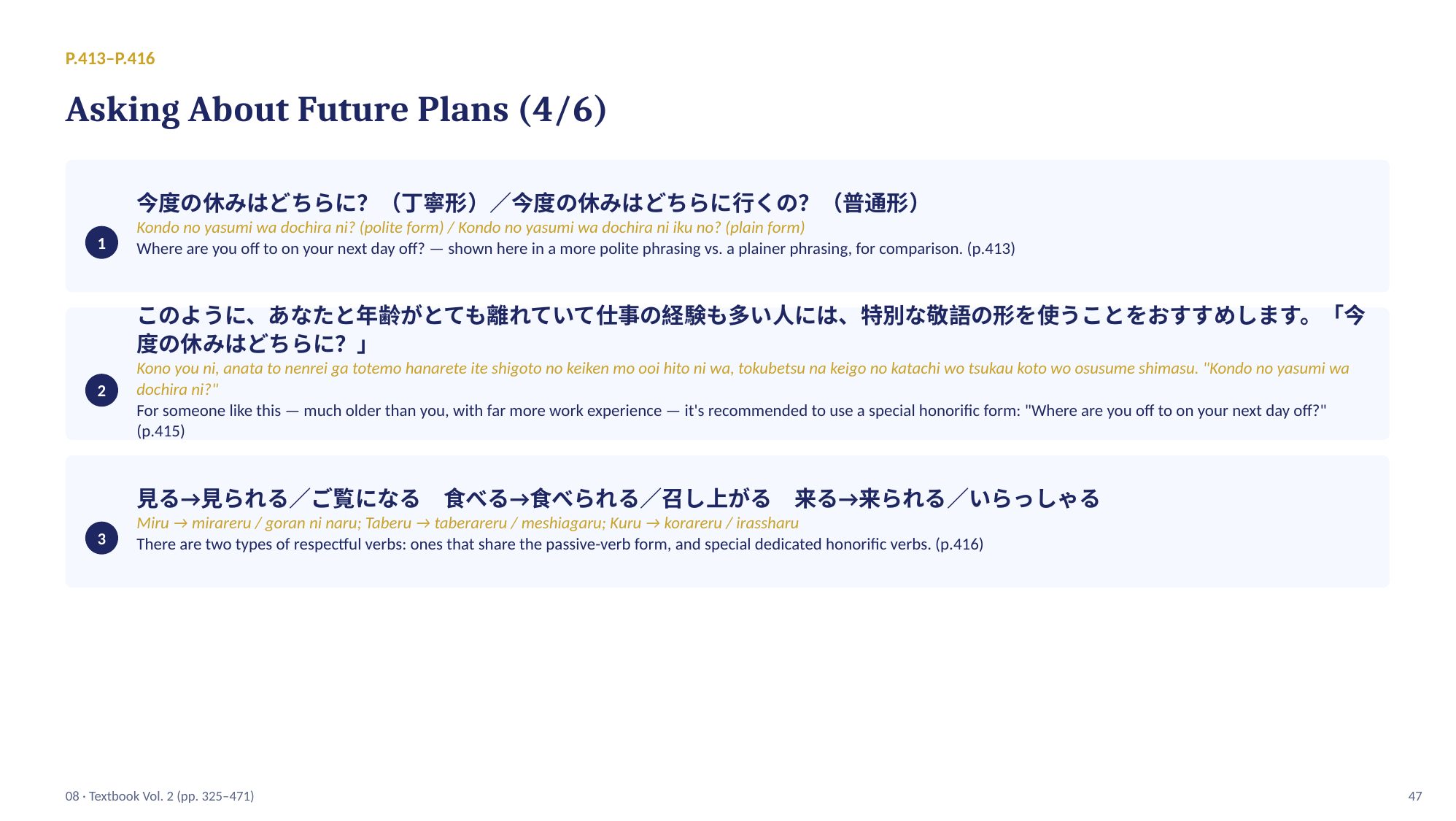
JP今度の休みはどちらに?(丁寧形)/今度の休みはどちらに行くの?(普通形)
EN Kondo no yasumi wa dochira ni? (polite form) / Kondo no yasumi wa dochira ni iku no? (plain form)
1 Where are you off to on your next day off? — shown here in a more polite phrasing vs. a plainer phrasing, for comparison. (p.413)
1 Where are you off to on your next day off? — shown here in a more polite phrasing vs. a plainer phrasing, for comparison. (p.413)
JPこのように、あなたと年齢がとても離れていて仕事の経験も多い人には、特別な敬語の形を使うことをおすすめします。「今
度の休みはどちらに?」
度の休みはどちらに?」
EN Kono you ni, anata to nenrei ga totemo hanarete ite shigoto no keiken mo ooi hito ni wa, tokubetsu na keigo no katachi wo tsukau koto wo osusume shimasu. "Kondo no yasumi wa
2 dochira ni?"
For someone like this — much older than you, with far more work experience — it's recommended to use a special honorific form: "Where are you off to on your next day off?"
(p.415)
2 dochira ni?"
For someone like this — much older than you, with far more work experience — it's recommended to use a special honorific form: "Where are you off to on your next day off?"
(p.415)
JP見る→見られる/ご覧になる食べる→食べられる/召し上がる来る→来られる/いらっしゃる
EN Miru → mirareru / goran ni naru; Taberu → taberareru / meshiagaru; Kuru → korareru / irassharu
3 There are two types of respectful verbs: ones that share the passive-verb form, and special dedicated honorific verbs. (p.416)
08 · Textbook Vol. 2 (pp. 325–471) 47
3 There are two types of respectful verbs: ones that share the passive-verb form, and special dedicated honorific verbs. (p.416)
08 · Textbook Vol. 2 (pp. 325–471) 47
หน้า 48
คลิกเพื่อขยาย
ENP.417–P.419
Asking About Future Plans (5/6)
Asking About Future Plans (5/6)
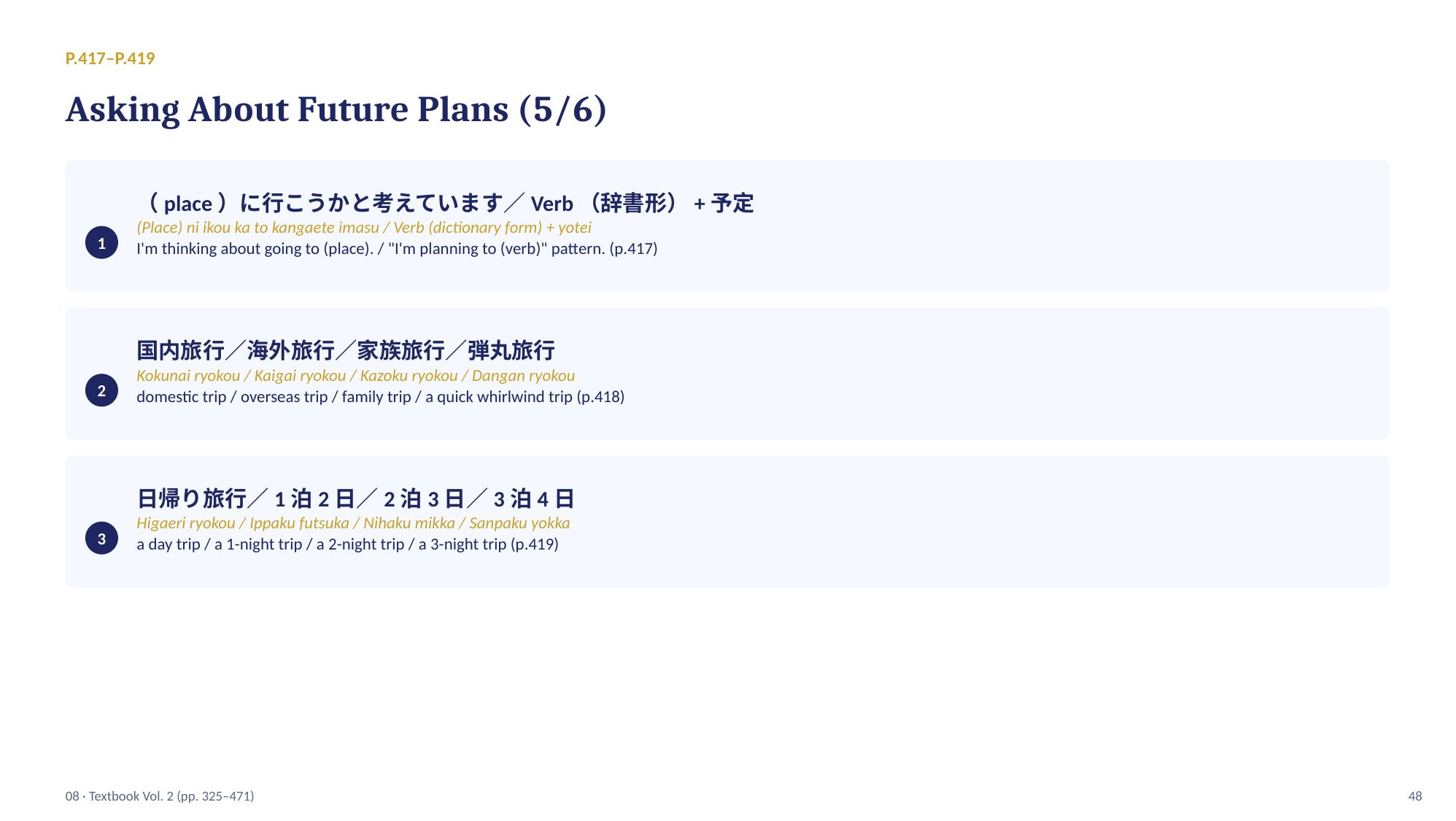
JP(place)に行こうかと考えています/Verb(辞書形)+予定
EN (Place) ni ikou ka to kangaete imasu / Verb (dictionary form) + yotei
1 I'm thinking about going to (place). / "I'm planning to (verb)" pattern. (p.417)
1 I'm thinking about going to (place). / "I'm planning to (verb)" pattern. (p.417)
JP国内旅行/海外旅行/家族旅行/弾丸旅行
EN Kokunai ryokou / Kaigai ryokou / Kazoku ryokou / Dangan ryokou
2 domestic trip / overseas trip / family trip / a quick whirlwind trip (p.418)
2 domestic trip / overseas trip / family trip / a quick whirlwind trip (p.418)
JP日帰り旅行/1泊2日/2泊3日/3泊4日
EN Higaeri ryokou / Ippaku futsuka / Nihaku mikka / Sanpaku yokka
3 a day trip / a 1-night trip / a 2-night trip / a 3-night trip (p.419)
08 · Textbook Vol. 2 (pp. 325–471) 48
3 a day trip / a 1-night trip / a 2-night trip / a 3-night trip (p.419)
08 · Textbook Vol. 2 (pp. 325–471) 48
หน้า 49
คลิกเพื่อขยาย
ENP.420–P.421
Asking About Future Plans (6/6)
Asking About Future Plans (6/6)
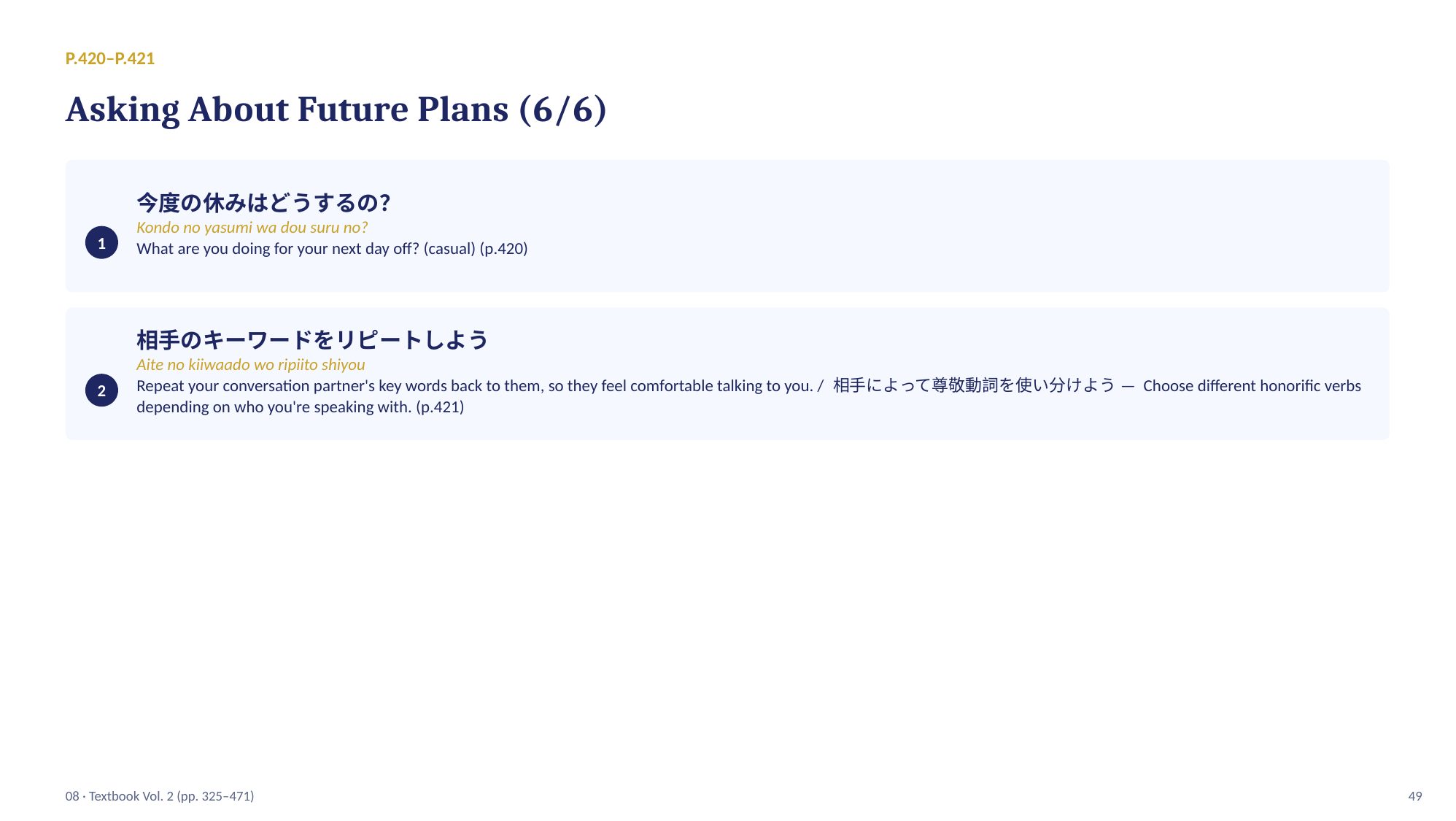
JP今度の休みはどうするの?
EN Kondo no yasumi wa dou suru no?
1 What are you doing for your next day off? (casual) (p.420)
1 What are you doing for your next day off? (casual) (p.420)
JP相手のキーワードをリピートしよう
EN Aite no kiiwaado wo ripiito shiyou
2 Repeat your conversation partner's key words back to them, so they feel comfortable talking to you. / 相手によって尊敬動詞を使い分けよう — Choose different honorific verbs
depending on who you're speaking with. (p.421)
08 · Textbook Vol. 2 (pp. 325–471) 49
2 Repeat your conversation partner's key words back to them, so they feel comfortable talking to you. / 相手によって尊敬動詞を使い分けよう — Choose different honorific verbs
depending on who you're speaking with. (p.421)
08 · Textbook Vol. 2 (pp. 325–471) 49
หน้า 50

คลิกเพื่อขยาย
12
ENIntroducing Recommended Spots
15 phrases · pages 422–439
15 phrases · pages 422–439
หน้า 51
คลิกเพื่อขยาย
ENP.422–P.424
Introducing Recommended Spots (1/5)
Introducing Recommended Spots (1/5)
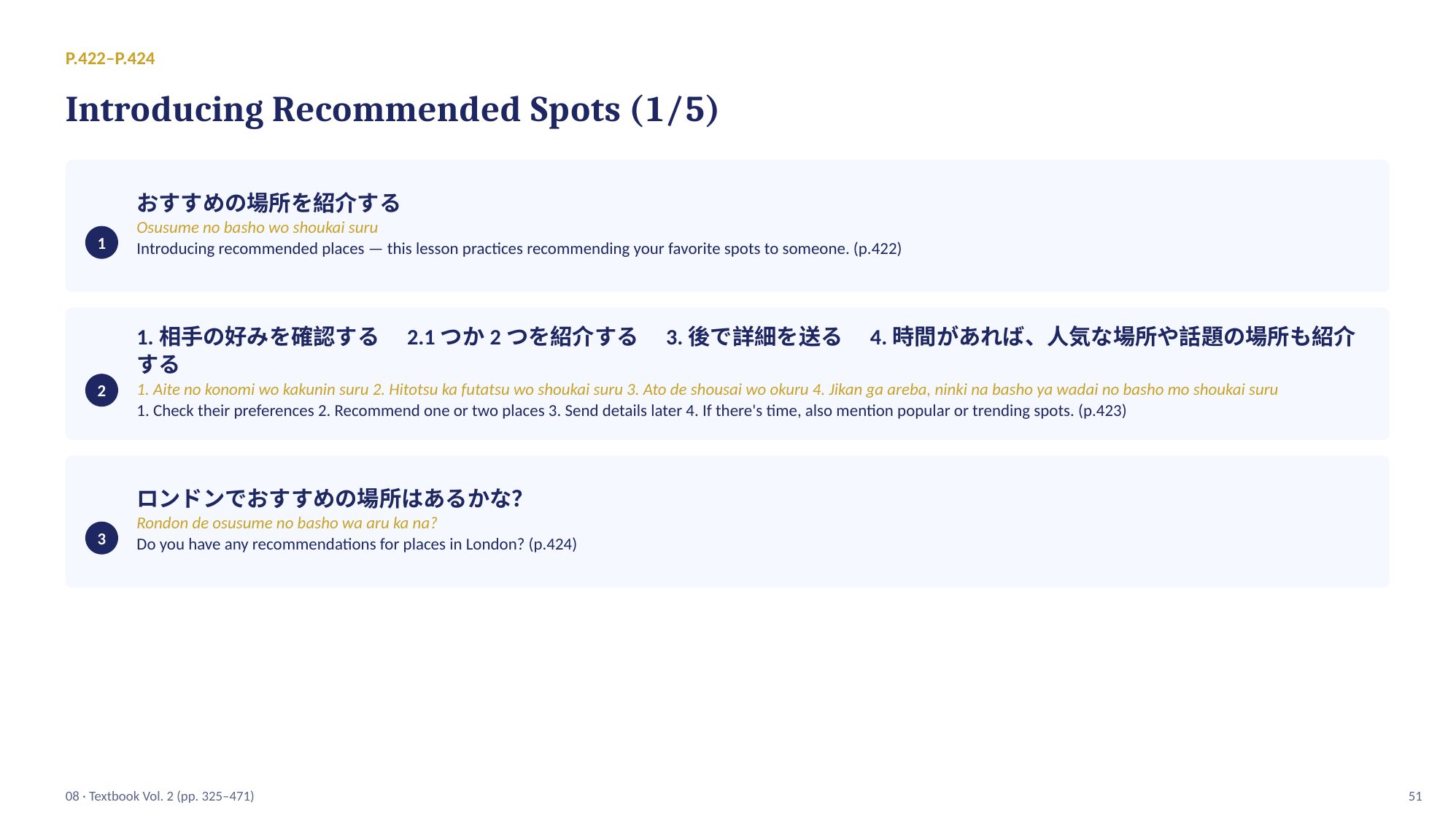
JPおすすめの場所を紹介する
EN Osusume no basho wo shoukai suru
1 Introducing recommended places — this lesson practices recommending your favorite spots to someone. (p.422)
1 Introducing recommended places — this lesson practices recommending your favorite spots to someone. (p.422)
JP1.相手の好みを確認する2.1つか2つを紹介する3.後で詳細を送る4.時間があれば、人気な場所や話題の場所も紹介
する
する
EN 2 1. Aite no konomi wo kakunin suru 2. Hitotsu ka futatsu wo shoukai suru 3. Ato de shousai wo okuru 4. Jikan ga areba, ninki na basho ya wadai no basho mo shoukai suru
1. Check their preferences 2. Recommend one or two places 3. Send details later 4. If there's time, also mention popular or trending spots. (p.423)
1. Check their preferences 2. Recommend one or two places 3. Send details later 4. If there's time, also mention popular or trending spots. (p.423)
JPロンドンでおすすめの場所はあるかな?
EN Rondon de osusume no basho wa aru ka na?
3 Do you have any recommendations for places in London? (p.424)
08 · Textbook Vol. 2 (pp. 325–471) 51
3 Do you have any recommendations for places in London? (p.424)
08 · Textbook Vol. 2 (pp. 325–471) 51
หน้า 52
คลิกเพื่อขยาย
ENP.425–P.428
Introducing Recommended Spots (2/5)
Introducing Recommended Spots (2/5)
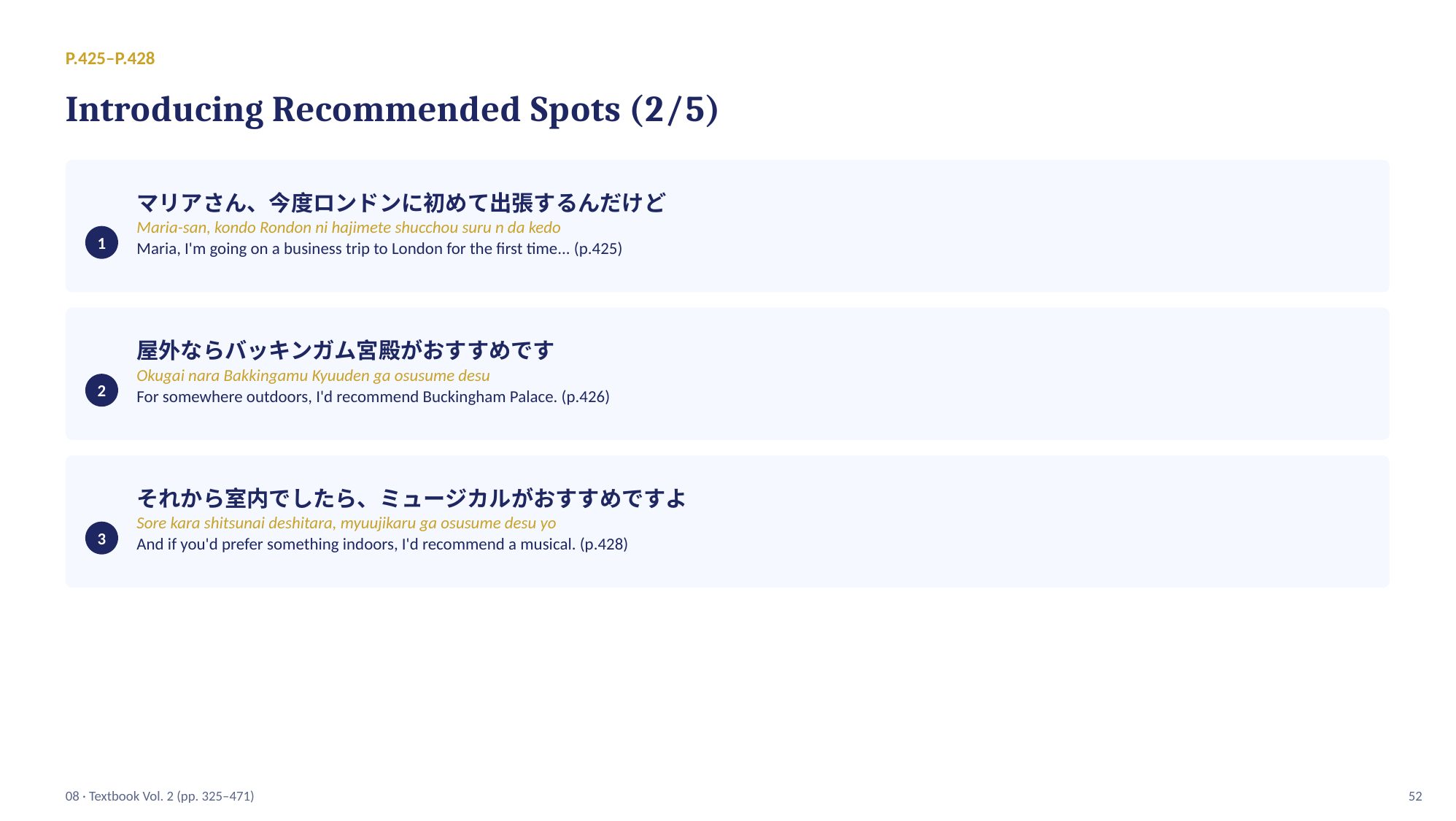
JPマリアさん、今度ロンドンに初めて出張するんだけど
EN Maria-san, kondo Rondon ni hajimete shucchou suru n da kedo
1 Maria, I'm going on a business trip to London for the first time... (p.425)
1 Maria, I'm going on a business trip to London for the first time... (p.425)
JP屋外ならバッキンガム宮殿がおすすめです
EN Okugai nara Bakkingamu Kyuuden ga osusume desu
2 For somewhere outdoors, I'd recommend Buckingham Palace. (p.426)
2 For somewhere outdoors, I'd recommend Buckingham Palace. (p.426)
JPそれから室内でしたら、ミュージカルがおすすめですよ
EN Sore kara shitsunai deshitara, myuujikaru ga osusume desu yo
3 And if you'd prefer something indoors, I'd recommend a musical. (p.428)
08 · Textbook Vol. 2 (pp. 325–471) 52
3 And if you'd prefer something indoors, I'd recommend a musical. (p.428)
08 · Textbook Vol. 2 (pp. 325–471) 52
หน้า 53
คลิกเพื่อขยาย
ENP.429–P.431
Introducing Recommended Spots (3/5)
Introducing Recommended Spots (3/5)
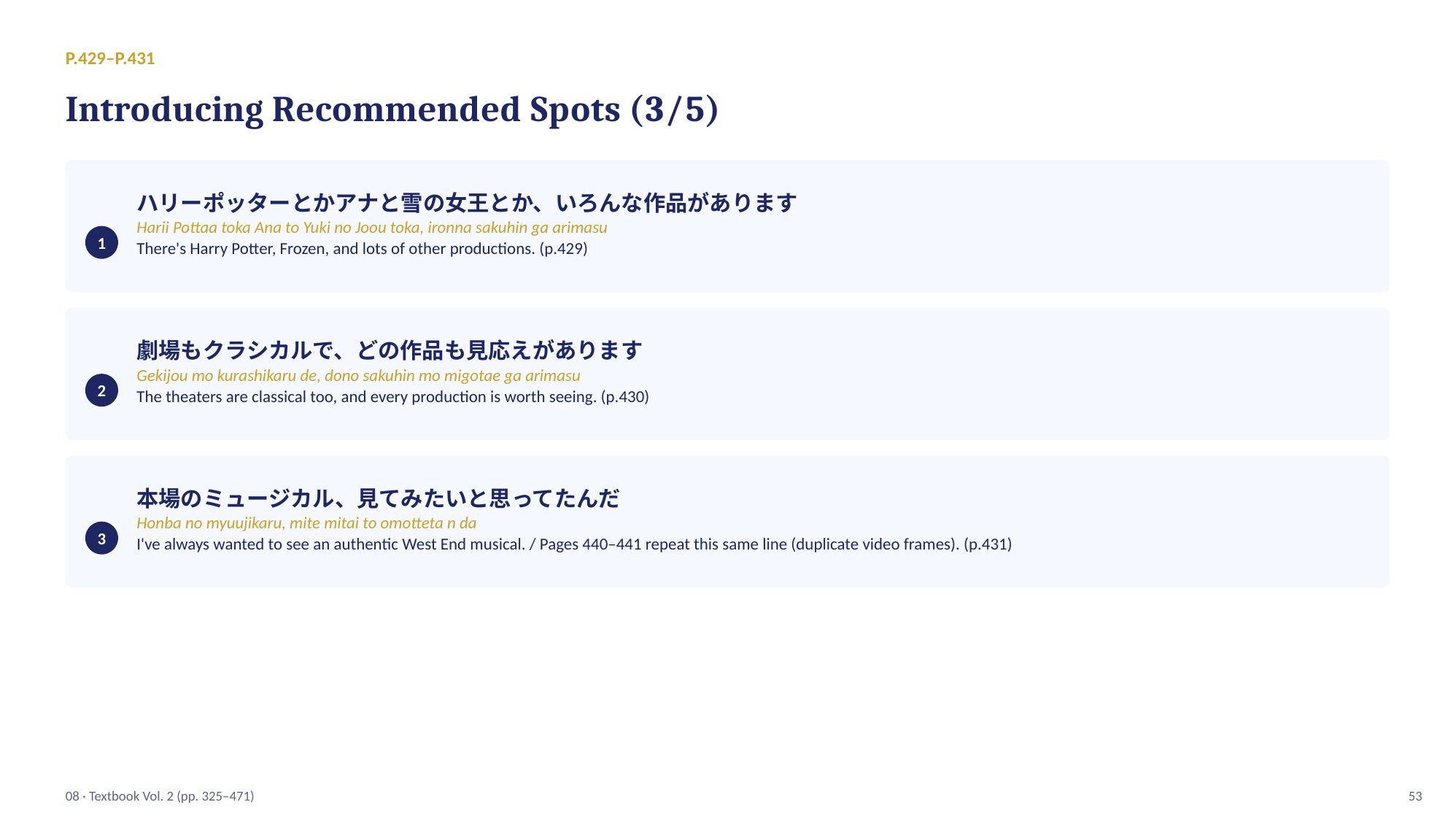
JPハリーポッターとかアナと雪の女王とか、いろんな作品があります
EN Harii Pottaa toka Ana to Yuki no Joou toka, ironna sakuhin ga arimasu
1 There's Harry Potter, Frozen, and lots of other productions. (p.429)
1 There's Harry Potter, Frozen, and lots of other productions. (p.429)
JP劇場もクラシカルで、どの作品も見応えがあります
EN Gekijou mo kurashikaru de, dono sakuhin mo migotae ga arimasu
2 The theaters are classical too, and every production is worth seeing. (p.430)
2 The theaters are classical too, and every production is worth seeing. (p.430)
JP本場のミュージカル、見てみたいと思ってたんだ
EN Honba no myuujikaru, mite mitai to omotteta n da
3 I've always wanted to see an authentic West End musical. / Pages 440–441 repeat this same line (duplicate video frames). (p.431)
08 · Textbook Vol. 2 (pp. 325–471) 53
3 I've always wanted to see an authentic West End musical. / Pages 440–441 repeat this same line (duplicate video frames). (p.431)
08 · Textbook Vol. 2 (pp. 325–471) 53
หน้า 54
คลิกเพื่อขยาย
ENP.432–P.434
Introducing Recommended Spots (4/5)
Introducing Recommended Spots (4/5)
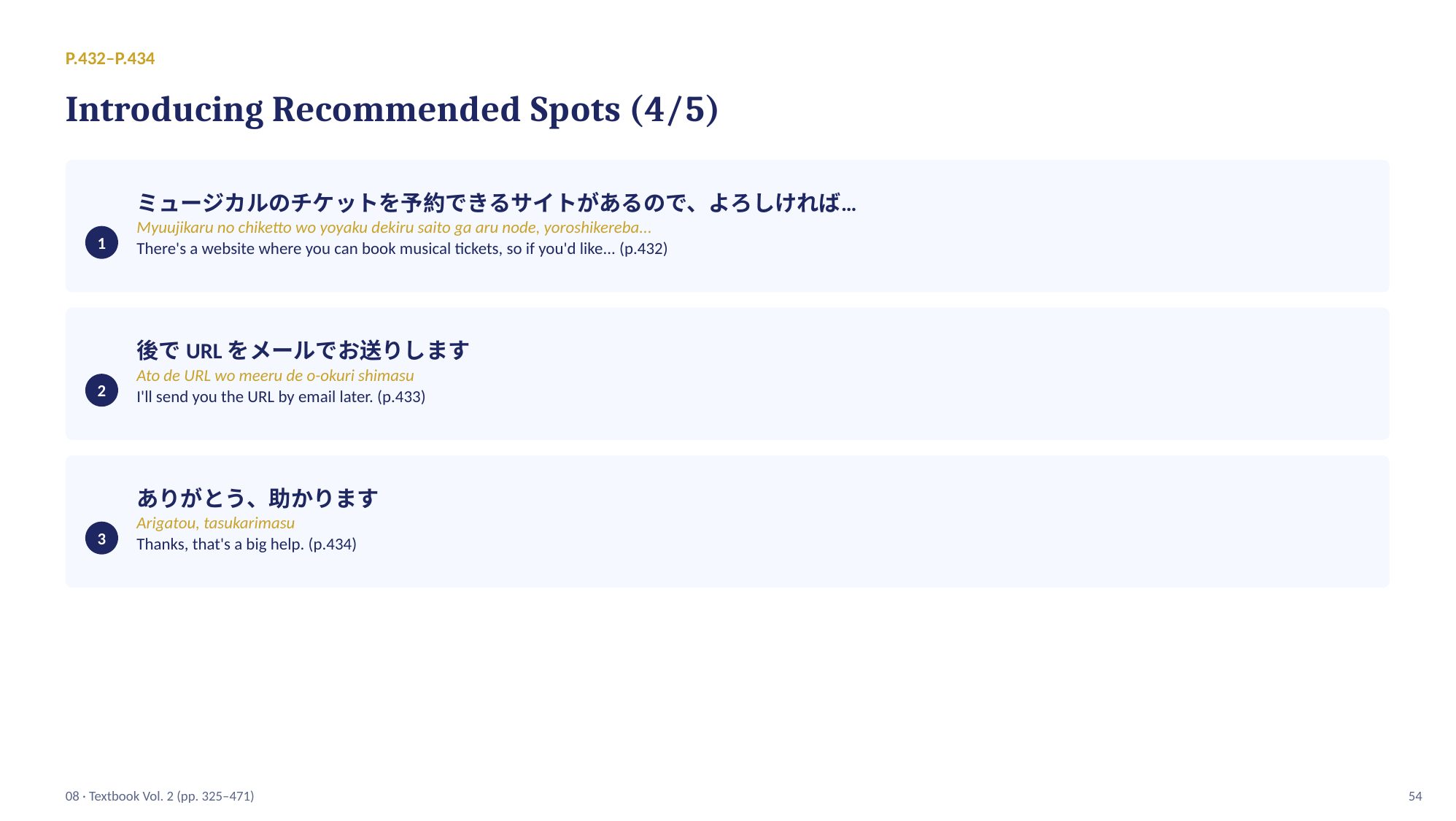
JPミュージカルのチケットを予約できるサイトがあるので、よろしければ…
EN Myuujikaru no chiketto wo yoyaku dekiru saito ga aru node, yoroshikereba...
1 There's a website where you can book musical tickets, so if you'd like... (p.432)
1 There's a website where you can book musical tickets, so if you'd like... (p.432)
JP後でURLをメールでお送りします
EN Ato de URL wo meeru de o-okuri shimasu
2 I'll send you the URL by email later. (p.433)
2 I'll send you the URL by email later. (p.433)
JPありがとう、助かります
EN Arigatou, tasukarimasu
3 Thanks, that's a big help. (p.434)
08 · Textbook Vol. 2 (pp. 325–471) 54
3 Thanks, that's a big help. (p.434)
08 · Textbook Vol. 2 (pp. 325–471) 54
หน้า 55
คลิกเพื่อขยาย
ENP.436–P.439
Introducing Recommended Spots (5/5)
Introducing Recommended Spots (5/5)
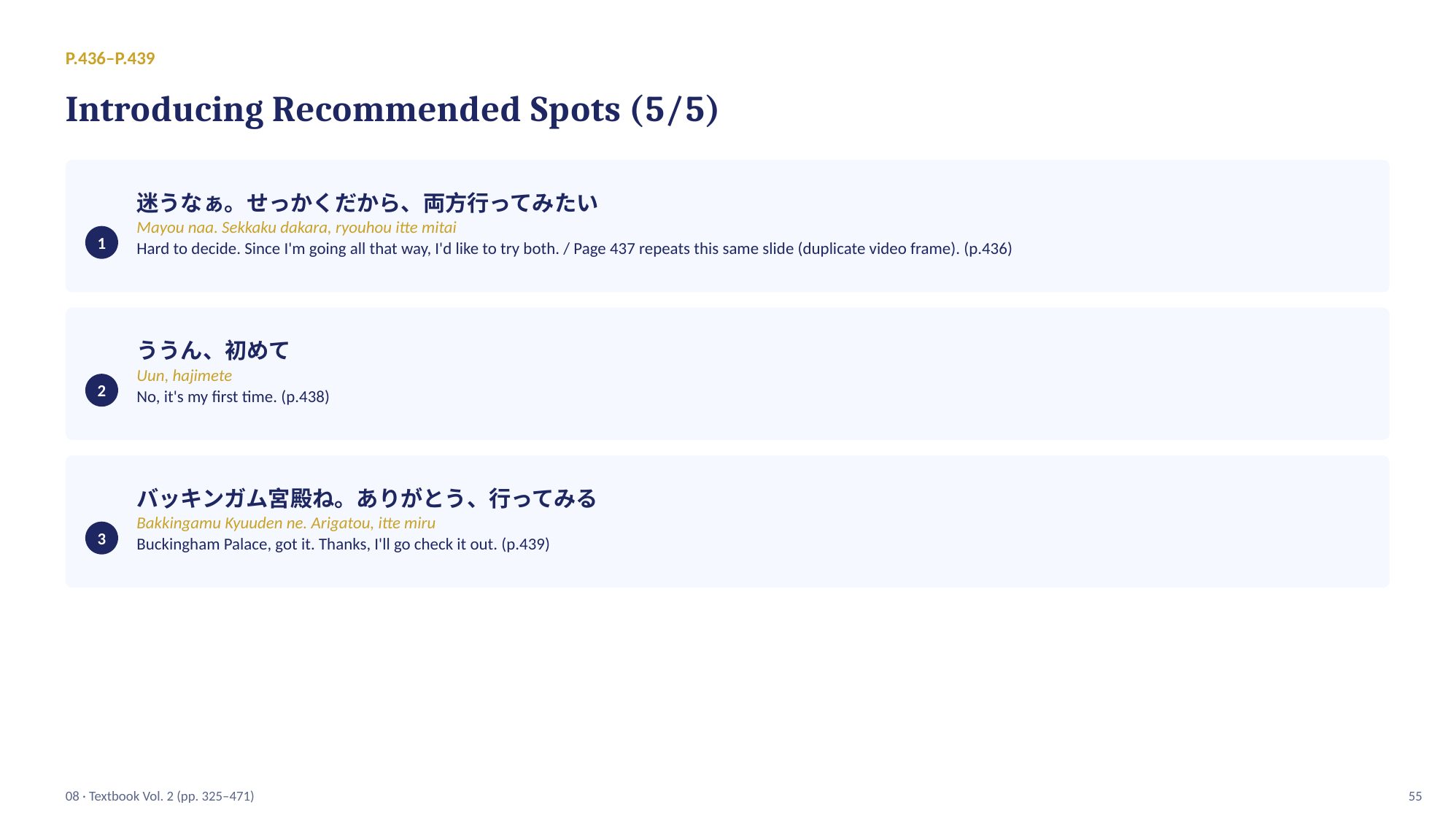
JP迷うなぁ。せっかくだから、両方行ってみたい
EN Mayou naa. Sekkaku dakara, ryouhou itte mitai
1 Hard to decide. Since I'm going all that way, I'd like to try both. / Page 437 repeats this same slide (duplicate video frame). (p.436)
1 Hard to decide. Since I'm going all that way, I'd like to try both. / Page 437 repeats this same slide (duplicate video frame). (p.436)
JPううん、初めて
EN Uun, hajimete
2 No, it's my first time. (p.438)
2 No, it's my first time. (p.438)
JPバッキンガム宮殿ね。ありがとう、行ってみる
EN Bakkingamu Kyuuden ne. Arigatou, itte miru
3 Buckingham Palace, got it. Thanks, I'll go check it out. (p.439)
08 · Textbook Vol. 2 (pp. 325–471) 55
3 Buckingham Palace, got it. Thanks, I'll go check it out. (p.439)
08 · Textbook Vol. 2 (pp. 325–471) 55
หน้า 56

คลิกเพื่อขยาย
13
ENAsking Different Ranks (cont.)
2 phrases · pages 442–443
2 phrases · pages 442–443
หน้า 57
คลิกเพื่อขยาย
ENP.442–P.443
Asking Different Ranks (cont.)
Asking Different Ranks (cont.)
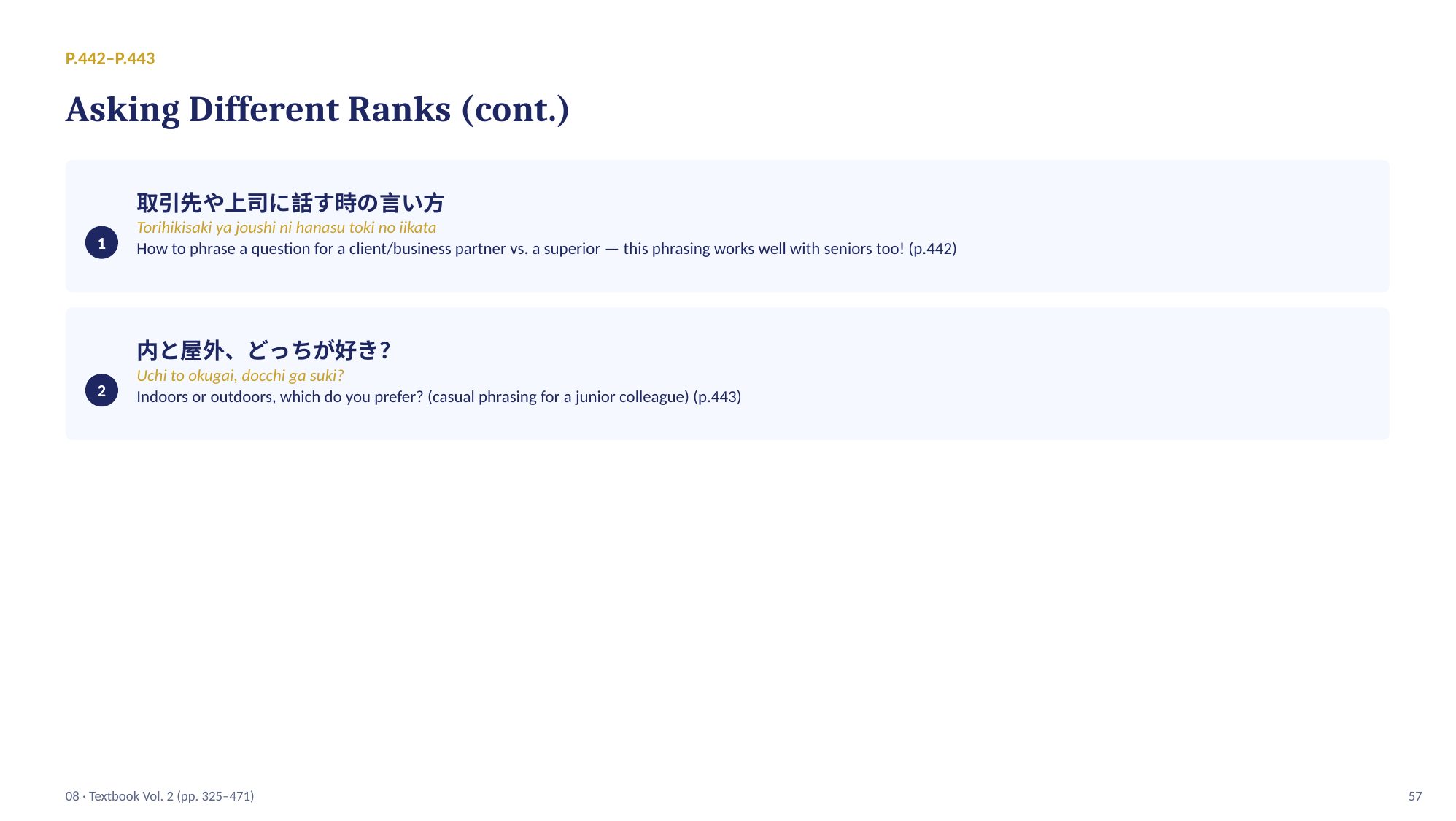
JP取引先や上司に話す時の言い方
EN Torihikisaki ya joushi ni hanasu toki no iikata
1 How to phrase a question for a client/business partner vs. a superior — this phrasing works well with seniors too! (p.442)
1 How to phrase a question for a client/business partner vs. a superior — this phrasing works well with seniors too! (p.442)
JP内と屋外、どっちが好き?
EN Uchi to okugai, docchi ga suki?
2 Indoors or outdoors, which do you prefer? (casual phrasing for a junior colleague) (p.443)
08 · Textbook Vol. 2 (pp. 325–471) 57
2 Indoors or outdoors, which do you prefer? (casual phrasing for a junior colleague) (p.443)
08 · Textbook Vol. 2 (pp. 325–471) 57
หน้า 58

คลิกเพื่อขยาย
14
ENBusiness Phone Etiquette
11 phrases · pages 451–463
11 phrases · pages 451–463
หน้า 59
คลิกเพื่อขยาย
ENP.451–P.453
Business Phone Etiquette (1/4)
Business Phone Etiquette (1/4)
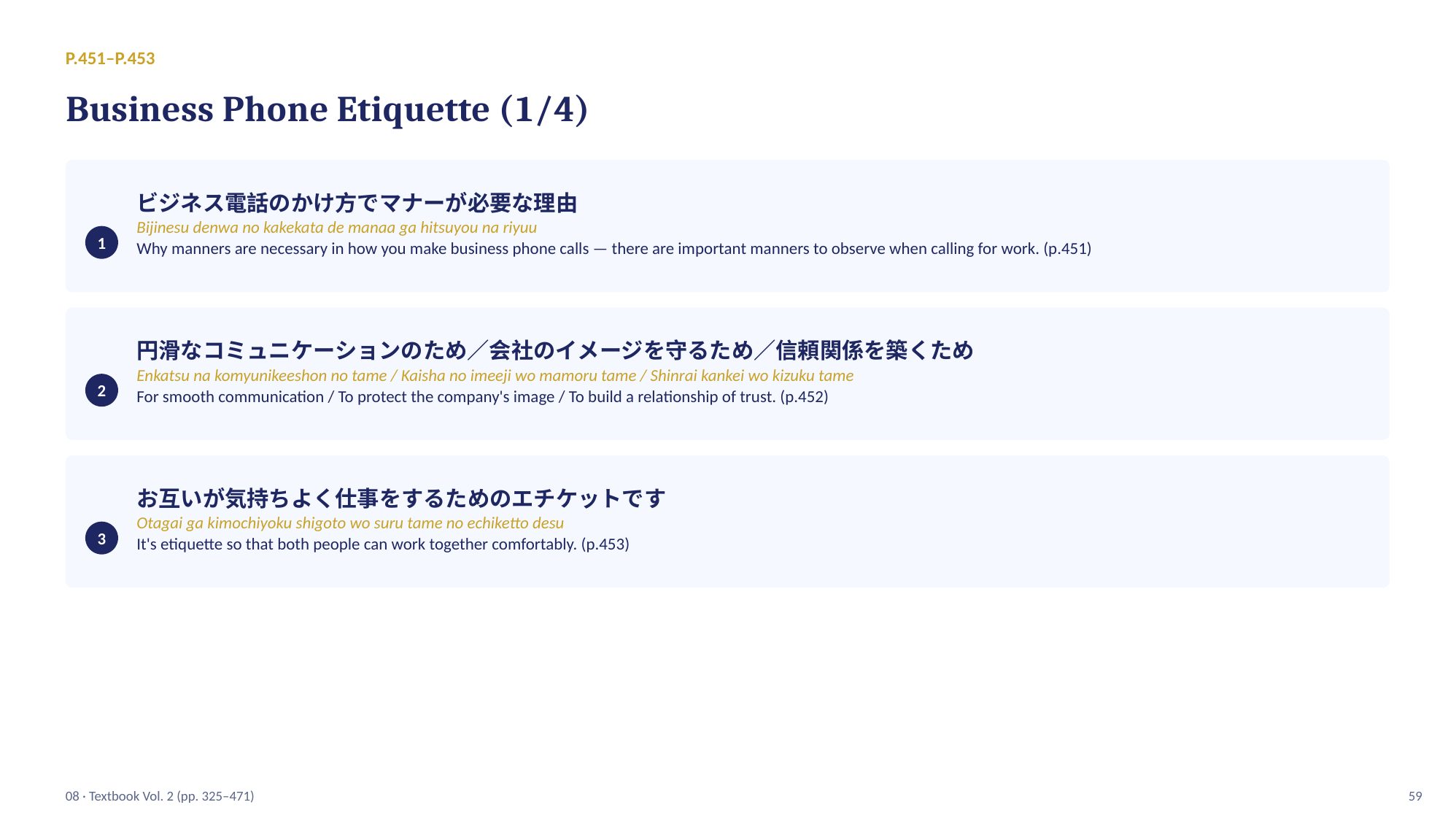
JPビジネス電話のかけ方でマナーが必要な理由
EN Bijinesu denwa no kakekata de manaa ga hitsuyou na riyuu
1 Why manners are necessary in how you make business phone calls — there are important manners to observe when calling for work. (p.451)
1 Why manners are necessary in how you make business phone calls — there are important manners to observe when calling for work. (p.451)
JP円滑なコミュニケーションのため/会社のイメージを守るため/信頼関係を築くため
EN Enkatsu na komyunikeeshon no tame / Kaisha no imeeji wo mamoru tame / Shinrai kankei wo kizuku tame
2 For smooth communication / To protect the company's image / To build a relationship of trust. (p.452)
2 For smooth communication / To protect the company's image / To build a relationship of trust. (p.452)
JPお互いが気持ちよく仕事をするためのエチケットです
EN Otagai ga kimochiyoku shigoto wo suru tame no echiketto desu
3 It's etiquette so that both people can work together comfortably. (p.453)
08 · Textbook Vol. 2 (pp. 325–471) 59
3 It's etiquette so that both people can work together comfortably. (p.453)
08 · Textbook Vol. 2 (pp. 325–471) 59
หน้า 60
คลิกเพื่อขยาย
ENP.454–P.456
Business Phone Etiquette (2/4)
Business Phone Etiquette (2/4)
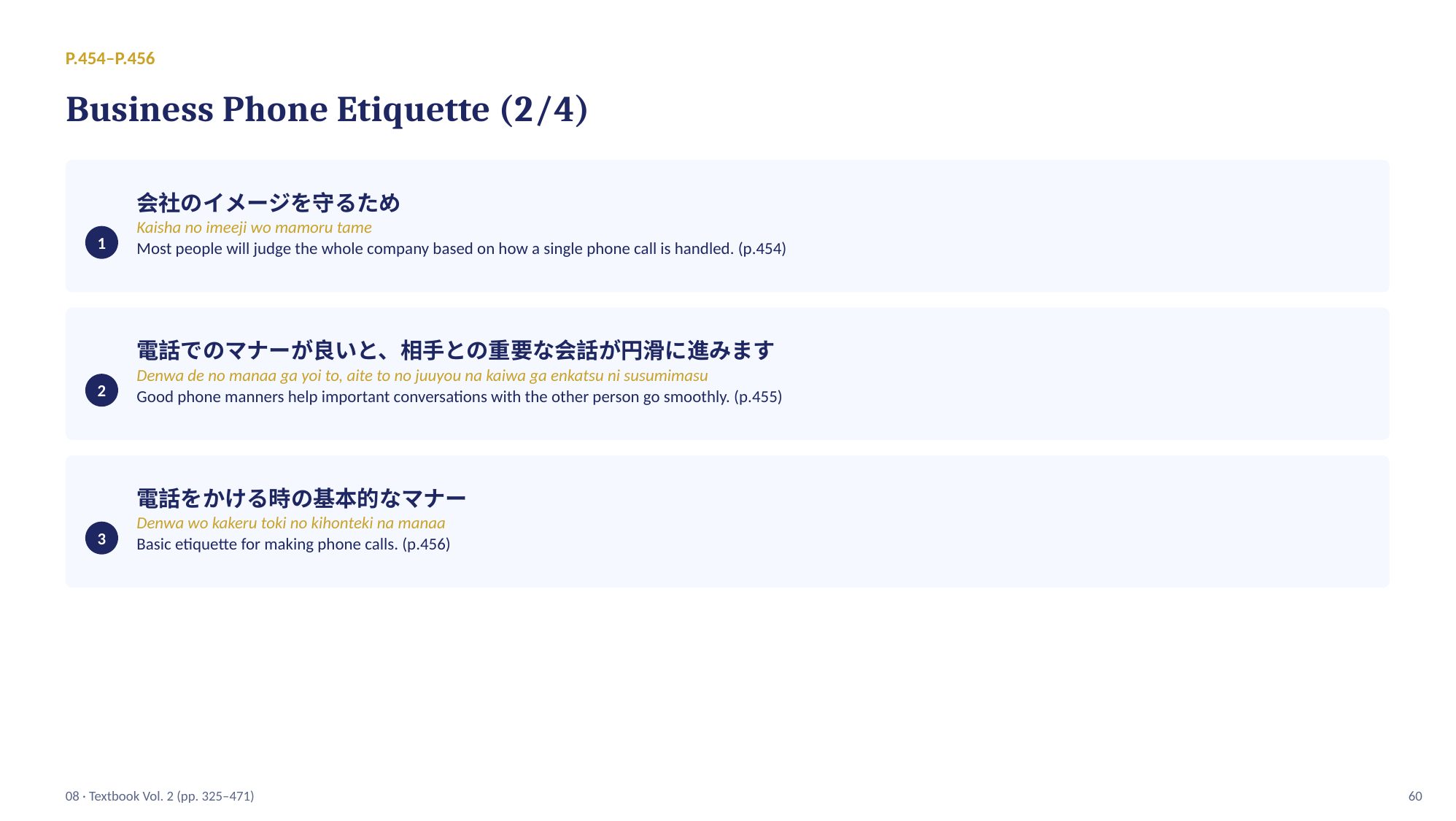
JP会社のイメージを守るため
EN Kaisha no imeeji wo mamoru tame
1 Most people will judge the whole company based on how a single phone call is handled. (p.454)
1 Most people will judge the whole company based on how a single phone call is handled. (p.454)
JP電話でのマナーが良いと、相手との重要な会話が円滑に進みます
EN Denwa de no manaa ga yoi to, aite to no juuyou na kaiwa ga enkatsu ni susumimasu
2 Good phone manners help important conversations with the other person go smoothly. (p.455)
2 Good phone manners help important conversations with the other person go smoothly. (p.455)
JP電話をかける時の基本的なマナー
EN Denwa wo kakeru toki no kihonteki na manaa
3 Basic etiquette for making phone calls. (p.456)
08 · Textbook Vol. 2 (pp. 325–471) 60
3 Basic etiquette for making phone calls. (p.456)
08 · Textbook Vol. 2 (pp. 325–471) 60
หน้า 61
คลิกเพื่อขยาย
ENP.457–P.460
Business Phone Etiquette (3/4)
Business Phone Etiquette (3/4)
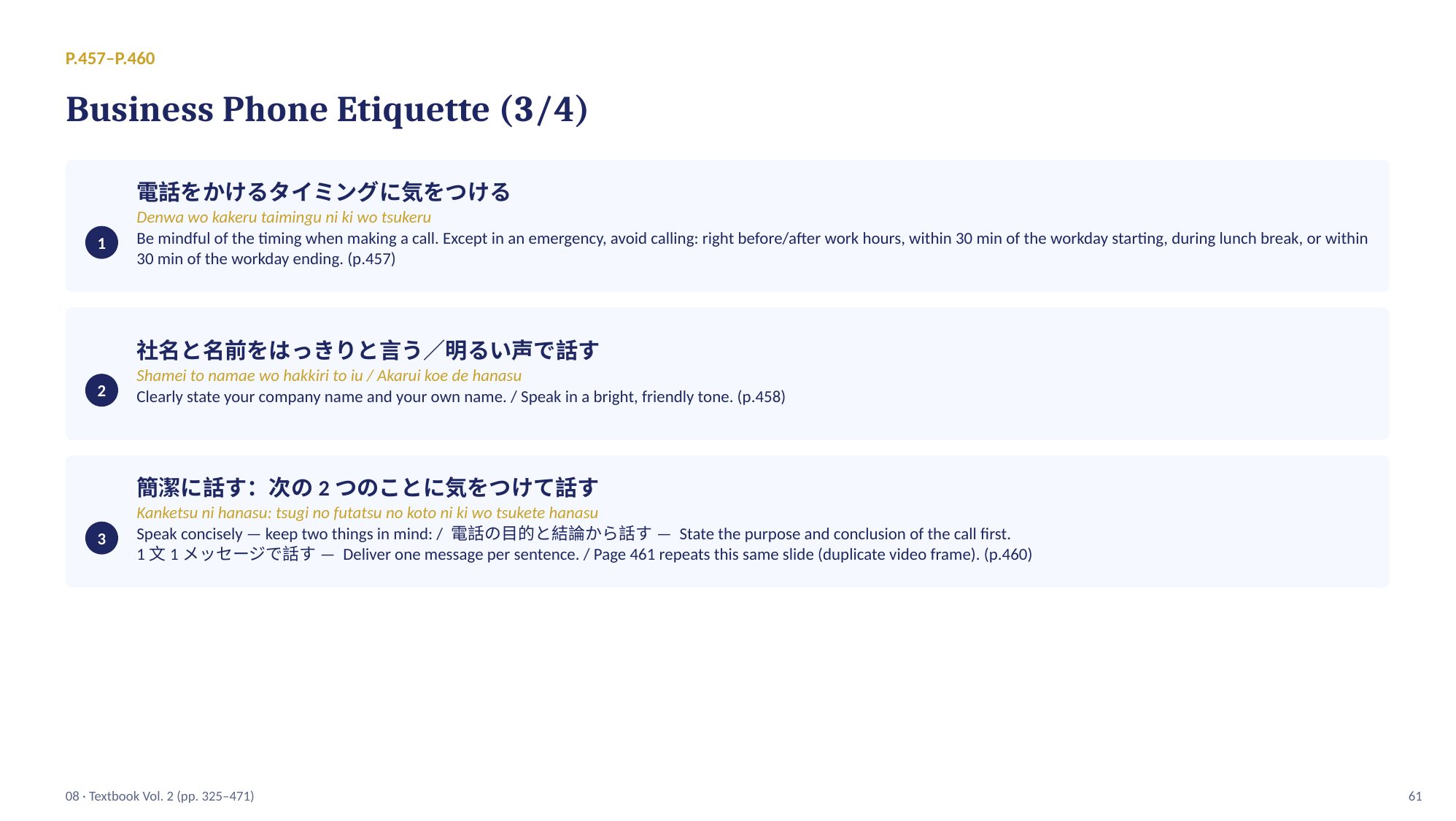
JP電話をかけるタイミングに気をつける
EN Denwa wo kakeru taimingu ni ki wo tsukeru
1 Be mindful of the timing when making a call. Except in an emergency, avoid calling: right before/after work hours, within 30 min of the workday starting, during lunch break, or within
30 min of the workday ending. (p.457)
1 Be mindful of the timing when making a call. Except in an emergency, avoid calling: right before/after work hours, within 30 min of the workday starting, during lunch break, or within
30 min of the workday ending. (p.457)
JP社名と名前をはっきりと言う/明るい声で話す
EN Shamei to namae wo hakkiri to iu / Akarui koe de hanasu
2 Clearly state your company name and your own name. / Speak in a bright, friendly tone. (p.458)
2 Clearly state your company name and your own name. / Speak in a bright, friendly tone. (p.458)
JP簡潔に話す:次の2つのことに気をつけて話す
EN Kanketsu ni hanasu: tsugi no futatsu no koto ni ki wo tsukete hanasu
3 Speak concisely — keep two things in mind: / 電話の目的と結論から話す — State the purpose and conclusion of the call first.
1 文 1 メッセージで話す — Deliver one message per sentence. / Page 461 repeats this same slide (duplicate video frame). (p.460)
08 · Textbook Vol. 2 (pp. 325–471) 61
3 Speak concisely — keep two things in mind: / 電話の目的と結論から話す — State the purpose and conclusion of the call first.
1 文 1 メッセージで話す — Deliver one message per sentence. / Page 461 repeats this same slide (duplicate video frame). (p.460)
08 · Textbook Vol. 2 (pp. 325–471) 61
หน้า 62
คลิกเพื่อขยาย
ENP.462–P.463
Business Phone Etiquette (4/4)
Business Phone Etiquette (4/4)
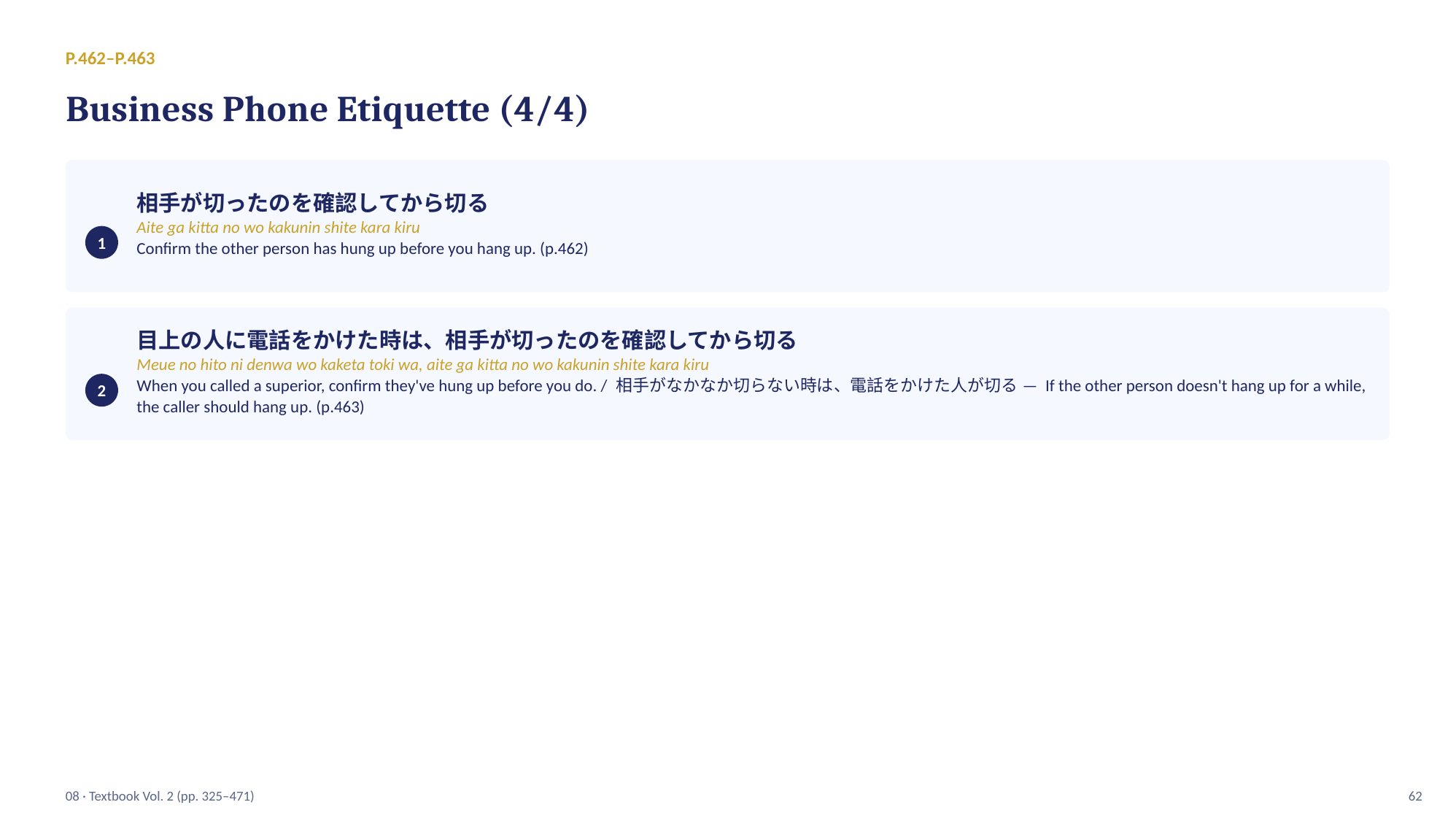
JP相手が切ったのを確認してから切る
EN Aite ga kitta no wo kakunin shite kara kiru
1 Confirm the other person has hung up before you hang up. (p.462)
1 Confirm the other person has hung up before you hang up. (p.462)
JP目上の人に電話をかけた時は、相手が切ったのを確認してから切る
EN Meue no hito ni denwa wo kaketa toki wa, aite ga kitta no wo kakunin shite kara kiru
2 When you called a superior, confirm they've hung up before you do. / 相手がなかなか切らない時は、電話をかけた人が切る — If the other person doesn't hang up for a while,
the caller should hang up. (p.463)
08 · Textbook Vol. 2 (pp. 325–471) 62
2 When you called a superior, confirm they've hung up before you do. / 相手がなかなか切らない時は、電話をかけた人が切る — If the other person doesn't hang up for a while,
the caller should hang up. (p.463)
08 · Textbook Vol. 2 (pp. 325–471) 62
หน้า 63

คลิกเพื่อขยาย
15
ENSpeaking on the Phone
5 phrases · pages 464–468
5 phrases · pages 464–468
หน้า 64
คลิกเพื่อขยาย
ENP.464–P.466
Speaking on the Phone (1/2)
Speaking on the Phone (1/2)
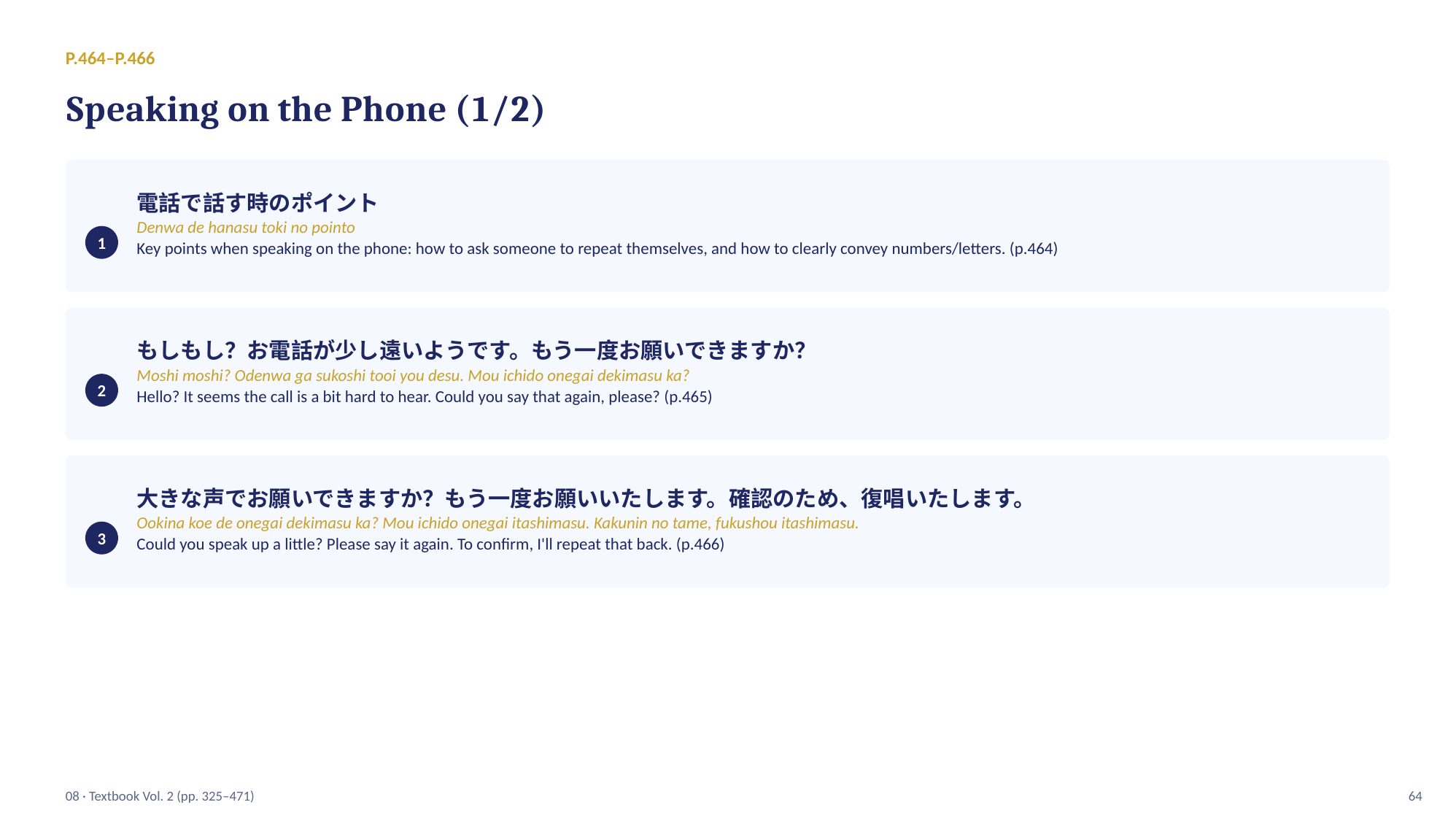
JP電話で話す時のポイント
EN Denwa de hanasu toki no pointo
1 Key points when speaking on the phone: how to ask someone to repeat themselves, and how to clearly convey numbers/letters. (p.464)
1 Key points when speaking on the phone: how to ask someone to repeat themselves, and how to clearly convey numbers/letters. (p.464)
JPもしもし?お電話が少し遠いようです。もう一度お願いできますか?
EN Moshi moshi? Odenwa ga sukoshi tooi you desu. Mou ichido onegai dekimasu ka?
2 Hello? It seems the call is a bit hard to hear. Could you say that again, please? (p.465)
2 Hello? It seems the call is a bit hard to hear. Could you say that again, please? (p.465)
JP大きな声でお願いできますか?もう一度お願いいたします。確認のため、復唱いたします。
EN Ookina koe de onegai dekimasu ka? Mou ichido onegai itashimasu. Kakunin no tame, fukushou itashimasu.
3 Could you speak up a little? Please say it again. To confirm, I'll repeat that back. (p.466)
08 · Textbook Vol. 2 (pp. 325–471) 64
3 Could you speak up a little? Please say it again. To confirm, I'll repeat that back. (p.466)
08 · Textbook Vol. 2 (pp. 325–471) 64
หน้า 65
คลิกเพื่อขยาย
ENP.467–P.468
Speaking on the Phone (2/2)
Speaking on the Phone (2/2)
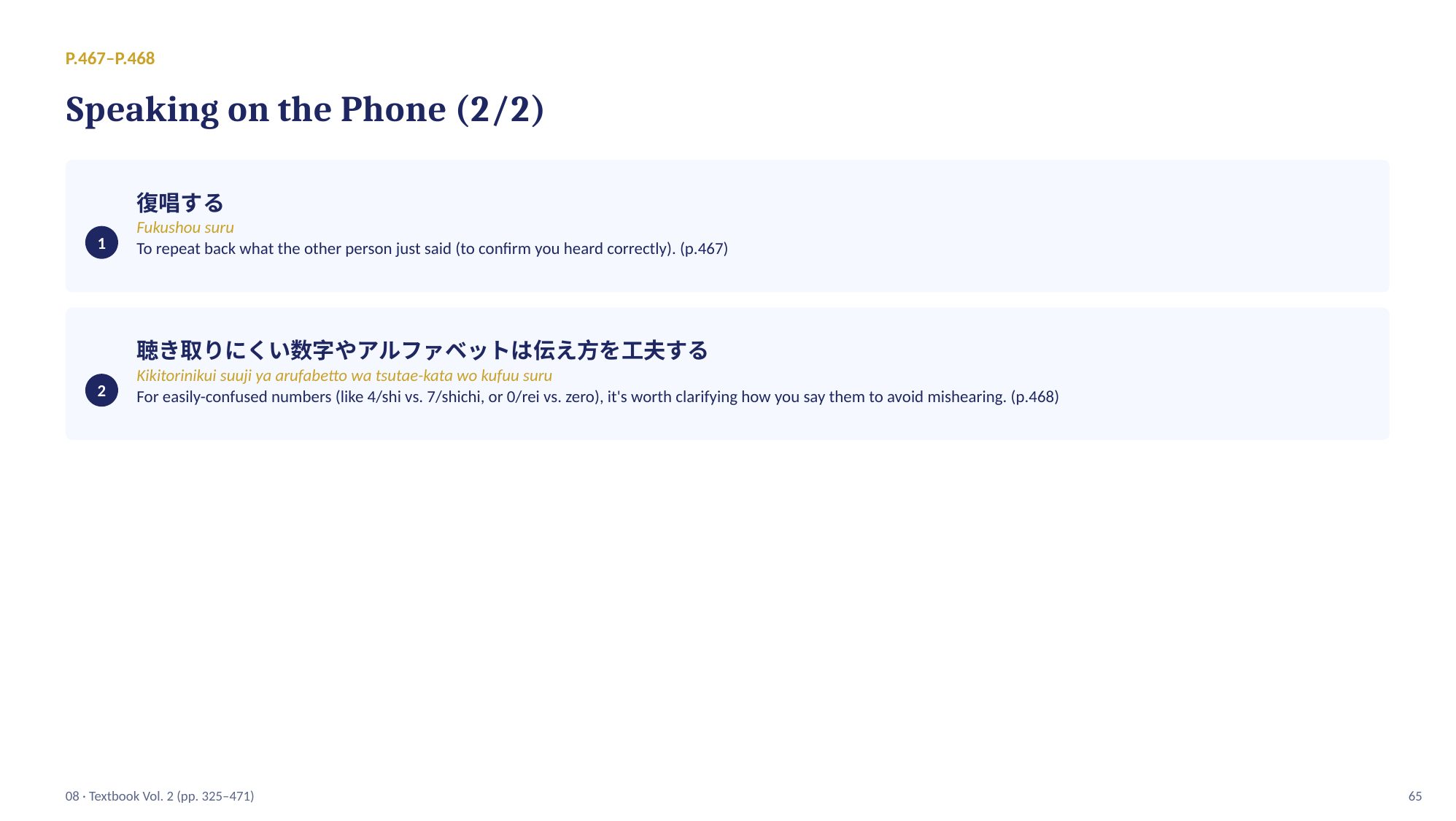
JP復唱する
EN Fukushou suru
1 To repeat back what the other person just said (to confirm you heard correctly). (p.467)
1 To repeat back what the other person just said (to confirm you heard correctly). (p.467)
JP聴き取りにくい数字やアルファベットは伝え方を工夫する
EN Kikitorinikui suuji ya arufabetto wa tsutae-kata wo kufuu suru
2 For easily-confused numbers (like 4/shi vs. 7/shichi, or 0/rei vs. zero), it's worth clarifying how you say them to avoid mishearing. (p.468)
08 · Textbook Vol. 2 (pp. 325–471) 65
2 For easily-confused numbers (like 4/shi vs. 7/shichi, or 0/rei vs. zero), it's worth clarifying how you say them to avoid mishearing. (p.468)
08 · Textbook Vol. 2 (pp. 325–471) 65
หน้า 66

คลิกเพื่อขยาย
16
ENPhone Call Script Template
2 phrases · pages 469–471
2 phrases · pages 469–471
หน้า 67
คลิกเพื่อขยาย
ENP.469–P.471
Phone Call Script Template
Phone Call Script Template
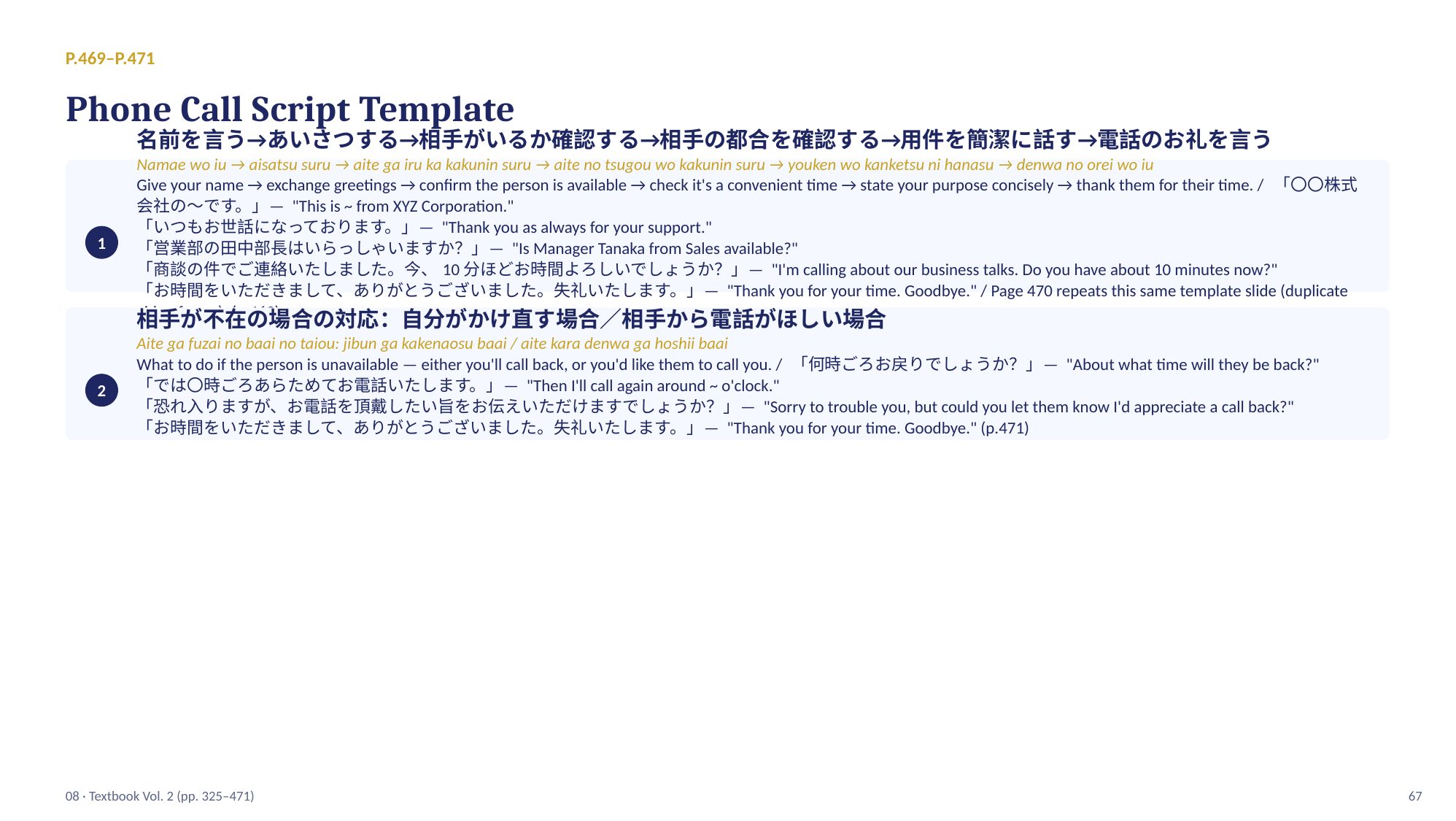
JP名前を言う→あいさつする→相手がいるか確認する→相手の都合を確認する→用件を簡潔に話す→電話のお礼を言う
EN Namae wo iu → aisatsu suru → aite ga iru ka kakunin suru → aite no tsugou wo kakunin suru → youken wo kanketsu ni hanasu → denwa no orei wo iu
Give your name → exchange greetings → confirm the person is available → check it's a convenient time → state your purpose concisely → thank them for their time. / 「〇〇株式
会社の~です。」— "This is ~ from XYZ Corporation."
「いつもお世話になっております。」— "Thank you as always for your support."
1 「営業部の田中部長はいらっしゃいますか?」 — "Is Manager Tanaka from Sales available?"
「商談の件でご連絡いたしました。今、 10 分ほどお時間よろしいでしょうか?」— "I'm calling about our business talks. Do you have about 10 minutes now?"
「お時間をいただきまして、ありがとうございました。失礼いたします。」 — "Thank you for your time. Goodbye." / Page 470 repeats this same template slide (duplicate
video frame). (p.469)
Give your name → exchange greetings → confirm the person is available → check it's a convenient time → state your purpose concisely → thank them for their time. / 「〇〇株式
会社の~です。」— "This is ~ from XYZ Corporation."
「いつもお世話になっております。」— "Thank you as always for your support."
1 「営業部の田中部長はいらっしゃいますか?」 — "Is Manager Tanaka from Sales available?"
「商談の件でご連絡いたしました。今、 10 分ほどお時間よろしいでしょうか?」— "I'm calling about our business talks. Do you have about 10 minutes now?"
「お時間をいただきまして、ありがとうございました。失礼いたします。」 — "Thank you for your time. Goodbye." / Page 470 repeats this same template slide (duplicate
video frame). (p.469)
JP相手が不在の場合の対応:自分がかけ直す場合/相手から電話がほしい場合
EN Aite ga fuzai no baai no taiou: jibun ga kakenaosu baai / aite kara denwa ga hoshii baai
What to do if the person is unavailable — either you'll call back, or you'd like them to call you. / 「何時ごろお戻りでしょうか?」— "About what time will they be back?"
2 「では〇時ごろあらためてお電話いたします。」— "Then I'll call again around ~ o'clock."
「恐れ入りますが、お電話を頂戴したい旨をお伝えいただけますでしょうか?」 — "Sorry to trouble you, but could you let them know I'd appreciate a call back?"
What to do if the person is unavailable — either you'll call back, or you'd like them to call you. / 「何時ごろお戻りでしょうか?」— "About what time will they be back?"
2 「では〇時ごろあらためてお電話いたします。」— "Then I'll call again around ~ o'clock."
「恐れ入りますが、お電話を頂戴したい旨をお伝えいただけますでしょうか?」 — "Sorry to trouble you, but could you let them know I'd appreciate a call back?"
JP「お時間をいただきまして、ありがとうございました。失礼いたします。」—"Thankyouforyourtime.Goodbye."(p.471)
EN08 · Textbook Vol. 2 (pp. 325–471) 67