หน้า 1

คลิกเพื่อขยาย
JP仕事のメールには
いつも目的とGOALがある
いつも目的とGOALがある
ENEvery business emails have a purpose and a goal
หน้า 2
คลิกเพื่อขยาย
JPそうだんないようけんめいか
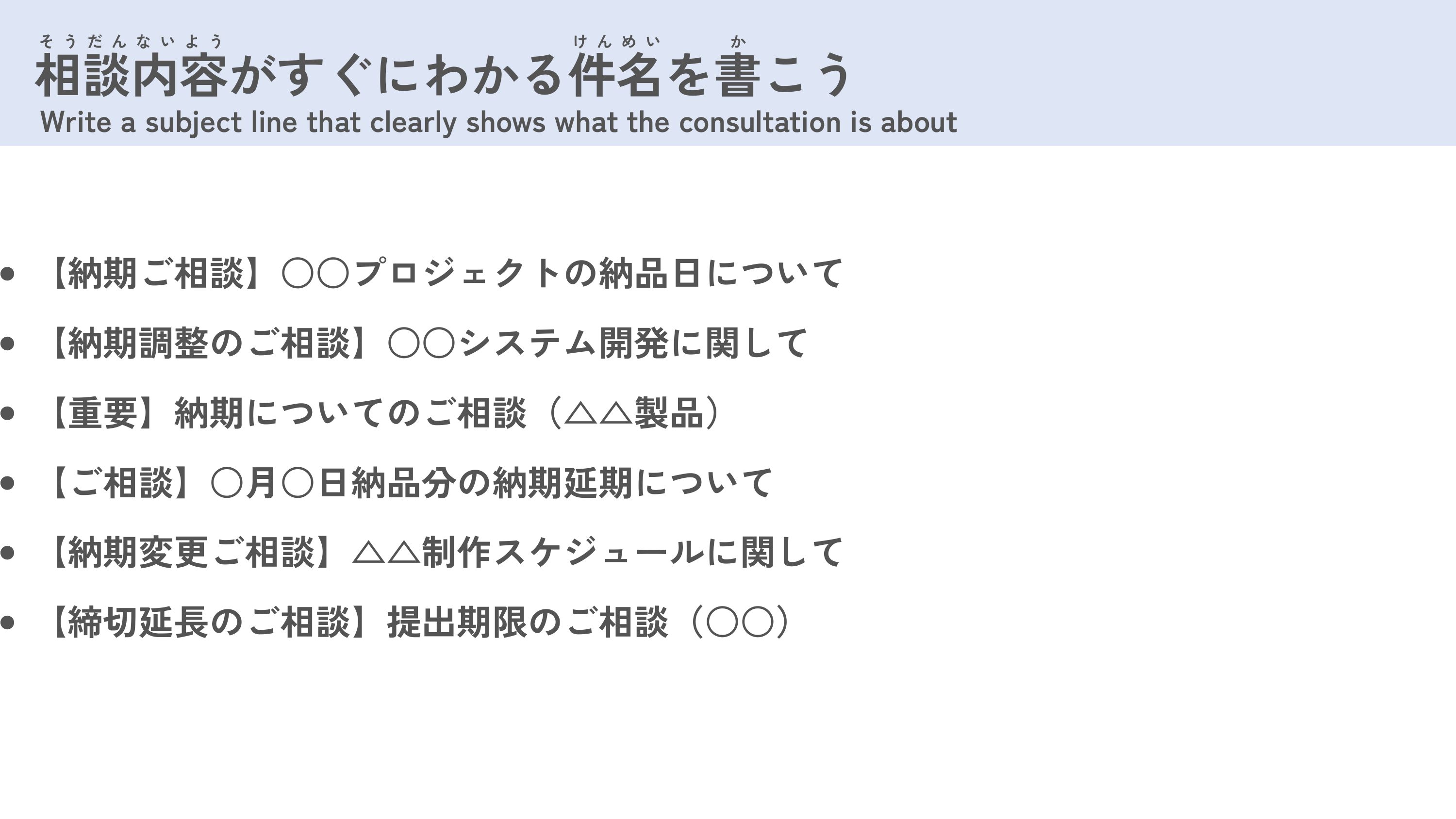
相談内容がすぐにわかる件名を書こう
相談内容がすぐにわかる件名を書こう
ENWrite a subject line that clearly shows what the consultation is about
JP【納期ご相談】○○プロジェクトの納品日について
【納期調整のご相談】○○システム開発に関して
【重要】納期についてのご相談(△△製品)
【ご相談】○月○日納品分の納期延期について
【納期変更ご相談】△△制作スケジュールに関して
【締切延長のご相談】提出期限のご相談(○○)
【納期調整のご相談】○○システム開発に関して
【重要】納期についてのご相談(△△製品)
【ご相談】○月○日納品分の納期延期について
【納期変更ご相談】△△制作スケジュールに関して
【締切延長のご相談】提出期限のご相談(○○)
หน้า 3
คลิกเพื่อขยาย
JPこうせい
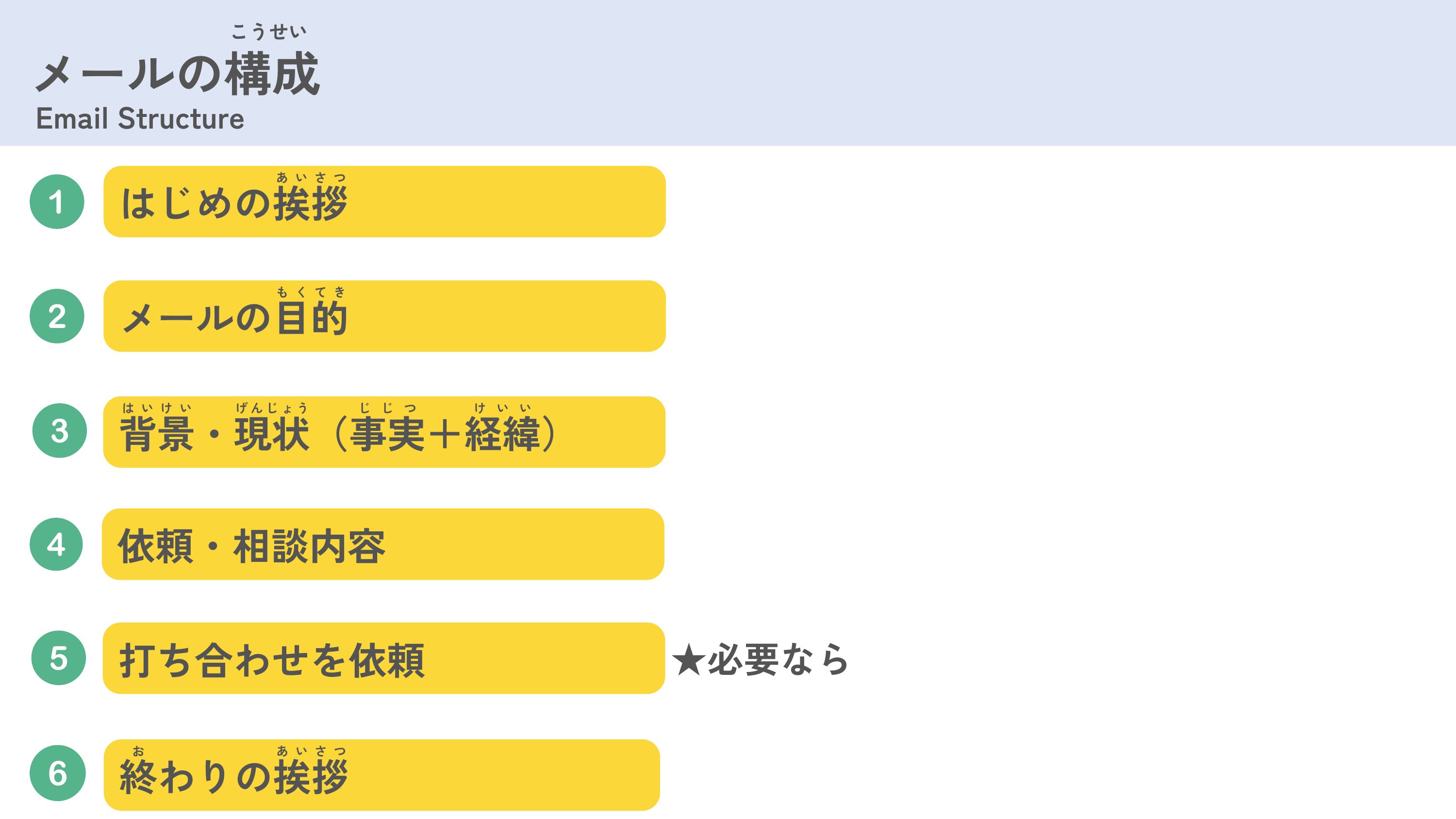
メールの構成
メールの構成
ENEmail Structure
JPあいさつ
はじめの挨拶
もくてき
メールの目的
はいけいげんじょうじじつけいい
背景・現状(事実+経緯)
依頼・相談内容
打ち合わせを依頼★必要なら
おあいさつ
終わりの挨拶
はじめの挨拶
もくてき
メールの目的
はいけいげんじょうじじつけいい
背景・現状(事実+経緯)
依頼・相談内容
打ち合わせを依頼★必要なら
おあいさつ
終わりの挨拶
หน้า 4
คลิกเพื่อขยาย
JPメールの例文
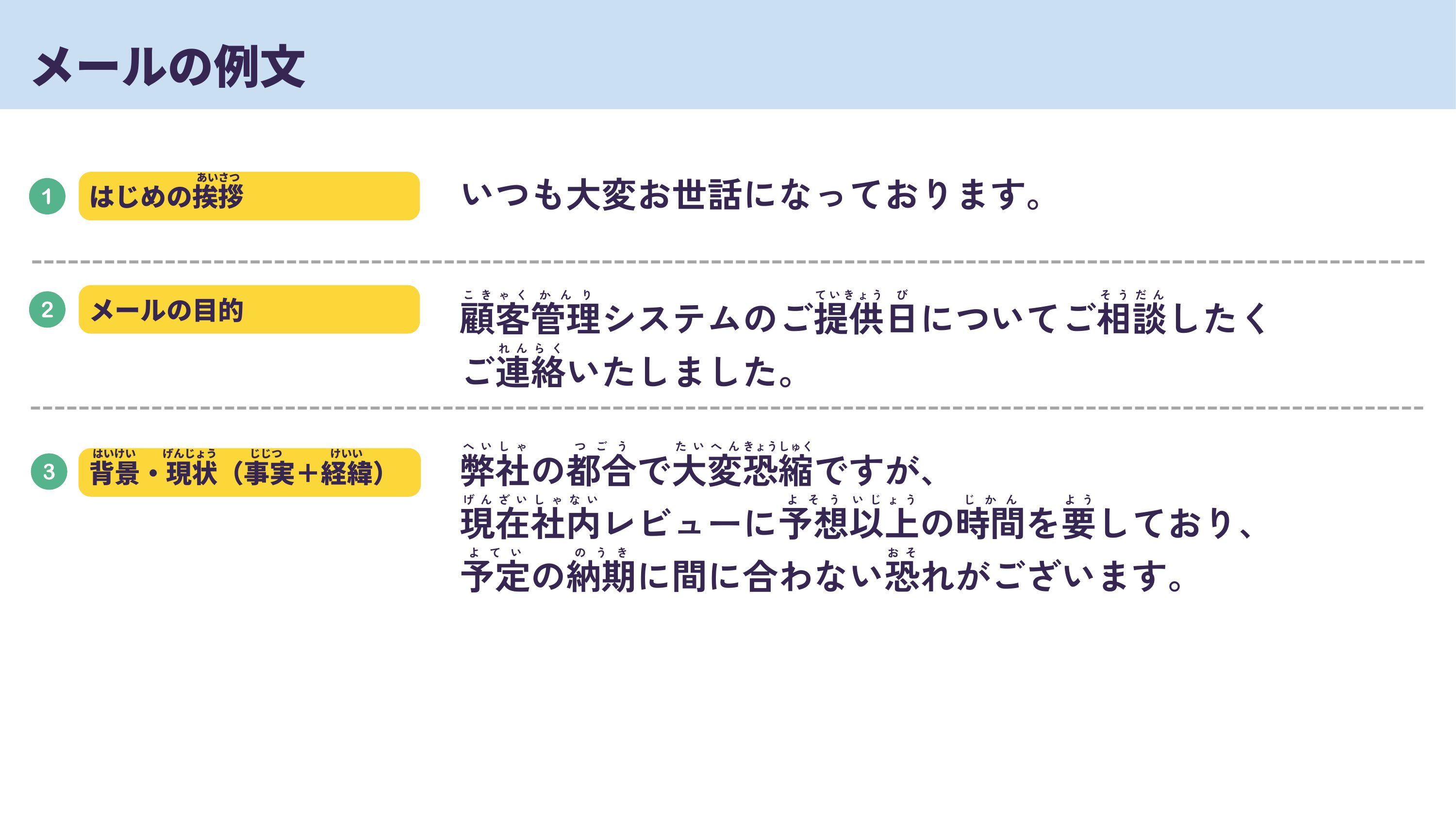
いつも大変お世話になっております。
あいさつ
はじめの挨拶
こきゃくかんりていきょうびそうだん
メールの目的顧客管理システムのご提供日についてご相談したく
れんらく
ご連絡いたしました。
へいしゃつごうたいへんきょうしゅく
弊社の都合で大変恐縮ですが、
はいけいげんじょうじじつけいい
背景・現状(事実+経緯)
げんざいしゃないよそういじょうじかんよう
現在社内レビューに予想以上の時間を要しており、
よていのうきおそ
予定の納期に間に合わない恐れがございます。
いつも大変お世話になっております。
あいさつ
はじめの挨拶
こきゃくかんりていきょうびそうだん
メールの目的顧客管理システムのご提供日についてご相談したく
れんらく
ご連絡いたしました。
へいしゃつごうたいへんきょうしゅく
弊社の都合で大変恐縮ですが、
はいけいげんじょうじじつけいい
背景・現状(事実+経緯)
げんざいしゃないよそういじょうじかんよう
現在社内レビューに予想以上の時間を要しており、
よていのうきおそ
予定の納期に間に合わない恐れがございます。
หน้า 5
คลิกเพื่อขยาย
JPメールの例文
のうきえんちょう
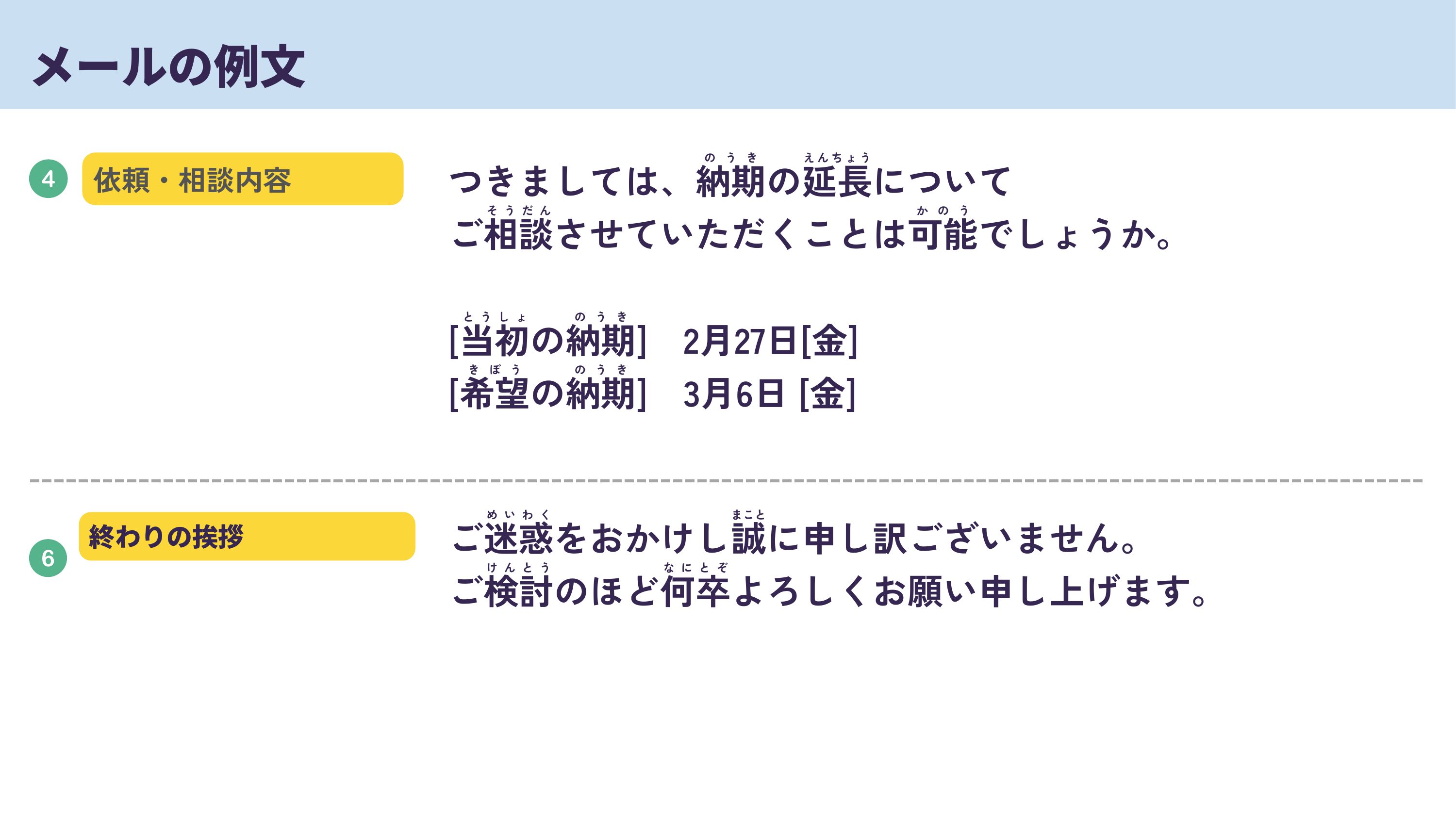
依頼・相談内容つきましては、納期の延長について
そうだんかのう
ご相談させていただくことは可能でしょうか。
とうしょのうき
[当初の納期]2月27日[金]
きぼうのうき
[希望の納期]3月6日[金]
めいわくまこと
終わりの挨拶ご迷惑をおかけし誠に申し訳ございません。
けんとうなにとぞ
ご検討のほど何卒よろしくお願い申し上げます。
のうきえんちょう
依頼・相談内容つきましては、納期の延長について
そうだんかのう
ご相談させていただくことは可能でしょうか。
とうしょのうき
[当初の納期]2月27日[金]
きぼうのうき
[希望の納期]3月6日[金]
めいわくまこと
終わりの挨拶ご迷惑をおかけし誠に申し訳ございません。
けんとうなにとぞ
ご検討のほど何卒よろしくお願い申し上げます。
หน้า 6
คลิกเพื่อขยาย
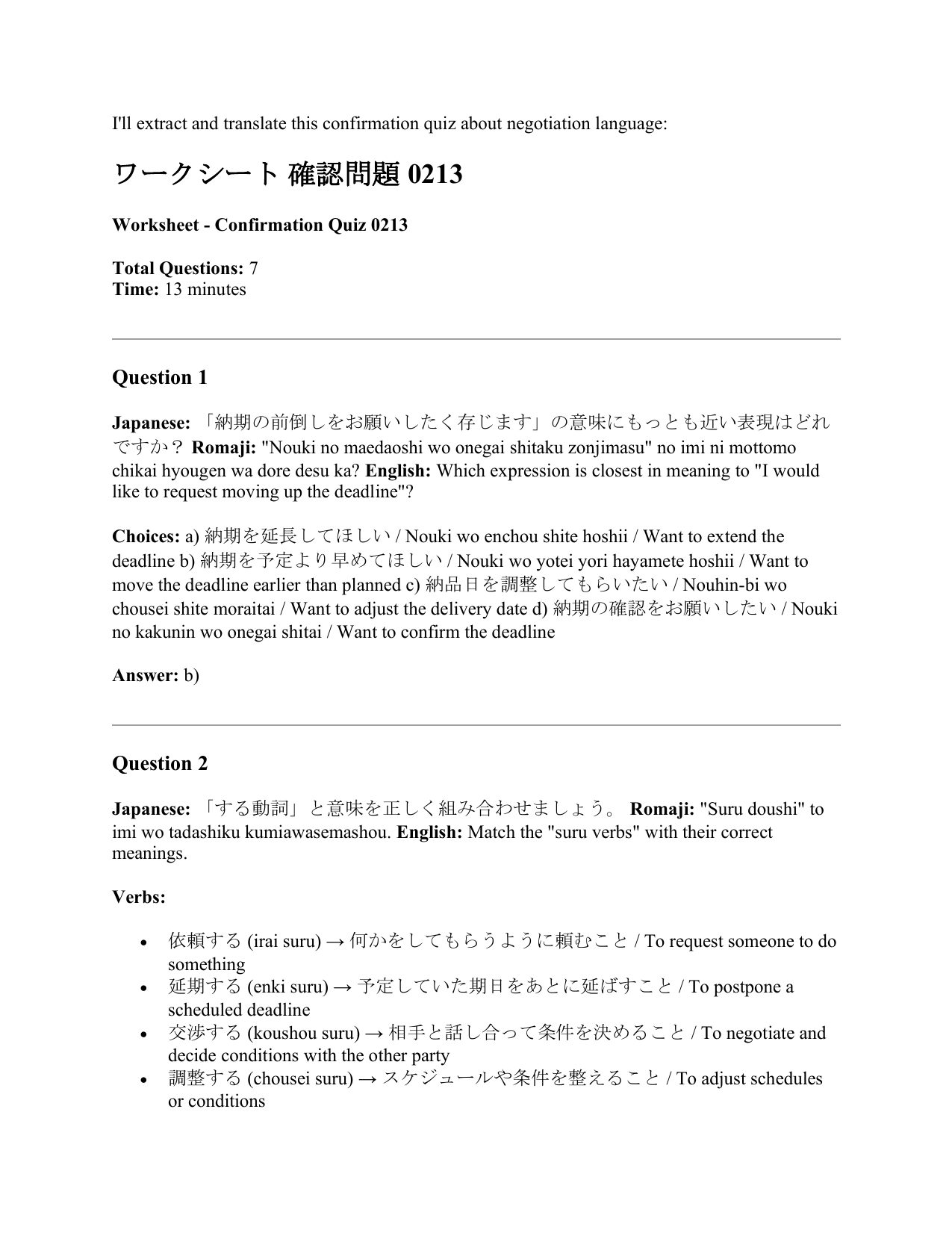
ENI'll extract and translate this confirmation quiz about negotiation language:
JPワークシート確認問題0213
ENWorksheet - Confirmation Quiz 0213
Total Questions: 7
Time: 13 minutes
Question 1
Total Questions: 7
Time: 13 minutes
Question 1
JPJapanese:「納期の前倒しをお願いしたく存じます」の意味にもっとも近い表現はどれ
ENですか? Romaji: "Nouki no maedaoshi wo onegai shitaku zonjimasu" no imi ni mottomo
chikai hyougen wa dore desu ka? English: Which expression is closest in meaning to "I would
like to request moving up the deadline"?
Choices: a) 納期を延長してほしい / Nouki wo enchou shite hoshii / Want to extend the
deadline b) 納期を予定より早めてほしい / Nouki wo yotei yori hayamete hoshii / Want to
move the deadline earlier than planned c) 納品日を調整してもらいたい / Nouhin-bi wo
chousei shite moraitai / Want to adjust the delivery date d) 納期の確認をお願いしたい / Nouki
no kakunin wo onegai shitai / Want to confirm the deadline
Answer: b)
Question 2
Japanese: 「する動詞」と意味を正しく組み合わせましょう。 Romaji: "Suru doushi" to
imi wo tadashiku kumiawasemashou. English: Match the "suru verbs" with their correct
meanings.
Verbs:
• 依頼する (irai suru) → 何かをしてもらうように頼むこと / To request someone to do
something
chikai hyougen wa dore desu ka? English: Which expression is closest in meaning to "I would
like to request moving up the deadline"?
Choices: a) 納期を延長してほしい / Nouki wo enchou shite hoshii / Want to extend the
deadline b) 納期を予定より早めてほしい / Nouki wo yotei yori hayamete hoshii / Want to
move the deadline earlier than planned c) 納品日を調整してもらいたい / Nouhin-bi wo
chousei shite moraitai / Want to adjust the delivery date d) 納期の確認をお願いしたい / Nouki
no kakunin wo onegai shitai / Want to confirm the deadline
Answer: b)
Question 2
Japanese: 「する動詞」と意味を正しく組み合わせましょう。 Romaji: "Suru doushi" to
imi wo tadashiku kumiawasemashou. English: Match the "suru verbs" with their correct
meanings.
Verbs:
• 依頼する (irai suru) → 何かをしてもらうように頼むこと / To request someone to do
something
JP•延期する(enkisuru)→予定していた期日をあとに延ばすこと/Topostponea
EN scheduled deadline
• 交渉する (koushou suru) → 相手と話し合って条件を決めること / To negotiate and
decide conditions with the other party
• 調整する (chousei suru) → スケジュールや条件を整えること / To adjust schedules
or conditions
• 交渉する (koushou suru) → 相手と話し合って条件を決めること / To negotiate and
decide conditions with the other party
• 調整する (chousei suru) → スケジュールや条件を整えること / To adjust schedules
or conditions
หน้า 7
คลิกเพื่อขยาย
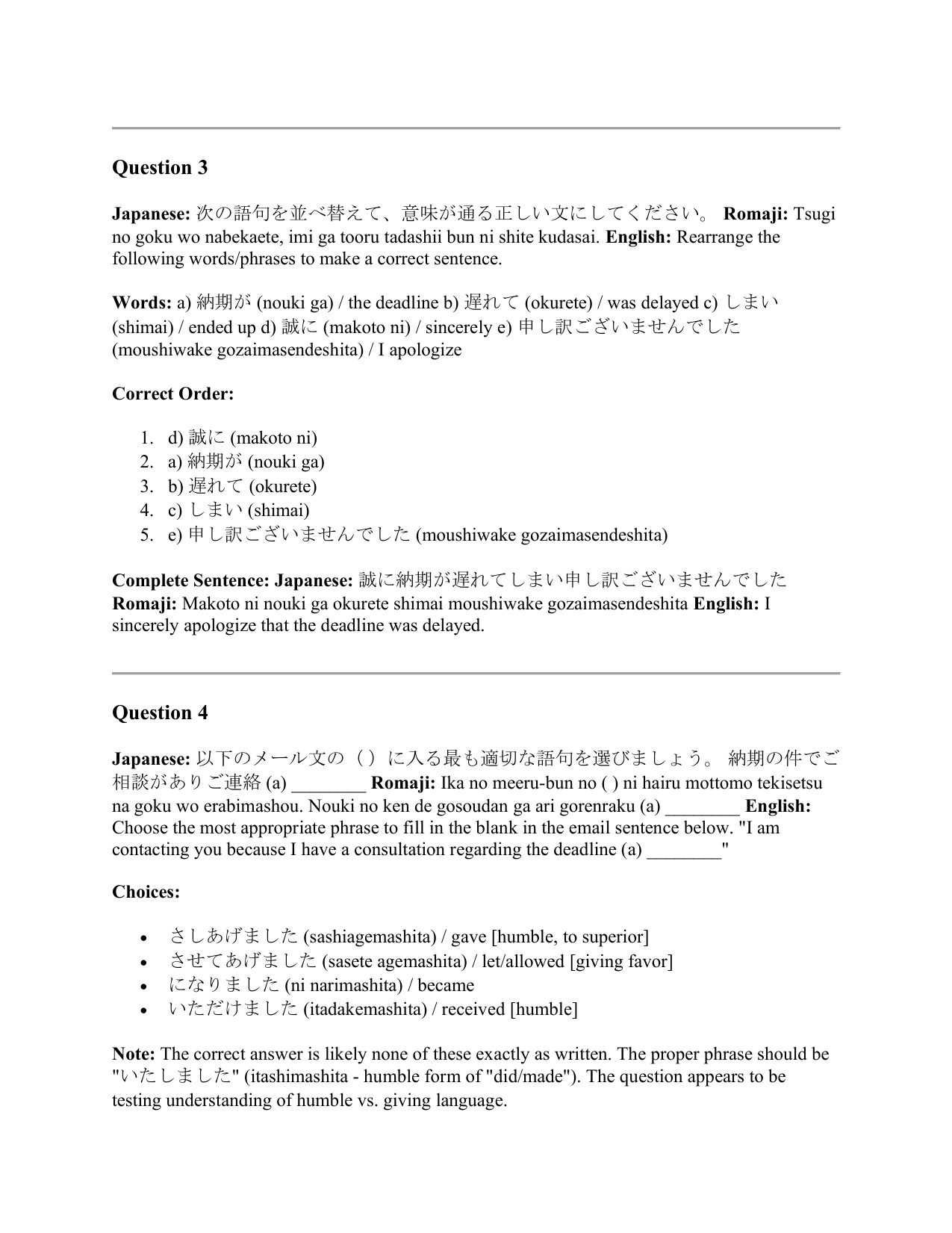
ENQuestion 3
JPJapanese:次の語句を並べ替えて、意味が通る正しい文にしてください。Romaji:Tsugi
ENno goku wo nabekaete, imi ga tooru tadashii bun ni shite kudasai. English: Rearrange the
following words/phrases to make a correct sentence.
Words: a) 納期が (nouki ga) / the deadline b) 遅れて (okurete) / was delayed c) しまい
(shimai) / ended up d) 誠に (makoto ni) / sincerely e) 申し訳ございませんでした
(moushiwake gozaimasendeshita) / I apologize
Correct Order:
1. d) 誠に (makoto ni)
2. a) 納期が (nouki ga)
3. b) 遅れて (okurete)
4. c) しまい (shimai)
5. e) 申し訳ございませんでした (moushiwake gozaimasendeshita)
Complete Sentence: Japanese: 誠に納期が遅れてしまい申し訳ございませんでした
Romaji: Makoto ni nouki ga okurete shimai moushiwake gozaimasendeshita English: I
sincerely apologize that the deadline was delayed.
Question 4
following words/phrases to make a correct sentence.
Words: a) 納期が (nouki ga) / the deadline b) 遅れて (okurete) / was delayed c) しまい
(shimai) / ended up d) 誠に (makoto ni) / sincerely e) 申し訳ございませんでした
(moushiwake gozaimasendeshita) / I apologize
Correct Order:
1. d) 誠に (makoto ni)
2. a) 納期が (nouki ga)
3. b) 遅れて (okurete)
4. c) しまい (shimai)
5. e) 申し訳ございませんでした (moushiwake gozaimasendeshita)
Complete Sentence: Japanese: 誠に納期が遅れてしまい申し訳ございませんでした
Romaji: Makoto ni nouki ga okurete shimai moushiwake gozaimasendeshita English: I
sincerely apologize that the deadline was delayed.
Question 4
JPJapanese:以下のメール文の()に入る最も適切な語句を選びましょう。納期の件でご
EN相談がありご連絡 (a) ________ Romaji: Ika no meeru-bun no ( ) ni hairu mottomo tekisetsu
na goku wo erabimashou. Nouki no ken de gosoudan ga ari gorenraku (a) ________ English:
Choose the most appropriate phrase to fill in the blank in the email sentence below. "I am
contacting you because I have a consultation regarding the deadline (a) ________"
Choices:
• さしあげました (sashiagemashita) / gave [humble, to superior]
• させてあげました (sasete agemashita) / let/allowed [giving favor]
• になりました (ni narimashita) / became
• いただけました (itadakemashita) / received [humble]
Note: The correct answer is likely none of these exactly as written. The proper phrase should be
"いたしました" (itashimashita - humble form of "did/made"). The question appears to be
testing understanding of humble vs. giving language.
na goku wo erabimashou. Nouki no ken de gosoudan ga ari gorenraku (a) ________ English:
Choose the most appropriate phrase to fill in the blank in the email sentence below. "I am
contacting you because I have a consultation regarding the deadline (a) ________"
Choices:
• さしあげました (sashiagemashita) / gave [humble, to superior]
• させてあげました (sasete agemashita) / let/allowed [giving favor]
• になりました (ni narimashita) / became
• いただけました (itadakemashita) / received [humble]
Note: The correct answer is likely none of these exactly as written. The proper phrase should be
"いたしました" (itashimashita - humble form of "did/made"). The question appears to be
testing understanding of humble vs. giving language.
หน้า 8
คลิกเพื่อขยาย
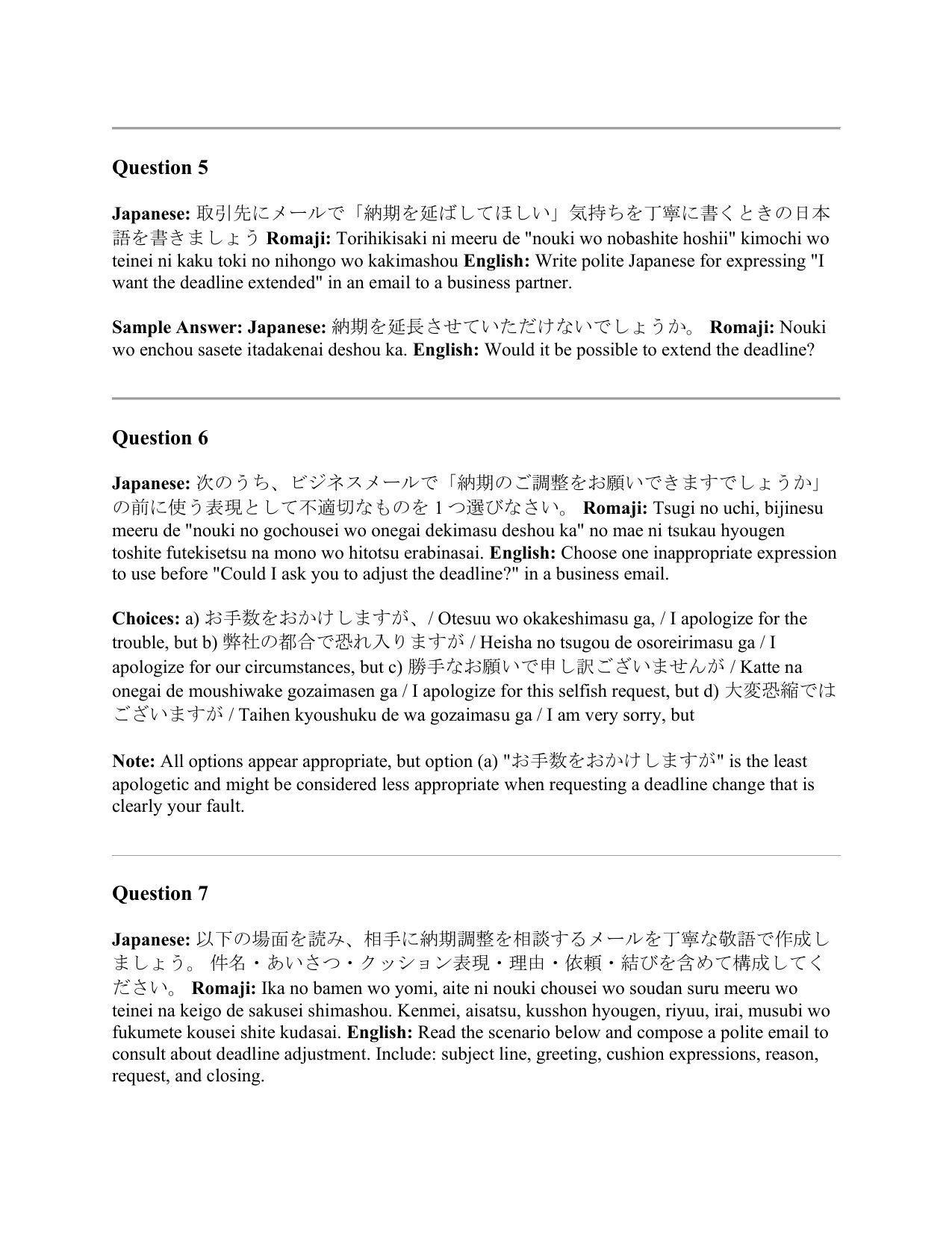
ENQuestion 5
JPJapanese:取引先にメールで「納期を延ばしてほしい」気持ちを丁寧に書くときの日本
EN語を書きましょう Romaji: Torihikisaki ni meeru de "nouki wo nobashite hoshii" kimochi wo
teinei ni kaku toki no nihongo wo kakimashou English: Write polite Japanese for expressing "I
want the deadline extended" in an email to a business partner.
Sample Answer: Japanese: 納期を延長させていただけないでしょうか。 Romaji: Nouki
wo enchou sasete itadakenai deshou ka. English: Would it be possible to extend the deadline?
Question 6
teinei ni kaku toki no nihongo wo kakimashou English: Write polite Japanese for expressing "I
want the deadline extended" in an email to a business partner.
Sample Answer: Japanese: 納期を延長させていただけないでしょうか。 Romaji: Nouki
wo enchou sasete itadakenai deshou ka. English: Would it be possible to extend the deadline?
Question 6
JPJapanese:次のうち、ビジネスメールで「納期のご調整をお願いできますでしょうか」
ENの前に使う表現として不適切なものを 1 つ選びなさい。 Romaji: Tsugi no uchi, bijinesu
meeru de "nouki no gochousei wo onegai dekimasu deshou ka" no mae ni tsukau hyougen
toshite futekisetsu na mono wo hitotsu erabinasai. English: Choose one inappropriate expression
to use before "Could I ask you to adjust the deadline?" in a business email.
Choices: a) お手数をおかけしますが、/ Otesuu wo okakeshimasu ga, / I apologize for the
trouble, but b) 弊社の都合で恐れ入りますが / Heisha no tsugou de osoreirimasu ga / I
apologize for our circumstances, but c) 勝手なお願いで申し訳ございませんが / Katte na
onegai de moushiwake gozaimasen ga / I apologize for this selfish request, but d) 大変恐縮では
ございますが / Taihen kyoushuku de wa gozaimasu ga / I am very sorry, but
Note: All options appear appropriate, but option (a) "お手数をおかけしますが" is the least
apologetic and might be considered less appropriate when requesting a deadline change that is
clearly your fault.
Question 7
meeru de "nouki no gochousei wo onegai dekimasu deshou ka" no mae ni tsukau hyougen
toshite futekisetsu na mono wo hitotsu erabinasai. English: Choose one inappropriate expression
to use before "Could I ask you to adjust the deadline?" in a business email.
Choices: a) お手数をおかけしますが、/ Otesuu wo okakeshimasu ga, / I apologize for the
trouble, but b) 弊社の都合で恐れ入りますが / Heisha no tsugou de osoreirimasu ga / I
apologize for our circumstances, but c) 勝手なお願いで申し訳ございませんが / Katte na
onegai de moushiwake gozaimasen ga / I apologize for this selfish request, but d) 大変恐縮では
ございますが / Taihen kyoushuku de wa gozaimasu ga / I am very sorry, but
Note: All options appear appropriate, but option (a) "お手数をおかけしますが" is the least
apologetic and might be considered less appropriate when requesting a deadline change that is
clearly your fault.
Question 7
JPJapanese:以下の場面を読み、相手に納期調整を相談するメールを丁寧な敬語で作成し
ましょう。件名・あいさつ・クッション表現・理由・依頼・結びを含めて構成してく
ましょう。件名・あいさつ・クッション表現・理由・依頼・結びを含めて構成してく
ENださい。 Romaji: Ika no bamen wo yomi, aite ni nouki chousei wo soudan suru meeru wo
teinei na keigo de sakusei shimashou. Kenmei, aisatsu, kusshon hyougen, riyuu, irai, musubi wo
fukumete kousei shite kudasai. English: Read the scenario below and compose a polite email to
consult about deadline adjustment. Include: subject line, greeting, cushion expressions, reason,
request, and closing.
teinei na keigo de sakusei shimashou. Kenmei, aisatsu, kusshon hyougen, riyuu, irai, musubi wo
fukumete kousei shite kudasai. English: Read the scenario below and compose a polite email to
consult about deadline adjustment. Include: subject line, greeting, cushion expressions, reason,
request, and closing.
หน้า 9
คลิกเพื่อขยาย
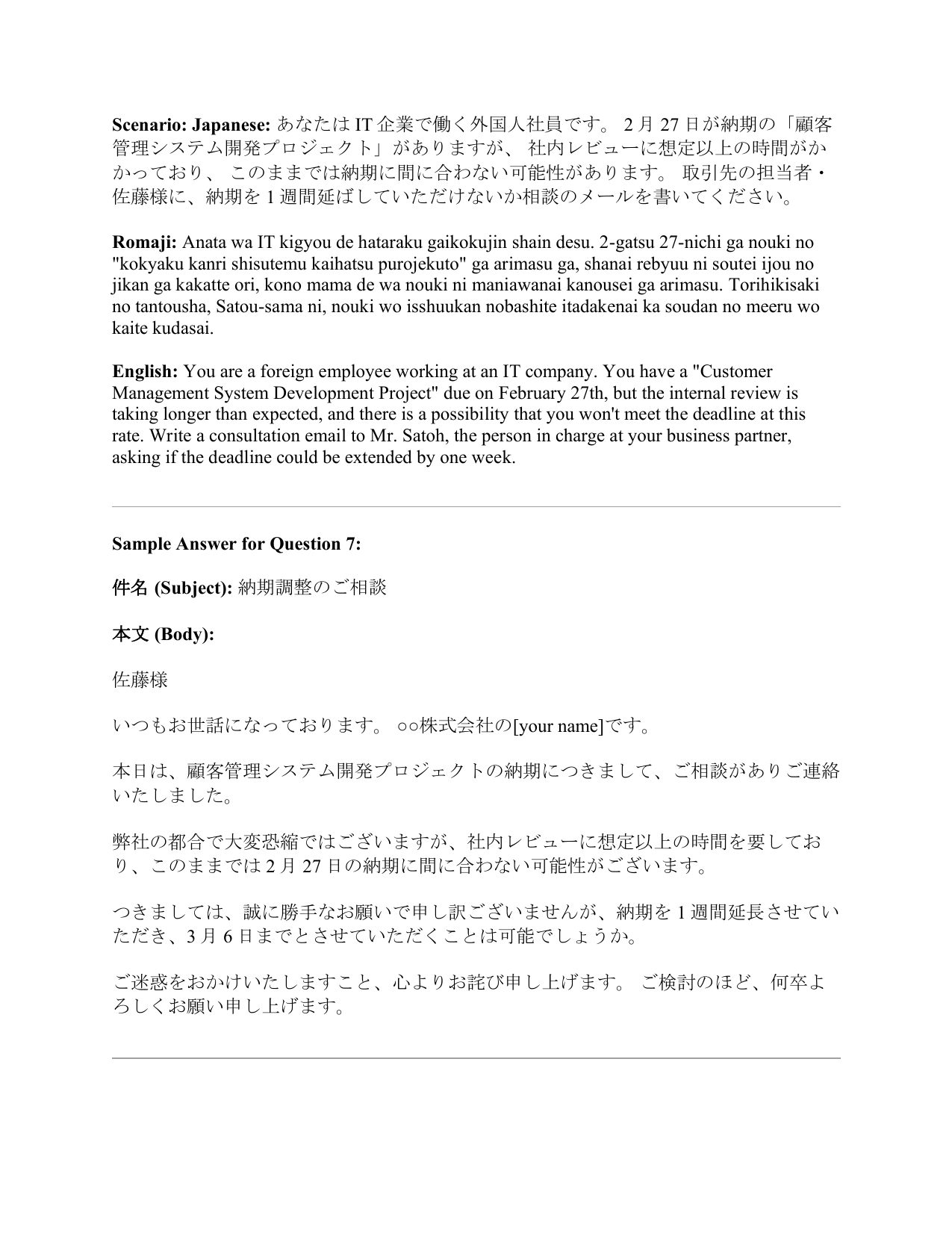
JPScenario:Japanese:あなたはIT企業で働く外国人社員です。2月27日が納期の「顧客
管理システム開発プロジェクト」がありますが、社内レビューに想定以上の時間がか
かっており、このままでは納期に間に合わない可能性があります。取引先の担当者・
佐藤様に、納期を1週間延ばしていただけないか相談のメールを書いてください。
管理システム開発プロジェクト」がありますが、社内レビューに想定以上の時間がか
かっており、このままでは納期に間に合わない可能性があります。取引先の担当者・
佐藤様に、納期を1週間延ばしていただけないか相談のメールを書いてください。
ENRomaji: Anata wa IT kigyou de hataraku gaikokujin shain desu. 2-gatsu 27-nichi ga nouki no
"kokyaku kanri shisutemu kaihatsu purojekuto" ga arimasu ga, shanai rebyuu ni soutei ijou no
jikan ga kakatte ori, kono mama de wa nouki ni maniawanai kanousei ga arimasu. Torihikisaki
no tantousha, Satou-sama ni, nouki wo isshuukan nobashite itadakenai ka soudan no meeru wo
kaite kudasai.
English: You are a foreign employee working at an IT company. You have a "Customer
Management System Development Project" due on February 27th, but the internal review is
taking longer than expected, and there is a possibility that you won't meet the deadline at this
rate. Write a consultation email to Mr. Satoh, the person in charge at your business partner,
asking if the deadline could be extended by one week.
Sample Answer for Question 7:
"kokyaku kanri shisutemu kaihatsu purojekuto" ga arimasu ga, shanai rebyuu ni soutei ijou no
jikan ga kakatte ori, kono mama de wa nouki ni maniawanai kanousei ga arimasu. Torihikisaki
no tantousha, Satou-sama ni, nouki wo isshuukan nobashite itadakenai ka soudan no meeru wo
kaite kudasai.
English: You are a foreign employee working at an IT company. You have a "Customer
Management System Development Project" due on February 27th, but the internal review is
taking longer than expected, and there is a possibility that you won't meet the deadline at this
rate. Write a consultation email to Mr. Satoh, the person in charge at your business partner,
asking if the deadline could be extended by one week.
Sample Answer for Question 7:
JP件名(Subject):納期調整のご相談
EN本文 (Body):
JP佐藤様
いつもお世話になっております。○○株式会社の[yourname]です。
本日は、顧客管理システム開発プロジェクトの納期につきまして、ご相談がありご連絡
いたしました。
弊社の都合で大変恐縮ではございますが、社内レビューに想定以上の時間を要してお
り、このままでは2月27日の納期に間に合わない可能性がございます。
つきましては、誠に勝手なお願いで申し訳ございませんが、納期を1週間延長させてい
ただき、3月6日までとさせていただくことは可能でしょうか。
ご迷惑をおかけいたしますこと、心よりお詫び申し上げます。ご検討のほど、何卒よ
ろしくお願い申し上げます。
いつもお世話になっております。○○株式会社の[yourname]です。
本日は、顧客管理システム開発プロジェクトの納期につきまして、ご相談がありご連絡
いたしました。
弊社の都合で大変恐縮ではございますが、社内レビューに想定以上の時間を要してお
り、このままでは2月27日の納期に間に合わない可能性がございます。
つきましては、誠に勝手なお願いで申し訳ございませんが、納期を1週間延長させてい
ただき、3月6日までとさせていただくことは可能でしょうか。
ご迷惑をおかけいたしますこと、心よりお詫び申し上げます。ご検討のほど、何卒よ
ろしくお願い申し上げます。
หน้า 10
คลิกเพื่อขยาย
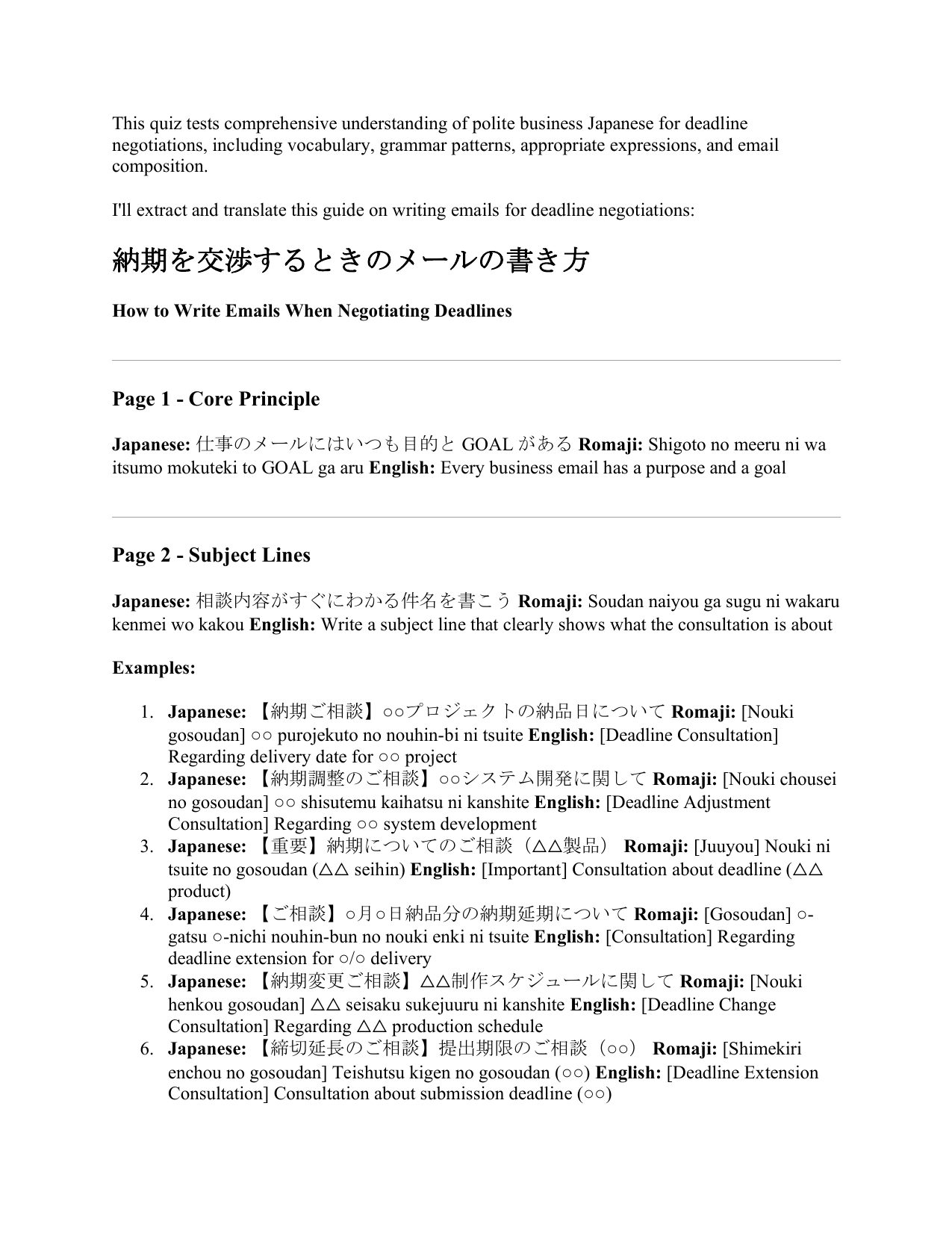
ENThis quiz tests comprehensive understanding of polite business Japanese for deadline
negotiations, including vocabulary, grammar patterns, appropriate expressions, and email
composition.
I'll extract and translate this guide on writing emails for deadline negotiations:
negotiations, including vocabulary, grammar patterns, appropriate expressions, and email
composition.
I'll extract and translate this guide on writing emails for deadline negotiations:
JP納期を交渉するときのメールの書き方
ENHow to Write Emails When Negotiating Deadlines
Page 1 - Core Principle
Japanese: 仕事のメールにはいつも目的と GOAL がある Romaji: Shigoto no meeru ni wa
itsumo mokuteki to GOAL ga aru English: Every business email has a purpose and a goal
Page 2 - Subject Lines
Japanese: 相談内容がすぐにわかる件名を書こう Romaji: Soudan naiyou ga sugu ni wakaru
kenmei wo kakou English: Write a subject line that clearly shows what the consultation is about
Examples:
Page 1 - Core Principle
Japanese: 仕事のメールにはいつも目的と GOAL がある Romaji: Shigoto no meeru ni wa
itsumo mokuteki to GOAL ga aru English: Every business email has a purpose and a goal
Page 2 - Subject Lines
Japanese: 相談内容がすぐにわかる件名を書こう Romaji: Soudan naiyou ga sugu ni wakaru
kenmei wo kakou English: Write a subject line that clearly shows what the consultation is about
Examples:
JP1.Japanese:【納期ご相談】○○プロジェクトの納品日についてRomaji:[Nouki
EN gosoudan] ○○ purojekuto no nouhin-bi ni tsuite English: [Deadline Consultation]
Regarding delivery date for ○○ project
2. Japanese: 【納期調整のご相談】○○システム開発に関して Romaji: [Nouki chousei
no gosoudan] ○○ shisutemu kaihatsu ni kanshite English: [Deadline Adjustment
Consultation] Regarding ○○ system development
3. Japanese: 【重要】納期についてのご相談(△△製品) Romaji: [Juuyou] Nouki ni
tsuite no gosoudan (△△ seihin) English: [Important] Consultation about deadline (△△
product)
4. Japanese: 【ご相談】○月○日納品分の納期延期について Romaji: [Gosoudan] ○-
gatsu ○-nichi nouhin-bun no nouki enki ni tsuite English: [Consultation] Regarding
deadline extension for ○/○ delivery
Regarding delivery date for ○○ project
2. Japanese: 【納期調整のご相談】○○システム開発に関して Romaji: [Nouki chousei
no gosoudan] ○○ shisutemu kaihatsu ni kanshite English: [Deadline Adjustment
Consultation] Regarding ○○ system development
3. Japanese: 【重要】納期についてのご相談(△△製品) Romaji: [Juuyou] Nouki ni
tsuite no gosoudan (△△ seihin) English: [Important] Consultation about deadline (△△
product)
4. Japanese: 【ご相談】○月○日納品分の納期延期について Romaji: [Gosoudan] ○-
gatsu ○-nichi nouhin-bun no nouki enki ni tsuite English: [Consultation] Regarding
deadline extension for ○/○ delivery
JP5.Japanese:【納期変更ご相談】△△制作スケジュールに関してRomaji:[Nouki
EN henkou gosoudan] △△ seisaku sukejuuru ni kanshite English: [Deadline Change
Consultation] Regarding △△ production schedule
6. Japanese: 【締切延長のご相談】提出期限のご相談(○○) Romaji: [Shimekiri
enchou no gosoudan] Teishutsu kigen no gosoudan (○○) English: [Deadline Extension
Consultation] Consultation about submission deadline (○○)
Consultation] Regarding △△ production schedule
6. Japanese: 【締切延長のご相談】提出期限のご相談(○○) Romaji: [Shimekiri
enchou no gosoudan] Teishutsu kigen no gosoudan (○○) English: [Deadline Extension
Consultation] Consultation about submission deadline (○○)
หน้า 11
คลิกเพื่อขยาย
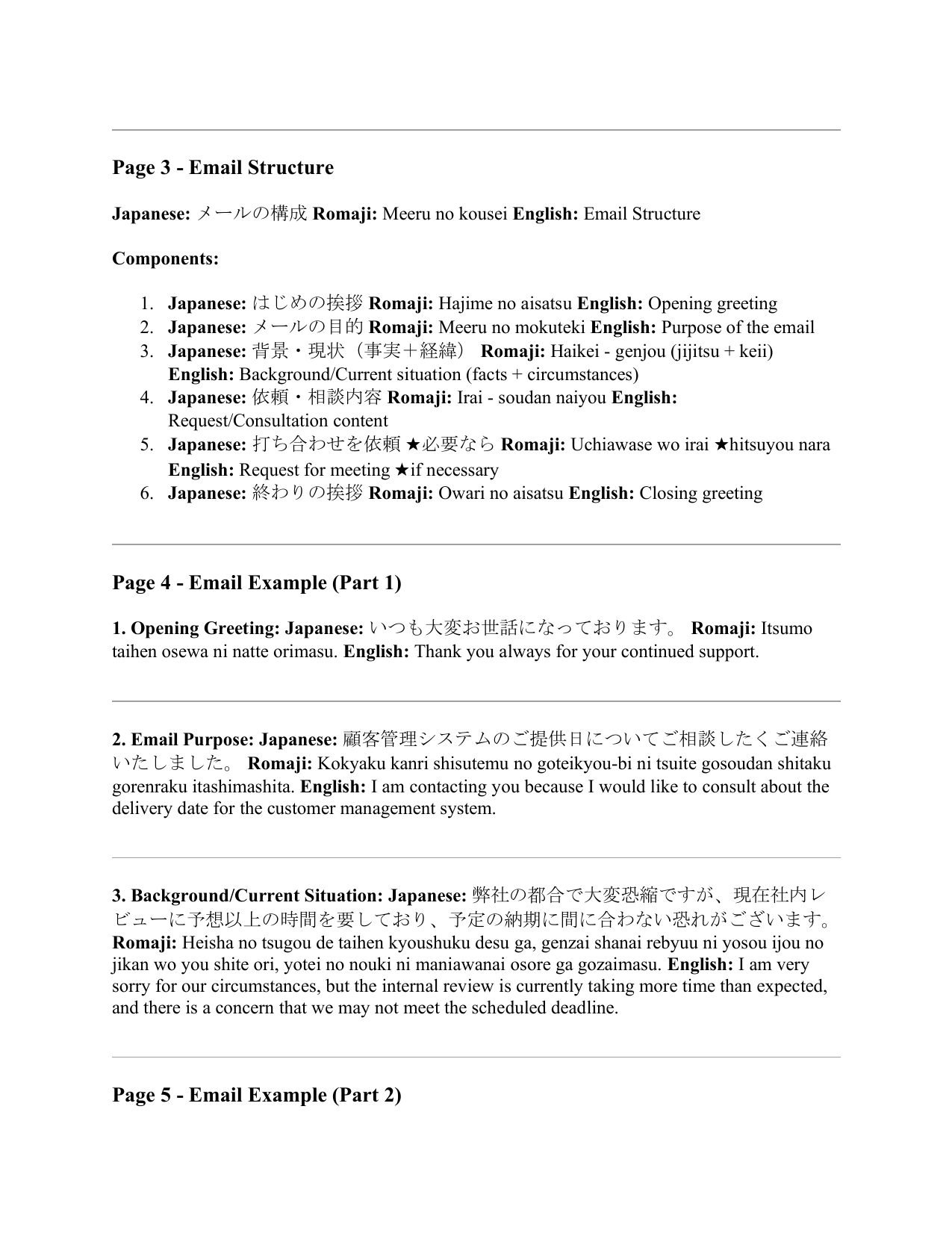
ENPage 3 - Email Structure
Japanese: メールの構成 Romaji: Meeru no kousei English: Email Structure
Components:
1. Japanese: はじめの挨拶 Romaji: Hajime no aisatsu English: Opening greeting
2. Japanese: メールの目的 Romaji: Meeru no mokuteki English: Purpose of the email
3. Japanese: 背景・現状(事実+経緯) Romaji: Haikei - genjou (jijitsu + keii)
English: Background/Current situation (facts + circumstances)
4. Japanese: 依頼・相談内容 Romaji: Irai - soudan naiyou English:
Request/Consultation content
5. Japanese: 打ち合わせを依頼 ★必要なら Romaji: Uchiawase wo irai ★hitsuyou nara
English: Request for meeting ★if necessary
6. Japanese: 終わりの挨拶 Romaji: Owari no aisatsu English: Closing greeting
Page 4 - Email Example (Part 1)
1. Opening Greeting: Japanese: いつも大変お世話になっております。 Romaji: Itsumo
taihen osewa ni natte orimasu. English: Thank you always for your continued support.
Japanese: メールの構成 Romaji: Meeru no kousei English: Email Structure
Components:
1. Japanese: はじめの挨拶 Romaji: Hajime no aisatsu English: Opening greeting
2. Japanese: メールの目的 Romaji: Meeru no mokuteki English: Purpose of the email
3. Japanese: 背景・現状(事実+経緯) Romaji: Haikei - genjou (jijitsu + keii)
English: Background/Current situation (facts + circumstances)
4. Japanese: 依頼・相談内容 Romaji: Irai - soudan naiyou English:
Request/Consultation content
5. Japanese: 打ち合わせを依頼 ★必要なら Romaji: Uchiawase wo irai ★hitsuyou nara
English: Request for meeting ★if necessary
6. Japanese: 終わりの挨拶 Romaji: Owari no aisatsu English: Closing greeting
Page 4 - Email Example (Part 1)
1. Opening Greeting: Japanese: いつも大変お世話になっております。 Romaji: Itsumo
taihen osewa ni natte orimasu. English: Thank you always for your continued support.
JP2.EmailPurpose:Japanese:顧客管理システムのご提供日についてご相談したくご連絡
ENいたしました。 Romaji: Kokyaku kanri shisutemu no goteikyou-bi ni tsuite gosoudan shitaku
gorenraku itashimashita. English: I am contacting you because I would like to consult about the
delivery date for the customer management system.
3. Background/Current Situation: Japanese: 弊社の都合で大変恐縮ですが、現在社内レ
gorenraku itashimashita. English: I am contacting you because I would like to consult about the
delivery date for the customer management system.
3. Background/Current Situation: Japanese: 弊社の都合で大変恐縮ですが、現在社内レ
JPビューに予想以上の時間を要しており、予定の納期に間に合わない恐れがございます。
ENRomaji: Heisha no tsugou de taihen kyoushuku desu ga, genzai shanai rebyuu ni yosou ijou no
jikan wo you shite ori, yotei no nouki ni maniawanai osore ga gozaimasu. English: I am very
sorry for our circumstances, but the internal review is currently taking more time than expected,
and there is a concern that we may not meet the scheduled deadline.
Page 5 - Email Example (Part 2)
jikan wo you shite ori, yotei no nouki ni maniawanai osore ga gozaimasu. English: I am very
sorry for our circumstances, but the internal review is currently taking more time than expected,
and there is a concern that we may not meet the scheduled deadline.
Page 5 - Email Example (Part 2)
หน้า 12
คลิกเพื่อขยาย
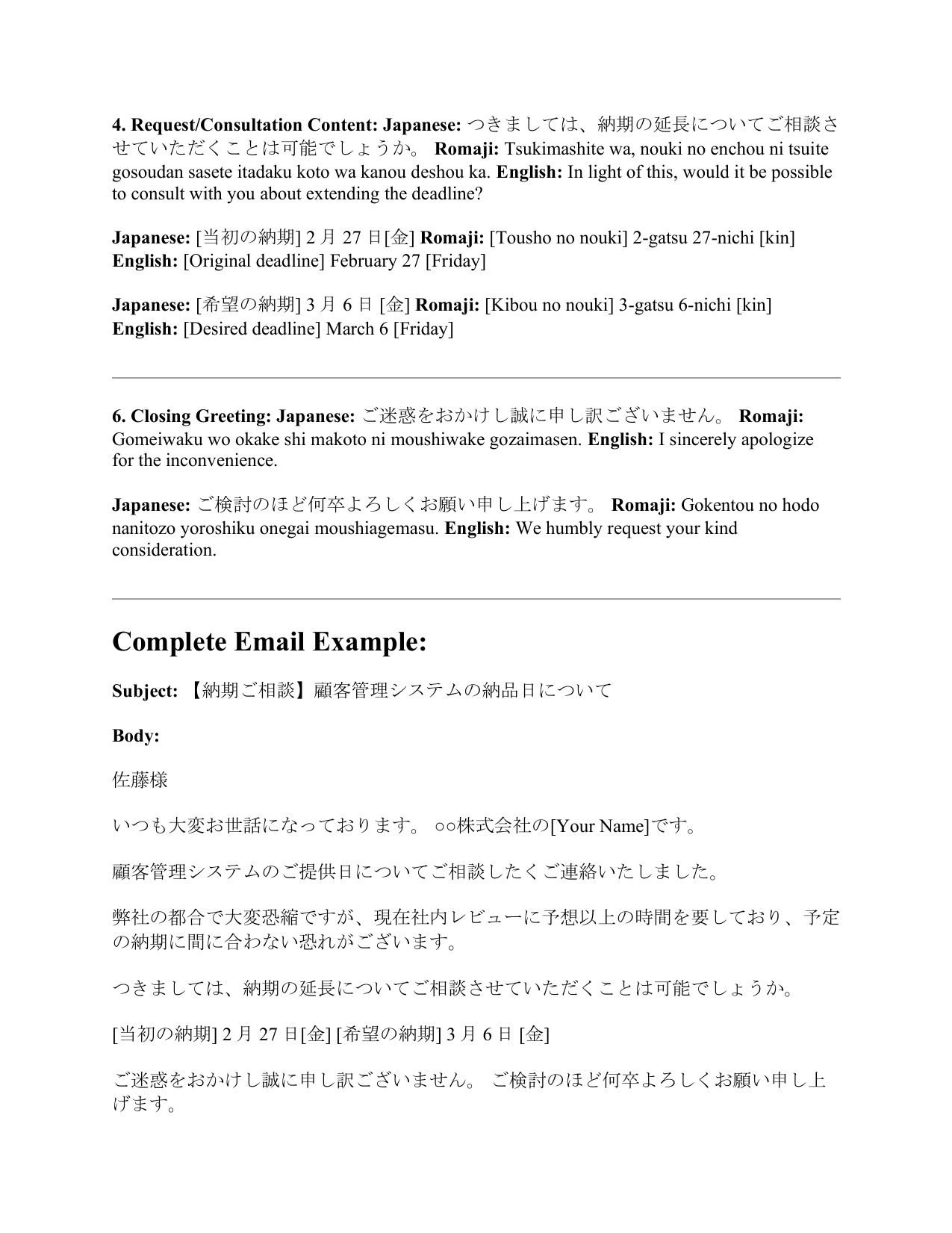
EN4. Request/Consultation Content: Japanese: つきましては、納期の延長についてご相談さ
せていただくことは可能でしょうか。 Romaji: Tsukimashite wa, nouki no enchou ni tsuite
gosoudan sasete itadaku koto wa kanou deshou ka. English: In light of this, would it be possible
to consult with you about extending the deadline?
Japanese: [当初の納期] 2 月 27 日[金] Romaji: [Tousho no nouki] 2-gatsu 27-nichi [kin]
English: [Original deadline] February 27 [Friday]
Japanese: [希望の納期] 3 月 6 日 [金] Romaji: [Kibou no nouki] 3-gatsu 6-nichi [kin]
English: [Desired deadline] March 6 [Friday]
6. Closing Greeting: Japanese: ご迷惑をおかけし誠に申し訳ございません。 Romaji:
Gomeiwaku wo okake shi makoto ni moushiwake gozaimasen. English: I sincerely apologize
for the inconvenience.
Japanese: ご検討のほど何卒よろしくお願い申し上げます。 Romaji: Gokentou no hodo
nanitozo yoroshiku onegai moushiagemasu. English: We humbly request your kind
consideration.
Complete Email Example:
せていただくことは可能でしょうか。 Romaji: Tsukimashite wa, nouki no enchou ni tsuite
gosoudan sasete itadaku koto wa kanou deshou ka. English: In light of this, would it be possible
to consult with you about extending the deadline?
Japanese: [当初の納期] 2 月 27 日[金] Romaji: [Tousho no nouki] 2-gatsu 27-nichi [kin]
English: [Original deadline] February 27 [Friday]
Japanese: [希望の納期] 3 月 6 日 [金] Romaji: [Kibou no nouki] 3-gatsu 6-nichi [kin]
English: [Desired deadline] March 6 [Friday]
6. Closing Greeting: Japanese: ご迷惑をおかけし誠に申し訳ございません。 Romaji:
Gomeiwaku wo okake shi makoto ni moushiwake gozaimasen. English: I sincerely apologize
for the inconvenience.
Japanese: ご検討のほど何卒よろしくお願い申し上げます。 Romaji: Gokentou no hodo
nanitozo yoroshiku onegai moushiagemasu. English: We humbly request your kind
consideration.
Complete Email Example:
JPSubject:【納期ご相談】顧客管理システムの納品日について
ENBody:
JP佐藤様
いつも大変お世話になっております。○○株式会社の[YourName]です。
顧客管理システムのご提供日についてご相談したくご連絡いたしました。
弊社の都合で大変恐縮ですが、現在社内レビューに予想以上の時間を要しており、予定
の納期に間に合わない恐れがございます。
つきましては、納期の延長についてご相談させていただくことは可能でしょうか。
[当初の納期]2月27日[金][希望の納期]3月6日[金]
ご迷惑をおかけし誠に申し訳ございません。ご検討のほど何卒よろしくお願い申し上
げます。
いつも大変お世話になっております。○○株式会社の[YourName]です。
顧客管理システムのご提供日についてご相談したくご連絡いたしました。
弊社の都合で大変恐縮ですが、現在社内レビューに予想以上の時間を要しており、予定
の納期に間に合わない恐れがございます。
つきましては、納期の延長についてご相談させていただくことは可能でしょうか。
[当初の納期]2月27日[金][希望の納期]3月6日[金]
ご迷惑をおかけし誠に申し訳ございません。ご検討のほど何卒よろしくお願い申し上
げます。
หน้า 13
คลิกเพื่อขยาย
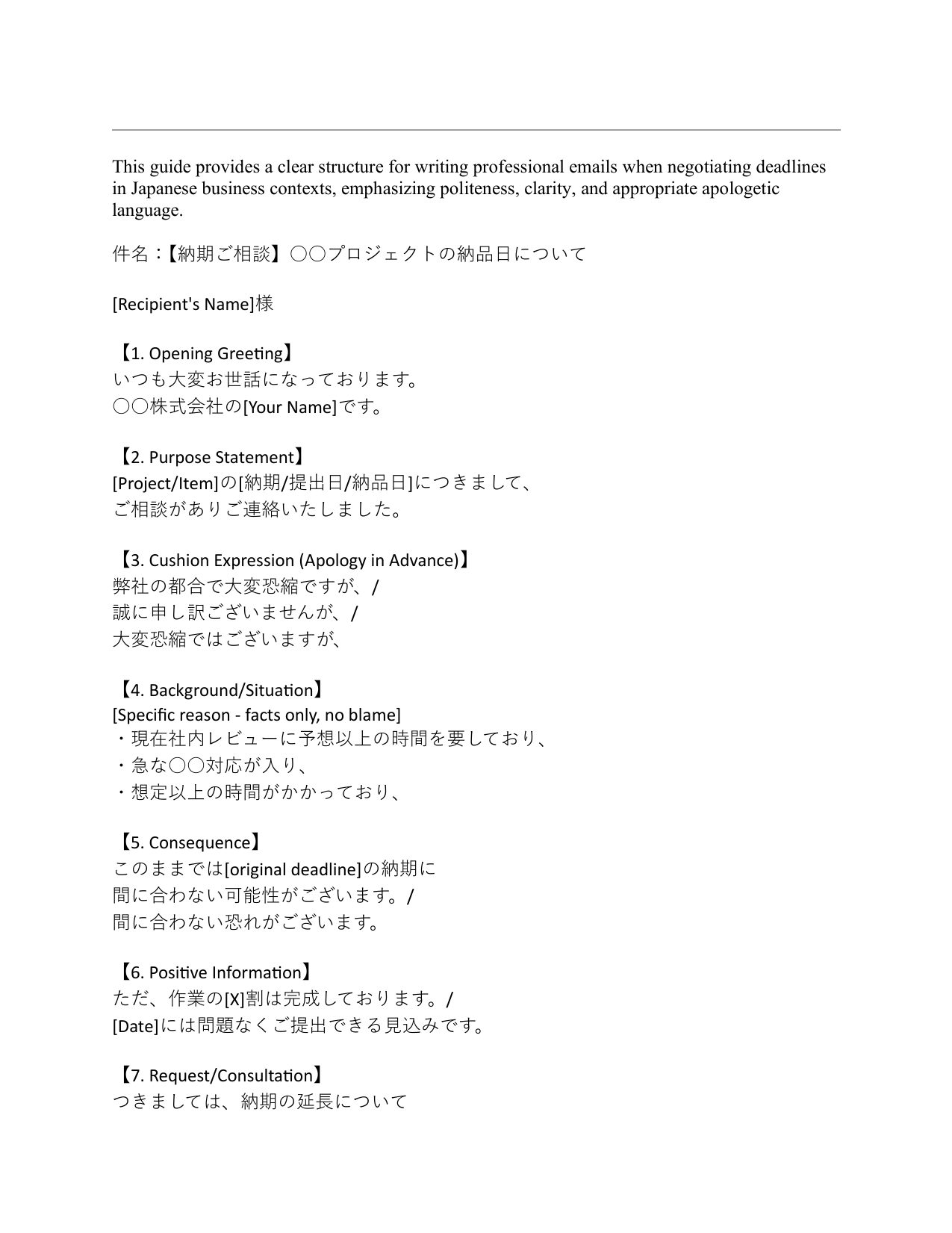
ENThis guide provides a clear structure for writing professional emails when negotiating deadlines
in Japanese business contexts, emphasizing politeness, clarity, and appropriate apologetic
language.
in Japanese business contexts, emphasizing politeness, clarity, and appropriate apologetic
language.
JP件名:【納期ご相談】○○プロジェクトの納品日について
EN[Recipient's Name]様
【1. Opening Greeting】
【1. Opening Greeting】
JPいつも大変お世話になっております。
EN○○株式会社の[Your Name]です。
【2. Purpose Statement】
【2. Purpose Statement】
JP[Project/Item]の[納期/提出日/納品日]につきまして、
ご相談がありご連絡いたしました。
ご相談がありご連絡いたしました。
EN【3. Cushion Expression (Apology in Advance)】
JP弊社の都合で大変恐縮ですが、/
誠に申し訳ございませんが、/
大変恐縮ではございますが、
誠に申し訳ございませんが、/
大変恐縮ではございますが、
EN【4. Background/Situation】
[Specific reason - facts only, no blame]
[Specific reason - facts only, no blame]
JP・現在社内レビューに予想以上の時間を要しており、
・急な○○対応が入り、
・想定以上の時間がかかっており、
・急な○○対応が入り、
・想定以上の時間がかかっており、
EN【5. Consequence】
このままでは[original deadline]の納期に
このままでは[original deadline]の納期に
JP間に合わない可能性がございます。/
間に合わない恐れがございます。
間に合わない恐れがございます。
EN【6. Positive Information】
JPただ、作業の[X]割は完成しております。/
[Date]には問題なくご提出できる見込みです。
[Date]には問題なくご提出できる見込みです。
EN【7. Request/Consultation】
JPつきましては、納期の延長について
หน้า 14
คลิกเพื่อขยาย
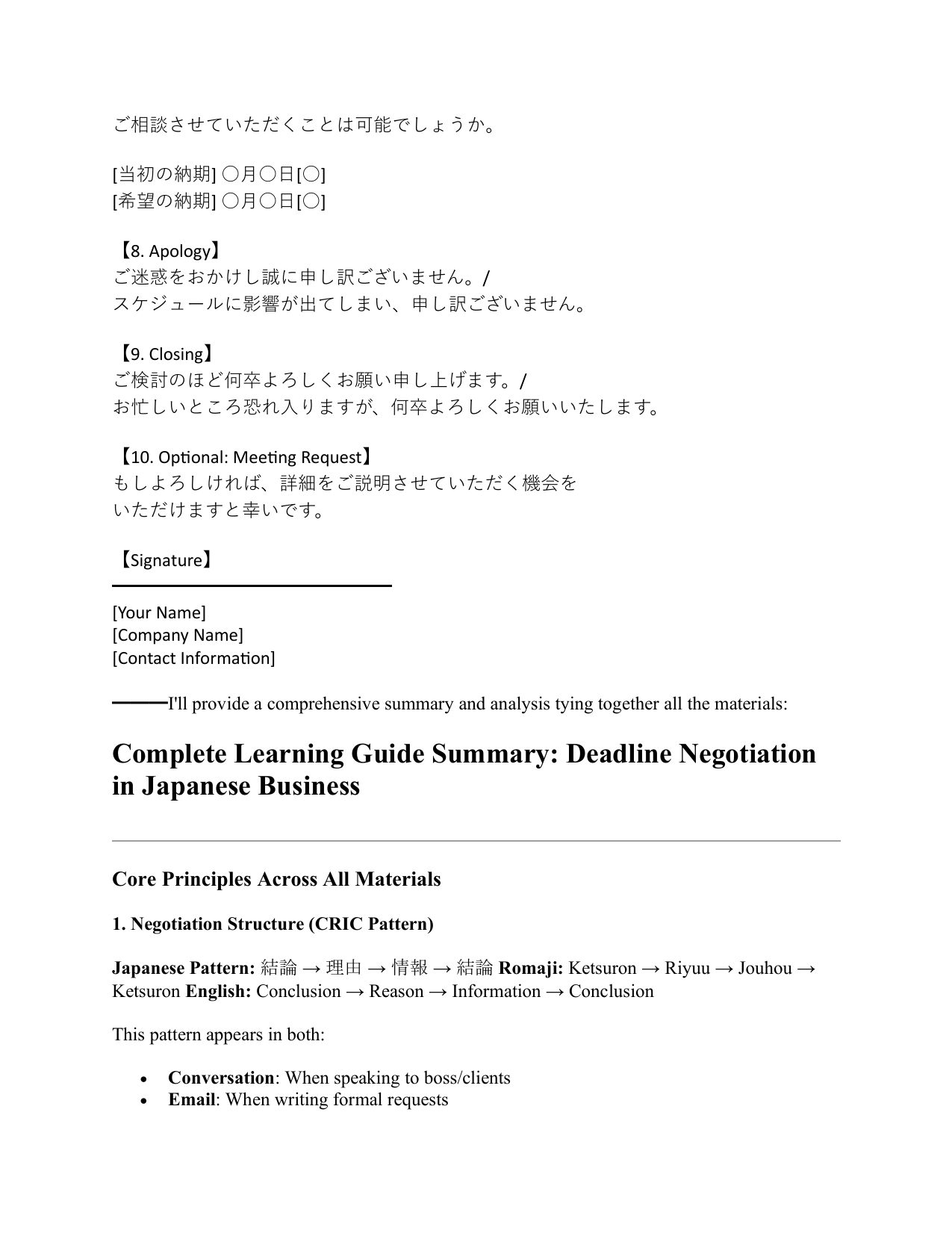
JPご相談させていただくことは可能でしょうか。
[当初の納期]○月○日[○]
[希望の納期]○月○日[○]
[当初の納期]○月○日[○]
[希望の納期]○月○日[○]
EN【8. Apology】
JPご迷惑をおかけし誠に申し訳ございません。/
スケジュールに影響が出てしまい、申し訳ございません。
スケジュールに影響が出てしまい、申し訳ございません。
EN【9. Closing】
JPご検討のほど何卒よろしくお願い申し上げます。/
お忙しいところ恐れ入りますが、何卒よろしくお願いいたします。
お忙しいところ恐れ入りますが、何卒よろしくお願いいたします。
EN【10. Optional: Meeting Request】
JPもしよろしければ、詳細をご説明させていただく機会を
いただけますと幸いです。
いただけますと幸いです。
EN【Signature】
━━━━━━━━━━━━━━━
[Your Name]
[Company Name]
[Contact Information]
━━━I'll provide a comprehensive summary and analysis tying together all the materials:
Complete Learning Guide Summary: Deadline Negotiation
in Japanese Business
Core Principles Across All Materials
1. Negotiation Structure (CRIC Pattern)
Japanese Pattern: 結論 → 理由 → 情報 → 結論 Romaji: Ketsuron → Riyuu → Jouhou →
Ketsuron English: Conclusion → Reason → Information → Conclusion
This pattern appears in both:
• Conversation: When speaking to boss/clients
• Email: When writing formal requests
━━━━━━━━━━━━━━━
[Your Name]
[Company Name]
[Contact Information]
━━━I'll provide a comprehensive summary and analysis tying together all the materials:
Complete Learning Guide Summary: Deadline Negotiation
in Japanese Business
Core Principles Across All Materials
1. Negotiation Structure (CRIC Pattern)
Japanese Pattern: 結論 → 理由 → 情報 → 結論 Romaji: Ketsuron → Riyuu → Jouhou →
Ketsuron English: Conclusion → Reason → Information → Conclusion
This pattern appears in both:
• Conversation: When speaking to boss/clients
• Email: When writing formal requests
หน้า 15
คลิกเพื่อขยาย
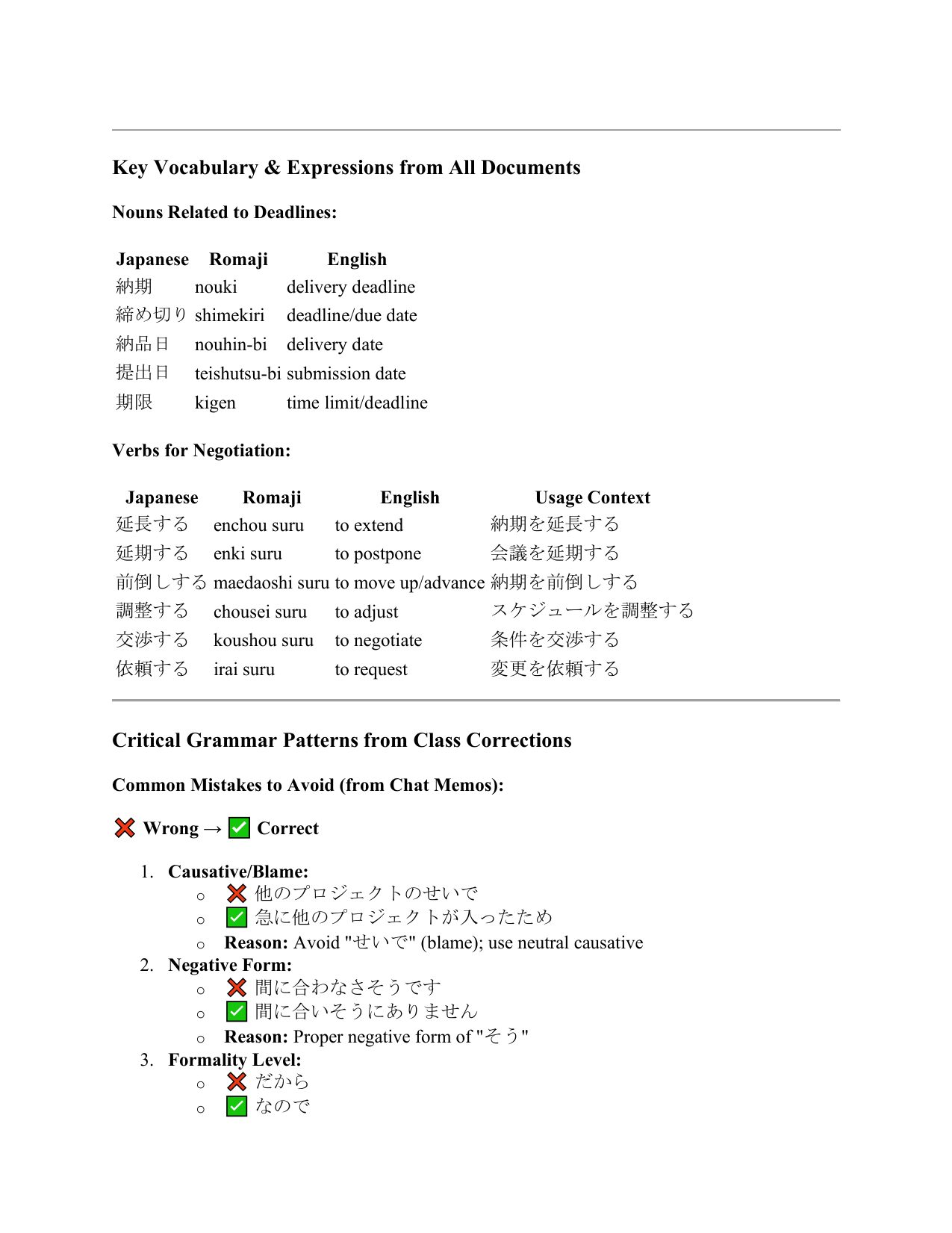
ENKey Vocabulary & Expressions from All Documents
Nouns Related to Deadlines:
Japanese Romaji English
納期 nouki delivery deadline
締め切り shimekiri deadline/due date
納品日 nouhin-bi delivery date
提出日 teishutsu-bi submission date
期限 kigen time limit/deadline
Verbs for Negotiation:
Japanese Romaji English Usage Context
延長する enchou suru to extend 納期を延長する
延期する enki suru to postpone 会議を延期する
前倒しする maedaoshi suru to move up/advance 納期を前倒しする
調整する chousei suru to adjust スケジュールを調整する
交渉する koushou suru to negotiate 条件を交渉する
依頼する irai suru to request 変更を依頼する
Critical Grammar Patterns from Class Corrections
Common Mistakes to Avoid (from Chat Memos):
Wrong → Correct
1. Causative/Blame:
Nouns Related to Deadlines:
Japanese Romaji English
納期 nouki delivery deadline
締め切り shimekiri deadline/due date
納品日 nouhin-bi delivery date
提出日 teishutsu-bi submission date
期限 kigen time limit/deadline
Verbs for Negotiation:
Japanese Romaji English Usage Context
延長する enchou suru to extend 納期を延長する
延期する enki suru to postpone 会議を延期する
前倒しする maedaoshi suru to move up/advance 納期を前倒しする
調整する chousei suru to adjust スケジュールを調整する
交渉する koushou suru to negotiate 条件を交渉する
依頼する irai suru to request 変更を依頼する
Critical Grammar Patterns from Class Corrections
Common Mistakes to Avoid (from Chat Memos):
Wrong → Correct
1. Causative/Blame:
JPo他のプロジェクトのせいで
o急に他のプロジェクトが入ったため
o急に他のプロジェクトが入ったため
EN o Reason: Avoid "せいで" (blame); use neutral causative
2. Negative Form:
2. Negative Form:
JPo間に合わなさそうです
o間に合いそうにありません
o間に合いそうにありません
EN o Reason: Proper negative form of "そう"
3. Formality Level:
3. Formality Level:
JPoだから
oなので
oなので
หน้า 16
คลิกเพื่อขยาย
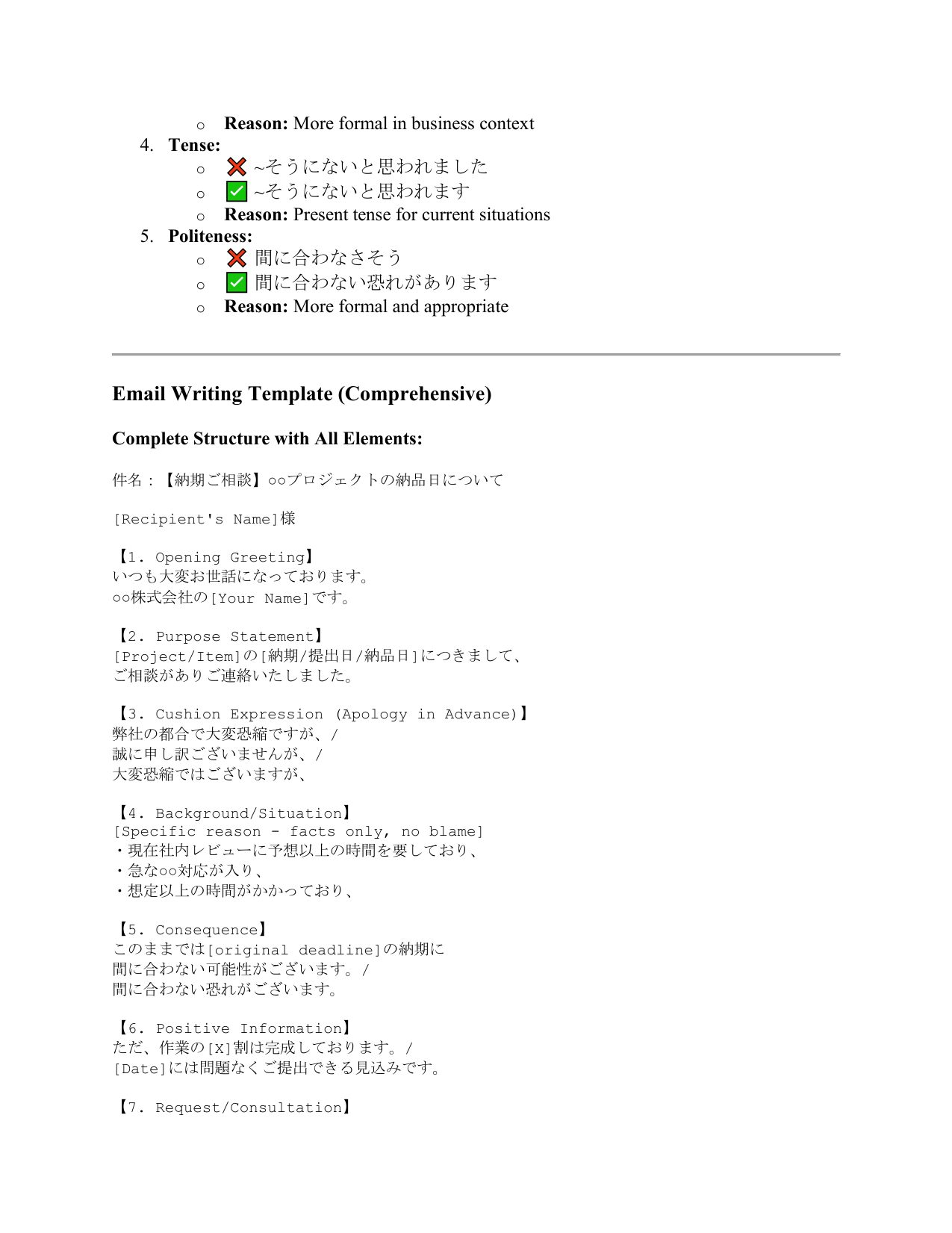
EN o Reason: More formal in business context
4. Tense:
4. Tense:
JPo~そうにないと思われました
o~そうにないと思われます
o~そうにないと思われます
EN o Reason: Present tense for current situations
5. Politeness:
5. Politeness:
JPo間に合わなさそう
o間に合わない恐れがあります
o間に合わない恐れがあります
EN o Reason: More formal and appropriate
Email Writing Template (Comprehensive)
Complete Structure with All Elements:
Email Writing Template (Comprehensive)
Complete Structure with All Elements:
JP件名:【納期ご相談】○○プロジェクトの納品日について
EN[Recipient's Name]様
【1. Opening Greeting】
【1. Opening Greeting】
JPいつも大変お世話になっております。
EN○○株式会社の[Your Name]です。
【2. Purpose Statement】
【2. Purpose Statement】
JP[Project/Item]の[納期/提出日/納品日]につきまして、
ご相談がありご連絡いたしました。
ご相談がありご連絡いたしました。
EN【3. Cushion Expression (Apology in Advance)】
JP弊社の都合で大変恐縮ですが、/
誠に申し訳ございませんが、/
大変恐縮ではございますが、
誠に申し訳ございませんが、/
大変恐縮ではございますが、
EN【4. Background/Situation】
[Specific reason - facts only, no blame]
[Specific reason - facts only, no blame]
JP・現在社内レビューに予想以上の時間を要しており、
・急な○○対応が入り、
・想定以上の時間がかかっており、
・急な○○対応が入り、
・想定以上の時間がかかっており、
EN【5. Consequence】
このままでは[original deadline]の納期に
このままでは[original deadline]の納期に
JP間に合わない可能性がございます。/
間に合わない恐れがございます。
間に合わない恐れがございます。
EN【6. Positive Information】
JPただ、作業の[X]割は完成しております。/
[Date]には問題なくご提出できる見込みです。
[Date]には問題なくご提出できる見込みです。
EN【7. Request/Consultation】
หน้า 17
คลิกเพื่อขยาย
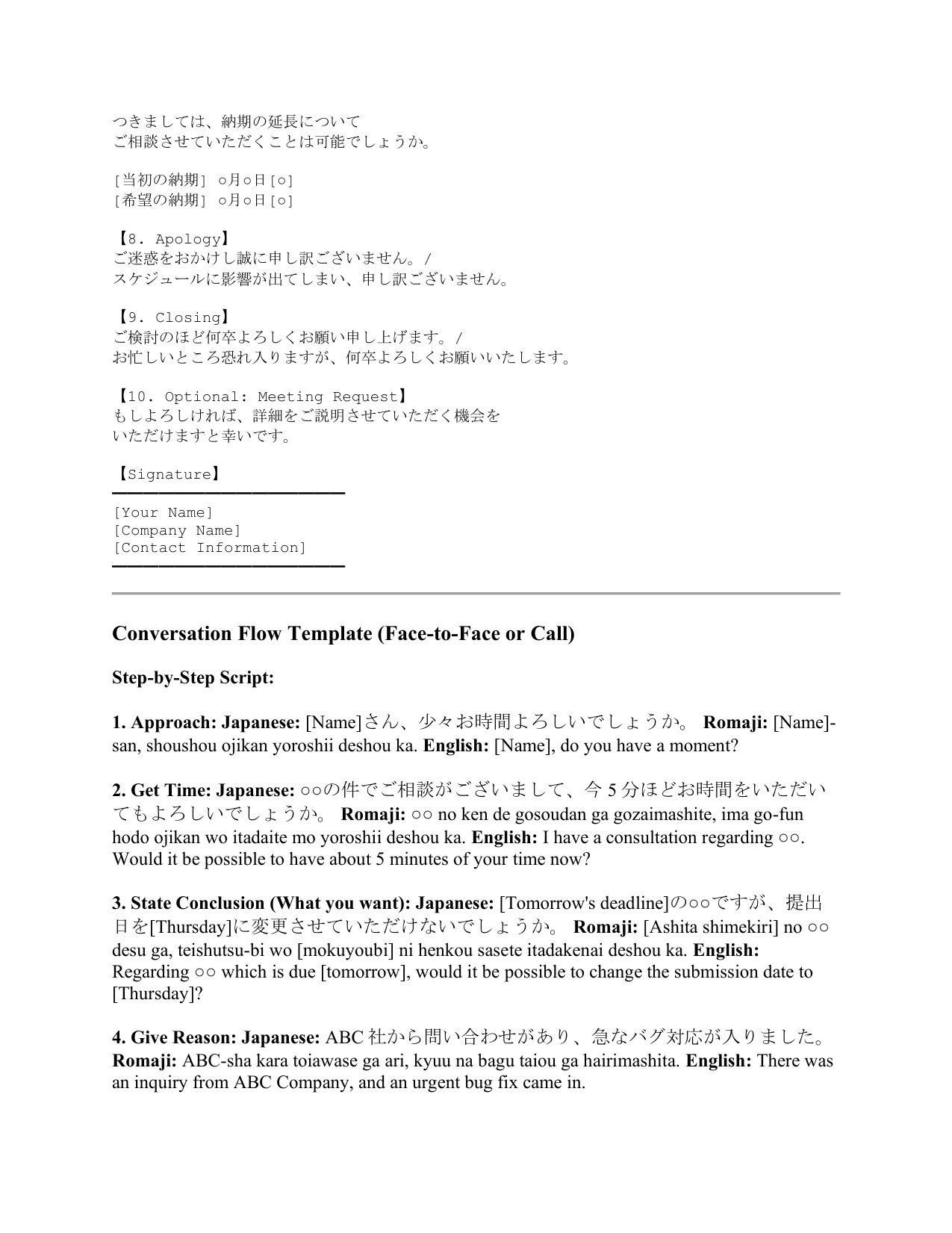
JPつきましては、納期の延長について
ご相談させていただくことは可能でしょうか。
[当初の納期]○月○日[○]
[希望の納期]○月○日[○]
ご相談させていただくことは可能でしょうか。
[当初の納期]○月○日[○]
[希望の納期]○月○日[○]
EN【8. Apology】
JPご迷惑をおかけし誠に申し訳ございません。/
スケジュールに影響が出てしまい、申し訳ございません。
スケジュールに影響が出てしまい、申し訳ございません。
EN【9. Closing】
JPご検討のほど何卒よろしくお願い申し上げます。/
お忙しいところ恐れ入りますが、何卒よろしくお願いいたします。
お忙しいところ恐れ入りますが、何卒よろしくお願いいたします。
EN【10. Optional: Meeting Request】
JPもしよろしければ、詳細をご説明させていただく機会を
いただけますと幸いです。
いただけますと幸いです。
EN【Signature】
━━━━━━━━━━━━━━━
[Your Name]
[Company Name]
[Contact Information]
━━━━━━━━━━━━━━━
Conversation Flow Template (Face-to-Face or Call)
Step-by-Step Script:
1. Approach: Japanese: [Name]さん、少々お時間よろしいでしょうか。 Romaji: [Name]-
san, shoushou ojikan yoroshii deshou ka. English: [Name], do you have a moment?
━━━━━━━━━━━━━━━
[Your Name]
[Company Name]
[Contact Information]
━━━━━━━━━━━━━━━
Conversation Flow Template (Face-to-Face or Call)
Step-by-Step Script:
1. Approach: Japanese: [Name]さん、少々お時間よろしいでしょうか。 Romaji: [Name]-
san, shoushou ojikan yoroshii deshou ka. English: [Name], do you have a moment?
JP2.GetTime:Japanese:○○の件でご相談がございまして、今5分ほどお時間をいただい
ENてもよろしいでしょうか。 Romaji: ○○ no ken de gosoudan ga gozaimashite, ima go-fun
hodo ojikan wo itadaite mo yoroshii deshou ka. English: I have a consultation regarding ○○.
Would it be possible to have about 5 minutes of your time now?
3. State Conclusion (What you want): Japanese: [Tomorrow's deadline]の○○ですが、提出
日を[Thursday]に変更させていただけないでしょうか。 Romaji: [Ashita shimekiri] no ○○
desu ga, teishutsu-bi wo [mokuyoubi] ni henkou sasete itadakenai deshou ka. English:
Regarding ○○ which is due [tomorrow], would it be possible to change the submission date to
[Thursday]?
hodo ojikan wo itadaite mo yoroshii deshou ka. English: I have a consultation regarding ○○.
Would it be possible to have about 5 minutes of your time now?
3. State Conclusion (What you want): Japanese: [Tomorrow's deadline]の○○ですが、提出
日を[Thursday]に変更させていただけないでしょうか。 Romaji: [Ashita shimekiri] no ○○
desu ga, teishutsu-bi wo [mokuyoubi] ni henkou sasete itadakenai deshou ka. English:
Regarding ○○ which is due [tomorrow], would it be possible to change the submission date to
[Thursday]?
JP4.GiveReason:Japanese:ABC社から問い合わせがあり、急なバグ対応が入りました。
ENRomaji: ABC-sha kara toiawase ga ari, kyuu na bagu taiou ga hairimashita. English: There was
an inquiry from ABC Company, and an urgent bug fix came in.
an inquiry from ABC Company, and an urgent bug fix came in.
หน้า 18
คลิกเพื่อขยาย
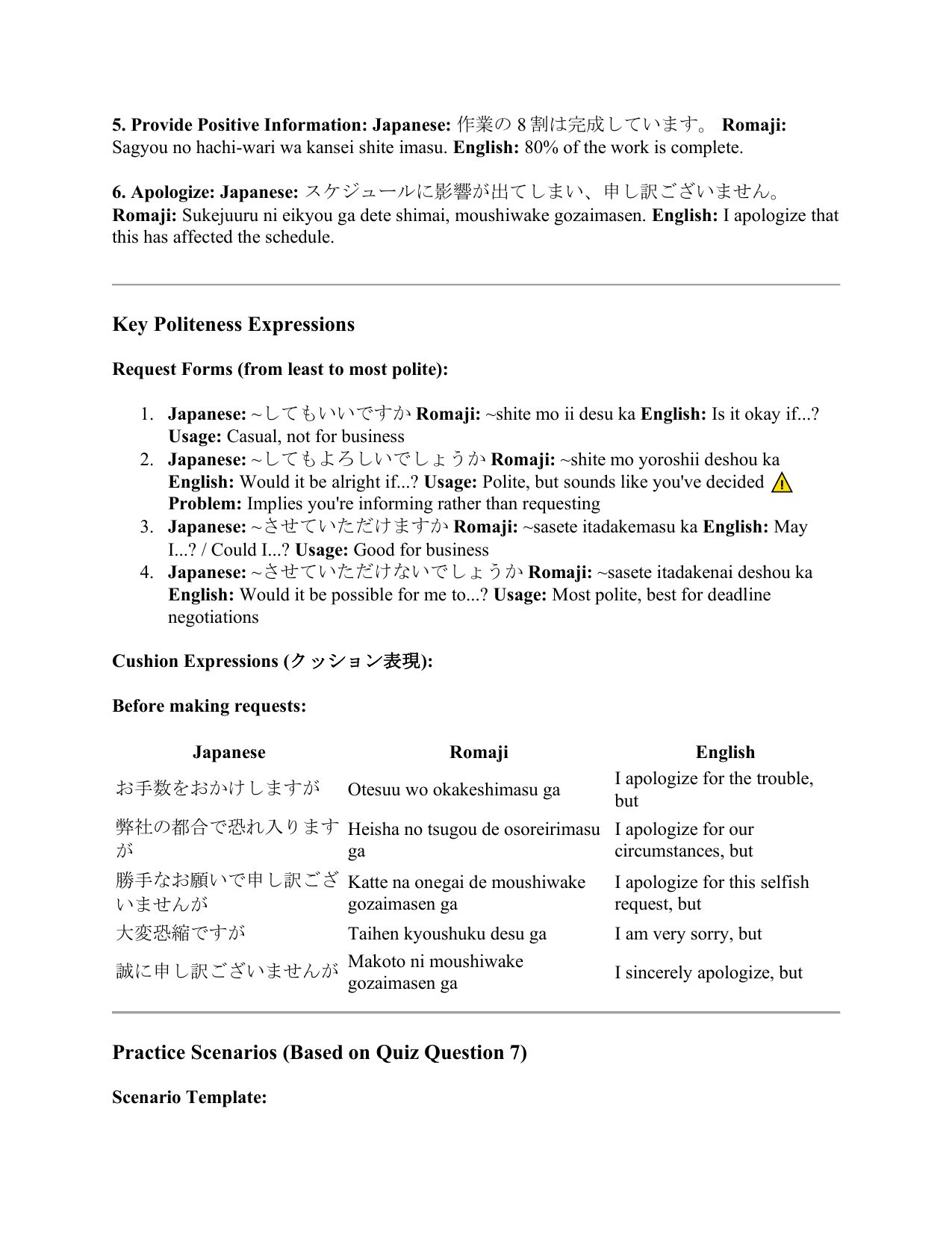
EN5. Provide Positive Information: Japanese: 作業の 8 割は完成しています。 Romaji:
Sagyou no hachi-wari wa kansei shite imasu. English: 80% of the work is complete.
Sagyou no hachi-wari wa kansei shite imasu. English: 80% of the work is complete.
JP6.Apologize:Japanese:スケジュールに影響が出てしまい、申し訳ございません。
ENRomaji: Sukejuuru ni eikyou ga dete shimai, moushiwake gozaimasen. English: I apologize that
this has affected the schedule.
Key Politeness Expressions
Request Forms (from least to most polite):
1. Japanese: ~してもいいですか Romaji: ~shite mo ii desu ka English: Is it okay if...?
Usage: Casual, not for business
2. Japanese: ~してもよろしいでしょうか Romaji: ~shite mo yoroshii deshou ka
English: Would it be alright if...? Usage: Polite, but sounds like you've decided
Problem: Implies you're informing rather than requesting
3. Japanese: ~させていただけますか Romaji: ~sasete itadakemasu ka English: May
I...? / Could I...? Usage: Good for business
4. Japanese: ~させていただけないでしょうか Romaji: ~sasete itadakenai deshou ka
English: Would it be possible for me to...? Usage: Most polite, best for deadline
negotiations
Cushion Expressions (クッション表現):
Before making requests:
Japanese Romaji English
I apologize for the trouble,
お手数をおかけしますが Otesuu wo okakeshimasu ga
but
弊社の都合で恐れ入ります Heisha no tsugou de osoreirimasu I apologize for our
が ga circumstances, but
勝手なお願いで申し訳ござ Katte na onegai de moushiwake I apologize for this selfish
いませんが gozaimasen ga request, but
大変恐縮ですが Taihen kyoushuku desu ga I am very sorry, but
Makoto ni moushiwake
誠に申し訳ございませんが I sincerely apologize, but
gozaimasen ga
Practice Scenarios (Based on Quiz Question 7)
Scenario Template:
this has affected the schedule.
Key Politeness Expressions
Request Forms (from least to most polite):
1. Japanese: ~してもいいですか Romaji: ~shite mo ii desu ka English: Is it okay if...?
Usage: Casual, not for business
2. Japanese: ~してもよろしいでしょうか Romaji: ~shite mo yoroshii deshou ka
English: Would it be alright if...? Usage: Polite, but sounds like you've decided
Problem: Implies you're informing rather than requesting
3. Japanese: ~させていただけますか Romaji: ~sasete itadakemasu ka English: May
I...? / Could I...? Usage: Good for business
4. Japanese: ~させていただけないでしょうか Romaji: ~sasete itadakenai deshou ka
English: Would it be possible for me to...? Usage: Most polite, best for deadline
negotiations
Cushion Expressions (クッション表現):
Before making requests:
Japanese Romaji English
I apologize for the trouble,
お手数をおかけしますが Otesuu wo okakeshimasu ga
but
弊社の都合で恐れ入ります Heisha no tsugou de osoreirimasu I apologize for our
が ga circumstances, but
勝手なお願いで申し訳ござ Katte na onegai de moushiwake I apologize for this selfish
いませんが gozaimasen ga request, but
大変恐縮ですが Taihen kyoushuku desu ga I am very sorry, but
Makoto ni moushiwake
誠に申し訳ございませんが I sincerely apologize, but
gozaimasen ga
Practice Scenarios (Based on Quiz Question 7)
Scenario Template:
หน้า 19
คลิกเพื่อขยาย
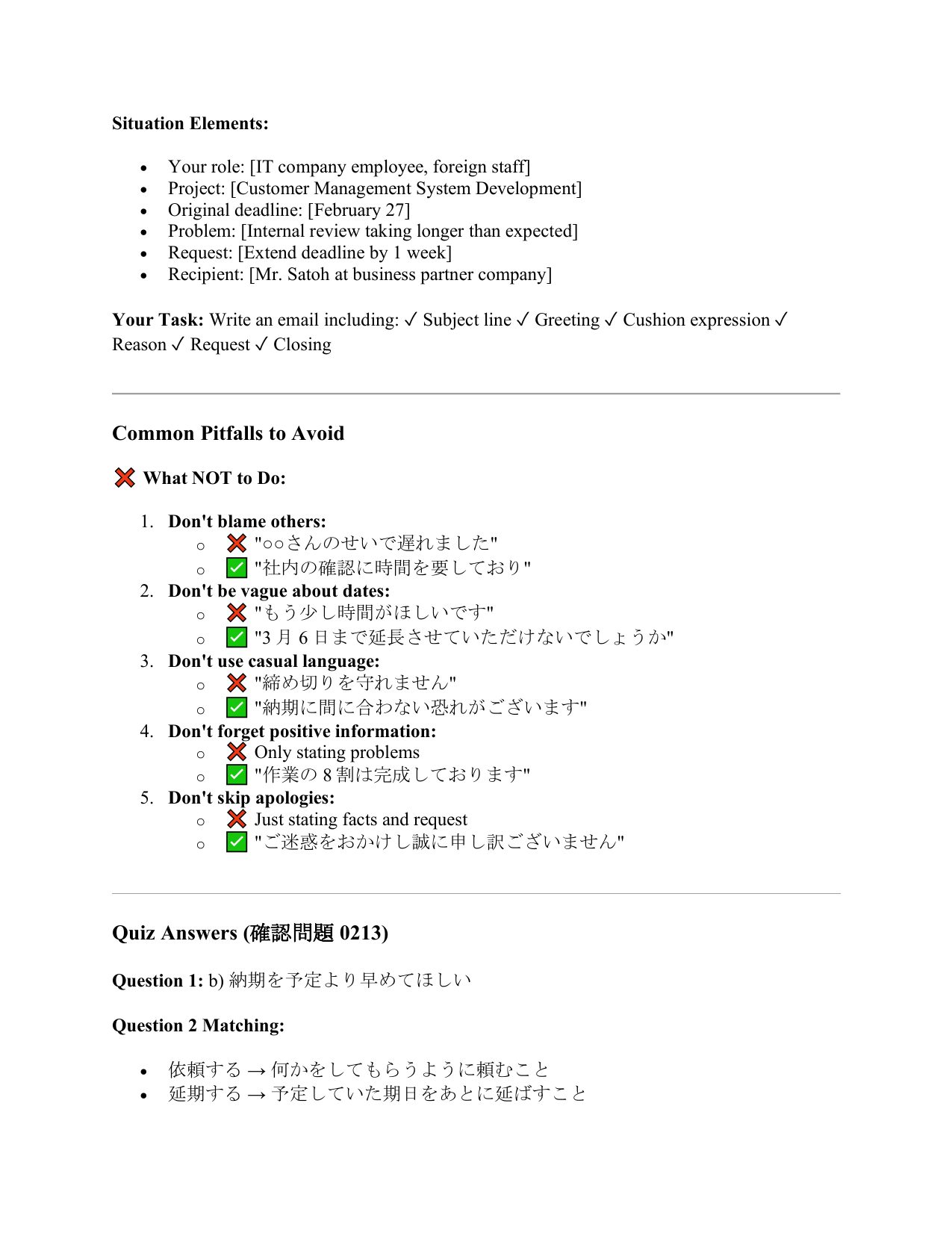
ENSituation Elements:
• Your role: [IT company employee, foreign staff]
• Project: [Customer Management System Development]
• Original deadline: [February 27]
• Problem: [Internal review taking longer than expected]
• Request: [Extend deadline by 1 week]
• Recipient: [Mr. Satoh at business partner company]
Your Task: Write an email including: ✓ Subject line ✓ Greeting ✓ Cushion expression ✓
Reason ✓ Request ✓ Closing
Common Pitfalls to Avoid
What NOT to Do:
1. Don't blame others:
• Your role: [IT company employee, foreign staff]
• Project: [Customer Management System Development]
• Original deadline: [February 27]
• Problem: [Internal review taking longer than expected]
• Request: [Extend deadline by 1 week]
• Recipient: [Mr. Satoh at business partner company]
Your Task: Write an email including: ✓ Subject line ✓ Greeting ✓ Cushion expression ✓
Reason ✓ Request ✓ Closing
Common Pitfalls to Avoid
What NOT to Do:
1. Don't blame others:
JPo"○○さんのせいで遅れました"
o"社内の確認に時間を要しており"
o"社内の確認に時間を要しており"
EN 2. Don't be vague about dates:
JPo"もう少し時間がほしいです"
o"3月6日まで延長させていただけないでしょうか"
o"3月6日まで延長させていただけないでしょうか"
EN 3. Don't use casual language:
JPo"締め切りを守れません"
o"納期に間に合わない恐れがございます"
o"納期に間に合わない恐れがございます"
EN 4. Don't forget positive information:
o Only stating problems
o Only stating problems
JPo"作業の8割は完成しております"
EN 5. Don't skip apologies:
o Just stating facts and request
o Just stating facts and request
JPo"ご迷惑をおかけし誠に申し訳ございません"
ENQuiz Answers (確認問題 0213)
JPQuestion1:b)納期を予定より早めてほしい
ENQuestion 2 Matching:
JP•依頼する→何かをしてもらうように頼むこと
•延期する→予定していた期日をあとに延ばすこと
•延期する→予定していた期日をあとに延ばすこと
หน้า 20
คลิกเพื่อขยาย
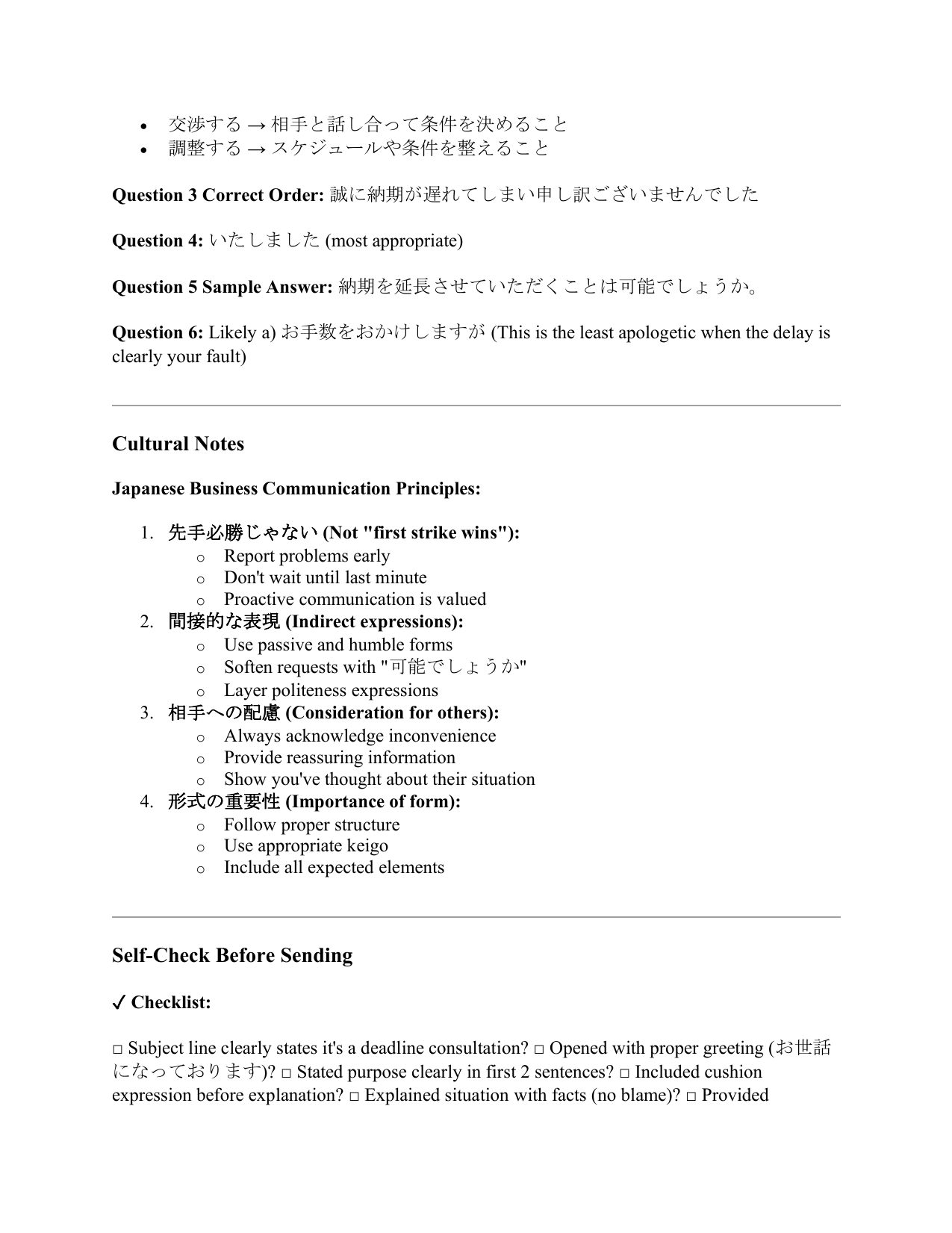
JP•交渉する→相手と話し合って条件を決めること
•調整する→スケジュールや条件を整えること
Question3CorrectOrder:誠に納期が遅れてしまい申し訳ございませんでした
•調整する→スケジュールや条件を整えること
Question3CorrectOrder:誠に納期が遅れてしまい申し訳ございませんでした
ENQuestion 4: いたしました (most appropriate)
JPQuestion5SampleAnswer:納期を延長させていただくことは可能でしょうか。
ENQuestion 6: Likely a) お手数をおかけしますが (This is the least apologetic when the delay is
clearly your fault)
Cultural Notes
Japanese Business Communication Principles:
1. 先手必勝じゃない (Not "first strike wins"):
o Report problems early
o Don't wait until last minute
o Proactive communication is valued
2. 間接的な表現 (Indirect expressions):
o Use passive and humble forms
o Soften requests with "可能でしょうか"
o Layer politeness expressions
3. 相手への配慮 (Consideration for others):
o Always acknowledge inconvenience
o Provide reassuring information
o Show you've thought about their situation
4. 形式の重要性 (Importance of form):
o Follow proper structure
o Use appropriate keigo
o Include all expected elements
Self-Check Before Sending
✓ Checklist:
□ Subject line clearly states it's a deadline consultation? □ Opened with proper greeting (お世話
になっております)? □ Stated purpose clearly in first 2 sentences? □ Included cushion
expression before explanation? □ Explained situation with facts (no blame)? □ Provided
clearly your fault)
Cultural Notes
Japanese Business Communication Principles:
1. 先手必勝じゃない (Not "first strike wins"):
o Report problems early
o Don't wait until last minute
o Proactive communication is valued
2. 間接的な表現 (Indirect expressions):
o Use passive and humble forms
o Soften requests with "可能でしょうか"
o Layer politeness expressions
3. 相手への配慮 (Consideration for others):
o Always acknowledge inconvenience
o Provide reassuring information
o Show you've thought about their situation
4. 形式の重要性 (Importance of form):
o Follow proper structure
o Use appropriate keigo
o Include all expected elements
Self-Check Before Sending
✓ Checklist:
□ Subject line clearly states it's a deadline consultation? □ Opened with proper greeting (お世話
になっております)? □ Stated purpose clearly in first 2 sentences? □ Included cushion
expression before explanation? □ Explained situation with facts (no blame)? □ Provided
หน้า 21
คลิกเพื่อขยาย
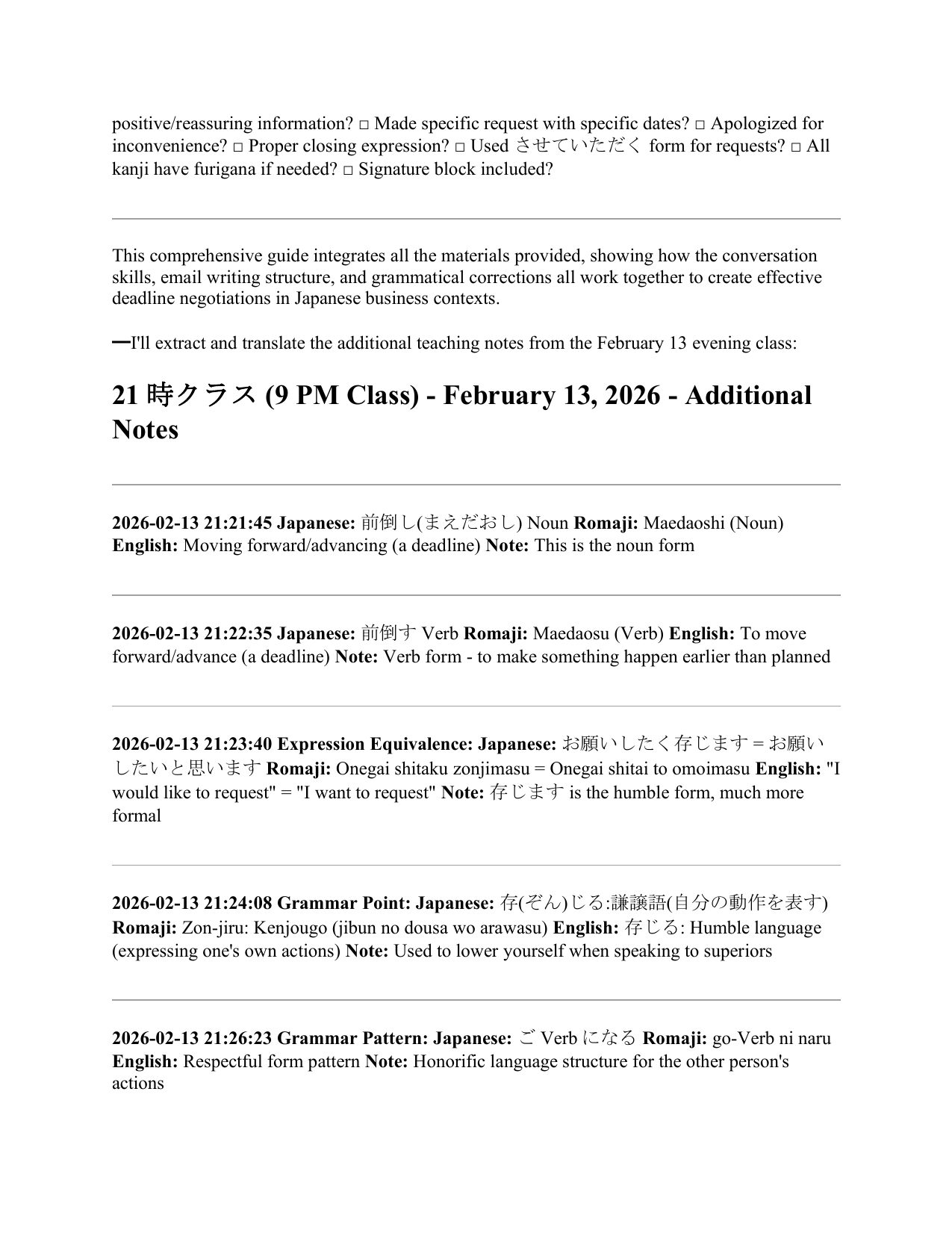
ENpositive/reassuring information? □ Made specific request with specific dates? □ Apologized for
inconvenience? □ Proper closing expression? □ Used させていただく form for requests? □ All
kanji have furigana if needed? □ Signature block included?
This comprehensive guide integrates all the materials provided, showing how the conversation
skills, email writing structure, and grammatical corrections all work together to create effective
deadline negotiations in Japanese business contexts.
━I'll extract and translate the additional teaching notes from the February 13 evening class:
21 時クラス (9 PM Class) - February 13, 2026 - Additional
Notes
2026-02-13 21:21:45 Japanese: 前倒し(まえだおし) Noun Romaji: Maedaoshi (Noun)
English: Moving forward/advancing (a deadline) Note: This is the noun form
2026-02-13 21:22:35 Japanese: 前倒す Verb Romaji: Maedaosu (Verb) English: To move
forward/advance (a deadline) Note: Verb form - to make something happen earlier than planned
2026-02-13 21:23:40 Expression Equivalence: Japanese: お願いしたく存じます = お願い
したいと思います Romaji: Onegai shitaku zonjimasu = Onegai shitai to omoimasu English: "I
would like to request" = "I want to request" Note: 存じます is the humble form, much more
formal
2026-02-13 21:24:08 Grammar Point: Japanese: 存(ぞん)じる:謙譲語(自分の動作を表す)
Romaji: Zon-jiru: Kenjougo (jibun no dousa wo arawasu) English: 存じる: Humble language
(expressing one's own actions) Note: Used to lower yourself when speaking to superiors
2026-02-13 21:26:23 Grammar Pattern: Japanese: ご Verb になる Romaji: go-Verb ni naru
English: Respectful form pattern Note: Honorific language structure for the other person's
actions
inconvenience? □ Proper closing expression? □ Used させていただく form for requests? □ All
kanji have furigana if needed? □ Signature block included?
This comprehensive guide integrates all the materials provided, showing how the conversation
skills, email writing structure, and grammatical corrections all work together to create effective
deadline negotiations in Japanese business contexts.
━I'll extract and translate the additional teaching notes from the February 13 evening class:
21 時クラス (9 PM Class) - February 13, 2026 - Additional
Notes
2026-02-13 21:21:45 Japanese: 前倒し(まえだおし) Noun Romaji: Maedaoshi (Noun)
English: Moving forward/advancing (a deadline) Note: This is the noun form
2026-02-13 21:22:35 Japanese: 前倒す Verb Romaji: Maedaosu (Verb) English: To move
forward/advance (a deadline) Note: Verb form - to make something happen earlier than planned
2026-02-13 21:23:40 Expression Equivalence: Japanese: お願いしたく存じます = お願い
したいと思います Romaji: Onegai shitaku zonjimasu = Onegai shitai to omoimasu English: "I
would like to request" = "I want to request" Note: 存じます is the humble form, much more
formal
2026-02-13 21:24:08 Grammar Point: Japanese: 存(ぞん)じる:謙譲語(自分の動作を表す)
Romaji: Zon-jiru: Kenjougo (jibun no dousa wo arawasu) English: 存じる: Humble language
(expressing one's own actions) Note: Used to lower yourself when speaking to superiors
2026-02-13 21:26:23 Grammar Pattern: Japanese: ご Verb になる Romaji: go-Verb ni naru
English: Respectful form pattern Note: Honorific language structure for the other person's
actions
หน้า 22
คลิกเพื่อขยาย
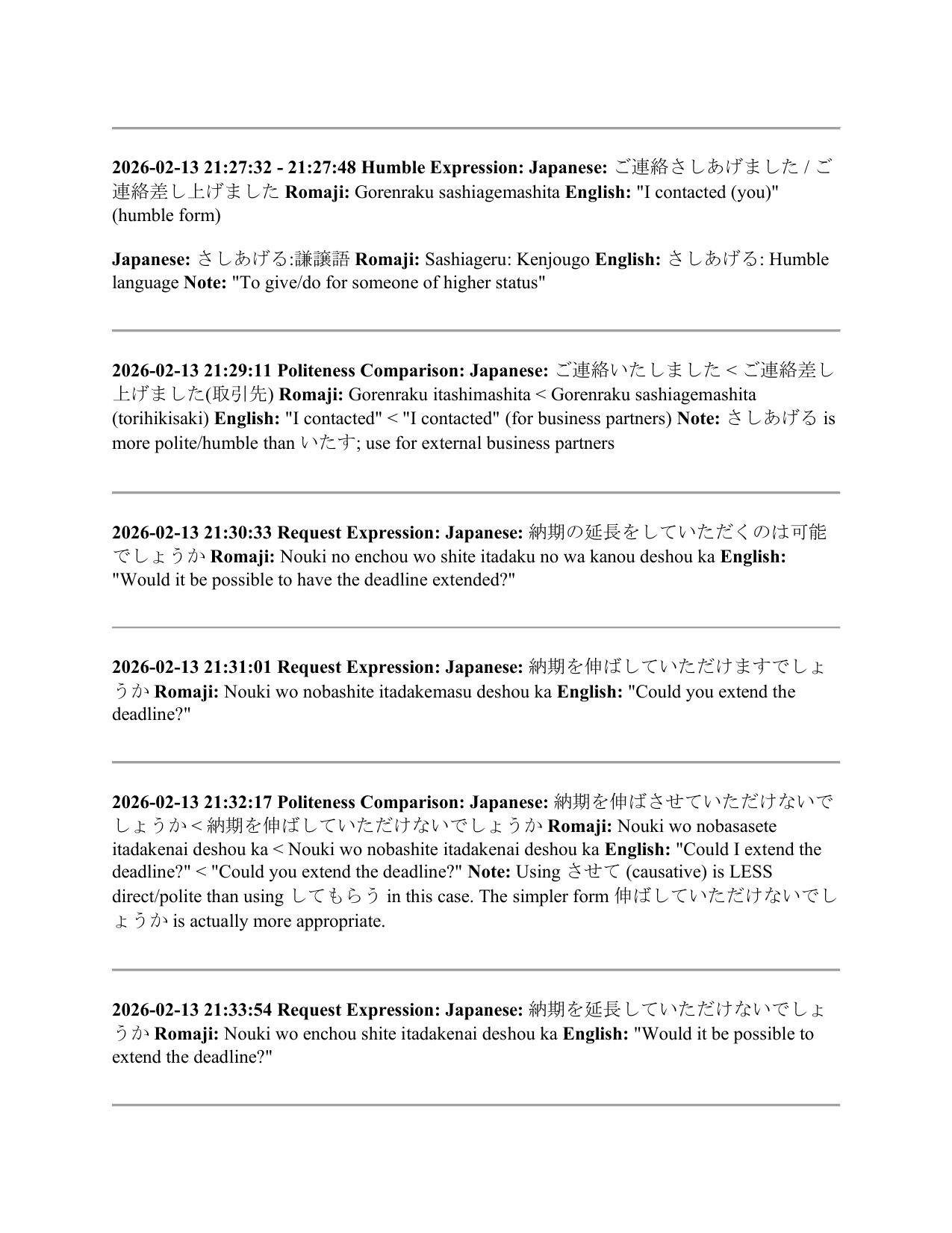
EN2026-02-13 21:27:32 - 21:27:48 Humble Expression: Japanese: ご連絡さしあげました / ご
連絡差し上げました Romaji: Gorenraku sashiagemashita English: "I contacted (you)"
(humble form)
Japanese: さしあげる:謙譲語 Romaji: Sashiageru: Kenjougo English: さしあげる: Humble
language Note: "To give/do for someone of higher status"
2026-02-13 21:29:11 Politeness Comparison: Japanese: ご連絡いたしました < ご連絡差し
上げました(取引先) Romaji: Gorenraku itashimashita < Gorenraku sashiagemashita
(torihikisaki) English: "I contacted" < "I contacted" (for business partners) Note: さしあげる is
more polite/humble than いたす; use for external business partners
2026-02-13 21:30:33 Request Expression: Japanese: 納期の延長をしていただくのは可能
でしょうか Romaji: Nouki no enchou wo shite itadaku no wa kanou deshou ka English:
"Would it be possible to have the deadline extended?"
2026-02-13 21:31:01 Request Expression: Japanese: 納期を伸ばしていただけますでしょ
うか Romaji: Nouki wo nobashite itadakemasu deshou ka English: "Could you extend the
deadline?"
2026-02-13 21:32:17 Politeness Comparison: Japanese: 納期を伸ばさせていただけないで
しょうか < 納期を伸ばしていただけないでしょうか Romaji: Nouki wo nobasasete
itadakenai deshou ka < Nouki wo nobashite itadakenai deshou ka English: "Could I extend the
deadline?" < "Could you extend the deadline?" Note: Using させて (causative) is LESS
direct/polite than using してもらう in this case. The simpler form 伸ばしていただけないでし
ょうか is actually more appropriate.
2026-02-13 21:33:54 Request Expression: Japanese: 納期を延長していただけないでしょ
うか Romaji: Nouki wo enchou shite itadakenai deshou ka English: "Would it be possible to
extend the deadline?"
連絡差し上げました Romaji: Gorenraku sashiagemashita English: "I contacted (you)"
(humble form)
Japanese: さしあげる:謙譲語 Romaji: Sashiageru: Kenjougo English: さしあげる: Humble
language Note: "To give/do for someone of higher status"
2026-02-13 21:29:11 Politeness Comparison: Japanese: ご連絡いたしました < ご連絡差し
上げました(取引先) Romaji: Gorenraku itashimashita < Gorenraku sashiagemashita
(torihikisaki) English: "I contacted" < "I contacted" (for business partners) Note: さしあげる is
more polite/humble than いたす; use for external business partners
2026-02-13 21:30:33 Request Expression: Japanese: 納期の延長をしていただくのは可能
でしょうか Romaji: Nouki no enchou wo shite itadaku no wa kanou deshou ka English:
"Would it be possible to have the deadline extended?"
2026-02-13 21:31:01 Request Expression: Japanese: 納期を伸ばしていただけますでしょ
うか Romaji: Nouki wo nobashite itadakemasu deshou ka English: "Could you extend the
deadline?"
2026-02-13 21:32:17 Politeness Comparison: Japanese: 納期を伸ばさせていただけないで
しょうか < 納期を伸ばしていただけないでしょうか Romaji: Nouki wo nobasasete
itadakenai deshou ka < Nouki wo nobashite itadakenai deshou ka English: "Could I extend the
deadline?" < "Could you extend the deadline?" Note: Using させて (causative) is LESS
direct/polite than using してもらう in this case. The simpler form 伸ばしていただけないでし
ょうか is actually more appropriate.
2026-02-13 21:33:54 Request Expression: Japanese: 納期を延長していただけないでしょ
うか Romaji: Nouki wo enchou shite itadakenai deshou ka English: "Would it be possible to
extend the deadline?"
หน้า 23
คลิกเพื่อขยาย
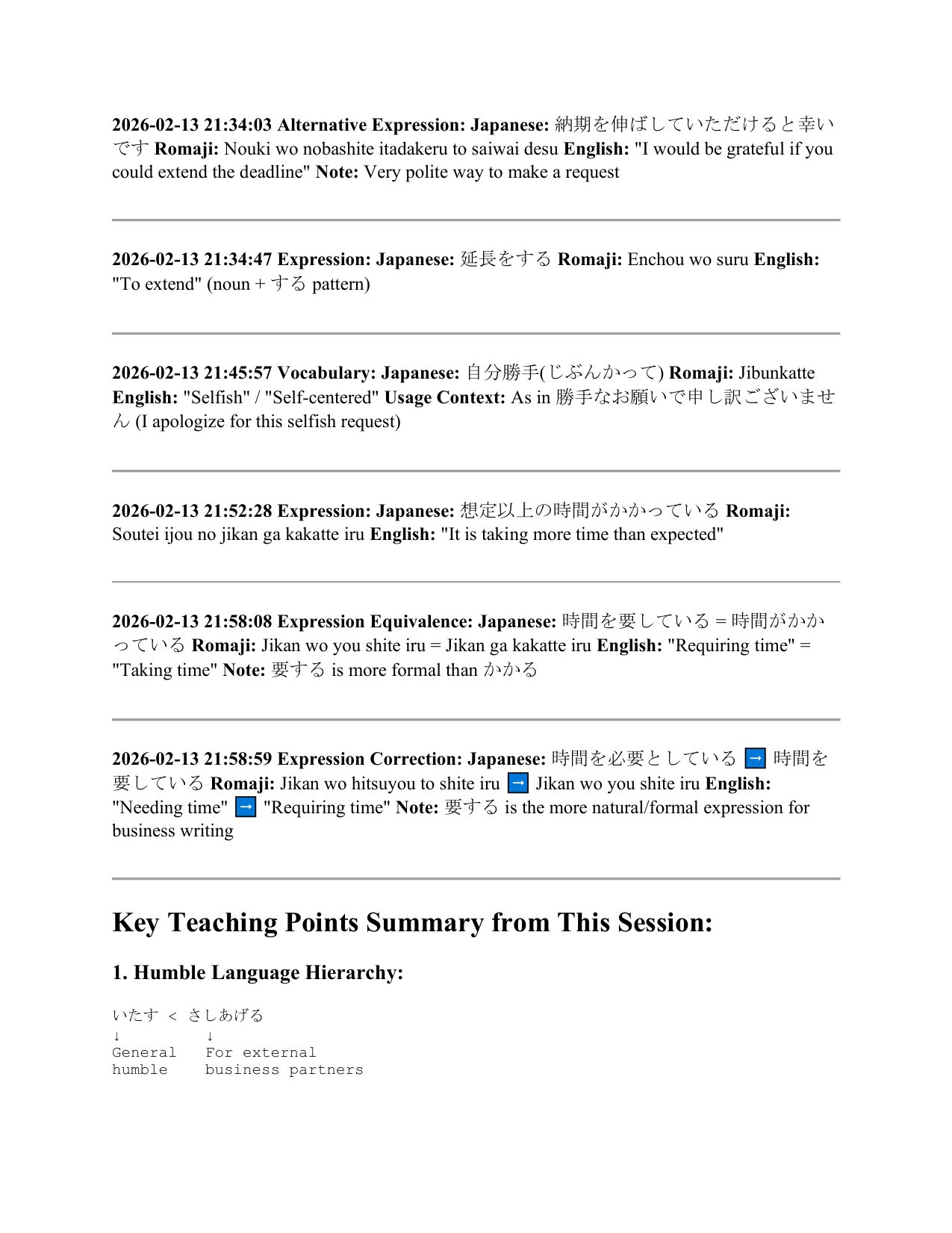
EN2026-02-13 21:34:03 Alternative Expression: Japanese: 納期を伸ばしていただけると幸い
です Romaji: Nouki wo nobashite itadakeru to saiwai desu English: "I would be grateful if you
could extend the deadline" Note: Very polite way to make a request
2026-02-13 21:34:47 Expression: Japanese: 延長をする Romaji: Enchou wo suru English:
"To extend" (noun + する pattern)
2026-02-13 21:45:57 Vocabulary: Japanese: 自分勝手(じぶんかって) Romaji: Jibunkatte
English: "Selfish" / "Self-centered" Usage Context: As in 勝手なお願いで申し訳ございませ
ん (I apologize for this selfish request)
2026-02-13 21:52:28 Expression: Japanese: 想定以上の時間がかかっている Romaji:
Soutei ijou no jikan ga kakatte iru English: "It is taking more time than expected"
2026-02-13 21:58:08 Expression Equivalence: Japanese: 時間を要している = 時間がかか
っている Romaji: Jikan wo you shite iru = Jikan ga kakatte iru English: "Requiring time" =
"Taking time" Note: 要する is more formal than かかる
2026-02-13 21:58:59 Expression Correction: Japanese: 時間を必要としている 時間を
要している Romaji: Jikan wo hitsuyou to shite iru Jikan wo you shite iru English:
"Needing time" "Requiring time" Note: 要する is the more natural/formal expression for
business writing
Key Teaching Points Summary from This Session:
1. Humble Language Hierarchy:
です Romaji: Nouki wo nobashite itadakeru to saiwai desu English: "I would be grateful if you
could extend the deadline" Note: Very polite way to make a request
2026-02-13 21:34:47 Expression: Japanese: 延長をする Romaji: Enchou wo suru English:
"To extend" (noun + する pattern)
2026-02-13 21:45:57 Vocabulary: Japanese: 自分勝手(じぶんかって) Romaji: Jibunkatte
English: "Selfish" / "Self-centered" Usage Context: As in 勝手なお願いで申し訳ございませ
ん (I apologize for this selfish request)
2026-02-13 21:52:28 Expression: Japanese: 想定以上の時間がかかっている Romaji:
Soutei ijou no jikan ga kakatte iru English: "It is taking more time than expected"
2026-02-13 21:58:08 Expression Equivalence: Japanese: 時間を要している = 時間がかか
っている Romaji: Jikan wo you shite iru = Jikan ga kakatte iru English: "Requiring time" =
"Taking time" Note: 要する is more formal than かかる
2026-02-13 21:58:59 Expression Correction: Japanese: 時間を必要としている 時間を
要している Romaji: Jikan wo hitsuyou to shite iru Jikan wo you shite iru English:
"Needing time" "Requiring time" Note: 要する is the more natural/formal expression for
business writing
Key Teaching Points Summary from This Session:
1. Humble Language Hierarchy:
JPいたす<さしあげる
↓↓
↓↓
ENGeneral For external
humble business partners
humble business partners
หน้า 24
คลิกเพื่อขยาย
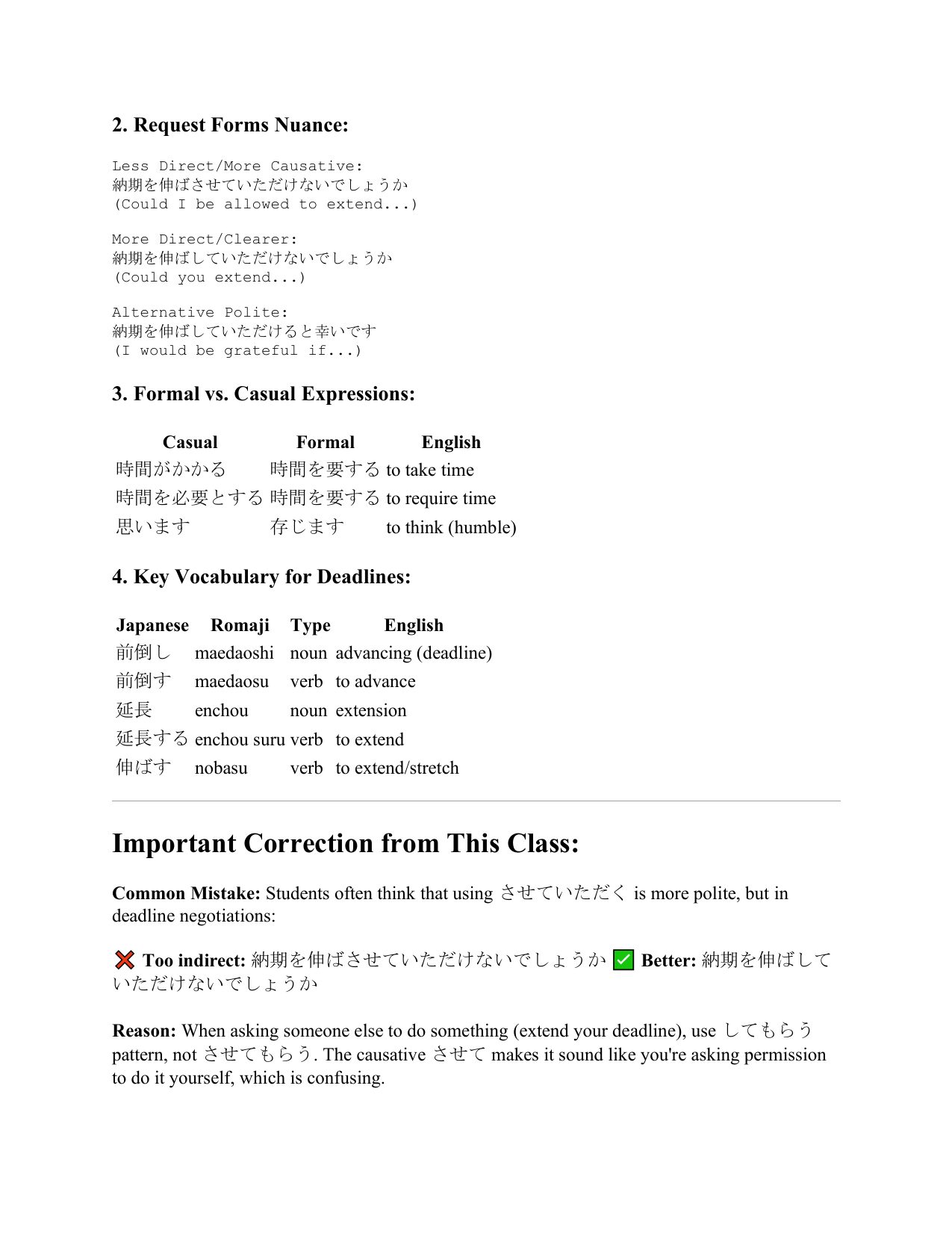
EN2. Request Forms Nuance:
Less Direct/More Causative:
Less Direct/More Causative:
JP納期を伸ばさせていただけないでしょうか
EN(Could I be allowed to extend...)
More Direct/Clearer:
More Direct/Clearer:
JP納期を伸ばしていただけないでしょうか
EN(Could you extend...)
Alternative Polite:
Alternative Polite:
JP納期を伸ばしていただけると幸いです
EN(I would be grateful if...)
3. Formal vs. Casual Expressions:
Casual Formal English
3. Formal vs. Casual Expressions:
Casual Formal English
JP時間がかかる時間を要するtotaketime
時間を必要とする時間を要するtorequiretime
時間を必要とする時間を要するtorequiretime
EN思います 存じます to think (humble)
4. Key Vocabulary for Deadlines:
Japanese Romaji Type English
前倒し maedaoshi noun advancing (deadline)
前倒す maedaosu verb to advance
延長 enchou noun extension
延長する enchou suru verb to extend
伸ばす nobasu verb to extend/stretch
Important Correction from This Class:
Common Mistake: Students often think that using させていただく is more polite, but in
deadline negotiations:
4. Key Vocabulary for Deadlines:
Japanese Romaji Type English
前倒し maedaoshi noun advancing (deadline)
前倒す maedaosu verb to advance
延長 enchou noun extension
延長する enchou suru verb to extend
伸ばす nobasu verb to extend/stretch
Important Correction from This Class:
Common Mistake: Students often think that using させていただく is more polite, but in
deadline negotiations:
JPTooindirect:納期を伸ばさせていただけないでしょうかBetter:納期を伸ばして
いただけないでしょうか
いただけないでしょうか
ENReason: When asking someone else to do something (extend your deadline), use してもらう
pattern, not させてもらう. The causative させて makes it sound like you're asking permission
to do it yourself, which is confusing.
pattern, not させてもらう. The causative させて makes it sound like you're asking permission
to do it yourself, which is confusing.
หน้า 25

คลิกเพื่อขยาย
ENThis session emphasized the subtle differences in politeness levels and the proper use of humble
vs. respectful language in business negotiations.
━━━━━━━━━━━
vs. respectful language in business negotiations.
━━━━━━━━━━━