หน้า 1

คลิกเพื่อขยาย
9-2
JPめんせつみりょくてきじこしょうかい
面接で魅力的な自己紹介をしよう
面接で魅力的な自己紹介をしよう
EN Make a compelling self-introduction in the interview
How to Speak So You Get Chosen in a Job Interview
How to Speak So You Get Chosen in a Job Interview
หน้า 2
คลิกเพื่อขยาย
EN Lesson Agenda
JPじこしょうかいはなないよう
自己紹介で話す内容
自己紹介で話す内容
ENSelf-Introduction Topics
JPじこしょうかいにほんご
自己紹介の日本語
自己紹介の日本語
ENJapanese for Self-Introduction
JPめんせつじこしょうかいれい
面接での自己紹介の例
面接での自己紹介の例
ENExamples of Self-Introduction for Interviews
หน้า 3

คลิกเพื่อขยาย
EN Lesson GOAL
JPじぶんみりょくぷんつた
自分の魅力が1分で伝わる
じこしょうかいつく
自己紹介を作ろう
自分の魅力が1分で伝わる
じこしょうかいつく
自己紹介を作ろう
ENCrafting a Self-Introduction
That Captures Your Charm in One Minute
That Captures Your Charm in One Minute
หน้า 4
คลิกเพื่อขยาย
ENAGENDA 1
JPめんせつじこしょうかいはなないよう
面接の自己紹介で話す内容
面接の自己紹介で話す内容
ENWhat to say when introducing yourself for an interview
หน้า 5
คลิกเพื่อขยาย
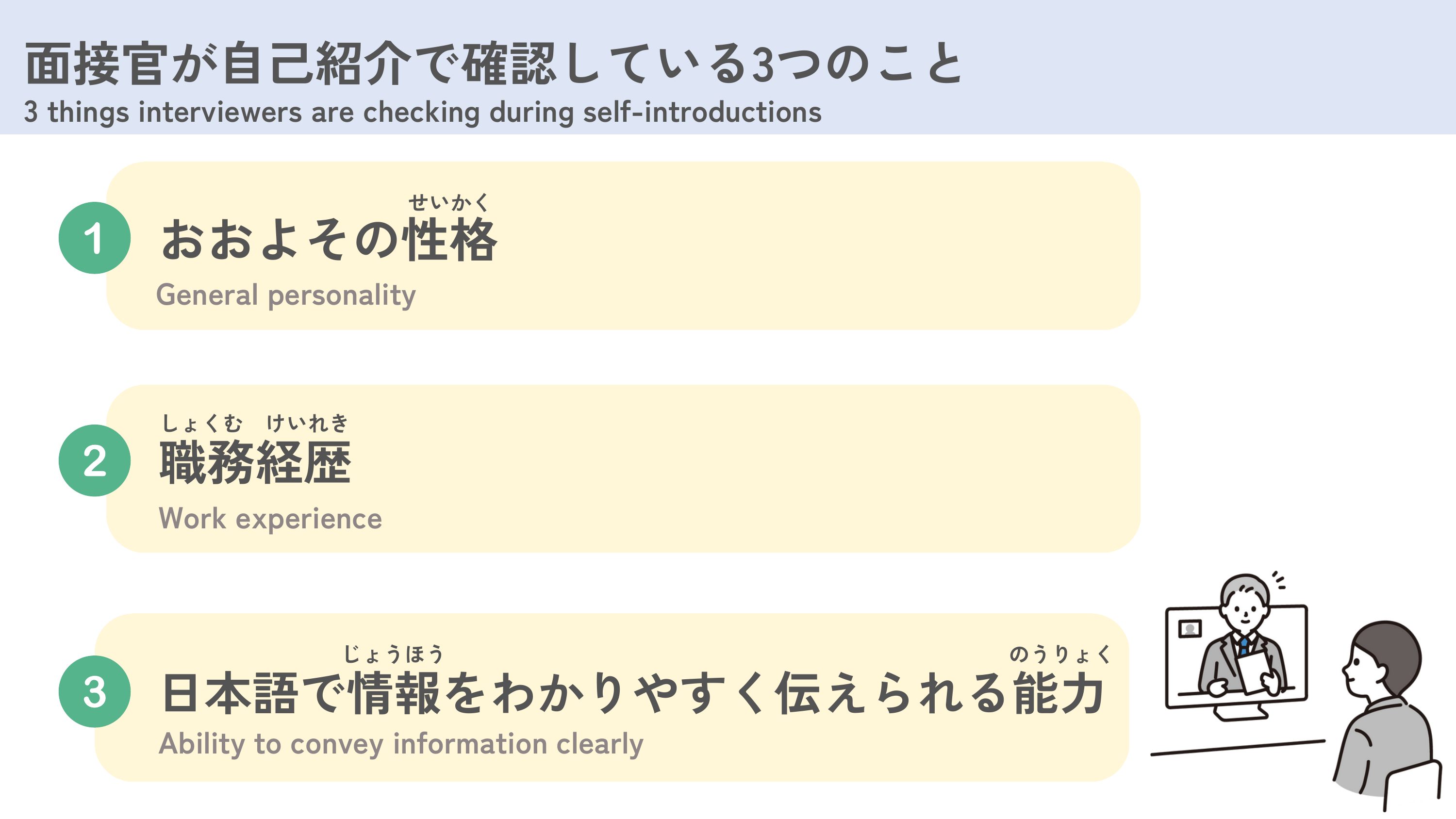
JP面接官が自己紹介で確認している3つのこと
EN3 things interviewers are checking during self-introductions
JPせいかく
おおよその性格
おおよその性格
EN General personality
JPしょくむけいれき
職務経歴
職務経歴
EN Work experience
JPじょうほうのうりょく
日本語で情報をわかりやすく伝えられる能力
日本語で情報をわかりやすく伝えられる能力
EN Ability to convey information clearly
หน้า 6
คลิกเพื่อขยาย
JPせいかく
おおよその性格
おおよその性格
EN General personality
JPひょうじょうこえきゅうしょくしゃひとがらみ
表情や声のトーンなどで求職者のおおよその人柄を見ている
表情や声のトーンなどで求職者のおおよその人柄を見ている
EN A candidate's general personality can be assessed through their expressions and tone of voice
JPだいいちいんしょうよ
第一印象を良くするために:
第一印象を良くするために:
EN To make a good first impression
JPあかこええがおはなれんしゅう
明るい声と笑顔で話す練習をする
明るい声と笑顔で話す練習をする
ENPractice speaking with a bright voice and a smile
JPはなろくが
スマートフォンで話しているところを録画する
スマートフォンで話しているところを録画する
ENRecord yourself speaking on your smartphone
หน้า 7
คลิกเพื่อขยาย
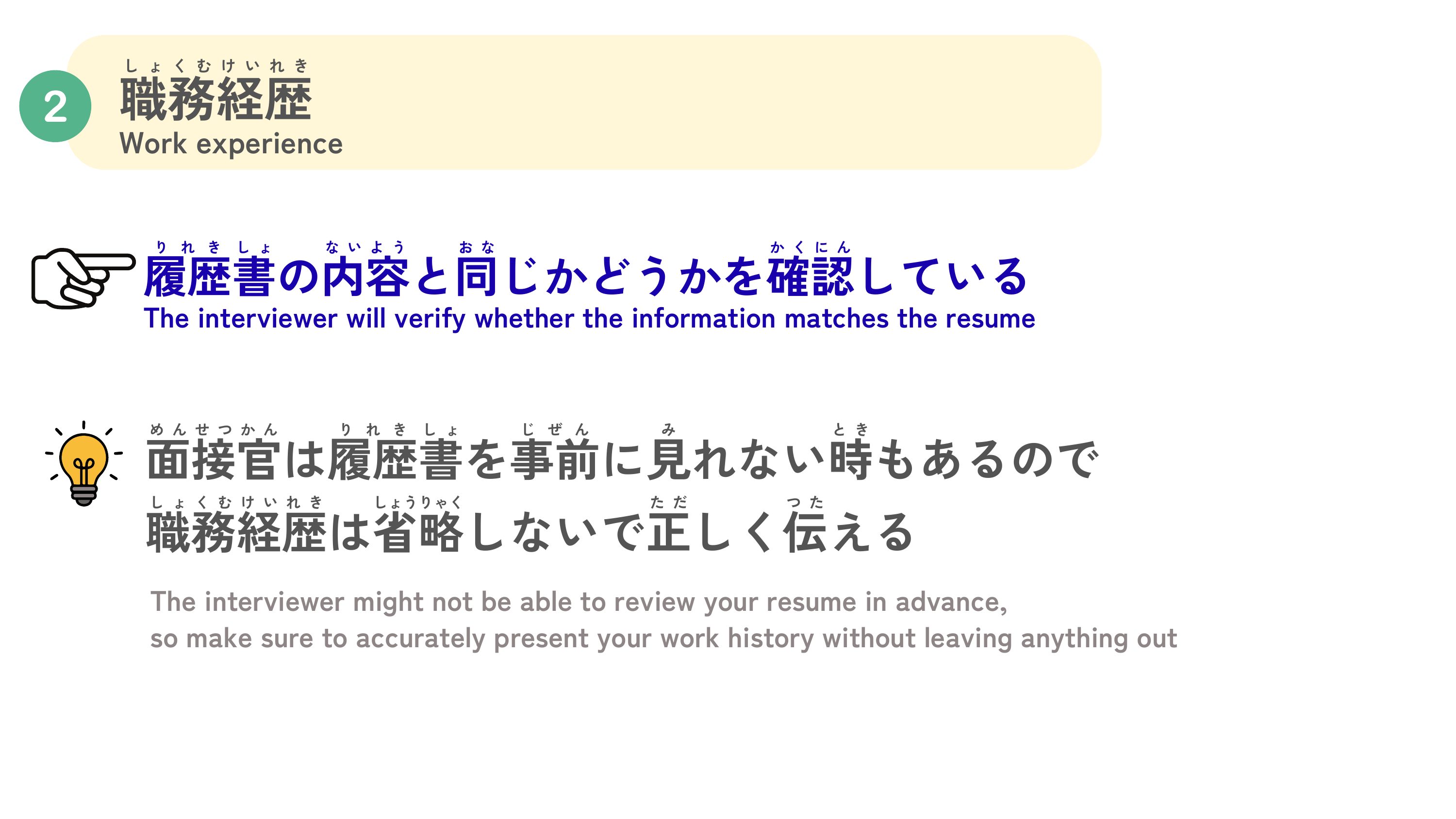
JPしょくむけいれき
職務経歴
職務経歴
ENWork experience
JPりれきしょないようおなかくにん
履歴書の内容と同じかどうかを確認している
履歴書の内容と同じかどうかを確認している
EN The interviewer will verify whether the information matches the resume
JPめんせつかんりれきしょじぜんみとき
面接官は履歴書を事前に見れない時もあるので
しょくむけいれきしょうりゃくただつた
職務経歴は省略しないで正しく伝える
面接官は履歴書を事前に見れない時もあるので
しょくむけいれきしょうりゃくただつた
職務経歴は省略しないで正しく伝える
EN The interviewer might not be able to review your resume in advance,
so make sure to accurately present your work history without leaving anything out
so make sure to accurately present your work history without leaving anything out
หน้า 8
คลิกเพื่อขยาย
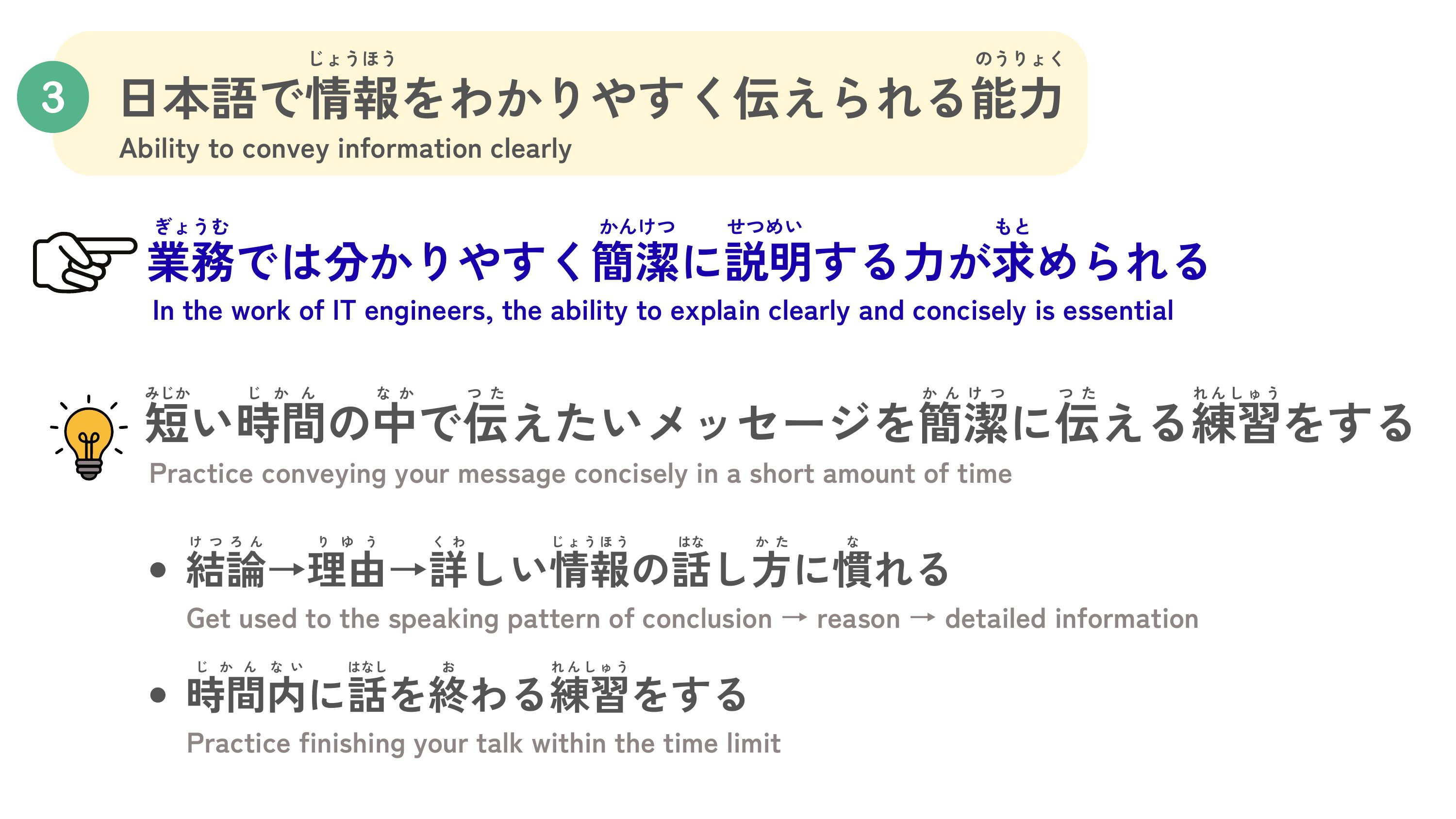
JPじょうほうのうりょく
日本語で情報をわかりやすく伝えられる能力
日本語で情報をわかりやすく伝えられる能力
ENAbility to convey information clearly
JPぎょうむかんけつせつめいもと
業務では分かりやすく簡潔に説明する力が求められる
業務では分かりやすく簡潔に説明する力が求められる
EN In the work of IT engineers, the ability to explain clearly and concisely is essential
JPみじかじかんなかつたかんけつつたれんしゅう
短い時間の中で伝えたいメッセージを簡潔に伝える練習をする
短い時間の中で伝えたいメッセージを簡潔に伝える練習をする
EN Practice conveying your message concisely in a short amount of time
JPけつろんりゆうくわじょうほうはなかたな
結論→理由→詳しい情報の話し方に慣れる
結論→理由→詳しい情報の話し方に慣れる
EN Get used to the speaking pattern of conclusion → reason → detailed information
JPじかんないはなしおれんしゅう
時間内に話を終わる練習をする
時間内に話を終わる練習をする
EN Practice finishing your talk within the time limit
หน้า 9
คลิกเพื่อขยาย
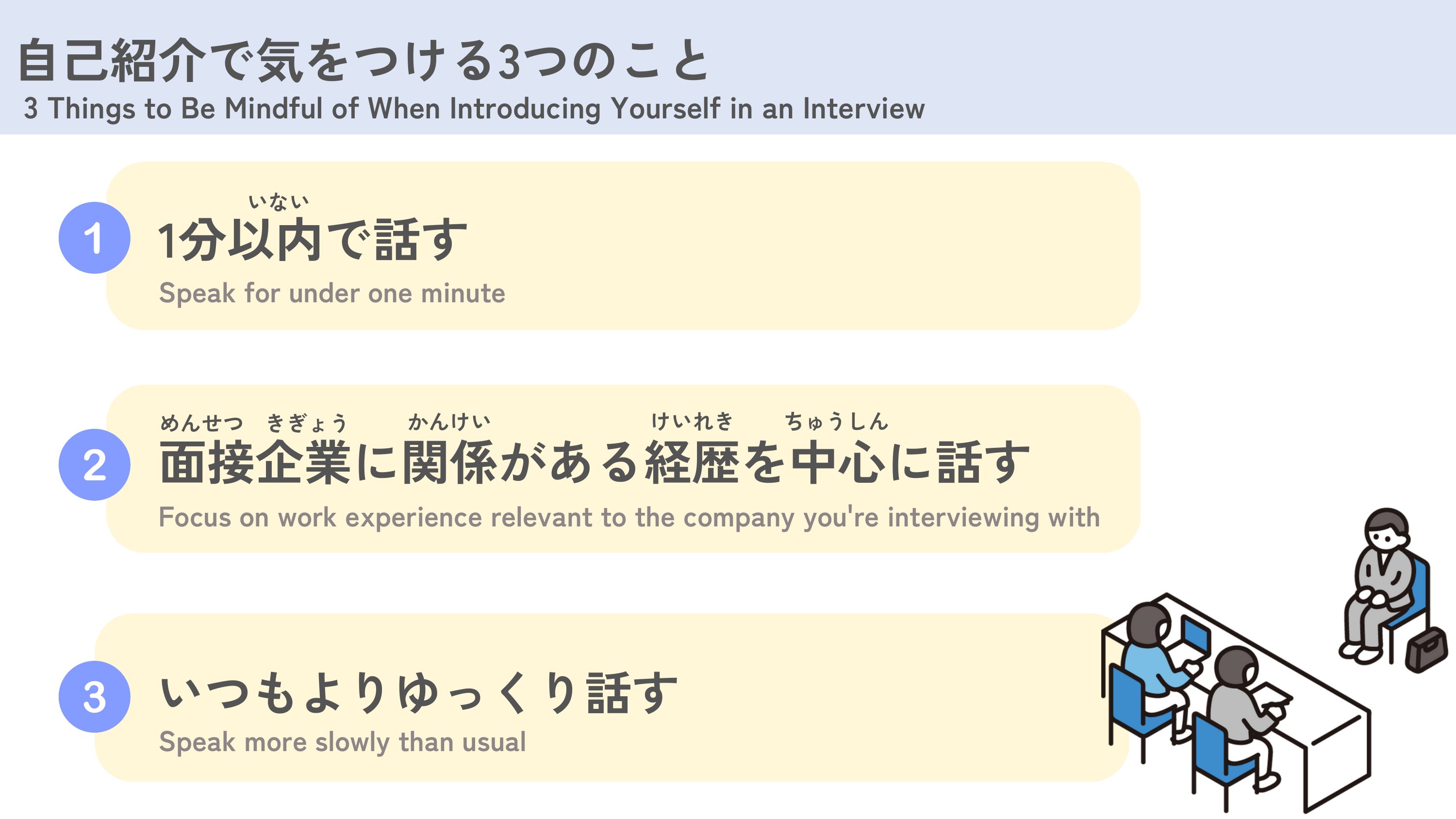
JP自己紹介で気をつける3つのこと
EN3 Things to Be Mindful of When Introducing Yourself in an Interview
JPいない
1分以内で話す
1分以内で話す
EN Speak for under one minute
JPめんせつきぎょうかんけいけいれきちゅうしん
面接企業に関係がある経歴を中心に話す
面接企業に関係がある経歴を中心に話す
EN Focus on work experience relevant to the company you're interviewing with
JPいつもよりゆっくり話す
EN Speak more slowly than usual
หน้า 10

คลิกเพื่อขยาย
ENAGENDA 2
JPじこしょうかいにほんご
自己紹介の日本語
自己紹介の日本語
ENJapanese for Self-Introduction
หน้า 11
คลิกเพื่อขยาย
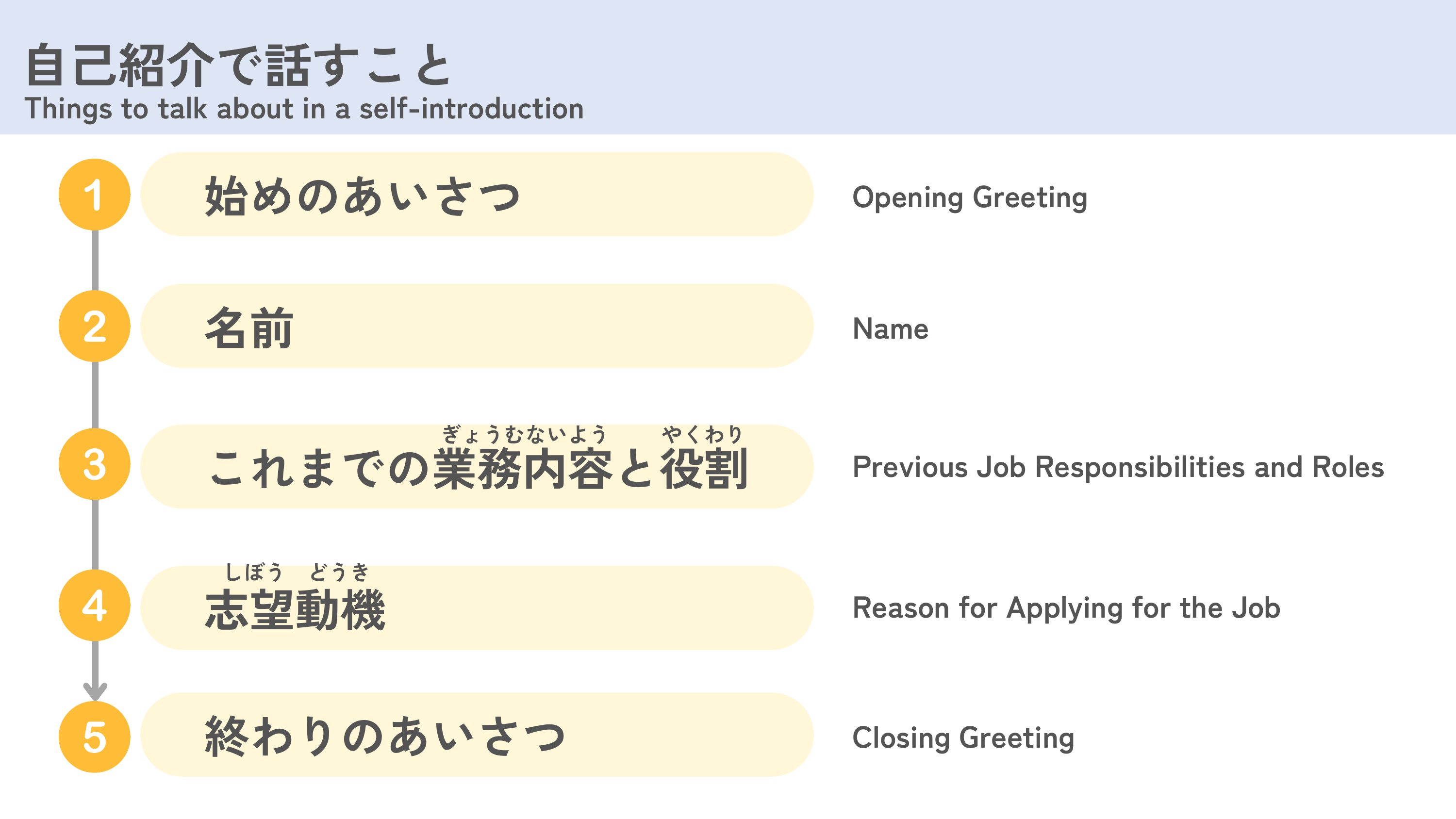
JP自己紹介で話すこと
ENThings to talk about in a self-introduction
始めのあいさつ Opening Greeting
名前 Name
始めのあいさつ Opening Greeting
名前 Name
JPぎょうむないようやくわり
EN これまでの業務内容と役割 Previous Job Responsibilities and Roles
JPしぼうどうき
EN 志望動機 Reason for Applying for the Job
終わりのあいさつ Closing Greeting
終わりのあいさつ Closing Greeting
หน้า 12
คลิกเพื่อขยาย
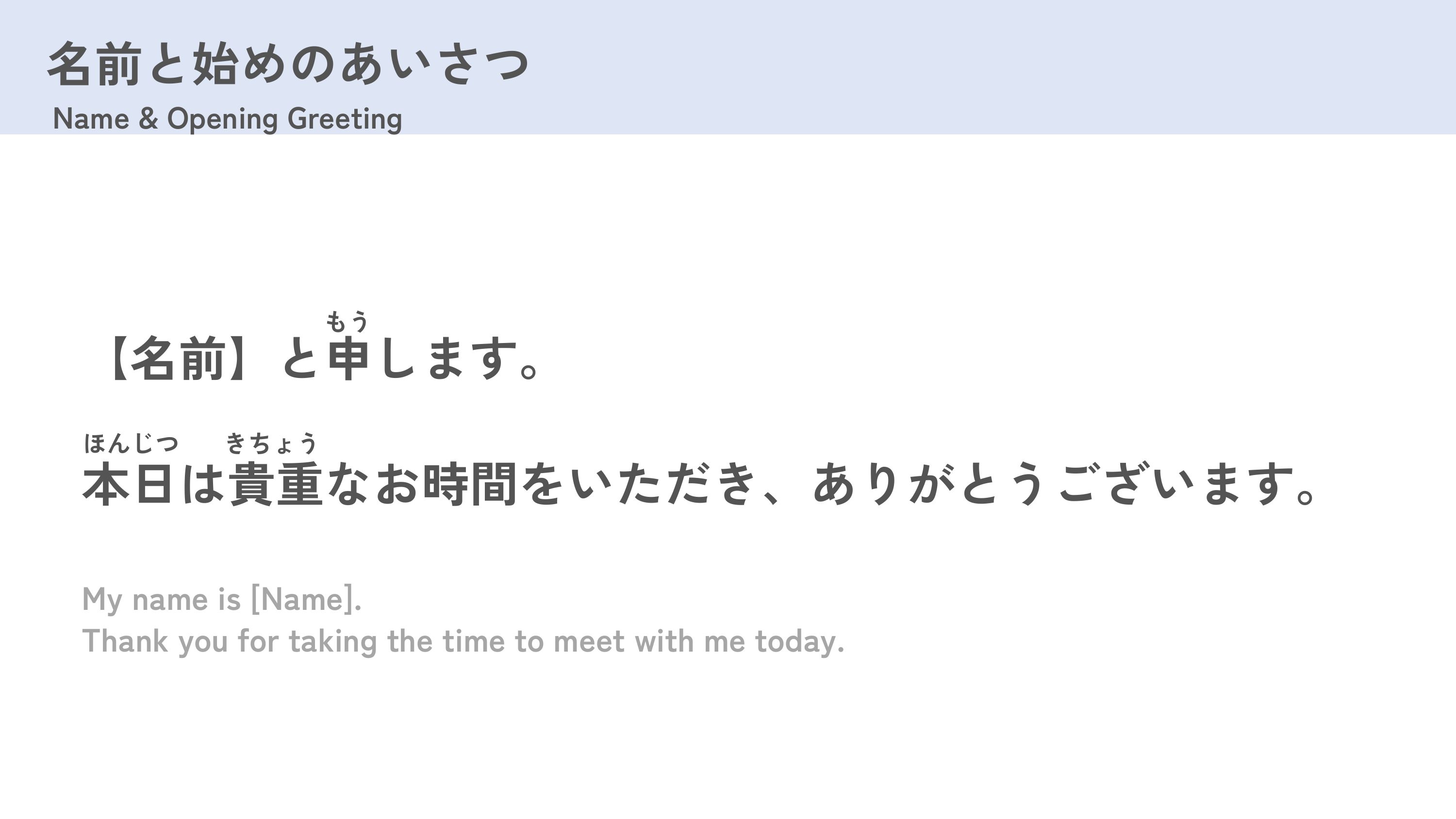
JP名前と始めのあいさつ
ENName & Opening Greeting
JPもう
【名前】と申します。
ほんじつきちょう
本日は貴重なお時間をいただき、ありがとうございます。
【名前】と申します。
ほんじつきちょう
本日は貴重なお時間をいただき、ありがとうございます。
EN My name is [Name].
Thank you for taking the time to meet with me today.
Thank you for taking the time to meet with me today.
หน้า 13
คลิกเพื่อขยาย
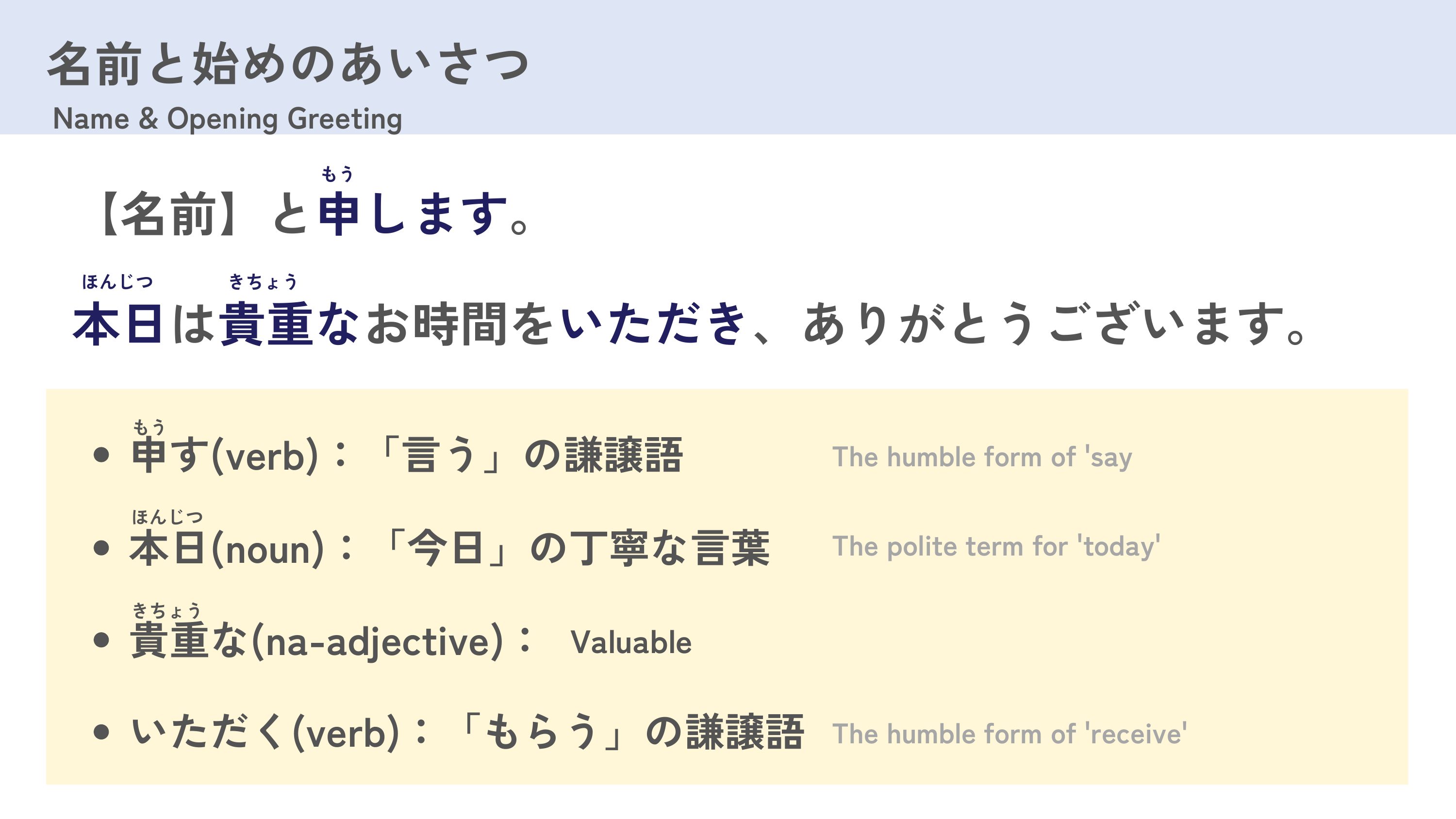
JP名前と始めのあいさつ
ENName & Opening Greeting
JPもう
【名前】と申します。
ほんじつきちょう
本日は貴重なお時間をいただき、ありがとうございます。
もう
【名前】と申します。
ほんじつきちょう
本日は貴重なお時間をいただき、ありがとうございます。
もう
EN 申す(verb):「言う」の謙譲語 The humble form of 'say
JPほんじつ
EN 本日(noun):「今日」の丁寧な言葉 The polite term for 'today'
JPきちょう
EN 貴重な(na-adjective): Valuable
いただく(verb):「もらう」の謙譲語 The humble form of 'receive'
いただく(verb):「もらう」の謙譲語 The humble form of 'receive'
หน้า 14
คลิกเพื่อขยาย
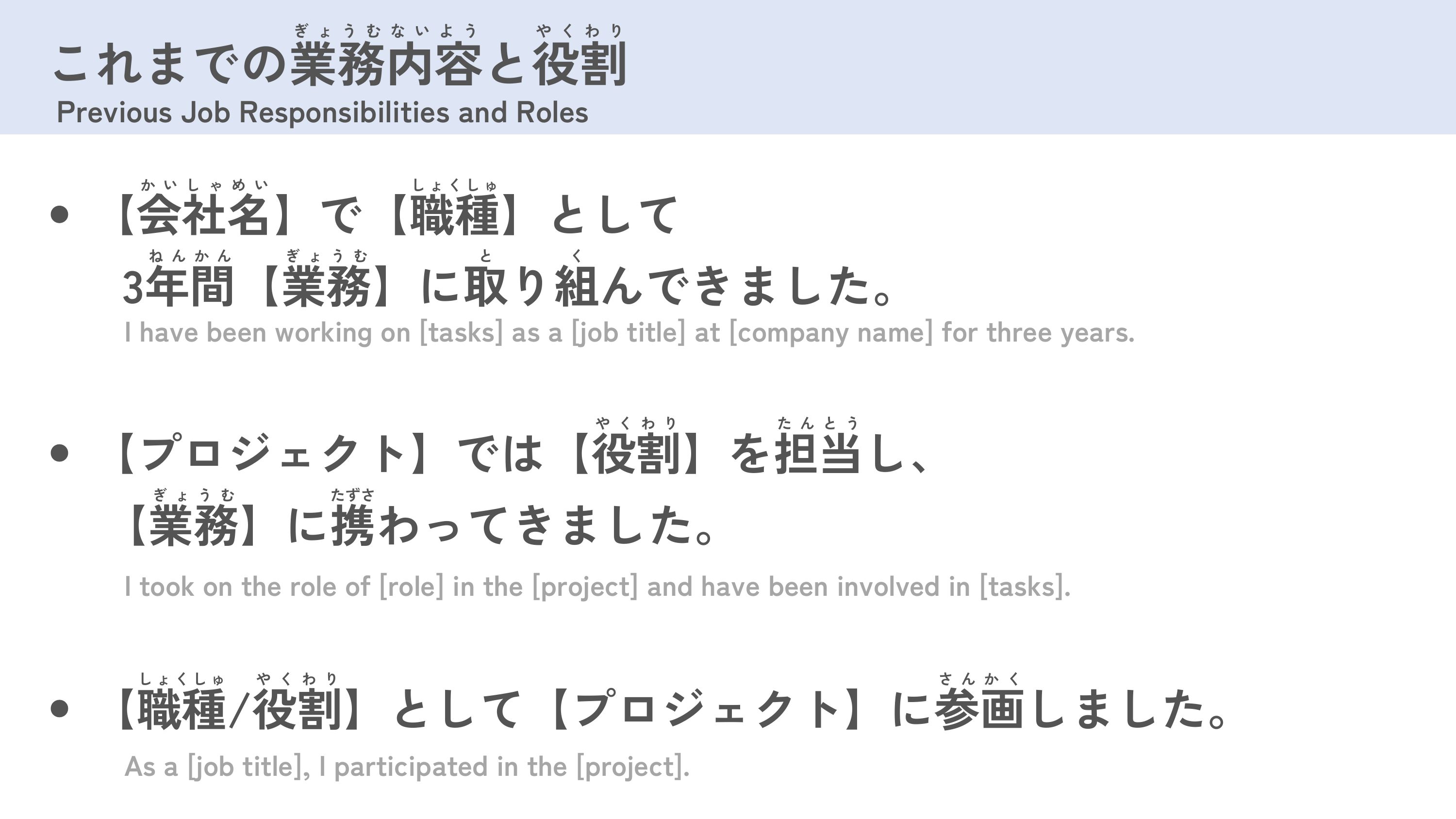
JPぎょうむないようやくわり
これまでの業務内容と役割
これまでの業務内容と役割
ENPrevious Job Responsibilities and Roles
JPかいしゃめいしょくしゅ
【会社名】で【職種】として
ねんかんぎょうむとく
3年間【業務】に取り組んできました。
【会社名】で【職種】として
ねんかんぎょうむとく
3年間【業務】に取り組んできました。
EN I have been working on [tasks] as a [job title] at [company name] for three years.
JPやくわりたんとう
【プロジェクト】では【役割】を担当し、
ぎょうむたずさ
【業務】に携わってきました。
【プロジェクト】では【役割】を担当し、
ぎょうむたずさ
【業務】に携わってきました。
EN I took on the role of [role] in the [project] and have been involved in [tasks].
JPしょくしゅやくわりさんかく
【職種/役割】として【プロジェクト】に参画しました。
【職種/役割】として【プロジェクト】に参画しました。
EN As a [job title], I participated in the [project].
หน้า 15
คลิกเพื่อขยาย
JPぎょうむないようやくわり
これまでの業務内容と役割
これまでの業務内容と役割
ENPrevious Job Responsibilities and Roles
JPかいしゃめいしょくしゅ
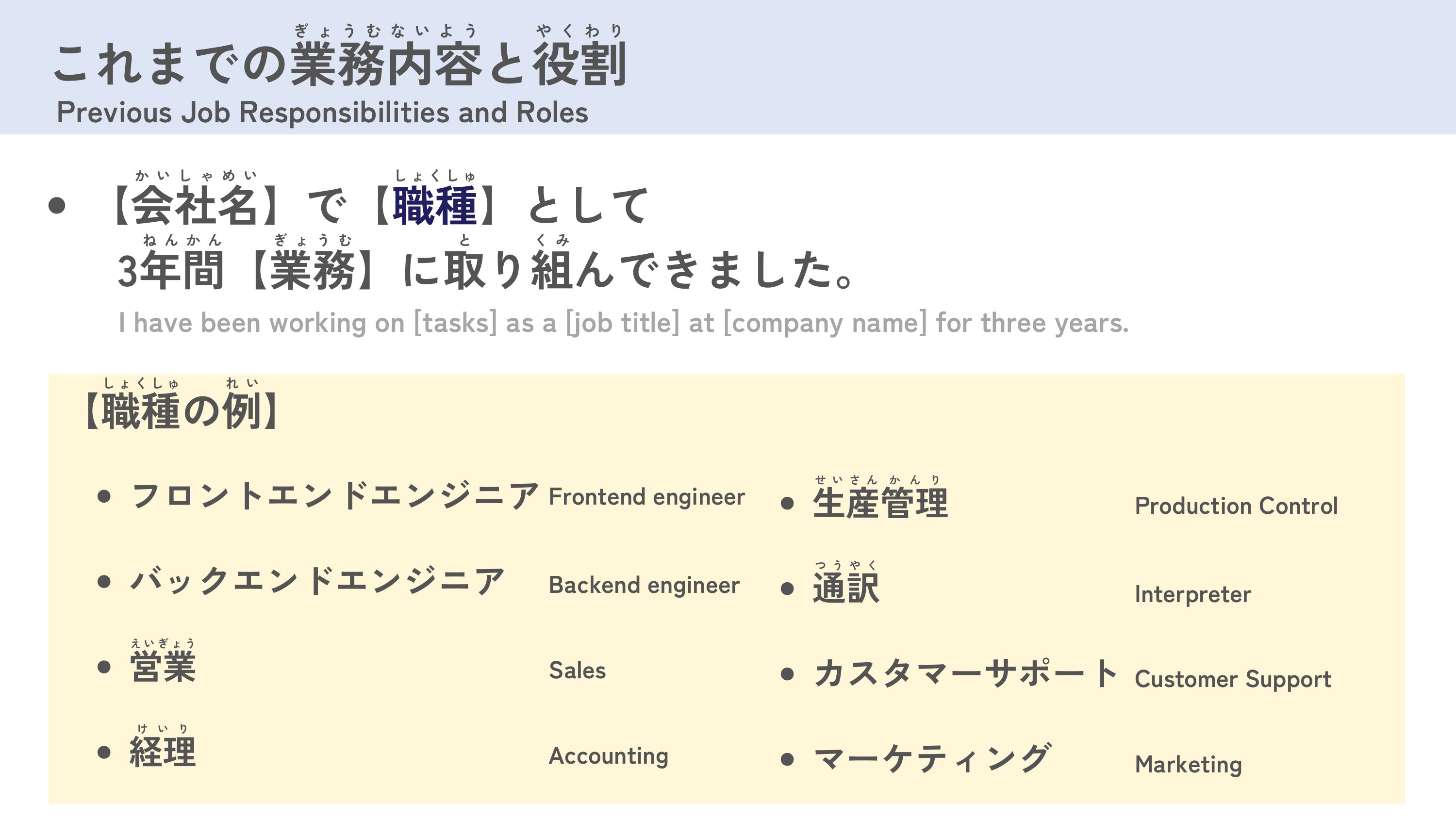
【会社名】で【職種】として
ねんかんぎょうむとくみ
3年間【業務】に取り組んできました。
【会社名】で【職種】として
ねんかんぎょうむとくみ
3年間【業務】に取り組んできました。
EN I have been working on [tasks] as a [job title] at [company name] for three years.
JPしょくしゅれい
【職種の例】
【職種の例】
EN フロントエンドエンジニア Frontend engineer
JPせいさんかんり
EN 生産管理 Production Control
JPバックエンドエンジニア
つうやく
つうやく
EN Backend engineer 通訳 Interpreter
JPえいぎょう
EN 営業 Sales カスタマーサポート Customer Support
JPけいり
EN 経理 Accounting マーケティング Marketing
หน้า 16
คลิกเพื่อขยาย
JPぎょうむないようやくわり
これまでの業務内容と役割
これまでの業務内容と役割
ENPrevious Job Responsibilities and Roles
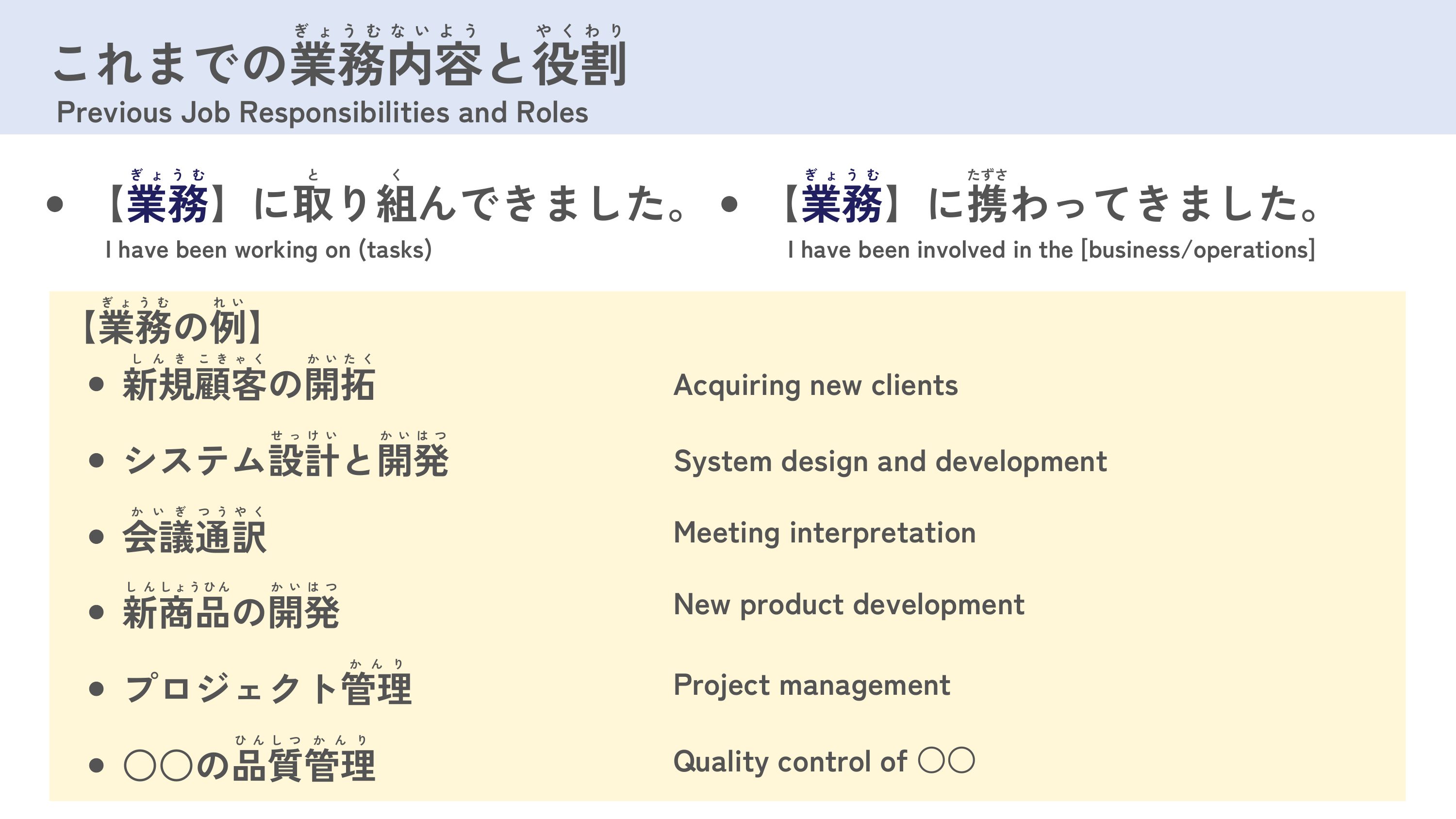
JPぎょうむとくぎょうむたずさ
【業務】に取り組んできました。【業務】に携わってきました。
【業務】に取り組んできました。【業務】に携わってきました。
EN I have been working on (tasks) I have been involved in the [business/operations]
JPぎょうむれい
【業務の例】
しんきこきゃくかいたく
【業務の例】
しんきこきゃくかいたく
EN 新規顧客の開拓 Acquiring new clients
JPせっけいかいはつ
EN システム設計と開発 System design and development
JPかいぎつうやく
EN 会議通訳 Meeting interpretation
JPしんしょうひんかいはつ
EN 新商品の開発 New product development
JPかんり
EN プロジェクト管理 Project management
JPひんしつかんり
EN ○○の品質管理 Quality control of ○○
หน้า 17
คลิกเพื่อขยาย
JPぎょうむないようやくわり
これまでの業務内容と役割
これまでの業務内容と役割
ENPrevious Job Responsibilities and Roles
JPやくわりたんとうぎょうむたずさ
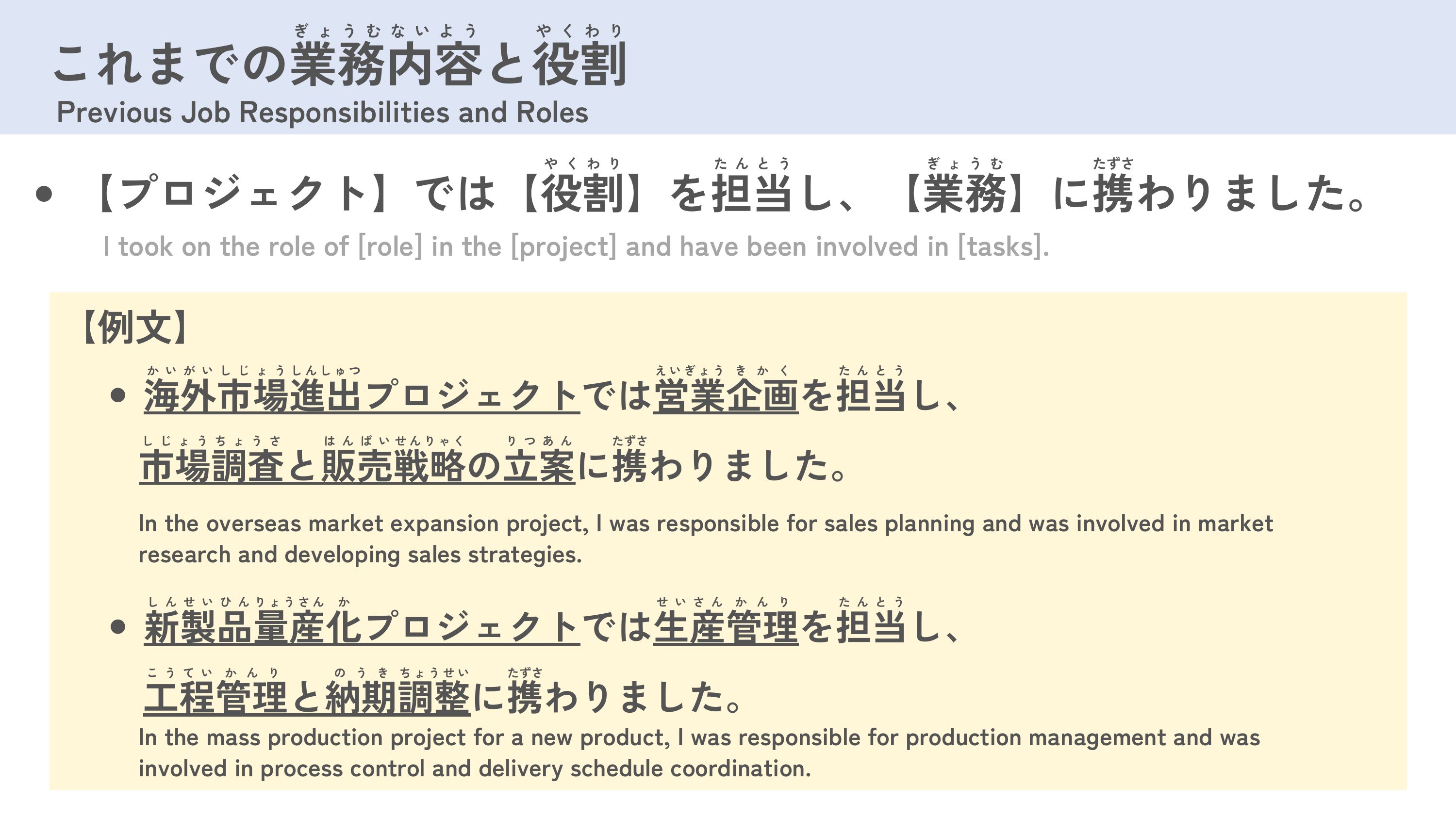
【プロジェクト】では【役割】を担当し、【業務】に携わりました。
【プロジェクト】では【役割】を担当し、【業務】に携わりました。
EN I took on the role of [role] in the [project] and have been involved in [tasks].
JP【例文】
かいがいしじょうしんしゅつえいぎょうきかくたんとう
海外市場進出プロジェクトでは営業企画を担当し、
しじょうちょうさはんばいせんりゃくりつあんたずさ
市場調査と販売戦略の立案に携わりました。
かいがいしじょうしんしゅつえいぎょうきかくたんとう
海外市場進出プロジェクトでは営業企画を担当し、
しじょうちょうさはんばいせんりゃくりつあんたずさ
市場調査と販売戦略の立案に携わりました。
EN In the overseas market expansion project, I was responsible for sales planning and was involved in market
research and developing sales strategies.
research and developing sales strategies.
JPしんせいひんりょうさんかせいさんかんりたんとう
新製品量産化プロジェクトでは生産管理を担当し、
こうていかんりのうきちょうせいたずさ
工程管理と納期調整に携わりました。
新製品量産化プロジェクトでは生産管理を担当し、
こうていかんりのうきちょうせいたずさ
工程管理と納期調整に携わりました。
EN In the mass production project for a new product, I was responsible for production management and was
involved in process control and delivery schedule coordination.
involved in process control and delivery schedule coordination.
หน้า 18
คลิกเพื่อขยาย
JPかんたんしぼうどうき
簡単な志望動機
簡単な志望動機
ENA brief statement of why you want the job
JPけいけんおんしゃいおうぼ
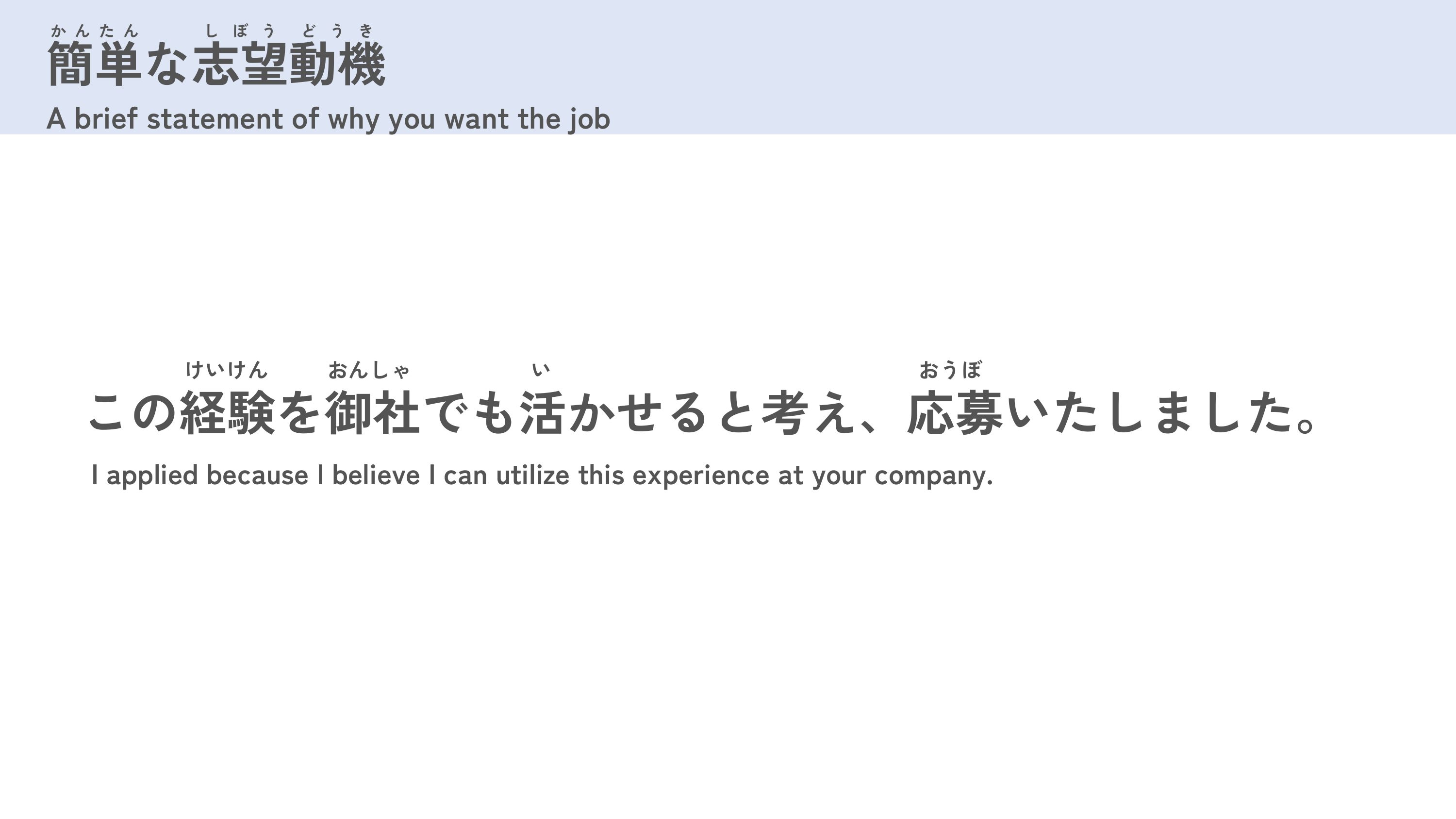
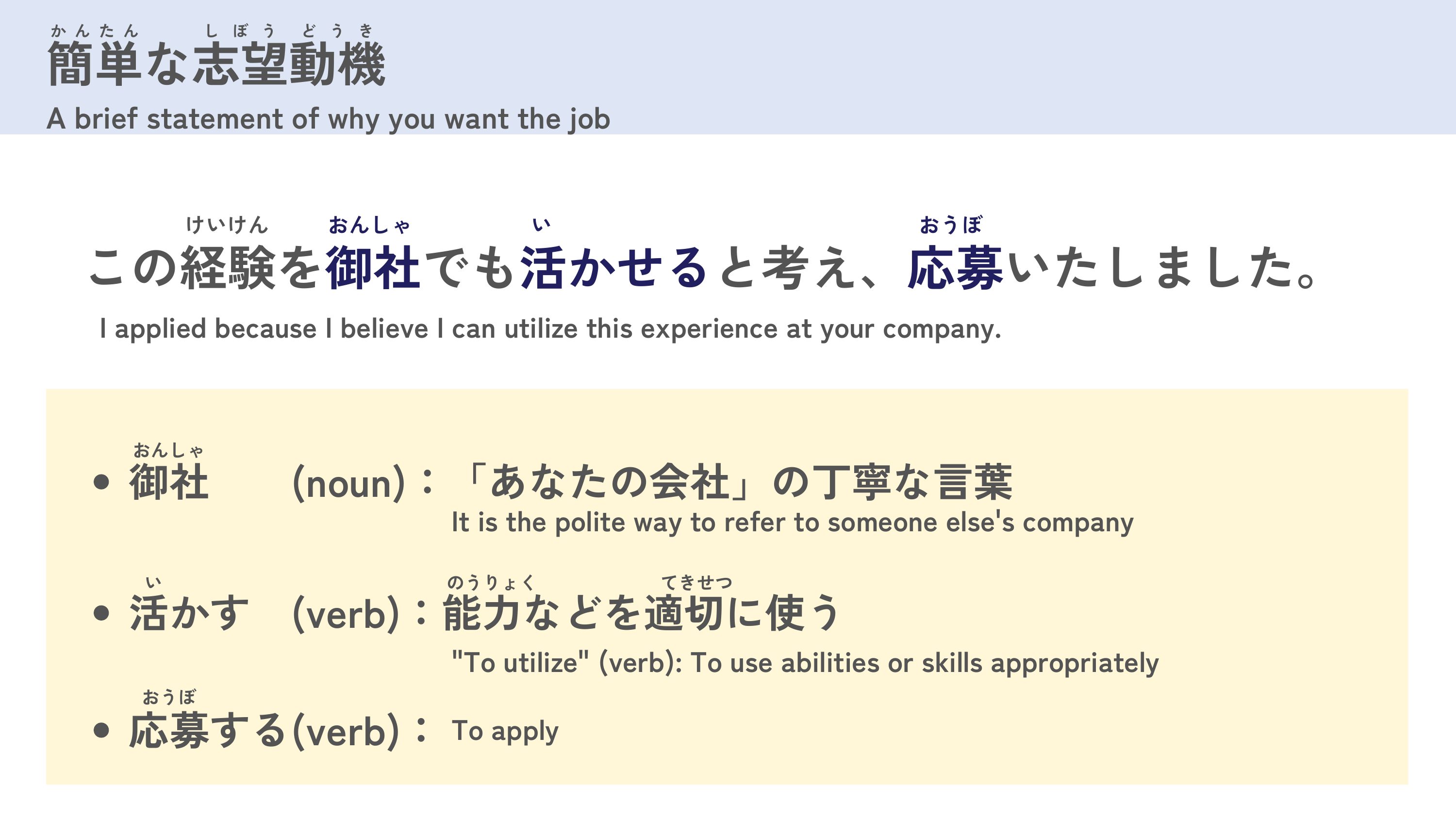
この経験を御社でも活かせると考え、応募いたしました。
この経験を御社でも活かせると考え、応募いたしました。
EN I applied because I believe I can utilize this experience at your company.
หน้า 19
คลิกเพื่อขยาย
JPかんたんしぼうどうき
簡単な志望動機
簡単な志望動機
ENA brief statement of why you want the job
JPけいけんおんしゃいおうぼ
この経験を御社でも活かせると考え、応募いたしました。
この経験を御社でも活かせると考え、応募いたしました。
EN I applied because I believe I can utilize this experience at your company.
JPおんしゃ
御社(noun):「あなたの会社」の丁寧な言葉
御社(noun):「あなたの会社」の丁寧な言葉
EN It is the polite way to refer to someone else's company
JPいのうりょくてきせつ
活かす(verb):能力などを適切に使う
活かす(verb):能力などを適切に使う
EN "To utilize" (verb): To use abilities or skills appropriately
JPおうぼ
EN 応募する(verb): To apply
หน้า 20
คลิกเพื่อขยาย
JP終わりのあいさつ
ENClosing Greeting
JPほんじつ
本日はよろしくお願いいたします。
本日はよろしくお願いいたします。
EN Thank you for your time today.
หน้า 21

คลิกเพื่อขยาย
ENAGENDA 3
JPめんせつじこしょうかい
面接での自己紹介の例
面接での自己紹介の例
ENExamples of Self-Introduction for Interviews
หน้า 22
คลิกเพื่อขยาย
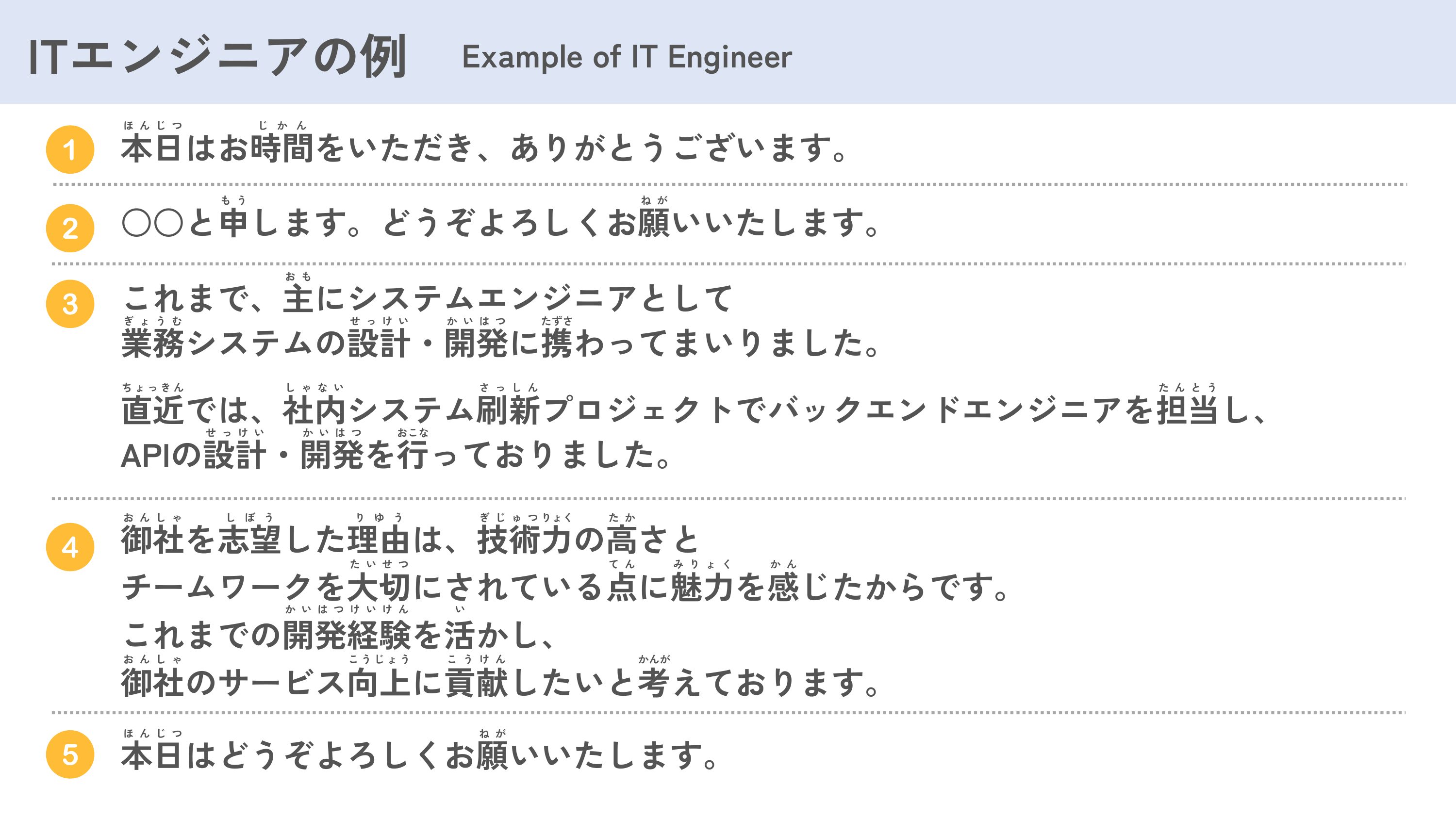
ENITエンジニアの例 Example of IT Engineer
JPほんじつじかん
本日はお時間をいただき、ありがとうございます。
もうねが
○○と申します。どうぞよろしくお願いいたします。
おも
これまで、主にシステムエンジニアとして
ぎょうむせっけいかいはつたずさ
業務システムの設計・開発に携わってまいりました。
ちょっきんしゃないさっしんたんとう
直近では、社内システム刷新プロジェクトでバックエンドエンジニアを担当し、
せっけいかいはつおこな
APIの設計・開発を行っておりました。
おんしゃしぼうりゆうぎじゅつりょくたか
御社を志望した理由は、技術力の高さと
たいせつてんみりょくかん
チームワークを大切にされている点に魅力を感じたからです。
かいはつけいけんい
これまでの開発経験を活かし、
おんしゃこうじょうこうけんかんが
御社のサービス向上に貢献したいと考えております。
ほんじつねが
本日はどうぞよろしくお願いいたします。
本日はお時間をいただき、ありがとうございます。
もうねが
○○と申します。どうぞよろしくお願いいたします。
おも
これまで、主にシステムエンジニアとして
ぎょうむせっけいかいはつたずさ
業務システムの設計・開発に携わってまいりました。
ちょっきんしゃないさっしんたんとう
直近では、社内システム刷新プロジェクトでバックエンドエンジニアを担当し、
せっけいかいはつおこな
APIの設計・開発を行っておりました。
おんしゃしぼうりゆうぎじゅつりょくたか
御社を志望した理由は、技術力の高さと
たいせつてんみりょくかん
チームワークを大切にされている点に魅力を感じたからです。
かいはつけいけんい
これまでの開発経験を活かし、
おんしゃこうじょうこうけんかんが
御社のサービス向上に貢献したいと考えております。
ほんじつねが
本日はどうぞよろしくお願いいたします。
หน้า 23
คลิกเพื่อขยาย
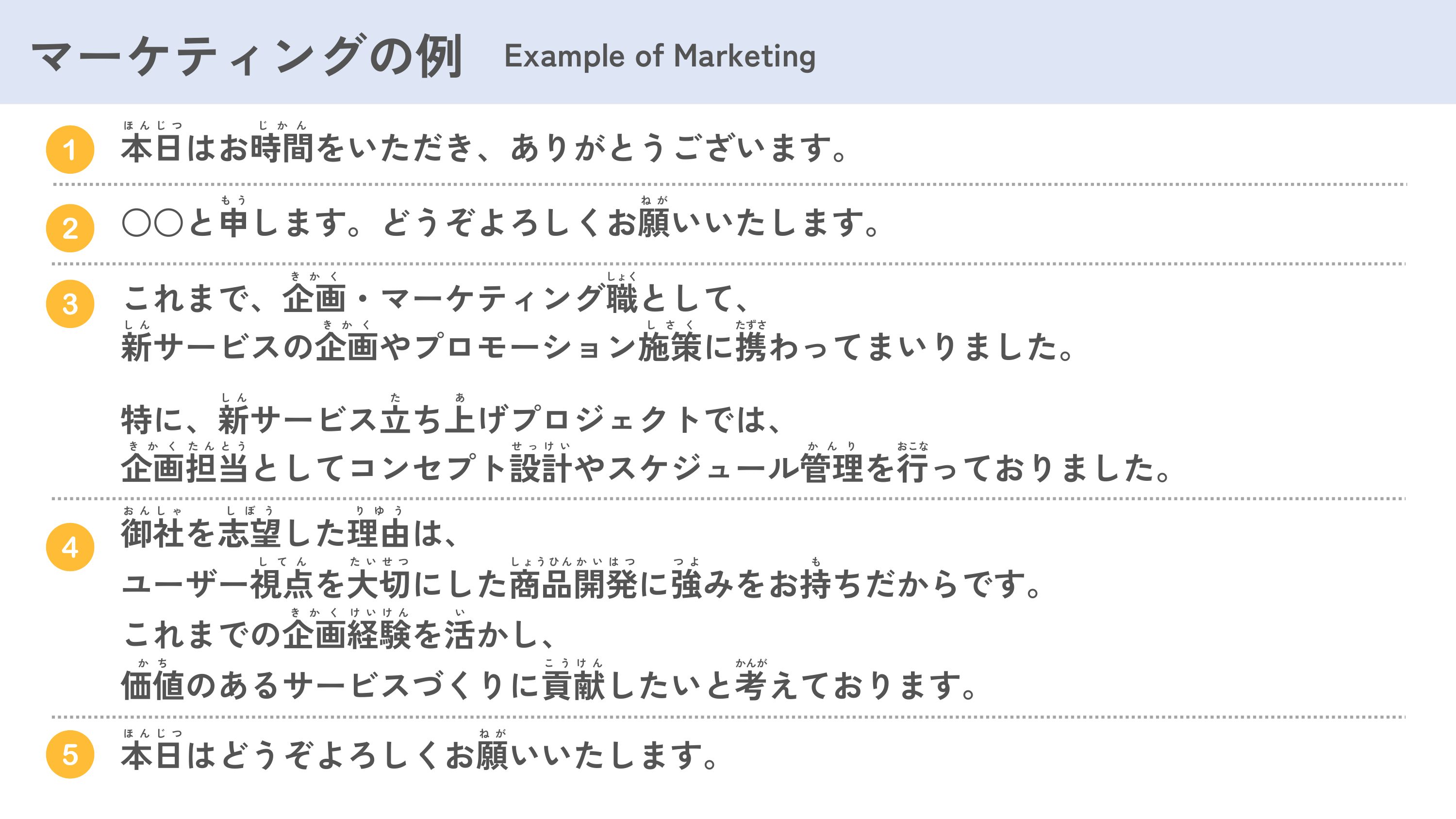
ENマーケティングの例 Example of Marketing
JPほんじつじかん
本日はお時間をいただき、ありがとうございます。
もうねが
○○と申します。どうぞよろしくお願いいたします。
きかくしょく
これまで、企画・マーケティング職として、
しんきかくしさくたずさ
新サービスの企画やプロモーション施策に携わってまいりました。
しんたあ
特に、新サービス立ち上げプロジェクトでは、
きかくたんとうせっけいかんりおこな
企画担当としてコンセプト設計やスケジュール管理を行っておりました。
おんしゃしぼうりゆう
御社を志望した理由は、
してんたいせつしょうひんかいはつつよも
ユーザー視点を大切にした商品開発に強みをお持ちだからです。
きかくけいけんい
これまでの企画経験を活かし、
かちこうけんかんが
価値のあるサービスづくりに貢献したいと考えております。
ほんじつねが
本日はどうぞよろしくお願いいたします。
本日はお時間をいただき、ありがとうございます。
もうねが
○○と申します。どうぞよろしくお願いいたします。
きかくしょく
これまで、企画・マーケティング職として、
しんきかくしさくたずさ
新サービスの企画やプロモーション施策に携わってまいりました。
しんたあ
特に、新サービス立ち上げプロジェクトでは、
きかくたんとうせっけいかんりおこな
企画担当としてコンセプト設計やスケジュール管理を行っておりました。
おんしゃしぼうりゆう
御社を志望した理由は、
してんたいせつしょうひんかいはつつよも
ユーザー視点を大切にした商品開発に強みをお持ちだからです。
きかくけいけんい
これまでの企画経験を活かし、
かちこうけんかんが
価値のあるサービスづくりに貢献したいと考えております。
ほんじつねが
本日はどうぞよろしくお願いいたします。
หน้า 24
คลิกเพื่อขยาย
JPじぶんじこしょうかいつく
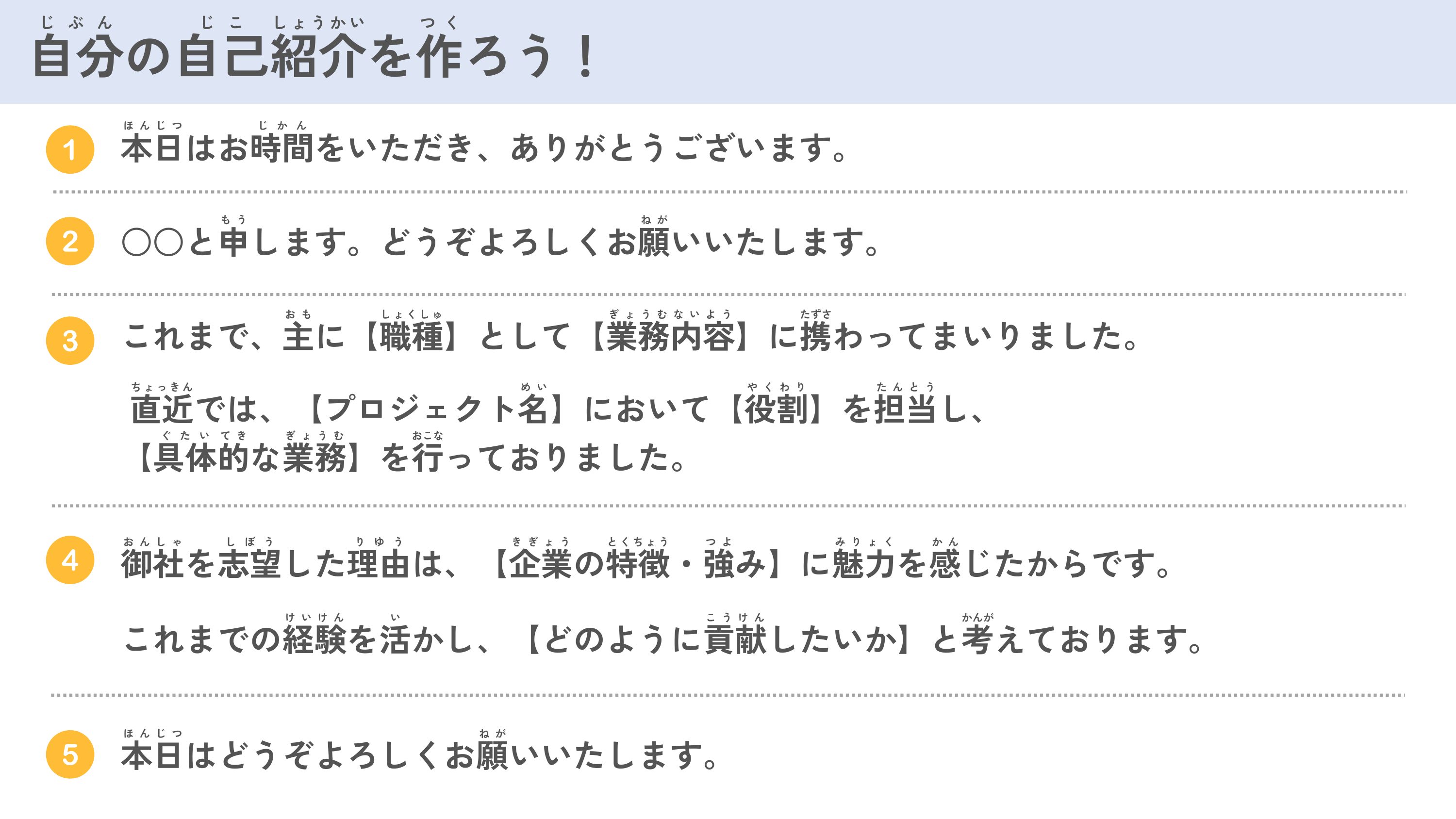
自分の自己紹介を作ろう!
ほんじつじかん
本日はお時間をいただき、ありがとうございます。
もうねが
○○と申します。どうぞよろしくお願いいたします。
おもしょくしゅぎょうむないようたずさ
これまで、主に【職種】として【業務内容】に携わってまいりました。
ちょっきんめいやくわりたんとう
直近では、【プロジェクト名】において【役割】を担当し、
ぐたいてきぎょうむおこな
【具体的な業務】を行っておりました。
おんしゃしぼうりゆうきぎょうとくちょうつよみりょくかん
御社を志望した理由は、【企業の特徴・強み】に魅力を感じたからです。
けいけんいこうけんかんが
これまでの経験を活かし、【どのように貢献したいか】と考えております。
ほんじつねが
本日はどうぞよろしくお願いいたします。
自分の自己紹介を作ろう!
ほんじつじかん
本日はお時間をいただき、ありがとうございます。
もうねが
○○と申します。どうぞよろしくお願いいたします。
おもしょくしゅぎょうむないようたずさ
これまで、主に【職種】として【業務内容】に携わってまいりました。
ちょっきんめいやくわりたんとう
直近では、【プロジェクト名】において【役割】を担当し、
ぐたいてきぎょうむおこな
【具体的な業務】を行っておりました。
おんしゃしぼうりゆうきぎょうとくちょうつよみりょくかん
御社を志望した理由は、【企業の特徴・強み】に魅力を感じたからです。
けいけんいこうけんかんが
これまでの経験を活かし、【どのように貢献したいか】と考えております。
ほんじつねが
本日はどうぞよろしくお願いいたします。
หน้า 25
คลิกเพื่อขยาย
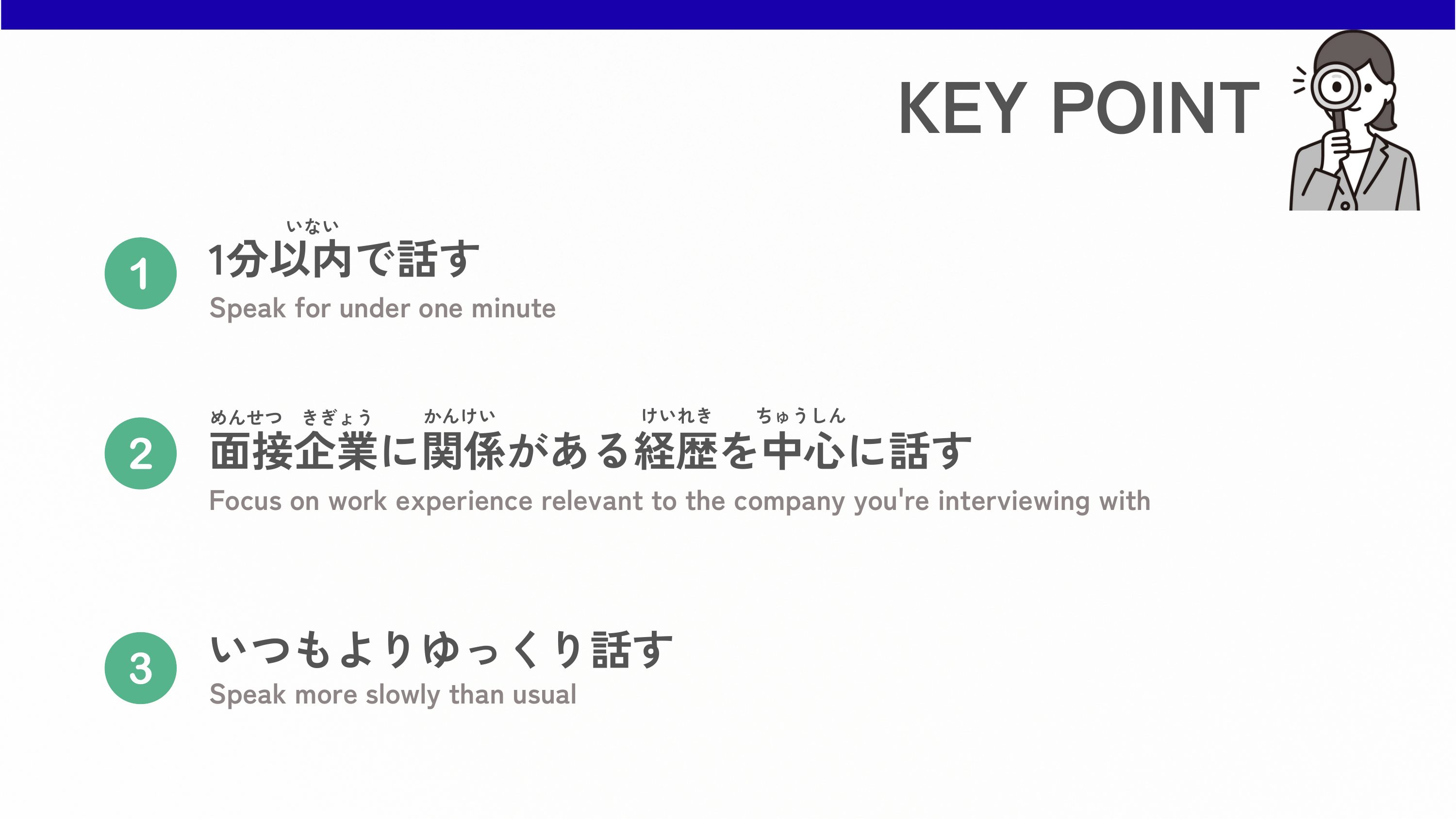
EN KEY POINT
JPいない
1分以内で話す
1分以内で話す
ENSpeak for under one minute
JPめんせつきぎょうかんけいけいれきちゅうしん
面接企業に関係がある経歴を中心に話す
面接企業に関係がある経歴を中心に話す
ENFocus on work experience relevant to the company you're interviewing with
JPいつもよりゆっくり話す
ENSpeak more slowly than usual
หน้า 26

คลิกเพื่อขยาย
9-3
JPきょうかんしぼうどうきはなかた
共感される志望動機の話し方
共感される志望動機の話し方
ENHow to Explain Your Motivation in a Relatable Way
How to Speak So You Get Chosen in a Job Interview
How to Speak So You Get Chosen in a Job Interview
หน้า 27
คลิกเพื่อขยาย
JPめんせつかんしつもん
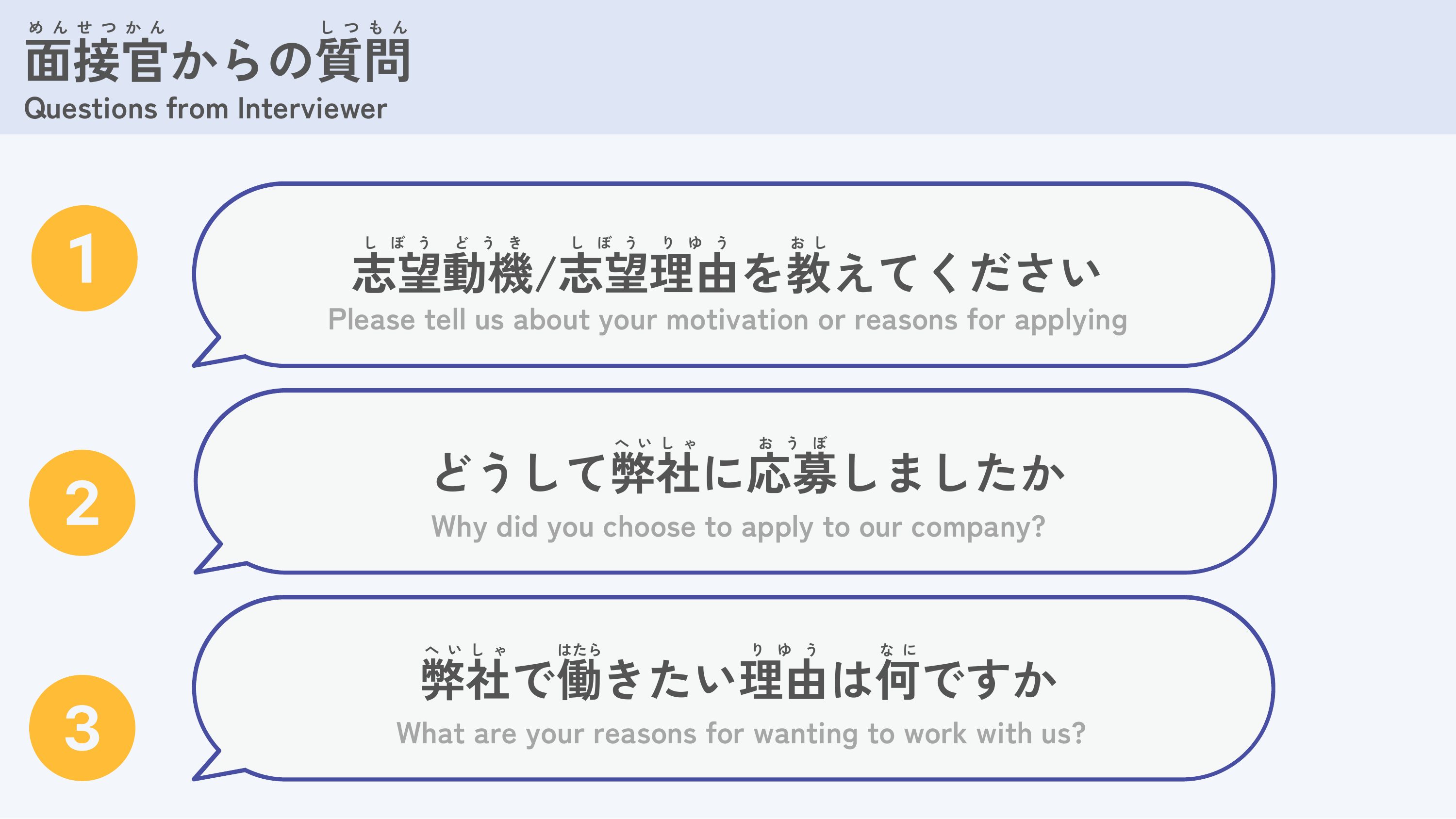
面接官からの質問
面接官からの質問
ENQuestions from Interviewer
JPしぼうどうきしぼうりゆうおし
志望動機/志望理由を教えてください
志望動機/志望理由を教えてください
EN Please tell us about your motivation or reasons for applying
JPへいしゃおうぼ
どうして弊社に応募しましたか
どうして弊社に応募しましたか
EN Why did you choose to apply to our company?
JPへいしゃはたらりゆうなに
弊社で働きたい理由は何ですか
弊社で働きたい理由は何ですか
EN What are your reasons for wanting to work with us?
หน้า 28
คลิกเพื่อขยาย
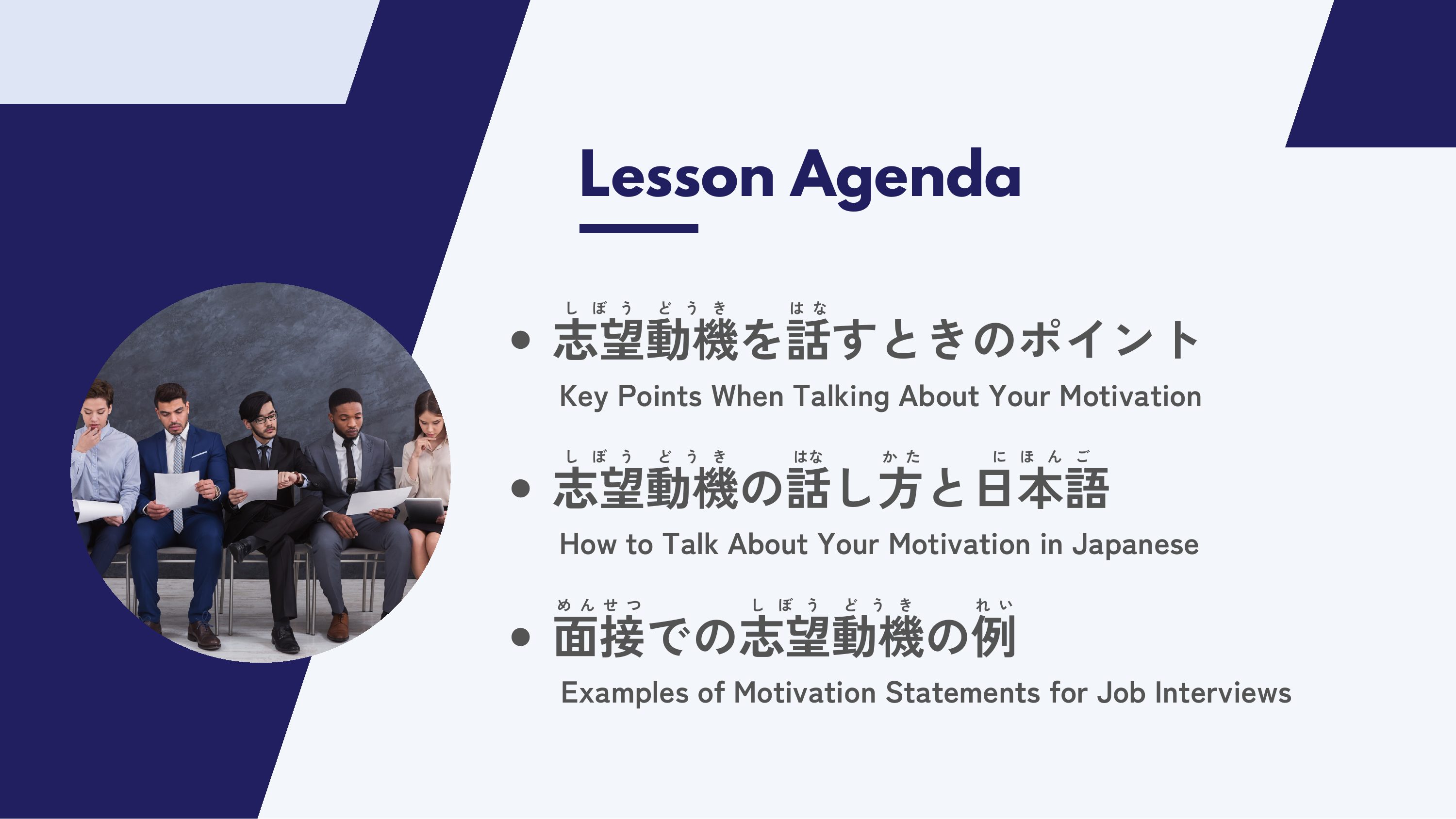
EN Lesson Agenda
JPしぼうどうきはな
志望動機を話すときのポイント
志望動機を話すときのポイント
ENKey Points When Talking About Your Motivation
JPしぼうどうきはなかたにほんご
志望動機の話し方と日本語
志望動機の話し方と日本語
ENHow to Talk About Your Motivation in Japanese
JPめんせつしぼうどうきれい
面接での志望動機の例
面接での志望動機の例
ENExamples of Motivation Statements for Job Interviews
หน้า 29
คลิกเพื่อขยาย
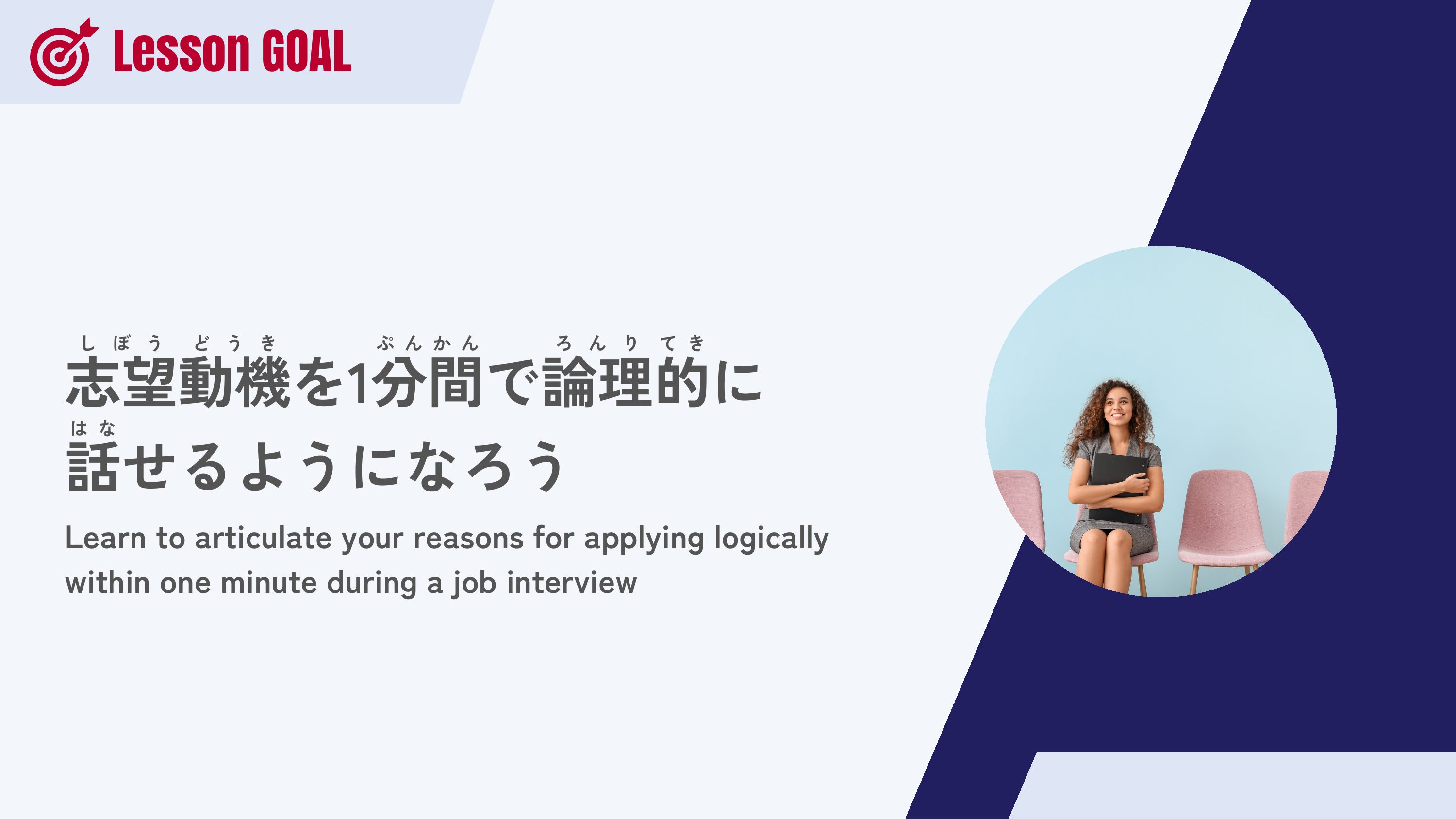
EN Lesson GOAL
JPしぼうどうきぷんかんろんりてき
志望動機を1分間で論理的に
はな
話せるようになろう
志望動機を1分間で論理的に
はな
話せるようになろう
ENLearn to articulate your reasons for applying logically
within one minute during a job interview
within one minute during a job interview
หน้า 30
คลิกเพื่อขยาย
ENAGENDA 1
JPしぼうどうきはなとき
志望動機を話す時のポイント
志望動機を話す時のポイント
ENPoints to consider when speaking about your reasons for applying for the position
หน้า 31
คลิกเพื่อขยาย
JPしぼうどうきはなとき
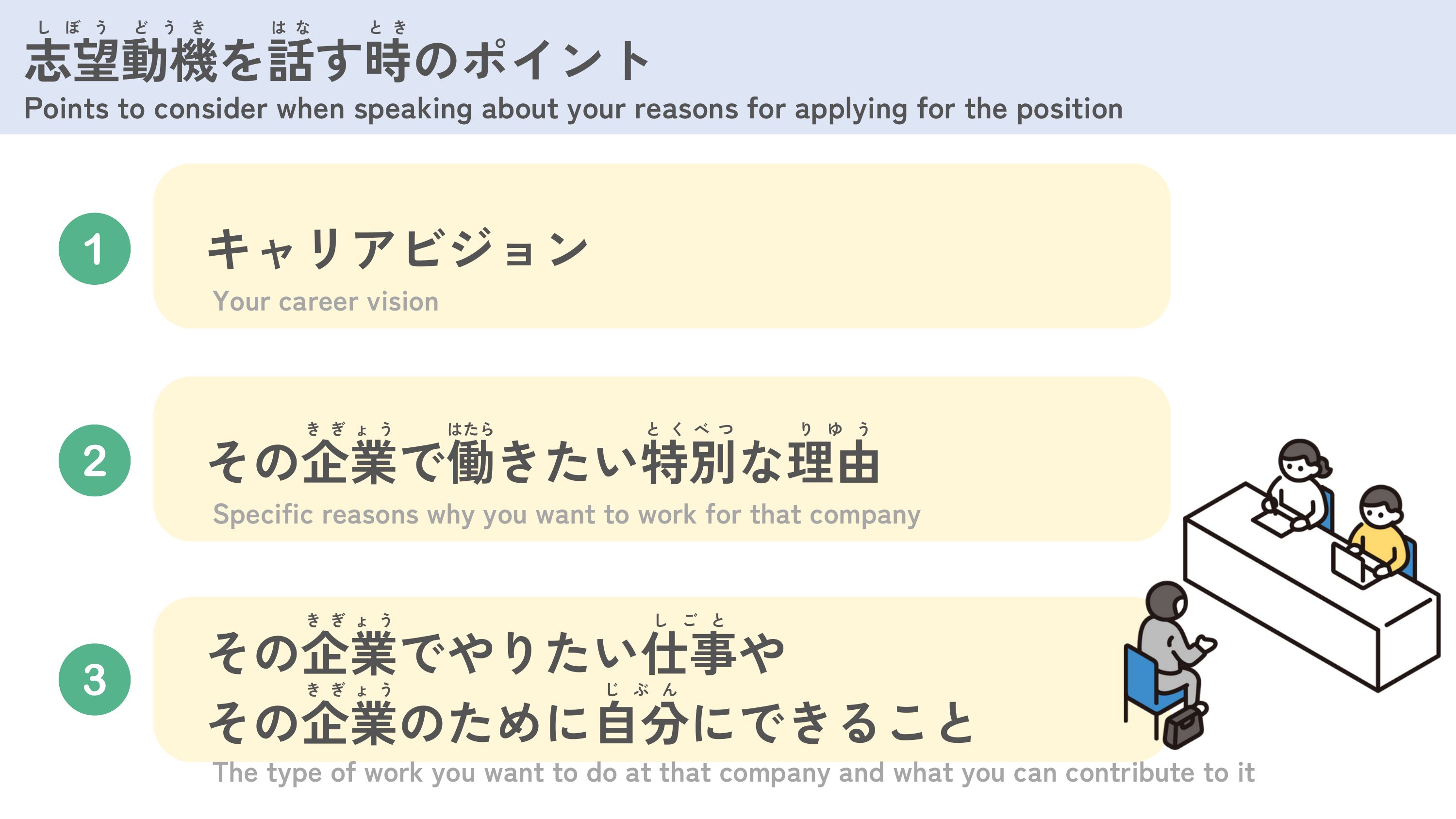
志望動機を話す時のポイント
志望動機を話す時のポイント
ENPoints to consider when speaking about your reasons for applying for the position
JPキャリアビジョン
EN Your career vision
JPきぎょうはたらとくべつりゆう
その企業で働きたい特別な理由
その企業で働きたい特別な理由
EN Specific reasons why you want to work for that company
JPきぎょうしごと
その企業でやりたい仕事や
きぎょうじぶん
その企業のために自分にできること
その企業でやりたい仕事や
きぎょうじぶん
その企業のために自分にできること
EN The type of work you want to do at that company and what you can contribute to it
หน้า 32
คลิกเพื่อขยาย
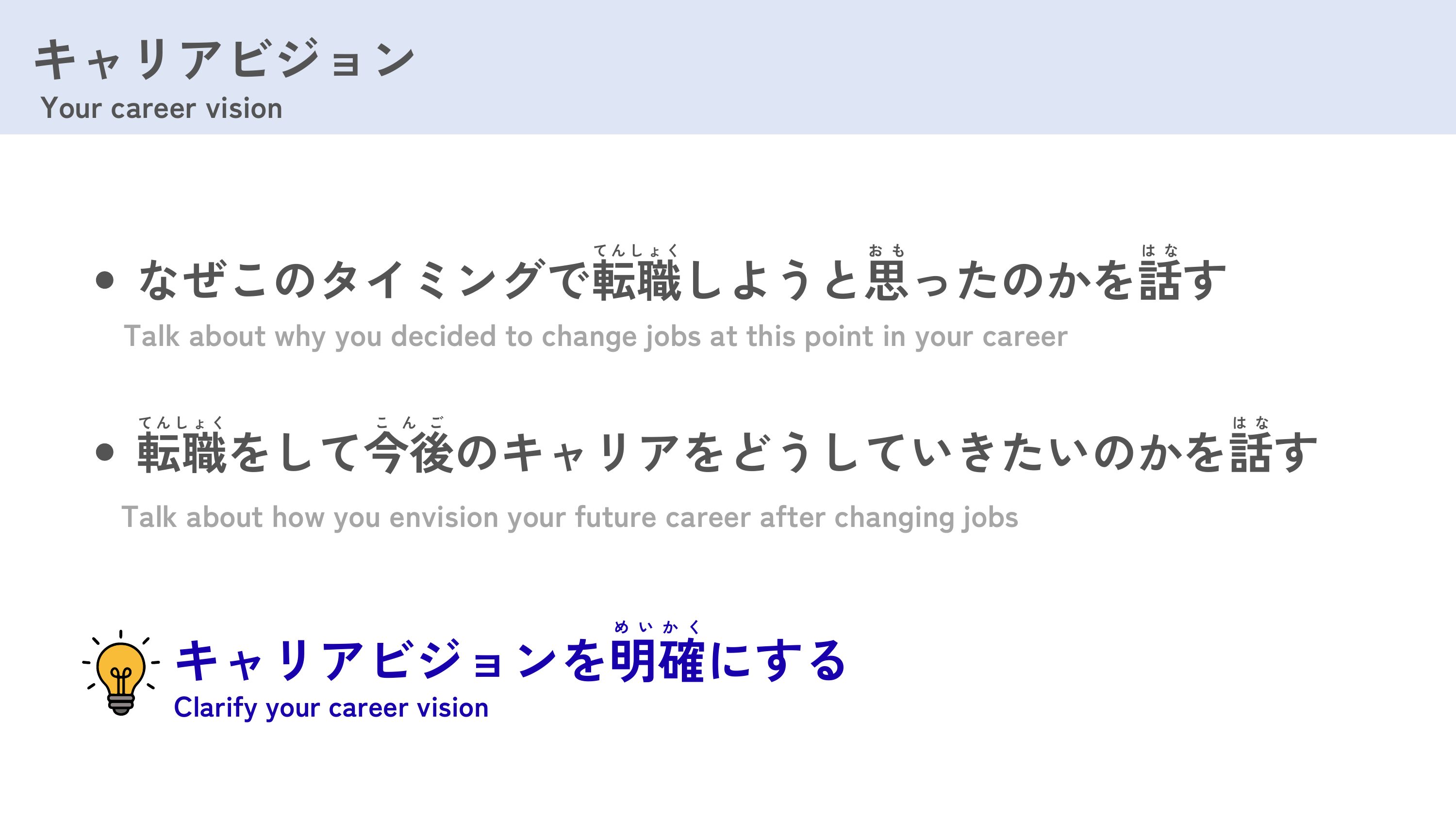
JPキャリアビジョン
ENYour career vision
JPてんしょくおもはな
なぜこのタイミングで転職しようと思ったのかを話す
なぜこのタイミングで転職しようと思ったのかを話す
EN Talk about why you decided to change jobs at this point in your career
JPてんしょくこんごはな
転職をして今後のキャリアをどうしていきたいのかを話す
転職をして今後のキャリアをどうしていきたいのかを話す
EN Talk about how you envision your future career after changing jobs
JPめいかく
キャリアビジョンを明確にする
キャリアビジョンを明確にする
EN Clarify your career vision
หน้า 33
คลิกเพื่อขยาย
JPきぎょうはたらとくべつりゆう
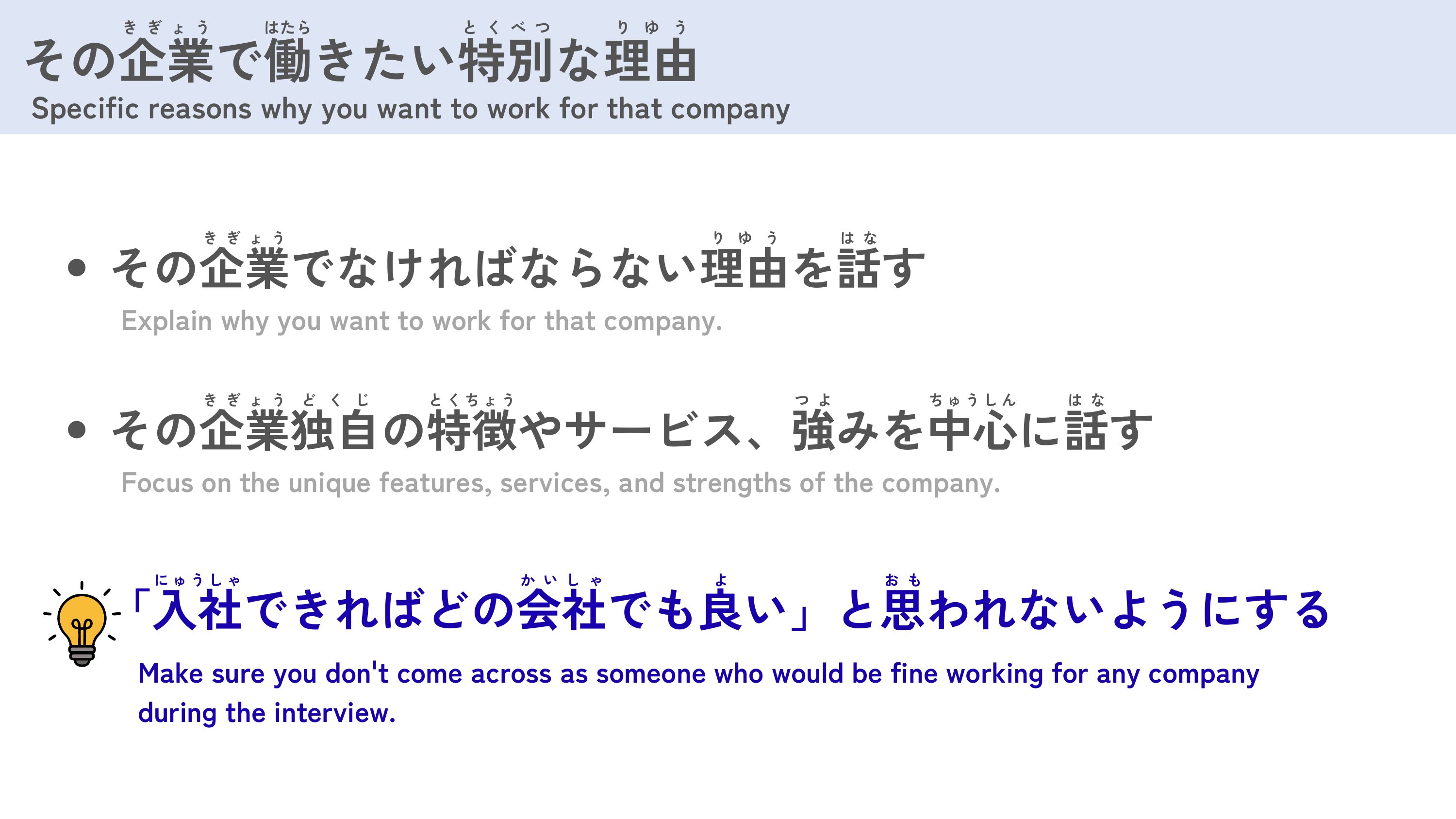
その企業で働きたい特別な理由
その企業で働きたい特別な理由
ENSpecific reasons why you want to work for that company
JPきぎょうりゆうはな
その企業でなければならない理由を話す
その企業でなければならない理由を話す
EN Explain why you want to work for that company.
JPきぎょうどくじとくちょうつよちゅうしんはな
その企業独自の特徴やサービス、強みを中心に話す
その企業独自の特徴やサービス、強みを中心に話す
EN Focus on the unique features, services, and strengths of the company.
JPにゅうしゃかいしゃよおも
「入社できればどの会社でも良い」と思われないようにする
「入社できればどの会社でも良い」と思われないようにする
EN Make sure you don't come across as someone who would be fine working for any company
during the interview.
during the interview.
หน้า 34
คลิกเพื่อขยาย
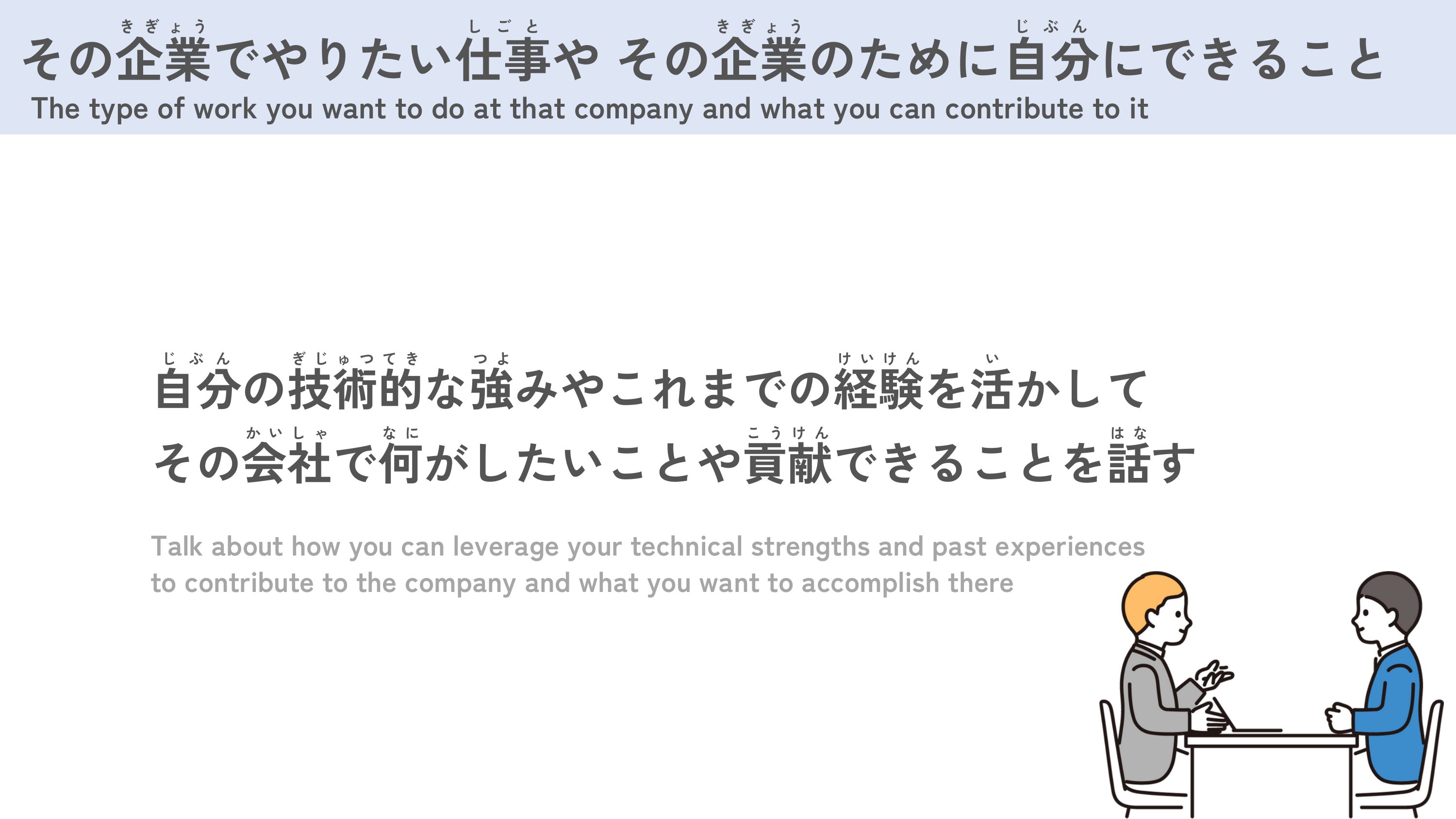
JPきぎょうしごときぎょうじぶん
その企業でやりたい仕事やその企業のために自分にできること
その企業でやりたい仕事やその企業のために自分にできること
ENThe type of work you want to do at that company and what you can contribute to it
JPじぶんぎじゅつてきつよけいけんい
自分の技術的な強みやこれまでの経験を活かして
かいしゃなにこうけんはな
その会社で何がしたいことや貢献できることを話す
自分の技術的な強みやこれまでの経験を活かして
かいしゃなにこうけんはな
その会社で何がしたいことや貢献できることを話す
EN Talk about how you can leverage your technical strengths and past experiences
to contribute to the company and what you want to accomplish there
to contribute to the company and what you want to accomplish there
หน้า 35
คลิกเพื่อขยาย
ENAGENDA 2
JPしぼうどうきはなながにほんご
志望動機を話す流れと日本語
志望動機を話す流れと日本語
ENThe flow of speaking your motive for applying and Japanese
หน้า 36
คลิกเพื่อขยาย
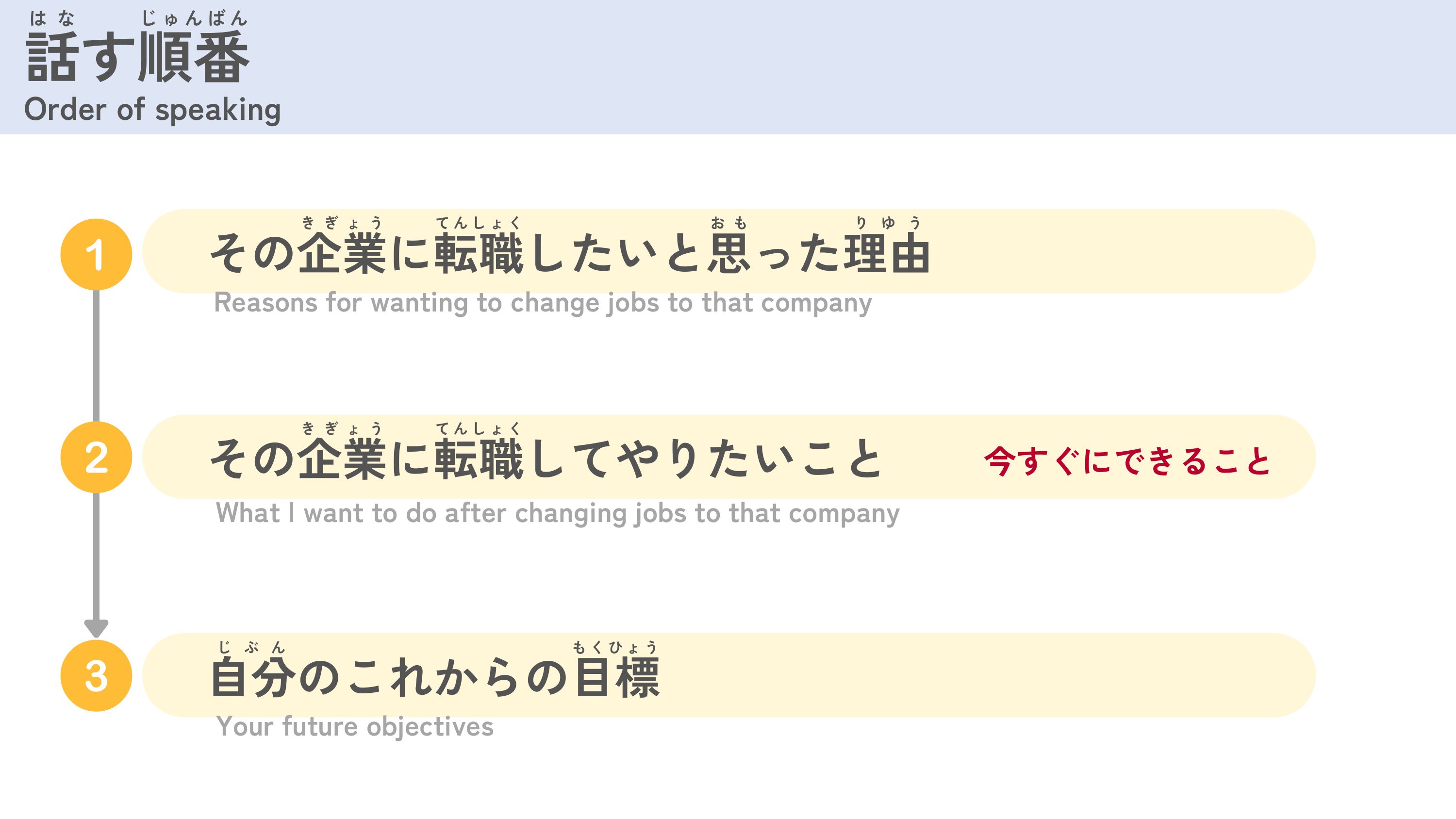
JPはなじゅんばん
話す順番
話す順番
ENOrder of speaking
JPきぎょうてんしょくおもりゆう
その企業に転職したいと思った理由
その企業に転職したいと思った理由
EN Reasons for wanting to change jobs to that company
JPきぎょうてんしょく
その企業に転職してやりたいこと今すぐにできること
その企業に転職してやりたいこと今すぐにできること
EN What I want to do after changing jobs to that company
JPじぶんもくひょう
自分のこれからの目標
自分のこれからの目標
EN Your future objectives
หน้า 37
คลิกเพื่อขยาย
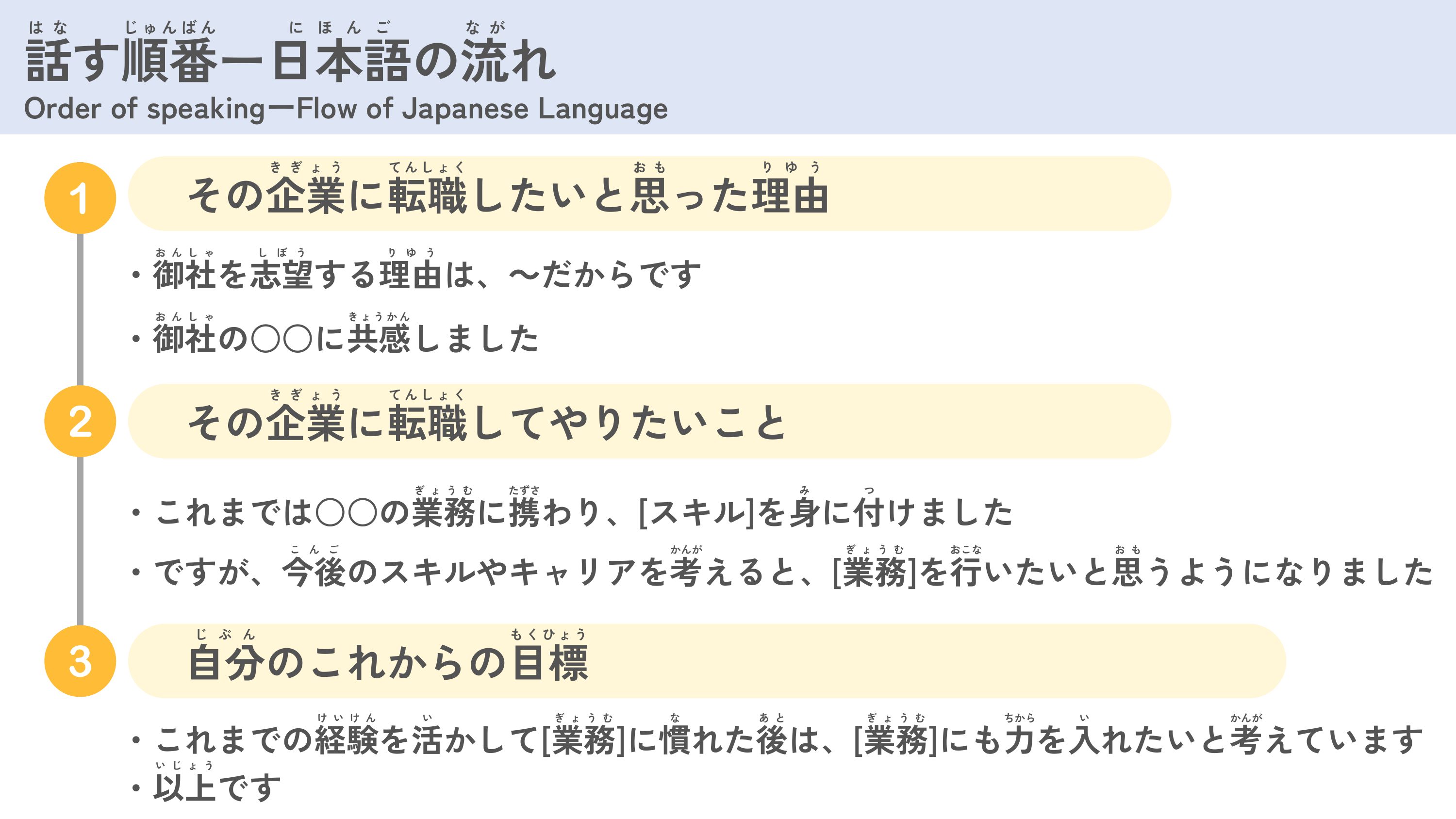
JPはなじゅんばんにほんごなが
話す順番ー日本語の流れ
話す順番ー日本語の流れ
ENOrder of speakingーFlow of Japanese Language
JPきぎょうてんしょくおもりゆう
その企業に転職したいと思った理由
おんしゃしぼう
・御社を志望する理由は、だからです
りゆう
~
おんしゃきょうかん
・御社の○○に共感しました
きぎょうてんしょく
その企業に転職してやりたいこと
ぎょうむたずさみつ
・これまでは○○の業務に携わり、[スキル]を身に付けました
こんごかんがぎょうむおこなおも
・ですが、今後のスキルやキャリアを考えると、[業務]を行いたいと思うようになりました
じぶんもくひょう
自分のこれからの目標
けいけんいぎょうむなあとぎょうむちからいかんが
・これまでの経験を活かして[業務]に慣れた後は、[業務]にも力を入れたいと考えています
いじょう
・以上です
その企業に転職したいと思った理由
おんしゃしぼう
・御社を志望する理由は、だからです
りゆう
~
おんしゃきょうかん
・御社の○○に共感しました
きぎょうてんしょく
その企業に転職してやりたいこと
ぎょうむたずさみつ
・これまでは○○の業務に携わり、[スキル]を身に付けました
こんごかんがぎょうむおこなおも
・ですが、今後のスキルやキャリアを考えると、[業務]を行いたいと思うようになりました
じぶんもくひょう
自分のこれからの目標
けいけんいぎょうむなあとぎょうむちからいかんが
・これまでの経験を活かして[業務]に慣れた後は、[業務]にも力を入れたいと考えています
いじょう
・以上です
หน้า 38
คลิกเพื่อขยาย
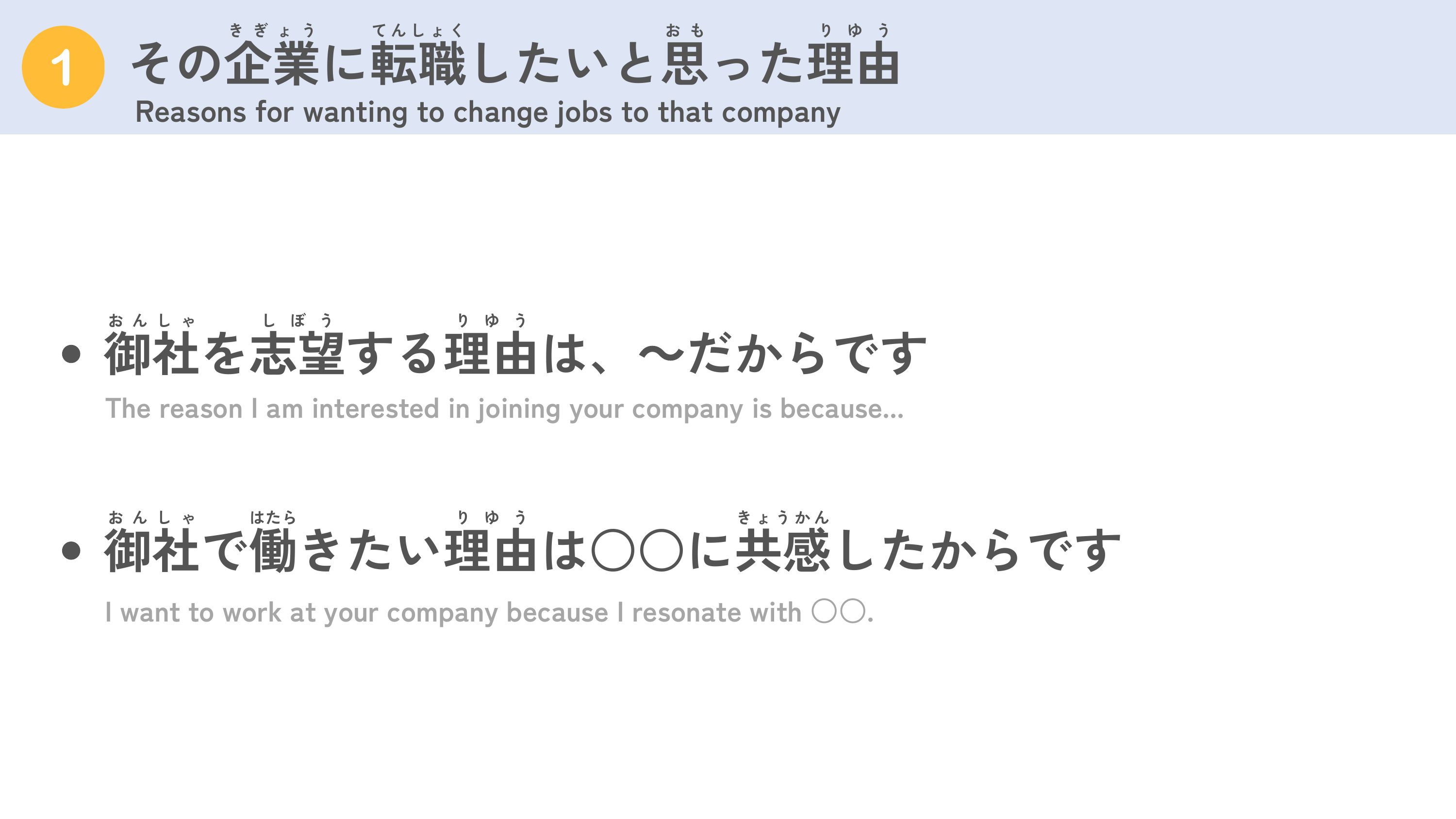
JPきぎょうてんしょくおもりゆう
その企業に転職したいと思った理由
その企業に転職したいと思った理由
EN Reasons for wanting to change jobs to that company
JPおんしゃしぼう
御社を志望する理由は、だからです
りゆう
~
御社を志望する理由は、だからです
りゆう
~
ENThe reason I am interested in joining your company is because...
JPおんしゃはたらりゆうきょうかん
御社で働きたい理由は○○に共感したからです
御社で働きたい理由は○○に共感したからです
ENI want to work at your company because I resonate with ○○.
หน้า 39
คลิกเพื่อขยาย
JPきぎょうてんしょくおもりゆう
その企業に転職したいと思った理由
その企業に転職したいと思った理由
EN Reasons for wanting to change jobs to that company
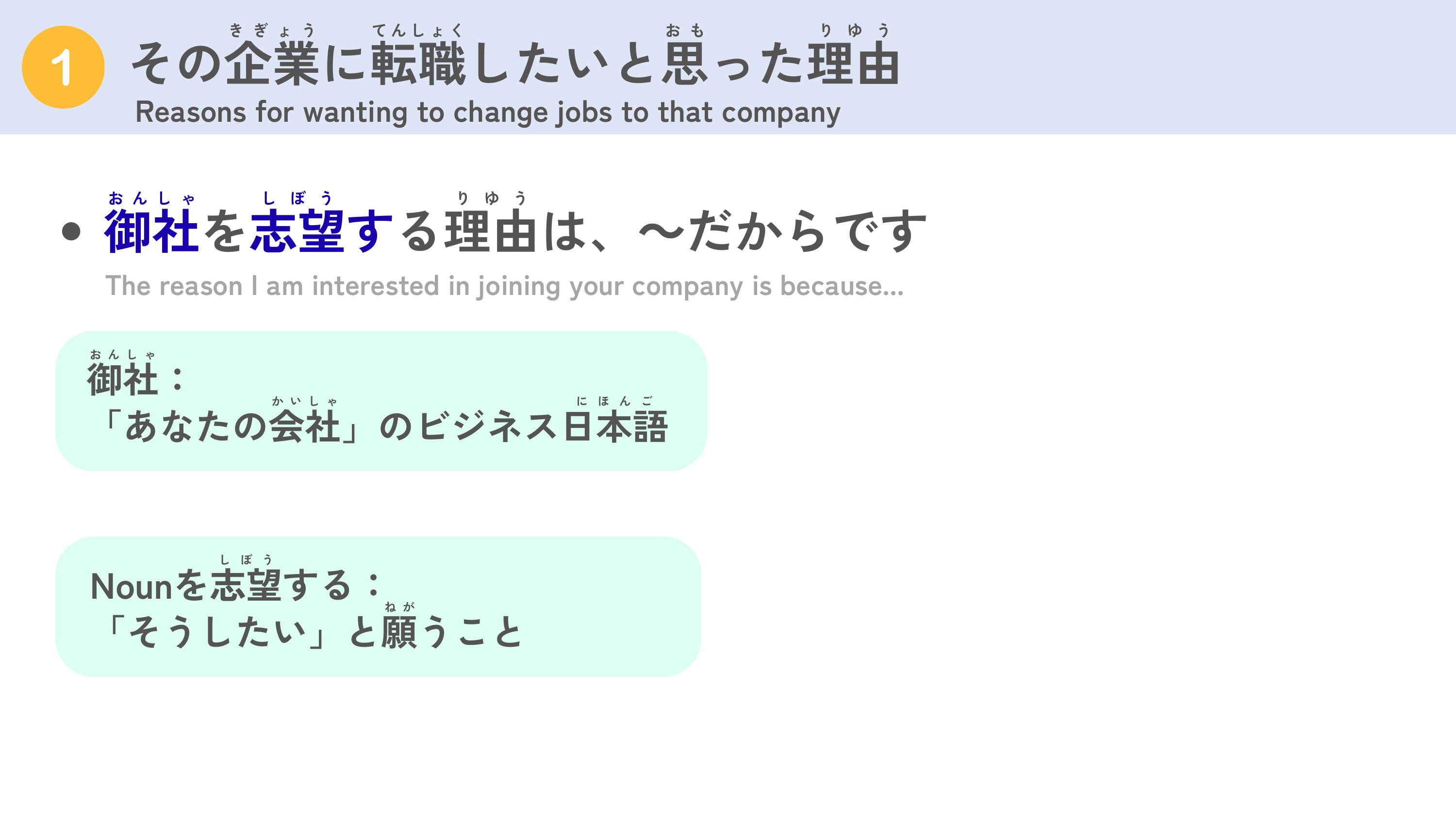
JPおんしゃしぼう
御社を志望する理由は、だからです
りゆう
~
御社を志望する理由は、だからです
りゆう
~
EN The reason I am interested in joining your company is because...
JPおんしゃ
御社:かいしゃにほんご
「あなたの会社」のビジネス日本語
しぼう
Nounを志望する:ねが
「そうしたい」と願うこと
御社:かいしゃにほんご
「あなたの会社」のビジネス日本語
しぼう
Nounを志望する:ねが
「そうしたい」と願うこと
หน้า 40
คลิกเพื่อขยาย
JPきぎょうてんしょくおもりゆう
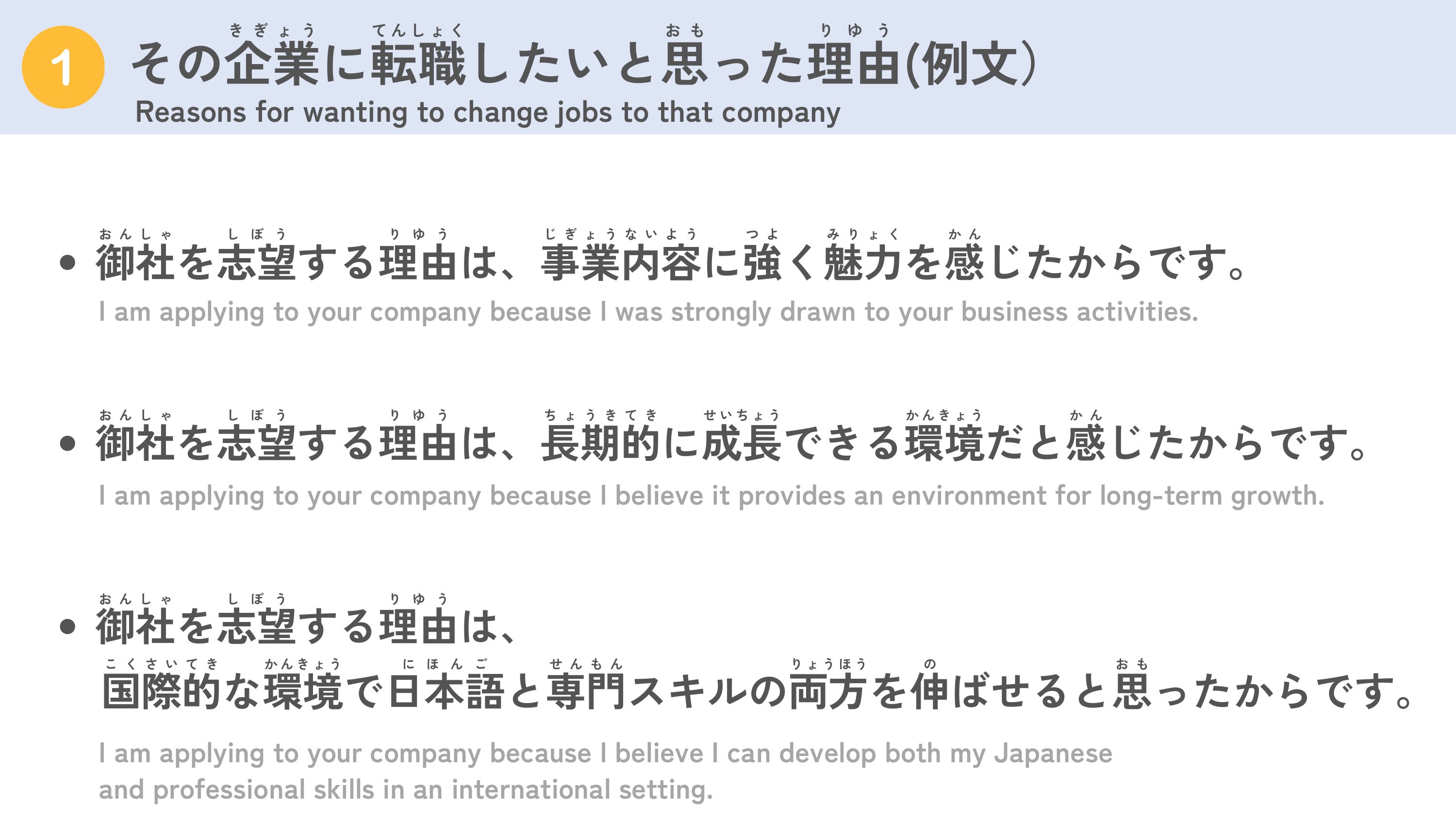
その企業に転職したいと思った理由(例文)
その企業に転職したいと思った理由(例文)
EN Reasons for wanting to change jobs to that company
JPおんしゃしぼうりゆうじぎょうないようつよみりょくかん
御社を志望する理由は、事業内容に強く魅力を感じたからです。
御社を志望する理由は、事業内容に強く魅力を感じたからです。
ENI am applying to your company because I was strongly drawn to your business activities.
JPおんしゃしぼうりゆうちょうきてきせいちょうかんきょうかん
御社を志望する理由は、長期的に成長できる環境だと感じたからです。
御社を志望する理由は、長期的に成長できる環境だと感じたからです。
ENI am applying to your company because I believe it provides an environment for long-term growth.
JPおんしゃしぼうりゆう
御社を志望する理由は、
こくさいてきかんきょうにほんごせんもんりょうほうのおも
国際的な環境で日本語と専門スキルの両方を伸ばせると思ったからです。
御社を志望する理由は、
こくさいてきかんきょうにほんごせんもんりょうほうのおも
国際的な環境で日本語と専門スキルの両方を伸ばせると思ったからです。
ENI am applying to your company because I believe I can develop both my Japanese
and professional skills in an international setting.
and professional skills in an international setting.
หน้า 41
คลิกเพื่อขยาย
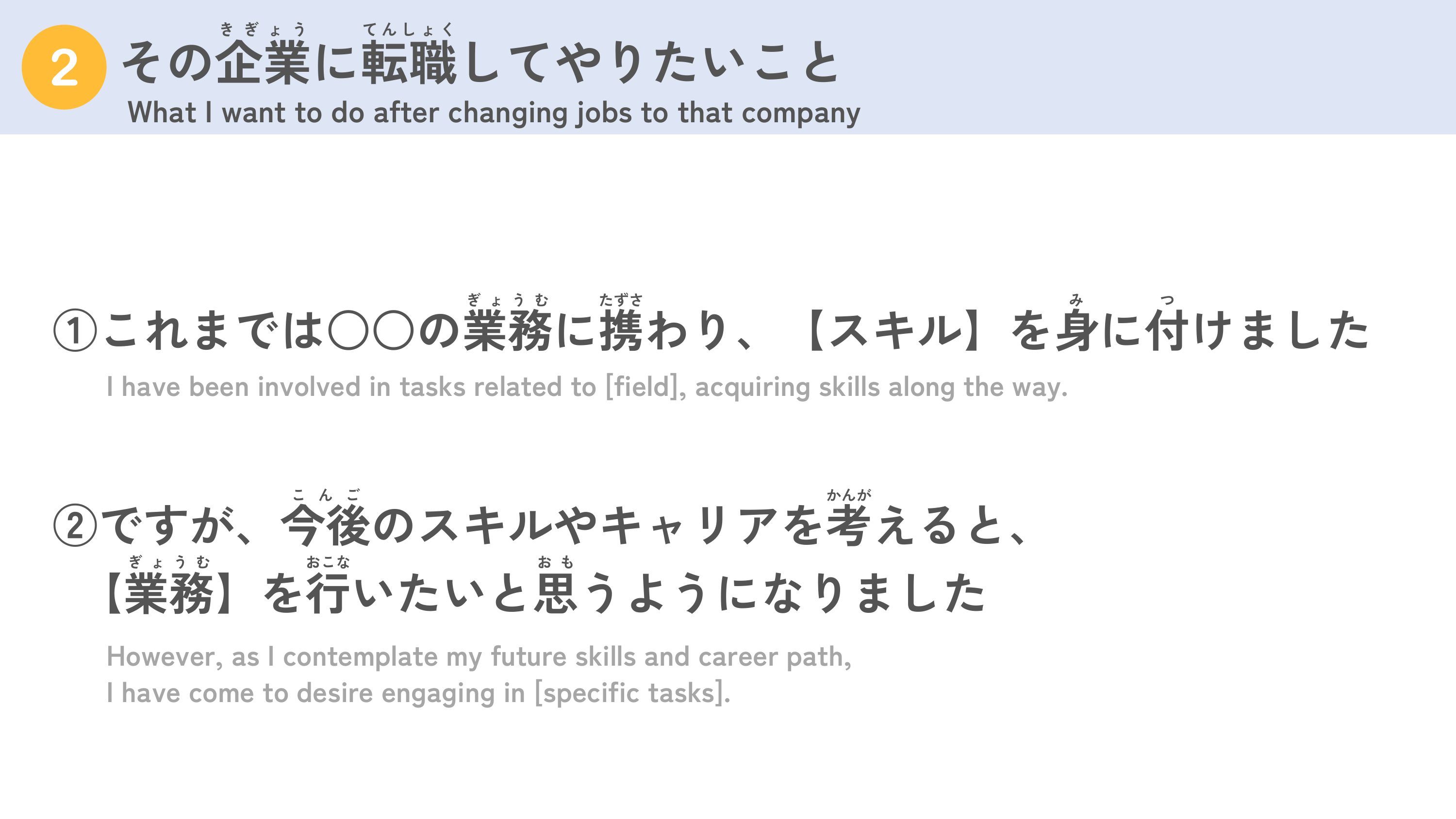
JPきぎょうてんしょく
その企業に転職してやりたいこと
その企業に転職してやりたいこと
EN What I want to do after changing jobs to that company
JPぎょうむたずさみつ
①これまでは○○の業務に携わり、【スキル】を身に付けました
①これまでは○○の業務に携わり、【スキル】を身に付けました
EN I have been involved in tasks related to [field], acquiring skills along the way.
JPこんごかんが
②ですが、今後のスキルやキャリアを考えると、
ぎょうむおこなおも
【業務】を行いたいと思うようになりました
②ですが、今後のスキルやキャリアを考えると、
ぎょうむおこなおも
【業務】を行いたいと思うようになりました
EN However, as I contemplate my future skills and career path,
I have come to desire engaging in [specific tasks].
I have come to desire engaging in [specific tasks].
หน้า 42
คลิกเพื่อขยาย
JPきぎょうてんしょく
その企業に転職してやりたいこと
その企業に転職してやりたいこと
EN What I want to do after changing jobs to that company
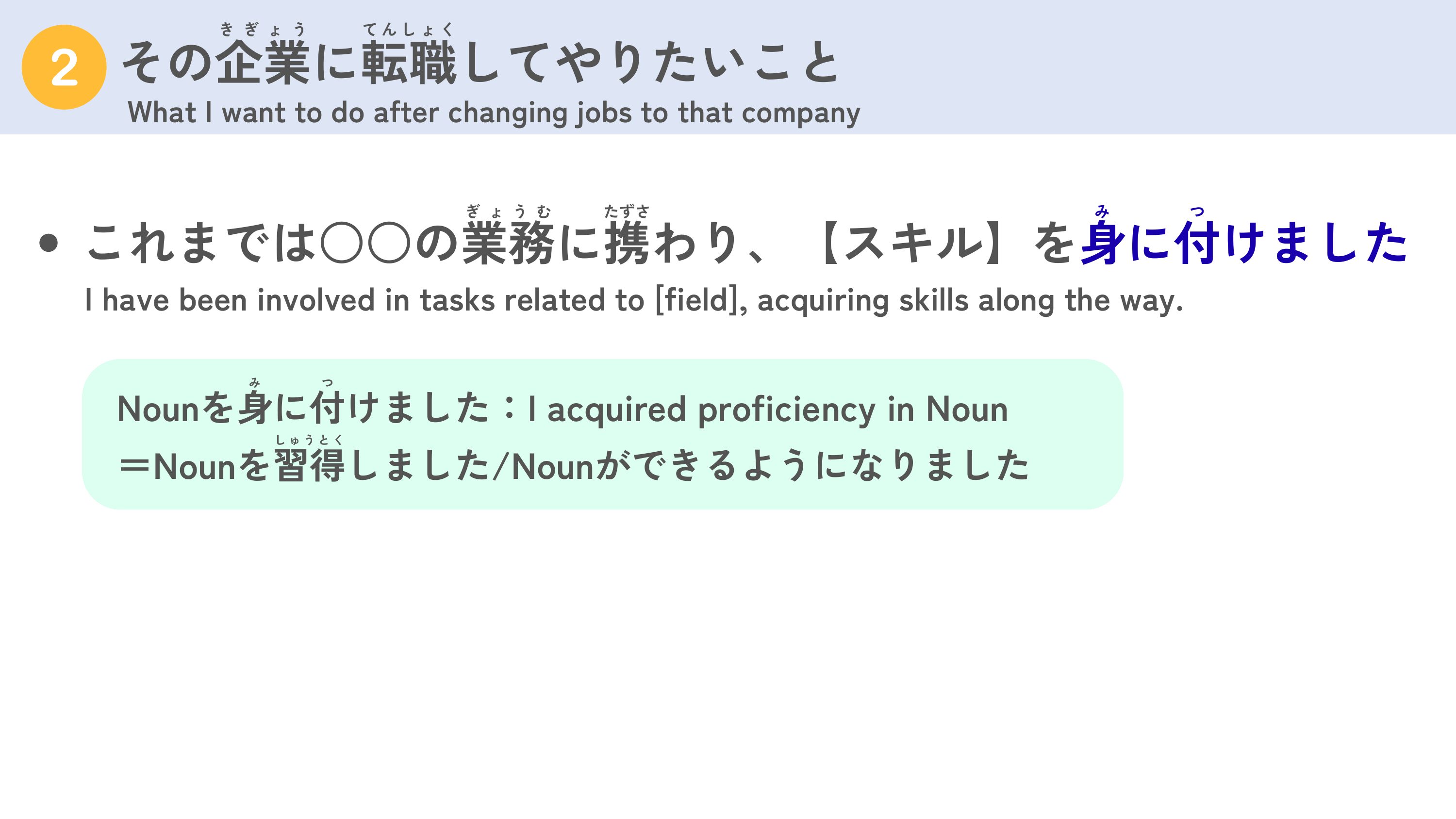
JPぎょうむたずさみつ
これまでは○○の業務に携わり、【スキル】を身に付けました
これまでは○○の業務に携わり、【スキル】を身に付けました
ENI have been involved in tasks related to [field], acquiring skills along the way.
JPみつ
EN Nounを身に付けました:I acquired proficiency in Noun
JPしゅうとく
=Nounを習得しました/Nounができるようになりました
=Nounを習得しました/Nounができるようになりました
หน้า 43
คลิกเพื่อขยาย
JPきぎょうてんしょく
その企業に転職してやりたいこと
その企業に転職してやりたいこと
EN What I want to do after changing jobs to that company
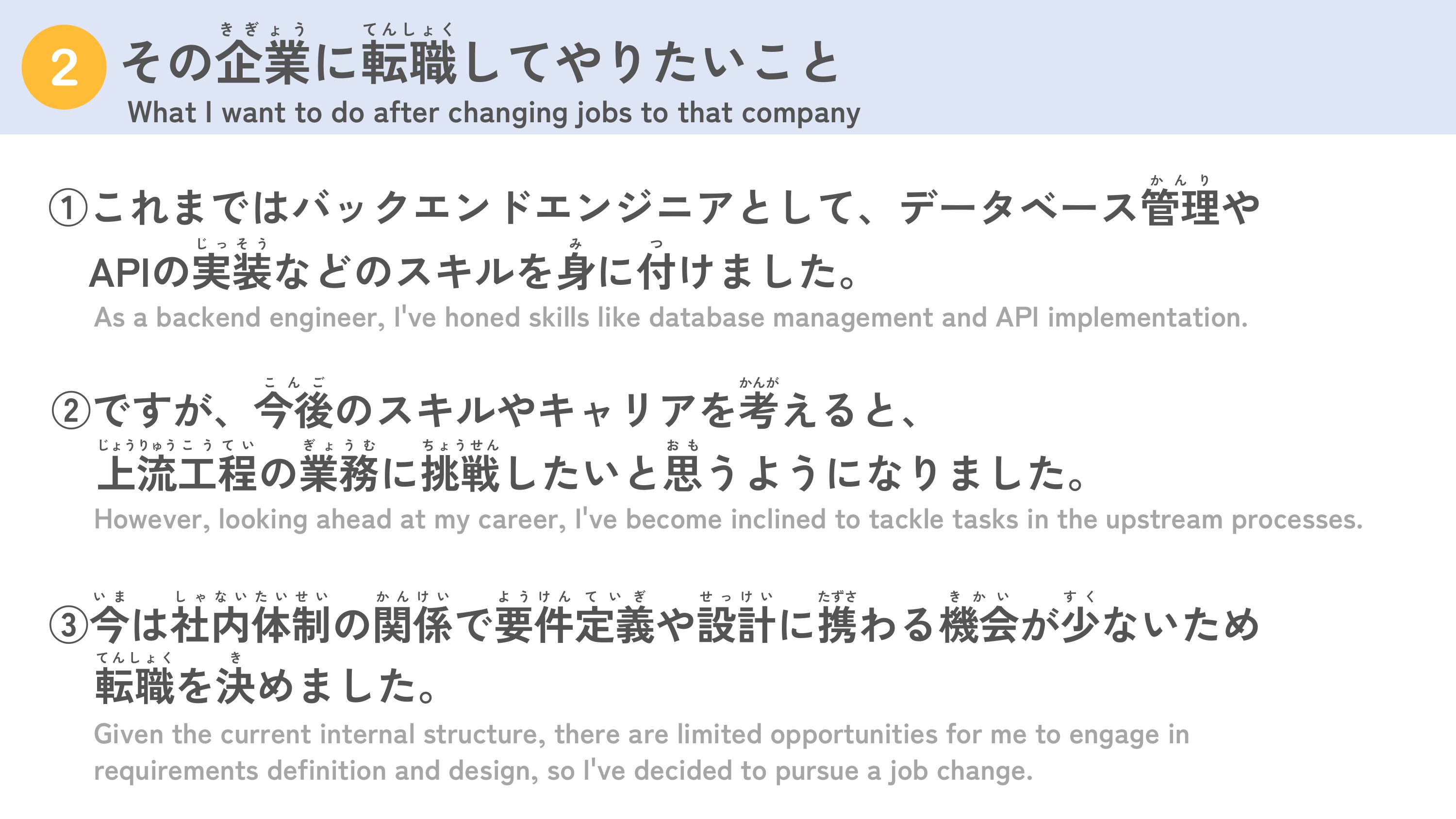
JPかんり
①これまではバックエンドエンジニアとして、データベース管理や
じっそうみつ
APIの実装などのスキルを身に付けました。
①これまではバックエンドエンジニアとして、データベース管理や
じっそうみつ
APIの実装などのスキルを身に付けました。
EN As a backend engineer, I've honed skills like database management and API implementation.
JPこんごかんが
②ですが、今後のスキルやキャリアを考えると、
じょうりゅうこうていぎょうむちょうせんおも
上流工程の業務に挑戦したいと思うようになりました。
②ですが、今後のスキルやキャリアを考えると、
じょうりゅうこうていぎょうむちょうせんおも
上流工程の業務に挑戦したいと思うようになりました。
EN However, looking ahead at my career, I've become inclined to tackle tasks in the upstream processes.
JPいましゃないたいせいかんけいようけんていぎせっけいたずさきかいすく
③今は社内体制の関係で要件定義や設計に携わる機会が少ないため
てんしょくき
転職を決めました。
③今は社内体制の関係で要件定義や設計に携わる機会が少ないため
てんしょくき
転職を決めました。
EN Given the current internal structure, there are limited opportunities for me to engage in
requirements definition and design, so I've decided to pursue a job change.
requirements definition and design, so I've decided to pursue a job change.
หน้า 44
คลิกเพื่อขยาย
JPじぶんもくひょう
自分のこれからの目標
自分のこれからの目標
ENYour future objectives
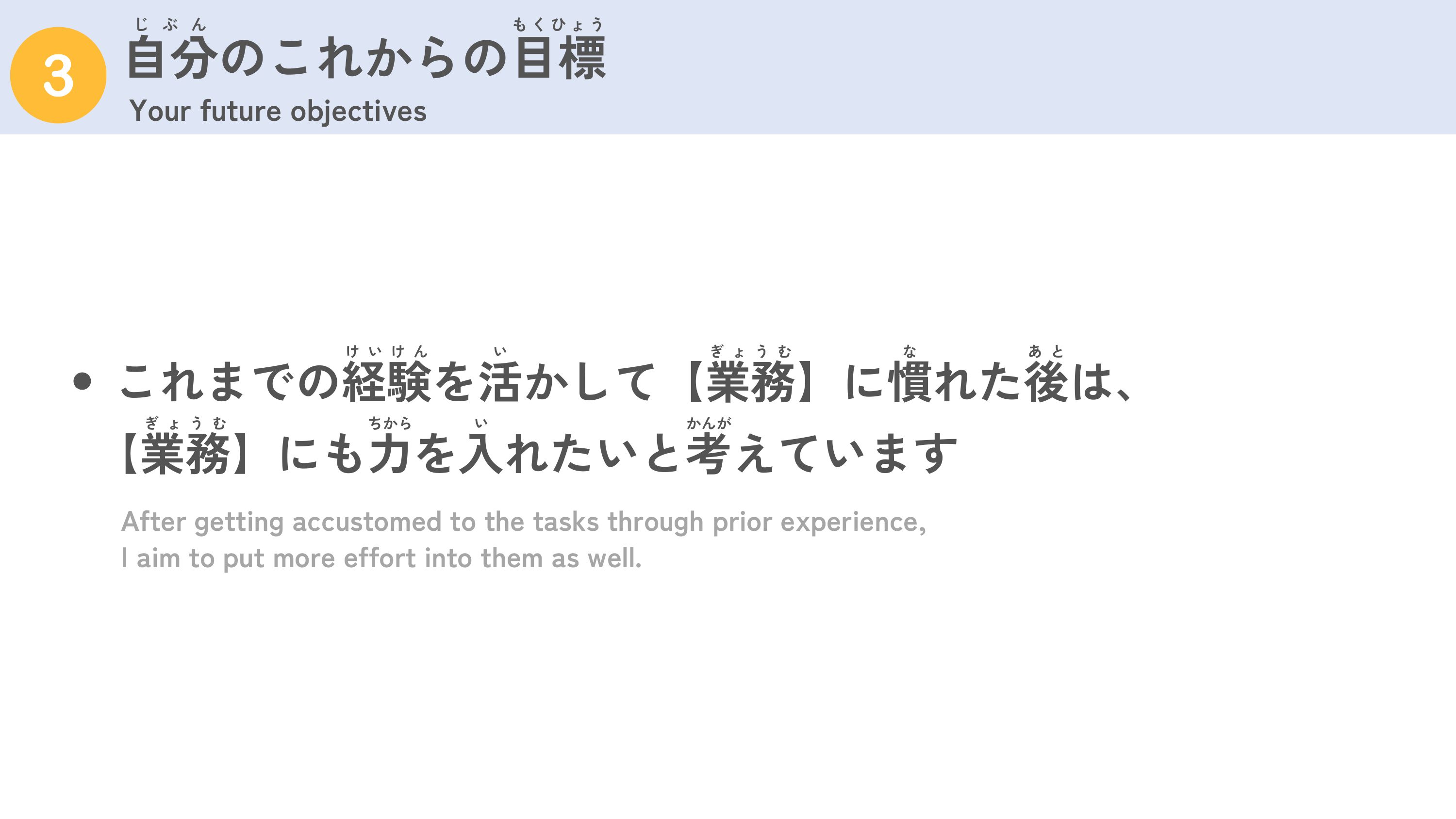
JPけいけんいぎょうむなあと
これまでの経験を活かして【業務】に慣れた後は、
ぎょうむちからいかんが
【業務】にも力を入れたいと考えています
これまでの経験を活かして【業務】に慣れた後は、
ぎょうむちからいかんが
【業務】にも力を入れたいと考えています
ENAfter getting accustomed to the tasks through prior experience,
I aim to put more effort into them as well.
I aim to put more effort into them as well.
หน้า 45
คลิกเพื่อขยาย
JPじぶんもくひょう
自分のこれからの目標
自分のこれからの目標
EN Your future objectives
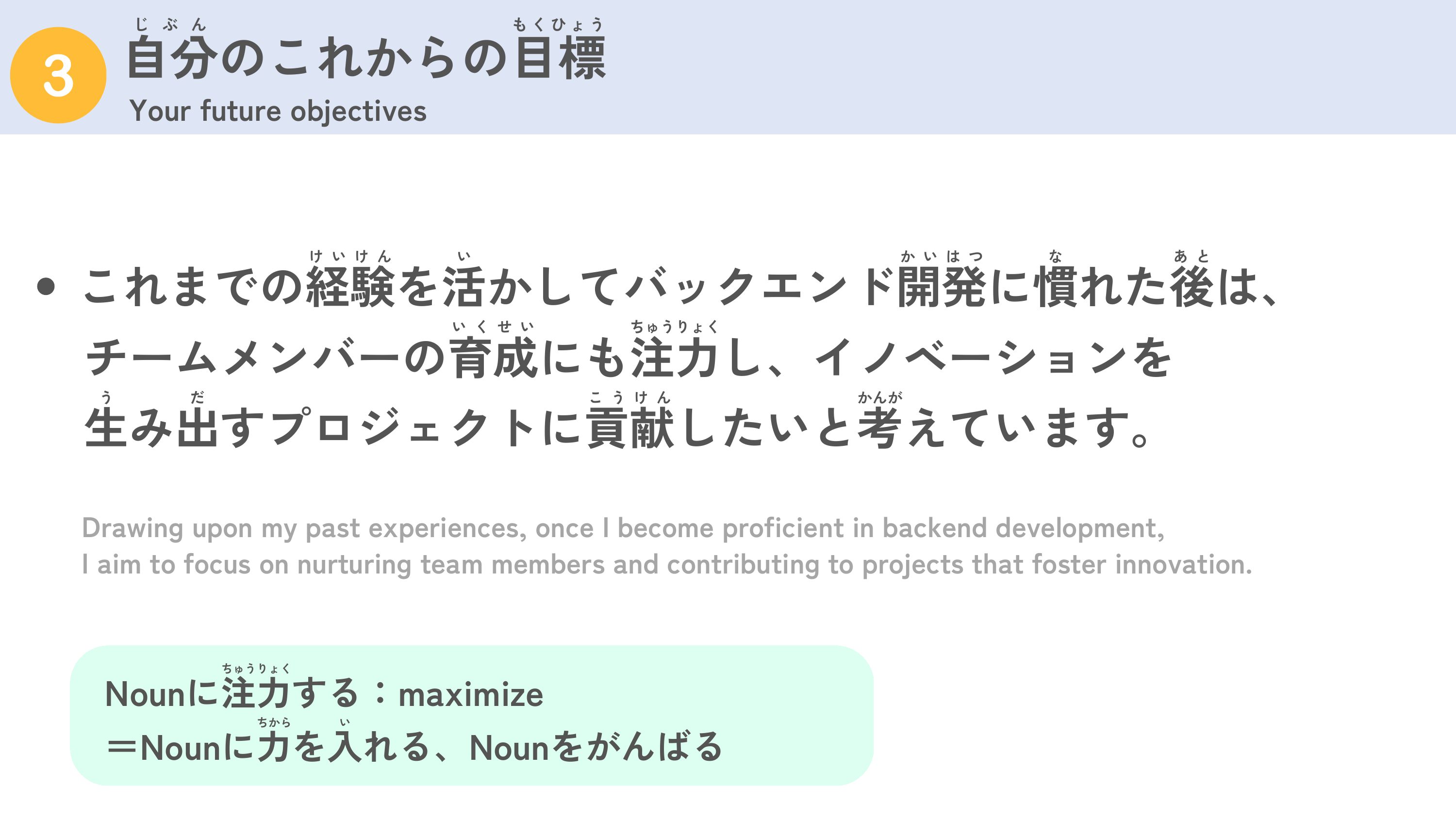
JPけいけんいかいはつなあと
これまでの経験を活かしてバックエンド開発に慣れた後は、
いくせいちゅうりょく
チームメンバーの育成にも注力し、イノベーションを
うだこうけんかんが
生み出すプロジェクトに貢献したいと考えています。
これまでの経験を活かしてバックエンド開発に慣れた後は、
いくせいちゅうりょく
チームメンバーの育成にも注力し、イノベーションを
うだこうけんかんが
生み出すプロジェクトに貢献したいと考えています。
ENDrawing upon my past experiences, once I become proficient in backend development,
I aim to focus on nurturing team members and contributing to projects that foster innovation.
I aim to focus on nurturing team members and contributing to projects that foster innovation.
JPちゅうりょく
EN Nounに注力する:maximize
JPちからい
=Nounに力を入れる、Nounをがんばる
=Nounに力を入れる、Nounをがんばる
หน้า 46

คลิกเพื่อขยาย
ENAGENDA 3
JPめんせつしぼうどうきれい
面接での志望動機の例
面接での志望動機の例
ENExamples of Motivation Statements for Job Interviews
หน้า 47
คลิกเพื่อขยาย
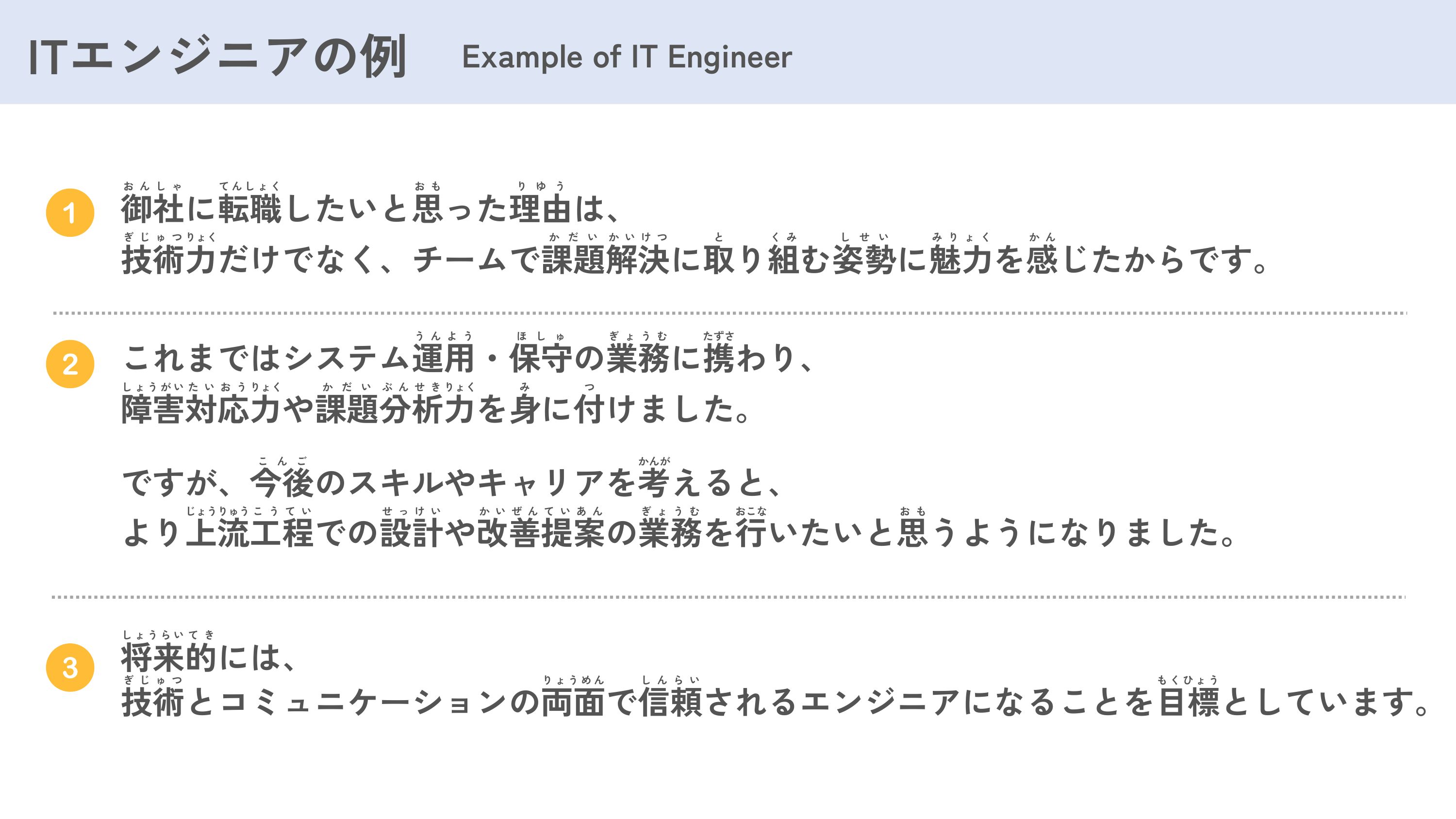
ENITエンジニアの例 Example of IT Engineer
JPおんしゃてんしょくおもりゆう
御社に転職したいと思った理由は、
ぎじゅつりょくかだいかいけつとくみしせいみりょくかん
技術力だけでなく、チームで課題解決に取り組む姿勢に魅力を感じたからです。
うんようほしゅぎょうむたずさ
これまではシステム運用・保守の業務に携わり、
しょうがいたいおうりょくかだいぶんせきりょくみつ
障害対応力や課題分析力を身に付けました。
こんごかんが
ですが、今後のスキルやキャリアを考えると、
じょうりゅうこうていせっけいかいぜんていあんぎょうむおこなおも
より上流工程での設計や改善提案の業務を行いたいと思うようになりました。
しょうらいてき
将来的には、
ぎじゅつりょうめんしんらいもくひょう
技術とコミュニケーションの両面で信頼されるエンジニアになることを目標としています。
御社に転職したいと思った理由は、
ぎじゅつりょくかだいかいけつとくみしせいみりょくかん
技術力だけでなく、チームで課題解決に取り組む姿勢に魅力を感じたからです。
うんようほしゅぎょうむたずさ
これまではシステム運用・保守の業務に携わり、
しょうがいたいおうりょくかだいぶんせきりょくみつ
障害対応力や課題分析力を身に付けました。
こんごかんが
ですが、今後のスキルやキャリアを考えると、
じょうりゅうこうていせっけいかいぜんていあんぎょうむおこなおも
より上流工程での設計や改善提案の業務を行いたいと思うようになりました。
しょうらいてき
将来的には、
ぎじゅつりょうめんしんらいもくひょう
技術とコミュニケーションの両面で信頼されるエンジニアになることを目標としています。
หน้า 48
คลิกเพื่อขยาย
JPえいぎょうれい
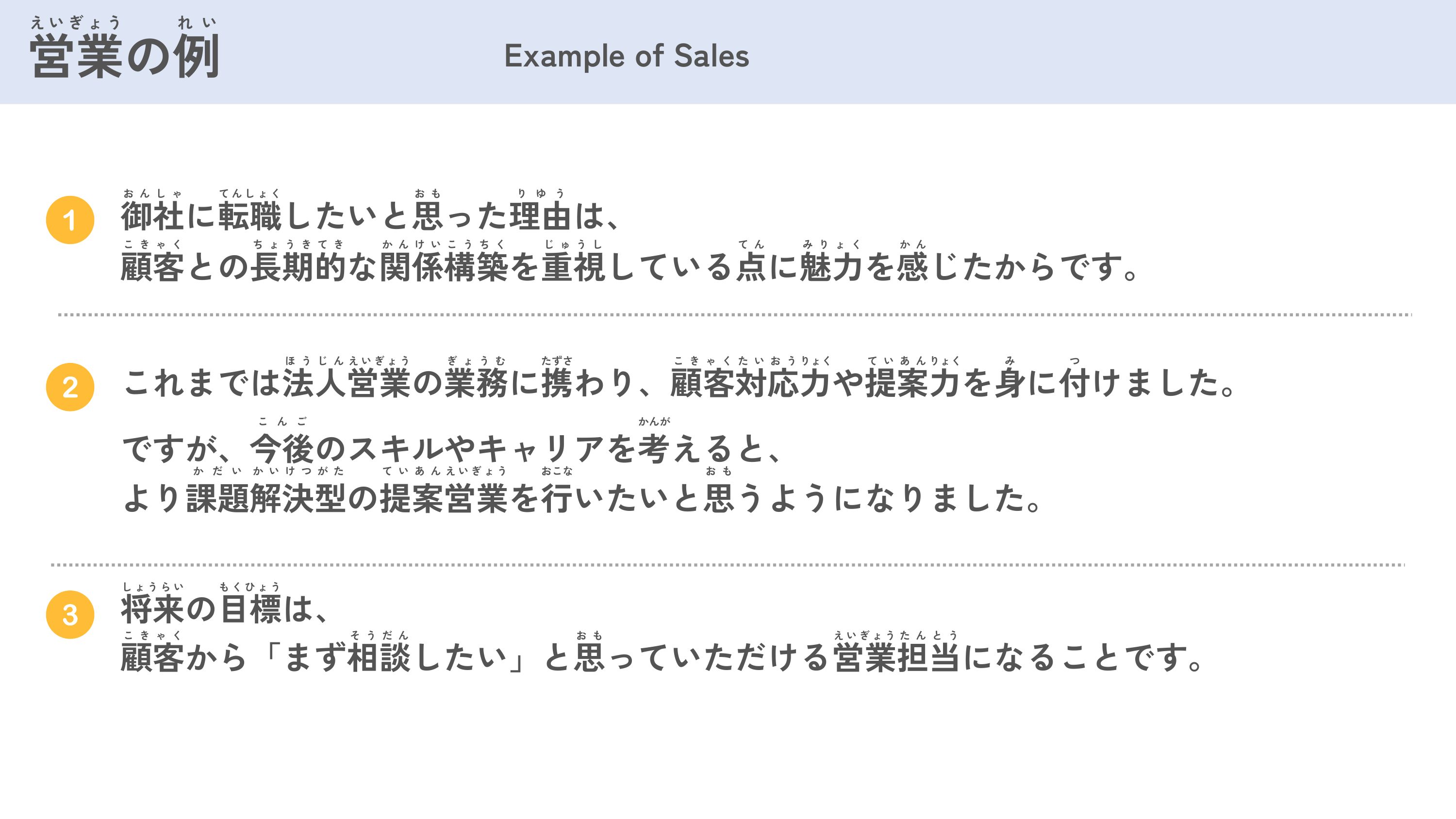
EN営業の例 Example of Sales
JPおんしゃてんしょくおもりゆう
御社に転職したいと思った理由は、
こきゃくちょうきてきかんけいこうちくじゅうしてんみりょくかん
顧客との長期的な関係構築を重視している点に魅力を感じたからです。
ほうじんえいぎょうぎょうむたずさこきゃくたいおうりょくていあんりょくみつ
これまでは法人営業の業務に携わり、顧客対応力や提案力を身に付けました。
こんごかんが
ですが、今後のスキルやキャリアを考えると、
かだいかいけつがたていあんえいぎょうおこなおも
より課題解決型の提案営業を行いたいと思うようになりました。
しょうらいもくひょう
将来の目標は、
こきゃくそうだんおもえいぎょうたんとう
顧客から「まず相談したい」と思っていただける営業担当になることです。
御社に転職したいと思った理由は、
こきゃくちょうきてきかんけいこうちくじゅうしてんみりょくかん
顧客との長期的な関係構築を重視している点に魅力を感じたからです。
ほうじんえいぎょうぎょうむたずさこきゃくたいおうりょくていあんりょくみつ
これまでは法人営業の業務に携わり、顧客対応力や提案力を身に付けました。
こんごかんが
ですが、今後のスキルやキャリアを考えると、
かだいかいけつがたていあんえいぎょうおこなおも
より課題解決型の提案営業を行いたいと思うようになりました。
しょうらいもくひょう
将来の目標は、
こきゃくそうだんおもえいぎょうたんとう
顧客から「まず相談したい」と思っていただける営業担当になることです。
หน้า 49
คลิกเพื่อขยาย
JPじぶんしぼうどうきつく
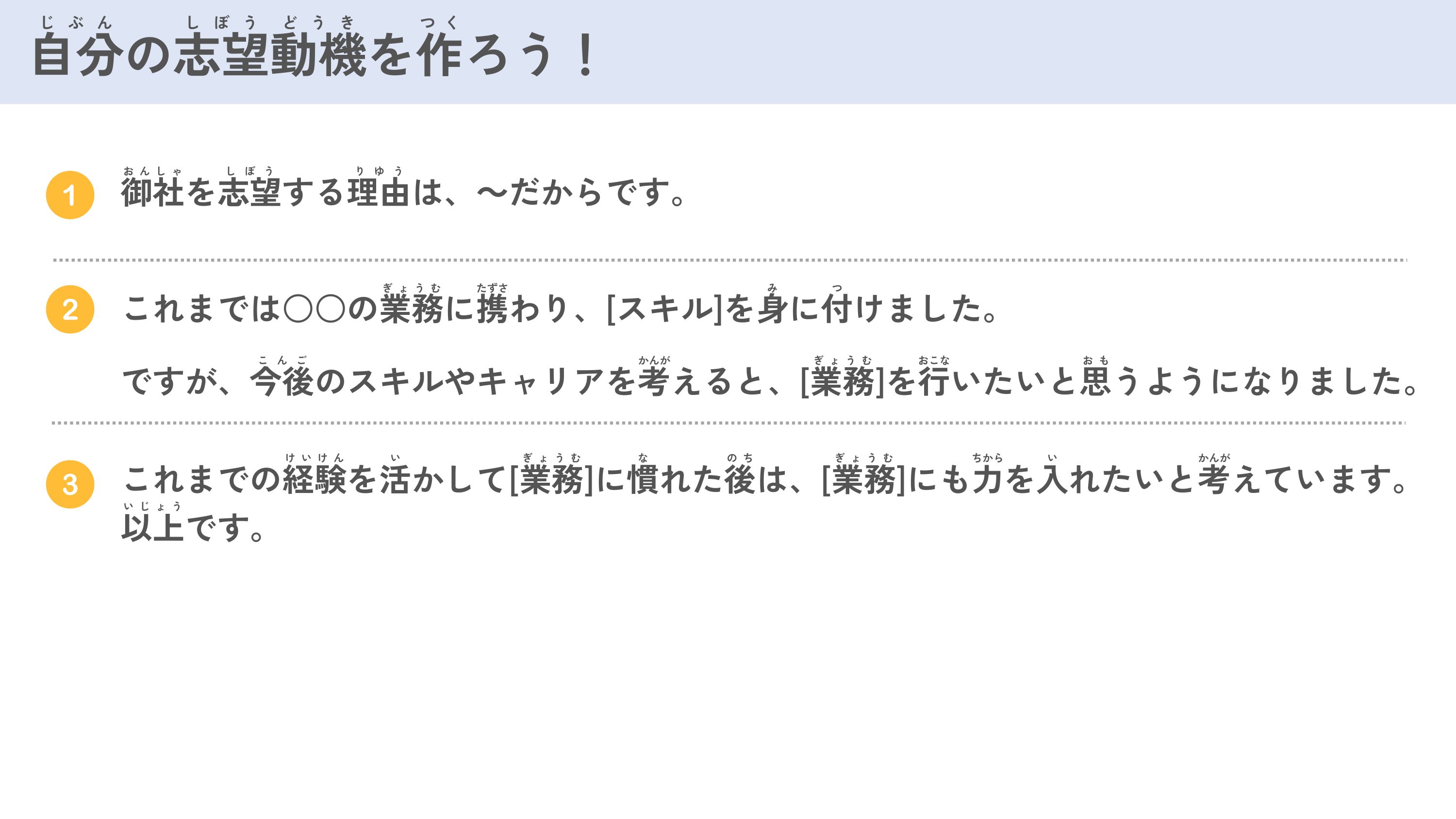
自分の志望動機を作ろう!
おんしゃしぼう
御社を志望する理由は、だからです。
りゆう
~
ぎょうむたずさみつ
これまでは○○の業務に携わり、[スキル]を身に付けました。
こんごかんがぎょうむおこなおも
ですが、今後のスキルやキャリアを考えると、[業務]を行いたいと思うようになりました。
けいけんいぎょうむなのちぎょうむちからいかんが
これまでの経験を活かして[業務]に慣れた後は、[業務]にも力を入れたいと考えています。
いじょう
以上です。
自分の志望動機を作ろう!
おんしゃしぼう
御社を志望する理由は、だからです。
りゆう
~
ぎょうむたずさみつ
これまでは○○の業務に携わり、[スキル]を身に付けました。
こんごかんがぎょうむおこなおも
ですが、今後のスキルやキャリアを考えると、[業務]を行いたいと思うようになりました。
けいけんいぎょうむなのちぎょうむちからいかんが
これまでの経験を活かして[業務]に慣れた後は、[業務]にも力を入れたいと考えています。
いじょう
以上です。
หน้า 50
คลิกเพื่อขยาย
JPしぼうどうき
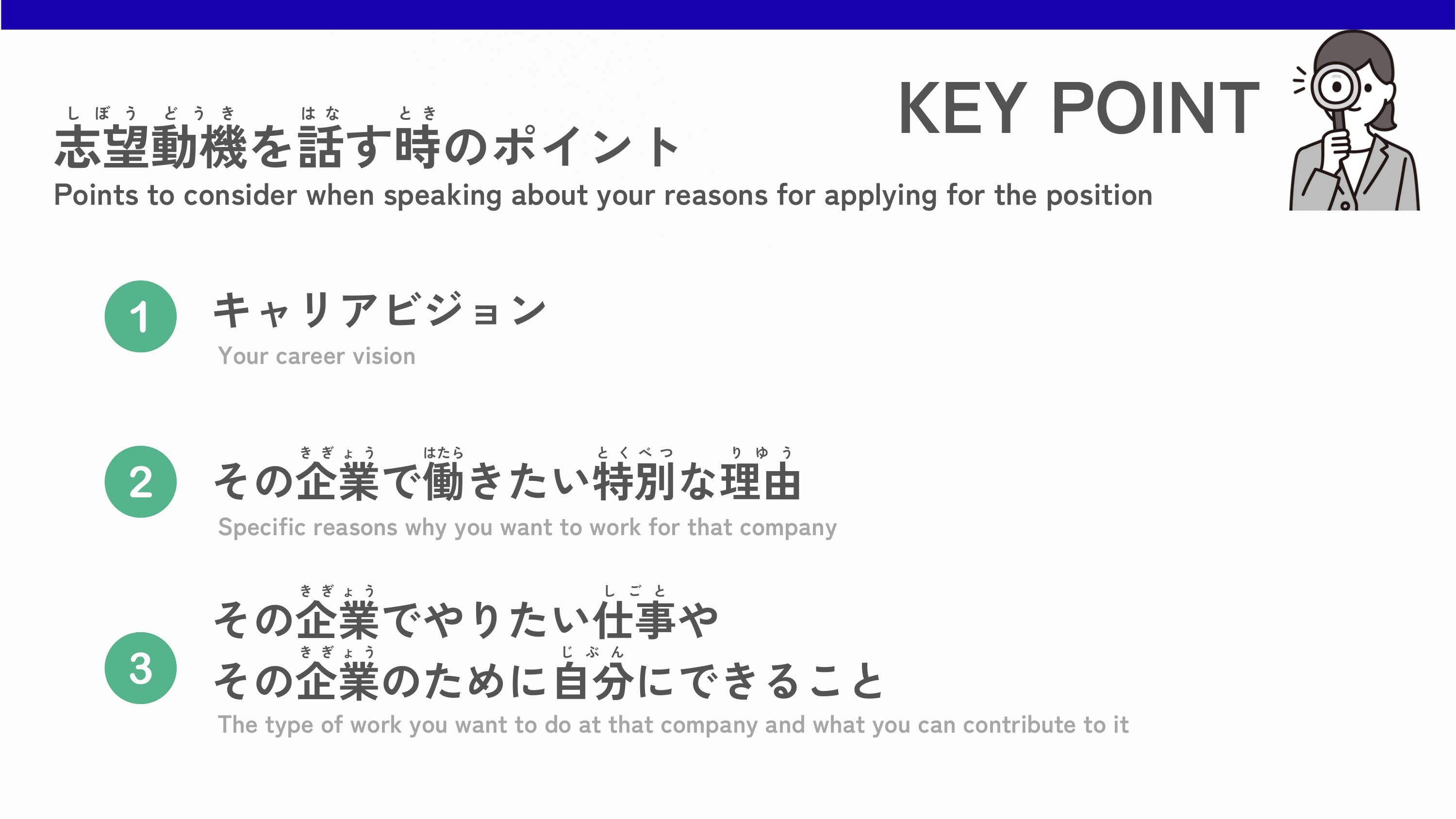
志望動機を話す時のポイント
はなとき
志望動機を話す時のポイント
はなとき
EN KEY POINT
Points to consider when speaking about your reasons for applying for the position
Points to consider when speaking about your reasons for applying for the position
JPキャリアビジョン
EN Your career vision
JPきぎょうはたらとくべつりゆう
その企業で働きたい特別な理由
その企業で働きたい特別な理由
EN Specific reasons why you want to work for that company
JPきぎょうしごと
その企業でやりたい仕事や
きぎょうじぶん
その企業のために自分にできること
その企業でやりたい仕事や
きぎょうじぶん
その企業のために自分にできること
EN The type of work you want to do at that company and what you can contribute to it
หน้า 51
คลิกเพื่อขยาย
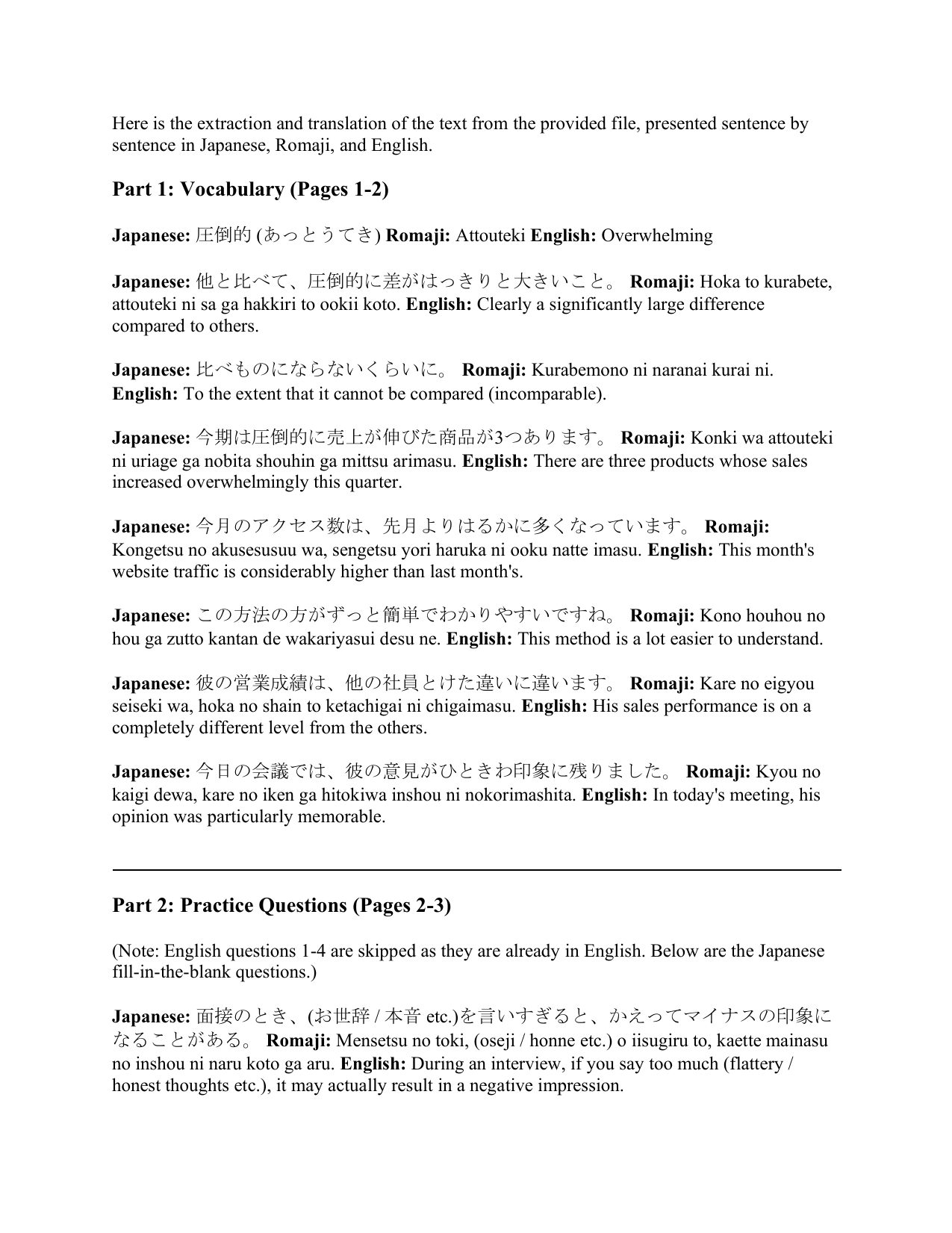
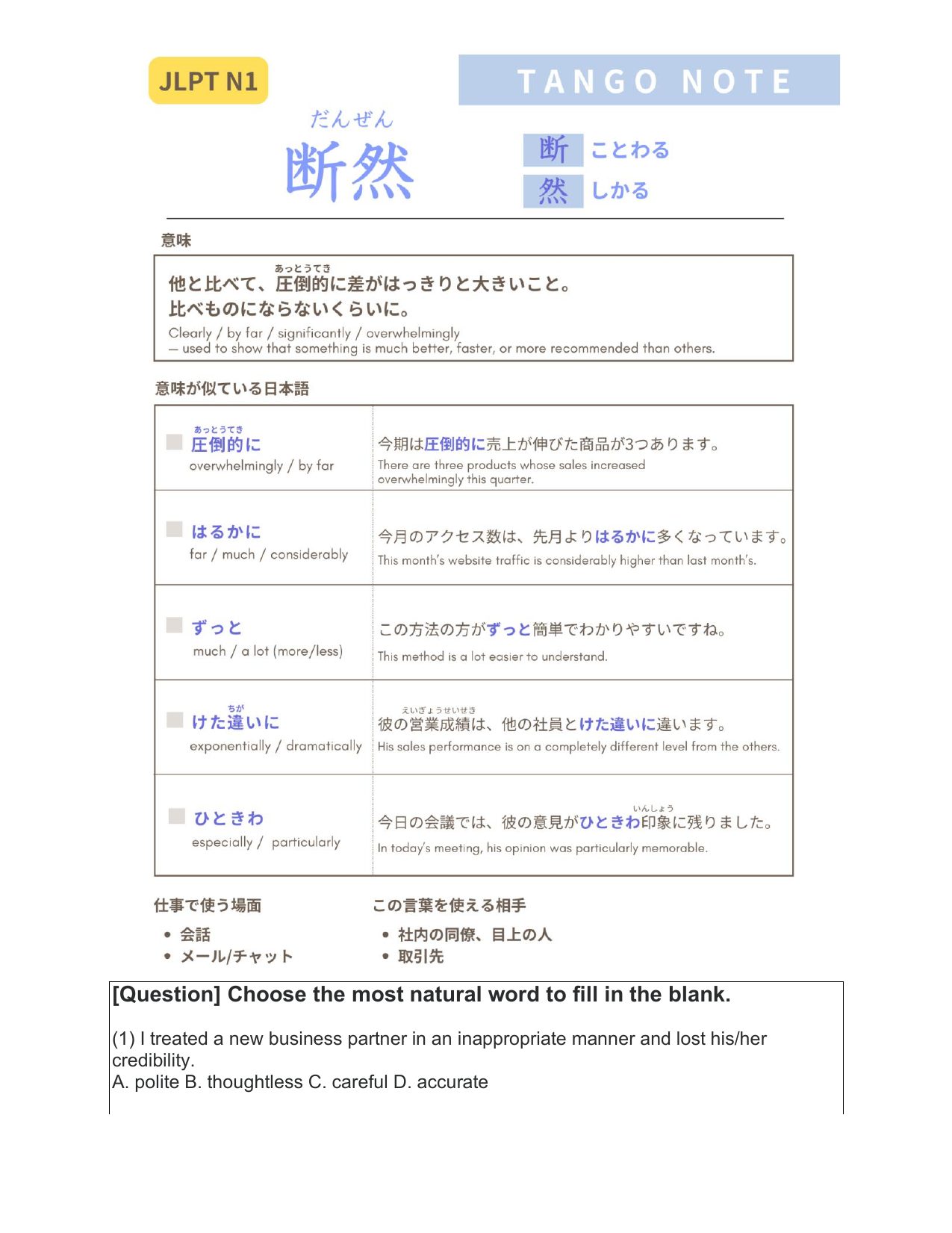
ENHere is the extraction and translation of the text from the provided file, presented sentence by
sentence in Japanese, Romaji, and English.
Part 1: Vocabulary (Pages 1-2)
Japanese: 圧倒的 (あっとうてき) Romaji: Attouteki English: Overwhelming
Japanese: 他と比べて、圧倒的に差がはっきりと大きいこと。 Romaji: Hoka to kurabete,
attouteki ni sa ga hakkiri to ookii koto. English: Clearly a significantly large difference
compared to others.
Japanese: 比べものにならないくらいに。 Romaji: Kurabemono ni naranai kurai ni.
English: To the extent that it cannot be compared (incomparable).
Japanese: 今期は圧倒的に売上が伸びた商品が3つあります。 Romaji: Konki wa attouteki
ni uriage ga nobita shouhin ga mittsu arimasu. English: There are three products whose sales
increased overwhelmingly this quarter.
sentence in Japanese, Romaji, and English.
Part 1: Vocabulary (Pages 1-2)
Japanese: 圧倒的 (あっとうてき) Romaji: Attouteki English: Overwhelming
Japanese: 他と比べて、圧倒的に差がはっきりと大きいこと。 Romaji: Hoka to kurabete,
attouteki ni sa ga hakkiri to ookii koto. English: Clearly a significantly large difference
compared to others.
Japanese: 比べものにならないくらいに。 Romaji: Kurabemono ni naranai kurai ni.
English: To the extent that it cannot be compared (incomparable).
Japanese: 今期は圧倒的に売上が伸びた商品が3つあります。 Romaji: Konki wa attouteki
ni uriage ga nobita shouhin ga mittsu arimasu. English: There are three products whose sales
increased overwhelmingly this quarter.
JPJapanese:今月のアクセス数は、先月よりはるかに多くなっています。Romaji:
ENKongetsu no akusesusuu wa, sengetsu yori haruka ni ooku natte imasu. English: This month's
website traffic is considerably higher than last month's.
Japanese: この方法の方がずっと簡単でわかりやすいですね。 Romaji: Kono houhou no
hou ga zutto kantan de wakariyasui desu ne. English: This method is a lot easier to understand.
Japanese: 彼の営業成績は、他の社員とけた違いに違います。 Romaji: Kare no eigyou
seiseki wa, hoka no shain to ketachigai ni chigaimasu. English: His sales performance is on a
completely different level from the others.
website traffic is considerably higher than last month's.
Japanese: この方法の方がずっと簡単でわかりやすいですね。 Romaji: Kono houhou no
hou ga zutto kantan de wakariyasui desu ne. English: This method is a lot easier to understand.
Japanese: 彼の営業成績は、他の社員とけた違いに違います。 Romaji: Kare no eigyou
seiseki wa, hoka no shain to ketachigai ni chigaimasu. English: His sales performance is on a
completely different level from the others.
JPJapanese:今日の会議では、彼の意見がひときわ印象に残りました。Romaji:Kyouno
ENkaigi dewa, kare no iken ga hitokiwa inshou ni nokorimashita. English: In today's meeting, his
opinion was particularly memorable.
Part 2: Practice Questions (Pages 2-3)
(Note: English questions 1-4 are skipped as they are already in English. Below are the Japanese
fill-in-the-blank questions.)
opinion was particularly memorable.
Part 2: Practice Questions (Pages 2-3)
(Note: English questions 1-4 are skipped as they are already in English. Below are the Japanese
fill-in-the-blank questions.)
JPJapanese:面接のとき、(お世辞/本音etc.)を言いすぎると、かえってマイナスの印象に
ENなることがある。 Romaji: Mensetsu no toki, (oseji / honne etc.) o iisugiru to, kaette mainasu
no inshou ni naru koto ga aru. English: During an interview, if you say too much (flattery /
honest thoughts etc.), it may actually result in a negative impression.
no inshou ni naru koto ga aru. English: During an interview, if you say too much (flattery /
honest thoughts etc.), it may actually result in a negative impression.
หน้า 52
คลิกเพื่อขยาย
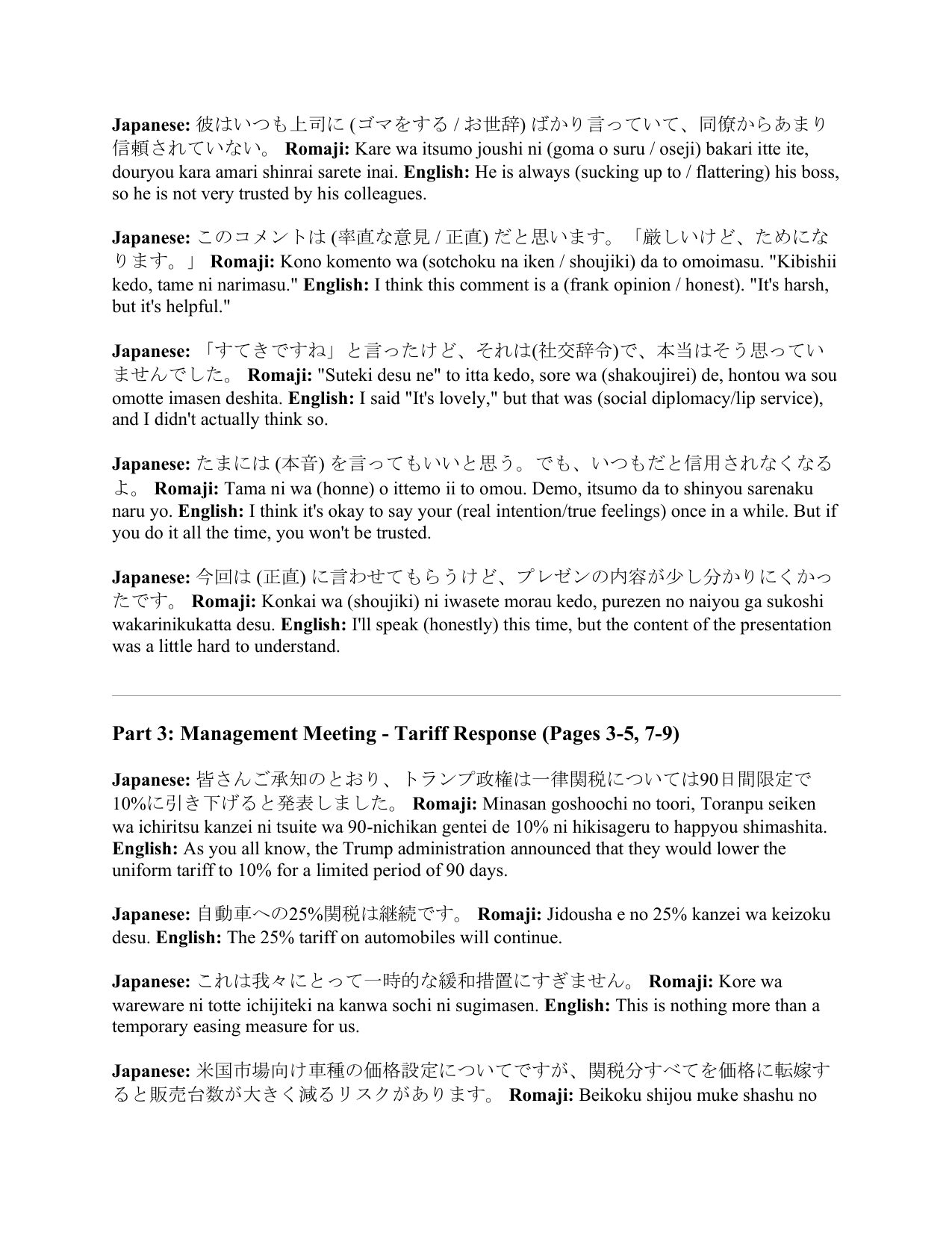
JPJapanese:彼はいつも上司に(ゴマをする/お世辞)ばかり言っていて、同僚からあまり
EN信頼されていない。 Romaji: Kare wa itsumo joushi ni (goma o suru / oseji) bakari itte ite,
douryou kara amari shinrai sarete inai. English: He is always (sucking up to / flattering) his boss,
so he is not very trusted by his colleagues.
douryou kara amari shinrai sarete inai. English: He is always (sucking up to / flattering) his boss,
so he is not very trusted by his colleagues.
JPJapanese:このコメントは(率直な意見/正直)だと思います。「厳しいけど、ためにな
ENります。」 Romaji: Kono komento wa (sotchoku na iken / shoujiki) da to omoimasu. "Kibishii
kedo, tame ni narimasu." English: I think this comment is a (frank opinion / honest). "It's harsh,
but it's helpful."
kedo, tame ni narimasu." English: I think this comment is a (frank opinion / honest). "It's harsh,
but it's helpful."
JPJapanese:「すてきですね」と言ったけど、それは(社交辞令)で、本当はそう思ってい
ENませんでした。 Romaji: "Suteki desu ne" to itta kedo, sore wa (shakoujirei) de, hontou wa sou
omotte imasen deshita. English: I said "It's lovely," but that was (social diplomacy/lip service),
and I didn't actually think so.
omotte imasen deshita. English: I said "It's lovely," but that was (social diplomacy/lip service),
and I didn't actually think so.
JPJapanese:たまには(本音)を言ってもいいと思う。でも、いつもだと信用されなくなる
ENよ。 Romaji: Tama ni wa (honne) o ittemo ii to omou. Demo, itsumo da to shinyou sarenaku
naru yo. English: I think it's okay to say your (real intention/true feelings) once in a while. But if
you do it all the time, you won't be trusted.
naru yo. English: I think it's okay to say your (real intention/true feelings) once in a while. But if
you do it all the time, you won't be trusted.
JPJapanese:今回は(正直)に言わせてもらうけど、プレゼンの内容が少し分かりにくかっ
ENたです。 Romaji: Konkai wa (shoujiki) ni iwasete morau kedo, purezen no naiyou ga sukoshi
wakarinikukatta desu. English: I'll speak (honestly) this time, but the content of the presentation
was a little hard to understand.
Part 3: Management Meeting - Tariff Response (Pages 3-5, 7-9)
wakarinikukatta desu. English: I'll speak (honestly) this time, but the content of the presentation
was a little hard to understand.
Part 3: Management Meeting - Tariff Response (Pages 3-5, 7-9)
JPJapanese:皆さんご承知のとおり、トランプ政権は一律関税については90日間限定で
EN10%に引き下げると発表しました。 Romaji: Minasan goshoochi no toori, Toranpu seiken
wa ichiritsu kanzei ni tsuite wa 90-nichikan gentei de 10% ni hikisageru to happyou shimashita.
English: As you all know, the Trump administration announced that they would lower the
uniform tariff to 10% for a limited period of 90 days.
Japanese: 自動車への25%関税は継続です。 Romaji: Jidousha e no 25% kanzei wa keizoku
desu. English: The 25% tariff on automobiles will continue.
wa ichiritsu kanzei ni tsuite wa 90-nichikan gentei de 10% ni hikisageru to happyou shimashita.
English: As you all know, the Trump administration announced that they would lower the
uniform tariff to 10% for a limited period of 90 days.
Japanese: 自動車への25%関税は継続です。 Romaji: Jidousha e no 25% kanzei wa keizoku
desu. English: The 25% tariff on automobiles will continue.
JPJapanese:これは我々にとって一時的な緩和措置にすぎません。Romaji:Korewa
ENwareware ni totte ichijiteki na kanwa sochi ni sugimasen. English: This is nothing more than a
temporary easing measure for us.
temporary easing measure for us.
JPJapanese:米国市場向け車種の価格設定についてですが、関税分すべてを価格に転嫁す
ENると販売台数が大きく減るリスクがあります。 Romaji: Beikoku shijou muke shashu no
หน้า 53
คลิกเพื่อขยาย
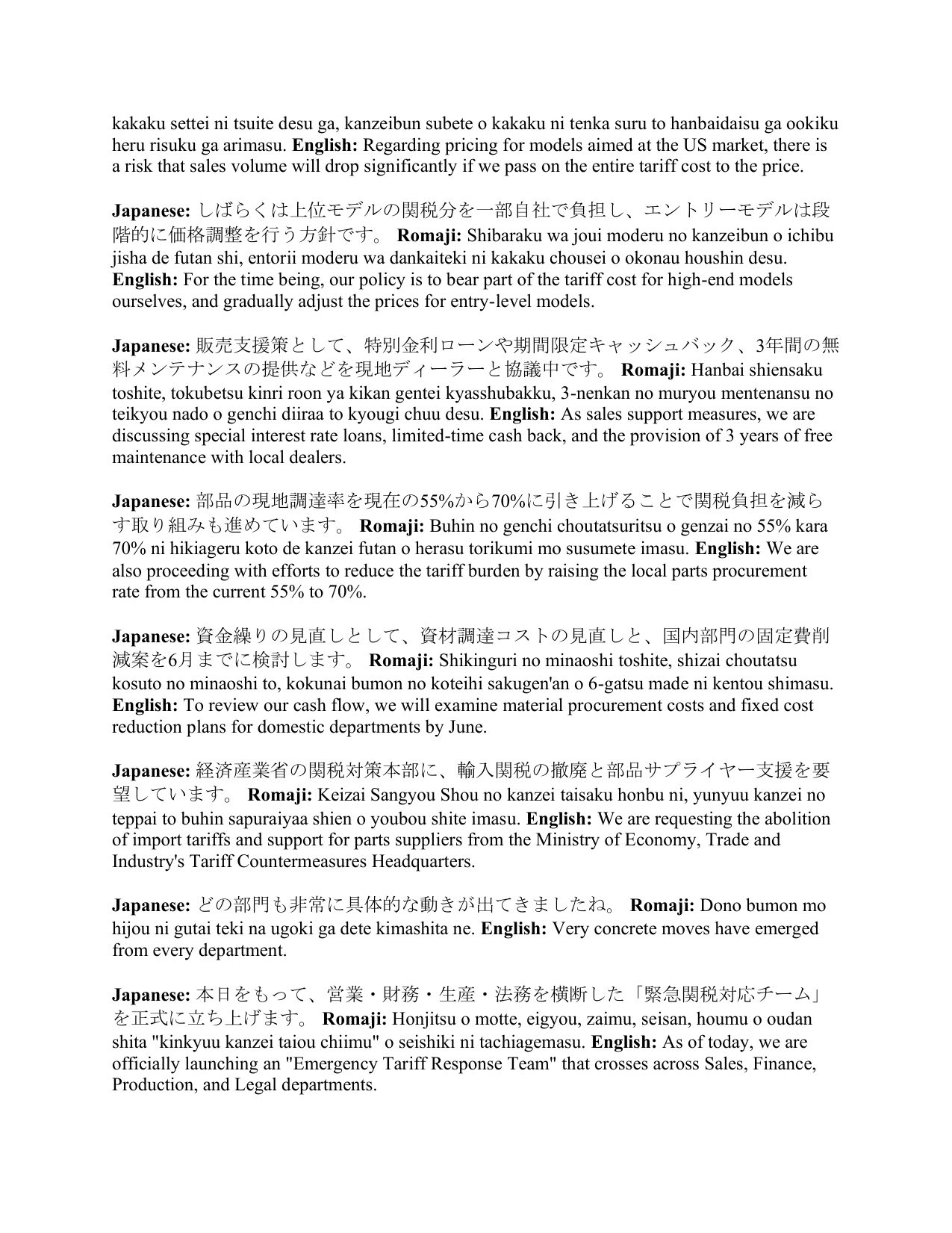
ENkakaku settei ni tsuite desu ga, kanzeibun subete o kakaku ni tenka suru to hanbaidaisu ga ookiku
heru risuku ga arimasu. English: Regarding pricing for models aimed at the US market, there is
a risk that sales volume will drop significantly if we pass on the entire tariff cost to the price.
heru risuku ga arimasu. English: Regarding pricing for models aimed at the US market, there is
a risk that sales volume will drop significantly if we pass on the entire tariff cost to the price.
JPJapanese:しばらくは上位モデルの関税分を一部自社で負担し、エントリーモデルは段
EN階的に価格調整を行う方針です。 Romaji: Shibaraku wa joui moderu no kanzeibun o ichibu
jisha de futan shi, entorii moderu wa dankaiteki ni kakaku chousei o okonau houshin desu.
English: For the time being, our policy is to bear part of the tariff cost for high-end models
ourselves, and gradually adjust the prices for entry-level models.
jisha de futan shi, entorii moderu wa dankaiteki ni kakaku chousei o okonau houshin desu.
English: For the time being, our policy is to bear part of the tariff cost for high-end models
ourselves, and gradually adjust the prices for entry-level models.
JPJapanese:販売支援策として、特別金利ローンや期間限定キャッシュバック、3年間の無
料メンテナンスの提供などを現地ディーラーと協議中です。Romaji:Hanbaishiensaku
料メンテナンスの提供などを現地ディーラーと協議中です。Romaji:Hanbaishiensaku
ENtoshite, tokubetsu kinri roon ya kikan gentei kyasshubakku, 3-nenkan no muryou mentenansu no
teikyou nado o genchi diiraa to kyougi chuu desu. English: As sales support measures, we are
discussing special interest rate loans, limited-time cash back, and the provision of 3 years of free
maintenance with local dealers.
teikyou nado o genchi diiraa to kyougi chuu desu. English: As sales support measures, we are
discussing special interest rate loans, limited-time cash back, and the provision of 3 years of free
maintenance with local dealers.
JPJapanese:部品の現地調達率を現在の55%から70%に引き上げることで関税負担を減ら
ENす取り組みも進めています。 Romaji: Buhin no genchi choutatsuritsu o genzai no 55% kara
70% ni hikiageru koto de kanzei futan o herasu torikumi mo susumete imasu. English: We are
also proceeding with efforts to reduce the tariff burden by raising the local parts procurement
rate from the current 55% to 70%.
70% ni hikiageru koto de kanzei futan o herasu torikumi mo susumete imasu. English: We are
also proceeding with efforts to reduce the tariff burden by raising the local parts procurement
rate from the current 55% to 70%.
JPJapanese:資金繰りの見直しとして、資材調達コストの見直しと、国内部門の固定費削
EN減案を6月までに検討します。 Romaji: Shikinguri no minaoshi toshite, shizai choutatsu
kosuto no minaoshi to, kokunai bumon no koteihi sakugen'an o 6-gatsu made ni kentou shimasu.
English: To review our cash flow, we will examine material procurement costs and fixed cost
reduction plans for domestic departments by June.
kosuto no minaoshi to, kokunai bumon no koteihi sakugen'an o 6-gatsu made ni kentou shimasu.
English: To review our cash flow, we will examine material procurement costs and fixed cost
reduction plans for domestic departments by June.
JPJapanese:経済産業省の関税対策本部に、輸入関税の撤廃と部品サプライヤー支援を要
EN望しています。 Romaji: Keizai Sangyou Shou no kanzei taisaku honbu ni, yunyuu kanzei no
teppai to buhin sapuraiyaa shien o youbou shite imasu. English: We are requesting the abolition
of import tariffs and support for parts suppliers from the Ministry of Economy, Trade and
Industry's Tariff Countermeasures Headquarters.
Japanese: どの部門も非常に具体的な動きが出てきましたね。 Romaji: Dono bumon mo
hijou ni gutai teki na ugoki ga dete kimashita ne. English: Very concrete moves have emerged
from every department.
teppai to buhin sapuraiyaa shien o youbou shite imasu. English: We are requesting the abolition
of import tariffs and support for parts suppliers from the Ministry of Economy, Trade and
Industry's Tariff Countermeasures Headquarters.
Japanese: どの部門も非常に具体的な動きが出てきましたね。 Romaji: Dono bumon mo
hijou ni gutai teki na ugoki ga dete kimashita ne. English: Very concrete moves have emerged
from every department.
JPJapanese:本日をもって、営業・財務・生産・法務を横断した「緊急関税対応チーム」
ENを正式に立ち上げます。 Romaji: Honjitsu o motte, eigyou, zaimu, seisan, houmu o oudan
shita "kinkyuu kanzei taiou chiimu" o seishiki ni tachiagemasu. English: As of today, we are
officially launching an "Emergency Tariff Response Team" that crosses across Sales, Finance,
Production, and Legal departments.
shita "kinkyuu kanzei taiou chiimu" o seishiki ni tachiagemasu. English: As of today, we are
officially launching an "Emergency Tariff Response Team" that crosses across Sales, Finance,
Production, and Legal departments.
หน้า 54
คลิกเพื่อขยาย
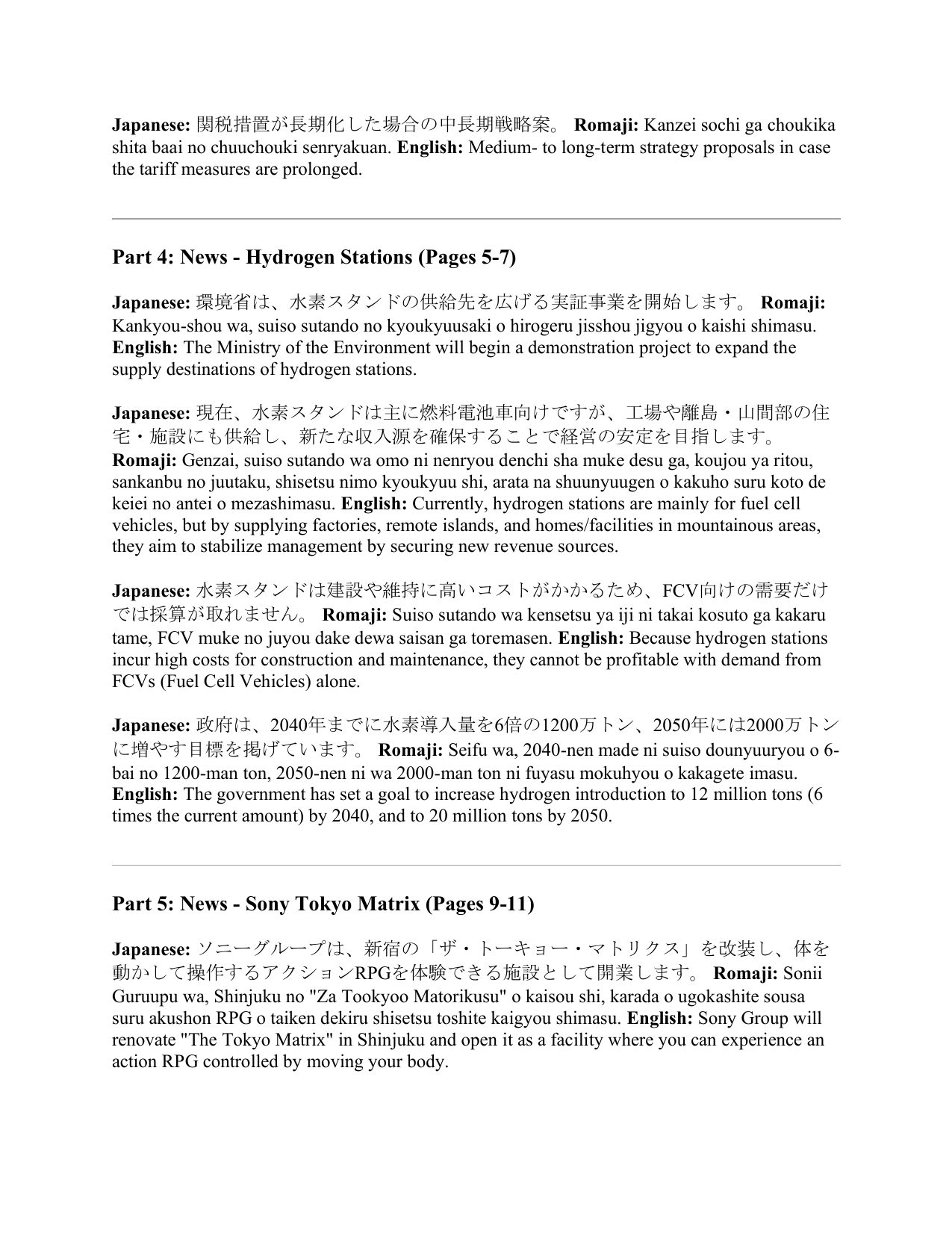
ENJapanese: 関税措置が長期化した場合の中長期戦略案。 Romaji: Kanzei sochi ga choukika
shita baai no chuuchouki senryakuan. English: Medium- to long-term strategy proposals in case
the tariff measures are prolonged.
Part 4: News - Hydrogen Stations (Pages 5-7)
shita baai no chuuchouki senryakuan. English: Medium- to long-term strategy proposals in case
the tariff measures are prolonged.
Part 4: News - Hydrogen Stations (Pages 5-7)
JPJapanese:環境省は、水素スタンドの供給先を広げる実証事業を開始します。Romaji:
ENKankyou-shou wa, suiso sutando no kyoukyuusaki o hirogeru jisshou jigyou o kaishi shimasu.
English: The Ministry of the Environment will begin a demonstration project to expand the
supply destinations of hydrogen stations.
English: The Ministry of the Environment will begin a demonstration project to expand the
supply destinations of hydrogen stations.
JPJapanese:現在、水素スタンドは主に燃料電池車向けですが、工場や離島・山間部の住
宅・施設にも供給し、新たな収入源を確保することで経営の安定を目指します。
宅・施設にも供給し、新たな収入源を確保することで経営の安定を目指します。
ENRomaji: Genzai, suiso sutando wa omo ni nenryou denchi sha muke desu ga, koujou ya ritou,
sankanbu no juutaku, shisetsu nimo kyoukyuu shi, arata na shuunyuugen o kakuho suru koto de
keiei no antei o mezashimasu. English: Currently, hydrogen stations are mainly for fuel cell
vehicles, but by supplying factories, remote islands, and homes/facilities in mountainous areas,
they aim to stabilize management by securing new revenue sources.
sankanbu no juutaku, shisetsu nimo kyoukyuu shi, arata na shuunyuugen o kakuho suru koto de
keiei no antei o mezashimasu. English: Currently, hydrogen stations are mainly for fuel cell
vehicles, but by supplying factories, remote islands, and homes/facilities in mountainous areas,
they aim to stabilize management by securing new revenue sources.
JPJapanese:水素スタンドは建設や維持に高いコストがかかるため、FCV向けの需要だけ
ENでは採算が取れません。 Romaji: Suiso sutando wa kensetsu ya iji ni takai kosuto ga kakaru
tame, FCV muke no juyou dake dewa saisan ga toremasen. English: Because hydrogen stations
incur high costs for construction and maintenance, they cannot be profitable with demand from
FCVs (Fuel Cell Vehicles) alone.
tame, FCV muke no juyou dake dewa saisan ga toremasen. English: Because hydrogen stations
incur high costs for construction and maintenance, they cannot be profitable with demand from
FCVs (Fuel Cell Vehicles) alone.
JPJapanese:政府は、2040年までに水素導入量を6倍の1200万トン、2050年には2000万トン
ENに増やす目標を掲げています。 Romaji: Seifu wa, 2040-nen made ni suiso dounyuuryou o 6-
bai no 1200-man ton, 2050-nen ni wa 2000-man ton ni fuyasu mokuhyou o kakagete imasu.
English: The government has set a goal to increase hydrogen introduction to 12 million tons (6
times the current amount) by 2040, and to 20 million tons by 2050.
Part 5: News - Sony Tokyo Matrix (Pages 9-11)
bai no 1200-man ton, 2050-nen ni wa 2000-man ton ni fuyasu mokuhyou o kakagete imasu.
English: The government has set a goal to increase hydrogen introduction to 12 million tons (6
times the current amount) by 2040, and to 20 million tons by 2050.
Part 5: News - Sony Tokyo Matrix (Pages 9-11)
JPJapanese:ソニーグループは、新宿の「ザ・トーキョー・マトリクス」を改装し、体を
動かして操作するアクションRPGを体験できる施設として開業します。Romaji:Sonii
動かして操作するアクションRPGを体験できる施設として開業します。Romaji:Sonii
ENGuruupu wa, Shinjuku no "Za Tookyoo Matorikusu" o kaisou shi, karada o ugokashite sousa
suru akushon RPG o taiken dekiru shisetsu toshite kaigyou shimasu. English: Sony Group will
renovate "The Tokyo Matrix" in Shinjuku and open it as a facility where you can experience an
action RPG controlled by moving your body.
suru akushon RPG o taiken dekiru shisetsu toshite kaigyou shimasu. English: Sony Group will
renovate "The Tokyo Matrix" in Shinjuku and open it as a facility where you can experience an
action RPG controlled by moving your body.
หน้า 55
คลิกเพื่อขยาย
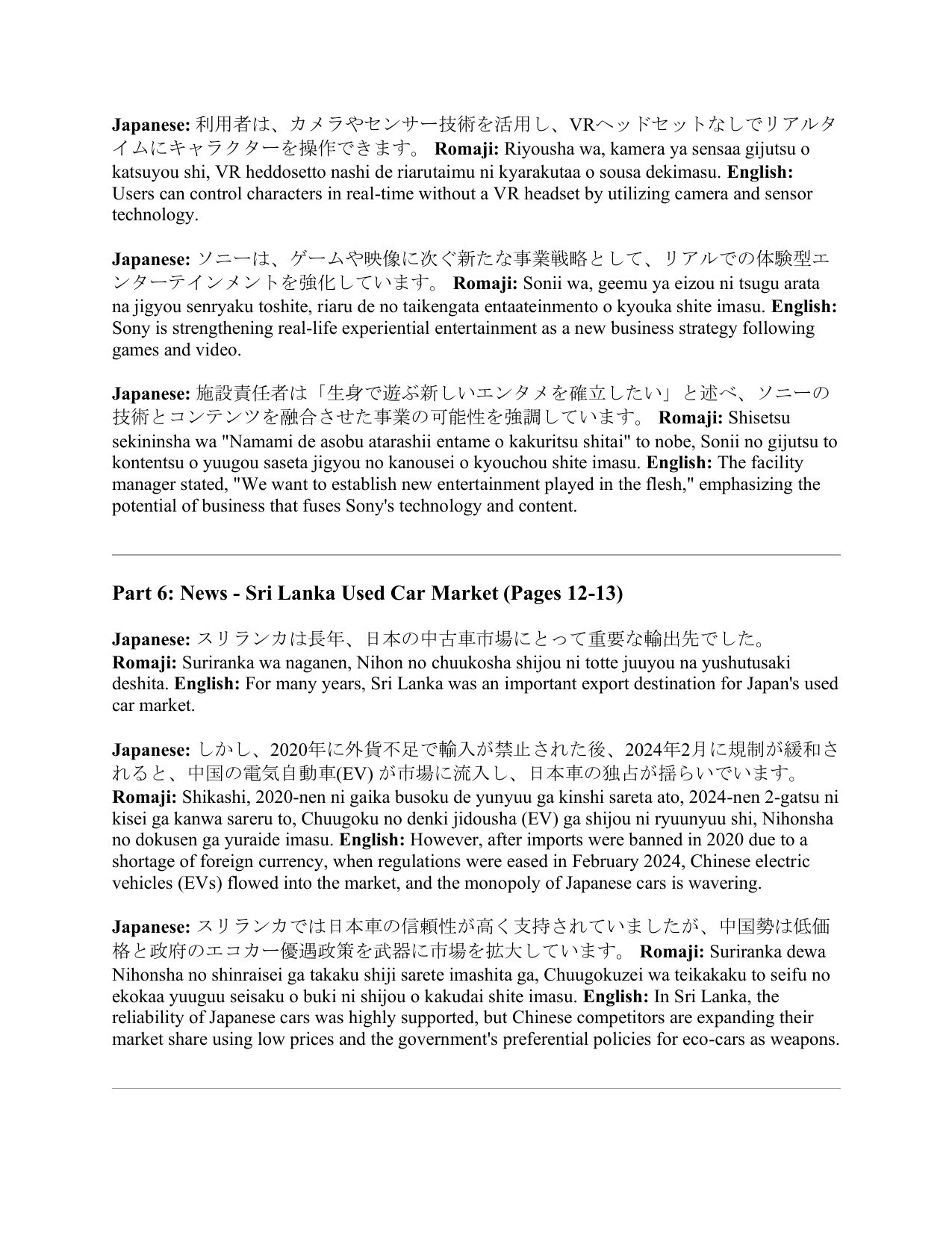
JPJapanese:利用者は、カメラやセンサー技術を活用し、VRヘッドセットなしでリアルタ
ENイムにキャラクターを操作できます。 Romaji: Riyousha wa, kamera ya sensaa gijutsu o
katsuyou shi, VR heddosetto nashi de riarutaimu ni kyarakutaa o sousa dekimasu. English:
Users can control characters in real-time without a VR headset by utilizing camera and sensor
technology.
katsuyou shi, VR heddosetto nashi de riarutaimu ni kyarakutaa o sousa dekimasu. English:
Users can control characters in real-time without a VR headset by utilizing camera and sensor
technology.
JPJapanese:ソニーは、ゲームや映像に次ぐ新たな事業戦略として、リアルでの体験型エ
ENンターテインメントを強化しています。 Romaji: Sonii wa, geemu ya eizou ni tsugu arata
na jigyou senryaku toshite, riaru de no taikengata entaateinmento o kyouka shite imasu. English:
Sony is strengthening real-life experiential entertainment as a new business strategy following
games and video.
na jigyou senryaku toshite, riaru de no taikengata entaateinmento o kyouka shite imasu. English:
Sony is strengthening real-life experiential entertainment as a new business strategy following
games and video.
JPJapanese:施設責任者は「生身で遊ぶ新しいエンタメを確立したい」と述べ、ソニーの
技術とコンテンツを融合させた事業の可能性を強調しています。Romaji:Shisetsu
技術とコンテンツを融合させた事業の可能性を強調しています。Romaji:Shisetsu
ENsekininsha wa "Namami de asobu atarashii entame o kakuritsu shitai" to nobe, Sonii no gijutsu to
kontentsu o yuugou saseta jigyou no kanousei o kyouchou shite imasu. English: The facility
manager stated, "We want to establish new entertainment played in the flesh," emphasizing the
potential of business that fuses Sony's technology and content.
Part 6: News - Sri Lanka Used Car Market (Pages 12-13)
kontentsu o yuugou saseta jigyou no kanousei o kyouchou shite imasu. English: The facility
manager stated, "We want to establish new entertainment played in the flesh," emphasizing the
potential of business that fuses Sony's technology and content.
Part 6: News - Sri Lanka Used Car Market (Pages 12-13)
JPJapanese:スリランカは長年、日本の中古車市場にとって重要な輸出先でした。
ENRomaji: Suriranka wa naganen, Nihon no chuukosha shijou ni totte juuyou na yushutusaki
deshita. English: For many years, Sri Lanka was an important export destination for Japan's used
car market.
deshita. English: For many years, Sri Lanka was an important export destination for Japan's used
car market.
JPJapanese:しかし、2020年に外貨不足で輸入が禁止された後、2024年2月に規制が緩和さ
れると、中国の電気自動車(EV)が市場に流入し、日本車の独占が揺らいでいます。
れると、中国の電気自動車(EV)が市場に流入し、日本車の独占が揺らいでいます。
ENRomaji: Shikashi, 2020-nen ni gaika busoku de yunyuu ga kinshi sareta ato, 2024-nen 2-gatsu ni
kisei ga kanwa sareru to, Chuugoku no denki jidousha (EV) ga shijou ni ryuunyuu shi, Nihonsha
no dokusen ga yuraide imasu. English: However, after imports were banned in 2020 due to a
shortage of foreign currency, when regulations were eased in February 2024, Chinese electric
vehicles (EVs) flowed into the market, and the monopoly of Japanese cars is wavering.
kisei ga kanwa sareru to, Chuugoku no denki jidousha (EV) ga shijou ni ryuunyuu shi, Nihonsha
no dokusen ga yuraide imasu. English: However, after imports were banned in 2020 due to a
shortage of foreign currency, when regulations were eased in February 2024, Chinese electric
vehicles (EVs) flowed into the market, and the monopoly of Japanese cars is wavering.
JPJapanese:スリランカでは日本車の信頼性が高く支持されていましたが、中国勢は低価
格と政府のエコカー優遇政策を武器に市場を拡大しています。Romaji:Surirankadewa
格と政府のエコカー優遇政策を武器に市場を拡大しています。Romaji:Surirankadewa
ENNihonsha no shinraisei ga takaku shiji sarete imashita ga, Chuugokuzei wa teikakaku to seifu no
ekokaa yuuguu seisaku o buki ni shijou o kakudai shite imasu. English: In Sri Lanka, the
reliability of Japanese cars was highly supported, but Chinese competitors are expanding their
market share using low prices and the government's preferential policies for eco-cars as weapons.
ekokaa yuuguu seisaku o buki ni shijou o kakudai shite imasu. English: In Sri Lanka, the
reliability of Japanese cars was highly supported, but Chinese competitors are expanding their
market share using low prices and the government's preferential policies for eco-cars as weapons.
หน้า 56
คลิกเพื่อขยาย
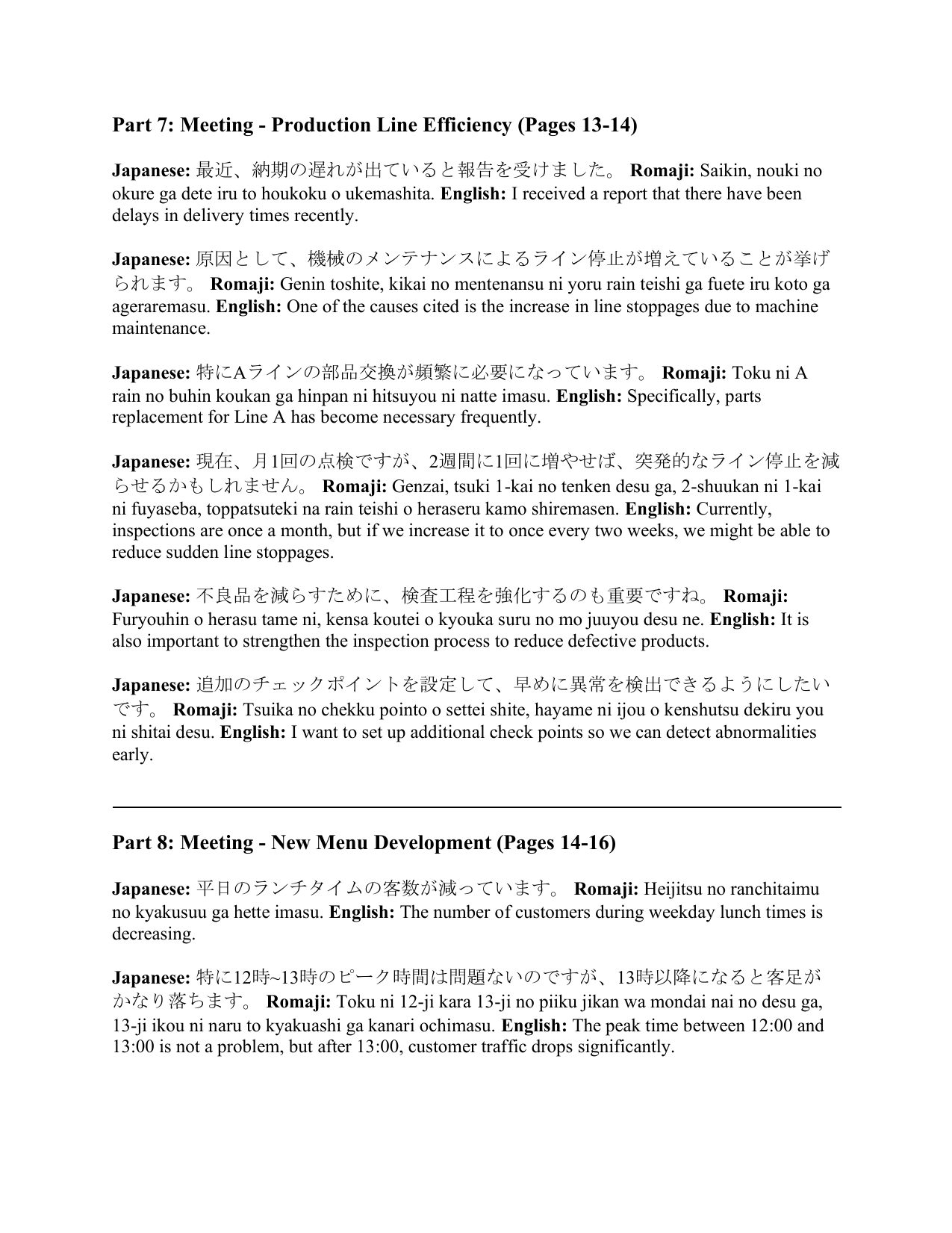
ENPart 7: Meeting - Production Line Efficiency (Pages 13-14)
Japanese: 最近、納期の遅れが出ていると報告を受けました。 Romaji: Saikin, nouki no
okure ga dete iru to houkoku o ukemashita. English: I received a report that there have been
delays in delivery times recently.
Japanese: 最近、納期の遅れが出ていると報告を受けました。 Romaji: Saikin, nouki no
okure ga dete iru to houkoku o ukemashita. English: I received a report that there have been
delays in delivery times recently.
JPJapanese:原因として、機械のメンテナンスによるライン停止が増えていることが挙げ
ENられます。 Romaji: Genin toshite, kikai no mentenansu ni yoru rain teishi ga fuete iru koto ga
ageraremasu. English: One of the causes cited is the increase in line stoppages due to machine
maintenance.
ageraremasu. English: One of the causes cited is the increase in line stoppages due to machine
maintenance.
JPJapanese:特にAラインの部品交換が頻繁に必要になっています。Romaji:TokuniA
ENrain no buhin koukan ga hinpan ni hitsuyou ni natte imasu. English: Specifically, parts
replacement for Line A has become necessary frequently.
replacement for Line A has become necessary frequently.
JPJapanese:現在、月1回の点検ですが、2週間に1回に増やせば、突発的なライン停止を減
ENらせるかもしれません。 Romaji: Genzai, tsuki 1-kai no tenken desu ga, 2-shuukan ni 1-kai
ni fuyaseba, toppatsuteki na rain teishi o heraseru kamo shiremasen. English: Currently,
inspections are once a month, but if we increase it to once every two weeks, we might be able to
reduce sudden line stoppages.
ni fuyaseba, toppatsuteki na rain teishi o heraseru kamo shiremasen. English: Currently,
inspections are once a month, but if we increase it to once every two weeks, we might be able to
reduce sudden line stoppages.
JPJapanese:不良品を減らすために、検査工程を強化するのも重要ですね。Romaji:
ENFuryouhin o herasu tame ni, kensa koutei o kyouka suru no mo juuyou desu ne. English: It is
also important to strengthen the inspection process to reduce defective products.
also important to strengthen the inspection process to reduce defective products.
JPJapanese:追加のチェックポイントを設定して、早めに異常を検出できるようにしたい
ENです。 Romaji: Tsuika no chekku pointo o settei shite, hayame ni ijou o kenshutsu dekiru you
ni shitai desu. English: I want to set up additional check points so we can detect abnormalities
early.
Part 8: Meeting - New Menu Development (Pages 14-16)
Japanese: 平日のランチタイムの客数が減っています。 Romaji: Heijitsu no ranchitaimu
no kyakusuu ga hette imasu. English: The number of customers during weekday lunch times is
decreasing.
ni shitai desu. English: I want to set up additional check points so we can detect abnormalities
early.
Part 8: Meeting - New Menu Development (Pages 14-16)
Japanese: 平日のランチタイムの客数が減っています。 Romaji: Heijitsu no ranchitaimu
no kyakusuu ga hette imasu. English: The number of customers during weekday lunch times is
decreasing.
JPJapanese:特に12時~13時のピーク時間は問題ないのですが、13時以降になると客足が
ENかなり落ちます。 Romaji: Toku ni 12-ji kara 13-ji no piiku jikan wa mondai nai no desu ga,
13-ji ikou ni naru to kyakuashi ga kanari ochimasu. English: The peak time between 12:00 and
13:00 is not a problem, but after 13:00, customer traffic drops significantly.
13-ji ikou ni naru to kyakuashi ga kanari ochimasu. English: The peak time between 12:00 and
13:00 is not a problem, but after 13:00, customer traffic drops significantly.
หน้า 57
คลิกเพื่อขยาย
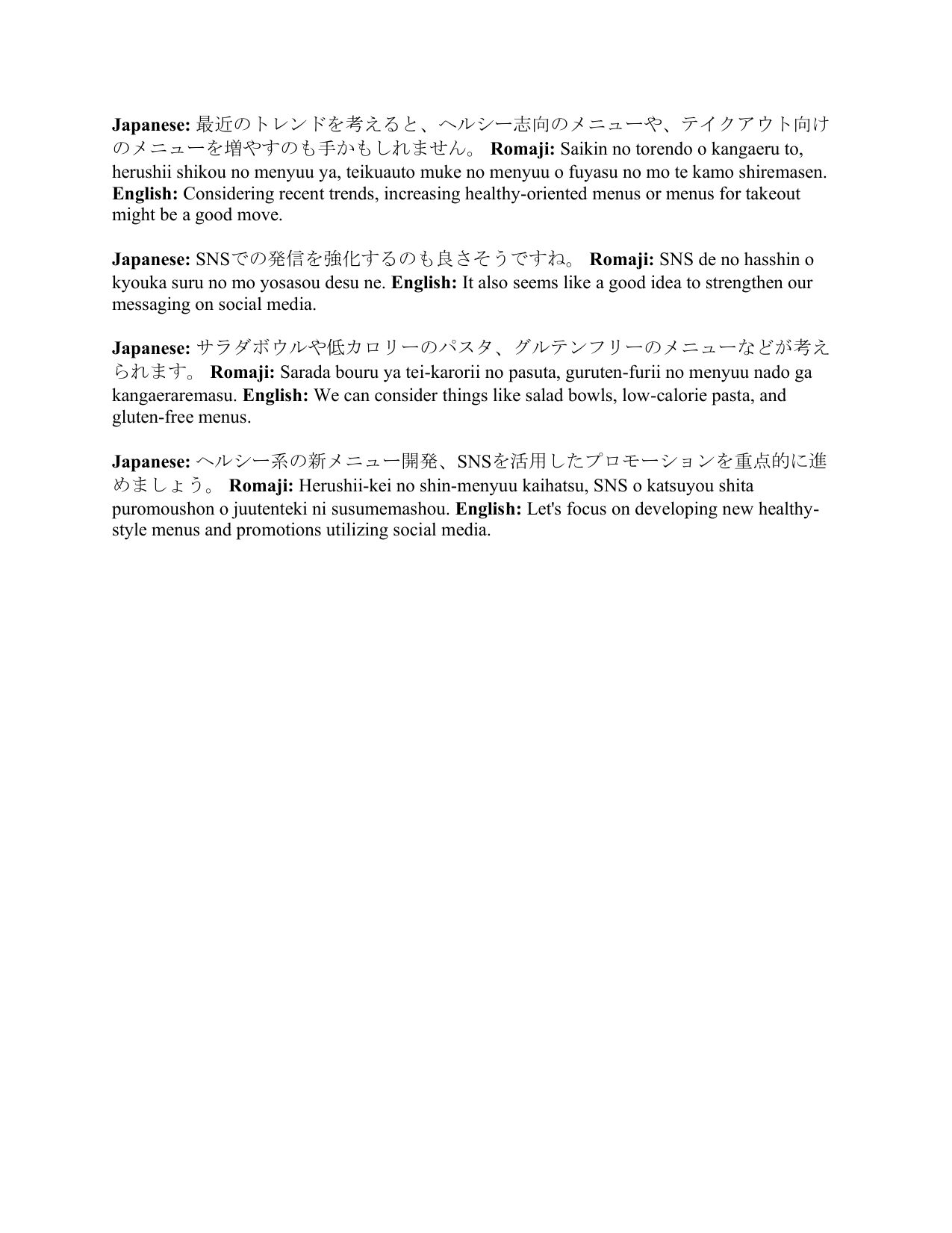
JPJapanese:最近のトレンドを考えると、ヘルシー志向のメニューや、テイクアウト向け
ENのメニューを増やすのも手かもしれません。 Romaji: Saikin no torendo o kangaeru to,
herushii shikou no menyuu ya, teikuauto muke no menyuu o fuyasu no mo te kamo shiremasen.
English: Considering recent trends, increasing healthy-oriented menus or menus for takeout
might be a good move.
Japanese: SNSでの発信を強化するのも良さそうですね。 Romaji: SNS de no hasshin o
kyouka suru no mo yosasou desu ne. English: It also seems like a good idea to strengthen our
messaging on social media.
herushii shikou no menyuu ya, teikuauto muke no menyuu o fuyasu no mo te kamo shiremasen.
English: Considering recent trends, increasing healthy-oriented menus or menus for takeout
might be a good move.
Japanese: SNSでの発信を強化するのも良さそうですね。 Romaji: SNS de no hasshin o
kyouka suru no mo yosasou desu ne. English: It also seems like a good idea to strengthen our
messaging on social media.
JPJapanese:サラダボウルや低カロリーのパスタ、グルテンフリーのメニューなどが考え
ENられます。 Romaji: Sarada bouru ya tei-karorii no pasuta, guruten-furii no menyuu nado ga
kangaeraremasu. English: We can consider things like salad bowls, low-calorie pasta, and
gluten-free menus.
kangaeraremasu. English: We can consider things like salad bowls, low-calorie pasta, and
gluten-free menus.
JPJapanese:ヘルシー系の新メニュー開発、SNSを活用したプロモーションを重点的に進
ENめましょう。 Romaji: Herushii-kei no shin-menyuu kaihatsu, SNS o katsuyou shita
puromoushon o juutenteki ni susumemashou. English: Let's focus on developing new healthy-
style menus and promotions utilizing social media.
puromoushon o juutenteki ni susumemashou. English: Let's focus on developing new healthy-
style menus and promotions utilizing social media.
หน้า 58
คลิกเพื่อขยาย
EN[Question] Choose the most natural word to fill in the blank.
(1) I treated a new business partner in an inappropriate manner and lost his/her
credibility.
A. polite B. thoughtless C. careful D. accurate
(1) I treated a new business partner in an inappropriate manner and lost his/her
credibility.
A. polite B. thoughtless C. careful D. accurate
หน้า 59
คลิกเพื่อขยาย
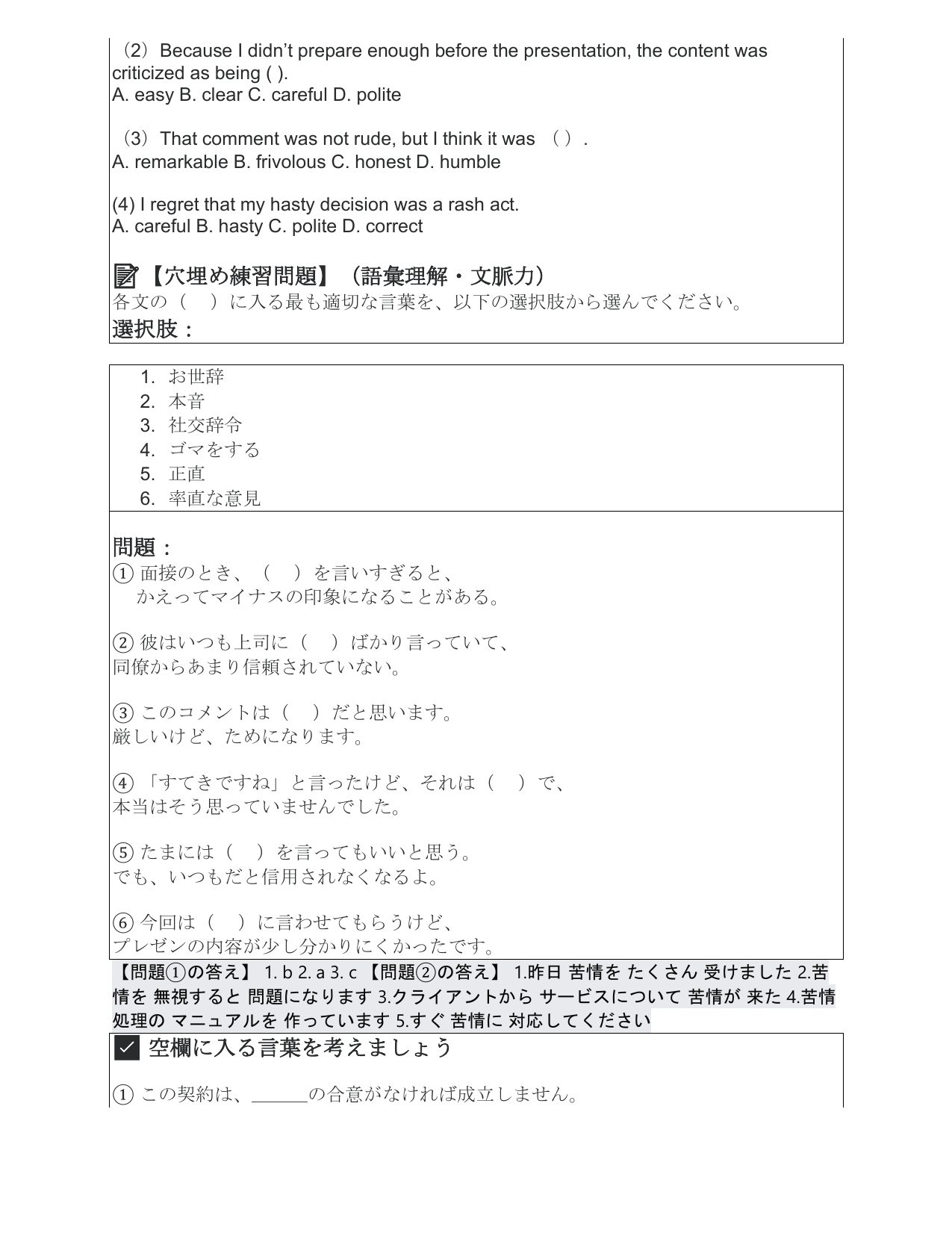
EN(2)Because I didn’t prepare enough before the presentation, the content was
criticized as being ( ).
A. easy B. clear C. careful D. polite
(3)That comment was not rude, but I think it was ( ).
A. remarkable B. frivolous C. honest D. humble
(4) I regret that my hasty decision was a rash act.
A. careful B. hasty C. polite D. correct
criticized as being ( ).
A. easy B. clear C. careful D. polite
(3)That comment was not rude, but I think it was ( ).
A. remarkable B. frivolous C. honest D. humble
(4) I regret that my hasty decision was a rash act.
A. careful B. hasty C. polite D. correct
JP📝【穴埋め練習問題】(語彙理解・文脈力)
各文の()に入る最も適切な言葉を、以下の選択肢から選んでください。
選択肢:
1.お世辞
2.本音
3.社交辞令
4.ゴマをする
5.正直
6.率直な意見
問題:
①面接のとき、()を言いすぎると、
かえってマイナスの印象になることがある。
②彼はいつも上司に()ばかり言っていて、
同僚からあまり信頼されていない。
③このコメントは()だと思います。
厳しいけど、ためになります。
④「すてきですね」と言ったけど、それは()で、
本当はそう思っていませんでした。
⑤たまには()を言ってもいいと思う。
でも、いつもだと信用されなくなるよ。
⑥今回は()に言わせてもらうけど、
プレゼンの内容が少し分かりにくかったです。
【問題①の答え】1.b2.a3.c【問題②の答え】1.昨日苦情をたくさん受けました2.苦
情を無視すると問題になります3.クライアントからサービスについて苦情が来た4.苦情
処理のマニュアルを作っています5.すぐ苦情に対応してください
✅空欄に入る言葉を考えましょう
①この契約は、___の合意がなければ成立しません。
各文の()に入る最も適切な言葉を、以下の選択肢から選んでください。
選択肢:
1.お世辞
2.本音
3.社交辞令
4.ゴマをする
5.正直
6.率直な意見
問題:
①面接のとき、()を言いすぎると、
かえってマイナスの印象になることがある。
②彼はいつも上司に()ばかり言っていて、
同僚からあまり信頼されていない。
③このコメントは()だと思います。
厳しいけど、ためになります。
④「すてきですね」と言ったけど、それは()で、
本当はそう思っていませんでした。
⑤たまには()を言ってもいいと思う。
でも、いつもだと信用されなくなるよ。
⑥今回は()に言わせてもらうけど、
プレゼンの内容が少し分かりにくかったです。
【問題①の答え】1.b2.a3.c【問題②の答え】1.昨日苦情をたくさん受けました2.苦
情を無視すると問題になります3.クライアントからサービスについて苦情が来た4.苦情
処理のマニュアルを作っています5.すぐ苦情に対応してください
✅空欄に入る言葉を考えましょう
①この契約は、___の合意がなければ成立しません。
หน้า 60
คลิกเพื่อขยาย
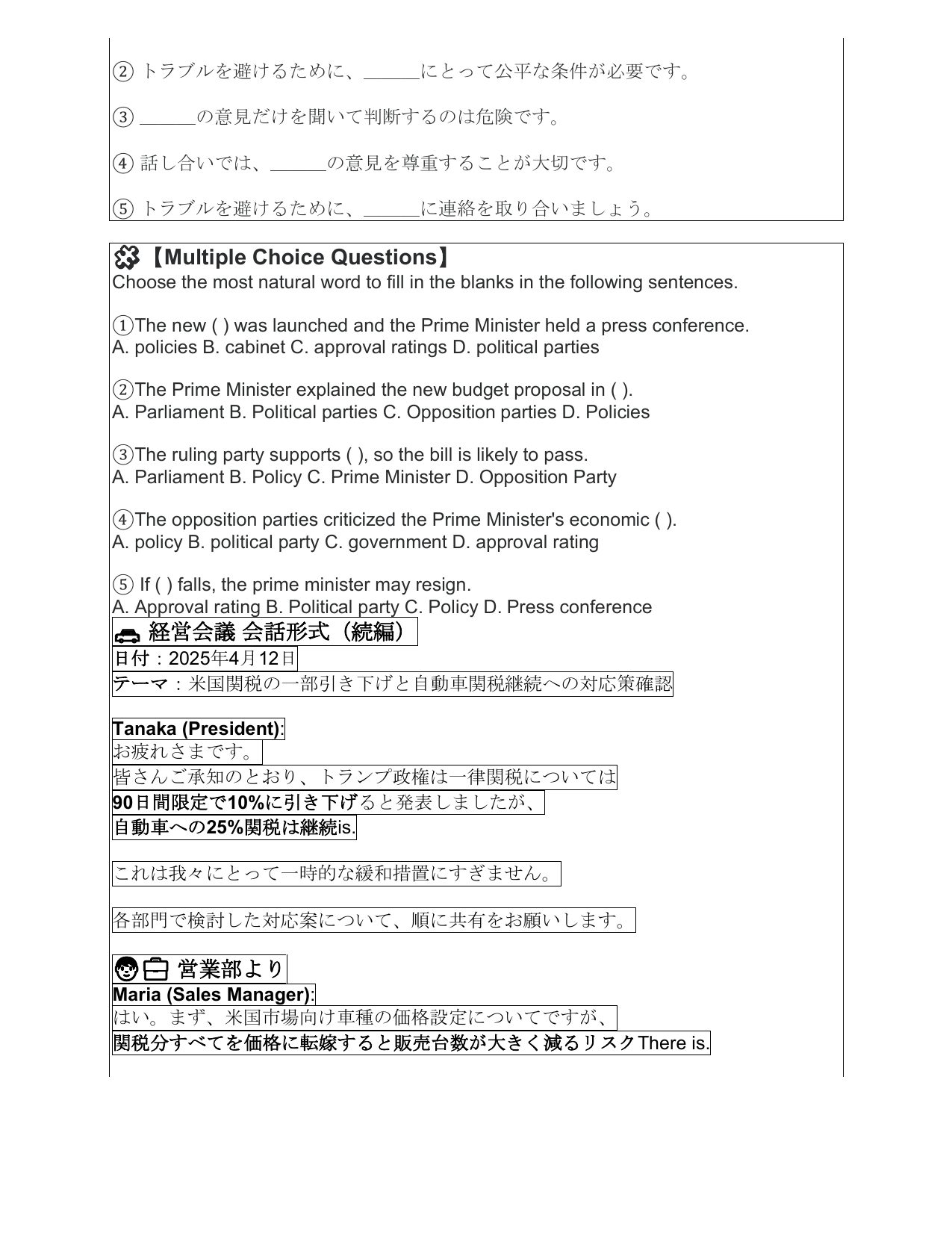
JP②トラブルを避けるために、___にとって公平な条件が必要です。
③___の意見だけを聞いて判断するのは危険です。
④話し合いでは、___の意見を尊重することが大切です。
⑤トラブルを避けるために、___に連絡を取り合いましょう。
③___の意見だけを聞いて判断するのは危険です。
④話し合いでは、___の意見を尊重することが大切です。
⑤トラブルを避けるために、___に連絡を取り合いましょう。
EN🧩【Multiple Choice Questions】
Choose the most natural word to fill in the blanks in the following sentences.
①The new ( ) was launched and the Prime Minister held a press conference.
A. policies B. cabinet C. approval ratings D. political parties
②The Prime Minister explained the new budget proposal in ( ).
A. Parliament B. Political parties C. Opposition parties D. Policies
③The ruling party supports ( ), so the bill is likely to pass.
A. Parliament B. Policy C. Prime Minister D. Opposition Party
④The opposition parties criticized the Prime Minister's economic ( ).
A. policy B. political party C. government D. approval rating
⑤ If ( ) falls, the prime minister may resign.
A. Approval rating B. Political party C. Policy D. Press conference
Choose the most natural word to fill in the blanks in the following sentences.
①The new ( ) was launched and the Prime Minister held a press conference.
A. policies B. cabinet C. approval ratings D. political parties
②The Prime Minister explained the new budget proposal in ( ).
A. Parliament B. Political parties C. Opposition parties D. Policies
③The ruling party supports ( ), so the bill is likely to pass.
A. Parliament B. Policy C. Prime Minister D. Opposition Party
④The opposition parties criticized the Prime Minister's economic ( ).
A. policy B. political party C. government D. approval rating
⑤ If ( ) falls, the prime minister may resign.
A. Approval rating B. Political party C. Policy D. Press conference
JP🚗経営会議会話形式(続編)
日付:2025年4月12日
テーマ:米国関税の一部引き下げと自動車関税継続への対応策確認
日付:2025年4月12日
テーマ:米国関税の一部引き下げと自動車関税継続への対応策確認
ENTanaka (President):
JPお疲れさまです。
皆さんご承知のとおり、トランプ政権は一律関税については
90日間限定で10%に引き下げると発表しましたが、
自動車への25%関税は継続is.
これは我々にとって一時的な緩和措置にすぎません。
各部門で検討した対応案について、順に共有をお願いします。
🧑💼営業部より
皆さんご承知のとおり、トランプ政権は一律関税については
90日間限定で10%に引き下げると発表しましたが、
自動車への25%関税は継続is.
これは我々にとって一時的な緩和措置にすぎません。
各部門で検討した対応案について、順に共有をお願いします。
🧑💼営業部より
ENMaria (Sales Manager):
JPはい。まず、米国市場向け車種の価格設定についてですが、
関税分すべてを価格に転嫁すると販売台数が大きく減るリスクThereis.
関税分すべてを価格に転嫁すると販売台数が大きく減るリスクThereis.
หน้า 61
คลิกเพื่อขยาย
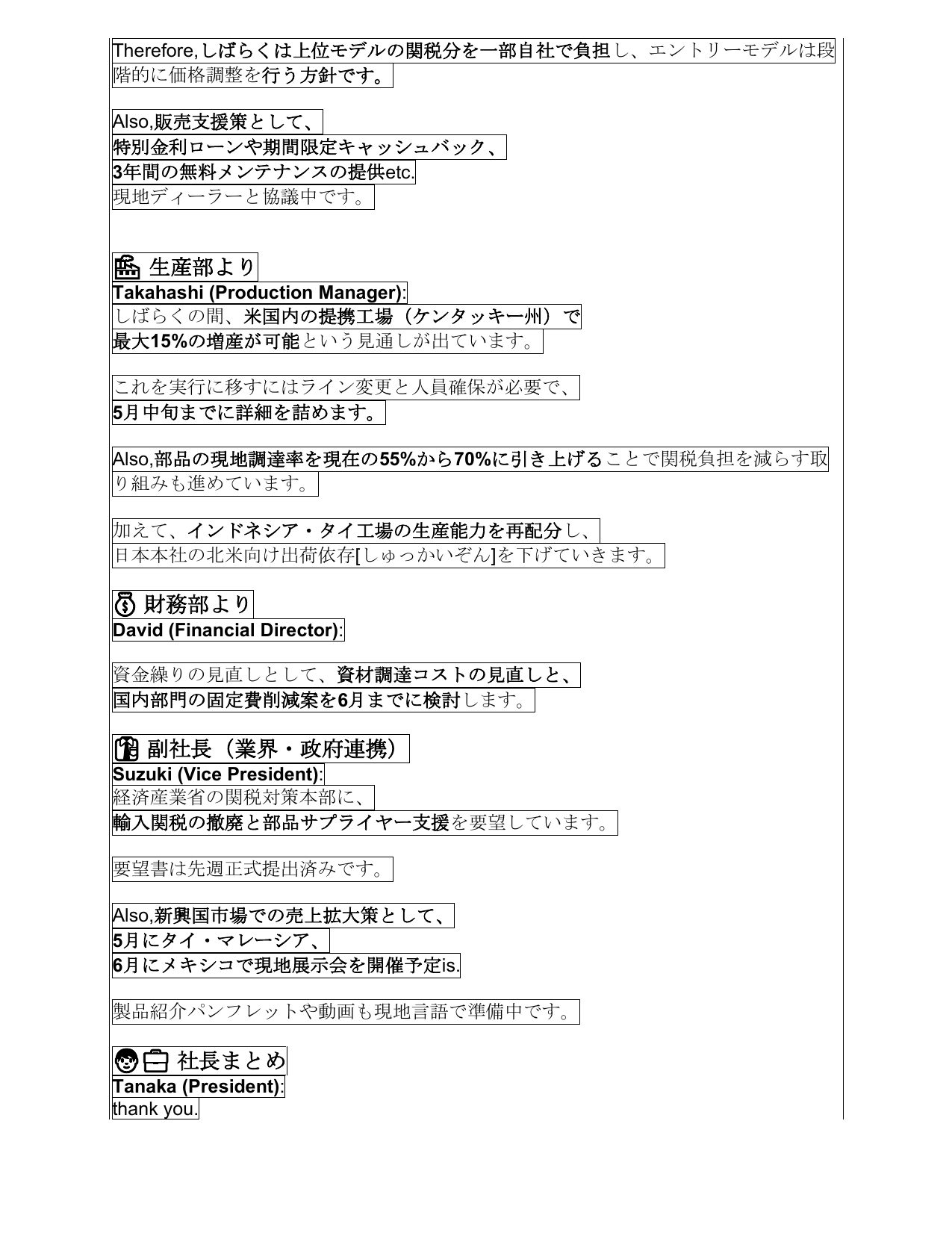
JPTherefore,しばらくは上位モデルの関税分を一部自社で負担し、エントリーモデルは段
階的に価格調整を行う方針です。
Also,販売支援策として、
特別金利ローンや期間限定キャッシュバック、
3年間の無料メンテナンスの提供etc.
現地ディーラーと協議中です。
🏭生産部より
階的に価格調整を行う方針です。
Also,販売支援策として、
特別金利ローンや期間限定キャッシュバック、
3年間の無料メンテナンスの提供etc.
現地ディーラーと協議中です。
🏭生産部より
ENTakahashi (Production Manager):
JPしばらくの間、米国内の提携工場(ケンタッキー州)で
最大15%の増産が可能という見通しが出ています。
これを実行に移すにはライン変更と人員確保が必要で、
5月中旬までに詳細を詰めます。
Also,部品の現地調達率を現在の55%から70%に引き上げることで関税負担を減らす取
り組みも進めています。
加えて、インドネシア・タイ工場の生産能力を再配分し、
日本本社の北米向け出荷依存[しゅっかいぞん]を下げていきます。
💰財務部より
最大15%の増産が可能という見通しが出ています。
これを実行に移すにはライン変更と人員確保が必要で、
5月中旬までに詳細を詰めます。
Also,部品の現地調達率を現在の55%から70%に引き上げることで関税負担を減らす取
り組みも進めています。
加えて、インドネシア・タイ工場の生産能力を再配分し、
日本本社の北米向け出荷依存[しゅっかいぞん]を下げていきます。
💰財務部より
ENDavid (Financial Director):
JP資金繰りの見直しとして、資材調達コストの見直しと、
国内部門の固定費削減案を6月までに検討します。
👔副社長(業界・政府連携)
国内部門の固定費削減案を6月までに検討します。
👔副社長(業界・政府連携)
ENSuzuki (Vice President):
JP経済産業省の関税対策本部に、
輸入関税の撤廃と部品サプライヤー支援を要望しています。
要望書は先週正式提出済みです。
Also,新興国市場での売上拡大策として、
5月にタイ・マレーシア、
6月にメキシコで現地展示会を開催予定is.
製品紹介パンフレットや動画も現地言語で準備中です。
🧑💼社長まとめ
輸入関税の撤廃と部品サプライヤー支援を要望しています。
要望書は先週正式提出済みです。
Also,新興国市場での売上拡大策として、
5月にタイ・マレーシア、
6月にメキシコで現地展示会を開催予定is.
製品紹介パンフレットや動画も現地言語で準備中です。
🧑💼社長まとめ
ENTanaka (President):
thank you.
thank you.
หน้า 62
คลิกเพื่อขยาย
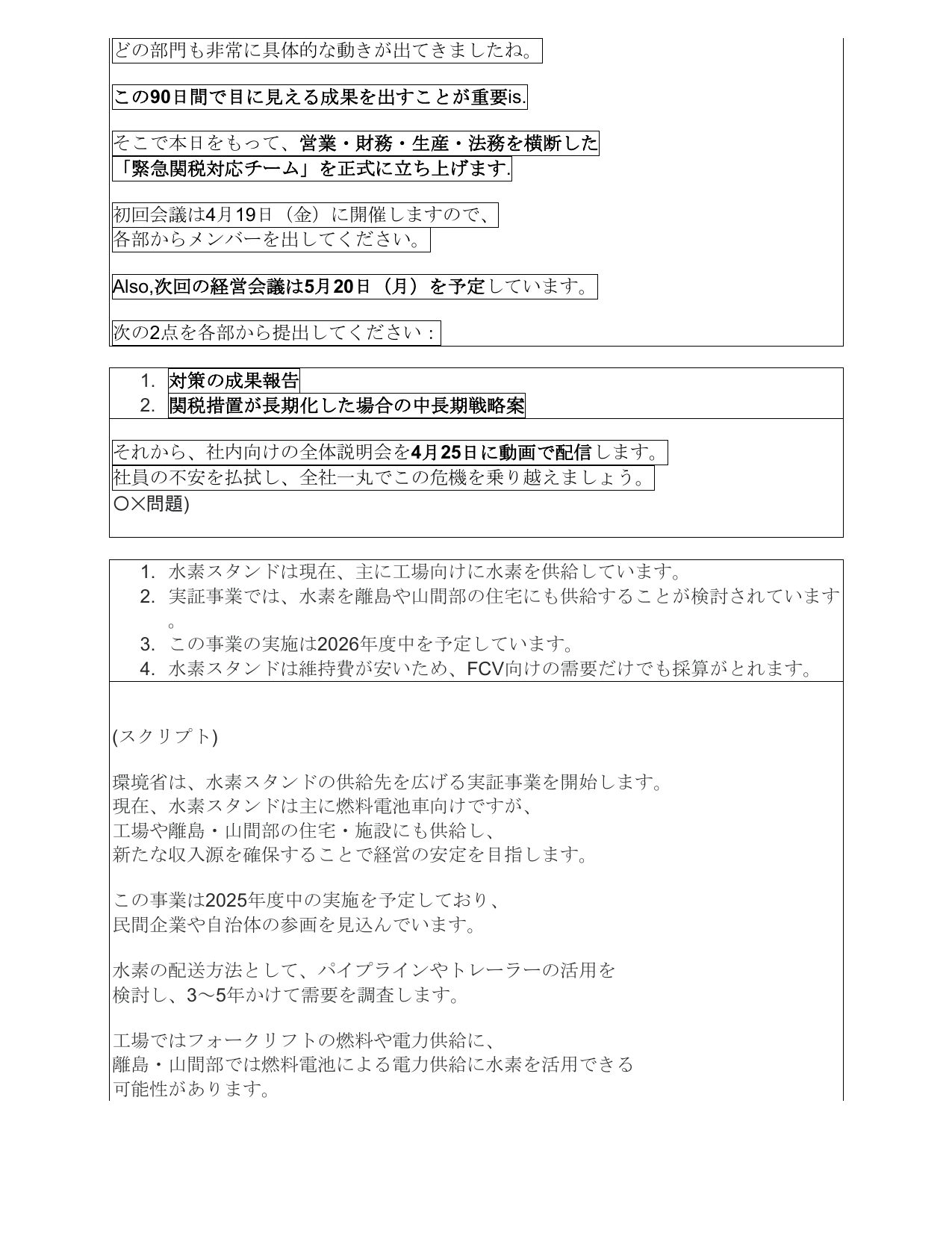
JPどの部門も非常に具体的な動きが出てきましたね。
この90日間で目に見える成果を出すことが重要is.
そこで本日をもって、営業・財務・生産・法務を横断した
「緊急関税対応チーム」を正式に立ち上げます.
初回会議は4月19日(金)に開催しますので、
各部からメンバーを出してください。
Also,次回の経営会議は5月20日(月)を予定しています。
次の2点を各部から提出してください:
1.対策の成果報告
2.関税措置が長期化した場合の中長期戦略案
それから、社内向けの全体説明会を4月25日に動画で配信します。
社員の不安を払拭し、全社一丸でこの危機を乗り越えましょう。
〇✕問題)
1.水素スタンドは現在、主に工場向けに水素を供給しています。
2.実証事業では、水素を離島や山間部の住宅にも供給することが検討されています
。
3.この事業の実施は2026年度中を予定しています。
4.水素スタンドは維持費が安いため、FCV向けの需要だけでも採算がとれます。
(スクリプト)
環境省は、水素スタンドの供給先を広げる実証事業を開始します。
現在、水素スタンドは主に燃料電池車向けですが、
工場や離島・山間部の住宅・施設にも供給し、
新たな収入源を確保することで経営の安定を目指します。
この事業は2025年度中の実施を予定しており、
民間企業や自治体の参画を見込んでいます。
水素の配送方法として、パイプラインやトレーラーの活用を
検討し、3~5年かけて需要を調査します。
工場ではフォークリフトの燃料や電力供給に、
離島・山間部では燃料電池による電力供給に水素を活用できる
可能性があります。
この90日間で目に見える成果を出すことが重要is.
そこで本日をもって、営業・財務・生産・法務を横断した
「緊急関税対応チーム」を正式に立ち上げます.
初回会議は4月19日(金)に開催しますので、
各部からメンバーを出してください。
Also,次回の経営会議は5月20日(月)を予定しています。
次の2点を各部から提出してください:
1.対策の成果報告
2.関税措置が長期化した場合の中長期戦略案
それから、社内向けの全体説明会を4月25日に動画で配信します。
社員の不安を払拭し、全社一丸でこの危機を乗り越えましょう。
〇✕問題)
1.水素スタンドは現在、主に工場向けに水素を供給しています。
2.実証事業では、水素を離島や山間部の住宅にも供給することが検討されています
。
3.この事業の実施は2026年度中を予定しています。
4.水素スタンドは維持費が安いため、FCV向けの需要だけでも採算がとれます。
(スクリプト)
環境省は、水素スタンドの供給先を広げる実証事業を開始します。
現在、水素スタンドは主に燃料電池車向けですが、
工場や離島・山間部の住宅・施設にも供給し、
新たな収入源を確保することで経営の安定を目指します。
この事業は2025年度中の実施を予定しており、
民間企業や自治体の参画を見込んでいます。
水素の配送方法として、パイプラインやトレーラーの活用を
検討し、3~5年かけて需要を調査します。
工場ではフォークリフトの燃料や電力供給に、
離島・山間部では燃料電池による電力供給に水素を活用できる
可能性があります。
หน้า 63
คลิกเพื่อขยาย
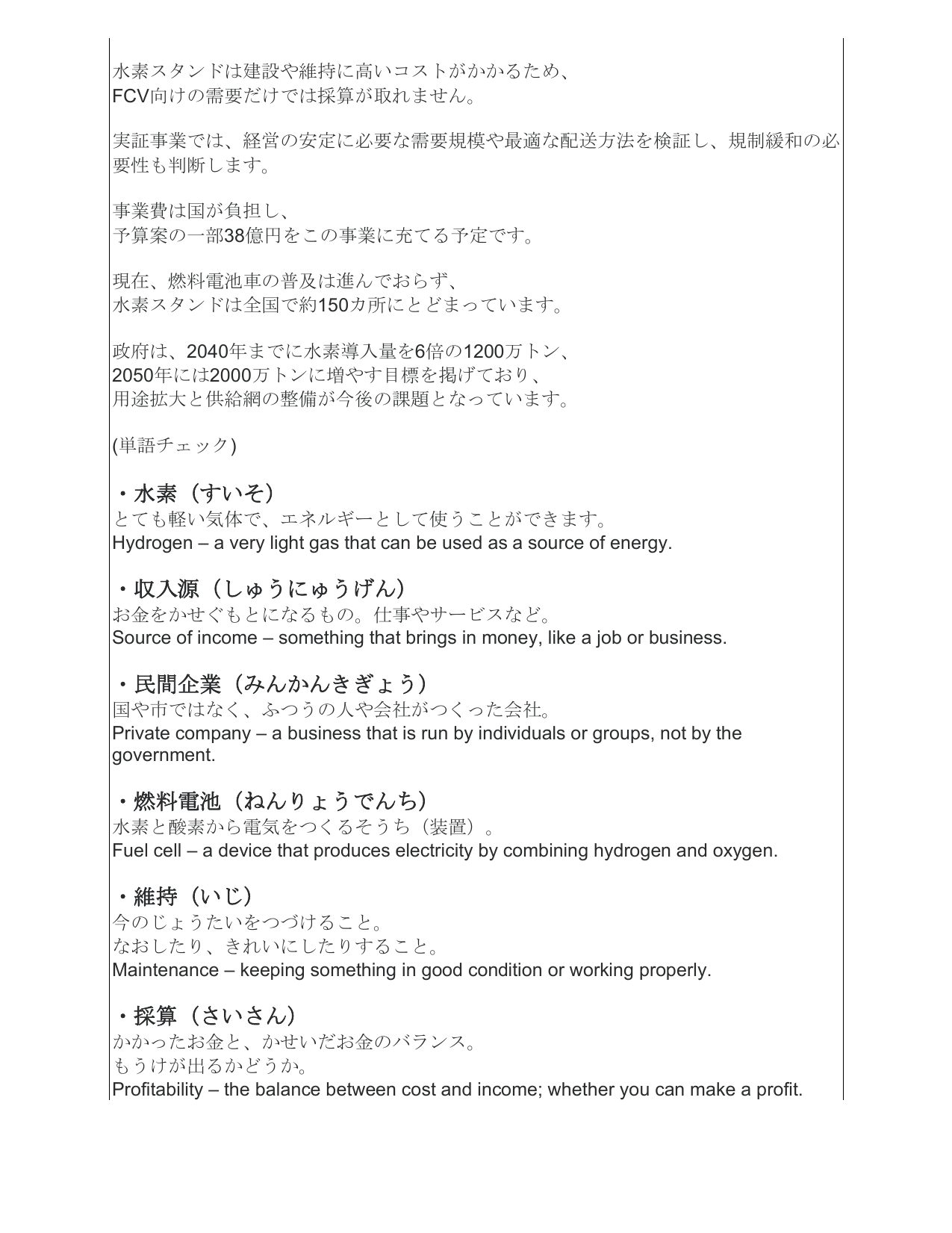
JP水素スタンドは建設や維持に高いコストがかかるため、
FCV向けの需要だけでは採算が取れません。
実証事業では、経営の安定に必要な需要規模や最適な配送方法を検証し、規制緩和の必
要性も判断します。
事業費は国が負担し、
予算案の一部38億円をこの事業に充てる予定です。
現在、燃料電池車の普及は進んでおらず、
水素スタンドは全国で約150カ所にとどまっています。
政府は、2040年までに水素導入量を6倍の1200万トン、
2050年には2000万トンに増やす目標を掲げており、
用途拡大と供給網の整備が今後の課題となっています。
(単語チェック)
・水素(すいそ)
とても軽い気体で、エネルギーとして使うことができます。
FCV向けの需要だけでは採算が取れません。
実証事業では、経営の安定に必要な需要規模や最適な配送方法を検証し、規制緩和の必
要性も判断します。
事業費は国が負担し、
予算案の一部38億円をこの事業に充てる予定です。
現在、燃料電池車の普及は進んでおらず、
水素スタンドは全国で約150カ所にとどまっています。
政府は、2040年までに水素導入量を6倍の1200万トン、
2050年には2000万トンに増やす目標を掲げており、
用途拡大と供給網の整備が今後の課題となっています。
(単語チェック)
・水素(すいそ)
とても軽い気体で、エネルギーとして使うことができます。
ENHydrogen – a very light gas that can be used as a source of energy.
JP・収入源(しゅうにゅうげん)
お金をかせぐもとになるもの。仕事やサービスなど。
お金をかせぐもとになるもの。仕事やサービスなど。
ENSource of income – something that brings in money, like a job or business.
JP・民間企業(みんかんきぎょう)
国や市ではなく、ふつうの人や会社がつくった会社。
国や市ではなく、ふつうの人や会社がつくった会社。
ENPrivate company – a business that is run by individuals or groups, not by the
government.
government.
JP・燃料電池(ねんりょうでんち)
水素と酸素から電気をつくるそうち(装置)。
水素と酸素から電気をつくるそうち(装置)。
ENFuel cell – a device that produces electricity by combining hydrogen and oxygen.
JP・維持(いじ)
今のじょうたいをつづけること。
なおしたり、きれいにしたりすること。
今のじょうたいをつづけること。
なおしたり、きれいにしたりすること。
ENMaintenance – keeping something in good condition or working properly.
JP・採算(さいさん)
かかったお金と、かせいだお金のバランス。
もうけが出るかどうか。
かかったお金と、かせいだお金のバランス。
もうけが出るかどうか。
ENProfitability – the balance between cost and income; whether you can make a profit.
หน้า 64
คลิกเพื่อขยาย
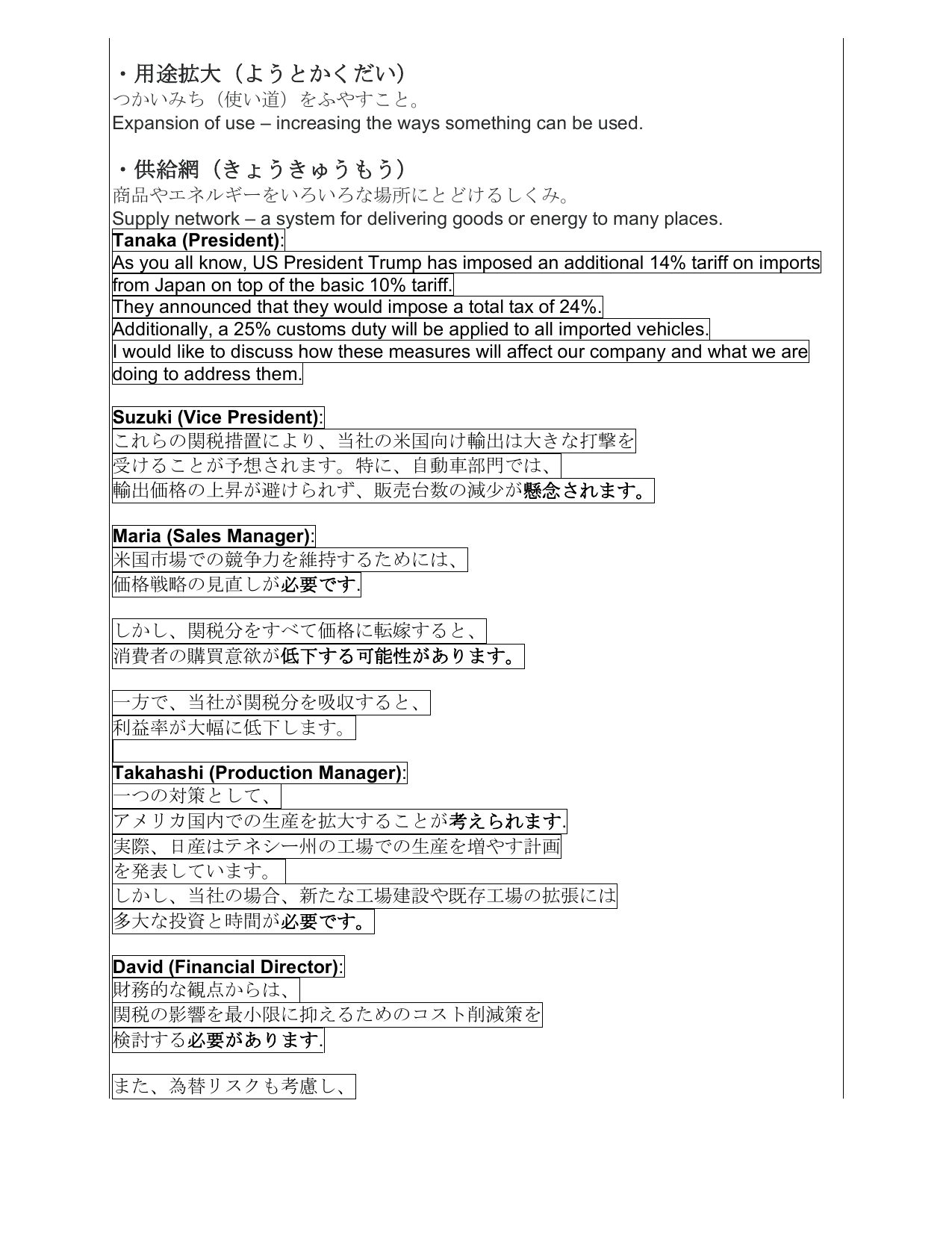
JP・用途拡大(ようとかくだい)
つかいみち(使い道)をふやすこと。
つかいみち(使い道)をふやすこと。
ENExpansion of use – increasing the ways something can be used.
JP・供給網(きょうきゅうもう)
商品やエネルギーをいろいろな場所にとどけるしくみ。
商品やエネルギーをいろいろな場所にとどけるしくみ。
ENSupply network – a system for delivering goods or energy to many places.
Tanaka (President):
As you all know, US President Trump has imposed an additional 14% tariff on imports
from Japan on top of the basic 10% tariff.
They announced that they would impose a total tax of 24%.
Additionally, a 25% customs duty will be applied to all imported vehicles.
I would like to discuss how these measures will affect our company and what we are
doing to address them.
Suzuki (Vice President):
Tanaka (President):
As you all know, US President Trump has imposed an additional 14% tariff on imports
from Japan on top of the basic 10% tariff.
They announced that they would impose a total tax of 24%.
Additionally, a 25% customs duty will be applied to all imported vehicles.
I would like to discuss how these measures will affect our company and what we are
doing to address them.
Suzuki (Vice President):
JPこれらの関税措置により、当社の米国向け輸出は大きな打撃を
受けることが予想されます。特に、自動車部門では、
輸出価格の上昇が避けられず、販売台数の減少が懸念されます。
受けることが予想されます。特に、自動車部門では、
輸出価格の上昇が避けられず、販売台数の減少が懸念されます。
ENMaria (Sales Manager):
JP米国市場での競争力を維持するためには、
価格戦略の見直しが必要です.
しかし、関税分をすべて価格に転嫁すると、
消費者の購買意欲が低下する可能性があります。
一方で、当社が関税分を吸収すると、
利益率が大幅に低下します。
価格戦略の見直しが必要です.
しかし、関税分をすべて価格に転嫁すると、
消費者の購買意欲が低下する可能性があります。
一方で、当社が関税分を吸収すると、
利益率が大幅に低下します。
ENTakahashi (Production Manager):
JP一つの対策として、
アメリカ国内での生産を拡大することが考えられます.
実際、日産はテネシー州の工場での生産を増やす計画
を発表しています。
しかし、当社の場合、新たな工場建設や既存工場の拡張には
多大な投資と時間が必要です。
アメリカ国内での生産を拡大することが考えられます.
実際、日産はテネシー州の工場での生産を増やす計画
を発表しています。
しかし、当社の場合、新たな工場建設や既存工場の拡張には
多大な投資と時間が必要です。
ENDavid (Financial Director):
JP財務的な観点からは、
関税の影響を最小限に抑えるためのコスト削減策を
検討する必要があります.
また、為替リスクも考慮し、
関税の影響を最小限に抑えるためのコスト削減策を
検討する必要があります.
また、為替リスクも考慮し、
หน้า 65
คลิกเพื่อขยาย
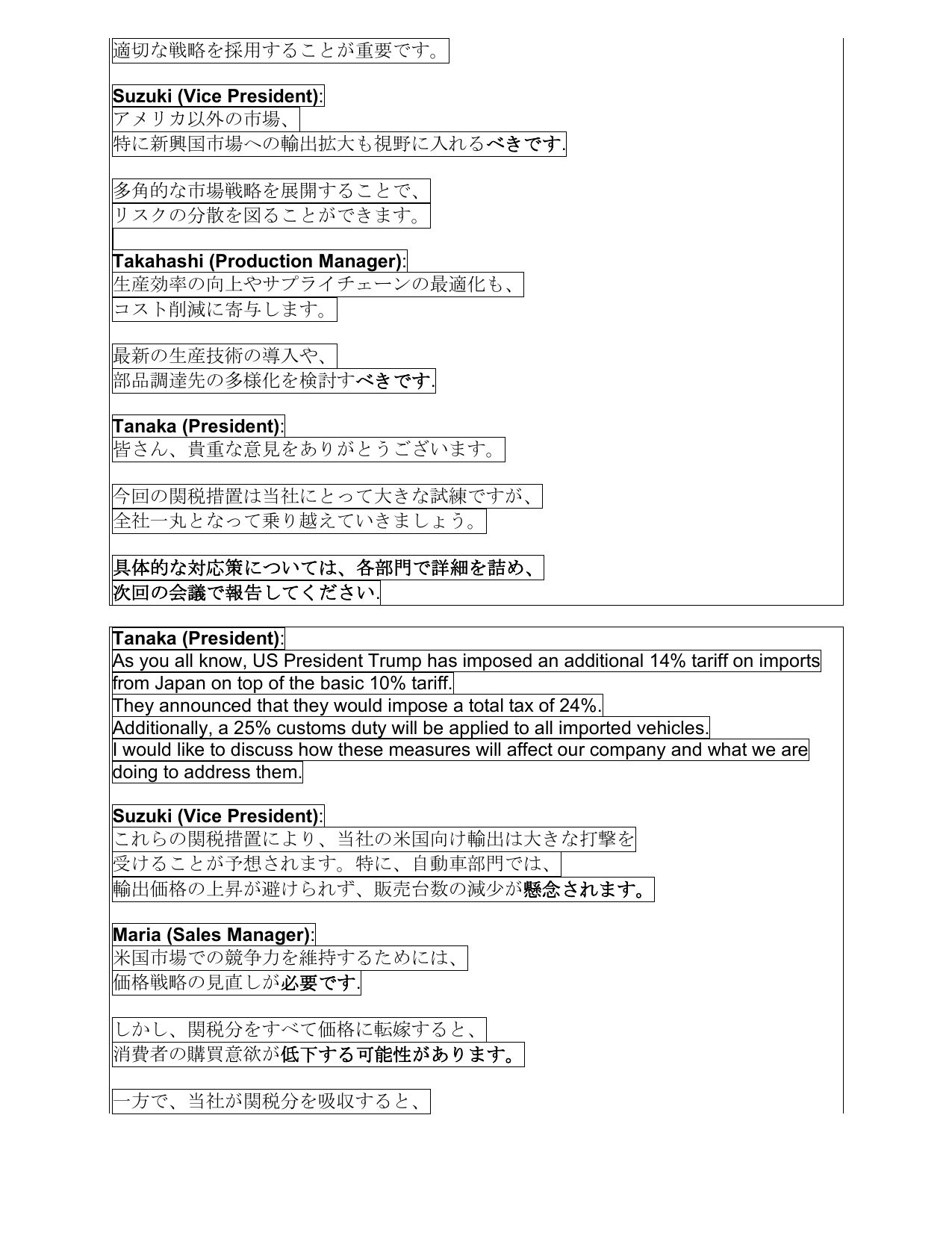
JP適切な戦略を採用することが重要です。
ENSuzuki (Vice President):
JPアメリカ以外の市場、
特に新興国市場への輸出拡大も視野に入れるべきです.
多角的な市場戦略を展開することで、
リスクの分散を図ることができます。
特に新興国市場への輸出拡大も視野に入れるべきです.
多角的な市場戦略を展開することで、
リスクの分散を図ることができます。
ENTakahashi (Production Manager):
JP生産効率の向上やサプライチェーンの最適化も、
コスト削減に寄与します。
最新の生産技術の導入や、
部品調達先の多様化を検討すべきです.
コスト削減に寄与します。
最新の生産技術の導入や、
部品調達先の多様化を検討すべきです.
ENTanaka (President):
JP皆さん、貴重な意見をありがとうございます。
今回の関税措置は当社にとって大きな試練ですが、
全社一丸となって乗り越えていきましょう。
具体的な対応策については、各部門で詳細を詰め、
次回の会議で報告してください.
今回の関税措置は当社にとって大きな試練ですが、
全社一丸となって乗り越えていきましょう。
具体的な対応策については、各部門で詳細を詰め、
次回の会議で報告してください.
ENTanaka (President):
As you all know, US President Trump has imposed an additional 14% tariff on imports
from Japan on top of the basic 10% tariff.
They announced that they would impose a total tax of 24%.
Additionally, a 25% customs duty will be applied to all imported vehicles.
I would like to discuss how these measures will affect our company and what we are
doing to address them.
Suzuki (Vice President):
As you all know, US President Trump has imposed an additional 14% tariff on imports
from Japan on top of the basic 10% tariff.
They announced that they would impose a total tax of 24%.
Additionally, a 25% customs duty will be applied to all imported vehicles.
I would like to discuss how these measures will affect our company and what we are
doing to address them.
Suzuki (Vice President):
JPこれらの関税措置により、当社の米国向け輸出は大きな打撃を
受けることが予想されます。特に、自動車部門では、
輸出価格の上昇が避けられず、販売台数の減少が懸念されます。
受けることが予想されます。特に、自動車部門では、
輸出価格の上昇が避けられず、販売台数の減少が懸念されます。
ENMaria (Sales Manager):
JP米国市場での競争力を維持するためには、
価格戦略の見直しが必要です.
しかし、関税分をすべて価格に転嫁すると、
消費者の購買意欲が低下する可能性があります。
一方で、当社が関税分を吸収すると、
価格戦略の見直しが必要です.
しかし、関税分をすべて価格に転嫁すると、
消費者の購買意欲が低下する可能性があります。
一方で、当社が関税分を吸収すると、
หน้า 66
คลิกเพื่อขยาย
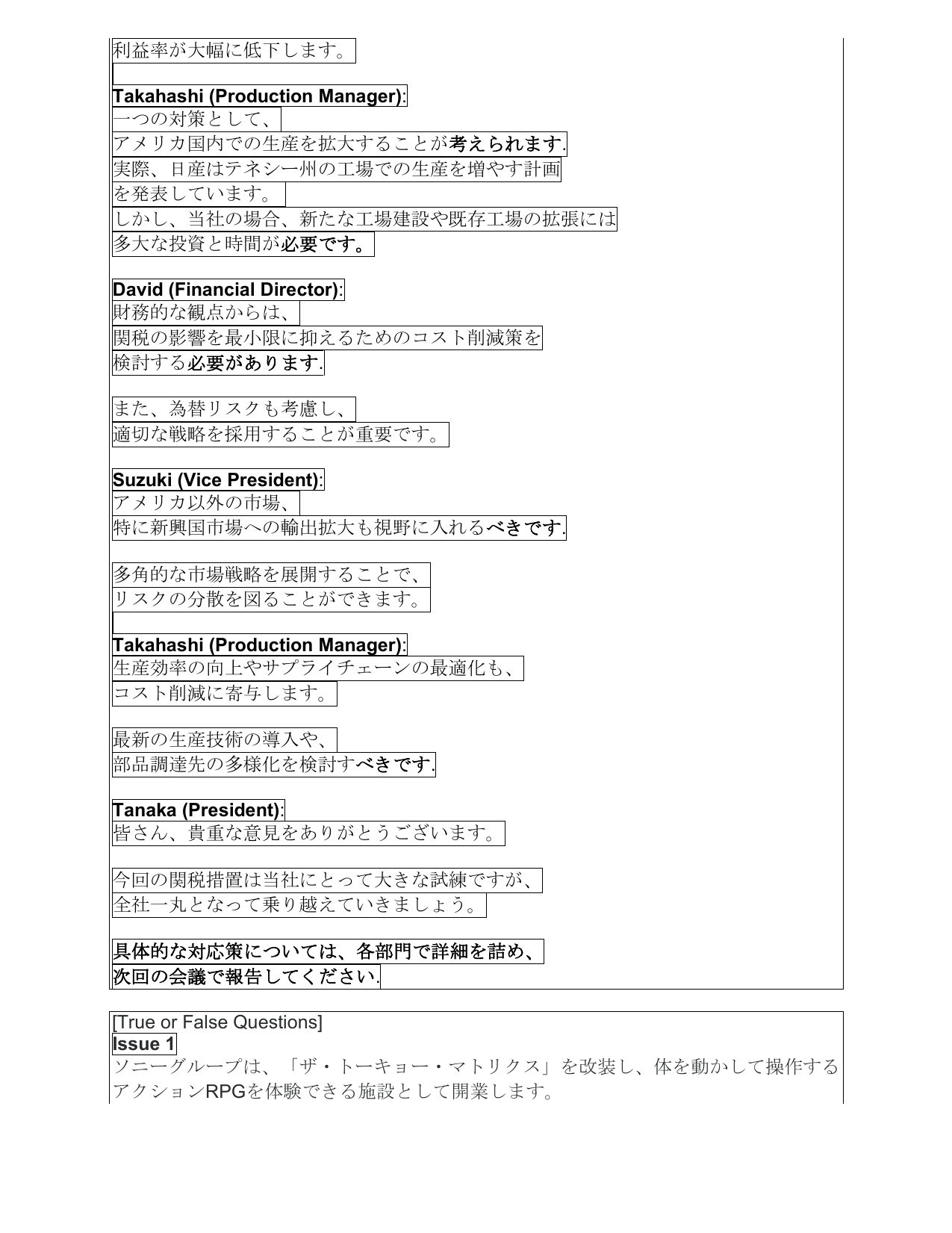
JP利益率が大幅に低下します。
ENTakahashi (Production Manager):
JP一つの対策として、
アメリカ国内での生産を拡大することが考えられます.
実際、日産はテネシー州の工場での生産を増やす計画
を発表しています。
しかし、当社の場合、新たな工場建設や既存工場の拡張には
多大な投資と時間が必要です。
アメリカ国内での生産を拡大することが考えられます.
実際、日産はテネシー州の工場での生産を増やす計画
を発表しています。
しかし、当社の場合、新たな工場建設や既存工場の拡張には
多大な投資と時間が必要です。
ENDavid (Financial Director):
JP財務的な観点からは、
関税の影響を最小限に抑えるためのコスト削減策を
検討する必要があります.
また、為替リスクも考慮し、
適切な戦略を採用することが重要です。
関税の影響を最小限に抑えるためのコスト削減策を
検討する必要があります.
また、為替リスクも考慮し、
適切な戦略を採用することが重要です。
ENSuzuki (Vice President):
JPアメリカ以外の市場、
特に新興国市場への輸出拡大も視野に入れるべきです.
多角的な市場戦略を展開することで、
リスクの分散を図ることができます。
特に新興国市場への輸出拡大も視野に入れるべきです.
多角的な市場戦略を展開することで、
リスクの分散を図ることができます。
ENTakahashi (Production Manager):
JP生産効率の向上やサプライチェーンの最適化も、
コスト削減に寄与します。
最新の生産技術の導入や、
部品調達先の多様化を検討すべきです.
コスト削減に寄与します。
最新の生産技術の導入や、
部品調達先の多様化を検討すべきです.
ENTanaka (President):
JP皆さん、貴重な意見をありがとうございます。
今回の関税措置は当社にとって大きな試練ですが、
全社一丸となって乗り越えていきましょう。
具体的な対応策については、各部門で詳細を詰め、
次回の会議で報告してください.
今回の関税措置は当社にとって大きな試練ですが、
全社一丸となって乗り越えていきましょう。
具体的な対応策については、各部門で詳細を詰め、
次回の会議で報告してください.
EN[True or False Questions]
Issue 1
Issue 1
JPソニーグループは、「ザ・トーキョー・マトリクス」を改装し、体を動かして操作する
アクションRPGを体験できる施設として開業します。
アクションRPGを体験できる施設として開業します。
หน้า 67
คลิกเพื่อขยาย
ENProblem 2
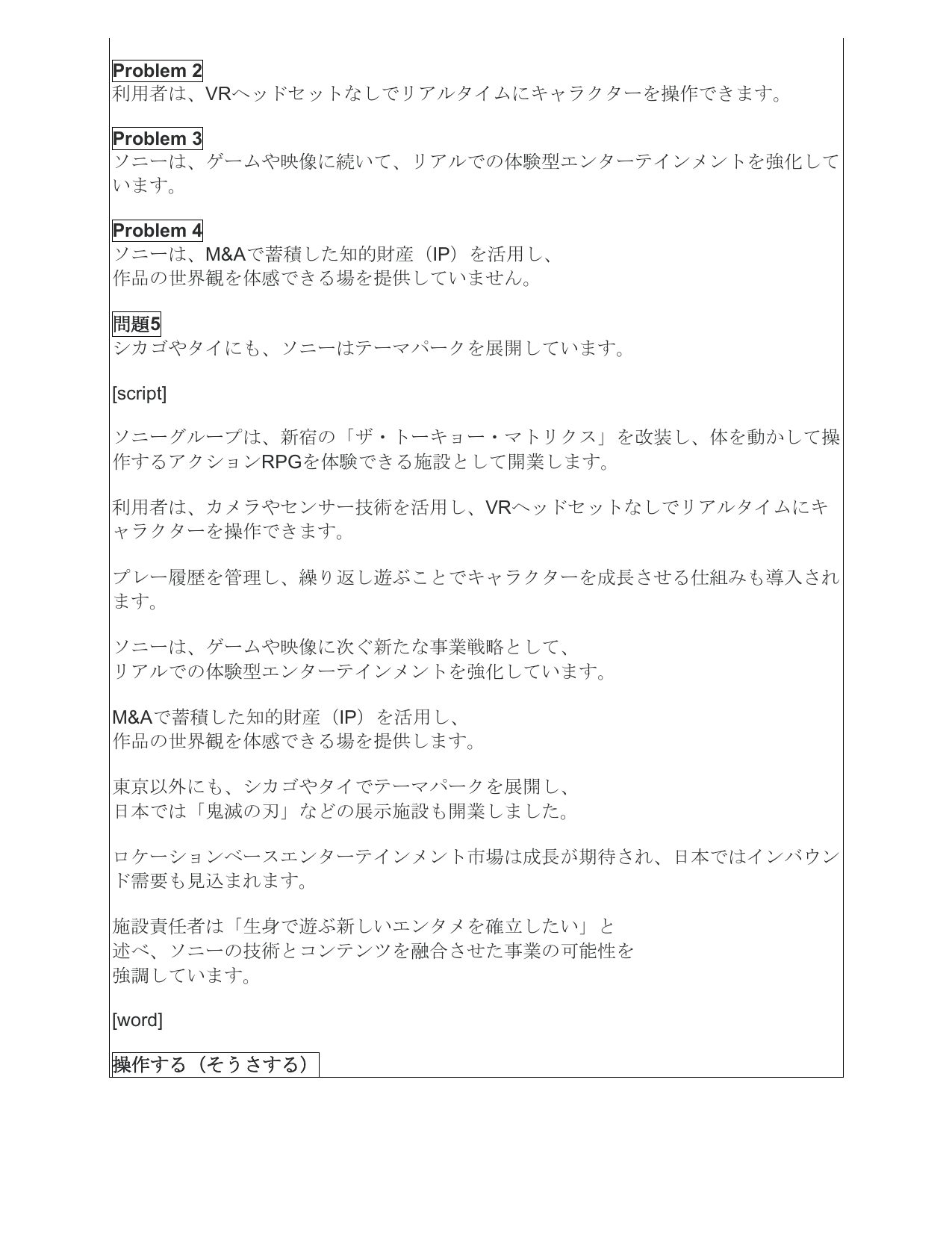
JP利用者は、VRヘッドセットなしでリアルタイムにキャラクターを操作できます。
ENProblem 3
JPソニーは、ゲームや映像に続いて、リアルでの体験型エンターテインメントを強化して
います。
います。
ENProblem 4
JPソニーは、M&Aで蓄積した知的財産(IP)を活用し、
作品の世界観を体感できる場を提供していません。
問題5
シカゴやタイにも、ソニーはテーマパークを展開しています。
作品の世界観を体感できる場を提供していません。
問題5
シカゴやタイにも、ソニーはテーマパークを展開しています。
EN[script]
JPソニーグループは、新宿の「ザ・トーキョー・マトリクス」を改装し、体を動かして操
作するアクションRPGを体験できる施設として開業します。
利用者は、カメラやセンサー技術を活用し、VRヘッドセットなしでリアルタイムにキ
ャラクターを操作できます。
プレー履歴を管理し、繰り返し遊ぶことでキャラクターを成長させる仕組みも導入され
ます。
ソニーは、ゲームや映像に次ぐ新たな事業戦略として、
リアルでの体験型エンターテインメントを強化しています。
M&Aで蓄積した知的財産(IP)を活用し、
作品の世界観を体感できる場を提供します。
東京以外にも、シカゴやタイでテーマパークを展開し、
日本では「鬼滅の刃」などの展示施設も開業しました。
ロケーションベースエンターテインメント市場は成長が期待され、日本ではインバウン
ド需要も見込まれます。
施設責任者は「生身で遊ぶ新しいエンタメを確立したい」と
述べ、ソニーの技術とコンテンツを融合させた事業の可能性を
強調しています。
作するアクションRPGを体験できる施設として開業します。
利用者は、カメラやセンサー技術を活用し、VRヘッドセットなしでリアルタイムにキ
ャラクターを操作できます。
プレー履歴を管理し、繰り返し遊ぶことでキャラクターを成長させる仕組みも導入され
ます。
ソニーは、ゲームや映像に次ぐ新たな事業戦略として、
リアルでの体験型エンターテインメントを強化しています。
M&Aで蓄積した知的財産(IP)を活用し、
作品の世界観を体感できる場を提供します。
東京以外にも、シカゴやタイでテーマパークを展開し、
日本では「鬼滅の刃」などの展示施設も開業しました。
ロケーションベースエンターテインメント市場は成長が期待され、日本ではインバウン
ド需要も見込まれます。
施設責任者は「生身で遊ぶ新しいエンタメを確立したい」と
述べ、ソニーの技術とコンテンツを融合させた事業の可能性を
強調しています。
EN[word]
JP操作する(そうさする)
หน้า 68
คลิกเพื่อขยาย
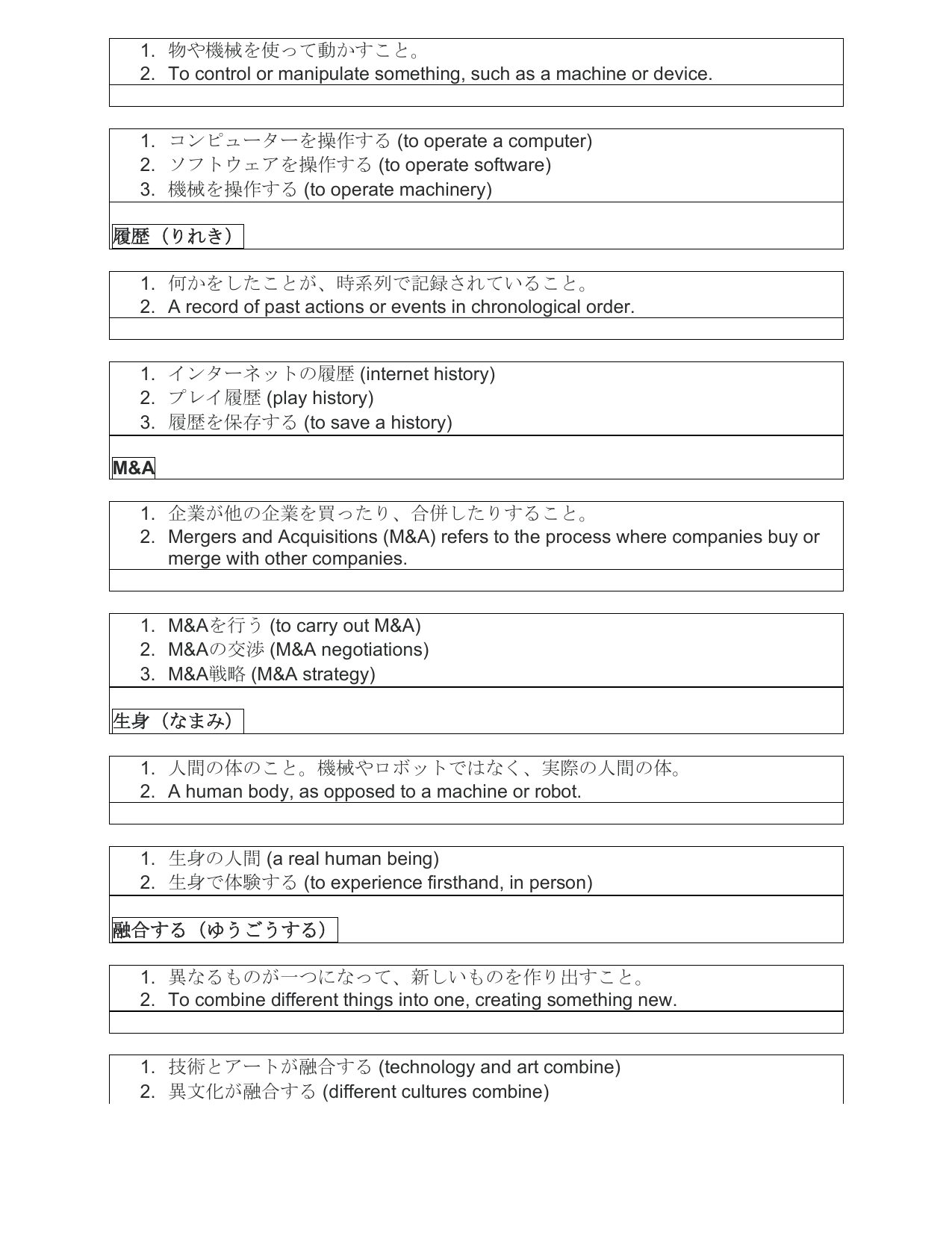
JP1.物や機械を使って動かすこと。
EN 2. To control or manipulate something, such as a machine or device.
1. コンピューターを操作する (to operate a computer)
2. ソフトウェアを操作する (to operate software)
3. 機械を操作する (to operate machinery)
1. コンピューターを操作する (to operate a computer)
2. ソフトウェアを操作する (to operate software)
3. 機械を操作する (to operate machinery)
JP履歴(りれき)
1.何かをしたことが、時系列で記録されていること。
1.何かをしたことが、時系列で記録されていること。
EN 2. A record of past actions or events in chronological order.
1. インターネットの履歴 (internet history)
2. プレイ履歴 (play history)
3. 履歴を保存する (to save a history)
M&A
1. インターネットの履歴 (internet history)
2. プレイ履歴 (play history)
3. 履歴を保存する (to save a history)
M&A
JP1.企業が他の企業を買ったり、合併したりすること。
EN 2. Mergers and Acquisitions (M&A) refers to the process where companies buy or
merge with other companies.
1. M&Aを行う (to carry out M&A)
2. M&Aの交渉 (M&A negotiations)
3. M&A戦略 (M&A strategy)
merge with other companies.
1. M&Aを行う (to carry out M&A)
2. M&Aの交渉 (M&A negotiations)
3. M&A戦略 (M&A strategy)
JP生身(なまみ)
1.人間の体のこと。機械やロボットではなく、実際の人間の体。
1.人間の体のこと。機械やロボットではなく、実際の人間の体。
EN 2. A human body, as opposed to a machine or robot.
1. 生身の人間 (a real human being)
2. 生身で体験する (to experience firsthand, in person)
1. 生身の人間 (a real human being)
2. 生身で体験する (to experience firsthand, in person)
JP融合する(ゆうごうする)
1.異なるものが一つになって、新しいものを作り出すこと。
1.異なるものが一つになって、新しいものを作り出すこと。
EN 2. To combine different things into one, creating something new.
1. 技術とアートが融合する (technology and art combine)
2. 異文化が融合する (different cultures combine)
1. 技術とアートが融合する (technology and art combine)
2. 異文化が融合する (different cultures combine)
หน้า 69
คลิกเพื่อขยาย
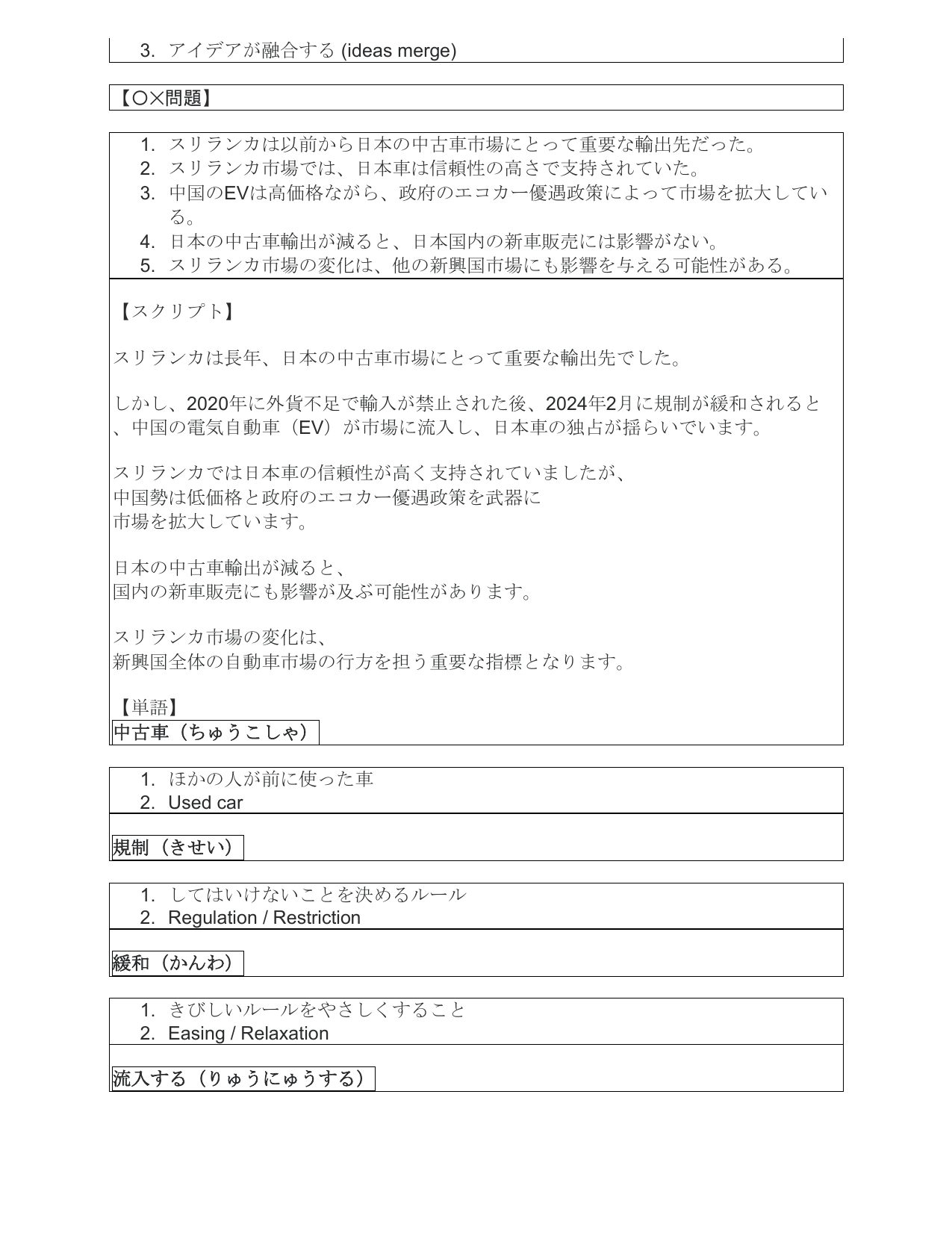
EN 3. アイデアが融合する (ideas merge)
JP【〇✕問題】
1.スリランカは以前から日本の中古車市場にとって重要な輸出先だった。
2.スリランカ市場では、日本車は信頼性の高さで支持されていた。
3.中国のEVは高価格ながら、政府のエコカー優遇政策によって市場を拡大してい
る。
4.日本の中古車輸出が減ると、日本国内の新車販売には影響がない。
5.スリランカ市場の変化は、他の新興国市場にも影響を与える可能性がある。
【スクリプト】
スリランカは長年、日本の中古車市場にとって重要な輸出先でした。
しかし、2020年に外貨不足で輸入が禁止された後、2024年2月に規制が緩和されると
、中国の電気自動車(EV)が市場に流入し、日本車の独占が揺らいでいます。
スリランカでは日本車の信頼性が高く支持されていましたが、
中国勢は低価格と政府のエコカー優遇政策を武器に
市場を拡大しています。
日本の中古車輸出が減ると、
国内の新車販売にも影響が及ぶ可能性があります。
スリランカ市場の変化は、
新興国全体の自動車市場の行方を担う重要な指標となります。
【単語】
中古車(ちゅうこしゃ)
1.ほかの人が前に使った車
1.スリランカは以前から日本の中古車市場にとって重要な輸出先だった。
2.スリランカ市場では、日本車は信頼性の高さで支持されていた。
3.中国のEVは高価格ながら、政府のエコカー優遇政策によって市場を拡大してい
る。
4.日本の中古車輸出が減ると、日本国内の新車販売には影響がない。
5.スリランカ市場の変化は、他の新興国市場にも影響を与える可能性がある。
【スクリプト】
スリランカは長年、日本の中古車市場にとって重要な輸出先でした。
しかし、2020年に外貨不足で輸入が禁止された後、2024年2月に規制が緩和されると
、中国の電気自動車(EV)が市場に流入し、日本車の独占が揺らいでいます。
スリランカでは日本車の信頼性が高く支持されていましたが、
中国勢は低価格と政府のエコカー優遇政策を武器に
市場を拡大しています。
日本の中古車輸出が減ると、
国内の新車販売にも影響が及ぶ可能性があります。
スリランカ市場の変化は、
新興国全体の自動車市場の行方を担う重要な指標となります。
【単語】
中古車(ちゅうこしゃ)
1.ほかの人が前に使った車
EN 2. Used car
JP規制(きせい)
1.してはいけないことを決めるルール
1.してはいけないことを決めるルール
EN 2. Regulation / Restriction
JP緩和(かんわ)
1.きびしいルールをやさしくすること
1.きびしいルールをやさしくすること
EN 2. Easing / Relaxation
JP流入する(りゅうにゅうする)
หน้า 70
คลิกเพื่อขยาย
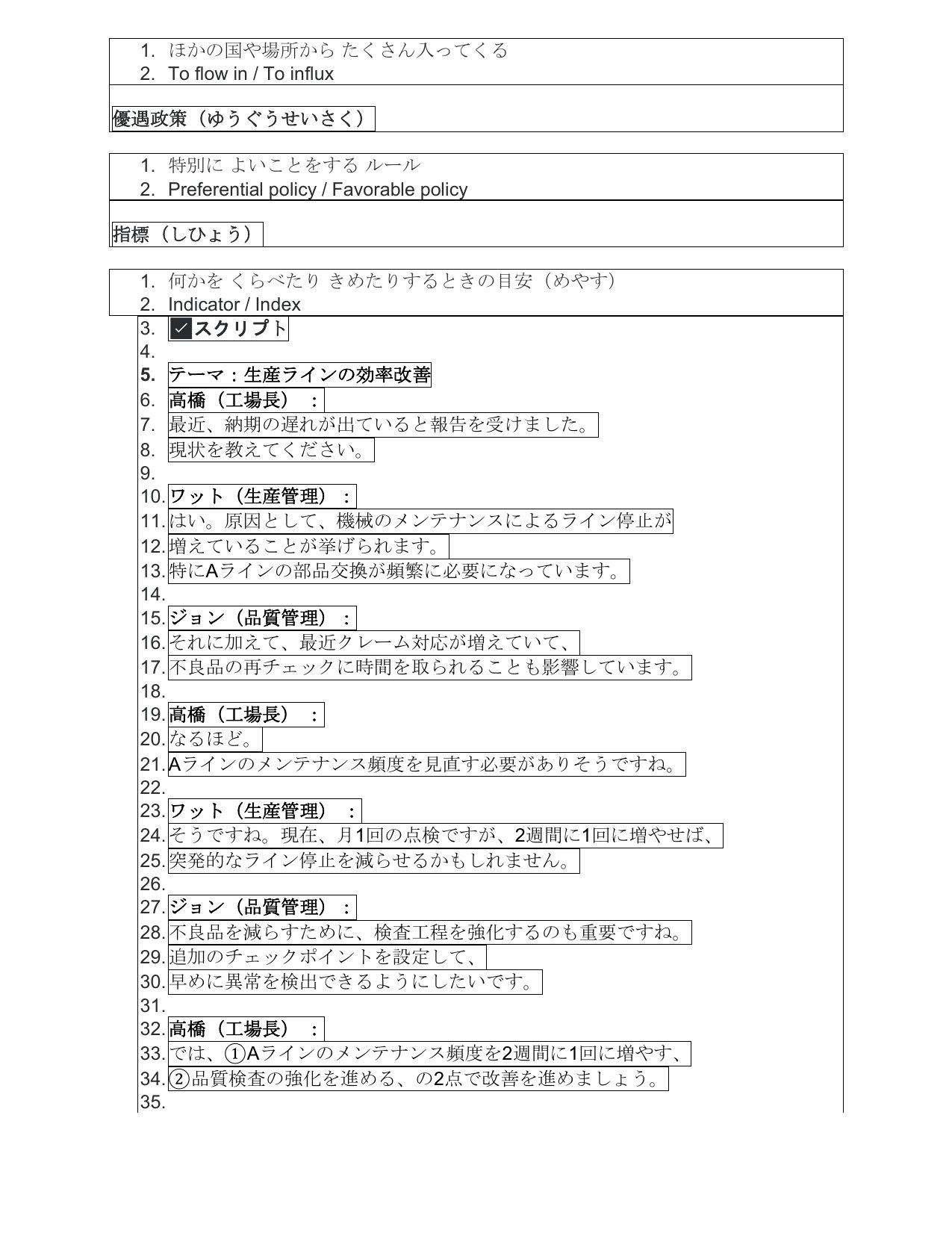
JP1.ほかの国や場所からたくさん入ってくる
EN 2. To flow in / To influx
JP優遇政策(ゆうぐうせいさく)
1.特別によいことをするルール
1.特別によいことをするルール
EN 2. Preferential policy / Favorable policy
JP指標(しひょう)
1.何かをくらべたりきめたりするときの目安(めやす)
1.何かをくらべたりきめたりするときの目安(めやす)
EN 2. Indicator / Index
JP3.✅スクリプト
4.
5.テーマ:生産ラインの効率改善
6.高橋(工場長):
7.最近、納期の遅れが出ていると報告を受けました。
8.現状を教えてください。
9.
10.ワット(生産管理):
11.はい。原因として、機械のメンテナンスによるライン停止が
12.増えていることが挙げられます。
13.特にAラインの部品交換が頻繁に必要になっています。
14.
15.ジョン(品質管理):
16.それに加えて、最近クレーム対応が増えていて、
17.不良品の再チェックに時間を取られることも影響しています。
18.
19.高橋(工場長):
20.なるほど。
21.Aラインのメンテナンス頻度を見直す必要がありそうですね。
22.
23.ワット(生産管理):
24.そうですね。現在、月1回の点検ですが、2週間に1回に増やせば、
25.突発的なライン停止を減らせるかもしれません。
26.
27.ジョン(品質管理):
28.不良品を減らすために、検査工程を強化するのも重要ですね。
29.追加のチェックポイントを設定して、
30.早めに異常を検出できるようにしたいです。
31.
32.高橋(工場長):
33.では、①Aラインのメンテナンス頻度を2週間に1回に増やす、
34.②品質検査の強化を進める、の2点で改善を進めましょう。
35.
4.
5.テーマ:生産ラインの効率改善
6.高橋(工場長):
7.最近、納期の遅れが出ていると報告を受けました。
8.現状を教えてください。
9.
10.ワット(生産管理):
11.はい。原因として、機械のメンテナンスによるライン停止が
12.増えていることが挙げられます。
13.特にAラインの部品交換が頻繁に必要になっています。
14.
15.ジョン(品質管理):
16.それに加えて、最近クレーム対応が増えていて、
17.不良品の再チェックに時間を取られることも影響しています。
18.
19.高橋(工場長):
20.なるほど。
21.Aラインのメンテナンス頻度を見直す必要がありそうですね。
22.
23.ワット(生産管理):
24.そうですね。現在、月1回の点検ですが、2週間に1回に増やせば、
25.突発的なライン停止を減らせるかもしれません。
26.
27.ジョン(品質管理):
28.不良品を減らすために、検査工程を強化するのも重要ですね。
29.追加のチェックポイントを設定して、
30.早めに異常を検出できるようにしたいです。
31.
32.高橋(工場長):
33.では、①Aラインのメンテナンス頻度を2週間に1回に増やす、
34.②品質検査の強化を進める、の2点で改善を進めましょう。
35.
หน้า 71
คลิกเพื่อขยาย
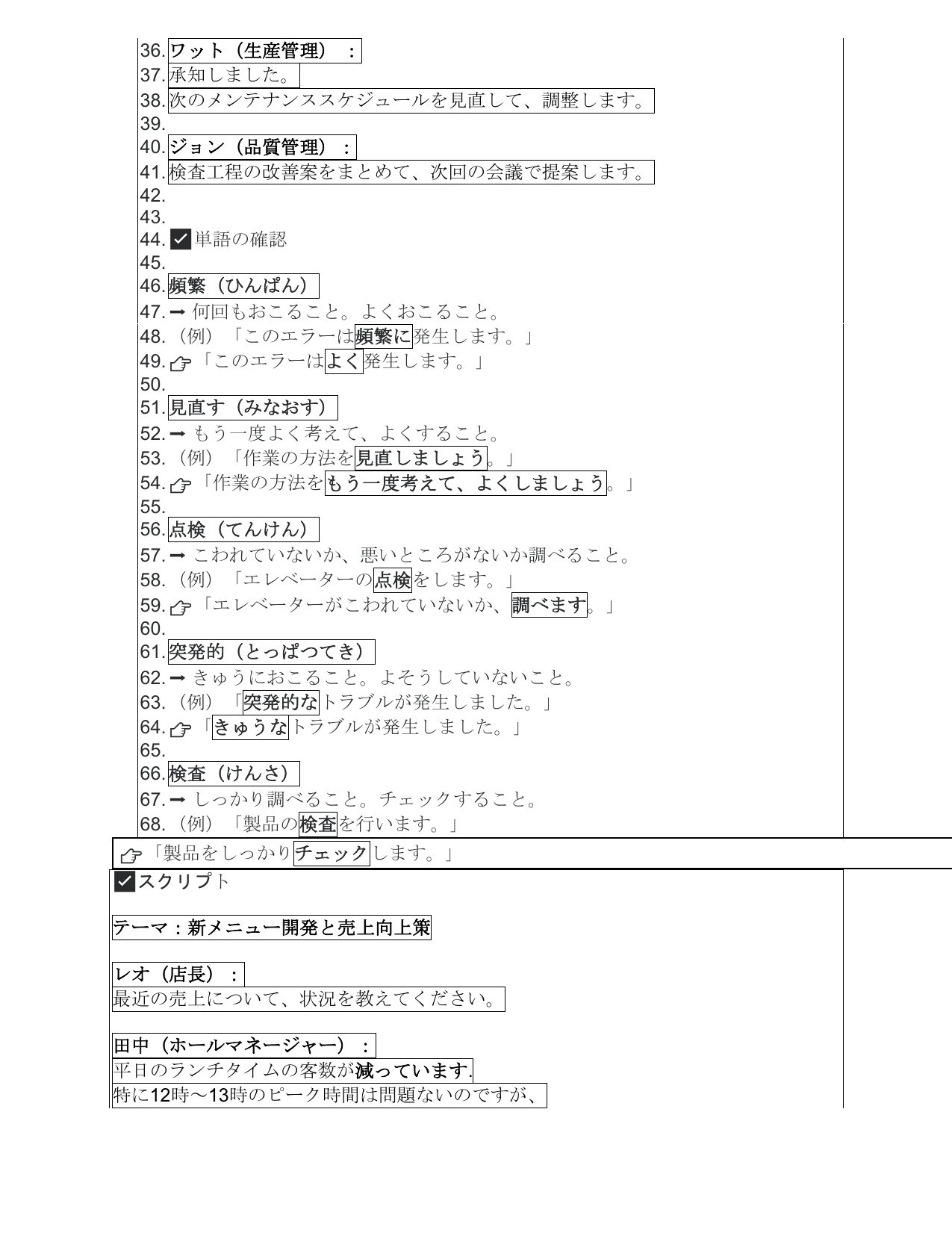
JP36.ワット(生産管理):
37.承知しました。
38.次のメンテナンススケジュールを見直して、調整します。
39.
40.ジョン(品質管理):
41.検査工程の改善案をまとめて、次回の会議で提案します。
42.
43.
44.✅単語の確認
45.
46.頻繁(ひんぱん)
47.➡何回もおこること。よくおこること。
48.(例)「このエラーは頻繁に発生します。」
49.👉「このエラーはよく発生します。」
50.
51.見直す(みなおす)
52.➡もう一度よく考えて、よくすること。
53.(例)「作業の方法を見直しましょう。」
54.👉「作業の方法をもう一度考えて、よくしましょう。」
55.
56.点検(てんけん)
57.➡こわれていないか、悪いところがないか調べること。
58.(例)「エレベーターの点検をします。」
59.👉「エレベーターがこわれていないか、調べます。」
60.
61.突発的(とっぱつてき)
62.➡きゅうにおこること。よそうしていないこと。
63.(例)「突発的なトラブルが発生しました。」
64.👉「きゅうなトラブルが発生しました。」
65.
66.検査(けんさ)
67.➡しっかり調べること。チェックすること。
68.(例)「製品の検査を行います。」
👉「製品をしっかりチェックします。」
✅スクリプト
テーマ:新メニュー開発と売上向上策
レオ(店長):
最近の売上について、状況を教えてください。
田中(ホールマネージャー):
平日のランチタイムの客数が減っています.
特に12時~13時のピーク時間は問題ないのですが、
37.承知しました。
38.次のメンテナンススケジュールを見直して、調整します。
39.
40.ジョン(品質管理):
41.検査工程の改善案をまとめて、次回の会議で提案します。
42.
43.
44.✅単語の確認
45.
46.頻繁(ひんぱん)
47.➡何回もおこること。よくおこること。
48.(例)「このエラーは頻繁に発生します。」
49.👉「このエラーはよく発生します。」
50.
51.見直す(みなおす)
52.➡もう一度よく考えて、よくすること。
53.(例)「作業の方法を見直しましょう。」
54.👉「作業の方法をもう一度考えて、よくしましょう。」
55.
56.点検(てんけん)
57.➡こわれていないか、悪いところがないか調べること。
58.(例)「エレベーターの点検をします。」
59.👉「エレベーターがこわれていないか、調べます。」
60.
61.突発的(とっぱつてき)
62.➡きゅうにおこること。よそうしていないこと。
63.(例)「突発的なトラブルが発生しました。」
64.👉「きゅうなトラブルが発生しました。」
65.
66.検査(けんさ)
67.➡しっかり調べること。チェックすること。
68.(例)「製品の検査を行います。」
👉「製品をしっかりチェックします。」
✅スクリプト
テーマ:新メニュー開発と売上向上策
レオ(店長):
最近の売上について、状況を教えてください。
田中(ホールマネージャー):
平日のランチタイムの客数が減っています.
特に12時~13時のピーク時間は問題ないのですが、
หน้า 72
คลิกเพื่อขยาย
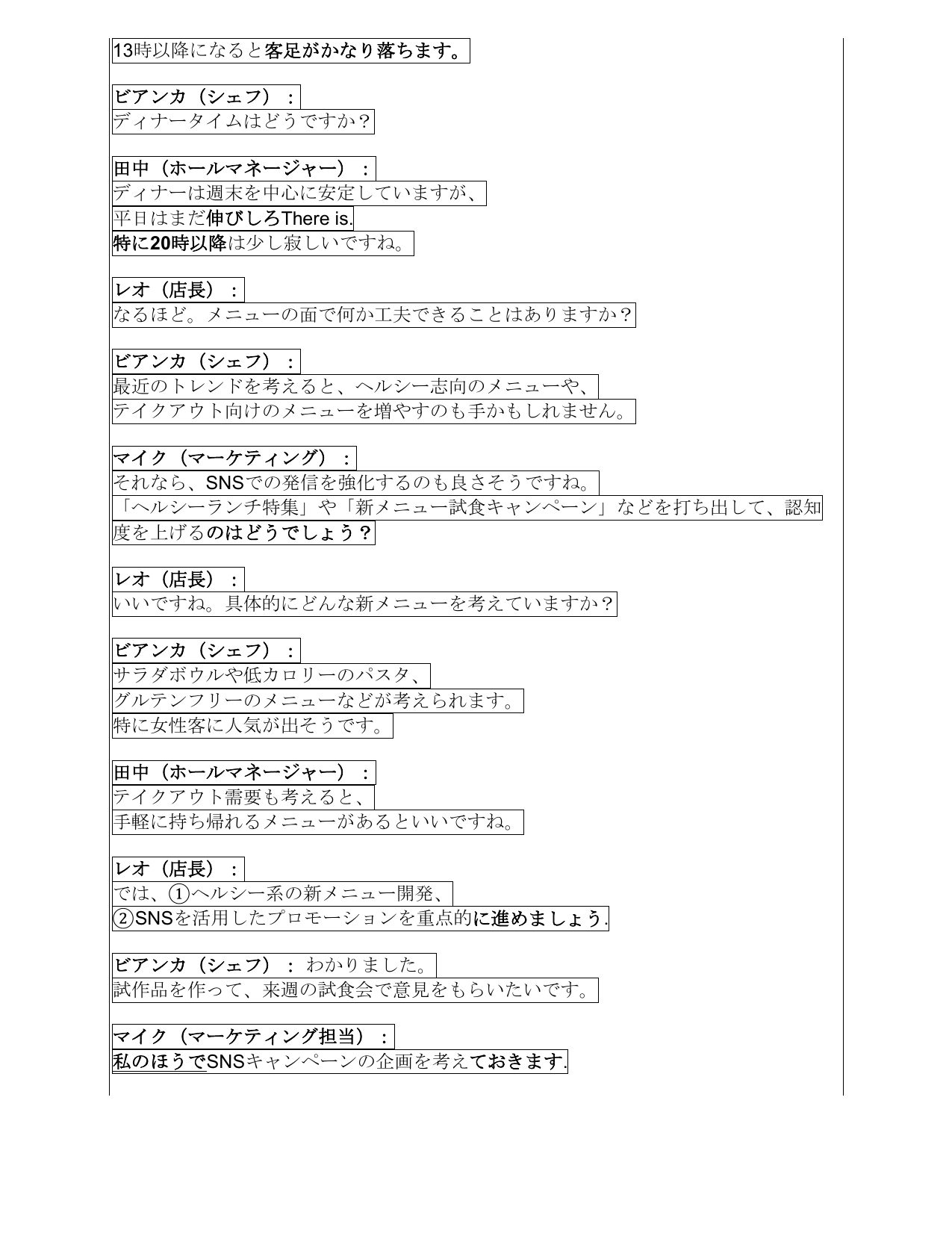
JP13時以降になると客足がかなり落ちます。
ビアンカ(シェフ):
ディナータイムはどうですか?
田中(ホールマネージャー):
ディナーは週末を中心に安定していますが、
平日はまだ伸びしろThereis.
特に20時以降は少し寂しいですね。
レオ(店長):
なるほど。メニューの面で何か工夫できることはありますか?
ビアンカ(シェフ):
最近のトレンドを考えると、ヘルシー志向のメニューや、
テイクアウト向けのメニューを増やすのも手かもしれません。
マイク(マーケティング):
それなら、SNSでの発信を強化するのも良さそうですね。
「ヘルシーランチ特集」や「新メニュー試食キャンペーン」などを打ち出して、認知
度を上げるのはどうでしょう?
レオ(店長):
いいですね。具体的にどんな新メニューを考えていますか?
ビアンカ(シェフ):
サラダボウルや低カロリーのパスタ、
グルテンフリーのメニューなどが考えられます。
特に女性客に人気が出そうです。
田中(ホールマネージャー):
テイクアウト需要も考えると、
手軽に持ち帰れるメニューがあるといいですね。
レオ(店長):
では、①ヘルシー系の新メニュー開発、
②SNSを活用したプロモーションを重点的に進めましょう.
ビアンカ(シェフ):わかりました。
試作品を作って、来週の試食会で意見をもらいたいです。
マイク(マーケティング担当):
私のほうでSNSキャンペーンの企画を考えておきます.
ビアンカ(シェフ):
ディナータイムはどうですか?
田中(ホールマネージャー):
ディナーは週末を中心に安定していますが、
平日はまだ伸びしろThereis.
特に20時以降は少し寂しいですね。
レオ(店長):
なるほど。メニューの面で何か工夫できることはありますか?
ビアンカ(シェフ):
最近のトレンドを考えると、ヘルシー志向のメニューや、
テイクアウト向けのメニューを増やすのも手かもしれません。
マイク(マーケティング):
それなら、SNSでの発信を強化するのも良さそうですね。
「ヘルシーランチ特集」や「新メニュー試食キャンペーン」などを打ち出して、認知
度を上げるのはどうでしょう?
レオ(店長):
いいですね。具体的にどんな新メニューを考えていますか?
ビアンカ(シェフ):
サラダボウルや低カロリーのパスタ、
グルテンフリーのメニューなどが考えられます。
特に女性客に人気が出そうです。
田中(ホールマネージャー):
テイクアウト需要も考えると、
手軽に持ち帰れるメニューがあるといいですね。
レオ(店長):
では、①ヘルシー系の新メニュー開発、
②SNSを活用したプロモーションを重点的に進めましょう.
ビアンカ(シェフ):わかりました。
試作品を作って、来週の試食会で意見をもらいたいです。
マイク(マーケティング担当):
私のほうでSNSキャンペーンの企画を考えておきます.
หน้า 73
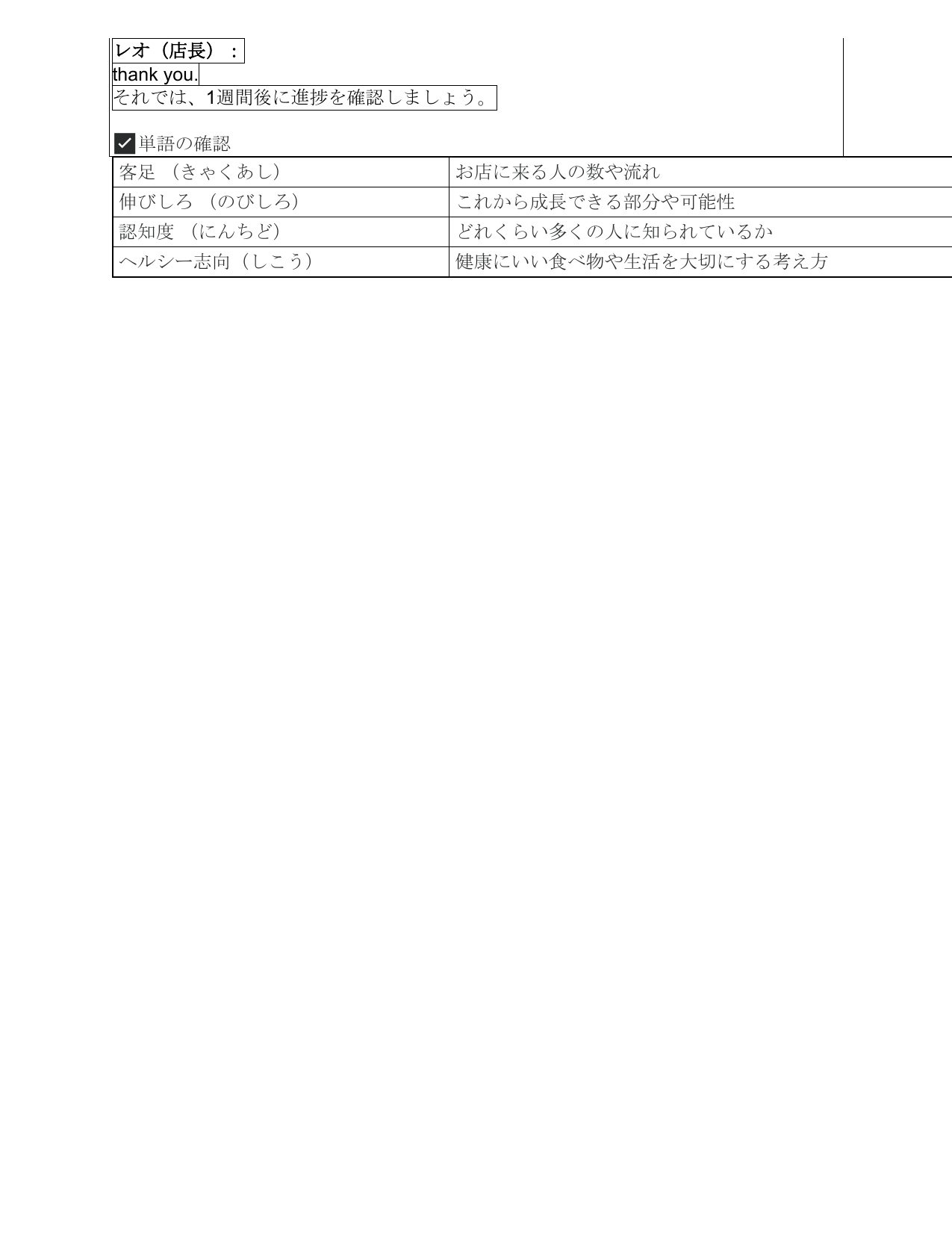
คลิกเพื่อขยาย
JPレオ(店長):
ENthank you.
JPそれでは、1週間後に進捗を確認しましょう。
✅単語の確認
客足(きゃくあし)お店に来る人の数や流れ
伸びしろ(のびしろ)これから成長できる部分や可能性
認知度(にんちど)どれくらい多くの人に知られているか
ヘルシー志向(しこう)健康にいい食べ物や生活を大切にする考え方
✅単語の確認
客足(きゃくあし)お店に来る人の数や流れ
伸びしろ(のびしろ)これから成長できる部分や可能性
認知度(にんちど)どれくらい多くの人に知られているか
ヘルシー志向(しこう)健康にいい食べ物や生活を大切にする考え方
หน้า 74
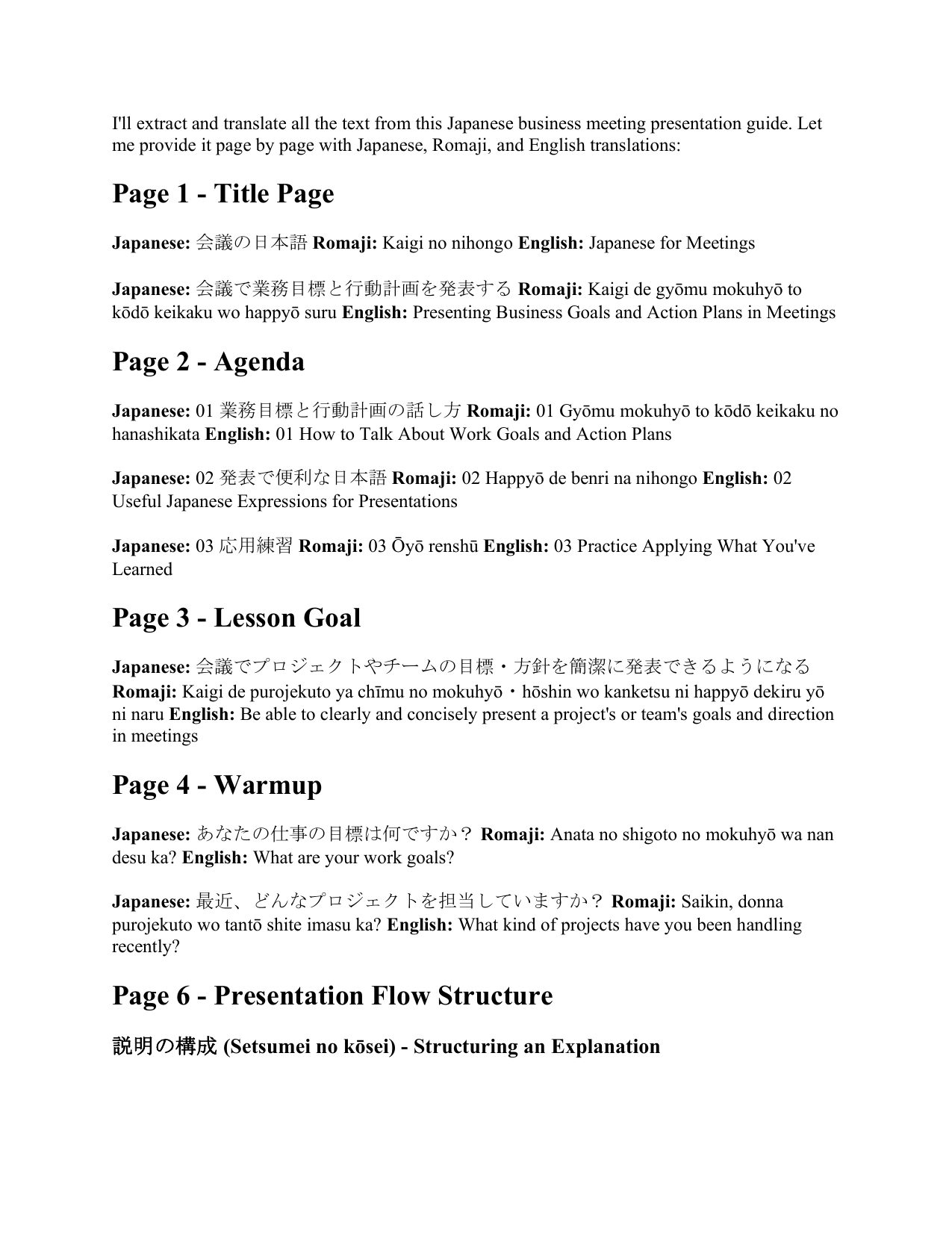
คลิกเพื่อขยาย
ENI'll extract and translate all the text from this Japanese business meeting presentation guide. Let
me provide it page by page with Japanese, Romaji, and English translations:
Page 1 - Title Page
Japanese: 会議の日本語 Romaji: Kaigi no nihongo English: Japanese for Meetings
Japanese: 会議で業務目標と行動計画を発表する Romaji: Kaigi de gyōmu mokuhyō to
kōdō keikaku wo happyō suru English: Presenting Business Goals and Action Plans in Meetings
Page 2 - Agenda
Japanese: 01 業務目標と行動計画の話し方 Romaji: 01 Gyōmu mokuhyō to kōdō keikaku no
hanashikata English: 01 How to Talk About Work Goals and Action Plans
Japanese: 02 発表で便利な日本語 Romaji: 02 Happyō de benri na nihongo English: 02
Useful Japanese Expressions for Presentations
Japanese: 03 応用練習 Romaji: 03 Ōyō renshū English: 03 Practice Applying What You've
Learned
Page 3 - Lesson Goal
me provide it page by page with Japanese, Romaji, and English translations:
Page 1 - Title Page
Japanese: 会議の日本語 Romaji: Kaigi no nihongo English: Japanese for Meetings
Japanese: 会議で業務目標と行動計画を発表する Romaji: Kaigi de gyōmu mokuhyō to
kōdō keikaku wo happyō suru English: Presenting Business Goals and Action Plans in Meetings
Page 2 - Agenda
Japanese: 01 業務目標と行動計画の話し方 Romaji: 01 Gyōmu mokuhyō to kōdō keikaku no
hanashikata English: 01 How to Talk About Work Goals and Action Plans
Japanese: 02 発表で便利な日本語 Romaji: 02 Happyō de benri na nihongo English: 02
Useful Japanese Expressions for Presentations
Japanese: 03 応用練習 Romaji: 03 Ōyō renshū English: 03 Practice Applying What You've
Learned
Page 3 - Lesson Goal
JPJapanese:会議でプロジェクトやチームの目標・方針を簡潔に発表できるようになる
ENRomaji: Kaigi de purojekuto ya chīmu no mokuhyō・hōshin wo kanketsu ni happyō dekiru yō
ni naru English: Be able to clearly and concisely present a project's or team's goals and direction
in meetings
Page 4 - Warmup
Japanese: あなたの仕事の目標は何ですか? Romaji: Anata no shigoto no mokuhyō wa nan
desu ka? English: What are your work goals?
Japanese: 最近、どんなプロジェクトを担当していますか? Romaji: Saikin, donna
purojekuto wo tantō shite imasu ka? English: What kind of projects have you been handling
recently?
Page 6 - Presentation Flow Structure
説明の構成 (Setsumei no kōsei) - Structuring an Explanation
ni naru English: Be able to clearly and concisely present a project's or team's goals and direction
in meetings
Page 4 - Warmup
Japanese: あなたの仕事の目標は何ですか? Romaji: Anata no shigoto no mokuhyō wa nan
desu ka? English: What are your work goals?
Japanese: 最近、どんなプロジェクトを担当していますか? Romaji: Saikin, donna
purojekuto wo tantō shite imasu ka? English: What kind of projects have you been handling
recently?
Page 6 - Presentation Flow Structure
説明の構成 (Setsumei no kōsei) - Structuring an Explanation
หน้า 75
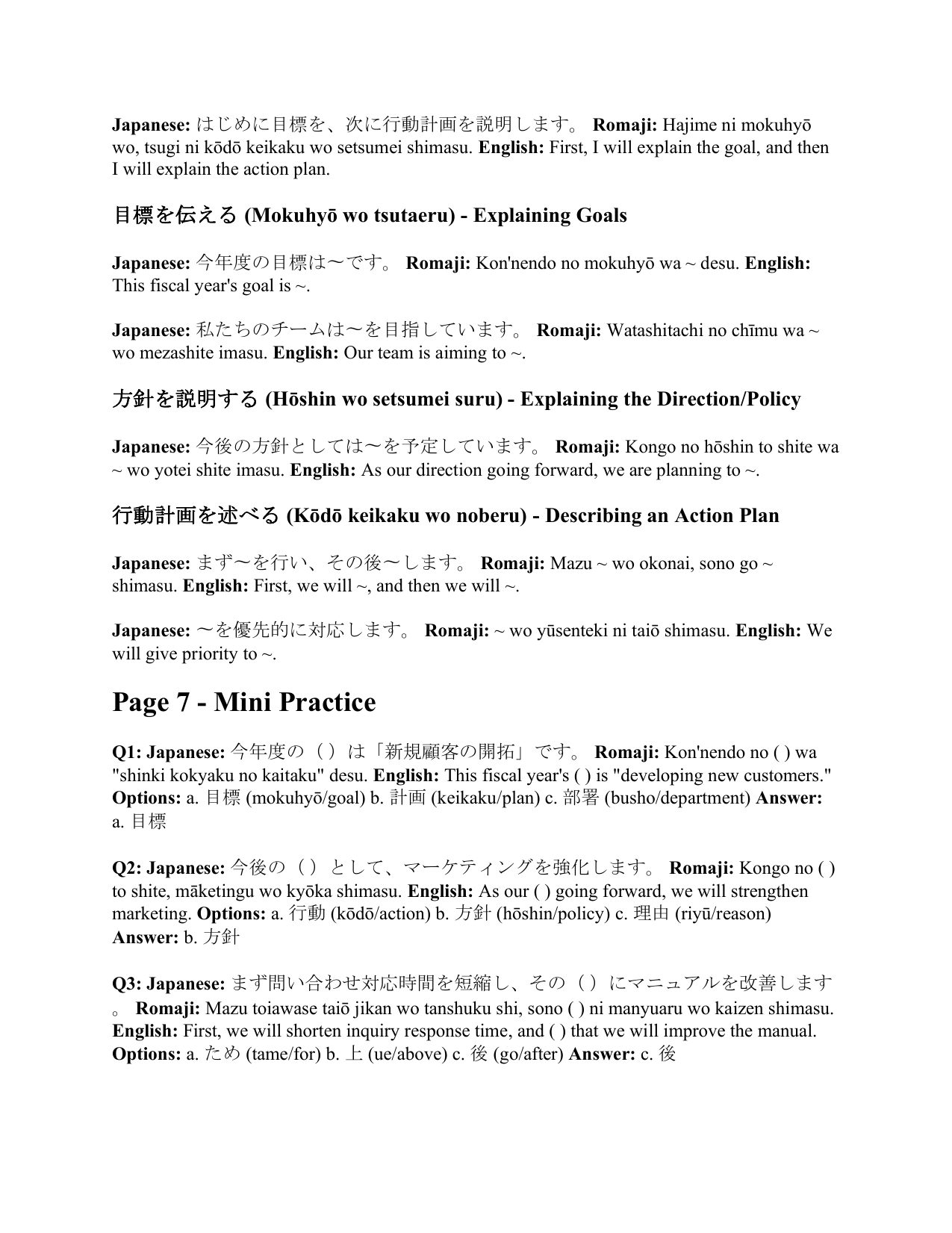
คลิกเพื่อขยาย
ENJapanese: はじめに目標を、次に行動計画を説明します。 Romaji: Hajime ni mokuhyō
wo, tsugi ni kōdō keikaku wo setsumei shimasu. English: First, I will explain the goal, and then
I will explain the action plan.
目標を伝える (Mokuhyō wo tsutaeru) - Explaining Goals
Japanese: 今年度の目標は〜です。 Romaji: Kon'nendo no mokuhyō wa ~ desu. English:
This fiscal year's goal is ~.
Japanese: 私たちのチームは〜を目指しています。 Romaji: Watashitachi no chīmu wa ~
wo mezashite imasu. English: Our team is aiming to ~.
方針を説明する (Hōshin wo setsumei suru) - Explaining the Direction/Policy
Japanese: 今後の方針としては〜を予定しています。 Romaji: Kongo no hōshin to shite wa
~ wo yotei shite imasu. English: As our direction going forward, we are planning to ~.
行動計画を述べる (Kōdō keikaku wo noberu) - Describing an Action Plan
Japanese: まず〜を行い、その後〜します。 Romaji: Mazu ~ wo okonai, sono go ~
shimasu. English: First, we will ~, and then we will ~.
Japanese: 〜を優先的に対応します。 Romaji: ~ wo yūsenteki ni taiō shimasu. English: We
will give priority to ~.
Page 7 - Mini Practice
Q1: Japanese: 今年度の( )は「新規顧客の開拓」です。 Romaji: Kon'nendo no ( ) wa
"shinki kokyaku no kaitaku" desu. English: This fiscal year's ( ) is "developing new customers."
Options: a. 目標 (mokuhyō/goal) b. 計画 (keikaku/plan) c. 部署 (busho/department) Answer:
wo, tsugi ni kōdō keikaku wo setsumei shimasu. English: First, I will explain the goal, and then
I will explain the action plan.
目標を伝える (Mokuhyō wo tsutaeru) - Explaining Goals
Japanese: 今年度の目標は〜です。 Romaji: Kon'nendo no mokuhyō wa ~ desu. English:
This fiscal year's goal is ~.
Japanese: 私たちのチームは〜を目指しています。 Romaji: Watashitachi no chīmu wa ~
wo mezashite imasu. English: Our team is aiming to ~.
方針を説明する (Hōshin wo setsumei suru) - Explaining the Direction/Policy
Japanese: 今後の方針としては〜を予定しています。 Romaji: Kongo no hōshin to shite wa
~ wo yotei shite imasu. English: As our direction going forward, we are planning to ~.
行動計画を述べる (Kōdō keikaku wo noberu) - Describing an Action Plan
Japanese: まず〜を行い、その後〜します。 Romaji: Mazu ~ wo okonai, sono go ~
shimasu. English: First, we will ~, and then we will ~.
Japanese: 〜を優先的に対応します。 Romaji: ~ wo yūsenteki ni taiō shimasu. English: We
will give priority to ~.
Page 7 - Mini Practice
Q1: Japanese: 今年度の( )は「新規顧客の開拓」です。 Romaji: Kon'nendo no ( ) wa
"shinki kokyaku no kaitaku" desu. English: This fiscal year's ( ) is "developing new customers."
Options: a. 目標 (mokuhyō/goal) b. 計画 (keikaku/plan) c. 部署 (busho/department) Answer:
JPa.目標
ENQ2: Japanese: 今後の( )として、マーケティングを強化します。 Romaji: Kongo no ( )
to shite, māketingu wo kyōka shimasu. English: As our ( ) going forward, we will strengthen
marketing. Options: a. 行動 (kōdō/action) b. 方針 (hōshin/policy) c. 理由 (riyū/reason)
Answer: b. 方針
to shite, māketingu wo kyōka shimasu. English: As our ( ) going forward, we will strengthen
marketing. Options: a. 行動 (kōdō/action) b. 方針 (hōshin/policy) c. 理由 (riyū/reason)
Answer: b. 方針
JPQ3:Japanese:まず問い合わせ対応時間を短縮し、その()にマニュアルを改善します
EN。 Romaji: Mazu toiawase taiō jikan wo tanshuku shi, sono ( ) ni manyuaru wo kaizen shimasu.
English: First, we will shorten inquiry response time, and ( ) that we will improve the manual.
Options: a. ため (tame/for) b. 上 (ue/above) c. 後 (go/after) Answer: c. 後
English: First, we will shorten inquiry response time, and ( ) that we will improve the manual.
Options: a. ため (tame/for) b. 上 (ue/above) c. 後 (go/after) Answer: c. 後
หน้า 76
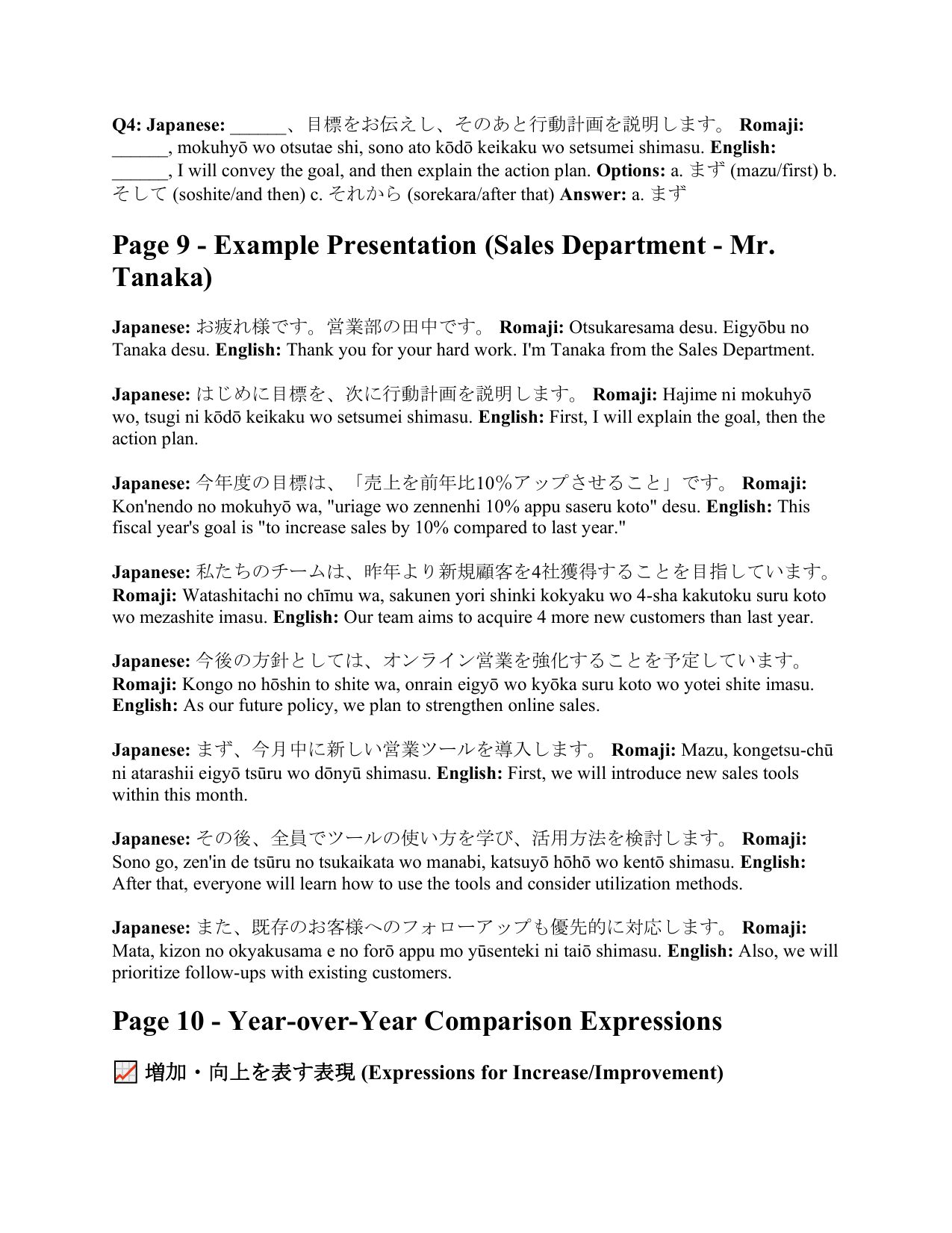
คลิกเพื่อขยาย
JPQ4:Japanese:______、目標をお伝えし、そのあと行動計画を説明します。Romaji:
EN______, mokuhyō wo otsutae shi, sono ato kōdō keikaku wo setsumei shimasu. English:
______, I will convey the goal, and then explain the action plan. Options: a. まず (mazu/first) b.
そして (soshite/and then) c. それから (sorekara/after that) Answer: a. まず
Page 9 - Example Presentation (Sales Department - Mr.
Tanaka)
Japanese: お疲れ様です。営業部の田中です。 Romaji: Otsukaresama desu. Eigyōbu no
Tanaka desu. English: Thank you for your hard work. I'm Tanaka from the Sales Department.
Japanese: はじめに目標を、次に行動計画を説明します。 Romaji: Hajime ni mokuhyō
wo, tsugi ni kōdō keikaku wo setsumei shimasu. English: First, I will explain the goal, then the
action plan.
______, I will convey the goal, and then explain the action plan. Options: a. まず (mazu/first) b.
そして (soshite/and then) c. それから (sorekara/after that) Answer: a. まず
Page 9 - Example Presentation (Sales Department - Mr.
Tanaka)
Japanese: お疲れ様です。営業部の田中です。 Romaji: Otsukaresama desu. Eigyōbu no
Tanaka desu. English: Thank you for your hard work. I'm Tanaka from the Sales Department.
Japanese: はじめに目標を、次に行動計画を説明します。 Romaji: Hajime ni mokuhyō
wo, tsugi ni kōdō keikaku wo setsumei shimasu. English: First, I will explain the goal, then the
action plan.
JPJapanese:今年度の目標は、「売上を前年比10%アップさせること」です。Romaji:
ENKon'nendo no mokuhyō wa, "uriage wo zennenhi 10% appu saseru koto" desu. English: This
fiscal year's goal is "to increase sales by 10% compared to last year."
fiscal year's goal is "to increase sales by 10% compared to last year."
JPJapanese:私たちのチームは、昨年より新規顧客を4社獲得することを目指しています。
ENRomaji: Watashitachi no chīmu wa, sakunen yori shinki kokyaku wo 4-sha kakutoku suru koto
wo mezashite imasu. English: Our team aims to acquire 4 more new customers than last year.
wo mezashite imasu. English: Our team aims to acquire 4 more new customers than last year.
JPJapanese:今後の方針としては、オンライン営業を強化することを予定しています。
ENRomaji: Kongo no hōshin to shite wa, onrain eigyō wo kyōka suru koto wo yotei shite imasu.
English: As our future policy, we plan to strengthen online sales.
Japanese: まず、今月中に新しい営業ツールを導入します。 Romaji: Mazu, kongetsu-chū
ni atarashii eigyō tsūru wo dōnyū shimasu. English: First, we will introduce new sales tools
within this month.
English: As our future policy, we plan to strengthen online sales.
Japanese: まず、今月中に新しい営業ツールを導入します。 Romaji: Mazu, kongetsu-chū
ni atarashii eigyō tsūru wo dōnyū shimasu. English: First, we will introduce new sales tools
within this month.
JPJapanese:その後、全員でツールの使い方を学び、活用方法を検討します。Romaji:
ENSono go, zen'in de tsūru no tsukaikata wo manabi, katsuyō hōhō wo kentō shimasu. English:
After that, everyone will learn how to use the tools and consider utilization methods.
After that, everyone will learn how to use the tools and consider utilization methods.
JPJapanese:また、既存のお客様へのフォローアップも優先的に対応します。Romaji:
ENMata, kizon no okyakusama e no forō appu mo yūsenteki ni taiō shimasu. English: Also, we will
prioritize follow-ups with existing customers.
Page 10 - Year-over-Year Comparison Expressions
増加・向上を表す表現 (Expressions for Increase/Improvement)
prioritize follow-ups with existing customers.
Page 10 - Year-over-Year Comparison Expressions
増加・向上を表す表現 (Expressions for Increase/Improvement)
หน้า 77
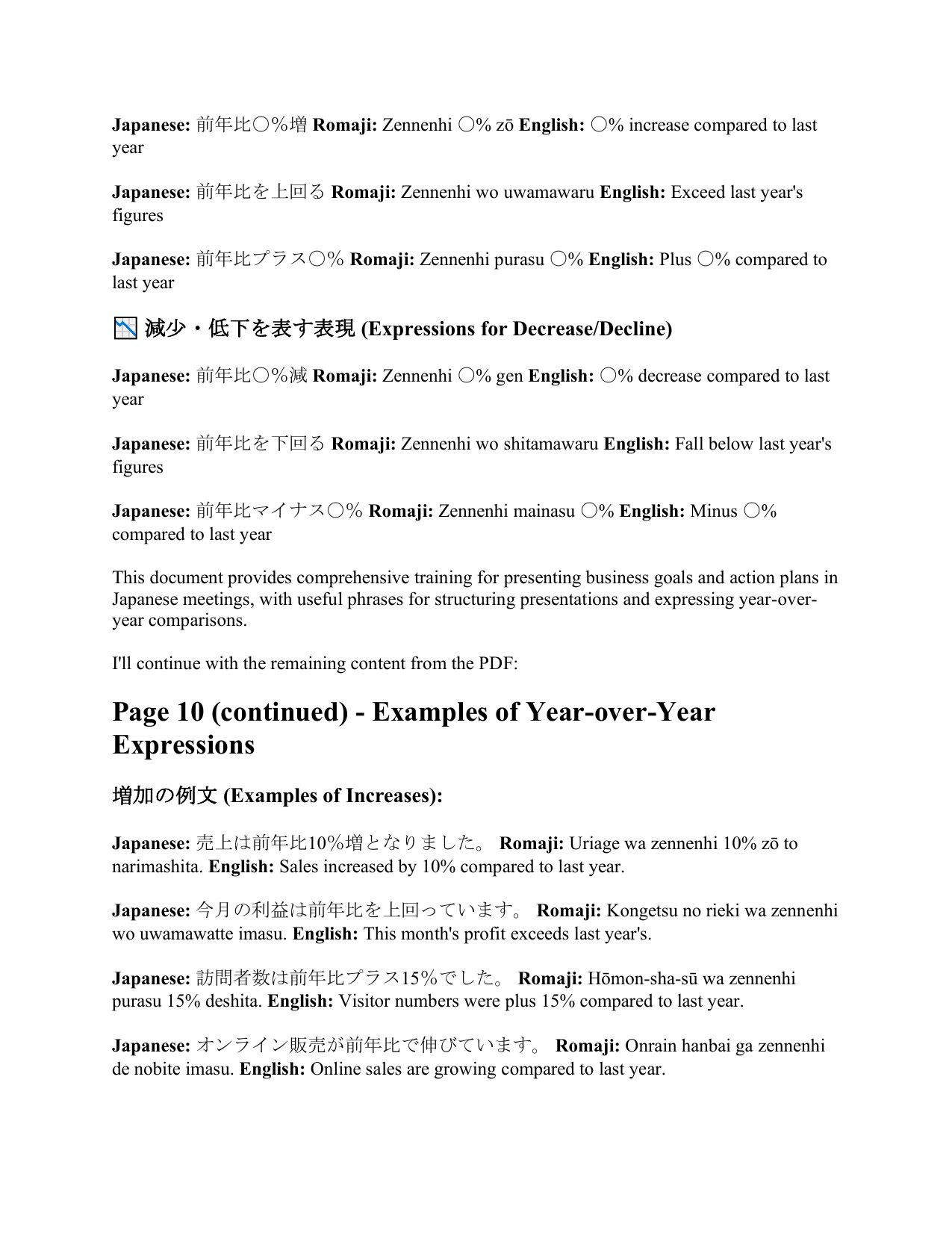
คลิกเพื่อขยาย
ENJapanese: 前年比〇%増 Romaji: Zennenhi 〇% zō English: 〇% increase compared to last
year
Japanese: 前年比を上回る Romaji: Zennenhi wo uwamawaru English: Exceed last year's
figures
Japanese: 前年比プラス〇% Romaji: Zennenhi purasu 〇% English: Plus 〇% compared to
last year
減少・低下を表す表現 (Expressions for Decrease/Decline)
Japanese: 前年比〇%減 Romaji: Zennenhi 〇% gen English: 〇% decrease compared to last
year
Japanese: 前年比を下回る Romaji: Zennenhi wo shitamawaru English: Fall below last year's
figures
Japanese: 前年比マイナス〇% Romaji: Zennenhi mainasu 〇% English: Minus 〇%
compared to last year
This document provides comprehensive training for presenting business goals and action plans in
Japanese meetings, with useful phrases for structuring presentations and expressing year-over-
year comparisons.
I'll continue with the remaining content from the PDF:
Page 10 (continued) - Examples of Year-over-Year
Expressions
増加の例文 (Examples of Increases):
Japanese: 売上は前年比10%増となりました。 Romaji: Uriage wa zennenhi 10% zō to
narimashita. English: Sales increased by 10% compared to last year.
Japanese: 今月の利益は前年比を上回っています。 Romaji: Kongetsu no rieki wa zennenhi
wo uwamawatte imasu. English: This month's profit exceeds last year's.
Japanese: 訪問者数は前年比プラス15%でした。 Romaji: Hōmon-sha-sū wa zennenhi
purasu 15% deshita. English: Visitor numbers were plus 15% compared to last year.
Japanese: オンライン販売が前年比で伸びています。 Romaji: Onrain hanbai ga zennenhi
de nobite imasu. English: Online sales are growing compared to last year.
year
Japanese: 前年比を上回る Romaji: Zennenhi wo uwamawaru English: Exceed last year's
figures
Japanese: 前年比プラス〇% Romaji: Zennenhi purasu 〇% English: Plus 〇% compared to
last year
減少・低下を表す表現 (Expressions for Decrease/Decline)
Japanese: 前年比〇%減 Romaji: Zennenhi 〇% gen English: 〇% decrease compared to last
year
Japanese: 前年比を下回る Romaji: Zennenhi wo shitamawaru English: Fall below last year's
figures
Japanese: 前年比マイナス〇% Romaji: Zennenhi mainasu 〇% English: Minus 〇%
compared to last year
This document provides comprehensive training for presenting business goals and action plans in
Japanese meetings, with useful phrases for structuring presentations and expressing year-over-
year comparisons.
I'll continue with the remaining content from the PDF:
Page 10 (continued) - Examples of Year-over-Year
Expressions
増加の例文 (Examples of Increases):
Japanese: 売上は前年比10%増となりました。 Romaji: Uriage wa zennenhi 10% zō to
narimashita. English: Sales increased by 10% compared to last year.
Japanese: 今月の利益は前年比を上回っています。 Romaji: Kongetsu no rieki wa zennenhi
wo uwamawatte imasu. English: This month's profit exceeds last year's.
Japanese: 訪問者数は前年比プラス15%でした。 Romaji: Hōmon-sha-sū wa zennenhi
purasu 15% deshita. English: Visitor numbers were plus 15% compared to last year.
Japanese: オンライン販売が前年比で伸びています。 Romaji: Onrain hanbai ga zennenhi
de nobite imasu. English: Online sales are growing compared to last year.
หน้า 78
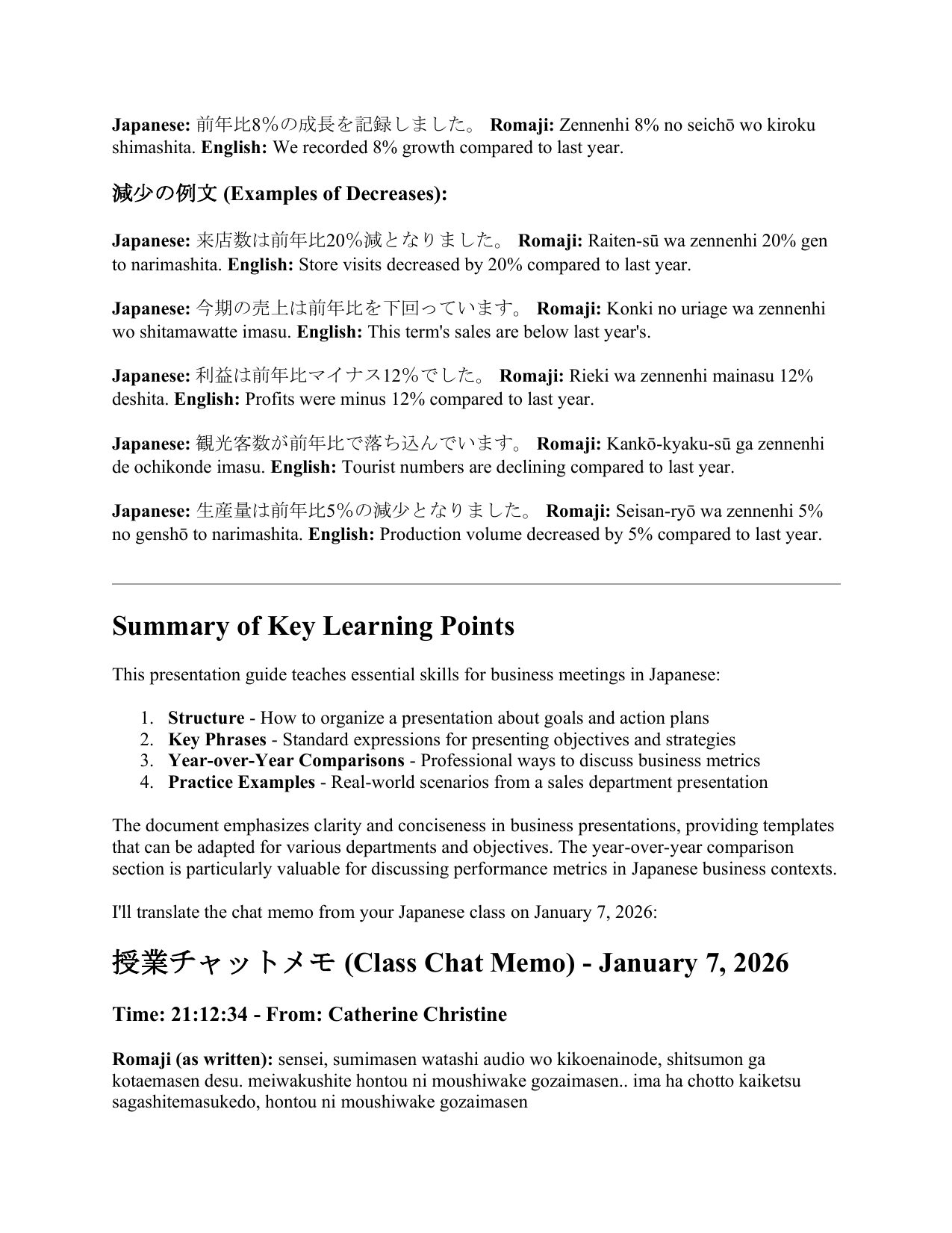
คลิกเพื่อขยาย
ENJapanese: 前年比8%の成長を記録しました。 Romaji: Zennenhi 8% no seichō wo kiroku
shimashita. English: We recorded 8% growth compared to last year.
減少の例文 (Examples of Decreases):
Japanese: 来店数は前年比20%減となりました。 Romaji: Raiten-sū wa zennenhi 20% gen
to narimashita. English: Store visits decreased by 20% compared to last year.
Japanese: 今期の売上は前年比を下回っています。 Romaji: Konki no uriage wa zennenhi
wo shitamawatte imasu. English: This term's sales are below last year's.
Japanese: 利益は前年比マイナス12%でした。 Romaji: Rieki wa zennenhi mainasu 12%
deshita. English: Profits were minus 12% compared to last year.
Japanese: 観光客数が前年比で落ち込んでいます。 Romaji: Kankō-kyaku-sū ga zennenhi
de ochikonde imasu. English: Tourist numbers are declining compared to last year.
Japanese: 生産量は前年比5%の減少となりました。 Romaji: Seisan-ryō wa zennenhi 5%
no genshō to narimashita. English: Production volume decreased by 5% compared to last year.
Summary of Key Learning Points
This presentation guide teaches essential skills for business meetings in Japanese:
1. Structure - How to organize a presentation about goals and action plans
2. Key Phrases - Standard expressions for presenting objectives and strategies
3. Year-over-Year Comparisons - Professional ways to discuss business metrics
4. Practice Examples - Real-world scenarios from a sales department presentation
The document emphasizes clarity and conciseness in business presentations, providing templates
that can be adapted for various departments and objectives. The year-over-year comparison
section is particularly valuable for discussing performance metrics in Japanese business contexts.
I'll translate the chat memo from your Japanese class on January 7, 2026:
授業チャットメモ (Class Chat Memo) - January 7, 2026
Time: 21:12:34 - From: Catherine Christine
Romaji (as written): sensei, sumimasen watashi audio wo kikoenainode, shitsumon ga
kotaemasen desu. meiwakushite hontou ni moushiwake gozaimasen.. ima ha chotto kaiketsu
sagashitemasukedo, hontou ni moushiwake gozaimasen
shimashita. English: We recorded 8% growth compared to last year.
減少の例文 (Examples of Decreases):
Japanese: 来店数は前年比20%減となりました。 Romaji: Raiten-sū wa zennenhi 20% gen
to narimashita. English: Store visits decreased by 20% compared to last year.
Japanese: 今期の売上は前年比を下回っています。 Romaji: Konki no uriage wa zennenhi
wo shitamawatte imasu. English: This term's sales are below last year's.
Japanese: 利益は前年比マイナス12%でした。 Romaji: Rieki wa zennenhi mainasu 12%
deshita. English: Profits were minus 12% compared to last year.
Japanese: 観光客数が前年比で落ち込んでいます。 Romaji: Kankō-kyaku-sū ga zennenhi
de ochikonde imasu. English: Tourist numbers are declining compared to last year.
Japanese: 生産量は前年比5%の減少となりました。 Romaji: Seisan-ryō wa zennenhi 5%
no genshō to narimashita. English: Production volume decreased by 5% compared to last year.
Summary of Key Learning Points
This presentation guide teaches essential skills for business meetings in Japanese:
1. Structure - How to organize a presentation about goals and action plans
2. Key Phrases - Standard expressions for presenting objectives and strategies
3. Year-over-Year Comparisons - Professional ways to discuss business metrics
4. Practice Examples - Real-world scenarios from a sales department presentation
The document emphasizes clarity and conciseness in business presentations, providing templates
that can be adapted for various departments and objectives. The year-over-year comparison
section is particularly valuable for discussing performance metrics in Japanese business contexts.
I'll translate the chat memo from your Japanese class on January 7, 2026:
授業チャットメモ (Class Chat Memo) - January 7, 2026
Time: 21:12:34 - From: Catherine Christine
Romaji (as written): sensei, sumimasen watashi audio wo kikoenainode, shitsumon ga
kotaemasen desu. meiwakushite hontou ni moushiwake gozaimasen.. ima ha chotto kaiketsu
sagashitemasukedo, hontou ni moushiwake gozaimasen
หน้า 79
คลิกเพื่อขยาย
JPCorrectedJapanese:先生、すみません。私はオーディオが聞こえないので、質問に答
えられません。ご迷惑をおかけして本当に申し訳ございません。今はちょっと解決策を
探していますけど、本当に申し訳ございません。
えられません。ご迷惑をおかけして本当に申し訳ございません。今はちょっと解決策を
探していますけど、本当に申し訳ございません。
ENCorrected Romaji: Sensei, sumimasen. Watashi wa ōdio ga kikoenai node, shitsumon ni
kotaeraremasen. Gomeiwaku wo okake shite hontō ni mōshiwake gozaimasen. Ima wa chotto
kaiketsusaku wo sagashite imasu kedo, hontō ni mōshiwake gozaimasen.
English: Teacher, I'm sorry. I can't hear the audio, so I cannot answer the questions. I'm truly
sorry for causing trouble. I'm trying to find a solution now, but I'm really very sorry.
Time: 21:16:27 - From: 守下 愛莉 (Teacher)
Japanese: 新規(しんき)↔️ 既存(きぞん) Romaji: Shinki ↔️ Kizon English: New
(customers/clients) ↔️ Existing (customers/clients)
Time: 21:28:00 - From: Catherine Christine
kotaeraremasen. Gomeiwaku wo okake shite hontō ni mōshiwake gozaimasen. Ima wa chotto
kaiketsusaku wo sagashite imasu kedo, hontō ni mōshiwake gozaimasen.
English: Teacher, I'm sorry. I can't hear the audio, so I cannot answer the questions. I'm truly
sorry for causing trouble. I'm trying to find a solution now, but I'm really very sorry.
Time: 21:16:27 - From: 守下 愛莉 (Teacher)
Japanese: 新規(しんき)↔️ 既存(きぞん) Romaji: Shinki ↔️ Kizon English: New
(customers/clients) ↔️ Existing (customers/clients)
Time: 21:28:00 - From: Catherine Christine
JPJapanese:ご迷惑をおかけしてすみません。いろいろ試しましたが、解決できませんで
ENしたので、この授業を退出します。失礼します.. Romaji: Gomeiwaku wo okake shite
sumimasen. Iroiro tameshimashita ga, kaiketsu dekimasen deshita node, kono jugyō wo taishutsu
shimasu. Shitsurei shimasu.. English: I'm sorry for causing trouble. I tried various things, but I
couldn't solve the problem, so I will leave this class. Excuse me..
Time: 21:45:41 - From: 守下 愛莉 (Teacher)
Japanese: 新規の海外ユーザーの開拓を予定しています Romaji: Shinki no kaigai yūzā no
kaitaku wo yotei shite imasu English: We are planning to develop new overseas users
Time: 21:45:52 - From: 守下 愛莉 (Teacher)
Japanese: 1億円の売上(うりあげ) Romaji: Ichi-oku-en no uriage English: 100 million
yen in sales
Time: 21:46:53 - From: 守下 愛莉 (Teacher)
Japanese: 試験に合格する Romaji: Shiken ni gōkaku suru English: To pass an exam
Context Notes:
sumimasen. Iroiro tameshimashita ga, kaiketsu dekimasen deshita node, kono jugyō wo taishutsu
shimasu. Shitsurei shimasu.. English: I'm sorry for causing trouble. I tried various things, but I
couldn't solve the problem, so I will leave this class. Excuse me..
Time: 21:45:41 - From: 守下 愛莉 (Teacher)
Japanese: 新規の海外ユーザーの開拓を予定しています Romaji: Shinki no kaigai yūzā no
kaitaku wo yotei shite imasu English: We are planning to develop new overseas users
Time: 21:45:52 - From: 守下 愛莉 (Teacher)
Japanese: 1億円の売上(うりあげ) Romaji: Ichi-oku-en no uriage English: 100 million
yen in sales
Time: 21:46:53 - From: 守下 愛莉 (Teacher)
Japanese: 試験に合格する Romaji: Shiken ni gōkaku suru English: To pass an exam
Context Notes:
หน้า 80
คลิกเพื่อขยาย
ENThis chat memo appears to be from the same business Japanese course covering the meeting
presentation material. The teacher provided examples of:
• The contrast between 新規 (new) and 既存 (existing) customers
• Business vocabulary like 開拓 (development/cultivation of new markets)
• Sales figures (売上)
• Achievement expressions (合格する - to pass/succeed)
Catherine Christine appears to have had technical difficulties with audio during the class and had
to leave after troubleshooting attempts failed.
I'll translate and provide answers with explanations for this Japanese business communication
worksheet:
presentation material. The teacher provided examples of:
• The contrast between 新規 (new) and 既存 (existing) customers
• Business vocabulary like 開拓 (development/cultivation of new markets)
• Sales figures (売上)
• Achievement expressions (合格する - to pass/succeed)
Catherine Christine appears to have had technical difficulties with audio during the class and had
to leave after troubleshooting attempts failed.
I'll translate and provide answers with explanations for this Japanese business communication
worksheet:
JPワークシート-確認問題0109
ENWorksheet - Confirmation Problems 0109
Question 1:
Japanese: 以下の___に自由に言葉を入れましょう。 Romaji: Ika no ___ ni jiyū ni
kotoba wo iremashou. English: Fill in the blank freely with appropriate words.
Question 1:
Japanese: 以下の___に自由に言葉を入れましょう。 Romaji: Ika no ___ ni jiyū ni
kotoba wo iremashou. English: Fill in the blank freely with appropriate words.
JPSentence:先ほどご指示いただいた内容をもとに、明日中に社内で検討し、私の方で
_________いたします。
_________いたします。
ENTranslation: Based on the instructions you gave earlier, we will discuss it internally by
tomorrow, and I will _______.
Suggested answers:
• 対応 (taiō) - handle it
• 準備 (junbi) - prepare it
• まとめ (matome) - summarize it
Question 2:
tomorrow, and I will _______.
Suggested answers:
• 対応 (taiō) - handle it
• 準備 (junbi) - prepare it
• まとめ (matome) - summarize it
Question 2:
JPJapanese:次の語句を並べ替えて、「内容の確認を丁寧に行う表現」として最も自然な
EN文を完成させなさい。 Romaji: Tsugi no goku wo narabekaete, "naiyō no kakunin wo teinei
ni okonau hyōgen" to shite mottomo shizen na bun wo kansei sasenasai. English: Rearrange the
following phrases to create the most natural sentence for politely confirming content.
ni okonau hyōgen" to shite mottomo shizen na bun wo kansei sasenasai. English: Rearrange the
following phrases to create the most natural sentence for politely confirming content.
JPPhrasestoarrange:a)ということでよろしいでしょうかb)ご指示のc)採用するd)A案
をe)内容は
をe)内容は
หน้า 81
คลิกเพื่อขยาย
ENAnswer: b-e-d-c-a Complete sentence: ご指示の内容はA案を採用するということでよろ
しいでしょうか Translation: Is my understanding correct that your instruction is to adopt Plan
A?
Question 3:
Japanese: 次の表現と近い意味を持つ単語を選びましょう Romaji: Tsugi no hyōgen to
chikai imi wo motsu tango wo erabimashou English: Choose words with similar meanings to the
following expressions
Matching pairs:
• 承諾する (shōdaku suru) = 許す (yurusu) - to approve/permit
• 理解する (rikai suru) = 把握する (haaku suru) - to understand/grasp
• 対応する (taiō suru) = 対処する (taisho suru) - to handle/deal with
• 指示する (shiji suru) = 命令する (meirei suru) - to instruct/order
• たたき台 (tatakidai) = 下書き (shitagaki) - draft
Question 4:
Task: Create a confirmation sentence using 「〜という理解で間違いないでしょうか」
しいでしょうか Translation: Is my understanding correct that your instruction is to adopt Plan
A?
Question 3:
Japanese: 次の表現と近い意味を持つ単語を選びましょう Romaji: Tsugi no hyōgen to
chikai imi wo motsu tango wo erabimashou English: Choose words with similar meanings to the
following expressions
Matching pairs:
• 承諾する (shōdaku suru) = 許す (yurusu) - to approve/permit
• 理解する (rikai suru) = 把握する (haaku suru) - to understand/grasp
• 対応する (taiō suru) = 対処する (taisho suru) - to handle/deal with
• 指示する (shiji suru) = 命令する (meirei suru) - to instruct/order
• たたき台 (tatakidai) = 下書き (shitagaki) - draft
Question 4:
Task: Create a confirmation sentence using 「〜という理解で間違いないでしょうか」
JPAnswer:資料の提出日は来週火曜日で、翌日の社内会議でご使用になるという理解で間
EN違いないでしょうか。 Romaji: Shiryō no teishutsu-bi wa raishū kayōbi de, yokujitsu no
shanai kaigi de go-shiyō ni naru to iu rikai de machigai nai deshō ka. English: Is my
understanding correct that the document submission date is next Tuesday and it will be used in
the internal meeting the following day?
Question 5:
shanai kaigi de go-shiyō ni naru to iu rikai de machigai nai deshō ka. English: Is my
understanding correct that the document submission date is next Tuesday and it will be used in
the internal meeting the following day?
Question 5:
JPJapanese:以下のカジュアルな表現を、よりフォーマルでビジネス向けの日本語に書き
EN換えましょう。 Romaji: Ika no kajuaru na hyōgen wo, yori fōmaru de bijinesu-muke no
nihongo ni kakikaemashō. English: Rewrite the following casual expressions in more formal
business Japanese.
Answers:
1. OKです!→ 承知いたしました (Shōchi itashimashita) - Understood
nihongo ni kakikaemashō. English: Rewrite the following casual expressions in more formal
business Japanese.
Answers:
1. OKです!→ 承知いたしました (Shōchi itashimashita) - Understood
JP2.打ち合わせは15日(火)でいいですよね→打ち合わせは15日(火)でよろしいでしょ
EN うか (Uchiawase wa 15-nichi (ka) de yoroshii deshō ka)
3. 資料を直しておきますね → 資料を修正いたします (Shiryō wo shūsei itashimasu)
Question 6:
3. 資料を直しておきますね → 資料を修正いたします (Shiryō wo shūsei itashimasu)
Question 6:
หน้า 82
คลิกเพื่อขยาย
ENAnswer: d) ご確認 (go-kakunin) Complete sentence: 添付は本日部長がご確認された資料
です。 Translation: The attachment is the document that the department manager confirmed
today.
Question 7:
Japanese: 次の敬語表現を尊敬語または謙譲語に分類しましょう Romaji: Tsugi no keigo
hyōgen wo sonkeigo mata wa kenjōgo ni bunrui shimashō English: Classify the following
honorific expressions as respectful or humble language
謙譲語 (Kenjōgo - Humble):
• 拝見します (haiken shimasu)
• 伺います (ukagaimasu)
• お目にかかります (ome ni kakarimasu)
• お持ちします (omochi shimasu)
• お伝えします (otsutae shimasu)
• お礼申し上げます (orei mōshiagemasu)
尊敬語 (Sonkeigo - Respectful):
• お越しになります (okoshi ni narimasu)
• ご覧になります (goran ni narimasu)
• おっしゃいます (osshaimasu)
• いらっしゃいます (irasshaimasu)
• なさいます (nasaimasu)
• ご存知です (go-zonji desu)
Question 8:
Answer: b) C. 資料をご覧いただけますと幸いです。 Translation: I would be grateful if
you could look at the documents.
Question 9:
Task: Rewrite casual sentence in business keigo
です。 Translation: The attachment is the document that the department manager confirmed
today.
Question 7:
Japanese: 次の敬語表現を尊敬語または謙譲語に分類しましょう Romaji: Tsugi no keigo
hyōgen wo sonkeigo mata wa kenjōgo ni bunrui shimashō English: Classify the following
honorific expressions as respectful or humble language
謙譲語 (Kenjōgo - Humble):
• 拝見します (haiken shimasu)
• 伺います (ukagaimasu)
• お目にかかります (ome ni kakarimasu)
• お持ちします (omochi shimasu)
• お伝えします (otsutae shimasu)
• お礼申し上げます (orei mōshiagemasu)
尊敬語 (Sonkeigo - Respectful):
• お越しになります (okoshi ni narimasu)
• ご覧になります (goran ni narimasu)
• おっしゃいます (osshaimasu)
• いらっしゃいます (irasshaimasu)
• なさいます (nasaimasu)
• ご存知です (go-zonji desu)
Question 8:
Answer: b) C. 資料をご覧いただけますと幸いです。 Translation: I would be grateful if
you could look at the documents.
Question 9:
Task: Rewrite casual sentence in business keigo
JPAnswer:先ほどいただきました資料、拝見いたしました。Romaji:Sakihodo
ENitadakimashita shiryō, haiken itashimashita. English: I have reviewed the documents I received
earlier.
Question 10:
earlier.
Question 10:
หน้า 83
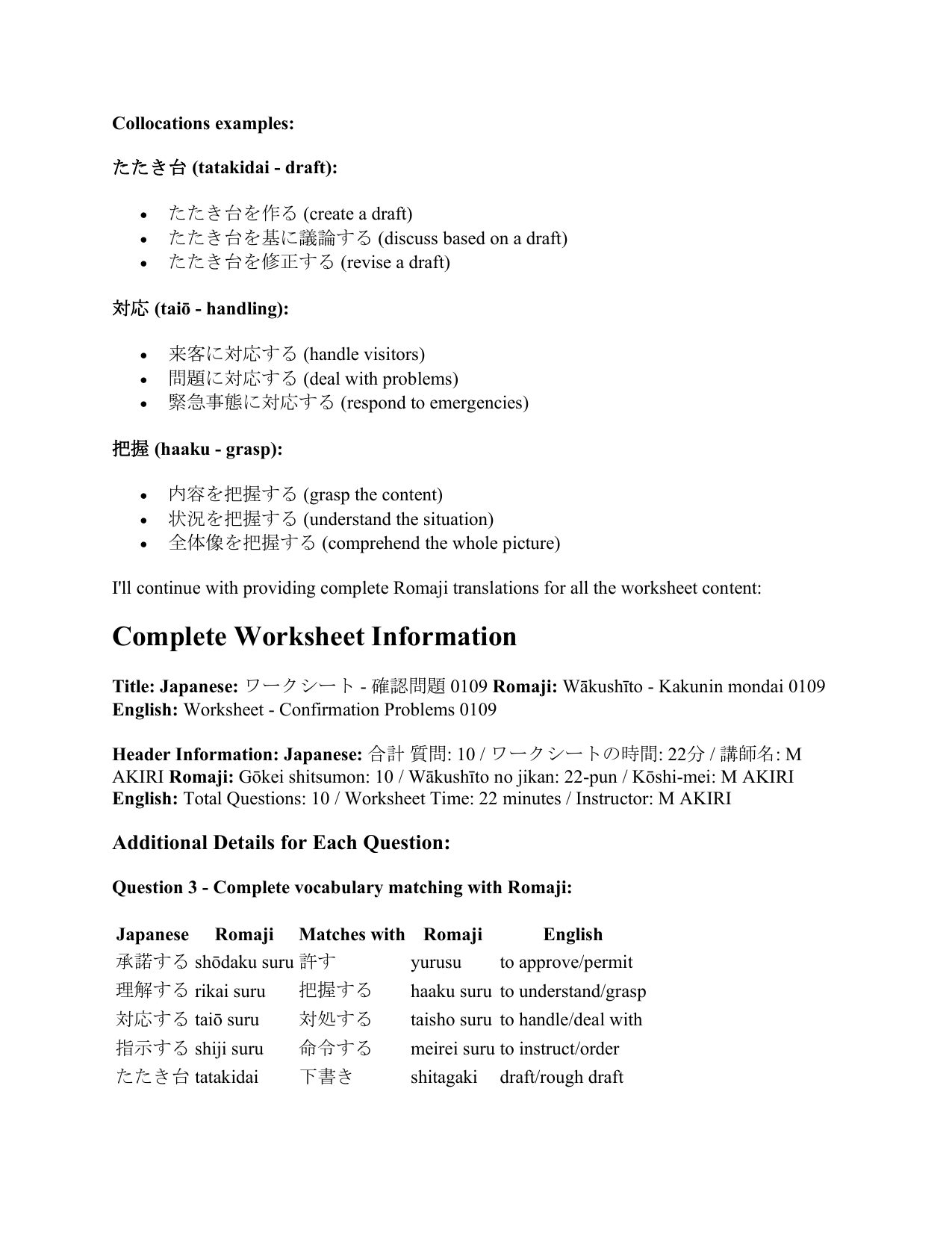
คลิกเพื่อขยาย
ENCollocations examples:
たたき台 (tatakidai - draft):
• たたき台を作る (create a draft)
• たたき台を基に議論する (discuss based on a draft)
• たたき台を修正する (revise a draft)
対応 (taiō - handling):
• 来客に対応する (handle visitors)
• 問題に対応する (deal with problems)
• 緊急事態に対応する (respond to emergencies)
把握 (haaku - grasp):
• 内容を把握する (grasp the content)
• 状況を把握する (understand the situation)
• 全体像を把握する (comprehend the whole picture)
I'll continue with providing complete Romaji translations for all the worksheet content:
Complete Worksheet Information
Title: Japanese: ワークシート - 確認問題 0109 Romaji: Wākushīto - Kakunin mondai 0109
English: Worksheet - Confirmation Problems 0109
Header Information: Japanese: 合計 質問: 10 / ワークシートの時間: 22分 / 講師名: M
AKIRI Romaji: Gōkei shitsumon: 10 / Wākushīto no jikan: 22-pun / Kōshi-mei: M AKIRI
English: Total Questions: 10 / Worksheet Time: 22 minutes / Instructor: M AKIRI
Additional Details for Each Question:
Question 3 - Complete vocabulary matching with Romaji:
Japanese Romaji Matches with Romaji English
承諾する shōdaku suru 許す yurusu to approve/permit
理解する rikai suru 把握する haaku suru to understand/grasp
対応する taiō suru 対処する taisho suru to handle/deal with
指示する shiji suru 命令する meirei suru to instruct/order
たたき台 tatakidai 下書き shitagaki draft/rough draft
たたき台 (tatakidai - draft):
• たたき台を作る (create a draft)
• たたき台を基に議論する (discuss based on a draft)
• たたき台を修正する (revise a draft)
対応 (taiō - handling):
• 来客に対応する (handle visitors)
• 問題に対応する (deal with problems)
• 緊急事態に対応する (respond to emergencies)
把握 (haaku - grasp):
• 内容を把握する (grasp the content)
• 状況を把握する (understand the situation)
• 全体像を把握する (comprehend the whole picture)
I'll continue with providing complete Romaji translations for all the worksheet content:
Complete Worksheet Information
Title: Japanese: ワークシート - 確認問題 0109 Romaji: Wākushīto - Kakunin mondai 0109
English: Worksheet - Confirmation Problems 0109
Header Information: Japanese: 合計 質問: 10 / ワークシートの時間: 22分 / 講師名: M
AKIRI Romaji: Gōkei shitsumon: 10 / Wākushīto no jikan: 22-pun / Kōshi-mei: M AKIRI
English: Total Questions: 10 / Worksheet Time: 22 minutes / Instructor: M AKIRI
Additional Details for Each Question:
Question 3 - Complete vocabulary matching with Romaji:
Japanese Romaji Matches with Romaji English
承諾する shōdaku suru 許す yurusu to approve/permit
理解する rikai suru 把握する haaku suru to understand/grasp
対応する taiō suru 対処する taisho suru to handle/deal with
指示する shiji suru 命令する meirei suru to instruct/order
たたき台 tatakidai 下書き shitagaki draft/rough draft
หน้า 84
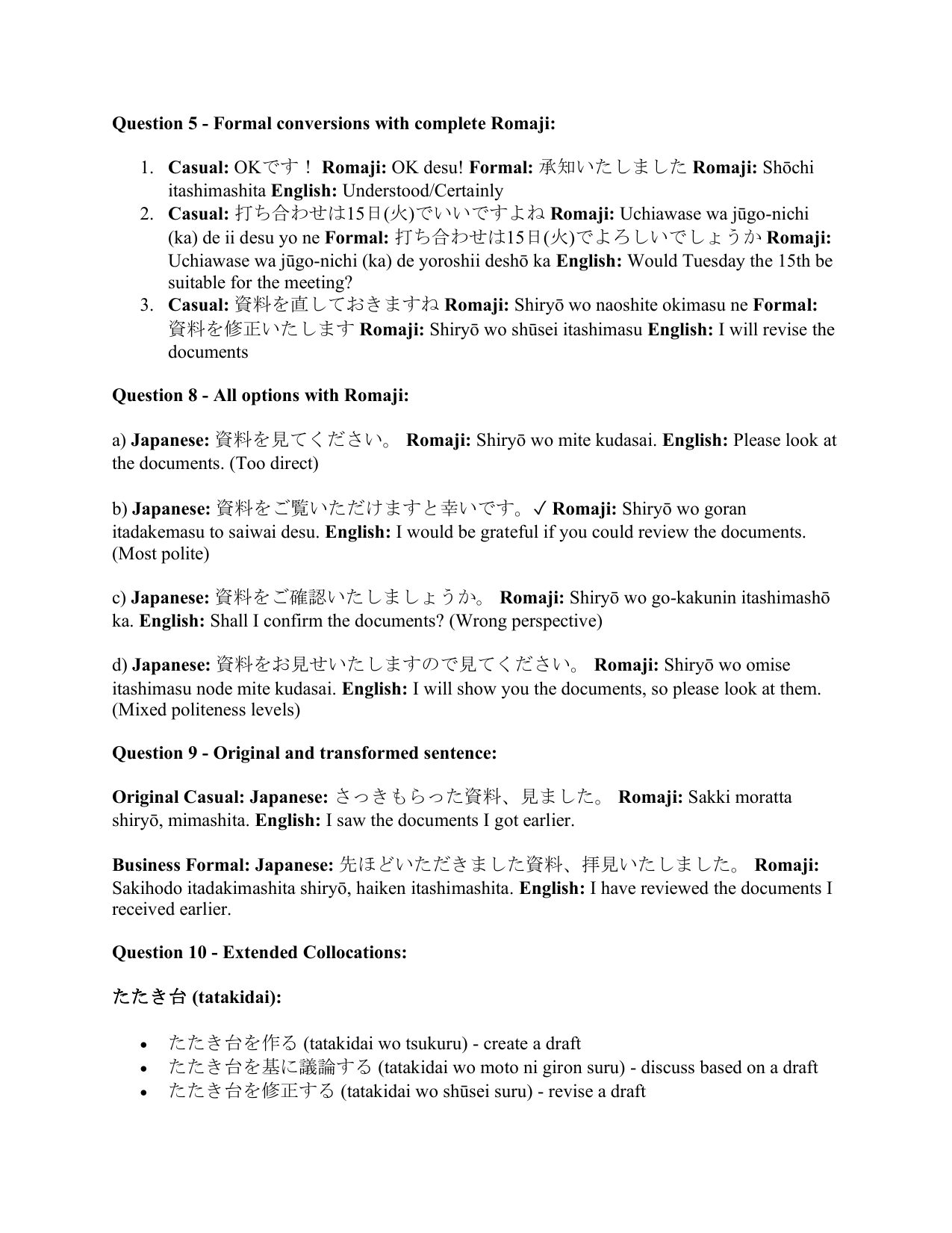
คลิกเพื่อขยาย
ENQuestion 5 - Formal conversions with complete Romaji:
1. Casual: OKです! Romaji: OK desu! Formal: 承知いたしました Romaji: Shōchi
itashimashita English: Understood/Certainly
2. Casual: 打ち合わせは15日(火)でいいですよね Romaji: Uchiawase wa jūgo-nichi
(ka) de ii desu yo ne Formal: 打ち合わせは15日(火)でよろしいでしょうか Romaji:
Uchiawase wa jūgo-nichi (ka) de yoroshii deshō ka English: Would Tuesday the 15th be
suitable for the meeting?
3. Casual: 資料を直しておきますね Romaji: Shiryō wo naoshite okimasu ne Formal:
資料を修正いたします Romaji: Shiryō wo shūsei itashimasu English: I will revise the
documents
Question 8 - All options with Romaji:
a) Japanese: 資料を見てください。 Romaji: Shiryō wo mite kudasai. English: Please look at
the documents. (Too direct)
b) Japanese: 資料をご覧いただけますと幸いです。✓ Romaji: Shiryō wo goran
itadakemasu to saiwai desu. English: I would be grateful if you could review the documents.
(Most polite)
c) Japanese: 資料をご確認いたしましょうか。 Romaji: Shiryō wo go-kakunin itashimashō
ka. English: Shall I confirm the documents? (Wrong perspective)
d) Japanese: 資料をお見せいたしますので見てください。 Romaji: Shiryō wo omise
itashimasu node mite kudasai. English: I will show you the documents, so please look at them.
(Mixed politeness levels)
Question 9 - Original and transformed sentence:
Original Casual: Japanese: さっきもらった資料、見ました。 Romaji: Sakki moratta
shiryō, mimashita. English: I saw the documents I got earlier.
Business Formal: Japanese: 先ほどいただきました資料、拝見いたしました。 Romaji:
Sakihodo itadakimashita shiryō, haiken itashimashita. English: I have reviewed the documents I
received earlier.
Question 10 - Extended Collocations:
たたき台 (tatakidai):
• たたき台を作る (tatakidai wo tsukuru) - create a draft
• たたき台を基に議論する (tatakidai wo moto ni giron suru) - discuss based on a draft
• たたき台を修正する (tatakidai wo shūsei suru) - revise a draft
1. Casual: OKです! Romaji: OK desu! Formal: 承知いたしました Romaji: Shōchi
itashimashita English: Understood/Certainly
2. Casual: 打ち合わせは15日(火)でいいですよね Romaji: Uchiawase wa jūgo-nichi
(ka) de ii desu yo ne Formal: 打ち合わせは15日(火)でよろしいでしょうか Romaji:
Uchiawase wa jūgo-nichi (ka) de yoroshii deshō ka English: Would Tuesday the 15th be
suitable for the meeting?
3. Casual: 資料を直しておきますね Romaji: Shiryō wo naoshite okimasu ne Formal:
資料を修正いたします Romaji: Shiryō wo shūsei itashimasu English: I will revise the
documents
Question 8 - All options with Romaji:
a) Japanese: 資料を見てください。 Romaji: Shiryō wo mite kudasai. English: Please look at
the documents. (Too direct)
b) Japanese: 資料をご覧いただけますと幸いです。✓ Romaji: Shiryō wo goran
itadakemasu to saiwai desu. English: I would be grateful if you could review the documents.
(Most polite)
c) Japanese: 資料をご確認いたしましょうか。 Romaji: Shiryō wo go-kakunin itashimashō
ka. English: Shall I confirm the documents? (Wrong perspective)
d) Japanese: 資料をお見せいたしますので見てください。 Romaji: Shiryō wo omise
itashimasu node mite kudasai. English: I will show you the documents, so please look at them.
(Mixed politeness levels)
Question 9 - Original and transformed sentence:
Original Casual: Japanese: さっきもらった資料、見ました。 Romaji: Sakki moratta
shiryō, mimashita. English: I saw the documents I got earlier.
Business Formal: Japanese: 先ほどいただきました資料、拝見いたしました。 Romaji:
Sakihodo itadakimashita shiryō, haiken itashimashita. English: I have reviewed the documents I
received earlier.
Question 10 - Extended Collocations:
たたき台 (tatakidai):
• たたき台を作る (tatakidai wo tsukuru) - create a draft
• たたき台を基に議論する (tatakidai wo moto ni giron suru) - discuss based on a draft
• たたき台を修正する (tatakidai wo shūsei suru) - revise a draft
หน้า 85
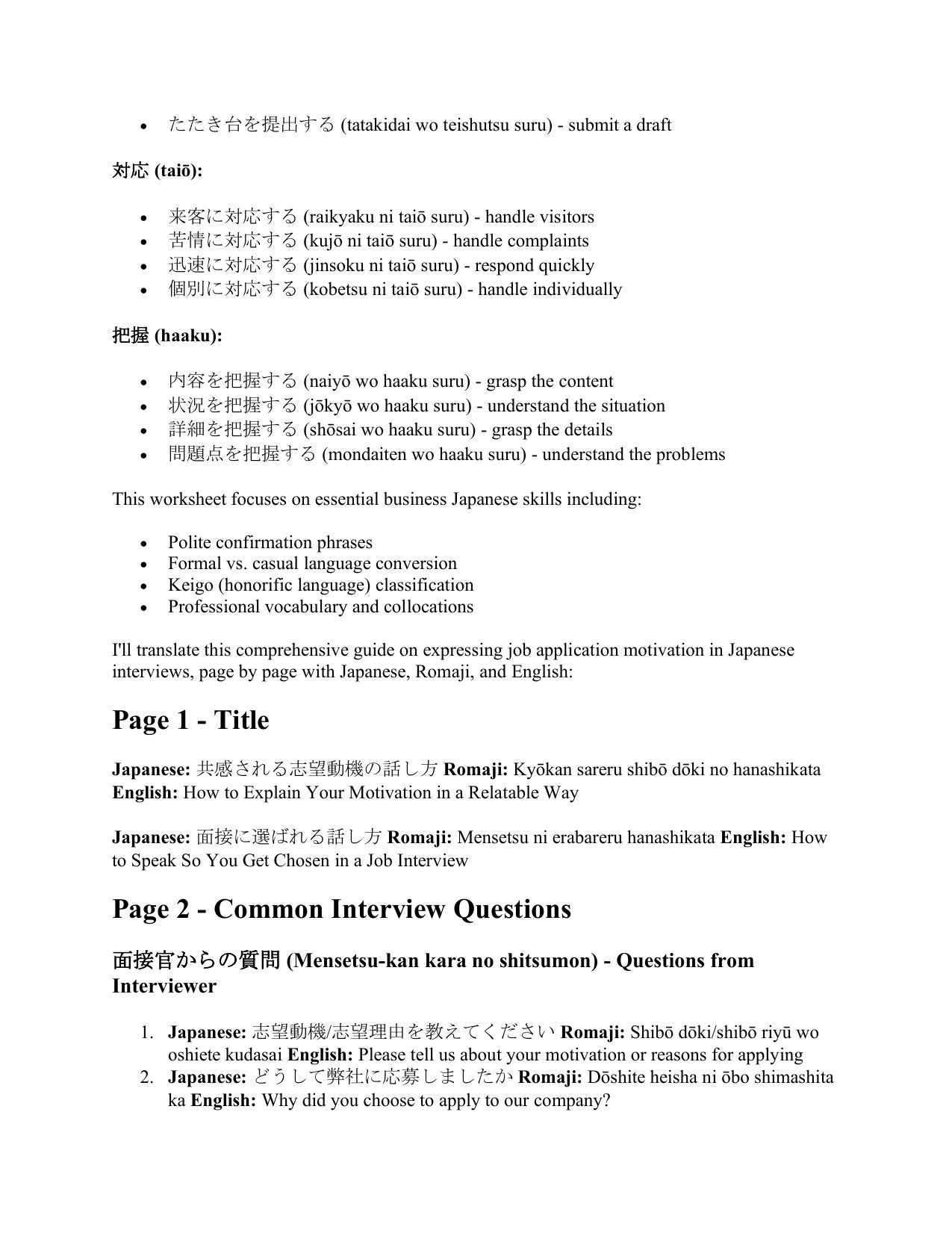
คลิกเพื่อขยาย
EN • たたき台を提出する (tatakidai wo teishutsu suru) - submit a draft
対応 (taiō):
• 来客に対応する (raikyaku ni taiō suru) - handle visitors
• 苦情に対応する (kujō ni taiō suru) - handle complaints
• 迅速に対応する (jinsoku ni taiō suru) - respond quickly
• 個別に対応する (kobetsu ni taiō suru) - handle individually
把握 (haaku):
• 内容を把握する (naiyō wo haaku suru) - grasp the content
• 状況を把握する (jōkyō wo haaku suru) - understand the situation
• 詳細を把握する (shōsai wo haaku suru) - grasp the details
• 問題点を把握する (mondaiten wo haaku suru) - understand the problems
This worksheet focuses on essential business Japanese skills including:
• Polite confirmation phrases
• Formal vs. casual language conversion
• Keigo (honorific language) classification
• Professional vocabulary and collocations
I'll translate this comprehensive guide on expressing job application motivation in Japanese
interviews, page by page with Japanese, Romaji, and English:
Page 1 - Title
Japanese: 共感される志望動機の話し方 Romaji: Kyōkan sareru shibō dōki no hanashikata
English: How to Explain Your Motivation in a Relatable Way
Japanese: 面接に選ばれる話し方 Romaji: Mensetsu ni erabareru hanashikata English: How
to Speak So You Get Chosen in a Job Interview
Page 2 - Common Interview Questions
面接官からの質問 (Mensetsu-kan kara no shitsumon) - Questions from
Interviewer
1. Japanese: 志望動機/志望理由を教えてください Romaji: Shibō dōki/shibō riyū wo
oshiete kudasai English: Please tell us about your motivation or reasons for applying
2. Japanese: どうして弊社に応募しましたか Romaji: Dōshite heisha ni ōbo shimashita
ka English: Why did you choose to apply to our company?
対応 (taiō):
• 来客に対応する (raikyaku ni taiō suru) - handle visitors
• 苦情に対応する (kujō ni taiō suru) - handle complaints
• 迅速に対応する (jinsoku ni taiō suru) - respond quickly
• 個別に対応する (kobetsu ni taiō suru) - handle individually
把握 (haaku):
• 内容を把握する (naiyō wo haaku suru) - grasp the content
• 状況を把握する (jōkyō wo haaku suru) - understand the situation
• 詳細を把握する (shōsai wo haaku suru) - grasp the details
• 問題点を把握する (mondaiten wo haaku suru) - understand the problems
This worksheet focuses on essential business Japanese skills including:
• Polite confirmation phrases
• Formal vs. casual language conversion
• Keigo (honorific language) classification
• Professional vocabulary and collocations
I'll translate this comprehensive guide on expressing job application motivation in Japanese
interviews, page by page with Japanese, Romaji, and English:
Page 1 - Title
Japanese: 共感される志望動機の話し方 Romaji: Kyōkan sareru shibō dōki no hanashikata
English: How to Explain Your Motivation in a Relatable Way
Japanese: 面接に選ばれる話し方 Romaji: Mensetsu ni erabareru hanashikata English: How
to Speak So You Get Chosen in a Job Interview
Page 2 - Common Interview Questions
面接官からの質問 (Mensetsu-kan kara no shitsumon) - Questions from
Interviewer
1. Japanese: 志望動機/志望理由を教えてください Romaji: Shibō dōki/shibō riyū wo
oshiete kudasai English: Please tell us about your motivation or reasons for applying
2. Japanese: どうして弊社に応募しましたか Romaji: Dōshite heisha ni ōbo shimashita
ka English: Why did you choose to apply to our company?
หน้า 86
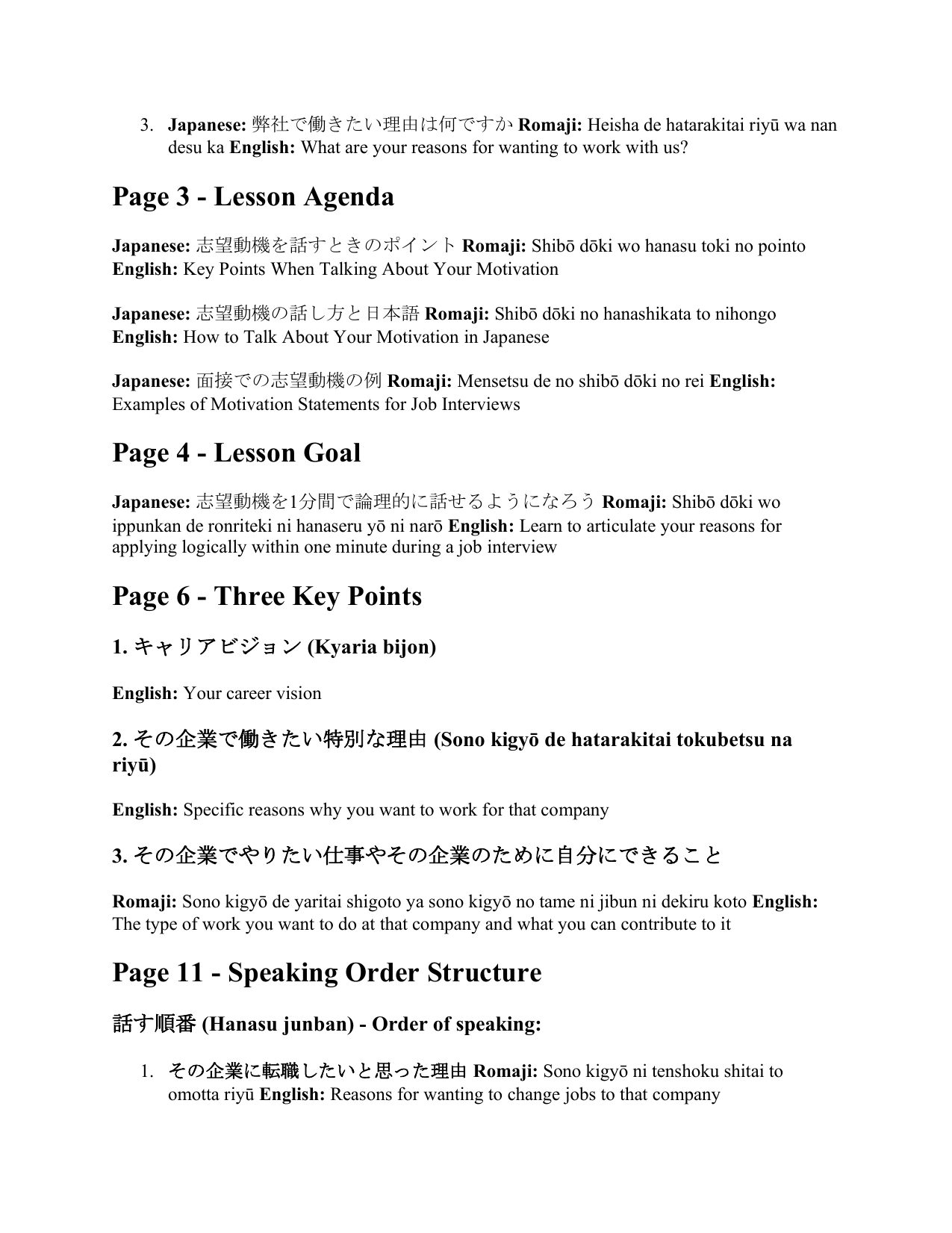
คลิกเพื่อขยาย
EN 3. Japanese: 弊社で働きたい理由は何ですか Romaji: Heisha de hatarakitai riyū wa nan
desu ka English: What are your reasons for wanting to work with us?
Page 3 - Lesson Agenda
Japanese: 志望動機を話すときのポイント Romaji: Shibō dōki wo hanasu toki no pointo
English: Key Points When Talking About Your Motivation
Japanese: 志望動機の話し方と日本語 Romaji: Shibō dōki no hanashikata to nihongo
English: How to Talk About Your Motivation in Japanese
Japanese: 面接での志望動機の例 Romaji: Mensetsu de no shibō dōki no rei English:
Examples of Motivation Statements for Job Interviews
Page 4 - Lesson Goal
Japanese: 志望動機を1分間で論理的に話せるようになろう Romaji: Shibō dōki wo
ippunkan de ronriteki ni hanaseru yō ni narō English: Learn to articulate your reasons for
applying logically within one minute during a job interview
Page 6 - Three Key Points
1. キャリアビジョン (Kyaria bijon)
English: Your career vision
2. その企業で働きたい特別な理由 (Sono kigyō de hatarakitai tokubetsu na
riyū)
English: Specific reasons why you want to work for that company
desu ka English: What are your reasons for wanting to work with us?
Page 3 - Lesson Agenda
Japanese: 志望動機を話すときのポイント Romaji: Shibō dōki wo hanasu toki no pointo
English: Key Points When Talking About Your Motivation
Japanese: 志望動機の話し方と日本語 Romaji: Shibō dōki no hanashikata to nihongo
English: How to Talk About Your Motivation in Japanese
Japanese: 面接での志望動機の例 Romaji: Mensetsu de no shibō dōki no rei English:
Examples of Motivation Statements for Job Interviews
Page 4 - Lesson Goal
Japanese: 志望動機を1分間で論理的に話せるようになろう Romaji: Shibō dōki wo
ippunkan de ronriteki ni hanaseru yō ni narō English: Learn to articulate your reasons for
applying logically within one minute during a job interview
Page 6 - Three Key Points
1. キャリアビジョン (Kyaria bijon)
English: Your career vision
2. その企業で働きたい特別な理由 (Sono kigyō de hatarakitai tokubetsu na
riyū)
English: Specific reasons why you want to work for that company
JP3.その企業でやりたい仕事やその企業のために自分にできること
ENRomaji: Sono kigyō de yaritai shigoto ya sono kigyō no tame ni jibun ni dekiru koto English:
The type of work you want to do at that company and what you can contribute to it
Page 11 - Speaking Order Structure
話す順番 (Hanasu junban) - Order of speaking:
1. その企業に転職したいと思った理由 Romaji: Sono kigyō ni tenshoku shitai to
omotta riyū English: Reasons for wanting to change jobs to that company
The type of work you want to do at that company and what you can contribute to it
Page 11 - Speaking Order Structure
話す順番 (Hanasu junban) - Order of speaking:
1. その企業に転職したいと思った理由 Romaji: Sono kigyō ni tenshoku shitai to
omotta riyū English: Reasons for wanting to change jobs to that company
หน้า 87
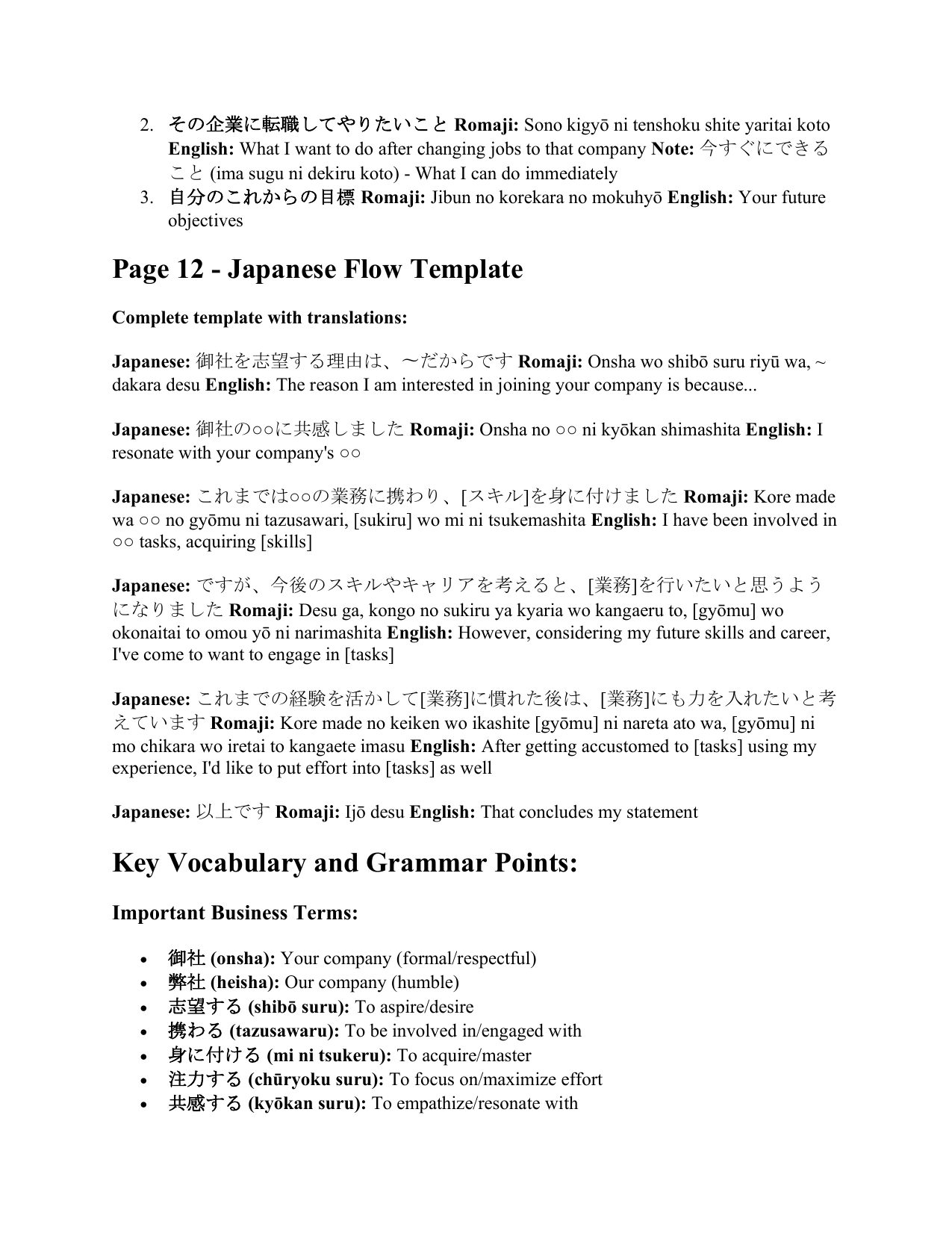
คลิกเพื่อขยาย
EN 2. その企業に転職してやりたいこと Romaji: Sono kigyō ni tenshoku shite yaritai koto
English: What I want to do after changing jobs to that company Note: 今すぐにできる
こと (ima sugu ni dekiru koto) - What I can do immediately
3. 自分のこれからの目標 Romaji: Jibun no korekara no mokuhyō English: Your future
objectives
Page 12 - Japanese Flow Template
Complete template with translations:
Japanese: 御社を志望する理由は、〜だからです Romaji: Onsha wo shibō suru riyū wa, ~
dakara desu English: The reason I am interested in joining your company is because...
Japanese: 御社の○○に共感しました Romaji: Onsha no ○○ ni kyōkan shimashita English: I
resonate with your company's ○○
English: What I want to do after changing jobs to that company Note: 今すぐにできる
こと (ima sugu ni dekiru koto) - What I can do immediately
3. 自分のこれからの目標 Romaji: Jibun no korekara no mokuhyō English: Your future
objectives
Page 12 - Japanese Flow Template
Complete template with translations:
Japanese: 御社を志望する理由は、〜だからです Romaji: Onsha wo shibō suru riyū wa, ~
dakara desu English: The reason I am interested in joining your company is because...
Japanese: 御社の○○に共感しました Romaji: Onsha no ○○ ni kyōkan shimashita English: I
resonate with your company's ○○
JPJapanese:これまでは○○の業務に携わり、[スキル]を身に付けましたRomaji:Koremade
ENwa ○○ no gyōmu ni tazusawari, [sukiru] wo mi ni tsukemashita English: I have been involved in
○○ tasks, acquiring [skills]
○○ tasks, acquiring [skills]
JPJapanese:ですが、今後のスキルやキャリアを考えると、[業務]を行いたいと思うよう
ENになりました Romaji: Desu ga, kongo no sukiru ya kyaria wo kangaeru to, [gyōmu] wo
okonaitai to omou yō ni narimashita English: However, considering my future skills and career,
I've come to want to engage in [tasks]
okonaitai to omou yō ni narimashita English: However, considering my future skills and career,
I've come to want to engage in [tasks]
JPJapanese:これまでの経験を活かして[業務]に慣れた後は、[業務]にも力を入れたいと考
ENえています Romaji: Kore made no keiken wo ikashite [gyōmu] ni nareta ato wa, [gyōmu] ni
mo chikara wo iretai to kangaete imasu English: After getting accustomed to [tasks] using my
experience, I'd like to put effort into [tasks] as well
Japanese: 以上です Romaji: Ijō desu English: That concludes my statement
Key Vocabulary and Grammar Points:
Important Business Terms:
• 御社 (onsha): Your company (formal/respectful)
• 弊社 (heisha): Our company (humble)
• 志望する (shibō suru): To aspire/desire
• 携わる (tazusawaru): To be involved in/engaged with
• 身に付ける (mi ni tsukeru): To acquire/master
• 注力する (chūryoku suru): To focus on/maximize effort
• 共感する (kyōkan suru): To empathize/resonate with
mo chikara wo iretai to kangaete imasu English: After getting accustomed to [tasks] using my
experience, I'd like to put effort into [tasks] as well
Japanese: 以上です Romaji: Ijō desu English: That concludes my statement
Key Vocabulary and Grammar Points:
Important Business Terms:
• 御社 (onsha): Your company (formal/respectful)
• 弊社 (heisha): Our company (humble)
• 志望する (shibō suru): To aspire/desire
• 携わる (tazusawaru): To be involved in/engaged with
• 身に付ける (mi ni tsukeru): To acquire/master
• 注力する (chūryoku suru): To focus on/maximize effort
• 共感する (kyōkan suru): To empathize/resonate with
หน้า 88
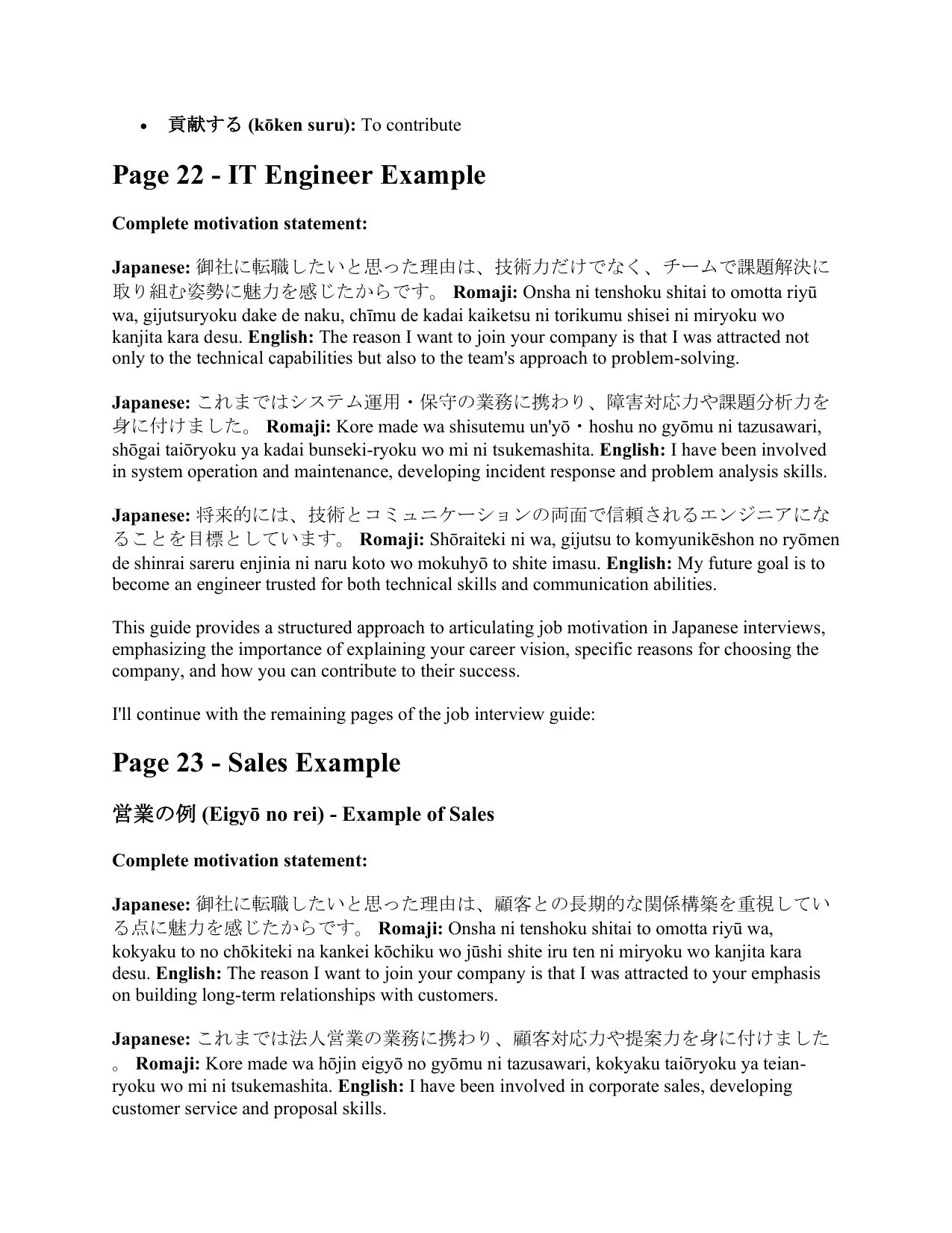
คลิกเพื่อขยาย
EN • 貢献する (kōken suru): To contribute
Page 22 - IT Engineer Example
Complete motivation statement:
Page 22 - IT Engineer Example
Complete motivation statement:
JPJapanese:御社に転職したいと思った理由は、技術力だけでなく、チームで課題解決に
EN取り組む姿勢に魅力を感じたからです。 Romaji: Onsha ni tenshoku shitai to omotta riyū
wa, gijutsuryoku dake de naku, chīmu de kadai kaiketsu ni torikumu shisei ni miryoku wo
kanjita kara desu. English: The reason I want to join your company is that I was attracted not
only to the technical capabilities but also to the team's approach to problem-solving.
wa, gijutsuryoku dake de naku, chīmu de kadai kaiketsu ni torikumu shisei ni miryoku wo
kanjita kara desu. English: The reason I want to join your company is that I was attracted not
only to the technical capabilities but also to the team's approach to problem-solving.
JPJapanese:これまではシステム運用・保守の業務に携わり、障害対応力や課題分析力を
EN身に付けました。 Romaji: Kore made wa shisutemu un'yō・hoshu no gyōmu ni tazusawari,
shōgai taiōryoku ya kadai bunseki-ryoku wo mi ni tsukemashita. English: I have been involved
in system operation and maintenance, developing incident response and problem analysis skills.
shōgai taiōryoku ya kadai bunseki-ryoku wo mi ni tsukemashita. English: I have been involved
in system operation and maintenance, developing incident response and problem analysis skills.
JPJapanese:将来的には、技術とコミュニケーションの両面で信頼されるエンジニアにな
ENることを目標としています。 Romaji: Shōraiteki ni wa, gijutsu to komyunikēshon no ryōmen
de shinrai sareru enjinia ni naru koto wo mokuhyō to shite imasu. English: My future goal is to
become an engineer trusted for both technical skills and communication abilities.
This guide provides a structured approach to articulating job motivation in Japanese interviews,
emphasizing the importance of explaining your career vision, specific reasons for choosing the
company, and how you can contribute to their success.
I'll continue with the remaining pages of the job interview guide:
Page 23 - Sales Example
営業の例 (Eigyō no rei) - Example of Sales
Complete motivation statement:
de shinrai sareru enjinia ni naru koto wo mokuhyō to shite imasu. English: My future goal is to
become an engineer trusted for both technical skills and communication abilities.
This guide provides a structured approach to articulating job motivation in Japanese interviews,
emphasizing the importance of explaining your career vision, specific reasons for choosing the
company, and how you can contribute to their success.
I'll continue with the remaining pages of the job interview guide:
Page 23 - Sales Example
営業の例 (Eigyō no rei) - Example of Sales
Complete motivation statement:
JPJapanese:御社に転職したいと思った理由は、顧客との長期的な関係構築を重視してい
ENる点に魅力を感じたからです。 Romaji: Onsha ni tenshoku shitai to omotta riyū wa,
kokyaku to no chōkiteki na kankei kōchiku wo jūshi shite iru ten ni miryoku wo kanjita kara
desu. English: The reason I want to join your company is that I was attracted to your emphasis
on building long-term relationships with customers.
kokyaku to no chōkiteki na kankei kōchiku wo jūshi shite iru ten ni miryoku wo kanjita kara
desu. English: The reason I want to join your company is that I was attracted to your emphasis
on building long-term relationships with customers.
JPJapanese:これまでは法人営業の業務に携わり、顧客対応力や提案力を身に付けました
EN。 Romaji: Kore made wa hōjin eigyō no gyōmu ni tazusawari, kokyaku taiōryoku ya teian-
ryoku wo mi ni tsukemashita. English: I have been involved in corporate sales, developing
customer service and proposal skills.
ryoku wo mi ni tsukemashita. English: I have been involved in corporate sales, developing
customer service and proposal skills.
หน้า 89
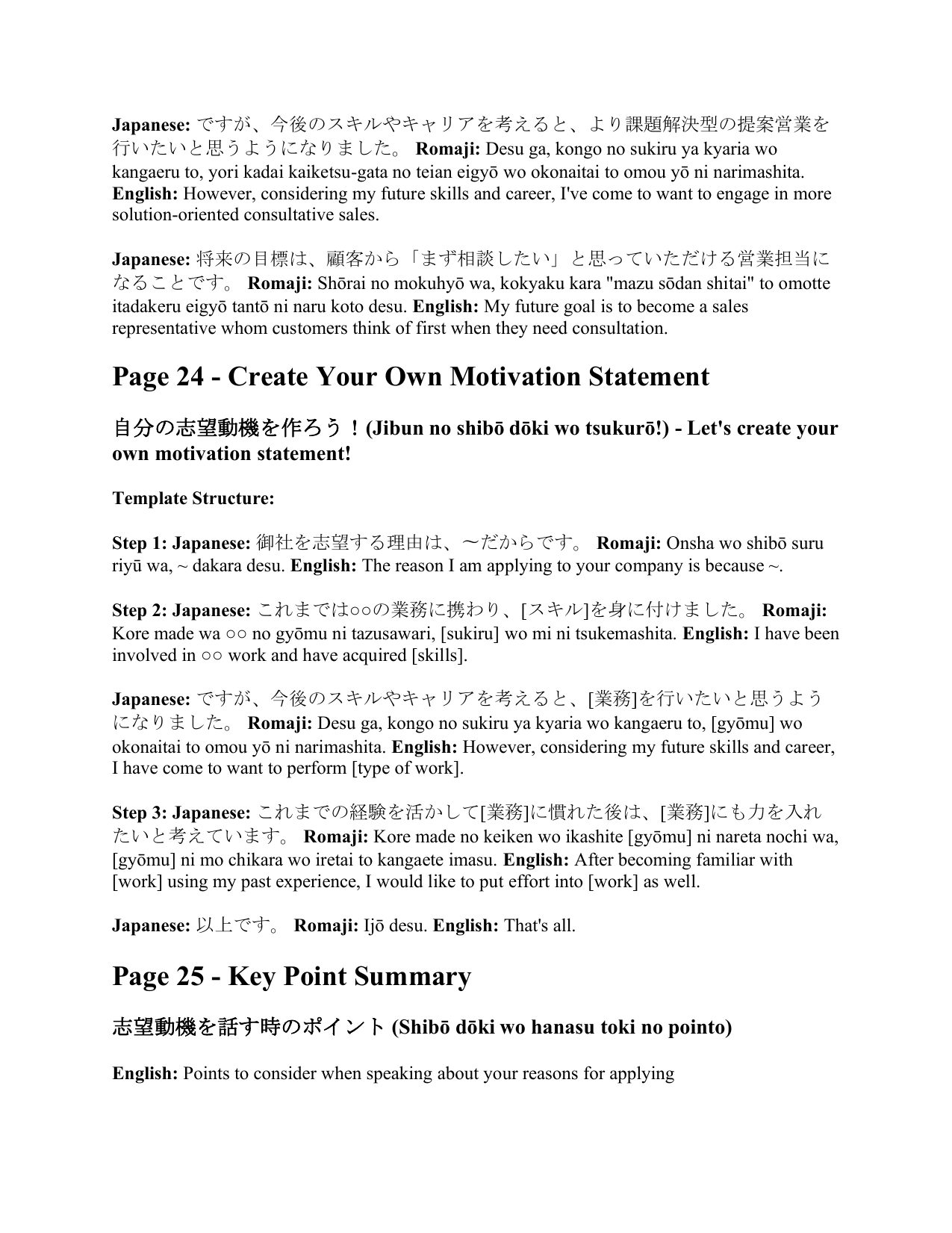
คลิกเพื่อขยาย
JPJapanese:ですが、今後のスキルやキャリアを考えると、より課題解決型の提案営業を
EN行いたいと思うようになりました。 Romaji: Desu ga, kongo no sukiru ya kyaria wo
kangaeru to, yori kadai kaiketsu-gata no teian eigyō wo okonaitai to omou yō ni narimashita.
English: However, considering my future skills and career, I've come to want to engage in more
solution-oriented consultative sales.
kangaeru to, yori kadai kaiketsu-gata no teian eigyō wo okonaitai to omou yō ni narimashita.
English: However, considering my future skills and career, I've come to want to engage in more
solution-oriented consultative sales.
JPJapanese:将来の目標は、顧客から「まず相談したい」と思っていただける営業担当に
ENなることです。 Romaji: Shōrai no mokuhyō wa, kokyaku kara "mazu sōdan shitai" to omotte
itadakeru eigyō tantō ni naru koto desu. English: My future goal is to become a sales
representative whom customers think of first when they need consultation.
Page 24 - Create Your Own Motivation Statement
自分の志望動機を作ろう!(Jibun no shibō dōki wo tsukurō!) - Let's create your
own motivation statement!
Template Structure:
Step 1: Japanese: 御社を志望する理由は、〜だからです。 Romaji: Onsha wo shibō suru
riyū wa, ~ dakara desu. English: The reason I am applying to your company is because ~.
itadakeru eigyō tantō ni naru koto desu. English: My future goal is to become a sales
representative whom customers think of first when they need consultation.
Page 24 - Create Your Own Motivation Statement
自分の志望動機を作ろう!(Jibun no shibō dōki wo tsukurō!) - Let's create your
own motivation statement!
Template Structure:
Step 1: Japanese: 御社を志望する理由は、〜だからです。 Romaji: Onsha wo shibō suru
riyū wa, ~ dakara desu. English: The reason I am applying to your company is because ~.
JPStep2:Japanese:これまでは○○の業務に携わり、[スキル]を身に付けました。Romaji:
ENKore made wa ○○ no gyōmu ni tazusawari, [sukiru] wo mi ni tsukemashita. English: I have been
involved in ○○ work and have acquired [skills].
involved in ○○ work and have acquired [skills].
JPJapanese:ですが、今後のスキルやキャリアを考えると、[業務]を行いたいと思うよう
ENになりました。 Romaji: Desu ga, kongo no sukiru ya kyaria wo kangaeru to, [gyōmu] wo
okonaitai to omou yō ni narimashita. English: However, considering my future skills and career,
I have come to want to perform [type of work].
okonaitai to omou yō ni narimashita. English: However, considering my future skills and career,
I have come to want to perform [type of work].
JPStep3:Japanese:これまでの経験を活かして[業務]に慣れた後は、[業務]にも力を入れ
ENたいと考えています。 Romaji: Kore made no keiken wo ikashite [gyōmu] ni nareta nochi wa,
[gyōmu] ni mo chikara wo iretai to kangaete imasu. English: After becoming familiar with
[work] using my past experience, I would like to put effort into [work] as well.
Japanese: 以上です。 Romaji: Ijō desu. English: That's all.
Page 25 - Key Point Summary
志望動機を話す時のポイント (Shibō dōki wo hanasu toki no pointo)
English: Points to consider when speaking about your reasons for applying
[gyōmu] ni mo chikara wo iretai to kangaete imasu. English: After becoming familiar with
[work] using my past experience, I would like to put effort into [work] as well.
Japanese: 以上です。 Romaji: Ijō desu. English: That's all.
Page 25 - Key Point Summary
志望動機を話す時のポイント (Shibō dōki wo hanasu toki no pointo)
English: Points to consider when speaking about your reasons for applying
หน้า 90
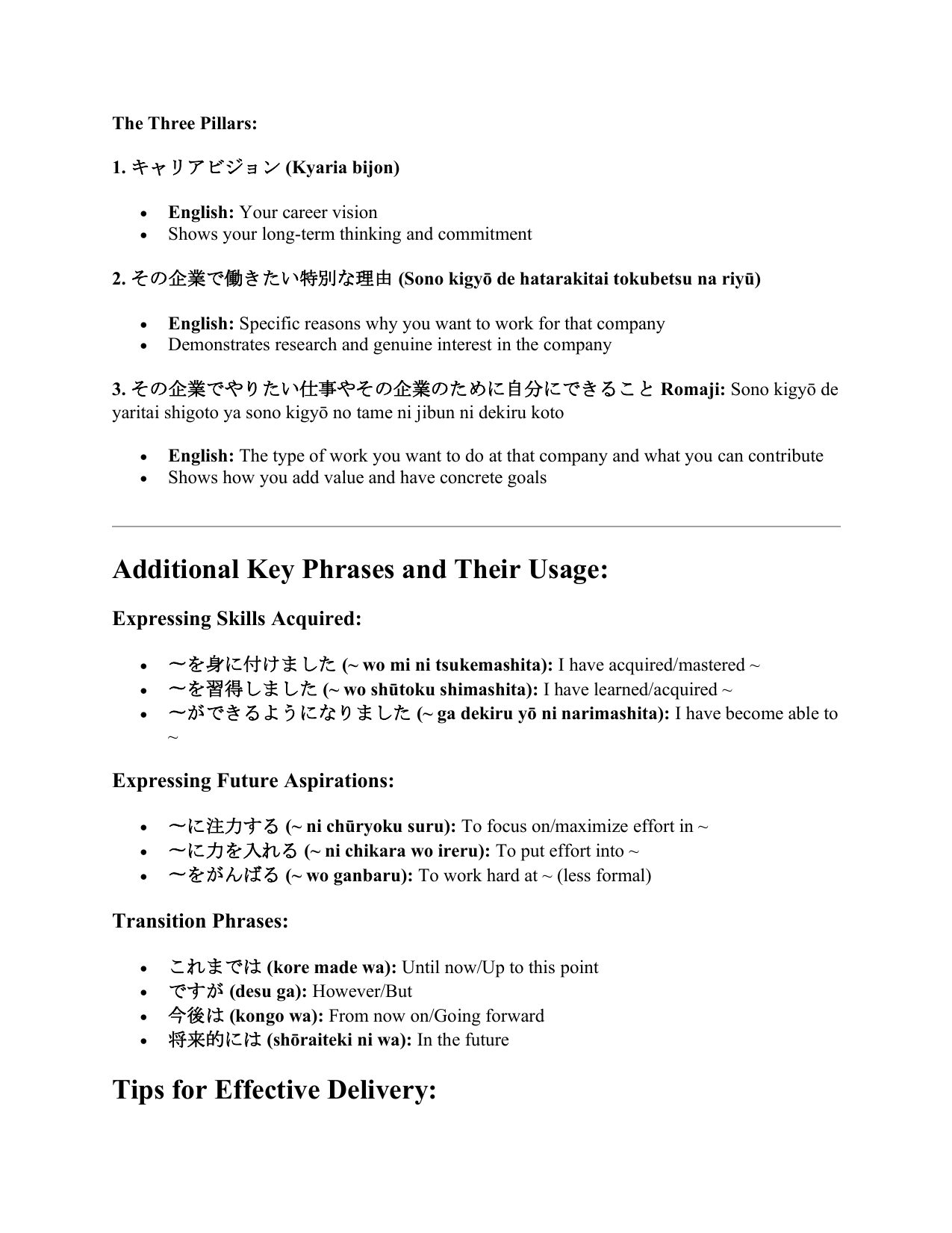
คลิกเพื่อขยาย
ENThe Three Pillars:
1. キャリアビジョン (Kyaria bijon)
• English: Your career vision
• Shows your long-term thinking and commitment
2. その企業で働きたい特別な理由 (Sono kigyō de hatarakitai tokubetsu na riyū)
• English: Specific reasons why you want to work for that company
• Demonstrates research and genuine interest in the company
1. キャリアビジョン (Kyaria bijon)
• English: Your career vision
• Shows your long-term thinking and commitment
2. その企業で働きたい特別な理由 (Sono kigyō de hatarakitai tokubetsu na riyū)
• English: Specific reasons why you want to work for that company
• Demonstrates research and genuine interest in the company
JP3.その企業でやりたい仕事やその企業のために自分にできることRomaji:Sonokigyōde
ENyaritai shigoto ya sono kigyō no tame ni jibun ni dekiru koto
• English: The type of work you want to do at that company and what you can contribute
• Shows how you add value and have concrete goals
Additional Key Phrases and Their Usage:
Expressing Skills Acquired:
• 〜を身に付けました (~ wo mi ni tsukemashita): I have acquired/mastered ~
• 〜を習得しました (~ wo shūtoku shimashita): I have learned/acquired ~
• 〜ができるようになりました (~ ga dekiru yō ni narimashita): I have become able to
~
Expressing Future Aspirations:
• 〜に注力する (~ ni chūryoku suru): To focus on/maximize effort in ~
• 〜に力を入れる (~ ni chikara wo ireru): To put effort into ~
• 〜をがんばる (~ wo ganbaru): To work hard at ~ (less formal)
Transition Phrases:
• これまでは (kore made wa): Until now/Up to this point
• ですが (desu ga): However/But
• 今後は (kongo wa): From now on/Going forward
• 将来的には (shōraiteki ni wa): In the future
Tips for Effective Delivery:
• English: The type of work you want to do at that company and what you can contribute
• Shows how you add value and have concrete goals
Additional Key Phrases and Their Usage:
Expressing Skills Acquired:
• 〜を身に付けました (~ wo mi ni tsukemashita): I have acquired/mastered ~
• 〜を習得しました (~ wo shūtoku shimashita): I have learned/acquired ~
• 〜ができるようになりました (~ ga dekiru yō ni narimashita): I have become able to
~
Expressing Future Aspirations:
• 〜に注力する (~ ni chūryoku suru): To focus on/maximize effort in ~
• 〜に力を入れる (~ ni chikara wo ireru): To put effort into ~
• 〜をがんばる (~ wo ganbaru): To work hard at ~ (less formal)
Transition Phrases:
• これまでは (kore made wa): Until now/Up to this point
• ですが (desu ga): However/But
• 今後は (kongo wa): From now on/Going forward
• 将来的には (shōraiteki ni wa): In the future
Tips for Effective Delivery:
หน้า 91
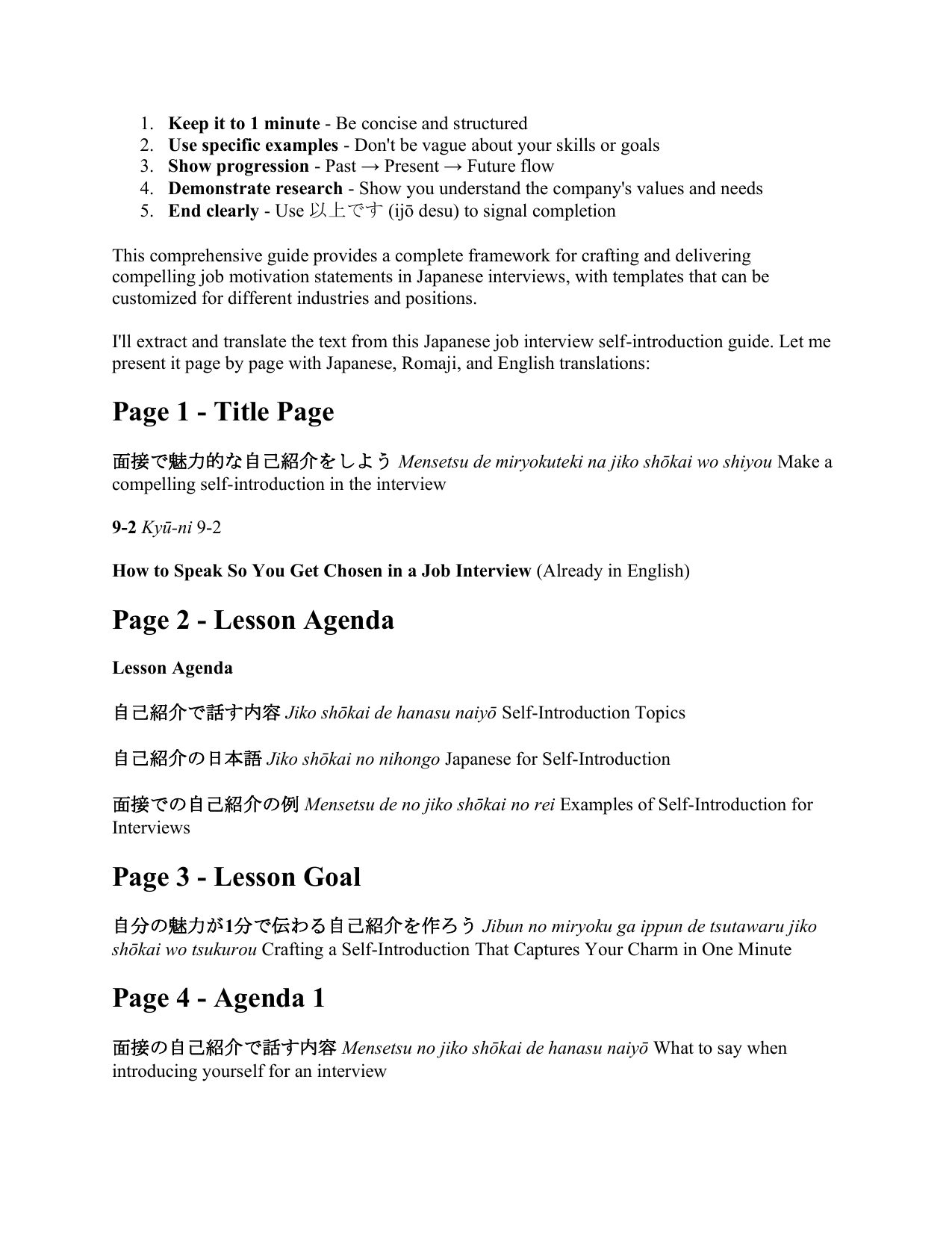
คลิกเพื่อขยาย
EN 1. Keep it to 1 minute - Be concise and structured
2. Use specific examples - Don't be vague about your skills or goals
3. Show progression - Past → Present → Future flow
4. Demonstrate research - Show you understand the company's values and needs
5. End clearly - Use 以上です (ijō desu) to signal completion
This comprehensive guide provides a complete framework for crafting and delivering
compelling job motivation statements in Japanese interviews, with templates that can be
customized for different industries and positions.
I'll extract and translate the text from this Japanese job interview self-introduction guide. Let me
present it page by page with Japanese, Romaji, and English translations:
Page 1 - Title Page
面接で魅力的な自己紹介をしよう Mensetsu de miryokuteki na jiko shōkai wo shiyou Make a
compelling self-introduction in the interview
9-2 Kyū-ni 9-2
How to Speak So You Get Chosen in a Job Interview (Already in English)
Page 2 - Lesson Agenda
Lesson Agenda
自己紹介で話す内容 Jiko shōkai de hanasu naiyō Self-Introduction Topics
自己紹介の日本語 Jiko shōkai no nihongo Japanese for Self-Introduction
面接での自己紹介の例 Mensetsu de no jiko shōkai no rei Examples of Self-Introduction for
Interviews
Page 3 - Lesson Goal
自分の魅力が1分で伝わる自己紹介を作ろう Jibun no miryoku ga ippun de tsutawaru jiko
shōkai wo tsukurou Crafting a Self-Introduction That Captures Your Charm in One Minute
Page 4 - Agenda 1
面接の自己紹介で話す内容 Mensetsu no jiko shōkai de hanasu naiyō What to say when
introducing yourself for an interview
2. Use specific examples - Don't be vague about your skills or goals
3. Show progression - Past → Present → Future flow
4. Demonstrate research - Show you understand the company's values and needs
5. End clearly - Use 以上です (ijō desu) to signal completion
This comprehensive guide provides a complete framework for crafting and delivering
compelling job motivation statements in Japanese interviews, with templates that can be
customized for different industries and positions.
I'll extract and translate the text from this Japanese job interview self-introduction guide. Let me
present it page by page with Japanese, Romaji, and English translations:
Page 1 - Title Page
面接で魅力的な自己紹介をしよう Mensetsu de miryokuteki na jiko shōkai wo shiyou Make a
compelling self-introduction in the interview
9-2 Kyū-ni 9-2
How to Speak So You Get Chosen in a Job Interview (Already in English)
Page 2 - Lesson Agenda
Lesson Agenda
自己紹介で話す内容 Jiko shōkai de hanasu naiyō Self-Introduction Topics
自己紹介の日本語 Jiko shōkai no nihongo Japanese for Self-Introduction
面接での自己紹介の例 Mensetsu de no jiko shōkai no rei Examples of Self-Introduction for
Interviews
Page 3 - Lesson Goal
自分の魅力が1分で伝わる自己紹介を作ろう Jibun no miryoku ga ippun de tsutawaru jiko
shōkai wo tsukurou Crafting a Self-Introduction That Captures Your Charm in One Minute
Page 4 - Agenda 1
面接の自己紹介で話す内容 Mensetsu no jiko shōkai de hanasu naiyō What to say when
introducing yourself for an interview
หน้า 92
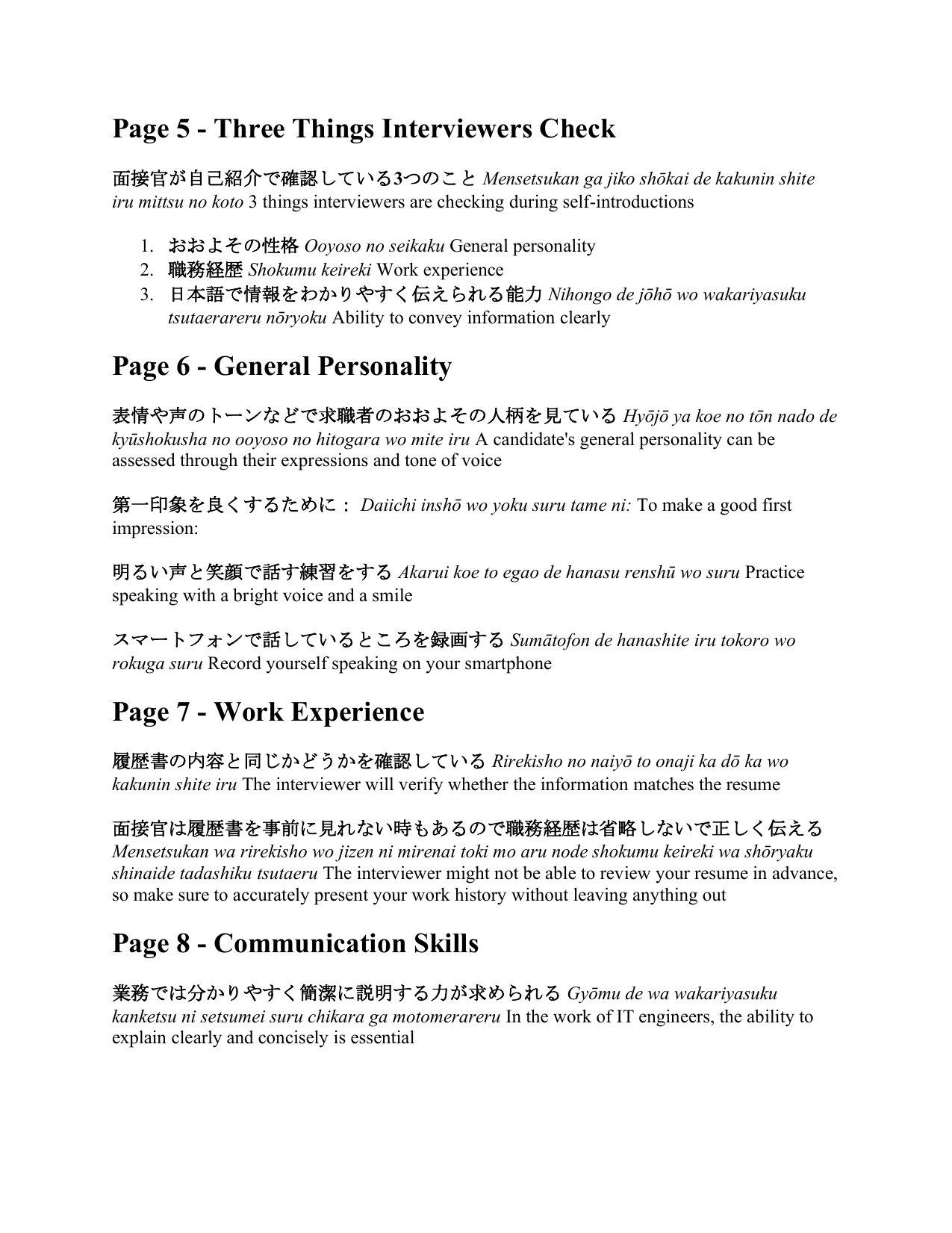
คลิกเพื่อขยาย
ENPage 5 - Three Things Interviewers Check
面接官が自己紹介で確認している3つのこと Mensetsukan ga jiko shōkai de kakunin shite
iru mittsu no koto 3 things interviewers are checking during self-introductions
1. おおよその性格 Ooyoso no seikaku General personality
2. 職務経歴 Shokumu keireki Work experience
3. 日本語で情報をわかりやすく伝えられる能力 Nihongo de jōhō wo wakariyasuku
tsutaerareru nōryoku Ability to convey information clearly
Page 6 - General Personality
面接官が自己紹介で確認している3つのこと Mensetsukan ga jiko shōkai de kakunin shite
iru mittsu no koto 3 things interviewers are checking during self-introductions
1. おおよその性格 Ooyoso no seikaku General personality
2. 職務経歴 Shokumu keireki Work experience
3. 日本語で情報をわかりやすく伝えられる能力 Nihongo de jōhō wo wakariyasuku
tsutaerareru nōryoku Ability to convey information clearly
Page 6 - General Personality
JP表情や声のトーンなどで求職者のおおよその人柄を見ているHyōjōyakoenotōnnadode
ENkyūshokusha no ooyoso no hitogara wo mite iru A candidate's general personality can be
assessed through their expressions and tone of voice
第一印象を良くするために: Daiichi inshō wo yoku suru tame ni: To make a good first
impression:
明るい声と笑顔で話す練習をする Akarui koe to egao de hanasu renshū wo suru Practice
speaking with a bright voice and a smile
スマートフォンで話しているところを録画する Sumātofon de hanashite iru tokoro wo
rokuga suru Record yourself speaking on your smartphone
Page 7 - Work Experience
履歴書の内容と同じかどうかを確認している Rirekisho no naiyō to onaji ka dō ka wo
kakunin shite iru The interviewer will verify whether the information matches the resume
assessed through their expressions and tone of voice
第一印象を良くするために: Daiichi inshō wo yoku suru tame ni: To make a good first
impression:
明るい声と笑顔で話す練習をする Akarui koe to egao de hanasu renshū wo suru Practice
speaking with a bright voice and a smile
スマートフォンで話しているところを録画する Sumātofon de hanashite iru tokoro wo
rokuga suru Record yourself speaking on your smartphone
Page 7 - Work Experience
履歴書の内容と同じかどうかを確認している Rirekisho no naiyō to onaji ka dō ka wo
kakunin shite iru The interviewer will verify whether the information matches the resume
JP面接官は履歴書を事前に見れない時もあるので職務経歴は省略しないで正しく伝える
ENMensetsukan wa rirekisho wo jizen ni mirenai toki mo aru node shokumu keireki wa shōryaku
shinaide tadashiku tsutaeru The interviewer might not be able to review your resume in advance,
so make sure to accurately present your work history without leaving anything out
Page 8 - Communication Skills
shinaide tadashiku tsutaeru The interviewer might not be able to review your resume in advance,
so make sure to accurately present your work history without leaving anything out
Page 8 - Communication Skills
JP業務では分かりやすく簡潔に説明する力が求められるGyōmudewawakariyasuku
ENkanketsu ni setsumei suru chikara ga motomerareru In the work of IT engineers, the ability to
explain clearly and concisely is essential
explain clearly and concisely is essential
หน้า 93
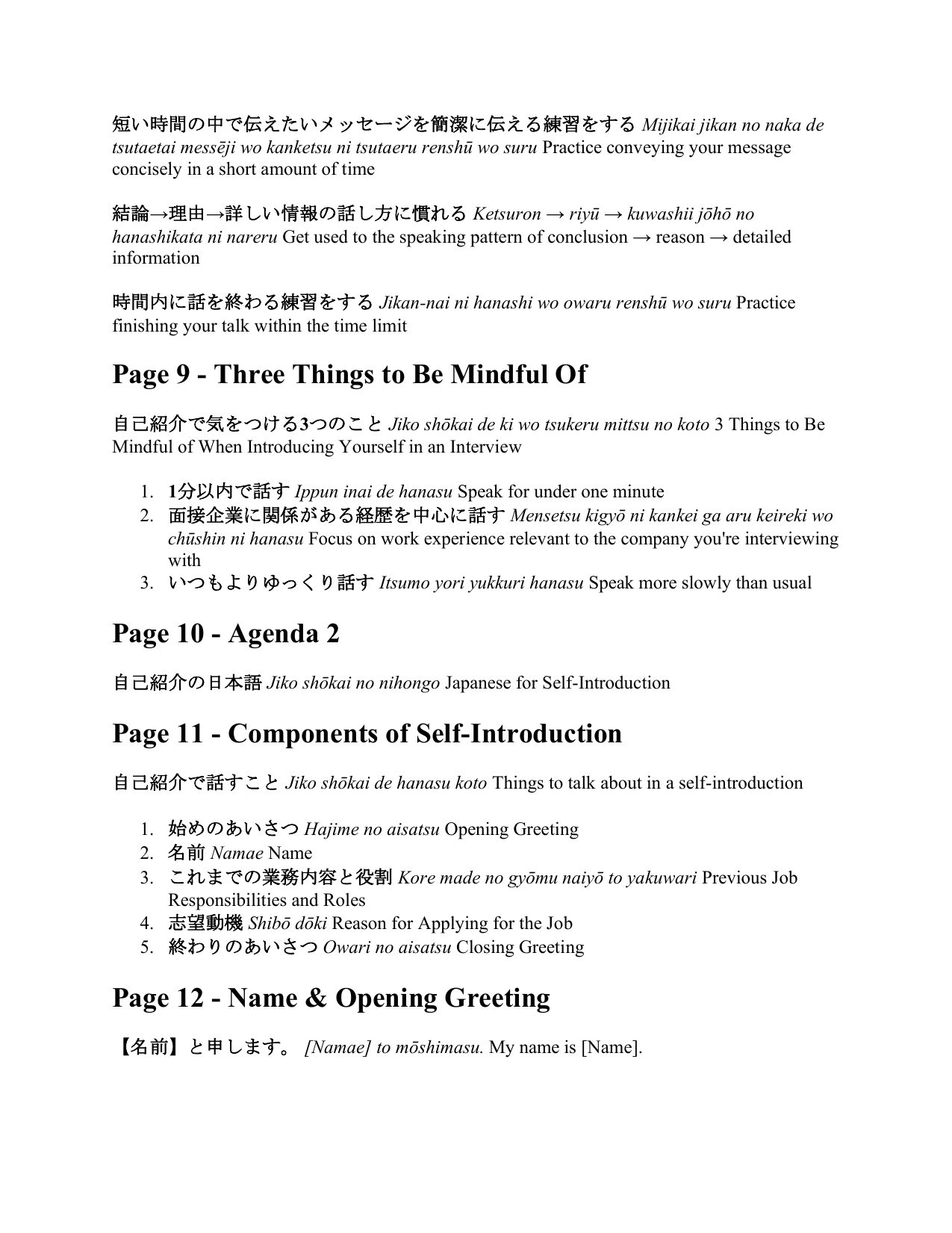
คลิกเพื่อขยาย
JP短い時間の中で伝えたいメッセージを簡潔に伝える練習をするMijikaijikannonakade
ENtsutaetai messēji wo kanketsu ni tsutaeru renshū wo suru Practice conveying your message
concisely in a short amount of time
結論→理由→詳しい情報の話し方に慣れる Ketsuron → riyū → kuwashii jōhō no
hanashikata ni nareru Get used to the speaking pattern of conclusion → reason → detailed
information
時間内に話を終わる練習をする Jikan-nai ni hanashi wo owaru renshū wo suru Practice
finishing your talk within the time limit
Page 9 - Three Things to Be Mindful Of
自己紹介で気をつける3つのこと Jiko shōkai de ki wo tsukeru mittsu no koto 3 Things to Be
Mindful of When Introducing Yourself in an Interview
1. 1分以内で話す Ippun inai de hanasu Speak for under one minute
2. 面接企業に関係がある経歴を中心に話す Mensetsu kigyō ni kankei ga aru keireki wo
chūshin ni hanasu Focus on work experience relevant to the company you're interviewing
with
3. いつもよりゆっくり話す Itsumo yori yukkuri hanasu Speak more slowly than usual
Page 10 - Agenda 2
自己紹介の日本語 Jiko shōkai no nihongo Japanese for Self-Introduction
Page 11 - Components of Self-Introduction
自己紹介で話すこと Jiko shōkai de hanasu koto Things to talk about in a self-introduction
1. 始めのあいさつ Hajime no aisatsu Opening Greeting
2. 名前 Namae Name
3. これまでの業務内容と役割 Kore made no gyōmu naiyō to yakuwari Previous Job
Responsibilities and Roles
4. 志望動機 Shibō dōki Reason for Applying for the Job
5. 終わりのあいさつ Owari no aisatsu Closing Greeting
Page 12 - Name & Opening Greeting
【名前】と申します。 [Namae] to mōshimasu. My name is [Name].
concisely in a short amount of time
結論→理由→詳しい情報の話し方に慣れる Ketsuron → riyū → kuwashii jōhō no
hanashikata ni nareru Get used to the speaking pattern of conclusion → reason → detailed
information
時間内に話を終わる練習をする Jikan-nai ni hanashi wo owaru renshū wo suru Practice
finishing your talk within the time limit
Page 9 - Three Things to Be Mindful Of
自己紹介で気をつける3つのこと Jiko shōkai de ki wo tsukeru mittsu no koto 3 Things to Be
Mindful of When Introducing Yourself in an Interview
1. 1分以内で話す Ippun inai de hanasu Speak for under one minute
2. 面接企業に関係がある経歴を中心に話す Mensetsu kigyō ni kankei ga aru keireki wo
chūshin ni hanasu Focus on work experience relevant to the company you're interviewing
with
3. いつもよりゆっくり話す Itsumo yori yukkuri hanasu Speak more slowly than usual
Page 10 - Agenda 2
自己紹介の日本語 Jiko shōkai no nihongo Japanese for Self-Introduction
Page 11 - Components of Self-Introduction
自己紹介で話すこと Jiko shōkai de hanasu koto Things to talk about in a self-introduction
1. 始めのあいさつ Hajime no aisatsu Opening Greeting
2. 名前 Namae Name
3. これまでの業務内容と役割 Kore made no gyōmu naiyō to yakuwari Previous Job
Responsibilities and Roles
4. 志望動機 Shibō dōki Reason for Applying for the Job
5. 終わりのあいさつ Owari no aisatsu Closing Greeting
Page 12 - Name & Opening Greeting
【名前】と申します。 [Namae] to mōshimasu. My name is [Name].
หน้า 94
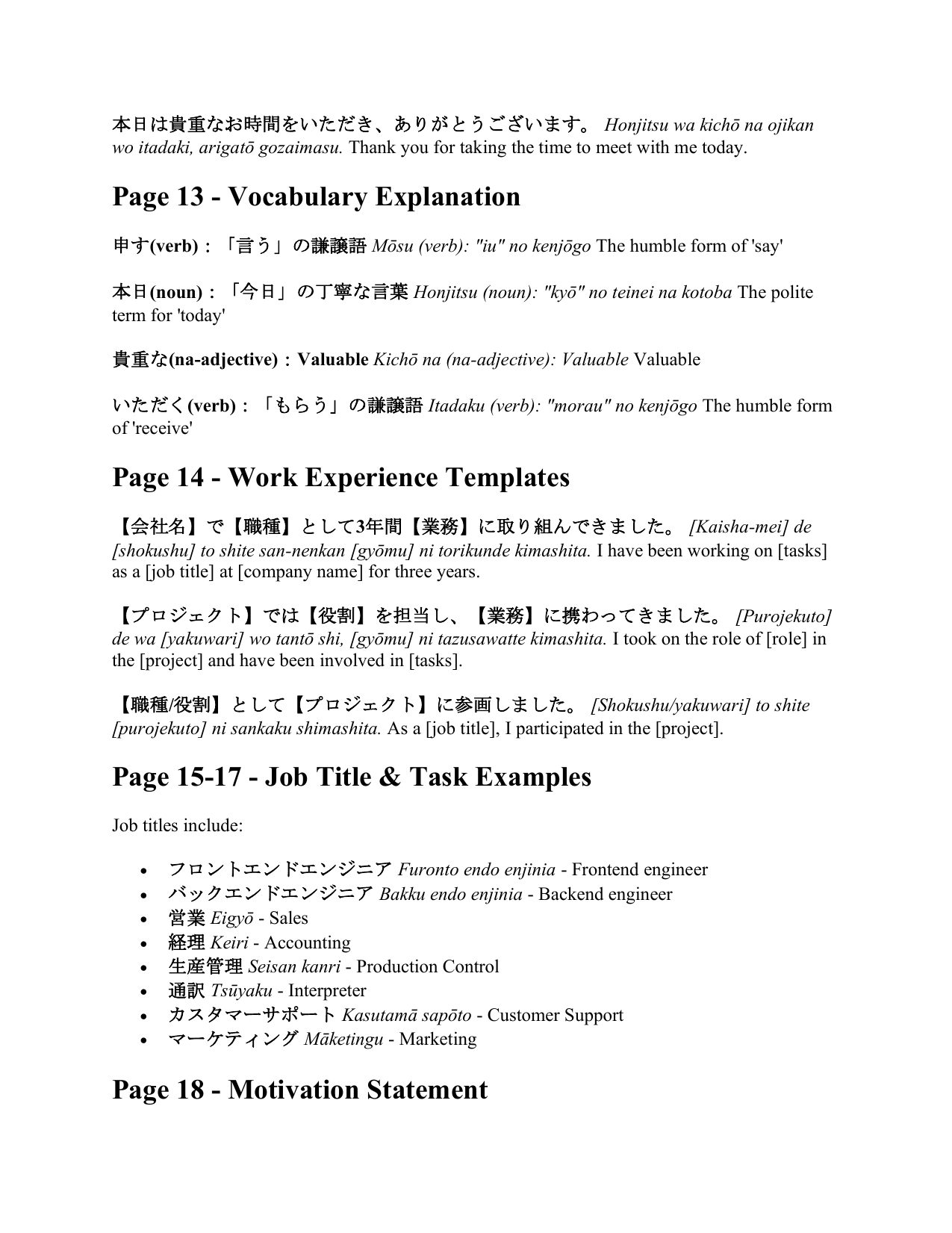
คลิกเพื่อขยาย
JP本日は貴重なお時間をいただき、ありがとうございます。Honjitsuwakichōnaojikan
ENwo itadaki, arigatō gozaimasu. Thank you for taking the time to meet with me today.
Page 13 - Vocabulary Explanation
申す(verb):「言う」の謙譲語 Mōsu (verb): "iu" no kenjōgo The humble form of 'say'
本日(noun):「今日」の丁寧な言葉 Honjitsu (noun): "kyō" no teinei na kotoba The polite
term for 'today'
貴重な(na-adjective):Valuable Kichō na (na-adjective): Valuable Valuable
いただく(verb):「もらう」の謙譲語 Itadaku (verb): "morau" no kenjōgo The humble form
of 'receive'
Page 14 - Work Experience Templates
Page 13 - Vocabulary Explanation
申す(verb):「言う」の謙譲語 Mōsu (verb): "iu" no kenjōgo The humble form of 'say'
本日(noun):「今日」の丁寧な言葉 Honjitsu (noun): "kyō" no teinei na kotoba The polite
term for 'today'
貴重な(na-adjective):Valuable Kichō na (na-adjective): Valuable Valuable
いただく(verb):「もらう」の謙譲語 Itadaku (verb): "morau" no kenjōgo The humble form
of 'receive'
Page 14 - Work Experience Templates
JP【会社名】で【職種】として3年間【業務】に取り組んできました。[Kaisha-mei]de
EN[shokushu] to shite san-nenkan [gyōmu] ni torikunde kimashita. I have been working on [tasks]
as a [job title] at [company name] for three years.
as a [job title] at [company name] for three years.
JP【プロジェクト】では【役割】を担当し、【業務】に携わってきました。[Purojekuto]
ENde wa [yakuwari] wo tantō shi, [gyōmu] ni tazusawatte kimashita. I took on the role of [role] in
the [project] and have been involved in [tasks].
【職種/役割】として【プロジェクト】に参画しました。 [Shokushu/yakuwari] to shite
[purojekuto] ni sankaku shimashita. As a [job title], I participated in the [project].
Page 15-17 - Job Title & Task Examples
Job titles include:
• フロントエンドエンジニア Furonto endo enjinia - Frontend engineer
• バックエンドエンジニア Bakku endo enjinia - Backend engineer
• 営業 Eigyō - Sales
• 経理 Keiri - Accounting
• 生産管理 Seisan kanri - Production Control
• 通訳 Tsūyaku - Interpreter
• カスタマーサポート Kasutamā sapōto - Customer Support
• マーケティング Māketingu - Marketing
Page 18 - Motivation Statement
the [project] and have been involved in [tasks].
【職種/役割】として【プロジェクト】に参画しました。 [Shokushu/yakuwari] to shite
[purojekuto] ni sankaku shimashita. As a [job title], I participated in the [project].
Page 15-17 - Job Title & Task Examples
Job titles include:
• フロントエンドエンジニア Furonto endo enjinia - Frontend engineer
• バックエンドエンジニア Bakku endo enjinia - Backend engineer
• 営業 Eigyō - Sales
• 経理 Keiri - Accounting
• 生産管理 Seisan kanri - Production Control
• 通訳 Tsūyaku - Interpreter
• カスタマーサポート Kasutamā sapōto - Customer Support
• マーケティング Māketingu - Marketing
Page 18 - Motivation Statement
หน้า 95
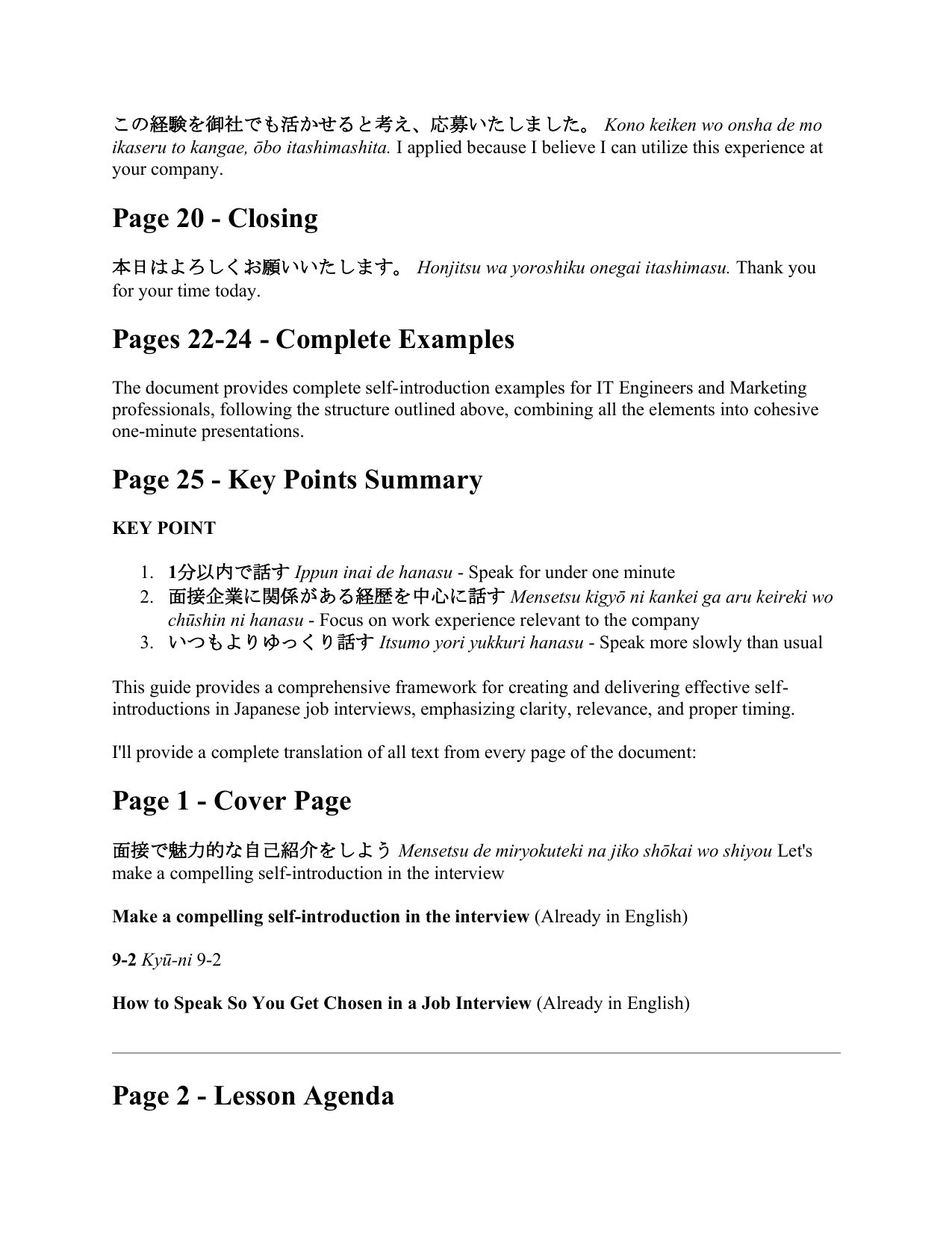
คลิกเพื่อขยาย
JPこの経験を御社でも活かせると考え、応募いたしました。Konokeikenwoonshademo
ENikaseru to kangae, ōbo itashimashita. I applied because I believe I can utilize this experience at
your company.
Page 20 - Closing
本日はよろしくお願いいたします。 Honjitsu wa yoroshiku onegai itashimasu. Thank you
for your time today.
Pages 22-24 - Complete Examples
The document provides complete self-introduction examples for IT Engineers and Marketing
professionals, following the structure outlined above, combining all the elements into cohesive
one-minute presentations.
Page 25 - Key Points Summary
KEY POINT
1. 1分以内で話す Ippun inai de hanasu - Speak for under one minute
2. 面接企業に関係がある経歴を中心に話す Mensetsu kigyō ni kankei ga aru keireki wo
chūshin ni hanasu - Focus on work experience relevant to the company
3. いつもよりゆっくり話す Itsumo yori yukkuri hanasu - Speak more slowly than usual
This guide provides a comprehensive framework for creating and delivering effective self-
introductions in Japanese job interviews, emphasizing clarity, relevance, and proper timing.
I'll provide a complete translation of all text from every page of the document:
Page 1 - Cover Page
面接で魅力的な自己紹介をしよう Mensetsu de miryokuteki na jiko shōkai wo shiyou Let's
make a compelling self-introduction in the interview
Make a compelling self-introduction in the interview (Already in English)
9-2 Kyū-ni 9-2
How to Speak So You Get Chosen in a Job Interview (Already in English)
Page 2 - Lesson Agenda
your company.
Page 20 - Closing
本日はよろしくお願いいたします。 Honjitsu wa yoroshiku onegai itashimasu. Thank you
for your time today.
Pages 22-24 - Complete Examples
The document provides complete self-introduction examples for IT Engineers and Marketing
professionals, following the structure outlined above, combining all the elements into cohesive
one-minute presentations.
Page 25 - Key Points Summary
KEY POINT
1. 1分以内で話す Ippun inai de hanasu - Speak for under one minute
2. 面接企業に関係がある経歴を中心に話す Mensetsu kigyō ni kankei ga aru keireki wo
chūshin ni hanasu - Focus on work experience relevant to the company
3. いつもよりゆっくり話す Itsumo yori yukkuri hanasu - Speak more slowly than usual
This guide provides a comprehensive framework for creating and delivering effective self-
introductions in Japanese job interviews, emphasizing clarity, relevance, and proper timing.
I'll provide a complete translation of all text from every page of the document:
Page 1 - Cover Page
面接で魅力的な自己紹介をしよう Mensetsu de miryokuteki na jiko shōkai wo shiyou Let's
make a compelling self-introduction in the interview
Make a compelling self-introduction in the interview (Already in English)
9-2 Kyū-ni 9-2
How to Speak So You Get Chosen in a Job Interview (Already in English)
Page 2 - Lesson Agenda
หน้า 96
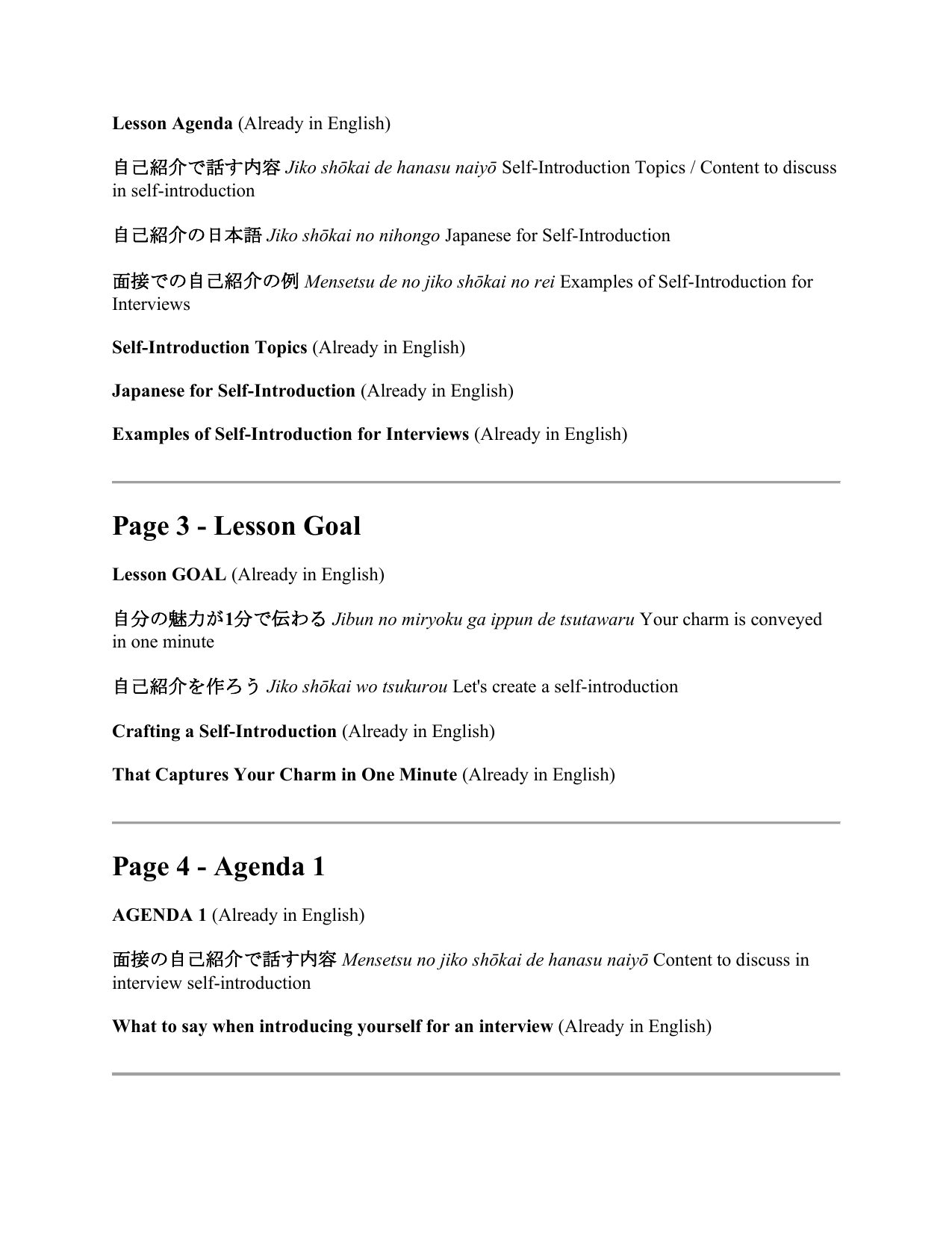
คลิกเพื่อขยาย
ENLesson Agenda (Already in English)
自己紹介で話す内容 Jiko shōkai de hanasu naiyō Self-Introduction Topics / Content to discuss
in self-introduction
自己紹介の日本語 Jiko shōkai no nihongo Japanese for Self-Introduction
面接での自己紹介の例 Mensetsu de no jiko shōkai no rei Examples of Self-Introduction for
Interviews
Self-Introduction Topics (Already in English)
Japanese for Self-Introduction (Already in English)
Examples of Self-Introduction for Interviews (Already in English)
Page 3 - Lesson Goal
Lesson GOAL (Already in English)
自分の魅力が1分で伝わる Jibun no miryoku ga ippun de tsutawaru Your charm is conveyed
in one minute
自己紹介を作ろう Jiko shōkai wo tsukurou Let's create a self-introduction
Crafting a Self-Introduction (Already in English)
That Captures Your Charm in One Minute (Already in English)
Page 4 - Agenda 1
AGENDA 1 (Already in English)
面接の自己紹介で話す内容 Mensetsu no jiko shōkai de hanasu naiyō Content to discuss in
interview self-introduction
What to say when introducing yourself for an interview (Already in English)
自己紹介で話す内容 Jiko shōkai de hanasu naiyō Self-Introduction Topics / Content to discuss
in self-introduction
自己紹介の日本語 Jiko shōkai no nihongo Japanese for Self-Introduction
面接での自己紹介の例 Mensetsu de no jiko shōkai no rei Examples of Self-Introduction for
Interviews
Self-Introduction Topics (Already in English)
Japanese for Self-Introduction (Already in English)
Examples of Self-Introduction for Interviews (Already in English)
Page 3 - Lesson Goal
Lesson GOAL (Already in English)
自分の魅力が1分で伝わる Jibun no miryoku ga ippun de tsutawaru Your charm is conveyed
in one minute
自己紹介を作ろう Jiko shōkai wo tsukurou Let's create a self-introduction
Crafting a Self-Introduction (Already in English)
That Captures Your Charm in One Minute (Already in English)
Page 4 - Agenda 1
AGENDA 1 (Already in English)
面接の自己紹介で話す内容 Mensetsu no jiko shōkai de hanasu naiyō Content to discuss in
interview self-introduction
What to say when introducing yourself for an interview (Already in English)
หน้า 97
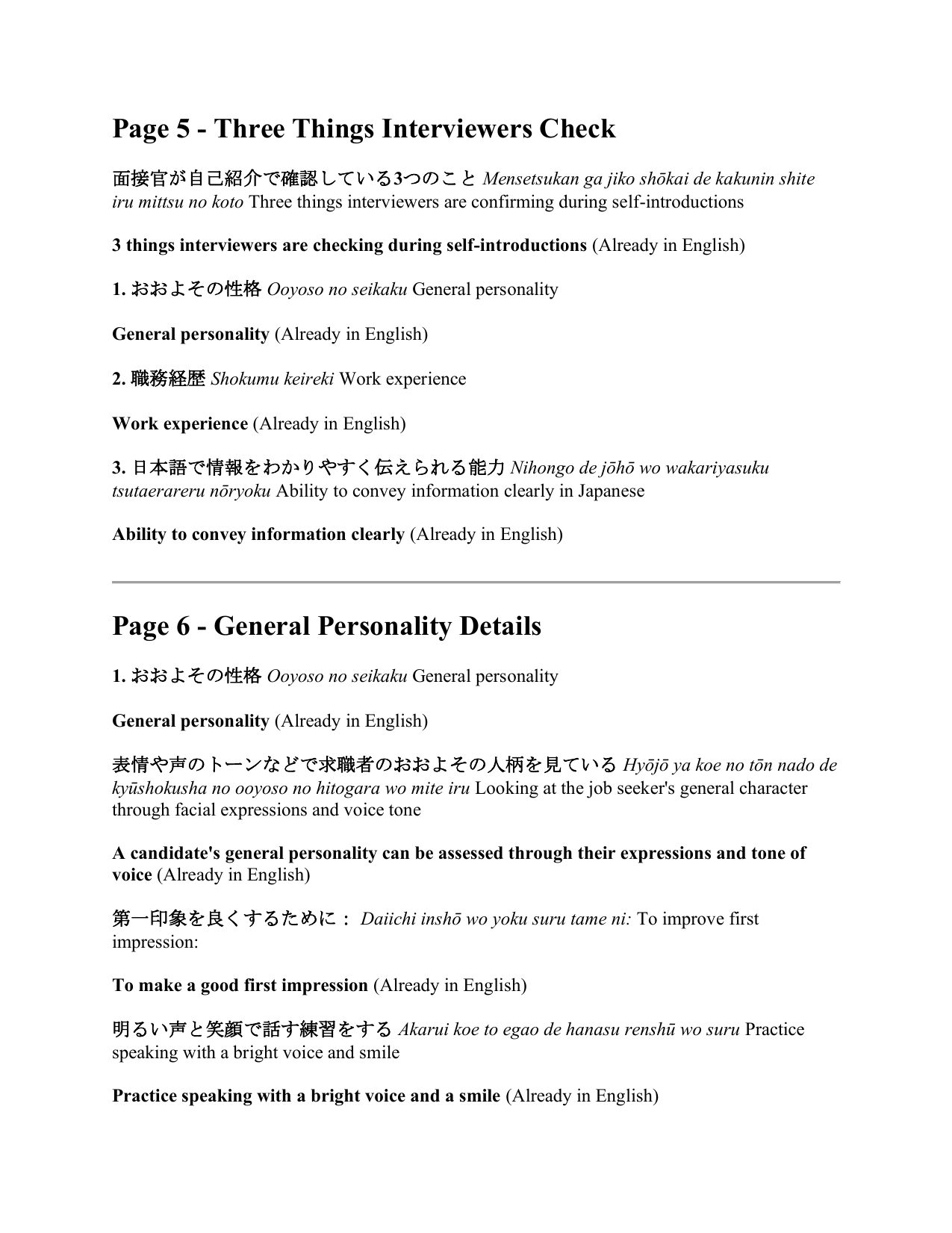
คลิกเพื่อขยาย
ENPage 5 - Three Things Interviewers Check
面接官が自己紹介で確認している3つのこと Mensetsukan ga jiko shōkai de kakunin shite
iru mittsu no koto Three things interviewers are confirming during self-introductions
3 things interviewers are checking during self-introductions (Already in English)
1. おおよその性格 Ooyoso no seikaku General personality
General personality (Already in English)
2. 職務経歴 Shokumu keireki Work experience
Work experience (Already in English)
3. 日本語で情報をわかりやすく伝えられる能力 Nihongo de jōhō wo wakariyasuku
tsutaerareru nōryoku Ability to convey information clearly in Japanese
Ability to convey information clearly (Already in English)
Page 6 - General Personality Details
1. おおよその性格 Ooyoso no seikaku General personality
General personality (Already in English)
面接官が自己紹介で確認している3つのこと Mensetsukan ga jiko shōkai de kakunin shite
iru mittsu no koto Three things interviewers are confirming during self-introductions
3 things interviewers are checking during self-introductions (Already in English)
1. おおよその性格 Ooyoso no seikaku General personality
General personality (Already in English)
2. 職務経歴 Shokumu keireki Work experience
Work experience (Already in English)
3. 日本語で情報をわかりやすく伝えられる能力 Nihongo de jōhō wo wakariyasuku
tsutaerareru nōryoku Ability to convey information clearly in Japanese
Ability to convey information clearly (Already in English)
Page 6 - General Personality Details
1. おおよその性格 Ooyoso no seikaku General personality
General personality (Already in English)
JP表情や声のトーンなどで求職者のおおよその人柄を見ているHyōjōyakoenotōnnadode
ENkyūshokusha no ooyoso no hitogara wo mite iru Looking at the job seeker's general character
through facial expressions and voice tone
A candidate's general personality can be assessed through their expressions and tone of
voice (Already in English)
第一印象を良くするために: Daiichi inshō wo yoku suru tame ni: To improve first
impression:
To make a good first impression (Already in English)
明るい声と笑顔で話す練習をする Akarui koe to egao de hanasu renshū wo suru Practice
speaking with a bright voice and smile
Practice speaking with a bright voice and a smile (Already in English)
through facial expressions and voice tone
A candidate's general personality can be assessed through their expressions and tone of
voice (Already in English)
第一印象を良くするために: Daiichi inshō wo yoku suru tame ni: To improve first
impression:
To make a good first impression (Already in English)
明るい声と笑顔で話す練習をする Akarui koe to egao de hanasu renshū wo suru Practice
speaking with a bright voice and smile
Practice speaking with a bright voice and a smile (Already in English)
หน้า 98
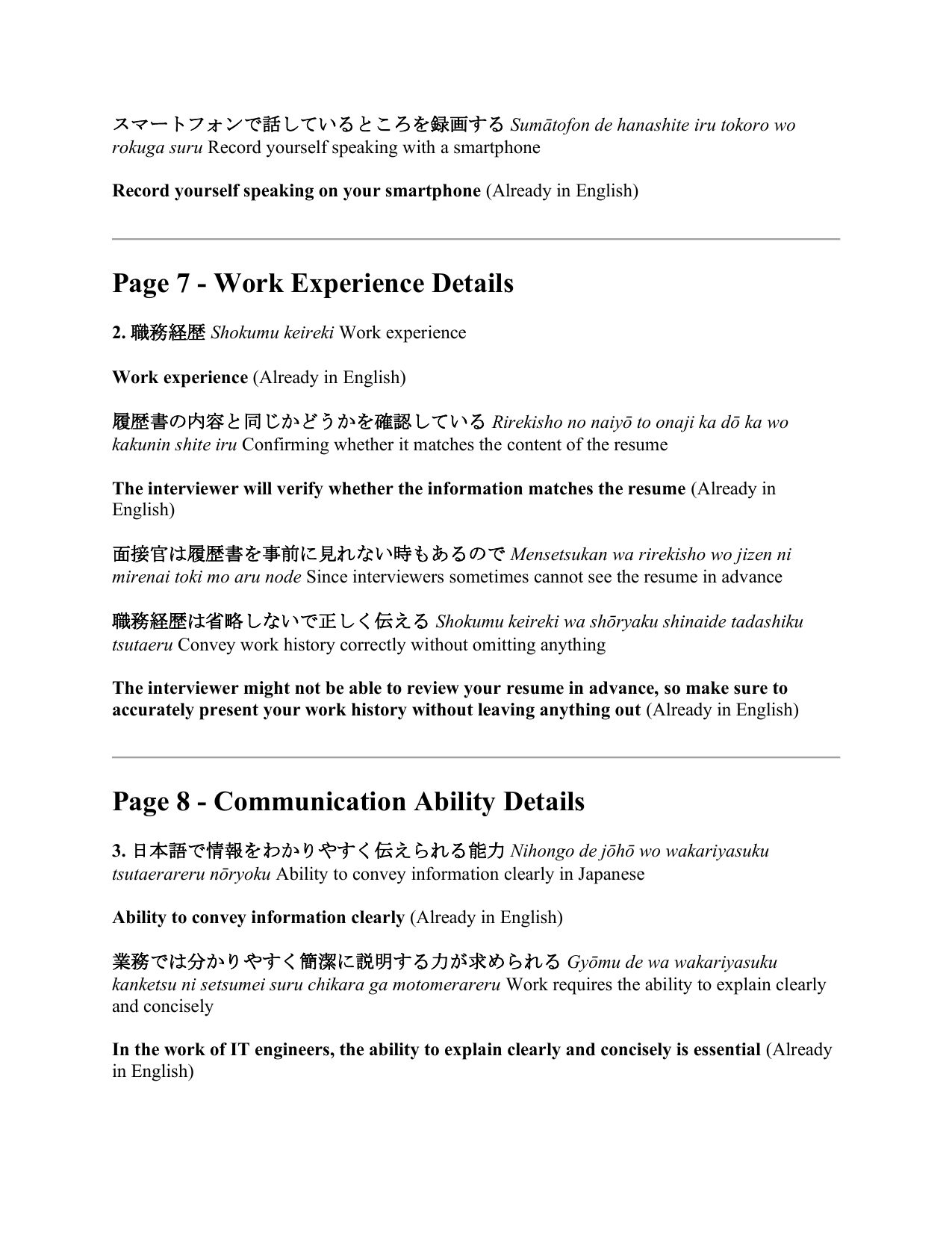
คลิกเพื่อขยาย
ENスマートフォンで話しているところを録画する Sumātofon de hanashite iru tokoro wo
rokuga suru Record yourself speaking with a smartphone
Record yourself speaking on your smartphone (Already in English)
Page 7 - Work Experience Details
2. 職務経歴 Shokumu keireki Work experience
Work experience (Already in English)
履歴書の内容と同じかどうかを確認している Rirekisho no naiyō to onaji ka dō ka wo
kakunin shite iru Confirming whether it matches the content of the resume
The interviewer will verify whether the information matches the resume (Already in
English)
面接官は履歴書を事前に見れない時もあるので Mensetsukan wa rirekisho wo jizen ni
mirenai toki mo aru node Since interviewers sometimes cannot see the resume in advance
職務経歴は省略しないで正しく伝える Shokumu keireki wa shōryaku shinaide tadashiku
tsutaeru Convey work history correctly without omitting anything
The interviewer might not be able to review your resume in advance, so make sure to
accurately present your work history without leaving anything out (Already in English)
Page 8 - Communication Ability Details
3. 日本語で情報をわかりやすく伝えられる能力 Nihongo de jōhō wo wakariyasuku
tsutaerareru nōryoku Ability to convey information clearly in Japanese
Ability to convey information clearly (Already in English)
rokuga suru Record yourself speaking with a smartphone
Record yourself speaking on your smartphone (Already in English)
Page 7 - Work Experience Details
2. 職務経歴 Shokumu keireki Work experience
Work experience (Already in English)
履歴書の内容と同じかどうかを確認している Rirekisho no naiyō to onaji ka dō ka wo
kakunin shite iru Confirming whether it matches the content of the resume
The interviewer will verify whether the information matches the resume (Already in
English)
面接官は履歴書を事前に見れない時もあるので Mensetsukan wa rirekisho wo jizen ni
mirenai toki mo aru node Since interviewers sometimes cannot see the resume in advance
職務経歴は省略しないで正しく伝える Shokumu keireki wa shōryaku shinaide tadashiku
tsutaeru Convey work history correctly without omitting anything
The interviewer might not be able to review your resume in advance, so make sure to
accurately present your work history without leaving anything out (Already in English)
Page 8 - Communication Ability Details
3. 日本語で情報をわかりやすく伝えられる能力 Nihongo de jōhō wo wakariyasuku
tsutaerareru nōryoku Ability to convey information clearly in Japanese
Ability to convey information clearly (Already in English)
JP業務では分かりやすく簡潔に説明する力が求められるGyōmudewawakariyasuku
ENkanketsu ni setsumei suru chikara ga motomerareru Work requires the ability to explain clearly
and concisely
In the work of IT engineers, the ability to explain clearly and concisely is essential (Already
in English)
and concisely
In the work of IT engineers, the ability to explain clearly and concisely is essential (Already
in English)
หน้า 99
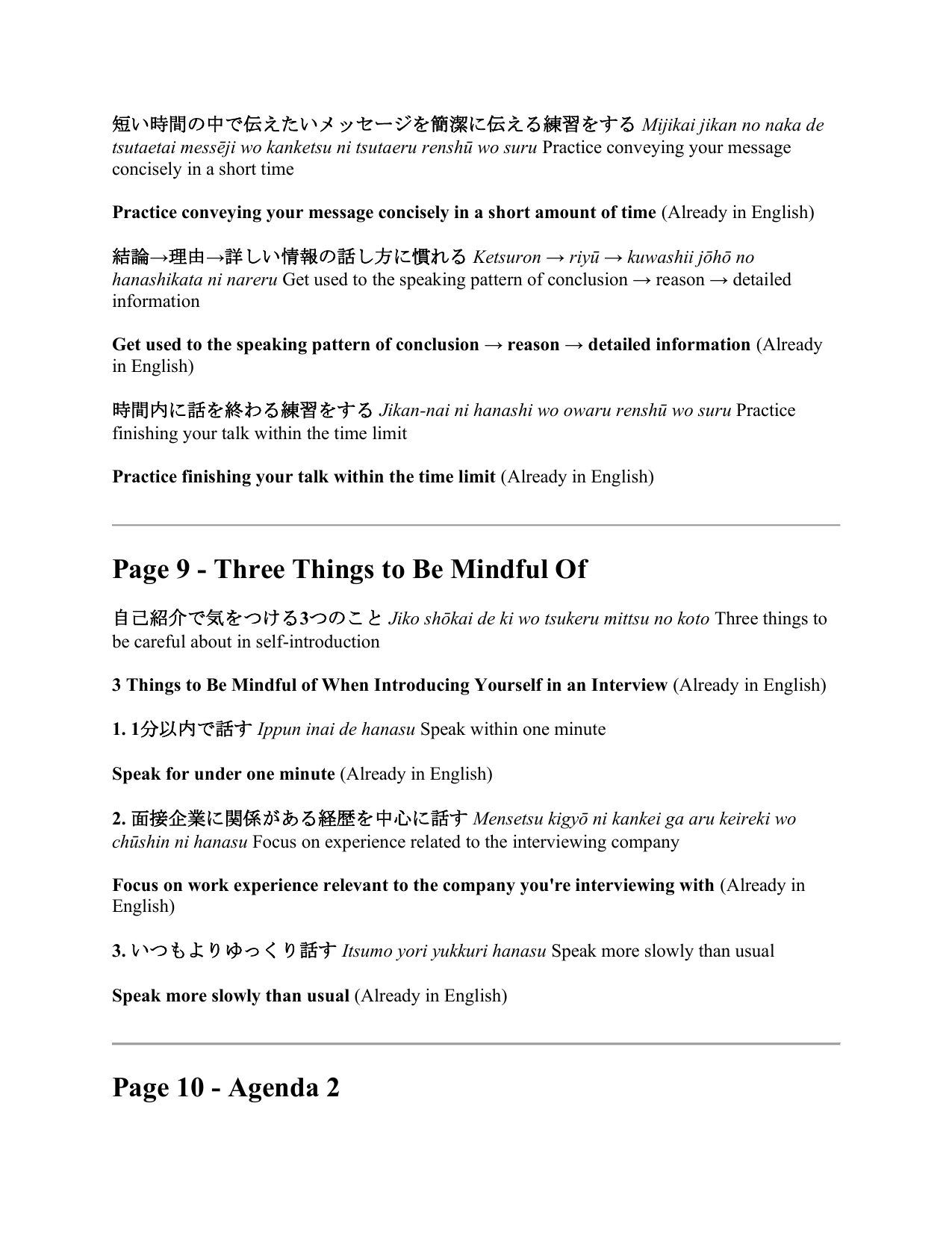
คลิกเพื่อขยาย
JP短い時間の中で伝えたいメッセージを簡潔に伝える練習をするMijikaijikannonakade
ENtsutaetai messēji wo kanketsu ni tsutaeru renshū wo suru Practice conveying your message
concisely in a short time
Practice conveying your message concisely in a short amount of time (Already in English)
結論→理由→詳しい情報の話し方に慣れる Ketsuron → riyū → kuwashii jōhō no
hanashikata ni nareru Get used to the speaking pattern of conclusion → reason → detailed
information
Get used to the speaking pattern of conclusion → reason → detailed information (Already
in English)
時間内に話を終わる練習をする Jikan-nai ni hanashi wo owaru renshū wo suru Practice
finishing your talk within the time limit
Practice finishing your talk within the time limit (Already in English)
Page 9 - Three Things to Be Mindful Of
自己紹介で気をつける3つのこと Jiko shōkai de ki wo tsukeru mittsu no koto Three things to
be careful about in self-introduction
3 Things to Be Mindful of When Introducing Yourself in an Interview (Already in English)
1. 1分以内で話す Ippun inai de hanasu Speak within one minute
Speak for under one minute (Already in English)
2. 面接企業に関係がある経歴を中心に話す Mensetsu kigyō ni kankei ga aru keireki wo
chūshin ni hanasu Focus on experience related to the interviewing company
Focus on work experience relevant to the company you're interviewing with (Already in
English)
3. いつもよりゆっくり話す Itsumo yori yukkuri hanasu Speak more slowly than usual
Speak more slowly than usual (Already in English)
Page 10 - Agenda 2
concisely in a short time
Practice conveying your message concisely in a short amount of time (Already in English)
結論→理由→詳しい情報の話し方に慣れる Ketsuron → riyū → kuwashii jōhō no
hanashikata ni nareru Get used to the speaking pattern of conclusion → reason → detailed
information
Get used to the speaking pattern of conclusion → reason → detailed information (Already
in English)
時間内に話を終わる練習をする Jikan-nai ni hanashi wo owaru renshū wo suru Practice
finishing your talk within the time limit
Practice finishing your talk within the time limit (Already in English)
Page 9 - Three Things to Be Mindful Of
自己紹介で気をつける3つのこと Jiko shōkai de ki wo tsukeru mittsu no koto Three things to
be careful about in self-introduction
3 Things to Be Mindful of When Introducing Yourself in an Interview (Already in English)
1. 1分以内で話す Ippun inai de hanasu Speak within one minute
Speak for under one minute (Already in English)
2. 面接企業に関係がある経歴を中心に話す Mensetsu kigyō ni kankei ga aru keireki wo
chūshin ni hanasu Focus on experience related to the interviewing company
Focus on work experience relevant to the company you're interviewing with (Already in
English)
3. いつもよりゆっくり話す Itsumo yori yukkuri hanasu Speak more slowly than usual
Speak more slowly than usual (Already in English)
Page 10 - Agenda 2
หน้า 100
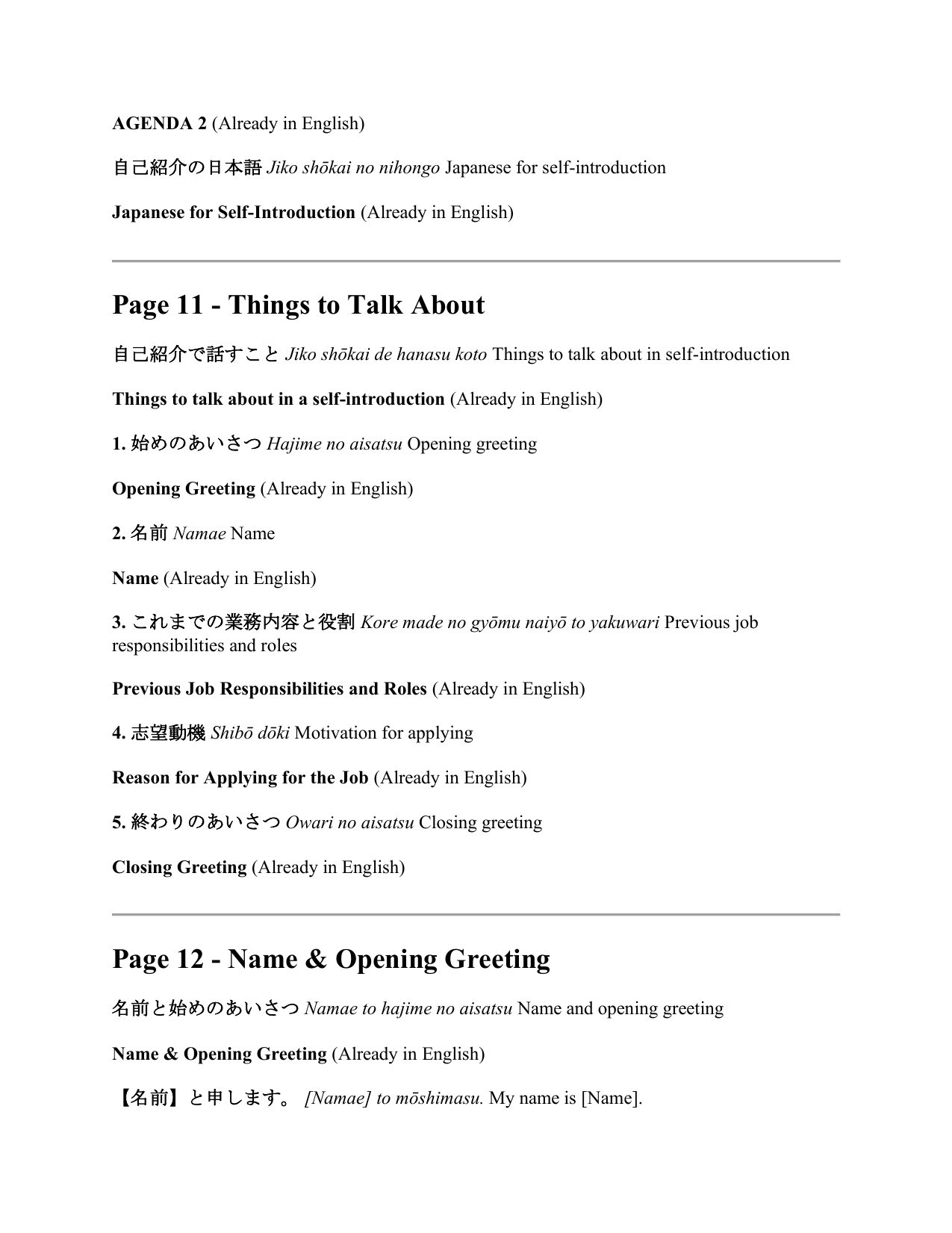
คลิกเพื่อขยาย
ENAGENDA 2 (Already in English)
自己紹介の日本語 Jiko shōkai no nihongo Japanese for self-introduction
Japanese for Self-Introduction (Already in English)
Page 11 - Things to Talk About
自己紹介で話すこと Jiko shōkai de hanasu koto Things to talk about in self-introduction
Things to talk about in a self-introduction (Already in English)
1. 始めのあいさつ Hajime no aisatsu Opening greeting
Opening Greeting (Already in English)
2. 名前 Namae Name
Name (Already in English)
3. これまでの業務内容と役割 Kore made no gyōmu naiyō to yakuwari Previous job
responsibilities and roles
Previous Job Responsibilities and Roles (Already in English)
4. 志望動機 Shibō dōki Motivation for applying
Reason for Applying for the Job (Already in English)
5. 終わりのあいさつ Owari no aisatsu Closing greeting
Closing Greeting (Already in English)
Page 12 - Name & Opening Greeting
名前と始めのあいさつ Namae to hajime no aisatsu Name and opening greeting
Name & Opening Greeting (Already in English)
【名前】と申します。 [Namae] to mōshimasu. My name is [Name].
自己紹介の日本語 Jiko shōkai no nihongo Japanese for self-introduction
Japanese for Self-Introduction (Already in English)
Page 11 - Things to Talk About
自己紹介で話すこと Jiko shōkai de hanasu koto Things to talk about in self-introduction
Things to talk about in a self-introduction (Already in English)
1. 始めのあいさつ Hajime no aisatsu Opening greeting
Opening Greeting (Already in English)
2. 名前 Namae Name
Name (Already in English)
3. これまでの業務内容と役割 Kore made no gyōmu naiyō to yakuwari Previous job
responsibilities and roles
Previous Job Responsibilities and Roles (Already in English)
4. 志望動機 Shibō dōki Motivation for applying
Reason for Applying for the Job (Already in English)
5. 終わりのあいさつ Owari no aisatsu Closing greeting
Closing Greeting (Already in English)
Page 12 - Name & Opening Greeting
名前と始めのあいさつ Namae to hajime no aisatsu Name and opening greeting
Name & Opening Greeting (Already in English)
【名前】と申します。 [Namae] to mōshimasu. My name is [Name].
หน้า 101
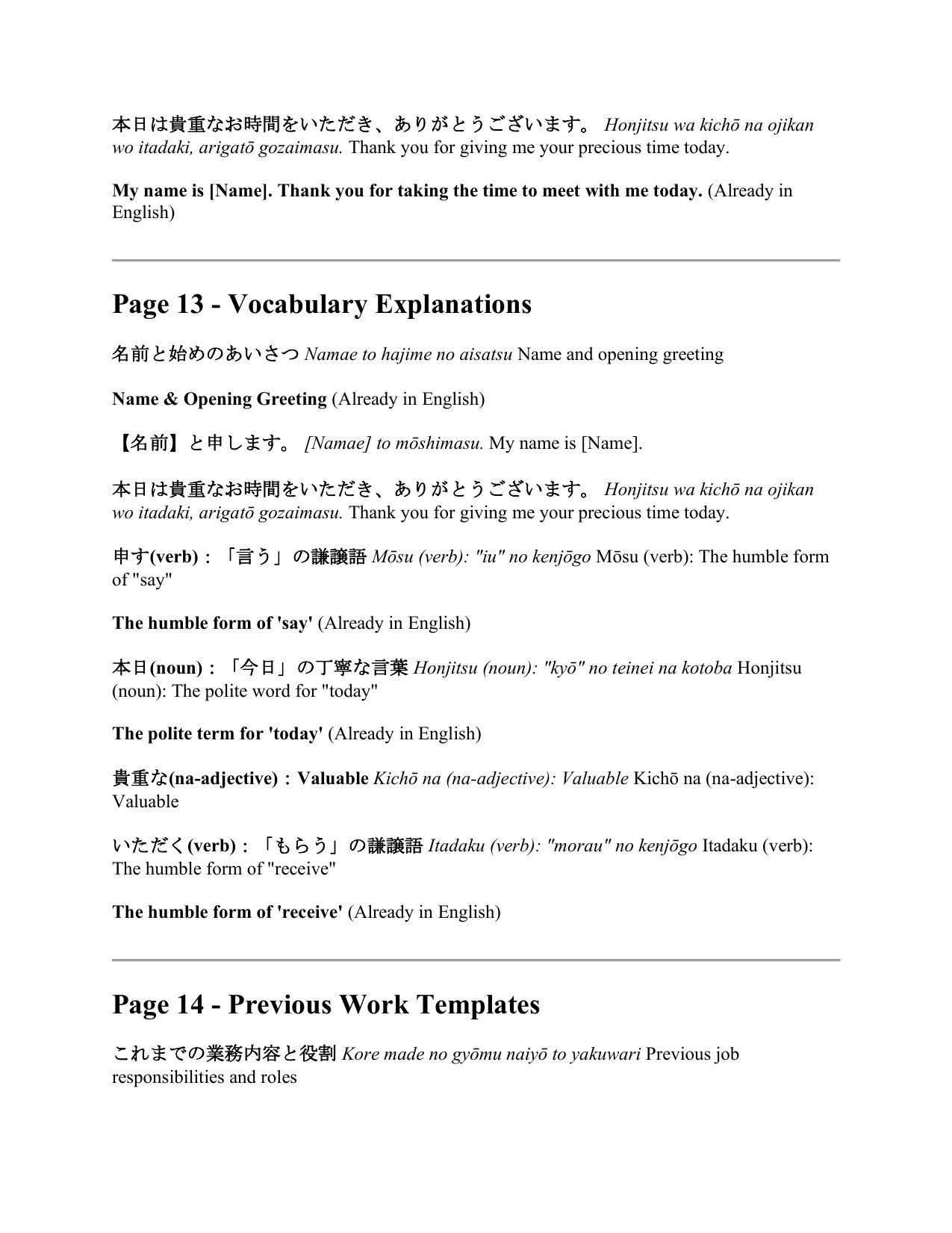
คลิกเพื่อขยาย
JP本日は貴重なお時間をいただき、ありがとうございます。Honjitsuwakichōnaojikan
ENwo itadaki, arigatō gozaimasu. Thank you for giving me your precious time today.
My name is [Name]. Thank you for taking the time to meet with me today. (Already in
English)
Page 13 - Vocabulary Explanations
名前と始めのあいさつ Namae to hajime no aisatsu Name and opening greeting
Name & Opening Greeting (Already in English)
【名前】と申します。 [Namae] to mōshimasu. My name is [Name].
My name is [Name]. Thank you for taking the time to meet with me today. (Already in
English)
Page 13 - Vocabulary Explanations
名前と始めのあいさつ Namae to hajime no aisatsu Name and opening greeting
Name & Opening Greeting (Already in English)
【名前】と申します。 [Namae] to mōshimasu. My name is [Name].
JP本日は貴重なお時間をいただき、ありがとうございます。Honjitsuwakichōnaojikan
ENwo itadaki, arigatō gozaimasu. Thank you for giving me your precious time today.
申す(verb):「言う」の謙譲語 Mōsu (verb): "iu" no kenjōgo Mōsu (verb): The humble form
of "say"
The humble form of 'say' (Already in English)
本日(noun):「今日」の丁寧な言葉 Honjitsu (noun): "kyō" no teinei na kotoba Honjitsu
(noun): The polite word for "today"
The polite term for 'today' (Already in English)
貴重な(na-adjective):Valuable Kichō na (na-adjective): Valuable Kichō na (na-adjective):
Valuable
いただく(verb):「もらう」の謙譲語 Itadaku (verb): "morau" no kenjōgo Itadaku (verb):
The humble form of "receive"
The humble form of 'receive' (Already in English)
Page 14 - Previous Work Templates
これまでの業務内容と役割 Kore made no gyōmu naiyō to yakuwari Previous job
responsibilities and roles
申す(verb):「言う」の謙譲語 Mōsu (verb): "iu" no kenjōgo Mōsu (verb): The humble form
of "say"
The humble form of 'say' (Already in English)
本日(noun):「今日」の丁寧な言葉 Honjitsu (noun): "kyō" no teinei na kotoba Honjitsu
(noun): The polite word for "today"
The polite term for 'today' (Already in English)
貴重な(na-adjective):Valuable Kichō na (na-adjective): Valuable Kichō na (na-adjective):
Valuable
いただく(verb):「もらう」の謙譲語 Itadaku (verb): "morau" no kenjōgo Itadaku (verb):
The humble form of "receive"
The humble form of 'receive' (Already in English)
Page 14 - Previous Work Templates
これまでの業務内容と役割 Kore made no gyōmu naiyō to yakuwari Previous job
responsibilities and roles
หน้า 102
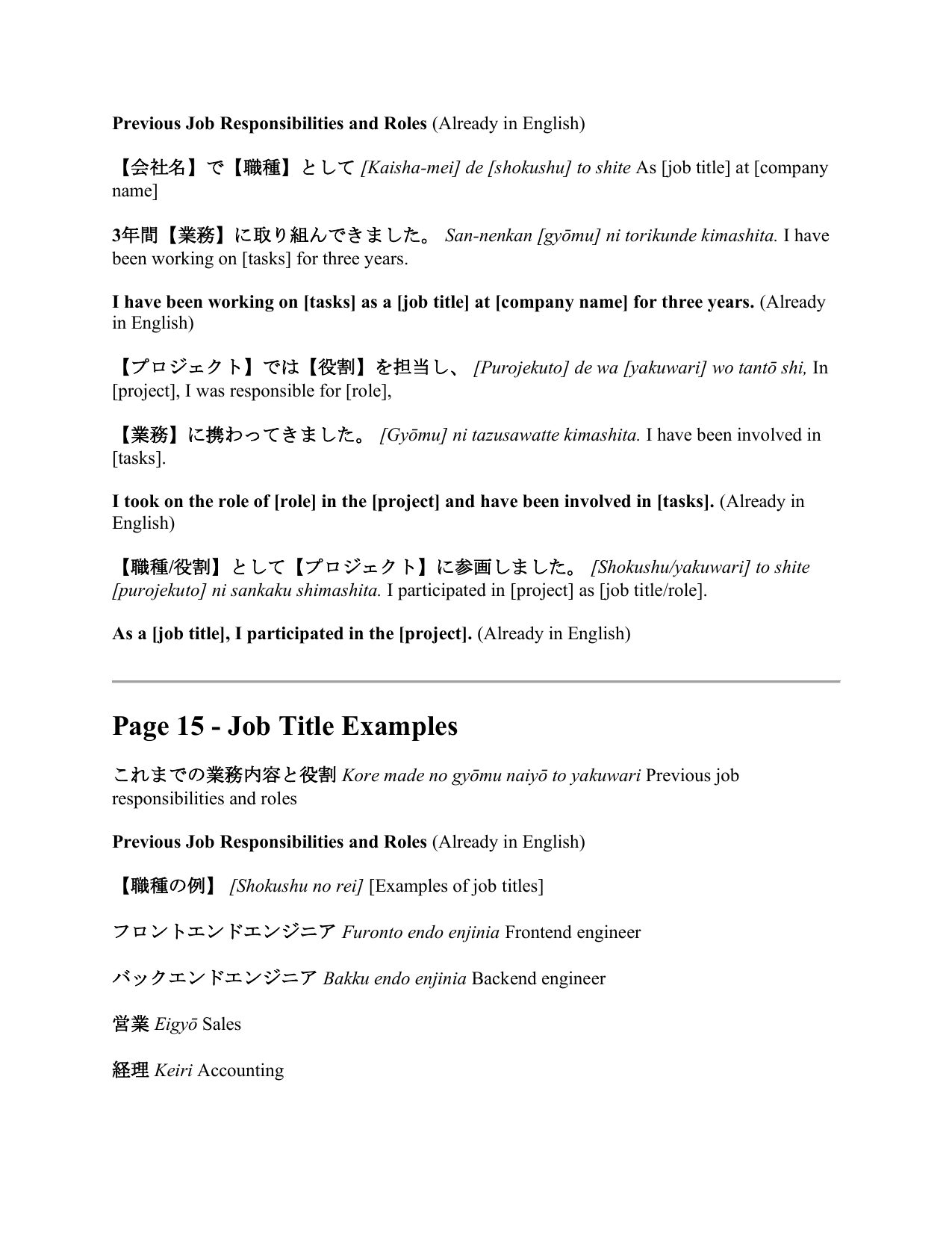
คลิกเพื่อขยาย
ENPrevious Job Responsibilities and Roles (Already in English)
【会社名】で【職種】として [Kaisha-mei] de [shokushu] to shite As [job title] at [company
name]
3年間【業務】に取り組んできました。 San-nenkan [gyōmu] ni torikunde kimashita. I have
been working on [tasks] for three years.
I have been working on [tasks] as a [job title] at [company name] for three years. (Already
in English)
【プロジェクト】では【役割】を担当し、 [Purojekuto] de wa [yakuwari] wo tantō shi, In
[project], I was responsible for [role],
【業務】に携わってきました。 [Gyōmu] ni tazusawatte kimashita. I have been involved in
[tasks].
I took on the role of [role] in the [project] and have been involved in [tasks]. (Already in
English)
【職種/役割】として【プロジェクト】に参画しました。 [Shokushu/yakuwari] to shite
[purojekuto] ni sankaku shimashita. I participated in [project] as [job title/role].
As a [job title], I participated in the [project]. (Already in English)
Page 15 - Job Title Examples
これまでの業務内容と役割 Kore made no gyōmu naiyō to yakuwari Previous job
responsibilities and roles
Previous Job Responsibilities and Roles (Already in English)
【職種の例】 [Shokushu no rei] [Examples of job titles]
フロントエンドエンジニア Furonto endo enjinia Frontend engineer
バックエンドエンジニア Bakku endo enjinia Backend engineer
営業 Eigyō Sales
経理 Keiri Accounting
【会社名】で【職種】として [Kaisha-mei] de [shokushu] to shite As [job title] at [company
name]
3年間【業務】に取り組んできました。 San-nenkan [gyōmu] ni torikunde kimashita. I have
been working on [tasks] for three years.
I have been working on [tasks] as a [job title] at [company name] for three years. (Already
in English)
【プロジェクト】では【役割】を担当し、 [Purojekuto] de wa [yakuwari] wo tantō shi, In
[project], I was responsible for [role],
【業務】に携わってきました。 [Gyōmu] ni tazusawatte kimashita. I have been involved in
[tasks].
I took on the role of [role] in the [project] and have been involved in [tasks]. (Already in
English)
【職種/役割】として【プロジェクト】に参画しました。 [Shokushu/yakuwari] to shite
[purojekuto] ni sankaku shimashita. I participated in [project] as [job title/role].
As a [job title], I participated in the [project]. (Already in English)
Page 15 - Job Title Examples
これまでの業務内容と役割 Kore made no gyōmu naiyō to yakuwari Previous job
responsibilities and roles
Previous Job Responsibilities and Roles (Already in English)
【職種の例】 [Shokushu no rei] [Examples of job titles]
フロントエンドエンジニア Furonto endo enjinia Frontend engineer
バックエンドエンジニア Bakku endo enjinia Backend engineer
営業 Eigyō Sales
経理 Keiri Accounting
หน้า 103
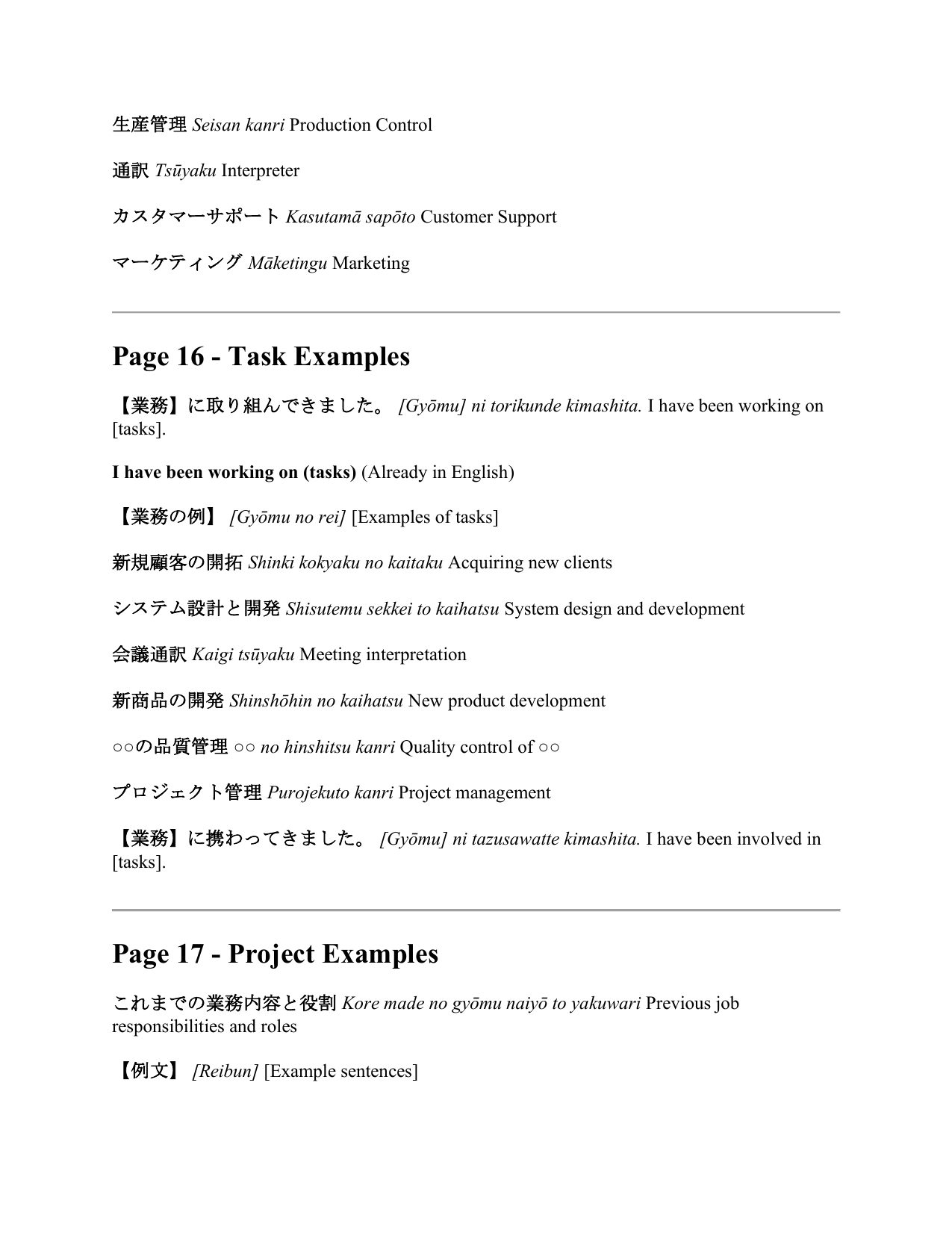
คลิกเพื่อขยาย
EN生産管理 Seisan kanri Production Control
通訳 Tsūyaku Interpreter
カスタマーサポート Kasutamā sapōto Customer Support
マーケティング Māketingu Marketing
Page 16 - Task Examples
【業務】に取り組んできました。 [Gyōmu] ni torikunde kimashita. I have been working on
[tasks].
I have been working on (tasks) (Already in English)
【業務の例】 [Gyōmu no rei] [Examples of tasks]
新規顧客の開拓 Shinki kokyaku no kaitaku Acquiring new clients
システム設計と開発 Shisutemu sekkei to kaihatsu System design and development
会議通訳 Kaigi tsūyaku Meeting interpretation
新商品の開発 Shinshōhin no kaihatsu New product development
○○の品質管理 ○○ no hinshitsu kanri Quality control of ○○
プロジェクト管理 Purojekuto kanri Project management
【業務】に携わってきました。 [Gyōmu] ni tazusawatte kimashita. I have been involved in
[tasks].
Page 17 - Project Examples
これまでの業務内容と役割 Kore made no gyōmu naiyō to yakuwari Previous job
responsibilities and roles
【例文】 [Reibun] [Example sentences]
通訳 Tsūyaku Interpreter
カスタマーサポート Kasutamā sapōto Customer Support
マーケティング Māketingu Marketing
Page 16 - Task Examples
【業務】に取り組んできました。 [Gyōmu] ni torikunde kimashita. I have been working on
[tasks].
I have been working on (tasks) (Already in English)
【業務の例】 [Gyōmu no rei] [Examples of tasks]
新規顧客の開拓 Shinki kokyaku no kaitaku Acquiring new clients
システム設計と開発 Shisutemu sekkei to kaihatsu System design and development
会議通訳 Kaigi tsūyaku Meeting interpretation
新商品の開発 Shinshōhin no kaihatsu New product development
○○の品質管理 ○○ no hinshitsu kanri Quality control of ○○
プロジェクト管理 Purojekuto kanri Project management
【業務】に携わってきました。 [Gyōmu] ni tazusawatte kimashita. I have been involved in
[tasks].
Page 17 - Project Examples
これまでの業務内容と役割 Kore made no gyōmu naiyō to yakuwari Previous job
responsibilities and roles
【例文】 [Reibun] [Example sentences]
หน้า 104
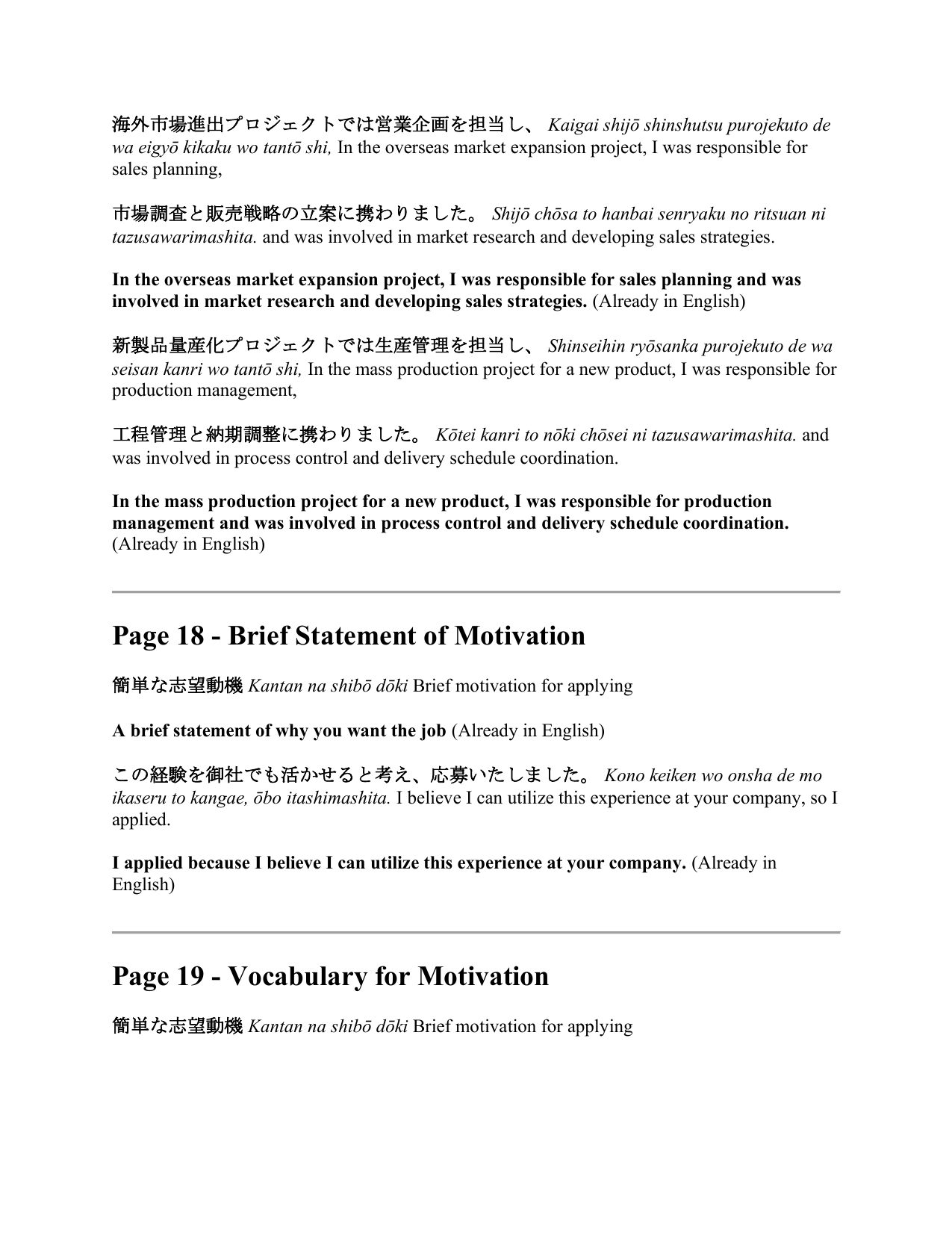
คลิกเพื่อขยาย
EN海外市場進出プロジェクトでは営業企画を担当し、 Kaigai shijō shinshutsu purojekuto de
wa eigyō kikaku wo tantō shi, In the overseas market expansion project, I was responsible for
sales planning,
市場調査と販売戦略の立案に携わりました。 Shijō chōsa to hanbai senryaku no ritsuan ni
tazusawarimashita. and was involved in market research and developing sales strategies.
In the overseas market expansion project, I was responsible for sales planning and was
involved in market research and developing sales strategies. (Already in English)
新製品量産化プロジェクトでは生産管理を担当し、 Shinseihin ryōsanka purojekuto de wa
seisan kanri wo tantō shi, In the mass production project for a new product, I was responsible for
production management,
工程管理と納期調整に携わりました。 Kōtei kanri to nōki chōsei ni tazusawarimashita. and
was involved in process control and delivery schedule coordination.
In the mass production project for a new product, I was responsible for production
management and was involved in process control and delivery schedule coordination.
(Already in English)
Page 18 - Brief Statement of Motivation
簡単な志望動機 Kantan na shibō dōki Brief motivation for applying
A brief statement of why you want the job (Already in English)
wa eigyō kikaku wo tantō shi, In the overseas market expansion project, I was responsible for
sales planning,
市場調査と販売戦略の立案に携わりました。 Shijō chōsa to hanbai senryaku no ritsuan ni
tazusawarimashita. and was involved in market research and developing sales strategies.
In the overseas market expansion project, I was responsible for sales planning and was
involved in market research and developing sales strategies. (Already in English)
新製品量産化プロジェクトでは生産管理を担当し、 Shinseihin ryōsanka purojekuto de wa
seisan kanri wo tantō shi, In the mass production project for a new product, I was responsible for
production management,
工程管理と納期調整に携わりました。 Kōtei kanri to nōki chōsei ni tazusawarimashita. and
was involved in process control and delivery schedule coordination.
In the mass production project for a new product, I was responsible for production
management and was involved in process control and delivery schedule coordination.
(Already in English)
Page 18 - Brief Statement of Motivation
簡単な志望動機 Kantan na shibō dōki Brief motivation for applying
A brief statement of why you want the job (Already in English)
JPこの経験を御社でも活かせると考え、応募いたしました。Konokeikenwoonshademo
ENikaseru to kangae, ōbo itashimashita. I believe I can utilize this experience at your company, so I
applied.
I applied because I believe I can utilize this experience at your company. (Already in
English)
Page 19 - Vocabulary for Motivation
簡単な志望動機 Kantan na shibō dōki Brief motivation for applying
applied.
I applied because I believe I can utilize this experience at your company. (Already in
English)
Page 19 - Vocabulary for Motivation
簡単な志望動機 Kantan na shibō dōki Brief motivation for applying
หน้า 105
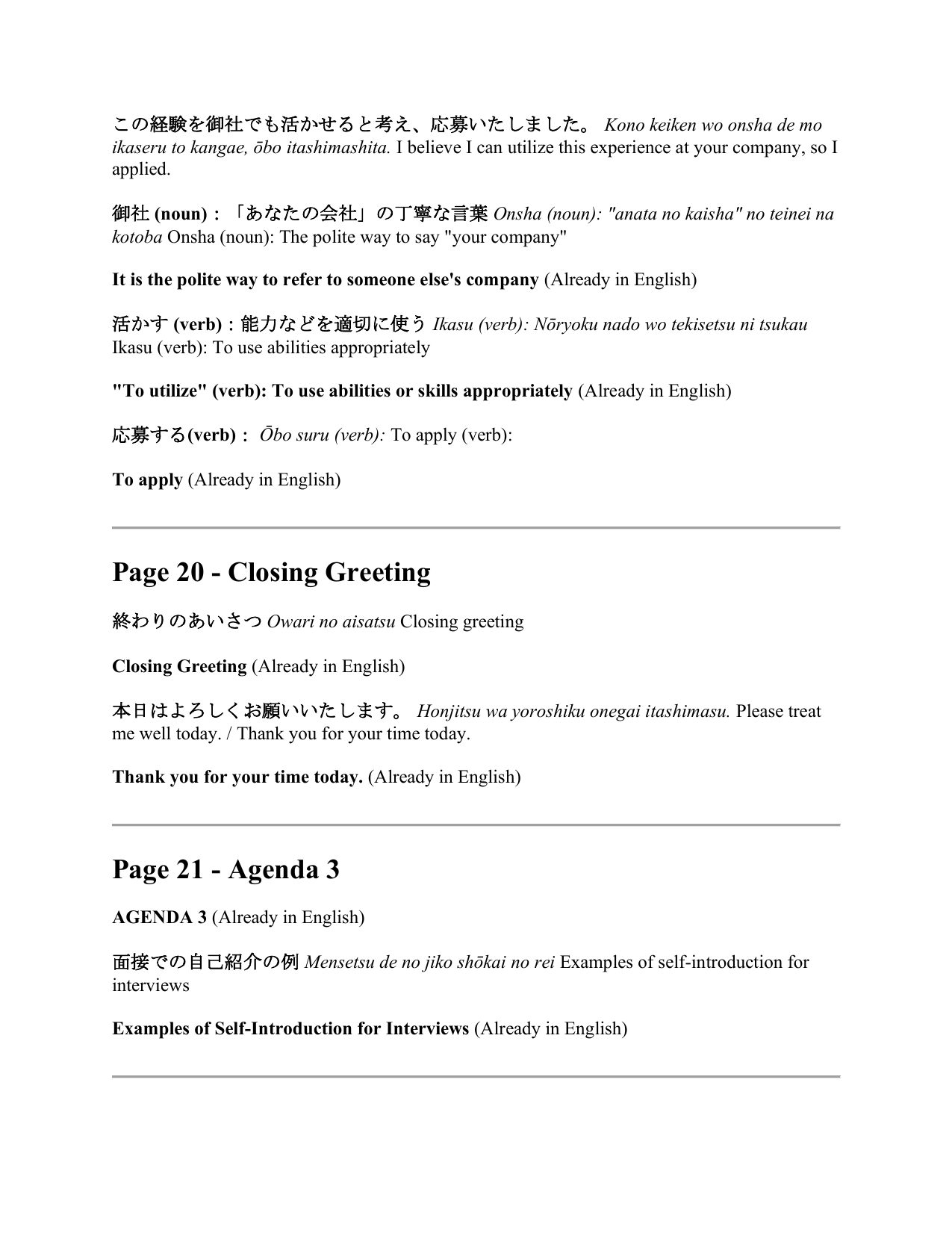
คลิกเพื่อขยาย
JPこの経験を御社でも活かせると考え、応募いたしました。Konokeikenwoonshademo
ENikaseru to kangae, ōbo itashimashita. I believe I can utilize this experience at your company, so I
applied.
御社 (noun):「あなたの会社」の丁寧な言葉 Onsha (noun): "anata no kaisha" no teinei na
kotoba Onsha (noun): The polite way to say "your company"
It is the polite way to refer to someone else's company (Already in English)
活かす (verb):能力などを適切に使う Ikasu (verb): Nōryoku nado wo tekisetsu ni tsukau
Ikasu (verb): To use abilities appropriately
"To utilize" (verb): To use abilities or skills appropriately (Already in English)
応募する(verb): Ōbo suru (verb): To apply (verb):
To apply (Already in English)
Page 20 - Closing Greeting
終わりのあいさつ Owari no aisatsu Closing greeting
Closing Greeting (Already in English)
本日はよろしくお願いいたします。 Honjitsu wa yoroshiku onegai itashimasu. Please treat
me well today. / Thank you for your time today.
Thank you for your time today. (Already in English)
Page 21 - Agenda 3
AGENDA 3 (Already in English)
面接での自己紹介の例 Mensetsu de no jiko shōkai no rei Examples of self-introduction for
interviews
Examples of Self-Introduction for Interviews (Already in English)
applied.
御社 (noun):「あなたの会社」の丁寧な言葉 Onsha (noun): "anata no kaisha" no teinei na
kotoba Onsha (noun): The polite way to say "your company"
It is the polite way to refer to someone else's company (Already in English)
活かす (verb):能力などを適切に使う Ikasu (verb): Nōryoku nado wo tekisetsu ni tsukau
Ikasu (verb): To use abilities appropriately
"To utilize" (verb): To use abilities or skills appropriately (Already in English)
応募する(verb): Ōbo suru (verb): To apply (verb):
To apply (Already in English)
Page 20 - Closing Greeting
終わりのあいさつ Owari no aisatsu Closing greeting
Closing Greeting (Already in English)
本日はよろしくお願いいたします。 Honjitsu wa yoroshiku onegai itashimasu. Please treat
me well today. / Thank you for your time today.
Thank you for your time today. (Already in English)
Page 21 - Agenda 3
AGENDA 3 (Already in English)
面接での自己紹介の例 Mensetsu de no jiko shōkai no rei Examples of self-introduction for
interviews
Examples of Self-Introduction for Interviews (Already in English)
หน้า 106
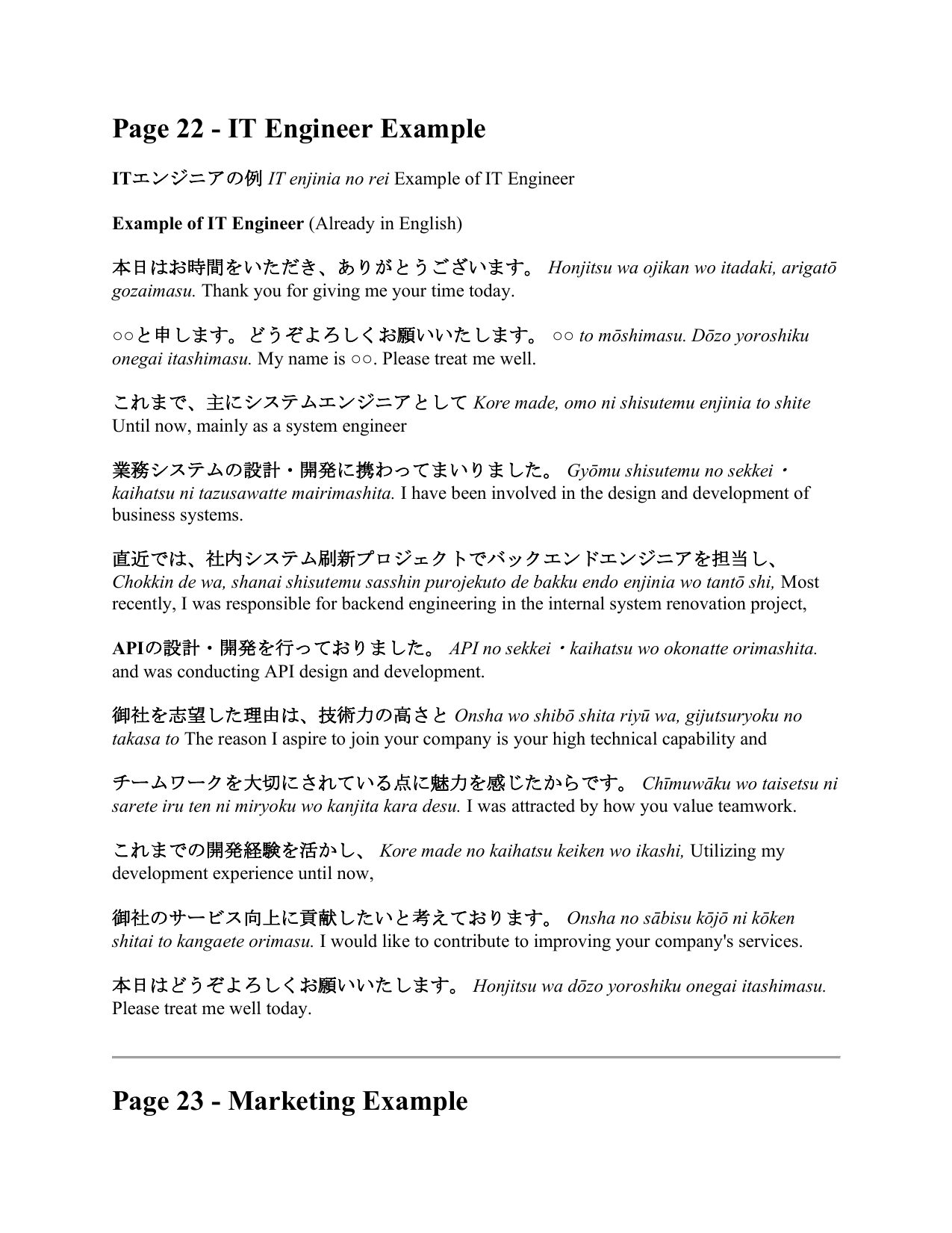
คลิกเพื่อขยาย
ENPage 22 - IT Engineer Example
ITエンジニアの例 IT enjinia no rei Example of IT Engineer
Example of IT Engineer (Already in English)
本日はお時間をいただき、ありがとうございます。 Honjitsu wa ojikan wo itadaki, arigatō
gozaimasu. Thank you for giving me your time today.
○○と申します。どうぞよろしくお願いいたします。 ○○ to mōshimasu. Dōzo yoroshiku
onegai itashimasu. My name is ○○. Please treat me well.
これまで、主にシステムエンジニアとして Kore made, omo ni shisutemu enjinia to shite
Until now, mainly as a system engineer
ITエンジニアの例 IT enjinia no rei Example of IT Engineer
Example of IT Engineer (Already in English)
本日はお時間をいただき、ありがとうございます。 Honjitsu wa ojikan wo itadaki, arigatō
gozaimasu. Thank you for giving me your time today.
○○と申します。どうぞよろしくお願いいたします。 ○○ to mōshimasu. Dōzo yoroshiku
onegai itashimasu. My name is ○○. Please treat me well.
これまで、主にシステムエンジニアとして Kore made, omo ni shisutemu enjinia to shite
Until now, mainly as a system engineer
JP業務システムの設計・開発に携わってまいりました。Gyōmushisutemunosekkei・
ENkaihatsu ni tazusawatte mairimashita. I have been involved in the design and development of
business systems.
business systems.
JP直近では、社内システム刷新プロジェクトでバックエンドエンジニアを担当し、
ENChokkin de wa, shanai shisutemu sasshin purojekuto de bakku endo enjinia wo tantō shi, Most
recently, I was responsible for backend engineering in the internal system renovation project,
APIの設計・開発を行っておりました。 API no sekkei・kaihatsu wo okonatte orimashita.
and was conducting API design and development.
御社を志望した理由は、技術力の高さと Onsha wo shibō shita riyū wa, gijutsuryoku no
takasa to The reason I aspire to join your company is your high technical capability and
recently, I was responsible for backend engineering in the internal system renovation project,
APIの設計・開発を行っておりました。 API no sekkei・kaihatsu wo okonatte orimashita.
and was conducting API design and development.
御社を志望した理由は、技術力の高さと Onsha wo shibō shita riyū wa, gijutsuryoku no
takasa to The reason I aspire to join your company is your high technical capability and
JPチームワークを大切にされている点に魅力を感じたからです。Chīmuwākuwotaisetsuni
ENsarete iru ten ni miryoku wo kanjita kara desu. I was attracted by how you value teamwork.
これまでの開発経験を活かし、 Kore made no kaihatsu keiken wo ikashi, Utilizing my
development experience until now,
御社のサービス向上に貢献したいと考えております。 Onsha no sābisu kōjō ni kōken
shitai to kangaete orimasu. I would like to contribute to improving your company's services.
本日はどうぞよろしくお願いいたします。 Honjitsu wa dōzo yoroshiku onegai itashimasu.
Please treat me well today.
Page 23 - Marketing Example
これまでの開発経験を活かし、 Kore made no kaihatsu keiken wo ikashi, Utilizing my
development experience until now,
御社のサービス向上に貢献したいと考えております。 Onsha no sābisu kōjō ni kōken
shitai to kangaete orimasu. I would like to contribute to improving your company's services.
本日はどうぞよろしくお願いいたします。 Honjitsu wa dōzo yoroshiku onegai itashimasu.
Please treat me well today.
Page 23 - Marketing Example
หน้า 107
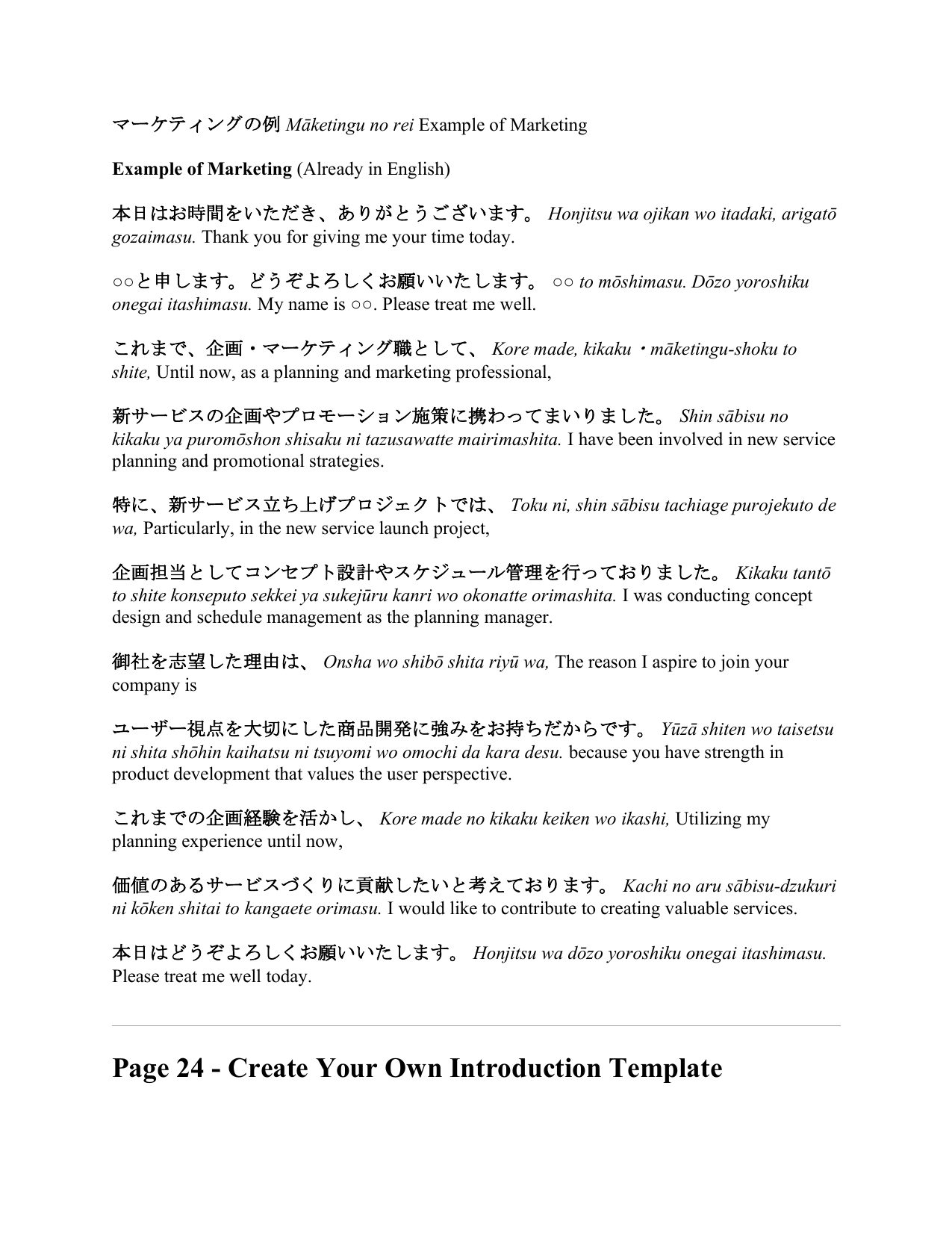
คลิกเพื่อขยาย
ENマーケティングの例 Māketingu no rei Example of Marketing
Example of Marketing (Already in English)
本日はお時間をいただき、ありがとうございます。 Honjitsu wa ojikan wo itadaki, arigatō
gozaimasu. Thank you for giving me your time today.
○○と申します。どうぞよろしくお願いいたします。 ○○ to mōshimasu. Dōzo yoroshiku
onegai itashimasu. My name is ○○. Please treat me well.
これまで、企画・マーケティング職として、 Kore made, kikaku・māketingu-shoku to
shite, Until now, as a planning and marketing professional,
Example of Marketing (Already in English)
本日はお時間をいただき、ありがとうございます。 Honjitsu wa ojikan wo itadaki, arigatō
gozaimasu. Thank you for giving me your time today.
○○と申します。どうぞよろしくお願いいたします。 ○○ to mōshimasu. Dōzo yoroshiku
onegai itashimasu. My name is ○○. Please treat me well.
これまで、企画・マーケティング職として、 Kore made, kikaku・māketingu-shoku to
shite, Until now, as a planning and marketing professional,
JP新サービスの企画やプロモーション施策に携わってまいりました。Shinsābisuno
ENkikaku ya puromōshon shisaku ni tazusawatte mairimashita. I have been involved in new service
planning and promotional strategies.
特に、新サービス立ち上げプロジェクトでは、 Toku ni, shin sābisu tachiage purojekuto de
wa, Particularly, in the new service launch project,
planning and promotional strategies.
特に、新サービス立ち上げプロジェクトでは、 Toku ni, shin sābisu tachiage purojekuto de
wa, Particularly, in the new service launch project,
JP企画担当としてコンセプト設計やスケジュール管理を行っておりました。Kikakutantō
ENto shite konseputo sekkei ya sukejūru kanri wo okonatte orimashita. I was conducting concept
design and schedule management as the planning manager.
御社を志望した理由は、 Onsha wo shibō shita riyū wa, The reason I aspire to join your
company is
design and schedule management as the planning manager.
御社を志望した理由は、 Onsha wo shibō shita riyū wa, The reason I aspire to join your
company is
JPユーザー視点を大切にした商品開発に強みをお持ちだからです。Yūzāshitenwotaisetsu
ENni shita shōhin kaihatsu ni tsuyomi wo omochi da kara desu. because you have strength in
product development that values the user perspective.
これまでの企画経験を活かし、 Kore made no kikaku keiken wo ikashi, Utilizing my
planning experience until now,
product development that values the user perspective.
これまでの企画経験を活かし、 Kore made no kikaku keiken wo ikashi, Utilizing my
planning experience until now,
JP価値のあるサービスづくりに貢献したいと考えております。Kachinoarusābisu-dzukuri
ENni kōken shitai to kangaete orimasu. I would like to contribute to creating valuable services.
本日はどうぞよろしくお願いいたします。 Honjitsu wa dōzo yoroshiku onegai itashimasu.
Please treat me well today.
Page 24 - Create Your Own Introduction Template
本日はどうぞよろしくお願いいたします。 Honjitsu wa dōzo yoroshiku onegai itashimasu.
Please treat me well today.
Page 24 - Create Your Own Introduction Template
หน้า 108
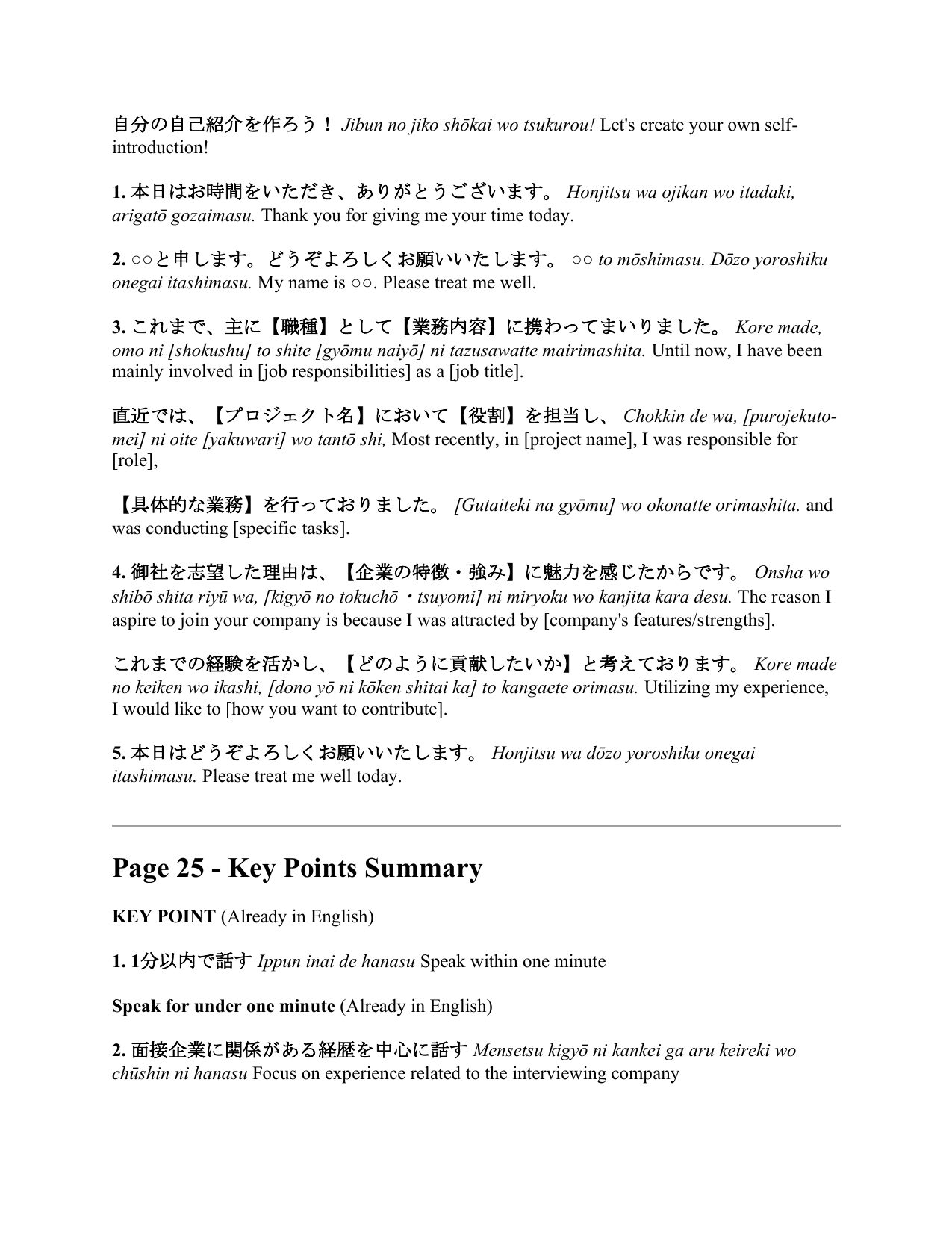
คลิกเพื่อขยาย
EN自分の自己紹介を作ろう! Jibun no jiko shōkai wo tsukurou! Let's create your own self-
introduction!
1. 本日はお時間をいただき、ありがとうございます。 Honjitsu wa ojikan wo itadaki,
arigatō gozaimasu. Thank you for giving me your time today.
2. ○○と申します。どうぞよろしくお願いいたします。 ○○ to mōshimasu. Dōzo yoroshiku
onegai itashimasu. My name is ○○. Please treat me well.
introduction!
1. 本日はお時間をいただき、ありがとうございます。 Honjitsu wa ojikan wo itadaki,
arigatō gozaimasu. Thank you for giving me your time today.
2. ○○と申します。どうぞよろしくお願いいたします。 ○○ to mōshimasu. Dōzo yoroshiku
onegai itashimasu. My name is ○○. Please treat me well.
JP3.これまで、主に【職種】として【業務内容】に携わってまいりました。Koremade,
ENomo ni [shokushu] to shite [gyōmu naiyō] ni tazusawatte mairimashita. Until now, I have been
mainly involved in [job responsibilities] as a [job title].
mainly involved in [job responsibilities] as a [job title].
JP直近では、【プロジェクト名】において【役割】を担当し、Chokkindewa,[purojekuto-
ENmei] ni oite [yakuwari] wo tantō shi, Most recently, in [project name], I was responsible for
[role],
【具体的な業務】を行っておりました。 [Gutaiteki na gyōmu] wo okonatte orimashita. and
was conducting [specific tasks].
[role],
【具体的な業務】を行っておりました。 [Gutaiteki na gyōmu] wo okonatte orimashita. and
was conducting [specific tasks].
JP4.御社を志望した理由は、【企業の特徴・強み】に魅力を感じたからです。Onshawo
ENshibō shita riyū wa, [kigyō no tokuchō・tsuyomi] ni miryoku wo kanjita kara desu. The reason I
aspire to join your company is because I was attracted by [company's features/strengths].
aspire to join your company is because I was attracted by [company's features/strengths].
JPこれまでの経験を活かし、【どのように貢献したいか】と考えております。Koremade
ENno keiken wo ikashi, [dono yō ni kōken shitai ka] to kangaete orimasu. Utilizing my experience,
I would like to [how you want to contribute].
5. 本日はどうぞよろしくお願いいたします。 Honjitsu wa dōzo yoroshiku onegai
itashimasu. Please treat me well today.
Page 25 - Key Points Summary
KEY POINT (Already in English)
1. 1分以内で話す Ippun inai de hanasu Speak within one minute
Speak for under one minute (Already in English)
2. 面接企業に関係がある経歴を中心に話す Mensetsu kigyō ni kankei ga aru keireki wo
chūshin ni hanasu Focus on experience related to the interviewing company
I would like to [how you want to contribute].
5. 本日はどうぞよろしくお願いいたします。 Honjitsu wa dōzo yoroshiku onegai
itashimasu. Please treat me well today.
Page 25 - Key Points Summary
KEY POINT (Already in English)
1. 1分以内で話す Ippun inai de hanasu Speak within one minute
Speak for under one minute (Already in English)
2. 面接企業に関係がある経歴を中心に話す Mensetsu kigyō ni kankei ga aru keireki wo
chūshin ni hanasu Focus on experience related to the interviewing company
หน้า 109
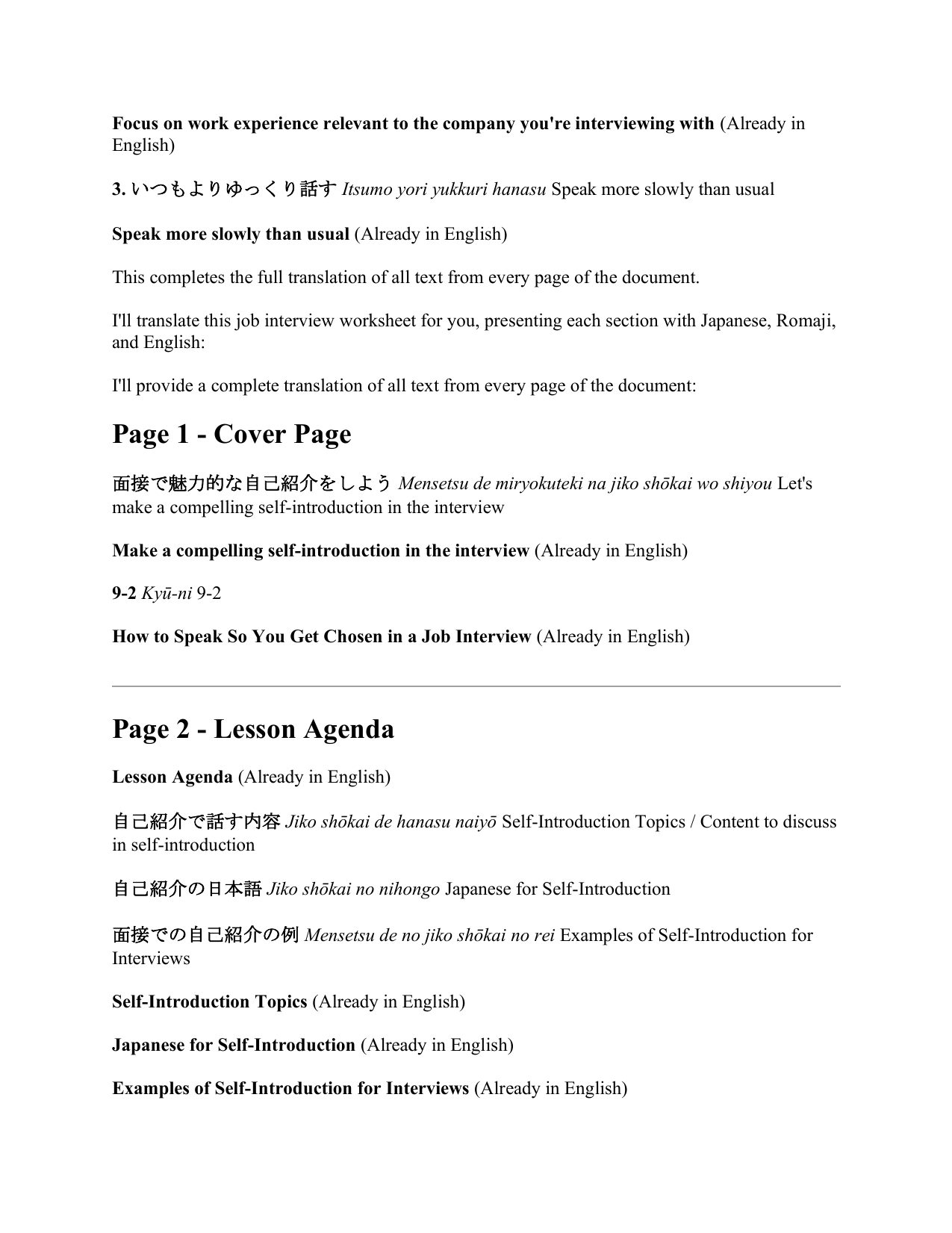
คลิกเพื่อขยาย
ENFocus on work experience relevant to the company you're interviewing with (Already in
English)
3. いつもよりゆっくり話す Itsumo yori yukkuri hanasu Speak more slowly than usual
Speak more slowly than usual (Already in English)
This completes the full translation of all text from every page of the document.
I'll translate this job interview worksheet for you, presenting each section with Japanese, Romaji,
and English:
I'll provide a complete translation of all text from every page of the document:
Page 1 - Cover Page
面接で魅力的な自己紹介をしよう Mensetsu de miryokuteki na jiko shōkai wo shiyou Let's
make a compelling self-introduction in the interview
Make a compelling self-introduction in the interview (Already in English)
9-2 Kyū-ni 9-2
How to Speak So You Get Chosen in a Job Interview (Already in English)
Page 2 - Lesson Agenda
Lesson Agenda (Already in English)
自己紹介で話す内容 Jiko shōkai de hanasu naiyō Self-Introduction Topics / Content to discuss
in self-introduction
自己紹介の日本語 Jiko shōkai no nihongo Japanese for Self-Introduction
面接での自己紹介の例 Mensetsu de no jiko shōkai no rei Examples of Self-Introduction for
Interviews
Self-Introduction Topics (Already in English)
Japanese for Self-Introduction (Already in English)
Examples of Self-Introduction for Interviews (Already in English)
English)
3. いつもよりゆっくり話す Itsumo yori yukkuri hanasu Speak more slowly than usual
Speak more slowly than usual (Already in English)
This completes the full translation of all text from every page of the document.
I'll translate this job interview worksheet for you, presenting each section with Japanese, Romaji,
and English:
I'll provide a complete translation of all text from every page of the document:
Page 1 - Cover Page
面接で魅力的な自己紹介をしよう Mensetsu de miryokuteki na jiko shōkai wo shiyou Let's
make a compelling self-introduction in the interview
Make a compelling self-introduction in the interview (Already in English)
9-2 Kyū-ni 9-2
How to Speak So You Get Chosen in a Job Interview (Already in English)
Page 2 - Lesson Agenda
Lesson Agenda (Already in English)
自己紹介で話す内容 Jiko shōkai de hanasu naiyō Self-Introduction Topics / Content to discuss
in self-introduction
自己紹介の日本語 Jiko shōkai no nihongo Japanese for Self-Introduction
面接での自己紹介の例 Mensetsu de no jiko shōkai no rei Examples of Self-Introduction for
Interviews
Self-Introduction Topics (Already in English)
Japanese for Self-Introduction (Already in English)
Examples of Self-Introduction for Interviews (Already in English)
หน้า 110
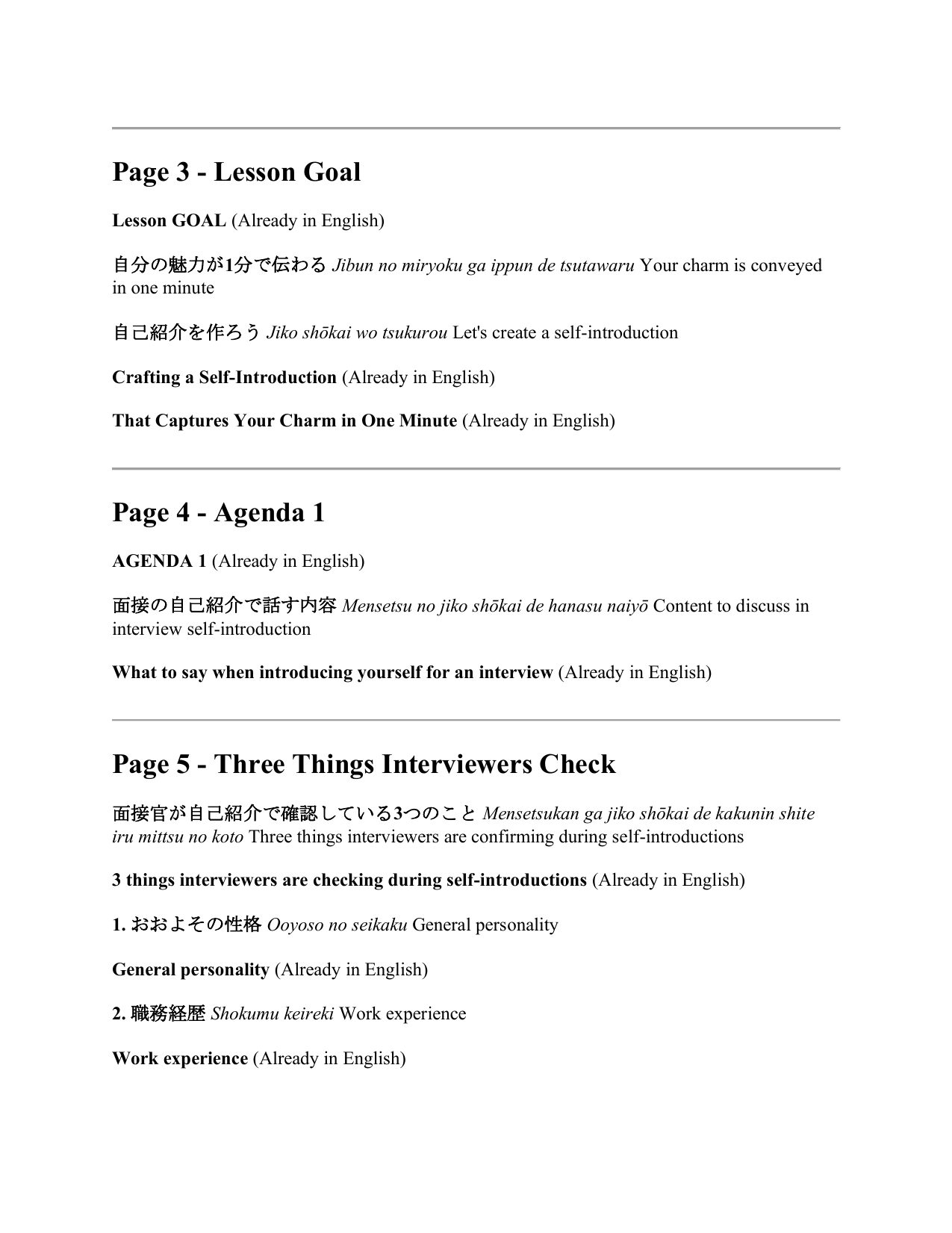
คลิกเพื่อขยาย
ENPage 3 - Lesson Goal
Lesson GOAL (Already in English)
自分の魅力が1分で伝わる Jibun no miryoku ga ippun de tsutawaru Your charm is conveyed
in one minute
自己紹介を作ろう Jiko shōkai wo tsukurou Let's create a self-introduction
Crafting a Self-Introduction (Already in English)
That Captures Your Charm in One Minute (Already in English)
Page 4 - Agenda 1
AGENDA 1 (Already in English)
面接の自己紹介で話す内容 Mensetsu no jiko shōkai de hanasu naiyō Content to discuss in
interview self-introduction
What to say when introducing yourself for an interview (Already in English)
Page 5 - Three Things Interviewers Check
面接官が自己紹介で確認している3つのこと Mensetsukan ga jiko shōkai de kakunin shite
iru mittsu no koto Three things interviewers are confirming during self-introductions
3 things interviewers are checking during self-introductions (Already in English)
1. おおよその性格 Ooyoso no seikaku General personality
General personality (Already in English)
2. 職務経歴 Shokumu keireki Work experience
Work experience (Already in English)
Lesson GOAL (Already in English)
自分の魅力が1分で伝わる Jibun no miryoku ga ippun de tsutawaru Your charm is conveyed
in one minute
自己紹介を作ろう Jiko shōkai wo tsukurou Let's create a self-introduction
Crafting a Self-Introduction (Already in English)
That Captures Your Charm in One Minute (Already in English)
Page 4 - Agenda 1
AGENDA 1 (Already in English)
面接の自己紹介で話す内容 Mensetsu no jiko shōkai de hanasu naiyō Content to discuss in
interview self-introduction
What to say when introducing yourself for an interview (Already in English)
Page 5 - Three Things Interviewers Check
面接官が自己紹介で確認している3つのこと Mensetsukan ga jiko shōkai de kakunin shite
iru mittsu no koto Three things interviewers are confirming during self-introductions
3 things interviewers are checking during self-introductions (Already in English)
1. おおよその性格 Ooyoso no seikaku General personality
General personality (Already in English)
2. 職務経歴 Shokumu keireki Work experience
Work experience (Already in English)
หน้า 111
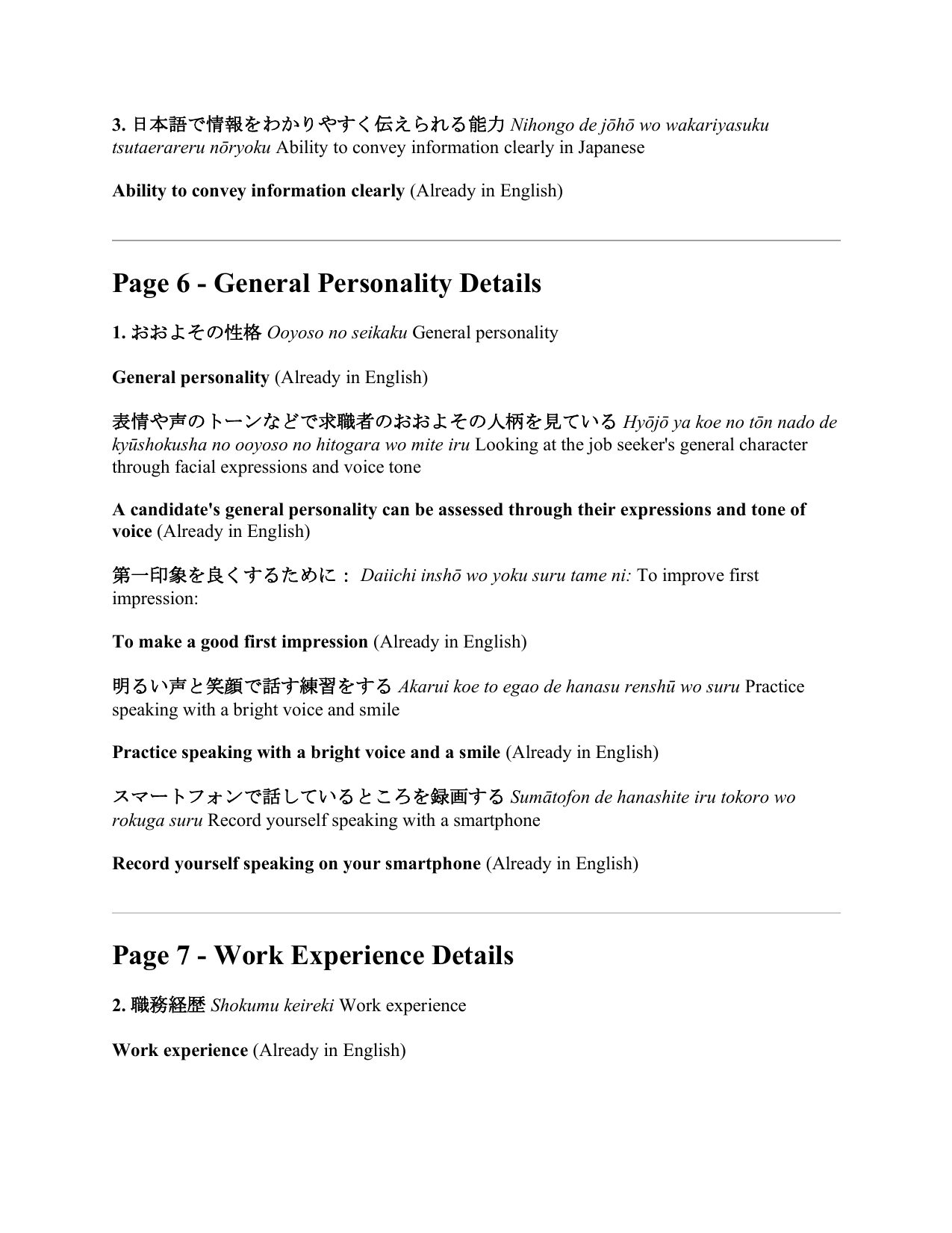
คลิกเพื่อขยาย
EN3. 日本語で情報をわかりやすく伝えられる能力 Nihongo de jōhō wo wakariyasuku
tsutaerareru nōryoku Ability to convey information clearly in Japanese
Ability to convey information clearly (Already in English)
Page 6 - General Personality Details
1. おおよその性格 Ooyoso no seikaku General personality
General personality (Already in English)
tsutaerareru nōryoku Ability to convey information clearly in Japanese
Ability to convey information clearly (Already in English)
Page 6 - General Personality Details
1. おおよその性格 Ooyoso no seikaku General personality
General personality (Already in English)
JP表情や声のトーンなどで求職者のおおよその人柄を見ているHyōjōyakoenotōnnadode
ENkyūshokusha no ooyoso no hitogara wo mite iru Looking at the job seeker's general character
through facial expressions and voice tone
A candidate's general personality can be assessed through their expressions and tone of
voice (Already in English)
第一印象を良くするために: Daiichi inshō wo yoku suru tame ni: To improve first
impression:
To make a good first impression (Already in English)
明るい声と笑顔で話す練習をする Akarui koe to egao de hanasu renshū wo suru Practice
speaking with a bright voice and smile
Practice speaking with a bright voice and a smile (Already in English)
スマートフォンで話しているところを録画する Sumātofon de hanashite iru tokoro wo
rokuga suru Record yourself speaking with a smartphone
Record yourself speaking on your smartphone (Already in English)
Page 7 - Work Experience Details
2. 職務経歴 Shokumu keireki Work experience
Work experience (Already in English)
through facial expressions and voice tone
A candidate's general personality can be assessed through their expressions and tone of
voice (Already in English)
第一印象を良くするために: Daiichi inshō wo yoku suru tame ni: To improve first
impression:
To make a good first impression (Already in English)
明るい声と笑顔で話す練習をする Akarui koe to egao de hanasu renshū wo suru Practice
speaking with a bright voice and smile
Practice speaking with a bright voice and a smile (Already in English)
スマートフォンで話しているところを録画する Sumātofon de hanashite iru tokoro wo
rokuga suru Record yourself speaking with a smartphone
Record yourself speaking on your smartphone (Already in English)
Page 7 - Work Experience Details
2. 職務経歴 Shokumu keireki Work experience
Work experience (Already in English)
หน้า 112
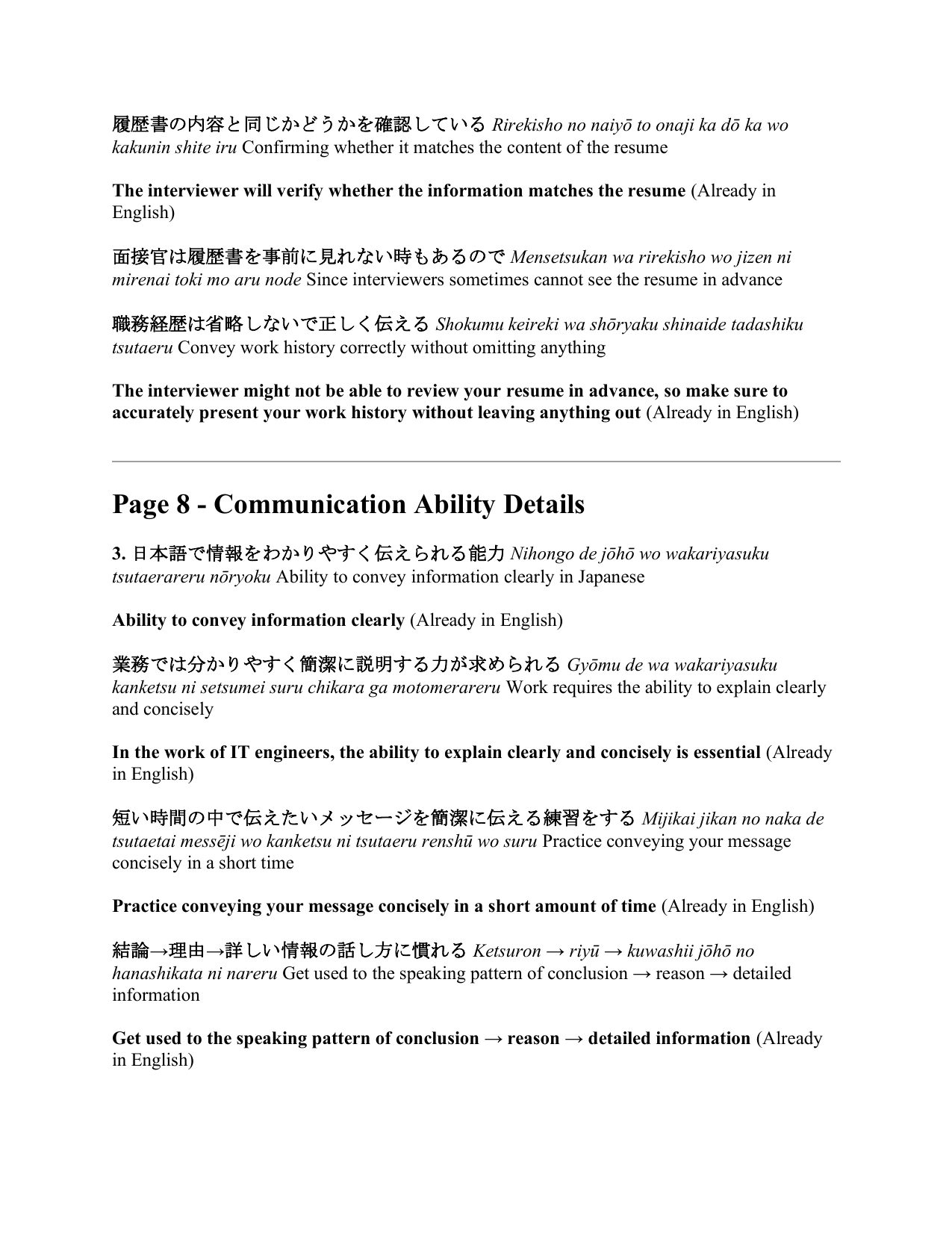
คลิกเพื่อขยาย
EN履歴書の内容と同じかどうかを確認している Rirekisho no naiyō to onaji ka dō ka wo
kakunin shite iru Confirming whether it matches the content of the resume
The interviewer will verify whether the information matches the resume (Already in
English)
面接官は履歴書を事前に見れない時もあるので Mensetsukan wa rirekisho wo jizen ni
mirenai toki mo aru node Since interviewers sometimes cannot see the resume in advance
職務経歴は省略しないで正しく伝える Shokumu keireki wa shōryaku shinaide tadashiku
tsutaeru Convey work history correctly without omitting anything
The interviewer might not be able to review your resume in advance, so make sure to
accurately present your work history without leaving anything out (Already in English)
Page 8 - Communication Ability Details
3. 日本語で情報をわかりやすく伝えられる能力 Nihongo de jōhō wo wakariyasuku
tsutaerareru nōryoku Ability to convey information clearly in Japanese
Ability to convey information clearly (Already in English)
kakunin shite iru Confirming whether it matches the content of the resume
The interviewer will verify whether the information matches the resume (Already in
English)
面接官は履歴書を事前に見れない時もあるので Mensetsukan wa rirekisho wo jizen ni
mirenai toki mo aru node Since interviewers sometimes cannot see the resume in advance
職務経歴は省略しないで正しく伝える Shokumu keireki wa shōryaku shinaide tadashiku
tsutaeru Convey work history correctly without omitting anything
The interviewer might not be able to review your resume in advance, so make sure to
accurately present your work history without leaving anything out (Already in English)
Page 8 - Communication Ability Details
3. 日本語で情報をわかりやすく伝えられる能力 Nihongo de jōhō wo wakariyasuku
tsutaerareru nōryoku Ability to convey information clearly in Japanese
Ability to convey information clearly (Already in English)
JP業務では分かりやすく簡潔に説明する力が求められるGyōmudewawakariyasuku
ENkanketsu ni setsumei suru chikara ga motomerareru Work requires the ability to explain clearly
and concisely
In the work of IT engineers, the ability to explain clearly and concisely is essential (Already
in English)
and concisely
In the work of IT engineers, the ability to explain clearly and concisely is essential (Already
in English)
JP短い時間の中で伝えたいメッセージを簡潔に伝える練習をするMijikaijikannonakade
ENtsutaetai messēji wo kanketsu ni tsutaeru renshū wo suru Practice conveying your message
concisely in a short time
Practice conveying your message concisely in a short amount of time (Already in English)
結論→理由→詳しい情報の話し方に慣れる Ketsuron → riyū → kuwashii jōhō no
hanashikata ni nareru Get used to the speaking pattern of conclusion → reason → detailed
information
Get used to the speaking pattern of conclusion → reason → detailed information (Already
in English)
concisely in a short time
Practice conveying your message concisely in a short amount of time (Already in English)
結論→理由→詳しい情報の話し方に慣れる Ketsuron → riyū → kuwashii jōhō no
hanashikata ni nareru Get used to the speaking pattern of conclusion → reason → detailed
information
Get used to the speaking pattern of conclusion → reason → detailed information (Already
in English)
หน้า 113
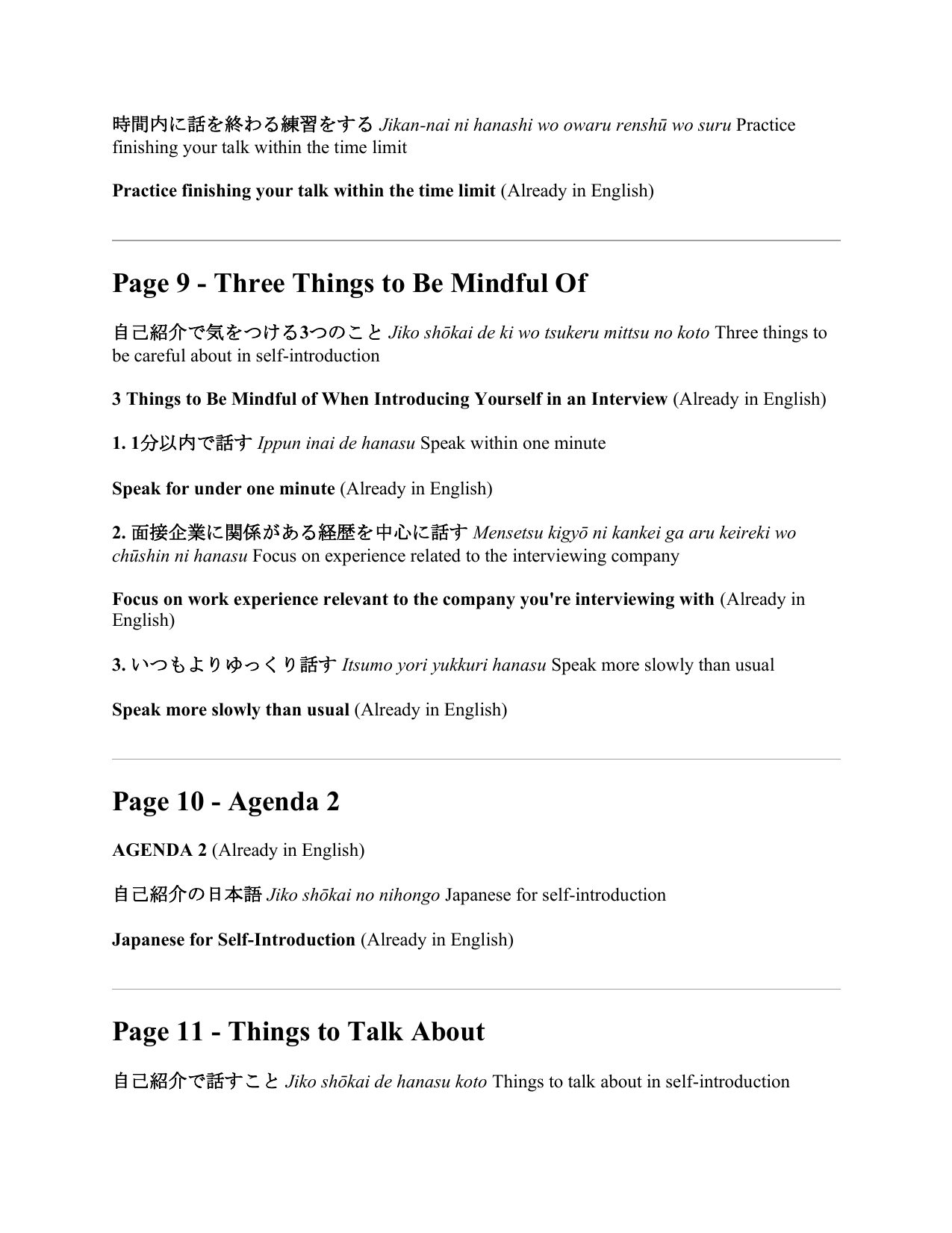
คลิกเพื่อขยาย
EN時間内に話を終わる練習をする Jikan-nai ni hanashi wo owaru renshū wo suru Practice
finishing your talk within the time limit
Practice finishing your talk within the time limit (Already in English)
Page 9 - Three Things to Be Mindful Of
自己紹介で気をつける3つのこと Jiko shōkai de ki wo tsukeru mittsu no koto Three things to
be careful about in self-introduction
3 Things to Be Mindful of When Introducing Yourself in an Interview (Already in English)
1. 1分以内で話す Ippun inai de hanasu Speak within one minute
Speak for under one minute (Already in English)
2. 面接企業に関係がある経歴を中心に話す Mensetsu kigyō ni kankei ga aru keireki wo
chūshin ni hanasu Focus on experience related to the interviewing company
Focus on work experience relevant to the company you're interviewing with (Already in
English)
3. いつもよりゆっくり話す Itsumo yori yukkuri hanasu Speak more slowly than usual
Speak more slowly than usual (Already in English)
Page 10 - Agenda 2
AGENDA 2 (Already in English)
自己紹介の日本語 Jiko shōkai no nihongo Japanese for self-introduction
Japanese for Self-Introduction (Already in English)
Page 11 - Things to Talk About
自己紹介で話すこと Jiko shōkai de hanasu koto Things to talk about in self-introduction
finishing your talk within the time limit
Practice finishing your talk within the time limit (Already in English)
Page 9 - Three Things to Be Mindful Of
自己紹介で気をつける3つのこと Jiko shōkai de ki wo tsukeru mittsu no koto Three things to
be careful about in self-introduction
3 Things to Be Mindful of When Introducing Yourself in an Interview (Already in English)
1. 1分以内で話す Ippun inai de hanasu Speak within one minute
Speak for under one minute (Already in English)
2. 面接企業に関係がある経歴を中心に話す Mensetsu kigyō ni kankei ga aru keireki wo
chūshin ni hanasu Focus on experience related to the interviewing company
Focus on work experience relevant to the company you're interviewing with (Already in
English)
3. いつもよりゆっくり話す Itsumo yori yukkuri hanasu Speak more slowly than usual
Speak more slowly than usual (Already in English)
Page 10 - Agenda 2
AGENDA 2 (Already in English)
自己紹介の日本語 Jiko shōkai no nihongo Japanese for self-introduction
Japanese for Self-Introduction (Already in English)
Page 11 - Things to Talk About
自己紹介で話すこと Jiko shōkai de hanasu koto Things to talk about in self-introduction
หน้า 114
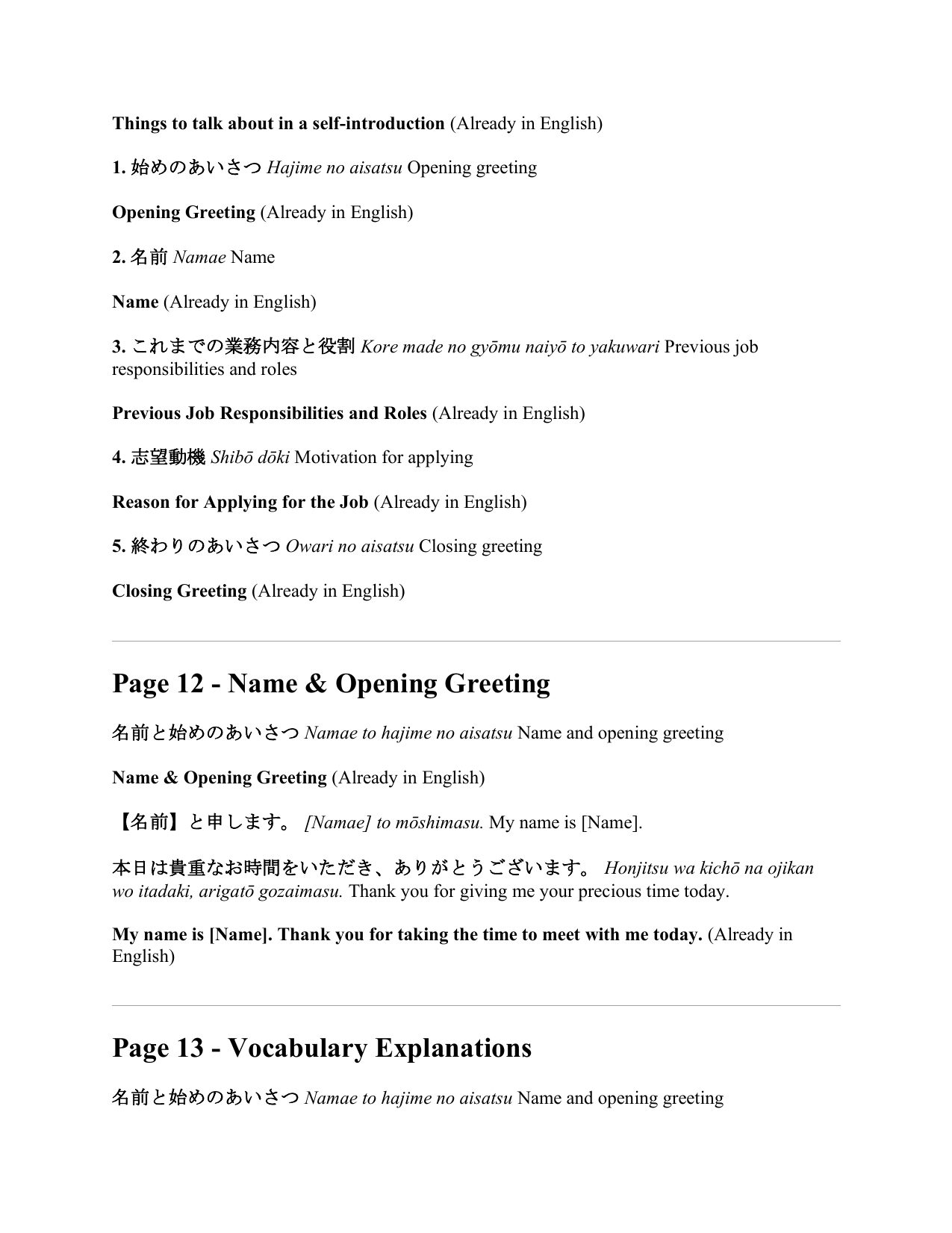
คลิกเพื่อขยาย
ENThings to talk about in a self-introduction (Already in English)
1. 始めのあいさつ Hajime no aisatsu Opening greeting
Opening Greeting (Already in English)
2. 名前 Namae Name
Name (Already in English)
3. これまでの業務内容と役割 Kore made no gyōmu naiyō to yakuwari Previous job
responsibilities and roles
Previous Job Responsibilities and Roles (Already in English)
4. 志望動機 Shibō dōki Motivation for applying
Reason for Applying for the Job (Already in English)
5. 終わりのあいさつ Owari no aisatsu Closing greeting
Closing Greeting (Already in English)
Page 12 - Name & Opening Greeting
名前と始めのあいさつ Namae to hajime no aisatsu Name and opening greeting
Name & Opening Greeting (Already in English)
【名前】と申します。 [Namae] to mōshimasu. My name is [Name].
1. 始めのあいさつ Hajime no aisatsu Opening greeting
Opening Greeting (Already in English)
2. 名前 Namae Name
Name (Already in English)
3. これまでの業務内容と役割 Kore made no gyōmu naiyō to yakuwari Previous job
responsibilities and roles
Previous Job Responsibilities and Roles (Already in English)
4. 志望動機 Shibō dōki Motivation for applying
Reason for Applying for the Job (Already in English)
5. 終わりのあいさつ Owari no aisatsu Closing greeting
Closing Greeting (Already in English)
Page 12 - Name & Opening Greeting
名前と始めのあいさつ Namae to hajime no aisatsu Name and opening greeting
Name & Opening Greeting (Already in English)
【名前】と申します。 [Namae] to mōshimasu. My name is [Name].
JP本日は貴重なお時間をいただき、ありがとうございます。Honjitsuwakichōnaojikan
ENwo itadaki, arigatō gozaimasu. Thank you for giving me your precious time today.
My name is [Name]. Thank you for taking the time to meet with me today. (Already in
English)
Page 13 - Vocabulary Explanations
名前と始めのあいさつ Namae to hajime no aisatsu Name and opening greeting
My name is [Name]. Thank you for taking the time to meet with me today. (Already in
English)
Page 13 - Vocabulary Explanations
名前と始めのあいさつ Namae to hajime no aisatsu Name and opening greeting
หน้า 115
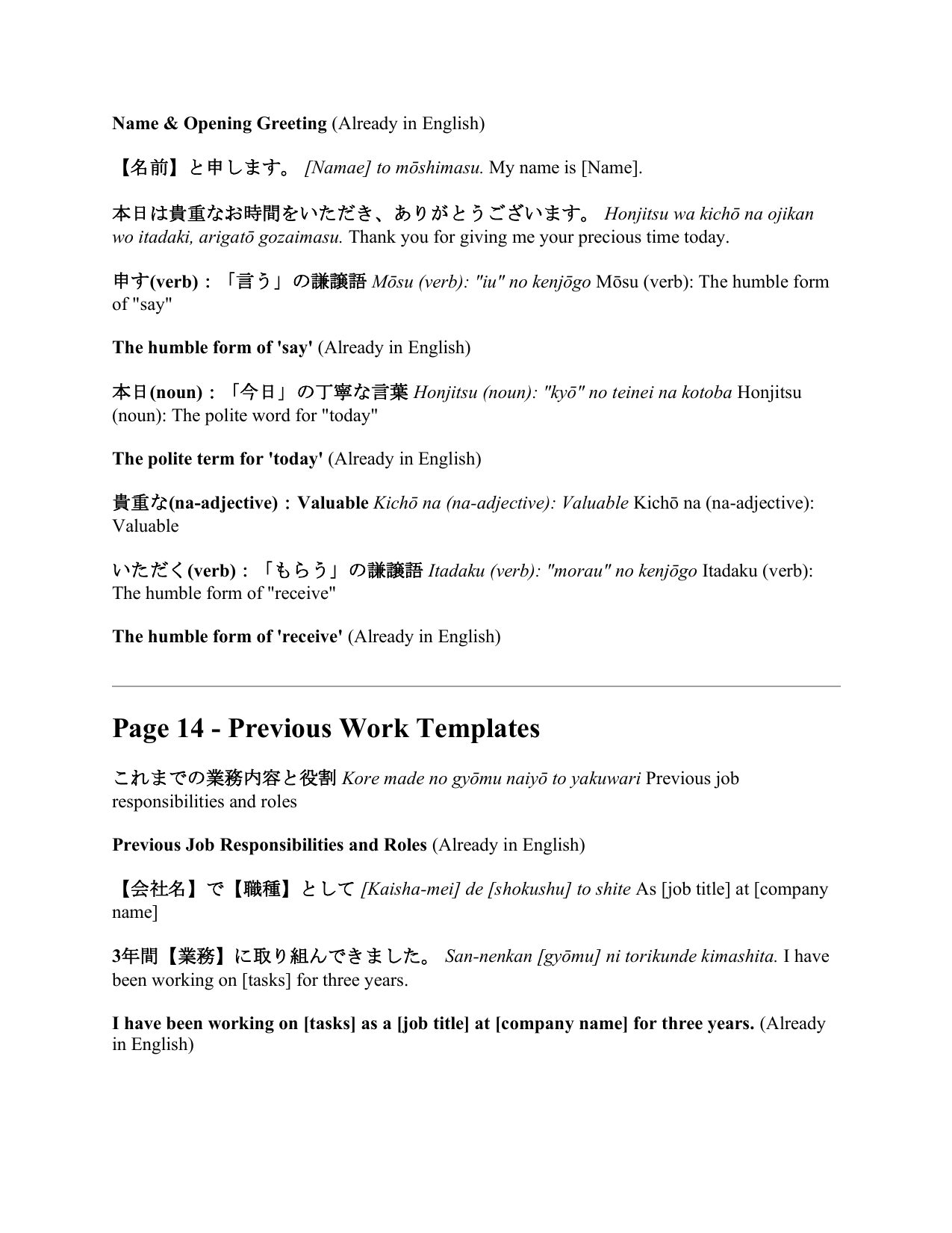
คลิกเพื่อขยาย
ENName & Opening Greeting (Already in English)
【名前】と申します。 [Namae] to mōshimasu. My name is [Name].
【名前】と申します。 [Namae] to mōshimasu. My name is [Name].
JP本日は貴重なお時間をいただき、ありがとうございます。Honjitsuwakichōnaojikan
ENwo itadaki, arigatō gozaimasu. Thank you for giving me your precious time today.
申す(verb):「言う」の謙譲語 Mōsu (verb): "iu" no kenjōgo Mōsu (verb): The humble form
of "say"
The humble form of 'say' (Already in English)
本日(noun):「今日」の丁寧な言葉 Honjitsu (noun): "kyō" no teinei na kotoba Honjitsu
(noun): The polite word for "today"
The polite term for 'today' (Already in English)
貴重な(na-adjective):Valuable Kichō na (na-adjective): Valuable Kichō na (na-adjective):
Valuable
いただく(verb):「もらう」の謙譲語 Itadaku (verb): "morau" no kenjōgo Itadaku (verb):
The humble form of "receive"
The humble form of 'receive' (Already in English)
Page 14 - Previous Work Templates
これまでの業務内容と役割 Kore made no gyōmu naiyō to yakuwari Previous job
responsibilities and roles
Previous Job Responsibilities and Roles (Already in English)
【会社名】で【職種】として [Kaisha-mei] de [shokushu] to shite As [job title] at [company
name]
3年間【業務】に取り組んできました。 San-nenkan [gyōmu] ni torikunde kimashita. I have
been working on [tasks] for three years.
I have been working on [tasks] as a [job title] at [company name] for three years. (Already
in English)
申す(verb):「言う」の謙譲語 Mōsu (verb): "iu" no kenjōgo Mōsu (verb): The humble form
of "say"
The humble form of 'say' (Already in English)
本日(noun):「今日」の丁寧な言葉 Honjitsu (noun): "kyō" no teinei na kotoba Honjitsu
(noun): The polite word for "today"
The polite term for 'today' (Already in English)
貴重な(na-adjective):Valuable Kichō na (na-adjective): Valuable Kichō na (na-adjective):
Valuable
いただく(verb):「もらう」の謙譲語 Itadaku (verb): "morau" no kenjōgo Itadaku (verb):
The humble form of "receive"
The humble form of 'receive' (Already in English)
Page 14 - Previous Work Templates
これまでの業務内容と役割 Kore made no gyōmu naiyō to yakuwari Previous job
responsibilities and roles
Previous Job Responsibilities and Roles (Already in English)
【会社名】で【職種】として [Kaisha-mei] de [shokushu] to shite As [job title] at [company
name]
3年間【業務】に取り組んできました。 San-nenkan [gyōmu] ni torikunde kimashita. I have
been working on [tasks] for three years.
I have been working on [tasks] as a [job title] at [company name] for three years. (Already
in English)
หน้า 116
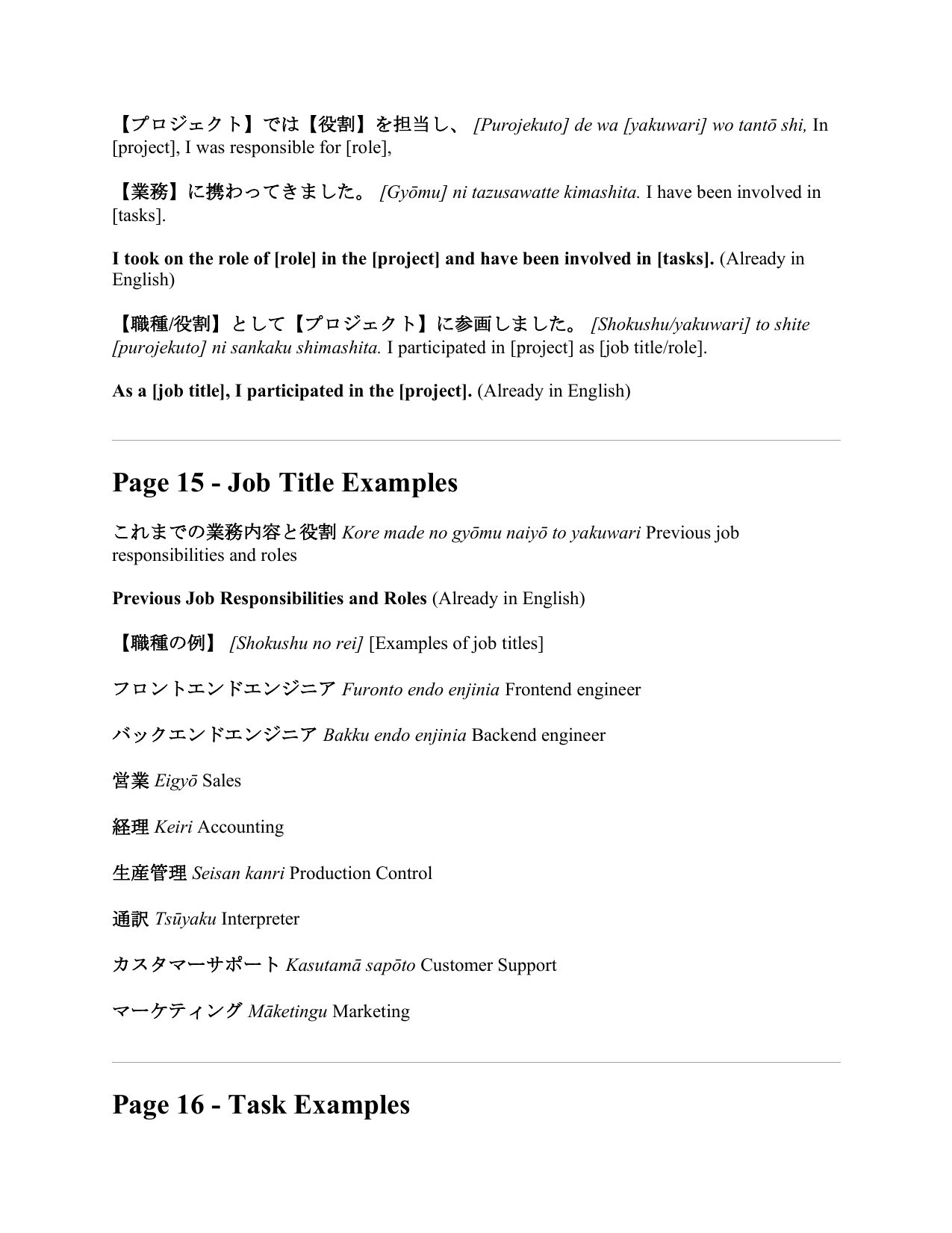
คลิกเพื่อขยาย
EN【プロジェクト】では【役割】を担当し、 [Purojekuto] de wa [yakuwari] wo tantō shi, In
[project], I was responsible for [role],
【業務】に携わってきました。 [Gyōmu] ni tazusawatte kimashita. I have been involved in
[tasks].
I took on the role of [role] in the [project] and have been involved in [tasks]. (Already in
English)
【職種/役割】として【プロジェクト】に参画しました。 [Shokushu/yakuwari] to shite
[purojekuto] ni sankaku shimashita. I participated in [project] as [job title/role].
As a [job title], I participated in the [project]. (Already in English)
Page 15 - Job Title Examples
これまでの業務内容と役割 Kore made no gyōmu naiyō to yakuwari Previous job
responsibilities and roles
Previous Job Responsibilities and Roles (Already in English)
【職種の例】 [Shokushu no rei] [Examples of job titles]
フロントエンドエンジニア Furonto endo enjinia Frontend engineer
バックエンドエンジニア Bakku endo enjinia Backend engineer
営業 Eigyō Sales
経理 Keiri Accounting
生産管理 Seisan kanri Production Control
通訳 Tsūyaku Interpreter
カスタマーサポート Kasutamā sapōto Customer Support
マーケティング Māketingu Marketing
Page 16 - Task Examples
[project], I was responsible for [role],
【業務】に携わってきました。 [Gyōmu] ni tazusawatte kimashita. I have been involved in
[tasks].
I took on the role of [role] in the [project] and have been involved in [tasks]. (Already in
English)
【職種/役割】として【プロジェクト】に参画しました。 [Shokushu/yakuwari] to shite
[purojekuto] ni sankaku shimashita. I participated in [project] as [job title/role].
As a [job title], I participated in the [project]. (Already in English)
Page 15 - Job Title Examples
これまでの業務内容と役割 Kore made no gyōmu naiyō to yakuwari Previous job
responsibilities and roles
Previous Job Responsibilities and Roles (Already in English)
【職種の例】 [Shokushu no rei] [Examples of job titles]
フロントエンドエンジニア Furonto endo enjinia Frontend engineer
バックエンドエンジニア Bakku endo enjinia Backend engineer
営業 Eigyō Sales
経理 Keiri Accounting
生産管理 Seisan kanri Production Control
通訳 Tsūyaku Interpreter
カスタマーサポート Kasutamā sapōto Customer Support
マーケティング Māketingu Marketing
Page 16 - Task Examples
หน้า 117
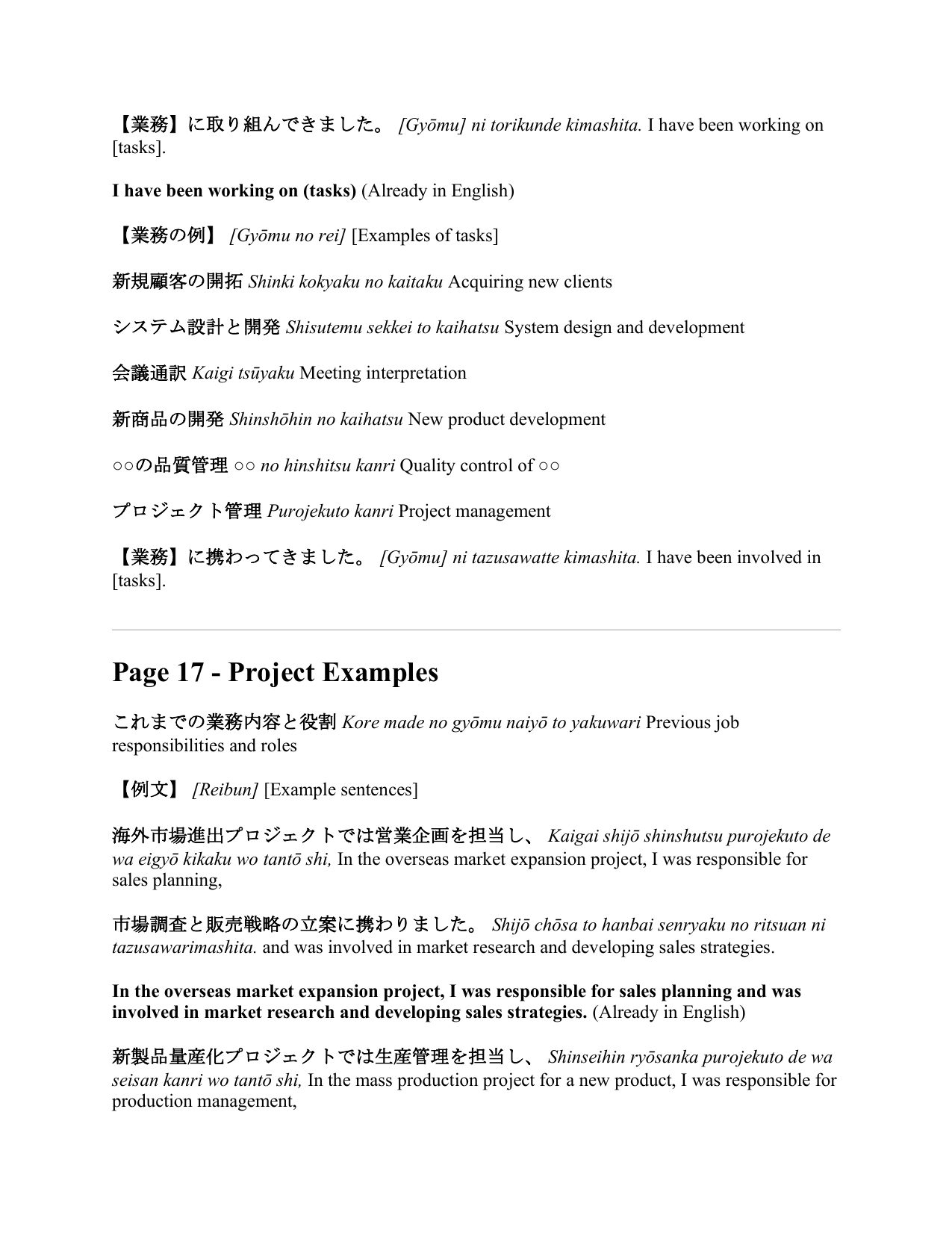
คลิกเพื่อขยาย
EN【業務】に取り組んできました。 [Gyōmu] ni torikunde kimashita. I have been working on
[tasks].
I have been working on (tasks) (Already in English)
【業務の例】 [Gyōmu no rei] [Examples of tasks]
新規顧客の開拓 Shinki kokyaku no kaitaku Acquiring new clients
システム設計と開発 Shisutemu sekkei to kaihatsu System design and development
会議通訳 Kaigi tsūyaku Meeting interpretation
新商品の開発 Shinshōhin no kaihatsu New product development
○○の品質管理 ○○ no hinshitsu kanri Quality control of ○○
プロジェクト管理 Purojekuto kanri Project management
【業務】に携わってきました。 [Gyōmu] ni tazusawatte kimashita. I have been involved in
[tasks].
Page 17 - Project Examples
これまでの業務内容と役割 Kore made no gyōmu naiyō to yakuwari Previous job
responsibilities and roles
【例文】 [Reibun] [Example sentences]
海外市場進出プロジェクトでは営業企画を担当し、 Kaigai shijō shinshutsu purojekuto de
wa eigyō kikaku wo tantō shi, In the overseas market expansion project, I was responsible for
sales planning,
市場調査と販売戦略の立案に携わりました。 Shijō chōsa to hanbai senryaku no ritsuan ni
tazusawarimashita. and was involved in market research and developing sales strategies.
In the overseas market expansion project, I was responsible for sales planning and was
involved in market research and developing sales strategies. (Already in English)
新製品量産化プロジェクトでは生産管理を担当し、 Shinseihin ryōsanka purojekuto de wa
seisan kanri wo tantō shi, In the mass production project for a new product, I was responsible for
production management,
[tasks].
I have been working on (tasks) (Already in English)
【業務の例】 [Gyōmu no rei] [Examples of tasks]
新規顧客の開拓 Shinki kokyaku no kaitaku Acquiring new clients
システム設計と開発 Shisutemu sekkei to kaihatsu System design and development
会議通訳 Kaigi tsūyaku Meeting interpretation
新商品の開発 Shinshōhin no kaihatsu New product development
○○の品質管理 ○○ no hinshitsu kanri Quality control of ○○
プロジェクト管理 Purojekuto kanri Project management
【業務】に携わってきました。 [Gyōmu] ni tazusawatte kimashita. I have been involved in
[tasks].
Page 17 - Project Examples
これまでの業務内容と役割 Kore made no gyōmu naiyō to yakuwari Previous job
responsibilities and roles
【例文】 [Reibun] [Example sentences]
海外市場進出プロジェクトでは営業企画を担当し、 Kaigai shijō shinshutsu purojekuto de
wa eigyō kikaku wo tantō shi, In the overseas market expansion project, I was responsible for
sales planning,
市場調査と販売戦略の立案に携わりました。 Shijō chōsa to hanbai senryaku no ritsuan ni
tazusawarimashita. and was involved in market research and developing sales strategies.
In the overseas market expansion project, I was responsible for sales planning and was
involved in market research and developing sales strategies. (Already in English)
新製品量産化プロジェクトでは生産管理を担当し、 Shinseihin ryōsanka purojekuto de wa
seisan kanri wo tantō shi, In the mass production project for a new product, I was responsible for
production management,
หน้า 118
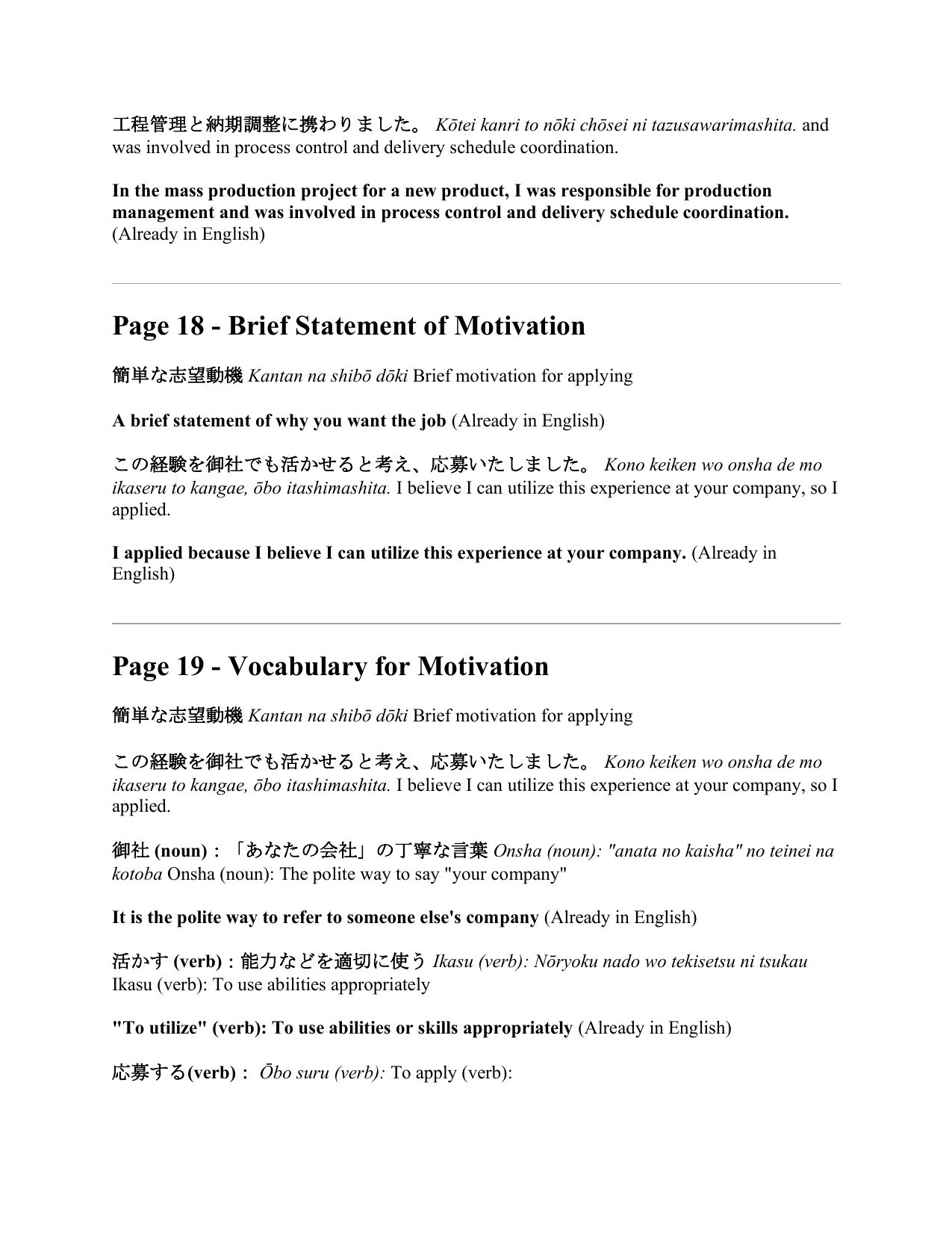
คลิกเพื่อขยาย
EN工程管理と納期調整に携わりました。 Kōtei kanri to nōki chōsei ni tazusawarimashita. and
was involved in process control and delivery schedule coordination.
In the mass production project for a new product, I was responsible for production
management and was involved in process control and delivery schedule coordination.
(Already in English)
Page 18 - Brief Statement of Motivation
簡単な志望動機 Kantan na shibō dōki Brief motivation for applying
A brief statement of why you want the job (Already in English)
was involved in process control and delivery schedule coordination.
In the mass production project for a new product, I was responsible for production
management and was involved in process control and delivery schedule coordination.
(Already in English)
Page 18 - Brief Statement of Motivation
簡単な志望動機 Kantan na shibō dōki Brief motivation for applying
A brief statement of why you want the job (Already in English)
JPこの経験を御社でも活かせると考え、応募いたしました。Konokeikenwoonshademo
ENikaseru to kangae, ōbo itashimashita. I believe I can utilize this experience at your company, so I
applied.
I applied because I believe I can utilize this experience at your company. (Already in
English)
Page 19 - Vocabulary for Motivation
簡単な志望動機 Kantan na shibō dōki Brief motivation for applying
applied.
I applied because I believe I can utilize this experience at your company. (Already in
English)
Page 19 - Vocabulary for Motivation
簡単な志望動機 Kantan na shibō dōki Brief motivation for applying
JPこの経験を御社でも活かせると考え、応募いたしました。Konokeikenwoonshademo
ENikaseru to kangae, ōbo itashimashita. I believe I can utilize this experience at your company, so I
applied.
御社 (noun):「あなたの会社」の丁寧な言葉 Onsha (noun): "anata no kaisha" no teinei na
kotoba Onsha (noun): The polite way to say "your company"
It is the polite way to refer to someone else's company (Already in English)
活かす (verb):能力などを適切に使う Ikasu (verb): Nōryoku nado wo tekisetsu ni tsukau
Ikasu (verb): To use abilities appropriately
"To utilize" (verb): To use abilities or skills appropriately (Already in English)
応募する(verb): Ōbo suru (verb): To apply (verb):
applied.
御社 (noun):「あなたの会社」の丁寧な言葉 Onsha (noun): "anata no kaisha" no teinei na
kotoba Onsha (noun): The polite way to say "your company"
It is the polite way to refer to someone else's company (Already in English)
活かす (verb):能力などを適切に使う Ikasu (verb): Nōryoku nado wo tekisetsu ni tsukau
Ikasu (verb): To use abilities appropriately
"To utilize" (verb): To use abilities or skills appropriately (Already in English)
応募する(verb): Ōbo suru (verb): To apply (verb):
หน้า 119
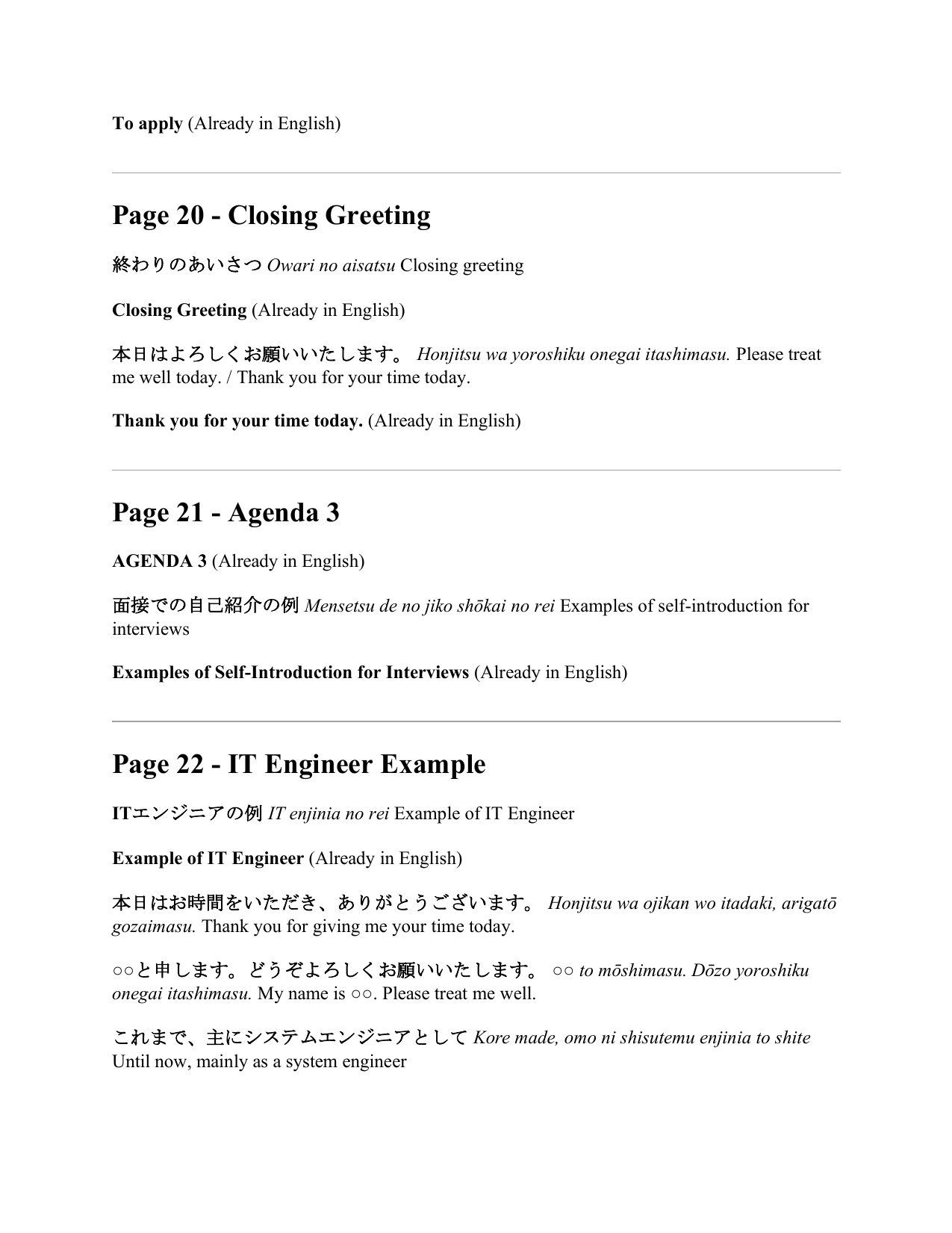
คลิกเพื่อขยาย
ENTo apply (Already in English)
Page 20 - Closing Greeting
終わりのあいさつ Owari no aisatsu Closing greeting
Closing Greeting (Already in English)
本日はよろしくお願いいたします。 Honjitsu wa yoroshiku onegai itashimasu. Please treat
me well today. / Thank you for your time today.
Thank you for your time today. (Already in English)
Page 21 - Agenda 3
AGENDA 3 (Already in English)
面接での自己紹介の例 Mensetsu de no jiko shōkai no rei Examples of self-introduction for
interviews
Examples of Self-Introduction for Interviews (Already in English)
Page 22 - IT Engineer Example
ITエンジニアの例 IT enjinia no rei Example of IT Engineer
Example of IT Engineer (Already in English)
本日はお時間をいただき、ありがとうございます。 Honjitsu wa ojikan wo itadaki, arigatō
gozaimasu. Thank you for giving me your time today.
○○と申します。どうぞよろしくお願いいたします。 ○○ to mōshimasu. Dōzo yoroshiku
onegai itashimasu. My name is ○○. Please treat me well.
これまで、主にシステムエンジニアとして Kore made, omo ni shisutemu enjinia to shite
Until now, mainly as a system engineer
Page 20 - Closing Greeting
終わりのあいさつ Owari no aisatsu Closing greeting
Closing Greeting (Already in English)
本日はよろしくお願いいたします。 Honjitsu wa yoroshiku onegai itashimasu. Please treat
me well today. / Thank you for your time today.
Thank you for your time today. (Already in English)
Page 21 - Agenda 3
AGENDA 3 (Already in English)
面接での自己紹介の例 Mensetsu de no jiko shōkai no rei Examples of self-introduction for
interviews
Examples of Self-Introduction for Interviews (Already in English)
Page 22 - IT Engineer Example
ITエンジニアの例 IT enjinia no rei Example of IT Engineer
Example of IT Engineer (Already in English)
本日はお時間をいただき、ありがとうございます。 Honjitsu wa ojikan wo itadaki, arigatō
gozaimasu. Thank you for giving me your time today.
○○と申します。どうぞよろしくお願いいたします。 ○○ to mōshimasu. Dōzo yoroshiku
onegai itashimasu. My name is ○○. Please treat me well.
これまで、主にシステムエンジニアとして Kore made, omo ni shisutemu enjinia to shite
Until now, mainly as a system engineer
หน้า 120
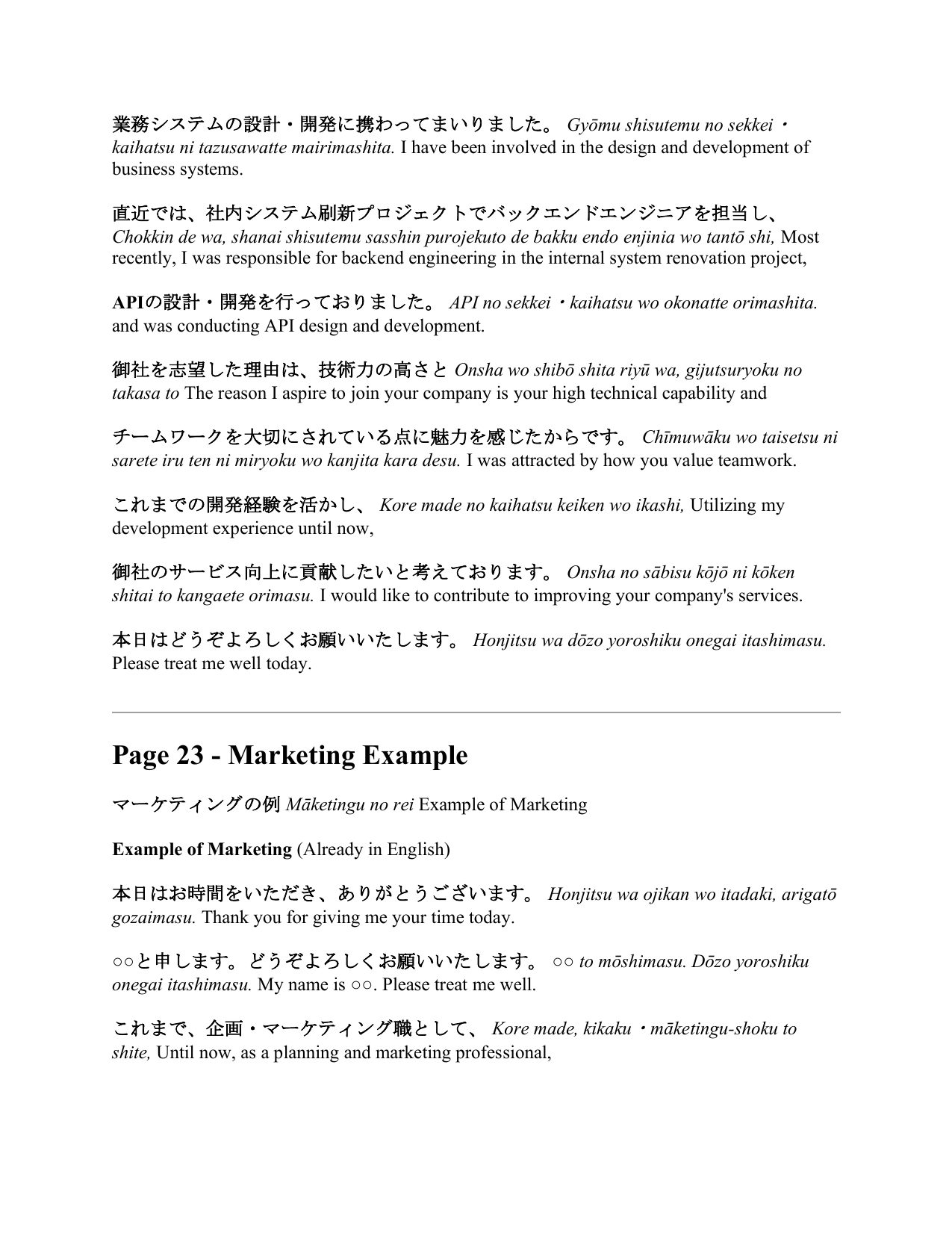
คลิกเพื่อขยาย
JP業務システムの設計・開発に携わってまいりました。Gyōmushisutemunosekkei・
ENkaihatsu ni tazusawatte mairimashita. I have been involved in the design and development of
business systems.
business systems.
JP直近では、社内システム刷新プロジェクトでバックエンドエンジニアを担当し、
ENChokkin de wa, shanai shisutemu sasshin purojekuto de bakku endo enjinia wo tantō shi, Most
recently, I was responsible for backend engineering in the internal system renovation project,
APIの設計・開発を行っておりました。 API no sekkei・kaihatsu wo okonatte orimashita.
and was conducting API design and development.
御社を志望した理由は、技術力の高さと Onsha wo shibō shita riyū wa, gijutsuryoku no
takasa to The reason I aspire to join your company is your high technical capability and
recently, I was responsible for backend engineering in the internal system renovation project,
APIの設計・開発を行っておりました。 API no sekkei・kaihatsu wo okonatte orimashita.
and was conducting API design and development.
御社を志望した理由は、技術力の高さと Onsha wo shibō shita riyū wa, gijutsuryoku no
takasa to The reason I aspire to join your company is your high technical capability and
JPチームワークを大切にされている点に魅力を感じたからです。Chīmuwākuwotaisetsuni
ENsarete iru ten ni miryoku wo kanjita kara desu. I was attracted by how you value teamwork.
これまでの開発経験を活かし、 Kore made no kaihatsu keiken wo ikashi, Utilizing my
development experience until now,
御社のサービス向上に貢献したいと考えております。 Onsha no sābisu kōjō ni kōken
shitai to kangaete orimasu. I would like to contribute to improving your company's services.
本日はどうぞよろしくお願いいたします。 Honjitsu wa dōzo yoroshiku onegai itashimasu.
Please treat me well today.
Page 23 - Marketing Example
マーケティングの例 Māketingu no rei Example of Marketing
Example of Marketing (Already in English)
本日はお時間をいただき、ありがとうございます。 Honjitsu wa ojikan wo itadaki, arigatō
gozaimasu. Thank you for giving me your time today.
○○と申します。どうぞよろしくお願いいたします。 ○○ to mōshimasu. Dōzo yoroshiku
onegai itashimasu. My name is ○○. Please treat me well.
これまで、企画・マーケティング職として、 Kore made, kikaku・māketingu-shoku to
shite, Until now, as a planning and marketing professional,
これまでの開発経験を活かし、 Kore made no kaihatsu keiken wo ikashi, Utilizing my
development experience until now,
御社のサービス向上に貢献したいと考えております。 Onsha no sābisu kōjō ni kōken
shitai to kangaete orimasu. I would like to contribute to improving your company's services.
本日はどうぞよろしくお願いいたします。 Honjitsu wa dōzo yoroshiku onegai itashimasu.
Please treat me well today.
Page 23 - Marketing Example
マーケティングの例 Māketingu no rei Example of Marketing
Example of Marketing (Already in English)
本日はお時間をいただき、ありがとうございます。 Honjitsu wa ojikan wo itadaki, arigatō
gozaimasu. Thank you for giving me your time today.
○○と申します。どうぞよろしくお願いいたします。 ○○ to mōshimasu. Dōzo yoroshiku
onegai itashimasu. My name is ○○. Please treat me well.
これまで、企画・マーケティング職として、 Kore made, kikaku・māketingu-shoku to
shite, Until now, as a planning and marketing professional,
หน้า 121
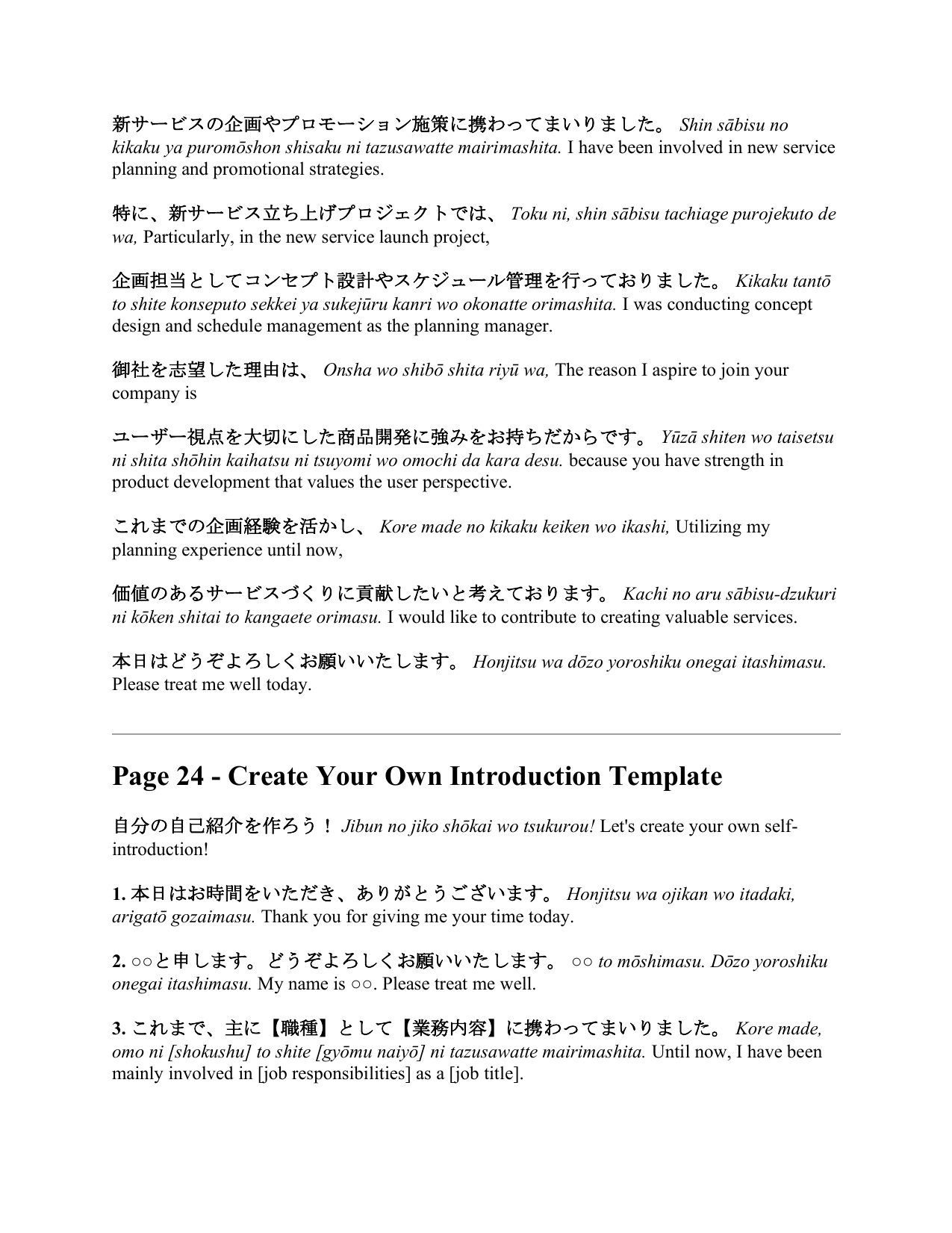
คลิกเพื่อขยาย
JP新サービスの企画やプロモーション施策に携わってまいりました。Shinsābisuno
ENkikaku ya puromōshon shisaku ni tazusawatte mairimashita. I have been involved in new service
planning and promotional strategies.
特に、新サービス立ち上げプロジェクトでは、 Toku ni, shin sābisu tachiage purojekuto de
wa, Particularly, in the new service launch project,
planning and promotional strategies.
特に、新サービス立ち上げプロジェクトでは、 Toku ni, shin sābisu tachiage purojekuto de
wa, Particularly, in the new service launch project,
JP企画担当としてコンセプト設計やスケジュール管理を行っておりました。Kikakutantō
ENto shite konseputo sekkei ya sukejūru kanri wo okonatte orimashita. I was conducting concept
design and schedule management as the planning manager.
御社を志望した理由は、 Onsha wo shibō shita riyū wa, The reason I aspire to join your
company is
design and schedule management as the planning manager.
御社を志望した理由は、 Onsha wo shibō shita riyū wa, The reason I aspire to join your
company is
JPユーザー視点を大切にした商品開発に強みをお持ちだからです。Yūzāshitenwotaisetsu
ENni shita shōhin kaihatsu ni tsuyomi wo omochi da kara desu. because you have strength in
product development that values the user perspective.
これまでの企画経験を活かし、 Kore made no kikaku keiken wo ikashi, Utilizing my
planning experience until now,
product development that values the user perspective.
これまでの企画経験を活かし、 Kore made no kikaku keiken wo ikashi, Utilizing my
planning experience until now,
JP価値のあるサービスづくりに貢献したいと考えております。Kachinoarusābisu-dzukuri
ENni kōken shitai to kangaete orimasu. I would like to contribute to creating valuable services.
本日はどうぞよろしくお願いいたします。 Honjitsu wa dōzo yoroshiku onegai itashimasu.
Please treat me well today.
Page 24 - Create Your Own Introduction Template
自分の自己紹介を作ろう! Jibun no jiko shōkai wo tsukurou! Let's create your own self-
introduction!
1. 本日はお時間をいただき、ありがとうございます。 Honjitsu wa ojikan wo itadaki,
arigatō gozaimasu. Thank you for giving me your time today.
2. ○○と申します。どうぞよろしくお願いいたします。 ○○ to mōshimasu. Dōzo yoroshiku
onegai itashimasu. My name is ○○. Please treat me well.
本日はどうぞよろしくお願いいたします。 Honjitsu wa dōzo yoroshiku onegai itashimasu.
Please treat me well today.
Page 24 - Create Your Own Introduction Template
自分の自己紹介を作ろう! Jibun no jiko shōkai wo tsukurou! Let's create your own self-
introduction!
1. 本日はお時間をいただき、ありがとうございます。 Honjitsu wa ojikan wo itadaki,
arigatō gozaimasu. Thank you for giving me your time today.
2. ○○と申します。どうぞよろしくお願いいたします。 ○○ to mōshimasu. Dōzo yoroshiku
onegai itashimasu. My name is ○○. Please treat me well.
JP3.これまで、主に【職種】として【業務内容】に携わってまいりました。Koremade,
ENomo ni [shokushu] to shite [gyōmu naiyō] ni tazusawatte mairimashita. Until now, I have been
mainly involved in [job responsibilities] as a [job title].
mainly involved in [job responsibilities] as a [job title].
หน้า 122
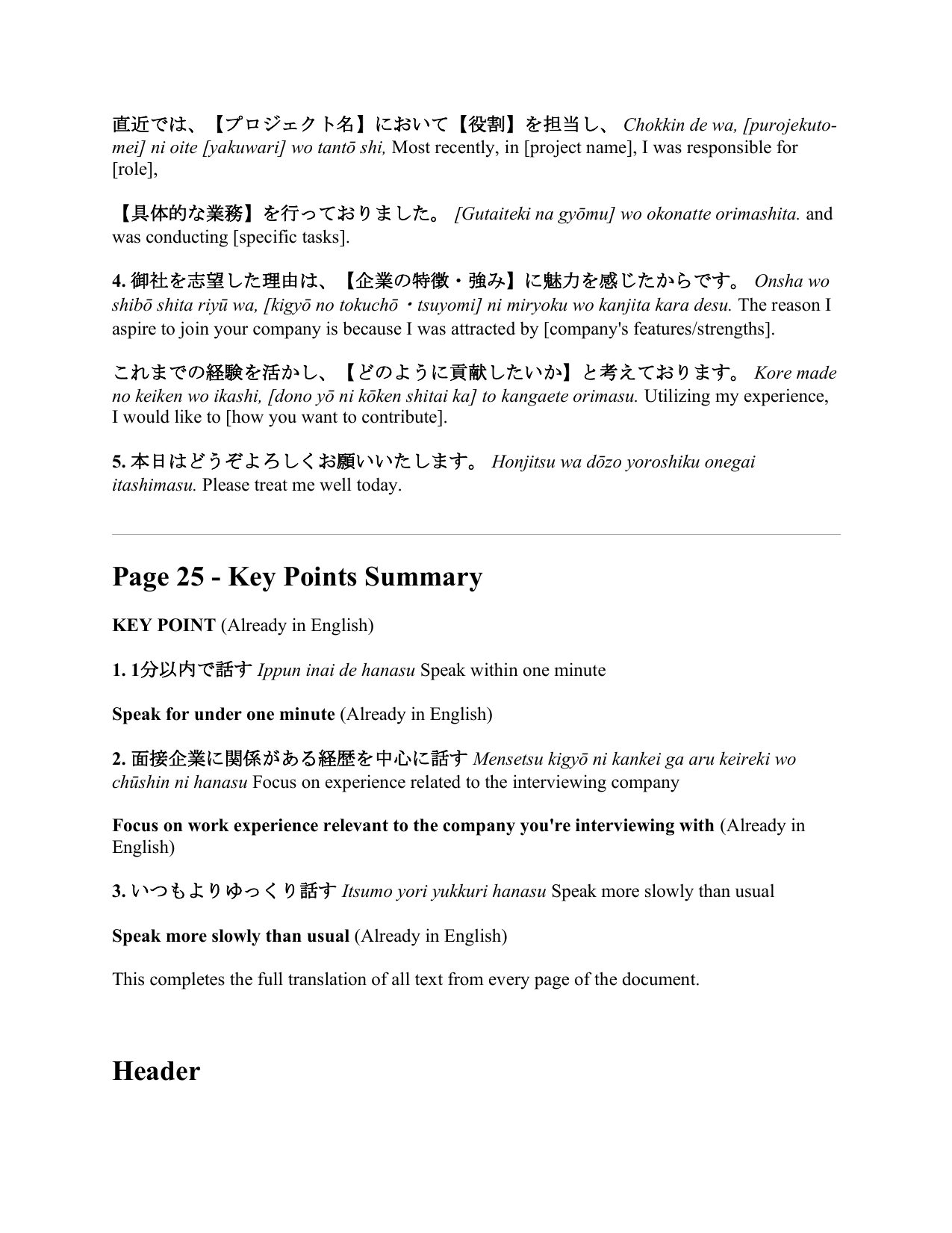
คลิกเพื่อขยาย
JP直近では、【プロジェクト名】において【役割】を担当し、Chokkindewa,[purojekuto-
ENmei] ni oite [yakuwari] wo tantō shi, Most recently, in [project name], I was responsible for
[role],
【具体的な業務】を行っておりました。 [Gutaiteki na gyōmu] wo okonatte orimashita. and
was conducting [specific tasks].
[role],
【具体的な業務】を行っておりました。 [Gutaiteki na gyōmu] wo okonatte orimashita. and
was conducting [specific tasks].
JP4.御社を志望した理由は、【企業の特徴・強み】に魅力を感じたからです。Onshawo
ENshibō shita riyū wa, [kigyō no tokuchō・tsuyomi] ni miryoku wo kanjita kara desu. The reason I
aspire to join your company is because I was attracted by [company's features/strengths].
aspire to join your company is because I was attracted by [company's features/strengths].
JPこれまでの経験を活かし、【どのように貢献したいか】と考えております。Koremade
ENno keiken wo ikashi, [dono yō ni kōken shitai ka] to kangaete orimasu. Utilizing my experience,
I would like to [how you want to contribute].
5. 本日はどうぞよろしくお願いいたします。 Honjitsu wa dōzo yoroshiku onegai
itashimasu. Please treat me well today.
Page 25 - Key Points Summary
KEY POINT (Already in English)
1. 1分以内で話す Ippun inai de hanasu Speak within one minute
Speak for under one minute (Already in English)
2. 面接企業に関係がある経歴を中心に話す Mensetsu kigyō ni kankei ga aru keireki wo
chūshin ni hanasu Focus on experience related to the interviewing company
Focus on work experience relevant to the company you're interviewing with (Already in
English)
3. いつもよりゆっくり話す Itsumo yori yukkuri hanasu Speak more slowly than usual
Speak more slowly than usual (Already in English)
This completes the full translation of all text from every page of the document.
Header
I would like to [how you want to contribute].
5. 本日はどうぞよろしくお願いいたします。 Honjitsu wa dōzo yoroshiku onegai
itashimasu. Please treat me well today.
Page 25 - Key Points Summary
KEY POINT (Already in English)
1. 1分以内で話す Ippun inai de hanasu Speak within one minute
Speak for under one minute (Already in English)
2. 面接企業に関係がある経歴を中心に話す Mensetsu kigyō ni kankei ga aru keireki wo
chūshin ni hanasu Focus on experience related to the interviewing company
Focus on work experience relevant to the company you're interviewing with (Already in
English)
3. いつもよりゆっくり話す Itsumo yori yukkuri hanasu Speak more slowly than usual
Speak more slowly than usual (Already in English)
This completes the full translation of all text from every page of the document.
Header
หน้า 123
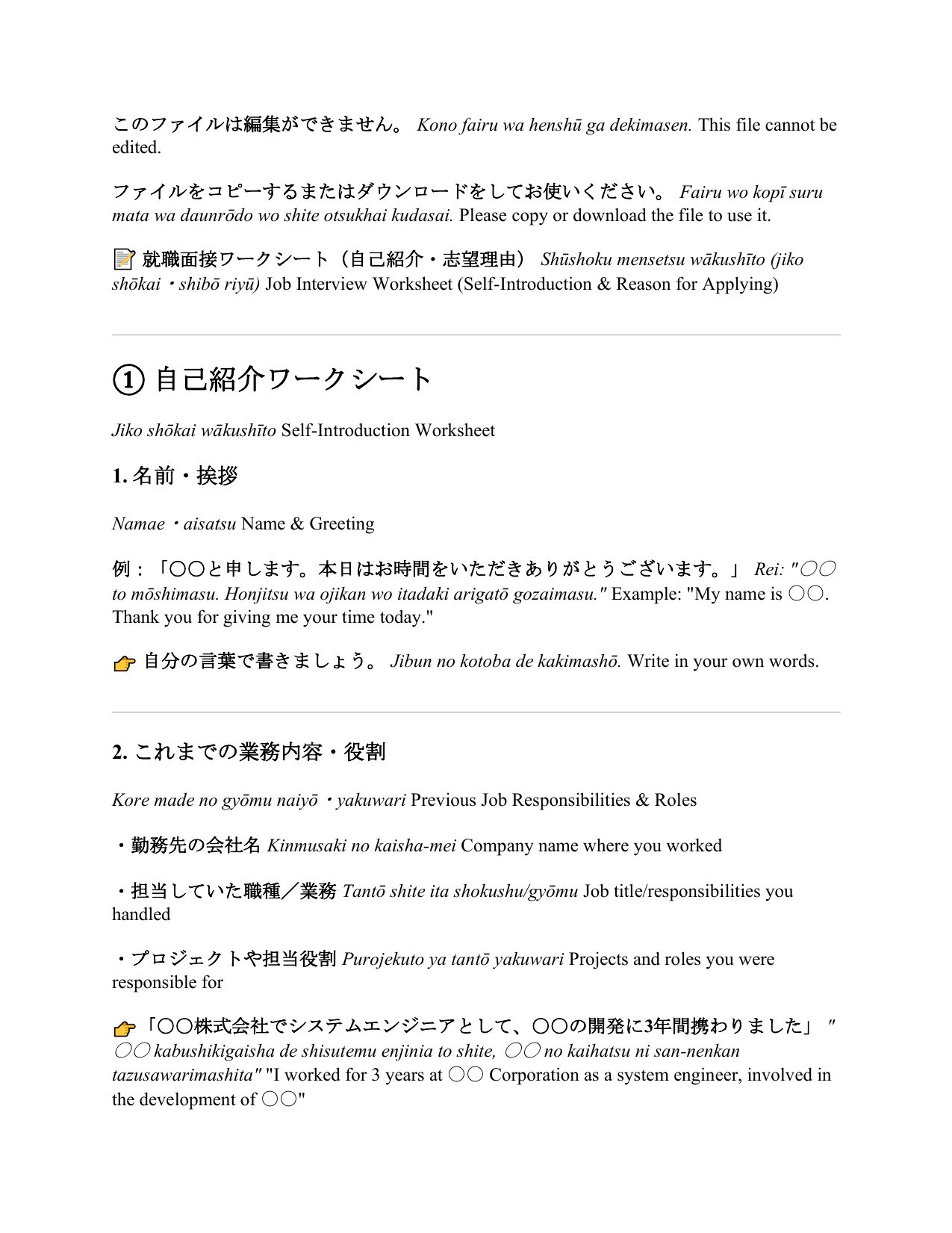
คลิกเพื่อขยาย
ENこのファイルは編集ができません。 Kono fairu wa henshū ga dekimasen. This file cannot be
edited.
edited.
JPファイルをコピーするまたはダウンロードをしてお使いください。Fairuwokopīsuru
ENmata wa daunrōdo wo shite otsukhai kudasai. Please copy or download the file to use it.
就職面接ワークシート(自己紹介・志望理由) Shūshoku mensetsu wākushīto (jiko
shōkai・shibō riyū) Job Interview Worksheet (Self-Introduction & Reason for Applying)
就職面接ワークシート(自己紹介・志望理由) Shūshoku mensetsu wākushīto (jiko
shōkai・shibō riyū) Job Interview Worksheet (Self-Introduction & Reason for Applying)
JP①自己紹介ワークシート
ENJiko shōkai wākushīto Self-Introduction Worksheet
JP1.名前・挨拶
ENNamae・aisatsu Name & Greeting
JP例:「〇〇と申します。本日はお時間をいただきありがとうございます。」Rei:"〇〇
ENto mōshimasu. Honjitsu wa ojikan wo itadaki arigatō gozaimasu." Example: "My name is 〇〇.
Thank you for giving me your time today."
自分の言葉で書きましょう。 Jibun no kotoba de kakimashō. Write in your own words.
Thank you for giving me your time today."
自分の言葉で書きましょう。 Jibun no kotoba de kakimashō. Write in your own words.
JP2.これまでの業務内容・役割
ENKore made no gyōmu naiyō・yakuwari Previous Job Responsibilities & Roles
・勤務先の会社名 Kinmusaki no kaisha-mei Company name where you worked
・担当していた職種/業務 Tantō shite ita shokushu/gyōmu Job title/responsibilities you
handled
・プロジェクトや担当役割 Purojekuto ya tantō yakuwari Projects and roles you were
responsible for
・勤務先の会社名 Kinmusaki no kaisha-mei Company name where you worked
・担当していた職種/業務 Tantō shite ita shokushu/gyōmu Job title/responsibilities you
handled
・プロジェクトや担当役割 Purojekuto ya tantō yakuwari Projects and roles you were
responsible for
JP「〇〇株式会社でシステムエンジニアとして、〇〇の開発に3年間携わりました」"
EN〇〇 kabushikigaisha de shisutemu enjinia to shite, 〇〇 no kaihatsu ni san-nenkan
tazusawarimashita" "I worked for 3 years at 〇〇 Corporation as a system engineer, involved in
the development of 〇〇"
tazusawarimashita" "I worked for 3 years at 〇〇 Corporation as a system engineer, involved in
the development of 〇〇"
หน้า 124
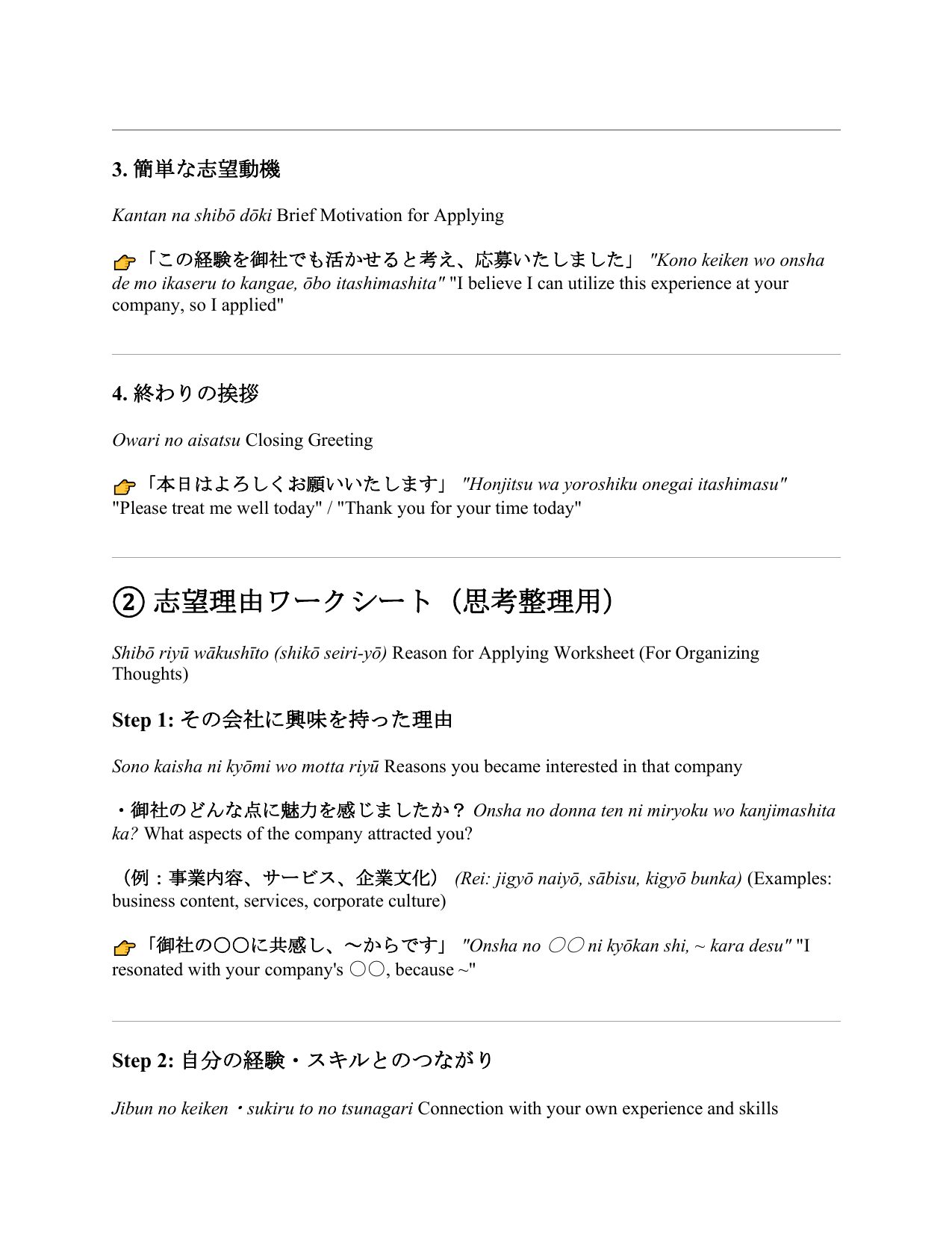
คลิกเพื่อขยาย
JP3.簡単な志望動機
ENKantan na shibō dōki Brief Motivation for Applying
JP「この経験を御社でも活かせると考え、応募いたしました」"Konokeikenwoonsha
ENde mo ikaseru to kangae, ōbo itashimashita" "I believe I can utilize this experience at your
company, so I applied"
company, so I applied"
JP4.終わりの挨拶
ENOwari no aisatsu Closing Greeting
「本日はよろしくお願いいたします」 "Honjitsu wa yoroshiku onegai itashimasu"
"Please treat me well today" / "Thank you for your time today"
「本日はよろしくお願いいたします」 "Honjitsu wa yoroshiku onegai itashimasu"
"Please treat me well today" / "Thank you for your time today"
JP②志望理由ワークシート(思考整理用)
ENShibō riyū wākushīto (shikō seiri-yō) Reason for Applying Worksheet (For Organizing
Thoughts)
Thoughts)
JPStep1:その会社に興味を持った理由
ENSono kaisha ni kyōmi wo motta riyū Reasons you became interested in that company
・御社のどんな点に魅力を感じましたか? Onsha no donna ten ni miryoku wo kanjimashita
ka? What aspects of the company attracted you?
(例:事業内容、サービス、企業文化) (Rei: jigyō naiyō, sābisu, kigyō bunka) (Examples:
business content, services, corporate culture)
「御社の〇〇に共感し、~からです」 "Onsha no 〇〇 ni kyōkan shi, ~ kara desu" "I
resonated with your company's 〇〇, because ~"
・御社のどんな点に魅力を感じましたか? Onsha no donna ten ni miryoku wo kanjimashita
ka? What aspects of the company attracted you?
(例:事業内容、サービス、企業文化) (Rei: jigyō naiyō, sābisu, kigyō bunka) (Examples:
business content, services, corporate culture)
「御社の〇〇に共感し、~からです」 "Onsha no 〇〇 ni kyōkan shi, ~ kara desu" "I
resonated with your company's 〇〇, because ~"
JPStep2:自分の経験・スキルとのつながり
ENJibun no keiken・sukiru to no tsunagari Connection with your own experience and skills
หน้า 125
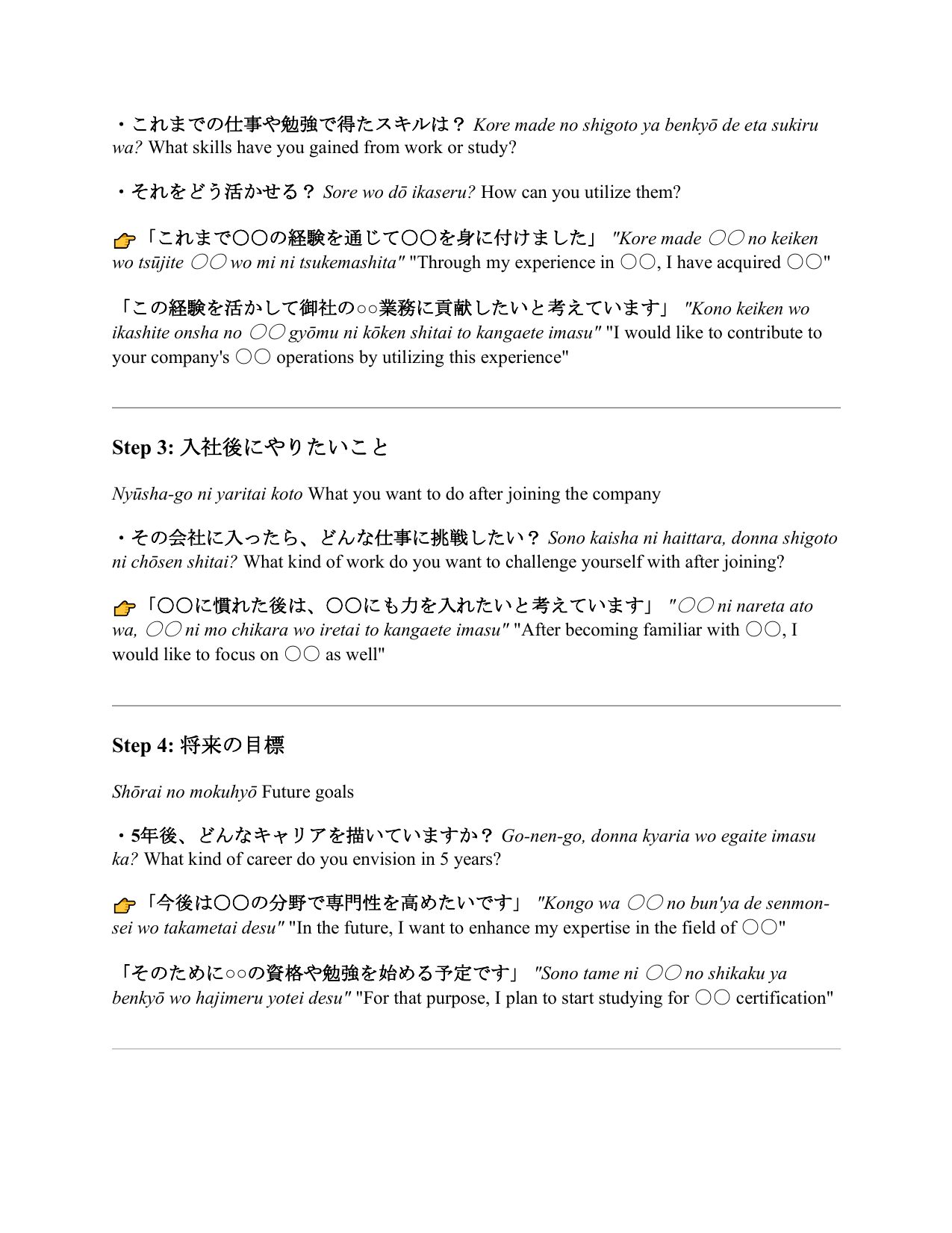
คลิกเพื่อขยาย
EN・これまでの仕事や勉強で得たスキルは? Kore made no shigoto ya benkyō de eta sukiru
wa? What skills have you gained from work or study?
・それをどう活かせる? Sore wo dō ikaseru? How can you utilize them?
wa? What skills have you gained from work or study?
・それをどう活かせる? Sore wo dō ikaseru? How can you utilize them?
JP「これまで〇〇の経験を通じて〇〇を身に付けました」"Koremade〇〇nokeiken
ENwo tsūjite 〇〇 wo mi ni tsukemashita" "Through my experience in 〇〇, I have acquired 〇〇"
JP「この経験を活かして御社の○○業務に貢献したいと考えています」"Konokeikenwo
ENikashite onsha no 〇〇 gyōmu ni kōken shitai to kangaete imasu" "I would like to contribute to
your company's 〇〇 operations by utilizing this experience"
your company's 〇〇 operations by utilizing this experience"
JPStep3:入社後にやりたいこと
ENNyūsha-go ni yaritai koto What you want to do after joining the company
・その会社に入ったら、どんな仕事に挑戦したい? Sono kaisha ni haittara, donna shigoto
ni chōsen shitai? What kind of work do you want to challenge yourself with after joining?
・その会社に入ったら、どんな仕事に挑戦したい? Sono kaisha ni haittara, donna shigoto
ni chōsen shitai? What kind of work do you want to challenge yourself with after joining?
JP「〇〇に慣れた後は、〇〇にも力を入れたいと考えています」"〇〇ninaretaato
ENwa, 〇〇 ni mo chikara wo iretai to kangaete imasu" "After becoming familiar with 〇〇, I
would like to focus on 〇〇 as well"
would like to focus on 〇〇 as well"
JPStep4:将来の目標
ENShōrai no mokuhyō Future goals
・5年後、どんなキャリアを描いていますか? Go-nen-go, donna kyaria wo egaite imasu
ka? What kind of career do you envision in 5 years?
「今後は〇〇の分野で専門性を高めたいです」 "Kongo wa 〇〇 no bun'ya de senmon-
sei wo takametai desu" "In the future, I want to enhance my expertise in the field of 〇〇"
「そのために○○の資格や勉強を始める予定です」 "Sono tame ni 〇〇 no shikaku ya
benkyō wo hajimeru yotei desu" "For that purpose, I plan to start studying for 〇〇 certification"
・5年後、どんなキャリアを描いていますか? Go-nen-go, donna kyaria wo egaite imasu
ka? What kind of career do you envision in 5 years?
「今後は〇〇の分野で専門性を高めたいです」 "Kongo wa 〇〇 no bun'ya de senmon-
sei wo takametai desu" "In the future, I want to enhance my expertise in the field of 〇〇"
「そのために○○の資格や勉強を始める予定です」 "Sono tame ni 〇〇 no shikaku ya
benkyō wo hajimeru yotei desu" "For that purpose, I plan to start studying for 〇〇 certification"
หน้า 126

คลิกเพื่อขยาย
ENThis worksheet provides a structured template for preparing both a self-introduction and
articulating reasons for applying to a company, helping job seekers organize their thoughts and
prepare for Japanese job interviews.
articulating reasons for applying to a company, helping job seekers organize their thoughts and
prepare for Japanese job interviews.