หน้า 1
คลิกเพื่อขยาย
ENJAPANESE STUDY LIBRARY · VOLUME 6
Kanji, Culture & Extras
漢字・文化・その他 — Kanji, Bunka, Sonota
Kanji/hiragana rules, aizuchi, workplace etiquette, healthcare, and bonus career vocabulary
Volume 6 of 9
Kanji, Culture & Extras
漢字・文化・その他 — Kanji, Bunka, Sonota
Kanji/hiragana rules, aizuchi, workplace etiquette, healthcare, and bonus career vocabulary
Volume 6 of 9
หน้า 2
คลิกเพื่อขยาย
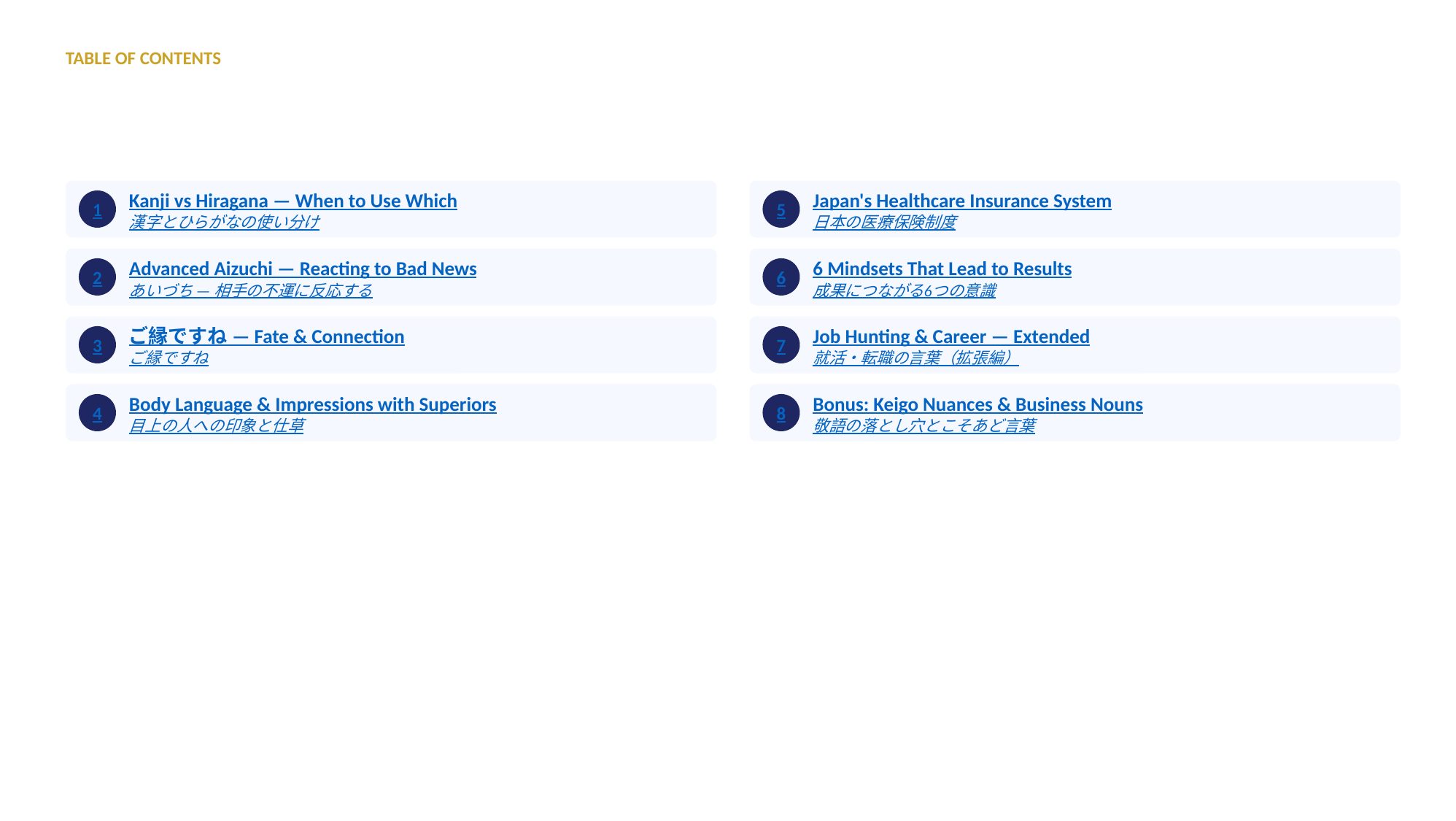
ENTABLE OF CONTENTS
THสารบัญ
EN 1 Kanji vs Hiragana — When to Use Which 5 Japan's Healthcare Insurance System
JP漢字とひらがなの使い分け日本の医療保険制度
EN 2 Advanced Aizuchi — Reacting to Bad News 6 6 Mindsets That Lead to Results
JPあいづち—相手の不運に反応する成果につながる6つの意識
EN 3 ご縁ですね — Fate & Connection 7 Job Hunting & Career — Extended
JPご縁ですね就活・転職の言葉(拡張編)
EN 4 Body Language & Impressions with Superiors 8 Bonus: Keigo Nuances & Business Nouns
JP目上の人への印象と仕草敬語の落とし穴とこそあど言葉
หน้า 3
คลิกเพื่อขยาย
01
ENKanji vs Hiragana — When to Use Which
JP漢字とひらがなの使い分け
ENThe rule that decides spelling: is it a content word, or a grammatical helper?
หน้า 4
คลิกเพื่อขยาย
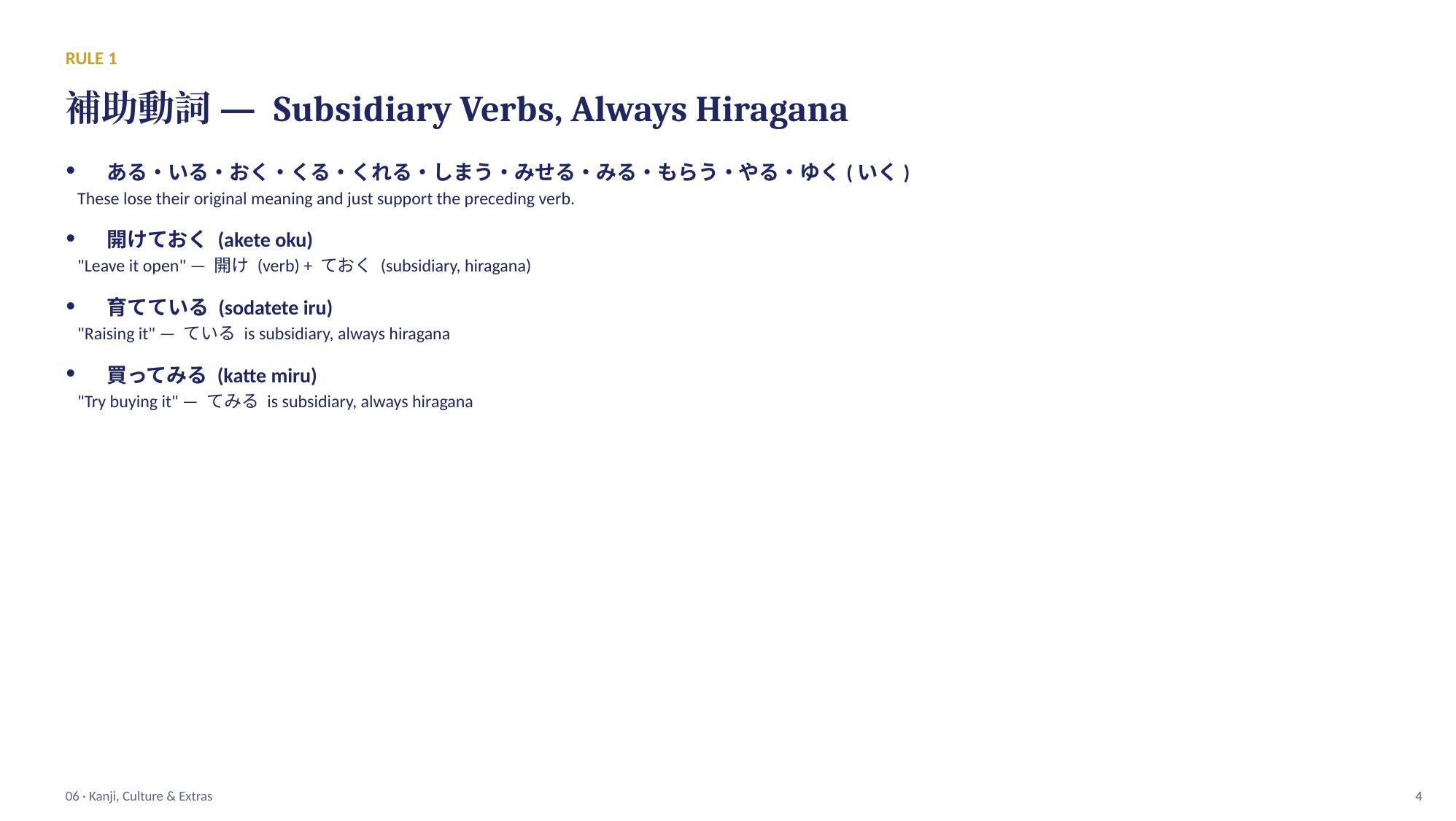
ENRULE 1
補助動詞 — Subsidiary Verbs, Always Hiragana
補助動詞 — Subsidiary Verbs, Always Hiragana
JP•ある・いる・おく・くる・くれる・しまう・みせる・みる・もらう・やる・ゆく(いく)
EN These lose their original meaning and just support the preceding verb.
• 開けておく (akete oku)
"Leave it open" — 開け (verb) + ておく (subsidiary, hiragana)
• 育てている (sodatete iru)
"Raising it" — ている is subsidiary, always hiragana
• 買ってみる (katte miru)
"Try buying it" — てみる is subsidiary, always hiragana
06 · Kanji, Culture & Extras 4
• 開けておく (akete oku)
"Leave it open" — 開け (verb) + ておく (subsidiary, hiragana)
• 育てている (sodatete iru)
"Raising it" — ている is subsidiary, always hiragana
• 買ってみる (katte miru)
"Try buying it" — てみる is subsidiary, always hiragana
06 · Kanji, Culture & Extras 4
หน้า 5
คลิกเพื่อขยาย
ENRULE 2
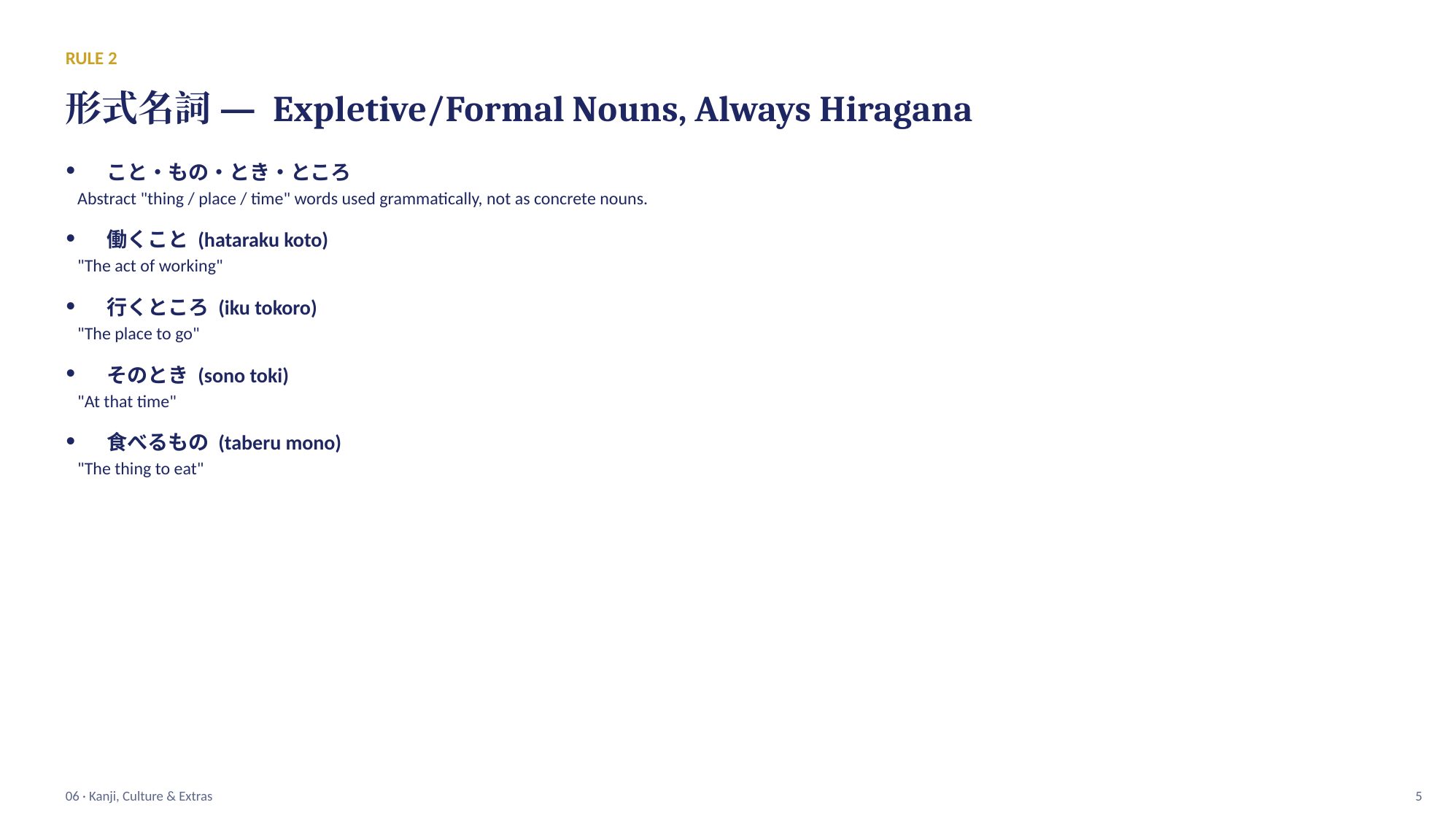
形式名詞 — Expletive/Formal Nouns, Always Hiragana
形式名詞 — Expletive/Formal Nouns, Always Hiragana
JP•こと・もの・とき・ところ
EN Abstract "thing / place / time" words used grammatically, not as concrete nouns.
• 働くこと (hataraku koto)
"The act of working"
• 行くところ (iku tokoro)
"The place to go"
• そのとき (sono toki)
"At that time"
• 食べるもの (taberu mono)
"The thing to eat"
06 · Kanji, Culture & Extras 5
• 働くこと (hataraku koto)
"The act of working"
• 行くところ (iku tokoro)
"The place to go"
• そのとき (sono toki)
"At that time"
• 食べるもの (taberu mono)
"The thing to eat"
06 · Kanji, Culture & Extras 5
หน้า 6
คลิกเพื่อขยาย
ENSAME WORD, TWO SPELLINGS
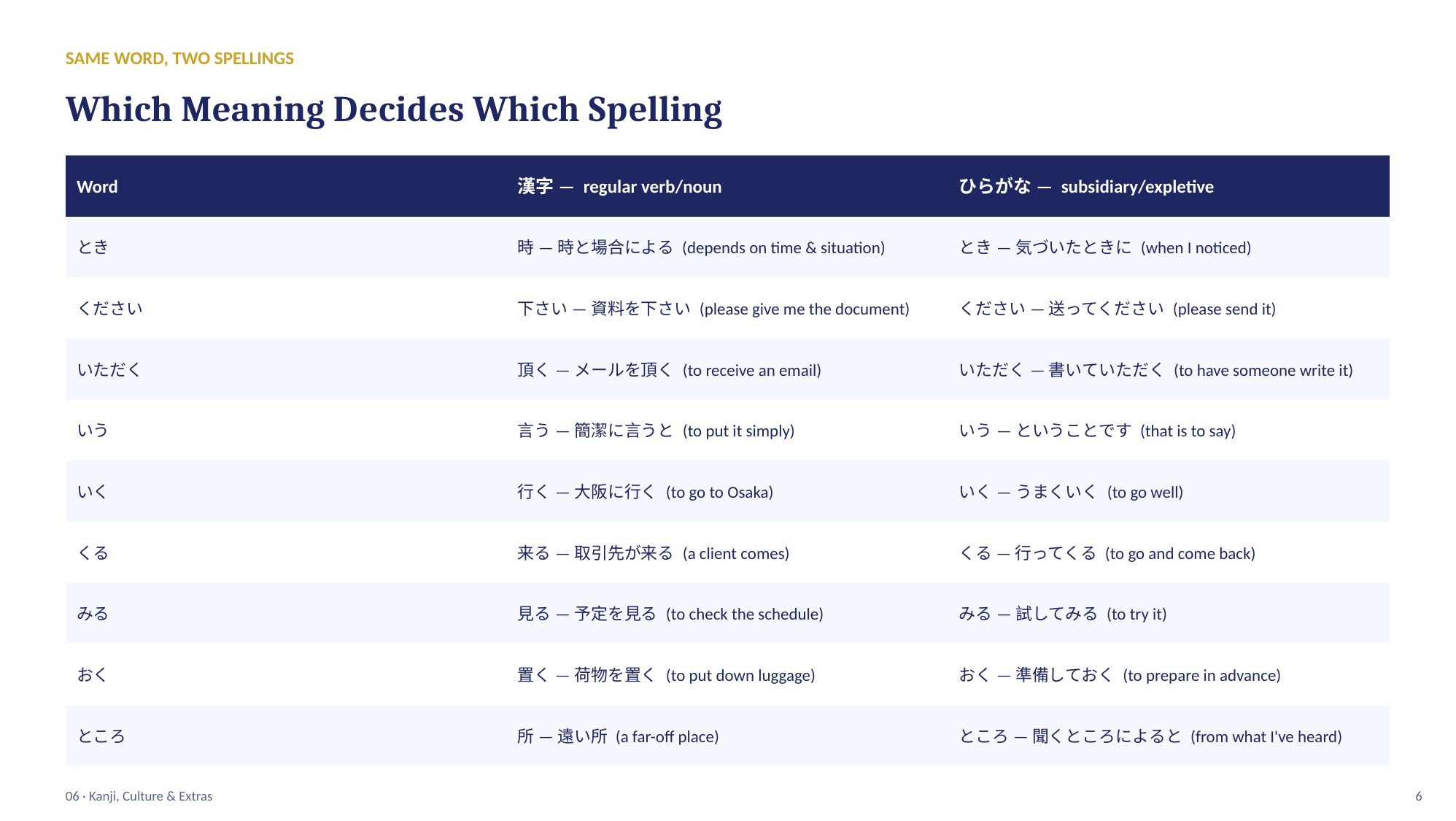
Which Meaning Decides Which Spelling
Word 漢字 — regular verb/noun ひらがな — subsidiary/expletive
とき 時 — 時と場合による (depends on time & situation) とき — 気づいたときに (when I noticed)
ください 下さい — 資料を下さい (please give me the document) ください — 送ってください (please send it)
いただく 頂く — メールを頂く (to receive an email) いただく — 書いていただく (to have someone write it)
いう 言う — 簡潔に言うと (to put it simply) いう — ということです (that is to say)
いく 行く — 大阪に行く (to go to Osaka) いく — うまくいく (to go well)
くる 来る — 取引先が来る (a client comes) くる — 行ってくる (to go and come back)
みる 見る — 予定を見る (to check the schedule) みる — 試してみる (to try it)
おく 置く — 荷物を置く (to put down luggage) おく — 準備しておく (to prepare in advance)
ところ 所 — 遠い所 (a far-off place) ところ — 聞くところによると (from what I've heard)
06 · Kanji, Culture & Extras 6
Which Meaning Decides Which Spelling
Word 漢字 — regular verb/noun ひらがな — subsidiary/expletive
とき 時 — 時と場合による (depends on time & situation) とき — 気づいたときに (when I noticed)
ください 下さい — 資料を下さい (please give me the document) ください — 送ってください (please send it)
いただく 頂く — メールを頂く (to receive an email) いただく — 書いていただく (to have someone write it)
いう 言う — 簡潔に言うと (to put it simply) いう — ということです (that is to say)
いく 行く — 大阪に行く (to go to Osaka) いく — うまくいく (to go well)
くる 来る — 取引先が来る (a client comes) くる — 行ってくる (to go and come back)
みる 見る — 予定を見る (to check the schedule) みる — 試してみる (to try it)
おく 置く — 荷物を置く (to put down luggage) おく — 準備しておく (to prepare in advance)
ところ 所 — 遠い所 (a far-off place) ところ — 聞くところによると (from what I've heard)
06 · Kanji, Culture & Extras 6
หน้า 7
คลิกเพื่อขยาย
ENREAL QUIZ EXAMPLES
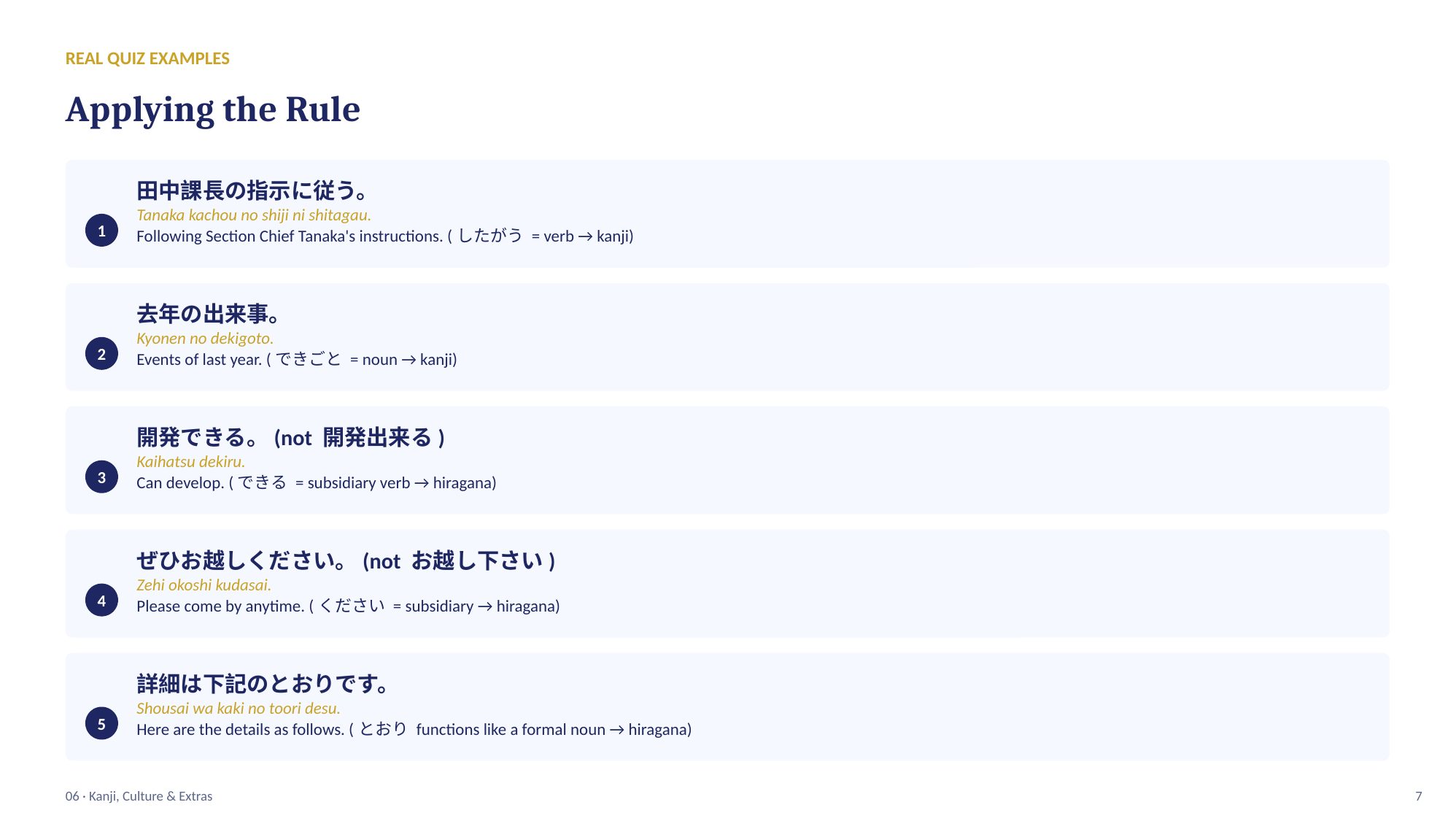
Applying the Rule
Applying the Rule
JP田中課長の指示に従う。
EN Tanaka kachou no shiji ni shitagau.
1 Following Section Chief Tanaka's instructions. ( したがう = verb → kanji)
1 Following Section Chief Tanaka's instructions. ( したがう = verb → kanji)
JP去年の出来事。
EN Kyonen no dekigoto.
2 Events of last year. ( できごと = noun → kanji)
2 Events of last year. ( できごと = noun → kanji)
JP開発できる。(not開発出来る)
EN Kaihatsu dekiru.
3 Can develop. ( できる = subsidiary verb → hiragana)
3 Can develop. ( できる = subsidiary verb → hiragana)
JPぜひお越しください。(notお越し下さい)
EN Zehi okoshi kudasai.
4 Please come by anytime. ( ください = subsidiary → hiragana)
4 Please come by anytime. ( ください = subsidiary → hiragana)
JP詳細は下記のとおりです。
EN Shousai wa kaki no toori desu.
5 Here are the details as follows. ( とおり functions like a formal noun → hiragana)
06 · Kanji, Culture & Extras 7
5 Here are the details as follows. ( とおり functions like a formal noun → hiragana)
06 · Kanji, Culture & Extras 7
หน้า 8
คลิกเพื่อขยาย
ENEASIER IN HIRAGANA
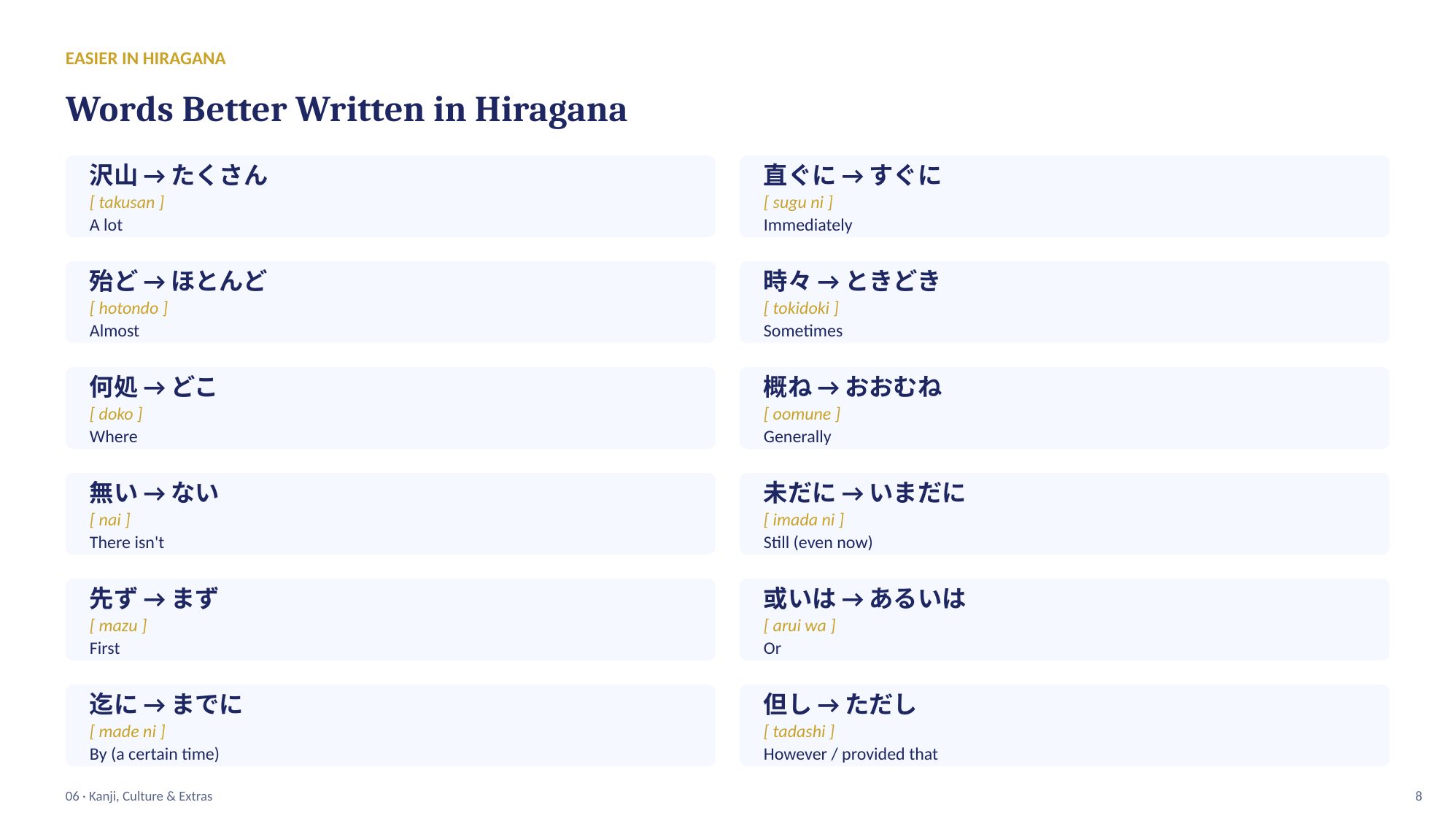
Words Better Written in Hiragana
Words Better Written in Hiragana
JP沢山→たくさん直ぐに→すぐに
EN [ takusan ] [ sugu ni ]
A lot Immediately
A lot Immediately
JP殆ど→ほとんど時々→ときどき
EN [ hotondo ] [ tokidoki ]
Almost Sometimes
Almost Sometimes
JP何処→どこ概ね→おおむね
EN [ doko ] [ oomune ]
Where Generally
Where Generally
JP無い→ない未だに→いまだに
EN [ nai ] [ imada ni ]
There isn't Still (even now)
There isn't Still (even now)
JP先ず→まず或いは→あるいは
EN [ mazu ] [ arui wa ]
First Or
First Or
JP迄に→までに但し→ただし
EN [ made ni ] [ tadashi ]
By (a certain time) However / provided that
06 · Kanji, Culture & Extras 8
By (a certain time) However / provided that
06 · Kanji, Culture & Extras 8
หน้า 9
คลิกเพื่อขยาย
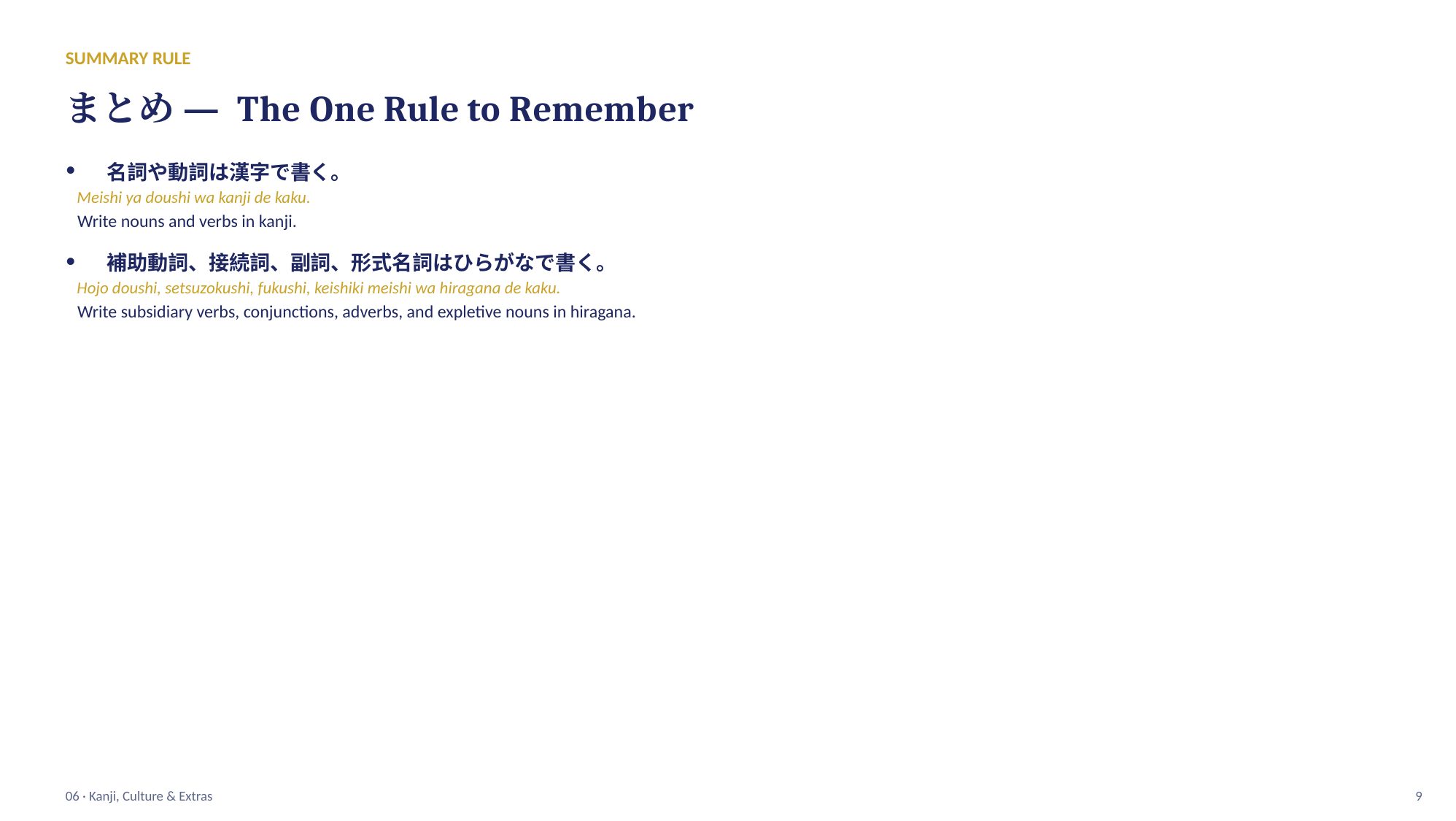
ENSUMMARY RULE
まとめ — The One Rule to Remember
まとめ — The One Rule to Remember
JP•名詞や動詞は漢字で書く。
EN Meishi ya doushi wa kanji de kaku.
Write nouns and verbs in kanji.
Write nouns and verbs in kanji.
JP•補助動詞、接続詞、副詞、形式名詞はひらがなで書く。
EN Hojo doushi, setsuzokushi, fukushi, keishiki meishi wa hiragana de kaku.
Write subsidiary verbs, conjunctions, adverbs, and expletive nouns in hiragana.
06 · Kanji, Culture & Extras 9
Write subsidiary verbs, conjunctions, adverbs, and expletive nouns in hiragana.
06 · Kanji, Culture & Extras 9
หน้า 10
คลิกเพื่อขยาย
02
ENAdvanced Aizuchi — Reacting to Bad News
JPあいづち—相手の不運に反応する
ENNatural back-channeling phrases for when a colleague shares bad luck
หน้า 11
คลิกเพื่อขยาย
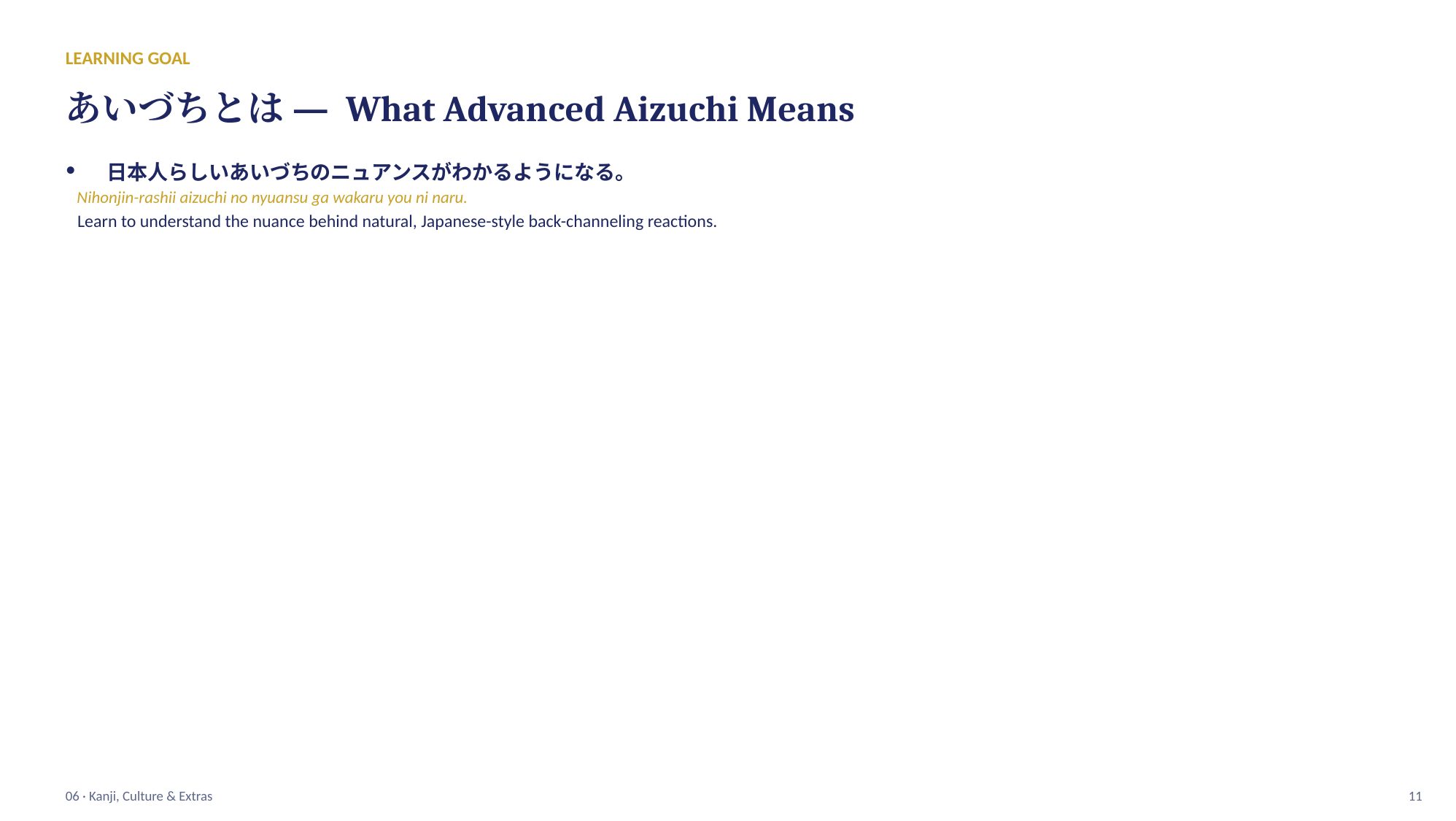
ENLEARNING GOAL
あいづちとは — What Advanced Aizuchi Means
あいづちとは — What Advanced Aizuchi Means
JP•日本人らしいあいづちのニュアンスがわかるようになる。
EN Nihonjin-rashii aizuchi no nyuansu ga wakaru you ni naru.
Learn to understand the nuance behind natural, Japanese-style back-channeling reactions.
06 · Kanji, Culture & Extras 11
Learn to understand the nuance behind natural, Japanese-style back-channeling reactions.
06 · Kanji, Culture & Extras 11
หน้า 12
คลิกเพื่อขยาย
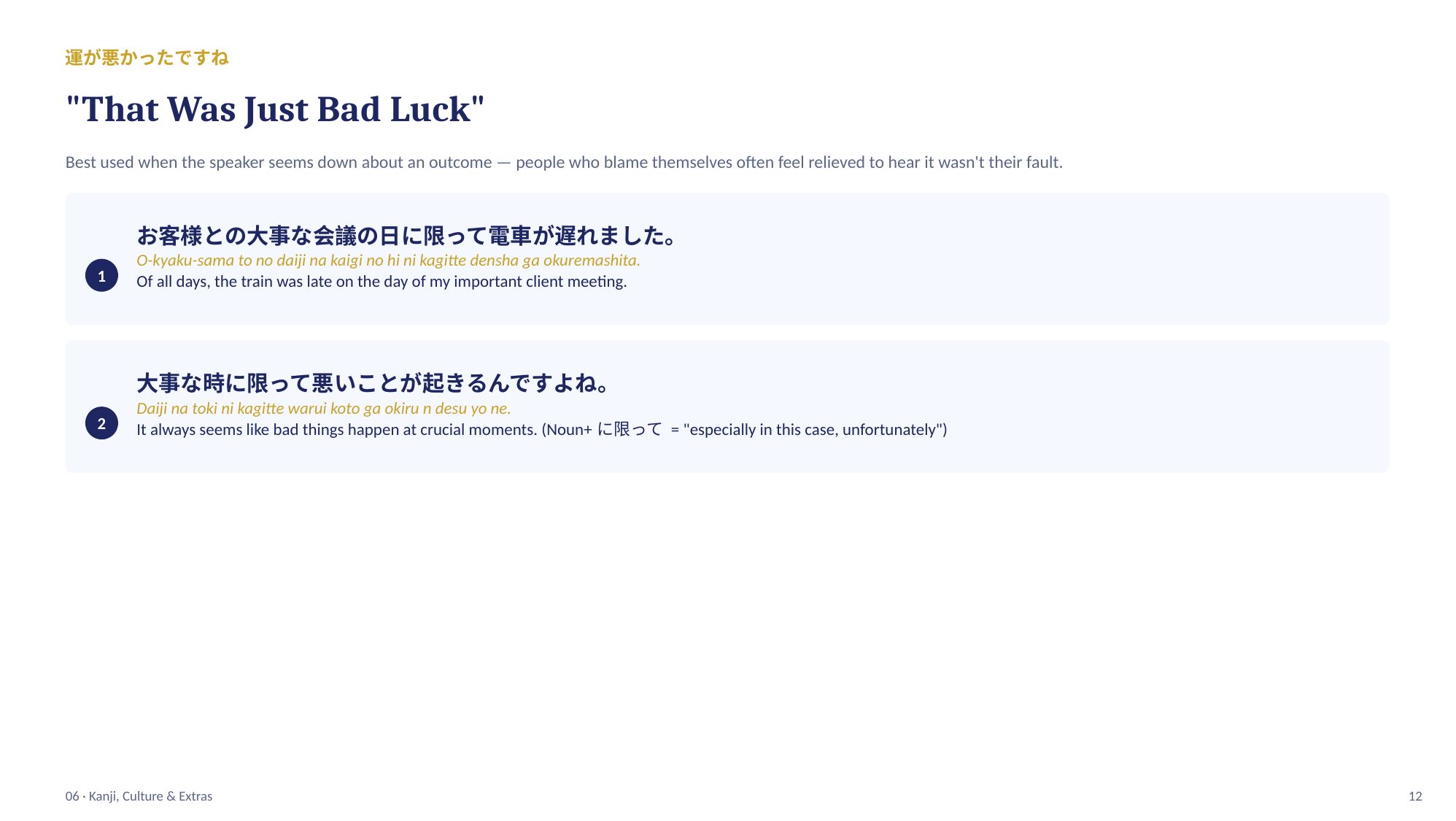
JP運が悪かったですね
EN"That Was Just Bad Luck"
Best used when the speaker seems down about an outcome — people who blame themselves often feel relieved to hear it wasn't their fault.
Best used when the speaker seems down about an outcome — people who blame themselves often feel relieved to hear it wasn't their fault.
JPお客様との大事な会議の日に限って電車が遅れました。
EN O-kyaku-sama to no daiji na kaigi no hi ni kagitte densha ga okuremashita.
1 Of all days, the train was late on the day of my important client meeting.
1 Of all days, the train was late on the day of my important client meeting.
JP大事な時に限って悪いことが起きるんですよね。
EN Daiji na toki ni kagitte warui koto ga okiru n desu yo ne.
2 It always seems like bad things happen at crucial moments. (Noun+ に限って = "especially in this case, unfortunately")
06 · Kanji, Culture & Extras 12
2 It always seems like bad things happen at crucial moments. (Noun+ に限って = "especially in this case, unfortunately")
06 · Kanji, Culture & Extras 12
หน้า 13
คลิกเพื่อขยาย
ENMORE EXAMPLES
Sympathizing With Bad Luck
Sympathizing With Bad Luck
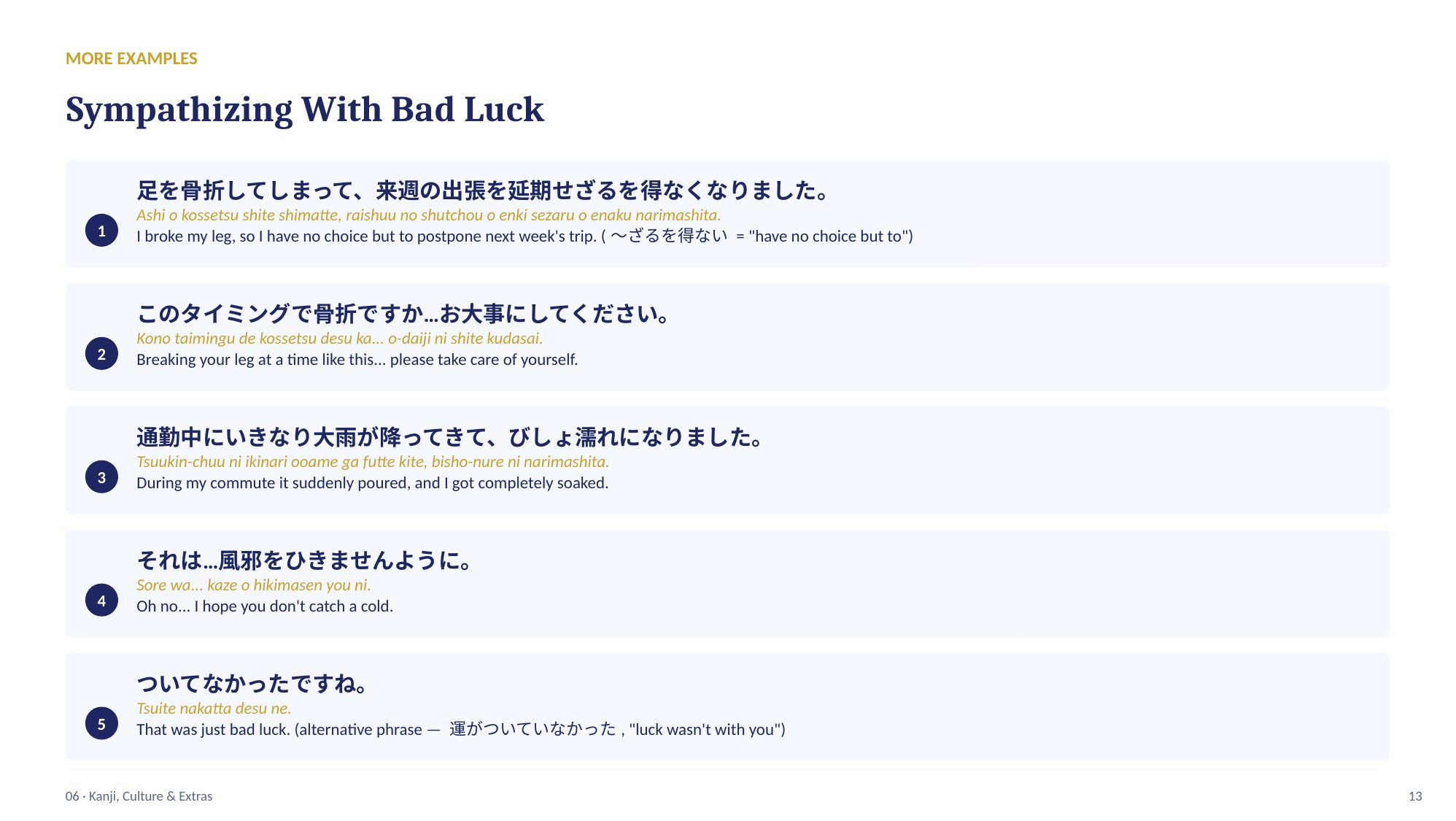
JP足を骨折してしまって、来週の出張を延期せざるを得なくなりました。
EN Ashi o kossetsu shite shimatte, raishuu no shutchou o enki sezaru o enaku narimashita.
1 I broke my leg, so I have no choice but to postpone next week's trip. ( ~ざるを得ない = "have no choice but to")
1 I broke my leg, so I have no choice but to postpone next week's trip. ( ~ざるを得ない = "have no choice but to")
JPこのタイミングで骨折ですか…お大事にしてください。
EN Kono taimingu de kossetsu desu ka... o-daiji ni shite kudasai.
2 Breaking your leg at a time like this... please take care of yourself.
2 Breaking your leg at a time like this... please take care of yourself.
JP通勤中にいきなり大雨が降ってきて、びしょ濡れになりました。
EN Tsuukin-chuu ni ikinari ooame ga futte kite, bisho-nure ni narimashita.
3 During my commute it suddenly poured, and I got completely soaked.
3 During my commute it suddenly poured, and I got completely soaked.
JPそれは…風邪をひきませんように。
EN Sore wa... kaze o hikimasen you ni.
4 Oh no... I hope you don't catch a cold.
4 Oh no... I hope you don't catch a cold.
JPついてなかったですね。
EN Tsuite nakatta desu ne.
5 That was just bad luck. (alternative phrase — 運がついていなかった , "luck wasn't with you")
06 · Kanji, Culture & Extras 13
5 That was just bad luck. (alternative phrase — 運がついていなかった , "luck wasn't with you")
06 · Kanji, Culture & Extras 13
หน้า 14

คลิกเพื่อขยาย
03
ENご縁ですね — Fate & Connection
JPご縁ですね
ENA distinctly Japanese way of framing meaningful coincidences at work
หน้า 15
คลิกเพื่อขยาย
ENTHE CONCEPT
縁 (En) — What It Means
縁 (En) — What It Means
JP•その出来事は偶然に起こったのではなく、これまでのさまざまなことがつながって「縁」によって引き寄せられた。
EN Sono dekigoto wa guuzen ni okotta no dewa naku, kore made no samazama na koto ga tsunagatte "en" ni yotte hikiyoserareta.
That event didn't happen by coincidence — it was drawn together by "en" (fate/connection), through everything that has linked up until now.
06 · Kanji, Culture & Extras 15
That event didn't happen by coincidence — it was drawn together by "en" (fate/connection), through everything that has linked up until now.
06 · Kanji, Culture & Extras 15
หน้า 16
คลิกเพื่อขยาย
ENIN USE
ご縁ですね — Example Dialogues
ご縁ですね — Example Dialogues
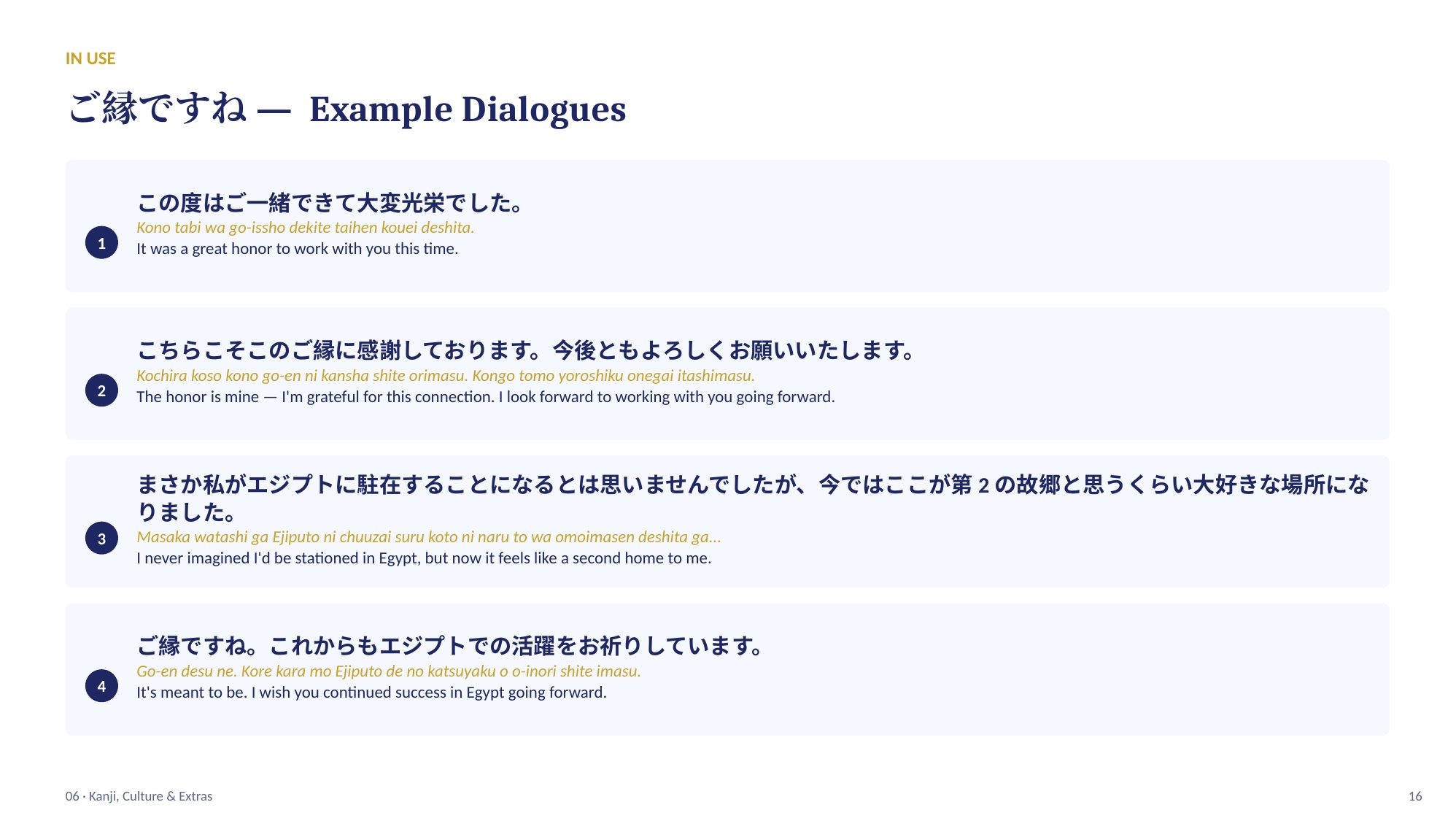
JPこの度はご一緒できて大変光栄でした。
EN Kono tabi wa go-issho dekite taihen kouei deshita.
1 It was a great honor to work with you this time.
1 It was a great honor to work with you this time.
JPこちらこそこのご縁に感謝しております。今後ともよろしくお願いいたします。
EN Kochira koso kono go-en ni kansha shite orimasu. Kongo tomo yoroshiku onegai itashimasu.
2 The honor is mine — I'm grateful for this connection. I look forward to working with you going forward.
2 The honor is mine — I'm grateful for this connection. I look forward to working with you going forward.
JPまさか私がエジプトに駐在することになるとは思いませんでしたが、今ではここが第2の故郷と思うくらい大好きな場所にな
りました。
りました。
EN 3 Masaka watashi ga Ejiputo ni chuuzai suru koto ni naru to wa omoimasen deshita ga...
I never imagined I'd be stationed in Egypt, but now it feels like a second home to me.
I never imagined I'd be stationed in Egypt, but now it feels like a second home to me.
JPご縁ですね。これからもエジプトでの活躍をお祈りしています。
EN Go-en desu ne. Kore kara mo Ejiputo de no katsuyaku o o-inori shite imasu.
4 It's meant to be. I wish you continued success in Egypt going forward.
06 · Kanji, Culture & Extras 16
4 It's meant to be. I wish you continued success in Egypt going forward.
06 · Kanji, Culture & Extras 16
หน้า 17
คลิกเพื่อขยาย
04
ENBody Language & Impressions with Superiors
JP目上の人への印象と仕草
ENMehrabian's Law and 5 gestures to avoid in front of your boss
หน้า 18
คลิกเพื่อขยาย
ENWHY IT MATTERS
見た目が与える印象 — Why Appearance Matters
見た目が与える印象 — Why Appearance Matters
JP•皆さんの目上の人に悪い印象を与えているかもしれません。
EN Mina-san no meue no hito ni warui inshou o ataete iru kamoshiremasen.
You might be giving your superiors a bad impression without realizing it.
• メラビアンの法則 (Mehrabian's Law, 1971)
Impressions form not just from words, but from vocal qualities (tone, volume, tempo) and visual cues (appearance, gestures, expression, gaze).
You might be giving your superiors a bad impression without realizing it.
• メラビアンの法則 (Mehrabian's Law, 1971)
Impressions form not just from words, but from vocal qualities (tone, volume, tempo) and visual cues (appearance, gestures, expression, gaze).
JP•見た目が与える情報はその人の印象を左右する。
EN Mitame ga ataeru jouhou wa sono hito no inshou o sayuu suru.
The information conveyed by appearance strongly influences the impression a person makes.
06 · Kanji, Culture & Extras 18
The information conveyed by appearance strongly influences the impression a person makes.
06 · Kanji, Culture & Extras 18
หน้า 19
คลิกเพื่อขยาย
EN5 GESTURES TO AVOID
JP目上の人の前でしない方が良い仕草
•話す時に目をキョロキョロと動かす
•話す時に目をキョロキョロと動かす
EN hanasu toki ni me o kyoro-kyoro to ugokasu
Letting your eyes dart around while speaking makes you look unconfident.
Letting your eyes dart around while speaking makes you look unconfident.
JP•足を揺らす・貧乏ゆすりをする
EN Shaking your leg/foot makes people around you feel "unsettled" or "unable to concentrate."
• 頬杖をつく (houzue o tsuku)
Resting your elbow on the desk with your chin in your palm — gives the impression you're unmotivated or tired.
• 頬杖をつく (houzue o tsuku)
Resting your elbow on the desk with your chin in your palm — gives the impression you're unmotivated or tired.
JP•相手を見下すような仕草
EN Gestures that can look like you're looking down on the other person should be avoided in front of superiors.
06 · Kanji, Culture & Extras 19
06 · Kanji, Culture & Extras 19
หน้า 20
คลิกเพื่อขยาย
05
ENJapan's Healthcare Insurance System
JP日本の医療保険制度
ENHow universal coverage, cost-sharing, and the high-cost care cap work
หน้า 21
คลิกเพื่อขยาย
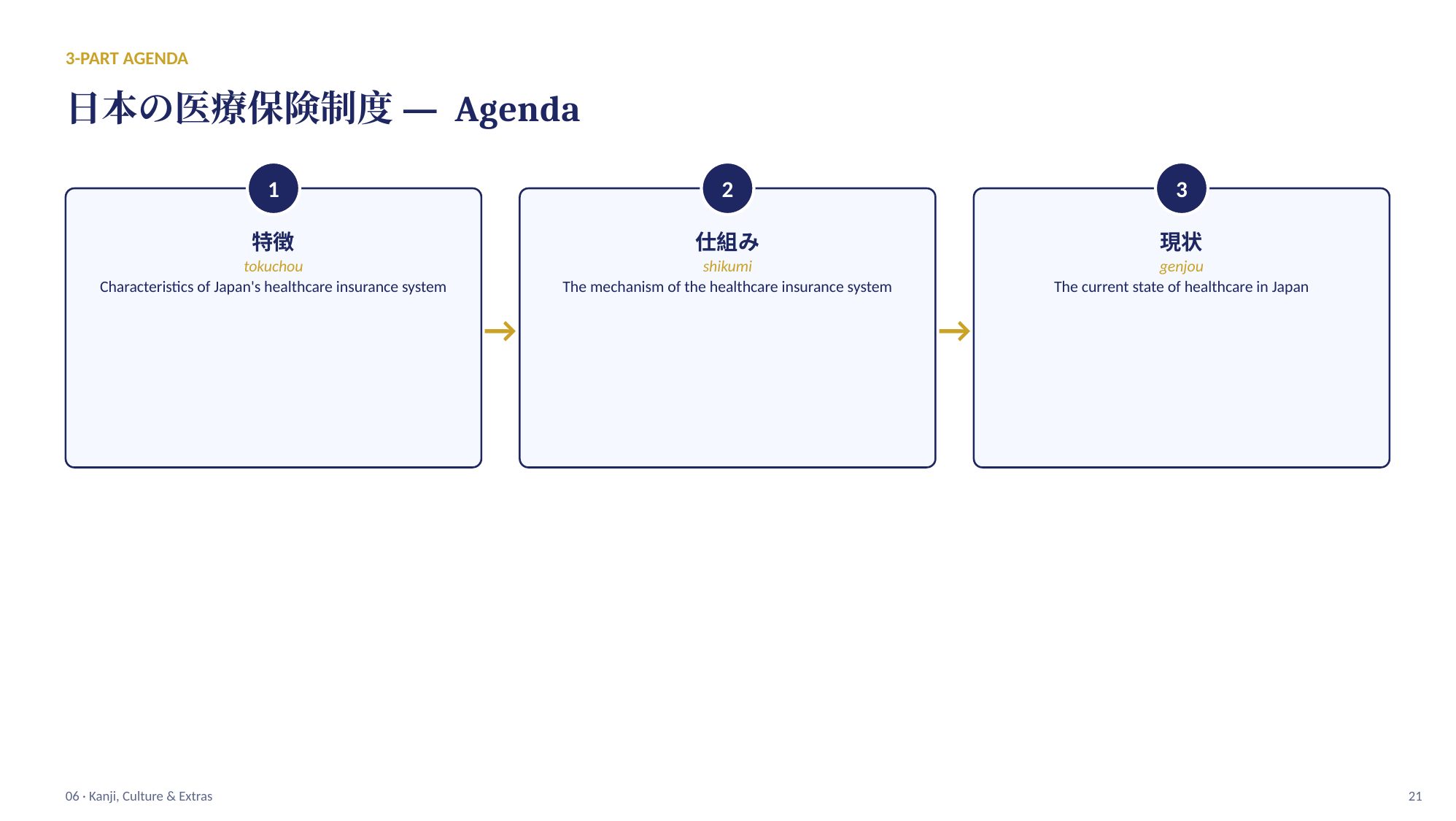
EN3-PART AGENDA
JP日本の医療保険制度—Agenda
123
特徴仕組み現状
123
特徴仕組み現状
EN tokuchou shikumi genjou
Characteristics of Japan's healthcare insurance system The mechanism of the healthcare insurance system The current state of healthcare in Japan
→ →
06 · Kanji, Culture & Extras 21
Characteristics of Japan's healthcare insurance system The mechanism of the healthcare insurance system The current state of healthcare in Japan
→ →
06 · Kanji, Culture & Extras 21
หน้า 22
คลิกเพื่อขยาย
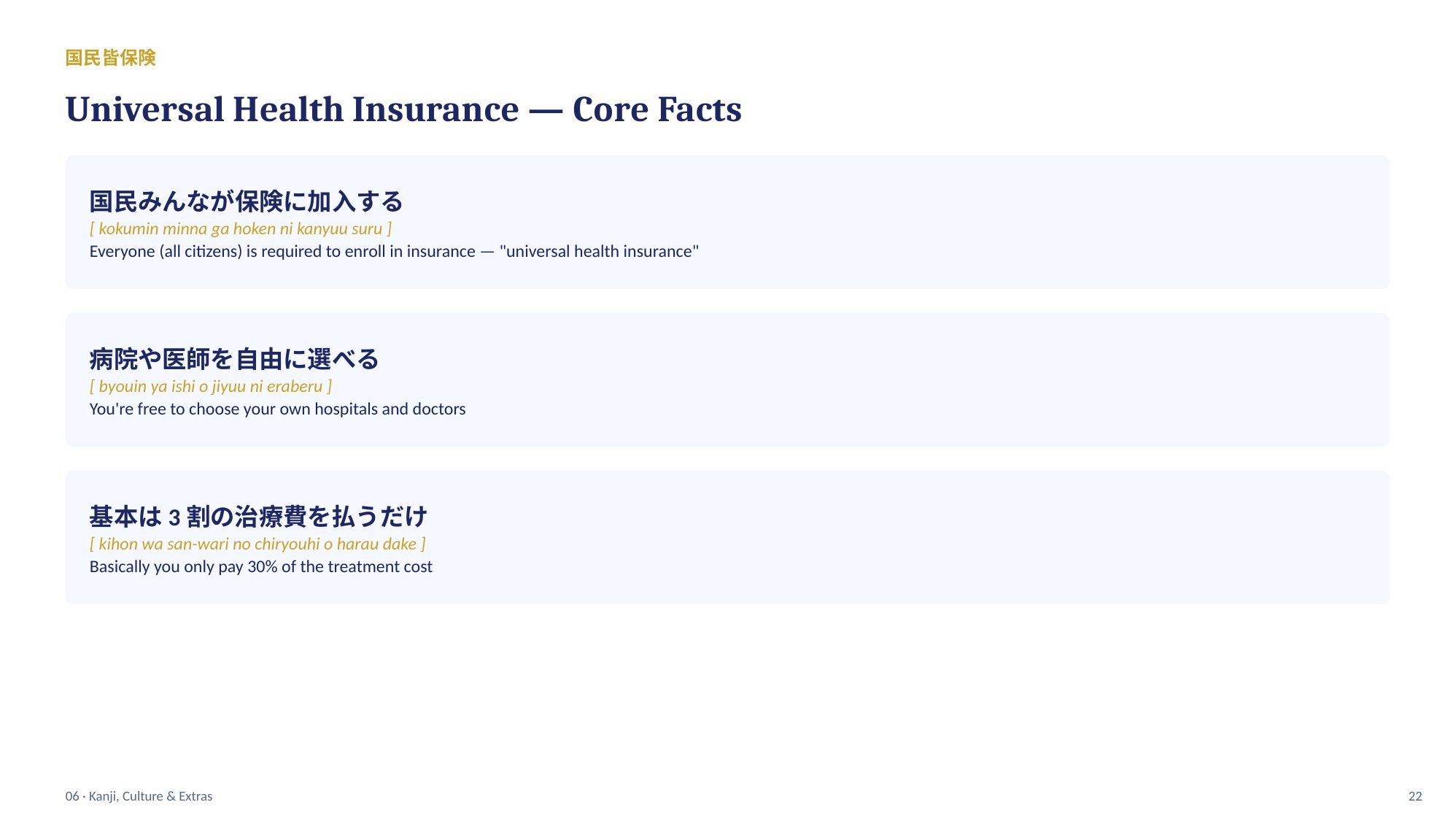
JP国民皆保険
ENUniversal Health Insurance — Core Facts
JP国民みんなが保険に加入する
EN [ kokumin minna ga hoken ni kanyuu suru ]
Everyone (all citizens) is required to enroll in insurance — "universal health insurance"
Everyone (all citizens) is required to enroll in insurance — "universal health insurance"
JP病院や医師を自由に選べる
EN [ byouin ya ishi o jiyuu ni eraberu ]
You're free to choose your own hospitals and doctors
You're free to choose your own hospitals and doctors
JP基本は3割の治療費を払うだけ
EN [ kihon wa san-wari no chiryouhi o harau dake ]
Basically you only pay 30% of the treatment cost
06 · Kanji, Culture & Extras 22
Basically you only pay 30% of the treatment cost
06 · Kanji, Culture & Extras 22
หน้า 23
คลิกเพื่อขยาย
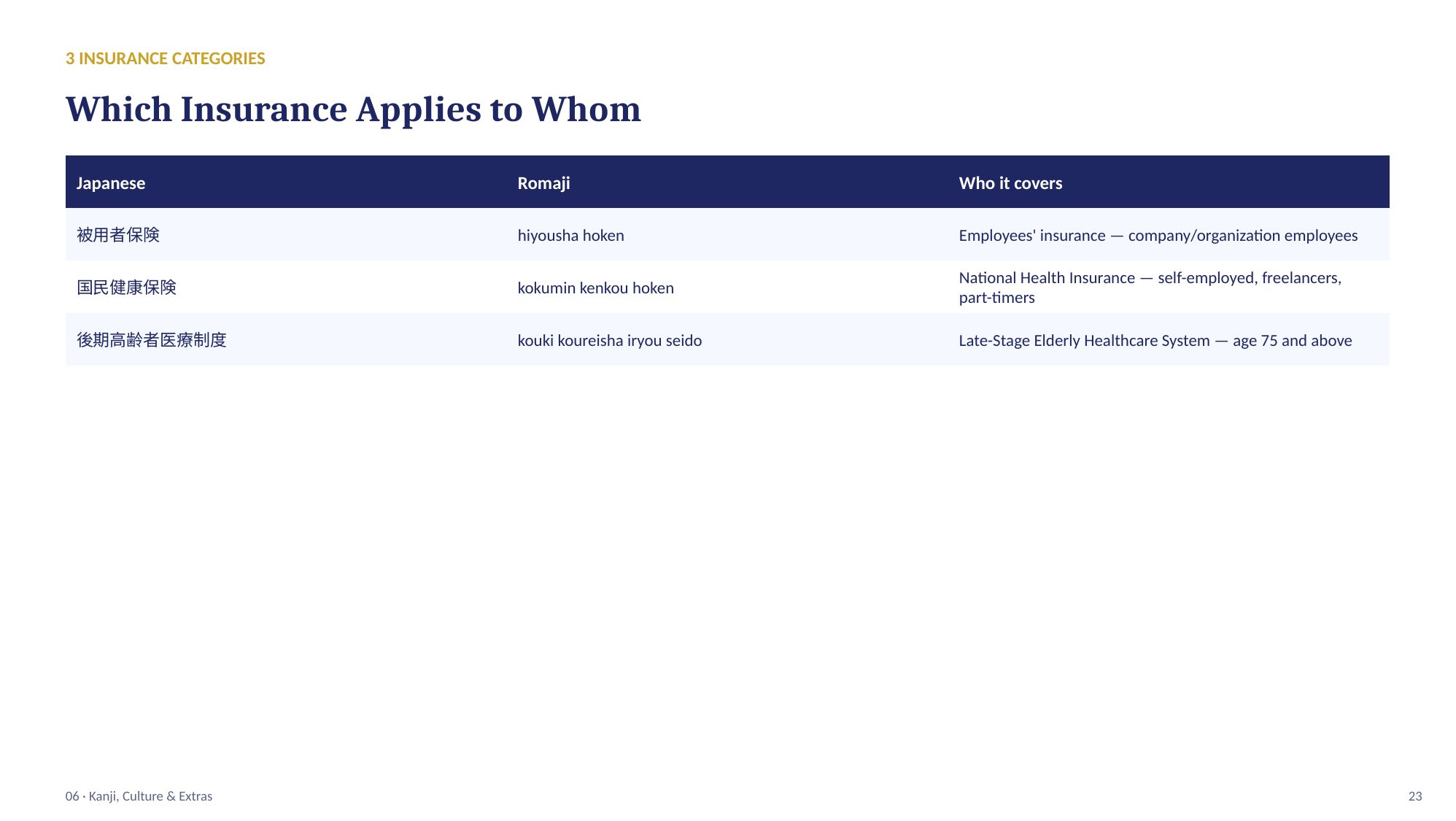
EN3 INSURANCE CATEGORIES
Which Insurance Applies to Whom
Japanese Romaji Who it covers
被用者保険 hiyousha hoken Employees' insurance — company/organization employees
National Health Insurance — self-employed, freelancers,
国民健康保険 kokumin kenkou hoken
part-timers
後期高齢者医療制度 kouki koureisha iryou seido Late-Stage Elderly Healthcare System — age 75 and above
06 · Kanji, Culture & Extras 23
Which Insurance Applies to Whom
Japanese Romaji Who it covers
被用者保険 hiyousha hoken Employees' insurance — company/organization employees
National Health Insurance — self-employed, freelancers,
国民健康保険 kokumin kenkou hoken
part-timers
後期高齢者医療制度 kouki koureisha iryou seido Late-Stage Elderly Healthcare System — age 75 and above
06 · Kanji, Culture & Extras 23
หน้า 24
คลิกเพื่อขยาย
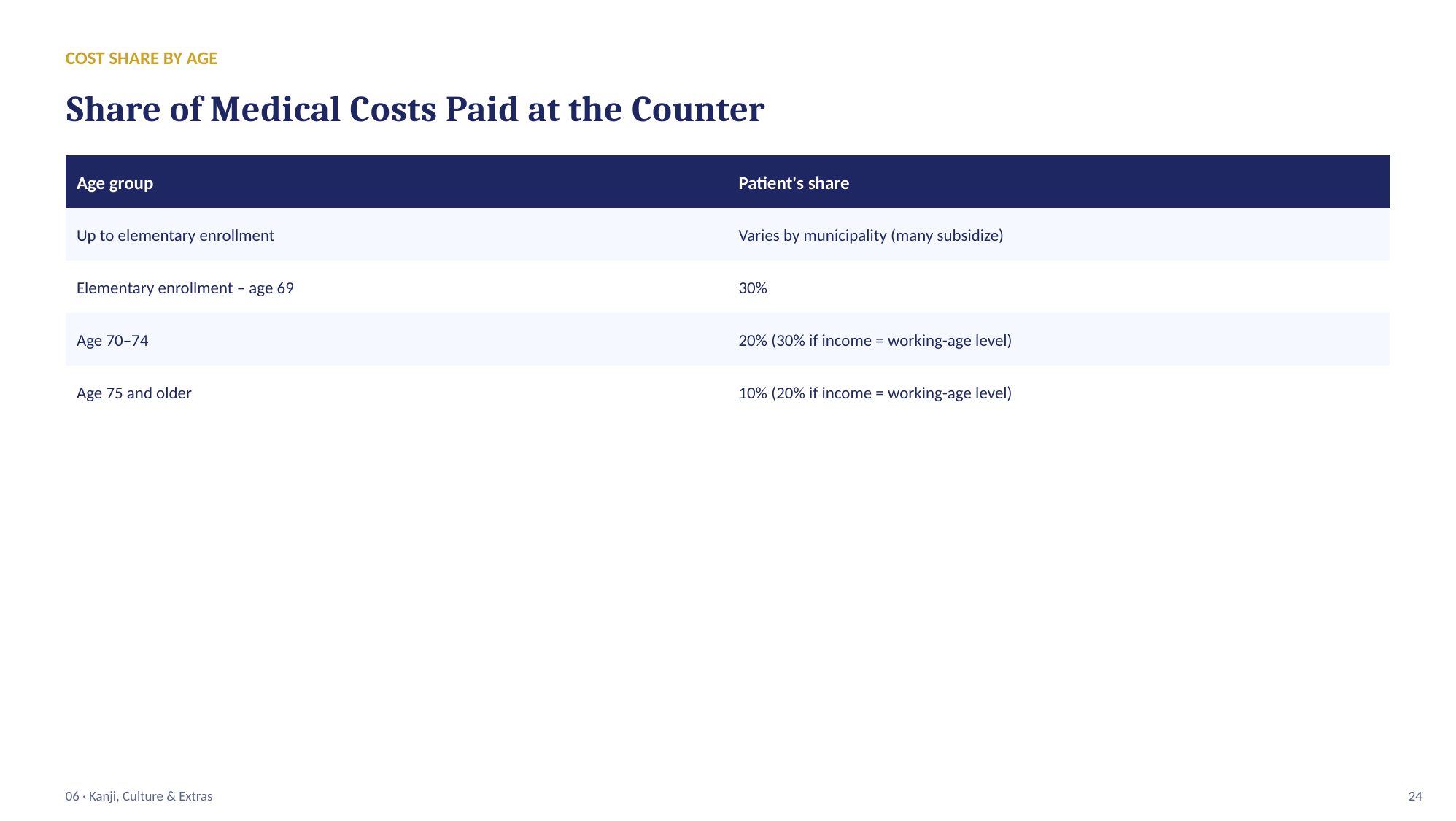
ENCOST SHARE BY AGE
Share of Medical Costs Paid at the Counter
Age group Patient's share
Up to elementary enrollment Varies by municipality (many subsidize)
Elementary enrollment – age 69 30%
Age 70–74 20% (30% if income = working-age level)
Age 75 and older 10% (20% if income = working-age level)
06 · Kanji, Culture & Extras 24
Share of Medical Costs Paid at the Counter
Age group Patient's share
Up to elementary enrollment Varies by municipality (many subsidize)
Elementary enrollment – age 69 30%
Age 70–74 20% (30% if income = working-age level)
Age 75 and older 10% (20% if income = working-age level)
06 · Kanji, Culture & Extras 24
หน้า 25
คลิกเพื่อขยาย
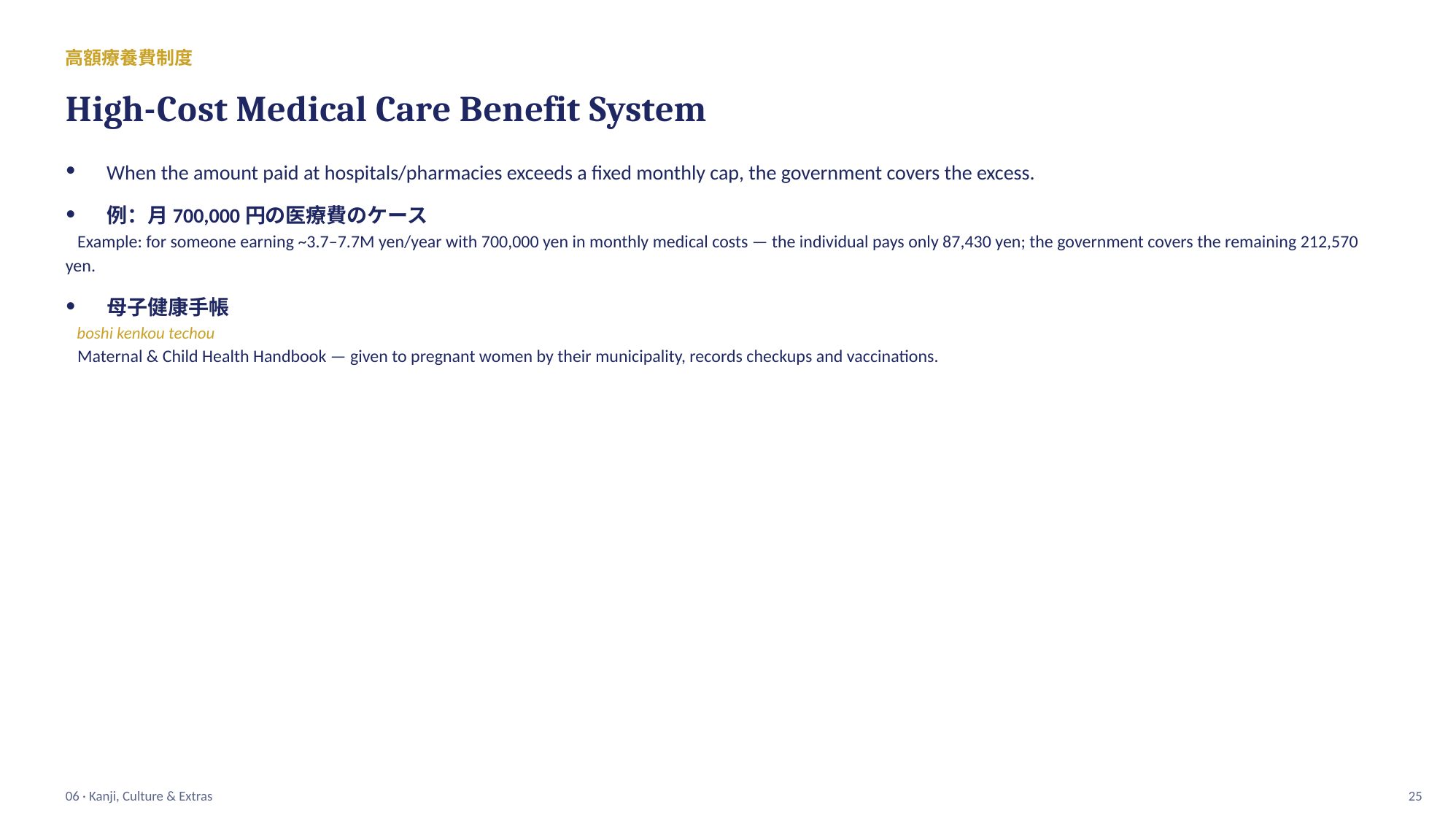
JP高額療養費制度
ENHigh-Cost Medical Care Benefit System
• When the amount paid at hospitals/pharmacies exceeds a fixed monthly cap, the government covers the excess.
• When the amount paid at hospitals/pharmacies exceeds a fixed monthly cap, the government covers the excess.
JP•例:月700,000円の医療費のケース
EN Example: for someone earning ~3.7–7.7M yen/year with 700,000 yen in monthly medical costs — the individual pays only 87,430 yen; the government covers the remaining 212,570
yen.
yen.
JP•母子健康手帳
EN boshi kenkou techou
Maternal & Child Health Handbook — given to pregnant women by their municipality, records checkups and vaccinations.
06 · Kanji, Culture & Extras 25
Maternal & Child Health Handbook — given to pregnant women by their municipality, records checkups and vaccinations.
06 · Kanji, Culture & Extras 25
หน้า 26

คลิกเพื่อขยาย
06
EN6 Mindsets That Lead to Results
JP成果につながる6つの意識
ENWorkplace mindsets said to make it easier to produce good results
หน้า 27
คลิกเพื่อขยาย
ENINTRODUCTION
JP6つの意識とは
•働く上で6つの意識を持っていると仕事で成果を出しやすいと言われています。
•働く上で6つの意識を持っていると仕事で成果を出しやすいと言われています。
EN Hataraku ue de muttsu no ishiki o motte iru to shigoto de seika o dashi-yasui to iwarete imasu.
It's said that having these six mindsets while working makes it easier to produce results.
06 · Kanji, Culture & Extras 27
It's said that having these six mindsets while working makes it easier to produce results.
06 · Kanji, Culture & Extras 27
หน้า 28
คลิกเพื่อขยาย
ENMINDSETS #1-3
JP当事者意識・協力意識・健康意識
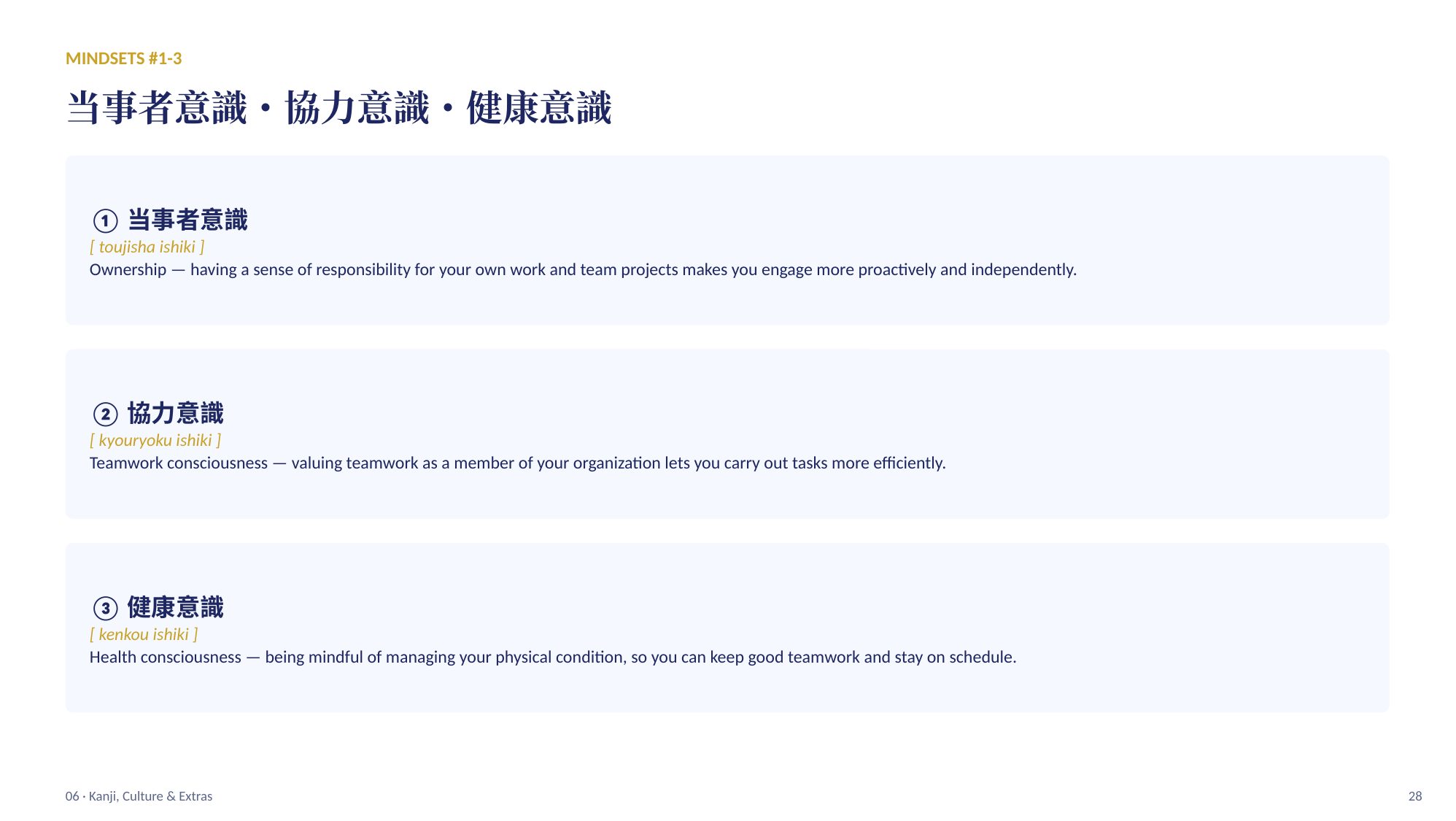
①当事者意識
①当事者意識
EN [ toujisha ishiki ]
Ownership — having a sense of responsibility for your own work and team projects makes you engage more proactively and independently.
Ownership — having a sense of responsibility for your own work and team projects makes you engage more proactively and independently.
JP②協力意識
EN [ kyouryoku ishiki ]
Teamwork consciousness — valuing teamwork as a member of your organization lets you carry out tasks more efficiently.
Teamwork consciousness — valuing teamwork as a member of your organization lets you carry out tasks more efficiently.
JP③健康意識
EN [ kenkou ishiki ]
Health consciousness — being mindful of managing your physical condition, so you can keep good teamwork and stay on schedule.
06 · Kanji, Culture & Extras 28
Health consciousness — being mindful of managing your physical condition, so you can keep good teamwork and stay on schedule.
06 · Kanji, Culture & Extras 28
หน้า 29
คลิกเพื่อขยาย
07
ENJob Hunting & Career — Extended
JP就活・転職の言葉(拡張編)
ENMore job-search vocabulary, a full self-PR template, and why to study Japanese for work
หน้า 30
คลิกเพื่อขยาย
EN就活・転職 VOCABULARY
Job-Hunting & Job-Changing Set Phrases
Job-Hunting & Job-Changing Set Phrases
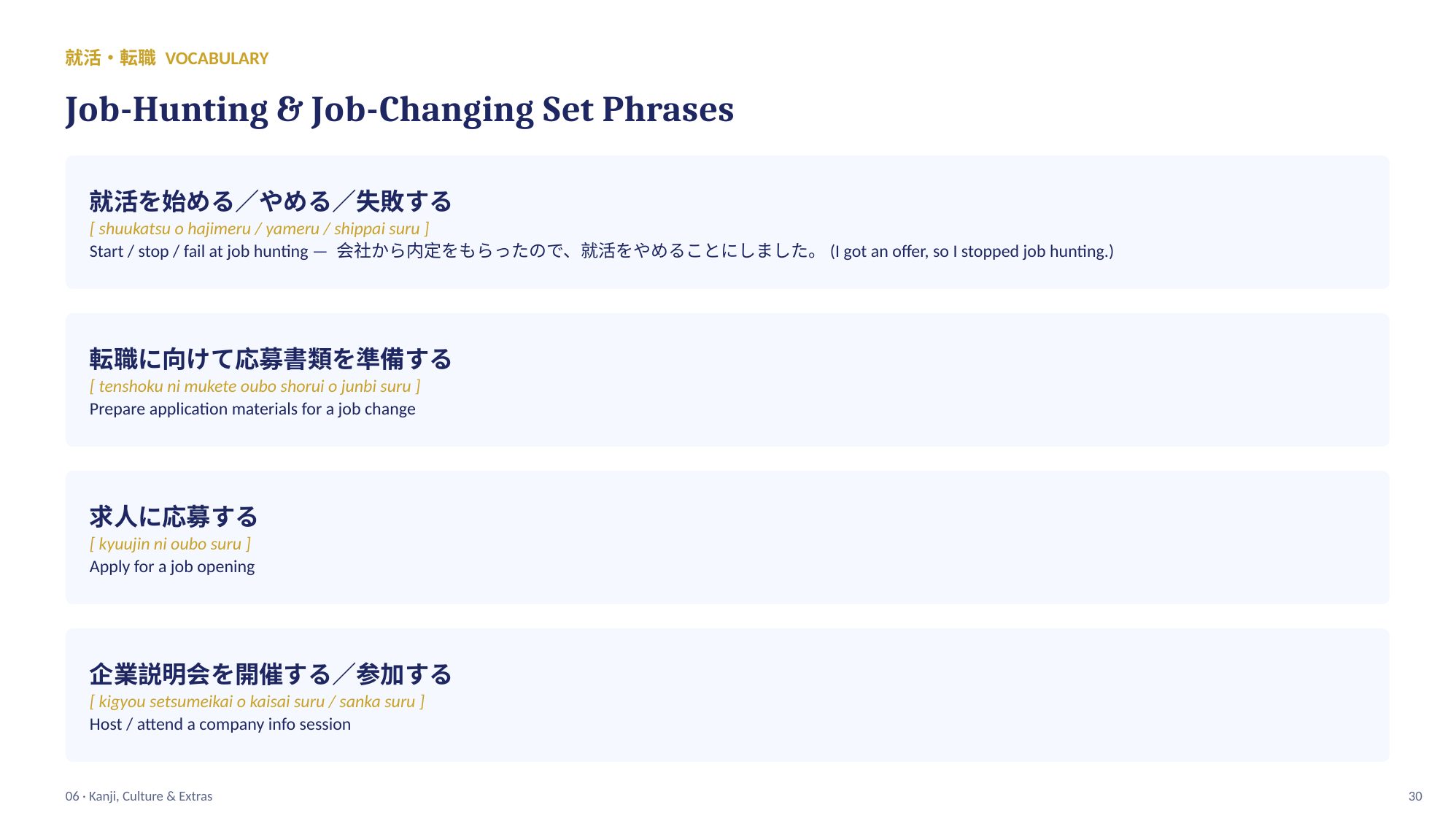
JP就活を始める/やめる/失敗する
EN [ shuukatsu o hajimeru / yameru / shippai suru ]
Start / stop / fail at job hunting — 会社から内定をもらったので、就活をやめることにしました。 (I got an offer, so I stopped job hunting.)
Start / stop / fail at job hunting — 会社から内定をもらったので、就活をやめることにしました。 (I got an offer, so I stopped job hunting.)
JP転職に向けて応募書類を準備する
EN [ tenshoku ni mukete oubo shorui o junbi suru ]
Prepare application materials for a job change
Prepare application materials for a job change
JP求人に応募する
EN [ kyuujin ni oubo suru ]
Apply for a job opening
Apply for a job opening
JP企業説明会を開催する/参加する
EN [ kigyou setsumeikai o kaisai suru / sanka suru ]
Host / attend a company info session
06 · Kanji, Culture & Extras 30
Host / attend a company info session
06 · Kanji, Culture & Extras 30
หน้า 31
คลิกเพื่อขยาย
EN自己 PR — MORE SAMPLE ANSWERS
Additional Strength Examples
Additional Strength Examples
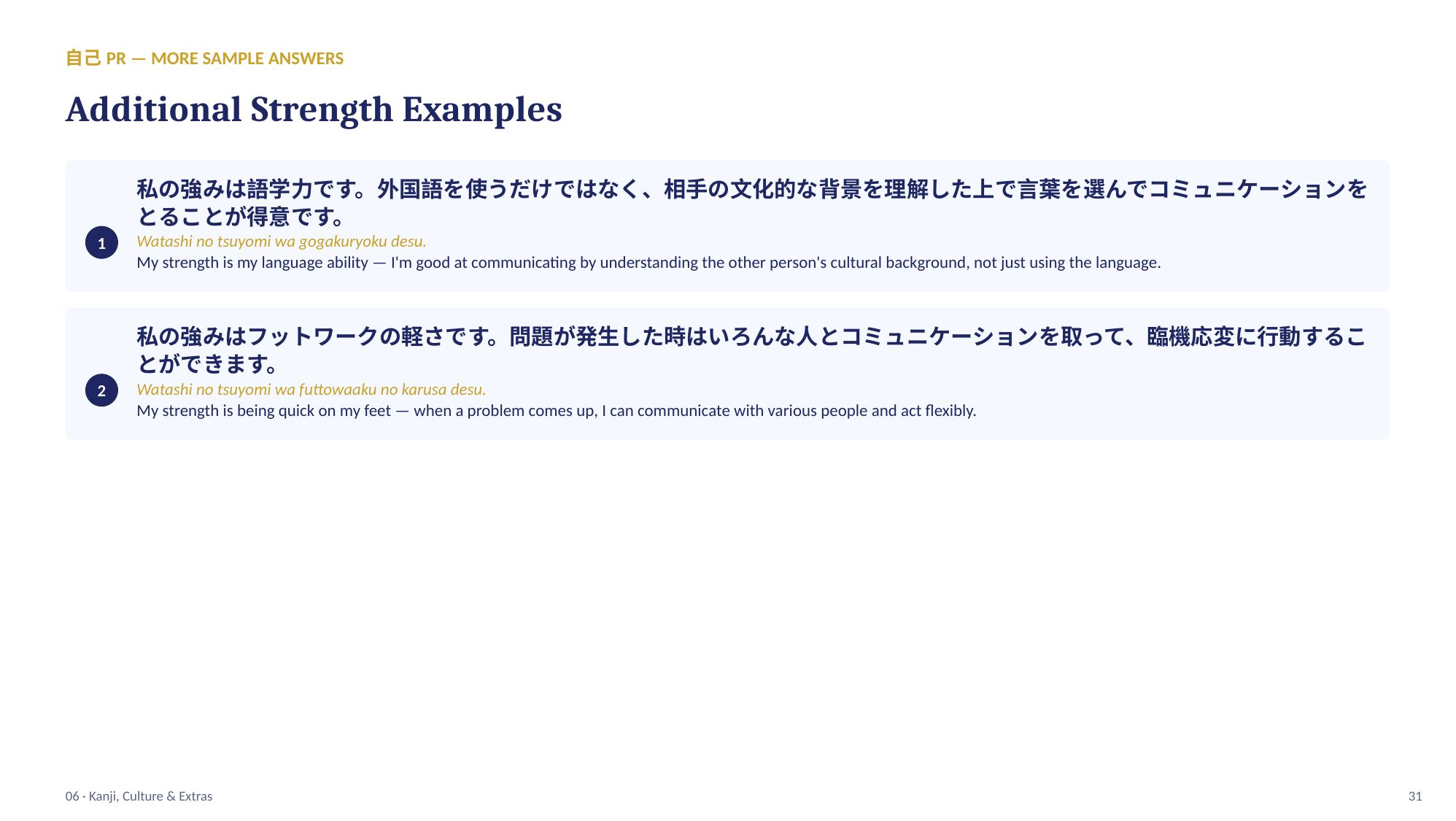
JP私の強みは語学力です。外国語を使うだけではなく、相手の文化的な背景を理解した上で言葉を選んでコミュニケーションを
とることが得意です。
とることが得意です。
EN 1 Watashi no tsuyomi wa gogakuryoku desu.
My strength is my language ability — I'm good at communicating by understanding the other person's cultural background, not just using the language.
My strength is my language ability — I'm good at communicating by understanding the other person's cultural background, not just using the language.
JP私の強みはフットワークの軽さです。問題が発生した時はいろんな人とコミュニケーションを取って、臨機応変に行動するこ
とができます。
とができます。
EN 2 Watashi no tsuyomi wa futtowaaku no karusa desu.
My strength is being quick on my feet — when a problem comes up, I can communicate with various people and act flexibly.
06 · Kanji, Culture & Extras 31
My strength is being quick on my feet — when a problem comes up, I can communicate with various people and act flexibly.
06 · Kanji, Culture & Extras 31
หน้า 32
คลิกเพื่อขยาย
ENFULL TEMPLATE
自己 PR 例:転職するプログラマー — A Full 3-Step Template
1 2 3
自己 PR 例:転職するプログラマー — A Full 3-Step Template
1 2 3
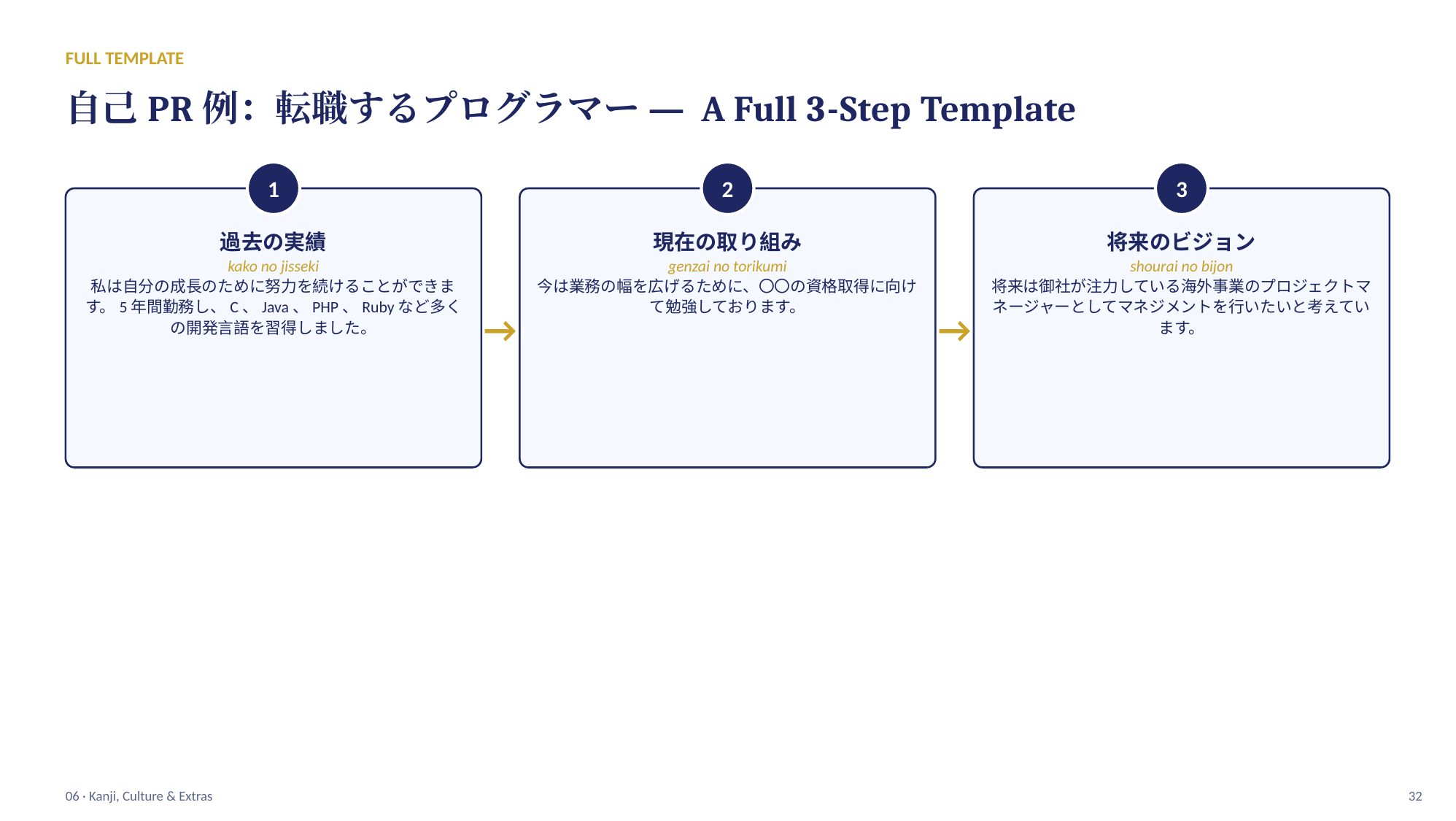
JP過去の実績現在の取り組み将来のビジョン
EN kako no jisseki genzai no torikumi shourai no bijon
JP私は自分の成長のために努力を続けることができま今は業務の幅を広げるために、〇〇の資格取得に向け将来は御社が注力している海外事業のプロジェクトマ
す。5年間勤務し、C、Java、PHP、Rubyなど多くて勉強しております。ネージャーとしてマネジメントを行いたいと考えてい
の開発言語を習得しました。
→→ます。
す。5年間勤務し、C、Java、PHP、Rubyなど多くて勉強しております。ネージャーとしてマネジメントを行いたいと考えてい
の開発言語を習得しました。
→→ます。
EN06 · Kanji, Culture & Extras 32
หน้า 33
คลิกเพื่อขยาย
ENWHY STUDY BUSINESS JAPANESE
仕事で日本語を話す理由 — Motivation to Keep Studying
仕事で日本語を話す理由 — Motivation to Keep Studying
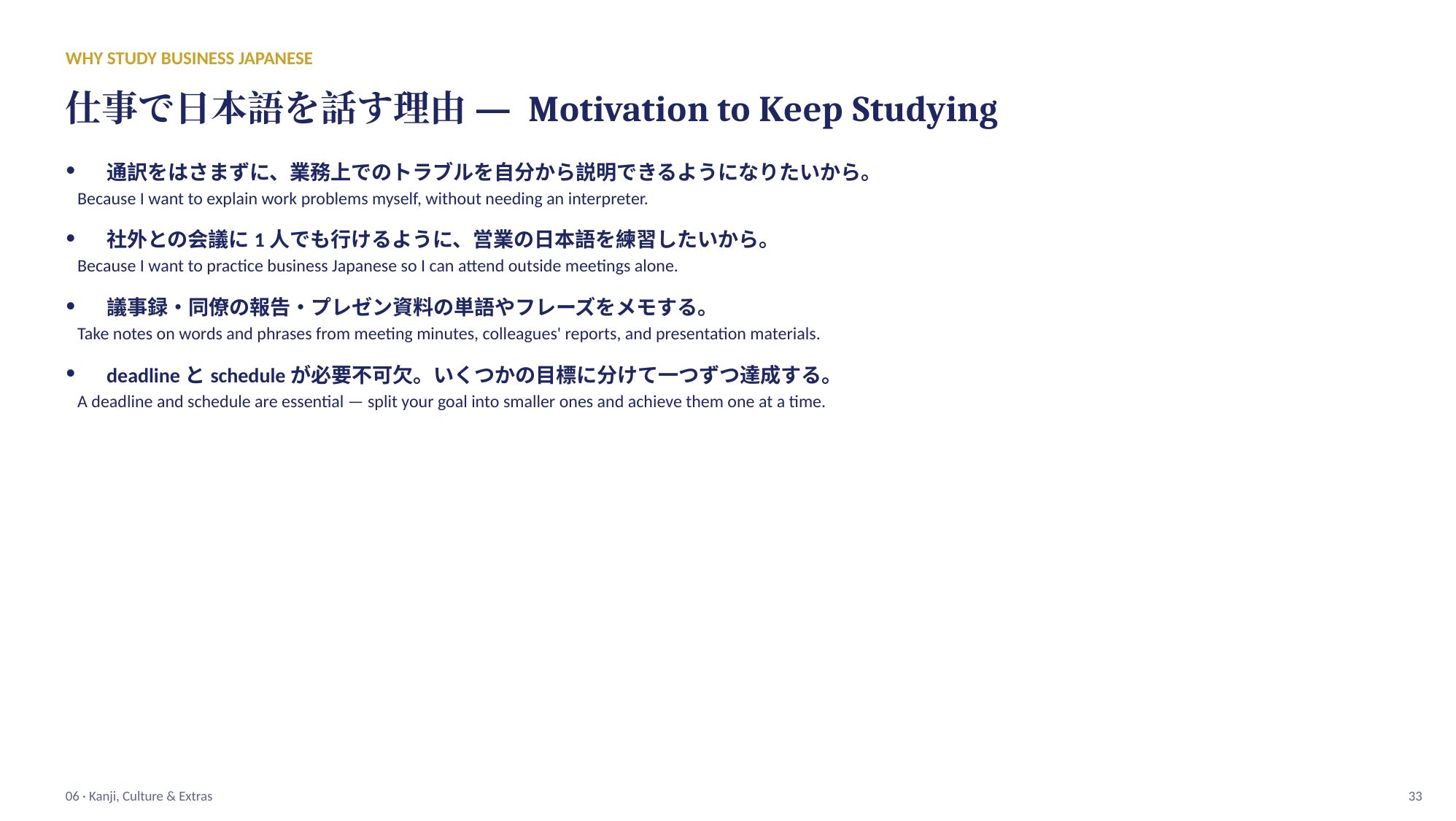
JP•通訳をはさまずに、業務上でのトラブルを自分から説明できるようになりたいから。
EN Because I want to explain work problems myself, without needing an interpreter.
JP•社外との会議に1人でも行けるように、営業の日本語を練習したいから。
EN Because I want to practice business Japanese so I can attend outside meetings alone.
JP•議事録・同僚の報告・プレゼン資料の単語やフレーズをメモする。
EN Take notes on words and phrases from meeting minutes, colleagues' reports, and presentation materials.
JP•deadlineとscheduleが必要不可欠。いくつかの目標に分けて一つずつ達成する。
EN A deadline and schedule are essential — split your goal into smaller ones and achieve them one at a time.
06 · Kanji, Culture & Extras 33
06 · Kanji, Culture & Extras 33
หน้า 34
คลิกเพื่อขยาย
ENJOB HUNTING IN JAPAN
外国人材が求められる理由 — Why Companies Hire Foreign Talent
外国人材が求められる理由 — Why Companies Hire Foreign Talent
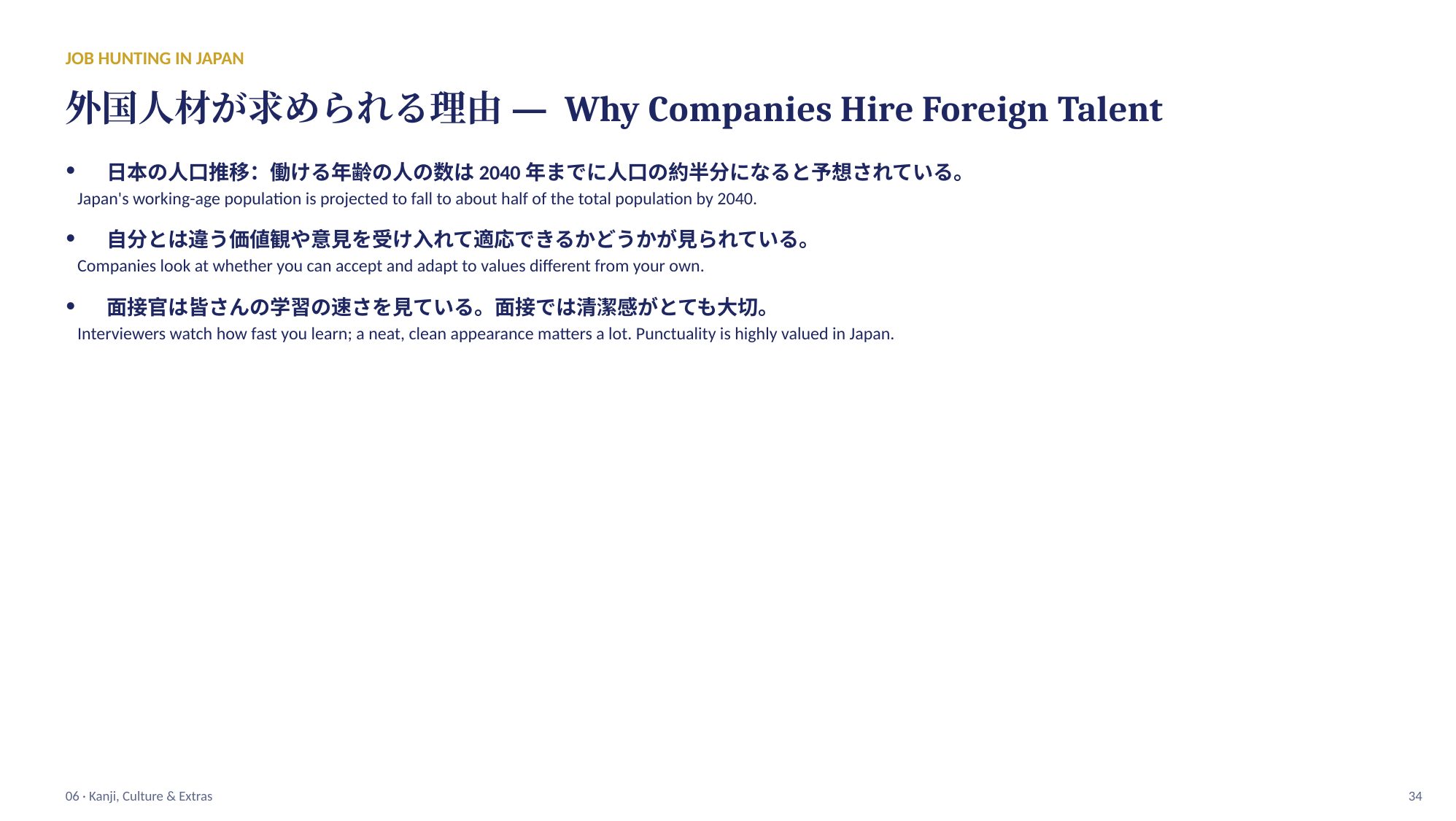
JP•日本の人口推移:働ける年齢の人の数は2040年までに人口の約半分になると予想されている。
EN Japan's working-age population is projected to fall to about half of the total population by 2040.
JP•自分とは違う価値観や意見を受け入れて適応できるかどうかが見られている。
EN Companies look at whether you can accept and adapt to values different from your own.
JP•面接官は皆さんの学習の速さを見ている。面接では清潔感がとても大切。
EN Interviewers watch how fast you learn; a neat, clean appearance matters a lot. Punctuality is highly valued in Japan.
06 · Kanji, Culture & Extras 34
06 · Kanji, Culture & Extras 34
หน้า 35
คลิกเพื่อขยาย
08
ENBonus: Keigo Nuances & Business Nouns
JP敬語の落とし穴とこそあど言葉
ENTwo easy-to-miss keigo pitfalls, plus the formal here/there/that word set
หน้า 36
คลิกเพื่อขยาย
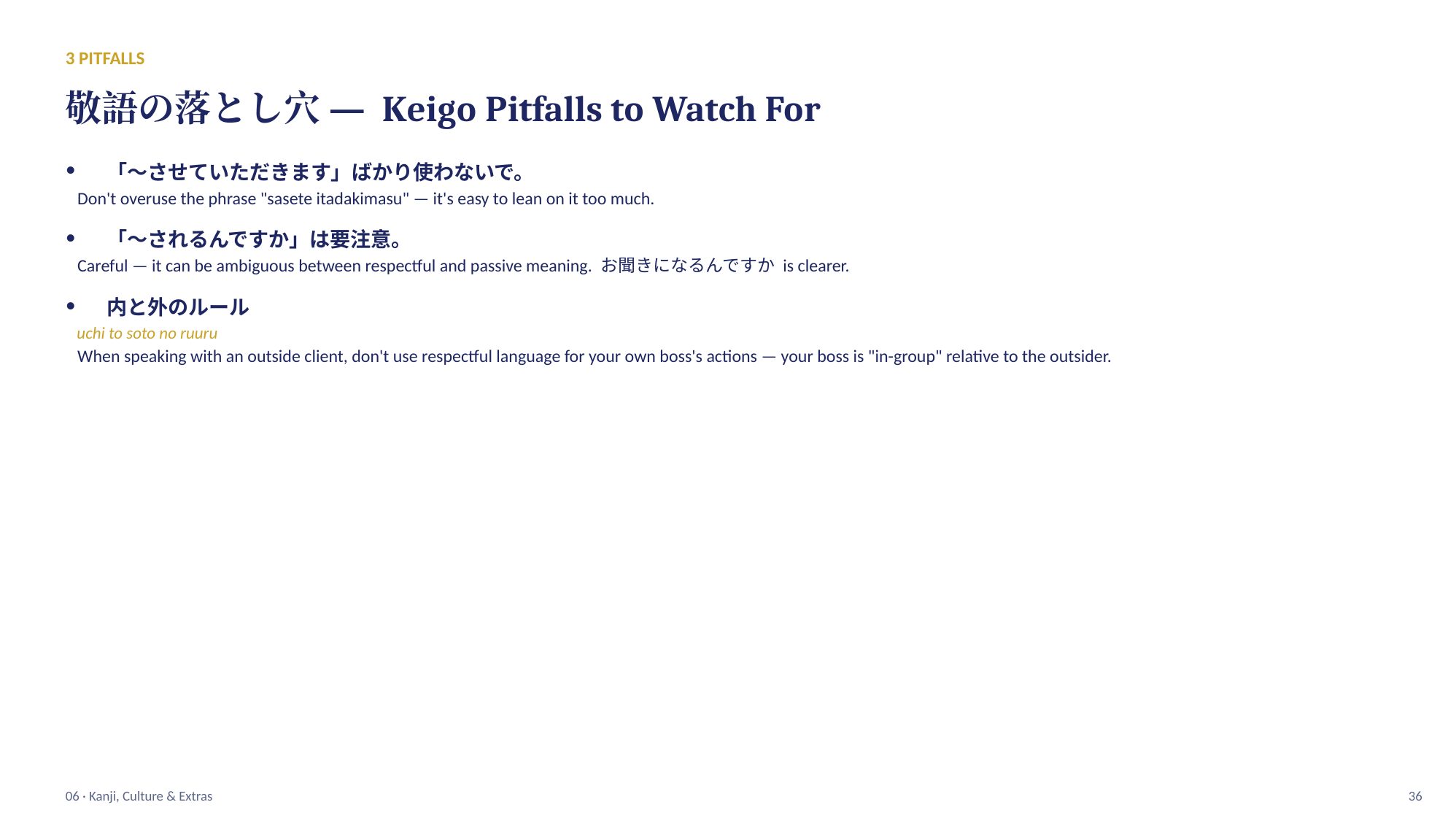
EN3 PITFALLS
敬語の落とし穴 — Keigo Pitfalls to Watch For
敬語の落とし穴 — Keigo Pitfalls to Watch For
JP•「〜させていただきます」ばかり使わないで。
EN Don't overuse the phrase "sasete itadakimasu" — it's easy to lean on it too much.
JP•「〜されるんですか」は要注意。
EN Careful — it can be ambiguous between respectful and passive meaning. お聞きになるんですか is clearer.
JP•内と外のルール
EN uchi to soto no ruuru
When speaking with an outside client, don't use respectful language for your own boss's actions — your boss is "in-group" relative to the outsider.
06 · Kanji, Culture & Extras 36
When speaking with an outside client, don't use respectful language for your own boss's actions — your boss is "in-group" relative to the outsider.
06 · Kanji, Culture & Extras 36
หน้า 37
คลิกเพื่อขยาย
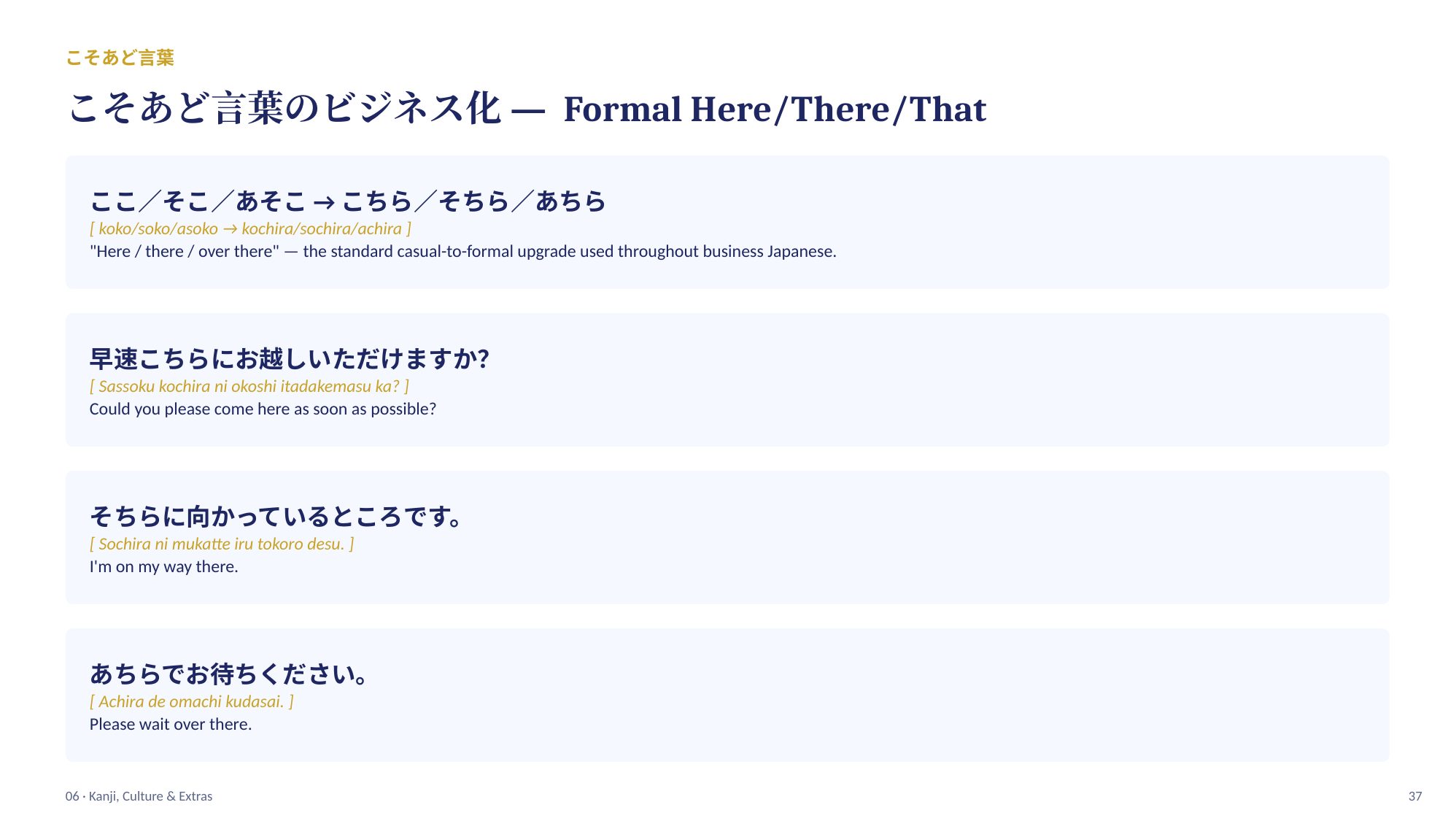
JPこそあど言葉
ENこそあど言葉のビジネス化 — Formal Here/There/That
JPここ/そこ/あそこ→こちら/そちら/あちら
EN [ koko/soko/asoko → kochira/sochira/achira ]
"Here / there / over there" — the standard casual-to-formal upgrade used throughout business Japanese.
"Here / there / over there" — the standard casual-to-formal upgrade used throughout business Japanese.
JP早速こちらにお越しいただけますか?
EN [ Sassoku kochira ni okoshi itadakemasu ka? ]
Could you please come here as soon as possible?
Could you please come here as soon as possible?
JPそちらに向かっているところです。
EN [ Sochira ni mukatte iru tokoro desu. ]
I'm on my way there.
I'm on my way there.
JPあちらでお待ちください。
EN [ Achira de omachi kudasai. ]
Please wait over there.
06 · Kanji, Culture & Extras 37
Please wait over there.
06 · Kanji, Culture & Extras 37
หน้า 38
คลิกเพื่อขยาย
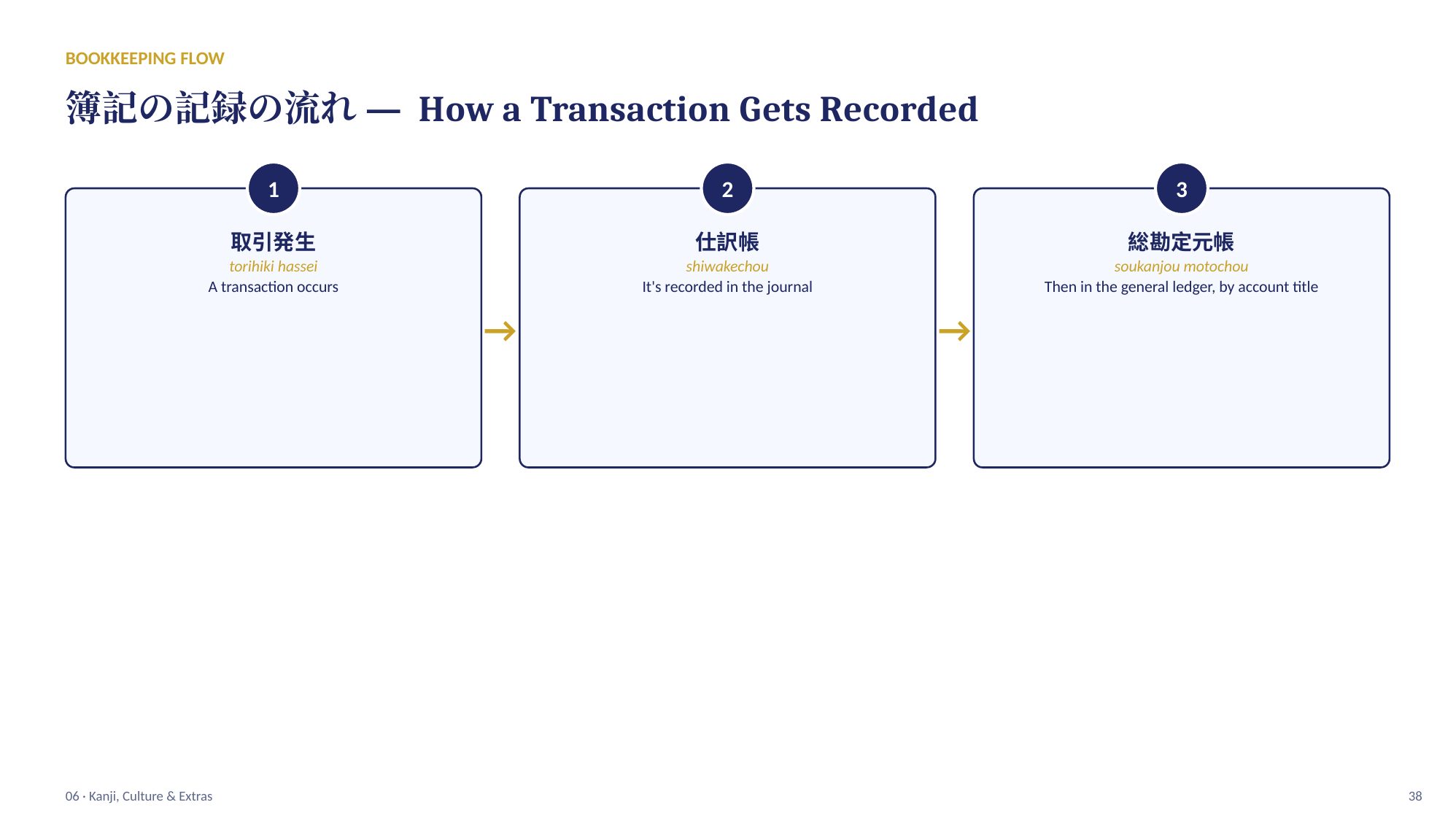
ENBOOKKEEPING FLOW
簿記の記録の流れ — How a Transaction Gets Recorded
1 2 3
簿記の記録の流れ — How a Transaction Gets Recorded
1 2 3
JP取引発生仕訳帳総勘定元帳
EN torihiki hassei shiwakechou soukanjou motochou
A transaction occurs It's recorded in the journal Then in the general ledger, by account title
→ →
06 · Kanji, Culture & Extras 38
A transaction occurs It's recorded in the journal Then in the general ledger, by account title
→ →
06 · Kanji, Culture & Extras 38