หน้า 1
คลิกเพื่อขยาย
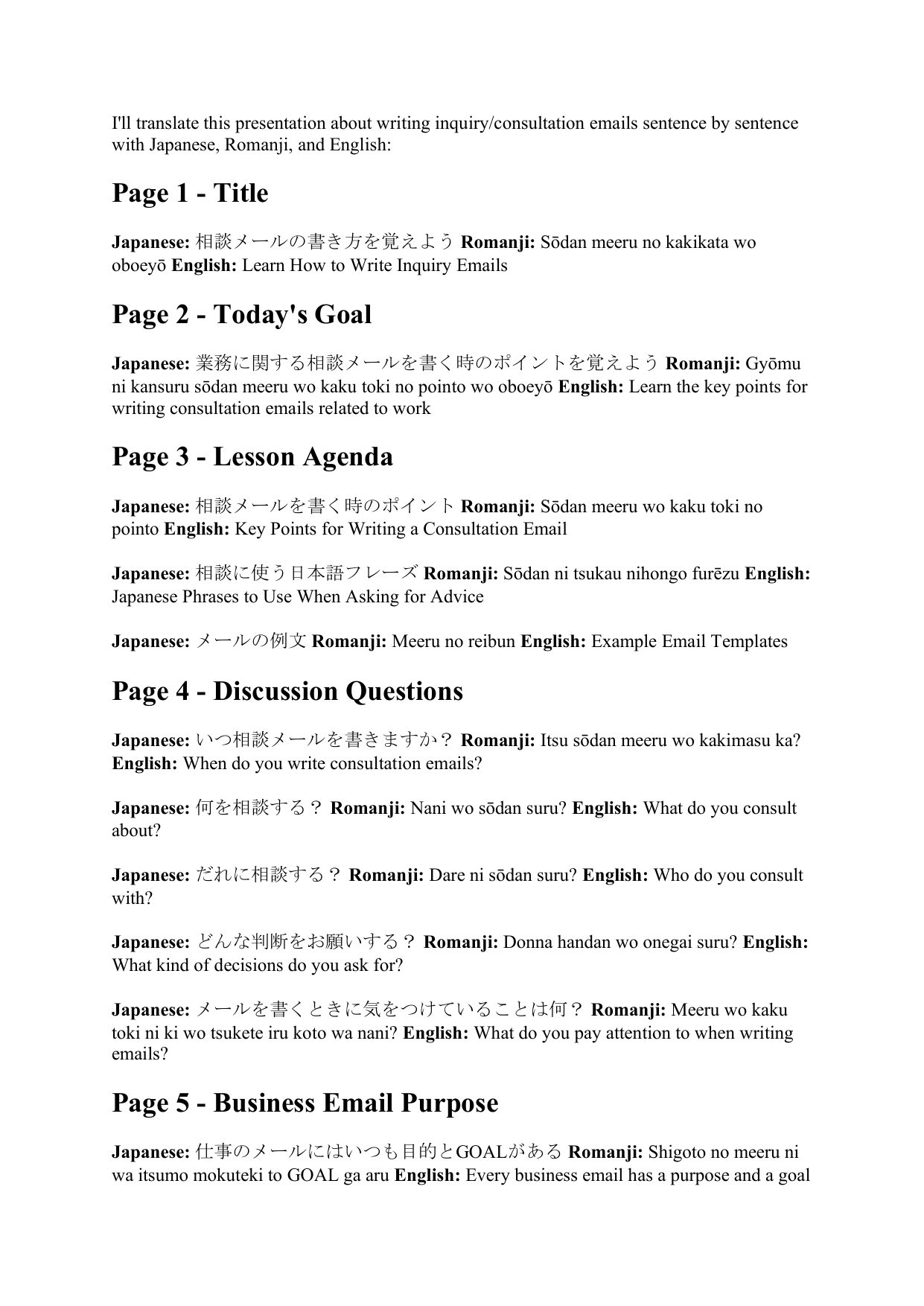
ENI'll translate this presentation about writing inquiry/consultation emails sentence by sentence
with Japanese, Romanji, and English:
Page 1 - Title
Japanese: 相談メールの書き方を覚えよう Romanji: Sōdan meeru no kakikata wo
oboeyō English: Learn How to Write Inquiry Emails
Page 2 - Today's Goal
with Japanese, Romanji, and English:
Page 1 - Title
Japanese: 相談メールの書き方を覚えよう Romanji: Sōdan meeru no kakikata wo
oboeyō English: Learn How to Write Inquiry Emails
Page 2 - Today's Goal
JPJapanese:業務に関する相談メールを書く時のポイントを覚えようRomanji:Gyōmu
ENni kansuru sōdan meeru wo kaku toki no pointo wo oboeyō English: Learn the key points for
writing consultation emails related to work
Page 3 - Lesson Agenda
Japanese: 相談メールを書く時のポイント Romanji: Sōdan meeru wo kaku toki no
pointo English: Key Points for Writing a Consultation Email
Japanese: 相談に使う日本語フレーズ Romanji: Sōdan ni tsukau nihongo furēzu English:
Japanese Phrases to Use When Asking for Advice
Japanese: メールの例文 Romanji: Meeru no reibun English: Example Email Templates
Page 4 - Discussion Questions
Japanese: いつ相談メールを書きますか? Romanji: Itsu sōdan meeru wo kakimasu ka?
English: When do you write consultation emails?
Japanese: 何を相談する? Romanji: Nani wo sōdan suru? English: What do you consult
about?
Japanese: だれに相談する? Romanji: Dare ni sōdan suru? English: Who do you consult
with?
Japanese: どんな判断をお願いする? Romanji: Donna handan wo onegai suru? English:
What kind of decisions do you ask for?
Japanese: メールを書くときに気をつけていることは何? Romanji: Meeru wo kaku
toki ni ki wo tsukete iru koto wa nani? English: What do you pay attention to when writing
emails?
Page 5 - Business Email Purpose
Japanese: 仕事のメールにはいつも目的とGOALがある Romanji: Shigoto no meeru ni
wa itsumo mokuteki to GOAL ga aru English: Every business email has a purpose and a goal
writing consultation emails related to work
Page 3 - Lesson Agenda
Japanese: 相談メールを書く時のポイント Romanji: Sōdan meeru wo kaku toki no
pointo English: Key Points for Writing a Consultation Email
Japanese: 相談に使う日本語フレーズ Romanji: Sōdan ni tsukau nihongo furēzu English:
Japanese Phrases to Use When Asking for Advice
Japanese: メールの例文 Romanji: Meeru no reibun English: Example Email Templates
Page 4 - Discussion Questions
Japanese: いつ相談メールを書きますか? Romanji: Itsu sōdan meeru wo kakimasu ka?
English: When do you write consultation emails?
Japanese: 何を相談する? Romanji: Nani wo sōdan suru? English: What do you consult
about?
Japanese: だれに相談する? Romanji: Dare ni sōdan suru? English: Who do you consult
with?
Japanese: どんな判断をお願いする? Romanji: Donna handan wo onegai suru? English:
What kind of decisions do you ask for?
Japanese: メールを書くときに気をつけていることは何? Romanji: Meeru wo kaku
toki ni ki wo tsukete iru koto wa nani? English: What do you pay attention to when writing
emails?
Page 5 - Business Email Purpose
Japanese: 仕事のメールにはいつも目的とGOALがある Romanji: Shigoto no meeru ni
wa itsumo mokuteki to GOAL ga aru English: Every business email has a purpose and a goal
หน้า 2
คลิกเพื่อขยาย
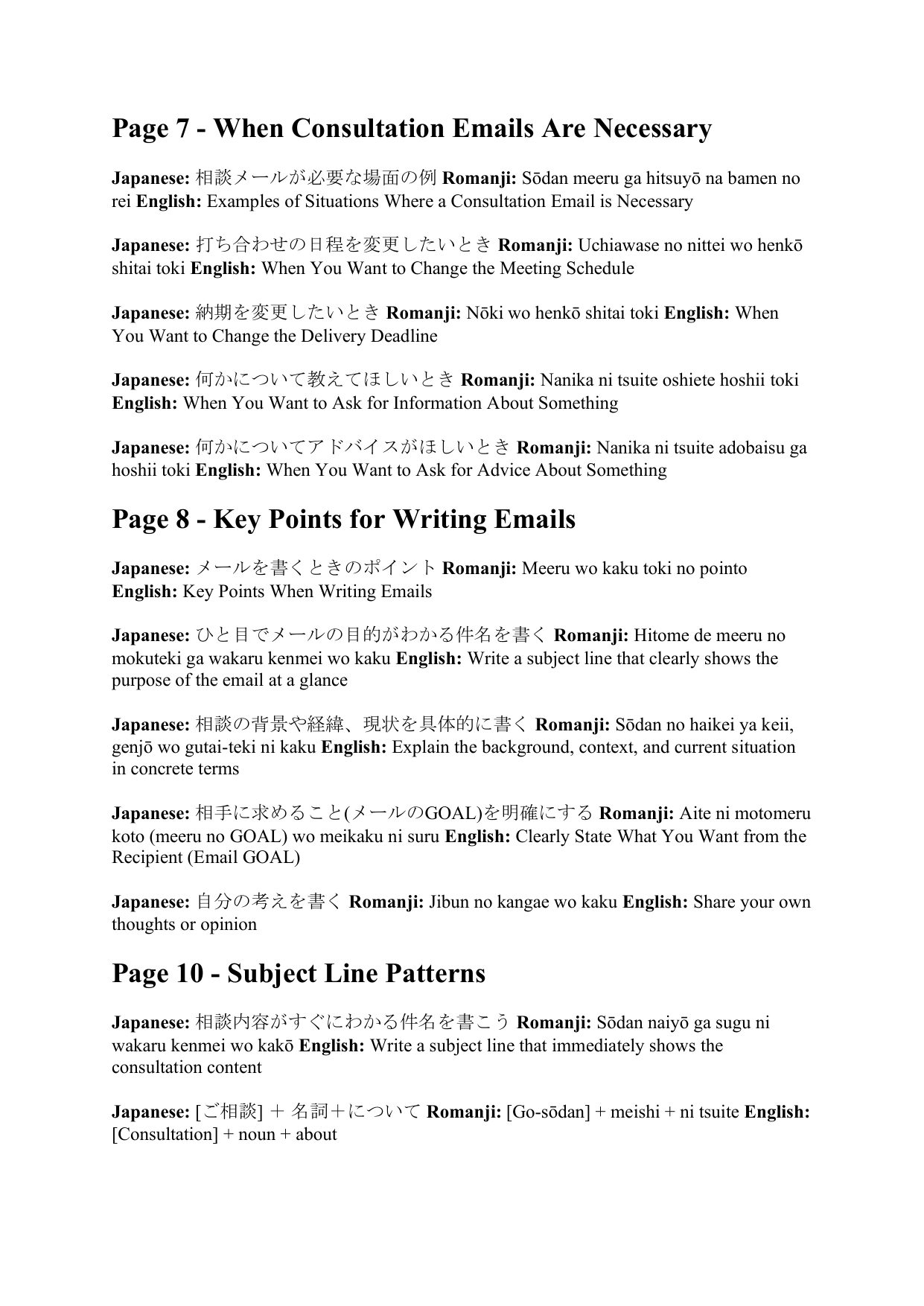
ENPage 7 - When Consultation Emails Are Necessary
Japanese: 相談メールが必要な場面の例 Romanji: Sōdan meeru ga hitsuyō na bamen no
rei English: Examples of Situations Where a Consultation Email is Necessary
Japanese: 打ち合わせの日程を変更したいとき Romanji: Uchiawase no nittei wo henkō
shitai toki English: When You Want to Change the Meeting Schedule
Japanese: 納期を変更したいとき Romanji: Nōki wo henkō shitai toki English: When
You Want to Change the Delivery Deadline
Japanese: 何かについて教えてほしいとき Romanji: Nanika ni tsuite oshiete hoshii toki
English: When You Want to Ask for Information About Something
Japanese: 何かについてアドバイスがほしいとき Romanji: Nanika ni tsuite adobaisu ga
hoshii toki English: When You Want to Ask for Advice About Something
Page 8 - Key Points for Writing Emails
Japanese: メールを書くときのポイント Romanji: Meeru wo kaku toki no pointo
English: Key Points When Writing Emails
Japanese: ひと目でメールの目的がわかる件名を書く Romanji: Hitome de meeru no
mokuteki ga wakaru kenmei wo kaku English: Write a subject line that clearly shows the
purpose of the email at a glance
Japanese: 相談の背景や経緯、現状を具体的に書く Romanji: Sōdan no haikei ya keii,
genjō wo gutai-teki ni kaku English: Explain the background, context, and current situation
in concrete terms
Japanese: 相手に求めること(メールのGOAL)を明確にする Romanji: Aite ni motomeru
koto (meeru no GOAL) wo meikaku ni suru English: Clearly State What You Want from the
Recipient (Email GOAL)
Japanese: 自分の考えを書く Romanji: Jibun no kangae wo kaku English: Share your own
thoughts or opinion
Page 10 - Subject Line Patterns
Japanese: 相談内容がすぐにわかる件名を書こう Romanji: Sōdan naiyō ga sugu ni
wakaru kenmei wo kakō English: Write a subject line that immediately shows the
consultation content
Japanese: [ご相談] + 名詞+について Romanji: [Go-sōdan] + meishi + ni tsuite English:
[Consultation] + noun + about
Japanese: 相談メールが必要な場面の例 Romanji: Sōdan meeru ga hitsuyō na bamen no
rei English: Examples of Situations Where a Consultation Email is Necessary
Japanese: 打ち合わせの日程を変更したいとき Romanji: Uchiawase no nittei wo henkō
shitai toki English: When You Want to Change the Meeting Schedule
Japanese: 納期を変更したいとき Romanji: Nōki wo henkō shitai toki English: When
You Want to Change the Delivery Deadline
Japanese: 何かについて教えてほしいとき Romanji: Nanika ni tsuite oshiete hoshii toki
English: When You Want to Ask for Information About Something
Japanese: 何かについてアドバイスがほしいとき Romanji: Nanika ni tsuite adobaisu ga
hoshii toki English: When You Want to Ask for Advice About Something
Page 8 - Key Points for Writing Emails
Japanese: メールを書くときのポイント Romanji: Meeru wo kaku toki no pointo
English: Key Points When Writing Emails
Japanese: ひと目でメールの目的がわかる件名を書く Romanji: Hitome de meeru no
mokuteki ga wakaru kenmei wo kaku English: Write a subject line that clearly shows the
purpose of the email at a glance
Japanese: 相談の背景や経緯、現状を具体的に書く Romanji: Sōdan no haikei ya keii,
genjō wo gutai-teki ni kaku English: Explain the background, context, and current situation
in concrete terms
Japanese: 相手に求めること(メールのGOAL)を明確にする Romanji: Aite ni motomeru
koto (meeru no GOAL) wo meikaku ni suru English: Clearly State What You Want from the
Recipient (Email GOAL)
Japanese: 自分の考えを書く Romanji: Jibun no kangae wo kaku English: Share your own
thoughts or opinion
Page 10 - Subject Line Patterns
Japanese: 相談内容がすぐにわかる件名を書こう Romanji: Sōdan naiyō ga sugu ni
wakaru kenmei wo kakō English: Write a subject line that immediately shows the
consultation content
Japanese: [ご相談] + 名詞+について Romanji: [Go-sōdan] + meishi + ni tsuite English:
[Consultation] + noun + about
หน้า 3
คลิกเพื่อขยาย
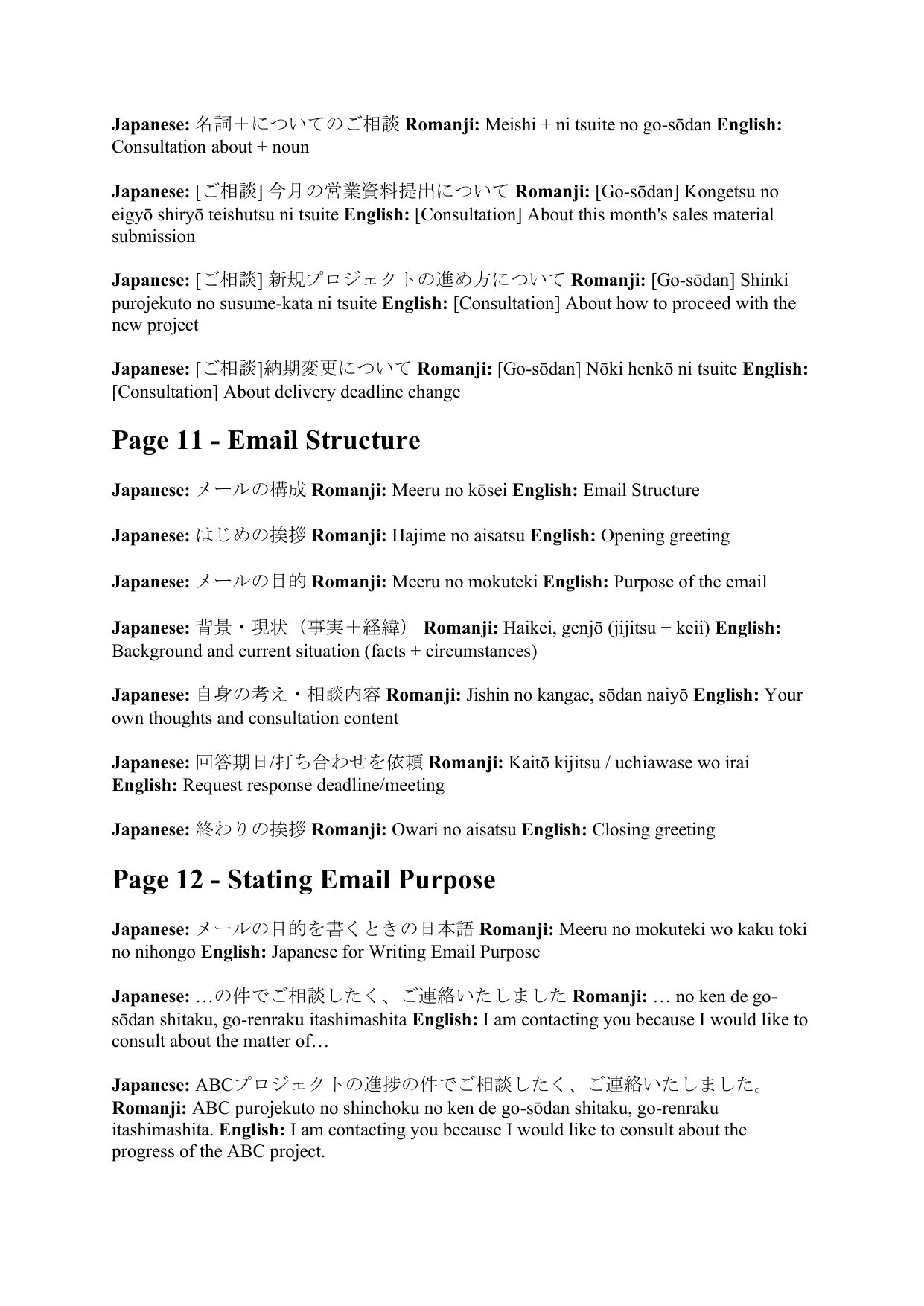
ENJapanese: 名詞+についてのご相談 Romanji: Meishi + ni tsuite no go-sōdan English:
Consultation about + noun
Japanese: [ご相談] 今月の営業資料提出について Romanji: [Go-sōdan] Kongetsu no
eigyō shiryō teishutsu ni tsuite English: [Consultation] About this month's sales material
submission
Japanese: [ご相談] 新規プロジェクトの進め方について Romanji: [Go-sōdan] Shinki
purojekuto no susume-kata ni tsuite English: [Consultation] About how to proceed with the
new project
Japanese: [ご相談]納期変更について Romanji: [Go-sōdan] Nōki henkō ni tsuite English:
[Consultation] About delivery deadline change
Page 11 - Email Structure
Japanese: メールの構成 Romanji: Meeru no kōsei English: Email Structure
Japanese: はじめの挨拶 Romanji: Hajime no aisatsu English: Opening greeting
Japanese: メールの目的 Romanji: Meeru no mokuteki English: Purpose of the email
Japanese: 背景・現状(事実+経緯) Romanji: Haikei, genjō (jijitsu + keii) English:
Background and current situation (facts + circumstances)
Japanese: 自身の考え・相談内容 Romanji: Jishin no kangae, sōdan naiyō English: Your
own thoughts and consultation content
Japanese: 回答期日/打ち合わせを依頼 Romanji: Kaitō kijitsu / uchiawase wo irai
English: Request response deadline/meeting
Japanese: 終わりの挨拶 Romanji: Owari no aisatsu English: Closing greeting
Page 12 - Stating Email Purpose
Japanese: メールの目的を書くときの日本語 Romanji: Meeru no mokuteki wo kaku toki
no nihongo English: Japanese for Writing Email Purpose
Japanese: …の件でご相談したく、ご連絡いたしました Romanji: … no ken de go-
sōdan shitaku, go-renraku itashimashita English: I am contacting you because I would like to
consult about the matter of…
Consultation about + noun
Japanese: [ご相談] 今月の営業資料提出について Romanji: [Go-sōdan] Kongetsu no
eigyō shiryō teishutsu ni tsuite English: [Consultation] About this month's sales material
submission
Japanese: [ご相談] 新規プロジェクトの進め方について Romanji: [Go-sōdan] Shinki
purojekuto no susume-kata ni tsuite English: [Consultation] About how to proceed with the
new project
Japanese: [ご相談]納期変更について Romanji: [Go-sōdan] Nōki henkō ni tsuite English:
[Consultation] About delivery deadline change
Page 11 - Email Structure
Japanese: メールの構成 Romanji: Meeru no kōsei English: Email Structure
Japanese: はじめの挨拶 Romanji: Hajime no aisatsu English: Opening greeting
Japanese: メールの目的 Romanji: Meeru no mokuteki English: Purpose of the email
Japanese: 背景・現状(事実+経緯) Romanji: Haikei, genjō (jijitsu + keii) English:
Background and current situation (facts + circumstances)
Japanese: 自身の考え・相談内容 Romanji: Jishin no kangae, sōdan naiyō English: Your
own thoughts and consultation content
Japanese: 回答期日/打ち合わせを依頼 Romanji: Kaitō kijitsu / uchiawase wo irai
English: Request response deadline/meeting
Japanese: 終わりの挨拶 Romanji: Owari no aisatsu English: Closing greeting
Page 12 - Stating Email Purpose
Japanese: メールの目的を書くときの日本語 Romanji: Meeru no mokuteki wo kaku toki
no nihongo English: Japanese for Writing Email Purpose
Japanese: …の件でご相談したく、ご連絡いたしました Romanji: … no ken de go-
sōdan shitaku, go-renraku itashimashita English: I am contacting you because I would like to
consult about the matter of…
JPJapanese:ABCプロジェクトの進捗の件でご相談したく、ご連絡いたしました。
ENRomanji: ABC purojekuto no shinchoku no ken de go-sōdan shitaku, go-renraku
itashimashita. English: I am contacting you because I would like to consult about the
progress of the ABC project.
itashimashita. English: I am contacting you because I would like to consult about the
progress of the ABC project.
หน้า 4
คลิกเพื่อขยาย
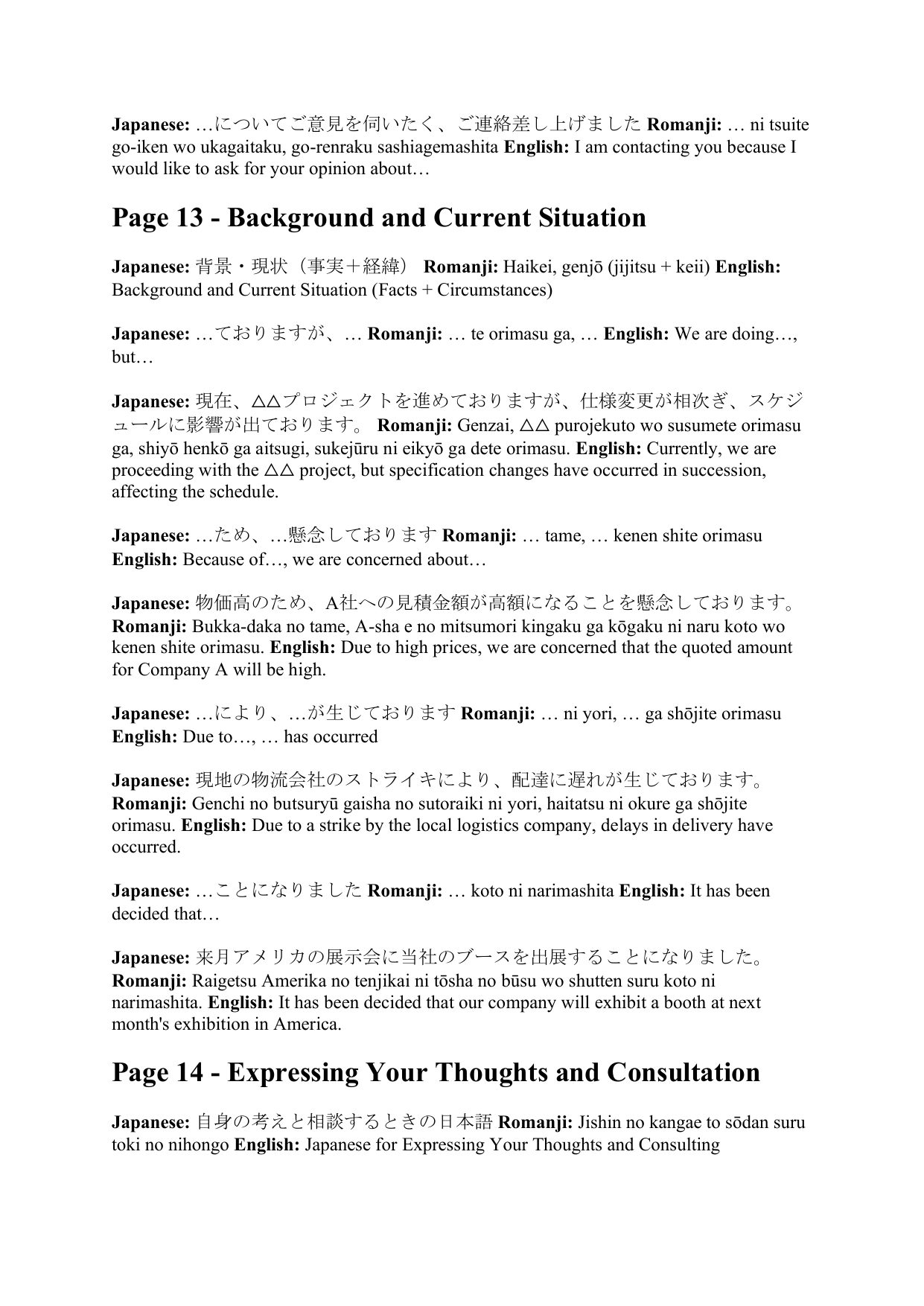
ENJapanese: …についてご意見を伺いたく、ご連絡差し上げました Romanji: … ni tsuite
go-iken wo ukagaitaku, go-renraku sashiagemashita English: I am contacting you because I
would like to ask for your opinion about…
Page 13 - Background and Current Situation
Japanese: 背景・現状(事実+経緯) Romanji: Haikei, genjō (jijitsu + keii) English:
Background and Current Situation (Facts + Circumstances)
Japanese: …ておりますが、… Romanji: … te orimasu ga, … English: We are doing…,
but…
go-iken wo ukagaitaku, go-renraku sashiagemashita English: I am contacting you because I
would like to ask for your opinion about…
Page 13 - Background and Current Situation
Japanese: 背景・現状(事実+経緯) Romanji: Haikei, genjō (jijitsu + keii) English:
Background and Current Situation (Facts + Circumstances)
Japanese: …ておりますが、… Romanji: … te orimasu ga, … English: We are doing…,
but…
JPJapanese:現在、△△プロジェクトを進めておりますが、仕様変更が相次ぎ、スケジ
ENュールに影響が出ております。 Romanji: Genzai, △△ purojekuto wo susumete orimasu
ga, shiyō henkō ga aitsugi, sukejūru ni eikyō ga dete orimasu. English: Currently, we are
proceeding with the △△ project, but specification changes have occurred in succession,
affecting the schedule.
Japanese: …ため、…懸念しております Romanji: … tame, … kenen shite orimasu
English: Because of…, we are concerned about…
ga, shiyō henkō ga aitsugi, sukejūru ni eikyō ga dete orimasu. English: Currently, we are
proceeding with the △△ project, but specification changes have occurred in succession,
affecting the schedule.
Japanese: …ため、…懸念しております Romanji: … tame, … kenen shite orimasu
English: Because of…, we are concerned about…
JPJapanese:物価高のため、A社への見積金額が高額になることを懸念しております。
ENRomanji: Bukka-daka no tame, A-sha e no mitsumori kingaku ga kōgaku ni naru koto wo
kenen shite orimasu. English: Due to high prices, we are concerned that the quoted amount
for Company A will be high.
Japanese: …により、…が生じております Romanji: … ni yori, … ga shōjite orimasu
English: Due to…, … has occurred
kenen shite orimasu. English: Due to high prices, we are concerned that the quoted amount
for Company A will be high.
Japanese: …により、…が生じております Romanji: … ni yori, … ga shōjite orimasu
English: Due to…, … has occurred
JPJapanese:現地の物流会社のストライキにより、配達に遅れが生じております。
ENRomanji: Genchi no butsuryū gaisha no sutoraiki ni yori, haitatsu ni okure ga shōjite
orimasu. English: Due to a strike by the local logistics company, delays in delivery have
occurred.
Japanese: …ことになりました Romanji: … koto ni narimashita English: It has been
decided that…
orimasu. English: Due to a strike by the local logistics company, delays in delivery have
occurred.
Japanese: …ことになりました Romanji: … koto ni narimashita English: It has been
decided that…
JPJapanese:来月アメリカの展示会に当社のブースを出展することになりました。
ENRomanji: Raigetsu Amerika no tenjikai ni tōsha no būsu wo shutten suru koto ni
narimashita. English: It has been decided that our company will exhibit a booth at next
month's exhibition in America.
Page 14 - Expressing Your Thoughts and Consultation
Japanese: 自身の考えと相談するときの日本語 Romanji: Jishin no kangae to sōdan suru
toki no nihongo English: Japanese for Expressing Your Thoughts and Consulting
narimashita. English: It has been decided that our company will exhibit a booth at next
month's exhibition in America.
Page 14 - Expressing Your Thoughts and Consultation
Japanese: 自身の考えと相談するときの日本語 Romanji: Jishin no kangae to sōdan suru
toki no nihongo English: Japanese for Expressing Your Thoughts and Consulting
หน้า 5
คลิกเพื่อขยาย
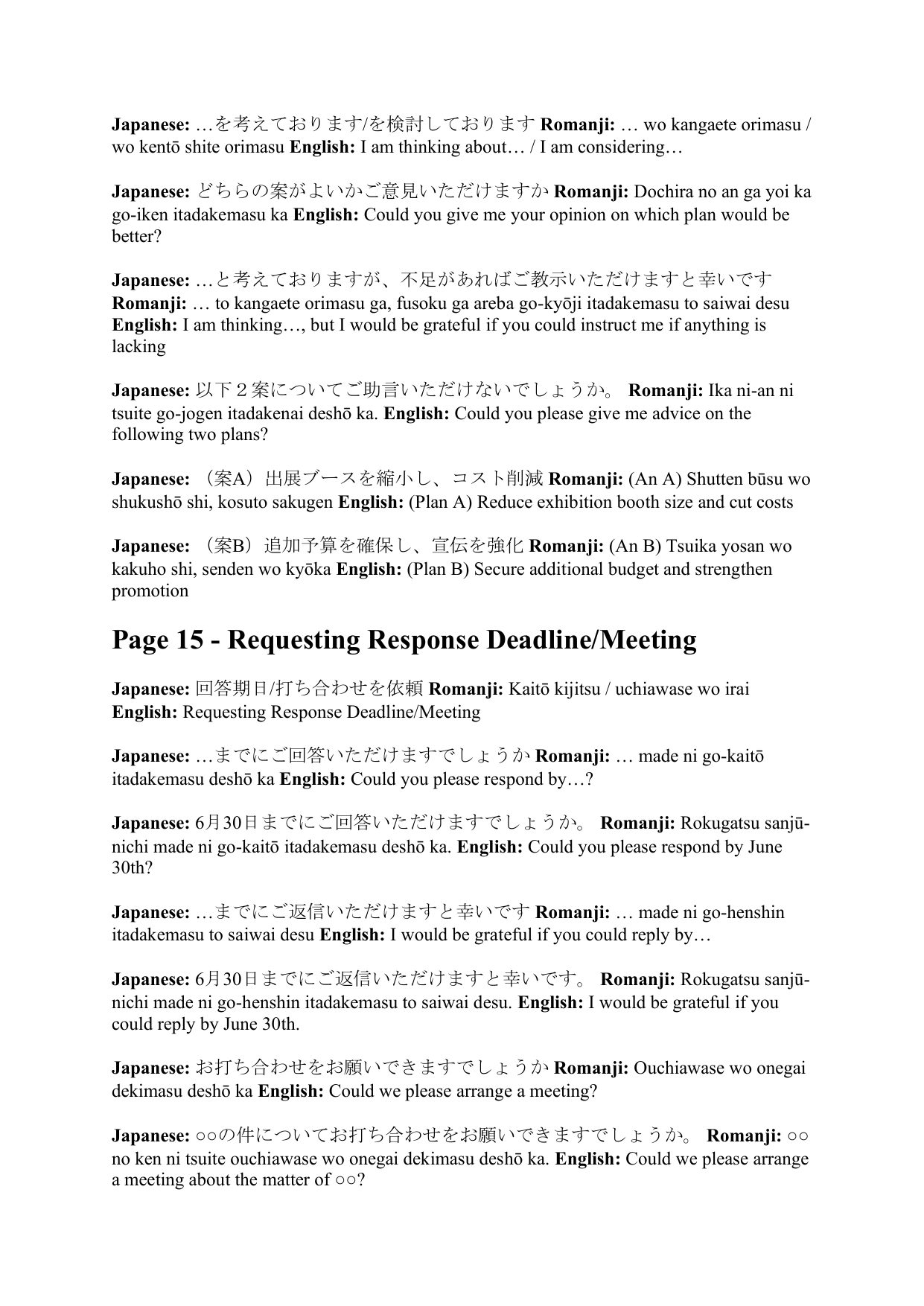
ENJapanese: …を考えております/を検討しております Romanji: … wo kangaete orimasu /
wo kentō shite orimasu English: I am thinking about… / I am considering…
Japanese: どちらの案がよいかご意見いただけますか Romanji: Dochira no an ga yoi ka
go-iken itadakemasu ka English: Could you give me your opinion on which plan would be
better?
wo kentō shite orimasu English: I am thinking about… / I am considering…
Japanese: どちらの案がよいかご意見いただけますか Romanji: Dochira no an ga yoi ka
go-iken itadakemasu ka English: Could you give me your opinion on which plan would be
better?
JPJapanese:…と考えておりますが、不足があればご教示いただけますと幸いです
ENRomanji: … to kangaete orimasu ga, fusoku ga areba go-kyōji itadakemasu to saiwai desu
English: I am thinking…, but I would be grateful if you could instruct me if anything is
lacking
Japanese: 以下2案についてご助言いただけないでしょうか。 Romanji: Ika ni-an ni
tsuite go-jogen itadakenai deshō ka. English: Could you please give me advice on the
following two plans?
Japanese: (案A)出展ブースを縮小し、コスト削減 Romanji: (An A) Shutten būsu wo
shukushō shi, kosuto sakugen English: (Plan A) Reduce exhibition booth size and cut costs
Japanese: (案B)追加予算を確保し、宣伝を強化 Romanji: (An B) Tsuika yosan wo
kakuho shi, senden wo kyōka English: (Plan B) Secure additional budget and strengthen
promotion
Page 15 - Requesting Response Deadline/Meeting
Japanese: 回答期日/打ち合わせを依頼 Romanji: Kaitō kijitsu / uchiawase wo irai
English: Requesting Response Deadline/Meeting
Japanese: …までにご回答いただけますでしょうか Romanji: … made ni go-kaitō
itadakemasu deshō ka English: Could you please respond by…?
Japanese: 6月30日までにご回答いただけますでしょうか。 Romanji: Rokugatsu sanjū-
nichi made ni go-kaitō itadakemasu deshō ka. English: Could you please respond by June
30th?
Japanese: …までにご返信いただけますと幸いです Romanji: … made ni go-henshin
itadakemasu to saiwai desu English: I would be grateful if you could reply by…
Japanese: 6月30日までにご返信いただけますと幸いです。 Romanji: Rokugatsu sanjū-
nichi made ni go-henshin itadakemasu to saiwai desu. English: I would be grateful if you
could reply by June 30th.
Japanese: お打ち合わせをお願いできますでしょうか Romanji: Ouchiawase wo onegai
dekimasu deshō ka English: Could we please arrange a meeting?
English: I am thinking…, but I would be grateful if you could instruct me if anything is
lacking
Japanese: 以下2案についてご助言いただけないでしょうか。 Romanji: Ika ni-an ni
tsuite go-jogen itadakenai deshō ka. English: Could you please give me advice on the
following two plans?
Japanese: (案A)出展ブースを縮小し、コスト削減 Romanji: (An A) Shutten būsu wo
shukushō shi, kosuto sakugen English: (Plan A) Reduce exhibition booth size and cut costs
Japanese: (案B)追加予算を確保し、宣伝を強化 Romanji: (An B) Tsuika yosan wo
kakuho shi, senden wo kyōka English: (Plan B) Secure additional budget and strengthen
promotion
Page 15 - Requesting Response Deadline/Meeting
Japanese: 回答期日/打ち合わせを依頼 Romanji: Kaitō kijitsu / uchiawase wo irai
English: Requesting Response Deadline/Meeting
Japanese: …までにご回答いただけますでしょうか Romanji: … made ni go-kaitō
itadakemasu deshō ka English: Could you please respond by…?
Japanese: 6月30日までにご回答いただけますでしょうか。 Romanji: Rokugatsu sanjū-
nichi made ni go-kaitō itadakemasu deshō ka. English: Could you please respond by June
30th?
Japanese: …までにご返信いただけますと幸いです Romanji: … made ni go-henshin
itadakemasu to saiwai desu English: I would be grateful if you could reply by…
Japanese: 6月30日までにご返信いただけますと幸いです。 Romanji: Rokugatsu sanjū-
nichi made ni go-henshin itadakemasu to saiwai desu. English: I would be grateful if you
could reply by June 30th.
Japanese: お打ち合わせをお願いできますでしょうか Romanji: Ouchiawase wo onegai
dekimasu deshō ka English: Could we please arrange a meeting?
JPJapanese:○○の件についてお打ち合わせをお願いできますでしょうか。Romanji:○○
ENno ken ni tsuite ouchiawase wo onegai dekimasu deshō ka. English: Could we please arrange
a meeting about the matter of ○○?
a meeting about the matter of ○○?
หน้า 6
คลิกเพื่อขยาย
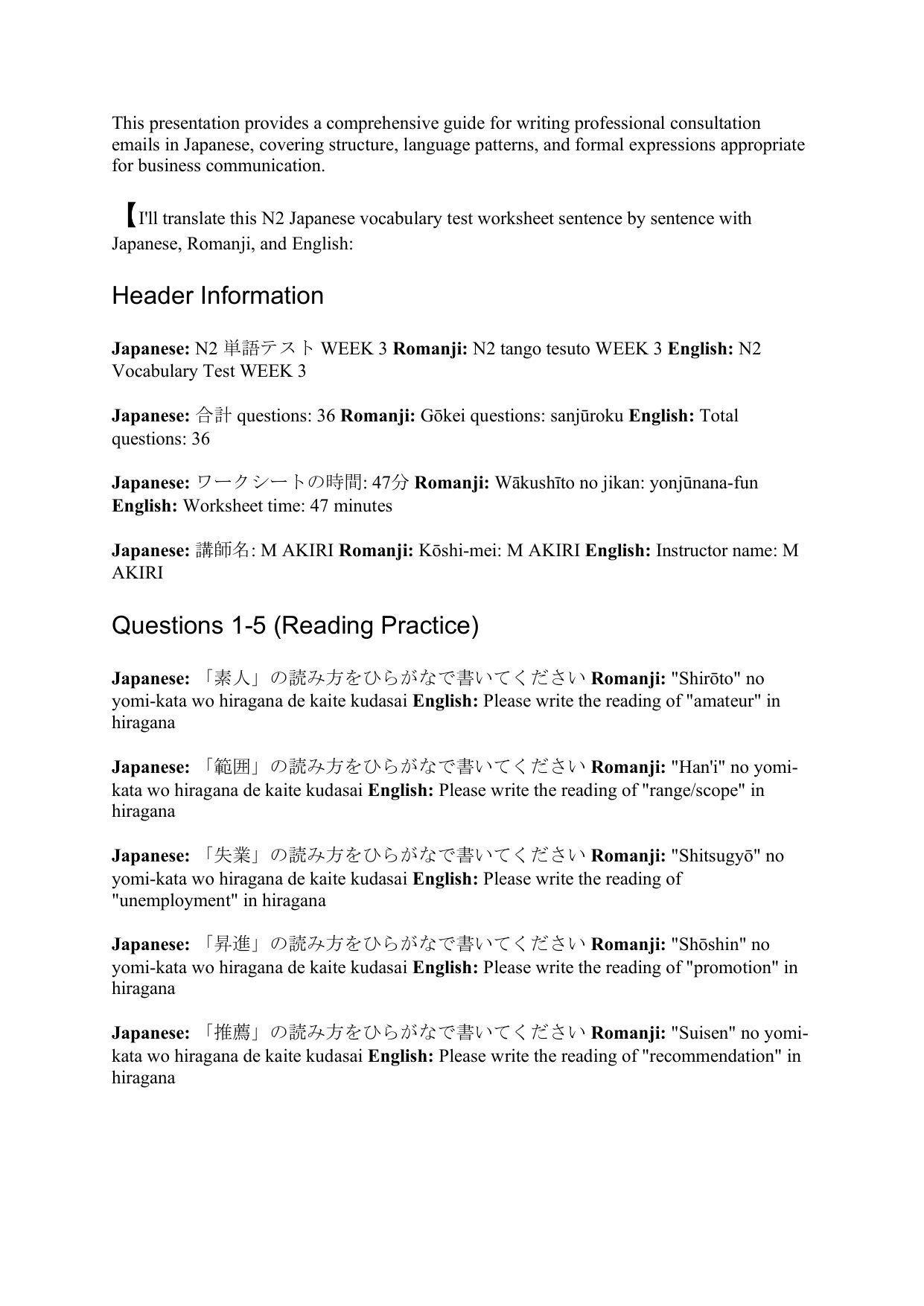
ENThis presentation provides a comprehensive guide for writing professional consultation
emails in Japanese, covering structure, language patterns, and formal expressions appropriate
for business communication.
【I'll translate this N2 Japanese vocabulary test worksheet sentence by sentence with
Japanese, Romanji, and English:
Header Information
Japanese: N2 単語テスト WEEK 3 Romanji: N2 tango tesuto WEEK 3 English: N2
Vocabulary Test WEEK 3
Japanese: 合計 questions: 36 Romanji: Gōkei questions: sanjūroku English: Total
questions: 36
Japanese: ワークシートの時間: 47分 Romanji: Wākushīto no jikan: yonjūnana-fun
English: Worksheet time: 47 minutes
Japanese: 講師名: M AKIRI Romanji: Kōshi-mei: M AKIRI English: Instructor name: M
AKIRI
Questions 1-5 (Reading Practice)
Japanese: 「素人」の読み方をひらがなで書いてください Romanji: "Shirōto" no
yomi-kata wo hiragana de kaite kudasai English: Please write the reading of "amateur" in
hiragana
Japanese: 「範囲」の読み方をひらがなで書いてください Romanji: "Han'i" no yomi-
kata wo hiragana de kaite kudasai English: Please write the reading of "range/scope" in
hiragana
Japanese: 「失業」の読み方をひらがなで書いてください Romanji: "Shitsugyō" no
yomi-kata wo hiragana de kaite kudasai English: Please write the reading of
"unemployment" in hiragana
Japanese: 「昇進」の読み方をひらがなで書いてください Romanji: "Shōshin" no
yomi-kata wo hiragana de kaite kudasai English: Please write the reading of "promotion" in
hiragana
Japanese: 「推薦」の読み方をひらがなで書いてください Romanji: "Suisen" no yomi-
kata wo hiragana de kaite kudasai English: Please write the reading of "recommendation" in
hiragana
emails in Japanese, covering structure, language patterns, and formal expressions appropriate
for business communication.
【I'll translate this N2 Japanese vocabulary test worksheet sentence by sentence with
Japanese, Romanji, and English:
Header Information
Japanese: N2 単語テスト WEEK 3 Romanji: N2 tango tesuto WEEK 3 English: N2
Vocabulary Test WEEK 3
Japanese: 合計 questions: 36 Romanji: Gōkei questions: sanjūroku English: Total
questions: 36
Japanese: ワークシートの時間: 47分 Romanji: Wākushīto no jikan: yonjūnana-fun
English: Worksheet time: 47 minutes
Japanese: 講師名: M AKIRI Romanji: Kōshi-mei: M AKIRI English: Instructor name: M
AKIRI
Questions 1-5 (Reading Practice)
Japanese: 「素人」の読み方をひらがなで書いてください Romanji: "Shirōto" no
yomi-kata wo hiragana de kaite kudasai English: Please write the reading of "amateur" in
hiragana
Japanese: 「範囲」の読み方をひらがなで書いてください Romanji: "Han'i" no yomi-
kata wo hiragana de kaite kudasai English: Please write the reading of "range/scope" in
hiragana
Japanese: 「失業」の読み方をひらがなで書いてください Romanji: "Shitsugyō" no
yomi-kata wo hiragana de kaite kudasai English: Please write the reading of
"unemployment" in hiragana
Japanese: 「昇進」の読み方をひらがなで書いてください Romanji: "Shōshin" no
yomi-kata wo hiragana de kaite kudasai English: Please write the reading of "promotion" in
hiragana
Japanese: 「推薦」の読み方をひらがなで書いてください Romanji: "Suisen" no yomi-
kata wo hiragana de kaite kudasai English: Please write the reading of "recommendation" in
hiragana
หน้า 7
คลิกเพื่อขยาย
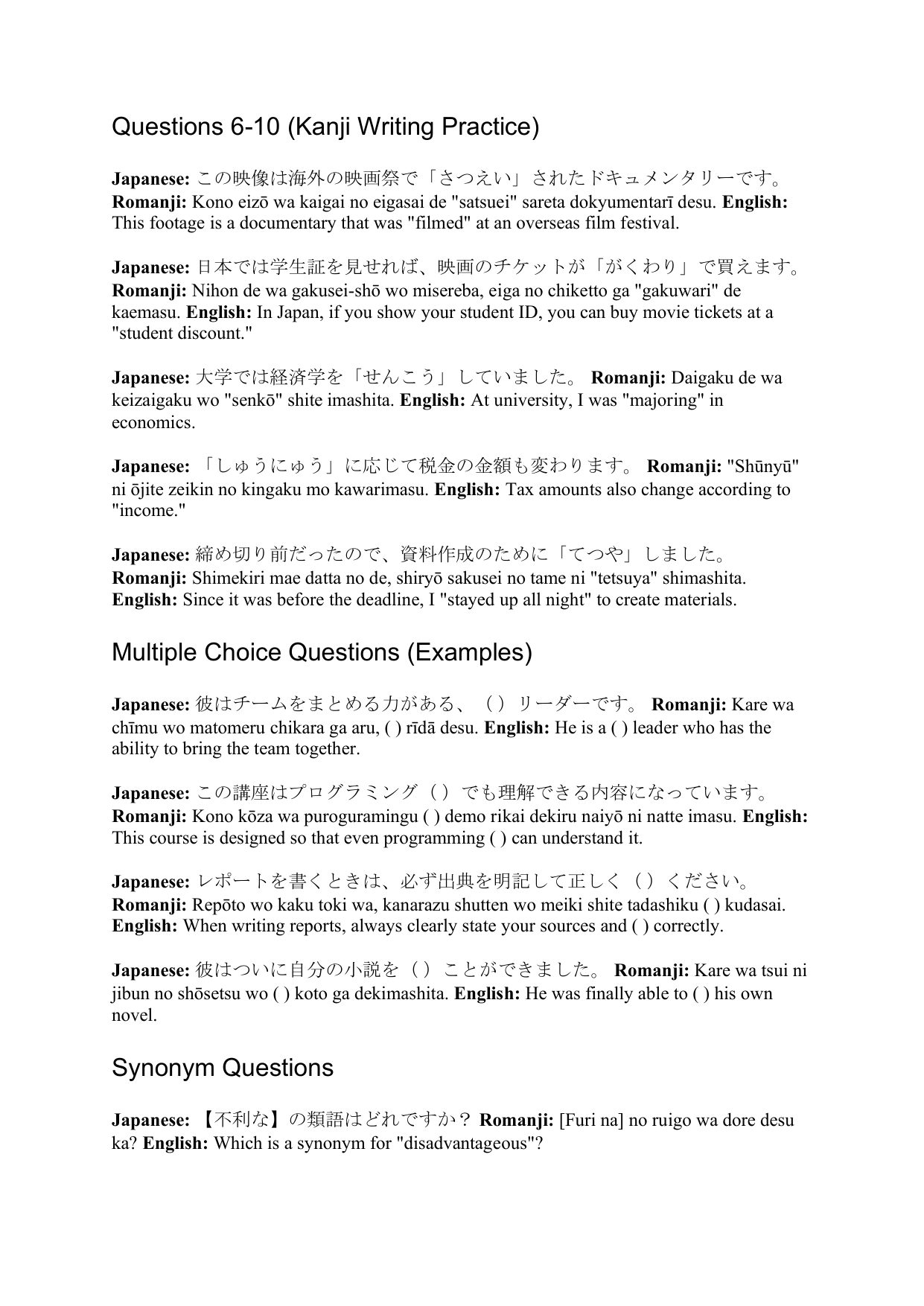
ENQuestions 6-10 (Kanji Writing Practice)
JPJapanese:この映像は海外の映画祭で「さつえい」されたドキュメンタリーです。
ENRomanji: Kono eizō wa kaigai no eigasai de "satsuei" sareta dokyumentarī desu. English:
This footage is a documentary that was "filmed" at an overseas film festival.
This footage is a documentary that was "filmed" at an overseas film festival.
JPJapanese:日本では学生証を見せれば、映画のチケットが「がくわり」で買えます。
ENRomanji: Nihon de wa gakusei-shō wo misereba, eiga no chiketto ga "gakuwari" de
kaemasu. English: In Japan, if you show your student ID, you can buy movie tickets at a
"student discount."
Japanese: 大学では経済学を「せんこう」していました。 Romanji: Daigaku de wa
keizaigaku wo "senkō" shite imashita. English: At university, I was "majoring" in
economics.
kaemasu. English: In Japan, if you show your student ID, you can buy movie tickets at a
"student discount."
Japanese: 大学では経済学を「せんこう」していました。 Romanji: Daigaku de wa
keizaigaku wo "senkō" shite imashita. English: At university, I was "majoring" in
economics.
JPJapanese:「しゅうにゅう」に応じて税金の金額も変わります。Romanji:"Shūnyū"
ENni ōjite zeikin no kingaku mo kawarimasu. English: Tax amounts also change according to
"income."
"income."
JPJapanese:締め切り前だったので、資料作成のために「てつや」しました。
ENRomanji: Shimekiri mae datta no de, shiryō sakusei no tame ni "tetsuya" shimashita.
English: Since it was before the deadline, I "stayed up all night" to create materials.
Multiple Choice Questions (Examples)
Japanese: 彼はチームをまとめる力がある、( )リーダーです。 Romanji: Kare wa
chīmu wo matomeru chikara ga aru, ( ) rīdā desu. English: He is a ( ) leader who has the
ability to bring the team together.
English: Since it was before the deadline, I "stayed up all night" to create materials.
Multiple Choice Questions (Examples)
Japanese: 彼はチームをまとめる力がある、( )リーダーです。 Romanji: Kare wa
chīmu wo matomeru chikara ga aru, ( ) rīdā desu. English: He is a ( ) leader who has the
ability to bring the team together.
JPJapanese:この講座はプログラミング()でも理解できる内容になっています。
ENRomanji: Kono kōza wa puroguramingu ( ) demo rikai dekiru naiyō ni natte imasu. English:
This course is designed so that even programming ( ) can understand it.
This course is designed so that even programming ( ) can understand it.
JPJapanese:レポートを書くときは、必ず出典を明記して正しく()ください。
ENRomanji: Repōto wo kaku toki wa, kanarazu shutten wo meiki shite tadashiku ( ) kudasai.
English: When writing reports, always clearly state your sources and ( ) correctly.
Japanese: 彼はついに自分の小説を( )ことができました。 Romanji: Kare wa tsui ni
jibun no shōsetsu wo ( ) koto ga dekimashita. English: He was finally able to ( ) his own
novel.
Synonym Questions
Japanese: 【不利な】の類語はどれですか? Romanji: [Furi na] no ruigo wa dore desu
ka? English: Which is a synonym for "disadvantageous"?
English: When writing reports, always clearly state your sources and ( ) correctly.
Japanese: 彼はついに自分の小説を( )ことができました。 Romanji: Kare wa tsui ni
jibun no shōsetsu wo ( ) koto ga dekimashita. English: He was finally able to ( ) his own
novel.
Synonym Questions
Japanese: 【不利な】の類語はどれですか? Romanji: [Furi na] no ruigo wa dore desu
ka? English: Which is a synonym for "disadvantageous"?
หน้า 8
คลิกเพื่อขยาย
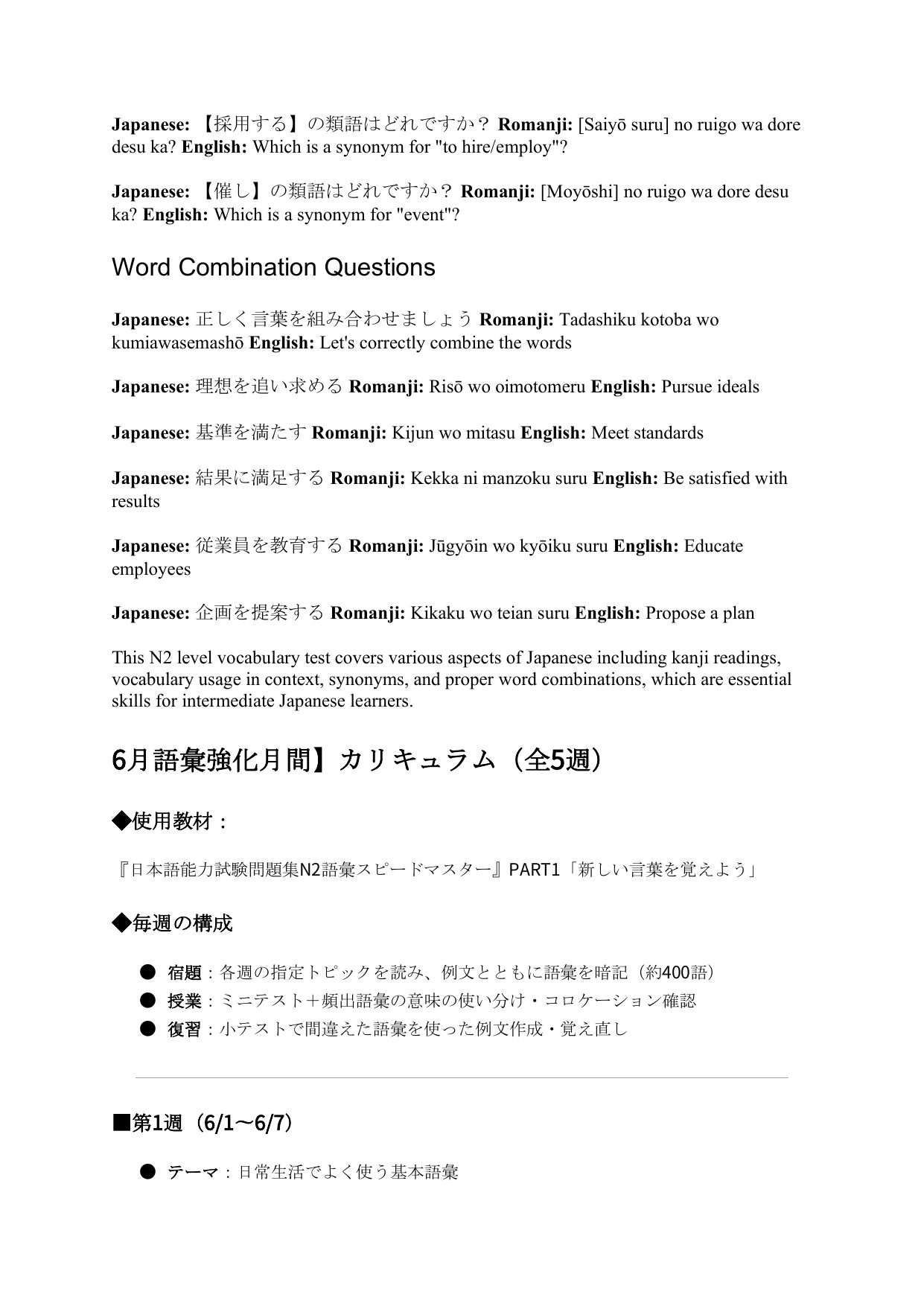
ENJapanese: 【採用する】の類語はどれですか? Romanji: [Saiyō suru] no ruigo wa dore
desu ka? English: Which is a synonym for "to hire/employ"?
Japanese: 【催し】の類語はどれですか? Romanji: [Moyōshi] no ruigo wa dore desu
ka? English: Which is a synonym for "event"?
Word Combination Questions
Japanese: 正しく言葉を組み合わせましょう Romanji: Tadashiku kotoba wo
kumiawasemashō English: Let's correctly combine the words
Japanese: 理想を追い求める Romanji: Risō wo oimotomeru English: Pursue ideals
Japanese: 基準を満たす Romanji: Kijun wo mitasu English: Meet standards
Japanese: 結果に満足する Romanji: Kekka ni manzoku suru English: Be satisfied with
results
Japanese: 従業員を教育する Romanji: Jūgyōin wo kyōiku suru English: Educate
employees
Japanese: 企画を提案する Romanji: Kikaku wo teian suru English: Propose a plan
This N2 level vocabulary test covers various aspects of Japanese including kanji readings,
vocabulary usage in context, synonyms, and proper word combinations, which are essential
skills for intermediate Japanese learners.
desu ka? English: Which is a synonym for "to hire/employ"?
Japanese: 【催し】の類語はどれですか? Romanji: [Moyōshi] no ruigo wa dore desu
ka? English: Which is a synonym for "event"?
Word Combination Questions
Japanese: 正しく言葉を組み合わせましょう Romanji: Tadashiku kotoba wo
kumiawasemashō English: Let's correctly combine the words
Japanese: 理想を追い求める Romanji: Risō wo oimotomeru English: Pursue ideals
Japanese: 基準を満たす Romanji: Kijun wo mitasu English: Meet standards
Japanese: 結果に満足する Romanji: Kekka ni manzoku suru English: Be satisfied with
results
Japanese: 従業員を教育する Romanji: Jūgyōin wo kyōiku suru English: Educate
employees
Japanese: 企画を提案する Romanji: Kikaku wo teian suru English: Propose a plan
This N2 level vocabulary test covers various aspects of Japanese including kanji readings,
vocabulary usage in context, synonyms, and proper word combinations, which are essential
skills for intermediate Japanese learners.
JP6月語彙強化月間】カリキュラム(全5週)
◆使用教材:
『日本語能力試験問題集N2語彙スピードマスター』PART1「新しい言葉を覚えよう」
◆毎週の構成
●宿題:各週の指定トピックを読み、例文とともに語彙を暗記(約400語)
●授業:ミニテスト+頻出語彙の意味の使い分け・コロケーション確認
●復習:小テストで間違えた語彙を使った例文作成・覚え直し
■第1週(6/1〜6/7)
●テーマ:日常生活でよく使う基本語彙
◆使用教材:
『日本語能力試験問題集N2語彙スピードマスター』PART1「新しい言葉を覚えよう」
◆毎週の構成
●宿題:各週の指定トピックを読み、例文とともに語彙を暗記(約400語)
●授業:ミニテスト+頻出語彙の意味の使い分け・コロケーション確認
●復習:小テストで間違えた語彙を使った例文作成・覚え直し
■第1週(6/1〜6/7)
●テーマ:日常生活でよく使う基本語彙
หน้า 9
คลิกเพื่อขยาย
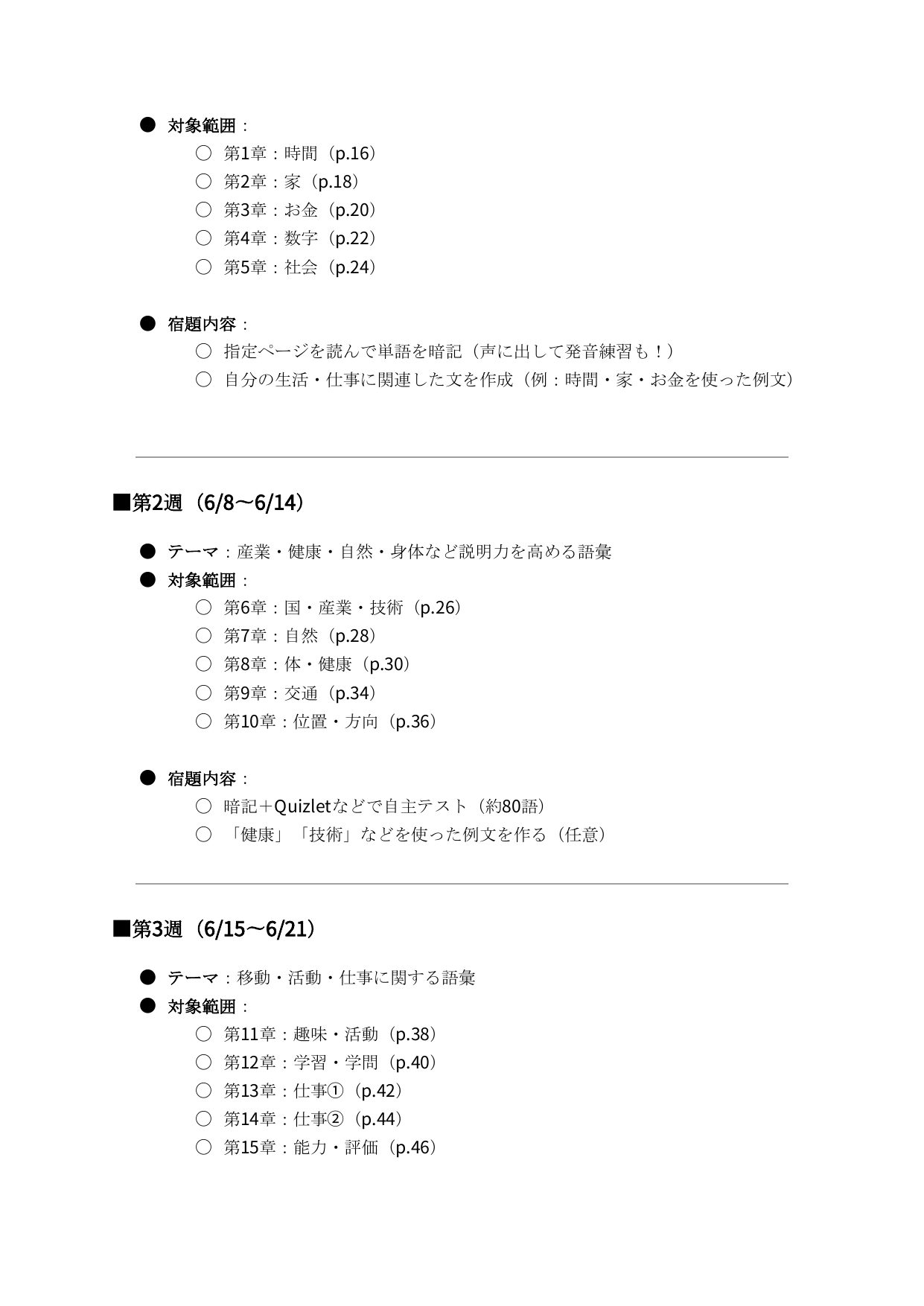
JP●対象範囲:
○第1章:時間(p.16)
○第2章:家(p.18)
○第3章:お金(p.20)
○第4章:数字(p.22)
○第5章:社会(p.24)
●宿題内容:
○指定ページを読んで単語を暗記(声に出して発音練習も!)
○自分の生活・仕事に関連した文を作成(例:時間・家・お金を使った例文)
■第2週(6/8〜6/14)
●テーマ:産業・健康・自然・身体など説明力を高める語彙
●対象範囲:
○第6章:国・産業・技術(p.26)
○第7章:自然(p.28)
○第8章:体・健康(p.30)
○第9章:交通(p.34)
○第10章:位置・方向(p.36)
●宿題内容:
○暗記+Quizletなどで自主テスト(約80語)
○「健康」「技術」などを使った例文を作る(任意)
■第3週(6/15〜6/21)
●テーマ:移動・活動・仕事に関する語彙
●対象範囲:
○第11章:趣味・活動(p.38)
○第12章:学習・学問(p.40)
○第13章:仕事①(p.42)
○第14章:仕事②(p.44)
○第15章:能力・評価(p.46)
○第1章:時間(p.16)
○第2章:家(p.18)
○第3章:お金(p.20)
○第4章:数字(p.22)
○第5章:社会(p.24)
●宿題内容:
○指定ページを読んで単語を暗記(声に出して発音練習も!)
○自分の生活・仕事に関連した文を作成(例:時間・家・お金を使った例文)
■第2週(6/8〜6/14)
●テーマ:産業・健康・自然・身体など説明力を高める語彙
●対象範囲:
○第6章:国・産業・技術(p.26)
○第7章:自然(p.28)
○第8章:体・健康(p.30)
○第9章:交通(p.34)
○第10章:位置・方向(p.36)
●宿題内容:
○暗記+Quizletなどで自主テスト(約80語)
○「健康」「技術」などを使った例文を作る(任意)
■第3週(6/15〜6/21)
●テーマ:移動・活動・仕事に関する語彙
●対象範囲:
○第11章:趣味・活動(p.38)
○第12章:学習・学問(p.40)
○第13章:仕事①(p.42)
○第14章:仕事②(p.44)
○第15章:能力・評価(p.46)
หน้า 10
คลิกเพื่อขยาย
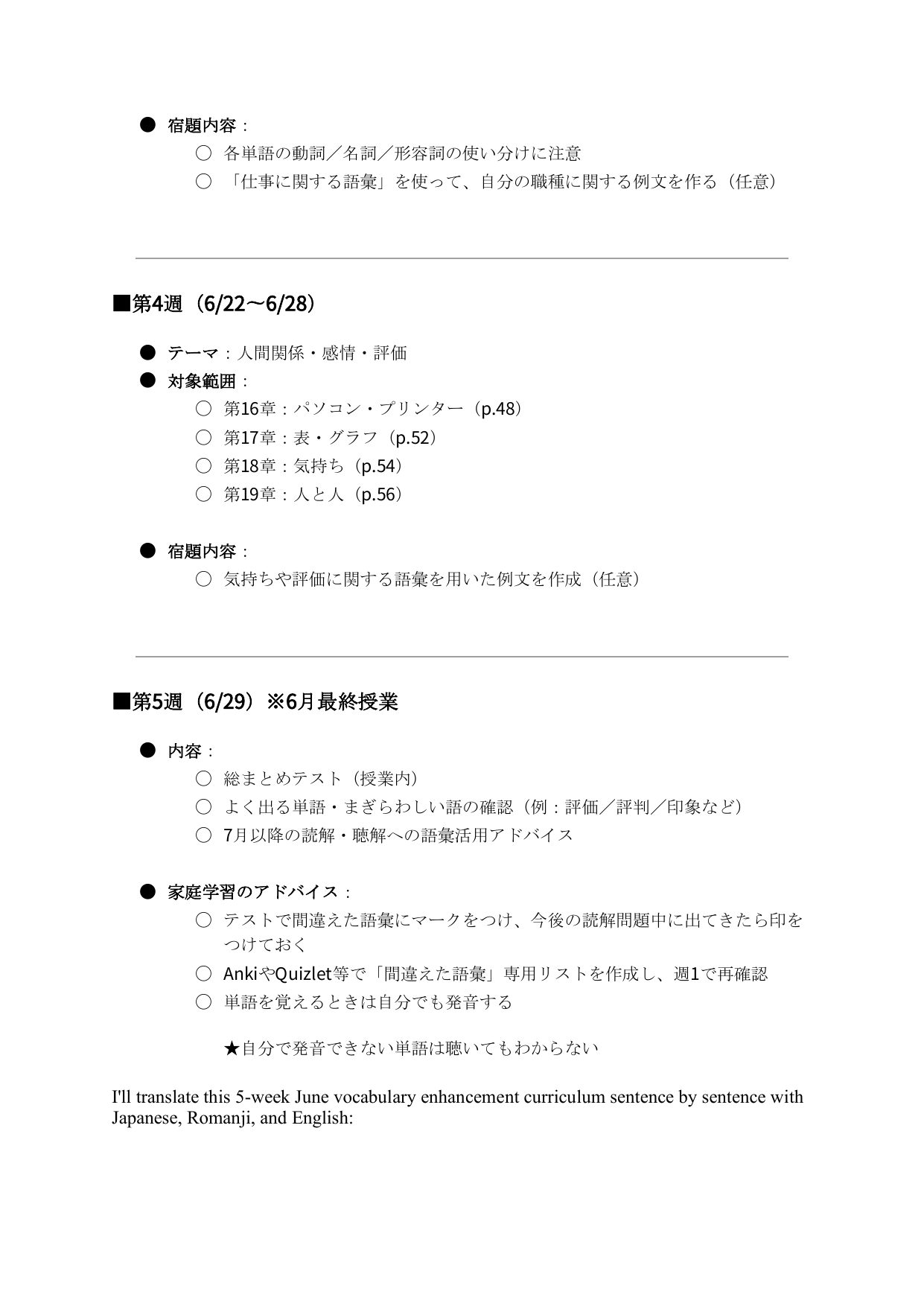
JP●宿題内容:
○各単語の動詞/名詞/形容詞の使い分けに注意
○「仕事に関する語彙」を使って、自分の職種に関する例文を作る(任意)
■第4週(6/22〜6/28)
●テーマ:人間関係・感情・評価
●対象範囲:
○第16章:パソコン・プリンター(p.48)
○第17章:表・グラフ(p.52)
○第18章:気持ち(p.54)
○第19章:人と人(p.56)
●宿題内容:
○気持ちや評価に関する語彙を用いた例文を作成(任意)
■第5週(6/29)※6月最終授業
●内容:
○総まとめテスト(授業内)
○よく出る単語・まぎらわしい語の確認(例:評価/評判/印象など)
○7月以降の読解・聴解への語彙活用アドバイス
●家庭学習のアドバイス:
○テストで間違えた語彙にマークをつけ、今後の読解問題中に出てきたら印を
つけておく
○AnkiやQuizlet等で「間違えた語彙」専用リストを作成し、週1で再確認
○単語を覚えるときは自分でも発音する
★自分で発音できない単語は聴いてもわからない
○各単語の動詞/名詞/形容詞の使い分けに注意
○「仕事に関する語彙」を使って、自分の職種に関する例文を作る(任意)
■第4週(6/22〜6/28)
●テーマ:人間関係・感情・評価
●対象範囲:
○第16章:パソコン・プリンター(p.48)
○第17章:表・グラフ(p.52)
○第18章:気持ち(p.54)
○第19章:人と人(p.56)
●宿題内容:
○気持ちや評価に関する語彙を用いた例文を作成(任意)
■第5週(6/29)※6月最終授業
●内容:
○総まとめテスト(授業内)
○よく出る単語・まぎらわしい語の確認(例:評価/評判/印象など)
○7月以降の読解・聴解への語彙活用アドバイス
●家庭学習のアドバイス:
○テストで間違えた語彙にマークをつけ、今後の読解問題中に出てきたら印を
つけておく
○AnkiやQuizlet等で「間違えた語彙」専用リストを作成し、週1で再確認
○単語を覚えるときは自分でも発音する
★自分で発音できない単語は聴いてもわからない
ENI'll translate this 5-week June vocabulary enhancement curriculum sentence by sentence with
Japanese, Romanji, and English:
Japanese, Romanji, and English:
หน้า 11
คลิกเพื่อขยาย
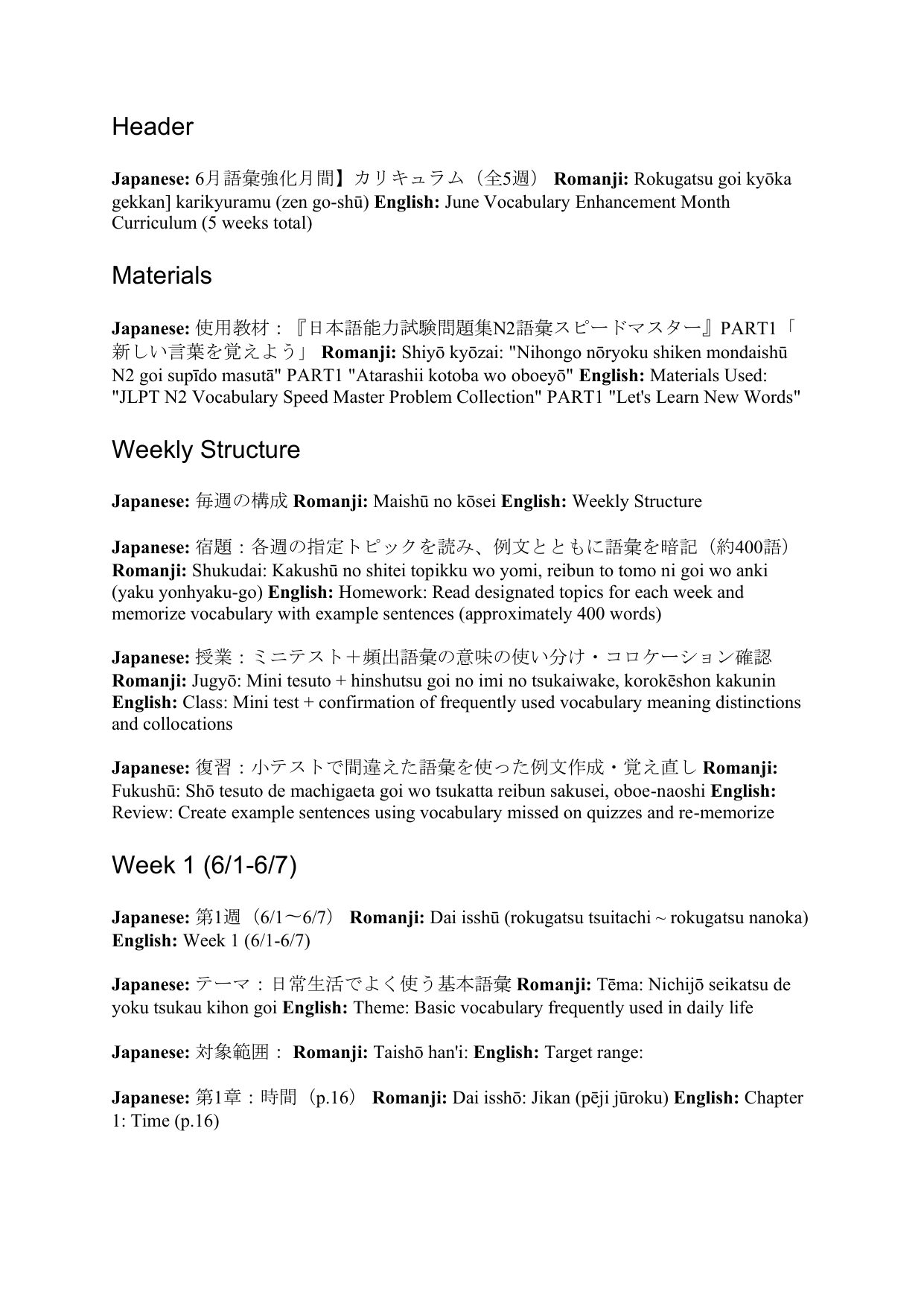
ENHeader
Japanese: 6月語彙強化月間】カリキュラム(全5週) Romanji: Rokugatsu goi kyōka
gekkan] karikyuramu (zen go-shū) English: June Vocabulary Enhancement Month
Curriculum (5 weeks total)
Materials
Japanese: 6月語彙強化月間】カリキュラム(全5週) Romanji: Rokugatsu goi kyōka
gekkan] karikyuramu (zen go-shū) English: June Vocabulary Enhancement Month
Curriculum (5 weeks total)
Materials
JPJapanese:使用教材:『日本語能力試験問題集N2語彙スピードマスター』PART1「
EN新しい言葉を覚えよう」 Romanji: Shiyō kyōzai: "Nihongo nōryoku shiken mondaishū
N2 goi supīdo masutā" PART1 "Atarashii kotoba wo oboeyō" English: Materials Used:
"JLPT N2 Vocabulary Speed Master Problem Collection" PART1 "Let's Learn New Words"
Weekly Structure
Japanese: 毎週の構成 Romanji: Maishū no kōsei English: Weekly Structure
N2 goi supīdo masutā" PART1 "Atarashii kotoba wo oboeyō" English: Materials Used:
"JLPT N2 Vocabulary Speed Master Problem Collection" PART1 "Let's Learn New Words"
Weekly Structure
Japanese: 毎週の構成 Romanji: Maishū no kōsei English: Weekly Structure
JPJapanese:宿題:各週の指定トピックを読み、例文とともに語彙を暗記(約400語)
ENRomanji: Shukudai: Kakushū no shitei topikku wo yomi, reibun to tomo ni goi wo anki
(yaku yonhyaku-go) English: Homework: Read designated topics for each week and
memorize vocabulary with example sentences (approximately 400 words)
(yaku yonhyaku-go) English: Homework: Read designated topics for each week and
memorize vocabulary with example sentences (approximately 400 words)
JPJapanese:授業:ミニテスト+頻出語彙の意味の使い分け・コロケーション確認
ENRomanji: Jugyō: Mini tesuto + hinshutsu goi no imi no tsukaiwake, korokēshon kakunin
English: Class: Mini test + confirmation of frequently used vocabulary meaning distinctions
and collocations
English: Class: Mini test + confirmation of frequently used vocabulary meaning distinctions
and collocations
JPJapanese:復習:小テストで間違えた語彙を使った例文作成・覚え直しRomanji:
ENFukushū: Shō tesuto de machigaeta goi wo tsukatta reibun sakusei, oboe-naoshi English:
Review: Create example sentences using vocabulary missed on quizzes and re-memorize
Week 1 (6/1-6/7)
Japanese: 第1週(6/1〜6/7) Romanji: Dai isshū (rokugatsu tsuitachi ~ rokugatsu nanoka)
English: Week 1 (6/1-6/7)
Japanese: テーマ:日常生活でよく使う基本語彙 Romanji: Tēma: Nichijō seikatsu de
yoku tsukau kihon goi English: Theme: Basic vocabulary frequently used in daily life
Japanese: 対象範囲: Romanji: Taishō han'i: English: Target range:
Japanese: 第1章:時間(p.16) Romanji: Dai isshō: Jikan (pēji jūroku) English: Chapter
1: Time (p.16)
Review: Create example sentences using vocabulary missed on quizzes and re-memorize
Week 1 (6/1-6/7)
Japanese: 第1週(6/1〜6/7) Romanji: Dai isshū (rokugatsu tsuitachi ~ rokugatsu nanoka)
English: Week 1 (6/1-6/7)
Japanese: テーマ:日常生活でよく使う基本語彙 Romanji: Tēma: Nichijō seikatsu de
yoku tsukau kihon goi English: Theme: Basic vocabulary frequently used in daily life
Japanese: 対象範囲: Romanji: Taishō han'i: English: Target range:
Japanese: 第1章:時間(p.16) Romanji: Dai isshō: Jikan (pēji jūroku) English: Chapter
1: Time (p.16)
หน้า 12
คลิกเพื่อขยาย
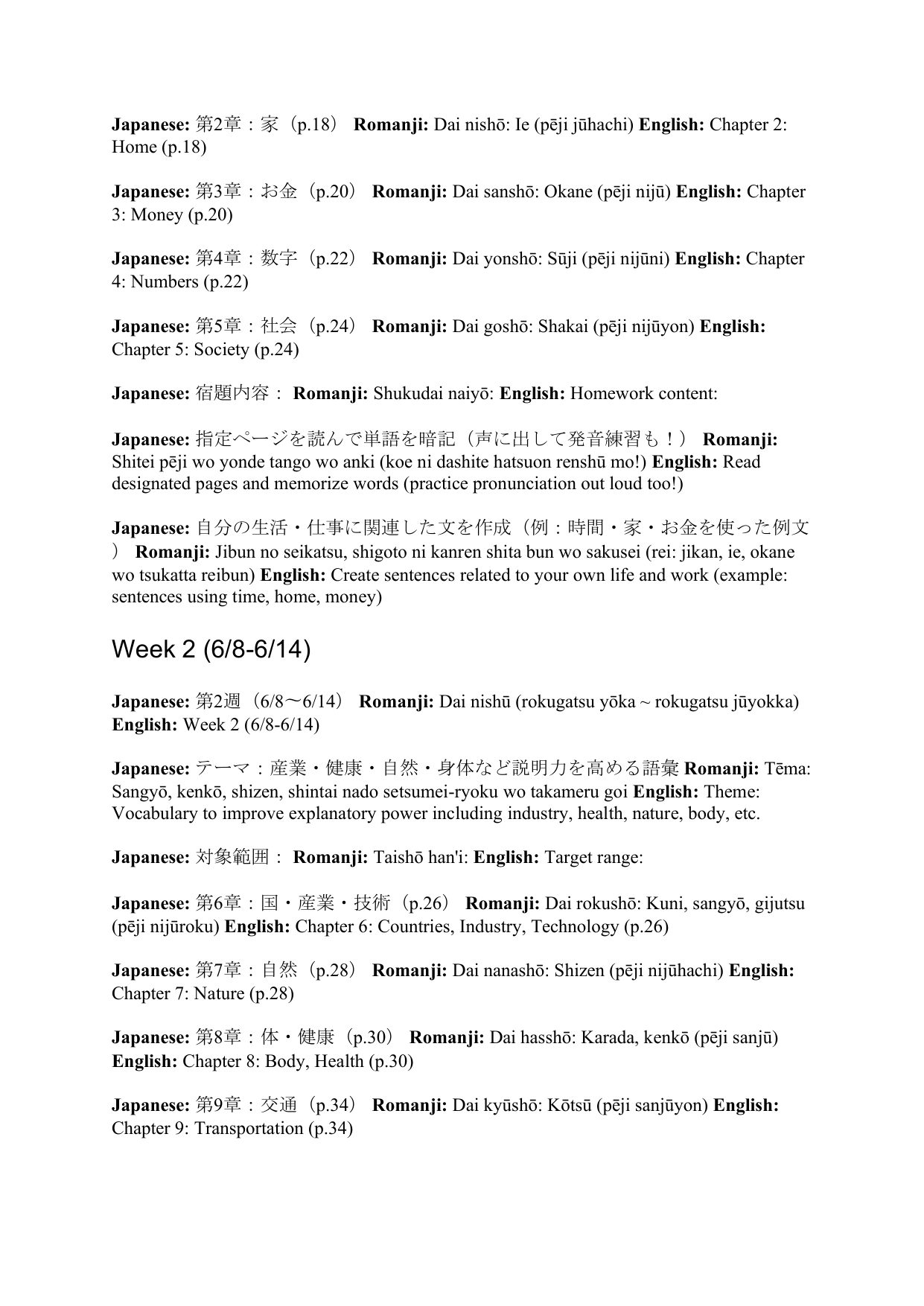
ENJapanese: 第2章:家(p.18) Romanji: Dai nishō: Ie (pēji jūhachi) English: Chapter 2:
Home (p.18)
Japanese: 第3章:お金(p.20) Romanji: Dai sanshō: Okane (pēji nijū) English: Chapter
3: Money (p.20)
Japanese: 第4章:数字(p.22) Romanji: Dai yonshō: Sūji (pēji nijūni) English: Chapter
4: Numbers (p.22)
Japanese: 第5章:社会(p.24) Romanji: Dai goshō: Shakai (pēji nijūyon) English:
Chapter 5: Society (p.24)
Japanese: 宿題内容: Romanji: Shukudai naiyō: English: Homework content:
Home (p.18)
Japanese: 第3章:お金(p.20) Romanji: Dai sanshō: Okane (pēji nijū) English: Chapter
3: Money (p.20)
Japanese: 第4章:数字(p.22) Romanji: Dai yonshō: Sūji (pēji nijūni) English: Chapter
4: Numbers (p.22)
Japanese: 第5章:社会(p.24) Romanji: Dai goshō: Shakai (pēji nijūyon) English:
Chapter 5: Society (p.24)
Japanese: 宿題内容: Romanji: Shukudai naiyō: English: Homework content:
JPJapanese:指定ページを読んで単語を暗記(声に出して発音練習も!)Romanji:
ENShitei pēji wo yonde tango wo anki (koe ni dashite hatsuon renshū mo!) English: Read
designated pages and memorize words (practice pronunciation out loud too!)
designated pages and memorize words (practice pronunciation out loud too!)
JPJapanese:自分の生活・仕事に関連した文を作成(例:時間・家・お金を使った例文
EN) Romanji: Jibun no seikatsu, shigoto ni kanren shita bun wo sakusei (rei: jikan, ie, okane
wo tsukatta reibun) English: Create sentences related to your own life and work (example:
sentences using time, home, money)
Week 2 (6/8-6/14)
Japanese: 第2週(6/8〜6/14) Romanji: Dai nishū (rokugatsu yōka ~ rokugatsu jūyokka)
English: Week 2 (6/8-6/14)
wo tsukatta reibun) English: Create sentences related to your own life and work (example:
sentences using time, home, money)
Week 2 (6/8-6/14)
Japanese: 第2週(6/8〜6/14) Romanji: Dai nishū (rokugatsu yōka ~ rokugatsu jūyokka)
English: Week 2 (6/8-6/14)
JPJapanese:テーマ:産業・健康・自然・身体など説明力を高める語彙Romanji:Tēma:
ENSangyō, kenkō, shizen, shintai nado setsumei-ryoku wo takameru goi English: Theme:
Vocabulary to improve explanatory power including industry, health, nature, body, etc.
Japanese: 対象範囲: Romanji: Taishō han'i: English: Target range:
Japanese: 第6章:国・産業・技術(p.26) Romanji: Dai rokushō: Kuni, sangyō, gijutsu
(pēji nijūroku) English: Chapter 6: Countries, Industry, Technology (p.26)
Japanese: 第7章:自然(p.28) Romanji: Dai nanashō: Shizen (pēji nijūhachi) English:
Chapter 7: Nature (p.28)
Japanese: 第8章:体・健康(p.30) Romanji: Dai hasshō: Karada, kenkō (pēji sanjū)
English: Chapter 8: Body, Health (p.30)
Japanese: 第9章:交通(p.34) Romanji: Dai kyūshō: Kōtsū (pēji sanjūyon) English:
Chapter 9: Transportation (p.34)
Vocabulary to improve explanatory power including industry, health, nature, body, etc.
Japanese: 対象範囲: Romanji: Taishō han'i: English: Target range:
Japanese: 第6章:国・産業・技術(p.26) Romanji: Dai rokushō: Kuni, sangyō, gijutsu
(pēji nijūroku) English: Chapter 6: Countries, Industry, Technology (p.26)
Japanese: 第7章:自然(p.28) Romanji: Dai nanashō: Shizen (pēji nijūhachi) English:
Chapter 7: Nature (p.28)
Japanese: 第8章:体・健康(p.30) Romanji: Dai hasshō: Karada, kenkō (pēji sanjū)
English: Chapter 8: Body, Health (p.30)
Japanese: 第9章:交通(p.34) Romanji: Dai kyūshō: Kōtsū (pēji sanjūyon) English:
Chapter 9: Transportation (p.34)
หน้า 13
คลิกเพื่อขยาย
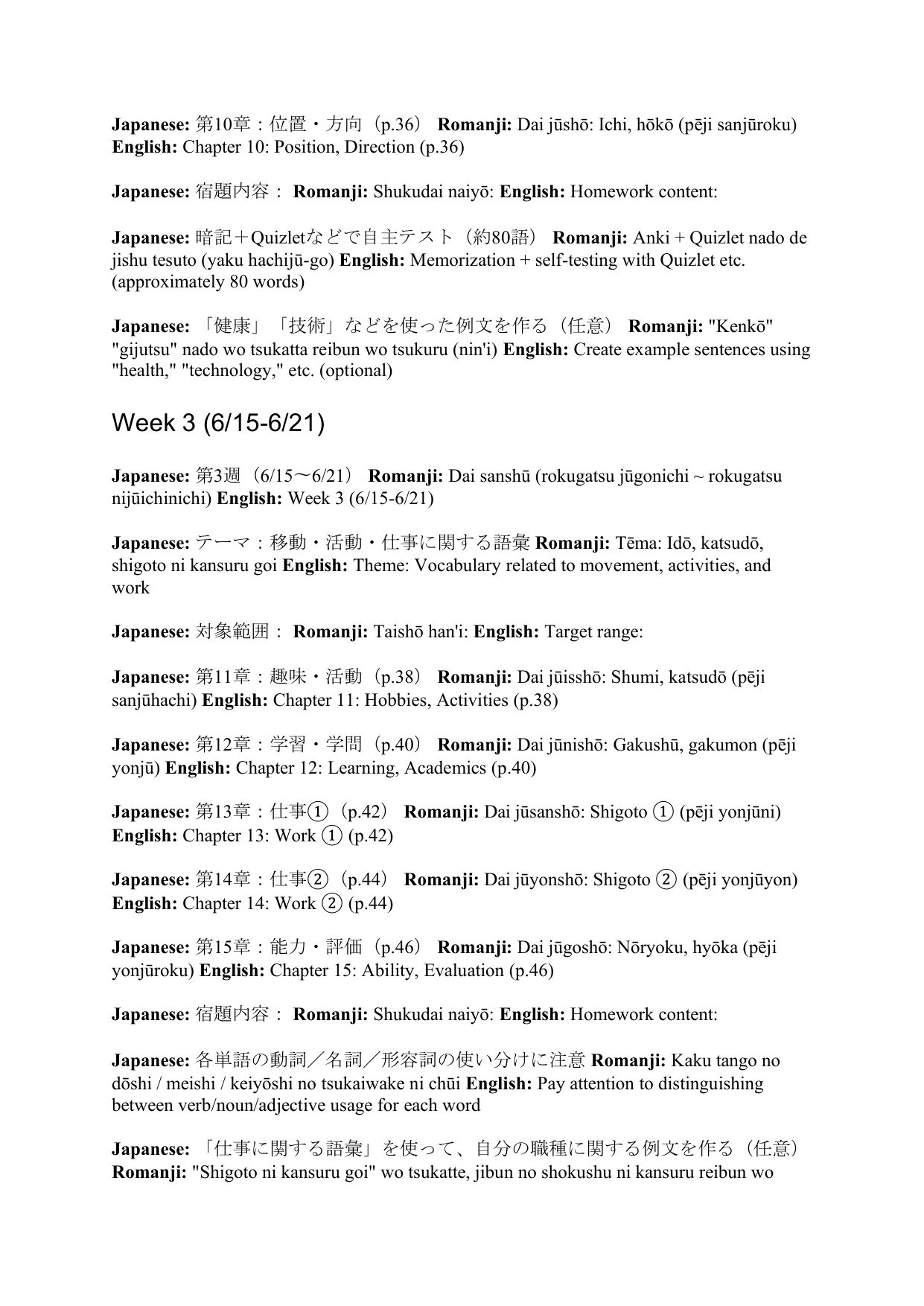
ENJapanese: 第10章:位置・方向(p.36) Romanji: Dai jūshō: Ichi, hōkō (pēji sanjūroku)
English: Chapter 10: Position, Direction (p.36)
Japanese: 宿題内容: Romanji: Shukudai naiyō: English: Homework content:
Japanese: 暗記+Quizletなどで自主テスト(約80語) Romanji: Anki + Quizlet nado de
jishu tesuto (yaku hachijū-go) English: Memorization + self-testing with Quizlet etc.
(approximately 80 words)
Japanese: 「健康」「技術」などを使った例文を作る(任意) Romanji: "Kenkō"
"gijutsu" nado wo tsukatta reibun wo tsukuru (nin'i) English: Create example sentences using
"health," "technology," etc. (optional)
Week 3 (6/15-6/21)
Japanese: 第3週(6/15〜6/21) Romanji: Dai sanshū (rokugatsu jūgonichi ~ rokugatsu
nijūichinichi) English: Week 3 (6/15-6/21)
Japanese: テーマ:移動・活動・仕事に関する語彙 Romanji: Tēma: Idō, katsudō,
shigoto ni kansuru goi English: Theme: Vocabulary related to movement, activities, and
work
Japanese: 対象範囲: Romanji: Taishō han'i: English: Target range:
Japanese: 第11章:趣味・活動(p.38) Romanji: Dai jūisshō: Shumi, katsudō (pēji
sanjūhachi) English: Chapter 11: Hobbies, Activities (p.38)
Japanese: 第12章:学習・学問(p.40) Romanji: Dai jūnishō: Gakushū, gakumon (pēji
yonjū) English: Chapter 12: Learning, Academics (p.40)
Japanese: 第13章:仕事①(p.42) Romanji: Dai jūsanshō: Shigoto ① (pēji yonjūni)
English: Chapter 13: Work ① (p.42)
Japanese: 第14章:仕事②(p.44) Romanji: Dai jūyonshō: Shigoto ② (pēji yonjūyon)
English: Chapter 14: Work ② (p.44)
Japanese: 第15章:能力・評価(p.46) Romanji: Dai jūgoshō: Nōryoku, hyōka (pēji
yonjūroku) English: Chapter 15: Ability, Evaluation (p.46)
Japanese: 宿題内容: Romanji: Shukudai naiyō: English: Homework content:
Japanese: 各単語の動詞/名詞/形容詞の使い分けに注意 Romanji: Kaku tango no
dōshi / meishi / keiyōshi no tsukaiwake ni chūi English: Pay attention to distinguishing
between verb/noun/adjective usage for each word
English: Chapter 10: Position, Direction (p.36)
Japanese: 宿題内容: Romanji: Shukudai naiyō: English: Homework content:
Japanese: 暗記+Quizletなどで自主テスト(約80語) Romanji: Anki + Quizlet nado de
jishu tesuto (yaku hachijū-go) English: Memorization + self-testing with Quizlet etc.
(approximately 80 words)
Japanese: 「健康」「技術」などを使った例文を作る(任意) Romanji: "Kenkō"
"gijutsu" nado wo tsukatta reibun wo tsukuru (nin'i) English: Create example sentences using
"health," "technology," etc. (optional)
Week 3 (6/15-6/21)
Japanese: 第3週(6/15〜6/21) Romanji: Dai sanshū (rokugatsu jūgonichi ~ rokugatsu
nijūichinichi) English: Week 3 (6/15-6/21)
Japanese: テーマ:移動・活動・仕事に関する語彙 Romanji: Tēma: Idō, katsudō,
shigoto ni kansuru goi English: Theme: Vocabulary related to movement, activities, and
work
Japanese: 対象範囲: Romanji: Taishō han'i: English: Target range:
Japanese: 第11章:趣味・活動(p.38) Romanji: Dai jūisshō: Shumi, katsudō (pēji
sanjūhachi) English: Chapter 11: Hobbies, Activities (p.38)
Japanese: 第12章:学習・学問(p.40) Romanji: Dai jūnishō: Gakushū, gakumon (pēji
yonjū) English: Chapter 12: Learning, Academics (p.40)
Japanese: 第13章:仕事①(p.42) Romanji: Dai jūsanshō: Shigoto ① (pēji yonjūni)
English: Chapter 13: Work ① (p.42)
Japanese: 第14章:仕事②(p.44) Romanji: Dai jūyonshō: Shigoto ② (pēji yonjūyon)
English: Chapter 14: Work ② (p.44)
Japanese: 第15章:能力・評価(p.46) Romanji: Dai jūgoshō: Nōryoku, hyōka (pēji
yonjūroku) English: Chapter 15: Ability, Evaluation (p.46)
Japanese: 宿題内容: Romanji: Shukudai naiyō: English: Homework content:
Japanese: 各単語の動詞/名詞/形容詞の使い分けに注意 Romanji: Kaku tango no
dōshi / meishi / keiyōshi no tsukaiwake ni chūi English: Pay attention to distinguishing
between verb/noun/adjective usage for each word
JPJapanese:「仕事に関する語彙」を使って、自分の職種に関する例文を作る(任意)
ENRomanji: "Shigoto ni kansuru goi" wo tsukatte, jibun no shokushu ni kansuru reibun wo
หน้า 14
คลิกเพื่อขยาย
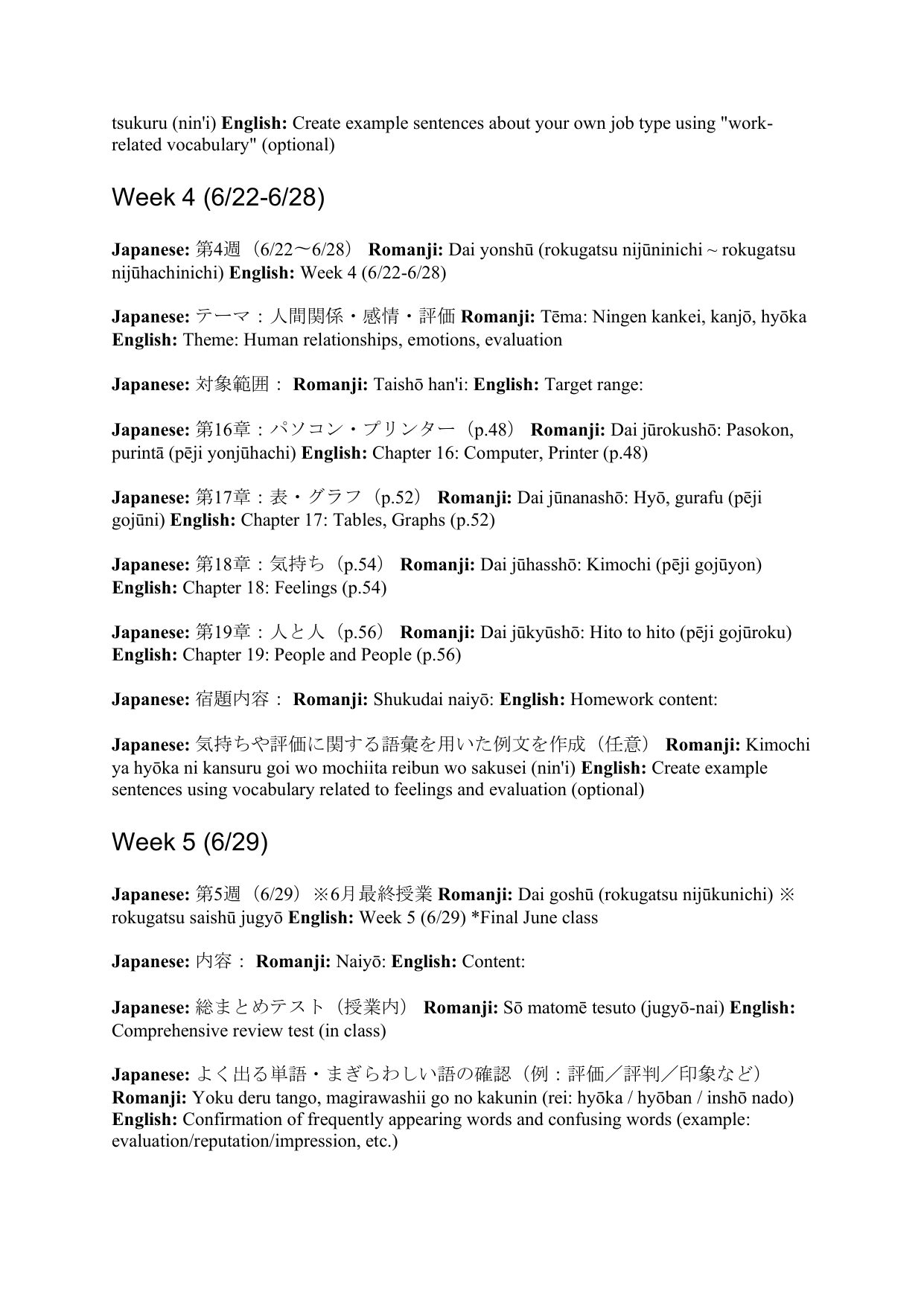
ENtsukuru (nin'i) English: Create example sentences about your own job type using "work-
related vocabulary" (optional)
Week 4 (6/22-6/28)
Japanese: 第4週(6/22〜6/28) Romanji: Dai yonshū (rokugatsu nijūninichi ~ rokugatsu
nijūhachinichi) English: Week 4 (6/22-6/28)
Japanese: テーマ:人間関係・感情・評価 Romanji: Tēma: Ningen kankei, kanjō, hyōka
English: Theme: Human relationships, emotions, evaluation
Japanese: 対象範囲: Romanji: Taishō han'i: English: Target range:
Japanese: 第16章:パソコン・プリンター(p.48) Romanji: Dai jūrokushō: Pasokon,
purintā (pēji yonjūhachi) English: Chapter 16: Computer, Printer (p.48)
Japanese: 第17章:表・グラフ(p.52) Romanji: Dai jūnanashō: Hyō, gurafu (pēji
gojūni) English: Chapter 17: Tables, Graphs (p.52)
Japanese: 第18章:気持ち(p.54) Romanji: Dai jūhasshō: Kimochi (pēji gojūyon)
English: Chapter 18: Feelings (p.54)
Japanese: 第19章:人と人(p.56) Romanji: Dai jūkyūshō: Hito to hito (pēji gojūroku)
English: Chapter 19: People and People (p.56)
Japanese: 宿題内容: Romanji: Shukudai naiyō: English: Homework content:
related vocabulary" (optional)
Week 4 (6/22-6/28)
Japanese: 第4週(6/22〜6/28) Romanji: Dai yonshū (rokugatsu nijūninichi ~ rokugatsu
nijūhachinichi) English: Week 4 (6/22-6/28)
Japanese: テーマ:人間関係・感情・評価 Romanji: Tēma: Ningen kankei, kanjō, hyōka
English: Theme: Human relationships, emotions, evaluation
Japanese: 対象範囲: Romanji: Taishō han'i: English: Target range:
Japanese: 第16章:パソコン・プリンター(p.48) Romanji: Dai jūrokushō: Pasokon,
purintā (pēji yonjūhachi) English: Chapter 16: Computer, Printer (p.48)
Japanese: 第17章:表・グラフ(p.52) Romanji: Dai jūnanashō: Hyō, gurafu (pēji
gojūni) English: Chapter 17: Tables, Graphs (p.52)
Japanese: 第18章:気持ち(p.54) Romanji: Dai jūhasshō: Kimochi (pēji gojūyon)
English: Chapter 18: Feelings (p.54)
Japanese: 第19章:人と人(p.56) Romanji: Dai jūkyūshō: Hito to hito (pēji gojūroku)
English: Chapter 19: People and People (p.56)
Japanese: 宿題内容: Romanji: Shukudai naiyō: English: Homework content:
JPJapanese:気持ちや評価に関する語彙を用いた例文を作成(任意)Romanji:Kimochi
ENya hyōka ni kansuru goi wo mochiita reibun wo sakusei (nin'i) English: Create example
sentences using vocabulary related to feelings and evaluation (optional)
Week 5 (6/29)
Japanese: 第5週(6/29)※6月最終授業 Romanji: Dai goshū (rokugatsu nijūkunichi) ※
rokugatsu saishū jugyō English: Week 5 (6/29) *Final June class
Japanese: 内容: Romanji: Naiyō: English: Content:
Japanese: 総まとめテスト(授業内) Romanji: Sō matomē tesuto (jugyō-nai) English:
Comprehensive review test (in class)
sentences using vocabulary related to feelings and evaluation (optional)
Week 5 (6/29)
Japanese: 第5週(6/29)※6月最終授業 Romanji: Dai goshū (rokugatsu nijūkunichi) ※
rokugatsu saishū jugyō English: Week 5 (6/29) *Final June class
Japanese: 内容: Romanji: Naiyō: English: Content:
Japanese: 総まとめテスト(授業内) Romanji: Sō matomē tesuto (jugyō-nai) English:
Comprehensive review test (in class)
JPJapanese:よく出る単語・まぎらわしい語の確認(例:評価/評判/印象など)
ENRomanji: Yoku deru tango, magirawashii go no kakunin (rei: hyōka / hyōban / inshō nado)
English: Confirmation of frequently appearing words and confusing words (example:
evaluation/reputation/impression, etc.)
English: Confirmation of frequently appearing words and confusing words (example:
evaluation/reputation/impression, etc.)
หน้า 15
คลิกเพื่อขยาย
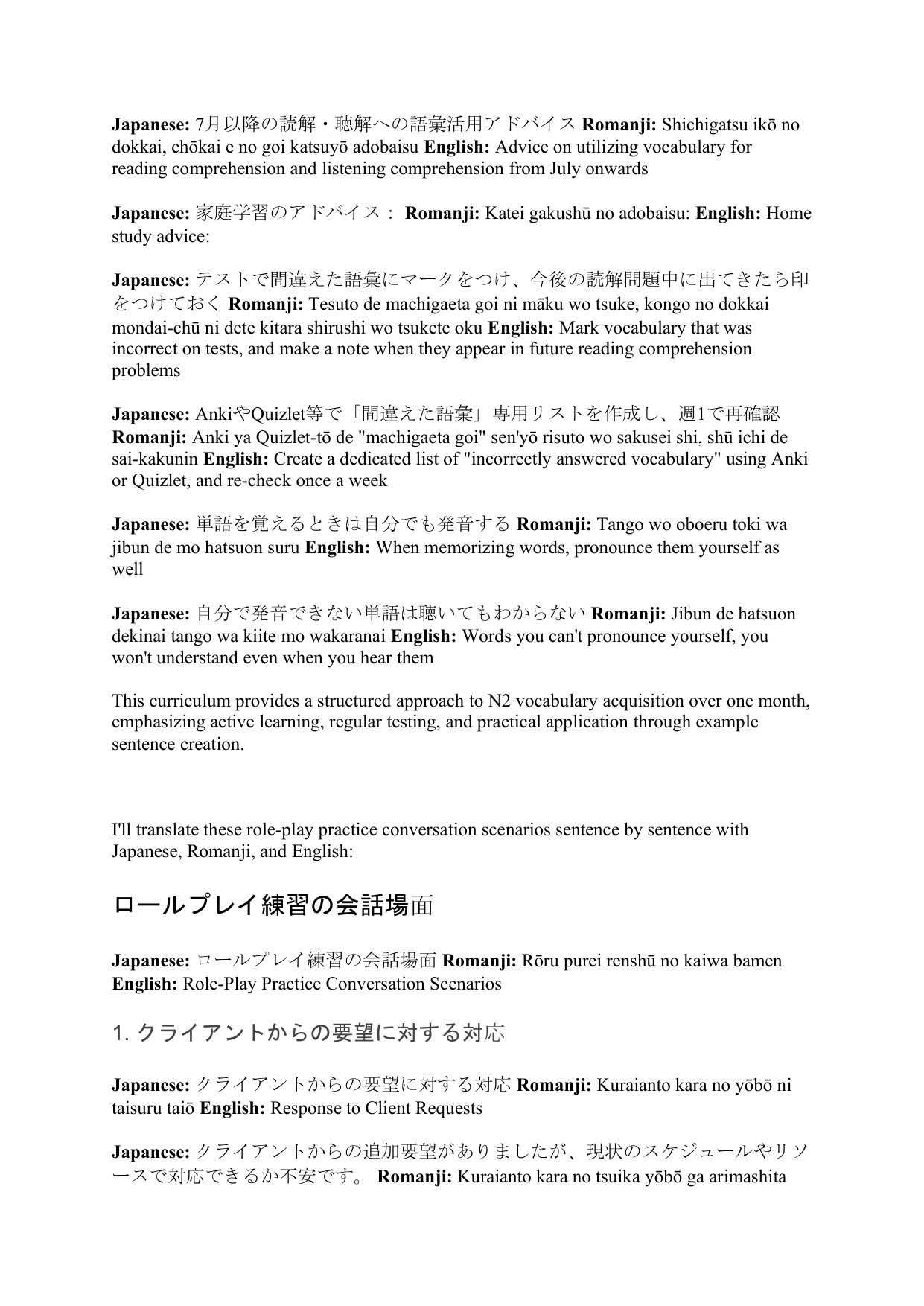
ENJapanese: 7月以降の読解・聴解への語彙活用アドバイス Romanji: Shichigatsu ikō no
dokkai, chōkai e no goi katsuyō adobaisu English: Advice on utilizing vocabulary for
reading comprehension and listening comprehension from July onwards
Japanese: 家庭学習のアドバイス: Romanji: Katei gakushū no adobaisu: English: Home
study advice:
dokkai, chōkai e no goi katsuyō adobaisu English: Advice on utilizing vocabulary for
reading comprehension and listening comprehension from July onwards
Japanese: 家庭学習のアドバイス: Romanji: Katei gakushū no adobaisu: English: Home
study advice:
JPJapanese:テストで間違えた語彙にマークをつけ、今後の読解問題中に出てきたら印
ENをつけておく Romanji: Tesuto de machigaeta goi ni māku wo tsuke, kongo no dokkai
mondai-chū ni dete kitara shirushi wo tsukete oku English: Mark vocabulary that was
incorrect on tests, and make a note when they appear in future reading comprehension
problems
mondai-chū ni dete kitara shirushi wo tsukete oku English: Mark vocabulary that was
incorrect on tests, and make a note when they appear in future reading comprehension
problems
JPJapanese:AnkiやQuizlet等で「間違えた語彙」専用リストを作成し、週1で再確認
ENRomanji: Anki ya Quizlet-tō de "machigaeta goi" sen'yō risuto wo sakusei shi, shū ichi de
sai-kakunin English: Create a dedicated list of "incorrectly answered vocabulary" using Anki
or Quizlet, and re-check once a week
Japanese: 単語を覚えるときは自分でも発音する Romanji: Tango wo oboeru toki wa
jibun de mo hatsuon suru English: When memorizing words, pronounce them yourself as
well
Japanese: 自分で発音できない単語は聴いてもわからない Romanji: Jibun de hatsuon
dekinai tango wa kiite mo wakaranai English: Words you can't pronounce yourself, you
won't understand even when you hear them
This curriculum provides a structured approach to N2 vocabulary acquisition over one month,
emphasizing active learning, regular testing, and practical application through example
sentence creation.
I'll translate these role-play practice conversation scenarios sentence by sentence with
Japanese, Romanji, and English:
sai-kakunin English: Create a dedicated list of "incorrectly answered vocabulary" using Anki
or Quizlet, and re-check once a week
Japanese: 単語を覚えるときは自分でも発音する Romanji: Tango wo oboeru toki wa
jibun de mo hatsuon suru English: When memorizing words, pronounce them yourself as
well
Japanese: 自分で発音できない単語は聴いてもわからない Romanji: Jibun de hatsuon
dekinai tango wa kiite mo wakaranai English: Words you can't pronounce yourself, you
won't understand even when you hear them
This curriculum provides a structured approach to N2 vocabulary acquisition over one month,
emphasizing active learning, regular testing, and practical application through example
sentence creation.
I'll translate these role-play practice conversation scenarios sentence by sentence with
Japanese, Romanji, and English:
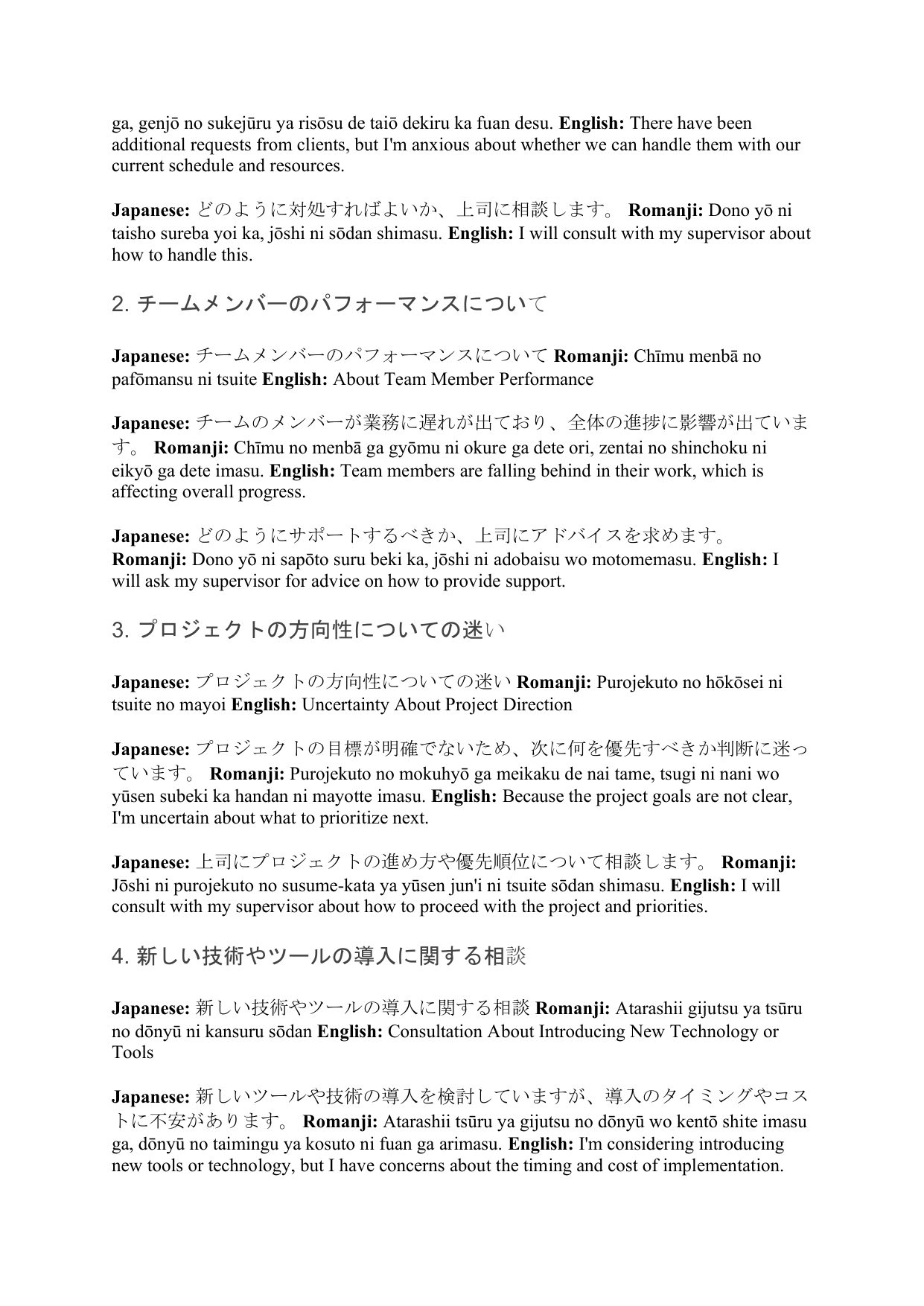
JPロールプレイ練習の会話場面
ENJapanese: ロールプレイ練習の会話場面 Romanji: Rōru purei renshū no kaiwa bamen
English: Role-Play Practice Conversation Scenarios
English: Role-Play Practice Conversation Scenarios
JP1.クライアントからの要望に対する対応
ENJapanese: クライアントからの要望に対する対応 Romanji: Kuraianto kara no yōbō ni
taisuru taiō English: Response to Client Requests
taisuru taiō English: Response to Client Requests
JPJapanese:クライアントからの追加要望がありましたが、現状のスケジュールやリソ
ENースで対応できるか不安です。 Romanji: Kuraianto kara no tsuika yōbō ga arimashita
หน้า 16
คลิกเพื่อขยาย
ENga, genjō no sukejūru ya risōsu de taiō dekiru ka fuan desu. English: There have been
additional requests from clients, but I'm anxious about whether we can handle them with our
current schedule and resources.
Japanese: どのように対処すればよいか、上司に相談します。 Romanji: Dono yō ni
taisho sureba yoi ka, jōshi ni sōdan shimasu. English: I will consult with my supervisor about
how to handle this.
additional requests from clients, but I'm anxious about whether we can handle them with our
current schedule and resources.
Japanese: どのように対処すればよいか、上司に相談します。 Romanji: Dono yō ni
taisho sureba yoi ka, jōshi ni sōdan shimasu. English: I will consult with my supervisor about
how to handle this.
JP2.チームメンバーのパフォーマンスについて
ENJapanese: チームメンバーのパフォーマンスについて Romanji: Chīmu menbā no
pafōmansu ni tsuite English: About Team Member Performance
pafōmansu ni tsuite English: About Team Member Performance
JPJapanese:チームのメンバーが業務に遅れが出ており、全体の進捗に影響が出ていま
ENす。 Romanji: Chīmu no menbā ga gyōmu ni okure ga dete ori, zentai no shinchoku ni
eikyō ga dete imasu. English: Team members are falling behind in their work, which is
affecting overall progress.
eikyō ga dete imasu. English: Team members are falling behind in their work, which is
affecting overall progress.
JPJapanese:どのようにサポートするべきか、上司にアドバイスを求めます。
ENRomanji: Dono yō ni sapōto suru beki ka, jōshi ni adobaisu wo motomemasu. English: I
will ask my supervisor for advice on how to provide support.
will ask my supervisor for advice on how to provide support.
JP3.プロジェクトの方向性についての迷い
ENJapanese: プロジェクトの方向性についての迷い Romanji: Purojekuto no hōkōsei ni
tsuite no mayoi English: Uncertainty About Project Direction
tsuite no mayoi English: Uncertainty About Project Direction
JPJapanese:プロジェクトの目標が明確でないため、次に何を優先すべきか判断に迷っ
ENています。 Romanji: Purojekuto no mokuhyō ga meikaku de nai tame, tsugi ni nani wo
yūsen subeki ka handan ni mayotte imasu. English: Because the project goals are not clear,
I'm uncertain about what to prioritize next.
yūsen subeki ka handan ni mayotte imasu. English: Because the project goals are not clear,
I'm uncertain about what to prioritize next.
JPJapanese:上司にプロジェクトの進め方や優先順位について相談します。Romanji:
ENJōshi ni purojekuto no susume-kata ya yūsen jun'i ni tsuite sōdan shimasu. English: I will
consult with my supervisor about how to proceed with the project and priorities.
consult with my supervisor about how to proceed with the project and priorities.
JP4.新しい技術やツールの導入に関する相談
ENJapanese: 新しい技術やツールの導入に関する相談 Romanji: Atarashii gijutsu ya tsūru
no dōnyū ni kansuru sōdan English: Consultation About Introducing New Technology or
Tools
no dōnyū ni kansuru sōdan English: Consultation About Introducing New Technology or
Tools
JPJapanese:新しいツールや技術の導入を検討していますが、導入のタイミングやコス
ENトに不安があります。 Romanji: Atarashii tsūru ya gijutsu no dōnyū wo kentō shite imasu
ga, dōnyū no taimingu ya kosuto ni fuan ga arimasu. English: I'm considering introducing
new tools or technology, but I have concerns about the timing and cost of implementation.
ga, dōnyū no taimingu ya kosuto ni fuan ga arimasu. English: I'm considering introducing
new tools or technology, but I have concerns about the timing and cost of implementation.
หน้า 17
คลิกเพื่อขยาย
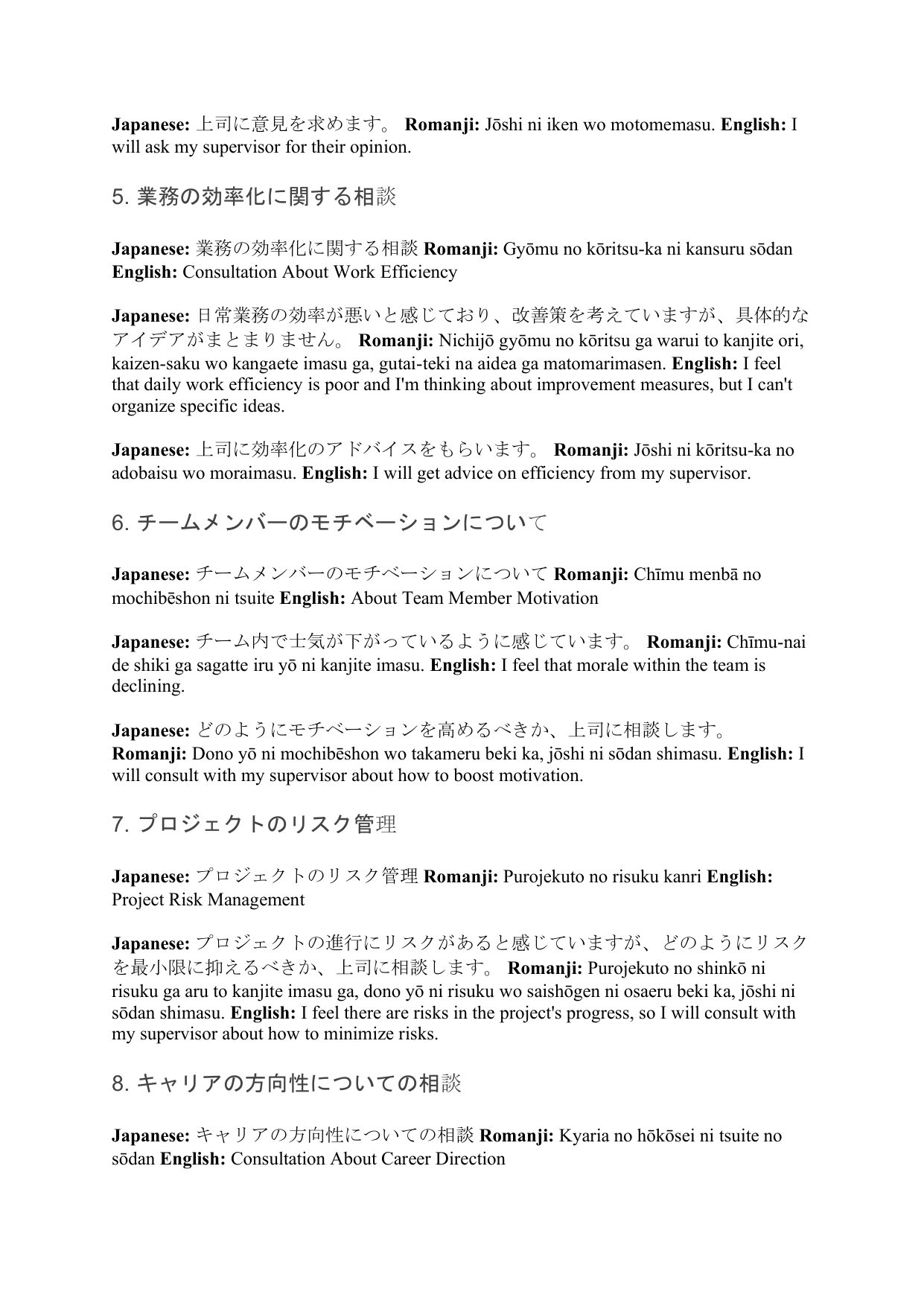
ENJapanese: 上司に意見を求めます。 Romanji: Jōshi ni iken wo motomemasu. English: I
will ask my supervisor for their opinion.
will ask my supervisor for their opinion.
JP5.業務の効率化に関する相談
ENJapanese: 業務の効率化に関する相談 Romanji: Gyōmu no kōritsu-ka ni kansuru sōdan
English: Consultation About Work Efficiency
English: Consultation About Work Efficiency
JPJapanese:日常業務の効率が悪いと感じており、改善策を考えていますが、具体的な
ENアイデアがまとまりません。 Romanji: Nichijō gyōmu no kōritsu ga warui to kanjite ori,
kaizen-saku wo kangaete imasu ga, gutai-teki na aidea ga matomarimasen. English: I feel
that daily work efficiency is poor and I'm thinking about improvement measures, but I can't
organize specific ideas.
Japanese: 上司に効率化のアドバイスをもらいます。 Romanji: Jōshi ni kōritsu-ka no
adobaisu wo moraimasu. English: I will get advice on efficiency from my supervisor.
kaizen-saku wo kangaete imasu ga, gutai-teki na aidea ga matomarimasen. English: I feel
that daily work efficiency is poor and I'm thinking about improvement measures, but I can't
organize specific ideas.
Japanese: 上司に効率化のアドバイスをもらいます。 Romanji: Jōshi ni kōritsu-ka no
adobaisu wo moraimasu. English: I will get advice on efficiency from my supervisor.
JP6.チームメンバーのモチベーションについて
ENJapanese: チームメンバーのモチベーションについて Romanji: Chīmu menbā no
mochibēshon ni tsuite English: About Team Member Motivation
mochibēshon ni tsuite English: About Team Member Motivation
JPJapanese:チーム内で士気が下がっているように感じています。Romanji:Chīmu-nai
ENde shiki ga sagatte iru yō ni kanjite imasu. English: I feel that morale within the team is
declining.
declining.
JPJapanese:どのようにモチベーションを高めるべきか、上司に相談します。
ENRomanji: Dono yō ni mochibēshon wo takameru beki ka, jōshi ni sōdan shimasu. English: I
will consult with my supervisor about how to boost motivation.
will consult with my supervisor about how to boost motivation.
JP7.プロジェクトのリスク管理
ENJapanese: プロジェクトのリスク管理 Romanji: Purojekuto no risuku kanri English:
Project Risk Management
Project Risk Management
JPJapanese:プロジェクトの進行にリスクがあると感じていますが、どのようにリスク
ENを最小限に抑えるべきか、上司に相談します。 Romanji: Purojekuto no shinkō ni
risuku ga aru to kanjite imasu ga, dono yō ni risuku wo saishōgen ni osaeru beki ka, jōshi ni
sōdan shimasu. English: I feel there are risks in the project's progress, so I will consult with
my supervisor about how to minimize risks.
risuku ga aru to kanjite imasu ga, dono yō ni risuku wo saishōgen ni osaeru beki ka, jōshi ni
sōdan shimasu. English: I feel there are risks in the project's progress, so I will consult with
my supervisor about how to minimize risks.
JP8.キャリアの方向性についての相談
ENJapanese: キャリアの方向性についての相談 Romanji: Kyaria no hōkōsei ni tsuite no
sōdan English: Consultation About Career Direction
sōdan English: Consultation About Career Direction
หน้า 18
คลิกเพื่อขยาย
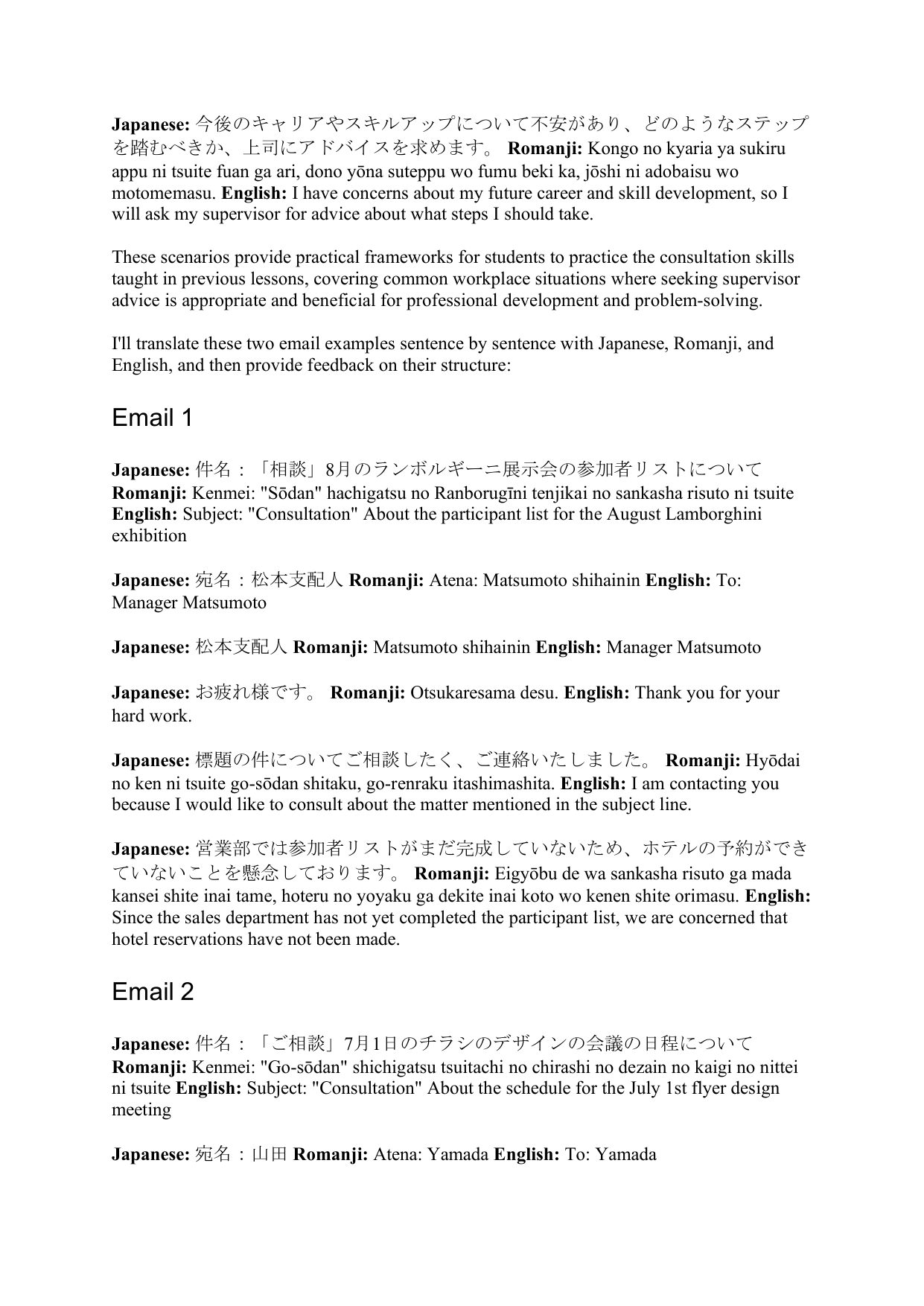
JPJapanese:今後のキャリアやスキルアップについて不安があり、どのようなステップ
ENを踏むべきか、上司にアドバイスを求めます。 Romanji: Kongo no kyaria ya sukiru
appu ni tsuite fuan ga ari, dono yōna suteppu wo fumu beki ka, jōshi ni adobaisu wo
motomemasu. English: I have concerns about my future career and skill development, so I
will ask my supervisor for advice about what steps I should take.
These scenarios provide practical frameworks for students to practice the consultation skills
taught in previous lessons, covering common workplace situations where seeking supervisor
advice is appropriate and beneficial for professional development and problem-solving.
I'll translate these two email examples sentence by sentence with Japanese, Romanji, and
English, and then provide feedback on their structure:
Email 1
appu ni tsuite fuan ga ari, dono yōna suteppu wo fumu beki ka, jōshi ni adobaisu wo
motomemasu. English: I have concerns about my future career and skill development, so I
will ask my supervisor for advice about what steps I should take.
These scenarios provide practical frameworks for students to practice the consultation skills
taught in previous lessons, covering common workplace situations where seeking supervisor
advice is appropriate and beneficial for professional development and problem-solving.
I'll translate these two email examples sentence by sentence with Japanese, Romanji, and
English, and then provide feedback on their structure:
Email 1
JPJapanese:件名:「相談」8月のランボルギーニ展示会の参加者リストについて
ENRomanji: Kenmei: "Sōdan" hachigatsu no Ranborugīni tenjikai no sankasha risuto ni tsuite
English: Subject: "Consultation" About the participant list for the August Lamborghini
exhibition
Japanese: 宛名:松本支配人 Romanji: Atena: Matsumoto shihainin English: To:
Manager Matsumoto
Japanese: 松本支配人 Romanji: Matsumoto shihainin English: Manager Matsumoto
Japanese: お疲れ様です。 Romanji: Otsukaresama desu. English: Thank you for your
hard work.
English: Subject: "Consultation" About the participant list for the August Lamborghini
exhibition
Japanese: 宛名:松本支配人 Romanji: Atena: Matsumoto shihainin English: To:
Manager Matsumoto
Japanese: 松本支配人 Romanji: Matsumoto shihainin English: Manager Matsumoto
Japanese: お疲れ様です。 Romanji: Otsukaresama desu. English: Thank you for your
hard work.
JPJapanese:標題の件についてご相談したく、ご連絡いたしました。Romanji:Hyōdai
ENno ken ni tsuite go-sōdan shitaku, go-renraku itashimashita. English: I am contacting you
because I would like to consult about the matter mentioned in the subject line.
because I would like to consult about the matter mentioned in the subject line.
JPJapanese:営業部では参加者リストがまだ完成していないため、ホテルの予約ができ
ENていないことを懸念しております。 Romanji: Eigyōbu de wa sankasha risuto ga mada
kansei shite inai tame, hoteru no yoyaku ga dekite inai koto wo kenen shite orimasu. English:
Since the sales department has not yet completed the participant list, we are concerned that
hotel reservations have not been made.
Email 2
kansei shite inai tame, hoteru no yoyaku ga dekite inai koto wo kenen shite orimasu. English:
Since the sales department has not yet completed the participant list, we are concerned that
hotel reservations have not been made.
Email 2
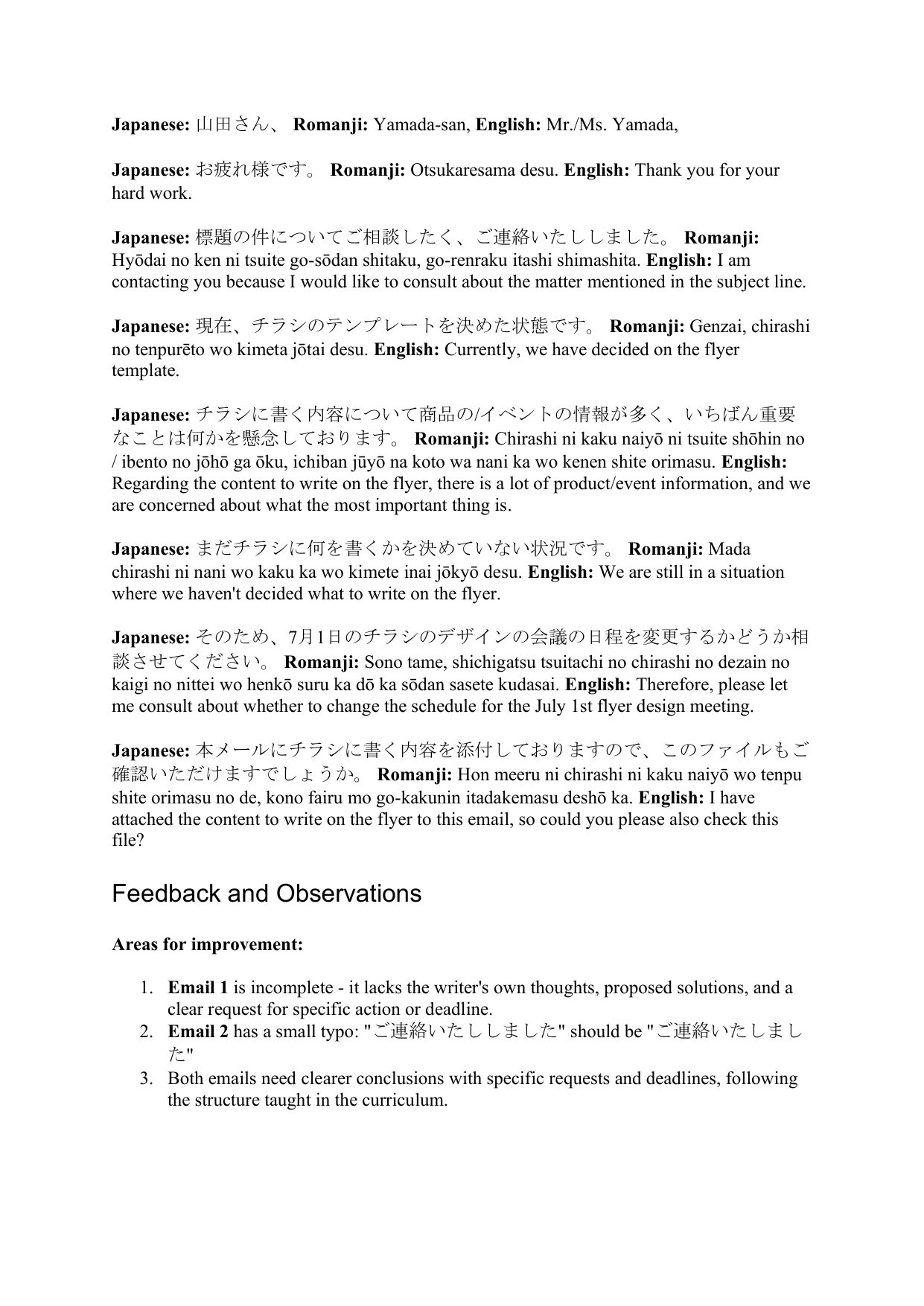
JPJapanese:件名:「ご相談」7月1日のチラシのデザインの会議の日程について
ENRomanji: Kenmei: "Go-sōdan" shichigatsu tsuitachi no chirashi no dezain no kaigi no nittei
ni tsuite English: Subject: "Consultation" About the schedule for the July 1st flyer design
meeting
Japanese: 宛名:山田 Romanji: Atena: Yamada English: To: Yamada
ni tsuite English: Subject: "Consultation" About the schedule for the July 1st flyer design
meeting
Japanese: 宛名:山田 Romanji: Atena: Yamada English: To: Yamada
หน้า 19
คลิกเพื่อขยาย
ENJapanese: 山田さん、 Romanji: Yamada-san, English: Mr./Ms. Yamada,
Japanese: お疲れ様です。 Romanji: Otsukaresama desu. English: Thank you for your
hard work.
Japanese: お疲れ様です。 Romanji: Otsukaresama desu. English: Thank you for your
hard work.
JPJapanese:標題の件についてご相談したく、ご連絡いたししました。Romanji:
ENHyōdai no ken ni tsuite go-sōdan shitaku, go-renraku itashi shimashita. English: I am
contacting you because I would like to consult about the matter mentioned in the subject line.
Japanese: 現在、チラシのテンプレートを決めた状態です。 Romanji: Genzai, chirashi
no tenpurēto wo kimeta jōtai desu. English: Currently, we have decided on the flyer
template.
contacting you because I would like to consult about the matter mentioned in the subject line.
Japanese: 現在、チラシのテンプレートを決めた状態です。 Romanji: Genzai, chirashi
no tenpurēto wo kimeta jōtai desu. English: Currently, we have decided on the flyer
template.
JPJapanese:チラシに書く内容について商品の/イベントの情報が多く、いちばん重要
ENなことは何かを懸念しております。 Romanji: Chirashi ni kaku naiyō ni tsuite shōhin no
/ ibento no jōhō ga ōku, ichiban jūyō na koto wa nani ka wo kenen shite orimasu. English:
Regarding the content to write on the flyer, there is a lot of product/event information, and we
are concerned about what the most important thing is.
/ ibento no jōhō ga ōku, ichiban jūyō na koto wa nani ka wo kenen shite orimasu. English:
Regarding the content to write on the flyer, there is a lot of product/event information, and we
are concerned about what the most important thing is.
JPJapanese:まだチラシに何を書くかを決めていない状況です。Romanji:Mada
ENchirashi ni nani wo kaku ka wo kimete inai jōkyō desu. English: We are still in a situation
where we haven't decided what to write on the flyer.
where we haven't decided what to write on the flyer.
JPJapanese:そのため、7月1日のチラシのデザインの会議の日程を変更するかどうか相
EN談させてください。 Romanji: Sono tame, shichigatsu tsuitachi no chirashi no dezain no
kaigi no nittei wo henkō suru ka dō ka sōdan sasete kudasai. English: Therefore, please let
me consult about whether to change the schedule for the July 1st flyer design meeting.
kaigi no nittei wo henkō suru ka dō ka sōdan sasete kudasai. English: Therefore, please let
me consult about whether to change the schedule for the July 1st flyer design meeting.
JPJapanese:本メールにチラシに書く内容を添付しておりますので、このファイルもご
EN確認いただけますでしょうか。 Romanji: Hon meeru ni chirashi ni kaku naiyō wo tenpu
shite orimasu no de, kono fairu mo go-kakunin itadakemasu deshō ka. English: I have
attached the content to write on the flyer to this email, so could you please also check this
file?
Feedback and Observations
Areas for improvement:
1. Email 1 is incomplete - it lacks the writer's own thoughts, proposed solutions, and a
clear request for specific action or deadline.
2. Email 2 has a small typo: "ご連絡いたししました" should be "ご連絡いたしまし
shite orimasu no de, kono fairu mo go-kakunin itadakemasu deshō ka. English: I have
attached the content to write on the flyer to this email, so could you please also check this
file?
Feedback and Observations
Areas for improvement:
1. Email 1 is incomplete - it lacks the writer's own thoughts, proposed solutions, and a
clear request for specific action or deadline.
2. Email 2 has a small typo: "ご連絡いたししました" should be "ご連絡いたしまし
JPた"
EN 3. Both emails need clearer conclusions with specific requests and deadlines, following
the structure taught in the curriculum.
the structure taught in the curriculum.
หน้า 20
คลิกเพื่อขยาย
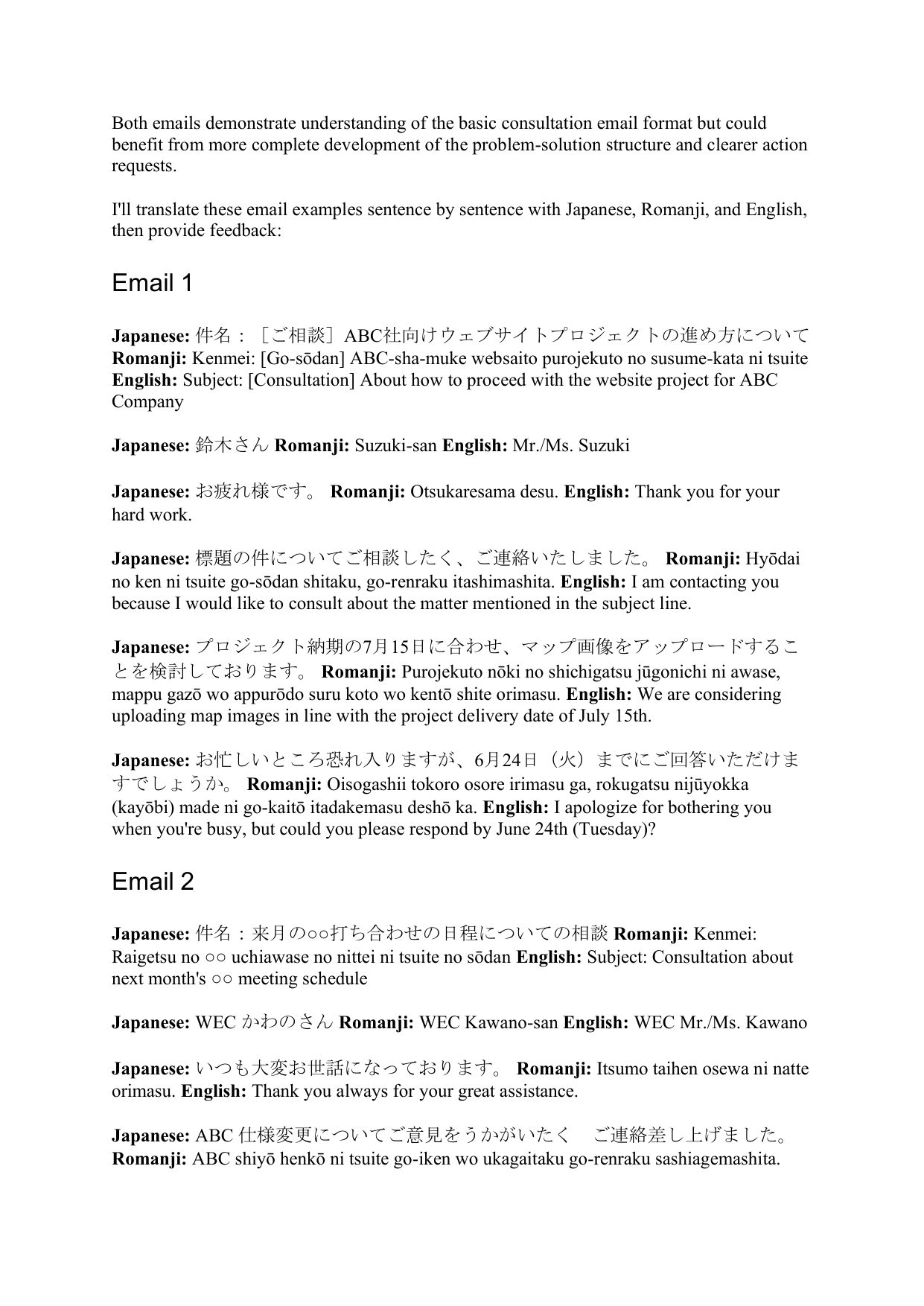
ENBoth emails demonstrate understanding of the basic consultation email format but could
benefit from more complete development of the problem-solution structure and clearer action
requests.
I'll translate these email examples sentence by sentence with Japanese, Romanji, and English,
then provide feedback:
Email 1
benefit from more complete development of the problem-solution structure and clearer action
requests.
I'll translate these email examples sentence by sentence with Japanese, Romanji, and English,
then provide feedback:
Email 1
JPJapanese:件名:[ご相談]ABC社向けウェブサイトプロジェクトの進め方について
ENRomanji: Kenmei: [Go-sōdan] ABC-sha-muke websaito purojekuto no susume-kata ni tsuite
English: Subject: [Consultation] About how to proceed with the website project for ABC
Company
Japanese: 鈴木さん Romanji: Suzuki-san English: Mr./Ms. Suzuki
Japanese: お疲れ様です。 Romanji: Otsukaresama desu. English: Thank you for your
hard work.
English: Subject: [Consultation] About how to proceed with the website project for ABC
Company
Japanese: 鈴木さん Romanji: Suzuki-san English: Mr./Ms. Suzuki
Japanese: お疲れ様です。 Romanji: Otsukaresama desu. English: Thank you for your
hard work.
JPJapanese:標題の件についてご相談したく、ご連絡いたしました。Romanji:Hyōdai
ENno ken ni tsuite go-sōdan shitaku, go-renraku itashimashita. English: I am contacting you
because I would like to consult about the matter mentioned in the subject line.
because I would like to consult about the matter mentioned in the subject line.
JPJapanese:プロジェクト納期の7月15日に合わせ、マップ画像をアップロードするこ
ENとを検討しております。 Romanji: Purojekuto nōki no shichigatsu jūgonichi ni awase,
mappu gazō wo appurōdo suru koto wo kentō shite orimasu. English: We are considering
uploading map images in line with the project delivery date of July 15th.
mappu gazō wo appurōdo suru koto wo kentō shite orimasu. English: We are considering
uploading map images in line with the project delivery date of July 15th.
JPJapanese:お忙しいところ恐れ入りますが、6月24日(火)までにご回答いただけま
ENすでしょうか。 Romanji: Oisogashii tokoro osore irimasu ga, rokugatsu nijūyokka
(kayōbi) made ni go-kaitō itadakemasu deshō ka. English: I apologize for bothering you
when you're busy, but could you please respond by June 24th (Tuesday)?
Email 2
Japanese: 件名:来月の○○打ち合わせの日程についての相談 Romanji: Kenmei:
Raigetsu no ○○ uchiawase no nittei ni tsuite no sōdan English: Subject: Consultation about
next month's ○○ meeting schedule
Japanese: WEC かわのさん Romanji: WEC Kawano-san English: WEC Mr./Ms. Kawano
Japanese: いつも大変お世話になっております。 Romanji: Itsumo taihen osewa ni natte
orimasu. English: Thank you always for your great assistance.
(kayōbi) made ni go-kaitō itadakemasu deshō ka. English: I apologize for bothering you
when you're busy, but could you please respond by June 24th (Tuesday)?
Email 2
Japanese: 件名:来月の○○打ち合わせの日程についての相談 Romanji: Kenmei:
Raigetsu no ○○ uchiawase no nittei ni tsuite no sōdan English: Subject: Consultation about
next month's ○○ meeting schedule
Japanese: WEC かわのさん Romanji: WEC Kawano-san English: WEC Mr./Ms. Kawano
Japanese: いつも大変お世話になっております。 Romanji: Itsumo taihen osewa ni natte
orimasu. English: Thank you always for your great assistance.
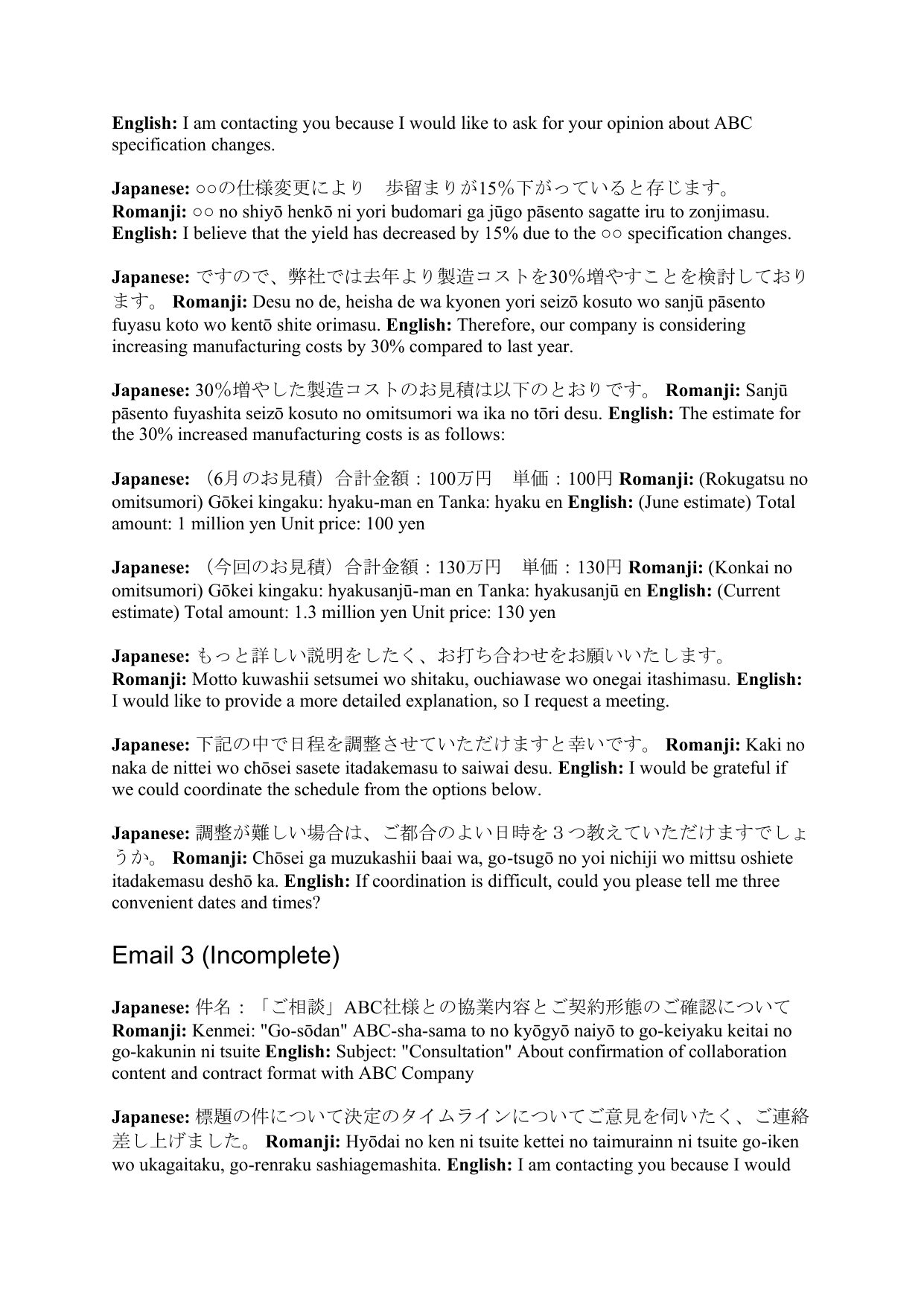
JPJapanese:ABC仕様変更についてご意見をうかがいたくご連絡差し上げました。
ENRomanji: ABC shiyō henkō ni tsuite go-iken wo ukagaitaku go-renraku sashiagemashita.
หน้า 21
คลิกเพื่อขยาย
ENEnglish: I am contacting you because I would like to ask for your opinion about ABC
specification changes.
specification changes.
JPJapanese:○○の仕様変更により歩留まりが15%下がっていると存じます。
ENRomanji: ○○ no shiyō henkō ni yori budomari ga jūgo pāsento sagatte iru to zonjimasu.
English: I believe that the yield has decreased by 15% due to the ○○ specification changes.
English: I believe that the yield has decreased by 15% due to the ○○ specification changes.
JPJapanese:ですので、弊社では去年より製造コストを30%増やすことを検討しており
ENます。 Romanji: Desu no de, heisha de wa kyonen yori seizō kosuto wo sanjū pāsento
fuyasu koto wo kentō shite orimasu. English: Therefore, our company is considering
increasing manufacturing costs by 30% compared to last year.
fuyasu koto wo kentō shite orimasu. English: Therefore, our company is considering
increasing manufacturing costs by 30% compared to last year.
JPJapanese:30%増やした製造コストのお見積は以下のとおりです。Romanji:Sanjū
ENpāsento fuyashita seizō kosuto no omitsumori wa ika no tōri desu. English: The estimate for
the 30% increased manufacturing costs is as follows:
Japanese: (6月のお見積)合計金額:100万円 単価:100円 Romanji: (Rokugatsu no
omitsumori) Gōkei kingaku: hyaku-man en Tanka: hyaku en English: (June estimate) Total
amount: 1 million yen Unit price: 100 yen
Japanese: (今回のお見積)合計金額:130万円 単価:130円 Romanji: (Konkai no
omitsumori) Gōkei kingaku: hyakusanjū-man en Tanka: hyakusanjū en English: (Current
estimate) Total amount: 1.3 million yen Unit price: 130 yen
the 30% increased manufacturing costs is as follows:
Japanese: (6月のお見積)合計金額:100万円 単価:100円 Romanji: (Rokugatsu no
omitsumori) Gōkei kingaku: hyaku-man en Tanka: hyaku en English: (June estimate) Total
amount: 1 million yen Unit price: 100 yen
Japanese: (今回のお見積)合計金額:130万円 単価:130円 Romanji: (Konkai no
omitsumori) Gōkei kingaku: hyakusanjū-man en Tanka: hyakusanjū en English: (Current
estimate) Total amount: 1.3 million yen Unit price: 130 yen
JPJapanese:もっと詳しい説明をしたく、お打ち合わせをお願いいたします。
ENRomanji: Motto kuwashii setsumei wo shitaku, ouchiawase wo onegai itashimasu. English:
I would like to provide a more detailed explanation, so I request a meeting.
I would like to provide a more detailed explanation, so I request a meeting.
JPJapanese:下記の中で日程を調整させていただけますと幸いです。Romanji:Kakino
ENnaka de nittei wo chōsei sasete itadakemasu to saiwai desu. English: I would be grateful if
we could coordinate the schedule from the options below.
we could coordinate the schedule from the options below.
JPJapanese:調整が難しい場合は、ご都合のよい日時を3つ教えていただけますでしょ
ENうか。 Romanji: Chōsei ga muzukashii baai wa, go-tsugō no yoi nichiji wo mittsu oshiete
itadakemasu deshō ka. English: If coordination is difficult, could you please tell me three
convenient dates and times?
Email 3 (Incomplete)
itadakemasu deshō ka. English: If coordination is difficult, could you please tell me three
convenient dates and times?
Email 3 (Incomplete)
JPJapanese:件名:「ご相談」ABC社様との協業内容とご契約形態のご確認について
ENRomanji: Kenmei: "Go-sōdan" ABC-sha-sama to no kyōgyō naiyō to go-keiyaku keitai no
go-kakunin ni tsuite English: Subject: "Consultation" About confirmation of collaboration
content and contract format with ABC Company
go-kakunin ni tsuite English: Subject: "Consultation" About confirmation of collaboration
content and contract format with ABC Company
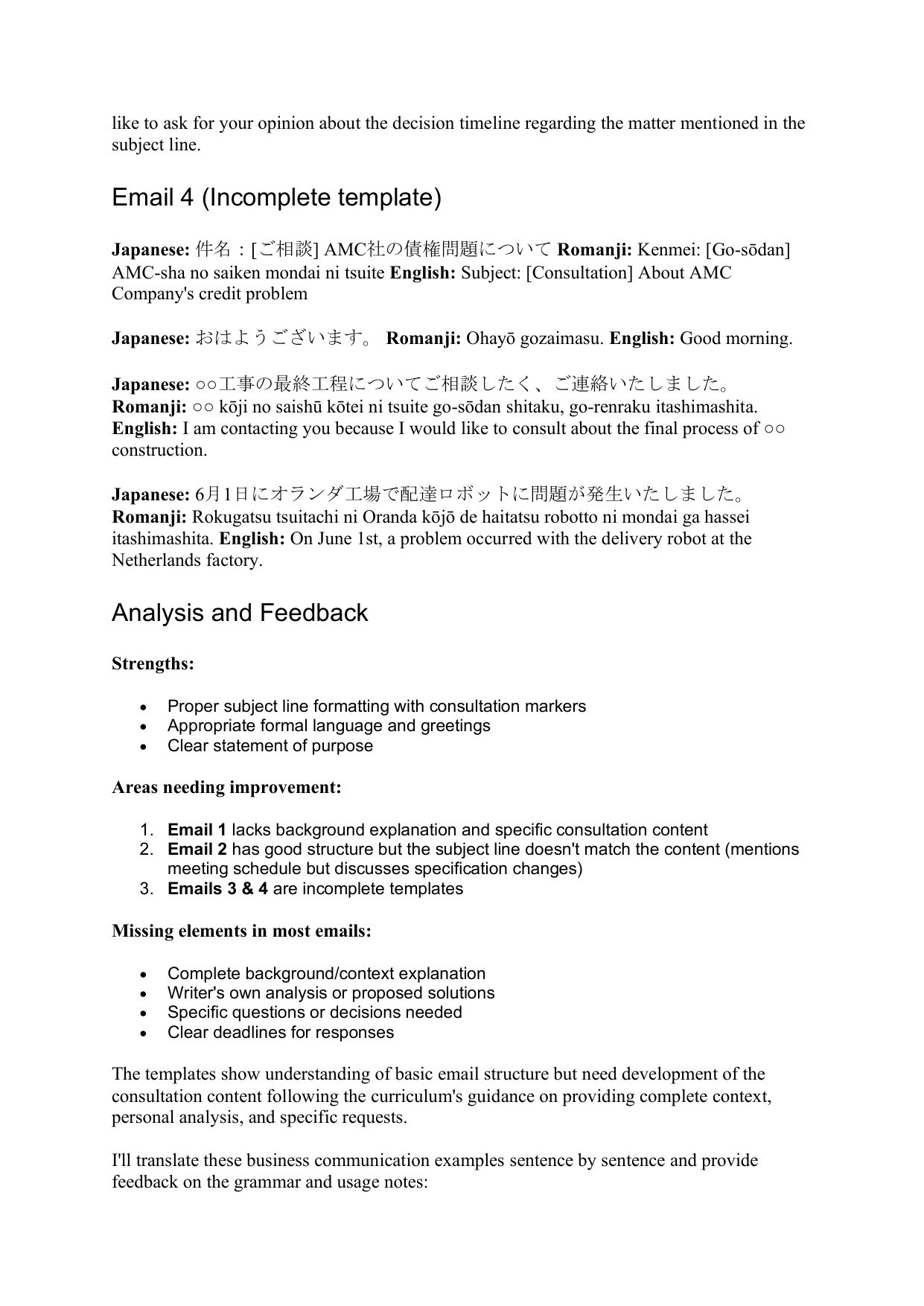
JPJapanese:標題の件について決定のタイムラインについてご意見を伺いたく、ご連絡
EN差し上げました。 Romanji: Hyōdai no ken ni tsuite kettei no taimurainn ni tsuite go-iken
wo ukagaitaku, go-renraku sashiagemashita. English: I am contacting you because I would
wo ukagaitaku, go-renraku sashiagemashita. English: I am contacting you because I would
หน้า 22
คลิกเพื่อขยาย
ENlike to ask for your opinion about the decision timeline regarding the matter mentioned in the
subject line.
Email 4 (Incomplete template)
Japanese: 件名:[ご相談] AMC社の債権問題について Romanji: Kenmei: [Go-sōdan]
AMC-sha no saiken mondai ni tsuite English: Subject: [Consultation] About AMC
Company's credit problem
Japanese: おはようございます。 Romanji: Ohayō gozaimasu. English: Good morning.
subject line.
Email 4 (Incomplete template)
Japanese: 件名:[ご相談] AMC社の債権問題について Romanji: Kenmei: [Go-sōdan]
AMC-sha no saiken mondai ni tsuite English: Subject: [Consultation] About AMC
Company's credit problem
Japanese: おはようございます。 Romanji: Ohayō gozaimasu. English: Good morning.
JPJapanese:○○工事の最終工程についてご相談したく、ご連絡いたしました。
ENRomanji: ○○ kōji no saishū kōtei ni tsuite go-sōdan shitaku, go-renraku itashimashita.
English: I am contacting you because I would like to consult about the final process of ○○
construction.
English: I am contacting you because I would like to consult about the final process of ○○
construction.
JPJapanese:6月1日にオランダ工場で配達ロボットに問題が発生いたしました。
ENRomanji: Rokugatsu tsuitachi ni Oranda kōjō de haitatsu robotto ni mondai ga hassei
itashimashita. English: On June 1st, a problem occurred with the delivery robot at the
Netherlands factory.
Analysis and Feedback
Strengths:
• Proper subject line formatting with consultation markers
• Appropriate formal language and greetings
• Clear statement of purpose
Areas needing improvement:
1. Email 1 lacks background explanation and specific consultation content
2. Email 2 has good structure but the subject line doesn't match the content (mentions
meeting schedule but discusses specification changes)
3. Emails 3 & 4 are incomplete templates
Missing elements in most emails:
• Complete background/context explanation
• Writer's own analysis or proposed solutions
• Specific questions or decisions needed
• Clear deadlines for responses
The templates show understanding of basic email structure but need development of the
consultation content following the curriculum's guidance on providing complete context,
personal analysis, and specific requests.
I'll translate these business communication examples sentence by sentence and provide
feedback on the grammar and usage notes:
itashimashita. English: On June 1st, a problem occurred with the delivery robot at the
Netherlands factory.
Analysis and Feedback
Strengths:
• Proper subject line formatting with consultation markers
• Appropriate formal language and greetings
• Clear statement of purpose
Areas needing improvement:
1. Email 1 lacks background explanation and specific consultation content
2. Email 2 has good structure but the subject line doesn't match the content (mentions
meeting schedule but discusses specification changes)
3. Emails 3 & 4 are incomplete templates
Missing elements in most emails:
• Complete background/context explanation
• Writer's own analysis or proposed solutions
• Specific questions or decisions needed
• Clear deadlines for responses
The templates show understanding of basic email structure but need development of the
consultation content following the curriculum's guidance on providing complete context,
personal analysis, and specific requests.
I'll translate these business communication examples sentence by sentence and provide
feedback on the grammar and usage notes:
หน้า 23
คลิกเพื่อขยาย
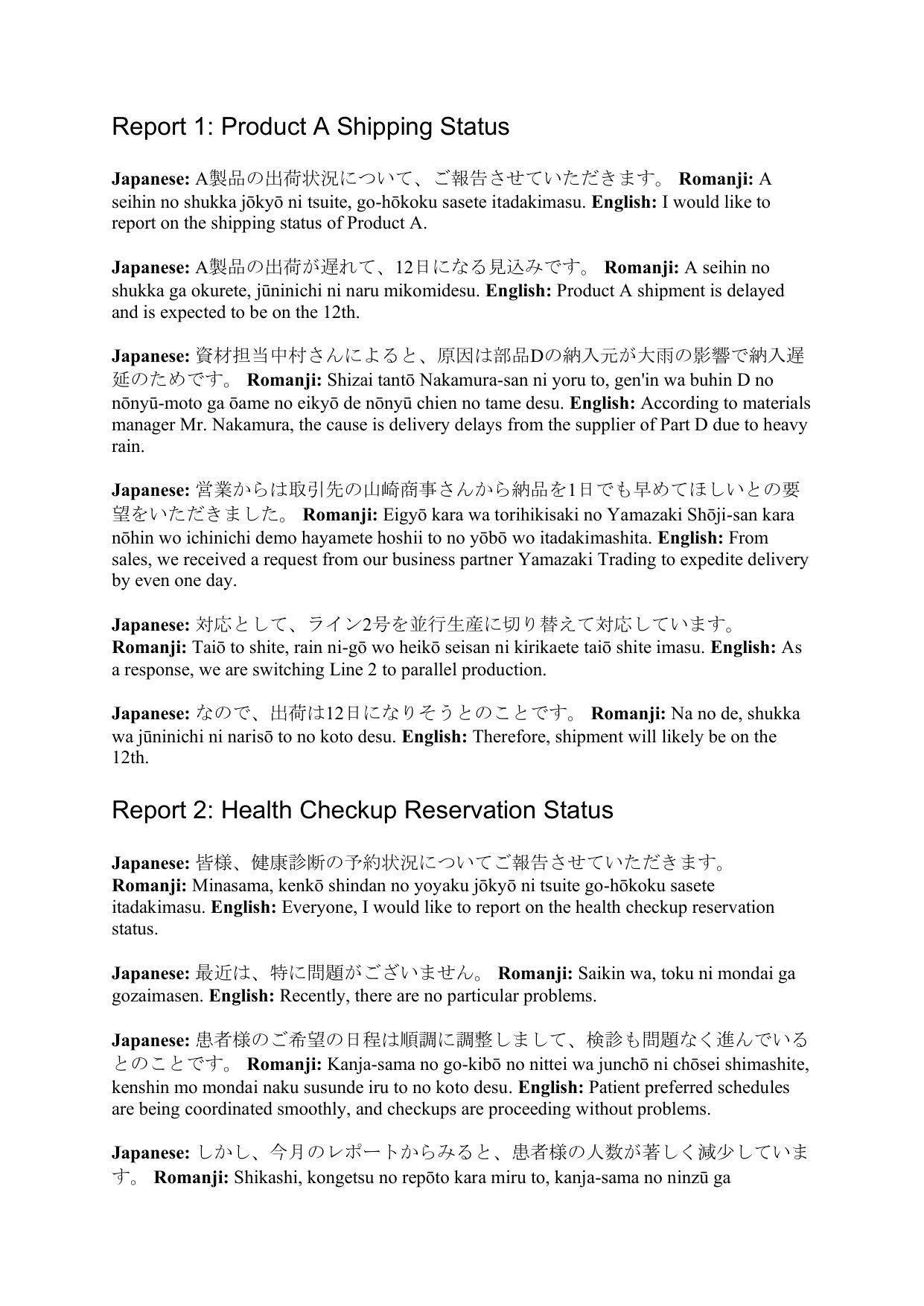
ENReport 1: Product A Shipping Status
JPJapanese:A製品の出荷状況について、ご報告させていただきます。Romanji:A
ENseihin no shukka jōkyō ni tsuite, go-hōkoku sasete itadakimasu. English: I would like to
report on the shipping status of Product A.
Japanese: A製品の出荷が遅れて、12日になる見込みです。 Romanji: A seihin no
shukka ga okurete, jūninichi ni naru mikomidesu. English: Product A shipment is delayed
and is expected to be on the 12th.
report on the shipping status of Product A.
Japanese: A製品の出荷が遅れて、12日になる見込みです。 Romanji: A seihin no
shukka ga okurete, jūninichi ni naru mikomidesu. English: Product A shipment is delayed
and is expected to be on the 12th.
JPJapanese:資材担当中村さんによると、原因は部品Dの納入元が大雨の影響で納入遅
EN延のためです。 Romanji: Shizai tantō Nakamura-san ni yoru to, gen'in wa buhin D no
nōnyū-moto ga ōame no eikyō de nōnyū chien no tame desu. English: According to materials
manager Mr. Nakamura, the cause is delivery delays from the supplier of Part D due to heavy
rain.
nōnyū-moto ga ōame no eikyō de nōnyū chien no tame desu. English: According to materials
manager Mr. Nakamura, the cause is delivery delays from the supplier of Part D due to heavy
rain.
JPJapanese:営業からは取引先の山崎商事さんから納品を1日でも早めてほしいとの要
EN望をいただきました。 Romanji: Eigyō kara wa torihikisaki no Yamazaki Shōji-san kara
nōhin wo ichinichi demo hayamete hoshii to no yōbō wo itadakimashita. English: From
sales, we received a request from our business partner Yamazaki Trading to expedite delivery
by even one day.
nōhin wo ichinichi demo hayamete hoshii to no yōbō wo itadakimashita. English: From
sales, we received a request from our business partner Yamazaki Trading to expedite delivery
by even one day.
JPJapanese:対応として、ライン2号を並行生産に切り替えて対応しています。
ENRomanji: Taiō to shite, rain ni-gō wo heikō seisan ni kirikaete taiō shite imasu. English: As
a response, we are switching Line 2 to parallel production.
Japanese: なので、出荷は12日になりそうとのことです。 Romanji: Na no de, shukka
wa jūninichi ni narisō to no koto desu. English: Therefore, shipment will likely be on the
12th.
Report 2: Health Checkup Reservation Status
a response, we are switching Line 2 to parallel production.
Japanese: なので、出荷は12日になりそうとのことです。 Romanji: Na no de, shukka
wa jūninichi ni narisō to no koto desu. English: Therefore, shipment will likely be on the
12th.
Report 2: Health Checkup Reservation Status
JPJapanese:皆様、健康診断の予約状況についてご報告させていただきます。
ENRomanji: Minasama, kenkō shindan no yoyaku jōkyō ni tsuite go-hōkoku sasete
itadakimasu. English: Everyone, I would like to report on the health checkup reservation
status.
Japanese: 最近は、特に問題がございません。 Romanji: Saikin wa, toku ni mondai ga
gozaimasen. English: Recently, there are no particular problems.
itadakimasu. English: Everyone, I would like to report on the health checkup reservation
status.
Japanese: 最近は、特に問題がございません。 Romanji: Saikin wa, toku ni mondai ga
gozaimasen. English: Recently, there are no particular problems.
JPJapanese:患者様のご希望の日程は順調に調整しまして、検診も問題なく進んでいる
ENとのことです。 Romanji: Kanja-sama no go-kibō no nittei wa junchō ni chōsei shimashite,
kenshin mo mondai naku susunde iru to no koto desu. English: Patient preferred schedules
are being coordinated smoothly, and checkups are proceeding without problems.
kenshin mo mondai naku susunde iru to no koto desu. English: Patient preferred schedules
are being coordinated smoothly, and checkups are proceeding without problems.
JPJapanese:しかし、今月のレポートからみると、患者様の人数が著しく減少していま
ENす。 Romanji: Shikashi, kongetsu no repōto kara miru to, kanja-sama no ninzū ga
หน้า 24
คลิกเพื่อขยาย
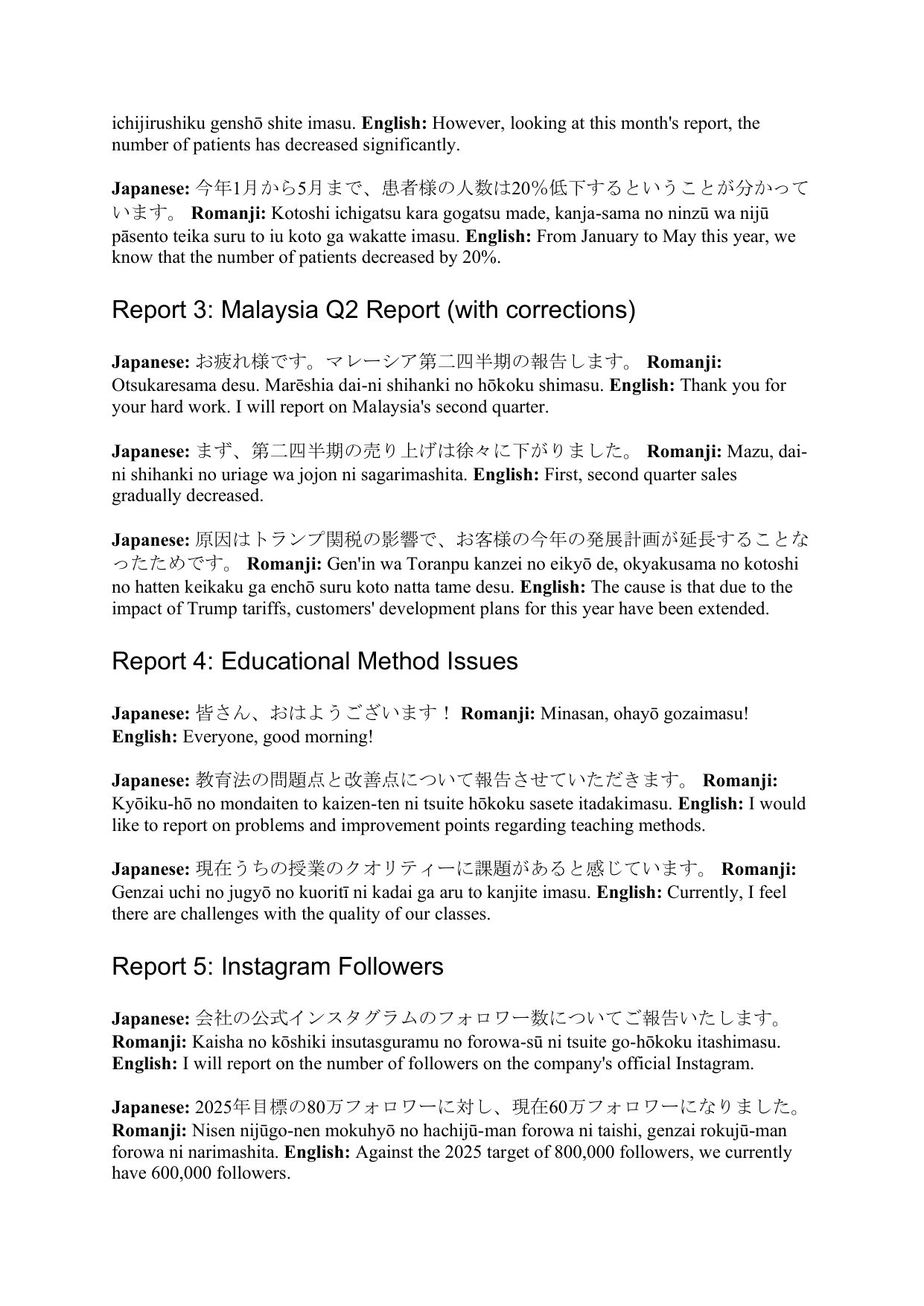
ENichijirushiku genshō shite imasu. English: However, looking at this month's report, the
number of patients has decreased significantly.
number of patients has decreased significantly.
JPJapanese:今年1月から5月まで、患者様の人数は20%低下するということが分かって
ENいます。 Romanji: Kotoshi ichigatsu kara gogatsu made, kanja-sama no ninzū wa nijū
pāsento teika suru to iu koto ga wakatte imasu. English: From January to May this year, we
know that the number of patients decreased by 20%.
Report 3: Malaysia Q2 Report (with corrections)
pāsento teika suru to iu koto ga wakatte imasu. English: From January to May this year, we
know that the number of patients decreased by 20%.
Report 3: Malaysia Q2 Report (with corrections)
JPJapanese:お疲れ様です。マレーシア第二四半期の報告します。Romanji:
ENOtsukaresama desu. Marēshia dai-ni shihanki no hōkoku shimasu. English: Thank you for
your hard work. I will report on Malaysia's second quarter.
Japanese: まず、第二四半期の売り上げは徐々に下がりました。 Romanji: Mazu, dai-
ni shihanki no uriage wa jojon ni sagarimashita. English: First, second quarter sales
gradually decreased.
your hard work. I will report on Malaysia's second quarter.
Japanese: まず、第二四半期の売り上げは徐々に下がりました。 Romanji: Mazu, dai-
ni shihanki no uriage wa jojon ni sagarimashita. English: First, second quarter sales
gradually decreased.
JPJapanese:原因はトランプ関税の影響で、お客様の今年の発展計画が延長することな
ENったためです。 Romanji: Gen'in wa Toranpu kanzei no eikyō de, okyakusama no kotoshi
no hatten keikaku ga enchō suru koto natta tame desu. English: The cause is that due to the
impact of Trump tariffs, customers' development plans for this year have been extended.
Report 4: Educational Method Issues
Japanese: 皆さん、おはようございます! Romanji: Minasan, ohayō gozaimasu!
English: Everyone, good morning!
no hatten keikaku ga enchō suru koto natta tame desu. English: The cause is that due to the
impact of Trump tariffs, customers' development plans for this year have been extended.
Report 4: Educational Method Issues
Japanese: 皆さん、おはようございます! Romanji: Minasan, ohayō gozaimasu!
English: Everyone, good morning!
JPJapanese:教育法の問題点と改善点について報告させていただきます。Romanji:
ENKyōiku-hō no mondaiten to kaizen-ten ni tsuite hōkoku sasete itadakimasu. English: I would
like to report on problems and improvement points regarding teaching methods.
like to report on problems and improvement points regarding teaching methods.
JPJapanese:現在うちの授業のクオリティーに課題があると感じています。Romanji:
ENGenzai uchi no jugyō no kuoritī ni kadai ga aru to kanjite imasu. English: Currently, I feel
there are challenges with the quality of our classes.
Report 5: Instagram Followers
there are challenges with the quality of our classes.
Report 5: Instagram Followers
JPJapanese:会社の公式インスタグラムのフォロワー数についてご報告いたします。
ENRomanji: Kaisha no kōshiki insutasguramu no forowa-sū ni tsuite go-hōkoku itashimasu.
English: I will report on the number of followers on the company's official Instagram.
English: I will report on the number of followers on the company's official Instagram.
JPJapanese:2025年目標の80万フォロワーに対し、現在60万フォロワーになりました。
ENRomanji: Nisen nijūgo-nen mokuhyō no hachijū-man forowa ni taishi, genzai rokujū-man
forowa ni narimashita. English: Against the 2025 target of 800,000 followers, we currently
have 600,000 followers.
forowa ni narimashita. English: Against the 2025 target of 800,000 followers, we currently
have 600,000 followers.
หน้า 25
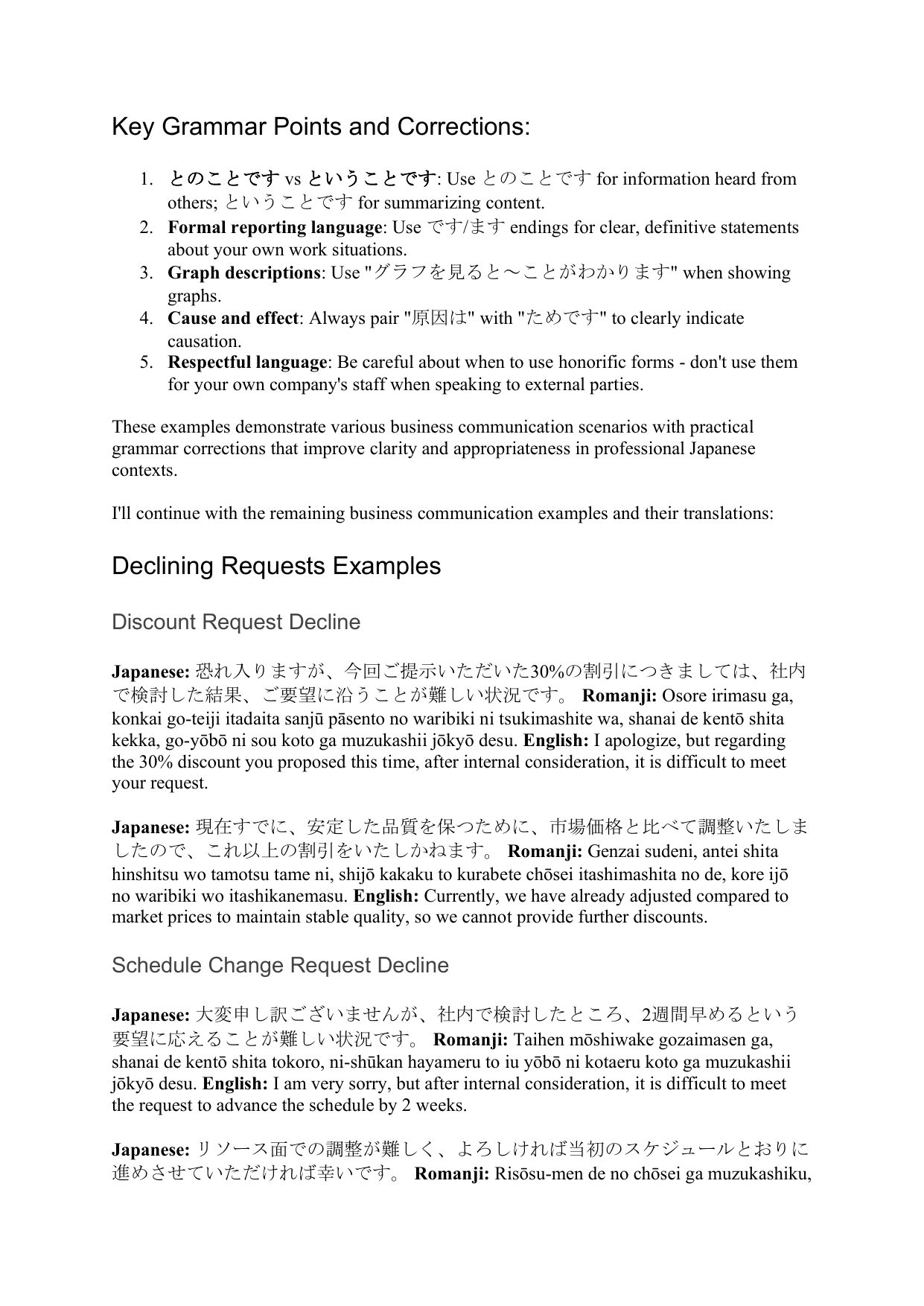
คลิกเพื่อขยาย
ENKey Grammar Points and Corrections:
1. とのことです vs ということです: Use とのことです for information heard from
others; ということです for summarizing content.
2. Formal reporting language: Use です/ます endings for clear, definitive statements
about your own work situations.
3. Graph descriptions: Use "グラフを見ると~ことがわかります" when showing
graphs.
4. Cause and effect: Always pair "原因は" with "ためです" to clearly indicate
causation.
5. Respectful language: Be careful about when to use honorific forms - don't use them
for your own company's staff when speaking to external parties.
These examples demonstrate various business communication scenarios with practical
grammar corrections that improve clarity and appropriateness in professional Japanese
contexts.
I'll continue with the remaining business communication examples and their translations:
Declining Requests Examples
Discount Request Decline
1. とのことです vs ということです: Use とのことです for information heard from
others; ということです for summarizing content.
2. Formal reporting language: Use です/ます endings for clear, definitive statements
about your own work situations.
3. Graph descriptions: Use "グラフを見ると~ことがわかります" when showing
graphs.
4. Cause and effect: Always pair "原因は" with "ためです" to clearly indicate
causation.
5. Respectful language: Be careful about when to use honorific forms - don't use them
for your own company's staff when speaking to external parties.
These examples demonstrate various business communication scenarios with practical
grammar corrections that improve clarity and appropriateness in professional Japanese
contexts.
I'll continue with the remaining business communication examples and their translations:
Declining Requests Examples
Discount Request Decline
JPJapanese:恐れ入りますが、今回ご提示いただいた30%の割引につきましては、社内
で検討した結果、ご要望に沿うことが難しい状況です。Romanji:Osoreirimasuga,
で検討した結果、ご要望に沿うことが難しい状況です。Romanji:Osoreirimasuga,
ENkonkai go-teiji itadaita sanjū pāsento no waribiki ni tsukimashite wa, shanai de kentō shita
kekka, go-yōbō ni sou koto ga muzukashii jōkyō desu. English: I apologize, but regarding
the 30% discount you proposed this time, after internal consideration, it is difficult to meet
your request.
kekka, go-yōbō ni sou koto ga muzukashii jōkyō desu. English: I apologize, but regarding
the 30% discount you proposed this time, after internal consideration, it is difficult to meet
your request.
JPJapanese:現在すでに、安定した品質を保つために、市場価格と比べて調整いたしま
ENしたので、これ以上の割引をいたしかねます。 Romanji: Genzai sudeni, antei shita
hinshitsu wo tamotsu tame ni, shijō kakaku to kurabete chōsei itashimashita no de, kore ijō
no waribiki wo itashikanemasu. English: Currently, we have already adjusted compared to
market prices to maintain stable quality, so we cannot provide further discounts.
Schedule Change Request Decline
hinshitsu wo tamotsu tame ni, shijō kakaku to kurabete chōsei itashimashita no de, kore ijō
no waribiki wo itashikanemasu. English: Currently, we have already adjusted compared to
market prices to maintain stable quality, so we cannot provide further discounts.
Schedule Change Request Decline
JPJapanese:大変申し訳ございませんが、社内で検討したところ、2週間早めるという
EN要望に応えることが難しい状況です。 Romanji: Taihen mōshiwake gozaimasen ga,
shanai de kentō shita tokoro, ni-shūkan hayameru to iu yōbō ni kotaeru koto ga muzukashii
jōkyō desu. English: I am very sorry, but after internal consideration, it is difficult to meet
the request to advance the schedule by 2 weeks.
shanai de kentō shita tokoro, ni-shūkan hayameru to iu yōbō ni kotaeru koto ga muzukashii
jōkyō desu. English: I am very sorry, but after internal consideration, it is difficult to meet
the request to advance the schedule by 2 weeks.
JPJapanese:リソース面での調整が難しく、よろしければ当初のスケジュールとおりに
EN進めさせていただければ幸いです。 Romanji: Risōsu-men de no chōsei ga muzukashiku,
หน้า 26
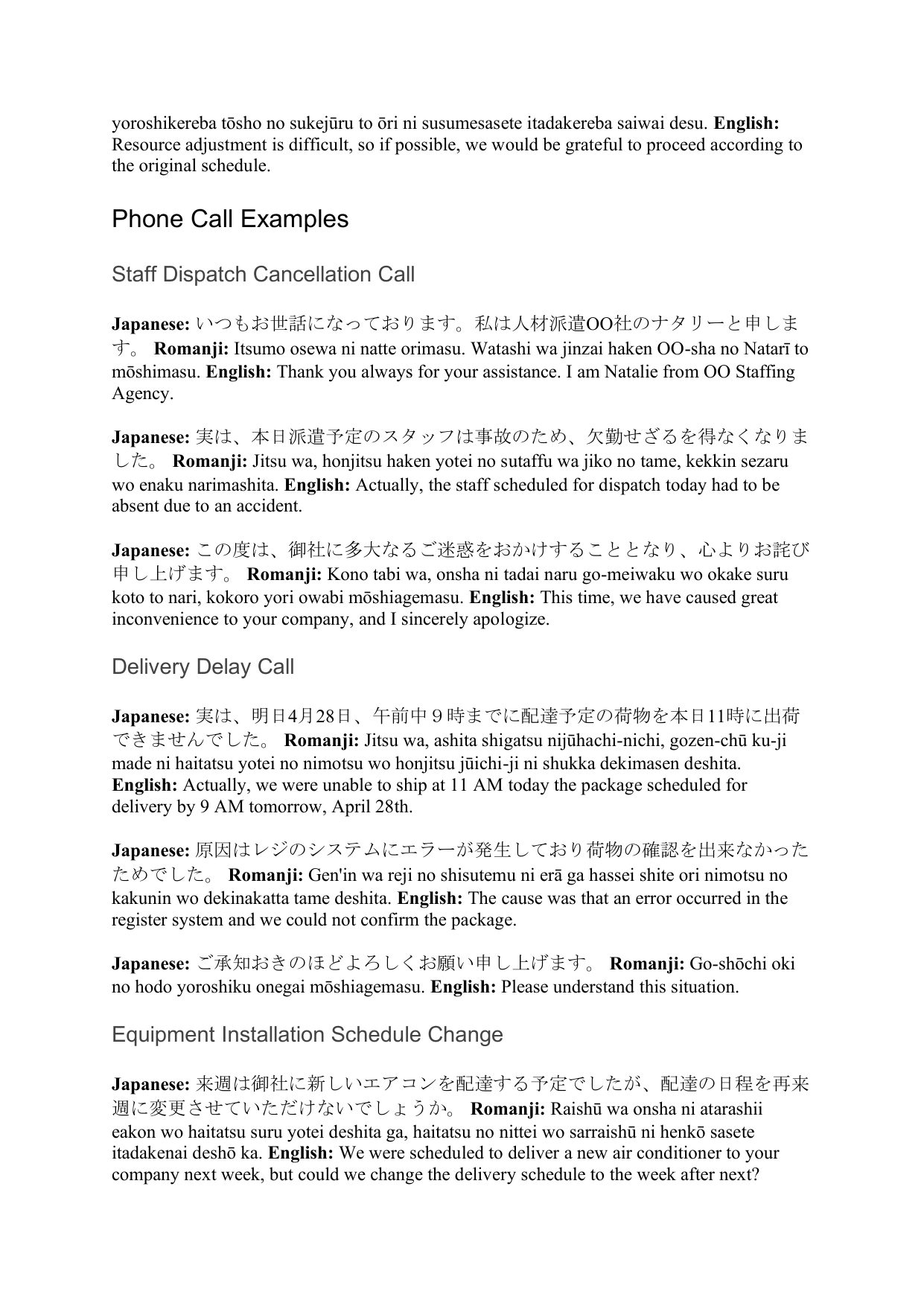
คลิกเพื่อขยาย
ENyoroshikereba tōsho no sukejūru to ōri ni susumesasete itadakereba saiwai desu. English:
Resource adjustment is difficult, so if possible, we would be grateful to proceed according to
the original schedule.
Phone Call Examples
Staff Dispatch Cancellation Call
Resource adjustment is difficult, so if possible, we would be grateful to proceed according to
the original schedule.
Phone Call Examples
Staff Dispatch Cancellation Call
JPJapanese:いつもお世話になっております。私は人材派遣OO社のナタリーと申しま
ENす。 Romanji: Itsumo osewa ni natte orimasu. Watashi wa jinzai haken OO-sha no Natarī to
mōshimasu. English: Thank you always for your assistance. I am Natalie from OO Staffing
Agency.
mōshimasu. English: Thank you always for your assistance. I am Natalie from OO Staffing
Agency.
JPJapanese:実は、本日派遣予定のスタッフは事故のため、欠勤せざるを得なくなりま
ENした。 Romanji: Jitsu wa, honjitsu haken yotei no sutaffu wa jiko no tame, kekkin sezaru
wo enaku narimashita. English: Actually, the staff scheduled for dispatch today had to be
absent due to an accident.
wo enaku narimashita. English: Actually, the staff scheduled for dispatch today had to be
absent due to an accident.
JPJapanese:この度は、御社に多大なるご迷惑をおかけすることとなり、心よりお詫び
EN申し上げます。 Romanji: Kono tabi wa, onsha ni tadai naru go-meiwaku wo okake suru
koto to nari, kokoro yori owabi mōshiagemasu. English: This time, we have caused great
inconvenience to your company, and I sincerely apologize.
Delivery Delay Call
koto to nari, kokoro yori owabi mōshiagemasu. English: This time, we have caused great
inconvenience to your company, and I sincerely apologize.
Delivery Delay Call
JPJapanese:実は、明日4月28日、午前中9時までに配達予定の荷物を本日11時に出荷
ENできませんでした。 Romanji: Jitsu wa, ashita shigatsu nijūhachi-nichi, gozen-chū ku-ji
made ni haitatsu yotei no nimotsu wo honjitsu jūichi-ji ni shukka dekimasen deshita.
English: Actually, we were unable to ship at 11 AM today the package scheduled for
delivery by 9 AM tomorrow, April 28th.
made ni haitatsu yotei no nimotsu wo honjitsu jūichi-ji ni shukka dekimasen deshita.
English: Actually, we were unable to ship at 11 AM today the package scheduled for
delivery by 9 AM tomorrow, April 28th.
JPJapanese:原因はレジのシステムにエラーが発生しており荷物の確認を出来なかった
ENためでした。 Romanji: Gen'in wa reji no shisutemu ni erā ga hassei shite ori nimotsu no
kakunin wo dekinakatta tame deshita. English: The cause was that an error occurred in the
register system and we could not confirm the package.
Japanese: ご承知おきのほどよろしくお願い申し上げます。 Romanji: Go-shōchi oki
no hodo yoroshiku onegai mōshiagemasu. English: Please understand this situation.
Equipment Installation Schedule Change
kakunin wo dekinakatta tame deshita. English: The cause was that an error occurred in the
register system and we could not confirm the package.
Japanese: ご承知おきのほどよろしくお願い申し上げます。 Romanji: Go-shōchi oki
no hodo yoroshiku onegai mōshiagemasu. English: Please understand this situation.
Equipment Installation Schedule Change
JPJapanese:来週は御社に新しいエアコンを配達する予定でしたが、配達の日程を再来
EN週に変更させていただけないでしょうか。 Romanji: Raishū wa onsha ni atarashii
eakon wo haitatsu suru yotei deshita ga, haitatsu no nittei wo sarraishū ni henkō sasete
itadakenai deshō ka. English: We were scheduled to deliver a new air conditioner to your
company next week, but could we change the delivery schedule to the week after next?
eakon wo haitatsu suru yotei deshita ga, haitatsu no nittei wo sarraishū ni henkō sasete
itadakenai deshō ka. English: We were scheduled to deliver a new air conditioner to your
company next week, but could we change the delivery schedule to the week after next?
หน้า 27
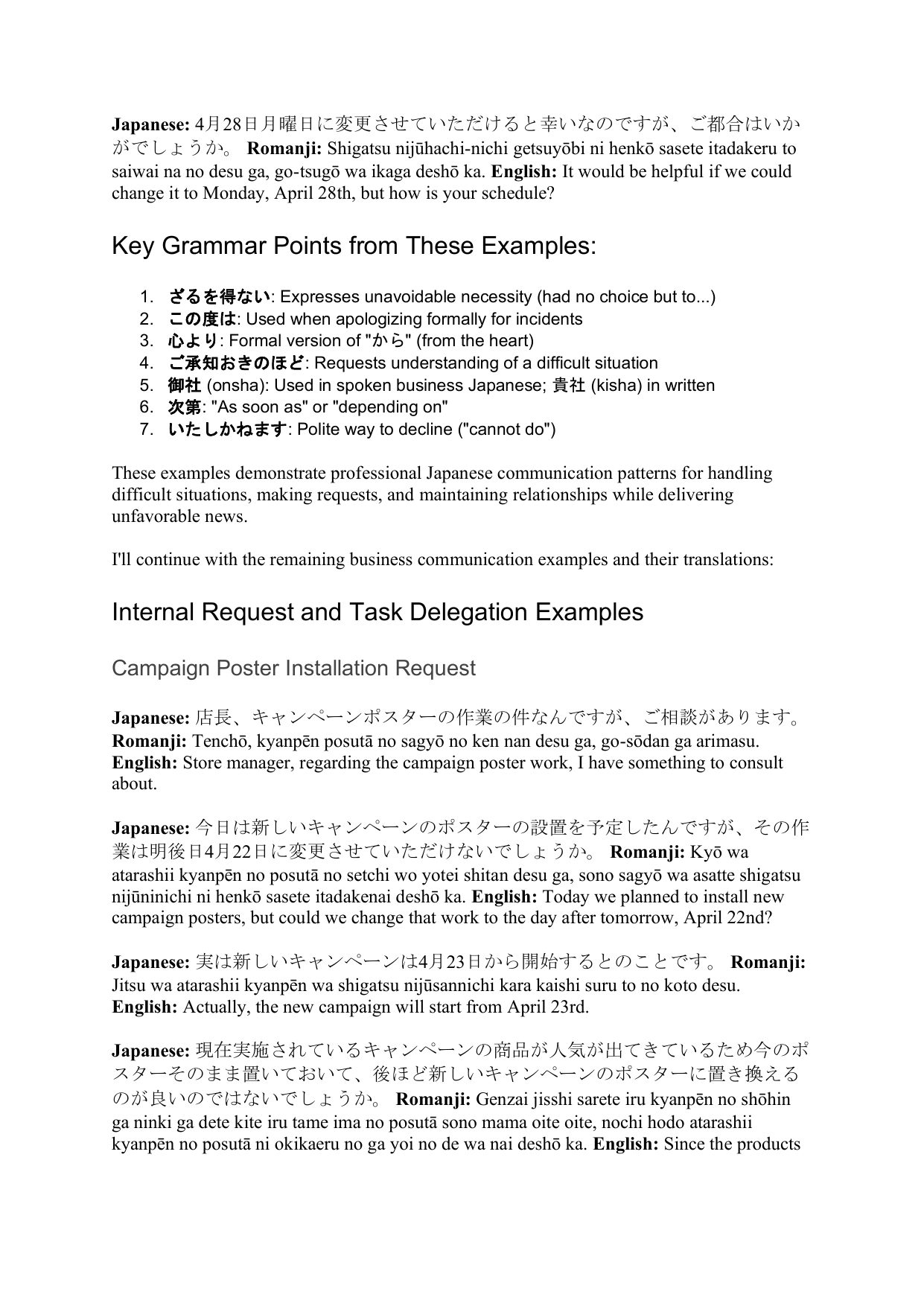
คลิกเพื่อขยาย
JPJapanese:4月28日月曜日に変更させていただけると幸いなのですが、ご都合はいか
ENがでしょうか。 Romanji: Shigatsu nijūhachi-nichi getsuyōbi ni henkō sasete itadakeru to
saiwai na no desu ga, go-tsugō wa ikaga deshō ka. English: It would be helpful if we could
change it to Monday, April 28th, but how is your schedule?
Key Grammar Points from These Examples:
1. ざるを得ない: Expresses unavoidable necessity (had no choice but to...)
2. この度は: Used when apologizing formally for incidents
3. 心より: Formal version of "から" (from the heart)
4. ご承知おきのほど: Requests understanding of a difficult situation
5. 御社 (onsha): Used in spoken business Japanese; 貴社 (kisha) in written
6. 次第: "As soon as" or "depending on"
7. いたしかねます: Polite way to decline ("cannot do")
These examples demonstrate professional Japanese communication patterns for handling
difficult situations, making requests, and maintaining relationships while delivering
unfavorable news.
I'll continue with the remaining business communication examples and their translations:
Internal Request and Task Delegation Examples
Campaign Poster Installation Request
saiwai na no desu ga, go-tsugō wa ikaga deshō ka. English: It would be helpful if we could
change it to Monday, April 28th, but how is your schedule?
Key Grammar Points from These Examples:
1. ざるを得ない: Expresses unavoidable necessity (had no choice but to...)
2. この度は: Used when apologizing formally for incidents
3. 心より: Formal version of "から" (from the heart)
4. ご承知おきのほど: Requests understanding of a difficult situation
5. 御社 (onsha): Used in spoken business Japanese; 貴社 (kisha) in written
6. 次第: "As soon as" or "depending on"
7. いたしかねます: Polite way to decline ("cannot do")
These examples demonstrate professional Japanese communication patterns for handling
difficult situations, making requests, and maintaining relationships while delivering
unfavorable news.
I'll continue with the remaining business communication examples and their translations:
Internal Request and Task Delegation Examples
Campaign Poster Installation Request
JPJapanese:店長、キャンペーンポスターの作業の件なんですが、ご相談があります。
ENRomanji: Tenchō, kyanpēn posutā no sagyō no ken nan desu ga, go-sōdan ga arimasu.
English: Store manager, regarding the campaign poster work, I have something to consult
about.
English: Store manager, regarding the campaign poster work, I have something to consult
about.
JPJapanese:今日は新しいキャンペーンのポスターの設置を予定したんですが、その作
業は明後日4月22日に変更させていただけないでしょうか。Romanji:Kyōwa
業は明後日4月22日に変更させていただけないでしょうか。Romanji:Kyōwa
ENatarashii kyanpēn no posutā no setchi wo yotei shitan desu ga, sono sagyō wa asatte shigatsu
nijūninichi ni henkō sasete itadakenai deshō ka. English: Today we planned to install new
campaign posters, but could we change that work to the day after tomorrow, April 22nd?
nijūninichi ni henkō sasete itadakenai deshō ka. English: Today we planned to install new
campaign posters, but could we change that work to the day after tomorrow, April 22nd?
JPJapanese:実は新しいキャンペーンは4月23日から開始するとのことです。Romanji:
ENJitsu wa atarashii kyanpēn wa shigatsu nijūsannichi kara kaishi suru to no koto desu.
English: Actually, the new campaign will start from April 23rd.
English: Actually, the new campaign will start from April 23rd.
JPJapanese:現在実施されているキャンペーンの商品が人気が出てきているため今のポ
スターそのまま置いておいて、後ほど新しいキャンペーンのポスターに置き換える
スターそのまま置いておいて、後ほど新しいキャンペーンのポスターに置き換える
ENのが良いのではないでしょうか。 Romanji: Genzai jisshi sarete iru kyanpēn no shōhin
ga ninki ga dete kite iru tame ima no posutā sono mama oite oite, nochi hodo atarashii
kyanpēn no posutā ni okikaeru no ga yoi no de wa nai deshō ka. English: Since the products
ga ninki ga dete kite iru tame ima no posutā sono mama oite oite, nochi hodo atarashii
kyanpēn no posutā ni okikaeru no ga yoi no de wa nai deshō ka. English: Since the products
หน้า 28
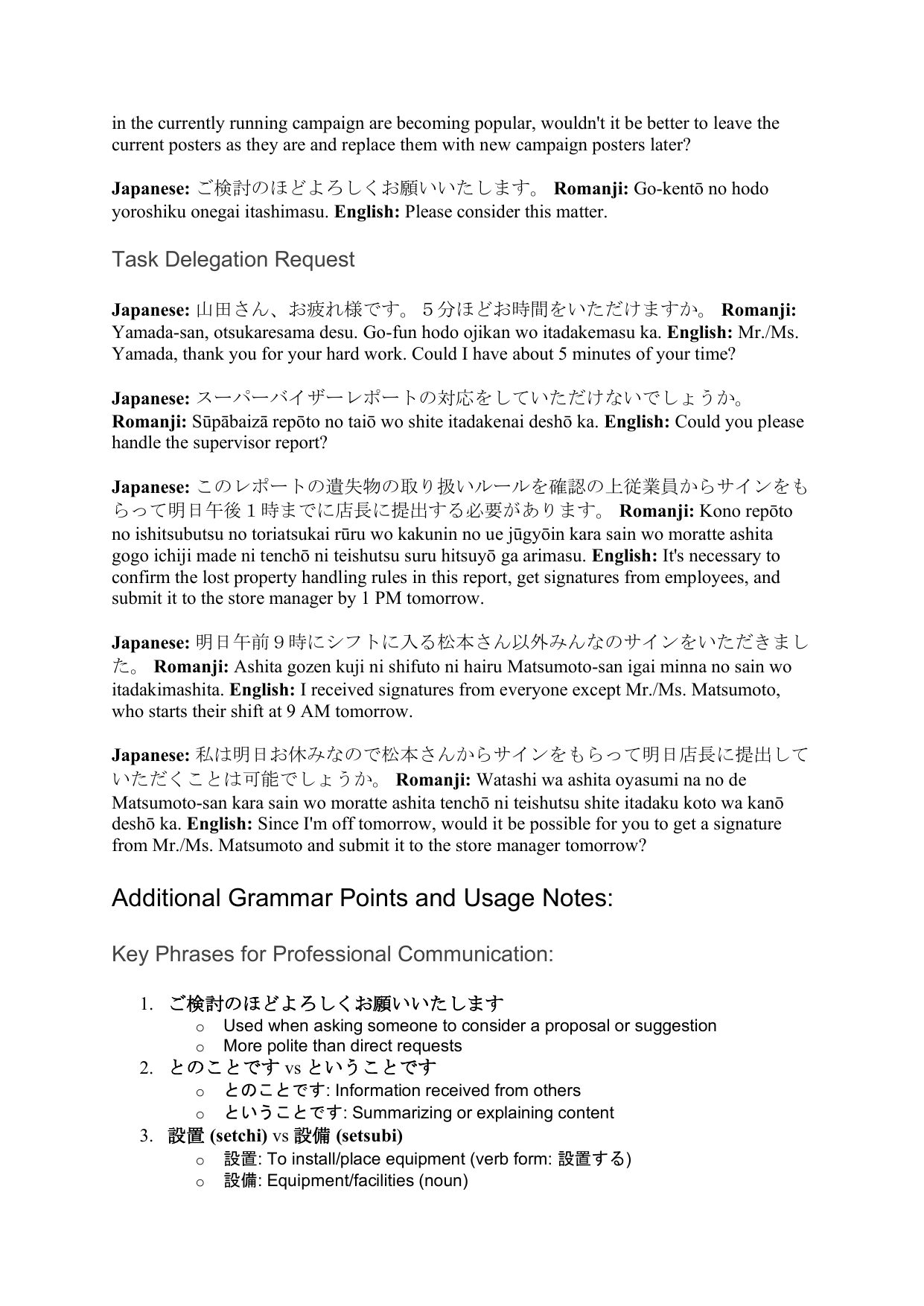
คลิกเพื่อขยาย
ENin the currently running campaign are becoming popular, wouldn't it be better to leave the
current posters as they are and replace them with new campaign posters later?
Japanese: ご検討のほどよろしくお願いいたします。 Romanji: Go-kentō no hodo
yoroshiku onegai itashimasu. English: Please consider this matter.
Task Delegation Request
current posters as they are and replace them with new campaign posters later?
Japanese: ご検討のほどよろしくお願いいたします。 Romanji: Go-kentō no hodo
yoroshiku onegai itashimasu. English: Please consider this matter.
Task Delegation Request
JPJapanese:山田さん、お疲れ様です。5分ほどお時間をいただけますか。Romanji:
ENYamada-san, otsukaresama desu. Go-fun hodo ojikan wo itadakemasu ka. English: Mr./Ms.
Yamada, thank you for your hard work. Could I have about 5 minutes of your time?
Yamada, thank you for your hard work. Could I have about 5 minutes of your time?
JPJapanese:スーパーバイザーレポートの対応をしていただけないでしょうか。
ENRomanji: Sūpābaizā repōto no taiō wo shite itadakenai deshō ka. English: Could you please
handle the supervisor report?
handle the supervisor report?
JPJapanese:このレポートの遺失物の取り扱いルールを確認の上従業員からサインをも
らって明日午後1時までに店長に提出する必要があります。Romanji:Konorepōto
らって明日午後1時までに店長に提出する必要があります。Romanji:Konorepōto
ENno ishitsubutsu no toriatsukai rūru wo kakunin no ue jūgyōin kara sain wo moratte ashita
gogo ichiji made ni tenchō ni teishutsu suru hitsuyō ga arimasu. English: It's necessary to
confirm the lost property handling rules in this report, get signatures from employees, and
submit it to the store manager by 1 PM tomorrow.
gogo ichiji made ni tenchō ni teishutsu suru hitsuyō ga arimasu. English: It's necessary to
confirm the lost property handling rules in this report, get signatures from employees, and
submit it to the store manager by 1 PM tomorrow.
JPJapanese:明日午前9時にシフトに入る松本さん以外みんなのサインをいただきまし
ENた。 Romanji: Ashita gozen kuji ni shifuto ni hairu Matsumoto-san igai minna no sain wo
itadakimashita. English: I received signatures from everyone except Mr./Ms. Matsumoto,
who starts their shift at 9 AM tomorrow.
itadakimashita. English: I received signatures from everyone except Mr./Ms. Matsumoto,
who starts their shift at 9 AM tomorrow.
JPJapanese:私は明日お休みなので松本さんからサインをもらって明日店長に提出して
ENいただくことは可能でしょうか。 Romanji: Watashi wa ashita oyasumi na no de
Matsumoto-san kara sain wo moratte ashita tenchō ni teishutsu shite itadaku koto wa kanō
deshō ka. English: Since I'm off tomorrow, would it be possible for you to get a signature
from Mr./Ms. Matsumoto and submit it to the store manager tomorrow?
Additional Grammar Points and Usage Notes:
Key Phrases for Professional Communication:
Matsumoto-san kara sain wo moratte ashita tenchō ni teishutsu shite itadaku koto wa kanō
deshō ka. English: Since I'm off tomorrow, would it be possible for you to get a signature
from Mr./Ms. Matsumoto and submit it to the store manager tomorrow?
Additional Grammar Points and Usage Notes:
Key Phrases for Professional Communication:
JP1.ご検討のほどよろしくお願いいたします
EN o Used when asking someone to consider a proposal or suggestion
o More polite than direct requests
o More polite than direct requests
JP2.とのことですvsということです
EN o とのことです: Information received from others
o ということです: Summarizing or explaining content
3. 設置 (setchi) vs 設備 (setsubi)
o 設置: To install/place equipment (verb form: 設置する)
o 設備: Equipment/facilities (noun)
o ということです: Summarizing or explaining content
3. 設置 (setchi) vs 設備 (setsubi)
o 設置: To install/place equipment (verb form: 設置する)
o 設備: Equipment/facilities (noun)
หน้า 29
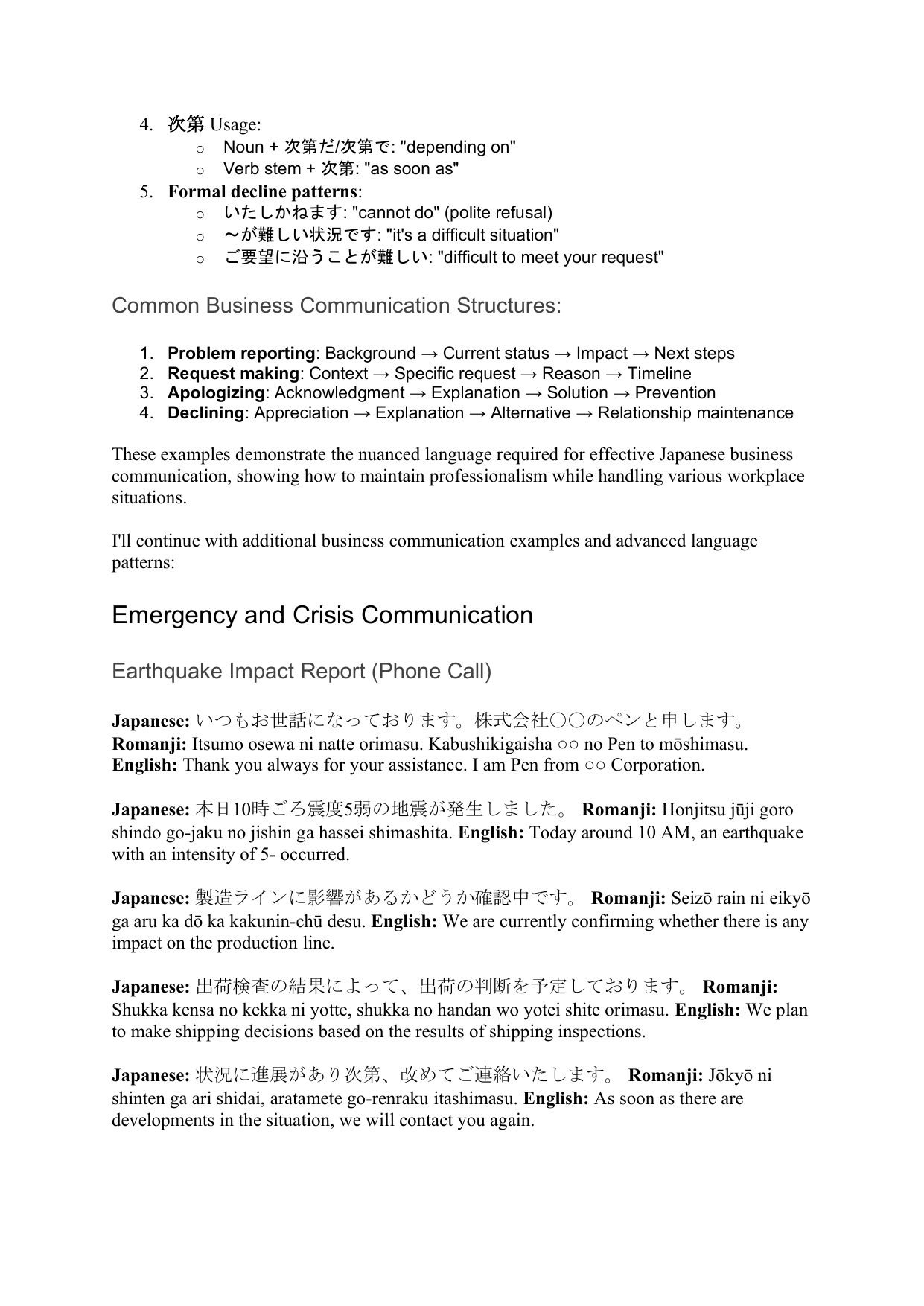
คลิกเพื่อขยาย
EN 4. 次第 Usage:
o Noun + 次第だ/次第で: "depending on"
o Verb stem + 次第: "as soon as"
5. Formal decline patterns:
o いたしかねます: "cannot do" (polite refusal)
o ~が難しい状況です: "it's a difficult situation"
o ご要望に沿うことが難しい: "difficult to meet your request"
Common Business Communication Structures:
1. Problem reporting: Background → Current status → Impact → Next steps
2. Request making: Context → Specific request → Reason → Timeline
3. Apologizing: Acknowledgment → Explanation → Solution → Prevention
4. Declining: Appreciation → Explanation → Alternative → Relationship maintenance
These examples demonstrate the nuanced language required for effective Japanese business
communication, showing how to maintain professionalism while handling various workplace
situations.
I'll continue with additional business communication examples and advanced language
patterns:
Emergency and Crisis Communication
Earthquake Impact Report (Phone Call)
o Noun + 次第だ/次第で: "depending on"
o Verb stem + 次第: "as soon as"
5. Formal decline patterns:
o いたしかねます: "cannot do" (polite refusal)
o ~が難しい状況です: "it's a difficult situation"
o ご要望に沿うことが難しい: "difficult to meet your request"
Common Business Communication Structures:
1. Problem reporting: Background → Current status → Impact → Next steps
2. Request making: Context → Specific request → Reason → Timeline
3. Apologizing: Acknowledgment → Explanation → Solution → Prevention
4. Declining: Appreciation → Explanation → Alternative → Relationship maintenance
These examples demonstrate the nuanced language required for effective Japanese business
communication, showing how to maintain professionalism while handling various workplace
situations.
I'll continue with additional business communication examples and advanced language
patterns:
Emergency and Crisis Communication
Earthquake Impact Report (Phone Call)
JPJapanese:いつもお世話になっております。株式会社〇〇のペンと申します。
ENRomanji: Itsumo osewa ni natte orimasu. Kabushikigaisha ○○ no Pen to mōshimasu.
English: Thank you always for your assistance. I am Pen from ○○ Corporation.
Japanese: 本日10時ごろ震度5弱の地震が発生しました。 Romanji: Honjitsu jūji goro
shindo go-jaku no jishin ga hassei shimashita. English: Today around 10 AM, an earthquake
with an intensity of 5- occurred.
Japanese: 製造ラインに影響があるかどうか確認中です。 Romanji: Seizō rain ni eikyō
ga aru ka dō ka kakunin-chū desu. English: We are currently confirming whether there is any
impact on the production line.
English: Thank you always for your assistance. I am Pen from ○○ Corporation.
Japanese: 本日10時ごろ震度5弱の地震が発生しました。 Romanji: Honjitsu jūji goro
shindo go-jaku no jishin ga hassei shimashita. English: Today around 10 AM, an earthquake
with an intensity of 5- occurred.
Japanese: 製造ラインに影響があるかどうか確認中です。 Romanji: Seizō rain ni eikyō
ga aru ka dō ka kakunin-chū desu. English: We are currently confirming whether there is any
impact on the production line.
JPJapanese:出荷検査の結果によって、出荷の判断を予定しております。Romanji:
ENShukka kensa no kekka ni yotte, shukka no handan wo yotei shite orimasu. English: We plan
to make shipping decisions based on the results of shipping inspections.
Japanese: 状況に進展があり次第、改めてご連絡いたします。 Romanji: Jōkyō ni
shinten ga ari shidai, aratamete go-renraku itashimasu. English: As soon as there are
developments in the situation, we will contact you again.
to make shipping decisions based on the results of shipping inspections.
Japanese: 状況に進展があり次第、改めてご連絡いたします。 Romanji: Jōkyō ni
shinten ga ari shidai, aratamete go-renraku itashimasu. English: As soon as there are
developments in the situation, we will contact you again.
หน้า 30
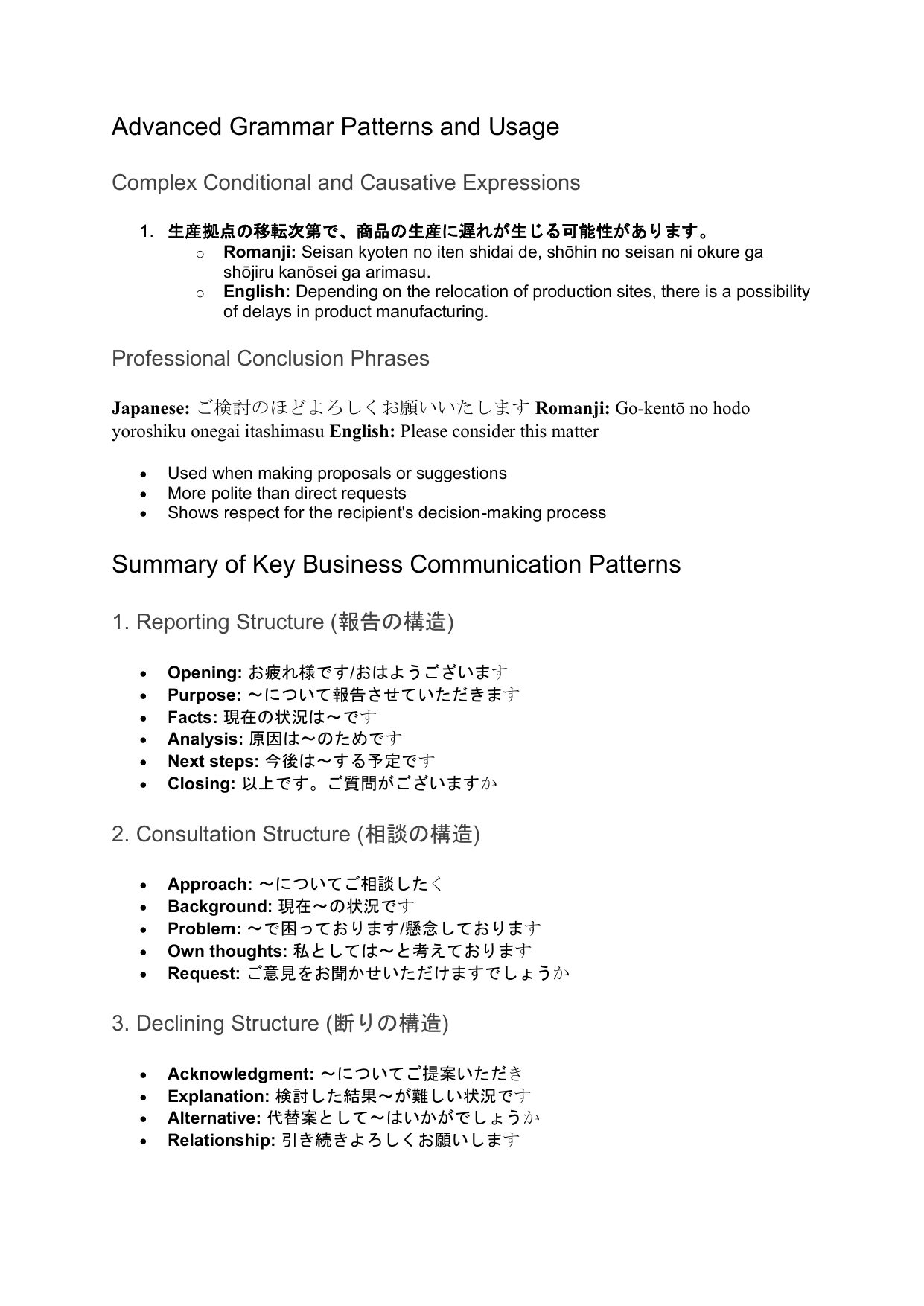
คลิกเพื่อขยาย
ENAdvanced Grammar Patterns and Usage
Complex Conditional and Causative Expressions
Complex Conditional and Causative Expressions
JP1.生産拠点の移転次第で、商品の生産に遅れが生じる可能性があります。
EN o Romanji: Seisan kyoten no iten shidai de, shōhin no seisan ni okure ga
shōjiru kanōsei ga arimasu.
o English: Depending on the relocation of production sites, there is a possibility
of delays in product manufacturing.
Professional Conclusion Phrases
Japanese: ご検討のほどよろしくお願いいたします Romanji: Go-kentō no hodo
yoroshiku onegai itashimasu English: Please consider this matter
• Used when making proposals or suggestions
• More polite than direct requests
• Shows respect for the recipient's decision-making process
Summary of Key Business Communication Patterns
1. Reporting Structure (報告の構造)
shōjiru kanōsei ga arimasu.
o English: Depending on the relocation of production sites, there is a possibility
of delays in product manufacturing.
Professional Conclusion Phrases
Japanese: ご検討のほどよろしくお願いいたします Romanji: Go-kentō no hodo
yoroshiku onegai itashimasu English: Please consider this matter
• Used when making proposals or suggestions
• More polite than direct requests
• Shows respect for the recipient's decision-making process
Summary of Key Business Communication Patterns
1. Reporting Structure (報告の構造)
JP•Opening:お疲れ様です/おはようございます
•Purpose:~について報告させていただきます
•Facts:現在の状況は~です
•Analysis:原因は~のためです
•Nextsteps:今後は~する予定です
•Closing:以上です。ご質問がございますか
•Purpose:~について報告させていただきます
•Facts:現在の状況は~です
•Analysis:原因は~のためです
•Nextsteps:今後は~する予定です
•Closing:以上です。ご質問がございますか
EN2. Consultation Structure (相談の構造)
JP•Approach:~についてご相談したく
EN • Background: 現在~の状況です
JP•Problem:~で困っております/懸念しております
•Ownthoughts:私としては~と考えております
•Request:ご意見をお聞かせいただけますでしょうか
•Ownthoughts:私としては~と考えております
•Request:ご意見をお聞かせいただけますでしょうか
EN3. Declining Structure (断りの構造)
• Acknowledgment: ~についてご提案いただき
• Acknowledgment: ~についてご提案いただき
JP•Explanation:検討した結果~が難しい状況です
•Alternative:代替案として~はいかがでしょうか
•Relationship:引き続きよろしくお願いします
•Alternative:代替案として~はいかがでしょうか
•Relationship:引き続きよろしくお願いします
หน้า 31
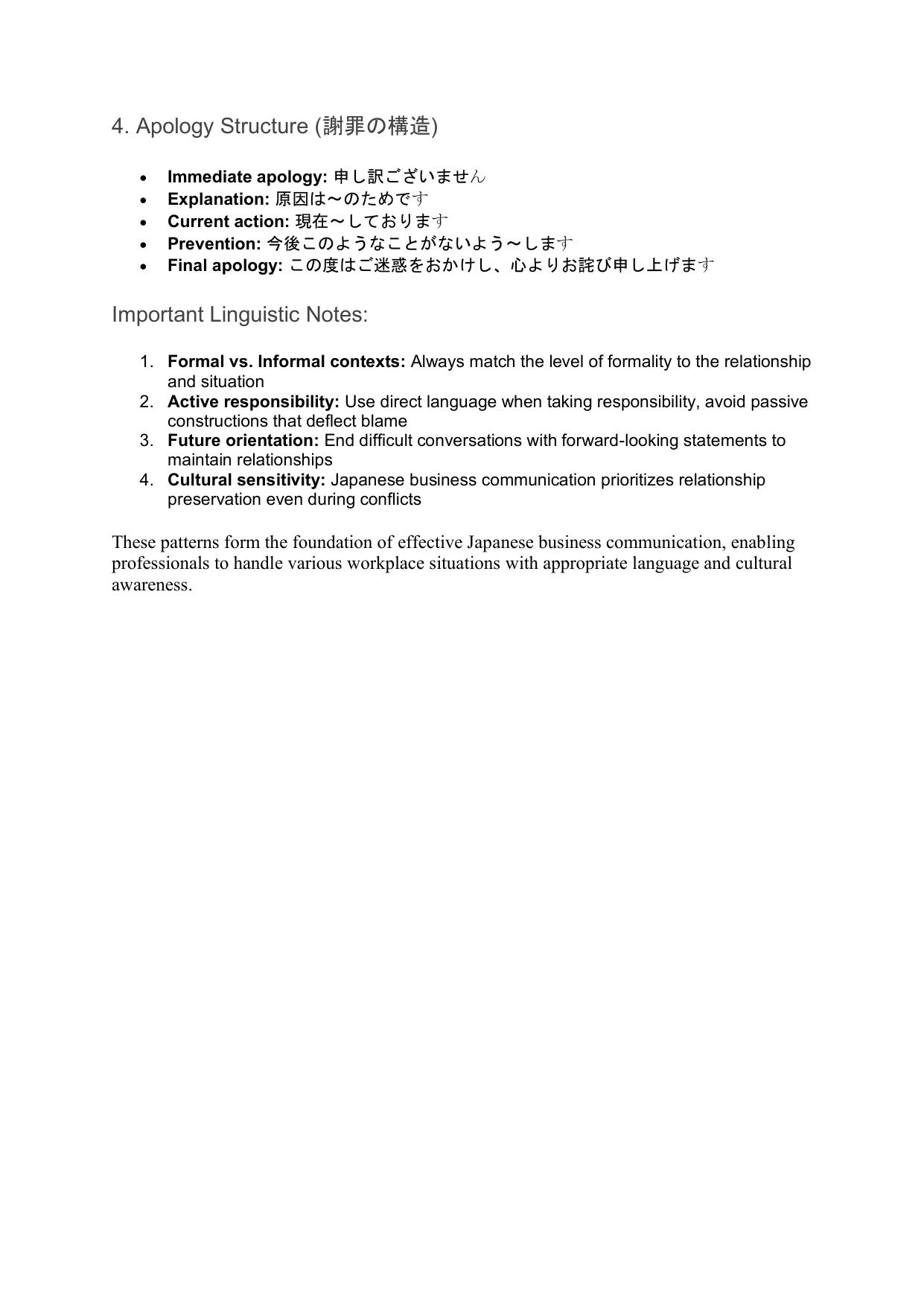
คลิกเพื่อขยาย
EN4. Apology Structure (謝罪の構造)
• Immediate apology: 申し訳ございません
• Explanation: 原因は~のためです
• Current action: 現在~しております
• Immediate apology: 申し訳ございません
• Explanation: 原因は~のためです
• Current action: 現在~しております
JP•Prevention:今後このようなことがないよう~します
•Finalapology:この度はご迷惑をおかけし、心よりお詫び申し上げます
•Finalapology:この度はご迷惑をおかけし、心よりお詫び申し上げます
ENImportant Linguistic Notes:
1. Formal vs. Informal contexts: Always match the level of formality to the relationship
and situation
2. Active responsibility: Use direct language when taking responsibility, avoid passive
constructions that deflect blame
3. Future orientation: End difficult conversations with forward-looking statements to
maintain relationships
4. Cultural sensitivity: Japanese business communication prioritizes relationship
preservation even during conflicts
These patterns form the foundation of effective Japanese business communication, enabling
professionals to handle various workplace situations with appropriate language and cultural
awareness.
1. Formal vs. Informal contexts: Always match the level of formality to the relationship
and situation
2. Active responsibility: Use direct language when taking responsibility, avoid passive
constructions that deflect blame
3. Future orientation: End difficult conversations with forward-looking statements to
maintain relationships
4. Cultural sensitivity: Japanese business communication prioritizes relationship
preservation even during conflicts
These patterns form the foundation of effective Japanese business communication, enabling
professionals to handle various workplace situations with appropriate language and cultural
awareness.