หน้า 1
คลิกเพื่อขยาย
ENJapanese Text Translation with Romanization
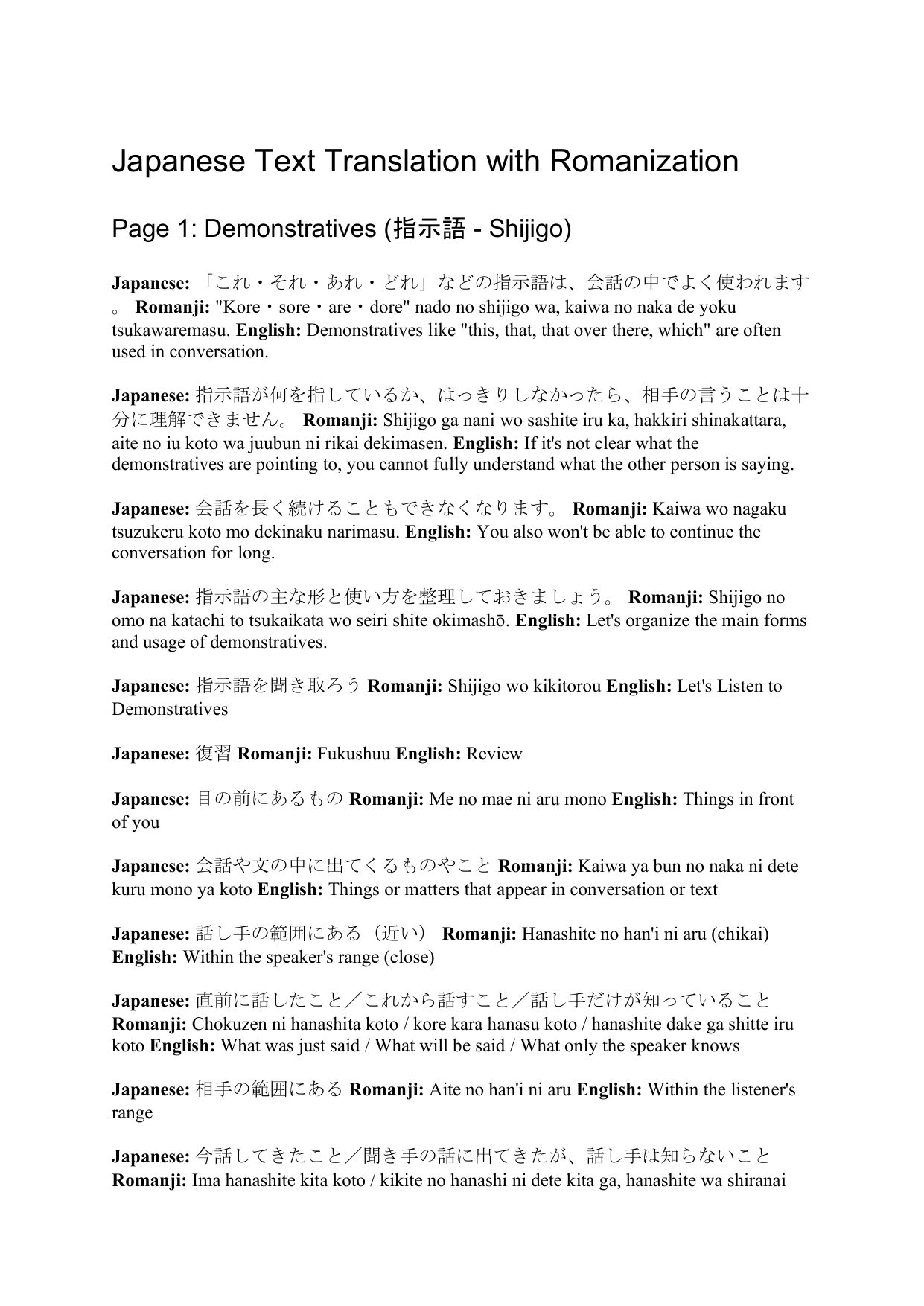
Page 1: Demonstratives (指示語 - Shijigo)
Page 1: Demonstratives (指示語 - Shijigo)
JPJapanese:「これ・それ・あれ・どれ」などの指示語は、会話の中でよく使われます
EN。 Romanji: "Kore・sore・are・dore" nado no shijigo wa, kaiwa no naka de yoku
tsukawaremasu. English: Demonstratives like "this, that, that over there, which" are often
used in conversation.
tsukawaremasu. English: Demonstratives like "this, that, that over there, which" are often
used in conversation.
JPJapanese:指示語が何を指しているか、はっきりしなかったら、相手の言うことは十
EN分に理解できません。 Romanji: Shijigo ga nani wo sashite iru ka, hakkiri shinakattara,
aite no iu koto wa juubun ni rikai dekimasen. English: If it's not clear what the
demonstratives are pointing to, you cannot fully understand what the other person is saying.
Japanese: 会話を長く続けることもできなくなります。 Romanji: Kaiwa wo nagaku
tsuzukeru koto mo dekinaku narimasu. English: You also won't be able to continue the
conversation for long.
Japanese: 指示語の主な形と使い方を整理しておきましょう。 Romanji: Shijigo no
omo na katachi to tsukaikata wo seiri shite okimashō. English: Let's organize the main forms
and usage of demonstratives.
Japanese: 指示語を聞き取ろう Romanji: Shijigo wo kikitorou English: Let's Listen to
Demonstratives
Japanese: 復習 Romanji: Fukushuu English: Review
Japanese: 目の前にあるもの Romanji: Me no mae ni aru mono English: Things in front
of you
Japanese: 会話や文の中に出てくるものやこと Romanji: Kaiwa ya bun no naka ni dete
kuru mono ya koto English: Things or matters that appear in conversation or text
Japanese: 話し手の範囲にある(近い) Romanji: Hanashite no han'i ni aru (chikai)
English: Within the speaker's range (close)
aite no iu koto wa juubun ni rikai dekimasen. English: If it's not clear what the
demonstratives are pointing to, you cannot fully understand what the other person is saying.
Japanese: 会話を長く続けることもできなくなります。 Romanji: Kaiwa wo nagaku
tsuzukeru koto mo dekinaku narimasu. English: You also won't be able to continue the
conversation for long.
Japanese: 指示語の主な形と使い方を整理しておきましょう。 Romanji: Shijigo no
omo na katachi to tsukaikata wo seiri shite okimashō. English: Let's organize the main forms
and usage of demonstratives.
Japanese: 指示語を聞き取ろう Romanji: Shijigo wo kikitorou English: Let's Listen to
Demonstratives
Japanese: 復習 Romanji: Fukushuu English: Review
Japanese: 目の前にあるもの Romanji: Me no mae ni aru mono English: Things in front
of you
Japanese: 会話や文の中に出てくるものやこと Romanji: Kaiwa ya bun no naka ni dete
kuru mono ya koto English: Things or matters that appear in conversation or text
Japanese: 話し手の範囲にある(近い) Romanji: Hanashite no han'i ni aru (chikai)
English: Within the speaker's range (close)
JPJapanese:直前に話したこと/これから話すこと/話し手だけが知っていること
ENRomanji: Chokuzen ni hanashita koto / kore kara hanasu koto / hanashite dake ga shitte iru
koto English: What was just said / What will be said / What only the speaker knows
Japanese: 相手の範囲にある Romanji: Aite no han'i ni aru English: Within the listener's
range
koto English: What was just said / What will be said / What only the speaker knows
Japanese: 相手の範囲にある Romanji: Aite no han'i ni aru English: Within the listener's
range
JPJapanese:今話してきたこと/聞き手の話に出てきたが、話し手は知らないこと
ENRomanji: Ima hanashite kita koto / kikite no hanashi ni dete kita ga, hanashite wa shiranai
หน้า 2
คลิกเพื่อขยาย
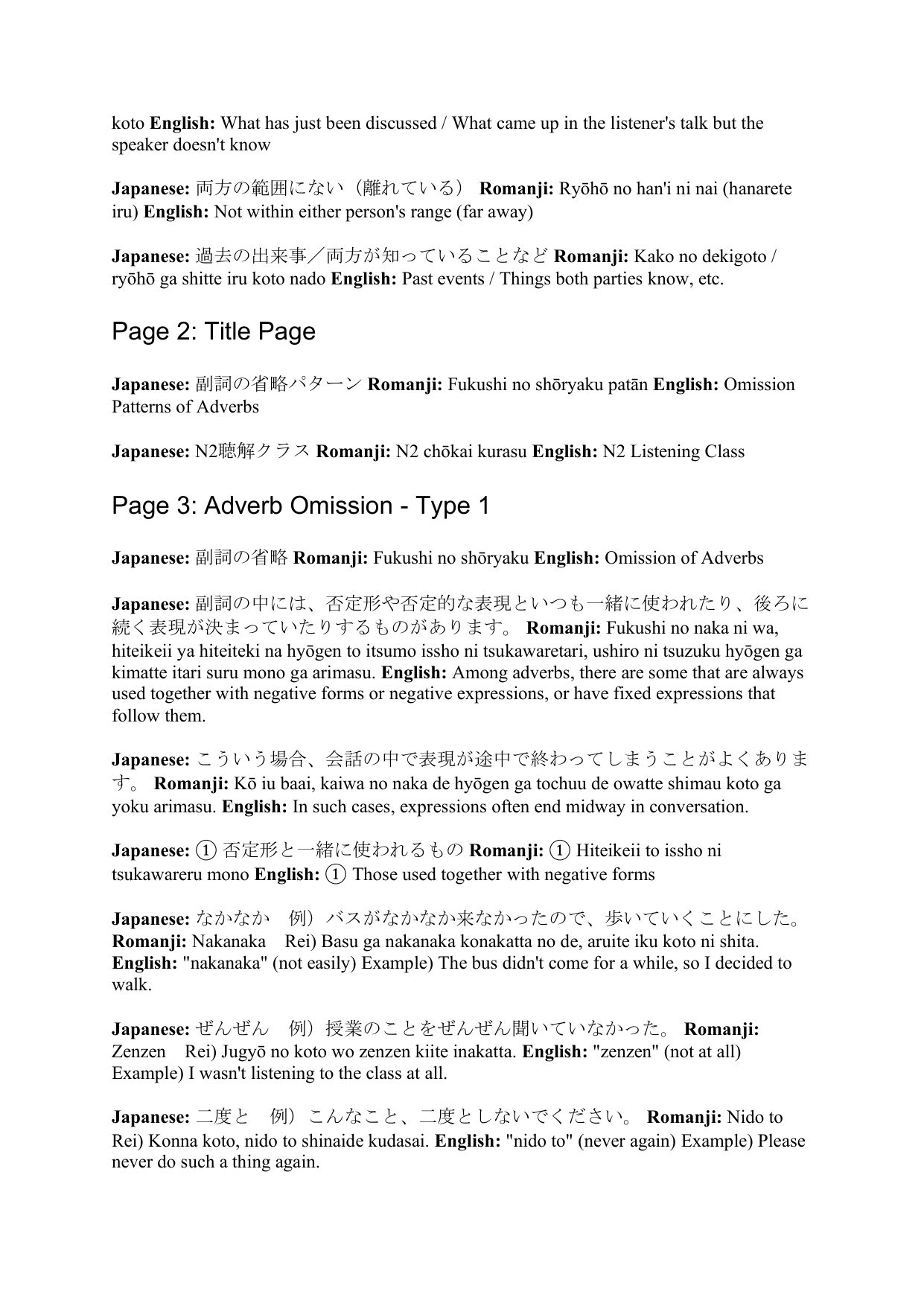
ENkoto English: What has just been discussed / What came up in the listener's talk but the
speaker doesn't know
Japanese: 両方の範囲にない(離れている) Romanji: Ryōhō no han'i ni nai (hanarete
iru) English: Not within either person's range (far away)
Japanese: 過去の出来事/両方が知っていることなど Romanji: Kako no dekigoto /
ryōhō ga shitte iru koto nado English: Past events / Things both parties know, etc.
Page 2: Title Page
Japanese: 副詞の省略パターン Romanji: Fukushi no shōryaku patān English: Omission
Patterns of Adverbs
Japanese: N2聴解クラス Romanji: N2 chōkai kurasu English: N2 Listening Class
Page 3: Adverb Omission - Type 1
Japanese: 副詞の省略 Romanji: Fukushi no shōryaku English: Omission of Adverbs
speaker doesn't know
Japanese: 両方の範囲にない(離れている) Romanji: Ryōhō no han'i ni nai (hanarete
iru) English: Not within either person's range (far away)
Japanese: 過去の出来事/両方が知っていることなど Romanji: Kako no dekigoto /
ryōhō ga shitte iru koto nado English: Past events / Things both parties know, etc.
Page 2: Title Page
Japanese: 副詞の省略パターン Romanji: Fukushi no shōryaku patān English: Omission
Patterns of Adverbs
Japanese: N2聴解クラス Romanji: N2 chōkai kurasu English: N2 Listening Class
Page 3: Adverb Omission - Type 1
Japanese: 副詞の省略 Romanji: Fukushi no shōryaku English: Omission of Adverbs
JPJapanese:副詞の中には、否定形や否定的な表現といつも一緒に使われたり、後ろに
EN続く表現が決まっていたりするものがあります。 Romanji: Fukushi no naka ni wa,
hiteikeii ya hiteiteki na hyōgen to itsumo issho ni tsukawaretari, ushiro ni tsuzuku hyōgen ga
kimatte itari suru mono ga arimasu. English: Among adverbs, there are some that are always
used together with negative forms or negative expressions, or have fixed expressions that
follow them.
hiteikeii ya hiteiteki na hyōgen to itsumo issho ni tsukawaretari, ushiro ni tsuzuku hyōgen ga
kimatte itari suru mono ga arimasu. English: Among adverbs, there are some that are always
used together with negative forms or negative expressions, or have fixed expressions that
follow them.
JPJapanese:こういう場合、会話の中で表現が途中で終わってしまうことがよくありま
ENす。 Romanji: Kō iu baai, kaiwa no naka de hyōgen ga tochuu de owatte shimau koto ga
yoku arimasu. English: In such cases, expressions often end midway in conversation.
Japanese: ① 否定形と一緒に使われるもの Romanji: ① Hiteikeii to issho ni
tsukawareru mono English: ① Those used together with negative forms
yoku arimasu. English: In such cases, expressions often end midway in conversation.
Japanese: ① 否定形と一緒に使われるもの Romanji: ① Hiteikeii to issho ni
tsukawareru mono English: ① Those used together with negative forms
JPJapanese:なかなか例)バスがなかなか来なかったので、歩いていくことにした。
ENRomanji: Nakanaka Rei) Basu ga nakanaka konakatta no de, aruite iku koto ni shita.
English: "nakanaka" (not easily) Example) The bus didn't come for a while, so I decided to
walk.
English: "nakanaka" (not easily) Example) The bus didn't come for a while, so I decided to
walk.
JPJapanese:ぜんぜん例)授業のことをぜんぜん聞いていなかった。Romanji:
ENZenzen Rei) Jugyō no koto wo zenzen kiite inakatta. English: "zenzen" (not at all)
Example) I wasn't listening to the class at all.
Japanese: 二度と 例)こんなこと、二度としないでください。 Romanji: Nido to
Rei) Konna koto, nido to shinaide kudasai. English: "nido to" (never again) Example) Please
never do such a thing again.
Example) I wasn't listening to the class at all.
Japanese: 二度と 例)こんなこと、二度としないでください。 Romanji: Nido to
Rei) Konna koto, nido to shinaide kudasai. English: "nido to" (never again) Example) Please
never do such a thing again.
หน้า 3
คลิกเพื่อขยาย
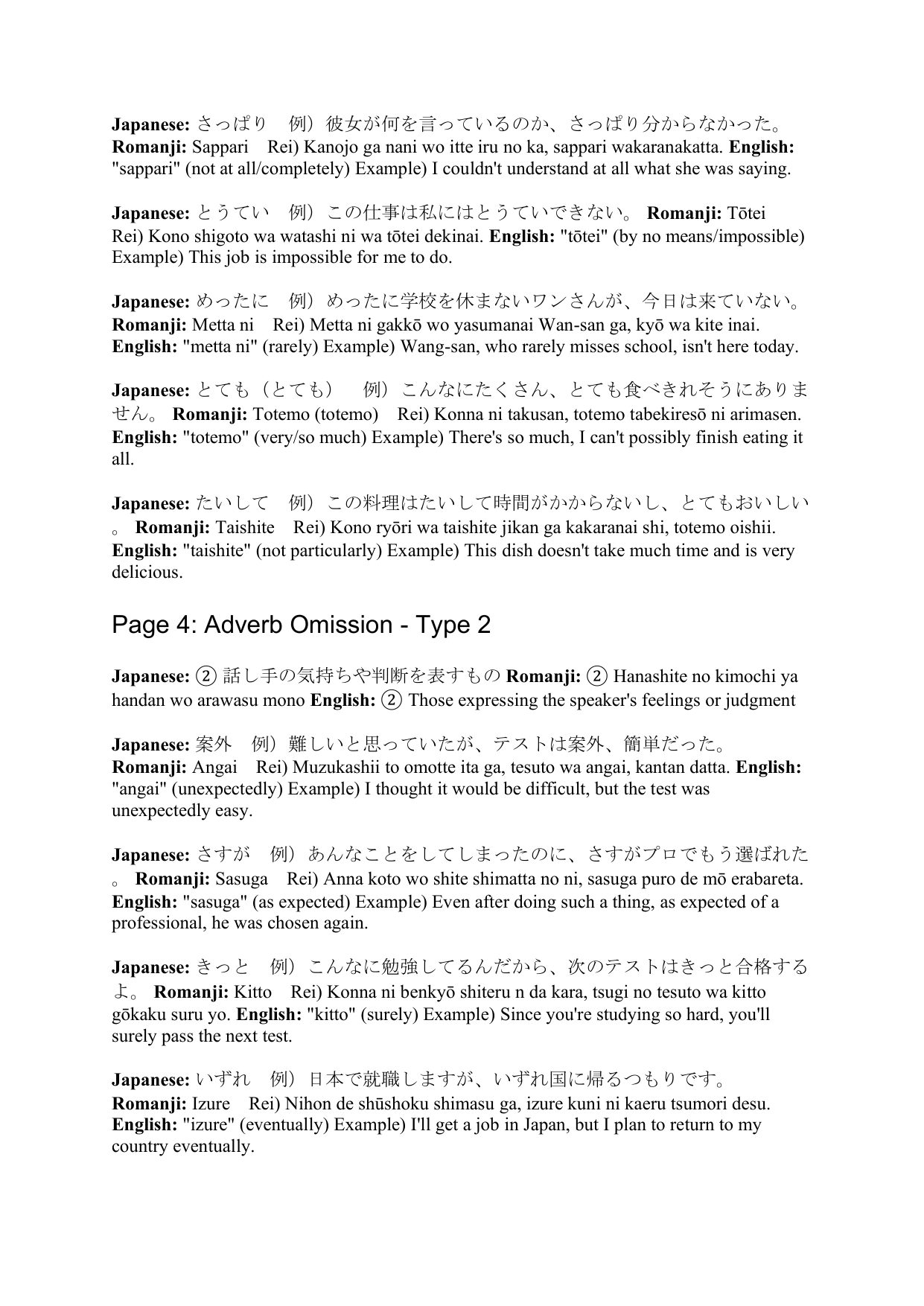
JPJapanese:さっぱり例)彼女が何を言っているのか、さっぱり分からなかった。
ENRomanji: Sappari Rei) Kanojo ga nani wo itte iru no ka, sappari wakaranakatta. English:
"sappari" (not at all/completely) Example) I couldn't understand at all what she was saying.
"sappari" (not at all/completely) Example) I couldn't understand at all what she was saying.
JPJapanese:とうてい例)この仕事は私にはとうていできない。Romanji:Tōtei
ENRei) Kono shigoto wa watashi ni wa tōtei dekinai. English: "tōtei" (by no means/impossible)
Example) This job is impossible for me to do.
Example) This job is impossible for me to do.
JPJapanese:めったに例)めったに学校を休まないワンさんが、今日は来ていない。
ENRomanji: Metta ni Rei) Metta ni gakkō wo yasumanai Wan-san ga, kyō wa kite inai.
English: "metta ni" (rarely) Example) Wang-san, who rarely misses school, isn't here today.
English: "metta ni" (rarely) Example) Wang-san, who rarely misses school, isn't here today.
JPJapanese:とても(とても)例)こんなにたくさん、とても食べきれそうにありま
ENせん。 Romanji: Totemo (totemo) Rei) Konna ni takusan, totemo tabekiresō ni arimasen.
English: "totemo" (very/so much) Example) There's so much, I can't possibly finish eating it
all.
English: "totemo" (very/so much) Example) There's so much, I can't possibly finish eating it
all.
JPJapanese:たいして例)この料理はたいして時間がかからないし、とてもおいしい
EN。 Romanji: Taishite Rei) Kono ryōri wa taishite jikan ga kakaranai shi, totemo oishii.
English: "taishite" (not particularly) Example) This dish doesn't take much time and is very
delicious.
Page 4: Adverb Omission - Type 2
Japanese: ② 話し手の気持ちや判断を表すもの Romanji: ② Hanashite no kimochi ya
handan wo arawasu mono English: ② Those expressing the speaker's feelings or judgment
English: "taishite" (not particularly) Example) This dish doesn't take much time and is very
delicious.
Page 4: Adverb Omission - Type 2
Japanese: ② 話し手の気持ちや判断を表すもの Romanji: ② Hanashite no kimochi ya
handan wo arawasu mono English: ② Those expressing the speaker's feelings or judgment
JPJapanese:案外例)難しいと思っていたが、テストは案外、簡単だった。
ENRomanji: Angai Rei) Muzukashii to omotte ita ga, tesuto wa angai, kantan datta. English:
"angai" (unexpectedly) Example) I thought it would be difficult, but the test was
unexpectedly easy.
"angai" (unexpectedly) Example) I thought it would be difficult, but the test was
unexpectedly easy.
JPJapanese:さすが例)あんなことをしてしまったのに、さすがプロでもう選ばれた
EN。 Romanji: Sasuga Rei) Anna koto wo shite shimatta no ni, sasuga puro de mō erabareta.
English: "sasuga" (as expected) Example) Even after doing such a thing, as expected of a
professional, he was chosen again.
English: "sasuga" (as expected) Example) Even after doing such a thing, as expected of a
professional, he was chosen again.
JPJapanese:きっと例)こんなに勉強してるんだから、次のテストはきっと合格する
ENよ。 Romanji: Kitto Rei) Konna ni benkyō shiteru n da kara, tsugi no tesuto wa kitto
gōkaku suru yo. English: "kitto" (surely) Example) Since you're studying so hard, you'll
surely pass the next test.
gōkaku suru yo. English: "kitto" (surely) Example) Since you're studying so hard, you'll
surely pass the next test.
JPJapanese:いずれ例)日本で就職しますが、いずれ国に帰るつもりです。
ENRomanji: Izure Rei) Nihon de shūshoku shimasu ga, izure kuni ni kaeru tsumori desu.
English: "izure" (eventually) Example) I'll get a job in Japan, but I plan to return to my
country eventually.
English: "izure" (eventually) Example) I'll get a job in Japan, but I plan to return to my
country eventually.
หน้า 4
คลิกเพื่อขยาย
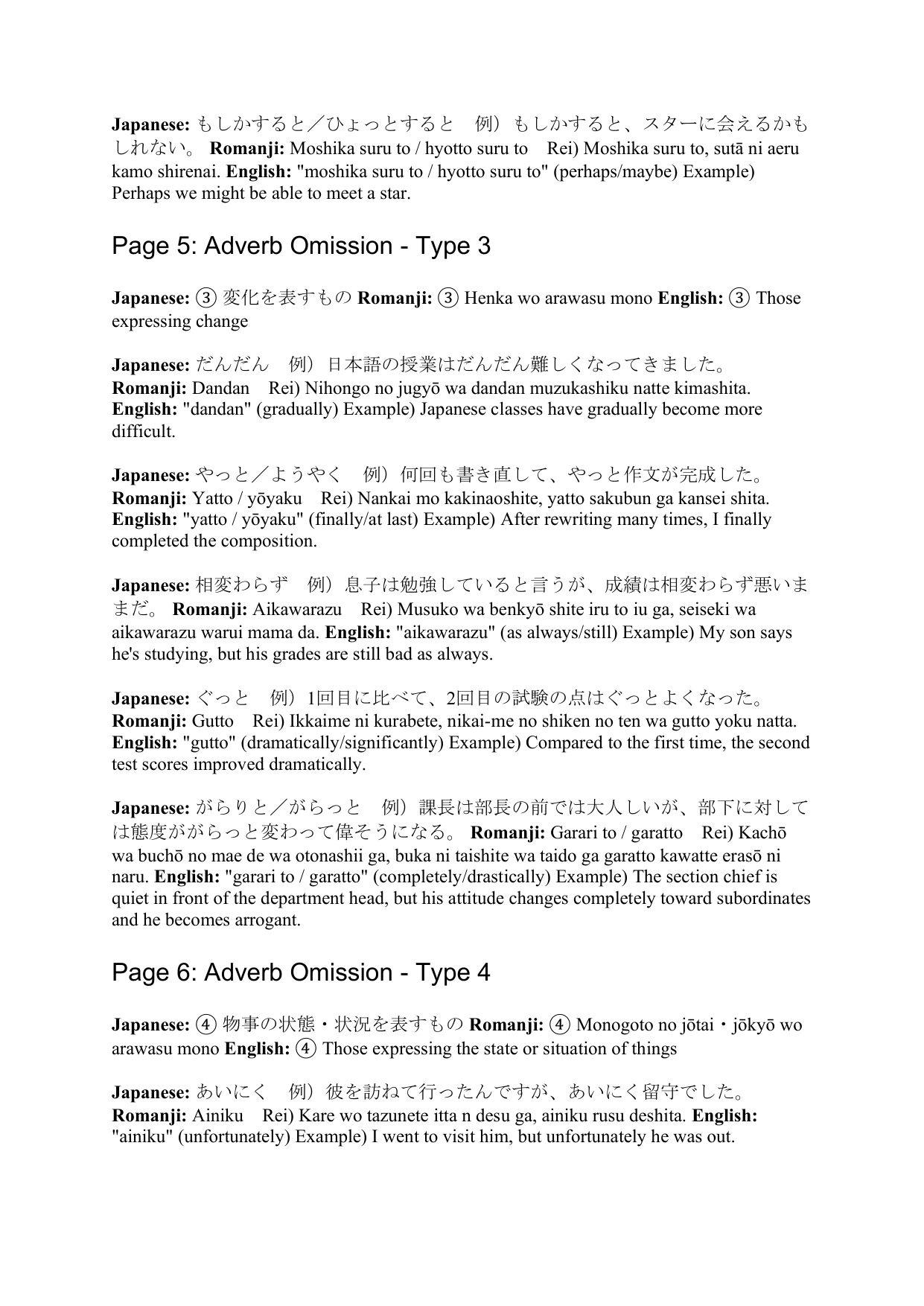
JPJapanese:もしかすると/ひょっとすると例)もしかすると、スターに会えるかも
ENしれない。 Romanji: Moshika suru to / hyotto suru to Rei) Moshika suru to, sutā ni aeru
kamo shirenai. English: "moshika suru to / hyotto suru to" (perhaps/maybe) Example)
Perhaps we might be able to meet a star.
Page 5: Adverb Omission - Type 3
Japanese: ③ 変化を表すもの Romanji: ③ Henka wo arawasu mono English: ③ Those
expressing change
kamo shirenai. English: "moshika suru to / hyotto suru to" (perhaps/maybe) Example)
Perhaps we might be able to meet a star.
Page 5: Adverb Omission - Type 3
Japanese: ③ 変化を表すもの Romanji: ③ Henka wo arawasu mono English: ③ Those
expressing change
JPJapanese:だんだん例)日本語の授業はだんだん難しくなってきました。
ENRomanji: Dandan Rei) Nihongo no jugyō wa dandan muzukashiku natte kimashita.
English: "dandan" (gradually) Example) Japanese classes have gradually become more
difficult.
English: "dandan" (gradually) Example) Japanese classes have gradually become more
difficult.
JPJapanese:やっと/ようやく例)何回も書き直して、やっと作文が完成した。
ENRomanji: Yatto / yōyaku Rei) Nankai mo kakinaoshite, yatto sakubun ga kansei shita.
English: "yatto / yōyaku" (finally/at last) Example) After rewriting many times, I finally
completed the composition.
English: "yatto / yōyaku" (finally/at last) Example) After rewriting many times, I finally
completed the composition.
JPJapanese:相変わらず例)息子は勉強していると言うが、成績は相変わらず悪いま
ENまだ。 Romanji: Aikawarazu Rei) Musuko wa benkyō shite iru to iu ga, seiseki wa
aikawarazu warui mama da. English: "aikawarazu" (as always/still) Example) My son says
he's studying, but his grades are still bad as always.
aikawarazu warui mama da. English: "aikawarazu" (as always/still) Example) My son says
he's studying, but his grades are still bad as always.
JPJapanese:ぐっと例)1回目に比べて、2回目の試験の点はぐっとよくなった。
ENRomanji: Gutto Rei) Ikkaime ni kurabete, nikai-me no shiken no ten wa gutto yoku natta.
English: "gutto" (dramatically/significantly) Example) Compared to the first time, the second
test scores improved dramatically.
English: "gutto" (dramatically/significantly) Example) Compared to the first time, the second
test scores improved dramatically.
JPJapanese:がらりと/がらっと例)課長は部長の前では大人しいが、部下に対して
ENは態度ががらっと変わって偉そうになる。 Romanji: Garari to / garatto Rei) Kachō
wa buchō no mae de wa otonashii ga, buka ni taishite wa taido ga garatto kawatte erasō ni
naru. English: "garari to / garatto" (completely/drastically) Example) The section chief is
quiet in front of the department head, but his attitude changes completely toward subordinates
and he becomes arrogant.
Page 6: Adverb Omission - Type 4
Japanese: ④ 物事の状態・状況を表すもの Romanji: ④ Monogoto no jōtai・jōkyō wo
arawasu mono English: ④ Those expressing the state or situation of things
wa buchō no mae de wa otonashii ga, buka ni taishite wa taido ga garatto kawatte erasō ni
naru. English: "garari to / garatto" (completely/drastically) Example) The section chief is
quiet in front of the department head, but his attitude changes completely toward subordinates
and he becomes arrogant.
Page 6: Adverb Omission - Type 4
Japanese: ④ 物事の状態・状況を表すもの Romanji: ④ Monogoto no jōtai・jōkyō wo
arawasu mono English: ④ Those expressing the state or situation of things
JPJapanese:あいにく例)彼を訪ねて行ったんですが、あいにく留守でした。
ENRomanji: Ainiku Rei) Kare wo tazunete itta n desu ga, ainiku rusu deshita. English:
"ainiku" (unfortunately) Example) I went to visit him, but unfortunately he was out.
"ainiku" (unfortunately) Example) I went to visit him, but unfortunately he was out.
หน้า 5
คลิกเพื่อขยาย
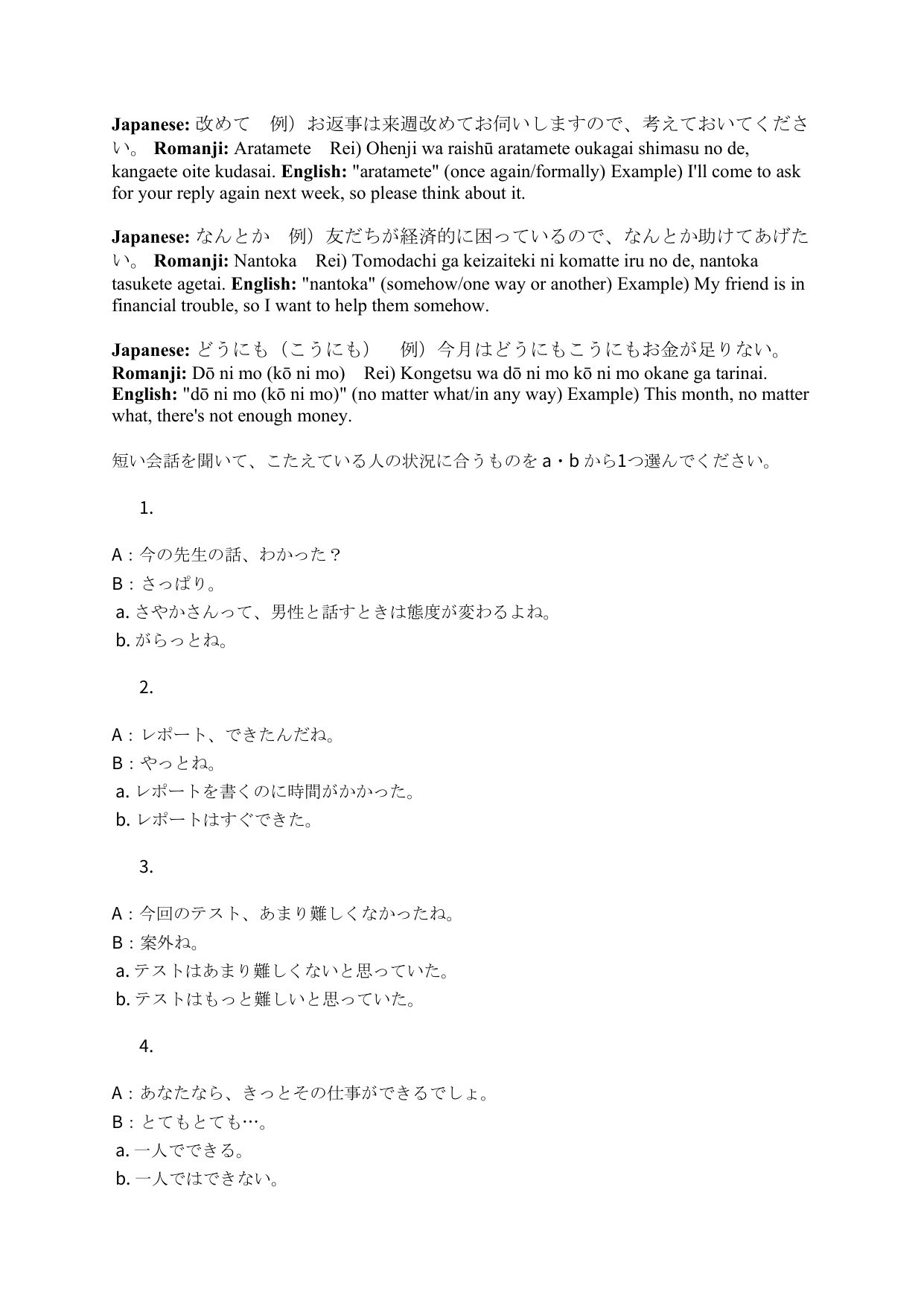
JPJapanese:改めて例)お返事は来週改めてお伺いしますので、考えておいてくださ
ENい。 Romanji: Aratamete Rei) Ohenji wa raishū aratamete oukagai shimasu no de,
kangaete oite kudasai. English: "aratamete" (once again/formally) Example) I'll come to ask
for your reply again next week, so please think about it.
kangaete oite kudasai. English: "aratamete" (once again/formally) Example) I'll come to ask
for your reply again next week, so please think about it.
JPJapanese:なんとか例)友だちが経済的に困っているので、なんとか助けてあげた
ENい。 Romanji: Nantoka Rei) Tomodachi ga keizaiteki ni komatte iru no de, nantoka
tasukete agetai. English: "nantoka" (somehow/one way or another) Example) My friend is in
financial trouble, so I want to help them somehow.
tasukete agetai. English: "nantoka" (somehow/one way or another) Example) My friend is in
financial trouble, so I want to help them somehow.
JPJapanese:どうにも(こうにも)例)今月はどうにもこうにもお金が足りない。
ENRomanji: Dō ni mo (kō ni mo) Rei) Kongetsu wa dō ni mo kō ni mo okane ga tarinai.
English: "dō ni mo (kō ni mo)" (no matter what/in any way) Example) This month, no matter
what, there's not enough money.
English: "dō ni mo (kō ni mo)" (no matter what/in any way) Example) This month, no matter
what, there's not enough money.
JP短い会話を聞いて、こたえている人の状況に合うものをa・bから1つ選んでください。
1.
A:今の先生の話、わかった?
B:さっぱり。
a.さやかさんって、男性と話すときは態度が変わるよね。
b.がらっとね。
2.
A:レポート、できたんだね。
B:やっとね。
a.レポートを書くのに時間がかかった。
b.レポートはすぐできた。
3.
A:今回のテスト、あまり難しくなかったね。
B:案外ね。
a.テストはあまり難しくないと思っていた。
b.テストはもっと難しいと思っていた。
4.
A:あなたなら、きっとその仕事ができるでしょ。
B:とてもとても…。
a.一人でできる。
b.一人ではできない。
1.
A:今の先生の話、わかった?
B:さっぱり。
a.さやかさんって、男性と話すときは態度が変わるよね。
b.がらっとね。
2.
A:レポート、できたんだね。
B:やっとね。
a.レポートを書くのに時間がかかった。
b.レポートはすぐできた。
3.
A:今回のテスト、あまり難しくなかったね。
B:案外ね。
a.テストはあまり難しくないと思っていた。
b.テストはもっと難しいと思っていた。
4.
A:あなたなら、きっとその仕事ができるでしょ。
B:とてもとても…。
a.一人でできる。
b.一人ではできない。
หน้า 6
คลิกเพื่อขยาย
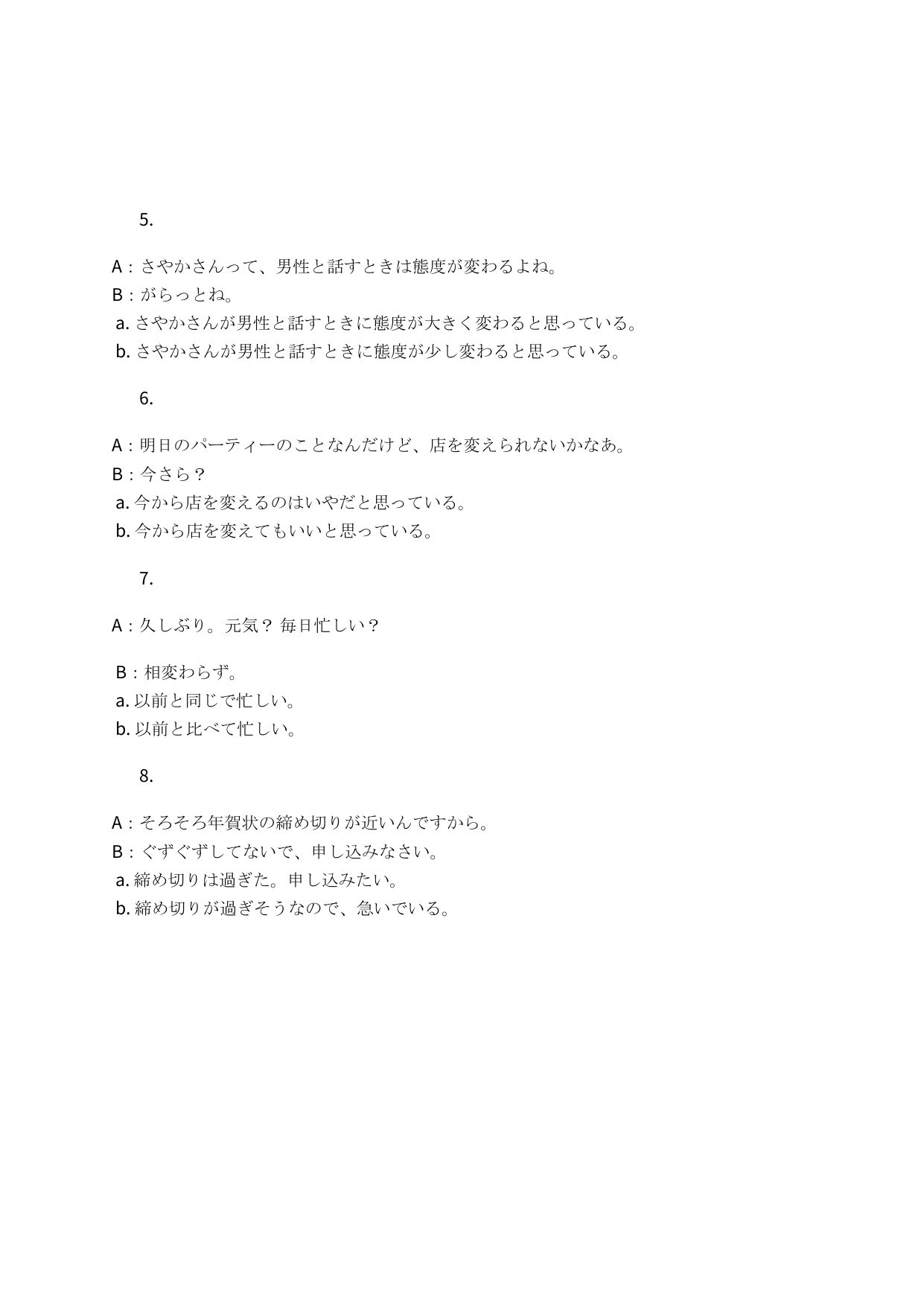
5.
JPA:さやかさんって、男性と話すときは態度が変わるよね。
B:がらっとね。
a.さやかさんが男性と話すときに態度が大きく変わると思っている。
b.さやかさんが男性と話すときに態度が少し変わると思っている。
6.
A:明日のパーティーのことなんだけど、店を変えられないかなあ。
B:今さら?
a.今から店を変えるのはいやだと思っている。
b.今から店を変えてもいいと思っている。
7.
A:久しぶり。元気?毎日忙しい?
B:相変わらず。
a.以前と同じで忙しい。
b.以前と比べて忙しい。
8.
A:そろそろ年賀状の締め切りが近いんですから。
B:ぐずぐずしてないで、申し込みなさい。
a.締め切りは過ぎた。申し込みたい。
b.締め切りが過ぎそうなので、急いでいる。
B:がらっとね。
a.さやかさんが男性と話すときに態度が大きく変わると思っている。
b.さやかさんが男性と話すときに態度が少し変わると思っている。
6.
A:明日のパーティーのことなんだけど、店を変えられないかなあ。
B:今さら?
a.今から店を変えるのはいやだと思っている。
b.今から店を変えてもいいと思っている。
7.
A:久しぶり。元気?毎日忙しい?
B:相変わらず。
a.以前と同じで忙しい。
b.以前と比べて忙しい。
8.
A:そろそろ年賀状の締め切りが近いんですから。
B:ぐずぐずしてないで、申し込みなさい。
a.締め切りは過ぎた。申し込みたい。
b.締め切りが過ぎそうなので、急いでいる。
หน้า 7
คลิกเพื่อขยาย
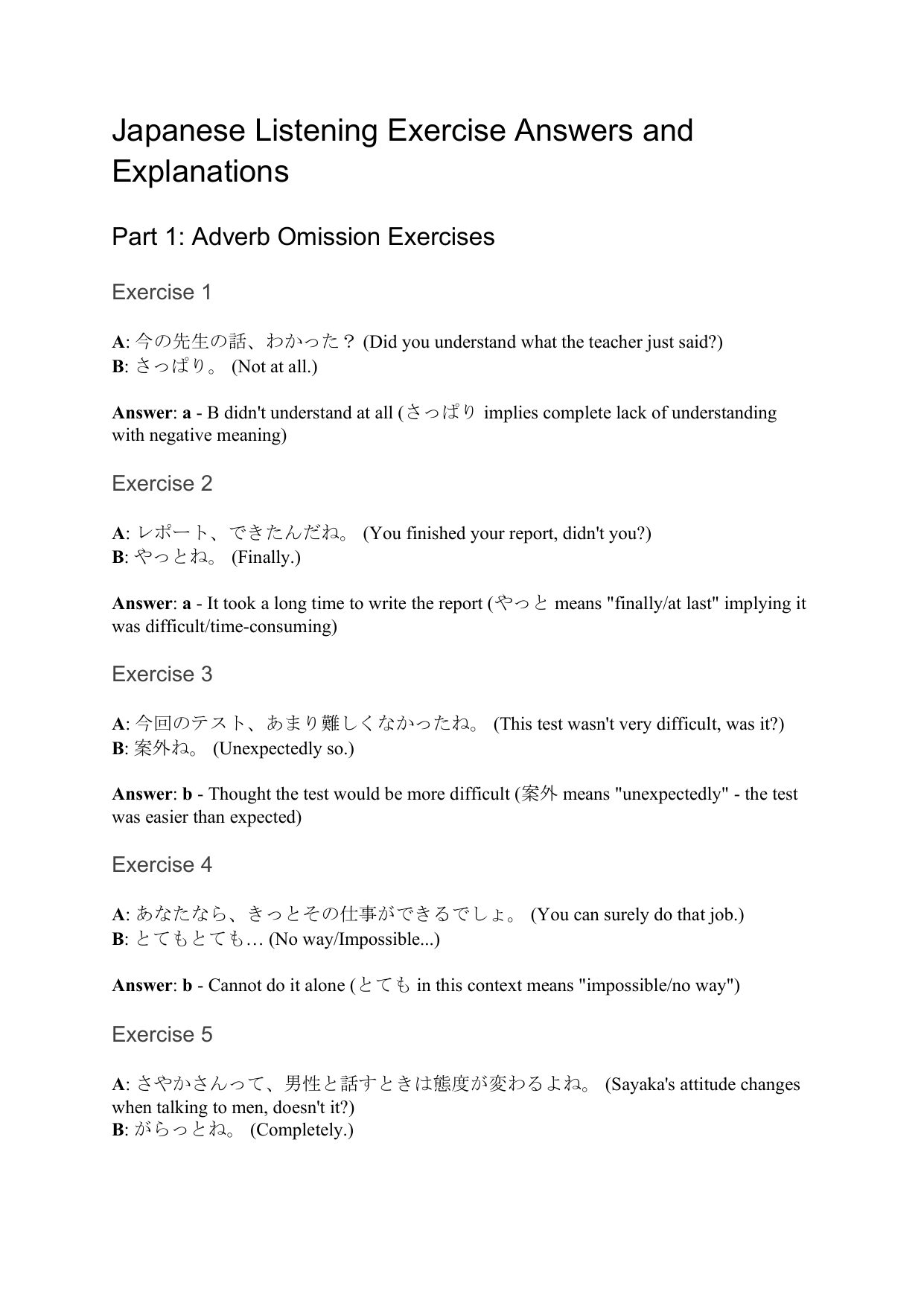
ENJapanese Listening Exercise Answers and
Explanations
Part 1: Adverb Omission Exercises
Exercise 1
A: 今の先生の話、わかった? (Did you understand what the teacher just said?)
B: さっぱり。 (Not at all.)
Answer: a - B didn't understand at all (さっぱり implies complete lack of understanding
with negative meaning)
Exercise 2
A: レポート、できたんだね。 (You finished your report, didn't you?)
B: やっとね。 (Finally.)
Answer: a - It took a long time to write the report (やっと means "finally/at last" implying it
was difficult/time-consuming)
Exercise 3
A: 今回のテスト、あまり難しくなかったね。 (This test wasn't very difficult, was it?)
B: 案外ね。 (Unexpectedly so.)
Answer: b - Thought the test would be more difficult (案外 means "unexpectedly" - the test
was easier than expected)
Exercise 4
A: あなたなら、きっとその仕事ができるでしょ。 (You can surely do that job.)
B: とてもとても… (No way/Impossible...)
Answer: b - Cannot do it alone (とても in this context means "impossible/no way")
Exercise 5
Explanations
Part 1: Adverb Omission Exercises
Exercise 1
A: 今の先生の話、わかった? (Did you understand what the teacher just said?)
B: さっぱり。 (Not at all.)
Answer: a - B didn't understand at all (さっぱり implies complete lack of understanding
with negative meaning)
Exercise 2
A: レポート、できたんだね。 (You finished your report, didn't you?)
B: やっとね。 (Finally.)
Answer: a - It took a long time to write the report (やっと means "finally/at last" implying it
was difficult/time-consuming)
Exercise 3
A: 今回のテスト、あまり難しくなかったね。 (This test wasn't very difficult, was it?)
B: 案外ね。 (Unexpectedly so.)
Answer: b - Thought the test would be more difficult (案外 means "unexpectedly" - the test
was easier than expected)
Exercise 4
A: あなたなら、きっとその仕事ができるでしょ。 (You can surely do that job.)
B: とてもとても… (No way/Impossible...)
Answer: b - Cannot do it alone (とても in this context means "impossible/no way")
Exercise 5
JPA:さやかさんって、男性と話すときは態度が変わるよね。(Sayaka'sattitudechanges
ENwhen talking to men, doesn't it?)
B: がらっとね。 (Completely.)
B: がらっとね。 (Completely.)
หน้า 8
คลิกเพื่อขยาย
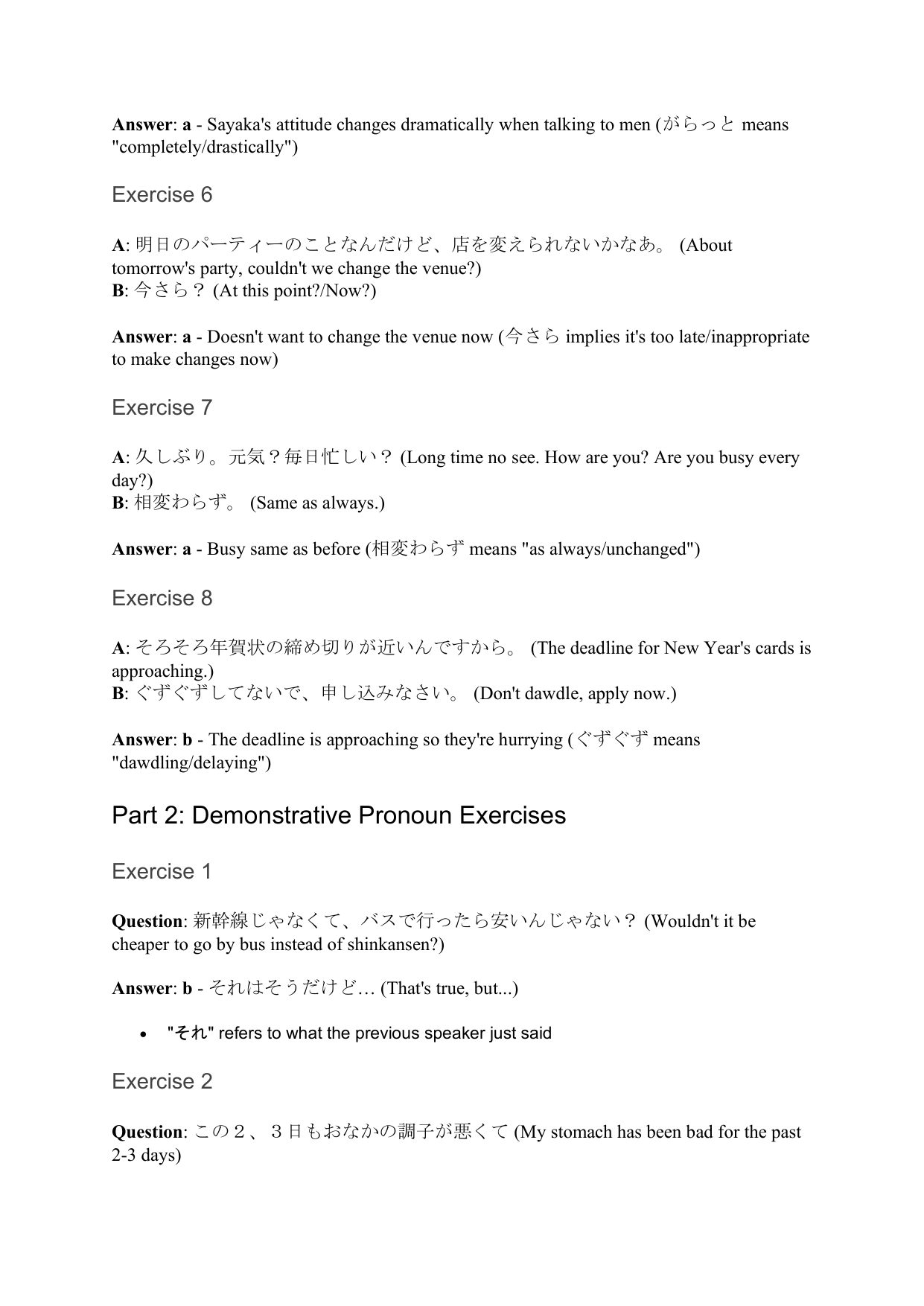
ENAnswer: a - Sayaka's attitude changes dramatically when talking to men (がらっと means
"completely/drastically")
Exercise 6
"completely/drastically")
Exercise 6
JPA:明日のパーティーのことなんだけど、店を変えられないかなあ。(About
ENtomorrow's party, couldn't we change the venue?)
B: 今さら? (At this point?/Now?)
Answer: a - Doesn't want to change the venue now (今さら implies it's too late/inappropriate
to make changes now)
Exercise 7
A: 久しぶり。元気?毎日忙しい? (Long time no see. How are you? Are you busy every
day?)
B: 相変わらず。 (Same as always.)
Answer: a - Busy same as before (相変わらず means "as always/unchanged")
Exercise 8
A: そろそろ年賀状の締め切りが近いんですから。 (The deadline for New Year's cards is
approaching.)
B: ぐずぐずしてないで、申し込みなさい。 (Don't dawdle, apply now.)
Answer: b - The deadline is approaching so they're hurrying (ぐずぐず means
"dawdling/delaying")
Part 2: Demonstrative Pronoun Exercises
Exercise 1
B: 今さら? (At this point?/Now?)
Answer: a - Doesn't want to change the venue now (今さら implies it's too late/inappropriate
to make changes now)
Exercise 7
A: 久しぶり。元気?毎日忙しい? (Long time no see. How are you? Are you busy every
day?)
B: 相変わらず。 (Same as always.)
Answer: a - Busy same as before (相変わらず means "as always/unchanged")
Exercise 8
A: そろそろ年賀状の締め切りが近いんですから。 (The deadline for New Year's cards is
approaching.)
B: ぐずぐずしてないで、申し込みなさい。 (Don't dawdle, apply now.)
Answer: b - The deadline is approaching so they're hurrying (ぐずぐず means
"dawdling/delaying")
Part 2: Demonstrative Pronoun Exercises
Exercise 1
JPQuestion:新幹線じゃなくて、バスで行ったら安いんじゃない?(Wouldn'titbe
ENcheaper to go by bus instead of shinkansen?)
Answer: b - それはそうだけど… (That's true, but...)
• "それ" refers to what the previous speaker just said
Exercise 2
Question: この2、3日もおなかの調子が悪くて (My stomach has been bad for the past
2-3 days)
Answer: b - それはそうだけど… (That's true, but...)
• "それ" refers to what the previous speaker just said
Exercise 2
Question: この2、3日もおなかの調子が悪くて (My stomach has been bad for the past
2-3 days)
หน้า 9
คลิกเพื่อขยาย
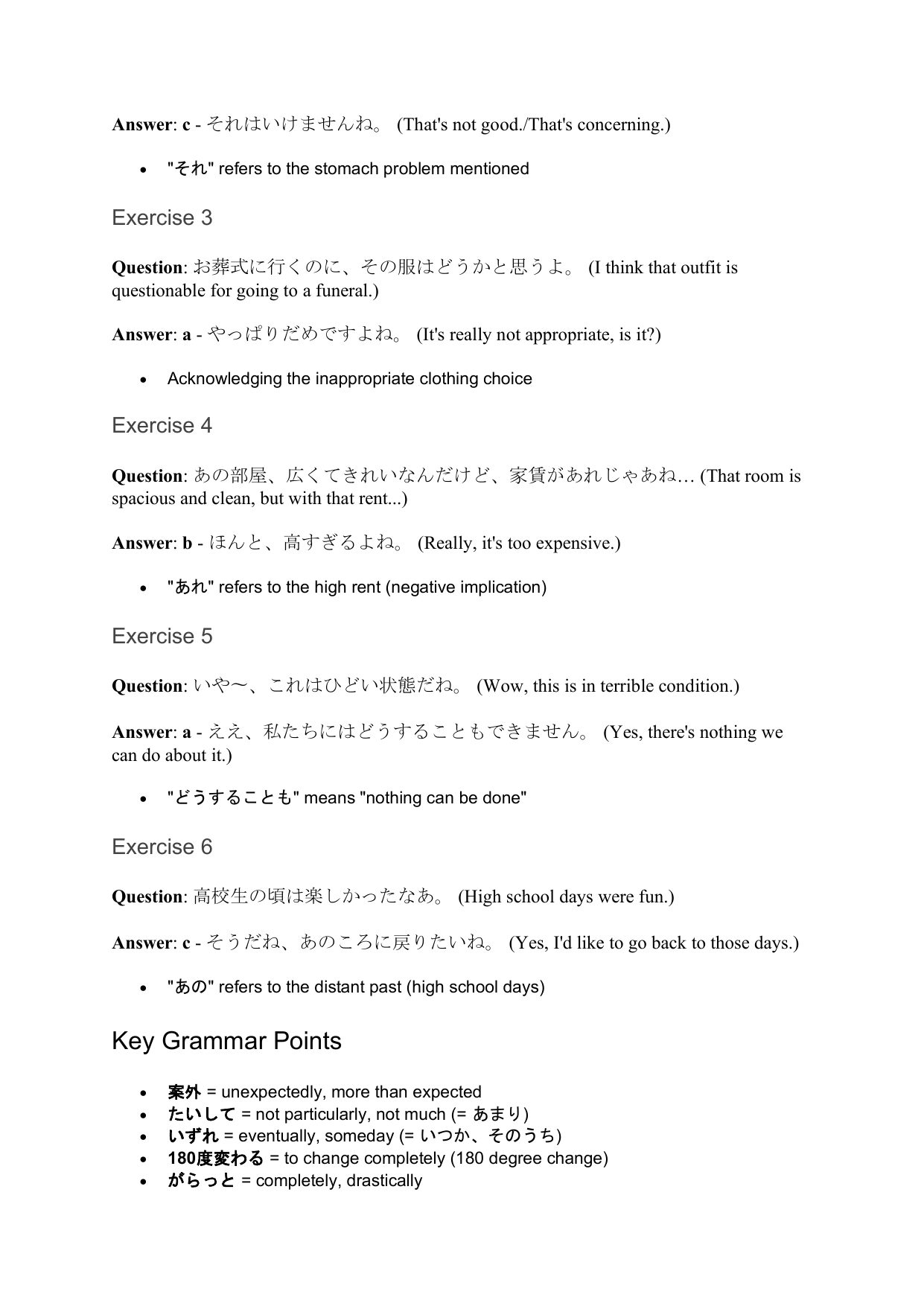
ENAnswer: c - それはいけませんね。 (That's not good./That's concerning.)
• "それ" refers to the stomach problem mentioned
Exercise 3
Question: お葬式に行くのに、その服はどうかと思うよ。 (I think that outfit is
questionable for going to a funeral.)
Answer: a - やっぱりだめですよね。 (It's really not appropriate, is it?)
• Acknowledging the inappropriate clothing choice
Exercise 4
• "それ" refers to the stomach problem mentioned
Exercise 3
Question: お葬式に行くのに、その服はどうかと思うよ。 (I think that outfit is
questionable for going to a funeral.)
Answer: a - やっぱりだめですよね。 (It's really not appropriate, is it?)
• Acknowledging the inappropriate clothing choice
Exercise 4
JPQuestion:あの部屋、広くてきれいなんだけど、家賃があれじゃあね…(Thatroomis
ENspacious and clean, but with that rent...)
Answer: b - ほんと、高すぎるよね。 (Really, it's too expensive.)
• "あれ" refers to the high rent (negative implication)
Exercise 5
Question: いや〜、これはひどい状態だね。 (Wow, this is in terrible condition.)
Answer: a - ええ、私たちにはどうすることもできません。 (Yes, there's nothing we
can do about it.)
• "どうすることも" means "nothing can be done"
Exercise 6
Question: 高校生の頃は楽しかったなあ。 (High school days were fun.)
Answer: c - そうだね、あのころに戻りたいね。 (Yes, I'd like to go back to those days.)
• "あの" refers to the distant past (high school days)
Key Grammar Points
• 案外 = unexpectedly, more than expected
• たいして = not particularly, not much (= あまり)
• いずれ = eventually, someday (= いつか、そのうち)
• 180度変わる = to change completely (180 degree change)
• がらっと = completely, drastically
Answer: b - ほんと、高すぎるよね。 (Really, it's too expensive.)
• "あれ" refers to the high rent (negative implication)
Exercise 5
Question: いや〜、これはひどい状態だね。 (Wow, this is in terrible condition.)
Answer: a - ええ、私たちにはどうすることもできません。 (Yes, there's nothing we
can do about it.)
• "どうすることも" means "nothing can be done"
Exercise 6
Question: 高校生の頃は楽しかったなあ。 (High school days were fun.)
Answer: c - そうだね、あのころに戻りたいね。 (Yes, I'd like to go back to those days.)
• "あの" refers to the distant past (high school days)
Key Grammar Points
• 案外 = unexpectedly, more than expected
• たいして = not particularly, not much (= あまり)
• いずれ = eventually, someday (= いつか、そのうち)
• 180度変わる = to change completely (180 degree change)
• がらっと = completely, drastically
หน้า 10
คลิกเพื่อขยาย
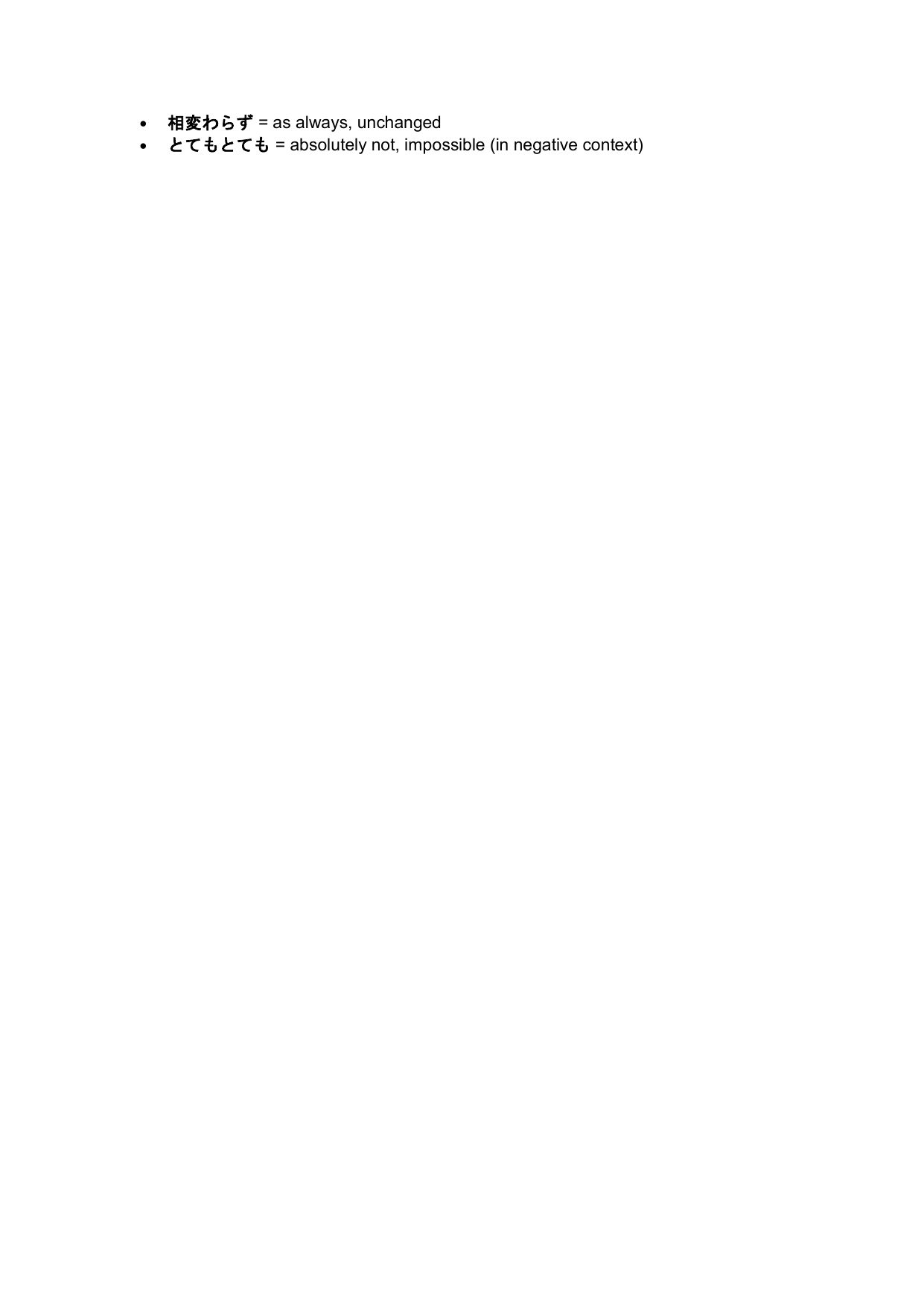
EN• 相変わらず = as always, unchanged
• とてもとても = absolutely not, impossible (in negative context)
• とてもとても = absolutely not, impossible (in negative context)