หน้า 1
คลิกเพื่อขยาย
ENJAPANESE STUDY LIBRARY · VOLUME 9
Textbook Vol. 3 — Meetings, Client
Entertaining & Gift Culture
Textbook Vol. 3 — Meetings, Client
Entertaining & Gift Culture
JP会議・接待・お土産文化
ENFull page-by-page phrase reference: running meetings, organizing a client dinner, aizuchi, and Japan's souvenir-gifting culture
(textbook pages 472–592)
Volume 9 of 9
(textbook pages 472–592)
Volume 9 of 9
หน้า 2
คลิกเพื่อขยาย
ENTABLE OF CONTENTS
THสารบัญ (1/3)
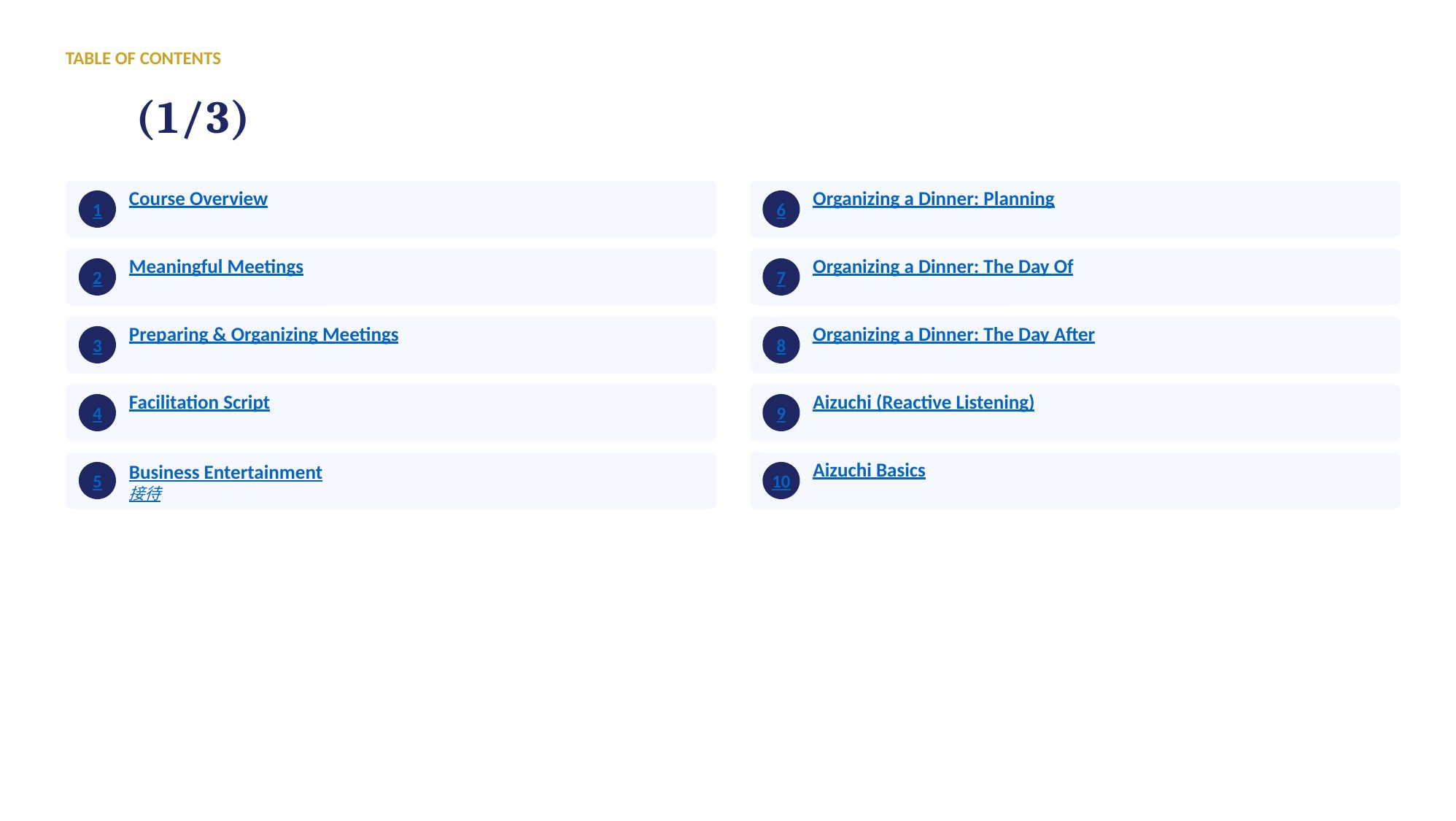
EN Course Overview Organizing a Dinner: Planning
1 6
Meaningful Meetings Organizing a Dinner: The Day Of
2 7
Preparing & Organizing Meetings Organizing a Dinner: The Day After
3 8
Facilitation Script Aizuchi (Reactive Listening)
4 9
Business Entertainment Aizuchi Basics
5 10
1 6
Meaningful Meetings Organizing a Dinner: The Day Of
2 7
Preparing & Organizing Meetings Organizing a Dinner: The Day After
3 8
Facilitation Script Aizuchi (Reactive Listening)
4 9
Business Entertainment Aizuchi Basics
5 10
JP接待
หน้า 3
คลิกเพื่อขยาย
ENTABLE OF CONTENTS
THสารบัญ (2/3)
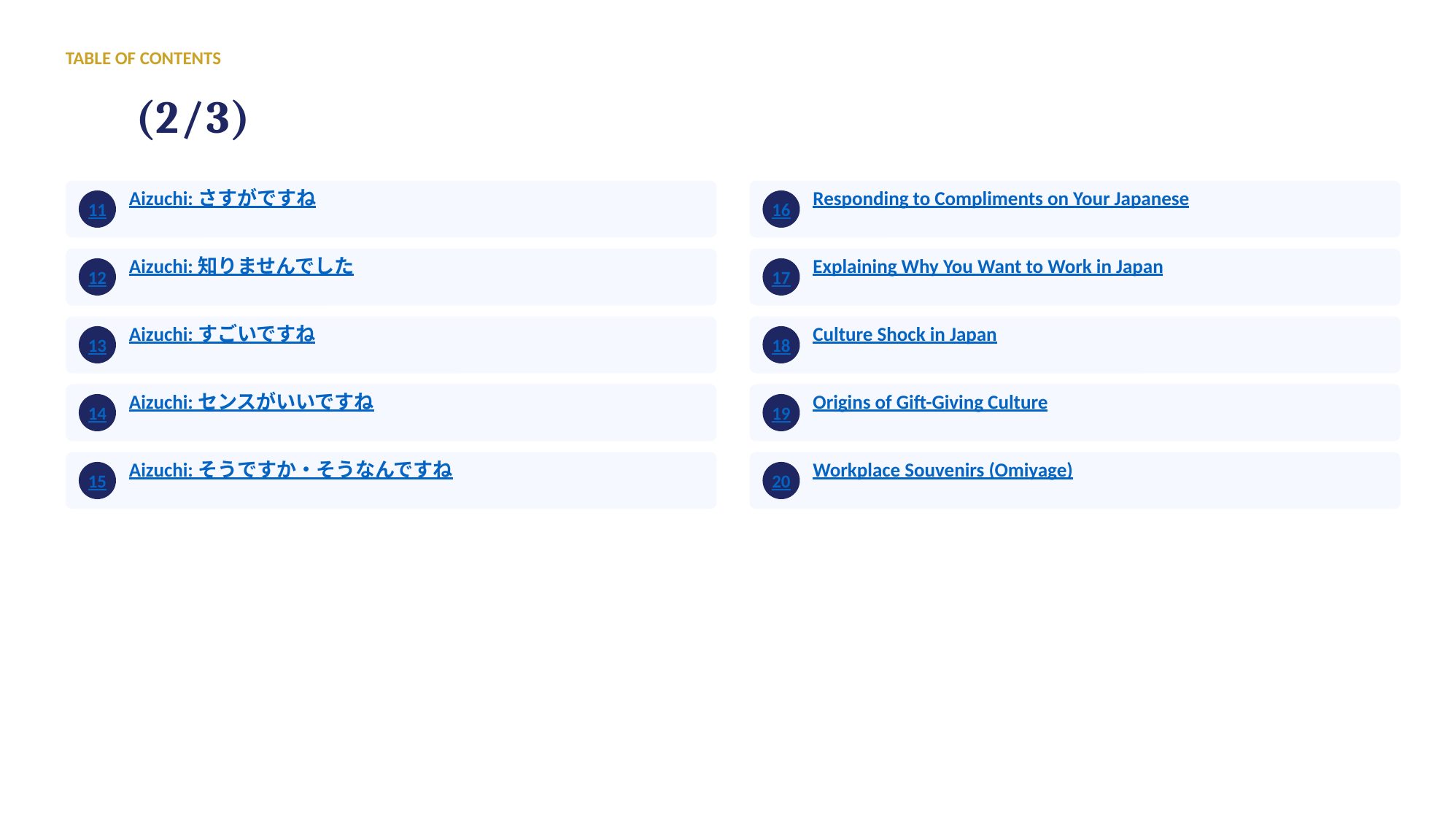
EN Aizuchi: さすがですね Responding to Compliments on Your Japanese
11 16
Aizuchi: 知りませんでした Explaining Why You Want to Work in Japan
12 17
Aizuchi: すごいですね Culture Shock in Japan
13 18
Aizuchi: センスがいいですね Origins of Gift-Giving Culture
14 19
Aizuchi: そうですか・そうなんですね Workplace Souvenirs (Omiyage)
15 20
11 16
Aizuchi: 知りませんでした Explaining Why You Want to Work in Japan
12 17
Aizuchi: すごいですね Culture Shock in Japan
13 18
Aizuchi: センスがいいですね Origins of Gift-Giving Culture
14 19
Aizuchi: そうですか・そうなんですね Workplace Souvenirs (Omiyage)
15 20
หน้า 4

คลิกเพื่อขยาย
ENTABLE OF CONTENTS
THสารบัญ (3/3)
EN Receiving a Souvenir (お土産)
21
21
หน้า 5

คลิกเพื่อขยาย
01
ENCourse Overview
1 phrase · pages 473–473
1 phrase · pages 473–473
หน้า 6
คลิกเพื่อขยาย
ENP.473
Course Overview
Course Overview
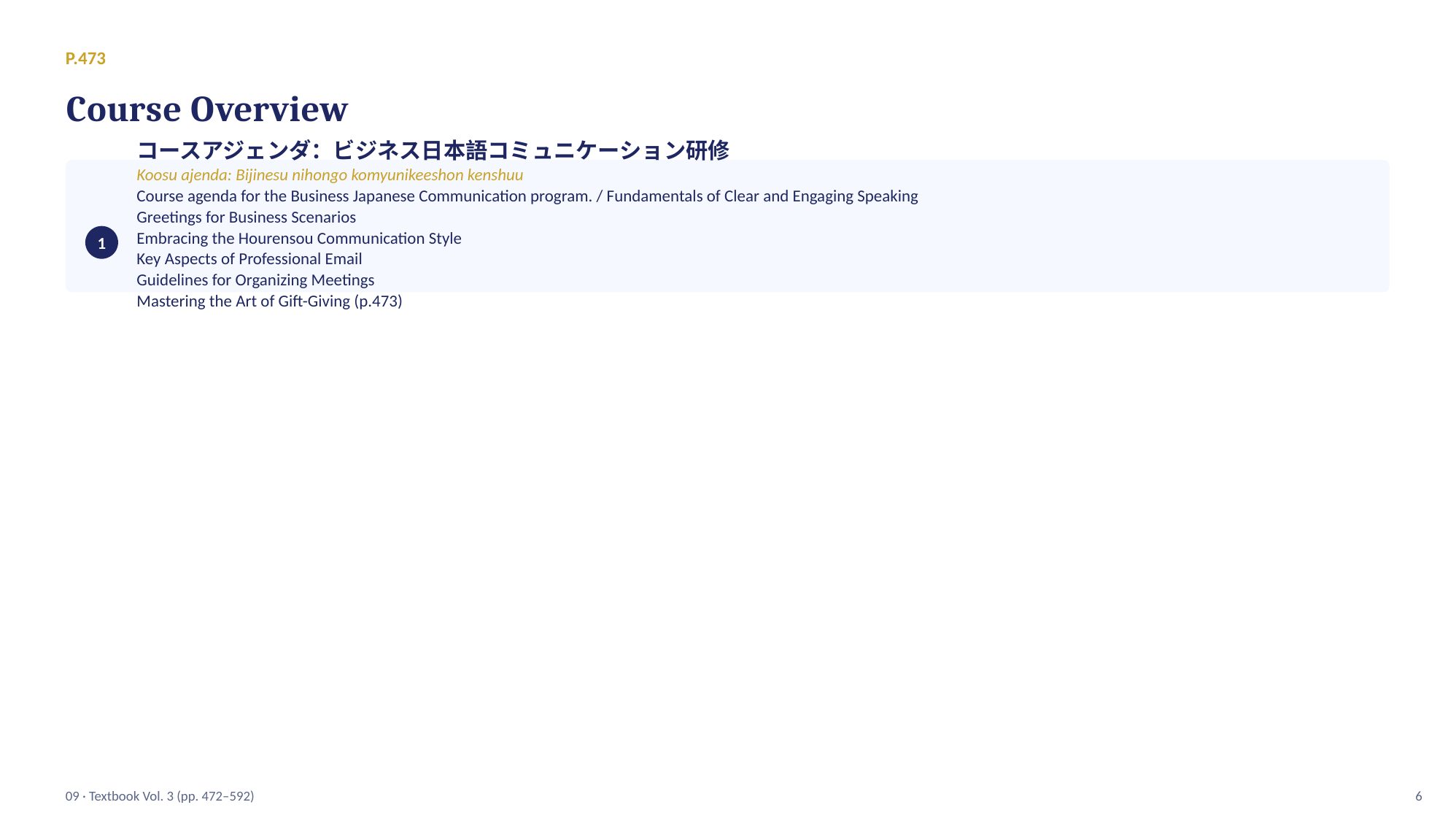
JPコースアジェンダ:ビジネス日本語コミュニケーション研修
EN Koosu ajenda: Bijinesu nihongo komyunikeeshon kenshuu
Course agenda for the Business Japanese Communication program. / Fundamentals of Clear and Engaging Speaking
Greetings for Business Scenarios
1 Embracing the Hourensou Communication Style
Key Aspects of Professional Email
Guidelines for Organizing Meetings
Mastering the Art of Gift-Giving (p.473)
09 · Textbook Vol. 3 (pp. 472–592) 6
Course agenda for the Business Japanese Communication program. / Fundamentals of Clear and Engaging Speaking
Greetings for Business Scenarios
1 Embracing the Hourensou Communication Style
Key Aspects of Professional Email
Guidelines for Organizing Meetings
Mastering the Art of Gift-Giving (p.473)
09 · Textbook Vol. 3 (pp. 472–592) 6
หน้า 7

คลิกเพื่อขยาย
02
ENMeaningful Meetings
7 phrases · pages 475–484
7 phrases · pages 475–484
หน้า 8
คลิกเพื่อขยาย
ENP.475–P.477
Meaningful Meetings (1/3)
Meaningful Meetings (1/3)
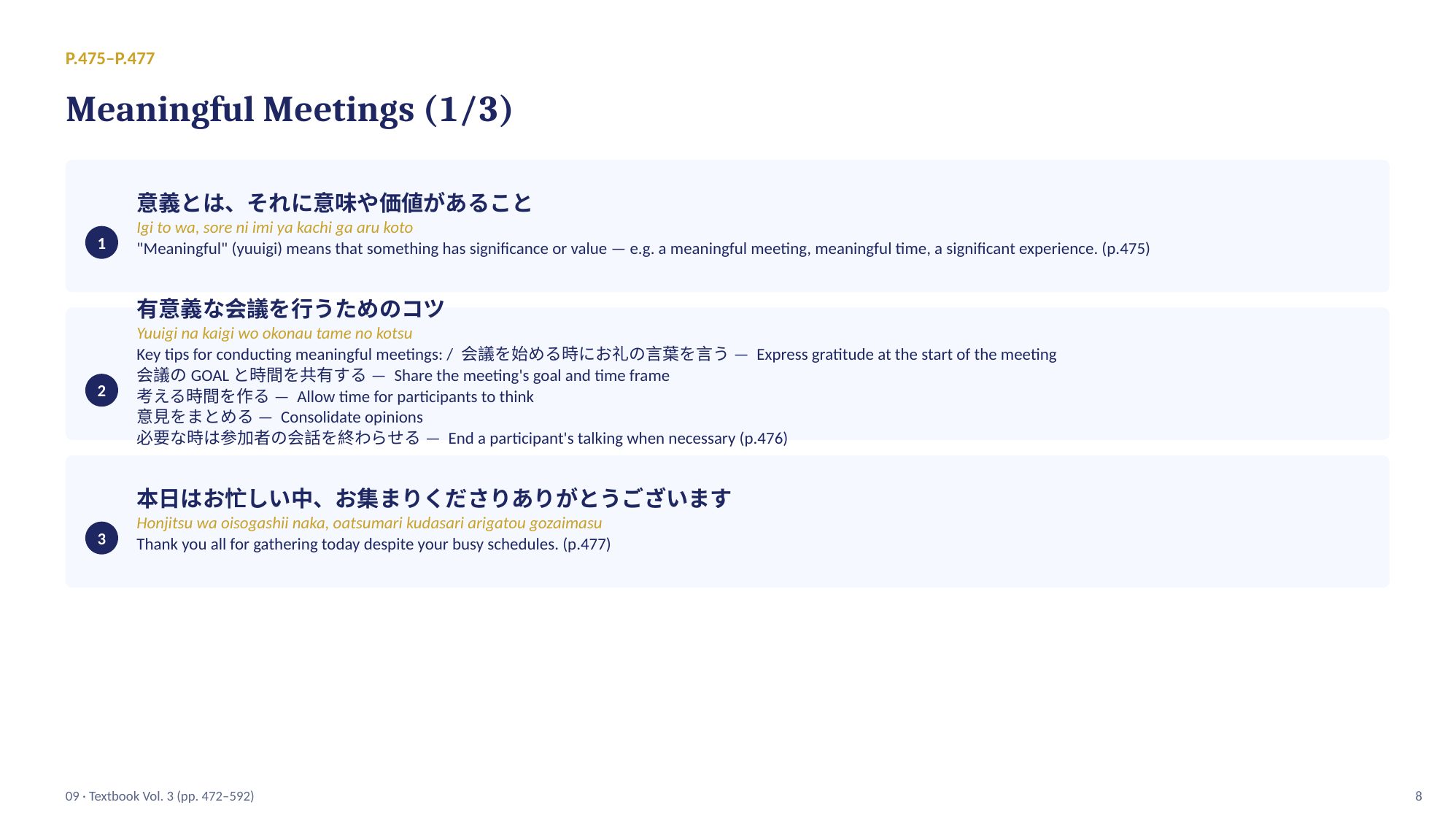
JP意義とは、それに意味や価値があること
EN Igi to wa, sore ni imi ya kachi ga aru koto
1 "Meaningful" (yuuigi) means that something has significance or value — e.g. a meaningful meeting, meaningful time, a significant experience. (p.475)
1 "Meaningful" (yuuigi) means that something has significance or value — e.g. a meaningful meeting, meaningful time, a significant experience. (p.475)
JP有意義な会議を行うためのコツ
EN Yuuigi na kaigi wo okonau tame no kotsu
Key tips for conducting meaningful meetings: / 会議を始める時にお礼の言葉を言う — Express gratitude at the start of the meeting
会議の GOAL と時間を共有する — Share the meeting's goal and time frame
2 考える時間を作る — Allow time for participants to think
意見をまとめる — Consolidate opinions
必要な時は参加者の会話を終わらせる — End a participant's talking when necessary (p.476)
Key tips for conducting meaningful meetings: / 会議を始める時にお礼の言葉を言う — Express gratitude at the start of the meeting
会議の GOAL と時間を共有する — Share the meeting's goal and time frame
2 考える時間を作る — Allow time for participants to think
意見をまとめる — Consolidate opinions
必要な時は参加者の会話を終わらせる — End a participant's talking when necessary (p.476)
JP本日はお忙しい中、お集まりくださりありがとうございます
EN Honjitsu wa oisogashii naka, oatsumari kudasari arigatou gozaimasu
3 Thank you all for gathering today despite your busy schedules. (p.477)
09 · Textbook Vol. 3 (pp. 472–592) 8
3 Thank you all for gathering today despite your busy schedules. (p.477)
09 · Textbook Vol. 3 (pp. 472–592) 8
หน้า 9
คลิกเพื่อขยาย
ENP.479–P.483
Meaningful Meetings (2/3)
Meaningful Meetings (2/3)
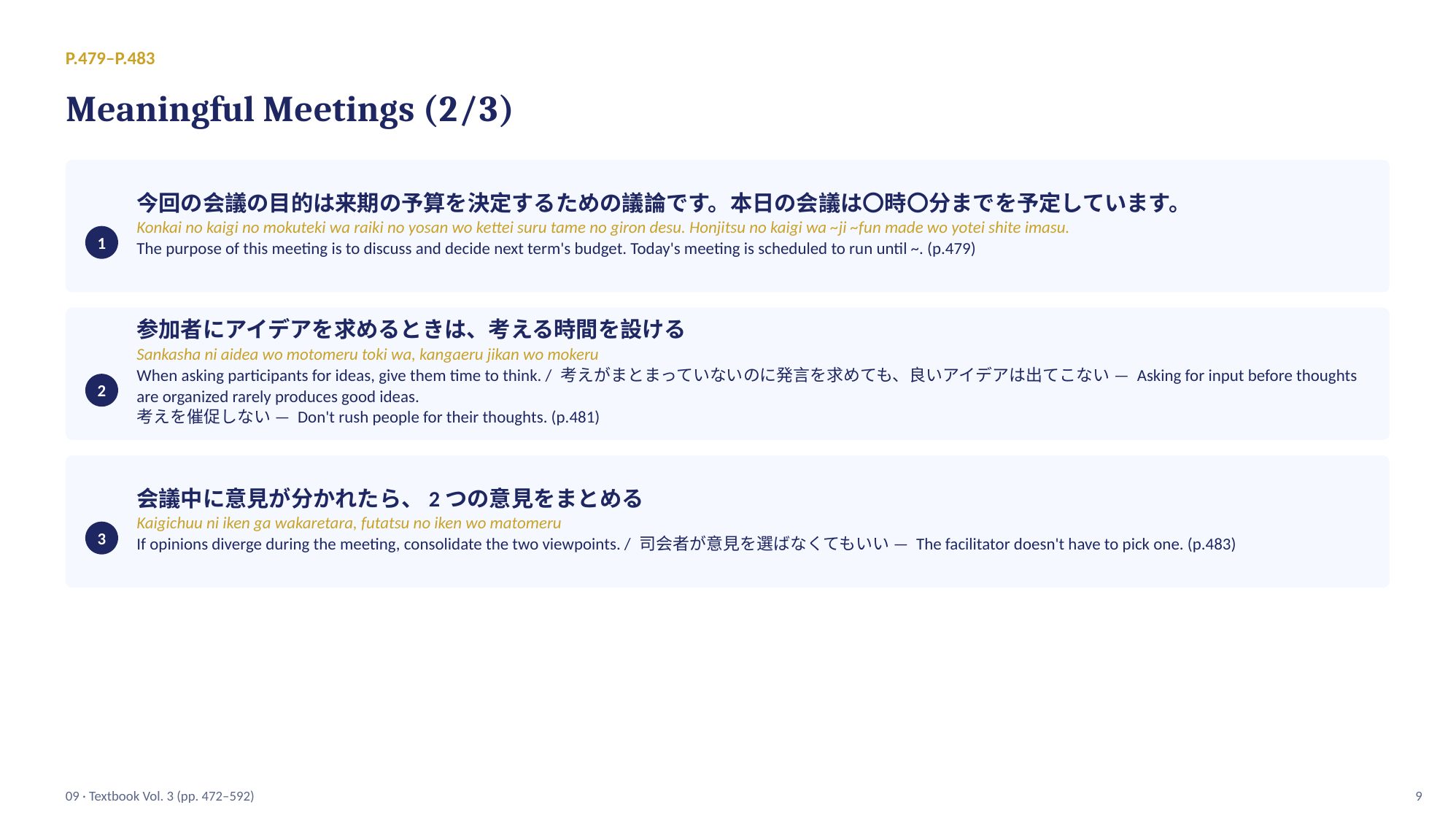
JP今回の会議の目的は来期の予算を決定するための議論です。本日の会議は〇時〇分までを予定しています。
EN Konkai no kaigi no mokuteki wa raiki no yosan wo kettei suru tame no giron desu. Honjitsu no kaigi wa ~ji ~fun made wo yotei shite imasu.
1 The purpose of this meeting is to discuss and decide next term's budget. Today's meeting is scheduled to run until ~. (p.479)
1 The purpose of this meeting is to discuss and decide next term's budget. Today's meeting is scheduled to run until ~. (p.479)
JP参加者にアイデアを求めるときは、考える時間を設ける
EN Sankasha ni aidea wo motomeru toki wa, kangaeru jikan wo mokeru
When asking participants for ideas, give them time to think. / 考えがまとまっていないのに発言を求めても、良いアイデアは出てこない — Asking for input before thoughts
2 are organized rarely produces good ideas.
考えを催促しない — Don't rush people for their thoughts. (p.481)
When asking participants for ideas, give them time to think. / 考えがまとまっていないのに発言を求めても、良いアイデアは出てこない — Asking for input before thoughts
2 are organized rarely produces good ideas.
考えを催促しない — Don't rush people for their thoughts. (p.481)
JP会議中に意見が分かれたら、2つの意見をまとめる
EN Kaigichuu ni iken ga wakaretara, futatsu no iken wo matomeru
3 If opinions diverge during the meeting, consolidate the two viewpoints. / 司会者が意見を選ばなくてもいい — The facilitator doesn't have to pick one. (p.483)
09 · Textbook Vol. 3 (pp. 472–592) 9
3 If opinions diverge during the meeting, consolidate the two viewpoints. / 司会者が意見を選ばなくてもいい — The facilitator doesn't have to pick one. (p.483)
09 · Textbook Vol. 3 (pp. 472–592) 9
หน้า 10
คลิกเพื่อขยาย
ENP.484
Meaningful Meetings (3/3)
Meaningful Meetings (3/3)
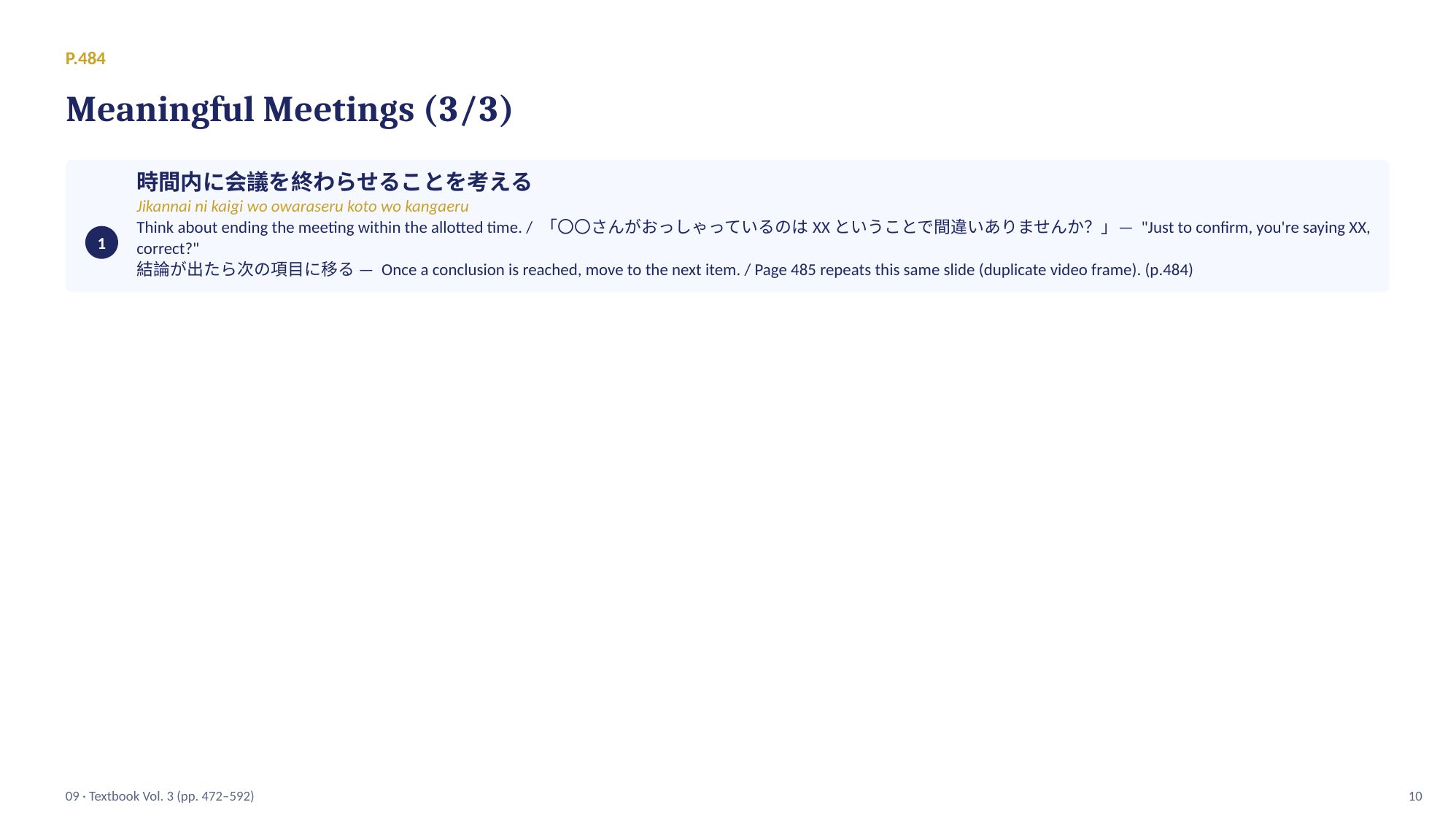
JP時間内に会議を終わらせることを考える
EN Jikannai ni kaigi wo owaraseru koto wo kangaeru
Think about ending the meeting within the allotted time. / 「〇〇さんがおっしゃっているのは XX ということで間違いありませんか?」— "Just to confirm, you're saying XX,
1 correct?"
結論が出たら次の項目に移る — Once a conclusion is reached, move to the next item. / Page 485 repeats this same slide (duplicate video frame). (p.484)
09 · Textbook Vol. 3 (pp. 472–592) 10
Think about ending the meeting within the allotted time. / 「〇〇さんがおっしゃっているのは XX ということで間違いありませんか?」— "Just to confirm, you're saying XX,
1 correct?"
結論が出たら次の項目に移る — Once a conclusion is reached, move to the next item. / Page 485 repeats this same slide (duplicate video frame). (p.484)
09 · Textbook Vol. 3 (pp. 472–592) 10
หน้า 11
คลิกเพื่อขยาย
03
ENPreparing & Organizing Meetings
4 phrases · pages 487–491
4 phrases · pages 487–491
หน้า 12
คลิกเพื่อขยาย
ENP.487–P.490
Preparing & Organizing Meetings (1/2)
Preparing & Organizing Meetings (1/2)
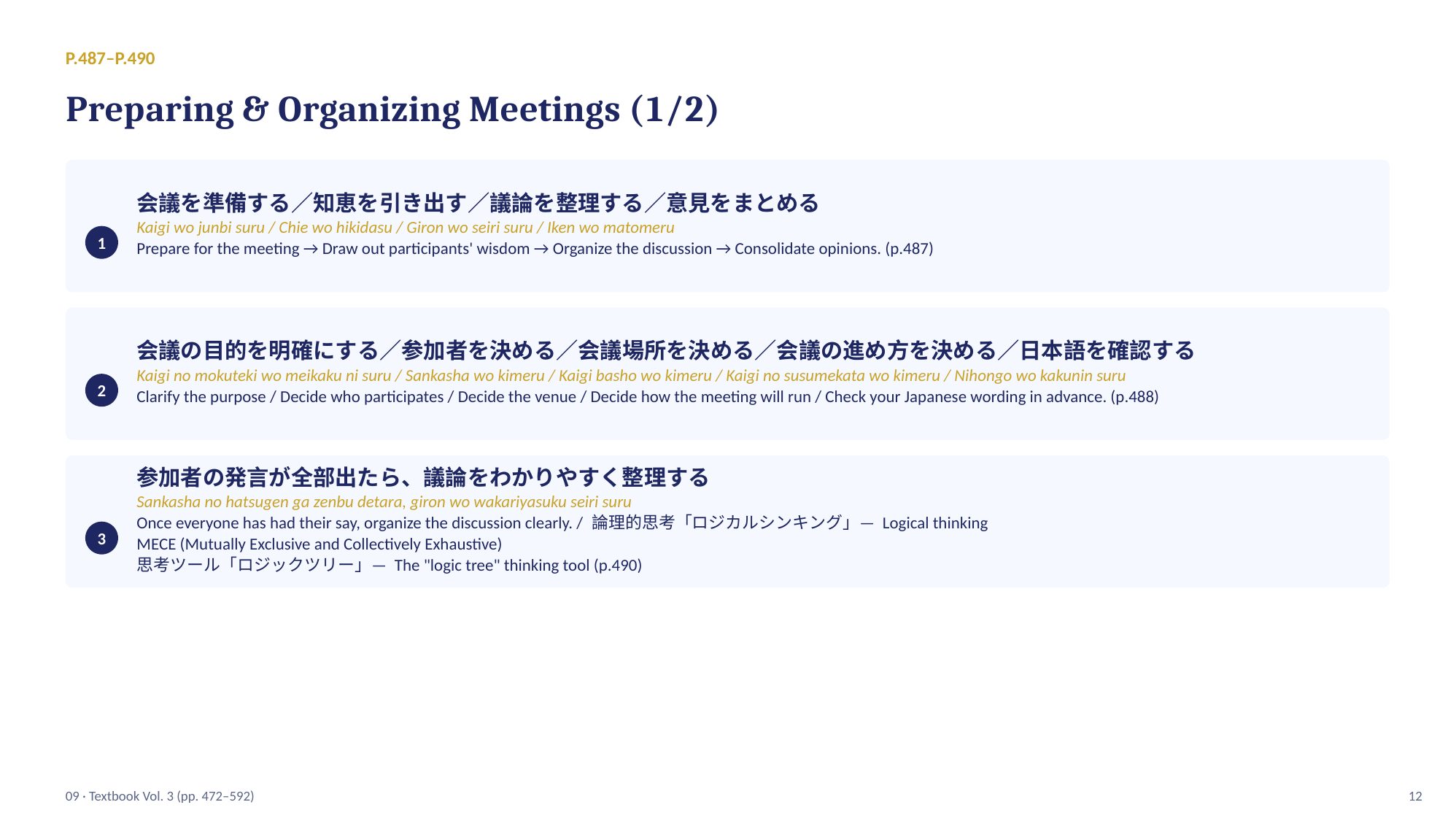
JP会議を準備する/知恵を引き出す/議論を整理する/意見をまとめる
EN Kaigi wo junbi suru / Chie wo hikidasu / Giron wo seiri suru / Iken wo matomeru
1 Prepare for the meeting → Draw out participants' wisdom → Organize the discussion → Consolidate opinions. (p.487)
1 Prepare for the meeting → Draw out participants' wisdom → Organize the discussion → Consolidate opinions. (p.487)
JP会議の目的を明確にする/参加者を決める/会議場所を決める/会議の進め方を決める/日本語を確認する
EN Kaigi no mokuteki wo meikaku ni suru / Sankasha wo kimeru / Kaigi basho wo kimeru / Kaigi no susumekata wo kimeru / Nihongo wo kakunin suru
2 Clarify the purpose / Decide who participates / Decide the venue / Decide how the meeting will run / Check your Japanese wording in advance. (p.488)
2 Clarify the purpose / Decide who participates / Decide the venue / Decide how the meeting will run / Check your Japanese wording in advance. (p.488)
JP参加者の発言が全部出たら、議論をわかりやすく整理する
EN Sankasha no hatsugen ga zenbu detara, giron wo wakariyasuku seiri suru
Once everyone has had their say, organize the discussion clearly. / 論理的思考「ロジカルシンキング」— Logical thinking
3 MECE (Mutually Exclusive and Collectively Exhaustive)
思考ツール「ロジックツリー」— The "logic tree" thinking tool (p.490)
09 · Textbook Vol. 3 (pp. 472–592) 12
Once everyone has had their say, organize the discussion clearly. / 論理的思考「ロジカルシンキング」— Logical thinking
3 MECE (Mutually Exclusive and Collectively Exhaustive)
思考ツール「ロジックツリー」— The "logic tree" thinking tool (p.490)
09 · Textbook Vol. 3 (pp. 472–592) 12
หน้า 13
คลิกเพื่อขยาย
ENP.491
Preparing & Organizing Meetings (2/2)
Preparing & Organizing Meetings (2/2)
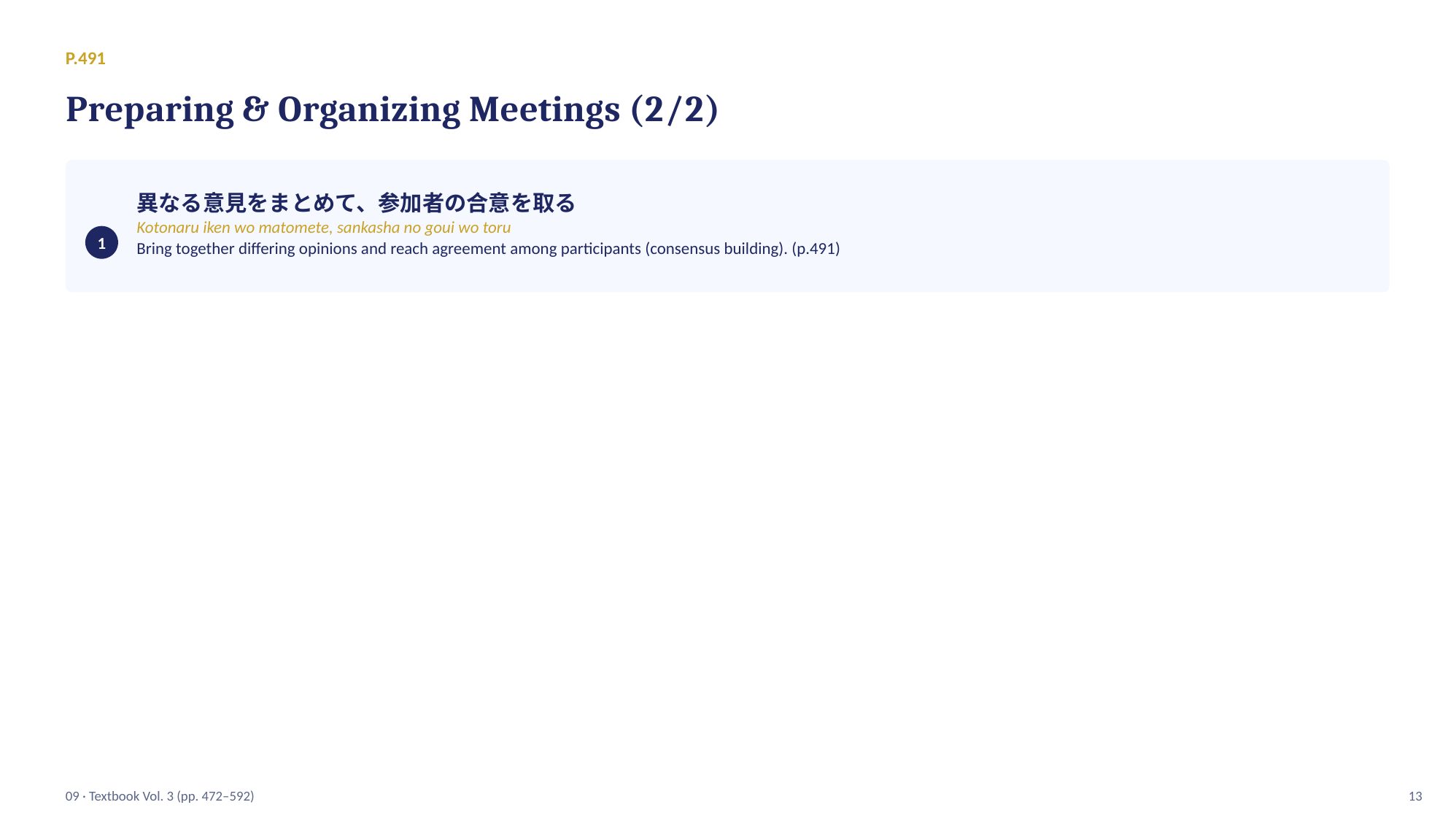
JP異なる意見をまとめて、参加者の合意を取る
EN Kotonaru iken wo matomete, sankasha no goui wo toru
1 Bring together differing opinions and reach agreement among participants (consensus building). (p.491)
09 · Textbook Vol. 3 (pp. 472–592) 13
1 Bring together differing opinions and reach agreement among participants (consensus building). (p.491)
09 · Textbook Vol. 3 (pp. 472–592) 13
หน้า 14

คลิกเพื่อขยาย
04
ENFacilitation Script
8 phrases · pages 492–500
8 phrases · pages 492–500
หน้า 15
คลิกเพื่อขยาย
ENP.492–P.494
Facilitation Script (1/3)
Facilitation Script (1/3)
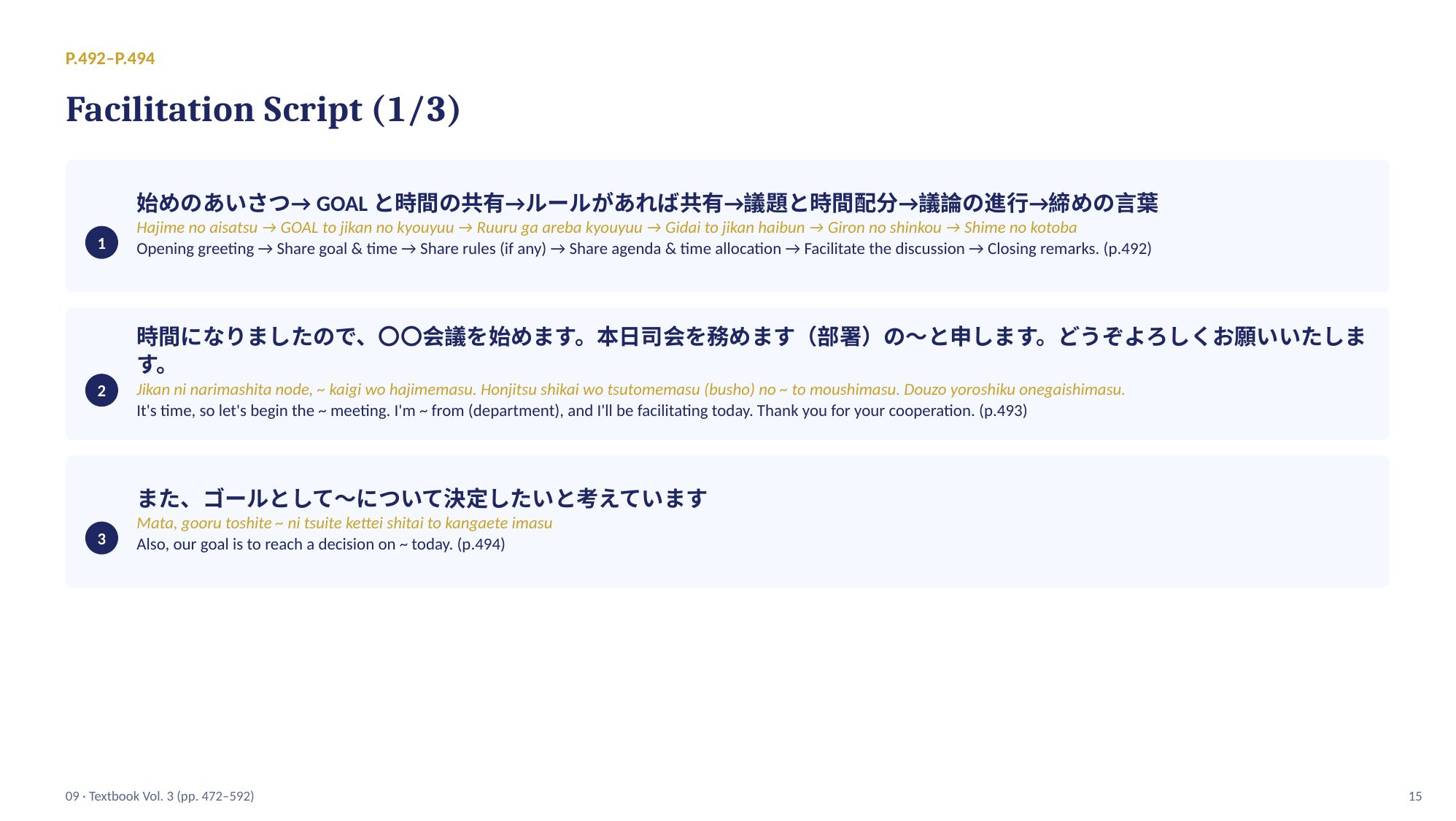
JP始めのあいさつ→GOALと時間の共有→ルールがあれば共有→議題と時間配分→議論の進行→締めの言葉
EN Hajime no aisatsu → GOAL to jikan no kyouyuu → Ruuru ga areba kyouyuu → Gidai to jikan haibun → Giron no shinkou → Shime no kotoba
1 Opening greeting → Share goal & time → Share rules (if any) → Share agenda & time allocation → Facilitate the discussion → Closing remarks. (p.492)
1 Opening greeting → Share goal & time → Share rules (if any) → Share agenda & time allocation → Facilitate the discussion → Closing remarks. (p.492)
JP時間になりましたので、〇〇会議を始めます。本日司会を務めます(部署)の〜と申します。どうぞよろしくお願いいたしま
す。
す。
EN 2 Jikan ni narimashita node, ~ kaigi wo hajimemasu. Honjitsu shikai wo tsutomemasu (busho) no ~ to moushimasu. Douzo yoroshiku onegaishimasu.
It's time, so let's begin the ~ meeting. I'm ~ from (department), and I'll be facilitating today. Thank you for your cooperation. (p.493)
It's time, so let's begin the ~ meeting. I'm ~ from (department), and I'll be facilitating today. Thank you for your cooperation. (p.493)
JPまた、ゴールとして〜について決定したいと考えています
EN Mata, gooru toshite ~ ni tsuite kettei shitai to kangaete imasu
3 Also, our goal is to reach a decision on ~ today. (p.494)
09 · Textbook Vol. 3 (pp. 472–592) 15
3 Also, our goal is to reach a decision on ~ today. (p.494)
09 · Textbook Vol. 3 (pp. 472–592) 15
หน้า 16
คลิกเพื่อขยาย
ENP.495–P.498
Facilitation Script (2/3)
Facilitation Script (2/3)
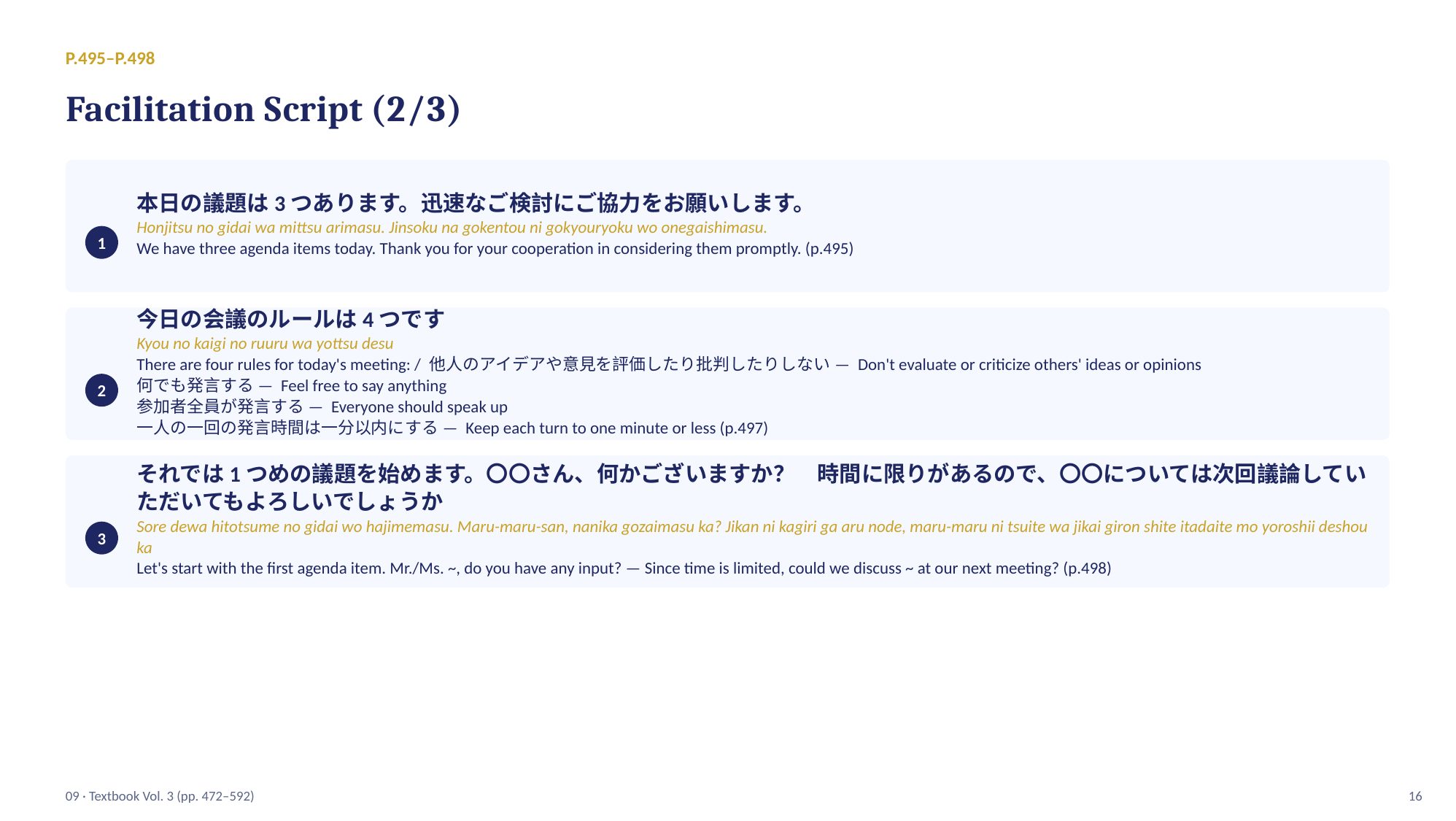
JP本日の議題は3つあります。迅速なご検討にご協力をお願いします。
EN Honjitsu no gidai wa mittsu arimasu. Jinsoku na gokentou ni gokyouryoku wo onegaishimasu.
1 We have three agenda items today. Thank you for your cooperation in considering them promptly. (p.495)
1 We have three agenda items today. Thank you for your cooperation in considering them promptly. (p.495)
JP今日の会議のルールは4つです
EN Kyou no kaigi no ruuru wa yottsu desu
There are four rules for today's meeting: / 他人のアイデアや意見を評価したり批判したりしない — Don't evaluate or criticize others' ideas or opinions
2 何でも発言する — Feel free to say anything
参加者全員が発言する — Everyone should speak up
一人の一回の発言時間は一分以内にする — Keep each turn to one minute or less (p.497)
There are four rules for today's meeting: / 他人のアイデアや意見を評価したり批判したりしない — Don't evaluate or criticize others' ideas or opinions
2 何でも発言する — Feel free to say anything
参加者全員が発言する — Everyone should speak up
一人の一回の発言時間は一分以内にする — Keep each turn to one minute or less (p.497)
JPそれでは1つめの議題を始めます。〇〇さん、何かございますか?時間に限りがあるので、〇〇については次回議論してい
ただいてもよろしいでしょうか
ただいてもよろしいでしょうか
EN Sore dewa hitotsume no gidai wo hajimemasu. Maru-maru-san, nanika gozaimasu ka? Jikan ni kagiri ga aru node, maru-maru ni tsuite wa jikai giron shite itadaite mo yoroshii deshou
3
ka
Let's start with the first agenda item. Mr./Ms. ~, do you have any input? — Since time is limited, could we discuss ~ at our next meeting? (p.498)
09 · Textbook Vol. 3 (pp. 472–592) 16
3
ka
Let's start with the first agenda item. Mr./Ms. ~, do you have any input? — Since time is limited, could we discuss ~ at our next meeting? (p.498)
09 · Textbook Vol. 3 (pp. 472–592) 16
หน้า 17
คลิกเพื่อขยาย
ENP.499–P.500
Facilitation Script (3/3)
Facilitation Script (3/3)
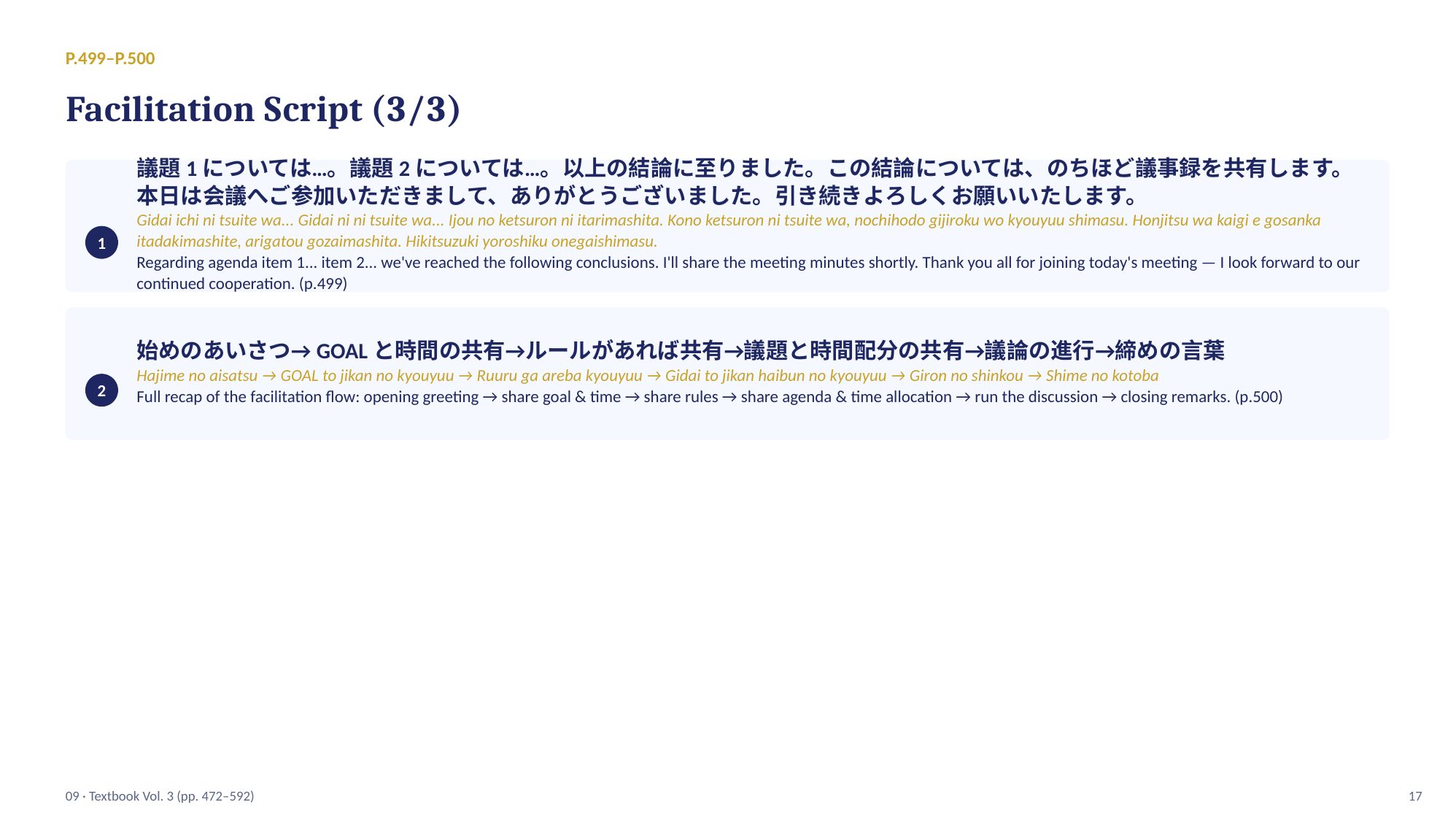
JP議題1については…。議題2については…。以上の結論に至りました。この結論については、のちほど議事録を共有します。
本日は会議へご参加いただきまして、ありがとうございました。引き続きよろしくお願いいたします。
本日は会議へご参加いただきまして、ありがとうございました。引き続きよろしくお願いいたします。
EN Gidai ichi ni tsuite wa... Gidai ni ni tsuite wa... Ijou no ketsuron ni itarimashita. Kono ketsuron ni tsuite wa, nochihodo gijiroku wo kyouyuu shimasu. Honjitsu wa kaigi e gosanka
1 itadakimashite, arigatou gozaimashita. Hikitsuzuki yoroshiku onegaishimasu.
Regarding agenda item 1... item 2... we've reached the following conclusions. I'll share the meeting minutes shortly. Thank you all for joining today's meeting — I look forward to our
continued cooperation. (p.499)
1 itadakimashite, arigatou gozaimashita. Hikitsuzuki yoroshiku onegaishimasu.
Regarding agenda item 1... item 2... we've reached the following conclusions. I'll share the meeting minutes shortly. Thank you all for joining today's meeting — I look forward to our
continued cooperation. (p.499)
JP始めのあいさつ→GOALと時間の共有→ルールがあれば共有→議題と時間配分の共有→議論の進行→締めの言葉
EN Hajime no aisatsu → GOAL to jikan no kyouyuu → Ruuru ga areba kyouyuu → Gidai to jikan haibun no kyouyuu → Giron no shinkou → Shime no kotoba
2 Full recap of the facilitation flow: opening greeting → share goal & time → share rules → share agenda & time allocation → run the discussion → closing remarks. (p.500)
09 · Textbook Vol. 3 (pp. 472–592) 17
2 Full recap of the facilitation flow: opening greeting → share goal & time → share rules → share agenda & time allocation → run the discussion → closing remarks. (p.500)
09 · Textbook Vol. 3 (pp. 472–592) 17
หน้า 18

คลิกเพื่อขยาย
05
ENBusiness Entertainment
JP接待
EN3 phrases · pages 502–504
หน้า 19
คลิกเพื่อขยาย
ENP.502–P.504
Business Entertainment
Business Entertainment
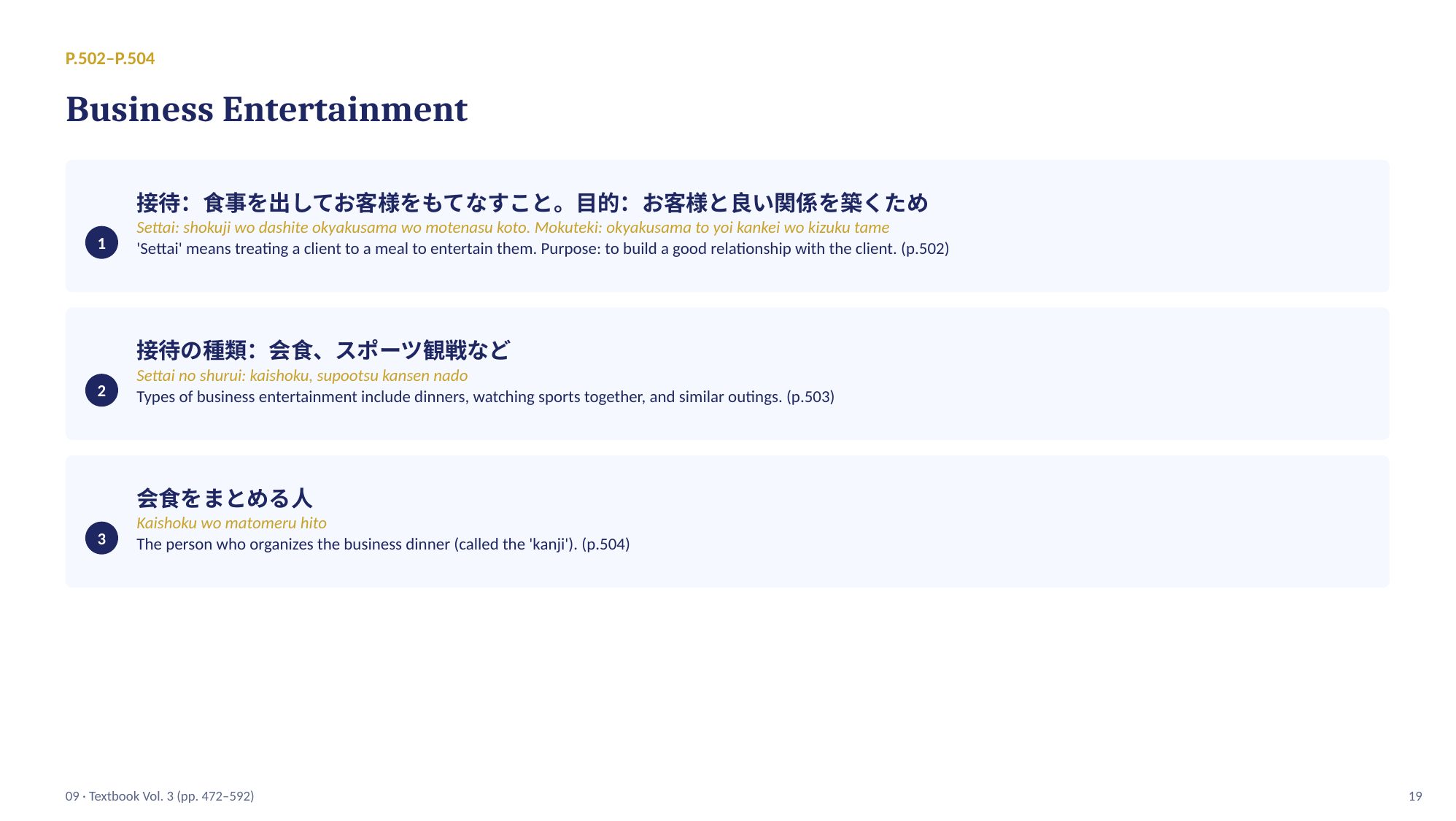
JP接待:食事を出してお客様をもてなすこと。目的:お客様と良い関係を築くため
EN Settai: shokuji wo dashite okyakusama wo motenasu koto. Mokuteki: okyakusama to yoi kankei wo kizuku tame
1 'Settai' means treating a client to a meal to entertain them. Purpose: to build a good relationship with the client. (p.502)
1 'Settai' means treating a client to a meal to entertain them. Purpose: to build a good relationship with the client. (p.502)
JP接待の種類:会食、スポーツ観戦など
EN Settai no shurui: kaishoku, supootsu kansen nado
2 Types of business entertainment include dinners, watching sports together, and similar outings. (p.503)
2 Types of business entertainment include dinners, watching sports together, and similar outings. (p.503)
JP会食をまとめる人
EN Kaishoku wo matomeru hito
3 The person who organizes the business dinner (called the 'kanji'). (p.504)
09 · Textbook Vol. 3 (pp. 472–592) 19
3 The person who organizes the business dinner (called the 'kanji'). (p.504)
09 · Textbook Vol. 3 (pp. 472–592) 19
หน้า 20
คลิกเพื่อขยาย
06
ENOrganizing a Dinner: Planning
12 phrases · pages 506–518
12 phrases · pages 506–518
หน้า 21
คลิกเพื่อขยาย
ENP.506–P.508
Organizing a Dinner: Planning (1/4)
Organizing a Dinner: Planning (1/4)
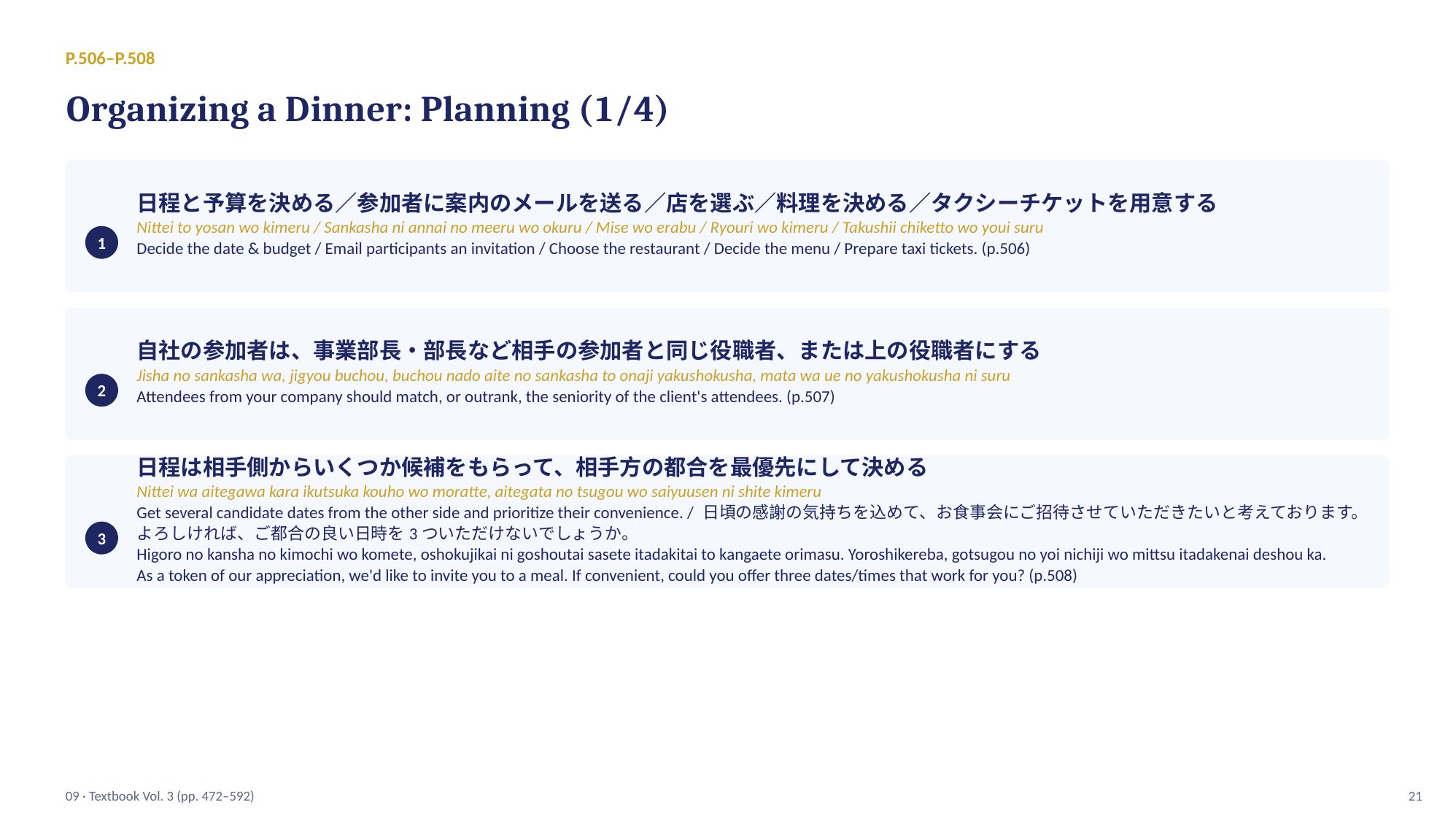
JP日程と予算を決める/参加者に案内のメールを送る/店を選ぶ/料理を決める/タクシーチケットを用意する
EN Nittei to yosan wo kimeru / Sankasha ni annai no meeru wo okuru / Mise wo erabu / Ryouri wo kimeru / Takushii chiketto wo youi suru
1 Decide the date & budget / Email participants an invitation / Choose the restaurant / Decide the menu / Prepare taxi tickets. (p.506)
1 Decide the date & budget / Email participants an invitation / Choose the restaurant / Decide the menu / Prepare taxi tickets. (p.506)
JP自社の参加者は、事業部長・部長など相手の参加者と同じ役職者、または上の役職者にする
EN Jisha no sankasha wa, jigyou buchou, buchou nado aite no sankasha to onaji yakushokusha, mata wa ue no yakushokusha ni suru
2 Attendees from your company should match, or outrank, the seniority of the client's attendees. (p.507)
2 Attendees from your company should match, or outrank, the seniority of the client's attendees. (p.507)
JP日程は相手側からいくつか候補をもらって、相手方の都合を最優先にして決める
EN Nittei wa aitegawa kara ikutsuka kouho wo moratte, aitegata no tsugou wo saiyuusen ni shite kimeru
Get several candidate dates from the other side and prioritize their convenience. / 日頃の感謝の気持ちを込めて、お食事会にご招待させていただきたいと考えております。
Get several candidate dates from the other side and prioritize their convenience. / 日頃の感謝の気持ちを込めて、お食事会にご招待させていただきたいと考えております。
JP3よろしければ、ご都合の良い日時を3ついただけないでしょうか。
EN Higoro no kansha no kimochi wo komete, oshokujikai ni goshoutai sasete itadakitai to kangaete orimasu. Yoroshikereba, gotsugou no yoi nichiji wo mittsu itadakenai deshou ka.
As a token of our appreciation, we'd like to invite you to a meal. If convenient, could you offer three dates/times that work for you? (p.508)
09 · Textbook Vol. 3 (pp. 472–592) 21
As a token of our appreciation, we'd like to invite you to a meal. If convenient, could you offer three dates/times that work for you? (p.508)
09 · Textbook Vol. 3 (pp. 472–592) 21
หน้า 22
คลิกเพื่อขยาย
ENP.509–P.511
Organizing a Dinner: Planning (2/4)
Organizing a Dinner: Planning (2/4)
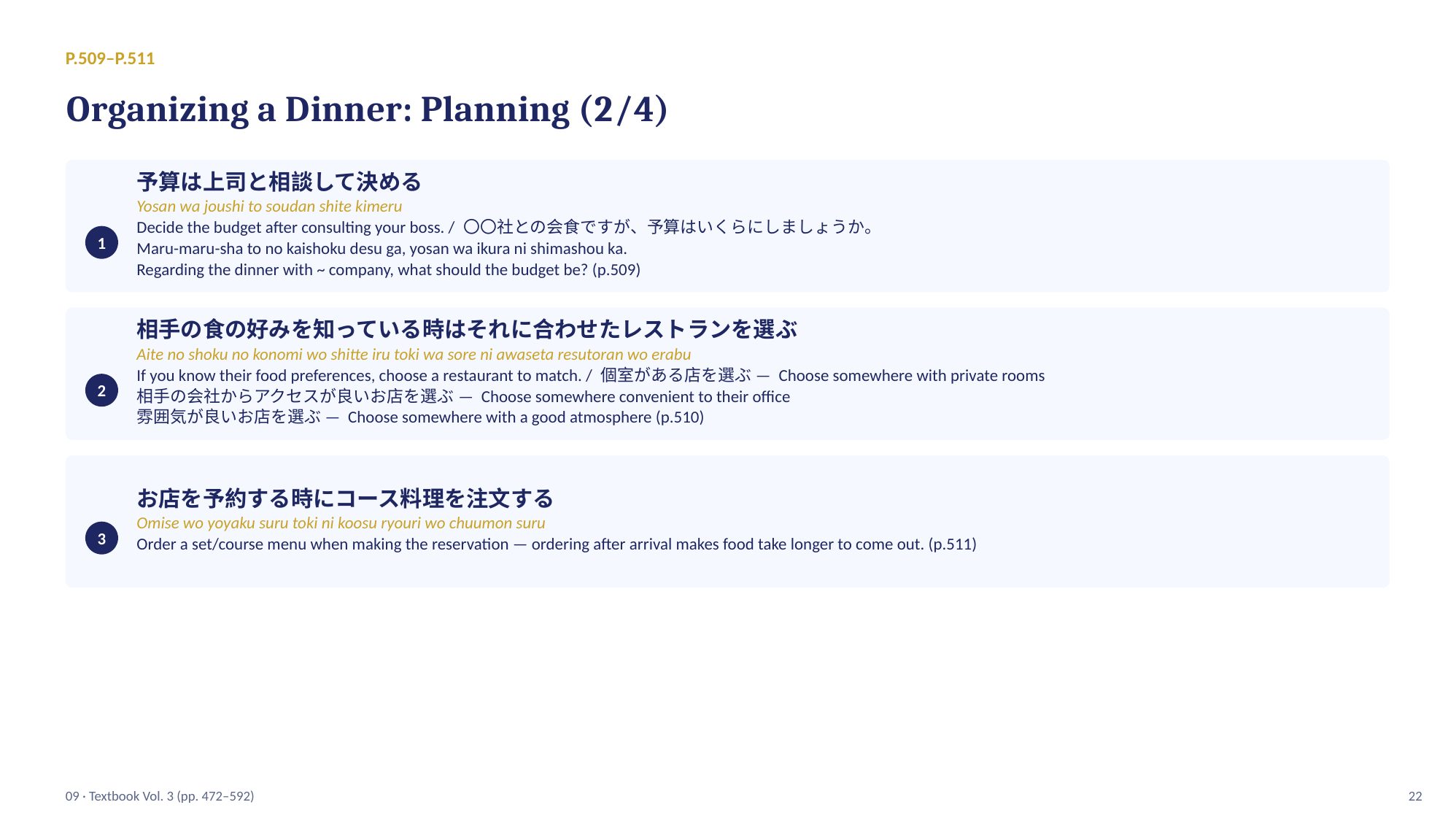
JP予算は上司と相談して決める
EN Yosan wa joushi to soudan shite kimeru
Decide the budget after consulting your boss. / 〇〇社との会食ですが、予算はいくらにしましょうか。
1 Maru-maru-sha to no kaishoku desu ga, yosan wa ikura ni shimashou ka.
Regarding the dinner with ~ company, what should the budget be? (p.509)
Decide the budget after consulting your boss. / 〇〇社との会食ですが、予算はいくらにしましょうか。
1 Maru-maru-sha to no kaishoku desu ga, yosan wa ikura ni shimashou ka.
Regarding the dinner with ~ company, what should the budget be? (p.509)
JP相手の食の好みを知っている時はそれに合わせたレストランを選ぶ
EN Aite no shoku no konomi wo shitte iru toki wa sore ni awaseta resutoran wo erabu
If you know their food preferences, choose a restaurant to match. / 個室がある店を選ぶ — Choose somewhere with private rooms
2 相手の会社からアクセスが良いお店を選ぶ — Choose somewhere convenient to their office
雰囲気が良いお店を選ぶ — Choose somewhere with a good atmosphere (p.510)
If you know their food preferences, choose a restaurant to match. / 個室がある店を選ぶ — Choose somewhere with private rooms
2 相手の会社からアクセスが良いお店を選ぶ — Choose somewhere convenient to their office
雰囲気が良いお店を選ぶ — Choose somewhere with a good atmosphere (p.510)
JPお店を予約する時にコース料理を注文する
EN Omise wo yoyaku suru toki ni koosu ryouri wo chuumon suru
3 Order a set/course menu when making the reservation — ordering after arrival makes food take longer to come out. (p.511)
09 · Textbook Vol. 3 (pp. 472–592) 22
3 Order a set/course menu when making the reservation — ordering after arrival makes food take longer to come out. (p.511)
09 · Textbook Vol. 3 (pp. 472–592) 22
หน้า 23
คลิกเพื่อขยาย
ENP.512–P.515
Organizing a Dinner: Planning (3/4)
Organizing a Dinner: Planning (3/4)
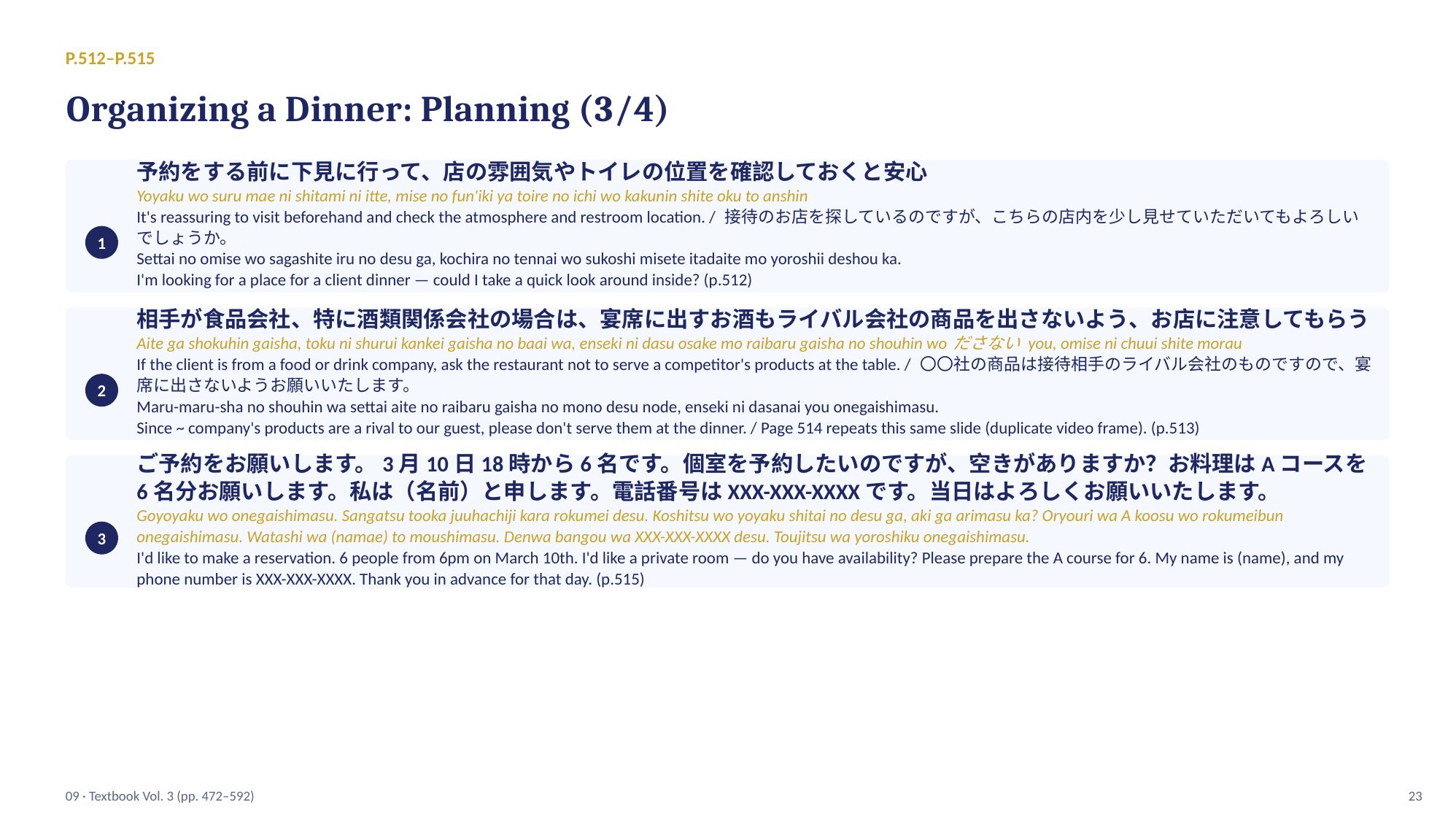
JP予約をする前に下見に行って、店の雰囲気やトイレの位置を確認しておくと安心
EN Yoyaku wo suru mae ni shitami ni itte, mise no fun'iki ya toire no ichi wo kakunin shite oku to anshin
It's reassuring to visit beforehand and check the atmosphere and restroom location. / 接待のお店を探しているのですが、こちらの店内を少し見せていただいてもよろしい
It's reassuring to visit beforehand and check the atmosphere and restroom location. / 接待のお店を探しているのですが、こちらの店内を少し見せていただいてもよろしい
JP1でしょうか。
EN Settai no omise wo sagashite iru no desu ga, kochira no tennai wo sukoshi misete itadaite mo yoroshii deshou ka.
I'm looking for a place for a client dinner — could I take a quick look around inside? (p.512)
I'm looking for a place for a client dinner — could I take a quick look around inside? (p.512)
JP相手が食品会社、特に酒類関係会社の場合は、宴席に出すお酒もライバル会社の商品を出さないよう、お店に注意してもらう
EN Aite ga shokuhin gaisha, toku ni shurui kankei gaisha no baai wa, enseki ni dasu osake mo raibaru gaisha no shouhin wo ださない you, omise ni chuui shite morau
If the client is from a food or drink company, ask the restaurant not to serve a competitor's products at the table. / 〇〇社の商品は接待相手のライバル会社のものですので、宴
If the client is from a food or drink company, ask the restaurant not to serve a competitor's products at the table. / 〇〇社の商品は接待相手のライバル会社のものですので、宴
JP2席に出さないようお願いいたします。
EN Maru-maru-sha no shouhin wa settai aite no raibaru gaisha no mono desu node, enseki ni dasanai you onegaishimasu.
Since ~ company's products are a rival to our guest, please don't serve them at the dinner. / Page 514 repeats this same slide (duplicate video frame). (p.513)
Since ~ company's products are a rival to our guest, please don't serve them at the dinner. / Page 514 repeats this same slide (duplicate video frame). (p.513)
JPご予約をお願いします。3月10日18時から6名です。個室を予約したいのですが、空きがありますか?お料理はAコースを
6名分お願いします。私は(名前)と申します。電話番号はXXX-XXX-XXXXです。当日はよろしくお願いいたします。
6名分お願いします。私は(名前)と申します。電話番号はXXX-XXX-XXXXです。当日はよろしくお願いいたします。
EN Goyoyaku wo onegaishimasu. Sangatsu tooka juuhachiji kara rokumei desu. Koshitsu wo yoyaku shitai no desu ga, aki ga arimasu ka? Oryouri wa A koosu wo rokumeibun
3 onegaishimasu. Watashi wa (namae) to moushimasu. Denwa bangou wa XXX-XXX-XXXX desu. Toujitsu wa yoroshiku onegaishimasu.
I'd like to make a reservation. 6 people from 6pm on March 10th. I'd like a private room — do you have availability? Please prepare the A course for 6. My name is (name), and my
phone number is XXX-XXX-XXXX. Thank you in advance for that day. (p.515)
09 · Textbook Vol. 3 (pp. 472–592) 23
3 onegaishimasu. Watashi wa (namae) to moushimasu. Denwa bangou wa XXX-XXX-XXXX desu. Toujitsu wa yoroshiku onegaishimasu.
I'd like to make a reservation. 6 people from 6pm on March 10th. I'd like a private room — do you have availability? Please prepare the A course for 6. My name is (name), and my
phone number is XXX-XXX-XXXX. Thank you in advance for that day. (p.515)
09 · Textbook Vol. 3 (pp. 472–592) 23
หน้า 24
คลิกเพื่อขยาย
ENP.516–P.518
Organizing a Dinner: Planning (4/4)
Organizing a Dinner: Planning (4/4)
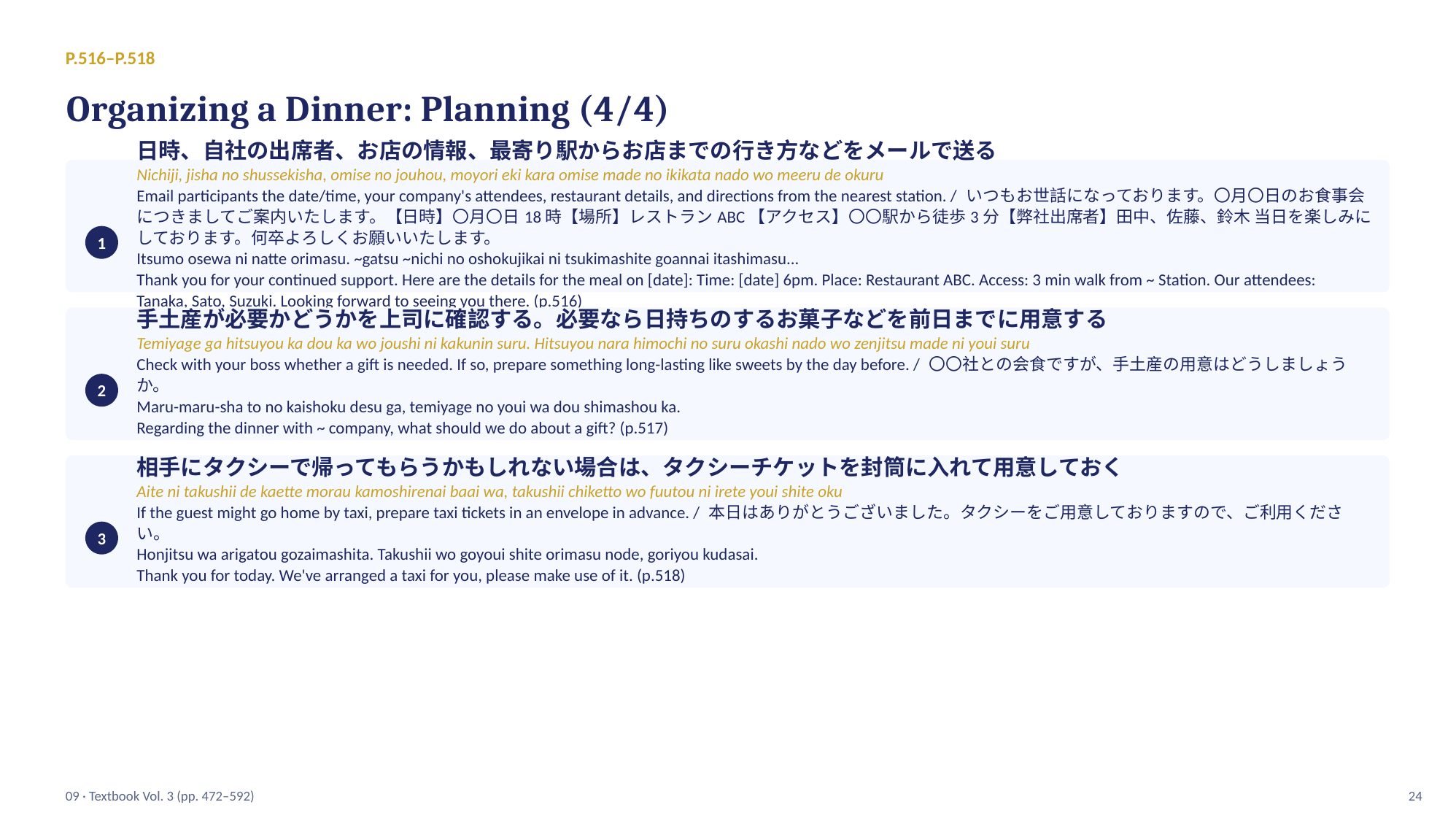
JP日時、自社の出席者、お店の情報、最寄り駅からお店までの行き方などをメールで送る
EN Nichiji, jisha no shussekisha, omise no jouhou, moyori eki kara omise made no ikikata nado wo meeru de okuru
Email participants the date/time, your company's attendees, restaurant details, and directions from the nearest station. / いつもお世話になっております。〇月〇日のお食事会
Email participants the date/time, your company's attendees, restaurant details, and directions from the nearest station. / いつもお世話になっております。〇月〇日のお食事会
JPにつきましてご案内いたします。【日時】〇月〇日18時【場所】レストランABC【アクセス】〇〇駅から徒歩3分【弊社出席者】田中、佐藤、鈴木当日を楽しみに
1しております。何卒よろしくお願いいたします。
1しております。何卒よろしくお願いいたします。
EN Itsumo osewa ni natte orimasu. ~gatsu ~nichi no oshokujikai ni tsukimashite goannai itashimasu...
Thank you for your continued support. Here are the details for the meal on [date]: Time: [date] 6pm. Place: Restaurant ABC. Access: 3 min walk from ~ Station. Our attendees:
Tanaka, Sato, Suzuki. Looking forward to seeing you there. (p.516)
Thank you for your continued support. Here are the details for the meal on [date]: Time: [date] 6pm. Place: Restaurant ABC. Access: 3 min walk from ~ Station. Our attendees:
Tanaka, Sato, Suzuki. Looking forward to seeing you there. (p.516)
JP手土産が必要かどうかを上司に確認する。必要なら日持ちのするお菓子などを前日までに用意する
EN Temiyage ga hitsuyou ka dou ka wo joushi ni kakunin suru. Hitsuyou nara himochi no suru okashi nado wo zenjitsu made ni youi suru
Check with your boss whether a gift is needed. If so, prepare something long-lasting like sweets by the day before. / 〇〇社との会食ですが、手土産の用意はどうしましょう
Check with your boss whether a gift is needed. If so, prepare something long-lasting like sweets by the day before. / 〇〇社との会食ですが、手土産の用意はどうしましょう
JP2か。
EN Maru-maru-sha to no kaishoku desu ga, temiyage no youi wa dou shimashou ka.
Regarding the dinner with ~ company, what should we do about a gift? (p.517)
Regarding the dinner with ~ company, what should we do about a gift? (p.517)
JP相手にタクシーで帰ってもらうかもしれない場合は、タクシーチケットを封筒に入れて用意しておく
EN Aite ni takushii de kaette morau kamoshirenai baai wa, takushii chiketto wo fuutou ni irete youi shite oku
If the guest might go home by taxi, prepare taxi tickets in an envelope in advance. / 本日はありがとうございました。タクシーをご用意しておりますので、ご利用くださ
If the guest might go home by taxi, prepare taxi tickets in an envelope in advance. / 本日はありがとうございました。タクシーをご用意しておりますので、ご利用くださ
JP3い。
EN Honjitsu wa arigatou gozaimashita. Takushii wo goyoui shite orimasu node, goriyou kudasai.
Thank you for today. We've arranged a taxi for you, please make use of it. (p.518)
09 · Textbook Vol. 3 (pp. 472–592) 24
Thank you for today. We've arranged a taxi for you, please make use of it. (p.518)
09 · Textbook Vol. 3 (pp. 472–592) 24
หน้า 25

คลิกเพื่อขยาย
07
ENOrganizing a Dinner: The Day Of
6 phrases · pages 519–525
6 phrases · pages 519–525
หน้า 26
คลิกเพื่อขยาย
ENP.519–P.522
Organizing a Dinner: The Day Of (1/2)
Organizing a Dinner: The Day Of (1/2)
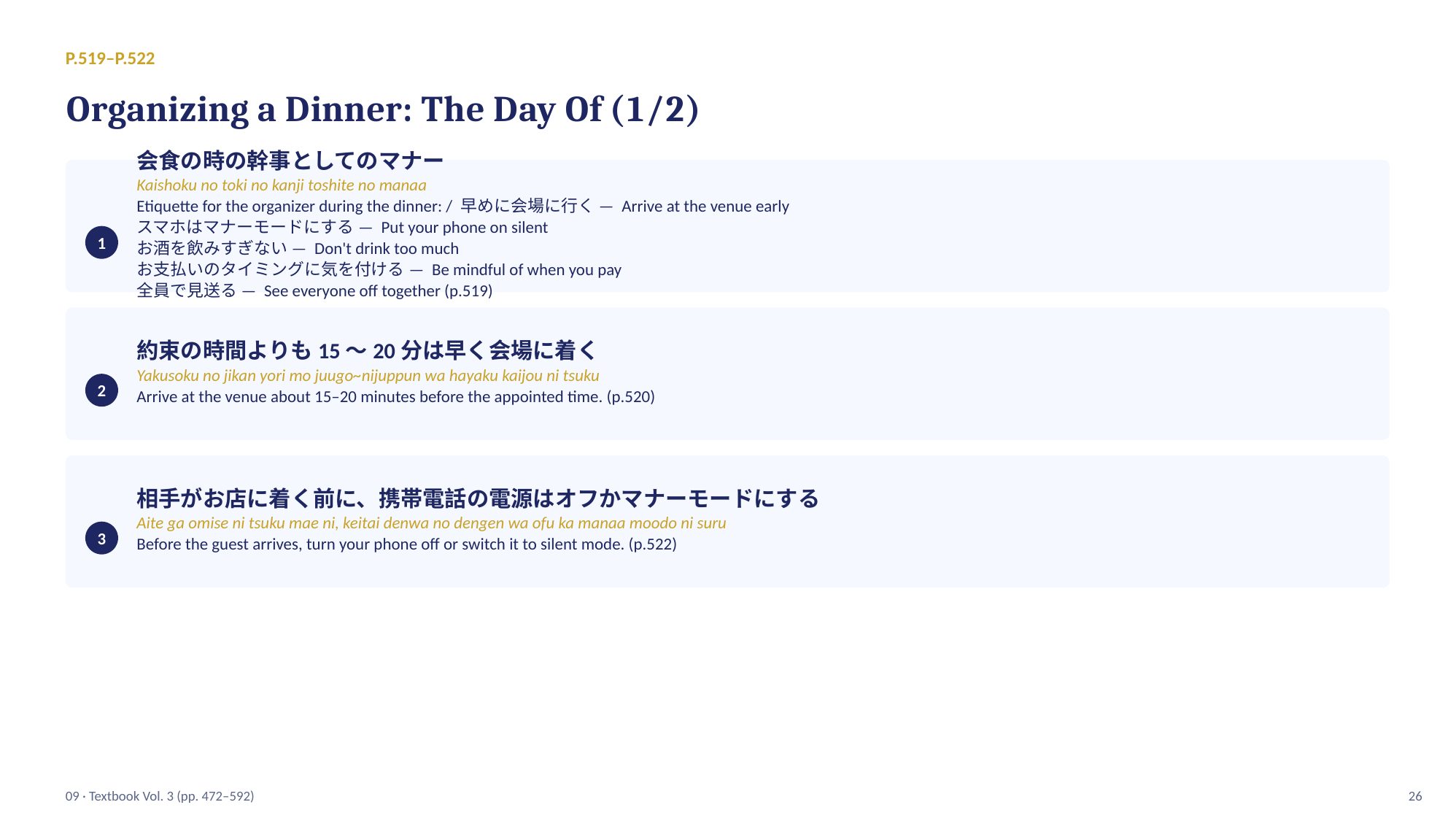
JP会食の時の幹事としてのマナー
EN Kaishoku no toki no kanji toshite no manaa
Etiquette for the organizer during the dinner: / 早めに会場に行く — Arrive at the venue early
スマホはマナーモードにする — Put your phone on silent
1 お酒を飲みすぎない — Don't drink too much
お支払いのタイミングに気を付ける — Be mindful of when you pay
全員で見送る — See everyone off together (p.519)
Etiquette for the organizer during the dinner: / 早めに会場に行く — Arrive at the venue early
スマホはマナーモードにする — Put your phone on silent
1 お酒を飲みすぎない — Don't drink too much
お支払いのタイミングに気を付ける — Be mindful of when you pay
全員で見送る — See everyone off together (p.519)
JP約束の時間よりも15〜20分は早く会場に着く
EN Yakusoku no jikan yori mo juugo~nijuppun wa hayaku kaijou ni tsuku
2 Arrive at the venue about 15–20 minutes before the appointed time. (p.520)
2 Arrive at the venue about 15–20 minutes before the appointed time. (p.520)
JP相手がお店に着く前に、携帯電話の電源はオフかマナーモードにする
EN Aite ga omise ni tsuku mae ni, keitai denwa no dengen wa ofu ka manaa moodo ni suru
3 Before the guest arrives, turn your phone off or switch it to silent mode. (p.522)
09 · Textbook Vol. 3 (pp. 472–592) 26
3 Before the guest arrives, turn your phone off or switch it to silent mode. (p.522)
09 · Textbook Vol. 3 (pp. 472–592) 26
หน้า 27
คลิกเพื่อขยาย
ENP.523–P.525
Organizing a Dinner: The Day Of (2/2)
Organizing a Dinner: The Day Of (2/2)
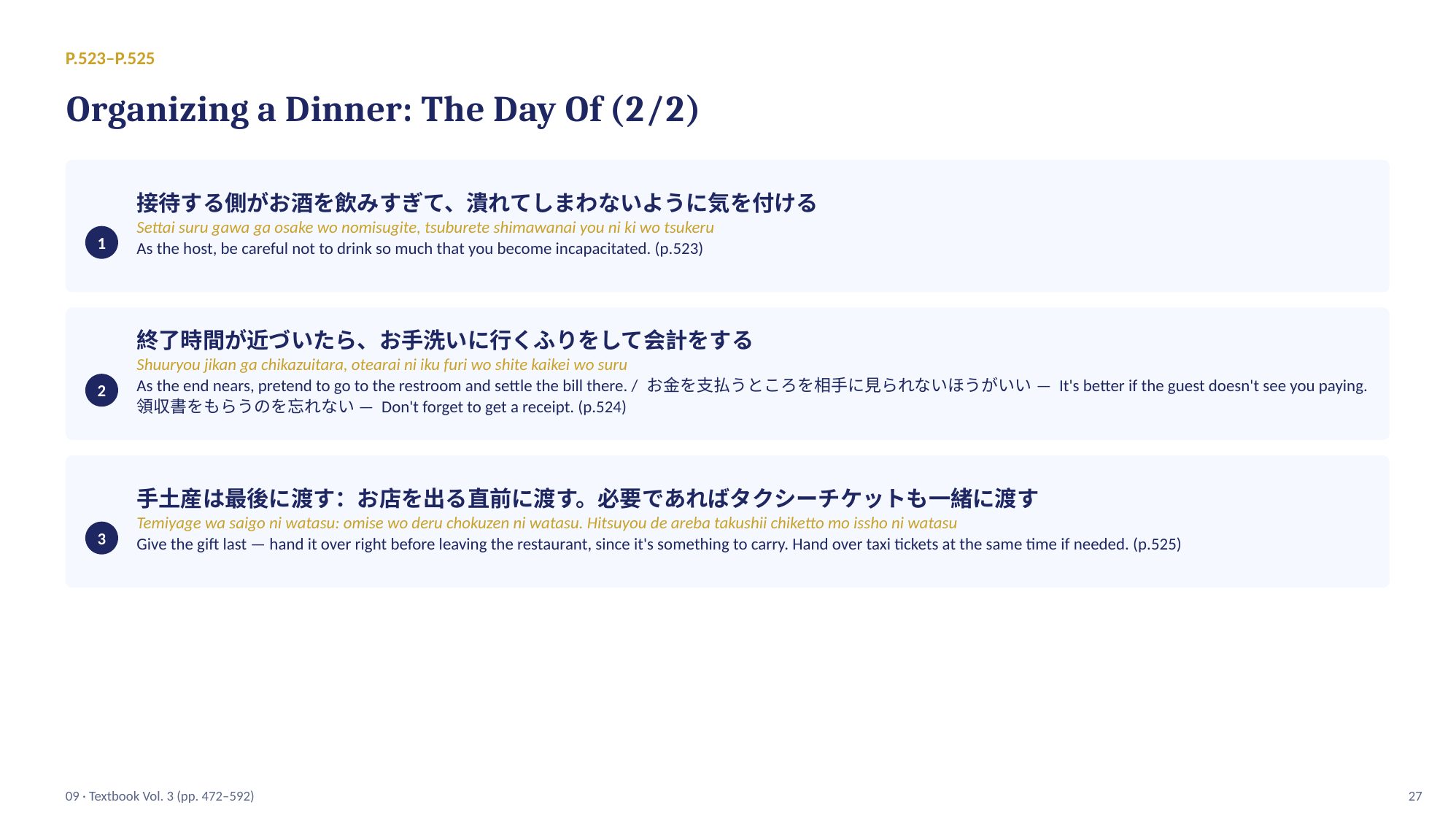
JP接待する側がお酒を飲みすぎて、潰れてしまわないように気を付ける
EN Settai suru gawa ga osake wo nomisugite, tsuburete shimawanai you ni ki wo tsukeru
1 As the host, be careful not to drink so much that you become incapacitated. (p.523)
1 As the host, be careful not to drink so much that you become incapacitated. (p.523)
JP終了時間が近づいたら、お手洗いに行くふりをして会計をする
EN Shuuryou jikan ga chikazuitara, otearai ni iku furi wo shite kaikei wo suru
2 As the end nears, pretend to go to the restroom and settle the bill there. / お金を支払うところを相手に見られないほうがいい — It's better if the guest doesn't see you paying.
領収書をもらうのを忘れない — Don't forget to get a receipt. (p.524)
2 As the end nears, pretend to go to the restroom and settle the bill there. / お金を支払うところを相手に見られないほうがいい — It's better if the guest doesn't see you paying.
領収書をもらうのを忘れない — Don't forget to get a receipt. (p.524)
JP手土産は最後に渡す:お店を出る直前に渡す。必要であればタクシーチケットも一緒に渡す
EN Temiyage wa saigo ni watasu: omise wo deru chokuzen ni watasu. Hitsuyou de areba takushii chiketto mo issho ni watasu
3 Give the gift last — hand it over right before leaving the restaurant, since it's something to carry. Hand over taxi tickets at the same time if needed. (p.525)
09 · Textbook Vol. 3 (pp. 472–592) 27
3 Give the gift last — hand it over right before leaving the restaurant, since it's something to carry. Hand over taxi tickets at the same time if needed. (p.525)
09 · Textbook Vol. 3 (pp. 472–592) 27
หน้า 28

คลิกเพื่อขยาย
08
ENOrganizing a Dinner: The Day After
2 phrases · pages 526–527
2 phrases · pages 526–527
หน้า 29
คลิกเพื่อขยาย
ENP.526–P.527
Organizing a Dinner: The Day After
Organizing a Dinner: The Day After
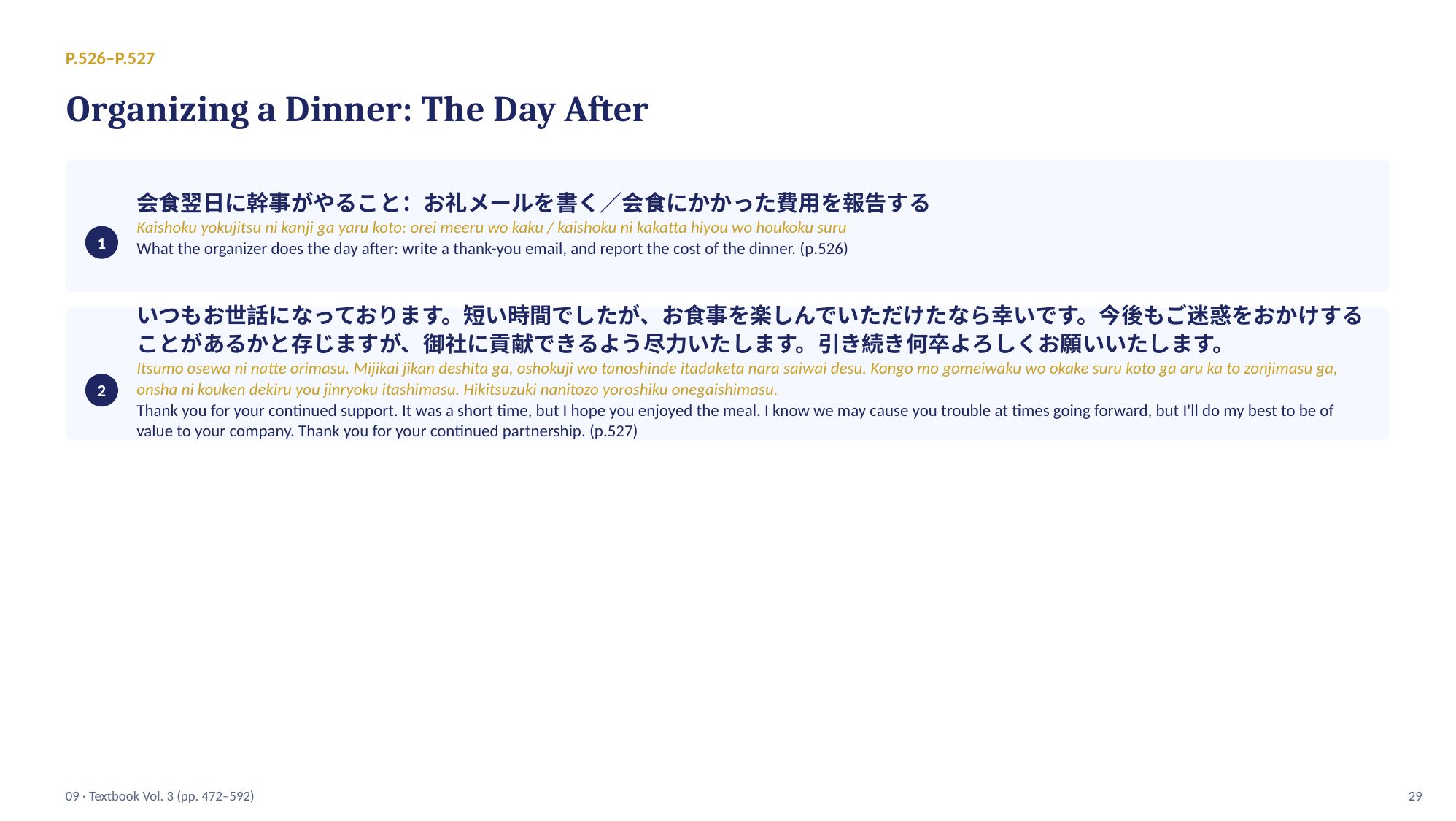
JP会食翌日に幹事がやること:お礼メールを書く/会食にかかった費用を報告する
EN Kaishoku yokujitsu ni kanji ga yaru koto: orei meeru wo kaku / kaishoku ni kakatta hiyou wo houkoku suru
1 What the organizer does the day after: write a thank-you email, and report the cost of the dinner. (p.526)
1 What the organizer does the day after: write a thank-you email, and report the cost of the dinner. (p.526)
JPいつもお世話になっております。短い時間でしたが、お食事を楽しんでいただけたなら幸いです。今後もご迷惑をおかけする
ことがあるかと存じますが、御社に貢献できるよう尽力いたします。引き続き何卒よろしくお願いいたします。
ことがあるかと存じますが、御社に貢献できるよう尽力いたします。引き続き何卒よろしくお願いいたします。
EN Itsumo osewa ni natte orimasu. Mijikai jikan deshita ga, oshokuji wo tanoshinde itadaketa nara saiwai desu. Kongo mo gomeiwaku wo okake suru koto ga aru ka to zonjimasu ga,
2 onsha ni kouken dekiru you jinryoku itashimasu. Hikitsuzuki nanitozo yoroshiku onegaishimasu.
Thank you for your continued support. It was a short time, but I hope you enjoyed the meal. I know we may cause you trouble at times going forward, but I'll do my best to be of
value to your company. Thank you for your continued partnership. (p.527)
09 · Textbook Vol. 3 (pp. 472–592) 29
2 onsha ni kouken dekiru you jinryoku itashimasu. Hikitsuzuki nanitozo yoroshiku onegaishimasu.
Thank you for your continued support. It was a short time, but I hope you enjoyed the meal. I know we may cause you trouble at times going forward, but I'll do my best to be of
value to your company. Thank you for your continued partnership. (p.527)
09 · Textbook Vol. 3 (pp. 472–592) 29
หน้า 30

คลิกเพื่อขยาย
09
ENAizuchi (Reactive Listening)
1 phrase · pages 530–530
1 phrase · pages 530–530
หน้า 31
คลิกเพื่อขยาย
ENP.530
Aizuchi (Reactive Listening)
Aizuchi (Reactive Listening)
JP日本人があいづちをする目的
EN Nihonjin ga aizuchi wo suru mokuteki
1 The purpose behind Japanese people's use of 'aizuchi' (verbal nodding/back-channel responses like 'un', 'hai', 'sou desu ne' while listening). (p.530)
09 · Textbook Vol. 3 (pp. 472–592) 31
1 The purpose behind Japanese people's use of 'aizuchi' (verbal nodding/back-channel responses like 'un', 'hai', 'sou desu ne' while listening). (p.530)
09 · Textbook Vol. 3 (pp. 472–592) 31
หน้า 32

คลิกเพื่อขยาย
10
ENAizuchi Basics
5 phrases · pages 533–538
5 phrases · pages 533–538
หน้า 33
คลิกเพื่อขยาย
ENP.533–P.536
Aizuchi Basics (1/2)
Aizuchi Basics (1/2)
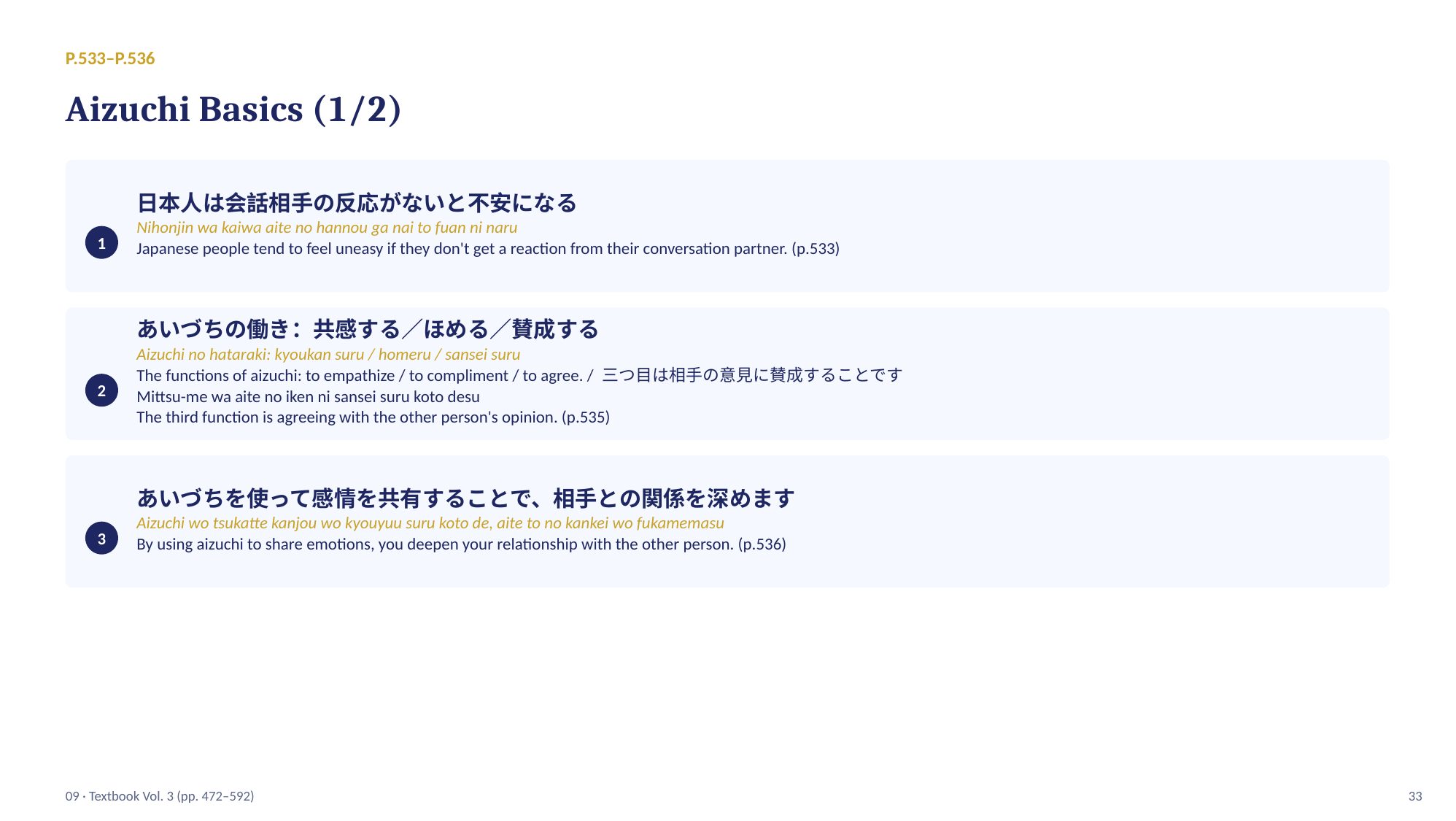
JP日本人は会話相手の反応がないと不安になる
EN Nihonjin wa kaiwa aite no hannou ga nai to fuan ni naru
1 Japanese people tend to feel uneasy if they don't get a reaction from their conversation partner. (p.533)
1 Japanese people tend to feel uneasy if they don't get a reaction from their conversation partner. (p.533)
JPあいづちの働き:共感する/ほめる/賛成する
EN Aizuchi no hataraki: kyoukan suru / homeru / sansei suru
The functions of aizuchi: to empathize / to compliment / to agree. / 三つ目は相手の意見に賛成することです
2 Mittsu-me wa aite no iken ni sansei suru koto desu
The third function is agreeing with the other person's opinion. (p.535)
The functions of aizuchi: to empathize / to compliment / to agree. / 三つ目は相手の意見に賛成することです
2 Mittsu-me wa aite no iken ni sansei suru koto desu
The third function is agreeing with the other person's opinion. (p.535)
JPあいづちを使って感情を共有することで、相手との関係を深めます
EN Aizuchi wo tsukatte kanjou wo kyouyuu suru koto de, aite to no kankei wo fukamemasu
3 By using aizuchi to share emotions, you deepen your relationship with the other person. (p.536)
09 · Textbook Vol. 3 (pp. 472–592) 33
3 By using aizuchi to share emotions, you deepen your relationship with the other person. (p.536)
09 · Textbook Vol. 3 (pp. 472–592) 33
หน้า 34
คลิกเพื่อขยาย
ENP.537–P.538
Aizuchi Basics (2/2)
Aizuchi Basics (2/2)
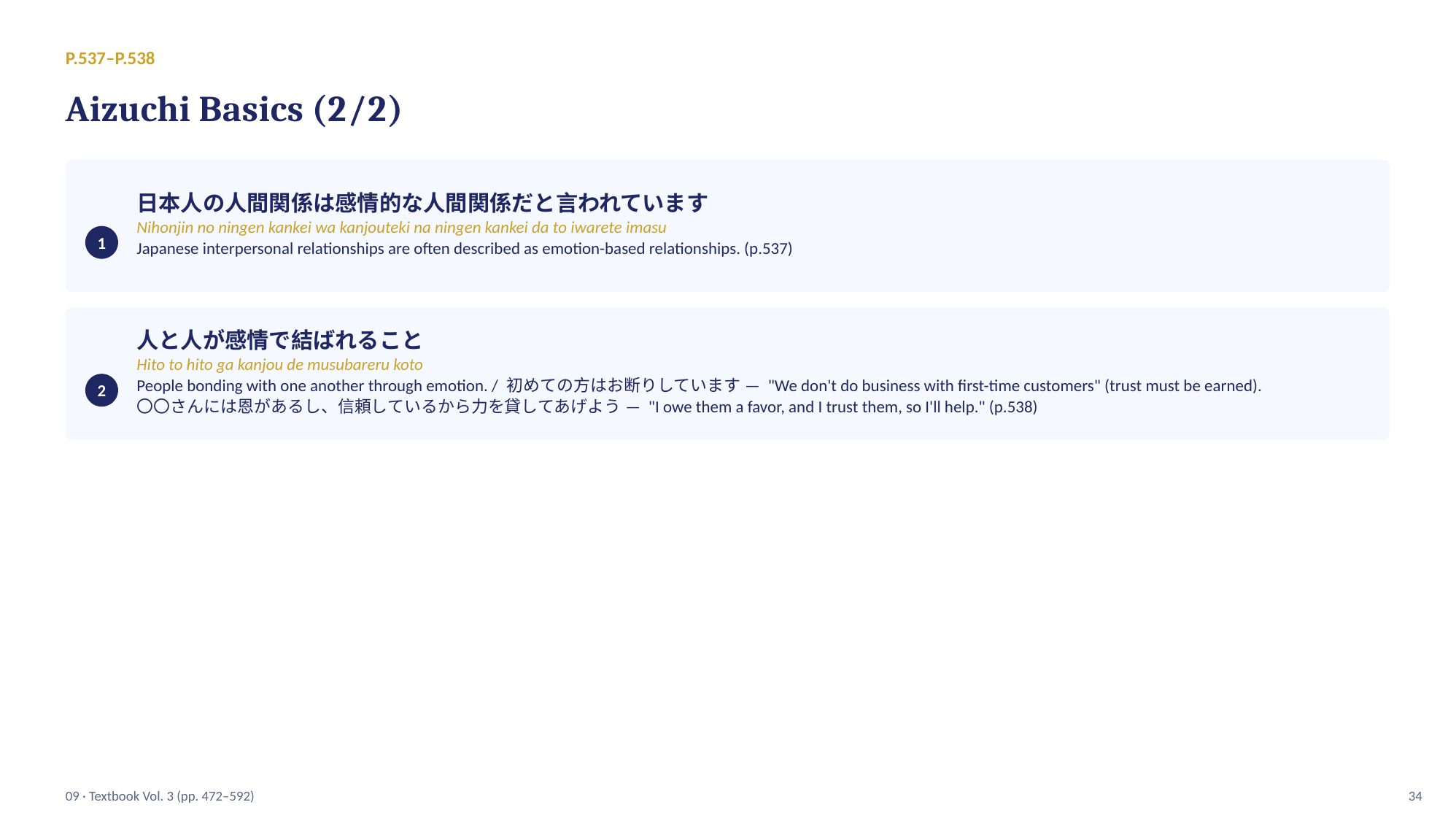
JP日本人の人間関係は感情的な人間関係だと言われています
EN Nihonjin no ningen kankei wa kanjouteki na ningen kankei da to iwarete imasu
1 Japanese interpersonal relationships are often described as emotion-based relationships. (p.537)
1 Japanese interpersonal relationships are often described as emotion-based relationships. (p.537)
JP人と人が感情で結ばれること
EN Hito to hito ga kanjou de musubareru koto
2 People bonding with one another through emotion. / 初めての方はお断りしています — "We don't do business with first-time customers" (trust must be earned).
〇〇さんには恩があるし、信頼しているから力を貸してあげよう — "I owe them a favor, and I trust them, so I'll help." (p.538)
09 · Textbook Vol. 3 (pp. 472–592) 34
2 People bonding with one another through emotion. / 初めての方はお断りしています — "We don't do business with first-time customers" (trust must be earned).
〇〇さんには恩があるし、信頼しているから力を貸してあげよう — "I owe them a favor, and I trust them, so I'll help." (p.538)
09 · Textbook Vol. 3 (pp. 472–592) 34
หน้า 35

คลิกเพื่อขยาย
11
ENAizuchi: さすがですね
2 phrases · pages 540–541
2 phrases · pages 540–541
หน้า 36
คลิกเพื่อขยาย
ENP.540–P.541
Aizuchi: さすがですね
Aizuchi: さすがですね
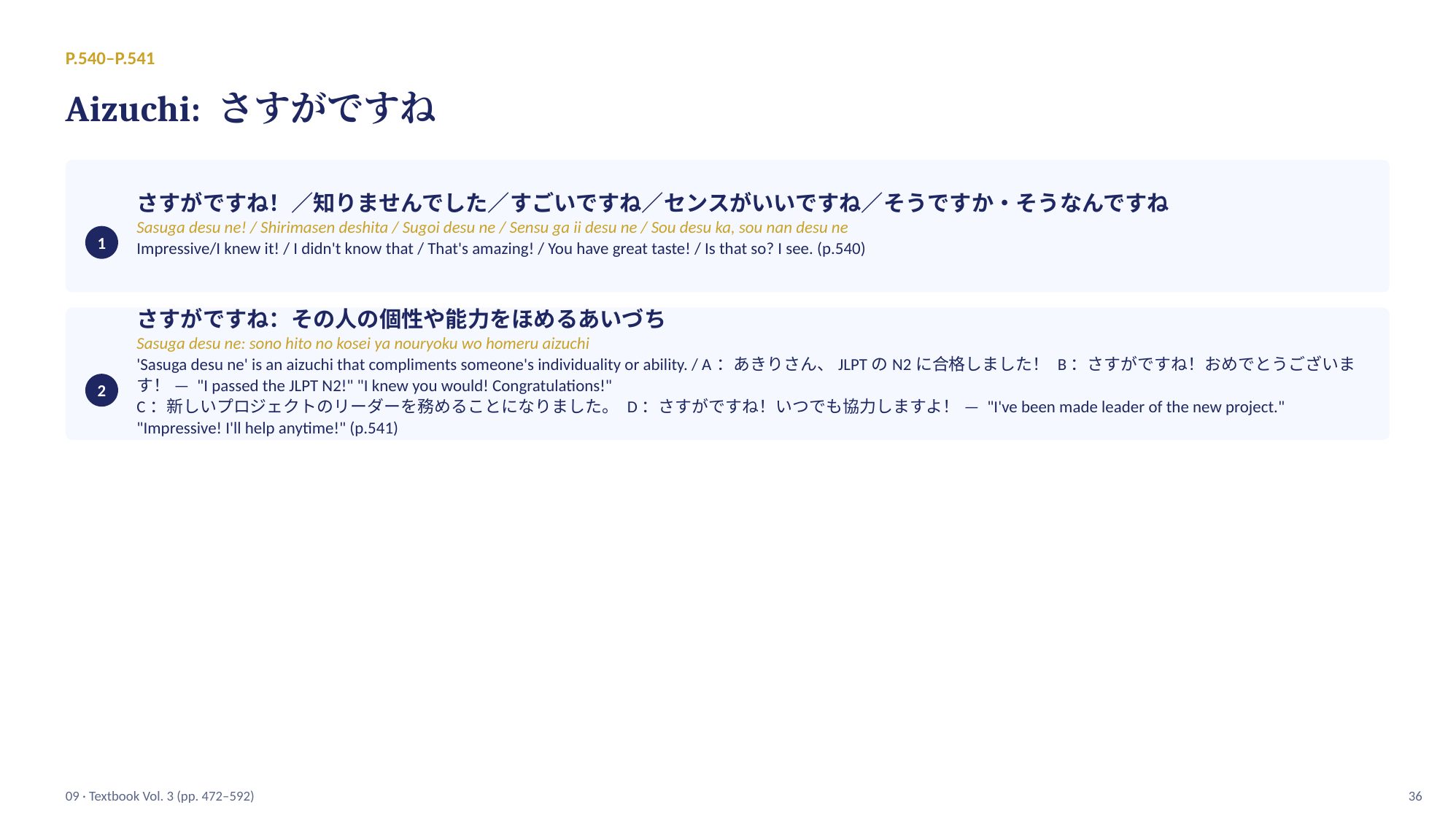
JPさすがですね!/知りませんでした/すごいですね/センスがいいですね/そうですか・そうなんですね
EN Sasuga desu ne! / Shirimasen deshita / Sugoi desu ne / Sensu ga ii desu ne / Sou desu ka, sou nan desu ne
1 Impressive/I knew it! / I didn't know that / That's amazing! / You have great taste! / Is that so? I see. (p.540)
1 Impressive/I knew it! / I didn't know that / That's amazing! / You have great taste! / Is that so? I see. (p.540)
JPさすがですね:その人の個性や能力をほめるあいづち
EN Sasuga desu ne: sono hito no kosei ya nouryoku wo homeru aizuchi
'Sasuga desu ne' is an aizuchi that compliments someone's individuality or ability. / A :あきりさん、 JLPT の N2 に合格しました! B :さすがですね!おめでとうございま
2 す! — "I passed the JLPT N2!" "I knew you would! Congratulations!"
'Sasuga desu ne' is an aizuchi that compliments someone's individuality or ability. / A :あきりさん、 JLPT の N2 に合格しました! B :さすがですね!おめでとうございま
2 す! — "I passed the JLPT N2!" "I knew you would! Congratulations!"
JPC:新しいプロジェクトのリーダーを務めることになりました。D:さすがですね!いつでも協力しますよ!—"I'vebeenmadeleaderofthenewproject."
EN "Impressive! I'll help anytime!" (p.541)
09 · Textbook Vol. 3 (pp. 472–592) 36
09 · Textbook Vol. 3 (pp. 472–592) 36
หน้า 37

คลิกเพื่อขยาย
12
JPAizuchi:知りませんでした
EN1 phrase · pages 545–545
หน้า 38
คลิกเพื่อขยาย
ENP.545
JPAizuchi:知りませんでした
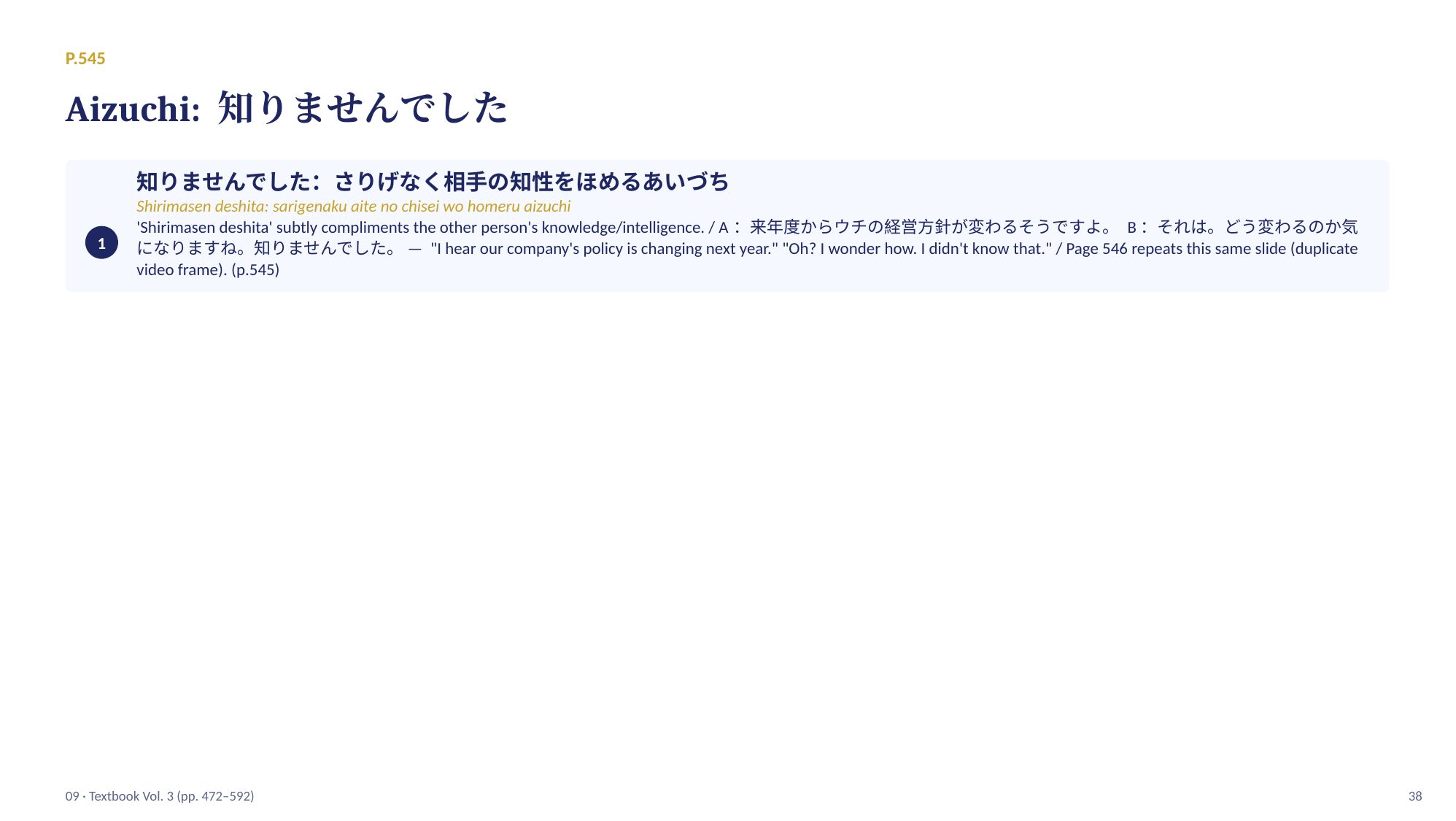
知りませんでした:さりげなく相手の知性をほめるあいづち
知りませんでした:さりげなく相手の知性をほめるあいづち
EN Shirimasen deshita: sarigenaku aite no chisei wo homeru aizuchi
'Shirimasen deshita' subtly compliments the other person's knowledge/intelligence. / A :来年度からウチの経営方針が変わるそうですよ。 B :それは。どう変わるのか気
1 になりますね。知りませんでした。 — "I hear our company's policy is changing next year." "Oh? I wonder how. I didn't know that." / Page 546 repeats this same slide (duplicate
video frame). (p.545)
09 · Textbook Vol. 3 (pp. 472–592) 38
'Shirimasen deshita' subtly compliments the other person's knowledge/intelligence. / A :来年度からウチの経営方針が変わるそうですよ。 B :それは。どう変わるのか気
1 になりますね。知りませんでした。 — "I hear our company's policy is changing next year." "Oh? I wonder how. I didn't know that." / Page 546 repeats this same slide (duplicate
video frame). (p.545)
09 · Textbook Vol. 3 (pp. 472–592) 38
หน้า 39

คลิกเพื่อขยาย
13
ENAizuchi: すごいですね
1 phrase · pages 547–547
1 phrase · pages 547–547
หน้า 40
คลิกเพื่อขยาย
ENP.547
Aizuchi: すごいですね
Aizuchi: すごいですね
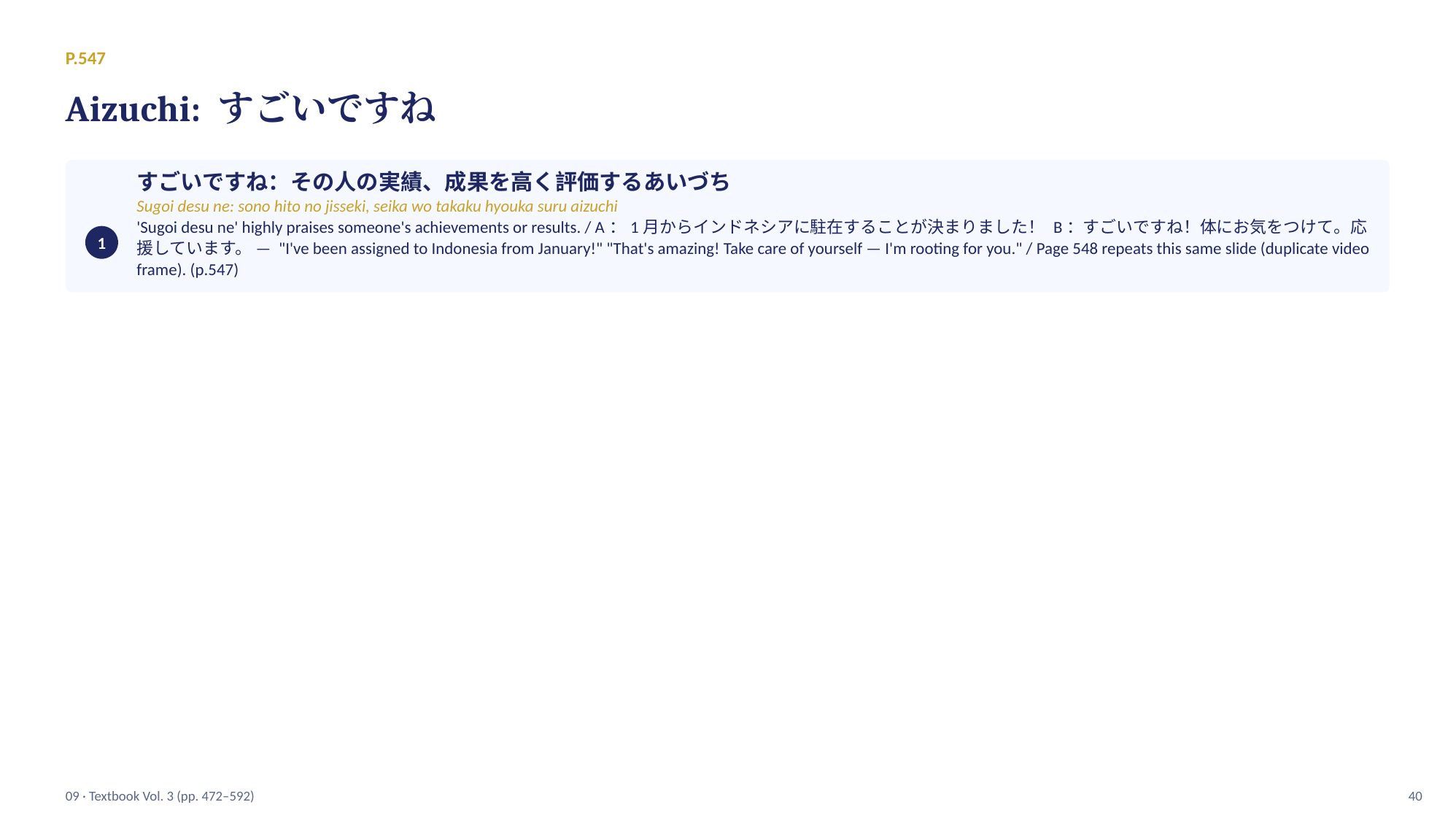
JPすごいですね:その人の実績、成果を高く評価するあいづち
EN Sugoi desu ne: sono hito no jisseki, seika wo takaku hyouka suru aizuchi
'Sugoi desu ne' highly praises someone's achievements or results. / A : 1 月からインドネシアに駐在することが決まりました! B :すごいですね!体にお気をつけて。応
1 援しています。 — "I've been assigned to Indonesia from January!" "That's amazing! Take care of yourself — I'm rooting for you." / Page 548 repeats this same slide (duplicate video
frame). (p.547)
09 · Textbook Vol. 3 (pp. 472–592) 40
'Sugoi desu ne' highly praises someone's achievements or results. / A : 1 月からインドネシアに駐在することが決まりました! B :すごいですね!体にお気をつけて。応
1 援しています。 — "I've been assigned to Indonesia from January!" "That's amazing! Take care of yourself — I'm rooting for you." / Page 548 repeats this same slide (duplicate video
frame). (p.547)
09 · Textbook Vol. 3 (pp. 472–592) 40
หน้า 41
คลิกเพื่อขยาย
14
JPAizuchi:センスがいいですね
EN1 phrase · pages 549–549
หน้า 42
คลิกเพื่อขยาย
ENP.549
JPAizuchi:センスがいいですね
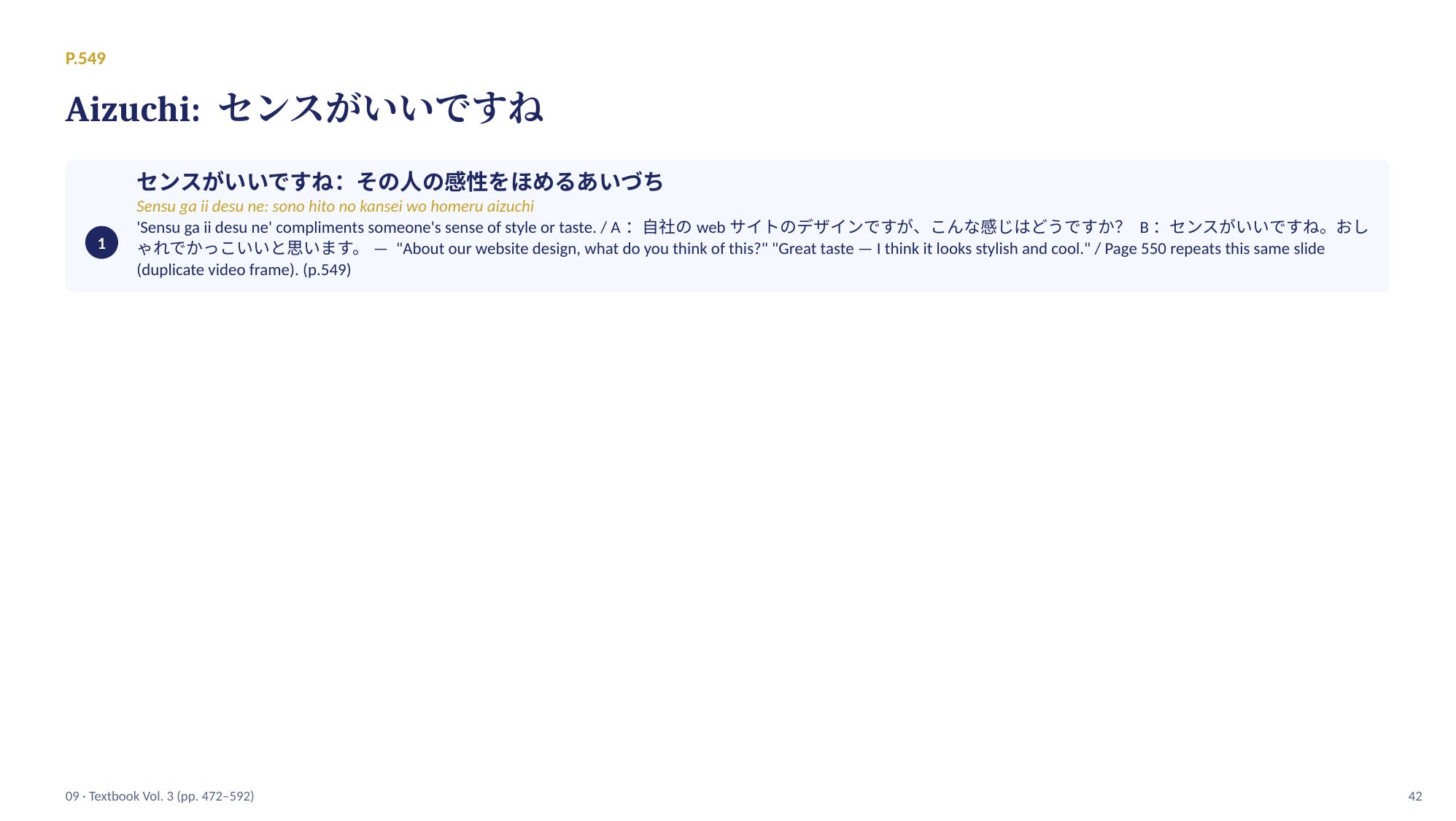
センスがいいですね:その人の感性をほめるあいづち
センスがいいですね:その人の感性をほめるあいづち
EN Sensu ga ii desu ne: sono hito no kansei wo homeru aizuchi
'Sensu ga ii desu ne' compliments someone's sense of style or taste. / A :自社の web サイトのデザインですが、こんな感じはどうですか? B :センスがいいですね。おし
1 ゃれでかっこいいと思います。 — "About our website design, what do you think of this?" "Great taste — I think it looks stylish and cool." / Page 550 repeats this same slide
(duplicate video frame). (p.549)
09 · Textbook Vol. 3 (pp. 472–592) 42
'Sensu ga ii desu ne' compliments someone's sense of style or taste. / A :自社の web サイトのデザインですが、こんな感じはどうですか? B :センスがいいですね。おし
1 ゃれでかっこいいと思います。 — "About our website design, what do you think of this?" "Great taste — I think it looks stylish and cool." / Page 550 repeats this same slide
(duplicate video frame). (p.549)
09 · Textbook Vol. 3 (pp. 472–592) 42
หน้า 43
คลิกเพื่อขยาย
15
JPAizuchi:そうですか・そうなんですね
EN1 phrase · pages 551–551
หน้า 44
คลิกเพื่อขยาย
ENP.551
JPAizuchi:そうですか・そうなんですね
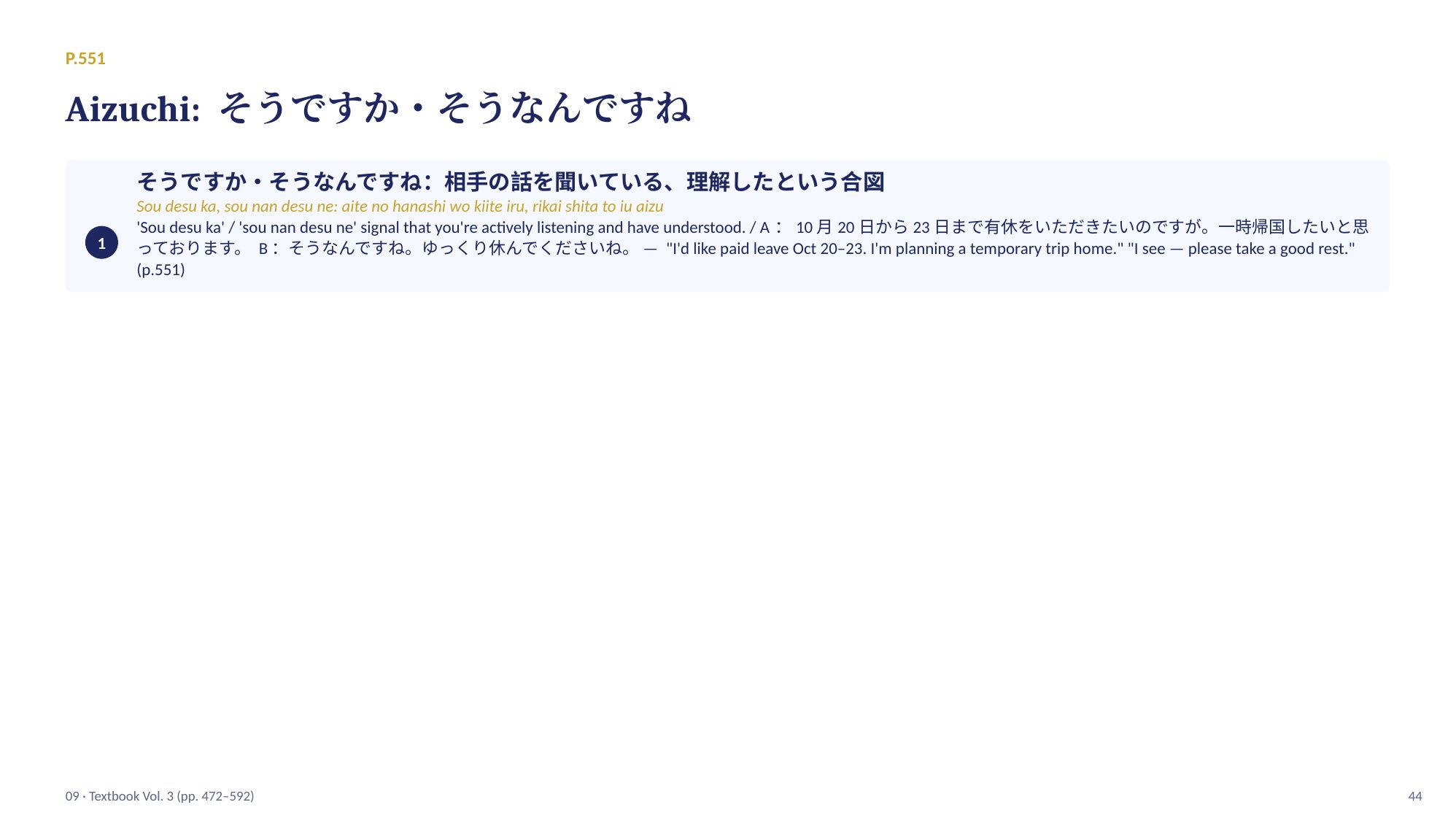
そうですか・そうなんですね:相手の話を聞いている、理解したという合図
そうですか・そうなんですね:相手の話を聞いている、理解したという合図
EN Sou desu ka, sou nan desu ne: aite no hanashi wo kiite iru, rikai shita to iu aizu
'Sou desu ka' / 'sou nan desu ne' signal that you're actively listening and have understood. / A : 10 月 20 日から 23 日まで有休をいただきたいのですが。一時帰国したいと思
1 っております。 B :そうなんですね。ゆっくり休んでくださいね。 — "I'd like paid leave Oct 20–23. I'm planning a temporary trip home." "I see — please take a good rest."
(p.551)
09 · Textbook Vol. 3 (pp. 472–592) 44
'Sou desu ka' / 'sou nan desu ne' signal that you're actively listening and have understood. / A : 10 月 20 日から 23 日まで有休をいただきたいのですが。一時帰国したいと思
1 っております。 B :そうなんですね。ゆっくり休んでくださいね。 — "I'd like paid leave Oct 20–23. I'm planning a temporary trip home." "I see — please take a good rest."
(p.551)
09 · Textbook Vol. 3 (pp. 472–592) 44
หน้า 45
คลิกเพื่อขยาย
16
ENResponding to Compliments on Your Japanese
6 phrases · pages 553–558
6 phrases · pages 553–558
หน้า 46
คลิกเพื่อขยาย
ENP.553–P.555
Responding to Compliments on Your Japanese (1/2)
Responding to Compliments on Your Japanese (1/2)
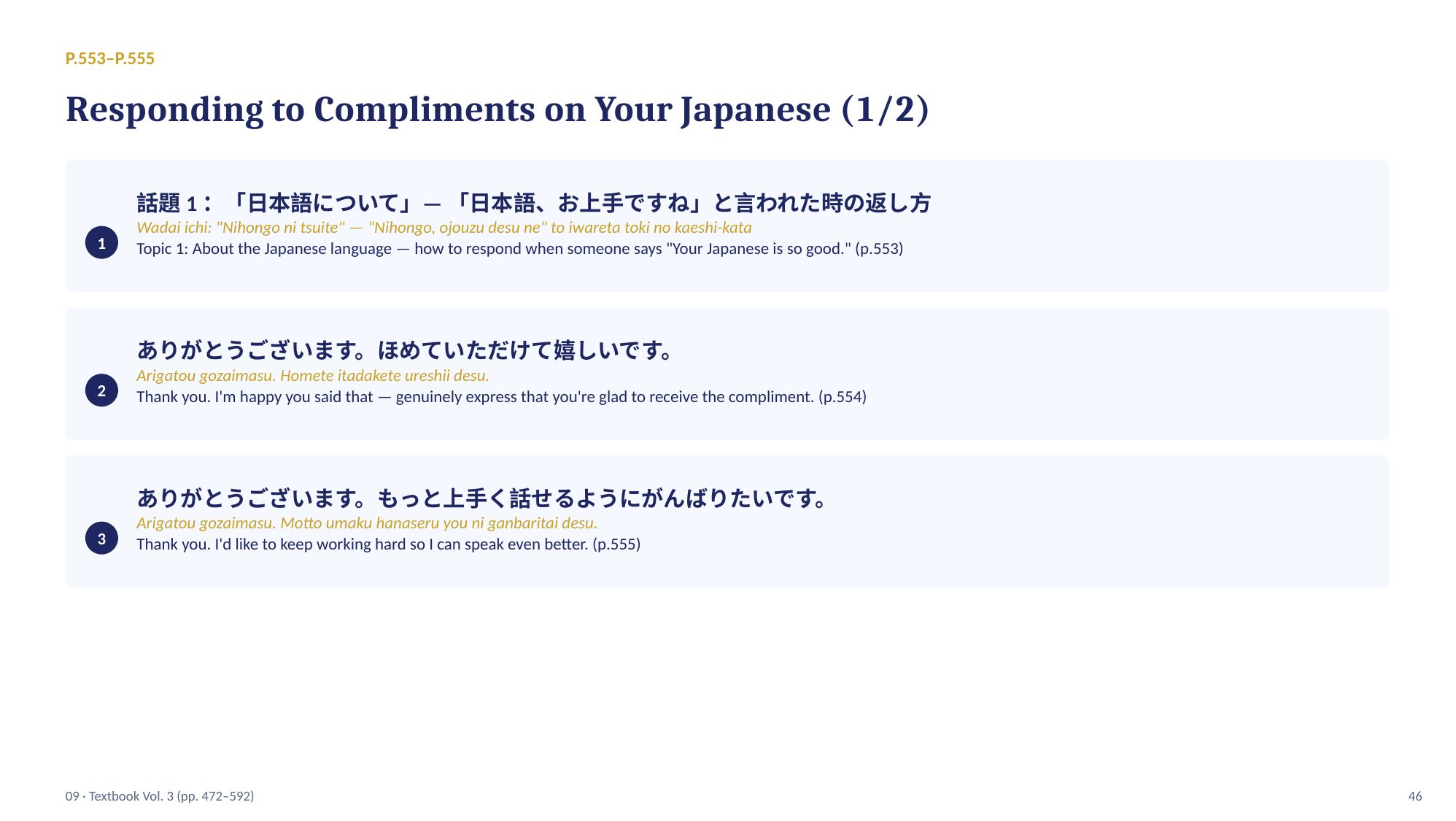
JP話題1:「日本語について」—「日本語、お上手ですね」と言われた時の返し方
EN Wadai ichi: "Nihongo ni tsuite" — "Nihongo, ojouzu desu ne" to iwareta toki no kaeshi-kata
1 Topic 1: About the Japanese language — how to respond when someone says "Your Japanese is so good." (p.553)
1 Topic 1: About the Japanese language — how to respond when someone says "Your Japanese is so good." (p.553)
JPありがとうございます。ほめていただけて嬉しいです。
EN Arigatou gozaimasu. Homete itadakete ureshii desu.
2 Thank you. I'm happy you said that — genuinely express that you're glad to receive the compliment. (p.554)
2 Thank you. I'm happy you said that — genuinely express that you're glad to receive the compliment. (p.554)
JPありがとうございます。もっと上手く話せるようにがんばりたいです。
EN Arigatou gozaimasu. Motto umaku hanaseru you ni ganbaritai desu.
3 Thank you. I'd like to keep working hard so I can speak even better. (p.555)
09 · Textbook Vol. 3 (pp. 472–592) 46
3 Thank you. I'd like to keep working hard so I can speak even better. (p.555)
09 · Textbook Vol. 3 (pp. 472–592) 46
หน้า 47
คลิกเพื่อขยาย
ENP.556–P.558
Responding to Compliments on Your Japanese (2/2)
Responding to Compliments on Your Japanese (2/2)
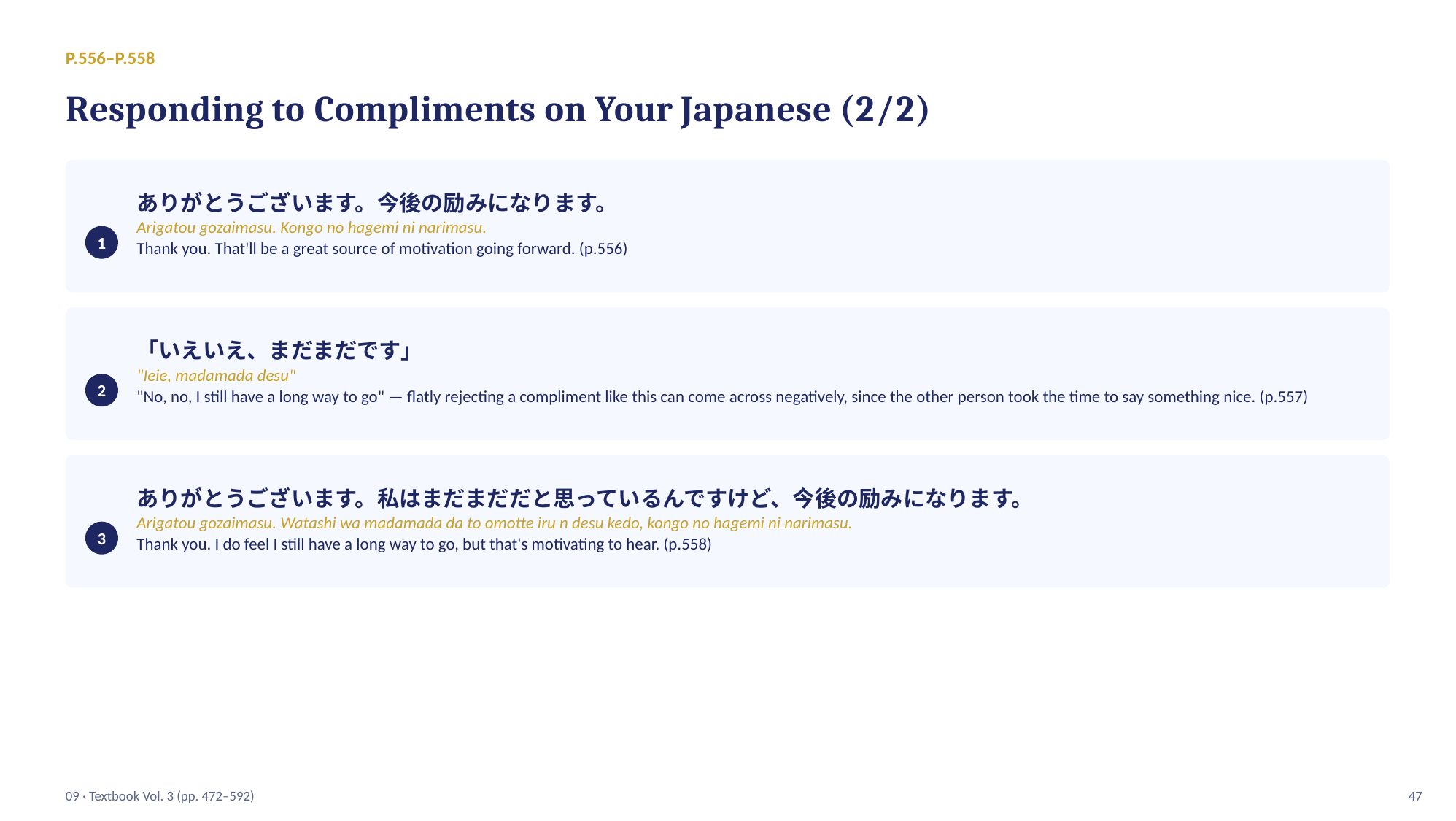
JPありがとうございます。今後の励みになります。
EN Arigatou gozaimasu. Kongo no hagemi ni narimasu.
1 Thank you. That'll be a great source of motivation going forward. (p.556)
1 Thank you. That'll be a great source of motivation going forward. (p.556)
JP「いえいえ、まだまだです」
EN "Ieie, madamada desu"
2 "No, no, I still have a long way to go" — flatly rejecting a compliment like this can come across negatively, since the other person took the time to say something nice. (p.557)
2 "No, no, I still have a long way to go" — flatly rejecting a compliment like this can come across negatively, since the other person took the time to say something nice. (p.557)
JPありがとうございます。私はまだまだだと思っているんですけど、今後の励みになります。
EN Arigatou gozaimasu. Watashi wa madamada da to omotte iru n desu kedo, kongo no hagemi ni narimasu.
3 Thank you. I do feel I still have a long way to go, but that's motivating to hear. (p.558)
09 · Textbook Vol. 3 (pp. 472–592) 47
3 Thank you. I do feel I still have a long way to go, but that's motivating to hear. (p.558)
09 · Textbook Vol. 3 (pp. 472–592) 47
หน้า 48

คลิกเพื่อขยาย
17
ENExplaining Why You Want to Work in Japan
4 phrases · pages 559–562
4 phrases · pages 559–562
หน้า 49
คลิกเพื่อขยาย
ENP.559–P.561
Explaining Why You Want to Work in Japan (1/2)
Explaining Why You Want to Work in Japan (1/2)
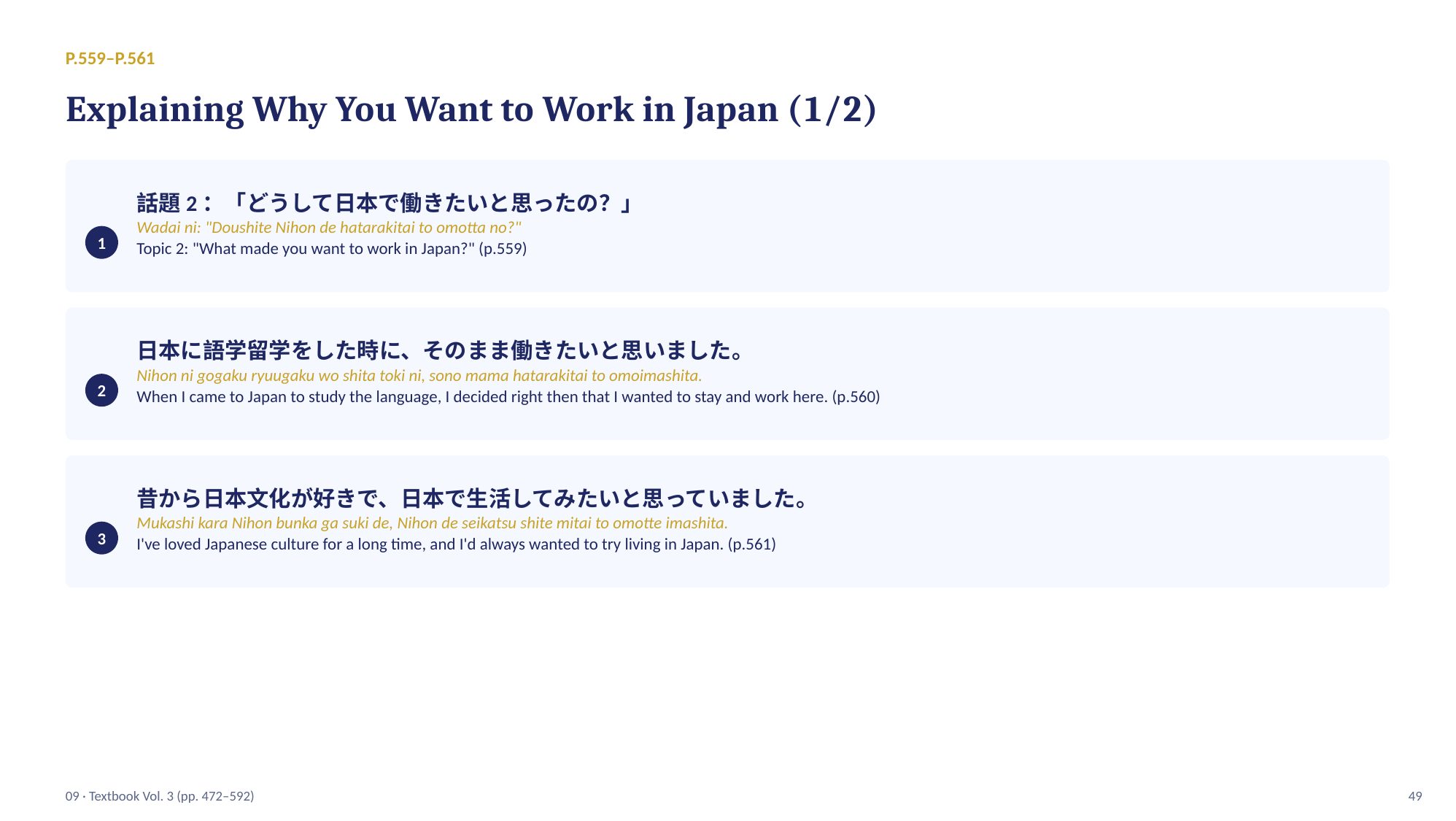
JP話題2:「どうして日本で働きたいと思ったの?」
EN Wadai ni: "Doushite Nihon de hatarakitai to omotta no?"
1 Topic 2: "What made you want to work in Japan?" (p.559)
1 Topic 2: "What made you want to work in Japan?" (p.559)
JP日本に語学留学をした時に、そのまま働きたいと思いました。
EN Nihon ni gogaku ryuugaku wo shita toki ni, sono mama hatarakitai to omoimashita.
2 When I came to Japan to study the language, I decided right then that I wanted to stay and work here. (p.560)
2 When I came to Japan to study the language, I decided right then that I wanted to stay and work here. (p.560)
JP昔から日本文化が好きで、日本で生活してみたいと思っていました。
EN Mukashi kara Nihon bunka ga suki de, Nihon de seikatsu shite mitai to omotte imashita.
3 I've loved Japanese culture for a long time, and I'd always wanted to try living in Japan. (p.561)
09 · Textbook Vol. 3 (pp. 472–592) 49
3 I've loved Japanese culture for a long time, and I'd always wanted to try living in Japan. (p.561)
09 · Textbook Vol. 3 (pp. 472–592) 49
หน้า 50
คลิกเพื่อขยาย
ENP.562
Explaining Why You Want to Work in Japan (2/2)
Explaining Why You Want to Work in Japan (2/2)
JP学生の時から日本語を勉強していて、日本での就職に挑戦したいと思いました。
EN Gakusei no toki kara nihongo wo benkyou shite ite, Nihon de no shuushoku ni chousen shitai to omoimashita.
1 I've been studying Japanese since I was a student, and I wanted to challenge myself by finding work in Japan. (p.562)
09 · Textbook Vol. 3 (pp. 472–592) 50
1 I've been studying Japanese since I was a student, and I wanted to challenge myself by finding work in Japan. (p.562)
09 · Textbook Vol. 3 (pp. 472–592) 50
หน้า 51

คลิกเพื่อขยาย
18
ENCulture Shock in Japan
4 phrases · pages 563–566
4 phrases · pages 563–566
หน้า 52
คลิกเพื่อขยาย
ENP.563–P.565
Culture Shock in Japan (1/2)
Culture Shock in Japan (1/2)
JP話題3:「カルチャーショックがあった?」
EN Wadai san: "Karuchaa shokku ga atta?"
1 Topic 3: "Did you have any culture shock?" — "Did you experience culture shock when you came to Japan?" (p.563)
1 Topic 3: "Did you have any culture shock?" — "Did you experience culture shock when you came to Japan?" (p.563)
JP外国人が日本で驚いたこと
EN Gaikokujin ga Nihon de odoroita koto
Things that surprise foreigners in Japan (from an article about visitors' impressions): / 日本人は公共の場所でマナーが良い — Japanese people have excellent manners in public
2 places
電車やバスなどの公共交通機関が時間通りに運行している — Public transport like trains and buses runs exactly on time
ご飯が安くて美味しい — Food is cheap and delicious (p.564)
Things that surprise foreigners in Japan (from an article about visitors' impressions): / 日本人は公共の場所でマナーが良い — Japanese people have excellent manners in public
2 places
電車やバスなどの公共交通機関が時間通りに運行している — Public transport like trains and buses runs exactly on time
ご飯が安くて美味しい — Food is cheap and delicious (p.564)
JP車内が静か
EN Shanai ga shizuka
3 Train cars are quiet — part of what's meant by good public manners. (p.565)
09 · Textbook Vol. 3 (pp. 472–592) 52
3 Train cars are quiet — part of what's meant by good public manners. (p.565)
09 · Textbook Vol. 3 (pp. 472–592) 52
หน้า 53
คลิกเพื่อขยาย
ENP.566
Culture Shock in Japan (2/2)
Culture Shock in Japan (2/2)
JP電車は時間通りに動くことにも驚いたし、遅延のアナウンスが流れたり、遅延証明書が配られることにも驚きました。みんな
並んで乗車したり下車したりするのも驚きました。
並んで乗車したり下車したりするのも驚きました。
EN Densha wa jikandoori ni ugoku koto ni mo odoroita shi, chien no anaunsu ga nagaretari, chien shoumeisho ga kubararetaru koto ni mo odorokimashita. Minna narande jousha shitari
1 gesha shitari suru no mo odorokimashita.
I was surprised trains run right on schedule, that delay announcements are made, and that delay certificates are handed out. I was also surprised everyone lines up to board and exit.
(p.566)
09 · Textbook Vol. 3 (pp. 472–592) 53
1 gesha shitari suru no mo odorokimashita.
I was surprised trains run right on schedule, that delay announcements are made, and that delay certificates are handed out. I was also surprised everyone lines up to board and exit.
(p.566)
09 · Textbook Vol. 3 (pp. 472–592) 53
หน้า 54

คลิกเพื่อขยาย
19
ENOrigins of Gift-Giving Culture
9 phrases · pages 569–580
9 phrases · pages 569–580
หน้า 55
คลิกเพื่อขยาย
ENP.569–P.572
Origins of Gift-Giving Culture (1/3)
Origins of Gift-Giving Culture (1/3)
JP日本人が贈り物をするようになった理由
EN Nihonjin ga okurimono wo suru you ni natta riyuu
1 The reason Japanese people came to give gifts: as an agricultural people, offering things to the gods in hopes of a good harvest was the start of gift-giving culture. (p.569)
1 The reason Japanese people came to give gifts: as an agricultural people, offering things to the gods in hopes of a good harvest was the start of gift-giving culture. (p.569)
JP農耕民族:作物を育てて生計を立てる人々のこと。彼らは畑で働いたり、農業をします。
EN Noukou minzoku: sakumotsu wo sodatete seikei wo tateru hitobito no koto. Karera wa hatake de hataraitari, nougyou wo shimasu.
2 'Agricultural people' refers to people who make their living growing crops — working in fields and farming. (p.570)
2 'Agricultural people' refers to people who make their living growing crops — working in fields and farming. (p.570)
JP豊作:作物が豊かに実ること。農作物や畑の収穫が多く、良い成果を上げた時に使う。
EN Housaku: sakumotsu ga yutaka ni minoru koto. Nousakubutsu ya hatake no shuukaku ga ooku, yoi seika wo ageta toki ni tsukau.
3 'Housaku' (bountiful harvest) is used when crops bear abundantly — a good, plentiful harvest. (p.572)
09 · Textbook Vol. 3 (pp. 472–592) 55
3 'Housaku' (bountiful harvest) is used when crops bear abundantly — a good, plentiful harvest. (p.572)
09 · Textbook Vol. 3 (pp. 472–592) 55
หน้า 56
คลิกเพื่อขยาย
ENP.574–P.576
Origins of Gift-Giving Culture (2/3)
Origins of Gift-Giving Culture (2/3)
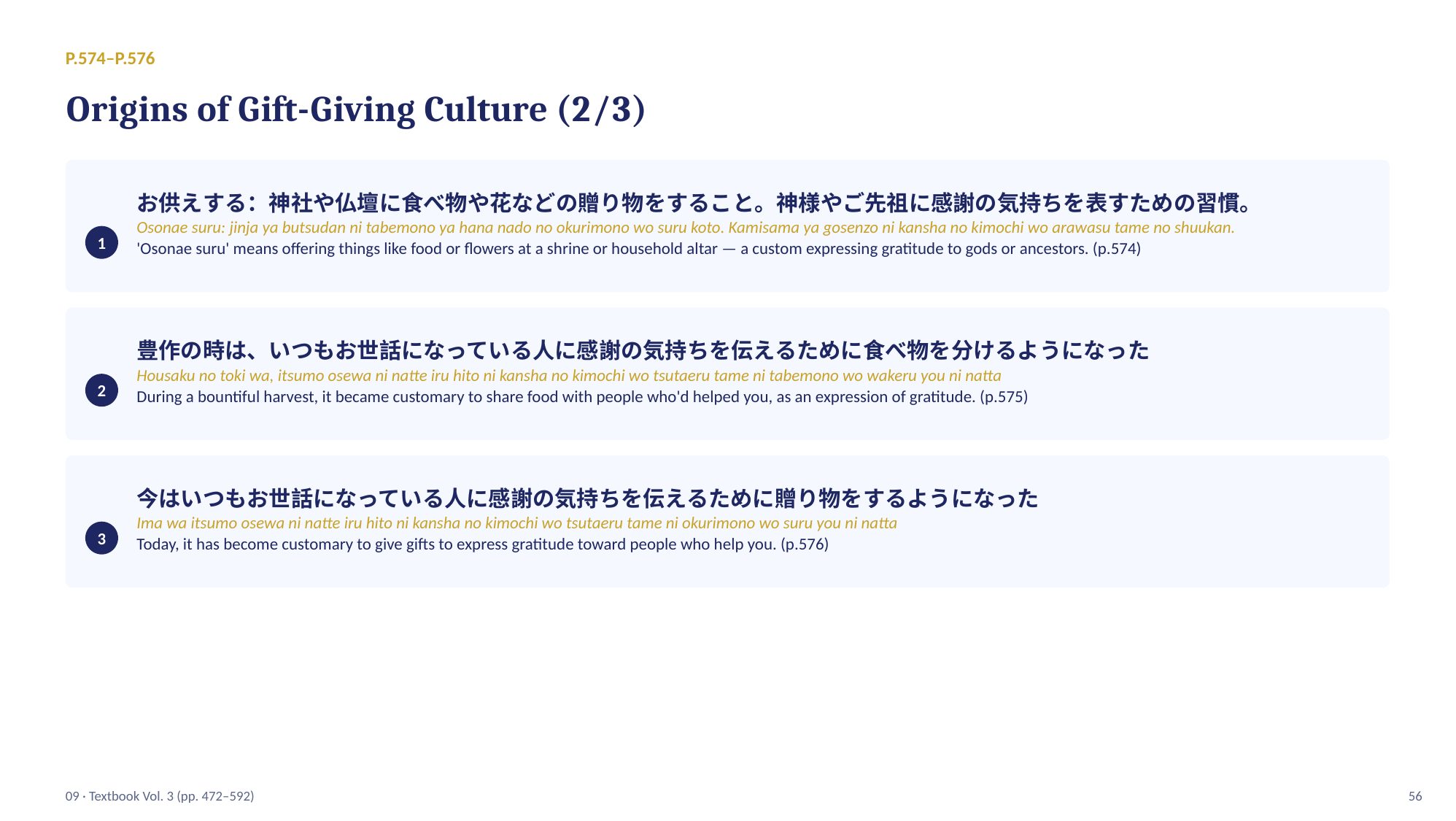
JPお供えする:神社や仏壇に食べ物や花などの贈り物をすること。神様やご先祖に感謝の気持ちを表すための習慣。
EN Osonae suru: jinja ya butsudan ni tabemono ya hana nado no okurimono wo suru koto. Kamisama ya gosenzo ni kansha no kimochi wo arawasu tame no shuukan.
1 'Osonae suru' means offering things like food or flowers at a shrine or household altar — a custom expressing gratitude to gods or ancestors. (p.574)
1 'Osonae suru' means offering things like food or flowers at a shrine or household altar — a custom expressing gratitude to gods or ancestors. (p.574)
JP豊作の時は、いつもお世話になっている人に感謝の気持ちを伝えるために食べ物を分けるようになった
EN Housaku no toki wa, itsumo osewa ni natte iru hito ni kansha no kimochi wo tsutaeru tame ni tabemono wo wakeru you ni natta
2 During a bountiful harvest, it became customary to share food with people who'd helped you, as an expression of gratitude. (p.575)
2 During a bountiful harvest, it became customary to share food with people who'd helped you, as an expression of gratitude. (p.575)
JP今はいつもお世話になっている人に感謝の気持ちを伝えるために贈り物をするようになった
EN Ima wa itsumo osewa ni natte iru hito ni kansha no kimochi wo tsutaeru tame ni okurimono wo suru you ni natta
3 Today, it has become customary to give gifts to express gratitude toward people who help you. (p.576)
09 · Textbook Vol. 3 (pp. 472–592) 56
3 Today, it has become customary to give gifts to express gratitude toward people who help you. (p.576)
09 · Textbook Vol. 3 (pp. 472–592) 56
หน้า 57
คลิกเพื่อขยาย
ENP.577–P.580
Origins of Gift-Giving Culture (3/3)
Origins of Gift-Giving Culture (3/3)
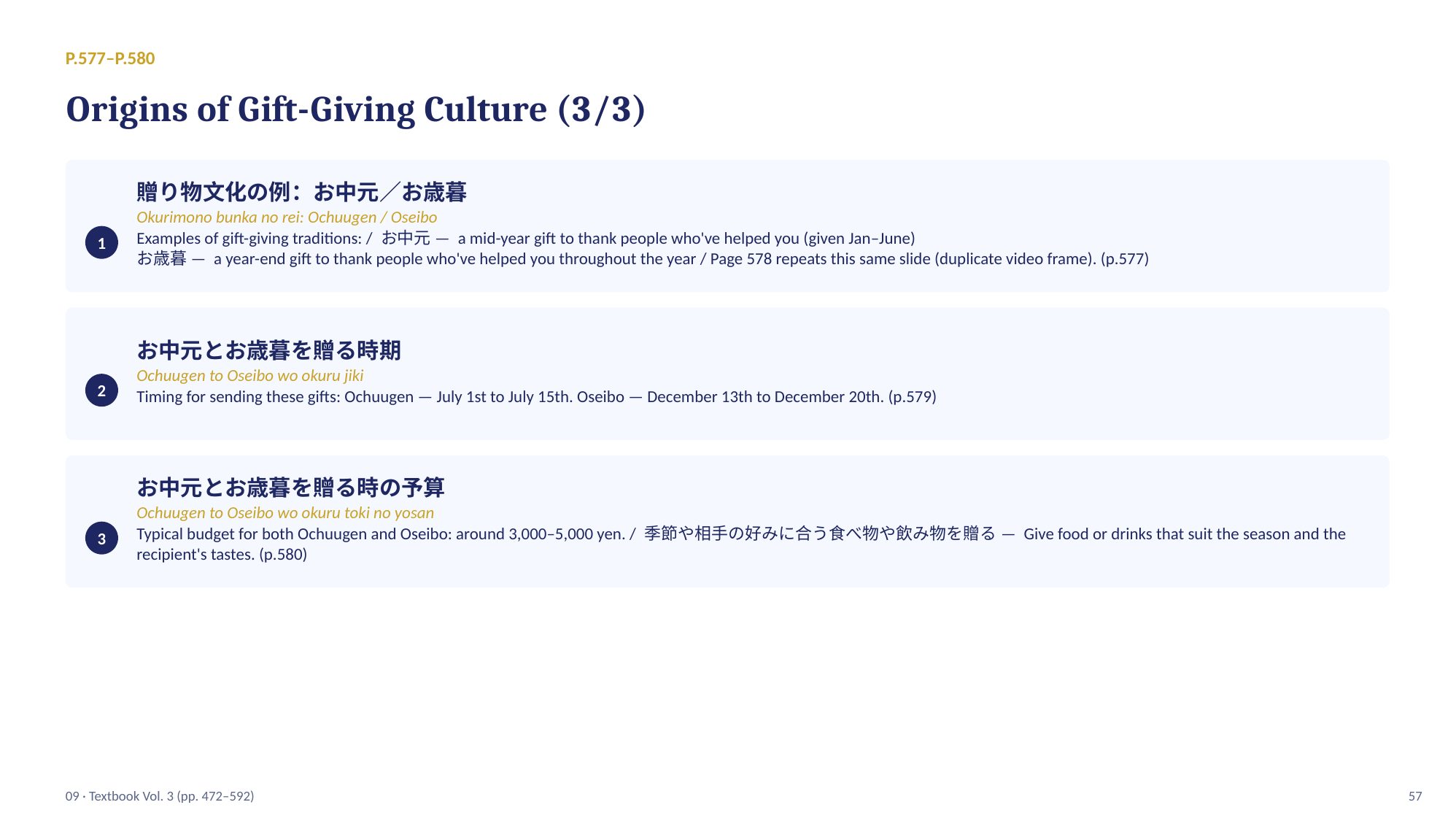
JP贈り物文化の例:お中元/お歳暮
EN Okurimono bunka no rei: Ochuugen / Oseibo
1 Examples of gift-giving traditions: / お中元 — a mid-year gift to thank people who've helped you (given Jan–June)
お歳暮 — a year-end gift to thank people who've helped you throughout the year / Page 578 repeats this same slide (duplicate video frame). (p.577)
1 Examples of gift-giving traditions: / お中元 — a mid-year gift to thank people who've helped you (given Jan–June)
お歳暮 — a year-end gift to thank people who've helped you throughout the year / Page 578 repeats this same slide (duplicate video frame). (p.577)
JPお中元とお歳暮を贈る時期
EN Ochuugen to Oseibo wo okuru jiki
2 Timing for sending these gifts: Ochuugen — July 1st to July 15th. Oseibo — December 13th to December 20th. (p.579)
2 Timing for sending these gifts: Ochuugen — July 1st to July 15th. Oseibo — December 13th to December 20th. (p.579)
JPお中元とお歳暮を贈る時の予算
EN Ochuugen to Oseibo wo okuru toki no yosan
3 Typical budget for both Ochuugen and Oseibo: around 3,000–5,000 yen. / 季節や相手の好みに合う食べ物や飲み物を贈る — Give food or drinks that suit the season and the
recipient's tastes. (p.580)
09 · Textbook Vol. 3 (pp. 472–592) 57
3 Typical budget for both Ochuugen and Oseibo: around 3,000–5,000 yen. / 季節や相手の好みに合う食べ物や飲み物を贈る — Give food or drinks that suit the season and the
recipient's tastes. (p.580)
09 · Textbook Vol. 3 (pp. 472–592) 57
หน้า 58

คลิกเพื่อขยาย
20
ENWorkplace Souvenirs (Omiyage)
6 phrases · pages 582–588
6 phrases · pages 582–588
หน้า 59
คลิกเพื่อขยาย
ENP.582–P.585
Workplace Souvenirs (Omiyage) (1/2)
Workplace Souvenirs (Omiyage) (1/2)
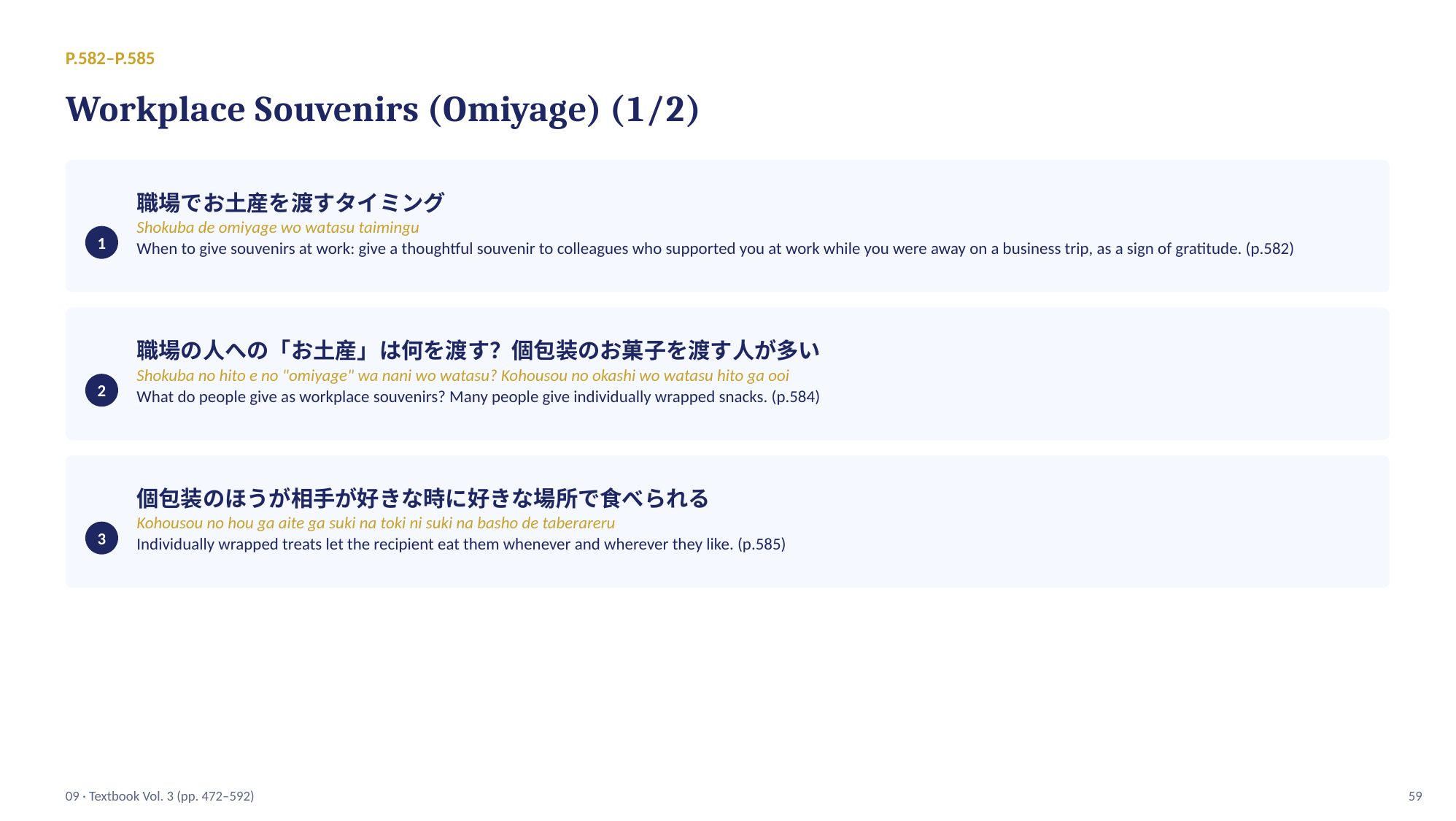
JP職場でお土産を渡すタイミング
EN Shokuba de omiyage wo watasu taimingu
1 When to give souvenirs at work: give a thoughtful souvenir to colleagues who supported you at work while you were away on a business trip, as a sign of gratitude. (p.582)
1 When to give souvenirs at work: give a thoughtful souvenir to colleagues who supported you at work while you were away on a business trip, as a sign of gratitude. (p.582)
JP職場の人への「お土産」は何を渡す?個包装のお菓子を渡す人が多い
EN Shokuba no hito e no "omiyage" wa nani wo watasu? Kohousou no okashi wo watasu hito ga ooi
2 What do people give as workplace souvenirs? Many people give individually wrapped snacks. (p.584)
2 What do people give as workplace souvenirs? Many people give individually wrapped snacks. (p.584)
JP個包装のほうが相手が好きな時に好きな場所で食べられる
EN Kohousou no hou ga aite ga suki na toki ni suki na basho de taberareru
3 Individually wrapped treats let the recipient eat them whenever and wherever they like. (p.585)
09 · Textbook Vol. 3 (pp. 472–592) 59
3 Individually wrapped treats let the recipient eat them whenever and wherever they like. (p.585)
09 · Textbook Vol. 3 (pp. 472–592) 59
หน้า 60
คลิกเพื่อขยาย
ENP.586–P.588
Workplace Souvenirs (Omiyage) (2/2)
Workplace Souvenirs (Omiyage) (2/2)
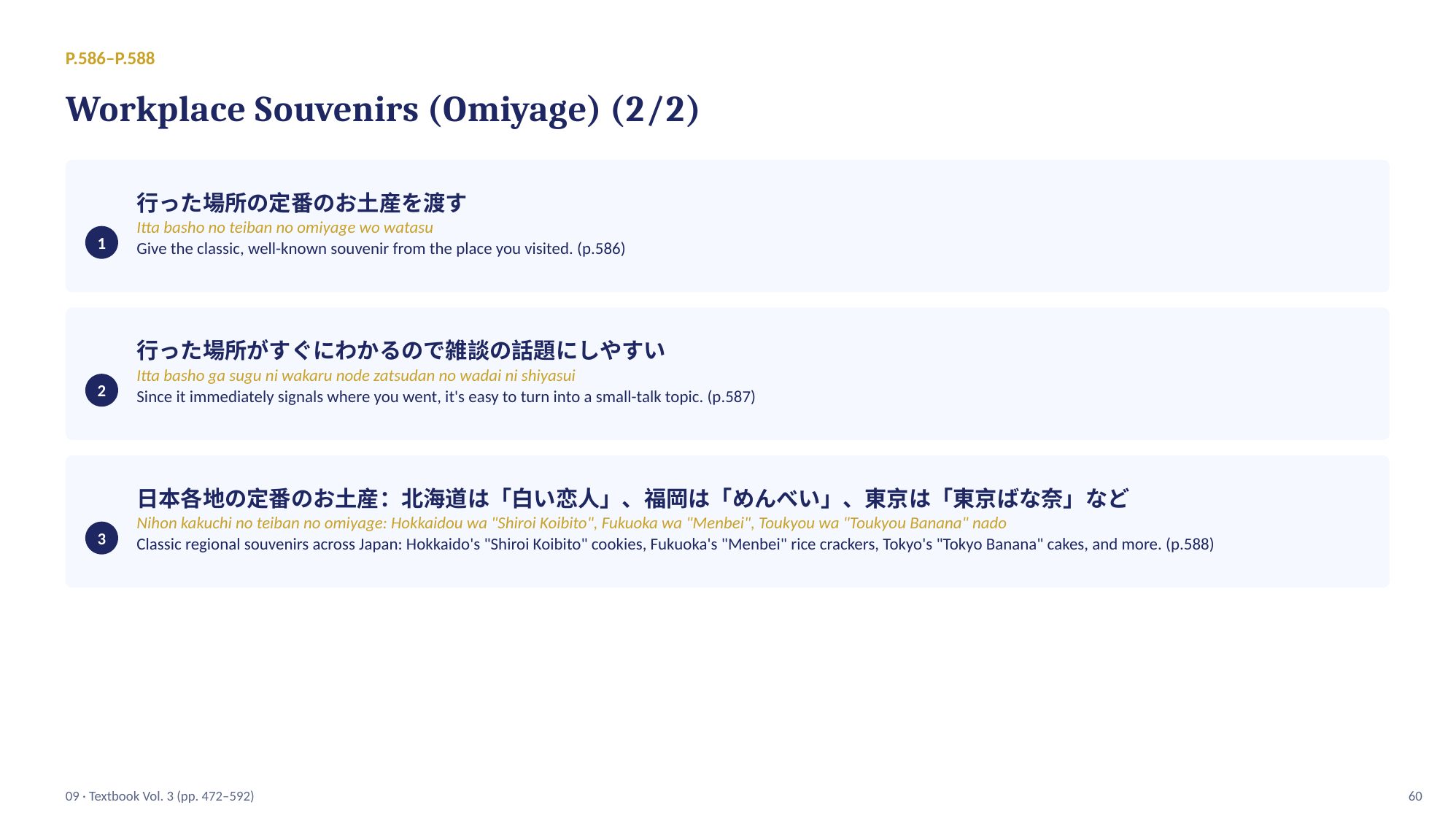
JP行った場所の定番のお土産を渡す
EN Itta basho no teiban no omiyage wo watasu
1 Give the classic, well-known souvenir from the place you visited. (p.586)
1 Give the classic, well-known souvenir from the place you visited. (p.586)
JP行った場所がすぐにわかるので雑談の話題にしやすい
EN Itta basho ga sugu ni wakaru node zatsudan no wadai ni shiyasui
2 Since it immediately signals where you went, it's easy to turn into a small-talk topic. (p.587)
2 Since it immediately signals where you went, it's easy to turn into a small-talk topic. (p.587)
JP日本各地の定番のお土産:北海道は「白い恋人」、福岡は「めんべい」、東京は「東京ばな奈」など
EN Nihon kakuchi no teiban no omiyage: Hokkaidou wa "Shiroi Koibito", Fukuoka wa "Menbei", Toukyou wa "Toukyou Banana" nado
3 Classic regional souvenirs across Japan: Hokkaido's "Shiroi Koibito" cookies, Fukuoka's "Menbei" rice crackers, Tokyo's "Tokyo Banana" cakes, and more. (p.588)
09 · Textbook Vol. 3 (pp. 472–592) 60
3 Classic regional souvenirs across Japan: Hokkaido's "Shiroi Koibito" cookies, Fukuoka's "Menbei" rice crackers, Tokyo's "Tokyo Banana" cakes, and more. (p.588)
09 · Textbook Vol. 3 (pp. 472–592) 60
หน้า 61
คลิกเพื่อขยาย
21
ENReceiving a Souvenir ( お土産 )
4 phrases · pages 589–592
4 phrases · pages 589–592
หน้า 62
คลิกเพื่อขยาย
ENP.589–P.591
Receiving a Souvenir ( お土産 ) (1/2)
Receiving a Souvenir ( お土産 ) (1/2)
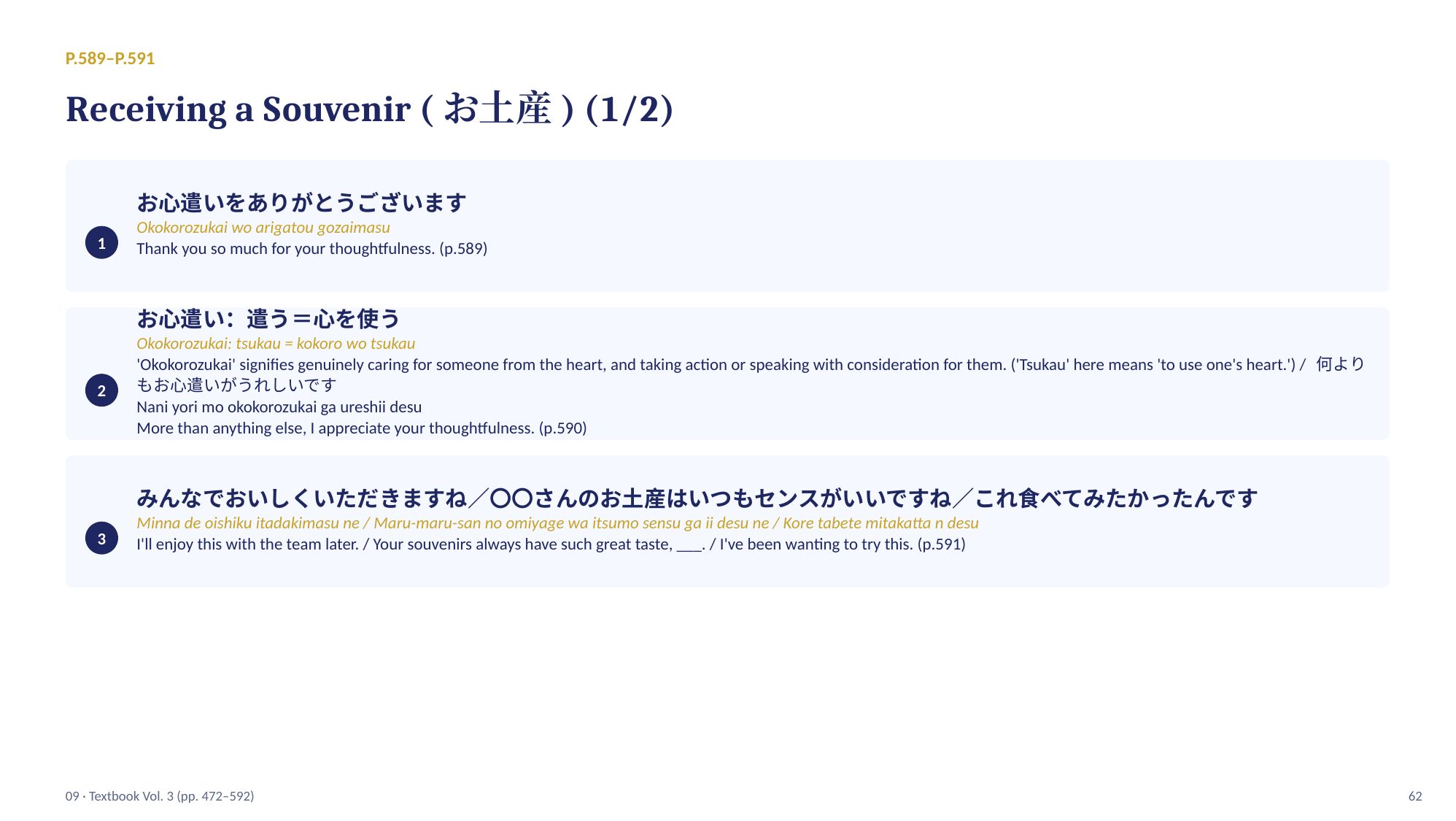
JPお心遣いをありがとうございます
EN Okokorozukai wo arigatou gozaimasu
1 Thank you so much for your thoughtfulness. (p.589)
1 Thank you so much for your thoughtfulness. (p.589)
JPお心遣い:遣う=心を使う
EN Okokorozukai: tsukau = kokoro wo tsukau
'Okokorozukai' signifies genuinely caring for someone from the heart, and taking action or speaking with consideration for them. ('Tsukau' here means 'to use one's heart.') / 何より
'Okokorozukai' signifies genuinely caring for someone from the heart, and taking action or speaking with consideration for them. ('Tsukau' here means 'to use one's heart.') / 何より
JP2もお心遣いがうれしいです
EN Nani yori mo okokorozukai ga ureshii desu
More than anything else, I appreciate your thoughtfulness. (p.590)
More than anything else, I appreciate your thoughtfulness. (p.590)
JPみんなでおいしくいただきますね/〇〇さんのお土産はいつもセンスがいいですね/これ食べてみたかったんです
EN Minna de oishiku itadakimasu ne / Maru-maru-san no omiyage wa itsumo sensu ga ii desu ne / Kore tabete mitakatta n desu
3 I'll enjoy this with the team later. / Your souvenirs always have such great taste, ___. / I've been wanting to try this. (p.591)
09 · Textbook Vol. 3 (pp. 472–592) 62
3 I'll enjoy this with the team later. / Your souvenirs always have such great taste, ___. / I've been wanting to try this. (p.591)
09 · Textbook Vol. 3 (pp. 472–592) 62
หน้า 63
คลิกเพื่อขยาย
ENP.592
Receiving a Souvenir ( お土産 ) (2/2)
Receiving a Souvenir ( お土産 ) (2/2)
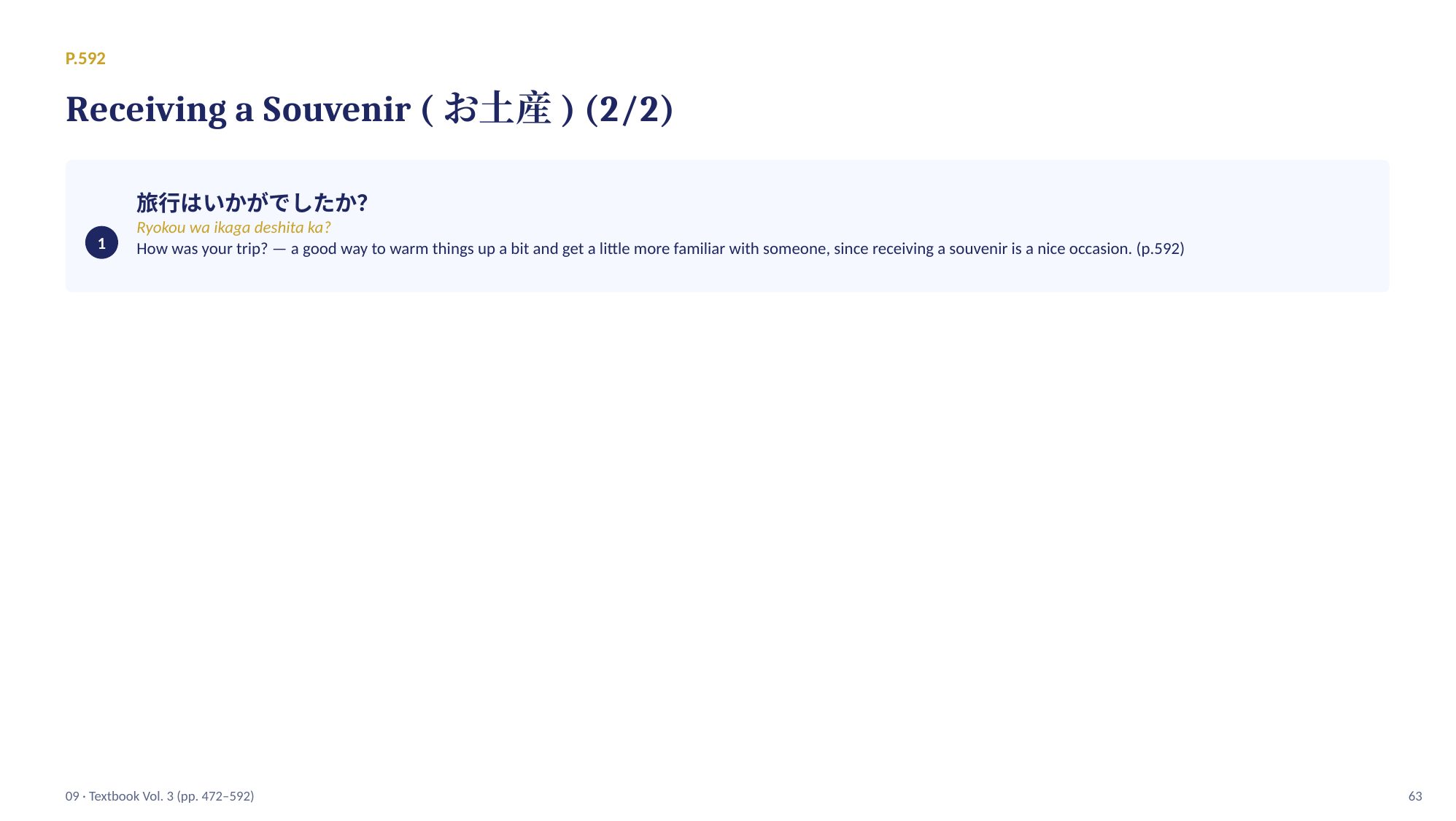
JP旅行はいかがでしたか?
EN Ryokou wa ikaga deshita ka?
1 How was your trip? — a good way to warm things up a bit and get a little more familiar with someone, since receiving a souvenir is a nice occasion. (p.592)
09 · Textbook Vol. 3 (pp. 472–592) 63
1 How was your trip? — a good way to warm things up a bit and get a little more familiar with someone, since receiving a souvenir is a nice occasion. (p.592)
09 · Textbook Vol. 3 (pp. 472–592) 63