หน้า 1
คลิกเพื่อขยาย
ENJAPANESE STUDY LIBRARY · VOLUME 7
Textbook Vol. 1 — Workplace Emotions &
Lunch Invitations
Textbook Vol. 1 — Workplace Emotions &
Lunch Invitations
JP職場の感情表現とランチのお誘い
ENFull page-by-page phrase reference: frustration, surprise, admiration, consideration, lunch invitations, and food-culture small
talk (textbook pages 31–324)
Volume 7 of 9
talk (textbook pages 31–324)
Volume 7 of 9
หน้า 2
คลิกเพื่อขยาย
ENTABLE OF CONTENTS
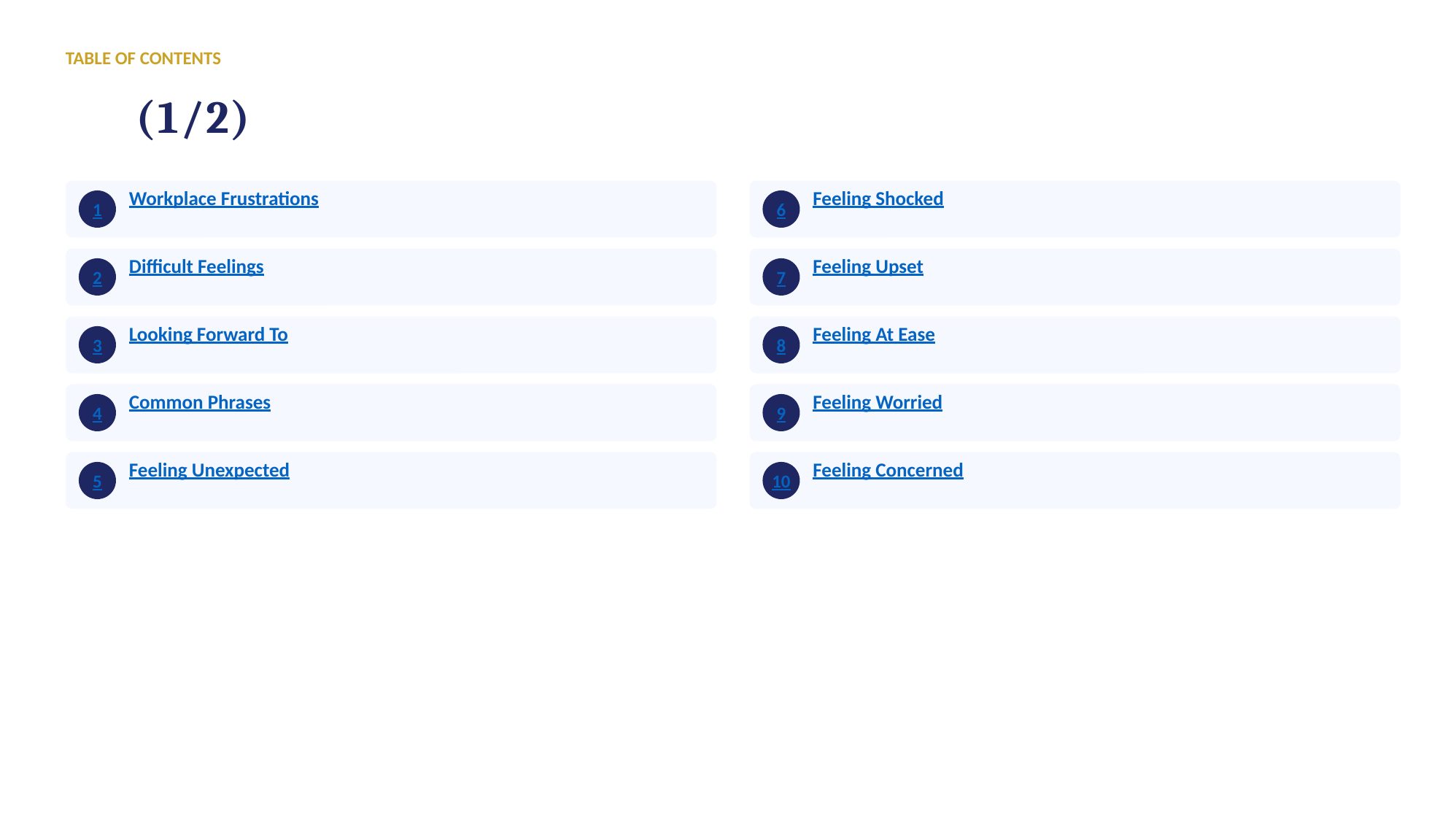
THสารบัญ (1/2)
EN Workplace Frustrations Feeling Shocked
1 6
Difficult Feelings Feeling Upset
2 7
Looking Forward To Feeling At Ease
3 8
Common Phrases Feeling Worried
4 9
Feeling Unexpected Feeling Concerned
5 10
1 6
Difficult Feelings Feeling Upset
2 7
Looking Forward To Feeling At Ease
3 8
Common Phrases Feeling Worried
4 9
Feeling Unexpected Feeling Concerned
5 10
หน้า 3
คลิกเพื่อขยาย
ENTABLE OF CONTENTS
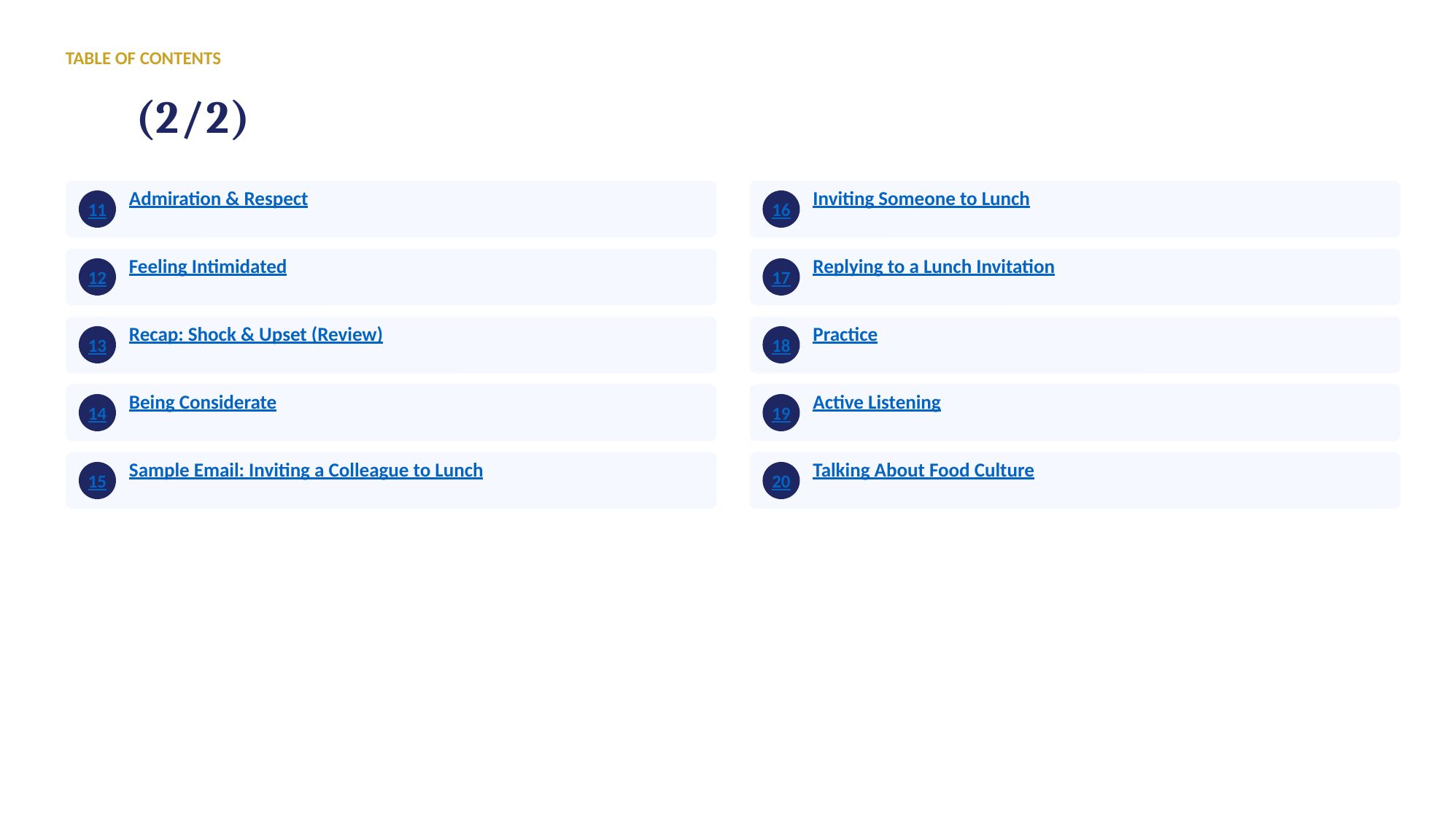
THสารบัญ (2/2)
EN Admiration & Respect Inviting Someone to Lunch
11 16
Feeling Intimidated Replying to a Lunch Invitation
12 17
Recap: Shock & Upset (Review) Practice
13 18
Being Considerate Active Listening
14 19
Sample Email: Inviting a Colleague to Lunch Talking About Food Culture
15 20
11 16
Feeling Intimidated Replying to a Lunch Invitation
12 17
Recap: Shock & Upset (Review) Practice
13 18
Being Considerate Active Listening
14 19
Sample Email: Inviting a Colleague to Lunch Talking About Food Culture
15 20
หน้า 4

คลิกเพื่อขยาย
01
ENWorkplace Frustrations
7 phrases · pages 31–37
7 phrases · pages 31–37
หน้า 5
คลิกเพื่อขยาย
ENP.31–P.33
Workplace Frustrations (1/3)
Workplace Frustrations (1/3)
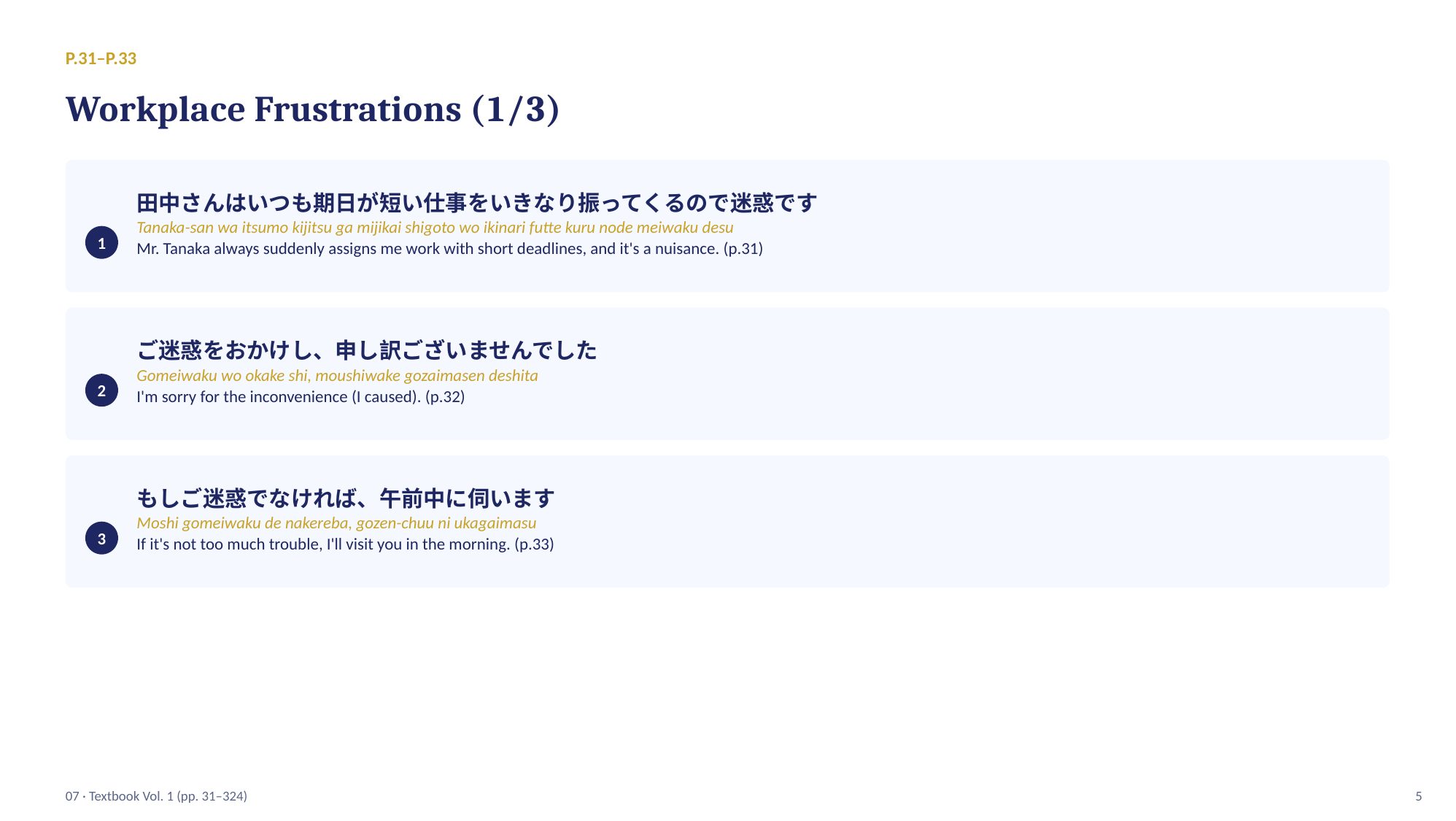
JP田中さんはいつも期日が短い仕事をいきなり振ってくるので迷惑です
EN Tanaka-san wa itsumo kijitsu ga mijikai shigoto wo ikinari futte kuru node meiwaku desu
1 Mr. Tanaka always suddenly assigns me work with short deadlines, and it's a nuisance. (p.31)
1 Mr. Tanaka always suddenly assigns me work with short deadlines, and it's a nuisance. (p.31)
JPご迷惑をおかけし、申し訳ございませんでした
EN Gomeiwaku wo okake shi, moushiwake gozaimasen deshita
2 I'm sorry for the inconvenience (I caused). (p.32)
2 I'm sorry for the inconvenience (I caused). (p.32)
JPもしご迷惑でなければ、午前中に伺います
EN Moshi gomeiwaku de nakereba, gozen-chuu ni ukagaimasu
3 If it's not too much trouble, I'll visit you in the morning. (p.33)
07 · Textbook Vol. 1 (pp. 31–324) 5
3 If it's not too much trouble, I'll visit you in the morning. (p.33)
07 · Textbook Vol. 1 (pp. 31–324) 5
หน้า 6
คลิกเพื่อขยาย
ENP.34–P.36
Workplace Frustrations (2/3)
Workplace Frustrations (2/3)
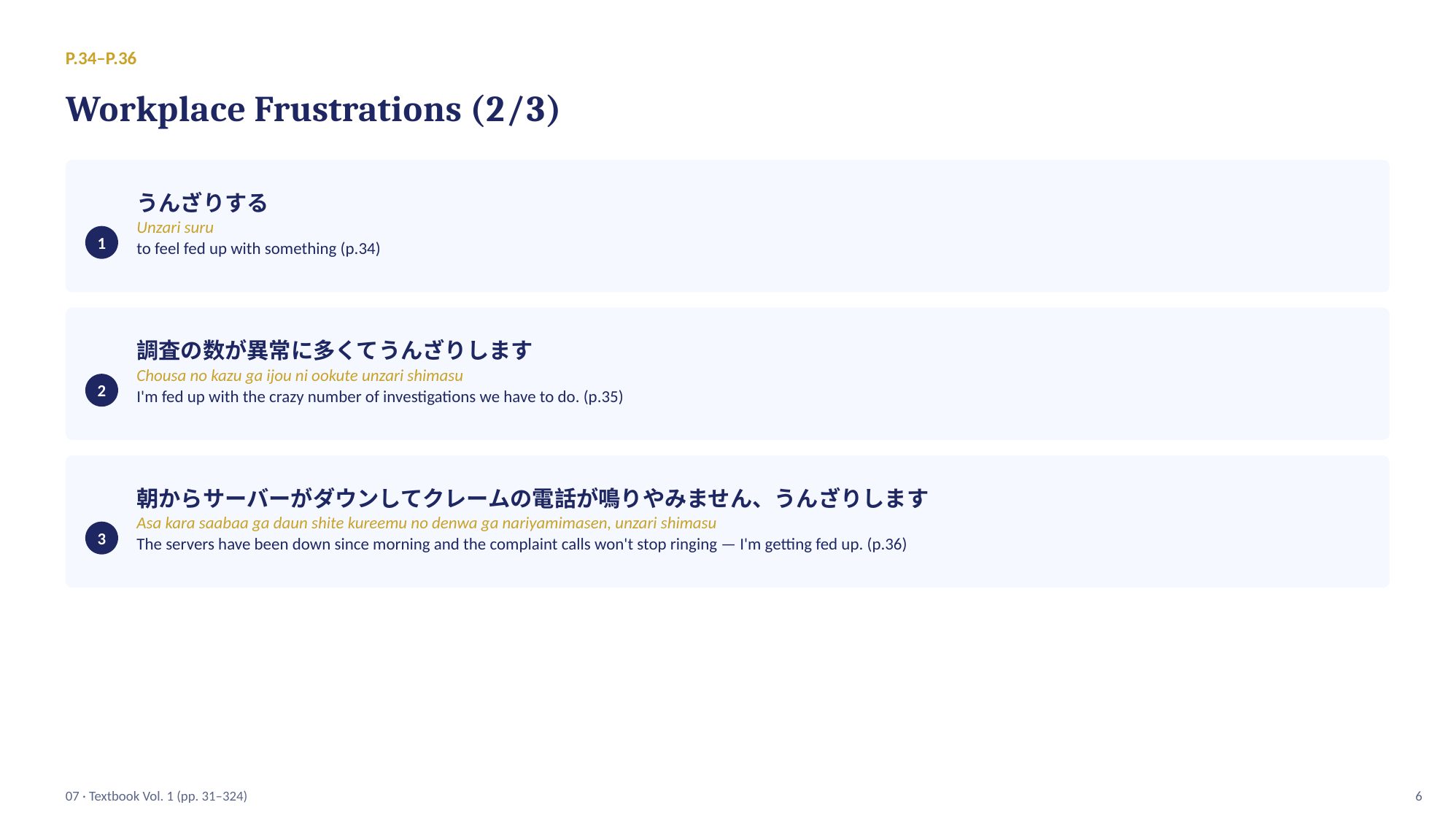
JPうんざりする
EN Unzari suru
1 to feel fed up with something (p.34)
1 to feel fed up with something (p.34)
JP調査の数が異常に多くてうんざりします
EN Chousa no kazu ga ijou ni ookute unzari shimasu
2 I'm fed up with the crazy number of investigations we have to do. (p.35)
2 I'm fed up with the crazy number of investigations we have to do. (p.35)
JP朝からサーバーがダウンしてクレームの電話が鳴りやみません、うんざりします
EN Asa kara saabaa ga daun shite kureemu no denwa ga nariyamimasen, unzari shimasu
3 The servers have been down since morning and the complaint calls won't stop ringing — I'm getting fed up. (p.36)
07 · Textbook Vol. 1 (pp. 31–324) 6
3 The servers have been down since morning and the complaint calls won't stop ringing — I'm getting fed up. (p.36)
07 · Textbook Vol. 1 (pp. 31–324) 6
หน้า 7
คลิกเพื่อขยาย
ENP.37
Workplace Frustrations (3/3)
Workplace Frustrations (3/3)
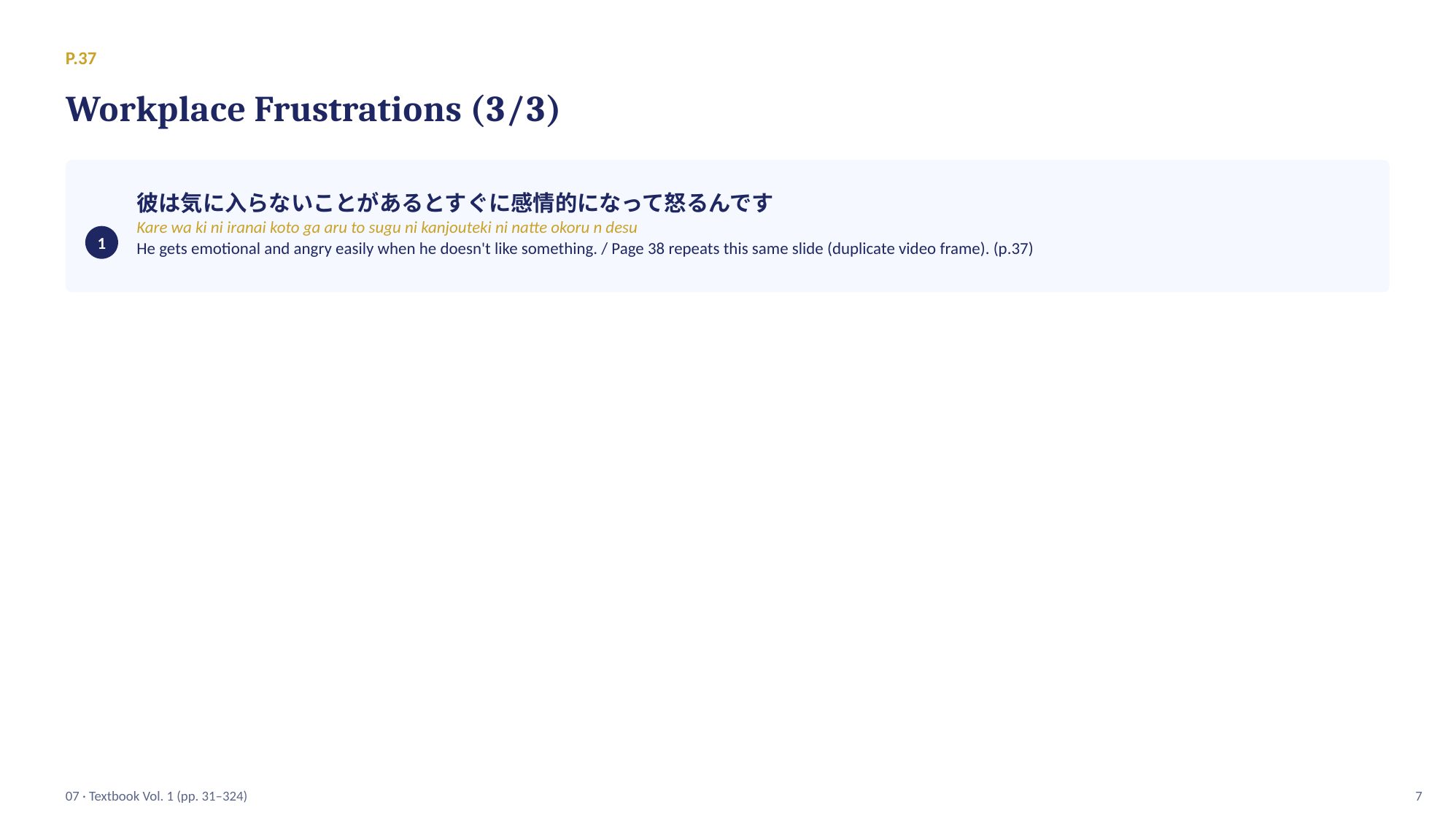
JP彼は気に入らないことがあるとすぐに感情的になって怒るんです
EN Kare wa ki ni iranai koto ga aru to sugu ni kanjouteki ni natte okoru n desu
1 He gets emotional and angry easily when he doesn't like something. / Page 38 repeats this same slide (duplicate video frame). (p.37)
07 · Textbook Vol. 1 (pp. 31–324) 7
1 He gets emotional and angry easily when he doesn't like something. / Page 38 repeats this same slide (duplicate video frame). (p.37)
07 · Textbook Vol. 1 (pp. 31–324) 7
หน้า 8

คลิกเพื่อขยาย
02
ENDifficult Feelings
7 phrases · pages 39–45
7 phrases · pages 39–45
หน้า 9
คลิกเพื่อขยาย
ENP.39–P.41
Difficult Feelings (1/3)
Difficult Feelings (1/3)
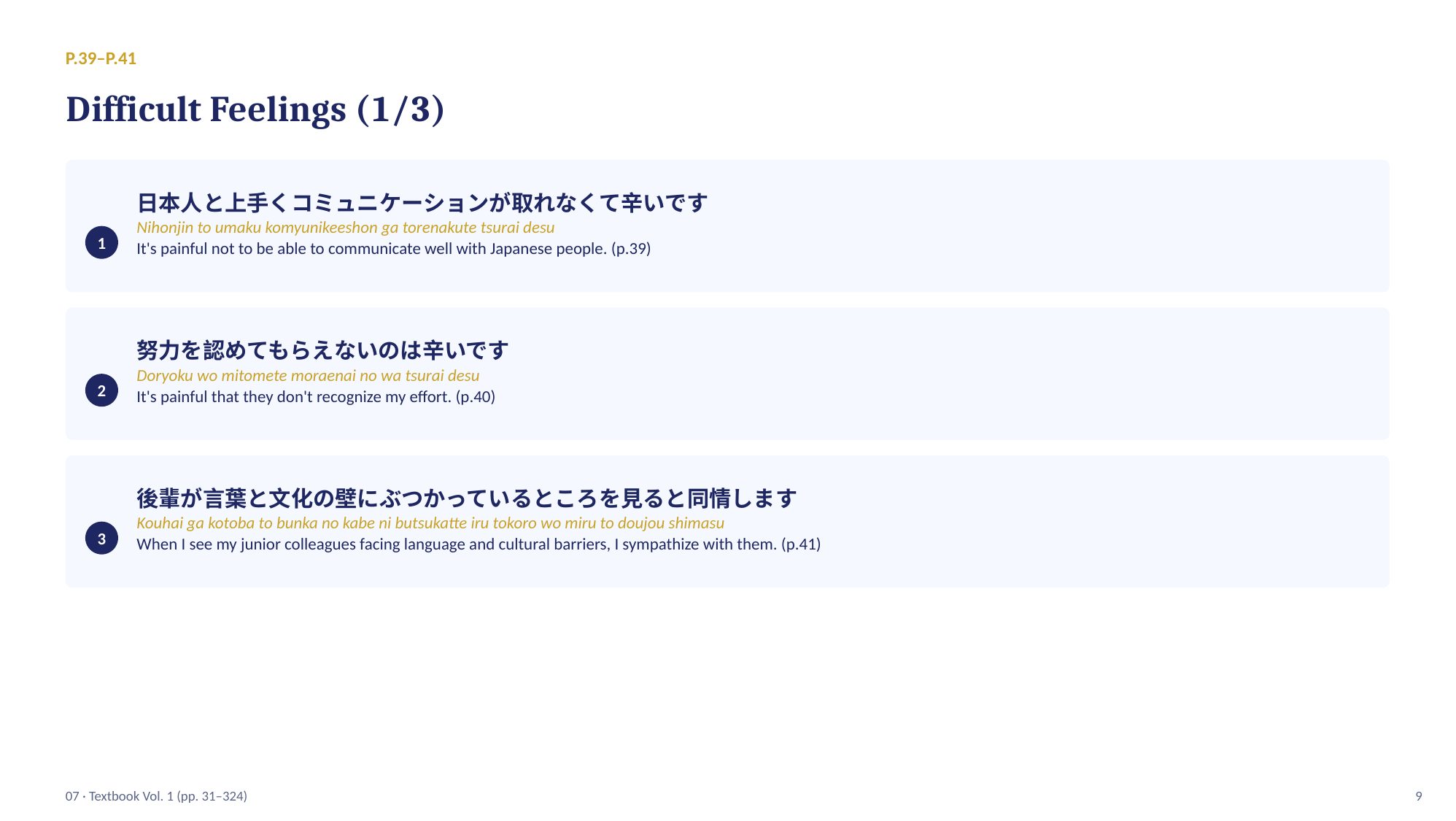
JP日本人と上手くコミュニケーションが取れなくて辛いです
EN Nihonjin to umaku komyunikeeshon ga torenakute tsurai desu
1 It's painful not to be able to communicate well with Japanese people. (p.39)
1 It's painful not to be able to communicate well with Japanese people. (p.39)
JP努力を認めてもらえないのは辛いです
EN Doryoku wo mitomete moraenai no wa tsurai desu
2 It's painful that they don't recognize my effort. (p.40)
2 It's painful that they don't recognize my effort. (p.40)
JP後輩が言葉と文化の壁にぶつかっているところを見ると同情します
EN Kouhai ga kotoba to bunka no kabe ni butsukatte iru tokoro wo miru to doujou shimasu
3 When I see my junior colleagues facing language and cultural barriers, I sympathize with them. (p.41)
07 · Textbook Vol. 1 (pp. 31–324) 9
3 When I see my junior colleagues facing language and cultural barriers, I sympathize with them. (p.41)
07 · Textbook Vol. 1 (pp. 31–324) 9
หน้า 10
คลิกเพื่อขยาย
ENP.42–P.44
Difficult Feelings (2/3)
Difficult Feelings (2/3)
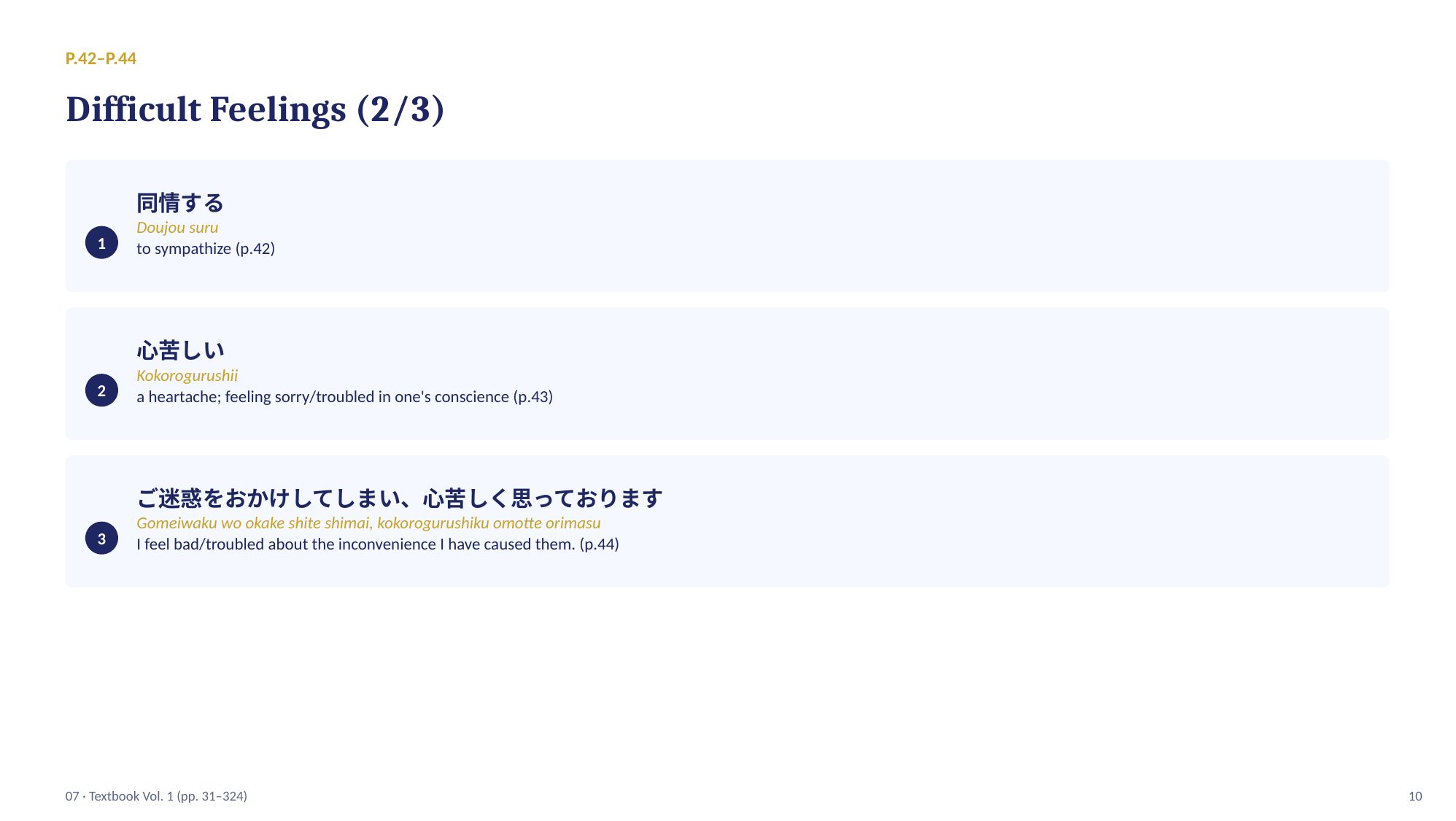
JP同情する
EN Doujou suru
1 to sympathize (p.42)
1 to sympathize (p.42)
JP心苦しい
EN Kokorogurushii
2 a heartache; feeling sorry/troubled in one's conscience (p.43)
2 a heartache; feeling sorry/troubled in one's conscience (p.43)
JPご迷惑をおかけしてしまい、心苦しく思っております
EN Gomeiwaku wo okake shite shimai, kokorogurushiku omotte orimasu
3 I feel bad/troubled about the inconvenience I have caused them. (p.44)
07 · Textbook Vol. 1 (pp. 31–324) 10
3 I feel bad/troubled about the inconvenience I have caused them. (p.44)
07 · Textbook Vol. 1 (pp. 31–324) 10
หน้า 11
คลิกเพื่อขยาย
ENP.45
Difficult Feelings (3/3)
Difficult Feelings (3/3)
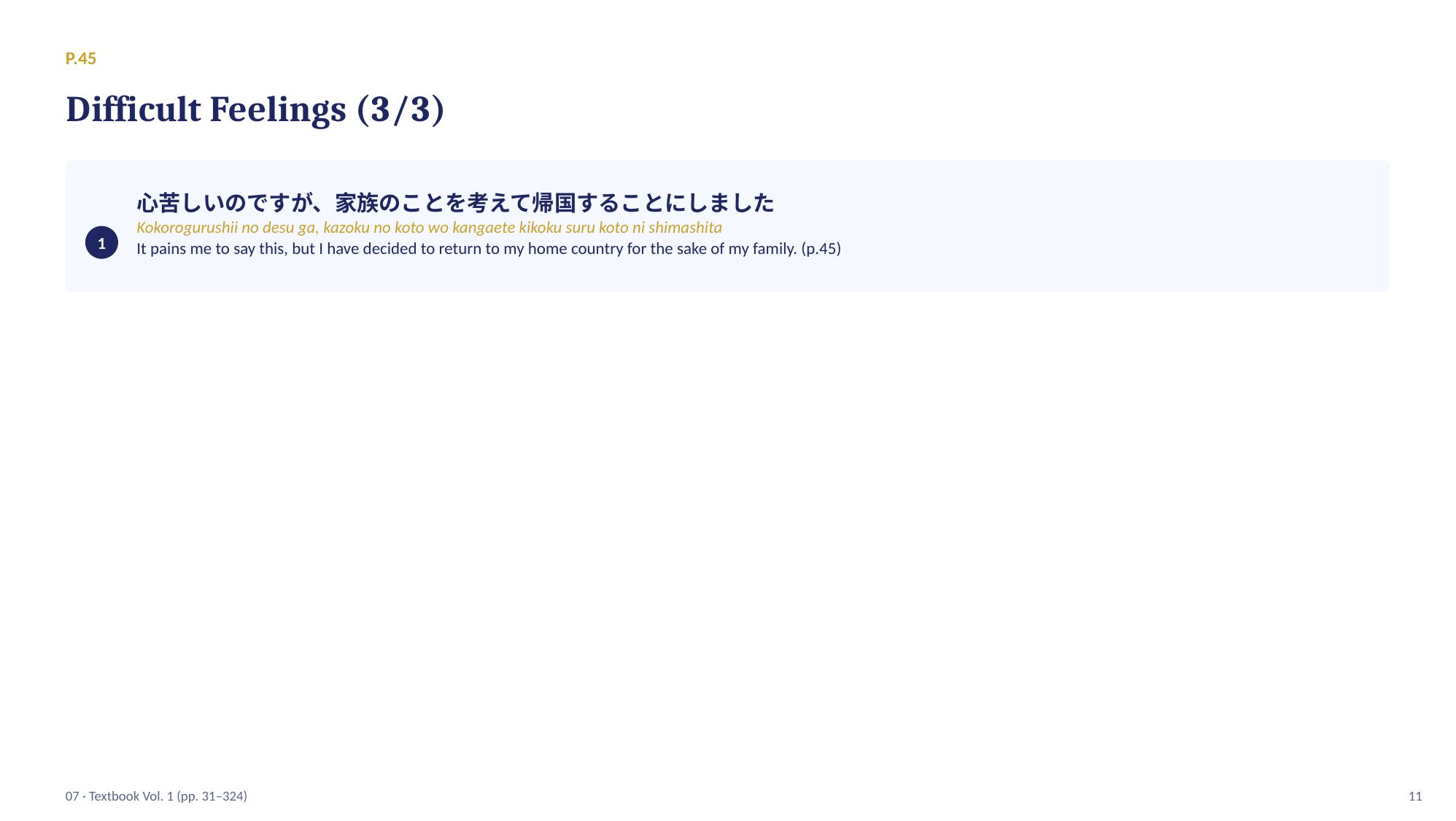
JP心苦しいのですが、家族のことを考えて帰国することにしました
EN Kokorogurushii no desu ga, kazoku no koto wo kangaete kikoku suru koto ni shimashita
1 It pains me to say this, but I have decided to return to my home country for the sake of my family. (p.45)
07 · Textbook Vol. 1 (pp. 31–324) 11
1 It pains me to say this, but I have decided to return to my home country for the sake of my family. (p.45)
07 · Textbook Vol. 1 (pp. 31–324) 11
หน้า 12

คลิกเพื่อขยาย
03
ENLooking Forward To
18 phrases · pages 46–63
18 phrases · pages 46–63
หน้า 13
คลิกเพื่อขยาย
ENP.46–P.48
Looking Forward To (1/6)
Looking Forward To (1/6)
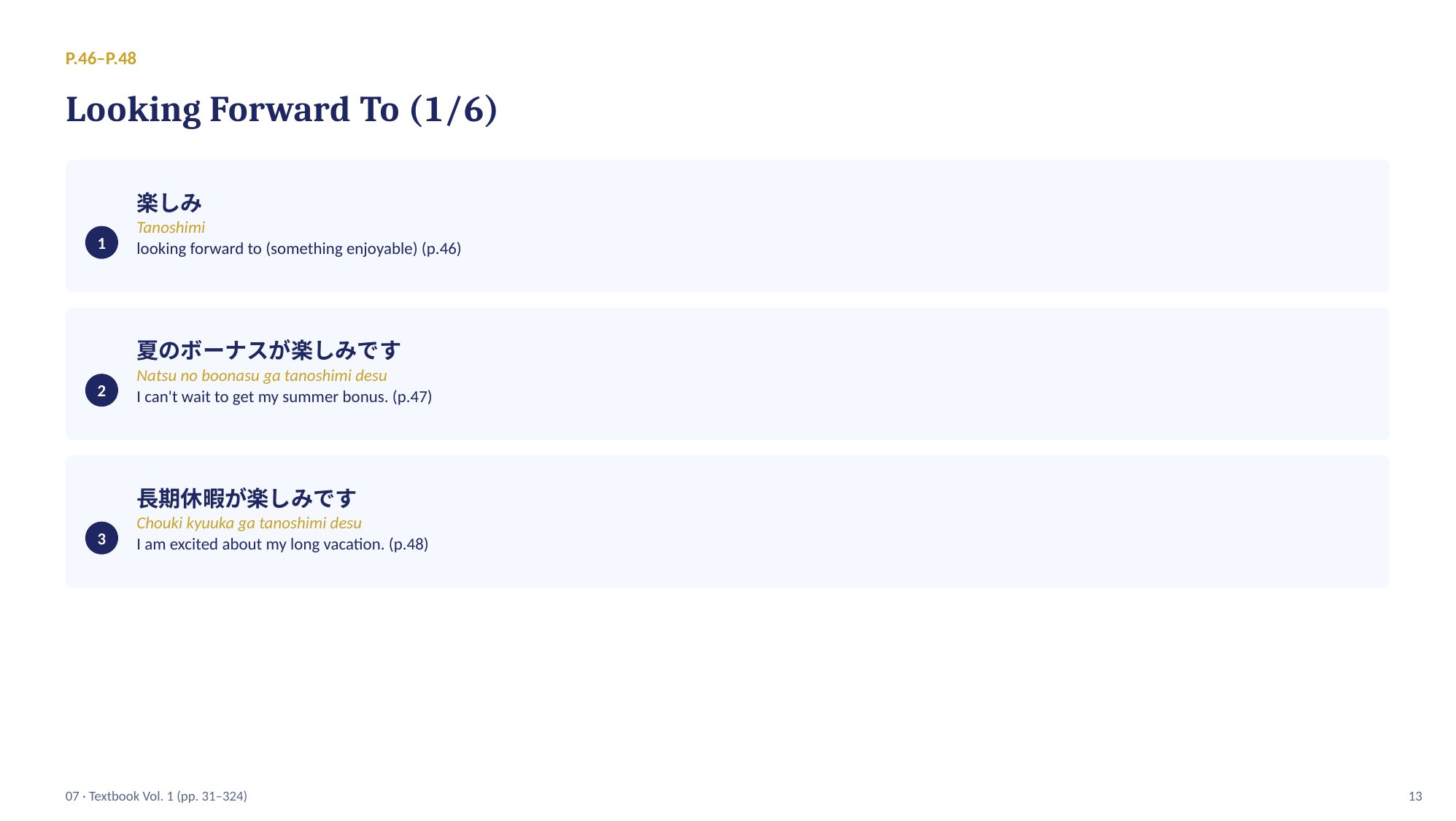
JP楽しみ
EN Tanoshimi
1 looking forward to (something enjoyable) (p.46)
1 looking forward to (something enjoyable) (p.46)
JP夏のボーナスが楽しみです
EN Natsu no boonasu ga tanoshimi desu
2 I can't wait to get my summer bonus. (p.47)
2 I can't wait to get my summer bonus. (p.47)
JP長期休暇が楽しみです
EN Chouki kyuuka ga tanoshimi desu
3 I am excited about my long vacation. (p.48)
07 · Textbook Vol. 1 (pp. 31–324) 13
3 I am excited about my long vacation. (p.48)
07 · Textbook Vol. 1 (pp. 31–324) 13
หน้า 14
คลิกเพื่อขยาย
ENP.49–P.51
Looking Forward To (2/6)
Looking Forward To (2/6)
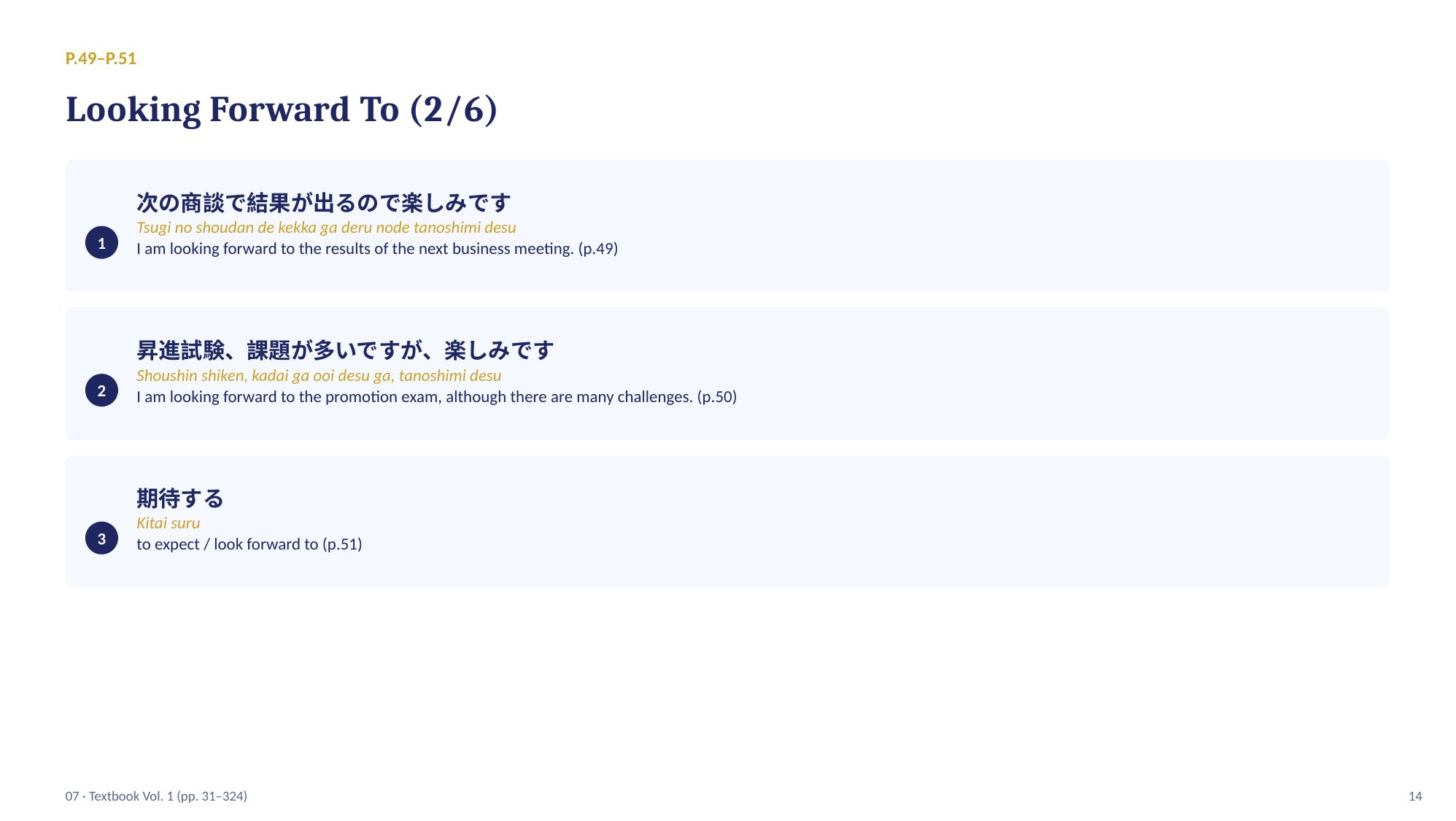
JP次の商談で結果が出るので楽しみです
EN Tsugi no shoudan de kekka ga deru node tanoshimi desu
1 I am looking forward to the results of the next business meeting. (p.49)
1 I am looking forward to the results of the next business meeting. (p.49)
JP昇進試験、課題が多いですが、楽しみです
EN Shoushin shiken, kadai ga ooi desu ga, tanoshimi desu
2 I am looking forward to the promotion exam, although there are many challenges. (p.50)
2 I am looking forward to the promotion exam, although there are many challenges. (p.50)
JP期待する
EN Kitai suru
3 to expect / look forward to (p.51)
07 · Textbook Vol. 1 (pp. 31–324) 14
3 to expect / look forward to (p.51)
07 · Textbook Vol. 1 (pp. 31–324) 14
หน้า 15
คลิกเพื่อขยาย
ENP.52–P.54
Looking Forward To (3/6)
Looking Forward To (3/6)
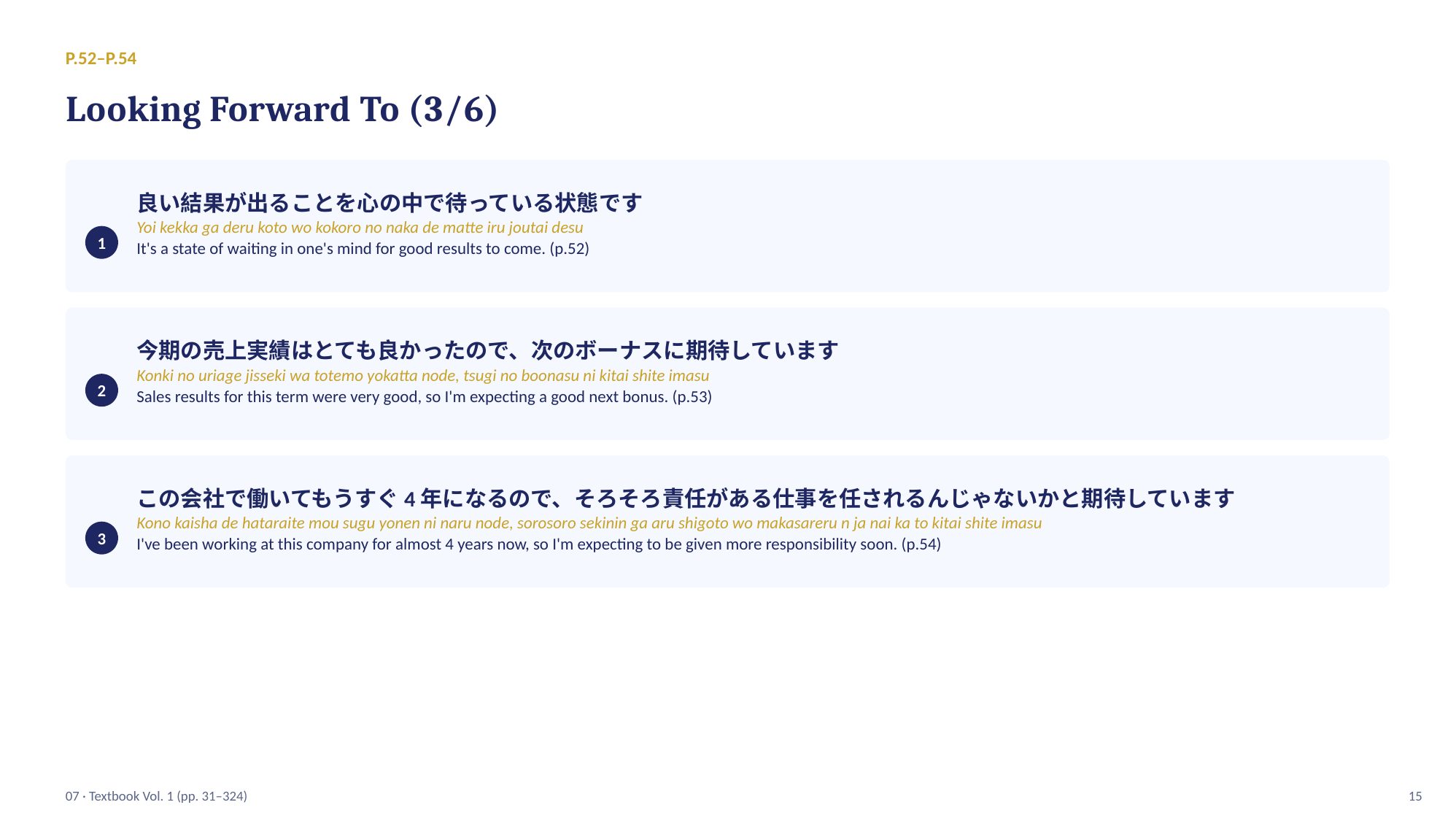
JP良い結果が出ることを心の中で待っている状態です
EN Yoi kekka ga deru koto wo kokoro no naka de matte iru joutai desu
1 It's a state of waiting in one's mind for good results to come. (p.52)
1 It's a state of waiting in one's mind for good results to come. (p.52)
JP今期の売上実績はとても良かったので、次のボーナスに期待しています
EN Konki no uriage jisseki wa totemo yokatta node, tsugi no boonasu ni kitai shite imasu
2 Sales results for this term were very good, so I'm expecting a good next bonus. (p.53)
2 Sales results for this term were very good, so I'm expecting a good next bonus. (p.53)
JPこの会社で働いてもうすぐ4年になるので、そろそろ責任がある仕事を任されるんじゃないかと期待しています
EN Kono kaisha de hataraite mou sugu yonen ni naru node, sorosoro sekinin ga aru shigoto wo makasareru n ja nai ka to kitai shite imasu
3 I've been working at this company for almost 4 years now, so I'm expecting to be given more responsibility soon. (p.54)
07 · Textbook Vol. 1 (pp. 31–324) 15
3 I've been working at this company for almost 4 years now, so I'm expecting to be given more responsibility soon. (p.54)
07 · Textbook Vol. 1 (pp. 31–324) 15
หน้า 16
คลิกเพื่อขยาย
ENP.55–P.57
Looking Forward To (4/6)
Looking Forward To (4/6)
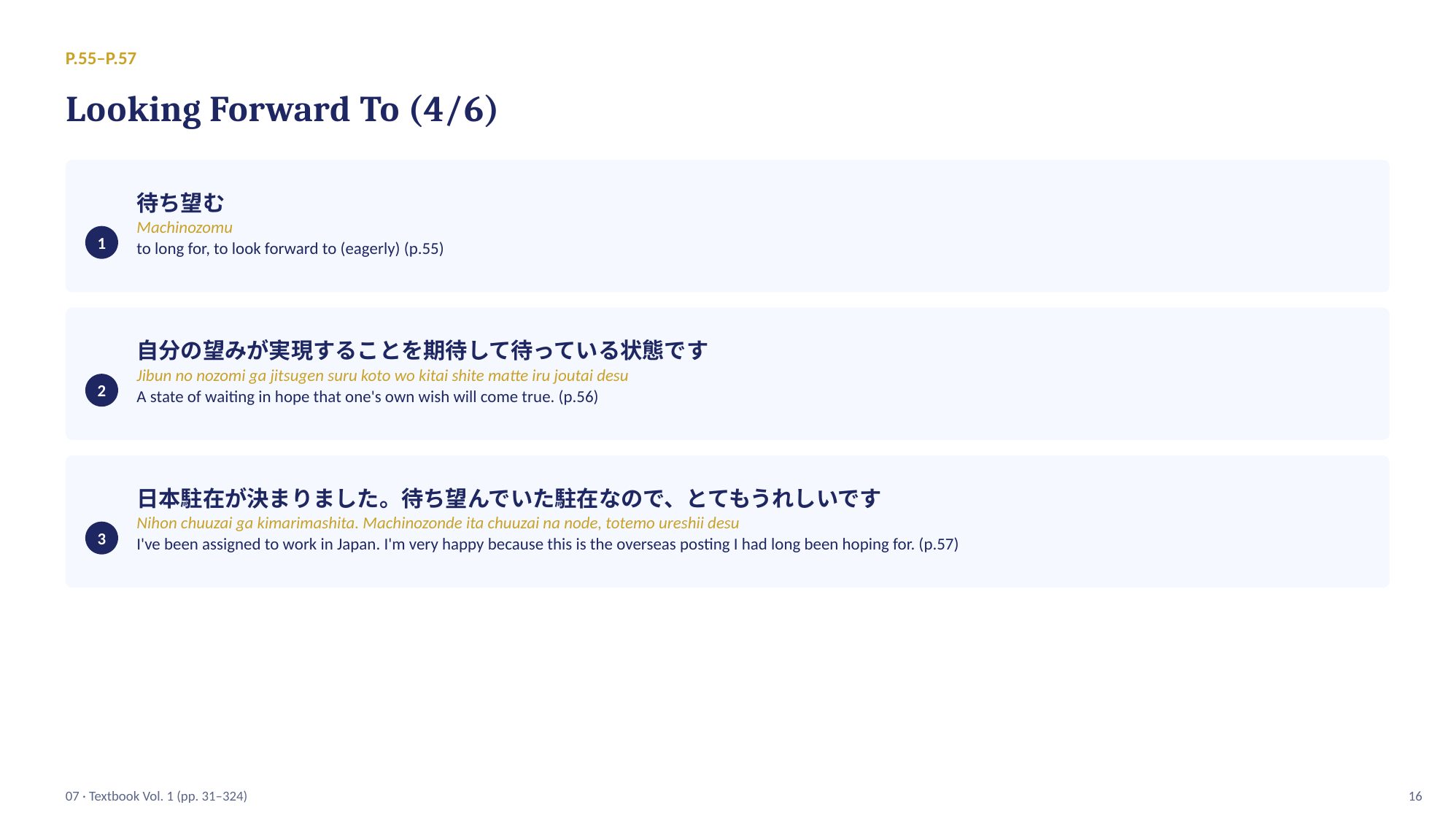
JP待ち望む
EN Machinozomu
1 to long for, to look forward to (eagerly) (p.55)
1 to long for, to look forward to (eagerly) (p.55)
JP自分の望みが実現することを期待して待っている状態です
EN Jibun no nozomi ga jitsugen suru koto wo kitai shite matte iru joutai desu
2 A state of waiting in hope that one's own wish will come true. (p.56)
2 A state of waiting in hope that one's own wish will come true. (p.56)
JP日本駐在が決まりました。待ち望んでいた駐在なので、とてもうれしいです
EN Nihon chuuzai ga kimarimashita. Machinozonde ita chuuzai na node, totemo ureshii desu
3 I've been assigned to work in Japan. I'm very happy because this is the overseas posting I had long been hoping for. (p.57)
07 · Textbook Vol. 1 (pp. 31–324) 16
3 I've been assigned to work in Japan. I'm very happy because this is the overseas posting I had long been hoping for. (p.57)
07 · Textbook Vol. 1 (pp. 31–324) 16
หน้า 17
คลิกเพื่อขยาย
ENP.58–P.60
Looking Forward To (5/6)
Looking Forward To (5/6)
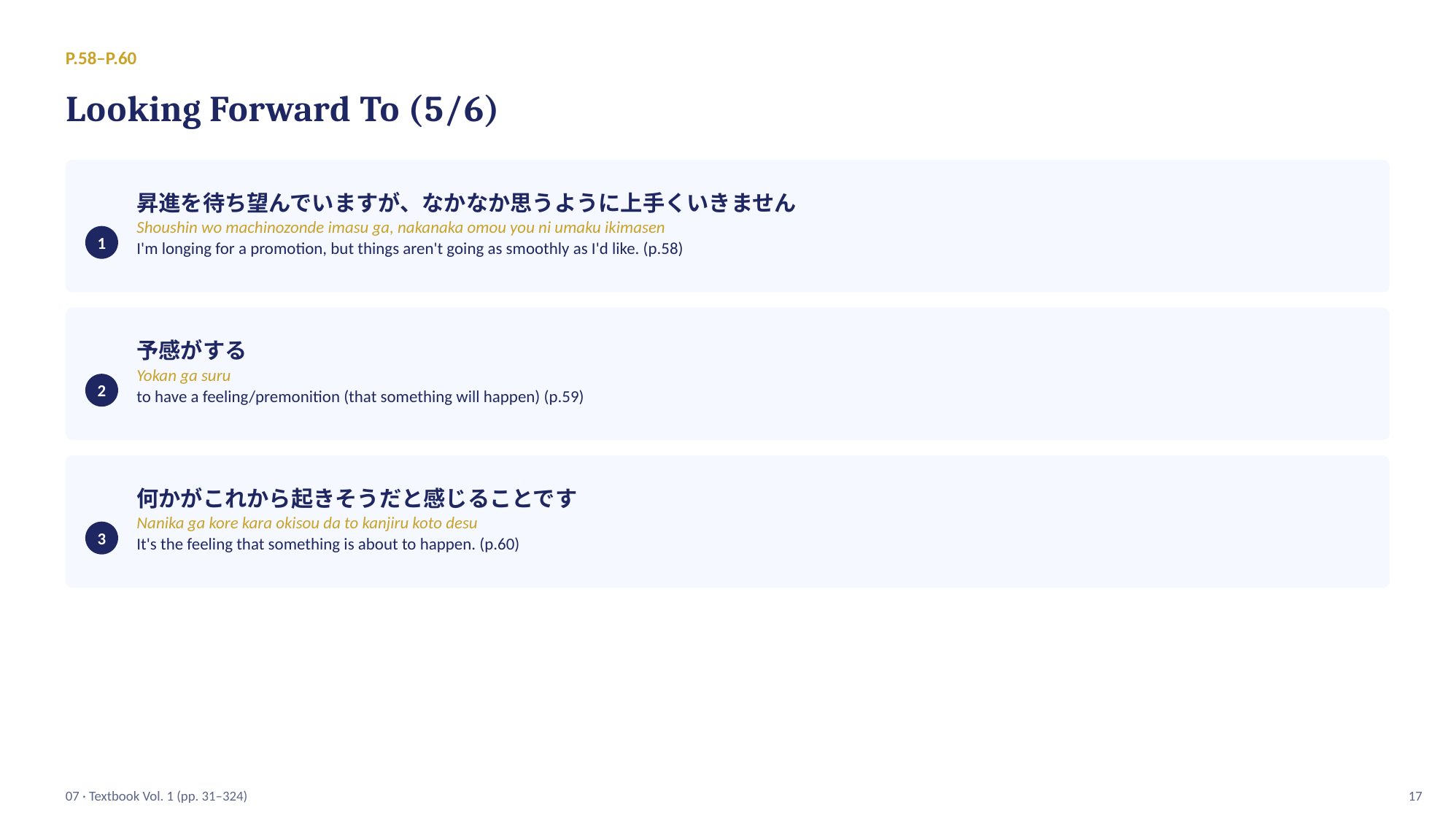
JP昇進を待ち望んでいますが、なかなか思うように上手くいきません
EN Shoushin wo machinozonde imasu ga, nakanaka omou you ni umaku ikimasen
1 I'm longing for a promotion, but things aren't going as smoothly as I'd like. (p.58)
1 I'm longing for a promotion, but things aren't going as smoothly as I'd like. (p.58)
JP予感がする
EN Yokan ga suru
2 to have a feeling/premonition (that something will happen) (p.59)
2 to have a feeling/premonition (that something will happen) (p.59)
JP何かがこれから起きそうだと感じることです
EN Nanika ga kore kara okisou da to kanjiru koto desu
3 It's the feeling that something is about to happen. (p.60)
07 · Textbook Vol. 1 (pp. 31–324) 17
3 It's the feeling that something is about to happen. (p.60)
07 · Textbook Vol. 1 (pp. 31–324) 17
หน้า 18
คลิกเพื่อขยาย
ENP.61–P.63
Looking Forward To (6/6)
Looking Forward To (6/6)
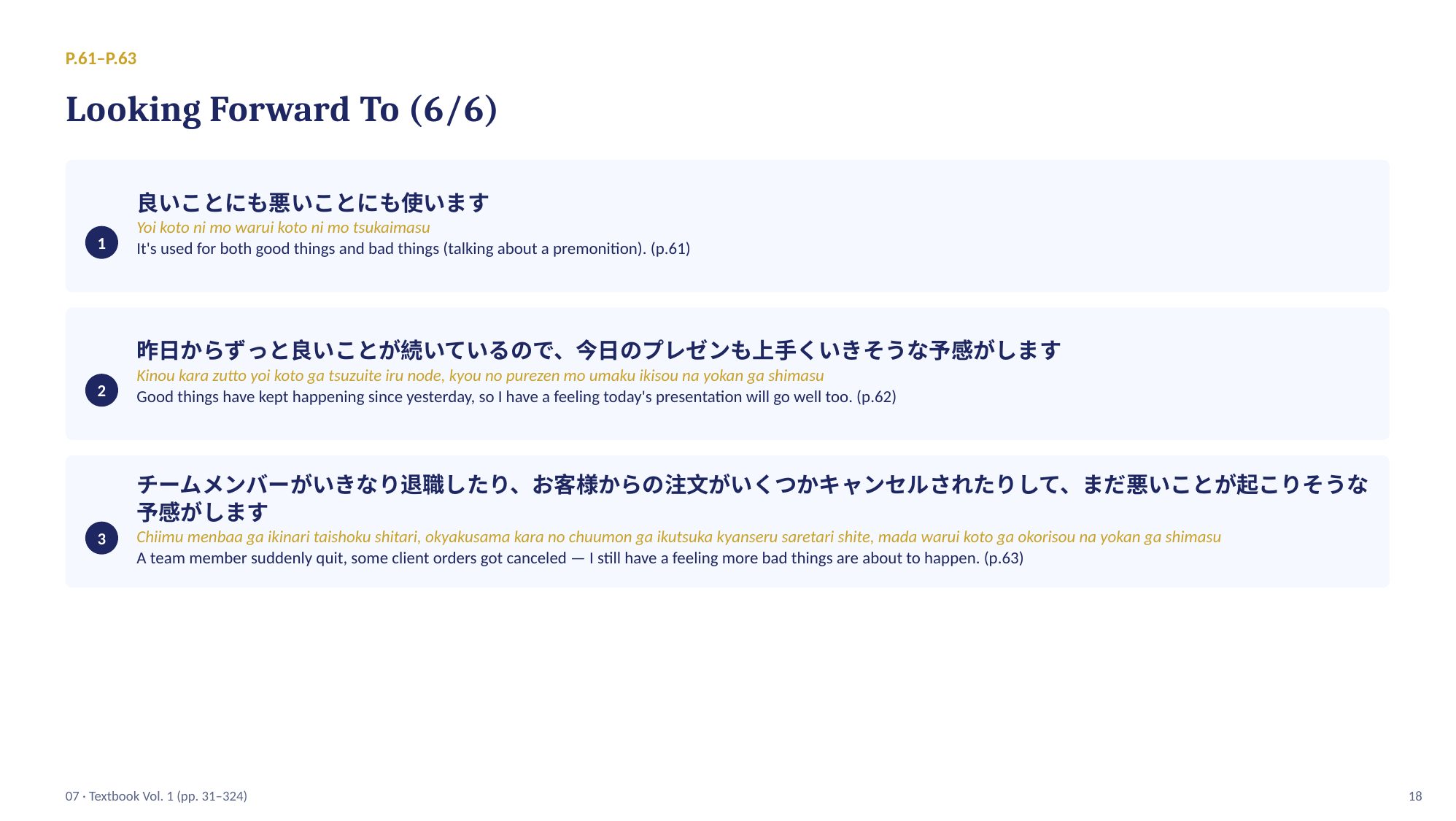
JP良いことにも悪いことにも使います
EN Yoi koto ni mo warui koto ni mo tsukaimasu
1 It's used for both good things and bad things (talking about a premonition). (p.61)
1 It's used for both good things and bad things (talking about a premonition). (p.61)
JP昨日からずっと良いことが続いているので、今日のプレゼンも上手くいきそうな予感がします
EN Kinou kara zutto yoi koto ga tsuzuite iru node, kyou no purezen mo umaku ikisou na yokan ga shimasu
2 Good things have kept happening since yesterday, so I have a feeling today's presentation will go well too. (p.62)
2 Good things have kept happening since yesterday, so I have a feeling today's presentation will go well too. (p.62)
JPチームメンバーがいきなり退職したり、お客様からの注文がいくつかキャンセルされたりして、まだ悪いことが起こりそうな
予感がします
予感がします
EN 3 Chiimu menbaa ga ikinari taishoku shitari, okyakusama kara no chuumon ga ikutsuka kyanseru saretari shite, mada warui koto ga okorisou na yokan ga shimasu
A team member suddenly quit, some client orders got canceled — I still have a feeling more bad things are about to happen. (p.63)
07 · Textbook Vol. 1 (pp. 31–324) 18
A team member suddenly quit, some client orders got canceled — I still have a feeling more bad things are about to happen. (p.63)
07 · Textbook Vol. 1 (pp. 31–324) 18
หน้า 19

คลิกเพื่อขยาย
04
ENCommon Phrases
1 phrase · pages 64–64
1 phrase · pages 64–64
หน้า 20
คลิกเพื่อขยาย
ENP.64
Common Phrases
Common Phrases
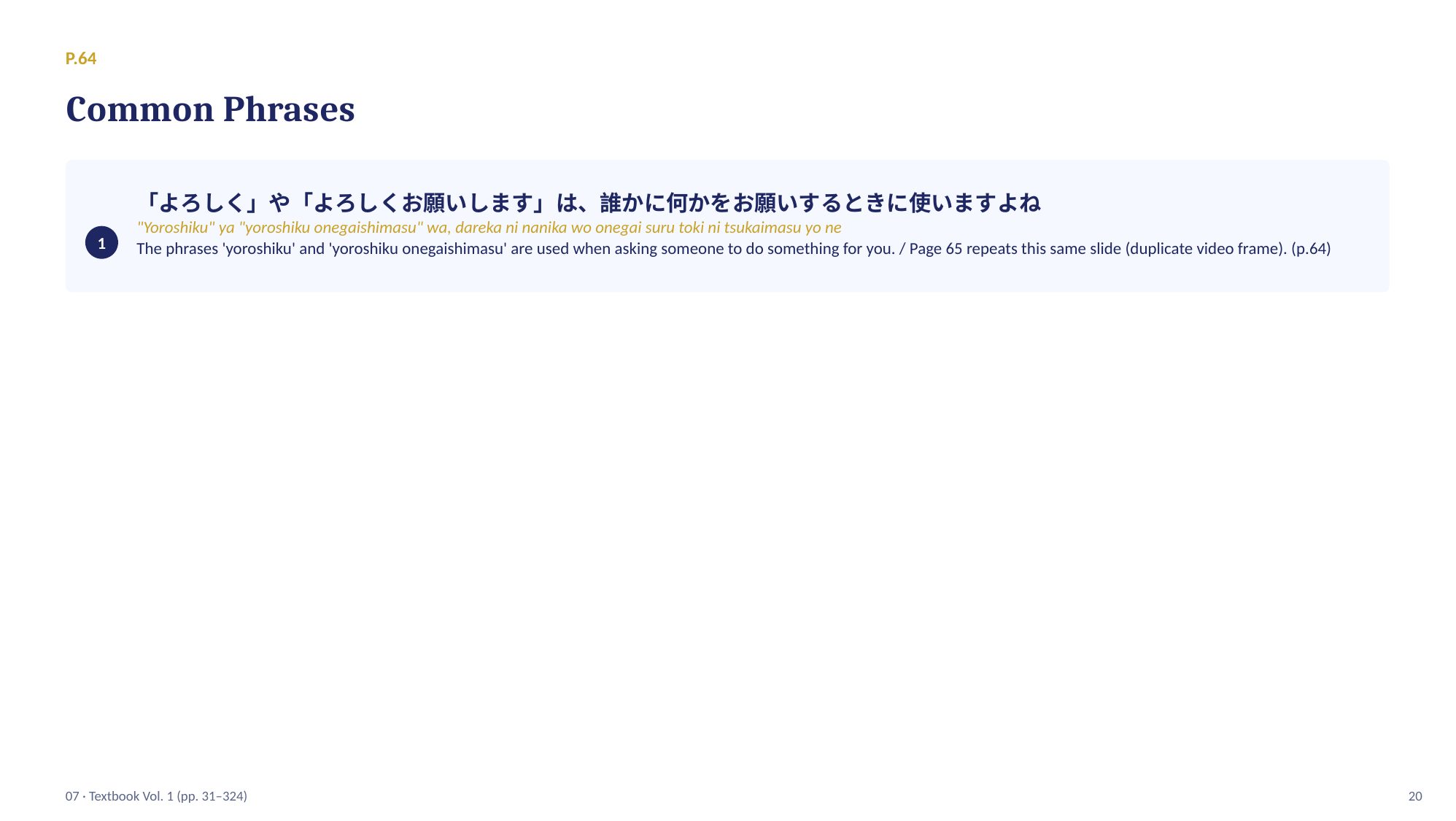
JP「よろしく」や「よろしくお願いします」は、誰かに何かをお願いするときに使いますよね
EN "Yoroshiku" ya "yoroshiku onegaishimasu" wa, dareka ni nanika wo onegai suru toki ni tsukaimasu yo ne
1 The phrases 'yoroshiku' and 'yoroshiku onegaishimasu' are used when asking someone to do something for you. / Page 65 repeats this same slide (duplicate video frame). (p.64)
07 · Textbook Vol. 1 (pp. 31–324) 20
1 The phrases 'yoroshiku' and 'yoroshiku onegaishimasu' are used when asking someone to do something for you. / Page 65 repeats this same slide (duplicate video frame). (p.64)
07 · Textbook Vol. 1 (pp. 31–324) 20
หน้า 21

คลิกเพื่อขยาย
05
ENFeeling Unexpected
9 phrases · pages 66–79
9 phrases · pages 66–79
หน้า 22
คลิกเพื่อขยาย
ENP.66–P.69
Feeling Unexpected (1/3)
Feeling Unexpected (1/3)
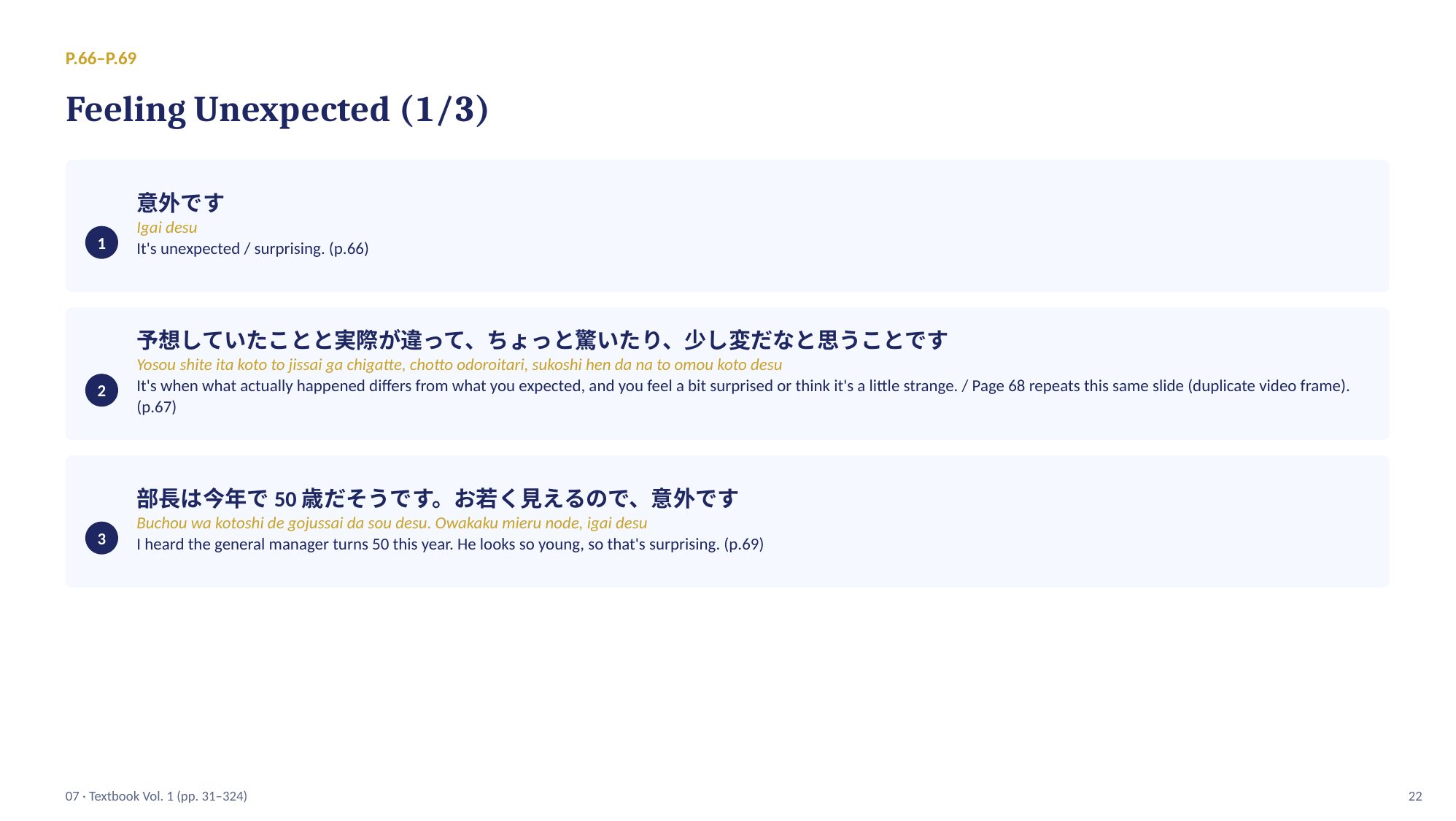
JP意外です
EN Igai desu
1 It's unexpected / surprising. (p.66)
1 It's unexpected / surprising. (p.66)
JP予想していたことと実際が違って、ちょっと驚いたり、少し変だなと思うことです
EN Yosou shite ita koto to jissai ga chigatte, chotto odoroitari, sukoshi hen da na to omou koto desu
2 It's when what actually happened differs from what you expected, and you feel a bit surprised or think it's a little strange. / Page 68 repeats this same slide (duplicate video frame).
(p.67)
2 It's when what actually happened differs from what you expected, and you feel a bit surprised or think it's a little strange. / Page 68 repeats this same slide (duplicate video frame).
(p.67)
JP部長は今年で50歳だそうです。お若く見えるので、意外です
EN Buchou wa kotoshi de gojussai da sou desu. Owakaku mieru node, igai desu
3 I heard the general manager turns 50 this year. He looks so young, so that's surprising. (p.69)
07 · Textbook Vol. 1 (pp. 31–324) 22
3 I heard the general manager turns 50 this year. He looks so young, so that's surprising. (p.69)
07 · Textbook Vol. 1 (pp. 31–324) 22
หน้า 23
คลิกเพื่อขยาย
ENP.70–P.76
Feeling Unexpected (2/3)
Feeling Unexpected (2/3)
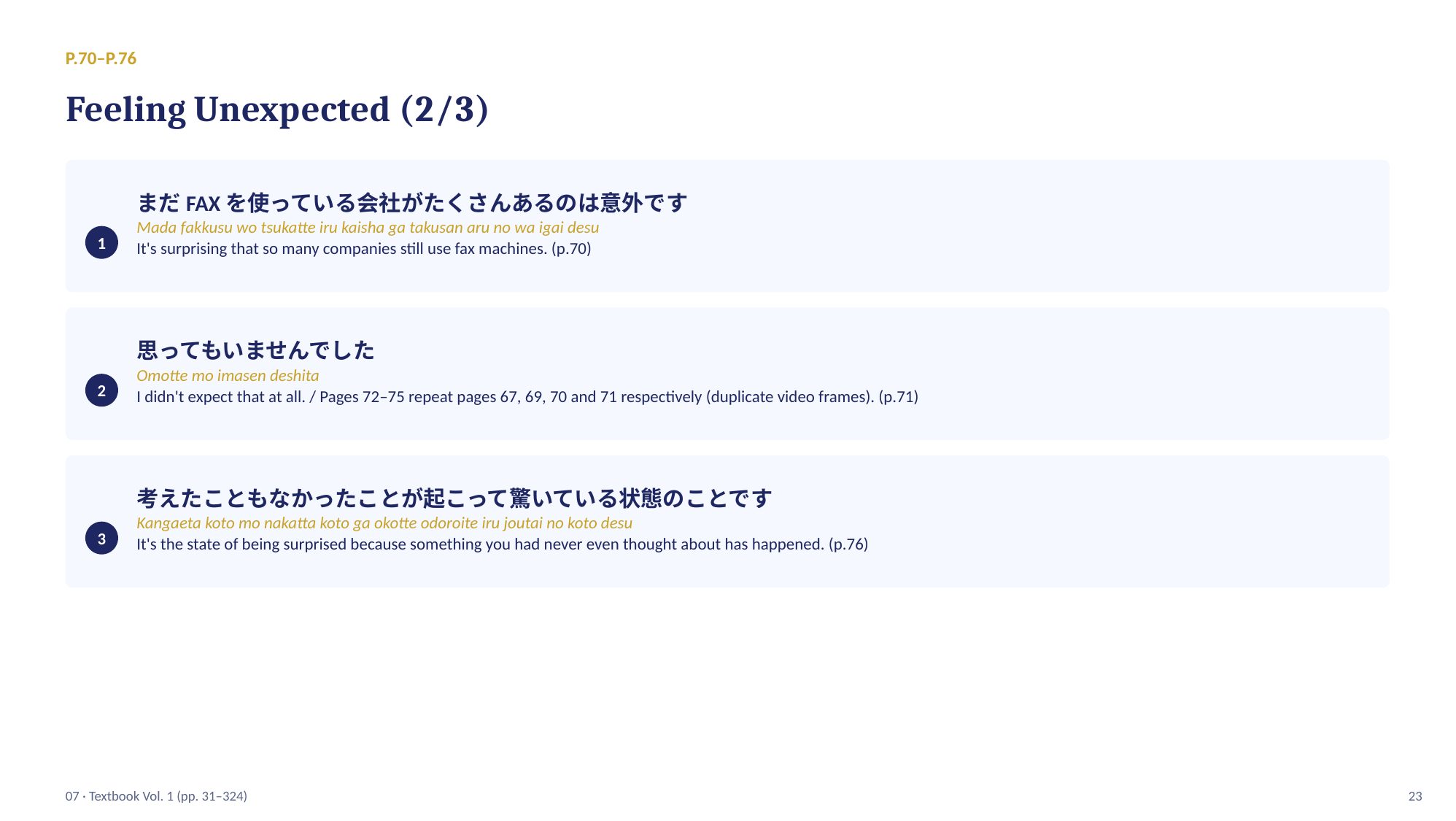
JPまだFAXを使っている会社がたくさんあるのは意外です
EN Mada fakkusu wo tsukatte iru kaisha ga takusan aru no wa igai desu
1 It's surprising that so many companies still use fax machines. (p.70)
1 It's surprising that so many companies still use fax machines. (p.70)
JP思ってもいませんでした
EN Omotte mo imasen deshita
2 I didn't expect that at all. / Pages 72–75 repeat pages 67, 69, 70 and 71 respectively (duplicate video frames). (p.71)
2 I didn't expect that at all. / Pages 72–75 repeat pages 67, 69, 70 and 71 respectively (duplicate video frames). (p.71)
JP考えたこともなかったことが起こって驚いている状態のことです
EN Kangaeta koto mo nakatta koto ga okotte odoroite iru joutai no koto desu
3 It's the state of being surprised because something you had never even thought about has happened. (p.76)
07 · Textbook Vol. 1 (pp. 31–324) 23
3 It's the state of being surprised because something you had never even thought about has happened. (p.76)
07 · Textbook Vol. 1 (pp. 31–324) 23
หน้า 24
คลิกเพื่อขยาย
ENP.77–P.79
Feeling Unexpected (3/3)
Feeling Unexpected (3/3)
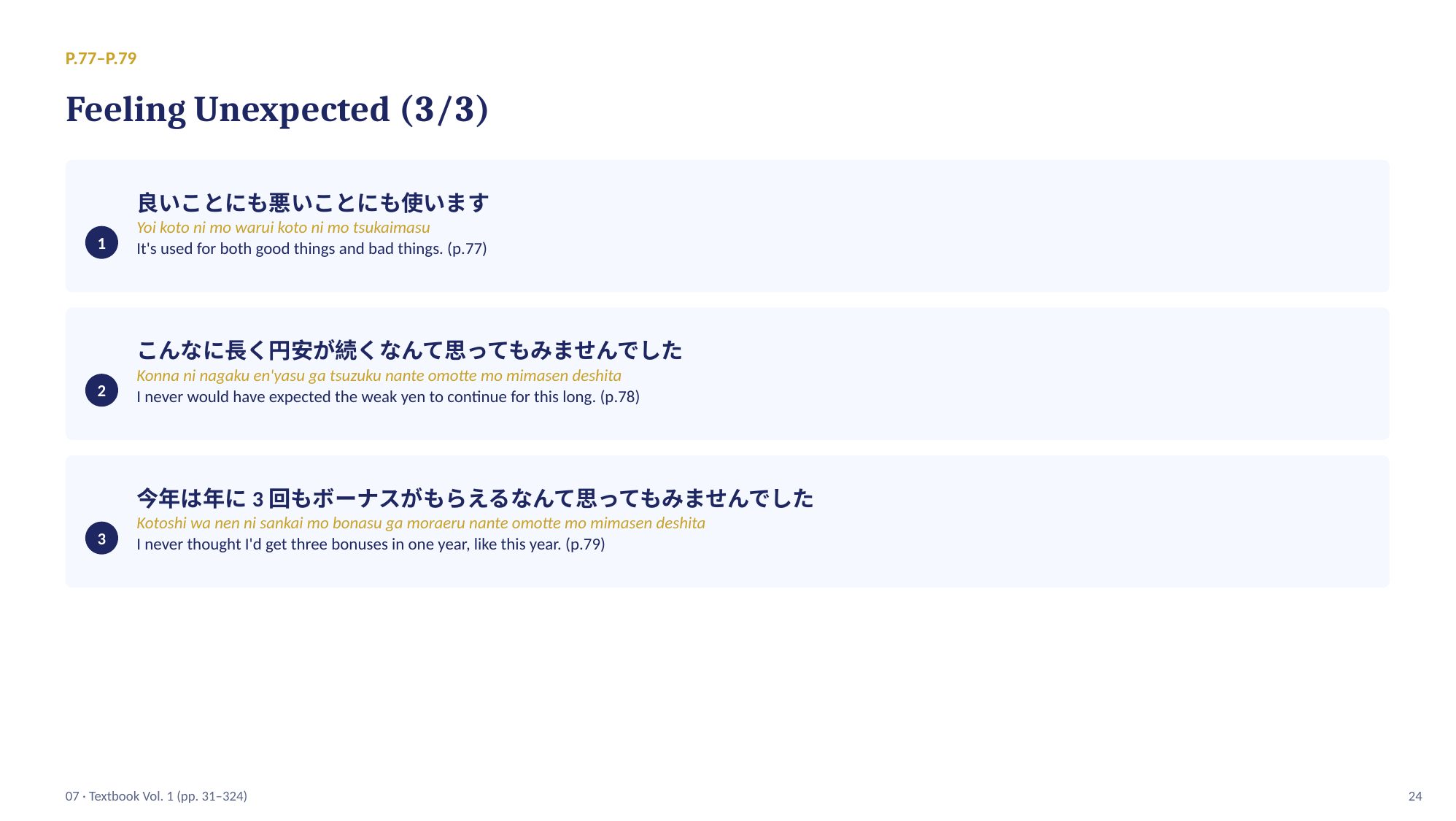
JP良いことにも悪いことにも使います
EN Yoi koto ni mo warui koto ni mo tsukaimasu
1 It's used for both good things and bad things. (p.77)
1 It's used for both good things and bad things. (p.77)
JPこんなに長く円安が続くなんて思ってもみませんでした
EN Konna ni nagaku en'yasu ga tsuzuku nante omotte mo mimasen deshita
2 I never would have expected the weak yen to continue for this long. (p.78)
2 I never would have expected the weak yen to continue for this long. (p.78)
JP今年は年に3回もボーナスがもらえるなんて思ってもみませんでした
EN Kotoshi wa nen ni sankai mo bonasu ga moraeru nante omotte mo mimasen deshita
3 I never thought I'd get three bonuses in one year, like this year. (p.79)
07 · Textbook Vol. 1 (pp. 31–324) 24
3 I never thought I'd get three bonuses in one year, like this year. (p.79)
07 · Textbook Vol. 1 (pp. 31–324) 24
หน้า 25

คลิกเพื่อขยาย
06
ENFeeling Shocked
4 phrases · pages 80–83
4 phrases · pages 80–83
หน้า 26
คลิกเพื่อขยาย
ENP.80–P.82
Feeling Shocked (1/2)
Feeling Shocked (1/2)
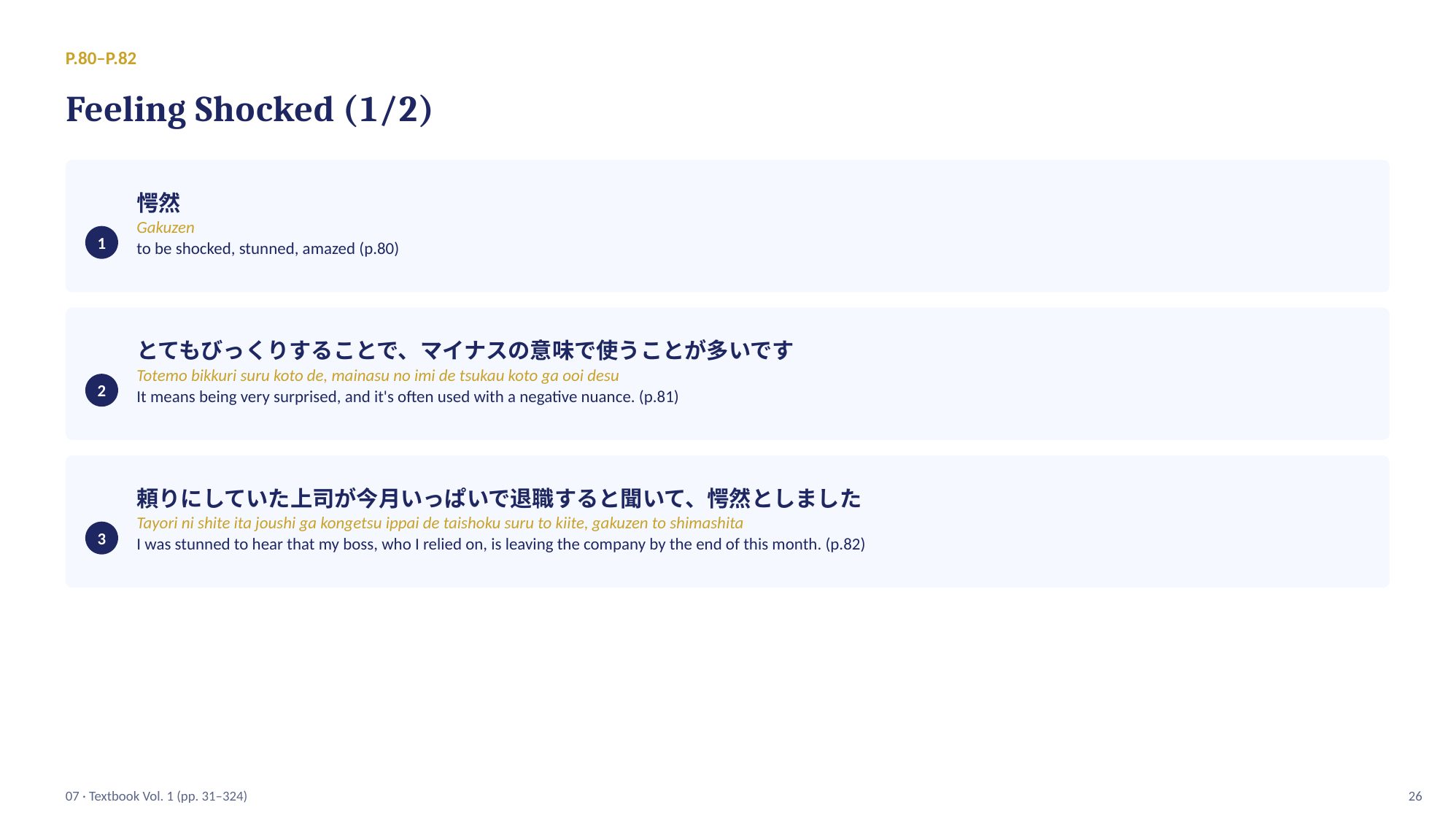
JP愕然
EN Gakuzen
1 to be shocked, stunned, amazed (p.80)
1 to be shocked, stunned, amazed (p.80)
JPとてもびっくりすることで、マイナスの意味で使うことが多いです
EN Totemo bikkuri suru koto de, mainasu no imi de tsukau koto ga ooi desu
2 It means being very surprised, and it's often used with a negative nuance. (p.81)
2 It means being very surprised, and it's often used with a negative nuance. (p.81)
JP頼りにしていた上司が今月いっぱいで退職すると聞いて、愕然としました
EN Tayori ni shite ita joushi ga kongetsu ippai de taishoku suru to kiite, gakuzen to shimashita
3 I was stunned to hear that my boss, who I relied on, is leaving the company by the end of this month. (p.82)
07 · Textbook Vol. 1 (pp. 31–324) 26
3 I was stunned to hear that my boss, who I relied on, is leaving the company by the end of this month. (p.82)
07 · Textbook Vol. 1 (pp. 31–324) 26
หน้า 27
คลิกเพื่อขยาย
ENP.83
Feeling Shocked (2/2)
Feeling Shocked (2/2)
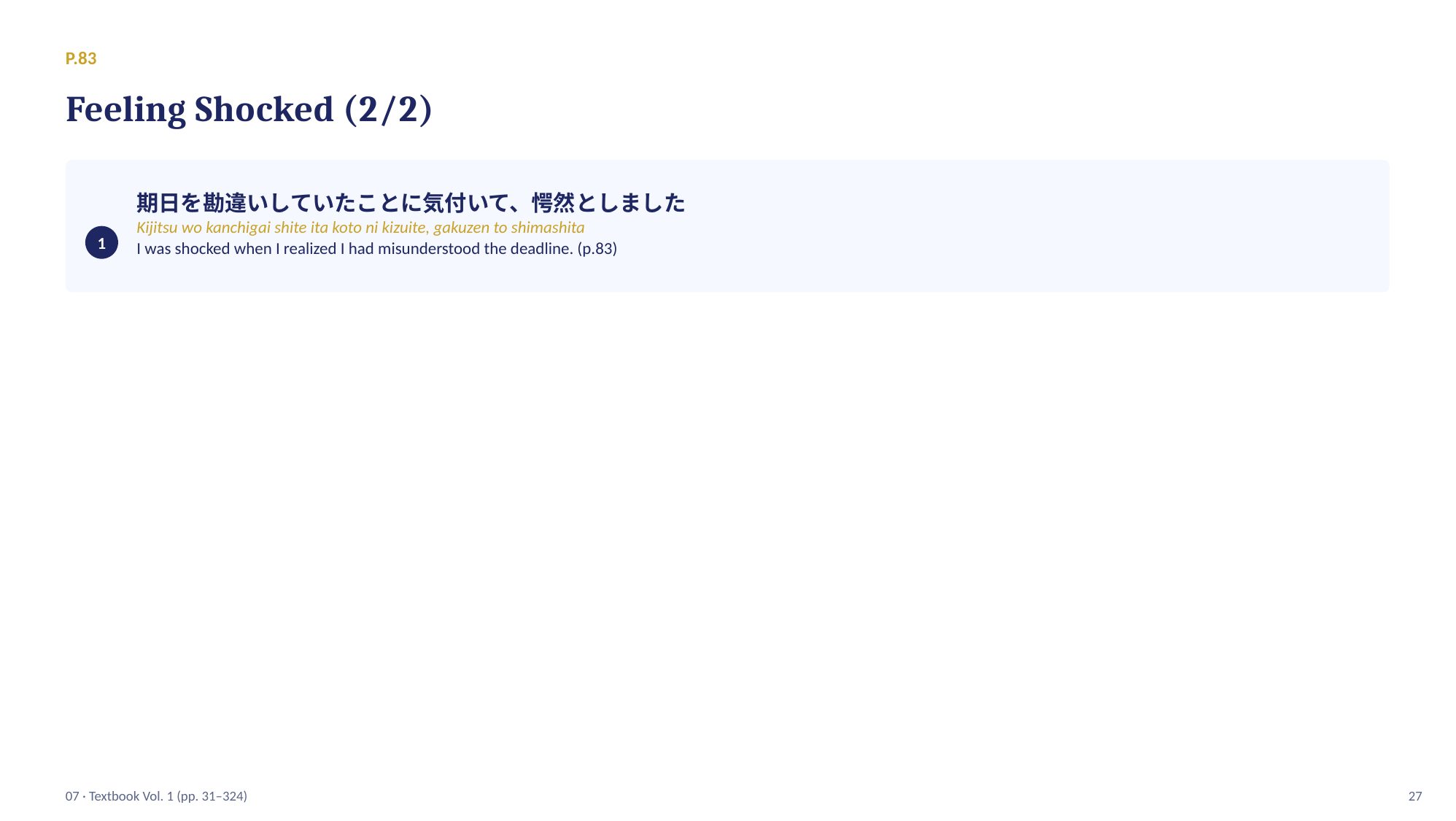
JP期日を勘違いしていたことに気付いて、愕然としました
EN Kijitsu wo kanchigai shite ita koto ni kizuite, gakuzen to shimashita
1 I was shocked when I realized I had misunderstood the deadline. (p.83)
07 · Textbook Vol. 1 (pp. 31–324) 27
1 I was shocked when I realized I had misunderstood the deadline. (p.83)
07 · Textbook Vol. 1 (pp. 31–324) 27
หน้า 28

คลิกเพื่อขยาย
07
ENFeeling Upset
4 phrases · pages 84–87
4 phrases · pages 84–87
หน้า 29
คลิกเพื่อขยาย
ENP.84–P.86
Feeling Upset (1/2)
Feeling Upset (1/2)
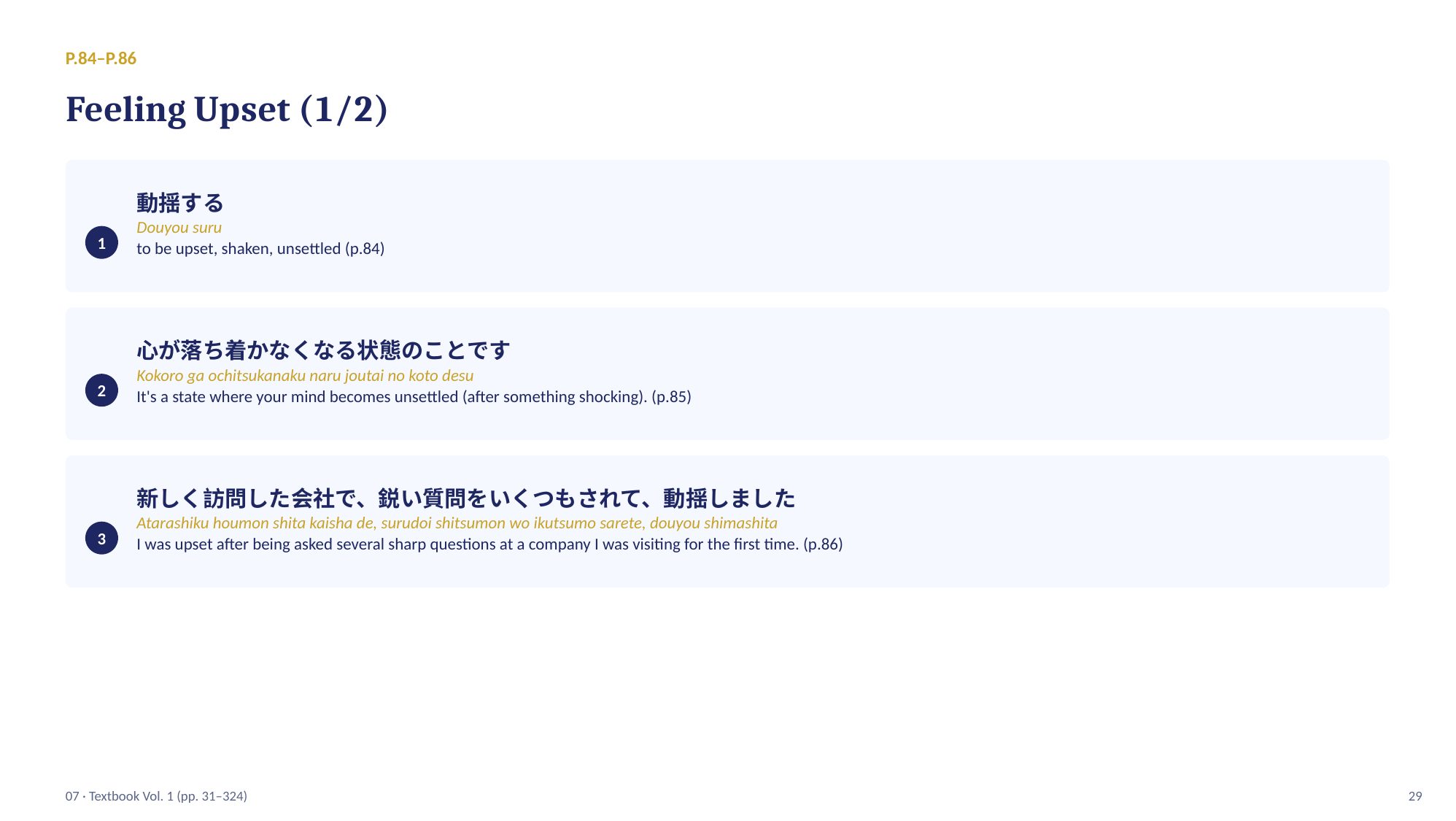
JP動揺する
EN Douyou suru
1 to be upset, shaken, unsettled (p.84)
1 to be upset, shaken, unsettled (p.84)
JP心が落ち着かなくなる状態のことです
EN Kokoro ga ochitsukanaku naru joutai no koto desu
2 It's a state where your mind becomes unsettled (after something shocking). (p.85)
2 It's a state where your mind becomes unsettled (after something shocking). (p.85)
JP新しく訪問した会社で、鋭い質問をいくつもされて、動揺しました
EN Atarashiku houmon shita kaisha de, surudoi shitsumon wo ikutsumo sarete, douyou shimashita
3 I was upset after being asked several sharp questions at a company I was visiting for the first time. (p.86)
07 · Textbook Vol. 1 (pp. 31–324) 29
3 I was upset after being asked several sharp questions at a company I was visiting for the first time. (p.86)
07 · Textbook Vol. 1 (pp. 31–324) 29
หน้า 30
คลิกเพื่อขยาย
ENP.87
Feeling Upset (2/2)
Feeling Upset (2/2)
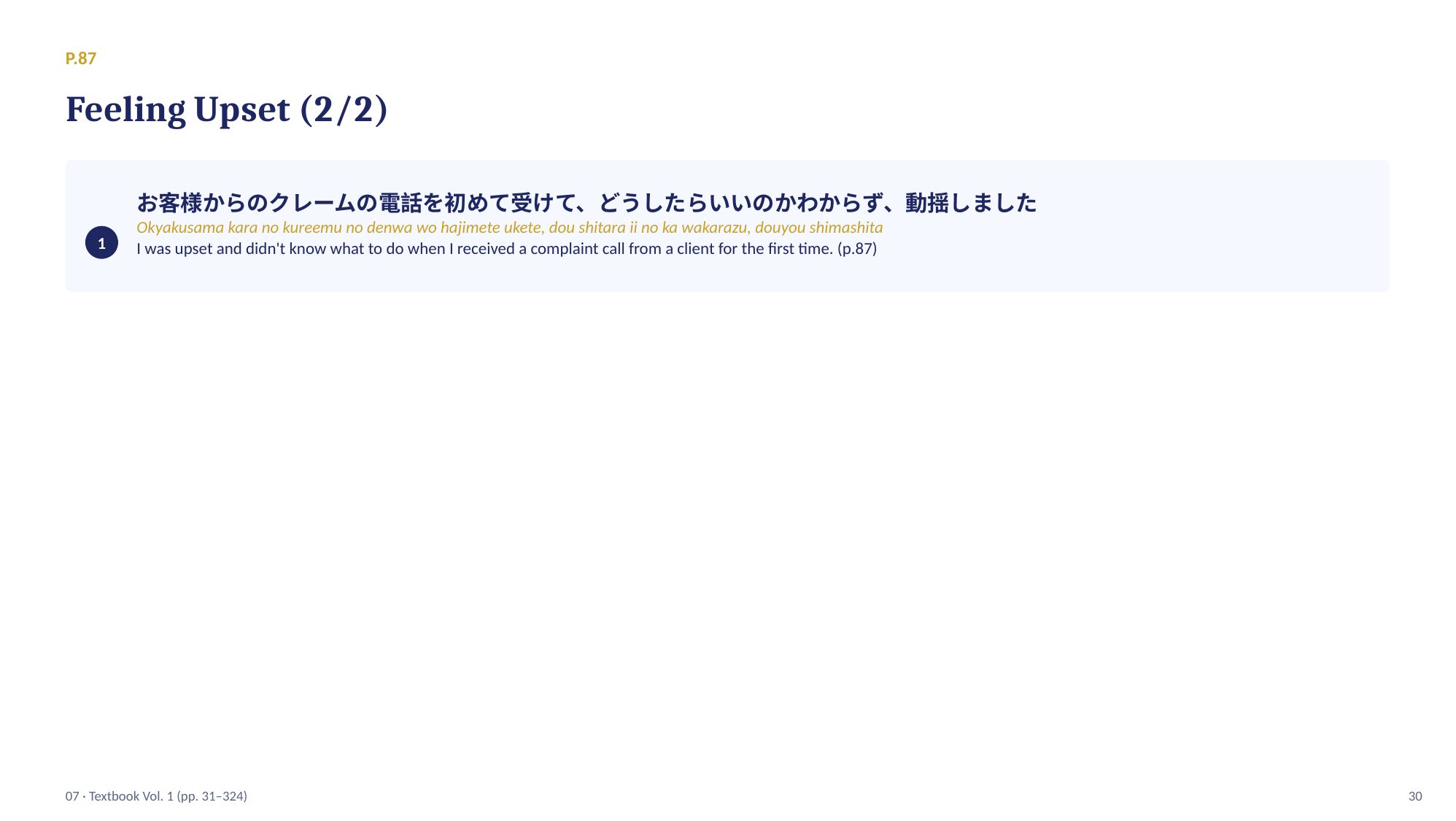
JPお客様からのクレームの電話を初めて受けて、どうしたらいいのかわからず、動揺しました
EN Okyakusama kara no kureemu no denwa wo hajimete ukete, dou shitara ii no ka wakarazu, douyou shimashita
1 I was upset and didn't know what to do when I received a complaint call from a client for the first time. (p.87)
07 · Textbook Vol. 1 (pp. 31–324) 30
1 I was upset and didn't know what to do when I received a complaint call from a client for the first time. (p.87)
07 · Textbook Vol. 1 (pp. 31–324) 30
หน้า 31

คลิกเพื่อขยาย
08
ENFeeling At Ease
12 phrases · pages 88–99
12 phrases · pages 88–99
หน้า 32
คลิกเพื่อขยาย
ENP.88–P.90
Feeling At Ease (1/4)
Feeling At Ease (1/4)
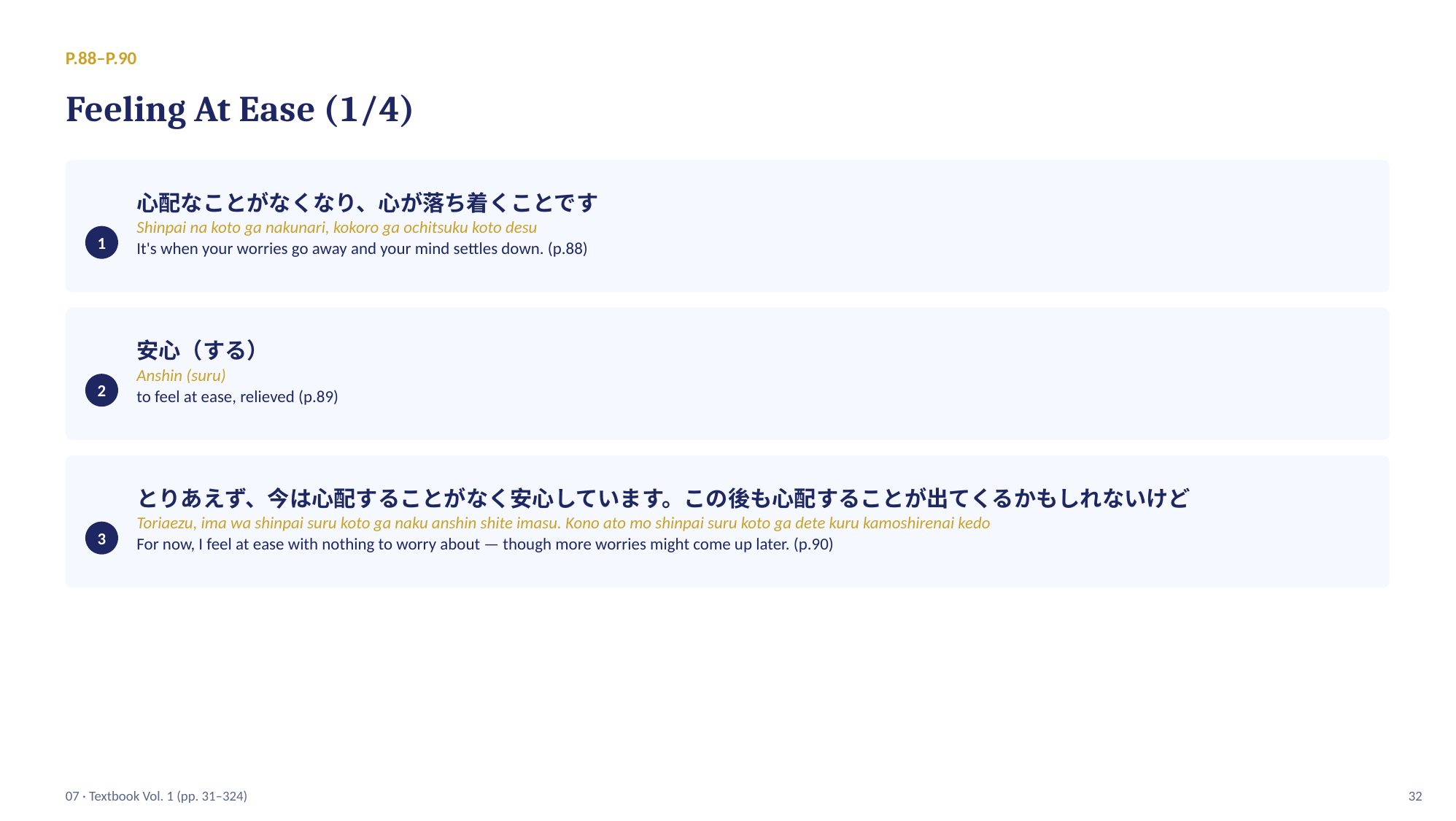
JP心配なことがなくなり、心が落ち着くことです
EN Shinpai na koto ga nakunari, kokoro ga ochitsuku koto desu
1 It's when your worries go away and your mind settles down. (p.88)
1 It's when your worries go away and your mind settles down. (p.88)
JP安心(する)
EN Anshin (suru)
2 to feel at ease, relieved (p.89)
2 to feel at ease, relieved (p.89)
JPとりあえず、今は心配することがなく安心しています。この後も心配することが出てくるかもしれないけど
EN Toriaezu, ima wa shinpai suru koto ga naku anshin shite imasu. Kono ato mo shinpai suru koto ga dete kuru kamoshirenai kedo
3 For now, I feel at ease with nothing to worry about — though more worries might come up later. (p.90)
07 · Textbook Vol. 1 (pp. 31–324) 32
3 For now, I feel at ease with nothing to worry about — though more worries might come up later. (p.90)
07 · Textbook Vol. 1 (pp. 31–324) 32
หน้า 33
คลิกเพื่อขยาย
ENP.91–P.93
Feeling At Ease (2/4)
Feeling At Ease (2/4)
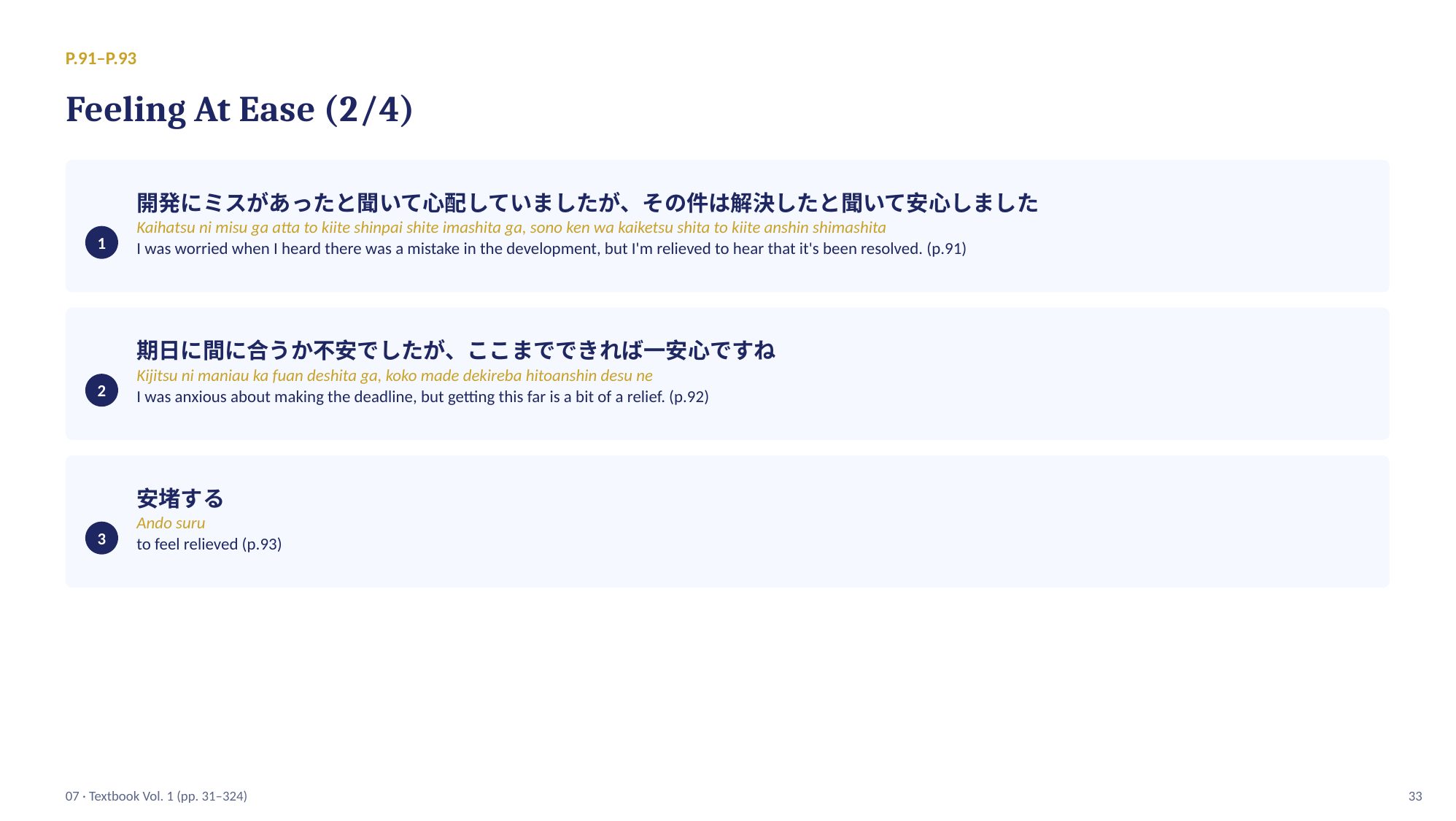
JP開発にミスがあったと聞いて心配していましたが、その件は解決したと聞いて安心しました
EN Kaihatsu ni misu ga atta to kiite shinpai shite imashita ga, sono ken wa kaiketsu shita to kiite anshin shimashita
1 I was worried when I heard there was a mistake in the development, but I'm relieved to hear that it's been resolved. (p.91)
1 I was worried when I heard there was a mistake in the development, but I'm relieved to hear that it's been resolved. (p.91)
JP期日に間に合うか不安でしたが、ここまでできれば一安心ですね
EN Kijitsu ni maniau ka fuan deshita ga, koko made dekireba hitoanshin desu ne
2 I was anxious about making the deadline, but getting this far is a bit of a relief. (p.92)
2 I was anxious about making the deadline, but getting this far is a bit of a relief. (p.92)
JP安堵する
EN Ando suru
3 to feel relieved (p.93)
07 · Textbook Vol. 1 (pp. 31–324) 33
3 to feel relieved (p.93)
07 · Textbook Vol. 1 (pp. 31–324) 33
หน้า 34
คลิกเพื่อขยาย
ENP.94–P.96
Feeling At Ease (3/4)
Feeling At Ease (3/4)
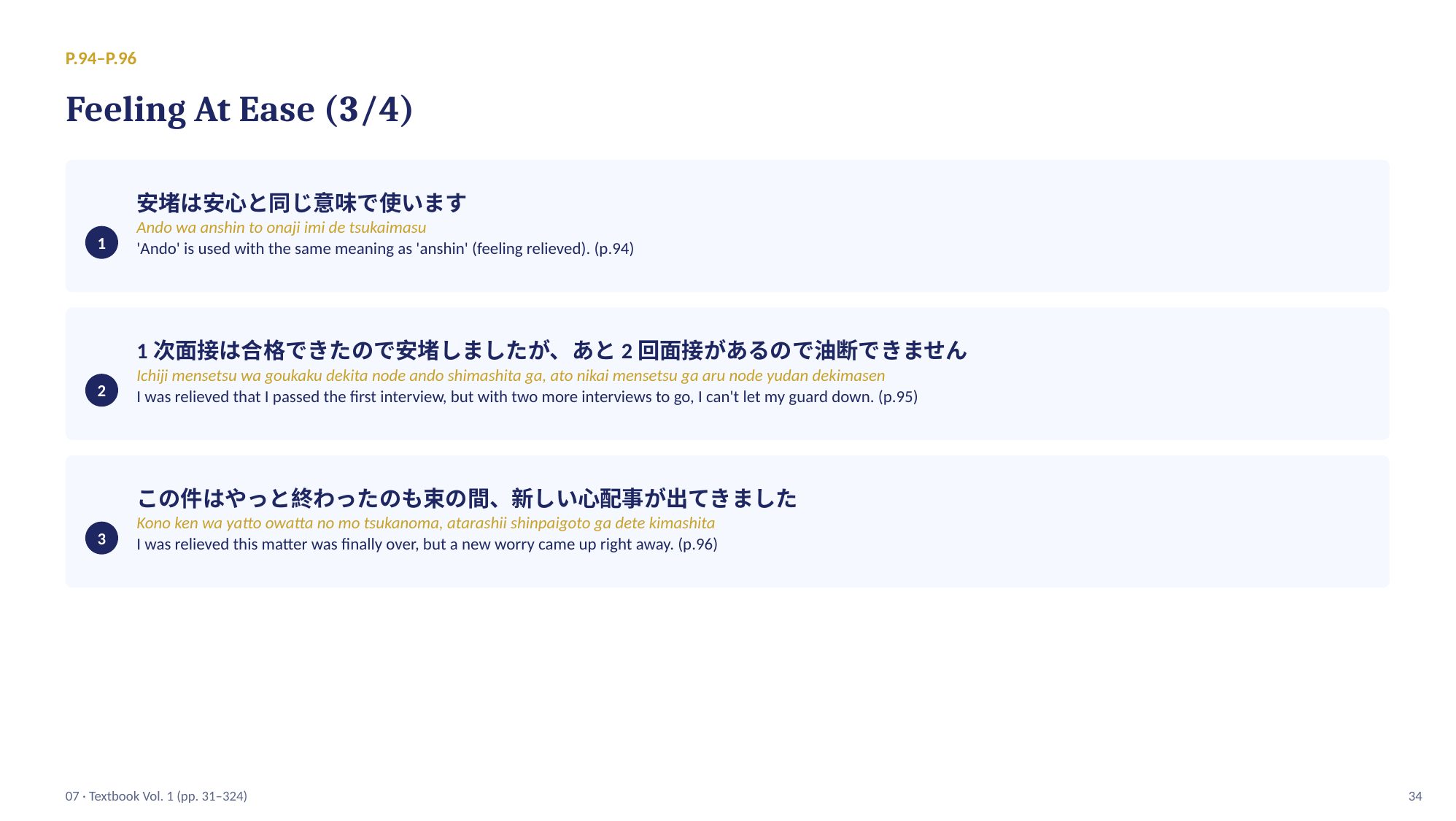
JP安堵は安心と同じ意味で使います
EN Ando wa anshin to onaji imi de tsukaimasu
1 'Ando' is used with the same meaning as 'anshin' (feeling relieved). (p.94)
1 'Ando' is used with the same meaning as 'anshin' (feeling relieved). (p.94)
JP1次面接は合格できたので安堵しましたが、あと2回面接があるので油断できません
EN Ichiji mensetsu wa goukaku dekita node ando shimashita ga, ato nikai mensetsu ga aru node yudan dekimasen
2 I was relieved that I passed the first interview, but with two more interviews to go, I can't let my guard down. (p.95)
2 I was relieved that I passed the first interview, but with two more interviews to go, I can't let my guard down. (p.95)
JPこの件はやっと終わったのも束の間、新しい心配事が出てきました
EN Kono ken wa yatto owatta no mo tsukanoma, atarashii shinpaigoto ga dete kimashita
3 I was relieved this matter was finally over, but a new worry came up right away. (p.96)
07 · Textbook Vol. 1 (pp. 31–324) 34
3 I was relieved this matter was finally over, but a new worry came up right away. (p.96)
07 · Textbook Vol. 1 (pp. 31–324) 34
หน้า 35
คลิกเพื่อขยาย
ENP.97–P.99
Feeling At Ease (4/4)
Feeling At Ease (4/4)
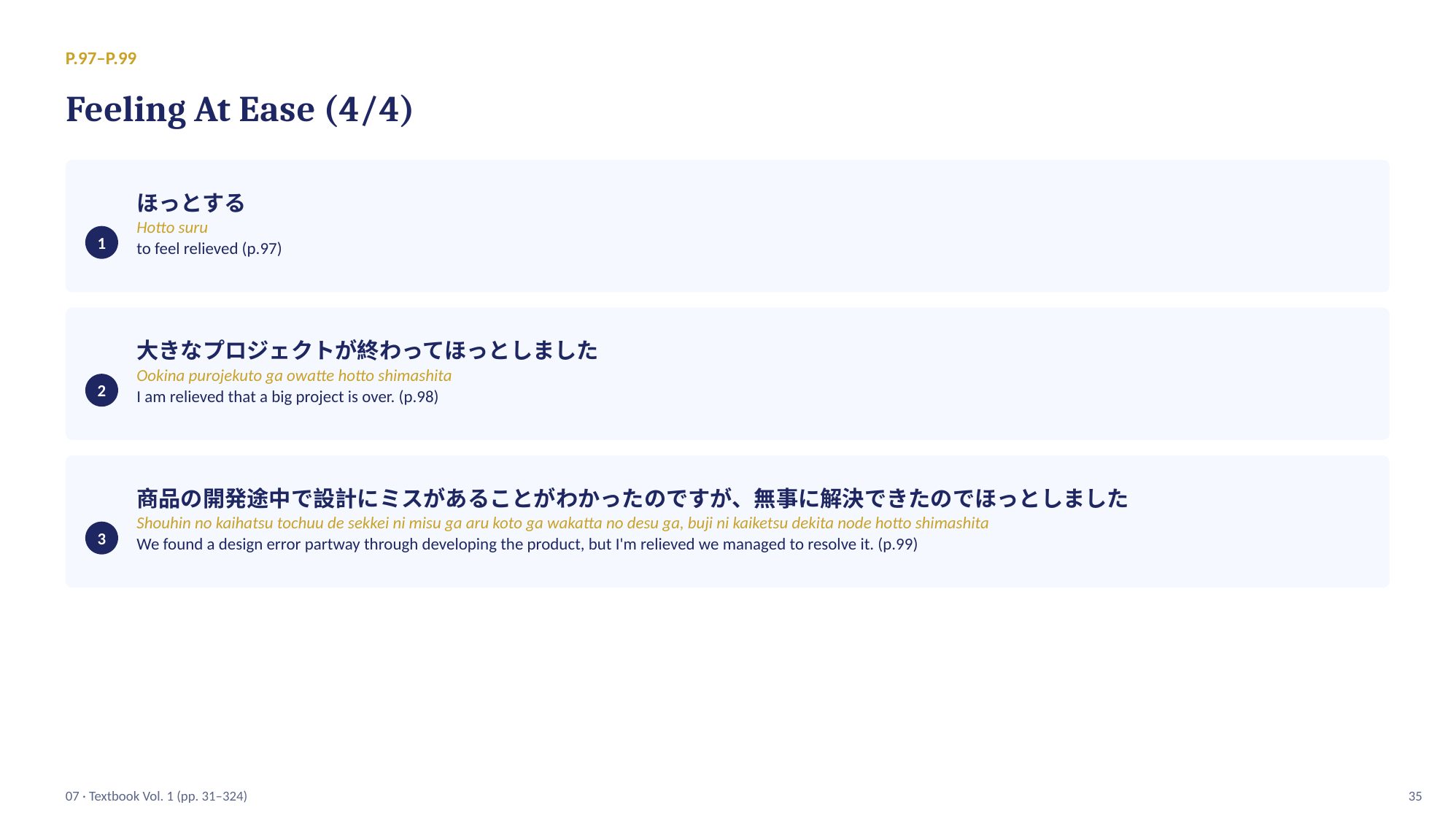
JPほっとする
EN Hotto suru
1 to feel relieved (p.97)
1 to feel relieved (p.97)
JP大きなプロジェクトが終わってほっとしました
EN Ookina purojekuto ga owatte hotto shimashita
2 I am relieved that a big project is over. (p.98)
2 I am relieved that a big project is over. (p.98)
JP商品の開発途中で設計にミスがあることがわかったのですが、無事に解決できたのでほっとしました
EN Shouhin no kaihatsu tochuu de sekkei ni misu ga aru koto ga wakatta no desu ga, buji ni kaiketsu dekita node hotto shimashita
3 We found a design error partway through developing the product, but I'm relieved we managed to resolve it. (p.99)
07 · Textbook Vol. 1 (pp. 31–324) 35
3 We found a design error partway through developing the product, but I'm relieved we managed to resolve it. (p.99)
07 · Textbook Vol. 1 (pp. 31–324) 35
หน้า 36

คลิกเพื่อขยาย
09
ENFeeling Worried
3 phrases · pages 100–102
3 phrases · pages 100–102
หน้า 37
คลิกเพื่อขยาย
ENP.100–P.102
Feeling Worried
Feeling Worried
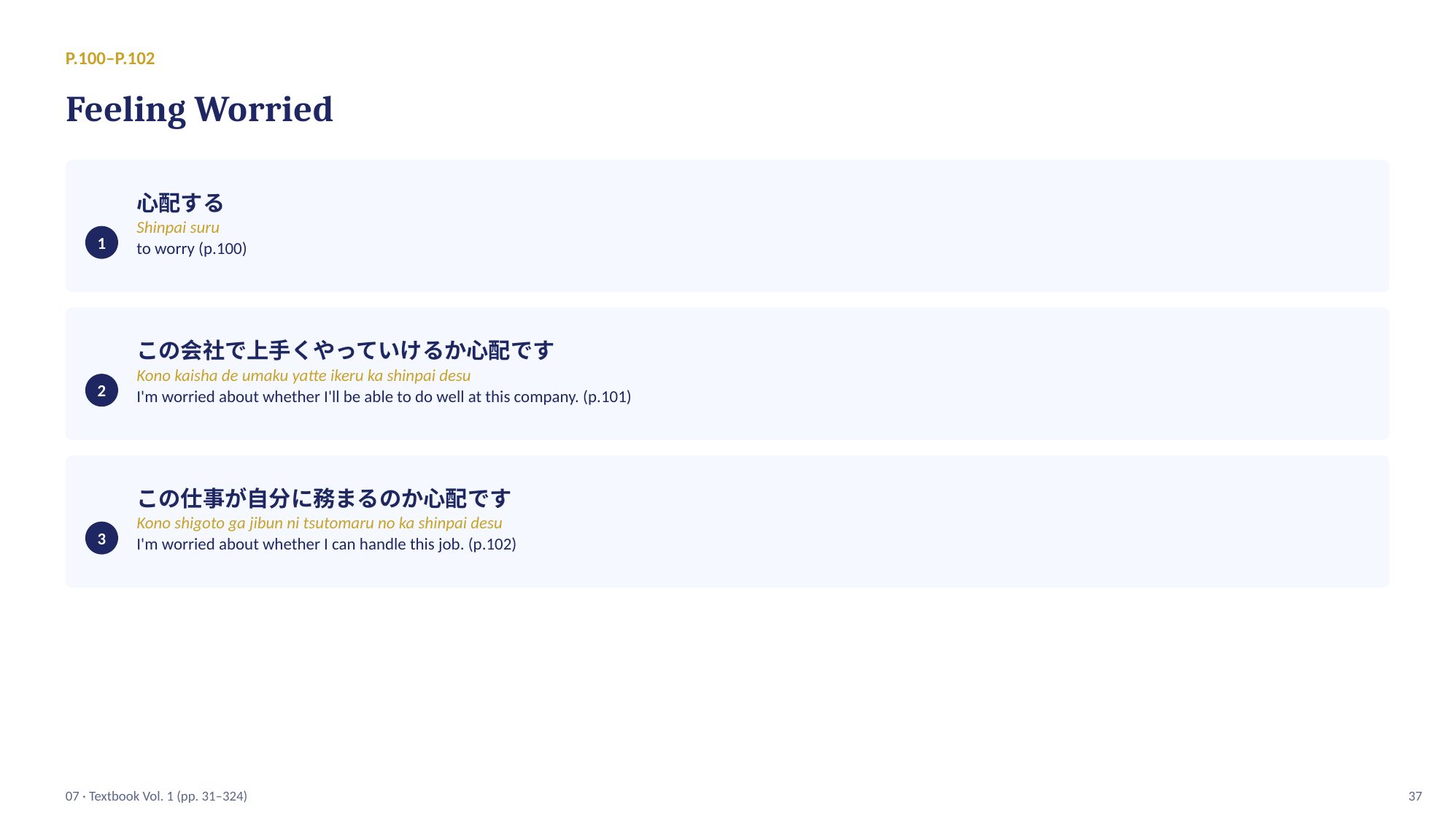
JP心配する
EN Shinpai suru
1 to worry (p.100)
1 to worry (p.100)
JPこの会社で上手くやっていけるか心配です
EN Kono kaisha de umaku yatte ikeru ka shinpai desu
2 I'm worried about whether I'll be able to do well at this company. (p.101)
2 I'm worried about whether I'll be able to do well at this company. (p.101)
JPこの仕事が自分に務まるのか心配です
EN Kono shigoto ga jibun ni tsutomaru no ka shinpai desu
3 I'm worried about whether I can handle this job. (p.102)
07 · Textbook Vol. 1 (pp. 31–324) 37
3 I'm worried about whether I can handle this job. (p.102)
07 · Textbook Vol. 1 (pp. 31–324) 37
หน้า 38

คลิกเพื่อขยาย
10
ENFeeling Concerned
4 phrases · pages 103–106
4 phrases · pages 103–106
หน้า 39
คลิกเพื่อขยาย
ENP.103–P.105
Feeling Concerned (1/2)
Feeling Concerned (1/2)
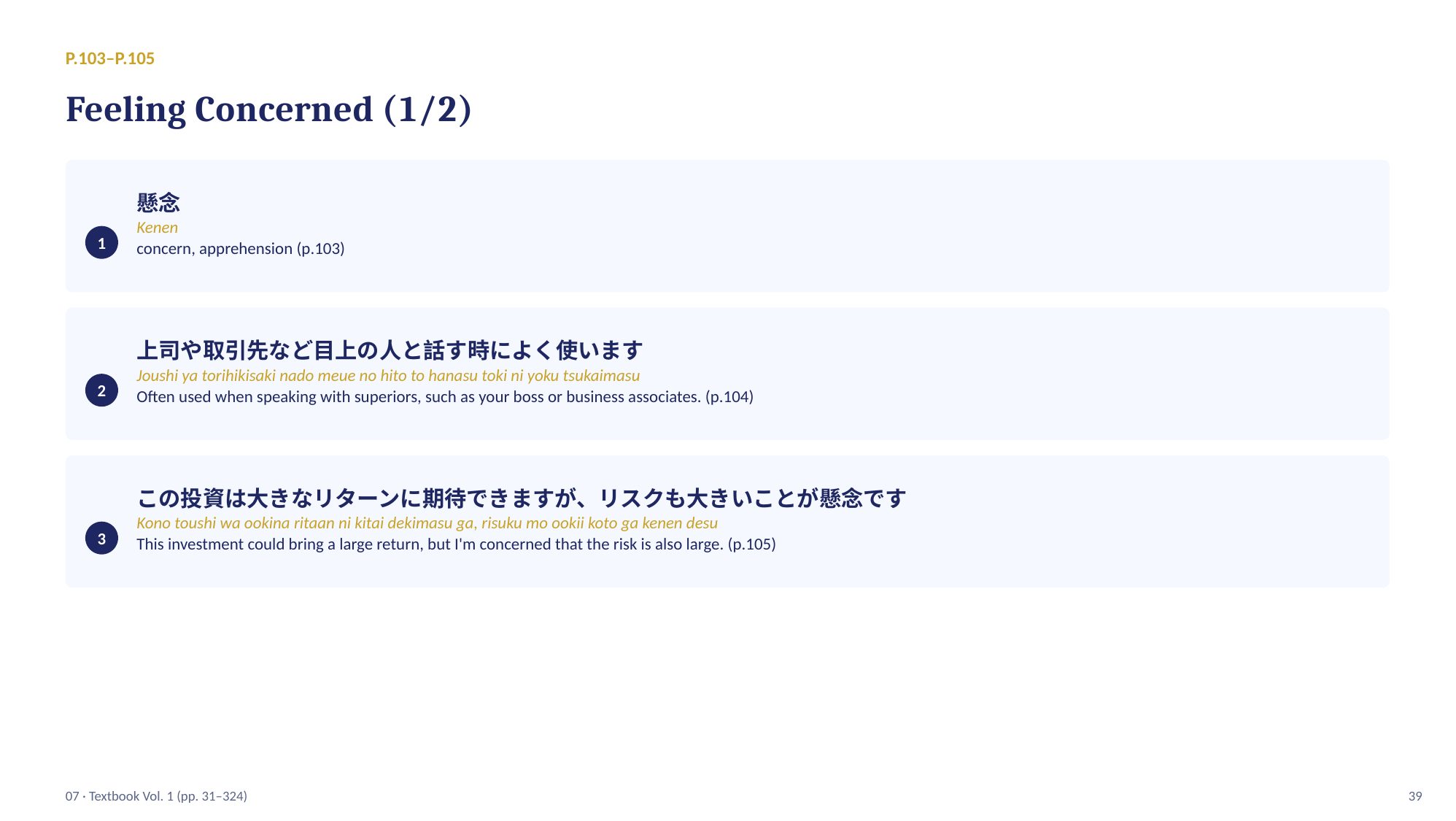
JP懸念
EN Kenen
1 concern, apprehension (p.103)
1 concern, apprehension (p.103)
JP上司や取引先など目上の人と話す時によく使います
EN Joushi ya torihikisaki nado meue no hito to hanasu toki ni yoku tsukaimasu
2 Often used when speaking with superiors, such as your boss or business associates. (p.104)
2 Often used when speaking with superiors, such as your boss or business associates. (p.104)
JPこの投資は大きなリターンに期待できますが、リスクも大きいことが懸念です
EN Kono toushi wa ookina ritaan ni kitai dekimasu ga, risuku mo ookii koto ga kenen desu
3 This investment could bring a large return, but I'm concerned that the risk is also large. (p.105)
07 · Textbook Vol. 1 (pp. 31–324) 39
3 This investment could bring a large return, but I'm concerned that the risk is also large. (p.105)
07 · Textbook Vol. 1 (pp. 31–324) 39
หน้า 40
คลิกเพื่อขยาย
ENP.106
Feeling Concerned (2/2)
Feeling Concerned (2/2)
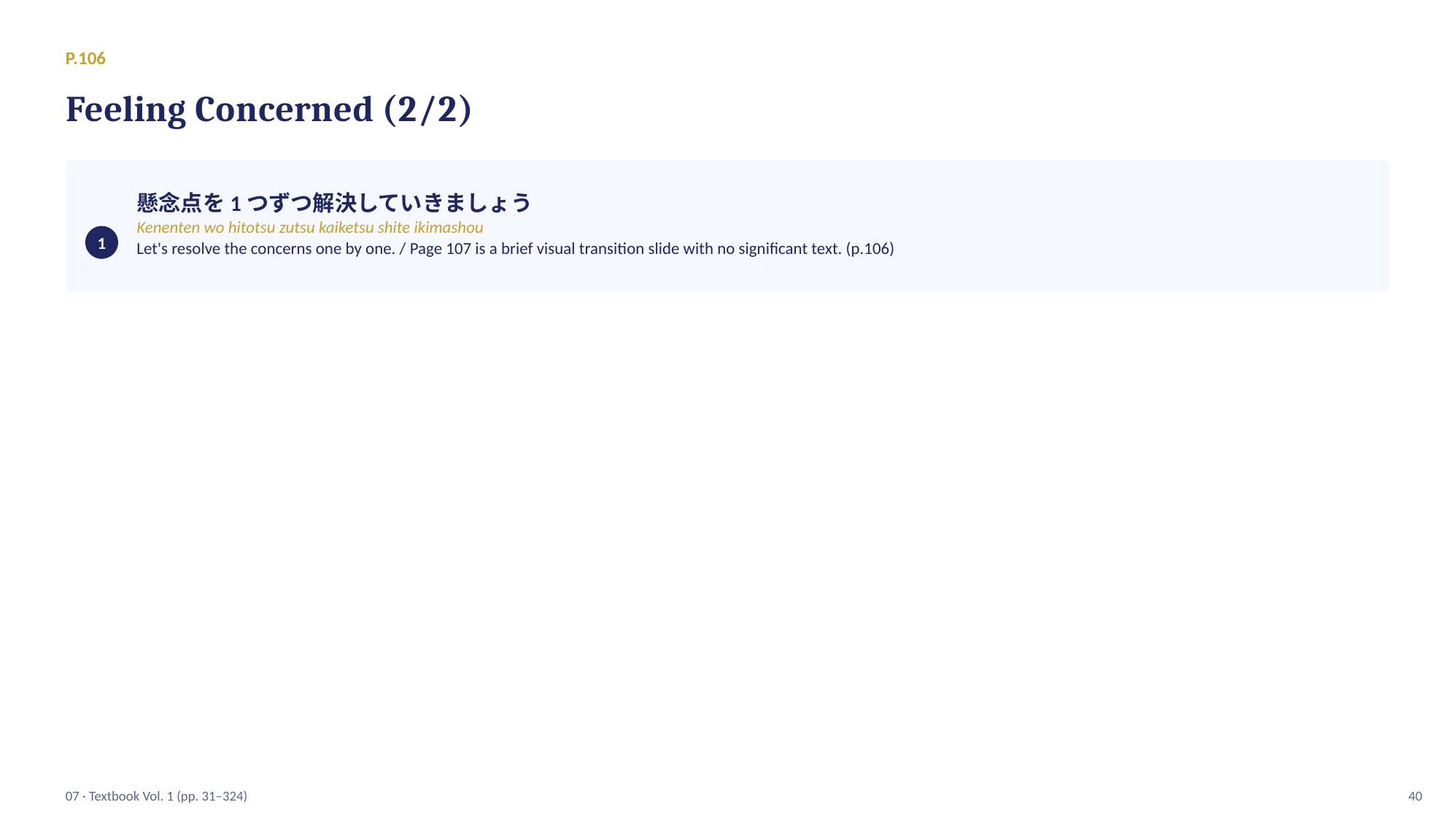
JP懸念点を1つずつ解決していきましょう
EN Kenenten wo hitotsu zutsu kaiketsu shite ikimashou
1 Let's resolve the concerns one by one. / Page 107 is a brief visual transition slide with no significant text. (p.106)
07 · Textbook Vol. 1 (pp. 31–324) 40
1 Let's resolve the concerns one by one. / Page 107 is a brief visual transition slide with no significant text. (p.106)
07 · Textbook Vol. 1 (pp. 31–324) 40
หน้า 41

คลิกเพื่อขยาย
11
ENAdmiration & Respect
9 phrases · pages 108–118
9 phrases · pages 108–118
หน้า 42
คลิกเพื่อขยาย
ENP.108–P.110
Admiration & Respect (1/3)
Admiration & Respect (1/3)
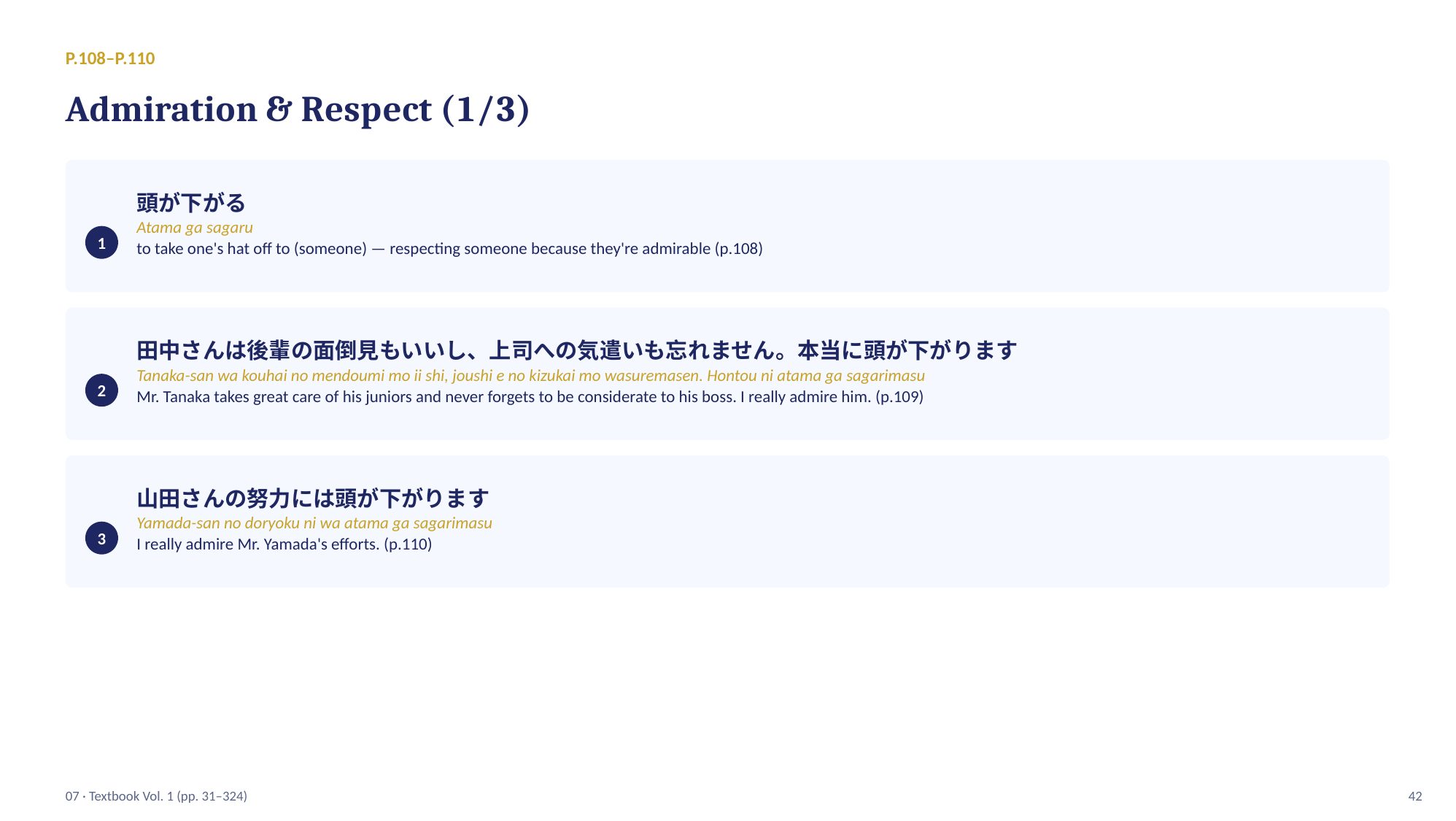
JP頭が下がる
EN Atama ga sagaru
1 to take one's hat off to (someone) — respecting someone because they're admirable (p.108)
1 to take one's hat off to (someone) — respecting someone because they're admirable (p.108)
JP田中さんは後輩の面倒見もいいし、上司への気遣いも忘れません。本当に頭が下がります
EN Tanaka-san wa kouhai no mendoumi mo ii shi, joushi e no kizukai mo wasuremasen. Hontou ni atama ga sagarimasu
2 Mr. Tanaka takes great care of his juniors and never forgets to be considerate to his boss. I really admire him. (p.109)
2 Mr. Tanaka takes great care of his juniors and never forgets to be considerate to his boss. I really admire him. (p.109)
JP山田さんの努力には頭が下がります
EN Yamada-san no doryoku ni wa atama ga sagarimasu
3 I really admire Mr. Yamada's efforts. (p.110)
07 · Textbook Vol. 1 (pp. 31–324) 42
3 I really admire Mr. Yamada's efforts. (p.110)
07 · Textbook Vol. 1 (pp. 31–324) 42
หน้า 43
คลิกเพื่อขยาย
ENP.111–P.114
Admiration & Respect (2/3)
Admiration & Respect (2/3)
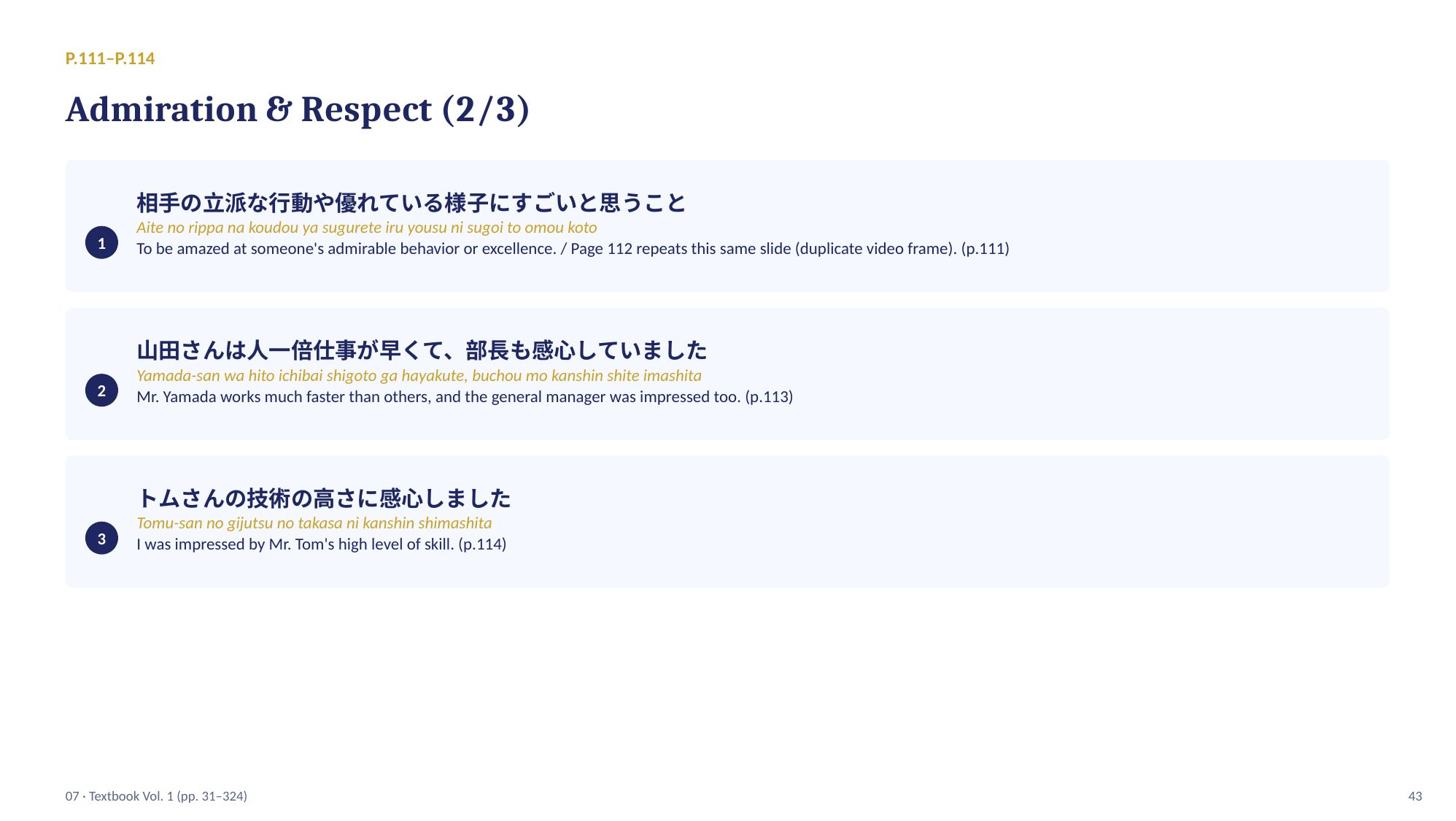
JP相手の立派な行動や優れている様子にすごいと思うこと
EN Aite no rippa na koudou ya sugurete iru yousu ni sugoi to omou koto
1 To be amazed at someone's admirable behavior or excellence. / Page 112 repeats this same slide (duplicate video frame). (p.111)
1 To be amazed at someone's admirable behavior or excellence. / Page 112 repeats this same slide (duplicate video frame). (p.111)
JP山田さんは人一倍仕事が早くて、部長も感心していました
EN Yamada-san wa hito ichibai shigoto ga hayakute, buchou mo kanshin shite imashita
2 Mr. Yamada works much faster than others, and the general manager was impressed too. (p.113)
2 Mr. Yamada works much faster than others, and the general manager was impressed too. (p.113)
JPトムさんの技術の高さに感心しました
EN Tomu-san no gijutsu no takasa ni kanshin shimashita
3 I was impressed by Mr. Tom's high level of skill. (p.114)
07 · Textbook Vol. 1 (pp. 31–324) 43
3 I was impressed by Mr. Tom's high level of skill. (p.114)
07 · Textbook Vol. 1 (pp. 31–324) 43
หน้า 44
คลิกเพื่อขยาย
ENP.115–P.118
Admiration & Respect (3/3)
Admiration & Respect (3/3)
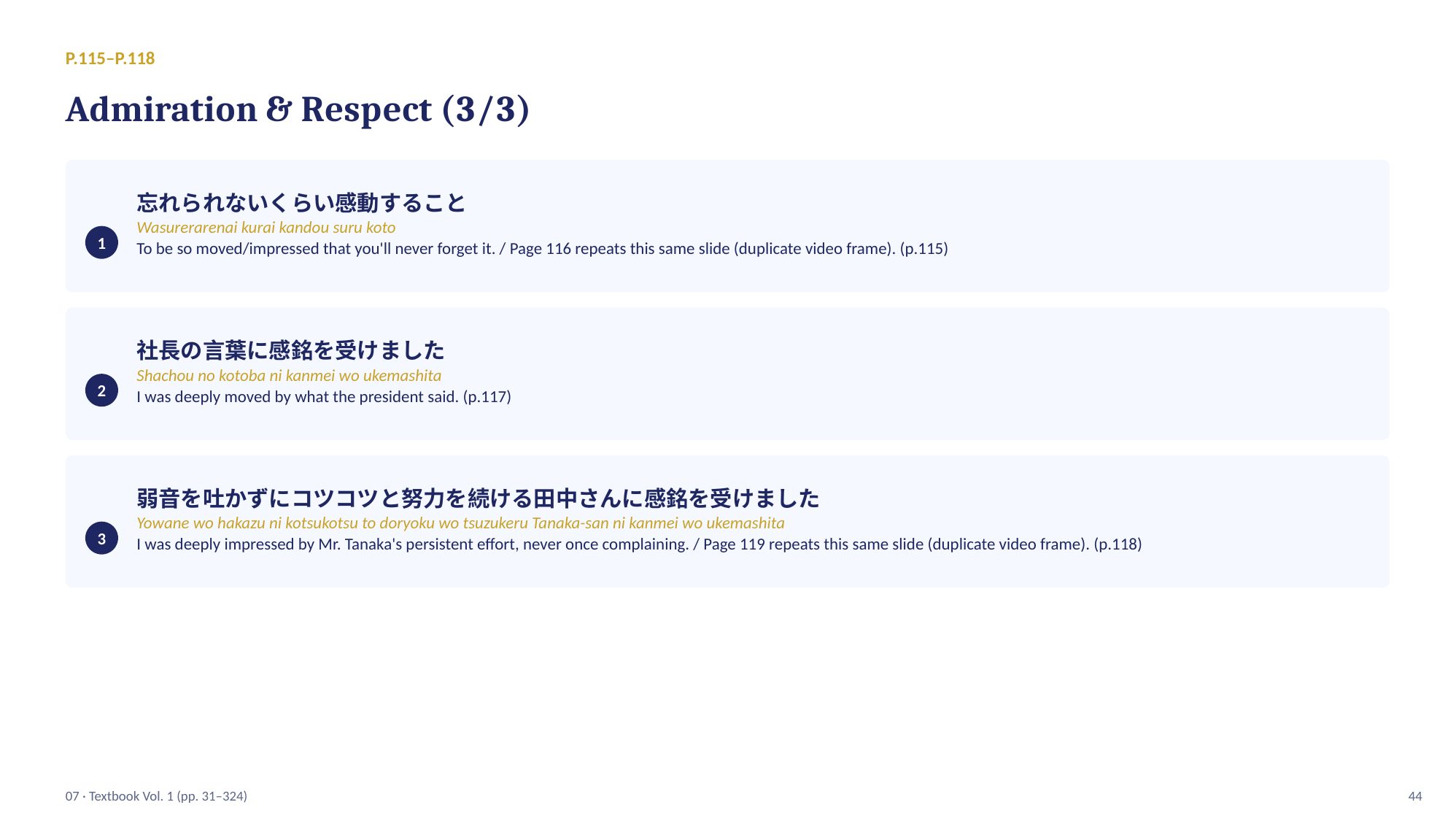
JP忘れられないくらい感動すること
EN Wasurerarenai kurai kandou suru koto
1 To be so moved/impressed that you'll never forget it. / Page 116 repeats this same slide (duplicate video frame). (p.115)
1 To be so moved/impressed that you'll never forget it. / Page 116 repeats this same slide (duplicate video frame). (p.115)
JP社長の言葉に感銘を受けました
EN Shachou no kotoba ni kanmei wo ukemashita
2 I was deeply moved by what the president said. (p.117)
2 I was deeply moved by what the president said. (p.117)
JP弱音を吐かずにコツコツと努力を続ける田中さんに感銘を受けました
EN Yowane wo hakazu ni kotsukotsu to doryoku wo tsuzukeru Tanaka-san ni kanmei wo ukemashita
3 I was deeply impressed by Mr. Tanaka's persistent effort, never once complaining. / Page 119 repeats this same slide (duplicate video frame). (p.118)
07 · Textbook Vol. 1 (pp. 31–324) 44
3 I was deeply impressed by Mr. Tanaka's persistent effort, never once complaining. / Page 119 repeats this same slide (duplicate video frame). (p.118)
07 · Textbook Vol. 1 (pp. 31–324) 44
หน้า 45

คลิกเพื่อขยาย
12
ENFeeling Intimidated
6 phrases · pages 120–126
6 phrases · pages 120–126
หน้า 46
คลิกเพื่อขยาย
ENP.120–P.122
Feeling Intimidated (1/2)
Feeling Intimidated (1/2)
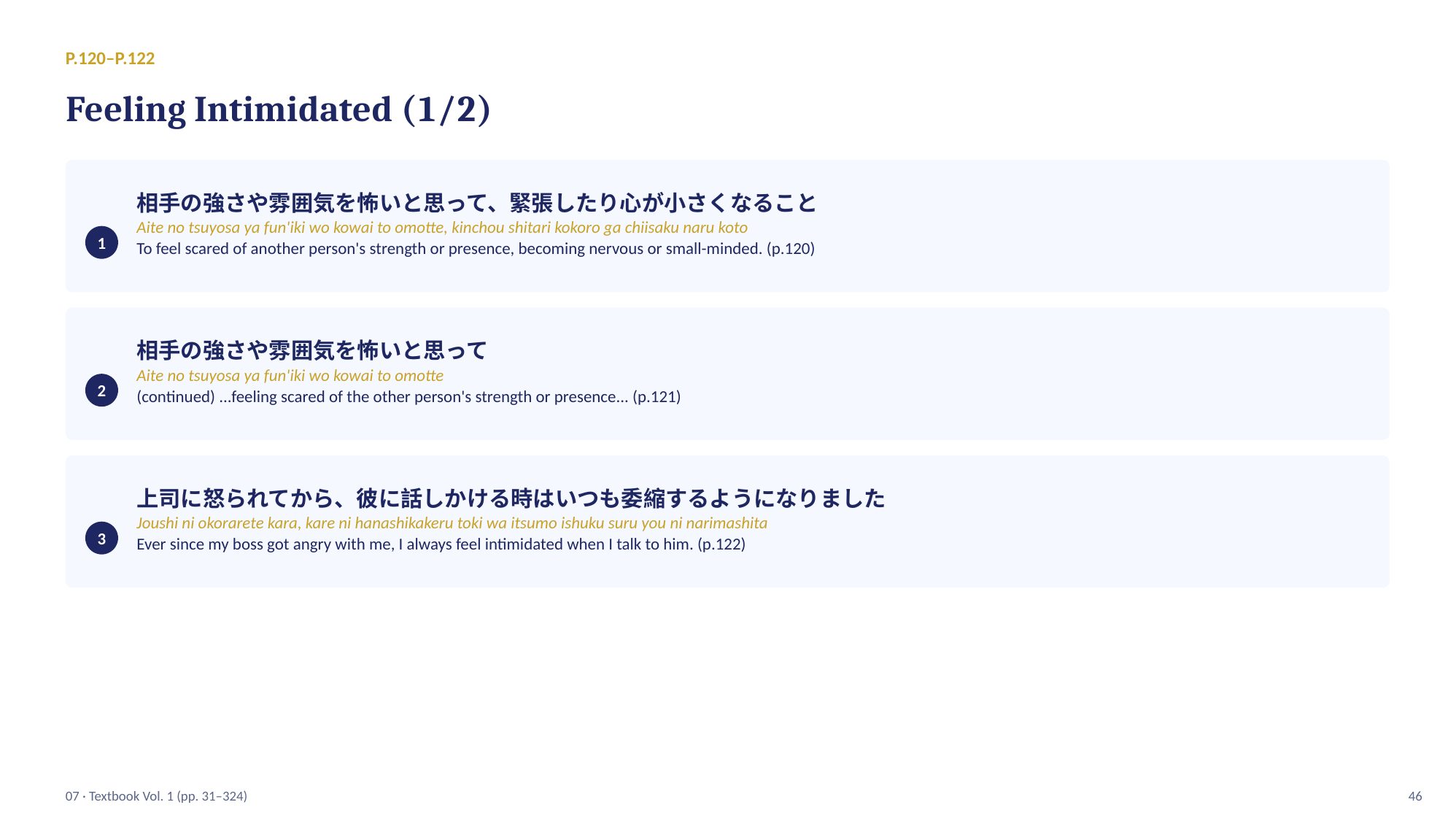
JP相手の強さや雰囲気を怖いと思って、緊張したり心が小さくなること
EN Aite no tsuyosa ya fun'iki wo kowai to omotte, kinchou shitari kokoro ga chiisaku naru koto
1 To feel scared of another person's strength or presence, becoming nervous or small-minded. (p.120)
1 To feel scared of another person's strength or presence, becoming nervous or small-minded. (p.120)
JP相手の強さや雰囲気を怖いと思って
EN Aite no tsuyosa ya fun'iki wo kowai to omotte
2 (continued) ...feeling scared of the other person's strength or presence... (p.121)
2 (continued) ...feeling scared of the other person's strength or presence... (p.121)
JP上司に怒られてから、彼に話しかける時はいつも委縮するようになりました
EN Joushi ni okorarete kara, kare ni hanashikakeru toki wa itsumo ishuku suru you ni narimashita
3 Ever since my boss got angry with me, I always feel intimidated when I talk to him. (p.122)
07 · Textbook Vol. 1 (pp. 31–324) 46
3 Ever since my boss got angry with me, I always feel intimidated when I talk to him. (p.122)
07 · Textbook Vol. 1 (pp. 31–324) 46
หน้า 47
คลิกเพื่อขยาย
ENP.123–P.126
Feeling Intimidated (2/2)
Feeling Intimidated (2/2)
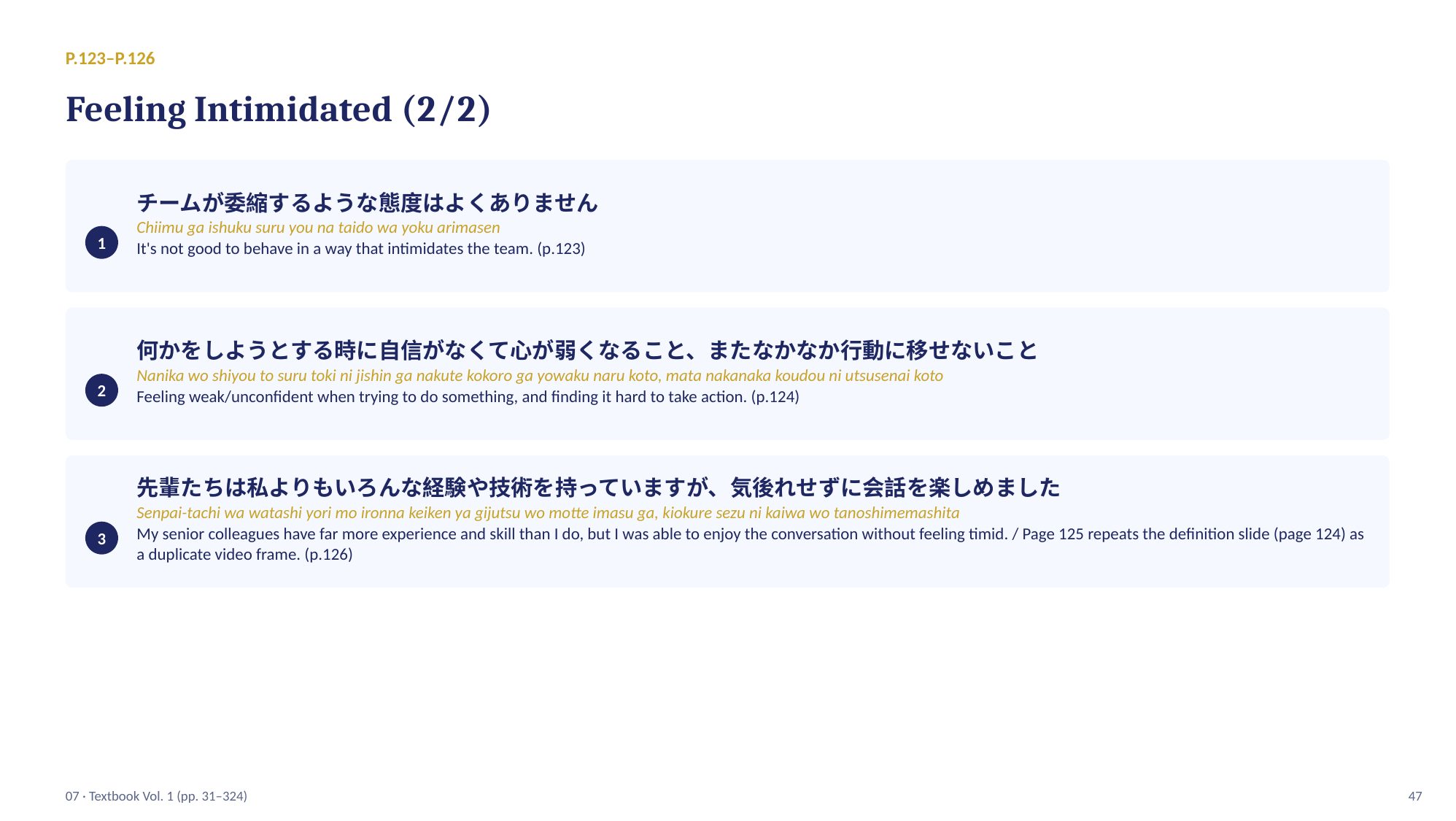
JPチームが委縮するような態度はよくありません
EN Chiimu ga ishuku suru you na taido wa yoku arimasen
1 It's not good to behave in a way that intimidates the team. (p.123)
1 It's not good to behave in a way that intimidates the team. (p.123)
JP何かをしようとする時に自信がなくて心が弱くなること、またなかなか行動に移せないこと
EN Nanika wo shiyou to suru toki ni jishin ga nakute kokoro ga yowaku naru koto, mata nakanaka koudou ni utsusenai koto
2 Feeling weak/unconfident when trying to do something, and finding it hard to take action. (p.124)
2 Feeling weak/unconfident when trying to do something, and finding it hard to take action. (p.124)
JP先輩たちは私よりもいろんな経験や技術を持っていますが、気後れせずに会話を楽しめました
EN Senpai-tachi wa watashi yori mo ironna keiken ya gijutsu wo motte imasu ga, kiokure sezu ni kaiwa wo tanoshimemashita
3 My senior colleagues have far more experience and skill than I do, but I was able to enjoy the conversation without feeling timid. / Page 125 repeats the definition slide (page 124) as
a duplicate video frame. (p.126)
07 · Textbook Vol. 1 (pp. 31–324) 47
3 My senior colleagues have far more experience and skill than I do, but I was able to enjoy the conversation without feeling timid. / Page 125 repeats the definition slide (page 124) as
a duplicate video frame. (p.126)
07 · Textbook Vol. 1 (pp. 31–324) 47
หน้า 48

คลิกเพื่อขยาย
13
ENRecap: Shock & Upset (Review)
4 phrases · pages 127–130
4 phrases · pages 127–130
หน้า 49
คลิกเพื่อขยาย
ENP.127–P.129
Recap: Shock & Upset (Review) (1/2)
Recap: Shock & Upset (Review) (1/2)
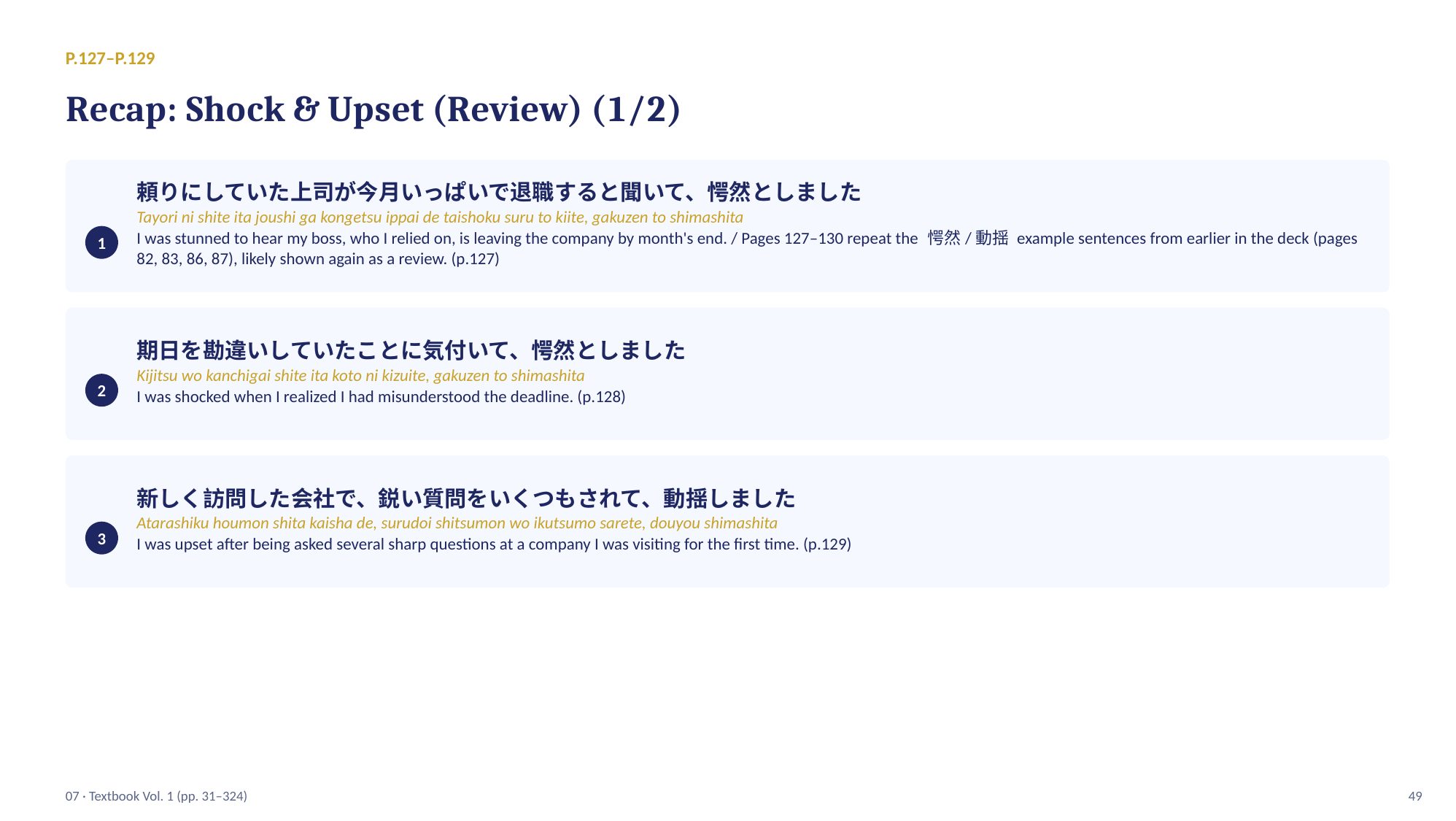
JP頼りにしていた上司が今月いっぱいで退職すると聞いて、愕然としました
EN Tayori ni shite ita joushi ga kongetsu ippai de taishoku suru to kiite, gakuzen to shimashita
1 I was stunned to hear my boss, who I relied on, is leaving the company by month's end. / Pages 127–130 repeat the 愕然 / 動揺 example sentences from earlier in the deck (pages
82, 83, 86, 87), likely shown again as a review. (p.127)
1 I was stunned to hear my boss, who I relied on, is leaving the company by month's end. / Pages 127–130 repeat the 愕然 / 動揺 example sentences from earlier in the deck (pages
82, 83, 86, 87), likely shown again as a review. (p.127)
JP期日を勘違いしていたことに気付いて、愕然としました
EN Kijitsu wo kanchigai shite ita koto ni kizuite, gakuzen to shimashita
2 I was shocked when I realized I had misunderstood the deadline. (p.128)
2 I was shocked when I realized I had misunderstood the deadline. (p.128)
JP新しく訪問した会社で、鋭い質問をいくつもされて、動揺しました
EN Atarashiku houmon shita kaisha de, surudoi shitsumon wo ikutsumo sarete, douyou shimashita
3 I was upset after being asked several sharp questions at a company I was visiting for the first time. (p.129)
07 · Textbook Vol. 1 (pp. 31–324) 49
3 I was upset after being asked several sharp questions at a company I was visiting for the first time. (p.129)
07 · Textbook Vol. 1 (pp. 31–324) 49
หน้า 50
คลิกเพื่อขยาย
ENP.130
Recap: Shock & Upset (Review) (2/2)
Recap: Shock & Upset (Review) (2/2)
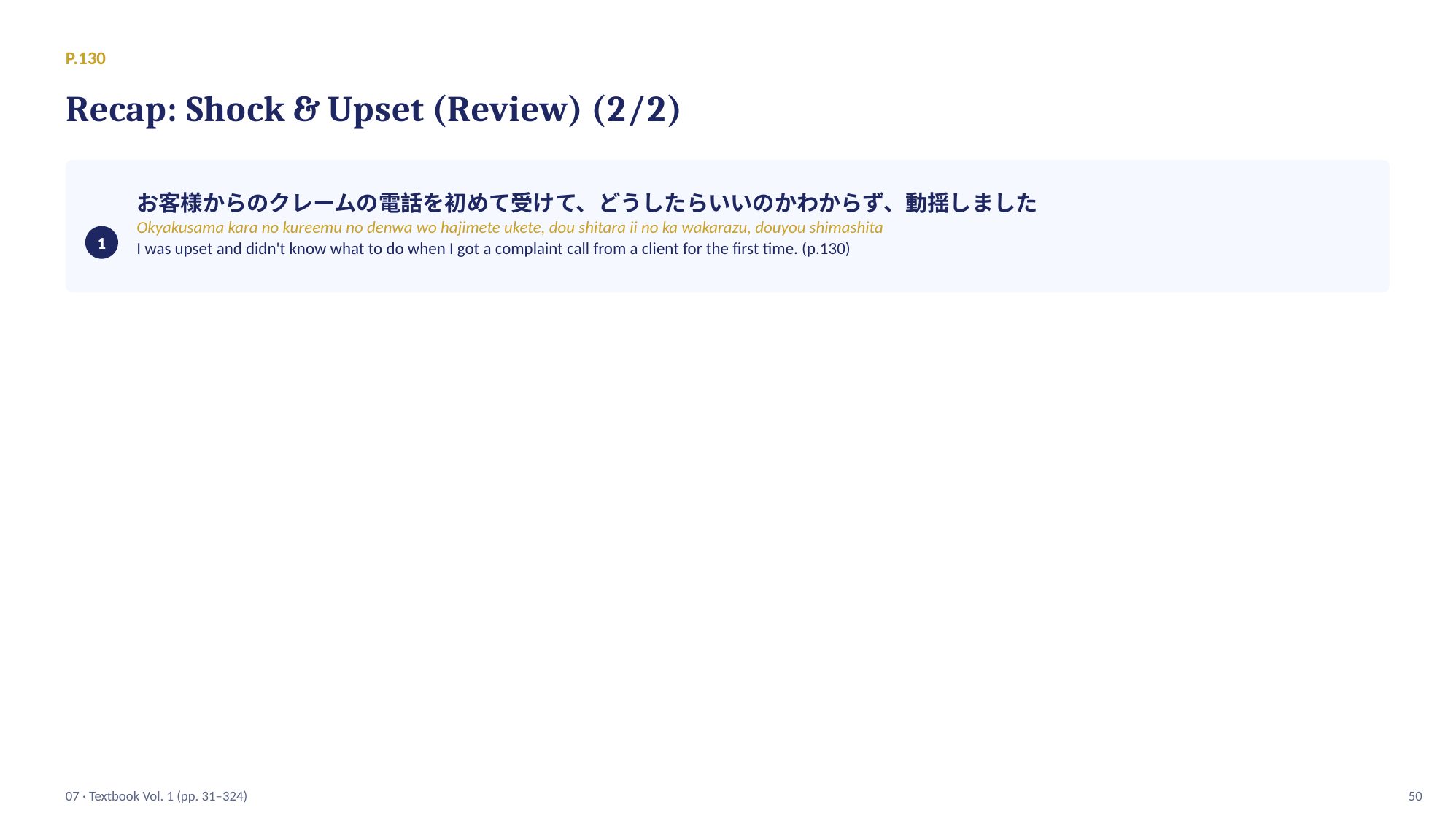
JPお客様からのクレームの電話を初めて受けて、どうしたらいいのかわからず、動揺しました
EN Okyakusama kara no kureemu no denwa wo hajimete ukete, dou shitara ii no ka wakarazu, douyou shimashita
1 I was upset and didn't know what to do when I got a complaint call from a client for the first time. (p.130)
07 · Textbook Vol. 1 (pp. 31–324) 50
1 I was upset and didn't know what to do when I got a complaint call from a client for the first time. (p.130)
07 · Textbook Vol. 1 (pp. 31–324) 50
หน้า 51

คลิกเพื่อขยาย
14
ENBeing Considerate
3 phrases · pages 131–133
3 phrases · pages 131–133
หน้า 52
คลิกเพื่อขยาย
ENP.131–P.133
Being Considerate
Being Considerate
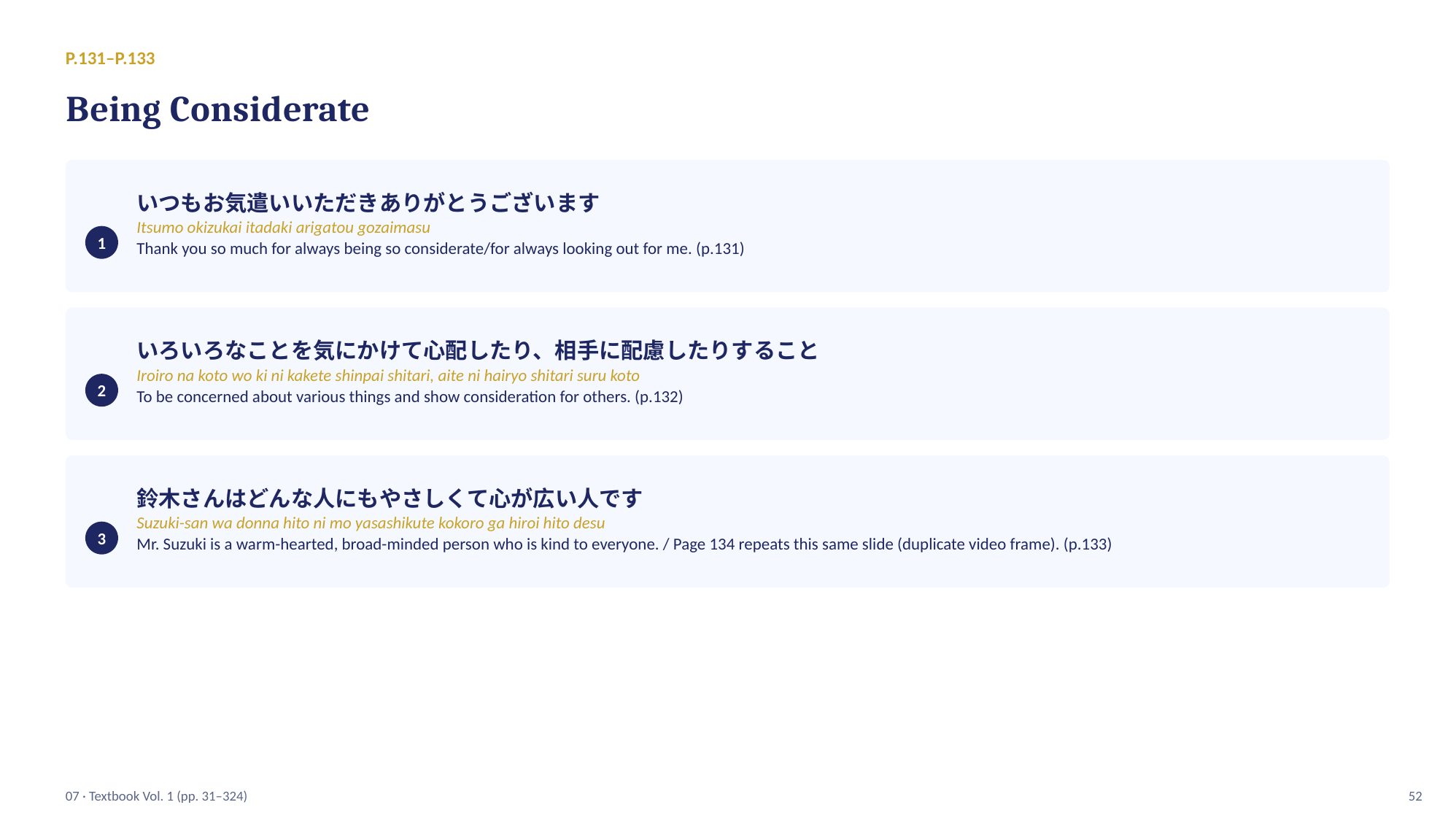
JPいつもお気遣いいただきありがとうございます
EN Itsumo okizukai itadaki arigatou gozaimasu
1 Thank you so much for always being so considerate/for always looking out for me. (p.131)
1 Thank you so much for always being so considerate/for always looking out for me. (p.131)
JPいろいろなことを気にかけて心配したり、相手に配慮したりすること
EN Iroiro na koto wo ki ni kakete shinpai shitari, aite ni hairyo shitari suru koto
2 To be concerned about various things and show consideration for others. (p.132)
2 To be concerned about various things and show consideration for others. (p.132)
JP鈴木さんはどんな人にもやさしくて心が広い人です
EN Suzuki-san wa donna hito ni mo yasashikute kokoro ga hiroi hito desu
3 Mr. Suzuki is a warm-hearted, broad-minded person who is kind to everyone. / Page 134 repeats this same slide (duplicate video frame). (p.133)
07 · Textbook Vol. 1 (pp. 31–324) 52
3 Mr. Suzuki is a warm-hearted, broad-minded person who is kind to everyone. / Page 134 repeats this same slide (duplicate video frame). (p.133)
07 · Textbook Vol. 1 (pp. 31–324) 52
หน้า 53

คลิกเพื่อขยาย
15
ENSample Email: Inviting a Colleague to Lunch
1 phrase · pages 135–135
1 phrase · pages 135–135
หน้า 54
คลิกเพื่อขยาย
ENP.135
Sample Email: Inviting a Colleague to Lunch
Sample Email: Inviting a Colleague to Lunch
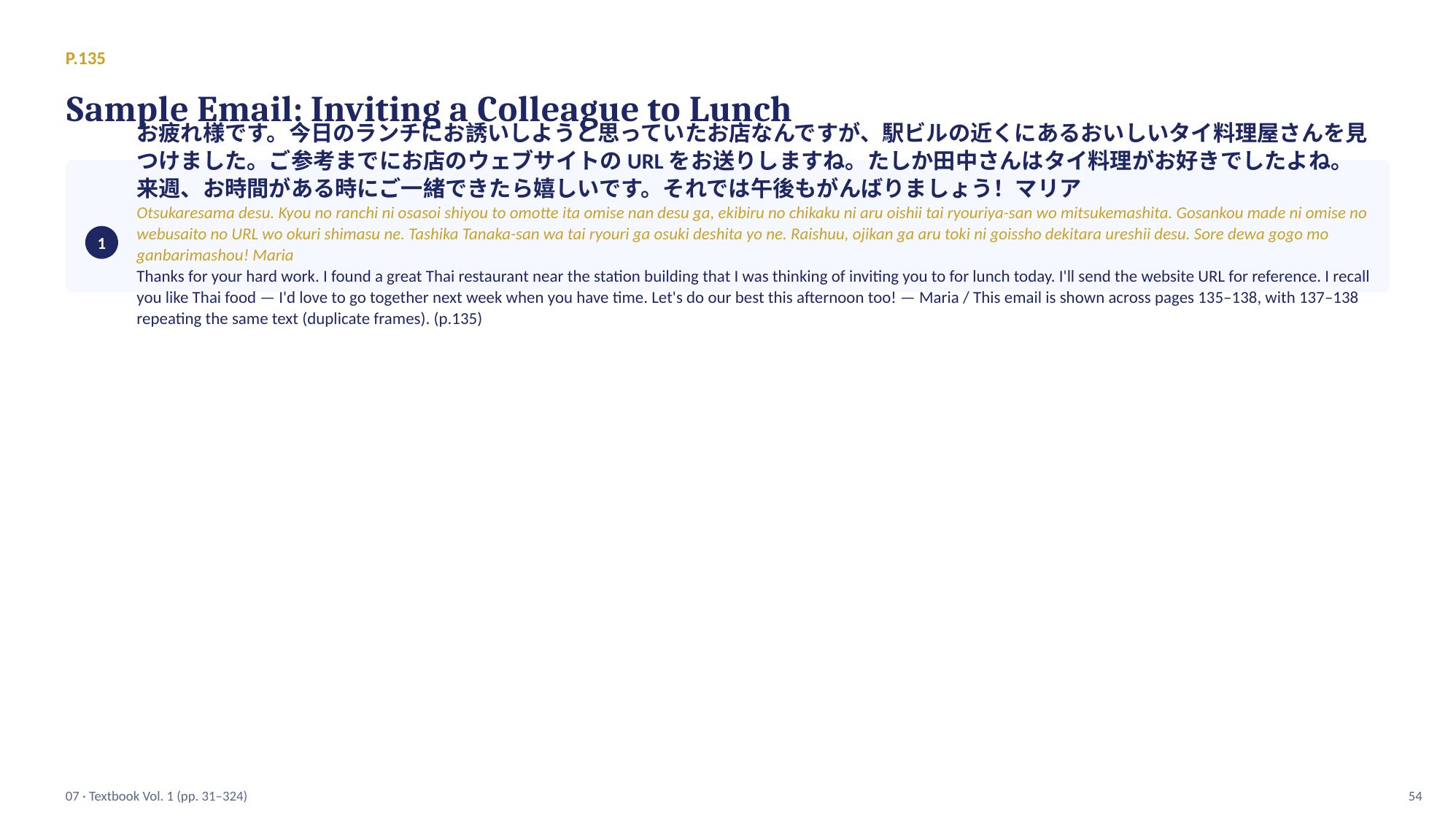
JPお疲れ様です。今日のランチにお誘いしようと思っていたお店なんですが、駅ビルの近くにあるおいしいタイ料理屋さんを見
つけました。ご参考までにお店のウェブサイトのURLをお送りしますね。たしか田中さんはタイ料理がお好きでしたよね。
来週、お時間がある時にご一緒できたら嬉しいです。それでは午後もがんばりましょう!マリア
つけました。ご参考までにお店のウェブサイトのURLをお送りしますね。たしか田中さんはタイ料理がお好きでしたよね。
来週、お時間がある時にご一緒できたら嬉しいです。それでは午後もがんばりましょう!マリア
EN Otsukaresama desu. Kyou no ranchi ni osasoi shiyou to omotte ita omise nan desu ga, ekibiru no chikaku ni aru oishii tai ryouriya-san wo mitsukemashita. Gosankou made ni omise no
webusaito no URL wo okuri shimasu ne. Tashika Tanaka-san wa tai ryouri ga osuki deshita yo ne. Raishuu, ojikan ga aru toki ni goissho dekitara ureshii desu. Sore dewa gogo mo
1
ganbarimashou! Maria
Thanks for your hard work. I found a great Thai restaurant near the station building that I was thinking of inviting you to for lunch today. I'll send the website URL for reference. I recall
you like Thai food — I'd love to go together next week when you have time. Let's do our best this afternoon too! — Maria / This email is shown across pages 135–138, with 137–138
repeating the same text (duplicate frames). (p.135)
07 · Textbook Vol. 1 (pp. 31–324) 54
webusaito no URL wo okuri shimasu ne. Tashika Tanaka-san wa tai ryouri ga osuki deshita yo ne. Raishuu, ojikan ga aru toki ni goissho dekitara ureshii desu. Sore dewa gogo mo
1
ganbarimashou! Maria
Thanks for your hard work. I found a great Thai restaurant near the station building that I was thinking of inviting you to for lunch today. I'll send the website URL for reference. I recall
you like Thai food — I'd love to go together next week when you have time. Let's do our best this afternoon too! — Maria / This email is shown across pages 135–138, with 137–138
repeating the same text (duplicate frames). (p.135)
07 · Textbook Vol. 1 (pp. 31–324) 54
หน้า 55

คลิกเพื่อขยาย
16
ENInviting Someone to Lunch
3 phrases · pages 139–142
3 phrases · pages 139–142
หน้า 56
คลิกเพื่อขยาย
ENP.139–P.142
Inviting Someone to Lunch
Inviting Someone to Lunch
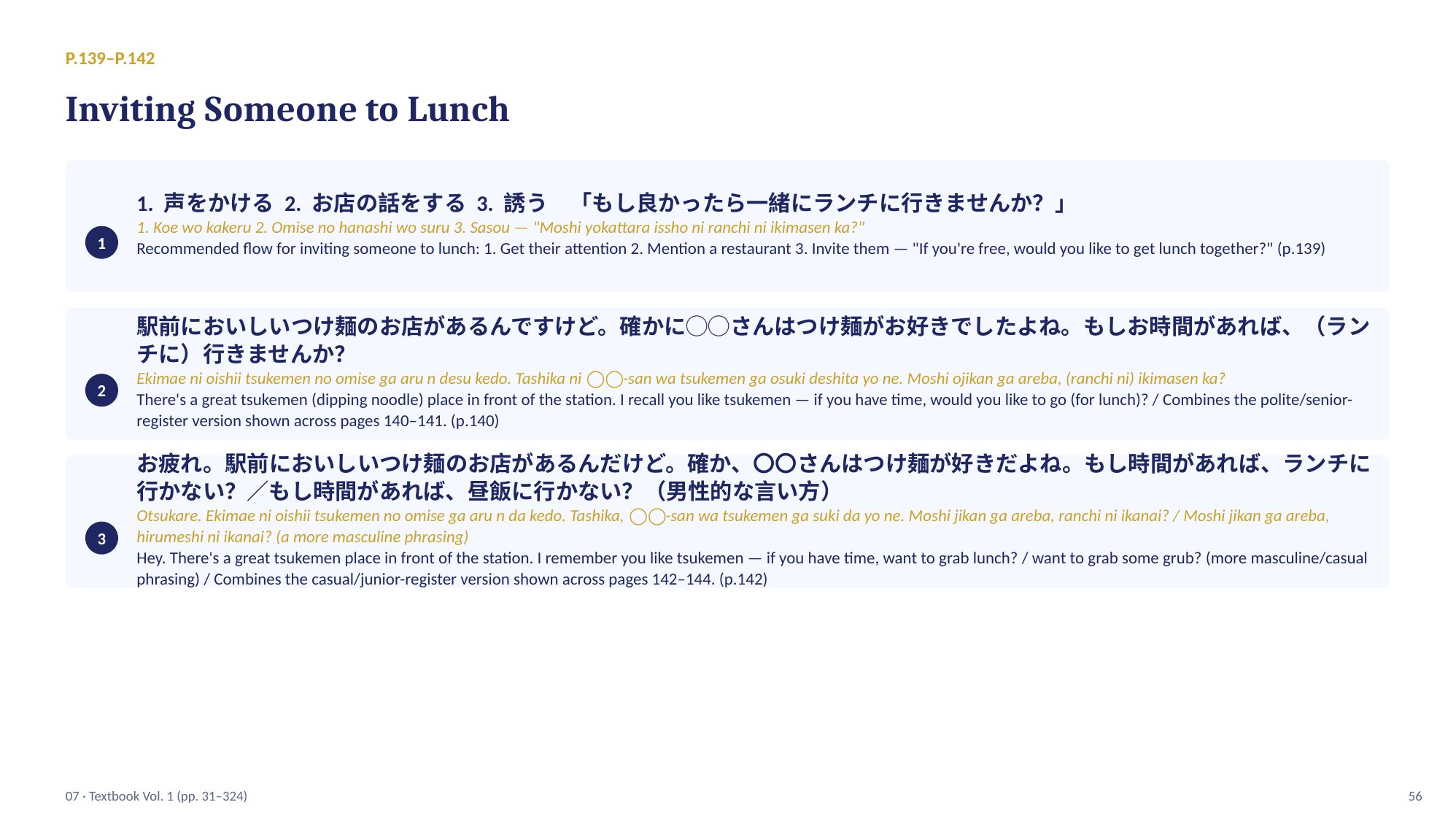
JP1.声をかける2.お店の話をする3.誘う「もし良かったら一緒にランチに行きませんか?」
EN 1. Koe wo kakeru 2. Omise no hanashi wo suru 3. Sasou — "Moshi yokattara issho ni ranchi ni ikimasen ka?"
1 Recommended flow for inviting someone to lunch: 1. Get their attention 2. Mention a restaurant 3. Invite them — "If you're free, would you like to get lunch together?" (p.139)
1 Recommended flow for inviting someone to lunch: 1. Get their attention 2. Mention a restaurant 3. Invite them — "If you're free, would you like to get lunch together?" (p.139)
JP駅前においしいつけ麺のお店があるんですけど。確かに◯◯さんはつけ麺がお好きでしたよね。もしお時間があれば、(ラン
チに)行きませんか?
チに)行きませんか?
EN Ekimae ni oishii tsukemen no omise ga aru n desu kedo. Tashika ni ◯◯-san wa tsukemen ga osuki deshita yo ne. Moshi ojikan ga areba, (ranchi ni) ikimasen ka?
2
There's a great tsukemen (dipping noodle) place in front of the station. I recall you like tsukemen — if you have time, would you like to go (for lunch)? / Combines the polite/senior-
register version shown across pages 140–141. (p.140)
2
There's a great tsukemen (dipping noodle) place in front of the station. I recall you like tsukemen — if you have time, would you like to go (for lunch)? / Combines the polite/senior-
register version shown across pages 140–141. (p.140)
JPお疲れ。駅前においしいつけ麺のお店があるんだけど。確か、〇〇さんはつけ麺が好きだよね。もし時間があれば、ランチに
行かない?/もし時間があれば、昼飯に行かない?(男性的な言い方)
行かない?/もし時間があれば、昼飯に行かない?(男性的な言い方)
EN Otsukare. Ekimae ni oishii tsukemen no omise ga aru n da kedo. Tashika, ◯◯-san wa tsukemen ga suki da yo ne. Moshi jikan ga areba, ranchi ni ikanai? / Moshi jikan ga areba,
3 hirumeshi ni ikanai? (a more masculine phrasing)
Hey. There's a great tsukemen place in front of the station. I remember you like tsukemen — if you have time, want to grab lunch? / want to grab some grub? (more masculine/casual
phrasing) / Combines the casual/junior-register version shown across pages 142–144. (p.142)
07 · Textbook Vol. 1 (pp. 31–324) 56
3 hirumeshi ni ikanai? (a more masculine phrasing)
Hey. There's a great tsukemen place in front of the station. I remember you like tsukemen — if you have time, want to grab lunch? / want to grab some grub? (more masculine/casual
phrasing) / Combines the casual/junior-register version shown across pages 142–144. (p.142)
07 · Textbook Vol. 1 (pp. 31–324) 56
หน้า 57

คลิกเพื่อขยาย
17
ENReplying to a Lunch Invitation
10 phrases · pages 145–303
10 phrases · pages 145–303
หน้า 58
คลิกเพื่อขยาย
ENP.145–P.296
Replying to a Lunch Invitation (1/4)
Replying to a Lunch Invitation (1/4)
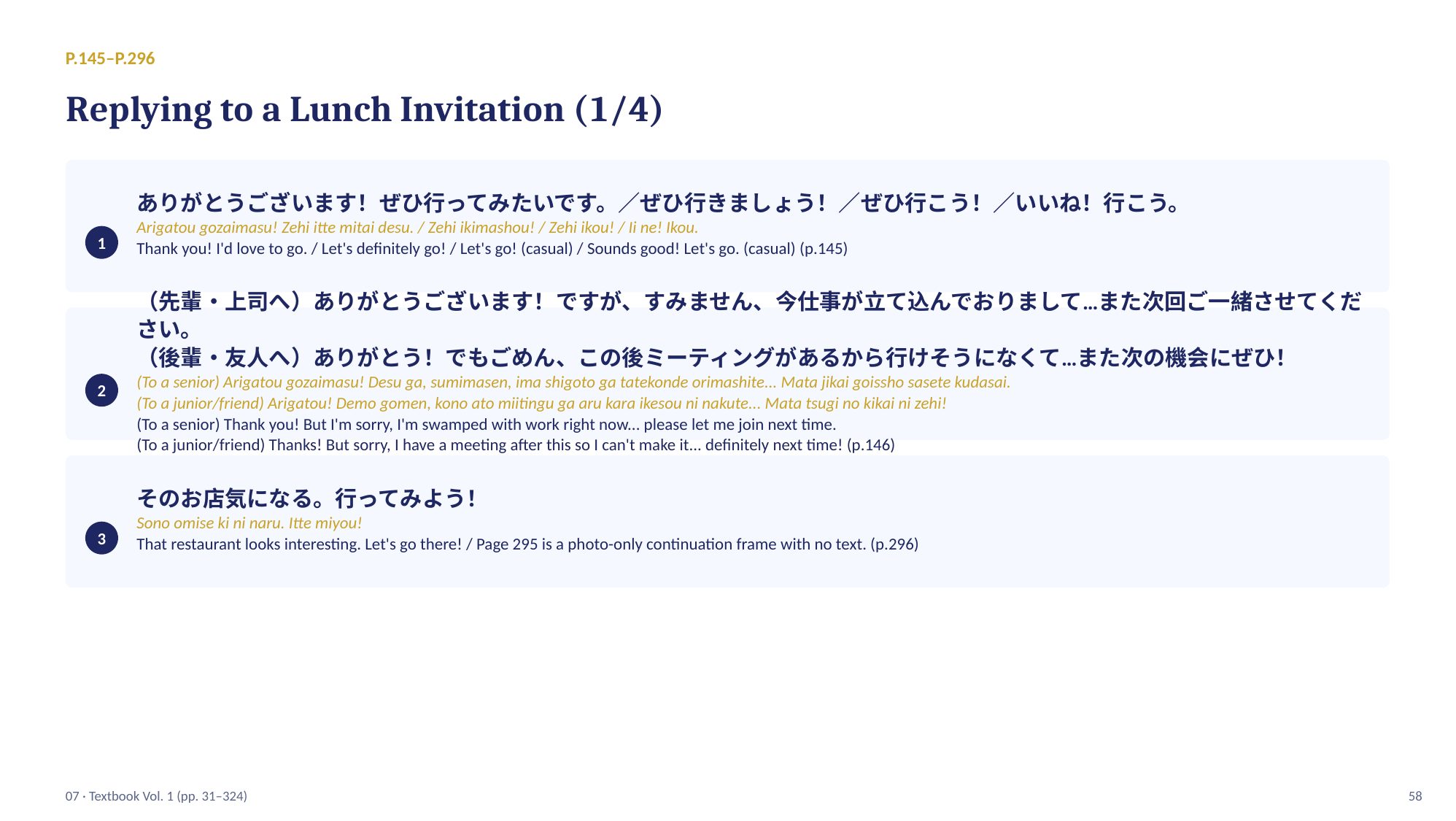
JPありがとうございます!ぜひ行ってみたいです。/ぜひ行きましょう!/ぜひ行こう!/いいね!行こう。
EN Arigatou gozaimasu! Zehi itte mitai desu. / Zehi ikimashou! / Zehi ikou! / Ii ne! Ikou.
1 Thank you! I'd love to go. / Let's definitely go! / Let's go! (casual) / Sounds good! Let's go. (casual) (p.145)
1 Thank you! I'd love to go. / Let's definitely go! / Let's go! (casual) / Sounds good! Let's go. (casual) (p.145)
JP(先輩・上司へ)ありがとうございます!ですが、すみません、今仕事が立て込んでおりまして…また次回ご一緒させてくだ
さい。
(後輩・友人へ)ありがとう!でもごめん、この後ミーティングがあるから行けそうになくて…また次の機会にぜひ!
さい。
(後輩・友人へ)ありがとう!でもごめん、この後ミーティングがあるから行けそうになくて…また次の機会にぜひ!
EN (To a senior) Arigatou gozaimasu! Desu ga, sumimasen, ima shigoto ga tatekonde orimashite... Mata jikai goissho sasete kudasai.
2
(To a junior/friend) Arigatou! Demo gomen, kono ato miitingu ga aru kara ikesou ni nakute... Mata tsugi no kikai ni zehi!
(To a senior) Thank you! But I'm sorry, I'm swamped with work right now... please let me join next time.
(To a junior/friend) Thanks! But sorry, I have a meeting after this so I can't make it... definitely next time! (p.146)
2
(To a junior/friend) Arigatou! Demo gomen, kono ato miitingu ga aru kara ikesou ni nakute... Mata tsugi no kikai ni zehi!
(To a senior) Thank you! But I'm sorry, I'm swamped with work right now... please let me join next time.
(To a junior/friend) Thanks! But sorry, I have a meeting after this so I can't make it... definitely next time! (p.146)
JPそのお店気になる。行ってみよう!
EN Sono omise ki ni naru. Itte miyou!
3 That restaurant looks interesting. Let's go there! / Page 295 is a photo-only continuation frame with no text. (p.296)
07 · Textbook Vol. 1 (pp. 31–324) 58
3 That restaurant looks interesting. Let's go there! / Page 295 is a photo-only continuation frame with no text. (p.296)
07 · Textbook Vol. 1 (pp. 31–324) 58
หน้า 59
คลิกเพื่อขยาย
ENP.297–P.299
Replying to a Lunch Invitation (2/4)
Replying to a Lunch Invitation (2/4)
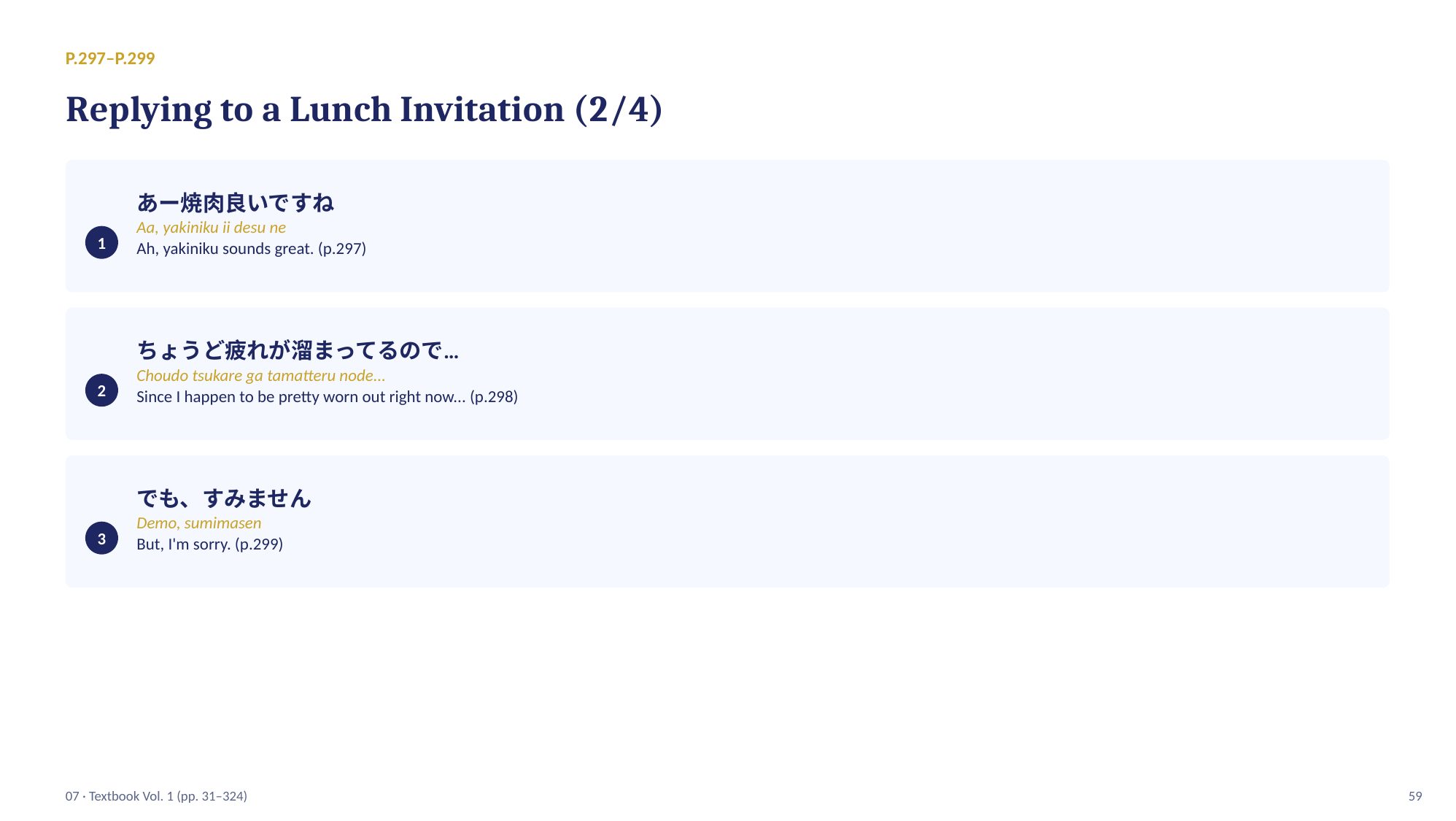
JPあー焼肉良いですね
EN Aa, yakiniku ii desu ne
1 Ah, yakiniku sounds great. (p.297)
1 Ah, yakiniku sounds great. (p.297)
JPちょうど疲れが溜まってるので…
EN Choudo tsukare ga tamatteru node...
2 Since I happen to be pretty worn out right now... (p.298)
2 Since I happen to be pretty worn out right now... (p.298)
JPでも、すみません
EN Demo, sumimasen
3 But, I'm sorry. (p.299)
07 · Textbook Vol. 1 (pp. 31–324) 59
3 But, I'm sorry. (p.299)
07 · Textbook Vol. 1 (pp. 31–324) 59
หน้า 60
คลิกเพื่อขยาย
ENP.300–P.302
Replying to a Lunch Invitation (3/4)
Replying to a Lunch Invitation (3/4)
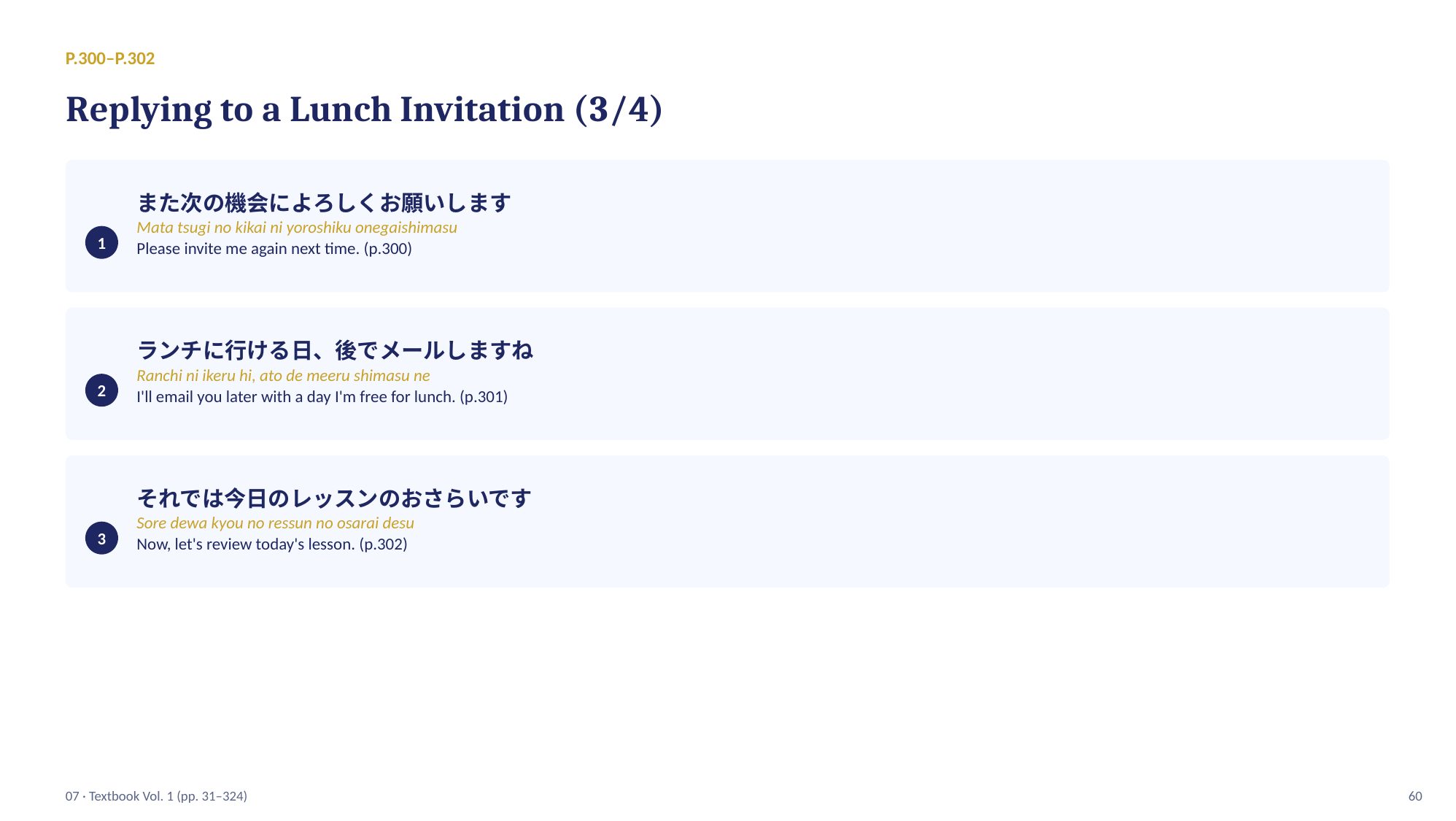
JPまた次の機会によろしくお願いします
EN Mata tsugi no kikai ni yoroshiku onegaishimasu
1 Please invite me again next time. (p.300)
1 Please invite me again next time. (p.300)
JPランチに行ける日、後でメールしますね
EN Ranchi ni ikeru hi, ato de meeru shimasu ne
2 I'll email you later with a day I'm free for lunch. (p.301)
2 I'll email you later with a day I'm free for lunch. (p.301)
JPそれでは今日のレッスンのおさらいです
EN Sore dewa kyou no ressun no osarai desu
3 Now, let's review today's lesson. (p.302)
07 · Textbook Vol. 1 (pp. 31–324) 60
3 Now, let's review today's lesson. (p.302)
07 · Textbook Vol. 1 (pp. 31–324) 60
หน้า 61
คลิกเพื่อขยาย
ENP.303
Replying to a Lunch Invitation (4/4)
Replying to a Lunch Invitation (4/4)
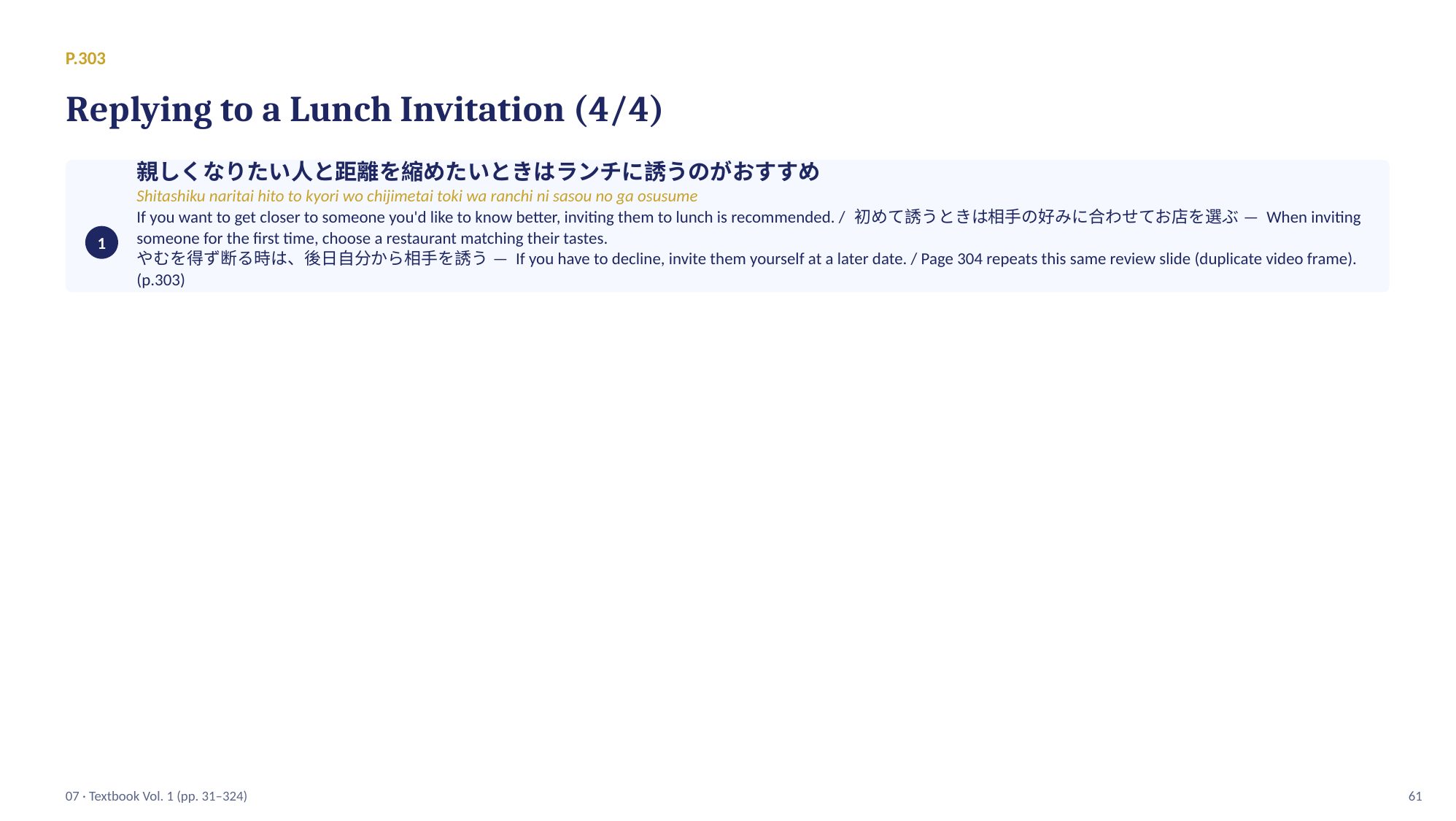
JP親しくなりたい人と距離を縮めたいときはランチに誘うのがおすすめ
EN Shitashiku naritai hito to kyori wo chijimetai toki wa ranchi ni sasou no ga osusume
If you want to get closer to someone you'd like to know better, inviting them to lunch is recommended. / 初めて誘うときは相手の好みに合わせてお店を選ぶ — When inviting
1 someone for the first time, choose a restaurant matching their tastes.
やむを得ず断る時は、後日自分から相手を誘う — If you have to decline, invite them yourself at a later date. / Page 304 repeats this same review slide (duplicate video frame).
(p.303)
07 · Textbook Vol. 1 (pp. 31–324) 61
If you want to get closer to someone you'd like to know better, inviting them to lunch is recommended. / 初めて誘うときは相手の好みに合わせてお店を選ぶ — When inviting
1 someone for the first time, choose a restaurant matching their tastes.
やむを得ず断る時は、後日自分から相手を誘う — If you have to decline, invite them yourself at a later date. / Page 304 repeats this same review slide (duplicate video frame).
(p.303)
07 · Textbook Vol. 1 (pp. 31–324) 61
หน้า 62

คลิกเพื่อขยาย
18
ENPractice
1 phrase · pages 147–147
1 phrase · pages 147–147
หน้า 63
คลิกเพื่อขยาย
ENP.147
Practice
Practice
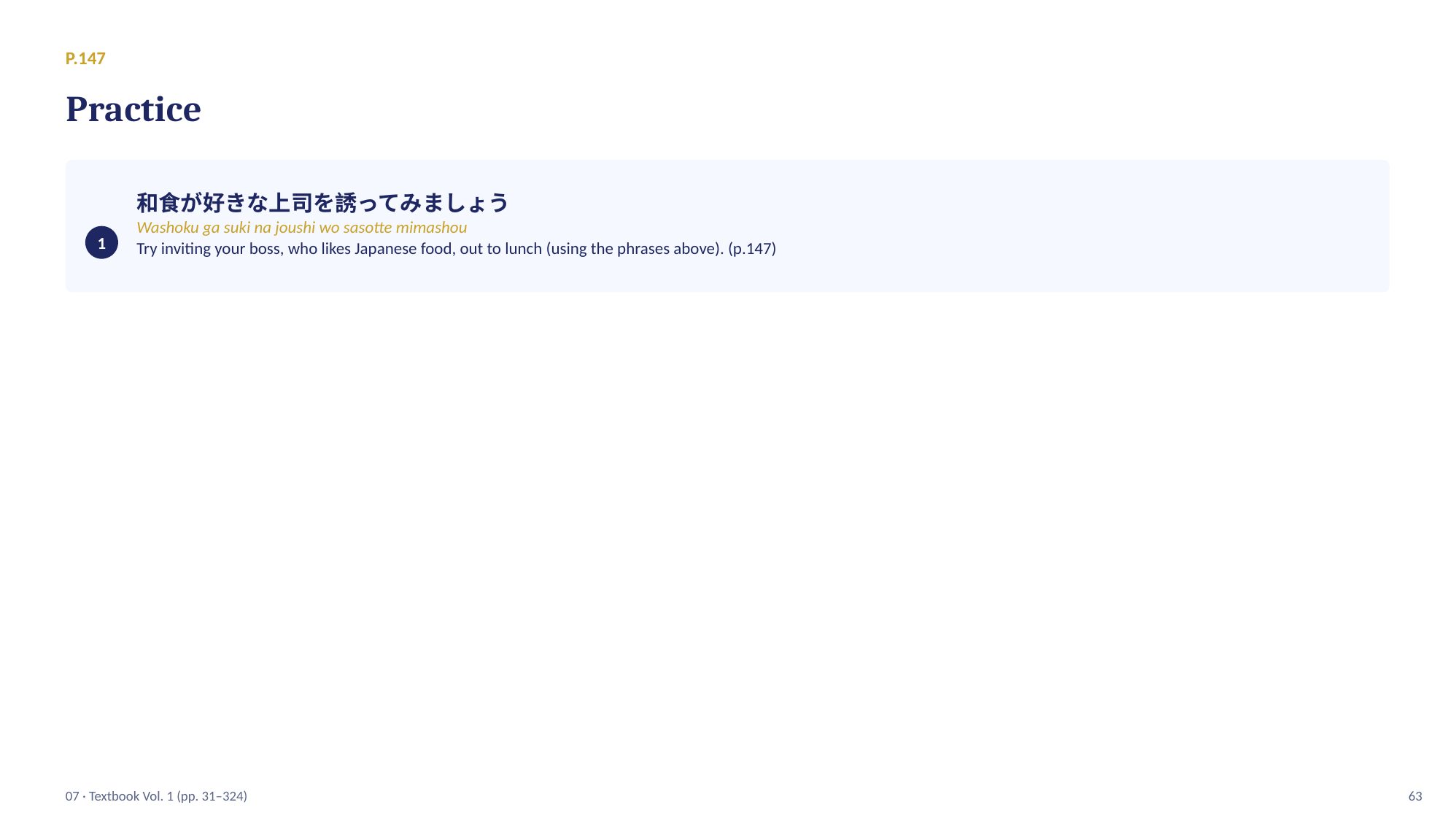
JP和食が好きな上司を誘ってみましょう
EN Washoku ga suki na joushi wo sasotte mimashou
1 Try inviting your boss, who likes Japanese food, out to lunch (using the phrases above). (p.147)
07 · Textbook Vol. 1 (pp. 31–324) 63
1 Try inviting your boss, who likes Japanese food, out to lunch (using the phrases above). (p.147)
07 · Textbook Vol. 1 (pp. 31–324) 63
หน้า 64

คลิกเพื่อขยาย
19
ENActive Listening
4 phrases · pages 305–308
4 phrases · pages 305–308
หน้า 65
คลิกเพื่อขยาย
ENP.305–P.307
Active Listening (1/2)
Active Listening (1/2)
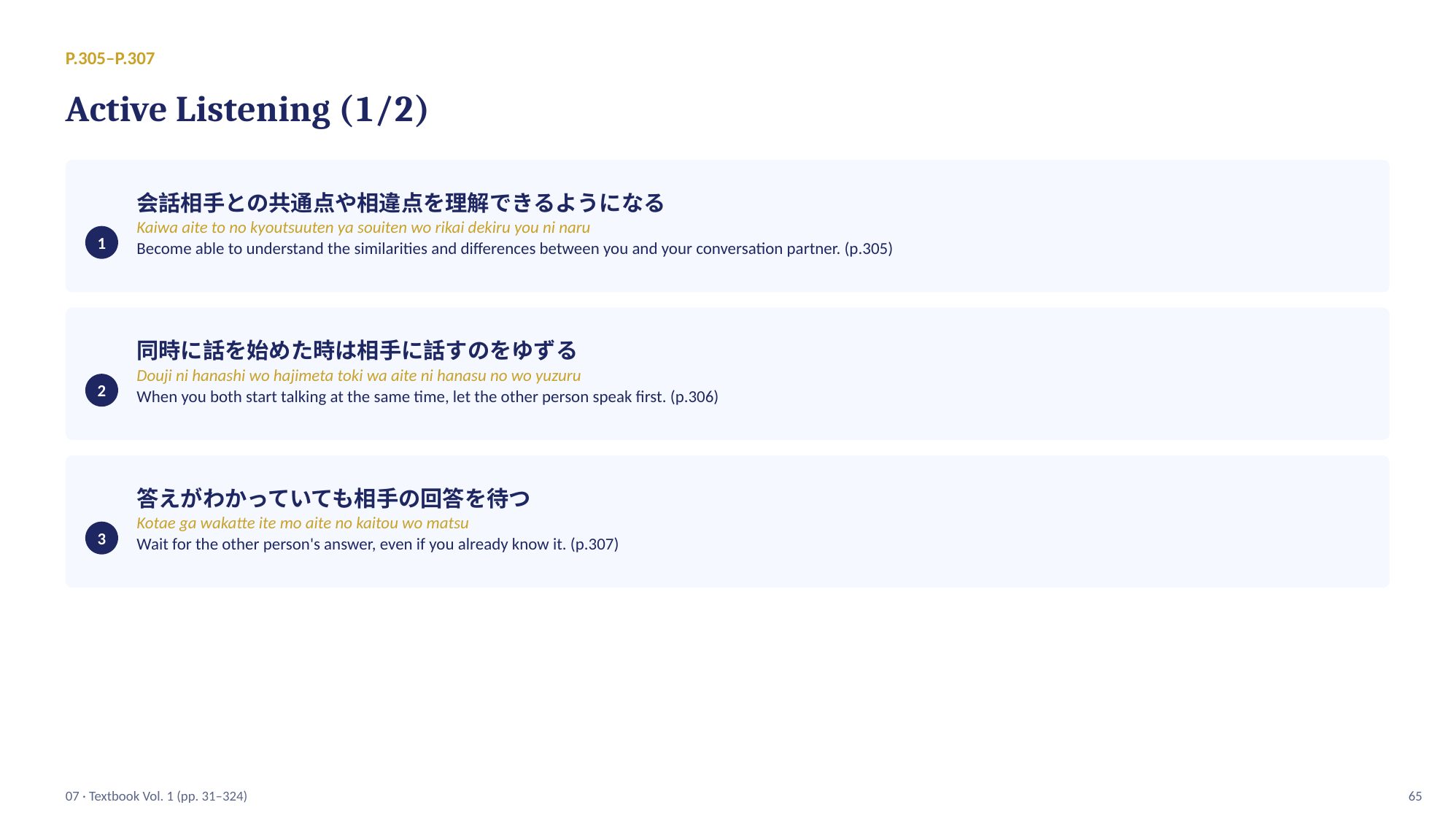
JP会話相手との共通点や相違点を理解できるようになる
EN Kaiwa aite to no kyoutsuuten ya souiten wo rikai dekiru you ni naru
1 Become able to understand the similarities and differences between you and your conversation partner. (p.305)
1 Become able to understand the similarities and differences between you and your conversation partner. (p.305)
JP同時に話を始めた時は相手に話すのをゆずる
EN Douji ni hanashi wo hajimeta toki wa aite ni hanasu no wo yuzuru
2 When you both start talking at the same time, let the other person speak first. (p.306)
2 When you both start talking at the same time, let the other person speak first. (p.306)
JP答えがわかっていても相手の回答を待つ
EN Kotae ga wakatte ite mo aite no kaitou wo matsu
3 Wait for the other person's answer, even if you already know it. (p.307)
07 · Textbook Vol. 1 (pp. 31–324) 65
3 Wait for the other person's answer, even if you already know it. (p.307)
07 · Textbook Vol. 1 (pp. 31–324) 65
หน้า 66
คลิกเพื่อขยาย
ENP.308
Active Listening (2/2)
Active Listening (2/2)
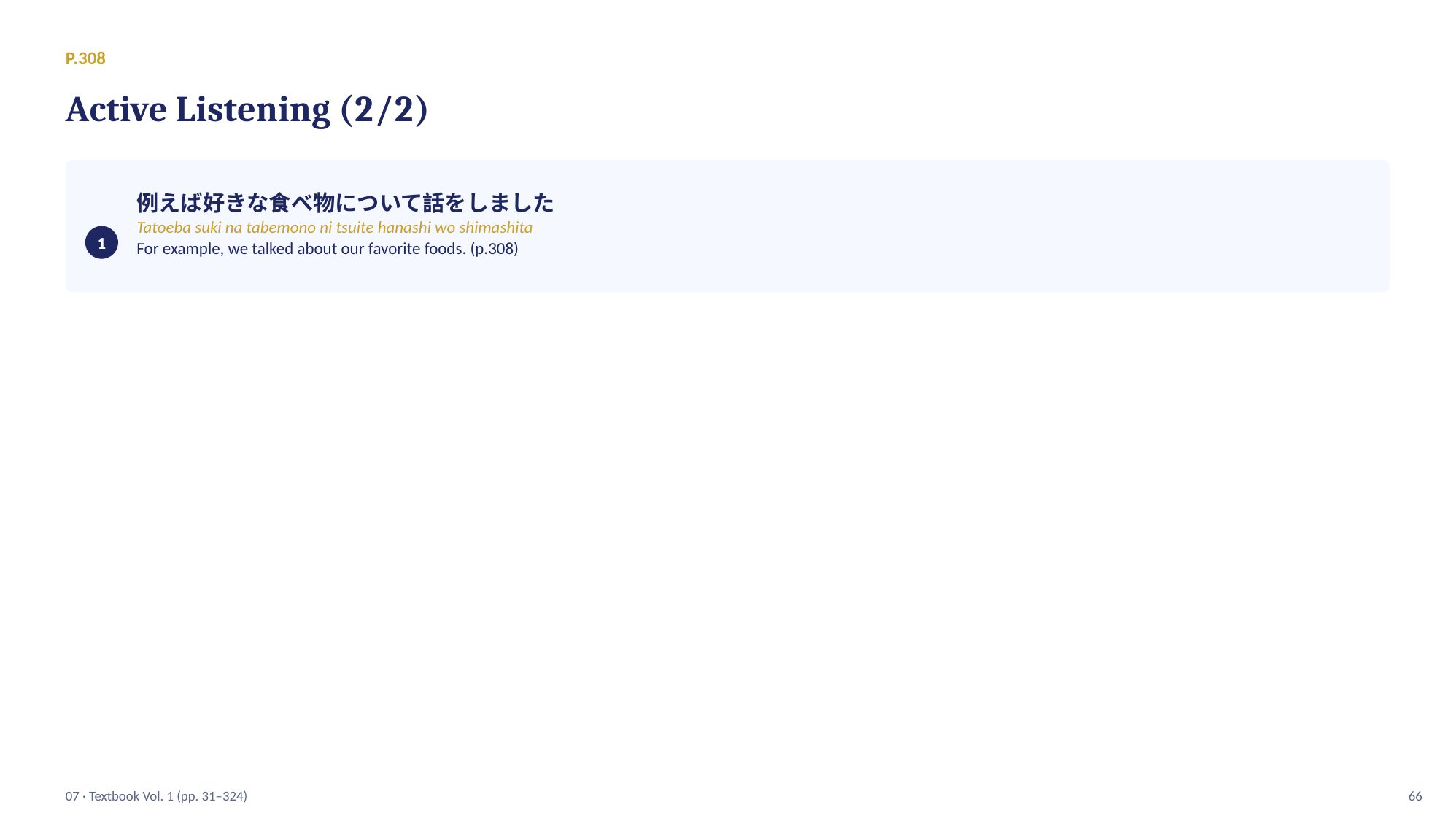
JP例えば好きな食べ物について話をしました
EN Tatoeba suki na tabemono ni tsuite hanashi wo shimashita
1 For example, we talked about our favorite foods. (p.308)
07 · Textbook Vol. 1 (pp. 31–324) 66
1 For example, we talked about our favorite foods. (p.308)
07 · Textbook Vol. 1 (pp. 31–324) 66
หน้า 67

คลิกเพื่อขยาย
20
ENTalking About Food Culture
12 phrases · pages 309–321
12 phrases · pages 309–321
หน้า 68
คลิกเพื่อขยาย
ENP.309–P.311
Talking About Food Culture (1/4)
Talking About Food Culture (1/4)
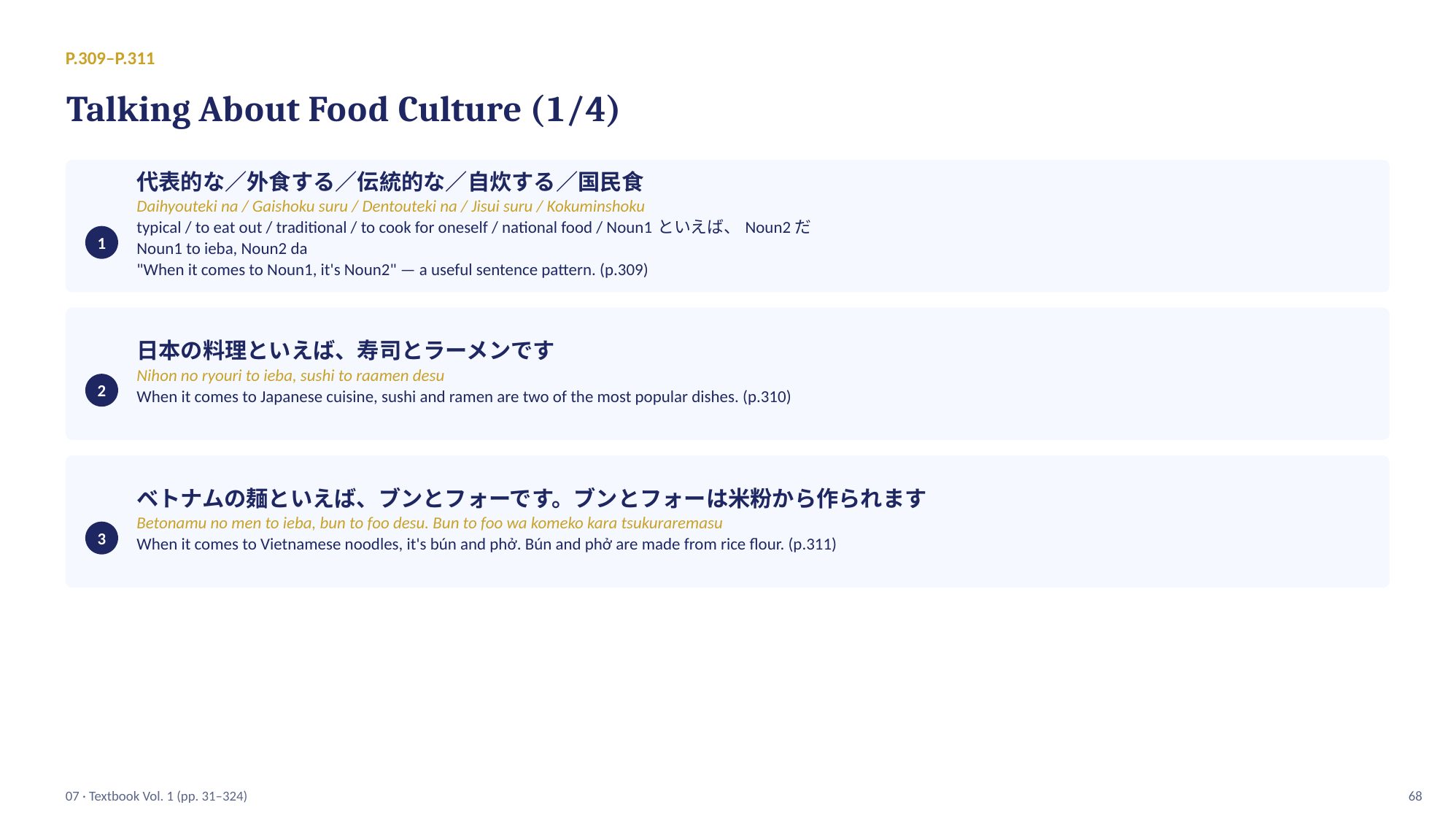
JP代表的な/外食する/伝統的な/自炊する/国民食
EN Daihyouteki na / Gaishoku suru / Dentouteki na / Jisui suru / Kokuminshoku
typical / to eat out / traditional / to cook for oneself / national food / Noun1 といえば、 Noun2 だ
1 Noun1 to ieba, Noun2 da
"When it comes to Noun1, it's Noun2" — a useful sentence pattern. (p.309)
typical / to eat out / traditional / to cook for oneself / national food / Noun1 といえば、 Noun2 だ
1 Noun1 to ieba, Noun2 da
"When it comes to Noun1, it's Noun2" — a useful sentence pattern. (p.309)
JP日本の料理といえば、寿司とラーメンです
EN Nihon no ryouri to ieba, sushi to raamen desu
2 When it comes to Japanese cuisine, sushi and ramen are two of the most popular dishes. (p.310)
2 When it comes to Japanese cuisine, sushi and ramen are two of the most popular dishes. (p.310)
JPベトナムの麺といえば、ブンとフォーです。ブンとフォーは米粉から作られます
EN Betonamu no men to ieba, bun to foo desu. Bun to foo wa komeko kara tsukuraremasu
3 When it comes to Vietnamese noodles, it's bún and phở. Bún and phở are made from rice flour. (p.311)
07 · Textbook Vol. 1 (pp. 31–324) 68
3 When it comes to Vietnamese noodles, it's bún and phở. Bún and phở are made from rice flour. (p.311)
07 · Textbook Vol. 1 (pp. 31–324) 68
หน้า 69
คลิกเพื่อขยาย
ENP.312–P.314
Talking About Food Culture (2/4)
Talking About Food Culture (2/4)
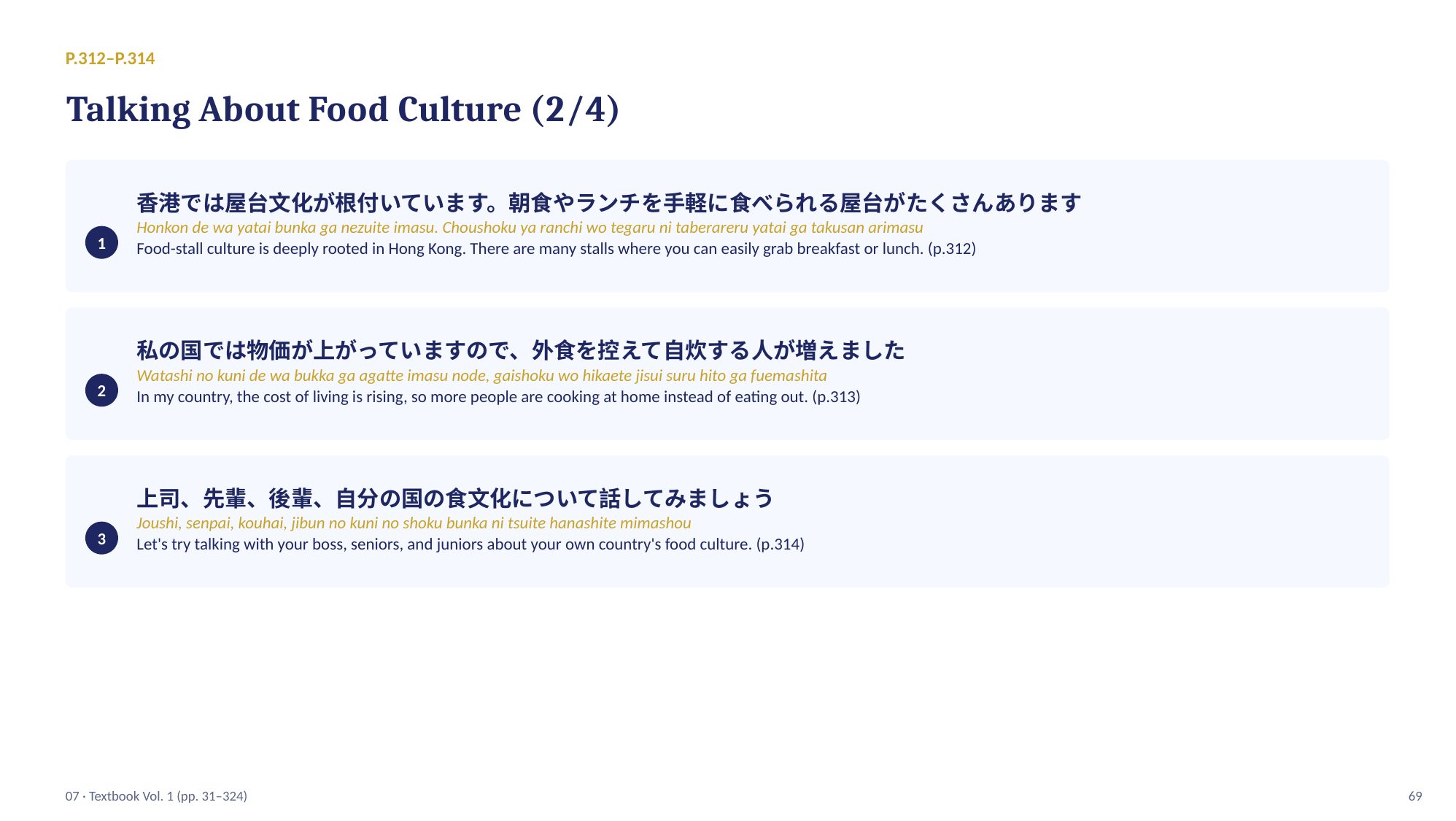
JP香港では屋台文化が根付いています。朝食やランチを手軽に食べられる屋台がたくさんあります
EN Honkon de wa yatai bunka ga nezuite imasu. Choushoku ya ranchi wo tegaru ni taberareru yatai ga takusan arimasu
1 Food-stall culture is deeply rooted in Hong Kong. There are many stalls where you can easily grab breakfast or lunch. (p.312)
1 Food-stall culture is deeply rooted in Hong Kong. There are many stalls where you can easily grab breakfast or lunch. (p.312)
JP私の国では物価が上がっていますので、外食を控えて自炊する人が増えました
EN Watashi no kuni de wa bukka ga agatte imasu node, gaishoku wo hikaete jisui suru hito ga fuemashita
2 In my country, the cost of living is rising, so more people are cooking at home instead of eating out. (p.313)
2 In my country, the cost of living is rising, so more people are cooking at home instead of eating out. (p.313)
JP上司、先輩、後輩、自分の国の食文化について話してみましょう
EN Joushi, senpai, kouhai, jibun no kuni no shoku bunka ni tsuite hanashite mimashou
3 Let's try talking with your boss, seniors, and juniors about your own country's food culture. (p.314)
07 · Textbook Vol. 1 (pp. 31–324) 69
3 Let's try talking with your boss, seniors, and juniors about your own country's food culture. (p.314)
07 · Textbook Vol. 1 (pp. 31–324) 69
หน้า 70
คลิกเพื่อขยาย
ENP.315–P.318
Talking About Food Culture (3/4)
Talking About Food Culture (3/4)
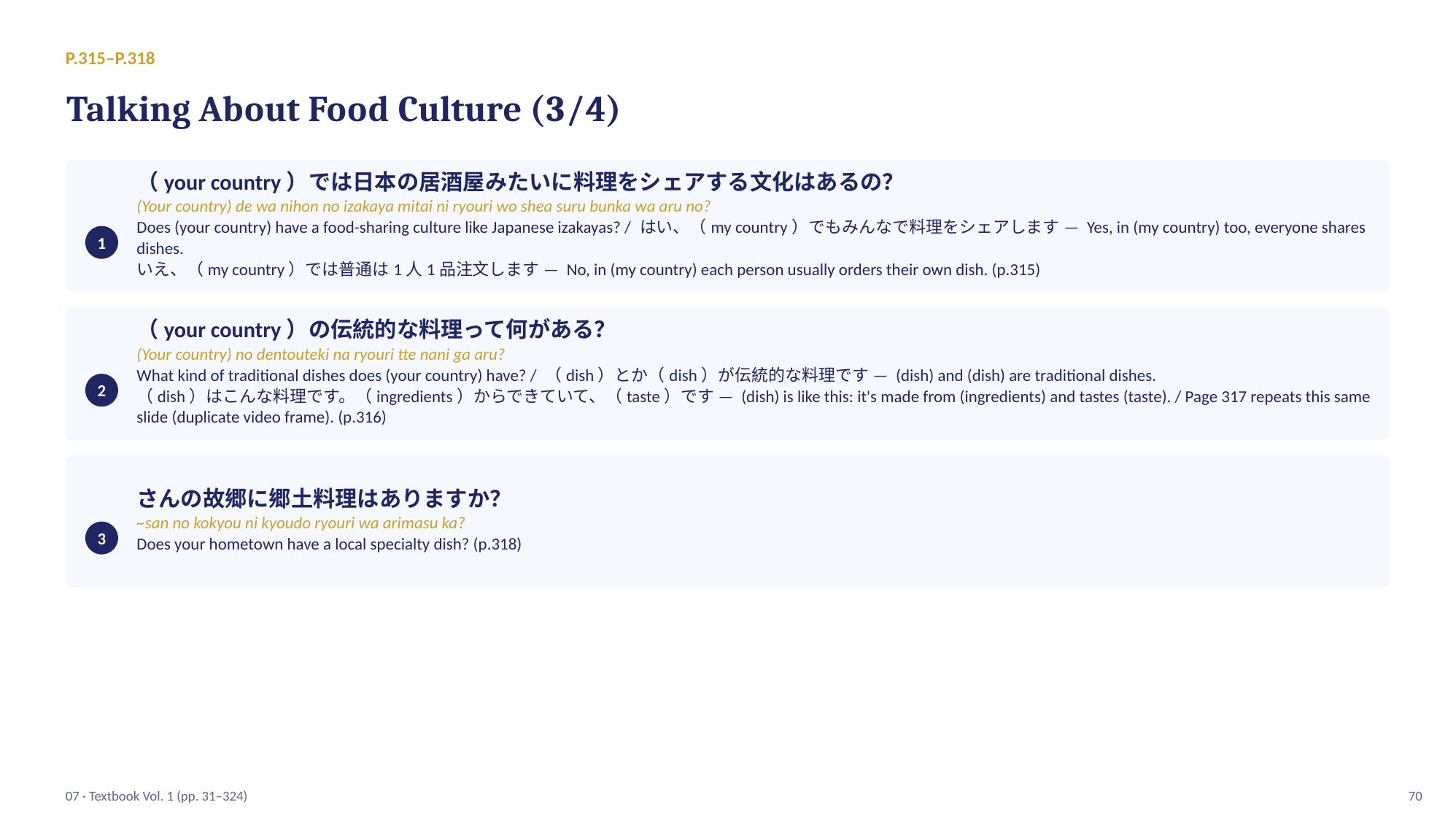
JP(yourcountry)では日本の居酒屋みたいに料理をシェアする文化はあるの?
EN (Your country) de wa nihon no izakaya mitai ni ryouri wo shea suru bunka wa aru no?
Does (your country) have a food-sharing culture like Japanese izakayas? / はい、( my country )でもみんなで料理をシェアします — Yes, in (my country) too, everyone shares
1 dishes.
いえ、( my country )では普通は 1 人 1 品注文します — No, in (my country) each person usually orders their own dish. (p.315)
Does (your country) have a food-sharing culture like Japanese izakayas? / はい、( my country )でもみんなで料理をシェアします — Yes, in (my country) too, everyone shares
1 dishes.
いえ、( my country )では普通は 1 人 1 品注文します — No, in (my country) each person usually orders their own dish. (p.315)
JP(yourcountry)の伝統的な料理って何がある?
EN (Your country) no dentouteki na ryouri tte nani ga aru?
What kind of traditional dishes does (your country) have? / ( dish )とか( dish )が伝統的な料理です — (dish) and (dish) are traditional dishes.
2 ( dish )はこんな料理です。( ingredients )からできていて、( taste )です — (dish) is like this: it's made from (ingredients) and tastes (taste). / Page 317 repeats this same
slide (duplicate video frame). (p.316)
What kind of traditional dishes does (your country) have? / ( dish )とか( dish )が伝統的な料理です — (dish) and (dish) are traditional dishes.
2 ( dish )はこんな料理です。( ingredients )からできていて、( taste )です — (dish) is like this: it's made from (ingredients) and tastes (taste). / Page 317 repeats this same
slide (duplicate video frame). (p.316)
JPさんの故郷に郷土料理はありますか?
EN ~san no kokyou ni kyoudo ryouri wa arimasu ka?
3 Does your hometown have a local specialty dish? (p.318)
07 · Textbook Vol. 1 (pp. 31–324) 70
3 Does your hometown have a local specialty dish? (p.318)
07 · Textbook Vol. 1 (pp. 31–324) 70
หน้า 71
คลิกเพื่อขยาย
ENP.319–P.321
Talking About Food Culture (4/4)
Talking About Food Culture (4/4)
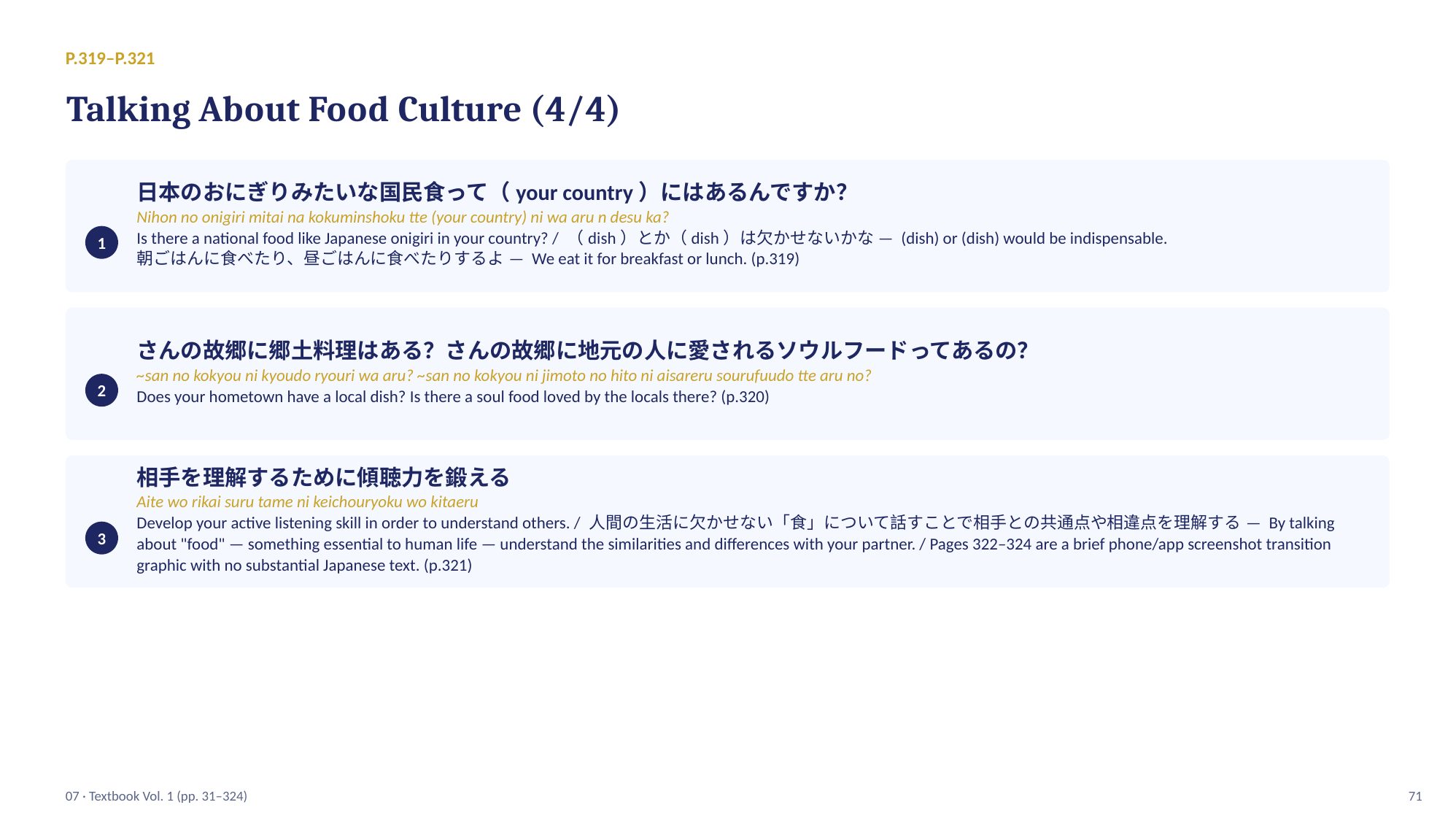
JP日本のおにぎりみたいな国民食って(yourcountry)にはあるんですか?
EN Nihon no onigiri mitai na kokuminshoku tte (your country) ni wa aru n desu ka?
1 Is there a national food like Japanese onigiri in your country? / ( dish )とか( dish )は欠かせないかな — (dish) or (dish) would be indispensable.
朝ごはんに食べたり、昼ごはんに食べたりするよ — We eat it for breakfast or lunch. (p.319)
1 Is there a national food like Japanese onigiri in your country? / ( dish )とか( dish )は欠かせないかな — (dish) or (dish) would be indispensable.
朝ごはんに食べたり、昼ごはんに食べたりするよ — We eat it for breakfast or lunch. (p.319)
JPさんの故郷に郷土料理はある?さんの故郷に地元の人に愛されるソウルフードってあるの?
EN ~san no kokyou ni kyoudo ryouri wa aru? ~san no kokyou ni jimoto no hito ni aisareru sourufuudo tte aru no?
2 Does your hometown have a local dish? Is there a soul food loved by the locals there? (p.320)
2 Does your hometown have a local dish? Is there a soul food loved by the locals there? (p.320)
JP相手を理解するために傾聴力を鍛える
EN Aite wo rikai suru tame ni keichouryoku wo kitaeru
Develop your active listening skill in order to understand others. / 人間の生活に欠かせない「食」について話すことで相手との共通点や相違点を理解する — By talking
3 about "food" — something essential to human life — understand the similarities and differences with your partner. / Pages 322–324 are a brief phone/app screenshot transition
graphic with no substantial Japanese text. (p.321)
07 · Textbook Vol. 1 (pp. 31–324) 71
Develop your active listening skill in order to understand others. / 人間の生活に欠かせない「食」について話すことで相手との共通点や相違点を理解する — By talking
3 about "food" — something essential to human life — understand the similarities and differences with your partner. / Pages 322–324 are a brief phone/app screenshot transition
graphic with no substantial Japanese text. (p.321)
07 · Textbook Vol. 1 (pp. 31–324) 71