หน้า 1
คลิกเพื่อขยาย
ENI'll extract the Japanese text from this business communication document and provide
romanization and English translations sentence by sentence.
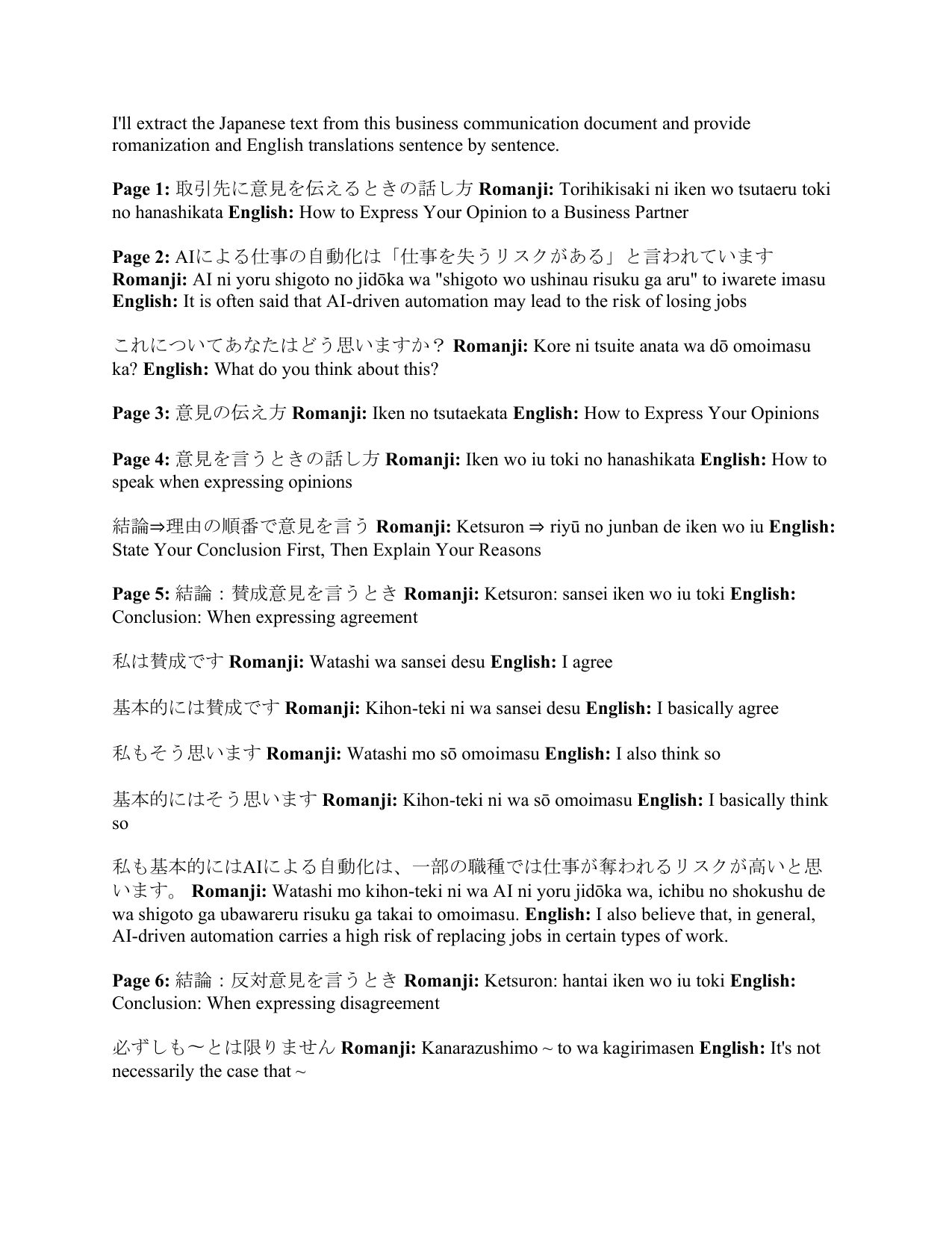
Page 1: 取引先に意見を伝えるときの話し方 Romanji: Torihikisaki ni iken wo tsutaeru toki
no hanashikata English: How to Express Your Opinion to a Business Partner
romanization and English translations sentence by sentence.
Page 1: 取引先に意見を伝えるときの話し方 Romanji: Torihikisaki ni iken wo tsutaeru toki
no hanashikata English: How to Express Your Opinion to a Business Partner
JPPage2:AIによる仕事の自動化は「仕事を失うリスクがある」と言われています
ENRomanji: AI ni yoru shigoto no jidōka wa "shigoto wo ushinau risuku ga aru" to iwarete imasu
English: It is often said that AI-driven automation may lead to the risk of losing jobs
これについてあなたはどう思いますか? Romanji: Kore ni tsuite anata wa dō omoimasu
ka? English: What do you think about this?
Page 3: 意見の伝え方 Romanji: Iken no tsutaekata English: How to Express Your Opinions
Page 4: 意見を言うときの話し方 Romanji: Iken wo iu toki no hanashikata English: How to
speak when expressing opinions
結論⇒理由の順番で意見を言う Romanji: Ketsuron ⇒ riyū no junban de iken wo iu English:
State Your Conclusion First, Then Explain Your Reasons
Page 5: 結論:賛成意見を言うとき Romanji: Ketsuron: sansei iken wo iu toki English:
Conclusion: When expressing agreement
私は賛成です Romanji: Watashi wa sansei desu English: I agree
基本的には賛成です Romanji: Kihon-teki ni wa sansei desu English: I basically agree
私もそう思います Romanji: Watashi mo sō omoimasu English: I also think so
基本的にはそう思います Romanji: Kihon-teki ni wa sō omoimasu English: I basically think
so
English: It is often said that AI-driven automation may lead to the risk of losing jobs
これについてあなたはどう思いますか? Romanji: Kore ni tsuite anata wa dō omoimasu
ka? English: What do you think about this?
Page 3: 意見の伝え方 Romanji: Iken no tsutaekata English: How to Express Your Opinions
Page 4: 意見を言うときの話し方 Romanji: Iken wo iu toki no hanashikata English: How to
speak when expressing opinions
結論⇒理由の順番で意見を言う Romanji: Ketsuron ⇒ riyū no junban de iken wo iu English:
State Your Conclusion First, Then Explain Your Reasons
Page 5: 結論:賛成意見を言うとき Romanji: Ketsuron: sansei iken wo iu toki English:
Conclusion: When expressing agreement
私は賛成です Romanji: Watashi wa sansei desu English: I agree
基本的には賛成です Romanji: Kihon-teki ni wa sansei desu English: I basically agree
私もそう思います Romanji: Watashi mo sō omoimasu English: I also think so
基本的にはそう思います Romanji: Kihon-teki ni wa sō omoimasu English: I basically think
so
JP私も基本的にはAIによる自動化は、一部の職種では仕事が奪われるリスクが高いと思
ENいます。 Romanji: Watashi mo kihon-teki ni wa AI ni yoru jidōka wa, ichibu no shokushu de
wa shigoto ga ubawareru risuku ga takai to omoimasu. English: I also believe that, in general,
AI-driven automation carries a high risk of replacing jobs in certain types of work.
Page 6: 結論:反対意見を言うとき Romanji: Ketsuron: hantai iken wo iu toki English:
Conclusion: When expressing disagreement
必ずしも〜とは限りません Romanji: Kanarazushimo ~ to wa kagirimasen English: It's not
necessarily the case that ~
wa shigoto ga ubawareru risuku ga takai to omoimasu. English: I also believe that, in general,
AI-driven automation carries a high risk of replacing jobs in certain types of work.
Page 6: 結論:反対意見を言うとき Romanji: Ketsuron: hantai iken wo iu toki English:
Conclusion: When expressing disagreement
必ずしも〜とは限りません Romanji: Kanarazushimo ~ to wa kagirimasen English: It's not
necessarily the case that ~
หน้า 2
คลิกเพื่อขยาย
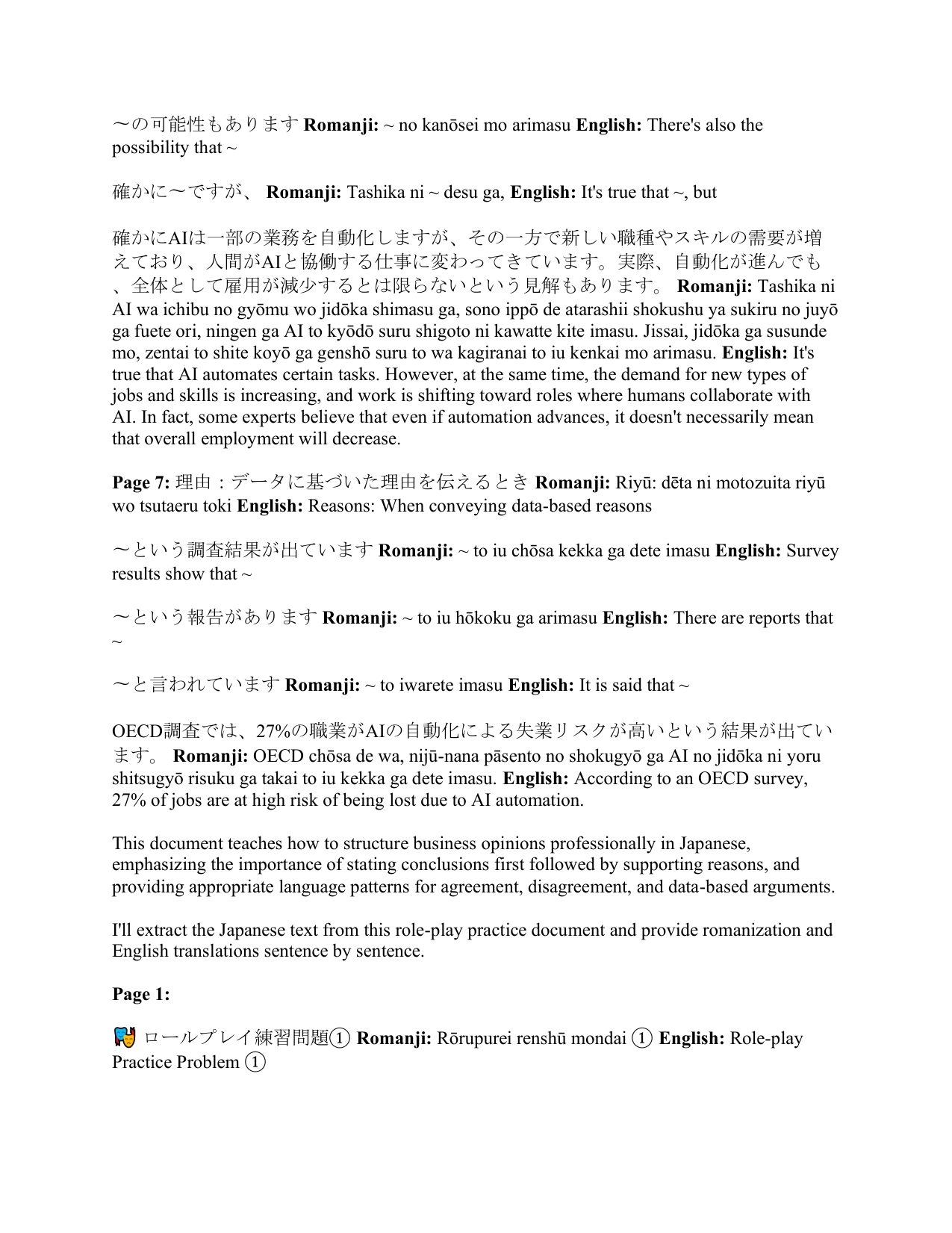
EN〜の可能性もあります Romanji: ~ no kanōsei mo arimasu English: There's also the
possibility that ~
確かに〜ですが、 Romanji: Tashika ni ~ desu ga, English: It's true that ~, but
possibility that ~
確かに〜ですが、 Romanji: Tashika ni ~ desu ga, English: It's true that ~, but
JP確かにAIは一部の業務を自動化しますが、その一方で新しい職種やスキルの需要が増
えており、人間がAIと協働する仕事に変わってきています。実際、自動化が進んでも
、全体として雇用が減少するとは限らないという見解もあります。Romanji:Tashikani
えており、人間がAIと協働する仕事に変わってきています。実際、自動化が進んでも
、全体として雇用が減少するとは限らないという見解もあります。Romanji:Tashikani
ENAI wa ichibu no gyōmu wo jidōka shimasu ga, sono ippō de atarashii shokushu ya sukiru no juyō
ga fuete ori, ningen ga AI to kyōdō suru shigoto ni kawatte kite imasu. Jissai, jidōka ga susunde
mo, zentai to shite koyō ga genshō suru to wa kagiranai to iu kenkai mo arimasu. English: It's
true that AI automates certain tasks. However, at the same time, the demand for new types of
jobs and skills is increasing, and work is shifting toward roles where humans collaborate with
AI. In fact, some experts believe that even if automation advances, it doesn't necessarily mean
that overall employment will decrease.
Page 7: 理由:データに基づいた理由を伝えるとき Romanji: Riyū: dēta ni motozuita riyū
wo tsutaeru toki English: Reasons: When conveying data-based reasons
〜という調査結果が出ています Romanji: ~ to iu chōsa kekka ga dete imasu English: Survey
results show that ~
〜という報告があります Romanji: ~ to iu hōkoku ga arimasu English: There are reports that
~
〜と言われています Romanji: ~ to iwarete imasu English: It is said that ~
ga fuete ori, ningen ga AI to kyōdō suru shigoto ni kawatte kite imasu. Jissai, jidōka ga susunde
mo, zentai to shite koyō ga genshō suru to wa kagiranai to iu kenkai mo arimasu. English: It's
true that AI automates certain tasks. However, at the same time, the demand for new types of
jobs and skills is increasing, and work is shifting toward roles where humans collaborate with
AI. In fact, some experts believe that even if automation advances, it doesn't necessarily mean
that overall employment will decrease.
Page 7: 理由:データに基づいた理由を伝えるとき Romanji: Riyū: dēta ni motozuita riyū
wo tsutaeru toki English: Reasons: When conveying data-based reasons
〜という調査結果が出ています Romanji: ~ to iu chōsa kekka ga dete imasu English: Survey
results show that ~
〜という報告があります Romanji: ~ to iu hōkoku ga arimasu English: There are reports that
~
〜と言われています Romanji: ~ to iwarete imasu English: It is said that ~
JPOECD調査では、27%の職業がAIの自動化による失業リスクが高いという結果が出てい
ENます。 Romanji: OECD chōsa de wa, nijū-nana pāsento no shokugyō ga AI no jidōka ni yoru
shitsugyō risuku ga takai to iu kekka ga dete imasu. English: According to an OECD survey,
27% of jobs are at high risk of being lost due to AI automation.
This document teaches how to structure business opinions professionally in Japanese,
emphasizing the importance of stating conclusions first followed by supporting reasons, and
providing appropriate language patterns for agreement, disagreement, and data-based arguments.
I'll extract the Japanese text from this role-play practice document and provide romanization and
English translations sentence by sentence.
Page 1:
ロールプレイ練習問題① Romanji: Rōrupurei renshū mondai ① English: Role-play
Practice Problem ①
shitsugyō risuku ga takai to iu kekka ga dete imasu. English: According to an OECD survey,
27% of jobs are at high risk of being lost due to AI automation.
This document teaches how to structure business opinions professionally in Japanese,
emphasizing the importance of stating conclusions first followed by supporting reasons, and
providing appropriate language patterns for agreement, disagreement, and data-based arguments.
I'll extract the Japanese text from this role-play practice document and provide romanization and
English translations sentence by sentence.
Page 1:
ロールプレイ練習問題① Romanji: Rōrupurei renshū mondai ① English: Role-play
Practice Problem ①
หน้า 3
คลิกเพื่อขยาย
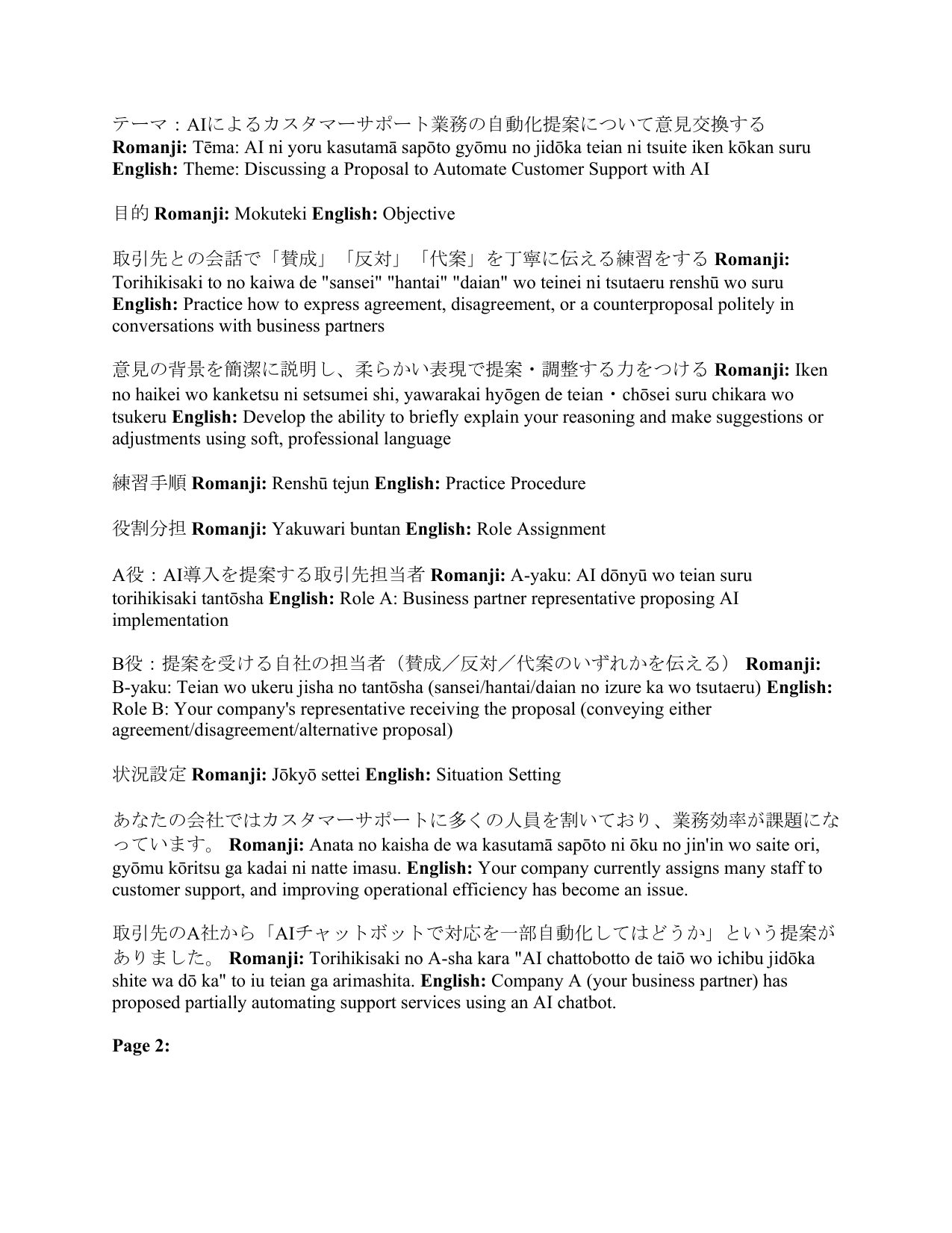
JPテーマ:AIによるカスタマーサポート業務の自動化提案について意見交換する
ENRomanji: Tēma: AI ni yoru kasutamā sapōto gyōmu no jidōka teian ni tsuite iken kōkan suru
English: Theme: Discussing a Proposal to Automate Customer Support with AI
目的 Romanji: Mokuteki English: Objective
English: Theme: Discussing a Proposal to Automate Customer Support with AI
目的 Romanji: Mokuteki English: Objective
JP取引先との会話で「賛成」「反対」「代案」を丁寧に伝える練習をするRomanji:
ENTorihikisaki to no kaiwa de "sansei" "hantai" "daian" wo teinei ni tsutaeru renshū wo suru
English: Practice how to express agreement, disagreement, or a counterproposal politely in
conversations with business partners
English: Practice how to express agreement, disagreement, or a counterproposal politely in
conversations with business partners
JP意見の背景を簡潔に説明し、柔らかい表現で提案・調整する力をつけるRomanji:Iken
ENno haikei wo kanketsu ni setsumei shi, yawarakai hyōgen de teian・chōsei suru chikara wo
tsukeru English: Develop the ability to briefly explain your reasoning and make suggestions or
adjustments using soft, professional language
練習手順 Romanji: Renshū tejun English: Practice Procedure
役割分担 Romanji: Yakuwari buntan English: Role Assignment
A役:AI導入を提案する取引先担当者 Romanji: A-yaku: AI dōnyū wo teian suru
torihikisaki tantōsha English: Role A: Business partner representative proposing AI
implementation
tsukeru English: Develop the ability to briefly explain your reasoning and make suggestions or
adjustments using soft, professional language
練習手順 Romanji: Renshū tejun English: Practice Procedure
役割分担 Romanji: Yakuwari buntan English: Role Assignment
A役:AI導入を提案する取引先担当者 Romanji: A-yaku: AI dōnyū wo teian suru
torihikisaki tantōsha English: Role A: Business partner representative proposing AI
implementation
JPB役:提案を受ける自社の担当者(賛成/反対/代案のいずれかを伝える)Romanji:
ENB-yaku: Teian wo ukeru jisha no tantōsha (sansei/hantai/daian no izure ka wo tsutaeru) English:
Role B: Your company's representative receiving the proposal (conveying either
agreement/disagreement/alternative proposal)
状況設定 Romanji: Jōkyō settei English: Situation Setting
Role B: Your company's representative receiving the proposal (conveying either
agreement/disagreement/alternative proposal)
状況設定 Romanji: Jōkyō settei English: Situation Setting
JPあなたの会社ではカスタマーサポートに多くの人員を割いており、業務効率が課題にな
ENっています。 Romanji: Anata no kaisha de wa kasutamā sapōto ni ōku no jin'in wo saite ori,
gyōmu kōritsu ga kadai ni natte imasu. English: Your company currently assigns many staff to
customer support, and improving operational efficiency has become an issue.
gyōmu kōritsu ga kadai ni natte imasu. English: Your company currently assigns many staff to
customer support, and improving operational efficiency has become an issue.
JP取引先のA社から「AIチャットボットで対応を一部自動化してはどうか」という提案が
ENありました。 Romanji: Torihikisaki no A-sha kara "AI chattobotto de taiō wo ichibu jidōka
shite wa dō ka" to iu teian ga arimashita. English: Company A (your business partner) has
proposed partially automating support services using an AI chatbot.
Page 2:
shite wa dō ka" to iu teian ga arimashita. English: Company A (your business partner) has
proposed partially automating support services using an AI chatbot.
Page 2:
หน้า 4
คลิกเพื่อขยาย
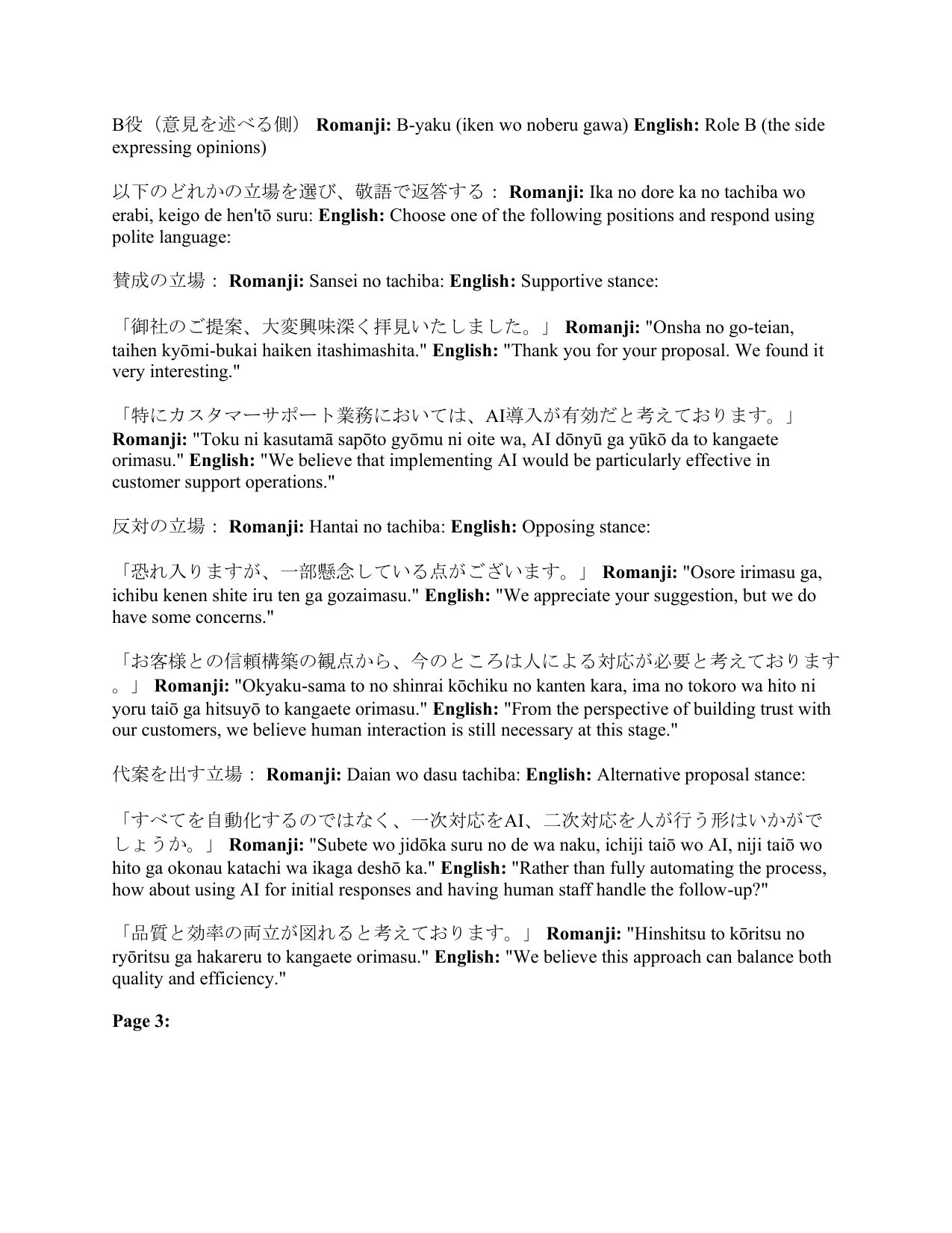
ENB役(意見を述べる側) Romanji: B-yaku (iken wo noberu gawa) English: Role B (the side
expressing opinions)
以下のどれかの立場を選び、敬語で返答する: Romanji: Ika no dore ka no tachiba wo
erabi, keigo de hen'tō suru: English: Choose one of the following positions and respond using
polite language:
賛成の立場: Romanji: Sansei no tachiba: English: Supportive stance:
「御社のご提案、大変興味深く拝見いたしました。」 Romanji: "Onsha no go-teian,
taihen kyōmi-bukai haiken itashimashita." English: "Thank you for your proposal. We found it
very interesting."
expressing opinions)
以下のどれかの立場を選び、敬語で返答する: Romanji: Ika no dore ka no tachiba wo
erabi, keigo de hen'tō suru: English: Choose one of the following positions and respond using
polite language:
賛成の立場: Romanji: Sansei no tachiba: English: Supportive stance:
「御社のご提案、大変興味深く拝見いたしました。」 Romanji: "Onsha no go-teian,
taihen kyōmi-bukai haiken itashimashita." English: "Thank you for your proposal. We found it
very interesting."
JP「特にカスタマーサポート業務においては、AI導入が有効だと考えております。」
ENRomanji: "Toku ni kasutamā sapōto gyōmu ni oite wa, AI dōnyū ga yūkō da to kangaete
orimasu." English: "We believe that implementing AI would be particularly effective in
customer support operations."
反対の立場: Romanji: Hantai no tachiba: English: Opposing stance:
orimasu." English: "We believe that implementing AI would be particularly effective in
customer support operations."
反対の立場: Romanji: Hantai no tachiba: English: Opposing stance:
JP「恐れ入りますが、一部懸念している点がございます。」Romanji:"Osoreirimasuga,
ENichibu kenen shite iru ten ga gozaimasu." English: "We appreciate your suggestion, but we do
have some concerns."
have some concerns."
JP「お客様との信頼構築の観点から、今のところは人による対応が必要と考えております
EN。」 Romanji: "Okyaku-sama to no shinrai kōchiku no kanten kara, ima no tokoro wa hito ni
yoru taiō ga hitsuyō to kangaete orimasu." English: "From the perspective of building trust with
our customers, we believe human interaction is still necessary at this stage."
代案を出す立場: Romanji: Daian wo dasu tachiba: English: Alternative proposal stance:
yoru taiō ga hitsuyō to kangaete orimasu." English: "From the perspective of building trust with
our customers, we believe human interaction is still necessary at this stage."
代案を出す立場: Romanji: Daian wo dasu tachiba: English: Alternative proposal stance:
JP「すべてを自動化するのではなく、一次対応をAI、二次対応を人が行う形はいかがで
ENしょうか。」 Romanji: "Subete wo jidōka suru no de wa naku, ichiji taiō wo AI, niji taiō wo
hito ga okonau katachi wa ikaga deshō ka." English: "Rather than fully automating the process,
how about using AI for initial responses and having human staff handle the follow-up?"
「品質と効率の両立が図れると考えております。」 Romanji: "Hinshitsu to kōritsu no
ryōritsu ga hakareru to kangaete orimasu." English: "We believe this approach can balance both
quality and efficiency."
Page 3:
hito ga okonau katachi wa ikaga deshō ka." English: "Rather than fully automating the process,
how about using AI for initial responses and having human staff handle the follow-up?"
「品質と効率の両立が図れると考えております。」 Romanji: "Hinshitsu to kōritsu no
ryōritsu ga hakareru to kangaete orimasu." English: "We believe this approach can balance both
quality and efficiency."
Page 3:
หน้า 5
คลิกเพื่อขยาย
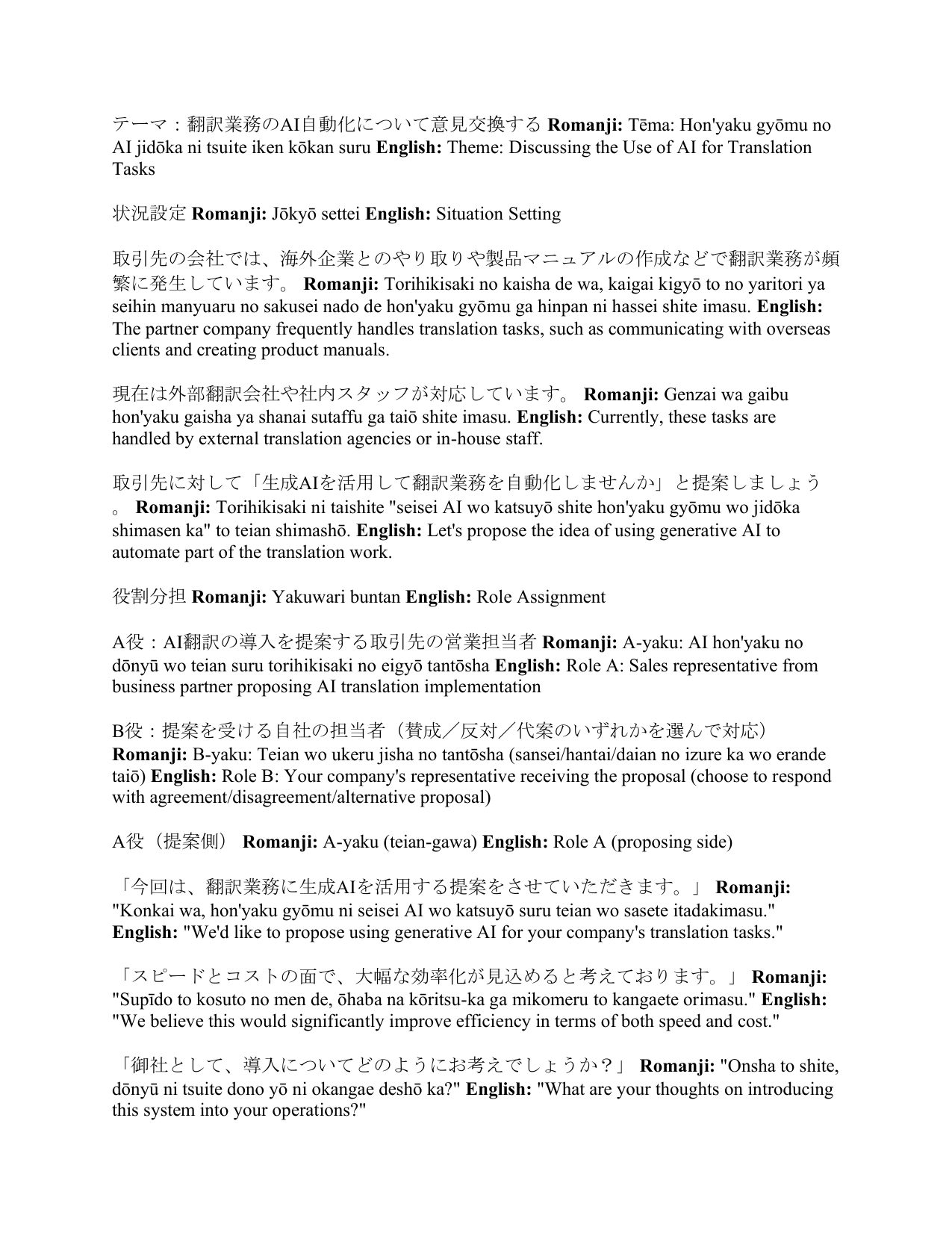
ENテーマ:翻訳業務のAI自動化について意見交換する Romanji: Tēma: Hon'yaku gyōmu no
AI jidōka ni tsuite iken kōkan suru English: Theme: Discussing the Use of AI for Translation
Tasks
状況設定 Romanji: Jōkyō settei English: Situation Setting
AI jidōka ni tsuite iken kōkan suru English: Theme: Discussing the Use of AI for Translation
Tasks
状況設定 Romanji: Jōkyō settei English: Situation Setting
JP取引先の会社では、海外企業とのやり取りや製品マニュアルの作成などで翻訳業務が頻
EN繁に発生しています。 Romanji: Torihikisaki no kaisha de wa, kaigai kigyō to no yaritori ya
seihin manyuaru no sakusei nado de hon'yaku gyōmu ga hinpan ni hassei shite imasu. English:
The partner company frequently handles translation tasks, such as communicating with overseas
clients and creating product manuals.
seihin manyuaru no sakusei nado de hon'yaku gyōmu ga hinpan ni hassei shite imasu. English:
The partner company frequently handles translation tasks, such as communicating with overseas
clients and creating product manuals.
JP現在は外部翻訳会社や社内スタッフが対応しています。Romanji:Genzaiwagaibu
ENhon'yaku gaisha ya shanai sutaffu ga taiō shite imasu. English: Currently, these tasks are
handled by external translation agencies or in-house staff.
handled by external translation agencies or in-house staff.
JP取引先に対して「生成AIを活用して翻訳業務を自動化しませんか」と提案しましょう
EN。 Romanji: Torihikisaki ni taishite "seisei AI wo katsuyō shite hon'yaku gyōmu wo jidōka
shimasen ka" to teian shimashō. English: Let's propose the idea of using generative AI to
automate part of the translation work.
役割分担 Romanji: Yakuwari buntan English: Role Assignment
A役:AI翻訳の導入を提案する取引先の営業担当者 Romanji: A-yaku: AI hon'yaku no
dōnyū wo teian suru torihikisaki no eigyō tantōsha English: Role A: Sales representative from
business partner proposing AI translation implementation
shimasen ka" to teian shimashō. English: Let's propose the idea of using generative AI to
automate part of the translation work.
役割分担 Romanji: Yakuwari buntan English: Role Assignment
A役:AI翻訳の導入を提案する取引先の営業担当者 Romanji: A-yaku: AI hon'yaku no
dōnyū wo teian suru torihikisaki no eigyō tantōsha English: Role A: Sales representative from
business partner proposing AI translation implementation
JPB役:提案を受ける自社の担当者(賛成/反対/代案のいずれかを選んで対応)
ENRomanji: B-yaku: Teian wo ukeru jisha no tantōsha (sansei/hantai/daian no izure ka wo erande
taiō) English: Role B: Your company's representative receiving the proposal (choose to respond
with agreement/disagreement/alternative proposal)
A役(提案側) Romanji: A-yaku (teian-gawa) English: Role A (proposing side)
taiō) English: Role B: Your company's representative receiving the proposal (choose to respond
with agreement/disagreement/alternative proposal)
A役(提案側) Romanji: A-yaku (teian-gawa) English: Role A (proposing side)
JP「今回は、翻訳業務に生成AIを活用する提案をさせていただきます。」Romanji:
EN"Konkai wa, hon'yaku gyōmu ni seisei AI wo katsuyō suru teian wo sasete itadakimasu."
English: "We'd like to propose using generative AI for your company's translation tasks."
English: "We'd like to propose using generative AI for your company's translation tasks."
JP「スピードとコストの面で、大幅な効率化が見込めると考えております。」Romanji:
EN"Supīdo to kosuto no men de, ōhaba na kōritsu-ka ga mikomeru to kangaete orimasu." English:
"We believe this would significantly improve efficiency in terms of both speed and cost."
"We believe this would significantly improve efficiency in terms of both speed and cost."
JP「御社として、導入についてどのようにお考えでしょうか?」Romanji:"Onshatoshite,
ENdōnyū ni tsuite dono yō ni okangae deshō ka?" English: "What are your thoughts on introducing
this system into your operations?"
this system into your operations?"
หน้า 6
คลิกเพื่อขยาย
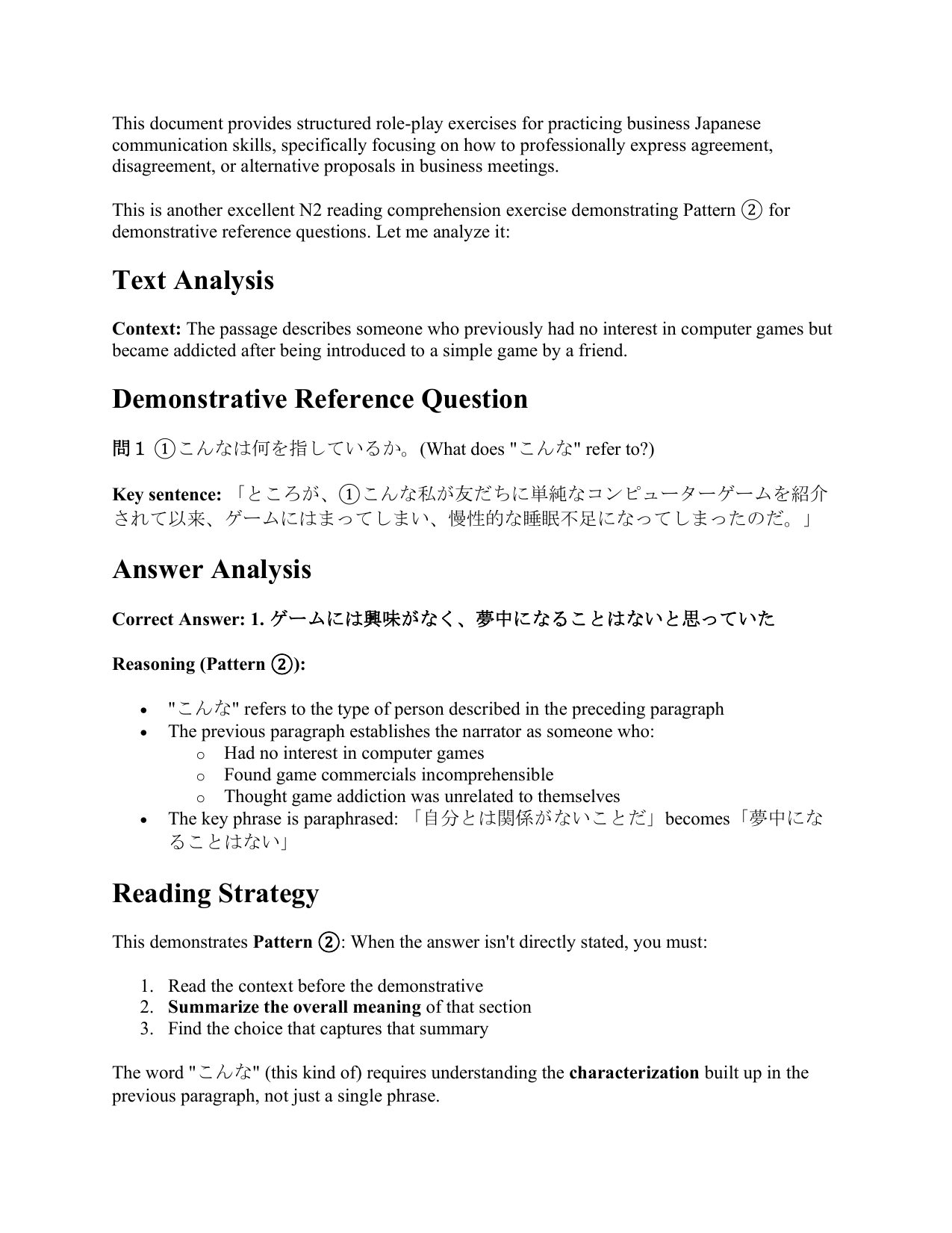
ENThis document provides structured role-play exercises for practicing business Japanese
communication skills, specifically focusing on how to professionally express agreement,
disagreement, or alternative proposals in business meetings.
This is another excellent N2 reading comprehension exercise demonstrating Pattern ② for
demonstrative reference questions. Let me analyze it:
Text Analysis
Context: The passage describes someone who previously had no interest in computer games but
became addicted after being introduced to a simple game by a friend.
Demonstrative Reference Question
communication skills, specifically focusing on how to professionally express agreement,
disagreement, or alternative proposals in business meetings.
This is another excellent N2 reading comprehension exercise demonstrating Pattern ② for
demonstrative reference questions. Let me analyze it:
Text Analysis
Context: The passage describes someone who previously had no interest in computer games but
became addicted after being introduced to a simple game by a friend.
Demonstrative Reference Question
JP問1①こんなは何を指しているか。(Whatdoes"こんな"referto?)
Keysentence:「ところが、①こんな私が友だちに単純なコンピューターゲームを紹介
されて以来、ゲームにはまってしまい、慢性的な睡眠不足になってしまったのだ。」
Keysentence:「ところが、①こんな私が友だちに単純なコンピューターゲームを紹介
されて以来、ゲームにはまってしまい、慢性的な睡眠不足になってしまったのだ。」
ENAnswer Analysis
JPCorrectAnswer:1.ゲームには興味がなく、夢中になることはないと思っていた
ENReasoning (Pattern ②):
• "こんな" refers to the type of person described in the preceding paragraph
• The previous paragraph establishes the narrator as someone who:
o Had no interest in computer games
o Found game commercials incomprehensible
o Thought game addiction was unrelated to themselves
• The key phrase is paraphrased: 「自分とは関係がないことだ」becomes「夢中にな
• "こんな" refers to the type of person described in the preceding paragraph
• The previous paragraph establishes the narrator as someone who:
o Had no interest in computer games
o Found game commercials incomprehensible
o Thought game addiction was unrelated to themselves
• The key phrase is paraphrased: 「自分とは関係がないことだ」becomes「夢中にな
JPることはない」
ENReading Strategy
This demonstrates Pattern ②: When the answer isn't directly stated, you must:
1. Read the context before the demonstrative
2. Summarize the overall meaning of that section
3. Find the choice that captures that summary
The word "こんな" (this kind of) requires understanding the characterization built up in the
previous paragraph, not just a single phrase.
This demonstrates Pattern ②: When the answer isn't directly stated, you must:
1. Read the context before the demonstrative
2. Summarize the overall meaning of that section
3. Find the choice that captures that summary
The word "こんな" (this kind of) requires understanding the characterization built up in the
previous paragraph, not just a single phrase.
หน้า 7
คลิกเพื่อขยาย
ENVocabulary Extension: ○○不足 Patterns
The document provides comprehensive examples of "shortage/lack" expressions:
Health/Lifestyle:
• 睡眠不足 (sleep deprivation)
• 運動不足 (lack of exercise)
• 栄養不足 (malnutrition)
Business:
• 人手不足 (staff shortage)
• 資金不足 (funding shortage)
• 情報不足 (lack of information)
Emotional/Social:
• 理解不足 (lack of understanding)
• コミュニケーション不足 (poor communication)
• 信頼不足 (lack of trust)
This exercise reinforces that JLPT N2 reading requires synthesizing information across multiple
sentences rather than just identifying single words or phrases.
The document provides comprehensive examples of "shortage/lack" expressions:
Health/Lifestyle:
• 睡眠不足 (sleep deprivation)
• 運動不足 (lack of exercise)
• 栄養不足 (malnutrition)
Business:
• 人手不足 (staff shortage)
• 資金不足 (funding shortage)
• 情報不足 (lack of information)
Emotional/Social:
• 理解不足 (lack of understanding)
• コミュニケーション不足 (poor communication)
• 信頼不足 (lack of trust)
This exercise reinforces that JLPT N2 reading requires synthesizing information across multiple
sentences rather than just identifying single words or phrases.