หน้า 1
คลิกเพื่อขยาย
หน้า 2
คลิกเพื่อขยาย
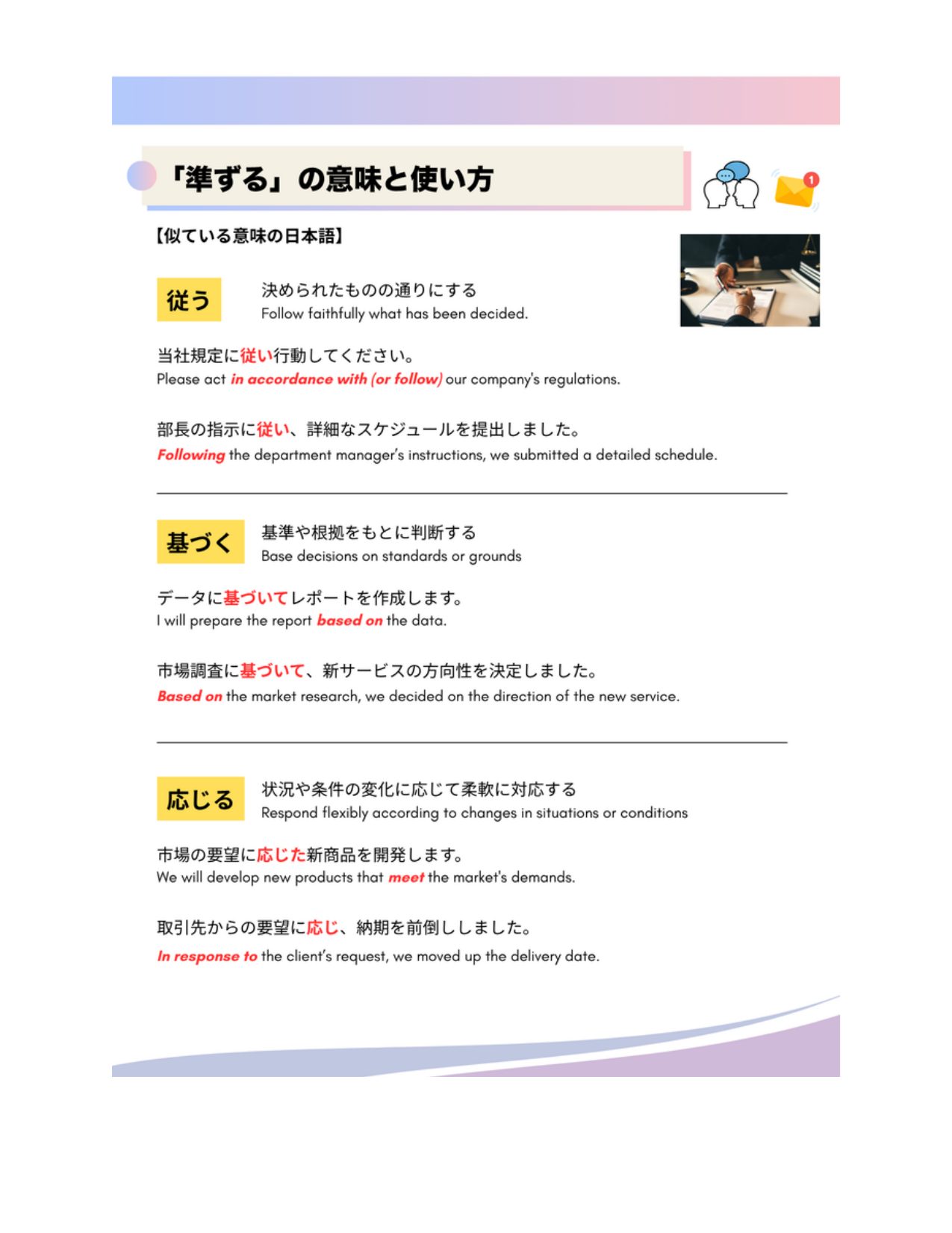
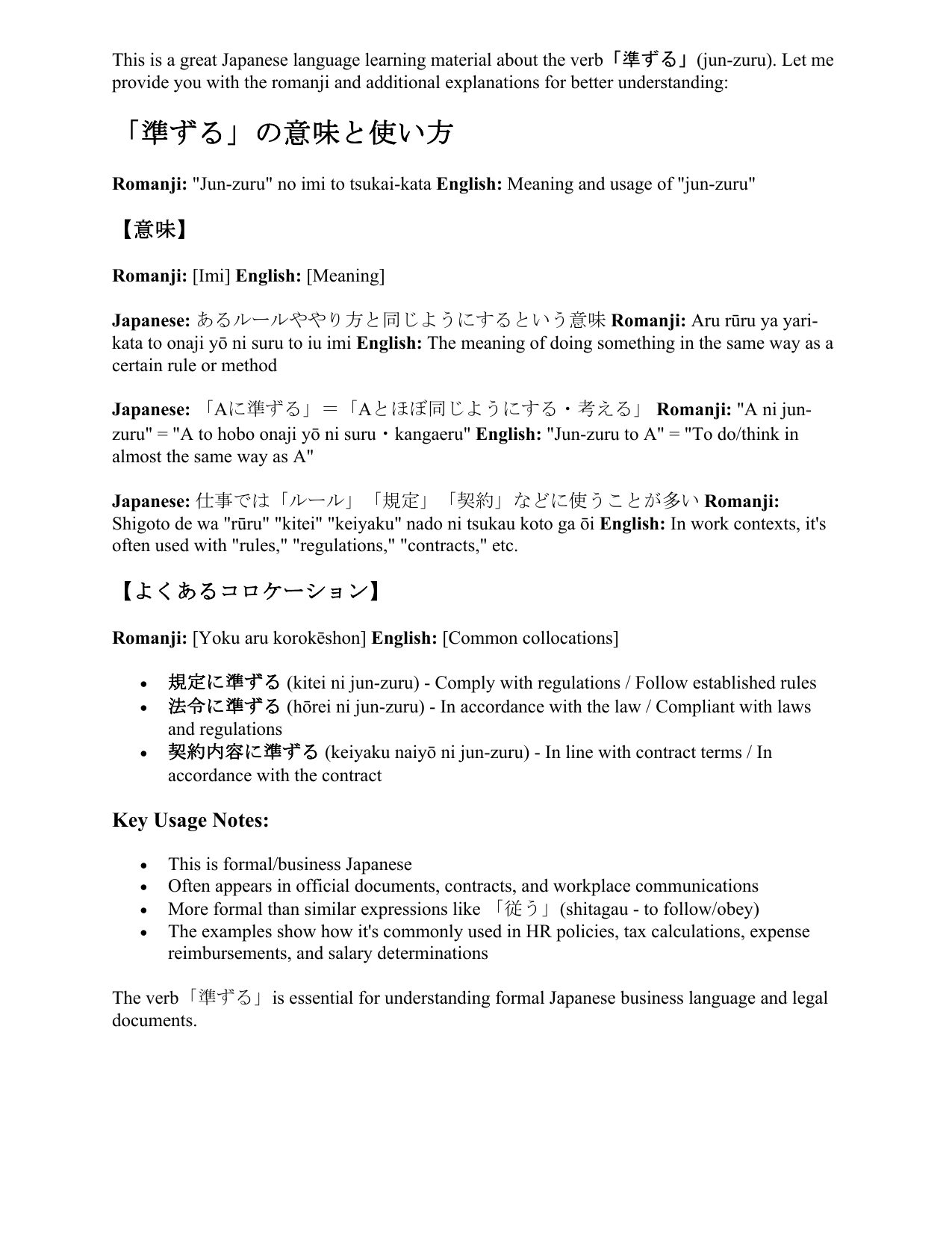
ENThis is a great Japanese language learning material about the verb「準ずる」(jun-zuru). Let me
provide you with the romanji and additional explanations for better understanding:
provide you with the romanji and additional explanations for better understanding:
JP「準ずる」の意味と使い方
ENRomanji: "Jun-zuru" no imi to tsukai-kata English: Meaning and usage of "jun-zuru"
JP【意味】
ENRomanji: [Imi] English: [Meaning]
Japanese: あるルールややり方と同じようにするという意味 Romanji: Aru rūru ya yari-
kata to onaji yō ni suru to iu imi English: The meaning of doing something in the same way as a
certain rule or method
Japanese: 「Aに準ずる」=「Aとほぼ同じようにする・考える」 Romanji: "A ni jun-
zuru" = "A to hobo onaji yō ni suru・kangaeru" English: "Jun-zuru to A" = "To do/think in
almost the same way as A"
Japanese: あるルールややり方と同じようにするという意味 Romanji: Aru rūru ya yari-
kata to onaji yō ni suru to iu imi English: The meaning of doing something in the same way as a
certain rule or method
Japanese: 「Aに準ずる」=「Aとほぼ同じようにする・考える」 Romanji: "A ni jun-
zuru" = "A to hobo onaji yō ni suru・kangaeru" English: "Jun-zuru to A" = "To do/think in
almost the same way as A"
JPJapanese:仕事では「ルール」「規定」「契約」などに使うことが多いRomanji:
ENShigoto de wa "rūru" "kitei" "keiyaku" nado ni tsukau koto ga ōi English: In work contexts, it's
often used with "rules," "regulations," "contracts," etc.
often used with "rules," "regulations," "contracts," etc.
JP【よくあるコロケーション】
ENRomanji: [Yoku aru korokēshon] English: [Common collocations]
• 規定に準ずる (kitei ni jun-zuru) - Comply with regulations / Follow established rules
• 法令に準ずる (hōrei ni jun-zuru) - In accordance with the law / Compliant with laws
and regulations
• 契約内容に準ずる (keiyaku naiyō ni jun-zuru) - In line with contract terms / In
accordance with the contract
Key Usage Notes:
• This is formal/business Japanese
• Often appears in official documents, contracts, and workplace communications
• More formal than similar expressions like 「従う」(shitagau - to follow/obey)
• The examples show how it's commonly used in HR policies, tax calculations, expense
reimbursements, and salary determinations
The verb「準ずる」is essential for understanding formal Japanese business language and legal
documents.
• 規定に準ずる (kitei ni jun-zuru) - Comply with regulations / Follow established rules
• 法令に準ずる (hōrei ni jun-zuru) - In accordance with the law / Compliant with laws
and regulations
• 契約内容に準ずる (keiyaku naiyō ni jun-zuru) - In line with contract terms / In
accordance with the contract
Key Usage Notes:
• This is formal/business Japanese
• Often appears in official documents, contracts, and workplace communications
• More formal than similar expressions like 「従う」(shitagau - to follow/obey)
• The examples show how it's commonly used in HR policies, tax calculations, expense
reimbursements, and salary determinations
The verb「準ずる」is essential for understanding formal Japanese business language and legal
documents.
หน้า 3
คลิกเพื่อขยาย
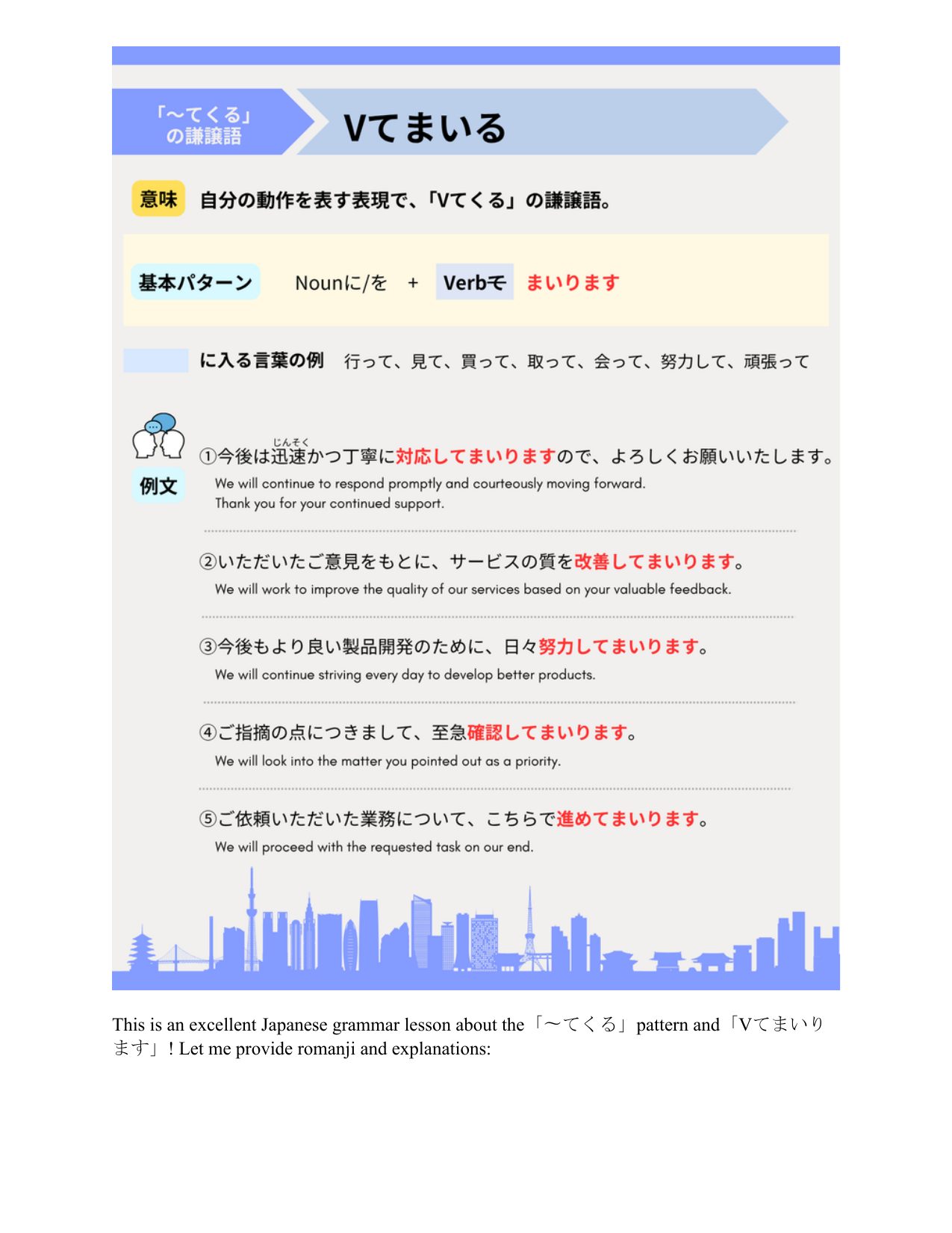
ENThis is an excellent Japanese grammar lesson about the「〜てくる」pattern and「Vてまいり
ます」! Let me provide romanji and explanations:
ます」! Let me provide romanji and explanations:
หน้า 4
คลิกเพื่อขยาย
JP「〜てくる」の謙譲語:Vてまいります
ENRomanji: "〜te kuru" no kenjōgo: V te mairimasu English: Humble form of "〜te kuru": V te
mairimasu
意味 (Meaning)
Japanese: 自分の動作を表す表現で、「Vてくる」の謙譲語。 Romanji: Jibun no dōsa wo
arawasu hyōgen de, "V te kuru" no kenjōgo. English: An expression that shows one's own
actions, the humble form of "V te kuru."
基本パターン (Basic Pattern)
Japanese: Nounに/を + Verbて + まいります Romanji: Noun ni/wo + Verb te + mairimasu
English: Noun ni/wo + Verb te + mairimasu
に入る言葉の例 (Examples of words that go in)
mairimasu
意味 (Meaning)
Japanese: 自分の動作を表す表現で、「Vてくる」の謙譲語。 Romanji: Jibun no dōsa wo
arawasu hyōgen de, "V te kuru" no kenjōgo. English: An expression that shows one's own
actions, the humble form of "V te kuru."
基本パターン (Basic Pattern)
Japanese: Nounに/を + Verbて + まいります Romanji: Noun ni/wo + Verb te + mairimasu
English: Noun ni/wo + Verb te + mairimasu
に入る言葉の例 (Examples of words that go in)
JPJapanese:行って、見て、買って、取って、会って、努力して、頑張ってRomanji:Itte,
ENmite, katte, totte, atte, doryoku shite, ganbatte English: Going, seeing, buying, taking, meeting,
making effort, working hard
例文 (Example sentences) with Romanji:
making effort, working hard
例文 (Example sentences) with Romanji:
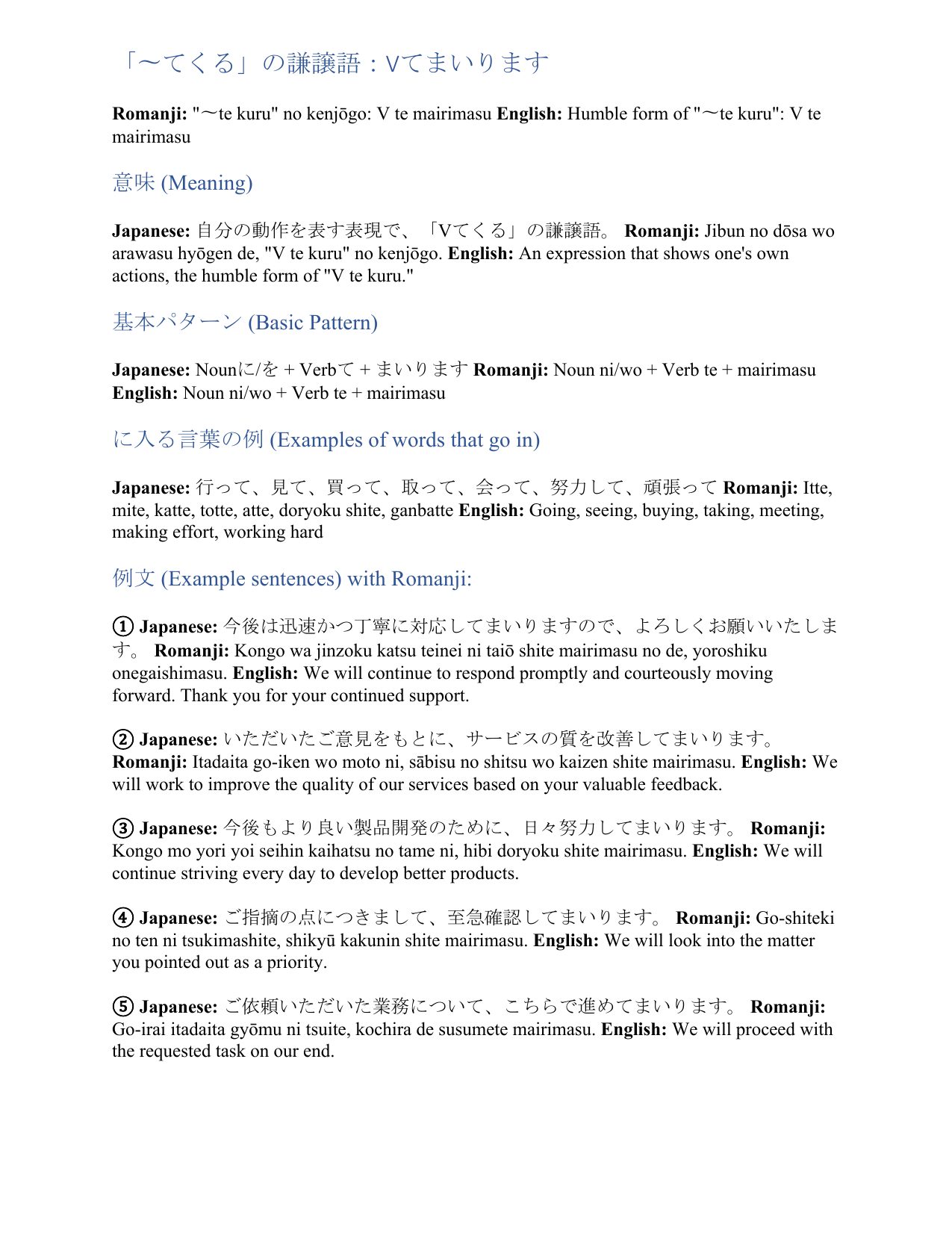
JP①Japanese:今後は迅速かつ丁寧に対応してまいりますので、よろしくお願いいたしま
ENす。 Romanji: Kongo wa jinzoku katsu teinei ni taiō shite mairimasu no de, yoroshiku
onegaishimasu. English: We will continue to respond promptly and courteously moving
forward. Thank you for your continued support.
onegaishimasu. English: We will continue to respond promptly and courteously moving
forward. Thank you for your continued support.
JP②Japanese:いただいたご意見をもとに、サービスの質を改善してまいります。
ENRomanji: Itadaita go-iken wo moto ni, sābisu no shitsu wo kaizen shite mairimasu. English: We
will work to improve the quality of our services based on your valuable feedback.
will work to improve the quality of our services based on your valuable feedback.
JP③Japanese:今後もより良い製品開発のために、日々努力してまいります。Romanji:
ENKongo mo yori yoi seihin kaihatsu no tame ni, hibi doryoku shite mairimasu. English: We will
continue striving every day to develop better products.
④ Japanese: ご指摘の点につきまして、至急確認してまいります。 Romanji: Go-shiteki
no ten ni tsukimashite, shikyū kakunin shite mairimasu. English: We will look into the matter
you pointed out as a priority.
continue striving every day to develop better products.
④ Japanese: ご指摘の点につきまして、至急確認してまいります。 Romanji: Go-shiteki
no ten ni tsukimashite, shikyū kakunin shite mairimasu. English: We will look into the matter
you pointed out as a priority.
JP⑤Japanese:ご依頼いただいた業務について、こちらで進めてまいります。Romanji:
ENGo-irai itadaita gyōmu ni tsuite, kochira de susumete mairimasu. English: We will proceed with
the requested task on our end.
the requested task on our end.
หน้า 5
คลิกเพื่อขยาย
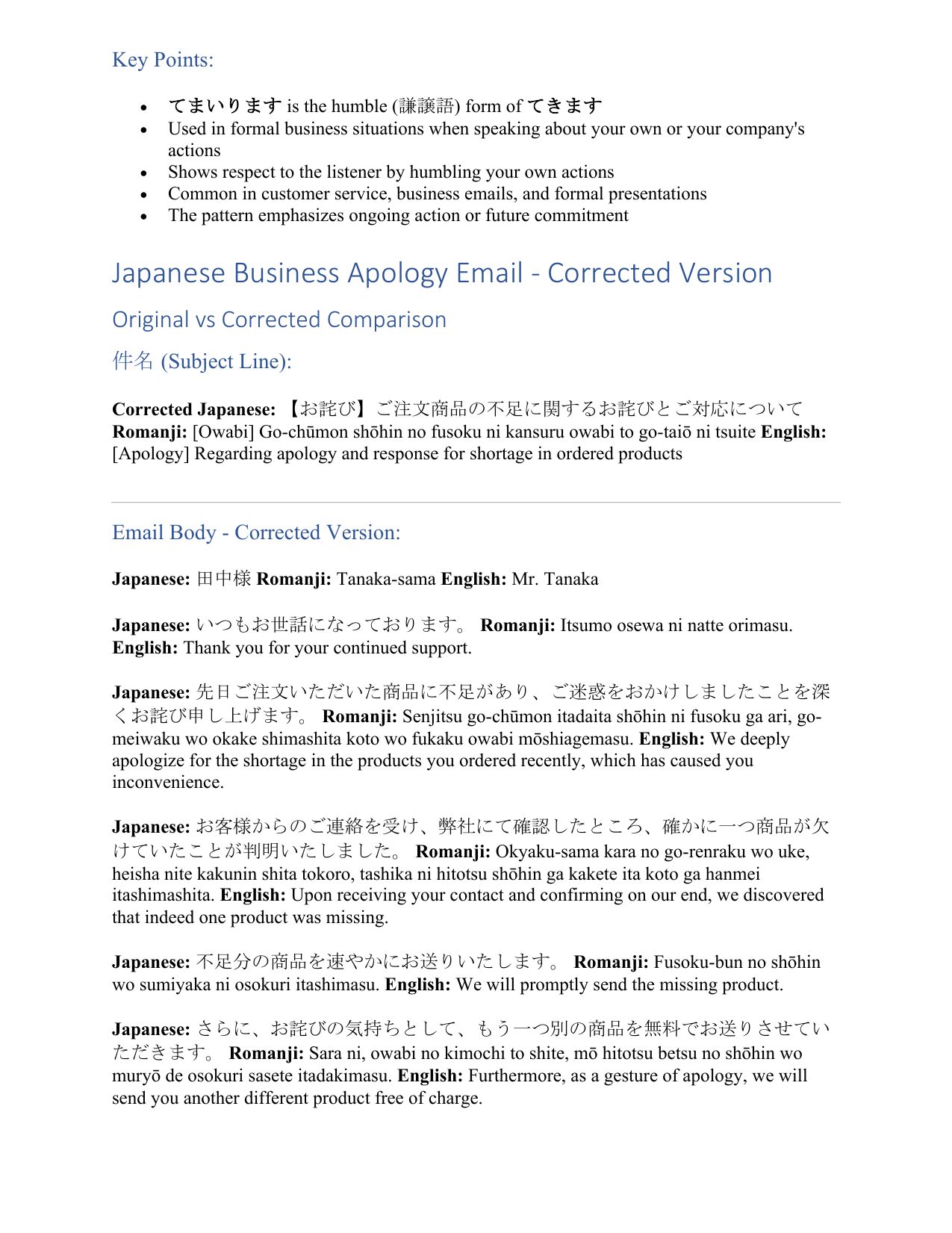
ENKey Points:
• てまいります is the humble (謙譲語) form of てきます
• Used in formal business situations when speaking about your own or your company's
actions
• Shows respect to the listener by humbling your own actions
• Common in customer service, business emails, and formal presentations
• The pattern emphasizes ongoing action or future commitment
Japanese Business Apology Email - Corrected Version
Original vs Corrected Comparison
件名 (Subject Line):
• てまいります is the humble (謙譲語) form of てきます
• Used in formal business situations when speaking about your own or your company's
actions
• Shows respect to the listener by humbling your own actions
• Common in customer service, business emails, and formal presentations
• The pattern emphasizes ongoing action or future commitment
Japanese Business Apology Email - Corrected Version
Original vs Corrected Comparison
件名 (Subject Line):
JPCorrectedJapanese:【お詫び】ご注文商品の不足に関するお詫びとご対応について
ENRomanji: [Owabi] Go-chūmon shōhin no fusoku ni kansuru owabi to go-taiō ni tsuite English:
[Apology] Regarding apology and response for shortage in ordered products
Email Body - Corrected Version:
Japanese: 田中様 Romanji: Tanaka-sama English: Mr. Tanaka
Japanese: いつもお世話になっております。 Romanji: Itsumo osewa ni natte orimasu.
English: Thank you for your continued support.
[Apology] Regarding apology and response for shortage in ordered products
Email Body - Corrected Version:
Japanese: 田中様 Romanji: Tanaka-sama English: Mr. Tanaka
Japanese: いつもお世話になっております。 Romanji: Itsumo osewa ni natte orimasu.
English: Thank you for your continued support.
JPJapanese:先日ご注文いただいた商品に不足があり、ご迷惑をおかけしましたことを深
ENくお詫び申し上げます。 Romanji: Senjitsu go-chūmon itadaita shōhin ni fusoku ga ari, go-
meiwaku wo okake shimashita koto wo fukaku owabi mōshiagemasu. English: We deeply
apologize for the shortage in the products you ordered recently, which has caused you
inconvenience.
meiwaku wo okake shimashita koto wo fukaku owabi mōshiagemasu. English: We deeply
apologize for the shortage in the products you ordered recently, which has caused you
inconvenience.
JPJapanese:お客様からのご連絡を受け、弊社にて確認したところ、確かに一つ商品が欠
ENけていたことが判明いたしました。 Romanji: Okyaku-sama kara no go-renraku wo uke,
heisha nite kakunin shita tokoro, tashika ni hitotsu shōhin ga kakete ita koto ga hanmei
itashimashita. English: Upon receiving your contact and confirming on our end, we discovered
that indeed one product was missing.
Japanese: 不足分の商品を速やかにお送りいたします。 Romanji: Fusoku-bun no shōhin
wo sumiyaka ni osokuri itashimasu. English: We will promptly send the missing product.
heisha nite kakunin shita tokoro, tashika ni hitotsu shōhin ga kakete ita koto ga hanmei
itashimashita. English: Upon receiving your contact and confirming on our end, we discovered
that indeed one product was missing.
Japanese: 不足分の商品を速やかにお送りいたします。 Romanji: Fusoku-bun no shōhin
wo sumiyaka ni osokuri itashimasu. English: We will promptly send the missing product.
JPJapanese:さらに、お詫びの気持ちとして、もう一つ別の商品を無料でお送りさせてい
ENただきます。 Romanji: Sara ni, owabi no kimochi to shite, mō hitotsu betsu no shōhin wo
muryō de osokuri sasete itadakimasu. English: Furthermore, as a gesture of apology, we will
send you another different product free of charge.
muryō de osokuri sasete itadakimasu. English: Furthermore, as a gesture of apology, we will
send you another different product free of charge.
หน้า 6
คลิกเพื่อขยาย
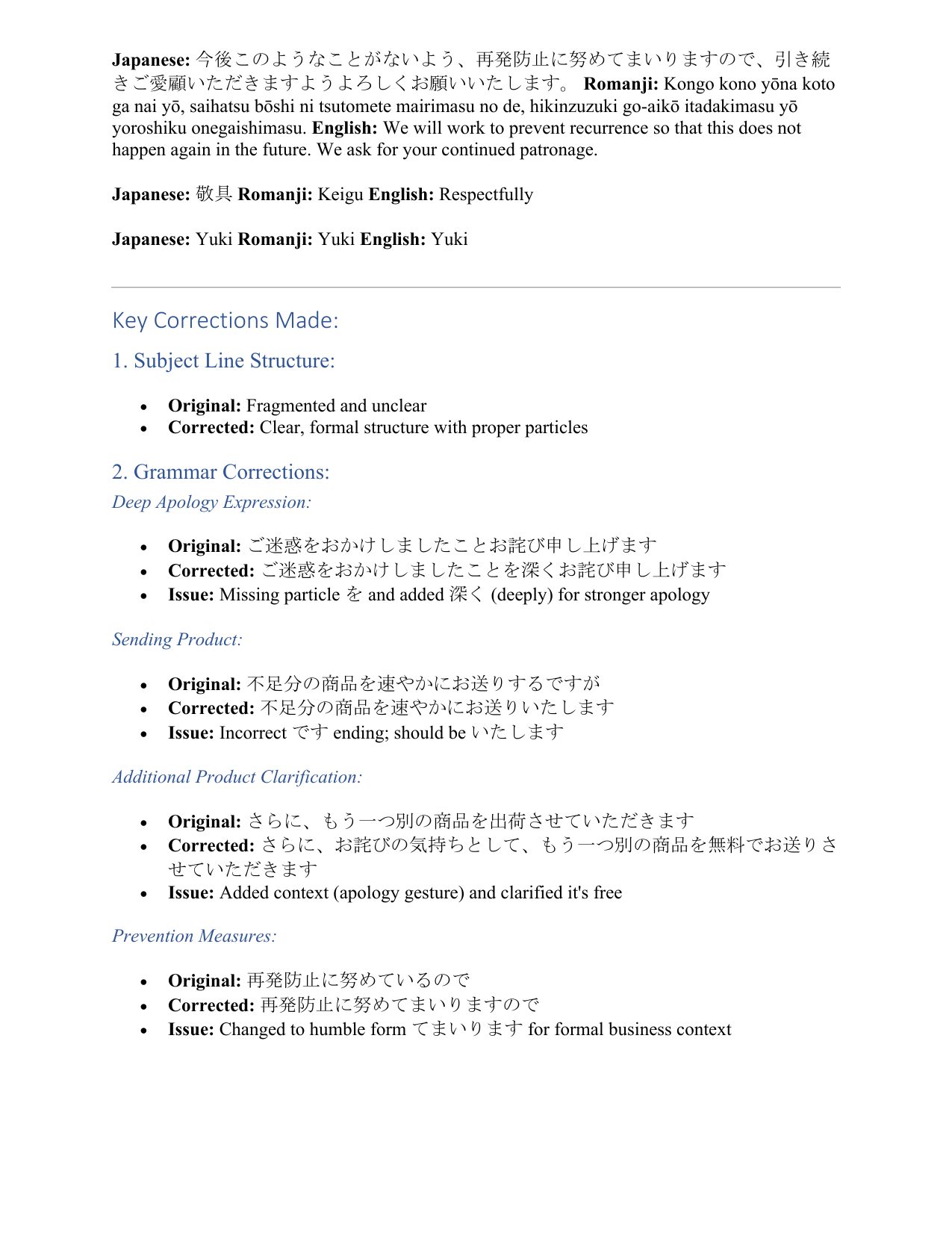
JPJapanese:今後このようなことがないよう、再発防止に努めてまいりますので、引き続
きご愛顧いただきますようよろしくお願いいたします。Romanji:Kongokonoyōnakoto
きご愛顧いただきますようよろしくお願いいたします。Romanji:Kongokonoyōnakoto
ENga nai yō, saihatsu bōshi ni tsutomete mairimasu no de, hikinzuzuki go-aikō itadakimasu yō
yoroshiku onegaishimasu. English: We will work to prevent recurrence so that this does not
happen again in the future. We ask for your continued patronage.
Japanese: 敬具 Romanji: Keigu English: Respectfully
Japanese: Yuki Romanji: Yuki English: Yuki
Key Corrections Made:
1. Subject Line Structure:
• Original: Fragmented and unclear
• Corrected: Clear, formal structure with proper particles
2. Grammar Corrections:
Deep Apology Expression:
yoroshiku onegaishimasu. English: We will work to prevent recurrence so that this does not
happen again in the future. We ask for your continued patronage.
Japanese: 敬具 Romanji: Keigu English: Respectfully
Japanese: Yuki Romanji: Yuki English: Yuki
Key Corrections Made:
1. Subject Line Structure:
• Original: Fragmented and unclear
• Corrected: Clear, formal structure with proper particles
2. Grammar Corrections:
Deep Apology Expression:
JP•Original:ご迷惑をおかけしましたことお詫び申し上げます
•Corrected:ご迷惑をおかけしましたことを深くお詫び申し上げます
•Corrected:ご迷惑をおかけしましたことを深くお詫び申し上げます
EN • Issue: Missing particle を and added 深く (deeply) for stronger apology
Sending Product:
Sending Product:
JP•Original:不足分の商品を速やかにお送りするですが
•Corrected:不足分の商品を速やかにお送りいたします
•Corrected:不足分の商品を速やかにお送りいたします
EN • Issue: Incorrect です ending; should be いたします
Additional Product Clarification:
Additional Product Clarification:
JP•Original:さらに、もう一つ別の商品を出荷させていただきます
•Corrected:さらに、お詫びの気持ちとして、もう一つ別の商品を無料でお送りさ
せていただきます
•Corrected:さらに、お詫びの気持ちとして、もう一つ別の商品を無料でお送りさ
せていただきます
EN • Issue: Added context (apology gesture) and clarified it's free
Prevention Measures:
Prevention Measures:
JP•Original:再発防止に努めているので
•Corrected:再発防止に努めてまいりますので
•Corrected:再発防止に努めてまいりますので
EN • Issue: Changed to humble form てまいります for formal business context
หน้า 7
คลิกเพื่อขยาย
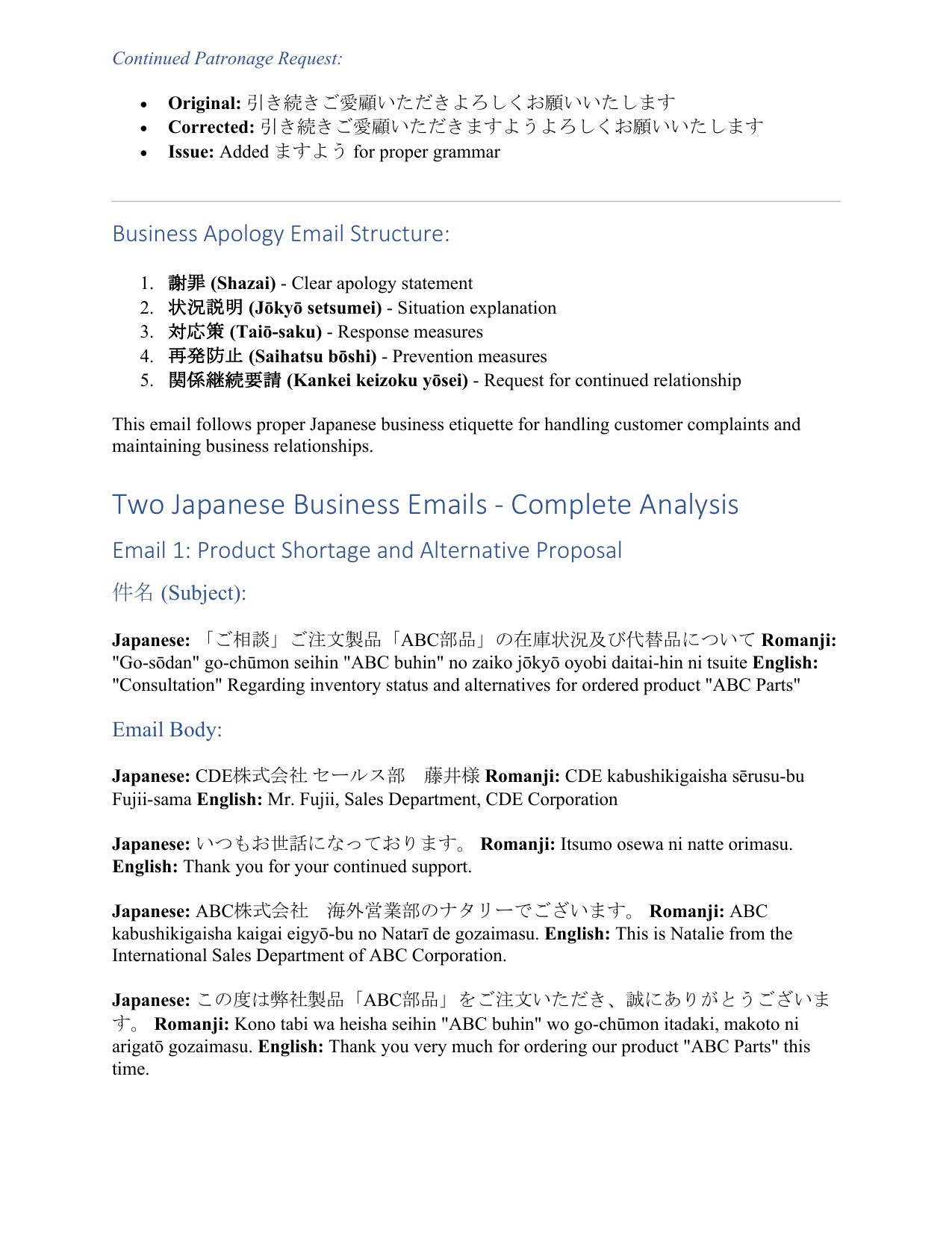
ENContinued Patronage Request:
JP•Original:引き続きご愛顧いただきよろしくお願いいたします
•Corrected:引き続きご愛顧いただきますようよろしくお願いいたします
•Corrected:引き続きご愛顧いただきますようよろしくお願いいたします
EN • Issue: Added ますよう for proper grammar
Business Apology Email Structure:
1. 謝罪 (Shazai) - Clear apology statement
2. 状況説明 (Jōkyō setsumei) - Situation explanation
3. 対応策 (Taiō-saku) - Response measures
4. 再発防止 (Saihatsu bōshi) - Prevention measures
5. 関係継続要請 (Kankei keizoku yōsei) - Request for continued relationship
This email follows proper Japanese business etiquette for handling customer complaints and
maintaining business relationships.
Two Japanese Business Emails - Complete Analysis
Email 1: Product Shortage and Alternative Proposal
件名 (Subject):
Business Apology Email Structure:
1. 謝罪 (Shazai) - Clear apology statement
2. 状況説明 (Jōkyō setsumei) - Situation explanation
3. 対応策 (Taiō-saku) - Response measures
4. 再発防止 (Saihatsu bōshi) - Prevention measures
5. 関係継続要請 (Kankei keizoku yōsei) - Request for continued relationship
This email follows proper Japanese business etiquette for handling customer complaints and
maintaining business relationships.
Two Japanese Business Emails - Complete Analysis
Email 1: Product Shortage and Alternative Proposal
件名 (Subject):
JPJapanese:「ご相談」ご注文製品「ABC部品」の在庫状況及び代替品についてRomanji:
EN"Go-sōdan" go-chūmon seihin "ABC buhin" no zaiko jōkyō oyobi daitai-hin ni tsuite English:
"Consultation" Regarding inventory status and alternatives for ordered product "ABC Parts"
Email Body:
Japanese: CDE株式会社 セールス部 藤井様 Romanji: CDE kabushikigaisha sērusu-bu
Fujii-sama English: Mr. Fujii, Sales Department, CDE Corporation
Japanese: いつもお世話になっております。 Romanji: Itsumo osewa ni natte orimasu.
English: Thank you for your continued support.
Japanese: ABC株式会社 海外営業部のナタリーでございます。 Romanji: ABC
kabushikigaisha kaigai eigyō-bu no Natarī de gozaimasu. English: This is Natalie from the
International Sales Department of ABC Corporation.
"Consultation" Regarding inventory status and alternatives for ordered product "ABC Parts"
Email Body:
Japanese: CDE株式会社 セールス部 藤井様 Romanji: CDE kabushikigaisha sērusu-bu
Fujii-sama English: Mr. Fujii, Sales Department, CDE Corporation
Japanese: いつもお世話になっております。 Romanji: Itsumo osewa ni natte orimasu.
English: Thank you for your continued support.
Japanese: ABC株式会社 海外営業部のナタリーでございます。 Romanji: ABC
kabushikigaisha kaigai eigyō-bu no Natarī de gozaimasu. English: This is Natalie from the
International Sales Department of ABC Corporation.
JPJapanese:この度は弊社製品「ABC部品」をご注文いただき、誠にありがとうございま
ENす。 Romanji: Kono tabi wa heisha seihin "ABC buhin" wo go-chūmon itadaki, makoto ni
arigatō gozaimasu. English: Thank you very much for ordering our product "ABC Parts" this
time.
arigatō gozaimasu. English: Thank you very much for ordering our product "ABC Parts" this
time.
หน้า 8
คลิกเพื่อขยาย
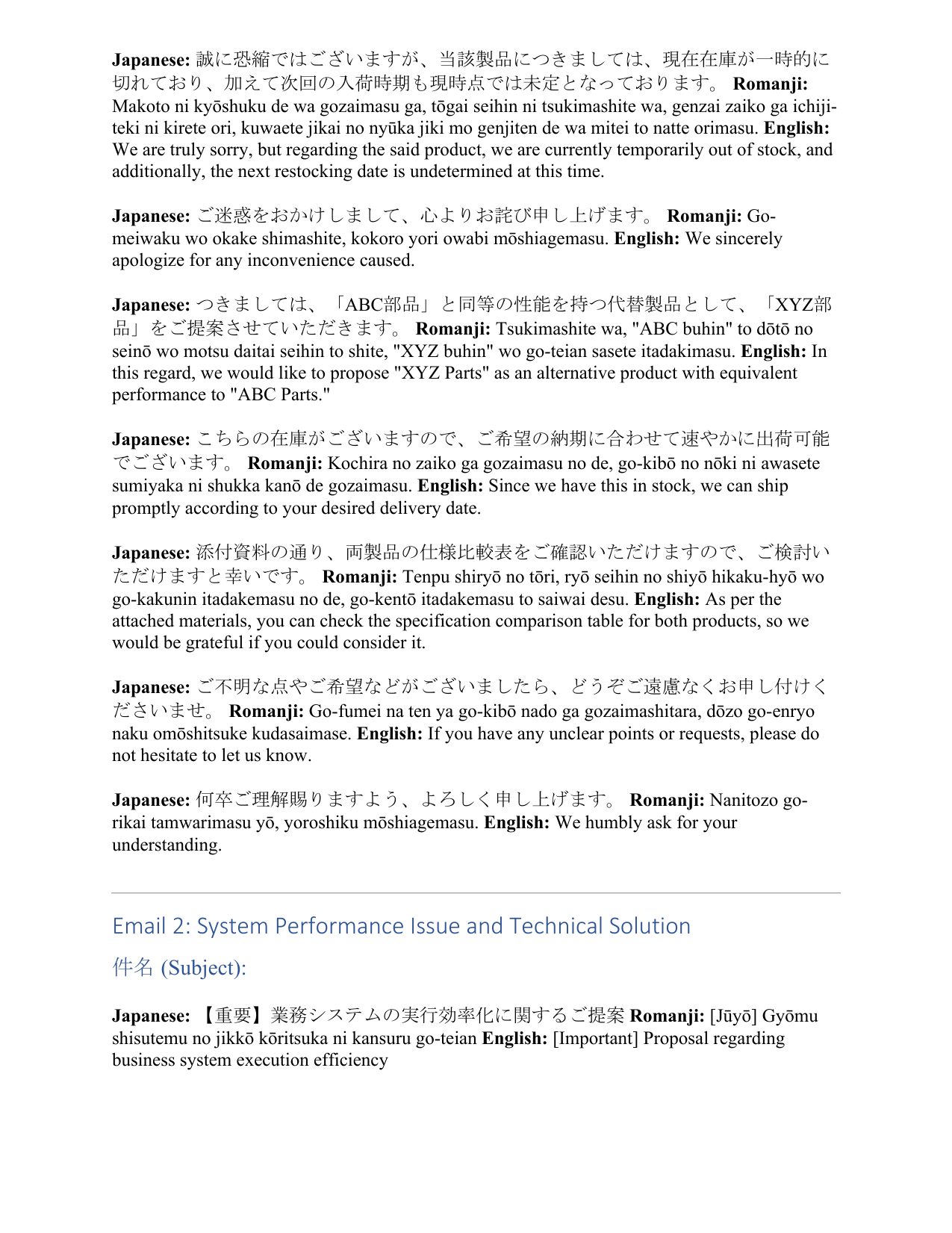
JPJapanese:誠に恐縮ではございますが、当該製品につきましては、現在在庫が一時的に
切れており、加えて次回の入荷時期も現時点では未定となっております。Romanji:
切れており、加えて次回の入荷時期も現時点では未定となっております。Romanji:
ENMakoto ni kyōshuku de wa gozaimasu ga, tōgai seihin ni tsukimashite wa, genzai zaiko ga ichiji-
teki ni kirete ori, kuwaete jikai no nyūka jiki mo genjiten de wa mitei to natte orimasu. English:
We are truly sorry, but regarding the said product, we are currently temporarily out of stock, and
additionally, the next restocking date is undetermined at this time.
teki ni kirete ori, kuwaete jikai no nyūka jiki mo genjiten de wa mitei to natte orimasu. English:
We are truly sorry, but regarding the said product, we are currently temporarily out of stock, and
additionally, the next restocking date is undetermined at this time.
JPJapanese:ご迷惑をおかけしまして、心よりお詫び申し上げます。Romanji:Go-
ENmeiwaku wo okake shimashite, kokoro yori owabi mōshiagemasu. English: We sincerely
apologize for any inconvenience caused.
apologize for any inconvenience caused.
JPJapanese:つきましては、「ABC部品」と同等の性能を持つ代替製品として、「XYZ部
EN品」をご提案させていただきます。 Romanji: Tsukimashite wa, "ABC buhin" to dōtō no
seinō wo motsu daitai seihin to shite, "XYZ buhin" wo go-teian sasete itadakimasu. English: In
this regard, we would like to propose "XYZ Parts" as an alternative product with equivalent
performance to "ABC Parts."
seinō wo motsu daitai seihin to shite, "XYZ buhin" wo go-teian sasete itadakimasu. English: In
this regard, we would like to propose "XYZ Parts" as an alternative product with equivalent
performance to "ABC Parts."
JPJapanese:こちらの在庫がございますので、ご希望の納期に合わせて速やかに出荷可能
ENでございます。 Romanji: Kochira no zaiko ga gozaimasu no de, go-kibō no nōki ni awasete
sumiyaka ni shukka kanō de gozaimasu. English: Since we have this in stock, we can ship
promptly according to your desired delivery date.
sumiyaka ni shukka kanō de gozaimasu. English: Since we have this in stock, we can ship
promptly according to your desired delivery date.
JPJapanese:添付資料の通り、両製品の仕様比較表をご確認いただけますので、ご検討い
ENただけますと幸いです。 Romanji: Tenpu shiryō no tōri, ryō seihin no shiyō hikaku-hyō wo
go-kakunin itadakemasu no de, go-kentō itadakemasu to saiwai desu. English: As per the
attached materials, you can check the specification comparison table for both products, so we
would be grateful if you could consider it.
go-kakunin itadakemasu no de, go-kentō itadakemasu to saiwai desu. English: As per the
attached materials, you can check the specification comparison table for both products, so we
would be grateful if you could consider it.
JPJapanese:ご不明な点やご希望などがございましたら、どうぞご遠慮なくお申し付けく
ENださいませ。 Romanji: Go-fumei na ten ya go-kibō nado ga gozaimashitara, dōzo go-enryo
naku omōshitsuke kudasaimase. English: If you have any unclear points or requests, please do
not hesitate to let us know.
Japanese: 何卒ご理解賜りますよう、よろしく申し上げます。 Romanji: Nanitozo go-
rikai tamwarimasu yō, yoroshiku mōshiagemasu. English: We humbly ask for your
understanding.
Email 2: System Performance Issue and Technical Solution
件名 (Subject):
Japanese: 【重要】業務システムの実行効率化に関するご提案 Romanji: [Jūyō] Gyōmu
shisutemu no jikkō kōritsuka ni kansuru go-teian English: [Important] Proposal regarding
business system execution efficiency
naku omōshitsuke kudasaimase. English: If you have any unclear points or requests, please do
not hesitate to let us know.
Japanese: 何卒ご理解賜りますよう、よろしく申し上げます。 Romanji: Nanitozo go-
rikai tamwarimasu yō, yoroshiku mōshiagemasu. English: We humbly ask for your
understanding.
Email 2: System Performance Issue and Technical Solution
件名 (Subject):
Japanese: 【重要】業務システムの実行効率化に関するご提案 Romanji: [Jūyō] Gyōmu
shisutemu no jikkō kōritsuka ni kansuru go-teian English: [Important] Proposal regarding
business system execution efficiency
หน้า 9
คลิกเพื่อขยาย
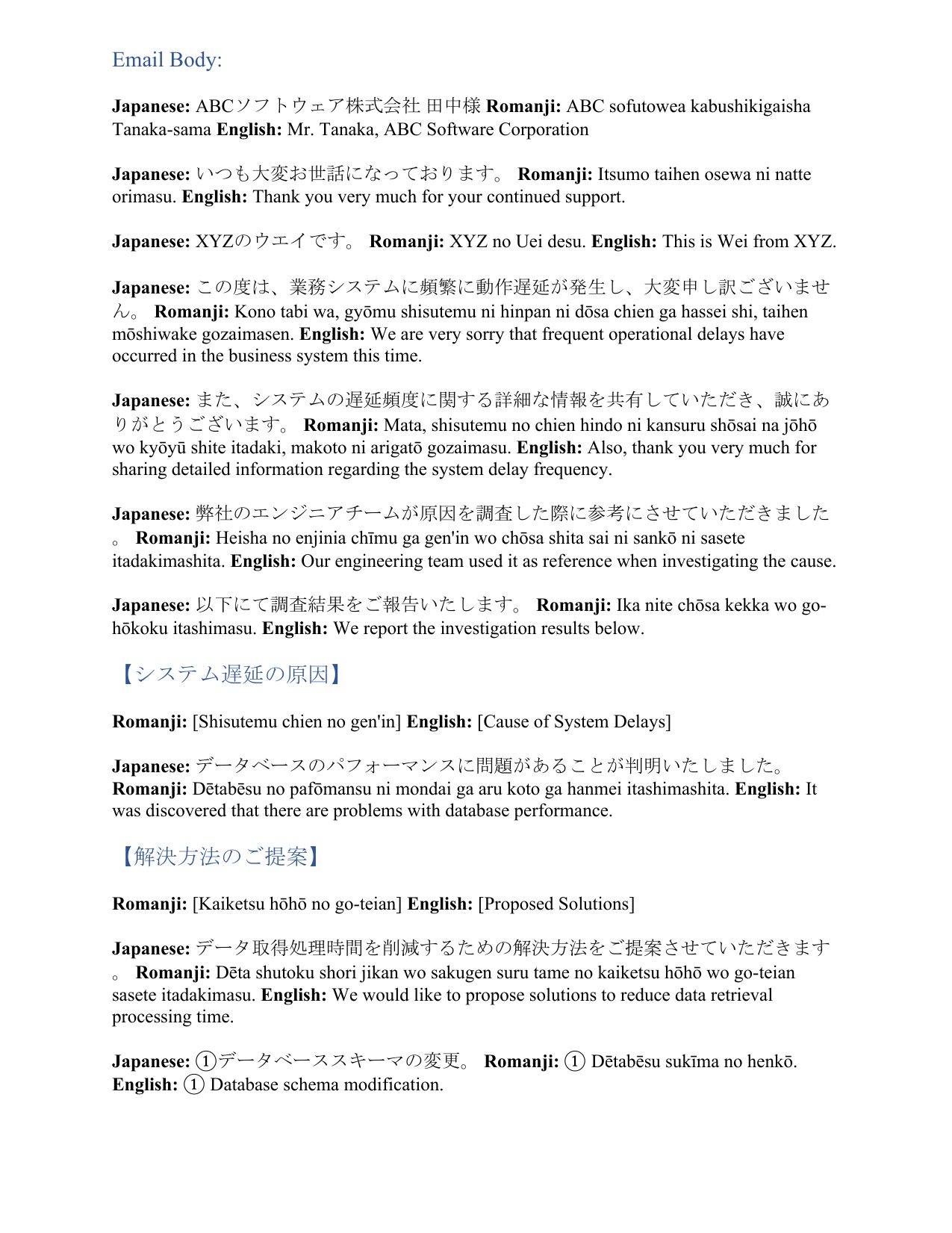
ENEmail Body:
Japanese: ABCソフトウェア株式会社 田中様 Romanji: ABC sofutowea kabushikigaisha
Tanaka-sama English: Mr. Tanaka, ABC Software Corporation
Japanese: いつも大変お世話になっております。 Romanji: Itsumo taihen osewa ni natte
orimasu. English: Thank you very much for your continued support.
Japanese: XYZのウエイです。 Romanji: XYZ no Uei desu. English: This is Wei from XYZ.
Japanese: ABCソフトウェア株式会社 田中様 Romanji: ABC sofutowea kabushikigaisha
Tanaka-sama English: Mr. Tanaka, ABC Software Corporation
Japanese: いつも大変お世話になっております。 Romanji: Itsumo taihen osewa ni natte
orimasu. English: Thank you very much for your continued support.
Japanese: XYZのウエイです。 Romanji: XYZ no Uei desu. English: This is Wei from XYZ.
JPJapanese:この度は、業務システムに頻繁に動作遅延が発生し、大変申し訳ございませ
ENん。 Romanji: Kono tabi wa, gyōmu shisutemu ni hinpan ni dōsa chien ga hassei shi, taihen
mōshiwake gozaimasen. English: We are very sorry that frequent operational delays have
occurred in the business system this time.
mōshiwake gozaimasen. English: We are very sorry that frequent operational delays have
occurred in the business system this time.
JPJapanese:また、システムの遅延頻度に関する詳細な情報を共有していただき、誠にあ
ENりがとうございます。 Romanji: Mata, shisutemu no chien hindo ni kansuru shōsai na jōhō
wo kyōyū shite itadaki, makoto ni arigatō gozaimasu. English: Also, thank you very much for
sharing detailed information regarding the system delay frequency.
wo kyōyū shite itadaki, makoto ni arigatō gozaimasu. English: Also, thank you very much for
sharing detailed information regarding the system delay frequency.
JPJapanese:弊社のエンジニアチームが原因を調査した際に参考にさせていただきました
EN。 Romanji: Heisha no enjinia chīmu ga gen'in wo chōsa shita sai ni sankō ni sasete
itadakimashita. English: Our engineering team used it as reference when investigating the cause.
Japanese: 以下にて調査結果をご報告いたします。 Romanji: Ika nite chōsa kekka wo go-
hōkoku itashimasu. English: We report the investigation results below.
itadakimashita. English: Our engineering team used it as reference when investigating the cause.
Japanese: 以下にて調査結果をご報告いたします。 Romanji: Ika nite chōsa kekka wo go-
hōkoku itashimasu. English: We report the investigation results below.
JP【システム遅延の原因】
ENRomanji: [Shisutemu chien no gen'in] English: [Cause of System Delays]
JPJapanese:データベースのパフォーマンスに問題があることが判明いたしました。
ENRomanji: Dētabēsu no pafōmansu ni mondai ga aru koto ga hanmei itashimashita. English: It
was discovered that there are problems with database performance.
was discovered that there are problems with database performance.
JP【解決方法のご提案】
ENRomanji: [Kaiketsu hōhō no go-teian] English: [Proposed Solutions]
JPJapanese:データ取得処理時間を削減するための解決方法をご提案させていただきます
EN。 Romanji: Dēta shutoku shori jikan wo sakugen suru tame no kaiketsu hōhō wo go-teian
sasete itadakimasu. English: We would like to propose solutions to reduce data retrieval
processing time.
Japanese: ①データベーススキーマの変更。 Romanji: ① Dētabēsu sukīma no henkō.
English: ① Database schema modification.
sasete itadakimasu. English: We would like to propose solutions to reduce data retrieval
processing time.
Japanese: ①データベーススキーマの変更。 Romanji: ① Dētabēsu sukīma no henkō.
English: ① Database schema modification.
หน้า 10
คลิกเพื่อขยาย
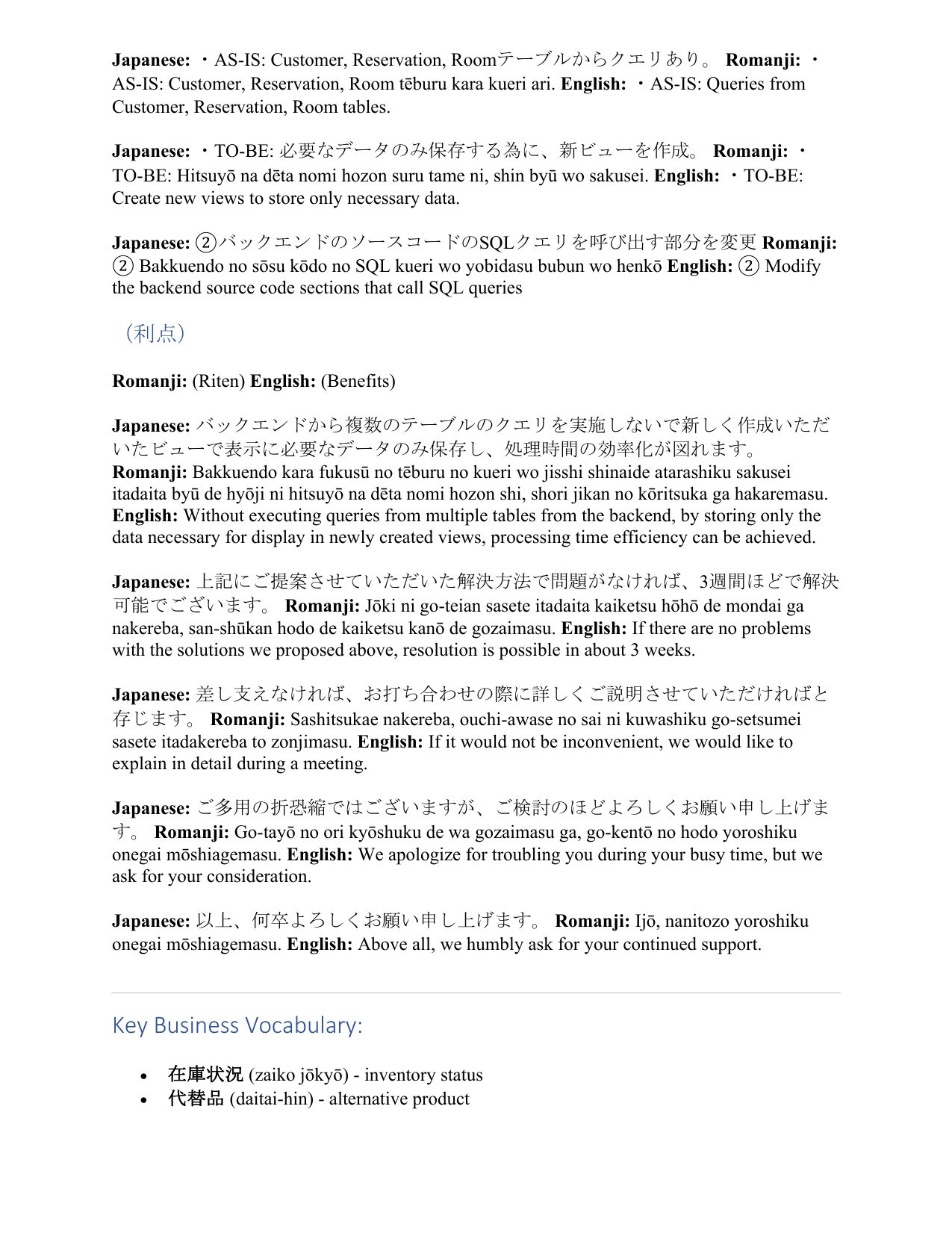
ENJapanese: ・AS-IS: Customer, Reservation, Roomテーブルからクエリあり。 Romanji: ・
AS-IS: Customer, Reservation, Room tēburu kara kueri ari. English: ・AS-IS: Queries from
Customer, Reservation, Room tables.
AS-IS: Customer, Reservation, Room tēburu kara kueri ari. English: ・AS-IS: Queries from
Customer, Reservation, Room tables.
JPJapanese:・TO-BE:必要なデータのみ保存する為に、新ビューを作成。Romanji:・
ENTO-BE: Hitsuyō na dēta nomi hozon suru tame ni, shin byū wo sakusei. English: ・TO-BE:
Create new views to store only necessary data.
Create new views to store only necessary data.
JPJapanese:②バックエンドのソースコードのSQLクエリを呼び出す部分を変更Romanji:
EN② Bakkuendo no sōsu kōdo no SQL kueri wo yobidasu bubun wo henkō English: ② Modify
the backend source code sections that call SQL queries
the backend source code sections that call SQL queries
JP(利点)
ENRomanji: (Riten) English: (Benefits)
JPJapanese:バックエンドから複数のテーブルのクエリを実施しないで新しく作成いただ
いたビューで表示に必要なデータのみ保存し、処理時間の効率化が図れます。
いたビューで表示に必要なデータのみ保存し、処理時間の効率化が図れます。
ENRomanji: Bakkuendo kara fukusū no tēburu no kueri wo jisshi shinaide atarashiku sakusei
itadaita byū de hyōji ni hitsuyō na dēta nomi hozon shi, shori jikan no kōritsuka ga hakaremasu.
English: Without executing queries from multiple tables from the backend, by storing only the
data necessary for display in newly created views, processing time efficiency can be achieved.
itadaita byū de hyōji ni hitsuyō na dēta nomi hozon shi, shori jikan no kōritsuka ga hakaremasu.
English: Without executing queries from multiple tables from the backend, by storing only the
data necessary for display in newly created views, processing time efficiency can be achieved.
JPJapanese:上記にご提案させていただいた解決方法で問題がなければ、3週間ほどで解決
EN可能でございます。 Romanji: Jōki ni go-teian sasete itadaita kaiketsu hōhō de mondai ga
nakereba, san-shūkan hodo de kaiketsu kanō de gozaimasu. English: If there are no problems
with the solutions we proposed above, resolution is possible in about 3 weeks.
nakereba, san-shūkan hodo de kaiketsu kanō de gozaimasu. English: If there are no problems
with the solutions we proposed above, resolution is possible in about 3 weeks.
JPJapanese:差し支えなければ、お打ち合わせの際に詳しくご説明させていただければと
EN存じます。 Romanji: Sashitsukae nakereba, ouchi-awase no sai ni kuwashiku go-setsumei
sasete itadakereba to zonjimasu. English: If it would not be inconvenient, we would like to
explain in detail during a meeting.
sasete itadakereba to zonjimasu. English: If it would not be inconvenient, we would like to
explain in detail during a meeting.
JPJapanese:ご多用の折恐縮ではございますが、ご検討のほどよろしくお願い申し上げま
ENす。 Romanji: Go-tayō no ori kyōshuku de wa gozaimasu ga, go-kentō no hodo yoroshiku
onegai mōshiagemasu. English: We apologize for troubling you during your busy time, but we
ask for your consideration.
Japanese: 以上、何卒よろしくお願い申し上げます。 Romanji: Ijō, nanitozo yoroshiku
onegai mōshiagemasu. English: Above all, we humbly ask for your continued support.
Key Business Vocabulary:
• 在庫状況 (zaiko jōkyō) - inventory status
• 代替品 (daitai-hin) - alternative product
onegai mōshiagemasu. English: We apologize for troubling you during your busy time, but we
ask for your consideration.
Japanese: 以上、何卒よろしくお願い申し上げます。 Romanji: Ijō, nanitozo yoroshiku
onegai mōshiagemasu. English: Above all, we humbly ask for your continued support.
Key Business Vocabulary:
• 在庫状況 (zaiko jōkyō) - inventory status
• 代替品 (daitai-hin) - alternative product
หน้า 11
คลิกเพื่อขยาย
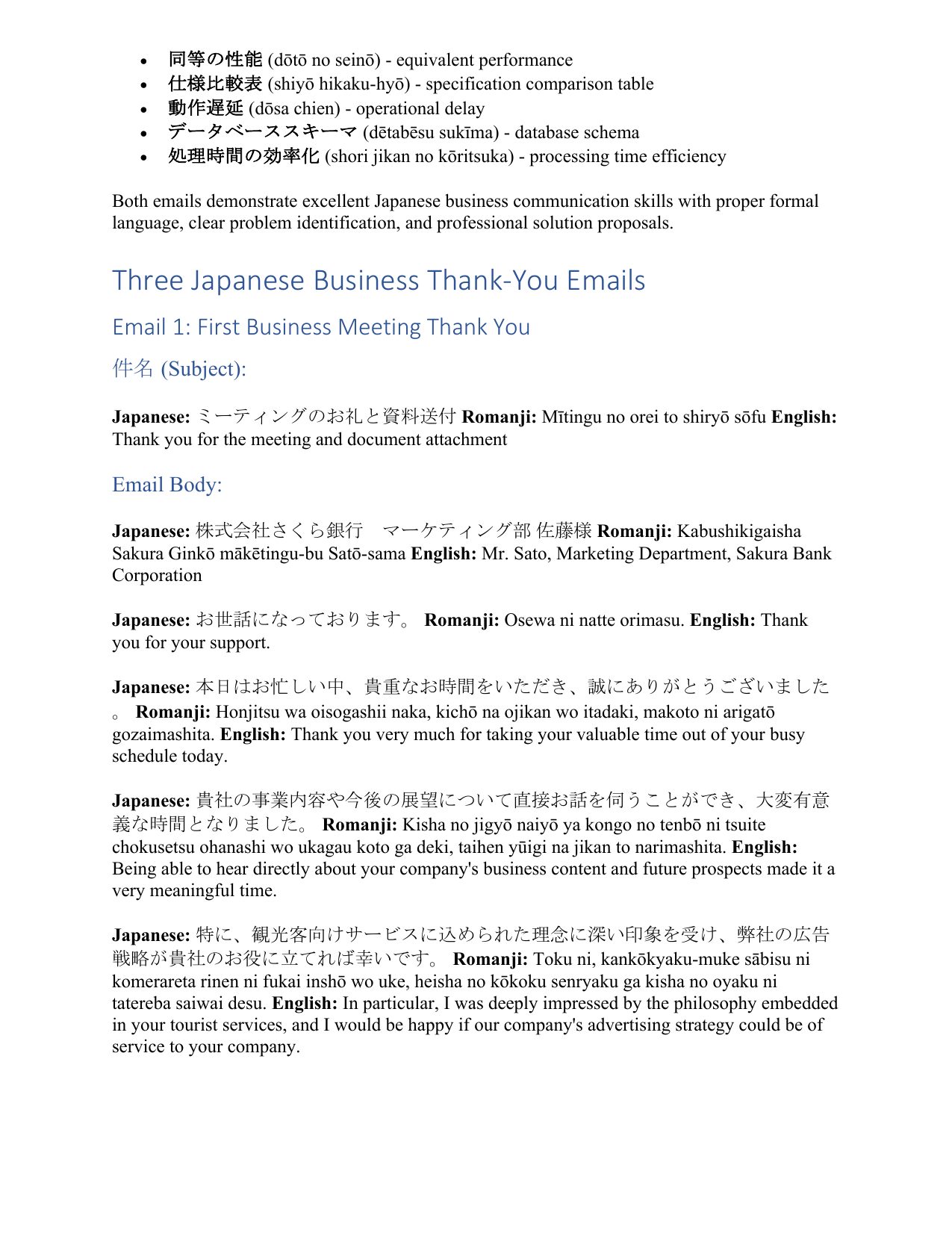
EN • 同等の性能 (dōtō no seinō) - equivalent performance
• 仕様比較表 (shiyō hikaku-hyō) - specification comparison table
• 動作遅延 (dōsa chien) - operational delay
• データベーススキーマ (dētabēsu sukīma) - database schema
• 処理時間の効率化 (shori jikan no kōritsuka) - processing time efficiency
Both emails demonstrate excellent Japanese business communication skills with proper formal
language, clear problem identification, and professional solution proposals.
Three Japanese Business Thank-You Emails
Email 1: First Business Meeting Thank You
件名 (Subject):
Japanese: ミーティングのお礼と資料送付 Romanji: Mītingu no orei to shiryō sōfu English:
Thank you for the meeting and document attachment
Email Body:
Japanese: 株式会社さくら銀行 マーケティング部 佐藤様 Romanji: Kabushikigaisha
Sakura Ginkō mākētingu-bu Satō-sama English: Mr. Sato, Marketing Department, Sakura Bank
Corporation
Japanese: お世話になっております。 Romanji: Osewa ni natte orimasu. English: Thank
you for your support.
• 仕様比較表 (shiyō hikaku-hyō) - specification comparison table
• 動作遅延 (dōsa chien) - operational delay
• データベーススキーマ (dētabēsu sukīma) - database schema
• 処理時間の効率化 (shori jikan no kōritsuka) - processing time efficiency
Both emails demonstrate excellent Japanese business communication skills with proper formal
language, clear problem identification, and professional solution proposals.
Three Japanese Business Thank-You Emails
Email 1: First Business Meeting Thank You
件名 (Subject):
Japanese: ミーティングのお礼と資料送付 Romanji: Mītingu no orei to shiryō sōfu English:
Thank you for the meeting and document attachment
Email Body:
Japanese: 株式会社さくら銀行 マーケティング部 佐藤様 Romanji: Kabushikigaisha
Sakura Ginkō mākētingu-bu Satō-sama English: Mr. Sato, Marketing Department, Sakura Bank
Corporation
Japanese: お世話になっております。 Romanji: Osewa ni natte orimasu. English: Thank
you for your support.
JPJapanese:本日はお忙しい中、貴重なお時間をいただき、誠にありがとうございました
EN。 Romanji: Honjitsu wa oisogashii naka, kichō na ojikan wo itadaki, makoto ni arigatō
gozaimashita. English: Thank you very much for taking your valuable time out of your busy
schedule today.
gozaimashita. English: Thank you very much for taking your valuable time out of your busy
schedule today.
JPJapanese:貴社の事業内容や今後の展望について直接お話を伺うことができ、大変有意
EN義な時間となりました。 Romanji: Kisha no jigyō naiyō ya kongo no tenbō ni tsuite
chokusetsu ohanashi wo ukagau koto ga deki, taihen yūigi na jikan to narimashita. English:
Being able to hear directly about your company's business content and future prospects made it a
very meaningful time.
chokusetsu ohanashi wo ukagau koto ga deki, taihen yūigi na jikan to narimashita. English:
Being able to hear directly about your company's business content and future prospects made it a
very meaningful time.
JPJapanese:特に、観光客向けサービスに込められた理念に深い印象を受け、弊社の広告
EN戦略が貴社のお役に立てれば幸いです。 Romanji: Toku ni, kankōkyaku-muke sābisu ni
komerareta rinen ni fukai inshō wo uke, heisha no kōkoku senryaku ga kisha no oyaku ni
tatereba saiwai desu. English: In particular, I was deeply impressed by the philosophy embedded
in your tourist services, and I would be happy if our company's advertising strategy could be of
service to your company.
komerareta rinen ni fukai inshō wo uke, heisha no kōkoku senryaku ga kisha no oyaku ni
tatereba saiwai desu. English: In particular, I was deeply impressed by the philosophy embedded
in your tourist services, and I would be happy if our company's advertising strategy could be of
service to your company.
หน้า 12
คลิกเพื่อขยาย
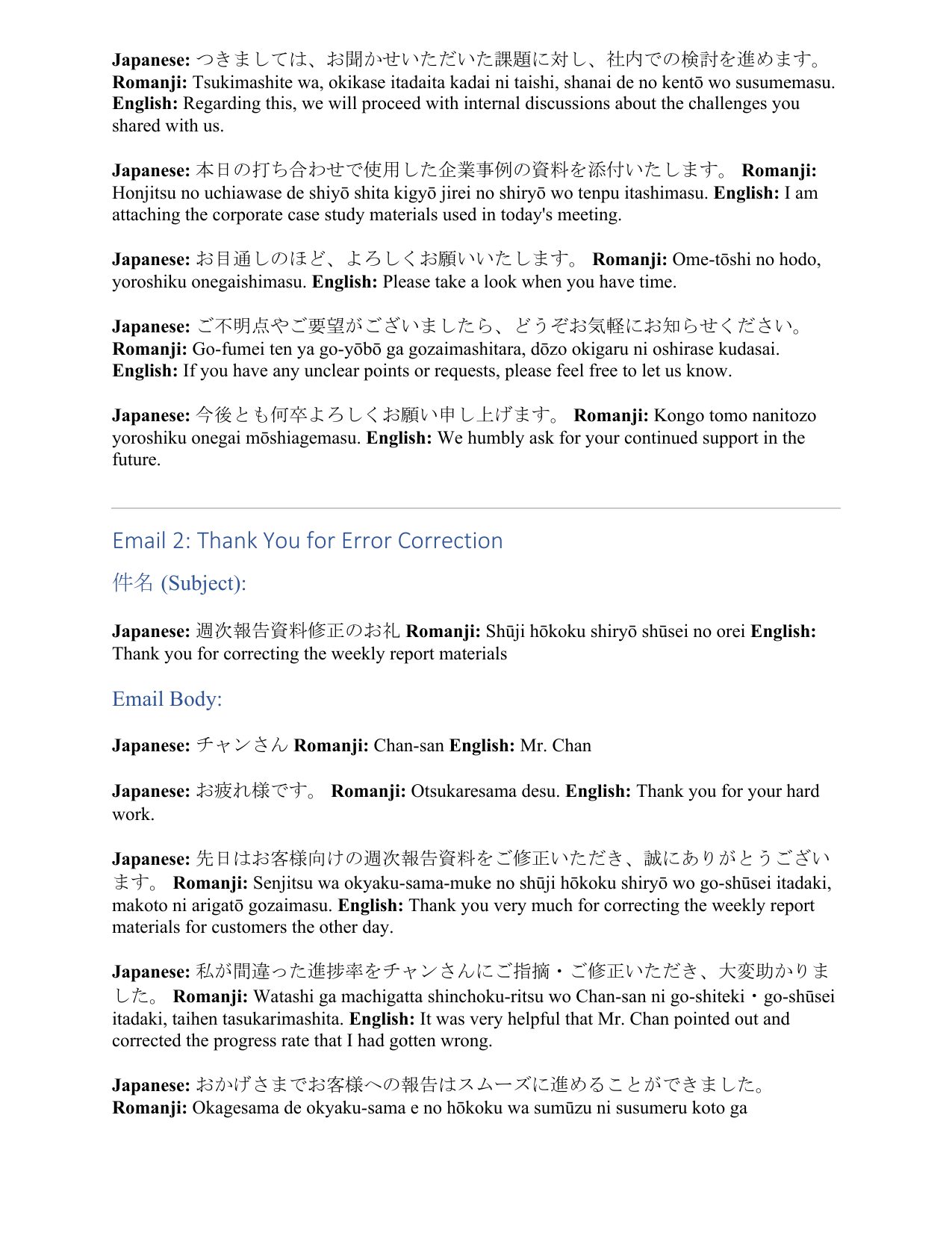
JPJapanese:つきましては、お聞かせいただいた課題に対し、社内での検討を進めます。
ENRomanji: Tsukimashite wa, okikase itadaita kadai ni taishi, shanai de no kentō wo susumemasu.
English: Regarding this, we will proceed with internal discussions about the challenges you
shared with us.
English: Regarding this, we will proceed with internal discussions about the challenges you
shared with us.
JPJapanese:本日の打ち合わせで使用した企業事例の資料を添付いたします。Romanji:
ENHonjitsu no uchiawase de shiyō shita kigyō jirei no shiryō wo tenpu itashimasu. English: I am
attaching the corporate case study materials used in today's meeting.
Japanese: お目通しのほど、よろしくお願いいたします。 Romanji: Ome-tōshi no hodo,
yoroshiku onegaishimasu. English: Please take a look when you have time.
attaching the corporate case study materials used in today's meeting.
Japanese: お目通しのほど、よろしくお願いいたします。 Romanji: Ome-tōshi no hodo,
yoroshiku onegaishimasu. English: Please take a look when you have time.
JPJapanese:ご不明点やご要望がございましたら、どうぞお気軽にお知らせください。
ENRomanji: Go-fumei ten ya go-yōbō ga gozaimashitara, dōzo okigaru ni oshirase kudasai.
English: If you have any unclear points or requests, please feel free to let us know.
Japanese: 今後とも何卒よろしくお願い申し上げます。 Romanji: Kongo tomo nanitozo
yoroshiku onegai mōshiagemasu. English: We humbly ask for your continued support in the
future.
Email 2: Thank You for Error Correction
件名 (Subject):
Japanese: 週次報告資料修正のお礼 Romanji: Shūji hōkoku shiryō shūsei no orei English:
Thank you for correcting the weekly report materials
Email Body:
Japanese: チャンさん Romanji: Chan-san English: Mr. Chan
Japanese: お疲れ様です。 Romanji: Otsukaresama desu. English: Thank you for your hard
work.
English: If you have any unclear points or requests, please feel free to let us know.
Japanese: 今後とも何卒よろしくお願い申し上げます。 Romanji: Kongo tomo nanitozo
yoroshiku onegai mōshiagemasu. English: We humbly ask for your continued support in the
future.
Email 2: Thank You for Error Correction
件名 (Subject):
Japanese: 週次報告資料修正のお礼 Romanji: Shūji hōkoku shiryō shūsei no orei English:
Thank you for correcting the weekly report materials
Email Body:
Japanese: チャンさん Romanji: Chan-san English: Mr. Chan
Japanese: お疲れ様です。 Romanji: Otsukaresama desu. English: Thank you for your hard
work.
JPJapanese:先日はお客様向けの週次報告資料をご修正いただき、誠にありがとうござい
ENます。 Romanji: Senjitsu wa okyaku-sama-muke no shūji hōkoku shiryō wo go-shūsei itadaki,
makoto ni arigatō gozaimasu. English: Thank you very much for correcting the weekly report
materials for customers the other day.
makoto ni arigatō gozaimasu. English: Thank you very much for correcting the weekly report
materials for customers the other day.
JPJapanese:私が間違った進捗率をチャンさんにご指摘・ご修正いただき、大変助かりま
ENした。 Romanji: Watashi ga machigatta shinchoku-ritsu wo Chan-san ni go-shiteki・go-shūsei
itadaki, taihen tasukarimashita. English: It was very helpful that Mr. Chan pointed out and
corrected the progress rate that I had gotten wrong.
itadaki, taihen tasukarimashita. English: It was very helpful that Mr. Chan pointed out and
corrected the progress rate that I had gotten wrong.
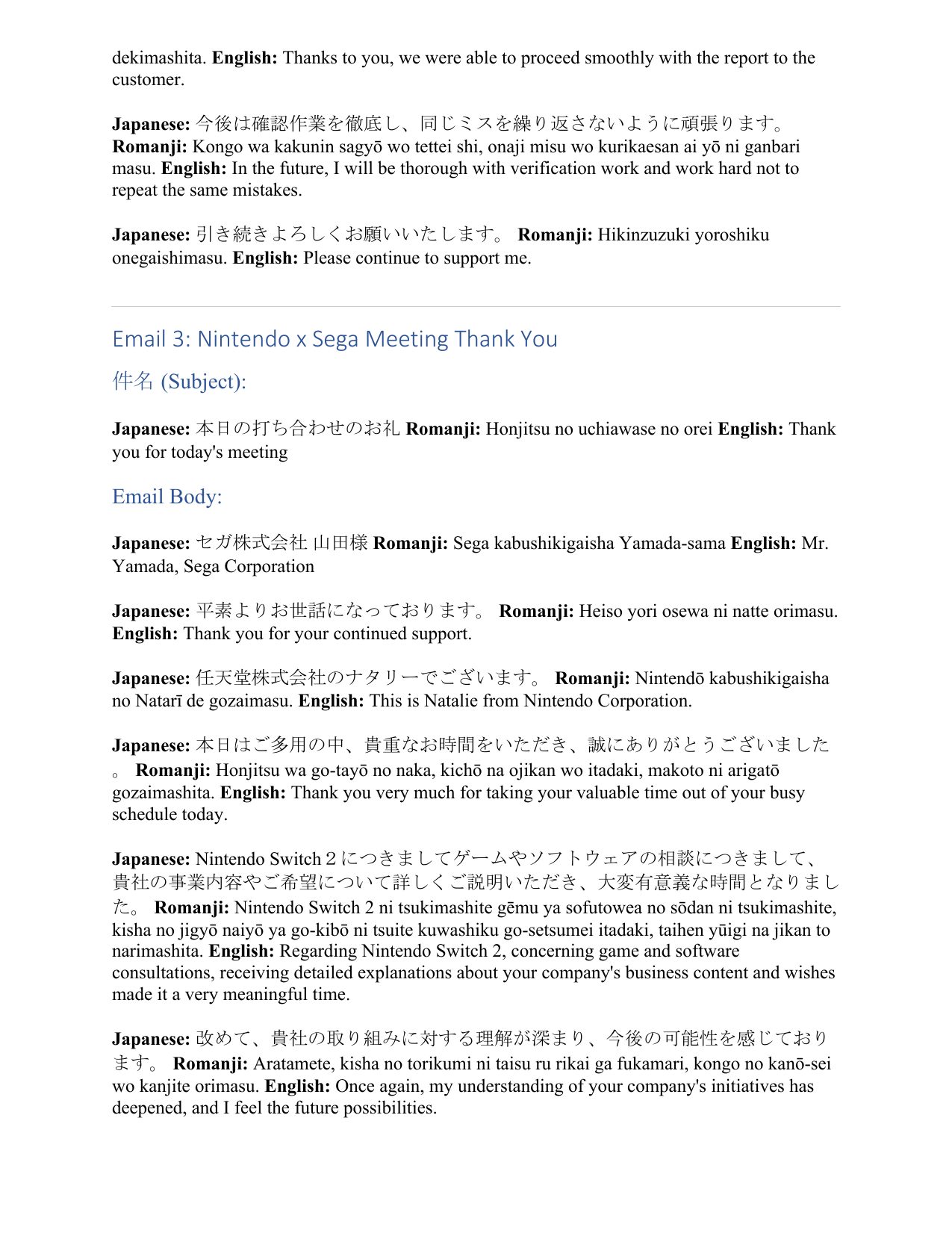
JPJapanese:おかげさまでお客様への報告はスムーズに進めることができました。
ENRomanji: Okagesama de okyaku-sama e no hōkoku wa sumūzu ni susumeru koto ga
หน้า 13
คลิกเพื่อขยาย
ENdekimashita. English: Thanks to you, we were able to proceed smoothly with the report to the
customer.
customer.
JPJapanese:今後は確認作業を徹底し、同じミスを繰り返さないように頑張ります。
ENRomanji: Kongo wa kakunin sagyō wo tettei shi, onaji misu wo kurikaesan ai yō ni ganbari
masu. English: In the future, I will be thorough with verification work and work hard not to
repeat the same mistakes.
Japanese: 引き続きよろしくお願いいたします。 Romanji: Hikinzuzuki yoroshiku
onegaishimasu. English: Please continue to support me.
Email 3: Nintendo x Sega Meeting Thank You
件名 (Subject):
Japanese: 本日の打ち合わせのお礼 Romanji: Honjitsu no uchiawase no orei English: Thank
you for today's meeting
Email Body:
Japanese: セガ株式会社 山田様 Romanji: Sega kabushikigaisha Yamada-sama English: Mr.
Yamada, Sega Corporation
Japanese: 平素よりお世話になっております。 Romanji: Heiso yori osewa ni natte orimasu.
English: Thank you for your continued support.
Japanese: 任天堂株式会社のナタリーでございます。 Romanji: Nintendō kabushikigaisha
no Natarī de gozaimasu. English: This is Natalie from Nintendo Corporation.
masu. English: In the future, I will be thorough with verification work and work hard not to
repeat the same mistakes.
Japanese: 引き続きよろしくお願いいたします。 Romanji: Hikinzuzuki yoroshiku
onegaishimasu. English: Please continue to support me.
Email 3: Nintendo x Sega Meeting Thank You
件名 (Subject):
Japanese: 本日の打ち合わせのお礼 Romanji: Honjitsu no uchiawase no orei English: Thank
you for today's meeting
Email Body:
Japanese: セガ株式会社 山田様 Romanji: Sega kabushikigaisha Yamada-sama English: Mr.
Yamada, Sega Corporation
Japanese: 平素よりお世話になっております。 Romanji: Heiso yori osewa ni natte orimasu.
English: Thank you for your continued support.
Japanese: 任天堂株式会社のナタリーでございます。 Romanji: Nintendō kabushikigaisha
no Natarī de gozaimasu. English: This is Natalie from Nintendo Corporation.
JPJapanese:本日はご多用の中、貴重なお時間をいただき、誠にありがとうございました
EN。 Romanji: Honjitsu wa go-tayō no naka, kichō na ojikan wo itadaki, makoto ni arigatō
gozaimashita. English: Thank you very much for taking your valuable time out of your busy
schedule today.
gozaimashita. English: Thank you very much for taking your valuable time out of your busy
schedule today.
JPJapanese:NintendoSwitch2につきましてゲームやソフトウェアの相談につきまして、
貴社の事業内容やご希望について詳しくご説明いただき、大変有意義な時間となりまし
貴社の事業内容やご希望について詳しくご説明いただき、大変有意義な時間となりまし
ENた。 Romanji: Nintendo Switch 2 ni tsukimashite gēmu ya sofutowea no sōdan ni tsukimashite,
kisha no jigyō naiyō ya go-kibō ni tsuite kuwashiku go-setsumei itadaki, taihen yūigi na jikan to
narimashita. English: Regarding Nintendo Switch 2, concerning game and software
consultations, receiving detailed explanations about your company's business content and wishes
made it a very meaningful time.
kisha no jigyō naiyō ya go-kibō ni tsuite kuwashiku go-setsumei itadaki, taihen yūigi na jikan to
narimashita. English: Regarding Nintendo Switch 2, concerning game and software
consultations, receiving detailed explanations about your company's business content and wishes
made it a very meaningful time.
JPJapanese:改めて、貴社の取り組みに対する理解が深まり、今後の可能性を感じており
ENます。 Romanji: Aratamete, kisha no torikumi ni taisu ru rikai ga fukamari, kongo no kanō-sei
wo kanjite orimasu. English: Once again, my understanding of your company's initiatives has
deepened, and I feel the future possibilities.
wo kanjite orimasu. English: Once again, my understanding of your company's initiatives has
deepened, and I feel the future possibilities.
หน้า 14
คลิกเพื่อขยาย
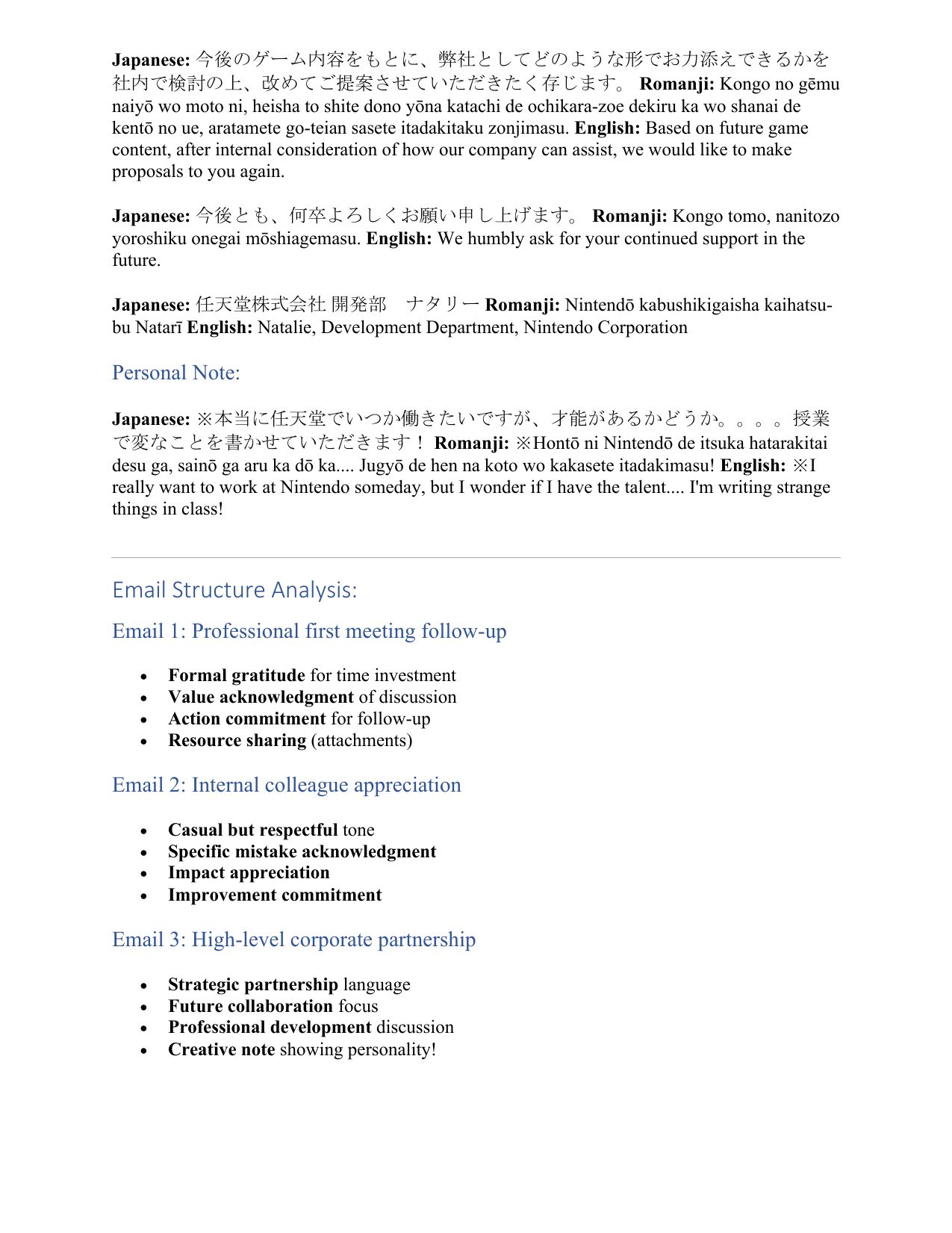
JPJapanese:今後のゲーム内容をもとに、弊社としてどのような形でお力添えできるかを
社内で検討の上、改めてご提案させていただきたく存じます。Romanji:Kongonogēmu
社内で検討の上、改めてご提案させていただきたく存じます。Romanji:Kongonogēmu
ENnaiyō wo moto ni, heisha to shite dono yōna katachi de ochikara-zoe dekiru ka wo shanai de
kentō no ue, aratamete go-teian sasete itadakitaku zonjimasu. English: Based on future game
content, after internal consideration of how our company can assist, we would like to make
proposals to you again.
Japanese: 今後とも、何卒よろしくお願い申し上げます。 Romanji: Kongo tomo, nanitozo
yoroshiku onegai mōshiagemasu. English: We humbly ask for your continued support in the
future.
Japanese: 任天堂株式会社 開発部 ナタリー Romanji: Nintendō kabushikigaisha kaihatsu-
bu Natarī English: Natalie, Development Department, Nintendo Corporation
Personal Note:
kentō no ue, aratamete go-teian sasete itadakitaku zonjimasu. English: Based on future game
content, after internal consideration of how our company can assist, we would like to make
proposals to you again.
Japanese: 今後とも、何卒よろしくお願い申し上げます。 Romanji: Kongo tomo, nanitozo
yoroshiku onegai mōshiagemasu. English: We humbly ask for your continued support in the
future.
Japanese: 任天堂株式会社 開発部 ナタリー Romanji: Nintendō kabushikigaisha kaihatsu-
bu Natarī English: Natalie, Development Department, Nintendo Corporation
Personal Note:
JPJapanese:※本当に任天堂でいつか働きたいですが、才能があるかどうか。。。。授業
ENで変なことを書かせていただきます! Romanji: ※Hontō ni Nintendō de itsuka hatarakitai
desu ga, sainō ga aru ka dō ka.... Jugyō de hen na koto wo kakasete itadakimasu! English: ※I
really want to work at Nintendo someday, but I wonder if I have the talent.... I'm writing strange
things in class!
Email Structure Analysis:
Email 1: Professional first meeting follow-up
• Formal gratitude for time investment
• Value acknowledgment of discussion
• Action commitment for follow-up
• Resource sharing (attachments)
Email 2: Internal colleague appreciation
• Casual but respectful tone
• Specific mistake acknowledgment
• Impact appreciation
• Improvement commitment
Email 3: High-level corporate partnership
• Strategic partnership language
• Future collaboration focus
• Professional development discussion
• Creative note showing personality!
desu ga, sainō ga aru ka dō ka.... Jugyō de hen na koto wo kakasete itadakimasu! English: ※I
really want to work at Nintendo someday, but I wonder if I have the talent.... I'm writing strange
things in class!
Email Structure Analysis:
Email 1: Professional first meeting follow-up
• Formal gratitude for time investment
• Value acknowledgment of discussion
• Action commitment for follow-up
• Resource sharing (attachments)
Email 2: Internal colleague appreciation
• Casual but respectful tone
• Specific mistake acknowledgment
• Impact appreciation
• Improvement commitment
Email 3: High-level corporate partnership
• Strategic partnership language
• Future collaboration focus
• Professional development discussion
• Creative note showing personality!
หน้า 15
คลิกเพื่อขยาย
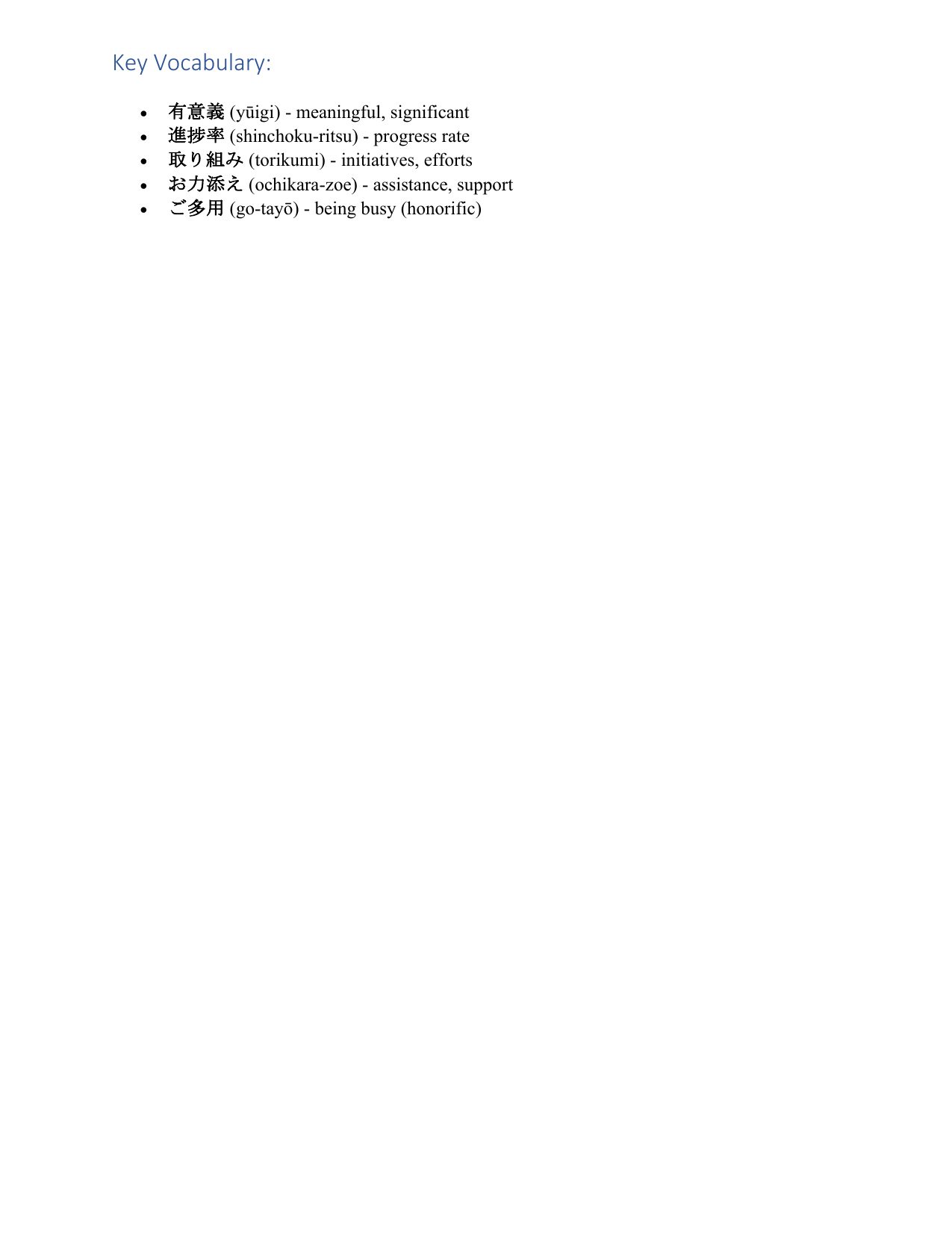
ENKey Vocabulary:
• 有意義 (yūigi) - meaningful, significant
• 進捗率 (shinchoku-ritsu) - progress rate
• 取り組み (torikumi) - initiatives, efforts
• お力添え (ochikara-zoe) - assistance, support
• ご多用 (go-tayō) - being busy (honorific)
• 有意義 (yūigi) - meaningful, significant
• 進捗率 (shinchoku-ritsu) - progress rate
• 取り組み (torikumi) - initiatives, efforts
• お力添え (ochikara-zoe) - assistance, support
• ご多用 (go-tayō) - being busy (honorific)