หน้า 1
คลิกเพื่อขยาย
ENJapanese Work Report Email Writing Guide
Translation
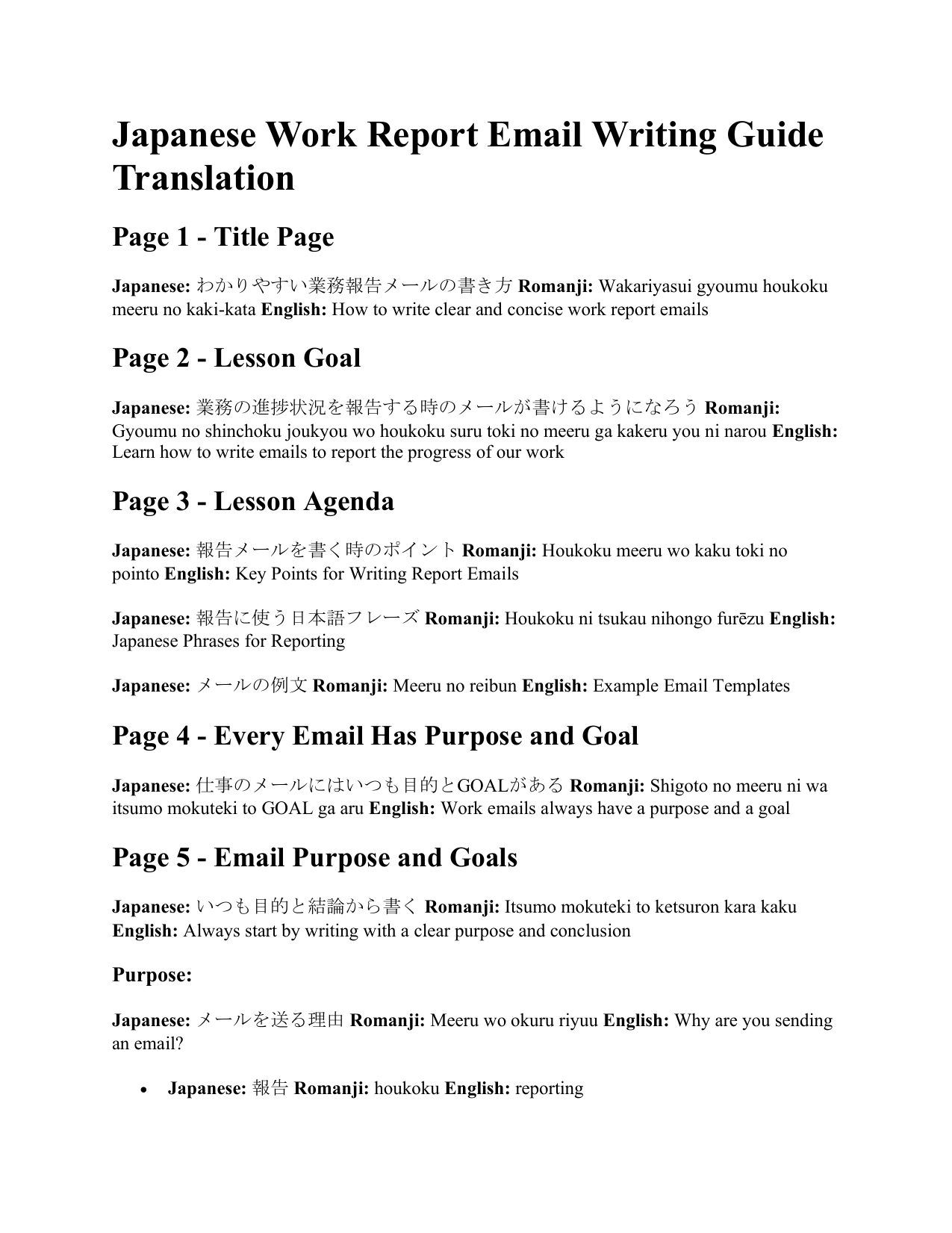
Page 1 - Title Page
Japanese: わかりやすい業務報告メールの書き方 Romanji: Wakariyasui gyoumu houkoku
meeru no kaki-kata English: How to write clear and concise work report emails
Page 2 - Lesson Goal
Translation
Page 1 - Title Page
Japanese: わかりやすい業務報告メールの書き方 Romanji: Wakariyasui gyoumu houkoku
meeru no kaki-kata English: How to write clear and concise work report emails
Page 2 - Lesson Goal
JPJapanese:業務の進捗状況を報告する時のメールが書けるようになろうRomanji:
ENGyoumu no shinchoku joukyou wo houkoku suru toki no meeru ga kakeru you ni narou English:
Learn how to write emails to report the progress of our work
Page 3 - Lesson Agenda
Japanese: 報告メールを書く時のポイント Romanji: Houkoku meeru wo kaku toki no
pointo English: Key Points for Writing Report Emails
Japanese: 報告に使う日本語フレーズ Romanji: Houkoku ni tsukau nihongo furēzu English:
Japanese Phrases for Reporting
Japanese: メールの例文 Romanji: Meeru no reibun English: Example Email Templates
Page 4 - Every Email Has Purpose and Goal
Japanese: 仕事のメールにはいつも目的とGOALがある Romanji: Shigoto no meeru ni wa
itsumo mokuteki to GOAL ga aru English: Work emails always have a purpose and a goal
Page 5 - Email Purpose and Goals
Japanese: いつも目的と結論から書く Romanji: Itsumo mokuteki to ketsuron kara kaku
English: Always start by writing with a clear purpose and conclusion
Purpose:
Japanese: メールを送る理由 Romanji: Meeru wo okuru riyuu English: Why are you sending
an email?
• Japanese: 報告 Romanji: houkoku English: reporting
Learn how to write emails to report the progress of our work
Page 3 - Lesson Agenda
Japanese: 報告メールを書く時のポイント Romanji: Houkoku meeru wo kaku toki no
pointo English: Key Points for Writing Report Emails
Japanese: 報告に使う日本語フレーズ Romanji: Houkoku ni tsukau nihongo furēzu English:
Japanese Phrases for Reporting
Japanese: メールの例文 Romanji: Meeru no reibun English: Example Email Templates
Page 4 - Every Email Has Purpose and Goal
Japanese: 仕事のメールにはいつも目的とGOALがある Romanji: Shigoto no meeru ni wa
itsumo mokuteki to GOAL ga aru English: Work emails always have a purpose and a goal
Page 5 - Email Purpose and Goals
Japanese: いつも目的と結論から書く Romanji: Itsumo mokuteki to ketsuron kara kaku
English: Always start by writing with a clear purpose and conclusion
Purpose:
Japanese: メールを送る理由 Romanji: Meeru wo okuru riyuu English: Why are you sending
an email?
• Japanese: 報告 Romanji: houkoku English: reporting
หน้า 2
คลิกเพื่อขยาย
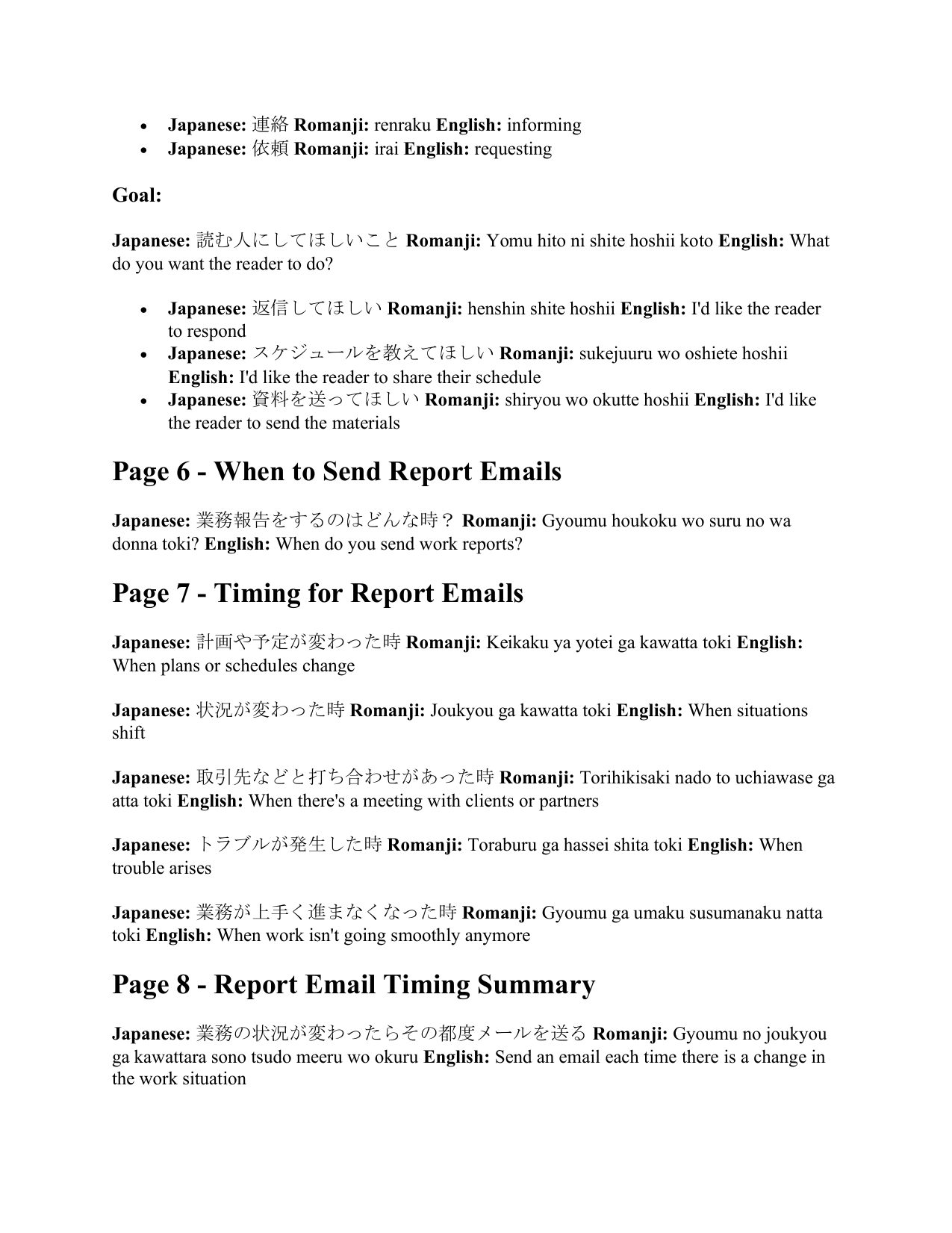
EN • Japanese: 連絡 Romanji: renraku English: informing
• Japanese: 依頼 Romanji: irai English: requesting
Goal:
Japanese: 読む人にしてほしいこと Romanji: Yomu hito ni shite hoshii koto English: What
do you want the reader to do?
• Japanese: 返信してほしい Romanji: henshin shite hoshii English: I'd like the reader
to respond
• Japanese: スケジュールを教えてほしい Romanji: sukejuuru wo oshiete hoshii
English: I'd like the reader to share their schedule
• Japanese: 資料を送ってほしい Romanji: shiryou wo okutte hoshii English: I'd like
the reader to send the materials
Page 6 - When to Send Report Emails
Japanese: 業務報告をするのはどんな時? Romanji: Gyoumu houkoku wo suru no wa
donna toki? English: When do you send work reports?
Page 7 - Timing for Report Emails
Japanese: 計画や予定が変わった時 Romanji: Keikaku ya yotei ga kawatta toki English:
When plans or schedules change
Japanese: 状況が変わった時 Romanji: Joukyou ga kawatta toki English: When situations
shift
Japanese: 取引先などと打ち合わせがあった時 Romanji: Torihikisaki nado to uchiawase ga
atta toki English: When there's a meeting with clients or partners
Japanese: トラブルが発生した時 Romanji: Toraburu ga hassei shita toki English: When
trouble arises
Japanese: 業務が上手く進まなくなった時 Romanji: Gyoumu ga umaku susumanaku natta
toki English: When work isn't going smoothly anymore
Page 8 - Report Email Timing Summary
Japanese: 業務の状況が変わったらその都度メールを送る Romanji: Gyoumu no joukyou
ga kawattara sono tsudo meeru wo okuru English: Send an email each time there is a change in
the work situation
• Japanese: 依頼 Romanji: irai English: requesting
Goal:
Japanese: 読む人にしてほしいこと Romanji: Yomu hito ni shite hoshii koto English: What
do you want the reader to do?
• Japanese: 返信してほしい Romanji: henshin shite hoshii English: I'd like the reader
to respond
• Japanese: スケジュールを教えてほしい Romanji: sukejuuru wo oshiete hoshii
English: I'd like the reader to share their schedule
• Japanese: 資料を送ってほしい Romanji: shiryou wo okutte hoshii English: I'd like
the reader to send the materials
Page 6 - When to Send Report Emails
Japanese: 業務報告をするのはどんな時? Romanji: Gyoumu houkoku wo suru no wa
donna toki? English: When do you send work reports?
Page 7 - Timing for Report Emails
Japanese: 計画や予定が変わった時 Romanji: Keikaku ya yotei ga kawatta toki English:
When plans or schedules change
Japanese: 状況が変わった時 Romanji: Joukyou ga kawatta toki English: When situations
shift
Japanese: 取引先などと打ち合わせがあった時 Romanji: Torihikisaki nado to uchiawase ga
atta toki English: When there's a meeting with clients or partners
Japanese: トラブルが発生した時 Romanji: Toraburu ga hassei shita toki English: When
trouble arises
Japanese: 業務が上手く進まなくなった時 Romanji: Gyoumu ga umaku susumanaku natta
toki English: When work isn't going smoothly anymore
Page 8 - Report Email Timing Summary
Japanese: 業務の状況が変わったらその都度メールを送る Romanji: Gyoumu no joukyou
ga kawattara sono tsudo meeru wo okuru English: Send an email each time there is a change in
the work situation
หน้า 3
คลิกเพื่อขยาย
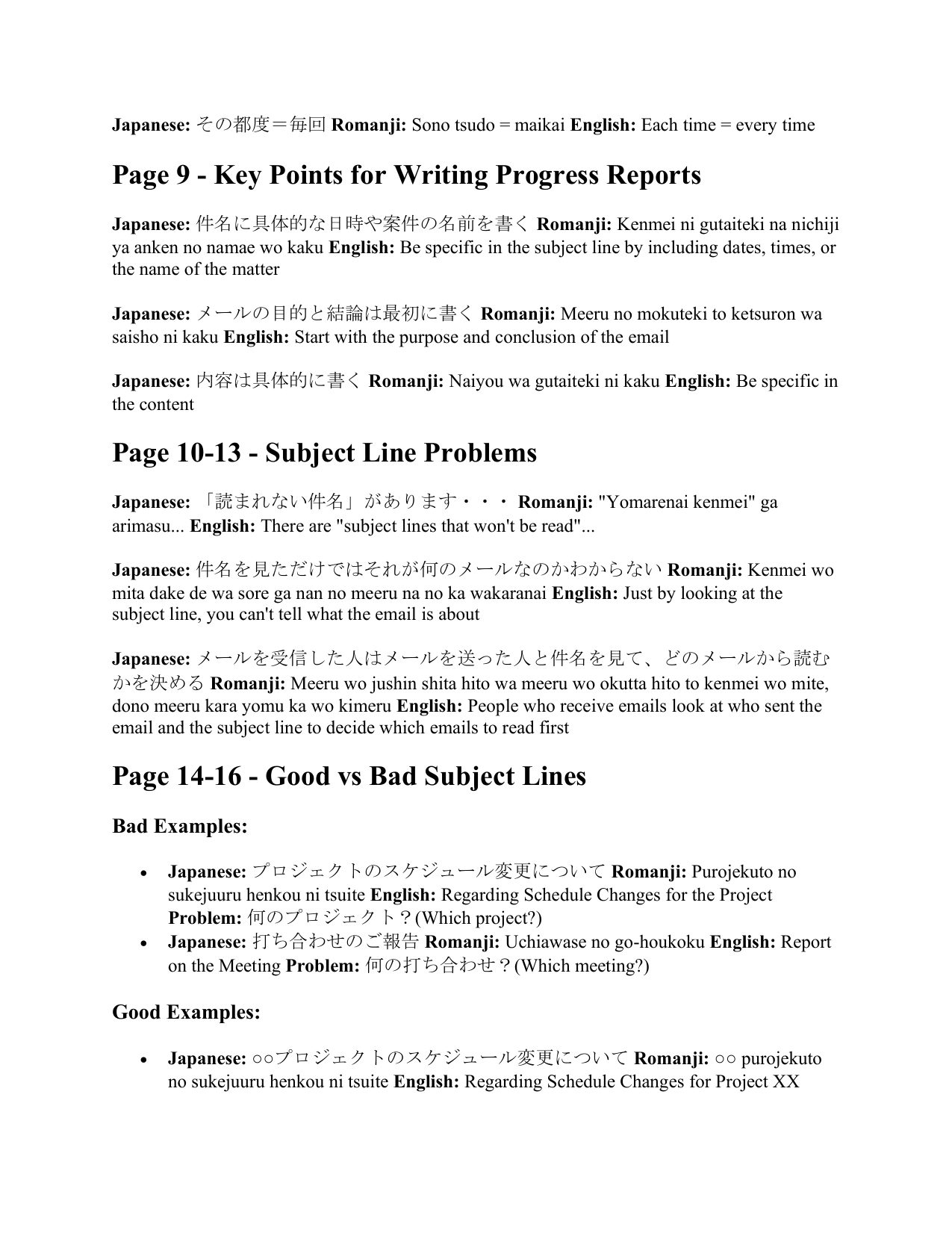
ENJapanese: その都度=毎回 Romanji: Sono tsudo = maikai English: Each time = every time
Page 9 - Key Points for Writing Progress Reports
Japanese: 件名に具体的な日時や案件の名前を書く Romanji: Kenmei ni gutaiteki na nichiji
ya anken no namae wo kaku English: Be specific in the subject line by including dates, times, or
the name of the matter
Japanese: メールの目的と結論は最初に書く Romanji: Meeru no mokuteki to ketsuron wa
saisho ni kaku English: Start with the purpose and conclusion of the email
Japanese: 内容は具体的に書く Romanji: Naiyou wa gutaiteki ni kaku English: Be specific in
the content
Page 10-13 - Subject Line Problems
Japanese: 「読まれない件名」があります・・・ Romanji: "Yomarenai kenmei" ga
arimasu... English: There are "subject lines that won't be read"...
Page 9 - Key Points for Writing Progress Reports
Japanese: 件名に具体的な日時や案件の名前を書く Romanji: Kenmei ni gutaiteki na nichiji
ya anken no namae wo kaku English: Be specific in the subject line by including dates, times, or
the name of the matter
Japanese: メールの目的と結論は最初に書く Romanji: Meeru no mokuteki to ketsuron wa
saisho ni kaku English: Start with the purpose and conclusion of the email
Japanese: 内容は具体的に書く Romanji: Naiyou wa gutaiteki ni kaku English: Be specific in
the content
Page 10-13 - Subject Line Problems
Japanese: 「読まれない件名」があります・・・ Romanji: "Yomarenai kenmei" ga
arimasu... English: There are "subject lines that won't be read"...
JPJapanese:件名を見ただけではそれが何のメールなのかわからないRomanji:Kenmeiwo
ENmita dake de wa sore ga nan no meeru na no ka wakaranai English: Just by looking at the
subject line, you can't tell what the email is about
subject line, you can't tell what the email is about
JPJapanese:メールを受信した人はメールを送った人と件名を見て、どのメールから読む
ENかを決める Romanji: Meeru wo jushin shita hito wa meeru wo okutta hito to kenmei wo mite,
dono meeru kara yomu ka wo kimeru English: People who receive emails look at who sent the
email and the subject line to decide which emails to read first
Page 14-16 - Good vs Bad Subject Lines
Bad Examples:
• Japanese: プロジェクトのスケジュール変更について Romanji: Purojekuto no
sukejuuru henkou ni tsuite English: Regarding Schedule Changes for the Project
Problem: 何のプロジェクト?(Which project?)
• Japanese: 打ち合わせのご報告 Romanji: Uchiawase no go-houkoku English: Report
on the Meeting Problem: 何の打ち合わせ?(Which meeting?)
Good Examples:
• Japanese: ○○プロジェクトのスケジュール変更について Romanji: ○○ purojekuto
no sukejuuru henkou ni tsuite English: Regarding Schedule Changes for Project XX
dono meeru kara yomu ka wo kimeru English: People who receive emails look at who sent the
email and the subject line to decide which emails to read first
Page 14-16 - Good vs Bad Subject Lines
Bad Examples:
• Japanese: プロジェクトのスケジュール変更について Romanji: Purojekuto no
sukejuuru henkou ni tsuite English: Regarding Schedule Changes for the Project
Problem: 何のプロジェクト?(Which project?)
• Japanese: 打ち合わせのご報告 Romanji: Uchiawase no go-houkoku English: Report
on the Meeting Problem: 何の打ち合わせ?(Which meeting?)
Good Examples:
• Japanese: ○○プロジェクトのスケジュール変更について Romanji: ○○ purojekuto
no sukejuuru henkou ni tsuite English: Regarding Schedule Changes for Project XX
หน้า 4
คลิกเพื่อขยาย
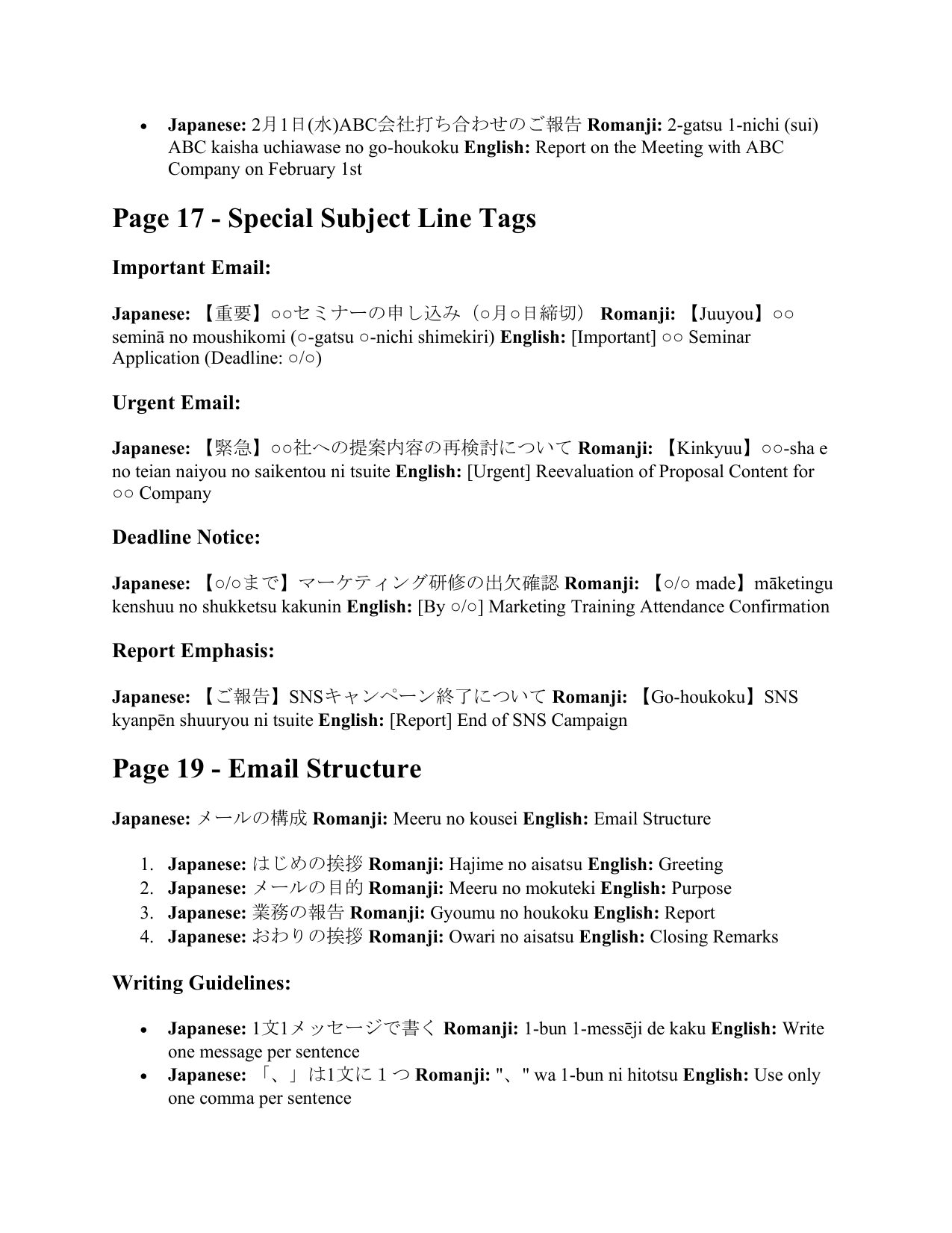
EN • Japanese: 2月1日(水)ABC会社打ち合わせのご報告 Romanji: 2-gatsu 1-nichi (sui)
ABC kaisha uchiawase no go-houkoku English: Report on the Meeting with ABC
Company on February 1st
Page 17 - Special Subject Line Tags
Important Email:
Japanese: 【重要】○○セミナーの申し込み(○月○日締切) Romanji: 【Juuyou】○○
seminā no moushikomi (○-gatsu ○-nichi shimekiri) English: [Important] ○○ Seminar
Application (Deadline: ○/○)
Urgent Email:
Japanese: 【緊急】○○社への提案内容の再検討について Romanji: 【Kinkyuu】○○-sha e
no teian naiyou no saikentou ni tsuite English: [Urgent] Reevaluation of Proposal Content for
○○ Company
Deadline Notice:
Japanese: 【○/○まで】マーケティング研修の出欠確認 Romanji: 【○/○ made】māketingu
kenshuu no shukketsu kakunin English: [By ○/○] Marketing Training Attendance Confirmation
Report Emphasis:
Japanese: 【ご報告】SNSキャンペーン終了について Romanji: 【Go-houkoku】SNS
kyanpēn shuuryou ni tsuite English: [Report] End of SNS Campaign
Page 19 - Email Structure
Japanese: メールの構成 Romanji: Meeru no kousei English: Email Structure
1. Japanese: はじめの挨拶 Romanji: Hajime no aisatsu English: Greeting
2. Japanese: メールの目的 Romanji: Meeru no mokuteki English: Purpose
3. Japanese: 業務の報告 Romanji: Gyoumu no houkoku English: Report
4. Japanese: おわりの挨拶 Romanji: Owari no aisatsu English: Closing Remarks
Writing Guidelines:
• Japanese: 1文1メッセージで書く Romanji: 1-bun 1-messēji de kaku English: Write
one message per sentence
• Japanese: 「、」は1文に1つ Romanji: "、" wa 1-bun ni hitotsu English: Use only
one comma per sentence
ABC kaisha uchiawase no go-houkoku English: Report on the Meeting with ABC
Company on February 1st
Page 17 - Special Subject Line Tags
Important Email:
Japanese: 【重要】○○セミナーの申し込み(○月○日締切) Romanji: 【Juuyou】○○
seminā no moushikomi (○-gatsu ○-nichi shimekiri) English: [Important] ○○ Seminar
Application (Deadline: ○/○)
Urgent Email:
Japanese: 【緊急】○○社への提案内容の再検討について Romanji: 【Kinkyuu】○○-sha e
no teian naiyou no saikentou ni tsuite English: [Urgent] Reevaluation of Proposal Content for
○○ Company
Deadline Notice:
Japanese: 【○/○まで】マーケティング研修の出欠確認 Romanji: 【○/○ made】māketingu
kenshuu no shukketsu kakunin English: [By ○/○] Marketing Training Attendance Confirmation
Report Emphasis:
Japanese: 【ご報告】SNSキャンペーン終了について Romanji: 【Go-houkoku】SNS
kyanpēn shuuryou ni tsuite English: [Report] End of SNS Campaign
Page 19 - Email Structure
Japanese: メールの構成 Romanji: Meeru no kousei English: Email Structure
1. Japanese: はじめの挨拶 Romanji: Hajime no aisatsu English: Greeting
2. Japanese: メールの目的 Romanji: Meeru no mokuteki English: Purpose
3. Japanese: 業務の報告 Romanji: Gyoumu no houkoku English: Report
4. Japanese: おわりの挨拶 Romanji: Owari no aisatsu English: Closing Remarks
Writing Guidelines:
• Japanese: 1文1メッセージで書く Romanji: 1-bun 1-messēji de kaku English: Write
one message per sentence
• Japanese: 「、」は1文に1つ Romanji: "、" wa 1-bun ni hitotsu English: Use only
one comma per sentence
หน้า 5
คลิกเพื่อขยาย
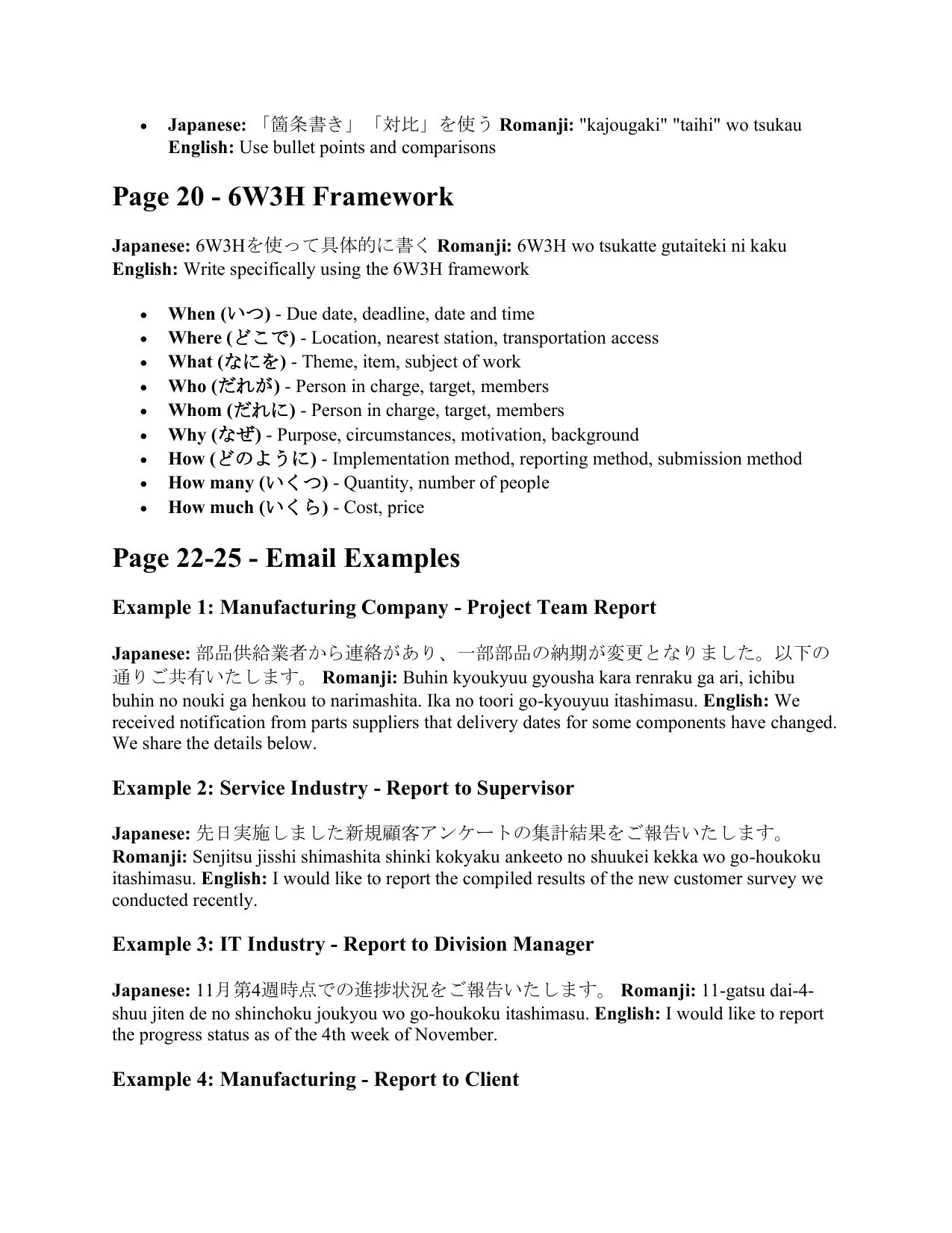
EN • Japanese: 「箇条書き」「対比」を使う Romanji: "kajougaki" "taihi" wo tsukau
English: Use bullet points and comparisons
Page 20 - 6W3H Framework
Japanese: 6W3Hを使って具体的に書く Romanji: 6W3H wo tsukatte gutaiteki ni kaku
English: Write specifically using the 6W3H framework
• When (いつ) - Due date, deadline, date and time
• Where (どこで) - Location, nearest station, transportation access
• What (なにを) - Theme, item, subject of work
• Who (だれが) - Person in charge, target, members
• Whom (だれに) - Person in charge, target, members
• Why (なぜ) - Purpose, circumstances, motivation, background
• How (どのように) - Implementation method, reporting method, submission method
• How many (いくつ) - Quantity, number of people
• How much (いくら) - Cost, price
Page 22-25 - Email Examples
Example 1: Manufacturing Company - Project Team Report
English: Use bullet points and comparisons
Page 20 - 6W3H Framework
Japanese: 6W3Hを使って具体的に書く Romanji: 6W3H wo tsukatte gutaiteki ni kaku
English: Write specifically using the 6W3H framework
• When (いつ) - Due date, deadline, date and time
• Where (どこで) - Location, nearest station, transportation access
• What (なにを) - Theme, item, subject of work
• Who (だれが) - Person in charge, target, members
• Whom (だれに) - Person in charge, target, members
• Why (なぜ) - Purpose, circumstances, motivation, background
• How (どのように) - Implementation method, reporting method, submission method
• How many (いくつ) - Quantity, number of people
• How much (いくら) - Cost, price
Page 22-25 - Email Examples
Example 1: Manufacturing Company - Project Team Report
JPJapanese:部品供給業者から連絡があり、一部部品の納期が変更となりました。以下の
EN通りご共有いたします。 Romanji: Buhin kyoukyuu gyousha kara renraku ga ari, ichibu
buhin no nouki ga henkou to narimashita. Ika no toori go-kyouyuu itashimasu. English: We
received notification from parts suppliers that delivery dates for some components have changed.
We share the details below.
Example 2: Service Industry - Report to Supervisor
buhin no nouki ga henkou to narimashita. Ika no toori go-kyouyuu itashimasu. English: We
received notification from parts suppliers that delivery dates for some components have changed.
We share the details below.
Example 2: Service Industry - Report to Supervisor
JPJapanese:先日実施しました新規顧客アンケートの集計結果をご報告いたします。
ENRomanji: Senjitsu jisshi shimashita shinki kokyaku ankeeto no shuukei kekka wo go-houkoku
itashimasu. English: I would like to report the compiled results of the new customer survey we
conducted recently.
Example 3: IT Industry - Report to Division Manager
Japanese: 11月第4週時点での進捗状況をご報告いたします。 Romanji: 11-gatsu dai-4-
shuu jiten de no shinchoku joukyou wo go-houkoku itashimasu. English: I would like to report
the progress status as of the 4th week of November.
Example 4: Manufacturing - Report to Client
itashimasu. English: I would like to report the compiled results of the new customer survey we
conducted recently.
Example 3: IT Industry - Report to Division Manager
Japanese: 11月第4週時点での進捗状況をご報告いたします。 Romanji: 11-gatsu dai-4-
shuu jiten de no shinchoku joukyou wo go-houkoku itashimasu. English: I would like to report
the progress status as of the 4th week of November.
Example 4: Manufacturing - Report to Client
หน้า 6
คลิกเพื่อขยาย
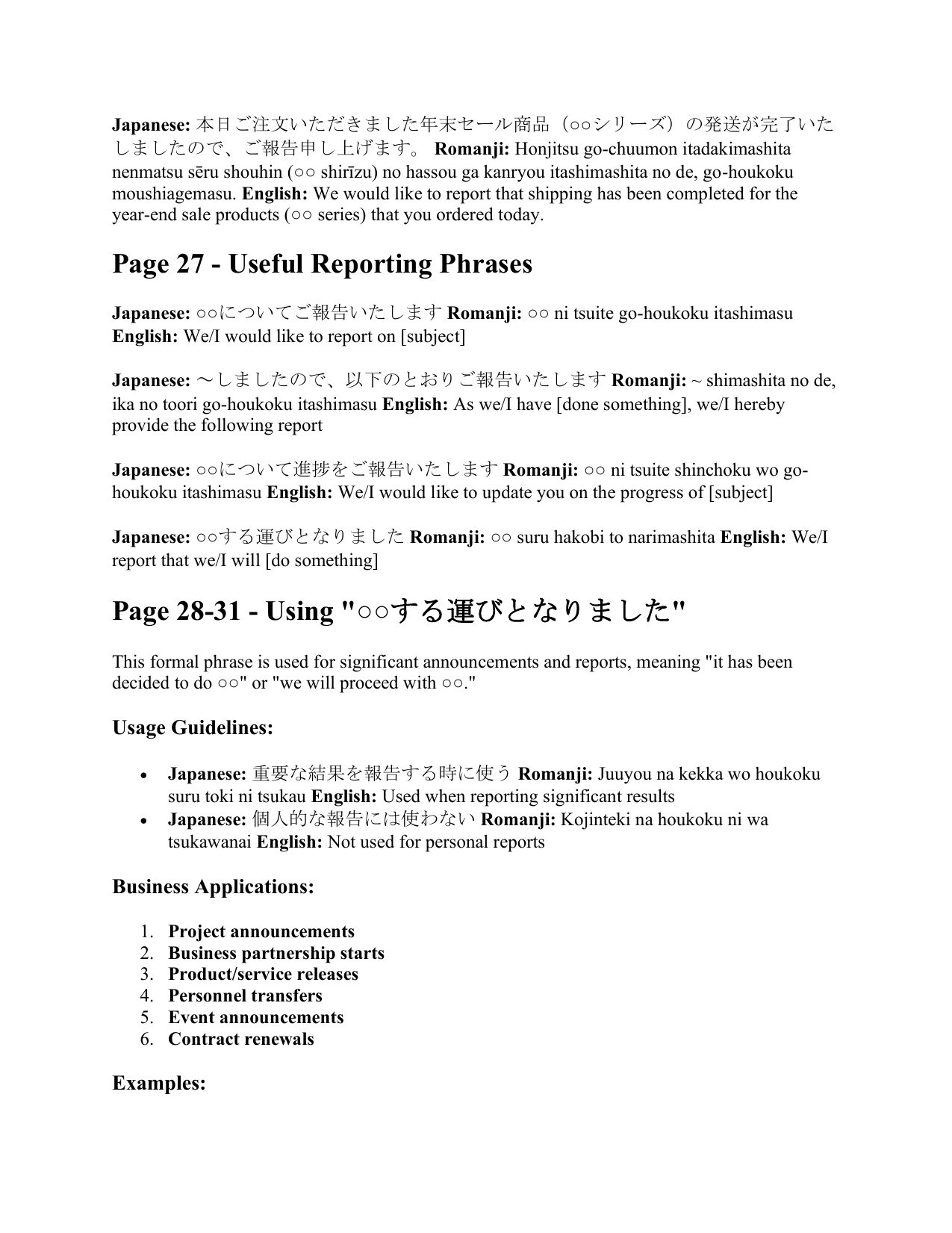
JPJapanese:本日ご注文いただきました年末セール商品(○○シリーズ)の発送が完了いた
ENしましたので、ご報告申し上げます。 Romanji: Honjitsu go-chuumon itadakimashita
nenmatsu sēru shouhin (○○ shirīzu) no hassou ga kanryou itashimashita no de, go-houkoku
moushiagemasu. English: We would like to report that shipping has been completed for the
year-end sale products (○○ series) that you ordered today.
Page 27 - Useful Reporting Phrases
Japanese: ○○についてご報告いたします Romanji: ○○ ni tsuite go-houkoku itashimasu
English: We/I would like to report on [subject]
Japanese: ~しましたので、以下のとおりご報告いたします Romanji: ~ shimashita no de,
ika no toori go-houkoku itashimasu English: As we/I have [done something], we/I hereby
provide the following report
Japanese: ○○について進捗をご報告いたします Romanji: ○○ ni tsuite shinchoku wo go-
houkoku itashimasu English: We/I would like to update you on the progress of [subject]
Japanese: ○○する運びとなりました Romanji: ○○ suru hakobi to narimashita English: We/I
report that we/I will [do something]
nenmatsu sēru shouhin (○○ shirīzu) no hassou ga kanryou itashimashita no de, go-houkoku
moushiagemasu. English: We would like to report that shipping has been completed for the
year-end sale products (○○ series) that you ordered today.
Page 27 - Useful Reporting Phrases
Japanese: ○○についてご報告いたします Romanji: ○○ ni tsuite go-houkoku itashimasu
English: We/I would like to report on [subject]
Japanese: ~しましたので、以下のとおりご報告いたします Romanji: ~ shimashita no de,
ika no toori go-houkoku itashimasu English: As we/I have [done something], we/I hereby
provide the following report
Japanese: ○○について進捗をご報告いたします Romanji: ○○ ni tsuite shinchoku wo go-
houkoku itashimasu English: We/I would like to update you on the progress of [subject]
Japanese: ○○する運びとなりました Romanji: ○○ suru hakobi to narimashita English: We/I
report that we/I will [do something]
JPPage28-31-Using"○○する運びとなりました"
ENThis formal phrase is used for significant announcements and reports, meaning "it has been
decided to do ○○" or "we will proceed with ○○."
Usage Guidelines:
• Japanese: 重要な結果を報告する時に使う Romanji: Juuyou na kekka wo houkoku
suru toki ni tsukau English: Used when reporting significant results
• Japanese: 個人的な報告には使わない Romanji: Kojinteki na houkoku ni wa
tsukawanai English: Not used for personal reports
Business Applications:
1. Project announcements
2. Business partnership starts
3. Product/service releases
4. Personnel transfers
5. Event announcements
6. Contract renewals
Examples:
decided to do ○○" or "we will proceed with ○○."
Usage Guidelines:
• Japanese: 重要な結果を報告する時に使う Romanji: Juuyou na kekka wo houkoku
suru toki ni tsukau English: Used when reporting significant results
• Japanese: 個人的な報告には使わない Romanji: Kojinteki na houkoku ni wa
tsukawanai English: Not used for personal reports
Business Applications:
1. Project announcements
2. Business partnership starts
3. Product/service releases
4. Personnel transfers
5. Event announcements
6. Contract renewals
Examples:
หน้า 7
คลิกเพื่อขยาย
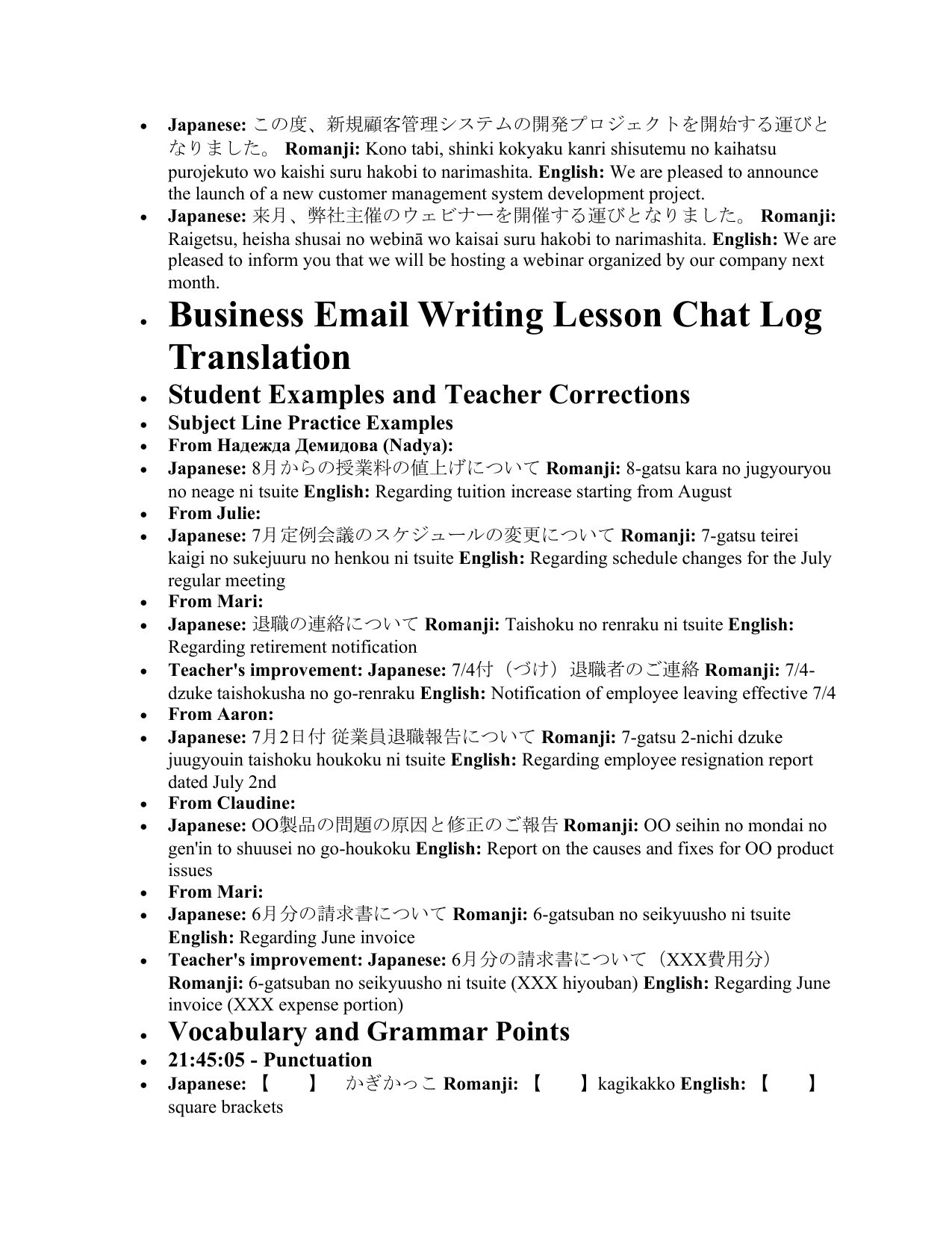
JP•Japanese:この度、新規顧客管理システムの開発プロジェクトを開始する運びと
EN なりました。 Romanji: Kono tabi, shinki kokyaku kanri shisutemu no kaihatsu
purojekuto wo kaishi suru hakobi to narimashita. English: We are pleased to announce
the launch of a new customer management system development project.
purojekuto wo kaishi suru hakobi to narimashita. English: We are pleased to announce
the launch of a new customer management system development project.
JP•Japanese:来月、弊社主催のウェビナーを開催する運びとなりました。Romanji:
EN Raigetsu, heisha shusai no webinā wo kaisai suru hakobi to narimashita. English: We are
pleased to inform you that we will be hosting a webinar organized by our company next
month.
• Business Email Writing Lesson Chat Log
Translation
• Student Examples and Teacher Corrections
• Subject Line Practice Examples
• From Надежда Демидова (Nadya):
• Japanese: 8月からの授業料の値上げについて Romanji: 8-gatsu kara no jugyouryou
no neage ni tsuite English: Regarding tuition increase starting from August
• From Julie:
• Japanese: 7月定例会議のスケジュールの変更について Romanji: 7-gatsu teirei
kaigi no sukejuuru no henkou ni tsuite English: Regarding schedule changes for the July
regular meeting
• From Mari:
• Japanese: 退職の連絡について Romanji: Taishoku no renraku ni tsuite English:
Regarding retirement notification
• Teacher's improvement: Japanese: 7/4付(づけ)退職者のご連絡 Romanji: 7/4-
dzuke taishokusha no go-renraku English: Notification of employee leaving effective 7/4
• From Aaron:
• Japanese: 7月2日付 従業員退職報告について Romanji: 7-gatsu 2-nichi dzuke
juugyouin taishoku houkoku ni tsuite English: Regarding employee resignation report
dated July 2nd
• From Claudine:
• Japanese: OO製品の問題の原因と修正のご報告 Romanji: OO seihin no mondai no
gen'in to shuusei no go-houkoku English: Report on the causes and fixes for OO product
issues
• From Mari:
• Japanese: 6月分の請求書について Romanji: 6-gatsuban no seikyuusho ni tsuite
English: Regarding June invoice
• Teacher's improvement: Japanese: 6月分の請求書について(XXX費用分)
Romanji: 6-gatsuban no seikyuusho ni tsuite (XXX hiyouban) English: Regarding June
invoice (XXX expense portion)
• Vocabulary and Grammar Points
• 21:45:05 - Punctuation
• Japanese: 【 】 かぎかっこ Romanji: 【 】kagikakko English: 【 】
square brackets
pleased to inform you that we will be hosting a webinar organized by our company next
month.
• Business Email Writing Lesson Chat Log
Translation
• Student Examples and Teacher Corrections
• Subject Line Practice Examples
• From Надежда Демидова (Nadya):
• Japanese: 8月からの授業料の値上げについて Romanji: 8-gatsu kara no jugyouryou
no neage ni tsuite English: Regarding tuition increase starting from August
• From Julie:
• Japanese: 7月定例会議のスケジュールの変更について Romanji: 7-gatsu teirei
kaigi no sukejuuru no henkou ni tsuite English: Regarding schedule changes for the July
regular meeting
• From Mari:
• Japanese: 退職の連絡について Romanji: Taishoku no renraku ni tsuite English:
Regarding retirement notification
• Teacher's improvement: Japanese: 7/4付(づけ)退職者のご連絡 Romanji: 7/4-
dzuke taishokusha no go-renraku English: Notification of employee leaving effective 7/4
• From Aaron:
• Japanese: 7月2日付 従業員退職報告について Romanji: 7-gatsu 2-nichi dzuke
juugyouin taishoku houkoku ni tsuite English: Regarding employee resignation report
dated July 2nd
• From Claudine:
• Japanese: OO製品の問題の原因と修正のご報告 Romanji: OO seihin no mondai no
gen'in to shuusei no go-houkoku English: Report on the causes and fixes for OO product
issues
• From Mari:
• Japanese: 6月分の請求書について Romanji: 6-gatsuban no seikyuusho ni tsuite
English: Regarding June invoice
• Teacher's improvement: Japanese: 6月分の請求書について(XXX費用分)
Romanji: 6-gatsuban no seikyuusho ni tsuite (XXX hiyouban) English: Regarding June
invoice (XXX expense portion)
• Vocabulary and Grammar Points
• 21:45:05 - Punctuation
• Japanese: 【 】 かぎかっこ Romanji: 【 】kagikakko English: 【 】
square brackets
หน้า 8
คลิกเพื่อขยาย
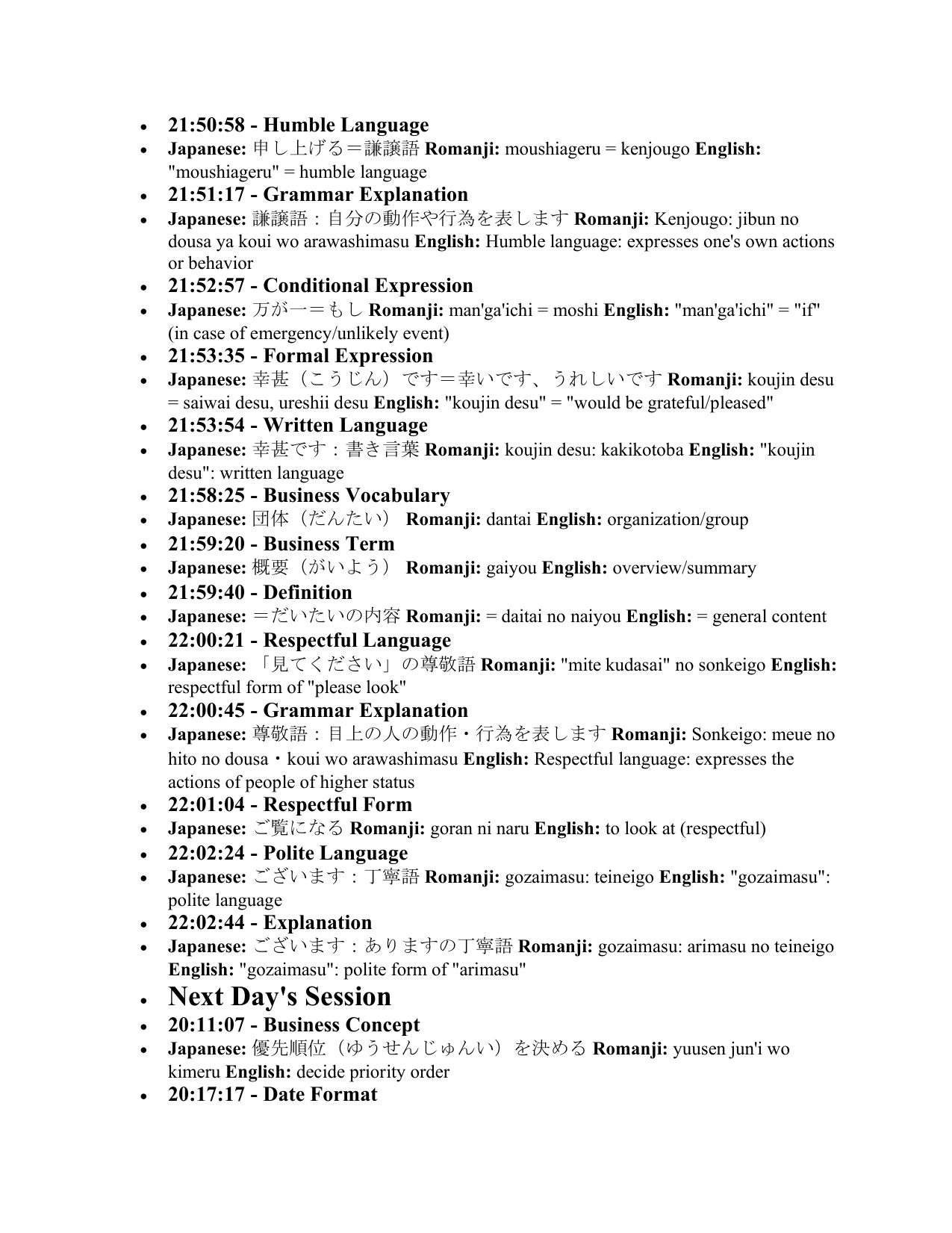
EN• 21:50:58 - Humble Language
• Japanese: 申し上げる=謙譲語 Romanji: moushiageru = kenjougo English:
"moushiageru" = humble language
• 21:51:17 - Grammar Explanation
• Japanese: 謙譲語:自分の動作や行為を表します Romanji: Kenjougo: jibun no
dousa ya koui wo arawashimasu English: Humble language: expresses one's own actions
or behavior
• 21:52:57 - Conditional Expression
• Japanese: 万が一=もし Romanji: man'ga'ichi = moshi English: "man'ga'ichi" = "if"
(in case of emergency/unlikely event)
• 21:53:35 - Formal Expression
• Japanese: 幸甚(こうじん)です=幸いです、うれしいです Romanji: koujin desu
= saiwai desu, ureshii desu English: "koujin desu" = "would be grateful/pleased"
• 21:53:54 - Written Language
• Japanese: 幸甚です:書き言葉 Romanji: koujin desu: kakikotoba English: "koujin
desu": written language
• 21:58:25 - Business Vocabulary
• Japanese: 団体(だんたい) Romanji: dantai English: organization/group
• 21:59:20 - Business Term
• Japanese: 概要(がいよう) Romanji: gaiyou English: overview/summary
• 21:59:40 - Definition
• Japanese: =だいたいの内容 Romanji: = daitai no naiyou English: = general content
• 22:00:21 - Respectful Language
• Japanese: 「見てください」の尊敬語 Romanji: "mite kudasai" no sonkeigo English:
respectful form of "please look"
• 22:00:45 - Grammar Explanation
• Japanese: 尊敬語:目上の人の動作・行為を表します Romanji: Sonkeigo: meue no
hito no dousa・koui wo arawashimasu English: Respectful language: expresses the
actions of people of higher status
• 22:01:04 - Respectful Form
• Japanese: ご覧になる Romanji: goran ni naru English: to look at (respectful)
• 22:02:24 - Polite Language
• Japanese: ございます:丁寧語 Romanji: gozaimasu: teineigo English: "gozaimasu":
polite language
• 22:02:44 - Explanation
• Japanese: ございます:ありますの丁寧語 Romanji: gozaimasu: arimasu no teineigo
English: "gozaimasu": polite form of "arimasu"
• Next Day's Session
• 20:11:07 - Business Concept
• Japanese: 優先順位(ゆうせんじゅんい)を決める Romanji: yuusen jun'i wo
kimeru English: decide priority order
• 20:17:17 - Date Format
• Japanese: 申し上げる=謙譲語 Romanji: moushiageru = kenjougo English:
"moushiageru" = humble language
• 21:51:17 - Grammar Explanation
• Japanese: 謙譲語:自分の動作や行為を表します Romanji: Kenjougo: jibun no
dousa ya koui wo arawashimasu English: Humble language: expresses one's own actions
or behavior
• 21:52:57 - Conditional Expression
• Japanese: 万が一=もし Romanji: man'ga'ichi = moshi English: "man'ga'ichi" = "if"
(in case of emergency/unlikely event)
• 21:53:35 - Formal Expression
• Japanese: 幸甚(こうじん)です=幸いです、うれしいです Romanji: koujin desu
= saiwai desu, ureshii desu English: "koujin desu" = "would be grateful/pleased"
• 21:53:54 - Written Language
• Japanese: 幸甚です:書き言葉 Romanji: koujin desu: kakikotoba English: "koujin
desu": written language
• 21:58:25 - Business Vocabulary
• Japanese: 団体(だんたい) Romanji: dantai English: organization/group
• 21:59:20 - Business Term
• Japanese: 概要(がいよう) Romanji: gaiyou English: overview/summary
• 21:59:40 - Definition
• Japanese: =だいたいの内容 Romanji: = daitai no naiyou English: = general content
• 22:00:21 - Respectful Language
• Japanese: 「見てください」の尊敬語 Romanji: "mite kudasai" no sonkeigo English:
respectful form of "please look"
• 22:00:45 - Grammar Explanation
• Japanese: 尊敬語:目上の人の動作・行為を表します Romanji: Sonkeigo: meue no
hito no dousa・koui wo arawashimasu English: Respectful language: expresses the
actions of people of higher status
• 22:01:04 - Respectful Form
• Japanese: ご覧になる Romanji: goran ni naru English: to look at (respectful)
• 22:02:24 - Polite Language
• Japanese: ございます:丁寧語 Romanji: gozaimasu: teineigo English: "gozaimasu":
polite language
• 22:02:44 - Explanation
• Japanese: ございます:ありますの丁寧語 Romanji: gozaimasu: arimasu no teineigo
English: "gozaimasu": polite form of "arimasu"
• Next Day's Session
• 20:11:07 - Business Concept
• Japanese: 優先順位(ゆうせんじゅんい)を決める Romanji: yuusen jun'i wo
kimeru English: decide priority order
• 20:17:17 - Date Format
หน้า 9
คลิกเพื่อขยาย
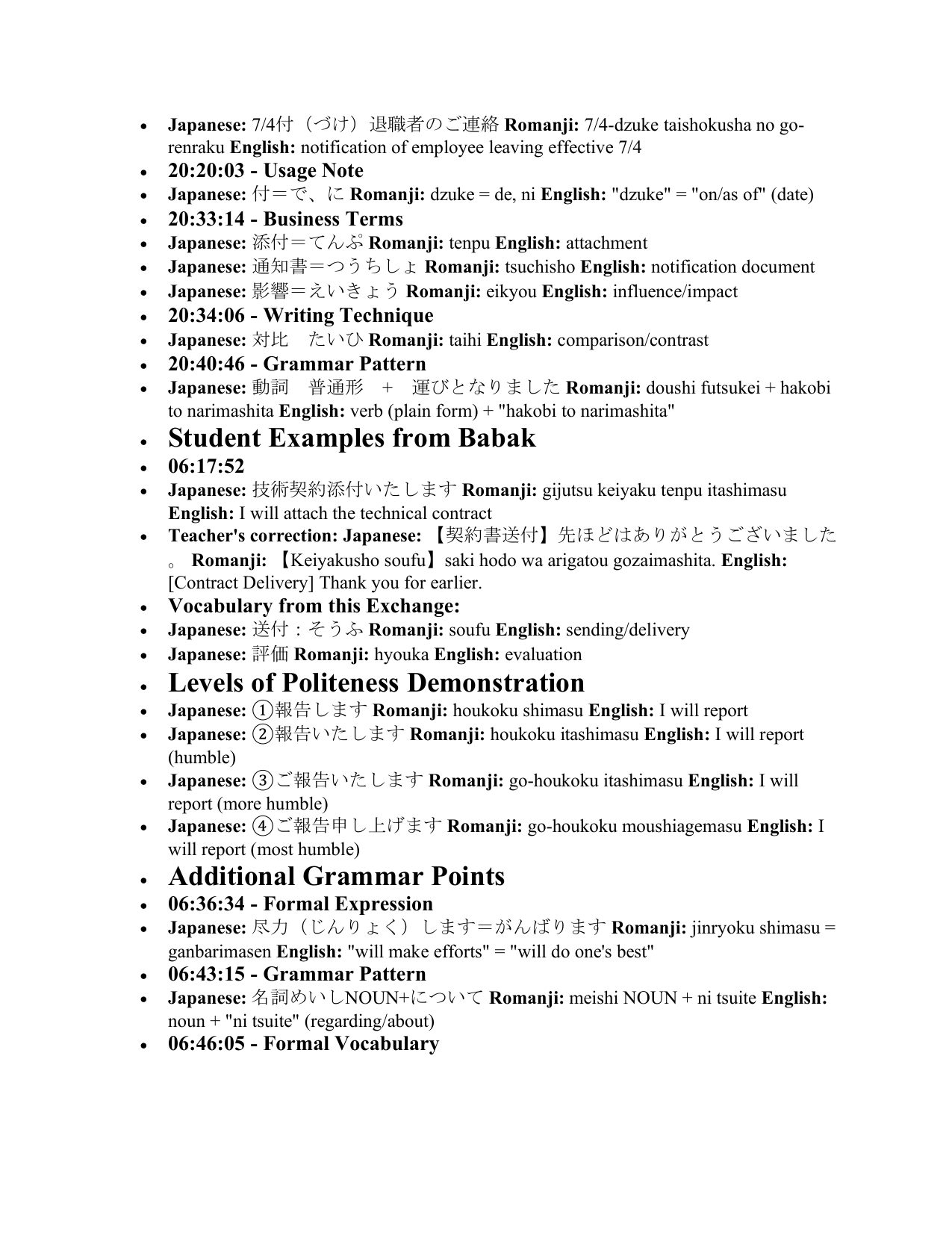
EN• Japanese: 7/4付(づけ)退職者のご連絡 Romanji: 7/4-dzuke taishokusha no go-
renraku English: notification of employee leaving effective 7/4
• 20:20:03 - Usage Note
• Japanese: 付=で、に Romanji: dzuke = de, ni English: "dzuke" = "on/as of" (date)
• 20:33:14 - Business Terms
• Japanese: 添付=てんぷ Romanji: tenpu English: attachment
• Japanese: 通知書=つうちしょ Romanji: tsuchisho English: notification document
• Japanese: 影響=えいきょう Romanji: eikyou English: influence/impact
• 20:34:06 - Writing Technique
• Japanese: 対比 たいひ Romanji: taihi English: comparison/contrast
• 20:40:46 - Grammar Pattern
• Japanese: 動詞 普通形 + 運びとなりました Romanji: doushi futsukei + hakobi
to narimashita English: verb (plain form) + "hakobi to narimashita"
• Student Examples from Babak
• 06:17:52
• Japanese: 技術契約添付いたします Romanji: gijutsu keiyaku tenpu itashimasu
English: I will attach the technical contract
• Teacher's correction: Japanese: 【契約書送付】先ほどはありがとうございました
。 Romanji: 【Keiyakusho soufu】saki hodo wa arigatou gozaimashita. English:
[Contract Delivery] Thank you for earlier.
• Vocabulary from this Exchange:
• Japanese: 送付:そうふ Romanji: soufu English: sending/delivery
• Japanese: 評価 Romanji: hyouka English: evaluation
• Levels of Politeness Demonstration
• Japanese: ①報告します Romanji: houkoku shimasu English: I will report
• Japanese: ②報告いたします Romanji: houkoku itashimasu English: I will report
(humble)
• Japanese: ③ご報告いたします Romanji: go-houkoku itashimasu English: I will
report (more humble)
• Japanese: ④ご報告申し上げます Romanji: go-houkoku moushiagemasu English: I
will report (most humble)
• Additional Grammar Points
• 06:36:34 - Formal Expression
• Japanese: 尽力(じんりょく)します=がんばります Romanji: jinryoku shimasu =
ganbarimasen English: "will make efforts" = "will do one's best"
• 06:43:15 - Grammar Pattern
• Japanese: 名詞めいしNOUN+について Romanji: meishi NOUN + ni tsuite English:
noun + "ni tsuite" (regarding/about)
• 06:46:05 - Formal Vocabulary
renraku English: notification of employee leaving effective 7/4
• 20:20:03 - Usage Note
• Japanese: 付=で、に Romanji: dzuke = de, ni English: "dzuke" = "on/as of" (date)
• 20:33:14 - Business Terms
• Japanese: 添付=てんぷ Romanji: tenpu English: attachment
• Japanese: 通知書=つうちしょ Romanji: tsuchisho English: notification document
• Japanese: 影響=えいきょう Romanji: eikyou English: influence/impact
• 20:34:06 - Writing Technique
• Japanese: 対比 たいひ Romanji: taihi English: comparison/contrast
• 20:40:46 - Grammar Pattern
• Japanese: 動詞 普通形 + 運びとなりました Romanji: doushi futsukei + hakobi
to narimashita English: verb (plain form) + "hakobi to narimashita"
• Student Examples from Babak
• 06:17:52
• Japanese: 技術契約添付いたします Romanji: gijutsu keiyaku tenpu itashimasu
English: I will attach the technical contract
• Teacher's correction: Japanese: 【契約書送付】先ほどはありがとうございました
。 Romanji: 【Keiyakusho soufu】saki hodo wa arigatou gozaimashita. English:
[Contract Delivery] Thank you for earlier.
• Vocabulary from this Exchange:
• Japanese: 送付:そうふ Romanji: soufu English: sending/delivery
• Japanese: 評価 Romanji: hyouka English: evaluation
• Levels of Politeness Demonstration
• Japanese: ①報告します Romanji: houkoku shimasu English: I will report
• Japanese: ②報告いたします Romanji: houkoku itashimasu English: I will report
(humble)
• Japanese: ③ご報告いたします Romanji: go-houkoku itashimasu English: I will
report (more humble)
• Japanese: ④ご報告申し上げます Romanji: go-houkoku moushiagemasu English: I
will report (most humble)
• Additional Grammar Points
• 06:36:34 - Formal Expression
• Japanese: 尽力(じんりょく)します=がんばります Romanji: jinryoku shimasu =
ganbarimasen English: "will make efforts" = "will do one's best"
• 06:43:15 - Grammar Pattern
• Japanese: 名詞めいしNOUN+について Romanji: meishi NOUN + ni tsuite English:
noun + "ni tsuite" (regarding/about)
• 06:46:05 - Formal Vocabulary
หน้า 10
คลิกเพื่อขยาย
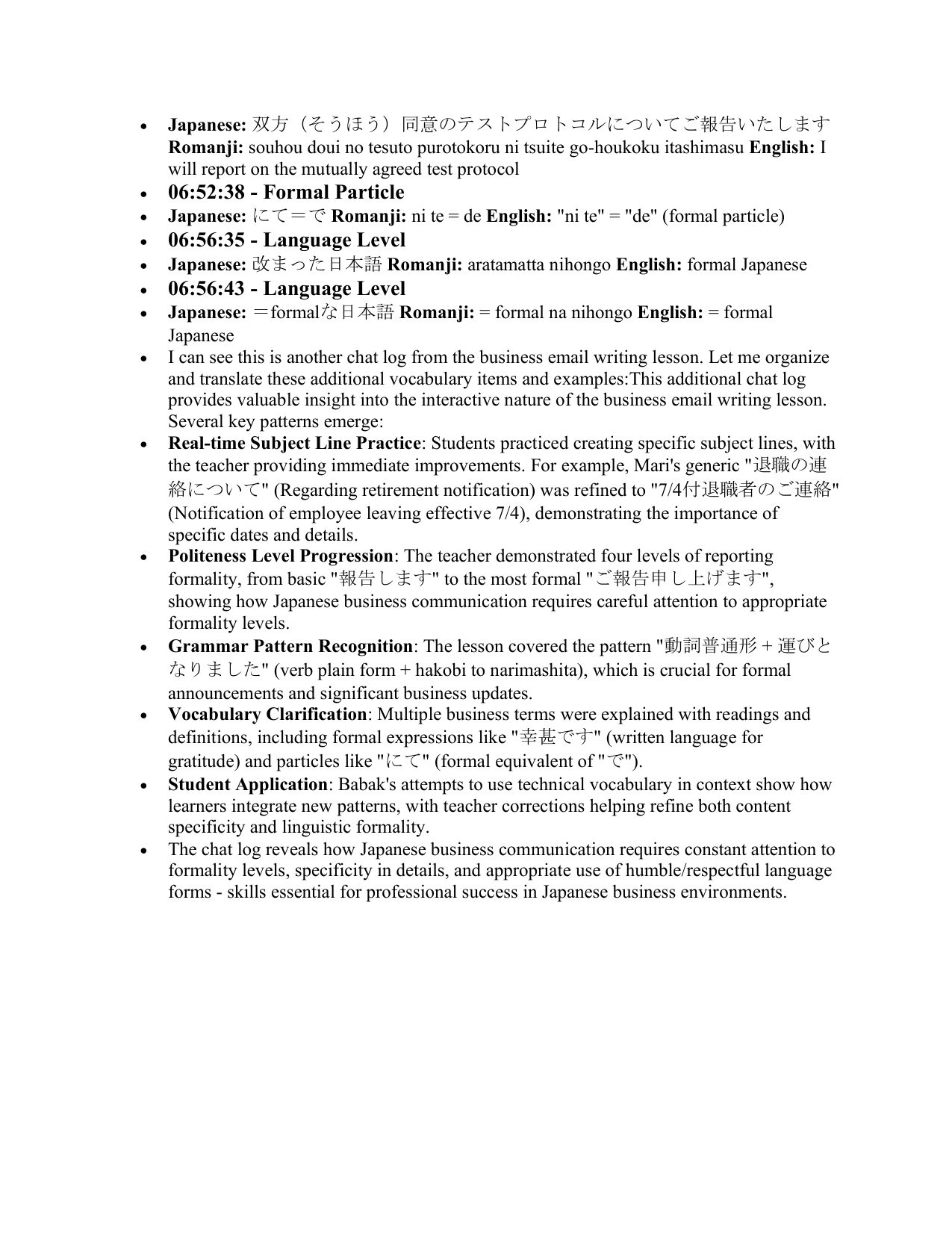
JP•Japanese:双方(そうほう)同意のテストプロトコルについてご報告いたします
EN Romanji: souhou doui no tesuto purotokoru ni tsuite go-houkoku itashimasu English: I
will report on the mutually agreed test protocol
• 06:52:38 - Formal Particle
• Japanese: にて=で Romanji: ni te = de English: "ni te" = "de" (formal particle)
• 06:56:35 - Language Level
• Japanese: 改まった日本語 Romanji: aratamatta nihongo English: formal Japanese
• 06:56:43 - Language Level
• Japanese: =formalな日本語 Romanji: = formal na nihongo English: = formal
Japanese
• I can see this is another chat log from the business email writing lesson. Let me organize
and translate these additional vocabulary items and examples:This additional chat log
provides valuable insight into the interactive nature of the business email writing lesson.
Several key patterns emerge:
• Real-time Subject Line Practice: Students practiced creating specific subject lines, with
the teacher providing immediate improvements. For example, Mari's generic "退職の連
絡について" (Regarding retirement notification) was refined to "7/4付退職者のご連絡"
(Notification of employee leaving effective 7/4), demonstrating the importance of
specific dates and details.
• Politeness Level Progression: The teacher demonstrated four levels of reporting
formality, from basic "報告します" to the most formal "ご報告申し上げます",
showing how Japanese business communication requires careful attention to appropriate
formality levels.
• Grammar Pattern Recognition: The lesson covered the pattern "動詞普通形 + 運びと
なりました" (verb plain form + hakobi to narimashita), which is crucial for formal
announcements and significant business updates.
• Vocabulary Clarification: Multiple business terms were explained with readings and
definitions, including formal expressions like "幸甚です" (written language for
gratitude) and particles like "にて" (formal equivalent of "で").
• Student Application: Babak's attempts to use technical vocabulary in context show how
learners integrate new patterns, with teacher corrections helping refine both content
specificity and linguistic formality.
• The chat log reveals how Japanese business communication requires constant attention to
formality levels, specificity in details, and appropriate use of humble/respectful language
forms - skills essential for professional success in Japanese business environments.
will report on the mutually agreed test protocol
• 06:52:38 - Formal Particle
• Japanese: にて=で Romanji: ni te = de English: "ni te" = "de" (formal particle)
• 06:56:35 - Language Level
• Japanese: 改まった日本語 Romanji: aratamatta nihongo English: formal Japanese
• 06:56:43 - Language Level
• Japanese: =formalな日本語 Romanji: = formal na nihongo English: = formal
Japanese
• I can see this is another chat log from the business email writing lesson. Let me organize
and translate these additional vocabulary items and examples:This additional chat log
provides valuable insight into the interactive nature of the business email writing lesson.
Several key patterns emerge:
• Real-time Subject Line Practice: Students practiced creating specific subject lines, with
the teacher providing immediate improvements. For example, Mari's generic "退職の連
絡について" (Regarding retirement notification) was refined to "7/4付退職者のご連絡"
(Notification of employee leaving effective 7/4), demonstrating the importance of
specific dates and details.
• Politeness Level Progression: The teacher demonstrated four levels of reporting
formality, from basic "報告します" to the most formal "ご報告申し上げます",
showing how Japanese business communication requires careful attention to appropriate
formality levels.
• Grammar Pattern Recognition: The lesson covered the pattern "動詞普通形 + 運びと
なりました" (verb plain form + hakobi to narimashita), which is crucial for formal
announcements and significant business updates.
• Vocabulary Clarification: Multiple business terms were explained with readings and
definitions, including formal expressions like "幸甚です" (written language for
gratitude) and particles like "にて" (formal equivalent of "で").
• Student Application: Babak's attempts to use technical vocabulary in context show how
learners integrate new patterns, with teacher corrections helping refine both content
specificity and linguistic formality.
• The chat log reveals how Japanese business communication requires constant attention to
formality levels, specificity in details, and appropriate use of humble/respectful language
forms - skills essential for professional success in Japanese business environments.