หน้า 1

คลิกเพื่อขยาย
ENJAPANESE STUDY LIBRARY · VOLUME 1
Grammar & Particles
文法と助詞 — Bunpou to Joshi
Core grammar points, particle contrasts, and N1/N2 advanced patterns for business Japanese
Volume 1 of 9
Grammar & Particles
文法と助詞 — Bunpou to Joshi
Core grammar points, particle contrasts, and N1/N2 advanced patterns for business Japanese
Volume 1 of 9
หน้า 2
คลิกเพื่อขยาย
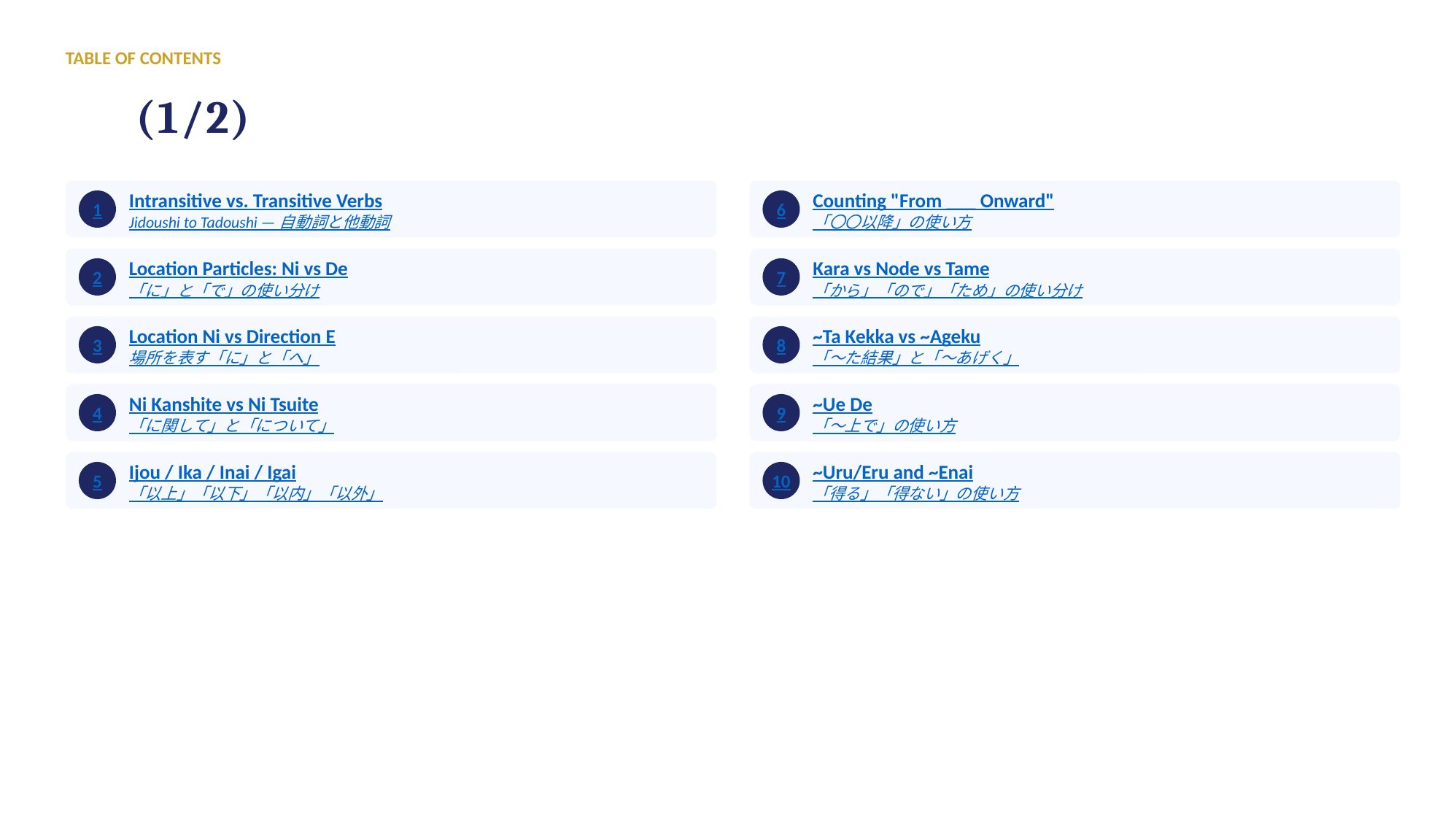
ENTABLE OF CONTENTS
THสารบัญ (1/2)
EN 1 Intransitive vs. Transitive Verbs 6 Counting "From ___ Onward"
Jidoushi to Tadoushi — 自動詞と他動詞 「〇〇以降」の使い方
2 Location Particles: Ni vs De 7 Kara vs Node vs Tame
Jidoushi to Tadoushi — 自動詞と他動詞 「〇〇以降」の使い方
2 Location Particles: Ni vs De 7 Kara vs Node vs Tame
JP「に」と「で」の使い分け「から」「ので」「ため」の使い分け
EN 3 Location Ni vs Direction E 8 ~Ta Kekka vs ~Ageku
JP場所を表す「に」と「へ」「〜た結果」と「〜あげく」
EN 4 Ni Kanshite vs Ni Tsuite 9 ~Ue De
JP「に関して」と「について」「〜上で」の使い方
EN 5 Ijou / Ika / Inai / Igai 10 ~Uru/Eru and ~Enai
JP「以上」「以下」「以内」「以外」「得る」「得ない」の使い方
หน้า 3
คลิกเพื่อขยาย
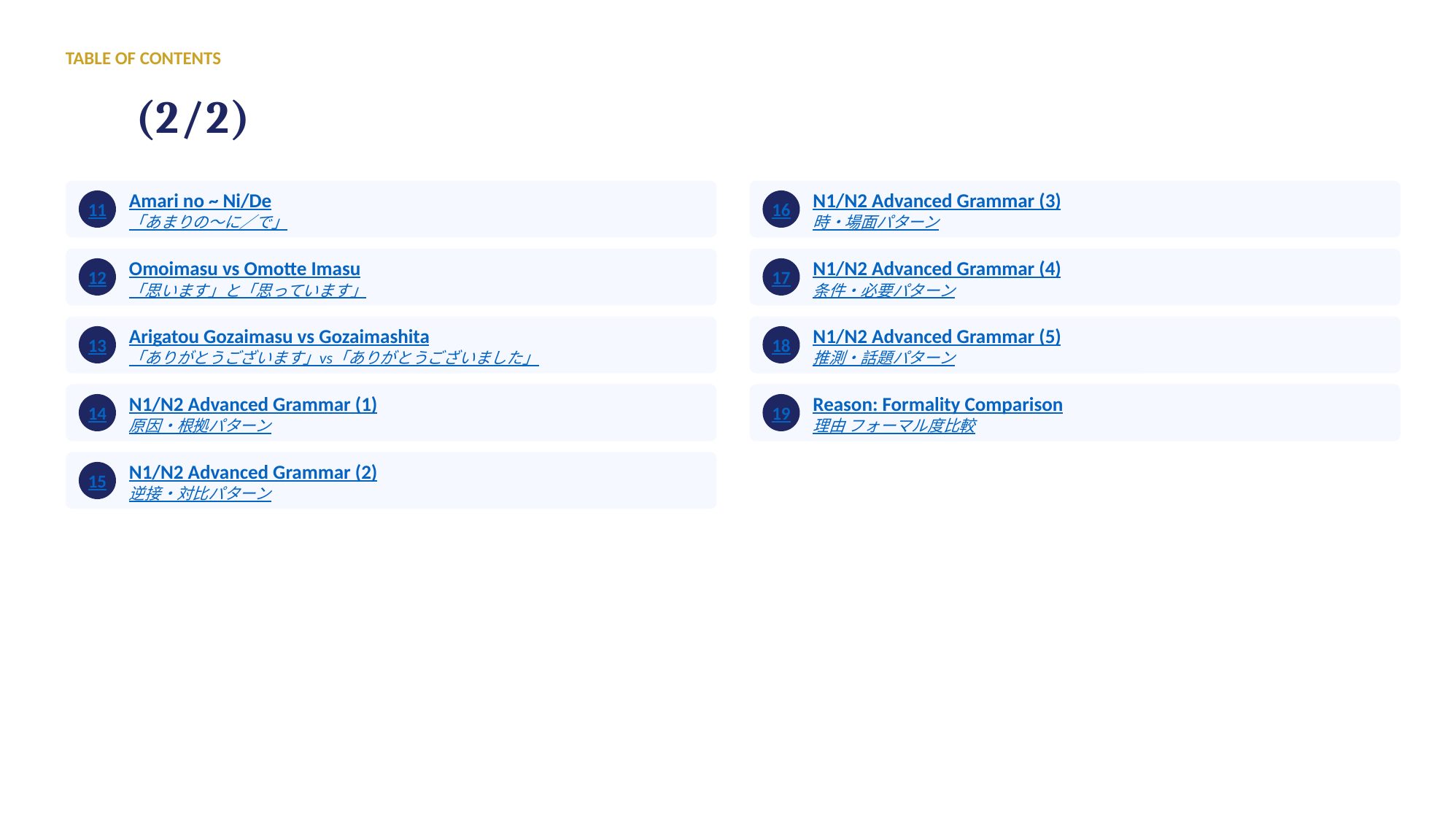
ENTABLE OF CONTENTS
THสารบัญ (2/2)
EN 11 Amari no ~ Ni/De 16 N1/N2 Advanced Grammar (3)
JP「あまりの〜に/で」時・場面パターン
EN 12 Omoimasu vs Omotte Imasu 17 N1/N2 Advanced Grammar (4)
JP「思います」と「思っています」条件・必要パターン
EN 13 Arigatou Gozaimasu vs Gozaimashita 18 N1/N2 Advanced Grammar (5)
JP「ありがとうございます」vs「ありがとうございました」推測・話題パターン
EN 14 N1/N2 Advanced Grammar (1) 19 Reason: Formality Comparison
JP原因・根拠パターン理由フォーマル度比較
EN 15 N1/N2 Advanced Grammar (2)
JP逆接・対比パターン
หน้า 4

คลิกเพื่อขยาย
01
ENIntransitive vs. Transitive Verbs
Jidoushi to Tadoushi — 自動詞と他動詞
30+ verb pairs, plus the core sentence pattern for each
Jidoushi to Tadoushi — 自動詞と他動詞
30+ verb pairs, plus the core sentence pattern for each
หน้า 5
คลิกเพื่อขยาย
ENCORE GRAMMAR
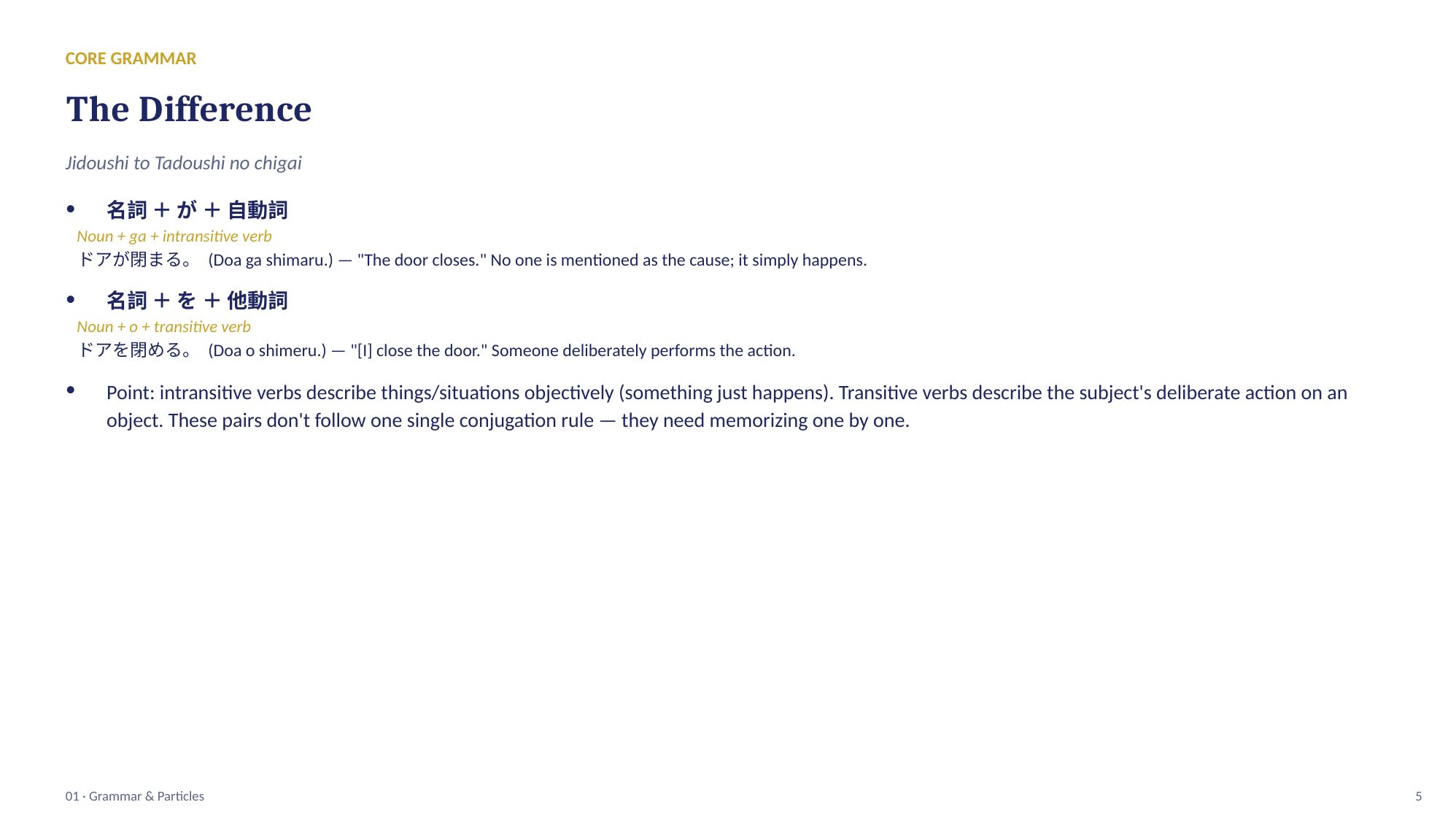
The Difference
Jidoushi to Tadoushi no chigai
The Difference
Jidoushi to Tadoushi no chigai
JP•名詞+が+自動詞
EN Noun + ga + intransitive verb
ドアが閉まる。 (Doa ga shimaru.) — "The door closes." No one is mentioned as the cause; it simply happens.
ドアが閉まる。 (Doa ga shimaru.) — "The door closes." No one is mentioned as the cause; it simply happens.
JP•名詞+を+他動詞
EN Noun + o + transitive verb
ドアを閉める。 (Doa o shimeru.) — "[I] close the door." Someone deliberately performs the action.
• Point: intransitive verbs describe things/situations objectively (something just happens). Transitive verbs describe the subject's deliberate action on an
object. These pairs don't follow one single conjugation rule — they need memorizing one by one.
01 · Grammar & Particles 5
ドアを閉める。 (Doa o shimeru.) — "[I] close the door." Someone deliberately performs the action.
• Point: intransitive verbs describe things/situations objectively (something just happens). Transitive verbs describe the subject's deliberate action on an
object. These pairs don't follow one single conjugation rule — they need memorizing one by one.
01 · Grammar & Particles 5
หน้า 6
คลิกเพื่อขยาย
ENVOCABULARY 1/5
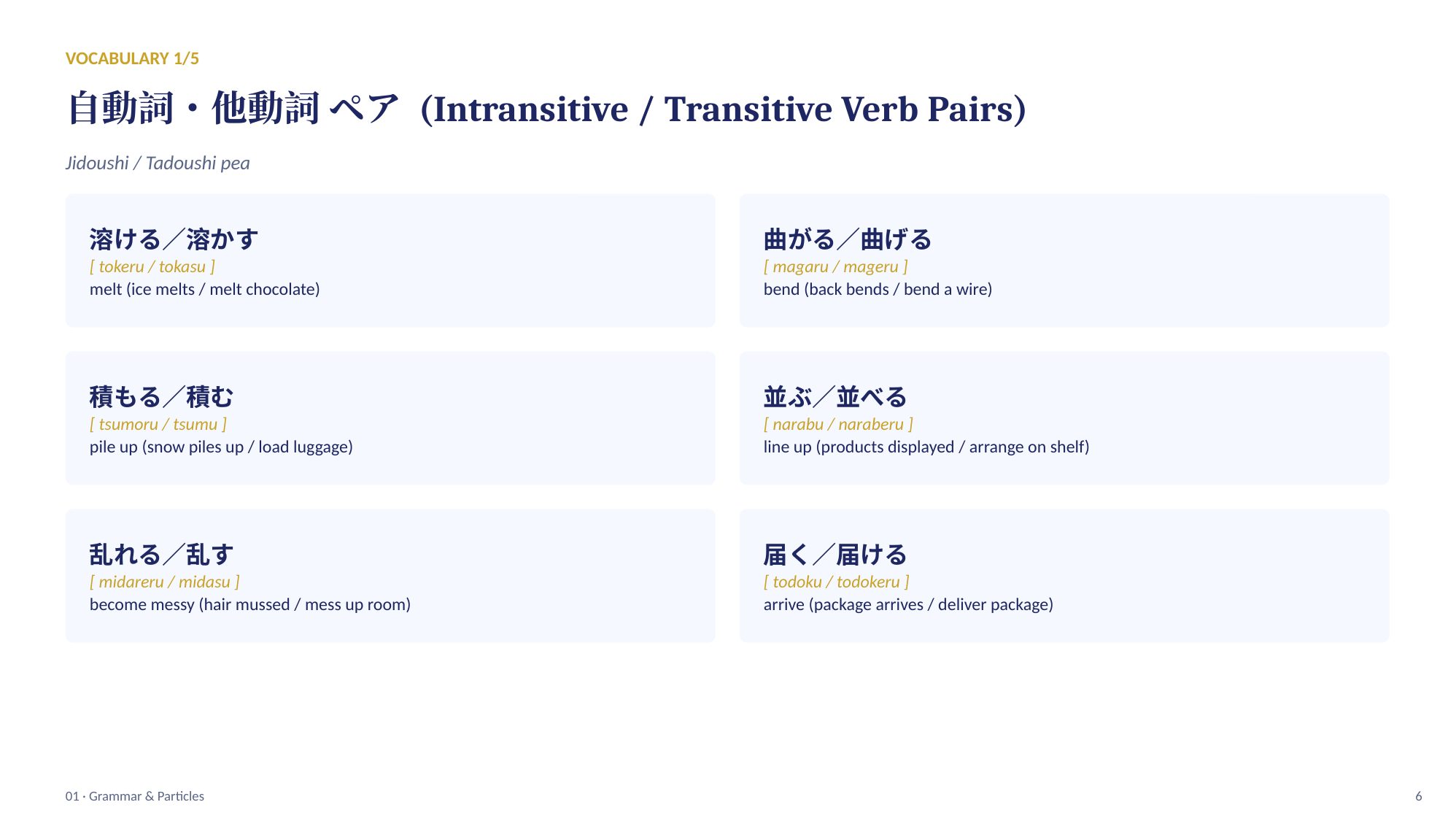
自動詞・他動詞 ペア (Intransitive / Transitive Verb Pairs)
Jidoushi / Tadoushi pea
自動詞・他動詞 ペア (Intransitive / Transitive Verb Pairs)
Jidoushi / Tadoushi pea
JP溶ける/溶かす曲がる/曲げる
EN [ tokeru / tokasu ] [ magaru / mageru ]
melt (ice melts / melt chocolate) bend (back bends / bend a wire)
melt (ice melts / melt chocolate) bend (back bends / bend a wire)
JP積もる/積む並ぶ/並べる
EN [ tsumoru / tsumu ] [ narabu / naraberu ]
pile up (snow piles up / load luggage) line up (products displayed / arrange on shelf)
pile up (snow piles up / load luggage) line up (products displayed / arrange on shelf)
JP乱れる/乱す届く/届ける
EN [ midareru / midasu ] [ todoku / todokeru ]
become messy (hair mussed / mess up room) arrive (package arrives / deliver package)
01 · Grammar & Particles 6
become messy (hair mussed / mess up room) arrive (package arrives / deliver package)
01 · Grammar & Particles 6
หน้า 7
คลิกเพื่อขยาย
ENVOCABULARY 2/5
自動詞・他動詞 ペア (Intransitive / Transitive Verb Pairs)
Jidoushi / Tadoushi pea
自動詞・他動詞 ペア (Intransitive / Transitive Verb Pairs)
Jidoushi / Tadoushi pea
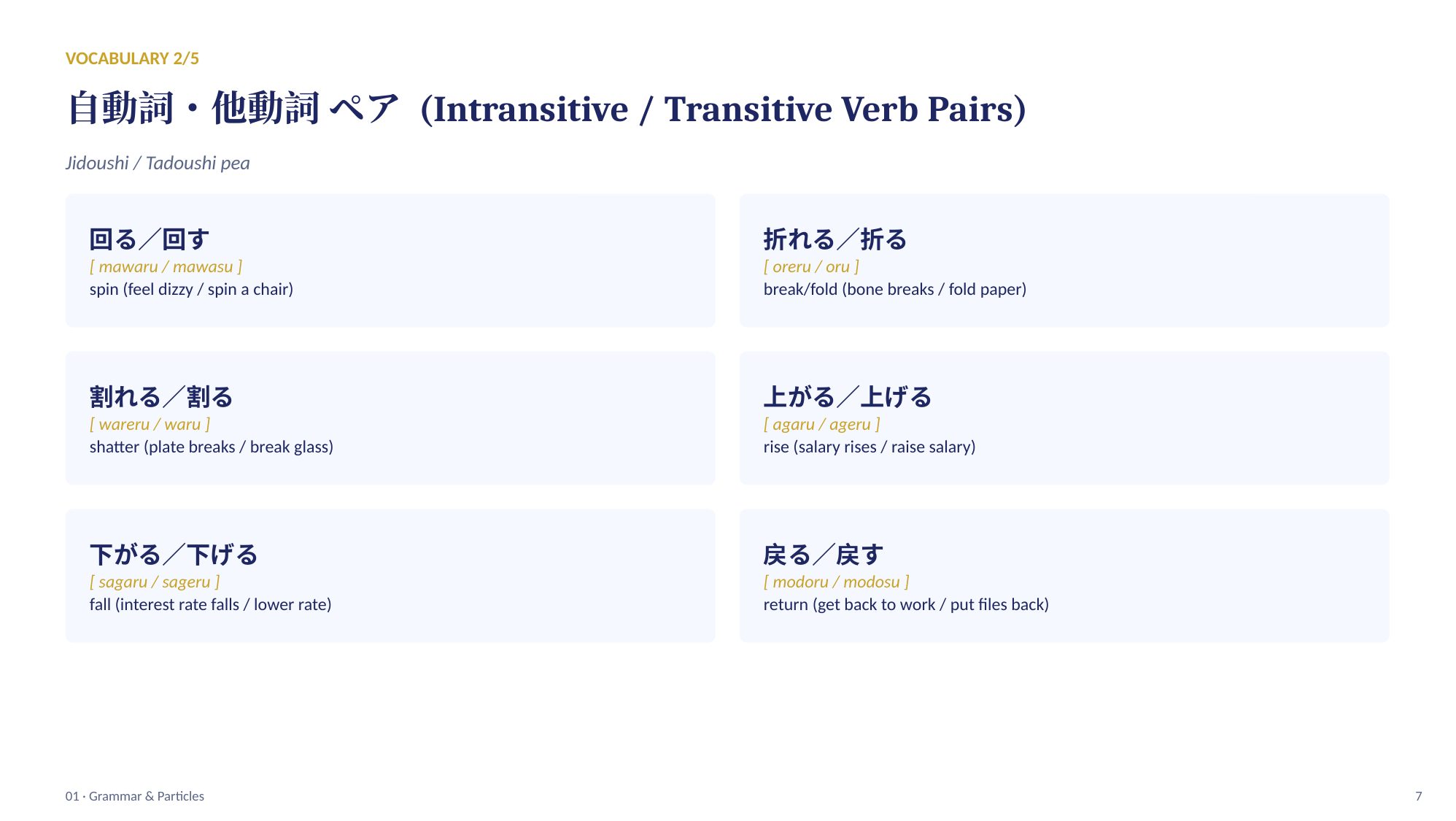
JP回る/回す折れる/折る
EN [ mawaru / mawasu ] [ oreru / oru ]
spin (feel dizzy / spin a chair) break/fold (bone breaks / fold paper)
spin (feel dizzy / spin a chair) break/fold (bone breaks / fold paper)
JP割れる/割る上がる/上げる
EN [ wareru / waru ] [ agaru / ageru ]
shatter (plate breaks / break glass) rise (salary rises / raise salary)
shatter (plate breaks / break glass) rise (salary rises / raise salary)
JP下がる/下げる戻る/戻す
EN [ sagaru / sageru ] [ modoru / modosu ]
fall (interest rate falls / lower rate) return (get back to work / put files back)
01 · Grammar & Particles 7
fall (interest rate falls / lower rate) return (get back to work / put files back)
01 · Grammar & Particles 7
หน้า 8
คลิกเพื่อขยาย
ENVOCABULARY 3/5
自動詞・他動詞 ペア (Intransitive / Transitive Verb Pairs)
Jidoushi / Tadoushi pea
自動詞・他動詞 ペア (Intransitive / Transitive Verb Pairs)
Jidoushi / Tadoushi pea
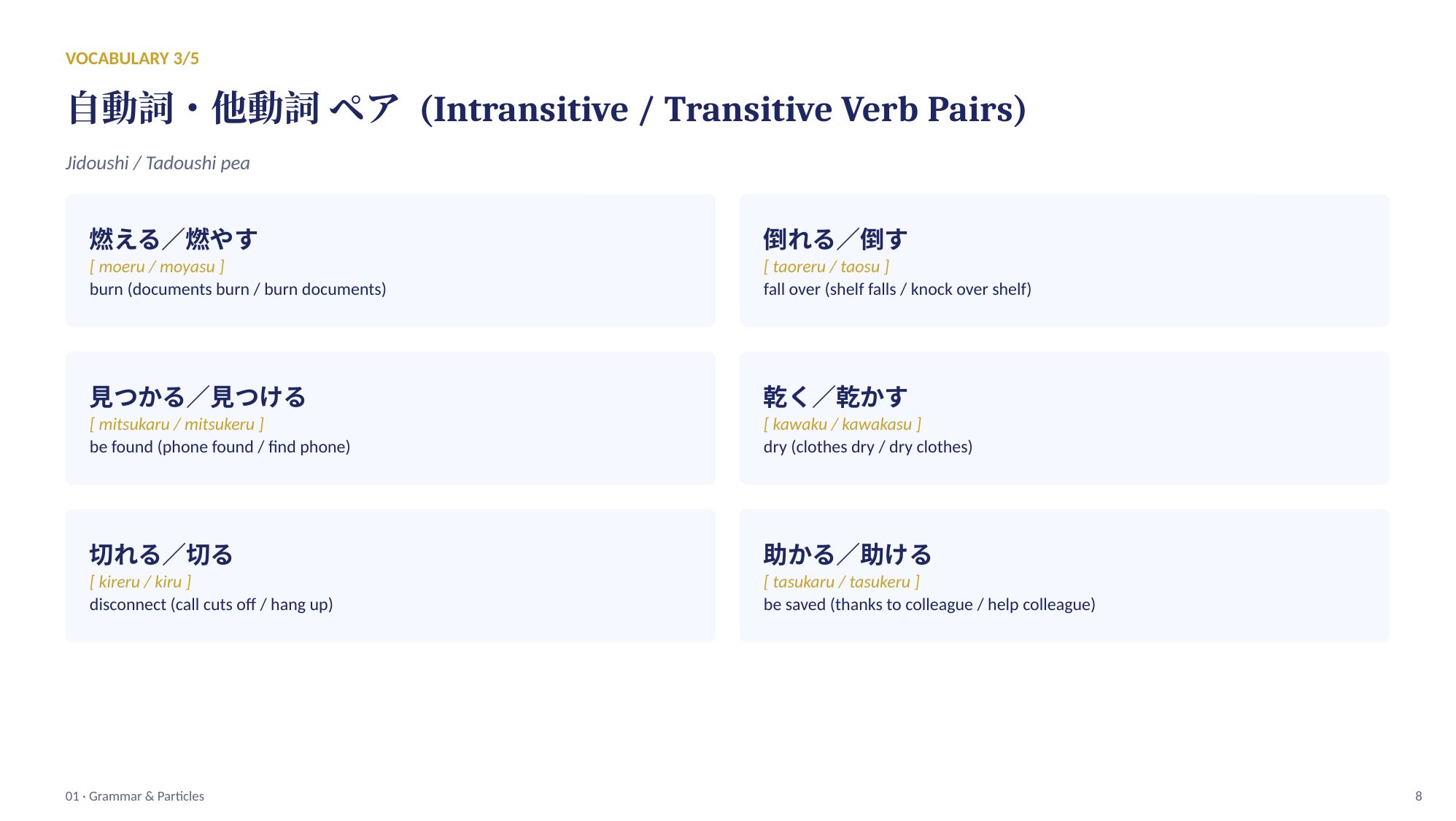
JP燃える/燃やす倒れる/倒す
EN [ moeru / moyasu ] [ taoreru / taosu ]
burn (documents burn / burn documents) fall over (shelf falls / knock over shelf)
burn (documents burn / burn documents) fall over (shelf falls / knock over shelf)
JP見つかる/見つける乾く/乾かす
EN [ mitsukaru / mitsukeru ] [ kawaku / kawakasu ]
be found (phone found / find phone) dry (clothes dry / dry clothes)
be found (phone found / find phone) dry (clothes dry / dry clothes)
JP切れる/切る助かる/助ける
EN [ kireru / kiru ] [ tasukaru / tasukeru ]
disconnect (call cuts off / hang up) be saved (thanks to colleague / help colleague)
01 · Grammar & Particles 8
disconnect (call cuts off / hang up) be saved (thanks to colleague / help colleague)
01 · Grammar & Particles 8
หน้า 9
คลิกเพื่อขยาย
ENVOCABULARY 4/5
自動詞・他動詞 ペア (Intransitive / Transitive Verb Pairs)
Jidoushi / Tadoushi pea
自動詞・他動詞 ペア (Intransitive / Transitive Verb Pairs)
Jidoushi / Tadoushi pea
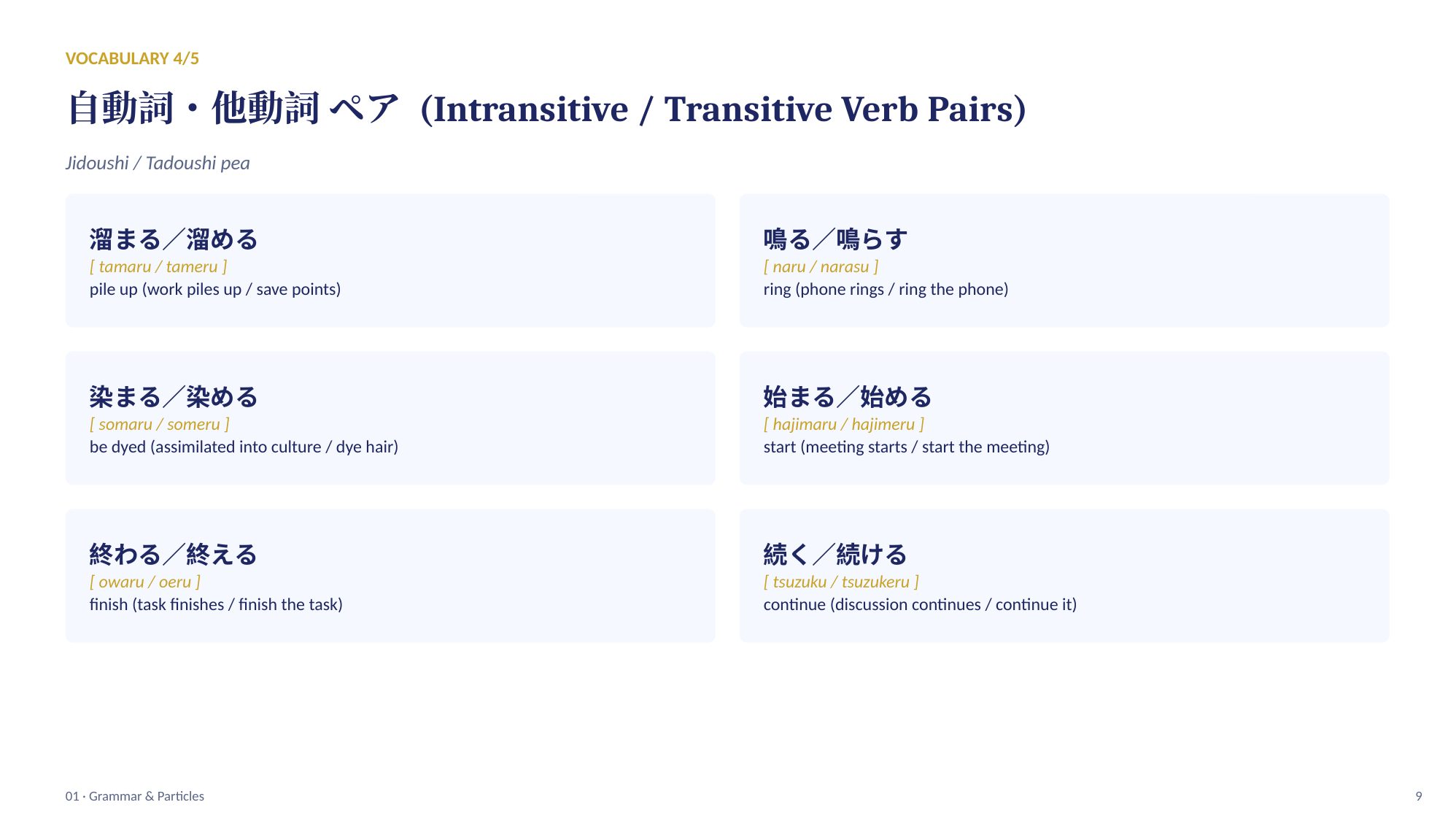
JP溜まる/溜める鳴る/鳴らす
EN [ tamaru / tameru ] [ naru / narasu ]
pile up (work piles up / save points) ring (phone rings / ring the phone)
pile up (work piles up / save points) ring (phone rings / ring the phone)
JP染まる/染める始まる/始める
EN [ somaru / someru ] [ hajimaru / hajimeru ]
be dyed (assimilated into culture / dye hair) start (meeting starts / start the meeting)
be dyed (assimilated into culture / dye hair) start (meeting starts / start the meeting)
JP終わる/終える続く/続ける
EN [ owaru / oeru ] [ tsuzuku / tsuzukeru ]
finish (task finishes / finish the task) continue (discussion continues / continue it)
01 · Grammar & Particles 9
finish (task finishes / finish the task) continue (discussion continues / continue it)
01 · Grammar & Particles 9
หน้า 10
คลิกเพื่อขยาย
ENVOCABULARY 5/5
自動詞・他動詞 ペア (Intransitive / Transitive Verb Pairs)
Jidoushi / Tadoushi pea
自動詞・他動詞 ペア (Intransitive / Transitive Verb Pairs)
Jidoushi / Tadoushi pea
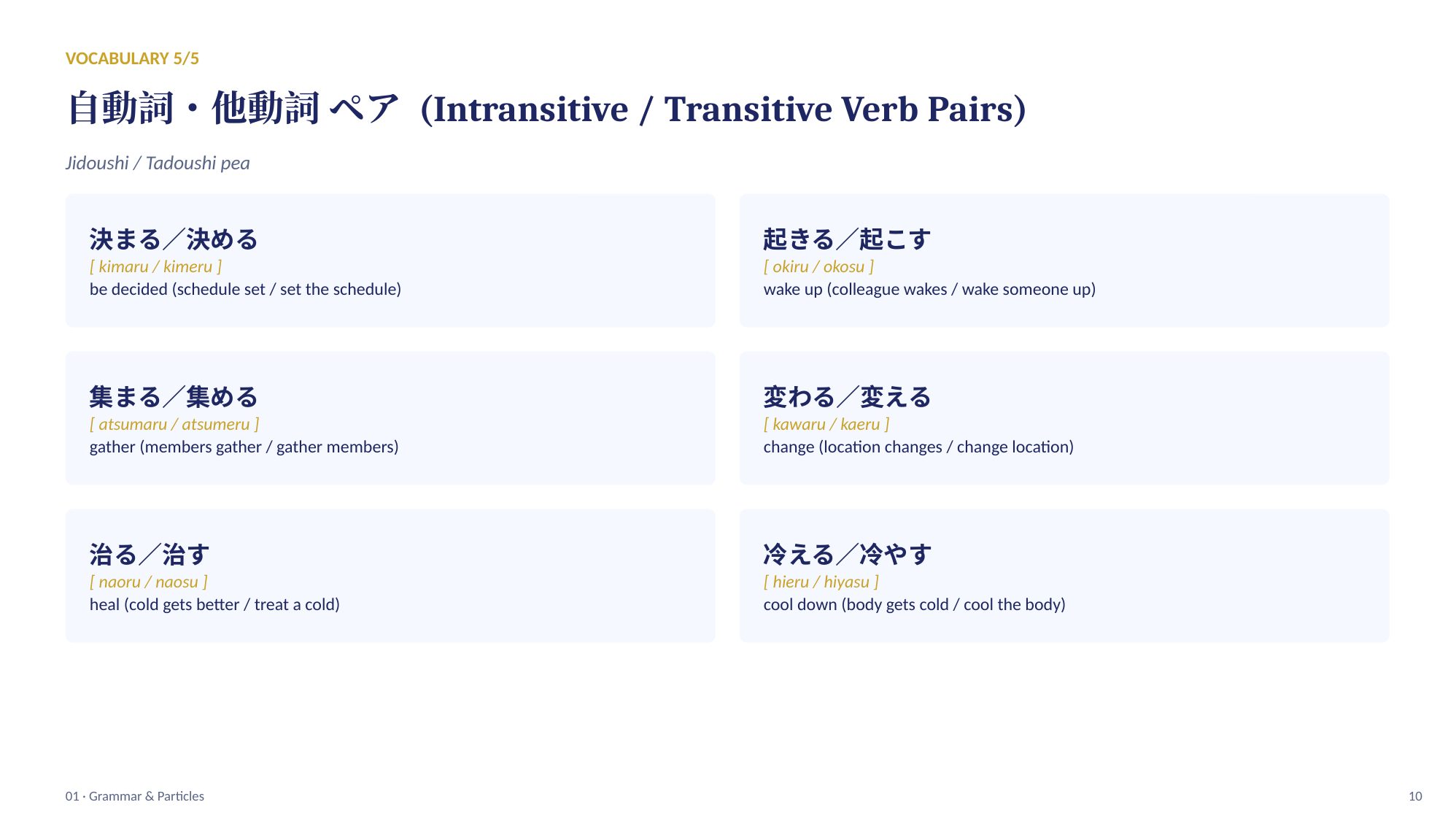
JP決まる/決める起きる/起こす
EN [ kimaru / kimeru ] [ okiru / okosu ]
be decided (schedule set / set the schedule) wake up (colleague wakes / wake someone up)
be decided (schedule set / set the schedule) wake up (colleague wakes / wake someone up)
JP集まる/集める変わる/変える
EN [ atsumaru / atsumeru ] [ kawaru / kaeru ]
gather (members gather / gather members) change (location changes / change location)
gather (members gather / gather members) change (location changes / change location)
JP治る/治す冷える/冷やす
EN [ naoru / naosu ] [ hieru / hiyasu ]
heal (cold gets better / treat a cold) cool down (body gets cold / cool the body)
01 · Grammar & Particles 10
heal (cold gets better / treat a cold) cool down (body gets cold / cool the body)
01 · Grammar & Particles 10
หน้า 11
คลิกเพื่อขยาย
ENSUMMARY
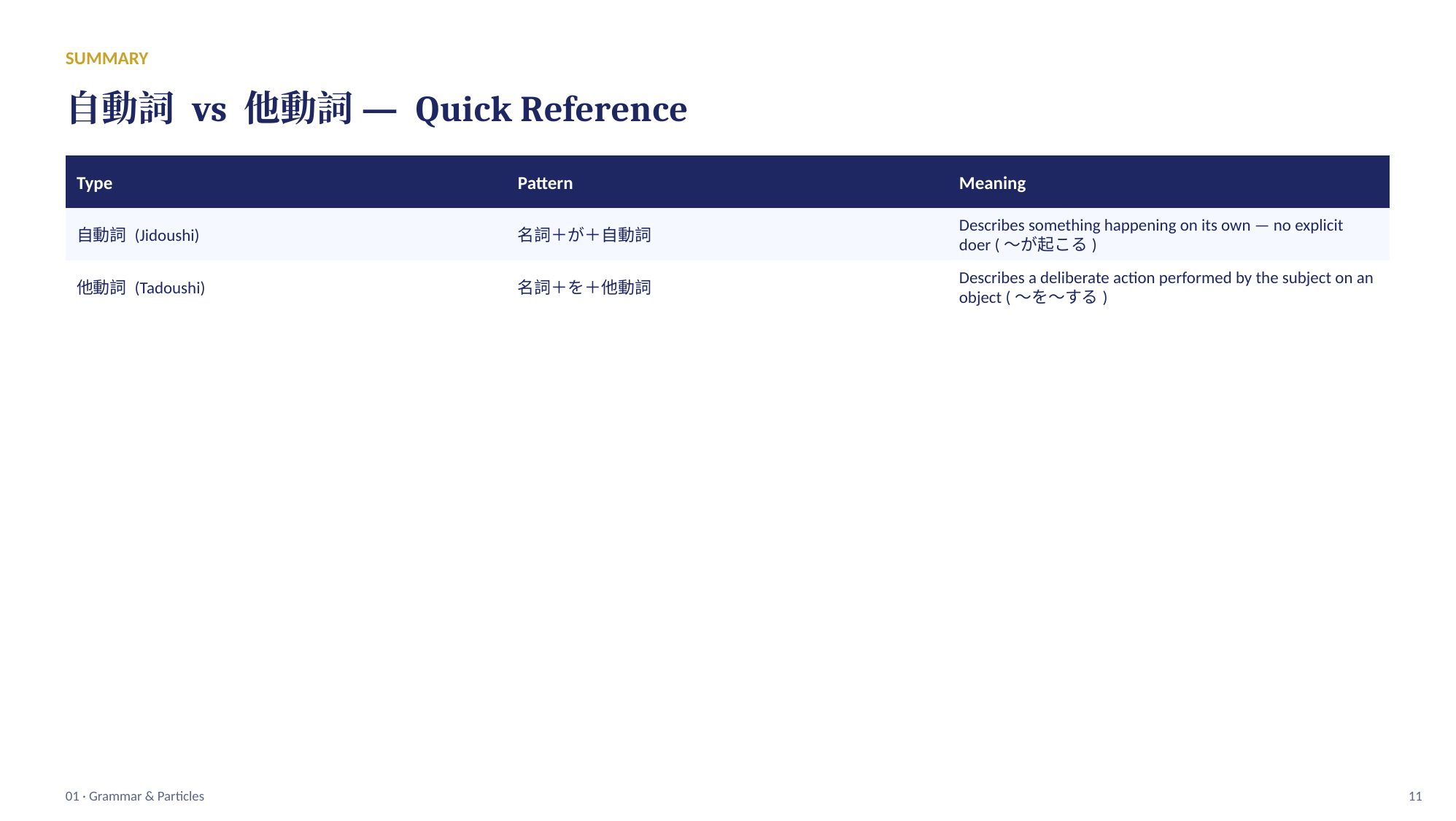
自動詞 vs 他動詞 — Quick Reference
Type Pattern Meaning
Describes something happening on its own — no explicit
自動詞 vs 他動詞 — Quick Reference
Type Pattern Meaning
Describes something happening on its own — no explicit
JP自動詞(Jidoushi)名詞+が+自動詞
doer(〜が起こる)
doer(〜が起こる)
EN Describes a deliberate action performed by the subject on an
JP他動詞(Tadoushi)名詞+を+他動詞
EN object ( 〜を〜する )
01 · Grammar & Particles 11
01 · Grammar & Particles 11
หน้า 12
คลิกเพื่อขยาย
02
ENLocation Particles: Ni vs De
JP「に」と「で」の使い分け
ENExistence / Destination ( に ) vs Place of Action ( で )
หน้า 13
คลิกเพื่อขยาย
ENOVERVIEW
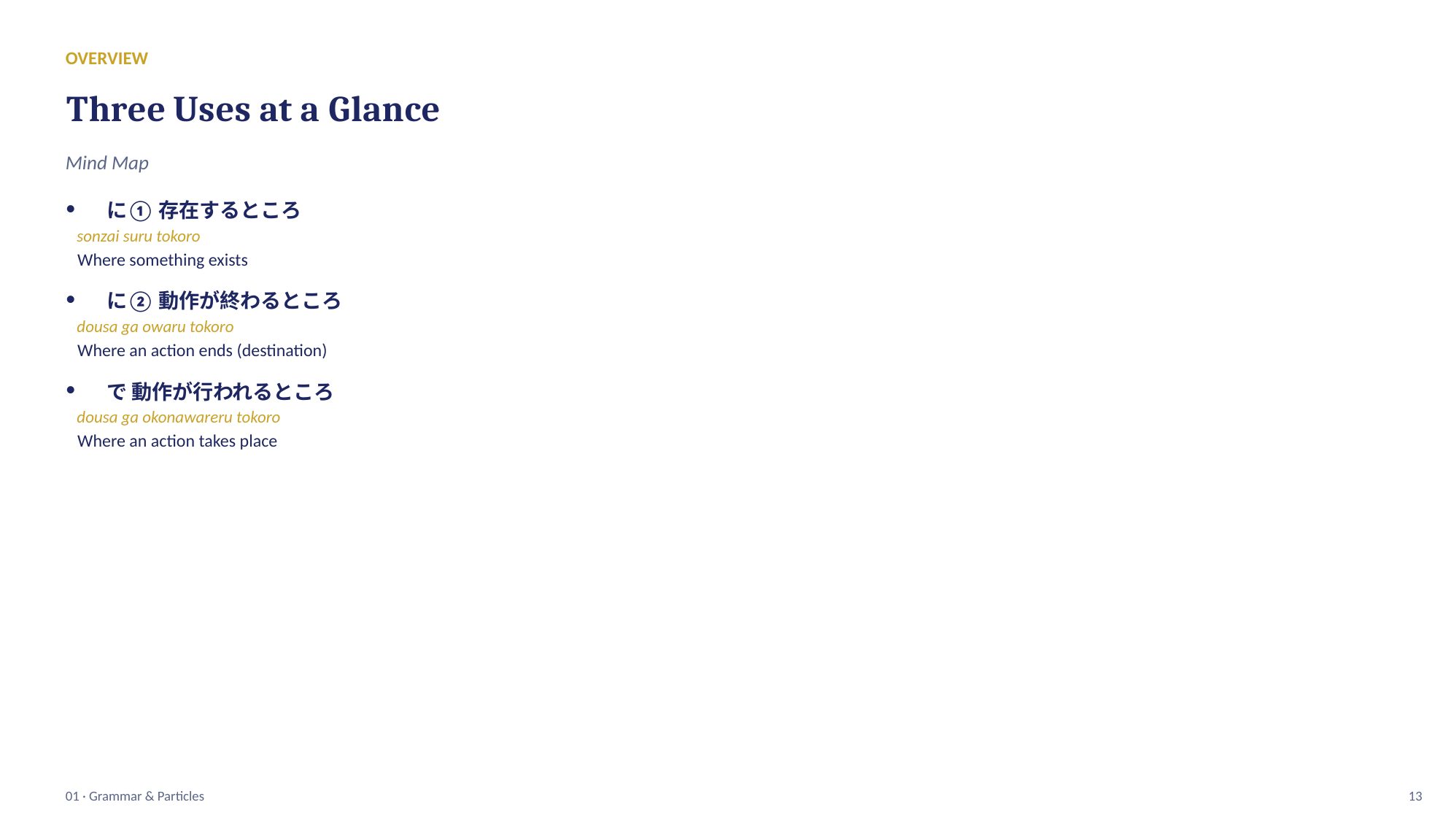
Three Uses at a Glance
Mind Map
Three Uses at a Glance
Mind Map
JP•に①存在するところ
EN sonzai suru tokoro
Where something exists
Where something exists
JP•に②動作が終わるところ
EN dousa ga owaru tokoro
Where an action ends (destination)
Where an action ends (destination)
JP•で動作が行われるところ
EN dousa ga okonawareru tokoro
Where an action takes place
01 · Grammar & Particles 13
Where an action takes place
01 · Grammar & Particles 13
หน้า 14
คลิกเพื่อขยาย
ENに① EXISTENCE
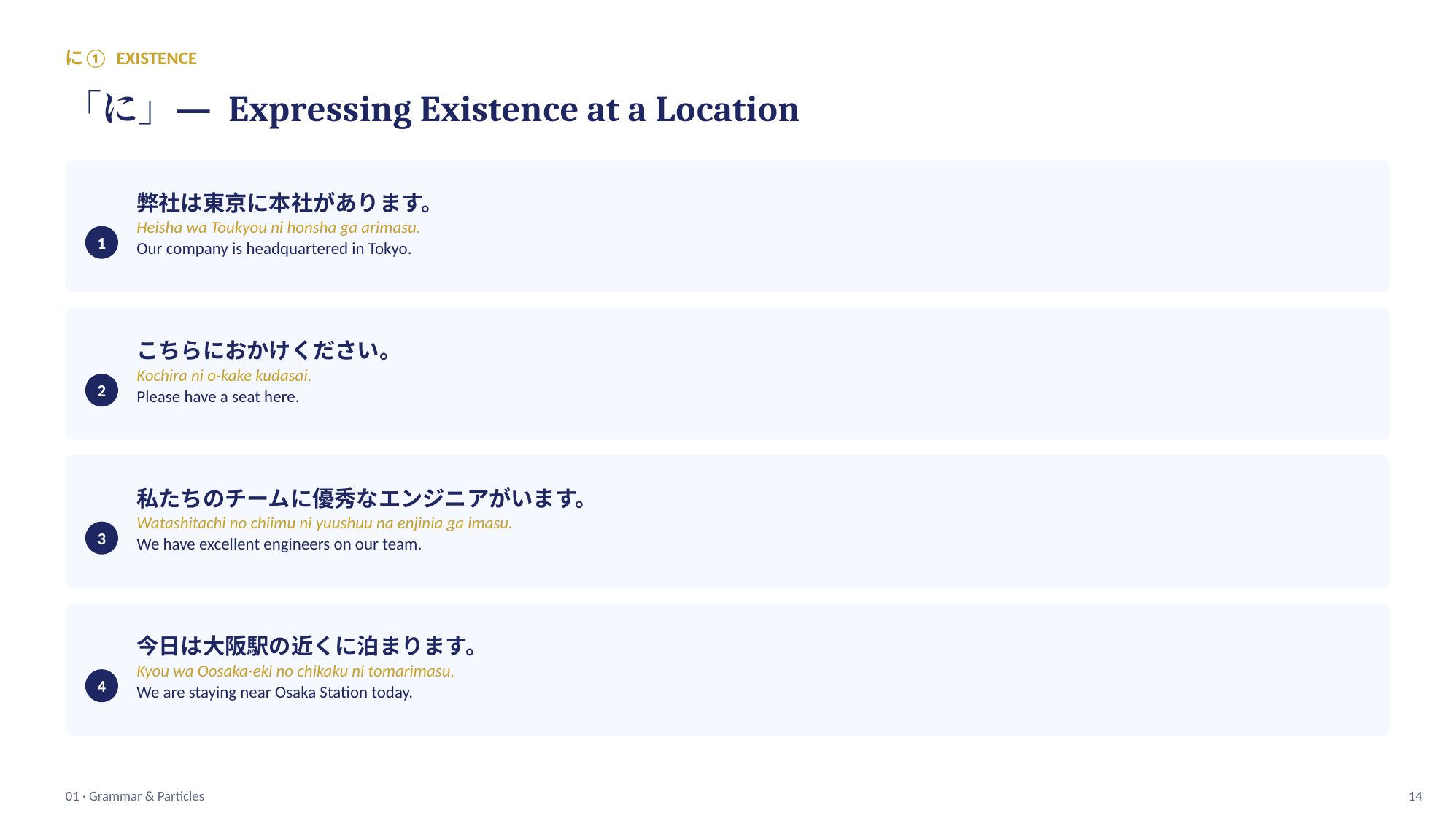
「に」— Expressing Existence at a Location
「に」— Expressing Existence at a Location
JP弊社は東京に本社があります。
EN Heisha wa Toukyou ni honsha ga arimasu.
1 Our company is headquartered in Tokyo.
1 Our company is headquartered in Tokyo.
JPこちらにおかけください。
EN Kochira ni o-kake kudasai.
2 Please have a seat here.
2 Please have a seat here.
JP私たちのチームに優秀なエンジニアがいます。
EN Watashitachi no chiimu ni yuushuu na enjinia ga imasu.
3 We have excellent engineers on our team.
3 We have excellent engineers on our team.
JP今日は大阪駅の近くに泊まります。
EN Kyou wa Oosaka-eki no chikaku ni tomarimasu.
4 We are staying near Osaka Station today.
01 · Grammar & Particles 14
4 We are staying near Osaka Station today.
01 · Grammar & Particles 14
หน้า 15
คลิกเพื่อขยาย
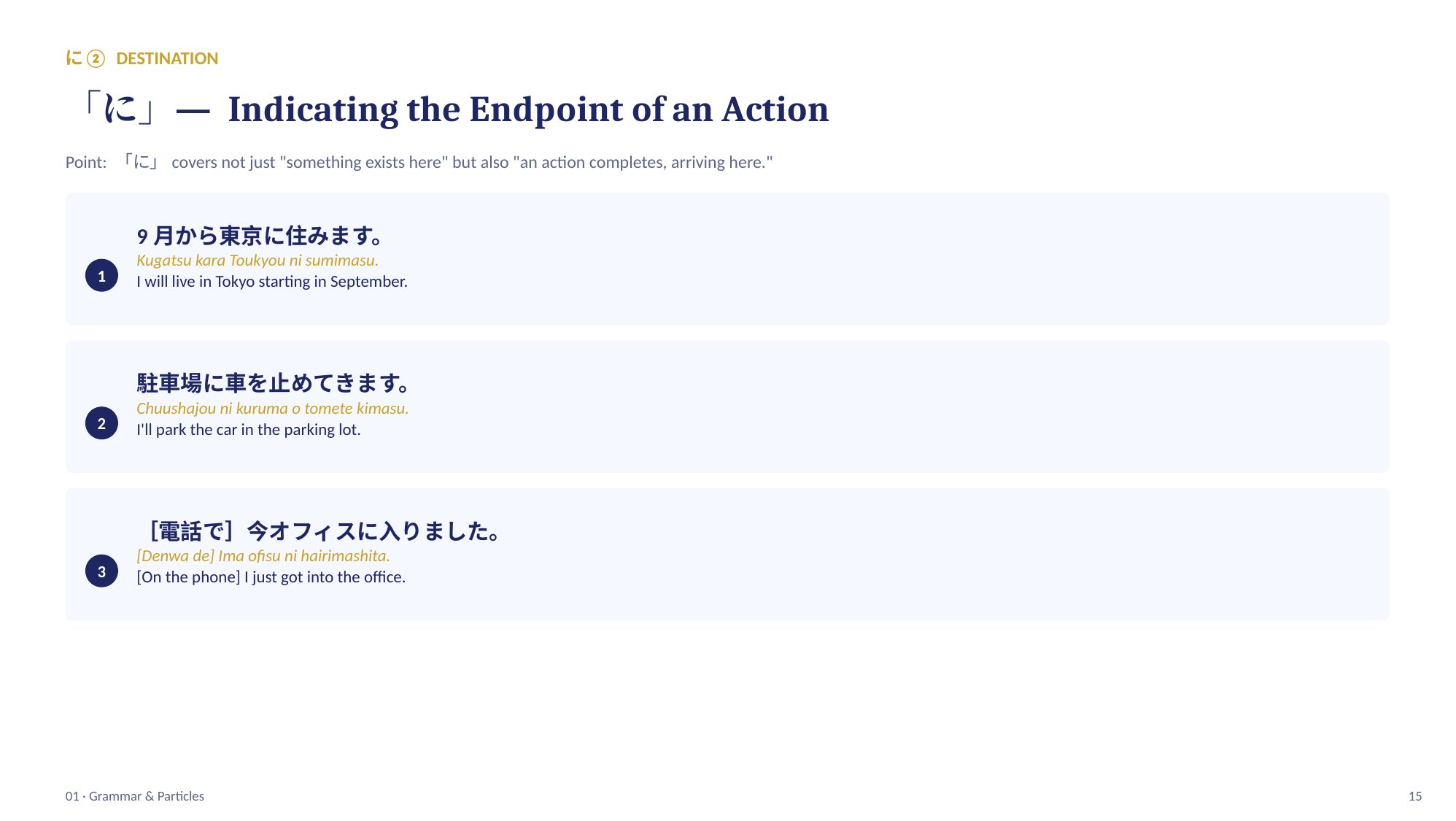
ENに② DESTINATION
「に」— Indicating the Endpoint of an Action
Point: 「に」 covers not just "something exists here" but also "an action completes, arriving here."
「に」— Indicating the Endpoint of an Action
Point: 「に」 covers not just "something exists here" but also "an action completes, arriving here."
JP9月から東京に住みます。
EN Kugatsu kara Toukyou ni sumimasu.
1 I will live in Tokyo starting in September.
1 I will live in Tokyo starting in September.
JP駐車場に車を止めてきます。
EN Chuushajou ni kuruma o tomete kimasu.
2 I'll park the car in the parking lot.
2 I'll park the car in the parking lot.
JP[電話で]今オフィスに入りました。
EN [Denwa de] Ima ofisu ni hairimashita.
3 [On the phone] I just got into the office.
01 · Grammar & Particles 15
3 [On the phone] I just got into the office.
01 · Grammar & Particles 15
หน้า 16
คลิกเพื่อขยาย
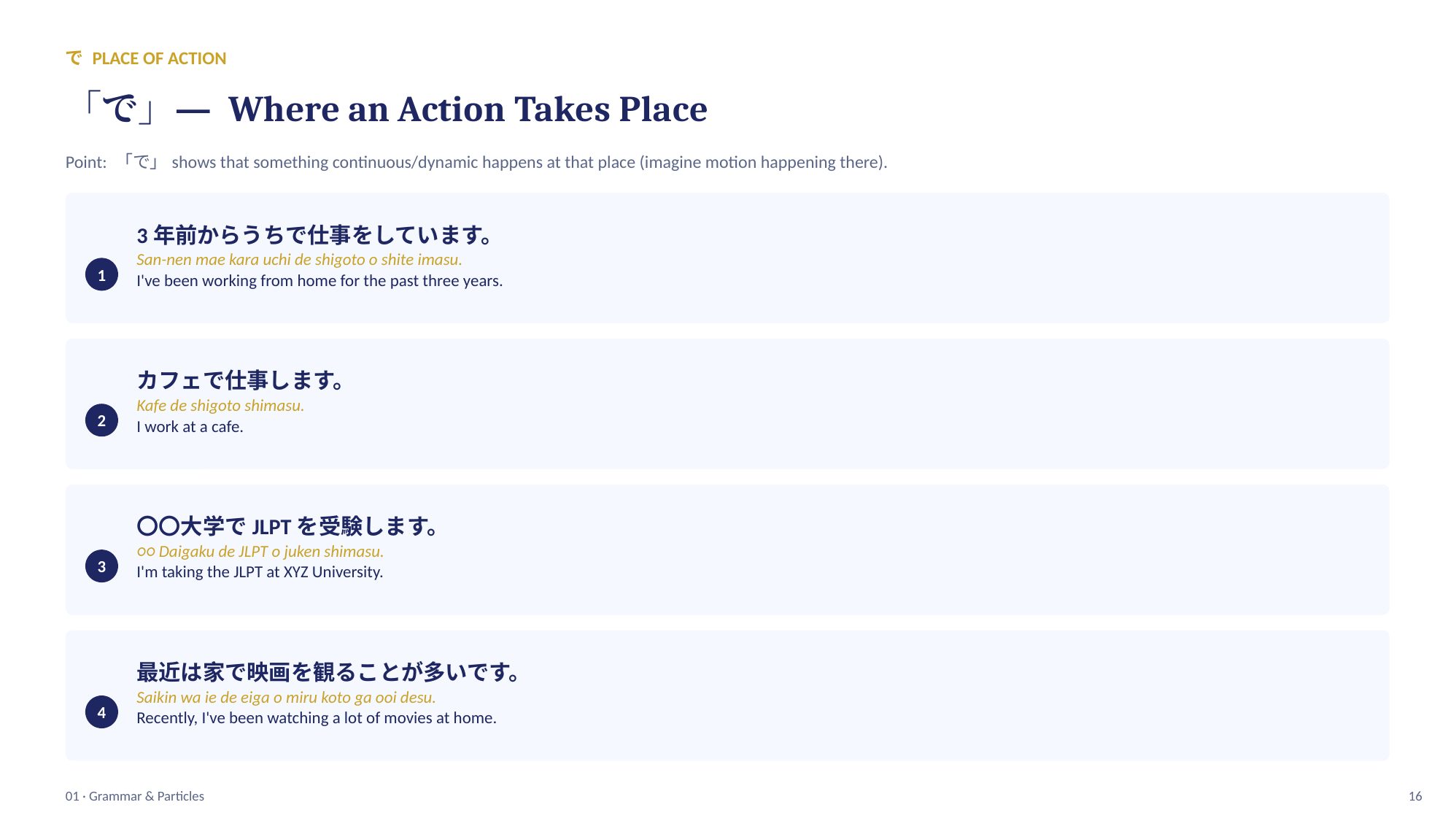
ENで PLACE OF ACTION
「で」— Where an Action Takes Place
Point: 「で」 shows that something continuous/dynamic happens at that place (imagine motion happening there).
「で」— Where an Action Takes Place
Point: 「で」 shows that something continuous/dynamic happens at that place (imagine motion happening there).
JP3年前からうちで仕事をしています。
EN San-nen mae kara uchi de shigoto o shite imasu.
1 I've been working from home for the past three years.
1 I've been working from home for the past three years.
JPカフェで仕事します。
EN Kafe de shigoto shimasu.
2 I work at a cafe.
2 I work at a cafe.
JP〇〇大学でJLPTを受験します。
EN ○○ Daigaku de JLPT o juken shimasu.
3 I'm taking the JLPT at XYZ University.
3 I'm taking the JLPT at XYZ University.
JP最近は家で映画を観ることが多いです。
EN Saikin wa ie de eiga o miru koto ga ooi desu.
4 Recently, I've been watching a lot of movies at home.
01 · Grammar & Particles 16
4 Recently, I've been watching a lot of movies at home.
01 · Grammar & Particles 16
หน้า 17
คลิกเพื่อขยาย
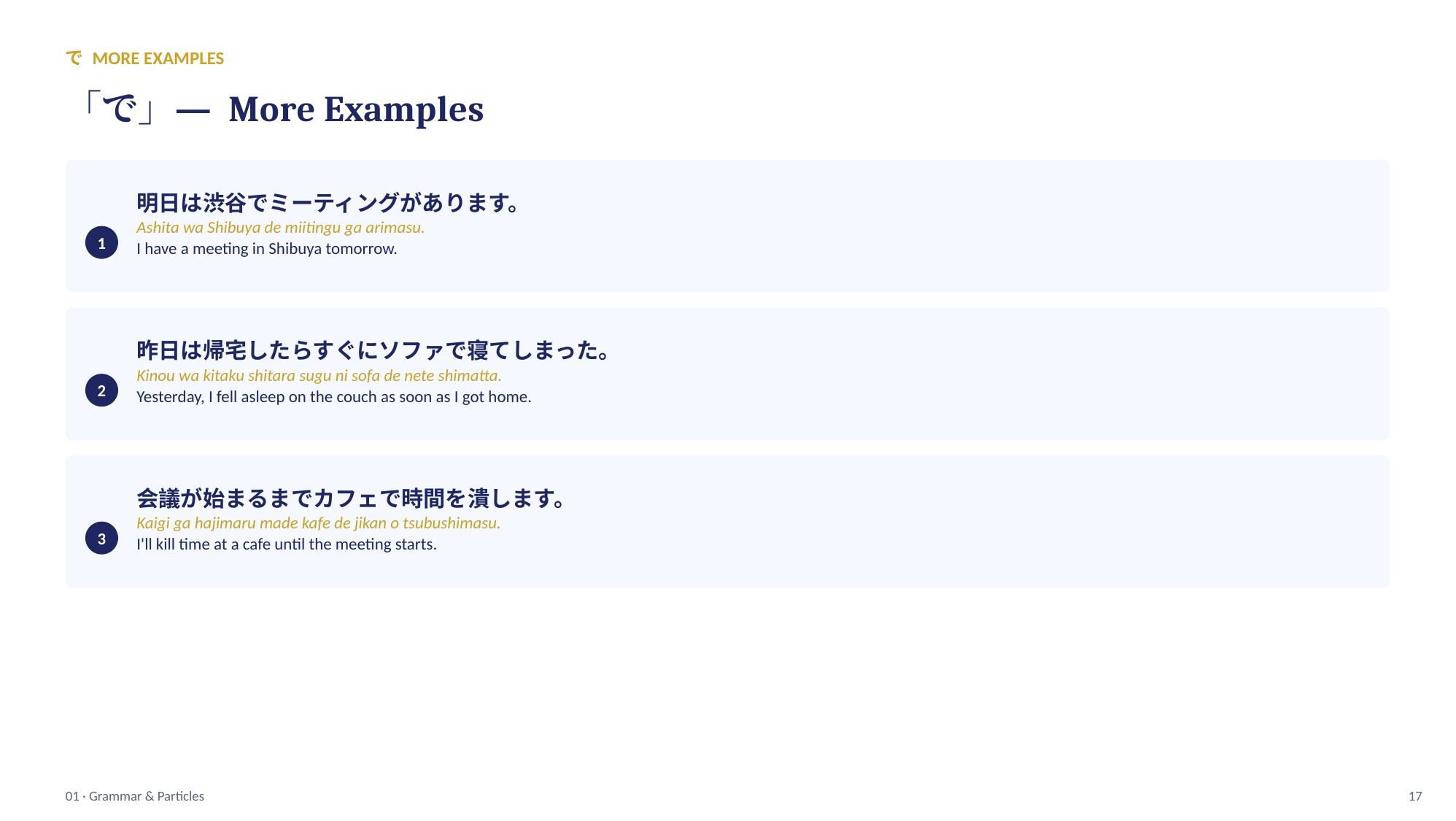
ENで MORE EXAMPLES
「で」— More Examples
「で」— More Examples
JP明日は渋谷でミーティングがあります。
EN Ashita wa Shibuya de miitingu ga arimasu.
1 I have a meeting in Shibuya tomorrow.
1 I have a meeting in Shibuya tomorrow.
JP昨日は帰宅したらすぐにソファで寝てしまった。
EN Kinou wa kitaku shitara sugu ni sofa de nete shimatta.
2 Yesterday, I fell asleep on the couch as soon as I got home.
2 Yesterday, I fell asleep on the couch as soon as I got home.
JP会議が始まるまでカフェで時間を潰します。
EN Kaigi ga hajimaru made kafe de jikan o tsubushimasu.
3 I'll kill time at a cafe until the meeting starts.
01 · Grammar & Particles 17
3 I'll kill time at a cafe until the meeting starts.
01 · Grammar & Particles 17
หน้า 18
คลิกเพื่อขยาย
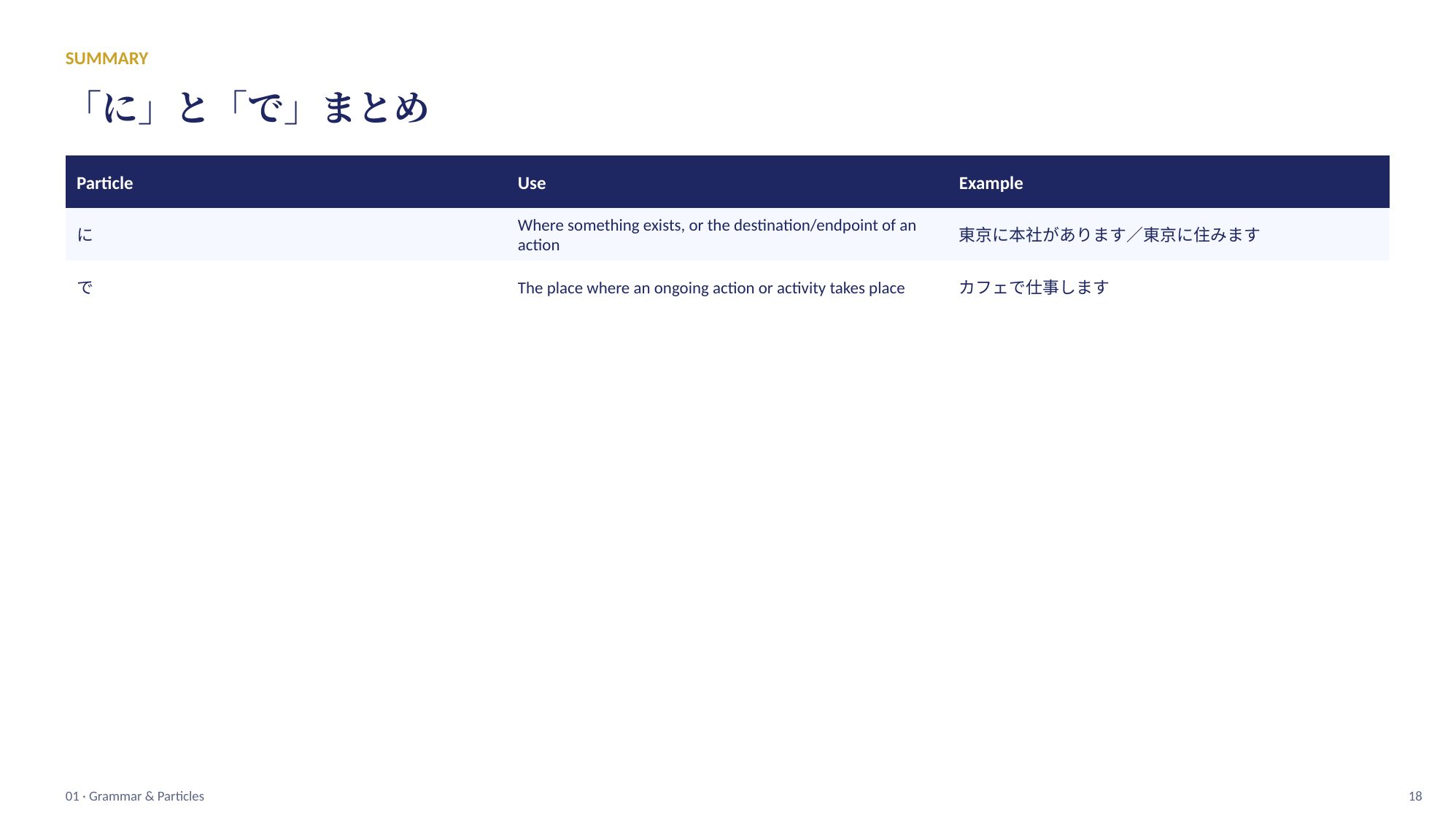
ENSUMMARY
JP「に」と「で」まとめ
EN Particle Use Example
Where something exists, or the destination/endpoint of an
Where something exists, or the destination/endpoint of an
JPに東京に本社があります/東京に住みます
EN action
で The place where an ongoing action or activity takes place カフェで仕事します
01 · Grammar & Particles 18
で The place where an ongoing action or activity takes place カフェで仕事します
01 · Grammar & Particles 18
หน้า 19
คลิกเพื่อขยาย
03
ENLocation Ni vs Direction E
JP場所を表す「に」と「へ」
ENPrecise destination ( に ) vs general direction ( へ )
หน้า 20
คลิกเพื่อขยาย
ENOVERVIEW
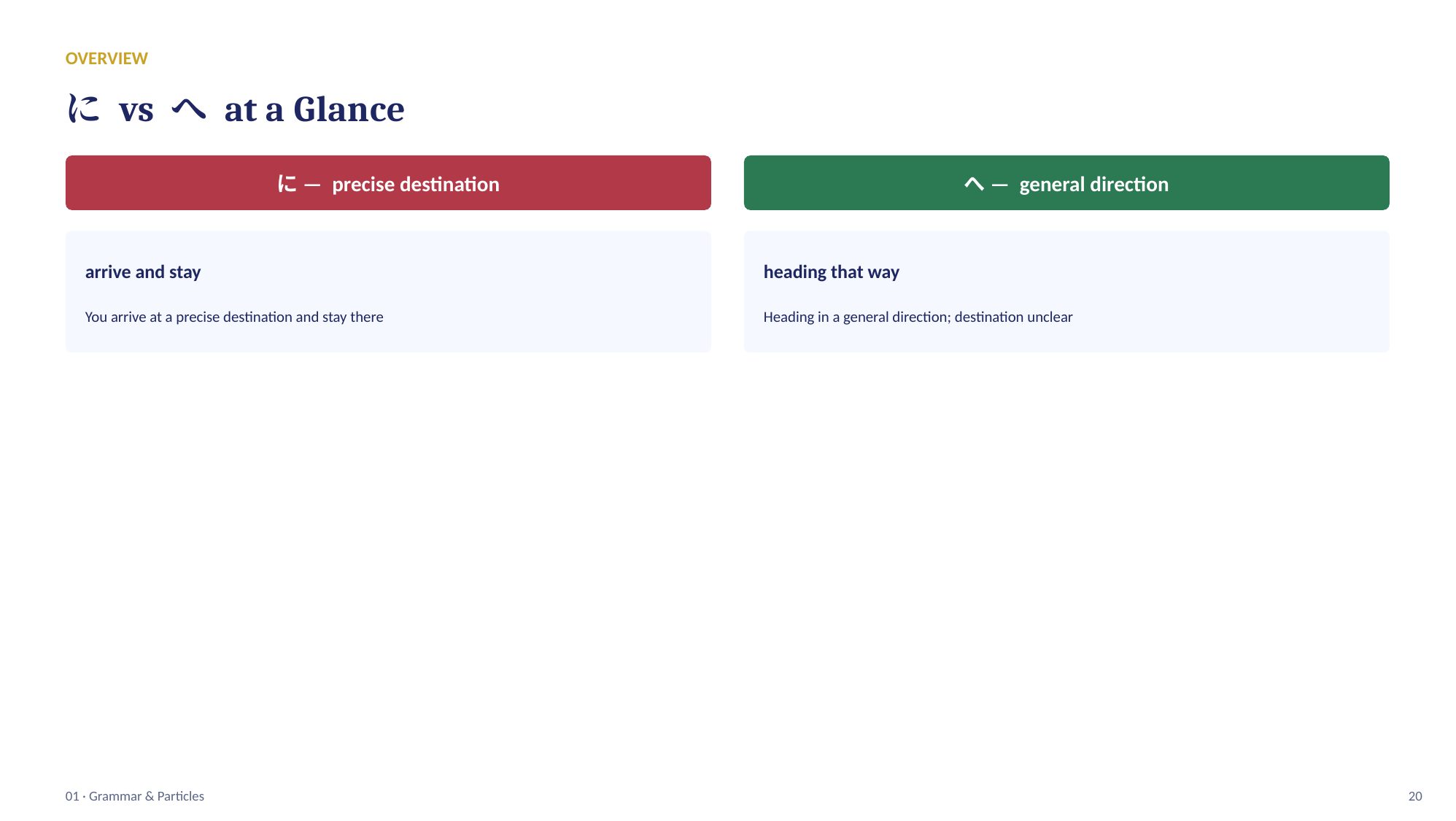
に vs へ at a Glance
に — precise destination へ — general direction
arrive and stay heading that way
You arrive at a precise destination and stay there Heading in a general direction; destination unclear
01 · Grammar & Particles 20
に vs へ at a Glance
に — precise destination へ — general direction
arrive and stay heading that way
You arrive at a precise destination and stay there Heading in a general direction; destination unclear
01 · Grammar & Particles 20
หน้า 21
คลิกเพื่อขยาย
JPに
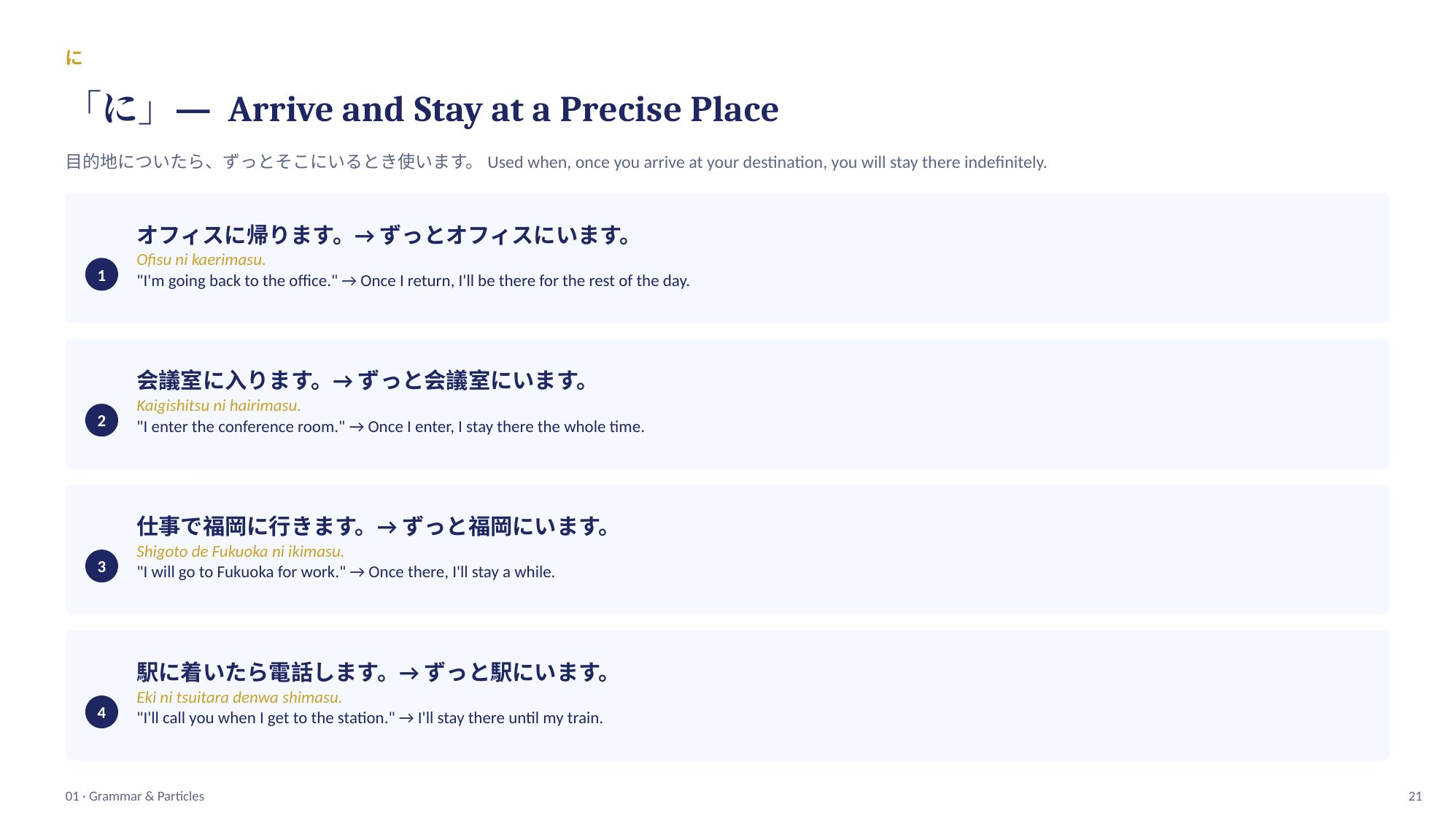
EN「に」— Arrive and Stay at a Precise Place
目的地についたら、ずっとそこにいるとき使います。 Used when, once you arrive at your destination, you will stay there indefinitely.
目的地についたら、ずっとそこにいるとき使います。 Used when, once you arrive at your destination, you will stay there indefinitely.
JPオフィスに帰ります。→ずっとオフィスにいます。
EN Ofisu ni kaerimasu.
1 "I'm going back to the office." → Once I return, I'll be there for the rest of the day.
1 "I'm going back to the office." → Once I return, I'll be there for the rest of the day.
JP会議室に入ります。→ずっと会議室にいます。
EN Kaigishitsu ni hairimasu.
2 "I enter the conference room." → Once I enter, I stay there the whole time.
2 "I enter the conference room." → Once I enter, I stay there the whole time.
JP仕事で福岡に行きます。→ずっと福岡にいます。
EN Shigoto de Fukuoka ni ikimasu.
3 "I will go to Fukuoka for work." → Once there, I'll stay a while.
3 "I will go to Fukuoka for work." → Once there, I'll stay a while.
JP駅に着いたら電話します。→ずっと駅にいます。
EN Eki ni tsuitara denwa shimasu.
4 "I'll call you when I get to the station." → I'll stay there until my train.
01 · Grammar & Particles 21
4 "I'll call you when I get to the station." → I'll stay there until my train.
01 · Grammar & Particles 21
หน้า 22
คลิกเพื่อขยาย
JPへ
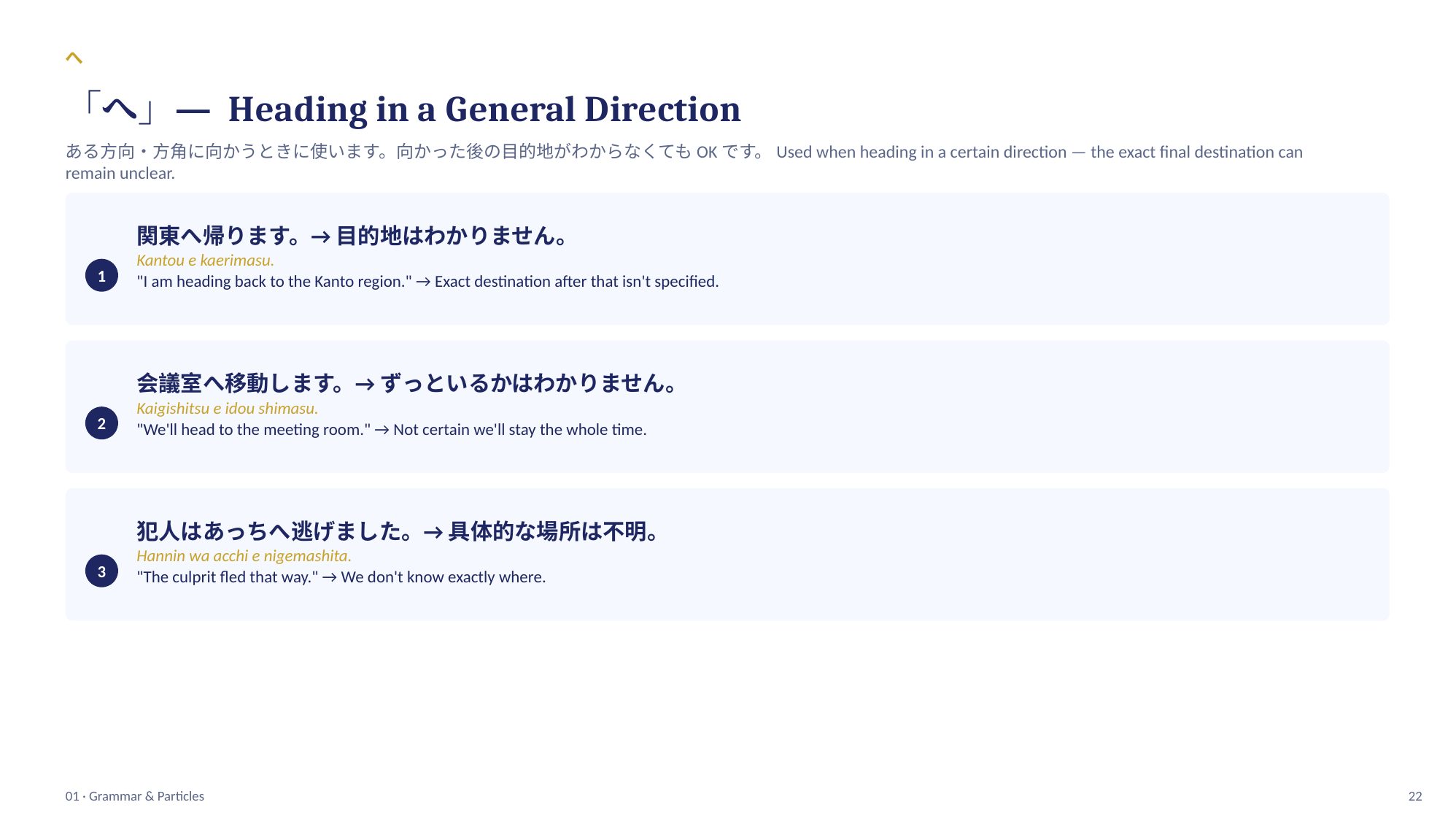
EN「へ」— Heading in a General Direction
ある方向・方角に向かうときに使います。向かった後の目的地がわからなくても OK です。 Used when heading in a certain direction — the exact final destination can
remain unclear.
ある方向・方角に向かうときに使います。向かった後の目的地がわからなくても OK です。 Used when heading in a certain direction — the exact final destination can
remain unclear.
JP関東へ帰ります。→目的地はわかりません。
EN Kantou e kaerimasu.
1 "I am heading back to the Kanto region." → Exact destination after that isn't specified.
1 "I am heading back to the Kanto region." → Exact destination after that isn't specified.
JP会議室へ移動します。→ずっといるかはわかりません。
EN Kaigishitsu e idou shimasu.
2 "We'll head to the meeting room." → Not certain we'll stay the whole time.
2 "We'll head to the meeting room." → Not certain we'll stay the whole time.
JP犯人はあっちへ逃げました。→具体的な場所は不明。
EN Hannin wa acchi e nigemashita.
3 "The culprit fled that way." → We don't know exactly where.
01 · Grammar & Particles 22
3 "The culprit fled that way." → We don't know exactly where.
01 · Grammar & Particles 22
หน้า 23
คลิกเพื่อขยาย
ENSUMMARY
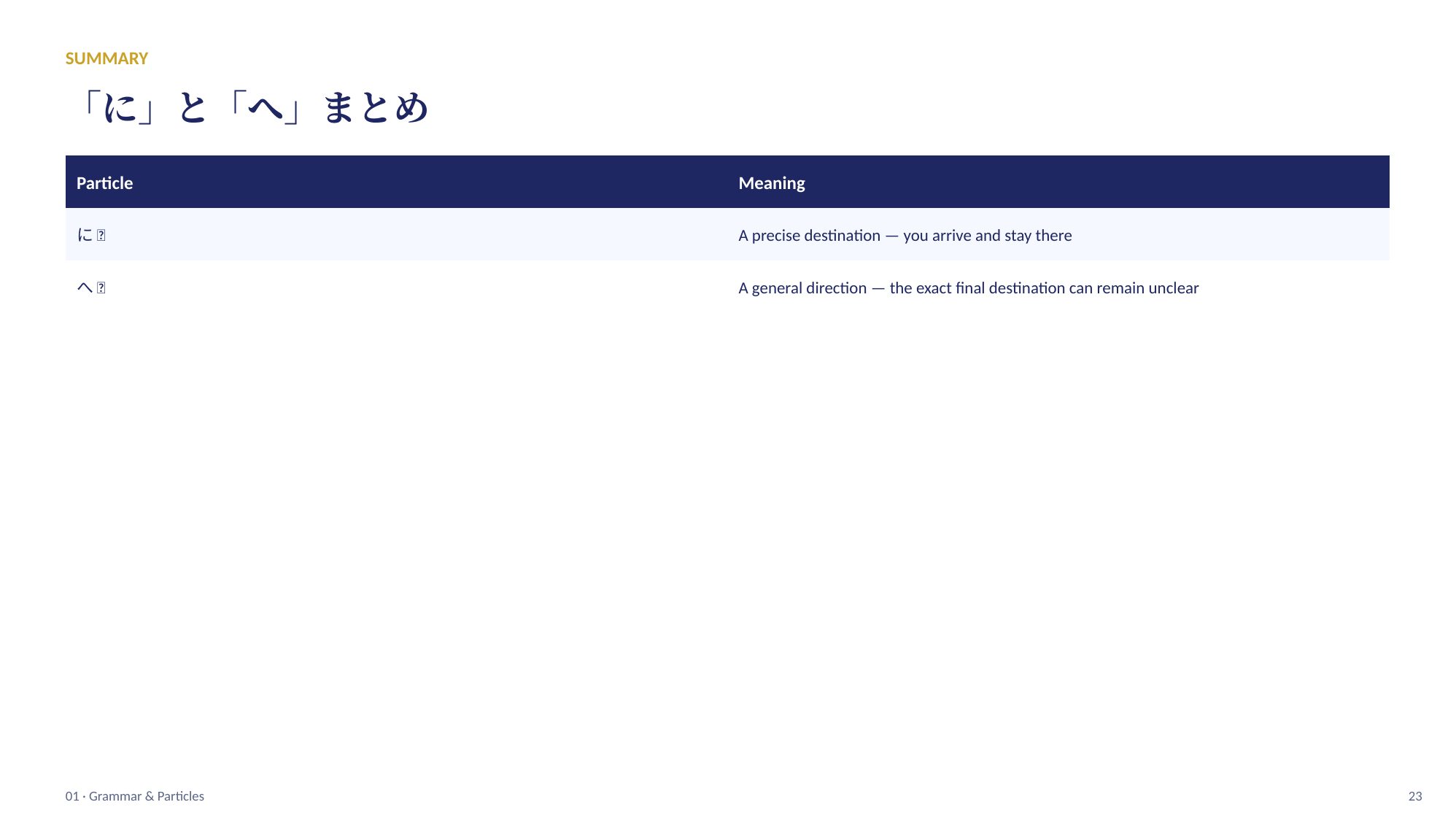
JP「に」と「へ」まとめ
EN Particle Meaning
に📍 A precise destination — you arrive and stay there
へ🧭 A general direction — the exact final destination can remain unclear
01 · Grammar & Particles 23
に📍 A precise destination — you arrive and stay there
へ🧭 A general direction — the exact final destination can remain unclear
01 · Grammar & Particles 23
หน้า 24

คลิกเพื่อขยาย
04
ENNi Kanshite vs Ni Tsuite
JP「に関して」と「について」
ENTwo ways to say "regarding / about"
หน้า 25
คลิกเพื่อขยาย
ENCONNECTION PATTERNS
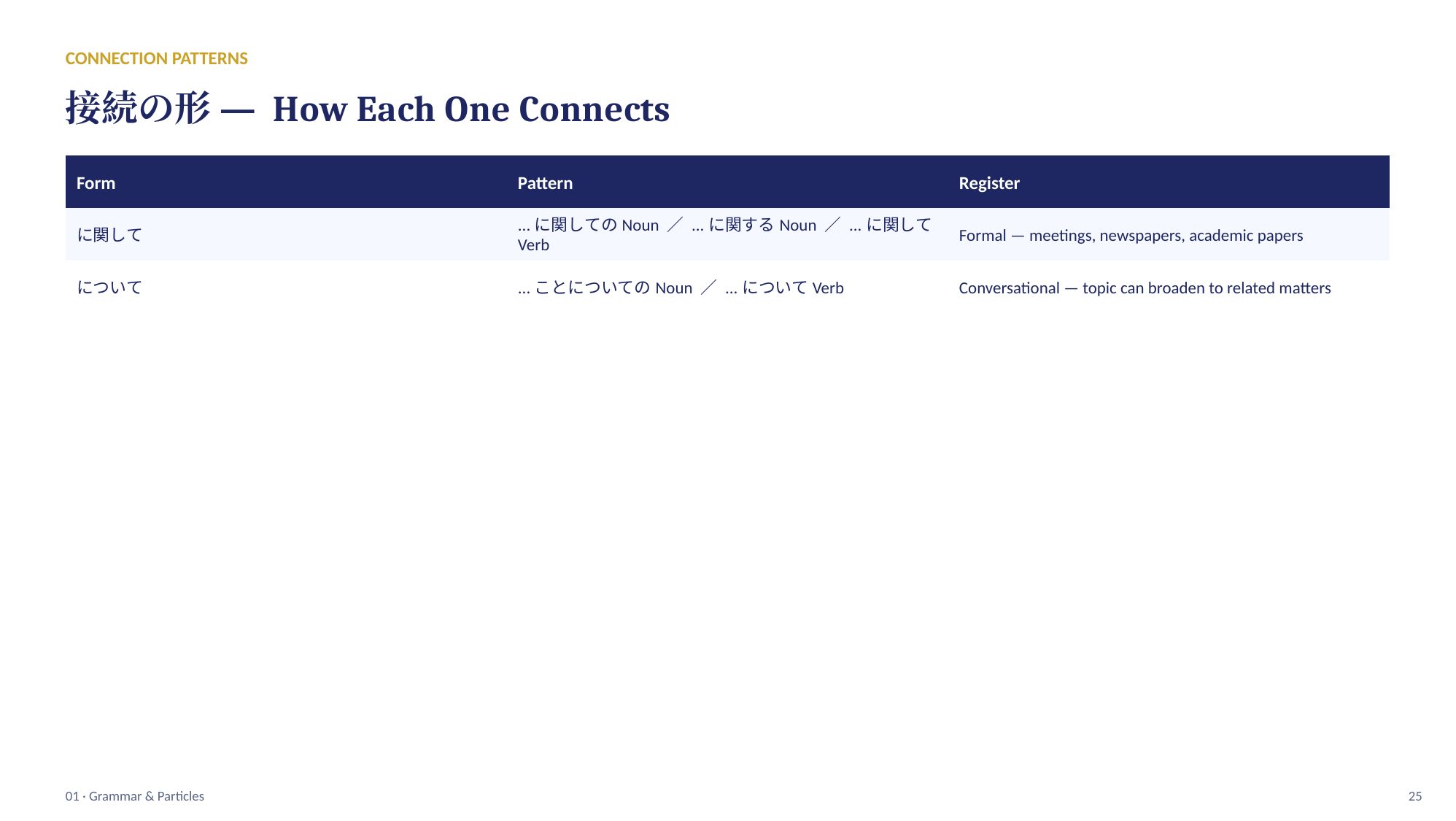
接続の形 — How Each One Connects
Form Pattern Register
接続の形 — How Each One Connects
Form Pattern Register
JP...に関してのNoun/...に関するNoun/...に関して
EN に関して Formal — meetings, newspapers, academic papers
Verb
について ... ことについての Noun / ... について Verb Conversational — topic can broaden to related matters
01 · Grammar & Particles 25
Verb
について ... ことについての Noun / ... について Verb Conversational — topic can broaden to related matters
01 · Grammar & Particles 25
หน้า 26
คลิกเพื่อขยาย
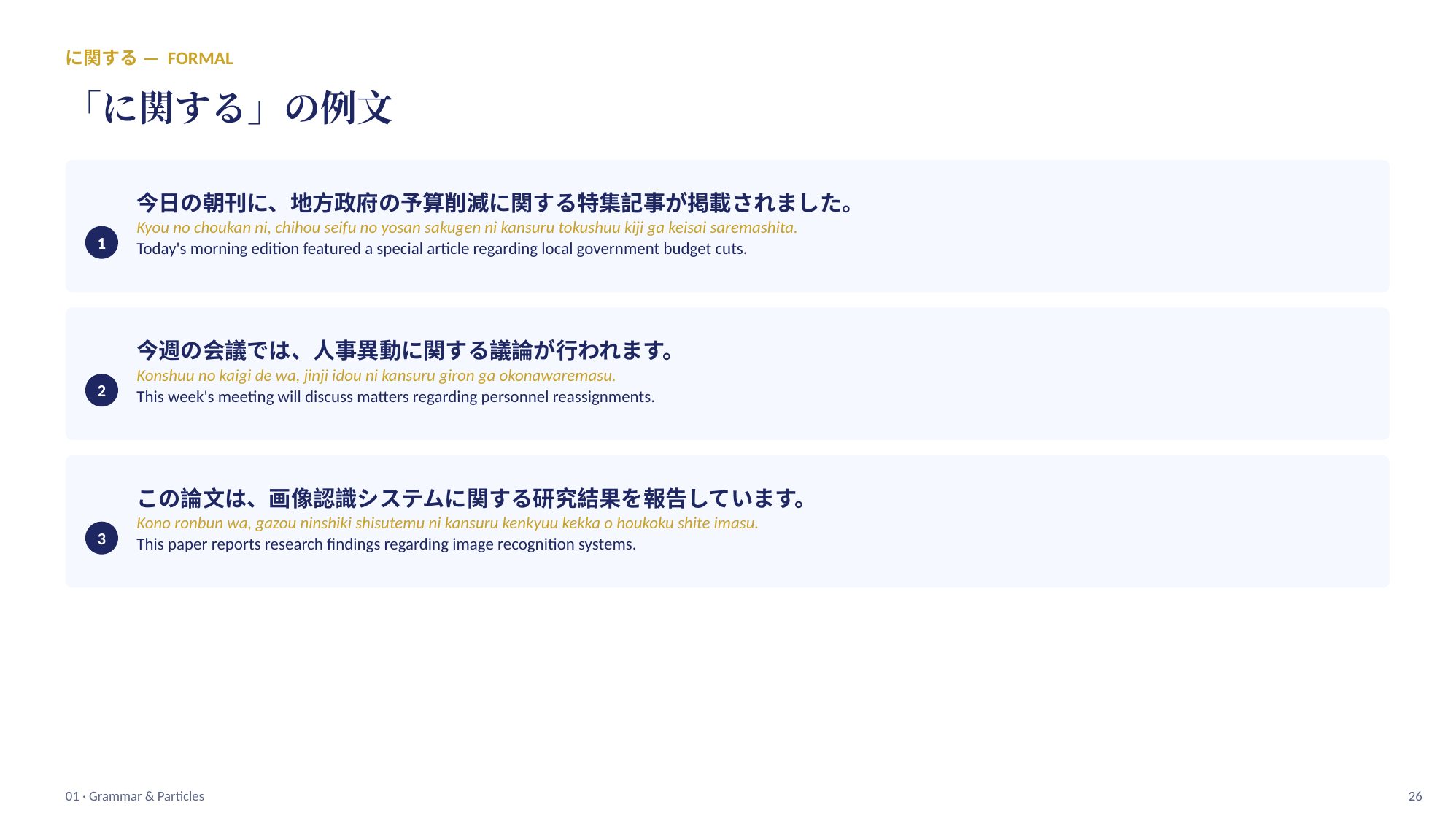
ENに関する — FORMAL
JP「に関する」の例文
今日の朝刊に、地方政府の予算削減に関する特集記事が掲載されました。
今日の朝刊に、地方政府の予算削減に関する特集記事が掲載されました。
EN Kyou no choukan ni, chihou seifu no yosan sakugen ni kansuru tokushuu kiji ga keisai saremashita.
1 Today's morning edition featured a special article regarding local government budget cuts.
1 Today's morning edition featured a special article regarding local government budget cuts.
JP今週の会議では、人事異動に関する議論が行われます。
EN Konshuu no kaigi de wa, jinji idou ni kansuru giron ga okonawaremasu.
2 This week's meeting will discuss matters regarding personnel reassignments.
2 This week's meeting will discuss matters regarding personnel reassignments.
JPこの論文は、画像認識システムに関する研究結果を報告しています。
EN Kono ronbun wa, gazou ninshiki shisutemu ni kansuru kenkyuu kekka o houkoku shite imasu.
3 This paper reports research findings regarding image recognition systems.
01 · Grammar & Particles 26
3 This paper reports research findings regarding image recognition systems.
01 · Grammar & Particles 26
หน้า 27
คลิกเพื่อขยาย
ENNUANCE
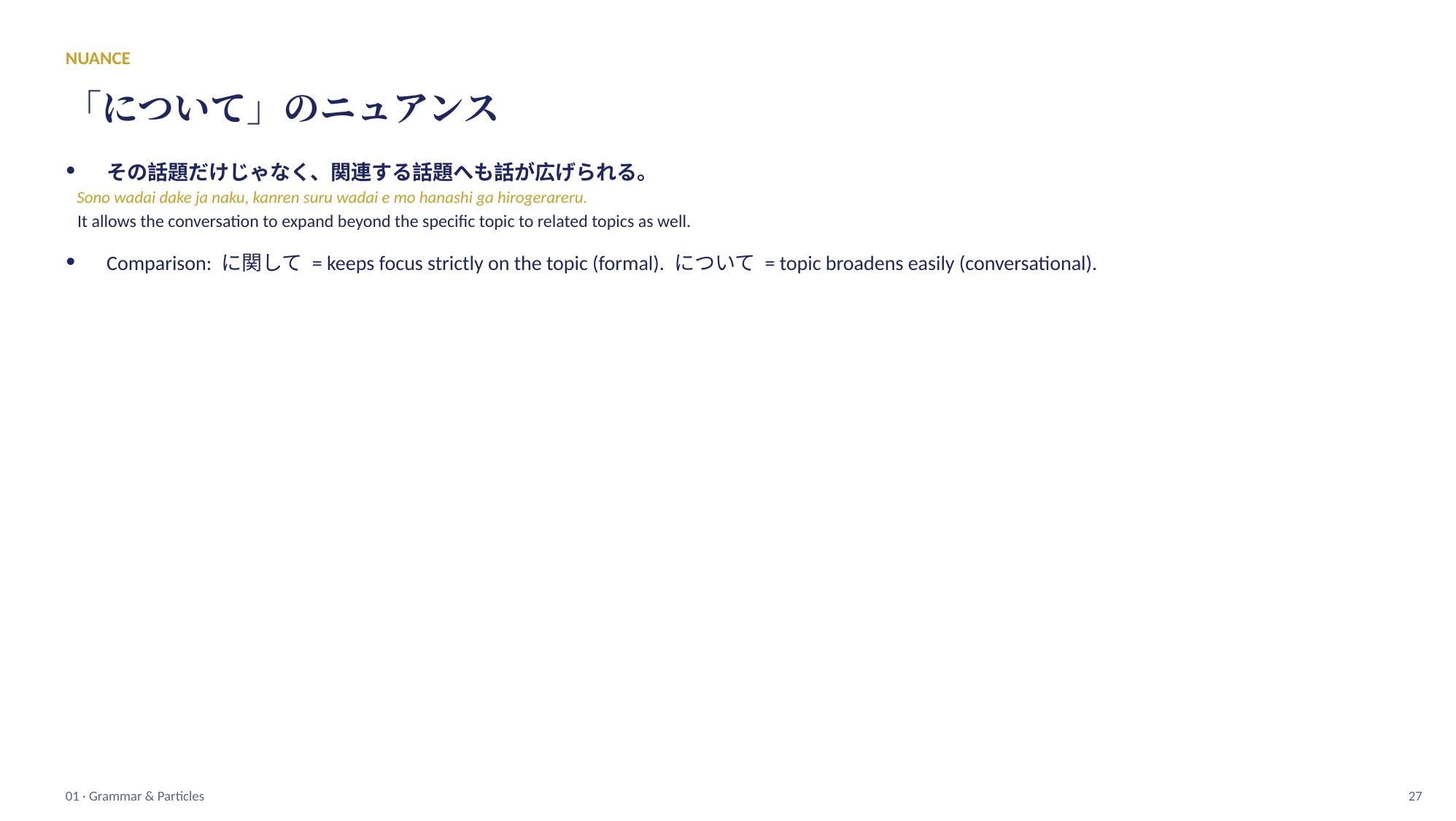
JP「について」のニュアンス
•その話題だけじゃなく、関連する話題へも話が広げられる。
•その話題だけじゃなく、関連する話題へも話が広げられる。
EN Sono wadai dake ja naku, kanren suru wadai e mo hanashi ga hirogerareru.
It allows the conversation to expand beyond the specific topic to related topics as well.
• Comparison: に関して = keeps focus strictly on the topic (formal). について = topic broadens easily (conversational).
01 · Grammar & Particles 27
It allows the conversation to expand beyond the specific topic to related topics as well.
• Comparison: に関して = keeps focus strictly on the topic (formal). について = topic broadens easily (conversational).
01 · Grammar & Particles 27
หน้า 28
คลิกเพื่อขยาย
ENSUMMARY
JPに関して・についてまとめ
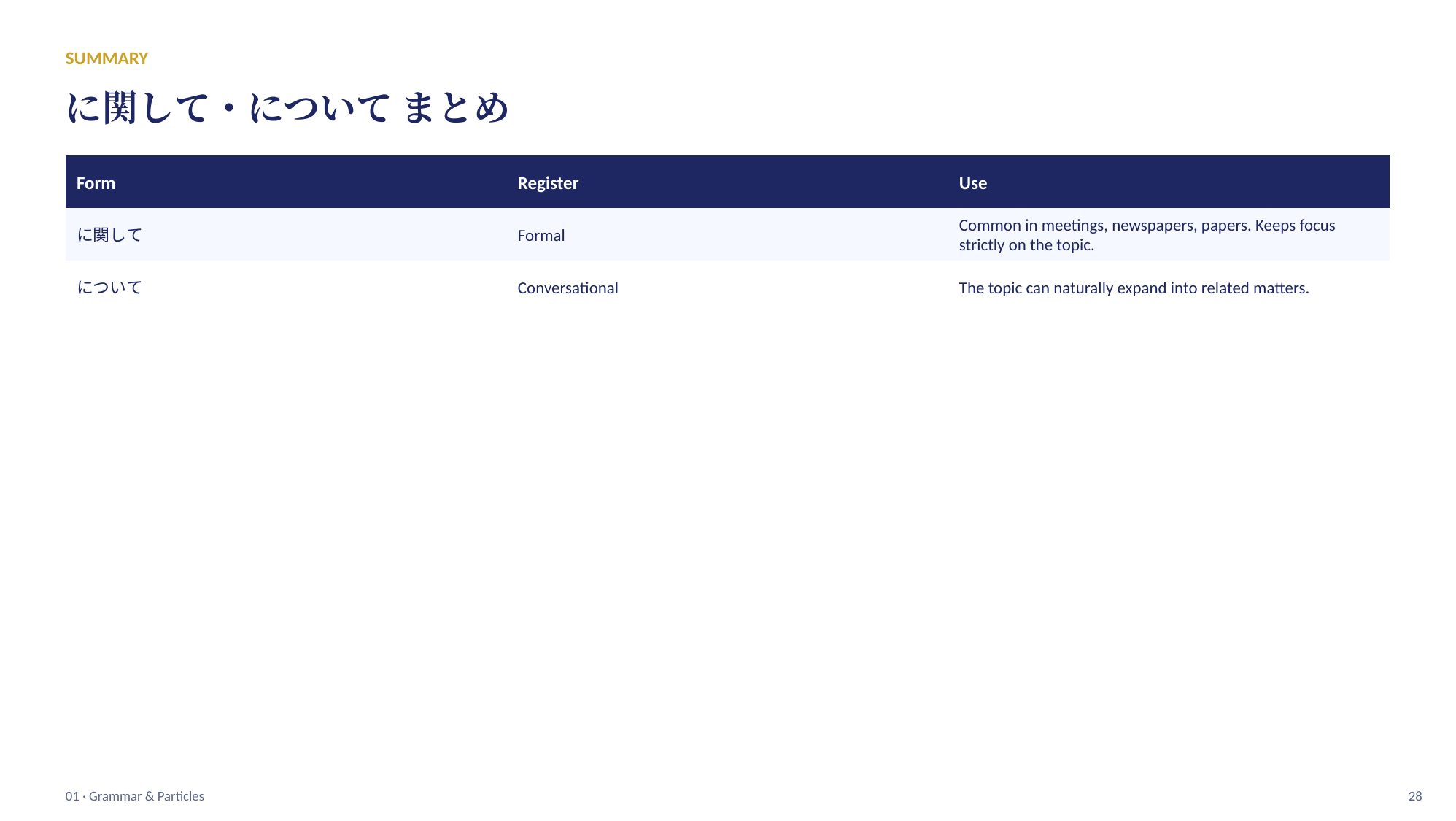
EN Form Register Use
Common in meetings, newspapers, papers. Keeps focus
に関して Formal
strictly on the topic.
について Conversational The topic can naturally expand into related matters.
01 · Grammar & Particles 28
Common in meetings, newspapers, papers. Keeps focus
に関して Formal
strictly on the topic.
について Conversational The topic can naturally expand into related matters.
01 · Grammar & Particles 28
หน้า 29
คลิกเพื่อขยาย
05
ENIjou / Ika / Inai / Igai
JP「以上」「以下」「以内」「以外」
ENFour words for describing ranges & boundaries, using 5 as the example
หน้า 30
คลิกเพื่อขยาย
ENOVERVIEW
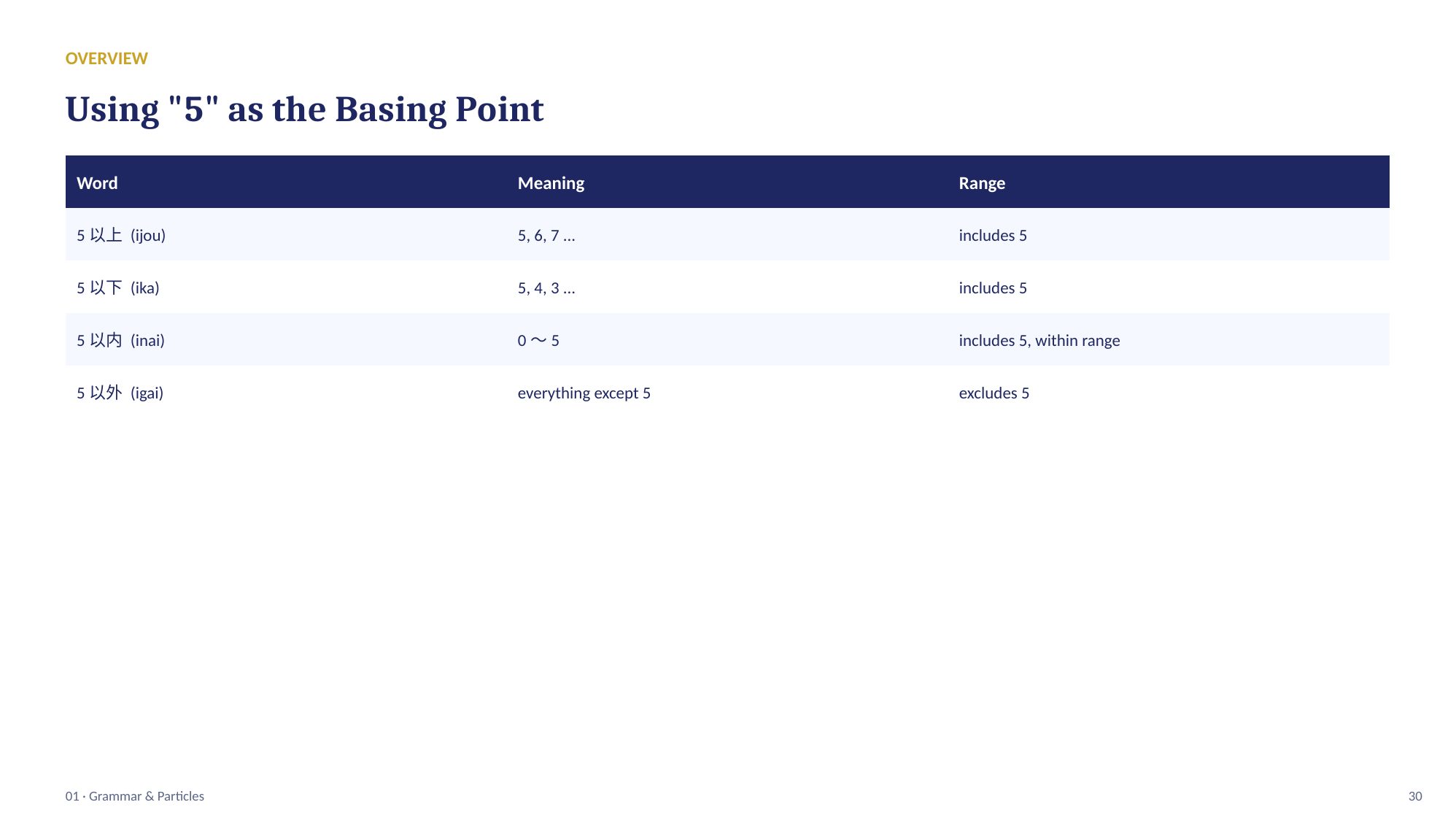
Using "5" as the Basing Point
Word Meaning Range
5 以上 (ijou) 5, 6, 7 ... includes 5
5 以下 (ika) 5, 4, 3 ... includes 5
5 以内 (inai) 0〜5 includes 5, within range
5 以外 (igai) everything except 5 excludes 5
01 · Grammar & Particles 30
Using "5" as the Basing Point
Word Meaning Range
5 以上 (ijou) 5, 6, 7 ... includes 5
5 以下 (ika) 5, 4, 3 ... includes 5
5 以内 (inai) 0〜5 includes 5, within range
5 以外 (igai) everything except 5 excludes 5
01 · Grammar & Particles 30
หน้า 31
คลิกเพื่อขยาย
EN以上 — OR MORE
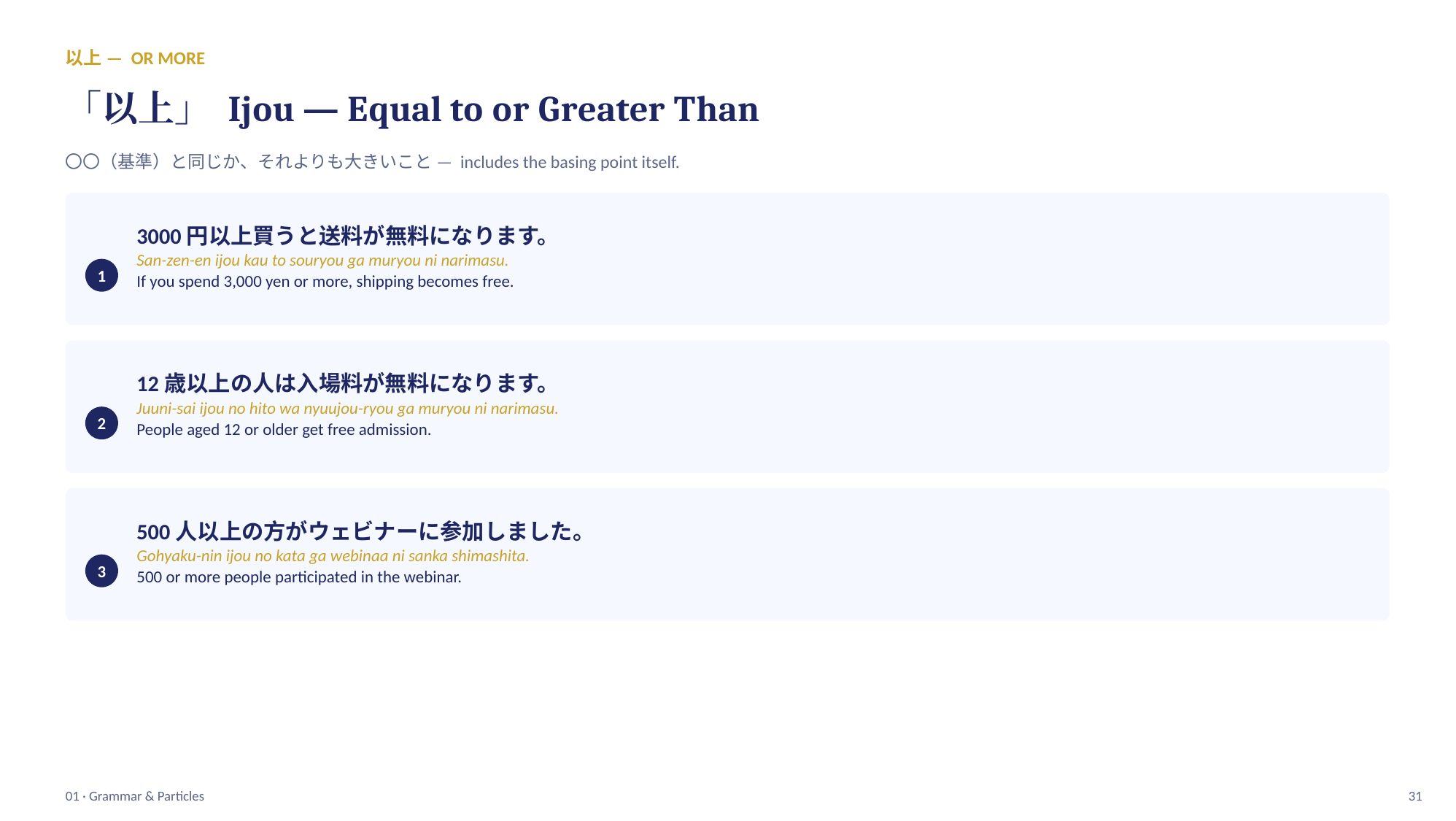
「以上」 Ijou — Equal to or Greater Than
〇〇(基準)と同じか、それよりも大きいこと — includes the basing point itself.
「以上」 Ijou — Equal to or Greater Than
〇〇(基準)と同じか、それよりも大きいこと — includes the basing point itself.
JP3000円以上買うと送料が無料になります。
EN San-zen-en ijou kau to souryou ga muryou ni narimasu.
1 If you spend 3,000 yen or more, shipping becomes free.
1 If you spend 3,000 yen or more, shipping becomes free.
JP12歳以上の人は入場料が無料になります。
EN Juuni-sai ijou no hito wa nyuujou-ryou ga muryou ni narimasu.
2 People aged 12 or older get free admission.
2 People aged 12 or older get free admission.
JP500人以上の方がウェビナーに参加しました。
EN Gohyaku-nin ijou no kata ga webinaa ni sanka shimashita.
3 500 or more people participated in the webinar.
01 · Grammar & Particles 31
3 500 or more people participated in the webinar.
01 · Grammar & Particles 31
หน้า 32
คลิกเพื่อขยาย
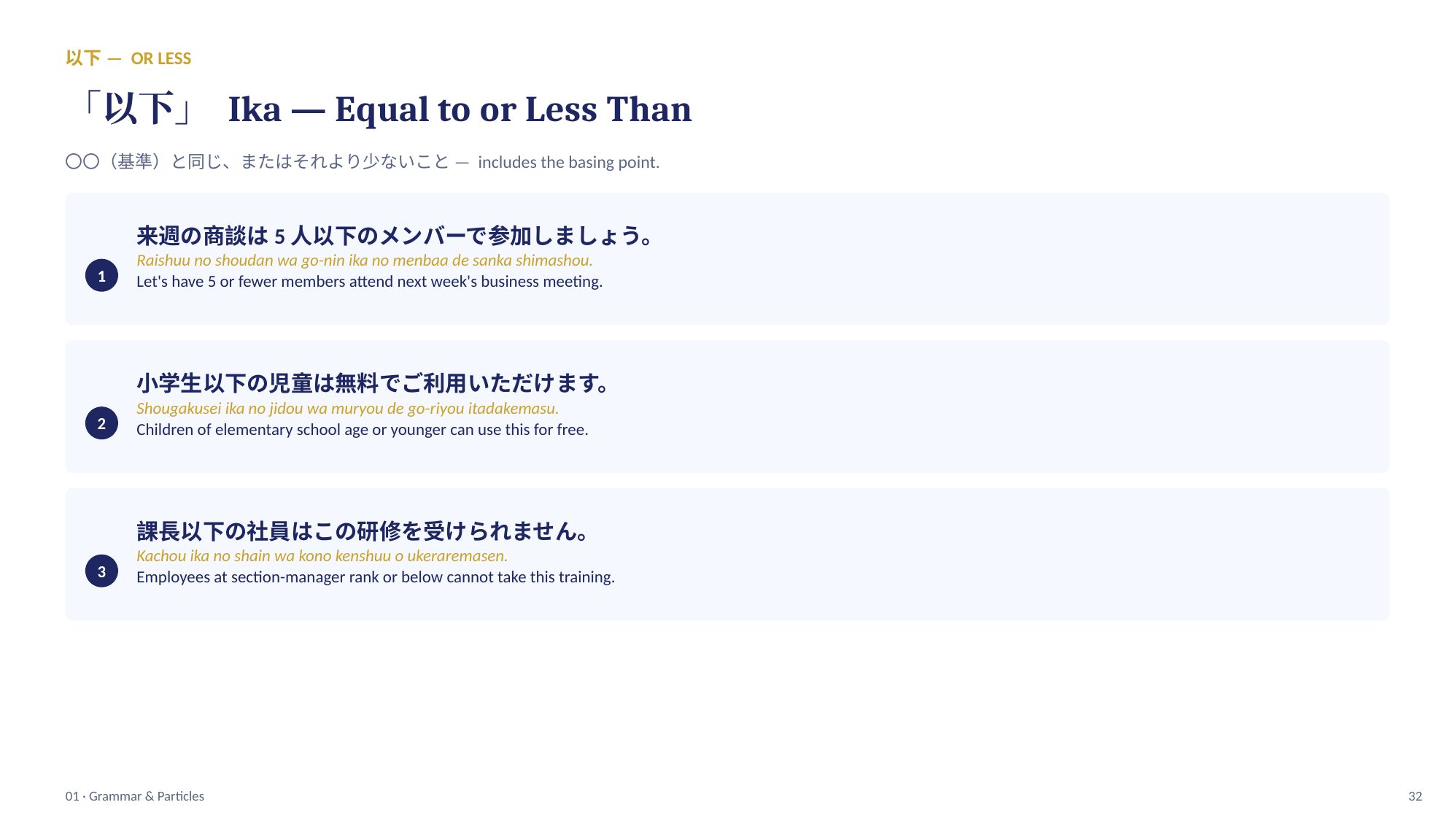
EN以下 — OR LESS
「以下」 Ika — Equal to or Less Than
〇〇(基準)と同じ、またはそれより少ないこと — includes the basing point.
「以下」 Ika — Equal to or Less Than
〇〇(基準)と同じ、またはそれより少ないこと — includes the basing point.
JP来週の商談は5人以下のメンバーで参加しましょう。
EN Raishuu no shoudan wa go-nin ika no menbaa de sanka shimashou.
1 Let's have 5 or fewer members attend next week's business meeting.
1 Let's have 5 or fewer members attend next week's business meeting.
JP小学生以下の児童は無料でご利用いただけます。
EN Shougakusei ika no jidou wa muryou de go-riyou itadakemasu.
2 Children of elementary school age or younger can use this for free.
2 Children of elementary school age or younger can use this for free.
JP課長以下の社員はこの研修を受けられません。
EN Kachou ika no shain wa kono kenshuu o ukeraremasen.
3 Employees at section-manager rank or below cannot take this training.
01 · Grammar & Particles 32
3 Employees at section-manager rank or below cannot take this training.
01 · Grammar & Particles 32
หน้า 33
คลิกเพื่อขยาย
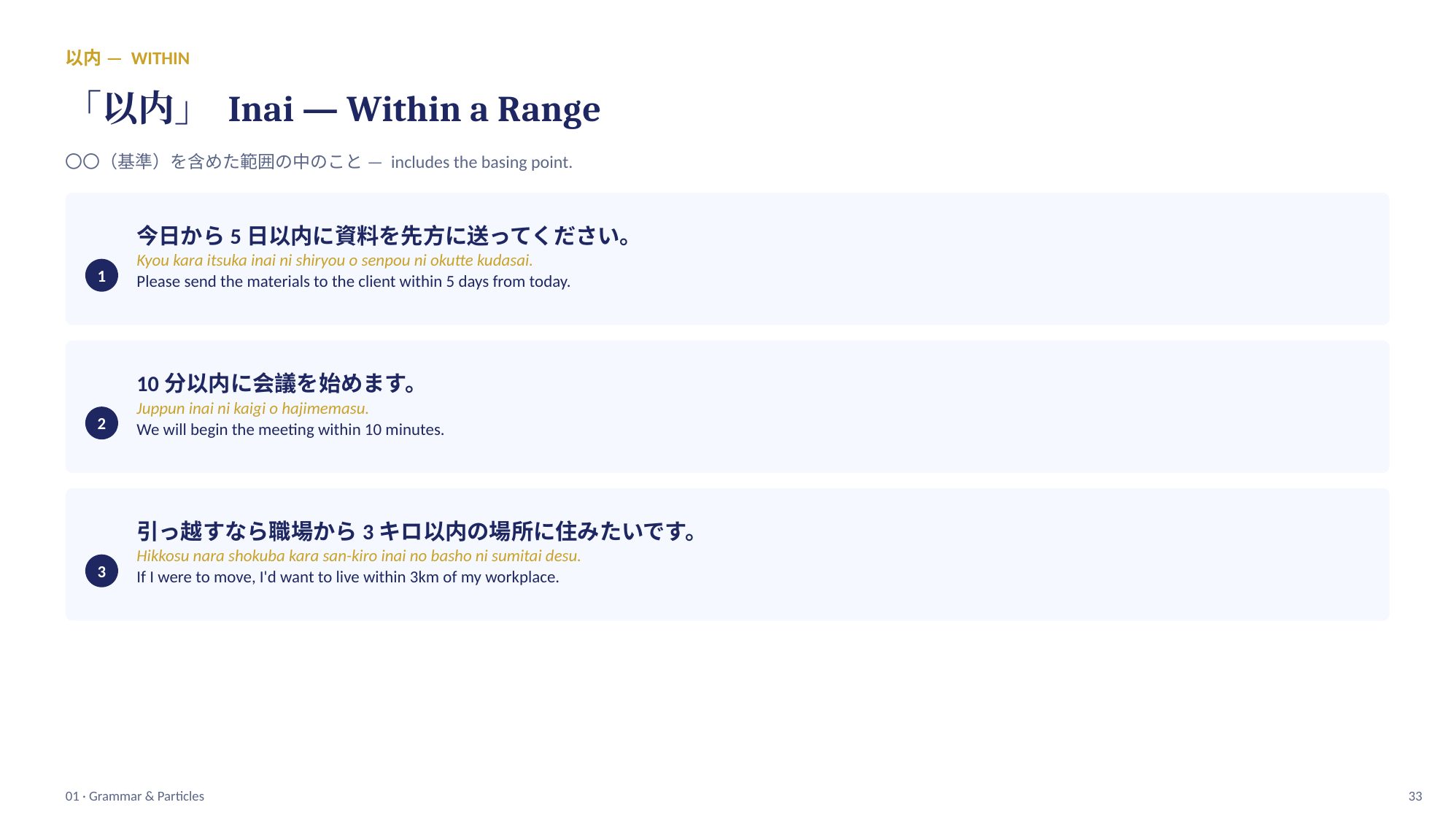
EN以内 — WITHIN
「以内」 Inai — Within a Range
〇〇(基準)を含めた範囲の中のこと — includes the basing point.
「以内」 Inai — Within a Range
〇〇(基準)を含めた範囲の中のこと — includes the basing point.
JP今日から5日以内に資料を先方に送ってください。
EN Kyou kara itsuka inai ni shiryou o senpou ni okutte kudasai.
1 Please send the materials to the client within 5 days from today.
1 Please send the materials to the client within 5 days from today.
JP10分以内に会議を始めます。
EN Juppun inai ni kaigi o hajimemasu.
2 We will begin the meeting within 10 minutes.
2 We will begin the meeting within 10 minutes.
JP引っ越すなら職場から3キロ以内の場所に住みたいです。
EN Hikkosu nara shokuba kara san-kiro inai no basho ni sumitai desu.
3 If I were to move, I'd want to live within 3km of my workplace.
01 · Grammar & Particles 33
3 If I were to move, I'd want to live within 3km of my workplace.
01 · Grammar & Particles 33
หน้า 34
คลิกเพื่อขยาย
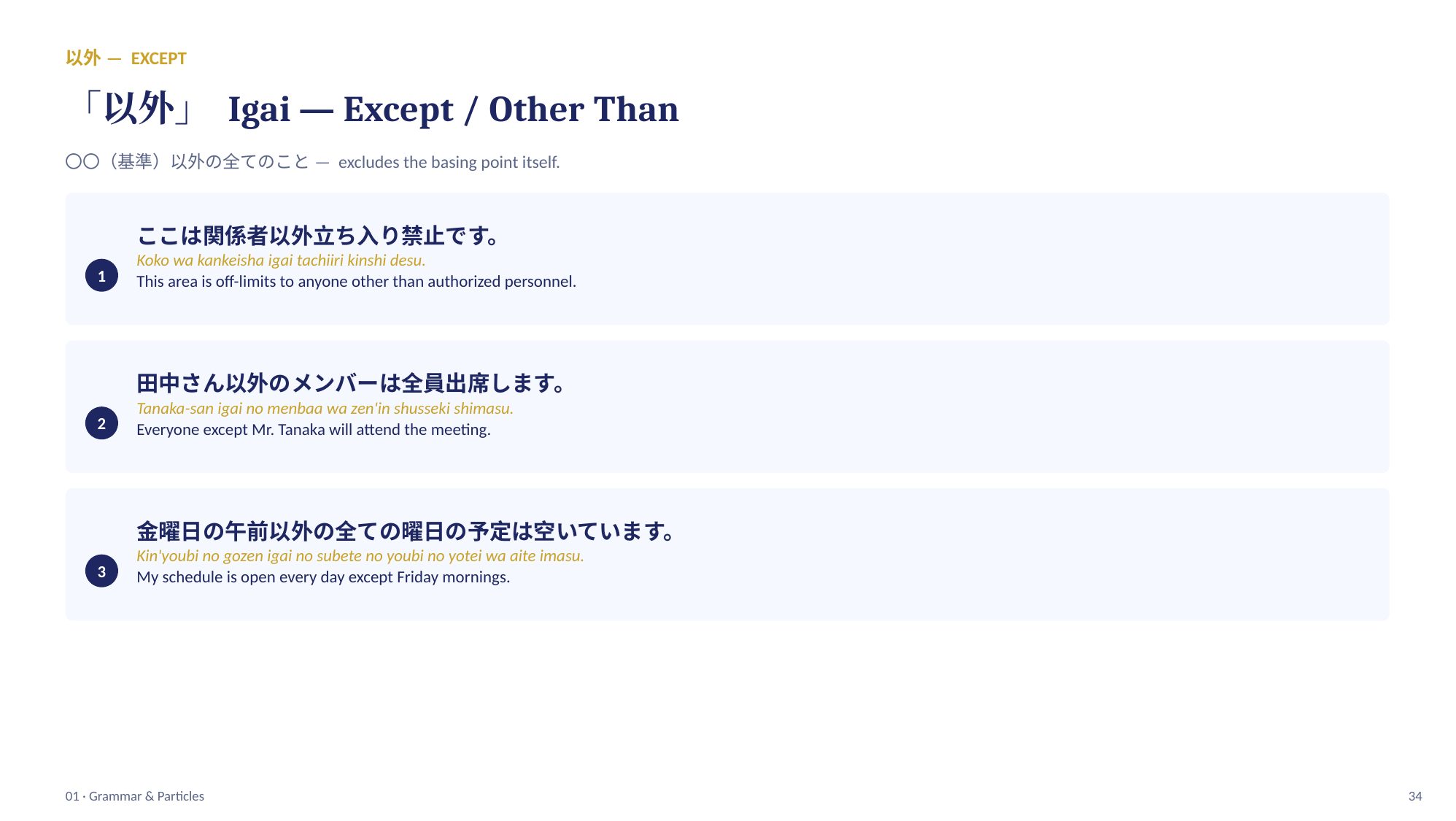
EN以外 — EXCEPT
「以外」 Igai — Except / Other Than
〇〇(基準)以外の全てのこと — excludes the basing point itself.
「以外」 Igai — Except / Other Than
〇〇(基準)以外の全てのこと — excludes the basing point itself.
JPここは関係者以外立ち入り禁止です。
EN Koko wa kankeisha igai tachiiri kinshi desu.
1 This area is off-limits to anyone other than authorized personnel.
1 This area is off-limits to anyone other than authorized personnel.
JP田中さん以外のメンバーは全員出席します。
EN Tanaka-san igai no menbaa wa zen'in shusseki shimasu.
2 Everyone except Mr. Tanaka will attend the meeting.
2 Everyone except Mr. Tanaka will attend the meeting.
JP金曜日の午前以外の全ての曜日の予定は空いています。
EN Kin'youbi no gozen igai no subete no youbi no yotei wa aite imasu.
3 My schedule is open every day except Friday mornings.
01 · Grammar & Particles 34
3 My schedule is open every day except Friday mornings.
01 · Grammar & Particles 34
หน้า 35
คลิกเพื่อขยาย
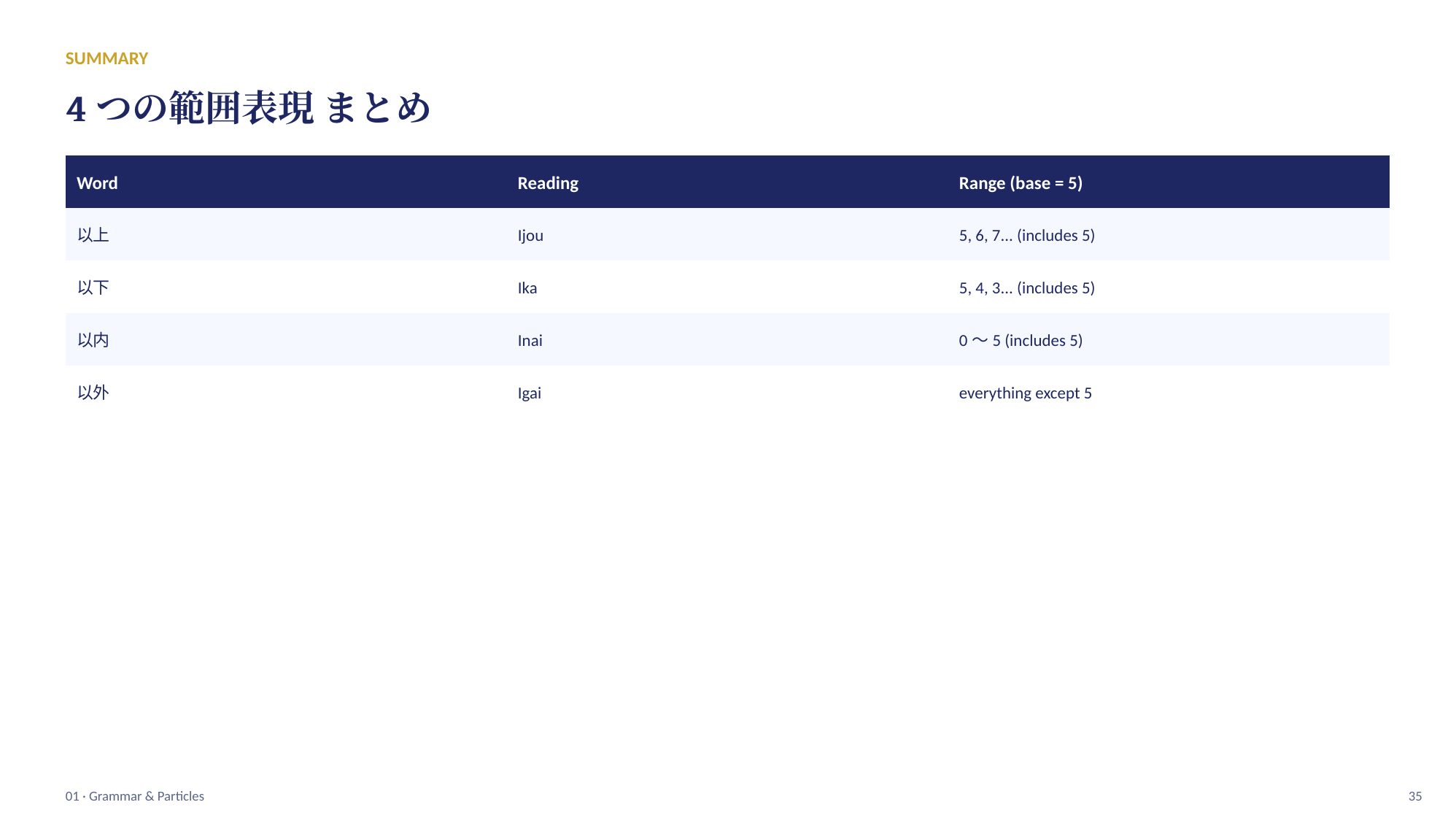
ENSUMMARY
JP4つの範囲表現まとめ
EN Word Reading Range (base = 5)
以上 Ijou 5, 6, 7... (includes 5)
以下 Ika 5, 4, 3... (includes 5)
以内 Inai 0 〜 5 (includes 5)
以外 Igai everything except 5
01 · Grammar & Particles 35
以上 Ijou 5, 6, 7... (includes 5)
以下 Ika 5, 4, 3... (includes 5)
以内 Inai 0 〜 5 (includes 5)
以外 Igai everything except 5
01 · Grammar & Particles 35
หน้า 36

คลิกเพื่อขยาย
06
ENCounting "From ___ Onward"
JP「〇〇以降」の使い方
ENDoes the reference point count as included or not?
หน้า 37
คลิกเพื่อขยาย
ENCORE RULE
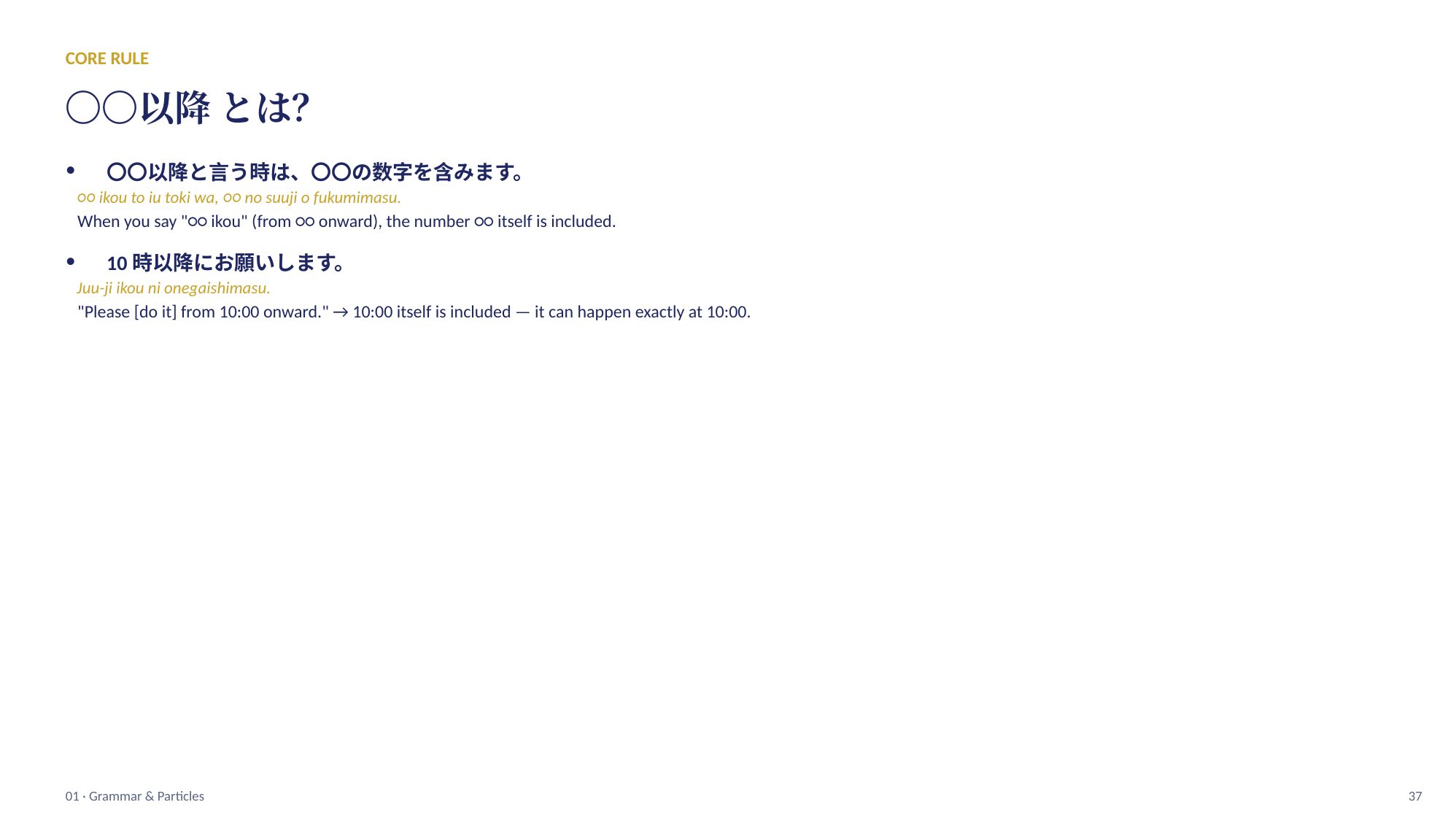
JP〇〇以降とは?
•〇〇以降と言う時は、〇〇の数字を含みます。
•〇〇以降と言う時は、〇〇の数字を含みます。
EN ○○ ikou to iu toki wa, ○○ no suuji o fukumimasu.
When you say "○○ ikou" (from ○○ onward), the number ○○ itself is included.
When you say "○○ ikou" (from ○○ onward), the number ○○ itself is included.
JP•10時以降にお願いします。
EN Juu-ji ikou ni onegaishimasu.
"Please [do it] from 10:00 onward." → 10:00 itself is included — it can happen exactly at 10:00.
01 · Grammar & Particles 37
"Please [do it] from 10:00 onward." → 10:00 itself is included — it can happen exactly at 10:00.
01 · Grammar & Particles 37
หน้า 38
คลิกเพื่อขยาย
ENRELATED GRAMMAR
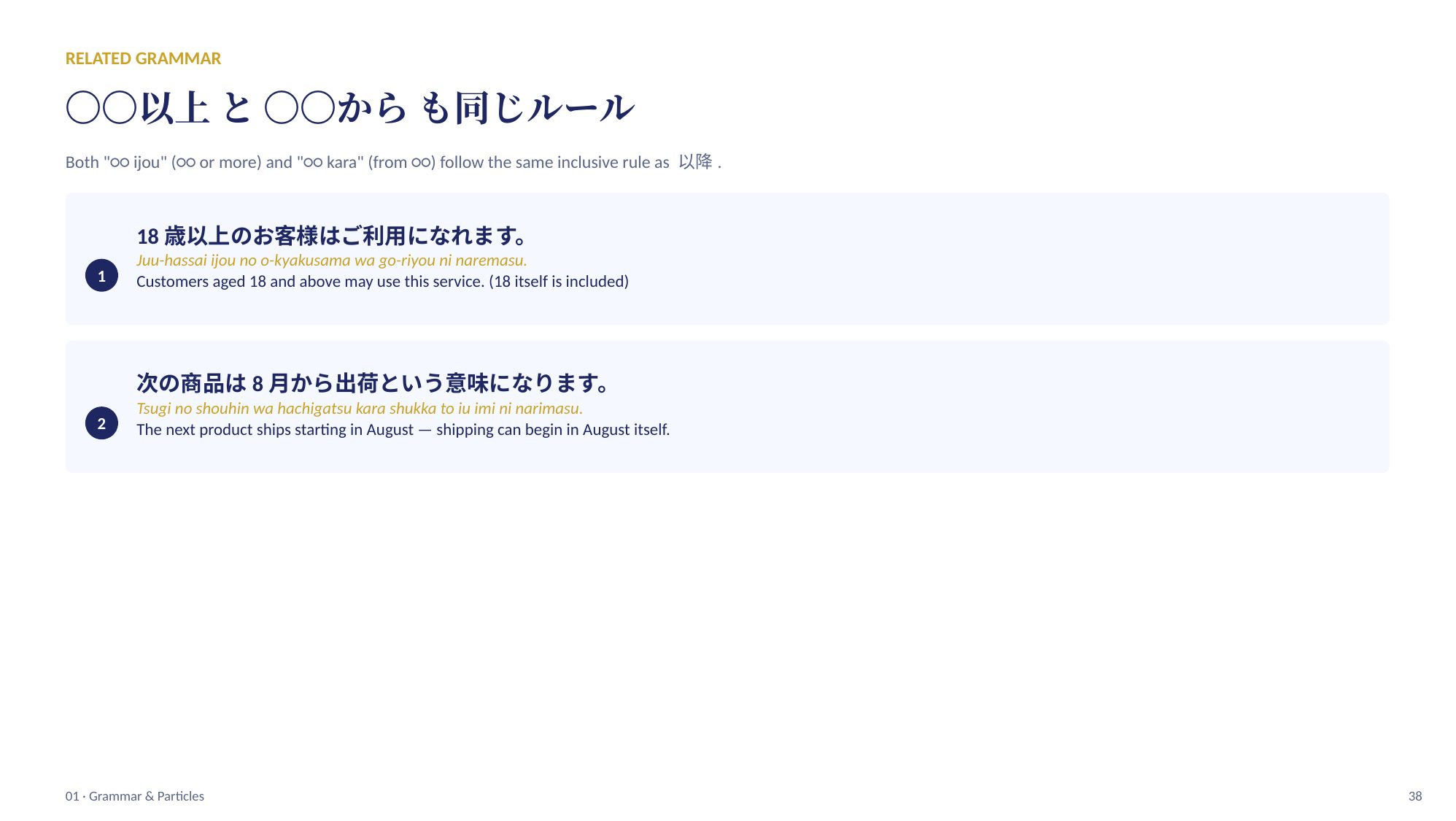
JP〇〇以上と〇〇からも同じルール
ENBoth "○○ ijou" (○○ or more) and "○○ kara" (from ○○) follow the same inclusive rule as 以降 .
JP18歳以上のお客様はご利用になれます。
EN Juu-hassai ijou no o-kyakusama wa go-riyou ni naremasu.
1 Customers aged 18 and above may use this service. (18 itself is included)
1 Customers aged 18 and above may use this service. (18 itself is included)
JP次の商品は8月から出荷という意味になります。
EN Tsugi no shouhin wa hachigatsu kara shukka to iu imi ni narimasu.
2 The next product ships starting in August — shipping can begin in August itself.
01 · Grammar & Particles 38
2 The next product ships starting in August — shipping can begin in August itself.
01 · Grammar & Particles 38
หน้า 39
คลิกเพื่อขยาย
ENCONTRAST
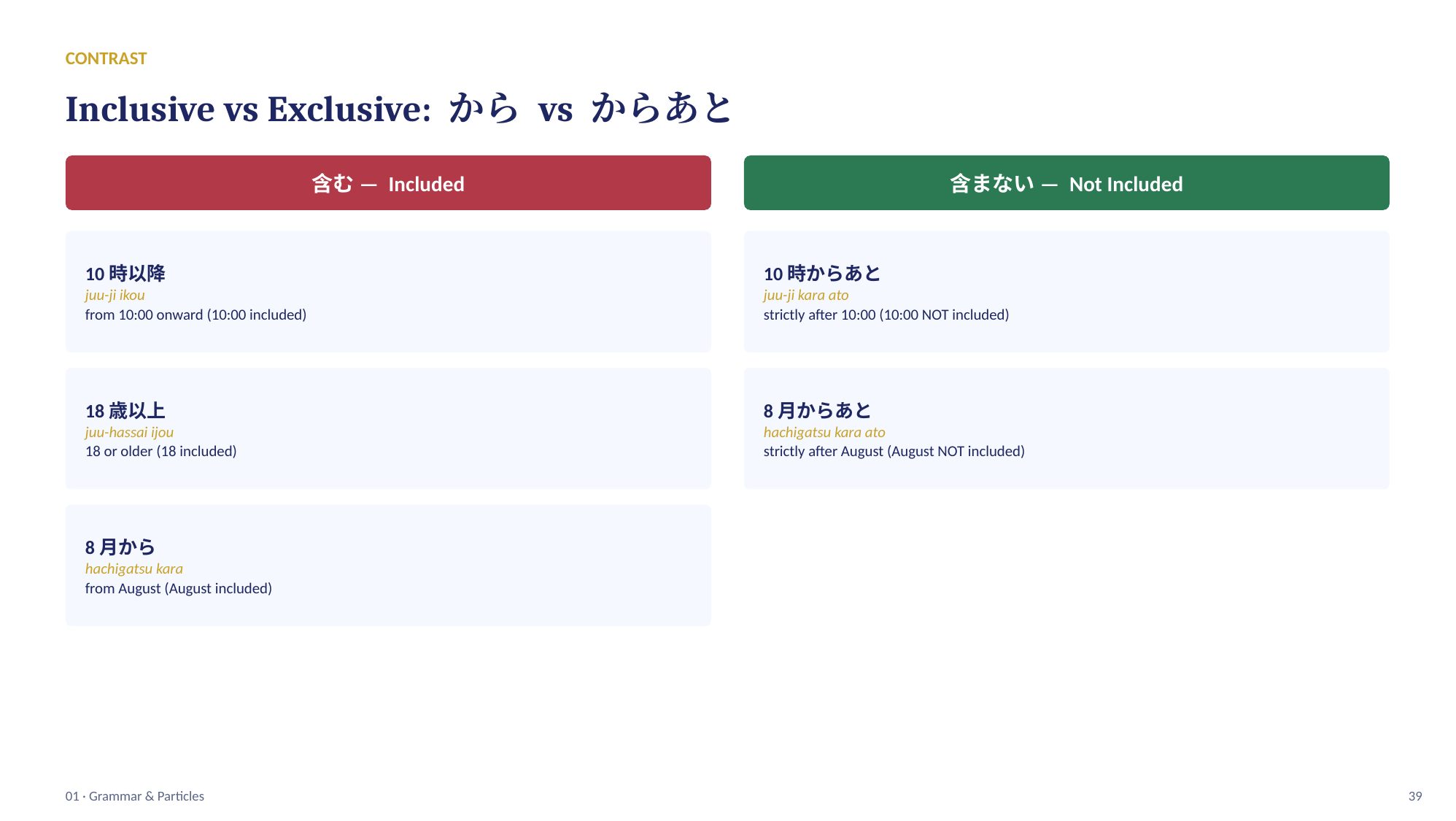
Inclusive vs Exclusive: から vs からあと
含む — Included 含まない — Not Included
Inclusive vs Exclusive: から vs からあと
含む — Included 含まない — Not Included
JP10時以降10時からあと
EN juu-ji ikou juu-ji kara ato
from 10:00 onward (10:00 included) strictly after 10:00 (10:00 NOT included)
from 10:00 onward (10:00 included) strictly after 10:00 (10:00 NOT included)
JP18歳以上8月からあと
EN juu-hassai ijou hachigatsu kara ato
18 or older (18 included) strictly after August (August NOT included)
18 or older (18 included) strictly after August (August NOT included)
JP8月から
EN hachigatsu kara
from August (August included)
01 · Grammar & Particles 39
from August (August included)
01 · Grammar & Particles 39
หน้า 40
คลิกเพื่อขยาย
ENCAUTION
Watch Out in Business Scheduling
• Adding あと ("after") to から shifts the meaning to EXCLUDE the reference point — unlike plain から or 以降 , which usually include it. Be careful with
this distinction when communicating deadlines and dates in business.
01 · Grammar & Particles 40
Watch Out in Business Scheduling
• Adding あと ("after") to から shifts the meaning to EXCLUDE the reference point — unlike plain から or 以降 , which usually include it. Be careful with
this distinction when communicating deadlines and dates in business.
01 · Grammar & Particles 40
หน้า 41
คลิกเพื่อขยาย
07
ENKara vs Node vs Tame
JP「から」「ので」「ため」の使い分け
ENThree ways to say "because" — casual, polite-objective, formal-written
หน้า 42
คลิกเพื่อขยาย
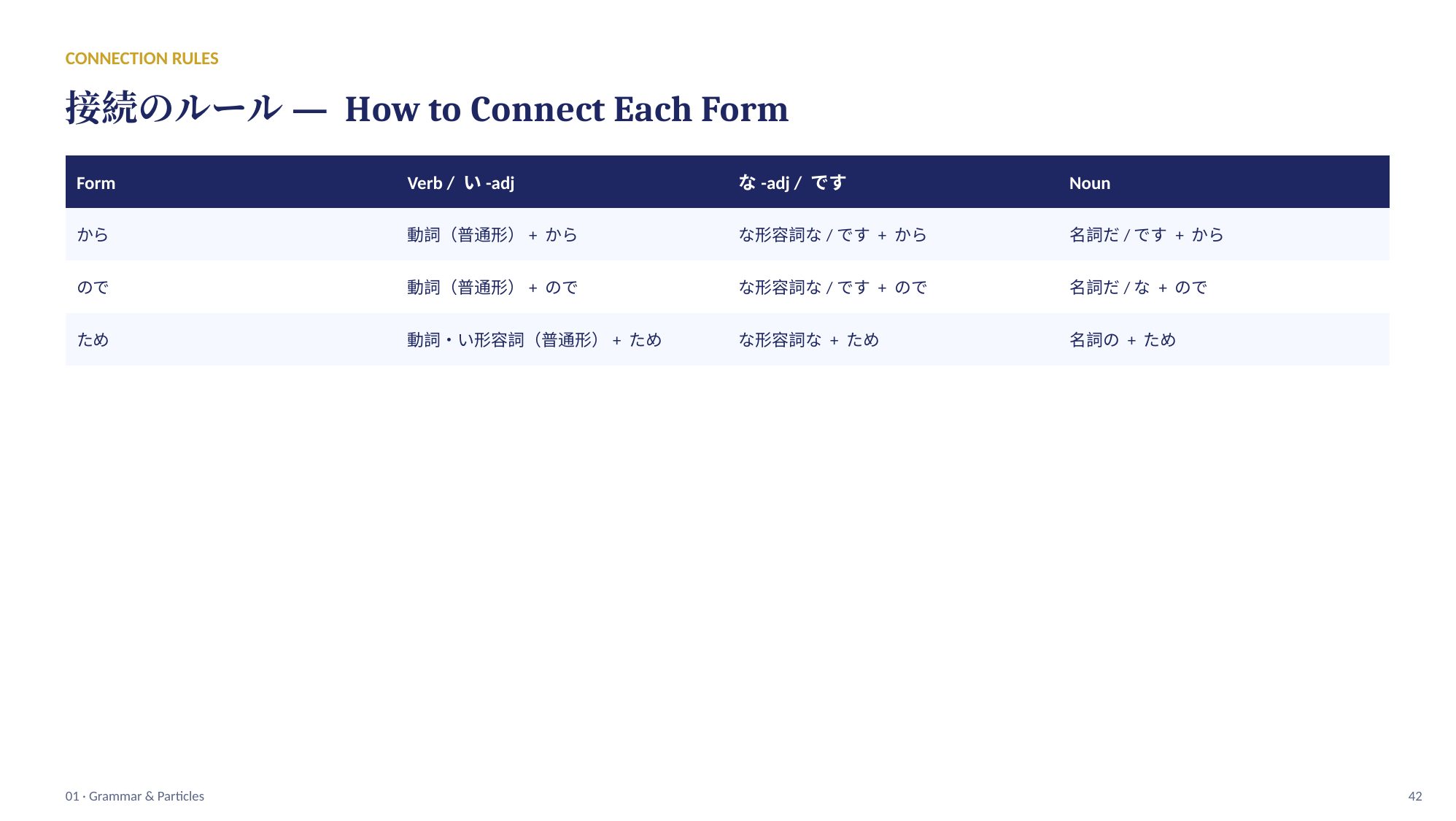
ENCONNECTION RULES
接続のルール — How to Connect Each Form
Form Verb / い -adj な -adj / です Noun
接続のルール — How to Connect Each Form
Form Verb / い -adj な -adj / です Noun
JPから動詞(普通形)+からな形容詞な/です+から名詞だ/です+から
ので動詞(普通形)+のでな形容詞な/です+ので名詞だ/な+ので
ため動詞・い形容詞(普通形)+ためな形容詞な+ため名詞の+ため
ので動詞(普通形)+のでな形容詞な/です+ので名詞だ/な+ので
ため動詞・い形容詞(普通形)+ためな形容詞な+ため名詞の+ため
EN01 · Grammar & Particles 42
หน้า 43
คลิกเพื่อขยาย
ENCOMPARISON
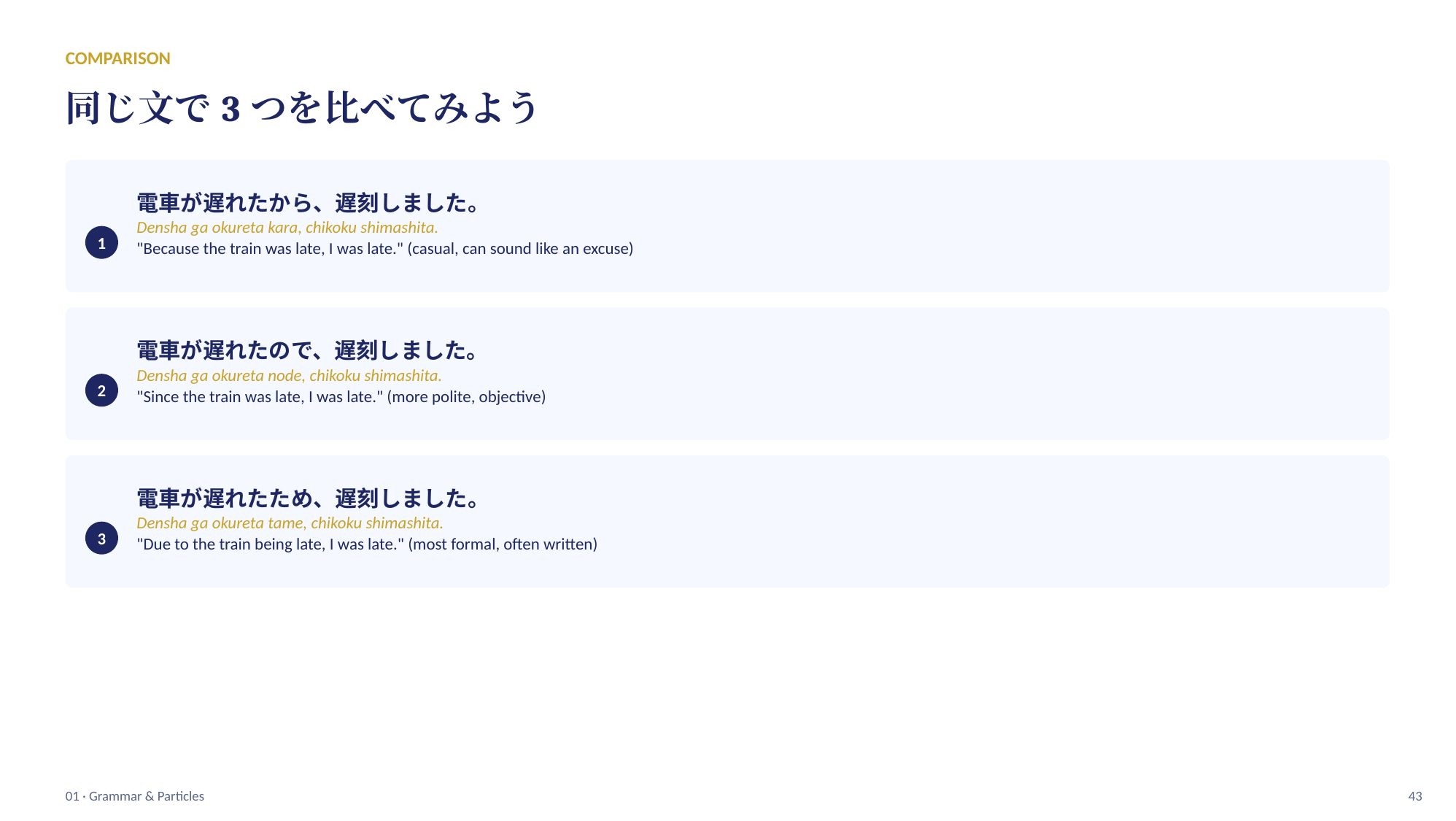
JP同じ文で3つを比べてみよう
電車が遅れたから、遅刻しました。
電車が遅れたから、遅刻しました。
EN Densha ga okureta kara, chikoku shimashita.
1 "Because the train was late, I was late." (casual, can sound like an excuse)
1 "Because the train was late, I was late." (casual, can sound like an excuse)
JP電車が遅れたので、遅刻しました。
EN Densha ga okureta node, chikoku shimashita.
2 "Since the train was late, I was late." (more polite, objective)
2 "Since the train was late, I was late." (more polite, objective)
JP電車が遅れたため、遅刻しました。
EN Densha ga okureta tame, chikoku shimashita.
3 "Due to the train being late, I was late." (most formal, often written)
01 · Grammar & Particles 43
3 "Due to the train being late, I was late." (most formal, often written)
01 · Grammar & Particles 43
หน้า 44
คลิกเพื่อขยาย
ENNUANCE
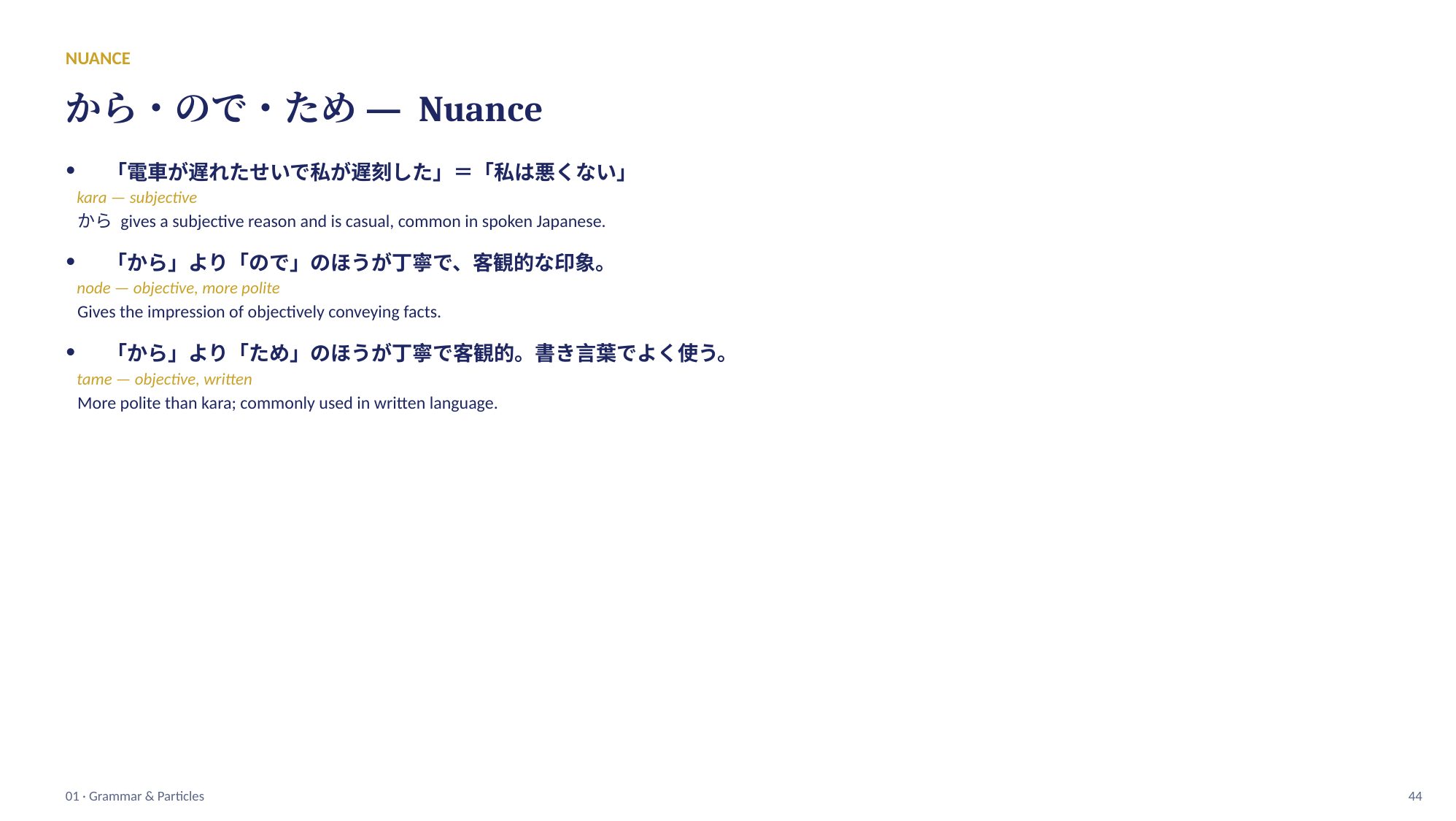
JPから・ので・ため—Nuance
•「電車が遅れたせいで私が遅刻した」=「私は悪くない」
•「電車が遅れたせいで私が遅刻した」=「私は悪くない」
EN kara — subjective
から gives a subjective reason and is casual, common in spoken Japanese.
から gives a subjective reason and is casual, common in spoken Japanese.
JP•「から」より「ので」のほうが丁寧で、客観的な印象。
EN node — objective, more polite
Gives the impression of objectively conveying facts.
Gives the impression of objectively conveying facts.
JP•「から」より「ため」のほうが丁寧で客観的。書き言葉でよく使う。
EN tame — objective, written
More polite than kara; commonly used in written language.
01 · Grammar & Particles 44
More polite than kara; commonly used in written language.
01 · Grammar & Particles 44
หน้า 45
คลิกเพื่อขยาย
ENSUMMARY TABLE
JP3つの違いまとめ
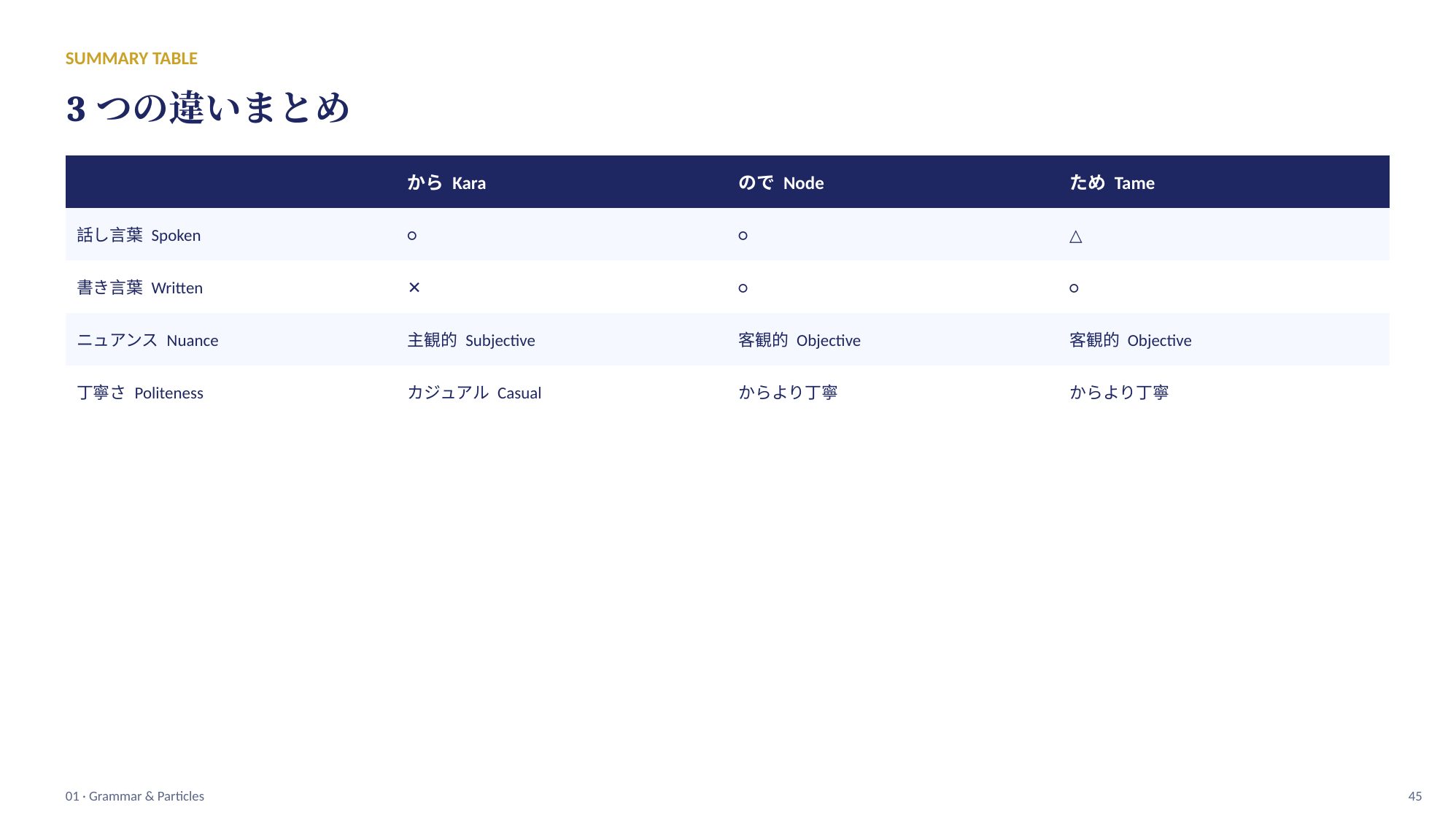
EN から Kara ので Node ため Tame
話し言葉 Spoken ○ ○ △
書き言葉 Written ✕ ○ ○
ニュアンス Nuance 主観的 Subjective 客観的 Objective 客観的 Objective
話し言葉 Spoken ○ ○ △
書き言葉 Written ✕ ○ ○
ニュアンス Nuance 主観的 Subjective 客観的 Objective 客観的 Objective
JP丁寧さPolitenessカジュアルCasualからより丁寧からより丁寧
EN01 · Grammar & Particles 45
หน้า 46
คลิกเพื่อขยาย
ENSPECIAL RULE
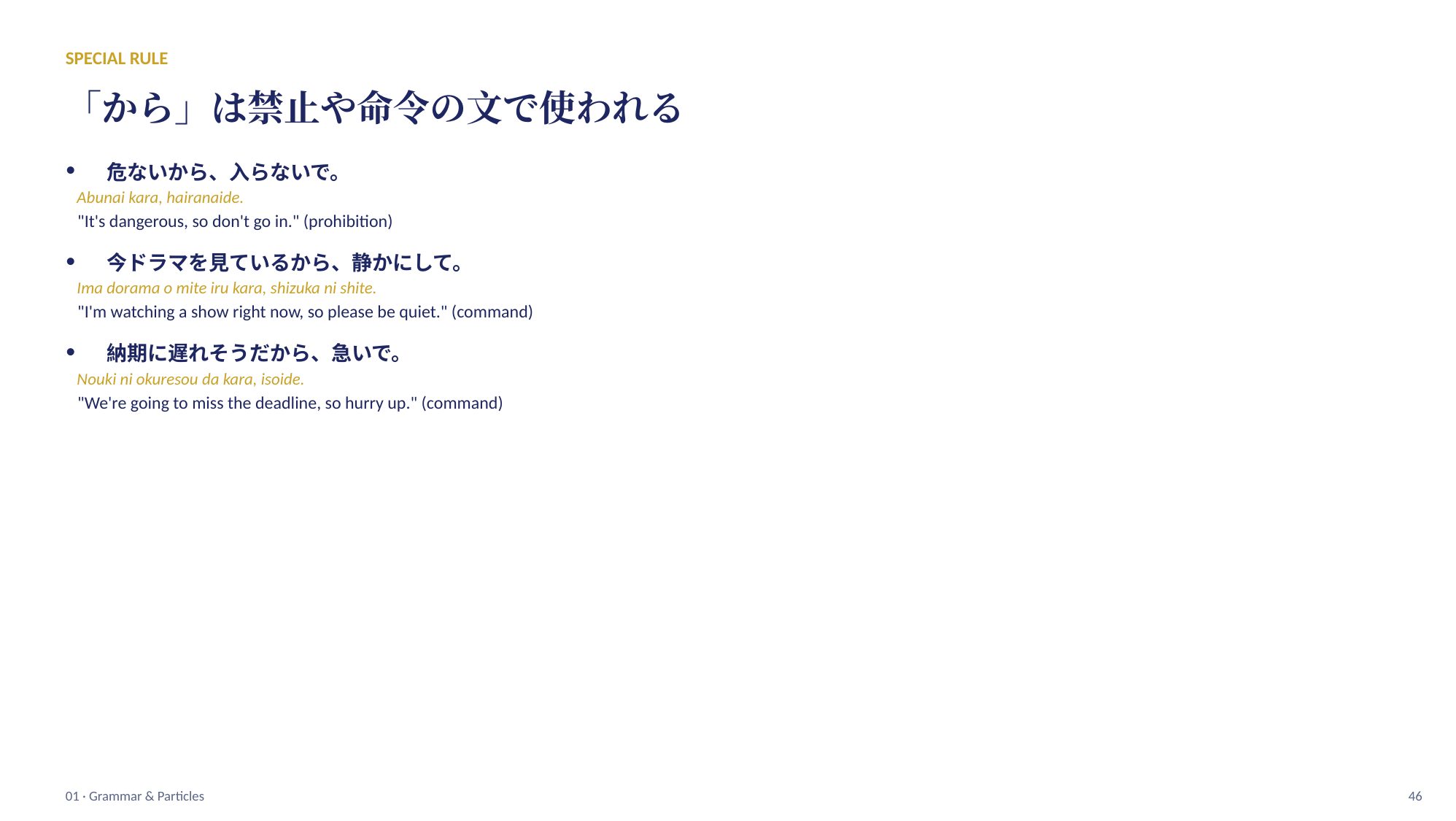
JP「から」は禁止や命令の文で使われる
•危ないから、入らないで。
•危ないから、入らないで。
EN Abunai kara, hairanaide.
"It's dangerous, so don't go in." (prohibition)
"It's dangerous, so don't go in." (prohibition)
JP•今ドラマを見ているから、静かにして。
EN Ima dorama o mite iru kara, shizuka ni shite.
"I'm watching a show right now, so please be quiet." (command)
"I'm watching a show right now, so please be quiet." (command)
JP•納期に遅れそうだから、急いで。
EN Nouki ni okuresou da kara, isoide.
"We're going to miss the deadline, so hurry up." (command)
01 · Grammar & Particles 46
"We're going to miss the deadline, so hurry up." (command)
01 · Grammar & Particles 46
หน้า 47
คลิกเพื่อขยาย
ENMORE EXAMPLES
から・ので・ため — Everyday Examples
から・ので・ため — Everyday Examples
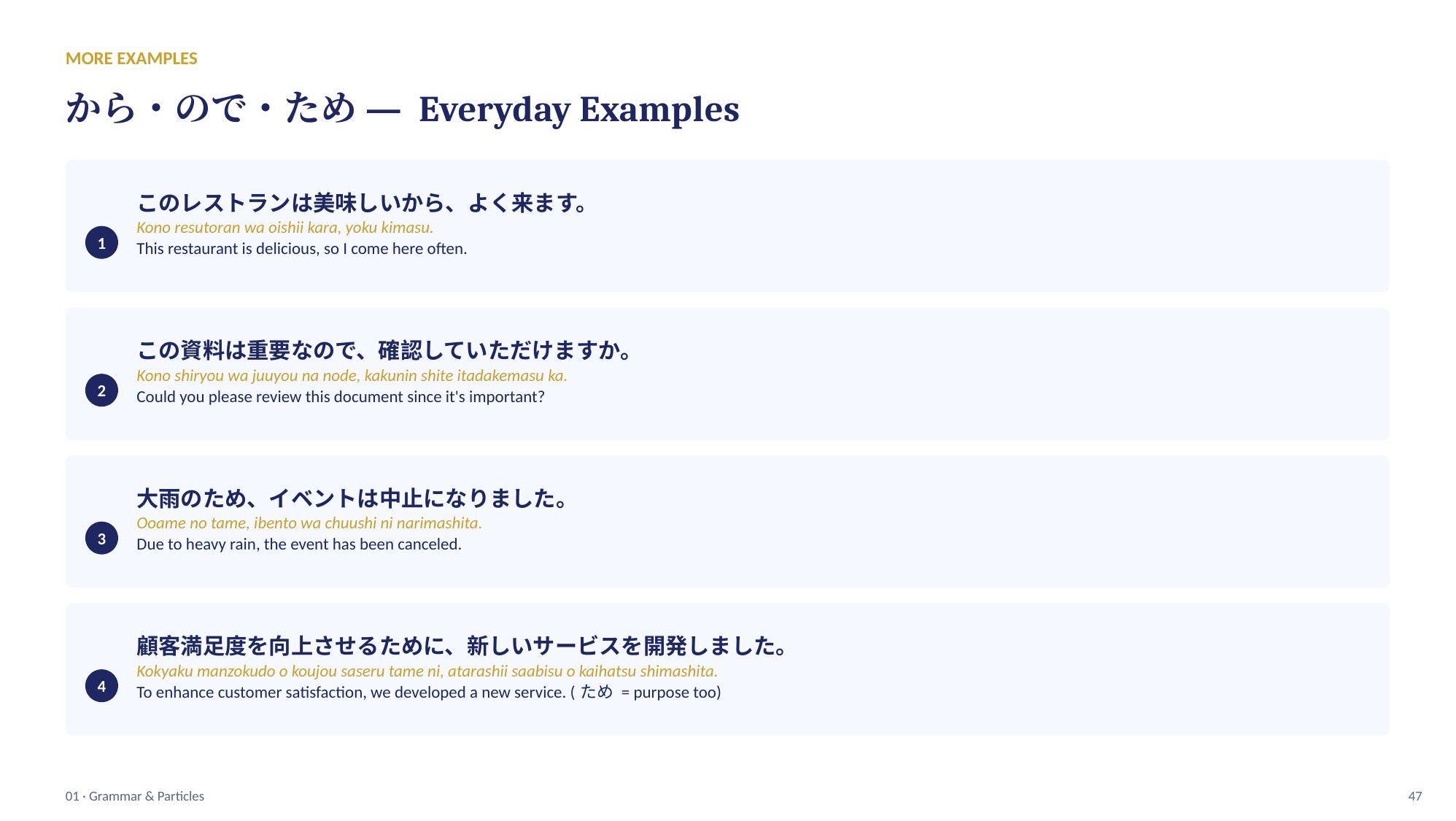
JPこのレストランは美味しいから、よく来ます。
EN Kono resutoran wa oishii kara, yoku kimasu.
1 This restaurant is delicious, so I come here often.
1 This restaurant is delicious, so I come here often.
JPこの資料は重要なので、確認していただけますか。
EN Kono shiryou wa juuyou na node, kakunin shite itadakemasu ka.
2 Could you please review this document since it's important?
2 Could you please review this document since it's important?
JP大雨のため、イベントは中止になりました。
EN Ooame no tame, ibento wa chuushi ni narimashita.
3 Due to heavy rain, the event has been canceled.
3 Due to heavy rain, the event has been canceled.
JP顧客満足度を向上させるために、新しいサービスを開発しました。
EN Kokyaku manzokudo o koujou saseru tame ni, atarashii saabisu o kaihatsu shimashita.
4 To enhance customer satisfaction, we developed a new service. ( ため = purpose too)
01 · Grammar & Particles 47
4 To enhance customer satisfaction, we developed a new service. ( ため = purpose too)
01 · Grammar & Particles 47
หน้า 48

คลิกเพื่อขยาย
08
EN~Ta Kekka vs ~Ageku
JP「〜た結果」と「〜あげく」
ENNeutral result vs a disappointing result after much effort
หน้า 49

คลิกเพื่อขยาย
JP~た結果
「〜た結果」の意味と接続
•出来事Aによって出来事Bになった
「〜た結果」の意味と接続
•出来事Aによって出来事Bになった
EN Dekigoto A ni yotte dekigoto B ni natta
"Event A led to Event B." — a neutral way to show cause and result.
"Event A led to Event B." — a neutral way to show cause and result.
JP•動詞(た形)+結果/名詞+の+結果
EN Verb (ta-form) + kekka / Noun + no + kekka
Connection pattern.
01 · Grammar & Particles 49
Connection pattern.
01 · Grammar & Particles 49
หน้า 50
คลิกเพื่อขยาย
ENEXAMPLES
JP「〜た結果」の例文
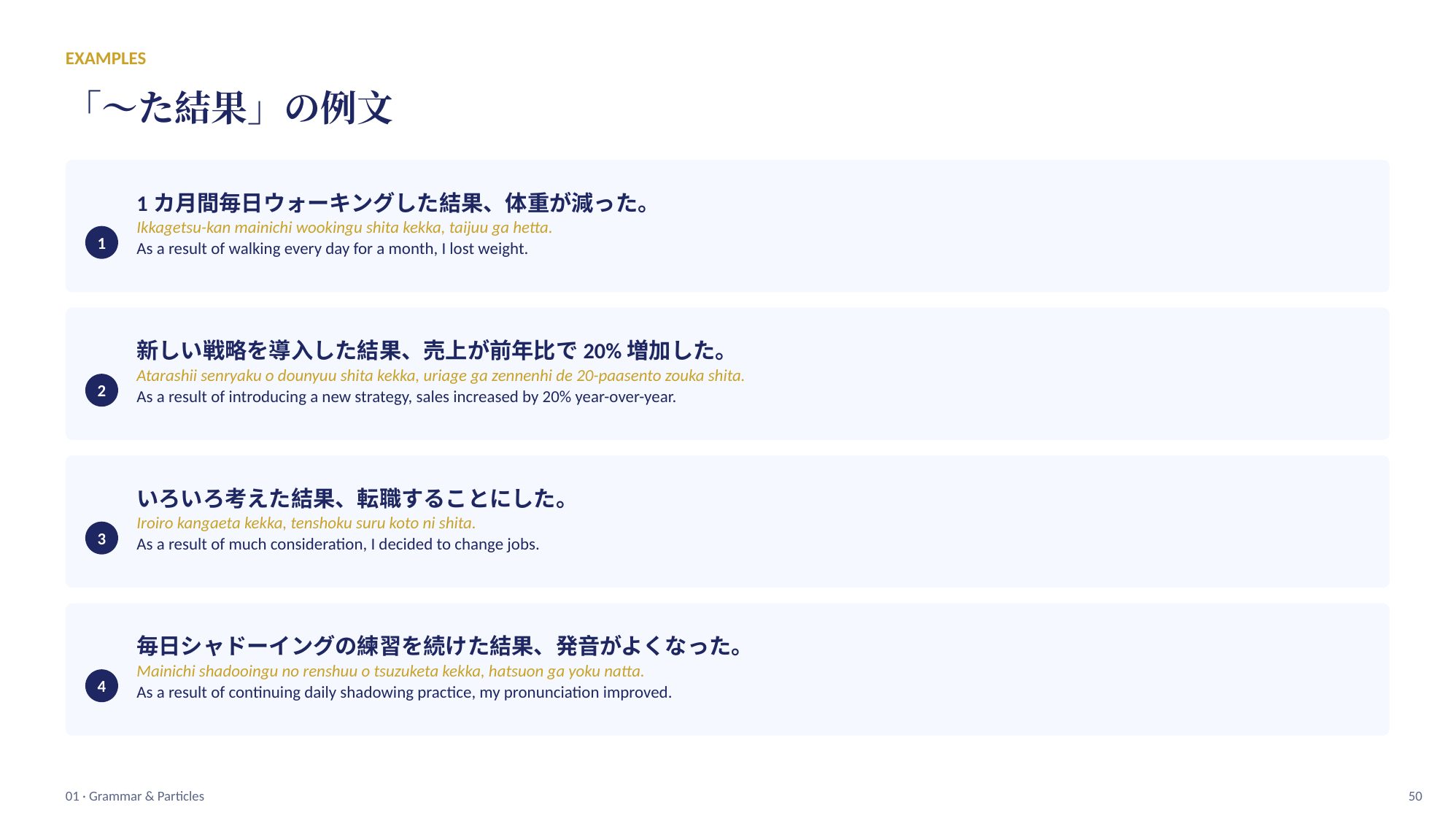
1カ月間毎日ウォーキングした結果、体重が減った。
1カ月間毎日ウォーキングした結果、体重が減った。
EN Ikkagetsu-kan mainichi wookingu shita kekka, taijuu ga hetta.
1 As a result of walking every day for a month, I lost weight.
1 As a result of walking every day for a month, I lost weight.
JP新しい戦略を導入した結果、売上が前年比で20%増加した。
EN Atarashii senryaku o dounyuu shita kekka, uriage ga zennenhi de 20-paasento zouka shita.
2 As a result of introducing a new strategy, sales increased by 20% year-over-year.
2 As a result of introducing a new strategy, sales increased by 20% year-over-year.
JPいろいろ考えた結果、転職することにした。
EN Iroiro kangaeta kekka, tenshoku suru koto ni shita.
3 As a result of much consideration, I decided to change jobs.
3 As a result of much consideration, I decided to change jobs.
JP毎日シャドーイングの練習を続けた結果、発音がよくなった。
EN Mainichi shadooingu no renshuu o tsuzuketa kekka, hatsuon ga yoku natta.
4 As a result of continuing daily shadowing practice, my pronunciation improved.
01 · Grammar & Particles 50
4 As a result of continuing daily shadowing practice, my pronunciation improved.
01 · Grammar & Particles 50
หน้า 51
คลิกเพื่อขยาย
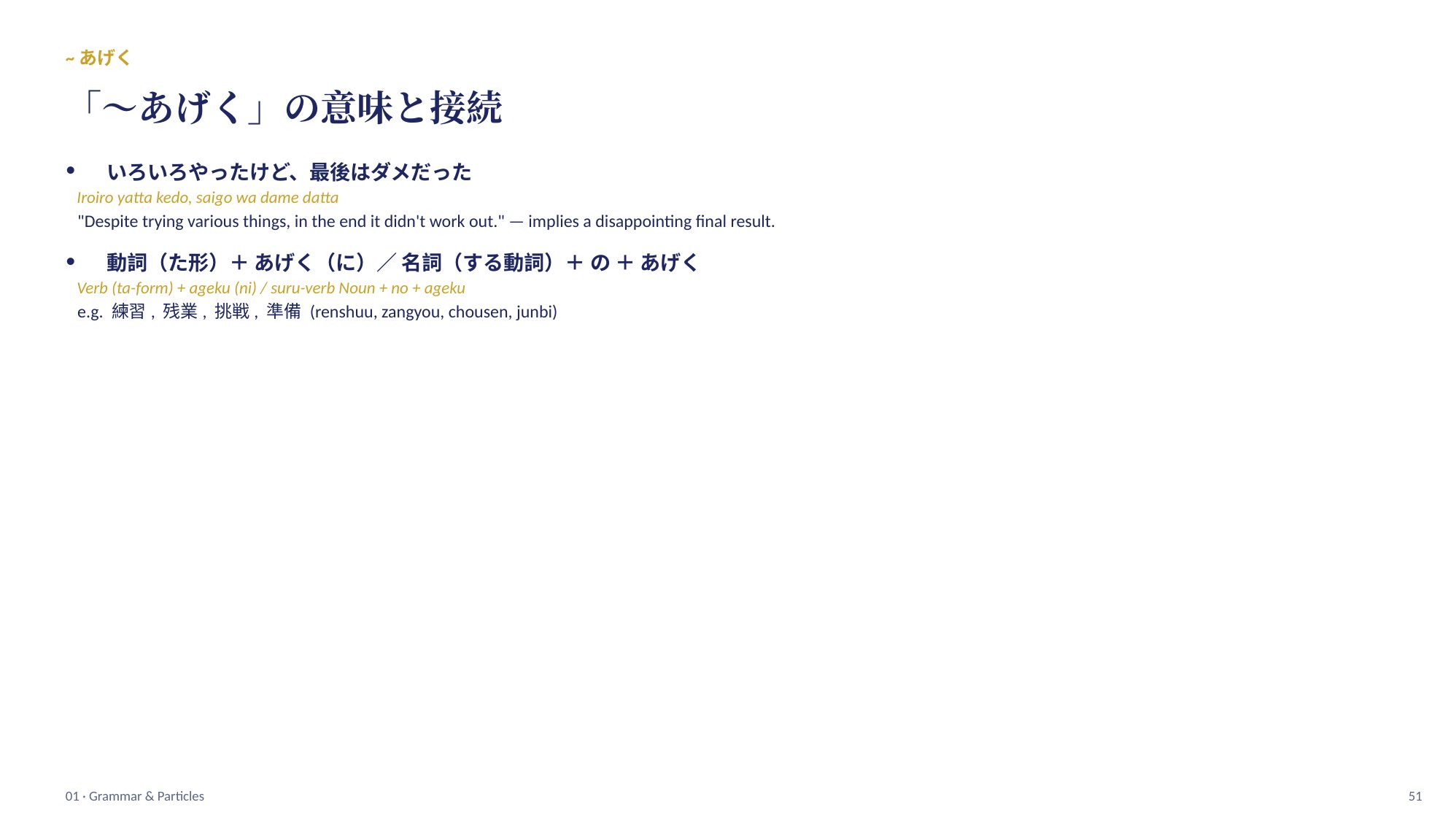
JP~あげく
「〜あげく」の意味と接続
•いろいろやったけど、最後はダメだった
「〜あげく」の意味と接続
•いろいろやったけど、最後はダメだった
EN Iroiro yatta kedo, saigo wa dame datta
"Despite trying various things, in the end it didn't work out." — implies a disappointing final result.
"Despite trying various things, in the end it didn't work out." — implies a disappointing final result.
JP•動詞(た形)+あげく(に)/名詞(する動詞)+の+あげく
EN Verb (ta-form) + ageku (ni) / suru-verb Noun + no + ageku
e.g. 練習 , 残業 , 挑戦 , 準備 (renshuu, zangyou, chousen, junbi)
01 · Grammar & Particles 51
e.g. 練習 , 残業 , 挑戦 , 準備 (renshuu, zangyou, chousen, junbi)
01 · Grammar & Particles 51
หน้า 52
คลิกเพื่อขยาย
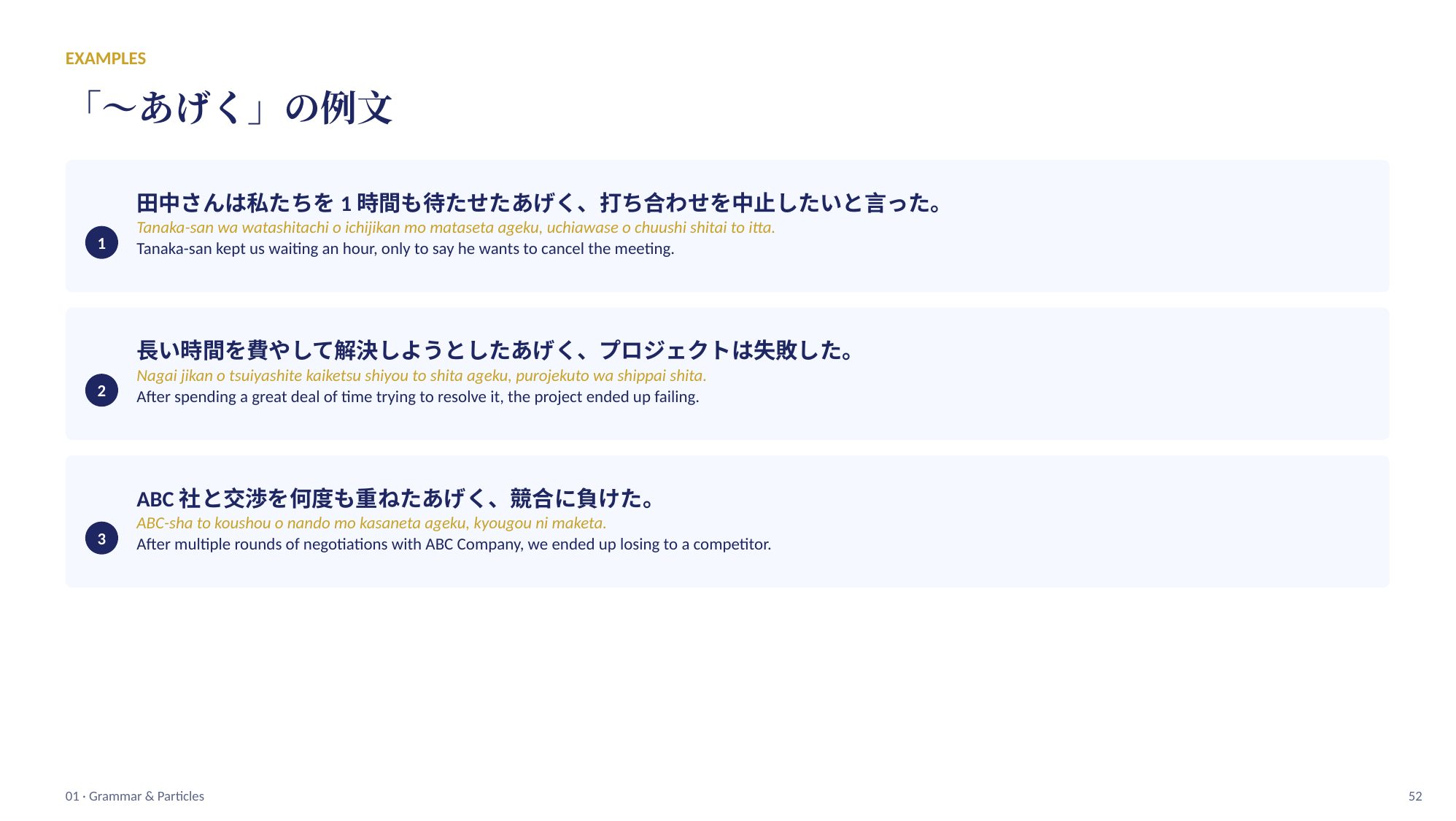
ENEXAMPLES
JP「〜あげく」の例文
田中さんは私たちを1時間も待たせたあげく、打ち合わせを中止したいと言った。
田中さんは私たちを1時間も待たせたあげく、打ち合わせを中止したいと言った。
EN Tanaka-san wa watashitachi o ichijikan mo mataseta ageku, uchiawase o chuushi shitai to itta.
1 Tanaka-san kept us waiting an hour, only to say he wants to cancel the meeting.
1 Tanaka-san kept us waiting an hour, only to say he wants to cancel the meeting.
JP長い時間を費やして解決しようとしたあげく、プロジェクトは失敗した。
EN Nagai jikan o tsuiyashite kaiketsu shiyou to shita ageku, purojekuto wa shippai shita.
2 After spending a great deal of time trying to resolve it, the project ended up failing.
2 After spending a great deal of time trying to resolve it, the project ended up failing.
JPABC社と交渉を何度も重ねたあげく、競合に負けた。
EN ABC-sha to koushou o nando mo kasaneta ageku, kyougou ni maketa.
3 After multiple rounds of negotiations with ABC Company, we ended up losing to a competitor.
01 · Grammar & Particles 52
3 After multiple rounds of negotiations with ABC Company, we ended up losing to a competitor.
01 · Grammar & Particles 52
หน้า 53
คลิกเพื่อขยาย
ENSUMMARY
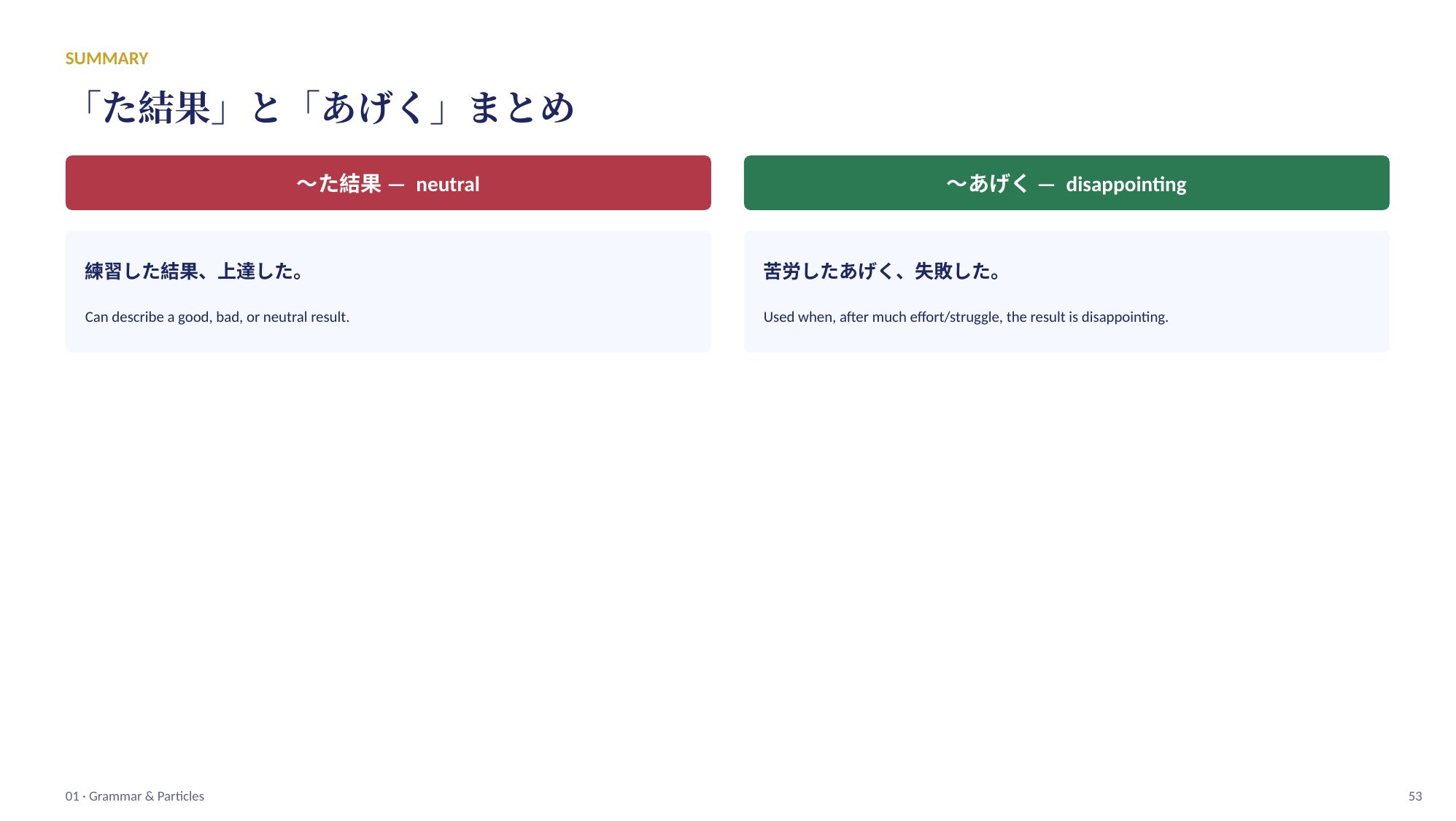
JP「た結果」と「あげく」まとめ
EN 〜た結果 — neutral 〜あげく — disappointing
JP練習した結果、上達した。苦労したあげく、失敗した。
EN Can describe a good, bad, or neutral result. Used when, after much effort/struggle, the result is disappointing.
01 · Grammar & Particles 53
01 · Grammar & Particles 53
หน้า 54

คลิกเพื่อขยาย
09
EN~Ue De
JP「〜上で」の使い方
EN"Do A first, then B" — a common business pattern
หน้า 55

คลิกเพื่อขยาย
ENMEANING & GRAMMAR
JP「〜上で」の意味と接続
•まずAをしてからBをする
•まずAをしてからBをする
EN Mazu A o shite kara B o suru
"To do Action A first, and then do Action B."
"To do Action A first, and then do Action B."
JP•動詞(た形)+上で/名詞+の上で
EN Verb (ta-form) + ue de / Noun + no ue de
Note: only volitional verbs (actions someone chooses to do) connect this way.
01 · Grammar & Particles 55
Note: only volitional verbs (actions someone chooses to do) connect this way.
01 · Grammar & Particles 55
หน้า 56
คลิกเพื่อขยาย
ENEVERYDAY REGISTER
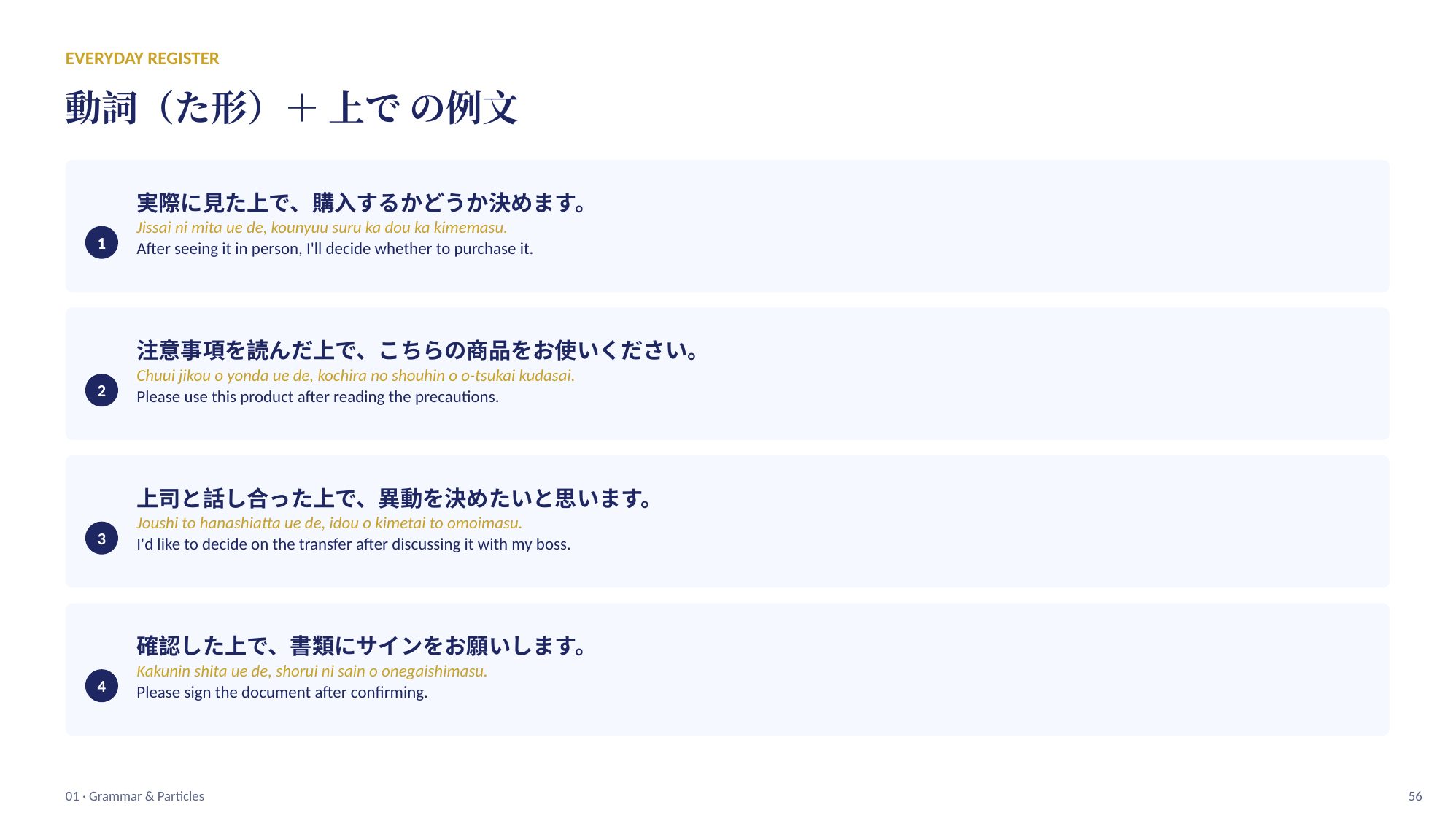
JP動詞(た形)+上での例文
実際に見た上で、購入するかどうか決めます。
実際に見た上で、購入するかどうか決めます。
EN Jissai ni mita ue de, kounyuu suru ka dou ka kimemasu.
1 After seeing it in person, I'll decide whether to purchase it.
1 After seeing it in person, I'll decide whether to purchase it.
JP注意事項を読んだ上で、こちらの商品をお使いください。
EN Chuui jikou o yonda ue de, kochira no shouhin o o-tsukai kudasai.
2 Please use this product after reading the precautions.
2 Please use this product after reading the precautions.
JP上司と話し合った上で、異動を決めたいと思います。
EN Joushi to hanashiatta ue de, idou o kimetai to omoimasu.
3 I'd like to decide on the transfer after discussing it with my boss.
3 I'd like to decide on the transfer after discussing it with my boss.
JP確認した上で、書類にサインをお願いします。
EN Kakunin shita ue de, shorui ni sain o onegaishimasu.
4 Please sign the document after confirming.
01 · Grammar & Particles 56
4 Please sign the document after confirming.
01 · Grammar & Particles 56
หน้า 57
คลิกเพื่อขยาย
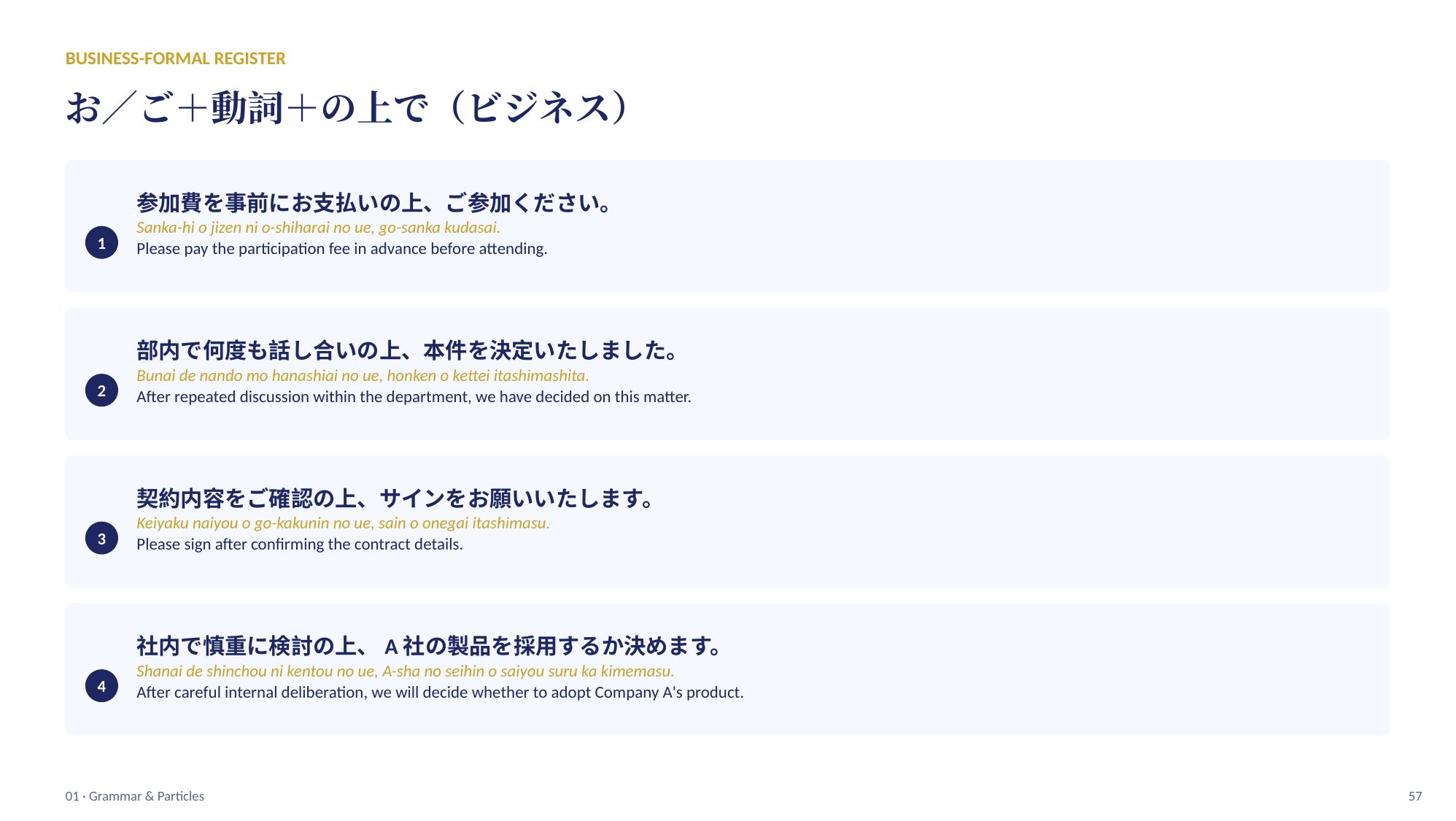
ENBUSINESS-FORMAL REGISTER
JPお/ご+動詞+の上で(ビジネス)
参加費を事前にお支払いの上、ご参加ください。
参加費を事前にお支払いの上、ご参加ください。
EN Sanka-hi o jizen ni o-shiharai no ue, go-sanka kudasai.
1 Please pay the participation fee in advance before attending.
1 Please pay the participation fee in advance before attending.
JP部内で何度も話し合いの上、本件を決定いたしました。
EN Bunai de nando mo hanashiai no ue, honken o kettei itashimashita.
2 After repeated discussion within the department, we have decided on this matter.
2 After repeated discussion within the department, we have decided on this matter.
JP契約内容をご確認の上、サインをお願いいたします。
EN Keiyaku naiyou o go-kakunin no ue, sain o onegai itashimasu.
3 Please sign after confirming the contract details.
3 Please sign after confirming the contract details.
JP社内で慎重に検討の上、A社の製品を採用するか決めます。
EN Shanai de shinchou ni kentou no ue, A-sha no seihin o saiyou suru ka kimemasu.
4 After careful internal deliberation, we will decide whether to adopt Company A's product.
01 · Grammar & Particles 57
4 After careful internal deliberation, we will decide whether to adopt Company A's product.
01 · Grammar & Particles 57
หน้า 58
คลิกเพื่อขยาย
ENSUMMARY
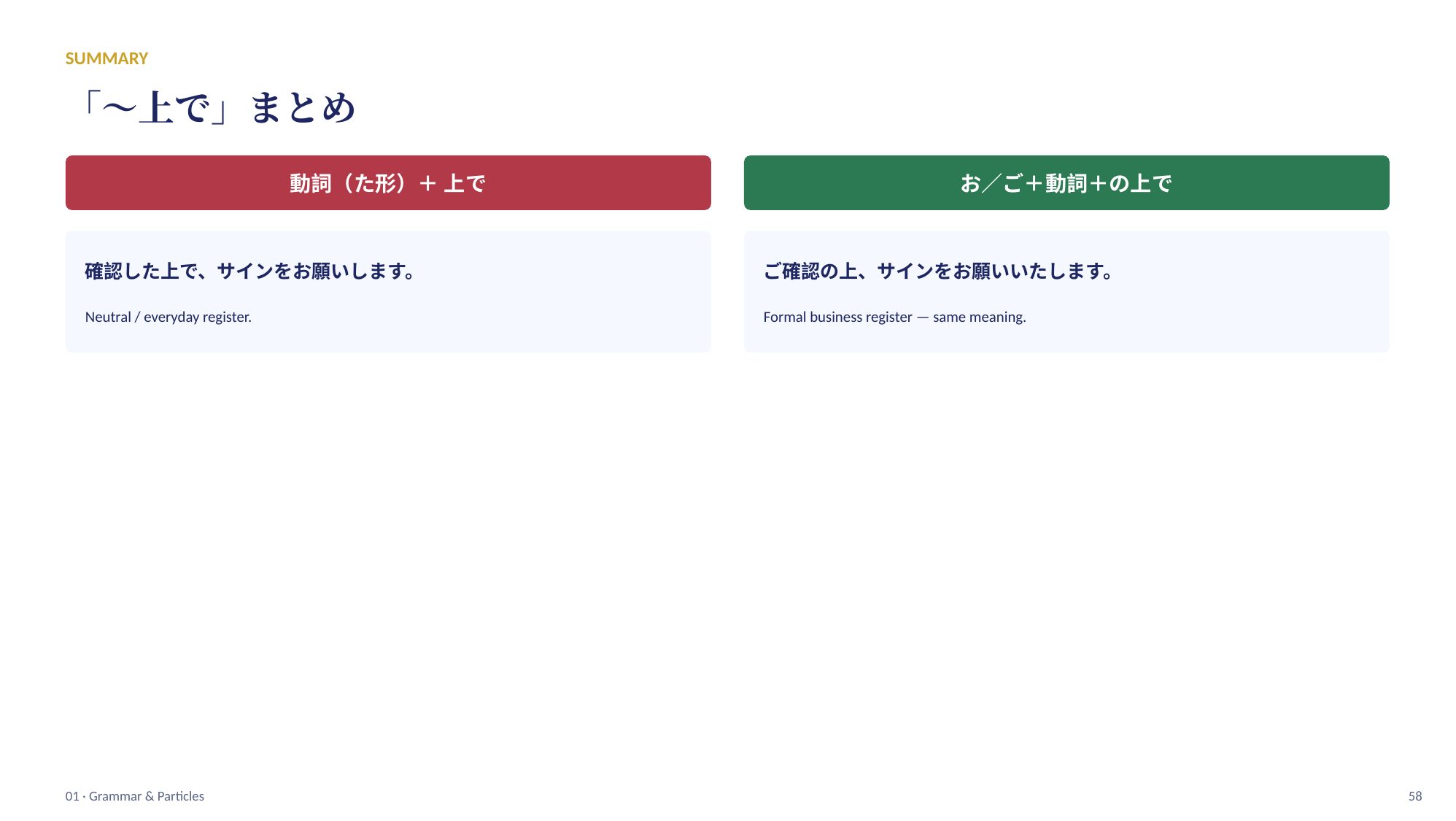
JP「〜上で」まとめ
動詞(た形)+上でお/ご+動詞+の上で
確認した上で、サインをお願いします。ご確認の上、サインをお願いいたします。
動詞(た形)+上でお/ご+動詞+の上で
確認した上で、サインをお願いします。ご確認の上、サインをお願いいたします。
EN Neutral / everyday register. Formal business register — same meaning.
01 · Grammar & Particles 58
01 · Grammar & Particles 58
หน้า 59

คลิกเพื่อขยาย
10
EN~Uru/Eru and ~Enai
JP「得る」「得ない」の使い方
ENExpressing possibility and impossibility in business Japanese
หน้า 60
คลิกเพื่อขยาย
ENMEANING
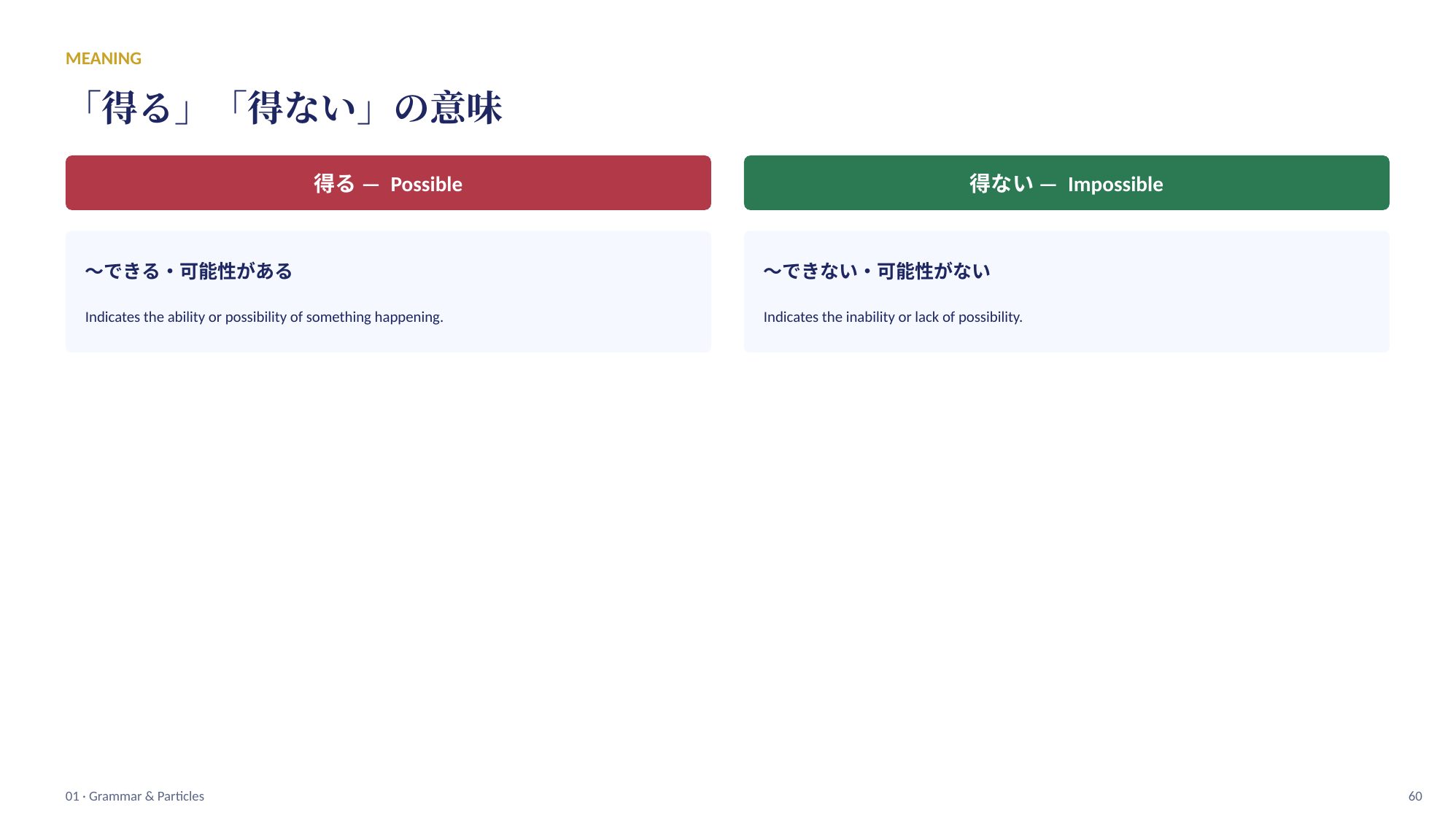
JP「得る」「得ない」の意味
EN 得る — Possible 得ない — Impossible
JP〜できる・可能性がある〜できない・可能性がない
EN Indicates the ability or possibility of something happening. Indicates the inability or lack of possibility.
01 · Grammar & Particles 60
01 · Grammar & Particles 60
หน้า 61
คลิกเพื่อขยาย
ENREADING & CONJUGATION
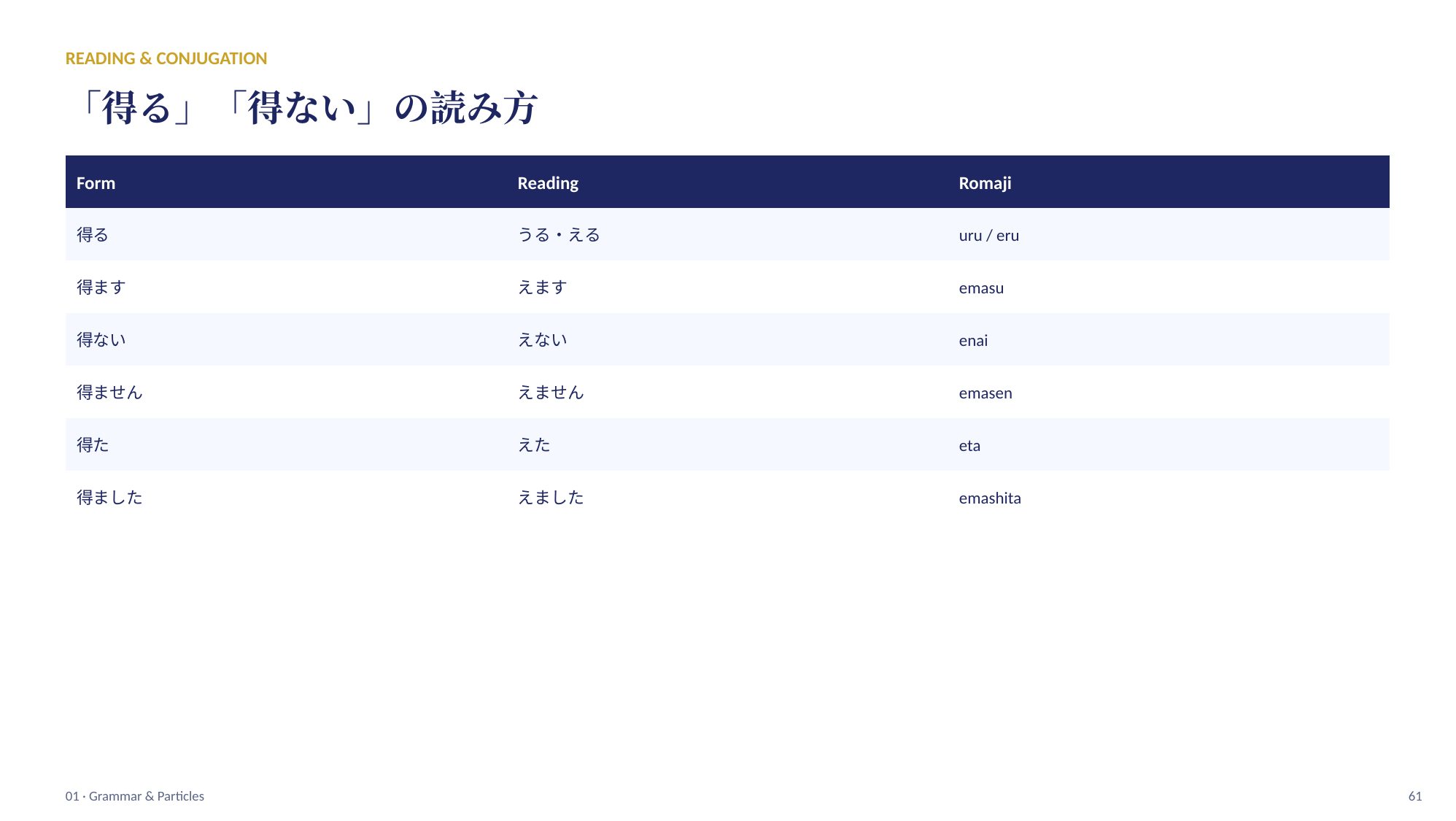
JP「得る」「得ない」の読み方
EN Form Reading Romaji
JP得るうる・えるuru/eru
得ますえますemasu
得ないえないenai
得ませんえませんemasen
得たえたeta
得ましたえましたemashita
得ますえますemasu
得ないえないenai
得ませんえませんemasen
得たえたeta
得ましたえましたemashita
EN01 · Grammar & Particles 61
หน้า 62
คลิกเพื่อขยาย
ENCAUTION
Point & Caution
Point & Caution
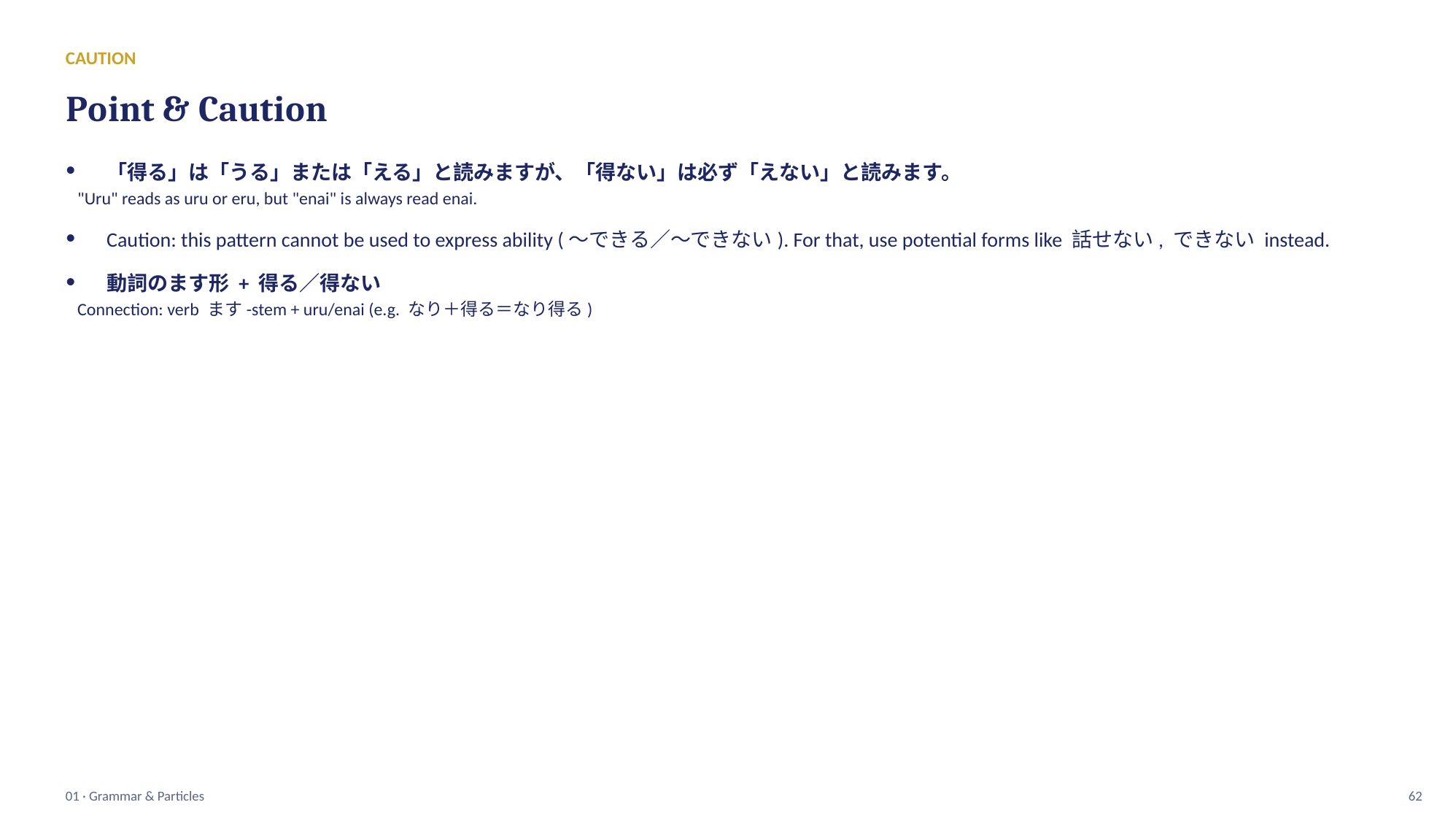
JP•「得る」は「うる」または「える」と読みますが、「得ない」は必ず「えない」と読みます。
EN "Uru" reads as uru or eru, but "enai" is always read enai.
• Caution: this pattern cannot be used to express ability ( 〜できる/〜できない ). For that, use potential forms like 話せない , できない instead.
• Caution: this pattern cannot be used to express ability ( 〜できる/〜できない ). For that, use potential forms like 話せない , できない instead.
JP•動詞のます形+得る/得ない
EN Connection: verb ます -stem + uru/enai (e.g. なり+得る=なり得る )
01 · Grammar & Particles 62
01 · Grammar & Particles 62
หน้า 63
คลิกเพื่อขยาย
ENEXAMPLES
JP社内会議・雑談での例文
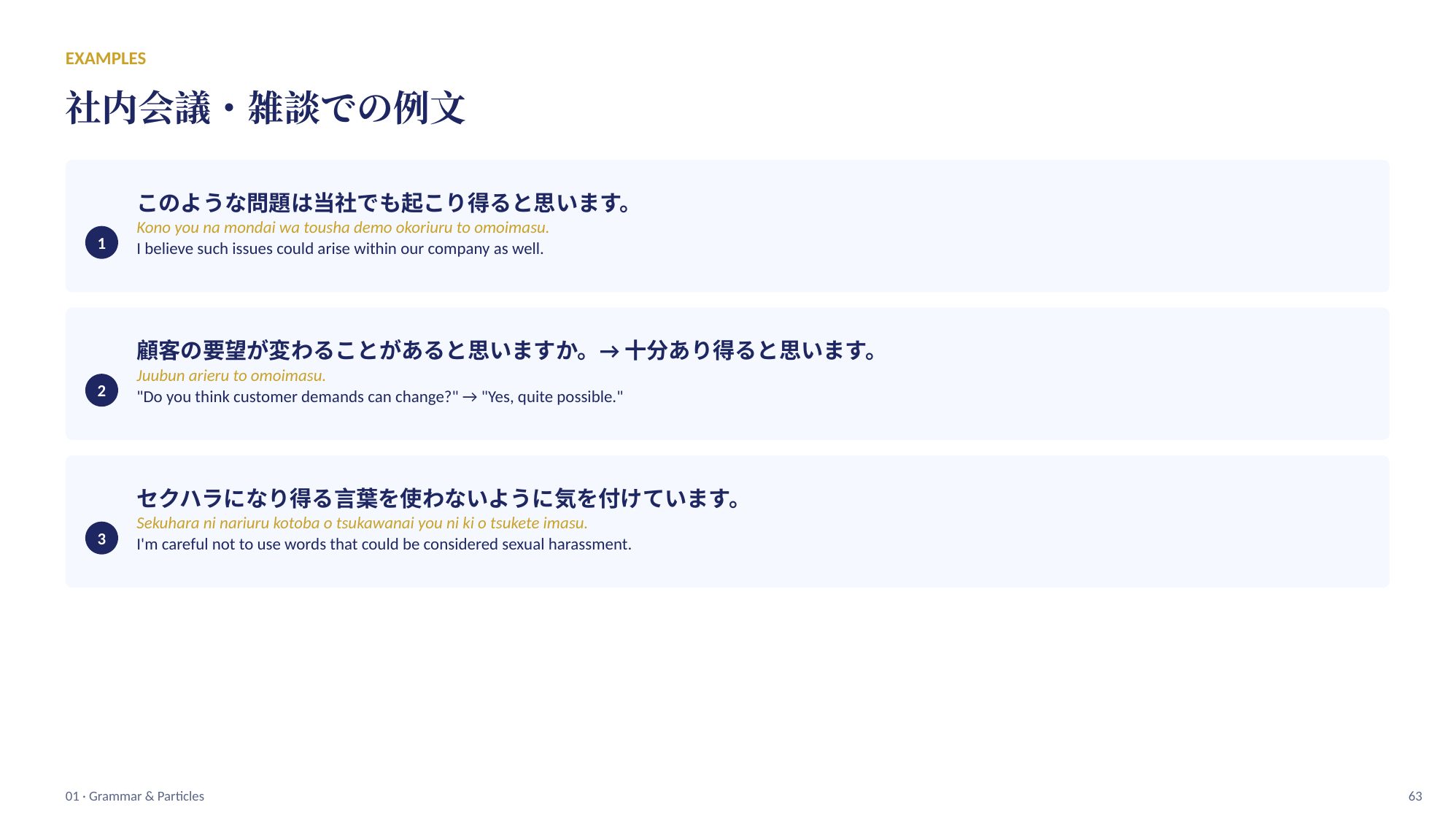
このような問題は当社でも起こり得ると思います。
このような問題は当社でも起こり得ると思います。
EN Kono you na mondai wa tousha demo okoriuru to omoimasu.
1 I believe such issues could arise within our company as well.
1 I believe such issues could arise within our company as well.
JP顧客の要望が変わることがあると思いますか。→十分あり得ると思います。
EN Juubun arieru to omoimasu.
2 "Do you think customer demands can change?" → "Yes, quite possible."
2 "Do you think customer demands can change?" → "Yes, quite possible."
JPセクハラになり得る言葉を使わないように気を付けています。
EN Sekuhara ni nariuru kotoba o tsukawanai you ni ki o tsukete imasu.
3 I'm careful not to use words that could be considered sexual harassment.
01 · Grammar & Particles 63
3 I'm careful not to use words that could be considered sexual harassment.
01 · Grammar & Particles 63
หน้า 64

คลิกเพื่อขยาย
11
ENAmari no ~ Ni/De
JP「あまりの〜に/で」
EN"So ~ that..." — expressing your feelings more vividly
หน้า 65
คลิกเพื่อขยาย
ENMEANING & USAGE
JP意味と使い方
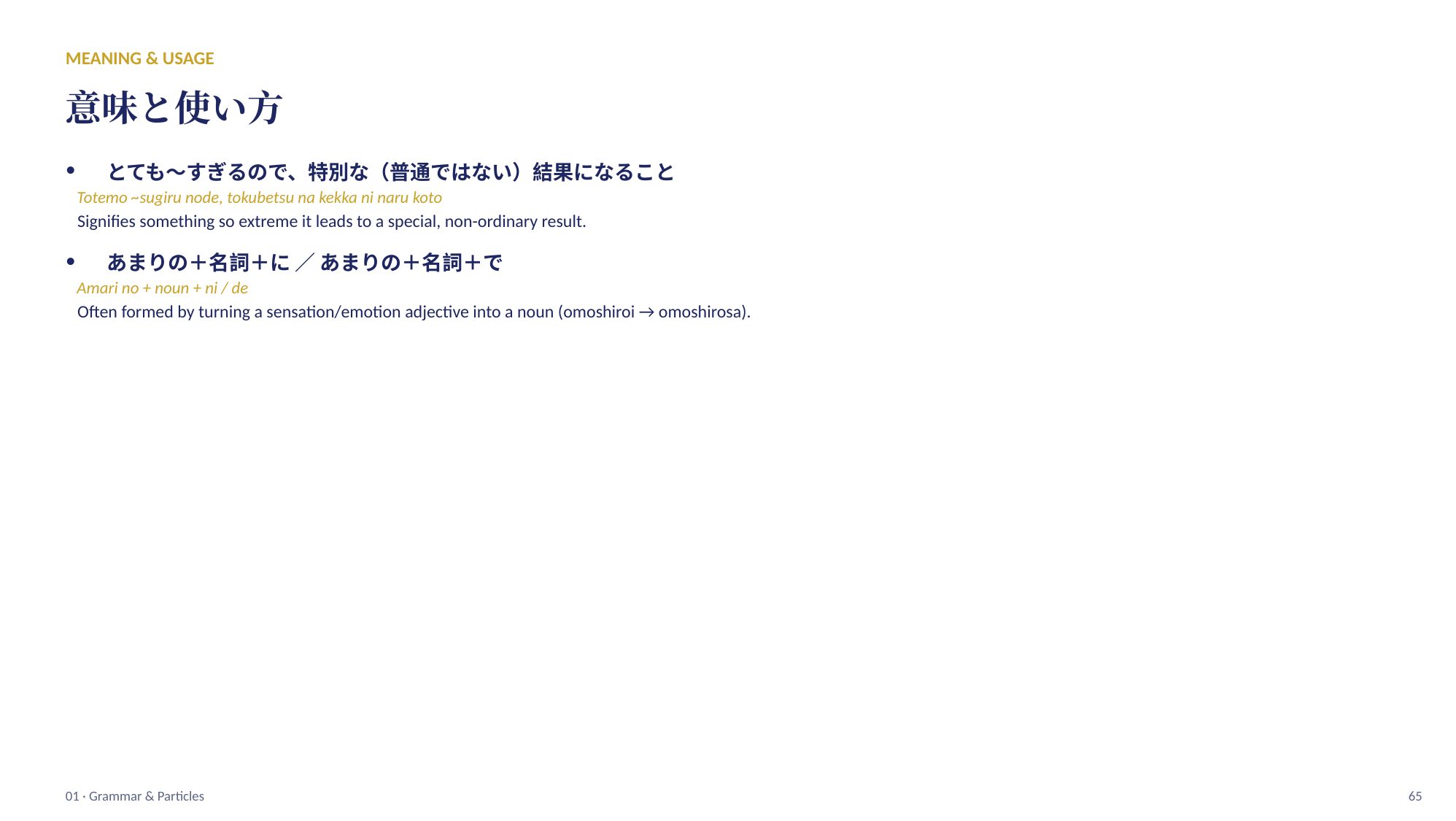
•とても〜すぎるので、特別な(普通ではない)結果になること
•とても〜すぎるので、特別な(普通ではない)結果になること
EN Totemo ~sugiru node, tokubetsu na kekka ni naru koto
Signifies something so extreme it leads to a special, non-ordinary result.
Signifies something so extreme it leads to a special, non-ordinary result.
JP•あまりの+名詞+に/あまりの+名詞+で
EN Amari no + noun + ni / de
Often formed by turning a sensation/emotion adjective into a noun (omoshiroi → omoshirosa).
01 · Grammar & Particles 65
Often formed by turning a sensation/emotion adjective into a noun (omoshiroi → omoshirosa).
01 · Grammar & Particles 65
หน้า 66
คลิกเพื่อขยาย
ENEXAMPLES
JP例文①〜④
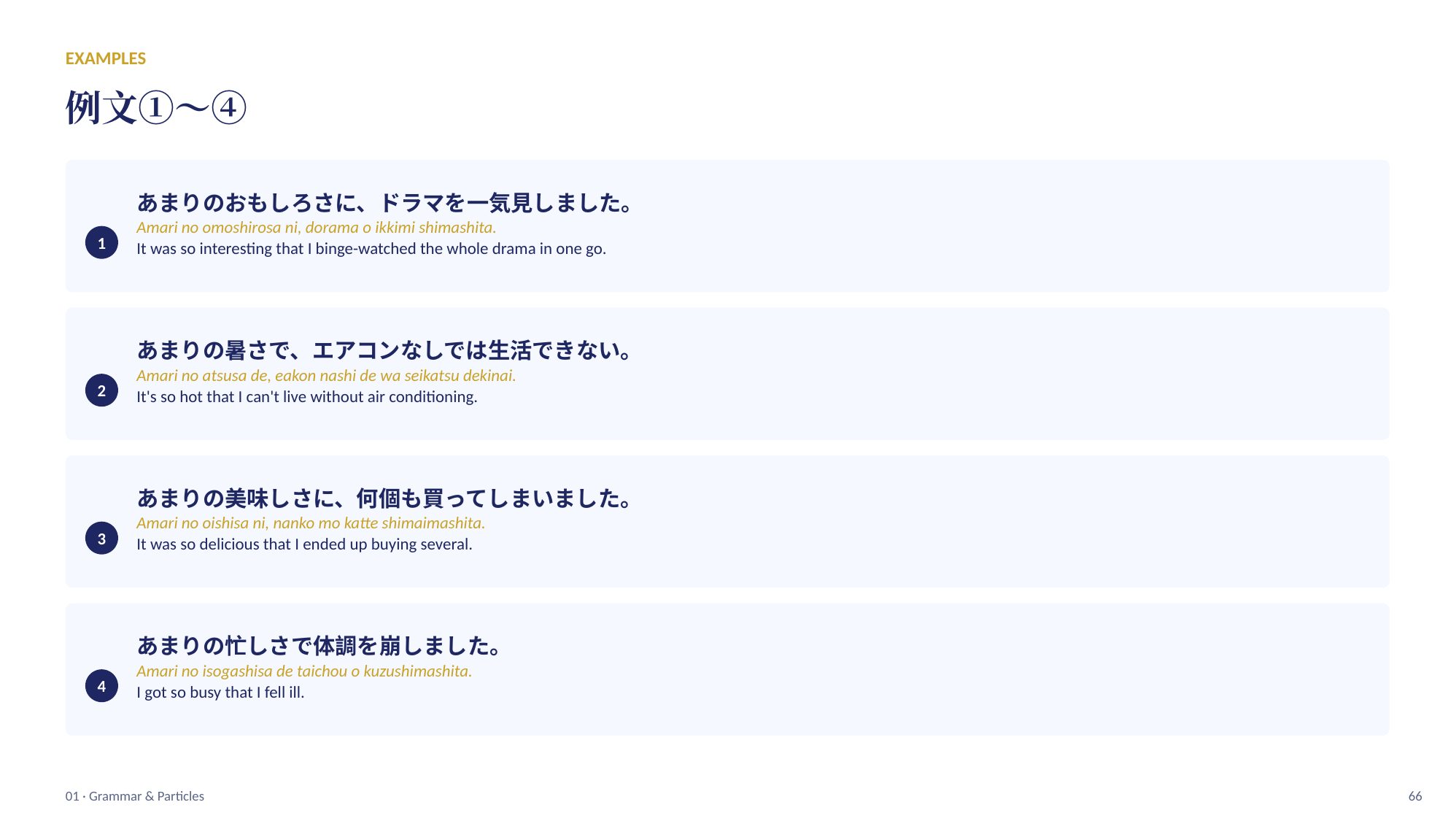
あまりのおもしろさに、ドラマを一気見しました。
あまりのおもしろさに、ドラマを一気見しました。
EN Amari no omoshirosa ni, dorama o ikkimi shimashita.
1 It was so interesting that I binge-watched the whole drama in one go.
1 It was so interesting that I binge-watched the whole drama in one go.
JPあまりの暑さで、エアコンなしでは生活できない。
EN Amari no atsusa de, eakon nashi de wa seikatsu dekinai.
2 It's so hot that I can't live without air conditioning.
2 It's so hot that I can't live without air conditioning.
JPあまりの美味しさに、何個も買ってしまいました。
EN Amari no oishisa ni, nanko mo katte shimaimashita.
3 It was so delicious that I ended up buying several.
3 It was so delicious that I ended up buying several.
JPあまりの忙しさで体調を崩しました。
EN Amari no isogashisa de taichou o kuzushimashita.
4 I got so busy that I fell ill.
01 · Grammar & Particles 66
4 I got so busy that I fell ill.
01 · Grammar & Particles 66
หน้า 67
คลิกเพื่อขยาย
ENPRACTICE
言い換え練習 — Rephrasing Practice
言い換え練習 — Rephrasing Practice
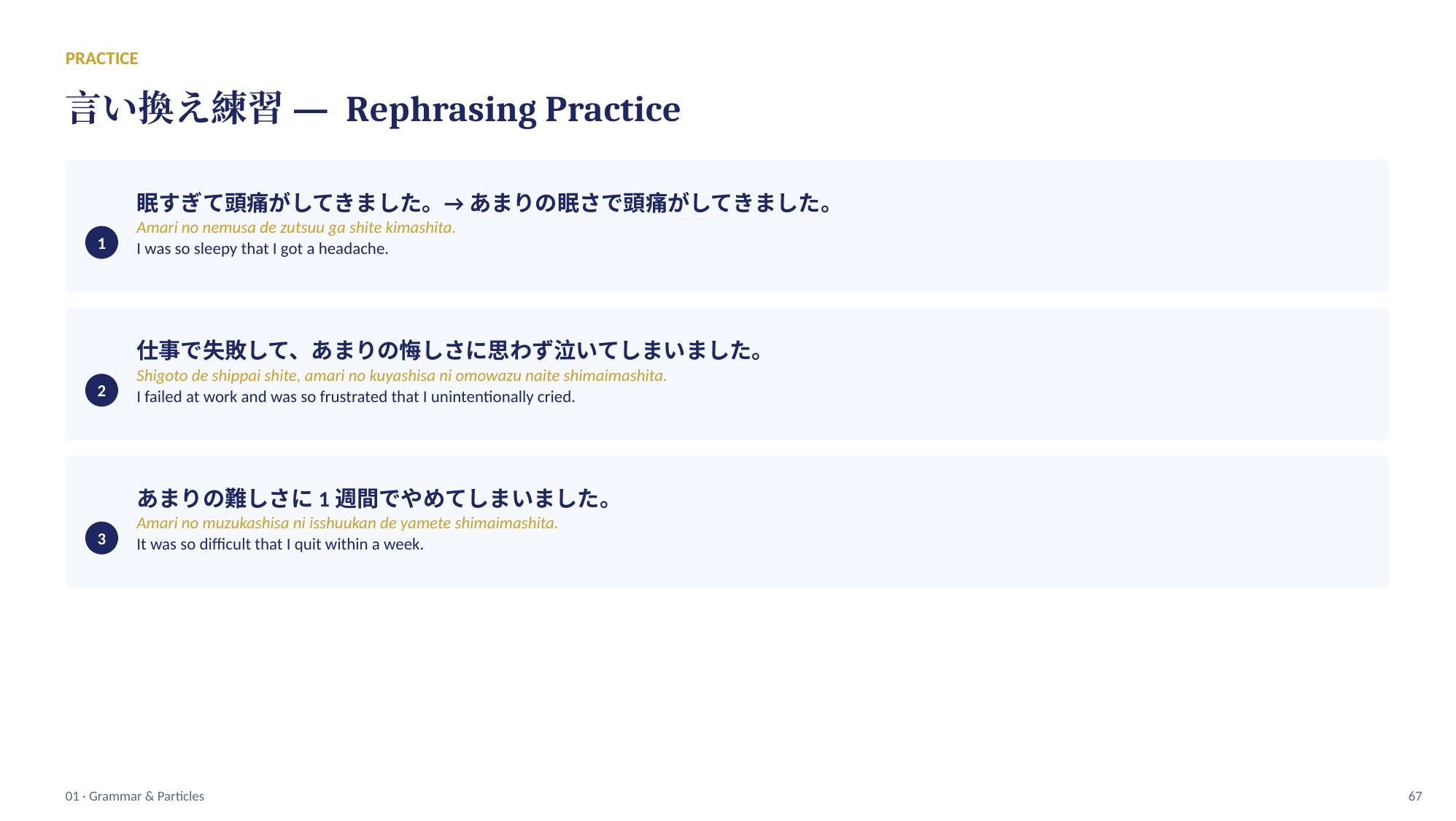
JP眠すぎて頭痛がしてきました。→あまりの眠さで頭痛がしてきました。
EN Amari no nemusa de zutsuu ga shite kimashita.
1 I was so sleepy that I got a headache.
1 I was so sleepy that I got a headache.
JP仕事で失敗して、あまりの悔しさに思わず泣いてしまいました。
EN Shigoto de shippai shite, amari no kuyashisa ni omowazu naite shimaimashita.
2 I failed at work and was so frustrated that I unintentionally cried.
2 I failed at work and was so frustrated that I unintentionally cried.
JPあまりの難しさに1週間でやめてしまいました。
EN Amari no muzukashisa ni isshuukan de yamete shimaimashita.
3 It was so difficult that I quit within a week.
01 · Grammar & Particles 67
3 It was so difficult that I quit within a week.
01 · Grammar & Particles 67
หน้า 68
คลิกเพื่อขยาย
12
ENOmoimasu vs Omotte Imasu
JP「思います」と「思っています」
ENA decision forming right now vs an ongoing plan held for a while
หน้า 69
คลิกเพื่อขยาย
ENPOINT
When Discussing an Action Plan
When Discussing an Action Plan
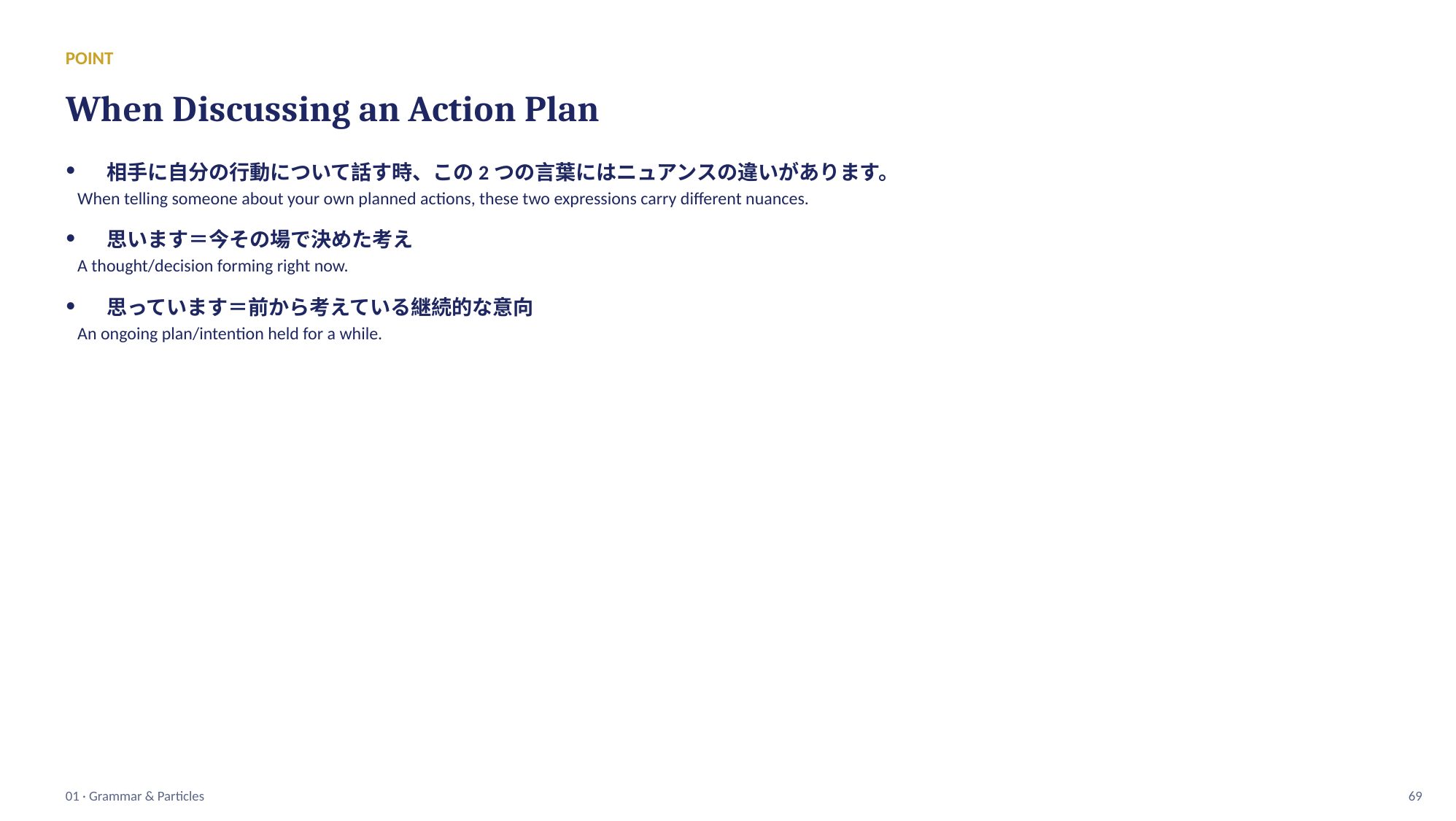
JP•相手に自分の行動について話す時、この2つの言葉にはニュアンスの違いがあります。
EN When telling someone about your own planned actions, these two expressions carry different nuances.
JP•思います=今その場で決めた考え
EN A thought/decision forming right now.
JP•思っています=前から考えている継続的な意向
EN An ongoing plan/intention held for a while.
01 · Grammar & Particles 69
01 · Grammar & Particles 69
หน้า 70
คลิกเพื่อขยาย
ENEXAMPLE
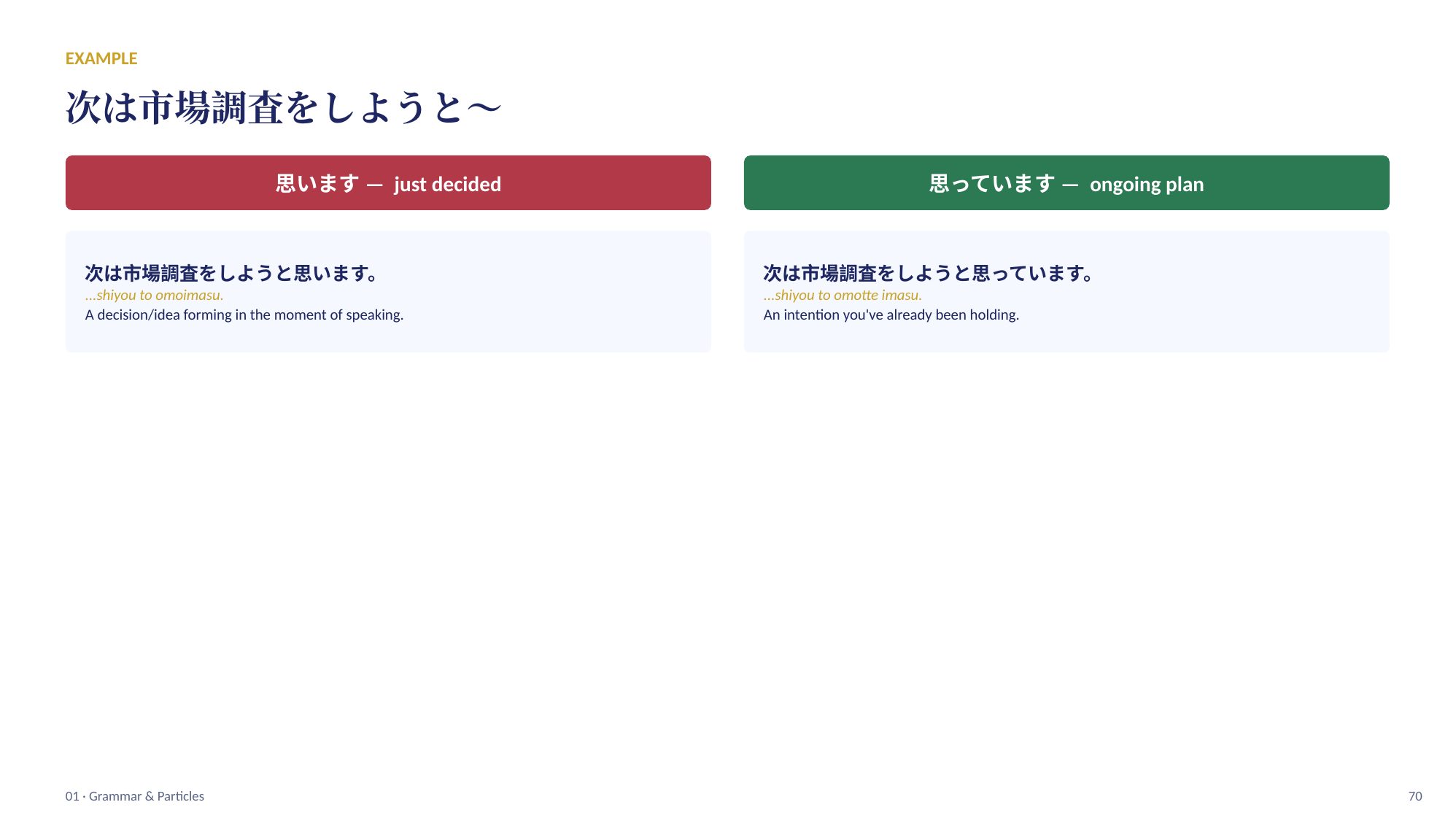
JP次は市場調査をしようと〜
EN 思います — just decided 思っています — ongoing plan
JP次は市場調査をしようと思います。次は市場調査をしようと思っています。
EN ...shiyou to omoimasu. ...shiyou to omotte imasu.
A decision/idea forming in the moment of speaking. An intention you've already been holding.
01 · Grammar & Particles 70
A decision/idea forming in the moment of speaking. An intention you've already been holding.
01 · Grammar & Particles 70
หน้า 71
คลิกเพื่อขยาย
ENMORE EXAMPLES
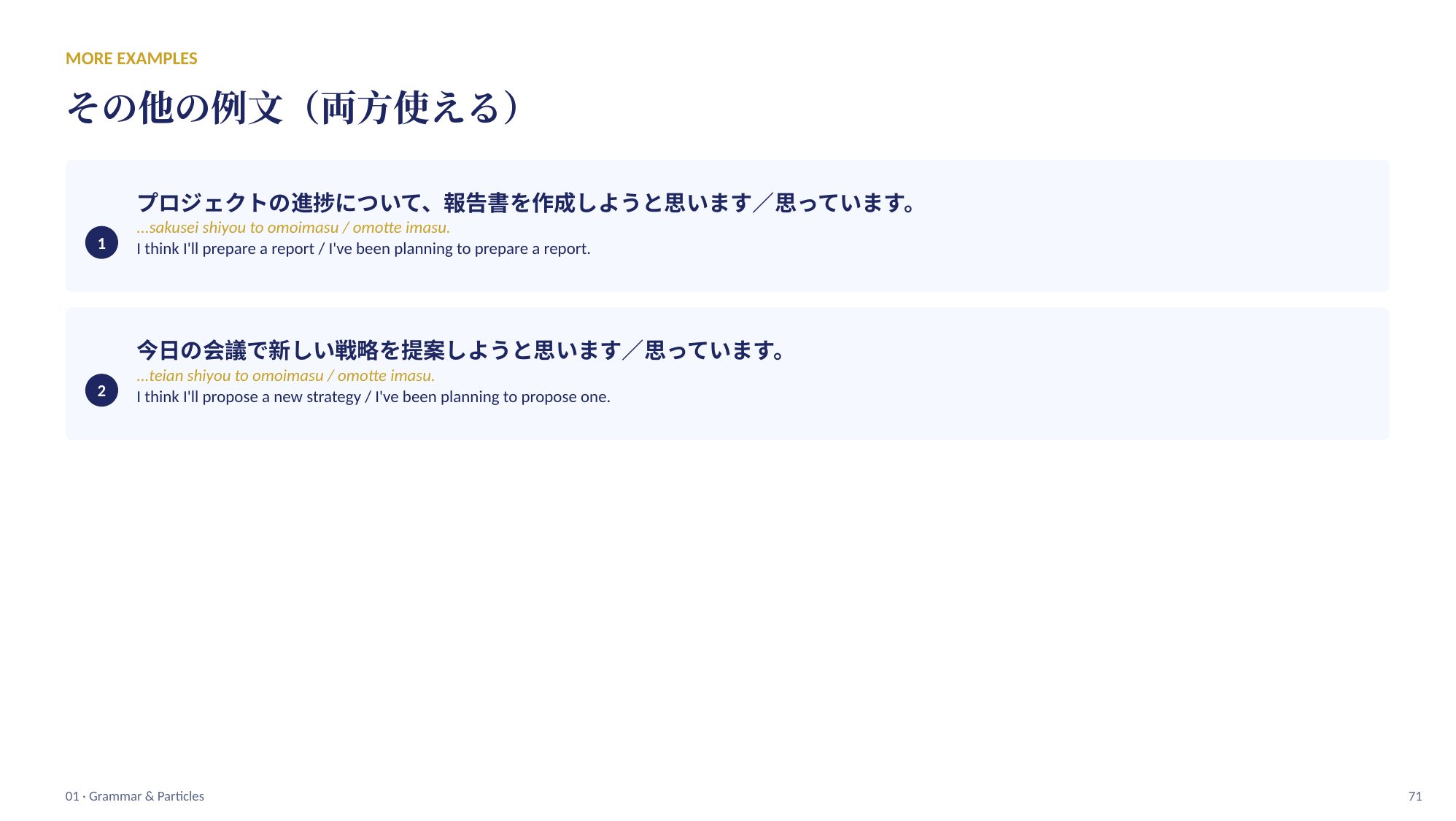
JPその他の例文(両方使える)
プロジェクトの進捗について、報告書を作成しようと思います/思っています。
プロジェクトの進捗について、報告書を作成しようと思います/思っています。
EN ...sakusei shiyou to omoimasu / omotte imasu.
1 I think I'll prepare a report / I've been planning to prepare a report.
1 I think I'll prepare a report / I've been planning to prepare a report.
JP今日の会議で新しい戦略を提案しようと思います/思っています。
EN ...teian shiyou to omoimasu / omotte imasu.
2 I think I'll propose a new strategy / I've been planning to propose one.
01 · Grammar & Particles 71
2 I think I'll propose a new strategy / I've been planning to propose one.
01 · Grammar & Particles 71
หน้า 72
คลิกเพื่อขยาย
13
ENArigatou Gozaimasu vs Gozaimashita
JP「ありがとうございます」vs「ありがとうございました」
ENPresent/ongoing gratitude vs past/completed gratitude
หน้า 73
คลิกเพื่อขยาย
ENORIGIN
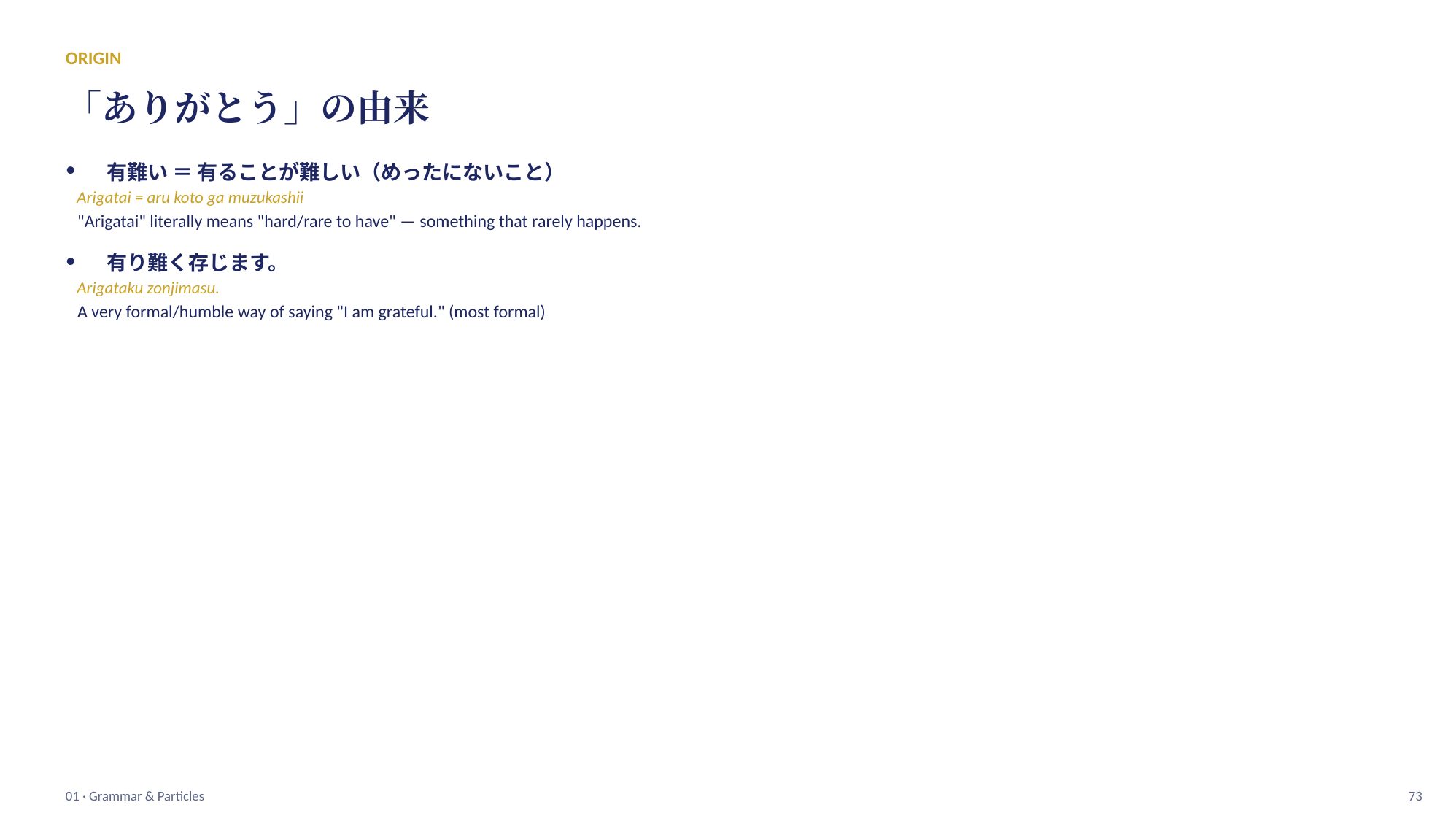
JP「ありがとう」の由来
•有難い=有ることが難しい(めったにないこと)
•有難い=有ることが難しい(めったにないこと)
EN Arigatai = aru koto ga muzukashii
"Arigatai" literally means "hard/rare to have" — something that rarely happens.
"Arigatai" literally means "hard/rare to have" — something that rarely happens.
JP•有り難く存じます。
EN Arigataku zonjimasu.
A very formal/humble way of saying "I am grateful." (most formal)
01 · Grammar & Particles 73
A very formal/humble way of saying "I am grateful." (most formal)
01 · Grammar & Particles 73
หน้า 74
คลิกเพื่อขยาย
ENRULE ① — PRESENT
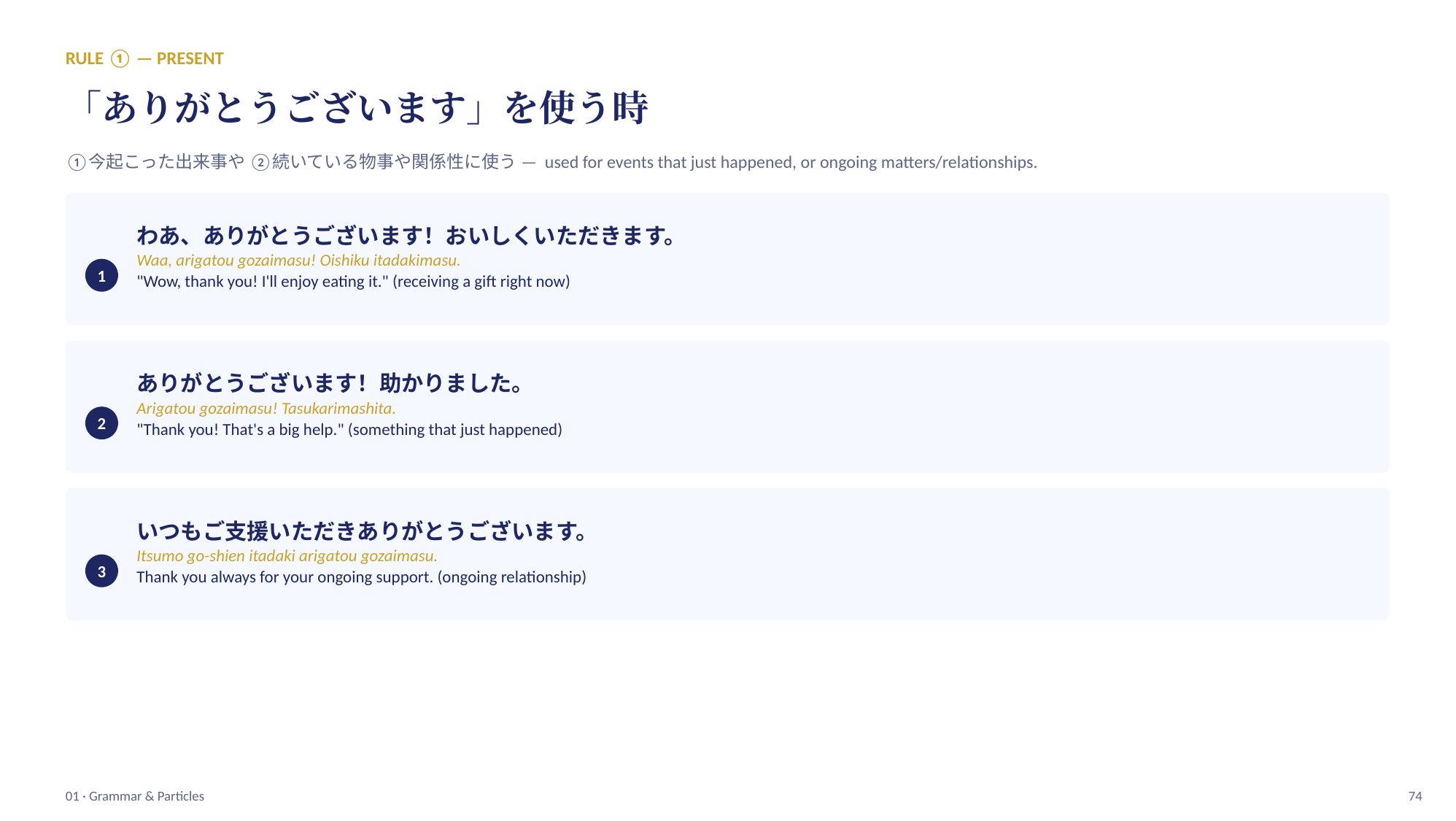
JP「ありがとうございます」を使う時
EN①今起こった出来事や ②続いている物事や関係性に使う — used for events that just happened, or ongoing matters/relationships.
JPわあ、ありがとうございます!おいしくいただきます。
EN Waa, arigatou gozaimasu! Oishiku itadakimasu.
1 "Wow, thank you! I'll enjoy eating it." (receiving a gift right now)
1 "Wow, thank you! I'll enjoy eating it." (receiving a gift right now)
JPありがとうございます!助かりました。
EN Arigatou gozaimasu! Tasukarimashita.
2 "Thank you! That's a big help." (something that just happened)
2 "Thank you! That's a big help." (something that just happened)
JPいつもご支援いただきありがとうございます。
EN Itsumo go-shien itadaki arigatou gozaimasu.
3 Thank you always for your ongoing support. (ongoing relationship)
01 · Grammar & Particles 74
3 Thank you always for your ongoing support. (ongoing relationship)
01 · Grammar & Particles 74
หน้า 75
คลิกเพื่อขยาย
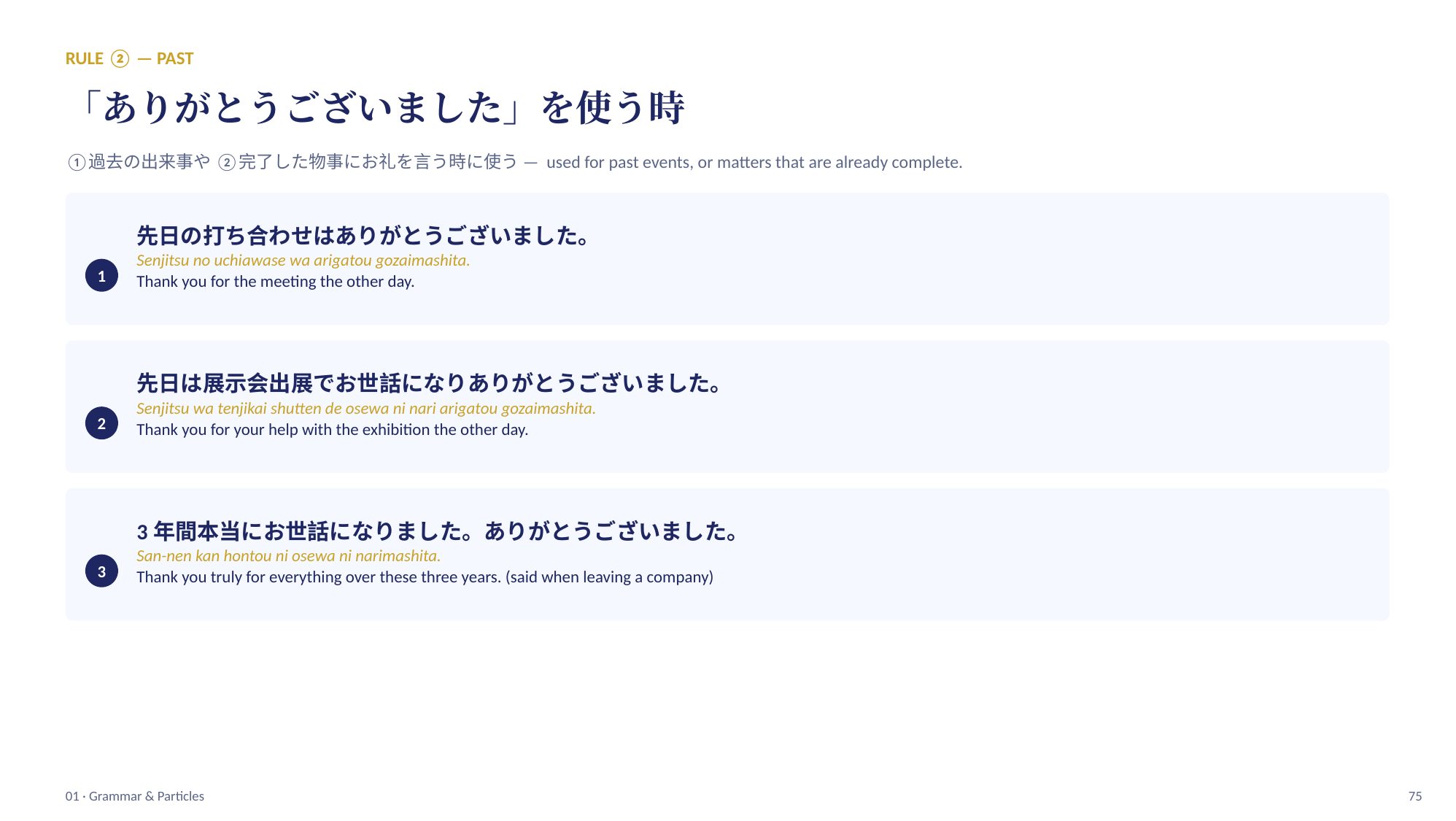
ENRULE ② — PAST
JP「ありがとうございました」を使う時
EN①過去の出来事や ②完了した物事にお礼を言う時に使う — used for past events, or matters that are already complete.
JP先日の打ち合わせはありがとうございました。
EN Senjitsu no uchiawase wa arigatou gozaimashita.
1 Thank you for the meeting the other day.
1 Thank you for the meeting the other day.
JP先日は展示会出展でお世話になりありがとうございました。
EN Senjitsu wa tenjikai shutten de osewa ni nari arigatou gozaimashita.
2 Thank you for your help with the exhibition the other day.
2 Thank you for your help with the exhibition the other day.
JP3年間本当にお世話になりました。ありがとうございました。
EN San-nen kan hontou ni osewa ni narimashita.
3 Thank you truly for everything over these three years. (said when leaving a company)
01 · Grammar & Particles 75
3 Thank you truly for everything over these three years. (said when leaving a company)
01 · Grammar & Particles 75
หน้า 76
คลิกเพื่อขยาย
ENCAUTION
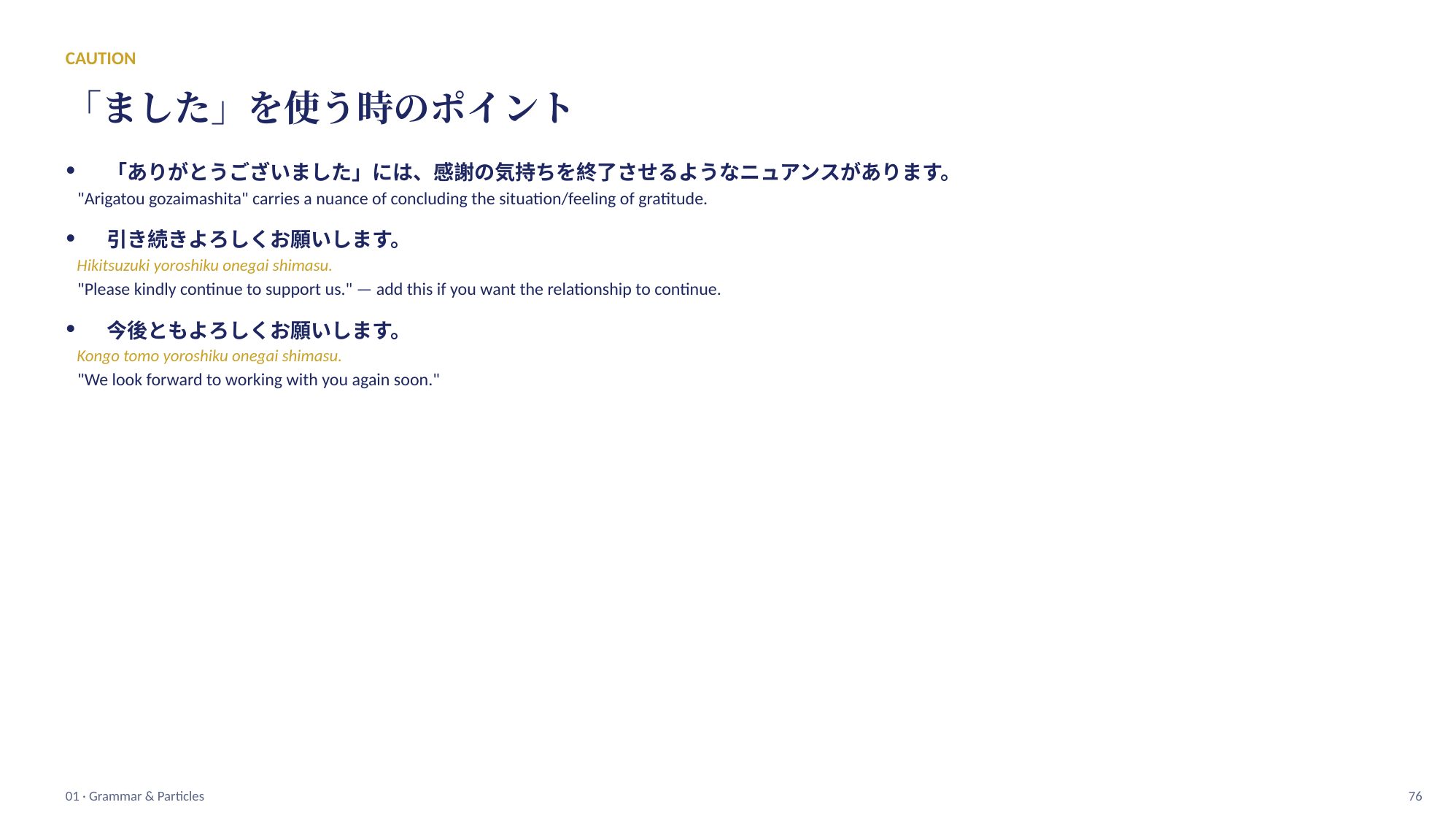
JP「ました」を使う時のポイント
•「ありがとうございました」には、感謝の気持ちを終了させるようなニュアンスがあります。
•「ありがとうございました」には、感謝の気持ちを終了させるようなニュアンスがあります。
EN "Arigatou gozaimashita" carries a nuance of concluding the situation/feeling of gratitude.
JP•引き続きよろしくお願いします。
EN Hikitsuzuki yoroshiku onegai shimasu.
"Please kindly continue to support us." — add this if you want the relationship to continue.
"Please kindly continue to support us." — add this if you want the relationship to continue.
JP•今後ともよろしくお願いします。
EN Kongo tomo yoroshiku onegai shimasu.
"We look forward to working with you again soon."
01 · Grammar & Particles 76
"We look forward to working with you again soon."
01 · Grammar & Particles 76
หน้า 77
คลิกเพื่อขยาย
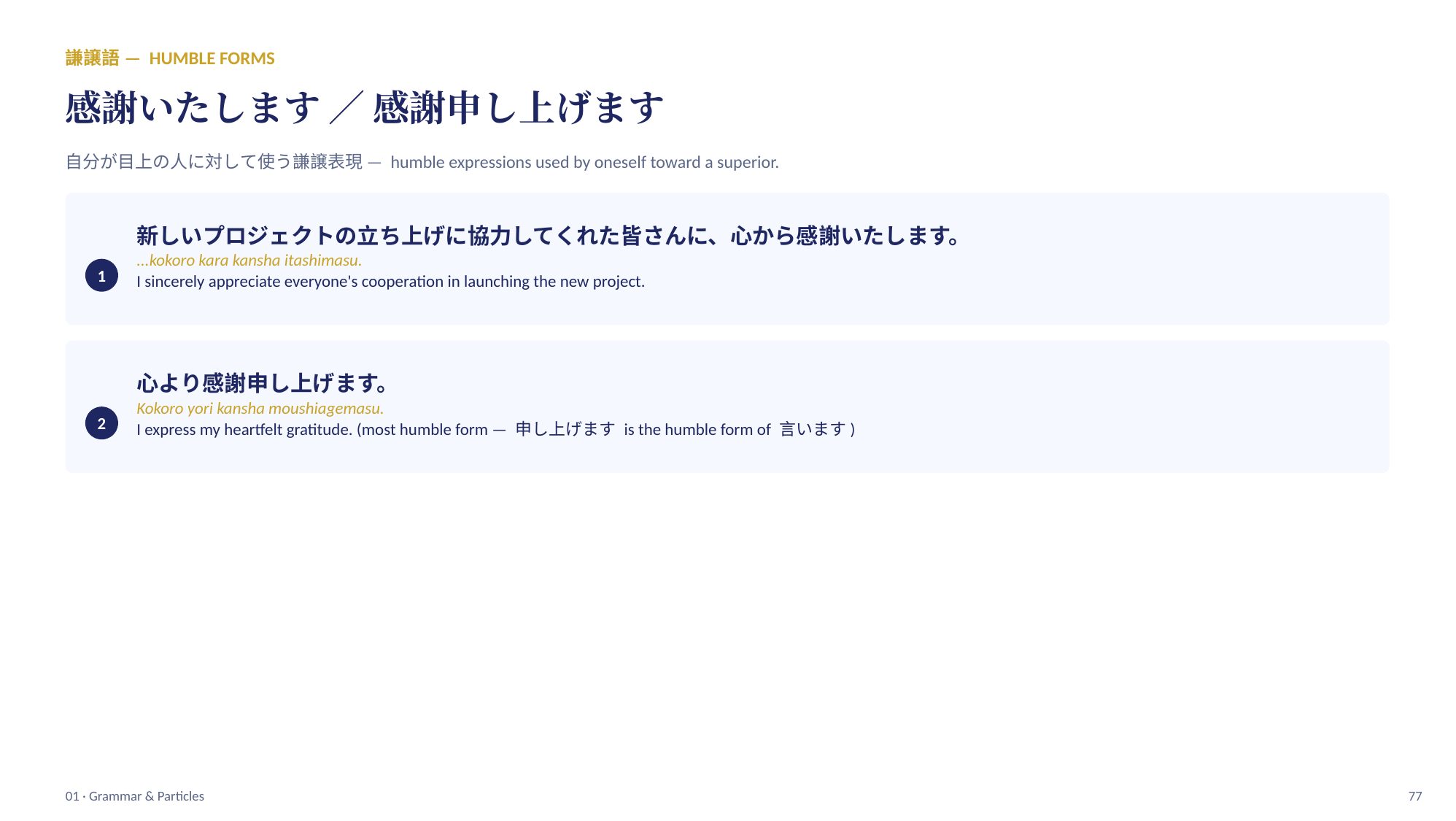
EN謙譲語 — HUMBLE FORMS
JP感謝いたします/感謝申し上げます
EN自分が目上の人に対して使う謙譲表現 — humble expressions used by oneself toward a superior.
JP新しいプロジェクトの立ち上げに協力してくれた皆さんに、心から感謝いたします。
EN ...kokoro kara kansha itashimasu.
1 I sincerely appreciate everyone's cooperation in launching the new project.
1 I sincerely appreciate everyone's cooperation in launching the new project.
JP心より感謝申し上げます。
EN Kokoro yori kansha moushiagemasu.
2 I express my heartfelt gratitude. (most humble form — 申し上げます is the humble form of 言います )
01 · Grammar & Particles 77
2 I express my heartfelt gratitude. (most humble form — 申し上げます is the humble form of 言います )
01 · Grammar & Particles 77
หน้า 78

คลิกเพื่อขยาย
14
ENN1/N2 Advanced Grammar (1)
JP原因・根拠パターン
に基づいて/に沿って/をもとに
に基づいて/に沿って/をもとに
หน้า 79
คลิกเพื่อขยาย
ENCAUSAL / BASIS
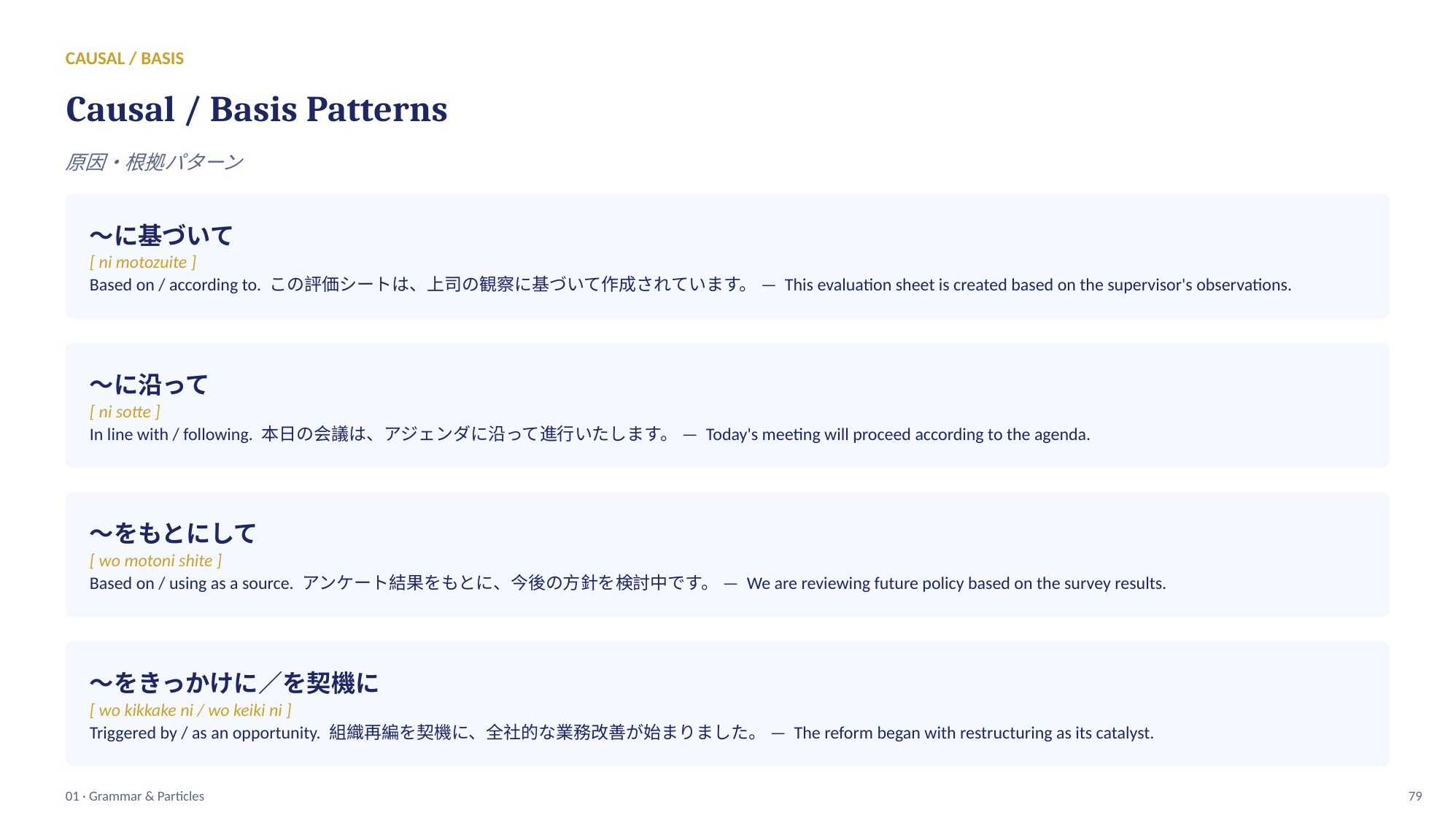
Causal / Basis Patterns
Causal / Basis Patterns
JP原因・根拠パターン
〜に基づいて
〜に基づいて
EN [ ni motozuite ]
Based on / according to. この評価シートは、上司の観察に基づいて作成されています。 — This evaluation sheet is created based on the supervisor's observations.
Based on / according to. この評価シートは、上司の観察に基づいて作成されています。 — This evaluation sheet is created based on the supervisor's observations.
JP〜に沿って
EN [ ni sotte ]
In line with / following. 本日の会議は、アジェンダに沿って進行いたします。 — Today's meeting will proceed according to the agenda.
In line with / following. 本日の会議は、アジェンダに沿って進行いたします。 — Today's meeting will proceed according to the agenda.
JP〜をもとにして
EN [ wo motoni shite ]
Based on / using as a source. アンケート結果をもとに、今後の方針を検討中です。 — We are reviewing future policy based on the survey results.
Based on / using as a source. アンケート結果をもとに、今後の方針を検討中です。 — We are reviewing future policy based on the survey results.
JP〜をきっかけに/を契機に
EN [ wo kikkake ni / wo keiki ni ]
Triggered by / as an opportunity. 組織再編を契機に、全社的な業務改善が始まりました。 — The reform began with restructuring as its catalyst.
01 · Grammar & Particles 79
Triggered by / as an opportunity. 組織再編を契機に、全社的な業務改善が始まりました。 — The reform began with restructuring as its catalyst.
01 · Grammar & Particles 79
หน้า 80
คลิกเพื่อขยาย
15
ENN1/N2 Advanced Grammar (2)
JP逆接・対比パターン
にしたところで/とはいえ/にもかかわらず
にしたところで/とはいえ/にもかかわらず
หน้า 81
คลิกเพื่อขยาย
ENCONCESSION / CONTRAST
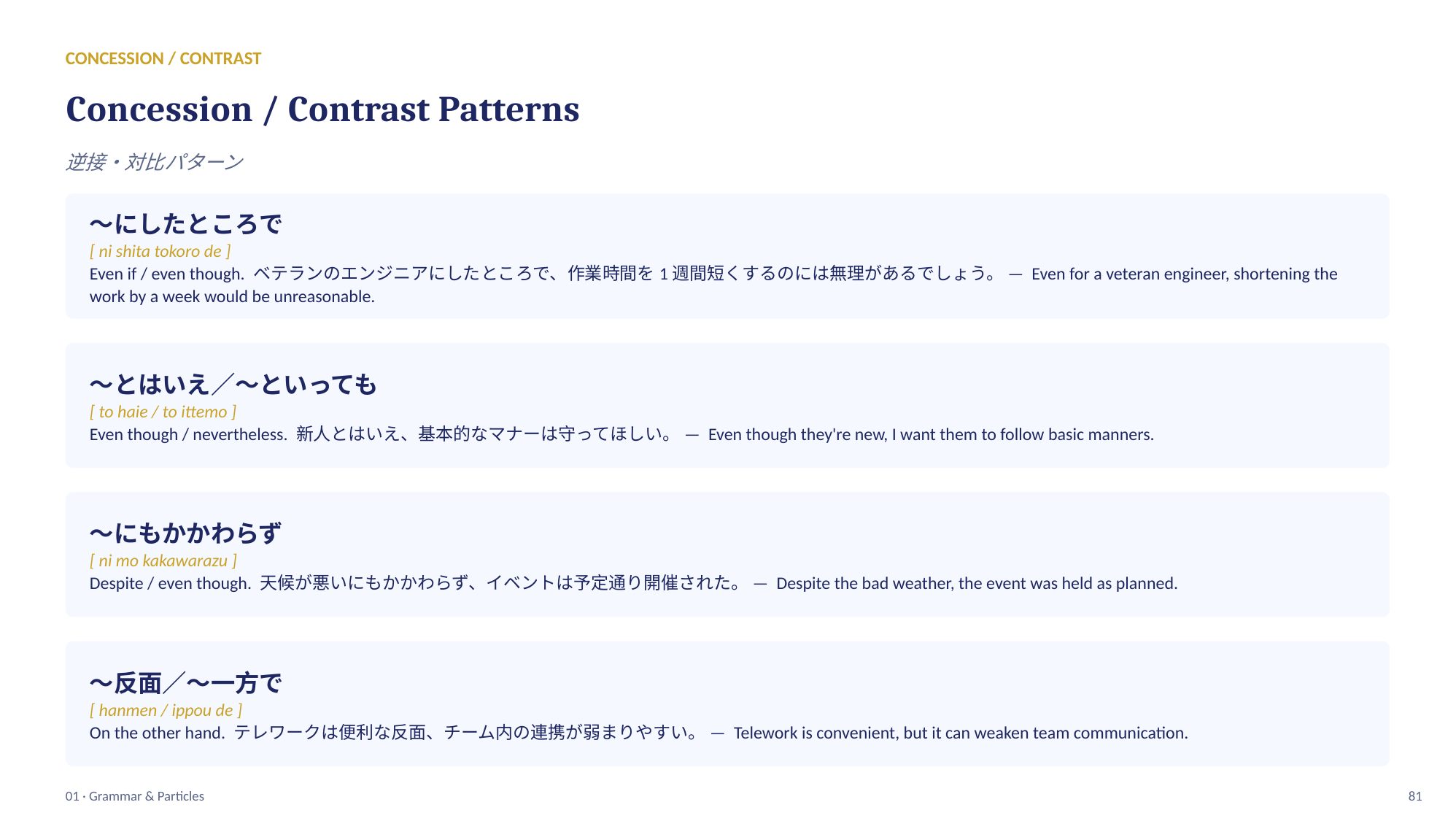
Concession / Contrast Patterns
Concession / Contrast Patterns
JP逆接・対比パターン
〜にしたところで
〜にしたところで
EN [ ni shita tokoro de ]
Even if / even though. ベテランのエンジニアにしたところで、作業時間を 1 週間短くするのには無理があるでしょう。 — Even for a veteran engineer, shortening the
work by a week would be unreasonable.
Even if / even though. ベテランのエンジニアにしたところで、作業時間を 1 週間短くするのには無理があるでしょう。 — Even for a veteran engineer, shortening the
work by a week would be unreasonable.
JP〜とはいえ/〜といっても
EN [ to haie / to ittemo ]
Even though / nevertheless. 新人とはいえ、基本的なマナーは守ってほしい。 — Even though they're new, I want them to follow basic manners.
Even though / nevertheless. 新人とはいえ、基本的なマナーは守ってほしい。 — Even though they're new, I want them to follow basic manners.
JP〜にもかかわらず
EN [ ni mo kakawarazu ]
Despite / even though. 天候が悪いにもかかわらず、イベントは予定通り開催された。 — Despite the bad weather, the event was held as planned.
Despite / even though. 天候が悪いにもかかわらず、イベントは予定通り開催された。 — Despite the bad weather, the event was held as planned.
JP〜反面/〜一方で
EN [ hanmen / ippou de ]
On the other hand. テレワークは便利な反面、チーム内の連携が弱まりやすい。 — Telework is convenient, but it can weaken team communication.
01 · Grammar & Particles 81
On the other hand. テレワークは便利な反面、チーム内の連携が弱まりやすい。 — Telework is convenient, but it can weaken team communication.
01 · Grammar & Particles 81
หน้า 82
คลิกเพื่อขยาย
16
ENN1/N2 Advanced Grammar (3)
JP時・場面パターン
に際して/の上で/が早いか/たとたん
に際して/の上で/が早いか/たとたん
หน้า 83
คลิกเพื่อขยาย
ENTIMING
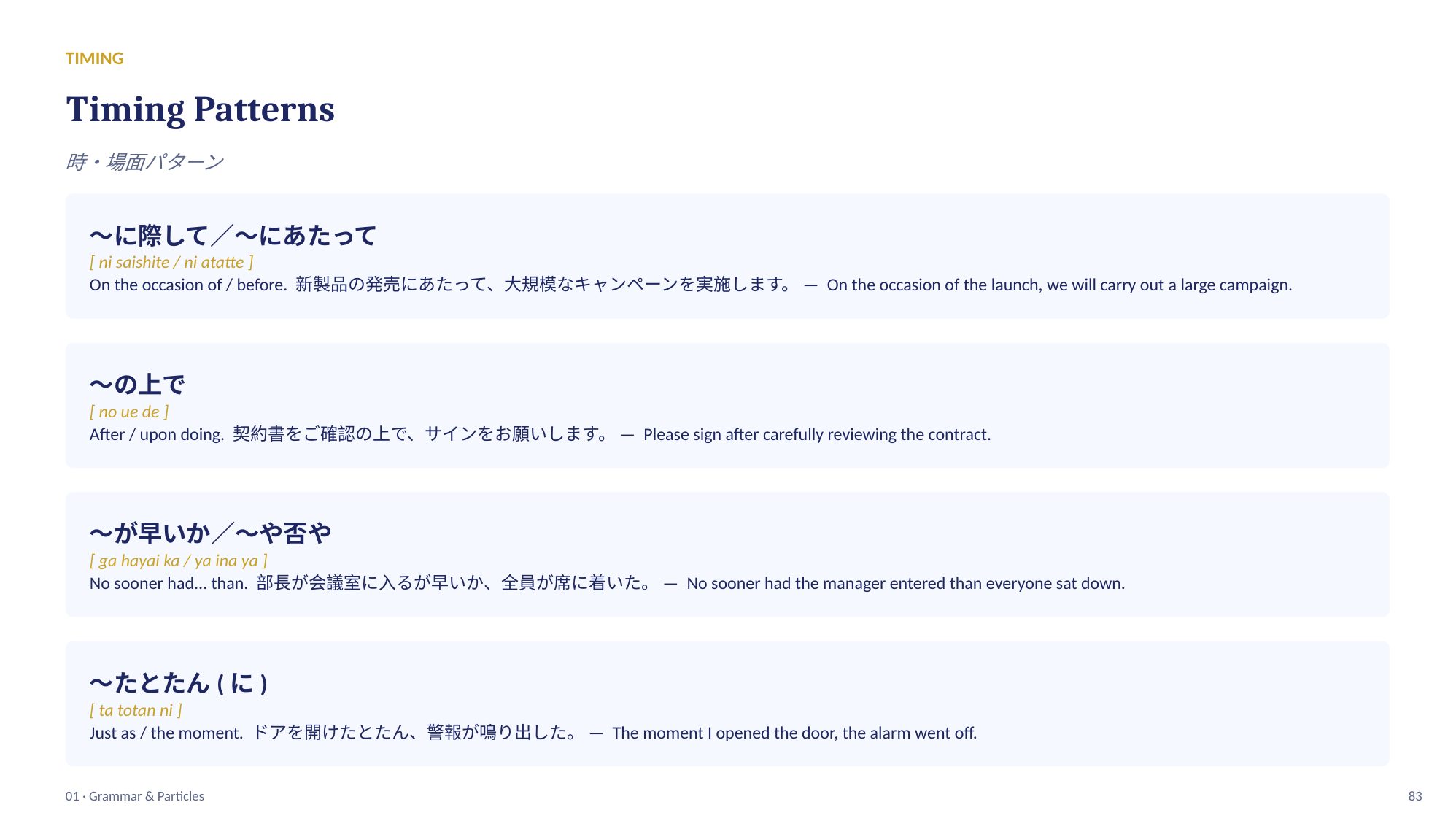
Timing Patterns
Timing Patterns
JP時・場面パターン
〜に際して/〜にあたって
〜に際して/〜にあたって
EN [ ni saishite / ni atatte ]
On the occasion of / before. 新製品の発売にあたって、大規模なキャンペーンを実施します。 — On the occasion of the launch, we will carry out a large campaign.
On the occasion of / before. 新製品の発売にあたって、大規模なキャンペーンを実施します。 — On the occasion of the launch, we will carry out a large campaign.
JP〜の上で
EN [ no ue de ]
After / upon doing. 契約書をご確認の上で、サインをお願いします。 — Please sign after carefully reviewing the contract.
After / upon doing. 契約書をご確認の上で、サインをお願いします。 — Please sign after carefully reviewing the contract.
JP〜が早いか/〜や否や
EN [ ga hayai ka / ya ina ya ]
No sooner had... than. 部長が会議室に入るが早いか、全員が席に着いた。 — No sooner had the manager entered than everyone sat down.
No sooner had... than. 部長が会議室に入るが早いか、全員が席に着いた。 — No sooner had the manager entered than everyone sat down.
JP〜たとたん(に)
EN [ ta totan ni ]
Just as / the moment. ドアを開けたとたん、警報が鳴り出した。 — The moment I opened the door, the alarm went off.
01 · Grammar & Particles 83
Just as / the moment. ドアを開けたとたん、警報が鳴り出した。 — The moment I opened the door, the alarm went off.
01 · Grammar & Particles 83
หน้า 84
คลิกเพื่อขยาย
17
ENN1/N2 Advanced Grammar (4)
JP条件・必要パターン
ものなら/ないことには/次第で/がち
ものなら/ないことには/次第で/がち
หน้า 85
คลิกเพื่อขยาย
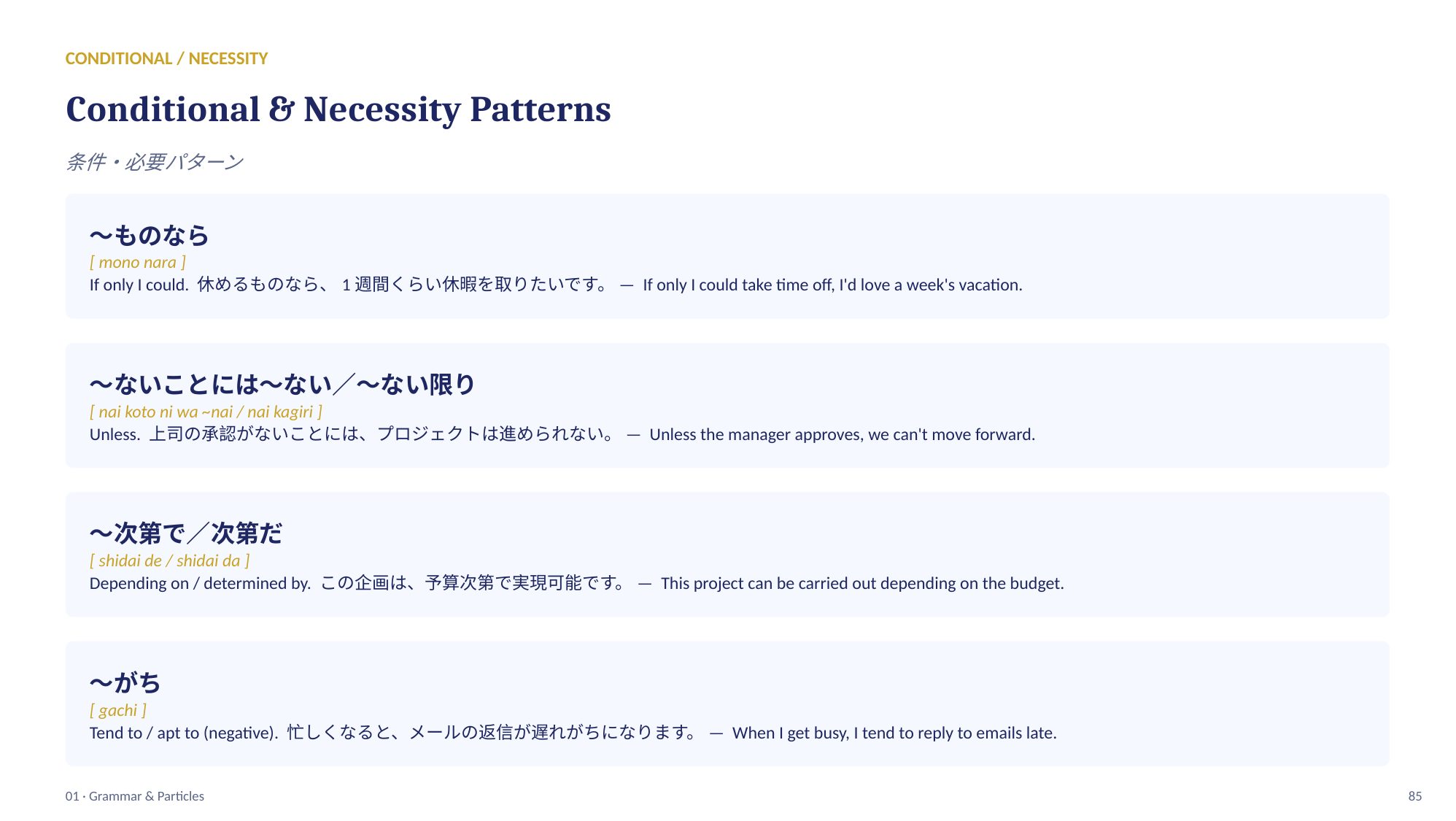
ENCONDITIONAL / NECESSITY
Conditional & Necessity Patterns
Conditional & Necessity Patterns
JP条件・必要パターン
〜ものなら
〜ものなら
EN [ mono nara ]
If only I could. 休めるものなら、 1 週間くらい休暇を取りたいです。 — If only I could take time off, I'd love a week's vacation.
If only I could. 休めるものなら、 1 週間くらい休暇を取りたいです。 — If only I could take time off, I'd love a week's vacation.
JP〜ないことには〜ない/〜ない限り
EN [ nai koto ni wa ~nai / nai kagiri ]
Unless. 上司の承認がないことには、プロジェクトは進められない。 — Unless the manager approves, we can't move forward.
Unless. 上司の承認がないことには、プロジェクトは進められない。 — Unless the manager approves, we can't move forward.
JP〜次第で/次第だ
EN [ shidai de / shidai da ]
Depending on / determined by. この企画は、予算次第で実現可能です。 — This project can be carried out depending on the budget.
Depending on / determined by. この企画は、予算次第で実現可能です。 — This project can be carried out depending on the budget.
JP〜がち
EN [ gachi ]
Tend to / apt to (negative). 忙しくなると、メールの返信が遅れがちになります。 — When I get busy, I tend to reply to emails late.
01 · Grammar & Particles 85
Tend to / apt to (negative). 忙しくなると、メールの返信が遅れがちになります。 — When I get busy, I tend to reply to emails late.
01 · Grammar & Particles 85
หน้า 86

คลิกเพื่อขยาย
18
ENN1/N2 Advanced Grammar (5)
JP推測・話題パターン
からすると/となると
からすると/となると
หน้า 87
คลิกเพื่อขยาย
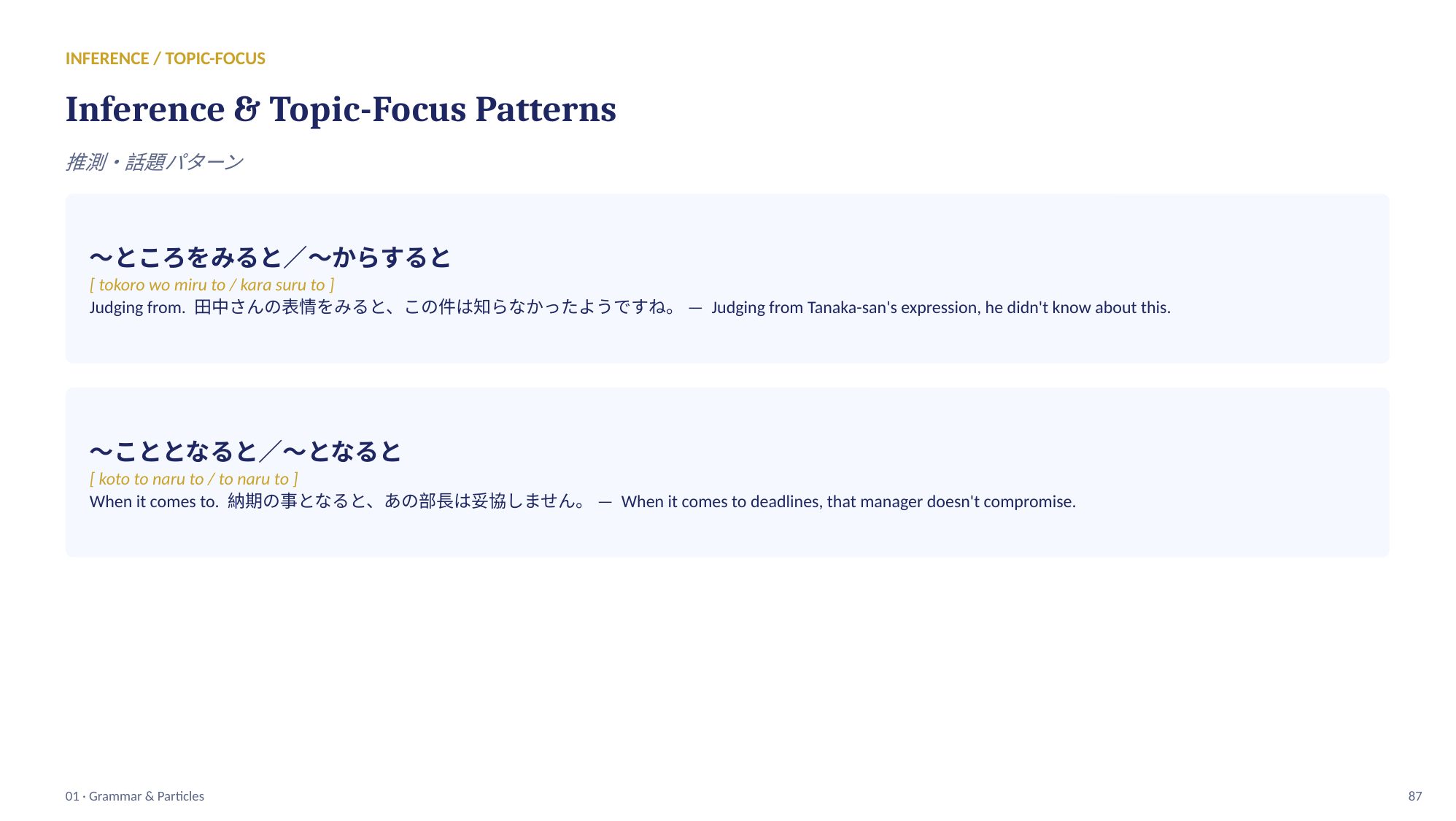
ENINFERENCE / TOPIC-FOCUS
Inference & Topic-Focus Patterns
Inference & Topic-Focus Patterns
JP推測・話題パターン
〜ところをみると/〜からすると
〜ところをみると/〜からすると
EN [ tokoro wo miru to / kara suru to ]
Judging from. 田中さんの表情をみると、この件は知らなかったようですね。 — Judging from Tanaka-san's expression, he didn't know about this.
Judging from. 田中さんの表情をみると、この件は知らなかったようですね。 — Judging from Tanaka-san's expression, he didn't know about this.
JP〜こととなると/〜となると
EN [ koto to naru to / to naru to ]
When it comes to. 納期の事となると、あの部長は妥協しません。 — When it comes to deadlines, that manager doesn't compromise.
01 · Grammar & Particles 87
When it comes to. 納期の事となると、あの部長は妥協しません。 — When it comes to deadlines, that manager doesn't compromise.
01 · Grammar & Particles 87
หน้า 88
คลิกเพื่อขยาย
19
ENReason: Formality Comparison
JP理由フォーマル度比較
ENにつき/ため・から/ので・せいで — ranked by formality
หน้า 89
คลิกเพื่อขยาย
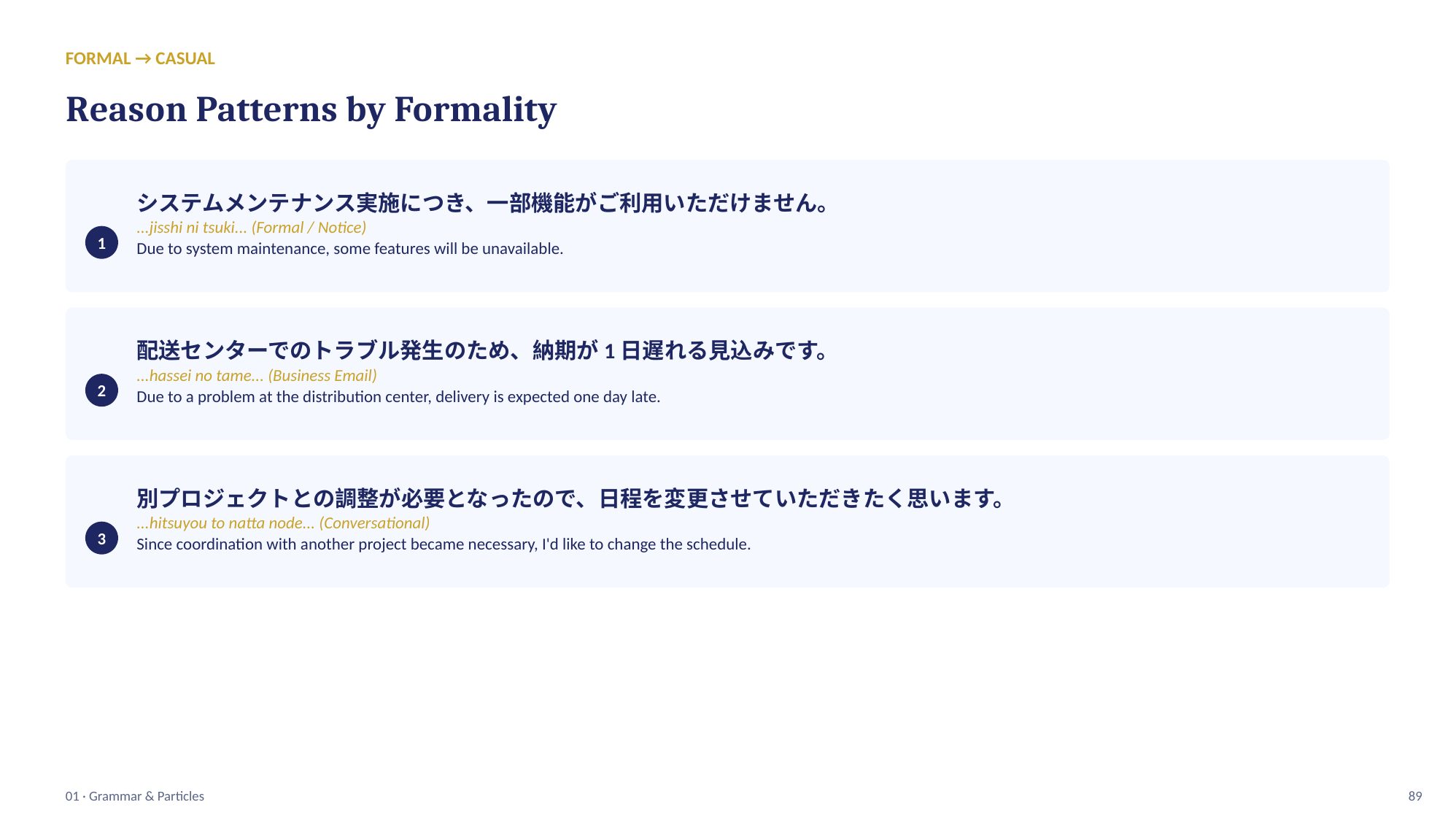
ENFORMAL → CASUAL
Reason Patterns by Formality
Reason Patterns by Formality
JPシステムメンテナンス実施につき、一部機能がご利用いただけません。
EN ...jisshi ni tsuki... (Formal / Notice)
1 Due to system maintenance, some features will be unavailable.
1 Due to system maintenance, some features will be unavailable.
JP配送センターでのトラブル発生のため、納期が1日遅れる見込みです。
EN ...hassei no tame... (Business Email)
2 Due to a problem at the distribution center, delivery is expected one day late.
2 Due to a problem at the distribution center, delivery is expected one day late.
JP別プロジェクトとの調整が必要となったので、日程を変更させていただきたく思います。
EN ...hitsuyou to natta node... (Conversational)
3 Since coordination with another project became necessary, I'd like to change the schedule.
01 · Grammar & Particles 89
3 Since coordination with another project became necessary, I'd like to change the schedule.
01 · Grammar & Particles 89